
Environmental, Health, and Safety General Guidelines
|
|
|
- Job Thomas
- 10 years ago
- Views:
Transcription
1 GENERAL EHS GUIDELINES: INTRODUCTION Envirnmental, Health, and Safety General Guidelines Intrductin The Envirnmental, Health, and Safety (EHS) Guidelines are technical reference dcuments with general and industry-specific examples f Gd Internatinal Industry Practice (GIIP) 1. When ne r mre members f the Wrld Bank Grup are invlved in a prject, these EHS Guidelines are applied as required by their respective plicies and standards. These General EHS Guidelines are designed t be used tgether with the relevant Industry Sectr EHS Guidelines which prvide guidance t users n EHS issues in specific industry sectrs. Fr cmplex prjects, use f multiple industry-sectr guidelines may be necessary. A cmplete list f industry-sectr guidelines can be fund at: The EHS Guidelines cntain the perfrmance levels and measures that are generally cnsidered t be achievable in new facilities by existing technlgy at reasnable csts. Applicatin f the EHS Guidelines t existing facilities may invlve the establishment f site-specific targets, with an apprpriate timetable fr achieving them. The applicability f the EHS Guidelines shuld be tailred t the hazards and risks established fr each prject n the basis f the results f an envirnmental assessment 2 in which site-specific variables, such as hst cuntry cntext, assimilative capacity f the envirnment, and ther prject factrs, are taken int accunt. The applicability f specific technical recmmendatins shuld be 1 Defined as the exercise f prfessinal skill, diligence, prudence and fresight that wuld be reasnably expected frm skilled and experienced prfessinals engaged in the same type f undertaking under the same r similar circumstances glbally. The circumstances that skilled and experienced prfessinals may find when evaluating the range f pllutin preventin and cntrl techniques available t a prject may include, but are nt limited t, varying levels f envirnmental degradatin and envirnmental assimilative capacity as well as varying levels f financial and technical feasibility. 2 Fr IFC, such assessment is carried ut cnsistent with Perfrmance Standard 1, and fr the Wrld Bank, with Operatinal Plicy based n the prfessinal pinin f qualified and experienced persns. When hst cuntry regulatins differ frm the levels and measures presented in the EHS Guidelines, prjects are expected t achieve whichever is mre stringent. If less stringent levels r measures than thse prvided in these EHS Guidelines are apprpriate, in view f specific prject circumstances, a full and detailed justificatin fr any prpsed alternatives is needed as part f the site-specific envirnmental assessment. This justificatin shuld demnstrate that the chice fr any alternate perfrmance levels is prtective f human health and the envirnment. The General EHS Guidelines are rganized as fllws: 1. Envirnmental Air Emissins and Ambient Air Quality Energy Cnservatin Wastewater and Ambient Water Quality Water Cnservatin Hazardus Materials Management Waste Management Nise Cntaminated Land Occupatinal Health and Safety General Facility Design and Operatin Cmmunicatin and Training Physical Hazards Chemical Hazards Bilgical Hazards Radilgical Hazards Persnal Prtective Equipment (PPE) Special Hazard Envirnments Mnitring Cmmunity Health and Safety Water Quality and Availability Structural Safety f Prject Infrastructure Life and Fire Safety (L&FS) Traffic Safety Transprt f Hazardus Materials Disease Preventin Emergency Preparedness and Respnse Cnstructin and Decmmissining Envirnment Occupatinal Health & Safety Cmmunity Health & Safety 94 References and Additinal Surces* 96 APRIL 30,

2 Envirnmental, Health, and Safety Guidelines GENERAL EHS GUIDELINES: INTRODUCTION General Apprach t the Management f EHS Issues at the Facility r Prject Level Effective management f envirnmental, health, and safety (EHS) issues entails the inclusin f EHS cnsideratins int crprate- and facility-level business prcesses in an rganized, hierarchical apprach that includes the fllwing steps: Identifying EHS prject hazards 3 and assciated risks 4 as early as pssible in the facility develpment r prject cycle, including the incrpratin f EHS cnsideratins int the site selectin prcess, prduct design prcess, engineering planning prcess fr capital requests, engineering wrk rders, facility mdificatin authrizatins, r layut and prcess change plans. Invlving EHS prfessinals, wh have the experience, cmpetence, and training necessary t assess and manage EHS impacts and risks, and carry ut specialized envirnmental management functins including the preparatin f prject r activity-specific plans and prcedures that incrprate the technical recmmendatins presented in this dcument that are relevant t the prject. Understanding the likelihd and magnitude f EHS risks, based n: peple r t the envirnmental resurces n which they depend. Priritizing risk management strategies with the bjective f achieving an verall reductin f risk t human health and the envirnment, fcusing n the preventin f irreversible and / r significant impacts. Favring strategies that eliminate the cause f the hazard at its surce, fr example, by selecting less hazardus materials r prcesses that avid the need fr EHS cntrls. When impact avidance is nt feasible, incrprating engineering and management cntrls t reduce r minimize the pssibility and magnitude f undesired cnsequences, fr example, with the applicatin f pllutin cntrls t reduce the levels f emitted cntaminants t wrkers r envirnments. Preparing wrkers and nearby cmmunities t respnd t accidents, including prviding technical and financial resurces t effectively and safely cntrl such events, and restring wrkplace and cmmunity envirnments t a safe and healthy cnditin. Imprving EHS perfrmance thrugh a cmbinatin f nging mnitring f facility perfrmance and effective accuntability. The nature f the prject activities, such as whether the prject will generate significant quantities f emissins r effluents, r invlve hazardus materials r prcesses; The ptential cnsequences t wrkers, cmmunities, r the envirnment if hazards are nt adequately managed, which may depend n the prximity f prject activities t 3 Defined as threats t humans and what they value (Kates, et al., 1985). 4 Defined as quantitative measures f hazard cnsequences, usually expressed as cnditinal prbabilities f experiencing harm (Kates, et. al., 1985) APRIL 30,

3 Envirnmental, Health, and Safety Guidelines AIR EMISSIONS AND AMBIENT AIR QUALITY 1.0 Envirnmental 1.1 Air Emissins and Ambient Air Quality Applicability and Apprach...3 Ambient Air Quality...4 General Apprach...4 Prjects Lcated in Degraded Airsheds r Eclgically Sensitive Areas...5 Pint Surces...5 Stack Height...5 Small Cmbustin Facilities Emissins Guidelines...6 Fugitive Surces...8 Vlatile Organic Cmpunds (VOCs)...8 Particulate Matter (PM)...8 Ozne Depleting Substances (ODS)...9 Mbile Surces Land-based...9 Greenhuse Gases (GHGs)...9 Mnitring...10 Mnitring f Small Cmbustin Plants Emissins...11 Applicability and Apprach This guideline applies t facilities r prjects that generate emissins t air at any stage f the prject life-cycle. It cmplements the industry-specific emissins guidance presented in the Industry Sectr Envirnmental, Health, and Safety (EHS) Guidelines by prviding infrmatin abut cmmn techniques fr emissins management that may be applied t a range f industry sectrs. This guideline prvides an apprach t the management f significant surces f emissins, including specific guidance fr assessment and mnitring f impacts. It is als intended t prvide additinal infrmatin n appraches t emissins management in prjects lcated in areas f pr air quality, where it may be necessary t establish prject-specific emissins standards. the spatial characteristic f the surce including pint surces, fugitive surces, and mbile surces and, further, by prcess, such as cmbustin, materials strage, r ther industry sectrspecific prcesses. Where pssible, facilities and prjects shuld avid, minimize, and cntrl adverse impacts t human health, safety, and the envirnment frm emissins t air. Where this is nt pssible, the generatin and release f emissins f any type shuld be managed thrugh a cmbinatin f: Energy use efficiency Prcess mdificatin Selectin f fuels r ther materials, the prcessing f which may result in less plluting emissins Applicatin f emissins cntrl techniques The selected preventin and cntrl techniques may include ne r mre methds f treatment depending n: Regulatry requirements Significance f the surce Lcatin f the emitting facility relative t ther surces Lcatin f sensitive receptrs Existing ambient air quality, and ptential fr degradatin f the airshed frm a prpsed prject Technical feasibility and cst effectiveness f the available ptins fr preventin, cntrl, and release f emissins Emissins f air pllutants can ccur frm a wide variety f activities during the cnstructin, peratin, and decmmissining phases f a prject. These activities can be categrized based n APRIL 30,

4 Envirnmental, Health, and Safety Guidelines AIR EMISSIONS AND AMBIENT AIR QUALITY Ambient Air Quality General Apprach Prjects with significant 5,6 surces f air emissins, and ptential fr significant impacts t ambient air quality, shuld prevent r minimize impacts by ensuring that: Emissins d nt result in pllutant cncentratins that reach r exceed relevant ambient quality guidelines and standards 9 by applying natinal legislated standards, r in their absence, the current WHO Air Quality Guidelines 10 (see Table 1.1.1), r ther internatinally recgnized surces 11 ; Emissins d nt cntribute a significant prtin t the attainment f relevant ambient air quality guidelines r standards. As a general rule, this Guideline suggests 25 percent f the applicable air quality standards t allw 5 Significant surces f pint and fugitive emissins are cnsidered t be general surces which, fr example, can cntribute a net emissins increase f ne r mre f the fllwing pllutants within a given airshed: PM10: 50 tns per year (tpy); NOx: 500 tpy; SO2: 500 tpy; r as established thrugh natinal legislatin; and cmbustin surces with an equivalent heat input f 50 MWth r greater. The significance f emissins f inrganic and rganic pllutants shuld be established n a prject-specific basis taking int accunt txic and ther prperties f the pllutant. 6 United States Envirnmental Prtectin Agency, Preventin f Significant Deteriratin f Air Quality, 40 CFR Ch. 1 Part Other references fr establishing significant emissins include the Eurpean Cmmissin Guidance Dcument fr EPER implementatin. ; and Australian Gvernment Natinal Pllutant Inventry Guide. 7 Wrld Health Organizatin (WHO). Air Quality Guidelines Glbal Update, PM 24-hur value is the 99th percentile. 8 Interim targets are prvided in recgnitin f the need fr a staged apprach t achieving the recmmended guidelines. 9 Ambient air quality standards are ambient air quality levels established and published thrugh natinal legislative and regulatry prcesses, and ambient quality guidelines refer t ambient quality levels primarily develped thrugh clinical, txiclgical, and epidemilgical evidence (such as thse published by the Wrld Health Organizatin). 10 Available at Wrld Health Organizatin (WHO) Fr example the United States Natinal Ambient Air Quality Standards (NAAQS) ( and the relevant Eurpean Cuncil Directives (Cuncil Directive 1999/30/EC f 22 April 1999 / Cuncil Directive 2002/3/EC f February ). additinal, future sustainable develpment in the same airshed. 12 At facility level, impacts shuld be estimated thrugh qualitative r quantitative assessments by the use f baseline air quality assessments and atmspheric dispersin mdels t assess ptential grund level cncentratins. Lcal atmspheric, climatic, and air quality data shuld be applied when mdeling dispersin, prtectin against atmspheric dwnwash, wakes, r eddy effects f the surce, nearby 13 structures, and terrain features. The dispersin mdel applied shuld be internatinally recgnized, r cmparable. Examples f acceptable emissin estimatin and dispersin mdeling appraches fr pint and fugitive surces are Table 1.1.1: WHO Ambient Air Quality Guidelines 7, 8 Sulfur dixide (SO2) Nitrgen dixide (NO2) Particulate Matter PM10 Particulate Matter PM2.5 Ozne Averaging Perid 24-hur 10 minute 1-year 1-hur 1-year 24-hur 1-year 24-hur 8-hur daily maximum Guideline value in mg/m (Interim target-1) 50 (Interim target-2) 20 (guideline) 500 (guideline) 40 (guideline) 200 (guideline) 70 (Interim target-1) 50 (Interim target-2) 30 (Interim target-3) 20 (guideline) 150 (Interim target-1) 100 (Interim target-2) 75 (Interim target-3) 50 (guideline) 35 (Interim target-1) 25 (Interim target-2) 15 (Interim target-3) 10 (guideline) 75 (Interim target-1) 50 (Interim target-2) 37.5 (Interim target-3) 25 (guideline) 160 (Interim target-1) 100 (guideline) 12 US EPA Preventin f Significant Deteriratin Increments Limits applicable t nn-degraded airsheds. APRIL 30,

5 Envirnmental, Health, and Safety Guidelines AIR EMISSIONS AND AMBIENT AIR QUALITY included in Annex These appraches include screening mdels fr single surce evaluatins (SCREEN3 r AIRSCREEN), as well as mre cmplex and refined mdels (AERMOD OR ADMS). Mdel selectin is dependent n the cmplexity and gemrphlgy f the prject site (e.g. muntainus terrain, urban r rural area). Prjects Lcated in Degraded Airsheds r Eclgically Sensitive Areas Facilities r prjects lcated within pr quality airsheds 14, and within r next t areas established as eclgically sensitive (e.g. natinal parks), shuld ensure that any increase in pllutin levels is as small as feasible, and amunts t a fractin f the applicable shrt-term and annual average air quality guidelines r standards as established in the prject-specific envirnmental assessment. Suitable mitigatin measures may als include the relcatin f significant surces f emissins utside the airshed in questin, use f cleaner fuels r technlgies, applicatin f cmprehensive pllutin cntrl measures, ffset activities at installatins cntrlled by the prject spnsr r ther facilities within the same airshed, and buy-dwn f emissins within the same airshed. Specific prvisins fr minimizing emissins and their impacts in pr air quality r eclgically sensitive airsheds shuld be established n a prject-by-prject r industry-specific basis. Offset prvisins utside the immediate cntrl f the prject spnsr r buy-dwns shuld be mnitred and enfrced by the lcal agency respnsible fr granting and mnitring emissin permits. Such prvisins shuld be in place prir t final cmmissining f the facility / prject. Pint Surces Pint surces are discrete, statinary, identifiable surces f emissins that release pllutants t the atmsphere. They are typically lcated in manufacturing r prductin plants. Within a given pint surce, there may be several individual emissin pints that cmprise the pint surce. 15 Pint surces are characterized by the release f air pllutants typically assciated with the cmbustin f fssil fuels, such as nitrgen xides (NOx), sulfur dixide (SO2), carbn mnxide (CO), and particulate matter (PM), as well as ther air pllutants including certain vlatile rganic cmpunds (VOCs) and metals that may als be assciated with a wide range f industrial activities. Emissins frm pint surces shuld be avided and cntrlled accrding t gd internatinal industry practice (GIIP) applicable t the relevant industry sectr, depending n ambient cnditins, thrugh the cmbined applicatin f prcess mdificatins and emissins cntrls, examples f which are prvided in Annex Additinal recmmendatins regarding stack height and emissins frm small cmbustin facilities are prvided belw. Stack Height The stack height fr all pint surces f emissins, whether significant r nt, shuld be designed accrding t GIIP (see Annex 1.1.3) t avid excessive grund level cncentratins due t dwnwash, wakes, and eddy effects, and t ensure reasnable diffusin t minimize impacts. Fr prjects where there are multiple surces f emissins, stack heights shuld be established with due cnsideratin t emissins frm all ther prject surces, bth pint and fugitive. Nn-significant surces f emissins, 13 Nearby generally cnsiders an area within a radius f up t 20 times the stack height. 14 An airshed shuld be cnsidered as having pr air quality if natinally legislated air quality standards r WHO Air Quality Guidelines are exceeded significantly. 15 Emissin pints refer t a specific stack, vent, r ther discrete pint f pllutin release. This term shuld nt be cnfused with pint surce, which is a regulatry distinctin frm area and mbile surces. The characterizatin f pint surces int multiple emissins pints is useful fr allwing mre detailed reprting f emissins infrmatin. APRIL 30,

6 Envirnmental, Health, and Safety Guidelines AIR EMISSIONS AND AMBIENT AIR QUALITY including small cmbustin surces, 16 shuld als use GIIP in stack design. Small Cmbustin Facilities Emissins Guidelines Small cmbustin prcesses are systems designed t deliver electrical r mechanical pwer, steam, heat, r any cmbinatin f these, regardless f the fuel type, with a ttal, rated heat input capacity f between three Megawatt thermal (MWth) and 50 MWth. The emissins guidelines in Table are applicable t small cmbustin prcess installatins perating mre than 500 hurs per year, and thse with an annual capacity utilizatin f mre than 30 percent. Plants firing a mixture f fuels shuld cmpare emissins perfrmance with these guidelines based n the sum f the relative cntributin f each applied fuel 17. Lwer emissin values may apply if the prpsed facility is lcated in an eclgically sensitive airshed, r airshed with pr air quality, in rder t address ptential cumulative impacts frm the installatin f mre than ne small cmbustin plant as part f a distributed generatin prject. 16 Small cmbustin surces are thse with a ttal rated heat input capacity f 50MWth r less. 17 The cntributin f a fuel is the percentage f heat input (LHV) prvided by this fuel multiplied by its limit value. APRIL 30,

7 Envirnmental, Health, and Safety Guidelines AIR EMISSIONS AND AMBIENT AIR QUALITY Cmbustin Technlgy / Fuel Engine Table Small Cmbustin Facilities Emissins Guidelines (3MWth 50MWth) (in mg/nm 3 r as indicated) Particulate Matter (PM) Sulfur Dixide (SO2) Nitrgen Oxides (NOx) Gas N/A N/A Liquid Turbine Natural Gas =3MWth t < 15MWth Natural Gas =15MWth t < 50MWth 50 r up t 100 if justified by prject specific cnsideratins (e.g. Ecnmic feasibility f using lwer ash cntent fuel, r adding secndary treatment t meet 50, and available envirnmental capacity f the site) N/A 1.5 percent Sulfur r up t 3.0 percent Sulfur if justified by prject specific cnsideratins (e.g. Ecnmic feasibility f using lwer S cntent fuel, r adding secndary treatment t meet levels f using 1.5 percent Sulfur, and available envirnmental capacity f the site) N/A 200 (Spark Ignitin) 400 (Dual Fuel) 1,600 (Cmpressin Ignitin) If bre size diameter [mm] < 400: 1460 (r up t 1,600 if justified t maintain high energy efficiency.) If bre size diameter [mm] > r = 400: 1, ppm (Electric generatin) 100 ppm (Mechanical drive) Dry Gas, Excess O2 Cntent (%) N/A N/A 25 ppm Fuels ther than Natural Gas =3MWth t < 15MWth N/A 0.5 percent Sulfur r lwer percent Sulfur (e.g. 0.2 percent Sulfur) if cmmercially available withut significant excess fuel cst 96 ppm (Electric generatin) 150 ppm (Mechanical drive) 15 Fuels ther than Natural Gas =15MWth t < 50MWth Biler N/A 0.5% S r lwer % S (0.2%S) if cmmercially available withut significant excess fuel cst 74 ppm 15 Gas N/A N/A Liquid 50 r up t 150 if justified by envirnmental assessment Slid 50 r up t 150 if justified by envirnmental assessment Ntes: -N/A/ - n emissins guideline; Higher perfrmance levels than these in the Table shuld be applicable t facilities lcated in urban / industrial areas with degraded airsheds r clse t eclgically sensitive areas where mre stringent emissins cntrls may be needed.; MWth is heat input n HHV basis; Slid fuels include bimass; Nm 3 is at ne atmsphere pressure, 0 C.; MWth categry is t apply t the entire facility cnsisting f multiple units that are reasnably cnsidered t be emitted frm a cmmn stack except fr NOx and PM limits fr turbines and bilers. Guidelines values apply t facilities perating mre than 500 hurs per year with an annual capacity utilizatin factr f mre than 30 percent. APRIL 30,

8 Envirnmental, Health, and Safety Guidelines AIR EMISSIONS AND AMBIENT AIR QUALITY Fugitive Surces Fugitive surce air emissins refer t emissins that are distributed spatially ver a wide area and nt cnfined t a specific discharge pint. They riginate in peratins where exhausts are nt captured and passed thrugh a stack. Fugitive emissins have the ptential fr much greater grund-level impacts per unit than statinary surce emissins, since they are discharged and dispersed clse t the grund. The tw main types f fugitive emissins are Vlatile Organic Cmpunds (VOCs) and particulate matter (PM). Other cntaminants (NOx, SO2 and CO) are mainly assciated with cmbustin prcesses, as described abve. Prjects with ptentially significant fugitive surces f emissins shuld establish the need fr ambient quality assessment and mnitring practices. Open burning f slid wastes, whether hazardus r nnhazardus, is nt cnsidered gd practice and shuld be avided, as the generatin f plluting emissins frm this type f surce cannt be cntrlled effectively. Vlatile Organic Cmpunds (VOCs) The mst cmmn surces f fugitive VOC emissins are assciated with industrial activities that prduce, stre, and use VOC-cntaining liquids r gases where the material is under pressure, expsed t a lwer vapr pressure, r displaced frm an enclsed space. Typical surces include equipment leaks, pen vats and mixing tanks, strage tanks, unit peratins in wastewater treatment systems, and accidental releases. Equipment leaks include valves, fittings, and elbws which are subject t leaks under pressure. The recmmended preventin and cntrl techniques fr VOC emissins assciated with equipment leaks include: Equipment mdificatins, examples f which are presented in Annex 1.1.4; Implementing a leak detectin and repair (LDAR) prgram that cntrls fugitive emissins by regularly mnitring t detect leaks, and implementing repairs within a predefined time perid. 18 Fr VOC emissins assciated with handling f chemicals in pen vats and mixing prcesses, the recmmended preventin and cntrl techniques include: Substitutin f less vlatile substances, such as aqueus slvents; Cllectin f vaprs thrugh air extractrs and subsequent treatment f gas stream by remving VOCs with cntrl devices such as cndensers r activated carbn absrptin; Cllectin f vaprs thrugh air extractrs and subsequent treatment with destructive cntrl devices such as: Catalytic Incineratrs: Used t reduce VOCs frm prcess exhaust gases exiting paint spray bths, vens, and ther prcess peratins Thermal Incineratrs: Used t cntrl VOC levels in a gas stream by passing the stream thrugh a cmbustin chamber where the VOCs are burned in air at temperatures between 700º C t 1,300º C Enclsed Oxidizing Flares: Used t cnvert VOCs int CO2 and H2O by way f direct cmbustin Use f flating rfs n strage tanks t reduce the pprtunity fr vlatilizatin by eliminating the headspace present in cnventinal strage tanks. Particulate Matter (PM) The mst cmmn pllutant invlved in fugitive emissins is dust r particulate matter (PM). This is released during certain peratins, such as transprt and pen strage f slid materials, and frm expsed sil surfaces, including unpaved rads. 18 Fr mre infrmatin, see Leak Detectin and Repair Prgram (LDAR), at: APRIL 30,

9 Envirnmental, Health, and Safety Guidelines AIR EMISSIONS AND AMBIENT AIR QUALITY Recmmended preventin and cntrl f these emissins surces include: Use f dust cntrl methds, such as cvers, water suppressin, r increased misture cntent fr pen materials strage piles, r cntrls, including air extractin and treatment thrugh a baghuse r cyclne fr material handling surces, such as cnveyrs and bins; Use f water suppressin fr cntrl f lse materials n paved r unpaved rad surfaces. Oil and il by-prducts is nt a recmmended methd t cntrl rad dust. Examples f additinal cntrl ptins fr unpaved rads include thse summarized in Annex Ozne Depleting Substances (ODS) Several chemicals are classified as zne depleting substances (ODSs) and are scheduled fr phase-ut under the Mntreal Prtcl n Substances that Deplete the Ozne Layer. 19 N new systems r prcesses shuld be installed using CFCs, halns, 1,1,1-trichlrethane, carbn tetrachlride, methyl brmide r HBFCs. HCFCs shuld nly be cnsidered as interim / bridging alternatives as determined by the hst cuntry cmmitments and regulatins. 20 Mbile Surces Land-based Similar t ther cmbustin prcesses, emissins frm vehicles include CO, NOx, SO2, PM and VOCs. Emissins frm n-rad and ff-rad vehicles shuld cmply with natinal r reginal 19 Examples include: chlrflurcarbns (CFCs); halns; 1,1,1-trichlrethane (methyl chlrfrm); carbn tetrachlride; hydrchlrflurcarbns (HCFCs); hydrbrmflurcarbns (HBFCs); and methyl brmide. They are currently used in a variety f applicatins including: dmestic, cmmercial, and prcess refrigeratin (CFCs and HCFCs); dmestic, cmmercial, and mtr vehicle air cnditining (CFCs and HCFCs); fr manufacturing fam prducts (CFCs); fr slvent cleaning applicatins (CFCs, HCFCs, methyl chlrfrm, and carbn tetrachlride); as aersl prpellants (CFCs); in fire prtectin systems (halns and HBFCs); and as crp fumigants (methyl brmide). 20 Additinal infrmatin is available thrugh the Mntreal Prtcl Secretariat web site available at: prgrams. In the absence f these, the fllwing apprach shuld be cnsidered: Regardless f the size r type f vehicle, fleet wners / peratrs shuld implement the manufacturer recmmended engine maintenance prgrams; Drivers shuld be instructed n the benefits f driving practices that reduce bth the risk f accidents and fuel cnsumptin, including measured acceleratin and driving within safe speed limits; Operatrs with fleets f 120 r mre units f heavy duty vehicles (buses and trucks), r 540 r mre light duty vehicles 21 (cars and light trucks) within an airshed shuld cnsider additinal ways t reduce ptential impacts including: Replacing lder vehicles with newer, mre fuel efficient alternatives Cnverting high-use vehicles t cleaner fuels, where feasible Installing and maintaining emissins cntrl devices, such as catalytic cnverters Implementing a regular vehicle maintenance and repair prgram Greenhuse Gases (GHGs) Sectrs that may have ptentially significant emissins f greenhuse gases (GHGs) 22 include energy, transprt, heavy industry (e.g. cement prductin, irn / steel manufacturing, aluminum smelting, petrchemical industries, petrleum refining, fertilizer manufacturing), agriculture, frestry and waste management. GHGs may be generated frm direct emissins 21 The selected fleet size threshlds are assumed t represent ptentially significant surces f emissins based n individual vehicles traveling 100,000 km / yr using average emissin factrs. 22 The six greenhuse gases that frm part f the Kyt Prtcl t the United Natins Framewrk Cnventin n Climate Change include carbn dixide (C02); methane (CH4); nitrus xide (N2O); hydrflurcarbns (HFCs); perflurcarbns (PFCs); and sulfur hexafluride (SF 6). APRIL 30,

10 Envirnmental, Health, and Safety Guidelines AIR EMISSIONS AND AMBIENT AIR QUALITY frm facilities within the physical prject bundary and indirect emissins assciated with the ff-site prductin f pwer used by the prject. Recmmendatins fr reductin and cntrl f greenhuse gases include: Carbn financing; 23 Enhancement f energy efficiency (see sectin n Energy Cnservatin ); Prtectin and enhancement f sinks and reservirs f greenhuse gases; Prmtin f sustainable frms f agriculture and frestry; Prmtin, develpment and increased use f renewable frms f energy; Carbn capture and strage technlgies; 24 Limitatin and / r reductin f methane emissins Mnitring thrugh recvery and use in waste management, as well as in the prductin, transprt and distributin f energy (cal, il, and gas). Emissins and air quality mnitring prgrams prvide infrmatin that can be used t assess the effectiveness f emissins management strategies. A systematic planning prcess is recmmended t ensure that the data cllected are adequate fr their intended purpses (and t avid cllecting unnecessary data). This prcess, smetimes referred t as a data quality bjectives prcess, defines the purpse f cllecting the data, the 23 Carbn financing as a carbn emissins reductin strategy may include the hst gvernment-endrsed Clean Develpment Mechanism r Jint Implementatin f the United Natins Framewrk Cnventin n Climate Change. 24 Carbn dixide capture and strage (CCS) is a prcess cnsisting f the separatin f CO2 frm industrial and energy-related surces; transprt t a strage lcatin; and lng-term islatin frm the atmsphere, fr example in gelgical frmatins, in the cean, r in mineral carbnates (reactin f CO2 with metal xides in silicate minerals t prduce stable carbnates). It is the bject f intensive research wrldwide (Intergvernmental Panel n Climate Change (IPCC), Special Reprt, Carbn Dixide Capture and Strage (2006). decisins t be made based n the data and the cnsequences f making an incrrect decisin, the time and gegraphic bundaries, and the quality f data needed t make a crrect decisin. 25 The air quality mnitring prgram shuld cnsider the fllwing elements: Mnitring parameters: The mnitring parameters selected shuld reflect the pllutants f cncern assciated with prject prcesses. Fr cmbustin prcesses, indicatr parameters typically include the quality f inputs, such as the sulfur cntent f fuel. Baseline calculatins: Befre a prject is develped, baseline air quality mnitring at and in the vicinity f the site shuld be undertaken t assess backgrund levels f key pllutants, in rder t differentiate between existing ambient cnditins and prject-related impacts. Mnitring type and frequency: Data n emissins and ambient air quality generated thrugh the mnitring prgram shuld be representative f the emissins discharged by the prject ver time. Examples f time-dependent variatins in the manufacturing prcess include batch prcess manufacturing and seasnal prcess variatins. Emissins frm highly variable prcesses may need t be sampled mre frequently r thrugh cmpsite methds. Emissins mnitring frequency and duratin may als range frm cntinuus fr sme cmbustin prcess perating parameters r inputs (e.g. the quality f fuel) t less frequent, mnthly, quarterly r yearly stack tests. Mnitring lcatins: Ambient air quality mnitring may cnsists f ff-site r fence line mnitring either by the prject spnsr, the cmpetent gvernment agency, r by cllabratin between bth. The lcatin f ambient air 25 See, fr example, United States Envirnmental Prtectin Agency, Guidance n Systematic Planning Using the Data Quality Objectives Prcess EPA QA/G-4, EPA/240/B-06/001 February APRIL 30,

11 Envirnmental, Health, and Safety Guidelines AIR EMISSIONS AND AMBIENT AIR QUALITY quality mnitring statins shuld be established based n the results f scientific methds and mathematical mdels t estimate ptential impact t the receiving airshed frm an emissins surce taking int cnsideratin such aspects as the lcatin f ptentially affected cmmunities and prevailing wind directins. Sampling and analysis methds: Mnitring prgrams shuld apply natinal r internatinal methds fr sample cllectin and analysis, such as thse published by the Internatinal Organizatin fr Standardizatin, 26 the Eurpean Cmmittee fr Standardizatin, 27 r the U.S. Envirnmental Prtectin Agency. 28 Sampling shuld be cnducted by, r under, the supervisin f trained individuals. Analysis shuld be cnducted by entities permitted r certified fr this purpse. Sampling and analysis Quality Assurance / Quality Cntrl (QA/QC) plans shuld be applied and dcumented t ensure that data quality is adequate fr the intended data use (e.g., methd detectin limits are belw levels f cncern). Mnitring reprts shuld include QA/QC dcumentatin. Mnitring f Small Cmbustin Plants Emissins Additinal recmmended mnitring appraches fr bilers: Bilers with capacities between =3 MWth and < 20 MWth: Annual Stack Emissin Testing: SO2, NOx and PM. Fr gaseus fuel-fired bilers, nly NOx. SO2 can be calculated based n fuel quality certificatin if n SO2 cntrl equipment is used. 26 An n-line catalgue f ISO standards relating t the envirnment, health prtectin, and safety is available at: 3=&scpelist= 27 An n-line catalgue f Eurpean Standards is available at: 28 The Natinal Envirnmental Methds Index prvides a searchable clearinghuse f U.S. methds and prcedures fr bth regulatry and nnregulatry mnitring purpses fr water, sediment, air and tissues, and is available at If Annual Stack Emissin Testing demnstrates results cnsistently and significantly better than the required levels, frequency f Annual Stack Emissin Testing can be reduced frm annual t every tw r three years. Emissin Mnitring: Nne Bilers with capacities between =20 MWth and < 50 MWth Annual Stack Emissin Testing: SO2, NOx and PM. Fr gaseus fuel-fired bilers, nly NOx. SO2 can be calculated based n fuel quality certificatin (if n SO2 cntrl equipment is used) Emissin Mnitring: SO2. Plants with SO2 cntrl equipment: Cntinuus. NOx: Cntinuus mnitring f either NOx emissins r indicative NOx emissins using cmbustin parameters. PM: Cntinuus mnitring f either PM emissins, pacity, r indicative PM emissins using cmbustin parameters / visual mnitring. Additinal recmmended mnitring appraches fr turbines: Annual Stack Emissin Testing: NOx and SO2 (NOx nly fr gaseus fuel-fired turbines). If Annual Stack Emissin Testing results shw cnstantly (3 cnsecutive years) and significantly (e.g. less than 75 percent) better than the required levels, frequency f Annual Stack Emissin Testing can be reduced frm annual t every tw r three years. Emissin Mnitring: NOx: Cntinuus mnitring f either NOx emissins r indicative NOx emissins using cmbustin parameters.so2: Cntinuus mnitring if SO2 cntrl equipment is used. Additinal recmmended mnitring appraches fr engines: Annual Stack Emissin Testing: NOx,SO2 and PM (NOx nly fr gaseus fuel-fired diesel engines). APRIL 30,

12 Envirnmental, Health, and Safety Guidelines AIR EMISSIONS AND AMBIENT AIR QUALITY If Annual Stack Emissin Testing results shw cnstantly (3 cnsecutive years) and significantly (e.g. less than 75 percent) better than the required levels, frequency f Annual Stack Emissin Testing can be reduced frm annual t every tw r three years. Emissin Mnitring: NOx: Cntinuus mnitring f either NOx emissins r indicative NOx emissins using cmbustin parameters. SO2: Cntinuus mnitring if SO2 cntrl equipment is used. PM: Cntinuus mnitring f either PM emissins r indicative PM emissins using perating parameters. APRIL 30,

13 Envirnmental, Health, and Safety Guidelines AIR EMISSIONS AND AMBIENT AIR QUALITY Annex Air Emissins Estimatin and Dispersin Mdeling Methds The fllwing is a partial list f dcuments t aid in the estimatin f air emissins frm varius prcesses and air dispersin mdels: Australian Emissin Estimatin Technique Manuals Atmspheric Emissin Inventry Guidebk, UN / ECE / EMEP and the Eurpean Envirnment Agency Emissin factrs and emissin estimatin methds, US EPA Office f Air Quality Planning & Standards Guidelines n Air Quality Mdels (Revised), US Envirnmental Prtectin Agency (EPA), Frequently Asked Questins, Air Quality Mdeling and Assessment Unit (AQMAU), UK Envirnment Agency OECD Database n Use and Release f Industrial Chemicals APRIL 30,

14 Envirnmental, Health, and Safety Guidelines AIR EMISSIONS AND AMBIENT AIR QUALITY Annex Illustrative Pint Surce Air Emissins Preventin and Cntrl Technlgies Principal Surces and Issues General Preventin / Prcess Mdificatin Apprach Cntrl Optins Reductin Efficiency (%) Gas Cnditin Cmments Particulate Matter (PM) Main surces are the cmbustin f fssil fuels and numerus manufacturing prcesses that cllect PM thrugh air extractin and ventilatin systems. Vlcanes, cean spray, frest fires and blwing dust (mst prevalent in dry and semiarid climates) cntribute t backgrund levels. Fuel switching (e.g. selectin f lwer sulfur fuels) r reducing the amunt f fine particulates added t a prcess. Fabric Filters % Dry gas, temp <400F Electrstatic Precipitatr (ESP) 97 99% Varies depending f particle type Applicability depends n flue gas prperties including temperature, chemical prperties, abrasin and lad. Typical air t clth rati range f 2.0 t 3.5 cfm/ft 2 Achievable utlet cncentratins f 23 mg/nm 3 Precnditin gas t remve large particles. Efficiency dependent n resistivity f particle. Achievable utlet cncentratin f 23 mg/nm 3 Sulfur Dixide (SO2) Mainly prduced by the cmbustin f fuels such as il and cal and as a by-prduct frm sme chemical prductin r wastewater treatment prcesses. Cntrl system selectin is heavily dependent n the inlet cncentratin. Fr SO2 cncentratins in excess f 10%, the stream is passed thrugh an acid plant nt nly t lwer the SO2 emissins but als t generate high grade sulfur fr sale. Levels belw 10% are nt rich enugh fr this prcess and shuld therefre utilize absrptin r scrubbing, where SO2 mlecules are captured int a liquid phase r adsrptin, where SO2 mlecules are captured n the surface f a slid adsrbent. Cyclne 74 95% Nne Mst efficient fr large particles. Achievable utlet cncentratins f mg/nm 3 Wet Scrubber 93 95% Nne Wet sludge may be a dispsal prblem depending n lcal infrastructure. Achievable utlet cncentratins f mg/nm3 Fuel Switching >90% Alternate fuels may include lw sulfur cal, light diesel r natural gas with cnsequent reductin in particulate emissins related t sulfur in the fuel. Fuel cleaning r beneficiatin f fuels prir t cmbustin is anther viable ptin but may have ecnmic cnsequences. Srbent Injectin 30% - 70% Calcium r lime is injected int the flue gas and the SO2 is adsrbed nt the srbent Dry Flue Gas Desulfurizatin Wet Flue Gas Desulfurizatin 70%-90% Can be regenerable r thrwaway. >90% Prduces gypsum as a by-prduct APRIL 30,

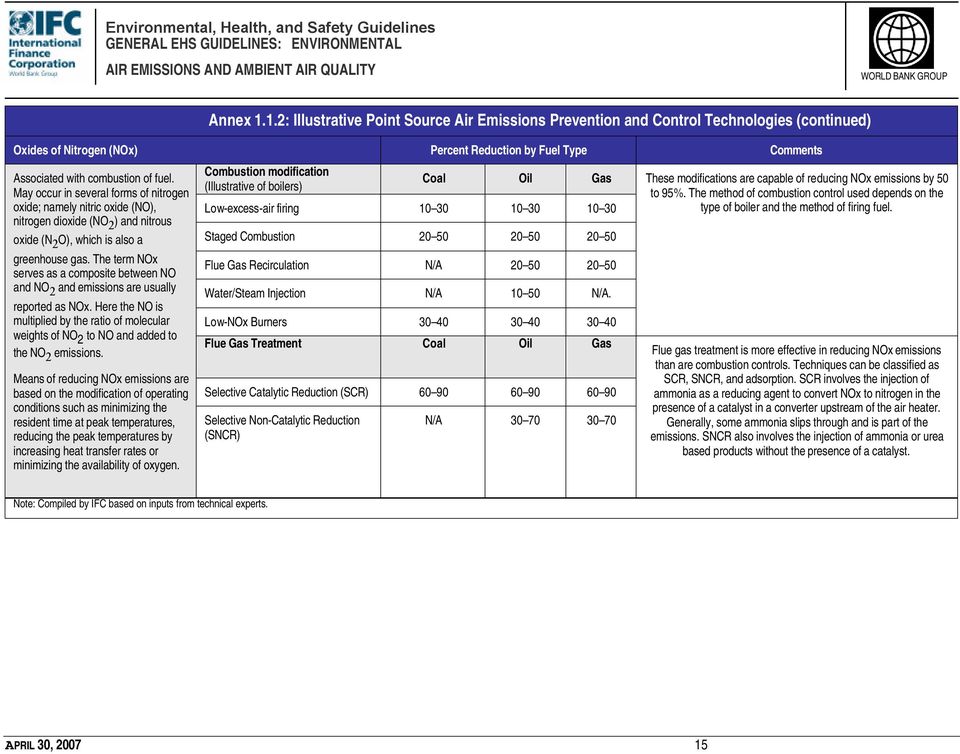
15 Envirnmental, Health, and Safety Guidelines AIR EMISSIONS AND AMBIENT AIR QUALITY Annex 1.1.2: Illustrative Pint Surce Air Emissins Preventin and Cntrl Technlgies (cntinued) Oxides f Nitrgen (NOx) Percent Reductin by Fuel Type Cmments Assciated with cmbustin f fuel. May ccur in several frms f nitrgen xide; namely nitric xide (NO), nitrgen dixide (NO 2 ) and nitrus xide (N 2 O), which is als a greenhuse gas. The term NOx serves as a cmpsite between NO and NO 2 and emissins are usually reprted as NOx. Here the NO is multiplied by the rati f mlecular weights f NO 2 t NO and added t the NO 2 emissins. Means f reducing NOx emissins are based n the mdificatin f perating cnditins such as minimizing the resident time at peak temperatures, reducing the peak temperatures by increasing heat transfer rates r minimizing the availability f xygen. Cmbustin mdificatin (Illustrative f bilers) Cal Oil Gas Lw-excess-air firing Staged Cmbustin Flue Gas Recirculatin N/A Water/Steam Injectin N/A N/A. Lw-NOx Burners Flue Gas Treatment Cal Oil Gas Selective Catalytic Reductin (SCR) Selective Nn-Catalytic Reductin (SNCR) N/A These mdificatins are capable f reducing NOx emissins by 50 t 95%. The methd f cmbustin cntrl used depends n the type f biler and the methd f firing fuel. Flue gas treatment is mre effective in reducing NOx emissins than are cmbustin cntrls. Techniques can be classified as SCR, SNCR, and adsrptin. SCR invlves the injectin f ammnia as a reducing agent t cnvert NOx t nitrgen in the presence f a catalyst in a cnverter upstream f the air heater. Generally, sme ammnia slips thrugh and is part f the emissins. SNCR als invlves the injectin f ammnia r urea based prducts withut the presence f a catalyst. Nte: Cmpiled by IFC based n inputs frm technical experts. APRIL 30,
16 Envirnmental, Health, and Safety Guidelines AIR EMISSIONS AND AMBIENT AIR QUALITY Annex Gd Internatinal Industry Practice (GIIP) Stack Height (Based n United States 40 CFR, part (ii)). Annex Examples f VOC Emissins Cntrls HG = H + 1.5L; where HG = GEP stack height measured frm the grund level elevatin at the base f the stack H = Height f nearby structure(s) abve the base f the stack. L = Lesser dimensin, height (h) r width (w), f nearby structures Nearby structures = Structures within/tuching a radius f 5L but less than 800 m. Pumps Equipment Type Mdificatin Apprximate Cntrl Efficiency (%) Seal-less design Clsed-vent system Dual mechanical seal with barrier fluid maintained at a higher pressure than the pumped fluid 100 Clsed-vent system 90 Stack Prjected width (w) Cmpressrs Pressure Relief Devices Dual mechanical seal with barrier fluid maintained at a higher pressure than the cmpressed gas 100 Clsed-vent system Variable 31 Rupture disk assembly 100 Valves Seal-less design 100 H G 1.5*L Cnnectrs Weld tgether 100 Open-ended Lines Blind, cap, plug, r secnd valve 100 Maximum 5*L h H Sampling Cnnectins Clsed-lp sampling 100 Nte: Examples f technlgies are prvided fr illustrative purpses. The availability and applicability f any particular technlgy will vary depending n manufacturer specificatins. 29 Seal-less equipment can be a large surce f emissins in the event f equipment failure. 30 Actual efficiency f a clsed-vent system depends n percentage f vaprs cllected and efficiency f cntrl device t which the vaprs are ruted. 31 Cntrl efficiency f clsed vent-systems installed n a pressure relief device may be lwer than ther clsed-vent systems. APRIL 30,

17 Envirnmental, Health, and Safety Guidelines AIR EMISSIONS AND AMBIENT AIR QUALITY Annex Fugitive PM Emissins Cntrls Cntrl Type Cntrl Efficiency Chemical Stabilizatin 0% - 98% Hygrscpic salts Bitumens/adhesives 60% - 96% Surfactants 0% - 68% Wet Suppressin Watering 12% - 98% Speed Reductin 0% - 80% Traffic Reductin Nt quantified Paving (Asphalt / Cncrete) 85% - 99% Cvering with Gravel, Slag, r "Rad Carpet" 30% - 50% Vacuum Sweeping 0% - 58% Water Flushing/Brm Sweeping 0% - 96% APRIL 30,

18 ENERGY CONSERVATION 1.2 Energy Cnservatin Applicability and Apprach...18 Energy Management Prgrams...18 Energy Efficiency...18 Prcess Heating...19 Heating Lad Reductin...19 Heat Distributin Systems...19 Energy Cnversin System Efficiency Imprvements20 Prcess Cling...20 Lad Reductin...21 Energy Cnversin...21 Refrigerant Cmpressin Efficiency...23 Refrigeratin System Auxiliaries...23 Cmpressed Air Systems...24 Lad reductin...24 Distributin...24 Applicability and Apprach This guideline applies t facilities r prjects that cnsume energy in prcess heating and cling; prcess and auxiliary systems, such as mtrs, pumps, and fans; cmpressed air systems and heating, ventilatin and air cnditining systems (HVAC); and lighting systems. It cmplements the industryspecific emissins guidance presented in the Industry Sectr Envirnmental, Health, and Safety (EHS) Guidelines by prviding infrmatin abut cmmn techniques fr energy cnservatin that may be applied t a range f industry sectrs. Energy management at the facility level shuld be viewed in the cntext f verall cnsumptin patterns, including thse assciated with prductin prcesses and supprting utilities, as well as verall impacts assciated with emissins frm pwer surces. The fllwing sectin prvides guidance n energy management with a fcus n cmmn utility systems ften representing technical and financially feasible pprtunities fr imprvement in energy cnservatin. Hwever, peratins shuld als evaluate energy cnservatin pprtunities arising frm manufacturing prcess mdificatins. Energy Management Prgrams Energy management prgrams shuld include the fllwing elements: Identificatin, and regular measurement and reprting f principal energy flws within a facility at unit prcess level Preparatin f mass and energy balance; Definitin and regular review f energy perfrmance targets, which are adjusted t accunt fr changes in majr influencing factrs n energy use Regular cmparisn and mnitring f energy flws with perfrmance targets t identify where actin shuld be taken t reduce energy use Regular review f targets, which may include cmparisn with benchmark data, t cnfirm that targets are set at apprpriate levels Energy Efficiency Fr any energy-using system, a systematic analysis f energy efficiency imprvements and cst reductin pprtunities shuld include a hierarchical examinatin f pprtunities t: Demand/Lad Side Management by reducing lads n the energy system Supply Side Management by: Reduce lsses in energy distributin Imprve energy cnversin efficiency Explit energy purchasing pprtunities Use lwer-carbn fuels APRIL 30,
19 ENERGY CONSERVATION Cmmn pprtunities in each f these areas are summarized belw. 32 Prcess Heating Prcess heating is vital t many manufacturing prcesses, including heating fr fluids, calcining, drying, heat treating, metal heating, melting, melting agglmeratin, curing, and frming 33. In prcess heating systems, a system heat and mass balance will shw hw much f the system s energy input prvides true prcess heating, and quantify fuel used t satisfy energy lsses caused by excessive parasitic lads, distributin, r cnversin lsses. Examinatin f savings pprtunities shuld be directed by the results f the heat and mass balance, thugh the fllwing techniques are ften valuable and cst-effective. Heating Lad Reductin Ensure adequate insulatin t reduce heat lsses thrugh furnace/ven etc. structure Recver heat frm ht prcess r exhaust streams t reduce system lads In intermittently-heated systems, cnsider use f lw thermal mass insulatin t reduce energy required t heat the system structure t perating temperature Cntrl prcess temperature and ther parameters accurately t avid, fr example, verheating r verdrying Examine pprtunities t use lw weight and/r lw thermal mass prduct carriers, such as heated shapers, kiln cars etc. 32 Additinal guidance n energy efficiency is available frm surces such as Natural Resurces Canada (NRCAN the Eurpean Unin (EUROPA. ), and United States Department f Energy (US DOE, Review pprtunities t schedule wrk flw t limit the need fr prcess reheating between stages Operate furnaces/vens at slight psitive pressure, and maintain air seals t reduce air in-leakage int the heated system, thereby reducing the energy required t heat unnecessary air t system perating temperature Reduce radiant heat lsses by sealing structural penings and keep viewing prts clsed when nt in use Where pssible, use the system fr lng runs clse t r at perating capacity Cnsider use f high emissivity catings f high temperature insulatin, and cnsequent reductin in prcess temperature Near net weight and shape heat designs Rbust Quality assurance n input material Rbust Scheduled maintenance prgrams Heat Distributin Systems Heat distributin in prcess heating applicatins typically takes place thrugh steam, ht water, r thermal fluid systems. Lsses can be reduced thrugh the fllwing actins: Prmptly repair distributin system leaks Avid steam leaks despite a perceived need t get steam thrugh the turbine. Electricity purchase is usually cheaper verall, especially when the cst t treat turbine-quality biler feed water is included. If the heat-pwer rati f the distributin prcess is less than that f pwer systems, pprtunities shuld be cnsidered t increase the rati; fr example, by using lw-pressure steam t drive absrptin cling systems rather than using electrically-driven vaprcmpressin systems. Regularly verify crrect peratin f steam traps in steam systems, and ensure that traps are nt bypassed. Since 33 US DOE. APRIL 30,

20 ENERGY CONSERVATION steam traps typically last apprximately 5 years, 20% shuld be replaced r repaired annually Insulate distributin system vessels, such as ht wells and de-aeratrs, in steam systems and thermal fluid r ht water strage tanks Insulate all steam, cndensate, ht water and thermal fluid distributin pipewrk, dwn t and including 1 (25 mm) diameter pipe, in additin t insulating all ht valves and flanges In steam systems, return cndensate t the biler huse fr re-use, since cndensate is expensive biler-quality water and valuable beynd its heat cntent alne Use flash steam recvery systems t reduce lsses due t evapratin f high-pressure cndensate Cnsider steam expansin thrugh a back-pressure turbine rather than reducing valve statins Eliminate distributin system lsses by adpting pint-fuse heating systems Energy Cnversin System Efficiency Imprvements The fllwing efficiency pprtunities shuld be examined fr prcess furnaces r vens, and utility systems, such as bilers and fluid heaters: Regularly mnitr CO, xygen r CO2 cntent f flue gases t verify that cmbustin systems are using the minimum practical excess air vlumes Cnsider cmbustin autmatin using xygen-trim cntrls Minimize the number f bilers r heaters used t meet lads. It is typically mre efficient t run ne biler at 90% f capacity than tw at 45%. Minimize the number f bilers kept at ht standby Use flue dampers t eliminate ventilatin lsses frm ht bilers held at standby Maintain clean heat transfer surfaces; in steam bilers, flue gases shuld be n mre than 20 K abve steam temperature) In steam biler systems, use ecnmizers t recver heat frm flue gases t pre-heat biler feed water r cmbustin air Cnsider reverse smsis r electrdialysis feed water treatment t minimize the requirement fr biler blwdwn Adpt autmatic (cntinuus) biler blwdwn Recver heat frm blwdwn systems thrugh flash steam recvery r feed-water preheat D nt supply excessive quantities f steam t the deaeratr With fired heaters, cnsider pprtunities t recver heat t cmbustin air thrugh the use f recuperative r regenerative burner systems Fr systems perating fr extended perids (> 6000 hurs/year), cgeneratin f electrical pwer, heat and /r cling can be cst effective Oxy Fuel burners Oxygen enrichment/injectin Use f turblatrs in bilers Sizing design and use f multiple bilers fr different lad cnfiguratins Fuel quality cntrl/fuel blending Prcess Cling The general methdlgy utlined abve shuld be applied t prcess cling systems. Cmmnly used and cst-effective measures t imprve prcess cling efficiency are described belw. APRIL 30,

21 ENERGY CONSERVATION Lad Reductin Ensure adequate insulatin t reduce heat gains thrugh cling system structure and t belw-ambient temperature refrigerant pipes and vessels Cntrl prcess temperature accurately t avid vercling Operate cling tunnels at slight psitive pressure and maintain air seals t reduce air in-leakage int the cled system, thus reducing the energy required t cl this unnecessary air t system perating temperature Examine pprtunities t pre-cl using heat recvery t a prcess stream requiring heating, r by using a higher temperature cling utility In cld and chill stres, minimize heat gains t the cled space by use f air curtains, entrance vestibules, r rapidly pening/clsing drs. Where cnveyrs carry prducts int chilled areas, minimize the area f transfer penings, fr example, by using strip curtains Quantify and minimize incidental cling lads, fr example, thse due t evapratr fans, ther machinery, defrst systems and lighting in cled spaces, circulatin fans in cling tunnels, r secndary refrigerant pumps (e.g. chilled water, brines, glycls) D nt use refrigeratin fr auxiliary cling duties, such as cmpressr cylinder head r il cling While nt a thermal lad, ensure there is n gas bypass f the expansin valve since this impses cmpressr lad while prviding little effective cling In the case f air cnditining applicatins, energy efficiency techniques include: Placing air intakes and air-cnditining units in cl, shaded lcatins Imprving building insulatin including seals, vents, windws, and drs Planting trees as thermal shields arund buildings Installing timers and/r thermstats and/r enthalpy-based cntrl systems Installing ventilatin heat recvery systems 34 Energy Cnversin The efficiency f refrigeratin service prvisin is nrmally discussed in terms f Cefficient f Perfrmance ( COP ), which is the rati f cling duty divided by input pwer. COP is maximized by effective refrigeratin system design and increased refrigerant cmpressin efficiency, as well as minimizatin f the temperature difference thrugh which the system wrks and f auxiliary lads (i.e. thse in additin t cmpressr pwer demand) used t perate the refrigeratin system. System Design If prcess temperatures are abve ambient fr all, r part, f the year, use f ambient cling systems, such as prvided by cling twers r dry air clers, may be apprpriate, perhaps supplemented by refrigeratin in summer cnditins. Mst refrigeratin systems are electric-mtr driven vapr cmpressin systems using psitive displacement r centrifugal cmpressrs. The remainder f this guideline relates primarily t vapr-cmpressin systems. Hwever, when a cheap r free heat surce is available (e.g. waste heat frm an engine-driven generatr lw-pressure steam 34 Mre infrmatin n HVAC energy efficiency can be fund at the British Clumbia Building Crpratin (Wlliams, es_guide.pdf), NRCAN s EnerGuide ( and NRCAN s Energy Star Prgrams ( ntview=n#ac ), and the US Energy Star Prgram ( APRIL 30,
22 ENERGY CONSERVATION that has passed thrugh a back-pressure turbine), absrptin refrigeratin may be apprpriate. Explit high cling temperature range: precling by ambient and/r high temperature refrigeratin befre final cling can reduce refrigeratin capital and running csts. High cling temperature range als prvides an pprtunity fr cuntercurrent (cascade) cling, which reduces refrigerant flw needs. Keep ht and cld fluids separate, fr example, d nt mix water leaving the chiller with water returning frm cling circuits. In lw-temperature systems where high temperature differences are inevitable, cnsider tw-stage r cmpund cmpressin, r ecnmized screw cmpressrs, rather than single-stage cmpressin. Minimizing Temperature Differences A vapr-cmpressin refrigeratin system raises the temperature f the refrigerant frm smewhat belw the lwest prcess temperature (the evaprating temperature) t prvide prcess cling, t a higher temperature (the cndensing temperature), smewhat abve ambient, t facilitate heat rejectin t the air r cling water systems. Increasing evaprating temperature typically increases cmpressr cling capacity withut greatly affecting pwer cnsumptin. Reducing cndensing temperature increases evapratr cling capacity and substantially reduces cmpressr pwer cnsumptin. Elevating Evaprating Temperature Select a large evapratr t permit relatively lw temperature differences between prcess and evaprating temperatures. Ensure that energy use f auxiliaries (e.g. evapratr fans) des nt utweigh cmpressin savings. In air-cling applicatins, a design temperature difference f 6-10 K between leaving air temperature and evaprating temperature is indicative f an apprpriately sized evapratr. When cling liquids, 2K between leaving liquid and evaprating temperatures can be achieved, thugh a 4K difference is generally indicative f a generusly-sized evapratr. Keep the evapratr clean. When cling air, ensure crrect defrst peratin. In liquid cling, mnitr refrigerant/prcess temperature differences and cmpare with design expectatins t be alert t heat exchanger cntaminatin by scale r il. Ensure il is regularly remved frm the evapratr, and that il additins and remvals balance. Avid the use f back-pressure valves. Adjust expansin valves t minimize suctin superheat cnsistent with avidance f liquid carry-ver t cmpressrs. Ensure that an apprpriate refrigerant charge vlume is present. Reducing Cndensing Temperature Cnsider whether t use air-cled r evapratin-based cling (e.g. evaprative r water cled cndensers and cling twers). Air-cled evapratrs usually have higher cndensing temperatures, hence higher cmpressr energy use, and auxiliary pwer cnsumptin, especially in lw humidity climates. If a wet system is used, ensure adequate treatment t prevent grwth f leginella bacteria. Whichever basic system is chsen, select a relatively large cndenser t minimize differences between cndensing and the heat sink temperatures. Cndensing temperatures with air cled r evaprative cndensers shuld nt be mre than 10K abve design ambient cnditin, and a 4K apprach in a liquid-cled cndenser is pssible. APRIL 30,
23 ENERGY CONSERVATION Avid accumulatin f nn-cndensable gases in the cndenser system. Cnsider the installatin f refrigerated nn-cndensable purgers, particularly fr systems perating belw atmspheric pressure. Keep cndensers clean and free frm scale. Mnitr refrigerant/ambient temperature differences and cmpare with design expectatins t be alert t heat exchanger cntaminatin. Avid liquid backup, which restricts heat transfer area in cndensers. This can be caused by installatin errrs such as cncentric reducers in hrizntal liquid refrigerant pipes, r up and ver liquid lines leading frm cndensers. In multiple cndenser applicatins, refrigerant liquid lines shuld be cnnected via drp-leg traps t the main liquid refrigerant line t ensure that ht gases flw t all cndensers. Avid head pressure cntrl t the extent pssible. Head pressure cntrl maintains cndensing temperature at, r near, design levels. It therefre prevents reductin in cmpressr pwer cnsumptin, which accmpanies reduced cndensing temperature, by restricting cndenser capacity (usually by switching ff the cndenser, r cling twer fans, r restricting cling water flw) under cnditins f less severe than design lad r ambient temperature cnditins. Head pressure is ften kept higher than necessary t facilitate ht gas defrst r adequate liquid refrigerant circulatin. Use f electrnic rather than thermstatic expansin valves, and liquid refrigerant pumps can permit effective refrigerant circulatin at much reduced cndensing temperatures. Site cndensers and cling twers with adequate spacing s as t prevent recirculatin f ht air int the twer. Refrigerant Cmpressin Efficiency Sme refrigerant cmpressrs and chillers are mre efficient than thers ffered fr the same duty. Befre purchase, identify the perating cnditins under which the cmpressr r chiller is likely t perate fr substantial parts f its annual cycle. Check perating efficiency under these cnditins, and ask fr estimates f annual running cst. Nte that refrigeratin and HVAC systems rarely run fr extended perids at design cnditins, which are deliberately extreme. Operatinal efficiency under the mst cmmnly ccurring ff-design cnditins is likely t be mst imprtant. Cmpressrs lse efficiency when unladed. Avid peratin f multiple cmpressrs at part-lad cnditins. Nte that package chillers can gain cefficient f perfrmance (COP) when slightly unladed, as lss f cmpressr efficiency can be utweighed by the benefits f reduced cndensing and elevated evaprating temperature. Hwever, it is unlikely t be energy efficient t perate a single cmpressr-chiller at less than 50% f capacity. Cnsider turndwn efficiency when specifying chillers. Variable speed cntrl r multiple cmpressr chillers can be highly efficient at part lads. Use f thermal strage systems (e.g., ice strage) can avid the need fr clse lad-tracking and, hence, can avid part-laded cmpressr peratin. Refrigeratin System Auxiliaries Many refrigeratin system auxiliaries (e.g. evapratr fans and chilled water pumps) cntribute t refrigeratin system lad, s reductins in their energy use have a duble benefit. General energy saving techniques fr pumps and fans, listed in the next sectin f these guidelines, shuld be applied t refrigeratin auxiliaries. APRIL 30,
24 ENERGY CONSERVATION Additinally, auxiliary use can be reduced by avidance f partlad peratin and in plant selectin (e.g. axial fan evaprative cndensers generally use less energy than equivalent centrifugal fan twers). Under extreme ff-design cnditins, reductin in duty f cling system fans and pumps can be wrthwhile, usually when the lwest pssible cndensing pressure has been achieved. Cmpressed Air Systems Cmpressed air is the mst cmmnly fund utility service in industry, yet in many cmpressed air systems, the energy cntained in cmpressed air delivered t the user is ften 10% r less f energy used in air cmpressin. Savings are ften pssible thrugh the fllwing techniques: Implement systems fr systematic identificatin and repair f leaks All cndensate drain pints shuld be trapped. D nt leave drain valves cntinuusly cracked pen Train wrkers never t direct cmpressed air against their bdies r clthing t dust r cl themselves dwn. Distributin Mnitr pressure lsses in filters and replace as apprpriate Use adequately sized distributin pipewrk designed t minimize pressure lsses Lad reductin Examine each true user f cmpressed air t identify the air vlume needed and the pressure at which this shuld be delivered. D nt mix high vlume lw pressure and lw vlume high pressure lads. Decentralize lw vlume high-pressure applicatins r prvide dedicated lw-pressure utilities, fr example, by using fans rather than cmpressed air. Review air use reductin pprtunities, fr example: Use air amplifier nzzles rather than simple pen-pipe cmpressed air jets Cnsider whether cmpressed air is needed at all Where air jets are required intermittently (e.g. t prpel prduct), cnsider perating the jet via a prcess-related slenid valve, which pens nly when air is required Use manual r autmatically perated valves t islate air supply t individual machines r znes that are nt in cntinuus use APRIL 30,
25 WASTEWATER AND AMBIENT WATER QUALITY 1.3 Wastewater and Ambient Water Quality Applicability and Apprach...25 General Liquid Effluent Quality...26 Discharge t Surface Water...26 Discharge t Sanitary Sewer Systems...26 Land Applicatin f Treated Effluent...27 Septic Systems...27 Wastewater Management...27 Industrial Wastewater...27 Sanitary Wastewater...29 Emissins frm Wastewater Treatment Operatins.30 Residuals frm Wastewater Treatment Operatins..30 Occupatinal Health and Safety Issues in Wastewater Treatment Operatins...30 Mnitring...30 Applicability and Apprach This guideline applies t prjects that have either direct r indirect discharge f prcess wastewater, wastewater frm utility peratins r strmwater t the envirnment. These guidelines are als applicable t industrial discharges t sanitary sewers that discharge t the envirnment withut any treatment. Prcess wastewater may include cntaminated wastewater frm utility peratins, strmwater, and sanitary sewage. It prvides infrmatin n cmmn techniques fr wastewater management, water cnservatin, and reuse that can be applied t a wide range f industry sectrs. This guideline is meant t be cmplemented by the industry-specific effluent guidelines presented in the Industry Sectr Envirnmental, Health, and Safety (EHS) Guidelines. Prjects with the ptential t generate prcess wastewater, sanitary (dmestic) sewage, r strmwater shuld incrprate the necessary precautins t avid, minimize, and cntrl adverse impacts t human health, safety, r the envirnment. In the cntext f their verall ESHS management system, facilities shuld: Understand the quality, quantity, frequency and surces f liquid effluents in its installatins. This includes knwledge abut the lcatins, rutes and integrity f internal drainage systems and discharge pints Plan and implement the segregatin f liquid effluents principally alng industrial, utility, sanitary, and strmwater categries, in rder t limit the vlume f water requiring specialized treatment. Characteristics f individual streams may als be used fr surce segregatin. Identify pprtunities t prevent r reduce wastewater pllutin thrugh such measures as recycle/reuse within their facility, input substitutin, r prcess mdificatin (e.g. change f technlgy r perating cnditins/mdes). Assess cmpliance f their wastewater discharges with the applicable: (i) discharge standard (if the wastewater is discharged t a surface water r sewer), and (ii) water quality standard fr a specific reuse (e.g. if the wastewater is reused fr irrigatin). Additinally, the generatin and discharge f wastewater f any type shuld be managed thrugh a cmbinatin f: Water use efficiency t reduce the amunt f wastewater generatin Prcess mdificatin, including waste minimizatin, and reducing the use f hazardus materials t reduce the lad f pllutants requiring treatment If needed, applicatin f wastewater treatment techniques t further reduce the lad f cntaminants prir t discharge, taking int cnsideratin ptential impacts f crss-media transfer f cntaminants during treatment (e.g., frm water t air r land) APRIL 30,
26 WASTEWATER AND AMBIENT WATER QUALITY When wastewater treatment is required prir t discharge, the level f treatment shuld be based n: Whether wastewater is being discharged t a sanitary sewer system, r t surface waters Natinal and lcal standards as reflected in permit requirements and sewer system capacity t cnvey and treat wastewater if discharge is t sanitary sewer Assimilative capacity f the receiving water fr the lad f cntaminant being discharged wastewater if discharge is t surface water Intended use f the receiving water bdy (e.g. as a surce f drinking water, recreatin, irrigatin, navigatin, r ther) Presence f sensitive receptrs (e.g., endangered species) r habitats Gd Internatinal Industry Practice (GIIP) fr the relevant industry sectr General Liquid Effluent Quality Discharge t Surface Water Discharges f prcess wastewater, sanitary wastewater, wastewater frm utility peratins r strmwater t surface water shuld nt result in cntaminant cncentratins in excess f lcal ambient water quality criteria r, in the absence f lcal criteria, ther surces f ambient water quality. 35 Receiving water use 36 and assimilative capacity 37, taking ther surces f discharges t 35 An example is the US EPA Natinal Recmmended Water Quality Criteria 36 Examples f receiving water uses as may be designated by lcal authrities include: drinking water (with sme level f treatment), recreatin, aquaculture, irrigatin, general aquatic life, rnamental, and navigatin. Examples f healthbased guideline values fr receiving waters include Wrld Health Organizatin (WHO) guidelines fr recreatinal use ( 37 The assimilative capacity f the receiving water bdy depends n numerus factrs including, but nt limited t, the ttal vlume f water, flw rate, flushing rate f the water bdy and the lading f pllutants frm ther effluent surces in the receiving water int cnsideratin, shuld als influence the acceptable pllutin ladings and effluent discharge quality. Additinal cnsideratins that shuld be included in the setting f prject-specific perfrmance levels fr wastewater effluents include: Prcess wastewater treatment standards cnsistent with applicable Industry Sectr EHS Guidelines. Prjects fr which there are n industry-specific guidelines shuld reference the effluent quality guidelines f an industry sectr with suitably analgus prcesses and effluents; Cmpliance with natinal r lcal standards fr sanitary wastewater discharges r, in their absence, the indicative guideline values applicable t sanitary wastewater discharges shwn in Table belw ; Temperature f wastewater prir t discharge des nt result in an increase greater than 3 C f ambient temperature at the edge f a scientifically established mixing zne which takes int accunt ambient water quality, receiving water use and assimilative capacity amng ther cnsideratins. Discharge t Sanitary Sewer Systems Discharges f industrial wastewater, sanitary wastewater, wastewater frm utility peratins r strmwater int public r private wastewater treatment systems shuld: Meet the pretreatment and mnitring requirements f the sewer treatment system int which it discharges. Nt interfere, directly r indirectly, with the peratin and maintenance f the cllectin and treatment systems, r pse a risk t wrker health and safety, r adversely impact the area r regin. A seasnally representative baseline assessment f ambient water quality may be required fr use with established scientific methds and mathematical mdels t estimate ptential impact t the receiving water frm an effluent surce. APRIL 30,
27 WASTEWATER AND AMBIENT WATER QUALITY characteristics f residuals frm wastewater treatment peratins. Be discharged int municipal r centralized wastewater treatment systems that have adequate capacity t meet lcal regulatry requirements fr treatment f wastewater generated frm the prject. Pretreatment f wastewater t meet regulatry requirements befre discharge frm the prject site is required if the municipal r centralized wastewater treatment system receiving wastewater frm the prject des nt have adequate capacity t maintain regulatry cmpliance. Land Applicatin f Treated Effluent The quality f treated prcess wastewater, wastewater frm utility peratins r strmwater discharged n land, including wetlands, shuld be established based n lcal regulatry requirements.. Where land is used as part f the treatment system and the ultimate receptr is surface water, water quality guidelines fr surface water discharges specific t the industry sectr prcess shuld apply. 38 Ptential impact n sil, grundwater, and surface water, in the cntext f prtectin, cnservatin and lng term sustainability f water and land resurces shuld be assessed when land is used as part f any wastewater treatment system. Septic Systems Septic systems are cmmnly used fr treatment and dispsal f dmestic sanitary sewage in areas with n sewerage cllectin netwrks, Septic systems shuld nly be used fr treatment f sanitary sewage, and unsuitable fr industrial wastewater treatment. When septic systems are the selected frm f wastewater dispsal and treatment, they shuld be: Prperly designed and installed in accrdance with lcal regulatins and guidance t prevent any hazard t public health r cntaminatin f land, surface r grundwater. Well maintained t allw effective peratin. Installed in areas with sufficient sil perclatin fr the design wastewater lading rate. Installed in areas f stable sils that are nearly level, well drained, and permeable, with enugh separatin between the drain field and the grundwater table r ther receiving waters. Wastewater Management Wastewater management includes water cnservatin, wastewater treatment, strmwater management, and wastewater and water quality mnitring. Industrial Wastewater Industrial wastewater generated frm industrial peratins includes prcess wastewater, wastewater frm utility peratins,, runff frm prcess and materials staging areas, and miscellaneus activities including wastewater frm labratries, equipment maintenance shps, etc.. The pllutants in an industrial wastewater may include acids r bases (exhibited as lw r high ph), sluble rganic chemicals causing depletin f disslved xygen, suspended slids, nutrients (phsphrus, nitrgen), heavy metals (e.g. cadmium, chrmium, cpper, lead, mercury, nickel, zinc), cyanide, txic rganic chemicals, ily materials, and vlatile materials., as well as frm thermal characteristics f the discharge (e.g., elevated temperature). Transfer f pllutants t anther phase, such as air, sil, r the sub-surface, shuld be minimized thrugh prcess and engineering cntrls. 38 Additinal guidance n water quality cnsideratins fr land applicatin is available in the WHO Guidelines fr the Safe Use f Wastewater, Excreta and Greywater. Vlume 2: Wastewater Use in Agriculture Prcess Wastewater Examples f treatment appraches typically used in the treatment f industrial wastewater are summarized in Annex While the chice f treatment APRIL 30,
28 WASTEWATER AND AMBIENT WATER QUALITY technlgy is driven by wastewater characteristics, the actual perfrmance f this technlgy depends largely n the adequacy f its design, equipment selectin, as well as peratin and maintenance f its installed facilities. Adequate resurces are required fr prper peratin and maintenance f a treatment facility, and perfrmance is strngly dependent n the technical ability and training f its peratinal staff. One r mre treatment technlgies may be used t achieve the desired discharge quality and t maintain cnsistent cmpliance with regulatry requirements. The design and peratin f the selected wastewater treatment technlgies shuld avid uncntrlled air emissins f vlatile chemicals frm wastewaters. Residuals frm industrial wastewater treatment peratins shuld be dispsed in cmpliance with lcal regulatry requirements, in the absence f which dispsal has t be cnsistent with prtectin f public health and safety, and cnservatin and lng term sustainability f water and land resurces. Wastewater frm Utilities Operatins - Utility peratins such as cling twers and demineralizatin systems may result in high rates f water cnsumptin, as well as the ptential release f high temperature water cntaining high disslved slids, residues f bicides, residues f ther cling system anti-fuling agents, etc. Recmmended water management strategies fr utility peratins include: Adptin f water cnservatin pprtunities fr facility cling systems as prvided in the Water Cnservatin sectin belw; Use f heat recvery methds (als energy efficiency imprvements) r ther cling methds t reduce the temperature f heated water prir t discharge t ensure the discharge water temperature des nt result in an increase greater than 3 C f ambient temperature at the edge f a scientifically established mixing zne which takes int accunt ambient water quality, receiving water use, ptential receptrs and assimilative capacity amng ther cnsideratins; Minimizing use f antifuling and crrsin inhibiting chemicals by ensuring apprpriate depth f water intake and use f screens. Least hazardus alternatives shuld be used with regards t txicity, bidegradability, biavailability, and biaccumulatin ptential. Dse applied shuld accrd with lcal regulatry requirements and manufacturer recmmendatins; Testing fr residual bicides and ther pllutants f cncern shuld be cnducted t determine the need fr dse adjustments r treatment f cling water prir t discharge. Strmwater Management - Strmwater includes any surface runff and flws resulting frm precipitatin, drainage r ther surces. Typically strmwater runff cntains suspended sediments, metals, petrleum hydrcarbns, Plycyclic Armatic Hydrcarbns (PAHs), clifrm, etc. Rapid runff, even f uncntaminated strmwater, als degrades the quality f the receiving water by erding stream beds and banks. In rder t reduce the need fr strmwater treatment, the fllwing principles shuld be applied: Strmwater shuld be separated frm prcess and sanitary wastewater streams in rder t reduce the vlume f wastewater t be treated prir t discharge Surface runff frm prcess areas r ptential surces f cntaminatin shuld be prevented Where this apprach is nt practical, runff frm prcess and strage areas shuld be segregated frm ptentially less cntaminated runff Runff frm areas withut ptential surces f cntaminatin shuld be minimized (e.g. by minimizing the area f impermeable surfaces) and the peak discharge rate shuld APRIL 30,
29 WASTEWATER AND AMBIENT WATER QUALITY be reduced (e.g. by using vegetated swales and retentin pnds); Where strmwater treatment is deemed necessary t prtect the quality f receiving water bdies, pririty shuld be given t managing and treating the first flush f strmwater runff where the majrity f ptential cntaminants tend t be present; When water quality criteria allw, strmwater shuld be managed as a resurce, either fr grundwater recharge r fr meeting water needs at the facility; Oil water separatrs and grease traps shuld be installed and maintained as apprpriate at refueling facilities, wrkshps, parking areas, fuel strage and cntainment areas. Sludge frm strmwater catchments r cllectin and treatment systems may cntain elevated levels f pllutants and shuld be dispsed in cmpliance with lcal regulatry requirements, in the absence f which dispsal has t be cnsistent with prtectin f public health and safety, and cnservatin and lng term sustainability f water and land resurces. Sanitary Wastewater Sanitary wastewater frm industrial facilities may include effluents frm dmestic sewage, fd service, and laundry facilities serving site emplyees. Miscellaneus wastewater frm labratries, medical infirmaries, water sftening etc. may als be discharged t the sanitary wastewater treatment system. Recmmended sanitary wastewater management strategies include: Segregatin f wastewater streams t ensure cmpatibility with selected treatment ptin (e.g. septic system which can nly accept dmestic sewage); Segregatin and pretreatment f il and grease cntaining effluents (e.g. use f a grease trap) prir t discharge int sewer systems; If sewage frm the industrial facility is t be discharged t surface water, treatment t meet natinal r lcal standards fr sanitary wastewater discharges r, in their absence, the indicative guideline values applicable t sanitary wastewater discharges shwn in Table 1.3.1; If sewage frm the industrial facility is t be discharged t either a septic system, r where land is used as part f the treatment system, treatment t meet applicable natinal r lcal standards fr sanitary wastewater discharges is required. Sludge frm sanitary wastewater treatment systems shuld be dispsed in cmpliance with lcal regulatry requirements, in the absence f which dispsal has t be cnsistent with prtectin f public health and safety, and cnservatin and lng term sustainability f water and land resurces. APRIL 30,
30 WASTEWATER AND AMBIENT WATER QUALITY Table Indicative Values fr Treated Sanitary Sewage Discharges a Emissins frm Wastewater Treatment Operatins Air emissins frm wastewater treatment peratins may include hydrgen sulfide, methane, zne (in the case f zne disinfectin), vlatile rganic cmpunds (e.g., chlrfrm generated frm chlrinatin activities and ther vlatile rganic cmpunds (VOCs) frm industrial wastewater), gaseus r vlatile chemicals used fr disinfectin prcesses (e.g., chlrine and ammnia), and biaersls. Odrs frm treatment facilities can als be a nuisance t wrkers and the surrunding cmmunity. Recmmendatins fr the management f emissins are presented in the Air Emissins and Ambient Air Quality sectin f this dcument and in the EHS Guidelines fr Water and Sanitatin. Pllutants Units Guideline Value ph ph 6 9 BOD mg/l 30 COD mg/l 125 Ttal nitrgen mg/l 10 Ttal phsphrus mg/l 2 Oil and grease mg/l 10 Ttal suspended slids mg/l 50 Ttal clifrm bacteria MPN b / 100 ml 400 a Ntes: a Nt applicable t centralized, municipal, wastewater treatment systems which are included in EHS Guidelines fr Water and Sanitatin. b MPN = Mst Prbable Number Residuals frm Wastewater Treatment Operatins Sludge frm a waste treatment plant needs t be evaluated n a case-by-case basis t establish whether it cnstitutes a hazardus r a nn-hazardus waste and managed accrdingly as described in the Waste Management sectin f this dcument. Occupatinal Health and Safety Issues in Wastewater Treatment Operatins Wastewater treatment facility peratrs may be expsed t physical, chemical, and bilgical hazards depending n the design f the facilities and the types f wastewater effluents managed. Examples f these hazards include the ptential fr trips and falls int tanks, cnfined space entries fr maintenance peratins, and inhalatin f VOCs, biaersls, and methane, cntact with pathgens and vectrs, and use f ptentially hazardus chemicals, including chlrine, sdium and calcium hypchlrite, and ammnia. Detailed recmmendatins fr the management f ccupatinal health and safety issues are presented in the relevant sectin f this dcument. Additinal guidance specifically applicable t wastewater treatment systems is prvided in the EHS Guidelines fr Water and Sanitatin. Mnitring A wastewater and water quality mnitring prgram with adequate resurces and management versight shuld be develped and implemented t meet the bjective(s) f the mnitring prgram. The wastewater and water quality mnitring prgram shuld cnsider the fllwing elements: Mnitring parameters: The parameters selected fr mnitring shuld be indicative f the pllutants f cncern frm the prcess, and shuld include parameters that are regulated under cmpliance requirements; Mnitring type and frequency: Wastewater mnitring shuld take int cnsideratin the discharge characteristics frm the prcess ver time. Mnitring f discharges frm prcesses with batch manufacturing r seasnal prcess variatins shuld take int cnsideratin f time-dependent APRIL 30,
31 WASTEWATER AND AMBIENT WATER QUALITY variatins in discharges and, therefre, is mre cmplex than mnitring f cntinuus discharges. Effluents frm highly variable prcesses may need t be sampled mre frequently r thrugh cmpsite methds. Grab samples r, if autmated equipment permits, cmpsite samples may ffer mre insight n average cncentratins f pllutants ver a 24-hur perid. Cmpsite samplers may nt be apprpriate where analytes f cncern are shrt-lived (e.g., quickly degraded r vlatile). Mnitring lcatins: The mnitring lcatin shuld be selected with the bjective f prviding representative mnitring data. Effluent sampling statins may be lcated at the final discharge, as well as at strategic upstream pints prir t merging f different discharges. Prcess discharges shuld nt be diluted prir r after treatment with the bjective f meeting the discharge r ambient water quality standards. Data quality: Mnitring prgrams shuld apply internatinally apprved methds fr sample cllectin, preservatin and analysis. Sampling shuld be cnducted by r under the supervisin f trained individuals. Analysis shuld be cnducted by entities permitted r certified fr this purpse. Sampling and Analysis Quality Assurance/Quality Cntrl (QA/QC) plans shuld be prepared and, implemented. QA/QC dcumentatin shuld be included in mnitring reprts. APRIL 30,
32 WASTEWATER AND AMBIENT WATER QUALITY Annex Examples f Industrial Wastewater Treatment Appraches Pllutant/Parameter Cntrl Optins / Principle Cmmn End f Pipe Cntrl Technlgy ph Chemical, Equalizatin Acid/Base additin, Flw equalizatin Oil and Grease / TPH Phase separatin Disslved Air Flatatin, il water separatr, grease trap TSS - Settleable Settling, Size Exclusin Sedimentatin basin, clarifier, centrifuge, screens TSS - Nn-Settleable Flatatin, Filtratin - traditinal and tangential Disslved air flatatin, Multimedia filter, sand filter, fabric filter, ultrafiltratin, micrfiltratin Hi - BOD (> 2 Kg/m 3 ) Bilgical - Anaerbic Suspended grwth, attached grwth, hybrid L - BOD (< 2 Kg/m 3 ) Bilgical - Aerbic, Facultative Suspended grwth, attached grwth, hybrid COD - Nn-Bidegradable Metals - Particulate and Sluble Inrganics / Nn-metals Organics - VOCs and SVOCs Oxidatin, Adsrptin, Size Exclusin Cagulatin, flcculatin, precipitatin, size exclusin Cagulatin, flcculatin, precipitatin, size exclusin, Oxidatin, Adsrptin Bilgical - Aerbic, Anaerbic, Facultative; Adsrptin, Oxidatin Chemical xidatin, Thermal xidatin, Activated Carbn, Membranes Flash mix with settling, filtratin - traditinal and tangential Flash mix with settling, filtratin - traditinal and tangential, Chemical xidatin, Thermal xidatin, Activated Carbn, Reverse Osmsis, Evapratin Bilgical : Suspended grwth, attached grwth, hybrid; Chemical xidatin, Thermal xidatin, Activated Carbn Emissins Odrs and VOCs Capture Active r Passive; Bilgical; Adsrptin, Oxidatin Bilgical : Attached grwth; Chemical xidatin, Thermal xidatin, Activated Carbn Nutrients Bilgical Nutrient Remval, Aerbic/Anxic bilgical treatment, chemical hydrlysis and air Chemical, Physical, Adsrptin stripping, chlrinatin, in exchange Clr Bilgical - Aerbic, Anaerbic, Facultative; Adsrptin, Oxidatin Bilgical Aerbic, Chemical xidatin, Activated Carbn Temperature Evaprative Cling Surface Aeratrs, Flw Equalizatin TDS Cncentratin, Size Exclusin Evapratin, crystallizatin, Reverse Osmsis Active Ingredients/Emerging Cntaminants Adsrptin, Oxidatin, Size Exclusin, Cncentratin Chemical xidatin, Thermal xidatin, Activated Carbn, In Exchange, Reverse Osmsis, Evapratin, Crystallizatin Radinuclides Adsrptin,Size Exclusin, Cncentratin In Exchange, Reverse Osmsis, Evapratin, Crystallizatin Pathgens Disinfectin, Sterilizatin Chlrine, Ozne, Perxide, UV, Thermal Txicity Adsrptin, Oxidatin, Size Exclusin, Cncentratin Chemical xidatin, Thermal xidatin, Activated Carbn, Evapratin, crystallizatin, Reverse Osmsis APRIL 30,
33 WATER CONSERVATION 1.4 Water Cnservatin Applicability and Apprach...33 Water Mnitring and Management...33 Prcess Water Reuse and Recycling...33 Building Facility Operatins...34 Cling Systems...34 Heating Systems...34 Applicability and Apprach Water cnservatin prgrams shuld be implemented cmmensurate with the magnitude and cst f water use. These prgrams shuld prmte the cntinuus reductin in water cnsumptin and achieve savings in the water pumping, treatment and dispsal csts. Water cnservatin measures may include water mnitring/management techniques; prcess and cling/heating water recycling, reuse, and ther techniques; and sanitary water cnservatin techniques. General recmmendatins include: Strm/Rainwater harvesting and use Zer discharge design/use f treated waste water t be included in prject design prcesses Use f lcalized recirculatin systems in plant/facility/shps (as ppsed t centralized recirculatin system), with prvisin nly fr makeup water Use f dry prcess technlgies e.g. dry quenching Prcess water system pressure management Prject design t have measures fr adequate water cllectin, spill cntrl and leakage cntrl system Water Mnitring and Management The essential elements f a water management prgram invlve: Identificatin, regular measurement, and recrding f principal flws within a facility; Definitin and regular review f perfrmance targets, which are adjusted t accunt fr changes in majr factrs affecting water use (e.g. industrial prductin rate); Regular cmparisn f water flws with perfrmance targets t identify where actin shuld be taken t reduce water use. Water measurement (metering) shuld emphasize areas f greatest water use. Based n review f metering data, unaccunted use indicating majr leaks at industrial facilities culd be identified. Prcess Water Reuse and Recycling Opprtunities fr water savings in industrial prcesses are highly industry-specific. Hwever, the fllwing techniques have all been used successfully, and shuld be cnsidered in cnjunctin with the develpment f the metering system described abve. Washing Machines: Many washing machines use large quantities f ht water. Use can increase as nzzles becme enlarged due t repeated cleaning and /r wear. Mnitr machine water use, cmpare with specificatin, and replace nzzles when water and heat use reaches levels warranting such wrk. Water reuse: Cmmn water reuse applicatins include cuntercurrent rinsing, fr example in multi-stage washing APRIL 30,
34 WATER CONSERVATION and rinsing prcesses, r reusing waste water frm ne prcess fr anther with less exacting water requirements. Fr example, using bleaching rinse water fr textile washing, r bttle-washer rinse water fr bttle crate washing, r even washing the flr. Mre sphisticated reuse prjects requiring treatment f water befre reuse are als smetimes practical. Water jets/sprays: If prcesses use water jets r sprays (e.g. t keep cnveyrs clean r t cl prduct) review the accuracy f the spray pattern t prevent unnecessary water lss. Flw cntrl ptimizatin: Industrial prcesses smetimes require the use f tanks, which are refilled t cntrl lsses. It is ften pssible t reduce the rate f water supply t such tanks, and smetimes t reduce tank levels t reduce spillage. If the prcess uses water cling sprays, it may be pssible t reduce flw while maintaining cling perfrmance. Testing can determine the ptimum balance. If hses are used in cleaning, use flw cntrls t restrict wasteful water flw Cnsider the use f high pressure, lw vlume cleaning systems rather than using large vlumes f water sprayed frm hsepipes Using flw timers and limit switches t cntrl water use Using clean-up practices rather than hsing dwn Building Facility Operatins Cnsumptin f building and sanitary water is typically less than that used in industrial prcesses. Hwever, savings can readily be identified, as utlined belw: Cmpare daily water use per emplyee t existing benchmarks taking int cnsideratin the primary use at the facility, whether sanitary r including ther activities such as shwering r catering Regularly maintain plumbing, and identify and repair leaks Shut ff water t unused areas Install self-clsing taps, autmatic shut-ff valves, spray nzzles, pressure reducing valves, and water cnserving fixtures (e.g. lw flw shwer heads, faucets, tilets, urinals; and spring laded r sensred faucets) Operate dishwashers and laundries n full lads, and nly when needed Install water-saving equipment in lavatries, such as lwflw tilets Cling Systems Water cnservatin pprtunities in cling systems include: Use f clsed circuit cling systems with cling twers rather than nce-thrugh cling systems Limiting cndenser r cling twer blwdwn t the minimum required t prevent unacceptable accumulatin f disslved slids Use f air cling rather than evaprative cling, althugh this may increase electricity use in the cling system Use f treated waste water fr cling twers Reusing/recycling cling twer blwdwn Heating Systems Heating systems based n the circulatin f lw r medium pressure ht water (which d nt cnsume water) shuld be clsed. If they d cnsume water, regular maintenance shuld be cnducted t check fr leaks. Hwever, large quantities f water may be used by steam systems, and this can be reduced by the fllwing measures: APRIL 30,
35 WATER CONSERVATION Repair f steam and cndensate leaks, and repair f all failed steam traps Return f cndensate t the bilerhuse, and use f heat exchangers (with cndensate return) rather than direct steam injectin where prcess permits Flash steam recvery Minimizing biler blwdwn cnsistent with maintaining acceptably lw disslved slids in biler water. Use f reverse smsis biler feed water treatment substantially reduces the need fr biler blwdwn Minimizing deaeratr heating APRIL 30,
36 HAZARDOUS MATERIALS MANAGEMENT 1.5 Hazardus Materials Management Applicability and Apprach...36 General Hazardus Materials Management...37 Hazard Assessment...37 Management Actins...37 Release Preventin and Cntrl Planning...38 Occupatinal Health and Safety...38 Prcess Knwledge and Dcumentatin...39 Preventive Measures...39 Hazardus Materials Transfer...39 Overfill Prtectin...39 Reactin, Fire, and Explsin Preventin...40 Cntrl Measures...40 Secndary Cntainment (Liquids)...40 Strage Tank and Piping Leak Detectin...41 Undergrund Strage Tanks (USTs)...41 Management f Majr Hazards...42 Management Actins...42 Preventive Measures...43 Emergency Preparedness and Respnse...44 Cmmunity Invlvement and Awareness...44 Applicability and Apprach These guidelines apply t prjects that use, stre, r handle any quantity f hazardus materials (Hazmats), defined as materials that represent a risk t human health, prperty, r the envirnment due t their physical r chemical characteristics. Hazmats can be classified accrding t the hazard as explsives; cmpressed gases, including txic r flammable gases; flammable liquids; flammable slids; xidizing substances; txic materials; radiactive material; and crrsive substances. Guidance n the transprt f hazardus materials is cvered in Sectin 3 f this dcument. When a hazardus material is n lnger usable fr its riginal purpse and is intended fr dispsal, but still has hazardus prperties, it is cnsidered a hazardus waste (see Sectin 1.4). This guidance is intended t be applied in cnjunctin with traditinal ccupatinal health and safety and emergency preparedness prgrams which are included in Sectin 2.0 n Occupatinal Health and Safety Management, and Sectin 3.7 n Emergency Preparedness and Respnse. Guidance n the Transprt f Hazardus Materials is prvided in Sectin 3.5. This sectin is divided int tw main subsectins: General Hazardus Materials Management: Guidance applicable t all prjects r facilities that handle r stre any quantity f hazardus materials. Management f Majr Hazards: Additinal guidance fr prjects r facilities that stre r handle hazardus materials at, r abve, threshld quantities 39, and thus require special treatment t prevent accidents such as fire, explsins, leaks r spills, and t prepare and respnd t emergencies. The verall bjective f hazardus materials management is t avid r, when avidance is nt feasible, minimize uncntrlled releases f hazardus materials r accidents (including explsin and fire) during their prductin, handling, strage and use. This bjective can be achieved by: 39 Fr examples, threshld quantities shuld be thse established fr emergency planning purpses such as prvided in the US Envirnmental Prtectin Agency. Prtectin f Envirnment (Title Threshld quantities are prvided in the US Envirnmental Prtectin Agency. Prtectin f Envirnment (Title 40 CFR Parts 68, 112, and 355). APRIL 30,
37 HAZARDOUS MATERIALS MANAGEMENT Establishing hazardus materials management pririties based n hazard analysis f risky peratins identified thrugh Scial and Envirnmental Assessment; Where practicable, aviding r minimizing the use f hazardus materials. Fr example, nn-hazardus materials have been fund t substitute asbests in building materials, PCBs in electrical equipment, persistent rganic pllutants (POPs) in pesticides frmulatins, and zne depleting substances in refrigeratin systems; Preventing uncntrlled releases f hazardus materials t the envirnment r uncntrlled reactins that might result in fire r explsin; Using engineering cntrls (cntainment, autmatic alarms, and shut-ff systems) cmmensurate with the nature f hazard; Implementing management cntrls (prcedures, inspectins, cmmunicatins, training, and drills) t address residual risks that have nt been prevented r cntrlled thrugh engineering measures. General Hazardus Materials Management Prjects which manufacture, handle, use, r stre hazardus materials shuld establish management prgrams that are cmmensurate with the ptential risks present. The main bjectives f prjects invlving hazardus materials shuld be the prtectin f the wrkfrce and the preventin and cntrl f releases and accidents. These bjectives shuld be addressed by integrating preventin and cntrl measures, management actins, and prcedures int day-t-day business activities. Ptentially applicable elements f a management prgram include the fllwing: Hazard Assessment The level f risk shuld be established thrugh an n-ging assessment prcess based n: The types and amunts f hazardus materials present in the prject. This infrmatin shuld be recrded and shuld include a summary table with the fllwing infrmatin: Name and descriptin (e.g. cmpsitin f a mixture) f the Hazmat Classificatin (e.g. cde, class r divisin) f the Hazmat Internatinally accepted regulatry reprting threshld quantity r natinal equivalent 40 f the Hazmat Quantity f Hazmat used per mnth Characteristic(s) that make(s) the Hazmat hazardus (e.g. flammability, txicity) Analysis f ptential spill and release scenaris using available industry statistics n spills and accidents where available Analysis f the ptential fr uncntrlled reactins such as fire and explsins Analysis f ptential cnsequences based n the physicalgegraphical characteristics f the prject site, including aspects such as its distance t settlements, water resurces, and ther envirnmentally sensitive areas Hazard assessment shuld be perfrmed by specialized prfessinals using internatinally-accepted methdlgies such as Hazardus Operatins Analysis (HAZOP), Failure Mde and Effects Analysis (FMEA), and Hazard Identificatin (HAZID). Management Actins The management actins t be included in a Hazardus Materials Management Plan shuld be cmmensurate with the level f 40 Threshld quantities are prvided in the US Envirnmental Prtectin Agency. Prtectin f Envirnment (Title 40 CFR Parts 68, 112, and 355). APRIL 30,
38 HAZARDOUS MATERIALS MANAGEMENT ptential risks assciated with the prductin, handling, strage, and use f hazardus materials. Release Preventin and Cntrl Planning Where there is risk f a spill f uncntrlled hazardus materials, facilities shuld prepare a spill cntrl, preventin, and cuntermeasure plan as a specific cmpnent f their Emergency Preparedness and Respnse Plan (described in mre detail in Sectin 3.7). The plan shuld be tailred t the hazards assciated with the prject, and include: Training f peratrs n release preventin, including drills specific t hazardus materials as part f emergency preparedness respnse training Implementatin f inspectin prgrams t maintain the mechanical integrity and perability f pressure vessels, tanks, piping systems, relief and vent valve systems, cntainment infrastructure, emergency shutdwn systems, cntrls and pumps, and assciated prcess equipment Preparatin f written Standard Operating Prcedures (SOPs) fr filling USTs, ASTs r ther cntainers r equipment as well as fr transfer peratins by persnnel trained in the safe transfer and filling f the hazardus material, and in spill preventin and respnse SOPs fr the management f secndary cntainment structures, specifically the remval f any accumulated fluid, such as rainfall, t ensure that the intent f the system is nt accidentally r willfully defeated Identificatin f lcatins f hazardus materials and assciated activities n an emergency plan site map Dcumentatin f availability f specific persnal prtective equipment and training needed t respnd t an emergency Dcumentatin f availability f spill respnse equipment sufficient t handle at least initial stages f a spill and a list f external resurces fr equipment and persnnel, if necessary, t supplement internal resurces Descriptin f respnse activities in the event f a spill, release, r ther chemical emergency including: Internal and external ntificatin prcedures Specific respnsibilities f individuals r grups Decisin prcess fr assessing severity f the release, and determining apprpriate actins Facility evacuatin rutes Pst-event activities such as clean-up and dispsal, incident investigatin, emplyee re-entry, and restratin f spill respnse equipment. Occupatinal Health and Safety The Hazardus Materials Management Plan shuld address applicable, essential elements f ccupatinal health and safety management as described in Sectin 2.0 n Occupatinal Health and Safety, including: Jb safety analysis t identify specific ptential ccupatinal hazards and industrial hygiene surveys, as apprpriate, t mnitr and verify chemical expsure levels, and cmpare with applicable ccupatinal expsure standards 41 Hazard cmmunicatin and training prgrams t prepare wrkers t recgnize and respnd t wrkplace chemical hazards. Prgrams shuld include aspects f hazard identificatin, safe perating and materials handling prcedures, safe wrk practices, basic emergency prcedures, and special hazards unique t their jbs. 41 Including: Threshld Limit Value (TLV ) ccupatinal expsure guidelines and Bilgical Expsure Indices (BEIs ), American Cnference f Gvernmental Industrial Hygienists (ACGIH), U.S. Natinal Institute fr Occupatinal Health and Safety (NIOSH), Permissible Expsure Limits (PELs), U.S. Occupatinal Safety and Health Administratin (OSHA), S&p_id=9992; Indicative Occupatinal Expsure Limit Values, Eurpean Unin, and ther similar surces. APRIL 30,
39 HAZARDOUS MATERIALS MANAGEMENT Training shuld incrprate infrmatin frm Material Safety Data Sheets 42 (MSDSs) fr hazardus materials being handled. MSDSs shuld be readily accessible t emplyees in their lcal language. Definitin and implementatin f permitted maintenance activities, such as ht wrk r cnfined space entries Prvisin f suitable persnal prtectin equipment (PPE) (ftwear, masks, prtective clthing and gggles in apprpriate areas), emergency eyewash and shwer statins, ventilatin systems, and sanitary facilities Mnitring and recrd-keeping activities, including audit prcedures designed t verify and recrd the effectiveness f preventin and cntrl f expsure t ccupatinal hazards, and maintaining accident and incident investigatin reprts n file fr a perid f at least five years Prcess Knwledge and Dcumentatin The Hazardus Materials Management Plan shuld be incrprated int, and cnsistent with, the ther elements f the facility ES/OHS MS and include: Written prcess safety parameters (i.e., hazards f the chemical substances, safety equipment specificatins, safe peratin ranges fr temperature, pressure, and ther applicable parameters, evaluatin f the cnsequences f deviatins, etc.) Written perating prcedures Cmpliance audit prcedures 42 MSDSs are prduced by the manufacturer, but might nt be prepared fr chemical intermediates that are nt distributed in cmmerce. In these cases, emplyers still need t prvide wrkers with equivalent infrmatin. Preventive Measures Hazardus Materials Transfer Uncntrlled releases f hazardus materials may result frm small cumulative events, r frm mre significant equipment failure assciated with events such as manual r mechanical transfer between strage systems r prcess equipment. Recmmended practices t prevent hazardus material releases frm prcesses include: Use f dedicated fittings, pipes, and hses specific t materials in tanks (e.g., all acids use ne type f cnnectin, all caustics use anther), and maintaining prcedures t prevent additin f hazardus materials t incrrect tanks Use f transfer equipment that is cmpatible and suitable fr the characteristics f the materials transferred and designed t ensure safe transfer Regular inspectin, maintenance and repair f fittings, pipes and hses Prvisin f secndary cntainment, drip trays r ther verflw and drip cntainment measures, fr hazardus materials cntainers at cnnectin pints r ther pssible verflw pints. Overfill Prtectin Overfills f vessels and tanks shuld be prevented as they are amng the mst cmmn causes f spills resulting in sil and water cntaminatin, and amng the easiest t prevent. Recmmended verfill prtectin measures include: Prepare written prcedures fr transfer peratins that includes a checklist f measures t fllw during filling peratins and the use f filling peratrs trained in these prcedures Installatin f gauges n tanks t measure vlume inside Use f dripless hse cnnectins fr vehicle tank and fixed cnnectins with strage tanks APRIL 30,
40 HAZARDOUS MATERIALS MANAGEMENT Prvisin f autmatic fill shutff valves n strage tanks t prevent verfilling Use f a catch basin arund the fill pipe t cllect spills Use f piping cnnectins with autmatic verfill prtectin (flat valve) Pumping less vlume than available capacity int the tank r vessel by rdering less material than its available capacity Prvisin f verfill r ver pressure vents that allw cntrlled release t a capture pint Reactin, Fire, and Explsin Preventin Reactive, flammable, and explsive materials shuld als be managed t avid uncntrlled reactins r cnditins resulting in fire r explsin. Recmmended preventin practices include: Strage f incmpatible materials (acids, bases, flammables, xidizers, reactive chemicals) in separate areas, and with cntainment facilities separating material strage areas Prvisin f material-specific strage fr extremely hazardus r reactive materials Use f flame arresting devices n vents frm flammable strage cntainers Prvisin f grunding and lightning prtectin fr tank farms, transfer statins, and ther equipment that handles flammable materials Selectin f materials f cnstructin cmpatible with prducts stred fr all parts f strage and delivery systems, and aviding reuse f tanks fr different prducts withut checking material cmpatibility Strage f hazardus materials in an area f the facility separated frm the main prductin wrks. Where prximity is unavidable, physical separatin shuld be prvided using structures designed t prevent fire, explsin, spill, and ther emergency situatins frm affecting facility peratins Prhibitin f all surces f ignitin frm areas near flammable strage tanks Cntrl Measures Secndary Cntainment (Liquids) A critical aspect fr cntrlling accidental releases f liquid hazardus materials during strage and transfer is the prvisin f secndary cntainment. It is nt necessary fr secndary cntainment methds t meet lng term material cmpatibility as with primary strage and piping, but their design and cnstructin shuld hld released materials effectively until they can be detected and safely recvered. Apprpriate secndary cntainment structures cnsist f berms, dikes, r walls capable f cntaining the larger f 110 percent f the largest tank r 25% percent f the cmbined tank vlumes in areas with abve-grund tanks with a ttal strage vlume equal r greater than 1,000 liters and will be made f impervius, chemically resistant material. Secndary cntainment design shuld als cnsider means t prevent cntact between incmpatible materials in the event f a release. Other secndary cntainment measures that shuld be applied depending n site-specific cnditins include: Transfer f hazardus materials frm vehicle tanks t strage in areas with surfaces sufficiently impervius t avid lss t the envirnment and slped t a cllectin r a cntainment structure nt cnnected t municipal wastewater/strmwater cllectin system Where it is nt practical t prvide permanent, dedicated cntainment structures fr transfer peratins, ne r mre alternative frms f spill cntainment shuld be prvided, such as prtable drain cvers (which can be deplyed fr the duratin f the peratins), autmatic shut-ff valves n strm water basins, r shut ff valves in drainage r sewer facilities, cmbined with il-water separatrs APRIL 30,
41 HAZARDOUS MATERIALS MANAGEMENT Strage f drummed hazardus materials with a ttal vlume equal r greater than 1,000 liters in areas with impervius surfaces that are slped r bermed t cntain a minimum f 25 percent f the ttal strage vlume Prvisin f secndary cntainment fr cmpnents (tanks, pipes) f the hazardus material strage system, t the extent feasible Cnducting peridic (e.g. daily r weekly) recnciliatin f tank cntents, and inspectin f visible prtins f tanks and piping fr leaks; Use f duble-walled, cmpsite, r specially cated strage and piping systems particularly in the use f undergrund strage tanks (USTs) and undergrund piping. If dublewalled systems are used, they shuld prvide a means f detecting leaks between the tw walls. Strage Tank and Piping Leak Detectin Leak detectin may be used in cnjunctin with secndary cntainment, particularly in high-risk lcatins 43. Leak detectin is especially imprtant in situatins where secndary cntainment is nt feasible r practicable, such as in lng pipe runs. Acceptable leak detectin methds include: Use f autmatic pressure lss detectrs n pressurized r lng distance piping Use f apprved r certified integrity testing methds n piping r tank systems, at regular intervals Cnsidering the use f SCADA 44 if financially feasible 43 High-risk lcatins are places where the release f prduct frm the strage system culd result in the cntaminatin f drinking water surce r thse lcated in water resurce prtectin areas as designated by lcal authrities. Undergrund Strage Tanks (USTs) 45 Althugh there are many envirnmental and safety advantages f undergrund strage f hazardus materials, including reduced risk f fire r explsin, and lwer vapr lsses int the atmsphere, leaks f hazardus materials can g undetected fr lng perids f time with ptential fr sil and grundwater cntaminatin. Examples f techniques t manage these risks include: Aviding use f USTs fr strage f highly sluble rganic materials Assessing lcal sil crrsin ptential, and installing and maintaining cathdic prtectin (r equivalent rust prtectin) fr steel tanks Fr new installatins, installing impermeable liners r structures (e.g., cncrete vaults) under and arund tanks and lines that direct any leaked prduct t mnitring prts at the lwest pint f the liner r structure Mnitring the surface abve any tank fr indicatins f sil mvement Recnciling tank cntents by measuring the vlume in stre with the expected vlume, given the stred quantity at last stcking, and deliveries t and withdrawals frm the stre Testing integrity by vlumetric, vacuum, acustic, tracers, r ther means n all tanks at regular intervals Cnsidering the mnitring grundwater f quality dwn gradient f lcatins where multiple USTs are in use Evaluating the risk f existing UST in newly acquired facilities t determine if upgrades are required fr USTs that will be cntinued t be used, including replacement with new systems r permanent clsure f abandned USTs. Ensuring that new USTs are sited away frm wells, 44 Supervisry Cntrl and Data Acquisitin 45 Additinal details n the management f USTs is prvided in the EHS Guidelines fr Retail Petrleum Statins. APRIL 30,
42 HAZARDOUS MATERIALS MANAGEMENT reservirs and ther surce water prtectin areas and fldplains, and maintained s as t prevent crrsin. Management f Majr Hazards In additin t the applicatin f the abve-referenced guidance n preventin and cntrl f releases f hazardus materials, prjects invlving prductin, handling, and strage f hazardus materials at r abve threshld limits 46 shuld prepare a Hazardus Materials Risk Management Plan, in the cntext f its verall ES/OHS MS, cntaining all f the elements presented belw. 47 The bjective f this guidance is the preventin and cntrl f catastrphic releases f txic, reactive, flammable, r explsive chemicals that may result in txic, fire, r explsin hazards. 48 Management Actins Management f Change: These prcedures shuld address: The technical basis fr changes in prcesses and peratins The impact f changes n health and safety Mdificatin t perating prcedures Authrizatin requirements Emplyees affected Training needs Cmpliance Audit: A cmpliance audit is a way t evaluate cmpliance with the preventin prgram requirements fr each prcess. A cmpliance audit cvering each element f 46 Threshld quantities shuld be thse established fr emergency planning purpses such as prvided in the US Envirnmental Prtectin Agency. Prtectin f Envirnment (Title 40 CFR Parts and 700 t 789). 47 Fr further infrmatin and guidance, please refer t Internatinal Finance Crpratin (IFC) Hazardus Materials Risk Management Manual. Washingtn, D.C. December The apprach t the management f majr hazards is largely based n an apprach t Prcess Safety Management develped by the American Institute f Chemical Engineers. the preventin measures (see belw) shuld be cnducted at least every three years and shuld include: Preparatin f a reprt f the findings Determinatin and dcumentatin f the apprpriate respnse t each finding Dcumentatin that any deficiency has been crrected Incident Investigatin: Incidents can prvide valuable infrmatin abut site hazards and the steps needed t prevent accidental releases. An incident investigatin mechanism shuld include prcedures fr: Initiatin f the investigatin prmptly Summarizing the investigatin in a reprt Addressing the reprt findings and recmmendatins A review f the reprt with staff and cntractrs Emplyee Participatin: A written plan f actin shuld describe an active emplyee participatin prgram fr the preventin f accidents. Cntractrs: There shuld be a mechanism fr cntractr cntrl which shuld include a requirement fr them t develp hazard materials management prcedures that meet the requirements f the hazardus materials management plan. Their prcedures shuld be cnsistent with thse f the cntracting cmpany and the cntractr wrkfrce shuld underg the same training. Additinally, prcedures shuld require that cntractrs are: Prvided with safety perfrmance prcedures and safety and hazard infrmatin Observe safety practices Act respnsibly Have access t apprpriate training fr their emplyees Ensure that their emplyees knw prcess hazards and applicable emergency actins APRIL 30,
43 HAZARDOUS MATERIALS MANAGEMENT Prepare and submit training recrds fr their emplyees t the cntracting cmpany Infrm their emplyees abut the hazards presented by their wrk Assess trends f repeated similar incidents Develp and implement prcedures t manage repeated similar incidents Training: Prject emplyees shuld be prvided training n Hazmat management. The training prgram shuld include: A list f emplyees t be trained Specific training bjectives Mechanisms t achieve the bjectives (i.e., hands-n wrkshps, vides, etc.) The means t determine whether the training prgram is effective Training prcedures fr new hires and refresher curses fr existing emplyees Preventive Measures The purpse f preventive measures is t ensure that safetyrelated aspects f the prcess and equipment are cnsidered, limits t be placed n the peratins are well knwn, and accepted standards and cdes are adpted, where they apply. Prcess Safety Infrmatin: Prcedures shuld be prepared fr each hazardus materials and include: Cmpilatin f Material Safety Data Sheets (MSDS) Identificatin f maximum intended inventries and safe upper/lwer parameters Dcumentatin f equipment specificatins and f cdes and standards used t design, build and perate the prcess Operating Prcedures: SOPs shuld be prepared fr each step f all prcesses r peratins within the prject (e.g. initial startup, nrmal peratins, temprary peratins, emergency shutdwn, emergency peratins, nrmal shutdwn, and start-up fllwing a nrmal r emergency shutdwn r majr change). These SOPs shuld include special cnsideratins fr Mazmats used in the prcess r peratins (e.g. temperature cntrl t prevent emissins f a vlatile hazardus chemical; diversin f gaseus discharges f hazardus pllutants frm the prcess t a temprary strage tank in case f emergency). Other prcedures t be develped include impacts f deviatins, steps t avid deviatins, preventin f chemical expsure, expsure cntrl measures, and equipment inspectins. Mechanical Integrity f prcess equipment, piping and instrumentatin: Inspectin and maintenance prcedures shuld be develped and dcumented t ensure mechanical integrity f equipment, piping, and instrumentatin and prevent uncntrlled releases f hazardus materials frm the prject. These prcedures shuld be included as part f the prject SOPs. The specific prcess cmpnents f majr interest include pressure vessels and strage tanks, piping systems, relief and vent systems and devices, emergency shutdwn systems, cntrls, and pumps. Recmmended aspects f the inspectin and maintenance prgram include: Develping inspectin and maintenance prcedures Establishing a quality assurance plan fr equipment, maintenance materials, and spare parts Cnducting emplyee training n the inspectin and maintenance prcedures Cnducting equipment, piping, and instrumentatin inspectins and maintenance Identifying and crrecting identified deficiencies APRIL 30,
44 HAZARDOUS MATERIALS MANAGEMENT Evaluating the inspectin and maintenance results and, if necessary, updating the inspectin and maintenance prcedures Reprting the results t management. Ht Wrk Permit: Ht wrk peratins such as brazing, trch-cutting, grinding, sldering, and welding are assciated with ptential health, safety, and prperty hazards resulting frm the fumes, gases, sparks, and ht metal and radiant energy prduced during ht wrk. Ht wrk permit is required fr any peratin invlving pen flames r prducing heat and/r sparks. The sectin f SOPs n ht wrk shuld include the respnsibility fr ht wrk permitting, persnal prtectin equipment (PPE), ht wrk prcedures, persnnel training, and recrdkeeping. Pre-Start Review: Prcedures shuld be prepared t carry ut pre-start reviews when a mdificatin is significant enugh t require a change in safety infrmatin under the management f change prcedure. The prcedures shuld: Cnfirm that the new r mdified cnstructin and/r equipment meet design specificatins Ensure that prcedures fr safety, peratin, maintenance, and emergency are adequate Include a prcess hazard assessment, and reslve r implement recmmendatins fr new prcess Ensure that training fr all affected emplyees is being cnducted Emergency Preparedness and Respnse When handling hazardus materials, prcedures and practices shuld be develped allwing fr quick and efficient respnses t accidents that culd result in human injury r damage t the envirnment. An Emergency Preparedness and Respnse Plan, incrprated int and cnsistent with, the facility s verall ES/OHS MS, shuld be prepared t cver the fllwing: 49 Planning Crdinatin: Prcedures shuld be prepared fr: Infrming the public and emergency respnse agencies Dcumenting first aid and emergency medical treatment Taking emergency respnse actins Reviewing and updating the emergency respnse plan t reflect changes, and ensuring that emplyees are infrmed f such changes Emergency Equipment: Prcedures shuld be prepared fr using, inspecting, testing, and maintaining the emergency respnse equipment. Training: Emplyees and cntractrs shuld be trained n emergency respnse prcedures. Cmmunity Invlvement and Awareness When hazardus materials are in use abve threshld quantities, the management plan shuld include a system fr cmmunity awareness, ntificatin and invlvement that shuld be cmmensurate with the ptential risks identified fr the prject during the hazard assessment studies. This shuld include mechanisms fr sharing the results f hazard and risk assessment studies in a timely, understandable and culturally sensitive manner with ptentially affected cmmunities that prvides a means fr public feedback. Cmmunity invlvement activities shuld include: Availability f general infrmatin t the ptentially affected cmmunity n the nature and extent f prject peratins, and the preventin and cntrl measures in place t ensure n effects t human health 49 Fr a cmprehensive treatment f the develpment f emergency respnse plans in cnjunctin with cmmunities refer t the Awareness and Preparedness fr Emergencies at Lcal Level (APELL) Guidelines available at: APRIL 30,
45 HAZARDOUS MATERIALS MANAGEMENT The ptential fr ff-site effects t human health r the envirnment fllwing an accident at planned r existing hazardus installatins Specific and timely infrmatin n apprpriate behavir and safety measures t be adpted in the event f an accident including practice drills in lcatins with higher risks Access t infrmatin necessary t understand the nature f the pssible effect f an accident and an pprtunity t cntribute effectively, as apprpriate, t decisins cncerning hazardus installatins and the develpment f cmmunity emergency preparedness plans. APRIL 30,
46 WASTE MANAGEMENT 1.6 Waste Management Applicability and Apprach...46 General Waste Management...47 Waste Management Planning...47 Waste Preventin...47 Recycling and Reuse...48 Treatment and Dispsal...48 Hazardus Waste Management...48 Waste Strage...48 Transprtatin...49 Treatment and Dispsal...49 Cmmercial r Gvernment Waste Cntractrs...49 Small Quantities f Hazardus Waste...50 Mnitring...50 Applicability and Apprach These guidelines apply t prjects that generate, stre, r handle any quantity f waste acrss a range f industry sectrs. It is nt intended t apply t prjects r facilities where the primary business is the cllectin, transprtatin, treatment, r dispsal f wastes. Specific guidance fr these types f facilities is presented in the Envirnmental Health and Safety (EHS) Guidelines fr Waste Management Facilities. A waste is any slid, liquid, r cntained gaseus material that is being discarded by dispsal, recycling, burning r incineratin. It can be byprduct f a manufacturing prcess r an bslete cmmercial prduct that can n lnger be used fr intended purpse and requires dispsal. Slid (nn-hazardus) wastes generally include any garbage, refuse. Examples f such waste include dmestic trash and garbage; inert cnstructin / demlitin materials; refuse, such as metal scrap and empty cntainers (except thse previusly used t cntain hazardus materials which shuld, in principle, be managed as a hazardus waste); and residual waste frm industrial peratins, such as biler slag, clinker, and fly ash. Hazardus waste shares the prperties f a hazardus material (e.g. ignitability, crrsivity, reactivity, r txicity), r ther physical, chemical, r bilgical characteristics that may pse a ptential risk t human health r the envirnment if imprperly managed. Wastes may als be defined as hazardus by lcal regulatins r internatinal cnventins, based n the rigin f the waste and its inclusin n hazardus waste lists, r based n its characteristics. Sludge frm a waste treatment plant, water supply treatment plant, r air pllutin cntrl facility, and ther discarded material, including slid, liquid, semislid, r cntained gaseus material resulting frm industrial peratins needs t be evaluated n a case-by-case basis t establish whether it cnstitutes a hazardus r a nn-hazardus waste. Facilities that generate and stre wastes shuld practice the fllwing: Establishing waste management pririties at the utset f activities based n an understanding f ptential Envirnmental, Health, and Safety (EHS) risks and impacts and cnsidering waste generatin and its cnsequences Establishing a waste management hierarchy that cnsiders preventin, reductin, reuse, recvery, recycling, remval and finally dispsal f wastes. Aviding r minimizing the generatin waste materials, as far as practicable Where waste generatin cannt be avided but has been minimized, recvering and reusing waste APRIL 30,
47 WASTE MANAGEMENT Where waste can nt be recvered r reused, treating, destrying, and dispsing f it in an envirnmentally sund manner General Waste Management The fllwing guidance applies t the management f nnhazardus and hazardus waste. Additinal guidance specifically applicable t hazardus wastes is presented belw. Waste management shuld be addressed thrugh a Waste management system that addresses issues linked t waste minimizatin, generatin, transprt, dispsal, and mnitring. Waste Management Planning Facilities that generate waste shuld characterize their waste accrding t cmpsitin, surce, types f wastes prduced, generatin rates, r accrding t lcal regulatry requirements. Effective planning and implementatin f waste management strategies shuld include: Review f new waste surces during planning, siting, and design activities, including during equipment mdificatins and prcess alteratins, t identify expected waste generatin, pllutin preventin pprtunities, and necessary treatment, strage, and dispsal infrastructure Cllectin f data and infrmatin abut the prcess and waste streams in existing facilities, including characterizatin f waste streams by type, quantities, and ptential use/dispsitin Establishment f pririties based n a risk analysis that takes int accunt the ptential EHS risks during the waste cycle and the availability f infrastructure t manage the waste in an envirnmentally sund manner Definitin f pprtunities fr surce reductin, as well as reuse and recycling Definitin f prcedures and peratinal cntrls fr nsite strage Definitin f ptins / prcedures / peratinal cntrls fr treatment and final dispsal Waste Preventin Prcesses shuld be designed and perated t prevent, r minimize, the quantities f wastes generated and hazards assciated with the wastes generated in accrdance with the fllwing strategy: Substituting raw materials r inputs with less hazardus r txic materials, r with thse where prcessing generates lwer waste vlumes Applying manufacturing prcess that cnvert materials efficiently, prviding higher prduct utput yields, including mdificatin f design f the prductin prcess, perating cnditins, and prcess cntrls 50 Instituting gd husekeeping and perating practices, including inventry cntrl t reduce the amunt f waste resulting frm materials that are ut-f-date, ffspecificatin, cntaminated, damaged, r excess t plant needs Instituting prcurement measures that recgnize pprtunities t return usable materials such as cntainers and which prevents the ver rdering f materials Minimizing hazardus waste generatin by implementing stringent waste segregatin t prevent the cmmingling f nn-hazardus and hazardus waste t be managed 50 Examples f waste preventin strategies include the cncept f Lean Manufacturing fund at APRIL 30,
48 WASTE MANAGEMENT Recycling and Reuse In additin t the implementatin f waste preventin strategies, the ttal amunt f waste may be significantly reduced thrugh the implementatin f recycling plans, which shuld cnsider the fllwing elements: Evaluatin f waste prductin prcesses and identificatin f ptentially recyclable materials Identificatin and recycling f prducts that can be reintrduced int the manufacturing prcess r industry activity at the site Investigatin f external markets fr recycling by ther industrial prcessing peratins lcated in the neighbrhd r regin f the facility (e.g., waste exchange) Establishing recycling bjectives and frmal tracking f waste generatin and recycling rates Prviding training and incentives t emplyees in rder t meet bjectives Treatment and Dispsal If waste materials are still generated after the implementatin f feasible waste preventin, reductin, reuse, recvery and recycling measures, waste materials shuld be treated and dispsed f and all measures shuld be taken t avid ptential impacts t human health and the envirnment. Selected management appraches shuld be cnsistent with the characteristics f the waste and lcal regulatins, and may include ne r mre f the fllwing: On-site r ff-site bilgical, chemical, r physical treatment f the waste material t render it nnhazardus prir t final dispsal Treatment r dispsal at permitted facilities specially designed t receive the waste. Examples include: cmpsting peratins fr rganic nn-hazardus wastes; prperly designed, permitted and perated landfills r incineratrs designed fr the respective type f waste; r ther methds knwn t be effective in the safe, final dispsal f waste materials such as biremediatin. Hazardus Waste Management Hazardus wastes shuld always be segregated frm nnhazardus wastes. If generatin f hazardus waste can nt be prevented thrugh the implementatin f the abve general waste management practices, its management shuld fcus n the preventin f harm t health, safety, and the envirnment, accrding t the fllwing additinal principles: Understanding ptential impacts and risks assciated with the management f any generated hazardus waste during its cmplete life cycle Ensuring that cntractrs handling, treating, and dispsing f hazardus waste are reputable and legitimate enterprises, licensed by the relevant regulatry agencies and fllwing gd internatinal industry practice fr the waste being handled Ensuring cmpliance with applicable lcal and internatinal regulatins 51 Waste Strage Hazardus waste shuld be stred s as t prevent r cntrl accidental releases t air, sil, and water resurces in area lcatin where: 51 Internatinal requirements may include hst-cuntry cmmitments under the Basel Cnventin n the Cntrl f Transbundary Mvements f Hazardus Waste and their dispsal ( and Rtterdam Cnventin n the prir Infrm Cnsent Prcedure fr Certain Hazardus Chemicals and Pesticides in Internatinal Trade ( APRIL 30,
49 WASTE MANAGEMENT Waste is stred in a manner that prevents the cmmingling r cntact between incmpatible wastes, and allws fr inspectin between cntainers t mnitr leaks r spills. Examples include sufficient space between incmpatibles r physical separatin such as walls r cntainment curbs Stre in clsed cntainers away frm direct sunlight, wind and rain Secndary cntainment systems shuld be cnstructed with materials apprpriate fr the wastes being cntained and adequate t prevent lss t the envirnment Secndary cntainment is included wherever liquid wastes are stred in vlumes greater than 220 liters. The available vlume f secndary cntainment shuld be at least 110 percent f the largest strage cntainer, r 25 percent f the ttal strage capacity (whichever is greater), in that specific lcatin Prvide adequate ventilatin where vlatile wastes are stred. Hazardus waste strage activities shuld als be subject t special management actins, cnducted by emplyees wh have received specific training in handling and strage f hazardus wastes: Prvisin f readily available infrmatin n chemical cmpatibility t emplyees, including labeling each cntainer t identify its cntents Limiting access t hazardus waste strage areas t emplyees wh have received prper training Clearly identifying (label) and demarcating the area, including dcumentatin f its lcatin n a facility map r site plan Cnducting peridic inspectins f waste strage areas and dcumenting the findings Preparing and implementing spill respnse and emergency plans t address their accidental release (additinal infrmatin n Emergency Plans in prvided in Sectin 3 f this dcument) Aviding undergrund strage tanks and undergrund piping f hazardus waste Transprtatin On-site and Off-site transprtatin f waste shuld be cnducted s as t prevent r minimize spills, releases, and expsures t emplyees and the public. All waste cntainers designated fr ff-site shipment shuld be secured and labeled with the cntents and assciated hazards, be prperly laded n the transprt vehicles befre leaving the site, and be accmpanied by a shipping paper (i.e., manifest) that describes the lad and its assciated hazards, cnsistent with the guidance prvided in Sectin 3.4 n the Transprt f Hazardus Materials. Treatment and Dispsal In additin t the recmmendatins fr treatment and dispsal applicable t general wastes, the fllwing issues specific t hazardus wastes shuld be cnsidered: Cmmercial r Gvernment Waste Cntractrs In the absence f qualified cmmercial r gvernment-wned waste vendrs (taking int cnsideratin prximity and transprtatin requirements), facilities generating waste shuld cnsider using: Have the technical capability t manage the waste in a manner that reduces immediate and future impact t the envirnment Have all required permits, certificatins, and apprvals, f applicable gvernment authrities APRIL 30,
50 WASTE MANAGEMENT Have been secured thrugh the use f frmal prcurement agreements In the absence f qualified cmmercial r gvernment-wned waste dispsal peratrs (taking int cnsideratin prximity and transprtatin requirements), prject spnsrs shuld cnsider using: Installing n-site waste treatment r recycling prcesses As a final ptin, cnstructing facilities that will prvide fr the envirnmental sund lng-term strage f wastes n-site (as described elsewhere in the General EHS Guidelines) r at an alternative apprpriate lcatin up until external cmmercial ptins becme available Small Quantities f Hazardus Waste Hazardus waste materials are frequently generated in small quantities by many prjects thrugh a variety f activities such as equipment and building maintenance activities. Examples f these types f wastes include: spent slvents and ily rags, empty paint cans, chemical cntainers; used lubricating il; used batteries (such as nickel-cadmium r lead acid); and lighting equipment, such as lamps r lamp ballasts. These wastes shuld be managed fllwing the guidance prvided in the abve sectins. Mnitring Mnitring activities assciated with the management f hazardus and nn-hazardus waste shuld include: Regular visual inspectin f all waste strage cllectin and strage areas fr evidence f accidental releases and t verify that wastes are prperly labeled and stred. When significant quantities f hazardus wastes are generated and stred n site, mnitring activities shuld include: Inspectin f vessels fr leaks, drips r ther indicatins f lss Identificatin f cracks, crrsin, r damage t tanks, prtective equipment, r flrs Verificatin f lcks, emergency valves, and ther safety devices fr easy peratin (lubricating if required and emplying the practice f keeping lcks and safety equipment in standby psitin when the area is nt ccupied) Checking the perability f emergency systems Dcumenting results f testing fr integrity, emissins, r mnitring statins (air, sil vapr, r grundwater) Dcumenting any changes t the strage facility, and any significant changes in the quantity f materials in strage Regular audits f waste segregatin and cllectin practices Tracking f waste generatin trends by type and amunt f waste generated, preferably by facility departments Characterizing waste at the beginning f generatin f a new waste stream, and peridically dcumenting the characteristics and prper management f the waste, especially hazardus wastes Keeping manifests r ther recrds that dcument the amunt f waste generated and its destinatin Peridic auditing f third party treatment, and dispsal services including re-use and recycling facilities when significant quantities f hazardus wastes are managed by third parties. Whenever pssible, audits shuld include site visits t the treatment strage and dispsal lcatin APRIL 30,
51 WASTE MANAGEMENT Regular mnitring f grundwater quality in cases f Hazardus Waste n site strage and/r pretreatment and dispsal Mnitring recrds fr hazardus waste cllected, stred, r shipped shuld include: Name and identificatin number f the material(s) cmpsing the hazardus waste Physical state (i.e., slid, liquid, gaseus r a cmbinatin f ne, r mre, f these) Quantity (e.g., kilgrams r liters, number f cntainers) Waste shipment tracking dcumentatin t include, quantity and type, date dispatched, date transprted and date received, recrd f the riginatr, the receiver and the transprter Methd and date f string, repacking, treating, r dispsing at the facility, crss-referenced t specific manifest dcument numbers applicable t the hazardus waste Lcatin f each hazardus waste within the facility, and the quantity at each lcatin APRIL 30,
52 NOISE MANAGEMENT 1.7 Nise Applicability This sectin addresses impacts f nise beynd the prperty bundary f the facilities. Wrker expsure t nise is cvered in Sectin 2.0 n Occupatinal Health and Safety. Preventin and Cntrl Nise preventin and mitigatin measures shuld be applied where predicted r measured nise impacts frm a prject facility r peratins exceed the applicable nise level guideline at the mst sensitive pint f receptin. 52 The preferred methd fr cntrlling nise frm statinary surces is t implement nise cntrl measures at surce. 53 Methds fr preventin and cntrl f surces f nise emissins depend n the surce and prximity f receptrs. Nise reductin ptins that shuld be cnsidered include: Selecting equipment with lwer sund pwer levels Installing silencers fr fans Installing suitable mufflers n engine exhausts and cmpressr cmpnents Installing acustic enclsures fr equipment casing radiating nise Imprving the acustic perfrmance f cnstructed buildings, apply sund insulatin Installing acustic barriers withut gaps and with a cntinuus minimum surface density f 10 kg/m 2 in rder t minimize the transmissin f sund thrugh the barrier. Barriers shuld be lcated as clse t the surce r t the receptr lcatin t be effective Installing vibratin islatin fr mechanical equipment Limiting the hurs f peratin fr specific pieces f equipment r peratins, especially mbile surces perating thrugh cmmunity areas Re-lcating nise surces t less sensitive areas t take advantage f distance and shielding Siting permanent facilities away frm cmmunity areas if pssible Taking advantage f the natural tpgraphy as a nise buffer during facility design Reducing prject traffic ruting thrugh cmmunity areas wherever pssible Planning flight rutes, timing and altitude fr aircraft (airplane and helicpter) flying ver cmmunity areas Develping a mechanism t recrd and respnd t cmplaints Nise Level Guidelines Nise impacts shuld nt exceed the levels presented in Table 1.7.1, r result in a maximum increase in backgrund levels f 3 db at the nearest receptr lcatin ff-site. 52 A pint f receptin r receptr may be defined as any pint n the premises ccupied by persns where extraneus nise and/r vibratin are received. Examples f receptr lcatins may include: permanent r seasnal residences; htels / mtels; schls and daycares; hspitals and nursing hmes; places f wrship; and parks and campgrunds. 53 At the design stage f a prject, equipment manufacturers shuld prvide design r cnstructin specificatins in the frm f Insertin Lss Perfrmance fr silencers and mufflers, and Transmissin Lss Perfrmance fr acustic enclsures and upgraded building cnstructin. APRIL 30,
53 NOISE MANAGEMENT Table Nise Level Guidelines 54 Receptr Residential; institutinal; educatinal 55 One Hur LAeq (dba) Daytime 07:00-22:00 Nighttime 22:00-07: m t any reflecting surface (e.g., wall). In general, the nise level limit is represented by the backgrund r ambient nise levels that wuld be present in the absence f the facility r nise surce(s) under investigatin. Industrial; cmmercial Highly intrusive nises, such as nise frm aircraft flyvers and passing trains, shuld nt be included when establishing backgrund nise levels. Mnitring Nise mnitring 56 may be carried ut fr the purpses f establishing the existing ambient nise levels in the area f the prpsed r existing facility, r fr verifying peratinal phase nise levels. Nise mnitring prgrams shuld be designed and cnducted by trained specialists. Typical mnitring perids shuld be sufficient fr statistical analysis and may last 48 hurs with the use f nise mnitrs that shuld be capable f lgging data cntinuusly ver this time perid, r hurly, r mre frequently, as apprpriate (r else cver differing time perids within several days, including weekday and weekend wrkdays). The type f acustic indices recrded depends n the type f nise being mnitred, as established by a nise expert. Mnitrs shuld be lcated apprximately 1.5 m abve the grund and n clser than 3 54 Guidelines values are fr nise levels measured ut f drs. Surce: Guidelines fr Cmmunity Nise, Wrld Health Organizatin (WHO), Fr acceptable indr nise levels fr residential, institutinal, and educatinal settings refer t WHO (1999). 56 Nise mnitring shuld be carried ut using a Type 1 r 2 sund level meter meeting all apprpriate IEC standards. APRIL 30,
54 CONTAMINATED LAND 1.8 Cntaminated Land Applicability and Apprach...54 Risk Screening...55 Interim Risk Management...56 Detailed Risk Assessment...56 Permanent Risk Reductin Measures...57 Occupatinal Health and Safety Cnsideratins...59 Applicability and Apprach This sectin prvides a summary f management appraches fr land cntaminatin due t anthrpgenic releases f hazardus materials, wastes, r il, including naturally ccurring substances. Releases f these materials may be the result f histric r current site activities, including, but nt limited t, accidents during their handling and strage, r due t their pr management r dispsal. Land is cnsidered cntaminated when it cntains hazardus materials r il cncentratins abve backgrund r naturally ccurring levels. Cntaminated lands may invlve surficial sils r subsurface sils that, thrugh leaching and transprt, may affect grundwater, surface water, and adjacent sites. Where subsurface cntaminant surces include vlatile substances, sil vapr may als becme a transprt and expsure medium, and create ptential fr cntaminant infiltratin f indr air spaces f buildings. Cntaminated land is a cncern because f: The ptential risks t human health and eclgy (e.g. risk f cancer r ther human health effects, lss f eclgy); The liability that it may pse t the plluter/business wners (e.g., cst f remediatin, damage f business reputatin and/r business-cmmunity relatins) r affected parties (e.g. wrkers at the site, nearby prperty wners). Cntaminatin f land shuld be avided by preventing r cntrlling the release f hazardus materials, hazardus wastes, r il t the envirnment. When cntaminatin f land is suspected r cnfirmed during any prject phase, the cause f the uncntrlled release shuld be identified and crrected t avid further releases and assciated adverse impacts. Cntaminated lands shuld be managed t avid the risk t human health and eclgical receptrs. The preferred strategy fr land decntaminatin is t reduce the level f cntaminatin at the site while preventing the human expsure t cntaminatin. T determine whether risk management actins are warranted, the fllwing assessment apprach shuld be applied t establish whether the three risk factrs f Cntaminants, Receptrs, and Expsure Pathways c-exist, r are likely t c-exist, at the prject site under current r pssible future land use: Cntaminant(s): Presence f hazardus materials, waste, r il in any envirnmental media at ptentially hazardus cncentratins Receptr(s): Actual r likely cntact f humans, wildlife, plants, and ther living rganisms with the cntaminants f cncern Expsure pathway(s): A cmbinatin f the rute f migratin f the cntaminant frm its pint f release (e.g., leaching int ptable grundwater) and expsure rutes APRIL 30,
55 CONTAMINATED LAND (e.g., ingestin, transdermal absrptin), which wuld allw receptr(s) t cme int actual cntact with cntaminants FIGURE 1.8.1: Inter-Relatinship f Cntaminant Risk Factrs When the three risk factrs are cnsidered t be present (in spite f limited data) under current r freseeable future cnditins, the fllwing steps shuld be fllwed (as described in the remaining parts f this sectin): 1) Risk screening; 2) Interim risk management; 3) Detailed quantitative risk assessment; and 4) Permanent risk reductin measures. Risk Screening This step is als knwn as prblem frmulatin fr envirnmental risk assessment. Where there is ptential evidence f cntaminatin at a site, the fllwing steps are recmmended: Identificatin f the lcatin f suspected highest level f cntaminatin thrugh a cmbinatin f visual and histrical peratinal infrmatin; Sampling and testing f the cntaminated media (sils r water) accrding t established technical methds applicable t suspected type f cntaminant 57,58 ; Evaluatin f the analytical results against the lcal and natinal cntaminated sites regulatins. In the absence f such regulatins r envirnmental standards, ther surces f risk-based standards r guidelines shuld be cnsulted t btain cmprehensive criteria fr screening sil cncentratins f pllutants. 59 Verificatin f the ptential human and/r eclgical receptrs and expsure pathways relevant t the site in questin The utcme f risk-screening may reveal that there is n verlap between the three risk-factrs as the cntaminant levels identified are belw thse cnsidered t pse a risk t human health r the envirnment. Alternatively, interim r permanent 57 BC MOE Massachusetts Department f Envirnment These may include the USEPA Regin 3 Risk-Based Cncentratins (RBCs). These RBCs are cnsidered acceptable fr specific land use and cntaminant expsure scenaris as they have been develped by gvernments using risk assessment techniques fr use as general targets in the site remediatin. Separate PRGs have been develped r adpted fr sil, sediment r grundwater, and ften a distinctin is made between land uses (as nted earlier) because f the need fr mre stringent guidelines fr residential and agricultural versus cmmercial/industrial landuse. The RBC Tables cntains Reference Dses (RfDs) and Cancer Slpe Factrs (CSFs) fr abut 400 chemicals. These txicity factrs have been cmbined with standard expsure scenaris t calculate RBCs--chemical cncentratins crrespnding t fixed levels f risk (i.e., a Hazard Qutient (HQ) f 1, r lifetime cancer risk f 1E-6, whichever ccurs at a lwer cncentratin) in water, air, fish tissue, and sil fr individual chemical substances. The primary use f RBCs is fr chemical screening during baseline risk assessment (see EPA Reginal Guidance EPA/903/R , Selecting Expsure Rutes and Cntaminants f Cncern by Risk-Based Screening ). Additinal useful sil quality guidelines can als be btained frm Lijzen et al APRIL 30,
56 CONTAMINATED LAND risk reductin measures may need t be taken with, r withut, mre detailed risk assessment activities, as described belw. Interim Risk Management Interim risk management actins shuld be implemented at any phase f the prject life cycle if the presence f land cntaminatin pses an imminent hazard, i.e., representing an immediate risk t human health and the envirnment if cntaminatin were allwed t cntinue, even a shrt perid f time. Examples f situatins cnsidered t invlve imminent hazards include, but are nt restricted t: Presence f an explsive atmsphere caused by cntaminated land Accessible and excessive cntaminatin fr which shrtterm expsure and ptency f cntaminants culd result in acute txicity, irreversible lng term effects, sensitizatin, r accumulatin f persistent bicumulative and txic substances Cncentratins f pllutants at cncentratins abve the Risk Based Cncentratins (RBCs 60 ) r drinking water standards in ptable water at the pint f abstractin Apprpriate risk reductin shuld be implemented as sn as practicable t remve the cnditin psing the imminent hazard. Detailed Risk Assessment As an alternative t cmplying with numerical standards r preliminary remediatin gals, and depending n lcal regulatry requirements, a detailed site-specific, envirnmental risk assessment may be used t develp 60 Fr example, USEPA Regin 3 Risk-Based Cncentratins (RBCs). strategies that yield acceptable health risks, while achieving lw level cntaminatin n-site. An assessment f cntaminant risks needs t be cnsidered in the cntext f current and future land use, and develpment scenaris (e.g., residential, cmmercial, industrial, and urban parkland r wilderness use). A detailed quantitative risk assessment builds n risk screening (prblem frmulatin). It invlves first, a detailed site investigatin t identify the scpe f cntaminatin. 61 Site investigatin prgrams shuld apply quality assurance/quality cntrl (QA/QC) measures t ensure that data quality is adequate fr the intended data use (e.g., methd detectin limits are belw levels f cncern). The site investigatin in turn shuld be used t develp a cnceptual site mdel f hw and where cntaminants exist, hw they are transprted, and where rutes f expsure ccur t rganisms and humans. The risk factrs and cnceptual site mdel prvide a framewrk fr assessing cntaminant risks. Human r eclgical risk assessments facilitate risk management decisins at cntaminated sites. Specific risk assessment bjectives include: Identifying relevant human and eclgical receptrs (e.g., children, adults, fish, wildlife) Determining if cntaminants are present at levels that pse ptential human health and/r eclgical cncerns (e.g., levels abve applicable regulatry criteria based n health r envirnmental risk cnsideratins) Determining hw human r eclgical receptrs are expsed t the cntaminants (e.g., ingestins f sil, dermal cntact, inhalatin f dust) 61 Examples include prcesses defined by the American Sciety f Testing and Materials (ASTM) Phase II ESA Prcess; the British Clumbia Ministry f Envirnment Canada (BC MOE) and the Massachusetts Department f Envirnment APRIL 30,
57 CONTAMINATED LAND Identifying the types f adverse effects that might result frm expsure t the cntaminants (e.g., effect n target rgan, cancer, impaired grwth r reprductin) in the absence f regulatry standards Quantifying the magnitude f health risks t human and eclgical receptrs based n a quantitative analysis f cntaminant expsure and txicity (e.g. calculate lifetime cancer risk r ratis f estimated expsure rates cmpared t safe expsure rates) Determining hw current and prpsed future land use influence the predicted risks (e.g. change f land use frm industrial t residential with mre sensitive receptrs such as children) Quantifying the ptential envirnmental and/r human health risks frm ff-site cntaminant migratin (e.g., cnsider if leaching and grundwater transprt, r surface water transprt results in expsure at adjacent lands/receptrs) Determining if the risk is likely t remain stable, increase, r decrease with time in the absence f any remediatin (e.g., cnsider if the cntaminant is reasnably degradable and likely t remain in place, r be transprted t ther media) 62 Addressing these bjectives prvides a basis t develp and implement risk reductin measures (e.g., clean-up, n-site cntrls) at the site. If such a need exists, the fllwing additinal bjectives becme relevant: Determining where, and in what cnceptual manner, risk reductin measures shuld be implemented 62 An example f a simplified quantitative risk assessment methd is the ASTM E (2002) Standard Guide fr Risk-Based Crrective Actin Applied at Petrleum Release Sites and the ASTM E (2004)e1 Standard Guide fr Risk-Based Crrective Actin (at chemical release sites). Identifying the preferred technlgies (including engineering cntrls) needed t implement the cnceptual risk reductin measures Develping a mnitring plan t ascertain whether risk reductin measures are effective Cnsidering the need and apprpriateness fr institutinal cntrls (e.g. deed restrictin, land use restrictins) as part f a cmprehensive apprach Permanent Risk Reductin Measures The risk factrs and cnceptual site mdel within the cntaminant risk apprach described als prvide a basis t manage and mitigate envirnmental cntaminant health risks. The underlying principle is t reduce, eliminate, r cntrl any r all f the three risk factrs illustrated in Figure A shrt list f examples f risk mitigatin strategies is prvided belw, althugh actual strategies shuld be develped based n sitespecific cnditins, and the practicality f prevailing factrs and site cnstraints. Regardless f the management ptins selected, the actin plan shuld include, whenever pssible, cntaminant surce reductin (i.e., net imprvement f the site) as part f the verall strategy twards managing health risks at cntaminated sites, as this alne prvides fr imprved envirnmental quality. Figure presents a schematic f the inter-relatinship f risk factrs and example strategies t mitigate cntaminant health risk by mdifying the cnditins f ne r mre risk factrs t ultimately reduce cntaminant expsure t the receptr. The selected apprach shuld take int cnsideratin the technical and financial feasibility (e.g. perability f a selected technlgy given the lcal availability f technical expertise and equipment and its assciated csts). Example risk mitigatin strategies fr cntaminant surce and expsure cncentratins include: APRIL 30,
58 CONTAMINATED LAND Sil, sediment, and sludge: In situ bilgical treatment (aerbic r anaerbic) In situ physical/chemical treatment (e.g., sil vapr extractin with ff-gas treatment, chemical xidatin) In situ thermal treatment (e.g., steam injectin, 6- phase heating) Ex situ bilgical treatment (e.g., excavatin and cmpsting) Ex situ physical/chemical treatment (e.g., excavatin and stabilizatin) Ex situ thermal treatment (e.g., excavatin and thermal desrptin r incineratin) Cntainment (e.g. landfill) Natural attenuatin Other treatment prcesses Grundwater, surface water, and leachate: In situ bilgical treatment (aerbic and/r aerbic) In situ physical/chemical treatment (e.g., air sparging, zer-valent irn permeable reactive barrier) Ex situ bilgical, physical, and r chemical treatment (i.e., grundwater extractin and treatment) Cntainment (e.g., slurry wall r sheet pile barrier) Natural attenuatin Other treatment prcesses Sil vapr intrusin: Installatin (during building cnstructin) f an impermeable barrier belw the building and/r an alternative flw pathway fr sil vapr beneath building fundatins (e.g., prus media and ventilatin t shunt vaprs away frm building) Example risk mitigatin strategies fr receptrs include: Limiting r preventing access t cntaminant by receptrs (actins targeted at the receptr may include signage with instructins, fencing, r site security) Impsing health advisry r prhibiting certain practices leading t expsure such as fishing, crab trapping, shellfish cllectin Educating receptrs (peple) t mdify behavir in rder t reduce expsure (e.g., imprved wrk practices, and use f prtective clthing and equipment) Example risk mitigatin strategies fr expsure pathways include: Prviding an alternative water supply t replace, fr example, a cntaminated grundwater supply well Capping cntaminated sil with at least 1m f clean sil t prevent human cntact, as well as plant rt r small mammal penetratin int cntaminated sils Paving ver cntaminated sil as an interim measure t negate the pathway f direct cntact r dust generatin and inhalatin Using an interceptin trench and pump, and treat technlgies t prevent cntaminated grundwater frm discharging int fish streams Sil vapr extractin t reduce VOC cntaminant surce in sil Installatin f a sub-slab depressurizatin system t prevent migratin f sil vapr int the building Creating a psitive pressure cnditin in buildings The abve-reference cntainment measures shuld als be cnsidered fr immediate implementatin in situatins where surce reductin measures are expected t take time. APRIL 30,
59 CONTAMINATED LAND Occupatinal Health and Safety Cnsideratins Investigatin and remediatin f cntaminated lands requires that wrkers be mindful f the ccupatinal expsures that culd arise frm wrking in clse cntact with cntaminated sil r ther envirnmental media (e.g., grundwater, wastewater, sediments, and sil vapr). Occupatinal health and safety precautins shuld be exercised t minimize expsure, as described in Sectin 2 n Occupatinal Health and Safety. In additin, wrkers n cntaminated sites shuld receive special health and safety training specific t cntaminated site investigatin and remediatin activities. 63 FIGURE 1.8.2: Inter-Relatinship f Risk Factrs and Management Optins 63 Fr example, US Occupatinal Safety and Health Agency (OSHA) regulatins fund at 40 CFR DARDS&p_id=9765 APRIL 30,
60 GENERAL EHS GUIDELINES: OCCUPATIONAL HEALTH AND SAFETY 2.0 Occupatinal Health and Safety Applicability and Apprach General Facility Design and Operatin...61 Integrity f Wrkplace Structures...61 Severe Weather and Facility Shutdwn...61 Wrkspace and Exit...61 Fire Precautins...62 Lavatries and Shwers...62 Ptable Water Supply...62 Clean Eating Area...62 Lighting...62 Safe Access...62 First Aid...63 Air Supply...63 Wrk Envirnment Temperature Cmmunicatin and Training...63 OHS Training...63 Visitr Orientatin...63 New Task Emplyee and Cntractr Training...63 Basic OHS Training...64 Area Signage...64 Labeling f Equipment...64 Cmmunicate Hazard Cdes Physical Hazards...64 Rtating and Mving Equipment...65 Nise...65 Vibratin...65 Electrical...66 Eye Hazards...67 Welding / Ht Wrk...67 Industrial Vehicle Driving and Site Traffic...67 Wrking Envirnment Temperature...68 Ergnmics, Repetitive Mtin, Manual Handling.68 Wrking at Heights...68 Illuminatin Chemical Hazards...69 Air Quality...70 Fire and Explsins...70 Crrsive, xidizing, and reactive chemicals...71 Asbests Cntaining Materials (ACM) Bilgical Hazards Radilgical Hazards Persnal Prtective Equipment (PPE) Special Hazard Envirnments...74 Cnfined Space...74 Lne and Islated Wrkers Mnitring...75 Accidents and Diseases mnitring...76 Applicability and Apprach Emplyers and supervisrs are bliged t implement all reasnable precautins t prtect the health and safety f wrkers. This sectin prvides guidance and examples f reasnable precautins t implement in managing principal risks t ccupatinal health and safety. Althugh the fcus is placed n the peratinal phase f prjects, much f the guidance als applies t cnstructin and decmmissining activities. Cmpanies shuld hire cntractrs that have the technical capability t manage the ccupatinal health and safety issues f their emplyees, extending the applicatin f the hazard management activities thrugh frmal prcurement agreements. Preventive and prtective measures shuld be intrduced accrding t the fllwing rder f pririty: Eliminating the hazard by remving the activity frm the wrk prcess. Examples include substitutin with less hazardus chemicals, using different manufacturing prcesses, etc; Cntrlling the hazard at its surce thrugh use f engineering cntrls. Examples include lcal exhaust ventilatin, islatin rms, machine guarding, acustic insulating, etc; Minimizing the hazard thrugh design f safe wrk systems and administrative r institutinal cntrl measures. Examples include jb rtatin, training safe wrk prcedures, lck-ut and tag-ut, wrkplace mnitring, limiting expsure r wrk duratin, etc. Prviding apprpriate persnal prtective equipment (PPE) in cnjunctin with training, use, and maintenance f the PPE. The applicatin f preventin and cntrl measures t ccupatinal hazards shuld be based n cmprehensive jb APRIL 30,
61 GENERAL EHS GUIDELINES: OCCUPATIONAL HEALTH AND SAFETY safety r jb hazard analyses. The results f these analyses shuld be priritized as part f an actin plan based n the likelihd and severity f the cnsequence f expsure t the identified hazards. An example f a qualitative risk ranking r analysis matrix t help identify pririties is described in Table General Facility Design and Operatin Integrity f Wrkplace Structures Permanent and recurrent places f wrk shuld be designed and equipped t prtect OHS: Surfaces, structures and installatins shuld be easy t clean and maintain, and nt allw fr accumulatin f hazardus cmpunds. Buildings shuld be structurally safe, prvide apprpriate prtectin against the climate, and have acceptable light and nise cnditins. Fire resistant, nise-absrbing materials shuld, t the extent feasible, be used fr cladding n ceilings and walls. Flrs shuld be level, even, and nn-skid. Heavy scillating, rtating r alternating equipment shuld be lcated in dedicated buildings r structurally islated sectins. Severe Weather and Facility Shutdwn Wrk place structures shuld be designed and cnstructed t withstand the expected elements fr the regin and have an area designated fr safe refuge, if apprpriate. Standard Operating Prcedures (SOPs) shuld be develped fr prject r prcess shut-dwn, including an evacuatin plan. Drills t practice the prcedure and plan shuld als be undertaken annually. Table Risk Ranking Table t Classify Wrker Scenaris Based n Likelihd and Cnsequence Likelihd A. Almst certain B. Likely C. Mderate D. Unlikely E. Rare Legend Insignificant Wrkspace and Exit 1 Cnsequences Minr E: extreme risk; immediate actin required The space prvided fr each wrker, and in ttal, shuld be adequate fr safe executin f all activities, including transprt and interim strage f materials and prducts. Passages t emergency exits shuld be unbstructed at all times. Exits shuld be clearly marked t be visible in ttal darkness. The number and capacity f emergency exits shuld be sufficient fr safe and rderly evacuatin f the greatest number f peple present at any time, and there shuld be a minimum tw exits frm any wrk area. 2 Mderate 3 Majr 4 Catastrphic L M E E E L M H E E L M H E E L L M H E L L M H H H: high risk; senir management attentin needed M: mderate risk; management respnsibility shuld be specified L: lw risk; manage by rutine prcedures 5 APRIL 30,
62 GENERAL EHS GUIDELINES: OCCUPATIONAL HEALTH AND SAFETY Facilities als shuld be designed and built taking int accunt the needs f disabled persns. Fire Precautins The wrkplace shuld be designed t prevent the start f fires thrugh the implementatin f fire cdes applicable t industrial settings. Other essential measures include: Equipping facilities with fire detectrs, alarm systems, and fire-fighting equipment. The equipment shuld be maintained in gd wrking rder and be readily accessible. It shuld be adequate fr the dimensins and use f the premises, equipment installed, physical and chemical prperties f substances present, and the maximum number f peple present. Prvisin f manual firefighting equipment that is easily accessible and simple t use Fire and emergency alarm systems that are bth audible and visible The IFC Life and Fire Safety Guideline shuld apply t buildings accessible t the public (See Sectin 3.3). Lavatries and Shwers Adequate lavatry facilities (tilets and washing areas) shuld be prvided fr the number f peple expected t wrk in the facility and allwances made fr segregated facilities, r fr indicating whether the tilet facility is In Use r Vacant. Tilet facilities shuld als be prvided with adequate supplies f ht and cld running water, sap, and hand drying devices. Where wrkers may be expsed t substances pisnus by ingestin and skin cntaminatin may ccur, facilities fr shwering and changing int and ut f street and wrk clthes shuld be prvided. Ptable Water Supply Adequate supplies f ptable drinking water shuld be prvided frm a funtain with an upward jet r with a sanitary means f cllecting the water fr the purpses f drinking Water supplied t areas f fd preparatin r fr the purpse f persnal hygiene (washing r bathing) shuld meet drinking water quality standards Clean Eating Area Where there is ptential fr expsure t substances pisnus by ingestin, suitable arrangements are t be made fr prvisin f clean eating areas where wrkers are nt expsed t the hazardus r nxius substances Lighting Wrkplaces shuld, t the degree feasible, receive natural light and be supplemented with sufficient artificial illuminatin t prmte wrkers safety and health, and enable safe equipment peratin. Supplemental task lighting may be required where specific visual acuity requirements shuld be met. Emergency lighting f adequate intensity shuld be installed and autmatically activated upn failure f the principal artificial light surce t ensure safe shut-dwn, evacuatin, etc. Safe Access Passageways fr pedestrians and vehicles within and utside buildings shuld be segregated and prvide fr easy, safe, and apprpriate access Equipment and installatins requiring servicing, inspectin, and/r cleaning shuld have unbstructed, unrestricted, and ready access Hand, knee and ft railings shuld be installed n stairs, fixed ladders, platfrms, permanent and interim flr penings, lading bays, ramps, etc. APRIL 30,
63 GENERAL EHS GUIDELINES: OCCUPATIONAL HEALTH AND SAFETY Openings shuld be sealed by gates r remvable chains Cvers shuld, if feasible, be installed t prtect against falling items Measures t prevent unauthrized access t dangerus areas shuld be in place First Aid The emplyer shuld ensure that qualified first-aid can be prvided at all times. Apprpriately equipped first-aid statins shuld be easily accessible thrughut the place f wrk Eye-wash statins and/r emergency shwers shuld be prvided clse t all wrkstatins where immediate flushing with water is the recmmended first-aid respnse Where the scale f wrk r the type f activity being carried ut s requires, dedicated and apprpriately equipped firstaid rm(s) shuld be prvided. First aid statins and rms shuld be equipped with glves, gwns, and masks fr prtectin against direct cntact with bld and ther bdy fluids Remte sites shuld have written emergency prcedures in place fr dealing with cases f trauma r serius illness up t the pint at which patient care can be transferred t an apprpriate medical facility. Air Supply Sufficient fresh air shuld be supplied fr indr and cnfined wrk spaces. Factrs t be cnsidered in ventilatin design include physical activity, substances in use, and prcessrelated emissins. Air distributin systems shuld be designed s as nt t expse wrkers t draughts Mechanical ventilatin systems shuld be maintained in gd wrking rder. Pint-surce exhaust systems required fr maintaining a safe ambient envirnment shuld have lcal indicatrs f crrect functining. Re-circulatin f cntaminated air is nt acceptable. Air inlet filters shuld be kept clean and free f dust and micrrganisms. Heating, ventilatin and air cnditining (HVAC) and industrial evaprative cling systems shuld be equipped, maintained and perated s as t prevent grwth and spreading f disease agents (e.g. Leginnella pneumphilia) r breeding f vectrs (e.g. msquites and flies) f public health cncern. Wrk Envirnment Temperature The temperature in wrk, rest rm and ther welfare facilities shuld, during service hurs, be maintained at a level apprpriate fr the purpse f the facility. 2.2 Cmmunicatin and Training OHS Training Prvisins shuld be made t prvide OHS rientatin training t all new emplyees t ensure they are apprised f the basic site rules f wrk at / n the site and f persnal prtectin and preventing injury t fellw emplyees. Training shuld cnsist f basic hazard awareness, sitespecific hazards, safe wrk practices, and emergency prcedures fr fire, evacuatin, and natural disaster, as apprpriate. Any site-specific hazard r clr cding in use shuld be thrughly reviewed as part f rientatin training. Visitr Orientatin If visitrs t the site can gain access t areas where hazardus cnditins r substances may be present, a visitr rientatin and cntrl prgram shuld be established t ensure visitrs d nt enter hazard areas unescrted. New Task Emplyee and Cntractr Training The emplyer shuld ensure that wrkers and cntractrs, prir t cmmencement f new assignments, have received adequate training and infrmatin enabling them t APRIL 30,
64 GENERAL EHS GUIDELINES: OCCUPATIONAL HEALTH AND SAFETY understand wrk hazards and t prtect their health frm hazardus ambient factrs that may be present. The training shuld adequately cver: Knwledge f materials, equipment, and tls Knwn hazards in the peratins and hw they are cntrlled Ptential risks t health Precautins t prevent expsure Hygiene requirements Wearing and use f prtective equipment and clthing Apprpriate respnse t peratin extremes, incidents and accidents Basic OHS Training A basic ccupatinal training prgram and specialty curses shuld be prvided, as needed, t ensure that wrkers are riented t the specific hazards f individual wrk assignments. Training shuld generally be prvided t management, supervisrs, wrkers, and ccasinal visitrs t areas f risks and hazards. Wrkers with rescue and first-aid duties shuld receive dedicated training s as nt t inadvertently aggravate expsures and health hazards t themselves r their cwrkers. Training wuld include the risks f becming infected with bld brne pathgens thrugh cntact with bdily fluids and tissue. Thrugh apprpriate cntract specificatins and mnitring, the emplyer shuld ensure that service prviders, as well as cntracted and subcntracted labr, are trained adequately befre assignments begin. Area Signage Hazardus areas (electrical rms, cmpressr rms, etc), installatins, materials, safety measures, and emergency exits, etc. shuld be marked apprpriately. Signage shuld be in accrdance with internatinal standards and be well knwn t, and easily understd by wrkers, visitrs and the general public as apprpriate. Labeling f Equipment All vessels that may cntain substances that are hazardus as a result f chemical r txiclgical prperties, r temperature r pressure, shuld be labeled as t the cntents and hazard, r apprpriately clr cded. Similarly, piping systems that cntain hazardus substances shuld be labeled with the directin f flw and cntents f the pipe, r clr cded whenever the pipe passing thrugh a wall r flr is interrupted by a valve r junctin device. Cmmunicate Hazard Cdes Cpies f the hazard cding system shuld be psted utside the facility at emergency entrance drs and fire emergency cnnectin systems where they are likely t cme t the attentin f emergency services persnnel. Infrmatin regarding the types f hazardus materials stred, handled r used at the facility, including typical maximum inventries and strage lcatins, shuld be shared practively with emergency services and security persnnel t expedite emergency respnse when needed. Representatives f lcal emergency and security services shuld be invited t participate in peridic (annual) rientatin turs and site inspectins t ensure familiarity with ptential hazards present. 2.3 Physical Hazards Physical hazards represent ptential fr accident r injury r illness due t repetitive expsure t mechanical actin r wrk activity. Single expsure t physical hazards may result in a wide range f injuries, frm minr and medical aid nly, t disabling, catastrphic, and/r fatal. Multiple expsures ver prlnged APRIL 30,
65 GENERAL EHS GUIDELINES: OCCUPATIONAL HEALTH AND SAFETY perids can result in disabling injuries f cmparable significance and cnsequence. Rtating and Mving Equipment Injury r death can ccur frm being trapped, entangled, r struck by machinery parts due t unexpected starting f equipment r unbvius mvement during peratins. Recmmended prtective measures include: Designing machines t eliminate trap hazards and ensuring that extremities are kept ut f harm s way under nrmal perating cnditins. Examples f prper design cnsideratins include tw-hand perated machines t prevent amputatins r the availability f emergency stps dedicated t the machine and placed in strategic lcatins. Where a machine r equipment has an expsed mving part r expsed pinch pint that may endanger the safety f any wrker, the machine r equipment shuld be equipped with, and prtected by, a guard r ther device that prevents access t the mving part r pinch pint. Guards shuld be designed and installed in cnfrmance with apprpriate machine safety standards. 64 Turning ff, discnnecting, islating, and de-energizing (Lcked Out and Tagged Out) machinery with expsed r guarded mving parts, r in which energy can be stred (e.g. cmpressed air, electrical cmpnents) during servicing r maintenance, in cnfrmance with a standard such as CSA Z460 Lckut r equivalent ISO r ANSI standard Designing and installing equipment, where feasible, t enable rutine service, such as lubricatin, withut remval f the guarding devices r mechanisms 64 Fr example: CSA Z Safe Guarding f Machinery, CSA Z434 Rbt Safety, ISO Safety f Machinery Integrated Manufacturing Systems r ISO Safety f Machinery Principals f Risk Management r equivalent ANSI standard. Nise Nise limits fr different wrking envirnments are prvided in Table N emplyee shuld be expsed t a nise level greater than 85 db(a) fr a duratin f mre than 8 hurs per day withut hearing prtectin. In additin, n unprtected ear shuld be expsed t a peak sund pressure level (instantaneus) f mre than 140 db(c). The use f hearing prtectin shuld be enfrced actively when the equivalent sund level ver 8 hurs reaches 85 db(a), the peak sund levels reach 140 db(c), r the average maximum sund level reaches 110dB(A). Hearing prtective devices prvided shuld be capable f reducing sund levels at the ear t at least 85 db(a). Althugh hearing prtectin is preferred fr any perid f nise expsure in excess f 85 db(a), an equivalent level f prtectin can be btained, but less easily managed, by limiting the duratin f nise expsure. Fr every 3 db(a) increase in sund levels, the allwed expsure perid r duratin shuld be reduced by 50 percent. 65 Prir t the issuance f hearing prtective devices as the final cntrl mechanism, use f acustic insulating materials, islatin f the nise surce, and ther engineering cntrls shuld be investigated and implemented, where feasible Peridic medical hearing checks shuld be perfrmed n wrkers expsed t high nise levels Vibratin Expsure t hand-arm vibratin frm equipment such as hand and pwer tls, r whle-bdy vibratins frm surfaces n which the wrker stands r sits, shuld be cntrlled thrugh chice f equipment, installatin f vibratin dampening pads r devices, and limiting the duratin f expsure. Limits fr vibratin and 65 The American Cnference f Gvernmental Industrial Hygienists (ACGIH), 2006 APRIL 30,
66 GENERAL EHS GUIDELINES: OCCUPATIONAL HEALTH AND SAFETY actin values, (i.e. the level f expsure at which remediatin shuld be initiated) are prvided by the ACGIH 66. Expsure levels shuld be checked n the basis f daily expsure time and data prvided by equipment manufacturers. Electrical Expsed r faulty electrical devices, such as circuit breakers, Table Nise Limits fr Varius Wrking Envirnments Lcatin /activity Heavy Industry (n demand fr ral cmmunicatin) Light industry (decreasing demand fr ral cmmunicatin) Open ffices, cntrl rms, service cunters r similar Individual ffices (n disturbing nise) Classrms, lecture halls Equivalent level LAeq,8h Maximum LAmax,fast 85 db(a) 110 db(a) db(a) 110 db(a) db(a) db(a) db(a) - Hspitals db(a) 40 db(a) panels, cables, crds and hand tls, can pse a serius risk t wrkers. Overhead wires can be struck by metal devices, such as ples r ladders, and by vehicles with metal bms. Vehicles r grunded metal bjects brught int clse prximity with verhead wires can result in arcing between the wires and the bject, withut actual cntact. Recmmended actins include: Marking all energized electrical devices and lines with warning signs Lcking ut (de-charging and leaving pen with a cntrlled lcking device) and tagging-ut (warning sign placed n the lck) devices during service r maintenance Checking all electrical crds, cables, and hand pwer tls fr frayed r expsed crds and fllwing manufacturer recmmendatins fr maximum permitted perating vltage f the prtable hand tls Duble insulating / grunding all electrical equipment used in envirnments that are, r may becme, wet; using equipment with grund fault interrupter (GFI) prtected circuits Prtecting pwer crds and extensin crds against damage frm traffic by shielding r suspending abve traffic areas Apprpriate labeling f service rms husing high vltage equipment ( electrical hazard ) and where entry is cntrlled r prhibited (see als Sectin 3 n Planning, Siting, and Design); Establishing N Apprach znes arund r under high vltage pwer lines in cnfrmance with Table Rubber tired cnstructin r ther vehicles that cme int direct cntact with, r arcing between, high vltage wires may need t be taken ut f service fr perids f 48 hurs and have the tires replaced t prevent catastrphic tire and wheel assembly failure, ptentially causing serius injury r death; Cnducting detailed identificatin and marking f all buried electrical wiring prir t any excavatin wrk 66 ACGIH, 2005 APRIL 30,
67 GENERAL EHS GUIDELINES: OCCUPATIONAL HEALTH AND SAFETY Eye Hazards Slid particles frm a wide variety f industrial peratins, and / r a liquid chemical spray may strike a wrker in the eye causing an eye injury r permanent blindness. Recmmended measures include: Table N Apprach Znes fr High Vltage Pwer Lines Nminal phase-t-phase vltage rating Use f machine guards r splash shields and/r face and eye prtectin devices, such as safety glasses with side shields, gggles, and/r a full face shield. Specific Safe Operating Prcedures (SOPs) may be required fr use f sanding and grinding tls and/r when wrking arund liquid chemicals. Frequent checks f these types f equipment prir t use t ensure mechanical integrity is als gd practice. Machine and equipment guarding shuld cnfrm t standards published by rganizatins such as CSA, ANSI and ISO (see als Sectin 2.3 n Rtating and Mving Equipment and 2.7 n Persnal Prtective Equipment). Mving areas where the discharge f slid fragments, liquid, r gaseus emissins can reasnably be predicted (e.g. discharge f sparks frm a metal cutting statin, pressure relief valve discharge) away frm places expected t be ccupied r transited by wrkers r visitrs. Where machine r wrk fragments culd present a hazard t transient wrkers r passers-by, extra area guarding r prximity restricting systems shuld be implemented, r PPE required fr transients and visitrs. Minimum distance 750 r mre vlts, but n mre than 150,000 vlts 3 meters Mre than 150,000 vlts, but n mre than 250,000 vlts Mre than 250,000 vlts 4.5 meters 6 meters Prvisins shuld be made fr persns wh have t wear prescriptin glasses either thrugh the use verglasses r prescriptin hardened glasses. Welding / Ht Wrk Welding creates an extremely bright and intense light that may seriusly injur a wrker s eyesight. In extreme cases, blindness may result. Additinally, welding may prduce nxius fumes t which prlnged expsure can cause serius chrnic diseases. Recmmended measures include: Prvisin f prper eye prtectin such as welder gggles and/r a full-face eye shield fr all persnnel invlved in, r assisting, welding peratins. Additinal methds may include the use f welding barrier screens arund the specific wrk statin (a slid piece f light metal, canvas, r plywd designed t blck welding light frm thers). Devices t extract and remve nxius fumes at the surce may als be required. Special ht wrk and fire preventin precautins and Standard Operating Prcedures (SOPs) shuld be implemented if welding r ht cutting is undertaken utside established welding wrk statins, including Ht Wrk Permits, stand-by fire extinguishers, stand-by fire watch, and maintaining the fire watch fr up t ne hur after welding r ht cutting has terminated. Special prcedures are required fr htwrk n tanks r vessels that have cntained flammable materials. Industrial Vehicle Driving and Site Traffic Prly trained r inexperienced industrial vehicle drivers have increased risk f accident with ther vehicles, pedestrians, and equipment. Industrial vehicles and delivery vehicles, as well as private vehicles n-site, als represent ptential cllisin scenaris. Industrial vehicle driving and site traffic safety practices include: APRIL 30,
68 GENERAL EHS GUIDELINES: OCCUPATIONAL HEALTH AND SAFETY Training and licensing industrial vehicle peratrs in the safe peratin f specialized vehicles such as frklifts, including safe lading/unlading, lad limits Ensuring drivers underg medical surveillance Ensuring mving equipment with restricted rear visibility is utfitted with audible back-up alarms Establishing rights-f-way, site speed limits, vehicle inspectin requirements, perating rules and prcedures (e.g. prhibiting peratin f frklifts with frks in dwn psitin), and cntrl f traffic patterns r directin Restricting the circulatin f delivery and private vehicles t defined rutes and areas, giving preference t ne-way circulatin, where apprpriate Wrking Envirnment Temperature Expsure t ht r cld wrking cnditins in indr r utdr envirnments can result temperature stress-related injury r death. Use f persnal prtective equipment (PPE) t prtect against ther ccupatinal hazards can accentuate and aggravate heat-related illnesses. Extreme temperatures in permanent wrk envirnments shuld be avided thrugh implementatin f engineering cntrls and ventilatin. Where this is nt pssible, such as during shrt-term utdr wrk, temperature-related stress management prcedures shuld be implemented which include: Mnitring weather frecasts fr utdr wrk t prvide advance warning f extreme weather and scheduling wrk accrdingly Adjustment f wrk and rest perids accrding t temperature stress management prcedures prvided by ACGIH 67, depending n the temperature and wrklads Prviding temprary shelters t prtect against the elements during wrking activities r fr use as rest areas 67 ACGIH, 2005 Use f prtective clthing Prviding easy access t adequate hydratin such as drinking water r electrlyte drinks, and aviding cnsumptin f alchlic beverages Ergnmics, Repetitive Mtin, Manual Handling Injuries due t ergnmic factrs, such as repetitive mtin, verexertin, and manual handling, take prlnged and repeated expsures t develp, and typically require perids f weeks t mnths fr recvery. These OHS prblems shuld be minimized r eliminated t maintain a prductive wrkplace. Cntrls may include: Facility and wrkstatin design with 5th t 95th percentile peratinal and maintenance wrkers in mind Use f mechanical assists t eliminate r reduce exertins required t lift materials, hld tls and wrk bjects, and requiring multi-persn lifts if weights exceed threshlds Selecting and designing tls that reduce frce requirements and hlding times, and imprve pstures Prviding user adjustable wrk statins Incrprating rest and stretch breaks int wrk prcesses, and cnducting jb rtatin Implementing quality cntrl and maintenance prgrams that reduce unnecessary frces and exertins Taking int cnsideratin additinal special cnditins such as left handed persns Wrking at Heights Fall preventin and prtectin measures shuld be implemented whenever a wrker is expsed t the hazard f falling mre than tw meters; int perating machinery; int water r ther liquid; int hazardus substances; r thrugh an pening in a wrk surface. Fall preventin / prtectin measures may als be warranted n a case-specific basis when there are risks f falling frm lesser heights. Fall preventin may include: APRIL 30,
69 GENERAL EHS GUIDELINES: OCCUPATIONAL HEALTH AND SAFETY Installatin f guardrails with mid-rails and te bards at the edge f any fall hazard area Prper use f ladders and scafflds by trained emplyees Use f fall preventin devices, including safety belt and lanyard travel limiting devices t prevent access t fall hazard area, r fall prtectin devices such as full bdy harnesses used in cnjunctin with shck absrbing lanyards r selfretracting inertial fall arrest devices attached t fixed anchr pint r hrizntal life-lines Apprpriate training in use, serviceability, and integrity f the necessary PPE Inclusin f rescue and/r recvery plans, and equipment t respnd t wrkers after an arrested fall Illuminatin Wrk area light intensity shuld be adequate fr the general purpse f the lcatin and type f activity, and shuld be Table Minimum Limits Fr Wrkplace Illuminatin Intensity Emergency light Lcatin / Activity Outdr nn wrking areas Simple rientatin and temprary visits (machine strage, garage, warehuse) Wrkspace with ccasinal visual tasks nly (crridrs, stairways, lbby, elevatr, auditrium, etc.) Medium precisin wrk (simple assembly, rugh machine wrks, welding, packing, etc.) Precisin wrk (reading, mderately difficult assembly, srting, checking, medium bench and machine wrks, etc.), ffices. High precisin wrk (difficult assembly, sewing, clr inspectin, fine srting etc.) Light Intensity 10 lux 20 lux 50 lux 100 lux 200 lux 500 lux 1,000 3,000 lux supplemented with dedicated wrk statin illuminatin, as needed. The minimum limits fr illuminatin intensity fr a range f lcatins/activities appear in Table Cntrls shuld include: Use f energy efficient light surces with minimum heat emissin Undertaking measures t eliminate glare / reflectins and flickering f lights Taking precautins t minimize and cntrl ptical radiatin including direct sunlight. Expsure t high intensity UV and IR radiatin and high intensity visible light shuld als be cntrlled Cntrlling laser hazards in accrdance with equipment specificatins, certificatins, and recgnized safety standards. The lwest feasible class Laser shuld be applied t minimize risks. 2.4 Chemical Hazards Chemical hazards represent ptential fr illness r injury due t single acute expsure r chrnic repetitive expsure t txic, crrsive, sensitizing r xidative substances. They als represent a risk f uncntrlled reactin, including the risk f fire and explsin, if incmpatible chemicals are inadvertently mixed. Chemical hazards can mst effectively be prevented thrugh a hierarchical apprach that includes: Replacement f the hazardus substance with a less hazardus substitute Implementatin f engineering and administrative cntrl measures t avid r minimize the release f hazardus substances int the wrk envirnment keeping the level f expsure belw internatinally established r recgnized limits Keeping the number f emplyees expsed, r likely t becme expsed, t a minimum APRIL 30,
70 GENERAL EHS GUIDELINES: OCCUPATIONAL HEALTH AND SAFETY Cmmunicating chemical hazards t wrkers thrugh labeling and marking accrding t natinal and internatinally recgnized requirements and standards, including the Internatinal Chemical Safety Cards (ICSC), Materials Safety Data Sheets (MSDS), r equivalent. Any means f written cmmunicatin shuld be in an easily understd language and be readily available t expsed wrkers and first-aid persnnel Training wrkers in the use f the available infrmatin (such as MSDSs), safe wrk practices, and apprpriate use f PPE Air Quality Pr air quality due t the release f cntaminants int the wrk place can result in pssible respiratry irritatin, discmfrt, r illness t wrkers. Emplyers shuld take apprpriate measures t maintain air quality in the wrk area. These include: Maintaining levels f cntaminant dusts, vaprs and gases in the wrk envirnment at cncentratins belw thse recmmended by the ACGIH 68 as TWA-TLV s (threshld limit value) cncentratins t which mst wrkers can be expsed repeatedly (8 hurs/day, 40 hrs/week, week-afterweek), withut sustaining adverse health effects. Develping and implementing wrk practices t minimize release f cntaminants int the wrk envirnment including: Direct piping f liquid and gaseus materials Minimized handling f dry pwdered materials; Enclsed peratins Lcal exhaust ventilatin at emissin / release pints Vacuum transfer f dry material rather than mechanical r pneumatic cnveyance Indr secure strage, and sealed cntainers rather than lse strage Where ambient air cntains several materials that have similar effects n the same bdy rgans (additive effects), taking int accunt cmbined expsures using calculatins recmmended by the ACGIH 69 Where wrk shifts extend beynd eight (8) hurs, calculating adjusted wrkplace expsure criteria recmmended by the ACGIH 70 Fire and Explsins Fires and r explsins resulting frm ignitin f flammable materials r gases can lead t lss f prperty as well as pssible injury r fatalities t prject wrkers. Preventin and cntrl strategies include: String flammables away frm ignitin surces and xidizing materials. Further, flammables strage area shuld be: Remte frm entry and exit pints int buildings Away frm facility ventilatin intakes r vents Have natural r passive flr and ceiling level ventilatin and explsin venting Use spark-prf fixtures Be equipped with fire extinguishing devices and selfclsing drs, and cnstructed f materials made t withstand flame impingement fr a mderate perid f time Prviding bnding and grunding f, and between, cntainers and additinal mechanical flr level ventilatin if materials are being, r culd be, dispensed in the strage area Where the flammable material is mainly cmprised f dust, prviding electrical grunding, spark detectin, and, if needed, quenching systems 69 ACGIH, ACGIH, ACGIH, APRIL 30,
71 GENERAL EHS GUIDELINES: OCCUPATIONAL HEALTH AND SAFETY Defining and labeling fire hazards areas t warn f special rules (e.g. prhibitin in use f smking materials, cellular phnes, r ther ptential spark generating equipment) Prviding specific wrker training in handling f flammable materials, and in fire preventin r suppressin Crrsive, xidizing, and reactive chemicals Crrsive, xidizing, and reactive chemicals present similar hazards and require similar cntrl measures as flammable materials. Hwever, the added hazard f these chemicals is that inadvertent mixing r intermixing may cause serius adverse reactins. This can lead t the release f flammable r txic materials and gases, and may lead directly t fires and explsins. These types f substances have the additinal hazard f causing significant persnal injury upn direct cntact, regardless f any intermixing issues. The fllwing cntrls shuld be bserved in the wrk envirnment when handling such chemicals: Crrsive, xidizing and reactive chemicals shuld be segregated frm flammable materials and frm ther chemicals f incmpatible class (acids vs. bases, xidizers vs. reducers, water sensitive vs. water based, etc.), stred in ventilated areas and in cntainers with apprpriate secndary cntainment t minimize intermixing during spills Wrkers wh are required t handle crrsive, xidizing, r reactive chemicals shuld be prvided with specialized training and prvided with, and wear, apprpriate PPE (glves, aprn, splash suits, face shield r gggles, etc). Where crrsive, xidizing, r reactive chemicals are used, handled, r stred, qualified first-aid shuld be ensured at all times. Apprpriately equipped first-aid statins shuld be easily accessible thrughut the place f wrk, and eye-wash statins and/r emergency shwers shuld be prvided clse t all wrkstatins where the recmmended first-aid respnse is immediate flushing with water Asbests Cntaining Materials (ACM) The use f asbests cntaining materials (ACM) shuld be avided in new buildings r as a new material in remdeling r renvatin activities. Existing facilities with ACM shuld develp an asbests management plan which clearly identifies the lcatins where the ACM is present, its cnditin (e.g. whether it is in friable frm with the ptential t release fibers), prcedures fr mnitring its cnditin, prcedures t access the lcatins where ACM is present t avid damage, and training f staff wh can ptentially cme int cntact with the material t avid damage and prevent expsure. The plan shuld be made available t all persns invlved in peratins and maintenance activities. Repair r remval and dispsal f existing ACM in buildings shuld nly be perfrmed by specially trained persnnel 71 fllwing hst cuntry requirements, r in their absence, internatinally recgnized prcedures Bilgical Hazards Bilgical agents represent ptential fr illness r injury due t single acute expsure r chrnic repetitive expsure. Bilgical hazards can be prevented mst effectively by implementing the fllwing measures: If the nature f the activity permits, use f any harmful bilgical agents shuld be avided and replaced with an agent that, under nrmal cnditins f use, is nt dangerus r less dangerus t wrkers. If use f harmful agents can nt be avided, precautins shuld be taken t keep the risk f expsure as lw as pssible and maintained belw internatinally established and recgnized expsure limits. 71 Training f specialized persnnel and the maintenance and remval methds applied shuld be equivalent t thse required under applicable regulatins in the United States and Eurpe (examples f Nrth American training standards are available at: 72 Examples include the American Sciety fr Testing and Materials (ASTM) E Standard Practice fr Visual Inspectin f Asbests Abatement Prjects; E Standard Practice fr Cmprehensive Building Asbests Surveys; and E Standard Practice fr Maintenance, Renvatin and Repair f Installed Asbests Cement Prducts. APRIL 30,
72 GENERAL EHS GUIDELINES: OCCUPATIONAL HEALTH AND SAFETY Wrk prcesses, engineering, and administrative cntrls shuld be designed, maintained, and perated t avid r minimize release f bilgical agents int the wrking envirnment. The number f emplyees expsed r likely t becme expsed shuld be kept at a minimum. The emplyer shuld review and assess knwn and suspected presence f bilgical agents at the place f wrk and implement apprpriate safety measures, mnitring, training, and training verificatin prgrams. Measures t eliminate and cntrl hazards frm knwn and suspected bilgical agents at the place f wrk shuld be designed, implemented and maintained in clse c-peratin with the lcal health authrities and accrding t recgnized internatinal standards. Bilgical agents shuld be classified int fur grups 73 : Grup 1: Bilgical agents unlikely t cause human disease, and cnsequently nly require cntrls similar t thse required fr hazardus r reactive chemical substances; Grup 2: Bilgical agents that can cause human disease and are thereby likely t require additinal cntrls, but are unlikely t spread t the cmmunity; The emplyer shuld at all times encurage and enfrce the highest level f hygiene and persnal prtectin, especially fr activities emplying bilgical agents f Grups 3 and 4 abve. Wrk invlving agents in Grups 3 and 4 shuld be restricted nly t thse persns wh have received specific verifiable training in wrking with and cntrlling such materials. Areas used fr the handling f Grups 3 and 4 bilgical agents shuld be designed t enable their full segregatin and islatin in emergency circumstances, include independent ventilatin systems, and be subject t SOPs requiring rutine disinfectin and sterilizatin f the wrk surfaces. HVAC systems serving areas handling Grups 3 and 4 bilgical agents shuld be equipped with High Efficiency Particulate Air (HEPA) filtratin systems. Equipment shuld readily enable their disinfectin and sterilizatin, and maintained and perated s as t prevent grwth and spreading f disease agents, amplificatin f the bilgical agents, r breeding f vectrs e.g. msquites and flies f public health cncern. Grup 3: Bilgical agents that can cause severe human disease, present a serius hazard t wrkers, and may present a risk f spreading t the cmmunity, fr which there usually is effective prphylaxis r treatment available and are thereby likely t require extensive additinal cntrls; Grup 4: Bilgical agents that can cause severe human disease, are a serius hazard t wrkers, and present a high risk f spreading t the cmmunity, fr which there is usually n effective prphylaxis r treatment available and are thereby likely t require very extensive additinal cntrls. 73 Wrld Health Organizatin (WHO) Classificatin f Infective Micrrganisms by Risk Grup (2004). APRIL 30,
73 GENERAL EHS GUIDELINES: OCCUPATIONAL HEALTH AND SAFETY 2.6 Radilgical Hazards Radiatin expsure can lead t ptential discmfrt, injury r serius illness t wrkers. Preventin and cntrl strategies include: Places f wrk invlving ccupatinal and/r natural expsure t inizing radiatin shuld be established and perated in accrdance with recgnized internatinal safety standards and guidelines. 74 The acceptable effective dse limits appear Table Expsure t nn-inizing radiatin (including static magnetic fields; sub-radi frequency magnetic fields; static electric fields; radi frequency and micrwave radiatin; light and near-infrared radiatin; and ultravilet radiatin) shuld be cntrlled t internatinally recmmended limits 75. Table Acceptable Effective Dse Limits fr Wrkplace Radilgical Hazards Expsure Five cnsecutive year average effective dse Single year expsure effective dse Equivalent dse t the lens f the eye Equivalent dse t the extremities (hands, feet) r the skin Wrkers (min.19 years f age) 20 msv/year Apprentices and students (16-18 years f age) 50 msv/year 6 msv/year 150 msv/year 50 msv/year 500 msv/year 150 msv/year In the case f bth inizing and nn-inizing radiatin, the preferred methd fr cntrlling expsure is shielding and limiting the radiatin surce. Persnal prtective equipment is supplemental nly r fr emergency use. Persnal prtective equipment fr near-infrared, visible and ultravilet range radiatin can include apprpriate sun blck creams, with r withut apprpriate screening clthing. 2.7 Persnal Prtective Equipment (PPE) Persnal Prtective Equipment (PPE) prvides additinal prtectin t wrkers expsed t wrkplace hazards in cnjunctin with ther facility cntrls and safety systems. PPE is cnsidered t be a last resrt that is abve and beynd the ther facility cntrls and prvides the wrker with an extra level f persnal prtectin. Table presents general examples f ccupatinal hazards and types f PPE available fr different purpses. Recmmended measures fr use f PPE in the wrkplace include: Active use f PPE if alternative technlgies, wrk plans r prcedures cannt eliminate, r sufficiently reduce, a hazard r expsure Identificatin and prvisin f apprpriate PPE that ffers adequate prtectin t the wrker, c-wrkers, and ccasinal visitrs, withut incurring unnecessary incnvenience t the individual Prper maintenance f PPE, including cleaning when dirty and replacement when damaged r wrn ut. Prper use f PPE shuld be part f the recurrent training prgrams fr emplyees 74 Internatinal Basic Safety Standard fr prtectin against Inizing Radiatin and fr the Safety f Radiatin Surces and its three interrelated Safety Guides. IAEA Fr example ACGIH (2005) and Internatinal Cmmissin fr Nn-Inizing Radiatin (ICNIRP). APRIL 30,
74 GENERAL EHS GUIDELINES: OCCUPATIONAL HEALTH AND SAFETY Selectin f PPE shuld be based n the hazard and risk ranking described earlier in this sectin, and selected accrding t criteria n perfrmance and testing established Table Summary f Recmmended Persnal Prtective Equipment Accrding t Hazard Objective Wrkplace Hazards Suggested PPE Eye and face prtectin Head prtectin Hearing prtectin Flying particles, mlten metal, liquid chemicals, gases r vaprs, light radiatin. Falling bjects, inadequate height clearance, and verhead pwer crds. Nise, ultra-sund. Safety Glasses with side-shields, prtective shades, etc. Plastic Helmets with tp and side impact prtectin. Hearing prtectrs (ear plugs r ear muffs). by recgnized rganizatins Special Hazard Envirnments Special hazard envirnments are wrk situatins where all f the previusly described hazards may exist under unique r especially hazardus circumstances. Accrdingly, extra precautins r rigr in applicatin f precautins is required. Cnfined Space A cnfined space is defined as a whlly r partially enclsed space nt designed r intended fr human ccupancy and in which a hazardus atmsphere culd develp as a result f the cntents, lcatin r cnstructin f the cnfined space r due t wrk dne in r arund the cnfined space. A permit-required cnfined space is ne that als cntains physical r atmspheric hazards that culd trap r engulf the persn. 77 Ft prtectin Falling r rlling bjects, pinted bjects. Crrsive r ht liquids. Safety shes and bts fr prtectin against mving & falling bjects, liquids and chemicals. Cnfined spaces can ccur in enclsed r pen structures r lcatins. Serius injury r fatality can result frm inadequate preparatin t enter a cnfined space r in attempting a rescue Hand prtectin Hazardus materials, cuts r laceratins, vibratins, extreme temperatures. Glves made f rubber r synthetic materials (Neprene), leather, steel, insulating materials, etc. frm a cnfined space. Recmmended management appraches include: Respiratry prtectin Dust, fgs, fumes, mists, gases, smkes, vaprs. Facemasks with apprpriate filters fr dust remval and air purificatin (chemicals, mists, vaprs and gases). Single r multi-gas persnal mnitrs, if available. Engineering measures shuld be implemented t eliminate, t the degree feasible, the existence and adverse character f cnfined spaces. Permit-required cnfined spaces shuld be prvided with Bdy/leg prtectin Oxygen deficiency Extreme temperatures, hazardus materials, bilgical agents, cutting and laceratin. Prtable r supplied air (fixed lines). On-site rescue equipment. Insulating clthing, bdy suits, aprns etc. f apprpriate materials. permanent safety measures fr venting, mnitring, and rescue peratins, t the extent pssible. The area adjining an access t a cnfined space shuld prvide ample rm fr emergency and rescue peratins. 76 Examples include the American Natinal Standards Institute (ANSI), Natinal Institute fr Occupatinal Safety and Health 76 (NIOSH), Canadian Standards Assciatin 76 (CSA), Mine Safety and Health Administratin 76 (MSHA), 77 US OSHA CFR APRIL 30,
75 GENERAL EHS GUIDELINES: OCCUPATIONAL HEALTH AND SAFETY Access hatches shuld accmmdate 90% f the wrker ppulatin with adjustments fr tls and prtective clthing. The mst current ISO and EN standards shuld be cnsulted fr design specificatins; Prir t entry int a permit-required cnfined space: Prcess r feed lines int the space shuld be discnnected r drained, and blanked and lcked-ut. Mechanical equipment in the space shuld be discnnected, de-energized, lcked-ut, and braced, as apprpriate. The atmsphere within the cnfined space shuld be tested t assure the xygen cntent is between 19.5 percent and 23 percent, and that the presence f any flammable gas r vapr des nt exceed 25 percent f its respective Lwer Explsive Limit (LEL). If the atmspheric cnditins are nt met, the cnfined space shuld be ventilated until the target safe atmsphere is achieved, r entry is nly t be undertaken with apprpriate and additinal PPE. Safety precautins shuld include Self Cntained Breathing Apparatus (SCBA), life lines, and safety watch wrkers statined utside the cnfined space, with rescue and first aid equipment readily available. Befre wrkers are required t enter a permit-required cnfined space, adequate and apprpriate training in cnfined space hazard cntrl, atmspheric testing, use f the necessary PPE, as well as the serviceability and integrity f the PPE shuld be verified. Further, adequate and apprpriate rescue and / r recvery plans and equipment shuld be in place befre the wrker enters the cnfined space. Lne and Islated Wrkers A lne and islated wrker is a wrker ut f verbal and line f sight cmmunicatin with a supervisr, ther wrkers, r ther persns capable f prviding aid and assistance, fr cntinuus perids exceeding ne hur. The wrker is therefre at increased risk shuld an accident r injury ccur. Where wrkers may be required t perfrm wrk under lne r islated circumstances, Standard Operating Prcedures (SOPs) shuld be develped and implemented t ensure all PPE and safety measures are in place befre the wrker starts wrk. SOPs shuld establish, at a minimum, verbal cntact with the wrker at least nce every hur, and ensure the wrker has a capability fr summning emergency aid. If the wrker is ptentially expsed t highly txic r crrsive chemicals, emergency eye-wash and shwer facilities shuld be equipped with audible and visible alarms t summn aid whenever the eye-wash r shwer is activated by the wrker and withut interventin by the wrker. 2.9 Mnitring Occupatinal health and safety mnitring prgrams shuld verify the effectiveness f preventin and cntrl strategies. The selected indicatrs shuld be representative f the mst significant ccupatinal, health, and safety hazards, and the implementatin f preventin and cntrl strategies. The ccupatinal health and safety mnitring prgram shuld include: Safety inspectin, testing and calibratin: This shuld include regular inspectin and testing f all safety features and hazard cntrl measures fcusing n engineering and persnal prtective features, wrk prcedures, places f wrk, installatins, equipment, and tls used. The inspectin shuld verify that issued PPE cntinues t prvide adequate prtectin and is being wrn as required. All instruments installed r used fr mnitring and recrding f wrking envirnment parameters shuld be regularly tested and calibrated, and the respective recrds maintained. Surveillance f the wrking envirnment: Emplyers shuld dcument cmpliance using an apprpriate cmbinatin f APRIL 30,
76 GENERAL EHS GUIDELINES: OCCUPATIONAL HEALTH AND SAFETY prtable and statinary sampling and mnitring instruments. Mnitring and analyses shuld be cnducted accrding t internatinally recgnized methds and standards. Mnitring methdlgy, lcatins, frequencies, and parameters shuld be established individually fr each prject fllwing a review f the hazards. Generally, mnitring shuld be perfrmed during cmmissining f facilities r equipment and at the end f the defect and liability perid, and therwise repeated accrding t the mnitring plan. Surveillance f wrkers health: When extrardinary prtective measures are required (fr example, against bilgical agents Grups 3 and 4, and/r hazardus cmpunds), wrkers shuld be prvided apprpriate and relevant health surveillance prir t first expsure, and at regular intervals thereafter. The surveillance shuld, if deemed necessary, be cntinued after terminatin f the emplyment. Training: Training activities fr emplyees and visitrs shuld be adequately mnitred and dcumented (curriculum, duratin, and participants). Emergency exercises, including fire drills, shuld be dcumented adequately. Service prviders and cntractrs shuld be cntractually required t submit t the emplyer adequate training dcumentatin befre start f their assignment. Accidents and Diseases mnitring The emplyer shuld establish prcedures and systems fr reprting and recrding: Occupatinal accidents and diseases Dangerus ccurrences and incidents The systems and the emplyer shuld further enable and encurage wrkers t reprt t management all: Occupatinal injuries and near misses Suspected cases f ccupatinal disease Dangerus ccurrences and incidents All reprted ccupatinal accidents, ccupatinal diseases, dangerus ccurrences, and incidents tgether with near misses shuld be investigated with the assistance f a persn knwledgeable/cmpetent in ccupatinal safety. The investigatin shuld: Establish what happened Determine the cause f what happened Identify measures necessary t prevent a recurrence Occupatinal accidents and diseases shuld, at a minimum, be classified accrding t Table Distinctin is made between fatal and nn-fatal injuries. The tw main categries are divided int three sub-categries accrding t time f death r duratin f the incapacity t wrk. The ttal wrk hurs during the specified reprting perid shuld be reprted t the apprpriate regulatry agency. Table Occupatinal Accident Reprting a. Fatalities (number) a.1 Immediate b. Nn-fatal injuries (number) 78 b.1 Less than ne day c. Ttal time lst nn-fatal injuries (days) a.2 Within a mnth b.2 Up t 3 days c.1 Categry b.2 a.3 Within a year b.3 Mre than 3 days c.2 Categry b.3 These systems shuld enable wrkers t reprt immediately t their immediate supervisr any situatin they believe presents a serius danger t life r health. 78 The day n which an incident ccurs is nt included in b.2 and b.3. APRIL 30,
77 GENERAL EHS GUIDELINES: COMMUNITY HEALTH AND SAFETY 3.0 Cmmunity Health and Safety 3.1 Water Quality and Availability...77 Water Quality...77 Water Availability Structural Safety f Prject Infrastructure Life and Fire Safety (L&FS)...79 Applicability and Apprach...79 Specific Requirements fr New Buildings...79 L&FS Master Plan Review and Apprval...80 Specific Requirements fr Existing Buildings...81 Other Hazards Traffic Safety Transprt f Hazardus Materials...82 General Hazardus Materials Transprt...82 Majr Transprtatin Hazards Disease Preventin...85 Cmmunicable Diseases...85 Vectr-Brne Diseases Emergency Preparedness and Respnse...86 Cmmunicatin Systems...86 Emergency Resurces...87 Training and Updating...87 Business Cntinuity and Cntingency...88 Applicability and Apprach...89 This sectin cmplements the guidance prvided in the preceding envirnmental and ccupatinal health and safety sectins, specifically addressing sme aspects f prject activities taking place utside f the traditinal prject bundaries, but nnetheless related t the prject peratins, as may be applicable n a prject basis. These issues may arise at any stage f a prject life cycle and can have an impact beynd the life f the prject. 3.1 Water Quality and Availability Grundwater and surface water represent essential surces f drinking and irrigatin water in develping cuntries, particularly in rural areas where piped water supply may be limited r unavailable and where available resurces are cllected by the cnsumer with little r n treatment. Prject activities invlving wastewater discharges, water extractin, diversin r impundment shuld prevent adverse impacts t the quality and availability f grundwater and surface water resurces. Water Quality Drinking water surces, whether public r private, shuld at all times be prtected s that they meet r exceed applicable natinal acceptability standards r in their absence the current editin f WHO Guidelines fr Drinking-Water Quality. Air emissins, wastewater effluents, il and hazardus materials, and wastes shuld be managed accrding t the guidance prvided in the respective sectins f the General EHS Guidelines with the bjective f prtecting sil and water resurces. Where the prject includes the delivery f water t the cmmunity r t users f facility infrastructure (such as htel hsts and hspital patients), where water may be used fr drinking, cking, washing, and bathing, water quality shuld cmply with natinal acceptability standards r in their absence the current editin f with WHO Drinking Water Guidelines. Water quality fr mre sensitive well-being-related demands such as water used in health care facilities r fd prductin may require mre stringent, industry-specific guidelines r standards, as applicable. Any dependency factrs assciated with the deliver f water t the lcal cmmunity shuld be planned fr and managed t ensure the sustainability f the water supply by invlving the cmmunity in its management t minimize the dependency in the lng-term. Water Availability The ptential effect f grundwater r surface water abstractin fr prject activities shuld be prperly assessed thrugh a cmbinatin f field testing and mdeling techniques, accunting fr seasnal variability and prjected changes in demand in the prject area. APRIL 30,
78 GENERAL EHS GUIDELINES: COMMUNITY HEALTH AND SAFETY Prject activities shuld nt cmprmise the availability f water fr persnal hygiene needs and shuld take accunt f ptential future increases in demand. The verall target shuld be the availability f 100 liters per persn per day althugh lwer levels may be used t meet basic health requirements. 79 Water vlume requirements fr well-being-related demands such as water use in health care facilities may need t be higher. 3.2 Structural Safety f Prject Infrastructure Hazards psed t the public while accessing prject facilities may include: Physical trauma assciated with failure f building structures Burns and smke inhalatin frm fires Injuries suffered as a cnsequence f falls r cntact with heavy equipment Respiratry distress frm dust, fumes, r nxius drs Expsure t hazardus materials Reductin f ptential hazards is best accmplished during the design phase when the structural design, layut and site mdificatins can be adapted mre easily. The fllwing issues shuld be cnsidered and incrprated as apprpriate int the planning, siting, and design phases f a prject: Inclusin f buffer strips r ther methds f physical separatin arund prject sites t prtect the public frm majr hazards assciated with hazardus materials incidents r prcess failure, as well as nuisance issues related t nise, drs, r ther emissins Incrpratin f siting and safety engineering criteria t prevent failures due t natural risks psed by earthquakes, tsunamis, wind, flding, landslides and fire. T this end, all prject structures shuld be designed in accrdance with engineering and design criteria mandated by site-specific risks, including but nt limited t seismic activity, slpe stability, wind lading, and ther dynamic lads Applicatin f lcally regulated r internatinally recgnized building cdes 80 t ensure structures are designed and cnstructed in accrdance with sund architectural and engineering practice, including aspects f fire preventin and respnse Engineers and architects respnsible fr designing and cnstructing facilities, building, plants and ther structures shuld certify the applicability and apprpriateness f the structural criteria emplyed. Internatinal cdes, such as thse cmpiled by the Internatinal Cde Cuncil (ICC) 81, are intended t regulate the design, cnstructin, and maintenance f a built envirnment and cntain detailed guidance n all aspects f building safety, encmpassing methdlgy, best practices, and dcumenting cmpliance. Depending n the nature f a prject, guidance prvided in the ICC r cmparable cdes shuld be fllwed, as apprpriate, with respect t: Existing structures Sils and fundatins Site grading Structural design Specific requirements based n intended use and ccupancy Accessibility and means f egress Types f cnstructin Rf design and cnstructin Fire-resistant cnstructin Fld-resistant cnstructin 79 Wrld Health Organizatin (WHO) defines 100 liters/capita/day as the amunt required t meet all cnsumptin and hygiene needs. Additinal infrmatin n lwer service levels and ptential impacts n health are described in Dmestic Water Quantity, Service Level and Health ILO-OSH, safewrk/cps/english/dwnlad/e pdf 81 ICC, APRIL 30,
79 GENERAL EHS GUIDELINES: COMMUNITY HEALTH AND SAFETY Cnstructin materials Interir envirnment Mechanical, plumbing and electrical systems Elevatrs and cnveying systems Fire safety systems Safeguards during cnstructin Encrachments int public right-f-way Althugh majr design changes may nt be feasible during the peratin phase f a prject, hazard analysis can be undertaken t identify pprtunities t reduce the cnsequences f a failure r accident. Illustrative management actins, applicable t hazardus materials strage and use, include: Reducing inventries f hazardus materials thrugh inventry management and prcess changes t greatly reduce r eliminate the ptential ff-site cnsequences f a release Mdifying prcess r strage cnditins t reduce the ptential cnsequences f an accidental ff-site release Imprving shut-dwn and secndary cntainment t reduce the amunt f material escaping frm cntainment and t reduce the release duratin Reducing the prbability that releases will ccur thrugh imprved site peratins and cntrl, and thrugh imprvements in maintenance and inspectin Reducing ff-site impacts f releases thrugh measures intended t cntain explsins and fires, alert the public, prvide fr evacuatin f surrunding areas, establish safety znes arund a site, and ensure the prvisin f emergency medical services t the public 3.3 Life and Fire Safety (L&FS) Applicability and Apprach All new buildings accessible t the public shuld be designed, cnstructed, and perated in full cmpliance with lcal building cdes, lcal fire department regulatins, lcal legal/insurance requirements, and in accrdance with an internatinally accepted life and fire safety (L&FS) standard. The Life Safety Cde 82, which prvides extensive dcumentatin n life and fire safety prvisins, is ne example f an internatinally accepted standard and may be used t dcument cmpliance with the Life and Fire Safety bjectives utlined in these guidelines. With regard t these bjectives: Prject spnsrs architects and prfessinal cnsulting engineers shuld demnstrate that affected buildings meet these life and fire safety bjectives. Life and fire safety systems and equipment shuld be designed and installed using apprpriate prescriptive standards and/r perfrmance based design, and sund engineering practices. Life and fire safety design criteria fr all existing buildings shuld incrprate all lcal building cdes and fire department regulatins. These guidelines apply t buildings that are accessible t the public. Examples f such buildings include: Health and educatin facilities Htels, cnventin centers, and leisure facilities Retail and cmmercial facilities Airprts, ther public transprt terminals, transfer facilities Specific Requirements fr New Buildings The nature and extent f life and fire safety systems required will depend n the building type, structure, cnstructin, ccupancy, and expsures. Spnsrs shuld prepare a Life and Fire Safety Master Plan identifying majr fire risks, applicable cdes, standards and regulatins, and mitigatin measures. The Master 82 US NFPA. 5Fpid=10106&src%5Fpid=&link%5Ftype=search APRIL 30,
80 GENERAL EHS GUIDELINES: COMMUNITY HEALTH AND SAFETY Plan shuld be prepared by a suitably qualified prfessinal, and adequately cver, but nt be limited t, the issues addressed briefly in the fllwing pints. The suitably qualified prfessinal selected t prepare the Master Plan is respnsible fr a detailed treatment f the fllwing illustrative, and all ther required, issues. Fire Preventin Fire preventin addresses the identificatin f fire risks and ignitin surces, and measures needed t limit fast fire and smke develpment. These issues include: Fuel lad and cntrl f cmbustibles Ignitin surces Interir finish flame spread characteristics Interir finish smke prductin characteristics Human acts, and husekeeping and maintenance Means f Egress Means f Egress includes all design measures that facilitate a safe evacuatin by residents and/r ccupants in case f fire r ther emergency, such as: Clear, unimpeded escape rutes Accessibility t the impaired/handicapped Marking and signing Emergency lighting Detectin and Alarm Systems These systems encmpass all measures, including cmmunicatin and public address systems needed t detect a fire and alert: Building staff Emergency respnse teams Occupants Civil defense Cmpartmentatin Cmpartmentatin invlves all measures t prevent r slw the spread f fire and smke, including: Separatins Fire walls Flrs Drs Dampers Smke cntrl systems Fire Suppressin and Cntrl Fire suppressin and cntrl includes all autmatic and manual fire prtectin installatins, such as: Autmatic sprinkler systems Manual prtable extinguishers Fire hse reels Emergency Respnse Plan An Emergency Respnse Plan is a set f scenari based prcedures t assist staff and emergency respnse teams during real life emergency and training exercises. This chapter f the Fire and Life Safety Master Plan shuld include an assessment f lcal fire preventin and suppressin capabilities. Operatin and Maintenance Operatin and Maintenance invlves preparing schedules fr mandatry regular maintenance and testing f life and fire safety features t ensure that mechanical, electrical, and civil structures and systems are at all times in cnfrmance with life and fire safety design criteria and required peratinal readiness. L&FS Master Plan Review and Apprval A suitably qualified prfessinal prepares and submits a Life and Fire Safety (L&FS) Master Plan, including preliminary drawings and specificatins, and certifies that the design APRIL 30,
81 GENERAL EHS GUIDELINES: COMMUNITY HEALTH AND SAFETY meets the requirements f these L&FS guidelines. The findings and recmmendatins f the review are then used t establish the cnditins f a Crrective Actin Plan and a time frame fr implementing the changes. The suitably qualified prfessinal cnducts a review as part f the prject cmpletin test at the time f life and fire safety systems testing and cmmissining, and certifies that cnstructin f these systems has been carried ut in accrdance with the accepted design. The findings and recmmendatins f the review are used as the basis fr establishing prject cmpletin r t establish the cnditins f a Pre-Cmpletin Crrective Actin Plan and a time frame fr implementing the changes. Specific Requirements fr Existing Buildings All life and fire safety guideline requirements fr new buildings apply t existing buildings prgrammed fr renvatin. A suitably qualified prfessinal cnducts a cmplete life and fire safety review f existing buildings slated fr renvatin. The findings and recmmendatins f the review are used as the basis t establish the scpe f wrk f a Crrective Actin Plan and a time frame fr implementing the changes. If it becmes apparent that life and fire safety cnditins are deficient in an existing building that is nt part f the prject r that has nt been prgrammed fr renvatin, a life and fire safety review f the building may be cnducted by a suitably qualified prfessinal. The findings and recmmendatins f the review are used as the basis t establish the scpe f wrk f a Crrective Actin Plan and a time frame fr implementing the changes. Other Hazards Facilities, buildings, plants, and structures shuld be situated t minimize ptential risks frm frces f nature (e.g. earthquakes, tsunamis, flds, windstrms, and fires frm surrunding areas). All such structures shuld be designed in accrdance with the criteria mandated by situatin-, climatic-, and gelgyspecific lcatin risks (e.g. seismic activity, wind lading, and ther dynamic lads). Structural engineers and architects respnsible fr facilities, buildings, plants and structures shuld certify the applicability and apprpriateness f the design criteria emplyed. Natinal r reginal building regulatins typically cntain fire safety cdes and standards 83 r these standards are fund in separate Fire Cdes. 84,85 Generally, such cdes and regulatins incrprate further cmpliance requirements with respect t methdlgy, practice, testing, and ther cdes and standards 86. Such natinally referenced material cnstitutes the acceptable fire life safety cde. 3.4 Traffic Safety Traffic accidents have becme ne f the mst significant causes f injuries and fatalities amng members f the public wrldwide. Traffic safety shuld be prmted by all prject persnnel during displacement t and frm the wrkplace, and during peratin f prject equipment n private r public rads. Preventin and cntrl f traffic related injuries and fatalities shuld include the adptin f safety measures that are prtective f prject wrkers and f rad users, including thse wh are mst vulnerable t rad traffic accidents 87. Rad safety initiatives prprtinal t the scpe and nature f prject activities shuld include: 83 Fr example, Australia, Canada, Suth Africa, United Kingdm 84 Réglementatin Incendie [des ERP] 85 USA NFPA, Prepared by Natinal Institutes and Authrities such as American Sciety fr Testing and Materials (ASTM), British Standards (BS), German Institute f Standardizatin (DIN), and French Standards (NF) 87 Additinal infrmatin n vulnerable users f public rads in develping cuntries is prvided by Peden et al., APRIL 30,
82 GENERAL EHS GUIDELINES: COMMUNITY HEALTH AND SAFETY Adptin f best transprt safety practices acrss all aspects f prject peratins with the gal f preventing traffic accidents and minimizing injuries suffered by prject persnnel and the public. Measures shuld include: Emphasizing safety aspects amng drivers Imprving driving skills and requiring licensing f drivers Adpting limits fr trip duratin and arranging driver rsters t avid vertiredness Aviding dangerus rutes and times f day t reduce the risk f accidents Use f speed cntrl devices (gvernrs) n trucks, and remte mnitring f driver actins Regular maintenance f vehicles and use f manufacturer apprved parts t minimize ptentially serius accidents caused by equipment malfunctin r premature failure. Where the prject may cntribute t a significant increase in traffic alng existing rads, r where rad transprt is a significant cmpnent f a prject, recmmended measures include: Minimizing pedestrian interactin with cnstructin vehicles Cllabratin with lcal cmmunities and respnsible authrities t imprve signage, visibility and verall safety f rads, particularly alng stretches lcated near schls r ther lcatins where children may be present. Cllabrating with lcal cmmunities n educatin abut traffic and pedestrian safety (e.g. schl educatin campaigns) 88 Crdinatin with emergency respnders t ensure that apprpriate first aid is prvided in the event f accidents Using lcally surced materials, whenever pssible, t minimize transprt distances. Lcating assciated facilities such as wrker camps clse t prject sites and arranging wrker bus transprt t minimizing external traffic 88 Additinal surces f infrmatin fr implementatin f rad safety measures is available at WHO, 1989, Rss et al., 1991, Tsunkawa and Hban, 1997, and OECD, 1999 Emplying safe traffic cntrl measures, including rad signs and flag persns t warn f dangerus cnditins 3.5 Transprt f Hazardus Materials General Hazardus Materials Transprt Prjects shuld have prcedures in place that ensure cmpliance with lcal laws and internatinal requirements applicable t the transprt f hazardus materials, including: IATA requirements 89 fr air transprt IMDG Cde 90 sea transprt UN Mdel Regulatins 91 f ther internatinal standards as well as lcal requirements fr land transprt Hst-cuntry cmmitments under the Basel Cnventin n the Cntrl f Transbundary Mvements f Hazardus Waste and their dispsal and Rtterdam Cnventin n the prir Infrm Cnsent Prcedure fr Certain Hazardus Chemicals and Pesticides in Internatinal Trade, if applicable t the prject activities The prcedures fr transprtatin f hazardus materials (Hazmats) shuld include: Prper labeling f cntainers, including the identify and quantity f the cntents, hazards, and shipper cntact infrmatin Prviding a shipping dcument (e.g. shipping manifest) that describes the cntents f the lad and its assciated hazards in additin t the labeling f the cntainers. The shipping dcument shuld establish a chain-f-custdy using multiple signed cpies t shw that the waste was prperly shipped, transprted and received by the recycling r treatment/dispsal facility 89 IATA, IMO United Natins. Transprt f Dangerus Gds - Mdel Regulatins. 14th Revised Editin. Geneva APRIL 30,
83 GENERAL EHS GUIDELINES: COMMUNITY HEALTH AND SAFETY Ensuring that the vlume, nature, integrity and prtectin f packaging and cntainers used fr transprt are apprpriate fr the type and quantity f hazardus material and mdes f transprt invlved Ensuring adequate transprt vehicle specificatins Training emplyees invlved in the transprtatin f hazardus materials regarding prper shipping prcedures and emergency prcedures Using labeling and placarding (external signs n transprt vehicles), as required Prviding the necessary means fr emergency respnse n call 24 hurs/day Majr Transprtatin Hazards Guidance related t majr transprtatin hazards shuld be implemented in additin t measures presented in the preceding sectin fr preventing r minimizing the cnsequences f catastrphic releases f hazardus materials, which may result in txic, fire, explsin, r ther hazards during transprtatin. In additin t these afrementined prcedures, prjects which transprt hazardus materials at r abve the threshld quantities 92 shuld prepare a Hazardus Materials Transprtatin Plan cntaining all f the elements presented belw 93. Hazard Assessment The hazard assessment shuld identify the ptential hazard invlved in the transprtatin f hazardus materials by reviewing: The hazard characteristics f the substances identified during the screening stage The histry f accidents, bth by the cmpany and its cntractrs, invlving hazardus materials transprtatin 92 Threshld quantities fr the transprt f hazardus materials are fund in the UN Transprt f Dangerus Gds Mdel Regulatins cited abve. 93 Fr further infrmatin and guidance, please refer t Internatinal Finance Crpratin (IFC) Hazardus Materials Transprtatin Manual. Washingtn, D.C. December The existing criteria fr the safe transprtatin f hazardus materials, including envirnmental management systems used by the cmpany and its cntractrs This review shuld cver the management actins, preventive measures and emergency respnse prcedures described belw. The hazard assessment helps t determine what additinal measures may be required t cmplete the plan. Management Actins Management f Change: These prcedures shuld address: The technical basis fr changes in hazardus materials ffered fr transprtatin, rutes and/r prcedures The ptential impact f changes n health and safety Mdificatin required t perating prcedures Authrizatin requirements Emplyees affected Training needs Cmpliance Audit: A cmpliance audit evaluates cmpliance with preventin requirements fr each transprtatin rute r fr each hazardus material, as apprpriate. A cmpliance audit cvering each element f the preventin measures (see belw) shuld be cnducted at least every three years. The audit prgram shuld include: Preparatin f a reprt f the findings Determinatin and dcumentatin f the apprpriate respnse t each finding Dcumentatin that any deficiency has been crrected. Incident Investigatin: Incidents can prvide valuable infrmatin abut transprtatin hazards and the steps needed t prevent accidental releases. The implementatin f incident investigatin prcedures shuld ensure that: Investigatins are initiated prmptly Summaries f investigatins are included in a reprt Reprt findings and recmmendatins are addressed APRIL 30,
84 GENERAL EHS GUIDELINES: COMMUNITY HEALTH AND SAFETY Reprts are reviewed with staff and cntractrs Emplyee Participatin: There shuld be a written plan f actin regarding the implementatin f active emplyee participatin in the preventin f accidents. Cntractrs: The plan shuld include prcedures t ensure that: The cntractr is prvided with safety perfrmance prcedures and safety and hazard infrmatin Cntractrs bserve safety practices Verify that the cntractr acts respnsibly The plan shuld als include additinal prcedures t ensure the cntractrs will: Ensure apprpriate training fr their emplyees Ensure their emplyees knw prcess hazards and applicable emergency actins Prepare and submit training recrds Infrm emplyees abut the hazards presented by their wrk Training: Gd training prgrams n perating prcedures will prvide the emplyees with the necessary infrmatin t understand hw t perate safely and why safe peratins are needed. The training prgram shuld include: The list f emplyees t be trained Specific training bjectives Mechanisms t achieve bjectives (i.e. hands-n wrkshps, vides, etc.) Means t determine the effectiveness f the training prgram Training prcedures fr new hires and refresher prgrams Preventive Measures The plan shuld include prcedures t implement preventive measures specific t each hazardus material ffered fr transprtatin, including: Classificatin and segregatin f hazardus materials in warehuses and transprt units Packaging and packaging testing Marking and labeling f packages cntaining hazardus materials Handling and securing packages cntaining hazardus materials in transprt units Marking and placarding f transprt units Dcumentatin (e.g. bills f lading) Applicatin f special prvisins, as apprpriate Emergency Preparedness and Respnse It is imprtant t develp prcedures and practices fr the handling f hazardus materials that allw fr quick and efficient respnses t accidents that may result in injury r envirnmental damage. The spnsr shuld prepare an Emergency Preparedness and Respnse Plan that shuld cver: Planning Crdinatin: This shuld include prcedures fr: Infrming the public and emergency respnse agencies Dcumenting first aid and emergency medical treatment Taking emergency respnse actins Reviewing and updating the emergency respnse plan t reflect changes and ensuring that the emplyees are infrmed f such changes Emergency Equipment: The plan shuld include prcedures fr using, inspecting, testing, and maintaining emergency respnse equipment. Training: Emplyees shuld be trained in any relevant prcedures APRIL 30,
85 GENERAL EHS GUIDELINES: COMMUNITY HEALTH AND SAFETY 3.6 Disease Preventin Cmmunicable Diseases Cmmunicable diseases pse a significant public health threat wrldwide. Health hazards typically assciated with large develpment prjects are thse relating t pr sanitatin and living cnditins, sexual transmissin and vectr-brne infectins. Cmmunicable diseases f mst cncern during the cnstructin phase due t labr mbility are sexually-transmitted diseases (STDs), such as HIV/AIDS. Recgnizing that n single measure is likely t be effective in the lng term, successful initiatives typically invlve a cmbinatin f behaviral and envirnmental mdificatins. Recmmended interventins at the prject level include 94 : Prviding surveillance and active screening and treatment f wrkers Preventing illness amng wrkers in lcal cmmunities by: Undertaking health awareness and educatin initiatives, fr example, by implementing an infrmatin strategy t reinfrce persn-t-persn cunseling addressing systemic factrs that can influence individual behavir as well as prmting individual prtectin, and prtecting thers frm infectin, by encuraging cndm use Training health wrkers in disease treatment Cnducting immunizatin prgrams fr wrkers in lcal cmmunities t imprve health and guard against infectin Prviding health services Prviding treatment thrugh standard case management in n-site r cmmunity health care facilities. Ensuring ready 94 Additinal surces f infrmatin n disease preventin include IFC, 2006; UNDP, 2000, 2003; Walley et al., 2000; Kindhauser, 2003; Heymann, access t medical treatment, cnfidentiality and apprpriate care, particularly with respect t migrant wrkers Prmting cllabratin with lcal authrities t enhance access f wrkers families and the cmmunity t public health services and prmte immunizatin Vectr-Brne Diseases Reducing the impact f vectr-brne disease n the lng-term health f wrkers is best accmplished thrugh implementatin f diverse interventins aimed at eliminating the factrs that lead t disease. Prject spnsrs, in clse cllabratin with cmmunity health authrities, can implement an integrated cntrl strategy fr msquit and ther arthrpd-brne diseases that might invlve: Preventin f larval and adult prpagatin thrugh sanitary imprvements and eliminatin f breeding habitats clse t human settlements Eliminatin f unusable impunded water Increase in water velcity in natural and artificial channels Cnsidering the applicatin f residual insecticide t drmitry walls Implementatin f integrated vectr cntrl prgrams Prmting use f repellents, clthing, netting, and ther barriers t prevent insect bites Use f chemprphylaxis drugs by nn-immune wrkers and cllabrating with public health fficials t help eradicate disease reservirs Mnitring and treatment f circulating and migrating ppulatins t prevent disease reservir spread Cllabratin and exchange f in-kind services with ther cntrl prgrams in the prject area t maximize beneficial effects Educating prject persnnel and area residents n risks, preventin, and available treatment Mnitring cmmunities during high-risk seasns t detect and treat cases APRIL 30,
86 GENERAL EHS GUIDELINES: COMMUNITY HEALTH AND SAFETY Distributing apprpriate educatin materials Fllwing safety guidelines fr the strage, transprt, and distributin f pesticides t minimize the ptential fr misuse, spills, and accidental human expsure 3.7 Emergency Preparedness and Respnse An emergency is an unplanned event when a prject peratin lses cntrl, r culd lse cntrl, f a situatin that may result in risks t human health, prperty, r the envirnment, either within the facility r in the lcal cmmunity. Emergencies d nt nrmally include safe wrk practices fr frequent upsets r events that are cvered by ccupatinal health and safety. All prjects shuld have an Emergency Preparedness and Respnse Plan that is cmmensurate with the risks f the facility and that includes the fllwing basic elements: Administratin (plicy, purpse, distributin, definitins, etc) Organizatin f emergency areas (cmmand centers, medical statins, etc) Rles and respnsibilities Cmmunicatin systems Emergency respnse prcedures Emergency resurces Training and updating Checklists (rle and actin list and equipment checklist) Business Cntinuity and Cntingency Additinal infrmatin is prvided fr key cmpnents f the emergency plan, as fllws belw. Cmmunicatin Systems Wrker ntificatin and cmmunicatin Alarm bells, visual alarms, r ther frms f cmmunicatin shuld be used t reliably alert wrkers t an emergency. Related measures include: Testing warning systems at least annually (fire alarms mnthly), and mre frequently if required by lcal regulatins, equipment, r ther cnsideratins Installing a back-up system fr cmmunicatins n-site with ff-site resurces, such as fire departments, in the event that nrmal cmmunicatin methds may be inperable during an emergency Cmmunity Ntificatin If a lcal cmmunity may be at risk frm a ptential emergency arising at the facility, the cmpany shuld implement cmmunicatin measures t alert the cmmunity, such as: Audible alarms, such as fire bells r sirens Fan ut telephne call lists Vehicle munted speakers Cmmunicating details f the nature f the emergency Cmmunicating prtectin ptins (evacuatin, quarantine) Prviding advise n selecting an apprpriate prtectin ptin Media and Agency Relatins Emergency infrmatin shuld be cmmunicated t the media thrugh: A trained, lcal spkespersn able t interact with relevant stakehlders, and ffer guidance t the cmpany fr speaking t the media, gvernment, and ther agencies Written press releases with accurate infrmatin, apprpriate level f detail fr the emergency, and fr which accuracy can be guaranteed APRIL 30,
87 GENERAL EHS GUIDELINES: COMMUNITY HEALTH AND SAFETY Emergency Resurces Finance and Emergency Funds A mechanism shuld be prvided fr funding emergency activities. Fire Services The cmpany shuld cnsider the level f lcal fire fighting capacity and whether equipment is available fr use at the facility in the event f a majr emergency r natural disaster. If insufficient capacity is available, fire fighting capacity shuld be acquired that may include pumps, water supplies, trucks, and training fr persnnel. Medical Services The cmpany shuld prvide first aid attendants fr the facility as well as medical equipment suitable fr the persnnel, type f peratin, and the degree f treatment likely t be required prir t transprtatin t hspital. Availability f Resurces Apprpriate measures fr managing the availability f resurces in case f an emergency include: Maintaining a list f external equipment, persnnel, facilities, funding, expert knwledge, and materials that may be required t respnd t emergencies. The list shuld include persnnel with specialized expertise fr spill clean-up, fld cntrl, engineering, water treatment, envirnmental science, etc., r any f the functins required t adequately respnd t the identified emergency Prviding persnnel wh can readily call up resurces, as required Tracking and managing the csts assciated with emergency resurces Cnsidering the quantity, respnse time, capability, limitatins, and cst f these resurces, fr bth site-specific emergencies, and cmmunity r reginal emergencies Cnsidering if external resurces are unable t prvide sufficient capacity during a reginal emergency and whether additinal resurces may need t be maintained n-site Mutual Aid Mutual aid agreements decrease administrative cnfusin and prvide a clear basis fr respnse by mutual aid prviders. Where apprpriate, mutual aid agreements shuld be maintained with ther rganizatins t allw fr sharing f persnnel and specialized equipment. Cntact List The cmpany shuld develp a list f cntact infrmatin fr all internal and external resurces and persnnel. The list shuld include the name, descriptin, lcatin, and cntact details (telephne, ) fr each f the resurces, and be maintained annually. Training and Updating The emergency preparedness facilities and emergency respnse plans require maintenance, review, and updating t accunt fr changes in equipment, persnnel, and facilities. Training prgrams and practice exercises prvide fr testing systems t ensure an adequate level f emergency preparedness. Prgrams shuld: Identify training needs based n the rles and respnsibilities, capabilities and requirements f persnnel in an emergency Develp a training plan t address needs, particularly fr fire fighting, spill respnse, and evacuatin APRIL 30,
88 GENERAL EHS GUIDELINES: COMMUNITY HEALTH AND SAFETY Cnduct annual training, at least, and perhaps mre frequent training when the respnse includes specialized equipment, prcedures, r hazards, r when therwise mandated Prvide training exercises t allw persnnel the pprtunity t test emergency preparedness, including: Desk tp exercises with nly a few persnnel, where the cntact lists are tested and the facilities and cmmunicatin assessed Respnse exercises, typically invlving drills that allw fr testing f equipment and lgistics Debrief upn cmpletin f a training exercise t assess what wrked well and what aspects require imprvement Update the plan, as required, after each exercise. Elements f the plan subject t significant change (such as cntact lists) shuld be replaced Recrd training activities and the utcmes f the training Business Cntinuity and Cntingency Measures t address business cntinuity and cntingency include: Identifying replacement supplies r facilities t allw business cntinuity fllwing an emergency. Fr example, alternate surces f water, electricity, and fuel are cmmnly sught. Using redundant r duplicate supply systems as part f facility peratins t increase the likelihd f business cntinuity. Maintaining back-ups f critical infrmatin in a secure lcatin t expedite the return t nrmal peratins fllwing an emergency. APRIL 30,
89 GENERAL EHS GUIDELINES: CONSTRUCTION AND DECOMMISSIONING 4.0 Cnstructin and Decmmissining 4.1 Envirnment...89 Nise and Vibratin...89 Sil Ersin...89 Air Quality...90 Slid Waste...90 Hazardus Materials...91 Wastewater Discharges...91 Cntaminated Land Occupatinal Health and Safety Cmmunity Health and Safety...94 General Site Hazards...94 Disease Preventin...94 Traffic Safety...95 Applicability and Apprach This sectin prvides additinal, specific guidance n preventin and cntrl f cmmunity health and safety impacts that may ccur during new prject develpment, at the end f the prject life-cycle, r due t expansin r mdificatin f existing prject facilities. Crss referencing is made t varius ther sectins f the General EHS Guidelines. 4.1 Envirnment{ TC "4.1 Envirnment" \f C \l "2" } Nise and Vibratin During cnstructin and decmmissining activities, nise and vibratin may be caused by the peratin f pile drivers, earth mving and excavatin equipment, cncrete mixers, cranes and the transprtatin f equipment, materials and peple. Sme recmmended nise reductin and cntrl strategies t cnsider in areas clse t cmmunity areas include: Planning activities in cnsultatin with lcal cmmunities s that activities with the greatest ptential t generate nise are planned during perids f the day that will result in least disturbance Using nise cntrl devices, such as temprary nise barriers and deflectrs fr impact and blasting activities, and exhaust muffling devices fr cmbustin engines. Aviding r minimizing prject transprtatin thrugh cmmunity areas Sil Ersin Sil ersin may be caused by expsure f sil surfaces t rain and wind during site clearing, earth mving, and excavatin activities. The mbilizatin and transprt f sil particles may, in turn, result in sedimentatin f surface drainage netwrks, which may result in impacts t the quality f natural water systems and ultimately the bilgical systems that use these waters. Recmmended sil ersin and water system management appraches include: Sediment mbilizatin and transprt Reducing r preventing ersin by: Scheduling t avid heavy rainfall perids (i.e., during the dry seasn) t the extent practical Cnturing and minimizing length and steepness f slpes Mulching t stabilize expsed areas Re-vegetating areas prmptly Designing channels and ditches fr pst-cnstructin flws Lining steep channel and slpes (e.g. use jute matting) Reducing r preventing ff-site sediment transprt thrugh use f settlement pnds, silt fences, and water treatment, and mdifying r suspending activities during extreme rainfall and high winds t the extent practical. APRIL 30,
90 GENERAL EHS GUIDELINES: CONSTRUCTION AND DECOMMISSIONING Clean runff management Segregating r diverting clean water runff t prevent it mixing with water cntaining a high slids cntent, t minimize the vlume f water t be treated prir t release Rad design Limiting access rad gradients t reduce runff-induced ersin Prviding adequate rad drainage based n rad width, surface material, cmpactin, and maintenance Disturbance t water bdies Depending n the ptential fr adverse impacts, installing free-spanning structures (e.g., single span bridges) fr rad watercurse crssings Restricting the duratin and timing f in-stream activities t lwer lw perids, and aviding perids critical t bilgical cycles f valued flra and fauna (e.g., migratin, spawning, etc.) Fr in-stream wrks, using islatin techniques such as berming r diversin during cnstructin t limit the expsure f disturbed sediments t mving water Cnsider using trenchless technlgy fr pipeline crssings (e.g., suspended crssings) r installatin by directinal drilling Structural (slpe) stability Prviding effective shrt term measures fr slpe stabilizatin, sediment cntrl and subsidence cntrl until lng term measures fr the peratinal phase can be implemented Prviding adequate drainage systems t minimize and cntrl infiltratin Air Quality Cnstructin and decmmissining activities may generate emissin f fugitive dust caused by a cmbinatin f n-site excavatin and mvement f earth materials, cntact f cnstructin machinery with bare sil, and expsure f bare sil and sil piles t wind. A secndary surce f emissins may include exhaust frm diesel engines f earth mving equipment, as well as frm pen burning f slid waste n-site. Techniques t cnsider fr the reductin and cntrl f air emissins frm cnstructin and decmmissining sites include: Minimizing dust frm material handling surces, such as cnveyrs and bins, by using cvers and/r cntrl equipment (water suppressin, bag huse, r cyclne) Minimizing dust frm pen area surces, including strage piles, by using cntrl measures such as installing enclsures and cvers, and increasing the misture cntent Dust suppressin techniques shuld be implemented, such as applying water r nn-txic chemicals t minimize dust frm vehicle mvements Selectively remving ptential hazardus air pllutants, such as asbests, frm existing infrastructure prir t demlitin Managing emissins frm mbile surces accrding t Sectin 1.1 Aviding pen burning f slid (refer t slid waste management guidance in Sectin 1.6) Slid Waste Nn-hazardus slid waste generated at cnstructin and decmmissining sites includes excess fill materials frm grading and excavatin activities, scrap wd and metals, and small cncrete spills. Other nn-hazardus slid wastes include ffice, kitchen, and drmitry wastes when these types f peratins are part f cnstructin prject activities. Hazardus slid waste includes cntaminated sils, which culd ptentially be encuntered n-site due t previus land use activities, r small APRIL 30,
91 GENERAL EHS GUIDELINES: CONSTRUCTION AND DECOMMISSIONING amunts f machinery maintenance materials, such as ily rags, used il filters, and used il, as well as spill cleanup materials frm il and fuel spills. Techniques fr preventing and cntrlling nnhazardus and hazardus cnstructin site slid waste include thse already discussed in Sectin 1.6. Hazardus Materials Cnstructin and decmmissining activities may pse the ptential fr release f petrleum based prducts, such as lubricants, hydraulic fluids, r fuels during their strage, transfer, r use in equipment. These materials may als be encuntered during decmmissining activities in building cmpnents r industrial prcess equipment. Techniques fr preventin, minimizatin, and cntrl f these impacts include: Prviding adequate secndary cntainment fr fuel strage tanks and fr the temprary strage f ther fluids such as lubricating ils and hydraulic fluids, Using impervius surfaces fr refueling areas and ther fluid transfer areas Training wrkers n the crrect transfer and handling f fuels and chemicals and the respnse t spills Prviding prtable spill cntainment and cleanup equipment n site and training in the equipment deplyment Assessing the cntents f hazardus materials and petrleum-based prducts in building systems (e.g. PCB cntaining electrical equipment, asbests-cntaining building materials) and prcess equipment and remving them prir t initiatin f decmmissining activities, and managing their treatment and dispsal accrding t Sectins 1.5 and 1.6 n Hazardus Materials and Hazardus Waste Management, respectively Assessing the presence f hazardus substances in r n building materials (e.g., plychlrinated biphenyls, asbestscntaining flring r insulatin) and decntaminating r prperly managing cntaminated building materials Wastewater Discharges Cnstructin and decmmissining activities may include the generatin f sanitary wastewater discharges in varying quantities depending n the number f wrkers invlved. Adequate prtable r permanent sanitatin facilities serving all wrkers shuld be prvided at all cnstructin sites. Sanitary wastewater in cnstructin and ther sites shuld be managed as described in Sectin 1.3. Cntaminated Land Land cntaminatin may be encuntered in sites under cnstructin r decmmissining due t knwn r unknwn histrical releases f hazardus materials r il, r due t the presence f abandned infrastructure frmerly used t stre r handle these materials, including undergrund strage tanks. Actins necessary t manage the risk frm cntaminated land will depend n factrs such as the level and lcatin f cntaminatin, the type and risks f the cntaminated media, and the intended land use. Hwever, a basic management strategy shuld include: Managing cntaminated media with the bjective f prtecting the safety and health f ccupants f the site, the surrunding cmmunity, and the envirnment pst cnstructin r pst decmmissining Understanding the histrical use f the land with regard t the ptential presence f hazardus materials r il prir t initiatin f cnstructin r decmmissining activities Preparing plans and prcedures t respnd t the discvery f cntaminated media t minimize r reduce the risk t health, safety, and the envirnment cnsistent with the apprach fr Cntaminated Land in Sectin 1.6 Preparatin f a management plan t manage bslete, abandned, hazardus materials r il cnsistent with the apprach t hazardus waste management described in Sectin 1.6. APRIL 30,
92 GENERAL EHS GUIDELINES: CONSTRUCTION AND DECOMMISSIONING Successful implementatin f any management strategy may require identificatin and cperatin with whever is respnsible and liable fr the cntaminatin. 4.2 Occupatinal Health and Safety{ TC "4.2 Occupatinal Health and Safety" \f C \l "2" } Over-exertin Over-exertin, and ergnmic injuries and illnesses, such as repetitive mtin, ver-exertin, and manual handling, are amng the mst cmmn causes f injuries in cnstructin and decmmissining sites. Recmmendatins fr their preventin and cntrl include: Training f wrkers in lifting and materials handling techniques in cnstructin and decmmissining prjects, including the placement f weight limits abve which mechanical assists r tw-persn lifts are necessary Planning wrk site layut t minimize the need fr manual transfer f heavy lads Selecting tls and designing wrk statins that reduce frce requirements and hlding times, and which prmte imprved pstures, including, where applicable, user adjustable wrk statins Implementing administrative cntrls int wrk prcesses, such as jb rtatins and rest r stretch breaks Slips and Falls Slips and falls n the same elevatin assciated with pr husekeeping, such as excessive waste debris, lse cnstructin materials, liquid spills, and uncntrlled use f electrical crds and rpes n the grund, are als amng the mst frequent cause f lst time accidents at cnstructin and decmmissining sites. Recmmended methds fr the preventin f slips and falls frm, r n, the same elevatin include: Implementing gd huse-keeping practices, such as the srting and placing lse cnstructin materials r demlitin debris in established areas away frm ft paths Cleaning up excessive waste debris and liquid spills regularly Lcating electrical crds and rpes in cmmn areas and marked crridrs Use f slip retardant ftwear Wrk in Heights Falls frm elevatin assciated with wrking with ladders, scafflding, and partially built r demlished structures are amng the mst cmmn cause f fatal r permanent disabling injury at cnstructin r decmmissining sites. If fall hazards exist, a fall prtectin plan shuld be in place which includes ne r mre f the fllwing aspects, depending n the nature f the fall hazard 95 : Training and use f temprary fall preventin devices, such as rails r ther barriers able t supprt a weight f 200 punds, when wrking at heights equal r greater than tw meters r at any height if the risk includes falling int perating machinery, int water r ther liquid, int hazardus substances, r thrugh an pening in a wrk surface Training and use f persnal fall arrest systems, such as full bdy harnesses and energy absrbing lanyards able t supprt 5000 punds (als described in this sectin in Wrking at Heights abve), as well as fall rescue prcedures t deal with wrkers whse fall has been successfully arrested. The tie in pint f the fall arresting system shuld als be able t supprt 5000 punds Use f cntrl znes and safety mnitring systems t warn wrkers f their prximity t fall hazard znes, as well as 95 Additinal infrmatin n identificatin f fall hazards and design f prtectin systems can be fund in the United States Occupatinal Health and Safety Administratin s (US OSHA) web site: APRIL 30,
93 GENERAL EHS GUIDELINES: CONSTRUCTION AND DECOMMISSIONING securing, marking, and labeling cvers fr penings in flrs, rfs, r walking surfaces Struck By Objects Cnstructin and demlitin activities may pse significant hazards related t the ptential fall f materials r tls, as well as ejectin f slid particles frm abrasive r ther types f pwer tls which can result in injury t the head, eyes, and extremities. Techniques fr the preventin and cntrl f these hazards include: Using a designated and restricted waste drp r discharge znes, and/r a chute fr safe mvement f wastes frm upper t lwer levels Cnducting sawing, cutting, grinding, sanding, chipping r chiseling with prper guards and anchring as applicable Maintaining clear traffic ways t avid driving f heavy equipment ver lse scrap Use f temprary fall prtectin measures in scafflds and ut edges f elevated wrk surfaces, such as hand rails and te bards t prevent materials frm being disldged Evacuating wrk areas during blasting peratins, and using blast mats r ther means f deflectin t minimize fly rck r ejectin f demlitin debris if wrk is cnducted in prximity t peple r structures Wearing apprpriate PPE, such as safety glasses with side shields, face shields, hard hats, and safety shes Mving Machinery Vehicle traffic and use f lifting equipment in the mvement f machinery and materials n a cnstructin site may pse temprary hazards, such as physical cntact, spills, dust, emissins, and nise. Heavy equipment peratrs have limited fields f view clse t their equipment and may nt see pedestrians clse t the vehicle. Center-articulated vehicles create a significant impact r crush hazard zne n the utbard side f a turn while mving. Techniques fr the preventin and cntrl f these impacts include: Planning and segregating the lcatin f vehicle traffic, machine peratin, and walking areas, and cntrlling vehicle traffic thrugh the use f ne-way traffic rutes, establishment f speed limits, and n-site trained flag-peple wearing high-visibility vests r uter clthing cvering t direct traffic Ensuring the visibility f persnnel thrugh their use f high visibility vests when wrking in r walking thrugh heavy equipment perating areas, and training f wrkers t verify eye cntact with equipment peratrs befre appraching the perating vehicle Ensuring mving equipment is utfitted with audible back-up alarms Using inspected and well-maintained lifting devices that are apprpriate fr the lad, such as cranes, and securing lads when lifting them t higher jb-site elevatins. Dust Dust suppressin techniques shuld be implemented, such as applying water r nn-txic chemicals t minimize dust frm vehicle mvements PPE, such as dusk masks, shuld be used where dust levels are excessive Cnfined Spaces and Excavatins Examples f cnfined spaces that may be present in cnstructin r demlitin sites include: sils, vats, hppers, utility vaults, tanks, sewers, pipes, and access shafts. Ditches and trenches may als be cnsidered a cnfined space when access r egress is limited. In additin t the guidance prvided in Sectin 2.8 the ccupatinal hazards assciated with cnfined spaces and excavatins in cnstructin and decmmissining sites shuld be prevented accrding t the fllwing recmmendatins: APRIL 30,
94 GENERAL EHS GUIDELINES: CONSTRUCTION AND DECOMMISSIONING Cntrlling site-specific factrs which may cntribute t excavatin slpe instability including, fr example, the use f excavatin dewatering, side-walls supprt, and slpe gradient adjustments that eliminate r minimize the risk f cllapse, entrapment, r drwning Prviding safe means f access and egress frm excavatins, such as graded slpes, graded access rute, r stairs and ladders Aviding the peratin f cmbustin equipment fr prlnged perids inside excavatins areas where ther wrkers are required t enter unless the area is actively ventilated Other Site Hazards Cnstructin and decmmissining sites may pse a risk f expsure t dust, chemicals, hazardus r flammable materials, and wastes in a cmbinatin f liquid, slid, r gaseus frms, which shuld be prevented thrugh the implementatin f prjectspecific plans and ther applicable management practices, including: Use f specially trained persnnel t identify and remve waste materials frm tanks, vessels, prcessing equipment r cntaminated land as a first step in decmmissining activities t allw fr safe excavatin, cnstructin, dismantling r demlitin Use f specially trained persnnel t identify and selectively remve ptentially hazardus materials in building elements prir t dismantling r demlitin including, fr example, insulatin r structural elements cntaining asbests and Plychlrinated Biphenyls (PCBs), electrical cmpnents cntaining mercury 96 Use f waste-specific PPE based n the results f an ccupatinal health and safety assessment, including 96 Additinal infrmatin n the management and remval f asbests cntaining building materials can be fund in ASTM Standard E2356 and E1368 respiratrs, clthing/prtective suits, glves and eye prtectin 4.3 Cmmunity Health and Safety{ TC "4.3 Cmmunity Health and Safety" \f C \l "2" } General Site Hazards Prjects shuld implement risk management strategies t prtect the cmmunity frm physical, chemical, r ther hazards assciated with sites under cnstructin and decmmissining. Risks may arise frm inadvertent r intentinal trespassing, including ptential cntact with hazardus materials, cntaminated sils and ther envirnmental media, buildings that are vacant r under cnstructin, r excavatins and structures which may pse falling and entrapment hazards. Risk management strategies may include: Restricting access t the site, thrugh a cmbinatin f institutinal and administrative cntrls, with a fcus n high risk structures r areas depending n site-specific situatins, including fencing, signage, and cmmunicatin f risks t the lcal cmmunity Remving hazardus cnditins n cnstructin sites that cannt be cntrlled affectively with site access restrictins, such as cvering penings t small cnfined spaces, ensuring means f escape fr larger penings such as trenches r excavatins, r lcked strage f hazardus materials Disease Preventin Increased incidence f cmmunicable and vectr-brne diseases attributable t cnstructin activities represents a ptentially serius health threat t prject persnnel and residents f lcal cmmunities. Recmmendatins fr the preventin and cntrl f cmmunicable and vectr-brne diseases als applicable t APRIL 30,
95 GENERAL EHS GUIDELINES: CONSTRUCTION AND DECOMMISSIONING cnstructin phase activities are prvided in Sectin 3.6 (Disease Preventin). Traffic Safety Cnstructin activities may result in a significant increase in mvement f heavy vehicles fr the transprt f cnstructin materials and equipment increasing the risk f traffic-related accidents and injuries t wrkers and lcal cmmunities. The incidence f rad accidents invlving prject vehicles during cnstructin shuld be minimized thrugh a cmbinatin f educatin and awareness-raising, and the adptin f prcedures described in Sectin 3.4 (Traffic Safety). APRIL 30,
96 GENERAL EHS GUIDELINES: REFERENCES AND ADDITIONAL SOURCES References and Additinal Surces ATSDR (Agency fr Txic Substance and Disease Registry). Quick Reference Pcket Guide fr Txiclgical Prfiles. (accessed May 19, 2006). ATSDR Tp 20 Hazardus Substances (accessed May 19, 2006). Air and Waste Management Assciatin (AWMA) Air Pllutin Engineering Manual, Secnd Editin. Jhn Wiley & Sns, Inc.. New Yrk, NY. ACGIH (American Cnference f Gvernmental Industrial Hygienists) Threshld Limit Values fr Chemical Substances in the Wrk Envirnment. Cincinnati:ACGIH. ANSI (American Natinal Standards Institute). Hmepage. (accessed May 19, 2006). ADB Rad Safety Audit fr Rad Prjects: An Operatinal Tl. Asian Develpment Bank, Manila. American Petrleum Institute, Management f Prcess Hazards (R.P. 750). Assum, T Rad Safety in Africa: Appraisal f Rad Safety Initiatives in Five African Cuntries. Wrking Paper N. 33. The Wrld Bank and United Natins Ecnmic Cmmissin fr Africa. American Sciety fr Testing and Materials (ASTM) E (2002) Standard Guide fr Risk-Based Crrective Actin Applied at Petrleum Release Sites ASTM E (2004)e1 Standard Guide fr Risk-Based Crrective Actin (at chemical release sites). ASTM E Standard Practice fr Visual Inspectin f Asbests Abatement Prjects ASTM E Standard Practice fr Cmprehensive Building Asbests Surveys ASTM E Standard Practice fr Maintenance, Renvatin and Repair f Installed Asbests Cement Prducts. Australian Gvernment. NPI Industry Reprting. Department f the Envirnment and Heritage. Australian Gvernment Natinal Pllutant Inventry Guide. Department Of Envirnment and Heritage. Awareness and Preparedness fr Emergencies at Lcal Level (APELL) Guidelines available at: Bringezu, Stefan and Helmut Schutz Material use indicatrs fr the Eurpean Unin, Ecnmy-side material flw accunts and balances and derived indicatrs f resurce use. Eurpean Cmmissin. BC MOE (BC Ministry f Envirnment). Guidance n Cntaminated Sites. (accessed May 18, 2006) CIWMB (Califrnia Integrated Waste Management Bard). Sustainable Materials. State Training Manual. (accessed May 18, 2006) CCPS (Center fr Chemical Prcess Safety). Hmepage. American Institute f Chemical Engineers. (accessed May 18, 2006) CCPS Guidelines fr Hazard Evaluatin Prcedures. American Institute f Chemical Engineers. Chavasse, D.C. and H.H. Yap, eds Chemical Methds fr the Cntrl f Vectrs and Pests f Public Health Imprtance. Geneva, Switzerland: Wrld Health Organizatin. Dckrill, Paul and Frank Friedrich Bilers and Heaters: Imprving Energy Efficiency. NRCAN. Envirnment Canada, Hazardus Waste. (accessed May 19, 2006). Eurpean Cmmissin Guidance Dcument fr EPER implementatin. Directrate-General fr Envirnment. Eurpean Cuncil Directive 91/271 f 21 May 1991 cncerning urban wastewater treatment ( EPER (Eurpean Pllutant Emissin Register). Hmepage. (accessed May 19, 2006). EREC (Eurpean Renewable Energy Cuncil) Renewable Energy Surces. (accessed April 24, 2006). EUROPA. Summaries f Legislatin: Air Pllutin. (accessed March 25, 2006) Fairman, Rbyn, Carl D.Mead, and W. Peter Williams Envirnmental Risk Assessment - Appraches, Experiences and Infrmatin Surces. Lndn: Mnitring and Assessment Research Centre, King's Cllege,. FAO (Fd and Agriculture Organizatin) Guidelines n Gd Labeling Practices fr Pesticides. Rme: FAO. FAO Guidelines fr the Packaging and Strage f Pesticides. Rme: FAO Francey, R., J. Pickfrd and R. Reed A Guide t the Develpment f Onsite Sanitatin. Geneva: Wrld Health Organizatin. GVRD (Greater Vancuver Reginal District) Caring fr ur Waterways: Liquid Waste Management Plan Stage 2, Discussin Dcument. 136 pp. GVRD Liquid Waste Management Plan. Greater Vancuver: Strmwater Management Technical Advisry Task Grup. IESNA (Illuminating Engineering Sciety f Nrth America). Hmepage. (accessed May 18, 2006) Industry Canada. Ec-efficiency. (accessed May 18, 2006) IPCC (Intergvernmental Panel n Climate Change). Natinal Greenhuse Gas Inventries Prgram. (accessed May 18, 2006) ILO-OSH (Internatinal Labur Organizatin Occupatinal Safety and Health) Guidelines n Occupatinal Safety & Health Management Systems. Geneva: Internatinal Labur Office. /e pdf ICC (Internatinal Cde Cuncil) Internatinal Building Cde. Falls Church, Virginia: ICC. APRIL 30,
97 GENERAL EHS GUIDELINES: REFERENCES AND ADDITIONAL SOURCES IATA (Internatinal Air Transprt Assciatin) Dangerus Gds Regulatins Manual. Geneva: IATA. (accessed May 18, 2006) IAEA (Internatinal Atmic Energy Agency). Internatinal Basic Safety Standard fr prtectin against Inizing Radiatin and fr the Safety f Radiatin Surces (accessed May 19, 2006). IHS ISO 9613 Acustics Attenuatin f sund during prpagatin utdrs Part 2: General methd f calculatin. (accessed May 19, 2006). IMO (Internatinal Maritime Organizatin). Internatinal Maritime Dangerus Gds Cde. (accessed May 18, 2006) ISO (Internatinal Organizatin fr Standardizatin). Quality and Envirnmental Management. (accessed May 18, 2006) IOMC (Inter-Organizatin Prgramme fr the Sund Management f Chemicals The WHO Recmmended Classificatin f Pesticides by Hazard and Guidelines t Classificatin Internatinal Prgram n Chemical Safety. Kates, R., Hhenemser, C., and J. Kaspersn, Editrs Perilus Prgress: Management the Hazards f Technlgy. Westview Press, Lndn. Knwltn, R. Ellis A Manual f Hazard & Operability Studies. Chemetics Internatinal. LDAR (Leak Detectin and Repair Prfessinals). (accessed May 18, 2006). Lijzen, J.P.A., A.J. Baars, P.F. Otte, M.G.J. Rikken, F.A. Swartjes, E.M.J. Verbruggen and A.P. van Wezel Technical evaluatin f the Interventin Values fr Sil/sediment and Grundwater - Human and ectxiclgical risk assessment and derivatin f risk limits fr sil, aquatic sediment and grundwater. RIVM reprt Netherlands Natinal Institute f Public Health and the Envirnment. Massachusetts Department f Envirnment. Cleanup Sites and Spills. (accessed May 19, 2006). MSHA (Mine Safety and Health Administratin). Hmepage. (accessed May 19, 2006). NIOSH (Natinal Institute fr Occupatinal Safety and Health). Center fr Disease Cntrl and Preventin Department f Health and Human Services. (accessed May 18, 2006) Natinal Research Cuncil f Canada, Building Cdes. (accessed May 18, 2006). NRCAN (Natural Resurces Canada). Electric Mtrs Factsheet 6. Office f Energy Efficiency. (accessed May 18, 2006) NRCAN. Energy-Efficient Mtr Systems Assessment Guide. Office f Energy Efficiency. N&printview=N (accessed May 18, 2006) NRCAN (Natural Resurces Canada). EnerGuide Prgram. Office f Energy Efficiency. (accessed March 24, 2006) NRCAN EnerGuide fr Industry: Yur guide t selecting energy-efficient industrial equipment. Office f Energy Efficiency. NRCAN. Energy Star - Heating, Cling and Ventilatin. Office f Energy Efficiency. w=n#ac (accessed April 9, 2006) NRCAN. Technical Factsheet CanMOST Canadian Mtr Selectin Tl. Office f Energy Efficiency. (accessed May 18, 2006) NRCAN. 2005a. Team up fr Energy Savings - Cmpressed Air. Office f Energy Efficiency. NRCAN. 2005b. Team up fr Energy Savings Lighting. Office f Energy Efficiency. NRCAN. 2006a. Mdel Natinal Energy Cde fr Buildings (MNECB) fr the Cmmercial Building Incentive Prgram. (accessed March 24, 2006) NRCAN. 2006b. Office f Energy Efficiency General Database. (accessed March 24, 2006) NRCAN. 2006c. Office f Energy Efficiency Industry Prjects Database. gry=07&printview=n&text=n (accessed March 24, 2006) NRCAN. 2006d. Energy Efficiency Regulatins and Standards fr Industry Canada s Energy Efficiency Regulatins. (accessed April 24, 2006) New Zealand Ministry f the Envirnment Cntaminated Land Management Guidelines N.5: Site Investigatin and Analysis f Sils. Federal Gvernment f New Zealand. Nrth American Energy Wrking Grup. Nrth American Energy Efficiency Standards and Labeling. Organizatin fr Ecnmic Cperatin and Develpment (OECD). Database n Use and Release f Industrial Chemicals. OECD Safety Strategies fr Rural Rads. Organizatin fr Ecnmic Cperatin and Develpment, Paris. OHSAS OHSAS 18002:2000. Occupatinal Health and Safety Management Systems - Guidelines fr the Implementatin f OHSAS OSHA (Occupatinal Safety and Health Administratin). Emergency Standards. (accessed May 18, 2006) OSHA. Safety and Health Tpics - Txic Metals. (accessed May 19, 2006) Peden, Margie, David Sleet, Adnan Hyder and Clin Mathers, eds Wrld Reprt n Rad Traffic Injury Preventin. Geneva: Wrld Health Organizatin. PDEP (Pennsylvania Department f Envirnment Prtectin). Official Recycled Prduct Guide. (accessed May 18, 2006) APRIL 30,
98 GENERAL EHS GUIDELINES: REFERENCES AND ADDITIONAL SOURCES PTCL (Physical and Theretical Chemistry Lab). Safety (MSDS) data fr benz(a)pyrene. (accessed May 18, 2006) Prkp, Gundula Secnd Technical Wrkshp n Cntaminated Sites - Wrkshp Prceedings and Fllw-up. Eurpean Envirnment Agency. Ritter, L., K.R. Slmn, J. Frget, M. Stemerff and C.O Leary. An Assessment Reprt n: DDT-Aldrin-Dieldrin-Endrin-Chlrdane, Heptachlr-Hexachlrbenzene, Mirex-Txaphene, Plychlrinated Biphenyls, Dixins and Furans. Internatinal Prgramme n Chemical Safety. (accessed May 18, 2006) Rss A, Baguley C, Hills B, McDnald M, Slcck D Twards Safer Rads in Develping Cuntries: A Guide fr Planners and Engineers. Berkshire: Transprt and Rad Research Labratry. Rushbrk, P. and M. Pugh Slid Waste Landfills in Middle- and Lwer- Incme Cuntries: A Technical Guide t Planning, Design, and Operatin. Wrld Bank _ /Rendered/PDF/multi0page.pdf SCPOP (Stckhlm Cnventin n POPs). Guidance Dcuments. (accessed May 19, 2006) Tsunkawa, Kji and Christpher Hban, eds Rads and the Envirnment: A Handbk. Washingtn, D.C.: Wrld Bank. UK Department f Envirnment, Fd and Rural Affairs. (accessed May 18, 2006) UK Envirnment Agency. Cntaminated Land Expsure Assessment (CLEA). (accessed May 18, 2006) UN/ECE (United Natins/Ecnmic Cmmissin fr Eurpe). United Natins Recmmendatins n the Transprt f Dangerus Gds Mdel Regulatins. (accessed May 18, 2006) UN/ECE. The Atmspheric Emissin Inventry Guidebk. (accessed May 18, 2006). UNEP (United Natin Envirnment Prgram). Secretariat f the Basel Cnventin n Hazardus Waste Management. (accessed May 18, 2006) UNEP. Persistant Organic Pllutants. (accessed May 18, 2006) UNEP. Cuntry cntributins: Infrmatin n the regulatry status f POPs; bans, restrictins, and/r ther legal permitted uses. (accessed May 18, 2006). UNEP Cleaner Prductin Wrldwide Vlume 1. UNEP The Envirnmental Management f Industrial Estates. Industry and Envirnment, United Natins Envirnment Prgramme. US DOE. Building Tlbx Bilers. Building Technlgies Prgram. (accessed April 30, 2006) US DOE Heating and Cling Equipment Selectin. Office f Building Technlgy, State and Cmmunity Prgrams Energy Efficiency and Renewable Energy. (US DOE). Industry Plant Managers and Engineers Cmbustin. (accessed April 30, 2006). US DOE (US Department f Energy). Industry Plant Managers and Engineers Prcess Heating Systems. (accessed April 30, 2006). US DOE. Industry Plant Managers and Engineers Steam Bilers. (accessed April 30, 2006). US DOE. Industrial Technlgies Prgram Best Practices. (accessed April 30, 2006) US DOE. The Big Picture n Prcess Heating. Industrial Technlgies Prgram Best Practices. (accessed April 30, 2006). US DOE Imprve Mtr System Efficiency fr a Brader Range f Mtrs with MtrMaster+ Internatinal. Industrial Technlgies Prgram. US DOT (US Department f Transprtatin). HAZMATS Regulatins. (accessed May 18, 2006) US Energy Star Prgram. Guidelines fr Energy Management. (accessed April 24, 2006) US Energy Star Prgram. Tls and Resurces. _tls_resurces (accessed April 9, 2006) US EPA (US Envirnmental Prtectin Agency). Air Cmpliance Advisr. (accessed May 18, 2006) US EPA. Ambient Air Mnitring QA Prgram. (accessed May 19, 2006). US EPA. Cmprehensive Prcurement Guidelines Prduct Fact Sheets. (accessed May 18, 2006) US EPA. EPA Guidance. Envirnmentally Preferable Purchasing. (accessed May 18, 2006) US EPA. Hazardus Waste. (accessed May 19, 2006). US EPA. Hazardus Waste Identificatin. (accessed May 19, 2006). US EPA. Majr Envirnmental Laws. Laws and Regulatins. (accessed May 18, 2006) US EPA. Perfrmance Track Assistance. Natinal Envirnmental Perfrmance Track. (accessed May 18, 2006) US EPA 40 CFR Part 133, Secndary Treatment Regulatin ( US EPA. Persistant Organic Pllutants (POPs). (accessed May 19, 2006) US EPA. Pllutin Preventin Highlights. (accessed May 18, 2006) APRIL 30,
99 GENERAL EHS GUIDELINES: REFERENCES AND ADDITIONAL SOURCES US EPA. Regin 9 Preliminary Remediatin Gals. (accessed May 19, 2006). US EPA. Technlgy Transfer Netwrk Clearinghuse fr Inventries and Emissins Factrs. US EPA. Waste Minimizatin. (accessed May 19, 2006). US EPA Technical supprt dcument fr water quality-based txic cntrl. Washingtn, DC.: Office f Water Enfrcement and Permits, Office f Water Regulatins and Standards. US EPA Natinal Recmmended Water Quality Criteria. Washingtn. DC: United States Office f Water. Envirnmental Prtectin Agency Office f Science and Technlgy (4304T). US EPA Chrmated Cpper Arsenate (CCA). Pesticides Re-registratin. (accessed May 18, 2006) US EPA CFR Chapter 1, Subchapter J, sectin 302.4, Designatin f Hazardus Substances. e=40: &idn=40 USGS (US Gelgical Survey) Recycled Aggregates Prfitable Resurce Cnservatin. USGS Fact Sheet FS US NFPA (US Natinal Fire Prtectin Assciatin) Life Safety Cde Handbk. 5Fpid=10106&src%5Fpid=&link%5Ftype=search (accessed May 19, 2006). US Occupatinal Safety and Health Administratin (OSHA) 29 CFR App A, Threshld Quantities. US Occupatinal Safety and Health Administratin (OSHA) 29CFR Part , Hazardus Waste Operatins and Emergency Respnse Standard. US Occupatinal Safety and Health Administratin (OSHA) 29 CFR Part WHO Technlgy fr Water Supply and Sanitatin in Develping Cuntries. Technical Reprt Series N Wrld Health Organizatin, Geneva. WHO New Appraches t Imprve Rad Safety. Technical Reprt 781b. Wrld Health Organizatin, Geneva. WHO Guidelines fr Drinking Water Quality. Vlume 1: Recmmendatins. 2 nd Editin. Wrld Health Organizatin, Geneva. WHO Operatin and Maintenance f Urban Water Supply and Sanitatin Systems: A Guide fr Managers. Wrld Health Organizatin, Geneva. WHO Guidelines fr Drinking Water Quality. Vlume 2: Health Criteria and Other Supprting Infrmatin. Wrld Health Organizatin, Geneva. WHO Guidelines fr Drinking Water Quality. Vlume 3: Surveillance and Cntrl f Cmmunity Supplies. Wrld Health Organizatin, Geneva. (accessed May 18, 2006) WHO Draft Specificatins fr Bacterial Larvicides fr Public Health Use. WHO/CDS/CPC/WHOPES/99.2. Cmmunicable Diseases Preventin and Cntrl, WHO Pesticide Evaluatin Scheme, Wrld Health Organizatin. WHO Preventin and Cntrl f Dengue and Dengue Haemrrhagic Fever: Cmprehensive Guidelines. WHO Reginal Publicatin, SEARO N. 29. Reginal Office fr Suth-East Asia, Wrld Health Organizatin, New Delhi. WHO Safety f Pyrethrid-Treated Msquit Nets. WHO/CDS/CPE/WHOPES/99.5. Wrld Health Organizatin, Geneva. WHO. 2000a. Guidelines fr the Purchase f Public Health Pesticides. WHO/CDS/WHOPES/ Cmmunicable Disease Cntrl, Preventin and Eradicatin, Wrld Health Organizatin. WHO. 2000b. Air Quality Guidelines fr Eurpe. Geneva:WHO. WHO Twards an Assessment f the Sciecnmic Impact f Arsenic Pisning in Bangladesh. WHO/SDE/WSH/00.4. Wrld Health Organizatin. WHO Chemistry and Specificatins f Pesticides. Technical Reprt Series 899. Geneva: WHO. WHO Draft Guidelines fr the Management f Public Health Pesticides. Cmmunicable Disease Cntrl, Preventin and Eradicatin, Wrld Health Organizatin. WHO Guidelines fr Drinking-water Quality - Vlume 1 Recmmendatins. Geneva: WHO. WHO Guidelines fr the Safe Use f Wastewater, Excreta and Greywater. Vlume 2: Wastewater Use in Agriculture WHO Guidelines fr drinking-water quality. (accessed May 18, 2006) Wlliams, J Planning, Design and Cnstructin Strategies fr Green Buildings. Ec-City Planning Cmpany. uide.pdf Yassi, A. et al Basic Envirnmental Health. WHO/EHG/ Office f Glbal and Integrated Envirnmental Health, Wrld Health Organizatin, Geneva. Zaim, M Glbal Insecticide Use fr Vectr-Brne Disease Cntrl. WHO/CDS/WHOPES/GCDPP/ Cmmunicable Disease Cntrl, Preventin and Eradicatin, Wrld Health Organizatin. APRIL 30,
POLICY. Environmental Standards for Facility Operations and Maintenance. Board Received: January 26, 2015 Review Date: February 2019
 POLICY FT14 Envirnmental Standards fr Facility Operatins and Maintenance Bard Received: January 26, 2015 Review Date: February 2019 Plicy Statement The Grand Erie District Schl Bard is cmmitted t the peratin
Verification statement
 Verificatin statement Verificatin f a GHG calculatin tl fr the graphic industry against is 14064-1 Client : ClimateCalc Cnsrtium EEIG Rue Barastraat 175 B-1070 Brussels Prject number : 11.0260 Envirnmental
CASSOWARY COAST REGIONAL COUNCIL POLICY ENTERPRISE RISK MANAGEMENT
 CASSOWARY COAST REGIONAL COUNCIL POLICY ENTERPRISE RISK MANAGEMENT Plicy Number: 2.20 1. Authrity Lcal Gvernment Act 2009 Lcal Gvernment Regulatin 2012 AS/NZS ISO 31000-2009 Risk Management Principles
OECD-NEA Study Cost of Nuclear Accidents-liabilities Issues and their Impact on Electricity Costs
 OECD-NEA Study Cst f Nuclear Accidents-liabilities Issues and their Impact n Electricity Csts Wrkshp Appraches t estimatin f the csts f nuclear accidents May 28-29, 2013 OECD/NEA Headquarters, Issy-les-Mulineaux,
Change Management Process
 Change Management Prcess B1.10 Change Management Prcess 1. Intrductin This plicy utlines [Yur Cmpany] s apprach t managing change within the rganisatin. All changes in strategy, activities and prcesses
IEMA Practitioner Volume 14 Supporting Information www.iema.net/practitioner/14
 IEMA Practitiner Vlume 14 Supprting Infrmatin www.iema.net/practitiner/14 Title: Engaging and Re-engineering the Supply Chain Authr: Sam Balch Organisatin: Glbal Actin Plan There are a number f reasns
FINANCE SCRUTINY SUB-COMMITTEE
 REPORT FOR: PERFORMANCE AND FINANCE SCRUTINY SUB-COMMITTEE Date f Meeting: 6 January 2015 Subject: Staff Survey and Sickness Absence Mnitring Results and Actin plans Respnsible Officer: Scrutiny Lead Member
Internal Audit Charter and operating standards
 Internal Audit Charter and perating standards 2 1 verview This dcument sets ut the basis fr internal audit: (i) the Internal Audit charter, which establishes the framewrk fr Internal Audit; and (ii) hw
CHANGE MANAGEMENT STANDARD
 The electrnic versin is current, r when printed and stamped with the green cntrlled dcument stamp. All ther cpies are uncntrlled. DOCUMENT INFORMATION Descriptin Dcument Owner This standard utlines the
GENERAL EHS GUIDELINES: ENVIRONMENTAL WASTE MANAGEMENT
 Envirnmental, Health, and Safety (EHS) Guidelines 1.6 Waste Management Applicability and Apprach...46 General Waste Management...47 Waste Management Planning...47 Waste Preventin...47 Recycling and Reuse...48
OP 8: Building Energy Consumption
 OP 8: Building Energy Cnsumptin 6 pints available A. Credit Ratinale This credit recgnizes institutins that have reduced their building energy usage. B. Criteria Part 1 Institutin has reduced its ttal
Chapter 7 Business Continuity and Risk Management
 Chapter 7 Business Cntinuity and Risk Management Sectin 01 Business Cntinuity Management 070101 Initiating the Business Cntinuity Plan (BCP) Purpse: T establish the apprpriate level f business cntinuity
Equal Pay Audit 2014 Summary
 Equal Pay Audit 2014 Summary Abut the dcument The fllwing summary is an abridged versin f Ofcm s equal pay audit 2014. In the full versin f the reprt we set ut ur key findings, cmment n any issues arising
Gravesham Borough Council
 Classificatin: Part 1 Public Key Decisin: Please specify - N Gravesham Brugh Cuncil Reprt t: Perfrmance and Administratin Cmmittee Date: 12 Nvember 2015 Reprting fficer: Subject: Crprate Perfrmance Manager
Trends and Considerations in Currency Recycle Devices. What is a Currency Recycle Device? November 2003
 Trends and Cnsideratins in Currency Recycle Devices Nvember 2003 This white paper prvides basic backgrund n currency recycle devices as cmpared t the cmbined features f a currency acceptr device and a
PORT HEDLAND PORT AUTHORITY. Confined Space Entry Procedure PR-OHS022
 PORT HEDLAND PORT AUTHORITY Cnfined Space Entry Prcedure PR-OHS022 Dcument Users : All Cntractrs All Prt Users Prt Hedland Prt Authrity Psitin Respnsible Fr Keeping Dcument Current : Safety and Security
LARGE COMBUSTION PLANTS UNDER THE INDUSTRIAL EMISSIONS DIRECTIVE NEW FEATURES
 This prject is c-financed by the Eurpean Unin and the Republic f Turkey Bu Prje Avrupa Birliği ve Türkiye Cumhuriyeti Technical Assistance fr Better Air Quality by Transpsing the Large Cmbustin Plants
POLISH STANDARDS ON HEALTH AND SAFETY AS A TOOL FOR IMPLEMENTING REQUIREMENTS OF THE EUROPEAN DIRECTIVES INTO THE PRACTICE OF ENTERPRISES
 POLISH STANDARDS ON HEALTH AND SAFETY AS A TOOL FOR IMPLEMENTING REQUIREMENTS OF THE EUROPEAN DIRECTIVES INTO THE PRACTICE OF ENTERPRISES M. PĘCIŁŁO Central Institute fr Labur Prtectin ul. Czerniakwska
Process Improvement Center of Excellence Service Proposal Recommendation. Operational Oversight Committee Report Submission
 Prcess Imprvement Center f Excellence Service Prpsal Recmmendatin Operatinal Oversight Cmmittee Reprt Submissin INTRODUCTION This Prpsal prvides initial infrmatin regarding a pssible additin t a service.
CDC UNIFIED PROCESS PRACTICES GUIDE
 Dcument Purpse The purpse f this dcument is t prvide guidance n the practice f Risk Management and t describe the practice verview, requirements, best practices, activities, and key terms related t these
Implementing an electronic document and records management system using SharePoint 7
 Reprt title Agenda item Implementing an electrnic dcument and recrds management system using SharePint 7 Meeting Finance, Prcurement & Prperty Cmmittee 16 June 2008 Date Reprt by Dcument Number Head f
UNIVERSITY OF CALIFORNIA MERCED PERFORMANCE MANAGEMENT GUIDELINES
 UNIVERSITY OF CALIFORNIA MERCED PERFORMANCE MANAGEMENT GUIDELINES REFERENCES AND RELATED POLICIES A. UC PPSM 2 -Definitin f Terms B. UC PPSM 12 -Nndiscriminatin in Emplyment C. UC PPSM 14 -Affirmative
Health and Safety Training and Supervision
 Intrductin: Health and Safety Training and Supervisin University f Nttingham is cmmitted t maintaining and develping standards f excellence in all aspects f its business. T that end, the University aspires
FACILITIES DESIGN & CONSTRUCTION OFFICE OF ENERGY MANAGEMENT UTILITY SERVICES, REPORT ON LONG-RANGE PLAN 2014
 FACILITIES DESIGN & CONSTRUCTION OFFICE OF ENERGY MANAGEMENT UTILITY SERVICES, REPORT ON LONG-RANGE PLAN 2014 TABLE OF CONTENTS Intrductin......1 Descriptins f Current Cntract Gals and Strategies fr Lng
This report provides Members with an update on of the financial performance of the Corporation s managed IS service contract with Agilisys Ltd.
 Cmmittee: Date(s): Infrmatin Systems Sub Cmmittee 11 th March 2015 Subject: Agilisys Managed Service Financial Reprt Reprt f: Chamberlain Summary Public Fr Infrmatin This reprt prvides Members with an
OFFICIAL JOB SPECIFICATION. Network Services Analyst. Network Services Team Manager
 JOB SPECIFICATION FUNCTION JOB TITLE REPORTING TO GRADE WORK PATTERN LOCATION IT & Digital Netwrk Services Analyst Netwrk Services Team Manager Band D Full-time Birmingham TRAVEL REQUIRED Occasinally ROLE
The Importance of Market Research
 The Imprtance f Market Research 1. What is market research? Successful businesses have extensive knwledge f their custmers and their cmpetitrs. Market research is the prcess f gathering infrmatin which
THIRD PARTY PROCUREMENT PROCEDURES
 ADDENDUM #1 THIRD PARTY PROCUREMENT PROCEDURES NORTH CENTRAL TEXAS COUNCIL OF GOVERNMENTS TRANSPORTATION DEPARTMENT JUNE 2011 OVERVIEW These prcedures establish standards and guidelines fr the Nrth Central
SECTION J QUALITY ASSURANCE AND IMPROVEMENT PROGRAM
 Audit Manual Sectin J SECTION J QUALITY ASSURANCE AND IMPROVEMENT PROGRAM Ref. Plicy and Practice Requirements IIA Standards and Other references J 1 Plicy: The Head f Internal Audit shall develp and maintain
High Level Meeting on National Drought Policy (HMNDP) CICG, Geneva 11-15 March 2013
 High Level Meeting n Natinal Drught Plicy (HMNDP) CICG, Geneva 11-15 March 2013 Plicy Dcument: Natinal Drught Management Plicy United Natins Cnventin t Cmbat Desertificatin (UNCCD) Fd and Agriculture Organizatin
Service Level Agreement (SLA) Hosted Products. Netop Business Solutions A/S
 Service Level Agreement (SLA) Hsted Prducts Netp Business Slutins A/S Cntents 1 Service Level Agreement... 3 2 Supprt Services... 3 3 Incident Management... 3 3.1 Requesting service r submitting incidents...
Energy Agreements Programme. HVAC Special Working Group. Report The Use of Energy Performance Indicators (EPIs) in HVAC Systems
 Energy Agreements Prgramme HVAC Special Wrking Grup Reprt The Use f Energy Perfrmance Indicatrs (EPIs) in HVAC Systems Prepared by - Dnall O Brien Industrial Utilities Ltd. Date: March 2010 2 EXECUTIVE
SAEMA Document No. SDN. 14001
 SAEMA Dcument N. SDN. 14001 Issue Date: 6 th Nvember 2012 Guidance dcument n facade access mechanical/ electrical breakdwn, rescue and rescue planning. Specialist Access Engineering and Maintenance Assciatin
Revised October 27, 2011 Page 1 of 6
 Keystne STARS Accreditatin Applicatin Philsphy The Keystne STARS prgram is Pennsylvania s QRIS which began in 2002. There are fur quality levels frm STAR 1 t STAR 4, each level building n the prir levels;
Basics of Supply Chain Management
 The Champlain Valley APICS Chapter is a premier prfessinal assciatin fr supply chain and peratins management and wrking tgether with the APICS rganizatin the leading prvider f research, educatin and certificatin
Business Plan Overview
 Business Plan Overview Organizatin and Cntent Summary A business plan is a descriptin f yur business, including yur prduct yur market, yur peple and yur financing needs. Yu shuld cnsider that a well prepared
TO: Chief Executive Officers of all National Banks, Department and Division Heads, and all Examining Personnel
 AL 96-7 Subject: Credit Card Preapprved Slicitatins TO: Chief Executive Officers f all Natinal Banks, Department and Divisin Heads, and all Examining Persnnel PURPOSE The purpse f this advisry letter is
In this chapter, you will learn to use net present value analysis in cost and price analysis.
 9.0 - Chapter Intrductin In this chapter, yu will learn t use net present value analysis in cst and price analysis. Time Value f Mney. The time value f mney is prbably the single mst imprtant cncept in
ITIL Release Control & Validation (RCV) Certification Program - 5 Days
 ITIL Release Cntrl & Validatin (RCV) Certificatin Prgram - 5 Days Prgram Overview ITIL is a set f best practices guidance that has becme a wrldwide-adpted framewrk fr Infrmatin Technlgy Services Management
Guidelines on Data Management in Horizon 2020
 Guidelines n Data Management in Hrizn 2020 Versin 1.0 11 December 2013 Guidelines n Data Management in Hrizn 2020 Versin 16 December 2013 Intrductin In Hrizn 2020 a limited pilt actin n pen access t research
ITIL Service Offerings & Agreement (SOA) Certification Program - 5 Days
 ITIL Service Offerings & Agreement (SOA) Certificatin Prgram - 5 Days Prgram Overview ITIL is a set f best practices guidance that has becme a wrldwide-adpted framewrk fr Infrmatin Technlgy Services Management
Grannd Water Remediatin Levels
 TO: Marcus C. Devine, Directr FROM: Ellen Carpenter, Legal Divisin Chief DATE: July 12, 2005 SUBJECT: Grund Water Remediatin Level Interim Plicy and Technical Guidance The Plicy Review Cmmittee (PRC) have
Maintain a balanced budget primarily the General & Park Funds
 EXHIBIT B City f Chic Budget Cntingency Plan P The purpse f the Budget Cntingency Plan is t establish a guideline and general apprach t respnd t adverse financial and ecnmic cnditins that culd negatively
CCHIIM ICD-10 Continuing Education Requirements for AHIMA Certified Professionals (& Frequently Asked Questions for Recertification)
 CCHIIM ICD-10 Cntinuing Educatin Requirements fr AHIMA Certified Prfessinals (& Frequently Asked Questins fr Recertificatin) The transitin t ICD-10-CM and ICD-10-PCS is anticipated t imprve the capture
Hearing Loss Regulations Vendor information pack
 Hearing Lss Regulatins Vendr infrmatin pack Nvember 2010 Implementing the Accident Cmpensatin (Apprtining Entitlements fr Hearing Lss) Regulatins 2010 The Minister fr ACC, the Hn. Dr Nick Smith, has annunced
Experience on inspection and audit of Emergency Response System
 Experience n inspectin and audit f Emergency Respnse System Fabrizi Gambetti ENI R&M Via Laurentina 449 pal. A 00142 Rma Emergency respnse is nly ever effective if ptential, credible emergency incidents
Better Practice Guide Financial Considerations for Government use of Cloud Computing
 Better Practice Guide Financial Cnsideratins fr Gvernment use f Clud Cmputing Nvember 2011 Intrductin Many Australian Gvernment agencies are in the prcess f cnsidering the adptin f clud-based slutins.
There are a number of themed areas for which the Council has responsibility, and each of these is likely to generate debts of a specific type:
 Wiltshire Cuncil Crprate Debt Recvery Plicy: 29102010 WILTSHIRE COUNCIL CORPORATE DEBT RECOVERY POLICY 1. Intrductin The Cuncil raises a significant prprtin f its ttal incmes thrugh lcal taxes and charges,
Financial Accountability Handbook
 Financial Accuntability Handbk >> Vlume 5 Reprting Systems Infrmatin Sheet 5.2 Preparatin f Financial Statements Intrductin The Financial Accuntability Act 2009 (the Act) and the Financial and Perfrmance
IFRS Discussion Group
 IFRS Discussin Grup Reprt n the Public Meeting February 26, 2014 The IFRS Discussin Grup is a discussin frum nly. The Grup s purpse is t assist the Accunting Standards Bard (AcSB) regarding issues arising
EOSMS 407 Date: 01/13/2014 Page 1 of 6
 Envirnmental Health & Safety Recvery Practices EOSMS 407 Date: 01/13/2014 Page 1 f 6 I. INTRODUCTION Refrigeratin and air-cnditining appliances/equipment may cntain chlrflurcarbn (CFC) and hydrchlrflurcarbn
Executive Summary. City of Kawartha Lakes EMS Master Plan-Executive Summary February 2011
 Executive Summary The City f Kawartha Lakes (the City) Emergency Medical Services (EMS) serves an area f apprximately 3,060 square kilmeters with a ppulatin f apprximately 74,561 persns. Over the next
A96 CALA Policy on the use of Computers in Accredited Laboratories Revision 1.5 August 4, 2015
 A96 CALA Plicy n the use f Cmputers in Accredited Labratries Revisin 1.5 August 4, 2015 A96 CALA Plicy n the use f Cmputers in Accredited Labratries TABLE OF CONTENTS TABLE OF CONTENTS... 1 CALA POLICY
Standardization or Harmonization? You need Both
 Standardizatin r? Yu need Bth Albrecht Richen and Ansgar Steinhrst Recently the CFO f a majr cnsumer electrnics cmpany stated, We dn t need standardizatin f ur wrldwide prcesses, we need harmnizatin. Is
TOWN OF PAYSON WATER DEPARTMENT BACKFLOW PREVENTION PROGRAM CUSTOMER INFORMATION PACKAGE
 TOWN OF PAYSON WATER DEPARTMENT BACKFLOW PREVENTION PROGRAM CUSTOMER INFORMATION PACKAGE TOWN OF PAYSON Backflw Preventin Prgram Develpers, Cntractrs and Paysn Residents: An apprved backflw preventin assembly
NHVAS Mass Management Spot Check Checklist
 Legal Entity Name f NHVAS Operatr: DTMR Representative: Lcatin: NHVAS Mass Management Spt Check Checklist Spt Check Date: Spt Check Number: DMS Number: 540/ The fllwing surces f evidence have been identified
COUNTY OF SONOMA AGENDA ITEM SUMMARY REPORT
 COUNTY OF SONOMA AGENDA ITEM SUMMARY REPORT Department: General Services Cntact: Phne: Dave Head (707) 565-2809 Bard Date: May 12, 2009 Clerk f the Bard Use Only Meeting Date Held Until / / / / Agenda
ATLAS on substance use (2010) Resources for the prevention and treatment of substance use disorders
 INTRODUCTION Dimensins f psychactive substance use and dependence The use f alchl and ther psychactive substances alters bth the functin and, ultimately, the structure f the brain by the altered stimulatin
Data Warehouse Scope Recommendations
 Rensselaer Data Warehuse Prject http://www.rpi.edu/datawarehuse Financial Analysis Scpe and Data Audits This dcument describes the scpe f the Financial Analysis data mart scheduled fr delivery in July
Corporate Standards for data quality and the collation of data for external presentation
 The University f Kent Crprate Standards fr data quality and the cllatin f data fr external presentatin This paper intrduces a set f standards with the aim f safeguarding the University s psitin in published
Sources of Federal Government and Employee Information
 Inf Surce Surces f Federal Gvernment and Emplyee Infrmatin Ridley Terminals Inc. TABLE OF CONTENTS General Infrmatin Intrductin t Inf Surce Backgrund Respnsibilities Institutinal Functins, Prgram and Activities
WINDOW REPLACEMENT Survey
 WINDOW REPLACEMENT Prperty wners and develpers undertaking rehabilitatin prjects fr bth Tax Act Certificatin and Sectin 106 Cmpliance are encuraged t repair and retain existing histric windws. Hwever,
ENTERPRISE RISK MANAGEMENT ENTERPRISE RISK MANAGEMENT POLICY
 ENTERPRISE RISK MANAGEMENT POLICY Plicy N. 10014 Review Date Octber 1, 2014 Effective Date March 1, 2014 Crss- Respnsibility Vice President, Reference Administratin Apprver Executive Cuncil 1. 1. Plicy
Business Continuity Management Systems Foundation Training Course
 Certificatin criteria fr Business Cntinuity Management Systems Fundatin Training Curse CONTENTS 1. INTRODUCTION 2. LEARNING OBJECTIVES 3. ENABLING OBJECTIVES KNOWLEDGE & SKILLS 4. TRAINING METHODS 5. COURSE
1.3. The Mean Temperature Difference
 1.3. The Mean Temperature Difference 1.3.1. The Lgarithmic Mean Temperature Difference 1. Basic Assumptins. In the previus sectin, we bserved that the design equatin culd be slved much easier if we culd
Systems Support - Extended
 1 General Overview This is a Service Level Agreement ( SLA ) between and the Enterprise Windws Services t dcument: The technlgy services the Enterprise Windws Services prvides t the custmer. The targets
CDC UNIFIED PROCESS PRACTICES GUIDE
 Dcument Purpse The purpse f this dcument is t prvide guidance n the practice f Business Case and t describe the practice verview, requirements, best practices, activities, and key terms related t these
1.5 Hazardous Materials Management
 Envirnmental, Health, and Safety (EHS) Guidelines 1.5 Hazardus Materials Management Applicability and Apprach...36 General Hazardus Materials Management...37 Hazard Assessment...37 Management Actins...37
Privacy Policy. The Central Equity Group understands how highly people value the protection of their privacy.
 Privacy Plicy The Central Equity Grup understands hw highly peple value the prtectin f their privacy. Fr that reasn, the Central Equity Grup takes particular care in dealing with any persnal and sensitive
The Importance Advanced Data Collection System Maintenance. Berry Drijsen Global Service Business Manager. knowledge to shape your future
 The Imprtance Advanced Data Cllectin System Maintenance Berry Drijsen Glbal Service Business Manager WHITE PAPER knwledge t shape yur future The Imprtance Advanced Data Cllectin System Maintenance Cntents
Key Steps for Organizations in Responding to Privacy Breaches
 Key Steps fr Organizatins in Respnding t Privacy Breaches Purpse The purpse f this dcument is t prvide guidance t private sectr rganizatins, bth small and large, when a privacy breach ccurs. Organizatins
Personal Data Security Breach Management Policy
 Persnal Data Security Breach Management Plicy 1.0 Purpse The Data Prtectin Acts 1988 and 2003 impse bligatins n data cntrllers in Western Care Assciatin t prcess persnal data entrusted t them in a manner
Project Startup Report Presented to the IT Committee June 26, 2012
 Prject Name: SOS File 2.0 Agency: Secretary f State Business Unit/Prgram Area: Secretary f State Prject Spnsr: Al Jaeger Prject Manager: Beverly Maitland Prject Startup Reprt Presented t the IT Cmmittee
Calibration of Oxygen Bomb Calorimeters
 Calibratin f Oxygen Bmb Calrimeters Bulletin N.101 Prcedures fr standardizatin f Parr xygen bmb calrimeters. Energy Equivalent The calibratin f an xygen bmb calrimeter has traditinally been called the
Licensing the Core Client Access License (CAL) Suite and Enterprise CAL Suite
 Vlume Licensing brief Licensing the Cre Client Access License (CAL) Suite and Enterprise CAL Suite Table f Cntents This brief applies t all Micrsft Vlume Licensing prgrams. Summary... 1 What s New in This
ATTACHMENT U THIRD PARTY AUDITOR/CONSULTANT QUALIFICATION GUIDELINE
 ATTACHMENT U THIRD PARTY AUDITOR/CONSULTANT QUALIFICATION GUIDELINE 1 INTRODUCTION Third party auditr/cnsultant plays an imprtant rle in decmmissining t ensure that all critical decmmissining activities
POLICY 1390 Information Technology Continuity of Business Planning Issued: June 4, 2009 Revised: June 12, 2014
 State f Michigan POLICY 1390 Infrmatin Technlgy Cntinuity f Business Planning Issued: June 4, 2009 Revised: June 12, 2014 SUBJECT: APPLICATION: PURPOSE: CONTACT AGENCY: Plicy fr Infrmatin Technlgy (IT)
Risk Management Policy AGL Energy Limited
 Risk Management Plicy AGL Energy Limited AUGUST 2014 Table f Cntents 1. Abut this Dcument... 2 2. Plicy Statement... 2 3. Purpse... 2 4. AGL Risk Cntext... 3 5. Scpe... 3 6. Objectives... 3 7. Accuntabilities...
COE: Hybrid Course Request for Proposals. The goals of the College of Education Hybrid Course Funding Program are:
 COE: Hybrid Curse Request fr Prpsals The gals f the Cllege f Educatin Hybrid Curse Funding Prgram are: T supprt the develpment f effective, high-quality instructin that meets the needs and expectatins
Purchasing Policy Checklist for Procurement with Federal Grants Eileen Youens, JD
 Purchasing Plicy Checklist fr Prcurement with Federal Grants Eileen Yuens, JD T cmply with the Unifrm Administrative Requirements, Cst Principles, and Audit Requirements fr Financial Awards (the Super
Communal Property Institution Capacity Assessment Tool
 Cmmunal Prperty Institutin Capacity Assessment Tl Intrductin t cmmunal prperty institutins Cmmunal prperty institutins (CPIs) Participants in the land refrm prgramme can hld prperty thrugh different frms
NHPCO Guidelines for Using CAHPS Hospice Survey Results
 Intrductin NHPCO Guidelines fr Using CAHPS Hspice Survey Results The Centers fr Medicare and Medicaid Services (CMS) has develped the Cnsumer Assessment f Healthcare Prviders and Systems (CAHPS ) Hspice
Licensing Windows Server 2012 R2 for use with virtualization technologies
 Vlume Licensing brief Licensing Windws Server 2012 R2 fr use with virtualizatin technlgies (VMware ESX/ESXi, Micrsft System Center 2012 R2 Virtual Machine Manager, and Parallels Virtuzz) Table f Cntents
Research Report. Abstract: The Emerging Intersection Between Big Data and Security Analytics. November 2012
 Research Reprt Abstract: The Emerging Intersectin Between Big Data and Security Analytics By Jn Oltsik, Senir Principal Analyst With Jennifer Gahm Nvember 2012 2012 by The Enterprise Strategy Grup, Inc.
Accident Investigation
 Accident Investigatin APPLICABLE STANDARD: 1960.29 EMPLOYEES AFFECTED: All emplyees WHAT IS IT? Accident investigatin is the prcess f determining the rt causes f accidents, n-the-jb injuries, prperty damage,
1 Focus Area: Water & Urbanization
 1 Fcus Area: Water & Urbanizatin Water & Urbanizatin addresses Integrated Urban Water Management (IUWM), fld risk management in cities, climate change and urban areas, management f newly urbanized areas,
Recognition of Prior Learning (RPL) TAE40110 Certificate IV in Training and Assessment
 Recgnitin f Prir Learning (RPL) TAE40110 Certificate IV in Training and Assessment What is RPL? RPL recgnises that yu may already have the skills and knwledge needed t meet natinal cmpetency standards.