
SIMOVERT Master Drives Rectifier/Regenerating Unit Sizes C to K
|
|
|
- Winifred Nash
- 9 years ago
- Views:
Transcription
1 SIMOVERT Master Drives Rectifier/Regenerating Unit Sizes C to Operating Instructions Edition: F Order No.: 6SE
2

3 12.95 General These Operating Instructions are available in the following languages: Language German French Spanish Italian Order-No.: 6SE Unit Software Release: starting with 3.0 The reproduction, transmission or use of this document or its contents is not permitted without express written authority. Offenders will be liable for damages. ll rights, including rights created by patent grant or registration of a utility model or design, are reserved. Conformity We have checked the contents of this document for conformity with the hardware and software described. However, this does not absolutely preclude deviations, and we therefore cannot guarantee complete conformity. The information in the document is subjected to regular scrutiny. ny necessary corrections will be made in subsequent editions. We also welcome any suggestions you may have in the way of improvement. SIMOVERT Registered Trade Mark Siemens G 1994 ll rights reserved
4 12.95 Contents Contents 0 Definitions Page 1 Description pplicability Principle of operation Transport, unpacking, assembly Transport, unpacking Storage ssembly Dimension drawings Connection Power connections Power supply and main contactor Short-circuit withstand capability for sizes H and Control terminal block and serial interface Connectors for the control terminal block Connecting the control leads Terminals and setting elements on the CUR (10) module Connecting-up the parameterizing unit (PMU) Measures for keeping to RFI suppression regulations Single-line diagrams with suggested circuit arrangements Power sections Parallel connection of parallel unit(s), size Single-line diagrams with suggested circuit arrangements for parallel connection pulse mode (only possible with the optional RS485 interface) General information on 12-pulse mode, application Hardware requirements, configuration of the power sections Parameterization for 12-pulse mode Control/status word for 12-pulse mode (r599) and control word 2, bit Start-up with 12-pulse mode Redundancy mode RS485 interface cable for the peer-to-peer link on SST Siemens G 6SE

5 Contents Start-Up Introduction and handling start-up Handling the start-up instructions General explanation of the terminology and functional scope of the rectifier/regenerating unit Initial start-up Preparatory measures Parameterization "Standard application" Parameterization for "Expert application" Simple application examples for connecting process data with connection assignment Start-up aids Process data Control word (control word 1 and control word 2) Introduction and application example Overview of the control word (control word 1 and control word 2) Selecting the source for control word 1 (bit 0-7) Selecting the source for control word 1 (bit 8-15) Selecting the source for control word 2 (bit 16-23) Selecting the source for control word 2 (bit 24-31) Significance of control word- (1 and 2) commands Status word (status word 1 and status word 2) Introduction and application example Overview of the status word (status word 1 and status word 2) Selecting the destinations for the status word (bits 0-31) Significance of the status word messages Setpoints ctual values Binary inputs Binary outputs nalog output Serial interfaces Basic converter interface SST Basic converter interface SST2 (2-X117), see Section 9.6, Options Dual-port RM (DPR for SCB, CB, TB) Function selection (P052) Generating the factory setting (P052 = 1) Initialization (MLFB setting) (P052 = 2) Download or upread (P052 = 3) Hardware configuration (P052 = 4) Drive setting (P052 = 5) Form DC link (P052 = 20) Circuit identification (P052 = 21) Siemens G 6SE

6 12.95 Contents Display modified parameters (P052 = 22) Functions WE (automatic restart) Function diagrams Parameter list Operation display General observation parameters General parameters Drive data Hardware configuration Data of the DC link Control Convenience functions Setpoint channel Control and status word nalog input/output Communications Diagnostics Modulator Factory parameters Profile parameters Operator control Operator control elements Displays Structure Fault and larm Messages Fault messages larm messages Maintenance Maintenance recommendations Replacing components Replacing the fan Replacing modules Replacing thyristor modules with sizes C and E Siemens G 6SE

7 Contents Replacing thyristor blocks Disassembling the thyristor blocks for size H Disassembling the thyristor blocks for size Options Options which can be integrated into the electronics box Interface boards Power Supply Operator control Mechanical design RS485 interface (PTP1) Order designation ssembly Function and terminal description Parameterization SIMOVIS Spare parts Blank 12 Logbook Environmental compatibility Technical data Power reduction at increased coolant temperature Power reduction at altitudes > 1000m above MSL pplied standards Index Siemens G 6SE

8 11.94 Definitions 0 Definitions QULIFIED PERSONNEL within the meaning of these operating instructions or the warning information on the product itself, are persons who are entrusted with installation, assembly, commissioning and operation of the product and who avail of qualifications corresponding to their activities, e.g.: 1. training or instruction or authorization to activate and deactivate, to earth and to mark circuits and equipment in accordance with the standards of safety engineering. 2. training or instruction in accordance with the standards of safety engineering in the care and use of suitable safety equipment. 3. training in First id DNGER within the meaning of these operating instructions or the warning information on the product itself, indicates that death and/or substantial property damage will result if proper precautions are not taken. WRNING within the meaning of these operating instructions or the warning information on the product itself, indicates that severe personal injury and/or substantial property damage will result if proper precautions are not taken. CUTION within the meaning of these operating instructions or the warning information on the product itself, indicates that slight personal injury or property damage will result if proper precautions are not taken. NOTE within the meaning of these operating instructions indicates important information about the product or the respective part of the operating instructions to which attention is drawn. NOTE For reasons of clarity, these operating instructions do not contain all details of all types of the product and can also not take into account every conceivable installation, operation or maintenance circumstances. You can consult your local Siemens branch if you should require further information or if particular problem occur that are not dealt with in adequate detail in the operating instructions. ttention is also drawn to the fact that the contents of this instruction manual shall not become part of or modify any prior or existing agreement, commitment or legal relationship. The sales contract, which also contains the complete and solely valid warranty stipulations, contains the entire obligations of Siemens. These contractual warranty stipulations are neither extended nor limited by the statements given in instructions and documentation. Siemens G 6SE

9 Definitions CUTION Electrostatically Sensitive Devices (ESDs) The equipment contains electrostatically sensitive devices. These components may be destroyed very easily by improper handling. Please observe the following notes if you nevertheless have to work with electronic modules: Electronic modules should only be touched if absolutely necessary to carry out work on them. If modules nevertheless have to be touched, you must discharge your own body directly beforehand (this is best done by touching an earthed conductive object such as the PE contact of a socket). Modules must not come into contact with highly insulating materials e.g. plastic films, insulating desktops or synthetic fibber clothing items. Modules must only be placed on conductive surfaces. When soldering modules, the tip of the soldering iron must be earthed. Modules and components must only be stored or dispatched in conductive packaging (e.g. metallized plastic boxes or metal tins). If packagings are not conductive, modules must be placed in a conductive envelopment prior to packaging. In this case, use can be made of conductive foam rubber or domestic aluminum foil, for example. The necessary protective measures for ESDs are elucidated once again in the following figure: a = conductive floor d = ESD coat b = ESD desk e = ESD armband c = ESD shoes f = earthing terminal on cabinets b d d b d e e f f f f f a c a c a Sitting position Standing position Standing / Sitting position 0-8 Siemens G 6SE

10 11.94 Definitions WRNING When operating electrical equipment, certain parts of such equipment are inevitably live. Owing to the dc link capacitors, hazardous voltages are present on the equipment up to 5 min. after deenergization (power terminal and electronic power supply). This is why it is not permitted to open the housing until after waiting for 5 minutes. Non-observance of warning notices can result in death, severe personal injury or considerable property damage. Such personnel must be thoroughly acquainted with all warnings and maintenance activities. Perfect and safe operation of the equipment requires proper transport, expert storage, installation and assembly and cautious operation and maintenance. Siemens G 6SE

11 Definitions Siemens G 6SE

12 12.95 Description 1 Description 1.1 pplication The rectifier/regenerating units of the SIMOVERT Master Drives 6SE70 series are power electronics devices for supplying the DC voltage to the SIMOVERT Master Drives 6SEE70 series of inverters. The rectifier/regenerating units convert the voltage of a three-phase system into a fixed DC voltage (depending on the operating mode and voltage tolerance). This voltage is kept constant within a specified range even when the inverter is feeding power back into the system. The following voltages are specified for the DC voltage output (DC link voltage): DC 280V to 310V ±15% at C system input voltage 208 to 230V ±15% DC 510V to 620V ±15% at C system input voltage 380 to 460 V ±15% DC 675V to 780V ±15% at C system input voltage 500 to 575V ±15% DC 890V to 930V ±15% at C system input voltage 660 to 690V ±15% The units with system input voltages of 208 to 230V are identical to the units with system input voltage of 380 to 460V. You only have to set the P071 to the corresponding system input voltage. You can connect one or more inverters to the output. The total of the rated currents of the installed inverters may then exceed the rated current of the rectifier/regenerating unit. When planning your system, however, make sure that the aggregate DC load currents at no time exceed the rated DC current of the rectifier/regenerating unit The output current can be increased by connecting power sections of size in parallel. Up to 2 parallel units of the same rated current can be connected in parallel with one basic unit (see Section 3.7 for further details on parallel connection) You can make technological adaptations and expansions over a defined interface in the control section. Harmonic loading on the supply network can be reduced by coupling 2 units for "12-pulse mode" (for further details on "12-pulse mode", see Section 3.8). 1.2 Principle of operation The power section of the rectifier/regenerating unit consists of two thyristor bridges connected in anti-parallel for supplying power to the inverter DC link and feeding power back from the DC link into the system. To avoid a voltage drop in the regenerative mode, you must increase the input voltage for the regenerating bridge by 20%. You can do this with an (auto) transformer or connecting the bridge to its own power system. If a higher voltage is not applied to the regenerative terminals, the DC link voltage must be decreased by phase angle control (permanently (permanent or by external control in regenerative mode only). The link voltage is automatically controlled by a digital microprocessor-based controller. 24 V external supply is required for operating the units (see Sections 3.5 and 9.3). The rectifier/regenerating unit is suitable for connecting several inverters to a common DC bus. This permits the exchange of energy between motoring and generating drives, and thus saves energy. Once the DC link capacitors have been precharged, the inverters are ready for operation. The rectifier/regenerating unit is controlled from an operator panel which is in the door of the unit for size C, and on the electronics box for sizes E, H and. The operator can also control the unit over a terminal block or through a serial interface. Optional interfaces and intelligent I/O modules are available in conjunction with programmable controllers and other automation equipment for controlling the rectifier/regenerating units. Siemens G 6SE

13 Description Siemens G 6SE

14 12.96 Transport, Unpacking and ssembly 2 Transport, Unpacking and ssembly 2.1 Transport and unpacking The units are packed at the manufacturing works. product packaging label is attached to the box. void extreme vibrations and hard impacts during transport, e.g. when lowering the unit. Pay attention to the notes on the packaging relating to transport, storage and proper handling. The converter can be installed after unpacking it and checking the consignment for completeness and damage. The packaging consists of cardboard and corrugated cardboard for units of size C. The units of size E, H and are bolted onto pallets with fixing pieces in their usual operating position and packed with cardboard. The packaging may be disposed of in accordance with local cardboard disposal regulations. You should notify your freight forwarder immediately if you discover any transportation damage. 2.2 Storage The units must be stored in clean dry rooms. Temperatures between 25 C (13 F) and + 70 C (158 F) are permissible. Temperature fluctuations > 20 per hour are not permissible. 2.3 ids to assembly The following are required for securing size C: G rail conforming to EN50035 with screws for securing one M6 bolt dimension drawing (Figure 2.2 for size C) The following are required for securing size E: four M8 bolts dimension drawing (Figure 2.3 for size E) The following are required for securing size H: four M8 bolts dimension drawing (Figure 2.4 for size H) The following are required for securing size : six M8 bolts dimension drawing (Figure 2.5 for size ) Siemens G 6SE

15 Transport, Unpacking and ssembly WRNING For safe operation of the unit, it is presumed it will be assembled and commissioned by qualified personnel, paying attention to the warning notes given in these operating instructions. Particular note must be taken both of the general and national erection and safety regulations regarding work on power installations (e.g. VDE) and regulations regarding the proper use of tools and of personal protective equipment. Non-observance of warning notices can result in death, severe personal injury or considerable property damage. The unit must be protected against the ingress of foreign matter as otherwise proper functioning and safety will not be guaranteed. Requirements for the installation site Local guidelines and standards must be observed in relation to assembly. Operating facilities must be dry and dust-free. ir fed in must not contain any gases, vapors or dusts that are electrically conductive or detrimental to functioning. ir containing dust must be filtered. Dissipated power WRNING Dimension cabinet ventilation according to the dissipated power! (Technical data in Chapter 14) The unit s ambient climate in operating rooms must not exceed the values of code 33 as detailed in DIN IEC 721 Part 3-3 / reduction of power as detailed in Chapters 14.1 and 14.2 is necessary in the event of temperatures > 40 C (104 F) and altitudes >1000m. The terminal voltage has to be reduced for altitudes > 2000m. Carry out assembly in accordance with the dimension drawings in Section SE70 Cooling air 40 C (50 C) Figure 2.1 Installation in control cabinets NOTE In the case of units of size H and, all plastic covers must be mounted to ensure correct air flow and cooling for the units. 2-2 Siemens G 6SE
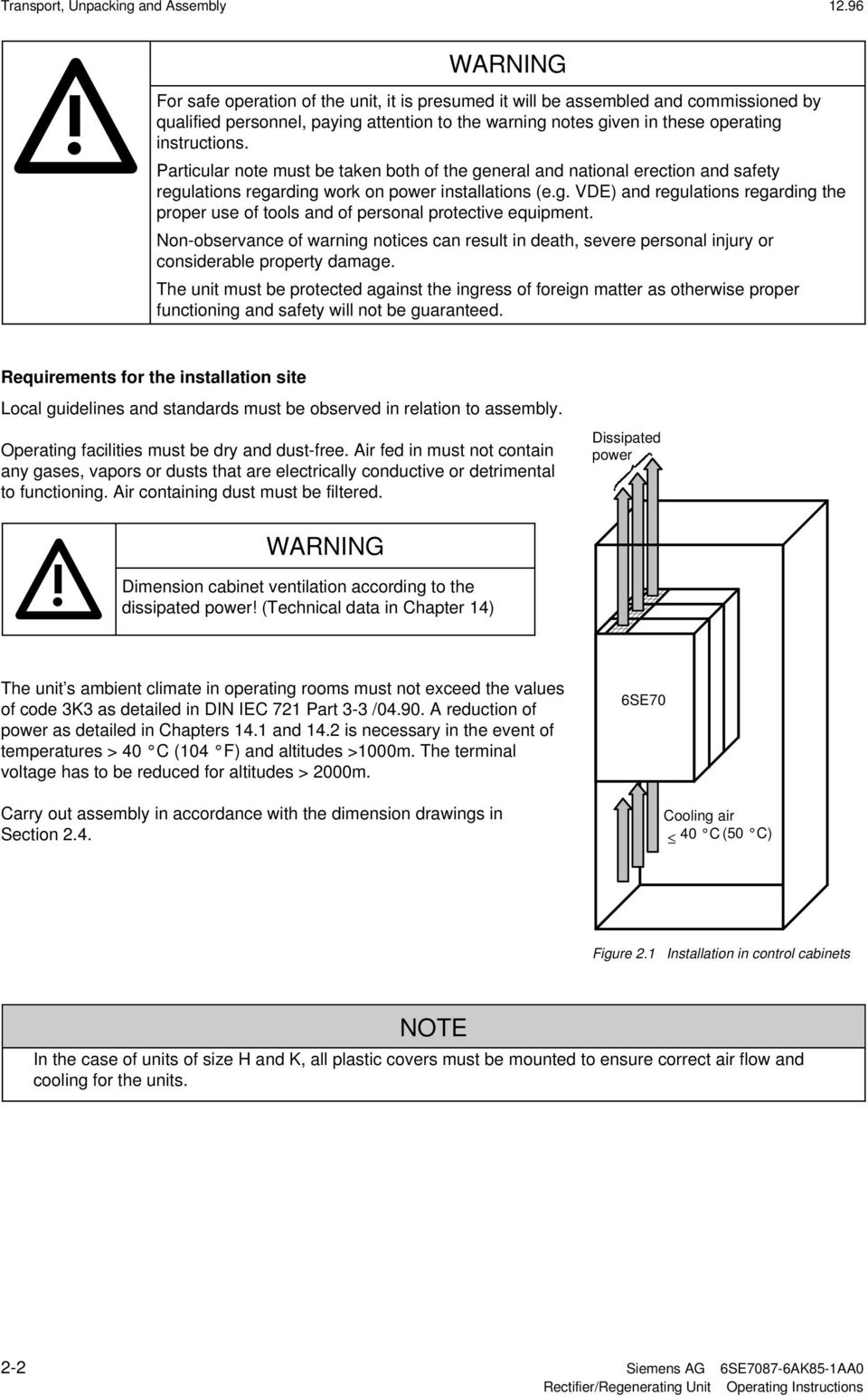
16 12.96 Transport, Unpacking and ssembly 2.4 Dimension drawings SIEMENS SIEMENS WRNUNG DNGER X1 X9 U1 V1 W1 1PE C D L2 L3 L1 L+ L- 3) 2) Exhaust air 6) Z 1) Mounting hole for screw M6. 126,7 52 WRNUNG DNGER X9 X X30.1 X ) X4 4) X4 90 1U2 1T1 1V2 1W2 1T2 1T V21+24 V23+26 R100 V25+22 V11+14 V13+16 V F10 F2 F1 R75 R76 X20.1 X47 X48 R77 R78 PMU X300 5) View without front cover F10 Options 23 ir intake 86 3) 2) Hook (suspension) for mounting on a g-rail according to EN ) Space required for cooling the unit. 4) Screen connection for two cables. 5) Shock-hazard protection 6) Connector for power supply DC24V and main contactor No displacement of the centre of gravity Weight: refer to section 14 (technical data) Dimension: mm Detail Z max. 5,7 54 Figure 2.2 Dimension drawing, size C Siemens G 6SE
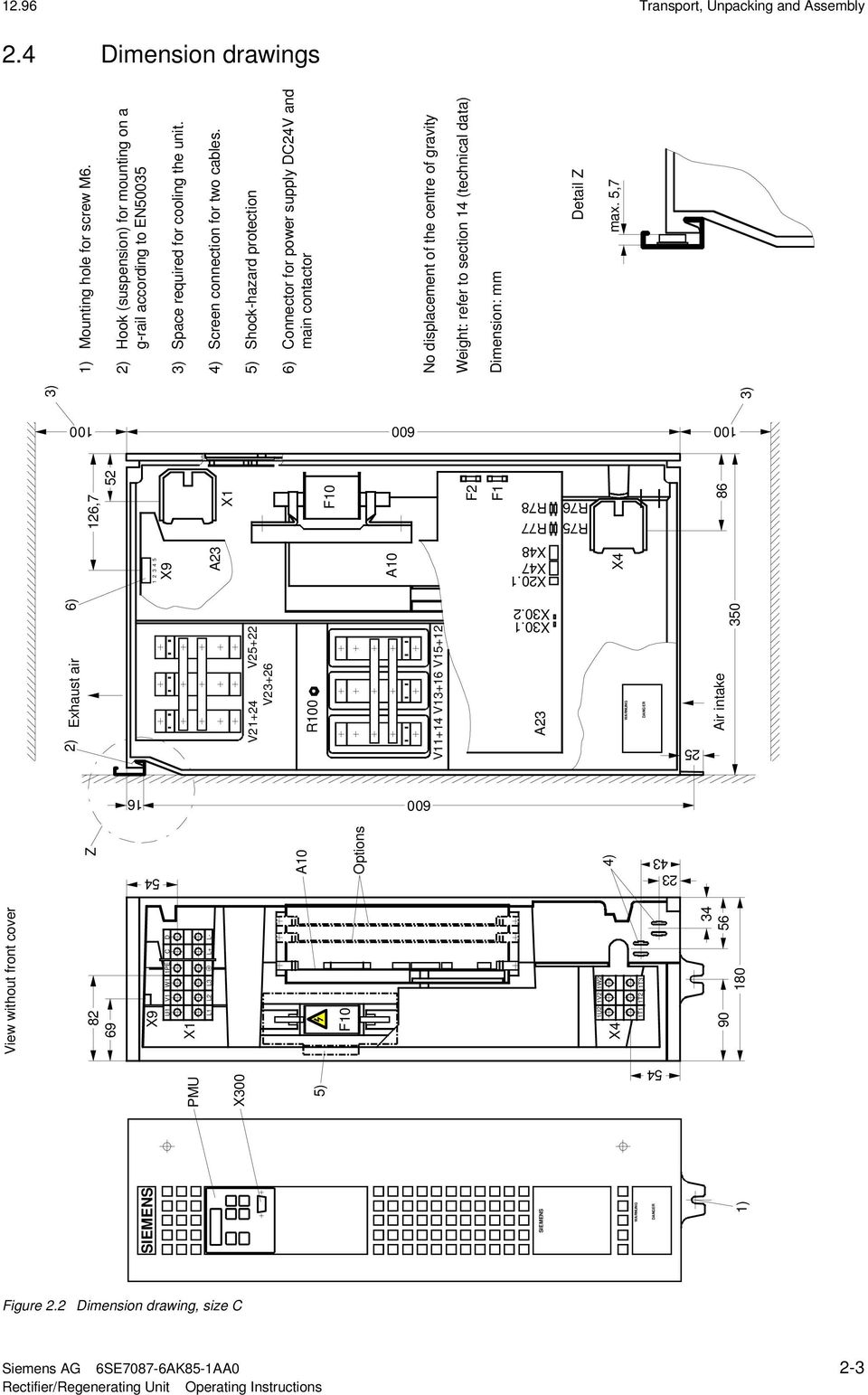
17 Transport, Unpacking and ssembly Front view V1 L2 Exhaust air 4) PE ir intake 1) Mounting hole for screw M8 2) Mounting hole for power connections: M16 for 6SE7036-1EE85-10, 6SE7035-4FE SE7034-2HE85-10 and 6SE7035-3HE85-10 M12 for every other units 3) Connection for PE, mounted: M16 for 6SE7036-1EE85-10, 6SE7035-4FE SE7034-2HE85-10 and 6SE7035-3HE85-10 M12 for every other units 4) Hole for crane hook 30mm 5) Front cover only for design IP20 6) connector for power supply DC24V and main contactor 7) Fan-Customer connection (X19) 8) Screen connection for cables 9) Space required for connection and cooling the unit Unit Dimension a Dimension b (mm) (mm) 6SE7031-7EE SE7032-2EE SE7033-1EE SE7033-8EE SE7034-6EE SE7036-1EE SE7031-5FE SE7032-4FE SE7032-7FE SE7033-5FE SE7034-2FE SE7035-4FE SE7031-4HE SE7032-2HE SE7032-7HE SE7034-2HE SE7035-3HE No displacement of the centre of gravity Weight: refer to section 14 Dimension: mm 25 44,5 C/L+ D/L- 23 F1 F2 X29 X19 X9 F3 F PMU 5) ) 41 2) PE ) 1) 2) ) 9) ) ,5 237,5 292 a b 10 Options F U1 L1 94,5 W1 L3 1U2 1T1 1V2 1T2 1W2 1T3 3) X48 7) V11 to V16 23 V21 to V26 E1 F PMU X300 8) 10) X47 10) 10) Remove transport plates before start-up Figure 2.3 Dimension drawing, size E 2-4 Siemens G 6SE

18 12.96 Transport, Unpacking and ssembly PMU X Options 3) ) ) 130 Exhaust air 7) C/L+ D/L- D/L- C/L+ 1U2/1T1 1V2/1T2 1W2/1T U1/L1 V1/L2 W1/L3 2) 2) W1 L3 V1 L2 U1 L1 PE1 PE1 F11 F14 F13 F16 F15 F12 T1 T2 1) X19 F4 F3 X29 23 X27 F5 F1 F2 X9 X9 4) X19 5) X19 X9 1) F24 F21 F26 F23 F22 F25 1) PE2 T3 T4 PE Mounting holes for wall mounting with M8 bolts Front view Level B Level 70 6) ir intake 1) Mounting hole for M12 screw 2) M12 thread 3) Screen connection for cables 4) Connector for 24 V DC power supply and main contactor 5) Fan connection 6) Remove transport plates before start-up 7) For cabinet installation: Insulate this part of the unit against the cabinet walls and door When the units are installed in cabinets,it must be ensured that the air intake and exhaust is adequate (for air requirements and intake air temperature, see Section 14 "Technical Data"). No displacement of the centre of gravity Weight: refer to Section 14 (Technical Data) Dimension: mm Figure 2.4 Dimension drawing, size H Siemens G 6SE
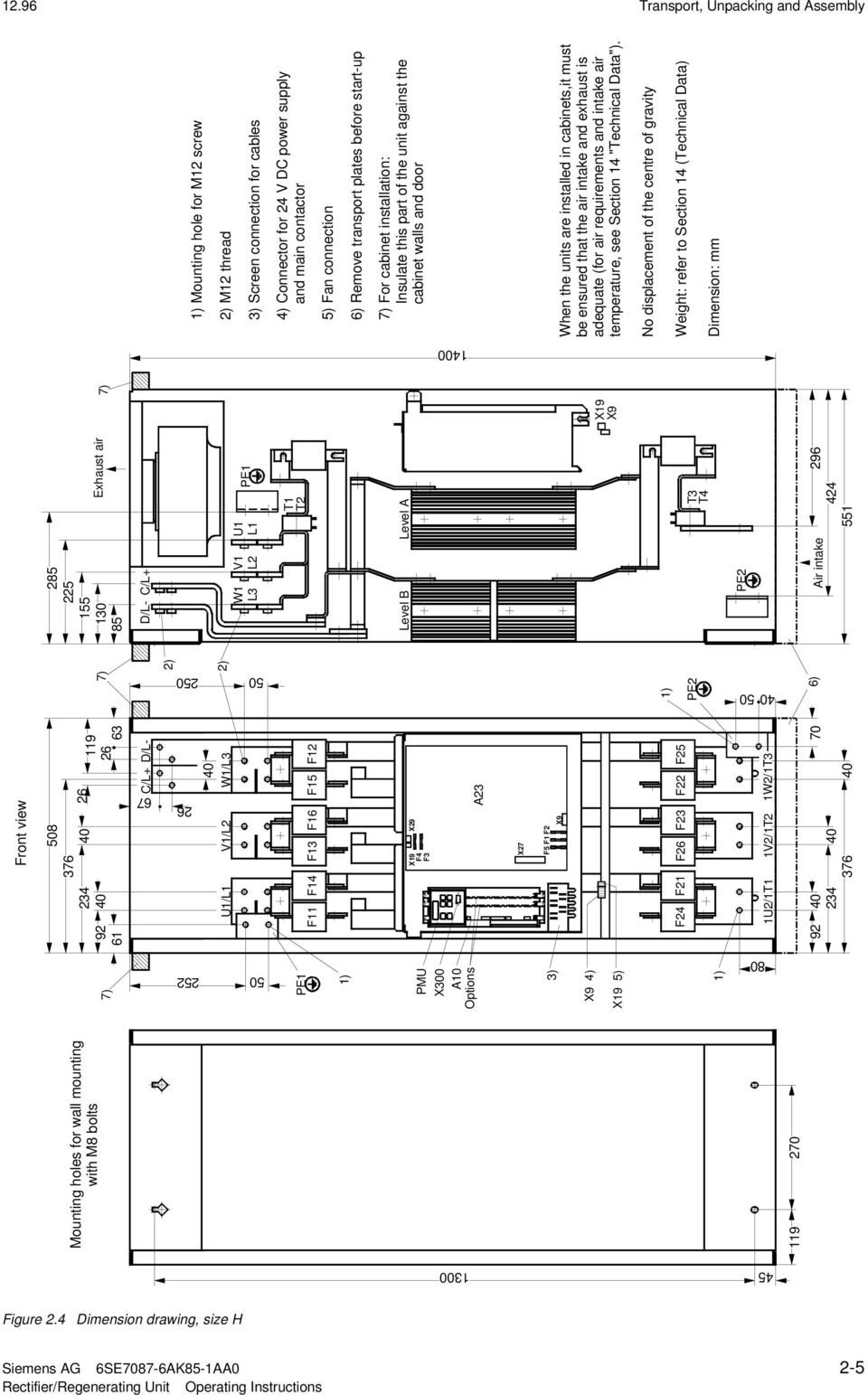
19 Transport, Unpacking and ssembly PE1 1U L1 1V L W L3 1C L PE1 50 PMU X Options 3) 23 PE U/L1 1V/L2 1W/L3 1C/L+ 1D/L- PE2 1U2 1T1 1V2 1T2 1W2 1T b) 3) 7a) X19 X9 1) 7a) X19 5) X9 4) 1) ) 7a) 1) 6) 137,5 112,5 6) 1D L- Level Level B Front view Mounting holes for wall mounting with M8 bolts Exhaust air ir intake 1) Mounting hole for M12 screw 2) M12 thread 3) Screen connection for cables 4) Connector for 24 V DC power supply and main contactor 5) Fan connection 6) Remove transport plate and transport cross before start-up 7) For cabinet installation: a) Insulate this part of the unit against the cabinet walls and door. b) Loosen fixing screws for fan casing (M8/SW13) and lift up plastic cover as far as the cabinettop panel. Tighten screws again. When the units are installed in cabinets,it must be ensured that the air intake and exhaust is adequate (for air requirements and intake air temperature, see Section 14 "Technical Data"). No displacement of the centre of gravity Weight: refer to Section 14 (Technical Data) Dimension: mm Figure 2.5 Dimension drawing, size 2-6 Siemens G 6SE

20 12.96 Transport, Unpacking and ssembly PMU Printed-circuit board Front cover Printed-circuit board 44 Front of enclosure Figure 2.6 Clearance between PCBs and front cover (size C) Figure 2.7 Clearance between PCBs and PMU (size E) Line connection without autotransfomer (size E) (For sizes C, H and, these connections have to be made externally on the system side. Rect. connection Busbar Regen. connection Figure 2.8 Line connection w/o autotransformer (size E) Order No. for three busbars 6SE7032-7FE87-3E0 6SE7032-7HE87-3E0 6SE7034-2HE87-3E0 Unit Order No. 6SE7031-7EE SE7032-2EE SE7033-1EE SE7031-5FE SE7032-4FE SE7032-7FE SE7033-8EE SE7034-6EE SE7033-5FE SE7034-2FE SE7031-4HE SE7032-2HE SE7032-7HE SE7036-1EE SE7035-4FE SE7034-2HE85-10 Siemens G 6SE

21 Transport, Unpacking and ssembly Siemens G 6SE
22 12.96 Connection 3 Connection WRNING The units are operated at high voltages. Only carry out connection work after disconnecting the voltage! ll work on the unit must only be carried out by qualified persons. Non-observance of warning notices can result in death, severe personal injury or considerable property damage. Damage or destruction can result if the unit is incorrectly connected. s the result of the dc link capacitors in the connected SIMOVERT Master Drives, the unit still contains a hazardous voltage up to 5 min. after isolation. This is why it is only permitted to open the unit after observing an appropriate waiting time. The power terminals and control terminals may carry a voltage even when the motor is at standstill. When working on the open unit, pay attention to the fact that live parts are exposed. The unit may only be operated with the front covers attached. The user is responsible for ensuring that the motor, converter, rectifier/regenerating unit and other units are installed and connected in accordance with the technical regulations recognized in the country of installation (in Germany: VDE, VBG4) and other regionally valid regulations. In doing so, particular attention must be paid to cable dimensioning, fusing, earthing, deactivation, isolation and overcurrent protection. CUTION The power cables must be fixed in position mechanically outside the unit. NOTES n external 24 V power supply is required for operation of the units (see Chapters 3.5 and 9.3). Operational range of the unit: 20 V to 30 V. Siemens G 6SE Rectifier/Regenerating Unit Operating instructions
23 Connection Power connections U1 L1 Mains V1 L2 W1 L3 PE1 DC link (DC output) C L+ D L- utotransformer/ regen. system X4 U1 L1 Mains V1 L2 W1 L3 DC link (DC output) C L+ D L- X1 1U2 1T1 1V2 1T2 1W2 1T3 1U2 1T1 1V2 1T2 1W2 1T3 utotransformer/ regen. system PE PE 23 X19-1 X19-2 Mains fan Figure 3.1 Mains connection size C Figure 3.2 Mains connection size E 1) DC-link (DC output) C/L+ D/L- 1) DC-link (DC output) PE1 C/L+ D/L- Mains 1) PE1 U1/L1 V1/L2 W1/L3 Mains fan X19 U1/L1 V1/L2 Mains 1) W1/L3 Mains fan X19 X9 X9 PE2 1U2/1T1 1V2/1T2 1W2/1T3 utotransformer / regen. system 1U2/1T1 1V2/1T2 1W2/1T3 utotransformer / regen. system PE2 Figure 3.3 Mains connection size H Figure 3.4 Mains connection size 1) Due to the press-in nuts, cable lugs or DC rails can only be connected to the terminal rails from the front. 3-2 Siemens G 6SE Rectifier/Regenerating Unit Operating instructions
24 12.96 Connection WRNING The operating coils of contactors and relays that are connected to the same supply network as the unit or that are located in close proximity of the unit must be connected to overvoltage limiters, e.g. RC circuits. n RCCB (residual-current-operated circuit-breaker) must not be used to protect the rectifier/regenerating unit (DIN VDE 0160). Voltage is only permitted to be applied to the unit when SIMOVERT Master Drives are connected. Operation without a connected DC link capacitor is not permitted! If the DC link terminals are connected incorrectly or short-circuited, the SIMOVERT Master Drives inverter will be destroyed! To reduce mains pollution, limit harmonics and reduce current ripple, the total system inductance for the supply and feedback connection (incl. commutating reactor and, where applicable, autotransformer must result in a total relative short-circuit voltage u k between 4% and 10%. Connect the fan power supply to X19. The fan continues to run for about four minutes or until a certain cooling element temperature threshold is undershot (provided its power supply is connected) after the unit has been switched off, following fault messages, on canceling the enable signal and after isolating the system supply connection. Despite switching the voltage off at the power terminals, a voltage may still exist on terminal X19 due to the external fan supply. NOTES The supply voltages applied to the rectifier and regenerating power terminals (U1/L1, V1/L2, W1/L3 and 1U2/1T1, 1V2/1T2, 1W2/1T3) must have an identical phase angle and identical frequency. Recommendation: The inductive components of the impedance drop u k of the (auto) transformer should lie between 1.5 and 3% (see Table 3.4). Commutating reactor: Selection of the reactors for 4 % u k should be based on the rated current in regenerative mode on the line side (see Technical Data). In weak or low-power systems, the u k of the commutating reactor must be decreased in order not to exceed the upper limit for the total u k of 10%. further measure in the case of extremely high u k values for the supply network can be implemented by connecting the primary side of the autotransformer to the supply network directly (before the commutating reactors), to ensure that the total u k value in the regenerating direction will not be too high. Mains Rectification Regeneration DC link Mains Rectification Regeneration DC link rrangement for high-power system rrangement for low-power system For the selection of the commutating reactors, see Table 3.5 and Catalog D93.1. With an extremely high total u k value in the regenerative direction, it may be necessary due to the increased thyristor current commutating time, to reduce the inverter step limit (parameter P776). This may mean it is necessary to reduce Ud. Output reactors in the DC circuit are not permitted (even with the parallel connection of power sections or in 12-pulse mode), because the DC link voltage is measured at the unit output terminals. Siemens G 6SE Rectifier/Regenerating Unit Operating instructions
25 Connection Function Terminal Connected load / Description Incoming supply terminals Protective conductor Power feedback terminals autotransformer/system Power terminals DC link voltage (inverter) Fan terminals Sizes E, H, X1-U1/L1 X1-V1/L2 X1-W1/L3 PE/GND X4-1U2/1T1 X4-1V2/1T2 X4-1W2/1T3 X1-C/L+ X1-D/L- X19-1 X19-2 See Technical Data Chapter 14 See Technical Data Chapter 14 See Technical Data Chapter 14 Supply connection for fan 230V C ±10%, 50 to 60 Hz ±5% Size E Current consumption: 0.84 Size H Current consumption: at 50 Hz: 2.6, at 60 Hz: 3.3 Size Current consumption: at 50 Hz: 5.2, at 60 Hz: 6.6 Table 3.1 Power connections Sizes C and E Terminal X19 fused with fuse (F3 and F4): T2/250V time-lag 5x20 mm (19198-T2/250V Messrs. Wickmann-Werke GmbH or FSD Messrs. Schurter) or T2/250V time-lag 6.3x32 mm (¼ x 1¼ ) (19343-T2/250V Messrs. Wickmann-Werke GmbH or FST Messrs. Schurter) Sizes H and Terminal X19 fused with fuse (F3 and F4): T2/250V time-lag 6.3x32 mm (¼ x 1¼ ) (19343-T7/250V Messrs. Wickmann-Werke GmbH or FST Messrs. Schurter) 3-4 Siemens G 6SE Rectifier/Regenerating Unit Operating instructions
26 12.96 Connection The units are designed for permanent connection to the system in keeping with DIN VDE 0160 Section Protective conductor connection: Min. cross-sectional area 10 mm2 (see Table 3.2). The conductor cross-sectional areas listed in Table 3.2 are maximum connectable cross-sections. The data is given for multicore cable. The cross-sections actually connected must be determined in accordance with the applicable regulations - e.g. DIN VDE 100 Part 523, DIN VDE 0276 Part Unit Order No. Mains DC link Protective conductor Rated input Conductor U1/L1, V1/L2,W1/L3 1U2/1T1, 1V2/1T2, 1W2/1T3 Conductor C/L+, D/L- Conductor PE voltage current max. max. max. max. 6SE70 (V) () mm2 1) WG 2) mm2 1) WG 2) mm2 1) WG 2) 22-1EC to ) 1/0 50 3) 1/ EC to ) 1/0 50 3) 1/ EC to ) 1/0 50 3) 1/ EE to x120 2x4/0 2x150 2x /0 32-2EE to x120 2x4/0 2x150 2x /0 33-1EE to x120 2x4/0 2x150 2x EE to x240 2x500 2x300 2x EE to x240 2x500 2x300 2x EE to x240 2x500 2x300 2x EH to C 4x300 R 100x EH to C 4x300 R 100x E to C 4x300 R 100x E85-1D0 380 to C 4x300 R 100x E to C 4x300 R 100x E85-1D0 380 to C 4x300 R 100x10 4x600 4x600 4x600 4x600 4x600 4x600 C 4x300 R 60x10 C 4x300 R 60x10 C 6x300 R 100x10 C 6x300 R 100x10 C 6x300 R 100x10 C 6x300 R 100x10 4x600 4x600 6x600 6x600 6x600 6x600 C 4x300 R 100x10 C 4x300 R 100x10 C 4x300 R 100x10 C 4x300 R 100x10 C 4x300 R 100x10 C 4x300 R 100x FC to ) 1/0 50 3) 1/ FC to ) 1/0 50 3) 1/ FC to ) 1/0 50 3) 1/ FC to ) 1/0 50 3) 1/ FE to x120 2x4/0 2x150 2x /0 32-4FE to x120 2x4/0 2x150 2x /0 32-7FE to x120 2x4/0 2x150 2x /0 33-5FE to x240 2x500 2x300 2x x600 4x600 4x600 4x600 4x600 4x600 1) C=Cable, R=Rail 2) merican Wire Gauge 3) Terminal connection area: Multicore10mm 2 to 50mm 2 WG 8 to WG 1/0 Stranded 3.5mm 2 to 35mm 2 WG 12 to WG 2 Siemens G 6SE Rectifier/Regenerating Unit Operating instructions
27 Connection Unit Order No. Mains DC link Protective conductor Rated input Conductor U1/L1, V1/L2,W1/L3 1U2/1T1, 1V2/1T2, 1W2/1T3 Conductor C/L+, D/L- Conductor PE voltage current max. max. max. max. 6SE70 (V) () mm2 1) WG 2) mm2 1) WG 2) mm2 1) WG 2) 34-2FE to x240 2x500 2x300 2x FE to x240 2x500 2x300 2x FH to C 4x300 R 100x FH to C 4x300 R 100x F to C 4x300 R 100x F85-1D0 500 to C 4x300 R 100x F to C 4x300 R 100x F85-1D0 500 to C 4x300 R 100x F to C 4x300 R 100x F85-1D0 500 to C 4x300 R 100x10 4x600 4x600 4x600 4x600 4x600 4x600 4x600 4x600 C 4x300 R 60x10 C 4x300 R 60x10 C 6x300 R 100x10 C 6x300 R 100x10 C 6x300 R 100x10 C 6x300 R 100x10 C 6x300 R 100x10 C 6x300 R 100x10 4x600 4x600 6x600 6x600 6x600 6x600 6x600 6x600 C 4x300 R 100x10 C 4x300 R 100x10 C 4x300 R 100x10 C 4x300 R 100x10 C 4x300 R 100x10 C 4x300 R 100x10 C 4x300 R 100x10 C 4x300 R 100x HE to x120 2x4/0 2x150 2x /0 32-2HE to x120 2x4/0 2x150 2x /0 32-7HE to x120 2x4/0 2x150 2x /0 34-2HE to x240 2x500 2x300 2x HE to x240 2x500 2x300 2x HH to C 4x300 R 100x HH to C 4x300 R 100x H to C 4x300 R 100x H85-1D0 660 to C 4x300 R 100x H to C 4x300 R 100x H85-1D0 660 to C 4x300 R 100x H to C 4x300 R 100x H85-1D0 660 to C 4x300 R 100x10 4x600 4x600 4x600 4x600 4x600 4x600 4x600 4x600 C 4x300 R 60x10 C 4x300 R 60x10 C 6x300 R 100x10 C 6x300 R 100x10 C 6x300 R 100x10 C 6x300 R 100x10 C 6x300 R 100x10 C 6x300 R 100x10 4x600 4x600 6x600 6x600 6x600 6x600 6x600 6x600 C 4x300 R 100x10 C 4x300 R 100x10 C 4x300 R 100x10 C 4x300 R 100x10 C 4x300 R 100x10 C 4x300 R 100x10 C 4x300 R 100x10 C 4x300 R 100x10 4x600 4x600 4x600 4x600 4x600 4x600 4x600 4x600 4x600 4x600 4x600 4x600 4x600 4x600 4x600 4x600 Table 3.2 Connection cross-sections 1) C=Cable, R=Rail 2) merican Wire Gauge 3-6 Siemens G 6SE Rectifier/Regenerating Unit Operating instructions
28 12.96 Connection Unit Mains supply fuses Order No. Column 1 Column 2 Siemens (SITOR) Bussmann US standard 6SE70 Type Type 22-1EC NE M EC NE M EC NE M EE NE M EE NE3230-0B M EE NE M EE NE M EE NE M EE NE M FC NE M FC NE M FC NE M FC NE M FE NE FE NE3220-0B 32-7FE NE M FE NE M FE NE3334-0B 35-4FE NE M HE NE HE NE3230-0B M HE NE HE NE HE NE M6696 Table 3.3 Column 1, 2: Recommended mains fuses Semiconductor protection only, lines are not reliably protected. Discriminative line protection is assured only by correlating the line protection fuses to the installed conductor cross-section in accordance with the applicable regulations - e.g. DIN VDE 0100 Teil 430. Siemens G 6SE Rectifier/Regenerating Unit Operating instructions
29 Connection Unit Order No. Built-in F10 DC link fuse Siemens SITOR Bussmann US standard 6SE70 Type Type 22-1EC NE L3832 1) 24-1EC NE L3836 1) 28-6EC NE EE NE M EE NE M EE NE M EE NE3334-0B M EE NE M EE NE M FC NE L3834 1) 24-1FC NE L3836 1) 27-2FC NE L3838 1) 28-8FC NE FE NE M FE NE3230-0B M FE NE M FE NE M FE NE3334-0B M FE NE M HE NE M HE NE3230-0B M HE NE M HE NE M HE NE M5699 Table 3.4 Built-in DC link fuse 1) Not a US standard 3-8 Siemens G 6SE Rectifier/Regenerating Unit Operating instructions
30 12.96 Connection Unit Built-in branch fuses F11 to F16 Order No. Siemens SITOR Bussmann US standard 6SE70 Type Type 38-2EH NE M EH NE M FH NE M FH NE M HH NE M HH NE M5699 Built-in branch fuses F111 to F E NE E85-1D NE E NE E85-1D NE F NE M F85-1D NE M F NE M F85-1D NE M F NE M F85-1D NE M H NE M H85-1D NE M H NE M H85-1D NE M H NE M H85-1D NE M5698 Table 3.5 Built-in branch fuses Siemens G 6SE Rectifier/Regenerating Unit Operating instructions
31 Connection Unit Order No. Rated input Regen.- Commutating reactor Type Voltage / Frequency Rated voltage curr. current current 6SE70 (V) () () (V / Hz) (V / Hz) () 22-1EC to EP3700-7U 400 / / EC to EP3900-5U 400 / / 60 35,5 28-6EC to EU2451-4U / / EE to EU2751-1UB / / EE to EU2751-2UB / / EE to EU3051-7U / / EE to EU3051-8U / / EE to EU3651-3UB / / EE to EU3651-4UB / / EH to EU3951-6U / / EH to EU3951-1UB / / E to EU4351-3U / / E85-1D0 380 to EU4351-3U / / E to EU4351-7U / / E85-1D0 380 to EU4351-7U / / FC to EP3800-8U 500 / 50 22,4 24-1FC to EP4001-0U 500 / 50 35,5 27-2FC to EU2451-5U / FC to EU2551-1UB / FE to EU2751-3UB / FE to EU3051-0UB / FE to EU3051-1UB / FE to EU3651-5UB / FE to EU3651-6UB / FE to EU3651-7UB / FH to EU3951-7U / FH to EU4351-5U / F to EU4551-1U / F85-1D0 500 to EU4551-1U / F to EU4551-2U / F85-1D0 500 to EU4551-2U / F to EU4751-0U / F85-1D0 500 to EU4751-0U / HE to EU2751-4UB / HE to EU3051-2UB / HE to EU3651-8UB / HE to EU3951-8U / HE to EU3951-0UB / HH to EU4351-6U / Siemens G 6SE Rectifier/Regenerating Unit Operating instructions
32 12.96 Connection Unit Order No. Rated input Regen.- Commutating reactor Type Voltage / Frequency Rated voltage curr. current current 6SE70 (V) () () (V / Hz) (V / Hz) () 41-0HH to EU4551-3U / H to EU4751-1U / H85-1D0 660 to EU4751-1U / H to EU5051-0U / H85-1D0 660 to EU5051-0U / H to EU5251-0U / H85-1D0 660 bi EU5251-0U / Table 3.6 Recommended commutating reactor Unit Order No. Rated input current Feedback current Line voltage range 15% 6SE70 () () (V) (Hz) utotransformer Duty factor utotransformer Duty factor Volt. Freq.. 100% 25% 22-1EC /60 4P2795-0U11-8 4P2595-0U P2795-0U21-8 4P2595-0U EC /60 4P3095-0U11-8 4P2795-0U P3095-0U21-8 4P2795-0U EC /60 4U3995-0U01-8 4P3095-0U U3995-0U11-8 4P3095-0U EE /60 4BU4595-0U01-8 4U3995-0U BU4395-0U01-8 4U3695-0U EE /60 4BU4595-0U11-8 4U3995-0U BU4595-0U21-8 4U3995-0UB EE /60 4BU4795-0U01-8 4BU4395-0U BU4795-0U11-8 4BU4395-0U EE /60 4BU5295-0U01-8 4BU4595-0U BU5195-0U01-8 4BU4595-0U EE /60 4BU5395-0U01-8 4BU4795-0U BU5395-0U11-8 4BU4795-0U EE /60 4BU5495-0U11-8 4BU5195-0U BU5495-0U01-8 4BU5195-0U EH /60 4BU5695-0U01-8 4BU5395-0U BU5695-0U11-8 4BU5295-0U EH /60 4BU5895-0U01-8 4BU5495-0U BU5895-0U11-8 4BU5495-0U E /60 4BU6095-0U01-8 4BU5695-0U BU5995-0U01-8 4BU5595-0U31-8 Siemens G 6SE Rectifier/Regenerating Unit Operating instructions
33 Connection Unit Order No. Rated input current Feedback current Line voltage range 15% 6SE70 () () (V) (Hz) utotransformer Duty factor utotransformer Duty factor Volt. Freq.. 100% 25% 41-3E85-1D /60 4BU6095-0U01-8 4BU5695-0U BU5995-0U01-8 4BU5595-0U E /60 4BU6295-0U01-8 4BU5895-0U BU6295-0U71-8 4BU5695-0U E85-1D /60 4BU6295-0U01-8 4BU5895-0U BU6295-0U71-8 4BU5695-0U FC /60 4P3095-0U31-8 4P2795-0U P3095-0U51-8 4P2595-0U FC /60 4U3695-0U41-8 4P2795-0U P3695-0U01-8 4P2795-0U FC /60 4U3995-0U21-8 4P3095-0U P3695-0U11-8 4P3095-0U FC /60 4U3995-0U31-8 4U3695-0U U3995-0U71-8 4U3095-0U FE /60 4BU4595-0U31-8 4U3995-0UB BU4595-0UB11-8 4U3995-0U FE /60 4BU4795-0U21-8 4BU4395-0U BU4795-0UB01-8 4BU4395-0U FE /60 4BU5195-0U11-8 4BU4595-0U BU5195-0U61-8 4BU4395-0U FE /60 4BU5295-0U11-8 4BU4595-0UB BU5295-0U51-8 4BU4595-0U FE /60 4BU5395-0U21-8 4BU4795-0U BU5495-0U51-8 4BU4795-0U FE /60 4BU5595-0U01-8 4BU5195-0U BU5595-0U51-8 4BU5195-0U FH /60 4BU5895-0U21-8 4BU5495-0U BU5895-0U71-8 4BU5395-0U FH /60 4BU6095-0U11-8 4BU5595-0U BU5995-0U31-8 4BU5595-0U F /60 4BU6295-0U11-8 4BU5695-0U BU6295-0U51-8 4BU5695-0U F85-1D /60 4BU6295-0U11-8 4BU5695-0U BU6295-0U51-8 4BU5695-0U F /60 4BU6295-0U21-8 4BU5895-0U BU6295-0U61-8 4BU5895-0U Siemens G 6SE Rectifier/Regenerating Unit Operating instructions
34 12.96 Connection Unit Order No. Rated input current Feedback current Line voltage range 15% 6SE70 () () (V) (Hz) utotransformer Duty factor utotransformer Duty factor Volt. Freq.. 100% 25% 41-5F85-1D /60 4BU6295-0U21-8 4BU5895-0U BU6295-0U61-8 4BU5895-0U F /60 4BU6495-0U01-8 4BU5995-0U BU6395-0U11-8 4BU5995-0U F85-1D /60 4BU6495-0U01-8 4BU5995-0U BU6395-0U11-8 4BU5995-0U HE /60 4BU4795-0U31-8 4BU4395-0U HE /60 4BU5295-0U21-8 4BU4595-0U HE /60 4BU5395-0U31-8 4BU4795-0U HE /60 4BU5595-0U11-8 4BU5295-0U HE /60 4BU5895-0U31-8 4BU5395-0U HH /60 4BU6095-0U21-8 4BU5695-0U HH /60 4BU6295-0U31-8 4BU5895-0U H /60 4BU6395-0U01-8 4BU5995-0U H85-1D /60 4BU6395-0U01-8 4BU5995-0U H /60 4BU6495-0U11-8 4BU6095-0U H85-1D /60 4BU6495-0U11-8 4BU6095-0U H /60 4BU6595-0U01-8 4BU6295-0U H85-1D /60 4BU6595-0U01-8 4BU6295-0U41-8 Table 3.7 Recommended autotransformers Siemens G 6SE Rectifier/Regenerating Unit Operating instructions
35 Connection Power supply and main contactor The power supply and main contactor control circuit are connected through five-pin connector X9 (sizes C and E: on module 23, sizes H and : at the bottom-left of the unit) Single-core cables with conductor cross-sections of 0.2 to 2.5 mm2 (WG: 24 to 14) can be connected to X9 (finely stranded 1.5 mm2 with core end ferrules). PS 24V DC Main contactor control P M The main contactor is driven over isolated contacts X9.4 and X9.5. Technical specifications of main contact control circuit: 230V Size C: max. 3 at p.f.0.4; max. making capacity 1500V; with switching voltage of 30 V DC, max 5 DC Size E, H, : max. 5 at p.f.0.4; max. making capacity 3000V; with switching voltage of 30 V DC, max 8 DC X V C Figure V DC and main contactor control connections Terminal Function description X9-1 DC +24V (tolerance range 20V - 30V) max. current consumption 2 at +24V max. current consumption without options: 1 for basic unit (master) 0.3 for parallel unit (slave) X9-2 Reference potential for DC X9-1 X9-3 not connected (N.C.) X9-4 Main contactor control circuit X9-5 Main contactor control circuit Table 3.8 Connector X9 pin assignments for auxiliary power supply and main contactor control Terminal X9.1 fused with fuse (F1) T2/250V time-lag 5x20mm (19198-T2/250V Messrs. Wickmann-Werke GmbH or FSD Messrs. Schurter) and for parallel unit via connector x27 (for size ): fused with fuse (F5) T2/250V time-lag 5x20mm (19198-T2/250V Messrs. Wickmann-Werke GmbH or FSD Messrs. Schurter) Terminal X9.2 Sizes C and E: fused with fuse (F2) T3.2/250V time-lag 5x20mm (19198-T3,2/250V Messrs. Wickmann-Werke GmbH or FSD Messrs. Schurter) Sizes H and : fused with fuse (F2) T7/250V time-lag 6.3x32mm (¼ x 1¼ ) (19343-T7/250V Messrs. Wickmann-Werke GmbH and/or FST Messrs. Schurter) NOTE The main contactor s operating coil must be protected, for example, by RC elements (Chapter 9) Siemens G 6SE Rectifier/Regenerating Unit Operating instructions
36 12.96 Connection Short-circuit withstand capability for sizes H and In the event of a line-side short-circuit in front of the super-fast built-in fuses, the power fed in from the supply depends on the protective devices provided on the system-side (NH fuses or circuit-breakers). To ensure that the forces and temperatures that result from short-circuits of this type can be kept within acceptable limits for the units, the following values calculated in accordance with DIN VDE 0660 Part 500 must be complied with by the supply and by the fuses or circuit-breakers connected before the unit. Size H: Rated short-time withstand current: I cw = k / 1s or I cw = 88.1 k / 0,1s Rated surge withstand current: I pk =85 k The power rails must be mechanically buffered to absorb the short-circuit forces directly in front of their entry point into the unit. Size : Rated short-time withstand current: I cw = 69,86 k / 1s or I cw = 220 k / 0,1s Rated surge withstand current: I pk =85 k The power rails must be mechanically buffered to absorb the short-circuit forces directly in front of their entry point into the unit. 3.3 Control terminal block and serial interface WRNING The rectifier/regenerating unit must be isolated before connecting the control leads to the CUR You can control the rectifier/regenerating unit over the following interfaces: Control terminal block on the CUR electronic module RS 485 serial interface on the CUR electronic module Operator panel OP 1 (see Chapter 9 Options) RS485 and RS232 serial interface on the PMU X300 CUTION The CUR incorporates ESD-endangered components that may be destroyed if improperly handled. See also under the measures recommended to protect ESD-endangered components in the introductory chapter entitled "General" Connectors for the control terminal block Conductors with cross-sectional areas of 0.14 to 1.5 mm2 (WG: 26 to 16), or 1 mm2 (WG: 18), finely stranded with core end ferrules, can be connected to the connectors (Recommended: 0.5 mm2 (WG: 20)). Siemens G 6SE Rectifier/Regenerating Unit Operating instructions
37 Connection Connecting the control leads NOTE When installed, control leads must be shielded and isolated from the power cables, laying them at a minimum spacing of 20 cm. The shield must be connected at both ends. On the unit's housing, the shield is connected with shield clamps. Handling of these clamps is shown in Figure 3.4. If they intersect, control and power cables must be run at an angle of 90 to each other. Fitting the shielding clamp Connector 15 mm 7.5 mm 5 mm dapt length to design Slide on shield and secure with shrink-on tubing, for example Shield 35 Do not bend spring over Releasing the shielding clamp Manually or using a screwdriver, press the clamp together and extrac it in the upward direction. Caution! The clamps are sharp-edged! Figure 3.6 Connecting the control leads and handling the shielding clamps If two shielding clamps cannot cope with the number of control leads on the Size C unit, the "EMC shielding enclosure" option should be used. Order number: Size C 6SE7090-0XC87-3C Siemens G 6SE Rectifier/Regenerating Unit Operating instructions
38 12.96 Connection Terminals and setting elements on the CUR (10) module R CUR PMU X100 X101 X102 R136 X104 S1 S2 Figure 3.7 Control terminals and setting elements on the CUR Setting elements: DIP switches S1, S2: Both open: No bus termination for the RS485 interface (terminals X100-1 to X100-4) Both closed: Bus termination for the RS485 interface active (1500 between RS485P and RS485N, 3900 from RS485P to +5V supply, 390 from RS485N to earth) R135 and R136: 0 resistances as earth-frame (M) connection M is connected to earth when the unit is supplied. Remove these resistances only to avoid faults due to earth loops, i.e. if the electronics frame is connected in some other way to earth (e.g. through signal leads or the frame terminal of the power supply unit). If option modules are used, a further earth-frame (M) connection may have to be removed. (please refer to the description of these modules). Siemens G 6SE Rectifier/Regenerating Unit Operating instructions
39 Connection Electronics terminals: Function Terminal Connected loads/description Serial interface RS485 (Bus) X100-1 X100-2 X100-3 X100-4 X100-5 Binary inputs X101-6 X101-7 X101-8 X101-9 X X X X nalog outputs X X X RS485P Plus line Send and receive- RS485N Minus line line RS485P Plus line (difference input/output) RS485N Minus line Signal frame For functions see Section P24S +24V power supply for external contacts, max. load 100m Frame for binary signals Frame for binary signals Binary input 1 Binary input 2 Binary input 3 Binary input 4 Binary input 5 Low level: -0.6V - 3V or floating terminals High level: 13V - 33V Input current at 24V: ca. 10m For functions see Section nalog output resolution 8 bits, For functions see Section Frame for analog outputs ctual current value: 0V - 5V corresponds to 0 - rated DC current Display range: 0-10V, max. 5m load, current limited Binary outputs X X X X Binary output 1, pin 1 Binary output 1, pin 2 Binary output 2, pin 1 Binary output 2, pin 2 The binary outputs are normally-open relay contacts t 50V C max. switching voltage, the following applies: Max. switching current 1~ at p.f. =1 Max. switching current 0.12 C at p.f. = 0.4 t max. 30V DC switching voltage, the following applies:: Max. switching current 0.8 (resistive loads) For functions see Section and (status word) Table 3.9 Control terminal block 3-18 Siemens G 6SE Rectifier/Regenerating Unit Operating instructions
40 12.96 Connection Connecting-up the parameterizing unit (PMU) serial connection to automation unit or a PC can be realized via connector X300 on the PMU. Thus, the rectifier/regenerating unit can be controlled and operated from the central control station or control room. P X Figure 3.8 Parameterizing unit (PMU) PMU -X300 Description 1 Housing ground 2 Receive line, RS232 standard (V.24) 3 Transmit- and receive line, RS485, two-wire, positive differential input/output 4 RTS (Request to send; for direction reversal in the case of interface converters 5 Ref. potential (ground) 6 5 V power supply for OP 7 Transmit line, RS232 standard (V.24) 8 Transmit- and receive line RS485, two-wire, negative differential input/output 9 Ref. potential for RS232 or RS485 interface Table 3.10 Connector pin assignment for interface X Measures for keeping to RFI suppression regulations To appear shortly Siemens G 6SE Rectifier/Regenerating Unit Operating instructions
41 Connection Single-line diagrams with suggested circuit arrangements RS X300 X308 PMU 1 2 RS P5 R15 P N R16 RS485 P N M X117 M 2 C TTL X108 X107 X100 M X115 X116 3C 50-60Hz, 400V 3C 50-60Hz, 500V 1C 50-60Hz, 230V X101 P24 M M 10 C BI X109 P5 S1 390 Ω RS485P 150 Ω RS485N S2 390 Ω M 10nF M 820k 01 Iact BO R135 R136 M 10nF X102 X X C X9-3 X9-4 X V Load X30-1 X30-2 X X PE 1 Filter (optional) X1: U1 V1 W1 L1 L2 L3 R100 ϑ F10 X1: C/L+ E1 M X4: 1U2 1V2 1W2 1T1 1T2 1T3 X1: D/L- RESET L_DSVE RS485 ê OP1, SIMOVIS RS232 ê SIMOVIS Option modules binary selecting inputs Microprocessor selection: Open and closed-loop control of the DC link voltage binary selecting outputs analog outputs 24V-power supply unit X9-1 X9-2 F1 F2 Power supply +5V +15V -15V +24V Figure 3.9 Single-line diagram with suggested circuit arrangement without autotransformer, Size C 3-20 Siemens G 6SE Rectifier/Regenerating Unit Operating instructions
42 12.96 Connection RS X300 X308 PMU 1 2 RS P5 R15 P N R16 RS485 P N M X117 M 2 C TTL X108 X107 X100 M X115 X116 3C 50-60Hz, 400V 3C 50-60Hz, 500V 1C 50-60Hz, 230V X101 P24 M M 10 C BI X109 P5 S1 390 Ω RS485P 150 Ω RS485N S2 390 Ω M 10nF M 820k 01 Iact BO R135 R136 M 10nF X102 X X C X9-3 X9-4 X V Bürde X30-1 X30-2 X X PE 1 Filter (optional) X1: U1 V1 W1 L1 L2 L3 R100 ϑ F10 X1: C/L+ 1U1 1U1 1V1 1V1 1W1 1W1 E1 M 1 ϑ 2U1 2V1 2W1 X4: 1U2 1V2 1W2 1T1 1T2 1T3 X1: D/L- RESET L_DSVE RS485 ê OP1, SIMOVIS RS232 ê SIMOVIS Option modules binary selecting inputs Microprocessor selection: Open and closed-loop control of the DC link voltage binary selecting outputs analog outputs 24V-power supply unit X9-1 X9-2 F1 F2 Power supply +5V +15V -15V +24V Figure 3.10 Single-line diagram with suggested circuit arrangement with autotransformer, Size C Siemens G 6SE Rectifier/Regenerating Unit Operating instructions
43 Connection X300 X308 PMU 1 2 RS X108 X107 X100 M X101 P24 M M 10 C X109 BI P5 S1 390 Ω RS485P 150 Ω RS485N S2 390 Ω M 10nF M 820k 01 Iact BO R135 R136 M 10nF X102 X X9-1 X9-2 X9-3 X9-4 X9-5 F1 F V +15V -15V +24V Bürde X C X30-1 X30-2 X29.3 X PE 1 Filter (optional) X1: U1 V1 W1 L1 L2 L3 R100 ϑ F10 X1: C/L+ E1 M 1~ X4: 1U2 1V2 1W2 1T1 1T2 1T3 X1: D/L- RESET L_DSVE RS RS485 ê OP1, SIMOVIS RS232 ê SIMOVIS Option modules P5 R15 P N R16 RS485 P N M X117 M 2 C TTL X115 X116 3C 50-60Hz, 400V 3C 50-60Hz, 500V 3C 50-60Hz, 690V 1C 50-60Hz, 230V binary selecting inputs Microprocessor selection: Open and closed-loop control of the DC link voltage binary selecting outputs analog outputs 24V-power supply unit Power supply F3 F4 X19-1 X19-2 X29.1 Figure 3.11 Single-line diagram with suggested circuit arrangement without autotransformer, Size E 3-22 Siemens G 6SE Rectifier/Regenerating Unit Operating instructions
44 12.96 Connection X300 X308 PMU 1 2 RS X108 X107 X100 M X101 P24 M M 10 C X109 BI P5 S1 390 Ω RS485P 150 Ω RS485N S2 390 Ω M 10nF M 820k 01 Iact BO R135 R136 M 10nF X102 X X9-1 X9-2 X9-3 X9-4 X9-5 F1 F V +15V -15V +24V Bürde X C X30-1 X30-2 X29.3 X PE 1 Filter (optional) X1: U1 V1 W1 L1 L2 L3 R100 ϑ F10 X1: C/L+ 1U1 1U1 1V1 1V1 1W1 1W1 E1 M 1~ 1 ϑ 2U1 2V1 2W1 X4: 1U2 1V2 1W2 1T1 1T2 1T3 X1: D/L- RESET L_DSVE RS RS485 ê OP1, SIMOVIS RS232 ê SIMOVIS Option modules P5 R15 P N R16 RS485 P N M X117 M 2 C TTL X115 X116 3C 50-60Hz, 400V 3C 50-60Hz, 500V 3C 50-60Hz, 690V 1C 50-60Hz, 230V binary selecting inputs Microprocessor selection: Open and closed-loop control of the DC link voltage binary selecting outputs analog outputs 24V-power supply unit Power supply F3 F4 X19-1 X19-2 X29.1 Figure 3.12 Single-line diagram with suggested circuit arrangement with autotransformer, Size E Siemens G 6SE Rectifier/Regenerating Unit Operating instructions
45 Connection RS RS485 ê OP1, SIMOVIS RS232 ê SIMOVIS X300 X308 X108 PMU X107 X100 1 RS M P5 R15 P N R16 RS485 X115 P N M X117 M 2 C TTL X X101 P24 M M 10 C X109 BI P5 S1 390 Ω RS485P 150 Ω RS485N S2 390 Ω M 10nF 820k R135 M 01 Iact BO R136 M 10nF X102 X F1 F2 +5V +15V -15V +24V X C X27 Bürde F3 F4 X19-1 X19-2 X19-1 X19-2 1C 230V Filter (optional) PE X1: U1 V1 W1 L1 L2 L3 X4: 1U2 1V2 1W2 1T1 1T2 1T X30-1 ϑ E1 M 1~ X30-2 X31-1 X31-2 R100 ϑ R101 X29.3 X20.2 X20.1 X29.2 X29.1 X1: C/L+ X1: D/L- RESET L_DSVE Option modules 3C 50-60Hz, 400V 3C 50-60Hz, 500V 3C 50-60Hz, 690V 1C 50-60Hz, 230V binary selecting inputs Microprocessor selection: Open and closed-loop control of the DC link voltage binary selecting outputs analog outputs 24V-power supply unit X9-1 X9-2 X9-3 X9-4 X9-5 X9-1 X9-2 X9-3 X9-4 X9-5 F5 1-2 Power supply 1 Figure 3.13 Single-line diagram with suggested circuit arrangement without autotransformer, Size H 3-24 Siemens G 6SE Rectifier/Regenerating Unit Operating instructions
46 12.96 Connection RS RS485 ê OP1, SIMOVIS RS232 ê SIMOVIS X300 X308 X108 PMU X107 X100 1 RS M P5 R15 P N R16 RS485 X115 P N M X117 M 2 C TTL X X101 P24 M M 10 C X109 BI P5 S1 390 Ω RS485P 150 Ω RS485N S2 390 Ω M 10nF 820k R135 M 01 Iact BO R136 M 10nF X102 X F1 F2 +5V +15V -15V +24V X C X27 Bürde F3 F4 X19-1 X19-2 X19-1 X19-2 1C 230V Filter (optional) 1 1U1 1U1 1V1 1V1 1W1 1W1 ϑ 2U1 2V1 2W1 PE X1: U1 V1 W1 L1 L2 L3 X4: 1U2 1V2 1W2 1T1 1T2 1T ϑ E1 X30-1 M 1~ X30-2 R100 X31-1 ϑ X31-2 R101 X29.3 X20.2 X20.1 X29.2 X29.1 X1: C/L+ X1: D/L- RESET L_DSVE Option modules 3C 50-60Hz, 400V 3C 50-60Hz, 500V 3C 50-60Hz, 690V 1C 50-60Hz, 230V binary selecting inputs Microprocessor selection: Open and closed-loop control of the DC link voltage binary selecting outputs analog outputs 24V-power supply unit X9-1 X9-2 X9-3 X9-4 X9-5 X9-1 X9-2 X9-3 X9-4 X9-5 F5 1-2 Power supply 1 Figure 3.14 Single-line diagram with suggested circuit arrangement with autotransformer, Size H Siemens G 6SE Rectifier/Regenerating Unit Operating instructions
47 Connection RS RS485 ê OP1, SIMOVIS RS232 ê SIMOVIS X300 X308 X108 PMU X107 X100 1 RS M P5 R15 P N R16 RS485 X115 P N M X117 M 2 C TTL X X101 P24 M M 10 C X109 BI P5 S1 390 Ω RS485P 150 Ω RS485N S2 390 Ω M 10nF 820k R135 M 01 Iact BO R136 M 10nF X102 X F1 F2 +5V +15V -15V +24V X C X27 Connections for parallel unit Bürde F3 F4 X19-1 X19-2 X19-1 X19-2 1C 230V X30-1 X30-2 X31-1 X31-2 X29.3 X29.2 X PE Filter (optional) X1: U1 V1 W1 L1 L2 L3 X4: 1U2 1V2 1W2 1T1 1T2 1T3 ϑ E2 M 1~ R100 ϑ R101 E1 M 1~ X20.2 X20.1 X1: C/L+ X1: D/L- RESET L_DSVE Option modules 3C 50-60Hz, 400V 3C 50-60Hz, 500V 3C 50-60Hz, 690V 1C 50-60Hz, 230V binary selecting inputs Microprocessor selection: Open and closed-loop control of the DC link voltage binary selecting outputs analog outputs 24V-power supply unit X9-1 X9-2 X9-3 X9-4 X9-5 X9-1 X9-2 X9-3 X9-4 X9-5 F5 1-2 Power supply 1 Figure 3.15 Single-line diagram with suggested circuit arrangement without autotransformer, Size 3-26 Siemens G 6SE Rectifier/Regenerating Unit Operating instructions
48 12.95 Connection RS RS485 ê OP1, SIMOVIS RS232 ê SIMOVIS X300 X308 X108 PMU X107 X100 1 RS M P5 R15 P N R16 RS485 X115 P N M X117 M 2 C TTL X X101 P24 M M 10 C X109 BI P5 S1 390 Ω RS485P 150 Ω RS485N S2 390 Ω M 10nF 820k R135 M 01 Iact BO R136 M 10nF X102 X F1 F2 +5V +15V -15V +24V X C X27 Bürde F3 F4 X19-1 X19-2 X19-1 X19-2 1C 230V X30-1 X30-2 X31-1 X31-2 X29.3 X29.2 X PE Filter (optional) 1 1U1 1U1 1V1 1V1 1W1 1W1 ϑ 2U1 2V1 2W1 X1: U1 V1 W1 L1 L2 L3 X4: 1U2 1V2 1W2 1T1 1T2 1T3 ϑ E2 M 1~ R100 ϑ R101 E1 M 1~ X20.2 X20.1 X1: C/L+ X1: D/L- RESET L_DSVE Option modules 3C 50-60Hz, 400V 3C 50-60Hz, 500V 3C 50-60Hz, 690V 1C 50-60Hz, 230V binary selecting inputs Microprocessor selection: Open and closed-loop control of the DC link voltage binary selecting outputs analog outputs 24V-power supply unit X9-1 X9-2 X9-3 X9-4 X9-5 X9-1 X9-2 X9-3 X9-4 X9-5 F5 1-2 Power supply Connections for parallel unit 1 Figure 3.16 Single-line diagram with suggested circuit arrangement with autotransformer, Size Siemens G 6SE Rectifier/Regenerating Unit Operating instructions
49 - Connection Power sections 1 X4: X1: U1/L1 V1/L2 W1/L3 C/L+ D/L- T1 T2 X24 X21 X26 X23 X22 X25 F10 G2 G1 G2 G1 G2 G1 V21+24 V23+26 V25+22 V11+14 V13+16 V15+12 G1 G2 G1 G2 G1 G2 X11 X14 X13 X16 X15 X12 T3 T4 1U2/1T1 1V2/1T2 1W2/1T3 X1: U1/ V1/ W1/ L1 L2 L3 X4: 1U2/ 1V2/ 1W2/ 1T1 1T2 1T3 T1 T2 L k L k X47-1 X47-4 X47-3 X k k T3 T4 L L X48-1 X48-4 X48-3 X48-2 X11-1 X11-2 G1 G2 X14-2 X14-1 V11+V14 G2 V21+V24 G1 X13-1 X13-2 G1 G2 X16-2 X16-1 V13+V16 G2 V23+V26 G1 X15-1 X15-2 G1 G2 X12-2 X12-1 V15+V12 G2 V25+V22 G1 F10 X1: C/L+ X1: D/L- + X24-1 X24-2 X21-2 X21-1 X26-1 X26-2 X23-2 X23-1 X22-1 X22-2 X25-2 X25-1 F1 T2 F2 T3,2 X9-1 X9-2 X9-3 X9-4 X9-5 l l l l R75 R77 R76 R78 C D 1-2 U1 V1 W1 1U2 1V2 1W2 X X X20-1 X20-2 X30-1 X30-2 X239 E1 M N.C. Load 1 Load 2 Termal sensor on the heatsink 10-X109 (C ) rrangement of thyristor modules ϑ R100 PE 23 C C C Figure 3.17 Power section, 6SE7022-1EC85-10, 6SE7024-1EC85-10 and 6SE7028-6EC85-10,( V / 21, 41 and 86) 3-28 Siemens G 6SE Rectifier/Regenerating Unit Operating instructions
50 Connection G1 V11+V14 G2 G1 V13+V16 G2 G1 V15+V12 G2 + R25+R22 ϑ X30-1 X30-2 X239 M 1~ X11-1 X11-2 X14-2 X14-1 X13-1 X13-2 X16-2 X16-1 X15-1 X15-2 X12-2 X12-1 k k 230V~ T1 T2 L L X47-1 X47-4 X47-3 X47-2 L k L k X48-1 X48-4 X48-3 X48-2 F10 X1: C/L+ X1: D/L- l l l l R75 R77 R79 R76 R78 R80 F4 T2 F1 T2 F2 T3,2 1-2 X9-1 X9-2 X9-3 X9-4 X9-5 U1.1 U1.2 V1.1 V1.2 W1.1 W1.2 1U2.1 1U2.2 1V2.1 1V2.2 1W2.1 1W2.2 C D X29-1 X29-2 X29-3 X19-1 X X109 (C ) R100 E1 F3 T C X1: U1/ V1/ W1/ L1 L2 L3 PE X4: 1U2/ 1V2/ 1W2/ 1T1 1T2 1T3 T3 T4 601 C N.C. 23 C R11+R14 R13+R16 R15+R12 R21+R24 R23+R26 Load 1 Load 2 Termal sensor on the heatsink rrangement of thyristor modules C/L+ D/L- F10 X14 X11 X16 X13 X12 X15 G2 G1 G2 G1 G2 G1 V11+14 V13+16 V15+12 T1 T2 G2 2 G1 1 G2 2 X24 X21 X26 X23 X22 X25 G1 1 G2 2 G1 1 V21+ V24 V23+ V26 V25+ V22 T3 T4 U1/L1 1U2/1T1 V1/L2 1V2/1T2 W1/L3 1W2/1T3 G2 2 V21+V24 G1 1 G2 2 V23+V26 G1 1 G2 2 V25+V22 G1 1 X24-1 X24-2 X21-2 X21-1 X26-1 X26-2 X23-2 X23-1 X22-1 X22-2 X25-2 X25-1 Figure 3.18 Power section, 6SE7031-7EE85-10 ( V / 173) Siemens G 6SE Rectifier/Regenerating Unit Operating instructions
51 - Connection V21+ V24 V23+ V26 V25+ V22 L k L k X48-3 X48-2 F10 X1: C/L+ X1: D/L F1 T2 F2 T3,2 X9-1 X9-2 X9-3 X9-4 X9-5 l l U1.1 U1.2 V1.1 V1.2 W1.1 W1.2 1U2.1 1U2.2 1V2.1 1V2.2 1W2.1 1W2.2 C/L+ D/L- F10 G2 2 G1 1 G2 2 X24 X21 X26 X23 X22 X25 G1 1 G2 2 G1 1 T3 T4 U1/L1 1U2/1T1 V1/L2 1V2/1T2 W1/L3 1W2/1T3 X11-1 X11-2 X14-2 X14-1 X13-1 X13-2 X16-2 X16-1 X15-1 X15-2 X12-2 X12-1 k k 230V~ T1 T2 L L X47-1 X47-4 X47-3 X47-2 X48-1 X G1 G2 2 V11+V14 V21+V24 2 G2 G1 1 1 G1 G2 2 V13+V16 V23+V26 2 G2 G1 1 1 G1 G2 2 V15+V12 V25+V22 2 G2 G1 1 C D X24-1 X24-2 X21-2 X21-1 X26-1 X26-2 X23-2 X23-1 X22-1 X22-2 X25-2 X25-1 l l R75 R77 R79 R76 R78 R80 ϑ R100 X30-1 X30-2 X239 M 1~ F4 T2 X29-1 X29-2 X29-3 X19-1 X X109 (C ) E1 F3 T X1: U1/ V1/ W1/ L1 L2 L3 PE X4: 1U2/ 1V2/ 1W2/ 1T1 1T2 1T3 T3 T4 N.C. R11+R14 R13+R16 R15+R12 R21+R24 R23+R26 R25+R22 Load 1 Load 2 Termal sensor on the heatsink rrangement of thyristor modules G2 2 G1 1 G2 2 X14 X11 X16 X13 X12 X15 G1 1 G2 2 G1 1 V11+ V14 V13+ V16 V15+ V12 T1 T2 23 C C C Figure 3.19 Power section, 6SE7032-2EE85-10 ( V / 222) 3-30 Siemens G 6SE Rectifier/Regenerating Unit Operating instructions
52 Connection L k L k X48-3 X G1 G2 2 2 G2 G1 1 1 G1 G2 2 2 G2 G1 1 1 G1 G2 2 2 G2 G1 1 F10 X1: C/L+ X1: D/L F1 T2 F2 T3,2 X9-1 X9-2 X9-3 X9-4 X9-5 l l U1.1 U1.2 V1.1 V1.2 W1.1 W1.2 1U2.1 1U2.2 1V2.1 1V2.2 1W2.1 1W2.2 X11-1 X11-2 X14-2 X14-1 X13-1 X13-2 X16-2 X16-1 X15-1 X15-2 X12-2 X12-1 k k 230V~ T1 T2 L L X47-1 X47-4 X47-3 X47-2 X48-1 X48-4 V11+V14 V21+V24 V13+V16 V23+V26 V15+V12 V25+V22 C D X24-1 X24-2 X21-2 X21-1 X26-1 X26-2 X23-2 X23-1 X22-1 X22-2 X25-2 X25-1 l l R75 R77 R79 R76 R78 R80 ϑ R100 X30-1 X30-2 X239 M 1~ F4 T2 X29-1 X29-2 X29-3 X19-1 X X109 (C ) E1 F3 T X1: U1/ V1/ W1/ L1 L2 L3 PE X4: 1U2/ 1V2/ 1W2/ 1T1 1T2 1T3 T3 T4 N.C. R11+R14 R13+R16 R15+R12 23 C C C R21 R24 R23 R26 R25 R22 Load 1 Load 2 Termal sensor on the heatsink rrangement of thyristor modules C/L+ D/L- F10 G2 2 G1 1 G2 2 X14 X11 X16 X13 X12 X15 G1 1 G2 2 G1 1 V11+ V14 V13+ V16 V15+ V12 T1 T2 G2 2 G1 1 G2 2 X24 X21 X26 X23 X22 X25 G1 1 G2 2 G1 1 V21+ V24 V23+ V26 V25+ V22 T3 T4 U1/L1 1U2/1T1 V1/L2 1V2/1T2 W1/L3 1W2/1T3 Figure 3.20 Power section, 6SE7033-1EE85-10 ( V / 310) Siemens G 6SE Rectifier/Regenerating Unit Operating instructions
53 Connection R100 E1 k k 230V~ T1 T2 L L X47-1 X47-4 X47-3 X47-2 L k L k X48-1 X48-4 X48-3 X48-2 X11-1 X G1 G2 2 X14-2 X14-1 X13-1 X13-2 V11+V14 1 G1 2 G2 V21+V24 G2 2 G1 1 X16-2 X16-1 X15-1 X15-2 V13+V16 1 G1 2 G2 V23+V26 G2 2 G1 1 X12-2 X12-1 V15+V12 2 G2 V25+V22 G1 1 F10 X1: C/L+ X1:D/L- 1-2 F1 T2 F2 T3,2 X9-1 X9-2 X9-3 X9-4 X9-5 l l U1.1 U1.2 V1.1 V1.2 W1.1 W1.2 C D X24-1 X24-2 X21-2 X21-1 X26-1 X26-2 X23-2 X23-1 X22-1 X22-2 X25-2 X25-1 l l R75 R77 R79 R76 R78 R80 ϑ X30-1 X30-2 X239 M 1~ X29-1 X29-2 X29-3 X19-1 X19-2 U1/L1 C/L+ D/L- F10 X14 X11 X16 X13 X12 X15 2 G2 G11 2 G2 G1 1 2 G2 G1 1 V11+V14 V13+V16 V15+V12 T1 T2 X24 X21 X26 X23 X22 X25 2 G2 G1 1 2 G2 G1 1 2 G2 G1 1 V21+V24 V23+V26 V25+V22 T3 T4 1U2/1T1 V1/L2 1V2/1T2 W1/L3 1W2/1T3 X1: U1/ V1/ W1/ L1 L2 L3 PE X4: 1U2/ 1V2/ 1W2/ 1T1 1T2 1T F3 T2 F4 T2 23 C C C R11+R14 R13+R16 R15+R12 1U2.1 R21 1U2.2 R24 1V2.1 R23 1V2.2 R26 1W2.1 R25 1W2.2 R22 Load 1 Load 2 Termal sensor on the heatsink 10-X109 (C ) rrangement of thyristor modules T3 T4 Figure 3.21 Power section, 6SE7033-8EE85-10 and 6SE7034-6EE85-10 ( V / 375 and 463) 3-32 Siemens G 6SE Rectifier/Regenerating Unit Operating instructions
54 12.95 Connection X11-1 X11-2 X14-2 X14-1 X13-1 X13-2 X16-2 X16-1 X15-1 X15-2 X12-2 X12-1 k k 230V~ T1 T2 L L X47-1 X47-4 X47-3 X47-2 L k L k X48-1 X48-4 X48-3 X G1 G2 2 V11+V14 V21+V24 2 G2 G1 1 1 G1 G2 2 V13+V16 V23+V26 2 G2 G1 1 1 G1 G2 2 V15+V12 V25+V22 2 G2 G1 1 F10 X1: C/L+ X1: D/L- X24-1 X24-2 X21-2 X21-1 X26-1 X X23-2 X23-1 X22-1 X22-2 X25-2 X25-1 F1 T2 F2 T3,2 X9-1 X9-2 X9-3 X9-4 X9-5 l l l l R75 R77 R79 R76 R78 R80 ϑ R100 X30-1 X30-2 X239 M 1~ F4 T2 X29-1 X29-2 X29-3 X19-1 U1.1 U1.2 V1.1 V1.2 W1.1 W1.2 1U2.1 1U2.2 1V2.1 1V2.2 1W2.1 1W2.2 U1.1 U1.2 V1.1 V1.2 W1.1 W1.2 1U2.1 1U2.2 1V2.1 1V2.2 1W2.1 1W2.2 X19-2 U1/L1 10-X109 (C ) C/L+ D/L- F10 X14 X11 X16 X13 X12 X15 2 G2 G11 2 G2 G1 1 2 G2 G1 1 V11+V14 V13+V16 V15+V12 T1 T2 X24 X21 X26 X23 X22 X25 2 G2 G1 1 2 G2 G1 1 2 G2 G1 1 V21+V24 V23+V26 V25+V22 T3 T4 1U2/1T1 V1/L2 1V2/1T2 W1/L3 1W2/1T3 E1 F3 T C X1: U1/ V1/ W1/ L1 L2 L3 PE X4: 1U2/ 1V2/ 1W2/ 1T1 1T2 1T3 T3 T4 C 601 C D C 602 C D 23 C R11 R14 R13 R16 R15 R12 R21 R24 R23 R26 R25 R22 Load 1 Load 2 Termal sensor on the heatsink rrangement of thyristor modules Figure 3.22 Power section, 6SE7036-1EE85-10 ( V / 605) Siemens G 6SE Rectifier/Regenerating Unit Operating instructions
55 Connection PE X1: U1/L1 V1/L2 W1/L3 k k T1 T2 L L F14 F16 F12 F11 F13 F15 XU11 G11 X X11-2 V11 V14 C11 R11 24 X24-2 G24 X24-1 V24 V21 C24 R24 XV13 G13 X X13-2 V13 V16 C13 R13 26 X26-2 G26 X26-1 V26 V23 C26 R26 XW15 G15 X X15-2 V15 V12 C15 R15 22 X22-2 G22 X22-1 V22 V25 C22 R22 F24 F26 F22 F21 F23 F25 L T3 T4 k k L X4: 1U2/1T1 1V2/1T2 1W2/1T3 C/L+ D/L- 14 G14 R14 C14 G21 21 R21 C21 16 G16 R16 C16 G23 23 R23 C23 12 G12 R12 C12 G25 25 R25 C25 X47-1 X47-4 X47-3 X47-2 X14-2 X14-1 X21-1 X21-2 XU21 X16-2 X16-1 X23-1 X23-2 XV23 X12-2 X12-1 X25-1 X25-2 XW25 X48-2 X48-3 X48-4 X C l l l l X29-1 X29-2 X29-3 R76 R75 R78 R77 R80 R79 Load 1 Load 2 E1 M 1~ X20-1 X20-2 Termal sensor on the heatsink ϑ R101 ϑ R X109 (C ) 24V-power supply unit Main contactor 230V~ X31-1 X31-2 X32-1 X32-2 X239 X27 X9-1 X9-2 X9-3 X9-4 X9-5 X19-2 X19-1 F5 T2 F1 T2 F2 T7 N.C. 1-2 F4 T7 F3 T7 23 C Figure 3.23 Power section, Size H 3-34 Siemens G 6SE Rectifier/Regenerating Unit Operating instructions
56 12.95 Connection rrangement of the thyristor blocks V11 V13 V15 Level B (rear level) V24 V26 V22 V14 V16 V12 Level (front level) V21 V23 V25 Figure 3.24 rrangement of the thyristor blocks, Size H (see dimension drawing in Section 2.4) Siemens G 6SE Rectifier/Regenerating Unit Operating instructions
57 Connection X29-1 X29-2 X29-3 ϑ R100 X31-1 X31-2 X9-1 X9-2 X9-3 X9-4 X9-5 F5 T2 F1 T2 F2 T7 N.C C PE XU11 G11 X X11-2 V11 C11 R11 24 X24-2 G24 X24-1 V24 C24 R24 XV13 G13 X X13-2 V13 C13 R13 26 X26-2 G26 X26-1 V26 C26 R26 XW15 G15 X X15-2 V15 C15 R15 22 X22-2 G22 X22-1 V22 C22 R22 k k T1 T2 L L L T3 T4 k k L X4: 1U2/1T1 1V2/1T2 1W2/1T3 V14 V21 C/L+ D/L- 14 G14 R14 C14 G21 21 V16 V23 R21 C21 16 G16 R16 C16 G23 23 V12 V25 R23 C23 12 G12 R12 C12 G25 25 R25 C25 X47-1 X47-4 X47-3 X47-2 X14-2 X14-1 X21-1 X21-2 XU21 X16-2 X16-1 X23-1 X23-2 XV23 X12-2 X12-1 X25-1 X25-2 XW25 X48-2 X48-3 X48-4 X C l l l l R76 R75 R78 R77 R80 R79 Load 1 Load 2 X1: U1/L1 V1/L2 W1/L3 F112 F111 F141 F142 F132 F131 F161 F162 F152 F151 F121 F122 ϑ R V~ X32-1 X32-2 E1 M 1~ X20-1 X20-2 F242 F241 F211 F212 F262 F261 F231 F232 F222 F221 F251 F252 Termal sensor on the heatsink 10-X109 (C ) Connections for parallel unit 24V-power supply unit Main contactor X239 X27 X19-2 X19-1 E2 M 1~ F4 T7 F3 T7 Figure 3.25 Power section, Size 3-36 Siemens G 6SE Rectifier/Regenerating Unit Operating instructions
58 12.95 Connection Level Level B V11 V14 V13 V16 V15 V12 V24 V21 V26 V23 V22 V25 Figure 3.26 rrangement of the thyristor blocks, view from right-hand side of unit, Size (see dimension drawing in Section 2.4) Siemens G 6SE Rectifier/Regenerating Unit Operating instructions
59 - Connection X47-1 X47-4 G1 G2 V11+V14 G2 V21+V24 G1 G1 G2 V13+V16 G2 V23+V26 G1 G1 G2 V15+V12 G2 V25+V22 G1 + N.C. X X X20-1 X20-2 L k L k X47-3 X k k T3 T4 L L X48-1 X48-4 X48-3 X48-2 X11-1 X11-2 X14-2 X14-1 X13-1 X13-2 X16-2 X16-1 X15-1 X15-2 X12-2 X12-1 F10 X1: C/L+ X1: D/L- X24-1 X24-2 X21-2 X21-1 X26-1 X26-2 X23-2 X23-1 X22-1 X22-2 X25-2 X25-1 F1 T2 F2 T3,2 X9-1 X9-2 X9-3 X9-4 X9-5 l l l l R75 R77 R76 R78 C D 1-2 U1 V1 W1 1U2 1V2 1W2 Load 1 Load 2 rrangement of thyristor modules X1: U1/L1 V1/L2 T1 T2 X24 X21 X26 X23 X22 X25 G2 G1 G2 G1 G2 G1 V21+24 V23+26 V25+22 V11+14 V13+16 V15+12 G1 G2 G1 G2 G1 G2 X11 X14 X13 X16 X15 X12 T3 T4 X4: 1U2/1T1 1V2/1T2 1W2/1T3 Termal sensor on the heatsink 10-X109 (C ) W1/L3 C/L+ D/L- F10 ϑ R100 X30-1 X30-2 X239 X1: U1/ V1/ W1/ L1 L2 L3 PE X4: 1U2/ 1V2/ 1W2/ 1T1 1T2 1T3 E1 M T1 T2 23 C C C Figure 3.27 Power section, 6SE7022-7FC85-10, 6SE7024-1FC85-10, 6SE7027-2FC85-10 and 6SE7028-8FC85-10 ( V / 27, 41, 72 and 94) 3-38 Siemens G 6SE Rectifier/Regenerating Unit Operating instructions
60 Connection 230V~ k k T1 T2 L L X47-1 X47-4 X47-3 X47-2 L k L k X48-1 X48-4 X48-3 X48-2 X11-1 X11-2 G1 X14-2 X14-1 V11+V14 G2 X13-1 X13-2 G1 X16-2 X16-1 V13+V16 G2 X15-1 X15-2 G1 X12-2 X12-1 V15+V12 G2 F10 X1: C/L+ X1: D/L- + F1 T2 F2 T3,2 N.C. X9-1 X9-2 X9-3 X9-4 X9-5 l l l l R75 R77 R79 R76 R78 R U1.1 U1.2 V1.1 V1.2 W1.1 W1.2 ϑ X30-1 X30-2 X239 X1: U1/ V1/ W1/ L1 L2 L3 PE X4: 1U2/ 1V2/ 1W2/ 1T1 1T2 1T3 M 1~ X29-1 X29-2 X29-3 X19-1 X F3 T2 F4 T2 23 C C C D 23 C R11+R14 R13+R16 R15+R12 1U2.1 R21 1U2.2 R24 1V2.1 R23 1V2.2 R26 1W2.1 R25 1W2.2 R22 Load 1 Load 2 Termal sensor on the heatsink 10-X109 (C ) rrangement of thyristor modules C/L+ D/L- F10 X14 X11 X16 X13 X12 X15 G2 G1 G2 G1 G2 G1 V11+14 V13+16 V15+12 T1 T2 G2 G1 G2 G1 G2 G1 X24 X21 X26 X23 X22 X V21+ V24 V23+ V26 V25+ V22 T3 T4 U1/L1 1U2/1T1 V1/L2 1V2/1T2 W1/L3 1W2/1T3 R100 E1 T3 T4 G2 2 V21+V24 G1 1 G2 2 V23+V26 G1 1 G2 2 V25+V22 G1 1 X24-1 X24-2 X21-2 X21-1 X26-1 X26-2 X23-2 X23-1 X22-1 X22-2 X25-2 X25-1 Figure 3.28 Power section, 6SE7031-5FE85-10 ( V / 151) Siemens G 6SE Rectifier/Regenerating Unit Operating instructions
61 Connection X11-1 X11-2 X14-2 X14-1 X13-1 X13-2 X16-2 X16-1 X15-1 X15-2 X12-2 X12-1 k k 230V~ T1 T2 L L X47-1 X47-4 X47-3 X47-2 L k L k X48-1 X48-4 X48-3 X G1 G2 2 V11+V14 V21+V24 2 G2 G1 1 1 G1 G2 2 V13+V16 V23+V26 2 G2 G1 1 1 G1 G2 2 V15+V12 V25+V22 2 G2 G1 1 F10 X1: C/L+ X1: D/L- X24-1 X24-2 X21-2 X21-1 X26-1 X X23-2 X23-1 X22-1 X22-2 X25-2 X25-1 F1 T2 F2 T3,2 X9-1 X9-2 X9-3 X9-4 X9-5 l l l l R75 R77 R79 R76 R78 R80 ϑ X30-1 X30-2 X239 M 1~ F4 T2 X29-1 X29-2 X29-3 X19-1 X19-2 F3 T X1: U1/ V1/ W1/ L1 L2 L3 PE X4: 1U2/ 1V2/ 1W2/ 1T1 1T2 1T3 U1.1 U1.2 V1.1 V1.2 W1.1 W1.2 1U2.1 1U2.2 1V2.1 1V2.2 1W2.1 1W2.2 U1.1 U1.2 V1.1 V1.2 W1.1 W1.2 1U2.1 1U2.2 1V2.1 1V2.2 1W2.1 1W2.2 R11 R14 R13 R16 R15 R12 R21 R24 R23 R26 R25 R22 Load 1 Load 2 Termal sensor on the heatsink 10-X109 (C ) rrangement of thyristor modules C/L+ D/L- F10 G2 2 G1 1 G2 2 X14 X11 X16 X13 X12 X15 G1 1 G2 2 G1 1 V11+ V14 V13+ V16 V15+ V12 T1 T2 G2 2 G1 1 G2 2 X24 X21 X26 X23 X22 X25 G1 1 G2 2 G1 1 V21+ V24 V23+ V26 V25+ V22 T3 T4 U1/L1 1U2/1T1 V1/L2 1V2/1T2 W1/L3 1W2/1T3 R100 E1 23 C T3 T4 C 601 C D C 602 C D 23 C Figure 3.29 Power section, 6SE7032-4FE85-10 ( V / 235) 3-40 Siemens G 6SE Rectifier/Regenerating Unit Operating instructions
62 12.95 Connection X11-1 X11-2 X14-2 X14-1 X13-1 X13-2 X16-2 X16-1 X15-1 X15-2 X12-2 X12-1 k k 230V~ T1 T2 L L X47-1 X47-4 X47-3 X47-2 L k L k X48-1 X48-4 X48-3 X G1 G2 2 V11+V14 V21+V24 2 G2 G1 1 1 G1 G2 2 V13+V16 V23+V26 2 G2 G1 1 1 G1 G2 2 V15+V12 V25+V22 2 G2 G1 1 F10 X1: C/L+ X1: D/L- X24-1 X24-2 X21-2 X21-1 X26-1 X X23-2 X23-1 X22-1 X22-2 X25-2 X25-1 F1 T2 F2 T3,2 X9-1 X9-2 X9-3 X9-4 X9-5 l l l l R75 R77 R79 R76 R78 R80 ϑ X30-1 X30-2 X239 M 1~ F4 T2 X29-1 X29-2 X29-3 X19-1 X19-2 U1/L1 C/L+ D/L- F10 X14 X11 X16 X13 X12 X15 2 G2 G11 2 G2 G1 1 2 G2 G1 1 V11+V14 V13+V16 V15+V12 T1 T2 X24 X21 X26 X23 X22 X25 2 G2 G1 1 2 G2 G1 1 2 G2 G1 1 V21+V24 V23+V26 V25+V22 T3 T4 1U2/1T1 V1/L2 1V2/1T2 W1/L3 1W2/1T3 F3 T X1: U1/ V1/ W1/ L1 L2 L3 PE X4: 1U2/ 1V2/ 1W2/ 1T1 1T2 1T3 U1.1 U1.2 V1.1 V1.2 W1.1 W1.2 1U2.1 1U2.2 1V2.1 1V2.2 1W2.1 1W2.2 U1.1 U1.2 V1.1 V1.2 W1.1 W1.2 1U2.1 1U2.2 1V2.1 1V2.2 1W2.1 1W2.2 R11 R14 R13 R16 R15 R12 R21 R24 R23 R26 R25 R22 Load 1 Load 2 Termal sensor on the heatsink 10-X109 (C ) rrangement of thyristor modules R100 E1 23 C T3 T4 C 601 C C D C D 23 C Figure 3.30 Power section, 6SE7032-7FE85-10, 6SE7033-5FE85-10, and 6SE7034-2FE85-10 ( V / 270, 354 and 420) Siemens G 6SE Rectifier/Regenerating Unit Operating instructions
63 Connection L k L k X48-3 X G1 G2 2 2 G2 G1 1 1 G1 G2 2 2 G2 G1 1 1 G1 G2 2 2 G2 G1 1 F10 X1: C/L+ X1: D/L- 1-2 F1 T2 F2 T3,2 X9-1 X9-2 X9-3 X9-4 X9-5 l l U1.1 U1.2 V1.1 V1.2 W1.1 W1.2 X11-1 X11-2 X14-2 X14-1 X13-1 X13-2 X16-2 X16-1 X15-1 X15-2 X12-2 X V~ k k T1 T2 L L X47-1 X47-4 X47-3 X47-2 X48-1 X48-4 V11+V14 V21+V24 V13+V16 V23+V26 V15+V12 V25+V22 C D X24-1 X24-2 X21-2 X21-1 X26-1 X26-2 X23-2 X23-1 X22-1 X22-2 X25-2 X25-1 l l R75 R77 R79 R76 R78 R80 ϑ X30-1 X30-2 X239 M 1~ F4 T2 X29-1 X29-2 X29-3 X19-1 X19-2 U1/L1 C/L+ D/L- F10 X14 X11 X16 X13 X12 X15 2 G2 G11 2 G2 G1 1 2 G2 G1 1 V11+V14 V13+V16 V15+V12 T1 T2 X24 X21 X26 X23 X22 X25 2 G2 G1 1 2 G2 G1 1 2 G2 G1 1 V21+V24 V23+V26 V25+V22 T3 T4 1U2/1T1 V1/L2 1V2/1T2 W1/L3 1W2/1T3 F3 T C X1: U1/ V1/ W1/ L1 L2 L3 PE X4: 1U2/ 1V2/ 1W2/ 1T1 1T2 1T3 C21 R21 R24 C C C23 R23 C25 R25 R26 C26 R22 C22 23 C R11 R14 R13 R16 R15 R12 Load 1 Load 2 Termal sensor on the heatsink 10-X109 (C ) rrangement of thyristor modules R100 E1 T3 T4 Figure 3.31 Power section, 6SE7035-4FE85-10 ( V / 536) 3-42 Siemens G 6SE Rectifier/Regenerating Unit Operating instructions
64 12.95 Connection L k L k X48-3 X G1 G2 2 2 G2 G1 1 1 G1 G2 2 2 G2 G1 1 1 G1 G2 2 2 G2 G1 1 F10 X1: C/L+ X1: D/L- 1-2 F1 T2 F2 T3,2 X9-1 X9-2 X9-3 X9-4 X9-5 l l U1.1 U1.2 V1.1 V1.2 W1.1 W1.2 1U2.1 1U2.2 1V2.1 1V2.2 1W2.1 1W2.2 X11-1 X11-2 X14-2 X14-1 X13-1 X13-2 X16-2 X16-1 X15-1 X15-2 X12-2 X V~ k k T1 T2 L L X47-1 X47-4 X47-3 X47-2 X48-1 X48-4 V11+V14 V21+V24 V13+V16 V23+V26 V15+V12 V25+V22 C D X24-1 X24-2 X21-2 X21-1 X26-1 X26-2 X23-2 X23-1 X22-1 X22-2 X25-2 X25-1 l l R75 R77 R79 R76 R78 R80 C/L+ D/L- F10 X24 X21 X26 X23 X22 X25 2 G2 G1 1 2 G2 G1 1 2 G2 G1 1 V21+V24 V23+V26 V25+V22 T3 T4 U1/L1 1U2/1T1 V1/L2 1V2/1T2 W1/L3 1W2/1T3 ϑ R100 X30-1 X30-2 X239 M 1~ F4 T2 X29-1 X29-2 X29-3 X19-1 X19-2 F3 T C X1: U1/ V1/ W1/ L1 L2 L3 PE X4: 1U2/ 1V2/ 1W2/ 1T1 1T2 1T3 601 C C R11+R14 R13+R16 R15+R12 R21+R24 R23+R26 R25+R22 Load 1 Load 2 Termal sensor on the heatsink 10-X109 (C ) rrangement of thyristor modules G2 2 G1 1 G2 2 X14 X11 X16 X13 X12 X15 G1 1 G2 2 G1 1 V11+ V14 V13+ V16 V15+ V12 T1 T2 E1 T3 T4 Figure 3.32 Power section, 6SE7031-4HE85-10 ( V / 140) Siemens G 6SE Rectifier/Regenerating Unit Operating instructions
65 Connection X11-1 X11-2 X14-2 X14-1 X13-1 X13-2 X16-2 X16-1 X15-1 X15-2 X12-2 X12-1 k k 230V~ T1 T2 L L X47-1 X47-4 X47-3 X47-2 L k L k X48-1 X48-4 X48-3 X G1 G2 2 V11+V14 V21+V24 2 G2 G1 1 1 G1 G2 2 V13+V16 V23+V26 2 G2 G1 1 1 G1 G2 2 V15+V12 V25+V22 2 G2 G1 1 F10 X1: C/L+ X1: D/L- X24-1 X24-2 X21-2 X21-1 X26-1 X X23-2 X23-1 X22-1 X22-2 X25-2 X25-1 F1 T2 F2 T3,2 X9-1 X9-2 X9-3 X9-4 X9-5 l l l l R75 R77 R79 R76 R78 R80 ϑ X30-1 X30-2 X239 M 1~ F3 T2 F4 T2 X29-1 X29-2 X29-3 X19-1 X X1: U1/ V1/ W1/ L1 L2 L3 PE X4: 1U2/ 1V2/ 1W2/ 1T1 1T2 1T3 U1.1 U1.2 V1.1 V1.2 W1.1 W1.2 1U2.1 1U2.2 1V2.1 1V2.2 1W2.1 1W2.2 U1.1 U1.2 V1.1 V1.2 W1.1 W1.2 1U2.1 1U2.2 1V2.1 1V2.2 1W2.1 1W C C 601 C D C 602 C D 23 C R11 R14 R13 R16 R15 R12 R21 R24 R23 R26 R25 R22 Load 1 Load 2 Termal sensor on the heatsink 10-X109 (C ) rrangement of thyristor modules C/L+ D/L- F10 G2 2 G1 1 G2 2 X14 X11 X16 X13 X12 X15 G1 1 G2 2 G1 1 V11+ V14 V13+ V16 V15+ V12 T1 T2 X24 X21 X26 X23 X22 X25 2 G2 G1 1 2 G2 G1 1 2 G2 G1 1 V21+V24 V23+V26 V25+V22 T3 T4 U1/L1 1U2/1T1 V1/L2 1V2/1T2 W1/L3 1W2/1T3 R100 E1 T3 T4 Figure 3.33 Power section, 6SE7032-2HE85-10 ( V / 222) 3-44 Siemens G 6SE Rectifier/Regenerating Unit Operating instructions
66 12.95 Connection X11-1 X11-2 X14-2 X14-1 X13-1 X13-2 X16-2 X16-1 X15-1 X15-2 X12-2 X12-1 k k 230V~ T1 T2 L L X47-1 X47-4 X47-3 X47-2 L k L k X48-1 X48-4 X48-3 X G1 G2 2 V11+V14 V21+V24 2 G2 G1 1 1 G1 G2 2 V13+V16 V23+V26 2 G2 G1 1 1 G1 G2 2 V15+V12 V25+V22 2 G2 G1 1 F10 X1: C/L+ X1: D/L- X24-1 X24-2 X21-2 X21-1 X26-1 X X23-2 X23-1 X22-1 X22-2 X25-2 X25-1 F1 T2 F2 T3,2 X9-1 X9-2 X9-3 X9-4 X9-5 l l l l R75 R77 R79 R76 R78 R80 ϑ X30-1 X30-2 X239 M 1~ F3 T2 F4 T2 X29-1 X29-2 X29-3 X19-1 X19-2 U1/L1 C/L+ D/L- F10 X14 X11 X16 X13 X12 X15 2 G2 G11 2 G2 G1 1 2 G2 G1 1 V11+V14 V13+V16 V15+V12 T1 T2 X24 X21 X26 X23 X22 X25 2 G2 G1 1 2 G2 G1 1 2 G2 G1 1 V21+V24 V23+V26 V25+V22 T3 T4 1U2/1T1 V1/L2 1V2/1T2 W1/L3 1W2/1T X1: U1/ V1/ W1/ L1 L2 L3 PE X4: 1U2/ 1V2/ 1W2/ 1T1 1T2 1T3 U1.1 U1.2 V1.1 V1.2 W1.1 W1.2 1U2.1 1U2.2 1V2.1 1V2.2 1W2.1 1W2.2 U1.1 U1.2 V1.1 V1.2 W1.1 W1.2 1U2.1 1U2.2 1V2.1 1V2.2 1W2.1 1W X109 (C ) R100 E1 23 C T3 T4 C 601 C D C 602 C D 23 C R11 R14 R13 R16 R15 R12 R21 R24 R23 R26 R25 R22 Load 1 Load 2 Termal sensor on the heatsink rrangement of thyristor modules Figure 3.34 Power section, 6SE7032-7HE85-10 and 6SE7034-2HE85-10 ( V / 270 and 420) Siemens G 6SE Rectifier/Regenerating Unit Operating instructions
67 Connection X11-1 X11-2 X14-2 X14-1 X13-1 X13-2 X16-2 X16-1 X15-1 X15-2 X12-2 X V~ k k T1 T2 L L X47-1 X47-4 X47-3 X47-2 L k L k X48-1 X48-4 X48-3 X G1 G2 2 V11+V14 V21+V24 2 G2 G1 1 1 G1 G2 2 V13+V16 V23+V26 2 G2 G1 1 1 G1 G2 2 V15+V12 V25+V22 2 G2 G1 1 F10 X1: C/L+ X1: D/L- X24-1 X24-2 X21-2 X21-1 X26-1 X X23-2 X23-1 X22-1 X22-2 X25-2 X25-1 F1 T2 F2 T3,2 X9-1 X9-2 X9-3 X9-4 X9-5 l l l l R75 R77 R79 R76 R78 R80 ϑ X30-1 X30-2 X239 M 1~ F4 T2 X29-1 X29-2 X29-3 X19-1 X19-2 U1/L1 10-X109 (C ) C/L+ D/L- F10 X14 X11 X16 X13 X12 X15 2 G2 G11 2 G2 G1 1 2 G2 G1 1 V11+V14 V13+V16 V15+V12 T1 T2 X24 X21 X26 X23 X22 X25 2 G2 G1 1 2 G2 G1 1 2 G2 G1 1 V21+V24 V23+V26 V25+V22 T3 T4 1U2/1T1 V1/L2 1V2/1T2 W1/L3 1W2/1T3 R100 E1 F3 T C X1: U1/ V1/ W1/ L1 L2 L3 PE X4: 1U2/ 1V2/ 1W2/ 1T1 1T2 1T3 T3 T4 C21 R21 R24 C24 C23 R23 R26 C26 C25 R25 R22 C22 C D 23 C U1.1 U1.2 V1.1 V1.2 W1.1 W1.2 1U2.1 1U2.2 1V2.1 1V2.2 1W2.1 1W2.2 R11 R14 R13 R16 R15 R12 Load 1 Load 2 Termal sensor on the heatsink rrangement of thyristor modules 601 C Figure 3.35 Power section, 6SE7035-3HE85-10 ( V / 536) 3-46 Siemens G 6SE Rectifier/Regenerating Unit Operating instructions
68 12.95 Connection 3.7 Parallel connection of parallel unit(s), size The output current can be increased by connecting up to 2 "parallel" units of identical rated current in parallel with the power section of a rectifier/regenerating unit of size (basic unit). The following table shows for each basic unit order number, the order number for the corresponding parallel unit that can be connected in parallel. Order No. for basic unit 6SE7041-3E SE7041-8E SE7041-3F SE7041-5F SE7041-8F SE7041-3H SE7041-5H SE7041-8H85-10 Order No. for parallel unit for connecting in parallel 6SE7041-3E85-1D0 6SE7041-8E85-1D0 6SE7041-3F85-1D0 6SE7041-5F85-1D0 6SE7041-8F85-1D0 6SE7041-3H85-1D0 6SE7041-5H85-1D0 6SE7041-8H85-1D0 Table 3.11 Corresponding basic and parallel units The parallel units have the same technical data as the corresponding basic units. The parallel units do not include a CUR electronic module and are fitted with a C (23) Power Interface module instead of a C (23) Power Interface module. The parallel units do not require an external 24 V supply. 50-core ribbon cable is used to transfer firing pulse signals and monitoring signals. It also carries the power supply for the parallel units. Parallel connection to a basic unit: The female terminal strip X27 on module 23 of the basic unit is connected to the male terminal strip X28 on module 23 of the parallel unit via a 50-core ribbon cable. Parallel connection of a second parallel unit: The female terminal strip X27 on module 23 of the first parallel unit is connected to the male terminal strip X28 on module 23 of the second parallel unit via a 50-core ribbon cable. The parallel unit(s) should be installed to the left of the basic unit (see Figure 3.36). Parallel unit Parallel unit Basic unit 23 C C C X27 X28 X27 X28 X27 Figure 3.36 Connection of firing pulse signals and monitoring signals for the parallel units Siemens G 6SE
69 Connection NOTE The permissible output current for a parallel arrangement is reduced (due to the current division between the power sections) by 10% as compared with the sum of the rated currents of the separate power sections. The following is required to ensure even current distribution between the basic unit and parallel unit(s). Identical phases for the power section connections of the rectifier/regenerating units between the basic units and parallel unit(s) Use of identical power components (see above table for the corresponding parallel units and basic units) Commutating reactors and autotransformers specific for each basic and parallel unit with identical technical data. Each separate parallel path must have a minimum uk value of 2%. In the case of extremely high uk values for the mains supply (low-power system), the primary side of the autotransformer should be connected directly to the supply (before the commutating reactors), so that the total uk value will not be too high in the regenerative direction. With an extremely high total uk value in the regenerative direction, it may be necessary due to the increased thyristor current commutating time, to reduce the inverter step limit (parameter P776). This may mean it is necessary to reduce Ud.. Basic unit Rectification Regeneration X27 X28 Parallel unit (1) Rectification Regeneration Basic unit Rectification Regeneration X27 X28 Mains DC link Mains Parallel unit (1) Rectification Regeneration DC link X27 X28 X27 X28 Parallel unit 2 Rectification Regeneration Parallel unit 2 Rectification Regeneration rrangement for high-power system rrangement for low-power system Identical fuses for basic unit and parallel unit(s) Identical cable lengths leading to the power section connections of the basic and parallel units Output reactors in the DC circuit are not permitted. WRNING Fault-free operation can only be guaranteed if the phases at the power section terminals (U1/L1, V1/L2, W1/L3, 1U2/1T1, 1V2/1T2, 1W2/1T3, C/L+ and D/L-) between the basic unit and parallel unit(s) are identical. Non-compliance with this condition may result in destruction of the power sections of the basic and parallel units. The maximum permissible total cable length between the basic unit and parallel unit 1 or parallel unit 2 (if present) is 15 m. 50-core ribbon cable, 2.6 m in length, is included in the scope of delivery of a parallel unit (spare parts order No.: 6SY ) Siemens G 6SE
70 12.95 Connection Order No. for one cable "10 m round, screened": 6QX5368 (other lengths on request): On connecting this round, 50-core cable with a diameter of 14 mm, its screen has to be laid bare by cutting away the insulation and it must be connected to earth on both devices. To ensure the interference immunity of the system, it is recommended that the cable is laid in an earthed metal pipe of at least 50 mm in diameter (to allow the plug to be fed through). The cable length within the unit from the connector on the 23 module (X27 or X28) to the top edge of the unit on the rear panel (cabinet wall) is 1m to the left and 1.8 m to the right. This includes the spare length required for removing the 23 module with its carrier board for service purposes. WRNING When the 23 module of a parallel unit is removed for servicing, the terminals of the current transformers are open. The parallel unit must not be operated, otherwise the current transformers of the parallel unit can be damaged by currents from the snubber RC network. Non-compliance may result in the destruction of the current transformer of a parallel unit. Parameterization: Parameter P076 (configuration of the power section) P076 = 1x... 1 parallel unit is connected in parallel with the basic unit P076 = 2x... 2 parallel units are connected in parallel with the basic unit NOTE With the parameterization P076=0x, a connected parallel unit still receives firing pulses and carries current, it is only the monitoring for current asymmetry (over-current or under-current in the parallel power section as compared to the current in the basic unit, -F034) that is not active. The results of the thyristor test (selected via P353) are only conditionally applicable when units are connected in parallel. Start-up: The start-up procedure is exactly the same as in the case of a single basic unit. The final cabling (parallel connection of the power sections and coupling via the 50-core ribbon cable) must however already exist because the parallel units also carry current during circuit identification. Note: In the case of 1 or 2 parallel units connected in parallel, the value of parameter P144 (DC link capacitance) only represents a half or 1/3 of the actual DC link capacitance because parameter P075 for the basic unit contains the rated current for a single power section. LED display on the 23 power interface module (C ) of a parallel unit: Green LED (H11) lit: The power supply on this parallel unit is operating. Yellow LED (H12) lit: On this parallel unit, the highest temperature of any power section connected in parallel has been measured (this does not necessarily mean over-temperature). If the yellow H12 LED is not lit on any of the parallel units, the highest temperature is currently measured at the power section of the basic unit. Red LED (H13) lit: fuse has fused on this parallel unit. Siemens G 6SE
71 Connection Single-line diagrams with suggested circuit arrangements for parallel connection X9-1 X9-2 X9-3 X9-4 X9-5 X9-1 X9-2 X9-3 X9-4 X9-5 Load Load X27 X28 X27 12 X239 X19-2 X19-1 X19-1 X19-2 X1: D/L- X1: C/L+ X1: D/L- X19-1 X19-2 1C 230V Power section, parallel unit 23 C ϑ ϑ ϑ ϑ 23 C Power section, basic unit PE Filter (optional) X1: U1 V1 W1 L1 L2 L3 X1: C/L+ Parallel unit Basic unit Connection for parallel unit 24V power supply unit 1 Filter (optional) X4: 1U2 1V2 1W2 1T1 1T2 1T3 1-2 PE X1: U1 V1 W1 L1 L2 L3 X4: 1U2 1V2 1W2 1T1 1T2 1T Thermistor Thermistor Fan unit Fan unit X19-2 X19-1 1C 230V to electronics module 10-X109 3C 50-60Hz, 400V 3C 50-60Hz, 500V 3C 50-60Hz, 690V 1C 50-60Hz, 230V DC 510V - 620V DC 675V - 780V DC 890V - 930V Figure 3.37 Single-line diagram with suggested circuit for parallel connection without autotransformer, size 3-50 Siemens G 6SE
72 12.95 Connection X9-1 X9-1 X9-2 X9-3 X9-4 X9-5 X9-2 X9-3 X9-4 X9-5 Load Load X27 X28 X C ϑ ϑ ϑ ϑ 23 C PE Filter (optional) X1: U1 V1 W1 L1 L2 L3 X1: C/L+ Parallel unit Basic unit 10-X101 1U1 1U1 1V1 1V1 1W1 1W1 ϑ 2U1 2V1 2W1 Connection for parallel unit 1 Filter (optional) 10-X101 1U1 1U1 1V1 1V1 1W1 1W1 ϑ 2U1 2V1 2W1 X4: 1U2 1V2 1W2 1T1 1T2 1T3 1-2 PE X1: U1 V1 W1 L1 L2 L3 X4: 1U2 1V2 1W2 1T1 1T2 1T Thermistor Fan unit X239 X19-2 X19-1 X19-1 X19-2 X1: D/L- X1: C/L+ X1: D/L- X19-2 X19-1 1C 230V to electronics module 10-X109 X19-1 X19-2 1C 230V 3C 50-60Hz, 400V 3C 50-60Hz, 500V 3C 50-60Hz, 690V 1C 50-60Hz, 230V DC 510V - 620V DC 675V - 780V DC 890V - 930V Power section, parallel unit Power section, basic unit 24V power supply unit Thermistor Fan unit Figure 3.38 Single-line diagram with suggested circuit for parallel connection with autotransformer, size Siemens G 6SE
73 Connection pulse mode (only possible with the optional RS485 interface) General information on 12-pulse mode, application 12-pulse mode is implemented to reduce the harmonic loading on the mains supply. Two 6SE70 units (rectifier/regenerating units) are connected in parallel on the output side and supplied on the line side with two 3-phase C supplies, galvanically isolated and with a phase offset of 30 degrees. One unit, the "12-pulse master", controls the DC link voltage and provides the setpoint current for the other unit, the "12-pulse slave". Note: unit described here as a "slave" is a completely normal rectifier/regenerating unit with a CUR electronic module and is only transformed into a "12-pulse slave" by the appropriate parameterization. The term "12-pulse slave" must not be confused with a "parallel unit" for the connection of power sections in parallel because the latter does not contain a CUR electronic module and has a different order No. (see Section 3.7). The two 3-phase galvanically isolated C supplies with a phase offset of 30 degrees are usually generated using a transformer with 2 different secondary systems (e.g. Y y6 d5, i.e. primary winding: star, secondary winding 1: star, secondary winding 2: delta). transformer of this type will be referred to below as a "12-pulse transformer". To implement 12-pulse mode, the two rectifier/regenerating units must be coupled via a fast serial link. The SST2 serial interface for the basic unit is used for this purpose which is however only available as an RS485 interface once the optional 2 submodule (C ) has been plugged into the 10 CUR electronic module (C ). See Sections 9.6 and 3.8.7). The transmission protocol used for SST2 is the "Peer-to-Peer" protocol Hardware requirements, configuration of the power sections The sub-currents of the 3-phase C supplies are decoupled on the line side (line side with respect to the unit terminals) through inductances (due to the secondary leakage inductance of the 12-pulse transformer, commutating reactors and in the regenerative direction also due to the leakage inductance of the autotransformers, if present). Note: 12-pulse transformer alone is not always sufficient for decoupling because the two secondary windings of the transformer are magnetically coupled. When the "12-pulse master" and the "12-pulse slave" are directly supplied from a "high-power" 12-pulse transformer (i.e. without the intermediate connection of commutating reactors), the DC link currents (in non-pulsating operation) each comprise 30 degree current blocks because at intervals of 30 degrees, a commutating process takes place from secondary winding 1 to secondary winding 2 or vice-versa. dditional commutating reactors can only be dispensed with when a 12-pulse transformer is used that has a sufficiently large secondary leakage inductance (or sufficiently large u k value between secondary winding 1 and secondary winding 2). The following points must be complied with: Supply of the power sections of the 12-pulse master and the 12-pulse slave from galvanically isolated 3- phase C systems Decoupled supplies - i.e. commutating reactors after the 12-pulse transformer, or 12-pulse transformer with sufficiently large secondary leakage inductances (or sufficiently large u k value between secondary winding 1 and secondary winding 2). Identical inductances in the 12-pulse master and 12-pulse slave power section branches. Identical voltage levels at the 12-pulse master and 12-pulse slave, otherwise with a control angle of 0 degrees, this will cause unequal current division (with a control angle of 0 degrees, closed-loop control is not possible - the unit with the higher voltage level carries more current). With Ud reduction, current asymmetry (as a result of a control angle of 0 degrees and differing voltage levels) can be prevented or considerably reduced. n output reactor must not be used in the DC link Siemens G 6SE
74 12.95 Connection Recommended power section configurations: Note: It is of no consequence whether the "12-pulse master" or "12-pulse slave" is supplied by the delta winding of the 12-pulse transformer. It is only important that a phase offset of 30 degrees is present between the two galvanically isolated supplies. In contrast to the following configuration examples, the "12-pulse master" and "12- pulse slave" can also be exchanged with respect to their connection to the "12-pulse transformer". a) Power section supply with autotransformers With a small u k value for the 12-pulse transformer and/or the autotransformer ("high-power supply"), the decoupling (commutating) reactors should be installed between the 12-pulse transformer outputs and the autotransformer inputs. With a large u k value for the 12-pulse transformer ("low-power supply") they should be installed directly in the path of the rectifier bridge to ensure that the total u k value in the regenerating direction is not too large (see note in Section 3.1). rrangement for high-power system "12-pulse transformer" Reactor Mains Reactor 12-pulse master Rectification Regeneration X117 utotransformer X117 utotransformer 12-pulse slave Rectification Regeneration DC link rrangement for low-power system Mains "12-pulse transformer" Reactor 12-pulse master Rectification Regeneration X117 utotransformer X117 Reactor 12-pulse slave Rectification Regeneration utotransformer DC link Figure 3.39 Power section supply with autotransformers b) Power section supply without autotransformers, reduced DC link voltage If an autotransformer for raising the regenerating voltage is not used, "Ud reduction" must be selected. By selecting a transformation ratio of, for example, ü = 1.25 at the 12-pulse transformer and by using rectifier/regenerating units of a higher voltage class (500 V unit instead of 400 V unit, 690 V unit instead of 500 V unit. Note: this is not possible for the 690 V unit) it is possible to obtain high DC link voltage with respect to the primary supply voltage of the 12-pulse transformer despite Ud reduction. Disadvantage: Worse mains power factor due to the phases. Mains "12-pulse transformer" Reactor Reactor 12-pulse master Rectification Regeneration X117 X pulse slave Rectification Regeneration DC link Figure 3.40 Power section supply with autotransformers, reduced DC link voltage Siemens G 6SE
75 Connection c) Example of a configuration for 12-pulse mode and parallel connection of units of size to obtain the maximum output current In the following example of a power section arrangement with autotransformers and a reactor arrangement for a "high-power supply", 2 groups of size units operate in 12-pulse mode to obtain the maximum possible output current. The first group of units comprises a basic unit parameterized as a "12-pulse master" to which 2 parallel units (not containing a CUR electronic module, see Section 3.7) are connected in parallel. The second group of units comprises a basic unit parameterized as a "12-pulse slave" to which 2 parallel units are also connected in parallel. rrangement for high-power system Reactor utotransformer 12-pulse master Rectification Regeneration X117 X27 Reactor Reactor utotransformer X28 Parallel unit Rectification Regeneration X27 X28 "12-pulse transformer" Reactor utotransformer Parallel unit Rectification Regeneration DC link Mains Reactor utotransformer 12-pulse slave Rectification Regeneration X117 X27 X28 Reactor utotransformer Parallel unit Rectification Regeneration X27 X28 Reactor utotransformer Parallel unit Rectification Regeneration Figure 3.41 Example of a configuration for 12-pulse mode and parallel connection of units of size to obtain the maximum output current Parameterization for 12-pulse mode In this application, two 6SE70 units (rectifier/regenerating units) are coupled via the SST2 serial interface (optional RS485 interface PTP1) using "Peer-to-Peer" protocol. One unit is parameterized as a 12-pulse master and one is parameterized as a 12-pulse slave. Selection of the basic or reserve setting (index i001 or i002) of the appropriate "Source selection parameter (P554, P555,...) is described in Section Siemens G 6SE
76 12.95 Connection "12-pulse master"-6se70 unit "12 pulse slave"-6se70 unit Function: Controls the DC link voltage and provides the setpoint current for the 12-pulse slave unit via the SST2 interface and control commands (and receives control commands). Function: In current control mode, receives the setpoint current and control commands via the SST2 interface from the 12-pulse master (and sends control commands). P051= 3 (ccess level: Expert mode) P051= 3 (ccess level: Expert mode) SST2 interface definition: P688= 1 (protocol selection "Peer-to-Peer") P684.i003= 13 (baudrate Bd) (factory setting) P686.i003= 2 (2 process data words) (factory setting) P687.i003= 1 ms (telegram failure time) (factory setting) (see Section 3.8.6) SST2 send channel: P (1st process data item is control/status word for 12-pulse mode) (factory setting) P (2nd process data item is the setpoint current) (factory setting) Use of SST2 receive data: P573.i001 (or i002) = 6001 (1st receive data is source for "No external fault 3") (but should only be parameterized when the 12- pulse master is required to go into the "fault" state in the event of a 12-pulse slave fault - see Section 3.8.6) Definition of the unit as a 12-pulse unit: P583.i001 (or i002) = 1 (12-pulse mode is selected) Definition of the unit as a master or slave: P587.i001 (or i002) = 0 (master) (factory setting) Special functions: P354 = 0 (Earth short-circuit test deactivated when the unit is supplied by a non-earthed supply - e.g. from the delta winding of the 12-pulse transformer) Table 12 Parameterization for 12-pulse mode SST2 interface definition: P688= 1 (protocol selection "Peer-to-Peer") P684.i003= 13 (baudrate Bd) (factory setting) P686.i003= 2 (2 process data words) (factory setting) P687.i003= 1 ms (telegram failure time) (factory setting) (see Section 3.8.6) SST2 send channel: P (1st process data item is control/status word for 12-pulse mode) (factory setting) Use of SST2 receive data: P554.i001 (or i002) = 6001 (ON/OFF1) P555.i001 (or i002) = 6001 (not OFF2) (with the "fault" state for the 12-pulse master or when "no 12-pulse mode" is selected on the 12-pulse master (see P583.i001 or i002), OFF2 is signaled) P561.i001 (or i002) = 6001 (Run enable) (the 12-pulse slave only receives the run enable when the 12-pulse master is in the "run" state) P566.i001 (or i002) = 6001 (RESET) (Source 2 for reset... this facilitates an external reset from the master) P572.i001 (or i002) = 6001 (REGEN. ENBLE) (to facilitate, e.g. Ud reduction) P486.i001 (or i002) = 6002 (2nd receive data item is the setpoint current) Definition of the unit as a 12-pulse unit: P583.i001 (or i002) = 1 (12-pulse mode is selected) Definition of the unit as a master or slave: P587.i001 (or i002) = 1 (slave) Special functions: P354 = 0 (Earth short-circuit test deactivated when the unit is supplied by a non-earthed supply - e.g. from the delta winding of the 12-pulse transformer) Siemens G 6SE
77 Connection Control/status word for 12-pulse mode (r599) and control word 2, bit 23 The following table shows how the bits of the control/status word for 12-pulse mode (r599) are formed from the bits of control words 1 and 2 (r550, r551), the bits of status word 1 (r552), the bits of the first SST2 receive data (r599 sent from the Peer-to-Peer partner) and the internal unit status with Boolean arithmetic or how these bits are connected together (negation is represented with a slash) : Control/status word for 12-pulse mode (r599) Bit Logical linking (or meaning in the high state): r599.0 r550.0 (ON or not OFF1) ND /r552.3 (no fault) ND r (12-pulse mode is selected) r599.1 r550.1 (run condition or not OFF2) ND /r552.3 (no fault) ND r (12-pulse mode is selected) r599.2 r550.2 r599.3 r552.2 (Message for RUN state) r599.4 r550.4 r599.5 r550.5 r599.6 Message: DC link forming or current identification is being carried out r599.7 r550.7 (fault reset) r599.8 r550.8 (typing 1 ON) ND /r552.3 (no fault) ND r (12-pulse mode is selected) r599.9 r550.9 (typing 2 ON) ND /r552.3 (no fault) ND r (12-pulse mode is selected) r r (PLC control) r r (Ud-reduction requested) r r (Message: "Regenerating ready") or High when with 12-pulse mode selected (r551.23= 1), the unit is held in state r000 = "--" (because "circuit identification" or "forming" is taking place on the partner unit, or because the unit is waiting for the "run" state of the 12-pulse slave unit (while the slave unit is carrying out the earth shortcircuit test and the maximum waiting time of 5 s in state r000 = "--" has not yet elapsed)) r /r552.3 (Message: NO fault) r r (Message: "Motoring" (Rectifier bridge is carrying current or is ready to carry current or neither rectifier nor regenerating bridge are carrying current)) r r (No external fault 1) Table 13 Control/status word for 12-pulse mode (r599) 3-56 Siemens G 6SE
78 12.95 Connection Control word 2 (r551), bit 23: 12-pulse mode selection command ssociated source selection parameter: P583 Low state: "no 12-pulse mode", i.e. there is only one "normal unit" High state: "12-pulse mode is selected" The command is effective in the high state and effects the following changes with respect to the operational behavior of a single unit (i.e. a "normal single unit" becomes a 12-pulse master or 12-pulse slave depending on control word 2, bit 27, or the associated source selection parameter P587.i001 or i002): The P-gain of the Ud controller is halved internally according to P313 and the DC link capacitance P144 of the 12-pulse master is halved internally but only when the 12-pulse slave reports the "run" operating state to the 12-pulse master via r599 (bit 3 of the first SST2 receive data). During "forming" or "circuit identification", only one unit is permitted to carry current. This prevents firing of the thyristors of the rectifier/regenerating bridge in the "run" operating state on the 12-pulse master or 12-pulse slave by forcing the state r000 = "--", when the corresponding partner unit reports via r599 (bit 6 of the first SST2 receive telegram) that "forming" or "circuit identification" is being carried out. part from which, on the unit that is held in the state r000= "--", error message F061 (fault value 3, 4, 5) is suppressed. On completion of "forming" or "circuit identification" of the partner unit (i.e. with the trailing edge of bit 6 of the first SST2 receive data), the unit switches to the operating state SWITCH-ON INHIBITED (r000= 008). On switch-on, on the 12-pulse master following the 012 operating state (test phase - earth short-circuit test), firing of the thyristors of the rectifier/regenerating bridge by forcing the state r000 = "--" is prevented until the 12-pulse slave reports the "run" operating state via r599 (bit 3 of the first SST2 receive data) or until a maximum waiting time of 5 s has elapsed. During this waiting time, the 12-pulse slave is given the opportunity of carrying out the earth short-circuit test. In addition, ramping up of the pre-charging ramp (parameter P329) is prevented. Bits 0, 1, 8 and 9 of r599 (control/status word for 12-pulse mode) are linked with control word bit 23 such that an ON command is only passed on via r599 when control word bit 23 is 1 ("12-pulse mode is selected"). Note: The prerequisite for 12-pulse mode is that the 12-pulse master and 12-pulse slave are coupled via the SST2 serial interface using Peer-to-Peer protocol (P688=1) and that in each case, the "control/status word for 12-pulse mode" (r599) is transmitted in word 1 of the transmission protocol (P ) Start-up with 12-pulse mode Linking the units via SST2 RS485 interface Mount the optional 2 submodule (C ) on the 10 CUR electronic module (C ) of master and slave (see Section 9.6) and connecting an interface cable (RS485 4-core cable, see Section 3.8.7) on the 5-pole terminal block -X117 of 2. Parameterizing a unit as a 12-pulse master (see Section 3.8.3) Following "Generate factory setting" (see Section ), only the following parameters have to be set: P051= 3 (expert mode) P688 = 1 (select Peer-to-Peer protocol) P583.i001 (or i002) = 1 (12-pulse mode is selected) P573.i001 (or i002) = 6001 (only set when the 12-pulse master is also required to go into the "fault" state in the event of a 12-pulse slave fault - see Section 3.8.6) Switch off earth short-circuit test (P354 = 0), when the unit is supplied by a non-earthed supply - e.g. from the delta winding of the 12-pulse transformer Note: The basic setting (index i001) of the unit is used in practice for the parameterization as 12-pulse master (with the appropriate source wiring for the ON command (P554, P555) and other external control commands), and the reserve setting (index i002) is used to operate the unit as a stand-alone unit with user control on-site via the OP1 or PMU. Siemens G 6SE
79 Connection Parameterizing a unit as a 12-pulse slave (see Section 3.8.3) Using P077 = 5 or 6, almost all settings required for the parameterization as a 12-pulse slave can be carried out automatically (see Chapter ). Meaning of P077 = 5 or 6: P077= 5: Basic setting (index i001): 12-pulse slave (all control is carried out via the master) Reserve setting (index i002): stand-alone unit with operator control via PMU P077= 6: Basic setting (index i001): 12-pulse slave (all control is carried out via the master) Reserve setting (index i002): stand-alone unit with operator control via OP1 Note: When the reserve setting is selected, the unit operates as a stand-alone unit with on-site operator control. Changeover between the basic and reserve settings takes place via binary input 5 (P590=1005), but the reserve setting can be set permanently via P590= 1. Procedure for carrying out the P077-dependent factory setting (see Section ): Set P051= 3 (expert mode) Set P052= 2 (Select "Initialize" function (set MLFB), so that P077 can be modified) Set P077= 5 or 6 (Select the required P077-dependent parameter setting) Set P052= 0 and press the <P> key (terminate the "initialize" function) Set P052= 1 (select the function "Generate manufacturer setting"; when the <P> key is pressed, all parameters are reset to their factory setting or to the P077-dependent value) If only those parameter values that are dependent on P077 are required to be changed and all other parameters should remain unchanged, the following procedure is necessary: Set P051= 3 (expert mode) Set P052= 2 (select "Initialize" function (set MLFB)) Note P070 and set P070= 0 Set P077= 5 or 6 (select the required P077-dependent parameter setting) Set P052= 0 and press the <P> key (read in the parameter values dependent on P077) Move the F060 error message into the "background" by pressing <P>+<H> Set P052= 2 (select "Initialize" function (set MLFB) again) P070= noted value (restore MLFB) P052= 0 and press the <P> key (MLFB is read in and the dependent parameters P071, P075 and P076 are set) Move the F060 error message into the "foreground" again by pressing <P>+<T>, and reset by pressing the <P> key dditional parameter settings for the 12-pulse slave: P051= 3 (expert mode) P688 = 1 (Peer-to-Peer protocol) Switch off earth short-circuit test (P354 = 0), when the unit is supplied from an unearthed supply, e.g. from the delta winding of the 12-pulse transformer For factory settings in accordance with P077= 5 or 6, binary input 1 is a source for "No external fault 1" and binary input 2 is a source for "No external warning 1". If this is not required, e.g. in the case of open terminals, P575 = 1 and P588 = 1 must be set Siemens G 6SE
80 12.95 Connection Circuit identification: Circuit identification should be carried out successively on the 12-pulse master and on the 12-pulse slave. P052= 21 must be set on each unit for this purpose, and the switch-on command for the 12-pulse slave comes from the 12-pulse master (the control word wiring ensures that the partner unit, in each case, does not carry current or is held in the operating state r000= "--". Circuit identification procedure for 12-pulse master: Set P052= 21 on the 12-pulse master unit, switch on circuit identification is carried out on the 12-pulse master Circuit identification procedure for 12-pulse slave: Set P052= 21 on the 12-pulse slave unit, switch on the 12-pulse master unit circuit identification is carried out on the 12-pulse slave Note: If circuit identification is carried out with the basic settings selected (operation as a 12-pulse slave, all control is from the 12-pulse master), the switch-on command must come from the 12-pulse master and the power terminals of the 12-pulse master unit must be connected to the supply voltage. Note: When the reserve setting is selected on the 12-pulse slave unit (with appropriate parameterization of index i002 of the "Source selection parameters" P554, P555,...) it is also possible to issue the switch-on command for circuit identification on the slave unit on-site via the PMU or OP1. Setting additional functions: If required, activate the "auto restart" (via P366= 2) on the master and on the slave unit. This will be effective in the event of failure of the electronics supply voltage provided that the Peer-to-Peer telegram failure monitoring time has been switched off via P687.i003= Redundancy mode If both rectifier/regenerating units are rated such that each separate unit is capable of carrying the full load current, the following possibilities are available with respect to redundant operation: Uninterrupted changeover of the 12-pulse master unit to stand-alone 6-pulse mode in the event of failure of the 12-pulse slave unit during 12-pulse mode: If the 12-pulse master is required to continue to run in "normal" stand-alone 6-pulse mode in the event of failure of the 12-pulse slave unit without interruption, "External fault 3" must not be "wired" to the Peer-to-Peer interface, but instead the parameterization P573.i001 (or i002) = 1 is required on the 12-pulse master. If the master unit is also required to continue to run without an interruption in the event of failure of the Peer-to-Peer interface cable, the Peer-to-Peer telegram failure monitoring time also has to be switched off via P687.i003= 0 on the master. Reconnection of the 12-pulse slave unit during operation of the master: If (12-pulse) operation of a 12-pulse slave unit is required to be reinstated following an interruption of the Peer-to-Peer interface cable without error message and during (stand-alone 6-pulse) operation of the master unit, the Peer-to-Peer telegram failure monitoring time also has to be switched off via P687.i003= 0 on the 12- pulse slave unit. Changeover of the 12-pulse slave unit to stand-alone 6-pulse mode in the event of failure of the 12- pulse master unit: In the event of failure of the master unit during 12-pulse mode, it is possible for the 12-pulse slave unit to change over to stand-alone 6-pulse mode almost without interruption, because all external control commands that are wired to the terminals of the master unit (e.g. ON command) are also carried to the terminals of the 12-pulse slave unit. Externally implemented logic must ensure that in the event of failure of the master unit, the 12-pulse slave is switched from the basic to the reserve setting. The 12-pulse slave must be parameterized appropriately in the reserve setting to facilitate stand-alone 6-pulse mode with external control. The Peer-to-Peer telegram failure monitoring time also has to be switched off via P687.i003= 0 in this case. Siemens G 6SE
81 Connection Note: With the parameterization P687.i003 = 0 ND P681.i001 = 599, in the event of telegram failure, bits 3 and 6 of the first SST2 Peer-to-Peer receive data (i.e. the control/status word for 12-pulse mode sent from the partner unit) are set to RS485 interface cable for the Peer-to-Peer link on SST2 The RS485 interface cable required for the serial Peer-to-Peer link on SST2 is in the form of a four-wire connection. screened 4-core cable must be connected at the screw terminals of the 5-pole plug of terminal block -X117 on submodule 2 (C ). Submodule 2 is fitted to the CUR 10 electronics module (see Section 9.6). The 4-core cable is not included in the scope of delivery. 12-pulse master M 5 X pulse slave M 5 X117 Figure 3.42 Connecting cable for "Peer-to-Peer" communication on SST2 (between the terminals of the 2 submodule (C )) 3-60 Siemens G 6SE
82 12.95 Start-Up 4 Start-Up 4.1 Introduction and handling start-up WRNING Despite disconnecting the power terminals from the supply, voltage may still be present on terminal X19 due to the external fan supply Handling the start-up instructions Section 4.2 First start-up: First start-up of the rectifier/regenerating unit NOTE Section 4.3 Start-up aids: Index-type reference for start-up and use of the rectifier/regenerating unit, which only has to be used if actually required! Section 4.4 Function diagrams: Graphical overview of the setpoint channel, open-loop/closed-loop control, analog inputs/outputs, and the rectifier/regenerating unit data sets General explanation of the terminology and functions of the rectifier/regenerating unit bbreviations: bbreviations used: Refer to Section 15 "Information, notes " Mode and automatic control variants of the rectifier/regenerating unit: "Function block diagrams: Open and closed-loop control": see Section 4.4 pplication: Power supply of the variable-voltage DC link of SIMOVERT converters of the 6SEE70 series Mode variants: a) The line voltage in the regenerative branch is stepped up by an (auto) transformer to prevent having to reduce the DC link voltage in regenerating mode b) Permanent reduction of the DC link voltage by phase angle control in rectifier mode in order to always be able to feed power back into the system P318 Reduced DC link voltage setpoint (e.g. = 80 %) P571 = 0001 Permanent selection of reduced voltage c) Reduction of the link voltage for regenerative mode only by means of open-loop control to be able to exploit the line voltage fully in rectifier mode and not have to use an autotransformer for feeding power back into the system. This type of power feedback is not intended for dynamic operation, but only for setpoint-controlled operation in conjunction with external open-loop control. P318 Reduced DC link voltage setpoint (e.g. = 80 %) P571 = 1004 Selection of reduction via terminal X P613 = 1001 Output "DC Link voltage reduced" message to signaling relay X104-17/18 P319 Hysteresis "Link voltage reduced" message Siemens G 6SE
83 Start-Up Closed-loop control variant: a) Parallel connection (see Section 3.7) The output current can be increased by connecting up to 2 "parallel units of identical rated current in parallel with the power section of a rectifier/regenerating unit of size ("basic unit"). The "basic unit" controls the DC-link voltage. The firing pulses of the basis unit are transmitted to the parallel unit(s) via ribbon cable. parallel unit does not contain a CUR electronic module. When connected in parallel, the load current must be reduced by 10 % with respect to the total rated current. Due to the use of identical power sections, commutating reactors, autotransformers as well as identical cable lengths for connection to the mains supply, an almost symmetrical division of current between the "basic unit" and the "parallel unit(s)" can be ensured. b) 12-pulse mode (see Section 3.8) Two rectifier/regenerating units are connected in parallel on the output side and fed on the line side with galvanically isolated C supplies, each displaced by 30 degrees. rectifier/regenerating unit controls the DC-link voltage and supplies a second rectifier/regenerating unit with the current setpoint. The second rectifier/regenerating unit that is linked to the first via the SST2 serial interface (RS485 interface option) with peer-to-peer protocol only becomes a "12-pulse slave" after parameterization. 12-pulse mode is used to reduce the harmonic loading on the system and to increase the performance for high-power rectifier/regenerating units. "Process data": "Process data" are commands and setpoints from "outside" fed into the rectifier/regenerating unit, as well as signals and actual values which are output from the rectifier/regenerating unit Sources - Binary inputs BE (terminals) - Parameterizing unit (PMU) - Operator control panel (OP) - Serial interfaces (SST1, SST2, SCB, CB, TB) - Serial interfaces (SST1, SST2, SCB, CB, TB) Commands "Control Word" e.g.: "ON command" Setpoints Only: Id setpoint in 12-pulse operation Process data Setpoint chanal Op./cl-loop control Messages "status word" e.g.: "fault ctual values e.g. output current Destinations - Binary outputs B (terminals) - Parameterizing unit (PMU) - Operator control panel (OP) - Serial interfaces (SST1, SST2, SCB, CB, TB) - nalog outputs (terminals) - Parameterizing unit (PMU) - Operator control panel (OP) - Serial interfaces (SST1, SST2, SCB, CB, TB) Rectifier/regenerating unit 4-2 Siemens G 6SE
84 12.95 Start-Up "Indexed" parameters: Example: Several parameter values are assigned to one parameter number, which can be accessed via the separate indices (in brief: i001, i002, etc.). The meaning of the indices of the respective parameter (parameter number) is explained in the parameter list in Chapter 5. Index1 P683 i001 = 0 Bus address for serial interface SST1 (CUR) Index2 i002 = 2 Bus address for serial interface on the SCB module "Data sets": "Indexed" parameters can be sub-divided according to data sets. data set comprises a group of several parameter values with the same index. Depending on the status of certain control word bits, a specific data record is accessed (see the function diagram for "selecting the data sets " in Section 4.4). There are two types of data set: Data sets for basic/reserve setting (B/R) can be selected via control word 2/bit 30 ssociated source selection parameter: P590 ffected parameters: P486, P554 to P557, P561, P565 to P569, P571 to P575, P578, P579, P583 and P586 to P589 e.g. for changing over between manual and automatic operation 4 changeover reserve data sets (RDS) 1, 2, 3 or 4, selectable via the bit combination in control word 2/bits 18 and 19. ssociated source selection parameters: P578, P579 ffected parameters: P140 to P144, P160, P161, P310 to P320, P329, P408, P517, P518, P773 to P777 Used, e.g. for alternating operation of different inverter types on one rectifier/regenerating unit Siemens G 6SE
85 Start-Up Initial start-up Preparatory measures - Transporting, unpacking, assembling: refer to Section 2 - Connecting-up: Refer to Section 3 - Read "Introduction and handling the start-up instructions": Section Forming: If the inverter(s) connected have been switched off continuously or not connected for more than a year, is/their link capacitors must be formed (see Section ). - Connect-up the supply and electronics power supply of the converter with the front panel closed. The rectifier/regenerating unit is supplied with the "factory setting" (refer to Section 5 "Parameter list", column 4) and access stage 2 (standard mode). That means: - The settings of the rectifier/regenerating unit data correspond to the unit type according to the MLFB (i.e. converter already initialized). When supplied, the converter is controlled and parameterized by the parameterizing unit (PMU) located on the front side of the converter. Displays: Statuses faults, alarms, parameter numbers, index numbers, parameter values Switch-on Switch-off Fault acknowledgement and changeover between: Parameter number Parameter index Parameter value P Raise/lower to select: Parameters Indices Parameter values detailed description of the displays as well as the parameterizing and operator control possibilities of the rectifier/regenerating unit via the PMU, is provided in Section 6 "operator control". Parameterization is realized according to Sections and NOTE It is possible to jump into the appropriate sequence step (in the following flow diagrams) if incorrect entries have been made, taking into account the access stage (P051) and a function selection (P052) which may be required. It is recommended that the following parameters and function steps after the jump-in position are rechecked and executed due to the background calculations! NOTE To avoid oscillating of the link voltage in regenerative mode, it is advisable to set parameter P302 of the SIMOVERT Master Drives FC, VC, SC (time constant for filtering the link voltage) to the value Siemens G 6SE
86 12.95 Start-Up Parameterization "Standard application" P050 = Language (only important when an OP1 is in use; see Section 9.4): 0: German, 1: English, 2: Spanish, 3: French, 4: Italian P051 = 2 ccess stage "Standard mode P053 = Commands via OP1? no yes P554 = 2001 P555 = 2001 Parameterization enable e.g. with P053=6, the parameters from the parameterization unit (PMU) and from serial interface 1 of the basic unit (SST1- and therefore also from the optional user-friendly operator panel OP1) can be modified. Operator control If the unit is to be switched on and off via the optional user-friendly operator panel OP1: P554=2001 Source for control command "ON/OFF1" P555=2001 Source for control command "OFF2" P052 = 5 P071 = Drive setting Supply voltage [V] Value of the rated voltage at the input bridge Regen. transformer? yes no Permanent reduction yes P571 = 0001 Mode variants: a) The system voltage in the regenerative branch is stepped up by an (auto) transformer in order not to have to reduce the link voltage in regenerative mode b) Permanent reduction of the link voltage by phase angle control in rectifier mode to always be able to feed power back into the system In accordance with the manufacturer setting P318=80%, it is reduced to a setpoint of 80% of 1.35 x system voltage at the rectifier bridge 1) P571 = 0001 permanent selection of reduced voltage 1) P318 is not displayed in "standard mode" Siemens G 6SE
87 Start-Up Idle time of converter >1year no yes P408 = P052 = 20 P key Switch-on Forming the DC link (if necessary, see Section ) - The rectifier/regenerating unit must be in status o009 less (give SWITCH ON command) - Set P408 (forming time: 1.0 to minute) - Select function (P052 = 20) - Press P key on the PMU - Press the I key on the PMU - The DC link is formed. - When forming is completed, the operating status display appears. Forming r000 o 009 (see r006) P052 = 21 P key Switch-on Identification Fault message Wait to Ud<50V yes r949.i009 =? r000 o 009 cknowledge Eliminate cause of fault Circuit identification (see Section ) - The rectifier/regenerating unit must be in operating state o009 or less (give SWITCH OFF command!). - Select circuit identification (P052 = 21). - Press the P key on the PMU - Switch on: Press the I key on the PMU - Circuit identification takes place (takes about 10 s) - Following circuit identification, the operating display is activated. - If an error occurs during circuit identification, the identification process must be repeated (error value r949 assigned to error memory r947 can provide more information on the cause of error (if the error in index i009 has been reset) see Sections 5.16 and 7.1) no r000 o 009 P052 = 22 Logbook P52 = 0 Ready Documenting the settings - Select the "Display modified parameters function (P052 = 22). (see Section "Display modified parameters ) Note: Function can only be used with operator control via the PMU - Enter the values of the modified (i.e. system-specific) parameters in the logbook (Chapter 12) - Select the "Return" function (P052 = 0). DC link voltage smoothing - By parameterizing P302=3 (time constant for smoothing the DC link voltage) on the connected SIMOVERT Master Drive FC the dynamic behavior of the closed-loop control of the DC link voltage can be improved. 4-6 Siemens G 6SE
88 12.95 Start-Up Parameterization for "Expert application" Parameterization can be simplified by selecting an appropriate factory setting via parameter P077 using special functions such as 12-pulse mode with two rectifier/regenerating units coupled via a peer-to-peer link. In this case, this is carried out by selecting the function "Generate factory setting" as described in Section with P0770. Then the parameterization shown in the following diagram can be carried out. In all other cases, the following parameterization is started immediately. P050 = P051 = 3 Language (only important when an OP1 is in use; see Section 9.4): 0: German, 1: English, 2: Spanish, 3: French, 4: Italian ccess stage "Standard mode P053 = Commands via OP1? no yes P554 = 2001 P555 = 2001 Parameterization enable e.g. with P053=6, the parameters from the parameterization unit (PMU) and from serial interface 1 of the basic unit (SST1- and therefore also from the optional user-friendly operator panel OP1) can be modified. Operator control If the unit is to be switched on and off via the optional user-friendly operator panel OP1: P554=2001 Source for control command "ON/OFF1" P555=2001 Source for control command "OFF2" P052 = 5 P071 = P076 = P160 = P161 = Drive setting Supply voltage [V] Value of the rated voltage at the rectifier bridge Configuration of the power section P076 = 0x No power section connected in parallel 1x 1 parallel unit connected in parallel with the basic unit 2x 2 parallel units connected in parallel with the basic unit (also see Section 3.7) Current limits: P160 = Max. supply current (in % P075 rated current of rectifier/regenerating unit (factory setting: +150% only briefly available) P161 = Max. regenerative current (in % of P075 rated current of rectifier/regenerating unit (factory setting: -150% only briefly available) Siemens G 6SE
89 Start-Up Mode variants: a) The system voltage in the regenerative branch is stepped up by an (auto) transformer in order not to have to reduce the link voltage in regenerative mode b) Permanent reduction of the link voltage by phase angle control in rectifier mode to always be able to feed power back into the system P318 Reduced DC link voltage setpoint (e.g. = 80 %) P571 = 0001 Permanent selection of reduced voltage c) Reduction of the DC link voltage in regenerative mode only by external open-loop control in order to be able to exploit the line voltage fully in rectifier mode and not have to use an autotransformer for feeding power back into the system P318 reduced DC link voltage setpoint (e.g. = 80 %) P571 = 1004 Reduction selected via terminal X P613 = 1001 Output "Link voltage reduced" message to signaling relay X104-17/18 (ready for regenerating) P319 Hysteresis for the "DC link voltage reduced" message (ready for regenerating) Regen. transformer? yes no Permanent reduction yes P318 = P571 = 0001 no P318 = P319 = P571 = 1004 Idle time of converter >1year yes P613 = 1001 no P408 = P052 = 20 P key Switch-on Forming r000 o 009 Forming the DC link (if necessary; see Section ) - The rectifier/regenerating unit must be in status o009 or less (give SWITCH OFF command!). - Set P408 (forming time: 1.0 to minutes). - Select function (P052 = 20) - Press the P key on the PMU - Switch on: Press the I key on the PMU - Forming of the DC link takes place - Following the forming process, the status display is activated. Wait to Ud<50V (see r006) 4-8 Siemens G 6SE
90 12.95 Start-Up Circuit identification (see Section ) P052 = 21 P key Switch-on Identification Fault message no yes r949.i009 =? r000 o 009 cknowledge Eliminate cause of fault - The rectifier/regenerating unit must be in operating state o009 or less (give SWITCH OFF command!). - Select circuit identification (P052 = 21). - Press the P key on the PMU - Switch on: Press the I key on the PMU - Circuit identification takes place (takes about 10 s) - Following circuit identification, the operating display is activated. - If an error occurs during circuit identification, the identification process must be repeated (error value r949 assigned to error memory r947 can provide more information on the cause of error (if the error in index i009 has been reset) see Sections 5.16 and 7.1) r000 o 009 Change factory setting for: Command and setpoint sources, Destinations for signals and actual values Change process data connection? no yes Connect process data Process data: refer to Section Control word (commands) / status word (messages) - Setpoint/actual values Possible process data sources/destinations: (refer to Sections to 4.3.6) - Binary inputs, binary outputs - nalog inputs - Serial interface in the basic unit (SST1) - Option boards (SCB, CB, TB) Simple applications: refer to Section Functions required? software no yes Parametrize functions Possible functions: WE Parameterize functions: Refer to Section "Functions" and Section 5 "Parameter list" P052 = 22 Logbook P52 = 0 Documenting the settings - Select the "Display modified parameters function (P052 = 22). Note: Function can only be used with operator control via the PMU - Enter the values of the modified (i.e. system-specific) parameters in the logbook (Chapter 12) - Select the "Return" function (P052 = 0). Ready DC link voltage smoothing - By parameterizing P302=3 (time constant for smoothing the DC link voltage) on the connected SIMOVERT Master Drive FC the dynamic behavior of the closed-loop control of the DC link voltage can be improved. Siemens G 6SE
91 Start-Up Simple application examples for connecting process data with connection assignment Connecting-up: Refer to Section 3.3 "Control terminal strip" Factory setting: Switch-on/off via the PMU, messages and actual values via the terminal strip. Terminal strip only operational if binary input 5 (BE5) is energized (high signal level corresponds to "reserve"). CUR PMU -X104/19 B2 -X104/20 B2 Floating contact Fault P603.1 = 1002 ON/OFF1 P554.1 = X101/6 P24 -X101/9 BE1 -X101/10 BE2 -X101/11 BE3 -X101/12 BE4 -X101/13 BE5 -X102/15 M -X102/14 ON/OFF1 OFF2(pulse inhibit) cknowledge Basic/reserve (activates above commands) ctual Ud value P554.2 = 1001 P555.2 = 1002 P565.2 = 1003 P590 = 1005 P655.1 = 37 Manual/automatic operation: utomatic operation (BE5 high signal level): Command input from the automation unit via serial interface (SST1), the monitoring of external faults via a terminal strip also possible. Manual operation (BE5 low signal level): Command input via the terminal strip. CUR SST1 SST utomation unit ON/OFF1 cknowledge P554.2 = 2001 P565.2 = X104/19 B2 -X104/20 B2 -X101/6 P24 -X101/9 BE1 -X101/10 BE2 -X101/11 BE3 -X101/12 BE4 -X101/13 BE5 Floating contact Operation ON/OFF1 cknowledge Fault external 1 Basic/reserve P602.1 = 1002 P554.1 = 1001 P565.1 = 1003 P575.1 = 1004 P575.2 = 1004 (always activ) P590 = X102/15 M -X102/14 ctual Ud value P655 = Siemens G 6SE
92 12.95 Start-Up 4.3 Start-up aids Process data Process data are commands and setpoints which are entered into the rectifier/regenerating unit from "outside" as well as signals and actual values which the rectifier/regenerating unit outputs Control word (control word 1 and control word 2) Control/status word for 12-pulse mode, see Section Introduction and application example The two control words 1 (bits 0 to 15) and 2 (bits 16 to 31) output commands and external signals (messages) to the rectifier/regenerating unit. Their status can be read-out via parameter r550 or r967 (control 1) and r551 (control word 2). n overview is provided in Section "Overview of the control word". The significance of the possible commands and signals, entered externally, is described in Section "Significance of the control word commands". Every control word bit is assigned a selection parameter, which defines from which source(s) this bit can be changed (refer to Section , right-hand column). The selection parameters for the sources are, with the exception of P590 (source selection for control word bit 30 "basic/reserve setting") and P591 (source selection for control word bit 31 "Main contactor checkback signal") are indexed 2x as follows: Index i001 Basic setting i002 Reserve setting n overview of possible sources, which are assigned fixed values (0-6005, non-consecutively), are provided in Section to "Selecting the source for the control word". In this overview, values 0 and 1 are an exception; sources are not selected with these values, but the bits are set permanently to 0 (LOW) or 1 (HIGH) (also refer to select parameters P554 to P591 in Section 5 "parameter list"). NOTE The control word commands "OFF2" (bit1), "OFF3" (bit2) and "cknowledge" (bit7) are always simultaneously effective from 3 sources (can be parameterized)! "cknowledge" (bit7) is also always effective from the PMU! NOTE If the "On" command (bit 0) is connected to a serial interface (SST1, CB/TB, SCB-SST), then the following must be observed for safety-related reasons: dditionally, an "OFF2" or "OFF3" command must be parameterized at the terminal strip/pmu, as otherwise the converter cannot be shutdown with a defined command, when communications fail! WRNING When making any modifications to control or other wiring, make absolutely sure that no dangerous situations can arise! Example If a terminal at logic H potential is programmed as the source for the ON/OFF1 command, the rectifier/regenerating unit will enter the "Run" ("R") state when the P key is pressed (activates the value set!). Conversely, a rectifier/regenerating unit that is in the "R" state will enter the "Ready" ("B") state if the terminal is at logic L potential. Siemens G 6SE
93 Start-Up Typical application: Control word bit Meaning 1: ON 0: OFF1 1: Op. cond. 0: OFF2 1: Op. enable 0: Op. inhibit 1: Main con. chckbk. 0: no main con. chckbk. Select. parameter P554 P555 P556 P557 P561 P... P... P591 Basic set. Reserve set. Changeover using control word bit 30 P590 Value to to 6005 Source Constantvalue = 0 Constantvalue = 1 CUR, BE1 -X101:9 CUR, BE2 -X101:10 CUR, BE3 -X101:11 CUR, BE4 -X101:12 CUR, BE5 -X101:13 PMU SST1 (Word1) SST1 (Word4) Options SST1 (Peer-to- Peer) word 1 to word 5 ON/OFF1: Basic set.: via PMU (keys I/0) Reserve set.: via bin. input 1 of CUR Op. cond/off2: Basic set.: Constant value= 1= always op. cond. Reserve set.: Constant value = 1 = always op. cond. NOTE For OFF2 and OFF3, 3 selection parameters can be assigned differently in the same index! Op. enable/inhibit: Basic set.: Constant value = 1 = always op. enable. Reserve set.: Constant value = 1 = via serial interface SST1 of the CUR 4-12 Siemens G 6SE
94 12.95 Start-Up Overview of the control word (control word 1 and control word 2) PMU Display "Control word 1" (visualization parameter r550 or r967) Bit High Low Comments Source selection 0 ON OFF1 (stop) (Priority OFF 2/1) P554 1 Operating condition OFF2 (electrical) 3 sources simultaneously effective; (Priority OFF 2/1) P555 P556 P557 2 always HIGH 3 Operating condition Inhibit operation Firing pulse enable P561 4 always High 5 always High 6 always High 7 cknowledge Simultaneously effective from 3 sources and PMU; Positive edge evaluation P565 P566 P567 8 Inching 1 ON Inching 1 OFF Same effect as ON/OFF1 P568 1) 9 Inching 2 ON Inching 2 OFF Same effect as ON/OFF1 P569 1) 10 Control from the PLC No control Only effective via CB,TB,SST1,SST/SCB 11 Ud reduction requested Ud reduction inactive P571 1) 12 Regenerating enabled Regenerating inhibited P572 1) 13 No fault, external 3 Fault, external 3 P573 1) 14 Motoring Generating Specification of the direction of supply P574 1) 15 No fault, external 1 Fault, external 1 P PMU Display "Control word 2" (visualization parameter r551) Bit High Low Comments Source selection RDS (reserve data set) bit 0 (LSB) Logic operation with bit 19 P578 1) 19 RDS (reserve data set) bit 1 (MSB) Logic operation with bit 18 P579 1) pulse mode selected No 12-pulse mode P583 1) No fault, external 2 Fault, external 2 P Slave S/F unit Master S/F unit Changeover Ud/Id control P No alarm, external 1 larm, external 1 P No alarm, external 2 larm, external 2 P Reserve setting for setpoints and control word Basic setting for setpoints and control word 31 HS checkback signal No HS checkback signal Can only connected at the converter term. strip or SCB 1) This bit has a different meaning for the rectifier/regenerating unit as for the converter P590 P591 Siemens G 6SE
95 Start-Up Selecting the source for control word 1 (bit 0-7) Bit Selection P. basic setting to to Selection P. reserve setting to to Value Source 0000 Constant value = 0 x x xg/r 0001 Constant value = 1 xg/r xg/ R 1001 CUR, BE1, -X101:9 xr x x x 1002 CUR, BE2, -X101:10 x xr for 555 x x 1003 CUR, BE3, -X101:11 x x x xr for CUR, BE4, -X101:12 x x x x 1005 CUR, BE5, -X101:13 x x x x 1010 PMU xg 2) 1) 2001 SST1 (PMU -X300 or -X100:1...5) x x x xg/r for 567 Word SST1 (PMU -X300 or -X100:1...5) Word4 OPTIONS 3001 CB/TB (Word1) x x x x 3004 CB/TB (Word4) 4101 SCI 1 and 2, Slave 1,BE1 x x x x 4102 BE2 x x x x... Consecutively to x x x x 4110 BE10 x x x x 4111 only SCI 2, Slave 1,BE11 x x x x 4112 BE12 x x x x... Consecutively to x x x x 4116 BE16 x x x x 4201 SCI 1 and 2, Slave 2,BE1 x x x x 4202 BE2 x x x x... Consecutively to x x x x 4210 BE10 x x x x 4211 only SCI 2, Slave 2,BE11 x x x x 4212 BE12 x x x x... Consecutively to x x x x 4216 BE16 x x x x 4501 SCB-SST (USS /Peer-t-Peer) Word1 x x x x 4504 SCB-SST (USS /Peer-t-Peer) Word SST2 (PTP1, 2-X117:1..5) Word 1 x x x x... Consecutively to x x x x 6005 SST2 (PTP1, 2-X117:1..5) Word 5 x x x x x: Value can be assigned for the selection parameters (BE can only be assigned once in the same index of all selection parameters!) 1) Value 1010 cannot be set, but reset is always possible from PMU. 2) xg for P555, value 1010 is only possible for P555 to P557 when P554=1010. Factory setting: xg: for basic setting with P077=0 xr: for reserve setting with P077= Siemens G 6SE
96 12.95 Start-Up Selecting the source for control word 1 (bit 8-15) Bit Selection P. basic setting Selection P. reserve setting Value Source 0000 Constant value = 0 xg/r xg/r xg/r x xg/r 0001 Constant value = 1 x xg/r xg/r xg/r 1001 CUR, BE1, -X101:9 x x x x x x x 1002 CUR, BE2, -X101:10 x x x x x x x 1003 CUR, BE3, -X101:11 x x x x x x x 1004 CUR, BE4, -X101:12 x x x x x x x 1005 CUR, BE5, -X101:23 x x x x x x x 1010 PMU 2001 SST1 (PMU -X300 or -X100:1...5) Word SST1 (PMU -X300 or -X100:1...5) Word4 x x x x x x x OPTIONS 3001 CB/TB (Word1) x x x x x x x 3004 CB/TB (Word4) 4101 SCI 1 and 2, Slave 1,BE1 x x x x x x x 4102 BE2 x x x x x x x... Consecutively to x x x x x x x 4110 BE10 x x x x x x x 4111 only SCI 2, Slave 1,BE11 x x x x x x x 4112 BE12 x x x x x x x... Consecutively to x x x x x x x 4116 BE16 x x x x x x x 4201 SCI 1 and 2, Slave 2,BE1 x x x x x x x 4202 BE2 x x x x x x x... Consecutively to x x x x x x x 4210 BE10 x x x x x x x 4211 only SCI 2, Slave 2,BE11 x x x x x x x 4212 BE12 x x x x x x x... Consecutively to x x x x x x x 4216 BE16 x x x x x x x 4501 SCB-SST (USS /Peer-t-Peer) Word1 x x x x x x x 4504 SCB-SST (USS /Peer-t-Peer) Word SST2 (PTP1, 2-X117:1..5) Word 1 x x x x x x x... Consecutively to x x x x x x x 6005 SST2 (PTP1, 2-X117:1..5) Word 5 x x x x x x x x: Value can be assigned for the selection parameters Factory setting: xg: for basic setting with P077=0 xr: for reserve setting with P077=0 Siemens G 6SE
97 Start-Up Selecting the source for control word 2 (bit 16-23) Bit Selection P. basic setting Selection P. reserve setting Value Source 0000 Constant value = 0 xg/r xg/r xg/r 0001 Constant value = 1 x x x 1001 CUR, BE1, -X101:9 x x x 1002 CUR, BE2, -X101:10 x x x 1003 CUR, BE3, -X101:11 x x x 1004 CUR, BE4, -X101:12 x x x 1005 CUR, BE5, -X101:13 x x x 1010 PMU 2001 SST1 (PMU -X300 or -X100:1...5) Word SST1 (PMU -X300 or -X100:1...5) Word4 x x x OPTIONS 3001 CB/TB (Word1) 3004 CB/TB (Word4) x x x 4101 SCI 1 and 2, Slave 1, BE1 x x x 4102 BE2 x x x... Consecutively to x x x 4110 BE10 x x x 4111 only SCI 2, Slave 1, BE11 x x x 4112 BE12 x x x... Consecutively to x x x 4116 BE16 x x x 4201 SCI 1 and 2, Slave 2, BE1 x x x 4202 BE2 x x x... Consecutively to x x x 4210 BE10 x x x 4211 only SCI 2, Slave 2, BE11 x x x 4212 BE12 x x x... Consecutively to x x x 4216 BE16 x x x 4501 SCB-SST (USS /Peer-t-Peer) Word SCB-SST (USS /Peer-t-Peer) Word4 x x x 6001 SST2 (PTP1, 2-X117:1..5) Word 1 x x x... Consecutively to x x x 6005 SST2 (PTP1, 2-X117:1..5) Word 5 x x x x: Value can be assigned for the selection parameters Factory setting: xg: for basic setting with P077=0 xr: for reserve setting with P077= Siemens G 6SE
98 12.95 Start-Up Selecting the source for control word 2 (bit 24-31) Bit Selection P. basic setting Selection P. reserve setting Value Source 0000 Constant value = 0 xg/r x 0001 Constant value = 1 xg/r x xg/r xg/r x X 1001 CUR, BE1, -X101:9 x x x x x x 1002 CUR, BE2, -X101:10 x x x x x x 1003 CUR, BE3, -X101:11 x x x x x x 1004 CUR, BE4, -X101:12 x x x x x x 1005 CUR, BE5, -X101:13 x x x x X x 1010 PMU 2001 SST1 (PMU -X300 or -X100:1...5) Word SST1 (PMU -X300 or -X100:1...5) Word4 x x x x x OPTIONS 3001 CB/TB, Word CB/TB, Word4 x x x x x 4101 SCI 1 and 2, Slave 1,BE1 x x x x x x 4102 BE2 x x x x x x... Consecutively to x x x x x x 4110 BE10 x x x x x x 4111 only SCI 2, Slave 1,BE11 x x x x x x 4112 BE12 x x x x x x... Consecutively to x x x x x x 4116 BE16 x x x x x x 4201 SCI 1 and 2,Slave 2,BE1 x x x x x x 4202 BE2 x x x x x x... Consecutively to x x x x x x 4210 BE10 x x x x x x 4211 only SCI 2, Slave 2,BE11 x x x x x x 4212 BE12 x x x x x x... Consecutively to x x x x x x 4216 BE16 x x x x x x 4501 SCB-SST (USS /Peer-t-Peer) Word SCB-SST (USS /Peer-t-Peer) Word4 x x x x x 6001 SST2 (PTP1, 2-X117:1..5) Word 1 x x x x x... Consecutively to x x x x x 6005 SST2 (PTP1, 2-X117:1..5) Word 5 x x x x x x: Value can be assigned for the selection parameters Factory setting: X: for P590 / P591 xg: for basic setting with P077=0 xr: for reserve setting with P077=0 Siemens G 6SE
99 Start-Up Significance of control word (1 and 2) commands The status of the rectifier/regenerating unit can be read in the operating display r000: e.g. REDY-TO-SWITCH- ON r000=009 The function sequences are described in the sequence in which they are realized. Bit 0: ON command ( "ON") The command is executed with a positive edge change from L to H (L H) only in the REDY-TO-SWITCH-ON (009). fter the command has been accepted: Changeover to the status WIT FOR LINE VOLTGE (010) The main contactor is closed. Changeover to the status REDY STTUS(011) Changeover to the status TEST PHSE (012) Takes place only if thyristor or ground-fault test (P353,P354) selected. Changeover to the RUN status(014) Pre-charging is carried out, followed by normal operation. Bit 0: OFF1 command (L "OFF1") The OFF1 command (stop) is executed with an L signal. fter the command has been accepted: The rectifier/regenerating unit discharges the DC link with the fixed discharge ramp of 2 s to about 20% of U d. The firing pulses are then inhibited and the main contactor (if installed) drops out. If the OFF1 command is removed again (ON command) during the discharge process, the latter is interrupted and changeover is made again to the RUN (014) status. If the rectifier/regenerating unit is in the REDY status, the firing pulses are disabled and the main contact, if installed, drops out. If there is no OFF2 command: Changeover to the REDY TO SWITCH ON status (009) Bit 1: OFF2 command (L "OFF2") The OFF2 command (electrical) is realized with an L signal. fter the command has been accepted: The firing pulses are inhibited and the main contact drops out. Changeover into the SWITCH-ON INHIBIT status(008) NOTE The OFF2 command is simultaneously effective from three sources (P555, P556 and P557)!! NOTE Priority of the OFF commands OFF2 > OFF Siemens G 6SE
100 12.95 Start-Up Bit 3: Run enable command (H "Run enable") The RUN ENBLE command (firing pulse enable) is implemented with an H signal. fter the command has been accepted: If the REDY status (011) still applies. Changeover to the RUN status (014); the firing pulses are enabled and the voltage setpoint is approached over the pre-charging ramp. Bit 3: Run inhibit command (L "Run inhibit") The RUN INHIBIT command (firing pulses disabled) is implemented with an L signal. fter the command has been accepted: If the RUN status (014) applies: Changeover to the REDY status (01); the firing pulses are inhibited. Bit 4 to 6: reserved Bit 7: cknowledge command ( "cknowledge") The command is executed with a positive edge change from L to H (L H) only in the FULT status (007). fter the command has been accepted: ll actual faults are deleted after having been previously transferred into the diagnostics memory If no faults are present: The drive changes into the status SWITCH-ON INHIBIT (008) If actual faults are present: The drive remains in the FULT status (007). NOTE The acknowledge command is simultaneously effective from three sources (P565, P566 and P567) and always from the PMU! Bit 8: Inching 1 ON command ( "Inching 1 ON") The command is executed with a positive edge change from L to H (L H) only in the REDY-TO-SWITCH-ON status (009). fter the command has been accepted an ON command is automatically executed (description, refer to control word bit 0). Bit 8: Inching 1 OFF command (L "Inching 1 OFF") The command is executed with an L signal. fter the command has been accepted: n OFF 1 command is automatically executed (description, refer to control word bit 0). Bit 9: Inching 2 ON command ( "Inching 2 ON") The command is executed with a positive edge change from L to H (L H) only in the REDY-TO-SWITCH-ON status (009). fter the command has been accepted an ON command is automatically executed (description, refer to control word bit 0). Siemens G 6SE
101 Start-Up Bit 9: Inching 2 OFF command (L "Inching 2 OFF") The command is executed with an L signal. fter the command has been accepted: n OFF 1 command is automatically executed (description, refer to control word bit 0). Bit 10: Control from the PLC command (H "Control from the PLC") The command is executed with an H signal Process data PZD (control word, setpoints) originating from a PLC which were sent via the SST1 interface of CU1, the CB/TB interface (option) and the SST/SCB interface (option), are only evaluated if the command was accepted. If several interfaces are operational, only the process data of the interfaces are evaluated, which transmit the H signal. For an L signal, the last values are retained in the appropriate dual port RM of the interface. n H signal appears in the visualization parameter r550 "control word 1", if one of the interfaces transmits an H signal! Bit 11: Ud reduction command (H "Ud reduction requested") The command is executed with an H signal. fter the command has been accepted: The DC link voltage setpoint drops to the value set with P318: Setpoint =135. USupply, rectifier * * P % t the same time, the intermediate DC link voltage threshold for enabling the regenerating bridge is reduced to the following value if an autotransformer is not present (i.e. when U U P * USupply, regenerating * % Supply, regenerating Supply, rectifier This causes the signal "Regenerating ready" (status word 1, bit 10) to switch to low. The DC link should now discharge. When the DC link voltage drops below the following threshold value P * U, * % Supply rectifier + 2% 100% * 135. P071 * < 117. ): the message "Ud reduced" (status word 1, bit 13) is issued, and a converter connected to the DC link can regenerate. t the same time as the message "Ud reduced" is issued, for which the hysteresis of P319 applies, the regenerating bridge is enabled such that the DC link voltage threshold for the message "Regenerating ready" is set to a higher value. The appearance of a trailing edge of the Ud reduction command causes the output of the ramp-up/return element (precharging time P329) to be set to the current value of DC link voltage so that the DC link voltage setpoint can ramp up again from this value. The L signal of the Ud reduction command causes the "Ud reduced" message (status word 1, bit 13) to be held low (regardless of the DC link voltage level) 4-20 Siemens G 6SE
102 12.95 Start-Up Bit 12: Regenerating enable command (H "Regenerating enable") The REGENERTING ENBLE command is executed with an H signal. fter the command has been accepted: The regenerating bridge of the rectifier/regenerating unit is enabled (firing pulse enable). Bit 12: Regenerating inhibit command (L "Regenerating inhibit") The REGENERTING INHIBIT command is executed with an L signal. fter the command has been accepted: The regenerative branch of the rectifier/regenerating unit is inhibited (firing pulse inhibit). Bit 13: Fault, external 3 command (L "Fault, external 3") The command is executed with an L signal. fter the command has been accepted: Changeover to the FULT status (007) (fault F038) The firing pulses are inhibited and the main contactor, if installed, drops out (see also Chapter 7 ""Faults and Warnings"). Bit 14: Power direction command (H " Motoring "; L " Generating ") The command is used to specify the power direction. With an H signal only the rectifier bridge can carry current, and with an L signal only the regenerating bridge. Bit 15: Fault, external 1 command (L "Fault, external 1") The command is executed with an L signal. fter the command has been accepted: Changeover to the FULT status (007) (fault F035) The firing pulses are inhibited and the main contactor, if installed, drops out.(see also Chapter 7 ""Faults and Warnings") Bit 16 and 17: reserved Bit 18: Reserve data set RDS bit 0 (LSB) command In conjunction with bit 19 "RDS bit 1", this command permits changeover between four possible data sets (see "Data sets" in Section and "Selecting the data sets" in Section 4.4). NOTE The values in the data sets must be meaningful. This is the case, for example, when current identification (see Section ) has been carried out for the currently selected reserve data set or when a valid data set has been copied using copy parameters (see P055 in Section 5.3). Otherwise errors will be reported. fter the command has been accepted: The parameter settings of the corresponding data set in the closed/open-loop control are activated. Bit 19: Reserve data set RDS bit 1 (MSB) command In conjunction with bit 18 "RDS bit 0", this command permits switches over between four possible data sets (see bit 18). Siemens G 6SE
103 Start-Up Bits 20 to 22: reserved Bit 23: 12-pulse mode selection command (H "12-pulse mode is selected") The command is executed with an H signal and causes a change in operational behavior from that of a single unit (i.e. a "normal" single unit becomes a 12-pulse master or a 12-pulse slave depending on parameter P587 or control word bit 27). See Section for further details. Bits 24 and 25: reserved Bit 26: Fault, external 2 command (L "Fault, external 2") The command is recognized with an L signal and does not become active until the pre-charging time (P329) and an additional time delay of 300 ms has elapsed when the operating mode RUN is active. During formation (P052=20) or circuit identification (P052=21), the command is ineffective. fter the command has been accepted Changeover to the FULT status (007) (fault F036) The firing pulses are inhibited and the main contactor, if installed, drops out (see also Chapter 7 "Faults and Warnings"). Bit 27: Master/slave changeover (H "Slave S/F unit"/l "Master S/F unit") The command switches between slave and master mode. Slave S/F unit: The closed-loop control operates with an external DC link current setpoint Even when a thyristor test is selected (P353=1, 2 or 3) if Ud > 5% it does not wait in state o012 and the thyristor test is not carried out. Master S/F unit: The closed-loop control operates with an external DC link current setpoint Bit 28: larm, external 1 command (L "larm, external 1") The command is executed with an L signal. fter the command has been accepted The operating status is retained. n alarm message (015) is output (also refer to Section 7 "Fault and larm Messages") Bit 29: larm, external 2 command (L "larm, external 2") The command is executed with an L signal. fter the command has been accepted: The operating status is retained. n alarm message (015) is output (also refer to Section 7 " Fault and larm Messages ") Bit 30: Selection, basic/reserve setting command (L "Basic setting / H "Reserve setting") The command activates the BSIC SETTING with an L signal and the RESERVE SETTING with an H signal fter the command has been accepted: The parameter settings of the basic or reserve setting for the control word itself, the setpoint channel, and the closed-loop control are activated (see "Data sets" in Section and "Selecting the data sets" in Section 4.4). Bit 31: Main contactor checkback signal command (H "Main contactor checkback signal") This command permits you to include an auxiliary contact of the main contactor in the unit control circuit (an H signal implies that the main contactor has picked up). fter the command has been accepted: n operating status > o010 is permitted 4-22 Siemens G 6SE
104 12.95 Start-Up Status word (status word 1 and status word 2) Introduction and application example Status words 1 (bits 0 to 15) and 2 (bits 16 to 31) issue messages and commands from the rectifier/regenerating unit to external destinations. Their particular status can be read-out via parameters r552 or r968 (status word 1) and r553 (status word 2). n overview is provided in Section "Overview of the status word". The significance of the possible messages and commands to the outside is described in Section "Significance of the status word messages". Each status word bit is assigned a selection parameter, which defines, to which destination this bit is sent (refer to Section , right-hand column). The selection parameters for the destinations are indexed twice as follows: Index: i001 Selecting a terminal on the CU / PEU board (basic converter) i002 Selecting a terminal on the SCI 1/2 board (option) n overview of the possible destinations, which are assigned fixed values, is provided in Section "Selecting the destinations for the status word". NOTE For the output of faults, alarms and switch-on inhibit of the status word (HIGH active) via the terminal strip, then these are LOW active at the terminals (binary outputs) (i.e.: the relay drops out)! This is also true for possible option boards! lso refer to Section "Binary outputs" Example: Status word bit Meaning 1: Ready to switch-on 0: n.ready to switch-on 1: Ready 0: n. ready 1: Run 0: Pulse. inhibit 1: Fault 0: no fault 1: Prech. active 0: Prech. not active Select parameter P600 P601 P602 P603 P... P... P631 Term. on CUR Term on SCI 1/2 Value Dest. no dest. CUR, B1 -X104:17/18 CUR, B2 -X104:19/20 no dest. SCI,Slave1 B1 SCI,Slave1 B12 SCI,Slave2 B1 SCI,Slave2 B5 SCI,Slave2 B12 Index 1 Terminal on CUR Index 2 Terminal on SCI 1/2 (Option) "Run" signal: - at terminal -X104:19/20 of the CUR - at terminal of the binary output 5 of the SCI (option),which is coded as slave 2 Siemens G 6SE
105 Start-Up Overview of the status word (status word 1 and status word 2) PMU Display "Status word 1" (visualization parameter r552 or r968) Bit High Low Comments Dest. selection 0 Ready-to-switch-on Not ready to switch on P600 1 Ready Not ready P601 2 Run Firing pulses inhibited P602 3 Fault No fault Inverted for terminal strips! P603 4 No OFF 2 OFF2 P604 5 always High 6 Switch-on inhibit No switch-on inhibit Inverted for terminal strips! P606 7 larm No alarm Inverted for terminal strips! P607 8 No setpt. act. val. deviation Setpt. act. value deviation Can be parameterized P608 9 PZD control requested always "High" (for CB,TB,SST1,SST/SCB) 10 Regenerating ready Regenerating not ready P610 1) 11 Fault, undervoltage No undervoltage fault Inverted for terminal strips! P Main contactor energized Main contactor not Can only be connector for P612 energized terminals CUR or SCI! 13 Ud reduced Ud not reduced P613 1) 14 Motoring Generating P614 1) PMU Display "Status word 2" (visualization parameter r553) Bit High Low Comments Dest. selection Current active Current limit not active Inverted for terminal strips! P618 1) 19 Fault, external 1 No fault, external 1 Inverted for terminal strips! P Fault, external 2 No fault, external 2 Inverted for terminal strips! P larm, external No alarm, external Inverted for terminal strips! P larm i2t power sections No alarm, i2t power section Inverted for terminal strips! P Fault, overtemp., p.s. No fault, overtemp. p.s. Inverted for terminal strips! P larm, overtemp., p.s. No alarm, overtemp., p.s. Inverted for terminal strips! P Pre-charging active Pre-charging not active P631 1) The meaning of this bit is different for the rectifier/regenerating unit than for the converter 4-24 Siemens G 6SE
106 12.95 Start-Up Selecting the destinations for the status word (bits 0-31) For the selection parameters P600 to P631, in which the destination of the appropriate bit can be specified, then the indices are uniformly assigned as follows: Index i001 Selecting a terminal on the CUR board (basic converter) i002 Selecting a terminal on the SCI 1/2 board (option) Index i001 Selecting a terminal on the CUR board (basic converter) Value Destination 0000 No destination Factory setting, except P CUR, B1, -X104:17/18, 1002 CUR, B2, -X104:19/20, Factory setting, for P603 Index i002 Selecting a terminal on the SCI 1/2 board (option) Value Destination 0000 No destination Factory setting 4101 SCI 1 and 2,Slave 1, B B B B B B B B only SCI 2,Slave 1, B B B B SCI 1 and 2,Slave 2, B B B B B B B B only SCI 2,Slave 2, B B B B12 Siemens G 6SE
107 Start-Up Significance of the status word messages NOTE When faults, alarms and switch-on inhibit of the status word are output (HIGH active) via the terminal strip, then these are LOW active at the terminal strips (binary outputs) (i.e.: relay drops out)! This is also valid for possible option boards! lso refer to Section "Binary outputs" Bit 0: Signal, "Ready to switch-on" (H) n H signal indicates that the operating status SWITCH-ON INHIBIT (008) or REDY-TO-SWITCH-ON (009) is available. The firing pulses are inhibited. Bit 1: Signal, "Ready" (H) H n H signal, indicates that the operating status REDY (011) or PRE-CHRGING (010) is available. The firing pulses are still inhibited. Bit 2: Signal, "Run" (H) n H signal indicates that the operating status RUN (014) is available. The firing pulses are enabled and the output terminals are live. Bit 3: Signal, "Fault" (H) n H signal indicates that the operating status FULT (007) is available. If the fault is output at a terminal strip (CUR, SCI1/2) an L signal appears there for this fault message. Bit 4: Signal, "OFF2" (L) n L signal indicates that an OFF2 command is present via the control word (bit 1). Bit 5: reserved Bit 6: Signal, "Switch-on inhibit" (H) n H signal indicates that the operating status SWITCH-ON INHIBIT (008) is present. The message remains as long an OFF2 command is applied over the control word (bit 1) and/or an ON command is still applied the control word (bit 0) (edge evaluation). If the message is output at a terminal strip (CUR, SCB1) an L signal appears there for this message. Bit 7: Signal, "larm" (H) n H signal indicates that an alarm (xxx) is present. If the alarm is output at the terminal strip (CUR, SCB1), an L signal appears there for this alarm. Bit 8: Signal, "Setpoint/actual-value deviation" (L) The L signal indicates that the absolute value of the difference between the Ud setpoint and the Ud actual value is greater than or equal to a programmable deviation (P517 "Setpoint/actual-value deviation Ud" for longer than the "Setpoint/actual-value deviation time" (P518). The bit is again set high as soon as the absolute value of the difference between the Ud setpoint and the Ud actual value is less than the deviation (P517). Bit 9: Signal, "PZD control requested" (H) n H signal is always present. Bit 10: Message, "Regenerating ready" (H) n H signal indicates that the rectifier/regenerating unit us ready to feed power back into the system (see control word/bit 11 in Section ). Bit 11: Message, "Fault" (reserved, L) n L signal is always present. If the fault signal is output to a terminal block (CUR, SCI 1/2), an L signal appears there for this fault. Bit 12: Signal, "Main contactor energized" (H) This message is identical to the status of the relay contact at terminals 9-4/5 with which a main contactor can be driven Siemens G 6SE
108 12.95 Start-Up Bit 13: Message, "Ud reduced" (H) n H signal indicates that the DC link voltage has been reduced below the following value: P * U, * 100% Supply rectifier + 2% 100% * 135. P071 * The signal changes from H to L when the DC link voltage exceeds the following threshold: P * U, * 100% Supply rectifier + 2% + P P % * * The L signal is also output provided that in control word 1, bit 11=0 ("Ud reduction not requested"). Bit 14: Message, " Motoring mode" (H) n H signal indicates that the rectifier bridge is carrying current or is ready to carry current or that neither the rectifier nor the regenerating bridge is carrying current. Message, " Generating mode" (L) n L signal indicates that the regenerative bridge is carrying current or is ready to carry current or that neither the rectifier nor the regenerating bridge is carrying current. Bits 15 to 17: reserved Bit 18: Message, "Current limit active" (L) n L signal indicates that the rectifier/regenerating unit is operating at the current limit. If the message is output at a terminal (CUR, SCB1), an L signal appears there for this message Bit 19: Signal, "Fault, external 1" (H) n H signal indicates that a "Fault, external 1" is present in control word bit 15. If this fault is output at a terminal strip (CUR, SCB1), an L signal appears there for this fault signal. Bit 20: Signal, "Fault, external 2" (H) n H signal indicates that a "Fault, external 2" is present in control word bit 26. If this fault is output at a terminal strip (CUR, SCB1), an L signal appears there for this fault signal. Bit 21: Signal, "External alarm" (H) n H signal indicates that an "larm, external 1" is present in control word bit 28, or an "alarm, external 2" in control word, bit 29. If this fault is output at a terminal strip (CUR, SCB1), an L signal appears there for this fault signal. Bit 22: Signal, "larm I2t power section" (H) H signal indicates that the "I2t alarm power section" (025) is present. lso refer to Section 7 "Fault and larm Messages". If this alarm is output at a terminal strip (CUR, SCB1), an L signal appears there for this fault signal. Bit 23: Signal "Overtemperature fault signal power section (H) n H signal indicates that an "Power section temperature too high" fault (F023) is present. lso refer to Section 7 "Fault and larm Messages". If this fault is output at a terminal strip (CUR, SCB1), an L signal appears there for this fault signal. Bit 24: Signal "Overtemperature alarm power section" (H) n H signal indicates that the "Power section temperature too high" alarm (022) is present. lso refer to Section 7 "Fault and larm Messages". If this fault is output at a terminal strip (CUR, SCB1), an L signal appears there for this fault signal. Bits 25 to 30: reserved Bit 31: Signal, "Pre-charging active" (H) n H signal indicates that the DC link has been charged following a successful ON command. Siemens G 6SE
109 Start-Up Setpoints The only possible setpoint selection that can be programmed on a rectifier/regenerating unit is the selection of the Id setpoint for a rectifier/regenerating unit in slave mode (e.g. the slave rectifier/regenerating unit in 12-pulse operation) using parameter (See also Chapter 5 "Parameter list") The control word command can be used for effecting the changeover: "Basic and reserve settings" See Section 4.4 "Function diagrams" The source for the setpoint is defined using values: Value entry in Index1 i001 active when "basic setting" selected" (control word) Index2 i002 active when "reserve setting" selected (control word) Value assignment for P486 "Source Id-setpoint": Value Source 0000 Constant setpoint = 0 Factory setting: P486 i001, i SST1 (PMU -X300 or -X100:1...5) Word Word Word4 only if word 4 is not assigned for "control word 2 with 2004 (Section )... consecutively to 2016 Word16 OPTIONS 3002 CB/TB Word Word Word4 only if word 4 is not assigned for "control word 2 with 3004 (Section )... consecutively to 3016 Word16) 4101 SCB1 with SCI 1,Slave1, analog input E E E SCB1 with SCI 1,Slave2, analog input E E E SCB-SST (only Peer to Peer, Word1) only if word 1 is not assigned for "control word 1 with 4501 (Section ) 4502 USS /Peer to Peer, Word USS /Peer to Peer, Word USS /Peer to Peer, Word4 only if word 4 is not assigned for "control word 2 with 4504 (Section ) 4505 USS /Peer to Peer, Word only USS, Word6... consecutively to 4516 only USS, Word SST2 (PTP1, 2-X117:1..5) Peer-to-Peer, Word SST2 (PTP1, 2-X117:1..5) Peer-to-Peer, Word SST2 (PTP1, 2-X117:1..5) Peer-to-Peer, Word SST2 (PTP1, 2-X117:1..5) Peer-to-Peer, Word Siemens G 6SE
110 12.95 Start-Up ctual values ll available parameter numbers (0 to 999) can be entered into the actual value parameters, sorted according to destinations (refer to the following). The parameter value of the entered parameter number is output at the selected destination. Note: - When specifying parameter numbers, which are indexed, the value of the first index (.i001) is always output! - When specifying "0", no output is made to the appropriate destination! Destinations: P655 P680 "CUR- actual values" Output via the CUR control terminal strip (Section 3.3) nalog output 1 (-X102:14 / reference potential -X102:15) (refer to Section "analog output") "SST1 actual values" Output via the basic converter interface SST1 Indices: i001 Word 01 of the telegram (PZD) i016 Word 16 of the telegram (PZD) (refer to Section "basic converter interface SST1") Destination, options: P664 P690 P694 "SCI- actual values" Output via the SCB1 interface with SCI1 (also refer to the Instruction Manual for the option boards) Indexes i001 Destination: nalog output 1 from slave 1 i002 Destination: nalog output 2 from slave 1 i003 Destination: nalog output 3 from slave 1 i004 Destination: nalog output 1 from slave 2 i005 Destination: nalog output 2 from slave 2 i006 Destination: nalog output 3 from slave 2 "SCB actual values" Output via the SCB1 interface with peer-to-peer protocol or SCB2 (also refer to the Instruction Manual for the option boards) Indexes: i001 Destination: Word 01 of the telegram (PZD) i016 Destination: Word 16 of the telegram (PZD) "CB/TB actual values" Output via the CB or TB interface (also refer to the Instruction Manual for the option boards and Sections "DPR") Indices: i001 Destination: Word 01 of the telegram (PZD) i016 Destination: Word 16 of the telegram (PZD) NOTE For telegram data transfer (P680,P690,P694), it is generally necessary/practical to assign "Word 01 of the telegram (PZD)" with status word 1 (r968 or r552)! Siemens G 6SE
111 Start-Up Binary inputs 5 binary inputs (24V) which can be parameterized at the control terminal strip (board CUR, -X101) to enter commands, external faults/alarms as well as a checkback signal to the rectifier/ regenerating unit control word. Connecting-up: Refer to Section 3.3 "Control terminal strip" Parameterization: Refer to Section "Control word" Function of the binary inputs for factory setting with P077 = 0 (see Section ): Binary input 1 ON/OFF 1 command (control word bit 0) for RESERVE SETTING (binary input 5 = high state) Binary input 2 OFF2 command "pulse inhibit" (control word bit 1) for RESERVE SETTING (binary input 5 = high state) Binary input 3 cknowledge (control word bit 7) for RESERVE SETTING (binary input 5 = high state) Binary input 4 No function Binary input 5 RESERVE/BSIC SETTING (control word bit 30) Binary outputs 2 binary outputs, which can be parameterized, for the output of signals and external commands of the rectifier/regenerating unit status word. Connecting-up: Binary output 1 on the CUR control terminal strip (connector X104 / NO contact): Refer to Section 3.3 "Control terminal strip " Binary output 2 on the CUR control terminal strip (connector X104 / NO contact): Refer to Section 3.3 "Control terminal strip" Parameterization: Refer to Section "Status word " Factory setting: Binary output 1 X10⁴ on the CUR Binary output 2 X10⁴ on the CUR No function (relay always de-energized) Fault (status word bit 3) NOTE When faults, alarms and switch-on inhibit of the status word (HIGH active) are output via the terminal strip, these are LOW active at the terminal strip (binary outputs) (i.e. relay drops out)! lso refer to Section "Status word" Siemens G 6SE
112 12.95 Start-Up nalog output 1 analog output, which can be parameterized, at the control terminal strip (board CUR, -X102 / Section 3.3) to output actual values and other internal rectifier/regenerating unit quantities. nalog output: - Voltage range: 10V - Resolution: 39mV (8 bits + sign) - ccuracy: 5% - Smoothing: 20ms - Output current: max. 5m - Short-circuit proof and non-floating Connecting-up: Refer to "Control terminal strip", Section 3.3 Parameterization: lso observe "Function diagram, analog output CUR", Section 4.4! Enter the parameter number (0 to 999) whose value is to output, in P655 "CUR- actual values". Set the analog output gain factor in P656 "CUR- gain". (setting range: V to V / pre-setting: V gain of 1) Set the offset in P657 "CUR- offset". (setting range: V to V / pre-setting: +0.00V no offset) The following is obtained for the calculation from the "Function diagram, analog output CUR": [ ] [ ] Parameter value in % Uoff = Gain in V Offset in V 100 % [ ] + [ ] Pre-assignment (gain of 1 and no offset): 100% = 10V The parameter value in [%] for the appropriate parameter number can be taken from the parameter list, Chapter 5! Siemens G 6SE
113 Start-Up Configuring examples: Example 1: vailable: Required: P071 (line voltage) = 400 V Map the actual DC link voltage r037 between 400 and 600 V to 0.00V to V at the analog output Connect-up parameter R037 at the analog output: P655 "CUR- actual values" = 037 Converter the required output range in [%]: r037 should be taken from the parameter list, Section 5: nalog output: 100% = 1.35 x P071 (in this case: 1.35 x 400 V = 540 V) Thus, the following is obtained for the range to be represented: 400 V 74.05% (Parameter value PWE1) to be represented as U off1 = 0.00 V 600 V % (Parameter value PWE2) to be represented as U off2 = V Define gain factor P656 and offset P657: The following is obtained from the formula shown above: Gain factor [ V] = Uoff1 V Uoff2 V 100 % (0.00 V V) 100 % = PWE 1 % PWE 2 % % % [ ] [ ] 10,00 V 100 = = V 37 % [ ] off1 [ ] Offset V = U V [ ] 1 [ ] Gain factor V PWE % V % = 0V 100 % 100 % V % = 0 V = V 100 % To be adjusted: gain: P656 = +27,03V offset: P657 = 19,98V 4-32 Siemens G 6SE
114 12.95 Start-Up Example 2: vailable: Required: P075 (rated DC current) = 420 Map the output current r035 between -630 and +630 to V to at the analog output Connect-up parameter r035 at the analog output: P655 "CUR- actual values = 035 Convert the required output range in [%]: r035 should be taken from the parameter list, Section 5: nalog output: 100% = P075 Thus, the following is obtained for the range to be represented: % (Parameter value PWE1) represented as V off1 = V % (Parameter value PWE2) represented as V off2 = V Define gain factor P656 and offset P657: The following is obtained from the formula shown above: [ ] Gain factor V Uoff1 V Uoff2 V 100% ( V V) 100 % = = PWE 1 % PWE 2 % -150 % 150 % [ ] [ ] V 100 % = = 6.67 V 300 % [ ] off1 [ ] Offset V = U V [ ] 1 [ ] 6.67 V ( %) Gain factor V PWE % = 10V 100 % = 10 V V = 0.00 V 100 % To be adjusted: Gain P656 = +6,67 V offset P657 = 0,00 V Siemens G 6SE
115 Start-Up Serial interfaces Basic converter interface SST1 The USS protocol (universal serial interface) is implemented at the basic converter interface SST1. The following documentation is available depending on the particular application of the SST1 basic converter interface: Connection of higher-level programmable controllers with USS protocol: SIMOVERT Master Drives Use of the serial interface with USS protocol Order No.: 6SE7087-6CX87-4B0 dditional general comments regarding connecting-up and parameterization: Connecting-up: lso refer to "Control terminal strip" Section 3.3 NOTE Communications can either be realized via the terminal strip of CUR -X100 (RS485 standard) or the interface connector on PMU -X300 (9-pin SUB D connector / RS485) Only one of the two possible connections (-X100 or -X300) may be used! NOTE The bus terminating resistors (total 150 ) must be switched-in at the last bus node (slave). To realize this, jumpers of DIP-FIX switches S1 and S2 must be closed on board CUR!! Parameterization: Defining the interface: P683 to P687 Define the process data (control word, status word, setpoints, actual values) for the interface: Refer to "Process data" Section Enabling parameterization: P053 or P927 NOTE The factory setting (refer to "Parameter list" Chapter 5) can be used if the SST1 basic converter interface is not used! Basic converter interface SST2 (2-X117), see Section 9.6, Options Dual-port RM (DPR for SCB, CB, TB) The dual-port RM is the internal interface on the CUR (-X107) to connect possible option boards via the backplane bus of the electronics box (LD bus adapter required). Possible option boards: TB (Technology board); SCB (serial communications board); CB (Communications board). To connect possible option boards and parameterize the interface, also refer to the Section 3.5 "Recommended circuits" as well as in the appropriate Instruction Manuals to the various option boards. dditional information can be taken from Sections to "Control word, status word, setpoints, actual values" Siemens G 6SE
116 12.95 Start-Up Function selection (P052) Function selection is activated via parameter P052 and permits various special functions during the start-up phase. ccess stage 2 (P051 = 2) must be enabled and the rectifier/regenerating unit may only be in the "Run" (R) status. part from this, P053 must be set for parameter enable (e.g. P053=6). The following functions are available: - Return from function selection (P052 = 0) - Generate factory setting (P052 = 1) - Initialization (MLFB setting) (P052 = 2) - Download (P052 = 3) - Hardware configuration (P052 = 4) - Drive setting (P052 = 5) - Forming (P052 = 20) - Circuit identification (P052 = 21) - Display modified parameters (P052 = 22) The "Generate factory setting", "Forming", and "Circuit identification" functions are automatically reset on completion, i.e. P052 = 0 ("Return"). The other functions must be manually reset! Generate factory setting (P052 = 1) This function is used to reset the parameter values, in accordance with a) the parameter list (dispatch status for the unit; see Section 5, column 4) and b) parameter P077 (see below). Only the settings of parameters P070 (MLFB) and P077 (type of factory setting) remain unchanged. The MLFB-dependent parameters P071, P075 and P076 are set in accordance with the type of the rectifier/regenerating unit (see Section "Initialization"). The parameters dependent on P077 are set in accordance with the table shown below. In the normal case (P070=0), the values listed in the parameter list in Section 5 are used as factory settings, so the table shown below does not have to be considered. For fast parameterization of special functions, using P077=1 to 6, an appropriate set of factory settings can be selected for certain parameters in accordance with the table shown below. In this manner, for example, certain terminals of the basic unit can be parameterized fast as sources for certain control word functions. The following table shows the factory settings for the parameters that are dependent on P077: Standard Standard Standard Standard Standard Parameters Designation of setting Normal factory cubicle with cubicle with cubicle with cubicle with cubicle with terminals PMU OP1 PMU as OP1 as depend. the parameter 12-pulse slave 12-pulse slave on on OP1 P077= 0 P077= 1 P077= 2 P077= 4 P077= 5 P077= 6 P077 Basic (i001) Res. (i002) Basic (i001) Res. (i002) Basic (i001) Res. (i002) Basic (i001) Res. (i002) Basic (i001) Res. (i002) Basic (i001) Res. (i002) P486 Src Current Setp P554 Src ON/OFF P555 Src1 OFF2(electr.) P561 Src InvRelease P565 Src1 fault reset P566 Src2 fault reset P567 Src3 fault reset P572 Src RegenRelease P575 Src No ExtFault P583 Src 12-pulse mode P587 Src Master/Slave P588 Src No Ext Warn P607 Trg Bit Warning The factory setting for P (responsible for the optional SCI1/2 module) is not affected by P077. Siemens G 6SE
117 Start-Up In column 1, the parameters are listed for which the factory setting depends on P077. The right-hand columns contain the factory settings for index 1 and 2 of these parameters depending on the value of parameter P077. The values in the column "Normal factory setting" (P077=0) are the same as those listed in the parameter list in Chapter 5 and are in accordance with the standard factory setting. When P077 is set and the function "Generate factory setting" is selected, all parameters are set to their factory settings, whereby the P077-dependent factory settings are taken into account. "Generate factory setting" can be selected in the following statuses: "Switch-on inhibit" (008), "Ready-to-switchon" (009) or "Fault" (007). Procedure: If a special factory setting dependent on P077 is not required, i.e. P077=0, part a) of the following procedure is not required and you start with part b). a) Start of the procedure when a special factory setting is required, otherwise start at b) : P051 = 3 ccess stage "Expert mode" to permit access to P077 P052 = 2 Select "Initialize" function to modify P077 P key The operating display appears (000) P077 Select the required P077-dependent parameter set in accordance with the above table P052 = 0 Terminate the function "Initialize" P key The operating display appears. Then continue with b). b) Start of the procedure when a normal factory setting is required: P052 = 1 Function selection, "Generate factory setting" P key The operating display appears (001), and the following parameters can be re-assigned: - Factory setting for all parameters according to the parameter list in Chapter 5 (also the board configuration P090/P091) taking P077 into account - Data of the rectifier/regenerating unit (from the MLFB / P070) P071 Rated voltage at the input of the rectifier bridge P075 Rated DC current P076 Configuration of the power section The operating display "Switch-on inhibit" (008) or "Ready-to-switch-on" (009) appears after the factory setting has been completed Siemens G 6SE
118 12.95 Start-Up Initialization (MLFB setting) (P052 = 2) This function is used to change the rectifier/regenerating unit MLFB (type setting). The parameters P071, P075 and P076 are only set dependent on the new MLFB when changing the MLFB. "Initialization" can be selected in the following statuses: "Switch-on inhibit" (008), "Ready-to-switch-on" (009) or "Fault" (007). Procedure: P051 = 3 ccess stage "Expert mode" to permit access to P070 P052 = 2 Function selection "Initialization" P070 Specification of the number of the MLFB of the rectifier/regenerating unit (rating plate data on the unit) according to the table at the end of this Section. P052 = 0 Terminate the function "Initialize" P key The operating display appears and once the MLFB has been modified, the following parameters are reassigned in accordance with the MLFB: P071 Rated voltage at the input to the rectifier bridge possible P075 P076 Rated DC current Only the ones position is modified Ones position = 2, when rectifier and regenerating mode is Ones position = 1, when only rectifier mode is possible (only set when P ) The operating display "Switch-on inhibit" (008) or "Ready-to-switch-on" (009) appears after "Initialization" has been completed MLFB table (see next page): Brief description of the table columns: PWE Parameter value (to be entered at initialization / PMU / P070) MLFB Machine-readable product designation (see rating plate) I(n) Rated DC current in (P075) U-l. Voltage class, voltage range BF Type of construction Siemens G 6SE
119 Start-Up MLFB table: PWE MLFB I(n) U-l. BF 0 none SE7022-1EC C V C 15 6SE7022-7FC C V C 20 6SE7024-1EC C V C 21 6SE7024-1FC C V C 28 6SE7027-2FC C V C 31 6SE7028-6EC C V C 32 6SE7028-8FC C V C 36 6SE7031-4HE C V E 38 6SE7031-5FE C V E 39 6SE7031-7EE C V E 42 6SE7032-2EE C V E 43 6SE7032-2HE C V E 44 6SE7032-4FE C V E 46 6SE7032-7FE C V E 47 6SE7032-7HE C V E 48 6SE7033-1EE C V E 49 6SE7033-5FE C V E 51 6SE7033-8EE C V E 52 6SE7034-2FE C V E 53 6SE7034-2HE C V E 54 6SE7034-6EE C V E 55 6SE7035-4FE C V E 56 6SE7035-3HE C V E 57 6SE7036-1EE C V E 61 6SE7037-7FH C V H 62 6SE7037-7HH C V H 63 6SE7038-2EH C V H 66 6SE7041-0EH C V H 67 6SE7041-0FH C V H 68 6SE7041-0HH C V H 71 6SE7041-3F C V 72 6SE7041-3H C V 73 6SE7041-3E C V 74 6SE7041-5F C V 75 6SE7041-5H C V 79 6SE7041-8E C V 80 6SE7041-8F C V 81 6SE7041-8H C V 4-38 Siemens G 6SE
120 12.95 Start-Up Download or upread (P052 = 3) P052 has to be set to 3 when a "download" (write) or "upload" (read) has to be carried out for the parameters of the rectifier/regenerating unit at the basic unit interface (SST1) using USS protocol (e.g. using SIMOVIS). Download" can be selected in the following statuses: "Switch-on inhibit" (008), "Ready-to-switch-on" (009) or "Fault" (007). Procedure: P052 = 3 Function selection Download P key The operating display appears(021) - Using a PC at the basic converter interface (SST1) and an appropriate application program (e.g.: SIMOVIS), all parameters can be now read and changed independently of the operating status. The dependence on the access stage (P051) still applies, i.e. the access stage has to be set in accordance with Chapter 5 in order to access a parameter. P052 = 0 Function selection Return P key fter return, the operating display appears, "Switch-on inhibit" (008) or "Ready-to-switch-on" (009) Siemens G 6SE
121 Start-Up Hardware configuration (P052 = 4) This function is used to select option boards (SCB, CB, TB) in the rectifier/regenerating unit electronics box. In order to install these modules, an LB bus coupling (Local Bus dapter) is required for the electronics box (see Section 9.1)! ll parameters, which can be written into the "Hardware configuration" status ("H", refer to the right-hand column in the parameter list in Chapter 5), can be changed. The "hardware configuration" selection can be realized in the "Switch-on inhibit", "Ready-to-switch" or "Fault" status Procedure: P052 = 4 Function selection Hardware configuration P051 = 3 ccess stage Expert mode ( to change the following parameters) P090 = Board, slot 2 (To the RIGHT in the electronics box!) P091 = Board, slot 3 (In the CENTER in the electronics box!) Parameter values for P090/P091: 0: No option board 1: CB Communications board 2: TB Technology board (only P090) 3: SCB Serial Communication Board Slot in the electronics box Boards +1.B1 (LEFT) Standard board CUR +1.B3 (CENTER) Option boards CB / SCB1 / SCB2 +1.B2 (RIGHT) CB / SCB1 / SCB2 / TB NOTE Each of the option boards may only be used once in the electronics box! When using the TB option board (e.g.: T300), this must always be inserted in slot 2 (at the RIGHT in the electronics box!) If only one option board is used, this must always be inserted at slot 2 (to the RIGHT in the electronics box)! dditional parameters, depending on the option boards (refer to the associated Instruction Manuals or Section 5) P052 = 0 Function selection return P key The operating display appears (r000) while parameters and interval variables are being re-assigned - The hardware is initialized If error/fault message F050, F070 or F080 appears: see Chapter 7 fter the selected function selection has been completed, the "Switch-on inhibit" (008) or "Ready-to-switch-on" (009) operating display appears Siemens G 6SE
122 12.95 Start-Up Drive setting (P052 = 5) This function is used to change the drive setting(rectifier/regenerating data, system data). This includes all parameters that can be written in the "Drive setting" status ("",see right-hand column of the parameter list in Chapter 5). Once you have completed the drive setting procedure, you can decide whether to implement the function selection "Forming" (P052=20) or "Circuit identification" (P052 = 21) or whether just to reset the status (P052 = 0). "Drive setting" can be selected in the following statuses: "Switch-on inhibit", "Ready-to-switch-on" or "Fault". Procedure: P052 = 5 Function selection Drive setting P051 = 3 ccess stage Expert mode - (if all parameters, which can be accessed in the "drive setting" status () are required) ll parameters, which can be written into the "drive setting" () status (see right-hand column of the parameter list in Chapter 5), can be changed. if necessary P052 = 20 Function selection " Forming " (refer to Section ) P052 = 21 Function selection " Circuit identification " (refer to Section ) P052 = 0 Return The display appears (r000) while parameters and internal variables are being de-assigned, depending on the function selected. The "Switch-on inhibit" (008) or "Ready-to-switch-on" (009) operating display appears after the selected function or selection has been completed Siemens G 6SE
123 Start-Up Form DC link (P052 = 20) DNGER The "Form DC link" function may only be implemented if the rectifier/regenerating unit and the converter(s) connected have the same voltage class (9th digit position of the MLFB). If the converters have been left to stand idle for more than a year, the DC link capacitors must be re-formed. If the converters are taken into service within a year of being delivered (factory number, rating plate); it is not necessary to re-form the DC link capacitors. For more details on this subject, please refer to Section of the converter's operating instructions The DC link capacitors are formed as described below. The "Form DC link" function can be selected in the "Ready to switch on" status (009). Procedure: P408 Set the forming time (1.0 to minutes; see Section of the converter's operating instructions P052 = 20 Select the "Form DC link" function" P key The operating display appears: The rectifier/regenerating unit must be switched on within 20 s, otherwise message F091 (fault value 4) appears. Switch on the rectifier/regenerating unit NOTE The firing pulses are enabled, the rectifier/regenerating unit carries current and the DC link is charged! During the forming procedure, the connected SIMOVERT Master Drives FC, VC, SC must not be switched on. Forming of the DC link takes place (duration as set with P406): While the forming time P408 is running, the control angle is reduced linearly from 120 degrees to 30 degrees and the DC link capacitor is charged up to the peak value of rectifier supply voltage. If DC link voltage reduction is selected (control word 1 bit 11, P571), the forming procedure will be completed on reaching a DC link voltage of P318 * rectifier network peak value. During the forming procedure, the current limit set at P160 is not effective. When this function has been completed, the "Ready to switch on" display (009) appears Siemens G 6SE
124 12.95 Start-Up Circuit identification (P052 = 21) This function identifies the DC link and the supply and re-assigns certain control parameters. Specific closed-loop control parameters are re-assigned in connection with this function.. Only the parameters of the reserve data sets currently selected are modified (see "Data sets" in Section and "Selecting the data sets" in Section 4.4). NOTE Circuit identification (i.e. automatic setting of the appropriate parameters) must be carried out, otherwise error message F061 will be generated when the unit is switched on. While circuit identification is being carried out, the constellation of supply, and reactor and autotransformer arrangement as well as the capacitive load connected to the DC link terminals of the rectifier/regenerating unit must be identical to the constellation for normal operation later. The main reason being that the Ud controller gain that is set depends on the measured intermediate circuit capacitance. If more than one inverter of the series SIMOVERT Master Drives 6SE70 are to be operated with the rectifier/regenerating unit, whereby the number of inverters connected to the DC link at any one time varies, it is recommended that reserve data set selection is implemented. Up to 4 different configurations can be formed for this purpose that are each assigned to a reserve data set. Circuit identification has to be carried out separately for each of these reserve data sets. During circuit identification, the appropriate configuration must exist for the selected data set. Circuit identification must be carried out whenever the supply network changes and/or whenever the number of connected inverters changes. The "Circuit identification" function can be aborted at any time with an OFF command. This triggers fault message F091 "Circuit identification aborted by external cause". During circuit identification, which is carried out in a series of separate stages, code numbers appear on the PMU that indicate the current working stage. If an error occurs during a stage, the circuit identification function is aborted. The exact cause of the abort is indicated in the fault value r949 assigned to the fault number memory r947 (for a non-reset fault in index i001 and if reset in index i009). You will find a detailed description of the fault messages, associated fault values and a description on the warning messages in Chapter 7 "Faults and Warnings". Siemens G 6SE
125 Start-Up You can select the "Circuit identification" function in the "Ready to switch on" status (009). Procedure: P052 = 21 Select the "Circuit identification" function P key The display appears: The rectifier/regenerating unit must be switched on within 20 s, otherwise fault message F091 (fault value 4) appears. Switch on the rectifier/regenerating unit. NOTE The firing pulses are enabled, the rectifier/regenerating unit carries current and the DC link is charged up to a certain limit! During circuit identification, the control angle is reduced until the generated separate current crests reach an average value (with reference to an averaging time of 1/6 of the supply cycle time) of 25% of P075 (with P160 = %). By reducing P160 to 60.0 %, the required current crest size of up to 10 % of P075 can be reduced (with values P160 < 60.0 %, the threshold remains at 10 % of P075). Reduction of the size of the generated current crests may be necessary when the sum of the rated currents of the inverters connected to the rectifier/regenerating unit significantly drops below the rated current of the rectifier/regenerating unit. The operating display appears. Circuit identification takes about 10 s with a discharged DC link capacitor. The following parameters are set automatically: P140 Circuit resistance of the rectifier bridge P142 Circuit resistance of the regenerating bridge P143 Circuit inductance of the regenerating bridge P144 Capacitance of the DC link P310 Proportional gain of current controller P311 Integral-action time of current controller P313 Proportional gain of DC link voltage controller P772 Correction of measured values for thyristor voltage acquisition (parameters for special access) On completion of the function, "Ready to switch on" (009) appears in the display. NOTE If a fault message occurs during circuit identification, the cause of the fault must be eliminated and the function repeated (see Section 7.1). Circuit identification for 12-pulse mode must be carried out in succession on the 12-pulse master and on the 12- pulse slave units (see Section 3.8.5) Siemens G 6SE
126 12.95 Start-Up Display modified parameters (P052 = 22) This function is used to display all parameters (regardless of the access stage) that differ from the factory setting (i.e. plant-specific parameters). This function only works with operator control via the PMU but not with the OP1. djustable parameters that have no factory setting (P070) or whose value depends on other parameters (P071,...) are regarded as "modified". Those parameters that are dependent on P077 (see Section "Factory setting") whose values differ from the setting for P077=0 are also regarded as modified. "Modified" parameters for "special access" are also displayed that are only accessible to specially trained personnel using P799. The "Display modified parameters" function can be selected in all operating statuses. Procedure: P052 = 22 Select the "Display modified parameters" function P key Only parameters that differ from the factory setting appear on the PMU (i.e. plant-specific parameters), irrespective of the access stage (P051). It is not possible to modify the parameter value here. P052 = 0 Select the Return function P key NOTE Parameters r990 and r991 provide a list of modified parameters for the PMU and also for the OP Functions WE (automatic restart) The utomatic Restart function can be used for the automatic acknowledgment of faults and automatic restart of the unit following a power failure (F003, F004, F005, F007, F009 or F010) without the operator having to intervene. If there is no voltage on one of the terminals 1U/L1, 1V/L2, 1W/L3, 1U2/1T1, 1V2/1T2, 1W2/1T3, X9.1, X9.2, or if their values are not within the tolerance range and the DC link voltage has dropped below the threshold P074 * 1.35 * P071, the rectifier/regenerating unit responds as follows: P366 = 0: WE (automatic restart) is inhibited No automatic restart; the relevant fault message (F003, F004, F005, F007, F009 or F010) is initiated. P366 = 1: cknowledgment of power failure after system recovery The rectifier/regenerating unit enters the operating status o008 (Switch-on inhibit) or o009 (when switching on/off with the I/O keys of the PMU). On power recovery, a new ON command must be given to enable the DC link to re-charge. The converter is not automatically restarted by the WE function. Siemens G 6SE
127 Start-Up P366 = 2 Restart after system recovery and pre-charging of the DC link after system recovery While the system is down, the automatic controllers and firing pulses of the rectifier and regenerating bridges are inhibited. The rectifier/regenerating unit enters the status o010. On power recovery, the unit is automatically switched on again by the WE. The DC link is re-charged. The unit is only switched back on again if there is still an ON command (control word bit 0) active following system recovery. The WE function is therefore not possible with an ON command (control word bit 0) programmed from the PMU or operator panel OP1 provided the external 24 V supply does not fail. IMPORTNT: External measures must be taken to guarantee safety on an automatic restart! Warning 065 (utomatic restart active): This warning bit is set following a system failure if the automatic restart function is active, and reset following a restart by the WE and completion of the pre-charging process. The unit can also be switched off by a manual OFF command during this restart phase. Please also refer to Chapter 7 "Faults and Warnings" WRNING In the event of system failures when the WE function has been activated (P366 = 2), the unit may restart on system recovery and re-charge the DC link. If the WE function (P366 = 2 or P366 = 3) of the converter has been activated, the converter may also be switched back on. The drive may then stop for some considerable time and may be erroneously assumed to be switched off. Fatal injuries, severe bodily harm or damage to property and machinery may result if the area surrounding the drive is entered while the drive is in this state. NOTE If the kinetic buffering function (IP) is activated on a connected converter from the series SIMOVERT Master Drives 6SE70, on the rectifier/regenerating unit, P366=2 must be parameterized. If two rectifier/regenerating units for 12-pulse mode are coupled via peer-to-peer protocol via the basic unit interface SST2, the peer-to-peer telegram failure time monitoring must be switched off via P687.i003=0 on the "12-pulse master" unit, otherwise the automatic switch-on with the parameterization P366=2 (on both units) will not work correctly if the electronics supply voltage fails Siemens G 6SE
128 12.95 Start-Up 4.4 Function diagrams 1 2 U d set reduction P318 Select U d set reduction (P571) Pre-charging time P329 U line 1.35 r006 r037 U d r035 I d Figure Controller structure r P773 Rect. P773 0 P % Regen. I comp. = 0 Deadband pos. threshold P316 p TN P313 P314 P160 P T N P310 P311 r038 U d controller r034 I d -Regler P317 Deadband neg. threshold P161 Current limit in regen. direction C P144 Filter time P320 U d U line Load current feedforward injection U d I d - C t Feedforward control P140 P141 R ON L ON P142 P143 R regen L regen Stop I comp. αg P775 P776 αw 7 r033 Trigger unit 8 MI 1 MI 2 MI 3 MI 4 MI 5 MI 6 MII 1 MII 2 MII 3 MII 4 MII 5 MII 6 Shift αw P774 Current limit in rect. direction Siemens G 6SE
129 Start-Up nalog output of the CUR module Figure nalog output of the CUR module 3 P657 CU- offset 4 DC 5 6 Hardware filtering 20 ms 7 8 U P655 CU- actual values P656 CU- gain Contents of parameter # +10 V -10 V to terminal block 4-48 Siemens G 6SE
130 12.95 Start-Up Base/reserve setting (Bas/Res) Parameters involved P486, P554 to P557, P561, P565 to P569 P571 to P575, P578, P579, P586 to P589 Reserve data set selection (RDS) Parameters involved: P140 to P144, P160, P161, P310 to P320, P329, P408, P517, P518, P773 to P777 Figure Selecting the data sets ll grey-hatched background fields can be changed via the control word. This is described in Figure i001.i002 P590 Q. base/reserve Control word bit 30 RESV GRND 1 0.i001.i004.i003.i002 RDS 2 RDS 1 RDS 4 RDS 3 P578 Q. RDS bit 0 Control word bit P579 Q. RDS bit 1 Control word bit 19 0 P P Index.i001.i002.i003.i004 8 Siemens G 6SE
131 Start-Up Siemens G 6SE
132 12.95 Parameter List 5 Parameter List Parameter list - Overview Range of Parameter Numbers Function 000 Operation Display General Observation Parameters General Parameters Drive Data Hardware Configuration DC Link Data Control Convenience functions Setpoint Channel Control and Status Word nalog Input/Output Communications Diagnostics Modulator Factory Parameters Profile Parameters (Profibus) Siemens G 6SE
133 Parameter List Parameter list; Summary of the abbreviations Example: PNU * : Conf. Par. P329 1) 8) OP1 - Parameter name Description Pre-charging time Pre-charging time of the DC link RDS parameter 2) Value range [phys. unit] Selection text 0 to 9999 [ms] Display Indices Factory setting See Modify (access/ status) ) 3 5) / BR 6) 7) PNU=149Hex; Type=O2; 3) Scaling: 1Hex 1 4) 1) n * under the parameter number means that this is a confirmation parameter, i.e. the modified value does not become active until the P key is pressed. 2) bbreviations for indexed parameters RDS Reserve data set parameter with 4 indices; changeover with control word 2, bits 18 and 19 G/R Parameter with changeover feature for basic and reserve setting in control word 2, bit 30 3) Specification of parameter type O2 16-bit value without sign I2 16-bit value with sign V2 Bit-coded quantity L2 Nibble-coded quantity 4) Scaling for access via the PW mechanism If necessary: Specification of scaling group for process data (PZD) PZD group PZD scaling 0 or no specification s for PW scaling Hex = 100% 5) ccess stage (P051), starting at which a parameter can be modified or displayed 1 Operator input 2 Standard mode 3 Expert mode 4 Factory-set parameters 6) Specification of the operating states in which the parameter can be displayed 7) Specification of the operating states in which the parameter can be displayed 6) 7) Operating states: U MLFB input o 000 H Hardware o 002, o 004 configuration Drive setting o 005 B Ready (incl.: fault ) o 007, o 008, o 009, o 010, o 011, o 012, o 021 R (R) Run o 014, o 015, o 018 8) n ** under the parameter number means that this parameter does not exist with a 6SE70 rectifier unit (P070 (MLFB) 101). 9) factory setting value in brackets means that the specified value only applies for P077=0. See Section "Generate factory setting" for more details. 5-2 Siemens G 6SE
134 12.95 Parameter List PNU * : Conf. Par. OP1 parameter name Description Value range [phys. unit] Selection text Display Indices Factorysetting See Modify (access / status) 5.1 Operation display r000 Operation Display Status display, faults and warnings of the S/F unit For description, see Chapter 6 Operator control 0 to /UHBR o 014 Run - - No thyristor bridge in circuit I Rectifier bridge in circuit II Regenerative bridge in circuit o 012 o 011 o 010 or or or or o 009 or o 008 or or or o 007 o 021 o 005 o 004 o 002 or o 001 o 000 Test phase Wait until the thyristor test and/or earth-fault test has been completed (Selection function: P3530 and/or P3540). Note: The thyristor test can only be conducted if the DC link voltage is less than 5% of 1.35 * P071. Following an ON command, therefore, wait in operating status o 012 until this condition is satisfied! Wait for Run enable Wait for Run enable Wait for system voltage Wait until the system voltage has been checked. Wait for voltage at power terminals X1-U1, X1-V1, X1-W1 (rectifier bridge) Wait for voltage at power terminals X4-1U2, X4-1V2, X4-1W2 (regenerative bridge) Wait for checkback signal "System contactor energized" Waiting state before energizing the system contactor (Waiting time P409) Wait for Ready to Switch On Wait for Ready to Switch On (OFF1 active) Wait until internal OFF state is canceled by an external OFF command. Switch-on inhibit; isolation (OFF2) Wait for acknowledgment of switch-on inhibit by activating the SWITCH-OFF command Isolation implemented (OFF2) Wait until a valid USS telegram to SST1 has been received (only if P687 is set to 0) Wait until a valid peer-to-peer telegram to SST2 has been received (only for P688=1, when P687.i003 is set to 0) Fault fault message has been received. Download parameter download over SST1 can be executed Drive settings Hardware settings Electronics initialization The option module electronics are initialized The basic unit electronics are initialized Establish factory setting Set MLFB PNU=00Hex; Type=O2; Scaling: 1Hex 1 Siemens G 6SE
135 Parameter List PNU * : Conf. Par. OP1 parameter name Description Value range [phys. unit] Selection text Display Indices Factorysetting See Modify (access / status) 5.2 General observation parameters r001 Status 0 to 21-2/UHBR Observation parameters for the current status of the S/F unit 0 = Enter MLFB (P070) (U) 1 = Establish factory setting 2 = Hardware initialization (H) 4 = Hardware settings (H) 5 = Drive system settings () 7 = Fault (B) 8 = Restart inhibit (B) 9 = Ready for turn-on (B) 10 = Wait for system voltage (B) 11 = Ready for operation (B) 12 = Ground fault test (B) 14 = R/R unit is in operation (R) 15 = Ramp generator decelerating (OFF1) (R) 18 = Circuit identification or forming (R) 21 = Download of parameter settings (B) MLFB-Input Init. RFE InitHW Conf HW Config. System Set. Fault ON Locked Ready for ON Line Voltage Ready Oper GrndFltTest Operation OFF 1 Circuit ID Download r006 PNU=1Hex; Type=O2; Scaling: 1Hex 1 DC Bus Volts ctual DC link voltage 0 to 1000 [V] - - 2/ BR r012 PNU=6Hex; Type=I2; Scaling: 1Hex 1 V 0-100% 0 to 16384V Base/Reserve Base / reserve settings of the process data wiring for control word bits 0 to / BR 0: Base setting 1: Reserve setting r013 PNU=0CHex; Type=O2; Scaling: 1Hex 1 Operat. Hours Display of operating hours with firing pulses enabled (Run status). ll times > about 0.1s are taken into account. 3-2/ BR i001 = days ( ) i002 = hours (0..24) i003 = seconds ( ) The operating hours counter r013 is set to 0 when the factory setting is established (P052=1). d h s r030 PNU=0DHex; Type=O2; Scaling: 1Hex 1 Rectifier Volts Display of the system voltage at the rectifier bridge (phase W-U) 0.0 to [V] - - 2/ BR r031 PNU=1EHex; Type=O2; Scaling: 1Hex 0.1 V 0-100% 0 to V Inverter Volts Display of the system voltage at the regenerative bridge (average value of the three phases) 0.0 to [V] - - 2/ BR PNU=1FHex; Type=O2; Scaling: 1Hex 0.1 V 0-100% 0 to V 5-4 Siemens G 6SE
136 12.95 Parameter List PNU * : Conf. Par. r032 OP1 parameter name Description Line Frequency Display of the line frequency Value range [phys. unit] Selection text 0.01 to [Hz] Display Indices Factorysetting - - See Modify (access / status) 2/ BR r033 PNU=20Hex; Type=O2; Scaling: 1Hex 0.01 Hz, 0-100% 0 to 50 Hz PZD gr.: 1 Firing ngle Display of the firing angle 0.0 to [el] - - 2/ BR r034 PNU=21Hex; Type=O2; Scaling: 1Hex 0.1 el, 0-100% 0el -180el PZD gr.: 1 DC mps (set) Display of DC link current setpoint -150 to 150 [%] - - r035 PNU=22Hex; DC mps (act) Type=I2; Scaling: 1Hex 0.1 %, 100% P075 PZD gr.: 1 Display of actual DC link current -199 to 199 [%] - - 2/ BR r036 PNU=23Hex; DC Volts (set) Type=I2; Scaling: 1Hex 1 %, 100% P075 PZD gr.: 1 Display of DC link voltage setpoint The setpoint 1.35 * r030, limited to values of P074 up to 106.8%. 0 to 199 [%] - - r037 PNU=24Hex; Type=O2; Scaling: 1Hex 1 %, 100% 1.35 * P071 PZD gr.: 1 DC Volts (act) Display of actual DC link voltage 0 to 199 [%] - - 2/ BR r038 PNU=25Hex; Type=O2; Scaling: 1Hex 1 %, 100% 1.35 * P071 PZD gr.: 1 DC Volts Deviat. Display of setpoint/actual-value deviation of DC link voltage controller to [%] - - r039 PNU=26Hex; Type=I2; Scaling: 1Hex 1 %, 100% 1.35 * P071 PZD gr.: 1 nalogout Displ. Display of terminal X (analog output) to [%] - - 2/ BR PNU=27Hex; Type=O2; Scaling: 1Hex 0.1, 100% 10V at terminal X PZD gr.: 1 Siemens G 6SE
137 Parameter List PNU * : Conf. Par. OP1 parameter name Description Value range [phys. unit] Selection text Display Indices Factorysetting See Modify (access / status) 5.3 General parameters P050 * Language Display language on the optional operation panel OP 0 to 4-0 2/UHBR 2/ HBR P051 * 0: German 3: Français 1: English 4: Italiano 2: Espanol PNU=32Hex; Type=O2; Scaling: 1Hex 1 ccess Level Setting of access levels; with higher access levels more parameters can be read and/or written. German English Espanol Français Italiano 1 to 3-2 1/UHBR 1/ HBR 1: Operating via PMU or OP 2: Standard mode 3: Expert mode Operation Standard Expert P052 * PNU=33Hex; Type=O2; Scaling: 1Hex 1 Function Select Selection of several commissioning steps and special functions. (See Section for details) 0 = Return from on of the functions described below to the previous status of the R/R unit 1 = Parameter-Reset: all parameters are reset to their original settings (factory settings). ccording to the Profibus profile for variable speed drives this function is also accessible via parameter P970. fter finishing this function the parameter is automatically reset to 0. 2 = Release for MLFB setting (changing into the status 'MLFB input'). To exit this function the parameter must be reset to 0. 3 = Download (Changing into the status 'Download'). To exit this function the parameter must be reset to 0. 4 = Hardware configuration (Changing into the status 'Hardware settings'). To exit this function the parameter must be reset to 0. 5 = Drive setting (change to the status "Drive setting" for assigning the plant data parameters. To exit this function the parameter must be reset to = Forming of the DC link 21 = Circuit identification: ssigning the controller parameters of the R/R unit 22 = Display only parameters with modified values Important: This function can only be used in conjunction with operator control from the PMU. To exit this function the parameter must be reset to 0 (Return). 0 to 22 Return Param.Reset Input MLFB Download HW Config. System Set. FormingCaps Circuit ID Changed Par - 0 2/UHBR 2/UHB PNU=34Hex; Type=O2; Scaling: 1Hex Siemens G 6SE
138 12.95 Parameter List PNU * : Conf. Par. P053 * OP1 parameter name Description Parameter ccess Release of interfaces for parameterization. This parameter is also available as P927 in keeping with Profibus Profile DV. Value range [phys. unit] Selection text 0 to 31-6 Display Indices Factorysetting See Modify (access / status) 1/UHBR 1/ HBR 0: none 1: COM BORD (CB) 2: BSE EYPD (PMU) 4: BSE SERIL (SST1) (SST1 and OP) 8: Serial I/O (SCB with USS)) (SCB) 16: TECH BORD (TB) Description for Setting: Every interface is coded by a number. Input of the number or the total of several numbers which are related to interfaces, gives parameterization access to these interfaces. Example: The factory setting '6' (=4+2) means, that BSE EYPD (PMU) and BSE SERIL (SST1) have parameterization access. P054 PNU=35Hex; Type=O2; Scaling: 1Hex 1 Display Light Backlight for the optional operation panel OP 0 = Backlight always ON 1 = Backlight only ON during operation 0 to 1 always ON dur. operat. - 0 P055 * PNU=36Hex; Type=O2; Scaling: 1Hex 1 Copy Parameters This parameter permits the copying of data sets 1, 2, 3 or 4 to data sets 1, 2, 3 or 4. Only those parameters specified in Section 4.4 "Selecting the data sets" are affected by the copying process whereby each of these parameters has 4 indices that are assigned to the 4 data sets. Data set 1 can be set with the parameters Pxxx i001 Data set 2 can be set with the parameters Pxxx i002 Data set 3 can be set with the parameters Pxxx i003 Data set 4 can be set with the parameters Pxxx i to / B 3/ B 0xy 1xy Do nothing; automatic reset value at the end of a copy operation The contents of data set x (x = 1, 2, 3 or 4) are copied to data set y (y = 1, 2, 3 or 4) (data set x remains unchanged; the original contents of data set y are overwritten). x and y are the respective data set numbers (1, 2, 3 or 4) of the source and destination data set. Each copy operation is started by changing P055 to parameter mode if P055 = xy and the unit is not in the "RUN" status. P555 is reset to P055 = 0xy at the end of the copy operation. Important: Once a copy operation has been started, the electronic power supply must not be switched off for at least 3 minutes to enable the copied parameters to be passed to the EEPROM. P055 is not stored in the EEPROM, and has the value "012" when the electronic power supply is switched on. PNU=37Hex; Type=L2; Scaling: 1Hex 1 Siemens G 6SE
139 Parameter List PNU * : Conf. Par. OP1 parameter name Description Value range [phys. unit] Selection text Display Indies Factorysetting See Modify (access / status 5.4 Drive data P070 * MLFB(6SE70... ) MLFB (order number) of the rectifier/regenerating unit 0 to Depends on unit 3/U BR 3/U On POWER ON, the "Bootstrap" function is automatically selected as long as P070 has not been set! P071 * Enter the code of the corresponding MLFB here (see Section ) PNU=46Hex; Type=O2; Scaling: 1Hex 1 Line Volts Line voltage of the rectifier bridge RMS value of the rated voltage at which the power section is actually operated 100 to 1000 [V] - acc. to P070 2/UBR 2/ P074 PNU=47Hex; Type=O2; Scaling: 1Hex 1 Limit LowVoltage Response threshold for undervoltage disconnection and phase failure monitoring and threshold for DC link voltage (ssee Section ). 10 to 100 [% of P071] or [% of 1.35 * P071] / BR 2/ BR P075 * PNU=4Hex; Type=O2; Scaling: 1Hex 1 Rtd mps Rated DC voltage of the R/R unit Output DC current (average value) at the power terminals X1-C and X1-D. 0.0 to [] - acc. to P070 2/U BR 2/U P076 * PNU=4BHex; Type=O2; Scaling: 1Hex 0.1 Config. PCircuit Configuration of the power section 01 to / x1 Motoring only x2 Motoring and generating possible 0x No parallel power section connected 1x to 2x Number of power sections connected in parallel PNU=4CHex; Type=L2; Scaling: 1Hex Siemens G 6SE
140 12.95 Parameter List PNU * : Conf. Par. P077 OP1 parameter name Description Factory set. type Selective factory setting (see Section ) The parameter can be modified in the state "MLFB input" (P052=2). There are two methods for setting the parameters dependent on P077: 1: If a MLFB is not entered (P070=0), once P077 has been entered and "MLFB input" has been terminated (P052=0), the selected parameter becomes valid immediately 2: Via the selection "Par.reset" (P052=1 or P970=0), "generate factory setting" is carried out and the setting of P077 is taken into account. The values of P070 and P077 will not be changed, but all other parameters are reset to their factory setting Value range [phys. unit] Selection text 0 to 6 RRU Display Indies Factorysetting - 0 See Modify (access / status 3/U BR 3/U Parameter values: 0: Factory setting, acc. to "Parameter list", Chapter 5 1: With this setting, the following parameters are initialized differently as compared to "0" P554, P555 2: With this setting, the following parameters are initialized differently as compared to "0" P554, P555, P565, P566, P567, P575, P588, P607 4: With this setting, the following parameters are initialized differently as compared to "0" P554, P555, P565, P566, P575, P588, P607 5: With this setting, the following parameters are initialized differently as compared to "0" P486, P554, P555, P561, P565, P566, P567, P572, P575, P583, P587, P588, 607 6: With this setting, the following parameters are initialized differently as compared to "0" P486, P554, P555, P561, P565, P566, P572, P575, P583, P587, P588, P607 r089 PNU=4DHex; Type=02; Scaling: 1Hex 1 Module slot1 Module in slot 1 (left) in the electronics box / B 4 = Module CUR (Designation: RRU=Rectifying Regenerative Unit) RRU PNU=59Hex; Type=02; Scaling: 1Hex 1 Siemens G 6SE
141 Parameter List PNU * : Conf. Par. OP1 parameter name Description Value range [phys. unit] Selection text Display Indices Factorysetting See Modify (access / status) 5.5 Hardware configuration P090 * Board Position 2 PCB in position 2 (right) of the electronic box 0 to 3-0 3/ HBR 3/ H 0 = No optional PCBs 1 = CB Communication Board 2 = TB Technology Board 3 = SCB Serial Communication Board none CB TB SCB Description for Setting: Only the following combinations of PCBs and positions are admitted: Position 3(P091) Position 2(P090) - CB - TB - SCB SCB CB CB TB SCB TB CB SCB P091 * PNU=5Hex; Type=O2; Scaling: 1Hex 1 Board Position 3 PCB in position 3 (center) of the electronic box Description see P090(PCB position 2) 0 to 3 Text as for P / HBR 3/ H PNU=5BHex; Type=O2; Scaling: 1Hex Siemens G 6SE
142 12.95 Parameter List PNU * : Conf. Par. OP1 parameter name Description Value range [phys. unit] Selection text Display Indices Factorysetting See Modify (access / status) 5.6 Data of the DC link P140 Rectifier Resist Circuit resistance in the rectifier bridge This parameter is automatically set when circuit identification takes place (P052=21) to [] RDS parameter P141 PNU=6EHex; Type=O2; Scaling: 1Hex Rectifier Induct Circuit inductance of the rectifier bridge This parameter is automatically set when circuit identification takes place (P052=21) 0.00 to [mh] RDS parameter P142 ** PNU=6FHex; Type=O2; Scaling: 1Hex 0.01 Inverter Resist. Circuit resistance of the regenerative bridge This parameter is automatically set when circuit identification takes place (P052=21) to [] RDS- parameter P143 ** PNU=70Hex; Type=O2; Scaling: 1Hex Inverter Induct. Circuit inductance of the regenerative bridge This parameter is automatically set when circuit identification takes place (P052=21) 0.00 to [mh] RDS parameter P144 PNU=71Hex; Type=O2; Scaling: 1Hex 0.01 DC Bus Capacit. Capacitance of the DC link This parameter is automatically set when circuit identification takes place (P052=21) 0.00 to [mf] RDS parameter PNU=72Hex; Type=O2; Scaling: 1Hex 0.01 Siemens G 6SE
143 Parameter List PNU * : Conf. Par. OP1 parameter name Description Value range [phys. unit] Selection text Display Indices Factorysetting See Modify (access / status) 5.7 Control r150 Control Status Status word of the control 0 to 1818Hex Meaning of the individual segments 3 Rectifier current limit reached 4 Rectifier stability limit reached 11 Regerating current limit reached 12 Inverter stability limit reached Segment bright: Segment dark: corresponding limit reached corresponding limit not reached P160 PNU=96Hex; Type=V2;Scaling: 1Hex 1 Motor Curr Limit Motoring current limit The rectifier current is limited to the value set here RDS parameter 0.0 to 150.0% of P075 [%] % 3/ P161 ** PNU=00Hex; Type=O2; Scaling: 1Hex 0.1 Regen Curr Limit Generating current limit The regenerating current is limited to the value set here to 0.0% of P075 [%] % 3/ RDS parameter P310 PNU=01Hex; Type=I2; Scaling: 1Hex 0.1 DC Curr Reg Gain Proportional gain of the DC link current controller This parameter is automatically set when circuit identification takes place (P052=21) 0.01 to RDS parameter P311 PNU=136Hex; Type=O2; Scaling: 1Hex 0.01 DC Curr Reg Time Integral-action (reset) time of the DC link current controller This parameter is automatically set when circuit identification takes place (P052=21) to [s] RDS parameter P313 PNU=137Hex; Type=O2; Scaling: 1Hex DC Volts RegGain Proportional gain of the DC link voltage controller This parameter is automatically set when circuit identification takes place (P052=21) 0.10 to RDS parameter PNU=139Hex; Type=O2; Scaling: 1Hex Siemens G 6SE
144 12.95 Parameter List PNU * : Conf. Par. P314 OP1 parameter name Description DC Volts RegTime Integral-action (reset) time of the DC link voltage controller This parameter is automatically set when circuit identification takes place (P052=21) Value range [phys. unit] Selection text 0.10 to [s] Display Indices Factorysetting See Modify (access / status) RDS parameter P316 PNU=13Hex; Type=O2; Scaling: 1Hex 0.01 DC V-Reg +Limit Positive threshold for the dead band of the setpoint/actual-value difference of the U d controller setpoint/actual-value deviation signal for the DC link voltage is not applied to the U d controller until the deviation of the DC link voltage exceeds the value set here to [%] of 1.35 * P RDS parameter P317 PNU=13CHex; Type=O2; Scaling: 1Hex 0.01 DC V-Reg -Limit Negative threshold for the dead band of the setpoint/actual-value difference of the U d controller setpoint/actual-value deviation signal for the DC link voltage is not applied to the U d controller until the deviation of the DC link voltage drops below the value set to 0.00 [%] of 1.35 * P % RDS parameter P318 PNU=13DHex; Type=I2; Scaling: 1Hex 0.01 DC V(set,red) DC link voltage setpoint when selecting the DC link voltage reduction function 0.00 to [%] of 1.35 * Supply voltage at the rectifier bridge / RDS parameter P319 PNU=13EHex; Type=O2; Scaling: 1Hex 0.01 DC V(set,red)Hys Hysteresis for Ud < Ud(set,red) (message "Ud reduced") 0.00 to [%] of 1.35xP % RDS parameter P320 PNU=13FHex; Type=O2; Scaling: 1Hex 0.01 Smooth Load mps Smoothing time for feedforward load current injection 0 to 9999 [ms] 4 5 RDS parameter P329 PNU=140Hex; Type=O2; Scaling: 1Hex 1 PreCharge Time DC link pre-charging time 0 to 9999 [ms] RDS parameter PNU=149Hex; Type=O2; Scaling: 1Hex 1 Siemens G 6SE
145 Parameter List PNU * : Conf. Par. OP1 parameter name Description Value range [phys. unit] Selection text Display Indices Factorysetting See Modify (access / status) 5.8 Convenience functions P353 * Thyristor Test Function test of the S/F unit thyristors 0 to 3-0 3/ B 0 Thyristor test inactive 1 Thyristors are tested when the first ON command is given after switching on the electronics power supply 2 Thyristors are tested at each ON command 3 Thyristors tested at the next ON command. If no fault occurs, parameter P353 is reset to 0. not active first ON every ON next ON Important: When units are connected in parallel (see Section 3.7), the thyristor test results are only conditionally useful. Note: The thyristor test can only be carried out if the DC link voltage is less than 5% of 1.35 * P071. Following an ON command, therefore, the unit waits in operating status o 012 until this condition is fulfilled! Exception: In slave mode (control word bit 27=1), the thyristor test is only carried out when U d 5%. When U d 5%, a selected thyristor test (P353>0) is ignored (with P353=3, P353 remains at 3). The thyristors of the regenerating bridge are also fired for the purposes of the thyristor test in the case of "regenerating inhibited" (control word 1, bit 12, corresponding source P572 selected). P354 * PNU=161Hex; Type=O2; Scaling: 1Hex 1 Ground Fault Test Checking the S/F unit for ground faults This is not a protective function as defined by the VDE guidelines! 0 to 3-2 3/ B 0 Ground fault test inactive 1 Ground fault test when the first ON command is given after switching on the electronics power supply 2 Ground fault test at each ON command 3 Ground fault test at the next ON command. If no fault occurs, parameter P353 is reset to 0 inactive First ON ny ON Next ON Note: The ground fault test is only carried out if the DC link voltage is less than 50% of 1.35 * P071; otherwise it is automatically skipped! PNU=162Hex; Type=O2; Scaling: 1Hex Siemens G 6SE
146 12.95 Parameter List PNU * : Conf. Par. P366 * OP1 parameter name Description uto Restart uto restart after power outage If the power fails at one of the terminals U1/L1, V1/L2, W1/L3, 1U2/1T1, 1V2/1T2 1W2/1T3, X9.1 and X9.2, or if the voltage is not within the permissible tolerance range and the DC link voltage has dropped beneath the P074 * 1.35 * P071 threshold, the S/F unit responds as follows:: Value range [phys. unit] Selection text 0 to 2 Display Indices Factorysetting - 0 See Modify (access / status) 0 uto restart inhibited No automatic restart; the corresponding fault message (F003, F004, F005, F007, F009 or F010) is triggered. OFF 1 cknowledgment following power outage The rectifier/regenerating unit enters status o 008 (switch-on inhibit) or o 009 (switch on/off from the I/O keys of the PMU). On power recovery, a new ON command must be given to enable the DC link to re-charge. The inverter is not automatically restarted by the WE (auto restart) function. ON Reset 2 Restart following power recovery and pre-charging of the DC link During the power outage, the controllers and firing pulses of the PZD R/R are inhibited. The rectifier/regenerating unit enters status o 010. On recovery of the voltage, the DC link is charged again as quickly as possible (see Section ). ON lways Important: The necessary external measures must be taken to guarantee safety on an automatic restart! P408 PNU=16EHex; Type=O2; Scaling: 1Hex 1 Caps FormingTime Forming time of the DC link This parameter is used when forming the DC link (P052=20). 1.0 to [min] / BR 2/ B RDS parameter P409 PNU=198Hex; Type=O2; Scaling: 1Hex 0.1 Contactor Delay Closing delay of the line contactor Closing of the line contactor is delayed by the time set here with respect to the "Switch on" command. 0.0 to [s] / B This parameter can be used to implement time grading when energizing the line contactors of several drive units in order to prevent the inrush currents of the autotransformers for regenerative mode overloading a supply transformer. PNU=199Hex; Type=O2; Scaling: 1Hex 0.1 Siemens G 6SE
147 Parameter List PNU * : Conf. Par. OP1 parameter name Description Value range [phys. unit] Selection text Display Indices Factorysetting See Modify (access / status) 5.9 Setpoint channel P486 * Src Current Setp Setpoint source 0 to (0) Parameter values: s per PZD wiring of the setpoint channel (see Section ) Only effective if slave drive (control word 2, bit 27 =1) G/R parameter P517 PNU=1E6Hex; Type=L2; Scaling: 1Hex 1 DC Volts Dev Lim Setpoint/actual-value deviation of Ud: If the deviation between the Ud setpoint and the actual Ud is considerable, the "Setpoint/actual-value deviation" message is generated (status word 1 Bit 8 (r552)) Compare P518 (min. duration of deviation) 0.00 to [%] of 1.35 * P / B RDS- parameter P518 PNU=205Hex; Type=O2; Scaling: 1Hex 0.01 Deviation Time Min. deviation time: If there is a deviation (P517), the "Setpoint/actual-value deviation" message (status word 1 bit 8 (r552)) is generated after this minimum time has elapsed 0.00 to [s] / B RDS parameter PNU=206Hex; Type=O2; Scaling: 1Hex Siemens G 6SE
148 12.95 Parameter List PNU * : Conf. Par. OP1 parameter name Description Value range [phys. unit] Selection text Display Indices Factorysetting See Modify (access / status) 5.10 Control and status word r550 Control Word 1-2/ BR Display of the control word 1 bits 0 to 15, see Section PNU=226Hex; Type=V2;Scaling: 1Hex 1 r551 Control Word 2-2/ BR Display of the control word 2 bits 16 to 31, see Section PNU=227Hex; Type=V2;Scaling: 1Hex 1 r552 Status Word 1-2/ BR Display of the status word 1 bits 0 to 15, see Section PNU=228Hex; Type=V2;Scaling: 1Hex 1 r553 Status Word 2-2/ BR Display of the status word 2 bits 16 to 31, see Section P554 * PNU=229Hex; Type=V2;Scaling: 1Hex 1 Src ON/OFF1 Source of the 'ON/OFF1' command (control word 1, bit 0) 0 to (1010) (1001) 2/ BR 2/ BR 0: OFF1 1: Not allowed 1001: CUR, binary input : PMU ON/OFF keys Other values: see allowed settings in Section (process data wiring of the control word) B/R Parameter P555 * PNU=22Hex; Type=L2; Scaling: 1Hex 1 Src1 OFF2 Source 1 of the 'OFF2' command (control word 1, bit 1) 1 to (1010) (1002) 2/ BR 2/ BR 0: Not allowed 1: Condition for operation 1002: binary input 2 of the CUR board Other values: see allowed settings in Section (process data wiring of the control word) B/R Parameter PNU=22BHex; Type=L2; Scaling: 1Hex 1 Siemens G 6SE
149 Parameter List PNU * : Conf. Par. P556 * OP1 parameter name Description Src2 OFF2 Source 2 of the 'OFF2' command (control word 1, bit 1) Value range [phys. unit] Selection text 1 to Display Indices Factorysetting See Modify (access / status) 2/ BR 2/ BR Description see P555 B/R Parameter P557 * PNU=22CHex; Type=L2; Scaling: 1Hex 1 Src3 OFF2 Source 3 of the 'OFF2' command (control word 1, bit 1) 1 to / BR 2/ BR Description see P555 B/R Parameter P561 * PNU=22DHex; Type=L2; Scaling: 1Hex 1 Src InvRelease Source for the "Run enable" command (control word 1, bit 3) 1 to (1) 2/ BR 2/ BR 0: Pulse inhibit 1: utomatic "Run enable" at end of waiting times Other values: see allowed settings in Section (process data wiring of the control word) B/R Parameter P565 * PNU=231Hex; Type=L2; Scaling: 1Hex 1 Src1 Fault Reset Source 1 of the 'Reset' command (control word 1, bit 7) 0 to (0) (1003) 2/ BR 2/ BR 0: No source selected 1: Not allowed 1003: Binary input 3 of the CUR board Other values: see allowed settings in Section (process data wiring of the control word) whereby "Reset" from the PMU is always possible Note: The "cknowledge" control command is edge-triggered B/R parameter P566 * PNU=235Hex; Type=L2; Scaling: 1Hex 1 Src2 Fault Reset Source 2 of the 'Reset' command (control word 1, bit 7) 0 to (0) 2/ BR 2/ BR Description see P565 B/R parameter P567 * PNU=236Hex; Type=L2; Scaling: 1Hex 1 Src3 Fault Reset Source 3 of the 'Reset' command (control word 1, bit 7) 0 to (2001) 2/ BR 2/ BR Description see P565 B/R parameter PNU=237Hex; Type=L2; Scaling: 1Hex Siemens G 6SE
150 12.95 Parameter List PNU * : Conf. Par. P568 * OP1 parameter name Description Src Jog1 ON Source of the 'Jog 1' command (control word 1, bit 8) Value range [phys. unit] Selection text 0 to Display Indices Factorysetting See Modify (access / status) 2/ BR 2/ BR 0: No Jog operation 1: Not allowed Other values: see allowed settings in Section (process data wiring of the control word) B/R-Parameter P569 * PNU=238Hex; Type=L2; Scaling: 1Hex 1 Src Jog2 ON Source of the 'Jog 2' command (control word 1, bit 9) 0 to / BR 2/ BR Description see P568 B/R parameter P571 * PNU=239Hex; Type=L2; Scaling: 1Hex 1 Src Reduce DC V Source for the "Reduce U d " control command (control word 1, bit 11) 0 to / BR 2/ BR Wait for U d reduction 0: U d reduction inactive 1: U d reduction requested (permanent U d reduction) other values: see allowed settings in Section (process data wiring of the control word) B/R parameter P572 * ** PNU=23BHex; Type=L2; Scaling: 1Hex 1 Src RegenRelease Source for the "Regenerating enable" control command (control word 1, bit 12) 0: Regenerating inhibited 1: Regenerating enabled Other values: see allowed settings in Section (process data wiring of the control word) 0 to (1) 2/ BR 2/ BR B/R parameter P573 * PNU=23CHex; Type=L2; Scaling: 1Hex 1 Src No ExtFault3 Source for the "External fault 3" control command (control word 1, bit 13) L signal causes disconnection of the faulted drive. 1 to / BR 2/ BR 0: Not allowed 1: No external fault : Binary input 3 of the CUR board Other values: see allowed settings in Section (process data wiring of the control word) B/R parameter PNU=23DHex; Type=L2; Scaling: 1Hex 1 Siemens G 6SE
151 Parameter List PNU * : Conf. Par. P574 * ** OP1 parameter name Description Src Motor/Regen Source for the "Generating/motoring" control command (control word 1, bit 14) 0: Control command ineffective (motoring and generating mode permitted 1: Not allowed Other values: see allowed settings in Section (process data wiring of the control word) Value range [phys. unit] Selection text 0 to Display Indices Factorysetting See Modify (access / status) 2/ BR 2/ BR B/R parameter P575 * PNU=23EHex; Type=L2; Scaling: 1Hex 1 Src No ExtFault1 Source for the "External fault 1" control command (control word 1, bit 15) L signal causes disconnection of the faulted drive. 1 to (1) 2/ BR 2/ BR 0: Not allowed 1: No external fault : Binary input 3 of the CUR board Other values: see allowed settings in Section (process data wiring of the control word) B/R parameter P578 * PNU=23FHex; Type=L2; Scaling: 1Hex 1 Src RDataSetBit0 Source for bit 0 (control word 2, bit 18) for selecting the reserve data set (RDS) 0 to : RDS bit 0 has the value 0 1: RDS bit 0 has the value 1 Other values: see allowed settings in Section (process data wiring of the control word) B/R parameter P579 * PNU=242Hex; Type=L2; Scaling: 1Hex 1 Src RDataSetBit1 Source for bit 1 (control word 2, bit 19) for selecting the reserve data set (RDS) 0 to / BR 2/ BR 0: RDS bit 1 has the value 0 1: RDS bit 1 has the value 1 Other values: see allowed settings in section (process data wiring of the control word) B/R parameter PNU=243Hex; Type=L2; Scaling: 1Hex Siemens G 6SE
152 12.95 Parameter List PNU * : Conf. Par. P583 * OP1 parameter name Description Src 12-Pulse Mode Source for control command "12-pulse mode is selected" (control word 2, bit 23) Value range [phys. unit] Selection text 1 to (0) Display Indices Factorysetting See Modify (access / status) 0: No 12-pulse mode 1: 12-pulse mode is selected Other values: see allowed settings in section (process data wiring of the control word) B/R parameter P586 * PNU=247Hex; Type=L2; Scaling: 1Hex 1 Src No ExtFault2 Source of the 'External fault 2' message (control word 2, bit 26) L signal causes disconnection of the faulted unit after a pre-charging time of + 200ms if the rectifier/regenerating unit is in the "RUN" status. 1 to / BR 2/ BR 0: Not allowed 1: No external fault 1004: Binary input 4 of the CUR board Other values: see allowed settings in Section (process data wiring of the control word) B/R parameter P587 * PNU=24Hex; Type=L2; Scaling: 1Hex 1 Src Master/Slave Source for the master/slave drive changeover (control word 2, bit 27) 0 to (0) 2/ BR 2/ BR 0: Master drive: The control works with an internal current setpoint 1: Slave drive: The control works with an external current setpoint Other values: see allowed settings in Section (process data wiring of the control word) B/R parameter P588 * PNU=24BHex; Type=L2; Scaling: 1Hex 1 Src No Ext Warn1 Source of the 'External warning 1' message (control word 2, bit 28) 1 to (1) 0: Not allowed 1: No external warning Other values: see allowed settings in Section (process data wiring of the control word) B/R- parameter P589 * PNU=24CHex; Type=L2; Scaling: 1Hex 1 Src No Ext Warn2 Source of the 'external warning 2' message (control word 2, bit 29)) 1 to : Not allowed 1: No external warning Other values: see allowed settings in Section (process data wiring of the control word) B/R parameter PNU=24DHex; Type=L2; Scaling: 1Hex 1 Siemens G 6SE
153 Parameter List PNU * : Conf. Par. P590 * OP1 parameter name Description Src Base/Reserve Source of the 'Base / reserve settings' switching command (control word 2, bit 30) Value range [phys. unit] Selection text Display Indices Factorysetting 0 to See Modify (access / status) 0: Base setting 1: Reserve setting 1005: Binary input 5 of the CUR board Other values: see allowed settings in Section (process data wiring of the control word) No base/reserve changeover possible P591 * PNU=24EHex; Type=L2; Scaling: 1Hex 1 Src ContactorMsg Source of the 'Main contactor energized' message(control word 2, bit 31) 1 to : Not allowed 1: No main contactor checkback signal 1001 to 1005: CUR terminals 4101 to 4116: SCB-SCI1- terminals (serial I/O) 4201 to 4216: SCB-SCI2- terminals (serial I/O) For details see Section Notes: If the function is active, pulses are released as soon as the message is available. No base / reserve settings possible r599 PNU=24FHex; Type=L2; Scaling: 1Hex 1 CW/SW 12-Pulse Display of control/status word for 12-pulse mode, bit 0 to 15, see Section / BR P600 * PNU=257Hex; Type=V2;Scaling: 1Hex 1 Trg Bit Ready On Destination of the status bit 'ready for turn ON' (status word 1, bit 0) Power is ON, the drive may be turned on. 0 to Depending on the selected index all settings according to Section (process data wiring of the status word) may be selected. i01: GG: selection of a base drive terminal i02: SCI : selection of a SCI1/2 terminal P601 * PNU=258Hex; Type=L2; Scaling: 1Hex 1 Trg Bit Rdy Oper Destination of the status bit 'Ready for operation' (status word 1, bit 1) 0 to ll the settings specified in Section (process data wiring of the status word) are permissible, depending on the index selected Parameter values, indices: as P600 PNU=259Hex; Type=L2; Scaling: 1Hex Siemens G 6SE
154 12.95 Parameter List PNU * : Conf. Par. P602 * OP1 parameter name Description Trg Bit Operat Destination of the status bit 'Run' (status word 1, bit 2) The unit is in operation. Value range [phys. unit] Selection text 0 to Display Indices Factorysetting See Modify (access / status) 2/ BR 2/ BR Parameter values, indices: as P600 P603 * PNU=25Hex; Type=L2; Scaling: 1Hex 1 Trg Bit Fault Destination of the status bit 'Fault' (status word 1, bit 3) 0 to / BR 2/ BR Note: For issuing the fault message via a terminal the active status (bit has H- level) is inverted (broken wire proof). Parameter values, indices: as P600 P604 * PNU=25BHex; Type=L2; Scaling: 1Hex 1 Trg Bit No OFF2 Destination of the status bit 'No OFF2 command' (status word 1, bit 4) 0 to Parameter values, indices: as P600 P606 * PNU=25CHex; Type=L2; Scaling: 1Hex 1 Trg BitONblocked Destination of the status bit 'Turn-ON locked' (status word 1, bit 6) 0 to Note: For issuing the message via a terminal the active status (bit has H-level) is inverted (broken wire proof). Parameter values, indices: as P600 P607 * PNU=25EHex; Type=L2; Scaling: 1Hex 1 Trg Bit Warning Destination of the status bit 'Warning' (status word 1, bit 7) 0 to (0) 2/ BR 2/ BR Note: For issuing the message via a terminal the active status (bit has H-level) is inverted (broken wire proof). Parameter values, indices: as P600 P608 * PNU=25FHex; Type=L2; Scaling: 1Hex 1 Trg Bit Deviat. Destination wiring of the status bit "U d set = U d act (status word 1, bit 8) - cf. P517 0 to Parameter values, indices: as P600 P610 * PNU=260Hex; Type=L2; Scaling: 1Hex 1 Trg Regen Ready Destination wiring of the status bit "Regenerating ready" (status word 1, Bit 10) 0 to Parameter values, indices: as P600 PNU=260Hex; Type=L2; Scaling: 1Hex 1 Siemens G 6SE
155 Parameter List PNU * : Conf. Par. P611 * OP1 parameter name Description Trg Low Voltage Destination of the status bit 'Undervoltage' (status word 1, bit 11) Value range [phys. unit] Selection text 0 to Display Indices Factorysetting See Modify (access / status) Note: For issuing the message via a terminal the active status (bit has H-level) is inverted (broken wire proof). Parameter values, indices: as P600 P612 * PNU=263Hex; Type=L2; Scaling: 1Hex 1 Trg Bit Contact Destination of the status bit 'Energize main contactor' (status word 1, bit 12) H level: energize contactor! 0 to Important: Relay X9-4/5, whose function cannot be programmed, is provided for controlling the main contactor. Parameter values, indices: as P600 P613 * PNU=264Hex; Type=L2; Scaling: 1Hex 1 Trg DC V reduced Destination wiring for the status bit "U d reduced (status word 1, bit 13) 0 to Parameter values, indices: as P600 P614 * ** PNU=265Hex; Type=L2; Scaling: 1Hex 1 Trg Motor/Regen Destination wiring for the status bit "Regenerative/motoring mode" (status word 1, bit 14) Parameter values, Indices: as P600 0 to P618 * PNU=266Hex; Type=L2; Scaling: 1Hex 1 Trg Current Lim. Destination wiring of the status bit "Current limit active" (status word 2, bit 18) 0 to Note: For issuing the message via a terminal the active status (bit has H-level) is inverted (broken-wire proof). Parameter values, indices: as P600 P619 * PNU=26Hex; Type=L2; Scaling: 1Hex 1 Trg Bit Ext Flt1 Destination of the status bit 'External fault 1' (status word 2, bit 19) 0 to Note: For issuing the message via a terminal the active status (bit has H-level) is inverted (broken wire proof). Parameter values, indices: as P600 PNU=26BHex; Type=L2; Scaling: 1Hex Siemens G 6SE
156 12.95 Parameter List PNU * : Conf. Par. P620 * OP1 parameter name Description Trg Bit Ext Flt2 Destination of the status bit 'External fault 2' (status word 2, bit 20) Note: For issuing the message via a terminal the active status (bit has H-level) is inverted (broken wire proof). If an ON command is active, L-level causes fault trip after 200 msec. Value range [phys. unit] Selection text 0 to Display Indices Factorysetting See Modify (access / status) Parameter values, indices: as P600 P621 * PNU=26CHex; Type=L2; Scaling: 1Hex 1 Trg Bit ExtWarn Destination of the status bit 'External warning' (status word 2, bit 21) 0 to Note: For issuing the message via a terminal the active status (bit has H-level) is inverted (broken wire proof). Parameter values, indices: as P600 P622 * PNU=26DHex; Type=L2; Scaling: 1Hex 1 Trg Bit i2t Inv Destination of the status bit 'Warning unit overload' (status word 2, bit 22); 0 to Note: For issuing the message via a terminal the active status (bit has H-level) is inverted (broken wire proof). Parameter values, indices: as P600 P623 * PNU=26EHex; Type=L2; Scaling: 1Hex 1 Trg BitFltTmpInv Destination of the status bit 'Fault unit overtemperature' (status word 2, bit 23 0 to Note: For issuing the message via a terminal the active status (bit has H-level) is inverted (broken wire proof). Parameter values, Indices: as for P600 P624 * PNU=26FHex; Type=L2; Scaling: 1Hex 1 Trg BitWarTmpInv Destination of the status bit 'Warning unit overtemperature' (status word 2, bit 24 0 to Note: For issuing the message via a terminal the active status (bit has H-level) is inverted (broken wire proof). Parameter values, indices: as P600 PNU=270Hex; Type=L2; Scaling: 1Hex 1 Siemens G 6SE
157 Parameter List PNU * : Conf. Par. P631 * OP1 parameter name Description Trg Bit Charging Destination of the status bit 'Charging active' (status word 2, bit 31) Value range [phys. unit] Selection text 0 to Display Indices Factorysetting See Modify (access / status) Note: For issuing the message via a terminal the active status (bit has H-level) is inverted (broken wire proof). Parameter values, indices: as P600 PNU=277Hex; Type=L2; Scaling: 1Hex Siemens G 6SE
158 12.95 Parameter List PNU * : Conf. Par. OP1 parameter name Description Value range [phys. unit] Selection text Display Indices Factorysetting See Modify (access / status) 5.11 nalog input/output P655 CUR naoutctval Number of the parameters whose value is to be output at the analog output of the CUR, (terminal X102-14). 0 to / BR 2/ BR P656 PNU=28FHex; Type=O2; Scaling: 1Hex 1 CUR naout Gain Gain for the analog output of the CUR (terminal X102-14) 320,00 [V] / BR 2/ BR P656 = desired analog output voltage at PWE=100%, if offset=0 The output voltage is calculated with the following formula: U(out)= [(PWE/100%) * P656] + P657 P657 PNU=290Hex; Type=I2; Scaling: 1Hex 0.01 V CUR naoutoffset Offset for the analog output on the CUR (terminal X102-14) The analog output can represent voltages of -10V to +10V to [V] / BR 2/ BR P658 * PNU=291Hex; Type=I2; Scaling: 1Hex 0.01 V naout Conf Curr Configuration of terminal X (actual current display) 0 Output with correct sign (positive voltage: motoring current) (negative voltage: regenerative current) 1 Output absolute value (positive voltage only) 2 Signed output, inverted (positive voltage: motoring current) (negative voltage: regenerative current) 3 Output of absolute value, inverted (negative voltage only) 0 to 3 signed absoluteval inverted inv. absval - 0 2/ BR 2/ BR PNU=292Hex; Type=O2; Scaling: 1Hex 1 Siemens G 6SE
159 Parameter List PNU * : Conf. Par. P660 OP1 parameter name Description SCI naloginconf Configuration of the SCI analog inputs; defines the kind of the input signals Value range [phys. unit] Selection text 0 to Display Indices Factorysetting See Modify (access / status) Parameter values Terminals Terminals X428/3, 6, 9 X428/5, 8, 11 0: -10 V V - 20 m m 1: 0 V V 0 m m 2: 4 m m Notes: Only one signal can be wired per input; alternatively voltage or current signals can be evaluated. Voltage and current signals must be connected to different terminals. Settings 1 and 2 only allow unipolar signals, i. e. the internal process data are also unipolar. t setting 2 an input current < 2 m causes a fault trip (broken wire proof) The offset scaling of the analog inputs is done via P662. i001: Sl11 Slave 1, analog input 1 i002: Sl12 Slave 1, analog input 2 i003: Sl13 Slave 1, analog input 3 i004: Sl21 Slave 2, analog input 1 i005: Sl22 Slave 2, analog input 2 i006: Sl23 Slave 2, analog input 3 Condition: The related SCB board must be reported via P090 and P091, respectively P661 PNU=294Hex; Type=O2; Scaling: 1Hex 1 SCI nainsmooth Filter time constant of the SCI analog inputs 0 to i001: Sl11 Slave 1, analog input 1 i002: Sl12 Slave 1, analog input 2 i003: Sl13 Slave 1, analog input 3 i004: Sl21 Slave 2, analog input 1 i005: Sl22 Slave 2, analog input 2 i006: Sl23 Slave 2, analog input 3 P662 PNU=295Hex; Type=O2; Scaling: 1Hex 1 SCI naloginoffs Offset scaling of the SCI analog inputs Description for setting see SCI manual to [V] i001: Sl11 Slave 1, analog input 1 i002: Sl12 Slave 1, analog input 2 i003: Sl13 Slave 1, analog input 3 i004: Sl21 Slave 2, analog input 1 i005: Sl22 Slave 2, analog input 2 i006: Sl23 Slave 2, analog input 3 PNU=296Hex; Type=I2; Scaling: 1Hex 0.01 V 5-28 Siemens G 6SE
160 12.95 Parameter List PNU * : Conf. Par. P664 OP1 parameter name Description SCI naoutctval ctual value output via SCI analog outputs Value range [phys. unit] Selection text 0 to Display Indices Factorysetting See Modify (access / status) Description for setting: Enter the parameter number of the quantities, which are to be issued; for details see SCI manual. i001: Sl11 Slave 1, analog output 1 i002: Sl12 Slave 1, analog output 2 i003: Sl13 Slave 1, analog output 3 i004: Sl21 Slave 2, analog output 1 i005: Sl22 Slave 2, analog output 2 i006: Sl23 Slave 2, analog output 3 Condition: The related SCB board must be reported via P090 and P091, respectively P665 PNU=298Hex; Type=O2; Scaling: 1Hex 1 SCI naout Gain Proportional gain of the SCI analog outputs to [V] Description for setting: see SCI manual i001: Sl11 Slave 1, analog output 1 i002: Sl12 Slave 1, analog output 2 i003: Sl13 Slave 1, analog output 3 i004: Sl21 Slave 2, analog output 1 i005: Sl22 Slave 2, analog output 2 i006: Sl23 Slave 2, analog output 3 P666 PNU=299Hex; Type=I2; Scaling: 1Hex 0.01 V SCI naout Offs Offset of the SCI analog outputs to [V] i001: Sl11 Slave 1, analog output 1 i002: Sl12 Slave 1, analog output 2 i003: Sl13 Slave 1, analog output 3 i004: Sl21 Slave 2, analog output 1 i005: Sl22 Slave 2, analog output 2 i006: Sl23 Slave 2, analog output 3 PNU=29Hex; Type=I2; Scaling: 1Hex 0.01 V Siemens G 6SE
161 Parameter List PNU * : Conf. Par. OP1-parameter name Description Value range [phys. unit] Selection text Display Indices Factorysetting See Modify (access / status) 5.12 Communications P680 * Scom1 ct Value Process data assignment for actual-value output over serial interface SST1. Defines the parameter positions in the telegram. Notes: Word 1 should be assigned status word 1 (r552=r968). 0 to i016=0 3/ B The length (number of words) of the process data part in the telegram is set with P686, Index i001. Word 01 of the (process data part of the) telegram Word 02 of the (process data part of the) telegram... i016=word 16 of the (process data part of the) telegram P681 * PNU=28Hex; Type=O2; Scaling: 1Hex 1 Scom2 ct Value Selection of the process data to be transmitted over serial interface SST2 (actual values) with peer-to-peer protocol selected (P688=1). Defines the parameter positions in the telegram. Notes: The length (number of words) of the process data part in the peer-to-peer telegram is set with P686, Index i to i003=0 i004=0 i005=0 3/ B Word 1 of the (process data part of the) telegram Word 2 of the (process data part of the) telegram... i005=word 5 of the (process data part of the) telegram P682 * PNU=29Hex; Type=O2; Scaling: 1Hex 1 SCB Protocol SCB can be operated as master for the SCI boards or as serial communications board (see SCB manual). 0 to 5-0 3/ HBR 3/ H 0 = SCI-Module: Master for SCI boards 1 = 4 wire USS 2 = 2 wire USS 3 = Peer to Peer 4 = Option-1: not used 5 = Option-2; not used SCI-Module 4 wire USS 2 wire USS Peer 2 Peer Option 1 Option 2 Condition: SCB board must be reported via P090 and 0P91, respectively P683 * PNU=2Hex; Type=O2; Scaling: 1Hex 1 SCom/SCB Busddr Bus address of the serial communication interfaces 0 to / B i001 = SST1: bus address of serial comm. interface 1 (CUR) i002 = SCB: SCB baud rate, if P682=1, 2 PNU=2BHex; Type=O2; Scaling: 1Hex Siemens G 6SE
162 12.95 Parameter List PNU * : Conf. Par. P684 * OP1 parameter name Description SCom/SCB Baud Serial interfaces baud rate Baud Baud Baud Baud Baud Baud Baud Baud Baud Baud Baud Baud Baud Value range [phys. unit] Selection text 1 to Bd 600 Bd 1200 Bd 2400 Bd 4800 Bd 9600 Bd Bd Bd Bd Bd Bd Bd Bd Display Indices Factorysetting i003=13 See Modify (access / status) 3/ B i001 = SST1: serial comm. interface 1 (CUR) i002 = SCB: SCB, if P682=1, 2, 3 i003 = SST2: serial comm. interface 2 (CUR with PTP1 option) P685 * PNU=2CHex; Type=O2; Scaling: 1Hex 1 SCom/SCB #PWDat Number of words (16 bit) of the parameter data part in the net data block of the telegram. 0 to / B 0: No parameter data part in the telegram 3, 4 Parameter data part is 3 (parameter identifier, Ind, parameter value), 4 words long 127 Variable parameter data length for the transfer of parameter description and texts i001 = SST1: serial comm. interface 1 (CUR) i002 = SCB: SCB, if P682=1, 2 P686 * PNU=2DHex; Type=O2; Scaling: 1Hex 1 SCom/SCB # PrDat Number of words (16 bits) of the process data part in the net data block of the telegram. 0 to / B i001 = SST1: serial comm. interface 1 (CUR) i002 = SCB: SCB, if P682=1, 2, 3 PWE=0 means that no process data are expected in the USS protocol and that none are sent. i003 = SST2: serial comm. interface 2 (CUR with PTP1 option), if Peer-to-Peer protocol is selected (P688=1), from 1 to 5 net data words can be sent. PNU=2EHex; Type=O2; Scaling: 1Hex 1 Siemens G 6SE
163 Parameter List PNU * : Conf. Par. P687 * OP1 parameter name Description SCom/SCB TlgOFF Telegram OFF time of CUR and SCB If no correct telegram is received within the parameterized time a fault trip is set. Value range [phys. unit] Selection text 0 to 6500 [ms] Display Indices Factorysetting i003=1 See Modify (access / status) 2/ BR 2/ BR Description for setting: Value 0: No monitoring, no fault trip; must be parameterized for sporadic (acyclic) telegrams, e. g. operator panel OP at serial comm. interface 1. i001 = SST1: serial comm. interface 1 (CUR) i002 = SCB: SCB, if P682=1, 2, 3 i003 = SST2: serial comm. interface 2 (CUR with PTP1 option), if Peer-to-Peer protocol is selected (P688=1). With active Peer-To-Peer protocol (P688 = 1) and telegram failure time P687.i003 0, the unit remains in operating state o 008 until telegram traffic is correct (see P688). With P687.i003 = 0 ND P681.i001 = 599 in the case of telegram failure, bits 3 and 6 of the first SST2 Peer-to-Peer receive data (the control/status word sent from the partner unit in 12-pulse mode) are set to 0. P688 * PNU=2FHex; Type=O2; SST2 Protocol Scaling: 1Hex 1ms Selection of the protocol for SST2 (serial interface 2 (CUR with PTP1 option)) 0 to 1-0 3/ B 0 Interface is provided for factory-internal diagnostics purposes, 7 data bits + 1 parity bit, even parity,1 stop bit) 1 Peer-to-Peer protocol (8 data bits + 1 parity bit, even parity,1 stop bit) With active Peer-To-Peer protocol (P688 = 1) and telegram failure time P687.i003 0, the unit remains in operating state o 008 until telegram traffic is correct. factory-internal Peer to Peer P689 PNU=2B0Hex; Typ=O2; Normierung: 1Hex 1 SCB Peer2PeerExt Immediate transfer on of data received via the peer to peer protocol of SCB. Mark of these words of the received peer to peer telegram which are to be transferred on immediately. 0: No immediate transfer (only to CUR) 1: Immediate transfer (and passing to CUR) 0 to 1 CUR only Transfer 5 0 i001 = W01: i002 = W02:..... i005 = W05: Word 01 of the (process data part of the) telegram Word 02 of the (process data part of the) telegram Word 05 of the (process data part of the) telegram Condition: P682 = 3 (peer to peer protocol) PNU=2B1Hex; Type=O2; Scaling: 1Hex Siemens G 6SE
164 12.95 Parameter List PNU * : Conf. Par. P690 * OP1 parameter name Description SCB ct Values ctual value output via the serial communications interface of the SCB board. Defines, which parameter is to be transferred at which telegram address. Value range [phys. unit] Selection text Display Indices Factorysetting 0 to i016=0 See Modify (access / status) 3/ B Notes: Word 1 should be set for status word 1 (r552=r968) The length (number of words) of the process data part of the telegram is set with P686, Index 02 i001 i i016 Word 01 of the (process data part of the) telegram Word 02 of the (process data part of the) telegram Word16 of the (process data part of the) telegram P694 * PNU=2B2Hex; Type=O2; Scaling: 1Hex 1 CB/TB ct Values ctual-value output over the serial interface of the CB and/or TB module Defines which parameter is to be transferred at which telegram address. Note: Word 1 should be set for status word 1 (r552=r968) If "0" is entered (factory setting from i002 to i016), the option module does not pass the current value of r000 to the control system (e.g. SIMTIC), but the constant value "0". 0 to i016=0 3/ B i001 i i016 Word 01 of the (process data part of the) telegram Word 02 of the (process data part of the) telegram Word16 of the (process data part of the) telegram P695 * PNU=2B6Hex; Type=O2; Scaling: 1Hex 1 CB/TB TlgOFFTime Telegram lag time of CB and TB If no correct telegram is received within the parameterized time a fault trip is set. Monitoring is carried out at intervals of 20 ms, therefore it is only appropriate to set values that are multiples of 20 ms. 0 to 6500 [ms] - 20 Description for setting: 0: no monitoring, no fault trip; must be parameterized for sporadic (non-cyclic) telegrams, e. g. operator panel OP at serial comm. interface 1. PNU=2B7Hex; Type=O2;Scaling: 1Hex 1 ms P696 CB Parameter 1 Communication board parameter 1. See manual of the used communication board. Parameter is only needed if a communication board is reported (P090 or P091 = 1) The communication board checks, if the set value is valid. If the value is not accepted, the fault message 80 is issued with fault value 5 0 to / HBR 3/ H PNU=2B8Hex; Type=O2; Scaling: 1Hex 1 P697 CB Parameter 2 Communication board parameter 2 see P696 0 to / HBR 3/H PNU=2B9Hex; Type=O2; Scaling: 1Hex 1 Siemens G 6SE
165 Parameter List PNU OP1 parameter name * : Conf. Description Par. P698 CB Parameter 3 Communication board parameter 3 See P696 Value range [phys. unit] Selection text 0 to Display Indices Factorysetting See Modify (access / status) 3/ HBR 3/ H PNU=2BHex; Type=O2; Scaling: 1Hex 1 P699 CB Parameter 4 Communication board parameter 4 See P696 0 to / HBR 3/ H PNU=2BBHex; Type=O2; Scaling: 1Hex 1 P700 CB Parameter 5 Communication board parameter 5 See P696 0 to / HBR 3/ H PNU=2BCHex; Type=O2; Scaling: 1Hex 1 P701 CB Parameter 6 Communication board parameter 6 See P696 0 to / HBR 3/ H PNU=2BDHex; Type=O2; Scaling: 1Hex 1 P702 CB Parameter 7 Communication board parameter 7 See P696 0 to / HBR 3/ H PNU=2BEHex; Type=O2; Scaling: 1Hex 1 P703 CB Parameter 8 Communication board parameter 8 See P696 0 to / HBR 3/ H PNU=2BFHex; Type=O2; Scaling: 1Hex 1 P704 CB Parameter 9 Communication Board Parameter 9 See P696 0 to / HBR 3/ H PNU=2C0Hex; Type=O2; Scaling: 1Hex 1 P705 CB Parameter 10 Communication board parameter 10 See P696 0 to / HBR 3/ H PNU=2C1Hex; Type=O2; Scaling: 1Hex Siemens G 6SE
166 12.95 Parameter List PNU * : Conf. Par. OP1 parameter name Description Value range [phys. unit] Selection text Display Indices Factorysetting See Modify (access / status) 5.13 Diagnostics r720 SW Version 3 3/U BR Software version of the PCBs in positions 1, 2 and 3 of the electronic box. r721 Indices: i001: Pos1: Software version of the PCB in position 1 i002: Pos2: Software version of the PCB in position 2 i003: Pos3: Software version of the PCB in position 3 PNU=2D0Hex; Type=O2; Scaling: 1Hex 0.1 SW Generat. Date Software generation date of the CUR board. Pos1 Pos2 Pos3 3 3/U BR Indices: Year Month i003= Day Year Mon Day r722 PNU=2D1Hex; Type=O2; Scaling: 1Hex 1 SW ID Extended software version ID of the modules in slots 1, 2 and 3 of the electronic box for internal purposes. Indices: i001: SPL1: Software code of the PCB in position 1 i002: SPL2: Software code of the PCB in position 2 i003: SPL3: Software code of the PCB in position 3 3 3/U BR r723 PNU=2D2Hex; Type=O2; Scaling: 1Hex 0.1 PCB Code Identification code of the PCBs in positions 1, 2 and 3 of the electronic box Indices: i001: SPL1: PCB code of the PCB in position 1 i002: SPL2: PCB code of the PCB in position 2 i003: SPL3: PCB code of the PCB in position 3 PCB codes: CUR: 105 CB: TB: SCB: /U BR r725 PNU=2D3Hex; Type=O2; Scaling: 1Hex 1 HeadroomCalcTime Headroom of the CPU on the CUR module. 0 to 100% [%] - - 3/ PNU=2D5Hex; Type=O2; Scaling: 1Hex 1 % PZD gr.: 1 nalog output: 100% 100% computer time free Siemens G 6SE
167 Parameter List PNU * : Conf. Par. r730 OP1 parameter name Description SCB Diagnostics Value range [phys. unit] Selection text Display Indices Factorysetting See Modify (access / status) 16 3/ HBR SCB diagnostics ll values in HEX display If a quantity is represented, overflow takes place at FF Hex. The meaning of several Indices depends of the selected SCB protocol (P682). i001: fltc Number of error-free telegrams i002: Terr Number of error telegrams i003: Ferr Number of byte frame-errors i004: Orun Number of overrun errors i005: Prty Parity error i006: STX STX error i007: ETX ETX error i008: BCC Block check error i009: L/L USS/Peer to Peer: incorrect telegram length SCI modules: required maximum number of terminals according to process data wiring (P554 to P631). i010: T/n USS: Timeout SCI Modules: required analog inputs / outputs according to process data wiring of the setpoint channel and actual value output via SCI (P664). i011: BCd0 PCB code word 0 i012: BCd1 PCB code word 1 i013: Warn SCB-DPR- warning word i014: Sl1? Information, if slave 1 needed and if yes, which type. 0: no slave needed 1: SCI1 2: SCI2 i015: Sl2? Information, if slave 2 needed and if yes, which type. 0: no slave needed 1: SCI1 2: SCI2 i016: IniF: with 'SCI modules': initialization fault r731 PNU=2DHex; Type=L2; Scaling: 1Hex 1 CB/TB Diagnostics 32 3/ HBR For detailed information see manuals of the used communication boards (CB) or technology boards (TB). r748 PNU=2DBHex; Type=L2; Scaling: 1Hex 1 Fault Time 24 2/ BR The instants at which faults occur (reading of the hours counter r013 at the instant the fault occurs) See parameter r947 for details Trip description by: r947 Fault number r949 Fault value r951 List of fault texts P952 Number of faults PNU=2ECHex; Type=O2; Scaling: 1Hex Siemens G 6SE
168 12.95 Parameter List PNU * : Conf. Par. OP1 parameter name Description Value range [phys. unit] Selection text Display Indices Factorysetting See Modify (access / status) 5.14 Modulator P773 Deadband Convert The reversing threshold of the auto-reversing module (in rectifier direction) 0.01 to [%] If the (signed) setpoint of the DC link current (output of the DC link voltage controller on the output side of the limiting module) exceeds the value of % set with this parameter, the firing pulses of the rectifier bridge are enabled. These pulses are inhibited if the setpoint of the DC link current drops below the value set here. RDS parameter P774 ** PNU=305Hex; Type=O2; Scaling: 1Hex 0.01 % Deadband Invert The reversing threshold of the auto-reversing module (in regenerating direction) If the (signed) setpoint of the DC link current (output of the DC link voltage controller on the output side of the limiting module) exceeds the value of % set with this parameter, the firing pulses of the rectifier bridge are enabled. These pulses are inhibited if the setpoint of the DC link current drops below the value set here to [%] RDS parameter P775 PNU=306Hex; Type=O2; Scaling: 1Hex 0.01 Min Gating ngle lpha G limit (rectifier stability limit) 0 to 120 [el] 4 0 RDS parameter P776 PNU=307Hex; Type=O2; Scaling: 1Hex 1 el Max Gating ngle lpha W limit (inverter stability limit) 120 to 165 [el] / B RDS parameter P777 PNU=308Hex; Type=O2; Max Gating ngle Ramp Scaling: 1Hex 1 el Transition ramp of the alpha W limit from pulsating to continuous DC (for currents < pulsating threshold, the control angle is limited to 165, for currents > (pulsating threshold+p777) to P776 with linear interpolation inbetween) 0.00 to [%] of P RDS parameter PNU=309Hex; Type=O2; Scaling: 1Hex 1 % Siemens G 6SE
169 Parameter List PNU * : Conf. Par. OP1 parameter name Description Value range [phys. unit] Selection text Display Indices Factorysetting See Modify (access / status) 5.15 Factory parameters P785 * I2t Control Word Control word for the i 2 t power section 0 to 1-1 3/ HBR 3/ B 0 Response of the i 2 t monitor for the power section (i.e. 100% of the i 2 t value has been reached) results in an automatic reduction of the limit for the current setpoint to the rated DC current until the absolute value of the current setpoint has dropped below the rated DC current before its limit, and the calculated equivalent junction temperature rise is again below the unit-specific response threshold. The current setpoint limit is then raised again. 1 Response of the i 2 t monitor for the power section (i.e. 100% of the i 2 t value has been reached) results in fault F022 and disconnection. P793 PNU=311Hex; Type=O2; Scaling: 1Hex 1 Line Voltage Delay Stabilizing time for the line voltage 0.01 to 1.00 [s] If the "Switch-on" command is given, the unit waits in status o 010 for voltage to be applied to the power section. The line voltage is not assumed to be applied to the power terminals until amplitude, frequency and phase symmetry lie within the permissible tolerance range for longer than the time set with this parameter. The parameter applies to both the rectifier and regenerative power terminals. P799 PNU=319Hex; Type=O2; Scaling: 1Hex 0.01 s Special ccess Parameter for special access 0 to /U BR PNU=31FHex; Type=O2; Scaling: 1Hex Siemens G 6SE
170 12.95 Parameter List PNU * : Conf. Par. OP1 parameter name Description Value range [phys. unit] Selection text Display Indices Factorysetting See Modify (access / status) 5.16 Profile parameters P917 * Change Reports Control word for spontaneous messages If the value of an active parameter is changed, the new value is reported to the programmable controller connected by means of the spontaneous reporting mechanism. This function can be activated and de-activated for each interface. 0 to 7-0 3/ B Important: When the control word is modified, spontaneous message buffers can be deleted with the loss of spontaneous messages! 0 No spontaneous messages 1 Output of spontaneous messages over the DPR interface (TB/CB) 2 Output of spontaneous messages over the BSE SERIL interface (SST1) 4 Output of spontaneous messages over SCB with USS protocol inactive TB/CB SCom SCB (USS) Setting help: Each interface is coded with a number. Enter the number and/or the sum of several numbers assigned to the interfaces to enable the spontaneous message mechanism for the relevant interface(s). P918 PNU=395Hex; Type=O2; Scaling: 1Hex 1 CB Bus ddress Protocol depending bus address for communication board; see manual of this board. 3 to / HBR 3/ H Notes: The communication board checks, if the set value is valid. (The bus addresses 0 to 2 are reserved for master stations and therefore cannot be set). If the value is not accepted, the fault message 80 is issued with fault value 5 Condition: P090=1 or P091=1 (communication board installed) P927 * PNU=396Hex; Type=O2; Scaling: 1Hex 1 Parameter ccess Release of interfaces for the parameterization. This parameter performs the same function as P053. Parameter P053 can always be modified. 0 to 31-6 For description, see P053. P928 * PNU=39FHex; Type=O2; Scaling: 1Hex 1 Src Base/Reserve Source of the switching command 'base / reserve settings' (control word 2, bit 30) This parameter performs the same function as P to For description, see P590. PNU=30Hex; Type=L2; Scaling: 1Hex 1 Siemens G 6SE
171 Parameter List PNU * : Conf. Par. r947 OP1 parameter name Description Fault Memory Value range [phys. unit] Selection text Display Indices Factorysetting See Modify (access / status) 64 2/ BR Display of the faults which have occurred at the last trips. Each fault number has a fault value and a fault time assigned to it (see Chapter 7 for details of fault numbers and fault values). The relationship between the responsible parameters is shown in the diagram below. The fault numbers for the last (8 max.) faults are stored under the indices of parameter r947. The fault number for the current (not yet reset) trip is indicated by r , the fault number for the last reset fault is indicated by index 9, the fault number of the last-but-one reset fault is indicated by index 17, etc. The entry "0" here means that no previous fault has occurred. In contrast to the converter (SIMOVERT Master Drive FC, VC, SC), in the case of the rectifier/regenerating unit only one fault can occur for each trip, therefore the only significant indices are 1, 9, 17, 25, 33, 41, 49 and 57. fault value in the appropriate index of parameter r949 is assigned to every fault number. This provides more detailed information on the type of fault. part from this, for each trip, the fault time which is the actual value of the operating hours counter (r013) is stored in parameter r748. The data for the current (not yet reset) trip is present as "day", "hours" and "seconds" in indices 1 to 3. The data for the already reset, previous trips is present in groups of 3 elements on the following indices. Index 1 Index 9 Index 17 r947 Fault number Current st ack nd ack. r949 Fault value Current st ack nd ack r748 Fault time Curr. d Curr. h Curr. s 1st ack. d 1st ack. h 1st ack. s 2nd ack. d 2nd ack. h 2nd ack. s... Index 1 Index 4 Index 7 Index 10 Plain text describing the fault numbers is available under the corresponding index of parameter r951. If the electronics supply voltage fails, all fault numbers are saved, but only those fault values and fault times relating to the last trip are stored. fter the supply voltage has been restored, the other indices have the value "0". r949 PNU=3B3Hex; Type=O2; Scaling: 1Hex 1 Fault Value Fault values of the faults; allows a more detailed diagnosis at several faults. The fault values are saved in the same indices as the related fault numbers (r947) - see parameter P / BR PNU=3B5Hex; Type=O2; Scaling: 1Hex Siemens G 6SE
172 12.95 Parameter List PNU * : Conf. Par. r951 OP1 parameter name Description Fault Texts List Value range [phys. unit] Selection text Display Indices Factorysetting See Modify (access / status) 116 2/ BR List of fault texts; every fault text is saved in the index equivalent to its fault number. P952 PNU=3B7Hex; Type=O2; Scaling: 1Hex 1 # of Faults Number of faults stored in the fault memory (max. 8). If the parameter is set to '0', the diagnosis memory (r748 - trip times, r947 - fault number, r949 fault value) is cleared. 0 to 8-0 2/ BR 2/ BR PNU=3B8Hex; Type=O2; Scaling: 1Hex 1 r953 Warning Param 1 - Warning Parameter 1 If a warning (numbers 1 to 16) is active, the related bar in the display is ON For the meaning of the individual warnings, see Chapter 7. PNU=3B9Hex; Type=V2;Scaling: 1Hex 1 r954 Warning Param 2 - Warning Parameter 2 If a warning (numbers 17 to 32) is active, the related bar in the display is ON PNU=3BHex; Type=V2;Scaling: 1Hex 1 r955 Warning Param 3 - Warning Parameter 3 If a warning (numbers 33 to 48) is active, the related segment in the display is ON PNU=3BBHex; Type=V2;Scaling: 1Hex 1 r956 Warning Param 4 - Warning Parameter 4 If a warning (numbers 49 to 64) is active, the related segment in the display is ON PNU=3BCHex; Type=V2;Scaling: 1Hex 1 Siemens G 6SE
173 Parameter List PNU OP1 parameter name * : Conf. Description Par. r957 Warning Param 5 Warning Parameter 5 If a warning (numbers 65 to 80) is active, the related segment in the display is ON Value range [phys. unit] Selection text Display Indices Factorysetting See Modify (access / status) PNU=3BDHex; Type=V2;Scaling: 1Hex 1 r958 Warning Param 6 - Warning Parameter 6 (CB-warnings) If a warning (numbers 80 to 96) is active, the related segment in the display is ON PNU=3BEHex; Type=V2;Scaling: 1Hex 1 r959 Warning Param 7 - Warning Parameter 6 (TB-warnings 1) If a warning (numbers 97 to 112) is active, the related segment in the display is ON PNU=3BFHex; Type=V2;Scaling: 1Hex 1 r960 Warning Param 8 - Warning Parameter 6 (TB-warnings 2) If a warning (numbers 113 to 128) is active, the related segment in the display is ON PNU=3C0Hex; Type=V2;Scaling: 1Hex 1 r967 Control Word 1-2/ BR Display parameter of control word 1 (bit 0-15) Identical with r550 (control word 1) PNU=3C7Hex; Type=V2;Scaling: 1Hex 1 r968 Status Word 1-2/ BR Display parameter of status word 1 (bit 0-15) Identical with r552 (status word 1) P970 * PNU=3C8Hex; Type=V2;Scaling: 1Hex 1 Factory Settings Parameter reset to factory settings 0 to 1-1 3/ B 3/ B 0: Parameter reset: all parameters are reset to their original values (factory settings). fter this the parameter is reset to '1'. 1: no parameter reset Note: This function can also be selected via P052=1. Param.Reset Return PNU=3CHex; Type=O2; Scaling: 1Hex Siemens G 6SE
174 12.95 Parameter List PNU * : Conf. Par. P971 * OP1 parameter name Description EEPROM Storing Passing of the parameter values of the RM to the EEPROM on a change from 0 auf 1. It takes about 15s to process all of the values. During this time, the PMU stays in the Values mode. Value range [phys. unit] Selection text 0 to 1-0 Display Indices Factorysetting See Modify (access / status) r980 PNU=3CBHex; Type=O2; Scaling: 1Hex 1 PNU-Lst. 1 avail List of the available parameter numbers; part 1. The parameter numbers are listed in a positive sequence. The first existing '0' shows, that no more parameter numbers are available. Index range: 1 to 116. s special function the value of i116 is the number of the parameter which contains the next following part of the list. If i116 has a value of '0' then there are no more parts of the list. 116 r981 PNU=3D4Hex; Type=O2; Scaling: 1Hex 1 PNU-Lst. 2 avail List of the available parameter numbers; part 2 See r r990 PNU=3D5Hex; Type=O2; Scaling: 1Hex 1 PNU-Lst.1 chnged List of the changed parameter numbers; part 1. The parameter numbers are listed in a positive sequence. The first existing '0' shows, that no more parameter numbers are changed. Index range: 1 to 116. s special function the value of i116 is the number of the parameter which contains the next following part of the list. If i116 has a value of '0' then there are no more parts of the list. 116 r991 PNU=3DEHex; Type=O2; Scaling: 1Hex 1 PNU-Lst.2 chnged List of the changed parameter numbers; part 2 See r PNU=3DFHex; Type=O2; Scaling: 1Hex 1 Siemens G 6SE
175 Parameter List Siemens G 6SE
176 12.95 Operator Control 6 Operator control The rectifier/regenerating unit can be controlled via: the PMU (Parameterization Unit) on the CUR module the control terminal strip on the CUR (Section 3.3 Control terminal strip ) the OP1 operator control panel (Section 9.4 Options/Operator control ) the SST1 serial interface (RS485 and RS232) on PMU-X300 the optional SST2 serial interface (RS485) for peer-to-peer coupling Operator control using the PMU (see diagram below) is described in this section. Seven-segment displays On key Reversing key Raise key Off key P Changeover key, operator control level Lower key X300 Figure 6.1 Parameterization unit 6.1 Operator control elements Operator control elements Function Rectifier/regenerating unit switch on (standard). For faults: Return to the fault display. Rectifier/regenerating unit shutdown depending on the parameterization of OFF1 or OFF2 (P554 to P557). No function P, 1) Changeover between parameter number, index and parameter value levels (see Figure 6.2), whereby the command only becomes effective when the key is released. 2) Resetting the current fault message (see Figure 6.3) 3) In conjunction with the arrow keys <raise> and <lower>, additional functions are possible (refer to Figs. 6.2 and 6.3), whereby <P> is pressed first followed by the other key. This command becomes effective once the other key has been pressed. Changing the parameter number when the parameter number level is displayed, changing the index when the index level is displayed, or the parameter value when the parameter value level is displayed. Table 6.1 Function of the operator control elements on the PMU Siemens G 6SE
177 Operator Control Displays Tables 6.2 and 6.3 below give an overview of the displays that can be shown on the PMU: Parameter number Index Parameter value e.g. e.g. e.g. Visualization parameters Setting parameters Basic converter Technology board Basic converter Technology board Table 6.2 Displaying visualization and setting parameters on the PMU ctual value Parameter value not (yet) possible larm Fault Display Table 6.3 Status display on the PMU NOTE The parameters are described in Chapter 5 and the fault and alarm messages are described in Chapter 7. Once the electronics supply voltage has been switched on, either the PMU operating display shows the current operating state of the rectifier/regenerating unit (e.g. o009) or a fault or alarm message is displayed (e.g. F060). The operating states are described in Section 5.1 and the fault and alarm messages are described in Sections 7.1 and 7.2. s described in Section 6.3 (Figures 6.2 and 6.3), it is possible to change over from one display level to another. By pressing <P>, it is possible to change from the status display (e.g. o009) to the parameter number level in which the separate parameters can be selected via <raise> or <lower>. The selected access level (P051) and the operating state (r000, r001) determine here which parameters are displayed. ll parameters are not always visible (see Chapter 5/overview of the abbreviations/footnotes 5 to 8)! Pressing <P> again switches to the index level for indexed parameters (see Section 4.1.2) but directly to the parameter value level for all other parameters and the index or the value can be modified via <raise> and <lower>. The same conditions apply for changing a parameter value as were described for the parameter number, i.e. a parameter value can only be modified under an appropriate access level and an appropriate operating state. If the 4 characters of the seven-segment display are insufficient for displaying a parameter value, only 4 figures will be displayed initially (see Figure 6.4). The presence of further figures to the right or left of this "window" is indicated by flashing of the left-hand or right-hand figure. If <P>+<lower> or <P>+<raise> are pressed simultaneously, this "window" can be moved to view the parameter value. By pressing <P> again, it is possible to switch back to the parameter number level Siemens G 6SE
178 12.95 Operator Control 6.3 Structure Operating display Ready-to-switch-on P Parameter number level Fast changeover P + P + P + P + P + Fast changeover P P P Parameter indexed no yes Index level Highest index P P P Parameter value level Highest value P P P Return to parameter Figure 6.2 Operator control structure using the PMU Siemens G 6SE
179 Operator Control fter delay time Fault Display before fault/alarm larm P + Fault not acknowledged P Fault acknowledged P + Fault not acknowledged P Fault acknowledged with a fault condition larm cause removed P or or larm cause removed P or or Figure 6.3 Operator control structure of the PMU for alarms and faults Handling of fault and alarm messages (reset, move into the "background" in order to parameterize) is described in Chapter 7 in detail. P + P + Figure 6.4 Shifting the PMU display for parameters values with more than 4 digits 6-4 Siemens G 6SE
180 12.95 Fault and larm Messages 7 Fault and larm Messages When a fault or alarm is generated, it is displayed immediately on the PMU as well as on the optional OP1 (see Section 6.3, Figure 6.3). n alarm disappears automatically from the display when the problem has been corrected. fault message must be reset by pressing the P key on the PMU or the reset key on the OP1 after the problem has been corrected, before it is possible to return to a normal operating state. NOTE current fault message or alarm can be "moved into the background" by pressing the P + keys on the PMU simultaneously, in order to parameterize or to read the fault value via r Via the optional operator panel OP1, in spite of an active fault message or alarm it is still possible to parameterize. If no key is pressed on the PMU for 30 s, the fault message which was moved into the background or active alarm appears automatically on the PMU. The message can be brought back into the foreground by simultaneously pressing the P + keys on the PMU at the parameter number level Fault messages General information on faults The following information is available for each fault: Parameter r947 Fault number r949 Fault value r951 Fault text list P952 Number of faults r748 Time of fault For detailed information on the organization of the fault memory, see r947 in Section If a fault message is not acknowledged before the electronics power supply is switched off, this fault message will appear again the next time the power supply is switched on. The unit will not start up unless this message is acknowledged (except if auto restart has been selected; see under P366 and Section ). Siemens G 6SE
181 Fault and larm Messages Fault No. F001 F003 F004 F005 F006 Feedb Cont. Fault description No checkback signal from main contactor If a main contactor checkback signal is configured and is not received within 500 ms after the power-up command. Line Over V Line overvoltage Voltage at terminals X1-U1/L1, or X1- W1/L3 and/or X4-1U2/1T1, X4-1V2/1T2 or X4-1W2/1T3 greater than the response threshold (120% of P071). Line Under V Line undervoltage Voltage at terminals X1-U1/L1, or X1- W1/L3 and/or X4-1U2/1T1, X4-1V2/1T2 or X4-1W2/1T3 lower than the response threshold (P074 and P071). Line Frequ. Line frequency outside permissible range This fault message is generated if the line frequency is lower than 45 Hz or higher than 65Hz. Bus Over V DC link voltage The unit was shutdown due to an excessive DC link voltage. Fault value Meaning Possible causes Countermeasures Check P591 Q.HS checkback signal. The parameter value must match the main contactor checkback signal connection - Check the main contactor checkback signal circuit Line overvoltage - P071 set to wrong value Line undervoltage - Monitoring too finely or wrongly set (P074, P071) Frequency of the regenerative bridge < 45Hz Frequency of the rectifier bridge < 45Hz Frequency of the regenerative bridge > 65Hz Frequency of the rectifier bridge > 65Hz -Line frequency < 45Hz or > 65Hz F007 F009 Line voltage- Shutdown threshold range 380 V to 460 V 835 V 500 V to 575 V 1042 V 660 V to 690 V 1244 V uxpoweroff Failure or overvoltage of the electronics supply voltage in "Run" status or at least one power section connected in parallel reports "Power supply faulted" Rec PhaseFlt Phase failure in the rectifier bridge The rms line voltage calculated from the area of each line voltage half-wave (average rectification value x peak value) must be greater than the response value for phase-failure monitoring The interval between two identical line voltage zeros of the voltage for the rectifier converter must not be greater than 450 deg. 1, 2, Electronics supply voltage of the rectifier/regenerating unit too low Power interface module of the rectifier/regenerating unit or parallel power section reports "Power supply faulted" Voltage failure in the rectifier bridge (X1-U1/L1, X1-V1/L2 or X1- W1/L3) Waiting time in status o 010 elapsed - Check electronics power supply - Power supply fuse for parallel units blown - Internal fault on the power interface module of a slave unit - Parameter P074 wrongly set - Phase failure in the rectifier bridge - Line contactor dropped out in operation - Fuse blown on three-phase side of rectifier bridge 7-2 Siemens G 6SE
182 12.95 Fault and larm Messages Fault No. F010 F022 F023 F029 F030 Inv PhaseFlt Fault description Phase failure in regenerative bridge The rms line voltage calculated from the area of each line voltage half-wave (average rectification value x peak value) must be greater than the response value for phase-failure monitoring The interval between two identical line voltage zeros of the voltage for the regenerating converter must not be greater than 450 deg.. I 2 t Overload I 2 t monitor of the power section has responded The monitor responds when 100 % of the calculated I 2 t value of the power section is reached. Temp Overl. Temperature of the power section too high check is made to see whether the heat sink temperature measured using thermistor(s) is > 95 C Fault value 1 2 Meaning Voltage failure in the regenerative bridge (X4-1U2/1T1, X4-1V2/1T2 or X4-1W2/1T3) Waiting time in status o 010 elapsed Possible causes Countermeasures - Parameter P074 wrongly set - Phase failure in the rectifier bridge - Line contactor dropped out in operation - Fuse blown on three-phase side of rectifier bridge Drive operated too long under overload conditions - Check to see whether the rated current of the R/G unit is adequate for the specific application 1 Heat sink temperature > 95 C - Heat sink (air inlets and outlets) contaminated - Heat sink temperature sensor not connected to X31, X32 on 1681 and/or 1682 module ("slave unit") - Fan has no voltage - Fan faulted - Fan running in the wrong direction - Fan fuse (F3, F4) defective NOTE: - Measure inlet air ambient temperature. If > 40 ºC, note reduction curves. See Section Temperature of the power section too low 2 Heat sink temperature -45 C - Heat sink temperature sensor not connected to X30 module on 1681 and/or 1682 Measure Flt 1 2 Fault in line voltage measurement 3 n offset > 5% has been detected when attempting to compensate for the offset of the line voltage measurement DC Bus Short Channel V-U faulted Channel V-W faulted Channel W-U faulted - Fault in the voltage path on the power interface module (1681 and/or 1682 and/or 1685) or on the electronic module (CUR) Short-circuit in the DC link F031 DC link short-circuit The monitor responds if the following conditions obtain for longer than 0.5 sec: - The current limit of the rectifier/regenerating unit is reached (this condition does not apply during circuit identification or during DC link forming) - The rectifier or regenerative current is greater than 10% of the rated DC current (P075) - The DC link voltage is less than 5% of 1.35*P071 Fuse Blown Fuse blown in a thyristor branch of the rectifier/regenerating unit or of a parallel power section Thyristor branch fuse faulted Siemens G 6SE
183 Fault and larm Messages Fault No. F032 F033 Phase Sequ.? Fault description Wrong phase sequence check is make to see whether the phase sequence of the rectifier bridge is the same as that of the regenerative bridge. DC Bus Open The monitor responds if the following conditions obtain for longer than 30sec in the "RUN status: - DC link current <1% - Output voltage of the thyristor bridge oscillates severely Fault value Meaning Possible causes Countermeasures Phase sequence of the rectifier bridge different from that of the regenerative bridge Rectifier fuse defective - No inverter connected F034 Par PwrSectF Fault in power sections connected in parallel t least one parallel power section is connected, has been selected with parameter P076 and reports the fault message "Current asymmetry between rectifier/regenerating unit and parallel power section". F035 Ext Fault 1 External fault 1 parameter-programmable fault input has become active. F036 Ext Fault 2 External fault 2 ctive in the "RUN when the pre-charging time (P329) + 3s (200 ms for SW<3.0) has elapsed. 1 Current asymmetry (overcurrent or undercurrent in the parallel power section compared with the current in the rectifier/regenerating unit) - One of the thyristors is not firing - Different current ripple in the rectifier/regenerating unit and parallel power section due to different commutating reactors - Cable connection between the rectifier/regenerating unit and a parallel power section is interrupted or faulted There is an "External fault 1" signal at the selected binary input (P575/source for "Ext. fault 1") - The line to the corresponding binary input is interrupted There is an "External fault 2" signal at the selected binary input (P586/source for "Ext. fault 2") - The line to the corresponding binary input is interrupted.. parameter-programmable fault input has been activated. F038 Ext Fault 3 F041 External fault 3 parameter-programmable fault input has been activated. EEprom-Fault Parameter range fault Software monitoring of the permissible value range of the parameters and the functionality of the EEPROM chip (permanent memory) on electronic module CUR (type: X28C64, 8192 bytes) There is an "External fault 3" signal at the selected binary input (P573/source for "Ext. fault 3") - The line to the corresponding binary input is interrupted.. 1 "Parameter value outside the permissible range". - Software has been replaced - Excessive interference (e.g. by contactors without RC elements, unshielded cables, faulty shielding connections...) - Countermeasures: cknowledge the fault Check EMC measures Set MLFB (Section ) Establish factory setting (Section ) Repeat system start-up (Section 4.2.3) 2 "EEPROM location defective" - Hardware defect - Severe EMC noise - Countermeasures: Replace the CUR module Check EMC measures. 3 "EEPROM fault" - s for Siemens G 6SE
184 12.95 Fault and larm Messages Fault No. F042 F047 F048 F049 F060 Buffer OFlow Fault description Internal buffer overflow Software monitoring of various software buffers. Int Fault Non-permissible microprocessor status The microprocessor is monitored by internal hardware for non-permissible states RM Fault RM defective Software-based checking of the functionality of the RM chips on the CUR module Watchdog! Watchdog timer has triggered a Reset n internal hardware counter in the microprocessor checks to see whether the program for calculating the firing pulses is executed at least about every 400 ms (on average, it is executed every 2.7 to 3.3 ms). If this is not the case, the counter triggers a Reset. F047 then appears. No MLFB P070=0 Fault value Meaning Possible causes Countermeasures CUR module faulted - Excessive interference (e.g. by contactors without RC elements, unshielded cables, faulty shielding connections...) CUR module faulted - Excessive interference (e.g. by contactors without RC elements, unshielded cables, faulty shielding connections...) RM defective (replace the CUR module) CUR module defective - Excessive interference (e.g. by contactors without RC elements, unshielded cables, faulty shielding connections) fter acknowledging in BOOTSTRP, enter a suitable parameter value for the unit with P070 MLFB (6SEE70..) (only possible with the corresponding access stages of the two access parameters; see Section ). Siemens G 6SE
185 Fault and larm Messages Fault No. Fault description Fault value Meaning Possible causes Countermeasures F061 WrongPar Set Parameter wrong or not yet set 3 P141 (Rectifier Induct.), P143 (Inverter Induct.) or P144 (C of DC link) are = P318 is too large (with U d reduction selected) or P776 is set too small to facilitate constant regenerative operation with continuous DC link current for the current ratio of rectifier/regenerating supply voltage. - Carry out circuit identification (P052 = 21) s the inverter step limit P776 with respect to the commutation duration (depending on u value of the network) has an upper limit, P318 has to be set lower, or U d reduction has to be activated via P571if it is not currently active. The following must apply: USupply, reg. P % cosp776 USupply, rect. or. if operating without U d reduction: USupply, reg. 100% 100% cosp776 USupply, rect. 5 P318 is too large (with U d reduction selected) to facilitate constant regenerative operation with pulsating DC link current for the current ratio of rectifier/regenerating supply voltage. P318 has to be set lower, or U d reduction has to be activated via P571if it is not currently active. The following must apply: Usupply, regenerating P318 87, 62% USupply, rectifier or if operating without U d reduction: 100% U Supply, regenerating 87,62% USupply, rectifier F065 utotransformer connected incorrectly 6 U SST1 Telegr. USS telegram to SST1 failed Supply, regenerating U Supply, rectifier < 1 1, Cable break - Fault in the USS master F066 F070 F072 F073 ctive from the first reception of a valid protocol in all operating states Following receipt of a valid telegram, no further telegrams were received for longer than the time set with parameter P687.i001 SST2 Telegr. Peer-to-peer telegram to SST1 failed Following receipt of a valid telegram, no further telegrams were received for longer than the time set with parameter P687.i003 SCB Initial SCB initialization error n error has occurred when initializing the SCB. SCB Heartb. SCB heartbeat SCB no longer processes the heartbeat counter. Sl1 nain1 Current at analog input 1, slave 1, under 4 m Cable break SCB not plugged in or SCB module code wrong SCB not compatible Wrong initialization data Timeout when initializing Error in the configuration channel - Plug in the SCB - Check the SCB and/or replace it - Correct the initialization data Replace the SCB - Check the connection between the module rack and the option module Check the connection between the signal source and the SCI1- module (slave 1) -X428:4, Siemens G 6SE
186 12.95 Fault and larm Messages Fault No. F074 F075 F076 F077 F078 F079 F080 F081 F082 F090 Sl1 nain2 Fault description Current at analog input 2, slave 1, under 4 m Sl1 nain3 Current at analog input 3, slave 1, under 4 m Sl2 nain1 Current at analog input 1, slave 2, under 4 m Sl2 nain2 Current at analog input 2, slave 2, under 4 m Sl2 nain3 Current at analog input 3, slave 2, under 4 m SCB Telegr. SCB telegram failure Following a correctly received telegram, no further telegram has been received within the time set with parameter P687.i002. TB/CB Init. n error has occurred when initializing the module at the DPR interface. TB/CB Heartb TB/CB heartbeat error TB or CB has stopped processing the heartbeat counter. TB/CB Telegr TB/CB telegram failure The exchange of data has been interrupted. P695 defines the telegram failure time Circuit ID F Circuit identification not possible Fault value Meaning Possible causes Countermeasures Check the connection between the signal source and the SCI1- module (slave 2) -X428:7, Check the connection between the signal source and the SCI1- module (slave 3) -X428:10, Check the connection between the signal source and the SCI1- module (slave 3) -X428:4, Check the connection between the signal source and the SCI1- module (slave 3) -X428:7, Check the connection between the signal source and the SCI1- module (slave 3) -X428:10, Check connection to the SCB TB/CB not plugged in TB/CB not compatible Error in initializing data Timeout when initializing TB/TC module code wrong - Contact problem in connection between module rack and TB and/or CB - Slot does not agree with assignment (P090, P091) - Wrong module code r723 - Wrong module compatibility r Contact problem in connection between module rack and TB and/or CB - Hardware fault (replace TB and/or CB) CB alarm channel faulty TB alarm channel faulty TB error channel faulty CB task channel (CB CUR) faulty CB answer channel (CUR CB) faulty Internal error TB task channel (TB CUR) faulty TB answer channel (CUR TB) faulty Internal error CB/TB Telegram failure PMU task channel (CUR TB) faulty PMU answer channel (TB CUR) faulty CB/TB setpoint channel faulty CB/TB actual value channel faulty 1 If generating mode is inhibited (P076 = x1), circuit identification is not possible! 2 If = 30, not enough rectifier current flows (less than 25% of the rated DC current with P160=150.0% or less than 10% with P160=60.0%) 3 P141 (Rectifier Induct.) and/or P143 (Inverter Induct.) and/or P144 (C for DC link) could not be identified - - Set P076 = x2 - Connection to DC link interrupted - Commutating inductance too low (see Section 3.1) - Connection to DC link interrupted Siemens G 6SE
187 Fault and larm Messages Fault No. F091 Circuit ID C Fault description Circuit identification or forming aborted due to external cause. If circuit identification is aborted, only those parameters are modified whose assignment was completed before this fault occurred. Fault value Meaning 4 waiting time of 20s has already elapsed but the circuit identification cannot be carried out because the DC link voltage is too high (Ud>20% of 1.35 * P071) 1 The abort took place because the RUN or "R" status was exited for some reason (e.g. brief power outage) during forming or circuit identification. 2 The abort took place because the reserve data set selection changed during forming or circuit identification. 3 The abort took place because the OFF command was given. 4 The abort took place because an ON command was not given within 20 sec after selecting the forming function (P052=20) or the circuit identification function (P052=21) 5 The abort took place because the "Inhibit regenerating" command was given during circuit identification (see control word 1, bit 12 and P572) Possible causes Countermeasures - nother unit is supplying the DC link - Wait until the DC link has discharged sufficiently, then start circuit identification again Siemens G 6SE
188 12.95 Fault and larm Messages Fault No. F103 F116 to F150 Thy/Grnd Flt Fault description Fault when conducting the thyristor/ground-fault test This fault message can only occur if the thyristor/ground-fault test is activated with parameters P353 / P354. software check is made to see whether all thyristors have blocking capability, whether they can be fired, and whether there is a ground fault Identification of the firing lines and the associated thyristors should always be made with the aid of the relevant wiring diagram (see Section 3-5 "Power terminals"). Fault on the intelligent I/O module See User's Manual of the TB module Fault value Meaning Short-circuit of thyristor V11 or V24 Short-circuit of thyristor V12 or V25 Short-circuit of thyristor V13 or V26 Short-circuit of thyristor V14 or V21 Short-circuit of thyristor V15 or V22 Short-circuit of thyristor V16 or V23 8 Ground fault in DC link or in motor / rectifier fuse defective Possible causes Countermeasures - Thyristor defective - Thyristor externally shorted (e.g. by ground fault in grounded system and ground fault in the motor) - Connection to DC link interrupted (e.g. fuse blown) Possible reasons for the thyristor being defective: - Interruption in the RC circuit - Converter and compensation control not optimized (excessive current peaks) - Cooling not guaranteed (e.g. fan not running, ambient temperature too high, to little air intake, heat sink severely contaminated) - Excessive voltage peaks in supply system - Ground fault - Connection to DC link interrupted (e.g. fuse blown) 9 I = 0 - Message defective - CUR module defect Thyristor cannot be fired (X11) Thyristor cannot be fired (X12) Thyristor cannot be fired (X13) Thyristor cannot be fired (X14) Thyristor cannot be fired (X15) Thyristor cannot be fired (X16) 17 2 or more thyristors of the rectifier bridge cannot be fired Thyristor cannot be fired (X21) Thyristor cannot be fired (X22) Thyristor cannot be fired (X23) Thyristor cannot be fired (X24) Thyristor cannot be fired (X25) Thyristor cannot be fired (X26) - Firing pulse line to relevant thyristor interrupted - Ribbon cable X109 not correctly plugged in or interrupted (and ribbon cable X27 in the case of power section connected in parallel) - Defect in electronics and/or power interface module - internal interruption on the gate line in the thyristor module - Connection to DC link interrupted (e.g. fuse blown) - s under 11 to 16 - s under 11 to or more thyristors of the regenerative bridge cannot be fired - Parameter P076 wrong - s under 11 to Thyristor cannot block (gate X11 or X21) Thyristor cannot block (gate X12 or X22) Thyristor cannot block (gate X13 or X23) Thyristor cannot block (gate X14 or X24) Thyristor cannot block (gate X15 or X25) Thyristor cannot block (gate X16 or X26) - s under 1 to Siemens G 6SE
189 Fault and larm Messages larm messages The warning message appears periodically as =larm/warning and a three-digit in the display of the PMU warning cannot be acknowledged. It extinguishes automatically when the cause of the warning is eliminated. Several messages may occur at the same time, in which case they appear one after the other in the display If the rectifier/regenerating unit is operated with the OP1 operator panel, the warning appears in the bottom line of the display. The red LED starts blinking first (see the operating instructions for the OP1) larm No. Parameter No. Description Countermeasures Bit No P P P954 5 P954 8 ext.warn 1 Parameter-programmable external warning input 1 has been activated ext. Warn 2 Parameter-programmable external warning input 1 has been activated Heatsk Temp The heat sink temperature is > 90 ºC I 2 t Warning The I 2 t value of the power section is too high. The warning is triggered when 90% of the permissible I 2 t value is reached. See also under fault F022 and parameter P785. The permissible I 2 t value is reached at the maximum permissible load cycle (see Section 14, Figure 14.1) External warning arrived! Check whether the line to the relevant binary input is interrupted. Check parameter P588 Src No Ext Warn 1. See also Section External warning arrived! Check whether the line to the relevant binary input is interrupted. Check parameter P589 Src No Ext Warn 2. See also Section Check r011 Heat sink temperature. Measure inlet air and/or ambient temperature. If > 40 C, note the reduction curves. See Section Check - whether fan -E1(-E2) is connected and rotating in the right direction. - whether the air inlet and outlet openings are clean and clear. - the connection of the temperature sensor to -X30 (- X31, -X32). Check whether the rated DC current of the rectifier/regenerating unit is adequate for the specific application Siemens G 6SE
190 12.95 Fault and larm Messages larm No. Parameter No. Description Countermeasures Bit No. 049 P956 0 no Slave In the case of serial I/O (SCB1 with SCI1/2), no slave is connected and/or the fiber optic conductor is interrupted or the slaves have no voltage. P660 SCI naloginconf Check the slave. Check the cable. 050 P956 1 Slave not ok In the case of serial I/O, the slaves required according to the parameter settings are not available (slave number an/or slave type). Check P660 SCI naloginconf 051 P956 2 Peer Bdrate In a peer-to-peer connection, the baud rate selected is too high and/pr different Match the baud rates of the SCB modules connected to each (P684 SST/SCB Baudrate) 052 P956 3 Peer PrD-L In a peer-to-peer connection, an excessive process data length has been set (>5). Reduce the number of words P686 SCom/SCB # PrDat. 053 P956 Peer Lng f. 4 In a peer-to-peer connection, the process data length of the sender and receiver do not agree Match the word lengths of the sender and receiver P686 SCom/SCB # PrDat 065 P957 0 uto Restart The line voltage is outside the tolerance band at the moment (e.g. power outage). The firing pulses are therefore inhibited. On power recovery, however, the WE option (P366) implements an auto restart. Important n auto restart may constitute a danger for persons and property. Make sure you really want to have auto restart (WE). If necessary, change P366 WE r CB Warning See user's manual for the CB module r TB Warning 1 16 See user's manual for the TB module r TB Warning See user's manual for the TB module Siemens G 6SE
191 Fault and larm Messages Siemens G 6SE
192 12.95 Maintenance 8 Maintenance WRNING The rectifier/regenerating units are operated with high voltages. ll work on the unit must be carried out in agreement with the national electrical regulations (in Germany: VBG 4). Maintenance and repair work must only be carried out by qualified personnel. Use must only be made of the spare parts approved by the manufacturer. It is imperative to observe the prescribed maintenance intervals and the repair and replacement instructions. s the result of the dc link capacitors in the connected SIMOVERT Master Drives, the unit still contains a hazardous voltage up to 5 min. after isolation (power terminal and electronic power supply). This is why it is only permitted to open the unit after observing an appropriate waiting time. The power and control terminals may still be live even in the event of motor standstill. Despite disconnecting the power terminals from the supply, terminal X19 may still be live due to the external fan supply. If work on the activated unit is necessary: do not touch any live parts. use only proper measuring equipment and protective work clothing. stand or sit on an unearthed and isolated surface that does justice to ESD requirements. Non-observance of warning notices can result in death, severe personal injury or considerable property damage. You should know the order and factory numbers of your unit when consulting the service department. You will find these numbers and other important data on the rating plate of the unit. 8.1 Maintenance recommendations The fans are designed for a service life of 35,000 hours (Size C) and 40,000 hours (Size E, H and ) at an ambient temperature of T = 40 C. To guarantee the availability of the unit at all times, the fans must be replaced in good time. Siemens G 6SE Rectifier/Regenerating Unit Operating instructions
193 Maintenance Replacing components Replacing the fan WRNING The fan must only be replaced by qualified personnel. s the result of the dc link capacitors in the connected SIMOVERT Master Drives, the unit still contains a hazardous voltage up to 5 min. after isolation. Non-observance of warning notices can result in death, severe personal injury or considerable property damage. Size C The fan is located on the underside of the unit X20 Undo both M4 x 49 Torx screws Remove the protective grille Pull the fan down and extract the connector X20 Install a new fan in reverse order Before commissioning the unit, check that the fan does not rub and also check the air flow direction (arrow pointing upward). The air must be discharged from the unit in the upward direction. M4 x 49 / Torx T20 Figure 8.1 M4 x 49 Torx T20 Protective grille Protective grille and fan (24 V) for size C Fan E1 Size E X29 The fan is located on the right underside of the unit. Undo the M4 x 8/T20 Torx screw securing the fan Extract the plug-in terminal X29 Undo the M4 x 8/T20 Torx screw for earth connection Pull the fan out of the unit towards the front left Install a new fan in reverse order Before commissioning the unit, check that the fan does not rub and also check the air flow direction. The air must be discharged from the unit in the upward direction. M4 x 8 Torx T20 Fan E1 Figure 8.2 Fan (C 230V) for size E 8-2 Siemens G 6SE
194 12.95 Maintenance Size H The fan is located in the fan box on the top of the unit. M8 M8 Unplug X20. Undo both M8 (SW 13) fixing screws. Loosen the two M4 fixing screws and swing the plastic cover out sideways.. Pull the fan box out of the unit forwards as far as the stop. X20 Fan E1 M4 Then lift it up over the stop (at the back) and remove it completely from the unit. Figure 8.3 Fan (C 230V) for size H Installation is carried out in reverse order. Important! The two M8 fixing screws are used to earth the fan box, so they must be screwed down firmly. Size The two fans are located in the fan box on the top of the unit. M8 Unplug X20. Undo both M8 (SW 13) fixing screws. Pull the fan box out of the unit forwards. Installation is carried out in reverse order. X20 Fan E1 Fan E2 Figure 8.4 Fan (C 230V) for size WRNING The fan box weighs approx. 16 kg for size H, and approx. 32 kg for size. This must be taken into account when removing the fan box. Non-observance of warning notices can result in severe personal injury or considerable property damage. Siemens G 6SE Rectifier/Regenerating Unit Operating instructions
195 Maintenance Replacing modules WRNING Modules must only be replaced by qualified persons. Modules must not be removed or inserted under a live voltage. Non-observance of warning notices can result in death, severe personal injury or considerable property damage. CUTION The modules contain electrostatically sensitive devices. You must discharge your own body before touching an electronic module. This is best done by touching a conductive earthed object (e.g. a bare metal part of the control cabinet) directly beforehand. Replacing modules in the electronics box (option) Undo the securing screws of the modules above and below the insertion /removal aids By means of the insertion /removal aids, carefully pull the module out of the electronics box, making sure that the module does not get stuck Slot 1 (CUR) Slot 3 (Options) Slot 2 (Options) Carefully insert the new module in the guide rails until it moves no further in the electronics box Firmly screw down the module with the securing screws above and below the insertion / removal aids. Figure 8.5 Electronics box, equipped with CUR (slot 1) and options (slots 2 and 3) 8-4 Siemens G 6SE
196 12.95 Maintenance ssigning the "Start-up" parameters for the CUR option module (10) For general information see Chapter 4 F060 P and Higher key Switch over from fault display to parameterization P051 = 3 ccess stage "Expert mode P052 = 2 P070 = MLFB setting (initialization) WRNING Initialization is mandatory. Specify the ID number of the MLFB in P070 of the rectifier/regenerating unit (rating plate on the unit) as per MLFB table Section P052 = 0 Return from setting MLFB P and Lower key P-key Change back to fault display and acknowledge F060 See Section or Replacing firing-circuit module 23 WRNING Carry out circuit identification after replacing the 23 (see Chapter 4). Sizes H and The earth connection must be restored by tightening the screws marked with an earthing sign on the electronics box (size H) or on the electronics slide-in unit (size ). Replacing the PMU for size C Release the snaps on the front cover Open-up the front cover Withdraw connector X108 on the CUR Carefully depress the latch upwards on the inner side of the front cover using a screwdriver Remove the PMU board Install the new PMU board in the inverse sequence. Rear side of the front cover Snap catch PMU Figure 8.6 Rear side of the front cover with PMU board Siemens G 6SE Rectifier/Regenerating Unit Operating instructions
197 Maintenance Replacing the EPROM on the CUR module (upgrading to a new software version) On setup and during servicing work, the current parameter settings in the logbook in Chapter 12 should be saved For information on reading out the parameters changed from the factory settings easily, see Section (saving the parameter values using SIMOVIS) and Section (displaying modified parameters). It should be checked that these entries are up-to-date before the EPROM is replaced because when the electronics supply voltage is switched on again, the function "generate factory settings" is carried out automatically (see Section ). Then only the values of parameters P070 and P077 are retained. WRNING The EPROM must only be replaced by qualified persons. The EPROM must not be removed or inserted under a live voltage. Non-observance of warning notices can result in death, severe personal injury or considerable property damage. The EPROM is located in slot D14 of module CUR. CUTION The modules contain electrostatically sensitive devices. You must discharge your own body before touching an electronic module. This is best done by touching a conductive earthed object (e.g. a bare metal part of the control cabinet) directly beforehand. Procedure for replacing EPROMs: Switch off electronics supply voltage Undo fixing screws for module CUR above and below the insertion/removal aids. Remove the module from the electronics box carefully with the help of the insertion/removal aids. Remove old EPROM carefully from the socket and replace it with a new EPROM. It is important to ensure that the EPROM is mounted the right way round (pin 1 aligned correctly) and that pins are not bent. Slide module into the electronics box carefully in the guide rails as far as the stop. Screw the module into place again using the fixing screws. fter switching the electronics supply voltage on again, wait until the function "generate factory setting" is complete. Then restore the parameter values in accordance with the logbook or reload the values saved using SIMOVIS into the unit. If the parameters are restored in accordance with the logbook, circuit identification (see Section ) must be carried out (due to special parameter P772) Replacing thyristor modules The thyristor modules are secured with self-tapping screws. When replacing the thyristor modules, it is imperative to use original-length screws with locking elements to secure them. lso use original-length screws when screwing the thyristor modules to the busbars. 8-6 Siemens G 6SE
198 12.95 Maintenance Replacing thyristor blocks Disassembling the thyristor blocks for size H G 7 G 7 G 7 12 G G Level B G 12 Level G G G 12 G 12 9 G Front thyristor block, level (weight of a thyristor block, approx. 9.5 kg) Swing out the two doors by removing two M4 slit Torx screws in each case. Detach cable from the modules and the screen fixture. Remove 2 M6 hexagon-head bolts and swing out electronics box as far as the stop. Only on disassembling the central thyristor block, open 4 twisted cables and detach cable for the two thermistors that are only located on the central thyristor block. Unplug the gate and cathode cables (G, ). Remove 3 M8 hexagon-head bolts Loosen the two M8 hexagon-head screws, push rail approx. 150 mm upwards and swing the thyristor block out forwards. Loosen M6 nut 11 and pull the thyristor block out upwards at an angle. Rear thyristor block, level B (weight of a thyristor block, approx. 9.5 kg) Unplug the gate and cathode cables(g, ) 12. Remove 3 M8 hexagon-head bolts 13. Loosen M6 nut 14 and pull the thyristor block out upwards at an angle. Siemens G 6SE Rectifier/Regenerating Unit Operating instructions
199 Maintenance The thyristor blocks are installed in the reverse order. 8-8 Siemens G 6SE
200 12.95 Maintenance Disassembling the thyristor blocks for size Level B Level 10 G G G G G G Front thyristor block, level (weight of a thyristor block, approx. 25 kg) Remove the 3 covers by removing 7 M4 hexagon-head bolts and 3 M4 nuts. Remove the copper plate by removing 6 M10 hexagon-head bolts. Remove the copper plate by removing 4 M10 hexagon-head bolts. Unplug the gate and cathode cables (G, ). 2 Only on disassembling the central thyristor block, remove the two thermistors that are only located on the central thyristor block by removing the screws (Torx drive T25). Loosen the two M10 hexagon-head screws and swing the thyristor block out forwards. Loosen M10 nut 11 and pull the thyristor block out upwards at an angle. Rear thyristor block, level B (weight of a thyristor block, approx. 25 kg) Unplug gate and cathode cables (G, ) 12. Remove 2 M10 hexagon-head screws 13. Remove 2 M10 hexagon-head screws 14. Remove 2 M10 hexagon-head screws 15. Loosen M10 nut 16, swing the thyristor block out forwards and pull the thyristor block out upwards at an angle. The thyristor blocks are installed in the reverse order. Siemens G 6SE Rectifier/Regenerating Unit Operating instructions
201 12.95 Options 9 Options 9.1 Options which can be integrated into the electronics box One or two option boards, listed in Table 9.1, can be inserted in the electronics box using the LB option (local bus adapter). The options are supplied with the option description. Designation LB Description Local bus adapter for the electronics box. This is required for installing T100, T300, CB1, TSY, SCB1 and SCB2 Board description T100 Technology board Board description T300 SCB1 SCB2 Technology board for controlling technological processes Serial communications board with fiber-optic cable for serial I/O system and peer-to-peer connection Serial communications board for peer-to-peer connection and USS protocol via RS485 Use of the serial interface with USS protocol CB1 Communications board with interface for SINEC L2- DP, (Profibus) Use of the PROFIBUS DP interface Board description Board description Board description pplication description Board description pplication description Order No. 6SE7090-0XX84-4H0 6SE7080-0CX84-4H0 6SE7090-0XX87-0BB0 6SE7080-0CX87-0BB0 6SE7090-0XX84-0H0 6SE7080-0CX84-0H0 6SE7090-0XX84-0BC0 6SE7080-0CX84-0BC0 6SE7090-0XX84-0BD0 6SE7080-0CX84-0BD0 6SE7087-6CX87-4B0 6SE7090-0XX SE7087-0CX SE7087-6CX87-00 Table 9.1 Option boards and bus adapter Slots in the electronics box Boards Left Slot 1 (CUR) CUR Center Slot 3 (options) CB1 / SCB1 / SCB2 Right Slots 2 (options) CB1 / SCB1 / SCB2 / T100 / T300 NOTE Only one of each option board type may inserted in the electronics box. TB (technology boards, e.g. T300) must always be inserted at slot 2. If only one option board is used it must always be inserted at slot 2. Table 9.2 Slots in the electronics box Siemens G 6SE
202 Options Current input of DC 24V power supply: The figures are required in addition to the 1 consumed by the basic unit. Boards CB1 190 SCB1 50 SCB2 150 T T300 without tacho 620 Current drain (m) 24V DC supply Table 9.3 Current drain of the option boards 9.2 Interface boards The boards, listed in the following table must be externally mounted and wired-up on the external system side. Designation Description Order No. SCI1 Serial I/O board (only in conjunction with SCB1). nalog and binary input and outputs for coupling to the SCB1 via fiber-optic cable Board description 6SE7090-0XX84-3E0 6SE7080-0CX84-0BC0 SCI2 Serial I/O board (only in conjunction with SCB1) Binary inputs and outputs for coupling to the SCB1 via fiber-optic cable. Board description 6SE7090-0XX84-3EF0 6SE7080-0CX84-0BC0 Table 9.4 Interface boards 9.3 Power Supply SITOP power supply as described in Catalog T10 is recommended for the rectifier/regenerating unit (connector X9). 9-2 Siemens G 6SE
203 12.95 Options 9.4 Operator control Option OP1 Table 9.5 Description User-friendly operator control panel with plain text display Order No.: 6SE7090-0XX84-2FF0 Operator control options Fault Run The optional user-friendly operator panel OP1 is connected to the SST1 serial interface of the basic unit. The following parameters influence the function of the OP1 or the interface SST1: P050, P051, P053, P054, P683 to P687 For further information, see the OP1 manual. I O Jog P /- Reset Figure 9.1 OP1 9.5 Mechanical design Option Busbar option Size E Front door, bottom and cover plates, and PC covers for Size E EMC screened housing Description For interconnecting the rectifier and regenerative bridges in operation without autotransformer (see Chapter 2, Figure 2.6) Increases degree of protection to IP20 For screened cables Table 9.6 Mechanical options Siemens G 6SE
204 Options RS485 interface (PTP1) The SST2 serial interface for the basic unit is not available until submodule 2 (C L1) has been plugged into the CUR electronics module (10). With the parameterization P688=1, the peer-to-peer transmission protocol is implemented on SST2. The RS485 interface cable required for peer-to-peer coupling to a second unit is described in Section Order designation Three different versions of this module (short designation PTP1, item number C L1, equipment identifier 2) can be ordered. The order numbers (MLFB) for these versions are: 1. Module PTP1 with two spacers (1 module) MLFB: 6SE7090-0XX85-1N0 2. Standard package for 12-pulse mode (2 PTP1 modules with two spacers for each of two units) 3. Retrofitting package for 12-pulse mode (2 PTP1 modules with two spacers, 2 CUR control electronics modules and two EPROMs with up-to-date software for two units) MLFB: 6SE7090-0XX85-1T0 MLFB: 6SE7090-0XX85-1TB0 Versions 1 and 2 require a CUR control electronics module of hardware version 06 or higher (indicated on the fourth number block of the item number on the module: C L1-06, C L1-07,...) and software version 3.0 or higher (see the label on the EPROM, fourth number block must be 30 or higher: V , V ,... The software version can also be read from parameter r The contents must be 3.0 or greater) Installation Undo the fixing screws of the CUR (10) above and below the removal handles. À Á Remove the module carefully from the electronics box using the handles. 10 CUR Versions 1 and 2: Module PTP1 is a submodule of the CUR. The PTP1 is fitted to the electronics module using the preassembled spacers. The female rods X115 and X116 must be fitted onto the corresponding male pins on the CUR. Version 3: The PTP1 and EPROM are already fitted to the CUR. Slide CUR module (10) with PTP1 (2) into the electronics box carefully along the guide rails as far as the stop. Screw the module into position with the fixing screws above and below the removal handles. PMU X100 X101 X102 X117 X104 Á À X115 2 X116 Â 9-4 Siemens G 6SE
205 12.95 Options Function and terminal description See circuit diagram in Section 3.5 "Single-line diagrams with suggested circuit arrangements". Function Terminal Connected values / Description RS485 serial interface X117-1 RS485R + receive cable RS485 positive (SST2) X117-2 RS485R - receive cable RS485 negative X117-3 RS485T+ send cable RS485 positive X117-4 RS485T- send cable RS485 negative X117-5 Signal earth The bus termination resistors required for peer-to-peer mode are installed on the module: 150 between terminal X117-1 and terminal X from terminal X117-1 to +5V supply 390 from terminal X117-2 to ground Parameterization The following parameters influence the function of the SST2 interface for the basic unit (for details see Section 5.12): P681 (i001 to i005) Selection of process data for transmission P684.i003 Baudrate P686.i003 Number of net data words for peer-to-peer link P687.i003 Telegram failure time P688 Selection of the protocol Parameterization for "12-pulse mode" see Section SIMOVIS WRNING Only qualified personnel who are familiar with the SIMOVIS operating instructions and with the operating instructions of the connected devices and their safety instructions are permitted to intervene at the drive using the PC. Incorrect use of the software can result in death, severe personal injury or considerable property damage. What is SIMOVIS? SIMOVIS is a program that runs on standard PCs for the setup and diagnostics of converters. The connection to this unit is implemented via the RS485 interface and USS protocol. If your PC does not have an RS485 interface, you have to connect an RS232/RS485 interface converter to the COM1 or COM2 RS 232 interface. n interface converter of this type is supplied under the order number 6SX Siemens G 6SE
206 Options SIMOVIS functions Menu-driven setting up using the PC: all parameters can be set that are required for operation. Reading and writing any preferred parameter sets (Upread, Download). Setting and monitoring all parameters of the unit using graphical methods. Operation of the unit via screen forms. Issuing control commands. Evaluation of faults and alarms: Overview of faults and alarms for all equipment connected to the bus. SIMOVIS is supplied with every unit, on diskette, in the diskette pocket at the back of the manual. The installation and operating instructions for the software is supplied in the form of a Windows WRITE file and as an SCII text file on the installation disks: NLEITNG.WRI...Operating instructions in Windows Write format NLEITNG.TXT...Operating instructions in SCII text format. If WINDOWS (Version 3.1 upwards) is installed on your PC, you can load NLEITNG.WRI into MS-WRITE and print it out (7 pages). It is also possible under DOS to print out the file NLEITNG.TXT. In order to accommodate the different number of lines per page for different printers, page divisions were omitted. The simplest way to print the file out is as follows: COPY NLEITNG.TXT LPT1: Please note that an SCII character set is active on a laser printer (e.g. PC-8) ; and that a printer with endless paper is set to "Skip over perforation". 9-6 Siemens G 6SE
207 12.95 Spare-parts 10 Spare-parts For rectifier/regenerating units sizes C to Equipment identifier Designation Order number Used in 10 PCB electronics (CUR) 6SE7090-0XX85-1D0 all unit types PCB- Power Interface 6SE7028-6EC85-1H0 6SE7022-1EC SE7024-1EC SE7028-6EC PCB- Power Interface 6SE7036-1EE85-1H0 6SE7031-7EE SE7032-2EE SE7033-1EE SE7033-8EE SE7034-6EE SE7036-1EE PCB- Power Interface 6SE7028-8FC85-1H0 6SE7022-7FE SE7024-1FC SE7027-2FC SE7028-8FC PCB- Power Interface 6SE7035-4FE85-1H0 6SE7031-5FE SE7032-4FE SE7032-7FE SE7033-5FE SE7034-2FE SE7035-4FE FBG- Power Interface 6SE7034-2HE85-1H0 6SE7031-4HE SE7032-2HE SE7032-7HE SE7034-2HE SE7035-3HE PCB- Power Interface 6SE7041-8E85-1H0 6SE7038-2EH SE7041-0EH SE7041-3E SE7041-8E PCB- Power Interface 6SE7041-8H85-1H0 6SE7037-7FH SE7041-0FH SE7041-3F SE7041-5F SE7041-8F SE7037-7HH SE7041-0HH SE7041-3H SE7041-5H SE7041-8H PCB- Power Interface 6SE7041-8E85-1M0 6SE7041-3E85-1D0 6SE7041-8E85-1D0 23 PCB- Power Interface 6SE7041-8H85-1M0 6SE7041-3F85-1D0 6SE7041-5F85-1D0 6SE7041-8F85-1D0 6SE7041-3H85-1D0 6SE7041-5H85-1D0 6SE7041-8H85-1D0 PMU Parameterization unit 6SE7090-0XX84-2F0 all unit types - 10 Siemens G 6SE
208 Spare-parts Equipment identifier Designation Order number Used in 601 PCB -snubber RC network 6SE7032-2EE85-1J0 6SE7031-7EE SE7032-2EE PCB -snubber RC network 6SE7034-6EE85-1J0 6SE7033-1EE SE7033-8EE SE7034-6EE , 602 PCB -snubber RC network 6SE7034-6EE85-1J0 6SE7036-1EE PCB -snubber RC network 6SE7031-4FE85-1J0 6SE7031-5FE , 602 PCB -snubber RC network 6SE7031-4FE85-1J0 6SE7032-4FE SE7032-7FE SE7033-5FE SE7034-2FE PCB -snubber RC network 6SE7035-4HE85-1J0 6SE7035-4FE PCB -snubber RC network 6SE7031-4HE85-1J0 6SE7031-4HE SE7035-3HE , 602 PCB -snubber RC network 6SE7031-4HE85-1J0 6SE7032-2HE SE7032-7HE SE7034-2HE85-10 V11 bis V16 Thyristor module 6SY SE7022-1EC SE7022-7FC85-10 V11 bis V16 Thyristor module 6SY SE7024-1EC85-10 V11 bis V16 Thyristor module 6SY SE7024-1FC85-10 V11 bis V16 Thyristor module 6SY SE7028-8FC SE7031-5FE85-10 V11 bis V16 Thyristor module 6SY SE7028-6EC85-10 V11 bis V16 Thyristor module 6SY SE7031-7EE85-10 V11 bis V16- Thyristor module 6SY SE7032-4FE85-10 V11 bis V16 Thyristor module 6SY SE7033-1EE85-10 V11 bis V16 Thyristor module 6SY SE7033-8EE85-10 V11 bis V16 Thyristor module 6SY SE7034-6EE85-10 V11 bis V16 Thyristor module 6SY SE7034-2FE85-10 V11 bis V16 Thyristor module 6SY SE7036-1EE85-10 V11 bis V16 Thyristor module 6SY SE7035-4FE85-10 V11 bis V16 Thyristor module 6SY SE7027-2FC85-10 V11 bis V16 Thyristor module 6SY SE7031-4HE85-10 V11 bis V16 Thyristor module 6SY SE7032-2HE85-10 V11 bis V16 Thyristor module 6SY SE7032-7FE SE7033-5FE85-10 V11 bis V16 Thyristor module 6SY SE7032-7HE85-10 V11 bis V26 Thyristor module 6SY SE7032-2EE85-10 V11 bis V26 Thyristor module 6SY SE7034-2HE85-00 V11 bis V26 Thyristor module 6SY SE7035-3HE85-10 V21 bis V26 Thyristor module 6SY SE7022-1EC85-10 V21 bis V26 Thyristor module 6SY SE7024-1EC85-10 V21 bis V26 Thyristor module 6SY SE7028-6EC85-10 V21 bis V26 Thyristor module 6SY SE7033-1EE85-10 V21 bis V26 Thyristor module 6SY SE7031-7EE Siemens G 6SE
209 12.95 Spare-parts Equipment identifier Designation Order number Used in V21 bis V26 Thyristor module 6SY SE7033-8EE85-10 V21 bis V26 Thyristor module 6SY SE7034-6EE85-10 V21 bis V26 Thyristor module 6SY SE7036-1EE85-10 V21 bis V26 Thyristor module 6SY SE7035-4FE85-10 V21 bis V26 Thyristor module 6SY SE7022-7FC SE7024-1FC SE7027-2FC SE7028-8FC85-10 V21 bis V26 Thyristor module 6SY SE7031-5FE SE7032-4FE85-10 V21 bis V26 Thyristor module 6SY SE7033-5FE SE7034-2FE85-10 V21 bis V26 Thyristor module 6SY SE7032-7FE85-10 V21 bis V26 Thyristor module 6SY SE7031-4HE SE7032-2HE SE7032-7HE85-10 Ebene Thyristor block with snubber RC network 6SY7010-0B01 6SE7038-2EH85-10 Ebene B Ebene Ebene B Ebene Ebene B Ebene Ebene B Ebene Ebene B Ebene Ebene B Ebene Ebene B Ebene Ebene B Thyristor block with snubber RC network Thyristor block with snubber RC network Thyristor block with snubber RC network Thyristor block with snubber RC network Thyristor block with snubber RC network Thyristor block with snubber RC network Thyristor block with snubber RC network Thyristor block with snubber RC network Thyristor block with snubber RC network Thyristor block with snubber RC network Thyristor block with snubber RC network Thyristor block with snubber RC network Thyristor block with snubber RC network Thyristor block with snubber RC network Thyristor block with snubber RC network 6SY7010-0B02 6SY7010-0B03 6SY7010-0B04 6SY7010-0B05 6SY7010-0B06 6SY7010-0B07 6SY7010-0B08 6SY7010-0B12 6SY7010-0B13 6SY7010-0B15 6SY7010-0B16 6SY7010-0B17 6SY7010-0B18 6SY7010-0B20 6SY7010-0B21 6SE7038-2EH SE7041-0EH SE7041-0EH SE7041-3E SE7041-3E85-1D0 6SE7041-3E SE7041-3E85-1D0 6SE7041-8E SE7041-8E85-1D0 6SE7041-8E SE7041-8E85-1D0 6SE7037-7FH SE7037-7FH SE7041-0FH SE7041-0FH SE7041-3F SE7041-3F85-1D0 6SE7041-3F SE7041-3F85-1D0 6SE7041-5F SE7041-5F85-1D0 6SE7041-5F SE7041-5F85-1D0 Siemens G 6SE
210 Spare-parts Equipment identifier Ebene Ebene B Ebene Ebene B Ebene Ebene B Ebene Ebene B Ebene Ebene B Ebene Ebene B Designation Order number Used in Thyristor block with snubber RC network Thyristor block with snubber RC network Thyristor block with snubber RC network Thyristor block with snubber RC network Thyristor block with snubber RC network Thyristor block with snubber RC network Thyristor block with snubber RC network Thyristor block with snubber RC network Thyristor block with snubber RC network Thyristor block with snubber RC network Thyristor block with snubber RC network Thyristor block with snubber RC network 6SY7010-0B22 6SY7010-0B23 6SY7010-0B26 6SY7010-0B27 6SY7010-0B28 6SY7010-0B30 6SY7010-0B31 6SY7010-0B32 6SY7010-0B33 6SY7010-0B34 6SY7010-0B35 6SY7010-0B36 6SE7041-8F SE7041-8F85-1D0 6SE7041-8F SE7041-8F85-1D0 6SE7037-7HH SE7037-7HH SE7041-0HH SE7041-0HH SE7041-3H SE7041-3H85-1D0 6SE7041-3H SE7041-3H85-1D0 6SE7041-5H SE7041-5H85-1D0 6SE7041-5H SE7041-5H85-1D0 6SE7041-8H SE7041-8H85-1D0 6SE7041-8H SE7041-8H85-1D0 F1 Fuse link 6SY all unit types F2 Fuse link 6SY SE7022-1EC SE7024-1EC SE7028-6EC SE7022-7FC SE7024-1FC SE7027-2FC SE7028-8FC SE7031-7EE SE7032-2EE SE7033-1EE SE7033-8EE SE7034-6EE SE7036-1EE SE7031-5FE SE7032-4FE SE7032-7FE SE7033-5FE SE7034-2FE SE7035-4FE SE7031-4HE SE7032-2HE SE7032-7HE SE7034-2HE SE7035-3HE Siemens G 6SE
211 12.95 Spare-parts Equipment identifier Designation Order number Used in F5 Fuse link 6SY SE7038-2EH SE7041-0EH SE7037-7FH SE7041-0FH SE7037-7HH SE7041-0HH SE7041-3E SE7041-3E85-1D0 6SE7041-8E SE7041-8E85-1D0 6SE7041-3F SE7041-3F85-1D0 6SE7041-5F SE7041-5F85-1D0 6SE7041-8F SE7041-8F85-1D0 6SE7041-3H SE7041-3H85-1D0 6SE7041-5H SE7041-5H85-1D0 6SE7041-8H SE7041-8H85-1D0 F3, F4 Fuse link 6SY SE7031-7EE SE7032-2EE SE7033-1EE SE7033-8EE SE7034-6EE SE7036-1EE SE7031-5FE SE7032-4FE SE7032-7FE SE7033-5FE SE7034-2FE SE7036-4FE SE7031-4HE SE7032-2HE SE7032-7HE SE7034-2HE SE7035-3HE85-10 Siemens G 6SE
212 Spare-parts Equipment identifier Designation Order number Used in F2, F3, F4 Fuse link 6SY SE7038-2EH SE7041-0EH SE7037-7FH SE7041-0FH SE7037-7HH SE7041-0HH SE7041-3E SE7041-3E85-1D0 6SE7041-8E SE7041-8E85-1D0 6SE7041-3F SE7041-3F85-1D0 6SE7041-5F SE7041-5F85-1D0 6SE7041-8F SE7041-8F85-1D0 6SE7041-3H SE7041-3H85-1D0 6SE7041-5H SE7041-5H85-1D0 6SE7041-8H SE7041-8H85-1D0 F10 Fuse link 6SY SE7022-1EC85-10 F10 Fuse link 6SY SE7024-1EC SE7024-1FC85-10 F10 Fuse link 6SY SE7028-6EC85-10 F10 Fuse link 6SY SE7031-7EE SE7032-2EE85-10 F10 Fuse link 6SY SE7033-1EE85-10 F10 Fuse link 6SY SE7033-8EE SE7034-2FE85-10 F10 Fuse link 6SY SE7034-6EE SE7034-2HE85-10 F10 Fuse link 6SY SE7036-1EE85-10 F10 Fuse link 6SY SE7022-7FC85-10 F10 Fuse link 6SY SE7027-2FC85-10 F10 Fuse link 6SY SE7028-8FC85-10 F10 Fuse link 6SY SE7031-5FE SE7031-4HE85-10 F10 Fuse link 6SY SE7032-4FE SE7032-2HE85-10 F10 Fuse link 6SY SE7032-7FE SE7032-7HE85-10 F10 Fuse link 6SY SE7033-5FE85-10 F10 Fuse link 6SY SE7035-4FE SE7035-3HE85-10 F11 bis F26 Fuse link 6SY SE7038-2EH85-10 F111 bis F262 Fuse link 6SY SE7041-3E SE7041-3E85-1D Siemens G 6SE
213 12.95 Spare-parts Equipment identifier Designation Order number Used in F11 bis F26 Fuse link 6SY SE7041-0EH SE7041-0FH SE7041-0HH85-10 F111 bis F262 Fuse link 6SY SE7041-8E SE7041-8E85-1D0 6SE7041-8F SE7041-8F85-1D0 6SE7041-8H SE7041-8H85-1D0 F11 bis F26 Fuse link 6SY SE7037-7FH SE7037-7HH85-10 F111 bis F262 Fuse link 6SY SE7041-3F SE7041-3F85-1D0 6SE7041-3H SE7041-3H85-1D0 F111 bis F262 Fuse link 6SY SE7041-5F SE7041-5F85-0D0 6SE7041-5H SE7041-5H85-0D0 R100 NTC thermistor 6SY SE7022-1EC SE7024-1EC SE7028-1EC SE7022-7FC SE7024-1FC SE7027-2FC SE7028-8FC SE7031-7EE SE7032-2EE SE7033-1EE SE7033-8EE SE7034-6EE SE7036-1EE SE7031-5FE SE7032-4FE SE7032-7FE SE7033-5FE SE7034-2FE SE7035-4FE SE7031-4HE SE7032-2HE SE7032-7HE SE7034-2HE SE7035-3HE85-10 Siemens G 6SE
214 Spare-parts Equipment identifier Designation Order number Used in R100 NTC thermistor 6SY SE7038-2EH SE7041-0EH SE7037-7FH SE7041-0FH SE7037-7HH SE7041-0HH SE7041-3E SE7041-3E85-1D0 6SE7041-8E SE7041-8E85-1D0 6SE7041-3F SE7041-3F85-1D0 6SE7041-5F SE7041-5F85-1D0 6SE7041-8F SE7041-8F85-1D0 6SE7041-3H SE7041-3H85-1D0 6SE7041-5H SE7041-5H85-1D0 6SE7041-8H SE7041-8H85-1D0 E1 Fan 6SY SE7022-1EC SE7024-1EC SE7028-1EC SE7022-7FC SE7024-1FC SE7027-2FC SE7028-8FC85-10 E1 Fan 6SY SE7031-7EE SE7032-2EE SE7033-1EE SE7033-8EE SE7034-6EE SE7036-1EE SE7031-5FE SE7032-4FE SE7032-7FE SE7033-5FE SE7034-2FE SE7035-4FE SE7031-4HE SE7032-2HE SE7032-7HE SE7034-2HE SE7035-3HE85-10 E1 Fan 6SY SE7038-2EH SE7041-0EH SE7037-7FH SE7041-0FH SE7037-7HH SE7041-0HH Siemens G 6SE
215 12.95 Spare-parts Equipment identifier Designation Order number Used in E1,E2 Fan 6SY SE7041-3E SE7041-3E85-1D0 6SE7041-8E SE7041-8E85-1D0 6SE7041-3F SE7041-3F85-1D0 6SE7041-5F SE7041-5F85-1D0 6SE7041-8F SE7041-8F85-1D0 6SE7041-3H SE7041-3H85-1D0 6SE7041-5H SE7041-5H85-1D0 6SE7041-8H SE7041-8H85-1D0 T1 bis T4 Current transformer 6SY SE7022-1EC SE7024-1EC SE7028-1EC SE7022-7FC SE7024-1FC SE7027-2FC SE7028-8FC85-10 T1 bis T4 Current transformer 6SY SE7031-7EE SE7032-2EE SE7033-1EE SE7033-8EE SE7034-6EE SE7036-1EE SE7031-5FE SE7032-4FE SE7032-7FE SE7033-5FE SE7034-2FE SE7035-4FE SE7031-4HE SE7032-2HE SE7032-7HE SE7034-2HE SE7035-3HE85-10 T1, T2 Current transformer 6SY SE7038-2EH SE7041-0EH SE7037-7FH SE7041-0FH SE7037-7HH SE7041-0HH85-10 Siemens G 6SE
216 Spare-parts Equipment identifier Designation Order number Used in T1, T2 Current transformer 6SY SE7041-3E SE7041-3E85-1D0 6SE7041-8E SE7041-8E85-1D0 6SE7041-3F SE7041-3F85-1D0 6SE7041-5F SE7041-5F85-1D0 6SE7041-8F SE7041-8F85-1D0 6SE7041-3H SE7041-3H85-1D0 6SE7041-5H SE7041-5H85-1D0 6SE7041-8H SE7041-8H85-1D Siemens G 6SE
217 12.95 Logbook 12 Logbook The logbook must be kept up-to-date by the operating personnel. ll service and maintenance work carried out on the rectifier/regenerating unit should be entered briefly in keywords into the logbook. Continuous entries are important for maintenance and could be significant when it comes to warranty claims. Similarly, in the event of software upgrading, it is important that a record of the parameter settings is available, because during this procedure all values are reset to their original factory settings. Location:... Unit Order No.:... Start-up settings Start-up settings change Serial No.:... Date Name Department Signature Par- No. Parameter designation P050 Language 0 P051 ccess Level 2 P052 Function select 0 P053 Parameter ccess 6 P054 Display Light 0 P070 MLFB(6SE70... ) 0 P071 Line Volts dependent on P070 P074 Limit LowVoltage 61 P075 Rtd mps dependent on P070 P076 Config. PCircuit 02 P077 Factory set.type 0 P090 Board Position 2 0 P091 Board Position 3 0 P140 Rectifier Resist i003=0.000 i004=0.000 P141 Rectifier Induct i003=0.00 i004=0.00 P142 Inverter Resist i003=0.000 i004=0.000 Factory setting Start-up setting Start-up setting change i003= i004= i003= i004= i003= i004= i003= i004= i003= i004= i003= i004= Siemens G 6SE
218 Logbook Par- No. Parameter designation P143 Inverter Induct i003=0.00 i004=0.00 P144 DC Bus Capacit i003=0.00 i004=0.00 P160 Motor Curr Limit i003=150.0 i004=150.0 P161 Regen Curr Limit i003= i004= P310 DC Curr Reg Gain i003=0.15 i004=0.15 P311 DC Curr Reg Time i003=0.015 i004=0.015 P313 DC Volts Reg Gain i003=3.00 i004=3.00 P314 DC Volts RegTime i003=3.00 i004=3.00 P316 DC V-Reg +Limit i003=0.01 i004=0.01 P317 DC V-Reg -Limit i003=-1.00 i004=-1.00 P318 DC V(set,red) i003=80.00 i004=80.00 Factory setting Start-up setting Start-up setting change i003= i004= i003= i004= i003= i004= i003= i004= i003= i004= i003= i004= i003= i004= i003= i004= i003= i004= i003= i004= i003= i004= i003= i004= i003= i004= i003= i004= i003= i004= i003= i004= i003= i004= i003= i004= i003= i004= i003= i004= i003= i004= i003= i004= 12-2 Siemens G 6SE
219 12.95 Logbook Par- No. Parameter designation P319 DC V(set,red)Hys i003=6.00 i004=6.00 P320 Smooth Load mps 5 5 i003=5 i004=5 P329 PreChange Time i003=500 i004=500 P353 Thyristor Test 0 P354 GroundFault Test 2 P366 uto Restart 0 P408 Caps FormingTime i003=10.0 i004=10.0 P409 Contactor Delay 0.0 P486 Src Current Setp 0 0 P517 DC Volts Dev Lim i003=2.00 i004=2.00 P518 Deviation Time i003=0.10 i004=0.10 P554 Src ON/OFF P555 Src1 OFF P556 Src2 OFF2 1 1 P557 Src3 OFF2 1 1 P561 Src InvRelease 1 1 P565 Src1 Fault Reset Factory setting Start-up setting Start-up setting change i003= i004= i003= i004= i003= i004= i003= i004= i003= i004= i003= i004= i003= i004= i003= i004= i003= i004= i003= i004= i003= i004= i003= i004= Siemens G 6SE
220 Logbook Par- No. Parameter designation P566 Src2 Fault Reset 0 0 P567 Src3 Fault Reset P568 Src Jog1 ON 0 0 P569 Src Jog2 ON 0 0 P571 Src Reduce DC V 0 0 P572 Src RegenRelease 1 1 P573 Src No ExtFault3 1 1 P574 Src Motor/Regen 0 0 P575 Src No ExtFault1 1 1 P578 Src RDataSetBit0 0 0 P579 Src RDataSetBit1 0 0 P583 Src 12-Pulse Mode 0 0 P586 Src No ExtFault2 1 1 P587 Src Master/Slave 0 0 P588 Src No Ext Warn1 1 1 P589 Src No Ext Warn2 1 1 P590 Src Base/Reserve 1005 P591 Src ContactorMsg 1 P600 Trg Bit Ready On 0 0 P601 Trg Bit Rdy Oper 0 0 P602 Trg Bit Operat 0 0 P603 Trg Bit Fault Factory setting Start-up setting Start-up setting change 12-4 Siemens G 6SE
221 12.95 Logbook Par- No. Parameter designation P604 Trg Bit No OFF2 0 0 P606 Trg BitONblocked 0 0 P607 Trg Bit Warning 0 0 P608 Trg Bit Deviat. 0 0 P610 Trg Reren Ready 0 0 P611 Trg Low Voltage 0 0 P612 Trg Bit Contact 0 0 P613 Trg DC V reduced 0 0 P614 Trg Motor/Regen 0 0 P618 Trg Current Lim. 0 0 P619 Trg Bit Ext Flt1 0 0 P620 Trg Bit Ext Flt2 0 0 P621 Trg Bit ExtWarn 0 0 P622 Trg Bit i2t Inv 0 0 P623 Trg BitFltTmpInv 0 0 P624 Trg BitWarTmpInv 0 0 P631 Trg Bit Charging 0 0 P655 CUR naoutctval 37 P656 CUR naout Gain P657 CUR naoutoffset 0.00 P658 O Curr(act)Conf 0 Factory setting Start-up setting Start-up setting change Siemens G 6SE
222 Logbook Par- No. Parameter designation P660 SCI naloginconf 0 0 i003=0 i004=0 i005=0 i006=0 P661 SCI nainsmooth 2 2 i003=2 i004=2 i005=2 i006=2 P662 SCI naloginoffs i003=0.00 i004=0.00 i005=0.00 i006=0.00 P664 SCI naoutctval 0 0 i003=0 i004=0 i005=0 i006=0 P665 SCI naout Gain i003=10.00 i004=10.00 i005=10.00 i006=10.00 P666 SCI naout Offs i003=0.00 i004=0.00 i005=0.00 i006=0.00 Factory setting Start-up setting Start-up setting change i003= i004= i005= i006= i003= i004= i005= i006= i003= i004= i005= i006= i003= i004= i005= i006= i003= i004= i005= i006= i003= i004= i005= i006= i003= i004= i005= i006= i003= i004= i005= i006= i003= i004= i005= i006= i003= i004= i005= i006= i003= i004= i005= i006= i003= i004= i005= i006= 12-6 Siemens G 6SE
223 12.95 Logbook Par- No. Parameter designation P680 Scom1 ct Value i003=0 i004=0 i005=0 i006=0 i007=0 i008=0 i009=0 i010=0 i011=0 i012=0 i013=0 i014=0 i015=0 i016=0 P681 Scom2 ct Value i003=0 i004=0 i005=0 P682 SCB Protocol 0 P683 SCom/SCB Busddr 0 0 P684 SCom/SCB Baud 6 6 i003=13 P685 SCom/SCB #PWDat P686 SCom/SCB # PrDat 2 2 i003=2 P687 SCom/SCB TlgOFF 0 0 i003=1 P688 SST2 Protocol 0 P689 SCB Peer2PeerExt 0 0 i003=0 i004=0 i005=0 Factory setting Start-up setting Start-up setting change i003= i004= i005= i006= i007= i008= i009= i010= i011= i012= i013= i014= i015= i016= i003= i004= i005= i003= i003= i003= i003= i004= i005= i003= i004= i005= i006= i007= i008= i009= i010= i011= i012= i013= i014= i015= i016= i003= i004= i005= i003= i003= i003= i003= i004= i005= Siemens G 6SE
224 Logbook Par- No. Parameter designation P690 SCB ct Values i003=0 i004=0 i005=0 i006=0 i007=0 i008=0 i009=0 i010=0 i011=0 i012=0 i013=0 i014=0 i015=0 i016=0 P694 CB/TB ct Values i003=0 i004=0 i005=0 i006=0 i007=0 i008=0 i009=0 i010=0 i011=0 i012=0 i013=0 i014=0 i015=0 i016=0 P695 CB/TB TlgOFFTime 20 P696 CB Parameter 1 0 P697 CB Parameter 2 0 P698 CB Parameter 3 0 P699 CB Parameter 4 0 P700 CB Parameter 5 0 P701 CB Parameter 6 0 P702 CB Parameter 7 0 P703 CB Parameter 8 0 P704 CB Parameter 9 0 P705 CB Parameter 10 0 Factory setting Start-up setting Start-up setting change i003= i004= i005= i006= i007= i008= i009= i010= i011= i012= i013= i014= i015= i016= i003= i004= i005= i006= i007= i008= i009= i010= i011= i012= i013= i014= i015= i016= i003= i004= i005= i006= i007= i008= i009= i010= i011= i012= i013= i014= i015= i016= i003= i004= i005= i006= i007= i008= i009= i010= i011= i012= i013= i014= i015= i016= 12-8 Siemens G 6SE
225 12.95 Logbook Par- No. Parameter designation P773 Deadband Convert i003=0.01 i004=0.01 P774 Deadband Invert i003=-3.00 i004=-3.00 P775 Min Gating ngle 0 0 i003=0 i004=0 P776 Max Gating ngle i003=150 i004=150 P777 Max Gating ngle Ramp i003=20.00 i004=20.00 P785 I 2 t Control Word 1 P793 Line Voltage Delay 0.03 P799 Spezial ccess 0 P917 Change Reports 0 P918 CB Bus ddress 3 P927 Parameter ccess 6 P928 Src Base/Reserve 1005 P952 # of Faults 0 P970 Factory Settings 1 P971 EEPROM Storing 0 Factory setting Start-up setting Start-up setting change i003= i004= i003= i004= i003= i004= i003= i004= i003= i004= i003= i004= i003= i004= i003= i004= i003= i004= i003= i004= Siemens G 6SE
226 Logbook No. Date/time Name/department Fault and diagnostic messages Measures Siemens G 6SE
227 12.94 Environmental Compatibility 13 Environmental Compatibility Environmental aspects during development The number of parts has been reduced substantially by the use of highly integrated components and by a modular structure of the complete converter series. This reduces energy consumption during production. Particular attention was paid to reducing volume, mass and type diversity of the metal and plastic parts. Plastic parts used: BS: Front cover Fan grille, fan cover (Size C) PMU support PP: Hinge Insulating plate Handle Bus retrofit PC: Size E: Protection against accidental contact IP20 enclosure Insulation of customer connections Plastic part of fan box P6: Insulating films Terminal housing On all essential parts, flame retardants containing halogen and insulating material containing silicone have been substituted by materials that are devoid of noxious substances. Environmental compatibility was an important criterion in the selection of externally source items. Environmental aspects during production Externally sourced items are mainly transported in returnable packaging. The packaging material itself is recyclable, consisting mainly of cardboard. Except for the hot-dip-galvanized enclosure for size E, H and, no special surface coatings are used. SMD components are used on the printed-circuit boards. Production is emission-free. Environmental aspects of disposal The unit can be dismantled into recyclable mechanical components by means of easily removable screw and snap joints. The PC boards can be disposed of thermally. The number of components containing hazardous substances is only slight. The plastic parts are marked in conformity with DIN and bear the recycling symbol. Siemens G 6SE
228 Environmental Compatibility Siemens G 6SE Rectifier/Regenerating Unit Operating instructions
229 12.95 Technical Data 14 Technical Data In the event of conditions of use other than those listed in this chapter, please contact your local Siemens branch or national subsidiary. Coolant temperature 0 C to +40 C Storage temperature 25 C to +70 C Transport temperature 25 C to +70 C Environmental class 33 DIN IEC / Soiling 2 DIN VDE 0110 Part 1 / moisture not permitted Overvoltage category (power section) III DIN VDE 0110 Part 2 / Overvoltage resistance class 1 DIN VDE 0160 / (with converter connected) Type of protection Size C: DIN VDE 0470 Part 1 / =^ EN Standard IP20 Size E: Standard IP00 Option IP20 Interference immunity IEC 801-2, IEC Mechanical strength DIN IEC / stationary use during transport Frequency range Constant amplitude of deflection acceleration Hz mm m/s 2 (g) 10 to 58 more than 58 to (1) 9.8 (1) The units can also be operated in load class II. The permissible values must be taken from the following tables. I () Load class ΙΙ 136% Load class Ι 100% 91% 60s 240s t/(s) Figure 14.1 Power output according to load class II Siemens G 6SE
230 Technical Data R/R unit 6SE EC EC EC85 Rated voltage, rated frequency, rated current Rated voltage Rectifier connection Regenerative connection DC link voltage Rated frequency fn Input Output Rated current (rms value) With autotransformer Regenerating, line side Regenerating, unit side Rectifier operation Without autotransformer Regenerating, unit side Rectifier operation V Hz 380 to 460V three-phase C ±15 % 1) using an (auto) transformer 1.2 times the voltage of the rectifier connection 510 to 620V DC ±15 % to 64 (automatic frequency matching) DC Load class I to EN of the DC link current (average value) in rectifier operation; currents reduced to 92% in regenerative operation Rated current (average) DC link connection Rectifier operation Load class II to EN of the DC link current (average value) in rectifier operation; currents reduced to 92% in regenerative operation Rated current Base load duration s 240 Excess current Excess current duration s 60 Losses, cooling Power dissipation Maximum kw 0,14 0,19 0,31 Cooling air requirement m 3 /s 0,028 0,028 0,028 Sound pressure level, dimensions, weight Sound pressure level db() Size Width Height (without securing bracket) Depth mm mm C C C mm Weight app. kg ) 3C 208 to 230V Input voltage: see Chapter 1 Description 14-2 Siemens G 6SE
231 12.95 Technical Data R/R unit 6SE EE EE EE EE EE EE85 Rated voltage, rated frequency, rated current Rated voltage Rectifier connection Regenerative connection DC link voltage Rated frequency fn Input Output Rated current (rms value) With autotransformer Regenerating, line side Regenerating, unit side Rectifier operation Without autotransformer Regenerating, unit side Rectifier operation V Hz to 460V three-phase C ±15 % 1) using an (auto) transformer 1.2 times the voltage of the rectifier connection 510 to 620V DC ±15 % 46 to 64 (automatic frequency matching) DC Load class I to EN of the DC link current (average value) in rectifier operation; currents reduced to 92% in regenerative operation Rated current (average) DC link connection Rectifier operation Load class II to EN of the DC link current (average value) in rectifier operation; currents reduced to 92% in regenerative operation Rated current Base load duration s 240 Excess current Excess current duration s 60 Losses, cooling Power dissipation Maximum kw 0,69 0,97 1,07 1,16 1,43 1,77 Cooling air requirement m 3 /s 0,2 0,2 0,2 0,2 0,2 0,2 Sound pressure level, dimensions, weight Sound pressure level db() Size Width Height Depth - Standard Option mm mm mm mm E E E E E Weight app. kg E ) 3C 208 to 230V Input voltage: see Chapter 1 Description Siemens G 6SE
232 Technical Data R/R unit 6SE EH EH E E85 Rated voltage, rated frequency, rated current Rated voltage Rectifier connection Regenerative connection DC link voltage Rated frequency fn Input Output Rated current (rms value) With autotransformer Regenerating, line side Regenerating, unit side Rectifier operation Without autotransformer Regenerating, unit side Rectifier operation V Hz 380 to 460V three-phase C ±15 % 1) using an (auto) transformer 1.2 times the voltage of the rectifier connection 510 to 620V DC ±15 % to 64 (automatic frequency matching) DC Load class I to EN of the DC link current (average value) in rectifier operation; currents reduced to 92% in regenerative operation Rated current (average) DC link connection Rectifier operation Load class II to EN of the DC link current (average value) in rectifier operation; currents reduced to 92% in regenerative operation Rated current Base load duration s 240 Excess current Excess current duration s 60 Losses, cooling Power dissipation Maximum kw Cooling air requirement m 3 /s Sound pressure level, dimensions, weight Sound pressure level 50 Hz 60 Hz Size Width Height Depth db() mm mm mm H H Weight app. kg Parallel units (-1D0) of size for connecting in parallel have the same technical data as the corresponding "basic units" (-10). Please note the unit correspondence and notes of Section 3.7! The permissible output current in parallel mode is reduced (due to current division between the power sections) by 10 % as compared to the sum of the rated currents of the separate power sections. 1) 3C 208 to 230V Input voltage: see Chapter 1 Description 14-4 Siemens G 6SE
233 12.95 Technical Data R/R unit 6SE FC FC FC FC85 Rated voltage, rated frequency, rated current Rated voltage Rectifier connection Regenerative connection DC link voltage Rated frequency fn Input Output Rated current (rms value) With autotransformer Regenerating, line side Regenerating, unit side Rectifier operation Without autotransformer Regenerating, unit side Rectifier operation V Hz 500 to 575V three-phase C ±15 % 1) using an (auto) transformer 1.2 times the voltage of the rectifier connection 675 to 780V DC ± to 64 (automatic frequency matching) DC Load class I to EN of the DC link current (average value) in rectifier operation; currents reduced to 92% in regenerative operation Rated current (average) DC link connection Rectifier operation Load class II to EN of the DC link current (average value) in rectifier operation; currents reduced to 92% in regenerative operation Rated current Base load duration s 240 Excess current Excess current duration s 60 Losses, cooling Power dissipation Maximum kw 0,19 0,21 0,29 0,35 Cooling air requirement m 3 /s 0,028 0,028 0,028 0,028 Sound pressure level, dimensions, weight Sound pressure level db() Size Width Height (without securing bracket) Depth mm mm C C C C mm Weight app. kg ) 3C 208 to 230V Input voltage: see Chapter 1 Description Siemens G 6SE
234 Technical Data R/R-unit 6SE FE FE FE FE FE FE85 Rated voltage, rated frequency, rated current Rated voltage V Rectifier connection Regenerative connection DC link voltage Rated frequency fn Input Output Rated current (rms value) With autotransformer Regenerating, line side Regenerating, unit side Rectifier operation Without autotransformer Regenerating, unit side Rectifier operation Hz to 575V three-phase C ±15 % 1) using an (auto) transformer 1.2 times the voltage of the rectifier connection 675 to 780V DC ±15 46 to 64 (automatic fredquency matching) DC Load class I to EN of the DC link current (average value) in rectifier operation; currents reduced to 92% in regenerative operation Rated current (average) DC link connection Rectifier operation Load class II to EN of the DC link current (average value) in rectifier operation; currents reduced to 92% in regenerative operation Rated current Base load duration s 240 Excess current Excess current duration s 60 Losses, cooling Power dissipation Maximum kw 0,76 1,14 1,11 1,36 1,38 2,00 Cooling air requirement m 3 /s 0,2 0,2 0,2 0,2 0,2 0,2 Sound pressure level, dimensions, weight Sound pressure level db() Size Width Height Depth - Standard Option mm mm mm mm E E E E E Weight app. kg E ) 3C 208 to 230V Input voltage: see Chapter 1 Description 14-6 Siemens G 6SE
235 12.95 Technical Data R/R unit 6SE FH FH F F F85 Rated voltage, rated frequency, rated current Rated voltage Rectifier connection Regenerative connection DC link voltage Rated frequency fn Input Output Rated current (rms value) With autotransformer Regenerating, line side Regenerating, unit side Rectifier operation Without autotransformer Regenerating, unit side Rectifier operation V Hz 500 to 575 V three-phase C ±15 % using an (auto) transformer 1.2 times the voltage of the rectifier connection 675 to 780 V DC ±15 % to 64 (automatic frequency matching) DC Load class I to EN of the DC link current (average value) in rectifier operation; currents reduced to 92% in regenerative operation Rated current (average) DC link connection Rectifier operation Load class II to EN of the DC link current (average value) in rectifier operation; currents reduced to 92% in regenerative operation Rated current Base load duration s 240 Excess current Excess current duration s 60 Losses, cooling Power dissipation Maximum kw Cooling air requirement m 3 /s Sound pressure level, dimensions, weight Sound pressure level 50 Hz 60 Hz Size Width Height Depth db() mm mm mm H H Weight app. kg Parallel units (-1D0) of size for connecting in parallel have the same technical data as the corresponding "basic units" (-10). Please note the unit correspondence and notes of Section 3.7! The permissible output current in parallel mode is reduced (due to current division between the power sections) by 10 % as compared to the sum of the rated currents of the separate power sections. Siemens G 6SE
236 Technical Data R/R unit 6SE HE HE HE HE HE85 Rated voltage, rated frequency, rated current Rated voltage Rectifier connection Regenerative connection DC link voltage Rated frequency fn Input Output Rated current (rms value) With autotransformer Regenerating, line side Regenerating, unit side Rectifier operation Without autotransformer Regenerating, unit side Rectifier operation V Hz 660 to 690V three-phase C ±15 % using an (auto) transformer 1.2 times the voltage of the rectifier connection 890 to 930V DC ± to 64 (automatic Frequency matching) DC Load class I to EN of the DC link current (average value) in rectifier operation; currents reduced to 92% in regenerative operation Rated current (average) Zwischenkreisanschluß beim Einspeisen Load class II to EN of the DC link current (average value) in rectifier operation; currents reduced to 92% in regenerative operation Rated current Base load duration s 240 Excess current Excess current duration s 60 Losses, cooling Power dissipation Maximum kw 0,82 1,26 1,15 1,68 1,81 Cooling air requirement m 3 /s 0,2 0,2 0,2 0,2 0,2 Sound pressure level, dimensions, weight Sound pressure level db() Size Width Height Depth - Standard Option mm mm mm E E E E Weight app. kg E Siemens G 6SE
237 12.95 Technical Data R/R unit 6SE HH HH H H H85 Rated voltage, rated frequency, rated current Rated voltage Rectifier connection Regenerative connection DC link voltage Rated frequency fn Input Output Rated current (rms value) With autotransformer Regenerating, line side Regenerating, unit side Rectifier operation Without autotransformer Regenerating, unit side Rectifier operation V Hz 660 to 690 V three-phase C ±15 % using an (auto) transformer 1.2 times the voltage of the rectifier connection 890 to 930 V DC ±15 % to 64 (automatic frequency matching) DC Load class I to EN of the DC link current (average value) in rectifier operation; currents reduced to 92% in regenerative operation Rated current (average) DC link connection Rectifier operation Load class II to EN of the DC link current (average value) in rectifier operation; currents reduced to 92% in regenerative operation Rated current Base load duration s 240 Excess current Excess current duration s 60 Losses, cooling Power dissipation Maximum kw Cooling air requirement m 3 /s Sound pressure level, dimensions, weight Sound pressure level 50 Hz 60 Hz Size Width Height Depth db() mm mm mm H H Weight app. kg Parallel units (-1D0) of size for connecting in parallel have the same technical data as the corresponding "basic units" (-10). Please note the unit correspondence and notes of Section 3.7! The permissible output current in parallel mode is reduced (due to current division between the power sections) by 10 % as compared to the sum of the rated currents of the separate power sections. Siemens G 6SE
238 Technical Data Power reduction at increased coolant temperature The rated current must be reduced according to Figure 14.2 for cooling medium temperatures exceeding 40 C. Cooling medium temperatures > 50 C are not permissible. permissible rated current in % Coolant temperature in C Figure 14.2 Maximum permitted rated current depending on coolant temperature 14.2 Power reduction at altitudes > 1000m above MSL The rated current must be reduced as shown in Figure 14.3 in the event of installation altitudes > 1000 m above mean sea level. Installation altitudes > 2000 m above MSL (please enquire) permissible rated current in % permissible rated voltage in % Installation altitude in m above sea level Installation altitude in m above sea level Figure 14.3 Maximum values for rated current and rated voltage depending on installation altitude Siemens G 6SE
239 12.95 Technical Data 14.3 pplied standards DIN VDE 0100 Erection of power installations with rated voltages up to 1000 V, Part Selection and erection of electrical equipment, earthing, PE conductor, equipotential bonding conductor DIN VDE 0106 Protection against electric shock: Part Classification of electrical and electronic equipment (IEC 536) Part rrangement of actuation elements in the proximity of shock-hazard parts DIN VDE 0110 Part 1 and Isolation coordination for electrical equipment in low-voltage installations DIN VDE 0113 Safety of machines: electrical equipment of machines, Part General requirements (EN :1992) DIN VDE 0160 E04.91 Equipping power installations with electronic equipment DIN VDE 0298 Part Part Use of cables and insulated cables for power installations: Recommended values for the current carrying capacity of cables with rated voltages U 0 / U to 18/30 kv Recommended values for the current carrying capacity of cables DIN VDE 0470 Part Types of protection, shock, foreign body and water protection for electrical equipment (EN 60529: 1991) DIN VDE 0558 Part Semiconductor converters: general regulations and special regulations for line-commutated converters DIN VDE 0843 Part Z Electromagnetic compatibility of instrumentation and control equipment in industrial process engineering: Interference resistance to static electricity discharges; requirements and measurement methods (IEC801-2) Ersetzt durch DIN EN 60801, Teil 2 (09.87) DIN VDE 0875 RFI suppression of electrical equipment and installations: Part Z (EN 55014: 1987) Ersetzt durch DIN VDE 0875, Teil 14 und DIN VDE 0075 Part (EN 55011: 1991) DIN Part Equipment practice for electronic facilities; subracks and modules DIN Part Connectors for printed circuits for connecting ribbon cables with round conductors; indirect insertion, grid dimension 2.54 mm DIN IEC 68 Part 2 Elektrotechnik; Grundlegende Umweltprüfverfahren; Prüfungen DIN IEC 721 IEC 801 Part Part 4 Electrical engineering; classification of environmental conditions: classes of influencing quantities Electromagnetic compatibility for industrial - process measurement and control equipment Electrical fast transient / burst requirements EN : 1993 Semiconductor converters; General requirements and line-commutated converters: Part 1-1 Definition of basic requirements (IEC ) Siemens G 6SE
240 Technical Data Sources DIN standards and foreign standards: DIN VDE regulations: Beuth-Verlag GmbH Burggrafenstraße Berlin VDE-uslieferungsstelle Merianstraße Offenbach Siemens G 6SE
241 11.94 Index 15 Index To appear shortly Siemens G 6SE
242 Index Siemens G 6SE
243 SIMOVIS Disk1 SIMOVIS Disk 2
244 09.97 The following versions have appeared so far: Version Internal Part number C B C C C E C F C Version F consists of the following chapters Chapter Pages Date of Edition 0 General Description Transport, unpacking, assembly Connection Start-Up Parameter List Operator control Fault and larm Messages Maintenance Options Spare parts Blank 0 12 Logbook Environmental compatibility Technical data Index Electronic Plant Vienna P.O. Box 83, Vienna Siemens ktiengesellschaft Subject to change without notice Order-No: 6SE Printed in ustria Drives and Standard Products from Siemens Siemens G 6SE
SIMADYN D Digital Control System. Interface module SE21.2. User Manual. Edition 05.95 DK-Nr. 282042
 SIMADYN D Digital Control System User Manual Interface module SE21.2 Edition 05.95 DK-Nr. 282042 User Manual, Interface module SE21.2 Edition Edition status 1 Interface module SE21.2 04.91 2 Interface
33.6W Power over Ethernet Waterproof Adapter PoE Plus Single Port Injector for Outdoor Application
 33.6W Power over Ethernet Waterproof Adapter PoE Plus Single Port Injector for Outdoor Application Features Compliant with the IEEE802.3at Standard -40 to +60 C Temperature Range Diagnostic LEDs Full Protection
Current valve. for AC 24 V pulse/pause control of electrical loads up to 30 kw
 4 937 DESIO Current valve for AC 24 V pulse/pause control of electrical loads up to 30 kw SEA45.1 Use The current valve is used for the control of electric heating elements in heating, ventilation and
Brake module AX5021. Documentation. Please read this document carefully before installing and commissioning the brake module!
 Documentation Brake module AX5021 Please read this document carefully before installing and commissioning the brake module! Version : 1.2 : 2012.03.05 Date Article-no. : TDmlAX-5021-0000-0200 Page 2/8
MTE SERIES RLW. World REACTORS USER MANUAL PART NO. INSTR 030 REL. 090930. 2009 MTE Corporation
 MTE SERIES RLW World REACTORS USER MANUAL PART NO. INSTR 030 REL. 090930 2009 MTE Corporation IMPORTANT USER INFORMATION NOTICE MTE Series RLW reactors are components designed to improve the reliability
Three-phase monitoring relay CM-PFE
 Data sheet Three-phase monitoring relay CM-PFE The CM-PFE is a three-phase monitoring relay that monitors the phase parameter phase sequence and phase failure in three-phase mains. 2CDC 251 005 S0012 Characteristics
5SV Residual Current Protective Devices
 s Siemens AG 2013 SENTRON 5SV Residual Current Protective Devices New portfolio for reliable personnel, material and fire protection Safe protection against residual currents Residual current protective
AMFA-27 AMFA-29. Operator s Manual & Installation Instructions. Rev. 2.5
 AMFA-27 AMFA-29 Operator s Manual & Installation Instructions Rev. 2.5 Date: 17 July, 2010 Permanently-connected, utility Interactive, single-phase, inverters Model AMFA-27 WIND TURBINE INVERTER (240 VAC
ABB 1. Three-phase monitoring relay CM-PFS. Data sheet. Features. Approvals. Marks. Order data. Order data - Accessories. Application.
 1SR 430 824 F9300 Features Monitoring of three-phase mains for phase sequence and failure Powered by the measuring circuit 2 c/o (SPDT) contacts 1 LED for status indication Approvals R: yellow LED - relay
Power Supply Unit, Primary Switched, Narrow Design MINI-PS-12-24DC/24DC/1
 Power Supply Unit, Primary Switched, Narrow Design MINI POWER provides: Extra narrow design with widths of 22.5 mm, 45 mm, and 67.5 mm (0.886, 1.772, and 2.657 in.) Global use due to a wide-range input
BETA Protecting SITOR Semiconductor Fuses
 BETA Protecting SITOR Semiconductor Fuses /2 Product overview /3 /17 SITOR, cylindrical fuse design /22 SILIZED, NEOZED and DIAZED design Siemens ET B1 /2008 Product overview Overview Devices Page Field
SAFETY PRECAUTIONS AND INSTRUCTIONS FOR USE OF TECHNICAL INFORMATION
 SAFETY PRECAUTIONS AND INSTRUCTIONS FOR USE OF TECHNICAL INFORMATION Please read and understand the product instruction manual before installing, servicing or operating Yaskawa products. Technical content
Voltage Regulator SPAU 341 C. Product Guide
 Issued: July 1998 Status: Updated Version: D/25.04.2006 Data subject to change without notice Features Comprehensive voltage regulation for power transformers with on-load tapchangers in distribution substations
Installation and safety instructions for AC/DC built-in devices
 The device type and date of manufacture (week/year) can be found on the device rating plate. In the event of any queries about the device, please quote all the details given on the rating plate. For further
Safety technique. Emergency stop module BO 5988 safemaster
 Safety technique Emergency stop module BO 5988 safemaster 0221562 Function diagram Pushbutton on Mains or emergencystop () K1 According to EC Directive for machines 98/37/EG According to IEC/E 60204-1
SIMATIC S7-300. Getting Started for First Time Users. Order No.: 6ZB5310-0NC02-0BA0 04/2007 A5E01094750-01
 SIMATIC S7-300 Getting Started for First Time Users Order No.: 6ZB5310-0NC02-0BA0 04/2007 A5E01094750-01 Safety Guidelines This manual contains notices you have to observe in order to ensure your personal
PowerFlex 700S and 700H Frame 12 DC Bus Connector Kit
 PowerFlex 700S and 700H Frame 12 DC Bus Connector Kit Installation Instructions This document provides instructions for the installation of a DC bus connector kit for PowerFlex 700S and 700H frame 12 drives
Technical data UNIBLOCK UBSF 180 625
 Data TECHNICL DT Technical data UNIBLOCK UBSF 80 6 Output data Type UBSF 80 UBSF 0 UBSF 00 UBSF 6 Output power 80 kv 0 kv 00 kv 6 kv Output voltage 80/77 V 0/ V 0/ V 0/ V Output current 7 8 66 80 Power
ABB Drives. User s Manual. Pulse Encoder Interface Module RTAC-01
 ABB Drives User s Manual Pulse Encoder Interface Module RTAC-0 Pulse Encoder Interface Module RTAC-0 User s Manual 3AFE 64486853 REV A EN EFFECTIVE:.5.00 00 ABB Oy. All Rights Reserved. Safety instructions
Outdoor 33.6W Dual Port Passive Power-over-Ethernet Midspan For External Security Cameras and Wireless Access Points
 Outdoor 33.6W Dual Port Passive Power-over-Ethernet Midspan For External Security Cameras and Wireless Access Points Features SELV Compliant No Detection Passive Injector Gigabit Compatible Full Protection
CompactLogix Power Supplies Specifications
 Technical Data CompactLogix Power Supplies Specifications 1768 CompactLogix Power Supplies Catalog Numbers 1768-PA3, 1768-PB3 1769 Compact I/O Power Supplies Catalog Numbers 1769-PA2, 1769-PB2, 1769-PA4,
ABB 1 NEW. Three-phase monitoring relay for grid feeding CM-UFS.1. Data sheet. Features. Approvals. Marks. Order data. Order data - Accessories
 2CDC 251 014 F0t09 Features Monitoring of three-phase mains for grid feeding Type-tested in accordance with DIN V VDE V 0126-1-1: February 2006 Neutral conductor connection configurable Can also be used
40.3. Control Relays and Timers
 .3 Contents EASY500/700/800 Intelligent Relays........ EASY/MFD Expansion Modules............ MFD Intelligent Relays................... EASY/MFD Communication Modules....... EASY/MFD Power Supplies, Accessories
SIMATIC NET. CP 243-2 AS-Interface Master B C. Preface Contents. Technical Description and Installation Instructions Interface to the User Program
 Preface Contents SIMATIC NET CP 243-2 AS-Interface Master Manual Technical Description and Installation Instructions Interface to the User Program 2 in the S7-200 CPU Access to the Data of the AS-i Slaves
HERZ-Thermal Actuators
 HERZ-Thermal Actuators Data Sheet 7708-7990, Issue 1011 Dimensions in mm 1 7710 00 1 7710 01 1 7711 18 1 7710 80 1 7710 81 1 7711 80 1 7711 81 1 7990 00 1 7980 00 1 7708 11 1 7708 10 1 7708 23 1 7709 01
Product and functional description
 Product and functional description The KNX / DALI gateway N 141/02 is a 4 MU wide, DINrail mounted KNX device with one DALI interface to which up to 64 DALI actuators (e.g. DALI ballasts) can be connected
Duct Humidity Transmitter
 SDC-H Duct Humidity Transmitter Features Replaceable sensor element Humidity measurement for air ducts Minimum and maximum value memory 0 0V, 0 0mA or 0V, 4 0mA measuring signals selectable with jumpers
Your Advantages For safety application up to PL e / Cat. 4 e.g. SIL 3 Manual or automatic start 0225592. * see variants. Applications.
 Safety Technique SAFEMASTER Emergency Stop Module BG 5924, IP 5924 Your Advantages For safety application up to PL e / Cat. 4 e.g. SIL 3 Manual or automatic start 0225592 BG 5924 IP 5924 Product Description
MINI MCR-SL-R-UI(-SP)
 Resistance/potiposition transducer INTERFACE Data Sheet 0807_en_05 Description PHOENIX CONTACT - 0/008 Features The slim MINI MCR-SL-R-UI... potiposition transducer has a width of only 6. mm and converts
Addendum to the Operating Instructions
 Drive Technology \ Drive Automation \ System Integration \ Services Addendum to the Operating Instructions MOVIMOT with AS-Interface and AC Motor DT/DV Unit Replacement MOVIMOT MM..C -> MM..D with MLK3A
CONTROLS DATA MANAGEMENT PROCESS AUTOMATION EUROCUBE. General purpose single phase thyristors and solid state relays Product data.
 425 CONTROLS DATA MANAGEMENT PROCESS AUTOMATION EUROCUBE General purpose single phase thyristors and solid state relays Product data abc 425 EUROCUBE A complete range of low cost solid state relays and
ARCO Electric Products Installation and Maintenance Manual Low Voltage Automatic Power Factor Correction Capacitor Systems 2013
 ARCO Electric Products Installation and Maintenance Manual Low Voltage Automatic Power Factor Correction Capacitor Systems 2013 READ CAREFULLY These instructions are intended to cover good practices in
MILLENIUM INSTALLATION MANUAL NTR 735 A. Simple Automation Control Module (MAS)
 MILLENIUM Table of contents 1. INTRODUCTION 1 2. HARDWARE DESCRIPTION 2 3. INSTALLATION 5 4. CONNECTION 6 5. USER SAFETY AND PROTECTION OF EQUIPMENT 8 1. Introduction The MILLENIUM series has been designed
Electronic timer CT-VBS.17+18 OFF-delayed without auxiliary voltage, for DC contactors Data sheet
 Characteristics Single-function OFF-delay timer for DC contactors, without auxiliary voltage Width.5 mm CDC 5 6 F3 Approvals A culus E CCC CT-VBS a Circuit diagram b Marker label Marks a CE b C-Tick Order
Digital input modules
 8 172 TX-I/O Digital input modules TXM1.8D TXM1.16D Two fully compatible versions: TXM1.8D: 8 inputs, each with a three-color LED (green, yellow or red) TXM1.16D: As TXM1.8X, but 16 inputs, each with a
How To Build A Low Voltage Capacitor Lvcp
 Low Voltage Capacitor LVCP The new choice for Power Factor Correction LVCP : the new choice for Power Factor Correction The LVCP is a compact and powerful capacitor. It offers high modularity, unmatched
MCR1900 Media Converter 19-Slot Chassis
 MCR1900 Media Converter 19-Slot Chassis Installation Guide Part #5500304-11 Copyright Statement This document must not be reproduced in any way whatsoever, either printed or electronically, without the
CAT AVR V2.3. Instruction Manual. Voltage regulator for generators. March 2008
 CAT AVR V2.3 Voltage regulator for generators March 2008 Instruction Manual Warnings WARNING The system should not be installed, operated, serviced or modified except by qualified personnel who understand
Documentation for. KL2602 and KL2622. Two-channel Relay Output Terminals for 230 V AC / 30 V DC. Version: 1.4 Date: 2013-03-20
 Documentation for KL2602 and KL2622 Two-channel Relay Output Terminals for 230 V AC / 30 V DC Version: 1.4 Date: 2013-03-20 Table of contents Table of contents 1 Foreword 1 1.1 Notes on the documentation
SEZ220. Signal Converter. Synco 200. With preprogrammed standard applications Freely programmable Menu-driven operation. Use
 s 5 146 Synco 200 Signal Converter SEZ220 With preprogrammed standard applications Freely programmable enu-driven operation Use The signal converter is for use in HVAC plant to provide minimum / maximum
T7560A,B,C Digital Wall Module
 T7560A,B,C Digital Wall Module HONEYWELL EXCEL 5000 OPEN SYSTEM BEFORE INSTALLATION All wiring must comply with local electrical codes and ordinances or as specified on installation wiring diagrams. Digital
Analog Servo Drive 25A8
 Description Power Range NOTE: This product has been replaced by the AxCent family of servo drives. Please visit our website at www.a-m-c.com or contact us for replacement model information and retrofit
MCR-VDC-UI-B-DC. Voltage Transducer for DC Voltages. INTERFACE Data Sheet 100260_en_01. 1 Description
 Voltage Transducer for DC Voltages TERFACE Data Sheet 000_en_0 PHOENIX CONTACT - /00 Description The MCR voltage transducer measures DC voltages in several signal ranges from 0... ±0 V DC to 0... ±0 V
Thermistor motor protection
 Thermistor motor protection CM-E Range Thermistor motor protection Thermistor motor protection relays Benefits and advantages Selection table Operating principle and fields of application for thermistor
DRM75A 230V 20/100A DIN rail single phase two wire energy meter
 DRM75A 230V 20/100A DIN rail single phase two wire energy meter 1.1 Safety instruction 1.2 Foreword 1.3 Performance criteria 1.4 Specifications 1.5 Basic errors 1.6 Description 1.7 Dimensions 1.8 Installation
Product and Applications Description. Application Programs. Example of Operation. GAMMA instabus Technical Product-Information.
 Product and Applications Description The power supply units N 125/x2 can supply DC 24 V power from an additional pair of terminals (yellowwhite). This DC 24 V output voltage can be used to power e.g. an
Type: DILM115(RAC240) Article No.: 239548 Sales text Contactor,55kW/400V,AC operated. Ordering information
 Type: DILM115(RAC240) Article No.: 239548 Sales text Contactor,55kW/400V,AC operated Ordering information Connection technique Description Description Rated operational current Screw terminals 3 pole AC
User s Manual Before using the inverter, you need to read and save the safety instructions.
 User s Manual Before using the inverter, you need to read and save the safety instructions. STI SERIES (STI200, STI300, STI500, STI700, STI1000) Power Frequency Pure Sine Wave Inverter The information
SINAMICS G130. Braking Module / braking resistor. Operating Instructions 05/2010 SINAMICS
 SINAMICS G130 Operating Instructions 05/2010 SINAMICS s Safety information 1 General 2 SINAMICS SINAMICS G130 Operating Instructions Mechanical installation 3 Connection 4 Maintenance and servicing 5
Type: EASY719 DC RC Article No.: 274119. Ordering information Relay outputs Quantity 6 Power supply V DC 24 V DC. Description
 Type: EASY719 DC RC Article.: 274119 Ordering information Relay outputs Quantity 6 Power supply V DC 24 V DC Description 12 digital inputs (4 inputs available as analog inputs) 6 relay outputs LCD display
STEP-PS/1AC/12DC/1.5. Extract from the online catalog. Order No.: 2868567. DIN rail power supply unit 12 V DC/1.5 A, primary switched-mode, 1- phase
 Extract from the online catalog STEP-PS/1AC/12DC/1.5 Order No.: 2868567 DIN rail power supply unit 12 V DC/1.5 A, primary switched-mode, 1- phase Commercial data EAN 4046356292924 Pack 1 pcs. Customs tariff
E-STOP relays, safety gate monitors
 Unit features Safety features Gertebild ][Bildunterschrift_NOT_Sch.tuer_Licht Safety relay for monitoring E-STOP pushbuttons, safety gates and light beam devices Approvals Gertemerkmale Positive-guided
Electronic overload relay EF19 and EF45
 Data sheet Electronic overload relay EF19 and EF45 Electronic overload relays offer reliable protection in case of overload and phase-failure. They are the alternative to thermal overload relays. Motor
Whale 3. User Manual and Installation Guide. DC Servo drive. Contents. 1. Safety, policy and warranty. 1.1. Safety notes. 1.2. Policy. 1.3. Warranty.
 Whale 3 DC Servo drive User Manual and Installation Guide Contents 1. Safety, policy and warranty. 1.1. Safety notes. 1.2. Policy. 1.3. Warranty. 2. Electric specifications. 2.1.Operation ranges. 3. Connections
TIG INVERTER INSTRUCTION MANUAL
 TIG INVERTER INSTRUCTION MANUAL Contents Warning General Description Block Diagram Main Parameters Circuit Diagram Installation and Operation Caution Maintenance Spare Parts List Troubleshooting 3 4 4
Power Supplies 3. SDN-P DIN Rail Series
 SDN-P DIN Rail Series The SDN DIN Rail power supplies provide industry leading performance. Sag Immunity, transient suppression and noise tolerant, the SDN series ensures compatibility in demanding applications.
ST Series POWER SUPPLIES USER INSTRUCTIONS
 Introduction These instructions detail the installation and operation requirements for the ST20 & ST35 power supplies. These have been designed for operation in RV s providing a DC power system, with optional
R4D0-FB-IA* FieldBarrier. Features. Assembly. Function. Connection IN + - S OUT ... ... Spur 2. Spur 1. Zone 1. Zone 0
 FieldBarrier Features Assembly 8... 12 outputs Ex ia IIC, FISCO and Entity Advanced fault isolation and diagnostics at the spur FieldBarrier in Zone 1/Div. 2 Instruments in Zone 0...1/Div. 1 For FOUNDATION
SYSTEM DESCRIPTION Termination Boards
 PROCESS AUTOMATION SYSTEM DESCRIPTION Termination Boards Non-IS Termination Boards for Yokogawa CENTUM C3 and ProSafe RS ISO9001 With regard to the supply of products, the current issue of the following
3.1.1 Full Type Tests & Routine Tests according to Clause 8 2 & 8 3. 4.0 Instructions For Installation, Operation & Maintenance
 SPECIFICATION FOR LOW VOLTAGE SWITCHBOARD SEN I N D E X Description 10 STANDARD TECHNICAL REQUIREMENTS 11 Standards 12 General Operating Conditions 13 General Description Of Switchboard 131 Structure 132
Electronic overload relay EF65, EF96 and EF146
 Data sheet Electronic overload relay EF65, EF96 and EF146 Electronic overload relays offer reliable protection in case of overload and phase-failure. They are the alternative to thermal overload relays.
Process modules Digital input PMI for 24 V DC inputs for 120 V AC inputs
 E031026 000823 Process modules Digital input PMI for inputs for 120 V AC inputs PMI Input E4, E5, GND L- PMI 120 V AC Input E4, E5, Common C E6, E7, GND L- E6, E7, Common C LEDs for the inputs operation
MEDIUM VOLTAGE CE-BF SWITCHBOARDS. UP TO 40.5 kv. CE - BF - C - en - REV.00 2012.4
 CE - BF - C - en - REV.00 2012.4 APPLICATION CE-BF Switchbords up to 40.5 kv are designed for use in public and industrial distribution system up to 40,5KV for the operation and protection of lines, transformers,
Redundancy Module QUINT-DIODE/40
 Redundancy Module QUT DIODE provides: 00% decoupling of power supplies connected in parallel Can be installed in potentially explosive areas Load currents up to 60 A supported Easy assembly by snapping
When any of the following symbols appear, read the associated information carefully. Symbol Meaning Description
 Samba OPLC SM35-J-R20 Installation Guide The Unitronics SM35-J-R20 offers the following onboard I/Os: 12 Digital Inputs, configurable via wiring to include: 1 HSC/Shaft-encoder Input, 2 Analog inputs (only
Disturbance Recoder SPCR 8C27. Product Guide
 Issued: April 1999 Status: Updated Version: C/26.04.2006 Data subject to change without notice Features Versatile digital disturbance recorder module for recording various phenomena in the electric power
SECTION 26 29 23 VARIABLE FREQUENCY DRIVES
 SECTION 26 29 23 VARIABLE FREQUENCY DRIVES PART 1 GENERAL 1.01 SCOPE A. Furnish and install individual freestanding variable frequency AC drives (VFD) as shown on the Drawings and specified herein. 1.02
Vario-Series Accessories
 Accessories and spare parts for GMW analogue panel meters and controllers Current Transformers pages 2-9 Shunt Resistors 10-11 Voltage Dividers 12 Power supply for indicator/controllers 13 Blanking Plates
3RT1015-1BB41 CONTACTOR, AC-3 3 KW/400 V,
 Automation Technology > Industrial Controls > Switching Devices > Contactors and Contactor Assemblies > Power Contactors for Switching Motors > Contactors SIRIUS 3RT10, 3-pole, 3... 250 kw 3RT1015-1BB41
PCS0100en 02.2008. Persy Control Services B.V. Netherlands
 P-Bus Gateway PBGW2.128 Universal gateway between the P-bus protocol and open standard protocols. The variety of available electrical interfaces on the gateway offers a wide range of possibilities for
NATUS NES / NES-H Draw-out Type Medium Voltage Switchgear Systems. Safe energy distribution that meets the highest industrial requirements
 NATUS NES / NES-H Draw-out Type Medium Voltage Switchgear Systems Safe energy distribution that meets the highest industrial requirements NATUS switchgear systems your advantages minimal use of insulant
Silvertel. Ag5200. 1 Features. 2 Description. Power-over-Ethernet Plus Module. IEEE802.3at and IEEE802.3af compliant. Maximum 30W output power
 Silvertel V1.1 November 2012 Datasheet Pb 1 Features IEEE802.3at and IEEE802.3af compliant Maximum 30W output power Dual In-Line (DIL) package size 50.6mm (L) x 30mm (W) Overload, short-circuit and thermal
Voltage monitoring relays CM-ESS.2 For single-phase AC/DC voltages
 Data sheet Voltage monitoring relays CM-ESS.2 For single-phase AC/DC voltages The CM-ESS.2 is an electronic voltage monitoring relay that provides reliable monitoring of voltages as well as detection of
Safety Relays ESM/ESM-F
 Safety Relays ESM/ESM-F More than safety. Safety More than safety. Emil Euchner, the company s founder and inventor of the multiple limit switch, circa 1928. Around the world the Swabian specialists in
Rack mounted telephone- and leased line modem for industrial applications
 Rack mounted telephone- and leased line modem for industrial applications TR-6 Rack modem for industrial PSTNand /-wire leased line applications The TR-6 is an analogue V. 9 -rack PSTN modem as well as
EATS16 EATS16N. Installation and user manual ENGLISH. Copyright 2015 EATON All rights reserved.
 ENGLISH EATS6 EATS6N Installation and user manual Copyright 05 EATON All rights reserved. Service and suppt: Call your local service representative SAFETY INSTRUCTIONS SAVE THESE INSTRUCTIONS. This manual
Modular I/O System Analog and Digital Interface Modules
 OPERATING INSTRUCTIONS Modular I/O System Analog and Digital Interface Modules Installation Operation Maintenance Document Information Document ID Title: Operating Instructions Modular I/O System Part
DLP-PU/E Instruction Manual
 Instruction Manual BEFORE USING THE POWER SUPPLY UNIT Pay attention to all warnings and cautions before using the unit. Incorrect usage could lead to an electrical shock, damage to the unit or a fire hazard.
Power factor correction and harmonic filtering. Rectimat 2 Automatic capacitor banks. Catalogue. Building a New Electric World
 Catalogue 2002 Automatic capacitor banks Building a New Electric World 0Contents Power factor correction 2 Power factor equipment selection guide 3 General technical data 4 Capacitors and banks 50 z 6
TX OPEN RS232/485 module
 s 8 185 8185P01 TX-I/O ; DESIGO OPEN TX OPEN RS/485 module for integrating third-party systems and devices to DESIGO (V4 or higher) TXI1.OPEN Platform to integrate third-party systems and devices to the
Electronic timer CT-AHD.12 OFF-delayed with 1 c/o (SPDT) contact
 Data sheet Electronic timer CT-AHD.12 OFF-delayed with 1 c/o (SPDT) contact The CT-AHD.12 is an electronic time relay with OFF-delay. It is from the CT-D range. With their MDRC profile and a width of only
Contact expansion modules
 Gertebild ][Bildunterschrift Kontakterweiterungen Contact for increasing the number of available contacts Approvals Zulassungen Unit features Gertemerkmale Positive-guided relay outputs: 4 safety contacts
What are the basic electrical safety issues and remedies in solar photovoltaic installations?
 What are the basic electrical safety issues and remedies in solar photovoltaic installations? Presented by: Behzad Eghtesady City of Los Angeles Department of Building and Safety Topics Covered Photovoltaic
12 Volt 30 Amp Digital Solar Charge Controller
 12 Volt 30 Amp Digital Solar Charge Controller User s Manual WARNING Read carefully and understand all INSTRUCTIONS before operating. Failure to follow the safety rules and other basic safety precautions
ADM1TE 5/30A DIN rail single phase two wire energy meter
 ADMTE 5/30A DIN rail single phase two wire energy meter. Safety instruction.2 Foreword.3 Performance criteria.4 Specifications.5 Basic errors.6 Description.7 Dimensions.8 Installation.9 Operating.0 Troubleshooting.
Thyristor-controlled power supplies and battery chargers
 Thyristor-controlled power supplies and battery chargers Input voltage: 115 / 230 VAC, single phase, 50 / 60 Hz or 208 / 400 / 480 VAC, three phases, 50 / 60 Hz Output voltage: 12 / 24 / 48 / 60 / 72 /
VLT Series 3500 Adjustable Frequency Drive Instruction Manual
 Adjustable Frequency Drive Instruction Manual VLT Series 3500 Instruction Manual 175R5237 - Document Version 5.00 This manual applies to all VLT Series 3502-3800 Adjustable Frequency Drives with software
Installing the Tracer ZN517 Unitary Controller Ordering number: 4950 0496, 4950 0596
 Installing the Tracer ZN517 Unitary Controller Ordering number: 4950 0496, 4950 0596 Product overview The Tracer ZN517 controller is a field-installed, application-specific controller that provides directdigital
REB 1 REB 3 REB 5 REB 6 REB 8 REB 10 REB 12 REB 16
 REB 1 REB 3 REB 5 REB 6 REB 8 REB 10 REB 12 REB 16 Manually Operated Electronic Speed Controller Single Phase For all applications using suitably specified single-phase induction motor fans 1 GENERAL The
HP UPS R1500 Generation 3
 HP UPS R1500 Generation 3 Installation Instructions Part Number 650952-001 NOTE: The rating label on the device provides the class (A or B) of the equipment. Class B devices have a Federal Communications
UniGear ZS1. Medium voltage, arc proof, air insulated switchgear for primary distribution
 UniGear ZS1 Medium voltage, arc proof, air insulated switchgear for primary distribution UniGear ZS1: an innovative solution for all installation requirements ABB UniGear is medium voltage metal-clad,
RISH CON - Hz. Salient Features : Application : Product Features: FREQUENCY TRANSDUCER
 Application : The RISH CON - Hz transducer is used for frequency measurement. The output signal is proportional to measured frequency and is either load independent DC Current or load independent DC Voltage.
Permissible ambient temperature Operation Storage, transport
 The Sitras PRO combined DC protective unit and controller is used in the power supply for DC railways in mass transit and main-line systems up 3,000 V DC. It protects DC switch gear and contact line systems
TM7BDM8B expansion block - TM7 - IP67-8 DI/DO - 24V DC - 0.5 A - M8 connector
 Product datasheet Characteristics TM7BDM8B expansion block - TM7 - IP67-8 DI/DO - 24V DC - 0.5 A - M8 connector Main Range of product Product or component type Range compatibility Enclosure material Bus
DC UPS. RTB.e 50-1000 A. IMB.e/ITB.e 5-200 kva. E2001.e/E3001.e 5-200 kva. Input voltage: 110/125/220 Vdc. 115/120/230 Vac, 1-phase (IMB.
 Oil & Gas Energy Catalogue DC UPS RTB.e 50-1000 A 3 phase rectifier battery chargers voltage: 400 Vac, 3-phase, 50/60 Hz voltage: 24/48/110/220 Vdc RMB.e/RCB.e 50-100-150 A 1 and 3 phase compact rectifier
STRATO LED Drivers 70W, Single output
 Features STRATO switch mode driver technology is designed to generate one constant current output from a wide range AC input. The size and performance of these products make them the ideal choice for LED
KNX TH65-AP. Thermo-Hygrometer. Technical specifications and installation instructions Item number 70184
 EN KNX TH65-AP Thermo-Hygrometer Technical specifications and installation instructions Item number 70184 Elsner Elektronik GmbH Control and Automation Engineering Herdweg 7 D 75391 Gechingen Phone +49
Operating instructions
 ebm-papst Mulfingen GmbH & Co. KG Bachmühle D-74673 Mulfingen Phone +49 (0) 7938 81-0 Fax +49 (0) 7938 81-110 [email protected] www.ebmpapst.com CONTENTS 1. SAFETY REGULATIONS AND S 1.1 Levels of hazard
3. Design Requirements
 3. Design Requirements Design Guide & Applications Manual SAFETY CONSIDERATIONS Fusing. Safety agency conditions of acceptability require that the module positive (+) Input terminal be fused and the baseplate
mecotron Safety relay ESTOP-2 For emergency stop monitoring
 E0006 000824 Safety relay E-2 For emergency stop monitoring Description The safety module E-2 for emergency stop monitoring is used for safety breaking one or more circuits and is designed to be incorporated