
Periodic Table Packet #1
|
|
|
- Meredith Henry
- 9 years ago
- Views:
Transcription
1 Directions: Answer the questions with the proper information using your notes, book, and the periodic table. 1. Define a family. 2. What is a period? 3. What is the symbol for the following elements. a. Magnesium b. Potassium c. Iron d. Copper 4. What are the names of the following elements. a. C b. Cl c. Au d. Sr 5. What period are the following elements in? a. He b. Ge c. Rb d. I 6. What group are the following elements? a. Sulfur b. Ca c. Iodine d. Fe 7. Give me an atom with the following characteristics. a. Halogen b. Chalogen c. Alkali metal d. Boron e. Lanthanide series f. Alkaline Earth metal g. Transition metal h. Nobel gas

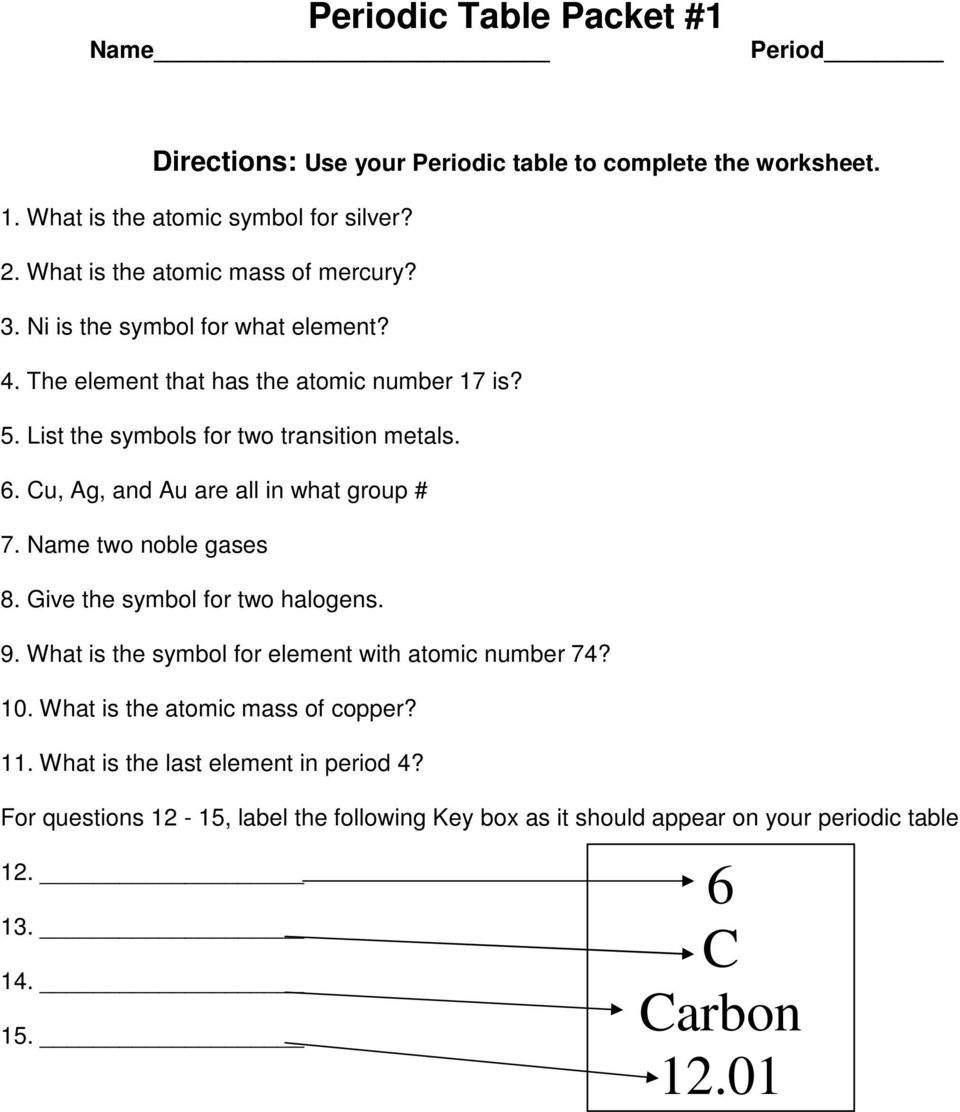
2 Directions: Use your Periodic table to complete the worksheet. 1. What is the atomic symbol for silver? 2. What is the atomic mass of mercury? 3. Ni is the symbol for what element? 4. The element that has the atomic number 17 is? 5. List the symbols for two transition metals. 6. Cu, Ag, and Au are all in what group # 7. Name two noble gases 8. Give the symbol for two halogens. 9. What is the symbol for element with atomic number 74? 10. What is the atomic mass of copper? 11. What is the last element in period 4? For questions 12-15, label the following Key box as it should appear on your periodic table C Carbon 12.01
3 6.4 c Periodic Table of Elements Directions: Use the periodic table to fill in the below chart. Element Symbol Atomic Number # of protons # of electrons Atomic Mass Rounded Atomic Mass (show work) # of Neutrons Period 1 Oxygen O = Helium 3 Carbon 4 Aluminum 5 Calcium 6 Sodium 7 Potassium 8 Nitrogen 9 Silicon 10 Iron 11 Hydrogen

4 Directions: Use a Periodic table to find the information asked for below: 1. What is the atomic number of: 2. What is the Atomic mass of: Calcium Calcium Iron Iron Gold Copper 3. How many protons do the following have? Calcium Gold Copper Iron 4. How many electrons do the following have? Gold Iron Copper 5. Does mercury have more protons and electrons than tin? 6. Is mercury a heavier element than tin? 7. Does potassium have more electrons than neon? 8. Does hydrogen have more electrons than Uranium? 9. Which has more protons, sulfur or iodine? 10. Write the symbols or the names for each of these elements: Chlorine Zn Copper Potassium Silver Na Sn Helium Iron P Ne Mercury

5 Directions: Answer the questions with the proper information using your notes, book, and the periodic table. 1. Define a family. 2. What is a period? 3. What is the symbol for the following elements. a. Magnesium b. Potassium c. Iron d. Copper 4. What are the names of the following elements. a. C b. Cl c. Au d. Sr 5. What period are the following elements in? a. He b. Ge c. Rb d. I 6. What group are the following elements? a. Sulfur b. Ca c. Iodine d. Fe 7. Give me an atom with the following characteristics. a. Halogen b. Chalogen c. Alkali metal d. Boron e. Lanthanide series f. Alkaline Earth metal g. Transition metal h. Nobel gas

6 Directions: Use your Periodic table to complete the worksheet. 1. What is the atomic symbol for silver? 2. What is the atomic mass of mercury? 3. Ni is the symbol for what element? 4. The element that has the atomic number 17 is? 5. List the symbols for two transition metals. 6. Cu, Ag, and Au are all in what group # 7. Name two noble gases 8. Give the symbol for two halogens. 9. What is the symbol for element with atomic number 74? 10. What is the atomic mass of copper? 11. What is the last element in period 4? For questions 12-15, label the following Key box as it should appear on your periodic table C Carbon 12.01

7 6.4 c Periodic Table of Elements Directions: Use the periodic table to fill in the below chart. Element Symbol Atomic Number # of protons # of electrons Atomic Mass Rounded Atomic Mass (show work) # of Neutrons Period 1 Oxygen O = Helium 3 Carbon 4 Aluminum 5 Calcium 6 Sodium 7 Potassium 8 Nitrogen 9 Silicon 10 Iron 11 Hydrogen

8 Directions: Use a Periodic table to find the information asked for below: 1. What is the atomic number of: 2. What is the Atomic mass of: Calcium Calcium Iron Iron Gold Copper 3. How many protons do the following have? Calcium Gold Copper Iron 4. How many electrons do the following have? Gold Iron Copper 5. Does mercury have more protons and electrons than tin? 6. Is mercury a heavier element than tin? 7. Does potassium have more electrons than neon? 8. Does hydrogen have more electrons than Uranium? 9. Which has more protons, sulfur or iodine? 10. Write the symbols or the names for each of these elements: Chlorine Zn Copper Potassium Silver Na Sn Helium Iron P Ne Mercury

9 Directions: Answer the questions with the proper information using your notes, book, and the periodic table. 1. Define a family. 2. What is a period? 3. What is the symbol for the following elements. a. Magnesium b. Potassium c. Iron d. Copper 4. What are the names of the following elements. a. C b. Cl c. Au d. Sr 5. What period are the following elements in? a. He b. Ge c. Rb d. I 6. What group are the following elements? a. Sulfur b. Ca c. Iodine d. Fe 7. Give me an atom with the following characteristics. a. Halogen b. Chalogen c. Alkali metal d. Boron e. Lanthanide series f. Alkaline Earth metal g. Transition metal h. Nobel gas

10 Directions: Use your Periodic table to complete the worksheet. 1. What is the atomic symbol for silver? 2. What is the atomic mass of mercury? 3. Ni is the symbol for what element? 4. The element that has the atomic number 17 is? 5. List the symbols for two transition metals. 6. Cu, Ag, and Au are all in what group # 7. Name two noble gases 8. Give the symbol for two halogens. 9. What is the symbol for element with atomic number 74? 10. What is the atomic mass of copper? 11. What is the last element in period 4? For questions 12-15, label the following Key box as it should appear on your periodic table C Carbon 12.01

11 6.4 c Periodic Table of Elements Directions: Use the periodic table to fill in the below chart. Element Symbol Atomic Number # of protons # of electrons Atomic Mass Rounded Atomic Mass (show work) # of Neutrons Period 1 Oxygen O = Helium 3 Carbon 4 Aluminum 5 Calcium 6 Sodium 7 Potassium 8 Nitrogen 9 Silicon 10 Iron 11 Hydrogen

12 Directions: Use a Periodic table to find the information asked for below: 1. What is the atomic number of: 2. What is the Atomic mass of: Calcium Calcium Iron Iron Gold Copper 3. How many protons do the following have? Calcium Gold Copper Iron 4. How many electrons do the following have? Gold Iron Copper 5. Does mercury have more protons and electrons than tin? 6. Is mercury a heavier element than tin? 7. Does potassium have more electrons than neon? 8. Does hydrogen have more electrons than Uranium? 9. Which has more protons, sulfur or iodine? 10. Write the symbols or the names for each of these elements: Chlorine Zn Copper Potassium Silver Na Sn Helium Iron P Ne Mercury

13 Directions: Answer the questions with the proper information using your notes, book, and the periodic table. 1. Define a family. 2. What is a period? 3. What is the symbol for the following elements. a. Magnesium b. Potassium c. Iron d. Copper 4. What are the names of the following elements. a. C b. Cl c. Au d. Sr 5. What period are the following elements in? a. He b. Ge c. Rb d. I 6. What group are the following elements? a. Sulfur b. Ca c. Iodine d. Fe 7. Give me an atom with the following characteristics. a. Halogen b. Chalogen c. Alkali metal d. Boron e. Lanthanide series f. Alkaline Earth metal g. Transition metal h. Nobel gas

14 Directions: Use your Periodic table to complete the worksheet. 1. What is the atomic symbol for silver? 2. What is the atomic mass of mercury? 3. Ni is the symbol for what element? 4. The element that has the atomic number 17 is? 5. List the symbols for two transition metals. 6. Cu, Ag, and Au are all in what group # 7. Name two noble gases 8. Give the symbol for two halogens. 9. What is the symbol for element with atomic number 74? 10. What is the atomic mass of copper? 11. What is the last element in period 4? For questions 12-15, label the following Key box as it should appear on your periodic table C Carbon 12.01

15 6.4 c Periodic Table of Elements Directions: Use the periodic table to fill in the below chart. Element Symbol Atomic Number # of protons # of electrons Atomic Mass Rounded Atomic Mass (show work) # of Neutrons Period 1 Oxygen O = Helium 3 Carbon 4 Aluminum 5 Calcium 6 Sodium 7 Potassium 8 Nitrogen 9 Silicon 10 Iron 11 Hydrogen

16 Directions: Use a Periodic table to find the information asked for below: 1. What is the atomic number of: 2. What is the Atomic mass of: Calcium Calcium Iron Iron Gold Copper 3. How many protons do the following have? Calcium Gold Copper Iron 4. How many electrons do the following have? Gold Iron Copper 5. Does mercury have more protons and electrons than tin? 6. Is mercury a heavier element than tin? 7. Does potassium have more electrons than neon? 8. Does hydrogen have more electrons than Uranium? 9. Which has more protons, sulfur or iodine? 10. Write the symbols or the names for each of these elements: Chlorine Zn Copper Potassium Silver Na Sn Helium Iron P Ne Mercury

17 Directions: Answer the questions with the proper information using your notes, book, and the periodic table. 1. Define a family. 2. What is a period? 3. What is the symbol for the following elements. a. Magnesium b. Potassium c. Iron d. Copper 4. What are the names of the following elements. a. C b. Cl c. Au d. Sr 5. What period are the following elements in? a. He b. Ge c. Rb d. I 6. What group are the following elements? a. Sulfur b. Ca c. Iodine d. Fe 7. Give me an atom with the following characteristics. a. Halogen b. Chalogen c. Alkali metal d. Boron e. Lanthanide series f. Alkaline Earth metal g. Transition metal h. Nobel gas

18 Directions: Use your Periodic table to complete the worksheet. 1. What is the atomic symbol for silver? 2. What is the atomic mass of mercury? 3. Ni is the symbol for what element? 4. The element that has the atomic number 17 is? 5. List the symbols for two transition metals. 6. Cu, Ag, and Au are all in what group # 7. Name two noble gases 8. Give the symbol for two halogens. 9. What is the symbol for element with atomic number 74? 10. What is the atomic mass of copper? 11. What is the last element in period 4? For questions 12-15, label the following Key box as it should appear on your periodic table C Carbon 12.01

19 6.4 c Periodic Table of Elements Directions: Use the periodic table to fill in the below chart. Element Symbol Atomic Number # of protons # of electrons Atomic Mass Rounded Atomic Mass (show work) # of Neutrons Period 1 Oxygen O = Helium 3 Carbon 4 Aluminum 5 Calcium 6 Sodium 7 Potassium 8 Nitrogen 9 Silicon 10 Iron 11 Hydrogen

20 Directions: Use a Periodic table to find the information asked for below: 1. What is the atomic number of: 2. What is the Atomic mass of: Calcium Calcium Iron Iron Gold Copper 3. How many protons do the following have? Calcium Gold Copper Iron 4. How many electrons do the following have? Gold Iron Copper 5. Does mercury have more protons and electrons than tin? 6. Is mercury a heavier element than tin? 7. Does potassium have more electrons than neon? 8. Does hydrogen have more electrons than Uranium? 9. Which has more protons, sulfur or iodine? 10. Write the symbols or the names for each of these elements: Chlorine Zn Copper Potassium Silver Na Sn Helium Iron P Ne Mercury

21 Directions: Answer the questions with the proper information using your notes, book, and the periodic table. 1. Define a family. 2. What is a period? 3. What is the symbol for the following elements. a. Magnesium b. Potassium c. Iron d. Copper 4. What are the names of the following elements. a. C b. Cl c. Au d. Sr 5. What period are the following elements in? a. He b. Ge c. Rb d. I 6. What group are the following elements? a. Sulfur b. Ca c. Iodine d. Fe 7. Give me an atom with the following characteristics. a. Halogen b. Chalogen c. Alkali metal d. Boron e. Lanthanide series f. Alkaline Earth metal g. Transition metal h. Nobel gas
22 Directions: Use your Periodic table to complete the worksheet. 1. What is the atomic symbol for silver? 2. What is the atomic mass of mercury? 3. Ni is the symbol for what element? 4. The element that has the atomic number 17 is? 5. List the symbols for two transition metals. 6. Cu, Ag, and Au are all in what group # 7. Name two noble gases 8. Give the symbol for two halogens. 9. What is the symbol for element with atomic number 74? 10. What is the atomic mass of copper? 11. What is the last element in period 4? For questions 12-15, label the following Key box as it should appear on your periodic table C Carbon 12.01
23 6.4 c Periodic Table of Elements Directions: Use the periodic table to fill in the below chart. Element Symbol Atomic Number # of protons # of electrons Atomic Mass Rounded Atomic Mass (show work) # of Neutrons Period 1 Oxygen O = Helium 3 Carbon 4 Aluminum 5 Calcium 6 Sodium 7 Potassium 8 Nitrogen 9 Silicon 10 Iron 11 Hydrogen
24 Directions: Use a Periodic table to find the information asked for below: 1. What is the atomic number of: 2. What is the Atomic mass of: Calcium Calcium Iron Iron Gold Copper 3. How many protons do the following have? Calcium Gold Copper Iron 4. How many electrons do the following have? Gold Iron Copper 5. Does mercury have more protons and electrons than tin? 6. Is mercury a heavier element than tin? 7. Does potassium have more electrons than neon? 8. Does hydrogen have more electrons than Uranium? 9. Which has more protons, sulfur or iodine? 10. Write the symbols or the names for each of these elements: Chlorine Zn Copper Potassium Silver Na Sn Helium Iron P Ne Mercury
25 Directions: Answer the questions with the proper information using your notes, book, and the periodic table. 1. Define a family. 2. What is a period? 3. What is the symbol for the following elements. a. Magnesium b. Potassium c. Iron d. Copper 4. What are the names of the following elements. a. C b. Cl c. Au d. Sr 5. What period are the following elements in? a. He b. Ge c. Rb d. I 6. What group are the following elements? a. Sulfur b. Ca c. Iodine d. Fe 7. Give me an atom with the following characteristics. a. Halogen b. Chalogen c. Alkali metal d. Boron e. Lanthanide series f. Alkaline Earth metal g. Transition metal h. Nobel gas
26 Directions: Use your Periodic table to complete the worksheet. 1. What is the atomic symbol for silver? 2. What is the atomic mass of mercury? 3. Ni is the symbol for what element? 4. The element that has the atomic number 17 is? 5. List the symbols for two transition metals. 6. Cu, Ag, and Au are all in what group # 7. Name two noble gases 8. Give the symbol for two halogens. 9. What is the symbol for element with atomic number 74? 10. What is the atomic mass of copper? 11. What is the last element in period 4? For questions 12-15, label the following Key box as it should appear on your periodic table C Carbon 12.01
27 6.4 c Periodic Table of Elements Directions: Use the periodic table to fill in the below chart. Element Symbol Atomic Number # of protons # of electrons Atomic Mass Rounded Atomic Mass (show work) # of Neutrons Period 1 Oxygen O = Helium 3 Carbon 4 Aluminum 5 Calcium 6 Sodium 7 Potassium 8 Nitrogen 9 Silicon 10 Iron 11 Hydrogen
28 Directions: Use a Periodic table to find the information asked for below: 1. What is the atomic number of: 2. What is the Atomic mass of: Calcium Calcium Iron Iron Gold Copper 3. How many protons do the following have? Calcium Gold Copper Iron 4. How many electrons do the following have? Gold Iron Copper 5. Does mercury have more protons and electrons than tin? 6. Is mercury a heavier element than tin? 7. Does potassium have more electrons than neon? 8. Does hydrogen have more electrons than Uranium? 9. Which has more protons, sulfur or iodine? 10. Write the symbols or the names for each of these elements: Chlorine Zn Copper Potassium Silver Na Sn Helium Iron P Ne Mercury
29 Directions: Answer the questions with the proper information using your notes, book, and the periodic table. 1. Define a family. 2. What is a period? 3. What is the symbol for the following elements. a. Magnesium b. Potassium c. Iron d. Copper 4. What are the names of the following elements. a. C b. Cl c. Au d. Sr 5. What period are the following elements in? a. He b. Ge c. Rb d. I 6. What group are the following elements? a. Sulfur b. Ca c. Iodine d. Fe 7. Give me an atom with the following characteristics. a. Halogen b. Chalogen c. Alkali metal d. Boron e. Lanthanide series f. Alkaline Earth metal g. Transition metal h. Nobel gas
30 Directions: Use your Periodic table to complete the worksheet. 1. What is the atomic symbol for silver? 2. What is the atomic mass of mercury? 3. Ni is the symbol for what element? 4. The element that has the atomic number 17 is? 5. List the symbols for two transition metals. 6. Cu, Ag, and Au are all in what group # 7. Name two noble gases 8. Give the symbol for two halogens. 9. What is the symbol for element with atomic number 74? 10. What is the atomic mass of copper? 11. What is the last element in period 4? For questions 12-15, label the following Key box as it should appear on your periodic table C Carbon 12.01
31 6.4 c Periodic Table of Elements Directions: Use the periodic table to fill in the below chart. Element Symbol Atomic Number # of protons # of electrons Atomic Mass Rounded Atomic Mass (show work) # of Neutrons Period 1 Oxygen O = Helium 3 Carbon 4 Aluminum 5 Calcium 6 Sodium 7 Potassium 8 Nitrogen 9 Silicon 10 Iron 11 Hydrogen
32 Directions: Use a Periodic table to find the information asked for below: 1. What is the atomic number of: 2. What is the Atomic mass of: Calcium Calcium Iron Iron Gold Copper 3. How many protons do the following have? Calcium Gold Copper Iron 4. How many electrons do the following have? Gold Iron Copper 5. Does mercury have more protons and electrons than tin? 6. Is mercury a heavier element than tin? 7. Does potassium have more electrons than neon? 8. Does hydrogen have more electrons than Uranium? 9. Which has more protons, sulfur or iodine? 10. Write the symbols or the names for each of these elements: Chlorine Zn Copper Potassium Silver Na Sn Helium Iron P Ne Mercury
33 Directions: Answer the questions with the proper information using your notes, book, and the periodic table. 1. Define a family. 2. What is a period? 3. What is the symbol for the following elements. a. Magnesium b. Potassium c. Iron d. Copper 4. What are the names of the following elements. a. C b. Cl c. Au d. Sr 5. What period are the following elements in? a. He b. Ge c. Rb d. I 6. What group are the following elements? a. Sulfur b. Ca c. Iodine d. Fe 7. Give me an atom with the following characteristics. a. Halogen b. Chalogen c. Alkali metal d. Boron e. Lanthanide series f. Alkaline Earth metal g. Transition metal h. Nobel gas
34 Directions: Use your Periodic table to complete the worksheet. 1. What is the atomic symbol for silver? 2. What is the atomic mass of mercury? 3. Ni is the symbol for what element? 4. The element that has the atomic number 17 is? 5. List the symbols for two transition metals. 6. Cu, Ag, and Au are all in what group # 7. Name two noble gases 8. Give the symbol for two halogens. 9. What is the symbol for element with atomic number 74? 10. What is the atomic mass of copper? 11. What is the last element in period 4? For questions 12-15, label the following Key box as it should appear on your periodic table C Carbon 12.01
35 6.4 c Periodic Table of Elements Directions: Use the periodic table to fill in the below chart. Element Symbol Atomic Number # of protons # of electrons Atomic Mass Rounded Atomic Mass (show work) # of Neutrons Period 1 Oxygen O = Helium 3 Carbon 4 Aluminum 5 Calcium 6 Sodium 7 Potassium 8 Nitrogen 9 Silicon 10 Iron 11 Hydrogen
36 Directions: Use a Periodic table to find the information asked for below: 1. What is the atomic number of: 2. What is the Atomic mass of: Calcium Calcium Iron Iron Gold Copper 3. How many protons do the following have? Calcium Gold Copper Iron 4. How many electrons do the following have? Gold Iron Copper 5. Does mercury have more protons and electrons than tin? 6. Is mercury a heavier element than tin? 7. Does potassium have more electrons than neon? 8. Does hydrogen have more electrons than Uranium? 9. Which has more protons, sulfur or iodine? 10. Write the symbols or the names for each of these elements: Chlorine Zn Copper Potassium Silver Na Sn Helium Iron P Ne Mercury
37 Directions: Answer the questions with the proper information using your notes, book, and the periodic table. 1. Define a family. 2. What is a period? 3. What is the symbol for the following elements. a. Magnesium b. Potassium c. Iron d. Copper 4. What are the names of the following elements. a. C b. Cl c. Au d. Sr 5. What period are the following elements in? a. He b. Ge c. Rb d. I 6. What group are the following elements? a. Sulfur b. Ca c. Iodine d. Fe 7. Give me an atom with the following characteristics. a. Halogen b. Chalogen c. Alkali metal d. Boron e. Lanthanide series f. Alkaline Earth metal g. Transition metal h. Nobel gas
38 Directions: Use your Periodic table to complete the worksheet. 1. What is the atomic symbol for silver? 2. What is the atomic mass of mercury? 3. Ni is the symbol for what element? 4. The element that has the atomic number 17 is? 5. List the symbols for two transition metals. 6. Cu, Ag, and Au are all in what group # 7. Name two noble gases 8. Give the symbol for two halogens. 9. What is the symbol for element with atomic number 74? 10. What is the atomic mass of copper? 11. What is the last element in period 4? For questions 12-15, label the following Key box as it should appear on your periodic table C Carbon 12.01
39 6.4 c Periodic Table of Elements Directions: Use the periodic table to fill in the below chart. Element Symbol Atomic Number # of protons # of electrons Atomic Mass Rounded Atomic Mass (show work) # of Neutrons Period 1 Oxygen O = Helium 3 Carbon 4 Aluminum 5 Calcium 6 Sodium 7 Potassium 8 Nitrogen 9 Silicon 10 Iron 11 Hydrogen
40 Directions: Use a Periodic table to find the information asked for below: 1. What is the atomic number of: 2. What is the Atomic mass of: Calcium Calcium Iron Iron Gold Copper 3. How many protons do the following have? Calcium Gold Copper Iron 4. How many electrons do the following have? Gold Iron Copper 5. Does mercury have more protons and electrons than tin? 6. Is mercury a heavier element than tin? 7. Does potassium have more electrons than neon? 8. Does hydrogen have more electrons than Uranium? 9. Which has more protons, sulfur or iodine? 10. Write the symbols or the names for each of these elements: Chlorine Zn Copper Potassium Silver Na Sn Helium Iron P Ne Mercury
41 Directions: Answer the questions with the proper information using your notes, book, and the periodic table. 1. Define a family. 2. What is a period? 3. What is the symbol for the following elements. a. Magnesium b. Potassium c. Iron d. Copper 4. What are the names of the following elements. a. C b. Cl c. Au d. Sr 5. What period are the following elements in? a. He b. Ge c. Rb d. I 6. What group are the following elements? a. Sulfur b. Ca c. Iodine d. Fe 7. Give me an atom with the following characteristics. a. Halogen b. Chalogen c. Alkali metal d. Boron e. Lanthanide series f. Alkaline Earth metal g. Transition metal h. Nobel gas
42 Directions: Use your Periodic table to complete the worksheet. 1. What is the atomic symbol for silver? 2. What is the atomic mass of mercury? 3. Ni is the symbol for what element? 4. The element that has the atomic number 17 is? 5. List the symbols for two transition metals. 6. Cu, Ag, and Au are all in what group # 7. Name two noble gases 8. Give the symbol for two halogens. 9. What is the symbol for element with atomic number 74? 10. What is the atomic mass of copper? 11. What is the last element in period 4? For questions 12-15, label the following Key box as it should appear on your periodic table C Carbon 12.01
43 6.4 c Periodic Table of Elements Directions: Use the periodic table to fill in the below chart. Element Symbol Atomic Number # of protons # of electrons Atomic Mass Rounded Atomic Mass (show work) # of Neutrons Period 1 Oxygen O = Helium 3 Carbon 4 Aluminum 5 Calcium 6 Sodium 7 Potassium 8 Nitrogen 9 Silicon 10 Iron 11 Hydrogen
44 Directions: Use a Periodic table to find the information asked for below: 1. What is the atomic number of: 2. What is the Atomic mass of: Calcium Calcium Iron Iron Gold Copper 3. How many protons do the following have? Calcium Gold Copper Iron 4. How many electrons do the following have? Gold Iron Copper 5. Does mercury have more protons and electrons than tin? 6. Is mercury a heavier element than tin? 7. Does potassium have more electrons than neon? 8. Does hydrogen have more electrons than Uranium? 9. Which has more protons, sulfur or iodine? 10. Write the symbols or the names for each of these elements: Chlorine Zn Copper Potassium Silver Na Sn Helium Iron P Ne Mercury
45 Directions: Answer the questions with the proper information using your notes, book, and the periodic table. 1. Define a family. 2. What is a period? 3. What is the symbol for the following elements. a. Magnesium b. Potassium c. Iron d. Copper 4. What are the names of the following elements. a. C b. Cl c. Au d. Sr 5. What period are the following elements in? a. He b. Ge c. Rb d. I 6. What group are the following elements? a. Sulfur b. Ca c. Iodine d. Fe 7. Give me an atom with the following characteristics. a. Halogen b. Chalogen c. Alkali metal d. Boron e. Lanthanide series f. Alkaline Earth metal g. Transition metal h. Nobel gas
46 Directions: Use your Periodic table to complete the worksheet. 1. What is the atomic symbol for silver? 2. What is the atomic mass of mercury? 3. Ni is the symbol for what element? 4. The element that has the atomic number 17 is? 5. List the symbols for two transition metals. 6. Cu, Ag, and Au are all in what group # 7. Name two noble gases 8. Give the symbol for two halogens. 9. What is the symbol for element with atomic number 74? 10. What is the atomic mass of copper? 11. What is the last element in period 4? For questions 12-15, label the following Key box as it should appear on your periodic table C Carbon 12.01
47 6.4 c Periodic Table of Elements Directions: Use the periodic table to fill in the below chart. Element Symbol Atomic Number # of protons # of electrons Atomic Mass Rounded Atomic Mass (show work) # of Neutrons Period 1 Oxygen O = Helium 3 Carbon 4 Aluminum 5 Calcium 6 Sodium 7 Potassium 8 Nitrogen 9 Silicon 10 Iron 11 Hydrogen
48 Directions: Use a Periodic table to find the information asked for below: 1. What is the atomic number of: 2. What is the Atomic mass of: Calcium Calcium Iron Iron Gold Copper 3. How many protons do the following have? Calcium Gold Copper Iron 4. How many electrons do the following have? Gold Iron Copper 5. Does mercury have more protons and electrons than tin? 6. Is mercury a heavier element than tin? 7. Does potassium have more electrons than neon? 8. Does hydrogen have more electrons than Uranium? 9. Which has more protons, sulfur or iodine? 10. Write the symbols or the names for each of these elements: Chlorine Zn Copper Potassium Silver Na Sn Helium Iron P Ne Mercury
49 Directions: Answer the questions with the proper information using your notes, book, and the periodic table. 1. Define a family. 2. What is a period? 3. What is the symbol for the following elements. a. Magnesium b. Potassium c. Iron d. Copper 4. What are the names of the following elements. a. C b. Cl c. Au d. Sr 5. What period are the following elements in? a. He b. Ge c. Rb d. I 6. What group are the following elements? a. Sulfur b. Ca c. Iodine d. Fe 7. Give me an atom with the following characteristics. a. Halogen b. Chalogen c. Alkali metal d. Boron e. Lanthanide series f. Alkaline Earth metal g. Transition metal h. Nobel gas
50 Directions: Use your Periodic table to complete the worksheet. 1. What is the atomic symbol for silver? 2. What is the atomic mass of mercury? 3. Ni is the symbol for what element? 4. The element that has the atomic number 17 is? 5. List the symbols for two transition metals. 6. Cu, Ag, and Au are all in what group # 7. Name two noble gases 8. Give the symbol for two halogens. 9. What is the symbol for element with atomic number 74? 10. What is the atomic mass of copper? 11. What is the last element in period 4? For questions 12-15, label the following Key box as it should appear on your periodic table C Carbon 12.01
51 6.4 c Periodic Table of Elements Directions: Use the periodic table to fill in the below chart. Element Symbol Atomic Number # of protons # of electrons Atomic Mass Rounded Atomic Mass (show work) # of Neutrons Period 1 Oxygen O = Helium 3 Carbon 4 Aluminum 5 Calcium 6 Sodium 7 Potassium 8 Nitrogen 9 Silicon 10 Iron 11 Hydrogen
52 Directions: Use a Periodic table to find the information asked for below: 1. What is the atomic number of: 2. What is the Atomic mass of: Calcium Calcium Iron Iron Gold Copper 3. How many protons do the following have? Calcium Gold Copper Iron 4. How many electrons do the following have? Gold Iron Copper 5. Does mercury have more protons and electrons than tin? 6. Is mercury a heavier element than tin? 7. Does potassium have more electrons than neon? 8. Does hydrogen have more electrons than Uranium? 9. Which has more protons, sulfur or iodine? 10. Write the symbols or the names for each of these elements: Chlorine Zn Copper Potassium Silver Na Sn Helium Iron P Ne Mercury
53 Directions: Answer the questions with the proper information using your notes, book, and the periodic table. 1. Define a family. 2. What is a period? 3. What is the symbol for the following elements. a. Magnesium b. Potassium c. Iron d. Copper 4. What are the names of the following elements. a. C b. Cl c. Au d. Sr 5. What period are the following elements in? a. He b. Ge c. Rb d. I 6. What group are the following elements? a. Sulfur b. Ca c. Iodine d. Fe 7. Give me an atom with the following characteristics. a. Halogen b. Chalogen c. Alkali metal d. Boron e. Lanthanide series f. Alkaline Earth metal g. Transition metal h. Nobel gas
54 Directions: Use your Periodic table to complete the worksheet. 1. What is the atomic symbol for silver? 2. What is the atomic mass of mercury? 3. Ni is the symbol for what element? 4. The element that has the atomic number 17 is? 5. List the symbols for two transition metals. 6. Cu, Ag, and Au are all in what group # 7. Name two noble gases 8. Give the symbol for two halogens. 9. What is the symbol for element with atomic number 74? 10. What is the atomic mass of copper? 11. What is the last element in period 4? For questions 12-15, label the following Key box as it should appear on your periodic table C Carbon 12.01
55 6.4 c Periodic Table of Elements Directions: Use the periodic table to fill in the below chart. Element Symbol Atomic Number # of protons # of electrons Atomic Mass Rounded Atomic Mass (show work) # of Neutrons Period 1 Oxygen O = Helium 3 Carbon 4 Aluminum 5 Calcium 6 Sodium 7 Potassium 8 Nitrogen 9 Silicon 10 Iron 11 Hydrogen
56 Directions: Use a Periodic table to find the information asked for below: 1. What is the atomic number of: 2. What is the Atomic mass of: Calcium Calcium Iron Iron Gold Copper 3. How many protons do the following have? Calcium Gold Copper Iron 4. How many electrons do the following have? Gold Iron Copper 5. Does mercury have more protons and electrons than tin? 6. Is mercury a heavier element than tin? 7. Does potassium have more electrons than neon? 8. Does hydrogen have more electrons than Uranium? 9. Which has more protons, sulfur or iodine? 10. Write the symbols or the names for each of these elements: Chlorine Zn Copper Potassium Silver Na Sn Helium Iron P Ne Mercury
57 Directions: Answer the questions with the proper information using your notes, book, and the periodic table. 1. Define a family. 2. What is a period? 3. What is the symbol for the following elements. a. Magnesium b. Potassium c. Iron d. Copper 4. What are the names of the following elements. a. C b. Cl c. Au d. Sr 5. What period are the following elements in? a. He b. Ge c. Rb d. I 6. What group are the following elements? a. Sulfur b. Ca c. Iodine d. Fe 7. Give me an atom with the following characteristics. a. Halogen b. Chalogen c. Alkali metal d. Boron e. Lanthanide series f. Alkaline Earth metal g. Transition metal h. Nobel gas
58 Directions: Use your Periodic table to complete the worksheet. 1. What is the atomic symbol for silver? 2. What is the atomic mass of mercury? 3. Ni is the symbol for what element? 4. The element that has the atomic number 17 is? 5. List the symbols for two transition metals. 6. Cu, Ag, and Au are all in what group # 7. Name two noble gases 8. Give the symbol for two halogens. 9. What is the symbol for element with atomic number 74? 10. What is the atomic mass of copper? 11. What is the last element in period 4? For questions 12-15, label the following Key box as it should appear on your periodic table C Carbon 12.01
59 6.4 c Periodic Table of Elements Directions: Use the periodic table to fill in the below chart. Element Symbol Atomic Number # of protons # of electrons Atomic Mass Rounded Atomic Mass (show work) # of Neutrons Period 1 Oxygen O = Helium 3 Carbon 4 Aluminum 5 Calcium 6 Sodium 7 Potassium 8 Nitrogen 9 Silicon 10 Iron 11 Hydrogen
60 Directions: Use a Periodic table to find the information asked for below: 1. What is the atomic number of: 2. What is the Atomic mass of: Calcium Calcium Iron Iron Gold Copper 3. How many protons do the following have? Calcium Gold Copper Iron 4. How many electrons do the following have? Gold Iron Copper 5. Does mercury have more protons and electrons than tin? 6. Is mercury a heavier element than tin? 7. Does potassium have more electrons than neon? 8. Does hydrogen have more electrons than Uranium? 9. Which has more protons, sulfur or iodine? 10. Write the symbols or the names for each of these elements: Chlorine Zn Copper Potassium Silver Na Sn Helium Iron P Ne Mercury
61 Directions: Answer the questions with the proper information using your notes, book, and the periodic table. 1. Define a family. 2. What is a period? 3. What is the symbol for the following elements. a. Magnesium b. Potassium c. Iron d. Copper 4. What are the names of the following elements. a. C b. Cl c. Au d. Sr 5. What period are the following elements in? a. He b. Ge c. Rb d. I 6. What group are the following elements? a. Sulfur b. Ca c. Iodine d. Fe 7. Give me an atom with the following characteristics. a. Halogen b. Chalogen c. Alkali metal d. Boron e. Lanthanide series f. Alkaline Earth metal g. Transition metal h. Nobel gas
62 Directions: Use your Periodic table to complete the worksheet. 1. What is the atomic symbol for silver? 2. What is the atomic mass of mercury? 3. Ni is the symbol for what element? 4. The element that has the atomic number 17 is? 5. List the symbols for two transition metals. 6. Cu, Ag, and Au are all in what group # 7. Name two noble gases 8. Give the symbol for two halogens. 9. What is the symbol for element with atomic number 74? 10. What is the atomic mass of copper? 11. What is the last element in period 4? For questions 12-15, label the following Key box as it should appear on your periodic table C Carbon 12.01
63 6.4 c Periodic Table of Elements Directions: Use the periodic table to fill in the below chart. Element Symbol Atomic Number # of protons # of electrons Atomic Mass Rounded Atomic Mass (show work) # of Neutrons Period 1 Oxygen O = Helium 3 Carbon 4 Aluminum 5 Calcium 6 Sodium 7 Potassium 8 Nitrogen 9 Silicon 10 Iron 11 Hydrogen
64 Directions: Use a Periodic table to find the information asked for below: 1. What is the atomic number of: 2. What is the Atomic mass of: Calcium Calcium Iron Iron Gold Copper 3. How many protons do the following have? Calcium Gold Copper Iron 4. How many electrons do the following have? Gold Iron Copper 5. Does mercury have more protons and electrons than tin? 6. Is mercury a heavier element than tin? 7. Does potassium have more electrons than neon? 8. Does hydrogen have more electrons than Uranium? 9. Which has more protons, sulfur or iodine? 10. Write the symbols or the names for each of these elements: Chlorine Zn Copper Potassium Silver Na Sn Helium Iron P Ne Mercury
65 Directions: Answer the questions with the proper information using your notes, book, and the periodic table. 1. Define a family. 2. What is a period? 3. What is the symbol for the following elements. a. Magnesium b. Potassium c. Iron d. Copper 4. What are the names of the following elements. a. C b. Cl c. Au d. Sr 5. What period are the following elements in? a. He b. Ge c. Rb d. I 6. What group are the following elements? a. Sulfur b. Ca c. Iodine d. Fe 7. Give me an atom with the following characteristics. a. Halogen b. Chalogen c. Alkali metal d. Boron e. Lanthanide series f. Alkaline Earth metal g. Transition metal h. Nobel gas
66 Directions: Use your Periodic table to complete the worksheet. 1. What is the atomic symbol for silver? 2. What is the atomic mass of mercury? 3. Ni is the symbol for what element? 4. The element that has the atomic number 17 is? 5. List the symbols for two transition metals. 6. Cu, Ag, and Au are all in what group # 7. Name two noble gases 8. Give the symbol for two halogens. 9. What is the symbol for element with atomic number 74? 10. What is the atomic mass of copper? 11. What is the last element in period 4? For questions 12-15, label the following Key box as it should appear on your periodic table C Carbon 12.01
67 6.4 c Periodic Table of Elements Directions: Use the periodic table to fill in the below chart. Element Symbol Atomic Number # of protons # of electrons Atomic Mass Rounded Atomic Mass (show work) # of Neutrons Period 1 Oxygen O = Helium 3 Carbon 4 Aluminum 5 Calcium 6 Sodium 7 Potassium 8 Nitrogen 9 Silicon 10 Iron 11 Hydrogen
68 Directions: Use a Periodic table to find the information asked for below: 1. What is the atomic number of: 2. What is the Atomic mass of: Calcium Calcium Iron Iron Gold Copper 3. How many protons do the following have? Calcium Gold Copper Iron 4. How many electrons do the following have? Gold Iron Copper 5. Does mercury have more protons and electrons than tin? 6. Is mercury a heavier element than tin? 7. Does potassium have more electrons than neon? 8. Does hydrogen have more electrons than Uranium? 9. Which has more protons, sulfur or iodine? 10. Write the symbols or the names for each of these elements: Chlorine Zn Copper Potassium Silver Na Sn Helium Iron P Ne Mercury
69 Directions: Answer the questions with the proper information using your notes, book, and the periodic table. 1. Define a family. 2. What is a period? 3. What is the symbol for the following elements. a. Magnesium b. Potassium c. Iron d. Copper 4. What are the names of the following elements. a. C b. Cl c. Au d. Sr 5. What period are the following elements in? a. He b. Ge c. Rb d. I 6. What group are the following elements? a. Sulfur b. Ca c. Iodine d. Fe 7. Give me an atom with the following characteristics. a. Halogen b. Chalogen c. Alkali metal d. Boron e. Lanthanide series f. Alkaline Earth metal g. Transition metal h. Nobel gas
70 Directions: Use your Periodic table to complete the worksheet. 1. What is the atomic symbol for silver? 2. What is the atomic mass of mercury? 3. Ni is the symbol for what element? 4. The element that has the atomic number 17 is? 5. List the symbols for two transition metals. 6. Cu, Ag, and Au are all in what group # 7. Name two noble gases 8. Give the symbol for two halogens. 9. What is the symbol for element with atomic number 74? 10. What is the atomic mass of copper? 11. What is the last element in period 4? For questions 12-15, label the following Key box as it should appear on your periodic table C Carbon 12.01
71 6.4 c Periodic Table of Elements Directions: Use the periodic table to fill in the below chart. Element Symbol Atomic Number # of protons # of electrons Atomic Mass Rounded Atomic Mass (show work) # of Neutrons Period 1 Oxygen O = Helium 3 Carbon 4 Aluminum 5 Calcium 6 Sodium 7 Potassium 8 Nitrogen 9 Silicon 10 Iron 11 Hydrogen
72 Directions: Use a Periodic table to find the information asked for below: 1. What is the atomic number of: 2. What is the Atomic mass of: Calcium Calcium Iron Iron Gold Copper 3. How many protons do the following have? Calcium Gold Copper Iron 4. How many electrons do the following have? Gold Iron Copper 5. Does mercury have more protons and electrons than tin? 6. Is mercury a heavier element than tin? 7. Does potassium have more electrons than neon? 8. Does hydrogen have more electrons than Uranium? 9. Which has more protons, sulfur or iodine? 10. Write the symbols or the names for each of these elements: Chlorine Zn Copper Potassium Silver Na Sn Helium Iron P Ne Mercury
47374_04_p25-32.qxd 2/9/07 7:50 AM Page 25. 4 Atoms and Elements
 47374_04_p25-32.qxd 2/9/07 7:50 AM Page 25 4 Atoms and Elements 4.1 a. Cu b. Si c. K d. N e. Fe f. Ba g. Pb h. Sr 4.2 a. O b. Li c. S d. Al e. H f. Ne g. Sn h. Au 4.3 a. carbon b. chlorine c. iodine d.
UNIT (2) ATOMS AND ELEMENTS
 UNIT (2) ATOMS AND ELEMENTS 2.1 Elements An element is a fundamental substance that cannot be broken down by chemical means into simpler substances. Each element is represented by an abbreviation called
Untitled Document. 1. Which of the following best describes an atom? 4. Which statement best describes the density of an atom s nucleus?
 Name: Date: 1. Which of the following best describes an atom? A. protons and electrons grouped together in a random pattern B. protons and electrons grouped together in an alternating pattern C. a core
Periodic Table Questions
 Periodic Table Questions 1. The elements characterized as nonmetals are located in the periodic table at the (1) far left; (2) bottom; (3) center; (4) top right. 2. An element that is a liquid at STP is
Chemistry CP Unit 2 Atomic Structure and Electron Configuration. Learning Targets (Your exam at the end of Unit 2 will assess the following:)
 Chemistry CP Unit 2 Atomic Structure and Electron Learning Targets (Your exam at the end of Unit 2 will assess the following:) 2. Atomic Structure and Electron 2-1. Give the one main contribution to the
3. What would you predict for the intensity and binding energy for the 3p orbital for that of sulfur?
 PSI AP Chemistry Periodic Trends MC Review Name Periodic Law and the Quantum Model Use the PES spectrum of Phosphorus below to answer questions 1-3. 1. Which peak corresponds to the 1s orbital? (A) 1.06
Chapter 2 Atoms, Ions, and the Periodic Table
 Chapter 2 Atoms, Ions, and the Periodic Table 2.1 (a) neutron; (b) law of conservation of mass; (c) proton; (d) main-group element; (e) relative atomic mass; (f) mass number; (g) isotope; (h) cation; (i)
2. John Dalton did his research work in which of the following countries? a. France b. Greece c. Russia d. England
 CHAPTER 3 1. Which combination of individual and contribution is not correct? a. Antoine Lavoisier - clarified confusion over cause of burning b. John Dalton - proposed atomic theory c. Marie Curie - discovered
Periodic Table, Valency and Formula
 Periodic Table, Valency and Formula Origins of the Periodic Table Mendelѐѐv in 1869 proposed that a relationship existed between the chemical properties of elements and their atomic masses. He noticed
Find a pair of elements in the periodic table with atomic numbers less than 20 that are an exception to the original periodic law.
 Example Exercise 6.1 Periodic Law Find the two elements in the fifth row of the periodic table that violate the original periodic law proposed by Mendeleev. Mendeleev proposed that elements be arranged
B) atomic number C) both the solid and the liquid phase D) Au C) Sn, Si, C A) metal C) O, S, Se C) In D) tin D) methane D) bismuth B) Group 2 metal
 1. The elements on the Periodic Table are arranged in order of increasing A) atomic mass B) atomic number C) molar mass D) oxidation number 2. Which list of elements consists of a metal, a metalloid, and
Name period AP chemistry Unit 2 worksheet Practice problems
 Name period AP chemistry Unit 2 worksheet Practice problems 1. What are the SI units for a. Wavelength of light b. frequency of light c. speed of light Meter hertz (s -1 ) m s -1 (m/s) 2. T/F (correct
Electrons in Atoms & Periodic Table Chapter 13 & 14 Assignment & Problem Set
 Electrons in Atoms & Periodic Table Name Warm-Ups (Show your work for credit) Date 1. Date 2. Date 3. Date 4. Date 5. Date 6. Date 7. Date 8. Electrons in Atoms & Periodic Table 2 Study Guide: Things You
EXPERIMENT 4 The Periodic Table - Atoms and Elements
 EXPERIMENT 4 The Periodic Table - Atoms and Elements INTRODUCTION Primary substances, called elements, build all the materials around you. There are more than 109 different elements known today. The elements
Chapter 5 TEST: The Periodic Table name
 Chapter 5 TEST: The Periodic Table name HPS # date: Multiple Choice Identify the choice that best completes the statement or answers the question. 1. The order of elements in the periodic table is based
5.4 Trends in the Periodic Table
 5.4 Trends in the Periodic Table Think about all the things that change over time or in a predictable way. For example, the size of the computer has continually decreased over time. You may become more
Chemistry: The Periodic Table and Periodicity
 Chemistry: The Periodic Table and Periodicity Name: per: Date:. 1. By what property did Mendeleev arrange the elements? 2. By what property did Moseley suggest that the periodic table be arranged? 3. What
2014 Spring CHEM101 Ch1-2 Review Worksheet Modified by Dr. Cheng-Yu Lai,
 Ch1 1) Which of the following underlined items is not an intensive property? A) A chemical reaction requires 3.00 g of oxygen. B) The density of helium at 25 C is 1.64 10-4 g/cm3. C) The melting point
Unit 3 Study Guide: Electron Configuration & The Periodic Table
 Name: Teacher s Name: Class: Block: Date: Unit 3 Study Guide: Electron Configuration & The Periodic Table 1. For each of the following elements, state whether the element is radioactive, synthetic or both.
Section 1: Arranging the Elements Pages 106-112
 Study Guide Chapter 5 Periodic Table Section 1: Arranging the Elements Pages 106-112 DISCOVERING A PATTERN 1. How did Mendeleev arrange the elements? a. by increasing density b. by increasing melting point
SCPS Chemistry Worksheet Periodicity A. Periodic table 1. Which are metals? Circle your answers: C, Na, F, Cs, Ba, Ni
 SCPS Chemistry Worksheet Periodicity A. Periodic table 1. Which are metals? Circle your answers: C, Na, F, Cs, Ba, Ni Which metal in the list above has the most metallic character? Explain. Cesium as the
Electron Configurations, Isoelectronic Elements, & Ionization Reactions. Chemistry 11
 Electron Configurations, Isoelectronic Elements, & Ionization Reactions Chemistry 11 Note: Of the 3 subatomic particles, the electron plays the greatest role in determining the physical and chemical properties
PERIODIC TABLE. reflect
 reflect Suppose you wanted to organize your locker at school. How could you separate and arrange everything in an organized way? You could place the books, notebooks, and folders on a shelf that is separate
TRENDS IN THE PERIODIC TABLE
 Noble gases Period alogens Alkaline earth metals Alkali metals TRENDS IN TE PERIDI TABLE Usual charge +1 + +3-3 - -1 Number of Valence e - s 1 3 4 5 6 7 Electron dot diagram X X X X X X X X X 8 Group 1
MODERN ATOMIC THEORY AND THE PERIODIC TABLE
 CHAPTER 10 MODERN ATOMIC THEORY AND THE PERIODIC TABLE SOLUTIONS TO REVIEW QUESTIONS 1. Wavelength is defined as the distance between consecutive peaks in a wave. It is generally symbolized by the Greek
Name: Worksheet: Electron Configurations. I Heart Chemistry!
 1. Which electron configuration represents an atom in an excited state? 1s 2 2s 2 2p 6 3p 1 1s 2 2s 2 2p 6 3s 2 3p 2 1s 2 2s 2 2p 6 3s 2 3p 1 1s 2 2s 2 2p 6 3s 2 Worksheet: Electron Configurations Name:
Periodic Table. 1. In the modern Periodic Table, the elements are arranged in order of increasing. A. atomic number B. mass number
 Name: ate: 1. In the modern, the elements are arranged in order of increasing. atomic number. mass number. oxidation number. valence number 5. s the elements in Group I are considered in order of increasing
THE PERIODIC TABLE O F T H E E L E M E N T S. The Academic Support Center @ Daytona State College (Science 117, Page 1 of 27)
 THE PERIODIC TABLE O F T H E E L E M E N T S The Academic Support Center @ Daytona State College (Science 117, Page 1 of 27) THE PERIODIC TABLE In 1872, Dmitri Mendeleev created the periodic table arranged
Periodic Table Bingo
 Periodic Table Bingo Materials: Periodic Table Bingo Card Periodic Table of Elements Colored pieces of paper or plastic discs Instructions: Print the Periodic Table Bingo Cards (pages 5-44). There are
All answers must use the correct number of significant figures, and must show units!
 CHEM 10113, Quiz 2 September 7, 2011 Name (please print) All answers must use the correct number of significant figures, and must show units! IA Periodic Table of the Elements VIIIA (1) (18) 1 2 1 H IIA
ANSWER KEY : BUILD AN ATOM PART I: ATOM SCREEN Build an Atom simulation ( http://phet.colorado.edu/en/simulation/build an atom )
 ANSWER KEY : PART I: ATOM SCREEN Build an Atom simulation ( http://phet.colorado.edu/en/simulation/build an atom ) 1. Explore the Build an Atom simulation with your group. As you explore, talk about what
PERIODIC TABLE OF GROUPS OF ELEMENTS Elements can be classified using two different schemes.
 1 PERIODIC TABLE OF GROUPS OF ELEMENTS Elements can be classified using two different schemes. Metal Nonmetal Scheme (based on physical properties) Metals - most elements are metals - elements on left
Chapter 7 Periodic Properties of the Elements
 Chapter 7 Periodic Properties of the Elements 1. Elements in the modern version of the periodic table are arranged in order of increasing. (a). oxidation number (b). atomic mass (c). average atomic mass
Chapter 3, Elements, Atoms, Ions, and the Periodic Table
 1. Which two scientists in 1869 arranged the elements in order of increasing atomic masses to form a precursor of the modern periodic table of elements? Ans. Mendeleev and Meyer 2. Who stated that the
Chapter 2 Atoms, Molecules, and Ions
 Chapter 2 Atoms, Molecules, and Ions 1. Methane and ethane are both made up of carbon and hydrogen. In methane, there are 12.0 g of carbon for every 4.00 g of hydrogen, a ration of 3:1 by mass. In ethane,
7.4. Using the Bohr Theory KNOW? Using the Bohr Theory to Describe Atoms and Ions
 7.4 Using the Bohr Theory LEARNING TIP Models such as Figures 1 to 4, on pages 218 and 219, help you visualize scientific explanations. As you examine Figures 1 to 4, look back and forth between the diagrams
Student Exploration: Electron Configuration
 Name: Date: Student Exploration: Electron Configuration Vocabulary: atomic number, atomic radius, Aufbau principle, chemical family, diagonal rule, electron configuration, Hund s rule, orbital, Pauli exclusion
Chemical Composition Review Mole Calculations Percent Composition. Copyright Cengage Learning. All rights reserved. 8 1
 Chemical Composition Review Mole Calculations Percent Composition Copyright Cengage Learning. All rights reserved. 8 1 QUESTION Suppose you work in a hardware store and a customer wants to purchase 500
Horizontal Rows are called Periods. Elements in the same period have the same number of energy levels for ground state electron configurations.
 The Periodic Table Horizontal Rows are called Periods. Elements in the same period have the same number of energy levels for ground state electron configurations. Vertical Rows are called Families or Groups.
CHAPTER 2 ATOMS AND THE ATOMIC THEORY
 1A 1B 2A 2B A CHAPTER 2 ATOMS AND THE ATOMIC THEORY PRACTICE EXAMPLES The total mass must be the same before and after reaction. mass before reaction = 0.82 g magnesium + 2.652 g nitrogen =.04 g mass after
Unit 3.2: The Periodic Table and Periodic Trends Notes
 Unit 3.2: The Periodic Table and Periodic Trends Notes The Organization of the Periodic Table Dmitri Mendeleev was the first to organize the elements by their periodic properties. In 1871 he arranged the
Chapter Outline. 3 Elements and Compounds. Elements and Atoms. Elements. Elements. Elements 9/4/2013
 3 Elements and Compounds Chapter Outline 3.1 Elements A. Distribution of Elements Foundations of College Chemistry, 14 th Ed. Morris Hein and Susan Arena Copyright This reclining Buddha in Thailand is
Trends of the Periodic Table Diary
 Trends of the Periodic Table Diary Trends are patterns of behaviors that atoms on the periodic table of elements follow. Trends hold true most of the time, but there are exceptions, or blips, where the
Chemistry Worksheet: Matter #1
 Chemistry Worksheet: Matter #1 1. A mixture (is/is not) a chemical combining of substances. 2. In a compound the (atoms/molecules) are (chemically/physically) combined so that the elements that make up
The Periodic Table: Periodic trends
 Unit 1 The Periodic Table: Periodic trends There are over one hundred different chemical elements. Some of these elements are familiar to you such as hydrogen, oxygen, nitrogen and carbon. Each one has
Chapter 8 Atomic Electronic Configurations and Periodicity
 Chapter 8 Electron Configurations Page 1 Chapter 8 Atomic Electronic Configurations and Periodicity 8-1. Substances that are weakly attracted to a magnetic field but lose their magnetism when removed from
2 The Structure of Atoms
 CHAPTER 4 2 The Structure of Atoms SECTION Atoms KEY IDEAS As you read this section, keep these questions in mind: What do atoms of the same element have in common? What are isotopes? How is an element
Study Guide For Chapter 7
 Name: Class: Date: ID: A Study Guide For Chapter 7 Multiple Choice Identify the choice that best completes the statement or answers the question. 1. The number of atoms in a mole of any pure substance
ATOMS A T O M S, I S O T O P E S, A N D I O N S. The Academic Support Center @ Daytona State College (Science 120, Page 1 of 39)
 ATOMS A T O M S, I S O T O P E S, A N D I O N S The Academic Support Center @ Daytona State College (Science 120, Page 1 of 39) THE ATOM All elements listed on the periodic table are made up of atoms.
KEY for Unit 1 Your Chemical Toolbox: Scientific Concepts, Fundamentals of Typical Calculations, the Atom and Much More
 KEY for Unit 1 Your Chemical Toolbox: Scientific Concepts, Fundamentals of Typical Calculations, the Atom and Much More The Modern Periodic Table The Periodic Law - when elements are arranged according
Chapter 3 Mass Relationships in Chemical Reactions
 Chapter 3 Mass Relationships in Chemical Reactions Student: 1. An atom of bromine has a mass about four times greater than that of an atom of neon. Which choice makes the correct comparison of the relative
CHAPTER 4: ATOMS AND ELEMENTS
 CHAPTER 4: ATOMS AND ELEMENTS Problems: 1-70 then after Chapter 9, complete 71-94, 103-104, 107-108, 113-114 4.1 Experiencing Atoms at Tiburon atom: smallest identifiable unit of an element All matter
Ionic and Metallic Bonding
 Ionic and Metallic Bonding BNDING AND INTERACTINS 71 Ions For students using the Foundation edition, assign problems 1, 3 5, 7 12, 14, 15, 18 20 Essential Understanding Ions form when atoms gain or lose
Moles, Molecules, and Grams Worksheet Answer Key
 Moles, Molecules, and Grams Worksheet Answer Key 1) How many are there in 24 grams of FeF 3? 1.28 x 10 23 2) How many are there in 450 grams of Na 2 SO 4? 1.91 x 10 24 3) How many grams are there in 2.3
Woods Chem-1 Lec-02 10-1 Atoms, Ions, Mole (std) Page 1 ATOMIC THEORY, MOLECULES, & IONS
 Woods Chem-1 Lec-02 10-1 Atoms, Ions, Mole (std) Page 1 ATOMIC THEORY, MOLECULES, & IONS Proton: A positively charged particle in the nucleus Atomic Number: We differentiate all elements by their number
neutrons are present?
 AP Chem Summer Assignment Worksheet #1 Atomic Structure 1. a) For the ion 39 K +, state how many electrons, how many protons, and how many 19 neutrons are present? b) Which of these particles has the smallest
Chemistry Post-Enrolment Worksheet
 Name: Chemistry Post-Enrolment Worksheet The purpose of this worksheet is to get you to recap some of the fundamental concepts that you studied at GCSE and introduce some of the concepts that will be part
Monatomic Ions. A. Monatomic Ions In order to determine the charge of monatomic ions, you can use the periodic table as a guide:
 Monatomic Ions Ions are atoms that have either lost or gained electrons. While atoms are neutral, ions are charged particles. A loss of electrons results in a positive ion or cation (pronounced cat-eye-on
ATOMS. Multiple Choice Questions
 Chapter 3 ATOMS AND MOLECULES Multiple Choice Questions 1. Which of the following correctly represents 360 g of water? (i) 2 moles of H 2 0 (ii) 20 moles of water (iii) 6.022 10 23 molecules of water (iv)
Sample Exercise 2.1 Illustrating the Size of an Atom
 Sample Exercise 2.1 Illustrating the Size of an Atom The diameter of a US penny is 19 mm. The diameter of a silver atom, by comparison, is only 2.88 Å. How many silver atoms could be arranged side by side
Atomic Structure Chapter 5 Assignment & Problem Set
 Atomic Structure Name Warm-Ups (Show your work for credit) Date 1. Date 2. Date 3. Date 4. Date 5. Date 6. Date 7. Date 8. Atomic Structure 2 Study Guide: Things You Must Know Vocabulary (know the definition
Part I: Principal Energy Levels and Sublevels
 Part I: Principal Energy Levels and Sublevels As you already know, all atoms are made of subatomic particles, including protons, neutrons, and electrons. Positive protons and neutral neutrons are found
Look at a periodic table to answer the following questions:
 Look at a periodic table to answer the following questions: 1. What is the name of group 1? 2. What is the name of group 2? 3. What is the name of group 17? 4. What is the name of group 18? 5. What is
Mole Notes.notebook. October 29, 2014
 1 2 How do chemists count atoms/formula units/molecules? How do we go from the atomic scale to the scale of everyday measurements (macroscopic scale)? The gateway is the mole! But before we get to the
Chapter 1: Moles and equations. Learning outcomes. you should be able to:
 Chapter 1: Moles and equations 1 Learning outcomes you should be able to: define and use the terms: relative atomic mass, isotopic mass and formula mass based on the 12 C scale perform calculations, including
CHM 1311: General Chemistry 1, Fall 2004 Exam #1, September 8, 2004. Name (print) SSN
 CHM 1311: General Chemistry 1, Fall 2004 Exam #1, September 8, 2004 Name (print) SSN Pledge: I have neither given nor received aid on this exam: Signature For ALL problems: SHOW ALL WORK TO GET FULL CREDIT
Atoms and Molecules. Preparation. Objectives. Standards. Materials. Grade Level: 5-8 Group Size: 20-30 Time: 60 90 Minutes Presenters: 2-4
 Atoms and Molecules Preparation Grade Level: 5-8 Group Size: 20-30 Time: 60 90 Minutes Presenters: 2-4 Objectives This lesson will enable students to: Describe how atoms are the building blocks of matter
A dozen. Molar Mass. Mass of atoms
 A dozen Molar Mass Science 10 is a number of objects. A dozen eggs, a dozen cars, and a dozen people are all 12 objects. But a dozen cars has a much greater mass than a dozen eggs because the mass of each
REVIEW QUESTIONS Chapter 8
 Chemistry 101 ANSWER KEY REVIEW QUESTIONS Chapter 8 Use only a periodic table to answer the following questions. 1. Write complete electron configuration for each of the following elements: a) Aluminum
100% ionic compounds do not exist but predominantly ionic compounds are formed when metals combine with non-metals.
 2.21 Ionic Bonding 100% ionic compounds do not exist but predominantly ionic compounds are formed when metals combine with non-metals. Forming ions Metal atoms lose electrons to form +ve ions. Non-metal
Chapter 3. Elements, Atoms, Ions, and the Periodic Table
 Chapter 3. Elements, Atoms, Ions, and the Periodic Table The Periodic Law and the Periodic Table In the early 1800's many elements had been discovered and found to have different properties. In 1817 Döbreiner's
APPENDIX B: EXERCISES
 BUILDING CHEMISTRY LABORATORY SESSIONS APPENDIX B: EXERCISES Molecular mass, the mole, and mass percent Relative atomic and molecular mass Relative atomic mass (A r ) is a constant that expresses the ratio
Atomic Theory: History of the Atom
 Atomic Theory: History of the Atom Atomic Theory: experimental observations that led scientists to postulate the existence of the atom (smallest bit of an element). 1. Law of Conservation of Mass -During
Trends of the Periodic Table Basics
 Trends of the Periodic Table Basics Trends are patterns of behaviors that atoms on the periodic table of elements follow. Trends hold true most of the time, but there are exceptions, or blips, where the
The Mole. Chapter 2. Solutions for Practice Problems
 Chapter 2 The Mole Note to teacher: You will notice that there are two different formats for the Sample Problems in the student textbook. Where appropriate, the Sample Problem contains the full set of
Chapter Test. Teacher Notes and Answers 5 The Periodic Law TEST A 1. b 2. d 3. b 4. b 5. d 6. a 7. b 8. b 9. b 10. a 11. c 12. a.
 Assessment Chapter Test A Teacher Notes and Answers 5 The Periodic Law TEST A 1. b 2. d 3. b 4. b 5. d 6. a 7. b 8. b 9. b 10. a 11. c 12. a 13. c 14. d 15. c 16. b 17. d 18. a 19. d 20. c 21. d 22. a
Atomic Structure. Name Mass Charge Location Protons 1 +1 Nucleus Neutrons 1 0 Nucleus Electrons 1/1837-1 Orbit nucleus in outer shells
 Atomic Structure called nucleons Name Mass Charge Location Protons 1 +1 Nucleus Neutrons 1 0 Nucleus Electrons 1/1837-1 Orbit nucleus in outer shells The number of protons equals the atomic number This
Ions & Their Charges Worksheet
 Ions & Their Charges Worksheet Name Date Teacher Diagram of charges based on groups on the periodic table including transition metals and noble gases: IA IIA Transition IIIA IVA VA VIA VIIA VIIIA metals
TOPIC 7. CHEMICAL CALCULATIONS I - atomic and formula weights.
 TOPIC 7. CHEMICAL CALCULATIONS I - atomic and formula weights. Atomic structure revisited. In Topic 2, atoms were described as ranging from the simplest atom, H, containing a single proton and usually
Naming and Writing Formulas for Ionic Compounds Using IUPAC Rules
 Naming and Writing Formulas for Ionic Compounds Using IUPAC Rules There are three categories of ionic compounds that we will deal with. 1.Binary ionic o simple ions (only single charges) o multivalent
CHAPTER REVIEW. 3. What category do most of the elements of the periodic table fall under?
 CHAPTER REVIEW EVIEW ANSWERS 1. alkaline-earth metals 2. halogens 3. metals. electron affinity 5. actinides 6. answers should involve the transmutation of one element to another by a change in the number
The Advanced Placement Examination in Chemistry. Part I Multiple Choice Questions Part II Free Response Questions Selected Questions from1970 to 2010
 The Advanced Placement Examination in Chemistry Part I Multiple Choice Questions Part II Free Response Questions Selected Questions from1970 to 2010 Atomic Theory and Periodicity Part I 1984 1. Which of
Chem term # 1 review sheet C. 12 A. 1
 hem term # 1 review sheet Name: ate: 1. n isotope of which element has an atomic number of 6 and a mass number of 14?. carbon. magnesium. nitrogen. silicon 6. Which atoms represent different isotopes of
Decomposition. Composition
 Decomposition 1. Solid ammonium carbonate is heated. 2. Solid calcium carbonate is heated. 3. Solid calcium sulfite is heated in a vacuum. Composition 1. Barium oxide is added to distilled water. 2. Phosphorus
Unit 2 Matter and Chemical Change. Unit Test
 Unit Test Student Name Class Section 1 Properties of Matter 1. Aluminum foam is used to create lighter, safer cars. The reason that a lighter car is a safer car is because aluminum foam is A. less rigid
Polyatomic ions can form ionic compounds just as monatomic ions.
 1 POLYATOMIC IONS We have seen that atoms can lose or gain electrons to become ions. Groups of atoms can also become ions. These groups of atoms are called polyatomic ions. Examples: O hydroxide ion NO
Bonding Practice Problems
 NAME 1. When compared to H 2 S, H 2 O has a higher 8. Given the Lewis electron-dot diagram: boiling point because H 2 O contains stronger metallic bonds covalent bonds ionic bonds hydrogen bonds 2. Which
Formulae, stoichiometry and the mole concept
 3 Formulae, stoichiometry and the mole concept Content 3.1 Symbols, Formulae and Chemical equations 3.2 Concept of Relative Mass 3.3 Mole Concept and Stoichiometry Learning Outcomes Candidates should be
= 11.0 g (assuming 100 washers is exact).
 CHAPTER 8 1. 100 washers 0.110 g 1 washer 100. g 1 washer 0.110 g = 11.0 g (assuming 100 washers is exact). = 909 washers 2. The empirical formula is CFH from the structure given. The empirical formula
Stoichiometry Review
 Stoichiometry Review There are 20 problems in this review set. Answers, including problem set-up, can be found in the second half of this document. 1. N 2 (g) + 3H 2 (g) --------> 2NH 3 (g) a. nitrogen
Chemistry Themed. Types of Reactions
 Chemistry Themed Types of Reactions 1 2 Chemistry in the Community-2015-2016 Types of Reactions Date In-Class Assignment Homework T 10/20 TEST on Reactivity of Metals and Redox None W 10/21 Late Start
Name Block Date Ch 17 Atomic Nature of Matter Notes Mrs. Peck. atoms- the smallest particle of an element that can be identified with that element
 Name Block Date Ch 17 Atomic Nature of Matter Notes Mrs. Peck atoms- the smallest particle of an element that can be identified with that element are the building blocks of matter consists of protons and
LAB 5 - PLANT NUTRITION. Chemical Ionic forms Approximate dry Element symbol Atomic weight Absorbed by plants tissue concentration
 LAB 5 PLANT NUTRITION I. General Introduction All living organisms require certain elements for their survival. Plants are known to require carbon (C), hydrogen (H), oxygen (O), nitrogen (N), phosphorus
Solution. Practice Exercise. Concept Exercise
 Example Exercise 9.1 Atomic Mass and Avogadro s Number Refer to the atomic masses in the periodic table inside the front cover of this textbook. State the mass of Avogadro s number of atoms for each of
W1 WORKSHOP ON STOICHIOMETRY
 INTRODUCTION W1 WORKSHOP ON STOICHIOMETRY These notes and exercises are designed to introduce you to the basic concepts required to understand a chemical formula or equation. Relative atomic masses of
The Structure of the Atom
 The Structure of the Atom Copyright Glencoe/McGraw-Hill, a division of the McGraw-Hill Companies, Inc. Section 4. Early Ideas About Matter pages 02 05 Section 4. Assessment page 05. Contrast the methods
Name: Teacher: Pd. Date:
 Name: Teacher: Pd. Date: STAAR Tutorial : Energy and Matter: Elements, Compounds, and Chemical Equations: 6.5C Differentiate between elements and compounds on the most basic level. 8.5F Recognize whether
Unit 2 Periodic Behavior and Ionic Bonding
 Unit 2 Periodic Behavior and Ionic Bonding 6.1 Organizing the Elements I. The Periodic Law A. The physical and chemical properties of the elements are periodic functions of their atomic numbers B. Elements
Tro's "Introductory Chemistry", Chapter 4
 1 Introductory Chemistry, 3 rd Edition Nivaldo Tro Atoms and Elements Opening figure showing a shore scene with molecules of O 2, N 2, triethyl amine (CH 3 CH 2 ) 3 N, and rocks made of silicates containing