
Introduction to Integration Part 1: Anti-Differentiation
|
|
|
- Kristina Peters
- 9 years ago
- Views:
Transcription
1 Mathematics Learning Centre Introuction to Integration Part : Anti-Differentiation Mary Barnes c 999 University of Syney

2 Contents For Reference. Table of erivatives New notation Introuction 2 2. How to use this book Objectives Assume knowlege Test yourself Solutions to Test yourself Definition of the Integral as an Anti-Derivative 5 4 Some Rules for Calculating Integrals 7 5 Integrating Powers of an Other Elementary Functions 9 6 Things You Can t Do With Integrals 3 7 Using the Chain Rule in Reverse 5 8 Applications 2

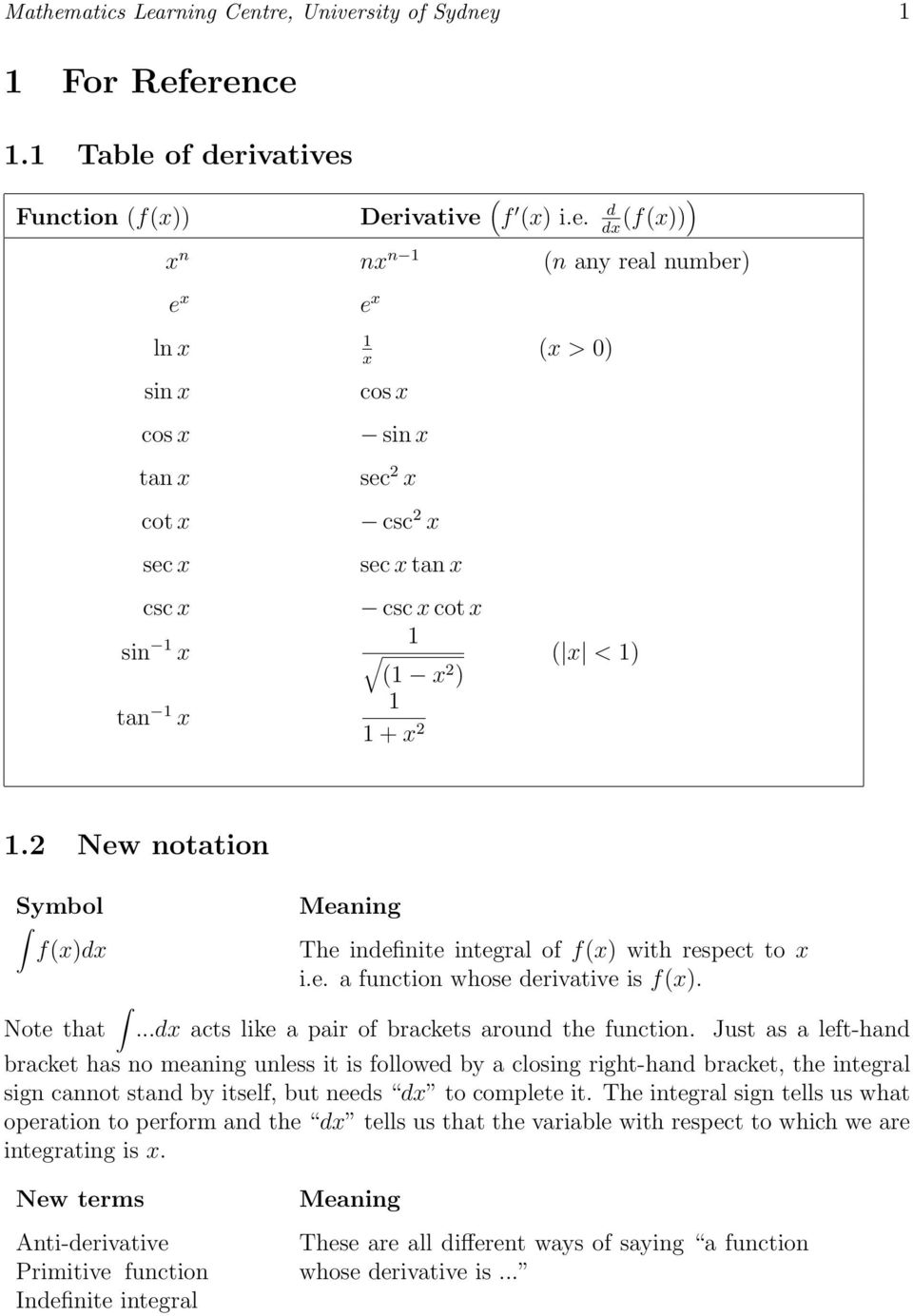
3 Mathematics Learning Centre, University of Syney For Reference. Table of erivatives Function (f()) Derivative ( f () i.e. (f())) n n n (n any real number) e e ln ( >0) sin cos tan cot sec csc sin tan cos sin sec 2 csc 2 sec tan csc cot ( 2 ) + 2 ( < ).2 New notation Symbol f() Meaning The inefinite integral of f() with respect to i.e. a function whose erivative is f(). Note that... acts like a pair of brackets aroun the function. Just as a left-han bracket has no meaning unless it is followe by a closing right-han bracket, the integral sign cannot stan by itself, but nees tocomplete it. The integral sign tells us what operation to perform an the tells us that the variable with respect to which we are integrating is. New terms Anti-erivative Primitive function Inefinite integral Meaning These are all ifferent ways of saying a function whose erivative is...
4 Mathematics Learning Centre, University of Syney 2 2 Introuction This booklet is intene for stuents who have never one integration before, or who have one it before, but so long ago that they feel they have forgotten it all. Integration is use in ealing with two essentially ifferent types of problems: The first type are problems in which the erivative of a function, or its rate of change, or the slope of its graph, is known an we want to fin the function. We are therefore require to reverse the process of ifferentiation. This reverse process is known as antfferentiation, orfining a primitive function, orfining an inefinite integral. The secon type are problems which involve aing up a very large number of very small quantities, (an then taking a limit as the size of the quantities approaches zero while the number of terms tens to infinity). This process leas to the efinition of the efinite integral. Definite integrals are use for fining area, volume, centre of gravity, moment of inertia, work one by a force, an in many other applications. This unit will eal only with problems of the first type, i.e. with inefinite integrals. The secon type of problem is ealt with in Introuction to Integration Part 2 - The Definite Integral. 2. How to use this book You will not gain much by just reaing this booklet. Have pencil an paper reay to work through the eamples before reaing their solutions. Do all the eercises. It is important that you try har to complete the eercises on your own, rather than refer to the solutions as soon as you are stuck. If you have one integration before, an want to revise it, you shoul skim through the tet an then o the eercises for practice. If you have any ifficulties with the eercises, go back an stuy the tet in more etail. 2.2 Objectives By the time you have worke through this unit, you shoul: Be familiar with the efinition of an inefinite integral as the result of reversing the process of ifferentiation. Unerstan how rules for integration are worke out using the rules for ifferentiation (in reverse). Be able to fin inefinite integrals of sums, ifferences an constant multiples of certain elementary functions. Be able to use the chain rule (in reverse) to fin inefinite integrals of certain epressions involving composite functions. Be able to apply these techniques to problems in which the rate of change of a function is known an the function has to be foun.

5 Mathematics Learning Centre, University of Syney Assume knowlege We assume that you are familiar with the following elementary functions: polynomials, powers of, an the trigonometric, eponential an natural logarithm functions, an are able to ifferentiate these. We also assume that you can recognise composite functions an are familiar with the chain rule for ifferentiating them. In aition you will nee to know some simple trigonometric ientities: those base on the efinitions of tan, cot, sec an csc an those base on Pythagoras Theorem. These are covere in sections of the Mathematics Learning Centre booklet Trigonometric Ientities. Other trigonometric ientities are not neee for this booklet, but will be neee in any course on integration, so if you are preparing for a course on integration you shoul work through the whole of Trigonometric Ientities as well as this booklet. Finally, knowlege of the inverse trigonometric functions, sin, cos, an tan an their erivatives woul be a help, but is not essential. 2.4 Test yourself To check how well you remember all the things we will be assuming, try the following questions, an check your answers against those on the net page.. Fin the erivatives of the following functions: i 0 i iv Fin f () for each of the functions f() given: i i iv f() =e f() =ln() f() =cos + sin f() =cot 3. Fin erivatives of: i (2 +) 2 sin 3 i e 2 iv 2 3 v cos( 3 ) vi ln(sin )

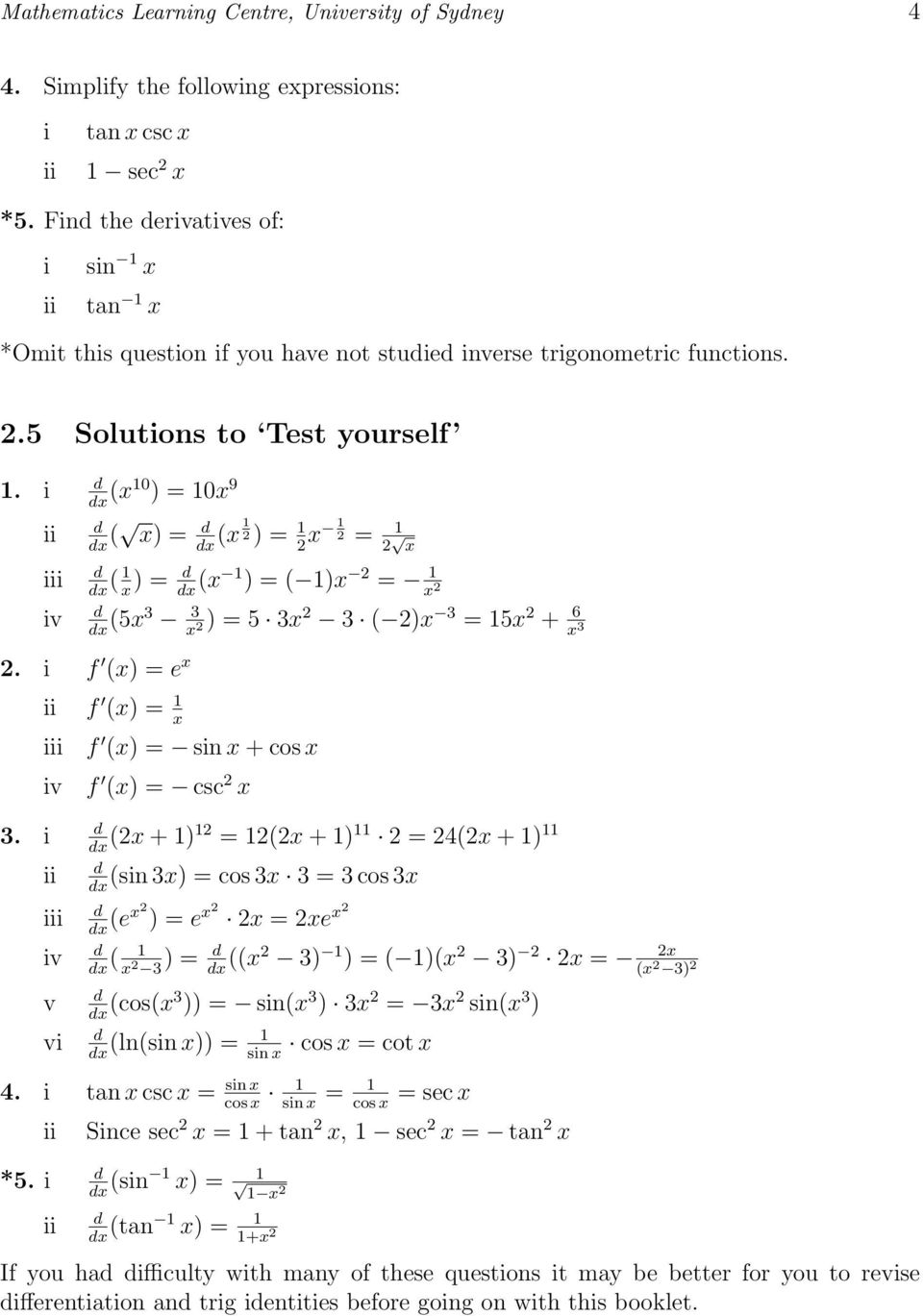
6 Mathematics Learning Centre, University of Syney 4 4. Simplify the following epressions: i tan csc sec 2 *5. Fin the erivatives of: i sin tan *Omit this question if you have not stuie inverse trigonometric functions. 2.5 Solutions to Test yourself. i (0 )=0 9 i iv ( )= ( 2 )= 2 2 = 2 ( )= ( )=( ) 2 = 2 (53 3 )= ( 2) 3 = i f () =e i iv f () = f () = sin + cos f () = csc 2 3. i +)2 = 2(2 +) 2=24(2 +) (sin 3) =cos 3 3=3cos3 i iv v vi (e2 )=e 2 2 =2e 2 ( )= 2 3 ((2 3) )=( )( 2 3) 2 2 = (cos(3 )) = sin( 3 ) 3 2 = 3 2 sin( 3 ) (ln(sin )) = cos = cot sin 4. i tan csc = sin = = sec cos sin cos Since sec 2 =+tan 2, sec 2 = tan 2 *5. i (sin )= 2 (tan )= ( 2 3) 2 If you ha ifficulty with many of these questions it may be better for you to revise ifferentiation an trig ientities before going on with this booklet.
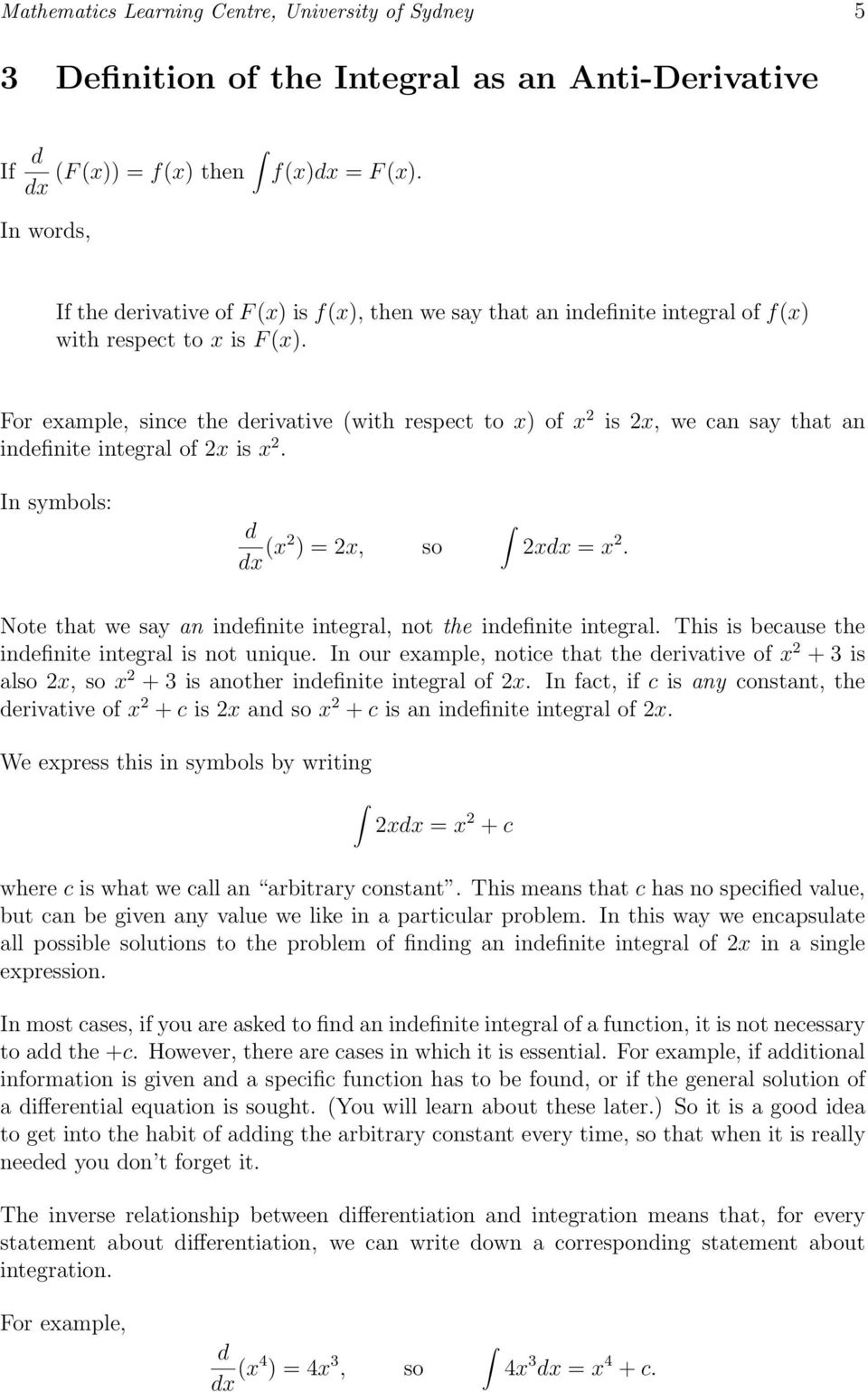
7 Mathematics Learning Centre, University of Syney 5 3 Definition of the Integral as an Anti-Derivative If (F ()) = f() then f() = F (). In wors, If the erivative of F () isf(), then we say that an inefinite integral of f() with respect to is F (). For eample, since the erivative (with respect to ) of 2 is 2, wecan say that an inefinite integral of 2 is 2. In symbols: (2 )=2, so 2 = 2. Note that we say an inefinite integral, not the inefinite integral. This is because the inefinite integral is not unique. In our eample, notice that the erivative of 2 +3is also 2, so 2 +3is another inefinite integral of 2. In fact, if c is any constant, the erivative of 2 + c is 2 an so 2 + c is an inefinite integral of 2. We epress this in symbols by writing 2 = 2 + c where c is what we call an arbitrary constant. This means that c has no specifie value, but can be given any value we like in a particular problem. In this way we encapsulate all possible solutions to the problem of fining an inefinite integral of 2 in a single epression. In most cases, if you are aske to fin an inefinite integral of a function, it is not necessary to a the +c. However, there are cases in which it is essential. For eample, if aitional information is given an a specific function has to be foun, or if the general solution of a ifferential equation is sought. (You will learn about these later.) So it is a goo iea to get into the habit of aing the arbitrary constant every time, so that when it is really neee you on t forget it. The inverse relationship between ifferentiation an integration means that, for every statement about ifferentiation, we can write own a corresponing statement about integration. For eample, (4 )=4 3, so 4 3 = 4 + c.
8 Mathematics Learning Centre, University of Syney 6 Eercises 3. Complete the following statements: (i) (sin ) = cos, so cos = sin + c. () (5 ) =, so = (i) (e ) =, so = (iv) ( ) 2 =, so = (v) (vi) =, so =, so = = The net step is, when we are given a function to integrate, to run quickly through all the stanar ifferentiation formulae in our mins, until we come to one which fits our problem. In other wors, we have to learn to recognise a given function as the erivative of another function (where possible). Trytoothe following eercises by recognising the function which has the given function as its erivative. Eercises 3.2 i ( sin ) 3 2 i 2 iv sec 2 v vi ( 2 )

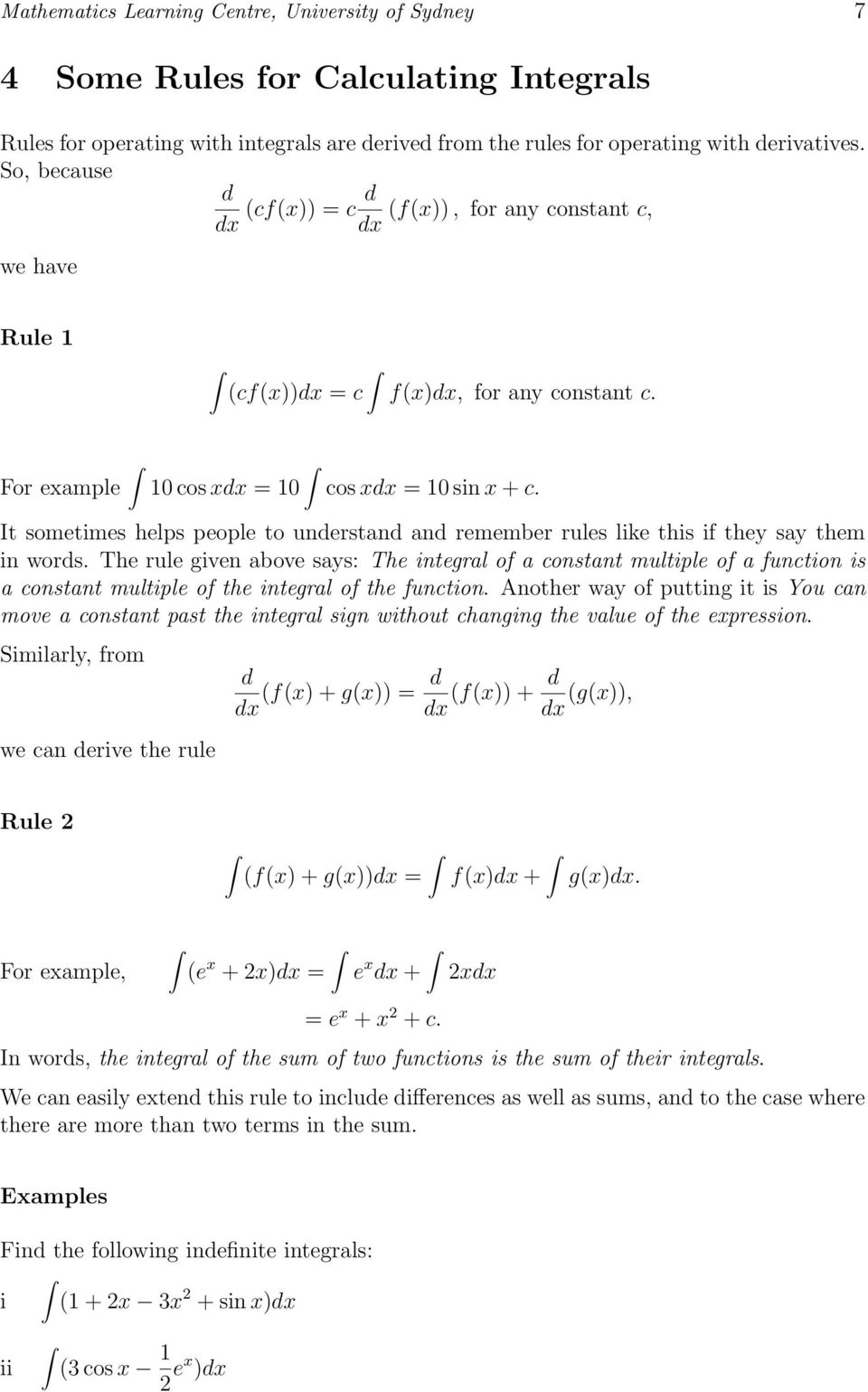
9 Mathematics Learning Centre, University of Syney 7 4 Some Rules for Calculating Integrals Rules for operating with integrals are erive from the rules for operating with erivatives. So, because (cf()) = c (f()), for any constant c, we have Rule (cf()) = c f(), for any constant c. For eample 0 cos =0 cos =0sin + c. It sometimes helps people to unerstan an remember rules like this if they say them in wors. The rule given above says: The integral of a constant multiple of a function is aconstant multiple of the integral of the function. Another way of putting it is You can move a constant past the integral sign without changing the value of the epression. Similarly, from we can erive the rule (f()+g()) = (f()) + (g()), Rule 2 (f()+g()) = f() + g(). For eample, (e +2) = e + 2 = e c. In wors, the integral of the sum of two functions is the sum of their integrals. We can easily eten this rule to inclue ifferences as well as sums, an to the case where there are more than two terms in the sum. Eamples Fin the following inefinite integrals: i ( sin ) (3 cos 2 e )
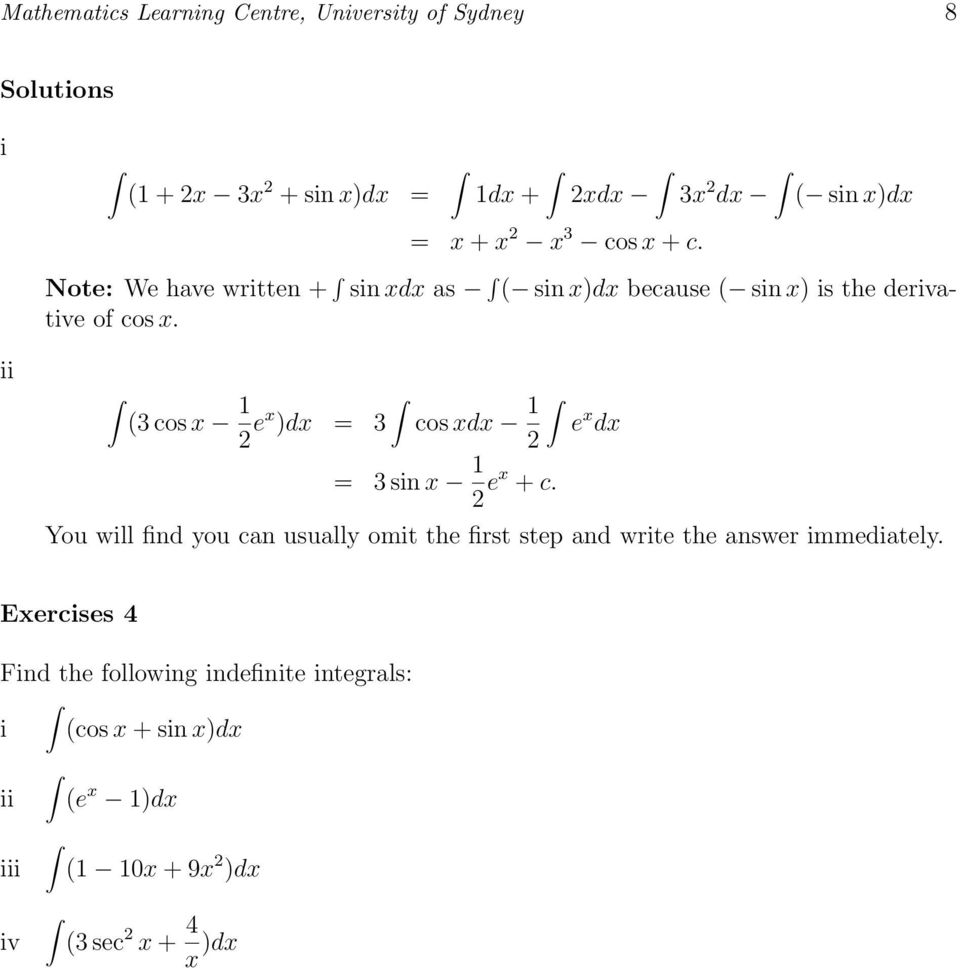
10 Mathematics Learning Centre, University of Syney 8 Solutions i ( sin ) = ( sin ) = cos + c. Note: We have written + sin as ( sin ) because ( sin ) isthe erivative of cos. (3 cos 2 e ) = 3 cos 2 e = 3sin 2 e + c. You will fin you can usually omit the first step an write the answer immeiately. Eercises 4 Fin the following inefinite integrals: i (cos + sin ) (e ) i ( ) iv (3 sec )
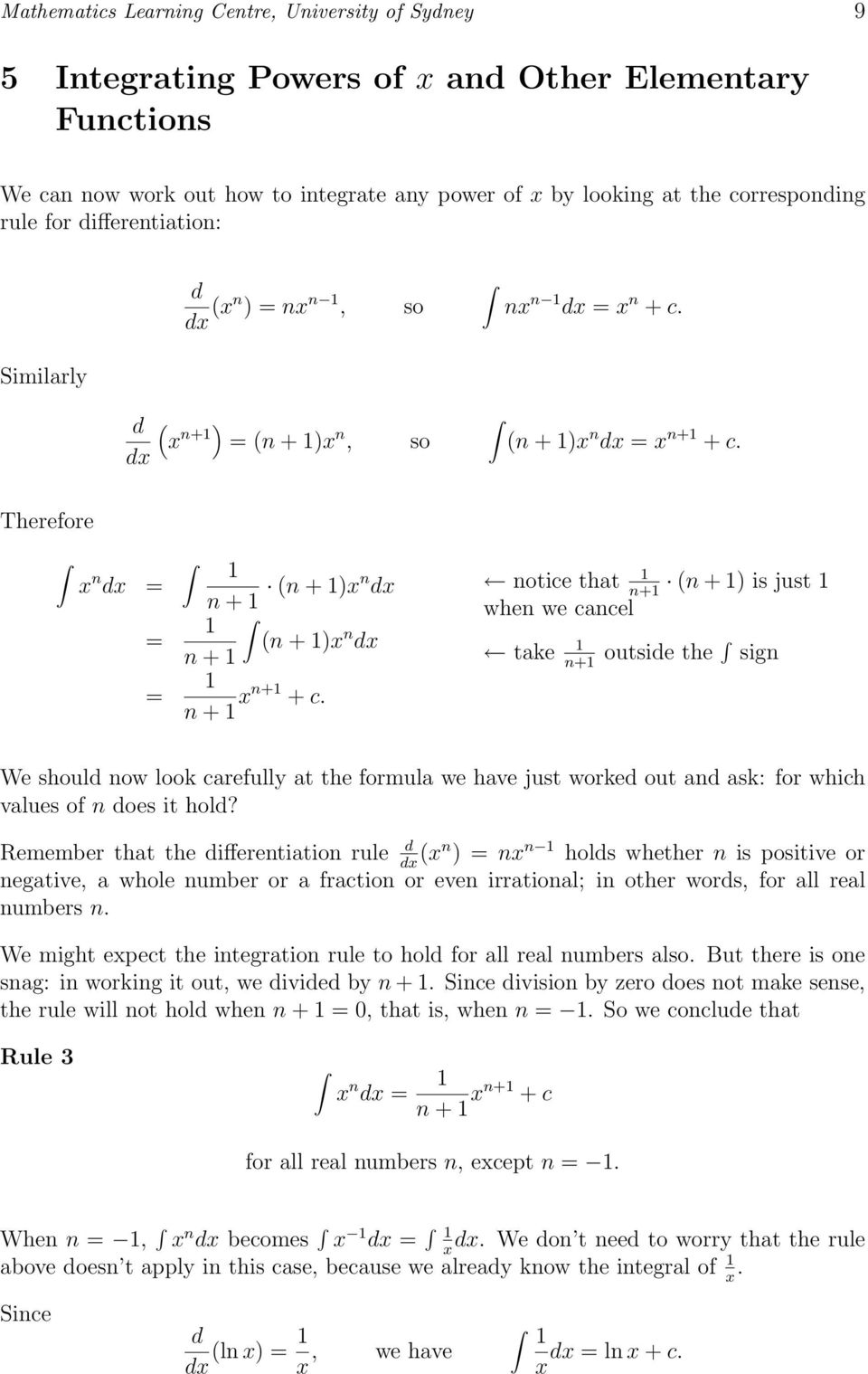
11 Mathematics Learning Centre, University of Syney 9 5 Integrating Powers of an Other Elementary Functions We can now work out how to integrate any power of by looking at the corresponing rule for ifferentiation: (n )=n n, so n n = n + c. Similarly ( ) n+ =(n +) n, so (n +) n = n+ + c. Therefore n = = = n + (n +)n (n +) n n + n + n+ + c. notice that when we cancel n+ (n +)isjust take n+ outsie the sign We shoul now look carefully at the formula we have just worke out an ask: for which values of n oes it hol? Remember that the ifferentiation rule (n )=n n hols whether n is positive or negative, a whole number or a fraction or even irrational; in other wors, for all real numbers n. We might epect the integration rule to hol for all real numbers also. But there is one snag: in working it out, we ivie by n +. Since ivision by zero oes not make sense, the rule will not hol when n +=0,that is, when n =. So we conclue that Rule 3 n = n + n+ + c for all real numbers n, ecept n =. When n =, n becomes =. We on t nee to worry that the rule above oesn t apply in this case, because we alreay know the integral of. Since (ln ) =, we have =ln + c.
12 Mathematics Learning Centre, University of Syney 0 Eamples Fin i i 3 2 Solutions i 3 = i = 2 = (3 + ) 4 + c = c. replacing n by 3inthe formula c = + c. replacing n by 2 inthe formula 2 = c = c. replacing n by = Eercises 5.. Fin anti-erivatives of the following functions: i 5 9 i 4 iv 2 v vi 3 v 2 vi i π 2. Fin the following integrals: i 3 i iv v vi v ( ) ( ) ( ) 2 ( ) ( ) 2 2 Hint: multiply out the epression Hint: ivie through by the enominator Hint: ivie through by the enominator

13 Mathematics Learning Centre, University of Syney At this stage it is very tempting to give a list of stanar integrals, corresponing to the list of erivatives given at the beginning of this booklet. However, you are NOT encourage to memorise integration formulae, but rather to become VERY familiar with the list of erivatives an to practise recognising a function as the erivative of another function. If you try memorising both ifferentiation an integration formulae, you will one ay mi them up an use the wrong one. An there is absolutely no nee to memorise the integration formulae if you know the ifferentiation ones. It is much better to recall the way in which an integral is efine as an anti-erivative. Every time you perform an integration you shoul pause for a moment an check it by ifferentiating the answer to see if you get back the function you began with. This is a very important habit to evelop. There is no nee to write own the checking process every time, often you will o it in your hea, but if you get into this habit you will avoi a lot of mistakes. There is a table of erivatives at the front of this booklet. Try to avoi using it if you can, but refer to it if you are unsure. Eamples Fin the following inefinite integrals: i (e ) (5 csc 2 +3sec 2 ) Solutions i (e ) = e = e c 2 = e c = e c. (5 csc 2 +3sec 2 ) = 5 ( csc 2 ) +3 = 5 cot +3tan + c. sec 2

14 Mathematics Learning Centre, University of Syney 2 Eercises 5.2 Integrate the following functions with respect to : i 0e 5 sin i ( 2 + +) 5 ( 2 ) + Hint: Multiply through by, an write with fractional eponents. iv v tan sin cos Hint: Divie through by + 2, an consult table of erivatives. Hint: Write tan as sin cos an simplify. vi tan 2 Hint: Remember the formula + tan 2 = sec 2. Youmay use the table of erivatives if you like. (If you are not familiar with inverse trig functions, omit parts i an iv.) Hint: In orer to get some of the functions above into a form in which we can recognise what they are erivatives of, we may have to epress them ifferently. Try to think of ways in which they coul be change that woul be helpful.

15 Mathematics Learning Centre, University of Syney 3 6 Things You Can t Do With Integrals It is just as important to be aware of what you can t o when integrating, as to know what you can o. In this way you will avoi making some serious mistakes. We mention here two fairly common ones.. We know that cf() = c f(), where c is a constant. That is, you are allowe to move a constant past the integral sign. It is often very tempting to try the same thing with a variable, i.e. to equate f() with f(). If we check a few special cases, however, it will become clear that this is not correct. For eample, compare the values of an. = 2 = c while These epressesions are obviously ifferent. = 2 2 = c. So the rule we trie to invent oes not work! It is unlikely that anyboy woul try to fin 2 in the way shown above. However, if aske to fin sin, one might very easily be tempte to write sin = cos + c. Although we o not yet know a metho for fining sin, wecan very easily show that the answer obtaine above is wrong. How? By ifferentiating the answer, of course! If we on t get back to sin, wemust have gone wrong somewhere. Notice that cos is a prouct, so we must use the prouct rule to ifferentiate it. ( cos + c) = ( sin )+( ) cos = sin cos. The first term is correct, but the secon term shouln t be there! So the metho we use was wrong. f() is not equal to f(). In wors, you cannot move a variable past the integral sign.

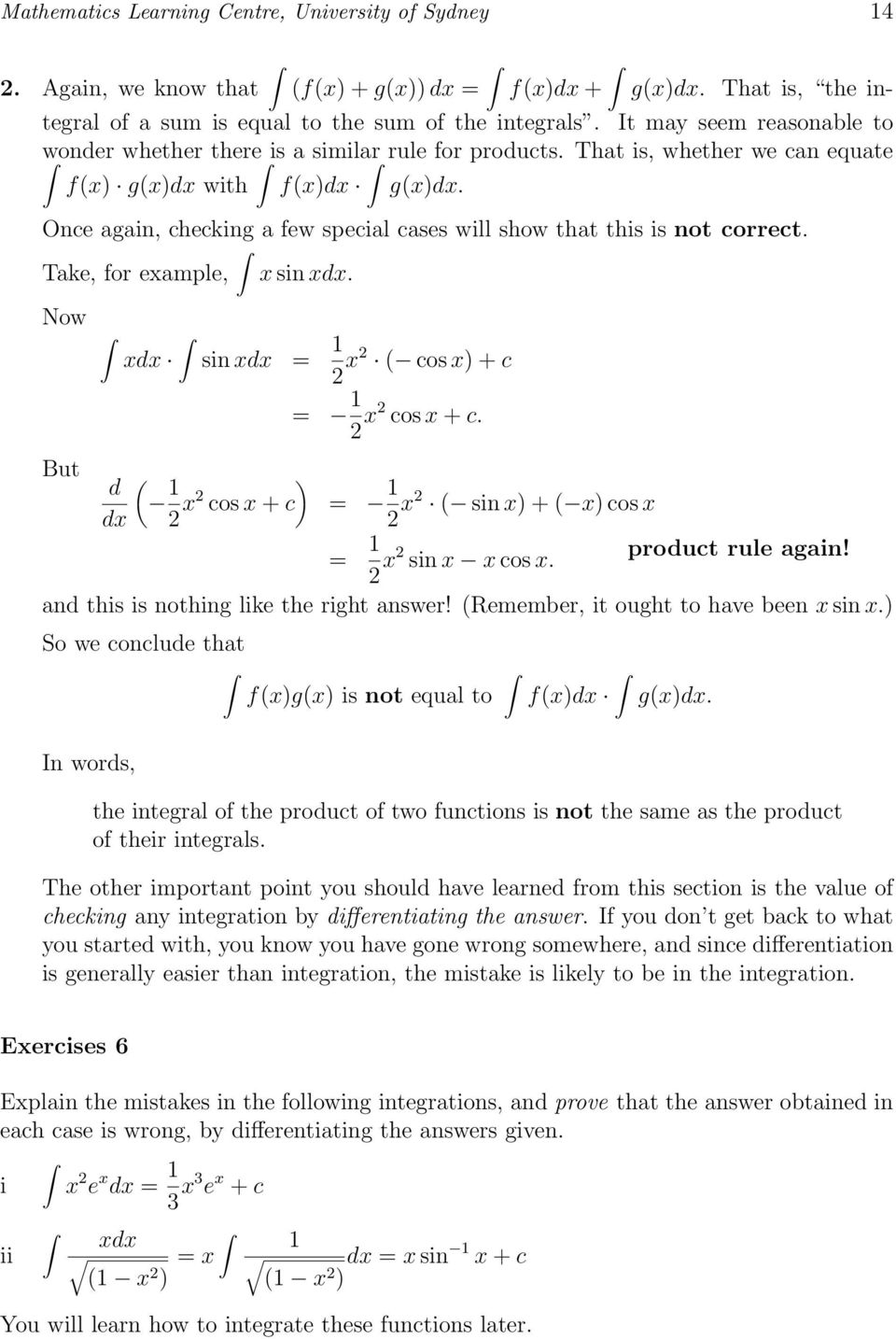
16 Mathematics Learning Centre, University of Syney 4 2. Again, we know that (f()+g()) = f() + g(). That is, the integral of a sum is equal to the sum of the integrals. It may seem reasonable to woner whether there is a similar rule for proucts. That is, whether we can equate f() g() with f() g(). Once again, checking a few special cases will show that this is not correct. Take, for eample, sin. Now sin = 2 2 ( cos )+c = 2 2 cos + c. But ( ) 2 2 cos + c = 2 2 ( sin )+( ) cos = 2 2 sin cos. prouct rule again! an this is nothing like the right answer! (Remember, it ought to have been sin.) So we conclue that f()g() isnot equal to f() g(). In wors, the integral of the prouct of two functions is not the same as the prouct of their integrals. The other important point you shoul have learne from this section is the value of checking any integration by ifferentiating the answer. If you on t get back to what you starte with, you know you have gone wrong somewhere, an since ifferentiation is generally easier than integration, the mistake is likely to be in the integration. Eercises 6 Eplain the mistakes in the following integrations, an prove that the answer obtaine in each case is wrong, by ifferentiating the answers given. i 2 e = 3 3 e + c ( 2 ) = ( 2 ) = sin + c You will learn how to integrate these functions later.
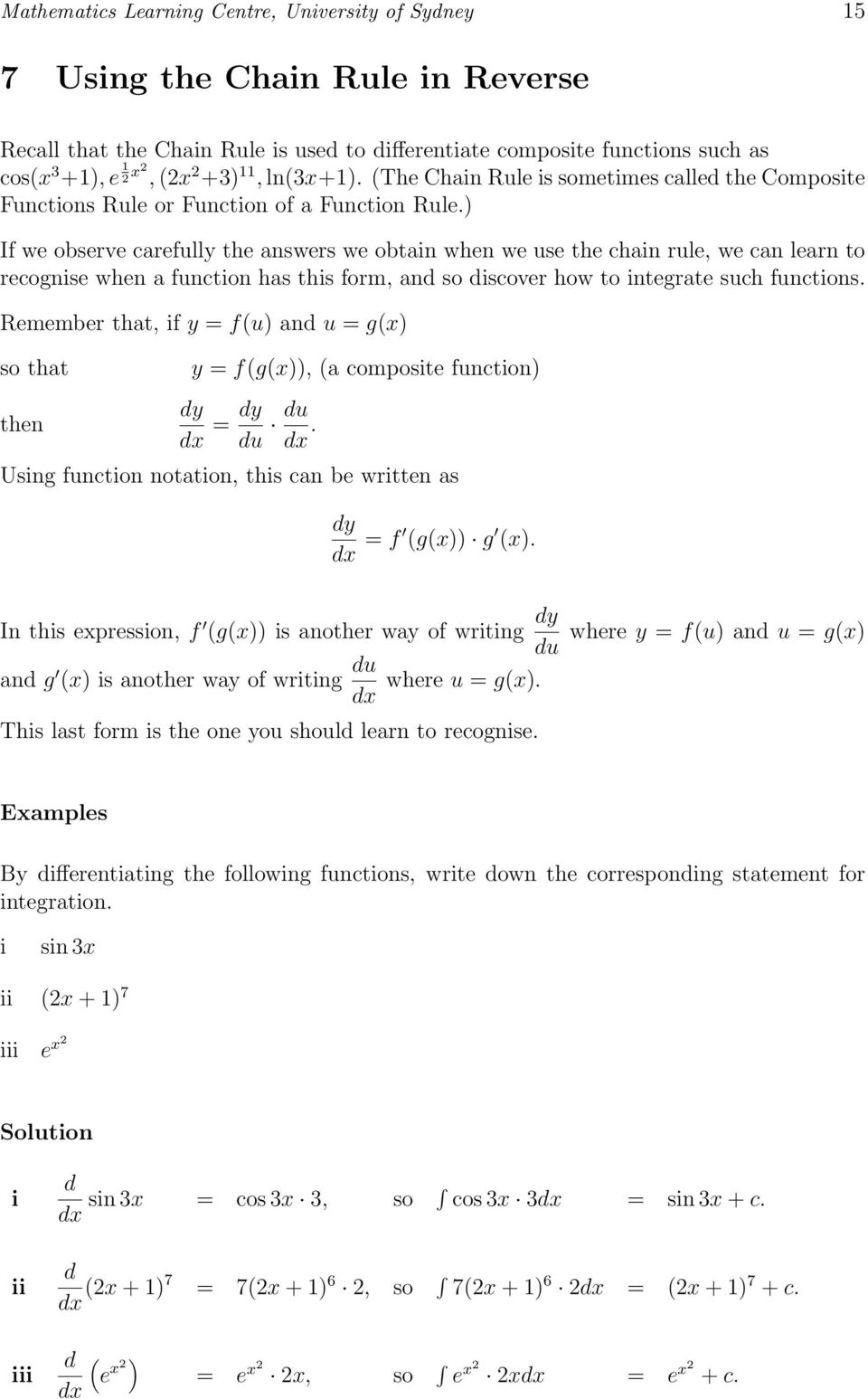
17 Mathematics Learning Centre, University of Syney 5 7 Using the Chain Rule in Reverse Recall that the Chain Rule is use to ifferentiate composite functions such as cos( 3 +),e 2 2, (2 2 +3), ln(3+). (The Chain Rule is sometimes calle the Composite Functions Rule or Function of a Function Rule.) If we observe carefully the answers we obtain when we use the chain rule, we can learn to recognise when a function has this form, an so iscover how to integrate such functions. Remember that, if y = f(u) an u = g() so that y = f(g()), (a composite function) y then = y u u. Using function notation, this can be written as y = f (g()) g (). In this epression, f (g()) is another way of writing y u an g () isanother way of writing u where u = g(). This last form is the one you shoul learn to recognise. where y = f(u) an u = g() Eamples By ifferentiating the following functions, write own the corresponing statement for integration. i sin 3 (2 +) 7 i e 2 Solution i sin 3 = cos 3 3, so cos 3 3 = sin 3 + c. i (2 +)7 = 7(2 +) 6 2, so ( e 2) = e 2 2, so 7(2 +)6 2 = (2 +) 7 + c. e 2 2 = e 2 + c.
18 Mathematics Learning Centre, University of Syney 6 Eercises 7. Differentiate each of the following functions, an then rewrite each result in the form of a statement about integration. i (2 4) 3 sin π i e 3 5 iv ln(2 ) v 5 3 vi tan 5 v ( 5 ) 4 vi sin( 3 ) i e cos 5 i tan ( 2 +) ln(sin ) The net step is to learn to recognise when a function has the forms f (g()) g (), that is, when it is the erivative of a composite function. Look back at each of the integration statements above. In every case, the function being integrate is the prouct of two functions: one is a composite function, an the other is the erivative of the inner function in the composite. You can think of it as the erivative of what s insie the brackets. Note that in some cases, this erivative is a constant. For eample, consier e 3 3. We can write e 3 as a composite function. 3isthe erivative of 3 i.e. the erivative of what s insie the brackets in e (3). This is in the form f (g()) g () with u = g() =3, an f (u) =e u. Using the chain rule in reverse, since (f(g())) = f (g()) g () wehave f (g()) g () = f(g()) + c. In this case e 3 3 = e 3 + c. If you have any oubts about this, it is easy to check if you are right: ifferentiate your answer! Now let s try another: cos( 2 +5) 2. cos( 2 +5)isacomposite function. 2 is the erivative of 2 +5,i.e. the erivative of what s insie the brackets.

19 Mathematics Learning Centre, University of Syney 7 So this is in the form f (g()) g () with u = g() = 2 +5an f (u) =cos u. Recall that if f (u) =cos u, f(u) =sin u. So, cos( 2 +5) 2 = sin( 2 +5)+c. Again, check that this is correct, byifferentiating. People sometimes ask Where i the 2 go?. The answer is, Back where it came from. If we ifferentiate sin( 2 +5)weget cos( 2 +5) 2. So when we integrate cos( 2 +5) 2 we get sin( 2 + 5). Eamples Each of the following functions is in the form f (g()) g (). Ientify f (u) an u = g() an hence fin an inefinite integral of the function. i (3 2 ) 4 6 sin( ) 2 Solutions i (3 2 ) 4 6 is a prouct of (3 2 ) 4 an 6. Clearly (3 2 ) 4 is the composite function f (g()). So g() shoul be is the other part. This shoul be the erivative of what s insie the brackets i.e. 3 2, an clearly, this is the case: (32 ) = 6. So, u = g() =3 2 an f (u) =u 4 giving f (g()) g () =(3 2 ) 4 6. If f (u) =u 4, f(u) = 5 u5. So, using the rule f (g()) g () = f(g()) + c we conclue (3 3 ) 4 6 = 5 (32 ) 5 + c. You shoul ifferentiate this answer immeiately an check that you get back the function you began with.

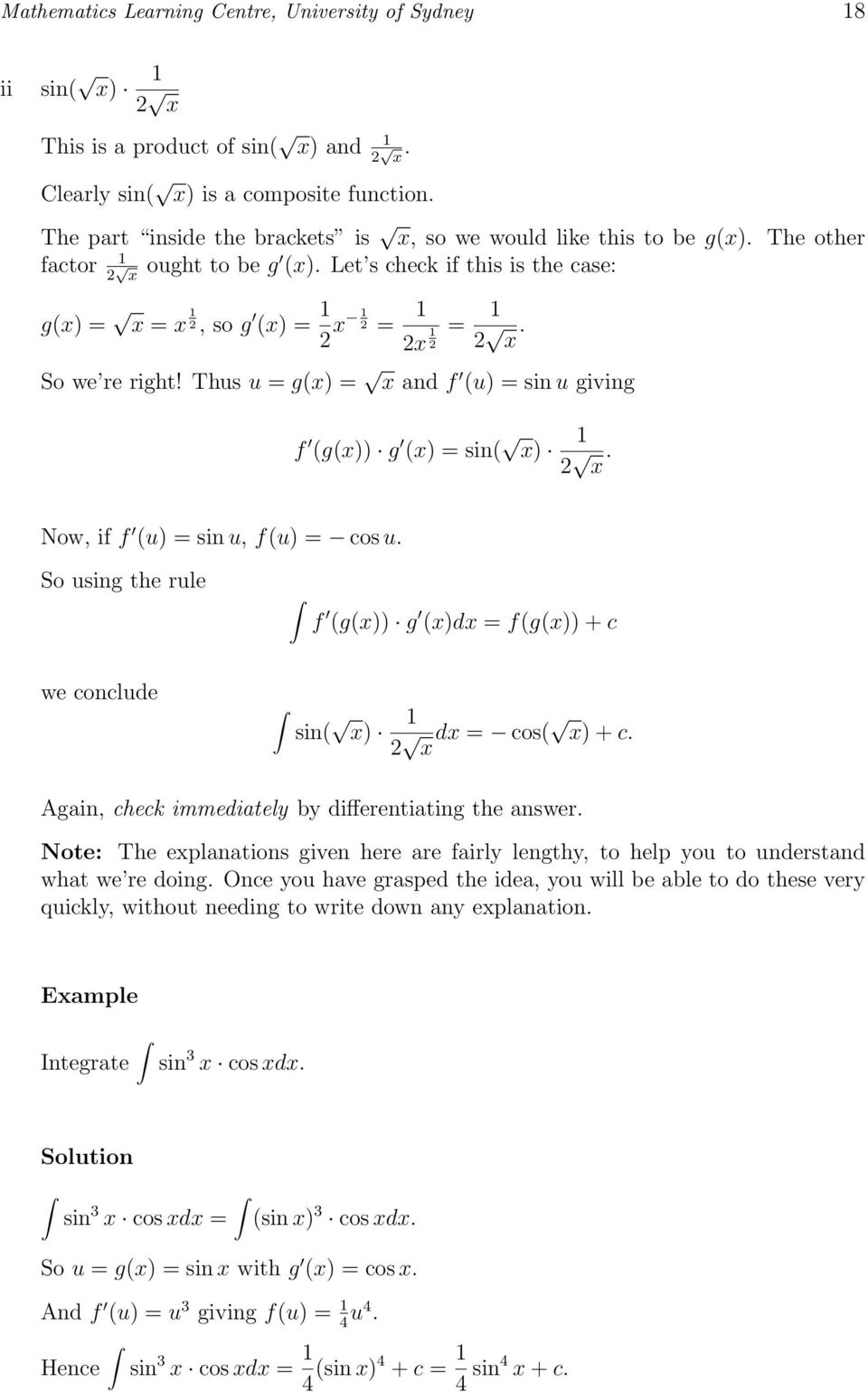
20 Mathematics Learning Centre, University of Syney 8 sin( ) 2 This is a prouct of sin( ) an 2. Clearly sin( )isacomposite function. The part insie the brackets is,sowewoul like this to be g(). The other factor 2 ought to be g (). Let s check if this is the case: g() = = 2,sog () = 2 2 = = So we re right! Thus u = g() = an f (u) =sin u giving f (g()) g () =sin( ) 2. Now, if f (u) =sin u, f(u) = cos u. So using the rule f (g()) g () = f(g()) + c we conclue sin( ) 2 = cos( )+c. Again, check immeiately by ifferentiating the answer. Note: The eplanations given here are fairly lengthy, to help you to unerstan what we re oing. Once you have graspe the iea, you will be able to o these very quickly, without neeing to write own any eplanation. Eample Integrate sin 3 cos. Solution sin 3 cos = (sin ) 3 cos. So u = g() =sin with g () =cos. An f (u) =u 3 giving f(u) = 4 u4. Hence sin 3 cos = 4 (sin )4 + c = 4 sin4 + c.
21 Mathematics Learning Centre, University of Syney 9 Eercises 7.2 Each of the following functions is in the form f (g()) g (). Ientify f (u) an u = g() an hence fin an inefinite integral of the function. i i (ln )2 iv e v sin( 3 ) 3 2 vi cos ( ) π π 2 2 v (7 8) 2 7 vi sin(ln ) i ( ) cos sin e tan sec 2 i e sec 2 (5 3) 5 i (2 ) 3 2 iv sin cos The final step in learning to use this process is to be able to recognise when a function is not quite in the correct form but can beput into the correct form by minor changes. For eample, we try to calculate We notice that 4 +is a composite function, so we woul like to have u = g() = 4 +. But this woul mean g () =4 3, an the integran (i.e. the function we are trying to integrate) only has 3.However, we can easily make it 4 3,asfollows: = 4 Note: The 4 an the 4 cancel with each other, so the epression is not change. So u = g() = 4 +, g () =4 3 An f (u) =u 2 f(u) = 2u So, = = ( 4 + ) c. 3 Note: We may only insert constants in this way, not variables. We cannot for eample evaluate e 2 by writing e 2 2, because 2 the in front of the integral sign oes not cancel with the which has been inserte in the integran. This integral cannot, in fact, be evaluate in terms of elementary functions.
22 Mathematics Learning Centre, University of Syney 20 The eample above illustrates one of the ifficulties with integration: many seemingly simple functions cannot be integrate without inventing new functions to epress the integrals. There is no set of rules which we can apply which will tell us how to integrate any function. All we can o is give some techniques which will work for some functions. Eercises 7.3 Write the following functions in the form f (g()) g () an hence integrate them: i cos 7 e 2 i 2 2 iv 2 (4 3 +3) 9 v sin( + 3) vi sin v ( 2 ) vi e 3 i tan 6 Hint: Write tan 6 in terms of sin 6 an cos 6.
23 Mathematics Learning Centre, University of Syney 2 8 Applications Applications of anti-ifferentiation arise in problems in which we know the rate of change of a function an want to fin the function itself. Problems about motion provie many eamples, such as those in which the velocity of a moving object is given an we want to fin its position at any time. Since velocity is rate of change of isplacement, we must anti-ifferentiate to fin the isplacement. Eamples. A stone is thrown upwars from the top of a tower 50 metres high. Its velocity in an upwars irection t secon later is 20 5t metres per secon. Fin the height of the stone above the groun 3 secons later. Solution Let the height of the stone above groun level at time t be h metres. We are given two pieces of information in this problem: i the fact that the tower is 50m high tells us that when t =0(that is, at the moment the stone leaves the thrower s han), h = 50, the fact that the velocity at time t is 20 5t tells us that h t =20 5t. We begin with the secon statement, which tells us about rate of change of a function. By anti-ifferentiating, we obtain h = (20 5t)t = 20t 5 2 t2 + c. () Note: it is vitally important not to forget the +c (the constant of integration) in problems like this. Now we can make use of the first statement, which is calle an initial conition (it tells us what things were like at the start) to fin a value for the constant c. By substituting h =50an t =0into the equation (), we obtain 50 = c. So h =20t 5 2 t (2) Finally, let us go back to the problem, an rea it again, to check eactly what we are aske to fin: Fin the height of the stone above the groun 3 secons later. To fin this, all we have to o is substitute t =3in the epression we have just erive. When t =3,h = =87.5, so the height of the stone 3 secons later is metres.
24 Mathematics Learning Centre, University of Syney 22 Let us look back at the structure of this problem an its solution. We are given information about the rate of change of a quantity, an we antfferentiate (i.e. integrate) to get a general epression for the quantity, incluing an arbitary constant. We are given information about initial conitions an use this to fin the value of the constant of integration. We now have a precise epression for the quantity, an can use that to answer the questions aske. 2. When a tap at the base of a storage tank is turne on, water flows out of the tank at the rate of 200e 5 t litres per minute. If the volume of water in the tank at the start is 000 litres, fin how much is left after the tap has been running for 0 minutes. Solution Let the volume of water in the tank t minutes after the tap is turne on be V litres. Since water is running out of the tank, V will be ecreasing, an so V must be t negative. V Hence = 200e 5 t t ( 200e an so V = t) 5 t ( = 200 ( 5) e 5 t ) t 5 = 000e 5 t + c. Now when t =0,V = 000, so 000 = c, hence c =0. So at any time t, V = 000e 5 t Thus when t = 0, V = 000e litres. Eercises 8. When a stone is roppe into smooth water, circular ripples sprea out from the point where it enters the water. If the area covere by ripples increases at a rate of 2πt square metres per secon, fin the total area of isturbe water t secons after the stone hits the water. What is the area covere by ripples after 3 secons? [Note: when t =0,the stone is just entering the water, so the area of isturbe water is 0.]
25 Mathematics Learning Centre, University of Syney A population of animals, uner certain conitions, has a growth rate given by 500π cos 2πt where t is the time in years. If the initial size of the her is 3000, fin the size of the population at time t. What are the maimum an minimum numbers in the her uring the course of a year? 3. During an eperiment, the height of a growing plant increase at a rate of t+4 cm per ay, where t represents the number of ays since the start of the eperiment. If the plant was 20 cm high at the beginning, what woul its height be after 2 ays? 4. An oral ose of a rug was aministere to a patient. t hours later, the concentration of the rug in the patient s bloo was changing at a rate give by 5e t e 0.2t. If none of the rug was present in the bloo at the time the ose was given, fin the concentration of the rug in the patient s bloo t hours later. How long after aministration will the concentration be greatest? 5. An object is propelle along the groun in such a way that its velocity after t secons is metres per secon. If it starts 2 metres from a fie point, an moves in a t+ straight line irectly towars the point, how long will it take to reach the point?
Inverse Trig Functions
 Inverse Trig Functions c A Math Support Center Capsule February, 009 Introuction Just as trig functions arise in many applications, so o the inverse trig functions. What may be most surprising is that
The Quick Calculus Tutorial
 The Quick Calculus Tutorial This text is a quick introuction into Calculus ieas an techniques. It is esigne to help you if you take the Calculus base course Physics 211 at the same time with Calculus I,
f(x) = a x, h(5) = ( 1) 5 1 = 2 2 1
 Exponential Functions an their Derivatives Exponential functions are functions of the form f(x) = a x, where a is a positive constant referre to as the base. The functions f(x) = x, g(x) = e x, an h(x)
Exponential Functions: Differentiation and Integration. The Natural Exponential Function
 46_54.q //4 :59 PM Page 5 5 CHAPTER 5 Logarithmic, Eponential, an Other Transcenental Functions Section 5.4 f () = e f() = ln The inverse function of the natural logarithmic function is the natural eponential
Here the units used are radians and sin x = sin(x radians). Recall that sin x and cos x are defined and continuous everywhere and
 Lecture 9 : Derivatives of Trigonometric Functions (Please review Trigonometry uner Algebra/Precalculus Review on the class webpage.) In this section we will look at the erivatives of the trigonometric
Rules for Finding Derivatives
 3 Rules for Fining Derivatives It is teious to compute a limit every time we nee to know the erivative of a function. Fortunately, we can evelop a small collection of examples an rules that allow us to
Calculating Viscous Flow: Velocity Profiles in Rivers and Pipes
 previous inex next Calculating Viscous Flow: Velocity Profiles in Rivers an Pipes Michael Fowler, UVa 9/8/1 Introuction In this lecture, we ll erive the velocity istribution for two examples of laminar
Lagrangian and Hamiltonian Mechanics
 Lagrangian an Hamiltonian Mechanics D.G. Simpson, Ph.D. Department of Physical Sciences an Engineering Prince George s Community College December 5, 007 Introuction In this course we have been stuying
Elliptic Functions sn, cn, dn, as Trigonometry W. Schwalm, Physics, Univ. N. Dakota
 Elliptic Functions sn, cn, n, as Trigonometry W. Schwalm, Physics, Univ. N. Dakota Backgroun: Jacobi iscovere that rather than stuying elliptic integrals themselves, it is simpler to think of them as inverses
APPLICATION OF CALCULUS IN COMMERCE AND ECONOMICS
 Application of Calculus in Commerce an Economics 41 APPLICATION OF CALCULUS IN COMMERCE AND ECONOMICS æ We have learnt in calculus that when 'y' is a function of '', the erivative of y w.r.to i.e. y ö
How to Avoid the Inverse Secant (and Even the Secant Itself)
 How to Avoi the Inverse Secant (an Even the Secant Itself) S A Fulling Stephen A Fulling (fulling@mathtamue) is Professor of Mathematics an of Physics at Teas A&M University (College Station, TX 7783)
Answers to the Practice Problems for Test 2
 Answers to the Practice Problems for Test 2 Davi Murphy. Fin f (x) if it is known that x [f(2x)] = x2. By the chain rule, x [f(2x)] = f (2x) 2, so 2f (2x) = x 2. Hence f (2x) = x 2 /2, but the lefthan
Calculus Refresher, version 2008.4. c 1997-2008, Paul Garrett, [email protected] http://www.math.umn.edu/ garrett/
 Calculus Refresher, version 2008.4 c 997-2008, Paul Garrett, [email protected] http://www.math.umn.eu/ garrett/ Contents () Introuction (2) Inequalities (3) Domain of functions (4) Lines (an other items
Example Optimization Problems selected from Section 4.7
 Example Optimization Problems selecte from Section 4.7 19) We are aske to fin the points ( X, Y ) on the ellipse 4x 2 + y 2 = 4 that are farthest away from the point ( 1, 0 ) ; as it happens, this point
20. Product rule, Quotient rule
 20. Prouct rule, 20.1. Prouct rule Prouct rule, Prouct rule We have seen that the erivative of a sum is the sum of the erivatives: [f(x) + g(x)] = x x [f(x)] + x [(g(x)]. One might expect from this that
10.2 Systems of Linear Equations: Matrices
 SECTION 0.2 Systems of Linear Equations: Matrices 7 0.2 Systems of Linear Equations: Matrices OBJECTIVES Write the Augmente Matrix of a System of Linear Equations 2 Write the System from the Augmente Matrix
Section 3.3. Differentiation of Polynomials and Rational Functions. Difference Equations to Differential Equations
 Difference Equations to Differential Equations Section 3.3 Differentiation of Polynomials an Rational Functions In tis section we begin te task of iscovering rules for ifferentiating various classes of
Algebra. Exponents. Absolute Value. Simplify each of the following as much as possible. 2x y x + y y. xxx 3. x x x xx x. 1. Evaluate 5 and 123
 Algebra Eponents Simplify each of the following as much as possible. 1 4 9 4 y + y y. 1 5. 1 5 4. y + y 4 5 6 5. + 1 4 9 10 1 7 9 0 Absolute Value Evaluate 5 and 1. Eliminate the absolute value bars from
To differentiate logarithmic functions with bases other than e, use
 To ifferentiate logarithmic functions with bases other than e, use 1 1 To ifferentiate logarithmic functions with bases other than e, use log b m = ln m ln b 1 To ifferentiate logarithmic functions with
Mathematics. Circles. hsn.uk.net. Higher. Contents. Circles 119 HSN22400
 hsn.uk.net Higher Mathematics UNIT OUTCOME 4 Circles Contents Circles 119 1 Representing a Circle 119 Testing a Point 10 3 The General Equation of a Circle 10 4 Intersection of a Line an a Circle 1 5 Tangents
Core Maths C3. Revision Notes
 Core Maths C Revision Notes October 0 Core Maths C Algebraic fractions... Cancelling common factors... Multipling and dividing fractions... Adding and subtracting fractions... Equations... 4 Functions...
Exponential and Logarithmic Functions
 Chapter 6 Eponential and Logarithmic Functions Section summaries Section 6.1 Composite Functions Some functions are constructed in several steps, where each of the individual steps is a function. For eample,
Differentiability of Exponential Functions
 Differentiability of Exponential Functions Philip M. Anselone an John W. Lee Philip Anselone ([email protected]) receive his Ph.D. from Oregon State in 1957. After a few years at Johns Hopkins an
Lecture L25-3D Rigid Body Kinematics
 J. Peraire, S. Winall 16.07 Dynamics Fall 2008 Version 2.0 Lecture L25-3D Rigi Boy Kinematics In this lecture, we consier the motion of a 3D rigi boy. We shall see that in the general three-imensional
There are two different ways you can interpret the information given in a demand curve.
 Econ 500 Microeconomic Review Deman What these notes hope to o is to o a quick review of supply, eman, an equilibrium, with an emphasis on a more quantifiable approach. Deman Curve (Big icture) The whole
4.4 The Derivative. 51. Disprove the claim: If lim f (x) = L, then either lim f (x) = L or. 52. If lim x a. f (x) = and lim x a. g(x) =, then lim x a
 Capter 4 Real Analysis 281 51. Disprove te claim: If lim f () = L, ten eiter lim f () = L or a a lim f () = L. a 52. If lim a f () = an lim a g() =, ten lim a f + g =. 53. If lim f () = an lim g() = L
Math 230.01, Fall 2012: HW 1 Solutions
 Math 3., Fall : HW Solutions Problem (p.9 #). Suppose a wor is picke at ranom from this sentence. Fin: a) the chance the wor has at least letters; SOLUTION: All wors are equally likely to be chosen. The
6-4 : Learn to find the area and circumference of circles. Area and Circumference of Circles (including word problems)
 Circles 6-4 : Learn to fin the area an circumference of circles. Area an Circumference of Circles (incluing wor problems) 8-3 Learn to fin the Circumference of a circle. 8-6 Learn to fin the area of circles.
y or f (x) to determine their nature.
 Level C5 of challenge: D C5 Fining stationar points of cubic functions functions Mathematical goals Starting points Materials require Time neee To enable learners to: fin the stationar points of a cubic
Sections 3.1/3.2: Introducing the Derivative/Rules of Differentiation
 Sections 3.1/3.2: Introucing te Derivative/Rules of Differentiation 1 Tangent Line Before looking at te erivative, refer back to Section 2.1, looking at average velocity an instantaneous velocity. Here
Math 229 Lecture Notes: Product and Quotient Rules Professor Richard Blecksmith [email protected]
 Mat 229 Lecture Notes: Prouct an Quotient Rules Professor Ricar Blecksmit [email protected] 1. Time Out for Notation Upate It is awkwar to say te erivative of x n is nx n 1 Using te prime notation for erivatives,
Modelling and Resolving Software Dependencies
 June 15, 2005 Abstract Many Linux istributions an other moern operating systems feature the explicit eclaration of (often complex) epenency relationships between the pieces of software
DIFFRACTION AND INTERFERENCE
 DIFFRACTION AND INTERFERENCE In this experiment you will emonstrate the wave nature of light by investigating how it bens aroun eges an how it interferes constructively an estructively. You will observe
Integrating algebraic fractions
 Integrating algebraic fractions Sometimes the integral of an algebraic fraction can be found by first epressing the algebraic fraction as the sum of its partial fractions. In this unit we will illustrate
Mathematics Review for Economists
 Mathematics Review for Economists by John E. Floy University of Toronto May 9, 2013 This ocument presents a review of very basic mathematics for use by stuents who plan to stuy economics in grauate school
The numerical values that you find are called the solutions of the equation.
 Appendi F: Solving Equations The goal of solving equations When you are trying to solve an equation like: = 4, you are trying to determine all of the numerical values of that you could plug into that equation.
Section 5.0A Factoring Part 1
 Section 5.0A Factoring Part 1 I. Work Together A. Multiply the following binomials into trinomials. (Write the final result in descending order, i.e., a + b + c ). ( 7)( + 5) ( + 7)( + ) ( + 7)( + 5) (
LIMITS AND CONTINUITY
 LIMITS AND CONTINUITY 1 The concept of it Eample 11 Let f() = 2 4 Eamine the behavior of f() as approaches 2 2 Solution Let us compute some values of f() for close to 2, as in the tables below We see from
Data Center Power System Reliability Beyond the 9 s: A Practical Approach
 Data Center Power System Reliability Beyon the 9 s: A Practical Approach Bill Brown, P.E., Square D Critical Power Competency Center. Abstract Reliability has always been the focus of mission-critical
MODELLING OF TWO STRATEGIES IN INVENTORY CONTROL SYSTEM WITH RANDOM LEAD TIME AND DEMAND
 art I. robobabilystic Moels Computer Moelling an New echnologies 27 Vol. No. 2-3 ransport an elecommunication Institute omonosova iga V-9 atvia MOEING OF WO AEGIE IN INVENOY CONO YEM WIH ANOM EA IME AN
Domain of a Composition
 Domain of a Composition Definition Given the function f and g, the composition of f with g is a function defined as (f g)() f(g()). The domain of f g is the set of all real numbers in the domain of g such
36 CHAPTER 1. LIMITS AND CONTINUITY. Figure 1.17: At which points is f not continuous?
 36 CHAPTER 1. LIMITS AND CONTINUITY 1.3 Continuity Before Calculus became clearly de ned, continuity meant that one could draw the graph of a function without having to lift the pen and pencil. While this
Measures of distance between samples: Euclidean
 4- Chapter 4 Measures of istance between samples: Eucliean We will be talking a lot about istances in this book. The concept of istance between two samples or between two variables is funamental in multivariate
Negative Integral Exponents. If x is nonzero, the reciprocal of x is written as 1 x. For example, the reciprocal of 23 is written as 2
 4 (4-) Chapter 4 Polynomials and Eponents P( r) 0 ( r) dollars. Which law of eponents can be used to simplify the last epression? Simplify it. P( r) 7. CD rollover. Ronnie invested P dollars in a -year
10.1. Solving Quadratic Equations. Investigation: Rocket Science CONDENSED
 CONDENSED L E S S O N 10.1 Solving Quadratic Equations In this lesson you will look at quadratic functions that model projectile motion use tables and graphs to approimate solutions to quadratic equations
Notes on tangents to parabolas
 Notes on tangents to parabolas (These are notes for a talk I gave on 2007 March 30.) The point of this talk is not to publicize new results. The most recent material in it is the concept of Bézier curves,
Five 5. Rational Expressions and Equations C H A P T E R
 Five C H A P T E R Rational Epressions and Equations. Rational Epressions and Functions. Multiplication and Division of Rational Epressions. Addition and Subtraction of Rational Epressions.4 Comple Fractions.
Section 6-3 Double-Angle and Half-Angle Identities
 6-3 Double-Angle and Half-Angle Identities 47 Section 6-3 Double-Angle and Half-Angle Identities Double-Angle Identities Half-Angle Identities This section develops another important set of identities
Functions and their Graphs
 Functions and their Graphs Functions All of the functions you will see in this course will be real-valued functions in a single variable. A function is real-valued if the input and output are real numbers
TRIGONOMETRY Compound & Double angle formulae
 TRIGONOMETRY Compound & Double angle formulae In order to master this section you must first learn the formulae, even though they will be given to you on the matric formula sheet. We call these formulae
An intertemporal model of the real exchange rate, stock market, and international debt dynamics: policy simulations
 This page may be remove to conceal the ientities of the authors An intertemporal moel of the real exchange rate, stock market, an international ebt ynamics: policy simulations Saziye Gazioglu an W. Davi
A Quick Algebra Review
 1. Simplifying Epressions. Solving Equations 3. Problem Solving 4. Inequalities 5. Absolute Values 6. Linear Equations 7. Systems of Equations 8. Laws of Eponents 9. Quadratics 10. Rationals 11. Radicals
f(x + h) f(x) h as representing the slope of a secant line. As h goes to 0, the slope of the secant line approaches the slope of the tangent line.
 Derivative of f(z) Dr. E. Jacobs Te erivative of a function is efine as a limit: f (x) 0 f(x + ) f(x) We can visualize te expression f(x+) f(x) as representing te slope of a secant line. As goes to 0,
9.3 OPERATIONS WITH RADICALS
 9. Operations with Radicals (9 1) 87 9. OPERATIONS WITH RADICALS In this section Adding and Subtracting Radicals Multiplying Radicals Conjugates In this section we will use the ideas of Section 9.1 in
Homework 2 Solutions
 Homework Solutions 1. (a) Find the area of a regular heagon inscribed in a circle of radius 1. Then, find the area of a regular heagon circumscribed about a circle of radius 1. Use these calculations to
Core Maths C1. Revision Notes
 Core Maths C Revision Notes November 0 Core Maths C Algebra... Indices... Rules of indices... Surds... 4 Simplifying surds... 4 Rationalising the denominator... 4 Quadratic functions... 4 Completing the
LINEAR INEQUALITIES. less than, < 2x + 5 x 3 less than or equal to, greater than, > 3x 2 x 6 greater than or equal to,
 LINEAR INEQUALITIES When we use the equal sign in an equation we are stating that both sides of the equation are equal to each other. In an inequality, we are stating that both sides of the equation are
TOPIC 4: DERIVATIVES
 TOPIC 4: DERIVATIVES 1. The derivative of a function. Differentiation rules 1.1. The slope of a curve. The slope of a curve at a point P is a measure of the steepness of the curve. If Q is a point on the
15.2. First-Order Linear Differential Equations. First-Order Linear Differential Equations Bernoulli Equations Applications
 00 CHAPTER 5 Differential Equations SECTION 5. First-Orer Linear Differential Equations First-Orer Linear Differential Equations Bernoulli Equations Applications First-Orer Linear Differential Equations
Chapter 7 Outline Math 236 Spring 2001
 Chapter 7 Outline Math 236 Spring 2001 Note 1: Be sure to read the Disclaimer on Chapter Outlines! I cannot be responsible for misfortunes that may happen to you if you do not. Note 2: Section 7.9 will
Mannheim curves in the three-dimensional sphere
 Mannheim curves in the three-imensional sphere anju Kahraman, Mehmet Öner Manisa Celal Bayar University, Faculty of Arts an Sciences, Mathematics Department, Muraiye Campus, 5, Muraiye, Manisa, urkey.
MSc. Econ: MATHEMATICAL STATISTICS, 1995 MAXIMUM-LIKELIHOOD ESTIMATION
 MAXIMUM-LIKELIHOOD ESTIMATION The General Theory of M-L Estimation In orer to erive an M-L estimator, we are boun to make an assumption about the functional form of the istribution which generates the
1. (from Stewart, page 586) Solve the initial value problem.
 . (from Stewart, page 586) Solve the initial value problem.. (from Stewart, page 586) (a) Solve y = y. du dt = t + sec t u (b) Solve y = y, y(0) = 0., u(0) = 5. (c) Solve y = y, y(0) = if possible. 3.
Towards a Framework for Enterprise Architecture Frameworks Comparison and Selection
 Towars a Framework for Enterprise Frameworks Comparison an Selection Saber Aballah Faculty of Computers an Information, Cairo University [email protected] Abstract A number of Enterprise Frameworks
UNIT 1: ANALYTICAL METHODS FOR ENGINEERS
 UNIT : ANALYTICAL METHODS FOR ENGINEERS Unit code: A/60/40 QCF Level: 4 Credit value: 5 OUTCOME 3 - CALCULUS TUTORIAL DIFFERENTIATION 3 Be able to analyse and model engineering situations and solve problems
Using research evidence in mental health: user-rating and focus group study of clinicians preferences for a new clinical question-answering service
 DOI: 10.1111/j.1471-1842.2008.00833.x Using research evience in mental health: user-rating an focus group stuy of clinicians preferences for a new clinical question-answering service Elizabeth A. Barley*,
Algebra 2 Unit 8 (Chapter 7) CALCULATORS ARE NOT ALLOWED
 Algebra Unit 8 (Chapter 7) CALCULATORS ARE NOT ALLOWED. Graph eponential functions. (Sections 7., 7.) Worksheet 6. Solve eponential growth and eponential decay problems. (Sections 7., 7.) Worksheet 8.
Chapter 4: Elasticity
 Chapter : Elasticity Elasticity of eman: It measures the responsiveness of quantity emane (or eman) with respect to changes in its own price (or income or the price of some other commoity). Why is Elasticity
Graphing Trigonometric Skills
 Name Period Date Show all work neatly on separate paper. (You may use both sides of your paper.) Problems should be labeled clearly. If I can t find a problem, I ll assume it s not there, so USE THE TEMPLATE
A positive exponent means repeated multiplication. A negative exponent means the opposite of repeated multiplication, which is repeated
 Eponents Dealing with positive and negative eponents and simplifying epressions dealing with them is simply a matter of remembering what the definition of an eponent is. division. A positive eponent means
Answers to Basic Algebra Review
 Answers to Basic Algebra Review 1. -1.1 Follow the sign rules when adding and subtracting: If the numbers have the same sign, add them together and keep the sign. If the numbers have different signs, subtract
Solutions of Linear Equations in One Variable
 2. Solutions of Linear Equations in One Variable 2. OBJECTIVES. Identify a linear equation 2. Combine like terms to solve an equation We begin this chapter by considering one of the most important tools
xn. x must be written as x^(2n) and NOT as x^2n. Writing x^2n means 4x y would be written as 4 x^2 y^3 or with the multiplication mark as 4*x^2*y^3.
 Writing Mathematical Epressions in Plain Tet Eamples and Cautions Copyright 009 Sally J. Keely. Mathematical epressions can be typed online in a number of ways including plain tet, ASCII codes, HTML tags,
MPE Review Section III: Logarithmic & Exponential Functions
 MPE Review Section III: Logarithmic & Eponential Functions FUNCTIONS AND GRAPHS To specify a function y f (, one must give a collection of numbers D, called the domain of the function, and a procedure
Rural Development Tools: What Are They and Where Do You Use Them?
 Faculty Paper Series Faculty Paper 00-09 June, 2000 Rural Development Tools: What Are They an Where Do You Use Them? By Dennis U. Fisher Professor an Extension Economist [email protected] Juith I. Stallmann
The majority of college students hold credit cards. According to the Nellie May
 CHAPTER 6 Factoring Polynomials 6.1 The Greatest Common Factor and Factoring by Grouping 6. Factoring Trinomials of the Form b c 6.3 Factoring Trinomials of the Form a b c and Perfect Square Trinomials
POLYNOMIAL FUNCTIONS
 POLYNOMIAL FUNCTIONS Polynomial Division.. 314 The Rational Zero Test.....317 Descarte s Rule of Signs... 319 The Remainder Theorem.....31 Finding all Zeros of a Polynomial Function.......33 Writing a
2. Properties of Functions
 2. PROPERTIES OF FUNCTIONS 111 2. Properties of Funtions 2.1. Injetions, Surjetions, an Bijetions. Definition 2.1.1. Given f : A B 1. f is one-to-one (short han is 1 1) or injetive if preimages are unique.
Common Math Errors Written by Paul Dawkins
 Common Math Errors Written by Paul Dawkins Originally the intended audience for this was my Calculus I students as pretty much every error listed here shows up in that class with alarming frequency. After
JON HOLTAN. if P&C Insurance Ltd., Oslo, Norway ABSTRACT
 OPTIMAL INSURANCE COVERAGE UNDER BONUS-MALUS CONTRACTS BY JON HOLTAN if P&C Insurance Lt., Oslo, Norway ABSTRACT The paper analyses the questions: Shoul or shoul not an iniviual buy insurance? An if so,
Simplification Problems to Prepare for Calculus
 Simplification Problems to Prepare for Calculus In calculus, you will encounter some long epressions that will require strong factoring skills. This section is designed to help you develop those skills.
Review of Fundamental Mathematics
 Review of Fundamental Mathematics As explained in the Preface and in Chapter 1 of your textbook, managerial economics applies microeconomic theory to business decision making. The decision-making tools
MASSACHUSETTS INSTITUTE OF TECHNOLOGY 6.436J/15.085J Fall 2008 Lecture 14 10/27/2008 MOMENT GENERATING FUNCTIONS
 MASSACHUSETTS INSTITUTE OF TECHNOLOGY 6.436J/15.085J Fall 2008 Lecture 14 10/27/2008 MOMENT GENERATING FUNCTIONS Contents 1. Moment generating functions 2. Sum of a ranom number of ranom variables 3. Transforms
State of Louisiana Office of Information Technology. Change Management Plan
 State of Louisiana Office of Information Technology Change Management Plan Table of Contents Change Management Overview Change Management Plan Key Consierations Organizational Transition Stages Change
CURRENCY OPTION PRICING II
 Jones Grauate School Rice University Masa Watanabe INTERNATIONAL FINANCE MGMT 657 Calibrating the Binomial Tree to Volatility Black-Scholes Moel for Currency Options Properties of the BS Moel Option Sensitivity
1. the acceleration of the body decreases by. 2. the acceleration of the body increases by. 3. the body falls 9.8 m during each second.
 Answer, Key Homework 3 Davi McIntyre 45123 Mar 25, 2004 1 This print-out shoul have 21 questions. Multiple-choice questions may continue on the next column or pae fin all choices before makin your selection.
Student Performance Q&A:
 Student Performance Q&A: 2008 AP Calculus AB and Calculus BC Free-Response Questions The following comments on the 2008 free-response questions for AP Calculus AB and Calculus BC were written by the Chief
2.3. Finding polynomial functions. An Introduction:
 2.3. Finding polynomial functions. An Introduction: As is usually the case when learning a new concept in mathematics, the new concept is the reverse of the previous one. Remember how you first learned
C3: Functions. Learning objectives
 CHAPTER C3: Functions Learning objectives After studing this chapter ou should: be familiar with the terms one-one and man-one mappings understand the terms domain and range for a mapping understand the
Core Maths C2. Revision Notes
 Core Maths C Revision Notes November 0 Core Maths C Algebra... Polnomials: +,,,.... Factorising... Long division... Remainder theorem... Factor theorem... 4 Choosing a suitable factor... 5 Cubic equations...
MEMORANDUM. All students taking the CLC Math Placement Exam PLACEMENT INTO CALCULUS AND ANALYTIC GEOMETRY I, MTH 145:
 MEMORANDUM To: All students taking the CLC Math Placement Eam From: CLC Mathematics Department Subject: What to epect on the Placement Eam Date: April 0 Placement into MTH 45 Solutions This memo is an
Lines. We have learned that the graph of a linear equation. y = mx +b
 Section 0. Lines We have learne that the graph of a linear equation = m +b is a nonvertical line with slope m an -intercept (0, b). We can also look at the angle that such a line makes with the -ais. This
Polynomial Degree and Finite Differences
 CONDENSED LESSON 7.1 Polynomial Degree and Finite Differences In this lesson you will learn the terminology associated with polynomials use the finite differences method to determine the degree of a polynomial
Double Integrals in Polar Coordinates
 Double Integrals in Polar Coorinates Part : The Area Di erential in Polar Coorinates We can also aly the change of variable formula to the olar coorinate transformation x = r cos () ; y = r sin () However,
y 1 x dx ln x y a x dx 3. y e x dx e x 15. y sinh x dx cosh x y cos x dx sin x y csc 2 x dx cot x 7. y sec 2 x dx tan x 9. y sec x tan x dx sec x
 Strateg for Integration As we have seen, integration is more challenging than differentiation. In finding the derivative of a function it is obvious which differentiation formula we should appl. But it
Web Appendices of Selling to Overcon dent Consumers
 Web Appenices of Selling to Overcon ent Consumers Michael D. Grubb A Option Pricing Intuition This appenix provies aitional intuition base on option pricing for the result in Proposition 2. Consier the
Optimal Control Policy of a Production and Inventory System for multi-product in Segmented Market
 RATIO MATHEMATICA 25 (2013), 29 46 ISSN:1592-7415 Optimal Control Policy of a Prouction an Inventory System for multi-prouct in Segmente Market Kuleep Chauhary, Yogener Singh, P. C. Jha Department of Operational
Mathematics 31 Pre-calculus and Limits
 Mathematics 31 Pre-calculus and Limits Overview After completing this section, students will be epected to have acquired reliability and fluency in the algebraic skills of factoring, operations with radicals