
SQA Advanced Higher Mathematics Unit 3
|
|
|
- Phillip Wiggins
- 9 years ago
- Views:
Transcription
1 SCHOLAR Study Guide SQA Advanced Higher Mathematics Unit 3 Jane S Paterson Heriot-Watt University Dorothy A Watson Balerno High School Heriot-Watt University Edinburgh EH14 4AS, United Kingdom.
2 First published 2001 by Heriot-Watt University. This edition published in 2009 by Heriot-Watt University SCHOLAR. Copyright 2009 Heriot-Watt University. Members of the SCHOLAR Forum may reproduce this publication in whole or in part for educational purposes within their establishment providing that no profit accrues at any stage, Any other use of the materials is governed by the general copyright statement that follows. All rights reserved. No part of this publication may be reproduced, stored in a retrieval system or transmitted in any form or by any means, without written permission from the publisher. Heriot-Watt University accepts no responsibility or liability whatsoever with regard to the information contained in this study guide. Distributed by Heriot-Watt University. SCHOLAR Study Guide Unit 3: Advanced Higher Mathematics 1. Advanced Higher Mathematics ISBN Printed and bound in Great Britain by Graphic and Printing Services, Heriot-Watt University, Edinburgh.
3 Acknowledgements Thanks are due to the members of Heriot-Watt University s SCHOLAR team who planned and created these materials, and to the many colleagues who reviewed the content. We would like to acknowledge the assistance of the education authorities, colleges, teachers and students who contributed to the SCHOLAR programme and who evaluated these materials. Grateful acknowledgement is made for permission to use the following material in the SCHOLAR programme: The Scottish Qualifications Authority for permission to use Past Papers assessments. The Scottish Government for financial support. All brand names, product names, logos and related devices are used for identification purposes only and are trademarks, registered trademarks or service marks of their respective holders.

4

5 i Contents 1 Vectors Revision exercise Introduction Direction ratios and cosines Basic arithmetic and scalar product of vectors Vector product - algebraic form Vector product - geometric form Scalar triple product Lines in three-dimensional space Planes in three-dimensional space Lines and planes Summary Proofs Extended information Review exercise Advanced review exercise Set review exercise Matrix algebra Revision exercise Basic matrix terminology Matrix operations Determinants and inverses Properties of matrices Matrices and transformations Summary Proofs Extended information Review exercise Advanced review exercise Set review exercise Further sequences and series Maclaurin series Iterative Schemes Summary Extended information Review exercise Advanced review exercise
6 ii CONTENTS 3.7 Set review exercise Further Ordinary Differential Equations First order linear differential equations Second order, linear, differential equations with constant coefficients Homogeneous, second order, linear, differential equations Non-homogeneous, second order, linear, differential equations Summary Proofs Extended information Review exercise Advanced review exercise Set review exercise Further number theory and further methods of proof Revision Implications Further proof by contradiction Further proof by induction Proof using the contrapositive Direct methods of proof The division algorithm and number bases The Euclidean algorithm and its applications Summary Extended information Divisibility rules and integer forms Review exercise Advanced review exercise Set review exercise End of unit three tests 199 Glossary 201 Hints for activities 209 Answers to questions and activities Vectors Matrix algebra Further sequences and series Further Ordinary Differential Equations Further number theory and further methods of proof

7 1 Topic 1 Vectors Contents 1.1 Revision exercise Introduction Direction ratios and cosines Basic arithmetic and scalar product of vectors Arithmetic on vectors in three dimensions Scalar product of vectors in three dimensions Vector product - algebraic form Vector product - geometric form Scalar triple product Lines in three-dimensional space The equation of a line Intersection of and the angles between lines Planes in three-dimensional space The equation of a plane Intersection of and the angles between two planes Intersection of three planes Lines and planes Summary Proofs Extended information Review exercise Advanced review exercise Set review exercise

8 2 TOPIC 1. VECTORS Learning Objectives Use vectors in three dimensions. Minimum Performance Criteria: Calculate a vector product. Find the equation of a line in parametric form. Find the equation of a plane in Cartesian form given a normal and a point in the plane.
9 1.1. REVISION EXERCISE 3 Prerequisites A sound knowledge of the following subjects is required for this topic: Plotting points in three dimensions. Simple trigonometry. Algebraic manipulation. Equations of straight lines. Gaussian elimination 1.1 Revision exercise Learning Objective Identify areas that need revision Æ Revision exercise If any question in this revision exercise causes difficulty then it may be necessary to revise the techniques before starting the topic. Ask a tutor for advice. 15 min Q1: Draw and label a three-dimensional graph with axes x, y and z Q2: Find the equation of the line which joins the two points (4, 5) and (-1, -10) Q3: Expand fully the following: (ab + 2c)(ac - b)(c + b) Hence simplify the expression if a 2 =2,b 2 = 1 and c 2 =1 Q4: Use Gaussian elimination to solve the equations 7x-7y-2z=8 2x-y-3z=-6 2x+3y-z= Introduction Learning Objective Æ Define basic vector terms Quantities that have magnitude only are called scalars. Weights, areas and volumes are all examples of scalars. Many quantities are not sufficiently defined by their magnitudes alone. For example, a movement or displacement from a point P to a point Q requires both the distance between the points and the direction from P to Q.

10 4 TOPIC 1. VECTORS Example If Q is 45 km North West of P then the distance is 45 km and the direction is North West. There is a special type of quantity to cope with this. It is called a vector quantity. Vector quantity A vector quantity is a quantity which has both direction and magnitude. Geometrically, a vector can be represented by a directed line segment. The two lines ab and cd represent two vectors in three dimensions. Parallel vectors Parallel vectors have the same direction but the magnitudes are scalar multiples of each other. There is a particular type of vector called a position vector. Position vector A position vector is a vector which starts at the origin.

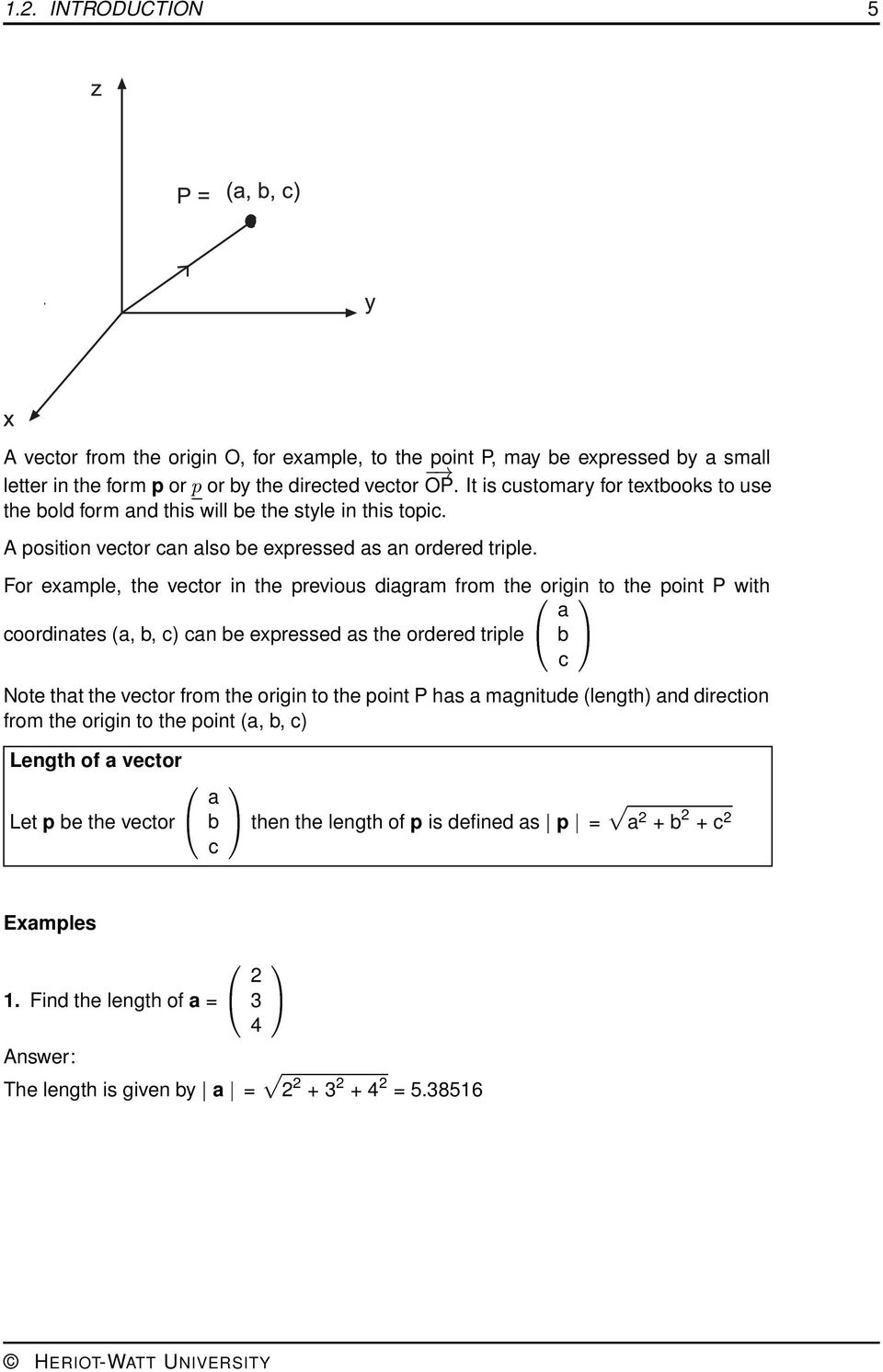
11 1.2. INTRODUCTION 5 A vector from the origin O, for example, to the point P, may be expressed by a small letter in the form p or Ô or by the directed vector OP. It is customary for textbooks to use the bold form and this will be the style in this topic. A position vector can also be expressed as an ordered triple. For example, the vector in the previous diagram from the origin to the point P with coordinates (a, b, c) can be expressed as the ordered triple a b c Note that the vector from the origin to the point P has a magnitude (length) and direction from the origin to the point (a, b, c) Length of a vector Let p be the vector a b c then the length of p is defined as p = Ôa 2 +b 2 +c 2 Examples 1. Find the length of a = Answer: The length is given by a = Ô =
12 6 TOPIC 1. VECTORS 2. These are all position vectors in 2 dimensions. These are position vectors in 3 dimensions. In this topic most of the work will be covered using position vectors. The word position will be omitted unless confusion is likely. Unit vector As the name would suggest a unit vector is a vector of magnitude 1. That is, the length (or magnitude) of the vector is 1 There are 3 special unit vectors which lie along the x, y and z axes. The point P has coordinates (1, 0, 0), Q has (0, 1, 0) and R has (0, 0, 1)

13 1.2. INTRODUCTION 7 Each of the vectors OP, OQ, and respectively. i, j and k are called the standard basis vectors. Thus i is the vector 1 0 similarly j is the vector and k is the vector Every vector p q r OR is one unit long and is denoted by i, j, and k can be written in component form as pi +qj +rk Conversely every vector in component form pi +qj +rk can be written as Example The vector p = Vector length exercise =3i -5j +2k p q r There is another version of this exercise on the web for you to try if you prefer it. Q5: Find the lengths of the position vectors in the diagram. 10 min Q6: Find the length of the vector Vector notation exercise There is another version of this exercise on the web for you to try if you like. Q7: Express the vector using the standard basis vectors. 5 min

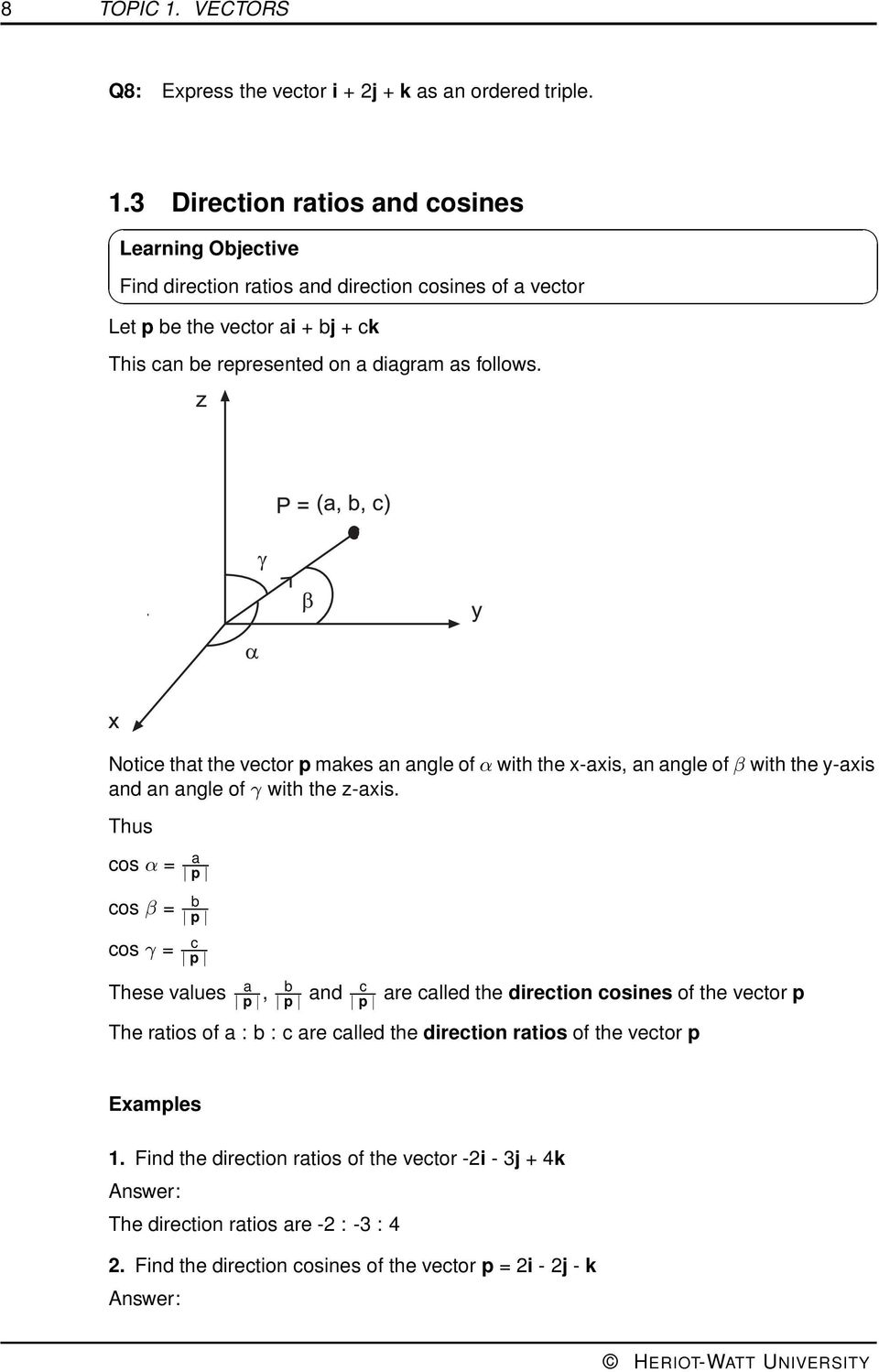
14 8 TOPIC 1. VECTORS Q8: Express the vector i +2j + k as an ordered triple. 1.3 Direction ratios and cosines Learning Objective Æ Find direction ratios and direction cosines of a vector Let p be the vector ai +bj +ck This can be represented on a diagram as follows. Notice that the vector p makes an angle of «with the x-axis, an angle of with the y-axis and an angle of with the z-axis. Thus cos «= cos = cos = a p b p c p These values a p, b p and c p are called the direction cosines of the vector p The ratios of a : b : c are called the direction ratios of the vector p Examples 1. Find the direction ratios of the vector -2i -3j +4k Answer: The direction ratios are -2 : -3 : 4 2. Find the direction cosines of the vector p =2i -2j - k Answer:
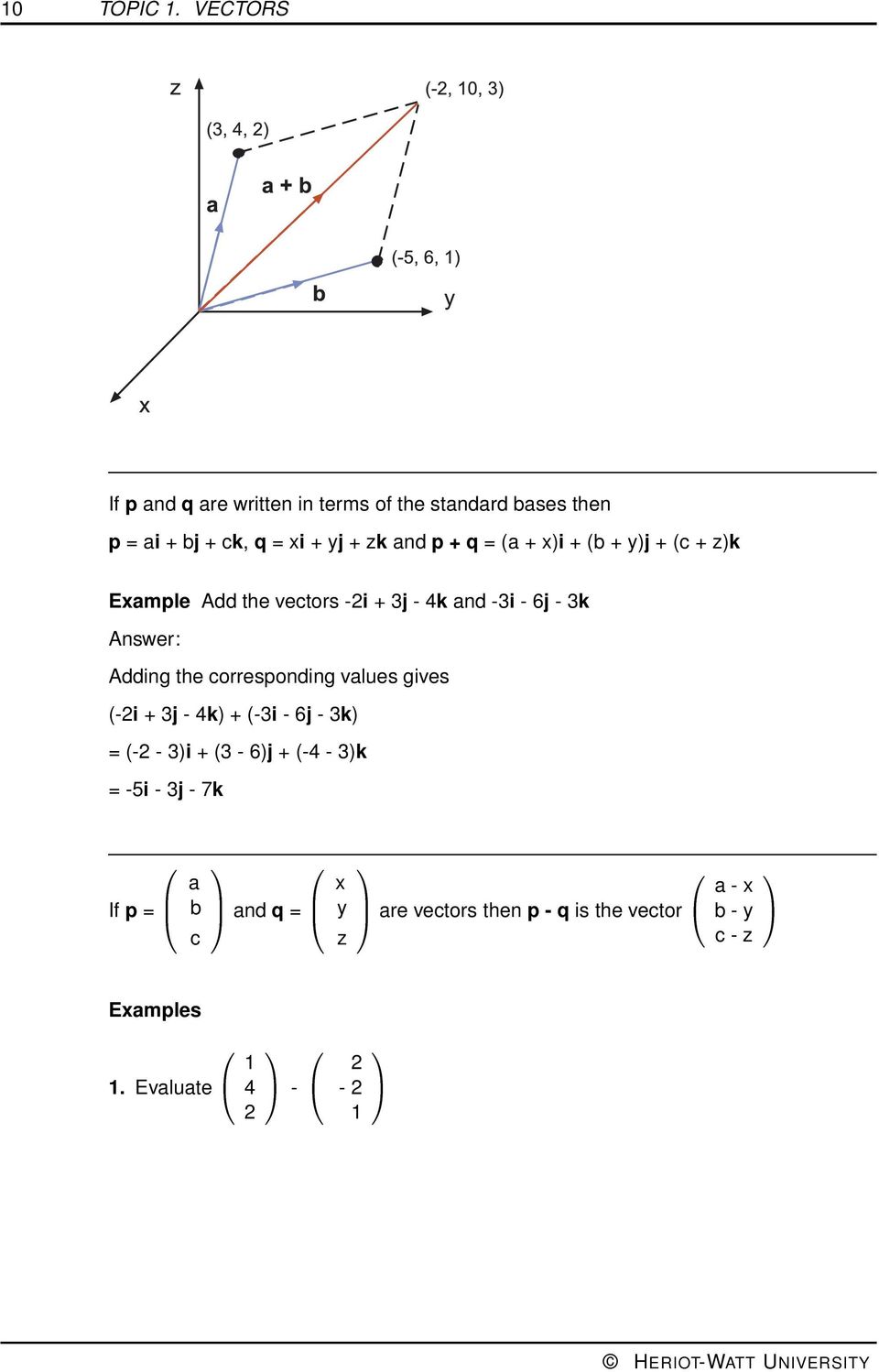
15 1.4. BASIC ARITHMETIC AND SCALAR PRODUCT OF VECTORS 9 p =3 The direction cosines are 2 / 3, -2 / 3 and -1 / 3 Direction ratios and direction cosines exercise There is a web exercise similar to this for you to try if you prefer it. Q9: Find the direction ratios of the following vectors: 5 min a) -3i +2j - k b) i + j + k c) 2i - j - k Q10: Find the direction cosines of the following vectors: a) 2i +3j +6k b) i - j - k c) 4i -4j +2k 1.4 Basic arithmetic and scalar product of vectors Learning Objective Add, subtract, multiply and find the scalar product of vectors in three dimensions Æ These techniques are straightforward and the following examples will demonstrate them. Vectors in 2d addition and subtraction There is a web animation to review addition and subtraction in 2 dimensions Arithmetic on vectors in three dimensions If p = a b c and q = x y z are vectors then p+qis the vector a+x b+y c+z 10 min The diagram in the following example shows how this is related to the parallelogram. Example Add the vectors a = Answer: and b = -5 6 The sum is found by adding the corresponding values so = 3+(-5) =

16 10 TOPIC 1. VECTORS If p and q are written in terms of the standard bases then p =ai +bj +ck, q =xi +yj +zk and p+q=(a+x)i +(b+y)j +(c+z)k Example Add the vectors -2i +3j -4k and -3i -6j -3k Answer: Adding the corresponding values gives (-2i +3j -4k) + (-3i -6j -3k) = (-2-3)i +(3-6)j + (-4-3)k =-5i -3j -7k If p = a b c and q = x y z are vectors then p-qis the vector a-x b-y c-z Examples 1. Evaluate
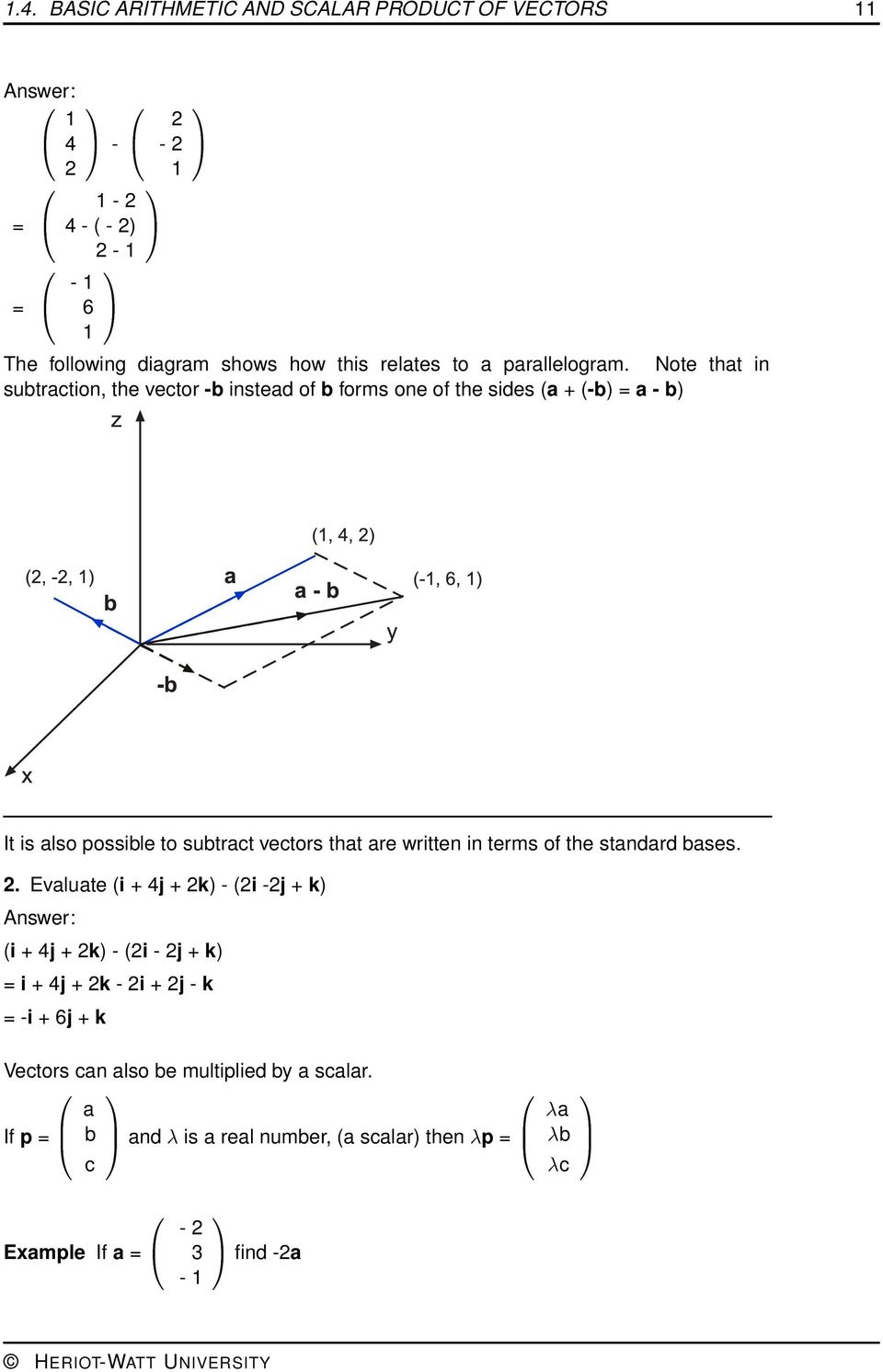
17 1.4. BASIC ARITHMETIC AND SCALAR PRODUCT OF VECTORS 11 Answer: 1 4 = = (-2) The following diagram shows how this relates to a parallelogram. Note that in subtraction, the vector -b instead of b forms one of the sides (a +(-b) =a-b) It is also possible to subtract vectors that are written in terms of the standard bases. 2. Evaluate (i +4j +2k) -(2i -2j + k) Answer: (i +4j +2k) -(2i -2j + k) = i +4j +2k -2i +2j - k =-i +6j + k Vectors can also be multiplied by a scalar. If p = a b c Example If a = and is a real number, (a scalar) then p = find -2a a b c
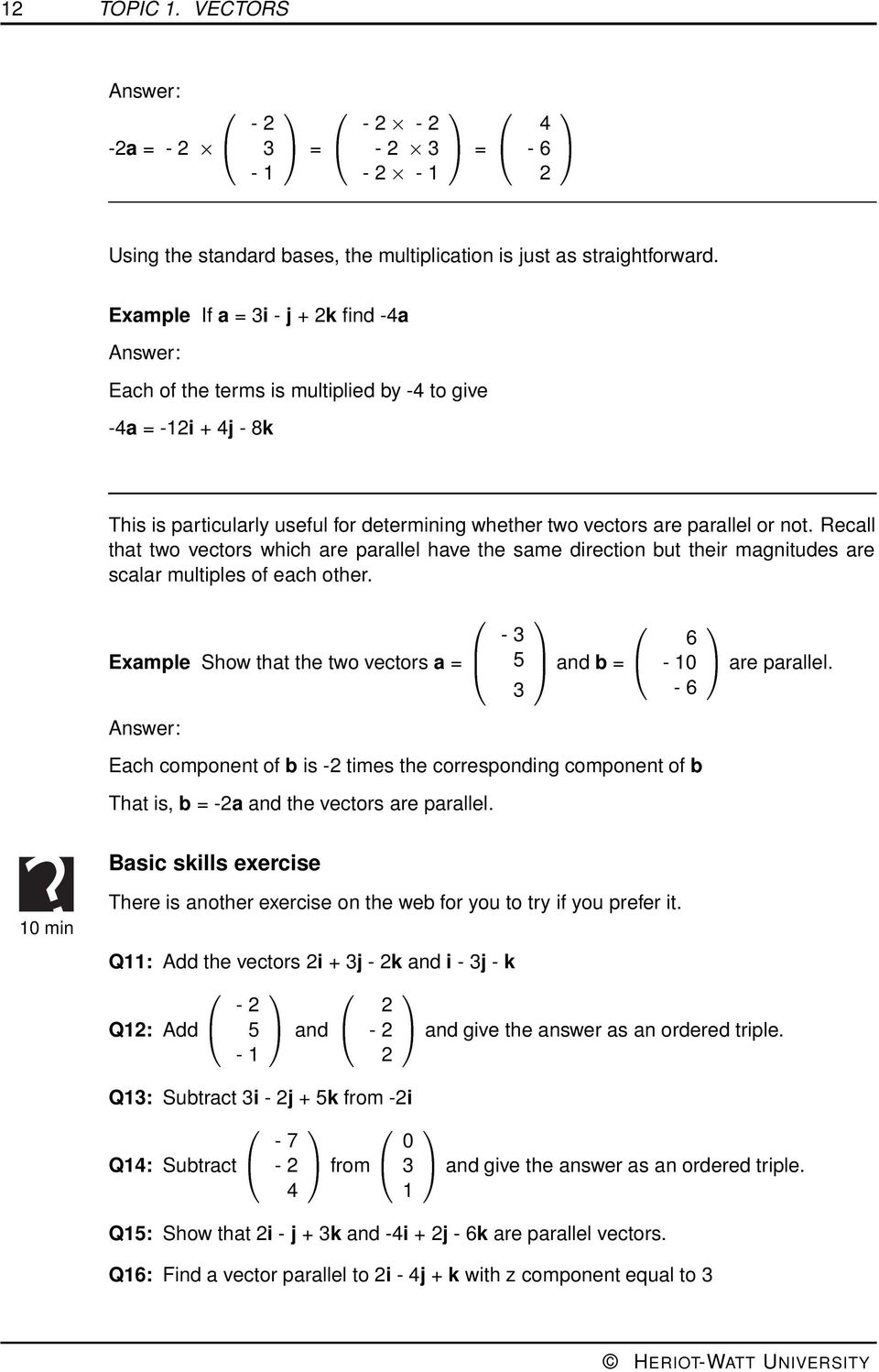
18 12 TOPIC 1. VECTORS Answer: -2a = = = Using the standard bases, the multiplication is just as straightforward. Example If a =3i - j +2k find -4a Answer: Each of the terms is multiplied by -4 to give -4a = -12i +4j -8k This is particularly useful for determining whether two vectors are parallel or not. Recall that two vectors which are parallel have the same direction but their magnitudes are scalar multiples of each other. Example Show that the two vectors a = Answer: and b = Each component of b is -2 times the corresponding component of b That is, b =-2a and the vectors are parallel. are parallel. Basic skills exercise 10 min There is another exercise on the web for you to try if you prefer it. Q11: Add the vectors 2i +3j -2k and i -3j - k Q12: Add and and give the answer as an ordered triple. Q13: Subtract 3i -2j +5k from -2i Q14: Subtract from and give the answer as an ordered triple. Q15: Show that 2i - j +3k and -4i +2j -6k are parallel vectors. Q16: Find a vector parallel to 2i -4j + k with z component equal to 3
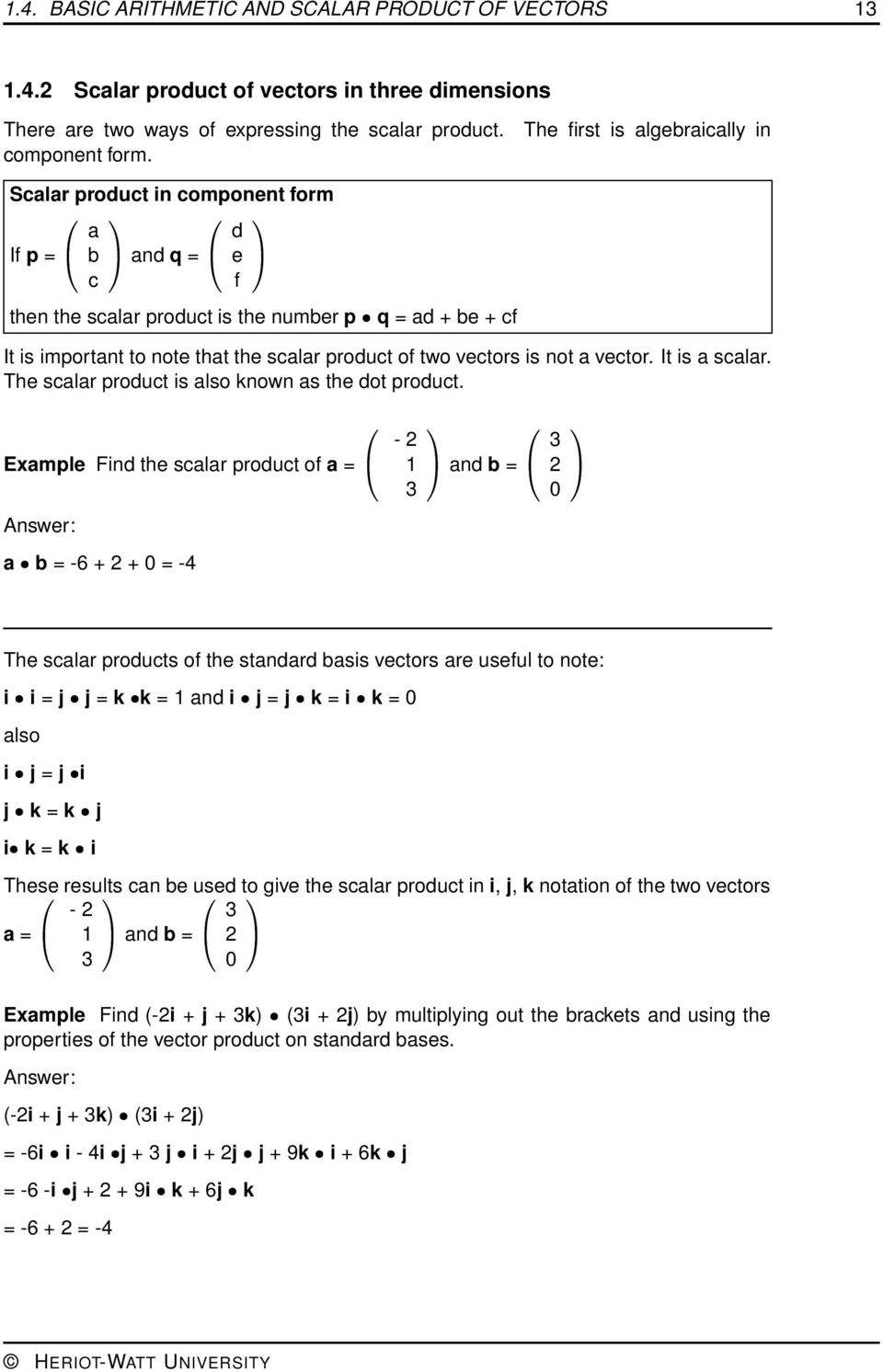
19 1.4. BASIC ARITHMETIC AND SCALAR PRODUCT OF VECTORS Scalar product of vectors in three dimensions There are two ways of expressing the scalar product. component form. The first is algebraically in Scalar product in component form If p = a b c and q = d e f then the scalar product is the number p q =ad+be+cf It is important to note that the scalar product of two vectors is not a vector. It is a scalar. The scalar product is also known as the dot product. Example Find the scalar product of a = Answer: a b =-6+2+0= and b = The scalar products of the standard basis vectors are useful to note: i i = j j = k k = 1 and i j = j k = i k =0 also i j = j i j k = k j i k = k i These results can be used to give the scalar product in i, j, k notation of the two vectors a = and b = Example Find (-2i + j +3k) (3i +2j) by multiplying out the brackets and using the properties of the vector product on standard bases. Answer: (-2i + j +3k) (3i +2j) =-6i i -4i j +3j i +2j j +9k i +6k j =-6-i j +2+9i k +6j k =-6+2=-4
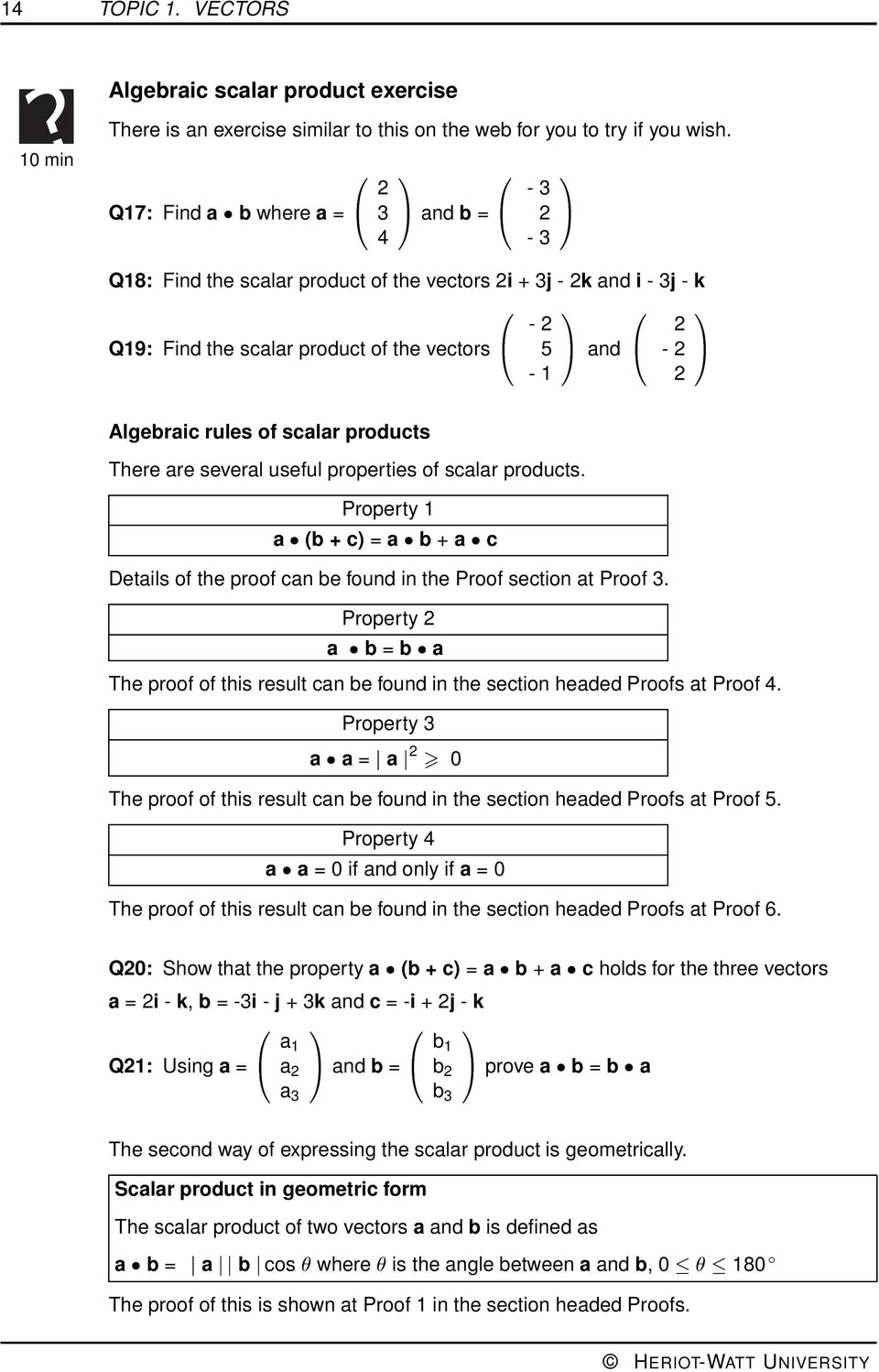
20 14 TOPIC 1. VECTORS Algebraic scalar product exercise 10 min There is an exercise similar to this on the web for you to try if you wish. Q17: Find a b where a = and b = Q18: Find the scalar product of the vectors 2i +3j -2k and i -3j - k Q19: Find the scalar product of the vectors and Algebraic rules of scalar products There are several useful properties of scalar products. Property 1 a (b + c) = a b + a c Details of the proof can be found in the Proof section at Proof 3. Property 2 a b = b a The proof of this result can be found in the section headed Proofs at Proof 4. Property 3 a a = a 2 0 The proof of this result can be found in the section headed Proofs at Proof 5. Property 4 a a = 0 if and only if a =0 The proof of this result can be found in the section headed Proofs at Proof 6. Q20: Show that the property a (b+c)= a b + a c holds for the three vectors a =2i - k, b =-3i - j +3k and c =-i +2j - k Q21: Using a = a 1 a 2 a 3 and b = b 1 b 2 b 3 prove a b = b a The second way of expressing the scalar product is geometrically. Scalar product in geometric form The scalar product of two vectors a and b is defined as a b = a b cos where is the angle between a and b, Æ The proof of this is shown at Proof 1 in the section headed Proofs.
21 1.4. BASIC ARITHMETIC AND SCALAR PRODUCT OF VECTORS 15 Example Find the scalar product of the vectors a and b where the length of a is 5, the length of b is 4 and the angle between them is 60 Æ Answer: a b = a b cos =5 4 cos 60 Æ =10 The geometric form of the scalar product is especially useful to find angles between vectors. Example Find the angle between i +4j and -8i +2j Answer: a b =-8+8=0 a = Ô 17 b = Ô 68 cos = a b a b =0so = 2 The last example demonstrates an important geometric property of the scalar product. Property 5 For non-zero vectors, a and b are perpendicular if and only if a b =0 In this case, a and b are said to be orthogonal vectors. The proof of this result is shown in the section headed Proofs at Proof 7. To show that two vectors are perpendicular however, the algebraic form is all that is required. Example Show that the two vectors a =-2i +2j + k and b = 3i +2j +2k are perpendicular. Answer: a b = (-2 3)+(2 2) + (1 2)=0 The vectors are perpendicular. Geometric scalar product exercise There is another exercise on the web for you to try if you prefer it. Q22: Find the scalar product of two vectors that have lengths 4 and 8 units respectively and an angle of 45 Æ between them. Give the answer to 3 decimal places. 10 min Q23: Find the scalar product of two vectors whose lengths are 2.5 and 5 and have an angle of 150 Æ between them. Give the answer to 3 decimal places. Q24: Determine the angle between two vectors whose scalar product is -6 and whose lengths are 4 and 3
22 16 TOPIC 1. VECTORS Q25: Find the angle between the two vectors 3i -4j and 12i +5j. Give the angle in degrees correct to 2 decimal places. Q26: Find the angle ACB if A is (0, 1, 6), B is (2, 3, 0) and C is (-1, 3, 4) Perpendicular vectors exercise 10 min There is an exercise on the web for you to try if you like. Q27: Find c so that ci +2j - k is perpendicular to i -3k Q28: Find c so that 3i +cj +4k is perpendicular to 2i -2j +3k Q29: Show that the vectors -4i -3j +2k and 2i -2j + k are perpendicular. 1.5 Vector product - algebraic form Learning Objective Calculate the vector product algebraically Æ Like the scalar product, there are two ways of expressing a vector product. The first is algebraically in component form. Vector product in component form If p =ai +bj +ck and q =di +ej +fk then the vector product is defined as the vector pxq= (bf - ec)i - (af - dc)j + (ae - db)k Hence, unlike the scalar product, the vector product of two vectors is another vector. This is actually the determinant of the matrix i j k a b c d e f By putting the vectors in this form it is easier to see how the calculation is done and why the vector product is sometimes called the cross product. Determinants of matrices will be studied in detail in topic 12 in this course. Examples 1. If a = and b = find axb Answer: To use the formula, the vectors a and b have to be expressed in terms of the basis i, j and k
23 1.5. VECTOR PRODUCT - ALGEBRAIC FORM 17 a =4i -5j -6k b =-i -2j +3k axb= ((-5) 3 - (-2) (-6))i -(4 3 - (-1) (-6))j +(4 (-2) - (-1) (-5))k = -27i -6j -13kIn matrix form the calculation can be taken from the determinant of i j k Find pxqwhere p =-2i +3j - k and q =4i +2j -2k Answer: pxq=(3 (-2) - 2 (-1))i - ((-2) (-2) - 4 (-1))j + ((-2) 2-4 3)k =-4i -8j -16k Algebraic vector product exercise There is a different exercise on the web. Q30: Find axbfor the following pairs of vectors 15 min a) -2i - j +3k and i +2j b) -5i + j +4k and 2i + j -3k c) -i +2j +4k and 2i -4j -8k The following table shows the outcome of the vector products of the standard vectors ixj= k jxi=-k ixi=0 jxk= i kxj=-i jxj=0 kxi= j ixk=-j kxk=0 Properties of vector products The vector product obeys the distributive laws. Property 1 ax(b +c)=(axb)+(axc) and (a +b) xc=(axc)+(bxc) Q31: Show that the distributive property ax(b +c) =(axb) +(axc) holds for the vectors a =3i -2j + k, b = i - j - k and c =2i -3k However the vector product does not obey all the laws that the product of real numbers does. For example, from the table of vector products of standard basis vectors shown previously ixj=k=-jxi Hence axbneed not equal bxa In fact Property 2 For any two vectors p and qp x q = -q x p
24 18 TOPIC 1. VECTORS The proof is shown here rather than in the section headed Proofs as it is important. Let p =ai +bj +ck and q =di +ej +fk qxp=(ec-bf)i - (dc - af )j +(db-ae)k but pxq= (bf - ec)i - (af - dc)j + (ae - db)k = -[(ec - bf )i - (dc - af )j +(db-ae)k] So pxq= -qxp Example Show that (6i - j +3k) x (9i + j +4k) = -(9i + j +4k) x (6i - j +3k) by expanding the brackets and using the properties of the vector product of standard bases. Answer: (6i - j +3k) x (9i + j +4k) =54ixi-9jxi+27kxi+6ixj- jxj+3kxj+24ixk-4jxk+12kxk =9k +27j +6k -3i -24j -4i =-7i +3j +15k and -(9i + j +4k) (6i - j +3k) = - (54i xi+6jxi+24kxi-9ixj- jxj-4kxj+27ixk+3jxk+12kxk) =-(7i -3j -15k) =-7i +3j +15k as required. From the result axb= -bxa, then (a xb)+(bxa)=0 If in particular a = b then 2(axa)= 0 then Property 3 For any vector aaxa=0 Another law that holds for the product of real numbers is a(bc) = (ab)c. It does not hold for the vector product. Property 4 For any vectors a, b and c, it is generally the case that ax(bxc) (axb)xc Example Answer: Show that the property ax(bxc) (axb)xcis true for the vectors, bxc=3i +4j +3k and ax(bxc)= -13i -3j +17k axb=3i +3j +3k (axb)xc= -15i +15k
25 1.6. VECTOR PRODUCT - GEOMETRIC FORM 19 They are not the same. Vector product properties exercise There is another exercise on the web for you to try if you prefer it. Q32: Show that axa=0fora =-3i - j - k 10 min Q33: Show that pxq= -qxpfor the vectors p =2i +3j +4k and q =4i + j +5k Q34: Show that the distributive law (a +b)x c=(axc) +(bxc) holds for a = 4-1 2, b = and c = Vector product - geometric form Learning Objective Calculate the vector product using the geometric formula Æ The second way of expressing a vector product is geometrically by specifying its direction and magnitude. As shown earlier, the angle between vectors can be found using the scalar product. It was shown that if a b = 0 then the vectors a and b are perpendicular. This can be used to explore the direction of axb Example Show that a (a xb) = 0 and that b (a xb)=0 Answer: Let a =a 1 i +a 2 j +a 3 k and b =b 1 i +b 2 j +b 3 k Then axb=(a 2 b 3 -b 2 a 3 )i -(a 1 b 3 -b 1 a 3 )j +(a 1 b 2 -b 1 a 2 )k Thus a (a xb)=a 1 a 2 b 3 -a 1 b 2 a 3 -a 2 a 1 b 3 +a 2 b 1 a 3 +a 3 a 1 b 2 -a 3 b 1 a 2 =0 Also b (a xb)=b 1 a 2 b 3 -b 1 b 2 a 3 -b 2 a 1 b 3 +b 2 b 1 a 3 +b 3 a 1 b 2 -b 3 b 1 a 2 =0 Since a (a xb)=0andb (a xb) = 0 the vector axbis perpendicular to both a and b But axb= -bxafrom the properties of vector products given earlier. So axbgives a vector perpendicular to a and b in a positive direction whereas b x a also gives a vector perpendicular to a and b but in the negative and opposite direction. This direction can be determined by the right hand rule which states that if the right hand is used with the thumb pointing in the direction of a and the first finger pointing in the direction of b, then the middle finger points in the direction of axb
26 20 TOPIC 1. VECTORS The vector axbhas length a b sin ( see Proof 2 in the Proof section). Thus the direction and length of the vector axbhave been specified. Vector product in geometric form The vector product of a and b is defined with magnitude of axb = a b sin, where is the angle between a and b, Æ direction perpendicular to both vectors a and b as determined by the right hand rule. Note that axb= 0 if and only if a and b are parallel. Example Find the magnitude of the vector product of the two vectors which are at an angle of 50 Æ to each other and have lengths of 5 and 7 units Answer: axb =5 7 sin 50 Æ = The length of the vector product a x b has the same formula as the area of a parallelogram in which the vectors a and b are the sides of the parallelogram as shown in the diagram. z c q b a y x Area of parallelogram = a c But c = b sin Thus the area = a b sin = a x b Of course to find axbthe algebraic version of the vector product is used. Example Find the area of the parallelogram which has adjacent edges a =3i + j +2k and b =2i - j
27 1.7. SCALAR TRIPLE PRODUCT 21 Answer: axb=2i +4j -5k Hence a x b = Õ (-5) 2 = units. The area of the parallelogram is sq units. Geometric vector product exercise There is a web exercise for you to try if you prefer it. Q35: Find a vector perpendicular to 2i - j +3k and i +2j 15 min Q36: Find the length of axbgiven that a has length 4 units, b has length 5 units and the angle between them is 45 Æ. Give the answer to 2 decimal places. Q37: Find the area of a parallelogram with edges i -4j + k and 2i +3j -2k Give the answer to 3 decimal places. Q38: Find the area of a triangle with vertices at (0, 0, 0), (3, 1, 2), (2, -1, 0). Give your answer to 3 decimal places. Q39: Find the area of the triangle with vertices (1, -1, 0), (2, 1, -1) and (-1, 1, 2) Activity Investigate geometrically (axb)xcand ax(bxc)by choosing some easy points to manipulate in three-dimensional space. 1.7 Scalar triple product Learning Objective Calculate the scalar triple product of vectors. Æ To show that axbis perpendicular to a and to b, the numbers a (a xb) and b (a xb) are found. If a, b and c are vectors then as bxcis also a vector it is possible to find the scalar product of a with bxc Scalar triple product The scalar triple product a (bxc)is the number given by the scalar product of the two vectors a and (b xc) This product can also be found using the determinant of a matrix in a similar way to the vector product. Suppose that a =a 1 i +a 2 j +a 3 k b =b 1 i +b 2 j +b 3 k c =c 1 i +c 2 j +c 3 k
28 22 TOPIC 1. VECTORS This is the determinant of the matrix a 1 a 2 a 3 b 1 b 2 b 3 c 1 c 2 c 3 The calculation of a (bxc)gives a 1 (b 2 c 3 -c 2 b 3 )-a 2 (b 1 c 3 -c 1 b 3 )+a 3 (b 1 c 2 -c 1 b 2 ) It is sometimes known as the triple scalar product or the dot cross product. The calculation is best shown by example. Example Find a (b x c) when a = i +2j -3k, b =4i - j +2k and c =3i -2j +5k Answer: bxc=-i -14j -5k a (bxc)= = -14 The modulus of the scalar triple product is the volume of a parallelepiped with adjacent edges a, b and c as shown in the following diagram. z a b x c q b c y x The base is formed by b and c The area of the base = b x c The perpendicular height is a cos But the volume of the parallelepiped = area of base perpendicular height Thus the volume = b x c a cos = a (b xc) (Remember that a b = b a) Example Find the volume of the parallelepiped with edges i + j +2k, i +2j +3k and 3i - j - k Answer: This is the modulus of the scalar triple product. Let a = i + j +2k, b = i +2j +3k and c =3i - j - k
29 1.7. SCALAR TRIPLE PRODUCT 23 The volume is a (b xc) bxc = i +10j -7k Then a (bxc)=(1 1) + (1 10) + (2 (-7)) = =-3 The modulus is 3 and the volume of the parallelepiped is 3 cubic units. Note that the volume of a parallelepiped is zero if and only if a, b and c are coplanar, that is if a (b xc) =0 If b and c form the base of the parallelepiped then bxcis perpendicular to the base. However, if a lies in the base formed by b and c then a is perpendicular to bxcwhich means that the scalar product of a and bxcis zero. Scalar triple product exercise There is another exercise on the web for you to try if you prefer it. Q40: Find a (b xc)ifa = i + j +2k, b = i + k and c =3i -2j +5k 15 min Q41: Find a (b xc)ifa = i +2j +3k, b =2i + j +3k and c =4i + k Q42: Find the volume of the parallelepiped with edges -i +4j +7k, 3i -2j - k and 4i +2k Q43: Show that the position vectors to the points (1, 2, 3), (4, -1, 2) and (2, -5, -4) lie in the same plane. Properties of the scalar triple product The volume of a parallelepiped was shown as a (b xc). By considering the base of the parallelogram formed from a and b, the volume is similarly computed as c (a xb) and by taking the base formed from a and c the volume is b (c xa) It is possible that c (axb)and a (bxc)may have different signs, but provided that a is followed by b which in turn is followed by c and back to a they have the same signs. Thus Property 1 a (bxc)= b (cxa)= c (axb) The proof of this is shown in the section called Proofs at Proof 8. If the order is different then the answer need not be the same. For example: a (cxb) = a (-(b x c)) (using the property of vector products) = -a (bxc)(using the property of scalar products) Q44: Check that this property holds for the vectors a = i - k, b =2i + j and c = i + j - k
30 24 TOPIC 1. VECTORS 1.8 Lines in three-dimensional space Learning Objective Determine and use the equations of a line in vector, parametric and symmetric form Æ In a similar way to lines in the plane, lines in space are specified by either: One point and a direction. Two points on the line The equation of a line There are three forms in which the equation of a line can be written in three-dimensional space. These are vector, parametric and symmetric form. Suppose first that the line is specified by a point and a direction. Vector form of the equation of a line The vector equation of a line through the point P with direction d is r = a + d where a = OP, d is a vector parallel to the required line and is a real number. Any position vector r of a point on the required line will satisfy this equation. Example Find the vector equation of the straight line through (2, -1, 6) and parallel to the vector i +2j -8k
31 1.8. LINES IN THREE-DIMENSIONAL SPACE 25 Answer: Using the formula r = a + d with a =2i - j +6k and d = i +2j -8k gives r =2i - j +6k + (i +2j -8k) If r =xi +yj +zk, a =a 1 i +a 2 j +a 3 k and d =d 1 i +d 2 j +d 3 k then the equation can be split into component parts. This leads to the second form of the equation of a straight line. Parametric form of the equation of a line The parametric equations of a line through the point P=(a 1,a 2,a 3 ) with direction d =d 1 i +d 2 j +d 3 k are x=a 1 + d 1,y=a 2 + d 2,z=a 3 + d 3 where is a real number. Example Find the parametric equations of the line through (3, 4, 5) and parallel to the vector 2i -3j -4k Answer: Using the formulae with a 1 =3,a 2 = 4 and a 3 =5 x=3+2, y=4-3, z=5-4 It is easy to obtain the parametric form from the vector form and vice versa. Examples 1. State the parametric form of the equation of the line which has a vector equation of r = a + d where P is the point (3, -1, 5), a = OP and d =-2i +4j - k Answer: r =(3i - j +5k) +(-2i +4j - k) Equating each component in turn gives x=3-2, y=-1+4, z=5-2. Find the vector form of the equation of a line with parametric equations x=-1+3, y=, z=2+2 Answer: x=-1+3, y=, z=2+2 gives x y z = a =-i +2k and d =3i + j +2k The equation is r =(-i +2k) +(3i + j +2k) Equations of the parametric form can be rearranged to eliminate the real number giving the third form of the equation of a straight line.
32 26 TOPIC 1. VECTORS Symmetric form of the equation of a line If x = a 1 + d 1,y=a 2 + d 2,z=a 3 + d 3 are parametric equations of a line, the symmetric equation of this line is x-a 1 d 1 = y-a 2 d 2 = z-a 3 d 3 These symmetric equations of a line are also known as the Cartesian equations of a line. Note that if any of the denominators are zero then the corresponding numerator is also zero. This means that the vector is parallel to an axis. It is also important to ensure that the symmetric form of the equation of a line is stated with each coefficient of x, y and z on the numerator equal to 1. An equation with any other coefficients for x, y and z is not the symmetric equation of the line. The direction ratios are the denominators d 1,d 2 and d 3 in these symmetric equations. It is straightforward to obtain the symmetric form from either the parametric or vector form. The following examples will demonstrate how this is done. Example Find the parametric and symmetric equations of the line with a vector equation of r =(2i -3j + k) +(-i -2j + k) Answer: a = (2, -3, 1) and d =(-i -2j + k) The parametric equations are x = 2 -, y=-3-2 and z = 1 + Solving each component for gives the symmetric equations as x-2-1 = y+3-2 = z-1 1 Note that even if the denominator is 1, the form of equations requires that it should be left there. Examples 1. Find the parametric and symmetric equations of the line which has position vector i - j + k and is parallel to the vector 3i +2j + k Answer: The parametric equations are x = 1 + 3, y=-1+2, z=1+ and so x-1 3 = y+1 2 = z-1 1 = Hence by eliminating the symmetric equations are x-1 3 = y+1 2 = z Find the symmetric equations of the line which has parametric equations x=2-2, y=-1+3, z=-
33 1.8. LINES IN THREE-DIMENSIONAL SPACE 27 Answer: Rearrange to make each equation equal to This gives x-2-2 = y+1 3 = z-0-1 = Hence the symmetric equations are x-2-2 = y+1 3 = z-0-1 To convert the symmetric equations of a line into the parametric form, take the equation x-a 1 d 1 = y-a 2 d 2 = z-a 3 d 3 and call this common value the parameter Then solve for x, y and z in terms of Examples 1. Find the parametric form of the equation of a line with symmetric equations x+3 2 = y-1 1 = z-4-3 Answer: Make each part of the equation equal to and solve for x, y and z x+3 2 = sox=-3+2 y-1 1 = soy=1+ z-4-3 = soz=4-3 The equations are x = , y=1+, z= Find the parametric and vector forms of the equation of a line which has symmetric equations x+4 1 = y-3-2 = z-4 2 Answer: Let x+4 1 = y-3-2 = z-4 2 = Solving for x, y and z gives: x = -4 +, y=3-2, z=4+2 This gives the parametric equations of the line. Thus a =-4i +3j +4k and d = i -2j +2k Thus r = (-4i +3j +4k) +(i -2j +2k) is the vector equation of the line. Equations of a line are not unique. The direction vectors however, are proportional (one is a scalar multiple of the other). Example Suppose that the equation of a line is given by the symmetric equations x-3 2 = y+1 3 = z-1 1 then in parametric form the equations are x=3+2, y=-1+3, z=1+ Answer: If = 2, a point on this line is = (7, 5, 3)
34 28 TOPIC 1. VECTORS Consider the line with symmetric equations x-9-4 = y-8-6 = z-4-2 This has symmetric equations x = 9-4, y=8-6, z=4-2 Substitution of the x, y, and z values of the point (7, 5, 3) into either of the forms of this second line gives = 1 / 2 and so the point is also on this line. But the direction vector d 1 =2i +3j + k of the first line is a scalar multiple of the direction vector d 2 =-4i -6j -2k of the second line. Thus the lines are in fact the same line with equations that look very different. Equation of a line exercise 10 min There is another version of this exercise on the web for you to try if you wish. Q45: State the vector equation of the line which passes through the point (3, 4, 5) and is parallel to the line -2i - j +3k Q46: Find the vector equation of a line with parametric equations: x=3+4, y=-2-3 and z = 4 - Q47: Give the parametric and symmetric equations for the lines: a) through (-1, 3, 0) in the direction -2i - j +4k b) through (2, -1, 0) in the direction -i +4k Q48: Find the symmetric equations of the lines with vector equations: a) r =-j +2k + (-i + j - k) b) r =2i -2j -2k + (-i +3j - k) Q49: From the vector equation of the line given as (2i + j -3k) + (3i - j - k) state the point with y coordinate -1 which also lies on this line. Q50: Find the parametric equations of the line through the point (3, 4, 5) and parallel to the line i + j + k Q51: Find the symmetric equation of the line which has parametric equations of x=-, y=-2+, z=3+2 Line determined by two points Now suppose that the line is determined by two points P and Q. A direction vector on this line can be obtained by taking PQ
35 1.8. LINES IN THREE-DIMENSIONAL SPACE 29 Let P be the point (a 1,a 2,a 3 ) and Q be the point (b 1,b 2,b 3 ) then a direction vector is represented by the line segment PQ = d = q - p. It is now possible to obtain vector, parametric and symmetric equations of the line as before. Example Find the vector, parametric and symmetric equations of the line through (1, -2, -1) and (2, 3, 1) Answer: If a = the position vector i -2j - k and b =2i +3j + k then a direction vector is b-a= i +5j +2k The vector form of the equation is r = i -2j - k + (i +5j +2k) The parametric equations are x = 1 +, y=-2+5, z=-1+2 The symmetric equations are x-1 1 = y+2 5 = z+1 2 Equation from two points exercise There is another exercise on the web for you to try if you prefer it. Q52: Give parametric and symmetric equations for the line through the points (3, -1, 6) and (0, -3, -1) 15 min Q53: Find the parametric and symmetric equations of the line joining the points A (1, 2, -1) and B(-1, 0, 1) Intersection of and the angles between lines Learning Objective Find the intersection of and the angle between two lines Æ Intersection of two lines in three-dimensional space Now suppose that L 1 and L 2 are two lines in three-dimensional space. The two lines can:
36 30 TOPIC 1. VECTORS be identical be parallel intersect
37 1.8. LINES IN THREE-DIMENSIONAL SPACE 31 be skew, that is, not identical, parallel or intersecting The last case cannot arise in two-dimensional space. Note that if two lines are parallel then their direction ratios are proportional. Two lines intersecting at a point In three dimensions lines normally do not intersect. If however they do meet then by equating the parametric equations, there will be a unique solution. To show this, take the lines in parametric form. Example Suppose that L 1 has parametric equations x = 1 +, y=-1+, z=2+ and L 2 has parametric equations x = 2 +, y=-2+3, z=-1+5 Show that the two lines L 1 and L 2 intersect but are not the same line. Answer: As their direction vectors are not proportional L 1 and L 2 are not the same line. If the lines intersect then there are solutions to the set of equations obtained by equating, in turn, x, y and z 1+ =2+ (this is the x equations) =-2+3 (this is the y equations). 2+ =-1+5 (this is the z equations). These can be solved to give = 1 and =2 Since there is a solution, the lines meet. By substituting the values for and the point of intersection is (3, 1, 4)
38 32 TOPIC 1. VECTORS Two skew lines If the equations of two lines have no solution for the real numbers and the lines are skew. Example Show that the lines L 1 with symmetric equation x-4 parametric equations x =, y=, z=3+ do not intersect. Answer: 3 = y-0-1 = z-2 If L 1 and L 2 do intersect then there is a solution of the set of equations 1)4+3 = 2) - = 3)2- =3+ However since 4 + 3= =- then =-1-1 and L 2 with Substituting = -1 in equation 2) gives = 1 but this is inconsistent with equation 3) which, using these values of and gives 3 = 4 There is no solution to these equations and so the lines do not intersect. Angle between two lines If two lines intersect then the angle between them is the angle between their direction vectors. The acute angle is always taken. Example Show that the two lines L 1 and L 2, which have symmetric equations as shown, intersect and find the angle between them. L 1 : x+4 2 = y-5-4 = z-3 1 L 2 : x-0-1 = y-3-1 = z-2 1 Answer: First of all find the parametric equations that are L 1 :x=-4+2, y=5-4, z=3+ L 2 :x=-, y=3-, z=2+ The set of equations are =- 5-4 =3-3+ =2+ These can be solved to give = 1 and =2 The two lines meet at (-2, 1, 4) The direction vectors are d 1 =2i -4j + k for L 1 and d 2 =-i - j + k for L 2
39 1.8. LINES IN THREE-DIMENSIONAL SPACE 33 If is the angle between L 1 and L 2 then cos = d 1 d 2 d d 2 = 3 Ô 21 Ô 3 So the angle is Æ Note: If two lines a and b have direction cosines equal to a 1,a 2,a 3 and b 1,b 2,b 3 then the angle can be found from the equation cos =a 1 b 1 +a 2 b 2 +a 3 b 3 Suppose that each direction cosine could be expressed as cos «= cos = a a =a 1 b a =a 2 cos = c a =a 3 for point (a, b, c) and similarly cos «= cos = d b =b 1 e b =b 2 cos = f b =b 3 for point (d, e, f) then a b = a b cos so cos = a b a b ad+be+cf a b a 1 b 1 +a 2 b 2 +a 3 b 3
40 34 TOPIC 1. VECTORS Intersection points and angles exercise 15 min There is another mixed exercise on the web for you to try if you like. Q54: Show that the lines x-2 1 = y-2 3 = z-3 1 and x-2 1 = y-3 4 = z-4 2 intersect. Q55: Determine whether the two lines L 1 and L 2 intersect when L 1 has symmetric equations x+3 1 = y-2 1 = z-1-3 and L 2 has symmetric equations x+4-2 = y-1 1 = z-0 1 Q56: Find the intersection of and the angle between the lines L 1 with parametric equations x = , y=1-3, z=-1+ and the line L 2 which passes through the point (-3, 4, 0) and is parallel to -i + j - k Q57: Find the angle between and the point of intersection of the two lines x-5 4 = y-7 4 = z+3 x-8-5 and 7 = y-4 1 = z-5 3 Q58: Find the point of intersection of the line through the point (1, 3, -2) and parallel to 4i + k with the line through the point (5, 3, 8) and parallel to -i +2k Then find the angle between them. Q59: Find the intersection of and the angle between the lines L 1 with symmetric equations x-1 2 = y-3 3 = z-2 1 and L 2 with symmetric equations x+1 2 = y-6 1 = z Planes in three-dimensional space Learning Objective Determine and use equations of the plane Æ Planes in space are specified either by: One point on the plane and a direction n at right angles (normal) to the plane. Three non-collinear points in the plane The equation of a plane There are three common forms in which the equation of a plane can be written. These are the vector equation, the Cartesian equation and the parametric equation.
41 1.9. PLANES IN THREE-DIMENSIONAL SPACE 35 Vector equation of a plane The vector equation of a plane containing the point P and perpendicular to the vector n is (r - a) n = 0 where a = OP The equation can also be written as r n = a n Example Find the vector equation of the plane through (-1, 2, 1) with normal vector i -3j +2k Answer: The general equation is (r-a) n =0orr n = a n Here a =-i +2j + k and n = i -3j +2k The vector equation is r (i -3j +2k) =-1-6+2=-5 If r =xi +yj +zk then evaluating the scalar products r n and a n will give the second form of the equation of a line. This is called the Cartesian form of the equation of the plane. Cartesian equation of a plane The Cartesian equation of a plane containing the point P (a 1,a 2,a 3 ) and perpendicular to the vector n =n 1 i +n 2 j +n 3 k is xn 1 +yn 2 +zn 3 = d where d = a 1 n 1 +a 2 n 2 +a 3 n 3 Example Find the Cartesian equation of the plane through (-1, 2, 1) which has normal vector i -3j +2k Answer: The vector form of this plane given in the previous example is r (i -3j +2k) =-5 If r =xi +yj +zk then evaluating the vector product r n gives x - 3y + 2z = -5
42 36 TOPIC 1. VECTORS Alternatively, the Cartesian equation in the last example can be found by immediate substitution into the definition of the equation in this form. The Cartesian form of the equation of a plane is the simplification of the vector equation. It is straightforward to find the vector equation of a plane if the Cartesian form is known. Example Find the vector equation of a plane whose Cartesian equation is 2x-y+3z=-4 Answer: If r =xi +yj +zk then 2x - y + 3z = r (2i - j +3k) The vector equation is r (2i - j +3k) =-4 The examples shown previously have defined the plane using a point on the plane and a normal to the plane. It is also possible to define the plane from three non-collinear points. The vector equation of a plane from three non-collinear points Suppose that A, B and C are three non-collinear points. The vectors AB and AC lie in a plane through all three points. Their vector product AB x AC is perpendicular to this plane. Any multiple of the vector product forms a normal n to the plane. Since a is the position vector to the point A that lies in the plane it is straightforward to give the equation of the plane as r n = a n Example Find the equation of the plane through A(-1, 3, 1), B(1, -3, -3) and C(3, -1, 5) Answer: AB=2i -6j -4k AC = 4i -4j +4k These two vectors lie in the plane and their vector product is normal to the plane. AB x AC = -40i -24j +16k
43 1.9. PLANES IN THREE-DIMENSIONAL SPACE 37 Let n =-5i -3j +2k (n is 1 / 8 of the vector product for ease) and a =-i +3j + k Thus the equation of the plane is r n = a n So-5x-3y+2z=5-9+2=-2 The equation is 5x + 3y - 2z = 2 The third form of the equation of the plane is the parametric equation. Parametric equation of a plane The parametric equation of the plane is r = a + b + c where a is a position vector of a point in the plane, b and c are two non-parallel vectors parallel to the plane and and are real numbers. Note that the parametric equation of the plane is sometimes referred to as the symmetric equation of the plane. Do not confuse this with the distinct differences in the equations of a line in parametric and symmetric form. Example Find the parametric equation of the plane through (2, 3, -1) and parallel to the vectors -2i -3j + k and -i +3j +4k Answer: The equation is r = a + b + c where a =2i +3j - k, b =-2i -3j + k and c =-i +3j +4k The Cartesian form, ax + by + cz = d can be thought of as one linear equation in three unknowns and solved by putting y = and z = to give the parametric solution.
44 38 TOPIC 1. VECTORS Example Find the parametric equation of the plane with Cartesian equation x+2y+z=3 Answer: To obtain the parametric equation let y = and z =, thenx=3-2 + so the general solution is Let a = 3 0 0, b = x y z = and c = Then the parametric equation of the plane is r = a + b + c It is also possible to find the Cartesian form of the equation of a plane from the parametric form of r = a + b + c By definition of the parametric form, b and c are vectors parallel to the plane. Thus bxcis a normal to the plane. Evaluating r (bxc)= r a gives the Cartesian form of the equation of the plane. Example Find the Cartesian form of the equation of a plane given the parametric form of r = a + b + c where a = i +2j - k, b = i + j +2k and c =2j - k Answer: bxc=-5i + j +2k This is a normal n and a is the position vector i +2j - k The equation of the plane is r n = a n So-5x+y+2z=-5+2-2=-5 It is worth noting that two parallel or coincident planes have normals that are proportional. Equation of a plane exercise 15 min There is an exercise on the web for you to try if you like. Q60: Find the equation of the plane which passes through (1, 2, 3) and is perpendicular to 6i - j + 1 / 3 k Q61: Find the equation of a plane through the points A = (1, 1, -1), B = (2, 0, 2) and C = (0, -2, 1) Q62: Find the equation of a plane which passes through the points A = (1, 2, 1), B = (-1, 0, 3) and C = (0, 5, -1)
45 1.9. PLANES IN THREE-DIMENSIONAL SPACE 39 Q63: Find the parametric form of the equation of the plane which has Cartesian equation x - 2y - 6z = Intersection of and the angles between two planes Learning Objective Find the intersection of and the angle between two planes Æ Consider two planes in three-dimensional space. In relation to each other, the two planes can: be coincident be parallel intersect on a line Note: parallel or coincident planes have normals that are proportional. Example : Parallel planes Determine whether the two planes P 1 and P 2 with equations 6x + 2y - 2z =5and -3x - y + z = 2 respectively are parallel, coincident or intersect.
46 40 TOPIC 1. VECTORS Answer: A normal n for P 1 is 6i +2j -2k A normal m for P 2 is -3i - j + k As n =-2m, P 1 and P 2 are either parallel or coincident. If P 1 and P 2 did intersect, the two equations 6x + 2y - 2z = 5 and -3x - y +z=2would have a common solution for x, y and z. This set of two equations have no solution and so P 1 and P 2 have no points in common. Hence, the planes do not intersect and are not coincident. The planes are parallel. If two planes intersect, Gaussian elimination can be used to find the vector equation of the line of intersection. The symmetric form of the equation can also be found more directly by algebraic manipulation of the equations. The following examples demonstrate this. Examples 1. Intersection of two planes in a line by Gaussian elimination Find the vector equation of the line of intersection of the two planes P 1 with equation 4x+y-2z=3andP 2 with equation x + y - z = 1 Answer: Using Gaussian elimination on the two equations gives That is, x + y - z = 1 and -3y + 2z = -1 Let z = Then by substituting in -3y + 2z = -1 gives y = and by substituting in x + y - z = 1 gives x = The vector equation is r = a + d = Intersection of two planes in a line by algebraic manipulation Find the symmetric equation of the line of intersection of the two planes P 1 with equation 4x+y-2z=3andP 2 with equation x + y - z = 1 Answer: Subtract 2P 2 from P 1 to eliminate z and give the equation 2x - y = 1 Subtract P 2 from P 1 to eliminate y and give the equation 3x - z = 2 Solving both for x gives x = y+1 2 = z+2 3 or as an equation of a line in symmetric form this is x-0 1 = y+1 2 = z+2 3
47 1.9. PLANES IN THREE-DIMENSIONAL SPACE 41 Angle between two planes If two planes intersect, the angle between them is equal to the angle between their normal vectors. The equation cos = n m n m will give the angle where n and m are the normals. Example Find the angle between the two planes with equations 2x + y - 2z = 5 and 3x - 6y - 2z = 7 Answer: The normal vectors are n =2i + j -2k and m =3i -6j -2k 4 cos = 3 7 = 4 21 so =79Æ Intersection and angles exercise There is another exercise on the web if you want to try something different. Q64: Find the equation of the plane that passes through (1, -3, 2) and is parallel to x-2y+z=5 30 min Q65: Ascertain whether the two planes 3x - 6y +9 z = -12 and -x + 2y - 3z = 10 intersect and give the equation if they do. Q66: Find the equation of a plane in Cartesian form which passes through the point (1, -1, 3) and is parallel to the plane 3x + y + z = 7 Q67: Find the symmetric equation of the line of intersection of the two planes 3x+y-z=-3andx-y-z=1 Q68: Ascertain whether the two planes 3x -y + 2z = 5 and x + 2y-z = 4 intersect and if they do give the equation of the line in parametric form. Q69: Find the angle between the planes x + y - 4z = -1 and 2x - 3y + 4z = -5 Q70: Find the acute angle between the planes 2x - y = 0 and x + y + z = Intersection of three planes Learning Objective Find the intersection of and the angle between three planes Æ Consider three distinct non-parallel planes in three-dimensional space. If no two of the three planes are parallel or coincident, the three planes can:
48 42 TOPIC 1. VECTORS intersect at a point intersect at a line not intersect The technique of Gaussian elimination can be used to find the point or line of intersection of three planes. Examples 1. Intersection of three planes at a point Find the point of intersection between the three planes P 1 :x-2y-z=3 P 2 :2x+y-z=-1 P 3 :-x+y+2z=2 Answer: Gaussian elimination gives = = This gives z = 3 and substituting this value back into row 2 gives 5y + 3 = -7
49 1.9. PLANES IN THREE-DIMENSIONAL SPACE 43 Thus y = -2 A further substitution gives x = 2 and the full solution of x = 2, y = -2 and z = 3 The point of intersection is (2, -2, 3) 2. Intersection of three planes in a line Find the symmetric equation of the line of intersection of the planes P 1 :x+y-z=0 P 2 :2x-y+4z=-3 P 3 :x+3y-5z=2 Answer: From row 2: y = 2z + 1 Fromrow1:x=z-y=-z-1 = = Letz= to give the parametric equations x = -1 -, y=1+2, z= This gives the intersection as a line with symmetric equation x+1-1 = y-1 2 = z No intersection of three planes Show that the planes do not intersect where P 1 :x+y+z=2 P 2 :2x-2y+z=5 P 3 :3x-y+2z=-1 Answer: Using Gaussian elimination gives = = This gives 0 = -8, which is impossible. The planes do not intersect at a common point or line. Intersection of three planes exercise There is another exercise on the web if you want to try something different. Q71: Find the point of intersection of the planes P 1 =6x-9y-8z=6 P 2 =3x-2y-9z=-17 P 3 =6x+6y-5z= min Q72: P 1 =x+y+z=6,p 2 =-x+y+2z=5andp 3 =3x+2z=12 Ascertain whether the three planes P 1,P 2 and P 3 as shown intersect. If they do, provide the relevant information on the intersection.
50 44 TOPIC 1. VECTORS Q73: If the planes P 1 with equation x+y+z=1,p 2 with equation 2x + 2y +z=3and P 3 with equation 4x + 4y + 3z = 5 intersect, give details of the intersection. Q74: Ascertain whether the three planes with equations 4x + y + 5z = 2, -x + y - 2z = 7 and 3x - 3y + 6z = 21 intersect. If they do provide details of the intersection. Q75: Find the angle between the planes x + y - 4z = -1 and 2x - 3y + 4z = -5 Q76: Find the acute angle between the planes 2x - y = 0 and x + y + z = Lines and planes Learning Objective Find relationships between lines and planes Æ The intersection of a line and a plane can be found by substituting the equation of the line in parametric form into the equation of the plane and solving for If there is a unique solution then a point of intersection exists. If there are infinite solutions then the line lies on the plane. If there is no solution then the line is parallel to the plane. Example : Intersection of a line and a plane Find the intersection between the plane x -y-2z =-15andtheline with symmetric equation x-1 1 = y-2 1 = z-3 2 Answer: In parametric form this line is given by the equations x=1+, y=2+ andz=3+2 Substitute this into the equation of the plane to give = -15 i.e. =2 When =2,x=3,y=4andz=7 Hence the point of intersection is (3, 4, 7) If a line L and a plane P intersect, it is possible to calculate the angle of intersection between the line and the plane. To do this, find the normal n to the plane and find the angle between L and L 2 where L 2 is in the direction n. The angle of intersection between the line and the plane is the complement of the angle between the line and the normal to the plane.
51 1.10. LINES AND PLANES 45 Example : Angle of intersection between a line and a plane Find the acute angle between the line x-1 4 = y-2 3 = z+3 2 and the plane -10x + 2y - z = 1 Answer: Take the direction vector of the line, that is, d =4i +3j +2k The normal to the plane is n = -10i +2j - k Thus cos = n d n d = Ô -36 Ô and so = Æ Thus the acute angle is Æ The angle between the line and plane is = Æ It is particularly difficult to visualise lines and planes in three dimensions but special isometric graph paper can help. Activity Take some isometric graph paper and for a selection of the lines or planes in this topic, try some drawings. Note any intersections and confirm the results given such as parallel planes, skew lines or three planes intersecting at a point. Interactive lines and planes in space There is an animation on the web of lines and planes in space to help with the concepts of intersections, angles and parallel properties. 10 min
52 46 TOPIC 1. VECTORS Lines, points and planes exercise 15 min There are some questions on the web for you to try if you wish. Q77: Find the point of intersection between the plane 3x + 2y - z = 5 and the line with symmetric equations x-1 2 = y+1-1 = z 3 Q78: Find the acute angle between the line x+1 2 = y 3 = z-3 6 and the plane 10x + 2y - 11z = 3 Q79: Show that the line of intersection of the planes x + 2y - 2z = 5 and 5x - 2y - z = 0 is parallel to the line x+3 2 = y 3 = z-1 4 Q80: Find a plane through the point (2, 1, -1) and perpendicular to the line of intersection of the planes 2x + y - z = 3 and x + 2y + z = Summary At this stage the following techniques and methods should be familiar: Using basic vector arithmetic. Calculating scalar, vector and scalar triple products. Using direction cosines and direction ratios. Finding the equation of a line and solving related problems. Finding the equation of a plane and solving related problems. Finding the intersections of and angles between lines and planes Proofs Proof 1: a b = a b cos Let a = c = b-a a 1 a 2 a 3 and b = b 1 b 2 b 3
53 1.12. PROOFS 47 c 2 = b - a 2 = (b 1 -a 1 ) 2 +(b 2 -a 2 ) 2 +(b 3 -a 3 ) 2 Thus = b 2 1-2a 1b 1 +a 2 1 +b2 2-2a 2b 2 +a 2 2 +b2 3-2a 3b 3 +a 2 3 = (a 2 1 +a2 2 +a2 3 µ b2 1 +b2 2 +b2 3 µ - 2(a 1 b 1 +a 2 b 2 +a 3 b 3 µ = a ¾ b ¾ -2(a bµ but c 2 = a 2 + b 2-2 a b cos by the cosine rule so (a bµ = a b cos Proof 2: a x b = a b sin a x b 2 = (a x b) (a x b) = a 2b 3 -b 2 a 3 a 1 b 3 -b 1 a 3 a 1 b 2 -b 1 a 2 a 2b 3 -b 2 a 3 a 1 b 3 -b 1 a 3 a 1 b 2 -b 1 a 2 = a 2 2 b2 3-2a 2b 2 a 3 b +a 2 3 b2 2 +a2 1 b2 3-2a 1b 1 a 3 b 3 +a 2 3 b2 1 +a2 1 b2 2-2a 1b 1 a 2 b 2 +a 2 2 b2 1 = a 2 1 b2 1 +a2 2 b2 1 +a2 3 b2 1 +a2 1 b2 2 +a2 2 b2 2 +a2 3 b2 2 +a2 1 b2 3 +a2 2 b2 3 +a2 3 b2 3 µ - a 2 1 b2 1 +2a 1b 1 a 2 b 2 +a 2 2 b2 2 +2a 2b 2 a 3 b 3 + a 2 3 b2 3 +2a 1b 1 a 3 b 3 µ = (a 2 1 +a2 2 +a2 3 µ b2 1 +b2 2 +b2 3 µ - a 1b 1 +a 2 b 2 +a 3 b 3 µ 2 = a ¾ b ¾ - a bµ ¾ = a ¾ b ¾ - a ¾ b ¾ cos 2 = a ¾ b ¾ (1 - cos 2 µ = a ¾ b ¾ sin 2 a x b = a b sin Note the trick of adding in and then subtracting the terms that are underlined. Proof 3: a (b + c) = a b + a c Let a = b+c= a 1 a 2 a 3 a (b + c) = a b = a c = Thus b 1 +c 1 b 2 +c 2 a 1 a 2, b = b 1 b 2 b 3 +c 3 a 3 a 1 a 2 a 3 a 1 a 2 a 3 b 3 b 1 b 2 b 3 c 1 c 2 c 3 and c = c 1 c 2 c 3 b 1 +c 1 b 2 +c 2 b 3 +c 3 =a1 b 1 +a 1 c 1 a 2 b 2 +a 2 c 2 +a 3 b 3 +a 3 c 3 =a1 b 1 +a 2 b 2 +a 3 b 3 =a1 c 1 +a 2 c 2 +a 3 c 3
54 48 TOPIC 1. VECTORS a b + a c = a 1 b 1 +a 2 b 2 +a 3 b 3 +a 1 c 1 +a 2 c 2 +a 3 c 3 Proof 4: a b = b a = a 1 b 1 +a 1 c 1 +a 2 b 2 +a 2 c 2 +a 3 b 3 +a 3 c 3 Let a =a 1 i +a 2 j +a 3 k and b =b 1 i +b 2 j +b 3 k a b =a 1 b 1 +a 2 b 2 +a 3 b 3 =b 1 a 1 +b 2 a 1 +b 3 a 3 (since ab = ba for any real numbers) = b a Proof 5: a a = a 2 0 Recall the definition of length. If p =ai +bj +ck then the length of p = But using the scalar product Ô a 2 +b 2 +c 2 = p p p =(a a) + (b b)+(c c) = a 2 +b 2 +c 2 = p ¾ Since any square of a real number is positive then p p is always greater than or equal to zero. Proof 6: a a = 0 if and only if a =0 Let a = a 1 a 2 a 3 then a a = a 1 a 2 a 3 a 1 a 2 a 3 =a1 2 +a 2 2 +a 3 2 The square of a real number is positive. So a a = 0 only if a 1 2 =a 2 2 =a 3 2 =0 Thus a 1 =a 2 =a 3 =0µ a =0 Proof 7: For non-zero vectors, a and b are perpendicular if and only if a b =0 a b = a b cos If a b = 0 then a b cos =0 µ cos = 0 since a and b are non-zero vectors. Thus =90 Æ and the vectors a and b are perpendicular. Conversely if a and b are perpendicular then a b cos =0 and so a b =0 Proof 8: a (bxc)= b (c x a) = c (axb) bxc=(b 2 c 3 -c 2 b 3 )i -(b 1 c 3 -c 1 b 3 j +(b 1 c 2 -c 1 b 2 )k a (bxc)=a 1 b 2 c 3 -a 1 c 2 b 3 -a 2 b 1 c 3 +a 2 c 1 b 3 +a 3 b 1 c 2 -a 3 c 1 b 2
55 1.13. EXTENDED INFORMATION 49 cxa=(c 2 a 3 -a 2 c 3 )i -(c 1 a 3 -a 1 c 3 )j +(c 1 a 2 -a 1 c 2 )k b (cxa)=b 1 c 2 a 3 -b 1 a 2 c 3 -b 2 c 1 a 3 +b 2 a 1 c 3 +b 3 c 1 a 2 -b 3 a 1 c 3 axb=(a 2 b 3 -b 2 a 3 )i -(a 1 b 3 -b 1 a 3 )j +(a 1 b 2 -b 1 a 2 )k c (axb)=c 1 a 2 b 3 -c 1 b 2 a 3 -c 2 a 1 b 3 +c 2 b 1 a 3 +c 3 a 1 b 2 -c 3 b 1 a 2 Rearrangement of the terms in each show that they are all equal Extended information Learning Objective Display a knowledge of the additional information available on this subject Æ There are links on the web which give a selection of interesting sites to visit. These sites can lead to an advanced study of the topic but there are many areas that will be of passing interest. Stevin Simon Stevin was a Flemish mathematician of the 16/17th century. He was an outstanding engineer and used the concept of vector addition on forces. This was however a long time before vectors were generally accepted. Hamilton This Irish mathematician was the first, in 1853, to use the term vector. Gibbs In the late 1800s, Josiah Gibbs used vectors in his lectures. contributions to the work in vector analysis. Weatherburn He made major An Australian, Charles Weatherburn published books in 1921 on vector analysis. There are many more mathematicians, such as those already mentioned in the complex numbers topic, who played a part in the development of vectors Review exercise Review exercise in vectors Choose two questions to complete in a time of about 15 minutes. There is a web exercise available for you to try if you prefer it. 15 min Q81: Given the vectors a =3j - k, b = i +2j - k and c =-i +2j +2k, calculate axband a (bxc)
56 50 TOPIC 1. VECTORS Q82: Obtain, in parametric form, an equation for the line which passes through the points (2, - 3, 1) and (1, -1, 7) Q83: Find the equation of the plane which has a normal vector n =2i + j +3k and passes through the point (1, 2, 3) Q84: Find the equation of the line of intersection in parametric form of the planes 2x-3y+z=3and3x+2y+z=2 Q85: Find the point of intersection of the planes P 1 :3x-2y-4z=3 P 2 :x+y+z=4 P 3 : -2x - 2y - 3z = Advanced review exercise Advanced review exercise in vectors 15 min There is a similar exercise on the web for you to try if you like. Q86: Let u = i -4j - k and v =2i -2j + k. a) Find u v and uxv b) Three planes 1, 2, 3 are given by the equations 1 :x-4y-z=3 2 :2x-2y+z=6 3 :3x-11y-2z=10 i) Find the acute angle between the planes 1 and 2 ii) By using Gaussian elimination show that the planes 1, 2 and 3 intersect in a point Q and obtain the coordinates of Q iii) Find an equation for the line L in which 1 and 2 intersect, and the point R in which L intersects the xy-plane. c) Three non-zero vectors a, b and c are such that axb=cand bxc=a Explain briefly why a, b and c must be mutually perpendicular and why b must be a unit vector. (1996 CSYS paper II) Q87: P is the point (2, -3, 1) and Q is (-1, 2, -1) a) Find p q and pxq b) Three planes P 1,P 2 and P 3 are given by the equations P 1 :4x-4y+z=8 P 2 :2x+3y-z=-1 P 3 :x+y+z=0
57 1.16. SET REVIEW EXERCISE 51 i) By Gaussian elimination, or otherwise, find the point of intersection of the three planes. ii) Find the equation of the line of intersection of the planes P 2 and P 3 iii) State where it meets the yz-plane. Q88: a) Find the equation of the plane through the points P (1, -2, 6), Q ( 1, 0, 3) and R (2, 1, 2) in Cartesian form. b) Find the angle QPR c) Find the angle between the plane and the line with parametric equations x=2-3,y=3, z= Set review exercise Set review exercise The answers for this exercise are only available on the web by entering the answers obtained in an exercise called set review exercise. The questions may be structured differently but will require the same answers. 15 min Q89: Let p =3i - j - k and q =-i +3kFind qxpand p q Q90: Find the vector, parametric and symmetric forms of the equation of the line which passes through the points (-2, 1, -1) and (3, 2, -2) Q91: Give the equation of the plane with normal vector n = i +2j -2k and which passes through the point (1, -3, 1)
58 52 TOPIC 1. VECTORS
59 53 Topic 2 Matrix algebra Contents 2.1 Revision exercise Basic matrix terminology Matrix operations Determinants and inverses Determinants Inverses Properties of matrices Matrices and transformations Summary Proofs Extended information Review exercise Advanced review exercise Set review exercise Learning Objectives Use matrix algebra. Minimum Performance Criteria: Perform the matrix operations of addition, subtraction and multiplication. Calculate the determinant of a 3 3 matrix. Find the inverse of a 2 2 matrix.
60 54 TOPIC 2. MATRIX ALGEBRA Prerequisites A sound knowledge of the following subjects is required for this unit: Algebraic manipulation. Basic matrix concepts. Transformations of functions. 2.1 Revision exercise Learning Objective Identify areas that need revision Æ Revision exercise 20 min If any question in this revision exercise causes difficulty then it may be necessary to revise the techniques before starting this topic. Ask a tutor for advice. Q1: Name the element a 23 in the matrix Q2: Using elementary row operations, solve the system of equations 2x-y+2z=11 x+y+z=4 3x-y-2z=1 Q3: Give the coordinates of the point (2, 3) under the following transformations: 1. under reflection in the x-axis. 2. under rotation by 90 Æ anticlockwise. Q4: Find the vector product of the two vectors a and b where a =a 1 i +a 2 j -a 3 k and b =b 1 i -b 2 j -b 3 k 2.2 Basic matrix terminology Learning Objective Know the basic terminology used in matrix algebra Æ The following terms are worth emphasing at this point as they will be used frequently in this topic.
61 2.2. BASIC MATRIX TERMINOLOGY 55 Matrix A matrix is a rectangular array of numbers. Example This matrix has 3 rows, 2columns and 6 elements. The order of this matrix is taken from the number of rows and the number of columns. In this case the matrix has order 3x2 In general terms, an m n matrix will have m rows, n columns and mn elements. It can be shown as a 11 a 12 a 1n a 21 a 22 a 2n a m1 a m2 a mn n columns This matrix A is written as A = a ij m n a ij is the element in the i-th row and the j-th column. Here are examples of matrices: 1 2 3, Column matrix, 1 2 and Ð mrows A column matrix has only one column but any number of rows. The matrix Row matrix is called a column matrix. A row matrix has only one row but any number of columns. The matrix 1 2 is called a row matrix. Square matrix A square matrix has the same number of rows and columns. 1 0 The matrix is a square matrix. This particular example has a special property 0 1 which will be explained in the section on determinants and inverses.
62 56 TOPIC 2. MATRIX ALGEBRA 2.3 Matrix operations Learning Objective Perform addition, subtraction and multiplication operations on matrices Æ It is possible to carry out basic arithmetic operations such as addition and subtraction with matrices. In fact, matrix addition has already been demonstrated in a previous topic. Recall the following example from topic 11 on vectors. If p = a b c and q = x y z are vectors then p+qis the vector a+x b+y c+z The ordered triple form of the vector is, of course, a 3 x 1 matrix and this example shows the matrix addition of two 3 x 1 matrices. Note: only matrices of the same order can be added (or subtracted). The technique is to add the corresponding ijth elements together. Matrices which have the same order are said to be conformable for addition (or subtraction). Expanding on this, matrix addition can be defined as follows: Addition of two matrices If A and B are two matrices of the same order, the matrix A + B is formed by adding the corresponding elements of each matrix. Example : Addition of matrices Add the following matrices and and and Answer:
63 2.3. MATRIX OPERATIONS 57 Matrix adding examples There are also examples of matrix addition on the web. Adding matrices exercise There is another exercise on the web for you to try if you wish Q5: Add and Q6: Add Q7: Add Q8: Add and and and min 5 min Subtraction is just as straightforward as addition. Note that again the matrices must have the same order. Subtraction of two matrices If A and B are two matrices of the same order, the matrix A-Bisformedbysubtracting the corresponding elements of matrix B from those in matrix A. Example : Subtraction of matrices Subtract the following matrices: Answer:
64 58 TOPIC 2. MATRIX ALGEBRA Matrix subtracting examples 10 min 5 min There are also examples of matrix subtraction on the web. Subtracting matrices exercise There is another exercise on the web for you to try if you wish. Q9: Q10: Q11: Q12: Matrices can be multiplied by a scalar. demonstrated. Recall the paragraph: Vectors can also be multiplied by a scalar. If p = a b c and is a real number, (a scalar) then p = a b c This technique is used for a matrix of any order. Multiplication by a scalar Again, in topic 11 on vectors this was To multiply an m x n matrix A by a scalar, take each element and multiply it by to give the matrix A. Example : Multiplication of a matrix by a scalar Multiply the matrix Answer: by -3 = From the previous example it is clear to see that for any matrix A multiplied by a scalar then A =A Note also that the new matrix A has the same order as the original matrix A.
65 2.3. MATRIX OPERATIONS 59 Multiplication of a matrix by a scalar exercise There is a similar exercise on the web for you to try if you prefer. Q13: Find the matrix formed by A where is -2 and A = min Q14: State the value of when A= and A = Q15: If A = find the matrix A which has element 23 =8 The final matrix operation to consider in this section is matrix multiplication. Two matrices can only be multiplied together if the number of columns in the first matrix is equal to the number of rows in the second matrix. When this is possible the two matrices are said to be conformable for multiplication. Example : Matrices conformable for multiplication is possible since the first matrix (of order 3 x 1) has 3 column times and the second matrix (of order 1 x 3) has 3 rows. However times columns but the second matrix only has 2 rows. is impossible since the first matrix has 3 It is worth remembering to multiply rows into columns. The first element of the product of two 3 x 3 matrices is shown on the diagram. This structure may help to make it easier to remember. The formal definition of matrix multiplication follows.
66 60 TOPIC 2. MATRIX ALGEBRA Multiplication of matrices The product of the two matrices A mn and B np =C mp IfA= a 11 a 12 a 1n a 21 a 22 a 2n a m1 a m2 a mn then the matrix AB = and B = b 11 b 12 b 1p b 21 b 22 b 2p b n1 b n2 b np a 11 b a 1n b n1 a 11 b a 1n b n2 a 11 b 1p + +a 1n b np a 21 b a 2n b n1 a 21 b a 2n b n2 a 21 b 1p + +a 2n b np a m1 b a mn b n1 a m1 b a mn b n2 a m1 b 1p + +a mn b np Some examples will help to make this clearer. Example : Matrix multiplication Find AB where A = Answer: and B = Since matrix A has order 3 x 2 and matrix B has order 2 x 3 the resulting matrix AB will have order 3 x 3 AB = ( ) ( ) ( ) ( ) ( ) ( ) ( ) ( ) ( ) Multiplying matrices exercise 10 min There is a web exercise for you to try if you prefer it. Q16: Multiply the matrices and Q17: Multiply and Q18: For the four matrices A, B, C, D, form all the possible products A=,B= C= and D =
67 2.3. MATRIX OPERATIONS 61 Q19: Multiply by Note carefully: Two matrices are equal if and only if the following two conditions apply: They have the same order. Each corresponding element ij is equal. Example : Equality of matrices Find the values of x and y which make the two matrices A and B equal when x x + 3 A= and B = -1-y 0 1 2x + y Answer: Both matrices are 2 x 2 Equate each element in turn x+2=3 4=x+3-1-y=1 0=2x+y and solve these to give x = 1 and y = -2 Thus if x = 1 and y = -2 both matrices represent the matrix If there are no values of x and y which satisfy all the equations then the matrices are not equal. Q20: Are the following pairs of matrices equal: x 4 2-x x+3 1. and y y x 4 2-x x+3 2. and y y and x-2 4 x 2 1 y and 1 x y + 2 y+1-1
68 62 TOPIC 2. MATRIX ALGEBRA 2.4 Determinants and inverses Learning Objective Æ Find and use the determinant and the inverse of a matrix Determinants The word determinant may be familiar. If you have studied vectors consider the vector product. The work which now follows should clarify the relationship between the vector product and the determinant. Determinant of a matrix The determinant of a matrix is a value representing sums and products of a square matrix. If the matrix A = a 11 a 12 a 1n a n1 a n2 a nn then the determinant of A is det A = a 11 a 12 a 1n a n1 a n2 a nn Note that the determinant only exists for a square matrix and that the determinant is a number, not a matrix. Determinant value of a2x2matrix a b IfA= then the value of det A = c d Example Find the determinant of the matrix A = Answer: deta=ad-bc=(-1-3) - (-2 2)=3+4=7 2 x 2 determinant exercise a c b d =ad-bc min There is another exercise on the web for you to try if you prefer. Q21: Find the determinant of the following matrices: -1 2 a) b) c) d) -1 1
69 2.4. DETERMINANTS AND INVERSES 63 e) The calculation of the determinant of a 3 x 3 matrix is slightly more complicated and involves the technique previously shown for the 2 x 2 matrices. There are two methods. The one explained here is called the Laplace expansion. Determinant value of a 3 x 3 matrix If A = a b c d e f g h i then the value of det A = +c d e e f a h i -b d f g i g a(ei - hf) - b(di - gf) + c(dh - ge) Remember the minus sign for the middle term in this calculation. h = Compare this formula with that for the vector product : If p =ai +bj +ck and q =di +ej +fk then pxq= (bf - ec)i - (af - dc)j + (ae - db)k This is actually the determinant of the matrix i j k a b c d e f Important: The same formula is used but the vector product is a vector whereas the determinant of a matrix is a value. There is an easy way to remember the calculation for the determinant of a 3 x 3 matrix. Make two copies of the matrix side by side. For each entry in the top row of the first matrix multiply down the diagonal to the right. For each entry in the top row of the second copy of the matrix, multiply down the diagonal to the left and add a minus sign. Example Find the determinant of
70 64 TOPIC 2. MATRIX ALGEBRA Answer: The determinant is 2( ) - (-1)( ) + 2( )=-2-6-6=-14 3 x 3 determinant exercise 10 min There is a web version of this exercise for you to try if you prefer. Q22: Find the determinant of the following matrices: a) b) c) d) Consider the matrix This has a determinant of 0 and matrices such as this have a special name. Singular matrix A matrix whose determinant is zero is called a singular matrix. Conversely, any matrix which has a non-zero determinant is said to be non-singular Inverses Although the formula for a determinant can be used to find the vector product, its main use is in finding the inverse of a matrix. In basic arithmetic for any number n there is a multiplicative inverse ( 1 / n ) such that n 1 / n =1 A multiplicative inverse also exists for a matrix if it satisfies two conditions. 1. The matrix must be square. 2. The determinant of the matrix must be non-zero. When these conditions are satisfied the matrix is said be to invertible.
71 2.4. DETERMINANTS AND INVERSES 65 Inverse of a 2 x 2 matrix a Let A be the square non-singular matrix c a b The inverse of A is denoted A -1 = c d b d = 1 ad - bc d - b -c a The definition clearly shows why the matrix has to be non-singular. 1 If the determinant is zero then ad - bc = 1 0 which is undefined. When the inverse is calculated it is customary either to leave the fraction outside or, if taken inside, to leave each element of the matrix as a fraction. Example : Inverse of a2x2matrix -2 2 Find the inverse of the matrix A = 3 4 Answer: The inverse exists since the matrix A is a square non-singular matrix. det A = (-2 4) - (3 2) = a -1 = 1-14 Inverse example There is an animation of the construction of an inverse on the web for you to look at if you wish. 5 min 2x2inverseexercise There is a web exercise for you to try if you prefer. Q23: Find the inverses of the following matrices: -1 2 a) b) c) d) e) min In the same way that it is possible to check that an integer times its inverse is equal to one (e.g. 3 1 / 3 = 1), it is possible to check that the matrix times its inverse gives the matrix equivalent of 1. The matrix equivalent of 1 is called the identity matrix.
72 66 TOPIC 2. MATRIX ALGEBRA Identity matrix An n x n matrix which has only ones on the leading diagonal and zeros elsewhere is called an identity matrix and takes the form n Ð n It is denoted by I. The structure of this matrix may look rather familiar. In vectors the standard basis vectors can be shown as the matrix This in fact is an identity matrix. It is the 3x3identity matrix Q24: What is the 2 x 2 identity matrix? Example A previous example showed the inverse of A where A= as A = Checking AA gives = Activity 3 14 Calculate AA -1 and verify that this gives the identity matrix shown. Find A -1 A and make a conclusion. In all cases this is a sensible simple check to make when an inverse of any matrix has been calculated. 1 7 The easiest method to use for finding the inverse of a 3 x 3 matrix relies on the elementary row operations that were covered in topic 5 - Systems of linear equations.
73 2.4. DETERMINANTS AND INVERSES 67 Strategy for finding the inverse of a 3 x 3 matrix A Form an augmented matrix A Iµ ( (A) at the left and the 3 x 3 identity matrix (I) at the right. ) using the given 3 x 3 matrix Perform elementary row operations to reduce the left-hand matrix to the 3 x 3 identity matrix (Gauss-Jordan elimination). The effect on the right matrix will be to convert it into the inverse required. As a brief reminder, here is the definition of elementary row operations. Elementary row operations The three ways in which a matrix can be manipulated to solve a system of equations are called elementary row operations. They are: Interchange two rows. Multiply one row by a non-zero constant. Change one row by adding a multiple of another row. Elementary row operations There are also examples of the application of each operation on the web. It is important to carry out the elementary row operations in such a way that the identity matrix is formed on the left hand side. 10 min 3x3inverseexercise There is another version of this exercise on the web for you to try if you like. Q25: By using ERO s find the inverses for the following matrices: min
74 68 TOPIC 2. MATRIX ALGEBRA In topic 5, elementary row operations were used to solve a system of three equations in three unknowns say, x, y and z. The coefficients of these unknowns were used to form a matrix of the coefficients, say A. The system can then be represented by the equation AX = B where X is the column matrix of the unknowns x, y, and z and B is the column matrix of the constants. If the augmented matrix A I µ is subsequently converted by elementary row operations to I A -1 this can be used to find a solution to this system of equations. A little bit of algebra completes the picture. AX = B (the system of equations) Multiply both sides by A -1 to give A -1 AX = A -1 B But A -1 A=IandsoX=A -1 B Thus multiplying the column matrix of constants by the inverse of the matrix of coefficients gives the column matrix of values for the unknowns. An example will demonstrate this technique. Example Find the solution to the system of linear equations using the matrix method, where the equations are: x+2y+z=1 2x+5y+2z=3 2x+4y+z=5 Answer: Find the matrix of coefficients, say A. This gives A = By using EROs on the augmented matrix the inverse A -1 = Let X be the matrix x y z then AX = B where B = 3 5 This equation (AX = B) represents the system of equations
75 2.4. DETERMINANTS AND INVERSES 69 so A -1 AX=A -1 B But A -1 A=I sox=a -1 B Thus X = The values are x = 2, y = 1 and z = -3 = This method is an alternative to the Gaussian elimination method but it is doubtful whether it is any quicker or easier to use. The determinant however can indicate if a system of equations has a unique solution or not. If an inverse exists, that is, if the matrix of coefficients is square and non-singular then there is a unique solution to the system. This determinant check can also be used to determine the nature of an intersection of three planes in three-dimensional space. If the determinant exists, then the intersection of the planes is at a point. It can also indicate, by the same argument, that three lines do intersect in three-dimensional space. It is important not to confuse the inverse matrix A -1 explained earlier with the transpose of a matrix. Transpose of a matrix The transpose of a matrix A of order m n is found by reflecting the matrix in its main diagonal. It is denoted A T or A. The effect is to interchange the rows of the matrix with the columns and A T has order n m. In contrast to an inverse, a transpose exists for any matrix; the matrix does not have to be square or non-singular. Example : Transpose of a matrix Find A T when A = Answer: A T =
76 70 TOPIC 2. MATRIX ALGEBRA Tranposing matrices 10 min There are four examples of forming the transpose on the web. For some square matrices A T =A -1. These matrices have a special name. Orthogonal matrix A square matrix A is orthogonal A T =A -1 A T =A -1 µ det A = 1 This information will be useful in the section on transformations. 2.5 Properties of matrices Learning Objective Use the properties of matrix operations Æ There are several interesting results which can be found from examining the operations on matrices. These are rather similar in some cases to the properties of operations on real numbers. Some of these may seem obvious. The following properties are assumed: AI=A AA -1 =I In each of the properties mentioned A, B and C are matrices with general elements of a ij b ij and c ij respectively. Property 1: A+B=B+A Condition: A and B must have the same order for addition. For any two real numbers a 1 and b 1 the sum a 1 +b 1 =b 1 +a 1 The matrix (A + B) will have elements (a + b) ij and (B + A) has elements (b + a) ij But (a + b) = (b + a) and so each element of A+BandB+Aareequal. ThusA+B=B+A Example ShowthatA+B=B+A when A = Answer: A+B= (-3) and B = =
77 2.5. PROPERTIES OF MATRICES 71 andb+a= -3+(-2) as required. Property 2: AB BA in general - this is the commutative property. Condition: to form either AB or BA the matrices A and B must be square, otherwise both products cannot be formed. Suppose that A and B have order m m and that A and B are not identical. (That is, each element of A each element in B.) Consider a general element e rs in each product. For AB the element e rs =(a r1 b 1s +a r2 b 2s +... a rm b ms ) However for BA the element e rs =(b r1 a 1s +b r2 a 2s +... b rm a ms ) Since A and B are not identical, it follows that there is at least one element e pq such that a pm b mq b pm a mq Thus AB BA in general. Example Show that if A = Answer: -6-1 AB = -4 1 and BA = and B = Property 3: (AB)C = A(BC) - this is the associative property. then AB BA Condition: for either product to exist, the orders of the matrices must be A=m n,b=n p,c=p q This property follows from the fact that for any three real numbers a, b and c, (ab)c = a(bc) and so each element of ABC can be expressed in either form. The general form of this proof is cumbersome and shown, in the section headed Proofs near the end of this topic, as Proof 1. Example If A = that (AB)C = A(BC) Answer: AB = (AB)C = and,b= = 4 and C = show
78 72 TOPIC 2. MATRIX ALGEBRA BC = and A(BC) = = 13 4 as required. Property 4: A(B + C) = AB + AC - this is the distributive property Condition: B and C must have the same order and the number of columns in A must equal the number of rows in B and C The proof is shown for interest in the section headed Proofs near the end of this topic as Proof Example LetA= 0 2 that A(B + C) = AB + AC Answer: -3 3 B+C= 1-2 A(B + C) = AB = so AB + AC = and,b= = and AC = and C = = as required. and show Property 5: (A ) =Aor(A T ) T =A Let A be the m n matrix Thus A T = But B T =(A T ) T = (A T ) T =A a 11 a 21 a n1 a 12 a 22 a n2 a 1m a 2m a nm a 11 a 12 a 1n a 21 a 22 a 2n a m1 a m2 a mn a 11 a 12 a 1n a 21 a 22 a 2n a m1 a m2 a mn. Call this the matrix B = A as required.
79 2.5. PROPERTIES OF MATRICES 73 Example Verify that (A T ) T = A when A = Answer: A T = So (A T ) T =A and transposing this matrix gives Property 6: (A+B) T =A T +B T Condition: A and B have the same order for addition to take place. Suppose that A and B are m n matrices. Then (A + B) T = a 11 +b 11 a 21 +b 21 a n1 +b n1 a 12 +b 12 a 22 +b 22 a n2 +b n2 a 1m +b 1m a 2m +b 2m a nm +b nm a 11 a 21 a n1 a 12 a 22 a n2 a 1m a 2m a nm =A T +B T + = b 11 b 21 b n1 b 12 b 22 b n2 b 1m b 2m b nm Example Show that (A + B) T =A T +B T when A = Answer: A+B= (A+B) T = But A T = so A T +B T = as required and B = and and B T = =
80 74 TOPIC 2. MATRIX ALGEBRA Property 7: (AB) T =B T A T Condition: A and B must be conformable for multiplication for the product AB to exist. This is another cumbersome proof, which has been placed in the Proof section near the end of this topic as Proof 3. Example IfA= andb= Answer: AB = so AB -2-5 T = But B T = and A -1 3 T = which gives B T A T = = show that (AB) T =B T A T as required. Property 8: (AB) -1 =B -1 A -1 Condition: A and B must be square non-singular matrices and conformable for mutliplication. (They are therefore of the same order.) (AB)(B -1 A -1 ) = A(BB -1 )A -1 =AIA -1 since BB -1 =I =AA -1 since AI = A =I Thus B -1 A -1 is the inverse of AB, but the inverse of AB is (AB) -1 Therefore (AB) -1 =B -1 A -1 Example For A = Answer: 4-2 AB = anddeta= and B = Thus (AB) -1 = deta=2anddetb=3soa -1 = Thus B -1 A -1 = 1 3 times show that (AB) -1 =B -1 A and B -1 = = 1 6 as required. -5 4
81 2.5. PROPERTIES OF MATRICES 75 Property 9: det (AB) = det A det B Condition: A and B must be conformable for multiplication. The proof is shown for 2 x 2 matrices but can be extended to 3 x 3 and larger matrices. a b e f Let A = and B = c d g h ae+bg af+bh AB = ce + dg cf + dh det A = ad - bc, det B = eh - fg and det A det B = (ad - bc)(eh - fg) = adeh - bceh + bcfg - adfg det (AB) = (ae + bg)(cf + dh) - (ce + dg)(af + bh) = acef + bcfg + adeh + bdgh - acef - adfg - bceh - bdgh = bcfg + adeh - bceh - adfg Thus det A det B = det (AB) Activity Verify the property for 3 x 3 matrices. Properties exercise There is an alternative exercise on the web for you to try if you wish. Q26: Show that A + B=B+A when A = Q27: Show that if A = Q28: If A = (AB)C = A(BC) and B = Q29: Let A = 1 1 A(B+C)=AB+AC and B =,B= Q30: Verify that (A T ) T = A when A = ,B= then AB BA and C = andc= show that and show that 15 min
82 76 TOPIC 2. MATRIX ALGEBRA Q31: Show that (A + B) T =A T +B T when A = Q32: If A = Q33: ForA= and B = and B = and B = -2-1 show that (AB) T =B T A T show that (AB) -1 =B -1 A Matrices and transformations Learning Objective Identify the relationship between matrix operations and transformations in the (x, y) plane Æ Transformations in the plane, other than translations, can be represented by 2 x 2 matrices. Any point (x, y) can be mapped to the point (x 1,y 1 ) with a 2 x 2 matrix such that a b x x 1 = c d y y 1 In fact a linear transformation maps any line in the x-y a b x x 1 plane to a line in the plane such that = c d y y 1 where ad - bc 0 Transformations include: rotations reflections dilatations (commonly known as scalings). Rotations Consider the effect of taking the point (5, 2) and rotating it by 90 Æ in an anticlockwise direction about the origin. After rotation the image of the point is at coordinates Q = (-2, 5)
83 2.6. MATRICES AND TRANSFORMATIONS 77 The point P (5, 2) can be represented by the 2 x 1 (column) matrix A = 0-1 If this matrix is then multiplied by the 2x2matrix R = = the result is In matrix terms RA = B where B is the matrix which represents the point Q, the coordinates of the image of P under the rotation. Q34: Find the simplest matrix which will rotate this point (5, 2) through -90 Æ The angle of rotation determines the transformation matrix through values of the cosine and sine of this angle. Activity Before continuing further, examine the cos and sin of the angles 90 Æ and -90 Æ in relationship to the two rotation matrices shown earlier. Try to deduce the form of a general matrix of rotation. Rotation matrix cos - sin The matrix R = acting, by multiplication on the column matrix sin cos x A=, represents the effect of rotation through y Æ anticlockwise about the origin on the point (x, y)
84 78 TOPIC 2. MATRIX ALGEBRA Example : Rotation of a point Find the coordinates of the point (3, 4) under an anticlockwise rotation of 60 Æ about the origin. Answer: cos 60 Æ LetR= sin 60 Æ Then RA = - sin 60 Æ 3 cos 60 Æ and A = 4 3 cos 60 Æ - 4 sin 60 Æ 3 sin 60 Æ + 4 cos 60 Æ = and the rotated point has its image at Q = (-1.964, 4.598) cos - sin Q35: If R = find R sin cos -1 Rotation of a point 5 min There is a very useful simulation on the web which allows exploration of these rotations both mathematically and graphically. Rotation exercise 10 min There is a web exercise for you to try if you like. Q36: Find the coordinates of the point (8, 1) rotated through an angle of 30 Æ anticlockwise. Q37: The point (2, 1) maps to the point (1.537, 1.624) under a rotation about the origin. Find the angle through which the point has been rotated to the nearest degree. Q38: A point is rotated about the origin by -100 Æ and finishes at the coordinates (-1.796, 1.332). Find the original coordinates to the nearest whole number. Reflections It would be useful to find another 2 x 2 matrix which could be used to determine the coordinates of a point reflected in any line through the origin.
85 2.6. MATRICES AND TRANSFORMATIONS 79 Such a matrix S does exist and SA = B where A is the column matrix representing the original point and B is the matrix representing the reflected coordinates. Consider the reflection in the y-axis of the point (2, -3) The matrix S = when multiplied to the column matrix representing the point (2, -3) has this effect = Also the matrix S = acting on the matrix 0-1 the x-axis represents a reflection in The reflection matrix is similar to the rotation matrix but uses the cos and sin of twice the angle where is the angle that the line of reflection makes with the positive x-axis. Reflection matrix cos 2 sin 2 The matrix acting, by multiplication on the column matrix sin 2 - cos 2 x, represents the effect of reflection on the point (x, y) in the line through the y origin which makes an angle of Æ, -90 Æ 90 Æ
86 80 TOPIC 2. MATRIX ALGEBRA Examples 1. Reflection of a point Find the coordinates of the point (-2, 5) under a reflection in the line through the origin which makes an angle of 60 Æ with the positive x-axis. Answer: cos 120 Æ sin 120 Æ -2 LetS= sin 120 Æ - cos 120 Æ and A = 5-2cos 120 Æ + 5 sin 120 Æ Then SA = - 2sin 120 Æ - 5 cos 120 Æ = and the rotated point has its image at Q = (5.33, 0.768) 2. Find the coordinates of the point (-3, 1) when reflected in the line y = 3x Answer: First find the angle which the line makes with the positive x-axis. By simple trigonometry, tan = 1 / 3 and so = Æ cos Æ sin Æ Let S be the reflection matrix then S = sin Æ - cos Æ -3 Thus if the point is represented by A =, the image of A is 1 cos Æ sin Æ SA = sin Æ - cos Æ = to one decimal place Reflection of a point 5 min There is a very useful simulation on the web which allows exploration of these reflections both mathematically and graphically. Reflection exercise 10 min There is a web exercise for you to try if you like. Q39: Find the coordinates, correct to one decimal place, of the point (3, 1) reflected in a line through the origin at an angle of -30 Æ Q40: The point (-1, -2) maps to the point (-2, -1) under a reflection in a line at an angle of to the x-axis. Find the angle to the nearest degree. Q41: A point is reflected in the line y = - 4x and has its image at the point with coordinates ( -1, 0). Find the original coordinates to one decimal place. Dilatations or scalings It is clear that for both rotations and reflections the values of the elements in the matrix lie between -1 and 1 However, it is possible to take a point (x, y) and multiply it by a 2 x 2 matrix whose elements are real numbers outwith this range. This produces another range of transformations.
87 2.6. MATRICES AND TRANSFORMATIONS 81 Examples 1. Scaling in the x direction Consider the effect on the point (2, 3) by multiplying the matrix 2 3 by Answer: The point has an image at (8, 3). The x-coordinate has been scaled by 4 and the y-coordinate has been left alone (scaled by 1). 2. Scaling in the y direction Consider the effect on the point (2, 3) by multiplying the matrix 2 3 by Answer: The point has an image at (2, 9) representing a scaling in the x direction of 1 (no real scaling) and in the y direction by 3 3. Scaling in both directions Consider the effect on the point (2, 3) by multiplying the matrix 2 3 by
88 82 TOPIC 2. MATRIX ALGEBRA Answer: = 8 15 The point is now (8, 15) = (4 2, 5 3) This demonstrates scaling in both the x and y directions: the x direction is scaled by 4 and the y direction by 5 A general definition can now be stated. Dilatation or scaling matrix 0 x The matrix acting by multiplication on the column matrix represents 0 y the effect on the point (x, y) thus scaling the x-coordinate by and the y-coordinate by Scaling of a point 5 min There is a very useful simulation on the web which allows exploration of these scalings both mathematically and graphically. Scaling exercise 10 min There is a web exercise for you to try if you like. Q42: Find the scaling matrix and the coordinates of the image of the point (3, 1) scaled in the x direction by -3 Q43: The point (-1, -2) maps to the point (-2, -1) under a scaling in both directions. Find the scaling matrix. Q44: A point (3, 4) is scaled to give an image at the point with coordinates (-1, 0). Find the scaling matrix.
89 2.6. MATRICES AND TRANSFORMATIONS 83 General linear transformations of a line a b In a more general way the matrix will transform sets of points in the x-y plane. c d In this case a and d are not equal to zero. However, it is important to note that the origin remains the origin under any linear transformation. Thus a translation is not a linear transformation. Activity a b Experiment with some points on the x-y plane using the matrix with a, b, c, d c d as integers. Check sets of points and verify that the origin remains fixed. This is a good stage at which to experiment with a graphics calculator for these multiplications. Example : General linear transformation Find the 2 x 2 matrix which will transform the point (-3, 2) to (-8, -13) and the point (5, 4) to (6, 7) Answer: a b Let the matrix be c d a b -3 Thus c d 2 1) -3a + 2b = -8 and 2) -3c + 2d = -13 a b 5 Also c d 4 3) 5a + 4b = 6 and 4) 5c + 4d = 7 = = gives the equations gives the equations Solving the set of equations, 1) and 3) gives a=2andb=-1 Similarly the set of equations 2) and 4) gives c = 3 and d = The matrix is 3-2 General transformation exercise There is an alternative exercise on the web for you to try if you prefer it. Q45: Find the 2 x 2 matrix which will transform the point (-3, 2) to (6, 7) and the point (5, 4) to (-8, -13) 5 min Q46: Find the transformation matrix which takes the point (2, -3 ) to (-8, 16) and the point (-1, -4) to the point (-7, 3)
90 84 TOPIC 2. MATRIX ALGEBRA Q47: Find the image of the point (-6, 4) under the transformation by the matrix Q48: Find the transformation matrix which maps the points (-2, 2) to (2, 2) and (-3, 2) to (3, 0) Q49: Find the 2 x 2 transformation matrix which maps the two points (2, 2) and (3, 4) onto the points (0, 8) and (-2, 13) respectively. Earlier in this topic orthogonal matrices were briefly mentioned. Recall the definition: A T =A -1 a matrix is orthogonal. The matrices for rotation and reflection transformations are orthogonal. Activity Verify this definition for rotation and reflection matrices using algebra and the trig. property that cos 2 + sin 2 =1 Having established that rotations and reflections have orthogonal matrices, the next step is to look at the transpose and the inverse of each more closely. Rotations Suppose that the point P is transformed under the rotation matrix R by Æ and maps to the point Q. The inverse of the rotation matrix R, (R -1 ) maps the point Q back to the point P. In other words it rotates through an angle of - or through in a clockwise direction. Since R is orthogonal, R -1 =R T Thus for any clockwise rotations it is a simple task to find the transpose of the matrix of rotation and multiply the coordinates of the point by this to find the image. Reflections Suppose now that the point P is transformed under the reflection matrix S about a line at Æ through the origin and maps to the point Q.
91 2.7. SUMMARY 85 The inverse of the reflection matrix S, (S -1 ) will reflect the point Q again in the same line back to the point P. Since S is orthogonal, S T =S -1 and so S T will reflect Q back to the point P. In this case, however, the reflection operation is identical, whether it maps P to Q or Q to P and this is confirmed by examination of S T For reflections S T =S. 2.7 Summary The following points and techniques should be know after studying this topic: Performing arithmetic operations on two matrices. Finding the inverse and determinant of 2x2and3x3matrices. Deducing and using the properties of matrix operations. Relating matrix operations to transformations in the (x, y) plane. 2.8 Proofs Learning Objective Follow the proofs given and understand the manipulation of the algebra Æ Proof 1 Property 3: (AB)C = A(BC) Only the relevant cells are shown to keep this simple. If time permits, try this proof in detail.
92 86 TOPIC 2. MATRIX ALGEBRA LetA= AB = (AB)C = a 11 a 1n a m1 a mn,b= b 11 b 1p b n1 b np a 11b a 1n b n1 a 11 b 1p + +a 1n b np a m1 b a mn b n1 a m1 b 1p + +a mn b np However BC = A(BC) = and C = c 11 c 1q c p1 c pq a 11b 11 c a 1n b np c p1 a 11 b 11 c 1q + +a 1n b np c pq a m1 b 11 c a mn b np c p1 a m1 b 11 c 1q + +a mn b np c pq (AB)C = A(BC) Proof 2 b 11c b 1p c p1 b 11 c 1q + +b 1p c pq b n1 c b np c p1 b n1 c 1q + +b np c pq and a 11b 11 c a 1n b np c p1 a 11 b 11 c 1q + +a 1n b np c pq a m1 b 11 c a mn b np c p1 a m1 b 11 c 1q + +a mn b np c pq Property 4: A(B+C)=AB+AC LetA= B+C= and A (B+C)= But AB = AC = AB + AC = a 11 a 1n a m1 a mn b 11 c 11 b 1p +c 1p b n1 +c n1 b np +c np,b= b 11 b 1p b n1 b np and C = c 11 c 1p c n1 c np a 11(b 11 +c 11 )+ +a 1n (b n1 +c n1 ) a 11 (b 1p +c 1p )+ +a 1n (b np +c np ) a m1 (b 11 +c 11 )+ +a mn (b n1 +c n1 ) a m1 (b 1p +c 1p )+ +a mn (b np +c np ) a 11b a 1n b n1 a 11 b 1p + +a 1n b np a m1 b a mn b n1 a m1 b 1p + +a mn b np a 11c a 1n c n1 a 11 c 1p + +a 1n c np a m1 c a mn c n1 a m1 c 1p + +a mn c np and a 11(b 11 +c 11 )+ +a 1n (b n1 +c n1 ) a 11 (b 1p +c 1p )+ +a 1n (b np +c np ) a m1 (b 11 +c 11 )+ +a mn (b n1 +c n1 ) a m1 (b 1p +c 1p )+ +a mn (b np +c np ) A(B+C)=AB+AC
93 2.9. EXTENDED INFORMATION 87 Proof 3 Property 7: (AB) T =B T A T Let A = (AB) = (AB) T = a 11 a 1n But B T = a m1 a mn,b= b 11 b 1p b n1 b np a 11b a 1n b n1 a 11 b 1p + +a 1n b np a m1 b a mn b n1 a m1 b 1p + +a mn b np Thus B T A T = numbers. (AB) T =B T A T a 11b a 1n b n1 a m1 b a mn b n1 a 11 b 1p + +a 1n b np a m1 b 1p + +a mn b np b 11 b n1 b 1p b np and A T = a 11 a m1 a 1n a mn and so a 11b a 1n b n1 a m1 b a mn b n1 a 11 b 1p + +a 1n b np a m1 b 1p + +a mn b np since ab = ba in real 2.9 Extended information Learning Objective Show an awareness of additional information on this topic Æ SEKI KOWA He was a Japanese mathematician who used matrix methods taken from the Chinese ideas of the centuries before. LEIBNITZ He was working on matrices at the same time as Seki Kowa using determinants applied to systems of three equations in three unknowns. LAPLACE The method of expanding the determinant shown in this course is named after him. CAUCHY The word determinant was first used as we know it by Cauchy. SYLVESTER The term matrix was not used until 1850 when the English mathematician defined it as an array.
94 88 TOPIC 2. MATRIX ALGEBRA CAYLEY In the late 1800s Cayley identified many of the algebraic properties of matrices which are studied today Review exercise Review exercise 15 min There is a web version of this review exercise for you to try if you prefer it Q50: Let A =,B=, C= Find andd= a) BC b) A -1 c) A -3B + C d) det D Q51: Let A = C= Find a) BC b) A -1 c) A +2B - C d) det D and D = 0-2,B= , 2.11 Advanced review exercise Advanced review exercise 15 min There is another exercise on the web that you may like to try. Q52: The n x n matrix A satisfies the equation 2A 2 = A + I where I is the n x n identity matrix. Show that A is invertible and express A -1 in the form pa + qi. Q53: If A is a square matrix which satisfies the equation A 2-4I = 0 find two solutions for A.
95 2.12. SET REVIEW EXERCISE 89 Q54: The point (2, -3) is transformed first by a rotation through -60 Æ and then by a scaling of -2 in the x direction and 3 in the y direction. Finally the point is further transformed by a reflection in the x-axis. Give the coordinates of the image of the point after these transformations have taken place to one decimal place. Q55: If A is an orthogonal matrix show that the matrix (AA T ) -1 + A(3A T -A -1 ) is 3I where I is the 2 x 2 identity matrix Set review exercise Set review exercise The answers for this exercise are only available on the web by entering the answers obtained in an exercise called set review exercise. The questions may be structured differently but will require the same answers. Q56: LetA= C= Find and D = -4 2,B= 3 1, min a) BC b) A -1 c) 2A - B + C d) det D Q57: LetA= C= Find a) AB b) C -1 c) 2A - B - 3C d) det D and D = -1 1,B= ,
96 90 TOPIC 2. MATRIX ALGEBRA
97 91 Topic 3 Further sequences and series Contents 3.1 Maclaurin series Power series Maclaurin series for simple functions Maclaurin s theorem The Maclaurin series for tan -1 x Further Maclaurin series Maclaurin series expansion to a given number of terms Iterative Schemes Recurrence relations Recurrence relations and corresponding equations The iterative scheme x n+1 =g(x n ) Locating an initial approximation Conditions for convergence Order of convergence Summary Extended information Review exercise Advanced review exercise Set review exercise Learning Objectives Understand and use further aspects of sequences and series. Minimum performance criteria: Use the Maclaurin series expansion to find power series for simple functions to a stated number of terms. Find a solution of a simple non-linear equation, to a prescribed degree of accuracy, using an iterative scheme of the form x n+1 = g (x n ) where x = g (x) is a rearrangement of the original equation.
98 92 TOPIC 3. FURTHER SEQUENCES AND SERIES Prerequisites Before attempting this unit you should have a thorough knowledge of the following: Geometric series, in particular the formula for the sum to infinity of a geometric series. The Binomial expansion for an expression in the form (a + x) -1 Higher derivatives of simple functions. Linear recurrence relations. Revision Exercise 10 min Q1: Find the sum to infinity for the geometric series / Q2: Write down the binomial expansion for (1 + x) -1,-1 x 1 Q3: Forf(x)=e 2x calculate the derivatives f (x), f (x) and f (x) Q4: Find the first five terms and the limit for the recurrence relation u n+1 = 0.7u n +9,u 0 =5 3.1 Maclaurin series Power series Learning Objective Recognise power series Æ A power series is an expression of the form È n=0 a n x n a 0 +a 1 x+a 2 x 2 +a 3 x 3 + +a n x n + where a 0,a 1,a 2,a 3,..., a n,... are constants and x is a variable. It is called a power series as it is made up of a sequence of powers of x with coefficients a 0,a 1,a 2,a 3,..., a n,... Power series are useful in solving differential equations that occur in physics, including the equations that describe motion of a simple pendulum, vibrating strings, heat flow, electrical current, and many other examples. In numerical analysis, power series can be used to determine how many decimal places are required in a computation to guarantee a specified accuracy. Numerical analysis is a branch of mathematics. It can be described as the analysis and solution of problems which require calculation. It is also useful if we are able to express some simple functions such as e x, sin x, cos x,
99 3.1. MACLAURIN SERIES 93 tan -1 x, (1 + x) n and ln (1 + x) in terms of power series. Examples 1. 1+x+x 2 +x 3 +x x n +... is an example of a power series with1=a 0 =a 1 =a 2 =a 3 =a 4 =... = a n =... You should also recognise this as a geometric series. 2. Another important example of a power series is 1 0! + x 1! + x2 2! + x3 3! + x4 4! + x5 5! + This time a r = 1 r! This power series converges for all values of x ¾ Ê Q5: Substitute x = 1 into the above power series and calculate the sum of the first ten terms, S 10, to 6 decimal places. Do you recognise this answer? In this topic we will learn a method that allows us to rewrite a variety of functions as power series Maclaurin series for simple functions Learning Objective Generate Maclaurin series for various functions using the given formula Æ Suppose we have a function f (x), which we are able to keep differentiating as often as we want and that there is no problem differentiating when x = 0. Functions like this do exist and for example e x and sin x are functions that satisfy these conditions. With these conditions we are able to find a special type of power series called the Maclaurin series. The Maclaurin series generated by the function f (x) is r=0 f (r) (0) xr r! =f(0)+f(1) (0) x 1! +f(2) (0) x2 2! +f(3) (0) x3 3! + +f(n) (0) xn n! + The following examples show how we can find the Maclaurin Series generated by e x and sin x Example Find the Maclaurin series generated by f (x) = e x Answer When f (x) = e x is repeatedly differentiated we obtain
100 94 TOPIC 3. FURTHER SEQUENCES AND SERIES f (x) = e x f (1) (x = e x f (2) (x) = e x f (3) (x) = e x f (4) (x = e x f (5) (x) = e x f (0) = e 0 =1 f (1) (0) = e 0 =1 f (2) (0) = e 0 =1 f (3) (0) = e 0 =1 f (4) (0) = e 0 =1 f (5) (0) = e 0 =1 Therefore the Maclaurin series generated by f (x) = e x becomes r=0 x r r! f (r) (0) = f (0) + f (1) (0) x 1! +f(2) (0) x2 2! +f(3) (0) x3 3! +f(4) (0) x4 4! +f(5) (0) x5 5! + = 1 + (1) x 1! + (1)x2 2! + (1)x3 3! + (1)x4 4! + (1)x5 5! = 1+x+ x2 2! + x3 3! + x4 4! + x5 5! + You should recognise this from before. Example Find the Maclaurin series generated by f (x) = sin x Answer When f (x) = sin x is repeatedly differentiated we obtain f (x) = sinx f (1) (x) = cosx f (2) (x) = - sinx f (3) (x) = - cosx f (4) (x) = sinx f (5) (x) = cosx f (0) = sin(0) = 0 f (1) (0) = cos(0) = 1 f (2) (0) = - sin(0) = 0 f (3) (0) = - cos(0) = - 1 f (4) (0) = sin(0) = 0 f (5) (0) = cos(0) = 1 Therefore the Maclaurin series generated by f (x) = sin x becomes r=0 x r r! f (r) (0) = f (0) + f (1) (0) x 1! +f(2) (0) x2 2! +f(3) (0) x3 3! +f(4) (0) x4 4! +f(5) (0) x5 5! = 0 + (1) x 1! + (0)x2 2! +(-1)x3 3! + (0)x4 4! + (1)x5 5! = x - x3 3! + x5 5! - x7 7! + x9 9! - x11 11! + Now try the questions in Exercise 1.
101 3.1. MACLAURIN SERIES 95 Exercise 1 An on-line assessment is available at this point, which you might find helpful. Q6: Find the Maclaurin series generated by the following functions a) f (x) = cos x b) f(x)=(1+x) n c) f(x)=ln(1+x) 15 min Maclaurin s theorem Learning Objective Appreciate that given certain conditions the Maclaurin series generated by a function is actually equal to that function Æ What is the relationship between the Maclaurin series of a function and the function itself? Suppose we have a function f (x) which we are able to keep differentiating as often as we want and that there is no problem differentiating when x = 0. Also suppose that it is possible to write this function as a series expansion so that f (x) = a 0 +a 1 x+a 2 x 2 +a 3 x 3 +a 4 x 4 +a 5 x Then the following definition applies Maclaurin s theorem Maclaurin s theorem states that f (x) = r=0 f (r) (0) xr r! = f (0) + f (1) (0) x 1! +f(2) (0) x2 2! +f(3) (0) x3 3! + +f(n) (0) xn n! + Notice that this theorem claims that the function f (x) is actually equal to its infinite power series expansion. The theorem is named after the Scottish mathematician Colin Maclaurin ( ) who first proposed this result in his publication Treatise of fluxions. We can see why this is true from the following reasoning. Let f (x) = a 0 +a 1 x+a 2 x 2 +a 3 x 3 +a 4 x 4 +a 5 x If we substitute x = 0 in the expansion we get f (0) = a 0 Differentiating with respect to x, we obtain f (x)=a 1 +2a 2 x+3a 3 x 2 +4a 4 x 3 +5a 5 x Now substituting x = 0 into this equation gives us f (0)=a 1 = 1!a 1 We can repeat this process again. Differentiating again with respect to x, we obtain f (x) = (2 1)a 2 +(3 2)a 3 x+(4 3)a 4 x 2 +(5 4)a 5 x
102 96 TOPIC 3. FURTHER SEQUENCES AND SERIES Therefore f (0) = (2 1)a 2 = 2!a 2 Differentiating once more with respect to x, we obtain f (x)=(2 1)a 2 +(3 2 1)a 3 +(4 3 2)a 4 x+(5 4 3)a 5 x Therefore f (0)=(3 2 1)a 3 = 3!a 3 Remember that for higher derivatives it is often more convenient to replace a series of dashes with a number. In other words, for example, f can be rewritten as f (3) Q7: Do the next differentation yourself to find f (4) (0) Rearranging the previous results we can rewrite the coefficients as follows, a 0 = f (0) a 1 = f (1) (0) 1! a 2 = f (2) (0) 2! a 3 = f (3) (0) 3! a 4 = f (4) (0) 4! Since we assumed that we could keep on differentiating f (x) then we can also say that a n = f (n) (0) n! Now substituting these expressions for a r back into the power series f(x)=a 0 +a 1 x+a 2 x 2 +a 3 x 3 +a 4 x 4 +a 5 x 5... gives the Maclaurin series expansion. f(x)=f(0)+f (1) (0) x 1! +f(2) (0) x2 2! +f (3) (0) x3 3! + Note that this result depends on us being able to differentiate the infinite series term-byterm and is only valid within an interval of convergence. The following example should help you understand more clearly what we mean by this. Example Consider the power series 1+x+x 2 +x 3 +x x n +... In Unit 2, Sequences and Series, we learned that for a geometric convergent series S a+ar+ar 2 +ar 3 +ar 4 + = a 1-r where 1 r 1 The interval -1 r 1 is known as the interval of convergence for the previous series. For values of r outside this interval the series does not converge and we say that the series is a divergent series for r -1 and for r 1 divergent series
103 3.1. MACLAURIN SERIES 97 A divergent series is one which is not convergent. For example is a divergent series. The sum of this series will continue increasing the more terms we add. It will not tend towards a limit. Therefore comparing the power series 1+x+x 2 +x 3 +x x n +... to a geometric series we can see that this series is convergent for -1 x 1 and from the formula for S, taking a=1andr=xwecanwrite 1+x+x 2 +x 3 +x x n +... = 1 / 1-x, for -1 x 1-1 x 1 is the interval of convergence for this series. Outside the interval of convergence the power series is divergent. For example, when x = 1 the series is simply which is obviously divergent as the sum of the series will continue increasing the more terms we add. It will not tend towards a limit. convergent series A convergent series is one for which the limit of partial sums exists. This limit is called the sum and is denoted by S It was also established in Unit 2, Sequences and Series, that we can perform a binomial expansion on 1 / 1-x which of course can be written as (1 - x) -1. Remember that when the binomial expansion is used with negative powers the expansion is infinite and to ensure that the infinite series converges we need -1 x 1, just as in the geometric series formula. The Binomial expansion gives (1 - x) -1 = 1 + (-1) ( - 1)( - 2) (-x)+ (-x) 2 + 1! 2! ( - 1)( - 2)( - 3)( - 4) + (-x) 4 + 4! = 1+x+x 2 +x 3 +x 4 + which you will notice gives the same series as previously. ( - 1)( - 2)( - 3) (-x) 3 3! It will be useful for you to remember the following information. We can normally expect a Maclaurin series to converge to its generating function in an interval about the origin. However, for many functions this is the entire x-axis. For example, the Maclaurin series for functions such as sin x, cos x, e x all converge for x ¾ Ê Whereas the Maclaurin series for ln(1 + x) converges for 1 x 1 1 converges for x 1 1+x tan -1 x converges for x 1
104 98 TOPIC 3. FURTHER SEQUENCES AND SERIES The Maclaurin series for sin x 10 min There is a simulation on the web that allows you to compare the graph for sin x with the graphs for partial sums of its Maclaurin series The Maclaurin series for tan -1 x We can find the Maclaurin series for tan -1 x in the same way as for the previous functions. However the working soon becomes a bit complicated as you can see here. When f (x) = tan -1 x is repeatedly differentiated we obtain f (x) = tan -1 x f (1) (x) = 1 1+x 2 f (2) (x) = -2x (1 + x 2 ) 2 f (0) = 0 f (1) (0) = 1 f (2) (0) = 0 f (3) (x) = 6x2-2 (1 + x 2 ) 3 f (3) (0) = - 2 From this we only obtain the first two terms in the Maclaurin series. tan -1 x= r=0 x r r! f (r) (0) =f(0)+f (1) (0) x 1! +f(2) (0) x2 2! +f(3) (0) x3 3! +f(4) (0) x4 4! +f(5) (0) x5 5! =0+(1) x 1! + (0)x2 2! +(-2)x3 3! + =x- x3 3 + You can see that to differentiate further and so obtain more terms in the series soon becomes quite tedious. The following method gives another way to obtain more terms. f (x) = tan -1 x f (x) = 1 1+x 2 = 1+x 2-1 Provided x 2 1 we can now use the binomial expansion to give f (x) = 1 + (-1) x 2 ( - 1)( - 2) + x 2 2 ( - 1)( - 2)( - 3) + x 2 3 1! 2! 3! ( - 1)( - 2)( - 3)( - 4) + x ! = 1 - x 2 +x 4 -x 6 +x 8 - Integrating this will take us back to f (x) = tan -1 x tan -1 x=c+x- 1 3 x x5-1 7 x x9 C is the integrating factor. However when x = 0, tan -1 x = 0 and therefore C = 0 So we can now write tan -1 x=x- 1 3 x x5-1 7 x x9
105 3.1. MACLAURIN SERIES 99 The previous series for tan -1 x actually converges for x 1 and we can use it to obtain an approximation for in the following way. Let x = 1 then tan -1 1= 4 = and so The previous series is known as the Leibniz formula for. However, this series converges very slowly so in practice it is not used in approximating to many decimal places. In fact 1000 terms are needed before it gives a value accurate to 4 decimal places. There is more information about different methods for calculating in the extended information chapter. What happens when you try to obtain the Maclaurin series for the following functions? Q8: f(x)=lnx Q9: f (x) = Ô x Q10: f (x) = cot x Further Maclaurin series Learning Objective Calculate the Maclaurin series for simple composite functions Æ It is also possible to find Maclaurin series for functions such as e -3x and sin 2x. The following example shows how this can be done. Example Find the Maclaurin series for e -3x Answer When f (x) = e -3x is repeatedly differentiated we obtain f (x) = e -3x f (1) (x) = - 3e -3x f (2) (x) = ( - 3) 2 e -3x f (3) (x) = ( - 3) 3 e -3x f (4) (x) = ( - 3) 4 e -3x f (5) (x) = ( - 3) 5 e -3x f (0) = e 0 =1 f (1) (0) = - 3e 0 =-3 f (2) (x) = ( - 3) 2 e 0 =(-3) 2 f (3) (x) = ( - 3) 3 e 0 =(-3) 3 f (4) (x) = ( - 3) 4 e 0 =(-3) 4 f (5) (x) = ( - 3) 5 e 0 =(-3) 5 Therefore the Maclaurin series for f (x) = e -3x becomes
106 100 TOPIC 3. FURTHER SEQUENCES AND SERIES e -3x = r=0 x r r! f (r) (0) = f (0) + x 1! f (1) (0) + x2 2! f (2) (0) + x3 3! f (3) (0) + x4 4! f (4) (0) + x5 5! f (5) (0) =1+ x x2 ( - 3) + 1! 2! (-3)2 + x3 3! (-3)3 + x4 4! (-3)4 + x5 5! (-3)5 =1-3x 1! + (3x)2 2! - (3x)3 3! + (3x)4 4! - (3x)5 5! We could have obtained this same result if we had substituted (-3x) for x in the Maclaurin series for e x. Check this for yourself! Now try the questions in Exercise 2. Exercise min An on-line assessment is available at this point, which you might find helpful. Q11: Find the Maclaurin series for the following functions a) e 5x,x¾ Ê b) sin 2x, x ¾ Ê c) cos 3x, x ¾ Ê d) cos (-x), x ¾ Ê e) ln (1-3x), - 1 / 3 x 1 / 3 Q12: a) For i = Ô -1 write down the Maclaurin expansion for e ix b) Can you suggest a connection between e ix, sin x and cos x Maclaurin series expansion to a given number of terms Learning Objective Determine the Maclaurin series expansion for a given function to a specified number of terms Æ Often you may be required to find a specific number of terms in a Maclaurin series expansion. We proceed as before as you can see in the following example. Examples 1. Use Maclaurin s theorem to write down the expansion of (1 + x) -3 as far as the term in x 3 Answer When (1 + x) -3 is repeatedly differentiated we obtain
107 3.1. MACLAURIN SERIES 101 f (x) = (1 + x) -3 f (1) (x) = - 3(1 + x) -4 f (2) (x) = ( - 3)( - 4)(1 + x) -5 f (0) = 1 f (1) (0) = - 3 f (2) (0) = ( - 3)( - 4) f (3) (x) = ( - 3)( - 4)( - 5)(1 + x) -6 f (3) (0) = ( - 3)( - 4)( - 5) We may stop here as we are only required to find the series as far as the term in x 3 From this we obtain the Maclaurin series (1+x) -3 = r=0 x r r! f (r) (0) = f (0) + x 1! f (1) (0) + x2 2! f (2) (0) + x3 3! f (3) (0) + =1+ x x2 ( - 3) + 1! 2! (-3)(-4)+x3 ( - 3)( - 4)( - 5) + 3! =1-3x+6x 2-10x 3 + Thus the Maclaurin series for (1 + x) -3, as far as the term in x 3,is1-3x+6x 2-10x 3 This is also known as the Maclaurin series to third order because the highest power of x in the expansion is 3 2. Be careful if you are asked to find the Maclaurin series generated by, for example, (1+x) 5. You should notice that since this expression has a positive integer power then it will have a finite number of terms when expanded. Answer When (1 + x) 5 is repeatedly differentiated we obtain f (x) = (1 + x) 5 f (0) = 1 f (1) (x) = 5(1 + x) 4 f (1) (0) = 5 f (2) (x) = (5)(4)(1 + x) 3 f (2) (0) = 20 f (3) (x) = (5)(4)(3)(1 + x) 2 f (3) (0) = 60 f (4) (x) = (5)(4)(3)(2)(1 + x) 1 f (4) (0) = 120 f (5) (x) = (5)(4)(3)(2) f (5) (0) = 120 f (6) (x) and further derivatives = 0 f (6) (0) and further derivatives = 0 From this we obtain the following Maclaurin series (1+x) 5 = r=0 x r r! f (r) (0) = f (0) + x 1! f (1) (0) + x2 2! f (2) (0) + x3 3! f (3) (0) + x4 3! f (4) (0) + x5 3! f (5) (0) =1+ x x2 x3 x4 x5 (5) + (20) + (60) + (120) + 1! 2! 3! 4! 5! (120) =1+5x+10x x 3 +5x 4 +x 5 You should recognise that this is the same as the binomial expansion for (1 + x) 5 Now try the questions in Exercise 3.
108 102 TOPIC 3. FURTHER SEQUENCES AND SERIES Exercise 3 30 min An on-line assessment is available at this point, which you might find helpful. Q13: Use Maclaurin s theorem to write down the expansions, as far as the term in x 4, of a) Ô (1 - x), x 1 b) (1 + x) -5, x 1 c) (x+1) 3/2, x 1 Q14: Find all the terms in the Maclaurin series generated by a) (2 + x) 4 b) (1-2x) 3 Q15: Use Maclaurin s theorem to write down the expansions, as far as the term in x 3,of 1 a) 2x + 3 x b), x (x-2) Iterative Schemes Iteration Iteration is the successive repetition of a mathematical process using the result of one stage as the input for the next. In this section we use iteration to solve equations Recurrence relations Learning Objective Investigate when a first order linear recurrence relation converges to a limit Æ You will already be familiar with the concept of a recurrence relation. However, as a reminder here is the definition. recurrence relation A recurrence relation describes a sequence of terms u 0,u 1,u 2,u 3,..., u n,u n+1,... where each term is a function of previous terms. So in this way a recurrence relation is a type of iterative process. There are various types of recurrence relation.
109 3.2. ITERATIVE SCHEMES 103 first order recurrence relation A first order recurrence relation is a recurrence relation where u n+1 depends only on u n and not on values of u r where r n Example u n+1 =2u n - 4 is an example of a first order recurrence relation. second order recurrence relation A second order recurrence relation is a recurrence relation of the form u n+2 =au n+1 +bu n + c, with a and b 0. Note that u n+2 depends on the previous two terms in the sequence. Example u n+2 =2u n u n - 6 is a second order recurrence relation. Note that u n+2 depends on the previous two terms in the sequence. Linear first order recurrence relation A linear first order recurrence relation is a recurrence relation of the form u n+1 =au n +b,a 0 Example u n+1 = 0.8u n + 2 is a linear first order recurrence relation. Example However, u n+1 =ln(u n )+3isanon-linear first order recurrence relation. It includes the non-linear term ln (u n ) Previous work has concentrated on first order linear recurrence relations. It will be useful if we are reminded of some of the properties of these recurrence relations. In particular it is important to be able to decide from a given recurrence relation whether the sequence of terms will converge or diverge. Look at these examples. Examples 1. For the recurrence relation u n+1 = 0.2u n + 4 with u 0 = 1 we get the following sequence of terms. 1, 4.2, 4.84, 4.968, , , ,... This sequence of terms converges to the limit 5 2. For the recurrence relation u n+1 =3u n + 2 with u 0 = 1 we get the following sequence of terms. 5, 17, 53, 161, 485, 1457, 4373, 13121,... This sequence continues to get bigger and bigger. It diverges. Now try the following questions in Exercise 4.
110 104 TOPIC 3. FURTHER SEQUENCES AND SERIES Exercise 4 20 min Q16: Consider the recurrence relation u n+1 =au n + 4. Investigate whether this recurrence relation converges or diverges for the following values of a a) 4 b) 1 c) 0.8 d) 0.5 e) 0.2 f) 0 g) -0.2 h) -0.6 i) -2 Q17: For which values of a would you expect the recurrence relation to converge to a limit? Q18: Consider the recurrence relation u n+1 = 0.2u n + b with u 0 = 0. Investigate the effect of substituting b with the following values. a) 10 b) 0.6 c) -0.2 d) -4 Q19: What effect does changing b seem to have on the recurrence relation? Q20: Consider the recurrence relation u n+1 = 0.2u n +6 Investigate the effect of substituting u 0 with the following values. a) 0 b) 2 c) 10 d) 100 Q21: What effect does changing u 0 seem to have on the convergence of the recurrence relation?
111 3.2. ITERATIVE SCHEMES Recurrence relations and corresponding equations Learning Objective Equate recurrence relations with their corresponding equations and identify when the recurrence relation converges to a fixed point Æ In the previous section we were able to confirm that For the linear recurrence relation u n+1 =au n +b,u n tends to a limit, L, when -1 a 1 L is given by the formula L = b 1-a We can derive the above formula for L from the following. In general we can say that if u n+1 µ Lasnµthen we also have that u n µ Lasnµ Therefore, as n µ, the formula u n+1 =au n + b tends to L=aL+b L-aL=b L(1-a)=b L= b 1-a Now consider the following. Q22: Solve the following equations a) x=4x+4 b) x = 0.8x + 4 c) x = -0.2x + 4 Compare your answers to these equations to the following recurrence relations which were already investigated in Exercise 4. u n+1 =4u n + 4 (Ex 4 Q16 a) u n+1 = 0.8u n + 4 (Ex 4 Q16 c) u n+1 = - 0.2u n + 4 (Ex 4 Q 16g) Is there a connection? You should notice that the above recurrence relations have corresponding equations. So, for example, u n+1 = 0.8u n + 4 has corresponding equation x = 0.8x + 4 When the recurrence relation converges (-1 a 1) then the limit of the recurrence relation is equal to the solution of the corresponding equation. This solution is also known as the fixed point of the recurrence relation. Divergent recurrence relations also have a fixed point but application of the recurrence relation does not provide the fixed point. You will understand this more clearly once you have done the exercise on Staircase and Cobweb diagrams later in this section.
112 106 TOPIC 3. FURTHER SEQUENCES AND SERIES fixed point The recurrence relation u n+1 =au n + b has fixed point given by b // (1 - a). The recurrence relation will only converge to this fixed point if (-1 a 1) Q23: Write down a recurrence relation which corresponds to each of the following equations. a) x = -0.3x + 7 b) x=2x=5 c) x = 0.4x + 6 d) 0.2x = 4 e) 1.2x = 3.6 f) -0.5x = 15 Q24: Which of these recurrence relations converge to a limit that is the same as the solution of the equation? The following diagrams may help you to understand why this happens. Staircase and Cobweb Diagrams 15 min You will find interactive versions of the following Staircase and Cobweb diagrams on the course web site. The recurrence relation x n+1 = ax n + b with initial value x 0 can be represented geometrically by the straight lines y = x and y = ax + b The strategy given here can then be used to draw the diagrams. 1. Draw the lines y=xandy=ax+b. Fromthegivenvalue of x 0 draw a vertical line to meet the line y = ax + b. The coordinates of the point of intersection are (x n,x n+1 ) with x n+1 =ax n +bandn=0 2. Draw a horizontal line from (x n, x n+1 ) to meet the line y = x. The point of intersection has coordinates (x n+1,x n+1 ) 3. Draw a vertical line from (x n+1,x n+1 ) to meet the line y = ax + b. The point of intersection has coordinates (x n+1,x n+2 ) with x n+2 =ax n+1 +b 4. Repeat steps 2, 3 and 4 of this iterative process. This single process gives two types of diagram. A staircase diagram when a 0 A cobweb diagram when a 0 There follows examples of these two types of diagram.
113 3.2. ITERATIVE SCHEMES 107 Example : Staircase Diagram (a 0) This diagram shows the straight lines y = 0.4x + 6 and y = x which is a geometrical illustration of the recurrence relation u n+1 = 0.4u n +6 This iterative process can be written in x notation as x n+1 = 0.4x n +6 The initial value in this example is x 0 =1 The iterative process is repeated and the value of x n tends to the fixed point of the recurrence relation as n µ. This is also the solution to the equation x = 0.4x + 6 which is x = 10 Notice that the fixed point is where the lines y = x and y = 0.4x + 6 intersect.
114 108 TOPIC 3. FURTHER SEQUENCES AND SERIES Example : Cobweb Diagram (a 0) This diagram shows the straight lines y = -0.5x + 6 and y = x which is a geometrical illustration of the recurrence relation u n+1 = -0.5u n +6 This iterative process can be written in x notation as x n+1 = -0.5x n +6 The initial value in this example is x 0 =1. The iterative process is repeated and the value of x n tends to the fixed point of the recurrence relation as n µ. This is also the solution to the equation x = -0.5x + 6 which is x = 4 Notice that the fixed point is where the lines y = x and y = -0.5x = 6 intersect.
115 3.2. ITERATIVE SCHEMES 109 Staircase and Cobweb diagrams Q25: Draw Staircase or Cobweb diagrams for the following recurrence relations. For each diagram write down the fixed point and determine whether the recurrence relation leads to this fixed point or not. a) x n+1 = 0.2x n +4,x 0 =0 b) x n+1 = -0.5x n + 12, x 0 =1 c) x n+1 = 1.5x n +6,x 0 =1 d) x n+1 = -2x n + 12, x 0 =2 15 min The iterative scheme x n+1 =g(x n ) If we require to obtain solutions for the equation x 2 + 3x - 2 = 0 we can use the formula Ô x -b b 2-4ac 2a and so obtain the solutions x= Ô 17 However, suppose that we wish to find the solutions of equations such as x 3 +2x 2 +10x-20=0,xe x = 1, or x = 3 sin x then we have no convenient formula and so we need to use another method. One technique for solving such equations is to use an iterative method. We rewrite the original equation in the form x = g (x) and then we set up the corresponding recurrence relation x n+1 =g(x n ). Taking x 0 as an initial approximation to the solution we are then able to calculate x 1,x 2,x 3,... and hopefully this will lead to a fixed point and therefore a solution to the original equation. However you should be wary from our previous work on first order linear recurrence relations that this may not always be the case. The following activity should highlight some of the difficulties you may encounter. Testing Convergence Learning Objective Evaluate different iterative processes. Æ Consider the cubic equation f (x) = x 3-6x+3 Using a graphic calculator it is possible to make a sketch of this graph and therefore obtain an estimate for the three roots of the equation. Your graph should look something like this 25 min
116 110 TOPIC 3. FURTHER SEQUENCES AND SERIES You can see that a reasonable estimate for the three roots is «= -2.7, = 0.5, Æ = 2.1 Now to obtain a more accurate value for these roots we can attempt to apply an iterative process. To achieve this we rearrange x 3-6x+3=0asx=g(x). This can be done in many ways. Check that the following are all possible rearrangements. (1) x = x (2) x = 6-x 2 (3) x = x 3-5x+3 (4) x = 2x3-3 3x 2-6 You can probably think of some more yourself. Using one of these rearrangements we can now set up an iterative process to try to obtain the roots of the original equation to a greater degree of accuracy. Rearrangement (1) will give us the iterative scheme x n+1 = x3 n +3 6 We can now check to see how effective this is for finding the roots. Let x 0 = 0.5 then we obtain the following results (correct to 6 decimal places).
117 3.2. ITERATIVE SCHEMES 111 x x x x x x x x x n Therefore it seems that this iterative process has converged to the root near 0.5 and, correct to 6 decimal places, this root is (A graphic calculator can do these calculations very quickly. For example, we can achieve the result using the following steps key in x 0 = 0.5 and press enter. now key in (ANS^3+3)/6 Pressing enter repeatedly will give x 1,x 2,x 3,...) However, look what happens if we try to find the root near -2.7 x x x x x x x x n µ For x 0 = -2.7 the sequence diverges and we are unable to find a more accurate value for the root near -2.7 Q26: Using the same iteration formula as above find out what happens when you take x 0 = 2.1 Having considered different iterative schemes with different values for x 0 it should now be obvious to you that not every iterative scheme will converge to the required solution. Convergence will depend on the iterative scheme and on the value of x 0 used. Q27: There is an interactive version of this question on the course web site. Copy and complete the following table to show how each iteration formula behaves near the given values of x 0
118 112 TOPIC 3. FURTHER SEQUENCES AND SERIES x n+1 = x3 n +3 6 x n+1 = 3 6-x 2 n x n+1 =x 3-5x n +3 x n+1 = 2x3 n -3 3x 2 n -6 x 0 = -2.7 x 0 = 0.5 x 0 = 2.1 Diverges Converges to Q28: Which of the previous iterative schemes gave all three solutions? Exercise 5 25 min An on-line assessment is available at this point, which you might find helpful. Q29: The equation xe x = 1 has one solution near x = 0.5 Find an iterative scheme that will find this solution, and write down your answer to 6 decimal places. Q30: The equation sin x + x - 2 = 0 has one solution near x = 1 Find an iterative scheme that will find this solution and write down your answer to 6 decimal places. Q31: The equation x 3 +x- 1 / 2 has one solution near x = 0 x= 1 / 2 -x 3 and x = 1 -x 1»3 2 are both rearrangements of the above equation. What results do you obtain when you apply iterative schemes to these rearrangements? If possible write down the value of the solution to 6 decimal places. Q32: The equation e x - x = 3 has two solutions, one near -3 and the other near 1.5 Show that x = e x - 3 and x = ln (x + 3) are both rearrangements of this equation. What results do you obtain when you apply iterative schemes to these rearrangements? Give any solutions to 6 decimal places Locating an initial approximation Learning Objective Use a graphical technique to locate the approximate solution x 0 Æ In practice we may often obtain an initial approximation to roots of the equation f (x) = 0 by using a graphic calculator to graph y = f (x) and then reading the x-coordinates of the point(s) where the curve cuts the x-axis. It is useful to have another method which will allow us to approximate x 0 without relying on a graphic calculator. The following example shows how this is possible. Example Find an approximate solution to the equation x 3-2x+3=0
119 3.2. ITERATIVE SCHEMES 113 Answer We can rewrite x 3-2x+3=0asx 3 =2x-3 Now if we graph y = x 3 and y = 2x - 3 on the same diagram then the intersection of these two lines will give an approximate solution for x 3-2x+3=0 (Since y = x 3 and y = 2x - 3 are familiar graphs, this is probably a better method than trying to graph y = x 3-2x + 3). You should try to draw these graphs as accurately as you can so that you can achieve a good estimate for x 0 (2mm graph paper is recommended) A table of values will help and then the graph can be plotted more accurately. x y=x (2 d.p.) x y=2x Notice that the scales on the axes are different. We need to choose a large scale for the x -axis so that we can achieve a good estimate for x 0 From the graph it would seem that there is only one solution for the equation and a first approximation to this solution is x 0 = -1.9 To find the solution to a greater degree of accuracy we then use a suitable iterative scheme with x 0 = -1.9 You can check that x = (2x - 3) 1/3 is a rearrangement of x 3-2x+3=0 The iterative scheme x n+1 = (2x - 3) 1/3 with x 0 = -1.9 then gives us the root more
120 114 TOPIC 3. FURTHER SEQUENCES AND SERIES accurately. To 6 decimal places the root is Exercise 6 20 min An on-line assessment is available at this point, which you might find helpful. Q33: a) Use a graphical method to find an approximate solution for the equation e x - x - 4 = 0 between 1 and 2. b) The equation e x - x - 4 = 0 can be rewritten as x = ln (x + 4). Use your value for x 0 and the iterative scheme x n+1 =ln(x n + 4) to find the solution of the equation to 6 decimal places. Q34: a) The equation x 3 - x + 4 = 0 has one real solution. Use a graphical method to obtain an approximation to this solution. b) Find an iterative scheme that will give this solution more accurately and write down the value of the solution to 6 decimal places. Q35: a) Show graphically that the equation ln x + x -3=0hasonly one real solution and find an approximate value for this solution. b) Find an iterative scheme that will give this solution more accurately and write down the value of the solution to 6 decimal places. Q36: a) Show graphically that the equation x 4-5x+1=0hastworeal solutions for 0 x 2 and write down an approximate value for these solutions. b) Find iterative schemes that will give you these solutions to 6 decimal places Conditions for convergence Learning Objective Determine when an iterative process will converge to a solution Æ From the work that we have done up to now it should be obvious that the success of an iterative scheme in the form x n+1 =g(x n ) depends on: i ii the starting value used and the particular iterative formula used. When we were dealing with a linear first order recurrence relation we were able to determine the condition that -1 a 1 for the recurrence relation u n+1 =au n +b to converge to a limit. It would be useful now if we were able to determine for the iterative process x n+1 =g(x n ) whether or not a particular formula and starting value will converge to the appropriate solution. In a similar way for recurrence relations we can represent x n+1 =g(x n ) geometrically in either a staircase or cobweb diagram by the lines y = x and
121 3.2. ITERATIVE SCHEMES 115 y = g (x) Study the following diagrams and try to arrive at some conclusions. The solution of the equation x = g (x) is where the two lines intersect at the fixed point «. Notice that the gradient of the curve y = g (x n ) at the fixed point is indicated by m T In diagrams 1 and 3 the iterative process converges towards the fixed point «. diagrams 2 and 4 the iterative process diverges away from the fixed point «Hopefully you will have spotted that the iterative process converges towards the fixed point «when -1 m T 1ie. m T 1 near the fixed point. Therefore the iterative process x n+1 =g(x n ) converges towards the fixed point «when g (x) 1 in an interval close to «Example x= 2x3 +2 5, x = 5x , and x = 4x3-2 6x 2-5 are all rearrangements of the equation 2x 3-5x+2=0 These rearrangements give the iterative process x n+1 =g(x n ) In
122 116 TOPIC 3. FURTHER SEQUENCES AND SERIES The equation has three solutions. One of these solutions is near 0.5 By considering the value of g (x) at 0.5 for the iterative processes determine which of them will converge to the solution near 0.5 Answer 1. For the iterative scheme x n+1 = 2x3 n +2 5 we have g (x) = 2x g (x) = 6 / 5 x 2 and g (0.5) = 0.3 Since g (0.5) 1 we can expect this iteration to converge to the solution near For the iterative scheme x n+1 = we have 5xn -2 2 g (x) = 5x x and g (0.5) 2.1 g (x) = 5 6 Since g (0.5) 1 we should not expect this iterative scheme to converge to the solution near For the iterative scheme x n+1 = 4x3 n -2 6x 2 n -5 we have g (x) = 4x3-2 6x 2-5 g (x) = 12x2 (6x 2-5) - 12x(4x 3-2) (6x 2-5) 2 and g (0.5) = -0.1 approx Since g (0.5) 1 we can expect this iteration to converge to the solution near 0.5 Using either of the iterative methods in 1 or 3 we are able to calculate the root as (to 6 decimal places). You should also note that unlike a linear first order recurrence relation it will make a difference to the iterative scheme x n+1 =g(x n ) which value we choose for x 0. Since g (x) represents the equation of a curve its gradient will vary, so given that the iterative process converges and g («) 1, x 0 should be chosen as close to the root «as possible to ensure that g (x 0 ) 1 also. Now try the questions in the following exercise.
123 3.2. ITERATIVE SCHEMES 117 Exercise 7 An on-line assessment is available at this point, which you might find helpful. Q37: The equation 4x +5-x 3 = 0 has one solution near x 0 =2 a) Show that the formula x n+1 = (4x n +5) 1/3 with x 0 = 2 should give a convergent process for this solution. b) Does the formula x n+1 = 1 4 x3 n -5 with x 0 = 2 converge? 20 min Q38: The equation x 3-4x - 1 = 0 has three solutions, near -1.9, -0.3 and 2.1 x n+1 = 1 is an iterative scheme for this equation in the form x x 2 n -4 n+1=g(x n ) a) Calculate g (x 0 ) for the initial values x 0 = -1.9, -0.3 and 2.1 and therefore determine for which of these values you would expect the iterative formula to converge to the required solution. b) Calculate the value of the solution or solutions that this iterative scheme gives you (to 6 decimal places). Q39: a) The following are all rearrangements of the equation 2x 3-5x+2=0 (A) x = 2x3 +2 5, (B) x = 5x , and (C) x = 4x3-2 6x 2-5 These rearrangements give the iterative process x n+1 =g(x n ) The equation has three solutions. One of these solutions is near -1.8 By considering the value of g (x) at -1.8 for the above iterative processes determine which of them will converge to the solution near -1.8 b) Calculate the value of this solution to 6 decimal places Order of convergence Learning Objective Determine the order of convergence for an iterative process Æ We now have a way for deciding whether a particular iterative process will converge or not to a particular solution. You may also have noticed that some iterative processes converge more quickly than others. This depends on the order of convergence. The following example should explain this. Example The equation x 2-7 = 0 has two solutions, one of which is near 2.6 and the other near Notice that solving this equation will give the exact roots «= Ô 7 Check that the following are both rearrangements of this equation x= x+7 x+1 and x = 1 2 x+ 7 x
124 118 TOPIC 3. FURTHER SEQUENCES AND SERIES For x n+1 = x n +7 x+7, g (x) = x n +1 x+1-6 and g (x) = (x + 1) 2 g (2.6) = approx For x n+1 = 1 x n + 7xn, g (x) = 1 x x and g (x) = 1 1-7x 2 2 g (2.6) approx Since g (2.6) 1 for both of these iterative processes they converge to the solution near 2.6 as follows. The iteration x n+1 = x n +7 The iteration x x n +1 n+1 = 1 x n + 7xn 2 gives the following iterates gives the following iterates x x x x x x x x x x x x x x x x x x x x x x Both iterations give the solution (to 6 decimal places). However, it is very obvious that the second iterative process converges far more quickly. The value of g (x) gives some indication of the speed of convergence for an iterative process. Notice that for the second iteration g (2.6) was much closer to zero. This indicates that it should converge more quickly. In this case we can actually calculate g («) since «= Ô 7 For g (x) = g («) = -6 (x + 1) 2-6 ( Ô = approx 2 7+1)
125 3.2. ITERATIVE SCHEMES 119 For g (x) = 1 2 g «µ x Ô The previous two iterative processes are examples of first order and second order convergence. x n+1 = is an iteration with first order convergence x n+1 = 1 2 x n + 7 is an iteration with second order convergence. xn xn +7 x n +1 order of convergence For an iterative process in the form x n+1 =g(x n ) The order of convergence is first order when g (x) 1but g («) 0 The order of convergence is second order when g (x) 1 and g («) =0but g («) 0 Similar statements can also be made about higher orders of convergence. Now try the following questions. Exercise 8 An on-line assessment is available at this point, which you might find helpful. Q40: Show that the following iterative processes have first order convergence i.e. show that g (x) 1 and that g («) 0 a)x n+1 = 2 x n +4 for the solution of x2 +4x-2=0near x = 0 b) x n+1 = 1 - sin x n for the solution of sin x + x -1=0between 0 and 1 radians Q41: The iterative process x n+1 = 1 2 x n 3-5x 2 n can be used to determine Ô 1 5. Show that this process is second order and apply it to obtain Ô 1 5 to 6 decimal places. (You can check this on your calculator.) 15 min
126 120 TOPIC 3. FURTHER SEQUENCES AND SERIES 3.3 Summary Learning Objective Recall the main learning points from this topic Æ 1. A power series is an expression of the form n=0 a n x n =a 0 +a 1 x+a 2 x 2 + +a n x n + where a 0,a 1,a 2,, a n, are constants and x is a variable. 2. The Maclaurin series generated by the function f (x) is r=0 f (r) (0) xr r! =f(0)+f(1) (0) x 1! +f(2) (0) x2 2! + +f(n) (0) xn n! + 3. For the linear recurrence relation u n+1 =au n +b,u n tends to a limit, L, when -1 a 1 L is given by the formula L = b 1-a 4. The iterative process x n+1 =g(x n ) ) will converge to the fixed point «when g (x) 1 for x close to «5. The order of convergence for x n+1 =g(x n ) is first order when g (x) 1but g («) 0 The order of convergence for x n+1 =g(x n ) is second order when g (x) 1 and g («) =0but g («) Extended information There are links on-line to a variety of web sites related to this topic. Colin Maclaurin ( ) Colin Maclaurin was born in Kilmodan, Scotland. He was the youngest of three brothers but never knew his father who died when he was only six weeks old. His mother also died, when Colin was nine years old, and so he was brought up by his uncle who was a minister at Kifinnnan on Loch Fyne. At the age of 19, in August 1717, Maclaurin was appointed professor of mathematics at Marischal College, Aberdeen University. Maclaurin at this time was a great supporter of Sir Isaac Newton and is reported to have travelled to London to meet him. He was elected a Fellow of the Royal Society during one of these visits. On 3 November 1725 Maclaurin was appointed to Edinburgh University where he spent the rest of his career. He married Anne Stewart the daughter of the Solicitor General for Scotland and had seven children. His teaching at Edinburgh came in for considerable praise and he is said to have been keen to aid the understanding of his students. If they had difficulty with a concept then he was likely to try another method of explanation in
127 3.4. EXTENDED INFORMATION 121 order to give them a clearer understanding. Maclaurin is best remembered for his publication the Treatise of fluxions where he demonstrates the special case of the Taylor series which is now named after him. The Taylor series generated by the function f (x) at x = a is f (a) + f (1) (a)(x - a) + f (2) (a) (x-a)2 2! + +f (n) (a) (x-a)n n! + Notice that Maclaurin series are Taylor series with a = 0. The Maclaurin series was not an idea discovered independently of the Taylor series and indeed Maclaurin makes acknowledgement of Taylor s influence. Maclaurin s other interests include the annual eclipse of the sun, the structure of bees honeycombs and actuarial studies. He laid sound actuarial foundations for the insurance society that has ever since helped the widows and children of Scottish ministers and professors. Maclaurin also became involved in the defence of Edinburgh during the Jacobite rebellion of However, when the city fell to the Jacobites he fled to England but returned when the Jacobites marched further south. Much weakened by a fall from his horse in combination with his exertions defending Edinburgh and a difficult journey through winter weather to return to his home city, he became very ill in December He died the next year and was buried in Greyfriars Churchyard, where his grave can still be seen. Calculating The series for tan -1 x was first discovered by James Gregory in tan -1 x=x- x3 3 + x5 5 - x7 7 + When x = 1 in the above then we obtain Leibniz s formula 4 = =4 + ( -1)n-1 2n )n-1 + ( 11 2n-1 + This series converges very slowly and so is not used to approximate to many decimal places. The series for tan -1 x converges more quickly when x is near zero. Therefore if you want to use the series for tan -1 x to calculate then you could consider various trigonometric identities. For example we could use the following trigonometrical identity with «= tan and = tan tan«+ tan tan («+ ) = 1 - tan«tan = (1»2)+(1»3) 1-(1»6) = 1 = tan 4
128 122 TOPIC 3. FURTHER SEQUENCES AND SERIES Therefore 4 = «+ = tan tan = 4 tan tan Now we can use the expansion for tan -1 x with x = 1 / 2 and x = 1 / 3 Since these values for x are nearer to zero the above method will give accurate results for more quickly than Leibniz s formula. 3.5 Review exercise Review exercise in further sequences and series 15 min An on-line assessment is available at this point, which you might find useful. Q42: Find the first three terms of the Maclaurin series for f (x) = exp (3x) Q43: The equation x 3-3x+2=0canberewritten as x = (3x - 3) 1»3. This equation has a solution which lies in the interval -3 x -2 By using the simple iterative scheme x n+1 = (3x n -3) 1»3 with x 0 = -2, find an approximation to this solution. Give your answer correct to three decimal places. 3.6 Advanced review exercise Advanced review exercise in further sequences and series 30 min An on-line assessment is available at this point, which you might find helpful. Q44: Use Maclaurin s theorem to write down the expansion, as far as the term in x 4,of Ô 1+2x x 1 2 Q45: Use Maclaurin s theorem to write down the expansion, as far as the term in x 3,of (3 - x) -2, x 1 Q46: The equation xe x = 2 can be rewritten as x = 2e -x and has one solution near x = 1 a) Show that the iterative scheme x n+1 =2e -xn will converge to give the solution near x = 1 and calculate the value of this solution to 3 decimal places. b) Determine the order of convergence for this iterative scheme. Q47: The solution of the equation x 3-6 = 0 will give the cube root of 6 a) Show that x = 2x3 +6 is a rearrangement of this equation. 3x 2 Use the iterative scheme, which comes from this rearrangement with x 0 =2,towrite down the values you get for x 0,x 1,x 2,x 3,x 4,... Find the cube root of 6 to 3 decimal places.
129 3.7. SET REVIEW EXERCISE 123 b) Determine the order of convergence for this iterative scheme. 3.7 Set review exercise Set review exercise in further sequences and series An on-line assessment is available at this point, which you will need to attempt to have these questions marked. These questions on the web site are not randomised and may be posed in a different manner, but you should have the required answers in your working. 10 min Q48: Find the first three terms of the Maclaurin series for f (x) = sin 3x Q49: The equation x 3 + 2x - 4 = 0 can be rewritten as x = (4-2x) 1/3. This equation has a solution which lies in the interval 1 x 2 By using the simple iterative scheme x n+1 =(4-2x n ) 1»3 with x 0 = 1, find an approximation to this solution. Give your answer correct to three decimal places.
130 124 TOPIC 3. FURTHER SEQUENCES AND SERIES
131 125 Topic 4 Further Ordinary Differential Equations Contents 4.1 First order linear differential equations Introduction Solving first order linear equations Applications Second order, linear, differential equations with constant coefficients Introduction Homogeneous, second order, linear, differential equations Real and Distinct Roots Equal Roots Complex Roots Initial value problems Non-homogeneous, second order, linear, differential equations Finding particular integrals Summary Proofs Extended information Review exercise Advanced review exercise Set review exercise Learning Objectives Solve further ordinary differential equations. Minimum Performance Criteria: Solve first order linear differential equations using the integrating factor method.
132 126 TOPIC 4. FURTHER ORDINARY DIFFERENTIAL EQUATIONS Prerequisites Before attempting this unit you should be familiar with: The rules for differentiating and integrating functions and in particular the product rule and chain rule. Properties of the exponential and logarithmic functions and in particular a ln x = ln x a and e ln x =x Solving quadratic equations and using the quadratic formula. The complex number i and its use when evaluating the square root of a negative number. Try the following exercise to test your skills. Some revision may be necessary if you find this difficult. Revision exercise 15 min These questions are designed to practice skills that you should already have. If you have difficulty you could consult your tutor or a classmate. Q1: Forf(x)=x 2 sin x calculate f (x) Q2: Fory=e 4x calculate dy / dx Q3: Ê 3 Integrate x dx Q4: Simplify e 3lnx Q5: Rewrite Ô (-49) in terms of i Q6: Find the complex roots of the equation x 2 +4x+13=0 4.1 First order linear differential equations Introduction Learning Objective Recognise a first order linear differential equation Æ first order linear differential equation A first order linear differential equation is an equation that can be expressed in the standard form dy / dx + P (x)y = f (x) In general, such equations contain only simple terms in y such as y and dy / dx and not more complicated nonlinear terms such as y 2,y dy / dx,e y, sin y etc The examples that follow are first order linear differential equations.
133 4.1. FIRST ORDER LINEAR DIFFERENTIAL EQUATIONS 127 Examples 1. dy / dx + 3xy = x ( P (x) = 3x, f (x) = x) 2. dy / dx -y=ex (P (x) = -1, f (x) = e x ) 3. dy / dx + y sin t = t 2 (P (t) = sin t, f (t) = t 2 ) Some algebraic manipulation may be necessary in order to express an equation in this form. Examples 1. x dy / dx -3x 2 = y can be expressed as dy / dx - y / x =3x 2. dy / dx =x 2 + xy - 3 can be expressed as dy / dx -xy=x Solving first order linear equations Learning Objective Solve first order linear differential equations using the integrating factor method Æ The first order linear differential equation dy / dx + P (x)y = f (x) can be solved by multiplying both sides of the equation by a suitable function called the integrating factor, I (x) integrating factor For the first order linear Ê differential equation dy / dx + P (x)y = f (x), the integrating factor is given by I (x) = e P(x) dx Note that d dx I (x)µ = d dx Here we have used e Ê P (x) dx = P (x) eê P (x)dx = P (x) I (x) the chain rule d dx e u (x) Ê = u (x)e u (x) where u (x) = P(x)dx
134 128 TOPIC 4. FURTHER ORDINARY DIFFERENTIAL EQUATIONS and the fact that d dx Ê P(x)dx = P(x) Using the the product rule and then d dx I (x)µ = d dx we obtain d dx d (I (x)) I (x)y = y+i(x) dy dx dx = P (x) I (x)y + I (x) dy dx e Ê P (x) dx = P (x) eê P (x)dx = P (x) I (x) We can now see why multiplying both sides of dy / dx + P (x)y = f (x) by I (x) enables us to solve the equation. If dy + P(x)y = f (x) dx then I (x) dy + I (x) P(x)y = I (x) f (x) dx and so d I (x)y = I (x) f(x) dx Integrating both sides we obtain I (x)y = Ê I (x) f (x)dx which can now be solved for y Hence a first order differential equation can be solved using the following strategy. Strategy for solving first order linear differential equations 1. Write the equation in standard linear form dy dx + P(x)y = f(x) and thus identify P (x) and f (x) 2. Calculate the integrating factor I (x) = e Ê P (x)dx 3. Mutiply the equation in standard linear form by I (x) and obtain the equation d dx I (x)y = I (x) f (x) 4. Integrate Ê both sides to give I (x)y = I (x) f (x)dx 5. Rearrange to solve for y. general solution The general solution of a differential equation contains one or more arbitrary constants and gives infinitely many solutions that all satisfy the differential equation. Example Find the general solution of dy / dx +2y=e 3x
135 4.1. FIRST ORDER LINEAR DIFFERENTIAL EQUATIONS 129 Answer 1. Note that the equation is given in standard linear form so we can easily identify P (x) = 2 and f (x) = e 3x 2. We can now calculate the integrating factor I (x) = P (x)dx eê =e Ê 2dx =e 2x Note that we do not use a constant of integration in finding the integrating factor. 3. Now use the fact that the equation can be written as d dx I (x)y = I (x) f (x) With I (x) = e 2x and f (x) = e 3x the equation becomes d e 2x y = e 2x e 3x dx d e 2x y = e 5x dx 4. Integrating both sides of this last equation gives d e 2x y dx = e 5x dx dx e 2x y= 1 5 e5x +C 5. Rearranging to solve for y we obtain the general solution y= 1 / 5 e 3x +Ce -2x Note that in order to apply this method it is first necessary to ensure that the equation is expressed in standard linear form. dy / dx + P (x)y = f (x) See the following example. Example Find the general solution of x dy / dx + y = sin x Answer We can rewrite the equation in standard linear form as dy / dx = y / x = sin x / x Thus P (x) = 1 / x Hence the integrating factor is I (x) = eê 1»xdx =e lnx =x Multiplying both sides of dy / dx + y / x = sin x / x by I (x) we obtain d I (x)y = I (x)sinx dx x d x sinx i.e. xyµ = = sinx dx x Integrating we obtain xy = Ê sinxdx = - cosx + C
136 130 TOPIC 4. FURTHER ORDINARY DIFFERENTIAL EQUATIONS Rearranging we obtain the general solution y=- cos x / x + C / x We saw in Unit 2, Further Integration (7.4) that if we are given an initial condition for a first order differential equation then it should be possible to find a particular solution of the differential equation satisfying the initial condition. initial condition For a differential equation an initial condition is an additional condition which must be satisfied by the solution. This could be a coordinate on a curve, a velocity at t =0,the amount of money in a bank account on 1st January 2000, etc. particular solution The particular solution of a differential equation is a solution which is often obtained from the general solution when values are assigned to the arbitrary constants. The following example illustrates this point. Example Solve the initial value problem x dy dx +3y=5x2 y (1) = 0 Answer In standard linear form the equation is dy / dx + 3y / x =5x Thus P (x) = 3 / x Therefore the integrating factor is I (x) = eê 3»xdx =e 3 lnx =e lnx3 =x 3 Multiplying both sides of dy / dx + 3y / x = 5x by I (x) we obtain d I (x)y = I (x)5x dx d x 3 y = x 3.5x = 5x 4 dx Ê Integrating we obtain x 3 y= 5x 4 dx = x 5 +C Now we are given that y (1) = 0 and so we can find C Substituting x = 1 and y = 0 into x 3 y=x 5 +Cgives0=1+CsoC=-1 Therefore x 3 y=x 5+C becomes x 3 y=x 5-1 and rearranging to solve for y gives y=x 2 -x -3 Now try the questions in Exercise 1. Exercise 1 40 min An on-line assessment is available at this point, which you might find helpful.
137 4.1. FIRST ORDER LINEAR DIFFERENTIAL EQUATIONS 131 Use the strategy given previously to find a general solution for the following differential equations. Q7: dy / dx -2y=e 3x Q8: dy / dx + y / x =4x 2 Q9: 2 dy / dx +y=e x/2 Q10: x dy / dx +2y= cos x / x Q11: dy dx = xy + 4 x 2 Q12: x dy dx + y = xsinx Solve the following initial value problems. Q13: dy dx + 2y x =6 y(1)=1 Q14: (Note that this linear equation is also a separable equation and so there is a choice of methods for solving it.) dy dx +5y=2 1 y = Q15: dy - cos(x)y = 2x esin(x) dx y() =0 Q16: dy x2 dx +y=x2 e 1»x y(1)=0 Q17: dy dx +3x2 y=6x 2 y(0)=1
138 132 TOPIC 4. FURTHER ORDINARY DIFFERENTIAL EQUATIONS Extra Help: Differential Equations - linear 1 An online exercise is provided to help you if you require additional assistance with this material, or would like to revise this subject. Extra Help: Differential Equations - linear 2 An online exercise is provided to help you if you require additional assistance with this material, or would like to revise this subject Applications Learning Objective Solve differential equations in context Æ As we have already seen in Unit 2, Further Integration, differential equations have important applications in engineering and science. In this section we look at some further examples that involve first order linear equations. Examples 1. Bacterial Growth Bacteria grow in a certain culture at a rate proportional to the amount of bacteria present. Given that there are 100 bacteria present initially, find an equation for bacterial growth and by solving an appropriate differential equation find the number of bacteria present at any subsequent time. Answer We have already seen how to deal with this type of problem when we used the method of separating variables to solve first order differential equations. However, we can use an integrating factor as an alternative method. Since bacteria grow at a rate proportional to the amount of bacteria present, the differential equation describing bacterial growth is db / dt =kb where B (t) is the number of bacteria present at time t and k is the constant of proportionality. In standard linear form the equation is db / dt - kb = 0 and therefore P (t) = -k and f (t) = 0 The integrating factor is I (t) = - kdt eê =e -kt The differential equation becomes d I (t)bµ = I (t) f(t) dt i.e. d dt (e -kt B) = 0 Integrating both sides gives e -kt B=C Where C is a constant. Rearranging to solve for B gives B=Ce kt
139 4.1. FIRST ORDER LINEAR DIFFERENTIAL EQUATIONS 133 (You should recognise this formula from Further Integration, Unit 2 (7.4.3).) Now we are given that there are initially 100 bacteria present in the culture. i.e.b = 100 when t = 0 Therefore 100 = Ce 0 and so C = 100 Hence, the number of bacteria present at time t is given by B = 100e kt 2. A mixing problem A tank contains 50 kg of salt dissolved in 200m 3 of water. Starting at time t=0,water which contains 2 kg of salt per m 3, enters the tank at a rate of 4 m 3 /minute and the well-stirred solution leaves the tank at the same rate. Calculate how much salt there is in the tank after 30 minutes. Answer Let M (t) represent the total mass of salt (in kg) in the tank at time t Clearly the rate of change of mass of salt is equal to dm / dt However, we can also calculate the rate of change of mass by calculating the rate at which the total amount of salt in the tank changes and so obtain a differential equation for M The rate at which salt enters the tank is 2 4 = 8kg/min The rate at which salt leaves the tank = mass of salt in the tank proportion of solution which leaves the tank per minute =M 4 / 200 = 0.02 per minute Thus the rate of change of mass = M kg/minute Hence M (t) must satisfy the differential equation dm / dt = M In standard linear form the equation is dm / dt M = 8 and therefore we can identify P (t) = 0.02 and f (t) = 8 The integrating factor is I (t) = 0.02dt eê =e 0.02t Therefore the differential equation becomes d I (t)m = I (t) f (t) dt d e 0.02t M = 8e 0.02t dt Integrating both sides with respect to t gives e 0.02t M= e0.02t +C = 400e 0.02t +C µ M= 400+Ce t Since there is initially 50 kg of salt in the tank, M (0) = 50 and so 50 = C i.e. C = -350 Hence our equation becomes M = e -0.02t
140 134 TOPIC 4. FURTHER ORDINARY DIFFERENTIAL EQUATIONS When t = 30 then M = e = kg After 30 minutes there is kg of salt in the tank. 3. An inductance-resistance circuit This diagram represents an electrical circuit which contains a constant DC voltage source of 12 volts, a switch, a resistor of size 6 ohms, and an inductor of size L henrys. The switch is initially open but is closed at time t = 0 and the current begins to flow at that time. Let i (t) denote the current t seconds after the switch is closed. Then it is known that i (t) satisfies L di dt +Ri=V i(0)=0 Find a formula for i (t) in terms of L,R and V. (Note that in this question L,R and V are constants.) Answer Rewrite the equation in standard linear form di dt + Ri L = V L and so we can easily see that P (t) = R / L and f (t) = V / L Calculate the integrating factor Ê R I (t) = e L dt =e R L t Therefore the differential equation becomes d I (t)iµ = I (t) f (t) dt d e Rt»L i = V dt L ert»l Integrating both sides we obtain d V e Rt»L i dt = dt L ert»l dt e Rt»L i= V L L R ert»l +C = V R ert»l +C We now substitute in the initial values and solve for y When t = 0 then i = 0, and so we have e o.0 = V R e0 +C 0= V R +C i.e.,c = - V R
141 4.1. FIRST ORDER LINEAR DIFFERENTIAL EQUATIONS 135 Therefore e Rt»L i= V R ert»l - V R and so i = V R - V R e -Rt»L = V 1 -e -Rt»L R Now try the questions in Exercise 2. Exercise 2 An on-line assessment is available at this point, which you might find helpful. Q18: In the first few weeks after birth a baby gains weight at a rate proportional to its weight. A baby weighing 3.5 kg at birth weighs 4.2 kg after two weeks. How much did it weigh after 5 days (give your answer to two decimal places)? 50 min Q19: Sugar dissolves in water at a rate proportional to the amount still undissolved. There was 80 kg of sugar initially and after 3 hours there is still 50 kg undissolved. How long will it take for half of the sugar to dissolve (give your answer to the nearest 5 minutes)? Q20: A tank contains 1000 litres of salt water. 20 litres of fresh water flow into the tank and 20 litres of salt water flow out of the tank each minute. Let M (t) represent the total amount of salt in the water at time t then the rate of change of salt in the tank can be described by the equation dm dt i.e. dm = M = M dt If the concentration of salt in the water was initially 30g/litre calculate the concentration of the salt in the water after 40 minutes. (Give your answer to 1 decimal place.) Q21: A tank contains 100 kg of salt dissolved in 500m 3 of water. Starting at time t = 0, water which contains 3 kg of salt per m 3 enters the tank at a rate of 5 m 3 /minute and the well-stirred solution leaves the tank at the same rate. Let M (t) represent the total amount of salt in the water at time t then the rate of change of salt in the tank can be described by the equation dm dt i.e. dm dt = M = M a) Calculate how much salt there is in the tank after 1 hour. b) How long does it take until there is 1000 kg of salt in the water? c) What happens to the level of salt in the water as t µ? Q22: An object of mass m is falling towards the earth. As it gets near the surface it is slowed down by air resistance proportional to its velocity so that, according to Newton s second law of motion
142 136 TOPIC 4. FURTHER ORDINARY DIFFERENTIAL EQUATIONS m dv / dt =mg-kv where v = v (t) is the velocity of the object at time t and g is the acceleration due to gravity near the surface of the earth. Assuming that the object falls from rest at time t = 0 i.e. v (0) = 0 then find an expression for v (t) for t 0 Q23: A patient is fed glucose intravenously at a constant rate. The change in the concentration of glucose in the blood with respect to time can be described by the differential equation dc dt = G 100V -kc G, V and k are positive constants. G is the rate at which glucose is administered, in milligrams per minute and V is the volume of blood in the body, in litres. The concentration c (t) is measured in milligrams per centilitre. The term -kx is included because it is assumed that the glucose is continually changing into other molecules at a rate propotional to its concentration. a) Solve the equation for c (t), given that c (0) = 100 b) Find the limit of the concentration of glucose in the blood as t µ Save the fish 15 min A rare species of fish is to be stored in a large tank containing 5000 litres of salt water. Initially the concentration of salt in the water is 20g/litre but the fish will survive best in a concentration of 12g/litre. Fresh water is poured into the tank and salt water is drained out at the same rate to reduce the concentration of salt in the water. What flow of water is needed for the concentration of salt in the water to reach the correct level after Ø minutes when the fish is first put in the water? Give your answer to the nearest whole number of litres. There is a simulation on the course web site which allows you to check your answers for various values of t.
143 4.2. SECOND ORDER, LINEAR, DIFFERENTIAL EQUATIONS WITH CONSTANT COEFFICIENTS Second order, linear, differential equations with constant coefficients Introduction Learning Objective Recognise second order, linear, differential equations Æ second order, linear, differential equation A second order, linear, differential equation is an equation which can be expressed in the standard form a d2 y dx 2 +b dy dx +cy=f(x) where a, b and c are constants and a 0. This equation is second order because it contains a second derivative (but no derivatives of higher order). non-homogeneous A second order, linear, differential equation is non-homogeneous when it can be expressed in the standard form a d2 y dx 2 +b dy dx +cy=f(x) where a, b and c are constants and a 0 and f (x) 0 homogeneous A second order, linear, differential equation is homogeneous when it can be expressed in the standard form a d2 y dx 2 +b dy dx +cy=0 where a, b and c are constants and a 0 If an equation is second order we would expect it to be solved by carrying out two integrations and so we should also expect it to have a general solution containing two arbitrary constants. In this topic we shall see how to find such solutions for second-order, linear, homogeneous and non-homogeneous differential equations with constant coefficients.
144 138 TOPIC 4. FURTHER ORDINARY DIFFERENTIAL EQUATIONS 4.3 Homogeneous, second order, linear, differential equations Learning Objective Solve homogeneous, second order, linear, differential equations with constant coefficients Æ We would like to find the general solution of a d2 y dx 2 +b dy dx +cy=0 i.e. a solution containing two arbitrary constants. Suppose that we could find two independent solutions y 1 and y 2 (i.e. y 1 is not a multiple of y 2 ) Then it is easy to see that 1. y 1 +y 2 is also a solution 2. If A is any constant then Ay 1 is also a solution It follows that if y 1 and y 2 are two independent solutions of a d2 y dx 2 +By 2 is also a solution where A and B are arbitrary constants, +b dy dx + cy = 0, then Ay 1 i.e. Ay 1 +By 2 is the general solution of a d2 y dx 2 +b dy dx +cy=0. Thus we can find the general solution provided we can find two independent solutions y 1 and y 2 for the equation. We now see how to find these two distinct solutions. The method used is to try and find appropriate values of m such that y = e mx is a solution. Ify=e mx, then dy dx =memx and d2 y =m 2 e mx dx 2 Substituting the above into the second order linear differential equation we obtain a d2 y dx 2 +bdy dx +cy= 0 am 2 e mx + bme mx +ce mx = 0 e mx am 2 +bm+c auxiliary equation = 0 The second order, linear, homogeneous differential equation a d2 y dx 2 +b dy dx +cy=0 has auxiliary equation am 2 +bm+c=0 Hence y = e mx is a solution of the differential equation if and only if m satisfies the quadratic equation
145 4.3. HOMOGENEOUS, SECOND ORDER, LINEAR, DIFFERENTIAL EQUATIONS 139 am 2 +bm+c=0 This quadratic equation, which is termed the auxiliary equation (or characteristic equation) of a d2 y +b dy dx 2 dx + cy = 0, has roots given by m -b Ô b 2-4ac 2a and these provide two independent solutions which enable us to find the general solution. Three possible cases arise in solving the quadratic: 1. b 2-4ac 0 when the quadratic has real distinct roots. 2. b 2-4ac = 0 when the quadratic has a repeated real root. 3. b 2-4ac 0 when the quadratic has roots which are complex numbers. We now see how the general solution can be found in each case Real and Distinct Roots Learning Objective Learn the form of the general solution when the roots of the auxiliary equation are real and distinct Æ If the roots are m 1 and m 2, then y 1 =e m1x and y 2 =e m2x are independent solutions of +b dy dx + cy = 0 and the general solution is a d2 y dx 2 y(x) = Ae m 1x +Be m 2x You can see how this works in the following example. Example Find the general solution for the differential equation d 2 y dx 2-4 dy dx +3y=0 Answer The auxiliary equation for this equation is m 2-4m+3=0 We can factorise this to give (m - 1)(m - 3) = 0 µ m=1orm=3 Therefore the roots of the auxiliary equation are m 1 = 1 and m 2 =3 Hence the general solution of the differential equation is y=ae x +Be 3x
146 140 TOPIC 4. FURTHER ORDINARY DIFFERENTIAL EQUATIONS Equal Roots Learning Objective Learn the form of the general solution when the roots of the auxiliary equation are equal Æ If b 2-4ac = 0, the auxiliary equation has a single repeated root given by m=- b / 2a Hence a d2 y dx 2 +b dy dx + cy = 0 has the solution y 1 =e mx A straightforward calculation shows that in this case y 2 =xe mx is also a solution. (See Proof 1 for a complete explanation of this.) Hence, in this situation, the equation has independent solutions e mx and xe mx and so has general solution y=ae mx +Bxe mx Example Find the general solution of the differential equation d 2 y dx 2-4 dy dx +4y=0 Answer The auxiliary equation is m 2-4m+4=0 i.e. (m - 2)(m - 2) = 0 µm = 2 (repeated root) Hence the equation has independent solutions y 1 =e 2x and y 2 =xe 2x and therefore has general solution y=ae 2x +bxe 2x
147 4.3. HOMOGENEOUS, SECOND ORDER, LINEAR, DIFFERENTIAL EQUATIONS Complex Roots Learning Objective Learn the form of the general solution when the roots of the auxiliary equation are complex Æ If b 2-4ac 0, the auxiliary equation has complex roots given by Ô -b Ô m 1 b b 2-4ac b 2a and m 2 2-4ac 2a which can be written as the complex conjugate pair m 1 =p+iqamdm 2 =p-iq The functions e m 1x and e m 2x now involve complex numbers and are not appropriate solutions of our differential equation. However, it is possible to deduce ( see Proof 2) that in this case a d2 y dx 2 y 1 =e px cos qx and y 2 =e px sin qx +b dy dx + cy = 0 has independent real solutions. Example Find the general solution for the differential equation d 2 y dx 2 +2 dy dx +5y=0 Answer The auxiliary equation for the above equation is m 2 +2m+5=0 This equation has roots given by the following m 2 Ô Ô i =-1 2i 2 Therefore p = -1 and q = 2 and the equation has independent solutions y 1 =e -x cos 2x and y 2 =e -x sin 2x Hence the general solution is y=e -x (A cos 2x + B sin 2x) We can summarise all of the above information as follows.
148 142 TOPIC 4. FURTHER ORDINARY DIFFERENTIAL EQUATIONS Strategy for solving a d2 y dx 2 +b dy dx +cy=0 1. Write down the auxiliary equation am 2 +bm+c=0 2. Solve the auxiliary equation by factorising or using the quadratic formula. 3. Write down the general solution, depending on the nature of the roots of the auxiliary equation, as follows: a) if roots m 1 and m 2 are real and distinct then the general solution is y=ae m1x +Be m 2x b) if there is a repeated root m then the general solution is y=ae mx +Bxe mx c) if there are complex roots p iq then the general solution is y=e px (A cos qx + B sin qx) You can now try the questions in Exercise 3. Exercise 3 50 min An on-line assessment is available at this point, which you might find helpful. Find the general solutions of the following second order differential equations. Q24: d2 y dx 2 Q25: d2 y dx 2 Q26: d2 y dx 2 Q27: d2 y dx 2 Q28: d2 y dx 2 Q29: d2 y dx 2 Q30: 2 d2 y dx 2 Q31: 4 d2 y dx 2 Q32: 9 d2 y dx 2 Q33: 2 d2 y dx 2 Q34: d2 y dx 2 - dy dx -6y=0 +6 dy dx +5y=0 +6 dy dx +9y=0 +4 dy dx + 13y = 0 =10 dy dx - 25y +4 dy dx +8y=0 +5 dy dx =3y -4 dy dx +y=0 +12 dy dx +4y=0 +2 dy dx +5y=0 +4 dy dx +6y=0
149 4.3. HOMOGENEOUS, SECOND ORDER, LINEAR, DIFFERENTIAL EQUATIONS 143 Q35: In this question find the solutions for the auxiliary equation to two decimal places. d 2 y dx 2 +4 dy dx +2y= Initial value problems Learning Objective Given initial conditions find the particular solution for a second order differential equation Æ If we are given a second order differential equation and initial conditions which must be satisfied by the solution we can find a particular solution of the equation satisfying the initial conditions. As the general solution contains two arbitrary constants it is appropriate to specify two initial conditions. Examples 1. Solve the initial value problem d 2 y dx 2-6dy dx +9y=0 y (0) = 2 and y (0) = 9 Answer The auxiliary equation for the differential equation is m 2-6m+9=0 µ(m - 3) 2 =0 µm = 3 (twice) The roots of the above auxiliary equation are equal and so the general solution of the differential equation takes the form y (x) = (A + Bx)e mx = (A + Bx)e 3x We can now find A and B to ensure that the initial conditions are satisfied. Since y (0) = 2 we require (A+B 0)e 0 =2 µa =2 Hence we must have y (x) = (2 + Bx)e 3x We will now find B to ensure that y (0) = 9. First we need to calculate y (x) y (x) = (2 + Bx)e 3x y (x)=be 3x + 3(2 + Bx)e 3x by the product rule Thus we require 9=y (0) = Be 0 +3(2+B 0)e 0 =B+6 µ B=3
150 144 TOPIC 4. FURTHER ORDINARY DIFFERENTIAL EQUATIONS Hence the solution for the initial value problem is y (x) = (2 + 3x)e 3x 2. Simple harmonic motion A mass is attached to a vertical spring and hangs in equilibrium. The mass is then pulled a distance of 10 cm down from its equilibrium position and released from rest so that it oscillates at the end of the spring. If x (t) denotes the distance of the mass below its equilibrium position at time t, it can be shown that x (t) satisfies the differential equation d 2 x dt 2 +9x=0 (The equation d2 x +w 2 x = 0 is the equation of simple harmonic motion. There is dt 2 further discussion of this equation in the Extended information chapter.) Find x (t) and hence determine the position of the mass when t = 2 Answer The differential equation d 2 x dt 2 +9x=0 has auxiliary equation m 2 +9=0 which has solutions m = Ô (-9) = 3i Obviously, we have complex roots of the form p iq where p=0andq=3 Hence the equation has independent solutions y 1 =e 0t cos 3t = cos 3t and y 2 =e 0t sin 3t = sin 3t and so has general solution x = A cos 3t + B sin 3t We are given that at t = 0 the spring is 10cm from the equilibrium position i.e. x = 10 at t = 0 the mass is at rest i.e. dx / dt =0att=0 We now choose A and B to obtain a particular solution which satisfies these initial conditions. Since x = 10 when t = 0 we require 10 = A cos 0 + B sin 0 µ A=10 Hence x (t) = 10 cos 3t + B sin 3t and so x (t) = -30 sin 3t + 3B cos 3t Since dx / dt = 0 when t = 0 we require 0 = -30 sin0 + 3B cos 0 µ 3B = 0 µ B=0 Thus the position of the mass is given by x = 10 cos 3t Finally when t = 2 the position of the mass isx=10cos6 9.6 cm below the equilibrium position.
151 4.3. HOMOGENEOUS, SECOND ORDER, LINEAR, DIFFERENTIAL EQUATIONS 145 Now try the questions in Exercise 4. Exercise 4 An on-line assessment is available at this point, which you might find helpful. Find the particular solution for each of the following differential equations with the given initial conditions. 60 min Q36: d 2 y dx 2 + dy dx -6y=0 y (0) = 0 andy (0) = 10 Q37: d 2 y dx 2 Q38: d 2 y dx 2 Q39: -4 dy dx + 4y = 0 with y = 0 and dy / dx = 3 when x = 0 +2 dy dy dx + 2y = 0 with y = 2 and dx = 3 when x = 0 d 2 y dx 2-6dy dx +5y=0 y (1) = 7 and y (1) = 15 Q40: d 2 y dx 2-8dy dx +16y=0 y(1) = 7 and y (1) = 30 Q41: d 2 y dx 2-6 dy dy dx + 13y = 0 with y = 1 and dx = 11 when x Q42: A mass is attached to a vertical spring and hangs in equilibrium. At time t = 0 the mass is lowered 40 cm from its equilibrium position and given an initial velocity of 12 cm/second in the upward direction (i.e. dx / dt = -12). If x (t) denotes the distance of the mass below its equilibrium position at time t, it can be shown that x (t) satisfies the differential equation d 2 x dt x = 0 Find x (t) and hence determine the position of the mass when t = 5 Q43: A mass is attached to a vertical spring which is immersed in a sticky fluid. At time t = 0 the mass is lowered 0.25 metres from its equilibrium position and given an initial velocity of 1m/second in the upward direction. (i.e. dx / dt = -1) If x (t) denotes the distance of the mass below its equilibrium position at time t, it can be shown that x (t) satisfies the differential equation
152 146 TOPIC 4. FURTHER ORDINARY DIFFERENTIAL EQUATIONS d 2 x dt 2 +2 dx dt +x=0 Find x (t) Q44: The motion of a certain mass on the end of a spring is governed by the differential equation d 2 x dt dx dt x = 0 where x (t) denotes the distance in metres of the mass below its equilibrium position at time t. When t = 0 the mass is lowered 0.7 metres from its equilibrium position and is released from rest. Find x (t) 4.4 Non-homogeneous, second order, linear, differential equations Learning Objective Solve non-homogeneous, second order, linear, differential equations with constant coefficients Æ In this section we see how to find the general solution of the non-homogeneous (or inhomogeneous) equation a d2 y dx 2 +b dy dx +cy=f(x) where f (x) is a simple function such as a polynomial, exponential or sine function. As the equation is of second order the general solution should contain two arbitrary constants. We can find the general solution in the following way. 1. Find a general solution, y c of the corresponding homogeneous equation a d2 y +b dy dx 2 dx +cy=0 complementary function The non-homogeneous equation a d2 y +b dy dx 2 dx +cy=f(x) has a corresponding homogeneous equation a d2 y dx 2 +b dy dx +cy=0 The homogenous equation has a general solution, y c, which contains two constants. y c is the complementary function for the non-homogeneous equation. 2. Find (by means of the method of undetermined coefficients, which you will learn about later) an obvious special solution y p of a d2 y +b dy dx 2 dx +cy=f(x) particular integral y p is a particular integral of the differential equation a d2 y dx 2 +b dy dx +cy=f(x)
153 4.4. NON-HOMOGENEOUS, SECOND ORDER, LINEAR, DIFFERENTIAL EQUATIONS 147 when y p is a solution to the equation. 3. Write down the general solution of a d2 y dx 2 y=y p +y c +b dy dx + cy = f (x) as (This is because y contains two arbitrary constants and a d2 y dx 2 +bdy dx +cy= y P ad2 dx 2 +bdy P dx +cy y C P +ad2 dx 2 = f(x)+0=f(x) so that y is a solution of the equation.) +bdy C dx +cy C Example a) Show that y = e 2x is a particular integral of the differential equation d 2 y dx 2 + dy dx -2y=4e2x b) Hence find the general solution for this equation. Answer a) If y = e 2x then dy dx =2e2x and d2 y =4e 2x dx 2 Therefore d 2 y dx 2 + dy dx -2y=4e2x +2e 2x -2e 2x =4e 2x and so y p =e 2x is a particular integral of the equation. b) The corresponding homogeneous equation is d 2 y dx 2 + dy dx -2y=0 This has auxiliary equation m 2 +m-2=0 µ (m + 2)(m - 1) = 0 µ m=-2orm=1 Thus the complementary function is y c =Ae -2x +Be x for A and B arbitrary constants. Therefore the equation has general solution y=y p +y c =e 2x +Ae -2x +Be x Thus we can use the following strategy to find the general solution of a nonhomogeneous, second order, linear, differential equation.
154 148 TOPIC 4. FURTHER ORDINARY DIFFERENTIAL EQUATIONS Strategy for solving a d2 y dx 2 +b dy dx +cy=f(x) 1. Find the complementary function y c i.e. find the general solution of the corresponding homogeneous equation a d2 y dx 2 +b dy dx +cy=0 2. Find a particular integral y p 3. Write down the required general solution y=y p +y c The difficult step in the method is finding the particular solution y p. We shall see how this can be done in the next section but you may find it useful to first obtain some practice with the overall method in Exercise 5. Exercise 5 15 min An on-line assessment is available at this point, which you might find helpful. Q45: a) Show that y = e 4x is a particular integral for the equation d 2 y -6 dy dx 2 dx +9y=e4x b) Hence find the general solution for this equation. Q46: a) Show that y = e 3x is a particular integral for the equation d 2 y +2 dy dx 2 dx +5y=20e3x b) Hence find the general solution for this equation Finding particular integrals Learning Objective Find particular integrals using the method of undetermined coefficients Æ We now see how to find particular integrals of the differential equation a d2 y dx 2 +b dy dx +cy=f(x) by using the method of undetermined coefficients. This relies on the idea that for simple functions it is easy to guess the general form of a particular integral and then unknown coefficients in the general form can be found by substituting into the differential equation. We will examine how this can be done in the cases where f (x) is a polynomial, where f (x) is an exponential and where f (x) is a sine or cosine function.
155 4.4. NON-HOMOGENEOUS, SECOND ORDER, LINEAR, DIFFERENTIAL EQUATIONS 149 Polynomial functions If f (x) is a polynomial of degree n, it is always possible to find a particular solution of the equation a d2 y dx 2 +b dy dx + cy = f (x) (c 0) of the form y P =a n x n +a n-1 x n-1 + +a 1 x+a 0 Example Find a particular integral for d 2 y dx 2 - dy dx +2y=2x Answer In this example the particular integral will have the form y p = ax + b where a and b are the undetermined coefficients. We find values for a and b to ensure that y p is a particular integral. When y P = ax + b then dy P dx Hence y p is a solution, provided d 2 y P dx 2 - dy P dx +2y P = 2x i.e. 0 - a + 2(ax + b) = 2x 2ax + (2b - a) = 2x Equating coefficients we obtain 2a = 2 µ a=1 and = a and d2 y P dx 2 =0 2b-a=0µ b= a / 2 µ b= 1 / 2 Thus we now have the particular integral y p =x+ 1 / 2 Note If f (x) is a quadratic e.g. f (x) = 3x 2-4x+1orf(x)=x 2-5 we would seek a particular solution of the form y p =ax 2 +bx+c If f(x) is a constant e.g. f (x) = 3 we would seek a particular integral of the form f (x) = a Exponential functions It is usually possible to find a particular integral for the equation a d2 y dx 2 +b dy dx +cy=erx of the form y p =ke rx where k is the undetermined coefficient.
156 150 TOPIC 4. FURTHER ORDINARY DIFFERENTIAL EQUATIONS Example Find a particular integral for d 2 y dx 2 +2 dy dx -3y=e2x Answer We make a guess and try y p =ke 2x Then dy P dx =2ke2x and d2 y P dx 2 =4ke 2x Hence y p is a particular integral provided 4ke 2x +2 2ke 2x -3ke 2x = e 2x i.e.5ke 2x = e 2x 5k = 1 k= 1 5 Thus the function y p = 1 / 5 e 2x is a particular solution for the differential equation. Note The above method for finding a particular solution of a d2 y +b dy dx 2 dx +cy=erx fails when r coincides with one of the roots of the auxiliary equation am 2 +bm+c=0 In this case we can still find a particular integral of the form: y p =kxe rx if r is a single root of the auxiliary equation; y p =kx 2 e rx if r is a repeated root of the auxiliary equation. Sine and Cosine functions It is always possible to find a particular integral of the equation a d2 y dx 2 or of a d2 y dx 2 +b dy dx + cy = sin nx, (b 0) +b dy dx + cy = cos nx,(b 0) of the form y p = p sin nx + q cos nx where p and q are the undetermined coefficients. It would have been much more convenient if the particular integrals could have been respectively y p = p sin nx and y p = q cos nx. Unfortunately, this simpler and more obvious approach does not work and the general form y p = p sin nx + q cos nx should always be used. Example Find a particular solution for the differential equation d 2 y dx 2 +2 dy dx + 2y = 5 sinx
157 4.4. NON-HOMOGENEOUS, SECOND ORDER, LINEAR, DIFFERENTIAL EQUATIONS 151 Answer We try a particular solution of the form y p = p sin x + q cos x Hence dy P dx = p cos x - q sin x and d2 y P dx 2 Hence y p is a particular solution of d2 y dx 2 = - p sin x - q cos x +2 dy dx + 2y = 5 sinx provided - p sinx - q cosx + 2(p cosx - q sinx) + 2(p sinx + q cosx) = 5 sinx i.e. (p - 2q)sinx + (2p + q)cosx = 5 sinx i.e.p-2q=5and2p+q= 0 i.e. p = 1 and q = - 2 The particular solution is therefore y p = sin x - 2 cos x Note For the differential equation a d2 y dx 2 +b dy dx +cy=f(x) if f (x) is a sum of terms i.e. f (x) = p (x) + q (x) and y = u (x) is a particular integral of a d2 y dx 2 +bdy + cy = p (x) and dx y = v (x) is a particular integral of a d2 y dx 2 +bdy dx +cy=q(x) then it can be shown that y = u (x) + v (x) is a particular integral of a d2 y dx 2 +b dy dx + cy = p (x) + q (x) Now try the questions in Exercise 6. Exercise 6 An on-line assessment is available at this point, which you might find helpful. In the following questions find 50 min a) the complementary function, y c b) a particular solution, y p c) the general solution of the non-homogeneous equation. Q47: d2 y dx 2 Q48: d2 y dx 2-6 dy dx +9y=e4x -5 dy dx +4y=8x2 +3
158 152 TOPIC 4. FURTHER ORDINARY DIFFERENTIAL EQUATIONS Q49: d2 y dx 2 Q50: d2 y dx 2 Q51: d2 y dx 2 Q52: d2 y dx 2 Q53: d2 y dx 2 Q54: d2 y dx 2 Q55: d2 y dx 2 +4 dy dx + 4y = 25 sinx +2 dy dx + 10y = 8-10x -6 dy dx +9y=18 +2 dy dx + 17y = 10ex +3 dy dx - 10y = 21e2x -5 dy dx + 4y + 50 cos3x = 0 + dy dx - 2y = 3 sinx + 19 cosx Q56: Find the general solution of the differential equation d 2 y - dy dx 2 dx -2y=f(x) in each of the cases a) f (x) = 12x b) f (x) = 8 e 3x c) Hence find the general solution of d 2 y dx 2 - dy dx -2y=12x+8e3x 4.5 Summary Learning Objective Recall the main learning points from this topic Æ A. First order linear differential equations can be solved in the following way 1. Write the equation in standard linear form dy dx + P(x) y = f (x) 2. Calculate the integrating factor I(x)=e Ê p (x) dx 3. Multiply the equation in standard linear form by I (x) and obtain the equation d dx I (x) y I(x)f(x) 4. Integrate Ê both sides of this last equation to give I(x)y= I (x) f (x) dx 5. Rearranged to solve for y
159 4.5. SUMMARY 153 B. When an initial condition is given for a first order, linear, differential equation we should then be able to find a particular solution. C. The homogeneous, second order, linear differential equation a d2 y dx 2 +b dy dx +cy=0 can be solved in the following way 1. Write down the auxiliary equation am 2 +bm+c=0 2. Solve the auxiliary equation by factorising or using the quadratic formula. 3. Write down the general solution depending on the nature of the roots of the auxiliary equation as follows a) if roots m 1 and m 2 are real and distinct then the general solution is y=ae m 1 x +Be m 2 x b) if there is a repeated root m then the general solution is y=ae mx +Bxe mx c) if there are complex roots p iq then the general solution is y=e px (A cos qx + B sin qx) D. When we are given two initial conditions we can find a particular solution of a second order linear differential equation satisfying these initial conditions. E. The non-homogeneous, second order, linear differential equation a d2 y dx 2 +b dy dx +cy=f(x) can be solved in the following way a) Find the complementary function y c i.e. find the general solution of the corresponding homogeneous equation a d2 y dx 2 +b dy dx +cy=0 b) Find a particular integral y p c) Write down the required general solution y=y p +y c
160 154 TOPIC 4. FURTHER ORDINARY DIFFERENTIAL EQUATIONS F. In certain cases it is possible to find a particular integral for the equation a d2 y dx 2 +b dy dx +cy=f(x) c 0µ 1. If f (x) is a polynomial of degree n then the particular integral is of the form y P =a n x n +a n-1 x n-1 + +a 1 x+a 0 2. If f (x) = e rx then the particular integral is usually of the form y p =ke rx 3. If f (x) = sin nx or f (x) = cos nx then the particular integral is usually of the form y p = p sin nx + q cos nx 4.6 Proofs Proof 1 For a homogeneous, second order, linear, differential equation with equal roots show that when y 1 =e mx is a solution then y 2 =xe mx is also a solution. Proof The differential equation a d2 y +b dy dx 2 dx +cy=0 has auxiliary equation am 2 +bm+c=0 The auxiliary equation has equal roots when b 2-4ac = 0 and from the quadratic formula m b Ô b 2-4ac 2a the repeated root is given by m = - b / 2a We saw in section 14.3 that y 1 =e mx is one solution of the homogeneous equation. In the case where m is a repeated root we try y 2 =xe mx as another solution. Then dy 2 dx =mxemx +e mx and d2 y 2 dx 2 Hence =m 2 xe mx +2me mx a d2 y 2 dx 2 +bdy 2 dx +cy 2 = am2 xe mx + 2ame mx + bmxe mx +be mx +cxe mx = am 2 +bm+c xe mx + (2am + b)e mx = 0 since am 2 b +bm+c=0andm=- 2a Therefore, if y is a repeated root of the auxiliary equation, the differential equation has solutions y 1 =e mx and y 2 =xe mx and we can write the general solution as
161 4.7. EXTENDED INFORMATION 155 y=ae mx +Bxe mx Proof 2 Show that the homogeneous, second order, linear, differential equation with complex roots has independent real solutions, y 1 =e px cos qx and y 2 =e px sin qx. Proof The differential equation a d2 y +b dy dx 2 dx +cy=0 has auxiliary equation am 2 +bm+c=0 If b 2-4ac 0 then the auxiliary equation has complex roots which can be written as m=p iq Nowifm=p iq is a solution to the auxiliary equation then y = e mx =e (p + iq)x is a solution of the differential equation. Unfortunately y involves complex numbers and we would like to find solutions of the equation invoving only real numbers. But y=e p +iqµx = e px e iqx = e px e ix q = e px cos x + i sin xµ q (see Further sequences and series) = e px cosqx + i sin qxµ (by De Moivre s theorem) It can be checked that both the real and imaginary parts of y give rise to solutions of the differential equation and hence we obtain the independent solutions y 1 =e px cos qx and y 2 =e px sin qx and we can write the general solution as y=e px (A cos qx + B sin qx) 4.7 Extended information There are links on the course web site to a variety of web sites related to this topic. These include references to The Tacoma Bridge Disaster of 1940, an example of where harmonic motion went wrong. The Millenium Bridge in London has also had oscillation problems and we include a site giving interesting background information. There is also a site which can take you on to more in-depth study of differential equations, if you wish, and there are two sites which demonstrate harmonic motion. Leonhard Euler ( ) Leonhard Euler was born on the 15th April 1707 in Basel, Switzerland. While living with his grandmother, he went to school in Basel but learned no mathematics at all there. His interest in mathematics was first sparked by his father, Paul, and indeed Euler read mathematics texts on his own and even took some private lessons.
162 156 TOPIC 4. FURTHER ORDINARY DIFFERENTIAL EQUATIONS He entered the University of Basel in 1720 at the age of 14 and in 1723 he completed his Master s degree having compared and contrasted the philosophical ideas of Descartes and Newton. He then went on to study mathematics and completed his studies in In 1727 he submitted an entry for the Grand Prize of the Paris Academy on the best arrangement of masts on a ship. His essay won him second place which was an excellent achievement for a young graduate. In later life he did go on to win this prize on two occasions, in 1738 and He served as a medical lieutenant in the Russian navy from 1727 to However, when he became professor of physics at the St Petersburg Academy he was able to give up his Russian navy post. On 7th January 1734 he married Katharina Gsell who was from a Swiss family and the daughter of a painter. They had 13 children altogether, although only five survived their infancy. It is said that Euler claimed to have made some of his greatest mathematical discoveries while holding a baby in his arms while others played around his feet. Euler is best known for his analytical treatment of mathematics and his discussion of calculus concepts, but he is also credited for work in acoustics, mechanics, astronomy, and optics. Indeed his work in mathematics is so vast that he is considered the most prolific writer of mathematics of all time. He discovered the procedure for solving linear differential equations with constant coefficiants in1739. This arose out of his work on various problems in dynamics that led to differential equations of this type. We owe to Euler the notation f (x) for a function, i for Ô (-1), for pi, for summation and many others. In 1735 Euler had a severe fever and almost lost his life. In1738 he started to have problems with his eyesight and by 1740 he had lost the use of an eye. By 1766 he became almost entirely blind after an illness. Incredibly after the age of 59, when he was now totally blind, he produced almost half of his total works. Upon losing the sight in his right eye he is quoted as saying Now I will have less distraction. Euler died in His last day has been described as follows. On 18 September 1783 Euler spent the first half of the day as usual. He gave a mathematics lesson to one of his grandchildren, did some calculations with chalk on two boards on the motion of balloons; then discussed with Lexell and Fuss the recently discovered planet Uranus. About five o clock in the afternoon he suffered a brain haemorrhage and uttered only I am dying before he lost consciousness. He died at about eleven o clock in the evening. After his death the St Petersburg Academy continued to publish Euler s unpublished work for nearly 50 more years. Robert Hooke Robert Hooke was born on the 18th July 1707 in Freshwater, Isle of Wight, and died on 3rd March 1703 in London, England. He went to school in Westminster where he learned Latin and Greek and in 1653 he went to Christ College, Oxford. In 1660 he discovered the law of elasticity, known as Hooke s law. He worked on optics,
163 4.7. EXTENDED INFORMATION 157 simple harmonic motion and stress in stretched springs. He applied these studies in his designs for the balance of springs in watches. In 1662 he was appointed curator of experiments to the Royal Society of London and was elected a fellow the following year. In 1665 he became professor of geometry at Gresham College, London where he remained for 30 years. In addition to this he also held the post of City Surveyor and was a very competent architect. He was chief assistant to Sir Christopher Wren in his project to rebuild London after the great fire of In 1665 he first achieved world wide fame after the publication of his book Micrographia ("Small Drawings"). This book contained beautiful pictures of objects Hooke had studied through a microscope that he made himself, including the crystal structure of snowflakes. His studies of microscopic fossils led him to become one of the first proposers of a theory of evolution. There is no portrait of Hooke that is known to exist. Perhaps because he has been described as a lean, bent and ugly man and so was maybe reluctant to sit and have his portrait painted. Simple harmonic motion One of the most useful applications of second order differential equations is in the study of vibrations or oscillations. This type of motion occurs in many situations but the classic example is the motion of a spring. Consider a weight of mass m, suspended from a spring of natural length L. The weight will stretch the spring to a new length, L + s Hooke s Law tells us that the tension in the spring acts back up towards the equilibrium position and is proportional to the amount the spring has stretched. Thus the upward force exerted by the spring is ks and since the mass is in equilibrium this is balanced by the force of gravity mg acting downwards on the mass. Thus we have ks = mg Suppose that the spring is pulled downwards by an additional amount x (positive
164 158 TOPIC 4. FURTHER ORDINARY DIFFERENTIAL EQUATIONS direction downwards) from this equilibrium position. Then the spring has been stretched by a total of s + x and so the spring now exerts a force of k(s + x) upwards. Thus the net downward force acting on the spring is mg - k(s + x) = mg - ks - kx = -kx But by Newton s Second Law mass acceleration = force and so we obtain the differential equation m d2 x dt 2 =-kx Dividing this equation by m and rearranging, we obtain the equation d 2 x dt 2 +w 2 x = 0, where w 2 = k m equation of simple harmonic motionthe equation d 2 x dt 2 +w 2 x=0 is the equation of simple harmonic motion. It has general solution x = A cos wt + B sin wt This second order differential equation has auxiliary equation m 2 +w 2 = 0 which has solutions m= Ô (-w 2 )= wi Obviously, this has complex roots of the form p qi where p = 0 and q = w. Hence the general solution is x= e 0t A coswt + B sinwtµ = A coswt + B sinwt This can be rewritten in the alternative form y = R cos(wt - «) with R = Ô A 2 +B 2 and «tan -1 B A This equation represents simple harmonic motion of amplitude R and period 2/w The angle «is the phase angle. The graph for this solution is shown here
165 4.7. EXTENDED INFORMATION 159 This graph represents the graph of simple harmonic motion of a frictionless spring. It is referred to as undamped vibration. Damped harmonic motion If the motion of the spring is retarded by a friction force, which is proportional to the velocity, then the equation of motion becomes m d2 x dt 2 =-kx-c dx dt c dx / dt is the friction force with c the constant of proportionality. This equation can then be rewritten as d 2 x dt 2 +2b dx dt +w 2 x = 0,where 2b = c m and w2 = k m The auxiliary equation is m 2 +2bm+w 2 = 0 which has roots m=-b Ô (b 2 -w 2 ) If b w then the differential equation has complex roots - b qi, the general solution takes the form Ô q= w 2 -b 2, and x= e -bt A cosqt + B sinqtµ = e -bt R(cosqt - «) As you can see, this is similar to the equation for undamped harmonic motion. However, due to the factor e -bt the amplitude diminishes exponentially as t µbecause e -bt µ 0astµ Thegraphforx=e -bt R (cos wt - «) follows. This solution represents damped vibratory motion as the result of friction. Notice that the vibrations tend to die out as time progresses.
166 160 TOPIC 4. FURTHER ORDINARY DIFFERENTIAL EQUATIONS 15 min 4.8 Review exercise Review exercise in further ordinary differential equations An on-line assessment is available at this point, which you might find useful. Q57: Obtain the general solution of the first-order linear differential equation dy / dx =5y=e -x Q58: Obtain the general solution of the first-order linear differential equation dy dx + 2xy = e -x2 cos x 4.9 Advanced review exercise Advanced review exercise in further ordinary differential equations 20 min An on-line assessment is available at this point, which you might find helpful. Q59: Find the particular solution of the initial value problem x dy dx +2y=6x4, x = 1 when y = 5 Q60: a) Show that the differential equation dy dx + (tanx) y = cos2 x has integrating factor I (x) = 1 cosx b) Hence find a solution of the differential equation for which y = 3 / 2 when x = /4 Q61: Find the general solution of the differential equation d 2 x dt 2 +2 dx dt +5x=0 Q62: Find the particular solution of the differential equation with the given initial conditions
167 4.10. SET REVIEW EXERCISE 161 d 2 y dx 2-10 dy dx + 25y = 0, y (0) = 3, y (0) = 20 Q63: Find the solution of the differential equation d 2 y -4 dy dx 2 dx +3y=f(x) in each of the cases a) f (x) = 40 cos x b) f (x) = 40 sin x c) f (x) = 40 cos x + 40 sin x 4.10 Set review exercise Set review exercise in further ordinary differential equations An on-line assessment is available at this point, which you will need to attempt to have these answers marked. These questions are not randomised on the web site. The questions on the web may be posed in a different manner but you should have the required answers in your working. 15 min Q64: Obtain the general solution of the first-order linear differential equation dy / dx = y / x =4x 2 Q65: Obtain the general solution of the first-order linear differential equation dy dx +3x2 y = (2x + 1)e -x3
168 162 TOPIC 4. FURTHER ORDINARY DIFFERENTIAL EQUATIONS
169 163 Topic 5 Further number theory and further methods of proof Contents 5.1 Revision Implications Further proof by contradiction Further proof by induction Proof using the contrapositive Direct methods of proof The division algorithm and number bases The division algorithm Number bases The Euclidean algorithm and its applications The Euclidean algorithm The gcd as a linear combination Summary Extended information Divisibility rules and integer forms Review exercise Advanced review exercise Set review exercise Learning Objectives Use further number theory and direct methods of proof. Minimum Performance Criteria: Use proof by mathematical induction. Use Euclid s algorithm to find the greatest common divisor of two positive integers.
170 164 TOPIC 5. FURTHER NUMBER THEORY AND FURTHER METHODS OF PROOF Prerequisites A sound knowledge of the following subjects is required for this unit: Algebraic manipulation. Basic number theory concepts. Standard results involving summations. 5.1 Revision If any question in this revision exercise causes difficulty then it may be necessary to revise the techniques before starting the topic. Ask a tutor for advice. Q1: Explain the relationship between the terms theorem, conjecture and proof. È Q2: Find S 4 for Q3: If x 2 +3yµ r 1 r+ 3 r 4x + 5 y Q4: State the meaning of the symbols: 1. µ x 4 4 5x 1, show that xy = - 5 x 2 y Implications Learning Objective Recognise and use implications on propositions. Æ Mathematical propositions by their nature are either true or false. They must have one truth value (either 1 for true or 0 for false) and cannot have both. Example Consider the proposition = 5; this is a true proposition. On the other hand = 3 is a false proposition. In number theory, the truth of a proposition has a bearing on the symbolism used. Many of the symbols and terms that are important in mathematics come from the fascinating topic called mathematical logic, which is not part of this course. Necessary and sufficient conditions
171 5.2. IMPLICATIONS 165 In topic 10 the following definitions of implies and implied by were given. Implies means that the first statement can be used to logically deduce the next statement. It is denoted by the symbol µ. Implied by means that the first statement is a logical consequence of the second statement. It is denoted by the symbol. The expression P µ Q reads P implies Q. P is called the antecedent, the premise or the hypothesis. Q is the conclusion or consequent. There are however many other precise ways of saying exactly the same thing. The following statements are all ways of saying that P µ Q: P implies Q if P then Q Q follows from P Q if P Q is necessary for P P is sufficient for Q Also P Q, meaning P is implied by Q, has a similar list: Q implies P if Q then P P follows from Q P if Q P is necessary for Q Q is sufficient for P These two lists demonstrate clearly that the symbol gives the reverse implication of the symbol µ The remainder of this section will concentrate on the µ sign but clearly the same explanations can be found for the implication (which is much less commonly used). The exercise which follows is similar, but not identical, to that given in topic 10. It is still worthwhile taking a few extra minutes to complete it at this stage.
172 166 TOPIC 5. FURTHER NUMBER THEORY AND FURTHER METHODS OF PROOF 5 min Symbol exercise Learning Objective Use the correct symbol Æ There is an alternative version of this exercise on the web for you to try if you wish. Q5: Insert the correct symbol between proposition A and proposition B in the following: 1. A: The liquid is colourless and clear. B: The liquid is drinking water. 2. A: x 2 =-2 B: x is a complex number. 3. A: R is a square matrix. B: The inverse matrix R -1 exists. 4. A: n is an odd prime. B: n is an odd number. Q6: Reword the following implications using either Pµ Q or P Q 1. Ifx+8=4then x is a negative number. 2. x 0 is sufficient for x + 1 to be positive. 3. sin = 0 is necessary for = The two phrases Q is necessary for P and P is sufficient for Q, both of which mean P µ Q, give a different emphasis to the propositions. Look at a truth table for P µ Q. The table is constructed by labelling the columns with the propositions P and Q and the implication P µ Q. The rows are then completed by considering the combinations of true (T = 1) and false (F = 0) which can occur. (T = 1 and F = 0 are known as Boolean constants.) P Q P µ Q The last two lines may seem puzzling, but can be explained by considering the meaning of P µ Q as if P then Q. Hence if P is true, Q follows by some logical deduction: but if Pisnot true, Q might still be true for some other reason. Examples 1. If P is the statement it is Saturday and Q is the statement it is the weekend then P µ Q. But statement Q is true on Sundays too, when P is false. 2. If P is the statement x 3 and Q is the statement x 2 9 then P µ Q. But if, for example, x = -4, then P is false, but Q is true.
173 5.2. IMPLICATIONS 167 So when P µ Q either P is true - and then Q must be true - or P is false and no conclusion can be made about Q. Hence P µ Q is logically equivalent to the statement either P is false, or Q is true, or both and when P is false, the implication P µ Qistrue. This may seem at odds with the usual sense of the word implication but it is correct within the framework of mathematical reasoning. 3. If P is the statement x is an odd number and 1 x 9 and Q is the statement x is a prime number then P µ Q. If P is false, then Q can be either true - for example when x = 13 - or false as when x=4orx=14. However as a single mathematical proposition P µ Qistrue. To say P is sufficient for Q indicates that if P is false the implication is true regardless of P but that if P is true then Q has to be true for the implication to hold. P is termed the sufficient condition. Sufficient condition If P µ Q then P is a sufficient condition for Q. The phrase Q is necessary for P however, indicates that Q has to be true if P is true for the implication to hold but Q can be true independently of P and give a true implication. Q is termed the necessary condition. Necessary condition If P µ Q then Q is a necessary condition for P. The same concepts apply to the lists of related phrases for P Q which were shown earlier. Bi-implication or equivalence The implication P Q can be read as: P if and only if Q P is equivalent to Q P implies Q and Q implies P The definition as given in topic 10 follows. Equivalent to Is equivalent to means that the first statement implies and is implied by the second statement. (The first statement is true if and only if the second statement is true.) The truth table for is
174 168 TOPIC 5. FURTHER NUMBER THEORY AND FURTHER METHODS OF PROOF P Q P Q Example Let P be the statement: A triangle has side lengths a, b and c (with c the largest) and contains a right angle. Let Q be the statement: A triangle has side lengths a, b, c (with c the largest) and a 2 +b 2 =c 2 Then P Q Equivalence exercise 5 min There is a short exercise similar to this on the web for you to try if you prefer it. Q7: State, with explanation, which of the following statements is correct with the equivalence symbol of replacing the question mark. 1. In the Smith family, Joe is Amy s father? Amy is Joe s daughter. 2. x is divisible by 6? x is an even number. 3. I study Maths? I am good at Maths. 4. x is an odd number? x is a prime 2 Negation The symbol is used to denote negation in this topic. There are alternative symbols such as - and ~. The definition of negation is as follows. Negation If the proposition P is true then its negation P is false. If the proposition P is false then its negation P istrue. Both propositions P and P cannot be true at the same time. Q8: Complete the truth table for negation. P 1 0 P Example State the negation of the proposition P : x 2 Answer:
175 5.2. IMPLICATIONS 169 The proposition is P and the negation is P :x 2 This can be checked as follows: Let x = 4 then P is true and P is false. Let x = 1 then P is false and P istrue. Negation exercise There is another small exercise on the web for you to try if you wish. Q9: For each of the propositions P, state its negation P. 5 min 1. P: Ô x is rational. 2. P: I like Maths. 3. P: x is a negative real. 4. P: x 0, x ¾. Inverse and converse Returning to the original implication P µ Q, the inverse implication applies to the negation of both propositions P and Q. Inverse The inverse of the statement P µ QisP µq The converse is also worth mentioning at this point. Converse The converse of the statement P µ QisQµ P Look at the truth tables of both. Inverse P P Q Q P µq Converse Q P Q µ P Notice that the results of the two truth tables are the same. That is, P µq is logically the same as Q µ P:
176 170 TOPIC 5. FURTHER NUMBER THEORY AND FURTHER METHODS OF PROOF the inverse is the logical equivalent of the converse. Example State the converse of the implication P µ Q where P is the proposition 1 / x ¾ Ê and Q is the proposition x 0 Answer: The implication as it stands reads if 1 / x ¾ Ê then x 0. The converse is Q µ P and reads If x 0 then 1 / x ¾ Ê. Note that the converse implication does not need to hold. Converse exercise 5 min There is a similar web exercise for you to try if you wish. Q10: Consider the implication S: if it is Thursday then I will be at home and state the converse. Q11: State the converse of the following implications: 1. I am over fifty µ I am over forty. 2. If it rains then it is cloudy. 3. I work only if I am at Heriot Watt University. 4. Joyce cycles to school if it is dry. Contrapositive The final implication to consider is the contrapositive. It is the inverse of the converse. Since the converse and the inverse are logically equivalent, from this alone it can be deduced that the contrapositive and the original implication are logically equivalent. (It is similar to taking the inverse of an inverse in matrix algebra or reflection twice in an axis in functions). Contrapositive The contrapositive of the implication P µ QisQ µp Activity Complete, compare and confirm that the truth tables for the implications P µ Q and Q µp are the same. When a philosopher says something which is true then it is trivial. something that is not trivial then it is false. Carl Gauss When he says
177 5.3. FURTHER PROOF BY CONTRADICTION Further proof by contradiction Learning Objective Apply the method of proof by contradiction Æ The following definition may be familiar. Proof by contradiction Proof by contradiction assumes the conjecture to be false and shows that this leads to the deduction of a false conclusion. Apart from assuming that the original conjecture is false, the strategy in proof by contradiction depends, as do other types of proof, on exactly what the conjecture states. Many proofs by contradiction can use the odd and even integer forms. For example any even integer m takes the form m = 2s for some other integer s (since all even integers are divisible by 2). An odd integer k takes the form k = 2t + 1 for some other integer t Further details on this and on other integer forms will be given in the section on the division algorithm and more of these integer forms are shown in a separate section called Divisibility rules and integer forms. Here is an example of a proof by contradiction using the odd and even forms of integers. Example If m 2 is even then m is even. Prove this conjecture using the proof by contradiction method. Answer: Assume that the conjecture is false. So assume that m 2 is even but that m is odd. Let m = 2t + 1 where t is an integer. Then m 2 =(2t+1) 2 =4t 2 +4t+1=2(2t 2 + 2t) + 1 = 2s + 1 where s = 2t 2 +2t This is in the form of an odd integer and contradicts the assumption that m 2 is even. Thus the conjecture is true. Sometimes straightforward algebraic manipulation is needed, as in the next example. Example Prove, by contradiction, that Ô 3+ Ô 5 Ô 17 Answer: Assume that the conjecture is false Make a new assumption that Ô 3+ Ô 5 Ô 17 Square both sides to give ( Ô 3+ Ô 5) 2 =3+2 Ô 15+5=8+2 Ô 15 ( Ô 17) 2 = Ô 15 17
178 172 TOPIC 5. FURTHER NUMBER THEORY AND FURTHER METHODS OF PROOF µ 2 Ô 15 9 Square both sides again to give which is a contradiction. Thus the assumption that Ô 3+ Ô 5 17 is untrue and the original conjecture is true. That is, Ô 3+ Ô 5 Ô 17 In an example such as the last one it is important to realise that prove means provide a reasoned logical argument. Calculation to show that the result holds is not a proof (though the proof is a calculation). Divisibility rules are also useful. For example, an integer which is not a multiple of three has a remainder of 1 or 2 if divided by 3. This is the basis of the next example. Example Prove, by contradiction, that for any integer n, if n 2 is a multiple of 3 then n itself is a multiple of 3 Answer: Assume that the conjecture is untrue and make a new assumption that n 2 is a multiple of 3 but n is not a multiple of 3. There are therefore two possibilities to consider 1. n is of the form 3k + 1 for some integer k 2. n is of the form 3k + 2 for some integer k Look at each case in turn. 1. Suppose n = 3k + 1 Then n 2 = (3k + 1) 2 =9k 2 + 6k + 1 = 3(3k 2 + 2k) + 1 which is of the form 3t + 1 where t = 3k 2 +2k But, by the assumption, n 2 is a multiple of 3 and this contradicts the fact that n 2 =3t+1 The assumption is false and so n is not of the form 3k Suppose n = 3k + 2 Then n 2 = (3k + 2) 2 =9k k + 4 = 3(3k 2 +4k+1)+1 which is of the form 3t +1foranother integer t But, by the assumption, n 2 is a multiple of 3 and this contradicts the fact that n 2 =3t+1 The assumption is false and so n is not of the form 3k + 2 The conjecture is therefore true and for any integer n, if n 2 is a multiple of 3 then n itself is a multiple of 3
179 5.3. FURTHER PROOF BY CONTRADICTION 173 Irrationality is another common area for proof by contradiction and leads to a famous theorem which states that Ô 2 is irrational. This is the subject of one of the questions in the exercise which is to come but the next example is very similar. Example Ô 6 is not a rational number. Prove this conjecture. Answer: Assume that Ô 6 is rational. Therefore Ô 6 = p q where p and q are positive integers with no common factors. (Otherwise the fraction could be reduced.) (p and q are relatively prime or coprime.) So 6q 2 =p 2 µ p 2 is even. Now if p is odd, then p 2 is odd. But here p 2 is even: so piseven and p = 2m for some integer m Thus 6q 2 =4m 2 µ 3q 2 =2m 2 Using the same argument again 3q 2 =2m 2 µ q 2 is even and so qiseven. Thus both p and q are even but both were assumed to have no common factors. This is a contradiction and the assumption that Ô 6 is rational is false. The original conjecture that Ô 6 is not a rational number is therefore true. There are many other techniques used in proofs, including the use of upper and lower bounds, largest or smallest integer and so on. With practice, recognising how to proceed does become easier. Contradiction exercise There is a similar exercise on the web. Q12: Prove that Ô 2+ Ô 3 Ô 10 by using proof by contradiction. 20 min Q13: If m 2 = 14 then m is not a rational number. Prove this conjecture using proof by contradiction. Q14: If x, y ¾ Ê such that x+yisirrational then at least one of x, y is irrational. Prove this using proof by contradiction. Q15: Prove, by contradiction, that for any integer n, if n 2 is a multiple of 5 then n itself is a multiple of 5 Q16: There is no largest positive integer. Prove this conjecture by contradiction. Q17: Prove, using proof by contradiction, the Archimedean Property which states that given any two positive real numbers x and y, there is a positive integer n, such that nx y
180 174 TOPIC 5. FURTHER NUMBER THEORY AND FURTHER METHODS OF PROOF Q18: Prove the conjecture that Ô 2 is not a rational number using proof by contradiction. Q19: There are infinitely many primes. Prove this using proof by contradiction. 5.4 Further proof by induction Learning Objective Apply the method of proof by induction Æ Axioms are statements that are accepted without proof and the Peano axioms are a famous set which were constructed for the natural numbers in The full set of axioms are shown in the section on divisibility rules and integer forms. One axiom of particular interest in this section is the axiom of induction that is the basis for the method of proof by induction. This states: If S is a subset of the natural numbers Æ such that if 1 ¾ S if x ¾ S then x + 1¾ S then S = Æ. Proof by induction (or proof by the principle of mathematical induction) is an advanced technique for showing that certain mathematical statements about the positive integers are true. The proof has two parts: the basis and the inductive step. The basis is an explicit check of the result for some positive integer. The inductive step is as follows: Assume the statement to be true for some unspecified value of n, say n = k Use this to construct an argument that the statement is true for n = k + 1 Once this is done the conclusion is that the statement is true for all positive integers the value of the basis step. The proofs of the Binomial Theorem and De Moivre s Theorem were given in topic 10 and in the relevant earlier topics 1 and 8. They will not be given again but it is important that both proofs are fully understood. The technique is shown in the variety of examples which follow. Some may be familiar. Again it is possible to categorise the proofs and the first example shows one of the many summation results that can be proved using induction. È Example If n is a positive integer, then n r= 1 2 n(n+1) Prove the conjecture by using the principle of mathematical induction. r=1
181 5.4. FURTHER PROOF BY INDUCTION 175 Answer: Check the first value for which the conjecture is stated: when n = 1 then 1 = 1 2 1(1+1)=1 Suppose the result is true for n = k then k= 1 2 k(k+1) Consider n = k + 1 then k+k+1= 1 2 k(k+1)+k+1 = (k+1)(k+2) 2 The result is true for n =k+1ifitistrueforn=k.butitistrueforn=1andsobythe principle of mathematical induction, the conjecture is true. It is always important to check for a starting value which relates to the conjecture and not assume that this will include n = 1. In fact many conjectures do not hold for smaller values. The next example shows an induction proof which has a basis step of n = 3 (and a conjecture which is untrue where n=1or2). Example n 2 2n + 1 when n is a positive integer 3. Prove this conjecture by the principle of mathematical induction. Answer: Check the first value of n = 3 Then 9 7 and the result is true. Assume that the result is true for n = k Then k 2 2k + 1 Consider n = k + 1 Then (k + 1) 2 =k 2 +2k+1 2k+1+2k+1 2k+1+1+1=2(k+1)+1 So (k + 1) 2 2(k+1)+1 The statement is true for n =k+1ifitistrueforn=kbutitistrueforn=3.sobythe principle of mathematical induction the conjecture is true for all n greater than or equal to 3. The starting value for the conjecture is sometimes an essential link in the argument under the step for n =k+1.this can be seen clearly in the next example where the fact that the conjecture is only being proved for n 3 is used to reach a conclusion that 2+2n 3 Example 2 n 1 + 2n for all n 3. Prove this conjecture by using induction. Check the first value for which the conjecture has to hold i.e. n = 3
182 176 TOPIC 5. FURTHER NUMBER THEORY AND FURTHER METHODS OF PROOF Then which is true. Assume that the conjecture is true for n = k Then 2 k 1+2k Consider n = k + 1 (This has the effect of multiplying by 2 on LHS so multiply RHS by 2 also.) So 2 k+1 2(1 + 2k) = 2 + 2k + 2k (The next line is very important.) But2+2k+2k 3 + 2k since 2+2n 3 for all n 3 and3+2k=1+2(k+1) So 2 k (k + 1) The result holds for n =k+1when it is true for n = k. But it is also true for n = 3 so by the principle of mathematical induction the conjecture is true. Divisibility rules are also used. Example Prove by induction that 3 2n + 7 is divisible by 8 for n ¾ Answer: Check the conjecture for n = 1 Then =16which is divisible by 8 Assume that the conjecture is true for n = k Then 3 2k +7=8aforsome integer a Consider n = k + 1 Then 3 2(k+1) +7=3 2 (3 2k )+7=3 2 (8a - 7) + 7 =72a-63+7=8(9a - 7) The result holds for n =k+1when it is true for n = k. But it is also true for n = 1 so by the principle of mathematical induction the conjecture is true. Induction exercise 20 min There is a web exercise for you to try if you wish. È Q20: By induction, if n ¾ Æ, prove n r 2 = r=1 n(n + 1)(2n + 1) 6 Q21: Prove by induction that n 2-2n-1 0 for n 3 Q22: Find the smallest integer m for which n! 3 n Hence prove by induction that n! 3 n for all n m Q23: Prove, by induction, that n 2-1 is divisible by 8 for all positive odd integers. Q24: Prove by induction that 10 n n 10 for all n 10
183 5.5. PROOF USING THE CONTRAPOSITIVE 177 The induction principle is similar to the falling domino chain. If the dominoes are arranged correctly, knocking the first one over produces a chain reaction causing the rest to follow. Proof by induction is a very strong argument which works by the same principle. Care must be taken, however, to ensure that the correct starting point is chosen. Activity A famous number theorist, Fermat, conjectured that numbers of the form 2 2n + 1 are prime for all Æ. Inspect the first four numbers of this form and comment on the results. Is the fifth number prime? Use a graphics calculator to help by checking division by 641 This is a case where the initial results would seem to support his claim but even induction will fail to prove the result. 5.5 Proof using the contrapositive Learning Objective Use proof by assumimg the contrapositive appropriately Æ There are two types of indirect proof. The first is proof by contradiction which has been fully explored in this topic and in topic 10. The second is the subject of this section and is proof using the contrapositive. Recall that earlier in the topic, the contrapositive implication of P µ Q was defined as Q µp. Although the two implications are logically equivalent, there are cases where it is easier to construct a proof starting with the contrapositive implication and facts about P and Q. Examples 1. The Pythagorean conjecture Ô 2 is irrational is sometimes worded as if x 2 = 2, then x is not rational. It is difficult to find properties and techniques for the two propositions x 2 = 2 and x is not rational. The contrapositive implication however reads if x is rational then x Prove that if 7 is not a factor of n 2 then 7 is not a factor of n Answer: The conjecture looks cumbersome and is certainly a case for using the contrapositive. This states if 7 is a factor of n then 7 is a factor of n 2 Thus n = 7m for some m µ n 2 = 49m 2 = 7(7m 2 ) That is, 7 is a factor of n 2 if 7 is a factor of n. The conjecture is proved. Proof using the contrapositive should only be used where it is easier to find relationships
184 178 TOPIC 5. FURTHER NUMBER THEORY AND FURTHER METHODS OF PROOF and properties for the negations than for the original propositions. Contrapositive exercise 20 min There is a web exercise for you to try if you prefer it. Q25: Prove that if n 3 is not even, then n is not even using the contrapositive. Q26: Prove by using the contrapositive that the integer n cannot be expressed as a sum of two square integers if n has remainder 3 on division by 4 Q27: Prove that if n 2 has the form 4m + 1 then n is odd. Extra Help: Proofs - using the contrapositive An online exercise is provided to help you if you require additional assistance with this material, or would like to revise this subject. 5.6 Direct methods of proof Learning Objective Apply direct methods of proof where possible Æ Direct methods of proof are the final type of proof to be examined. There are no set rules for such a proof. It is constructed by using the properties and known results which apply to the propositions and the implication as its stands. Saying this does not mean that the proof should be any less rigorous than the other methods of proof already used. In all cases, the deductions from one line of the proof to the next must be logical and correct mathematically. The following example shows how a proof can fail by not applying logical and mathematically correct deductions. This is an incorrect proof that 1=2 Let x = 1 and x = y Then xy = y 2 So xy - x 2 =y 2 -x 2 x(y - x) = (y + x)(y - x) Thus x = y + x and 1 = 2 This proof fails because the second last step divides through by y - x which of course is zero. As everyone should know, zero cannot be used as a divisor. Now some correct proofs will be demonstrated. The first is very straightforward and uses the property that an integer greater than one can be expressed as m + 1 for some positive integer m.
185 5.6. DIRECT METHODS OF PROOF 179 Example Prove that if x 1 then x 2 1 Answer: Letx=m+1where m 1 then x 2 =(m+1) 2 =m 2 + 2m + 1 and this is greater than 1 since m 1 Therefore if x 1 then x 2 1 As in other methods of proof, the divisibility rules and basic properties of numbers are used in this next example. Example Prove that a number under 100 is divisible by 3 if the sum of its digits is divisible by 3. Answer: Let n be the number and n = 10a + b where a and b are natural numbers 9 But a + b = 3k by the conjecture that the sum of the digits is divisible by 3 Son=10a+b=9a+a+b=9a+3k=3(3a+k) The conjecture is proved. The next example is straightforward algebraic manipulation. Example Prove that a bifa 2 +b 2 2abfora,b¾ Answer: a 2 +b 2 2ab µ a - 2ab + b 2 0 µ(a-b) 2 0 µa -b 0ora-b 0 µa bora b Thus a b as required. In the next case the form of an odd integer is encountered again. Example Prove that the square of an odd integer is odd. Answer: Let n = 2m + 1 for some integer m Then n 2 =(2m+1) 2 =4m 2 + 4m + 1 = 2(2m 2 + 2m) + 1 which is in the form of an odd integer as required.
186 180 TOPIC 5. FURTHER NUMBER THEORY AND FURTHER METHODS OF PROOF Summation results can sometimes be proved by this method and do not need induction. Example Prove that for the arithmetic series with first term a and common difference d, S Ò = n 2 2a + (n - 1)d Answer: The solution uses a trick of expressing S n in two different ways S Ò = n r 1 a + n -1µdµ = a + a +dµ + a +2dµ + + a + n -2µdµ + a + n -1µdµ but S Ò = (a + (n - 1)d) + (a + (n - 2)d) + +(a+2d)+(a+d)+a Add the two expressions for S n to give 2S n = (2a + (n - 1)d) + (2a + (n - 1)d) (2a + (n - 1)d) + (2a + (n - 1)d) That is 2S n = n(2a + (n - 1)d) Hence S Ò = n 2 2a + (n - 1)d There are also many summation results that can be proved using the common summations and the combination rules as in the next example. Example Prove that nè r=1 r and Answer: È n r 2 r=1 nè r=1 r(r+1)= 1 3n(n + 1)(n + 2) by using the summation results for By the combination rules and then using the summation results n r=1 r(r+1)= n r=1 r 2 + n r=1 r 1 6 n(n + 1)(2n + 1) n(n+1) n(n + 1)(2n + 1) + 3n(n + 1) = 6 n(n + 1)(2n + 4) 6 n(n + 1)(n + 2) 3 Direct proof exercise 20 min There is a web exercise for you to try if you prefer it. Q28: Prove that for all, cos 2 + sin 2 =1
187 5.7. THE DIVISION ALGORITHM AND NUMBER BASES 181 Q29: Prove that nè r=1 (2r-1)=n 2 Q30: Prove that if a 0 and b c then ab ac Q31: Prove directly using the results of the summations to n terms of r, r 2 and r 3 that nè r=1 r(r + 1)(r + 2) = n(n + 1)(n + 2)(n + 3) 4 Extra Help: Direct proof An online exercise is provided to help you if you require additional assistance with this material, or would like to revise this subject. 5.7 The division algorithm and number bases The division algorithm Learning Objective Use the division algorithm and produce the proof Æ At this point it is convenient to introduce an extra piece of symbolism. Consider the equation 6 = 3 2. A less precise way of stating this could be 2 divides 6 or 3 divides 6. For ease this is commonly written as 2 6or3 6. This symbolism not only is a neat shorthand way of expressing division but also has another advantage over the words: when written in this form, a b, then a is assumed 0 provided that b 0. If, in fact, a does not divide b this can be shown as Obviously in the integers, 3 7 but to cope with this most people are taught at an early age to write this sum with a remainder such that 7 = In general terms if there are two integers a and b (a b) where b a then this can written as a = qb + r where q and r are also integers. It is this type of division which forms the basis of the division algorithm. There are two forms of the algorithm which differ only in the condition placed on the remainder r. The original form of the division algorithm has the condition 0 r b where b is the divisor. The general form of the division algorithm replaces this condition with 0 r b and is given in the definition which follows. Division algorithm If a and b are integers, b 0, then there are unique integers q and r such that a = qb + r where 0 r b As in any division, q is the quotient and r is the remainder. Note that the proof of the division algorithm is based on the the well ordering principle
188 182 TOPIC 5. FURTHER NUMBER THEORY AND FURTHER METHODS OF PROOF which states that every nonempty set S of nonnegative integers contains a least element. The proof is shown for the original form with 0 r b Proof of the division algorithm Let S be the set {a - xb such that x ¾ and a - xb 0} The steps in the proof are: show that the set S is nonempty. show that S contains a least element. show that r b show the uniqueness of q and r S is nonempty: by the condition on b in the definition of the division algorithm b 1so a b a Thus a - (- a )b=a+ a b a + a 0 and so if x = - a,a-xb¾ S S contains a least element: by the well ordering principle, since S is nonempty, it contains a least element say r such that r = a - qb for some integer q and r 0 r b: assume r b then a-(q+1)b=a-qb-b=r-b 0 butr-b r which contradicts the fact that r is chosen as the least element in S. The original assumption is incorrect and r b q and r are unique: suppose a = bq 1 +r 1 and a = bq 2 +r 2 with the conditions 0 r 1 b and 0 r 2 b So bq 1 +r 1 =bq 2 +r 2 b(q 1 -q 2 )=r 2 -r 1 But then the left hand side is a multiple of b and the condition on r 1 and r 2 dictates that -b r 2 -r 1 b But the only multiple of b between -b and b is zero. Hence r 2 -r 1 =0µ r 2 =r 1 and b ( q 1 -q 2 )=0µ q 1 =q 2 Division algorithm example 5 min There is an example on the web of this algorithm. Here are two examples of the division algorithm. Examples 1. Find q and r by the division algorithm, such that a = qb + r where a = -29 and b = 6
189 5.7. THE DIVISION ALGORITHM AND NUMBER BASES 183 Answer: -29 = where a = -29, q = -5, b=6andr=1 2. Find q and r by the division algorithm, such that a=qb+r where a = 33 and b = 4 Answer: 33 = where a = 33, q = 8, b=4andr=1 Note the convention of expressing the calculation using a dot. This is an important and useful approach to adopt with both the division and the Euclidean algorithm. At first glance, the subtleties of the division algorithm may go unnoticed. In example one note that, in keeping with the division algorithm r is positive. So-29=-4.6-5isnotasolution. In example two, 33 = is not a solution in keeping with the division algorithm since r b(5 4). Division algorithm exercise There is another exercise on the web for you to try if you wish. Q32: Using the division algorithm find q and r such that a=qb+rwhere 5 min 1. a = -42 and b = 5 2. a=25andb=-7 3. a=14andb=-9 Q33: Using the division algorithm find q and r such that a=qb+rwhere 1. a=-1andb=3 2. a=4andb=9 3. a = -12 and b = 3 It may not have been apparent at the time but the division algorithm has been used in some form in many of the proofs in the previous sections. The application of the algorithm produces the integer forms such as 2k for an even integer and 2k + 1 for an odd integer. It is the condition 0 r b that is used to great effect in determining the form that a particular number can take. Example Suppose that b = 4 then in the equation a = qb + r, the division algorithm shows that a will have one of the following forms 4k where r = 0 with q=k 4k + 1 where r = 1 4k + 2 where r = 2
190 184 TOPIC 5. FURTHER NUMBER THEORY AND FURTHER METHODS OF PROOF 4k + 3 where r = 3 In all cases r satisifes the condition 0 r b Q34: Determine all the even forms of a number on division by 8 These types of integer forms are the basis of many proofs Number bases Learning Objective Convert decimal integers into other number bases such as binary, hexadecimal Æ octal or The division algorithm is a simple method to use to convert integers to different number bases. The standard number base used in mathematics is 10, that is the place values of a number are powers of 10. The decimal system, as it is known, has the structure as shown. A number can be converted and expressed in a different number system using any integer as a number base, but three of the most useful are the bases 2, 8 and 16. These are called binary, octal and hexadecimal respectively and are used extensively in subjects such as computing and electronics. Binary In the decimal number system there are ten digits, 0 to 9. In binary, which has a base of two, there are just two digits, 0 and 1. The place values in a binary system are all powers of 2 and another diagram showing these place values can be constructed. The diagram shows how easy it is to find the decimal form of a binary number is 1 x x2 3 +1x2 1 =26
191 5.7. THE DIVISION ALGORITHM AND NUMBER BASES 185 The division algorithm is used to find the binary form from the decimal form and is best described by an example. Example Convert 30 into a binary number. Answer: Use the algorithm repeatedly for a = qb + r; in the first case a = 30 and b = 2 (for binary); then a = 15 and b = 2 and so on until the algorithm can be taken no further. 30 = = = = =0.2+1 The binary number is taken directly from the remainders in this calculation by reading them off upwards and is Octal This is just as straightforward but uses the powers of 8 as place values. The octal system only uses the eight integers 0 to 7 Example Convert the number into octal form. Answer: In this case the equation a = qb + r has a = and b = = = = = = =0.8+1 Again the octal number is taken straight from the remainders in the calculation by reading upwards and is This can be checked in reverse as 3x1+3x8+3x8 2 +5x x 8 5 = Hexadecimal This system uses base 16 and has sixteen digits. Since each digit can only occupy one place value a slight modification is needed. In this case the system uses integers 0 to 9 and then A for 10, B for 11, C for 12, D for 13, E for 14 and F for 15
192 186 TOPIC 5. FURTHER NUMBER THEORY AND FURTHER METHODS OF PROOF Example Find the hexadecimal form of the number Answer: Repeated application of the division algorithm with b = 16gives = note: 15 F = = note: 12 C 72= = The hexadecimal number read upwards is 48C3F Number bases exercise 10 min There is a web exercise for you to try if you prefer. Q35: Convert the following numbers into binary numbers: a) 332 b) 501 c) 43 d) 63 Q36: Find the octal forms of the following numbers: a) 347 b) 2924 c) 3012 d) 534 Q37: Find the hexadecimal equivalent numbers to a) 4014 b) 364 c) 2179 d) 5034 Mathematics is the queen of sciences and number theory is the queen of mathematics. Carl Gauss
193 5.8. THE EUCLIDEAN ALGORITHM AND ITS APPLICATIONS The Euclidean algorithm and its applications In the last section the definition of the division algorithm gives expressions of the form a=qb+r Consider what happens when r = 0 In this case, the division algorithm leads to a definition. An integer b is said to be divisible by a, that is ab ifb=acforsome integer c. So a is a divisor of b. Suppose that there is an integer d such that d a and d b for two integers a and b, one non-zero. In this case d is a common divisor of a and b. An extra condition gives a definition for the greatest common divisor. Greatest common divisor The greatest common divisor of two integers a and b, where at least one is nonzero, denoted gcd (a, b) is the positive integer d such that: d a and d b ifc a and c b then c d The greatest common divisor is also well known as the highest common factor (hcf). Example Find gcd ( 42, 68) Answer: The positive divisors of 42 are 1, 2, 3, 6, 7, 14, 21, 42 and for 78 they are 1, 2, 3, 6, 13, 26, 39, 78. The common divisors are 1, 2, 3, 6 of which 6 is the greatest. gcd (42, 68) = 6 A particular case occurs when, for two integers a and b, the gcd (a, b) = 1 Relatively prime The integers a and b, where at least one is non-zero, are relatively prime (coprime) when gcd (a, b) = 1 Q38: Show that 2210 and 399 are relatively prime. It would be tedious to take large integers and search for their factors, as the last question demonstrates. In fact the division algorithm again plays its part in producing another famous algorithm to make this task much easier The Euclidean algorithm Learning Objective Use the Euclidean algorithm to find the greatest common divisor of two integers Æ
194 188 TOPIC 5. FURTHER NUMBER THEORY AND FURTHER METHODS OF PROOF This algorithm is very similar to the calculation required for the change of number basis except that at each step the value of b also changes. By repeated use of the division algorithm the calculation is subsequently reduced to give the greatest common divisor in the final step. An example will help to demonstrate this. Example Find the gcd of 140 and 252 Answer: Using the expression a 1 =qb 1 +r 1 let a be the larger number a 1 = 252 and then b 1 = 140 Use the division algorithm to obtain 252 = At this stage a 2 becomes 140 and b 2 becomes 112 and the next step gives 140 = The process continues 112 = Once r = 0 after i steps the algorithm stops and the last value of b i gives the greatest common divisor of the two numbers. Here is diagram indicating the steps in the algorithm for the last example. To find the gcd of 252 and 140 with the Euclidean algorithm Euclidean algorithm 10 min On the web there is a demonstration of the algorithm which allows you to input two integers and watch the algorithm in action. It is common to write the gcd of two numbers as, for example, gcd (252, 140) = 28 as in the last diagram. Example Find the gcd of 1980 and 3696 Answer: Let the larger number be a so a = 3696 and let b = Now use the division algorithm to give
195 5.8. THE EUCLIDEAN ALGORITHM AND ITS APPLICATIONS = = = = The greatest common divisor (or highest common factor) of 3696 and 1980 is 132 An interesting use of this algorithm is to reduce fractions. Example Simplify the fraction Answer: Use the Euclidean algorithm to find the gcd = = = = = = Thus the gcd is 256 and now divide both numerator and denominator by 256 to give the fully simplified fraction as Euclidean algorithm exercise There is a web version of this exercise for you to try if you prefer it. Q39: Use the Euclidean algorithm to find the gcd of 299 and min Q40: What is the highest common factor of 5187 and 760 Q41: Use the Euclidean algorithm to show that and 5643 are coprime. Q42: Use the Euclidean algorithm to find the gcd of 3024 and 5184 Q43: Reduce the fraction to its simplest form. Activity It is possible, in a few simple steps, to program a graphics calculator to do this algorithm and give the gcd. Try this if you have time. Fibonacci numbers The Fibonacci sequence, mentioned in topic 9 on sequences and series, produces some fascinating results in this topic.
196 190 TOPIC 5. FURTHER NUMBER THEORY AND FURTHER METHODS OF PROOF Recall that the sequence is defined by u n+2 =u n+1 +u n where u 1 = 1 and u 2 =1 The sequence is: 1, 1, 2, 3, 5, 8, 13, 21, 34, 55, 89, 144, 233,... It can be shown that gcd (u n,u n+1 )=1foralln1. So successive Fibonacci numbers are relatively prime. Activity Try to prove this result, viz, gcd (u n,u n+1 ) = 1 for all n 1 Now consider non-successive Fibonacci numbers by first answering the following question. Q44: Find gcd (610, 8) and gcd (610, 55) The last question used the Fibonacci numbers 8, 55 and 610. The answers were also the Fibonacci numbers 2 and 5 and in general it can be proved that the greatest common divisor of two Fibonacci numbers is in fact another Fibonacci number. This result can be taken further. The question first asked for gcd (610, 8). These are the Fibonacci numbers u 15 and u 6 and the answer of a greatest common divisor of 2 is the Fibonacci number u 3 Thus the gcd (u 15,u 6 )=u 3 and this leads to a very useful theorem. The greatest common divisor of two Fibonacci numbers is also a Fibonacci number such that gcd ( u n,u m )=u d where gcd (n, m) = d Example Find the gcd (987, 144) Answer: 987 = u 16 and 144 = u 12 But gcd (16, 12) = 4 and so gcd (987, 144) = u 4 =3 Activity Use the Euclidean algorithm and check that the gcd (987, 144) = 4 Activity Investigate the proposition that every positive integer can be expressed as a sum of Fibonacci numbers with none used more than once. Try to prove it as a challenge The gcd as a linear combination Learning Objective Use the Euclidean algorithm to express the greatest common divisor as a linear combination of the two integers a and b Æ Having used the Euclidean algorithm to find the gcd of two integers it is possible to take the algorithm and retrace the steps taken to arrive at a linear combination of the two integers which equals the gcd.
197 5.8. THE EUCLIDEAN ALGORITHM AND ITS APPLICATIONS 191 Example equation Use the Euclidean algorithm to obtain integers x and y which satisfy the gcd (2695, 1260) = 2695x y Answer: First use the Euclidean algorithm to find the gcd 2695 = = = The gcd (2695, 1260) = 35 Now taking the algorithm it is possible using algebraic manipulation to work backwards. Start at the second last step of the algorithm and work back each step eliminating the remainders. working down working up 35 = = = ( ) 1260 = = = So 35 = and x = -7 and y = 15 Thus the gcd is found in the last entry in the first column and the linear combination, having worked upwards is given in the first entry of the second column. Note that this is not the only way to express the gcd as a linear combination but it will always give a solution. The set of all solutions can, however, be found from this solution. A simpler example will be easier to follow. Example Find all solutions of the equation gcd (48, 20) = 48x + 20y Answer: Using the Euclidean algorithm gives: 48 = = =2.4+0 Working backwards to find one linear combination gives 4= = 20-2( ) = Thus one solution is 4 = 48x + 20y where x = -2 and y = 5 So48x+20y= Rearranging this gives
198 192 TOPIC 5. FURTHER NUMBER THEORY AND FURTHER METHODS OF PROOF 48(x + 2) = 20(5 - y)now divide through by the gcd which is 4 to give 12(x + 2) = 5(5 - y) Since 12 and 5 have no common factors x + 2 must be a multiple of 5 and 5-yisa multiple of 12 Thusx+2=5mµ x=5m-2 5-y=12mµ y=5-12m The general solution is 4 = 48(5m - 2) + 20(5-12m) There is a shortcut to the general solution. Suppose that ax + by = d where d is the gcd (a, b) If, by the Euclidean algorithm, the particular solutions for x and y are x 0 and y 0 then the general solutions x n and y n are found as follows x n =x 0 + b d m and y n =y 0 - a d m In the last example the particular solutions were x 0 = -2 and y 0 =5 The coefficient of x =b=48andthecoefficient of y = a = 20 The gcd is 4 Thus the general solution is 4 = 48x n + 20y n 4 = 48(-2 + ( 20 / 4 )m) + 20(5 - ( 48 / 4 )m) That is, 4 = 48(5m - 2) + 20(5-12m) A linear combination of two integers equal to the gcd is a special example of the simplest type of Diophantine equation. Diophantine equation A Diophantine equation is an equation with integer coefficients in one or more unknowns which is to be solved in the integers. In its simplest form in two unknowns the linear Diophantine equation is ax + by = c Ifthegcd(a,b)=disfound then such an equation has a solution if and only if d c The full method of then solving the equation is very similar to that for finding the general solution of the equation ax + by = c; with one extra step. Suppose that c = dn then after finding the particular solution ax + by = d the whole equation is multiplied up to give nax + nby = dn = c and the general solution is found in the same way as before. Example Find the solution to the linear Diophantine equation 18 = 90x + 12y if it exists. Answer: First find the gcd ( 90, 12)
199 5.9. SUMMARY = =2.6+0 The gcd (90, 12) = 6 Since 6 18 there is a solution to the Diophantine equation. Working backwards 6 = (-7) Multiply by 3 to give 18 = (-21) which is one particular solution to the Diophantine equation. Using the shortcut the general solution is 18 = 90(3 + ( 12 / 6 )m) + 12(-21 - ( 90 / 6 )m) = 90(3 + 2m) + 12(-21-15m) Note: Fermat s conjecture or, as more commonly known, Fermat s last theorem states that there is no solution to the Diophantine equation x n +y n =z n in the integers for n 2. This was one of the most famous unproved results until Andrew Wiles presented a proof in the mid 1990s. Linear combinations exercise There is another exercise on the web to find linear combinations of the gcd of two integers and to solve linear Diophantine equations. 20 min Q45: Use the Euclidean algorithm to find integers x and y such that gcd (693, 84) = 693x + 84y Q46: Use the Euclidean algorithm to find integers x and y such that gcd (10080, 3705) = 10080x y Q47: Use the Euclidean algorithm to find a solution to the equation gcd (336, 180) = 336x + 180y Q48: Use the Euclidean algorithm to solve for x and y when 14 = 1078x + 420y Q49: Find the general solution of the equation gcd (585, 104) = 585x + 104y using the Euclidean algorithm. Q50: Solve the linear Diophantine equation 20 = 204x + 56y 5.9 Summary At this stage you should be familiar with the following techniques and the methods: Use of the correct implication. Proof by contradiction. Proof by induction.
200 194 TOPIC 5. FURTHER NUMBER THEORY AND FURTHER METHODS OF PROOF Proof using the contrapositive. Direct methods of proof. The division algorithm. The Euclidean algorithm. Uses of the Euclidean algorithm Extended information Learning Objective Display a knowledge of the additional information available on this subject Æ There are links on the web which give a selection of interesting sites to visit. These sites can lead to an advanced study of the topic but there are many areas which will be of passing interest. Aristotle His logical arguments are the basis of much of the mathematical logic of the present day. Euclid The Euclidean algorithm is given in Euclid s seventh book of the Elements but there is evidence to suggest that it was known before this time. de Morgan An 18th century mathematician who formalised the method of proof by induction. The method however was known long before. Boole This English mathematician showed in 1847 that algebra could be used to express logical relationships. His work referred to as Boolean algebra is widely used in electronics. Peano He was a relatively modern Italian mathematician and logician who lived in the late 19th/early 20th century. His axioms form a sound basis for the study of integers. He also introduced the membership sign ¾ in his work on set theory. Lame The French mathematician Gabriel Lame produced a theorem which states that the number of steps required in the Euclidean algorithm is never greater than 5 times the number of digits in the lesser of the two numbers.
201 5.11. DIVISIBILITY RULES AND INTEGER FORMS 195 Godel A 20th century mathematician famous for his incompleteness theorem. Look this one up on the web Divisibility rules and integer forms The Peano axioms are stated below in their original form. Later Peano modified his axioms to include zero. 1 is a natural number. Every natural number x has a successor x =(x+1) There is no number whose successor is one. (no x such that x + 1 = 1) The function successor is a one to one function. (if x =y then x = y and no two numbers have the same immediate successor) Induction: If S is a subset of the natural numbers Æ such that 1 belongs to S if x belongs to S then x belongs to S then S = Æ Here the some of the divisibility rules for integers: An integer N is divisible by: 2 if the last digit is even 3 if the sum of its digits is divisible by 3 4 if the number formed by the last two digits is divisible by 4 5 if the last digit is 5 or 0 6 if it is divisible by 2 and 3 7 if the number formed by removing the last digit and subsequently subtracting twice the last digit is divisible by 7 8 if the number formed by the last three digits is divisible by 8 9 if the sum of its digits is divisible by 9 10 if it ends in 0 The following integer forms are useful to know: An odd integer has the form 2m + 1 for m an integer. An even integer has the form 2m for m an integer. A rational integer has the form p / q for p and q integers. An integer is of the form 2k or 2k + 1
202 196 TOPIC 5. FURTHER NUMBER THEORY AND FURTHER METHODS OF PROOF An integer is of the form 3k, 3k + 1 or 3k + 2 An integer is of the form 4k, 4k + 1, 4k +2or4k+3andsoon. Every odd integer is of the form 4k + 1 or 4k + 3 The square of any integer is of the form 3k or 3k + 1 The cube of any integer is of the form 9k, 9k + 1 or 9k + 8 The product of two or more integers of the form 3k + 1 is of the same form. The product of two or more integers of the form 4k + 1 is of the same form Review exercise Review exercise 15 min There is an alternative exercise available on the web for you to try if you prefer. Q51: Use proof by induction to prove that nè r=1 r 3 = n2 (n + 1) 2 4 Q52: Use the Euclidean algorithm to find the greatest common divisor of the integers 943 and 779 Q53: Prove, by induction, that the sum of the cubes of any three successive integers is divisible by 9 Q54: Use the Euclidean algorithm to find the greatest common divisor of 5141 and min 5.13 Advanced review exercise Advanced review exercise There is an alternative exercise available on the web for you to try if you prefer. Q55: Use the Euclidean algorithm to find integers x and y such that 247x + 139y = 1 Q56: Use the Euclidean algorithm to find integers x and y such that 252x + 160y = 4 Q57: Use the Euclidean algorithm to find integers x and y such that gcd(297, 180) = 297x + 180y
203 5.14. SET REVIEW EXERCISE Set review exercise Set review exercise The answers for this exercise are only available on the web by entering the answers obtained in an exercise called set review exercise. The questions may be structured differently but will require the same answers. One question on proof and one on the Euclidean algorithm should be completed in 20 minutes. However, if time permits, try them all. 20 min Q58: Use proof by induction to show that nè r=2 r(r-1)= n(n + 1)(n - 1) 3 Q59: Use the Euclidean algorithm to find the greatest common divisor of 1081 and 2773 È Q60: Use proof by induction to prove n 2r(r - 1)(r + 1) = r=2 n(n - 1)(n + 1)(n + 2) 2 Q61: Use the Euclidean algorithm to find the greatest common divisor of 3053 and 1349
204 198 TOPIC 5. FURTHER NUMBER THEORY AND FURTHER METHODS OF PROOF
205 199 Topic 6 End of unit three tests Contents
206 200 TOPIC 6. END OF UNIT THREE TESTS Online tests are provided on the web. The first two tests are set to provide questions at level C competency and cover work from the five topics for unit 3. The third test gives questions at level A or B.
207 GLOSSARY 201 Glossary addition of two matrices If A and B are two matrices of the same order, the matrix A + B is formed by adding the corresponding elements of each matrix. auxiliary equation The second order, linear, homogeneous differential equation a d2 y +b dy dx 2 dx +cy=0 has auxiliary equation am 2 +bm+c=0 cartesian equation of a plane The Cartesian equation of a plane containing the point P (a 1, a 2, a 3 ) and perpendicular to the vector n =n 1 i +n 2 j +n 3 k is xn 1 +yn 2 +zn 3 = d where d =a 1 n 1 +a 2 n 2 +a 3 n 3 column matrix A column matrix has only one column but any number of rows. complementary function The non-homogeneous equation a d2 y +b dy dx 2 dx + cy = f (x) has a corresponding homogeneous equation a d2 y dx 2 +b dy dx +cy=0 The homogenous equation has a general solution, y c, which contains two constants. y c is the complementary function for the non-homogeneous equation. contrapositive The contrapositive of the implication P µ QisQ µp convergent series A convergent series is one for which the limit of partial sums exists. This limit is called the sum and is denoted by S converse The converse of the statement P µ QisQµ P determinant of a matrix The determinant of a matrix is a value representing sums and products of a square matrix. If the matrix A = a 11 a 12 a 1n a n1 a n2 a nn then the determinant of A is det A = a 11 a 12 a 1n a n1 a n2 a nn
208 202 GLOSSARY determinant value of a2x2matrix a b IfA= then the value of det A = c d a c b d =ad-bc determinant value of a 3 x 3 matrix IfA= a b c d e f g h i then the value of det A = +c d e e f a h i -b d f g i g a(ei - hf) - b(di - gf) + c(dh - ge) h = dilatation or scaling matrix 0 x The matrix acting by multiplication on the column matrix 0 y represents the effect on the point (x, y) thus scaling the x-coordinate by and the y-coordinate by diophantine equation A Diophantine equation is an equation with integer coefficients in one or more unknowns which is to be solved in the integers. divergent series A divergent series is one which is not convergent. For example is a divergent series. The sum of this series will continue increasing the more terms we add. It will not tend towards a limit. division algorithm If a and b are integers, b 0, then there are unique integers q and r such that a = qb + r where 0 r b elementary row operations The three ways in which a matrix can be manipulated to solve a system of equations are called elementary row operations. They are: Interchange two rows. Multiply one row by a non-zero constant. Change one row by adding a multiple of another row. equation of simple harmonic motion The equation d 2 x +w 2 x=0 dt 2 is the equation of simple harmonic motion. It has general solution x = A cos wt + B sin wt
209 GLOSSARY 203 equivalent to Is equivalent to means that the first statement implies and is implied by the second statement. (The first statement is true if and only if the second statement is true.) first order linear differential equation A first order linear differential equation is an equation that can be expressed in the standard form dy / dx + P (x)y = f (x) first order recurrence relation A first order recurrence relation is a recurrence relation where u n+1 depends only on u n and not on values of u r where r n fixed point The recurrence relation u n+1 =au n + b has fixed point given by b // (1-a). The recurrence relation will only converge to this fixed point if (-1 a 1) general solution The general solution of a differential equation contains one or more arbitrary constants and gives infinitely many solutions that all satisfy the differential equation. greatest common divisor The greatest common divisor of two integers a and b, where at least one is nonzero, denoted gcd (a, b) is the positive integer d such that: d a and d b ifc a and c b then c d homogeneous A second order, linear, differential equation is homogeneous when it can be expressed in the standard form a d2 y +b dy dx 2 dx +cy=0 where a, b and c are constants and a 0 identity matrix An n x n matrix which has only ones on the leading diagonal and zeros elsewhere is called an identity matrix and takes the form n Ð n It is denoted by I.
210 204 GLOSSARY initial condition For a differential equation an initial condition is an additional condition which must be satisfied by the solution. This could be a coordinate on a curve, a velocity at t = 0, the amount of money in a bank account on 1st January 2000, etc. integrating factor For the first order linear differential Ê equation dy / dx + P (x)y = f (x), the integrating factor is given by I (x) = e P(x) dx inverse The inverse of the statement P µ QisP µq inverseofa2x2matrix a Let A be the square non-singular matrix c a b The inverse of A is denoted A -1 = c d b d = 1 ad - bc d - b -c a iteration Iteration is the successive repetition of a mathematical process using the result of one stage as the input for the next. length of a vector Let p be the vector a b c then the length of p is defined as p = Ôa 2 +b 2 +c 2 linear first order recurrence relation A linear first order recurrence relation is a recurrence relation of the form u n+1 =au n +b,a 0 maclaurin s theorem Maclaurin s theorem states that f (x) = r=0 f (r) (0) xr r! = f(0)+f (1) (0) x 1! +f(2) (0) x2 2! +f(3) (0) x3 3! + +f(n) (0) xn n! + matrix A matrix is a rectangular array of numbers. multiplication by a scalar To multiply an m x n matrix A by a scalar, take each element and multiply it by to give the matrix A. multiplication of matrices The product of the two matrices A mn and B np =C mp
211 GLOSSARY 205 If A = a 11 a 12 a 1n a 21 a 22 a 2n a m1 a m2 a mn and B = b 11 b 12 b 1p b 21 b 22 b 2p b n1 b n2 b np then the matrix AB = a 11 b a 1n b n1 a 11 b a 1n b n2 a 11 b 1p + +a 1n b np a 21 b a 2n b n1 a 21 b a 2n b n2 a 21 b 1p + +a 2n b np a m1 b a mn b n1 a m1 b a mn b n2 a m1 b 1p + +a mn b np necessary condition If P µ Q then Q is a necessary condition for P. negation If the proposition P is true then its negation P is false. If the proposition P is false then its negation P istrue. non-homogeneous A second order, linear, differential equation is non-homogeneous when it can be expressed in the standard form a d2 y +b dy dx 2 dx + cy = f (x) where a, b and c are constants and a 0 and f (x) 0 numerical analysis Numerical analysis is a branch of mathematics. It can be described as the analysis and solution of problems which require calculation. order of convergence For an iterative process in the form x n+1 =g(x n ) The order of convergence is first order when g (x) 1but g («) 0 The order of convergence is second order when g (x) 1 and g («) =0but g («) 0 orthogonal matrix A square matrix A is orthogonal A T =A -1 A T =A -1 µ deta= 1 parametric equation of a plane The parametric equation of the plane is r = a + b + c where a is a position vector of a point in the plane, b and c are two non-parallel vectors parallel to the plane and and are real numbers. parametric form of the equation of a line The parametric equations of a line through the point P=(a 1,a 2,a 3 ) with direction d =d 1 i +d 2 j +d 3 k are x=a 1 + d 1,y=a 2 + d 2,z=a 3 + d 3 where is a real number.
212 206 GLOSSARY particular integral y p is a particular integral of the differential equation a d2 y +b dy dx 2 dx +cy=f(x) when y p is a solution to the equation. particular solution The particular solution of a differential equation is a solution which is often obtained from the general solution when values are assigned to the arbitrary constants. position vector A position vector is a vector which starts at the origin. power series A power series is an expression of the form È n=0 a n x n a 0 +a 1 x+a 2 x 2 +a 3 x 3 + +a n x n + where a 0,a 1,a 2,a 3,..., a n,... are constants and x is a variable. It is called a power series as it is made up of a sequence of powers of x with coefficients a 0,a 1,a 2, a 3,..., a n,... proof by contradiction Proof by contradiction assumes the conjecture to be false and shows that this leads to the deduction of a false conclusion. recurrence relation A recurrence relation describes a sequence of terms u 0,u 1,u 2,u 3,..., u n,u n+1,... where each term is a function of previous terms. reflection matrix cos 2 sin 2 The matrix acting, by multiplication on the column matrix sin 2 - cos 2 x, represents the effect of reflection on the point (x, y) in the line through the y origin which makes an angle of Æ, -90 Æ 90 Æ relatively prime The integers a and b, where at least one is non-zero, are relatively prime (coprime) when gcd (a, b) = 1 rotation matrix cos - sin The matrix R = acting, by multiplication on the column matrix sin cos x A=, represents the effect of rotation through y Æ anticlockwise about the origin on the point (x, y) row matrix A row matrix has only one row but any number of columns.
213 GLOSSARY 207 scalar product in component form If p = a b c and q = d e f then the scalar product is the number p q =ad+be+cf scalar product in geometric form The scalar product of two vectors a and b is defined as a b = a b cos where is the angle between a and b, Æ scalar triple product The scalar triple product a (bxc)is the number given by the scalar product of the two vectors a and (b xc) second order, linear, differential equation A second order, linear, differential equation is an equation which can be expressed in the standard form a d2 y +b dy dx 2 dx + cy = f (x) where a, b and c are constants and a 0. second order recurrence relation A second order recurrence relation is a recurrence relation of the form u n+2 = au n+1 +bu n + c, with a and b 0. Note that u n+2 depends on the previous two terms in the sequence. singular matrix A matrix whose determinant is zero is called a singular matrix. square matrix A square matrix has the same number of rows and columns. subtraction of two matrices If A and B are two matrices of the same order, the matrix A - B is formed by subtracting the corresponding elements of matrix B from those in matrix A. sufficient condition If P µ Q then P is a sufficient condition for Q. symmetric form of the equation of a line Ifx=a 1 + d 1,y=a 2 + d 2,z=a 3 + d 3 are parametric equations of a line, the symmetric equation of this line is x-a 1 d 1 = y-a 2 d 2 = z-a 3 d 3 transpose of a matrix The transpose of a matrix A of order m n is found by reflecting the matrix in its main diagonal. It is denoted A T or A. The effect is to interchange the rows of the matrix with the columns and A T has order n m.
214 208 GLOSSARY vector equation of a plane The vector equation of a plane containing the point P and perpendicular to the vector n is (r - a) n = 0 where a = OP vector form of the equation of a line The vector equation of a line through the point P with direction d is r = a + d where a = OP, d is a vector parallel to the required line and is a real number. vector product in component form If p =ai +bj +ck and q =di +ej +fk then the vector product is defined as the vector pxq= (bf - ec)i - (af - dc)j + (ae - db)k vector product in geometric form The vector product of a and b is defined with magnitude of axb = a b sin, where is the angle between a and b, Æ direction perpendicular to both vectors a and b as determined by the right hand rule. vector quantity A vector quantity is a quantity which has both direction and magnitude.
215 HINTS 209 Hints for activities Topic 4: Further Ordinary Differential Equations Save the fish Hint 1: Let S = total mass of salt in the tank in and let w = the flow of water in litres/minute. Then we can write down the differential equation ds dt =- w 5000 S In standard linear form this becomes ds dt + w 5000 S=0 with P(t) = w 5000 and f (t) = 0 Hint 2: We can now obtain the differential equation d dt e -wt»5000 S =0 which we can integrate and solve for S to give S=Ce -wt/5000 where C is an arbitrary constant. Hint 3: There is initially S(0) = Therefore C = 100. We need there to be S = We can therefore write down the equation 60 = 100e -wt/ = 100kg of salt in the tank = 60kg when the fish is put in.
216 210 ANSWERS: TOPIC 1 Answers to questions and activities 1 Vectors Revision exercise (page 3) Q1: Q2: The equation will take the form y = mx + c The gradient m = y 2 -y 1 x 2 -x Thusy=3x+c By substituting the values for one of the points into this equation the value of c is obtained and is -7 The equation of the line is y = 3x - 7 Q3: (ab + 2c)(ac - b)(c + b) = (a 2 bc + 2ac 2 -ab 2-2bc)(c + b) =a 2 bc 2 + 2ac 3 -ab 2 c - 2bc 2 +a 2 b 2 c + 2abc 2 -ab 3-2b 2 c If a 2 =2,b 2 = 1 and c 2 = 1 then this simplifies to a(b + c) Q4: x = 1, y = -1 and z = 3 Vector length exercise (page 7) Q5: The vector to the point (-1, -2, 4) has length 4.58 to 2 decimal places. The vector to the point (2, 5, 4) has length 6.71 to 2 decimal places. The vector to the point (4, 2, -5) has length 6.71 to 2 decimal places. The vector to the point (3, -5, -2) has length 6.16 to 2 decimal places. Õ Q6: The length is -2) =3
217 ANSWERS: TOPIC Vector notation exercise (page 7) Q7: -3i +3j -4k Q8: Direction ratios and direction cosines exercise (page 9) Q9: a) -3 : 2 : -1 b) 1:1:1 c) 2 : -1 : -1 Q10: a) The modulus of the vector is 7. The direction cosines are 2 / 7, 3 / 7 and 6 / 7 b) The modulus of the vector is Ô 3. The direction cosines are 1 Ô 3 Ô-1 3 and Ô -1 3 c) The modulus of the vector is 6. The direction cosines are 2 / 3, -2 / 3 and 1 / 3 Basic skills exercise (page 12) Q11: 3i -3k Q12: The vector addition gives Q13: -5i +2j -5k Q14: The vector is Q15: -2 (2i - j +3k) =-4i +2j -6k These are scalar multiples of each other. The vectors are therefore parallel. Q16: Let the vector be ai +bj + k Then ai +bj + k = (2i -4j + k) Thus a = 2, b=-4 and c = But c = 3 and so =3 The vector parallel to 2i -4j + k with z = 3 is 3(2i -4j + k) =6i -12j +3k
218 212 ANSWERS: TOPIC 1 Algebraic scalar product exercise (page 14) Q17: a b = =-12 Q18: 2-9+2=-5 Q19: The scalar product is -16 Answers from page 14. Q20: b + c =-4i + j +2k a (b+c)=-8-2=-10 a b =-6-3=-9anda c =-2+1=-1 so a b + a c = -10 as required. Q21: a b = b a = b 1 b 2 b 3 a 1 a 2 a 3 a 1 a 2 a 3 b 1 b 2 b 3 =a1 b 1 +a 2 b 2 +a 3 b 3 and =b1 a 1 b 2 a 2 b 3 a 3 But a 1 b 1 +a 2 b 2 +a 3 b 3 =b 1 a 1 +b 2 a 2 +b 3 a 3 by the laws of algebra. Thus a b = b a Geometric scalar product exercise (page 15) Q22: Q23: Q24: -6=4 3 cos So cos =- 1 / 2 which gives = 120 Æ But the acute angle is always stated, so the angle is 60 Æ Q25: let a =3i -4j and b =12i +5j a b =16 a has length = 5 b has length = 13 So cos =16/(5 13) = 16 / 65 Thus = Æ Q26: CA = i -2j +2k CB=3i -4k cos ACB = a b a b = = -1 3 so angle ACB = Æ
219 ANSWERS: TOPIC Perpendicular vectors exercise (page 16) Q27: c=-3 Q28: c=9 Q29: a b = (-4 2) + (-3-2) + (2 1)=0 Therefore the vectors are perpendicular. Algebraic vector product exercise (page 17) Q30: The answers are: a) -6i +3j -3k b) -7i -7j -7k c) 0 Answers from page 17. Q31: b + c =3i - j -4k ax(b +c)=9i +15j +3k axb=3i +4j - k axc=6i +11j +4k Thus (a xb)+(axc)=9i +15j +3k as required. Vector product properties exercise (page 19) Q32: a x a =(1-1)i -(3-3)j +(3-3)k =0 Q33: p x q =(15-4)i - (10-16)j + (2-12)k =11i +6j -10k qxp= (4-15)i - (16-10)j +(12-2)k = -11i -6j +10k Thus pxq= -qxp Q34: a + b = So (a +b)x c= But axc= So (a xc)+(bxc)= and bxc= as required.
220 214 ANSWERS: TOPIC 1 Geometric vector product exercise (page 21) Q35: Find the vector product. This will be perpendicular to both vectors. It is -6i +3j +5k Q36: a x b =4 5 sin 45 Æ = units Q37: square units Q38: The area of the triangle is 1 2 axb axb=2i +4j -5k and so the area is 1 Ô / 2 45 = square units. Q39: The area of the triangle is 3 Ô 2 or square units. Scalar triple product exercise (page 23) Q40: -4 Q41: 9 Q42: 20 cubic units Q43: Let a = i +2j +3k b =4i - j +2k c =2i -5j -4k a (b xc) = 0 and so the three points are coplanar; they lie in the same plane. Answers from page 23. Q44: b x c =-i +2j + k cxa=-i - k axb= i -2j + k a ( bxc)=-1-1=-2 b (c xa)=-2 c (a xb)=1-2-1=-2 They are all equal. Equation of a line exercise (page 28) Q45: r =3i +4j +5k + (-2i - j +3k) Q46: r =3i -2j +4k + (4i -3j - k) Q47: The parametric equations are: a) x = -1-2, y=3- and z = 4
221 ANSWERS: TOPIC b) x=2-, y = -1 and z = 4 The symmetric equations are: a) For line one x+1-2 = y-3-1 = z-0 4 b) For line two x-2-1 = y+1 0 = z-0 4 Note the form of the middle term: The zero is used in cases such as this since y = -1 and is not involved. Q48: a) For line one x-0-1 = y+1 1 = z-2-1 b) For line two x-2-1 = y+2 3 = z+2-1 Q49: The symmetric equations are x =2+3, y=1-, z=-3- If y = -1 then -1 =1- µ = 2 and the point is ( 8, -1, -5) Q50: a = (3, 4, 5) and d = i + j + k so this gives x=3+, y=4+, z=5+ Q51: Solving each for gives x-0-1 = y+2 1 = z-3 2 Equation from two points exercise (page 29) Q52: Using the general equations r = p + (q - p) and x-a 1 b 1 -a 1 = y-a 2 b 2 -a 2 = z-a 3 b 3 -a 3 where p =(a 1,a 2,a 3 ) = (3, -1, 6) and q =(b 1,b 2,b 3 ) = (0, -3, -1) gives parametric equations as x = 3-3, y=-1-2 andz=6-7 symmetric equations as x-3-3 = y+1-2 = z-6-7 Q53: AB = b - a =-2i -2j +2k This gives a direction vector of i + j - k by taking a multiple of it. a = i +2j - k Thus the parametric equations are x=1+, y=2+, z=-1- and the symmetric equations are x-1 1 = y-2 1 = z+1-1 Intersection points and angles exercise (page 34) Q54: Let be the constant for line L 1 so x-2 1 = y-2 3 = z-3 1 = sox=2+, y=2+3 and z = 3 + Let be the constant for line L 2 so x-2 1 = y-3 4 = z-4 2 = sox=2+, y=3+4 andz=4+2
222 216 ANSWERS: TOPIC 1 If they intersect then 2+ = = =4+2 These solve to give = = -1 and satisfy all equations. The lines do meet at (1, -1, 2) Q55: L 1 has parametric equations x = -3 +, y=2+, z=1-3 L 2 has parametric equations x = -4-2, y=1+, z= Trying to solve the set of equations -3 + = = = gives no consistent solution for and Thus the equations do not intersect. Q56: L 2 has parametric equations x = -3 -, y=4+, z=- Thus solving the equations = = =- gives = -2 and =3 Substituting in either set of equations gives the point of intersection as (-6, 7, -3) The direction vectors are d 1 =2i -3j + k and d 2 =-i + j - k cos = d 1 d 2 d d 2 = Ô -6Ô 14 3 The angle of intersection is Æ but the acute angle is given and this is Æ Q57: (1, 3, 2) and the angle is Æ Q58: (9, 3, 0) and the angle is Æ Q59: They intersect at the point (5, 9, 4) at an angle of Æ Equation of a plane exercise (page 38) Q60: (r - a) n =0orr n = a n Here n =6i - j + 1 / 3 k and a = i +2j +3k The equation is 6x - y + 1 / 3 z=6-2+1=5 That is, 18x - 3y + z = 15 Q61: AB and AC are two vectors in the plane. AB x AC will be perpendicular to both vectors and therefore to the plane. This vector product will give a normal to the plane. AB = i - j +3k and AC=-i -3j +2k
223 ANSWERS: TOPIC so AB x AC=7i -5j -4k Thus a normal to the plane is n = (7, -5, -4) A with position vector a = (1, 1, -1) is on the plane and the equation of the plane is r n = a n which gives 7x - 5y - 4z = 6 AB=-2i -2j +2k Q62: AC=-i +3j -2k AB x AC=-2i -6j -8k The equation is x + 3y + 4z = since the plane goes through A That is, x + 3y + 4z = 11 Q63: Let y = and z = thenx= The parametric equation is a + b + c where a =-3i, b =2i + j and c =6i + k Intersection and angles exercise (page 41) Q64: Since it is parallel it takes the form x - 2y + z = d A normal to the plane is n = i -2j + k it passes through (1, -3, 2) so a = i -3j +2k Since r n = a n thenx-2y+z=1+6+2=9 The equation is x - 2y + z = 9 Q65: Let P 1 3x - 6y +9 z = -12 and P 2 =-x+2y-3z=2 Let P 1 have normal n and P 2 have normal m. Then -3m = n so P 1 and P 2 are either parallel or coincident. The set of equations 3x - 6y + 9 z = -12 and -x + 2y - 3z = 2 have no solutions so P 1 and P 2 do not intersect. Q66: A normal to the plane is n =3i + j + k a = i - j +3k Since r n = a n then 3x + y + z = 5 This is Cartesian form. Q67: x-0 planes. 1 = y+2-1 = z-1 2 is the symmetric equations of the line of intersection of the Q68: The normals are not multiples of each other. Therefore the planes do intersect. The equation of the line in parametric form is x =, y= ,z= Q69: The normals are n = i + j -4k and m =2i -3j +4k n m =2-3-16=-17 n = Ô 18 and m = Ô cos = Ô Ô so = Æ Taking the acute angle gives the angle between the two planes as 41.9 Æ
224 218 ANSWERS: TOPIC 1 Q70: The normals are n =2i - j and m = i + j + k n m =1, n = Ô 5, m = Ô 3 and so cos = Ô 1 which gives = Æ 15 Intersection of three planes exercise (page 43) Q71: Using Gaussian elimination gives the point (2, -2, 3) Q72: Use Gaussian elimination. They intersect at the point (2, 1, 3) Q73: Using Gaussian elimination the system reduces to a zero line on the bottom. Thus the intersection is a line where z = -1 and x + y = 2. In symmetric form this equation of the line is x+0 1 = y-2-1 = z+1 0 Q74: Using Gaussian elimination, the bottom row reduces to 0 = 42, which is impossible. The three planes do not intersect. Q75: The normals are n = i + j -4k and m =2i -3j +4k n m =2-3-16=-17 n = Ô 18 and m = Ô cos = Ô Ô so = Æ Taking the acute angle gives the angle between the two planes as 41.9 Æ Q76: The normals are n =2i - j and m = i + j + k n m =1, n = Ô 5, m = Ô 3 and so cos = Ô 1 15 which gives = Æ Lines, points and planes exercise (page 46) Q77: The general point has coordinates (1 + 2, -1-, 3) Substituting in the plane gives =5 and so =4 The coordinates of the point of intersection are (9, -5, 12) Q78: d =2i +3j +6k n =10i +2j -11k cos = n d n d = and so = 112.4Æ Thus the acute angle is 67.6 Æ The angle between the line and plane is = 22.4 Æ
225 ANSWERS: TOPIC Q79: n = i +2j -2k and m =5i -2j - k The vector product of these is along the direction of the line of intersection of the planes since it is perpendicular to both normals. nxm=-6i -9j -12k d =2i +3j +4k But nxmis a multiple of d and so it is parallel to it. Q80: n =2i + j - k and m = i +2j + k nxm=3i -3j +3k thus a normal to the plane is i - j + k 2i + j - k is also on this plane The equation of the plane is r n = a n That is, x - y + z = 0 Review exercise in vectors (page 49) Q81: a x b =-i - j -3k bxc=6i - j +4k a bxc=-3-4=-7 Q82: The vector is -i +2j +6k In parametric form the equations are x=2-, y=-3+2 andz=1+6 Q83: The normal is 2i + j +3k So the equation has the form 2x + y + 3z = c The point (1, 2, 3) is on the plane thus 2+2+9=c The equation is 2x + y + 3z = 13 Q84: x=, y= and z = 5 Q85: Using Gaussian elimination gives the point as (3, -1, 2) Advanced review exercise in vectors (page 50) Q86: a) u v = 9 and uxv=-6i -3j +6k b) i) The angle is 45 Æ ii) Q is (1, -1, 2) iii) L is the line with equations x-1-6 = y+1-3 = z-2 6 It meets the xy-plane where z = 0. The point R = (3, 0, 0) c) axb= c so a is perpendicular to c and b is perpendicular to c bxc= a so a is perpendicular to b Since the vectors are mutually perpendicular
226 220 ANSWERS: TOPIC 1 axb= c gives a b = c and bxc= a gives b c = a so a c = b = 1 b Therefore b = 1 That is, b is a unit vector Q87: a) p q = -9 and pxq= i + j + k b) i) The point is (1, -1, 0) b)ii) The equation of the line is x-0 1 = y b)iii) It meets the yz-plane at (0, -1 / 4, 1 / 4 ) = z Q88: a) The equation is x - 3y - 2z = -5 b) The angle QPR is Æ c) The angle is Æ i.e. the acute angle is The angle between the line and the plane is Æ = Æ Set review exercise (page 51) Q89: The answers are only available on the web. Q90: The answers are only available on the web. Q91: The answer is available on the web.
227 ANSWERS: TOPIC Matrix algebra Revision exercise (page 54) Q1: The element a 23 is 1 Q2: x = 2, y = -1 and z = 3 Q3: 1. (2-3) 2. (-3, 2) Q4: (-a 2 b 3 -a 3 b 2 )i - (-a 1 b 3 +a 3 b 1 )j + (-a 1 b 2 -b 1 a 2 )k Adding matrices exercise (page 57) -2-5 Q5: 4 2 Q6: Q7: Q8: Subtracting matrices exercise (page 58) -3-3 Q9: -5-2 Q10: Q11: Q12: Multiplication of a matrix by a scalar exercise (page 59) Q13: 4 2-6
228 222 ANSWERS: TOPIC 2 Q14: =-1 Q15: A = Multiplying matrices exercise (page 60) Q16: The answer in this case is the 1 x 1 matrix (10) Q17: The answer is the 3 x 4 matrix Q18: The following products can be formed: AB, BA, AC, AD, CB and CD. The product matrices are 0 2 AB =,BA= AC = AD = Q19: CB = ,CD= Answers from page 61. Q20: 1. These are not equal. There is no value for y which satisfies the equations. 2. Yes, these are equal with x = 1 and y = 6 3. These are not equal as the matrices are not of the same order. 4. Yes, these are equal with x = 3 and y = 0 2 x 2 determinant exercise (page 62) Q21: a) 5 b) 8 c) -1 d) 4 e) 0
229 ANSWERS: TOPIC x 3 determinant exercise (page 64) Q22: a) 2 b) 4 c) 1 d) 20 2 x 2 inverse exercise (page 65) Q23: a) 5 = b) 4 = c) - 1 = d) 4 = e) 12 = Answers from page 66. Q24: The 2 x 2 identity matrix is x 3 inverse exercise (page 67) Q25:
230 224 ANSWERS: TOPIC Properties exercise (page 75) Q26: A+B= and B + A = Q27: AB = Q28: AB = (AB)C = BC = -2+(-2) (-2) (-2) (-1) and BA = Q29: B+C= 1-3 A(B + C) = AB = = and = 20 and A(BC) = so AB + AC = Q30: A T = So (A T ) T =A 1 1 and = and AC = as required. = = and transposing this matrix gives as required. as required
231 ANSWERS: TOPIC Q31: A+B= (A+B) T = But A T = so A T +B T = and and B T = as required Q32: AB = so AB 1-4 T = But B T = and A 0 2 T = which gives B T A T = = Q33: AB = Thus (AB) -1 = and det AB = deta=3anddetb=-8soa -1 = Thus B -1 A = 8 times = as required. and B = = as required. Answers from page 77. Q34: The point under a rotation of -90 Æ will go to the point (2, -5) a b a b 5 2 Let the matrix R = then = c d c d 2-5 This gives two equations to solve: 5a + 2b = 2 5c + 2d = -5. The simplest solutions are a=0,b=1,c=-1andd=0 0 1 The matrix R such that RA = B is ( = )
232 226 ANSWERS: TOPIC 2 Answers from page 78. cos Q35: R -1 sin = - sin cos Rotation exercise (page 78) 6428 Q36: 4866 cos - sin 2 Q37: sin cos 1 This gives the two equations 2 cos Æ - sin Æ = and 2 sin Æ + cos Æ = = Rearrange the first to give sin Æ = 2 cos Æ Substitute this into the second to give cos = Thus =20 Æ Q38: RA=BsoA=R -1 RA=R -1 B cos As shown earlier R -1 sin = - sin cos and the point is (-1, -2) Reflection exercise (page 80) 0.6 Q39: cos 2 sin 2-1 Q40: sin 2 - cos 2-2 This gives the two equations -cos 2 Æ - 2sin Æ = -2 and -sin 2 Æ + 2cos Æ =-1 = -2-1 Rearrange the first to give cos 2 Æ =2-2sin2 Æ Substitute this into the second to give -sin sin2 =-1 Thus solving for gives =45 Æ Q41: The line y = -4x makes an angle of -76 Æ with the x-axis. If S is the rotation matrix and A is the original point with image B Then SA = B so A=S -1 SA=S -1 B - cos ( - 152) - sin ( - 152) cos ( - 152) sin ( - 152) S -1 = - 1 = - sin ( - 152) cos ( - 152) sin ( - 152) - cos ( - 152) and the point is (0.9, 0.5)
233 ANSWERS: TOPIC Scaling exercise (page 82) -3 0 Q42: The matrix is and the image of the point is (-9, 1) 0 1 a 0 Q43: Let the matrix be 0 b a Then = 0 b -2-1 This gives two simple equations which solve to give a = 2andb = The matrix is a 0 Q44: Let the matrix be 0 b Then 3a = -1 and 4b = 0 Thus a = - 1 / 3 and b = 0-1 The matrix is General transformation exercise (page 83) Q45: Answer: a b Let the matrix be c d a b -3 6 Thus = gives the equations c d 2 7 1) -3a + 2b = 6 and 2) -3c + 2d = 7 a b 5-8 Also = gives the equations c d ) 5a + 4b = -8 and 4) 5c + 4d = -13 Solving the set of equations, 1) and 3) gives a = -20 / 11 and b = 3 / 11 Similarly the set of equations 2) and 4) gives c = -27 / 11 andd= -2 / The matrix is a b Q46: Let the matrix be c d This gives equations 2a - 3b = -8 and -a - 4b = -7 These solve to give a=-1andb=2 Similarly the equations 2c - 3d = 16 and - c - 4d = 3 solve to give c = 5 and d = The matrix is 5-2
234 228 ANSWERS: TOPIC 2 Q47: The point is (18, -16) -1 0 Q48: The matrix is 2 3 a b Q49: Let the matrix be c d Take the two points on the first line and find two sets of equations to solve. The two sets here are 1)2a+2b=0and3a+4b=-2 2)2c+2d=8and3c+4d= The matrix is 3 1 Review exercise (page 88) Q50: a) b) c) d) Q51: -8 2 a) b) c) -9-7 d) -31 Advanced review exercise (page 88) Q52: 2A 2 = A + I rearranges to give A (2A - 1) = I Thus 2A - 1 is the inverse matrix and so A is invertible. A -1 =2A-1 Q53: A 2-4I=0 So (A - 2I)(A + 2I) = 0 thus A=2IorA=-2Ii.e.A= or
235 ANSWERS: TOPIC cos ( - 60) - sin ( - 60) Q54: The rotation matrix to use is followed by the scaling sin ( - 60) cos -60µ -2 0 matrix. The reflection is straightforward from there and the image of the 0 3 point has coordinates (3.196,9.696) to one decimal place. Q55: Since A is orthogonal A T =A -1 and AA T =I Thus (AA T ) -1 + A(3A T -A -1 )=I -1 + A(2A -1 )=I+2I=3I Set review exercise (page 89) Q56: The answer is only available on the web. Q57: The answer is only available on the web.
236 230 ANSWERS: TOPIC 3 3 Further sequences and series Revision Exercise (page 92) Q1: 32 Q2: 1+ (-1) 1! x+ (-1)(-2) 2! x 2 ( - 1)( - 2)( - 3) + 3! x 3 + Q3: f (x)=2e 2x f (x) = 4e 2x f (x)=8e 2x Q4: u 0 5 u u u u As n µ,u n µ 30,L=30 Answers from page 93. Q5: S 10 = e Exercise 1 (page 95) Q6: a) 1- x2 2! + x4 4! - x6 6! + x8 8! - x10 10! + b) 1 + nx + n(n - 1) 2! x 2 + n(n - 1)(n - 2) 3! x 3 + c) x- 1 2 x x3-1 4 x x5-1 6 x6 + n(n - 1)(n - 2)(n - 3) 4! x 4 + Answers from page 96. Q7: f (4) (0) = ( )a 4 = 4!a 4 Answers from page 99. Q8: We obtain the following results f (x) = lnx f (0) = ln0 f (1) (x) = 1 x f (2) (x) = -2 x 2 f (1) (0) = 1 0 f (2) (0) = -2 0 f (x) = ln x and its derivatives are undefined at x = 0 therefore we cannot find a Maclaurin series expansion for ln x
237 ANSWERS: TOPIC Q9: We obtain the following results f (x) = Ô x=x 1»2 f (0) = Ô 0 f (1) 1 (x) = 2x 1»2 f (1) (0) = 1 0 f (2) 1 (x) = - 4x 3»2 f (2) (0) = The derivatives of f (x) = Ô x are undefined at x = 0 therefore we cannot find a Maclaurin series expansion for Ô x Q10: We obtain the following results f (x) = cotx = 1 f (0) = 1 tanx 0 f (1) (x) = - cosec 2 1 x=sin 2 f (1) (0) = - 1 x 0 f (2) (x) = 2cotxcosec 2 x=2 cosx sin 3 f (2) (0) = 2 x 0 f (x) = cot x and its derivatives are undefined atx=0therefore we cannot find a Maclaurin series expansion for cot x Exercise 2 (page 100) Q11: a) e 5x =1+ 5x 1! + (5x)2 2! + (5x)3 3! + (5x)4 4! + (5x)5 5! + b) sin2x = 2x 1! - (2x)3 3! + (2x)5 5! - (2x)7 7! + (2x)9 8! - c) cos3x = 1 - (3x)2 2! + (3x)4 4! - (3x)6 6! + d) cos( - x) = 1 - x2 2! + x4 4! - x6 6! + x8 8! - x10 10! + e) Q12: a) e ix =1+ ix 1! + (ix)2 2! + (ix)3 3! + (ix)4 4! + (ix)5 5! + (ix)6 6! + =1+ix- x2 2! -ix3 3! + x4 4! +ix5 5! - x6 6! + b) e ix = cos x + i sin x Exercise 3 (page 102) Q13: a) x-1 8 x x x4 b) 1-5x+15x 2-35x x 4 c) x+ 3 8 x x x4
238 232 ANSWERS: TOPIC 3 Q14: a) x + 24x 2 +8x 3 +x 4 b) 1-6x+12x 2-8x 3 Q15: a) x x x3 b) x x x3 Exercise 4 (page 104) Q16: a), b) and i) all diverge. c) converges to 20 d) converges to 8 e) converges to 5 f) converges to 4 g) converges to 3 1 / 3 h) converges to 2.5 Q17: -1 a 1 Q18: a) converges to 12.5 b) converges to 0.75 c) converges to d) converges to -5 Q19: Changing b will not change whether a recurrence relation converges or not. It will change the value of the limit and may also alter the rate at which the recurrence relation converges to this limit. Q20: In each case the recurrence relation converges to 7.5 Q21: It does not seem to matter what value we choose for u 0. The recurrence relation always converges to the same limit. Answers from page 105. Q22: a) - 4 / 3 b) 20 c) 3 1 / 3 Answers from page 106.
239 ANSWERS: TOPIC Q23: a) u n+1 = -0.3u n +7 b) u n+1 =2u n +5 c) u n+1 = 0.4u n +6 d) u n+1 = 0.8u n +4 e) u n+1 = -0.2u n f) u n+1 = 1.5u n +15 Q24: a), c), d) and e) Staircase and Cobweb diagrams (page 109) Q25: a)
240 234 ANSWERS: TOPIC 3 b)
241 ANSWERS: TOPIC c)
242 236 ANSWERS: TOPIC 3 d) Testing Convergence (page 109) Q26: This time the sequence converges to This is the root that we found already. We have not found a more accurate value for the root near 2.1
243 ANSWERS: TOPIC Q27: x n+1 = x3 n +3 6 x n+1 = 3 6-x 2 n x 0 = -2.7 x 0 = 0.5 x 0 = 2.1 Diverges Converges to Converges to Converges to Converges to Converges to x n+1 =x 3 n -5x n +3 Diverges Diverges Diverges x n+1 = 2x3 n -3 3x 2 n -6 Converges to Converges to Converges to Q28: Of the iterative schemes given, only x n+1 = 2x3 n -3 gave values for all three roots. 3x 2 n -6 Exercise 5 (page 112) Q29: x n+1 =e -xn gives the solution (to 6 decimal places) Q30: x n+1 = 2 - sin x n gives the solution (to 6 decimal places) Q31: x= 1 / 2 -x 3 gives the solution x= 1 -x does not give the solution. It oscillates between the values and Q32: x=e x - 3 has only one solution, (to 6 decimal places) x = ln (x + 3) has only one solution, (to 6 decimal places) Exercise 6 (page 114) Q33: a) x 0 = 1.7 b) Q34: a) x 0 = -1.8 b) The iterative scheme x n+1 =(x-4) 1/3 will give the solution (to 6 decimal places) Q35: a) x 0 = 2.2 b) The iterative scheme x n+1 =3-lnx n will give the solution (to 6 decimal places) Q36: a) x 0 = 0.2 or x 0 = 1.6 b) x n+1 =(5x-1) 1/4 will give the solution (to decimal places) (to 6 decimal places) and x n+1 = 1 / 5 (x 4 + 1) will give the solution (to 6 decimal places)
244 238 ANSWERS: TOPIC 3 Exercise 7 (page 117) Q37: a) g (x) = (4x + 5) 1»3 g (x) = 4-2»3 (4x + 5) 3 g (2) = 0.24 approx g (2) 1 therefore the iterative process will converge to the solution. b) g (x) = 1 4 x 3-5 g (x) = 3 4 x2 g (2) = 3 g (2) 1 therefore the iterative process will diverge. Q38: a) g (-1.9) = 24.9, g (-0.3) = and g (2.1) = Therefore we should only expect the given iterative process to converge to the solution near -0.3 b) (to 6 decimal places) Q39: a) For (A) g ( - 1.8) = approx For (B) g ( - 1.8) = 0.27 approx For (C) g ( - 1.8) = 0.07 approx (A) will not converge to the required root but (B) and (C) will. b) (to 6 decimal places).
245 ANSWERS: TOPIC Exercise 8 (page 119) Q40: a) 2-1 g (x) = = 2(x + 4) x+4 g (x) = - 2(x + 4) -2-2 = (x + 4) 2-2 For «close to zero g («) = («+4) 2 0 Therefore this iterative process is first order. b) g (x) = 1 - sinx g (x) = - cosx We are given that 0 < «< 1 radians therefore g («) 0 (cosx = 0 when x = 2 or 3 2 radians and 2,3 2 >1) Q41: g (x) = 1 2 x 3-5x 2 = 3 2 x-5 2 x3 g (x) = x2 At «= 1 Ô 5,g 1 Ô5 = =0 Therefore this iterative process has second order convergence. Review exercise in further sequences and series (page 122) Q42: 1 + 3x + 9x2 2 Q43:
246 240 ANSWERS: TOPIC 3 Advanced review exercise in further sequences and series (page 122) Q44: 1+x- x2 2 + x x4 Q45: x x x 3 Q46: a) g (x) = - 2e -x g (1µ Therefore the iterative process will converge to the solution near x = 1 «= (to 3 decimal places). b) g «µ -2 e «0 Therfore the convergence is first order. Q47: a) x 0 2 x x x x To three decimal places «= b) g (x) = x 3 g (6 1»3 )= =0 Therefore the convergence is second order. Set review exercise in further sequences and series (page 123) Q48: This answer is only available on the course web site. Q49: This answer is only available on the course web site.
247 ANSWERS: TOPIC Further Ordinary Differential Equations Revision exercise (page 126) Q1: f (x) = 2x sin x + x 2 cos x Q2: dy / dx =4e 4x Q3: 3ln(x)+C Q4: x 3 Q5: 7i Q6: -2 3i Exercise 1 (page 130) Q7: y=e 3x +Ce 2x Q8: y=x 3 + C / x Q9: y= 1 2 ex»2 +Ce -x»2 Q10: y= sinx x 2 + C x 2 Q11: y=- 2 x +Cx Q12: y = - cosx + sinx x + C x Q13: Q14: y= e(1-5x) Q15: y=e sin(x) x 2-2 Q16: y=e 1/x (x - 1) Q17: y=2-e -x3 Ý ¾Ü Ü ¾ Exercise 2 (page 135) Q18: 3.74 kg Q19: 4 hours 25 minutes Q20: 13.5 g/litre Q21: a) kg b) Approximately 103 minutes. c) As t µthen M = e -0.01t µ 1500 since e -0.01t µ 0
248 242 ANSWERS: TOPIC 4 Q22: v (t) = mg k Q23: a) c (t) = G 100Vk 1 -e -kt»m 1-e -kt + 100e -kt b) As t µ,e -kt µ 0. Therefore the limit of concentration in the blood is G 100Vk Save the fish (page 136) The formula for the correct answer is w= ln0.6 t Exercise 3 (page 142) Q24: y=ae -2x +Be 3x Q25: y=ae -x +Be -5x Q26: y = (A + Bx) e -3x Q27: y=e -2x (A cos 3x + B sin 3x) Q28: y = (A + Bx)e 5x Q29: y=e -2x (A cos 2x + B sin 2x) Q30: y=ae -3x +Be x/2 Q31: y = (A + Bx)e x/2 Q32: y = (A + Bx)e -2x»3 Q33: y=e -x»2 A cos( 3 2 x) + B sin( 3 2 x) Q34: y=e -2x A cos Ô 2x B sin Ô 2x Q35: y=ae x +Be x Exercise 4 (page 145) Q36: y = -2e -3x +2e 2x Q37: y = 3xe 2x Q38: y=e -x (2 cos x + 5 sin x) Q39: Ý Ü Ü µ ¾ Q40: y = (5 + 2x)e 4x - 4 Q41: y=e 3 x -µ cos2x + 4 sin2xµ
249 ANSWERS: TOPIC Q42: x (t) = 40 cos 4t - 3 sin 4t When t = 5, x = 13.6 cm Q43: x = 0.25e -t te -t Q44: x=e -0.05t (0.7 cos 0.35t sin 0.35t) Exercise 5 (page 148) Q45: a) When y = e 4x then dy dx =4e4x and d2 y = 16e 4x dx 2 Therefore d2 y -6 dy dx 2 dx + 9y = 16e4x - 24e 4x +9e 4x =e 4x Hence e 4x is a particular integral for the equation and we can write y p =e 4x b) y=e 4x +Ae 3x +Bxe 3x Q46: a) When y = e 3x then dy dx =3e3x and d2 y =9e 3x dx 2 Therefore d2 y +2 dy dx 2 dx +5y=9e4x +6e 4x +5e 4x = 20e 4x Hence e 3x is a particular integral for the equation and we can write y p =e 3x b) y=e 3x +e -x ( A cos 2x + B sin 2x) Exercise 6 (page 151) Q47: a) y c =Ae 3x +Bxe 3x b) y p =e 4x c) y=e 4x +Ae 3x +bxe 3x Q48: a) y c =Ae x +Be 4x b) y p =2x 2 +5x+6 c) y=2x 2 +5x+6+Ae x +Be 4x Q49: a) y c =Ae -2x +Bxe -2x b) y p = 3 sin x - 4 cos x c)y =3sinx-4cosx+Ae 2x +Bxe 2x Q50: a) y c =e -x (A cos 3x + B sin 3x) b) y p =1-x c)y =1-x+e -x (A cos 3x + B sin 3x)
250 244 ANSWERS: TOPIC 4 Q51: a) y c +Ae 3x +Bxe 3x b) y p =2 c)y =2+Ae 3x +Bxe 3x Q52: a) y c =e -x ( A cos 4x + B sin 4x) b) y 1 p / 2 e x c)y = 1 / 2 e x +e -x ( A cos 4x + B sin 4x) Q53: a) y c =Ae -5x +Be 2x b) y p =3xe 2x c)y = 3x e 2x +Ae -5x +Be 2x Q54: a) y=ae x +Be 4x b) y p = cos 3x + 3 sin 3x c) y = cos 3x + 3 sin 3x + A e x +Be 4x Q55: a) y c =Ae -2x +Be x b) y p = sin x - 6 cos x c)y =sinx-6cosx+ae -2x +Be x Q56: a) y=3-6x+ae -x +Be 2x b) y=2e 3x +Ae -x +Be 2x c) y=3-6x+2e 3x +Ae -x +Be 2x Review exercise in further ordinary differential equations (page 160) Q57: y= 1 / 4 e -x +Ce -5x Q58: y=e -x2 sin x + Cµ Advanced review exercise in further ordinary differential equations (page 160) Q59: y=x x 2 Q60:
251 ANSWERS: TOPIC a) I (x) = tanx dx eê Ê so we need to find tanx dx first. sinx tanx dx = cosx dx Let u cosx then du dx = - sinx sinx sinx We now have cosx dx = dx u du du = - 1 u du = - ln u = - ln(cosx) = ln(cosx) -1 Hence I (x) = tanx dx eê =e ln(cosx) -1 = (cosx) -1 = 1 cosx b) y = sin x cos x + Ô 2 cos x Q61: x=e -t (A cos 2t + B sin 2t) Q62: y = (3 + 5x)e 5x Q63: a) y = 4 cos x - 8 sin x + A e x +Be 3x b) y = 8 cos x + 4 sin x + A e x +Be 3x c) y = 12 cos x - 4 sin x + A e x +Be 3x Set review exercise in further ordinary differential equations (page 161) Q64: This answer is only available on the course web site. Q65: This answer is only available on the course web site.
252 246 ANSWERS: TOPIC 5 5 Further number theory and further methods of proof Answers from page 164. Q1: In the first topic on number theory the following diagram and definitions were given to explain the connection. A conjecture is a precise, unambiguous statement for which a convincing argument is needed. A proof is a logically rigorous and complete argument that a mathematical statement is true. A theorem is a mathematical conjecture which has been proved. Q2: S 4 is the notation for the sum of the first four terms. This is the answer to (1 + 3) + ( ) + (3 + 1) + ( ) The sigma sign has a starting value (the lower limit) and an ending value (the higher limit) to indicate which values of r should be used. Q3: Using simple algebraic manipulation 4x xy + 5x2 y µ 12xy + 15 = 0 +15=4x3 + 5x2 y µ xy = Q4: The terms mean: 1. Implies (from left to right). 2. Implied by (from right to left). 3. If and only if (implication in both directions). Symbol exercise (page 166) Q5: 1. The correct symbol is. There are many clear, colourless liquids which are certainly not drinking water.
253 ANSWERS: TOPIC The correct symbol is µ. x = 3-4i is a complex number which does not imply that x 2 =-2 3. The correct symbol is. R may be a square singular matrix. 4. The correct symbol is µ. 15 is an odd number which is not prime. Q6: 1. If P is x + 8 = 4 and Q is x is a negative number then P µ Q 2. If P is x 0 and Q is x + 1 is positive then P µ Q 3. Careful: if Q is sin =0andPis = then P µ Q Equivalence exercise (page 168) Q7: The answers are: 1. Equivalence is correct here with the assumption that step parents are not being considered. P = Joe is Amy s father Q = Amy is Joe s P Q daughter Equivalence is incorrect here. The correct sign is µ If x is an even number, this does not imply that it is divisible by 6: for example, 4 is even. 3. Equivalence is incorrect here. None of the implication signs necessarily apply here. I study Maths does not imply that I am good at Maths. Similarly I am good at Maths does not imply that I study Maths. 4. Equivalence is incorrect. In this last case the correct sign is Take x = 9; x here is odd and does not imply that x is a prime since 9 is not a prime. However any prime greater than 2 is odd and so the implication works from Q to P where Q is the proposition that x is a prime 2 and P is the proposition that x is odd. Answers from page 168. Q8: The truth table is simply P P
254 248 ANSWERS: TOPIC 5 Negation exercise (page 169) Q9: 1. P: Ô x is irrational. 2. P: I dislike Maths. 3. P: x is not a negative real. Note that x could be zero and this rules out putting the word positive into the answer. 4. P: x 0, x ¾. Converse exercise (page 170) Q10: If I am at home then it is Thursday. The proposition P is it is Thursday and the proposition Q is I will be at home. So S : P µ Q and the converse is Q µ P Q11: 1. P: I am over fifty. Q: I am over forty. So Q µ P states I am over forty µ I am over fifty! 2. P: It rains. Q: It is cloudy. So Q µ P, meaning if Q then P reads If it is cloudy then it rains. 3. P: I work. Q: I am at Heriot Watt University. So Q µ P meaning Q only if P reads I am at Heriot Watt University only if I am working. 4. P: It is dry. Q: Joyce cycles to school. So Q µ P, meaning P if Q reads It is dry if Joyce cycles to school. Remember in this case that the phrase Q if P means P µ Q and this is why P and Q are defined as shown. Contradiction exercise (page 173) Q12: Assume that the conjecture is false and so Ô 2+ Ô 3 Ô 10 Square both sides to give 2+2 Ô µ 2 Ô 6 5 Square both sides to give which is a contradiction. Thus the assumption that Ô 2+ Ô 3 Ô 10 is untrue and the conjecture is true. That is, Ô Ô Ô Q13: Assume the conjecture is false and make a new assumption that m 2 =14butmis rational. Therefore m = p q where p and q are relatively prime. So 14q 2 =p 2 µ p 2 is even since 14q 2 =2 (7q 2 ) By the recently-proved conjecture (see the example) that if m 2 is even then m is even
255 ANSWERS: TOPIC then pisevenand p = 2k for some integer k Thus 14q 2 =4k 2 µ 7q 2 =2k 2 Using the same argument again 7q 2 =2m 2 µ q 2 is even and so qiseven. Thus both p and q are even but both were assumed to be relatively prime. This is a contradiction and the assumption that m is rational is false. The original conjecture that if m 2 = 14 then m is not a rational number is therefore true. Q14: Assume that the conjecture is untrue and make the assumption that x + y is irrational but both x and y are rational. Thus x = a b and y = c d for some integers a, b, c and d = ad + bc bd x+y= a b + c d This is rational and contradicts the assumption that if x+yisirrational then both x and y are rational. The conjecture that if x + y is irrational then at least one of x, y is irrational is true. Q15: Assume that the conjecture is untrue and make a new assumption that n 2 is a multiple of 5 but n is not a multiple of 5. There are therefore four possibilities to consider. n takes one of these forms: a) 5k + 1 b) 5k + 2 c) 5k + 3 d) 5k + 4 Taking each in turn: a) Suppose n = 5k + 1 then n 2 = (5k + 1) 2 = 25k 2 +10k+1=5(5k 2 + 2k) + 1 Which is of the form 5t + 1foranother integer t Thus n 2 is not a multiple of 5 which is false and the new assumption is contradicted. n is not of the form 5k + 1 b) Suppose n = 5k + 2 then n 2 = (5k + 2) 2 = 25k 2 +20k+4=5(5k 2 + 4k) + 4 which is of the form 5t + 4foranother integer t Thus n 2 is not a multiple of 5 which is false and the new assumption is contradicted. n is not of the form 5k + 2 c) Suppose n = 5k + 3 Then n 2 = (5k + 3) 2 = 25k 2 +30k+9=5(5k 2 + 6k + 1) + 4 which is of the form 5t + 4 for another integer t. Thus n 2 is not a multiple of 5 which is false and the new assumption is contradicted. n is not of the form 5k + 3 d) Suppose n = 5k + 4 Then n 2 = (5k + 4) 2 = 25k k + 16 = 5(5k 2 + 8k + 3) + 1 which is of the form 5t + 1 for another integer t. Thus n 2 is not a multiple of 5 which is false and the new assumption is contradicted. n is not of the form 5k + 4
256 250 ANSWERS: TOPIC 5 The assumption that n is not a multiple of five is contradicted. The conjecture is therefore true and for any integer n, if n 2 is a multiple of 5 then n itself is a multiple of 5 Q16: Assume that the statement is false: that is, assume that there is a largest integer say, P Since 2 is a positive integer, P 2 But P 2 is a positive integer, thus P P 2 Divide by P to give 1 P But P 2 and 1 P cannot both be true. The statements contradict. Therefore the assumption that P is the largest integer is false. The original conjecture that there is no largest positive integer must then be true. Q17: Assume that the conjecture is false. Assume that nx y for every choice of positive integer n Thus n y / x µ all positive integers are bounded above by y / x µa largest integer exists. By the previous question There is no largest positive integer. contradicted and the original conjecture is true. The assumption is Q18: Assume that Ô 2 is rational. Therefore Ô 2 = p q where p and q are positive integers with no common factors. (Otherwise the fraction could be reduced.) So 2q 2 =p 2 µ p 2 is even. Now if p is odd, then p 2 is odd. But here p 2 is even: so piseven and p = 2m for some integer m Thus 2q 2 =4m 2 µ q 2 =2m 2 Using the same argument again q 2 =2m 2 µ q 2 is even and so qiseven. Thus both p and q are even but both were assumed to have no common factors. This is a contradiction and the assumption that Ô 2 is rational is false. The original conjecture that Ô 2 is not a rational number is therefore true. Q19: Suppose that the conjecture is untrue and assume that there are a finite number of primes. So there is a collection of all primes P 1,P 2,P 3,..., P k LetN=(P 1 P 2... P k )+1 Then N is obviously larger than all P k Since P 1,..., P k is the collection of all primes then N is composite. If N is composite then N has a prime divisor Q But since all the primes P 1,P 2,P 3,..., P k leave remainder 1 when dividing N, none of these is equal to Q
257 ANSWERS: TOPIC This is impossible. The assumption that there is a finite number of primes is false. The conjecture that there is an infinite number of primes is true. Induction exercise (page 176) Q20: Check when r = 1 1(1 + 1)(2 + 1) Then 1 = 6 = 1. The result is true for r = 1 Assume true for r = k Then (k-1) 2 +k 2 = k(k + 1)(2k + 1) 6 Consider r = k + 1 Then (k-1) 2 +k 2 +(k+1) 2 = k(k + 1)(2k + 1) 6 +(k+1) 2 = (k + 1)(2k2 +7k+6) 6 (k + 1)(k + 2)(2k + 3) = 6 (k + 1)(k + 2)(2(k + 1) + 1) = 6 So the result is true for r = k + 1 if it is true for r = k. But it is true for r = 1 and so by the principal of mathematical induction the conjecture is true for all r = n ¾ Æ Q21: Check for n = 3 Then = 2 and 2 0 The result holds for n = 3 Assume that the conjecture is true for n = k Then k 2-2k-1 0 Consider n = k + 1 Then (k + 1) 2-2(k+1)-1=(k 2-2k-1)+2k-1 But (k 2-2k-1)+2k-1 k 2-2k-1 0 since n 3 Thus the result is true for n=k+1ifitistrueforn=k But it is also true for n = 3 and so by the principle of mathematical induction the conjecture is true for all n 3 Q22: A bit of number crunching will find that when m = 7 the result holds. Then 7! 3 7 Assume the result is true for n = k then k! 3 k Consider n = k + 1 Then (k + 1)! (k + 1) 3 k 3 k+1 since k 7 from the basis step. Thus the result holds for n = k + 1 if it is true for n = k but it is true for n=7. So by the principle of mathematical induction the conjecture is true for all n 7
258 252 ANSWERS: TOPIC 5 Q23: The first step here is to find a conjecture for all positive integers which will be easier to prove. Since n is a positive odd integer, let n=2m+1 Then n 2-1 becomes (2m + 1) 2-1=4m 2 + 4m and the conjecture can then be restated as 4m 2 + 4m is divisible by 8 for all positive integers m Check m = 1 which gives 8 and 8 is divisible by 8. It is true for m = 1 Assume that the conjecture is true for m = k then 4k 2 + 4k = 8a for some integer a Consider m = k + 1 Thus 4(k + 1) 2 +4(k+1)=4k 2 +8k+4+4k+4=4k k + 8 So the effect in letting m = k + 1 from m = k is to add 8k + 8 Thus 4(k + 1) 2 +4(k+1)=8a+8k+8=8(a+k+1) That is 4(k + 1) 2 + 4(k + 1) is divisible by 8 Thus the result holds for m = k + 1 if it is true for m = k Butitistrueform = 1andsobytheprinciple of mathematical induction the new conjecture is true for all m positive integers. But n = 2m + 1 and so the original conjecture that n 2-1 is divisible by 8 for all positive odd integers is now true. Note that the new conjecture of 4m 2 + 4m is divisible by 8 for all positive integers m could have been simplified and stated as m 2 + m is divisible by 2 for all positive integers m. Q24: Check for n = 10 Then =10 10 The result is true for n = 10 Assume that the result is true for n = k Then 10 k k 10 Consider n = k + 1 Then 10 k+1 10 k 10 (k+1) 10 (check using the binomial expansion). So the result is true for n = k + 1 if it is true for n=k But it is true for n = 1 and so by the principle of mathematical induction the conjecture is true for all n ¾ Æ Contrapositive exercise (page 178) Q25: The contrapositive states that if n is odd then n 3 is odd. Son=2k+1forsome k Thus n 3 = (2k + 1) 3 =8k k 2 + 6k + 1 = 2(4k 2 +6k 2 + 3k) + 1 That is, if n is odd then n 3 is odd and the original conjecture is proved. Q26: The contrapositive implication is if n can be expressed as a sum of two square integers then n does not have remainder 3 on division by 4.
259 ANSWERS: TOPIC If n does not have remainder 3 on division by 4 then n takes the form 4k, 4k + 1 or 4k + 2. This proof now involves four cases (proof by exhaustion). Let n = x 2 +y 2 where x and y are integers. Then x and y are either even or odd. a) Consider when x is even and y is even then x = 2m and y = 2l for some integers m and l Then n = x 2 +y 2 =4m 2 +4l 2 = 4(m 2 +l 2 ) and n has the form 4k b) When x is even and y is odd then x = 2m and y = 2l +1forsome integers m and l Then n = 4m 2 + (2l + 1) 2 =4m 2 +4l 2 +4l+1 = 4(m 2 +l 2 + l) + 1 and n has the form 4k + 1 c) When x is odd and y is even the same result as for part 2 is found. d) When x is odd and y is odd then x = 2m +1andy=2l+1forsome integers m and l Then n = (2m + 1) 2 + (2l + 1) 2 =4m 2 +4m+1+4l 2 +4l+1 = 4(m 2 +m+l 2 + l) + 2 and n has the form 4k + 2 The contrapositive conjecture and so the original conjecture is proved. Q27: Using the contrapositive which states if n is even then n 2 is not of the form 4m + 1, there are two cases to consider. When n = 4m then n 2 = 16m 2 = 4(4m 2 ) and is not of the form 4m + 1 When n = 4m + 2 then n 2 = 16m 2 +16m+4=4(4m 2 + 4m + 1) which is not of the form 4m + 1 The contrapositive holds and the original conjecture is true. Direct proof exercise (page 180) Q28: Sketch the triangle cos = b c and sin = a c so cos 2 + sin 2 = b2 c 2 + a2 c 2
260 254 ANSWERS: TOPIC 5 But by Pythagoras, a 2 +b 2 =c 2 so b2 c 2 + a2 c 2 = c2 c 2 =1 Q29: Using the combination rules and known results n r=1 (2r-1)= 2 n r=1 r - n 2n(n + 1) = -n 2 = n 2 +n-n = n 2 Q30: b c µ b-c c-c=0 µ a(b - c) 0 µ ab - ac 0 µ ab ac Q31: r(r + 1)(r + 2) = r 3 +3r 2 +2rso n r=1 r(r + 1)(r + 2) n r=1 r 3 +3 n r=1 r 2 +2 n r=1 n2 (n + 1) 2 n(n + 1)(2n + 1) 4 2 n(n + 1)(n2 +n+4n+2+4) 4 n(n + 1)(n + 2)(n + 3) 4 r 2n(n + 1) 2 Division algorithm exercise (page 183) Q32: The answers are 1. q = -9 and r = 3: -42 = q = -3 and r = 4: 25 = q = -1 and r = 5: 14 = Q33: The answers are 1. q=-1andr=2:-1= q=0andr=4:4= q = - 4 and r = 0: -12 =
261 ANSWERS: TOPIC Answers from page 184. Q34: All the possible forms of a number divided by 8 are 8k, 8k + 1, 8k + 2, 8k + 3, 8k + 4, 8k + 5, 8k + 6 and 8k + 7 Of these the even forms are 8k, 8k + 2, 8k + 4, 8k + 6 as each of these is of the form 2m for some integer m Number bases exercise (page 186) Q35: The binary equivalents are : a) = = = = = = = = =0.2+1 b) c) d) Q36: The octal forms are: a) = = =0.8+5 b) 5554 c) 5704 d) 1026 Q37: The hexadecimal answers are : a) FAE 4014 = (E) 250 = (A) 15 = (F) b) 16C c) 883 d) 13AA
262 256 ANSWERS: TOPIC 5 Answers from page 187. Q38: The factors of 2210 are 1, 2, 5, 13, 17, 2210 and the factors of 399 are 1, 3, 7, 19, 399 The only common factor is 1, thus gcd (2210, 399) = 1 and by definition the integers are relatively prime. Euclidean algorithm exercise (page 189) Q39: gcd (299, 1365) is = = = = = Q40: The highest common factor is the same as the gcd. The gcd (5187, 760) = 19 Q41: For coprime integers the gcd is = = = = = = = = =5.1+0 This gcd is 1 and the numbers have no common factor other than 1. They are coprime. Q42: 5184 = = = = and the gcd (3024, 5184) = 432 Q43: By the Euclidean algorithm the numerator and denominator have a gcd of 124. Dividing top and bottom by this gives a simplified fraction of 3 35
263 ANSWERS: TOPIC Answers from page 190. Q44: 610= =4.2+0 The gcd (610, 8) is = = The gcd (610, 55) is 5 Linear combinations exercise (page 193) Q45: 693= = The gcd is 21 working backwards 21 = and x = 1, y = -8 Q46: = = (line a) 2670 = (line b) 1035 = (c) 600 = (d) 435 = (e) 165 = (f) 105= (g) 60 = (h) 45 = (i) The gcd is 15 Working backwards gives 15 = using line (h) 15 = 60-1( ) = using line (g) 15 = ( ) = using line (f) 15 = ( ) = using line (e) 15 = ( ) = using line (d) 15 = ( ) = using line (c) 15 = ( ) = using line (b) 15 = ( ) = using line (a) 15 = ( ) = x = 68 and y = -185
264 258 ANSWERS: TOPIC 5 Q47: 12 = so x = 7 and y = -13 Q48: x = -7 and y = 18 Q49: 585 = = = = = The gcd is 13 Working backwards eliminating the remainders to solve for x and y gives 13= = 39-1( ) = = ( ) = = ( ) = Thus x = -3 and y = 17 For the general solution x = -3 + (104/13)m = m and y = 17 - (585/13)m = 17-45m The general solution is 13 = 585(-3 + 8m) + 104(17-45m) Q50: 204 = = = = =4.4+0 The gcd is 4 and 4 20 so there is a solution. Thus working backwards 4= =20-1( )= = ( ) = = ( ) = Multiply by 5 since 5 4=20 20 = The general solution is given by x = ( 56 / 4 )m and y = 55 - ( 204 / 4 )m That is, x = m and y = 55-51m The general solution is 20 = 204( m) + 56(55-51m)
265 ANSWERS: TOPIC Review exercise (page 196) Q51: Check when r = 1 then 1 = 1(2)2 4 = 1 as required. Assume that it is true for n = k Then k 3 = k2 k +1) 2 4 Consider n = k + 1 then k 3 +(k+1) 3 k2 k +1) 2 4 +(k+1) 3 k2 k +1) (k + 1)(k + 1) 2 4 k +1)2 k 2 +4k+4) 4 k +1µ¾ k +2) (k + 1)2 (k+1)+1) 4 The result is true for n = k + 1 if it is true for n = k. But it is also true for n = 1 and so by the principle of mathematical induction it is true for all n Q52: 943 = = = = The greatest common divisor is 41 Q53: Let the integers be n, n +1 and n + 2 The conjecture states that n 3 +(n+1) 3 +(n+2) 3 = 9a for some integer a Check when n = = 36 and 36 = 9 4 The result is true for n = 1 Assume that the result is true for n = k Then k 3 +(k+1) 3 +(k+2) 3 = 9b for some integer b Consider n = k + 1 then the effect is the difference between k 3 +(k+1) 3 +(k+2) 3 and (k + 1) 3 +(k+2) 3 +(k+3) 3 which is 9k k + 27 Thus when n = k + 1 (k + 1) 3 +(k+2) 3 +(k+3) 3 =9b+9k k + 27 = 9(b + k 2 + 3k + 3). That is, it is divisible by 9 The result is true for n = k + 1 if it is true for n = k But it is also true for n = 1 and so by the principle of mathematical induction the conjecture is true for all n
266 260 ANSWERS: TOPIC 5 Q54: 5141 = = = = = = = The greatest common divisor is 53 Advanced review exercise (page 196) Q55: 247 = = = = = So working backwards 1= = 31-2( ) = = ( ) = = ( ) = so 1 = 247x + 139y where x = -9 and y = 16 Q56: 252 = = = = = =5.4+0 so working backwards gives 4= =24-1( )= = ( ) = = ( ) = = ( ) = So 41 = 252x + 160y where x = 7 and y = -11
267 ANSWERS: TOPIC Q57: 297 = = = = =6.9+0 So gcd (297, 180) = 9 Working backwards gives 9= = 63-1( ) = = ( ) = = ( ) = so 9 = 297x + 180y where x = -3 and y = 5 Set review exercise (page 197) Q58: The answer is only available on the web. Q59: The answer is only available on the web. Q60: The answer is only available on the web. Q61: The answer is only available on the web. Well done! This is the end of the final exercise in the last topic in this Advanced Higher in Maths. We hope that you have found the course worthwhile and interesting.
SQA Higher Mathematics Unit 3
 SCHOLAR Study Guide SQA Higher Mathematics Unit 3 Jane Paterson Heriot-Watt University Dorothy Watson Balerno High School Heriot-Watt University Edinburgh EH14 4AS, United Kingdom. First published 2001
13.4 THE CROSS PRODUCT
 710 Chapter Thirteen A FUNDAMENTAL TOOL: VECTORS 62. Use the following steps and the results of Problems 59 60 to show (without trigonometry) that the geometric and algebraic definitions of the dot product
5.3 The Cross Product in R 3
 53 The Cross Product in R 3 Definition 531 Let u = [u 1, u 2, u 3 ] and v = [v 1, v 2, v 3 ] Then the vector given by [u 2 v 3 u 3 v 2, u 3 v 1 u 1 v 3, u 1 v 2 u 2 v 1 ] is called the cross product (or
9.4. The Scalar Product. Introduction. Prerequisites. Learning Style. Learning Outcomes
 The Scalar Product 9.4 Introduction There are two kinds of multiplication involving vectors. The first is known as the scalar product or dot product. This is so-called because when the scalar product of
FURTHER VECTORS (MEI)
 Mathematics Revision Guides Further Vectors (MEI) (column notation) Page of MK HOME TUITION Mathematics Revision Guides Level: AS / A Level - MEI OCR MEI: C FURTHER VECTORS (MEI) Version : Date: -9-7 Mathematics
Section 1.1. Introduction to R n
 The Calculus of Functions of Several Variables Section. Introduction to R n Calculus is the study of functional relationships and how related quantities change with each other. In your first exposure to
THREE DIMENSIONAL GEOMETRY
 Chapter 8 THREE DIMENSIONAL GEOMETRY 8.1 Introduction In this chapter we present a vector algebra approach to three dimensional geometry. The aim is to present standard properties of lines and planes,
Geometric description of the cross product of the vectors u and v. The cross product of two vectors is a vector! u x v is perpendicular to u and v
 12.4 Cross Product Geometric description of the cross product of the vectors u and v The cross product of two vectors is a vector! u x v is perpendicular to u and v The length of u x v is uv u v sin The
GCE Mathematics (6360) Further Pure unit 4 (MFP4) Textbook
 Version 36 klm GCE Mathematics (636) Further Pure unit 4 (MFP4) Textbook The Assessment and Qualifications Alliance (AQA) is a company limited by guarantee registered in England and Wales 364473 and a
Vector Algebra CHAPTER 13. Ü13.1. Basic Concepts
 CHAPTER 13 ector Algebra Ü13.1. Basic Concepts A vector in the plane or in space is an arrow: it is determined by its length, denoted and its direction. Two arrows represent the same vector if they have
Two vectors are equal if they have the same length and direction. They do not
 Vectors define vectors Some physical quantities, such as temperature, length, and mass, can be specified by a single number called a scalar. Other physical quantities, such as force and velocity, must
28 CHAPTER 1. VECTORS AND THE GEOMETRY OF SPACE. v x. u y v z u z v y u y u z. v y v z
 28 CHAPTER 1. VECTORS AND THE GEOMETRY OF SPACE 1.4 Cross Product 1.4.1 Definitions The cross product is the second multiplication operation between vectors we will study. The goal behind the definition
C relative to O being abc,, respectively, then b a c.
 2 EP-Program - Strisuksa School - Roi-et Math : Vectors Dr.Wattana Toutip - Department of Mathematics Khon Kaen University 200 :Wattana Toutip [email protected] http://home.kku.ac.th/wattou 2. Vectors A
December 4, 2013 MATH 171 BASIC LINEAR ALGEBRA B. KITCHENS
 December 4, 2013 MATH 171 BASIC LINEAR ALGEBRA B KITCHENS The equation 1 Lines in two-dimensional space (1) 2x y = 3 describes a line in two-dimensional space The coefficients of x and y in the equation
MAT 1341: REVIEW II SANGHOON BAEK
 MAT 1341: REVIEW II SANGHOON BAEK 1. Projections and Cross Product 1.1. Projections. Definition 1.1. Given a vector u, the rectangular (or perpendicular or orthogonal) components are two vectors u 1 and
Mathematics Notes for Class 12 chapter 10. Vector Algebra
 1 P a g e Mathematics Notes for Class 12 chapter 10. Vector Algebra A vector has direction and magnitude both but scalar has only magnitude. Magnitude of a vector a is denoted by a or a. It is non-negative
6. Vectors. 1 2009-2016 Scott Surgent ([email protected])
 6. Vectors For purposes of applications in calculus and physics, a vector has both a direction and a magnitude (length), and is usually represented as an arrow. The start of the arrow is the vector s foot,
Figure 1.1 Vector A and Vector F
 CHAPTER I VECTOR QUANTITIES Quantities are anything which can be measured, and stated with number. Quantities in physics are divided into two types; scalar and vector quantities. Scalar quantities have
Unified Lecture # 4 Vectors
 Fall 2005 Unified Lecture # 4 Vectors These notes were written by J. Peraire as a review of vectors for Dynamics 16.07. They have been adapted for Unified Engineering by R. Radovitzky. References [1] Feynmann,
VECTOR ALGEBRA. 10.1.1 A quantity that has magnitude as well as direction is called a vector. is given by a and is represented by a.
 VECTOR ALGEBRA Chapter 10 101 Overview 1011 A quantity that has magnitude as well as direction is called a vector 101 The unit vector in the direction of a a is given y a and is represented y a 101 Position
One advantage of this algebraic approach is that we can write down
 . Vectors and the dot product A vector v in R 3 is an arrow. It has a direction and a length (aka the magnitude), but the position is not important. Given a coordinate axis, where the x-axis points out
Linear Algebra Notes for Marsden and Tromba Vector Calculus
 Linear Algebra Notes for Marsden and Tromba Vector Calculus n-dimensional Euclidean Space and Matrices Definition of n space As was learned in Math b, a point in Euclidean three space can be thought of
Geometry of Vectors. 1 Cartesian Coordinates. Carlo Tomasi
 Geometry of Vectors Carlo Tomasi This note explores the geometric meaning of norm, inner product, orthogonality, and projection for vectors. For vectors in three-dimensional space, we also examine the
JUST THE MATHS UNIT NUMBER 8.5. VECTORS 5 (Vector equations of straight lines) A.J.Hobson
 JUST THE MATHS UNIT NUMBER 8.5 VECTORS 5 (Vector equations of straight lines) by A.J.Hobson 8.5.1 Introduction 8.5. The straight line passing through a given point and parallel to a given vector 8.5.3
Cross product and determinants (Sect. 12.4) Two main ways to introduce the cross product
 Cross product and determinants (Sect. 12.4) Two main ways to introduce the cross product Geometrical definition Properties Expression in components. Definition in components Properties Geometrical expression.
Vectors 2. The METRIC Project, Imperial College. Imperial College of Science Technology and Medicine, 1996.
 Vectors 2 The METRIC Project, Imperial College. Imperial College of Science Technology and Medicine, 1996. Launch Mathematica. Type
Vector Algebra II: Scalar and Vector Products
 Chapter 2 Vector Algebra II: Scalar and Vector Products We saw in the previous chapter how vector quantities may be added and subtracted. In this chapter we consider the products of vectors and define
Lecture L3 - Vectors, Matrices and Coordinate Transformations
 S. Widnall 16.07 Dynamics Fall 2009 Lecture notes based on J. Peraire Version 2.0 Lecture L3 - Vectors, Matrices and Coordinate Transformations By using vectors and defining appropriate operations between
11.1. Objectives. Component Form of a Vector. Component Form of a Vector. Component Form of a Vector. Vectors and the Geometry of Space
 11 Vectors and the Geometry of Space 11.1 Vectors in the Plane Copyright Cengage Learning. All rights reserved. Copyright Cengage Learning. All rights reserved. 2 Objectives! Write the component form of
Math 241, Exam 1 Information.
 Math 241, Exam 1 Information. 9/24/12, LC 310, 11:15-12:05. Exam 1 will be based on: Sections 12.1-12.5, 14.1-14.3. The corresponding assigned homework problems (see http://www.math.sc.edu/ boylan/sccourses/241fa12/241.html)
Dot product and vector projections (Sect. 12.3) There are two main ways to introduce the dot product
 Dot product and vector projections (Sect. 12.3) Two definitions for the dot product. Geometric definition of dot product. Orthogonal vectors. Dot product and orthogonal projections. Properties of the dot
Adding vectors We can do arithmetic with vectors. We ll start with vector addition and related operations. Suppose you have two vectors
 1 Chapter 13. VECTORS IN THREE DIMENSIONAL SPACE Let s begin with some names and notation for things: R is the set (collection) of real numbers. We write x R to mean that x is a real number. A real number
2 Session Two - Complex Numbers and Vectors
 PH2011 Physics 2A Maths Revision - Session 2: Complex Numbers and Vectors 1 2 Session Two - Complex Numbers and Vectors 2.1 What is a Complex Number? The material on complex numbers should be familiar
Equations Involving Lines and Planes Standard equations for lines in space
 Equations Involving Lines and Planes In this section we will collect various important formulas regarding equations of lines and planes in three dimensional space Reminder regarding notation: any quantity
Solving Simultaneous Equations and Matrices
 Solving Simultaneous Equations and Matrices The following represents a systematic investigation for the steps used to solve two simultaneous linear equations in two unknowns. The motivation for considering
5 VECTOR GEOMETRY. 5.0 Introduction. Objectives. Activity 1
 5 VECTOR GEOMETRY Chapter 5 Vector Geometry Objectives After studying this chapter you should be able to find and use the vector equation of a straight line; be able to find the equation of a plane in
LINEAR EQUATIONS IN TWO VARIABLES
 66 MATHEMATICS CHAPTER 4 LINEAR EQUATIONS IN TWO VARIABLES The principal use of the Analytic Art is to bring Mathematical Problems to Equations and to exhibit those Equations in the most simple terms that
Biggar High School Mathematics Department. National 5 Learning Intentions & Success Criteria: Assessing My Progress
 Biggar High School Mathematics Department National 5 Learning Intentions & Success Criteria: Assessing My Progress Expressions & Formulae Topic Learning Intention Success Criteria I understand this Approximation
12.5 Equations of Lines and Planes
 Instructor: Longfei Li Math 43 Lecture Notes.5 Equations of Lines and Planes What do we need to determine a line? D: a point on the line: P 0 (x 0, y 0 ) direction (slope): k 3D: a point on the line: P
LINEAR ALGEBRA W W L CHEN
 LINEAR ALGEBRA W W L CHEN c W W L Chen, 1982, 2008. This chapter originates from material used by author at Imperial College, University of London, between 1981 and 1990. It is available free to all individuals,
Section 9.5: Equations of Lines and Planes
 Lines in 3D Space Section 9.5: Equations of Lines and Planes Practice HW from Stewart Textbook (not to hand in) p. 673 # 3-5 odd, 2-37 odd, 4, 47 Consider the line L through the point P = ( x, y, ) that
discuss how to describe points, lines and planes in 3 space.
 Chapter 2 3 Space: lines and planes In this chapter we discuss how to describe points, lines and planes in 3 space. introduce the language of vectors. discuss various matters concerning the relative position
Section 10.4 Vectors
 Section 10.4 Vectors A vector is represented by using a ray, or arrow, that starts at an initial point and ends at a terminal point. Your textbook will always use a bold letter to indicate a vector (such
AP Physics - Vector Algrebra Tutorial
 AP Physics - Vector Algrebra Tutorial Thomas Jefferson High School for Science and Technology AP Physics Team Summer 2013 1 CONTENTS CONTENTS Contents 1 Scalars and Vectors 3 2 Rectangular and Polar Form
CHAPTER FIVE. 5. Equations of Lines in R 3
 118 CHAPTER FIVE 5. Equations of Lines in R 3 In this chapter it is going to be very important to distinguish clearly between points and vectors. Frequently in the past the distinction has only been a
1.3. DOT PRODUCT 19. 6. If θ is the angle (between 0 and π) between two non-zero vectors u and v,
 1.3. DOT PRODUCT 19 1.3 Dot Product 1.3.1 Definitions and Properties The dot product is the first way to multiply two vectors. The definition we will give below may appear arbitrary. But it is not. It
L 2 : x = s + 1, y = s, z = 4s + 4. 3. Suppose that C has coordinates (x, y, z). Then from the vector equality AC = BD, one has
 The line L through the points A and B is parallel to the vector AB = 3, 2, and has parametric equations x = 3t + 2, y = 2t +, z = t Therefore, the intersection point of the line with the plane should satisfy:
1 VECTOR SPACES AND SUBSPACES
 1 VECTOR SPACES AND SUBSPACES What is a vector? Many are familiar with the concept of a vector as: Something which has magnitude and direction. an ordered pair or triple. a description for quantities such
Solutions to old Exam 1 problems
 Solutions to old Exam 1 problems Hi students! I am putting this old version of my review for the first midterm review, place and time to be announced. Check for updates on the web site as to which sections
9 Multiplication of Vectors: The Scalar or Dot Product
 Arkansas Tech University MATH 934: Calculus III Dr. Marcel B Finan 9 Multiplication of Vectors: The Scalar or Dot Product Up to this point we have defined what vectors are and discussed basic notation
Higher Education Math Placement
 Higher Education Math Placement Placement Assessment Problem Types 1. Whole Numbers, Fractions, and Decimals 1.1 Operations with Whole Numbers Addition with carry Subtraction with borrowing Multiplication
Section V.3: Dot Product
 Section V.3: Dot Product Introduction So far we have looked at operations on a single vector. There are a number of ways to combine two vectors. Vector addition and subtraction will not be covered here,
Lecture 14: Section 3.3
 Lecture 14: Section 3.3 Shuanglin Shao October 23, 2013 Definition. Two nonzero vectors u and v in R n are said to be orthogonal (or perpendicular) if u v = 0. We will also agree that the zero vector in
Section 13.5 Equations of Lines and Planes
 Section 13.5 Equations of Lines and Planes Generalizing Linear Equations One of the main aspects of single variable calculus was approximating graphs of functions by lines - specifically, tangent lines.
Definition: A vector is a directed line segment that has and. Each vector has an initial point and a terminal point.
 6.1 Vectors in the Plane PreCalculus 6.1 VECTORS IN THE PLANE Learning Targets: 1. Find the component form and the magnitude of a vector.. Perform addition and scalar multiplication of two vectors. 3.
Section 1.1 Linear Equations: Slope and Equations of Lines
 Section. Linear Equations: Slope and Equations of Lines Slope The measure of the steepness of a line is called the slope of the line. It is the amount of change in y, the rise, divided by the amount of
v w is orthogonal to both v and w. the three vectors v, w and v w form a right-handed set of vectors.
 3. Cross product Definition 3.1. Let v and w be two vectors in R 3. The cross product of v and w, denoted v w, is the vector defined as follows: the length of v w is the area of the parallelogram with
Problem set on Cross Product
 1 Calculate the vector product of a and b given that a= 2i + j + k and b = i j k (Ans 3 j - 3 k ) 2 Calculate the vector product of i - j and i + j (Ans ) 3 Find the unit vectors that are perpendicular
3.2. Solving quadratic equations. Introduction. Prerequisites. Learning Outcomes. Learning Style
 Solving quadratic equations 3.2 Introduction A quadratic equation is one which can be written in the form ax 2 + bx + c = 0 where a, b and c are numbers and x is the unknown whose value(s) we wish to find.
Vector Spaces; the Space R n
 Vector Spaces; the Space R n Vector Spaces A vector space (over the real numbers) is a set V of mathematical entities, called vectors, U, V, W, etc, in which an addition operation + is defined and in which
The Vector or Cross Product
 The Vector or ross Product 1 ppendix The Vector or ross Product We saw in ppendix that the dot product of two vectors is a scalar quantity that is a maximum when the two vectors are parallel and is zero
MATH2210 Notebook 1 Fall Semester 2016/2017. 1 MATH2210 Notebook 1 3. 1.1 Solving Systems of Linear Equations... 3
 MATH0 Notebook Fall Semester 06/07 prepared by Professor Jenny Baglivo c Copyright 009 07 by Jenny A. Baglivo. All Rights Reserved. Contents MATH0 Notebook 3. Solving Systems of Linear Equations........................
Section 1: How will you be tested? This section will give you information about the different types of examination papers that are available.
 REVISION CHECKLIST for IGCSE Mathematics 0580 A guide for students How to use this guide This guide describes what topics and skills you need to know for your IGCSE Mathematics examination. It will help
Additional Topics in Math
 Chapter Additional Topics in Math In addition to the questions in Heart of Algebra, Problem Solving and Data Analysis, and Passport to Advanced Math, the SAT Math Test includes several questions that are
Algebra 2 Chapter 1 Vocabulary. identity - A statement that equates two equivalent expressions.
 Chapter 1 Vocabulary identity - A statement that equates two equivalent expressions. verbal model- A word equation that represents a real-life problem. algebraic expression - An expression with variables.
www.mathsbox.org.uk ab = c a If the coefficients a,b and c are real then either α and β are real or α and β are complex conjugates
 Further Pure Summary Notes. Roots of Quadratic Equations For a quadratic equation ax + bx + c = 0 with roots α and β Sum of the roots Product of roots a + b = b a ab = c a If the coefficients a,b and c
Review of Fundamental Mathematics
 Review of Fundamental Mathematics As explained in the Preface and in Chapter 1 of your textbook, managerial economics applies microeconomic theory to business decision making. The decision-making tools
Trigonometric Functions and Triangles
 Trigonometric Functions and Triangles Dr. Philippe B. Laval Kennesaw STate University August 27, 2010 Abstract This handout defines the trigonometric function of angles and discusses the relationship between
Vector Math Computer Graphics Scott D. Anderson
 Vector Math Computer Graphics Scott D. Anderson 1 Dot Product The notation v w means the dot product or scalar product or inner product of two vectors, v and w. In abstract mathematics, we can talk about
x(x + 5) x 2 25 (x + 5)(x 5) = x 6(x 4) x ( x 4) + 3
 CORE 4 Summary Notes Rational Expressions Factorise all expressions where possible Cancel any factors common to the numerator and denominator x + 5x x(x + 5) x 5 (x + 5)(x 5) x x 5 To add or subtract -
MATRIX ALGEBRA AND SYSTEMS OF EQUATIONS
 MATRIX ALGEBRA AND SYSTEMS OF EQUATIONS Systems of Equations and Matrices Representation of a linear system The general system of m equations in n unknowns can be written a x + a 2 x 2 + + a n x n b a
Selected practice exam solutions (part 5, item 2) (MAT 360)
 Selected practice exam solutions (part 5, item ) (MAT 360) Harder 8,91,9,94(smaller should be replaced by greater )95,103,109,140,160,(178,179,180,181 this is really one problem),188,193,194,195 8. On
Section 1.4. Lines, Planes, and Hyperplanes. The Calculus of Functions of Several Variables
 The Calculus of Functions of Several Variables Section 1.4 Lines, Planes, Hyperplanes In this section we will add to our basic geometric understing of R n by studying lines planes. If we do this carefully,
... ... . (2,4,5).. ...
 12 Three Dimensions ½¾º½ Ì ÓÓÖ Ò Ø ËÝ Ø Ñ So far wehave been investigatingfunctions ofthe form y = f(x), withone independent and one dependent variable Such functions can be represented in two dimensions,
Mechanics 1: Vectors
 Mechanics 1: Vectors roadly speaking, mechanical systems will be described by a combination of scalar and vector quantities. scalar is just a (real) number. For example, mass or weight is characterized
National 5 Mathematics Course Assessment Specification (C747 75)
 National 5 Mathematics Course Assessment Specification (C747 75) Valid from August 013 First edition: April 01 Revised: June 013, version 1.1 This specification may be reproduced in whole or in part for
Properties of Real Numbers
 16 Chapter P Prerequisites P.2 Properties of Real Numbers What you should learn: Identify and use the basic properties of real numbers Develop and use additional properties of real numbers Why you should
a 11 x 1 + a 12 x 2 + + a 1n x n = b 1 a 21 x 1 + a 22 x 2 + + a 2n x n = b 2.
 Chapter 1 LINEAR EQUATIONS 1.1 Introduction to linear equations A linear equation in n unknowns x 1, x,, x n is an equation of the form a 1 x 1 + a x + + a n x n = b, where a 1, a,..., a n, b are given
A vector is a directed line segment used to represent a vector quantity.
 Chapters and 6 Introduction to Vectors A vector quantity has direction and magnitude. There are many examples of vector quantities in the natural world, such as force, velocity, and acceleration. A vector
Geometric Transformations
 Geometric Transformations Definitions Def: f is a mapping (function) of a set A into a set B if for every element a of A there exists a unique element b of B that is paired with a; this pairing is denoted
9 MATRICES AND TRANSFORMATIONS
 9 MATRICES AND TRANSFORMATIONS Chapter 9 Matrices and Transformations Objectives After studying this chapter you should be able to handle matrix (and vector) algebra with confidence, and understand the
The Dot and Cross Products
 The Dot and Cross Products Two common operations involving vectors are the dot product and the cross product. Let two vectors =,, and =,, be given. The Dot Product The dot product of and is written and
Solutions to Practice Problems
 Higher Geometry Final Exam Tues Dec 11, 5-7:30 pm Practice Problems (1) Know the following definitions, statements of theorems, properties from the notes: congruent, triangle, quadrilateral, isosceles
Example SECTION 13-1. X-AXIS - the horizontal number line. Y-AXIS - the vertical number line ORIGIN - the point where the x-axis and y-axis cross
 CHAPTER 13 SECTION 13-1 Geometry and Algebra The Distance Formula COORDINATE PLANE consists of two perpendicular number lines, dividing the plane into four regions called quadrants X-AXIS - the horizontal
MTH4103: Geometry I. Dr John N. Bray, Queen Mary, University of London
 MTH4103: Geometry I Dr John N Bray, Queen Mary, University of London January March 2014 Contents Preface iv 1 Vectors 1 11 Introduction 1 12 Vectors 2 13 The zero vector 3 14 Vector negation 3 15 Parallelograms
1.5 Equations of Lines and Planes in 3-D
 40 CHAPTER 1. VECTORS AND THE GEOMETRY OF SPACE Figure 1.16: Line through P 0 parallel to v 1.5 Equations of Lines and Planes in 3-D Recall that given a point P = (a, b, c), one can draw a vector from
www.sakshieducation.com
 LENGTH OF THE PERPENDICULAR FROM A POINT TO A STRAIGHT LINE AND DISTANCE BETWEEN TWO PAPALLEL LINES THEOREM The perpendicular distance from a point P(x 1, y 1 ) to the line ax + by + c 0 is ax1+ by1+ c
Vectors Math 122 Calculus III D Joyce, Fall 2012
 Vectors Math 122 Calculus III D Joyce, Fall 2012 Vectors in the plane R 2. A vector v can be interpreted as an arro in the plane R 2 ith a certain length and a certain direction. The same vector can be
Math Review. for the Quantitative Reasoning Measure of the GRE revised General Test
 Math Review for the Quantitative Reasoning Measure of the GRE revised General Test www.ets.org Overview This Math Review will familiarize you with the mathematical skills and concepts that are important
A linear combination is a sum of scalars times quantities. Such expressions arise quite frequently and have the form
 Section 1.3 Matrix Products A linear combination is a sum of scalars times quantities. Such expressions arise quite frequently and have the form (scalar #1)(quantity #1) + (scalar #2)(quantity #2) +...
DRAFT. Further mathematics. GCE AS and A level subject content
 Further mathematics GCE AS and A level subject content July 2014 s Introduction Purpose Aims and objectives Subject content Structure Background knowledge Overarching themes Use of technology Detailed
13 MATH FACTS 101. 2 a = 1. 7. The elements of a vector have a graphical interpretation, which is particularly easy to see in two or three dimensions.
 3 MATH FACTS 0 3 MATH FACTS 3. Vectors 3.. Definition We use the overhead arrow to denote a column vector, i.e., a linear segment with a direction. For example, in three-space, we write a vector in terms
CIRCLE COORDINATE GEOMETRY
 CIRCLE COORDINATE GEOMETRY (EXAM QUESTIONS) Question 1 (**) A circle has equation x + y = 2x + 8 Determine the radius and the coordinates of the centre of the circle. r = 3, ( 1,0 ) Question 2 (**) A circle
Continued Fractions and the Euclidean Algorithm
 Continued Fractions and the Euclidean Algorithm Lecture notes prepared for MATH 326, Spring 997 Department of Mathematics and Statistics University at Albany William F Hammond Table of Contents Introduction
EQUATIONS and INEQUALITIES
 EQUATIONS and INEQUALITIES Linear Equations and Slope 1. Slope a. Calculate the slope of a line given two points b. Calculate the slope of a line parallel to a given line. c. Calculate the slope of a line
Estimated Pre Calculus Pacing Timeline
 Estimated Pre Calculus Pacing Timeline 2010-2011 School Year The timeframes listed on this calendar are estimates based on a fifty-minute class period. You may need to adjust some of them from time to
LINES AND PLANES CHRIS JOHNSON
 LINES AND PLANES CHRIS JOHNSON Abstract. In this lecture we derive the equations for lines and planes living in 3-space, as well as define the angle between two non-parallel planes, and determine the distance
4. How many integers between 2004 and 4002 are perfect squares?
 5 is 0% of what number? What is the value of + 3 4 + 99 00? (alternating signs) 3 A frog is at the bottom of a well 0 feet deep It climbs up 3 feet every day, but slides back feet each night If it started
LINES AND PLANES IN R 3
 LINES AND PLANES IN R 3 In this handout we will summarize the properties of the dot product and cross product and use them to present arious descriptions of lines and planes in three dimensional space.
Linear Algebra: Vectors
 A Linear Algebra: Vectors A Appendix A: LINEAR ALGEBRA: VECTORS TABLE OF CONTENTS Page A Motivation A 3 A2 Vectors A 3 A2 Notational Conventions A 4 A22 Visualization A 5 A23 Special Vectors A 5 A3 Vector