
Precalculus Prerequisites a.k.a. Chapter 0. August 16, 2013
|
|
|
- Arlene Barrett
- 9 years ago
- Views:
Transcription
1 Precalculus Prerequisites a.k.a. Chater 0 by Carl Stitz, Ph.D. Lakeland Community College Jeff Zeager, Ph.D. Lorain County Community College August 6, 0

2

3 Table of Contents 0 Prerequisites 0. Basic Set Theory and Interval Notation Some Basic Set Theory Notions Sets of Real Numbers Exercises Answers Real Number Arithmetic Exercises Answers Linear Equations and Inequalities Linear Equations Linear Inequalities Exercises Answers Absolute Value Equations and Inequalities Absolute Value Equations Absolute Value Inequalities Exercises Answers Polynomial Arithmetic Polynomial Addition, Subtraction and Multilication Polynomial Long Division Exercises Answers Factoring Solving Equations by Factoring Exercises Answers Quadratic Equations Exercises Answers Rational Exressions and Equations... 96

4 iv Table of Contents 0.8. Exercises Answers Radicals and Equations Rationalizing Denominators and Numerators Exercises Answers Comlex Numbers Exercises Answers... Relations and Functions 7. Sets of Real Numbers and the Cartesian Coordinate Plane The Cartesian Coordinate Plane Distance in the Plane Exercises Answers Relations Grahs of Equations Exercises Answers Introduction to Functions Exercises Answers Function Notation Modeling with Functions Exercises Answers Function Arithmetic Exercises Answers Grahs of Functions General Function Behavior Exercises Answers Transformations Exercises Answers...77 Linear and Quadratic Functions 8. Linear Functions Exercises Answers...0. Absolute Value Functions...05

5 Table of Contents v.. Exercises Answers...7. Quadratic Functions..... Exercises..... Answers Inequalities with Absolute Value and Quadratic Functions Exercises Answers Regression Exercises Answers...66 Polynomial Functions 69. Grahs of Polynomials Exercises Answers The Factor Theorem and the Remainder Theorem Exercises Answers Real Zeros of Polynomials For Those Wishing to use a Grahing Calculator For Those Wishing NOT to use a Grahing Calculator Exercises Answers Comlex Zeros and the Fundamental Theorem of Algebra Exercises Answers Rational Functions Introduction to Rational Functions Exercises Answers Grahs of Rational Functions Exercises Answers Rational Inequalities and Alications Variation Exercises Answers...49

6 vi Table of Contents 5 Further Toics in Functions Function Comosition Exercises Answers Inverse Functions Exercises Answers Other Algebraic Functions Exercises Answers Exonential and Logarithmic Functions Introduction to Exonential and Logarithmic Functions Exercises Answers Proerties of Logarithms Exercises Answers Exonential Equations and Inequalities Exercises Answers Logarithmic Equations and Inequalities Exercises Answers Alications of Exonential and Logarithmic Functions Alications of Exonential Functions Alications of Logarithms Exercises Answers Hooked on Conics 6 7. Introduction to Conics Circles Exercises Answers Parabolas Exercises Answers Ellises Exercises Answers Hyerbolas Exercises...68

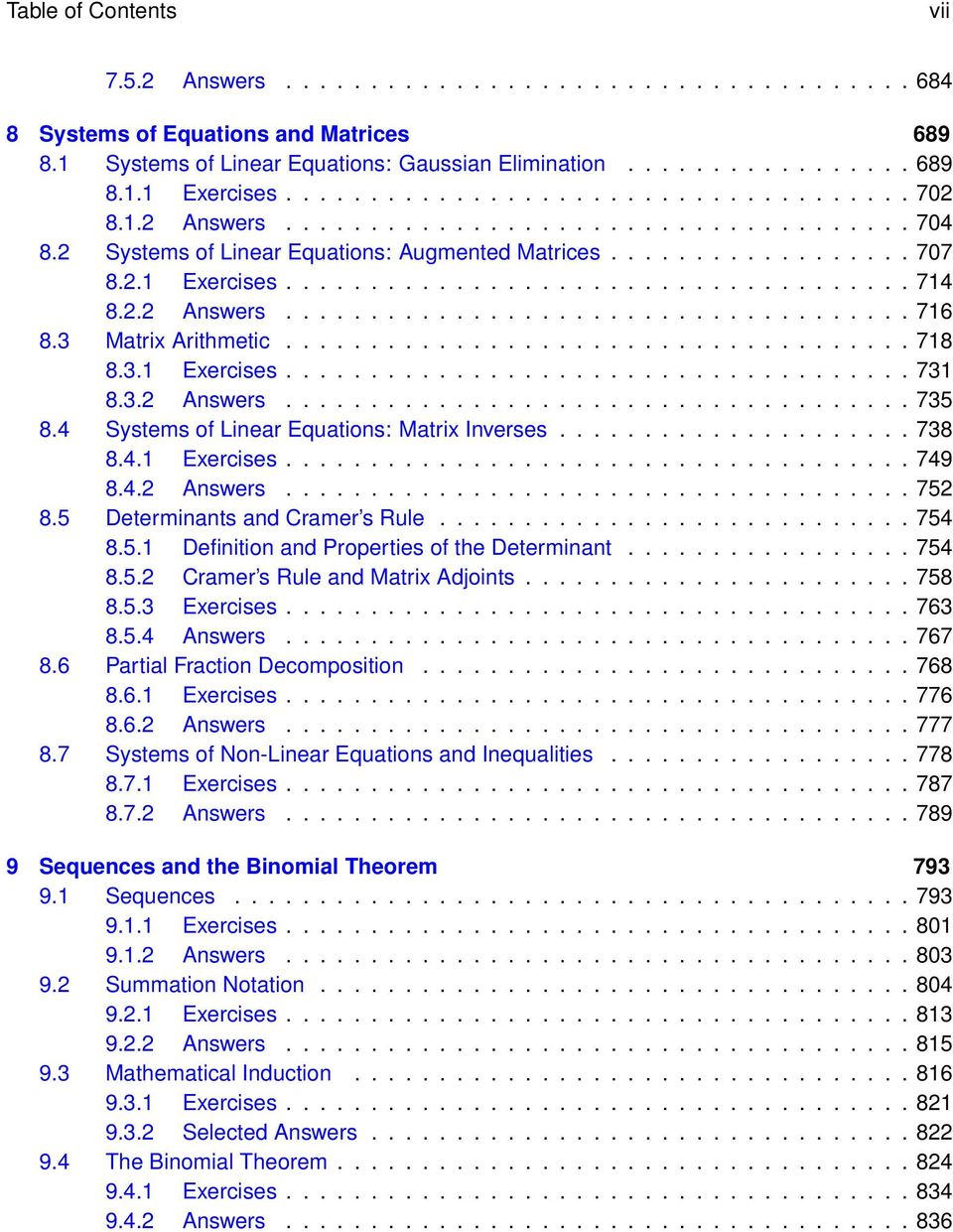
7 Table of Contents vii 7.5. Answers Systems of Equations and Matrices Systems of Linear Equations: Gaussian Elimination Exercises Answers Systems of Linear Equations: Augmented Matrices Exercises Answers Matrix Arithmetic Exercises Answers Systems of Linear Equations: Matrix Inverses Exercises Answers Determinants and Cramer s Rule Definition and Proerties of the Determinant Cramer s Rule and Matrix Adjoints Exercises Answers Partial Fraction Decomosition Exercises Answers Systems of Non-Linear Equations and Inequalities Exercises Answers Sequences and the Binomial Theorem Sequences Exercises Answers Summation Notation Exercises Answers Mathematical Induction Exercises Selected Answers The Binomial Theorem Exercises Answers...86
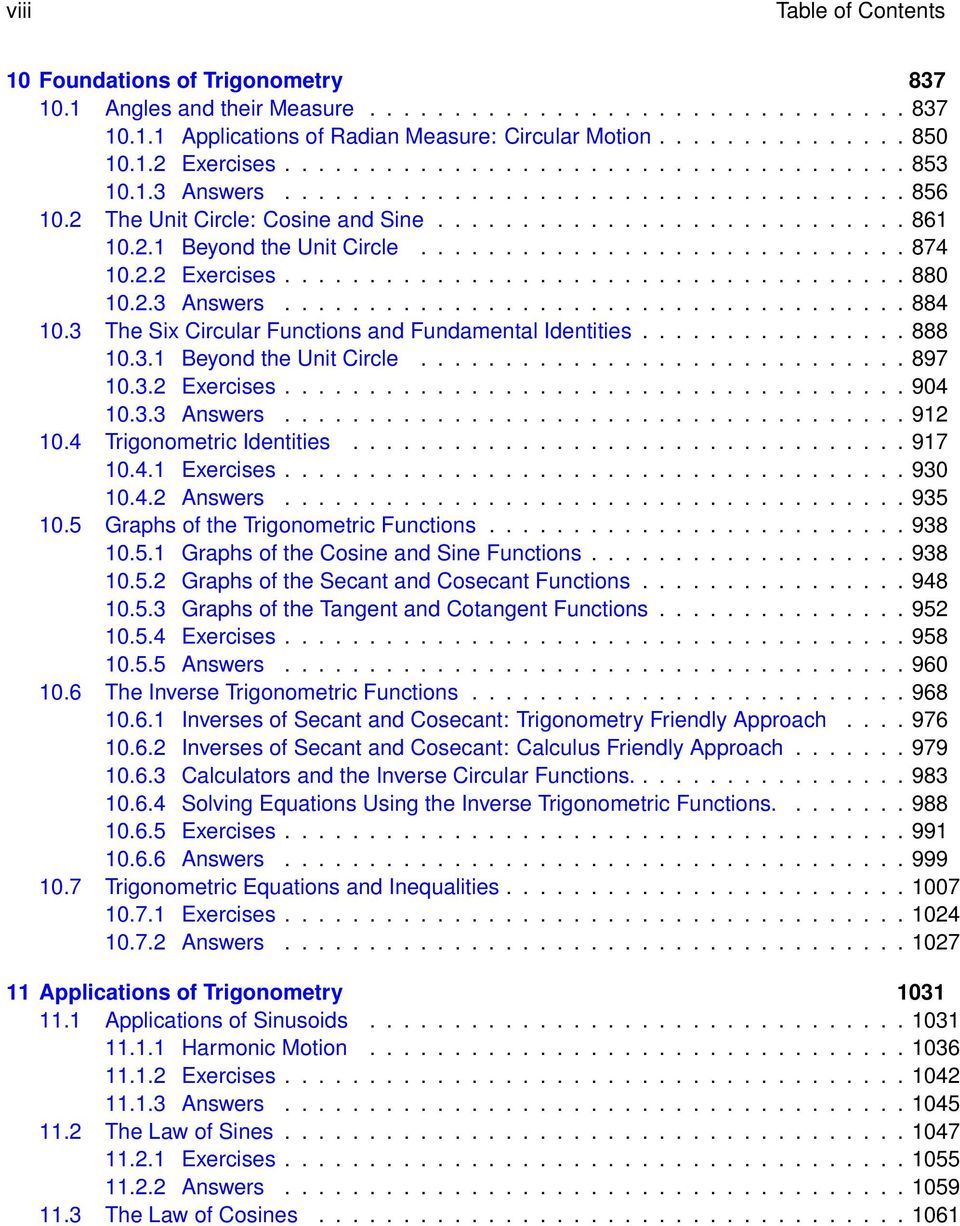
8 viii Table of Contents 0 Foundations of Trigonometry Angles and their Measure Alications of Radian Measure: Circular Motion Exercises Answers The Unit Circle: Cosine and Sine Beyond the Unit Circle Exercises Answers The Six Circular Functions and Fundamental Identities Beyond the Unit Circle Exercises Answers Trigonometric Identities Exercises Answers Grahs of the Trigonometric Functions Grahs of the Cosine and Sine Functions Grahs of the Secant and Cosecant Functions Grahs of the Tangent and Cotangent Functions Exercises Answers The Inverse Trigonometric Functions Inverses of Secant and Cosecant: Trigonometry Friendly Aroach Inverses of Secant and Cosecant: Calculus Friendly Aroach Calculators and the Inverse Circular Functions Solving Equations Using the Inverse Trigonometric Functions Exercises Answers Trigonometric Equations and Inequalities Exercises Answers...07 Alications of Trigonometry 0. Alications of Sinusoids Harmonic Motion Exercises Answers The Law of Sines Exercises Answers The Law of Cosines...06
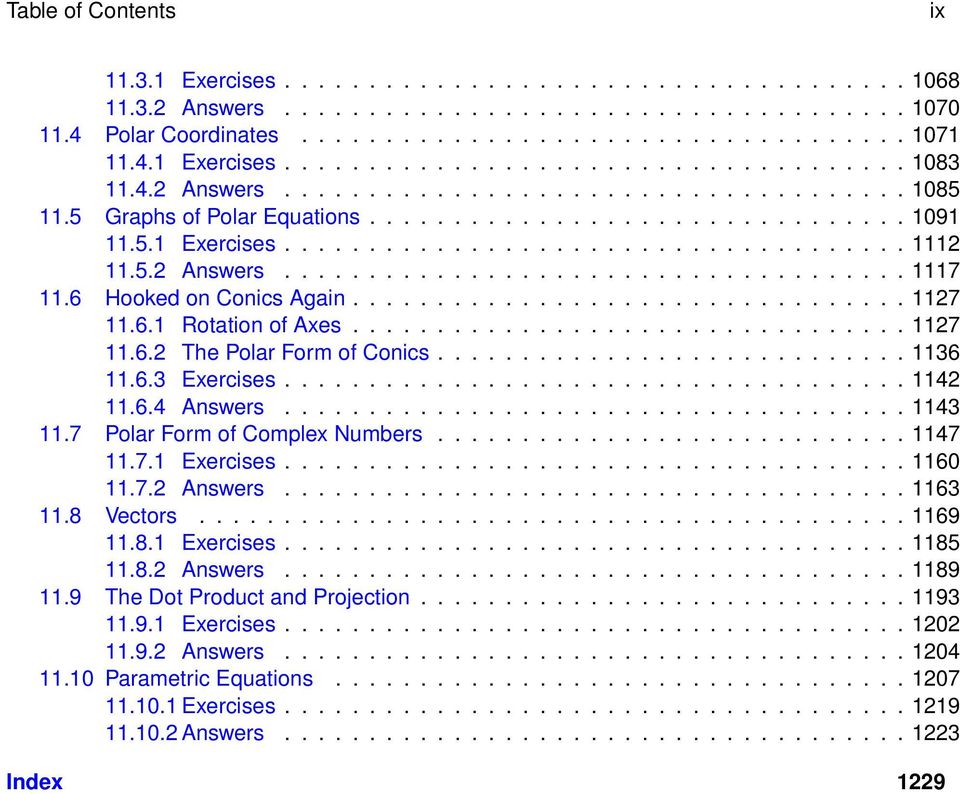
9 Table of Contents ix.. Exercises Answers Polar Coordinates Exercises Answers Grahs of Polar Equations Exercises Answers Hooked on Conics Again Rotation of Axes The Polar Form of Conics Exercises Answers Polar Form of Comlex Numbers Exercises Answers Vectors Exercises Answers The Dot Product and Projection Exercises Answers Parametric Equations Exercises Answers... Index 9
10 x Table of Contents

11 Chater 0 Prerequisites The authors would like nothing more than to dive right into the sheer excitement of Precalculus. However, exerience - our own as well as that of our colleagues - has taught us that is it beneficial, if not comletely necessary, to review what students should know before embarking on a Precalculus adventure. The goal of Chater 0 is exactly that: to review the concets, skills and vocabulary we believe are rerequisite to a rigorous, college-level Precalculus course. This review is not designed to teach the material to students who have never seen it before thus the resentation is more succinct and the exercise sets are shorter than those usually found in an Intermediate Algebra text. An outline of the chater is given below. Section 0. (Basic Set Theory and Interval Notation) contains a brief summary of the set theory terminology used throughout the text including sets of real numbers and interval notation. Section 0. (Real Number Arithmetic) lists the roerties of real number arithmetic. Section 0. (Linear Equations and Inequalities) focuses on solving linear equations and linear inequalities from a strictly algebraic ersective. The geometry of grahing lines in the lane is deferred until Section. (Linear Functions). Section 0.4 (Absolute Value Equations and Inequalities) begins with a definition of absolute value as a distance. Fundamental roerties of absolute value are listed and then basic equations and inequalities involving absolute value are solved using the distance definition and those roerties. Absolute value is revisited in much greater deth in Section. (Absolute Value Functions). Section 0.5 (Polynomial Arithmetic) covers the addition, subtraction, multilication and division of olynomials as well as the vocabulary which is used extensively when the grahs of olynomials are studied in Chater (Polynomials). Section 0.6 (Factoring) covers basic factoring techniques and how to solve equations using those techniques along with the Zero Product Proerty of Real Numbers. Section 0.7 (Quadratic Equations) discusses solving quadratic equations using the technique of comleting the square and by using the Quadratic Formula. Equations which are quadratic in form are also discussed. You know, the stuff students mess u all of the time like fractions and negative signs. The collection is close to exhaustive and definitely exhausting!

12 Prerequisites Section 0.8 (Rational Exressions and Equations) starts with the basic arithmetic of rational exressions and the simlifying of comound fractions. Solving equations by clearing denominators and the handling negative integer exonents are resented but the grahing of rational functions is deferred until Chater 4 (Rational Functions). Section 0.9 (Radicals and Equations) covers simlifying radicals as well as the solving of basic equations involving radicals. Section 0.0 (Comlex Numbers) covers the basic arithmetic of comlex numbers and the solving of quadratic equations with comlex solutions.

13 0. Basic Set Theory and Interval Notation 0. Basic Set Theory and Interval Notation 0.. Some Basic Set Theory Notions Like all good Math books, we begin with a definition. Definition 0.. A set is a well-defined collection of objects which are called the elements of the set. Here, well-defined means that it is ossible to determine if something belongs to the collection or not, without rejudice. The collection of letters that make u the word smolko is well-defined and is a set, but the collection of the worst Math teachers in the world is not well-defined and therefore is not a set. In general, there are three ways to describe sets and those methods are listed below. Ways to Describe Sets. The Verbal Method: Use a sentence to define the set.. The Roster Method: Begin with a left brace {, list each element of the set only once and then end with a right brace }.. The Set-Builder Method: A combination of the verbal and roster methods using a dummy variable such as x. For examle, let S be the set described verbally as the set of letters that make u the word smolko. A roster descrition of S is {s, m, o, l, k}. Note that we listed o only once, even though it aears twice in the word smolko. Also, the order of the elements doesn t matter, so {k, l, m, o, s} is also a roster descrition of S. Moving right along, a set-builder descrition of S is: {x x is a letter in the word smolko }. The way to read this is The set of elements x such that x is a letter in the word smolko. In each of the above cases, we may use the familiar equals sign and write S {s, m, o, l, k} or S {x x is a letter in the word smolko }. Notice that m is in S but many other letters, such as q, are not in S. We exress these ideas of set inclusion and exclusion mathematically using the symbols m S (read m is in S ) and q / S (read q is not in S ). More recisely, we have the following. Definition 0.. Let A be a set. If x is an element of A then we write x A which is read x is in A. If x is not an element of A then we write x / A which is read x is not in A. Now let s consider the set C {x x is a consonant in the word smolko }. A roster descrition of C is C {s, m, l, k}. Note that by construction, every element of C is also in S. We exress For a more thought-rovoking examle, consider the collection of all things that do not contain themselves - this leads to the famous Russell s Paradox.
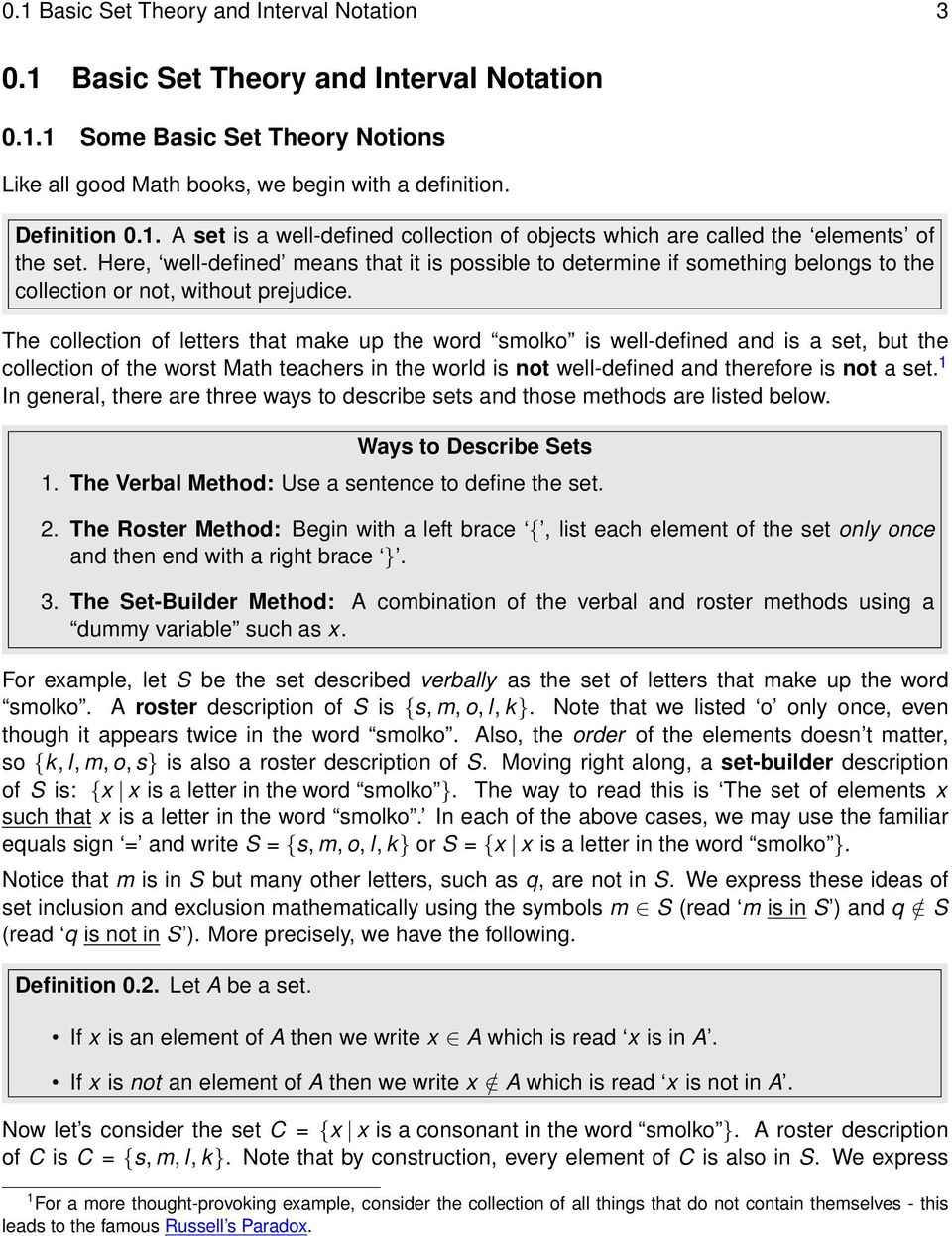
14 4 Prerequisites this relationshi by stating that the set C is a subset of the set S, which is written in symbols as C S. The more formal definition is given below. Definition 0.. Given sets A and B, we say that the set A is a subset of the set B and write A B if every element in A is also an element of B. Note that in our examle above C S, but not vice-versa, since o S but o / C. Additionally, the set of vowels V {a, e, i, o, u}, while it does have an element in common with S, is not a subset of S. (As an added note, S is not a subset of V, either.) We could, however, build a set which contains both S and V as subsets by gathering all of the elements in both S and V together into a single set, say U {s, m, o, l, k, a, e, i, u}. Then S U and V U. The set U we have built is called the union of the sets S and V and is denoted S [ V. Furthermore, S and V aren t comletely different sets since they both contain the letter o. The intersection of two sets is the set of elements (if any) the two sets have in common. In this case, the intersection of S and V is {o}, written S \ V {o}. We formalize these ideas below. Definition 0.4. Suose A and B are sets. The intersection of A and B is A \ B {x x A and x B} The union of A and B is A [ B {x x A or x B (or both)} The key words in Definition 0.4 to focus on are the conjunctions: intersection corresonds to and meaning the elements have to be in both sets to be in the intersection, whereas union corresonds to or meaning the elements have to be in one set, or the other set (or both). In other words, to belong to the union of two sets an element must belong to at least one of them. Returning to the sets C and V above, C [ V {s, m, l, k, a, e, i, o, u}. When it comes to their intersection, however, we run into a bit of notational awkwardness since C and V have no elements in common. While we could write C \ V {}, this sort of thing haens often enough that we give the set with no elements a name. Definition 0.5. The Emty Set ; is the set which contains no elements. That is, ; {} {x x 6 x}. As romised, the emty set is the set containing no elements since no matter what x is, x x. Like the number 0, the emty set lays a vital role in mathematics. We introduce it here more as a symbol of convenience as oosed to a contrivance. 4 Using this new bit of notation, we have for the sets C and V above that C \ V ;. A nice way to visualize relationshis between sets and set oerations is to draw a Venn Diagram. A Venn Diagram for the sets S, C and V is drawn at the to of the next age. Which just so haens to be the same set as S [ V. Sadly, the full extent of the emty set s role will not be exlored in this text. 4 Actually, the emty set can be used to generate numbers - mathematicians can create something from nothing!
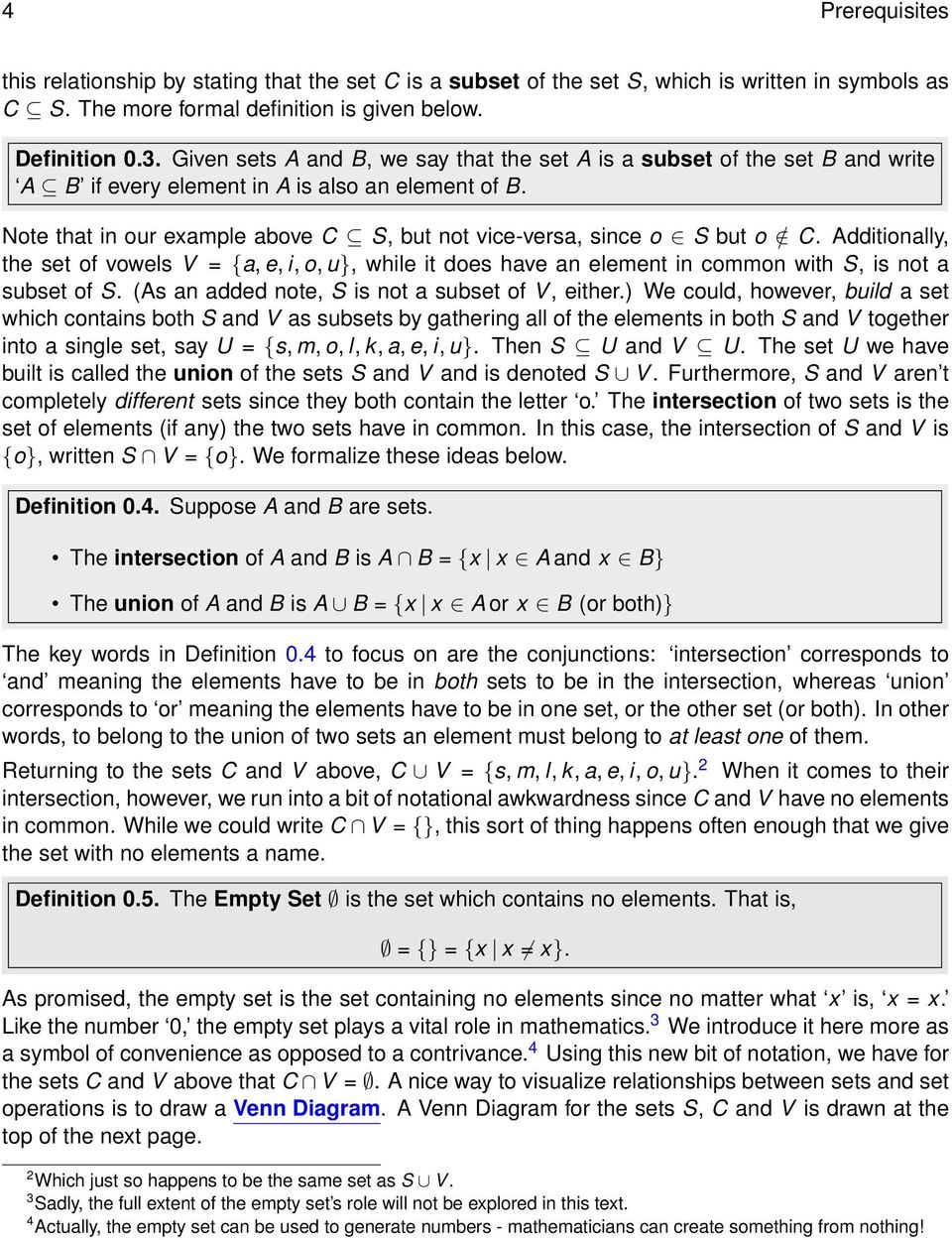
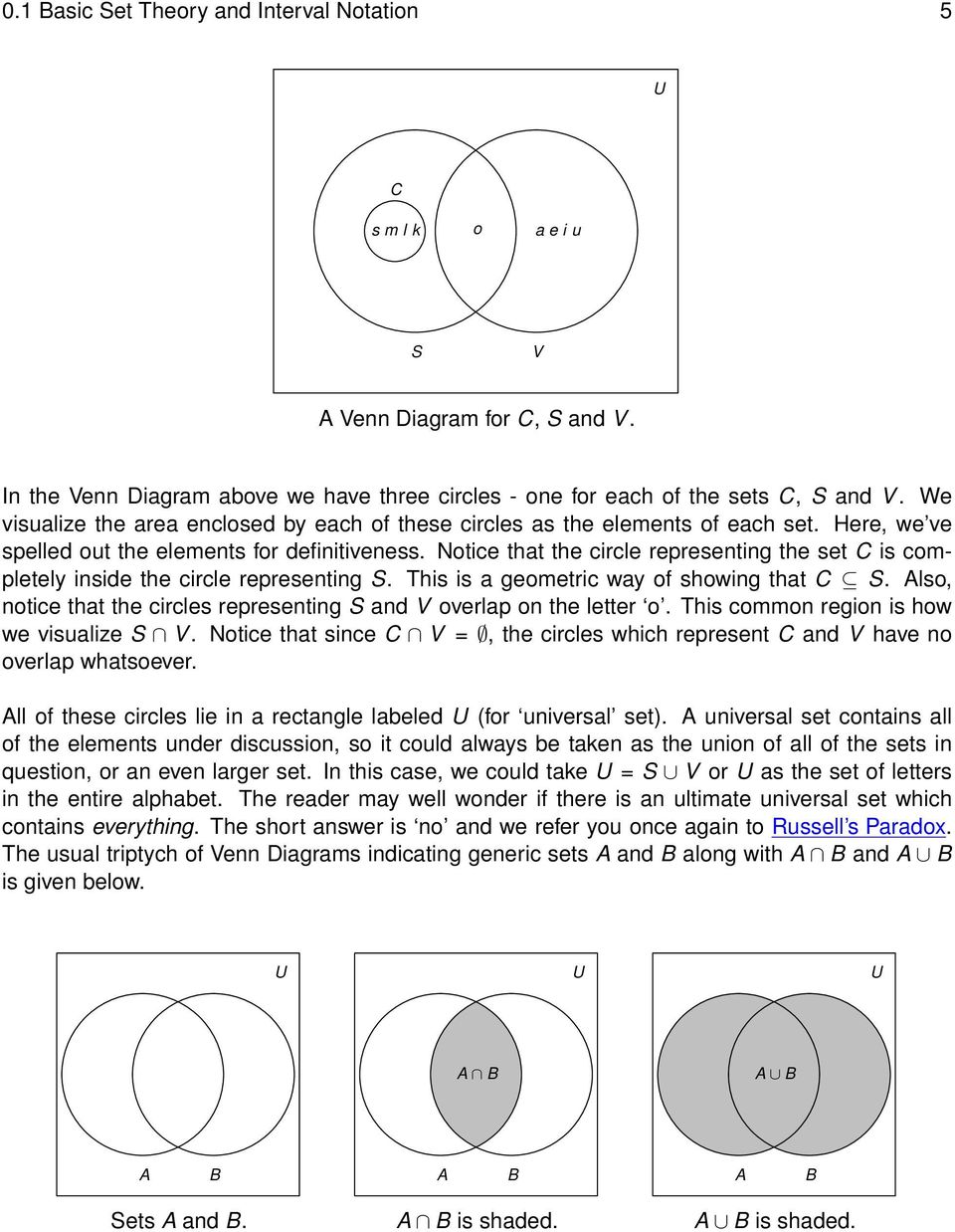
15 0. Basic Set Theory and Interval Notation 5 U C smlk o aeiu S V A Venn Diagram for C, S and V. In the Venn Diagram above we have three circles - one for each of the sets C, S and V. We visualize the area enclosed by each of these circles as the elements of each set. Here, we ve selled out the elements for definitiveness. Notice that the circle reresenting the set C is comletely inside the circle reresenting S. This is a geometric way of showing that C S. Also, notice that the circles reresenting S and V overla on the letter o. This common region is how we visualize S \ V. Notice that since C \ V ;, the circles which reresent C and V have no overla whatsoever. All of these circles lie in a rectangle labeled U (for universal set). A universal set contains all of the elements under discussion, so it could always be taken as the union of all of the sets in question, or an even larger set. In this case, we could take U S [ V or U as the set of letters in the entire alhabet. The reader may well wonder if there is an ultimate universal set which contains everything. The short answer is no and we refer you once again to Russell s Paradox. The usual tritych of Venn Diagrams indicating generic sets A and B along with A \ B and A [ B is given below. U U U A \ B A [ B A B A B A B Sets A and B. A \ B is shaded. A [ B is shaded.
16 6 Prerequisites 0.. Sets of Real Numbers The layground for most of this text is the set of Real Numbers. Many quantities in the real world can be quantified using real numbers: the temerature at a given time, the revenue generated by selling a certain number of roducts and the maximum oulation of Sasquatch which can inhabit a articular region are just three basic examles. A succinct, but nonetheless incomlete 5 definition of a real number is given below. Definition 0.6. A real number is any number which ossesses a decimal reresentation. The set of real numbers is denoted by the character R. Certain subsets of the real numbers are worthy of note and are listed below. In fact, in more advanced texts, 6 the real numbers are constructed from some of these subsets. Secial Subsets of Real Numbers. The Natural Numbers: N {,,,...} The eriods of ellisis... here indicate that the natural numbers contain,, and so forth.. The Whole Numbers: W {0,,,...}.. The Integers: Z {...,,,, 0,,,,...} {0, ±, ±, ±,...}. a 4. The Rational Numbers: Q a b a Z and b Z. Rational numbers are the ratios of integers where the denominator is not zero. It turns out that another way to describe the rational numbers b is: Q {x x ossesses a reeating or terminating decimal reresentation} 5. The Irrational Numbers: P {x x R but x / Q}. c That is, an irrational number is a real number which isn t rational. Said differently, P {x x ossesses a decimal reresentation which neither reeats nor terminates} a The symbol ± is read lus or minus and it is a shorthand notation which aears throughout the text. Just remember that x ± means x or x. b See Section 9.. c Examles here include number (See Section 0.), and Note that every natural number is a whole number which, in turn, is an integer. Each integer is a rational number (take b in the above definition for Q) and since every rational number is a real number 7 the sets N, W, Z, Q, and R are nested like Matryoshka dolls. More formally, these sets form a subset chain: N W Z Q R. The reader is encouraged to sketch a Venn Diagram deicting R and all of the subsets mentioned above. It is time for an examle. 5 Math un intended! 6 See, for instance, Landau s Foundations of Analysis. 7 Thanks to long division!

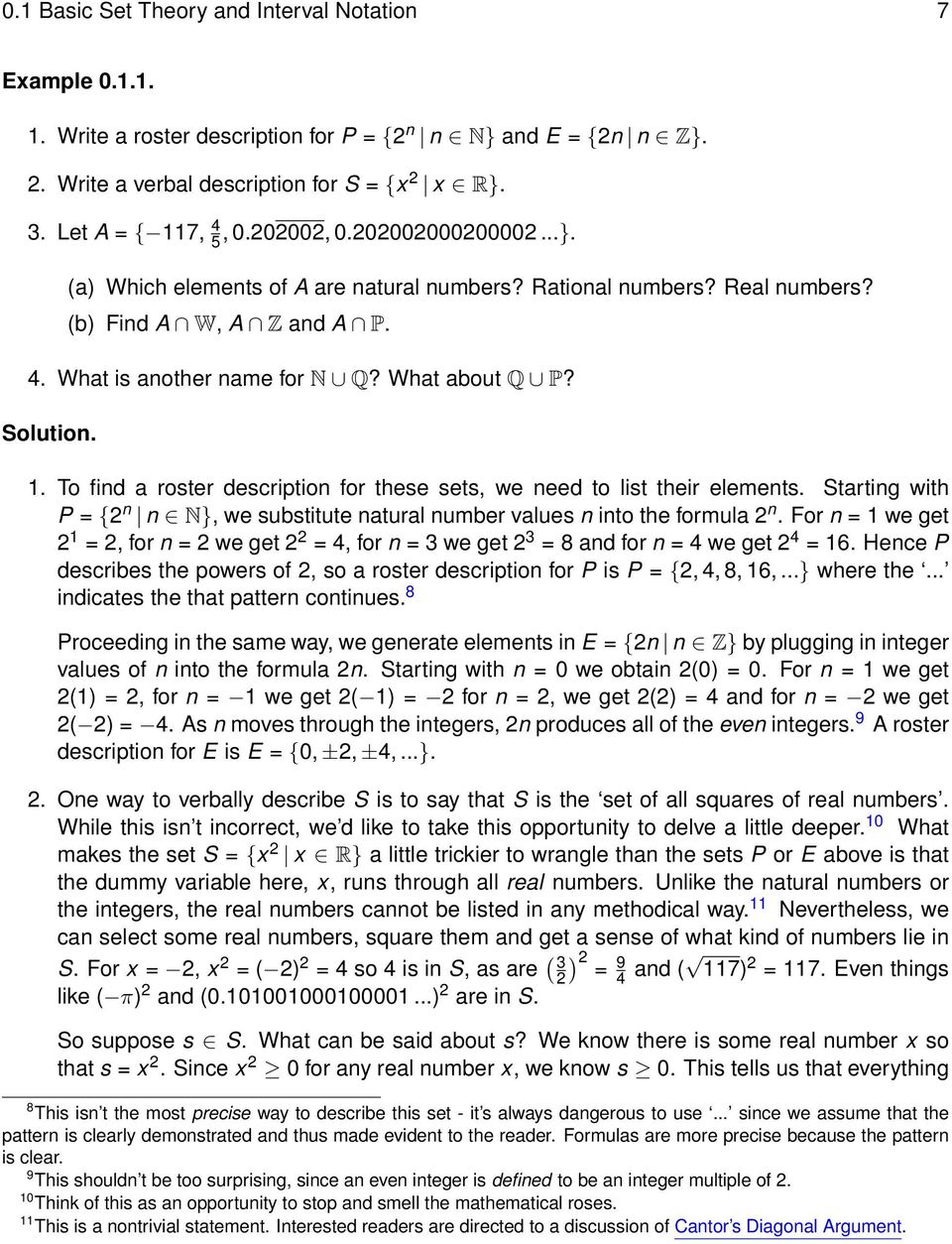
17 0. Basic Set Theory and Interval Notation 7 Examle Write a roster descrition for P { n n N} and E {n n Z}.. Write a verbal descrition for S {x x R}.. Let A { 7, 4 5, 0.000, }. (a) Which elements of A are natural numbers? Rational numbers? Real numbers? (b) Find A \ W, A \ Z and A \ P. 4. What is another name for N [ Q? What about Q [ P? Solution.. To find a roster descrition for these sets, we need to list their elements. Starting with P { n n N}, we substitute natural number values n into the formula n. For n we get, for n we get 4, for n we get 8 and for n 4 we get 4 6. Hence P describes the owers of, so a roster descrition for P is P {, 4, 8, 6,...} where the... indicates the that attern continues. 8 Proceeding in the same way, we generate elements in E {n n Z} by lugging in integer values of n into the formula n. Starting with n 0 we obtain (0) 0. For n we get (), for n we get ( ) for n, we get () 4 and for n we get ( ) 4. As n moves through the integers, n roduces all of the even integers. 9 A roster descrition for E is E {0, ±, ±4,...}.. One way to verbally describe S is to say that S is the set of all squares of real numbers. While this isn t incorrect, we d like to take this oortunity to delve a little deeer. 0 What makes the set S {x x R} a little trickier to wrangle than the sets P or E above is that the dummy variable here, x, runs through all real numbers. Unlike the natural numbers or the integers, the real numbers cannot be listed in any methodical way. Nevertheless, we can select some real numbers, square them and get a sense of what kind of numbers lie in S. For x, x ( ) 4 so 4 is in S, as are 9 4 and ( 7) 7. Even things like ( ) and ( ) are in S. So suose s S. What can be said about s? We know there is some real number x so that s x. Since x 0 for any real number x, we know s 0. This tells us that everything 8 This isn t the most recise way to describe this set - it s always dangerous to use... since we assume that the attern is clearly demonstrated and thus made evident to the reader. Formulas are more recise because the attern is clear. 9 This shouldn t be too surrising, since an even integer is defined to be an integer multile of. 0 Think of this as an oortunity to sto and smell the mathematical roses. This is a nontrivial statement. Interested readers are directed to a discussion of Cantor s Diagonal Argument.
18 8 Prerequisites in S is a non-negative real number. This begs the question: are all of the non-negative real numbers in S? Suose n is a non-negative real number, that is, n 0. If n were in S, there would be a real number x so that x n. As you may recall, we can solve x n by extracting square roots : x ± n. Since n 0, n is a real number. Moreover, ( n) n so n is the square of a real number which means n S. Hence, S is the set of non-negative real numbers.. (a) The set A contains no natural numbers. 4 Clearly, 4 5 is a rational number as is 7 7 (which can be written as ). It s the last two numbers listed in A, and , that warrant some discussion. First, recall that the line over the digits 00 in (called the vinculum) indicates that these digits reeat, so it is a rational number. 5 As for the number , the... indicates the attern of adding an extra 0 followed by a is what defines this real number. Desite the fact there is a attern to this decimal, this decimal is not reeating, so it is not a rational number - it is, in fact, an irrational number. All of the elements of A are real numbers, since all of them can be exressed as decimals (remember that ). (b) The set A \ W {x x A and x W} is another way of saying we are looking for the set of numbers in A which are whole numbers. Since A contains no whole numbers, A \ W ;. Similarly, A \ Z is looking for the set of numbers in A which are integers. Since 7 is the only integer in A, A \ Z { 7}. As for the set A \ P, as discussed in art (a), the number is irrational, so A \ P { }. 4. The set N [ Q {x x N or x Q} is the union of the set of natural numbers with the set of rational numbers. Since every natural number is a rational number, N doesn t contribute any new elements to Q, so N [ Q Q. 6 For the set Q [ P, we note that every real number is either rational or not, hence Q [ P R, retty much by the definition of the set P. As you may recall, we often visualize the set of real numbers R as a line where each oint on the line corresonds to one and only one real number. Given two different real numbers a and b, we write a < b if a is located to the left of b on the number line, as shown below. a b The real number line with two numbers a and b where a < b. While this notion seems innocuous, it is worth ointing out that this convention is rooted in two dee roerties of real numbers. The first roerty is that R is comlete. This means that there This means S is a subset of the non-negative real numbers. This is called the square root closed roerty of the non-negative real numbers. 4 Carl was temted to include 0.9 in the set A, but thought better of it. See Section 9. for details. 5 So In fact, anytime A B, A [ B B and vice-versa. See the exercises.

19 0. Basic Set Theory and Interval Notation 9 are no holes or gas in the real number line. 7 Another way to think about this is that if you choose any two distinct (different) real numbers, and look between them, you ll find a solid line segment (or interval) consisting of infinitely many real numbers. The next result tells us what tyes of numbers we can exect to find. Density Proerty of Q and P in R Between any two distinct real numbers, there is at least one rational number and irrational number. It then follows that between any two distinct real numbers there will be infinitely many rational and irrational numbers. The root word dense here communicates the idea that rationals and irrationals are thoroughly mixed into R. The reader is encouraged to think about how one would find both a rational and an irrational number between, say, and. Once you ve done that, try doing the same thing for the numbers 0.9 and. ( Try is the oerative word, here. 8 ) The second roerty R ossesses that lets us view it as a line is that the set is totally ordered. This means that given any two real numbers a and b, either a < b, a > b or a b which allows us to arrange the numbers from least (left) to greatest (right). You may have heard this roerty given as the Law of Trichotomy. Law of Trichotomy If a and b are real numbers then exactly one of the following statements is true: a < b a > b a b Segments of the real number line are called intervals. They lay a huge role not only in this text but also in the Calculus curriculum so we need a concise way to describe them. We start by examining a few examles of the interval notation associated with some secific sets of numbers. Set of Real Numbers Interval Notation Region on the Real Number Line {x ale x < } [, ) {x ale x ale 4} [, 4] 4 {x x ale 5} (, 5] 5 {x x > } (, ) As you can glean from the table, for intervals with finite endoints we start by writing left endoint, right endoint. We use square brackets, [ or ], if the endoint is included in the interval. This 7 Alas, this intuitive feel for what it means to be comlete is as good as it gets at this level. Comleteness does get a much more recise meaning later in courses like Analysis and Toology. 8 Again, see Section 9. for details.
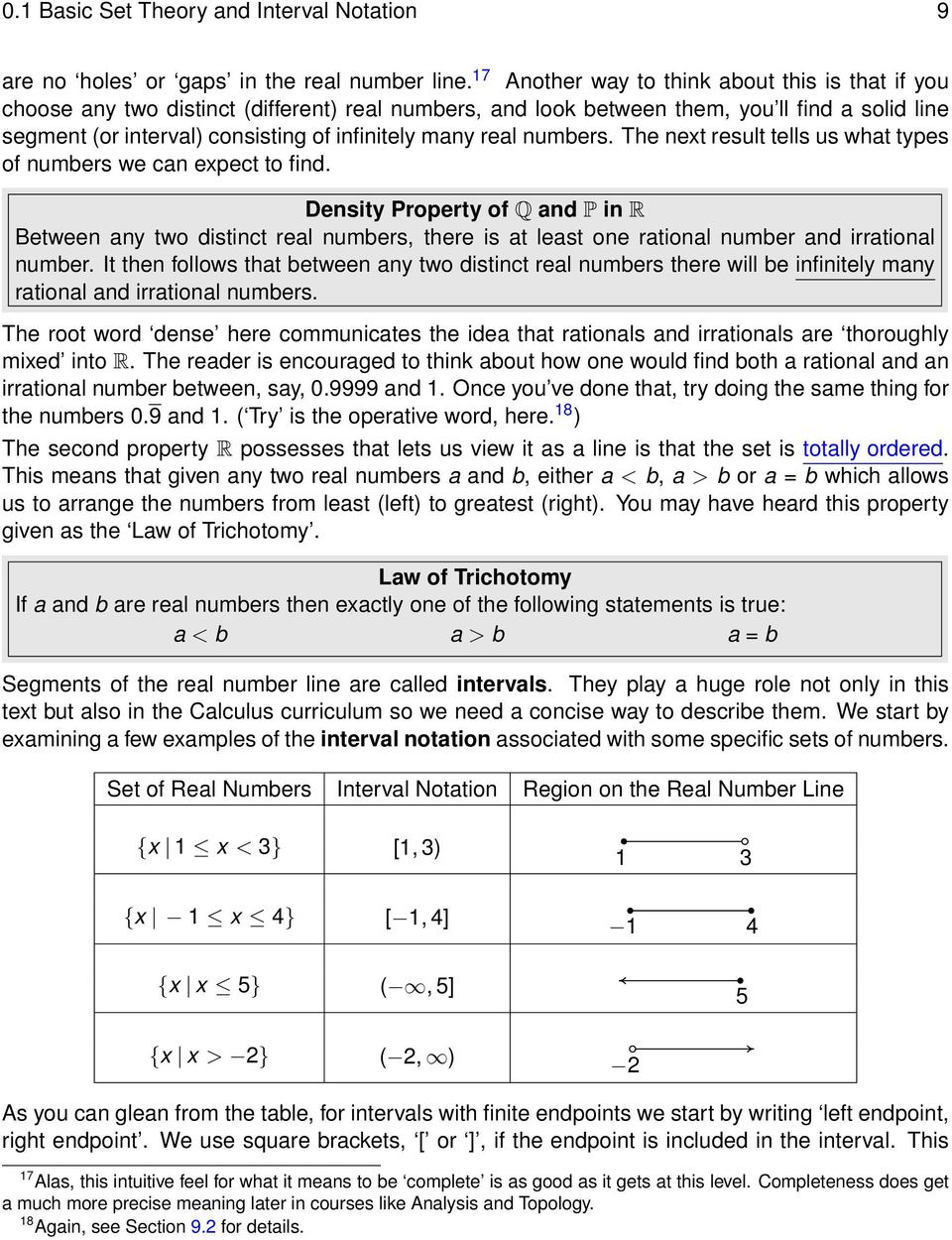
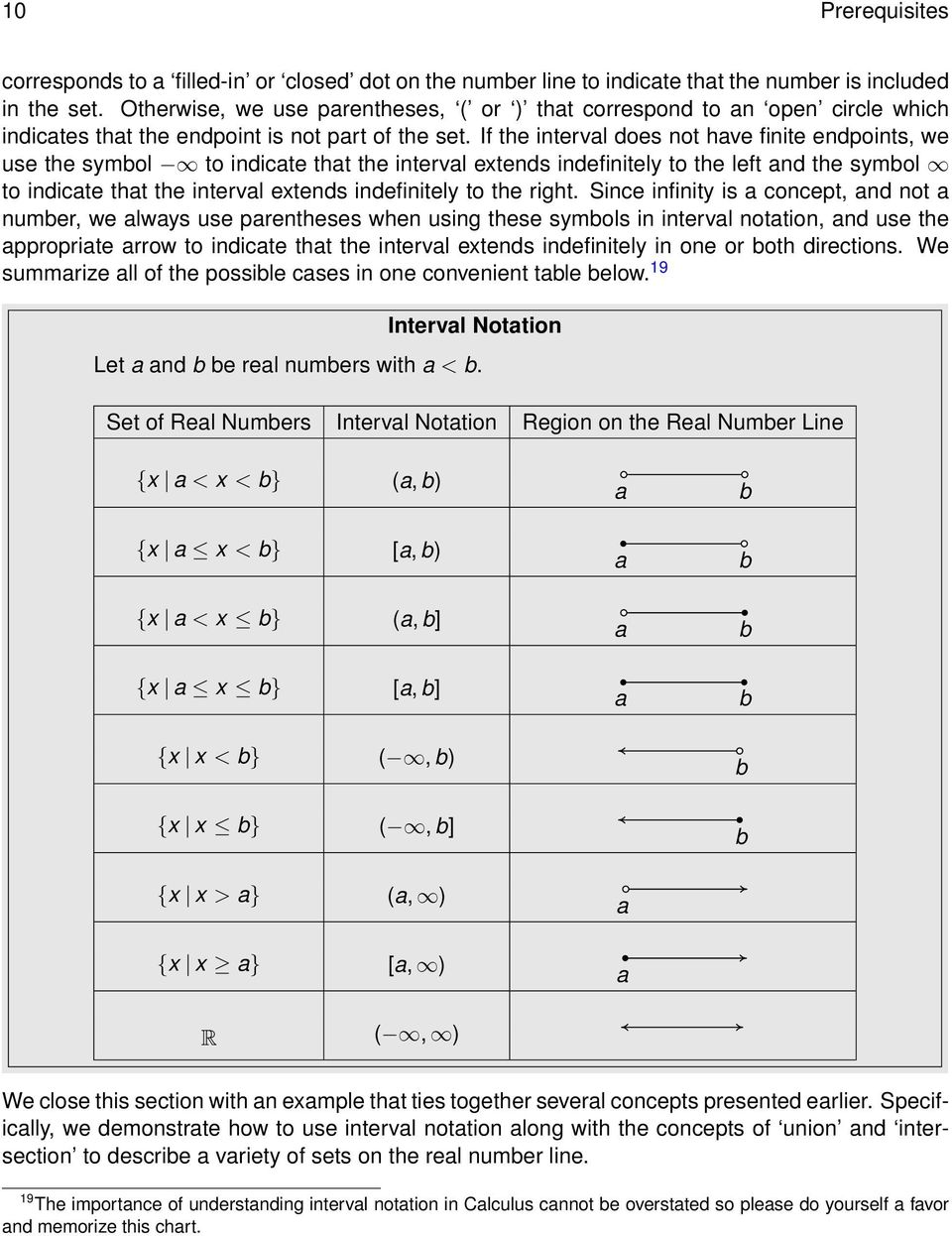
20 0 Prerequisites corresonds to a filled-in or closed dot on the number line to indicate that the number is included in the set. Otherwise, we use arentheses, ( or ) that corresond to an oen circle which indicates that the endoint is not art of the set. If the interval does not have finite endoints, we use the symbol to indicate that the interval extends indefinitely to the left and the symbol to indicate that the interval extends indefinitely to the right. Since infinity is a concet, and not a number, we always use arentheses when using these symbols in interval notation, and use the aroriate arrow to indicate that the interval extends indefinitely in one or both directions. We summarize all of the ossible cases in one convenient table below. 9 Interval Notation Let a and b be real numbers with a < b. Set of Real Numbers Interval Notation Region on the Real Number Line {x a < x < b} (a, b) a b {x a ale x < b} [a, b) a b {x a < x ale b} (a, b] a b {x a ale x ale b} [a, b] a b {x x < b} (, b) b {x x ale b} (, b] b {x x > a} (a, ) a {x x a} [a, ) a R (, ) We close this section with an examle that ties together several concets resented earlier. Secifically, we demonstrate how to use interval notation along with the concets of union and intersection to describe a variety of sets on the real number line. 9 The imortance of understanding interval notation in Calculus cannot be overstated so lease do yourself a favor and memorize this chart.
21 0. Basic Set Theory and Interval Notation Examle Exress the following sets of numbers using interval notation. (a) {x x ale or x } (b) {x x 6 } (c) {x x 6 ±} (d) {x < x ale or x 5}. Let A [ 5, ) and B (, ). Find A \ B and A [ B. Solution.. (a) The best way to roceed here is to grah the set of numbers on the number line and glean the answer from it. The inequality x ale corresonds to the interval (, ] and the inequality x corresonds to the interval [, ). The or in {x x ale or x } tells us that we are looking for the union of these two intervals, so our answer is (, ] [ [, ). (, ] [ [, ) (b) For the set {x x 6 }, we shade the entire real number line excet x, where we leave an oen circle. This divides the real number line into two intervals, (, ) and (, ). Since the values of x could be in one of these intervals or the other, we once again use the union symbol to get {x x 6 } (, ) [ (, ). (, ) [ (, ) (c) For the set {x x 6 ±}, we roceed as before and exclude both x and x from our set. (Do you remember what we said back on 6 about x ±?) This breaks the number line into three intervals, (, ), (, ) and (, ). Since the set describes real numbers which come from the first, second or third interval, we have {x x 6 ±} (, ) [ (, ) [ (, ). (, ) [ (, ) [ (, ) (d) Grahing the set {x < x ale or x 5} yields the interval (, ] along with the single number 5. While we could exress this single oint as [5, 5], it is customary to write a single oint as a singleton set, so in our case we have the set {5}. Thus our final answer is {x < x ale or x 5} (, ] [{5}. 5 (, ] [{5}
22 Prerequisites. We start by grahing A [ 5, ) and B (, ) on the number line. To find A\B, we need to find the numbers in common to both A and B, in other words, the overla of the two intervals. Clearly, everything between and is in both A and B. However, since is in A but not in B, is not in the intersection. Similarly, since is in B but not in A, it isn t in the intersection either. Hence, A \ B (, ). To find A [ B, we need to find the numbers in at least one of A or B. Grahically, we shade A and B along with it. Notice here that even though isn t in B, it is in A, so it s the union along with all the other elements of A between 5 and. A similar argument goes for the inclusion of in the union. The result of shading both A and B together gives us A [ B [ 5, ). 5 A [ 5, ), B (, ) 5 A \ B (, ) 5 A [ B [ 5, )
23 0. Basic Set Theory and Interval Notation 0.. Exercises. Find a verbal descrition for O {n n N}. Find a roster descrition for X {z z Z}. Let A,.0, 5, 0.57,.,, , 0 0, 7 (a) List the elements of A which are natural numbers. (b) List the elements of A which are irrational numbers. (c) Find A \ Z (d) Find A \ Q 4. Fill in the chart below. Set of Real Numbers Interval Notation Region on the Real Number Line {x ale x < 5} [0, ) {x 5 < x ale 0} 7 (, ) {x x ale } 5 7 (, 9) {x x } 4
24 4 Prerequisites In Exercises 5-0, find the indicated intersection or union and simlify if ossible. Exress your answers in interval notation. 5. (, 5] \ [0, 8) 6. (, ) [ [0, 6] 7. (, 4] \ (0, ) 8. (, 0) \ [, 5] 9. (, 0) [ [, 5] 0. (, 5] \ [5, 8) In Exercises -, write the set using interval notation.. {x x 6 5}. {x x 6 }. {x x 6, 4} 4. {x x 6 0, } 5. {x x 6, } 6. {x x 6 0, ±4} 7. {x x ale or x } 8. {x x < or x } 9. {x x ale or x > 0} 0. {x x ale 5 or x 6}. {x x > or x ±}. {x < x < or x 4} For Exercises - 8, use the blank Venn Diagram below A, B, and C as a guide for you to shade the following sets. U A B C. A [ C 4. B \ C 5. (A [ B) [ C 6. (A \ B) \ C 7. A \ (B [ C) 8. (A \ B) [ (A \ C) 9. Exlain how your answers to roblems 7 and 8 show A\(B[C) (A\B)[(A\C). Phrased differently, this shows intersection distributes over union. Discuss with your classmates if union distributes over intersection. Use a Venn Diagram to suort your answer.
25 0. Basic Set Theory and Interval Notation Answers. O is the odd natural numbers.. X {0,, 4, 9, 6,...}. (a) 0 and 7 0 (b) and (c), 0 0, 7 0 (d),.0,, 0.57,., 5 0, 7 4. Set of Real Numbers Interval Notation Region on the Real Number Line {x ale x < 5} [, 5) 5 {x 0 ale x < } [0, ) {x < x ale 7} (, 7] 0 7 {x 5 < x ale 0} ( 5, 0] 5 0 {x < x < } (, ) {x 5 ale x ale 7} [5, 7] {x x ale } (, ] {x x < 9} (, 9) {x x > 4} (4, ) {x x } [, )
26 6 Prerequisites 5. (, 5] \ [0, 8) [0, 5] 6. (, ) [ [0, 6] (, 6] 7. (, 4] \ (0, ) (0, 4] 8. (, 0) \ [, 5] ; 9. (, 0) [ [, 5] (, 0) [ [, 5] 0. (, 5] \ [5, 8) {5}. (, 5) [ (5, ). (, ) [ (, ). (, ) [ (, 4) [ (4, ) 4. (, 0) [ (0, ) [ (, ) 5. (, ) [ (, ) [ (, ) 6. (, 4) [ ( 4, 0) [ (0, 4) [ (4, ) 7. (, ] [ [, ) 8. (, ) 9. (, ] [ (0, ) 0. (, 5] [{6}. { }[{}[(, ). (, ) [{4}. A [ C 4. B \ C U U A B A B C C
27 0. Basic Set Theory and Interval Notation 7 5. (A [ B) [ C 6. (A \ B) \ C U U A B A B C C 7. A \ (B [ C) 8. (A \ B) [ (A \ C) U U A B A B C C 9. Yes, A [ (B \ C) (A [ B) \ (A [ C). U A B C
28 8 Prerequisites 0. Real Number Arithmetic In this section we list the roerties of real number arithmetic. This is meant to be a succinct, targeted review so we ll resist the temtation to wax oetic about these axioms and their subtleties and refer the interested reader to a more formal course in Abstract Algebra. There are two (rimary) oerations one can erform with real numbers: addition and multilication. Proerties of Real Number Addition Closure: For all real numbers a and b, a + b is also a real number. Commutativity: For all real numbers a and b, a + b b + a. Associativity: For all real numbers a, b and c, a +(b + c) (a + b)+c. Identity: There is a real number 0 so that for all real numbers a, a +0a. Inverse: For all real numbers a, there is a real number a such that a +( a) 0. Definition of Subtraction: For all real numbers a and b, a b a +( b). Next, we give real number multilication a similar treatment. Recall that we may denote the roduct of two real numbers a and b a variety of ways: ab, a b, a(b), (a)(b) and so on. We ll refrain from using a b for real number multilication in this text with one notable excetion in Definition 0.7. Proerties of Real Number Multilication Closure: For all real numbers a and b, ab is also a real number. Commutativity: For all real numbers a and b, ab ba. Associativity: For all real numbers a, b and c, a(bc) (ab)c. Identity: There is a real number so that for all real numbers a, a a. Inverse: For all real numbers a 6 0, there is a real number a such that a. a Definition of Division: For all real numbers a and b 6 0, a b a b a. b While most students and some faculty tend to ski over these roerties or give them a cursory glance at best, it is imortant to realize that the roerties stated above are what drive the symbolic maniulation for all of Algebra. When listing a tally of more than two numbers, + + for examle, we don t need to secify the order in which those numbers are added. Notice though, try as we might, we can add only two numbers at a time and it is the associative roerty of addition which assures us that we could organize this sum as ( + ) + or + ( + ). This brings u a Not unlike how Carl aroached all the Elven oetry in The Lord of the Rings.
29 0. Real Number Arithmetic 9 note about grouing symbols. Recall that arentheses and brackets are used in order to secify which oerations are to be erformed first. In the absence of such grouing symbols, multilication (and hence division) is given riority over addition (and hence subtraction). For examle, , but ( + ) 9. As you may recall, we can distribute the across the addition if we really wanted to do the multilication first: ( + ) More generally, we have the following. The Distributive Proerty and Factoring For all real numbers a, b and c: Distributive Proerty: a(b + c) ab + ac and (a + b)c ac + bc. Factoring: a ab + ac a(b + c) and ac + bc (a + b)c. a Or, as Carl calls it, reading the Distributive Proerty from right to left. It is worth ointing out that we didn t really need to list the Distributive Proerty both for a(b + c) (distributing from the left) and (a + b)c (distributing from the right), since the commutative roerty of multilication gives us one from the other. Also, factoring really is the same equation as the distributive roerty, just read from right to left. These are the first of many redundancies in this section, and they exist in this review section for one reason only - in our exerience, many students see these things differently so we will list them as such. It is hard to overstate the imortance of the Distributive Proerty. For examle, in the exression 5( + x), without knowing the value of x, we cannot erform the addition inside the arentheses first; we must rely on the distributive roerty here to get 5( + x) 5 +5 x 0 + 5x. The Distributive Proerty is also resonsible for combining like terms. Why is x + x 5x? Because x +x ( + )x 5x. We continue our review with summaries of other roerties of arithmetic, each of which can be derived from the roerties listed above. First u are roerties of the additive identity 0. Suose a and b are real numbers. Proerties of Zero Zero Product Proerty: ab 0 if and only if a 0 or b 0 (or both) Note: This not only says that 0 a 0 for any real number a, it also says that the only way to get an answer of 0 when multilying two real numbers is to have one (or both) of the numbers be 0 in the first lace. Zeros in Fractions: If a 6 0, 0 a 0 0. a Note: The quantity a 0 is undefined.a a The exression 0 is technically an indeterminant form as oosed to being strictly undefined meaning that 0 with Calculus we can make some sense of it in certain situations. We ll talk more about this in Chater 4.
30 0 Prerequisites The Zero Product Proerty drives most of the equation solving algorithms in Algebra because it allows us to take comlicated equations and reduce them to simler ones. For examle, you may recall that one way to solve x + x 6 0 is by factoring the left hand side of this equation to get (x )(x + ) 0. From here, we aly the Zero Product Proerty and set each factor equal to zero. This yields x 0 or x + 0 so x or x. This alication to solving equations leads, in turn, to some dee and rofound structure theorems in Chater. Next u is a review of the arithmetic of negatives. On age 8 we first introduced the dash which we all recognize as the negative symbol in terms of the additive inverse. For examle, the number (read negative ) is defined so that + ( ) 0. We then defined subtraction using the concet of the additive inverse again so that, for examle, 5 5+( ). In this text we do not distinguish tyograhically between the dashes in the exressions 5 and even though they are mathematically quite different. In the exression 5, the dash is a binary oeration (that is, an oeration requiring two numbers) whereas in, the dash is a unary oeration (that is, an oeration requiring only one number). You might ask, Who cares? Your calculator does - that s who! In the text we can write 6 but that will not work in your calculator. Instead you d need to tye to get 6 where the first dash comes from the +/ key. Proerties of Negatives Given real numbers a and b we have the following. Additive Inverse Proerties: a ( )a and ( a) a Products of Negatives: ( a)( b) ab. Negatives and Products: ab (ab) ( a)b a( b). Negatives and Fractions: If b is nonzero, a b a b a b and a b a b. Distributing Negatives: (a + b) a b and (a b) a + b b a. Factoring Negatives: a a b (a + b) and b a (a b). a Or, as Carl calls it, reading Distributing Negatives from right to left. An imortant oint here is that when we distribute negatives, we do so across addition or subtraction only. This is because we are really distributing a factor of across each of these terms: (a + b) ( )(a + b) ( )(a) +( )(b) ( a) +( b) a b. Negatives do not distribute across multilication: ( ) 6 ( ) ( ). Instead, ( ) ( ) () () ( ) 6. The same sort of thing goes for fractions: 5 can be written as 5 or 5, but not 5. Seaking of fractions, we now review their arithmetic. Don t worry. We ll review this in due course. And, yes, this is our old friend the Distributive Proerty! We re not just being lazy here. We looked at many of the big ublishers Precalculus books and none of them use different dashes, either.
31 0. Real Number Arithmetic Proerties of Fractions Suose a, b, c and d are real numbers. Assume them to be nonzero whenever necessary; for examle, when they aear in a denominator. Identity Proerties: a a and a a. Fraction Equality: a b c d if and only if ad bc. Multilication of Fractions: a b c d ac bd. In articular: a b c a b c ac b Note: A common denominator is not required to multily fractions! Division a of Fractions: a b c d a b d c ad bc. In articular: a b b a and a b c a b c a b c a bc Note: A common denominator is not required to divide fractions! Addition and Subtraction of Fractions: a b ± c b a ± c b. Note: A common denominator is required to add or subtract fractions! Equivalent Fractions: a b ad bd, since a b a b a b d d ad bd Note: The only way to change the denominator is to multily both it and the numerator by the same nonzero value because we are, in essence, multilying the fraction by. Reducing b Fractions: a d b d a ad, since b bd a b d d a b a b. In articular, ab b a since ab b ab b a b b a a and b a a b ( ) (a b) (a b). Note: We may only cancel common factors from both numerator and denominator. a The old invert and multily or fraction gymnastics lay. b Or Canceling Common Factors - this is really just reading the revious roerty from right to left. Students make so many mistakes with fractions that we feel it is necessary to ause a moment in the narrative and offer you the following examle. Examle 0... Perform the indicated oerations and simlify. By simlify here, we mean to have the final answer written in the form a b where a and b are integers which have no common factors. Said another way, we want a b in lowest terms.
32 Prerequisites (() + )( ( )) 5(4 7) 4 () Solution.. It may seem silly to start with an examle this basic but exerience has taught us not to take much for granted. We start by finding the lowest common denominator and then we rewrite the fractions using that new denominator. Since 4 and 7 are relatively rime, meaning they have no factors in common, the lowest common denominator is Equivalent Fractions Multilication of Fractions Addition of Fractions The result is in lowest terms because and 8 are relatively rime so we re done.. We could begin with the subtraction in arentheses, namely , and then subtract that result from 5. It s easier, however, to first distribute the negative across the quantity in arentheses and then use the Associative Proerty to erform all of the addition and subtraction in one ste. 4 The lowest common denominator 5 for all three fractions is Distribute the Negative Equivalent Fractions Multilication of Fractions Addition and Subtraction of Fractions The numerator and denominator are relatively rime so the fraction is in lowest terms and we have our final answer. 4 See the remark on age 8 about how we add We could have used as our common denominator but then the numerators would become unnecessarily large. It s best to use the lowest common denominator.
33 0. Real Number Arithmetic. What we are asked to simlify in this roblem is known as a comlex or comound fraction. Simly ut, we have fractions within a fraction. 6 The longest division line 7 acts as a grouing symbol, quite literally dividing the comound fraction into a numerator (containing fractions) and a denominator (which in this case does not contain fractions). The first ste to simlifying a comound fraction like this one is to see if you can simlify the little fractions inside it. To that end, we clean u the fractions in the numerator as follows Proerties of Negatives Distribute the Negative We are left with a comound fraction with decimals. We could relace. with 00 but that would make a mess. 8 It s better in this case to eliminate the decimal by multilying the numerator and denominator of the fraction with the decimal in it by 00 (since. 00 is an integer) as shown below We now erform the subtraction in the numerator and relace 0. with 00 in the denominator. This will leave us with one fraction divided by another fraction. We finish by erforming the division by a fraction is multilication by the recirocal trick and then cancel any factors that we can The last ste comes from the factorizations and Fractioncetion, erhas? 7 Also called a vinculum. 8 Try it if you don t believe us.
34 4 Prerequisites 4. We are given another comound fraction to simlify and this time both the numerator and denominator contain fractions. As before, the longest division line acts as a grouing symbol to searate the numerator from the denominator Hence, one way to roceed is as before: simlify the numerator and the denominator then erform the division by a fraction is the multilication by the recirocal trick. While there is nothing wrong with this aroach, we ll use our Equivalent Fractions roerty to rid ourselves of the comound nature of this fraction straight away. The idea is to multily both the numerator and denominator by the lowest common denominator of each of the smaller fractions - in this case, Equivalent Fractions ()(0) (0) (0) ( 4) (7 5) 0 + ( 7) (0) Distributive Proerty Multily fractions Factor and cancel Since 5 and 04 7 have no common factors our result is in lowest terms which means we are done.
35 0. Real Number Arithmetic 5 5. This fraction may look simler than the one before it, but the negative signs and arentheses mean that we shouldn t get comlacent. Again we note that the division line here acts as a grouing symbol. That is, (() + )( ( )) 5(4 7) 4 () ((() + )( ( )) 5(4 7)) (4 ()) This means that we should simlify the numerator and denominator first, then erform the division last. We tend to what s in arentheses first, giving multilication riority over addition and subtraction. (() + )( ( )) 5(4 7) 4 () (4 + )( + ) 5( ) 4 6 (5)(0) Since 5 5 and have no common factors, we are done. Proerties of Negatives 6. In this roblem, we have multilication and subtraction. Multilication takes recedence so we erform it first. Recall that to multily fractions, we do not need to obtain common denominators; rather, we multily the corresonding numerators together along with the corresonding denominators. Like the revious examle, we have arentheses and negative signs for added fun! ( ) 5 Multily fractions Proerties of Negatives Add numerators Since 6 7 and 65 5 have no common factors, our answer 6 65 and we are done. is in lowest terms Of the issues discussed in the revious set of examles none causes students more trouble than simlifying comound fractions. We resented two different methods for simlifying them: one in
36 6 Prerequisites which we simlified the overall numerator and denominator and then erformed the division and one in which we removed the comound nature of the fraction at the very beginning. We encourage the reader to go back and use both methods on each of the comound fractions resented. Kee in mind that when a comound fraction is encountered in the rest of the text it will usually be simlified using only one method and we may not choose your favorite method. Feel free to use the other one in your notes. Next, we review exonents and their roerties. Recall that can be written as because exonential notation exresses reeated multilication. In the exression, is called the base and is called the exonent. In order to generalize exonents from natural numbers to the integers, and eventually to rational and real numbers, it is helful to think of the exonent as a count of the number of factors of the base we are multilying by. For instance, From this, it makes sense that (three factors of two) ( ) 8. 0 (zero factors of two). What about? The in the exonent indicates that we are taking away three factors of two, essentially dividing by three factors of two. So, (three factors of two) ( ) We summarize the roerties of integer exonents below. Proerties of Integer Exonents Suose a and b are nonzero real numbers and n and m are integers. Product Rules: (ab) n a n b n and a n a m a n+m. a n a n an Quotient Rules: and b bn a m an m. Power Rule: (a n ) m a nm. Negatives in Exonents: a n a n. a n b n In articular, bn b a a n and a n an. Zero Powers: a 0. Note: The exression 0 0 is an indeterminate form. a Powers of Zero: For any natural number n, 0 n 0. Note: The exression 0 n for integers n ale 0 is not defined. a See the comment regarding 0 on age
37 0. Real Number Arithmetic 7 While it is imortant the state the Proerties of Exonents, it is also equally imortant to take a moment to discuss one of the most common errors in Algebra. It is true that (ab) a b (which some students refer to as distributing the exonent to each factor) but you cannot do this sort of thing with addition. That is, in general, (a + b) 6 a + b. (For examle, take a and b 4.) The same goes for any other owers. With exonents now in the mix, we can now state the Order of Oerations Agreement. Order of Oerations Agreement When evaluating an exression involving real numbers:. Evaluate any exressions in arentheses (or other grouing symbols.). Evaluate exonents.. Evaluate multilication and division as you read from left to right. 4. Evaluate addition and subtraction as you read from left to right. We note that there are many useful mnemonic device for remembering the order of oerations. a a Our favorite is Please entertain my dear auld Sasquatch. For examle, Where students get into trouble is with things like. If we think of this as 0, then it is clear that we evaluate the exonent first: In general, we interret a n (a n ). If we want the negative to also be raised to a ower, we must write ( a) n instead. To summarize, 9 but ( ) 9. Of course, many of the roerties we ve stated in this section can be viewed as ways to circumvent the order of oerations. We ve already seen how the distributive roerty allows us to simlify 5( + x) by erforming the indicated multilication before the addition that s in arentheses. Similarly, consider trying to evaluate The Order of Oerations Agreement demands that the exonents be dealt with first, however, trying to comute 07 is a challenge, even for a calculator. One of the Product Rules of Exonents, however, allow us to rewrite this roduct, essentially erforming the multilication first, to get: Let s take a break and enjoy another examle. Examle 0... Perform the indicated oerations and simlify... (4 )( 4) (4) (4 ). ( 5)( 5 + ) 4 + 6( 5) ( 4)( 5 + )
38 8 Prerequisites Solution.. We begin working inside arentheses then deal with the exonents before working through the other oerations. As we saw in Examle 0.., the division here acts as a grouing symbol, so we save the division to the end. (4 )( 4) (4) (4 ) ()(8) (4) ()(8) 6 () As before, we simlify what s in the arentheses first, then work our way through the exonents, multilication, and finally, the addition. ( 5)( 5 + ) 4 + 6( 5) ( 4)( 5 + ) 5 ( 5)( ) 4 + 6( 5) ( 4)( ) 5 ( 5) ( ) 4 ( 5) 6 ( 60) ( 5) ( 4) ( ) 5 + 6(5)( 4) +( 600). The Order of Oerations Agreement mandates that we work within each set of arentheses first, giving recedence to the exonents, then the multilication, and, finally the division. The trouble with this aroach is that the exonents are so large that comutation becomes a trifle unwieldy. What we observe, however, is that the bases of the exonential exressions, and 4, occur in both the numerator and denominator of the comound fraction, giving us hoe that we can use some of the Proerties of Exonents (the Quotient Rule, in articular)
39 0. Real Number Arithmetic 9 to hel us out. Our first ste here is to invert and multily. We see immediately that the 5 s cancel after which we grou the owers of together and the owers of 4 together and aly the roerties of exonents We have yet another instance of a comound fraction so our first order of business is to rid ourselves of the comound nature of the fraction like we did in Examle 0... To do this, however, we need to tend to the exonents first so that we can determine what common denominator is needed to simlify the fraction Since 0 and 9 have no common factors, we are done One of the laces where the roerties of exonents lay an imortant role is in the use of Scientific Notation. The basis for scientific notation is that since we use decimals (base ten numerals) to reresent real numbers, we can adjust where the decimal oint lies by multilying by an aroriate ower of 0. This allows scientists and engineers to focus in on the significant digits 9 of a number - the nonzero values - and adjust for the decimal laces later. For instance, and Notice here that we revert to using the familiar to indicate multilication. 0 In general, we arrange the real number so exactly one non-zero digit aears to the left of the decimal oint. We make this idea recise in the following: 9 Awesome un! 0 This is the notable excetion we alluded to earlier.
40 0 Prerequisites Definition 0.7. A real number is written in Scientific Notation if it has the form ±n.d d... 0 k where n is a natural number, d, d, etc., are whole numbers, and k is an integer. On calculators, scientific notation may aear using an E or EE as oosed to the symbol. For instance, while we will write in the text, the calculator may dislay 6.0 E or 6.0 EE. Examle 0... Perform the indicated oerations and simlify. Write your final answer in scientific notation, rounded to two decimal laces Solution.. As mentioned earlier, the oint of scientific notation is to searate out the significant arts of a calculation and deal with the owers of 0 later. In that sirit, we searate out the owers of 0 in both the numerator and the denominator and roceed as follows (6.66)(.4) We are asked to write our final answer in scientific notation, rounded to two decimal laces. To do this, we note that , so Our final answer, rounded to two decimal laces, is We could have done that whole comutation on a calculator so why did we bother doing any of this by hand in the first lace? The answer lies in the next examle.. If you try to comute using most hand-held calculators, you ll most likely get an overflow error. It is ossible, however, to use the calculator in combination with the roerties of exonents to comute this number. Using roerties of exonents, we get:
41 0. Real Number Arithmetic (.) To two decimal laces our answer is We close our review of real number arithmetic with a discussion of roots and radical notation. Just as subtraction and division were defined in terms of the inverse of addition and multilication, resectively, we define roots by undoing natural number exonents. Definition 0.8. Let a be a real number and let n be a natural number. If n is odd, then the rincial n th root of a (denoted n a) is the unique real number satisfying n a n a. If n is n even, a is defined similarly rovided a 0 and n a 0. The number n is called the index of the root and the the number a is called the radicand. For n, we write a instead of a. The reasons for the added stiulations for even-indexed roots in Definition 0.8 can be found in the Proerties of Negatives. First, for all real numbers, x even ower 0, which means it is never negative. Thus if a is a negative real number, there are no real numbers x with x even ower a. n This is why if n is even, a only exists if a 0. The second restriction for even-indexed roots is n that a 0. This comes from the fact that x even ower ( x) even ower, and we require n a to have just one value. So even though 4 6 and ( ) 4 6, we require 4 6 and ignore. Dealing with odd owers is much easier. For examle, x 8 has one and only one real solution, namely x, which means not only does 8 exist, there is only one choice, namely 8. Of course, when it comes to solving x 5 7, it s not so clear that there is one and only one real solution, let alone that the solution is 5 7. Such ills are easier to swallow once we ve thought a bit about such equations grahically, and ultimately, these things come from the comleteness roerty of the real numbers mentioned earlier. We list roerties of radicals below as a theorem since they can be justified using the roerties of exonents. Theorem 0.. Proerties of Radicals: Let a and b be real numbers and let m and n be natural numbers. If n a and n b are real numbers, then Product Rule: n ab n a n b Quotient Rule: n r a b n a n b, rovided b 6 0. Power Rule: n a m n a m See Chater.
42 Prerequisites The roof of Theorem 0. is based on the definition of the rincial n th root and the Proerties of Exonents. To establish the roduct rule, consider the following. If n is odd, then by definition n n ab is the unique real number such that ( ab) n ab. Given that ( n a n b) n ( n a) n ( n b) n ab n as well, it must be the case that ab n a n b. If n is even, then n ab is the unique non-negative real number such that ( n ab) n n ab. Note that since n is even, a and n b are also non-negative thus n a n n b 0 as well. Proceeding as above, we find that ab n a n b. The quotient rule is roved similarly and is left as an exercise. The ower rule results from reeated alication of the roduct rule, so long as n a is a real number to start with. We leave that as an exercise as well. We ause here to oint out one of the most common errors students make when working with radicals. Obviously 9, 6 4 and Thus we can clearly see that because we all know that The authors urge you to never consider distributing roots or exonents. It s wrong and no good will come of it because n in general a + b 6 n a + n b. Since radicals have roerties inherited from exonents, they are often written as such. We define rational exonents in terms of radicals in the box below. Definition 0.9. Let a be a real number, let m be an integer and let n be a natural number. a n n a whenever n a is a real number. a a m n n a m n a m whenever n a is a real number. a If n is even we need a 0. It would make life really nice if the rational exonents defined in Definition 0.9 had all of the same roerties that integer exonents have as listed on age 6 - but they don t. Why not? Let s look at an examle to see what goes wrong. Consider the Product Rule which says that (ab) n a n b n and let a 6, b 8 and n 4. Plugging the values into the Product Rule yields the equation (( 6)( 8)) /4 ( 6) /4 ( 8) /4. The left side of this equation is 96 /4 which equals 6 but the right side is undefined because neither root is a real number. Would it hel if, when it comes to even roots (as signified by even denominators in the fractional exonents), we ensure that everything they aly to is non-negative? That works for some of the rules - we leave it as an exercise to see which ones - but does not work for the Power Rule. Consider the exression a / /. Alying the usual laws of exonents, we d be temted to simlify this as a / / a a a. However, if we substitute a and aly Definition 0.9, we find ( ) / ( ) so that ( ) / / /. Thus in this case we have a / / 6 a even though all of the roots were defined. It is true, however, that a / / a and we leave this for the reader to show. The moral of the story is that when simlifying owers of rational exonents where the base is negative or worse, unknown, it s usually Otherwise we d run into an interesting aradox. See Section 0.0.
43 0. Real Number Arithmetic best to rewrite them as radicals. Examle Perform the indicated oerations and simlify.! ( 4) ( 4) 4()( ).. ()!. ( 54) / / Solution.. We begin in the numerator and note that the radical here acts a grouing symbol, 4 so our first order of business is to simlify the radicand. ( 4) ( 4) 4()( ) ( 4) 6 4()( ) () () ( 4) 6 4( 6) () ( 4) 6 ( 4) () ( 4) () ( 4) 40 () As you may recall, 40 can be factored using a erfect square as so we use the roduct rule of radicals to write This lets us factor a out of both terms in the numerator, eventually allowing us to cancel it with a factor of in the denominator. ( 4) 40 ( 4) () () () 0 ( 0) () () ( 0) 0 () Since the numerator and denominator have no more common factors, 5 we are done. Much to Jeff s chagrin. He s fairly traditional and therefore doesn t care much for radicals. 4 The line extending horizontally from the square root symbol is, you guessed it, another vinculum. 5 Do you see why we aren t canceling the remaining s?
44 4 Prerequisites. Once again we have a comound fraction, so we first simlify the exonent in the denominator to see which factor we ll need to multily by in order to clean u the fraction.!!! (! )!!! 9!. Working inside the arentheses, we first encounter. While the isn t a erfect cube, 6 we may think of ( )(). Since ( ), is a erfect cube, and we may write ( )(). When it comes to 54, we may write it as ( 7)() 7. So, 54 ( ) +. At this stage, we can simlify +. You may remember this as being called combining like radicals, but it is in fact just another alication of the distributive roerty: + ( ) + ( + ). Putting all this together, we get: ( 54) ( + ) ( ) ( ) Since there are no erfect integer cubes which are factors of 4 (aart from, of course), we are done. 6 Of an integer, that is!
45 0. Real Number Arithmetic 5 4. We start working in arentheses and get a common denominator to subtract the fractions: Since the denominators in the fractional exonents are odd, we can roceed using the roerties of exonents: 9 4 / / / 9 / + 4! 4 4 ( )/ 9 4 / (4) / + 4! (! )/ 9 (4) / (4) / + 4 ( ) / ( )/ 4 / + 9 4/ 4 ( ) / ( )/ 4 / + 4 / ( ) / ( )/ 4 / + 4/ ( ) / At this oint, we could start looking for common denominators but it turns out that these fractions reduce even further. Since 4,4 / ( ) / /. Similarly, 4 / ( ) / 4/. The exressions ( ) / and ( ) / contain negative bases so we roceed with caution and convert them back to radical notation to get: ( ) / / and ( ) / ( ) ( ) ( ) /. Hence: ( ) / 4 / + 4/ ( ) / ( / ) / + 4/ / ( / ) / + 4/ / / ( / )+ / 4/ / ( / )+ / / / / + / / 0
46 6 Prerequisites 0.. Exercises In Exercises -, erform the indicated oerations and simlify ( + ) ( ) ( ) () (4 ) ( ) 5( ) ( ) () 7 () () (( ) ) (( ) + ) ( ) ( ) 6 ( ) ( 4) + (5 ) ( 8) / 9 / 4. 9 q ( ( )) + 7. /5 q ( 5 5) +( 8 8) () 4()( ) () 0. ( 4) + ( 4) 4()( ) (). ( 5)( 5 + ) +( 5) ( )( 5 + ). (4) + + (4) ((4) + ) / (). ( 7) ( 7) + ( 7) ( ( 7)) / ( ) 4. With the hel of your calculator, find ( ) 7. Write your final answer, using scientific notation, rounded to two decimal laces. (See Examle 0...)
47 0. Real Number Arithmetic Answers Undefined.. 0. Undefined /
48 8 Prerequisites 0. Linear Equations and Inequalities In the introduction to this chater we said that we were going to review the concets, skills and vocabulary we believe are rerequisite to a rigorous, college-level Precalculus course. So far, we ve resented a lot of vocabulary and concets but we haven t done much to refresh the skills needed to survive in the Precalculus wilderness. Thus over the course of the next few sections we will focus our review on the Algebra skills needed to solve basic equations and inequalities. In general, equations and inequalities fall into one of three categories: conditional, identity or contradiction, deending on the nature of their solutions. A conditional equation or inequality is true for only certain real numbers. For examle, x + 7 is true recisely when x, and w ale 4 is true recisely when w ale 7. An identity is an equation or inequality that is true for all real numbers. For examle, x +x 4+x or t ale t +. A contradiction is an equation or inequality that is never true. Examles here include x 4x + 7 and a > a +. As you may recall, solving an equation or inequality means finding all of the values of the variable, if any exist, which make the given equation or inequality true. This often requires us to maniulate the given equation or inequality from its given form to an easier form. For examle, if we re asked to solve (x ) 7x + (x + ), we get x, but not without a fair amount of algebraic maniulation. In order to obtain the correct answer(s), however, we need to make sure that whatever maneuvers we aly are reversible in order to guarantee that we maintain a chain of equivalent equations or inequalities. Two equations or inequalities are called equivalent if they have the same solutions. We list these legal moves below. Procedures which Generate Equivalent Equations Add (or subtract) the same real number to (from) both sides of the equation. Multily (or divide) both sides of the equation by the same nonzero real number. a Procedures which Generate Equivalent Inequalities Add (or subtract) the same real number to (from) both sides of the equation. Multily (or divide) both sides of the equation by the same ositive real number. b a Multilying both sides of an equation by 0 collases the equation to 0 0, which doesn t do anybody any good. b Remember that if you multily both sides of an inequality by a negative real number, the inequality sign is reversed: ale 4, but ( )() ( )(4). 0.. Linear Equations The first tye of equations we need to review are linear equations as defined below. Definition 0.0. An equation is said to be linear in a variable X if it can be written in the form AX B where A and B are exressions which do not involve X and A 6 0.
49 0. Linear Equations and Inequalities 9 One key oint about Definition 0.0 is that the exonent on the unknown X in the equation is, that is X X. Our main strategy for solving linear equations is summarized below. Strategy for Solving Linear Equations In order to solve an equation which is linear in a given variable, say X:. Isolate all of the terms containing X on one side of the equation, utting all of the terms not containing X on the other side of the equation.. Factor out the X and divide both sides of the equation by its coefficient. We illustrate this rocess with a collection of examles below. Examle 0... Solve the following equations for the indicated variable. Check your answer.. Solve for x: x 67x +4. Solve for t:.7t t 4. Solve for a: 8 (7 4a)+ a 4 a 4. Solve for y: 8y +7 (5 y) 5. Solve for x: x x Solve for y: x(4 y) 8y Solution.. The variable we are asked to solve for is x so our first move is to gather all of the terms involving x on one side and ut the remaining terms on the other. x 6 7x +4 (x 6) 7x + 6 (7x + 4) 7x + 6 Subtract 7x, add 6 x 7x 6+6 7x 7x Rearrange terms 4x 0 x 7x ( 7)x 4x 4x x 5 5 Divide by the coefficient of x Reduce to lowest terms To check our answer, we substitute x into each side of the orginial equation to see the 5 equation is satisfied. Sure enough, 6 7 and In the margin notes, when we seak of oerations, e.g., Subtract 7x, we mean to subtract 7x from both sides of the equation. The from both sides of the equation is omitted in the interest of sacing.
50 40 Prerequisites. In our next examle, the unknown is t and we not only have a fraction but also a decimal to wrangle. Fortunately, with equations we can multily both sides to rid us of these comutational obstacles:.7t t 4 t 40(.7t) () 40(.7t) 40t Multily by 40 Distribute t 0t (0 68t) + 68t 0t + 68t Add 68t to both sides 0 78t 68t + 0t (68 + 0)t 78t t 78 t To check, we again substitute t Divide by the coefficient of t t Reduce to lowest terms into each side of the original equation. We find that and (0/) as well.. To solve this next equation, we begin once again by clearing fractions. The least common denominator here is 6: 8 (7 4a)+ a 6 (7 4a) a a 4 a Multily by 6 6 6a 6(4 a) (7 4a) + (6)() 8 Distribute (7 4a) + 7 a (4 a) Distribute 4 8a + 7 a + a 86 8a 5a a +a ( + )a 5a (86 8a)+8a + (5a ) + 8a + Add 8a and a +8a 5a +8a + Rearrange terms 98 a 5a +8a (5 + 8)a a 98 a 98 a Divide by the coefficient of a
51 0. Linear Equations and Inequalities 4 The check, as usual, involves substituting a 98 into both sides of the original equation. The reader is encouraged to work through the (admittedly messy) arithmetic. Both sides work out to The square roots may dishearten you but we treat them just like the real numbers they are. Our strategy is the same: get everything with the variable (in this case y) on one side, ut everything else on the other and divide by the coefficient of the variable. We ve added a few stes to the narrative that we would ordinarily omit just to hel you see that this equation is indeed linear. 8y + 7 8y + 7 (5 y) (5) + y 8y + 7 ( )5 + ( )y 8y y Distribute 4 (8y + ) y (7 0 +y ) y Subtract and y 8y y y y Rearrange terms (8 )y 6 0 6y 6 0 See note below 6y y 5 y ( 5) 5 y Divide 6 Factor and cancel In the list of comutations above we marked the row 6y 6 0 with a note. That s because we wanted to draw your attention to this line without breaking the flow of the maniulations. The equation 6y 6 0 is in fact linear according to Definition 0.0: the variable is y, the value of A is 6 and B 6 0. Checking the solution, while not trivial, is good mental exercise. Each side works out to be Proceeding as before, we simlify radicals and clear denominators. Once we gather all of the terms containing x on one side and move the other terms to the other, we factor out x to
52 4 Prerequisites identify its coefficient then divide to get our answer. x x x 5x x 5x +4 Multily by (x ) (5x ) + 4 Distribute x 0x +8 (x ) 0x + (0x + 8) 0x + Subtract 0x, add x 0x + 0x 0x Rearrange terms x 0x 9 ( 0 )x 9 Factor ( 0 )x 0 x Divide by the coefficient of x The reader is encouraged to check this solution - it isn t as bad as it looks if you re careful! Each side works out to be If we were instructed to solve our last equation for x, we d be done in one ste: divide both sides by (4 y) - assuming 4 y 6 0, that is. Alas, we are instructed to solve for y, which means we have some more work to do. x(4 y) 8y 4x xy 8y Distribute (4x xy)+ xy 8y + xy Add xy 4x (8 + x)y Factor In order to finish the roblem, we need to divide both sides of the equation by the coefficient of y which in this case is 8+x. Since this exression contains a variable, we need to stiulate that we may erform this division only if 8 + x 6 0, or, in other words, x 6 8. Hence, we write our solution as: y 4x, rovided x x What haens if x 8? Substituting x 8 into the original equation gives ( 8)(4 y) 8y or + 8y 8y. This reduces to 0, which is a contradiction. This means there is no solution when x 8, so we ve covered all the bases. Checking our answer requires some Algebra we haven t reviewed yet in this text, but the necessary skills should be lurking
53 0. Linear Equations and Inequalities 4 somewhere in the mathematical mists of your mind. The adventurous reader is invited to show that both sides work out to x x Linear Inequalities We now turn our attention to linear inequalities. Unlike linear equations which admit at most one solution, the solutions to linear inequalities are generally intervals of real numbers. While the solution strategy for solving linear inequalities is the same as with solving linear equations, we need to remind ourselves that, should we decide to multily or divide both sides of an inequality by a negative number, we need to reverse the direction of the inequality. (See age 8.) In the examle below, we work not only some simle linear inequalities in the sense there is only one inequality resent, but also some comound linear inequalities which require us to use the notions of intersection and union. Examle 0... Solve the following inequalities for the indicated variable.. Solve for x: 7 8x 4x +. Solve for y: 4 ale 7 y < 6. Solve for t: t ale 4 t < 6t + 4. Solve for x: 5+ 7x ale 4x +ale 8 5. Solve for w:. 0.0w ale or. 0.0w Solution.. We begin by clearing denominators and gathering all of the terms containing x to one side of the inequality and utting the remaining terms on the other. 7 8x 4x + 7 8x (4x + ) Multily by (7 8x) (4x) + () Distribute 7 8x 8x + (7 8x) + 8x 8x + + 8x Add 8x, subtract 7 8x + 8x 8x + 8x + Rearrange terms 5 6x 8x +8x (8 + 8)x 6x 5 6x Divide by the coefficient of x x 6
54 44 Prerequisites 5 We get 6 x or, said differently, x ale 5 6. We exress this set of real numbers as, 6 5. Though not required to do so, we could artially check our answer by substituting x 5 6 and a few other values in our solution set (x 0, for instance) to make sure the inequality holds. (It also isn t a bad idea to choose an x > 5 6, say x, to see that the inequality doesn t hold there.) The only real way to actually show that our answer works for all values in our solution set is to start with x ale 5 6 and reverse all of the stes in our solution rocedure to rove it is equivalent to our original inequality.. We have our first examle of a comound inequality. The solutions to must satisfy 4 ale 7 y 4 ale 7 y and < 6 7 y One aroach is to solve each of these inequalities searately, then intersect their solution sets. While this method works (and will be used later for more comlicated roblems), since our variable y aears only in the middle exression, we can roceed by essentially working both inequalities at once: 4 ale 7 y 7 y 4 ale 4 4 < 6 < 6 < 4(6) Multily by ale 4(7 y) < 4 ale (7 y) < 4 ale (7) y < 4 Distrbute ale 4 y < 4 4 ale (4 y) 4 < 4 4 Subtract 4 ale y < 0 y > 0 y > 5 Divide by the coefficient of y Reverse inequalities Our final answer is y > 5, or, said differently, 5 < y ale. In interval notation, this is 5,. We could check the reasonableness of our answer as before, and the reader is encouraged to do so. Using set-builder notation, our set of solutions here is {x x ale 5 6 }.
55 0. Linear Equations and Inequalities 45. We have another comound inequality and what distinguishes this one from our revious examle is that t aears on both sides of both inequalities. In this case, we need to create two searate inequalities and find all of the real numbers t which satisfy both t ale 4 t and 4 t < 6t +. The first inequality, t ale 4 t, reduces to t ale 5 or t ale 5. The second inequality, 4 t < 6t +, becomes < 7t which reduces to t > 7. Thus our solution is all real numbers t with t ale 5 and t > 7, or, writing this as a comound inequality, 7 < t ale 5. Using interval notation, we exress our solution as 7, As before, with this inequality we have no choice but to solve each inequality individually and intersect the solution sets. Starting with the leftmost inequality, we first note that the in the term 7x, the vinculum of the square root extends over the 7 only, meaning the x is not art of the radicand. In order to avoid confusion, we will write 7x as x 7. 5+x 7 ale 4x + (5 + x 7) 4x 5 ale (4x + ) 4x 5 Subtract 4x and 5 x 7 4x +5 5 ale 4x 4x + 5 Rearrange terms x( 7 4) ale 4 Factor At this oint, we need to exercise a bit of caution because the number 7 4 is negative. 4 When we divide by it the inequality reverses: x( 7 4) ale 4 x( 7 4) 4 Divide by the coefficient of x Reverse inequalities 4 x 7 4 x x 4 (4 7) We re only half done because we still have the rightmost inequality to solve. Fortunately, that one seems rather mundane: 4x +ale 8 reduces to x ale 7 4 without too much incident. Our 4 solution is x 4 and x ale We may be temted to write 4 4 ale x ale and call it a day but that would be nonsense! To see why, notice that 7 is between and so is between 4 4 and In articular, we get >. On the other hand, 7 4 <. This means that our solutions have to be simultaneously greater than AND less than which is imossible. Therefore, this comound inequality has no solution, which means we did all that work for nothing. 5 If we intersect the solution sets of the two individual inequalities, we get the answer, too:, 5 \ 7, 7, 5. 4 Since 4 < 7 < 9, it stands to reason that 4 < 7 < 9 so < 7 <. 5 Much like how eole walking on treadmills get nowhere. Math is the endurance cardio of the brain, folks!
56 46 Prerequisites 5. Our last examle is yet another comound inequality but here, instead of the two inequalities being connected with the conjunction and, they are connected with or, which indicates that we need to find the union of the results of each. Starting with. 0.0w ale, we get 0.0w ale 5., which gives 6 w 50. The second inequality,. 0.0w, becomes 0.0w 0.9, which reduces to w ale 90. Our solution set consists of all real numbers w with w 50 or w ale 90. In interval notation, this is (, 90] [ [50, ). 6 Don t forget to fli the inequality!
57 0. Linear Equations and Inequalities Exercises In Exercises - 9, solve the given linear equation and check your answer.. x 4 4(x ) y t 4 49w t y 6 8y 7t +. In equations 0-7, solve each equation for the indicated variable. (w ) w ( 4w) 6. 7 (4 x) x 0. Solve for y: x +y 4. Solve for x: x +y (x + ) x 7 9. Solve for C: F 9 5 C +. Solve for x:.5x Solve for x: C 00x Solve for y: x 4(y + ) + 6. Solve for w: vw v 7. Solve for v: vw v 8. Solve for y: x(y ) y + 9. Solve for : C r 0. Solve for V : PV nrt. Solve for R: PV nrt. Solve for g: E mgh. Solve for m: E mv w + 9 In Exercises 4-7, the subscrits on the variables have no intrinsic mathematical meaning; they re just used to distinguish one variable from another. In other words, treat P and P as two different variables as you would x and y. (The same goes for x and x 0, etc.) 4. Solve for V : P V P V 5. Solve for t: x x 0 + at 6. Solve for x: y y 0 m(x x 0 ) 7. Solve for T : q mc(t T ) 8. With the hel of your classmates, find values for c so that the equation: x 5c c(x +) (a) has x 4 as a solution. (b) has no solution (that is, the equation is a contradiction.) Is it ossible to find a value of c so the equation is an identity? Exlain.
58 48 Prerequisites In Exercises 9-46, solve the given inequality. Write your answer using interval notation. 9. 4x 0 0. t < (4t ) R +. > R. 7 ( x) ale x y 4 0m + 5 y + m 5. x > x t 7 ale 8t 7. 7y y 7y ale 5x ale 9. 4 t ale 0 < ale 5 x 4. y ale y < 7 4. x 4 x t > 4t 44. x +ale or x x ale 0 or x +7< x x < 0. t > x or x +5
59 0. Linear Equations and Inequalities Answers. x 8 7. t 0. w 6 4. y All real numbers. 6. No solution t y x y 4 x or y 4 y x +. x. C 5 9 (F ) or C 5 9 F x C w 8. y 0. V nrt P or x y + 4. x or x 00 C 5 5. y x 7 or y 4 4 x 7 4 v +, rovided v v v, rovided w 6. w x + x, rovided x C, rovided r 6 0. r or x PV, rovided P R, rovided n 6 0, T 6 0. nt. g E E, rovided m 6 0, h m mh v, rovided v 6 0 (so v 6 0). 4. V P V, rovided P t x x 0, rovided a 6 0. P a 6. x y y 0 + mx 0 m 7. T mct q or T T mc 9., 4 4., 5. (4, ) 6. or x x 0 + y y 0, rovided m 6 0. m q, rovided m 6 0, c 6 0. mc 0., 7 6.,. No solution. 4. (, ) ale 7, 8 7. [0, )
60 50 Prerequisites 8. ale, , 9 4. ( 4, ] 4. {} [, ] , 7 0 ale 6, (, ] [ [0, ) 45. (, 7) [ [4, ) 46. (, )
61 0.4 Absolute Value Equations and Inequalities Absolute Value Equations and Inequalities In this section, we review some basic concets involving the absolute value of a real number x. There are a few different ways to define absolute value and in this section we choose the following definition. (Absolute value will be revisited in much greater deth in Section. where we resent what one can think of as the recise definition.) Definition 0.. Absolute Value as Distance: For every real number x, the absolute value of x, denoted x, is the distance between x and 0 on the number line. More generally, if x and c are real numbers, x c is the distance between the numbers x and c on the number line. For examle, 5 5 and 5 5, since each is 5 units from 0 on the number line: distance is 5 units distance is 5 units Grahically why 5 5 and 5 5 Comutationally, the absolute value makes negative numbers ositive, though we need to be a little cautious with this descrition. While 7 7, The absolute value acts as a grouing symbol, so 5 7, which makes sense since 5 and 7 are two units away from each other on the number line: distance is units Grahically why 5 7 We list some of the oerational roerties of absolute value below. Theorem 0.. Proerties of Absolute Value: Let a, b and x be real numbers and let n be an integer. a Then Product Rule: ab a b Power Rule: a n a n whenever a n is defined Quotient Rule: a b a, rovided b 6 0 b a See age 6 if you don t remember what an integer is. The roof of Theorem 0. is difficult, but not imossible, using the distance definition of absolute value or even the it makes negatives ositive notion. It is, however, much easier if one uses the recise definition given in Section. so we will revisit the roof then. For now, let s focus on how to solve basic equations and inequalities involving the absolute value.
62 5 Prerequisites 0.4. Absolute Value Equations Thinking of absolute value in terms of distance gives us a geometric way to interret equations. For examle, to solve x, we are looking for all real numbers x whose distance from 0 is units. If we move three units to the right of 0, we end u at x. If we move three units to the left, we end u at x. Thus the solutions to x are x ±. units units Thinking this way gives us the following. 0 The solutions to x are x ±. Theorem 0.. Absolute Value Equations: Suose x, y and c are real numbers. x 0 if and only if x 0. For c > 0, x c if and only if x c or x c. For c < 0, x c has no solution. x y if and only if x y or x y. (That is, if two numbers have the same absolute values, they are either the same number or exact oosites.) Theorem 0. is our main tool in solving equations involving the absolute value, since it allows us a way to rewrite such equations as comound linear equations. Strategy for Solving Equations Involving Absolute Value In order to solve an equation involving the absolute value of a quantity X :. Isolate the absolute value on one side of the equation so it has the form X c.. Aly Theorem 0.. The techniques we use to isolate the absolute value are recisely those we used in Section 0. to isolate the variable when solving linear equations. Time for some ractice. Examle Solve each of the following equations.. x 6. y +5. t + 50
63 0.4 Absolute Value Equations and Inequalities w x 4x + 6. t t + 0 Solution.. The equation x 6 is of already in the form X c, so we know x 6 or x 6. Solving the former gives us at x 7 and solving the latter yields x 5. We may check both of these solutions by substituting them into the original equation and showing that the arithmetic works out.. We begin solving y+5 by isolating the absolute value to ut it in the form X c. y +5 y + 5 Multily by y + 5 Subtract y + 5 Divide by At this oint, we have y + 5 or y +5, so our solutions are y 4 or y 6. We leave it to the reader to check both answers in the original equation.. As in the revious examle, we first isolate the absolute value. Don t let the 5 throw you off - it s just another real number, so we treat it as such: t t + 5 Add 5 5 t + Divide by From here, we have that t + 5 or t + 5. The first equation gives t 5 6 while the second gives t 5 6 thus we list our answers as t ± 5 6. The reader should enjoy the challenge of substituting both answers into the original equation and following through the arithmetic to see that both answers work. 4. Uon isolating the absolute value in the equation 4 5w + 5, we get 5w +. At this oint, we know there cannot be any real solution. By definition, the absolute value is a distance, and as such is never negative. We write no solution and carry on. 5. Our next equation already has the absolute value exressions (lural) isolated, so we work from the rincile that if x y, then x y or x y. Thus from x 4x + we get two equations to solve: x 4x +, and x (4x + ) Notice that the right side of the second equation is (4x +) and not simly 4x +. Remember, the exression 4x + reresents a single real number so in order to negate it we need
64 54 Prerequisites to negate the entire exression (4x + ). Moving along, when solving x 4x +, we obtain x 4+ and the solution to x 4 (4x + ) is x. As usual, the 4 reader is invited to check these answers by substituting them into the original equation. 6. We start by isolating one of the absolute value exressions: t t + 0 gives t t +. While this resembles the form x y, the coefficient in t + revents it from being an exact match. Not to worry - since is ositive, so t + t + (t + ) t +. Hence, our equation becomes t t + which results in the two equations: t t + and t (t + ). The first equation gives t and the second gives t. The reader is encouraged to check both answers in the original equation Absolute Value Inequalities We now turn our attention to solving some basic inequalities involving the absolute value. Suose we wished to solve x <. Geometrically, we are looking for all of the real numbers whose distance from 0 is less than units. We get < x <, or in interval notation, (, ). Suose we are asked to solve x > instead. Now we want the distance between x and 0 to be greater than units. Moving in the ositive direction, this means x >. In the negative direction, this uts x <. Our solutions would then satisfy x < or x >. In interval notation, we exress this as (, ) [ (, ). units units units units 0 0 The solution to x < is (, ) The solution to x > is (, ) [ (, ) Generalizing this notion, we get the following: Theorem 0.4. Inequalities Involving Absolute Value: Let c be a real number. If c > 0, x < c is equivalent to c < x < c. If c ale 0, x < c has no solution. If c > 0, x > c is equivalent to x < c or x > c. If c ale 0, x > c is true for all real numbers. If the inequality we re faced with involves ale or, we can combine the results of Theorem 0.4 with Theorem 0. as needed.
65 0.4 Absolute Value Equations and Inequalities 55 Strategy for Solving Inequalities Involving Absolute Value In order to solve an inequality involving the absolute value of a quantity X :. Isolate the absolute value on one side of the inequality.. Aly Theorem 0.4. Examle Solve the following inequalities.. x 4 5 >. 4 x + 4. x ale 4 8x 0 4. x ale 4 8x < x ale5 6. 0x x ale0 Solution.. From Theorem 0.4, x 4 5 > is equivalent to x 4 5 < or x 4 5 >. Solving this comound inequality, we get x < or x > Our answer, in interval notation, is:, [ + 4 5,. As with linear inequalities, we can artially check our answer by selecting values of x both inside and outside the solution intervals to see which values of x satisfy the original inequality and which do not.. Our first ste in solving 4 x+ 4 is to isolate the absolute value. 4 x x + 4 Multily by 4 x Subtract x + ale Divide by, reverse the inequality x + ale + Reduce Since we re dealing with ale instead of just <, we can combine Theorems 0.4 and 0. to rewrite this last inequality as: ( + ) ale x +ale +. Subtracting the across both inequalities gives ale x ale +, which reduces to ale x ale + h. i In interval notation this reads as, +. Note the use of arentheses: ( + ) as oosed to +.
66 56 Prerequisites. There are two absolute values in x ale 4 8x 0, so it is unclear how we are to roceed. However, before juming in and trying to aly (or misaly) Theorem 0.4, we note that 4 8x ( 4)(x ). Using this, we get: x ale 4 8x 0 x ale ( 4)(x ) 0 Factor x ale 4 x 0 Product Rule x ale x 0 x ale 0 Subtract x x 0 Divide by and reduce At this oint, we invoke Theorems 0. and 0.4 and write the equivalent comound inequality: x ale 0 or x 0. We get x ale or x, which, in interval notation reads, [,. 4. The inequality x ale 4 8x + 0 differs from the revious examle in exactly one resect: on the right side of the inequality, we have +0 instead of 0. The stes to isolate the absolute value here are identical to those in the revious examle, but instead of 0 obtaining x as before, we obtain x 0. This latter inequality is always true. (Absolute value is, by definition, a distance and hence always 0 or greater.) Thus our solution to this inequality is all real numbers, (, ). 5. To solve < x ale5, we rewrite it as the comound inequality: < x and x ale5. The first inequality, < x, can be re-written as x > so it is equivalent to x < or x >. Thus the solution to < x is x < or x >, which in interval notation is (, ) [ (, ). For x ale5, we combine the results of Theorems 0. and 0.4 to get 5 ale x ale 5 so that 4 ale x ale 6, or [ 4, 6]. Our solution to < x ale5 is comrised of values of x which satisfy both arts of the inequality, so we intersect (, ) [ (, ) with [ 4, 6] to get our final answer [ 4, ) [ (, 6]. 6. Our first hoe when encountering 0x x ale0 is that we can somehow combine the two absolute value quantities as we d done in earlier examles. We leave it to the reader to show, however, that no matter what we try to factor out of the absolute value quantities, what remains inside the absolute values will always be different. At this oint, we take a ste back and look at the equation in a more general way: we are adding two absolute values together and wanting the result to be less than or equal to 0. Since the absolute value of anything is always 0 or greater, there are no solutions to: 0x x < 0. Is it ossible that 0x x 0? Only if there is an x where 0x 5 0 and 0 5x 0at the same time. The first equation holds only when x, while the second holds only when x. Alas, we have no solution. Do you see why? Not for lack of trying, however!
67 0.4 Absolute Value Equations and Inequalities 57 We close this section with an examle of how the roerties in Theorem 0. are used in Calculus. Here, " is the Greek letter esilon and it reresents a ositive real number. Those of you who will be taking Calculus in the future should become very familiar with this tye of algebraic maniulation. 8 4x < " 8 4x 4(x ) 4 x 4 x 4 x 4 < " Quotient Rule < " Factor < " Product Rule < " x < 4 " < 4 " Multily by 4
68 58 Prerequisites 0.4. Exercises In Exercises - 8, solve the equation.. x 6. t 0. 4 w y 5. 5m x x 8. 5 w 5 9. t +46 v + 0. x + y +4 v +. x +. y 4. t t x + 4x 5. y y x x z 5 z + 8. w w + In Exercises 9-0, solve the inequality. Write your answer using interval notation. 9. x 5 ale4 0. 7t + > 0. w + 5 < 0. y 4. z +5 +< 4. 7 v +4> 5. x + 5 < 6. 5t ale t + 7. w < w 8. ale 4 y < 7 9. < w 9 ale 0. > x >. With hel from your classmates, solve: (a) 5 x 4 (b) 5 x < 4
69 0.4 Absolute Value Equations and Inequalities Answers. x 6 or x 6. t or t 4. y or y 5. m or m 0 7. x or x 8. w 8 or w 5 8. w or w 6. No solution ± 9. t 0. v or v 0. No solution. y. t or t 9 4. x 7 or x 5. y 0 or y 6. x 7. z 9. ale, 0., 0 8 [ 7 7, ± 8. w See footnote 4. (, ). (, ] [ [, ). No solution 4. (, ) 5. (, 6 5) [ (6 5, ) 6. ale 4, 4 7. No solution 8. (, ] [ [6, ) 9. [, 4) [ (5, 6]!! 0., [ +, +. (a) x, or x, or x, or x 6 (b) (, ) [ (, 6) 4 That is, w + or w +
70 60 Prerequisites 0.5 Polynomial Arithmetic In this section, we review the arithmetic of olynomials. What recisely is a olynomial? Definition 0.. A olynomial is a sum of terms each of which is a real number or a real number multilied by one or more variables to natural number owers. Some examles of olynomials are x + x + 4, 7x y + 7x and 6. Things like x,4x x+ and x / y are not olynomials. (Do you see why not?) Below we review some of the terminology associated with olynomials. Definition 0.. Polynomial Vocabulary Constant Terms: Terms in olynomials without variables are called constant terms. Coefficient: In non-constant terms, the real number factor in the exression is called the coefficient of the term. Degree: The degree of a non-constant term is the sum of the exonents on the variables in the term; non-zero constant terms are defined to have degree 0. The degree of a olynomial is the highest degree of the nonzero terms. Like Terms: Terms in a olynomial are called like terms if they have the same variables each with the same corresonding exonents. Simlified: A olynomial is said to be simlified if all arithmetic oerations have been comleted and there are no longer any like terms. Classification by Number of Terms: A simlified olynomial is called a monomial if it has exactly one nonzero term binomial if it has exactly two nonzero terms trinomial if it has exactly three nonzero terms For examle, x + x + 4 is a trinomial of degree. The coefficient of x is and the constant term is 4. The olynomial 7x y + 7x is a binomial of degree (x y x y ) with constant term 0. The concet of like terms really amounts to finding terms which can be combined using the Distributive Proerty. For examle, in the olynomial 7x y xy +7xy, xy and 7xy are like terms, since they have the same variables with the same corresonding exonents. This allows us to combine these two terms as follows: 7x y xy +7xy 7x y +( )xy +7xy + 7x y +( + 7)xy 7x y +4xy Note that even though 7x y and 4xy have the same variables, they are not like terms since in the first term we have x and y y but in the second we have x x and y y so the corresonding exonents aren t the same. Hence, 7x y +4xy is the simlified form of the olynomial.
71 0.5 Polynomial Arithmetic 6 There are four basic oerations we can erform with olynomials: addition, subtraction, multilication and division. The first three of these oerations follow directly from roerties of real number arithmetic and will be discussed together first. Division, on the other hand, is a bit more comlicated and will be discussed searately Polynomial Addition, Subtraction and Multilication. Adding and subtracting olynomials comes down to identifying like terms and then adding or subtracting the coefficients of those like terms. Multilying olynomials comes to us courtesy of the Generalized Distributive Proerty. Theorem 0.5. Generalized Distributive Proerty: To multily a quantity of n terms by a quantity of m terms, multily each of the n terms of the first quantity by each of the m terms in the second quantity and add the resulting n m terms together. In articular, Theorem 0.5 says that, before combining like terms, a roduct of an n-term olynomial and an m-term olynomial will generate (n m)-terms. For examle, a binomial times a trinomial will roduce six terms some of which may be like terms. Thus the simlified end result may have fewer than six terms but you will start with six terms. A secial case of Theorem 0.5 is the famous F.O.I.L., listed here: Theorem 0.6. F.O.I.L: The terms generated from the roduct of two binomials: (a + b)(c + d) can be verbalized as follows Take the sum of: the roduct of the First terms a and c, ac the roduct of the Outer terms a and d, ad the roduct of the Inner terms b and c, bc the roduct of the Last terms b and d, bd. That is, (a + b)(c + d) ac + ad + bc + bd. Theorem 0.5 is best roved using the technique known as Mathematical Induction which is covered in Section 9.. The result is really nothing more than reeated alications of the Distributive Proerty so it seems reasonable and we ll use it without roof for now. The other major iece of olynomial multilication is one of the Power Rules of Exonents from age 6 in Section 0., namely a n a m a n+m. The Commutative and Associative Proerties of addition and multilication are also used extensively. We ut all of these roerties to good use in the next examle. We caved to eer ressure on this one. Aarently all of the cool Precalculus books have FOIL in them even though it s redundant once you know how to distribute multilication across addition. In general, we don t like mechanical shortcuts that interfere with a student s understanding of the material and FOIL is one of the worst.
72 6 Prerequisites Examle Perform the indicated oerations and simlify.. x x + (7x ). 4xz z(xz x + 4). (t + )(t 7) 4. y 9y + y Solution. 4w 6. (x + h) (x + h) x x. We begin distributing the negative as indicated on age 0 in Section 0., then we rearrange and combine like term: x x + (7x ) x x + 7x + Distribute x x 7x + + Rearrange terms x 9x + 4 Combine like terms Our answer is x 9x Following in our footstes from the revious examle, we first distribute the z through, then rearrange and combine like terms. 4xz z(xz x + 4) 4xz z(xz)+z(x) z(4) Distribute 4xz xz +xz z Multily xz +xz z Combine like terms We get our final answer: xz +xz z. At last, we have a chance to use our F.O.I.L. technique: (t + )(t 7) (t)(t) + (t)( 7) + ()(t) + ()( 7) F.O.I.L. 6t 4t +t 7 Multily 6t t 7 Combine like terms We get 6t t 7 as our final answer. 4. We use the Generalized Distributive Proerty here, multilying each term in the second quantity first by y, then by : y 9y + y + 4 y 9y +y y +y 4 9y y 4 7y +9y +y 4 9y y 4 8 7y +9y 9y +y 4 y 4 7y To our surrise and delight, this roduct reduces to 7y.
73 0.5 Polynomial Arithmetic 6 5. Since exonents do not distribute across owers, 4w you knew that.) Instead, we roceed as follows: 4w 4w 4w (4w)(4w) + (4w) 6w w w (4w)+ 6 (4w). (We know F.O.I.L. Multily 6w 4w + 4 Combine like terms Our (correct) final answer is 6w 4w Our last examle has two levels of grouing symbols. We begin simlifying the quantity inside the brackets, squaring out the binomial (x + h) in the same way we exanded the square in our last examle: (x + h) (x + h)(x + h) (x)(x)+(x)(h)+(h)(x)+(h)(h) x +xh + h When we substitute this into our exression, we enveloe it in arentheses, as usual, so we don t forget to distribute the negative. (x + h) (x + h) x x (x + h) x +xh + h x x Substitute x +h x xh h x x Distribute x +h x xh h x + x Distribute x x +h x + x xh h Rearrange terms h xh h Combine like terms We find no like terms in h xh h so we are finished. We conclude our discussion of olynomial multilication by showcasing two secial roducts which haen often enough they should be committed to memory. Theorem 0.7. Secial Products: Let a and b be real numbers: Perfect Square: (a + b) a +ab + b and (a b) a ab + b Difference of Two Squares: (a b)(a + b) a b The formulas in Theorem 0.7 can be verified by working through the multilication. See the remarks following the Proerties of Exonents on 6. These are both secial cases of F.O.I.L.
74 64 Prerequisites 0.5. Polynomial Long Division. We now turn our attention to olynomial long division. Dividing two olynomials follows the same algorithm, in rincile, as dividing two natural numbers so we review that rocess first. Suose we wished to divide 585 by 79. The standard division tableau is given below # In this case, 79 is called the divisor, 585 is called the dividend, is called the quotient and 57 is called the remainder. We can check our answer by showing: dividend (divisor)(quotient) + remainder or in this case, 585 (79)() + 57X. We hoe that the long division tableau evokes warm, fuzzy memories of your formative years as oosed to feelings of hoelessness and frustration. If you exerience the latter, kee in mind that the Division Algorithm essentially is a two-ste rocess, iterated over and over again. First, we guess the number of times the divisor goes into the dividend and then we subtract off our guess. We reeat those stes with what s left over until what s left over (the remainder) is less than what we started with (the divisor). That s all there is to it! The division algorithm for olynomials has the same basic two stes but when we subtract olynomials, we must take care to subtract like terms only. As a transition to olynomial division, let s write out our revious division tableau in exanded form ) # ) Written this way, we see that when we line u the digits we are really lining u the coefficients of the corresonding owers of 0 - much like how we ll have to kee the owers of x lined u in the same columns. The big difference between olynomial division and the division of natural numbers is that the value of x is an unknown quantity. So unlike using the known value of 0, when we subtract there can be no regrouing of coefficients as in our revious examle. (The subtraction 5 58 requires us to regrou or borrow from the tens digit, then the hundreds
75 0.5 Polynomial Arithmetic 65 digit.) This actually makes olynomial division easier. 4 Before we dive into examles, we first state a theorem telling us when we can divide two olynomials, and what to exect when we do so. Theorem 0.8. Polynomial Division: Let d and be nonzero olynomials where the degree of is greater than or equal to the degree of d. There exist two unique olynomials, q and r, such that d q + r, where either r 0 or the degree of r is strictly less than the degree of d. Essentially, Theorem 0.8 tells us that we can divide olynomials whenever the degree of the divisor is less than or equal to the degree of the dividend. We know we re done with the division when the olynomial left over (the remainder) has a degree strictly less than the divisor. It s time to walk through a few examles to refresh your memory. Examle Perform the indicated division. Check your answer by showing dividend (divisor)(quotient) + remainder. x +4x 5x 4 (x ). (t +7) (t 4). 6y (y +5) 4. w w. Solution.. To begin x +4x 5x 4 (x ), we divide the first term in the dividend, namely x, by the first term in the divisor, namely x, and get x x x. This then becomes the first term in the quotient. We roceed as in regular long division at this oint: we multily the entire divisor, x, by this first term in the quotient to get x (x ) x x. We then subtract this result from the dividend. x x x +4x 5x 4 x x # 6x 5x Now we bring down the next term of the quotient, namely 5x, and reeat the rocess. We divide 6x x 6x, and add this to the quotient olynomial, multily it by the divisor (which yields 6x(x ) 6x x) and subtract. 4 In our oinion - you can judge for yourself. x + 6x x x +4x 5x 4 x x # 6x 5x # 6x x) # 7x 4
76 66 Prerequisites Finally, we bring down the last term of the dividend, namely 4, and reeat the rocess. We divide 7x x 7, add this to the quotient, multily it by the divisor (which yields 7(x ) 7x 4) and subtract. x + 6x + 7 x x +4x 5x 4 x x 6x 5x 6x x) 7x 4 (7x 4) 0 In this case, we get a quotient of x +6x + 7 with a remainder of 0. To check our answer, we comute (x ) x +6x +7 +0x +6x +7x x x 4 x +4x 5x 4 X. To comute (t +7) (t 4), we start as before. We find t t, so that becomes the first (and only) term in the quotient. We multily the divisor (t 4) by and get t 8. We subtract this from the divided and get 9. t 4 t t 9 Our answer is with a remainder of 9. To check our answer, we comute (t 4) + 9 t t + t +7X. When we set-u the tableau for 6y (y +5), we must first issue a laceholder for the missing y-term in the dividend, 6y 6y +0y. We then roceed as before. Since 6y y y, y is the first term in our quotient. We multily (y + 5) times y and subtract
77 0.5 Polynomial Arithmetic 67 it from the dividend. We bring down the, and reeat. Our answer is y 5 (y + 5) y y 5 y+5 6y + 0y 6y + 5y) # 5y 75 5y 7 7 with a remainder of. To check our answer, we comute: y 5y + 5y y X 4. For our last examle, we need laceholders for both the divisor w w +0w and the dividend w w +0w +0w + 0. The first term in the quotient is w w, and when w we multily and subtract this from the dividend, we re left with just 0w + w +0w. w +0w w +0w + 0w +0 w +0w w # w 0w + w +0 Since the degree of w (which is ) is less than the degree of the divisor (which is ), we are done. 5 Our answer is w with a remainder of w. To check, we comute: w w + w w w +w w X 5 Since 0w w 0, we could roceed, write our quotient as w + 0, and move on... but even edants have limits.
78 68 Prerequisites 0.5. Exercises In Exercises - 5, erform the indicated oerations and simlify.. (4 x) + (x +x + 7). t +4t ( t). q(00 q) (5q + 500) x 4. (y )(y + ) 5. (x + 5) 6. (4t + )(t ) 7. w(w 5)(w + 5) 8. (5a )(5a 4 + 5a + 9) 9. (x x + )(x +x + ) 0. ( 7 z)( 7+z). (x 5). (x 5)(x + x 5+ 5). (w ) (w + 9) 4. (x+h) (x+h) (x x) 5. (x [+ 5])(x [ 5]) In Exercises 6-7, erform the indicated division. Check your answer by showing dividend (divisor)(quotient) + remainder 6. (5x x + ) (x + ) 7. (y +6y 7) (y ) 8. (6w ) (w + 5) 9. (x + ) (x 4) 0. (t 4) (t + ). (w 8) (5w 0). (x x + ) (x + ). (4y 4 +y + ) (y y + ) 4. w 4 (w ) 5. (5t t + ) (t + 4) 6. (t 4) (t 4) 7. (x x ) (x [ ]) In Exercises 8 - verify the given formula by showing the left hand side of the equation simlifies to the right hand side of the equation. 8. Perfect Cube: (a + b) a +a b +ab + b 9. Difference of Cubes: (a b)(a + ab + b )a b 0. Sum of Cubes: (a + b)(a ab + b )a + b. Perfect Quartic: (a + b) 4 a 4 +4a b +6a b +4ab + b 4. Difference of Quartics: (a b)(a + b)(a + b )a 4 b 4. Sum of Quartics: (a + ab +b )(a ab +b )a 4 + b 4 4. With hel from your classmates, determine under what conditions (a + b) a + b. What about (a + b) a + b? In general, when does (a + b) n a n + b n for a natural number n?
79 0.5 Polynomial Arithmetic Answers. x x +. t +6t 6. q + 95q y + y 5. x + 7 x t t +8t w 7 50w 8. 5a x 4 +x z. x x 5+x 5 5. x 5. 6w 4. h +xh h 5. x 4x 6. quotient: 5x 8, remainder: 9 7. quotient: y + 5, remainder: 8 8. quotient:, remainder: 8 9. quotient:, remainder: 0. quotient: t 4, remainder: 5 4. quotient: w 5 + w , remainder: 0. quotient:, remainder: x +. quotient: y + y +, remainder: 0 4. quotient: w, remainder: w 5. quotient: 5t, remainder: t + 6. quotient: 6 t + t 4+, remainder: 0 7. quotient: x, remainder: 0 6 Note: 6.
80 70 Prerequisites 0.6 Factoring Now that we have reviewed the basics of olynomial arithmetic it s time to review the basic techniques of factoring olynomial exressions. Our goal is to aly these techniques to hel us solve certain secialized classes of non-linear equations. Given that factoring literally means to resolve a roduct into its factors, it is, in the urest sense, undoing multilication. If this sounds like division to you then you ve been aying attention. Let s start with a numerical examle. Suose we are asked to factor 67. We could write 67 67, and while this is technically a factorization of 67, it s robably not an answer the oser of the question would accet. Usually, when we re asked to factor a natural number, we are being asked to resolve it into to a roduct of so-called rime numbers. Recall that rime numbers are defined as natural numbers whose only (natural number) factors are themselves and. They are, in essence, the building blocks of natural numbers as far as multilication is concerned. Said differently, we can build - via multilication - any natural number given enough rimes. So how do we find the rime factors of 67? We start by dividing each of the rimes:,, 5, 7, etc., into 67 until we get a remainder of 0. Eventually, we find that with a remainder of 0, which means So factoring and division are indeed closely related - factors of a number are recisely the divisors of that number which roduce a zero remainder. We continue our efforts to see if 96 can be factored down further, and we find that 96. Hence, 67 can be comletely factored as 7. (This factorization is called the rime factorization of 67.) In factoring natural numbers, our building blocks are rime numbers, so to be comletely factored means that every number used in the factorization of a given number is rime. One of the challenges when it comes to factoring olynomial exressions is to exlain what it means to be comletely factored. In this section, our building blocks for factoring olynomials are irreducible olynomials as defined below. Definition 0.4. A olynomial is said to be irreducible if it cannot be written as the roduct of olynomials of lower degree. While Definition 0.4 seems straightforward enough, sometimes a greater level of secificity is required. For examle, x (x )(x + ). While x and x + are erfectly fine olynomials, factoring which requires irrational numbers is usually saved for a more advanced treatment of factoring. For now, we will restrict ourselves to factoring using rational coefficients. So, while the olynomial x can be factored using irrational numbers, it is called irreducible over the rationals, since there are no olynomials with rational coefficients of smaller degree which can be used to factor it. 4 Since olynomials involve terms, the first ste in any factoring strategy involves ulling out factors which are common to all of the terms. For examle, in the olynomial 8x y 54x y xy, As mentioned in Section 0., this is ossible, in only one way, thanks to the Fundamental Theorem of Arithmetic. We ll refer back to this when we get to Section.. See Section.. 4 If this isn t immediately obvious, don t worry - in some sense, it shouldn t be. We ll talk more about this later.
81 0.6 Factoring 7 each coefficient is a multile of 6 so we can begin the factorization as 6(x y 9x y xy ). The remaining coefficients:, 9 and, have no common factors so 6 was the greatest common factor. What about the variables? Each term contains an x, so we can factor an x from each term. When we do this, we are effectively dividing each term by x which means the exonent on x in each term is reduced by : 6x(xy 9x y y ). Next, we see that each term has a factor of y in it. In fact, each term has at least two factors of y in it, since the lowest exonent on y in each term is. This means that we can factor y from each term. Again, factoring out y from each term is tantamount to dividing each term by y so the exonent on y in each term is reduced by two: 6xy (xy 9x ). Just like we checked our division by multilication in the revious section, we can check our factoring here by multilication, too. 6xy (xy 9x ) (6xy )(xy) (6xy )(9x ) (6xy )() 8x y 54x y xy X. We summarize how to find the Greatest Common Factor (G.C.F.) of a olynomial exression below. Finding the G.C.F. of a Polynomial Exression If the coefficients are integers, find the G.C.F. of the coefficients. NOTE : If all of the coefficients are negative, consider the negative as art of the G.C.F.. NOTE : If the coefficients involve fractions, get a common denominator, combine numerators, reduce to lowest terms and aly this ste to the olynomial in the numerator. If a variable is common to all of the terms, the G.C.F. contains that variable to the smallest exonent which aears among the terms. For examle, to factor 5 z 6z, we would first get a common denominator and factor as: 5 z 6z z 0z 5 z (z + 0) 5 z (z + 0) 5 We now list some common factoring formulas, each of which can be verified by multilying out the right side of the equation. While they all should look familiar - this is a review section after all - some should look more familiar than others since they aeared as secial roduct formulas in the revious section. Common Factoring Formulas Perfect Square Trinomials: a +ab + b (a + b) and a ab + b (a b) Difference of Two Squares: a b (a b)(a + b) NOTE: In general, the sum of squares, a + b is irreducible over the rationals. Sum of Two Cubes: a + b (a + b)(a ab + b ) NOTE: In general, a ab + b is irreducible over the rationals. Difference of Two Cubes: a b (a b)(a + ab + b ) NOTE: In general, a + ab + b is irreducible over the rationals.
82 7 Prerequisites Our next examle gives us ractice with these formulas. Examle Factor the following olynomials comletely over the rationals. That is, write each olynomial as a roduct olynomials of lowest degree which are irreducible over the rationals.. 8x 48x +. 64y. 75t 4 + 0t +t 4. w 4 z wz t 4 6. x 6 64 Solution.. Our first ste is to factor out the G.C.F. which in this case is. To match what is left with one of the secial forms, we rewrite 9x (x) and 6 4. Since the middle term is 4x (4)(x), we see that we have a erfect square trinomial. 8x 48x + (9x 4x + 6) Factor out G.C.F. ((x) (4)(x) + (4) ) (x 4) Perfect Square Trinomial: a x, b 4 Our final answer is (x 4). To check, we multily out (x 4) to show that it equals 8x 48x +.. For 64y, we note that the G.C.F. of the terms is just, so there is nothing (of substance) to factor out of both terms. Since 64y is the difference of two terms, one of which is a square, we look to the Difference of Squares Formula for insiration. By identifying 64y (8y) and, we get 64y (8y) (8y )(8y + ) Difference of Squares, a 8y, b As before, we can check our answer by multilying out (8y 64y. )(8y + ) to show that it equals. The G.C.F. of the terms in 75t 4 + 0t +t is t, so we factor that out first. We identify what remains as a erfect square trinomial: 75t 4 + 0t +t t (5t + 0t + ) Factor out G.C.F. t ((5t) + ()(5t)+ ) t (5t + ) Perfect Square Trinomial, a 5t, b Our final answer is t (5t + ), which the reader is invited to check. 4. For w 4 z wz 4, we identify the G.C.F. as wz and once we factor it out a difference of cubes is revealed: w 4 z wz 4 wz(w z ) Factor out G.C.F. wz(w z)(w + wz + z ) Difference of Cubes, a w, b z Our final answer is wz(w z)(w + wz + z ). The reader is strongly encouraged to multily this out to see that it reduces to w 4 z wz 4.
83 0.6 Factoring 7 5. The G.C.F. of the terms in 8 6t 4 is just so there is nothing of substance to factor out from both terms. With just a difference of two terms, we are limited to fitting this olynomial into either the Difference of Two Squares or Difference of Two Cubes formula. Since the variable here is t 4, and 4 is a multile of, we can think of t 4 (t ). This means that we can write 6t 4 (4t ) which is a erfect square. (Since 4 is not a multile of, we cannot write t 4 as a erfect cube of a olynomial.) Identifying 8 9 and 6t 4 (4t ), we aly the Difference of Squares Formula to get: 8 6t 4 9 (4t ) (9 4t )(9 + 4t ) Difference of Squares, a 9, b 4t At this oint, we have an oortunity to roceed further. Identifying 9 and 4t (t), we see that we have another difference of squares in the first quantity, which we can reduce. (The sum of two squares in the second quantity cannot be factored over the rationals.) 8 6t 4 (9 4t )(9 + 4t ) ( (t) )(9 + 4t ) ( t)( + t)(9 + 4t ) Difference of Squares, a, b t As always, the reader is encouraged to multily out ( t)(+t)(9+4t ) to check the result. 6. With a G.C.F. of and just two terms, x 6 64 is a candidate for both the Difference of Squares and the Difference of Cubes formulas. Notice that we can identify x 6 (x ) and 64 8 (both erfect squares), but also x 6 (x ) and 64 4 (both erfect cubes). If we follow the Difference of Squares aroach, we get: x 6 64 (x ) 8 (x 8)(x + 8) Difference of Squares, a x and b 8 At this oint, we have an oortunity to use both the Difference and Sum of Cubes formulas: x 6 64 (x )(x + ) (x )(x +x + )(x + )(x x + ) Sum / Difference of Cubes, a x, b (x )(x + )(x x + 4)(x +x + 4) Rearrange factors From this aroach, our final answer is (x )(x + )(x x + 4)(x +x + 4). Following the Difference of Cubes Formula aroach, we get x 6 64 (x ) 4 (x 4)((x ) +4x +4 ) Difference of Cubes, a x, b 4 (x 4)(x 4 +4x + 6) At this oint, we recognize x 4 as a difference of two squares: x 6 64 (x )(x 4 +4x + 6) (x )(x + )(x 4 +4x + 6) Difference of Squares, a x, b
84 74 Prerequisites Unfortunately, the remaining factor x 4 +4x + 6 is not a erfect square trinomial - the middle term would have to be 8x for this to work - so our final answer using this aroach is (x )(x + )(x 4 +4x + 6). This isn t as factored as our result from the Difference of Squares aroach which was (x )(x + )(x x + 4)(x +x + 4). While it is true that x 4 +4x +6 (x x +4)(x +x +4), there is no intuitive way to motivate this factorization at this oint. 5 The moral of the story? When given the otion between using the Difference of Squares and Difference of Cubes, start with the Difference of Squares. Our final answer to this roblem is (x )(x + )(x x + 4)(x +x + 4). The reader is strongly encouraged to show that this reduces down to x 6 64 after erforming all of the multilication. The formulas on age 7, while useful, can only take us so far, so we need to review some more advanced factoring strategies. Advanced Factoring Formulas un-f.o.i.l.ing : Given a trinomial Ax + Bx + C, try to reverse the F.O.I.L. rocess. That is, find a, b, c and d such that Ax + Bx + C (ax + b)(cx + d). NOTE: This means ac A, bd C and B ad + bc. Factor by Grouing: If the exression contains four terms with no common factors among the four terms, try factor by grouing : ac + bc + ad + bd (a + b)c +(a + b)d (a + b)(c + d) The techniques of un-f.o.i.l.ing and factoring by grouing are difficult to describe in general but should make sense to you with enough ractice. Be forewarned - like all Rules of Thumb, these strategies work just often enough to be useful, but you can be sure there are excetions which will defy any advice given here and will require some insiration to solve. 6 Even though Chater will give us more owerful factoring methods, we ll find that, in the end, there is no single algorithm for factoring which works for every olynomial. In other words, there will be times when you just have to try something and see what haens. Examle Factor the following olynomials comletely over the integers. 7. x x 6. t t y y 4. 8xy 54xy 80x 5. t 0t +t 5 6. x 4 +4x Of course, this begs the question, How do we know x x + 4 and x +x + 4 are irreducible? (We were told so on age 7, but no reason was given.) Stay tuned! We ll get back to this in due course. 6 Jeff will be sure to eer the Exercises with these. 7 This means that all of the coefficients in the factors will be integers. In a rare dearture from form, Carl decided to avoid fractions in this set of examles. Don t get comlacent, though, because fractions will return with a vengeance soon enough.
85 0.6 Factoring 75 Solution.. The G.C.F. of the terms x x 6 is and x x 6 isn t a erfect square trinomial (Think about why not.) so we try to reverse the F.O.I.L. rocess and look for integers a, b, c and d such that (ax + b)(cx + d) x x 6. To get started, we note that ac. Since a and c are meant to be integers, that leaves us with either a and c both being, or a and c both being. We ll go with a c, since we can factor 8 the negatives into our choices for b and d. This yields (x + b)(x + d) x x 6. Next, we use the fact that bd 6. The roduct is negative so we know that one of b or d is ositive and the other is negative. Since b and d are integers, one of b or d is ± and the other is 6 OR one of b or d is ± and the other is. After some guessing and checking, 9 we find that x x 6(x + )(x ).. As with the revious examle, we check the G.C.F. of the terms in t t + 5, determine it to be and see that the olynomial doesn t fit the attern for a erfect square trinomial. We now try to find integers a, b, c and d such that (at + b)(ct + d) t t + 5. Since ac, we have that one of a or c is, and the other is. (Once again, we ignore the negative otions.) At this stage, there is nothing really distinguishing a from c so we choose a and c. Now we look for b and d so that (t + b)(t + d) t t + 5. We know bd 5 so one of b or d is ± and the other ±5. Given that bd is ositive, b and d must have the same sign. The negative middle term t guides us to guess b and d 5 so that we get (t )(t 5) t t + 5. We verify our answer by multilying. 0. Once again, we check for a nontrivial G.C.F. and see if 6 y y fits the attern of a erfect square. Twice disaointed, we rewrite 6 y y y y + 6 for notational convenience. We now look for integers a, b, c and d such that y y +6 (ay + b)(cy + d). Since ac, we know that one of a or c is ± and the other ± OR one of them is ± and the other is ±6 OR one of them is ± while the other is ±4. Since their roduct is, however, we know one of them is ositive, while the other is negative. To make matters worse, the constant term 6 has its fair share of factors, too. Our answers for b and d lie among the airs ± and ±6, ± and ±8, ±4 and ±9, or ±6. Since we know one of a or c will be negative, we can simlify our choices for b and d and just look at the ositive ossibilities. After some guessing and checking, we find ( y + 4)(4y + 9) y y Since the G.C.F. of the terms in 8xy 54xy 80x is 8x, we begin the roblem by factoring it out first: 8xy 54xy 80x 8x(y y 0). We now focus our attention on y y 0. We can take a and c to both be which yields (y + b)(y + d) y y 0. Our choices for b and d are among the factor airs of 0: ± and ±0 or ± and ±5, where 8 Pun intended! 9 The authors have seen some strange gimmicks that allegedly hel students with this ste. We don t like them so we re sticking with good old-fashioned guessing and checking. 0 That s the checking art of guessing and checking. Some of these guesses can be more educated than others. Since the middle term is relatively small, we don t exect the extreme factors of 6 and to aear, for instance.
86 76 Prerequisites one of b or d is ositive and the other is negative. We find (y 5)(y + ) y y 0. Our final answer is 8xy 54xy 80x 8x(y 5)(y + ). 5. Since t 0t t + 5 has four terms, we are retty much resigned to factoring by grouing. The strategy here is to factor out the G.C.F. from two airs of terms, and see if this reveals a common factor. If we grou the first two terms, we can factor out a t to get t 0t t (t 5). We now try to factor something out of the last two terms that will leave us with a factor of (t 5). Sure enough, we can factor out a from both: t+5 (t 5). Hence, we get t 0t t + 5 t (t 5) (t 5) (t )(t 5) Now the question becomes can we factor t over the integers? This would require integers a, b, c and d such that (at +b)(ct +d) t. Since ab and cd, we aren t left with many otions - in fact, we really have only four choices: (t )(t + ), (t + )(t ), (t )(t +) and (t +)(t ). None of these roduces t - which means it s irreducible over the integers - thus our final answer is (t )(t 5). 6. Our last examle, x 4 +4x +6, is our old friend from Examle As noted there, it is not a erfect square trinomial, so we could try to reverse the F.O.I.L. rocess. This is comlicated by the fact that our highest degree term is x 4, so we would have to look at factorizations of the form (x + b)(x + d) as well as (x + b)(x + d). We leave it to the reader to show that neither of those work. This is an examle of where trying something ays off. Even though we ve stated that it is not a erfect square trinomial, it s retty close. Identifying x 4 (x ) and 6 4, we d have (x + 4) x 4 +8x + 6, but instead of 8x as our middle term, we only have 4x. We could add in the extra 4x we need, but to kee the balance, we d have to subtract it off. Doing so roduces and unexected oortunity: x 4 +4x + 6 x 4 +4x (4x 4x ) Adding and subtracting the same term x 4 +8x + 6 4x Rearranging terms (x + 4) (x) Factoring erfect square trinomial [(x + 4) x][(x + 4) + x] Difference of Squares: a (x + 4), b x (x x + 4)(x +x + 4) Rearraging terms We leave it to the reader to check that neither x integers, so we are done. x + 4 nor x +x + 4 factor over the 0.6. Solving Equations by Factoring Many students wonder why they are forced to learn how to factor. Simly ut, factoring is our main tool for solving the non-linear equations which arise in many of the alications of Mathematics. We use factoring in conjunction with the Zero Product Proerty of Real Numbers which was first stated on age 9 and is given here again for reference. Also known as story roblems or real-world examles.
87 0.6 Factoring 77 The Zero Product Proerty of Real Numbers: If a and b are real numbers with ab 0 then either a 0 or b 0 or both. For examle, consider the equation 6x + x 0. To see how the Zero Product Proerty is used to hel us solve this equation, we first set the equation equal to zero and then aly the techniques from Examle 0.6.: 6x + x 0 6x + x 0 0 Subtract 0 from both sides (x + 5)(x ) 0 Factor x or x 0 Zero Product Proerty x 5 or x a x + 5, b x The reader should check that both of these solutions satisfy the original equation. It is critical that you see the imortance of setting the exression equal to 0 before factoring. Otherwise, we d get: 6x + x 0 x(6x + ) 0 Factor What we cannot deduce from this equation is that x 0 or 6x + 0 or that x and 6x + 5, etc.. (It s wrong and you should feel bad if you do it.) It is recisely because 0 lays such a secial role in the arithmetic of real numbers (as the Additive Identity) that we can assume a factor is 0 when the roduct is 0. No other real number has that ability. We summarize the correct equation solving strategy below. Strategy for Solving Non-linear Equations. Put all of the nonzero terms on one side of the equation so that the other side is 0.. Factor.. Use the Zero Product Proerty of Real Numbers and set each factor equal to Solve each of the resulting equations. Let s finish the section with a collection of examles in which we use this strategy. Examle Solve the following equations.. x 5 6x. t +4t 4. (y ) (y ) 4. w 4 8w w z(z(8z + 9) 50) 5 6. x 4 8x 90
88 78 Prerequisites Solution.. We begin by gathering all of the nonzero terms to one side getting 0 on the other and then we roceed to factor and aly the Zero Product Proerty. x 5 6x x + 6x 5 0 Add 6x, subtract 5 (x 5)(x + 7) 0 Factor x 5 0 or x Zero Product Proerty x 5 or x 7 We check our answers by substituting each of them into the original equation. Plugging in x 5 5 yields on both sides while x 7 gives 47 on both sides.. To solve t +4t 4, we first clear fractions then move all of the nonzero terms to one side of the equation, factor and aly the Zero Product Proerty. t +4t 4 4t +4t Clear fractions (multily by 4) 0 +4t 4t Subtract 4 0 4t 4t + Rearrange terms 0 (t ) Factor (Perfect Square Trinomial) At this oint, we get (t ) (t )(t ) 0, so, the Zero Product Proerty gives us t 0 in both cases. Our final answer is t, which we invite the reader to check.. Following the strategy outlined above, the first ste to solving (y ) (y ) is to gather the nonzero terms on one side of the equation with 0 on the other side and factor. (y ) (y ) (y ) (y ) 0 Subtract (y ) (y )[(y ) ] 0 Factor out G.C.F. (y )(y ) 0 Simlify y 0 or y 0 y or y Both of these answers are easily checked by substituting them into the original equation. An alternative method to solving this equation is to begin by dividing both sides by (y ) to simlify things outright. As we saw in Examle 0.., however, whenever we divide by More generally, given a ositive ower, the only solution to X 0 is X 0.
89 0.6 Factoring 79 a variable quantity, we make the exlicit assumtion that this quantity is nonzero. Thus we must stiulate that y 6 0. (y ) (y ) (y ) (y ) y y Divide by (y ) - this assumes (y ) 6 0 Note that in this aroach, we obtain the y solution, but we lose the y solution. How did that haen? Assuming y 6 0 is equivalent to assuming y 6. This is an issue because y is a solution to the original equation and it was divided out too early. The moral of the story? If you decide to divide by a variable exression, double check that you aren t excluding any solutions Proceeding as before, we clear fractions, gather the nonzero terms on one side of the equation, have 0 on the other and factor. 8w w 4 4 w 4 8w w 4 Multily by 4 4w 4 (8w ) (w 4) Distribute 4w 4 8w w + Distribute 0 8w w + 4w 4 Subtract 4w 4 0 8w w 4w 4 Gather like terms 0 w (8w 4w ) Factor out G.C.F. w 4 At this oint, we aly the Zero Product Proerty to deduce that w 0 or 8w 4w 0. From w 0, we get w 0. To solve 8w 4w 0, we rearrange terms and factor: 4w +8w (w )( w + ) 0. Alying the Zero Product Proerty again, we get w 0 (which gives w ), or w + 0 (which gives w ). Our final answers are w 0, w and w. The reader is encouraged to check each of these answers in the original equation. (You need the ractice with fractions!) 5. For our next examle, we begin by subtracting the 5 from both sides then work out the indicated oerations before factoring by grouing. z(z(8z + 9) 50) 5 z(z(8z + 9) 50) 5 0 Subtract 5 z(8z +9z 50) 5 0 Distribute 8z +9z 50z 5 0 Distribute 9z (z + ) 5(z + ) 0 Factor (9z 5)(z + ) 0 Factor 4 You will see other examles throughout this text where dividing by a variable quantity does more harm than good. Kee this basic one in mind as you move on in your studies - it s a good cautionary tale.
90 80 Prerequisites At this oint, we use the Zero Product Proerty and get 9z 5 0 or z + 0. The latter gives z whereas the former factors as (z 5)(z + 5) 0. Alying the Zero Product Proerty again gives z 5 0 (so z 5 ) or z (so z 5.) Our final answers are z, z 5 and z 5, each of which good fun to check. 6. The nonzero terms of the equation x 4 8x 9 0 are already on one side of the equation so we roceed to factor. This trinomial doesn t fit the attern of a erfect square so we attemt to reverse the F.O.I.L.ing rocess. With an x 4 term, we have two ossible forms to try: (ax + b)(cx + d) and (ax + b)(cx + d). We leave it to you to show that (ax + b)(cx + d) does not work and we show that (ax + b)(cx + d) does. Since the coefficient of x 4 is, we take a c. The constant term is 9 so we know b and d have oosite signs and our choices are limited to two otions: either b and d come from ± and ±9 OR one is while the other is. After some trial and error, we get x 4 8x 9(x 9)(x + ). Hence x 4 8x 9 0 reduces to (x 9)(x + ) 0. The Zero Product Proerty tells us that either x 9 0 or x + 0. To solve the former, we factor: (x )(x + ) 0, so x 0 (hence, x ) or x + 0 (hence, x ). The equation x + 0 has no (real) solution, since for any real number x, x is always 0 or greater. Thus x + is always ositive. Our final answers are x and x. As always, the reader is invited to check both answers in the original equation.
91 0.6 Factoring Exercises In Exercises - 0, factor comletely over the integers. Check your answer by multilication.. x 0x. t 5 8t. 6xy x y 4. 5(m + ) 4(m + ) 5. (x )(x + ) 4(x ) 6. t (t 5) + t 5 7. w t 9. 8t z 64y 4. (y + ) 4y. (x + h) (x + h). y 4y t + 0t + 5. x 6x + 7x 6. m 4 + 0m x 8. t 6 + t 9. x 5x 4 0. y y + 7. t + 6t +5. 6x x m m 4. 7w w 5. m +9m m 6. x 4 + x (t ) + (t ) 0 8. x 5x 9x t + t t 0. 5 y 4 +5y +9 In Exercises - 45, find all rational number solutions. Check your answers.. (7x + )(x 5) 0. (t ) (t + 4) 0. (y + 4)(y + y 0) t t 5. y +y 6. 6x 8x x 4 9x 8. w(6w + ) 0 9. w +5w + (w +) 40. x (x ) 6(x ) 4. (t + ) (t + ) 4. a a 4. 8t t x + x x y 4 y (y + ) 46. With hel from your classmates, factor 4x 4 +8x With hel from your classmates, find an equation which has,, and 7 as solutions. 5 y 4 +5y +9(y 4 +6y + 9) y
92 8 Prerequisites 0.6. Answers. x( 5x). 4t (t ). 4xy(4y x) 4. (m + ) (4m + 7) 5. (x )(x ) 6. (t 5)(t + ) 7. (w )(w + ) 8. (7 t)(7 + t) 9. (t )(t + )(9t + 4) 0. (z 8y )(z +8y ). (y )(y + ). (x + h)(x + h )(x + h + ). (y ) 4. (5t + ) 5. x(x ) 6. (m + 5) 7. ( x)(9 + 6x +4x ) 8. t (t + )(t t + ) 9. (x 7)(x + ) 0. (y 9)(y ). (t + )(t + 5). (x 5)(x 4). (7 m)(5 + m) 4. ( w + )(w ) 5. m(m )(m + 4) 6. (x )(x + )(x + 5) 7. (t )(t + )(t + ) 8. (x )(x + )(x 5) 9. (t )( t)( + t) 0. (y y + )(y + y + ). x 7 or x 5. t or t 4. y 5 or y 4. t 0 or t 4 5. y or y 6. x or x x 0 or x ± 4 8. w 5 or w 9. w 5 or w 40. x or x ±4 4. t, t, or t 0 4. a ± 4. t 4 or t 44. x 45. y ±
93 0.7 Quadratic Equations Quadratic Equations In Section 0.6., we reviewed how to solve basic non-linear equations by factoring. The astute reader should have noticed that all of the equations in that section were carefully constructed so that the olynomials could be factored using the integers. To demonstrate just how contrived the equations had to be, we can solve x +5x 0 by factoring, (x )(x + ) 0, from which we obtain x and x. If we change the 5 to a 6 and try to solve x +6x 0, however, we find that this olynomial doesn t factor over the integers and we are stuck. It turns out that there are two real number solutions to this equation, but they are irrational numbers, and our aim in this section is to review the techniques which allow us to find these solutions. In this section, we focus our attention on quadratic equations. Definition 0.5. An equation is said to be quadratic in a variable X if it can be written in the form AX + BX + C 0 where A, B and C are exressions which do not involve X and A 6 0. Think of quadratic equations as equations that are one degree u from linear equations - instead of the highest ower of X being just X X, it s X. The simlest class of quadratic equations to solve are the ones in which B 0. In that case, we have the following. Solving Quadratic Equations by Extracting Square Roots If c is a real number with c 0, the solutions to X c are X ± c. Note: If c < 0, X c has no real number solutions. There are a coule different ways to see why Extracting Square Roots works, both of which are demonstrated by solving the equation x. If we follow the rocedure outlined in the revious section, we subtract from both sides to get x 0 and we now try to factor x. As mentioned in the remarks following Definition 0.4, we could think of x x ( ) and aly the Difference of Squares formula to factor x (x )(x + ). We solve (x )(x + ) 0 by using the Zero Product Proerty as before by setting each factor equal to zero: x 0 and x + 0. We get the answers x ±. In general, if c 0, then c is a real number, so x c x ( c) (x c)(x + c). Relacing the with c in the above discussion gives the general result. Another way to view this result is to visualize taking the square root of both sides: since x c, x c. How do we simlify x? We have to exercise a bit of caution here. Note that (5) and ( 5) both simlify to 5 5. In both cases, x returned a ositive number, since the negative in 5 was squared away before we took the square root. In other words, x is x if x is ositive, or, if x is negative, we make x ositive - that is, x x, the absolute value of x. So from x, we take the square root of both sides of the equation to get x. This simlifies to x, which by Theorem 0. is equivalent to x or x. Relacing the in the revious argument with c, gives the general result. While our discussion in this section dearts from factoring, we ll see in Chater that the same corresondence between factoring and solving equations holds whether or not the olynomial factors over the integers.
94 84 Prerequisites As you might exect, Extracting Square Roots can be alied to more comlicated equations. Consider the equation below. We can solve it by Extracting Square Roots rovided we first isolate the erfect square quantity: x x + x x + ± r 5 4 Add 5 Divide by Extract Square Roots x + 5 ± 5 x ± ± 5 x Proerty of Radicals Subtract Add fractions Let s return to the equation x +6x 0 from the beginning of the section. We leave it to the reader to show that x + 5 x +6x. (Hint: Exand the left side.) In other words, we can solve x +6x 0bytransforming into an equivalent equation. This rocess, you may recall, is called Comleting the Square. We ll revisit Comleting the Square in Section. in more generality and for a different urose but for now we revisit the stes needed to comlete the square to solve a quadratic equation. Solving Quadratic Equations: Comleting the Square To solve a quadratic equation AX + BX + C 0 by Comleting the Square:. Subtract the constant C from both sides.. Divide both sides by A, the coefficient of X. (Remember: A 6 0.). Add B A to both sides of the equation. (That s half the coefficient of X, squared.). 4. Factor the left hand side of the equation as X + A B 5. Extract Square Roots. B 6. Subtract A from both sides.
95 0.7 Quadratic Equations 85 To refresh our memories, we aly this method to solve x 4x + 5 0: x 4x +5 0 x 4x 5 Subtract C 5 x 5 8x Divide by A x 5 8x Add B A ( 4) 6 (x 4) 4 r 4 x 4 ± r 4 x 4± Factor: Perfect Square Trinomial Extract Square Roots Add 4 At this oint, we use roerties of fractions and radicals to rationalize the denominator: r r We can now get a common (integer) denominator which yields: r 4 9 x 4± 4± ± 9 The key to Comleting the Square is that the rocedure always roduces a erfect square trinomial. To see why this works every single time, we start with AX + BX + C 0 and follow the rocedure: AX + BX + C 0 AX + BX C Subtract C X + BX A X + BX A + B A C A C A + B A Divide by A 6 0 B Add A (Hold onto the line above for a moment.) Here s the heart of the method - we need to show that X + BX B A A + X + B A To show this, we start with the right side of the equation and aly the Perfect Square Formula from Theorem 0.7 X + A B B B X + X + X + BX B A A A + X A Recall that this means we want to get a denominator with rational (more secifically, integer) numbers.
96 86 Prerequisites With just a few more stes we can solve the general equation AX + BX + C 0 so let s ick u the story where we left off. (The line on the revious age we told you to hold on to.) X + BX B A A + C B A + A X + A B C A + B 4A X + A B 4AC 4A + B 4A X + B B 4AC A 4A X + B r B A ± 4AC 4A X + B B A ± 4AC A B B X A ± 4AC A B ± B X 4AC A Lo and behold, we have derived the legendary Quadratic Formula! Factor: Perfect Square Trinomial Get a common denominator Add fractions Extract Square Roots Proerties of Radicals Subtract B A Add fractions. Theorem 0.9. Quadratic Formula: The solution to AX + BX + C 0 with A 6 0 is: X B ± B 4AC A We can check our earlier solutions to x +6x 0 and x 4x using the Quadratic Formula. For x +6x 0, we identify A, B 6 and C. The quadratic formula gives: x 6 ± 6 4()( ) () 6 ± ± 60 4 Using roerties of radicals ( 60 5), this reduces to ( ± 5) 4 ± 5. We leave it to the reader to show these two answers are the same as ± 5, as required. For x 4x + 5 0, we identify A, B 4 and C 5. Here, we get: x ( 4) ± ( 4) 4()(5) () 4 ± 56 6 Since 56 9, this reduces to x ± 9. Think about what ( ± 5) is really telling you.
97 0.7 Quadratic Equations 87 It is worth noting that the Quadratic Formula alies to all quadratic equations - even ones we could solve using other techniques. For examle, to solve x +5x 0 we identify A, B 5 and C. This yields: x 5 ± 5 4()( ) () 5 ± ± 7 4 At this oint, we have x and x the same two answers we obtained factoring. We can also use it to solve x, if we wanted to. From x 0, we have A, B 0 and C. The Quadratic Formula roduces x 0 ± 0 4()() () ± ± ± As this last examle illustrates, while the Quadratic Formula can be used to solve every quadratic equation, that doesn t mean it should be used. Many times other methods are more efficient. We now rovide a more comrehensive aroach to solving Quadratic Equations. Strategies for Solving Quadratic Equations If the variable aears in the squared term only, isolate it and Extract Square Roots. Otherwise, ut the nonzero terms on one side of the equation so that the other side is 0. Try factoring. If the exression doesn t factor easily, use the Quadratic Formula. The reader is encouraged to ause for a moment to think about why Comleting the Square doesn t aear in our list of strategies desite the fact that we ve sent the majority of the section so far talking about it. 4 Let s get some ractice solving quadratic equations, shall we? Examle Find all real number solutions to the following equations.. (w ) 0. 5x x(x ) 7. (y ) y (5 x) x t + 0t x x 4 6 Solution.. Since (w ) 0 contains a erfect square, we isolate it first then extract square roots: (w ) 0 (w ) Add (w ) ± w Extract Square Roots ± w Add ± w Divide by 4 Unaccetable answers include Jeff and Carl are mean and It was one of Carl s Pedantic Rants.
98 88 Prerequisites We find our two answers w ±. The reader is encouraged to check both answers by substituting each into the original equation. 5. To solve 5x x(x ) 7, we begin erforming the indicated oerations and getting one side equal to 0. 5x x(x ) 7 5x x +x 7 Distribute x +8x 7 Gather like terms x +8x 7 0 Subtract 7 At this oint, we attemt to factor and find x +8x 7(x )( x + 7). Using the Zero Product Proerty, we get x 0 or x Our answers are x or x 7, both of which are easy to check.. Even though we have a erfect square in (y ), Extracting Square Roots won t hel matters since we have a y on the other side of the equation. Our strategy here is to erform the indicated oerations (and clear the fraction for good measure) and get 0 on one side of the equation. (y ) y + y y + y + Perfect Square Trinomial (y y + y + ) Multily by y + y 6y + 6 Distribute y 6y + 6 (y + ) y 6y + 6+(y + ) 0 Subtract 6, Add (y + ) y 5y 0 A cursory attemt at factoring bears no fruit, so we run this through the Quadratic Formula with A, B 5 and C. y+ ( 5) ± ( 5) y 4()( ) () y 5 ± y 5 ± 7 6 Since 7 is rime, we have no way to reduce 7. Thus, our final answers are y 5± 7 6. The reader is encouraged to suly the details of the challenging verification of the answers. 5 It s excellent ractice working with radicals fractions so we really, really want you to take the time to do it.
99 0.7 Quadratic Equations We roceed as before; our aim is to gather the nonzero terms on one side of the equation. 5(5 x) x 5 05x 59 5x (5 05x) 4 5x 4 Distribute Multily by x 59 00x Distribute x x 0 Subtract 59, Add 00x 00x 40x Gather like terms With highly comosite numbers like 00 and 44, factoring seems inefficient at best, 6 so we aly the Quadratic Formula with A 00, B 40 and C 44: x ( 40) ± ( 40) 4(00)(44) (00) 40 ± ± ± To our surrise and delight we obtain just one answer, x Our next equation 4.9t + 0t + 0, already has 0 on one side of the equation, but with coefficients like 4.9 and 0, factoring with integers is not an otion. We could make things a bit easier on the eyes by clearing the decimal (by multilying through by 0) to get 49t + 00t but we simly cannot rid ourselves of the irrational number. The Quadratic Formula is our only recourse. With A 49, B 00 and C 0 we get: 6 This is actually the Perfect Square Trinomial (0x ).
100 90 Prerequisites t 00 q ± (00 ) 4( 49)(0) ( 49) 00 ± ± ± ( 50 ± 4 50) ( 49) 50 ± ( 50 ± 4 50) Reduce Proerties of Negatives Distribute You ll note that when we distributed the negative in the last ste, we changed the ± to a. While this is technically correct, at the end of the day both symbols mean lus or minus, 7 so we can write our answers as t 50 ± Checking these answers are a true test of arithmetic mettle. 6. At first glance, the equation x x 4 6 seems mislaced. The highest ower of the variable x here is 4, not, so this equation isn t a quadratic equation - at least not in terms of the variable x. It is, however, an examle of an equation that is quadratic in disguise. 8 We introduce a new variable u to hel us see the attern - secifically we let u x. Thus u (x ) x 4. So in terms of the variable u, the equation x x 4 6 is u u 6. The latter is a quadratic equation, which we can solve using the usual techniques: u u 6 0 u u 6 Subtract u After a few attemts at factoring, we resort to the Quadratic Formula with A, B, 7 There are instances where we need both symbols, however. For examle, the Sum and Difference of Cubes Formulas (age 7) can be written as a single formula: a ± b (a ± b)(a ab + b ). In this case, all of the to symbols are read to give the sum formula; the bottom symbols give the difference formula. 8 More formally, quadratic in form. Carl likes Quadratics in Disguise since it reminds him of the tagline of one of his beloved childhood cartoons and toy lines.
101 0.7 Quadratic Equations 9 C 6 and get: u ( ) ± ( ) 4()( 6) () ± ± 76 6 ± ± 9 6 ( ± 9) () ± 9 Proerties of Radicals Factor Reduce We ve solved the equation for u, but what we still need to solve the original equation 9 - which means we need to find the corresonding values of x. Since u x, we have two equations: x + 9 or x 9 q + 9 We can solve the first equation by extracting square roots to get x ±. The second equation, however, has no real number solutions because 9 is a negative number. For our final answers we can rationalize the denominator 0 to get: x ± s + 9 ± s + 9 ± + 9 As with the revious exercise, the very challenging check is left to the reader. Our last examle above, the Quadratic in Disguise, hints that the Quadratic Formula is alicable to a wider class of equations than those which are strictly quadratic. We give some general guidelines to recognizing these beasts in the wild on the next age. 9 Or, you ve solved the equation for you (u), now you have to solve it for your instructor (x). 0 We ll say more about this technique in Section 0.9.
102 9 Prerequisites Identifying Quadratics in Disguise An equation is a Quadratic in Disguise if it can be written in the form: AX m + BX m + C 0. In other words: There are exactly three terms, two with variables and one constant term. The exonent on the variable in one term is exactly twice the variable on the other term. To transform a Quadratic in Disguise to a quadratic equation, let u X m so u (X m ) X m. This transforms the equation into Au + Bu + C 0. For examle, x 6 x + 0 is a Quadratic in Disguise, since 6. If we let u x, we get u (x ) x 6, so the equation becomes u u + 0. However, x 6 x + 0 is not a Quadratic in Disguise, since 6 6. The substitution u x yields u (x ) x 4, not x 6 as required. We ll see more instances of Quadratics in Disguise in later sections. We close this section with a review of the discriminant of a quadratic equation as defined below. Definition 0.6. The Discriminant: Given a quadratic equation AX + BX + C 0, the quantity B 4AC is called the discriminant of the equation. The discriminant is the radicand of the square root in the quadratic formula: X B ± B 4AC A It discriminates between the nature and number of solutions we get from a quadratic equation. The results are summarized below. Theorem 0.0. Discriminant Theorem: Given a Quadratic Equation AX + BX + C 0, let D B 4AC be the discriminant. If D > 0, there are two distinct real number solutions to the equation. If D 0, there is one reeated real number solution. Note: Reeated here comes from the fact that both solutions B±0 A reduce to B A. If D < 0, there are no real solutions. For examle, x + x 0 has two real number solutions since the discriminant works out to be () 4()( ) 5 > 0. This results in a ± 5 in the Quadratic Formula, generating two different answers. On the other hand, x + x + 0 has no real solutions since here, the discriminant is () 4()() < 0 which generates a ± in the Quadratic Formula. The equation x +x + 0 has discriminant () 4()() 0 so in the Quadratic Formula we get a ± 00 thereby generating just one solution. More can be said as well. For examle, the discriminant of 6x x 40 0 is 96. This is a erfect square, 96, which means our solutions are
103 0.7 Quadratic Equations 9 rational numbers. When our solutions are rational numbers, the quadratic actually factors nicely. In our examle 6x x 40 (x + 5)(x 8). Admittedly, if you ve already comuted the discriminant, you re most of the way done with the roblem and robably wouldn t take the time to exeriment with factoring the quadratic at this oint but we ll see another use for this analysis of the discriminant in the next section. Secifically in Examle 0.8..
104 94 Prerequisites 0.7. Exercises In Exercises -, find all real solutions. Check your answers, as directed by your instructor.. x 5. 4 (5t + ). (y ) 0 4. x + x 0 5. w w 6. y(y + 4) 7. z 4z 8. 0.v + 0.v x x 0. t (t + ). (x ) x +9. (y )(y + ) 5y. w 4 +w 0 4. x 4 + x 5. ( y) 4 ( y) + 6. x 4 +6x 5x v 7v v 5 9. y 8y 8y 0. x x 6+. v + In Exercises - 7, find all real solutions and use a calculator to aroximate your answers, rounded to two decimal laces b 6. r r + r t + 00t x.65( x) 7. (0.5+A) 0.7(0. A) v In Exercises 8-0, use Theorem 0. along with the techniques in this section to find all real solutions to the following. 8. x x 9. x x x 0. x x + 4 x. Prove that for every nonzero number, x + x + 0 has no real solutions.. Solve for t: gt + vt + h 0. Assume g > 0, v 0 and h 0.
105 0.7 Quadratic Equations Answers. x ± x ± 5 7. z ± t 5 ± 4 r. w ±. t 4 5, 5 5. w,. y ±, ± 5 6. y ± 5 8. v, 9. No real solution.. x 0. y ± x ± 5. y 4 ± x 0, 5 ± 7 7., ± 8. v 0, ±, ± 5 9. y 5 ± 46 ± 0 0. x. v, r 7 7. b ± ±.0. r ± 50 ±.4 4. r 4 ± x 99 ± x,, ± 7, r 6.,.7 5. t 500 ± 0 49, t 5.68, , x.69, A 07 ± 7 70, A 0.50, x ±, ± 0. x,, 7. The discriminant is: D 4 < 0. Since D < 0, there are no real solutions.. t v ± v +gh g
106 96 Prerequisites 0.8 Rational Exressions and Equations We now turn our attention to rational exressions - that is, algebraic fractions - and equations which contain them. The reader is encouraged to kee in mind the roerties of fractions listed on age 0 because we will need them along the way. Before we launch into reviewing the basic arithmetic oerations of rational exressions, we take a moment to review how to simlify them roerly. As with numeric fractions, we cancel common factors, not common terms. That is, in order to simlify rational exressions, we first factor the numerator and denominator. For examle: but, rather x 4 +5x x 5x x 4 +5x x 5x 6 x 4 +5x x 5x x (x + 5) x(x 5) x (x + 5) x(x 5)(x + 5) x x (x + 5) x(x 5) (x + 5) x x 5 Factor G.C.F. Difference of Squares Cancel common factors This equivalence holds rovided the factors being canceled aren t 0. Since a factor of x and a factor of x + 5 were canceled, x 6 0 and x +56 0, so x 6 5. We usually stiulate this as: x 4 +5x x 5x x, rovided x 6 0, x 6 5 x 5 While we re talking about common mistakes, lease notice that 5 x x Just like their numeric counterarts, you don t add algebraic fractions by adding denominators of fractions with common numerators - it s the other way around: x +9 5 x It s time to review the basic arithmetic oerations with rational exressions. One of the most common errors students make on college Mathematics lacement tests is that they forget how to add algebraic fractions correctly. This laces many students into remedial classes even though they are robably ready for college-level Math. We urge you to really study this section with great care so that you don t fall into that tra.
107 0.8 Rational Exressions and Equations 97 Examle Perform the indicated oerations and simlify.. x 5x x 4 4 x x x 5 +x. 5 w 9 w + w 9. y 8y y + 6y y 4. 4 (x + h) h 4 x 5. t (t) 6. 0x(x ) +5x ( )(x ) Solution.. As with numeric fractions, we divide rational exressions by inverting and multilying. Before we get too carried away however, we factor to see what, if any, factors cancel. x 5x x 4 4 x x x 5 +x x 5x x 5 +x x 4 4 x x (x 5x )(x 5 +x ) (x 4 4)(x x ) (x + )(x )x (x + ) (x )(x + )(x )(x + ) (x + ) (x )x (x + ) (x ) (x + ) (x )(x + ) x (x + ) (x + )(x ) Invert and multily Multily fractions Factor Cancel common factors Provided x 6 The x 6 is mentioned since a factor of (x ) was canceled as we reduced the exression. We also canceled a factor of (x + ). Why is there no stiulation as a result of canceling this factor? Because x (Can you see why?) At this oint, we could go ahead and multily out the numerator and denominator to get x (x + ) (x + )(x ) x 4 + x x + x x but for most of the alications where this kind of algebra is needed (solving equations, for instance), it is best to leave things factored. Your instructor will let you know whether to leave your answer in factored form or not. Seaking of factoring, do you remember why x can t be factored over the integers?
108 98 Prerequisites. As with numeric fractions we need common denominators in order to subtract. This is the case here so we roceed by subtracting the numerators. 5 w 9 w + w 9 5 (w + ) w 9 5 w w 9 w w 9 Subtract fractions Distribute Combine like terms At this oint, we need to see if we can reduce this exression so we roceed to factor. It first aears as if we have no common factors among the numerator and denominator until we recall the roerty of factoring negatives from Page 0: w (w ). This yields: w w 9 (w ) (w )(w + ) (w ) (w )(w + ) w + Factor Cancel common factors Provided w 6 The stiulation w 6 comes from the cancellation of the (w ) factor.. In this next examle, we are asked to add two rational exressions with different denominators. As with numeric fractions, we must first find a common denominator. To do so, we start by factoring each of the denominators. y 8y y + 6y y (y 4) + y + y(6 y ) (y 4) + y + y(4 y)(4 + y) Factor Factor some more To find the common denominator, we examine the factors in the first denominator and note that we need a factor of (y 4). We now look at the second denominator to see what other factors we need. We need a factor of y and (4 + y) (y + 4). What about (4 y)? As mentioned in the last examle, we can factor this as: (4 y) (y 4). Using roerties of negatives, we migrate this negative out to the front of the fraction, turning the addition into subtraction. We find the (least) common denominator to be (y 4) y(y + 4). We can now roceed to multily the numerator and denominator of each fraction by whatever factors each is missing from their resective denominators to roduce equivalent exressions with
109 0.8 Rational Exressions and Equations 99 common denominators. (y 4) + y + y(4 y)(4 + y) (y 4) + y + y( (y 4))(y + 4) y + (y 4) y(y 4)(y + 4) y(y + 4) y + (y 4) (y 4) y(y + 4) y(y 4)(y + 4) (y 4) y(y + 4) (y 4) y(y + 4) (y + )(y 4) y(y 4) (y + 4) Equivalent Fractions Multily Fractions At this stage, we can subtract numerators and simlify. We ll kee the denominator factored (in case we can reduce down later), but in the numerator, since there are no common factors, we roceed to erform the indicated multilication and combine like terms. y(y + 4) (y 4) y(y + 4) (y + )(y 4) y(y 4) (y + 4) y(y + 4) (y + )(y 4) (y 4) y(y + 4) y + y (y y 4) (y 4) y(y + 4) y + y y +y +4 (y 4) y(y + 4) Subtract numerators Distribute Distribute y + 5y +4 y(y + 4)(y 4) Gather like terms We would like to factor the numerator and cancel factors it has in common with the denominator. After a few attemts, it aears as if the numerator doesn t factor, at least over the integers. As a check, we comute the discriminant of y +5y+4 and get 5 4()(4) 9. This isn t a erfect square so we know that the quadratic equation y + 5y has irrational solutions. This means y + 5y + 4 can t factor over the integers so we are done. 4. In this examle, we have a comound fraction, and we roceed to simlify it as we did its numeric counterarts in Examle 0... Secifically, we start by multilying the numerator and denominator of the big fraction by the least common denominator of the little fractions inside of it - in this case we need to use (4 (x + h))(4 x) - to remove the comound nature of the big fraction. Once we have a more normal looking fraction, we can roceed as we See the remarks following Theorem 0.0.
110 00 Prerequisites have in the revious examles. 4 (x + h) 4 x 4 (x + h) 4 x h h 4 (x + h) 4 x h(4 (x + h))(4 x) (4 (x + h))(4 x) (4 (x + h))(4 x) (4 (x + h))(4 x) Equivalent fractions Multily (4 (x + h))(4 x) (4 (x + h))(4 x) 4 (x + h) 4 x h(4 (x + h))(4 x) ( (4((((( (x + h))(4 x) (4 (x + h)) (4 (((((( x) (4 (x + h)) (4 x) h(4 (x + h))(4 x) (4 x) (4 (x + h)) h(4 (x + h))(4 x) Distribute Reduce Now we can clean u and factor the numerator to see if anything cancels. (This why we ket the denominator factored.) (4 x) (4 (x + h)) h(4 (x + h))(4 x) [(4 x) (4 (x + h))] h(4 (x + h))(4 x) [4 x 4+(x + h)] h(4 (x + h))(4 x) [4 4 x + x + h] h(4 (x + h))(4 x) h h(4 (x + h))(4 x) Factor out G.C.F. Distribute Rearrange terms Gather like terms h h(4 (x + h))(4 x) (4 (x + h))(4 x) Reduce Provided h 6 0 Your instructor will let you know if you are to multily out the denominator or not At first glance, it doesn t seem as if there is anything that can be done with t (t) because the exonents on the variables are different. However, since the exonents are 4 We ll kee it factored because in Calculus it needs to be factored.
111 0.8 Rational Exressions and Equations 0 negative, these are actually rational exressions. In the first term, the exonent alies to the t only but in the second term, the exonent alies to both the and the t, as indicated by the arentheses. One way to roceed is as follows: t (t) t (t) t 9t We see that we are being asked to subtract two rational exressions with different denominators, so we need to find a common denominator. The first fraction contributes a t to the denominator, while the second contributes a factor of 9. Thus our common denominator is 9t, so we are missing a factor of 9 in the first denominator and a factor of t in the second. t 9t t t 8 t 9t t 9t 9t t t Equivalent Fractions Multily Subtract We find no common factors among the numerator and denominator so we are done. A second way to aroach this roblem is by factoring. We can extend the concet of the Polynomial G.C.F. to these tyes of exressions and we can follow the same guidelines as set forth on age 7 to factor out the G.C.F. of these two terms. The key ideas to remember are that we take out each factor with the smallest exonent and factoring is the same as dividing. We first note that t (t) t t and we see that the smallest ower on t is. Thus we want to factor out t from both terms. It s clear that this will leave in the first term, but what about the second term? Since factoring is the same as dividing, we would be dividing the second term by t which thanks to the roerties of exonents is the same as multilying by t t. The same holds for. Even though there are no factors of in the first term, we can factor out by multilying it by 9. We ut these ideas together below. t (t) t t Proerties of Exonents t (() t ) Factor (8 t) Rewrite t 8 t 9t Multily While both ways are valid, one may be more of a natural fit than the other deending on the circumstances and temerament of the student.
112 0 Prerequisites 6. As with the revious examle, we show two different yet equivalent ways to aroach simlifying 0x(x ) +5x ( )(x ). First u is what we ll call the common denominator aroach where we rewrite the negative exonents as fractions and roceed from there. Common Denominator Aroach: 0x(x ) +5x ( )(x ) 0x x + 5x ( ) (x ) 0x x x x 5x (x ) Equivalent Fractions 0x(x ) (x ) 5x (x ) Multily 0x(x ) 5x (x ) Subtract 5x((x ) x) (x ) Factor out G.C.F. 5x(x 6 x) (x ) Distribute 5x(x 6) (x ) Combine like terms Both the numerator and the denominator are comletely factored with no common factors so we are done. Factoring Aroach : In this case, the G.C.F. is 5x(x terms gives: ). Factoring this out of both 0x(x ) +5x ( )(x ) 5x(x ) ((x ) x) Factor As exected, we got the same reduced fraction as before. 5x (x 6 x) Rewrite, distribute (x ) 5x(x 6) (x ) Multily Next, we review the solving of equations which involve rational exressions. As with equations involving numeric fractions, our first ste in solving equations with algebraic fractions is to clear denominators. In doing so, we run the risk of introducing what are known as extraneous solutions - answers which don t satisfy the original equation. As we illustrate the techniques used to solve these basic equations, see if you can find the ste which creates the roblem for us.
113 0.8 Rational Exressions and Equations 0 Examle Solve the following equations.. + x x. t t + t t. w w (x + 4) +x( )(x + 4) (x) 0 5. Solve x y + y for y. 6. Solve f S + S for S. Solution.. Our first ste is to clear the fractions by multilying both sides of the equation by x. In doing so, we are imlicitly assuming x 6 0; otherwise, we would have no guarantee that the resulting equation is equivalent to our original equation. 5 + x x + x (x)x Provided x 6 0 x (x)+ x (x) x Distribute x + x x x Multily x + x 0 x x Subtract x, subtract ( ) ± ( ) x 4()( ) () x ± 5 Quadratic Formula Simlify We obtain two answers, x ± 5. Neither of these are 0 thus neither contradicts our assumtion that x 6 0. The reader is invited to check both of these solutions. 6 5 See age 8. 6 The check relies on being able to rationalize the denominator - a skill we haven t reviewed yet. (Come back after you ve read Section 0.9 if you want to!) Additionally, the ositive solution to this equation is the famous Golden Ratio.
114 04 Prerequisites. To solve the equation, we clear denominators. Here, we need to assume t 6 0, or t 6. t t + t t t + (t ) t (t t + )( (t )) (t ) t t (t ) Provided t 6 t( (t )) ((t )) Multily, distribute (t t + ) t t t + Distribute t 4t + t t + Distribute, combine like terms t t t 0 Subtract t, add t, subtract t(t t ) 0 Factor t 0 or t t 0 Zero Product Proerty t 0 or (t + )(t ) 0 Factor t 0 or t + 0 or t 0 t 0, or We assumed that t 6 in order to clear denominators. Sure enough, the solution t doesn t check in the original equation since it causes division by 0. In this case, we call t an extraneous solution. Note that t does work in every equation after we clear denominators. In general, multilying by variable exressions can roduce these extra solutions, which is why checking our answers is always encouraged. 7 The other two solutions, t 0 and t, both work.. As before, we begin by clearing denominators. Here, we assume w 6 0 (so w 6 ) and w (so w 6 5 ). w +5 w ( w )(w + 5) ( w ) w w +5 0 ( w )(w + 5) 0( w )(w + 5) w 6, ( w ) (w + 5) (w + 5) (w + 5) ( w ) Distribute The result is a linear equation in w so we gather the terms with w on one side of the equation 7 Contrast this with what haened in Examle 0.6. when we divided by a variable and lost a solution.
115 0.8 Rational Exressions and Equations 05 and ut everything else on the other. We factor out w and divide by its coefficient. (w + 5) ( w ) 0 6w + 5 +w 0 Distribute 6w + w 4 Subtract 4 (6 + )w 4 Factor 4 w 6+ Divide by 6 + This solution is different than our excluded values, and 5, so we kee w 4 6+ as our final answer. The reader is invited to check this in the original equation. 4. To solve our next equation, we have two aroaches to choose from: we could rewrite the quantities with negative exonents as fractions and clear denominators, or we can factor. We showcase each technique below. Clearing Denominators Aroach: We rewrite the negative exonents as fractions and clear denominators. In this case, we multily both sides of the equation by (x + 4), which is never 0. (Think about that for a moment.) As a result, we need not exclude any x values from our solution set. (x + 4) +x( )(x + 4) (x) 0 x +4 x +4 + x( )(x) (x + 4) 0 Rewrite 6x (x + 4) (x + 4) 0(x + 4) Multily : (x +4) (x + 4) 6x (x + 4) (x + 4) (x + 4) 0 Distribute (x + 4) 6x 0 x + 6x 0 Distribute x Combine like terms, subtract x 4 Divide by x ± 4± Extract square roots We leave it to the reader to show both x and x satisfy the original equation. Factoring Aroach: Since the equation is already set equal to 0, we re ready to factor. Following the guidelines resented in Examle 0.8., we factor out (x +4) from both
116 06 Prerequisites terms and look to see if more factoring can be done: (x + 4) +x( )(x + 4) (x) 0 (x + 4) ((x + 4) + x( )(x)) 0 Factor (x + 4) (x +4 x ) 0 (x + 4) (4 x ) 0 Gather like terms (x + 4) 0 or 4 x 0 Zero Product Proerty x +4 0 or 4 x The first equation yields no solutions (Think about this for a moment.) while the second gives us x ± 4± as before. 5. We are asked to solve this equation for y so we begin by clearing fractions with the stiulation that y 6 0 or y 6. We are left with a linear equation in the variable y. To solve this, we gather the terms containing y on one side of the equation and everything else on the other. Next, we factor out the y and divide by its coefficient, which in this case turns out to be x. In order to divide by x, we stiulate x 6 0 or, said differently, x 6. y + x y y + x(y ) (y ) Provided y 6 y xy x (y + ) (y ) (y ) Distribute, multily xy x y + xy y x + Add x, subtract y y(x ) x + Factor y x + x Divide rovided x 6 We highly encourage the reader to check the answer algebraically to see where the restrictions on x and y come into lay Our last examle comes from hysics and the world of hotograhy. 9 We take a moment here to note that while suerscrits in mathematics indicate exonents (owers), subscrits are used rimarily to distinguish one or more variables. In this case, S and S are two different variables (much like x and y) and we treat them as such. Our first ste is to clear 8 It involves simlifying a comound fraction! 9 See this article on focal length.
117 0.8 Rational Exressions and Equations 07 denominators by multilying both sides by fs S - rovided each is nonzero. We end u with an equation which is linear in S so we roceed as in the revious examle. f (fs S ) f + S S S + S (fs S ) Provided f 6 0, S 6 0, S 60 fs S f fs S f fs S S + fs S S f S S S + fs S S Multily, distribute Cancel S S fs + fs S S fs fs Subtract fs S (S f ) fs Factor S S fs f Divide rovided S 6 f As always, the reader is highly encouraged to check the answer and see what the restriction S 6 f means in terms of focusing a camera!
118 08 Prerequisites 0.8. Exercises In Exercises - 8, erform the indicated oerations and simlify.. x 9 x x x x 6. t t t + (t t 8). 4y y y + y 6 y 5y 4. x x 7. b + 0. x x b x x w x x 4 h h w + w x y y y y m m 4 + m x + h h x + y y. w (w) 4. y + ( y) 5. (x ) x(x ) 6. t + t t 7. ( + h) () h 8. (7 x h) (7 x) h In Exercises 9-7, find all real solutions. Be sure to check for extraneous solutions. 9. x 5x y y +. w + + w w w 9. x + 7 x + x +5. t t + t + t t 4. y +4y y 9 4y 5. w + w w w 6. x x + 7. x ( + x ) In Exercises 8-0, use Theorem 0. along with the techniques in this section to find all real solutions. 8. n n 9. x x 0. t 4 t t In Exercises -, find all real solutions and use a calculator to aroximate your answers, rounded to two decimal laces R. x (. x) c 4
119 0.8 Rational Exressions and Equations 09 In Exercises 4-9, solve the given equation for the indicated variable. 4. Solve for y: y y + x 5. Solve for y: x y 6. Solve for T : V T V T 7. Solve for t 0 : 8. Solve for x: x v r + x + v r 5 9. Solve for R: P t 0 t 0 t 5R (R + 4) Recall: subscrits on variables have no intrinsic mathematical meaning; they re just used to distinguish one variable from another. In other words, treat quantities like V and V as two different variables as you would x and y.
120 0 Prerequisites 0.8. Answers (x + ) x(x + ), x 6. t (t + 4)(t + ), t 6. y(y ) y +4, y 6,, 4 x x b 5b +7 b 5. w, w x + x +4 (x 4)(x + ) 9. y, y 6 0 m + m +, m 6 x, x 6. 4 h, h 6 0. x(x + h), h w t + t, t (y 7y + 9) y(y ) 5. 6 (x ) (h + 6) 9(h + ), h (7 x)(7 x h), h x y,. w. x 6,. No solution. 4. y 0, ± 5. w, 6. x, 7. x, 4 8. n 9. x ± 5 ± 5, 0. t r R ± ±0.05. x 0.58, x r c ± ± (You actually didn t need a calculator for this!) 4. y x x, y 6, x 6 5. y, y 6, x 6 x + x 6. T V T V, T 6 0, T 6 0, V t 0 8. x ± 5v r +, x 6 ±v r R (8P 5) ± (8P 5) 64P P t +, t 6 (5 8P) ± 5 5 6P, P 6 0, R 6 4 P
121 0.9 Radicals and Equations 0.9 Radicals and Equations In this section we review simlifying exressions and solving equations involving radicals. In addition to the roduct, quotient and ower rules stated in Theorem 0. in Section 0., we resent the following result which states that n th roots and n th owers more or less undo each other. Theorem 0.. Simlifying n th owers of n th roots: Suose n is a natural number, a is a real number and n a is a real number. Then ( n a) n a if n is odd, n a n a; if n is even, n a n a. Since n a is defined so that ( n a) n a, the first claim in the theorem is just a re-wording of Definition 0.8. The second art of the theorem breaks down along odd/even exonent lines due to how exonents affect negatives. To see this, consider the secific cases of ( ) and 4 ( ) 4. In the first case, ( ) 8, so we have an instance of when n a n a. The reason that the cube root undoes the third ower in ( ) is because the negative is reserved when raised to the third (odd) ower. In 4 ( ) 4, the negative goes away when raised to the fourth (even) ower: 4 ( ) According to Definition 0.8, the fourth root is defined to give only non-negative numbers, so 4 6. Here we have a case where 4 ( ) 4, not. In general, we need the absolute values to simlify n a n only when n is even because a negative to an even ower is always ositive. In articular, x x, not just x (unless we know x 0.) We ractice these formulas in the following examle. Examle Perform the indicated oerations and simlify.. x +. t 0t x x 4+ Solution. ( x 4) (x) 6. 48x 4 4. q ( 8y 8y) +( 0 r r 4 4 L 8 80). We told you back on age that roots do not distribute across addition and since x + cannot be factored over the real numbers, x + cannot be simlified. It may seem silly to start with this examle but it is extremely imortant that you understand what maneuvers are legal and which ones are not. See Section 5. for a more recise understanding of what we mean here. If this discussion sounds familiar, see the discussion following Definition 0.9 and the discussion following Extracting the Square Root on age 8. You really do need to understand this otherwise horrible evil will lague your future studies in Math. If you say something totally wrong like x +x + then you may never ass Calculus. PLEASE be careful!
122 Prerequisites. Again we note that t 0t t 0t + 5, since radicals do not distribute across addition and subtraction. 4 In this case, however, we can factor the radicand and simlify as t 0t + 5 (t 5) t 5 Without knowing more about the value of t, we have no idea if t so t 5 is our final answer. 5 5 is ositive or negative. To simlify 48x 4, we need to look for erfect cubes in the radicand. For the cofficient, we have To find the largest erfect cube factor in x 4, we divide 4 (the exonent on x) by (since we are looking for a erfect cube). We get 4 with a remainder of. This means 4 4 +, so x 4 x 4 + x 4 x (x 4 ) x. Putting this altogether gives: 48x 4 6 (x 4 ) x (x 4 ) 6x x 4 6x Factor out erfect cubes Rearrange factors, Product Rule of Radicals 4. In this examle, we are looking for erfect fourth owers in the radicand. In the numerator r 4 is clearly a erfect fourth ower. For the denominator, we take the ower on the L, namely, and divide by 4 to get. This means L 8 L 4 (L ) 4. We get r 4 r 4 L 4 r 4 4 L 4 4 r 4 4 (L ) 4 4 r L Quotient Rule of Radicals Product Rule of Radicals Simlify Without more information about r, we cannot simlify r any further. However, we can simlify L. Regardless of the choice of L, L 0. Actually, L > 0 because L is in the denominator which means L 6 0. Hence, L L. Our answer simlifies to: 4 r L r 4 L 5. After a quick cancellation (two of the s in the second term) we need to obtain a common denominator. Since we can view the first term as having a denominator of, the common denominator is recisely the denominator of the second term, namely ( x 4). With 4 Let t and see what haens to t 0t + 5 versus t 0t In general, t 5 6 t 5 and t 5 6 t + 5 so watch what you re doing!
123 0.9 Radicals and Equations common denominators, we roceed to add the two fractions. Our last ste is to factor the numerator to see if there are any cancellation oortunities with the denominator. x x 4+ ( (x) x x 4+ x 4) ( (x) Reduce x 4) x x 4+ x ( x 4) Mutily (x x 4) ( x 4) ( x 4) + x ( x 4) Equivalent fractions x( x 4) x ( + x 4) ( Multily x 4) x(x 4) ( x 4) + x ( x 4) Simlify x(x 4) + x ( x 4) Add x(x 4 + ) ( x 4) Factor x(x ) ( x 4) We cannot reduce this any further because x is irreducible over the rational numbers. 6. We begin by working inside each set of arentheses, using the roduct rule for radicals and combining like terms. q ( 8y 8y) +( q 0 80) ( 9 y 4 y) +( ) q ( 9 y 4 y) +( ) q ( y y) + ( 5 4 5) q ( y) +( 5) q y +( ) ( 5) y +4 5 y + 0 To see if this simlifies any further, we factor the radicand: y + 0 (y + 0). Finding no erfect square factors, we are done.
124 4 Prerequisites Theorem 0. allows us to generalize the rocess of Extracting Square Roots to Extracting n th roots which in turn allows us to solve equations 6 of the form X n c. Extracting n th roots: If c is a real number and n is odd then the real number solution to X n c is X n c. If c 0 and n is even then the real number solutions to X n c are X ± n c. Note: If c < 0 and n is even then X n c has no real number solutions. n Essentially, we solve X n c by taking the n th root of both sides: X n n c. Simlifying the left side gives us just X if n is odd or X if n is even. In the first case, X n c, and in the second, X ± n c. Putting this together with the other art of Theorem 0., namely ( n a) n a, gives us a strategy for solving equations which involve n th and n th roots. Strategies for Power and Radical Equations If the equation involves an n th ower and the variable aears in only one term, isolate the term with the n th ower and extract n th roots. If the equation involves an n th root and the variable aears in that n th root, isolate the n th root and raise both sides of the equation to the n th ower. Note: When raising both sides of an equation to an even ower, be sure to check for extraneous solutions. The note about extraneous solutions can be demonstrated by the basic equation: x. This equation has no solution since, by definition, x 0 for all real numbers x. However, if we square both sides of this equation, we get ( x) ( ) or x 4. However, x 4 doesn t check in the original equation, since 4, not. Once again, the root 7 of all of our roblems lies in the fact that a negative number to an even ower results in a ositive number. In other words, raising both sides of an equation to an even ower does not roduce an equivalent equation, but rather, an equation which may ossess more solutions than the original. Hence the cautionary remark above about extraneous solutions. Examle Solve the following equations.. (5x + ) 4 6. (5 w) 7 9. t + t y x + x 6. 4 n ++n 0 For the remaining roblems, assume that all of the variables reresent ositive real numbers. 8 6 Well, not entirely. The equation x 7 has seven answers: x and six comlex number solutions which we ll find using techniques in Section.7. 7 Pun intended! 8 That is, you needn t worry that you re multilying or dividing by 0 or that you re forgetting absolute value symbols.
125 0.9 Radicals and Equations 5 7. Solve for r: V 4 (R r ). 8. Solve for M : r r r M M 9. Solve for v: m r m 0. Assume all quantities reresent ositive real numbers. v c Solution.. In our first equation, the quantity containing x is already isolated, so we extract fourth roots. Since the exonent here is even, when the roots are extracted we need both the ositive and negative roots. (5x + ) 4 6 5x + ± 4 6 Extract fourth roots 5x + ± 5x + or 5x + x 5 or x We leave it to the reader that both of these solutions satisfy the original equation.. In this examle, we first need to isolate the quantity containing the variable w. Here, third (cube) roots are required and since the exonent (index) is odd, we do not need the ±: (5 w) 7 9 (5 w) 7 8 Subtract (5 w) 56 Multily by 7 5 w 56 Extract cube root 5 w ( 8)(7) 5 w 8 7 Product Rule 5 w 7 w 5 7 Subtract w w 5+ 7 Divide by Proerties of Negatives The reader should check the answer because it rovides a hearty review of arithmetic.. To solve t + t + 6, we first isolate the square root, then roceed to square both sides of the equation. In doing so, we run the risk of introducing extraneous solutions so checking
126 6 Prerequisites our answers here is a necessity. t + t + 6 t + 6 t Subtract t ( t + ) (6 t) Square both sides t + 6 t + t F.O.I.L. / Perfect Square Trinomial 0 t 4t + Subtract t and 0 (t )(t ) Factor From the Zero Product Proerty, we know either t 0 (which gives t ) or t 0 (which gives t ). When checking our answers, we find t satisfies the original equation, but t does not. 9 So our final answer is t only. 4. In our next examle, we locate the variable (in this case y) beneath a cube root, so we first isolate that root and cube both sides. y + 0 y + Subtract y + Divide by y + Proerties of Negatives! ( y + ) Cube both sides y + ( ) y + 7 y 7 y 7 Subtract 7 7 y 7 7 y 7 54 Common denominators Subtract fractions Divide by multily by Since we raised both sides to an odd ower, we don t need to worry about extraneous solutions but we encourage the reader to check the solution just for the fun of it. 9 It is worth noting that when t is substituted into the original equation, we get If the + 5 were 5, the solution would check. Once again, when squaring both sides of an equation, we lose track of ±, which is what lets extraneous solutions in the door.
127 0.9 Radicals and Equations 7 5. In the equation 4x + x, we have not one but two square roots. We begin by isolating one of the square roots and squaring both sides. 4x + x 4x x Subtract x from both sides ( 4x ) ( x) Square both sides 4x 4 x + ( x) F.O.I.L. / Perfect Square Trinomial 4x 4 x + 4( x) 4x 4 x +4 8x Distribute 4x 5 8x 4 x Gather like terms At this oint, we have just one square root so we roceed to isolate it and square both sides a second time. 0 4x 5 8x 4 x x 6 4 x Subtract 5, add 8x (x 6) ( 4 x) Square both sides 44x 44x + 6 6( x) 44x 44x x 44x x Subtract 6, add x 4(6x 8x + 5) 0 Factor 4(x )(8x 5) 0 Factor some more From the Zero Product Proerty, we know either x 0 or 8x 5 0. The former gives x 5 while the latter gives us x 8. Since we squared both sides of the equation (twice!), we need to check for extraneous solutions. We find x 5 8 to be extraneous, so our only solution is x. 6. As usual, our first ste in solving 4 n ++n 0 is to isolate the radical. We then roceed to raise both sides to the fourth ower to eliminate the fourth root: 4 n ++n 0 4 n + n Subtract n ( 4 n + ) 4 ( n) 4 Raise both sides to the 4 th ower n + n 4 Proerties of Negatives 0 n 4 n Subtract n and 0 (n )(n + ) Factor - this is a Quadratic in Disguise At this oint, the Zero Product Proerty gives either n 0 or n + 0. From n 0, we get n, so n ±. From n + 0, we get n, which gives no real solutions. 0 To avoid comlications with fractions, we ll forego dividing by the coefficient of x, namely 4. This is erfectly fine so long as we don t forget to square it when we square both sides of the equation. Why is that again?
128 8 Prerequisites Since we raised both sides to an even (the fourth) ower, we need to check for extraneous solutions. We find that n works but n is extraneous. 7. In this roblem, we are asked to solve for r. While there are a lot of letters in this equation, r aears in only one term: r. Our strategy is to isolate r then extract the cube root. V 4 (R r ) V 4 (R r ) Multily by to clear fractions V 4 R 4 r Distribute V 4 R 4 r Subtract 4 R V 4 R 4 r Divide by 4 4 R V r Proerties of Negatives 4 r 4 R V r Extract the cube root 4 The check is, as always, left to the reader and highly encouraged. 8. The equation we are asked to solve in this examle is from the world of Chemistry and is none other than Graham s Law of effusion. As was mentioned in Examle 0.8., subscrits in Mathematics are used to distinguish between variables and have no arithmetic significance. In this examle, r, r, M and M are as different as x, y, z and 7. Since we are asked to solve for M, we locate M and see it is in a denominator in a square root. We eliminate the square root by squaring both sides and roceed from there. r r r r r M M r M M Square both sides r r M M r M M r Multily by r M to clear fractions, assume r, M 60 M M r r Divide by r, assume r 60 As the reader may exect, checking the answer amounts to a good exercise in simlifying rational and radical exressions. The fact that we are assuming all of the variables reresent ositive real numbers comes in to lay, as well. including a Greek letter, no less!
129 0.9 Radicals and Equations 9 9. Our last equation to solve comes from Einstein s Secial Theory of Relativity and relates the mass of an object to its velocity as it moves. We are asked to solve for v which is located in just one term, namely v, which haens to lie in a fraction underneath a square root which is itself a denominator. We have quite a lot of work ahead of us! m m r r m m v r m 0 v c c m 0 Multily by r v to clear fractions c! v c m 0 Square both sides v c m 0 Proerties of Exonents m m v c m 0 Distribute m v c m 0 m Subtract m m v c (m 0 m ) Multily by c (c 6 0) m v c m 0 + c m Distribute v c m c m 0 m Rearrange terms, divide by m (m 6 0) r c m c m 0 v v c (m m 0 ) m m Extract Square Roots, v > 0 so no ± Proerties of Radicals, factor v c m m 0 m v c m m 0 m c > 0 and m > 0 so c c and m m Checking the answer algebraically would earn the reader great honor and resect on the Algebra battlefield so it is highly recommended Rationalizing Denominators and Numerators In Section 0.7, there were a few instances where we needed to rationalize a denominator - that is, take a fraction with radical in the denominator and re-write it as an equivalent fraction without See this article on the Lorentz Factor.
130 0 Prerequisites a radical in the denominator. There are various reasons for wanting to do this, 4 but the most ressing reason is that rationalizing denominators - and numerators as well - gives us an oortunity for more ractice with fractions and radicals. To hel refresh your memory, we rationalize a denominator and then a numerator below: and In general, if the fraction contains either a single term numerator or denominator with an undesirable n th root, we multily the numerator and denominator by whatever is required to obtain a erfect n th ower in the radicand that we want to eliminate. If the fraction contains two terms the situation is somewhat more comlicated. To see why, consider the fraction 4 5. Suose we wanted to rid the denominator of the 5 term. We could try as above and multily numerator and denominator by 5 but that just yields: 4 5 (4 5 5) We haven t removed 5 from the denominator - we ve just shuffled it over to the other term in the denominator. As you may recall, the strategy here is to multily both numerator and denominator by what s called the conjugate. Definition 0.7. Congugate of a Square Root Exression: If a, b and c are real numbers with c > 0 then the quantities (a + b c) and (a b c) are conjugates of one another. a Conjugates multily according to the Difference of Squares Formula: (a + b c)(a b c)a (b c) a b c a As are (b c a) and (b c + a): (b c a)(b c + a) b c a. That is, to get the conjugate of a two-term exression involving a square root, you change the to a +, or vice-versa. For examle, the conjugate of 4 5 is 4 + 5, and when we multily these two factors together, we get (4 5)(4 + 5) 4 ( 5) 6 5. Hence, to eliminate the 5 from the denominator of our original fraction, we multily both the numerator and denominator by the conjugate of 4 5: 4 5 (4 (4 + 5) (4 + 5) 5)(4 + 5) 4 ( 5) (4 + 5) What if we had 5 instead of 5? We could try multilying 4 5by4+ 5 to get (4 5)(4 + 5) 4 ( 5) 6 5, 4 Before the advent of the handheld calculator, rationalizing denominators made it easier to get decimal aroximations to fractions containing radicals. However, some (admittedly more abstract) alications remain today one of which we ll exlore in Section 0.0; one you ll see in Calculus.
131 0.9 Radicals and Equations which leaves us with a cube root. What we need to undo the cube root is a erfect cube, which means we look to the Difference of Cubes Formula for insiration: a b (a b)(a + ab + b ). If we take a 4 and b 5, we multily (4 5)( ( 5) ) ( 5) ( 5) So if we were charged with rationalizing the denominator of 4, we d have: (4 ( ( 5) ) 5)( ( 5) ) This sort of thing extends to n th roots since (a b) is a factor of a n b n for all natural numbers n, but in ractice, we ll stick with square roots with just a few cube roots thrown in for a challenge. 5 Examle Rationalize the indicated numerator or denominator:. Rationalize the denominator: Solution. 5 4x. Rationalize the numerator: 9+h. We are asked to rationalize the denominator, which in this case contains a fifth root. That means we need to work to create fifth owers of each of the factors of the radicand. To do so, we first factor the radicand: 4x 8 x x. To obtain fifth owers, we need to multily by 4 x inside the radical. 6 4x 5 x h 5 4 x 5 x 5 4 x 5 4 x 5 x 4 x Equivalent Fractions Product Rule 5 4 x x x x 5 Proerty of Exonents Product Rule 5 4 x x x x 5 4x x Product Rule Reduce Simlify 5 To see what to do about fourth roots, use long division to find (a 4 b 4 ) (a b), and aly this to
132 Prerequisites. Here, we are asked to rationalize the numerator. Since it is a two term numerator involving a square root, we multily both numerator and denominator by the conjugate of 9+h, namely 9+h +. After simlifying, we find an oortunity to reduce the fraction: 9+h ( 9+h )( 9+h + ) h h( Equivalent Fractions 9+h + ) ( 9+h) h( 9+h + ) (9 + h) 9 h( 9+h + ) h h( 9+h + ) h h( 9+h + ) 9+h + Difference of Squares Simlify Simlify Reduce We close this section with an awesome examle from Calculus. Examle Simlify the comound fraction then rationalize the numerator of the result. (x + h)+ x + h Solution. We start by multilying the to and bottom of the big fraction by x +h + x +. (x + h)+ x + h x +h + x + h x +h + x + x +h + x + ((((((( x +h + x + ((((((( x +h + h x +h + x + h x +h + x + x + x +h + h x +h + x + x +h + x + x + Next, we multily the numerator and denominator by the conjugate of x + x +h +,
133 0.9 Radicals and Equations namely x ++ x +h +, simlify and reduce: x + x +h + h x +h + x + ( x + x +h + )( x ++ x +h + ) h x +h + x + ( x ++ x +h + ) ( x + ) ( x +h + ) h x +h + x + ( x ++ x +h + ) (x + ) (x +h + ) h x +h + x + ( x ++ x +h + ) x + x h h x +h + x + ( x ++ x +h + ) h h x +h + x + ( x ++ x +h + ) x +h + x + ( x ++ x +h + ) While the denominator is quite a bit more comlicated than what we started with, we have done what was asked of us. In the interest of full disclosure, the reason we did all of this was to cancel the original h from the denominator. That s an awful lot of effort to get rid of just one little h, but you ll see the significance of this in Calculus.
134 4 Prerequisites 0.9. Exercises In Exercises -, erform the indicated oerations and simlify.. 9x. 8t. 50y t +4t + 5. w 6w x r c v. z +z c 8. r 4 r 5 L 9. x +. t +t x z In Exercises 4-5, find all real solutions.! ( ). x + (x) q ( x s 4 " 8 t x) + ( t) x 4 4. (x + ) ( y) t 4 7. x t + 9. x + x y + y + 0. t + 6 9t. x x +. w 4 w 4. x + x 5 5. x ++ 4 x In Exercises 6-9, solve each equation for the indicated variable. Assume all quantities reresent ositive real numbers.! () 6. Solve for h: I bh r L 8. Solve for g: T g. 7. Solve for a: I 0 5 a Solve for v: L L 0 r v c. In Exercises 0-5, rationalize the numerator or denominator, and simlify x 7. x x c c. x +h + x + h 4. x + x 7 5. x + h h x
135 0.9 Radicals and Equations Answers. x. t. 5 y 4. t + 5. w 8 6. x + 7. c v c 8. r r L 9. " 4 0. x. 6t t. 6 8z ( z). 4x (x ) x 4. x 5. y, 6. t 7. x 5 8. t ± 7 9. x 0. y. t,. x w 4. x 6 5. x 4 6. h r I b 8. g 4 L T 7. a 4 I v c L 0 L L x 6x. x + c. x +h ++ x + 4. ( x + ) + x ( x + h) + x + h x +( x)
136 6 Prerequisites 0.0 Comlex Numbers We conclude our Prerequisites chater with a review the set of Comlex Numbers. As you may recall, the comlex numbers fill an algebraic ga left by the real numbers. There is no real number x with x, since for any real number x 0. However, we could formally extract square roots and write x ±. We build the comlex numbers by relabeling the quantity as i, the unfortunately misnamed imaginary unit. The number i, while not a real number, is defined so that it lays along well with real numbers and acts very much like any other radical exression. For instance, (i) 6i, 7i i 4i, ( 7i) + ( + 4i) 5 i, and so forth. The key roerties which distinguish i from the real numbers are listed below. Definition 0.8. The imaginary unit i satisfies the two following roerties:. i. If c is a real number with c 0 then c i c Proerty in Definition 0.8 establishes that i does act as a square root of, and roerty establishes what we mean by the rincial square root of a negative real number. In roerty, it is imortant to remember the restriction on c. For examle, it is erfectly accetable to say 4i 4i() i. However, ( 4) 6 i 4, otherwise, we d get 4 ( 4) i 4i(i) i ( ), which is unaccetable. The moral of this story is that the general roerties of radicals do not aly for even roots of negative quantities. With Definition 0.8 in lace, we are now in osition to define the comlex numbers. Definition 0.9. A comlex number is a number of the form a + bi, where a and b are real numbers and i is the imaginary unit. The set of comlex numbers is denoted C. Comlex numbers include things you d normally exect, like + i and 5 i. However, don t forget that a or b could be zero, which means numbers like i and 6 are also comlex numbers. In other words, don t forget that the comlex numbers include the real numbers, so 0 and are both considered comlex numbers. The arithmetic of comlex numbers is as you would exect. The only things you need to remember are the two roerties in Definition 0.8. The next examle should hel recall how these animals behave. Some Technical Mathematics textbooks label it j. While it carries the adjective imaginary, these numbers have essential real-world imlications. For examle, every electronic device owes its existence to the study of imaginary numbers. Note the use of the indefinite article a. Whatever beast is chosen to be i, i is the other square root of. To use the language of Section 0.., R C.
137 0.0 Comlex Numbers 7 Examle Perform the indicated oerations.. ( i) ( + 4i). ( i)( + 4i). i 4i ( )( ) 6. (x [ + i])(x [ i]) Solution.. As mentioned earlier, we treat exressions involving i as we would any other radical. We distribute and combine like terms: ( i) ( + 4i) i 4i Distribute 6i Gather like terms Technically, we d have to rewrite our answer 6i as ( ) + ( 6)i to be (in the strictest sense) in the form a + bi. That being said, even edants have their limits, and we ll consider 6i good enough.. Using the Distributive Proerty (a.k.a. F.O.I.L.), we get ( i)( + 4i) ()() + ()(4i) (i)() (i)(4i) F.O.I.L. +4i 6i 8i i 8( ) i i +8 i. How in the world are we suosed to simlify i 4i? Well, we deal with the denominator 4i as we would any other denominator containing two terms, one of which is a square root: we and multily both numerator and denominator by + 4i, the (comlex) conjugate of 4i. Doing so roduces i 4i ( i)( + 4i) ( 4i)( + 4i) Equivalent Fractions +4i 6i 8i 9 6i F.O.I.L. i 8( ) 9 6( ) i i i 4. We use roerty of Definition 0.8 first, then aly the rules of radicals alicable to real numbers to get i i i 6 6.
138 8 Prerequisites 5. We adhere to the order of oerations here and erform the multilication before the radical to get ( )( ) We can brute force multily using the distributive roerty and see that (x [ + i])(x [ i]) x x[ i] x[ + i] + [ i][ + i] F.O.I.L. x x +ix x ix + i +i 4i Distribute x x + 4( ) Gather like terms x x +5 i This tye of factoring will be revisited in Section.4. In the revious examle, we used the conjugate idea from Section 0.9 to divide two comlex numbers. More generally, the comlex conjugate of a comlex number a + bi is the number a bi. The notation commonly used for comlex conjugation is a bar : a + bi a bi. For examle, +i i and i +i. To find 6, we note that 66+0i 6 0i 6, so 6 6. Similarly, 4i 4i, since 4i 0+4i 0 4i 4i. Note that , not 5, since i + 5 0i + 5. Here, the conjugation secified by the bar notation involves reversing the sign before i, not before 5. The roerties of the conjugate are summarized in the following theorem. Theorem 0.. Proerties of the Comlex Conjugate: Let z and w be comlex numbers. z z z + w z + w zw z w z n (z) n, for any natural number n z is a real number if and only if z z. Essentially, Theorem 0. says that comlex conjugation works well with addition, multilication and owers. The roofs of these roerties can best be achieved by writing out z a + bi and w c + di for real numbers a, b, c and d. Next, we comute the left and right sides of each equation and verify that they are the same. The roof of the first roerty is a very quick exercise. 4 To rove the second roerty, we comare z + w with z + w. We have z + w a + bi + c + di a bi + c di. To find z + w, we first comute so z + w (a + bi)+(c + di) (a + c)+(b + d)i z + w (a + c)+(b + d)i (a + c) (b + d)i a + c bi di a bi + c di z + w 4 Trust us on this.
139 0.0 Comlex Numbers 9 As such, we have established z + w z + w. The roof for multilication works similarly. The roof that the conjugate works well with owers can be viewed as a reeated alication of the roduct rule, and is best roved using a technique called Mathematical Induction. 5 The last roerty is a characterization of real numbers. If z is real, then z a +0i, so z a 0i a z. On the other hand, if z z, then a + bi a bi which means b b so b 0. Hence, z a +0i a and is real. We now return to the business of solving quadratic equations. Consider x x The discriminant b 4ac 6 is negative, so we know by Theorem 0.0 there are no real solutions, since the Quadratic Formula would involve the term 6. Comlex numbers, however, are built just for such situations, so we can go ahead and aly the Quadratic Formula to get: x ( ) ± ( ) 4()(5) () ± 6 ± 4i ± i. Examle Find the comlex solutions to the following equations. 6. Solution. x x + x +. t 4 9t +5. z +0. Clearing fractions yields a quadratic equation so we then roceed as in Section 0.7. x x + x + x (x + )(x + ) Multily by (x + ) to clear denominators x x + x +x + F.O.I.L. x x +4x + Gather like terms 0 x +x + Subtract x From here, we aly the Quadratic Formula ± x 4()() () ± 8 ± i 8 ± i ( ± i ) ± i Quadratic Formula Simlify Definition of i Product Rule for Radicals Factor and reduce 5 See Section Remember, all real numbers are comlex numbers, so comlex solutions means both real and non-real answers.
140 0 Prerequisites We get two answers: x +i and its conjugate x i. Checking both of these answers reviews all of the salient oints about comlex number arithmetic and is therefore strongly encouraged.. Since we have three terms, and the exonent on one term ( 4 on t 4 ) is exactly twice the exonent on the other ( on t ), we have a Quadratic in Disguise. We roceed accordingly. t 4 9t +5 t 4 9t 5 0 Subtract 9t and 5 (t + )(t 5) 0 Factor t + 0 or t 5 Zero Product Proerty From t + 0 we get t, or t. We extract square roots as follows: r r t ± ±i ±i ±i ± i, where we have rationalized the denominator er convention. From t 5, we get t ± 5. In total, we have four comlex solutions - two real: t ± 5 and two non-real: t ± i.. To find the real solutions to z + 0, we can subtract the from both sides and extract cube roots: z, so z. It turns out there are two more non-real comlex number solutions to this equation. To get at these, we factor: z + 0 (z + )(z z + ) 0 Factor (Sum of Two Cubes) z + 0 or z z +0 From z + 0, we get our real solution z. From z z + 0, we aly the Quadratic Formula to get: z ( ) ± ( ) 4()() () ± ± i Thus we get three solutions to z one real: z and two non-real: z ±i. As always, the reader is encouraged to test their algebraic mettle and check these solutions. It is no coincidence that the non-real solutions to the equations in Examle 0.0. aear in comlex conjugate airs. Any time we use the Quadratic Formula to solve an equation with real coefficients, the answers will form a comlex conjugate air owing to the ± in the Quadratic Formula. This leads us to a generalization of Theorem 0.0 which we state on the next age.
141 0.0 Comlex Numbers Theorem 0.. Discriminant Theorem: Given a Quadratic Equation AX + BX + C 0, where A, B and C are real numbers, let D B 4AC be the discriminant. If D > 0, there are two distinct real number solutions to the equation. If D 0, there is one (reeated) real number solution. Note: Reeated here comes from the fact that both solutions B±0 A reduce to B A. If D < 0, there are two non-real solutions which form a comlex conjugate air. We will have much more to say about comlex solutions to equations in Section.4 and we will revisit Theorem 0. then.
142 Prerequisites 0.0. Exercises In Exercises - 0, use the given comlex numbers z and w to find and simlify the following. z + w zw z z z w z zz (z). z +i, w 4i. z +i, w i. z i, w +i 4. z 4i, w i 5. z 5i, w +7i 6. z 5+i, w 4+i 7. z i, w +i 8. z i, w i w z 9. z + i, w + i 0. z + i, w i In Exercises - 8, simlify the quantity ( 5)( 4) ( 9)( 6) 7. ( 9) 8. ( 9) We know that i which means i i i ( ) i i and i 4 i i ( )( ). In Exercises 9-6, use this information to simlify the given ower of i. 9. i 5 0. i 6. i 7. i 8. i 5 4. i 6 5. i 7 6. i 04 In Exercises 7-5, find all comlex solutions. 7. x +64x 8. 5t +t +5t(t + ) 9. y +4y 4 0. w w. y y y. x x x. x 5 x Multily and simlify: x [ i ] 5y 4 + y y 5. z 4 6 x [ + i ]
143 0.0 Comlex Numbers 0.0. Answers. For z +i and w 4i z + w +7i zw + 8i z 5 + i z i z w 4 i w z + 8 i z i zz (z) 5 i. For z +i and w i z + w zw i z i z i z w +i w z i z i zz (z) i. For z i and w +i z + w +i zw i z z i z w 5 5 i w z +i z i zz (z) 4. For z 4i and w i z + w +i zw 8+8i z 6 z 4 i z w +i w z i z 4i zz 6 (z) 6 5. For z 5i and w +7i z + w 5+i zw 4 + i z 6 0i z i z w i w z i z +5i zz 4 (z) 6 + 0i
144 4 Prerequisites 6. For z 5+i and w 4+i z + w +i zw 6i z 4 0i z i z w i w z 9 7 i z 5 i zz 6 (z) 4 + 0i 7. For z i and w +i z + w zw 4 z 4i z i z w i w z i z +i zz 4 (z) 4i 8. For z i and w i z + w i zw 4 z i z i z w + i w z i z +i zz 4 (z) +i 9. For z + i and w + i z + w i zw z + i z i z w i w z + i z i zz (z) i 0. For z + i and w i z + w zw z i z i z w i w z i z i zz (z) i. 7i. i
145 0.0 Comlex Numbers i 9. i 5 i 4 i i i 0. i 6 i 4 i ( ). i 7 i 4 i ( i) i. i 8 i 4 i 4 i 4 (). i 5 i 4 i ( i) i 4. i 6 i 4 6 i ( ) 5. i 7 i 4 9 i i i 6. i 04 i x ± i 4 0. w ± i 7 5 ± i. x 6. x 6x + 8. t 5, ± i. y ± i 4. y ±i, ± i 9. y ±, ±i. x 0, ± i 5. z ±, ±i
146 6 Prerequisites
Thnkwell s Homeschool Precalculus Course Lesson Plan: 36 weeks
 Thnkwell s Homeschool Precalculus Course Lesson Plan: 36 weeks Welcome to Thinkwell s Homeschool Precalculus! We re thrilled that you ve decided to make us part of your homeschool curriculum. This lesson
6.042/18.062J Mathematics for Computer Science December 12, 2006 Tom Leighton and Ronitt Rubinfeld. Random Walks
 6.042/8.062J Mathematics for Comuter Science December 2, 2006 Tom Leighton and Ronitt Rubinfeld Lecture Notes Random Walks Gambler s Ruin Today we re going to talk about one-dimensional random walks. In
COLLEGE ALGEBRA. Paul Dawkins
 COLLEGE ALGEBRA Paul Dawkins Table of Contents Preface... iii Outline... iv Preliminaries... Introduction... Integer Exponents... Rational Exponents... 9 Real Exponents...5 Radicals...6 Polynomials...5
Complex Conjugation and Polynomial Factorization
 Comlex Conjugation and Polynomial Factorization Dave L. Renfro Summer 2004 Central Michigan University I. The Remainder Theorem Let P (x) be a olynomial with comlex coe cients 1 and r be a comlex number.
Higher Education Math Placement
 Higher Education Math Placement Placement Assessment Problem Types 1. Whole Numbers, Fractions, and Decimals 1.1 Operations with Whole Numbers Addition with carry Subtraction with borrowing Multiplication
More Properties of Limits: Order of Operations
 math 30 day 5: calculating its 6 More Proerties of Limits: Order of Oerations THEOREM 45 (Order of Oerations, Continued) Assume that!a f () L and that m and n are ositive integers Then 5 (Power)!a [ f
South Carolina College- and Career-Ready (SCCCR) Pre-Calculus
 South Carolina College- and Career-Ready (SCCCR) Pre-Calculus Key Concepts Arithmetic with Polynomials and Rational Expressions PC.AAPR.2 PC.AAPR.3 PC.AAPR.4 PC.AAPR.5 PC.AAPR.6 PC.AAPR.7 Standards Know
Precalculus REVERSE CORRELATION. Content Expectations for. Precalculus. Michigan CONTENT EXPECTATIONS FOR PRECALCULUS CHAPTER/LESSON TITLES
 Content Expectations for Precalculus Michigan Precalculus 2011 REVERSE CORRELATION CHAPTER/LESSON TITLES Chapter 0 Preparing for Precalculus 0-1 Sets There are no state-mandated Precalculus 0-2 Operations
Algebra and Geometry Review (61 topics, no due date)
 Course Name: Math 112 Credit Exam LA Tech University Course Code: ALEKS Course: Trigonometry Instructor: Course Dates: Course Content: 159 topics Algebra and Geometry Review (61 topics, no due date) Properties
A Second Course in Mathematics Concepts for Elementary Teachers: Theory, Problems, and Solutions
 A Second Course in Mathematics Concepts for Elementary Teachers: Theory, Problems, and Solutions Marcel B. Finan Arkansas Tech University c All Rights Reserved First Draft February 8, 2006 1 Contents 25
Math Review. for the Quantitative Reasoning Measure of the GRE revised General Test
 Math Review for the Quantitative Reasoning Measure of the GRE revised General Test www.ets.org Overview This Math Review will familiarize you with the mathematical skills and concepts that are important
Understanding Basic Calculus
 Understanding Basic Calculus S.K. Chung Dedicated to all the people who have helped me in my life. i Preface This book is a revised and expanded version of the lecture notes for Basic Calculus and other
Prentice Hall Mathematics: Algebra 2 2007 Correlated to: Utah Core Curriculum for Math, Intermediate Algebra (Secondary)
 Core Standards of the Course Standard 1 Students will acquire number sense and perform operations with real and complex numbers. Objective 1.1 Compute fluently and make reasonable estimates. 1. Simplify
Assignment 9; Due Friday, March 17
 Assignment 9; Due Friday, March 17 24.4b: A icture of this set is shown below. Note that the set only contains oints on the lines; internal oints are missing. Below are choices for U and V. Notice that
Math 0980 Chapter Objectives. Chapter 1: Introduction to Algebra: The Integers.
 Math 0980 Chapter Objectives Chapter 1: Introduction to Algebra: The Integers. 1. Identify the place value of a digit. 2. Write a number in words or digits. 3. Write positive and negative numbers used
Vocabulary Words and Definitions for Algebra
 Name: Period: Vocabulary Words and s for Algebra Absolute Value Additive Inverse Algebraic Expression Ascending Order Associative Property Axis of Symmetry Base Binomial Coefficient Combine Like Terms
Estimated Pre Calculus Pacing Timeline
 Estimated Pre Calculus Pacing Timeline 2010-2011 School Year The timeframes listed on this calendar are estimates based on a fifty-minute class period. You may need to adjust some of them from time to
Copy in your notebook: Add an example of each term with the symbols used in algebra 2 if there are any.
 Algebra 2 - Chapter Prerequisites Vocabulary Copy in your notebook: Add an example of each term with the symbols used in algebra 2 if there are any. P1 p. 1 1. counting(natural) numbers - {1,2,3,4,...}
0.8 Rational Expressions and Equations
 96 Prerequisites 0.8 Rational Expressions and Equations We now turn our attention to rational expressions - that is, algebraic fractions - and equations which contain them. The reader is encouraged to
9.2 Summation Notation
 9. Summation Notation 66 9. Summation Notation In the previous section, we introduced sequences and now we shall present notation and theorems concerning the sum of terms of a sequence. We begin with a
MATH. ALGEBRA I HONORS 9 th Grade 12003200 ALGEBRA I HONORS
 * Students who scored a Level 3 or above on the Florida Assessment Test Math Florida Standards (FSA-MAFS) are strongly encouraged to make Advanced Placement and/or dual enrollment courses their first choices
SOME PROPERTIES OF EXTENSIONS OF SMALL DEGREE OVER Q. 1. Quadratic Extensions
 SOME PROPERTIES OF EXTENSIONS OF SMALL DEGREE OVER Q TREVOR ARNOLD Abstract This aer demonstrates a few characteristics of finite extensions of small degree over the rational numbers Q It comrises attemts
What are the place values to the left of the decimal point and their associated powers of ten?
 The verbal answers to all of the following questions should be memorized before completion of algebra. Answers that are not memorized will hinder your ability to succeed in geometry and algebra. (Everything
Polynomial Operations and Factoring
 Algebra 1, Quarter 4, Unit 4.1 Polynomial Operations and Factoring Overview Number of instructional days: 15 (1 day = 45 60 minutes) Content to be learned Identify terms, coefficients, and degree of polynomials.
PHILOSOPHY OF THE MATHEMATICS DEPARTMENT
 PHILOSOPHY OF THE MATHEMATICS DEPARTMENT The Lemont High School Mathematics Department believes that students should develop the following characteristics: Understanding of concepts and procedures Building
Precalculus Orientation and FAQ
 Precalculus Orientation and FAQ MATH 1011 (Precalculus) is a four hour 3 credit course that prepares a student for Calculus. Topics covered include linear, quadratic, polynomial, rational, exponential,
Introduction to NP-Completeness Written and copyright c by Jie Wang 1
 91.502 Foundations of Comuter Science 1 Introduction to Written and coyright c by Jie Wang 1 We use time-bounded (deterministic and nondeterministic) Turing machines to study comutational comlexity of
Georgia Department of Education Kathy Cox, State Superintendent of Schools 7/19/2005 All Rights Reserved 1
 Accelerated Mathematics 3 This is a course in precalculus and statistics, designed to prepare students to take AB or BC Advanced Placement Calculus. It includes rational, circular trigonometric, and inverse
MATH BOOK OF PROBLEMS SERIES. New from Pearson Custom Publishing!
 MATH BOOK OF PROBLEMS SERIES New from Pearson Custom Publishing! The Math Book of Problems Series is a database of math problems for the following courses: Pre-algebra Algebra Pre-calculus Calculus Statistics
COURSE SYLLABUS Pre-Calculus A/B Last Modified: April 2015
 COURSE SYLLABUS Pre-Calculus A/B Last Modified: April 2015 Course Description: In this year-long Pre-Calculus course, students will cover topics over a two semester period (as designated by A and B sections).
PCHS ALGEBRA PLACEMENT TEST
 MATHEMATICS Students must pass all math courses with a C or better to advance to the next math level. Only classes passed with a C or better will count towards meeting college entrance requirements. If
Answer Key for California State Standards: Algebra I
 Algebra I: Symbolic reasoning and calculations with symbols are central in algebra. Through the study of algebra, a student develops an understanding of the symbolic language of mathematics and the sciences.
Tips for Solving Mathematical Problems
 Tips for Solving Mathematical Problems Don Byrd Revised late April 2011 The tips below are based primarily on my experience teaching precalculus to high-school students, and to a lesser extent on my other
Stat 134 Fall 2011: Gambler s ruin
 Stat 134 Fall 2011: Gambler s ruin Michael Lugo Setember 12, 2011 In class today I talked about the roblem of gambler s ruin but there wasn t enough time to do it roerly. I fear I may have confused some
Algebra I Vocabulary Cards
 Algebra I Vocabulary Cards Table of Contents Expressions and Operations Natural Numbers Whole Numbers Integers Rational Numbers Irrational Numbers Real Numbers Absolute Value Order of Operations Expression
Pythagorean Triples and Rational Points on the Unit Circle
 Pythagorean Triles and Rational Points on the Unit Circle Solutions Below are samle solutions to the roblems osed. You may find that your solutions are different in form and you may have found atterns
Birmingham City Schools
 Activity 1 Classroom Rules & Regulations Policies & Procedures Course Curriculum / Syllabus LTF Activity: Interval Notation (Precal) 2 Pre-Assessment 3 & 4 1.2 Functions and Their Properties 5 LTF Activity:
Students will be able to simplify and evaluate numerical and variable expressions using appropriate properties and order of operations.
 Outcome 1: (Introduction to Algebra) Skills/Content 1. Simplify numerical expressions: a). Use order of operations b). Use exponents Students will be able to simplify and evaluate numerical and variable
Algebra Unpacked Content For the new Common Core standards that will be effective in all North Carolina schools in the 2012-13 school year.
 This document is designed to help North Carolina educators teach the Common Core (Standard Course of Study). NCDPI staff are continually updating and improving these tools to better serve teachers. Algebra
PRIME NUMBERS AND THE RIEMANN HYPOTHESIS
 PRIME NUMBERS AND THE RIEMANN HYPOTHESIS CARL ERICKSON This minicourse has two main goals. The first is to carefully define the Riemann zeta function and exlain how it is connected with the rime numbers.
NEW YORK STATE TEACHER CERTIFICATION EXAMINATIONS
 NEW YORK STATE TEACHER CERTIFICATION EXAMINATIONS TEST DESIGN AND FRAMEWORK September 2014 Authorized for Distribution by the New York State Education Department This test design and framework document
MATH 0110 Developmental Math Skills Review, 1 Credit, 3 hours lab
 MATH 0110 Developmental Math Skills Review, 1 Credit, 3 hours lab MATH 0110 is established to accommodate students desiring non-course based remediation in developmental mathematics. This structure will
SECTION 0.6: POLYNOMIAL, RATIONAL, AND ALGEBRAIC EXPRESSIONS
 (Section 0.6: Polynomial, Rational, and Algebraic Expressions) 0.6.1 SECTION 0.6: POLYNOMIAL, RATIONAL, AND ALGEBRAIC EXPRESSIONS LEARNING OBJECTIVES Be able to identify polynomial, rational, and algebraic
Pinhole Optics. OBJECTIVES To study the formation of an image without use of a lens.
 Pinhole Otics Science, at bottom, is really anti-intellectual. It always distrusts ure reason and demands the roduction of the objective fact. H. L. Mencken (1880-1956) OBJECTIVES To study the formation
SECTION 2.5: FINDING ZEROS OF POLYNOMIAL FUNCTIONS
 SECTION 2.5: FINDING ZEROS OF POLYNOMIAL FUNCTIONS Assume f ( x) is a nonconstant polynomial with real coefficients written in standard form. PART A: TECHNIQUES WE HAVE ALREADY SEEN Refer to: Notes 1.31
Point Location. Preprocess a planar, polygonal subdivision for point location queries. p = (18, 11)
 Point Location Prerocess a lanar, olygonal subdivision for oint location ueries. = (18, 11) Inut is a subdivision S of comlexity n, say, number of edges. uild a data structure on S so that for a uery oint
Sequence of Mathematics Courses
 Sequence of ematics Courses Where do I begin? Associates Degree and Non-transferable Courses (For math course below pre-algebra, see the Learning Skills section of the catalog) MATH M09 PRE-ALGEBRA 3 UNITS
Algebra 2 Chapter 1 Vocabulary. identity - A statement that equates two equivalent expressions.
 Chapter 1 Vocabulary identity - A statement that equates two equivalent expressions. verbal model- A word equation that represents a real-life problem. algebraic expression - An expression with variables.
Mathematics (MAT) MAT 061 Basic Euclidean Geometry 3 Hours. MAT 051 Pre-Algebra 4 Hours
 MAT 051 Pre-Algebra Mathematics (MAT) MAT 051 is designed as a review of the basic operations of arithmetic and an introduction to algebra. The student must earn a grade of C or in order to enroll in MAT
The program also provides supplemental modules on topics in geometry and probability and statistics.
 Algebra 1 Course Overview Students develop algebraic fluency by learning the skills needed to solve equations and perform important manipulations with numbers, variables, equations, and inequalities. Students
Math Placement Test Study Guide. 2. The test consists entirely of multiple choice questions, each with five choices.
 Math Placement Test Study Guide General Characteristics of the Test 1. All items are to be completed by all students. The items are roughly ordered from elementary to advanced. The expectation is that
Factoring Patterns in the Gaussian Plane
 Factoring Patterns in the Gaussian Plane Steve Phelps Introduction This paper describes discoveries made at the Park City Mathematics Institute, 00, as well as some proofs. Before the summer I understood
Properties of Real Numbers
 16 Chapter P Prerequisites P.2 Properties of Real Numbers What you should learn: Identify and use the basic properties of real numbers Develop and use additional properties of real numbers Why you should
You know from calculus that functions play a fundamental role in mathematics.
 CHPTER 12 Functions You know from calculus that functions play a fundamental role in mathematics. You likely view a function as a kind of formula that describes a relationship between two (or more) quantities.
Functions and their Graphs
 Functions and their Graphs Functions All of the functions you will see in this course will be real-valued functions in a single variable. A function is real-valued if the input and output are real numbers
Math Course Descriptions & Student Learning Outcomes
 Math Course Descriptions & Student Learning Outcomes Table of Contents MAC 100: Business Math... 1 MAC 101: Technical Math... 3 MA 090: Basic Math... 4 MA 095: Introductory Algebra... 5 MA 098: Intermediate
PYTHAGOREAN TRIPLES KEITH CONRAD
 PYTHAGOREAN TRIPLES KEITH CONRAD 1. Introduction A Pythagorean triple is a triple of positive integers (a, b, c) where a + b = c. Examples include (3, 4, 5), (5, 1, 13), and (8, 15, 17). Below is an ancient
Expression. Variable Equation Polynomial Monomial Add. Area. Volume Surface Space Length Width. Probability. Chance Random Likely Possibility Odds
 Isosceles Triangle Congruent Leg Side Expression Equation Polynomial Monomial Radical Square Root Check Times Itself Function Relation One Domain Range Area Volume Surface Space Length Width Quantitative
MATH 90 CHAPTER 1 Name:.
 MATH 90 CHAPTER 1 Name:. 1.1 Introduction to Algebra Need To Know What are Algebraic Expressions? Translating Expressions Equations What is Algebra? They say the only thing that stays the same is change.
A Quick Algebra Review
 1. Simplifying Epressions. Solving Equations 3. Problem Solving 4. Inequalities 5. Absolute Values 6. Linear Equations 7. Systems of Equations 8. Laws of Eponents 9. Quadratics 10. Rationals 11. Radicals
MTH124: Honors Algebra I
 MTH124: Honors Algebra I This course prepares students for more advanced courses while they develop algebraic fluency, learn the skills needed to solve equations, and perform manipulations with numbers,
Mathematics 31 Pre-calculus and Limits
 Mathematics 31 Pre-calculus and Limits Overview After completing this section, students will be epected to have acquired reliability and fluency in the algebraic skills of factoring, operations with radicals
PURSUITS IN MATHEMATICS often produce elementary functions as solutions that need to be
 Fast Approximation of the Tangent, Hyperbolic Tangent, Exponential and Logarithmic Functions 2007 Ron Doerfler http://www.myreckonings.com June 27, 2007 Abstract There are some of us who enjoy using our
The Cubic Formula. The quadratic formula tells us the roots of a quadratic polynomial, a polynomial of the form ax 2 + bx + c. The roots (if b 2 b+
 The Cubic Formula The quadratic formula tells us the roots of a quadratic olynomial, a olynomial of the form ax + bx + c. The roots (if b b+ 4ac 0) are b 4ac a and b b 4ac a. The cubic formula tells us
Definition 8.1 Two inequalities are equivalent if they have the same solution set. Add or Subtract the same value on both sides of the inequality.
 8 Inequalities Concepts: Equivalent Inequalities Linear and Nonlinear Inequalities Absolute Value Inequalities (Sections 4.6 and 1.1) 8.1 Equivalent Inequalities Definition 8.1 Two inequalities are equivalent
Common Core Unit Summary Grades 6 to 8
 Common Core Unit Summary Grades 6 to 8 Grade 8: Unit 1: Congruence and Similarity- 8G1-8G5 rotations reflections and translations,( RRT=congruence) understand congruence of 2 d figures after RRT Dilations
Dear Accelerated Pre-Calculus Student:
 Dear Accelerated Pre-Calculus Student: I am very excited that you have decided to take this course in the upcoming school year! This is a fastpaced, college-preparatory mathematics course that will also
HIGH SCHOOL: GEOMETRY (Page 1 of 4)
 HIGH SCHOOL: GEOMETRY (Page 1 of 4) Geometry is a complete college preparatory course of plane and solid geometry. It is recommended that there be a strand of algebra review woven throughout the course
A Modified Measure of Covert Network Performance
 A Modified Measure of Covert Network Performance LYNNE L DOTY Marist College Deartment of Mathematics Poughkeesie, NY UNITED STATES lynnedoty@maristedu Abstract: In a covert network the need for secrecy
MATH 095, College Prep Mathematics: Unit Coverage Pre-algebra topics (arithmetic skills) offered through BSE (Basic Skills Education)
 MATH 095, College Prep Mathematics: Unit Coverage Pre-algebra topics (arithmetic skills) offered through BSE (Basic Skills Education) Accurately add, subtract, multiply, and divide whole numbers, integers,
3.2 The Factor Theorem and The Remainder Theorem
 3. The Factor Theorem and The Remainder Theorem 57 3. The Factor Theorem and The Remainder Theorem Suppose we wish to find the zeros of f(x) = x 3 + 4x 5x 4. Setting f(x) = 0 results in the polynomial
The Australian Curriculum Mathematics
 The Australian Curriculum Mathematics Mathematics ACARA The Australian Curriculum Number Algebra Number place value Fractions decimals Real numbers Foundation Year Year 1 Year 2 Year 3 Year 4 Year 5 Year
Review of Intermediate Algebra Content
 Review of Intermediate Algebra Content Table of Contents Page Factoring GCF and Trinomials of the Form + b + c... Factoring Trinomials of the Form a + b + c... Factoring Perfect Square Trinomials... 6
Algebra I Credit Recovery
 Algebra I Credit Recovery COURSE DESCRIPTION: The purpose of this course is to allow the student to gain mastery in working with and evaluating mathematical expressions, equations, graphs, and other topics,
Continued Fractions and the Euclidean Algorithm
 Continued Fractions and the Euclidean Algorithm Lecture notes prepared for MATH 326, Spring 997 Department of Mathematics and Statistics University at Albany William F Hammond Table of Contents Introduction
If A is divided by B the result is 2/3. If B is divided by C the result is 4/7. What is the result if A is divided by C?
 Problem 3 If A is divided by B the result is 2/3. If B is divided by C the result is 4/7. What is the result if A is divided by C? Suggested Questions to ask students about Problem 3 The key to this question
Pre-Calculus Semester 1 Course Syllabus
 Pre-Calculus Semester 1 Course Syllabus The Plano ISD eschool Mission is to create a borderless classroom based on a positive student-teacher relationship that fosters independent, innovative critical
MATH 2 Course Syllabus Spring Semester 2007 Instructor: Brian Rodas
 MATH 2 Course Syllabus Spring Semester 2007 Instructor: Brian Rodas Class Room and Time: MC83 MTWTh 2:15pm-3:20pm Office Room: MC38 Office Phone: (310)434-8673 E-mail: rodas [email protected] Office Hours:
Computational Finance The Martingale Measure and Pricing of Derivatives
 1 The Martingale Measure 1 Comutational Finance The Martingale Measure and Pricing of Derivatives 1 The Martingale Measure The Martingale measure or the Risk Neutral robabilities are a fundamental concet
Algebra 1 Course Title
 Algebra 1 Course Title Course- wide 1. What patterns and methods are being used? Course- wide 1. Students will be adept at solving and graphing linear and quadratic equations 2. Students will be adept
FACTORING QUADRATICS 8.1.1 and 8.1.2
 FACTORING QUADRATICS 8.1.1 and 8.1.2 Chapter 8 introduces students to quadratic equations. These equations can be written in the form of y = ax 2 + bx + c and, when graphed, produce a curve called a parabola.
1.6 The Order of Operations
 1.6 The Order of Operations Contents: Operations Grouping Symbols The Order of Operations Exponents and Negative Numbers Negative Square Roots Square Root of a Negative Number Order of Operations and Negative
Section 1.1 Real Numbers
 . Natural numbers (N):. Integer numbers (Z): Section. Real Numbers Types of Real Numbers,, 3, 4,,... 0, ±, ±, ±3, ±4, ±,... REMARK: Any natural number is an integer number, but not any integer number is
MATH 60 NOTEBOOK CERTIFICATIONS
 MATH 60 NOTEBOOK CERTIFICATIONS Chapter #1: Integers and Real Numbers 1.1a 1.1b 1.2 1.3 1.4 1.8 Chapter #2: Algebraic Expressions, Linear Equations, and Applications 2.1a 2.1b 2.1c 2.2 2.3a 2.3b 2.4 2.5
The Online Freeze-tag Problem
 The Online Freeze-tag Problem Mikael Hammar, Bengt J. Nilsson, and Mia Persson Atus Technologies AB, IDEON, SE-3 70 Lund, Sweden [email protected] School of Technology and Society, Malmö University,
POLYNOMIAL FUNCTIONS
 POLYNOMIAL FUNCTIONS Polynomial Division.. 314 The Rational Zero Test.....317 Descarte s Rule of Signs... 319 The Remainder Theorem.....31 Finding all Zeros of a Polynomial Function.......33 Writing a
Equations Involving Fractions
 . Equations Involving Fractions. OBJECTIVES. Determine the ecluded values for the variables of an algebraic fraction. Solve a fractional equation. Solve a proportion for an unknown NOTE The resulting equation
SAT Math Hard Practice Quiz. 5. How many integers between 10 and 500 begin and end in 3?
 SAT Math Hard Practice Quiz Numbers and Operations 5. How many integers between 10 and 500 begin and end in 3? 1. A bag contains tomatoes that are either green or red. The ratio of green tomatoes to red
SECTION 6: FIBER BUNDLES
 SECTION 6: FIBER BUNDLES In this section we will introduce the interesting class o ibrations given by iber bundles. Fiber bundles lay an imortant role in many geometric contexts. For examle, the Grassmaniann
VISUAL ALGEBRA FOR COLLEGE STUDENTS. Laurie J. Burton Western Oregon University
 VISUAL ALGEBRA FOR COLLEGE STUDENTS Laurie J. Burton Western Oregon University VISUAL ALGEBRA FOR COLLEGE STUDENTS TABLE OF CONTENTS Welcome and Introduction 1 Chapter 1: INTEGERS AND INTEGER OPERATIONS
As we have seen, there is a close connection between Legendre symbols of the form
 Gauss Sums As we have seen, there is a close connection between Legendre symbols of the form 3 and cube roots of unity. Secifically, if is a rimitive cube root of unity, then 2 ± i 3 and hence 2 2 3 In
WHAT ARE MATHEMATICAL PROOFS AND WHY THEY ARE IMPORTANT?
 WHAT ARE MATHEMATICAL PROOFS AND WHY THEY ARE IMPORTANT? introduction Many students seem to have trouble with the notion of a mathematical proof. People that come to a course like Math 216, who certainly
http://www.aleks.com Access Code: RVAE4-EGKVN Financial Aid Code: 6A9DB-DEE3B-74F51-57304
 MATH 1340.04 College Algebra Location: MAGC 2.202 Meeting day(s): TR 7:45a 9:00a, Instructor Information Name: Virgil Pierce Email: [email protected] Phone: 665.3535 Teaching Assistant Name: Indalecio
Lectures on the Dirichlet Class Number Formula for Imaginary Quadratic Fields. Tom Weston
 Lectures on the Dirichlet Class Number Formula for Imaginary Quadratic Fields Tom Weston Contents Introduction 4 Chater 1. Comlex lattices and infinite sums of Legendre symbols 5 1. Comlex lattices 5
Diablo Valley College Catalog 2014-2015
 Mathematics MATH Michael Norris, Interim Dean Math and Computer Science Division Math Building, Room 267 Possible career opportunities Mathematicians work in a variety of fields, among them statistics,
School of Mathematics, Computer Science and Engineering. Mathematics* Associate in Arts Degree COURSES, PROGRAMS AND MAJORS
 Mathematics School of Mathematics, Computer Science and Engineering Dean: Lianna Zhao, MD Academic Chair: Miriam Castroconde Faculty: Miriam Castroconde; Terry Cheng; Howard Dachslager, PhD; Ilknur Erbas
MATH 21. College Algebra 1 Lecture Notes
 MATH 21 College Algebra 1 Lecture Notes MATH 21 3.6 Factoring Review College Algebra 1 Factoring and Foiling 1. (a + b) 2 = a 2 + 2ab + b 2. 2. (a b) 2 = a 2 2ab + b 2. 3. (a + b)(a b) = a 2 b 2. 4. (a
Appendix 3 IB Diploma Programme Course Outlines
 Appendix 3 IB Diploma Programme Course Outlines The following points should be addressed when preparing course outlines for each IB Diploma Programme subject to be taught. Please be sure to use IBO nomenclature