
Lectures on the Dirichlet Class Number Formula for Imaginary Quadratic Fields. Tom Weston
|
|
|
- Shawn Fields
- 10 years ago
- Views:
Transcription
1 Lectures on the Dirichlet Class Number Formula for Imaginary Quadratic Fields Tom Weston

2

3 Contents Introduction 4 Chater 1. Comlex lattices and infinite sums of Legendre symbols 5 1. Comlex lattices 5 2. Homothety 7 3. Comlex multilication L-series Aendix: Lattice oints of bounded absolute value Exercises 22 Chater 2. Ideal factorizations Algebraic integers Irreducibles in Z[ 5] Ideals Unique factorization of ideals Exercises 34 Chater 3. Ideals and lattices The ideal class grou Ideals as comlex lattices Examle: n = Exercises 43 Chater 4. The Riemann Zeta Function Dirichlet series The residue at s = 1 of the Riemann zeta function Euler roducts L-functions Exercises 53 Chater 5. The Dedekind zeta function Ideals of fixed norm Ideals of bounded norm The Dedekind zeta function The class number formula Exercises 62 Bibliograhy 65 3

4 4 CONTENTS Introduction These notes were written to serve as a comanion to a series of five lectures I resented at the Ross mathematics rogram from July 26 to July 30, The first chater is an exanded version of a lecture I have given many times stating the Dirichlet class number formula for imaginary quadratic fields in terms of comlex lattices. The remainder of the notes are a roof of this formula. The rimary motivation behind these notes was the sudden realization that the roof of the class number formula for imaginary quadratic fields is in fact not terribly difficult. As is well known, this is rimarily due to the finiteness of the grou of units in this case. In fact, several toics (most notably Euler roducts) in the notes are not even strictly needed for the roof of the class number formula but are included because they hel to illuminate the key ideas (and also because I had already written u some of the material before realizing that it was unnecessary.) Although most of these notes were written without consulting outside sources, there are a few excetions which I should call attention to. The roof that comlex lattices are classified by the fundamental domain is based on that in [4, Theorem VII.1]. The aroach to the roof of unique factorization of ideals is insired by that of [1, Section XI.8]. The material on Dirichlet series is a synthesis of that in [2, Lemma VII.1] and [3, Theorem 7.11] (rewritten to avoid any exlicit discussion of absolute convergence). Finally, the roof of the key estimate on lattice oints of bounded absolute value is taken from [2, ]. The reader interested in further ursuing these toics is strongly encouraged to begin with [2] and [4]. It is a leasure to thank Rob Benedetto and Keith Conrad for heling me to overcome my inherent inability to do analysis during the rearation of these notes.

5 *+ () &' $% "#,-./ &' 23 $% 67 CHAPTER 1 Comlex lattices and infinite sums of Legendre symbols 1. Comlex lattices Definition 1.1. A comlex lattice Λ is a subset Λ C of the comlex numbers for which there exists α, β Λ such that: (1) α, β are not real multiles of one another; (2) Λ is recisely the set of integer linear combinations of α and β: Λ = { mα + nβ ; m, n Z }. Any such air α, β is called a basis of Λ. The basis is said to be normalized if the imaginary art of β/α is ositive. Let α, β be a basis of a comlex lattice Λ. Note that the condition (1) is equivalent to the condition that both α and β are non-zero and that the ratio β/α is not real. In articular, since im ( ) ( ) α = α 2 β β β 2 im α it follows that for a basis α, β of Λ exactly one of the orderings α, β and β, α yields a normalized basis of Λ. (The normalization is really just a convenient choice of ordering and should not be taken too seriously.) Examle 1.2. The simlest way to give examles of comlex lattices is by secifying a basis. Let α, β be non-zero comlex numbers such that the imaginary art of β/α is ositive. Then α, β are a normalized basis of the lattice α, β := { mα + nβ ; m, n Z } ! "# ! FIGURE 1. The lattices 1, i and 2, () *+,-./ 01 5

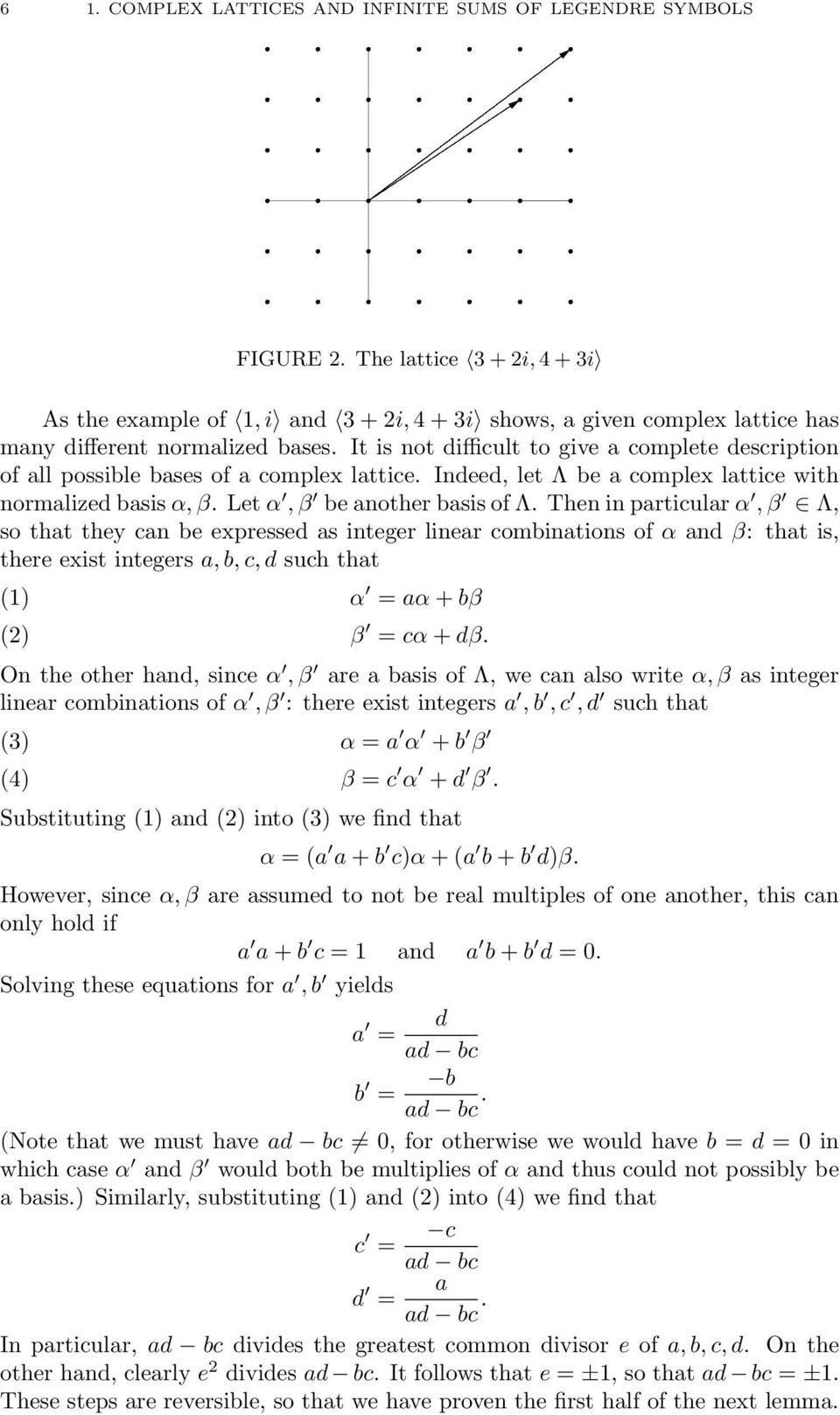
6 "# 89! 67 RS XY FG HI JK LM NO PQ 6 1. COMPLEX LATTICES AND INFINITE SUMS OF LEGENDRE SYMBOLS $% &' WV WV WV WV WV WV WV WV WV WV WV WV WV WV WV WV WV WV WV WV WV WV WV WV WV WV WV WV WV WV WV WV WV WV WV WV WV WV WV WV WV WV WV WV WV WV WV WV WV WV WV WV WV WV WV WV WV WV WV WV WV WV WV WV WV WV WV WV WV WV WV WV WV WV WV WV WV WV WV WV WV WV WV WV WV WV WV WV WV WV WV WV WV WV WV WV WV WV WV WV WV WV WV WV WV WV WV WV WV WV WV WV WV WV WV WV WV WV WV WV WV V WV V V V W V V WV V V WV V V V W V V WV V V WV V V WV V V WV V V V W V V WV V V WV V V V W V V WV W W W W W W W W W W W W W W W W W W W W W W W W W W W W WV W V V WV WV WV WV WV WV WV WV WV WV WV WV WV WV WV WV WV WV WV WV WV WV WV WV WV WV WV WV WV WV WV WV WV WV WV WV WV WV WV WV WV WV WV WV WV WV WV WV WV WV WV WV WV WV WV WV WV WV WV WV WV WV WV WV WV WV WV WV WV WV WV WV WV WV WV WV WV WV WV WV WV WV WV WV WV WV WV WV WV WV WV WV WV WV WV WV WV WV WV WV WV WV WV WV WV WV WV WV WV WV WV WV WV WV WV WV WV WV WV WV T T T T T T WV WV WV WV WV WV WV WV WV WV WV WV WV WV WV U U U U U U () *+,-./ :; <= BC DE FIGURE 2. The lattice 3 + 2i, 4 + 3i As the examle of 1, i and 3 + 2i, 4 + 3i shows, a given comlex lattice has many different normalized bases. It is not difficult to give a comlete descrition of all ossible bases of a comlex lattice. Indeed, let Λ be a comlex lattice with normalized basis α, β. Let α, β be another basis of Λ. Then in articular α, β Λ, so that they can be exressed as integer linear combinations of α and β: that is, there exist integers a, b, c, d such that (1) (2) α = aα + bβ β = cα + dβ. On the other hand, since α, β are a basis of Λ, we can also write α, β as integer linear combinations of α, β : there exist integers a, b, c, d such that (3) (4) α = a α + b β β = c α + d β. Substituting (1) and (2) into (3) we find that α = (a a + b c)α + (a b + b d)β. However, since α, β are assumed to not be real multiles of one another, this can only hold if a a + b c = 1 and a b + b d = 0. Solving these equations for a, b yields a d = ad bc b = b ad bc. (Note that we must have ad bc 0, for otherwise we would have b = d = 0 in which case α and β would both be multilies of α and thus could not ossibly be a basis.) Similarly, substituting (1) and (2) into (4) we find that c = c ad bc d a = ad bc. In articular, ad bc divides the greatest common divisor e of a, b, c, d. On the other hand, clearly e 2 divides ad bc. It follows that e = ±1, so that ad bc = ±1. These stes are reversible, so that we have roven the first half of the next lemma.
7 2. HOMOTHETY 7 Lemma 1.3. Let Λ be a comlex lattice and let α, β be a normalized basis of Λ. Let a, b, c, d Z satisfy ad bc = ±1. Then aα + bβ, cα + dβ is also a basis of Λ and every basis of Λ has this form for some a, b, c, d as above. It is a normalized basis if and only if ad bc = 1. Proof. It remains to rove the last statement. Set j = β/α and let x, y denote the real and imaginary art of j. We comute cα + dβ aα + bβ = c + dj a + bj (c + dj)(a + b j) = (a + bj)(a + b j) = ac + adj + bc j + bdj j a + bj 2 = (ac + adx + bcx + bd j 2 ) + (ad bc)yi a + bj 2. Here j = x yi is the comlex conjugate of j. We thus obtain the crucial formula ( ) c + dj ad bc (5) im = a + bj a + bj 2 im(j). Since im(j) > 0 by assumtion, this shows that aα + bβ, cα + dβ is still normalized if and only if ad bc is ositive, and thus if and only if ad bc = Homothety We now consider the question of determining all ossible shaes of lattices. Here we consider two comlex lattices Λ and Λ to have the same shae if one can be rotated and scaled to yield the other. (There is no need to consider translations since the origin gives a fixed common oint in each lattice.) We can take advantage of the arithmetic of the comlex numbers to give a remarkably simle descrition of this relationshi. To do this we need to consider rotations in the the comlex lane. Let x + yi be a comlex number and let θ be an angle. By simle trigonometry, one finds that the oint obtained from x + yi by rotating counterclockwise about the origin by the angle θ is (x cos θ y sin θ) + (x sin θ + y cos θ)i. This comlex number can also be written as (cos θ + i sin θ) (x + yi). By Euler s formula e iθ = cos θ + i sin θ we can further simlify this to e iθ (x + yi). That is, one can rotate a comlex number by an angle θ simly by multilying by e iθ. Suose now that Λ and Λ have the same shae. This should mean that there is a ositive real number r and an angle θ such that every element of Λ is obtained

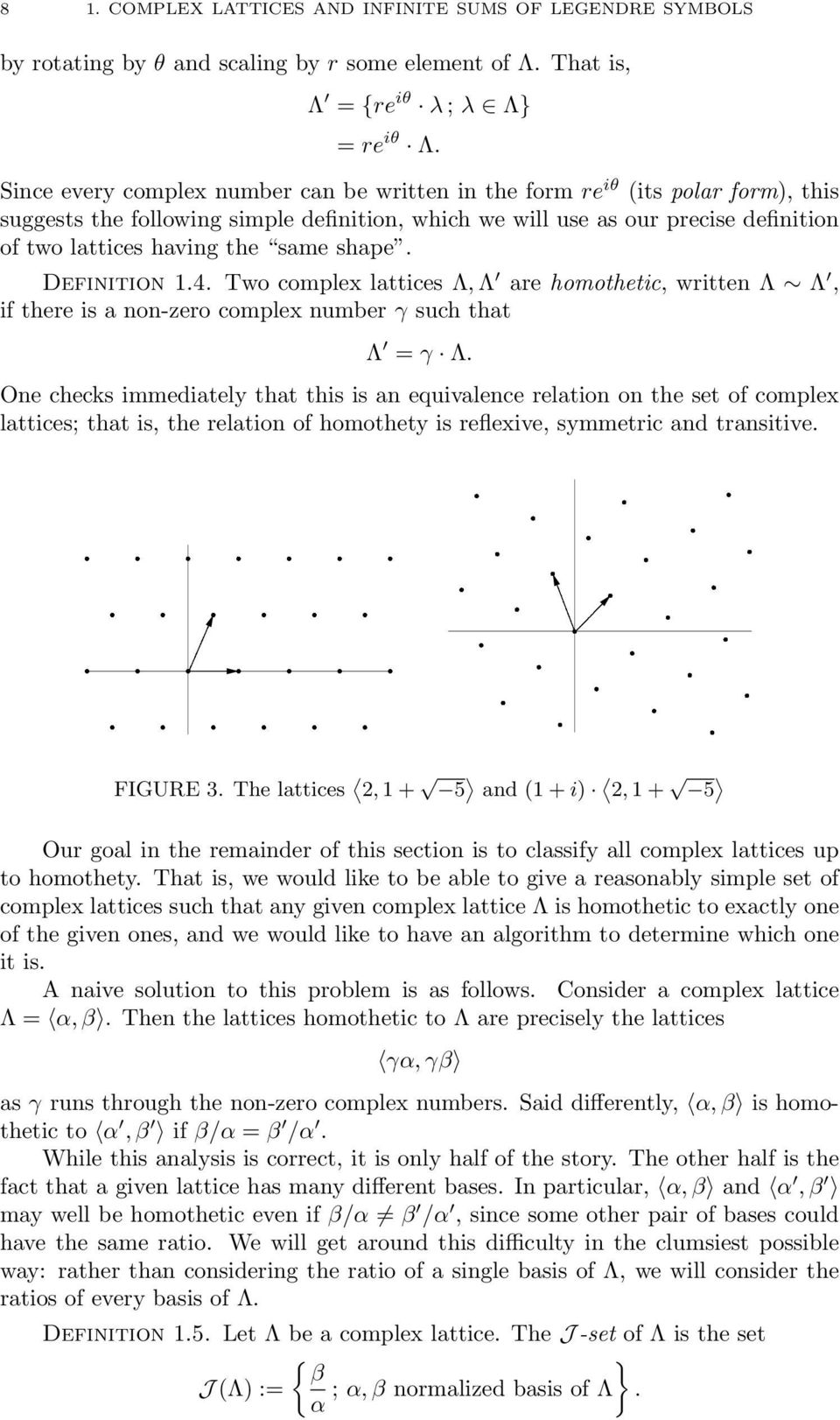
8 &' 23 $% 67 "# "# () ( 45,- &' * COMPLEX LATTICES AND INFINITE SUMS OF LEGENDRE SYMBOLS by rotating by θ and scaling by r some element of Λ. That is, Λ = {re iθ λ ; λ Λ} = re iθ Λ. Since every comlex number can be written in the form re iθ (its olar form), this suggests the following simle definition, which we will use as our recise definition of two lattices having the same shae. Definition 1.4. Two comlex lattices Λ, Λ are homothetic, written Λ Λ, if there is a non-zero comlex number γ such that Λ = γ Λ. One checks immediately that this is an equivalence relation on the set of comlex lattices; that is, the relation of homothety is reflexive, symmetric and transitive.!!!! ! "# /./././ $ % $ % () *+,-./ 01 FIGURE 3. The lattices 2, and (1 + i) 2, Our goal in the remainder of this section is to classify all comlex lattices u to homothety. That is, we would like to be able to give a reasonably simle set of comlex lattices such that any given comlex lattice Λ is homothetic to exactly one of the given ones, and we would like to have an algorithm to determine which one it is. A naive solution to this roblem is as follows. Consider a comlex lattice Λ = α, β. Then the lattices homothetic to Λ are recisely the lattices γα, γβ as γ runs through the non-zero comlex numbers. Said differently, α, β is homothetic to α, β if β/α = β /α. While this analysis is correct, it is only half of the story. The other half is the fact that a given lattice has many different bases. In articular, α, β and α, β may well be homothetic even if β/α β /α, since some other air of bases could have the same ratio. We will get around this difficulty in the clumsiest ossible way: rather than considering the ratio of a single basis of Λ, we will consider the ratios of every basis of Λ. Definition 1.5. Let Λ be a comlex lattice. The J -set of Λ is the set { } β J (Λ) := ; α, β normalized basis of Λ. α
9 2. HOMOTHETY 9 Note that J (Λ) is a subset of the set of all comlex numbers with ositive imaginary art. Let Λ be a lattice and choose a normalized basis α, β. Set j = β/α. We determined all ossible bases of Λ in Lemma 1.3, so that the J -set of Λ is simly (6) { cα + dβ J (Λ) = aα + bβ = } ; a, b, c, d Z, ad bc = 1 } { c + dj ; a, b, c, d Z, ad bc = 1 a + bj Taking (a, b, c, d) equal to (1, 0, 1, 1) and (0, 1, 1, 0) shows in articular that (7) j + 1, 1 j J (Λ). (Said differently, this corresonds to the simle fact that if α, β is a normalized basis of Λ, then so are α, α + β and β, α.) Of course, we could have started with a basis α, β of Λ giving rise to any ratio j J (Λ), so that the relation (7) holds for any element j J (Λ): that is, the set J (Λ) is closed under translation by 1 in the real direction (which is not difficult to visualize) and under negative recirocals (which is much harder to visualize). We give two examles of J -sets below.. FIGURE 4. J (1, i)

10 10 1. COMPLEX LATTICES AND INFINITE SUMS OF LEGENDRE SYMBOLS FIGURE 5. J (2, 1 + 5) The next lemma gives the sense in which J -sets are a (rather unsatisfactory) solution to the homothety classification roblem. It shows that two lattices are homothetic if and only if they have identical J -sets. Of course, it is not immediately clear how to verify that two J -sets are identical, so that this lemma is not immediately useful. Lemma 1.6. Let Λ be a comlex lattice. (1) Let j be a comlex number with ositive imaginary art. Then Λ 1, j if and only if j J (Λ). (2) Let Λ a second comlex lattice. Then Λ Λ J (Λ) = J (Λ ) J (Λ) J (Λ ). Proof. (1) Suose first that j J (Λ). Then there is a normalized basis α, β of Λ with j = β/α. Thus Λ = α, β = α 1, j 1, j. Conversely, if Λ 1, j, then there is a comlex number γ such that γ, γj is a normalized basis of Λ. Thus j = γj/γ lies in J (Λ), as desired. (2) Suose first that Λ Λ. Then there is a non-zero comlex number γ such that Λ = γ Λ, so that every normalized basis of Λ is obtained by scaling a normalized basis of Λ by γ. It follows that J (Λ) = J (Λ ). That the second condition imlies the third is obvious. Finally, suose that J (Λ) J (Λ ) and fix j in this intersection. Then by (1) we have as desired. Λ 1, j Λ, Lemma 1.6 roves much more than that homothetic lattices have identical J - sets: it shows that to show that two lattices are homothetic it suffices to find a

11 2. HOMOTHETY 11 single common element in their J -sets. In articular, if we could somehow ick out a articular element of the J -set, in a way which does not deend on the original lattice, then this single element would entirely describe the homothety class of lattices with this J -set. That is, we would like to define a comlex number j(λ) J (Λ) in some way that makes no reference to the lattice Λ but only to the set J (Λ). It will then follow from Lemma 1.6 that two lattices Λ, Λ are homothetic if and only if j(λ) = j(λ ). There are many ossible ways to do this. The one we choose is based on (7) and a visual insection of the J -sets for 1, i and 2, It aears in the examles that the elements of a J -set are clustered near the real axis, becoming more and more sarse as the imaginary art increases, until at some oint a maximum imaginary art is reached. We begin by roving this. Lemma 1.7. Let Λ be a comlex lattice. Then for any j Λ, the set is finite. {im(j ) ; j J (Λ), im(j ) > im(j) Proof. Recall that by (6) we have { } c + dj J (Λ) = ; a, b, c, d Z, ad bc = 1. a + bj By (5) we also have In articular, im ( ) c + dj 1 = a + bj a + bj 2 im(j). im ( ) c + dj > im(j) a + bj if and only if a + bj < 1. However, there are only finitely many integers a, b with this roerty. Indeed, a + bj 1 as soon as b 1/ im(j), while for each of the finitely many b with b < 1/ im(j) there are at most two values of a such that a + bj < 1. Any imaginary art in J (Λ) larger than im(j) must come from one of these finitely many airs (a, b), so that there are at most finitely many such imaginary arts. It follows from Lemma 1.7 that the (infinite) set {im(j) ; j J (Λ)} has a maximum element; indeed, we simly have to choose any j 0 J (Λ) and then select among the finitely many imaginary arts larger than that im(j 0 ). (Note that we are not asserting that there are only finitely many j J (Λ) with im(j) > im(j 0 ), but rather that among the ossibly infinitely many such j there are only finitely many different values of im(j).) Note that if j J (Λ) has maximum imaginary art, then certainly j 1 since otherwise 1/j J (Λ) would have larger imaginary art. Also, j + m J (Λ) also has maximum imaginary art for any m Z. In articular, in our effort to ick out a distinguished element of J (Λ), we might as well require that the real art is as small as ossible: we can certainly obtain a real art between 1 2 and 1 2. Being

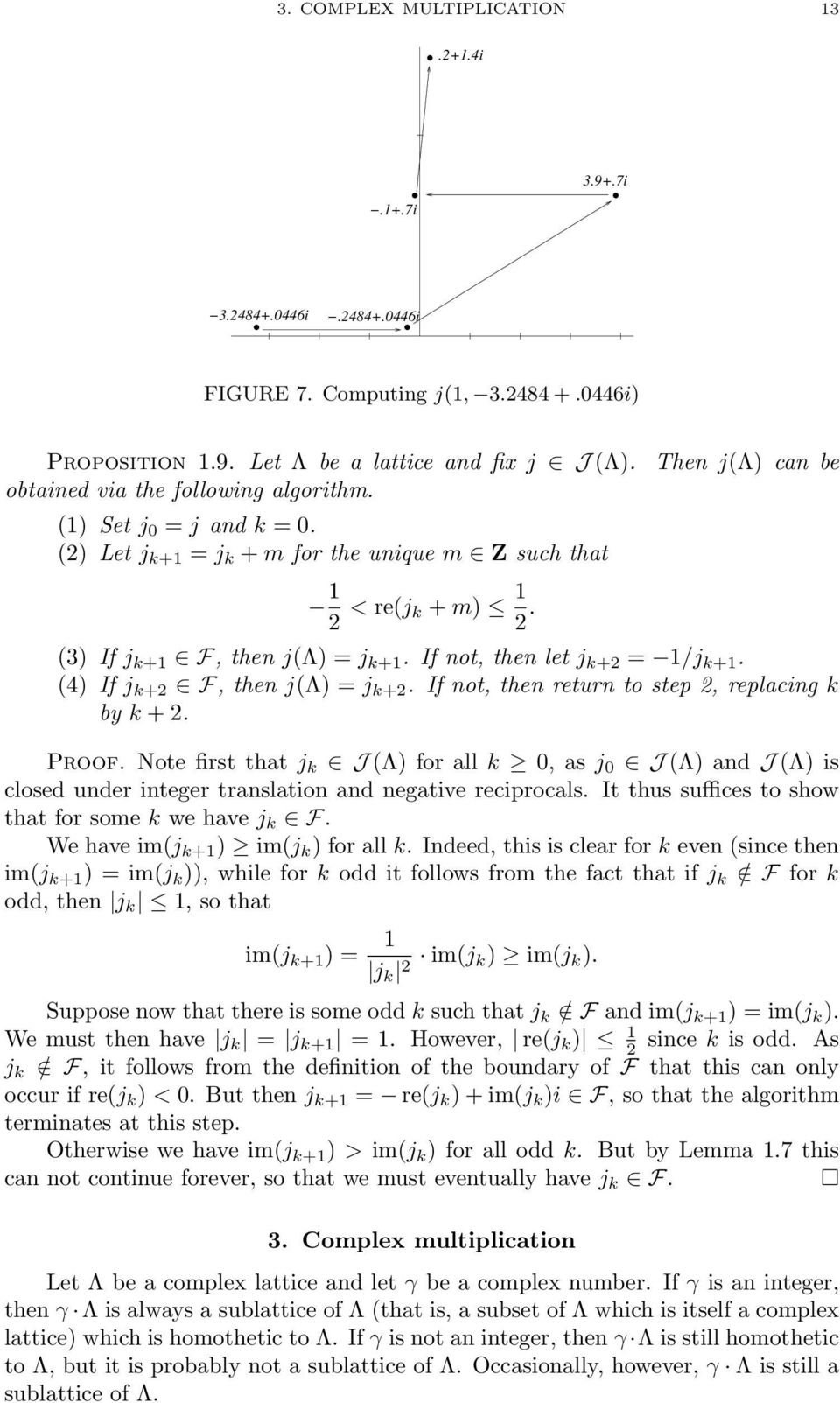
12 12 1. COMPLEX LATTICES AND INFINITE SUMS OF LEGENDRE SYMBOLS a bit careful about the boundaries, we are thus led to consider the region F C defined by F = {z C ; im(z) > 0, z 1, 12 < re(z) 12 } and re(z) 0 if z = Re(z)= z =1 Re(z)= 1 2 FIGURE 6. The domain F Proosition 1.8. Let Λ be a comlex lattice. consists of exactly one element, which we call j(λ). The intersection J (Λ) F Proof. We have seen above that J (Λ) F contains at least one element. Suose that it contains two elements j 1, j 2 ; we must show that j 1 = j 2. We may assume without loss of generality that im(j 1 ) im(j 2 ). There exist a, b, c, d Z, ad bc = 1, such that and thus as before im(j 1 ) = j 1 = c + dj 2 a + bj 2 1 a + bj 2 2 im(j 2). Thus a+bj 2 1. However, certainly im(j 2 ) 3/2 since j 2 F. Thus a+bj 2 3b/2, so that we can only have a + bj2 1 if b = 1, 0, 1. If b = 0, then a = ±1; as ad bc = 1, we thus must have d = a. Therefore j 1 = j 2 ± c. Since F does not contain any elements differing by a non-zero integer, it follows that j 1 = j 2, as desired. The cases of b = ±1 are similar and left to the exercises. Proosition 1.8 gives the first art of the classification of comlex lattices u to homothety: every comlex lattice is homothetic to a unique lattice of the form 1, j with j F (namely 1, j(λ) ), and no two lattices 1, j and 1, j with j, j F, j j are homothetic. Our last task is to give a comutational method for determining j(λ) for a lattice Λ. We will give an algorithm that allows one to comute j(λ) given any single element j J (Λ) (which in turn can be obtained as the ratio of a normalized basis of Λ).

13 3. COMPLEX MULTIPLICATION i.1+.7i i i i FIGURE 7. Comuting j(1, i) Proosition 1.9. Let Λ be a lattice and fix j J (Λ). obtained via the following algorithm. (1) Set j 0 = j and k = 0. (2) Let j k+1 = j k + m for the unique m Z such that Then j(λ) can be 1 2 < re(j k + m) 1 2. (3) If j k+1 F, then j(λ) = j k+1. If not, then let j k+2 = 1/j k+1. (4) If j k+2 F, then j(λ) = j k+2. If not, then return to ste 2, relacing k by k + 2. Proof. Note first that j k J (Λ) for all k 0, as j 0 J (Λ) and J (Λ) is closed under integer translation and negative recirocals. It thus suffices to show that for some k we have j k F. We have im(j k+1 ) im(j k ) for all k. Indeed, this is clear for k even (since then im(j k+1 ) = im(j k )), while for k odd it follows from the fact that if j k / F for k odd, then j k 1, so that im(j k+1 ) = 1 j k 2 im(j k) im(j k ). Suose now that there is some odd k such that j k / F and im(j k+1 ) = im(j k ). We must then have j k = j k+1 = 1. However, re(j k ) 1 2 since k is odd. As j k / F, it follows from the definition of the boundary of F that this can only occur if re(j k ) < 0. But then j k+1 = re(j k ) + im(j k )i F, so that the algorithm terminates at this ste. Otherwise we have im(j k+1 ) > im(j k ) for all odd k. But by Lemma 1.7 this can not continue forever, so that we must eventually have j k F. 3. Comlex multilication Let Λ be a comlex lattice and let γ be a comlex number. If γ is an integer, then γ Λ is always a sublattice of Λ (that is, a subset of Λ which is itself a comlex lattice) which is homothetic to Λ. If γ is not an integer, then γ Λ is still homothetic to Λ, but it is robably not a sublattice of Λ. Occasionally, however, γ Λ is still a sublattice of Λ.
14 TU RS VW *+ 23 BC $% 01 ()./ "# &',- () XY HI $% 01 &' $% "# FG NO,-./ BC JK HI PQ DE LM COMPLEX LATTICES AND INFINITE SUMS OF LEGENDRE SYMBOLS Definition Let γ be a comlex number which is not an integer. A comlex lattice Λ is said to have comlex multilication by γ if γ Λ is a sublattice of Λ. We also refer to Λ as a CM lattice and say that it has CM by γ. That is, a CM lattice is a lattice Λ which has a sublattice, different from the obvious sublattices n Λ for n Z, which is homothetic to Λ itself. The examles below show that 1, i has CM by i (note that in this case i 1, i actually equals 1, i. This is quite rare; see Exercise 1.3), 2, has CM by 5, and that 1, i does not have CM by i ! FIGURE 8. The lattices 1, i and i 1, i :; >?! &' () *+,-./ FIGURE 9. The lattices 2, and 5 2, 1 + 5! "# DE FG FG FG FG FG FG :; <= >? FIGURE 10. The lattices 1, i and i 1, i

15 3. COMPLEX MULTIPLICATION 15 One might guess that any lattice has CM by some γ, and that for any γ C Z there are many lattices with CM by γ. Surrisingly, this guess is very far from the truth. Lemma Let Λ be a comlex lattice with CM by γ. Then (8) γ = 1 2 (B ± B 2 4C) for some integers B, C with B 2 4C < 0. Proof. Let α, β be a basis for Λ. Since γ Λ is a sublattice of Λ, both γ α and γ β must lie in Λ. That is, there are integers a, b, c, d such that γ α = a α + b β γ β = c α + d β. (Note that this immediately imlies that γ is not real: if it were, then we must have b = 0 since β is not a real multile of α. But then γ = a is an integer, which is not allowed.) Thus Therefore so that γ = a + b β α γ = c α β + d. γ a b = c γ d γ 2 (a + d)γ + (ad bc) = 0. Taking B = a + d and C = ad bc and alying the quadratic formula now gives the above formula. We can imrove somewhat on Lemma By Exercise 1.2 a lattice Λ has CM by γ if and only if it has CM by γ + n for any integer n. If B in (8) is even, we thus may relace γ by (B ) 2 C, 2 while if B is odd we may relace γ by B2 4C 2 where B 2 4C 1 (mod 4). That is, it suffices to consider lattices with CM by numbers of the form 1 + n n or for n 3 (mod 4) 2 with n a ositive integer. For the remainder of this chater we will focus on the case of CM by n with n 1, 2 (mod 4) squarefree. The other case of secial interest is that of CM by 1+ n 2 for n 3 (mod 4) squarefree; we leave this case to the exercises. For n 1, 2 (mod 4) let Λ be a lattice with CM by n: that is, n Λ Λ.

16 16 1. COMPLEX LATTICES AND INFINITE SUMS OF LEGENDRE SYMBOLS If γ Λ is homothetic to Λ, then n (γ Λ) = γ ( n Λ) γ Λ so that γ Λ also has CM by n. That is, comlex multilication is reserved by homothety. It thus makes sense to look for all homothety classes of lattices with CM by n. Equivalently, since any lattice is homothetic to a unique lattice 1, j with j F, it is the same to find all j F such that 1, j has CM by n. This is an easy alication of the results of the revious section. We have n 1, j 1, j if and only if there exist integers a, b, c, d such that n = a + bj n j = c + dj. (The reason for the extraneous sign will become clear momentarily.) Thus j = a + n. b Solving the second equation for c we also find that ad + n + d a n = c. b b Since c is an integer and n is imaginary, this means that we must have a = d and a 2 + n must be divisible by b. The stes above are reversible, so that we have obtained the following theorem. Theorem Let n 1, 2 (mod 4) be a squarefree ositive integer. Then every lattice with CM by n is homothetic to a unique lattice of the form 1, a + n b with: (1) a, b Z; (2) 0 < b 2 n 3 ; (3) b < 2a b; (4) a 2 + n b 2 (and a 0 if a 2 + n = b 2 ); (5) b divides a 2 + n. Proof. We saw above that every lattice with CM by n is homothetic to a unique lattice 1, a+ n b with a, b Z, a 2 + n divisible by b and a+ n b F. The conditions (3) and (4) simly exress the latter fact. Condition (2) is in fact redundant (it is imlied by (3) and (4)) but is convenient to have written down anyway. Definition Let n be a squarefree ositive integer which is congruent to 1 or 2 modulo 4. We define the class grou Cl( n) to be the set of comlex numbers a+ n b satisfying the above conditions (1) (5). We will see later that Cl( n) indeed has a natural (although not at all obvious) structure of abelian grou. For the time being we content ourselves with the following fact. Corollary The class grou Cl( n) is finite.
17 4. L-SERIES 17 Proof. It is clear from (2) and (3) that there are at most finitely many airs of integers a, b satisfying the conditions (1) (5) of Theorem We define the class number h( n) to be the size of Cl( n): that is, it is the number of homothety classes of lattices with CM by n. (This is not really the otimal definition if n is not of the form we have been considering, which is why we have restricted to this case.) Examle We comute Cl( 5) using Theorem By (2) we must have 1 b 2 < 3. For b = 1 we must have a = 0 by (2). The air (0, 1) satisfies (4) 5 3 and (5), so that it yields one element of Cl( 5). For b = 2 we must have a = 0, 1 by (2), but only the air (1, 2) satisfies (5). Thus { 5, 1 + } 5 Cl( 5) = 2 so that h( 5) = 2. The first j-invariant corresonds to the rectangular lattice 1, 5, while the second corresonds to the lattice 2, of Figure 1. Examle We comute Cl( 14) using Theorem By (2) we have 1 b 2 < 5. For b = 1, by (3) we must have a = 0. The air (0, 1) satisfies 14 3 (4) and (5), so that this gives one element of Cl( 14). For b = 2 we must have a = 0, 1, but only (0, 2) satisfies (5). For b = 3 we must have a = 1, 0, 1, but only ( 1, 3) and (1, 3) satisfy (5). Finally, for b = 4 we have a = 1, 0, 1, 2, but none of these airs satisfy both (4) and (5). We conclude that and thus h( 14) = 4. { 14, 14 Cl( 14) =, , 1 + } For later reference we give a brief table of class numbers h( n) for selected squarefree n 1, 2 (mod 4). These are all easily comuted using Theorem 1.12 (and a comuter rogram for the last two). n h( n) L-series We now turn to something comletely different. For a squarefree integer n let ( ) n L( n) = 1 m m. ( ) Here is the extended Legendre symbol: for a rime 2, ( ) a = 1 a a non-zero square modulo 1 a not a square modulo 0 a

18 18 1. COMPLEX LATTICES AND INFINITE SUMS OF LEGENDRE SYMBOLS while ( a ) 1 a 1 (mod 8) = 1 a 5 (mod 8) 2 0 otherwise. ( ) (We give a unified definition of in Chater 4.) For a general ositive integer m = e1 1 er r we set a ( ( a a = m) 1 ) e1 ( ) er a. r The convergence of L( n) is far from obvious and quite slow; nevertheless, it does converge, as we will rove in Chater 4. For examle, we have L( 5) = Summing this for m one finds that L( 5) We include also a table of L( n) for several other values of n; the value given is the sum over m n L( n) In fact, there is a second interesting formula for L( n), L( n) = ( rime ), n as an infinite roduct over rimes. However, the only roofs of this formula of which the author is aware involve comlex analysis and are beyond the scoe of these notes. (We will almost, but not quite, rove this formula in Chater 4.) Let us return to the value L( 5) This number is close to, but slightly less than, the square root of 2. This is reminiscent of another famous coincidence of numbers: π is close to, but slightly less

19 4. L-SERIES 19 than, the square root of 10. At this oint we become curious and comute This is no accident. Theorem 1.17 (Dirichlet). π L( 5) = π 5. At this oint it is hard to resist comaring the values L( n) with to get the most striking result we ll throw in an extra factor of 2. π n. In fact, n L( n) L( n)/ π 2 n The numbers in the right-hand column are remarkably close to integers. In fact, they are remarkably close to integers we have seen before. Theorem 1.18 (Dirichlet). Let n 1, 2 (mod 4) be a squarefree integer greater than 1. Then L( n) = π 2 n h( n). The same formula holds for n 3 (mod 4), n > 3, with h( n) as in Exercise 1.5, excet that the factor of 2 in the denominator disaears. There are also similar formulas for n = 1, 3 with slightly different denominators. In fact, Dirichlet s formula for n = 1 reduces to the familiar formula π 4 = obtained from the ower series for tan 1 (x). This is one of the most remarkable and beautiful formulas in mathematics. In this chater we have given the fastest aroach to defining the relevant quantities in terms of comlex lattices and infinite sums. In order to actually rove the theorem, however, it is necessary to relate both sides to the arithmetic of the ring Z[ n]. This is the goal of the remaining chaters.

20 20 1. COMPLEX LATTICES AND INFINITE SUMS OF LEGENDRE SYMBOLS 5. Aendix: Lattice oints of bounded absolute value In this section we rove a result about lattice oints which will be crucial in Chater 5. We include the roof here since the result can be stated and roved entirely in the framework of comlex lattices. Let Λ = α, β be a comlex lattice. Let P denote the arallelogram with vertices at the origin, α, β, and α + β. Let A denote the area of P ; we leave it to the reader to check that A is indeendent of the choice of basis (although this fact will also follow from Lemma 1.19 below). Fix t > 0. Our goal is to estimate how many oints of Λ have absolute value at most t. Alternately, if C t = {z C ; z t}, then we wish to determine the size of Λ C t. It is not difficult to formulate a guess. For any λ Λ let P λ denote the translate of P by λ; it is a arallelogram congruent to P with one vertex at λ. Since C t has area πt 2 and since the arallelograms P λ tile the lane, we would exect C t to contain aroximately πt 2 /A of the translates P λ and thus aroximately πt 2 /A of the oints λ. Our goal in this section is to determine the error in this aroximation. P 1+ ϖ P 5 1+ ϖ P 5 3+ ϖ 5 P P0 P2 P 3 ϖ 5 P 1 ϖ 5 P1 ϖ 5 FIGURE 11. Some lattice arallelograms for 2, Lemma There is a constant C deending only on Λ such that #Λ C t πt2 A C t for all t 1. The recise value of the constant C will not be relevant in the alications. This is quite common when using estimates: the crucial thing is that the quantity we are counting grows like a constant times t 2 and the error grows like a constant times t, so that for large t the aroximation becomes relatively accurate. We note that this estimate does not hold for t near zero since the origin always lies in Λ C t. Nevertheless, this failure is uniquely uninteresting and will not be a roblem in the alications.

21 $% &' 67 () "# DE 45 FG! TU 23 HI 01 JK./ RS,- *+ 5. APPENDIX: LATTICE POINTS OF BOUNDED ABSOLUTE VALUE 21 Proof. Let n(t) = number of λ Λ C t n 1 (t) = number of λ Λ such that P λ C t n 2 (t) = number of λ Λ such that P λ intersects C t. (For Λ = 2, 1 + 5, the icture below shows that n(t) = 29, while n 1 (t) = 18 and n 2 (t) = 42.) LM NO PQ 89 :; <= BC FIGURE 12. 2, C 6 If P λ lies in C t, then certainly λ lies in C t ; similarly, if λ lies in C t, then certainly P λ intersects C t. Thus n 1 (t) n(t) n 2 (t). Since C t has area πt 2 it can not ossibly contain more than πt 2 /A disjoint translates of P, so that n 1 (t) πt2 A. Similarly, since the translates of P which intersect C t cover all of C t, we must have πt 2 A n 2(t). Unfortunately, these inequalities go the wrong way and do not allow us to say anything about n(t) itself. To remedy this, we erturb our circle slightly. Let δ denote the length of the longer diagonal of P. (In contrast to the area A, the length δ does deend on the choice of basis α, β, but this does not affect the roof below.) Then δ is the longest distance in P, so that for any λ Λ C t we must have P λ C t+δ ; that is, π(t + δ)2 n(t) n 1 (t + δ). A Similarly, if P λ intersects C t δ, then it (and in articular λ) must be contained in C t, so that π(t δ) 2 n 2 (t δ) n(t). A
22 22 1. COMPLEX LATTICES AND INFINITE SUMS OF LEGENDRE SYMBOLS Combining these inequalities we find that πt2 n(t) A π ( 2tδ + δ 2 ) C t A with C = π A (2δ + δ2 ). 6. Exercises Exercise 1.1. Comlete the roof of Lemma 1.8. Exercise 1.2. Show that a lattice Λ has CM by γ C Z if and only if it has CM by γ + n for all n Z. Exercise 1.3. Find all homothety classes of lattices Λ for which there exist γ C Z with γ Λ = Λ. Exercise 1.4. Comute the class grou Cl( 26). Exercise 1.5. Fix a squarefree ositive integer n 3 (mod 4). Show that the lattice 1, j with j F has CM by ϖ n if and only if j = a + n b where (1) a, b Z with a odd and b even; (2) 0 < b 2 n 3 ; (3) b < 2a b; (4) a 2 + n b 2 (and a 0 if a 2 + n = b 2 ); (5) 2b divides a 2 + n. We define the class grou Cl( n) in this case to be the set of comlex numbers of the form a+ n b with a, b as above. Exercise 1.6. Comute the class grou Cl( 23). Exercise 1.7. Comute the class grou Cl( 163). Exercise 1.8. Determine for which rimes the lattice 1, i has a oint of absolute value. Exercise 1.9. (1) Determine for which rimes 100 the lattice 1, 5 has a oint of absolute value. (2) Determine for which rimes 100 the lattice 2, has a oint of absolute value 2. Any conjectures?
23 CHAPTER 2 Ideal factorizations 1. Algebraic integers Fix a squarefree ositive integer n. Our goal in this section is to study factorization in the field Q( n) = {a + b n ; a, b Q}. Of course, every non-zero element of a field is a unit, so that this analysis is rather silly for Q( n) itself. Motivated by the classic examle of the integers Z inside the field Q, we should instead attemt to define a certain natural subring of Q( n) and develo a theory of factorization in this subring. The most obvious choice for subring is of course Z[ n] = {a + b n ; a, b Z}. However, this definition is rather arbitrary, and, as we will see, this ring is not always quite as large as we will need. To define the rings we wish to study, we focus on quadratic equations. Secifically, any α = a + b n Q( n) is a root of the quadratic olynomial x 2 2ax + (a 2 + nb 2 ) with rational coefficients. We will call this olynomial the characteristic olynomial of α. If α is irrational (that is, if b 0), then by Exercise 2.2 this is the unique quadratic monic olynomial with rational coefficients having α as a root; if α is rational, then it is simly (x α) 2. If α actually lies in Z[ n], then the characteristic olynomial of α has integer coefficients rather than merely rational coefficients. However, if n 3 (mod 4), then are are other elements of Q( n) whose characteristic olynomials have integer coefficients: namely those with 2a, 2b Z and 2a 2b (mod 2). (See Exercise 2.3.) These are the extra element we will need. Definition 2.1. The ring of algebraic integers O n of Q( n) is the set of all α Q( n) such that the characteristic olynomial of α has integer coefficients. We have seen above that { {a + b n ; a, b Z} n 1, 2 (mod 4); O n = {a + b n ; 2a, 2b Z, 2a 2b (mod 2)} n 3 (mod 4). In each case O n is actually closed under addition and multilication, so that it is a ring. It will sometimes be convenient to use a slightly different descrition of O n. Set { n n 1, 2 (mod 4) ϖ n = 1+ n 2 n 3 (mod 4). 23
24 24 2. IDEAL FACTORIZATIONS Then one checks immediately that for any n we have O n = {a + bϖ n ; a, b Z}. The coefficients of the characteristic olynomial of α O n are extremely useful invariants. Definition 2.2. For α O n, the norm N(α) and trace tr(α) of α are the coefficients of the characteristic olynomial of α. x 2 tr(α)x + N(α) Thus, if α = a + b n, then tr(α) = 2a and N(α) = a 2 + nb 2. Alternately, if α = a + bϖ n with a, b Z, then { 2a n 1, 2 (mod 4); tr(α) = 2a + b n 3 (mod 4); { a 2 + nb 2 n 1, 2 (mod 4); N(α) = a 2 + ab + 1+n 4 b2 n 3 (mod 4). In order to rove the basic roerties of the norm and trace it is convenient to introduce conjugation. Definition 2.3. For α = a + b n O n, the conjugate ᾱ of α is defined by ᾱ = a b n O n. Note that the characteristic olynomial of α factors as In articular, we have x 2 2ax + (a 2 + nb 2 ) = (x α)(x ᾱ). tr(α) = α + ᾱ and N(α) = α ᾱ. Lemma 2.4. For α, β O n we have Proof. The ma tr(α + β) = tr(α) + tr(β) N(α β) = N(α) N(β). O n O n α ᾱ sending α O n to its conjugate ᾱ is easily checked to be a homomorhism: that is, α + β = ᾱ + β Thus α β = ᾱ β. N(α β) = (αβ) (αβ) = (αβ) (ᾱ β) = (αᾱ) (β β) = N(α) N(β). The roof for the trace is similar.
25 2. IRREDUCIBLES IN Z[ 5] 25 The norm is very useful for transferring multilication roblems from O n to the integers Z. Its key roerties are summarized in the next lemma. Recall that for α, β O n we say that α divides β, written α β, if there exists γ O n such that β = γ α. An element α O n is a unit if it divides 1, while it is irreducible if it is not a unit and if for any factorization α = β γ with β, γ O n, one of β, γ is a unit. Lemma 2.5. (1) If α β in O n, then N(α) N(β) in Z. (2) α O n is a unit if and only if N(α) = 1. (3) If N(α) is rime in Z, then α is irreducible in O n. Note that the converse of (1) need not be true: if N(α) N(β), it is not necessarily true that α β. We will also see that the converse of (3) need not be true either: there are many irreducible elements with comosite norm. Proof. (1) If β = α γ, then N(β) = N(α) N(γ), so that N(α) N(β). (2) If α O n is a unit, then by (1) we have that N(α) divides 1 in Z, so that N(α) = ±1. However, N(α) is visibly ositive, so that we must thus have N(α) = 1. Conversely, if N(α) = 1, then α ᾱ = 1, so that α is a unit. (3) By (1) and (2) any factorization of α into non-units gives a factorization of N(α) into non-units. In articular, if N(α) is rime, then α itself can not factor in O n. It is now a simle matter to determine all units in O n. Corollary 2.6. For n = 1 the units in O n are {±1, ±i}. For n = 3 the units in O n are {±1, ±ω, ±ω 2 } with ω = For all other n, the only units in O n are {±1}. Proof. Let α = a + b n be a unit in O n. We have N(α) = a 2 + nb 2 = 1. If n 1, 2 (mod 4) then we have a, b Z, so that this can only occur if a = ±1, b = 0 (corresonding to the units ±1) or if n = 1, a = 0, b = ±1 (corresonding to the units ±i of Z[i]). If n 3 (mod 4), then we have (2a) 2 + n(2b) 2 = 4 with 2a, 2b Z. If n > 3 then the only solutions of this equation are again a = ±1, b = 0. When n = 3 we also have the solutions a = ± 1 2, b = ± 1 2. We leave it to the reader to check that these yield the four additional units of O 3 given above. 2. Irreducibles in Z[ 5] When n 3 it is well-known that the ring O n has unique factorization. The situation becomes more comlicated beginning with n = 5. In this section we consider some examles in the ring of algebraic integers Z[ 5] of Q( 5). We first list the irreducibles with small norm in Z[ 5]. Recall that two elements α, β are said to be associates if their ratio is a unit. Since the only units of Z[ 5] are ±1, this merely corresonds to negation in this case. We list below only one reresentative of each air of associate irreducibles.
26 26 2. IDEAL FACTORIZATIONS N irreducibles of norm N , , 2 5, , , 1 2 5, 4 + 5, , , , , 2 3 5, 7 Note that it is not difficult to construct such a table inductively; for examle, if were to factor, it would have to factor into elements of norm 3 and 7; since such elements do not exist in Z[ 5], it follows that must be irreducible. The table above raises many questions. Why do the rimes 29 and 41 factor in Z[ 5], while 3, 7, 11, 13, 17, 19, 23, 31, 37, 43 do not? (The rime 5 is obviously a secial case; in fact, so is 2, although not as obviously.) For some rimes this is easy to answer. Secifically, suose that a rime 2, 5 factors in Z[ 5]: = (a + b 5) (a b 5) with a, b Z. In articular, = a 2 + 5b 2, so that a 2 5b 2 (mod ). Clearly 0 < a, b < ; thus we may divide by b 2 to obtain (ab 1 ) 2 5 (mod ). Thus if factors in Z[ 5], then 5 is a square modulo, as we have exhibited its square root. Using quadratic recirocity one can show that this is the case if and only if 1, 3, 7, 9 (mod 20). Thus any rime 11, 13, 17, 19 (mod 20) can not ossibly factor in Z[ 5]. In articular, this exlains why 11, 13, 17, 19, 31, 37 are irreducible in Z[ 5]. This still leaves the rimes 3, 7, 23, 43. Here the reasons behind the failure to factor are much more subtle. The argument above is not reversible, so that there is no guarantee that these rimes must factor; this is fortunate, as we know that they do not. It is exactly the failure of these rimes to factor which causes unique factorization to fail, as we will see. We turn now to the classic counterexamle to unique factorization in Z[ 5]. The element 6 has norm 36 = and thus could factor as either a roduct of an element of norm 4 and of norm 9 or as two elements of norm 6. In fact, both ossibilities do occur: 6 = 2 3 = (1 + 5) (1 5). Since all irreducibles above are not associate to one another, this gives two different factorizations of 6 into irreducibles in Z[ 5], so that Z[ 5] does not have unique factorization.
27 3. IDEALS 27 In articular, this aears to give a counterexamle to the fundamental theorem of arithmetic: 2 divides the roduct (1 + 5) (1 5) and has no non-unit common divisors with 1 5, yet 2 does not divide The key observation, however, is that, while 2 and 1+ 5 have no common divisors, they are not really relatively rime. Recall that if a, b are relatively rime integers, then there exist integers x, y such that ax + by = 1. This is not true with the aarently relatively rime elements 2, in Z[ 5]: there are no x, y Z[ 5] such that 2x + (1 + 5)y = 1. (See Examle 2.8 below.) If we attemt to instead define the greatest common divisor of 2, as the smallest (in norm) element of Z[ 5] which can be exressed as a linear combination of 2 and we run into other roblems: 2 is the smallest such element, but there are other linear combinations (like 1+ 5) which are not divisible by 2. We have now seen that a fundamental failing of Z[ 5] is that we can find no element which has all the roerties of the greatest common divisor of 2 and 1 + 5: there is no element which simultaneously divides all common divisors of 2 and and can be written as a linear combination of 2 and The solution to this roblem is absurdly simle: instead of attemting to ick out a smallest linear combination of 2 and 1 + 5, we will consider the set of all linear combinations: (2, 1 + 5) := { 2x + (1 + 5)y ; x, y Z[ 5] }. This is an examle of an ideal of Z[ 5]. It is not an element of Z[ 5], but rather is a set of elements which is closed under certain oerations. We will see below that it behaves exactly like the greatest common divisor of 2 and Ideals Fix once again a squarefree ositive integer n. Definition 2.7. An ideal I of O n is a subset of O n such that: (1) if α, β I, then α + β I; (2) if α O n and β I, then α β I; (3) there is at least one non-zero element α in I. (Usually the last axiom is not included in the definition of an ideal; for our uroses, however, we refer to exclude the zero ideal.) Note that we require than an ideal I is not merely closed under multilication of its own elements, but under multilying its elements by any element of O n. The fundamental examle is the following: if α 1,..., α r are elements of O n, then the ideal (α 1,..., α r ) generated by α 1,..., α r is the set of all O n -linear combinations of the α i : (α 1,..., α r ) := {α 1 x α r x r ; x i O n }. (We leave it to the reader to check that this really is an ideal of O n so long as at least one of the α i is non-zero.) This ideal should be thought of as the greatest common divisor of α 1,..., α r. As we shall see, ideals are very well-suited for questions involving factorizations. To give one examle, if α and β are associates, then the ideals (α) and (β) are identical. Later, when we consider factorizations into ideals, this will mean that
28 28 2. IDEAL FACTORIZATIONS the annoying unit issue (that is, that factorizations are only determined u to ±1 in Z and u to owers of i in Z[i]) will not come u. Examle 2.8. Consider the ideal (2, 1 + 5) of Z[ 5]. A Z[ 5]-linear combination of 2 and has the form 2(a + b 5) + (1 + 5)(c + d 5) = (2a + c 5d) + (2b + c + d) 5 for a, b, c, d Z. It is not difficult to see that we can choose a, b, c, d to obtain any element α = e + f 5 of Z[ 5] such that e f (mod 2). Thus (2, 1 + 5) = {e + f 5; e, f Z, e f (mod 2)}. Examle 2.9. Consider the ideal (2, 5) of Z[ 5]. Note that 1 = is a linear combination of 2 and 5 and thus lies in (2, 5). Since an ideal is also closed under multilication by any element of Z[ 5], and every element of Z[ 5] is a multile of 1, it follows that (2, 5) = (1) = Z[ 5]. In other words, the elements 2 and 5 really are relatively rime in the strong sense in Z[ 5]. An ideal I is said to be rincial if there exists a single element α I such that I = (α). (Thus a rincial ideal is simly the set of all multiles of a fixed element α.) Examle We claim that the ideal (29, 13 5) of Z[ 5] is rincial with generator To see this, we must show that (9) (29, 13 5) ( ) and (10) ( ) (29, 13 5). Since (3+2 5) is the set of multiles of 3+2 5, for (9) this amounts to checking that divides both of 29 and 13 5 (for then every linear combination will also be divisible by ), which it does: 29 = ( ) (3 2 5) 13 5 = ( ) (1 5). For (10) it suffices to exhibit as a linear combination of 29 and 13 5, for then every multile of can also be exressed as a linear combination of 29 and The required exression is simly: = (13 5) ( 2). This examle shows that, unlike the elements 2 and 1 + 5, the elements 29 and 13 5 do have a well-behaved greatest common divisor in Z[ 5], namely, We now consider some basic oerations with ideals. It is imortant to note that any useful definition must deend only on the underlying set of the ideal, and not on a articular choice of generators. Of course, after this is done we will obtain a formula for the oeration in terms of generators; the key requirement is that this formula gives the same underlying ideal for any choice of generators. By alying
29 3. IDEALS 29 this formula in the secial case of rincial ideals we should be able to determine what oeration on elements the ideal oeration is a generalization of. Let I, J be ideals of O n. The simlest oeration on ideals is the sum: I + J = {α + β ; α I, β J}. One checks immediately from the definitions that I + J is an ideal of O n ; in fact, if I = (α 1,..., α r ) and J = (β 1,..., β s ), then I + J = (α 1,..., α r, β 1,..., β s ). In articular, if I = (α) and J = (β) are rincial, then I + J = (α, β) is the greatest common divisor of α and β. That is, addition of ideals corresonds not to addition of elements (there is no oeration on ideals which corresonds to addition of elements), but instead to the greatest common divisor. The roduct of ideals is slightly more subtle. Indeed, the natural guess {α β ; α I, β J} need not be closed under addition and thus may not actually be an ideal. We rectify this roblem in the simlest ossible way: we close it u under addition. That is, define I J = {α 1 β α m β m ; m 1, α i I, β i J} as the set of all sums of roducts of elements of I and J. This time closure under addition is automatic (you simly need to increase m to combine two elements), as is strong closure under multilication. If I = (α 1,..., α r ) and J = (β 1,..., β s ), then I J is generated by the roducts α i β j for 1 i r and 1 j s. In articular, if I = (α) and J = (β) are rincial, then I J = (α β). Thus the roduct of ideals does corresond to the usual roduct of elements. Note that multilication of ideals is visibly commutative and associative. The unit ideal O n = (1) acts as an identity element: I O n = I for any ideal I. The next lemma is immediate from the definitions. Lemma Let I, J be ideals of O n. Then I J I. Note that this lemma is oosite our usual intuition: multiles of an ideal are in fact smaller (as sets) than the original ideal. Also, Lemma 2.11 shows that the set of ideals of O n do not form a grou under multilication: if I O n is a non-unit ideal, then I J I O n for any ideal J, so that we can not ossibly find an inverse for I. Examle Consider the ideals of Z[ 5]. We comute I 2 = (2, 1 + 5) I 2 = (2, 1 5) I 3 = (3, 1 + 5) I 3 = (3, 1 5) I 2 I 2 = (4, , 2 2 5, 6) = (2) since 2 = 6 4 lies in I 2 I 2 and divides each of the generators. Similarly, I 3 I 3 = (9, , 3 3 5, 6) = (3).
30 30 2. IDEAL FACTORIZATIONS On the other hand, I 2 I 3 = (6, , , ) = (1 + 5) and I 2 I 3 = (6, 2 2 5, 3 3 5, 4 2 5) = (1 5). We claim that these calculations exlain the equation 2 3 = (1 + 5) (1 5). Indeed, reinterreting this equation as an equality of roducts of ideals, the four ideals above give a refinement of these factorizations: (I 2 I 2) (I 3 I 3) = (I 2 I 3 ) (I 2 I 3) in which the same factors aear on both sides. The counterexamle to unique factorization arises from regrouing the four non-rincial ideals to give different rincial ideals. Thus unique factorization is reaired once we allow factorizations into ideals and not merely into elements. (In the interest of full disclosure, we should mention that in fact I 2 = I 2; this has no effect on our above analysis, however.) Our next goal is to rove this in general. 4. Unique factorization of ideals We now work towards a roof of unique factorization of ideals of O n. Let I and J be ideals of O n. We say that I divides J, written I J, if there exists an ideal K such that I K = J. Lemma 2.11 shows that if I J, then J I. Our first task is to rove that the converse of this is true as well. For this we need the following key lemma. Lemma Let I be an ideal of O n. Define an ideal Ī by Ī = {ᾱ ; α I}. Then I Ī is rincial. In fact, there is an integer d such that I Ī = (d). Proof. Note that for any non-zero α I, the roduct αᾱ is a ositive integer in I Ī. In articular, I Ī contains ositive integers; we define d to be the least ositive integer in I Ī. We claim first that d divides every other rational integer in I Ī. Indeed, if an integer e lies in I Ī, then by closure under addition and strong closure under multilication so does the remainder e dq, 0 e dq < d, when e is divided by d. As d is assumed to be the smallest ositive integer in I Ī, this remainder must vanish, so that d divides e. We claim that I Ī = (d). The fact that (d) is a subset of I Ī is immediate from the definitions and the fact that d I Ī. To rove the other direction, since an arbitrary element of I Ī is a sum of roducts α β with α, β I, it suffices to show that any such α β is divisible by d in O n. Consider the element α β/d of Q( n). We have ( ) α β tr = 1 d d (α β + ᾱβ) Z since α β + ᾱβ is an integer lying in I Ī and thus is divisible by d. Similarly, ( ) α β N = αᾱ d d β β d Z. In articular, the characteristic olynomial of α β/d has integer coefficients, so that α β/d lies in O n by definition. Thus d divides α β in O n, as desired.
31 4. UNIQUE FACTORIZATION OF IDEALS 31 In the above roof it is crucial that we use the full ring of algebraic integers O n and not its subring Z[ n] when n 3 (mod 4). Indeed, we will see in Exercise 2.5 that the ideals of Z[ n] do not ossess unique factorization in this case. Proosition let I, J be ideals of O n. Then I J if and only if J I. Proof. We have already seen that if I J then J I. For the converse, assume that J I. Let d be the ositive integer such that I Ī = (d). Note that d divides any element of J Ī I Ī, so that { K := dī 1 J = } 1 d ᾱi β i ; α i I, β i J Q( n) is in fact a subset of O n. One checks easily that K is an ideal of O n. We comute I K = 1 d I Ī J = 1 d (d) J = (1) J. (We leave it to the reader to justify this last line of calculations.) Thus I divides J, as claimed. We can also use Lemma 2.13 to develo a theory of norms of ideals. Secifically, for an ideal I we define the norm N(I) to be the ositive integer d such that I Ī = (d). The next lemma is then immediate from the definitions. Lemma (1) N(I J) = N(I) N(J) for any ideals I, J of O n. (2) If I = (α) is a rincial ideal, then N(I) = N(α). Now that we have a good divisibility theory for ideals we should define an aroriate notion of rime ideals. We do this in the usual way. Definition An ideal I of O n is rime if it is not the unit ideal and if its only ideal divisors are the unit ideal and itself. We can use Proosition 2.14 to rove the ideal analogue of the fundamental theorem of arithmetic. Lemma A non-unit ideal I of O n is rime if and only if it has the roerty that whenever I divides a roduct J K, then I divides at least one of J and K. Proof. Suose first that I has the roerty above and let J be an ideal dividing I; thus there is an ideal K such that I = J K. Our hyothesis on I thus imlies that I must divide either J or K. If I divides J, then we must have I = J since I J and J I. If I divides K, then similarly I = K, so that J = O n by cancellation (Exercise 2.6). Thus the only ossible divisors of I are O n and I, so that I is rime. Conversely, suose that a rime ideal I divides a roduct J K. By Proosition 2.14 the ideal I + J certainly divides both I. In articular, since I is rime, I + J must equal either O n or I. If I + J = I, then J is contained in I, so that I divides J. To comlete the roof we must show that if I + J = O n, then I divides K. Fix k K. Since I + J = O n and 1 O n, we may choose i I and j J such that i + j = 1. Since I contains J K, the roduct jk lies in I. As jk = (1 i)k = k ik
32 32 2. IDEAL FACTORIZATIONS and ik lies in I, it follows that k I. Thus I contains K, so that I divides K by Proosition We have seen that every ideal of O n divides the rincial ideal generated by some integer (namely, its norm). The exected strengthening of this for rime ideals is not difficult. Lemma Let I be a rime ideal of O n. Then there is a rime number such that I divides (). Proof. Let d denote the norm of I, so that I divides (d). Decomosing d as a roduct of integer rimes, we find that I divides ( 1 ) ( r ) for some (not necessarily distinct) integer rimes 1,..., r. Since I is rime, it follows that I must divide ( i ) for some i. The next roosition thus gives (almost) all rime ideals of O n. (See Exercise 2.10 for the case of = 2.) Proosition Let be an odd rime. Then in O n we have ( ) n () = 1; () = (, a + n)(, a ( ) n n) = 1, a Z such that a 2 n (mod ); (, ( ) n) 2 n = 0 where each ideal on the right-hand side is rime. In the latter two cases the two factors on the right each have norm (while the ideal () itself has norm 2, of course). ( Proof. Assume first that ) n = 1. To show that () itself is rime, let I be a non-unit ideal dividing (); we must show that I = (). If not, then there exists an element α = a + bϖ n I which is not divisible by. Note first that I has norm : indeed, N(I) divides N() = 2 and can not equal 2 since I (). In articular N(α), which lies in I Ī, must be divisible by ; that is, a 2 + nb 2 if n 1, 2 (mod 4) or a 2 + ab + 1+n 4 b2 if n 3 (mod 4). In either case we must have b, since if b we also have a so that α. In the first case we then find that ( ab 1 ) 2 n (mod ) while in the second ( 2ab ) 2 n (mod ). ( ) n This contradicts the assumtion that = 1, so that we must in fact have I = (). Thus () is rime ( ) in this case. Assume next that = 1. Choose a Z such that a 2 n (mod ). Then n (, a + n)(, a n) = ( 2, a + n, a n, a 2 + n) = ()
33 4. UNIQUE FACTORIZATION OF IDEALS 33 since 2 and 2a lie in this roduct and a is not divisible by. This gives the desired factorization. Since () has norm 2 and both of these ideals are roer divisors of (), they must ( both) have norm and thus must be rime. Finally, suose that = 0, so that divides n. Then n (, n) 2 = ( 2, n, n) = () since divides n and n is squarefree. The same argument as above shows that (, n) must be rime of norm. At this oint the roof of unique factorization of ideals follows the usual attern. Theorem Let I be a non-unit ideal of O n. Then there exist rime ideals I 1,..., I r such that I = I 1 I r. The ideals I 1,..., I r are unique u to reordering. Proof. We roceed by induction on N(I). If I is rime, then we simly take r = 1 and I 1 = I. If I is not rime, then by definition I has a divisor J different from O n and I. Let K be the ideal such that I = JK. We must have N(J), N(K) < N(I), so that by the induction hyothesis both J and K factor as a roduct of rime ideals. Taking the roduct of these factorizations gives the desired factorization of I. To see uniqueness, we again roceed by induction on N(I). Let I be an ideal of smallest norm which has two different factorizations into rime ideals: I = I 1 I r = J 1 J s. In articular, the rime ideal I 1 divides J 1 J s, so that I 1 divides J j for some index j. But J j is also rime, so that this forces I 1 = J j. Canceling these ideals from each side we obtain I 2 I r = J 1 J j 1 J j+1 J s. But these roducts have norm less than N(I), so that they must coincide by the induction hyothesis. It follows that the two original factorizations of I were identical as well. Examle Let us factor the rincial ideal ( ) in Z[ 5]. This ideal has norm N( ) = = As the ideals (2), (3), (5), (7) all factor, while (11) is already rime, it follows that we must have ( ) = I 2 I 3 I 5 I 2 7 (11) where I 2, I 3, I 5 and I 7 have norm 2, 3, 5 and 7 resectively. (We can not have the two different rime ideals of norm 7 occurring, as their roduct equals (7); thus (7) would divide ( ), so that 7 would divide , which it does not.) There are unique rime ideals of norm 2 and 5, so that to comlete the factorization we must determine which ideal of each air divides ( ). (3, 1 5), (3, 1 + 5) (7, 3 5), (7, 3 + 5)
34 34 2. IDEAL FACTORIZATIONS For this we must work a bit harder. Recall that (2, 1 + 5) (3, 1 5) = (1 5) (2, 1 + 5) (3, 1 + 5) = (1 + 5). Since we know (2, 1 + 5) divides ( ), we can determine which of the rimes of norm 3 divide ( ) by determining which of 1 5 and divide In fact, it is 1 5, so that (3, 1 5) divides ( ). Similarly, (2, 1 + 5) (7, 3 5) = (3 5) (2, 1 + 5) (7, 3 + 5) = (3 + 5) and divides , so that (7, 3 + 5) divides ( ). Thus ( ) = (2, 1 + 5) (3, 1 5) ( 5) (7, 3 + 5) 2 (11) is the factorization into rime ideals. 5. Exercises Exercise 2.1. Verify that Q( n) is a field. Exercise 2.2. If a, b Q and b 0, verify that the olynomial x 2 + 2ax + (a 2 +nb 2 ) is the unique monic quadratic olynomial with rational coefficients having a + b n as a root. Exercise 2.3. Verify that a+b n with a, b Q has characteristic olynomial with integer coefficients if and only if a, b Z or n 3 (mod 4), 2a, 2b Z and 2a 2b (mod 2). Exercise 2.4. Let n be a squarefree ositive integer. An order in O n is a subring of O n which contains at least one irrational number. Let R be an order in O n. Show that there is a ositive integer f (called the conductor of R) such that R = {a + fbϖ n ; a, b Z}. Exercise 2.5. Let n 3 (mod 4) be a squarefree ositive integer and consider the order Z[ n] of conductor 2 in O n. Let I denote the ideal (2, 1 + n) of Z[ n]. Show that I 2 = (2) I and conclude that unique factorization of ideals in Z[ n] fails. (In fact, the ideals of the order of conductor f relatively rime to f do have unique factorization, although we do not rove this here.) Exercise 2.6. Prove cancellation for ideals: if I, J, K are ideals of O n such that I K = J K, then I = J. Exercise 2.7. Use factorization into ideals to exlain the counterexamle to unique factorization in Z[ 6]. 55 = (7 + 6) (7 6) Exercise 2.8. Show that the two rime factors of (101) in Z[ 5] are rincial. Exercise 2.9. Let I be the ideal (3, ) in Z[ 14]. Show that I 4 is rincial but I, I 2, I 3 are not.
35 5. EXERCISES 35 Exercise Let n be a squarefree ositive integer. Show that the ideal (2) factors into rime ideals as follows: (2, 1 + n) 2 n 1 (mod 4); (2, n) 2 n 2 (mod 4); (2) = (2) n 3 (mod 8); (2, ϖ n ) (2, 1 + ϖ n ) n 7 (mod 8). Exercise Use the ideal factorization of Examle 2.21 to find all factorizations of into irreducibles in Z[ 5]. Exercise Factor the rincial ideal ( ) into rime ideals in Z[ 5].
36
37 CHAPTER 3 Ideals and lattices In the examles of the revious lecture, we reeatedly saw that a roduct of non-rincial ideals of Z[ 5] is actually rincial. In fact, this is always true in Z[ 5]. This fact can be interreted as imlying that the failure of unique factorization in Z[ 5] is fairly mild: an irreducible element in Z[ 5] can at worst factor into a roduct of two rime ideals. For larger values of n, however, more comlex behavior is ossible. The ossibilities are catured by the ideal class grou. In this chater we define the ideal class grou of an imaginary quadratic field and then relate it to the class grous of the first lecture. 1. The ideal class grou Let n be a squarefree ositive integer and let O n denote the ring of algebraic integers in Q( n). We have already seen that the set of ideals of O n does not form a grou, as there are no inverses. On the other hand, we have seen that any ideal divides a rincial ideal. This suggests that if we consider all rincial ideals to be the identity element, then we should be able to obtain inverses of ideals. This is what we now do. Definition 3.1. Two ideals I, J are said to be similar, written I J, if there are α, β O n such that (α) I = (β) J. One checks immediately that similarity is an equivalence relation on the set of ideals. An equivalence class for similarity is called an ideal class; we write the ideal class of an ideal I as C I. Thus if C is an ideal class, then we have C = C I for any I C. The ideal class grou Cl( n) of O n is the set of all ideal classes in O n. Note that the ideal class C O n consists of all rincial ideals. Indeed, any rincial ideal (α) is similar to O n since conversely, if I is similar to O n, then (1) (α) = (α) O n ; (α) I = (β) O n = (β) from which it follows that α divides β and I = (β/α). We will simly write C 1 for the ideal class of rincial ideals. Examle 3.2. We will see later that there are only two ideal classes in Z[ 5]: the rincial class, and a class of all non-rincial ideals. For examle, (2, 1 + 5) (3, 1 + 5) since (3) (2, 1 + 5) = (1 5) (3, 1 + 5). We have not yet develoed the tools needed to rove that such relations exist for arbitrary airs of non-rincial ideals in Z[ 5]. 37
38 38 3. IDEALS AND LATTICES The next lemma shows that the roduct of ideals is comatible with similarity. Lemma 3.3. Let I, I, J, J be ideals of O n such that I J and I J. Then I I J J. Proof. By the definition of similarity, there exist α, β, α, β O n such that (α) I = (β) J Thus so that I I J J. (α ) I = (β ) J. (αα ) (I I ) = (ββ ) (J J ) We may use Lemma 3.3 to define the roduct of two ideal classes C and C as follows: ick I C and J C, so that C = C I and C = C J. Define that is, C C = C I J ; C I C J = C I J. The resulting ideal class C I J is indeendent of the choice of I, J by Lemma 3.3. The next roosition shows that this definition makes Cl( n) into a grou. Proosition 3.4. The above roduct makes Cl( n) into an abelian grou with identity element the class C 1 of rincial ideals. Proof. Associativity and commutativity are straightforward from the corresonding roerties of the ideal roduct; for examle if C, C are ideal classes, then C C = C I C J = C I J = C J I = C J C I = C C where I C and J C. The class C 1 of rincial ideals functions as the identity since C C 1 = C I C O n = C I O n = C I = C for I C. The most interesting art is inverses. In fact, for an ideal class C, we define the inverse class by C 1 = {Ī ; I C} with Ī the conjugate ideal of I as in Lemma (We leave it to the reader to check that this is an ideal class.) Fix I C; then C C 1 = C I C Ī = C I Ī = C (N(I)) = C 1 since (N(I)) is rincial. (Note that we are taking advantage of the fact that we may choose any ideals in C and C 1 when comuting the roduct.) Unfortunately, our ability to say anything interesting about ideal class grous is severely limited at the moment, as we have no techniques for showing that any ideals are not rincial. Without further ado we thus turn to the question of comuting ideal class grous.
39 2. IDEALS AS COMPLEX LATTICES Ideals as comlex lattices The key insight is that an ideal of O n, when regarded as a subset of the comlex numbers C, is a comlex lattice with CM by ϖ n, where as usual { n n 1, 2 (mod 4); ϖ n = 1+ n 2 n 3 (mod 4). Lemma 3.5. Let I be an ideal of O n. Regarding I as a subset of the comlex numbers, it is a comlex lattice with CM by ϖ n. If m is the least ositive integer in I and a + b n is an element of I with minimal ositive coefficient of n, then m, a + b n is a lattice basis of I. Note that if n 3 (mod 4), then the number b above may be a half-integer instead of an integer. Proof. To show that I is a lattice it suffices to rove that I = { mx + (a + b n)y ; x, y Z } with m, a + b n as in the statement of the lemma. It is clear from the definition of ideal that any linear combination of m and a + b n lies in I, so that it suffices to show that an arbitrary c + d n I can be exressed as an integer linear combination of m and a + b n. We can choose an integer y such that 0 d by < b. Since (c + d n) y(a + b n) = (c ay) + (d by) n lies in I and b is the minimal ositive coefficient of n occurring in I, it follows that in fact d = by. In articular, c ay = (c + d n) y(a + b n) I is an integer and thus must be divisible by m by a similar argument. (Note that c ay really is an integer since the only rational numbers in O n are integers.) That is, there exists an integer x such that c ay = mx. Thus c + d n = mx + (a + b n)y as desired. The fact that I has CM by ϖ n is immediate from the fact that it is an ideal of O n and thus is closed under multilication by ϖ n O n. The connection between ideal class grous and the lattice class grous of Chater 1 arises from the observation that similarity of ideals corresonds to homothety of lattices. Lemma 3.6. Two ideals I, J of O n are similar if and only if they are homothetic as lattices. In articular, I, J are similar if and only if j(i) = j(j) with j( ) the j-invariant of the ideal regarded as a lattice. For the ideals (2, 1 + 5) and (3, 1 + 5) of O 5, this similarity can be seen in the ictures below.
40 F FG H N HI NO P PQ J L RS T! TU B VWBC D "#&' DE $% () *+./, &' 23 $% IDEALS AND LATTICES 8> 89>? < <=! "# 6 67 : XY :; () *+,-./ 01 FIGURE 13. The ideals (2, 1 + 5) and (3, 1 + 5) Proof. Suose first that I and J are similar. Then there exist non-zero α, β O n such that (α) I = (β) J; that is, I = β α J, so that I and J are homothetic. Conversely, if I and J are homothetic as lattices, then there exists α C such that I = α J. In articular, fixing some non-zero j J, we have α j I; since both I and J lie in O n, it follows that α = α j j Q( n). Thus there is a non-zero integer m such that m α O n. (One may simly take m to be the least common multile of the denominators of the coefficients of α.) Now (m) I = (m α) J and m, m α O n, so that I and J are similar ideals. The last result we need to relate the two notions of class grou is the fact that any lattice with CM by ϖ n is homothetic to some ideal of O n. Lemma 3.7. Let a+ n b be the j-invariant of a lattice with CM by ϖ n as in Theorem 1.12 and Exercise 1.5. Then (b, a + n) is an ideal of O n which has j-invariant a+ n b when regarded as a comlex lattice. Proof. We claim that b, a+ n is a lattice basis of the ideal I := (b, a+ n). By Lemma 3.5 to check this it suffices to check that b is the least ositive integer in I and that there is no element of I of the form c+ 1 2 n. For the former statement, by Exercise 3.1 the only integers in I are linear combinations of b and a 2 + n. The latter quantity is divisible by b, so that b will indeed be the least ositive integer in I. The fact that c n / I for any c is clear when n 1, 2 (mod 4) and follows from the fact that b is even when n 3 (mod 4). Since a+ n b lies in F by assumtion, it follows that the ideal I has j-invariant a+ n b, as desired. We can combine the above results to show that our two notions of class grous coincide. For clarity we write Cl( n) for the ideal class grou of O n and Cl ( n) for the set of homothety classes of lattices with CM by ϖ n. Corollary 3.8. Let n be a squarefree ositive integer. The ma Cl( n) Cl ( n) sending an ideal class C to j(i) for any I C is a bijection.
41 3. EXAMPLE: n = Proof. Lemma 3.6 shows that similar ideals are homothetic, so that any ideals in an ideal class gives rise to homothetic lattices and thus to the same j-invariant; thus the ma Cl( n) Cl ( n) is well-defined. Lemma 3.6 also shows that it is injective, as if C I and C J are ideal classes containing homothetic ideals, then I and J must be similar so that C I = C J. Lemma 3.7 shows that the ma is surjective. 3. Examle: n = 14 In this section we illustrate the methods we have develoed in the case of Z[ 14]. We have already seen that in terms of lattices we have { 14, 14 Cl( 14) =, , 1 + } Proosition 3.5 allows us to easily write down ideals of each j-invariant: For ease of notation, set j(o 14 ) = 14 j(2, 14 14) = 2 j(3, 1 14) = j(3, ) = C 1 = C O 14 C 2 = C (2, 14) C 3 = C (3,1 14) C 3 = C (3,1+ 14) We can comute the grou structure of Cl( 14) as follows. We already know that C 1 is the identity. The fact that (2, 14) 2 = (2) is rincial imlies that C 2 2 = C 1. Similarly, the fact that (3, 1 14) (3, ) = (3) imlies that C 3 C 3 = C 1. So far we have the following multilication table: C 1 C 2 C 3 C 3 C 1 C 1 C 2 C 3 C 3 C 2 C 2 C 1?? C 3 C 3?? C 1 C 3 C 3? C 1? The ideal class C 2 C 3 is reresented by (2, 14) (3, 1 14) = (6, 3 14, , ) = (6, ) = (6, ).
42 42 3. IDEALS AND LATTICES We can comute the ideal class of this ideal by comuting its j-invariant as in Proosition 1.9. The elements 6, are a lattice basis by Lemma 3.5, so that one finds that j(6, ) = Thus (6, ) C 3 so that C 2 C 3 = C 3. Taking inverses, this also imlies that C 2 C 3 = C 3. We could continue in this fashion to comute the entire multilication table. Alternately, we can resort to some trickery: C 3 C 3 = (C 2 C 3 ) C 3 = C 2 (C 3 C 3) = C 2 C 1 = C 2. Taking inverses shows that C 3 C 3 = C 2, comleting the multilication table: C 1 C 2 C 3 C 3 C 1 C 1 C 2 C 3 C 3 C 2 C 2 C 1 C 3 C 3 C 3 C 3 C 3 C 2 C 1 C 3 C 3 C 3 C 1 C 2 Let us consider some larger rimes. The rime = 5 factors as One comutes that is, Similarly, The rime = 7 factors as (5) = (5, )(5, 1 14). j(5, ) = ; 3 (5, ) C 3. (5, 1 14) C 3. (7) = (7, 14) 2. (Right away this tells us that the ideal class of (7, 14) has order 1 or 2, so that it is either C 1 or C 2.) We comute j(7, 14 14) = 2 so that (7, 14) C 2. The rime = 11 does not factor, so that next interesting rime is = 13: One comutes so that (13) = (13, ) (13, ). j(13, ) = j(13, ) = (13, ) C 3 (13, 5 14) C 3.
43 4. EXERCISES 43 In articular, since C 3 C 3 = C 1, we know that the ideal is rincial! In fact, (5, ) (13, ) (5, ) (13, ) = (65, ) = (3 2 14) as one checks fairly easily. The smallest rime which factors as a roduct of rincial ideals is = 23; it factors as (23) = (23, ) (23, 3 14) where (23, ) = (3 + 14) (23, 3 14) = (3 14). Note that we have now answered our earlier question as to for which rimes there exist irreducibles of O n of norm : such an irreducible exists if and only if there is a rincial ideal of norm, which in turn exists if and only if factors (so that ( n ) = 1) into rincial ideals (so that the ideal factors of have j-invariant equal to ϖ n ). 4. Exercises Exercise 3.1. Let I = (b, a + n) be an ideal of O n with a, b as in Theorem 1.12 or Exercise 1.5. Show that the only integers in I are linear combinations of b and a 2 + n. In the next three exercises we give criteria for ideal class grous to contain non-trivial elements. Exercise 3.2. Let n be a squarefree ositive integer. Show that the ideals of O n of norm 2 are not rincial if either n 1, 2 (mod 4) and n 5 or n 7 (mod 8) and n 15. (Hint: It is easy to comute the j-invariant of a lattice if the ratio of an obvious basis lies in F.) Exercise 3.3. Let n be a squarefree ositive integer. Show that the ideals of O n of norm 3 are not rincial in any of the following cases: n 2, 5, 6, 9 (mod 12) and n 9; n 3 (mod 12) and n 27; n 11 (mod 12) and n 35. (Hint: the obvious ideal generators are not lattice bases in the last two cases.) Exercise 3.4. Let n 3 (mod 4) be a squarefree ositive integer. Show that the ideals of O n of norm 5 are not rincial in any of the following cases: n 11 (mod 20) and n 91; n 15 (mod 20) and n 75; n 19 (mod 20) and n 99. Exercise 3.5. Find all squarefree ositive n 300 such that h( n) = 1. (Hint: Use Exercises to eliminate most values of n.) In fact, every n with h( n) = 1 will be in your list, although this is very difficult to rove.
44 44 3. IDEALS AND LATTICES Exercise 3.6. Let J = (b, a + n) be an ideal with a, b as in Theorem 1.12 or Exercise 1.5. Prove that { b n 1, 2 (mod 4); N(J) = 2b n 3 (mod 4). Exercise 3.7. Let n 1, 2 (mod 4) be a squarefree integer and fix an ideal class C Cl( n) with j-invariant a+ n ( ) b as in Theorem Let be a rime n such that = 1. Prove that C contains an ideal of norm if and only if there are x, y Z such that bx 2 + 2axy + a2 + n y 2 =. b (Hint: Let J = (b, a + n) C. Suose I is an ideal in C of norm and let Ī denote the conjugate ideal. Let α be a generator of the rincial ideal Ī J. Then α J, so that it can be exressed as bx + (a + n)y for some x, y Z.) Can you find an algorithm to determine x and y? ( ) 5 Exercise 3.8. Use Exercise 3.7 to show that a rime 2, 5 satisfies = 1 if and only if there are integers x, y such that one of the two equations = x 2 + 5y 2 = 2x 2 + 2xy + 3y 2 is satisfied. ( ) 14 Exercise 3.9. Use Exercise 3.7 to show that a rime 2, 7 satisfies = 1 if and only if there are integers x, y such that one of the three equations is satisfied. = x y 2 = 2x 2 + 7y 2 = 3x 2 + 2xy + 5y 2
45 CHAPTER 4 The Riemann Zeta Function Consider an infinite sequence 1. Dirichlet series a 1, a 2, a 3,... of real numbers. Often in combinatorics one studies such a sequence by introducing the generating function f(x) := a m x m and attemting to study the roerties of the resulting function f(x). A function of this form, however, is best suited to the study of additive questions. In order to study multilicative questions, as is usually of interest in number theory, it is necessary to introduce Dirichlet series. Definition 4.1. A (real) Dirichlet series is a function of the form f(s) := a m m s for real numbers a 1, a 2,.... The use of the variable s is traditional and imossible to fight at this oint. The fundamental examle of a Dirichlet series is the Riemann zeta function ζ(s) := m s obtained with a m = 1 for all m. This function will lay a crucial role in all that follows. Before we can even begin to study Dirichlet series we had best deal with issues of convergence. For examle, it is immediate from the integral test that the series defining ζ(s) converges for all s > 1 and diverges for s 1. A general convergence result is given in the next roosition. Although it might seem more natural to give a criterion in terms of bounds on the coefficients a m, in our alications it will be crucial to have a result which takes into account artial cancellation occurring among the coefficients. Proosition 4.2. Let a 1, a 2,... be a sequence of real numbers. Suose that there are real numbers c, r > 0 such that M a m cm r 45
46 46 4. THE RIEMANN ZETA FUNCTION for all M 1. Then the Dirichlet series a m m s converges for all s > r. The resulting function of s is continuous. For examle, for the Riemann zeta function we have M a m = M so that we may aly Proosition 4.2 with c = 1 and r = 1 to obtain the exected region of convergence for ζ(s). Note that Proosition 4.2 also rovides the additional information that ζ(s) is a continuous function of s for s > 1. Proof. To understand the convergence of a m m s we first must estimate the tail m M a mm s for M large. Set A M = M a m ; by hyothesis we know that A M cm r. Fix s > r. For ositive integers M, N with M < N a simle rearrangement of terms shows that N N 1 a m m s = A N N s A M 1 M s ( + A m m s (m + 1) s). Thus m=m N m=m a m m s c Exercise 4.1 shows that ( N r s + (M 1) r s + m=m N 1 m=m m s (m + 1) s sm s 1 so that we obtain ( N a m m s c N r s + (M 1) r s + s m=m ( c N r s + (M 1) r s + s (since adding ositive terms can only increase the sum) ( c N r s + (M 1) r s + s m r (m s (m + 1) s ) N 1 m=m m=m M 1 m r s 1 ) m r s 1 ) m r s 1 ) (since this integral is easily seen to be larger than the sum) ( c N r s + (M 1) r s + s ) (M 1)r s s r ( c N r s + 2s r ) (M 1)r s. s r ).
47 1. DIRICHLET SERIES 47 Letting N go to infinity, we find that (11) a m m s m=m c(2s r) (M 1) r s. s r Since s > r this goes to zero as M goes to infinity, which is recisely what it means for the sum a mm s to converge. We turn now to the continuity of the resulting function f(s) := a m m s for s > r. Fix ε > 0. We must show that there is a δ > 0 such that t s < δ f(t) f(s) < ε. To do this we must estimate the difference f(t) f(s). Alying the triangle inequality and (11) we find that M f(t) f(s) f(t) a m m t M M + a m m t a m m s M + a m m s f(s) = a m m t M M + a m m t a m m s + a m m s m=m+1 m=m+1 c(2t r) M r t c(2s r) + M r s M M + a t r s r m m t a m m s for any M 1. Fix now some s 0, r < s 0 < s. We may choose M large enough so that for all t > s 0 we have c(2t r) M r t < ε t r 3. (Note that s 0 lays an imortant role, in that if we let t get too close to r then 1 t r would blow u on us. We need s 0 to revent this from occurring.) Thus f(t) f(s) 2 M 3 ε + M a m m t a m m s for all t > s 0. Finally, the finite sum M a m m t is a continuous function of t, so that we may find a δ, 0 < δ < s s 0, such that M M a m m t a m m s < ε 3 for all t with t s < δ. For such t we have f(t) f(s) < ε
48 48 4. THE RIEMANN ZETA FUNCTION as desired. 2. The residue at s = 1 of the Riemann zeta function We return now to the secial case of the Riemann zeta function. We will esecially be interested in its behavior near s = 1. Formally evaluating ζ(s) at s = 1 yields the harmonic series This series is divergent, so that we certainly exect ζ(s) to go to infinity as s aroaches 1. However, we can not immediately jum to this conclusion: it doesn t make any sense to discuss the continuity of ζ(s) at s = 1, so that it is not at all clear that whatever this equation would mean. Instead we use the easy estimate (12) ζ(s) = lim ζ(s) = ζ(1), s 1 + m s 1 dx x s = 1 s 1 for s > 1. (See Figure 14.) Taking the limit as s goes to 1, it follows that indeed lim ζ(s) =. s 1 + This fact may be used in conjunction with the Euler roduct for ζ(s) (discussed in the next section) to show that the sum of the recirocals of the rimes diverges; see Exercise 4.3. For our own alications we will need more recise information about the behavior of ζ(s) as s aroaches 1. The inequality (12) suggests that ζ(s) behaves like the function 1 s 1 as s aroaches 1. This leads to the following definition. Definition 4.3. Let f(s) be a function defined for s > r such that lim f(s) =. s r + We say that f(s) has a simle ole at s = r if lim s r +(s r)f(s) exists and is non-zero; in this case we call the value of this limit the residue of f(s) at s = r. Essentially, if f(s) has a simle ole at s = r with residue c, then f(s) behaves c very much like s r as s aroaches r. Thus we exect that ζ(s) has a simle ole with residue 1 at s = 1. It is not at all difficult to verify this. Indeed, we simly need an uer bound on ζ(s) to go with (12).
49 3. EULER PRODUCTS 49 FIGURE 14. Bounding ζ(s) In fact, we have for all s > 1. Thus dt 1 t s ζ(s) s 1 ζ(s) s s 1 1 (s 1)ζ(s) s; taking the limit as s aroaches 1 thus yields the following roosition. Proosition 4.4. The Riemann zeta function ζ(s) has a simle ole with residue 1 at s = 1. We give a different, and somewhat better, roof of this roosition in Exercises 4.5 and Euler roducts The Dirichlet series of interest in number theory have an additional secial roerty: they have decomositions as infinite roducts over rime numbers. Although we will not need these results in our roof of the class number formula, these Euler roducts are extremely useful in the alications of Dirichlet series, as we will see in the exercises. We first consider the case of the Riemann zeta function. Note that for a rime and s > 0 we have s < 1, so that ( 1 s ) 1 = 1 + s + 2s + 3s + Multilying these qualities for = 2 and = 3 we find that ( 1 2 s ) 1 ( 1 3 s ) 1 = ( s + 4 s + 8 s + ) (1 + 3 s + 9 s + 27 s + ) = s + 3 s + 4 s + 6 s + 8 s + 9 s + 12 s + 16 s + where the final sum is the sum of m s as m runs over all ositive integers divisible only by 2 and 3. Multilying by a factor of (1 5 s ) 1 will add in all terms with 5 as a rime factor as well. Ignoring all issues of convergence, we will thus obtain exactly the Riemann zeta function after multilying by the factors for every rime. dt t s
50 50 4. THE RIEMANN ZETA FUNCTION Proosition 4.5. For s > 1 we have ζ(s) = ( 1 s ) 1 where the roduct is over all rime numbers. Recall that an infinite roduct a m is said to converge if the artial roducts P m := a 1 a m converge to a number L as m goes to infinity. Rather than rove Proosition 4.5 directly, we instead rove a general form which will be useful later. A sequence a 1, a 2, a 3,... is said to be multilicative if a mn = a m a n for all relatively rime m, n; it is said to be comletely multilicative if a mn = a m a n for all m, n. Proosition 4.6. Let a 1, a 2,... be a multilicative sequence such that there is a constant c > 0 with M a m cm for all M. Then a j js a m m s = for s > 1. If also a 1, a 2,... is comletely multilicative and a for all rimes, then in fact ( 1 a s) 1 for all s > 1. a m m s = In articular the roosition asserts that the roducts above converge for s > 1. Proof. Fix s > 1. We assume first that a m 0 for all m. By Proosition 4.2 and the assumtion that M a m cm we know that a mm s converges. Let i denote the i th rime number and for n 1 let S n denote the set of all ositive integers divisible only by 1,..., n. The sum a m m s m S n is convergent since it is bounded by m a mm s. Since every m S n can be written uniquely in the form j1 1 jn n for j 1,..., j n 0, by the multilicativity of the a m we have ( ) s a m m s = a j 1 a 1 jn n j1 1 jn n m S n j 1,...,j n 0 = a j 1 j1s 1 1 a jn n jns n j 1,...,j n 0 n = js. Since the sequence of sums m S 1 a m m s, i=1 j=0 a j i j=0 m S 2 a m m s, i m S 3 a m m s,...
51 4. L-FUNCTIONS 51 converge to m a mm s, the same is thus true of the sequence of artial roducts 1 2 3, js, js,.... Thus i=1 j=0 a j i js i i=1 j=0 a j i i=1 j=0 i a j i js i converges and equals m s, as desired. If some a m are negative, we aly the above argument to the a m to see that the sum j 1,...,j n 0 a j 1 1 j1s i=1 1 a jn n j=0 jns n is absolutely convergent and thus can be rearranged to m S n a m m s. With this in hand, the argument above alies directly to the a m to rove the roosition in this case. Finally, assume that the a m are comletely multilicative. Since a i i we < 1, so that ( 1 ai s ) 1 i = 1 + ai s i + a 2 i 2s i have a i s i = 1 + a i s i + a 2 i 2s i a j i + a 3 i 3s i + + a 3 i 3s i +. Substituting this into the infinite roduct above yields the desired formula. 4. L-functions Fix a squarefree ositive integer n and let f(x) denote the characteristic olynomial of ϖ n ; thus { x 2 + n n 1, 2 (mod 4) f(x) = x 2 x + 1+n 4 n 3 (mod 4). ( ) n For a rime we define the extended Legendre symbol to be one less than the ( ) number of roots of f(x) in F. Then agrees with the usual Legendre symbol for odd (see Exercise 4.7), while ( ) n 1 n 7 (mod 8); = 1 n 3 (mod 8); 2 0 n 1, 2 (mod 4). n For an arbitrary ositive integer m = e1 1 er r, we define ( ) ( ) e1 ( ) er n n n =. m 1 r Note that we have ( ) ( n m n ) ( m = n ) mm for any m, m 1. In order to define a Dirichlet series based on the Legendre symbol, we need the following fact. i
52 52 4. THE RIEMANN ZETA FUNCTION Lemma 4.7. We have b+4n 1 m=b ( ) n = 0 m for any b 1. Proof. Let S denote the sum above. By Exercise 4.8 ( ) n m deends only on the residue of m in Z/4n, so that it makes sense to write S = ( ) n. m m Z/4n ( ) By Exercise 4.9 we may choose m 0 (Z/4n) n such that m 0 = 1. Now ( ) n S = S m 0 ( ) n ( ) n = m 0 m m Z/4n = ( ) n m 0 m m Z/4n = ( ) n m m Z/4n (since m := m 0 m runs through Z/4n as m does) Thus S = 0, as claimed. = S. Define the L-function L n (s) by L n (s) := ( ) n m s. m The basic roerties of L n (s) are given in the next roosition. Proosition 4.8. L n (s) converges to a continuous function for s > 0. For s > 1 there is a roduct exansion L n (s) = ( ( ) ) 1 n 1 s. Proof. Let A M = M ( n ) m. By Lemma 4.7 we have AM = 0 whenever M is divisible by 4n. In articular, for any M 4n M/4n ( ) A M = n M ( ) n + m m m=4n M/4n +1 = M ( ) n m m=4n M/4n +1 4n since ( ) n m 1 for all m. We may thus aly Proosition 4.2 with c = 4n and r = 0 to obtain the first art of the roosition. The second art follows immediately from Proosition 4.6 and the definition of ( ) n as a comletely multilicative function.
53 5. EXERCISES 53 In fact, the Euler roduct formula above still holds at s = 1. Unfortunately, the only roof of this we know involves comlex analysis and is well beyond the scoe of these notes. Exercise 4.1. Show that 5. Exercises m s (m + 1) s sm s 1 for any m > 0 and s > 0. (Hint: aly the mean value theorem to the function f(x) = x s on the interval [m, m + 1].) Exercise 4.2. Show that the sum rime j=2 1 j js is convergent for any s > 1 2. (Hint: you can get away with some very crude aroximations here.) Exercise 4.3. (1) Use the roduct formula to show that log ζ(s) = log(1 s ) for any s > 1. (Note: you should never take the logarithm of zero, so you should check that all terms involved are ositive.) (2) Use the ower series x j log(1 x) = j to deduce that log ζ(s) = j=1 j=1 j js for all s > 1. (This series is absolutely convergent, so that the order of summation does not affect the sum.) (3) Rewrite the above exression as 1 s = log ζ(s) Use Exercise 4.2 to conclude that 1 (13) lim s 1 + s =. Unfortunately, it is not clear that 1 (14) lim s 1 + s = j=2 1 1 j js. (whatever recisely this means), so that this does not by itself show that the sum of the recirocal of the rimes diverges. (This does at least imly
54 54 4. THE RIEMANN ZETA FUNCTION that there are infinitely many rimes, for if there were only finitely many, then (14) would be obvious and (13) would then yield a contradiction.) Exercise 4.4. (1) With notation as in the roof of Proosition 4.6, show that ( ) n 1 n 1 log m S n m s = s i=1 i + i=1 j=2 with all sums involved absolutely convergent, for any s > 0. (2) Take s = 1 above and take the limit as n goes to infinity to conclude that the sum of the recirocals of the rimes diverges. Exercise 4.5. In the next two exercises we sketch an alternate roof that ζ(s) has a simle ole at s = 1 with residue 1. This roof has the advantage of giving information about ζ(s) for all s > 0 (whatever that means). (1) Show that the Dirichlet series ζ(s) = ( 1) m+1 m s converges to a continuous function for all s > 0. (2) Use the ower series j+1 xj log(1 + x) = ( 1) j j=1 (valid for 1 < x 1) to show that ζ(1) = log 2. j js i (The order of summation in the definition of ζ(s) is crucial here.) (3) Show that ζ(s) (1 2 1 s ) = ζ(s) for all s > 1. (This formula allows us to define ζ(s) to be ζ(s)/(1 2 1 s ) for all s > 0, s 1.) (4) Assuming that ζ(s) is differentiable at s = 1, evaluate (s 1) ζ(s) lim s 1 +(s 1)ζ(s) = lim s s. Exercise 4.6. In this exercise we sketch a roof that ζ(s) is a differentiable function for all s > 0, with derivative the Dirichlet series (15) ( 1) m+1 log m m s. (In fact, Dirichlet series are always differentiable in their region of convergence.) (1) Show that (15) converges for s > 0. (2) Fix s > 0 and s 0, 0 < s 0 < s. Use the mean value theorem to show that N N ( 1) m+1 m s ( 1) m+1 m t N s t ( 1) m+1 log m m s0 m=m for all t > s 0. m=m m=m,
55 5. EXERCISES 55 (16) (3) Conclude that there are constants C M such that ( 1) m+1 m s ( 1) m+1 m t < C M s t m=m for all t > s 0 and such that m=m lim C M = 0. M (4) Use the triangle inequality to show that ζ(s) ζ(t) ( 1) m+1 log m m s s t m=m+1 ( 1)m+1 m s m=m+1 ( 1)m+1 m t s t M ( 1)m+1 m s M ( 1)m+1 m t M ( 1) m+1 log m m s + s t ( 1) m+1 log m m s. m=m+1 (5) Fix ε > 0. To rove that ζ(s) is differentiable we must show that there is a δ, 0 < δ < s s 0, such that (16) is less than ε for all t with s t < δ. Show first that there is M > 0 such that the first and third terms on the right-hand side of (16) are bounded by ε 3 for all t > s 0. (6) With M as above, show that there is a δ, 0 < δ < s s 0, such that the second term on the right-hand side of (16) bounded by ε 3 for all t with s t < δ. ( Exercise 4.7. Show that the extended Legendre symbol ) agrees with the usual Legendre symbol for an odd rime. Exercise 4.8. Let n be a squarefree ositive integer. (1) Let m be a ositive integer; if n 1, 2 (mod 4), assume also that m is odd. Prove that: with ( m n ( 1) ( ) (m 1)/2 m n n 1 (mod 4); ( m ) n ( ) n 3 (mod 4); ( 1) (m2 +4m 5)/8 m n/2 n 2 (mod 8); ( ) ( 1) (m2 1)/8 m n/2 n 6 (mod 8); ) ( ) and m n/2 the usual Jacobi symbol. ) is eriodic modulo 4n: ( ) ( ) n n m m (mod 4n) = m m. ( ) n = m (2) Conclude that in any case ( n Exercise 4.9. Let n be a squarefree ositive integer. Show that there exists a ositive integer m, relatively rime to 4n, such that ( ) n m = 1.
56
57 CHAPTER 5 The Dedekind zeta function 1. Ideals of fixed norm Fix a squarefree ositive integer n. For m 1 let a m denote the number of ideals of O n of norm m. For examle, by Proosition 2.19 for a rime we have ( ) n 2 = 1 ( ) n a = 1 = 0 ( ) 0 = 1. The basic facts about these numbers are given in the next lemma. Lemma 5.1. (1) The sequence a 1, a 2,... is multilicative. (2) For a rime ( ) (1 s ) 2 n = 1 ( ) a j js = (1 s ) 1 n = 0 ( ) j=0 (1 2s ) 1 n = 1 for s > 1. Proof. (1) Let m, m be relatively rime. Consider the ma n {ideals of norm m} {ideals of norm m } {ideals of norm mm } sending a air (I, I ) to the roduct I I. It follows from the unique factorization of ideals in O n that this ma is bijective: indeed, any ideal of norm mm can be uniquely factored as a roduct of an ideal of norm m and an ideal of norm m by simly grouing together its rime ideal factors of norm dividing m and m, resectively. Thus a m a m = a mm, as claimed. ( ) (2) Suose first that = 1 and let I, J be the two rime ideals of norm n. Then the ideals of norm j are exactly I i J j i for i = 0,..., j; thus a j = j + 1. The lemma in this case now follows from Exercise 5.1. The roofs in the other two cases are entirely similar, using that a j ( = 1 for all j 0 if n a j = ) = 0, while { 1 j even 0 j odd 57
58 58 5. THE DEDEKIND ZETA FUNCTION ( ) n if = Ideals of bounded norm We wish to use the sequence a 1, a 2,... defined above to define a Dirichlet series. In order to understand the convergence of this series, we must find a bound on the sums M A m := for M 1. In this section we use lattices and the finiteness of the ideal class grou to obtain such a bound. Let us first set some notation. Let w denote the number of units in O n, so that w = 2 unless n = 1, 3. Let h denote the class number of O n. For an ideal class C define a m (C) to the the number of ideals I in the class C which have norm m; thus a m = a m (C). C Cl( n) Define A m (C) = M a m(c). We will bound A m by bounding A m (C) for each C Cl( n). Let us begin with the class C 1 of rincial ideals. A rincial ideal I of norm m is generated by an element α of O n of norm m. How many generators does I have? Well, if I = (α) = (α ), then α α and α α, so that α and α are associates. Any element of O n has exactly w associates, so that a m a m (C 1 ) = 1 w b m where b m denotes the number of elements of O n of norm m. We now estimate B M := M b m by viewing O n as a comlex lattice with lattice basis 1, ϖ n. Since N(α) = α 2 for α O n, we have B M = {α O n ; N(α) M} = {α O n ; α M}. As the arallelogram with vertices 0, 1, ϖ n, 1 + ϖ n has area { n n 1, 2 (mod 4) A = n 2 n 3 (mod 4), Lemma 1.19 shows that there is a constant C 1 such that B M π A M C 1 M for all M 1. In articular, A m (C 1 ) π Aw M C1 M
59 2. IDEALS OF BOUNDED NORM 59 with C 1 = C 1/w. That is, A m (C 1 ) is aroximately π Aw M with an error bounded by a constant times M. Remarkably, the same estimate holds for arbitrary ideal classes. Proosition 5.2. There is a constant C such that A M (C) π Aw M C M for all M 1 and for any ideal class C. Proof. Let a+ n b be the j-invariant of the inverse ideal class C 1 as in Theorem 1.12 or Exercise 1.5. Let J denote the ideal (b, a + n) in the ideal class C 1. If I is an ideal in C, then I J is a rincial ideal contained in J. In fact, since by Proosition 2.14 any ideal contained in J is divisible by J, the ma (17) {I C ; N(I) = m} {I J ; I rincial and N(I ) = m N(J)} I I J is a bijection. Let b m (J) denote the number of elements of J of norm m N(J); thus by (17) we have a m (C) = 1 w b m(j). Let B M (J) = M b m(j). Every element of J has norm divisible by N(J), so that in fact B M (J) = #{α K ; N(α) M N(J)} = #{α K ; α M N(J)}. Since the arallelogram with vertices 0, b, a + n, a + b + n has area b n, by Lemma 1.19 there is a constant C J such that B M (J) π b n M N(J) J C N(J) M for all M 1. By Exercise 3.6 we have A = b n N(J) (with A the area of the fundamental arallelogram of O n, as before) so that A M (C) π Aw M CC M with C C = 1 w C J N(J). Taking C to be the largest of the constants C C as C runs through the finitely many ideal classes of O n roves the roosition. Summing over all ideal classes of O n we obtain the following result. Corollary 5.3. There is a constant C such that A M hπ Aw M C M for all M 1.
60 60 5. THE DEDEKIND ZETA FUNCTION 3. The Dedekind zeta function We continue with the notation of the revious section. We define the Dedekind zeta function of O n as the Dirichlet series ζ n (s) = a m m s. The basic facts about ζ n (s) are in the next result. Proosition 5.4. The Dedekind zeta function converges for s > 1 and has the Euler roduct ζ n (s) = ( 1 s ) 2 ( 1 s ) 1 ( 1 2s ) 1,( n )=1,( n )=0 for s > 1. It has a simle ole at s = 1 with residue hπ Aw.,( n )= 1 Proof. By Corollary 5.3 there is a constant C such that A M hπ Aw M C M for all M 1. Thus ( ) hπ A M Aw + C M so that the Dirichlet series defining ζ n (s) converges for s > 1 by Proosition 4.2. The existence of the desired Euler roduct is immediate from Proosition 4.6 and Lemma 5.1. To comute the residue at s = 1, define a Dirichlet series ( f(s) = a m hπ ) m s. Aw Then M ( a m hπ ) Aw = A M hπ Aw M C M, so that f(s) converges for s > 1 2. Furthermore, for s > 1 we have ζ n (s) = f(s) + hπ Aw ζ(s) with ζ(s) the Riemann zeta function. Since f(s) is defined at s = 1, it follows that Furthermore, lim ζ n(s) = f(1) + hπ s 1 + Aw lim ζ(s) =. s 1 + lim s 1 +(s 1)ζ hπ n(s) = lim s 1 +(s 1)f(s) + Aw lim s 1 +(s 1)ζ(s) = (1 1)f(1) + hπ Aw lim (s 1)ζ(s) s 1 + = hπ Aw
61 4. THE CLASS NUMBER FORMULA 61 by Proosition The class number formula The last result needed for the class number formula is a factorization of the Dedekind zeta function. Proosition 5.5. For s > 1 ζ n (s) = ζ(s) L n (s). Proof. This is most easily done on the level of Euler factors. We have ζ n (s) = ( 1 s ) 2 ( 1 s ) 1 ( 1 2s ) 1,( n )=1 =,( n )=1,( n )= 1 ( 1 s ) 2 = ( 1 s ) 1 = ζ(s) L n (s).,( n )=0,( n )=0 ( 1 s ) 1 ( 1 s ) 1 ( 1 + s ) 1 ( 1 ( ) ) 1 n s,( n )= 1 Corollary 5.6. Let n be a squarefree ositive integer and let 2 n 1, 3 w n = 4 n = 1 6 n = 3. Let h( n) denote the class number of O n. If n 1, 2 (mod 4), then L n (1) = h( n)π nw n. If n 3 (mod 4), then L n (1) = 2h( n)π nw n. Proof. Since L n (s) is continuous for s > 0, we have L n (1) = lim s 1 + L n(s) = lim s 1 + ζ n (s) ζ(s) = lim s 1 + (s 1)ζ n (s) (s 1)ζ(s) = lim s 1 +(s 1)ζ n(s) lim s 1 +(s 1)ζ(s) = h( n)π/aw n 1
62 62 5. THE DEDEKIND ZETA FUNCTION with A either n or n/2 deending on n modulo 4. Since L n (1) = ( ) n 1 m m this roves the class number formula in the form of the first lecture. As an obvious but nonetheless imortant corollary, we have the following result, which will be used in Exercise 5.5 to rove that there exist infinitely many rimes for which n is a quadratic residue. Corollary 5.7. For any squarefree ositive integer n we have L n (1) > Exercises Exercise 5.1. Fix an integer m. Show that the series (j + 1)m js j=0 converges to (1 m s ) 2 for s > 0. (Hint: Treat the sum as a ower series in m s.) Exercise 5.2. Let n be a squarefree ositive integer and let a m denote the number of ideals of O n of norm m. Show that a m = ( ) n d d m where the sum is over the ositive divisors of m. Exercise 5.3. Use Exercise 5.2 to give a roof of Proosition 5.5 without using Euler roducts. Exercise 5.4. Mimic Exercise 4.3 to show that log L n (s) = ( ) n s + j=2 1 j ( ) n js for s > 1 with L n (s) > 0. Use Corollary 5.7 and Exercise 4.2 to conclude that ( ) n lim s s 1 + exists. Exercise 5.5. (1) Show that,( n )=1 s + 1 2,( n )=0 ( s = 1 2 s + for s > 1. (2) Use Exercises 4.3 and 5.4 to conclude that lim s =. s 1 +,( n )=1 ( ) ) n s
63 5. EXERCISES 63 (3) ( Exlain ) why this imlies that there are infinitely many rimes with = 1. n (4) Modify ( this ) argument to show that there are infinitely many rimes with = 1. n
64
65 Bibliograhy [1] Michael Artin, Algebra, Prentice Hall, New Jersey, [2] Daniel Marcus, Number fields, Sringer-Verlag, New York, [3] Walter Rudin, Princiles of mathematical analysis, McGraw Hill, New York, [4] Jean-Pierre Serre, A course in arithmetic, Sringer-Verlag, New York,
SOME PROPERTIES OF EXTENSIONS OF SMALL DEGREE OVER Q. 1. Quadratic Extensions
 SOME PROPERTIES OF EXTENSIONS OF SMALL DEGREE OVER Q TREVOR ARNOLD Abstract This aer demonstrates a few characteristics of finite extensions of small degree over the rational numbers Q It comrises attemts
6.042/18.062J Mathematics for Computer Science December 12, 2006 Tom Leighton and Ronitt Rubinfeld. Random Walks
 6.042/8.062J Mathematics for Comuter Science December 2, 2006 Tom Leighton and Ronitt Rubinfeld Lecture Notes Random Walks Gambler s Ruin Today we re going to talk about one-dimensional random walks. In
As we have seen, there is a close connection between Legendre symbols of the form
 Gauss Sums As we have seen, there is a close connection between Legendre symbols of the form 3 and cube roots of unity. Secifically, if is a rimitive cube root of unity, then 2 ± i 3 and hence 2 2 3 In
FACTORING IN QUADRATIC FIELDS. 1. Introduction. This is called a quadratic field and it has degree 2 over Q. Similarly, set
 FACTORING IN QUADRATIC FIELDS KEITH CONRAD For a squarefree integer d other than 1, let 1. Introduction K = Q[ d] = {x + y d : x, y Q}. This is called a quadratic field and it has degree 2 over Q. Similarly,
11 Ideals. 11.1 Revisiting Z
 11 Ideals The presentation here is somewhat different than the text. In particular, the sections do not match up. We have seen issues with the failure of unique factorization already, e.g., Z[ 5] = O Q(
PRIME NUMBERS AND THE RIEMANN HYPOTHESIS
 PRIME NUMBERS AND THE RIEMANN HYPOTHESIS CARL ERICKSON This minicourse has two main goals. The first is to carefully define the Riemann zeta function and exlain how it is connected with the rime numbers.
Assignment 9; Due Friday, March 17
 Assignment 9; Due Friday, March 17 24.4b: A icture of this set is shown below. Note that the set only contains oints on the lines; internal oints are missing. Below are choices for U and V. Notice that
TRANSCENDENTAL NUMBERS
 TRANSCENDENTAL NUMBERS JEREMY BOOHER. Introduction The Greeks tried unsuccessfully to square the circle with a comass and straightedge. In the 9th century, Lindemann showed that this is imossible by demonstrating
Introduction to NP-Completeness Written and copyright c by Jie Wang 1
 91.502 Foundations of Comuter Science 1 Introduction to Written and coyright c by Jie Wang 1 We use time-bounded (deterministic and nondeterministic) Turing machines to study comutational comlexity of
A Modified Measure of Covert Network Performance
 A Modified Measure of Covert Network Performance LYNNE L DOTY Marist College Deartment of Mathematics Poughkeesie, NY UNITED STATES lynnedoty@maristedu Abstract: In a covert network the need for secrecy
Complex Conjugation and Polynomial Factorization
 Comlex Conjugation and Polynomial Factorization Dave L. Renfro Summer 2004 Central Michigan University I. The Remainder Theorem Let P (x) be a olynomial with comlex coe cients 1 and r be a comlex number.
Precalculus Prerequisites a.k.a. Chapter 0. August 16, 2013
 Precalculus Prerequisites a.k.a. Chater 0 by Carl Stitz, Ph.D. Lakeland Community College Jeff Zeager, Ph.D. Lorain County Community College August 6, 0 Table of Contents 0 Prerequisites 0. Basic Set
Pythagorean Triples and Rational Points on the Unit Circle
 Pythagorean Triles and Rational Points on the Unit Circle Solutions Below are samle solutions to the roblems osed. You may find that your solutions are different in form and you may have found atterns
1 Gambler s Ruin Problem
 Coyright c 2009 by Karl Sigman 1 Gambler s Ruin Problem Let N 2 be an integer and let 1 i N 1. Consider a gambler who starts with an initial fortune of $i and then on each successive gamble either wins
United Arab Emirates University College of Sciences Department of Mathematical Sciences HOMEWORK 1 SOLUTION. Section 10.1 Vectors in the Plane
 United Arab Emirates University College of Sciences Deartment of Mathematical Sciences HOMEWORK 1 SOLUTION Section 10.1 Vectors in the Plane Calculus II for Engineering MATH 110 SECTION 0 CRN 510 :00 :00
Quotient Rings and Field Extensions
 Chapter 5 Quotient Rings and Field Extensions In this chapter we describe a method for producing field extension of a given field. If F is a field, then a field extension is a field K that contains F.
A number field is a field of finite degree over Q. By the Primitive Element Theorem, any number
 Number Fields Introduction A number field is a field of finite degree over Q. By the Primitive Element Theorem, any number field K = Q(α) for some α K. The minimal polynomial Let K be a number field and
Factoring of Prime Ideals in Galois Extensions
 Chater 8 Factoring of Prime Ideals in Galois Extensions 8.1 Decomosition and Inertia Grous We return to the general AKLB setu: A is a Dedekind domain with fraction field K, L is a finite searable extension
How To Prove The Dirichlet Unit Theorem
 Chapter 6 The Dirichlet Unit Theorem As usual, we will be working in the ring B of algebraic integers of a number field L. Two factorizations of an element of B are regarded as essentially the same if
Number Theory Naoki Sato <[email protected]>
 Number Theory Naoki Sato 0 Preface This set of notes on number theory was originally written in 1995 for students at the IMO level. It covers the basic background material that an
Revised Version of Chapter 23. We learned long ago how to solve linear congruences. ax c (mod m)
 Chapter 23 Squares Modulo p Revised Version of Chapter 23 We learned long ago how to solve linear congruences ax c (mod m) (see Chapter 8). It s now time to take the plunge and move on to quadratic equations.
Chapter 4, Arithmetic in F [x] Polynomial arithmetic and the division algorithm.
![Chapter 4, Arithmetic in F [x] Polynomial arithmetic and the division algorithm.](/thumbs/26/8276997.jpg "Chapter 4, Arithmetic in F [x] Polynomial arithmetic and the division algorithm.") Chapter 4, Arithmetic in F [x] Polynomial arithmetic and the division algorithm. We begin by defining the ring of polynomials with coefficients in a ring R. After some preliminary results, we specialize
Chapter 4, Arithmetic in F [x] Polynomial arithmetic and the division algorithm. We begin by defining the ring of polynomials with coefficients in a ring R. After some preliminary results, we specialize
FREQUENCIES OF SUCCESSIVE PAIRS OF PRIME RESIDUES
 FREQUENCIES OF SUCCESSIVE PAIRS OF PRIME RESIDUES AVNER ASH, LAURA BELTIS, ROBERT GROSS, AND WARREN SINNOTT Abstract. We consider statistical roerties of the sequence of ordered airs obtained by taking
SUBGROUPS OF CYCLIC GROUPS. 1. Introduction In a group G, we denote the (cyclic) group of powers of some g G by
 SUBGROUPS OF CYCLIC GROUPS KEITH CONRAD 1. Introduction In a group G, we denote the (cyclic) group of powers of some g G by g = {g k : k Z}. If G = g, then G itself is cyclic, with g as a generator. Examples
Number Theory Naoki Sato <[email protected]>
 Number Theory Naoki Sato 0 Preface This set of notes on number theory was originally written in 1995 for students at the IMO level. It covers the basic background material
Unique Factorization
 Unique Factorization Waffle Mathcamp 2010 Throughout these notes, all rings will be assumed to be commutative. 1 Factorization in domains: definitions and examples In this class, we will study the phenomenon
The Online Freeze-tag Problem
 The Online Freeze-tag Problem Mikael Hammar, Bengt J. Nilsson, and Mia Persson Atus Technologies AB, IDEON, SE-3 70 Lund, Sweden [email protected] School of Technology and Society, Malmö University,
SECTION 6: FIBER BUNDLES
 SECTION 6: FIBER BUNDLES In this section we will introduce the interesting class o ibrations given by iber bundles. Fiber bundles lay an imortant role in many geometric contexts. For examle, the Grassmaniann
Point Location. Preprocess a planar, polygonal subdivision for point location queries. p = (18, 11)
 Point Location Prerocess a lanar, olygonal subdivision for oint location ueries. = (18, 11) Inut is a subdivision S of comlexity n, say, number of edges. uild a data structure on S so that for a uery oint
OSTROWSKI FOR NUMBER FIELDS
 OSTROWSKI FOR NUMBER FIELDS KEITH CONRAD Ostrowski classified the nontrivial absolute values on Q: up to equivalence, they are the usual (archimedean) absolute value and the p-adic absolute values for
Multiperiod Portfolio Optimization with General Transaction Costs
 Multieriod Portfolio Otimization with General Transaction Costs Victor DeMiguel Deartment of Management Science and Oerations, London Business School, London NW1 4SA, UK, [email protected] Xiaoling Mei
More Properties of Limits: Order of Operations
 math 30 day 5: calculating its 6 More Proerties of Limits: Order of Oerations THEOREM 45 (Order of Oerations, Continued) Assume that!a f () L and that m and n are ositive integers Then 5 (Power)!a [ f
QUADRATIC RECIPROCITY IN CHARACTERISTIC 2
 QUADRATIC RECIPROCITY IN CHARACTERISTIC 2 KEITH CONRAD 1. Introduction Let F be a finite field. When F has odd characteristic, the quadratic reciprocity law in F[T ] (see [4, Section 3.2.2] or [5]) lets
POISSON PROCESSES. Chapter 2. 2.1 Introduction. 2.1.1 Arrival processes
 Chater 2 POISSON PROCESSES 2.1 Introduction A Poisson rocess is a simle and widely used stochastic rocess for modeling the times at which arrivals enter a system. It is in many ways the continuous-time
Continued Fractions and the Euclidean Algorithm
 Continued Fractions and the Euclidean Algorithm Lecture notes prepared for MATH 326, Spring 997 Department of Mathematics and Statistics University at Albany William F Hammond Table of Contents Introduction
Some Polynomial Theorems. John Kennedy Mathematics Department Santa Monica College 1900 Pico Blvd. Santa Monica, CA 90405 [email protected].
 Some Polynomial Theorems by John Kennedy Mathematics Department Santa Monica College 1900 Pico Blvd. Santa Monica, CA 90405 [email protected] This paper contains a collection of 31 theorems, lemmas,
Stat 134 Fall 2011: Gambler s ruin
 Stat 134 Fall 2011: Gambler s ruin Michael Lugo Setember 12, 2011 In class today I talked about the roblem of gambler s ruin but there wasn t enough time to do it roerly. I fear I may have confused some
An important observation in supply chain management, known as the bullwhip effect,
 Quantifying the Bullwhi Effect in a Simle Suly Chain: The Imact of Forecasting, Lead Times, and Information Frank Chen Zvi Drezner Jennifer K. Ryan David Simchi-Levi Decision Sciences Deartment, National
Copy in your notebook: Add an example of each term with the symbols used in algebra 2 if there are any.
 Algebra 2 - Chapter Prerequisites Vocabulary Copy in your notebook: Add an example of each term with the symbols used in algebra 2 if there are any. P1 p. 1 1. counting(natural) numbers - {1,2,3,4,...}
PYTHAGOREAN TRIPLES KEITH CONRAD
 PYTHAGOREAN TRIPLES KEITH CONRAD 1. Introduction A Pythagorean triple is a triple of positive integers (a, b, c) where a + b = c. Examples include (3, 4, 5), (5, 1, 13), and (8, 15, 17). Below is an ancient
Number Theory Hungarian Style. Cameron Byerley s interpretation of Csaba Szabó s lectures
 Number Theory Hungarian Style Cameron Byerley s interpretation of Csaba Szabó s lectures August 20, 2005 2 0.1 introduction Number theory is a beautiful subject and even cooler when you learn about it
7. Some irreducible polynomials
 7. Some irreducible polynomials 7.1 Irreducibles over a finite field 7.2 Worked examples Linear factors x α of a polynomial P (x) with coefficients in a field k correspond precisely to roots α k [1] of
MOP 2007 Black Group Integer Polynomials Yufei Zhao. Integer Polynomials. June 29, 2007 Yufei Zhao [email protected]
 Integer Polynomials June 9, 007 Yufei Zhao [email protected] We will use Z[x] to denote the ring of polynomials with integer coefficients. We begin by summarizing some of the common approaches used in dealing
A MOST PROBABLE POINT-BASED METHOD FOR RELIABILITY ANALYSIS, SENSITIVITY ANALYSIS AND DESIGN OPTIMIZATION
 9 th ASCE Secialty Conference on Probabilistic Mechanics and Structural Reliability PMC2004 Abstract A MOST PROBABLE POINT-BASED METHOD FOR RELIABILITY ANALYSIS, SENSITIVITY ANALYSIS AND DESIGN OPTIMIZATION
U.C. Berkeley CS276: Cryptography Handout 0.1 Luca Trevisan January, 2009. Notes on Algebra
 U.C. Berkeley CS276: Cryptography Handout 0.1 Luca Trevisan January, 2009 Notes on Algebra These notes contain as little theory as possible, and most results are stated without proof. Any introductory
The Cubic Formula. The quadratic formula tells us the roots of a quadratic polynomial, a polynomial of the form ax 2 + bx + c. The roots (if b 2 b+
 The Cubic Formula The quadratic formula tells us the roots of a quadratic olynomial, a olynomial of the form ax + bx + c. The roots (if b b+ 4ac 0) are b 4ac a and b b 4ac a. The cubic formula tells us
3 1. Note that all cubes solve it; therefore, there are no more
 Math 13 Problem set 5 Artin 11.4.7 Factor the following polynomials into irreducible factors in Q[x]: (a) x 3 3x (b) x 3 3x + (c) x 9 6x 6 + 9x 3 3 Solution: The first two polynomials are cubics, so if
z 0 and y even had the form
 Gaussian Integers The concepts of divisibility, primality and factoring are actually more general than the discussion so far. For the moment, we have been working in the integers, which we denote by Z
The Ideal Class Group
 Chapter 5 The Ideal Class Group We will use Minkowski theory, which belongs to the general area of geometry of numbers, to gain insight into the ideal class group of a number field. We have already mentioned
Large firms and heterogeneity: the structure of trade and industry under oligopoly
 Large firms and heterogeneity: the structure of trade and industry under oligooly Eddy Bekkers University of Linz Joseh Francois University of Linz & CEPR (London) ABSTRACT: We develo a model of trade
The impact of metadata implementation on webpage visibility in search engine results (Part II) q
 Information Processing and Management 41 (2005) 691 715 www.elsevier.com/locate/inforoman The imact of metadata imlementation on webage visibility in search engine results (Part II) q Jin Zhang *, Alexandra
Prime Numbers and Irreducible Polynomials
 Prime Numbers and Irreducible Polynomials M. Ram Murty The similarity between prime numbers and irreducible polynomials has been a dominant theme in the development of number theory and algebraic geometry.
Math Review. for the Quantitative Reasoning Measure of the GRE revised General Test
 Math Review for the Quantitative Reasoning Measure of the GRE revised General Test www.ets.org Overview This Math Review will familiarize you with the mathematical skills and concepts that are important
CONTINUED FRACTIONS AND FACTORING. Niels Lauritzen
 CONTINUED FRACTIONS AND FACTORING Niels Lauritzen ii NIELS LAURITZEN DEPARTMENT OF MATHEMATICAL SCIENCES UNIVERSITY OF AARHUS, DENMARK EMAIL: [email protected] URL: http://home.imf.au.dk/niels/ Contents
ENFORCING SAFETY PROPERTIES IN WEB APPLICATIONS USING PETRI NETS
 ENFORCING SAFETY PROPERTIES IN WEB APPLICATIONS USING PETRI NETS Liviu Grigore Comuter Science Deartment University of Illinois at Chicago Chicago, IL, 60607 [email protected] Ugo Buy Comuter Science
A Note on Integer Factorization Using Lattices
 A Note on Integer Factorization Using Lattices Antonio Vera To cite this version: Antonio Vera A Note on Integer Factorization Using Lattices [Research Reort] 2010, 12 HAL Id: inria-00467590
Computational Finance The Martingale Measure and Pricing of Derivatives
 1 The Martingale Measure 1 Comutational Finance The Martingale Measure and Pricing of Derivatives 1 The Martingale Measure The Martingale measure or the Risk Neutral robabilities are a fundamental concet
Alex, I will take congruent numbers for one million dollars please
 Alex, I will take congruent numbers for one million dollars please Jim L. Brown The Ohio State University Columbus, OH 4310 [email protected] One of the most alluring aspectives of number theory
Factoring of Prime Ideals in Extensions
 Chapter 4 Factoring of Prime Ideals in Extensions 4. Lifting of Prime Ideals Recall the basic AKLB setup: A is a Dedekind domain with fraction field K, L is a finite, separable extension of K of degree
How To Solve The Prime Prime Prime Root Problem In Algebraic Theory
 Introductory Number Theory Course No. 100 331 Sring 2006 Michael Stoll Contents 1. Very Basic Remarks 2 2. Divisibility 2 3. The Euclidean Algorithm 2 4. Prime Numbers and Unique Factorization 4 5. Congruences
The van Hoeij Algorithm for Factoring Polynomials
 The van Hoeij Algorithm for Factoring Polynomials Jürgen Klüners Abstract In this survey we report about a new algorithm for factoring polynomials due to Mark van Hoeij. The main idea is that the combinatorial
Risk and Return. Sample chapter. e r t u i o p a s d f CHAPTER CONTENTS LEARNING OBJECTIVES. Chapter 7
 Chater 7 Risk and Return LEARNING OBJECTIVES After studying this chater you should be able to: e r t u i o a s d f understand how return and risk are defined and measured understand the concet of risk
MATH10040 Chapter 2: Prime and relatively prime numbers
 MATH10040 Chapter 2: Prime and relatively prime numbers Recall the basic definition: 1. Prime numbers Definition 1.1. Recall that a positive integer is said to be prime if it has precisely two positive
Ideal Class Group and Units
 Chapter 4 Ideal Class Group and Units We are now interested in understanding two aspects of ring of integers of number fields: how principal they are (that is, what is the proportion of principal ideals
Answer Key for California State Standards: Algebra I
 Algebra I: Symbolic reasoning and calculations with symbols are central in algebra. Through the study of algebra, a student develops an understanding of the symbolic language of mathematics and the sciences.
Algebra Unpacked Content For the new Common Core standards that will be effective in all North Carolina schools in the 2012-13 school year.
 This document is designed to help North Carolina educators teach the Common Core (Standard Course of Study). NCDPI staff are continually updating and improving these tools to better serve teachers. Algebra
6 EXTENDING ALGEBRA. 6.0 Introduction. 6.1 The cubic equation. Objectives
 6 EXTENDING ALGEBRA Chapter 6 Extending Algebra Objectives After studying this chapter you should understand techniques whereby equations of cubic degree and higher can be solved; be able to factorise
Mathematics Course 111: Algebra I Part IV: Vector Spaces
 Mathematics Course 111: Algebra I Part IV: Vector Spaces D. R. Wilkins Academic Year 1996-7 9 Vector Spaces A vector space over some field K is an algebraic structure consisting of a set V on which are
CHAPTER 5. Number Theory. 1. Integers and Division. Discussion
 CHAPTER 5 Number Theory 1. Integers and Division 1.1. Divisibility. Definition 1.1.1. Given two integers a and b we say a divides b if there is an integer c such that b = ac. If a divides b, we write a
THE FUNDAMENTAL THEOREM OF ALGEBRA VIA PROPER MAPS
 THE FUNDAMENTAL THEOREM OF ALGEBRA VIA PROPER MAPS KEITH CONRAD 1. Introduction The Fundamental Theorem of Algebra says every nonconstant polynomial with complex coefficients can be factored into linear
Measuring relative phase between two waveforms using an oscilloscope
 Measuring relative hase between two waveforms using an oscilloscoe Overview There are a number of ways to measure the hase difference between two voltage waveforms using an oscilloscoe. This document covers
Notes on Factoring. MA 206 Kurt Bryan
 The General Approach Notes on Factoring MA 26 Kurt Bryan Suppose I hand you n, a 2 digit integer and tell you that n is composite, with smallest prime factor around 5 digits. Finding a nontrivial factor
A Simple Model of Pricing, Markups and Market. Power Under Demand Fluctuations
 A Simle Model of Pricing, Markus and Market Power Under Demand Fluctuations Stanley S. Reynolds Deartment of Economics; University of Arizona; Tucson, AZ 85721 Bart J. Wilson Economic Science Laboratory;
ALGEBRA 2 CRA 2 REVIEW - Chapters 1-6 Answer Section
 ALGEBRA 2 CRA 2 REVIEW - Chapters 1-6 Answer Section MULTIPLE CHOICE 1. ANS: C 2. ANS: A 3. ANS: A OBJ: 5-3.1 Using Vertex Form SHORT ANSWER 4. ANS: (x + 6)(x 2 6x + 36) OBJ: 6-4.2 Solving Equations by
Elementary Number Theory: Primes, Congruences, and Secrets
 This is age i Printer: Oaque this Elementary Number Theory: Primes, Congruences, and Secrets William Stein November 16, 2011 To my wife Clarita Lefthand v vi Contents This is age vii Printer: Oaque this
FOUNDATIONS OF ALGEBRAIC GEOMETRY CLASS 22
 FOUNDATIONS OF ALGEBRAIC GEOMETRY CLASS 22 RAVI VAKIL CONTENTS 1. Discrete valuation rings: Dimension 1 Noetherian regular local rings 1 Last day, we discussed the Zariski tangent space, and saw that it
0.4 FACTORING POLYNOMIALS
 36_.qxd /3/5 :9 AM Page -9 SECTION. Factoring Polynomials -9. FACTORING POLYNOMIALS Use special products and factorization techniques to factor polynomials. Find the domains of radical expressions. Use
Introduction to Finite Fields (cont.)
 Chapter 6 Introduction to Finite Fields (cont.) 6.1 Recall Theorem. Z m is a field m is a prime number. Theorem (Subfield Isomorphic to Z p ). Every finite field has the order of a power of a prime number
A Multivariate Statistical Analysis of Stock Trends. Abstract
 A Multivariate Statistical Analysis of Stock Trends Aril Kerby Alma College Alma, MI James Lawrence Miami University Oxford, OH Abstract Is there a method to redict the stock market? What factors determine
Risk in Revenue Management and Dynamic Pricing
 OPERATIONS RESEARCH Vol. 56, No. 2, March Aril 2008,. 326 343 issn 0030-364X eissn 1526-5463 08 5602 0326 informs doi 10.1287/ore.1070.0438 2008 INFORMS Risk in Revenue Management and Dynamic Pricing Yuri
Properties of Real Numbers
 16 Chapter P Prerequisites P.2 Properties of Real Numbers What you should learn: Identify and use the basic properties of real numbers Develop and use additional properties of real numbers Why you should
Integer roots of quadratic and cubic polynomials with integer coefficients
 Integer roots of quadratic and cubic polynomials with integer coefficients Konstantine Zelator Mathematics, Computer Science and Statistics 212 Ben Franklin Hall Bloomsburg University 400 East Second Street
Die ganzen zahlen hat Gott gemacht
 Die ganzen zahlen hat Gott gemacht Polynomials with integer values B.Sury A quote attributed to the famous mathematician L.Kronecker is Die Ganzen Zahlen hat Gott gemacht, alles andere ist Menschenwerk.
CHAPTER SIX IRREDUCIBILITY AND FACTORIZATION 1. BASIC DIVISIBILITY THEORY
 January 10, 2010 CHAPTER SIX IRREDUCIBILITY AND FACTORIZATION 1. BASIC DIVISIBILITY THEORY The set of polynomials over a field F is a ring, whose structure shares with the ring of integers many characteristics.
Lecture Notes on Polynomials
 Lecture Notes on Polynomials Arne Jensen Department of Mathematical Sciences Aalborg University c 008 Introduction These lecture notes give a very short introduction to polynomials with real and complex
9. POLYNOMIALS. Example 1: The expression a(x) = x 3 4x 2 + 7x 11 is a polynomial in x. The coefficients of a(x) are the numbers 1, 4, 7, 11.
 9. POLYNOMIALS 9.1. Definition of a Polynomial A polynomial is an expression of the form: a(x) = a n x n + a n-1 x n-1 +... + a 1 x + a 0. The symbol x is called an indeterminate and simply plays the role
DEFINITION 5.1.1 A complex number is a matrix of the form. x y. , y x
 Chapter 5 COMPLEX NUMBERS 5.1 Constructing the complex numbers One way of introducing the field C of complex numbers is via the arithmetic of matrices. DEFINITION 5.1.1 A complex number is a matrix of
X How to Schedule a Cascade in an Arbitrary Graph
 X How to Schedule a Cascade in an Arbitrary Grah Flavio Chierichetti, Cornell University Jon Kleinberg, Cornell University Alessandro Panconesi, Saienza University When individuals in a social network
Math 4310 Handout - Quotient Vector Spaces
 Math 4310 Handout - Quotient Vector Spaces Dan Collins The textbook defines a subspace of a vector space in Chapter 4, but it avoids ever discussing the notion of a quotient space. This is understandable
Factoring Polynomials
 Factoring Polynomials Sue Geller June 19, 2006 Factoring polynomials over the rational numbers, real numbers, and complex numbers has long been a standard topic of high school algebra. With the advent
Coin ToGa: A Coin-Tossing Game
 Coin ToGa: A Coin-Tossing Game Osvaldo Marrero and Paul C Pasles Osvaldo Marrero OsvaldoMarrero@villanovaedu studied mathematics at the University of Miami, and biometry and statistics at Yale University
SECTION 0.6: POLYNOMIAL, RATIONAL, AND ALGEBRAIC EXPRESSIONS
 (Section 0.6: Polynomial, Rational, and Algebraic Expressions) 0.6.1 SECTION 0.6: POLYNOMIAL, RATIONAL, AND ALGEBRAIC EXPRESSIONS LEARNING OBJECTIVES Be able to identify polynomial, rational, and algebraic
CUBIC AND QUARTIC FORMULAS. James T. Smith San Francisco State University
 CUBIC AND QUARTIC FORMULAS James T. Smith San Francisco State University Quadratic formula You ve met the uadratic formula in algebra courses: the solution of the uadratic euation ax + bx + c = 0 with
Beyond the F Test: Effect Size Confidence Intervals and Tests of Close Fit in the Analysis of Variance and Contrast Analysis
 Psychological Methods 004, Vol. 9, No., 164 18 Coyright 004 by the American Psychological Association 108-989X/04/$1.00 DOI: 10.1037/108-989X.9..164 Beyond the F Test: Effect Size Confidence Intervals
FACTORING BIVARIATE SPARSE (LACUNARY) POLYNOMIALS
 FACTORING BIVARIATE SPARSE (LACUNARY) POLYNOMIALS Abstract. We resent a deterministic algorithm for comuting all irreducible factors of degree d of a given bivariate olynomial f K[x, y] over an algebraic