
EnterpriseOne B IRS Form 1099 Processing (1998) PeopleBook
|
|
|
- Rudolf Harvey
- 9 years ago
- Views:
Transcription
1 EnterpriseOne B IRS Form 1099 Processing (1998) PeopleBook June 1999

2 J.D. Edwards World Source Company One Technology Way Denver, CO Portions of this document were reproduced from material prepared by J.D. Edwards. Copyright J.D. Edwards World Source Company, All Rights Reserved SKU B7331CEA99 J.D. Edwards is a registered trademark of J.D. Edwards & Company. The names of all other products and services of J.D. Edwards used herein are trademarks or registered trademarks of J.D. Edwards World Source Company. All other product names used are trademarks or registered trademarks of their respective owners. The information in this guide is confidential and a proprietary trade secret of J.D. Edwards World Source Company. It may not be copied, distributed, or disclosed without prior written permission. This guide is subject to change without notice and does not represent a commitment on the part of J.D. Edwards & Company and/or its subsidiaries. The software described in this guide is furnished under a license agreement and may be used or copied only in accordance with the terms of the agreement. J.D. Edwards World Source Company uses automatic software disabling routines to monitor the license agreement. For more details about these routines, please refer to the technical product documentation.

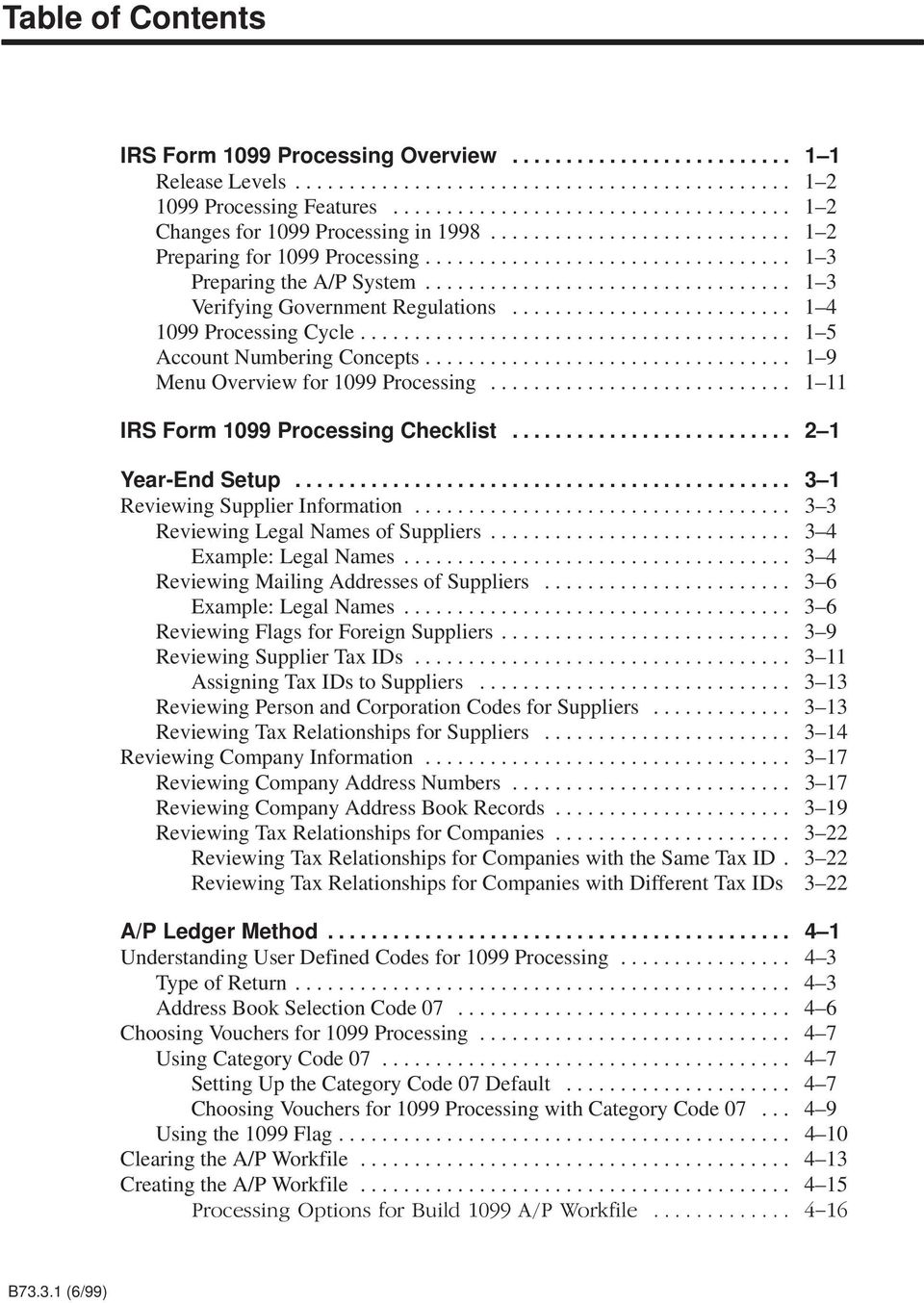
3 Table of Contents IRS Form 1099 Processing Overview Release Levels Processing Features Changes for 1099 Processing in Preparing for 1099 Processing Preparing the A/P System Verifying Government Regulations Processing Cycle Account Numbering Concepts Menu Overview for 1099 Processing IRS Form 1099 Processing Checklist Year-End Setup Reviewing Supplier Information Reviewing Legal Names of Suppliers Example: Legal Names Reviewing Mailing Addresses of Suppliers Example: Legal Names Reviewing Flags for Foreign Suppliers Reviewing Supplier Tax IDs Assigning Tax IDs to Suppliers Reviewing Person and Corporation Codes for Suppliers Reviewing Tax Relationships for Suppliers Reviewing Company Information Reviewing Company Address Numbers Reviewing Company Address Book Records Reviewing Tax Relationships for Companies Reviewing Tax Relationships for Companies with the Same Tax ID Reviewing Tax Relationships for Companies with Different Tax IDs 3 22 A/P Ledger Method Understanding User Defined Codes for 1099 Processing Type of Return Address Book Selection Code Choosing Vouchers for 1099 Processing Using Category Code Setting Up the Category Code 07 Default Choosing Vouchers for 1099 Processing with Category Code Using the 1099 Flag Clearing the A/P Workfile Creating the A/P Workfile B (6/99)
4 OneWorld IRS Form 1099 Processing (1998) Data Selection for Build 1099 A/P Workfile Adjusting the A/P Workfile Adding A/P Workfile Records Reviewing A/P Workfile Records Revising A/P Workfile Records Deleting A/P Workfile Records Year-End Reporting Previewing 1099 Returns Troubleshooting 1099 Returns Printing 1099 Returns Creating Magnetic Media Previewing Data for Magnetic Media Writing Magnetic Media Data Selection for Write Media Verifying Data on Magnetic Media Verifying the Number of Records Verifying Magnetic Media Records Example: Magnetic Media Records Appendices Appendix A System Tables Overview A 1 Appendix B Sample Forms B MISC Miscellaneous Income B DIV Dividends and Distributions B INT Interest Income B 2 Appendix C Frequently Asked Questions C 1 Glossary Index B (6/99)

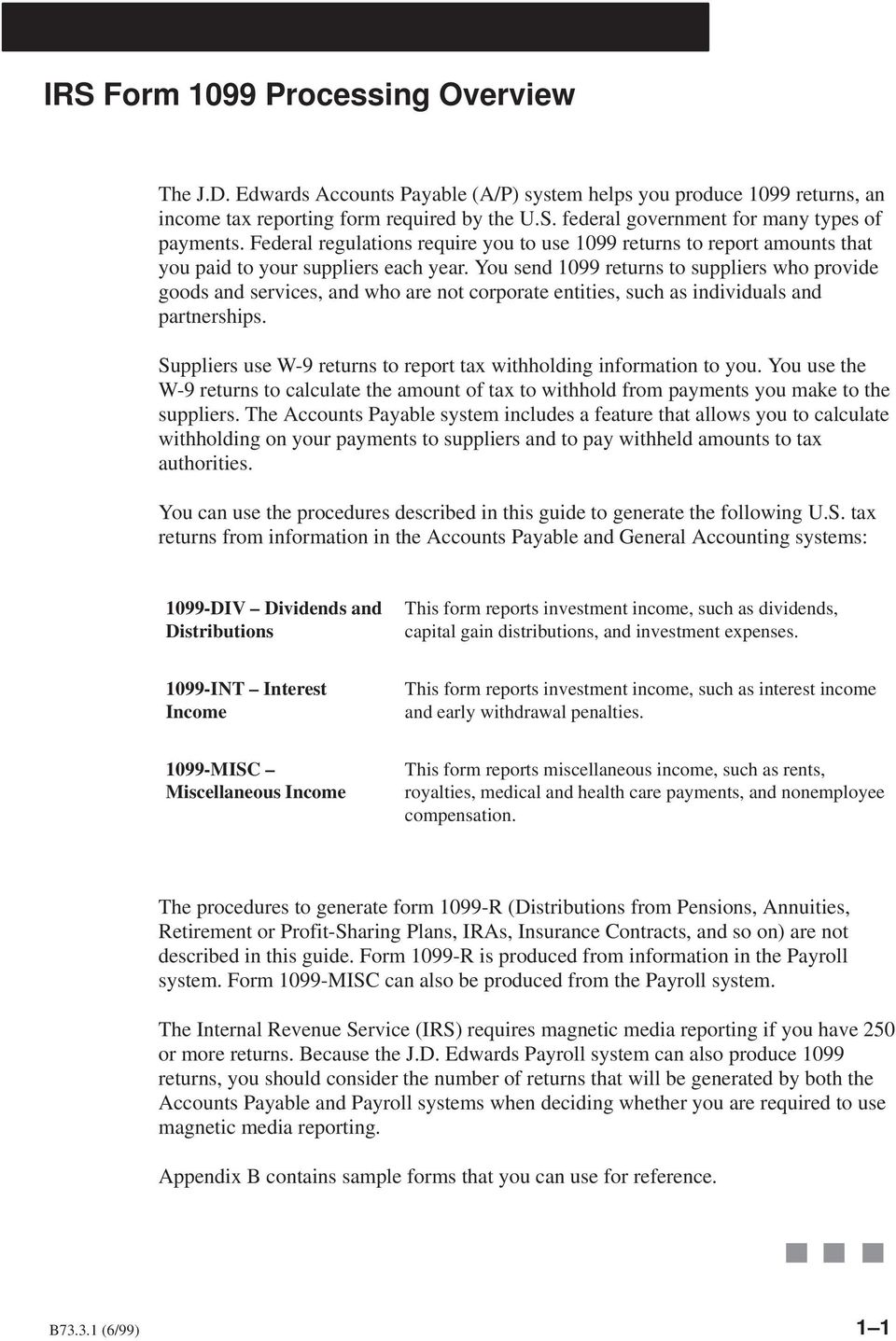
5 IRS Form 1099 Processing Overview The J.D. Edwards Accounts Payable (A/P) system helps you produce 1099 returns, an income tax reporting form required by the U.S. federal government for many types of payments. Federal regulations require you to use 1099 returns to report amounts that you paid to your suppliers each year. You send 1099 returns to suppliers who provide goods and services, and who are not corporate entities, such as individuals and partnerships. Suppliers use W-9 returns to report tax withholding information to you. You use the W-9 returns to calculate the amount of tax to withhold from payments you make to the suppliers. The Accounts Payable system includes a feature that allows you to calculate withholding on your payments to suppliers and to pay withheld amounts to tax authorities. You can use the procedures described in this guide to generate the following U.S. tax returns from information in the Accounts Payable and General Accounting systems: 1099-DIV Dividends and Distributions This form reports investment income, such as dividends, capital gain distributions, and investment expenses INT Interest Income This form reports investment income, such as interest income and early withdrawal penalties MISC Miscellaneous Income This form reports miscellaneous income, such as rents, royalties, medical and health care payments, and nonemployee compensation. The procedures to generate form 1099-R (Distributions from Pensions, Annuities, Retirement or Profit-Sharing Plans, IRAs, Insurance Contracts, and so on) are not described in this guide. Form 1099-R is produced from information in the Payroll system. Form 1099-MISC can also be produced from the Payroll system. The Internal Revenue Service (IRS) requires magnetic media reporting if you have 250 or more returns. Because the J.D. Edwards Payroll system can also produce 1099 returns, you should consider the number of returns that will be generated by both the Accounts Payable and Payroll systems when deciding whether you are required to use magnetic media reporting. Appendix B contains sample forms that you can use for reference. B (6/99) 1 1
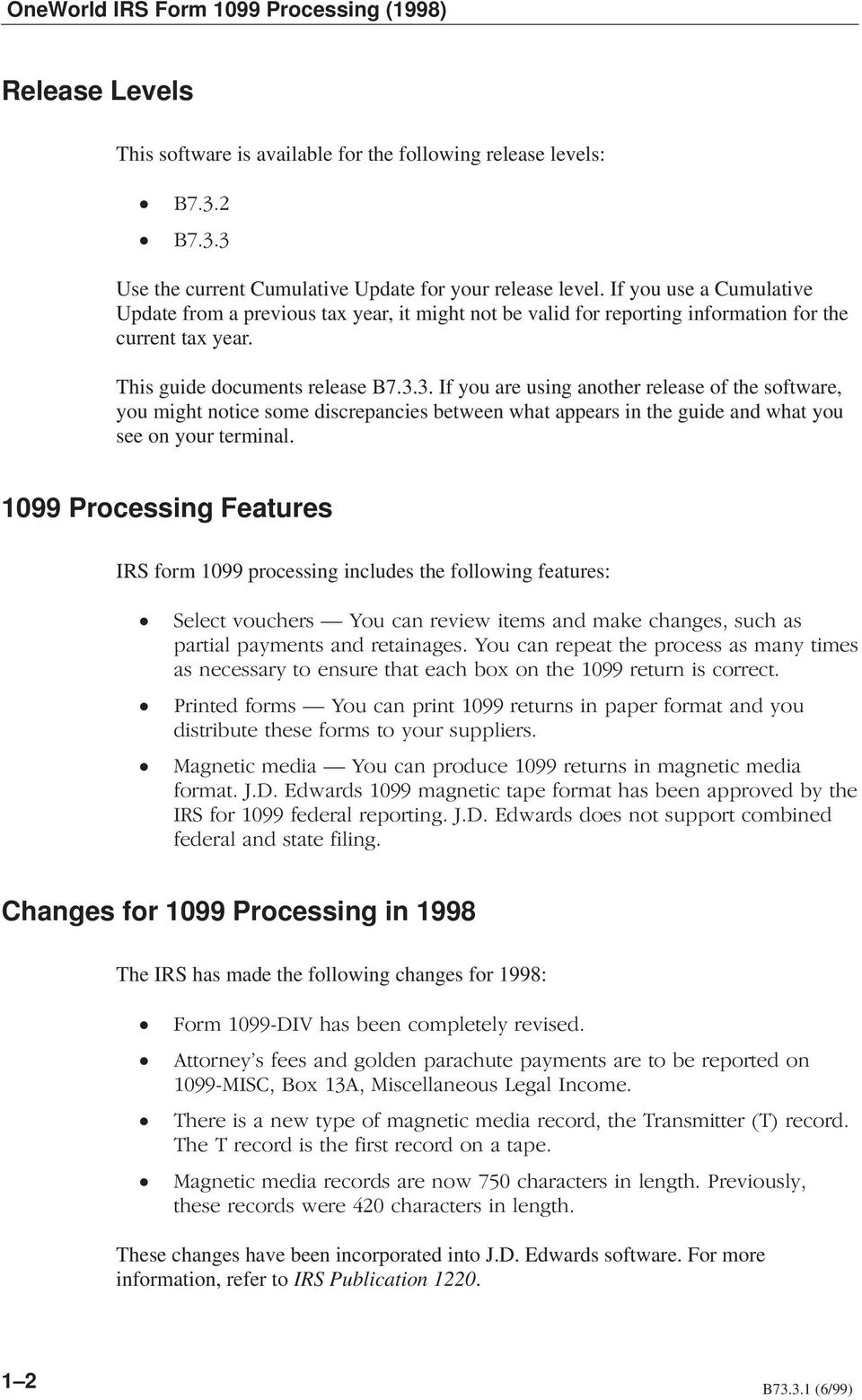
6 OneWorld IRS Form 1099 Processing (1998) Release Levels This software is available for the following release levels: Use the current Cumulative Update for your release level. If you use a Cumulative Update from a previous tax year, it might not be valid for reporting information for the current tax year. This guide documents release B If you are using another release of the software, you might notice some discrepancies between what appears in the guide and what you see on your terminal Processing Features IRS form 1099 processing includes the following features: Changes for 1099 Processing in 1998 The IRS has made the following changes for 1998: These changes have been incorporated into J.D. Edwards software. For more information, refer to IRS Publication B (6/99)
7 The standard notation for account numbers is Business Unit.Object.Subsidiary. Preparing for 1099 Processing When you prepare for 1099 processing, you prepare your internal records and assemble IRS publications and forms. You must use the A/P ledger method for release B73.3. A/P Ledger Method The A/P Ledger method summarizes all of the payments for a supplier. You associate amounts with specific boxes on a form using data selection, category code 07, or the 1099 flag field on the Standard Voucher Entry form. You use this method when you have information in the Account Ledger table for only part of the reporting year. For example, you might have incomplete information because you began using the system during the year, because you purged the Account Ledger table, or because you incorporated 1099 information from an outside system. You can also use this method if you have complete information for the reporting year. This method uses information in the A/P Ledger (F0411), A/P Matching Document (F0413), and A/P Matching Document Detail (F0414) tables. This method creates the 1099 A/P Workfile table (F045143). Preparing the A/P System Begin preparing 1099 returns before year end to allow ample time for researching and updating supplier and voucher information. You must have information in the A/P Ledger table before preparing 1099 returns. The system requires this information to calculate 1099 information for specific suppliers. For this reason, you should not purge the following tables until after you print 1099 returns: Address Book Master (F0101) Do not purge address book records for any supplier with A/P activity in the calendar year you are reporting. Supplier Master (F0401) Do not purge supplier master records for any supplier with A/P activity in the calendar year you are reporting. B (6/99) 1 3

8 OneWorld IRS Form 1099 Processing (1998) A/P Ledger (F0411), A/P Matching Document (F0413), and A/P Matching Document Detail (F0414) If you are using the A/P Ledger method, do not purge vouchers paid in the calendar year you are reporting. You must have information in these tables for all vouchers paid in the 1099 reporting calendar year for which a 1099 return might be required. If it is necessary to purge these tables, you must restore the A/P Ledger Purge (F0411P), A/P Matching Document Purge (F0413P), and A/P Matching Document Detail Purge (F0414P) before you produce 1099 returns. Using the A/P Ledger method, decide whether you will use either the 1099 flag or category code 07 to select the payments for which to create 1099 returns. You can use either of these fields on Standard Voucher Entry throughout the year to prepare for 1099 processing. You can also write 1099 returns for all of the payments in the A/P Ledger table (F0411). Verifying Government Regulations As part of the 1099 process, you should assemble the following IRS forms and publications: Information in this guide that restates government regulations is deemed accurate, but should not be relied upon. If you have specific questions, contact the IRS Magnetic Media Reporting Center (IRS/MCC) at (304) or review the IRS webpage at B (6/99)

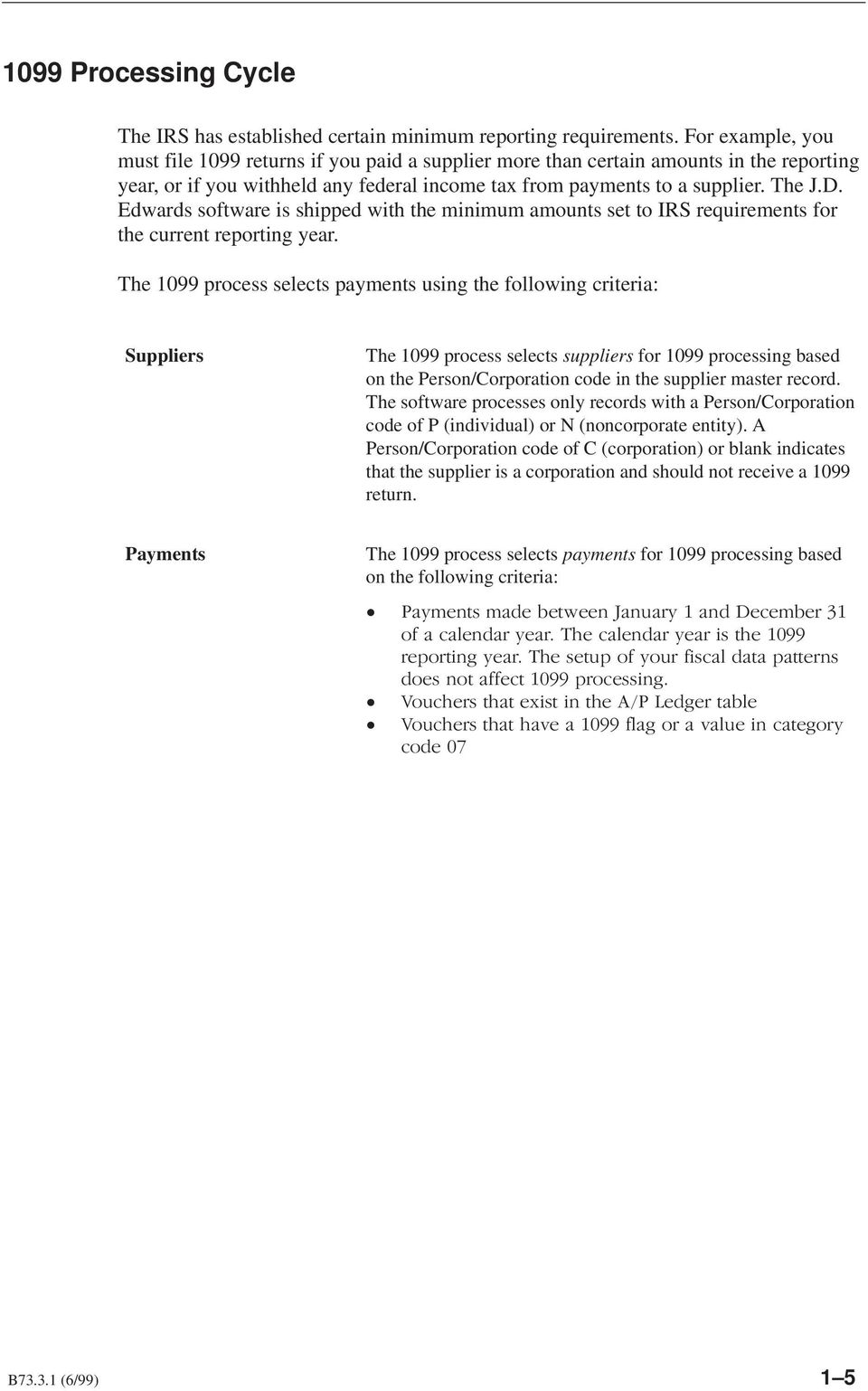
9 1099 Processing Cycle The IRS has established certain minimum reporting requirements. For example, you must file 1099 returns if you paid a supplier more than certain amounts in the reporting year, or if you withheld any federal income tax from payments to a supplier. The J.D. Edwards software is shipped with the minimum amounts set to IRS requirements for the current reporting year. The 1099 process selects payments using the following criteria: Suppliers The 1099 process selects suppliers for 1099 processing based on the Person/Corporation code in the supplier master record. The software processes only records with a Person/Corporation code of P (individual) or N (noncorporate entity). A Person/Corporation code of C (corporation) or blank indicates that the supplier is a corporation and should not receive a 1099 return. Payments The 1099 process selects payments for 1099 processing based on the following criteria: B (6/99) 1 5
10 OneWorld IRS Form 1099 Processing (1998) The 1099 process consists of the following tasks: Verify supplier and company set up You must verify that supplier and company information is accurate. You must verify legal names, mailing addresses, and so on. Update year-to-date voucher amounts Typically, you update year-to-date (YTD) voucher amounts soon after you close the year for A/P activity as part of your annual close procedures. Verify user defined codes, category code 07 values, or 1099 flags You verify category code 07 values, or 1099 flags so that the software selects the correct payments for 1099 processing. If you use category code 07 to select payments for processing, you must also verify the user defined codes that will determine how payments are reported. Build the workfile You create a workfile from which the system will create 1099 returns. If an existing workfile contains data that you do not intend to use, you must clear the workfile and then recreate it. The charts on the following pages show an overview of the 1099 process. The G/L Method, which is also shown on these charts, is not available with release B B (6/99)

11 Step 1 Review Address Book Verify company and supplier set-up Verify mailing address format Verify legal names Step 2 Choose Method of Reporting Use G/L method for discriminate reporting by object using Account Ledger table (F0911) Step 3 Verify Verify AAIs Step 4 Process Update receipts generated through 3-way match Update Account Ledger table with A/P payment number Step 5 Adjust Exceptions (G/L Method) Print payments exception worksheet Enter payment adjustments Print G/L register Step 6 Build Workfile Build 1099 G/L workfile Merge register Step 7 Write Media Verify Tax ID Person/Corp Code Check for duplicate tax IDs Use A/P Ledger method for nondiscriminate reporting by voucher using A/P Ledger table (F0411) Verify UDCs Update category code 07 Clear workfile Build 1099 A/P Ledger workfile Enter adjustments Write 1099 Forms and Magnetic Media Verify Magnetic Media Run A/P Annual Close (P04820) Print A/P Ledger method register 1 7

12 OneWorld IRS Form 1099 Processing (1998) The following graphic shows the principal programs, tables, and reports that the 1099 process uses. G/L Method Supplier Master (F0401) W-9 Exception Report (P01301) Build 1099 G/L Workfile (P04514) 1099 G/L Workfile (F045141) A/P Ledger (F0411) Update Payment Information (P04513) Account Ledger (F0911) 1099 G/L Register (P04512) A/P Ledger Method Enter Payment Adjustments (P04510) Payments Exceptions Worksheet (P04511) Supplier Master (F0401) W-9 Exception Report (P01301) Preview 1099 Media (P04512FP) 1099 Combined Workfile (F04514) A/P Ledger (F0411) Build 1099 A/P Workfile (P04514FP) 1099 A/P Workfile (F045143) Write Media (P04515) Enter A/P Workfile Adjustments (P04510FP) Revenue and Royalty Owner Detail Ledger (F2313) Build Workfile 1099 Revenue Workfile (F045142) Revenue Register 1 8 B (6/99)

13 See Also Account Numbering Concepts This guide uses the Business.Unit Object.Subsidiary standard notation for account numbers. Where What Balance Sheet for company 1 Cash in Bank Bear Creek National Bank 1 Business Unit Required Maximum 12 characters Alphanumeric 1110 Object Required Maximum 6 characters Alphanumeric BEAR Subsidiary Optional Maximum 8 characters Alphanumeric The account number includes both the Where and What. You can use periods, commas, or other user defined symbols to separate the components of the account number. The period (.) separator is the default. B (6/99) 1 9
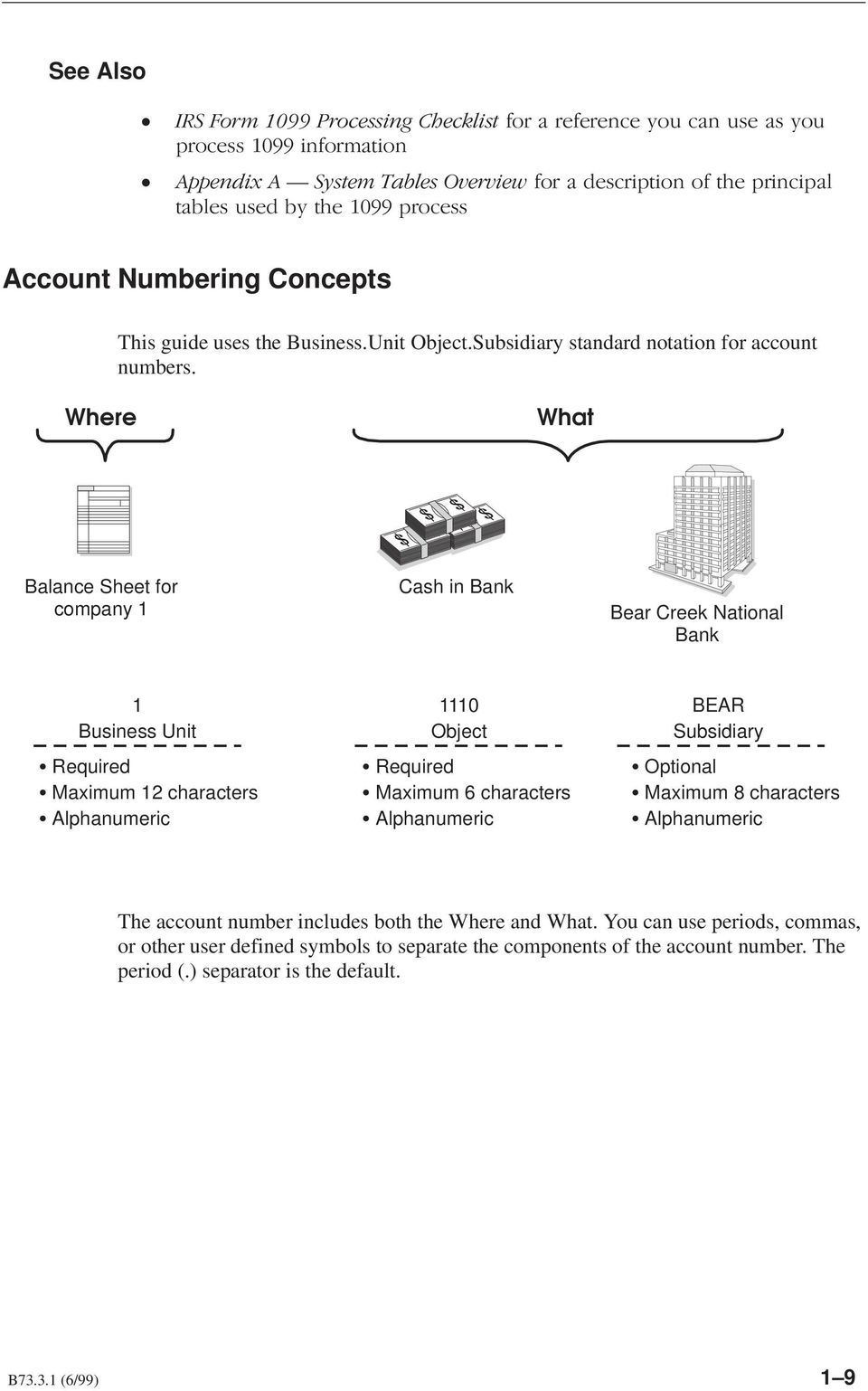
14 OneWorld IRS Form 1099 Processing (1998) Business Unit The Where The business unit describes where in your organization the transaction will have an impact. It represents the lowest organizational level within your business and is where you record all revenues, expenses, assets, liabilities, and equities. For example, a business unit can be a department, a branch office, or a truck. Business units are unique 12-character, alphanumeric fields. The following criteria applies: Object.Subsidiary The What The Object.Subsidiary represents what kind of transaction is being created. An object is a description of the transaction, for example, 1110 (Cash in Bank). A subsidiary is an expanded description of the object account, for example, 1110.BEAR (Cash in Bank.Bear Creek National Bank). There are two parts of the what : 1 10 B (6/99)

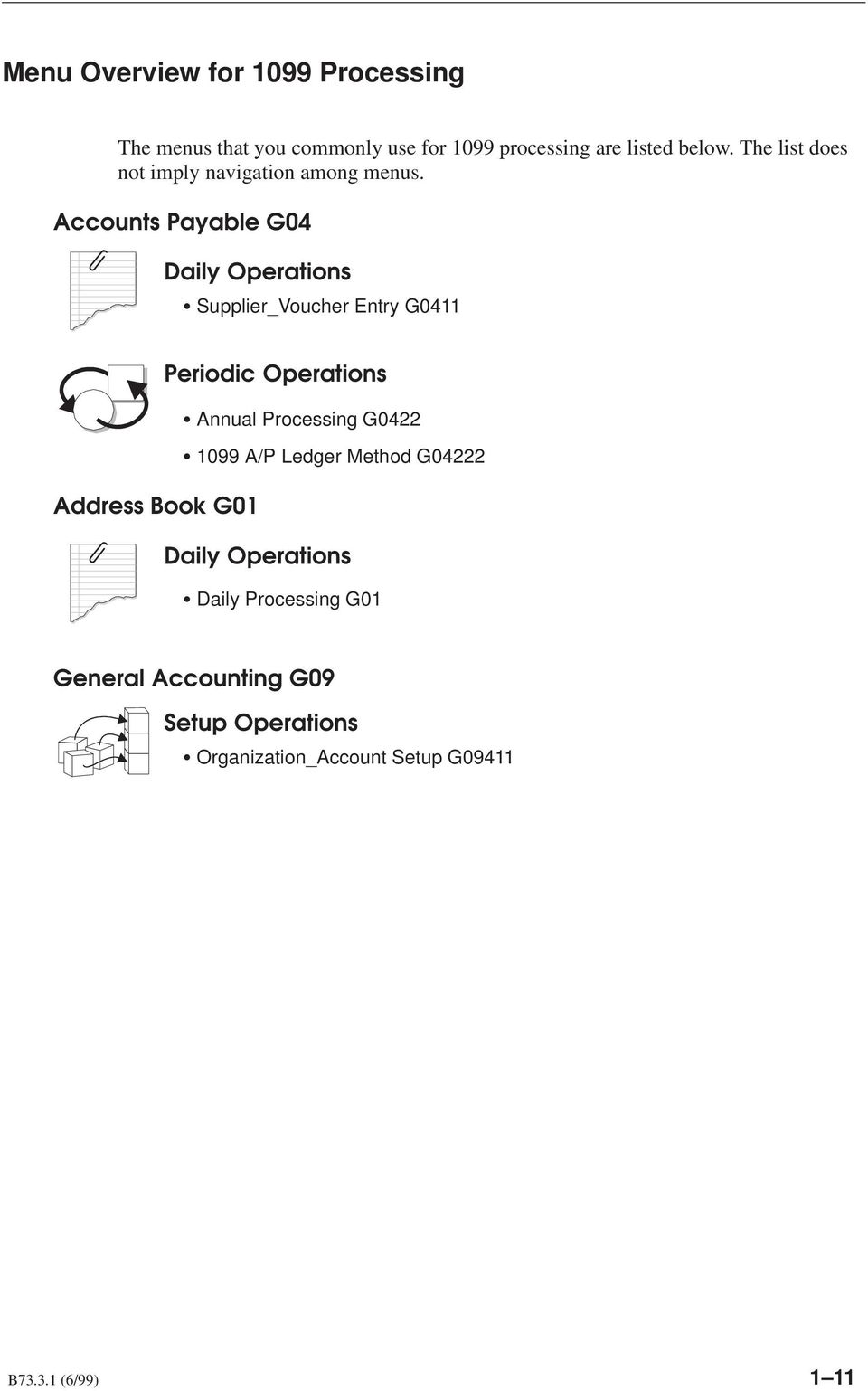
15 Menu Overview for 1099 Processing The menus that you commonly use for 1099 processing are listed below. The list does not imply navigation among menus. Accounts Payable G04 Daily Operations Supplier_Voucher Entry G0411 Periodic Operations Annual Processing G A/P Ledger Method G04222 Address Book G01 Daily Operations Daily Processing G01 General Accounting G09 Setup Operations Organization_Account Setup G09411 B (6/99) 1 11
16 OneWorld IRS Form 1099 Processing (1998) 1 12 B (6/99)

17 IRS Form 1099 Processing Checklist Use the following checklist for processing IRS Form 1099: This guide does not discuss software installation or the necessary automatic software instructions (ASIs). For instructions on installing the current year update, see the Update Installation Workbook. You set up supplier information to ensure that you have the necessary information and that your information meets IRS requirements. See. You set up company information to ensure that you have the necessary information and that your information meets IRS requirements. See. Typically, you update year-to-date (YTD) voucher amounts soon after you close the year for A/P activity as part of your annual close procedures. See Working with YTD Voucher Amounts in the Accounts Payable Guide. The A/P Ledger method uses user defined codes to select vouchers for 1099 processing. You set up specific user defined code lists to link vouchers in the workfile to the appropriate IRS form and box. See. The A/P Ledger method selects all vouchers in the current reporting year for suppliers who are not corporate entities. You might want to narrow your selection by using the 1099 flag or category code 07. See. B (6/99) 2 1
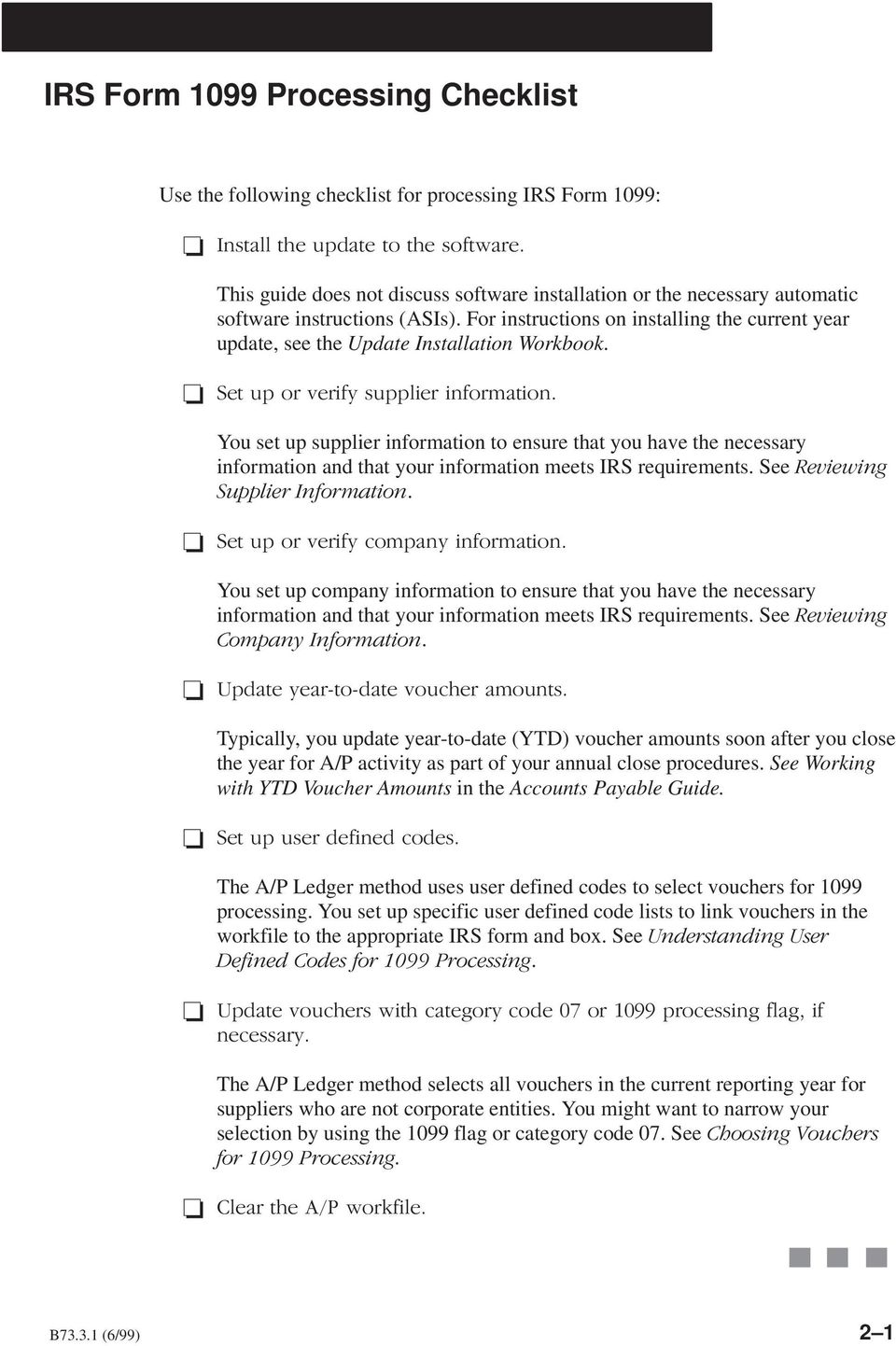
18 OneWorld IRS Form 1099 Processing (1998) The program that creates the workfile adds records to the workfile each time you run it. You might need to clear the workfile to avoid creating duplicate payment records. See. You build the workfile from which you will create your 1099 returns. You can use data selection for the 1099 flag or category code 07 to select vouchers in the A/P Ledger table for 1099 reporting. See. You might need to enter payment adjustments to add, review, and revise records in the workfile. See. You preview the results of submitting 1099 returns for processing to determine whether you have entered all necessary adjustments and are ready to print 1099 returns. See. You print 1099 returns and distribute them to your suppliers so that your suppliers can file printed forms with their tax returns. See. You write 1099 returns to magnetic media to produce the information that you submit to the IRS. See. J.D. Edwards recommends that you review the content and format of your 1099 magnetic media for accuracy before submitting it to the IRS. This can eliminate the need to resubmit your data. See and 2 2 B (6/99)

19 Year-End Setup Accurate 1099 reporting depends on setting up supplier and company records correctly. The information for suppliers must meet 1099 specifications to be accepted by the IRS. Begin preparing for 1099 returns early enough to review address book information for your suppliers and companies, enter corrections, and still meet the 1099 deadline. Leave sufficient time for researching and updating supplier records. Reviewing address book information for 1099 reporting consists of: B (6/99) 3 1

20 OneWorld IRS Form 1099 Processing (1998) 3 2 B (6/99)

21 Reviewing Supplier Information See Also As part of the 1099 process, you must review address book records for your suppliers to ensure that you have the necessary information and that your information meets IRS requirements. Reviewing supplier information consists of: This information is stored in the Address Book Master (F0101) and Supplier Master (F0401) tables. B (6/99) 3 3
22 OneWorld IRS Form 1099 Processing (1998) Reviewing Legal Names of Suppliers The IRS requires you to use the legal name of the supplier on 1099 returns. A supplier s legal name is the name associated with the supplier s tax identification number (TIN). You can have only one legal name for a supplier. The system prints this name on 1099 returns. If the mailing name on the supplier master record is not the legal name of the supplier, you must enter and flag a legal name on Who s Who. Example: Legal Names Who s Who entry not required Elmer Johnson Who s Who entry required Johnson Painting Specialists In this example, you need to create a Who s Who entry for Elmer Johnson, the owner of the Johnson Painting Specialists, and enter a Who s Who type code of T (1099 legal name). 3 4 B (6/99)
23 Reviewing Supplier Information To review legal names of suppliers From the Annual Processing menu (G0422), choose Supplier Master Information. On Work With Supplier Master 1. Locate a supplier. 2. Choose Who s Who from the Row menu. 3. On Who s Who, verify that one of the entries for the following field contains the legal name of the supplier: 4. Verify that the following field contains a value of T (1099 legal name): B (6/99) 3 5
24 OneWorld IRS Form 1099 Processing (1998) Field Type Code Explanation A user defined code (01/WO) that identifies the Who s Who entry. For example: S Student B Billing contact T 1099 legal name If an organization s legal name is different from the name under which it is doing business, enter a T (1099 legal name). During 1099 processing, this code overrides the mailing name so that the system uses a particular Who s Who entry on 1099 returns. Reviewing Mailing Addresses of Suppliers Review the mailing name and address for each supplier for whom you generate a 1099 return. If the mailing name of a supplier is not the same as the supplier s legal name (for example, it is a sole proprietorship), use Who s Who to override the mailing name. The IRS limits addresses on 1099 returns to three lines, consisting of name, street address, and city, state, and zip code. If there is a legal name the system prints four lines: For any supplier for whom you will prepare 1099 returns you cannot use a mailing address that contains more than one line for a street address. Example: Legal Names The address for Johnson Painting Specialists is 214 Potomac Circle, Suite 109, Washington, DC You must enter the street address and suite number on the same line. The Mailing tab on the Address Book Revision form should look like the following form. 3 6 B (6/99)
25 Reviewing Supplier Information If you enter the street address on two lines, the system will print only the second line of the address on 1099 returns. If the second line contains only the suite number, the 1099 will contain the address Johnson Painting Specialists, Suite 109, Washington, DC The Mailing tab on the Address Book Revision form should not look like the following form. B (6/99) 3 7
26 OneWorld IRS Form 1099 Processing (1998) To review mailing addresses of suppliers From the Annual Processing menu (G0422), choose Supplier Master Information. On Work With Supplier Master 1. Locate a supplier. 2. Choose Address Book Revision from the Row menu. 3. On Address Book Revision, click the Mailing tab. 4. Verify the following fields: 3 8 B (6/99)
27 Reviewing Supplier Information Field Mailing Name Address Line 1 Explanation The company or person to whom billing or correspondence is addressed Form-specific information If you leave this field blank, the default comes from the Alpha Name field. You can also choose Duplicate Name to copy the Mailing Name to the Alpha Name field. The first line of the mailing address for an employee, customer, or supplier in the Address Book system. The Internal Revenue Service (IRS) restricts the size of the address that prints on employee s year-end tax returns. To comply with IRS regulations, the system uses the following restrictions: Reviewing Flags for Foreign Suppliers The IRS requires you to report suppliers who do not have a U.S. address. To review flags for foreign suppliers From the Annual Processing menu (G0422), choose Supplier Master Information. On Work With Supplier Master 1. Locate a foreign supplier. 2. Choose Address Book Revision from the Row menu. B (6/99) 3 9
28 OneWorld IRS Form 1099 Processing (1998) 3. On Address Book Revision, click the Mailing tab. 4. Review the following field: 5. Click the Additional tab. 6. Verify that the following field contains a value of F (foreign supplier): Field Payables Explanation A code that identifies the address as a supplier. Valid values are: Y Yes, this is a supplier. A processing option determines whether the supplier master record automatically displays after you add an address. N No, this is not a supplier. This code does not prevent you from entering a voucher for the address. M This is a miscellaneous, one-time supplier. This code does not prevent you from entering multiple vouchers for the address. F This is a supplier with a foreign address. The IRS requires U.S. companies to identify suppliers with foreign addresses for 1099 reporting. You should assign tax authorities as suppliers. This allows tax payments to be made to tax authorities. Code N is informational only, unless you set a processing option. In this case, a warning message appears if both the Payables and Receivables fields are N B (6/99)
29 Reviewing Supplier Information Field Country Explanation A user defined code (00/CN) that identifies a country. The country code has no effect on currency conversion. The Address Book system uses the country code for data selection and address formatting. Reviewing Supplier Tax IDs A tax ID is required for each supplier. The system uses this information for the tax identification number (TIN) on 1099 returns, which is required by the IRS. For 1099 purposes, a tax ID must be either: For reporting purposes, the TIN is considered missing if it: You are required by the IRS to take steps to obtain missing TINs. The IRS contacts payers who submit payee data with missing TINs in an attempt to prevent erroneous notices. The IRS encourages payers who submit data with missing TINs to attach a letter of explanation to Form This prevents unnecessary contacts from the IRS, but does not prevent backup withholding notices (B Notices) or penalties for missing or incorrect TINs. A TIN can be incorrect for any of the following reasons: If you submit a 1099 return without a TIN, you must have withheld 31% of payments to that supplier. This is called backup withholding. In addition, you must perform one of the following tasks: B (6/99) 3 11
30 OneWorld IRS Form 1099 Processing (1998) You perform one of the preceding tasks because 1099 returns must reflect the amount you withheld from each supplier without a TIN. Suppliers may recover these amounts on their tax return reports. Reviewing supplier tax IDs occurs after you have assigned tax IDs to suppliers. Prior to reviewing supplier tax IDS, complete the following procedure: 3 12 B (6/99)
31 Assigning Tax IDs to Suppliers If a supplier s tax ID is missing, you must enter it before processing 1099 returns. To assign tax IDs to suppliers From the Annual 1099 Processing menu (G0422), choose Supplier Master Information. On Work With Supplier Master 1. Locate and select a supplier. 2. On Supplier Master Revision, click the Tax Information tab. 3. Complete the following field: Field Tax ID Explanation The identification code required by various tax authorities. This can be a social security number, federal or state corporate tax ID, sales tax number, and so on. Do not enter separator characters. The system verifies the number and prints the separators in their correct format, according to the value of TAXC (Person/Corporation Code). If there is no value for TAXC, the system uses the Corporate Entity. Attention Accounts Payable users: The supplier master record supplies the default value for the tax ID for 1099 processing. Reviewing Person and Corporation Codes for Suppliers You do not generate 1099 returns for corporate entities. The system processes only suppliers with a Person/Corporation code of P (person) or N (noncorporate entity). To review person and corporation codes for suppliers From the Annual Processing menu (G0422), choose Supplier Master Information. On Work With Supplier Master 1. Locate and select a supplier. 2. On Supplier Master Revision, click the Tax Information tab. 3. Verify the following field: B (6/99) 3 13
32 OneWorld IRS Form 1099 Processing (1998) Field Person/Corporation Explanation A code that designates the type of taxpayer. Valid values for U.S. entities are: C Corporate entity (the 20-digit Tax field prints as ) P Individual (the 20-digit Tax field prints as ) N Noncorporate entity (the 20-digit Tax field prints as ) Blank Corporate entity Valid values for non-u.s. clients are (used with the 20-digit Company field and Individual field): 1 Individual 2 Corporate entity 3 Both an individual and a corporate entity 4 Noncorporate entity 5 Customs authority For 1099 reporting, the system selects suppliers with codes of P and N. Reviewing Tax Relationships for Suppliers You might have several suppliers who are owned by a single company or legal entity and who share the same tax ID. You must prepare 1099 returns for the legal entity, not for the individual suppliers. Therefore, you combine the amounts you paid to the suppliers into one sum and report this amount on the legal entity s For example, Smith Company (a supplier) owns Johnson Incorporated (another supplier). You made payments to both suppliers, but you must create a 1099 return only for the legal entity, Smith Company. To combine amounts for suppliers, you enter the supplier number of the legal entity in one of the following fields: For example, you enter Smith Company s address book number in one of these fields on the Johnson Incorporated record. Then when you build the workfiles, you designate which field the system uses when it combines amounts for one legal entity. For example, you set the processing option to 1 to use the 1st Address Number field or 7 to use the Factor/Special Payee field. This 3 14 B (6/99)
33 allows the system to record the payments you made to one supplier on the 1099 for another supplier. To review tax relationships for suppliers From the Annual Processing menu (G0422), choose Supplier Master Information. On Work With Supplier Master 1. Locate a supplier. 2. From the Row menu, choose A/B Revision. 3. On Address Book Revision, click the Related Address tab. 4. Verify the following fields: B (6/99) 3 15
34 OneWorld IRS Form 1099 Processing (1998) Field Parent Number 1st Address Number Factor/Special Payee Explanation The Address Book number of the parent company. The system uses this number to associate a particular address with a parent company or location. For example: If you leave this field blank on an entry screen, the system supplies the primary address from the Address Number field. This address must exist in the Address Book Master table (F0101) for validation purposes. An alternate address number in the Address Book system. You can use this field for any secondary business address that relates to the primary address. For example: If you leave this field blank on an entry form, the system supplies the primary address from the Address Number field. An address book number that identifies a special payment address for A/P. If you leave this field blank on an entry form, the system supplies the primary address from the Address Number field. This address must exist in the Address Book Master table (F0101) for validation purposes B (6/99)
35 Reviewing Company Information Before you process 1099 returns, review your company information to ensure that 1099 returns will have the correct identifying information. Reviewing company information consists of: Reviewing Company Address Numbers You verify the address book number assigned to a company or payer because the system uses this information to: Typically, the company number is the same as the company s address book number. However, the company number has a limit of five characters, while the address book number has a limit of eight characters. If the address book number for a company is eight characters, you must complete the Company Address Number field in the detail area to provide a cross-reference between the two numbers. This information is stored in the Company Numbers and Names table (F0010). To review company address numbers From Organization_Account Setup (G09411), choose Company Names & Numbers. B (6/99) 3 17
36 OneWorld IRS Form 1099 Processing (1998) On Work With Companies 1. Locate the company and verify the number in the following field: 2. Choose Set Up Company from the Row menu. 3. On Company Setup, verify the following field: 3 18 B (6/99)
37 Reviewing Company Information Field Co Company Address Number Explanation A code that identifies a specific organization, fund, entity, and so on. The company code must already exist in the Company Constants table (F0010) and must identify a reporting entity that has a complete balance sheet. At this level, you can have intercompany transactions. NOTE: You can use Company for default values, such as dates and automatic accounting instructions (AAIs). You cannot use Company for transaction entries. The address number you want to retrieve. You can use the short format, the long format, or the tax ID (preceded by the indicators listed in the Address Book constants). Reviewing Company Address Book Records If you submit 1099s to the IRS via magnetic media, you must verify the information for the transmitter company. The transmitter company is the company that actually transmits the 1099s to the IRS. You review company address book records to ensure that the following information is correct for the transmitter company: To review company address book records From the Daily Processing menu (G01), choose Address Book Revision. On Work With Addresses 1. Locate a company. 2. Verify the following field: 3. Select the company. From the Row menu, select A/B Revisions. B (6/99) 3 19
38 OneWorld IRS Form 1099 Processing (1998) 4. On Address Book Revision, verify the following field: 5. Click the Mailing tab and verify the following fields: 6. Click the Additional tab and verify the following field: 7. From the Form menu, choose Phones. 8. On Phone Numbers, verify the following field and click OK: 9. On Address Book Revision, choose Who s Who from the Form menu. For returns that are submitted to the IRS on magnetic media, you must do the following: 3 20 B (6/99)
39 Reviewing Company Information 10. On Who s Who, verify the contact name in the following field: 11. Enter C in the following field: This value is specific to the transmitter company. Field Address Number Tax ID Explanation A number that identifies an entry in the Address Book system. Use this number to identify employees, applicants, participants, customers, suppliers, tenants, and any other Address Book members. The identification code required by various tax authorities. This can be a social security number, federal or state corporate tax ID, sales tax number, and so on. Do not enter separator characters. The system verifies the number and prints the separators in their correct format, according to the value of TAXC (Person/Corporation Code). If there is no value for TAXC, the system uses the Corporate Entity. Attention Accounts Payable users: The supplier master record supplies the default value for the tax ID for 1099 processing. B (6/99) 3 21
40 OneWorld IRS Form 1099 Processing (1998) Reviewing Tax Relationships for Companies You review tax relationships to identify and cross-reference companies that your company (the legal entity) owns. You change or create new address book records for these companies. This information is used to create 1099 returns for the legal entity (your company). Reviewing Tax Relationships for Companies with the Same Tax ID There might be several individual companies (or business units) that are owned by your company, or legal entity, and who share the same tax ID. You must prepare 1099 returns for the legal entity, not for the individual companies. Therefore, you must combine the amounts that the individual companies (payers) paid to the same supplier. Enter the address number of the legal entity (the collective payer) in one of the five alternate address fields, the Parent/Number field, or the Factor/Special Payee field for each individual company. When you build the workfile media, you will specify which one of these fields the system uses to combine the payments that your individual companies made to one supplier with the same tax ID. For example, Smith Company (your company) owns Johnson Incorporated (another company). Each company made payments to Marshall Systems, a supplier, but you must create a 1099 return only for the legal entity, Smith Company. You enter Smith Company s address book number in one of Johnson Incorporated s five alternate address fields. This allows the system to record the payments that both companies made to Marshall Systems on Smith Company s Reviewing Tax Relationships for Companies with Different Tax IDs You might have several individual companies with unique tax IDs who make payments to each other. However, you cannot create a 1099 return to send to your own company or legal entity. To generate a 1099 return for the payer company, you must set up another address book record with a Person/Corporation Code of P (individual) or N (noncorporate entity). Then you must enter the new address book number in one of the alternate address fields of the original address book record. This allows you to generate a 1099 return for the company s original address book record. For example, Johnson Incorporated (a company you own, with a Person/Corporation code of C) pays an amount to Smith Company (your company, with a Person/Corporation Code of C) that requires you to create a 1099 return. You create a new address book record for Smith Company and assign it a Person/Corporation Code of N. In Smith Company s original address book record, you enter the new address book number you just created in one of the alternate address fields. Now you can create a 1099 return for Smith Company B (6/99)
41 Reviewing Company Information To review tax relationships for companies From the Address Book menu (G01), choose Address Book Revisions. 1. Locate and select a company. 2. On Address Book Revision, click the Related Addresses tab. 3. Verify the following fields: You must use the same address field for combining suppliers and companies. For example, if you combine suppliers using the 5th Address Number, you must also combine companies using the 5th Address Number. Ñ Exercises See the exercises for this chapter. B (6/99) 3 23
42 OneWorld IRS Form 1099 Processing (1998) 3 24 B (6/99)
43 A/P Ledger Method See Also You can use the A/P Ledger method to generate 1099 returns when the information in the Account Ledger table (F0911) is incomplete, typically because of a conversion that was done mid-year, or to incorporate 1099 information from an outside system. This method uses data stored in the A/P Ledger (F0411), A/P Matching Document (F0413), and A/P Matching Document Detail (F0414) tables. The system creates the 1099 A/P Workfile (F045143). You can enter adjustments to the records in this table. You can also enter data that is not supported by documents in the A/P Ledger, A/P Matching Document, and A/P Matching Document Detail tables. The A/P Ledger method generates 1099 returns for all payments in the current reporting year to suppliers who have a Person/Corporation code of P (individual) or N (noncorporate entity). You can use the 1099 flag or category code 07 to note payments for processing, and as a data selection to include or exclude specific payments during processing. The A/P Ledger method consists of: The final task for this method is creating the actual 1099 returns. B (6/99) 4 1
44 OneWorld IRS Form 1099 Processing (1998) 4 2 B (6/99)
45 Understanding User Defined Codes for 1099 Processing The A/P Ledger method uses user defined codes to select vouchers for 1099 processing. You set up specific user defined code lists to link vouchers in the 1099 A/P Workfile (F045143) to the appropriate IRS form and box. The user defined codes in the Accounts Payable system for 1099 processing are: See Also Type of Return The Type of Return (04/TR) user defined code indicates a type of 1099 return and the relevant box on that return. This user defined code list determines the valid values for the following: The type of return is a two-part code. The first part is a code that indicates the type of form. The codes for form type are: B (6/99) 4 3
46 OneWorld IRS Form 1099 Processing (1998) The second part identifies the box on the form. This can be a number, a letter, or both. For example: The following table contains the valid values in the Type of Return table (04/TR), the corresponding box numbers on the preprinted form, and the amount codes on the magnetic media. Refer to IRS Publication 1220, Specifications for Filing Forms 1098, 1099, 5498 and W-2 Magnetically or Electronically. 4 4 B (6/99)
47 Understanding User Defined Codes for 1099 Processing B (6/99) 4 5
48 OneWorld IRS Form 1099 Processing (1998) Address Book Selection Code 07 When you select vouchers for processing using category code 07, you must have entered values for category code 07 for each voucher pay item. Valid values for category code 07 are defined in the Address Book Selection Code 07 (01/07) user defined code list. You can duplicate the values in user defined code list 04/TR or set up different values. However, it is helpful if you associate these values directly with the form and box numbers of the 1099 returns you plan to produce. For example, you can set up A1 (form 1099-MISC, Box 1), A2 (form 1099-MISC, Box 2), 11 (form 1099-DIV, Box 1), 61 (form 1099-INT, Box 1), and so on. 4 6 B (6/99)
49 Choosing Vouchers for 1099 Processing The A/P Ledger method selects all vouchers in the current reporting year for suppliers who are not corporate entities. However, you can narrow your selection by using the 1099 flag or category code 07. When you create the workfile, you can use a data selection that chooses only particular vouchers for inclusion in the workfile. Choosing vouchers for 1099 processing consists of: Using the 1099 flag is a simple include or exclude option. You have greater flexibility with category code 07 because you can assign as many values as you need. Choosing vouchers for 1099 processing changes records in the A/P Ledger table (F0411). Using Category Code 07 You can use category code 07 to choose individual vouchers for 1099 processing. You enter a value for category code 07 for pay items on a voucher. Then, when you build the A/P workfile you select only vouchers with the appropriate value for category code 07. Using category code 07 consists of the following tasks: Setting Up the Category Code 07 Default When you enter a voucher, the system uses the default value from the supplier master for category code 07. When you set up your suppliers in the Address Book, you assign category code 07 values according to the supplier s business type. For example: B (6/99) 4 7
50 OneWorld IRS Form 1099 Processing (1998) Changing the category code 07 default for a supplier changes the supplier record in the Supplier Master table (F0401). Before You Begin See. To set up the category code 07 default From the Annual Processing menu (G0422), choose Supplier Master Information. On Work With Supplier Master 1. Locate and select a supplier. 2. On Address Book Revision, click the Cat Code 1-10 tab. 3. On the Cat Code 1-10 tab, complete the following field: 4 8 B (6/99)
51 Choosing Vouchers for 1099 Processing See Also Choosing Vouchers for 1099 Processing with Category Code 07 You can use category code 07 to choose individual vouchers for 1099 processing. You enter a value for category code 07 for pay items on a voucher. Then, when you process 1099 returns, you use the following selections for the Build 1099 A/P Workfile program to identify the 1099 box to fill, and the data with which to fill it: The system derives the default value for category code for a voucher from the supplier master. Typically, you enter a value for the category code 07 during voucher entry. However, you may also change this value for posted vouchers. You can use category code 07 to identify line items to include or exclude from 1099 reporting. However, when you use a processing option for Match Voucher to Open Receipts to summarize A/P journal entries and when there are multiple line items, the program writes one summarized line. The program writes this line using the value for category code 07 from the first line item. Before You Begin When you change the category code 07 in the supplier record, the system does not automatically change existing transactions in the A/P Ledger table (F0411). See in the Accounts Payable Guide. To select vouchers for 1099 processing with category code 07 From the Annual Processing menu (G0422), choose Supplier Ledger Inquiry. B (6/99) 4 9
52 OneWorld IRS Form 1099 Processing (1998) On Supplier Ledger Inquiry 1. Locate a voucher. 2. In the detail area of Enter Voucher - Payment Information, complete the following field: Field Cat Cd 07 Explanation One of 30 reporting codes that you can assign to an address in the Address Book system. Use these codes to identify addresses for reports, mailings, and so on. Category codes are user defined codes (01/01-30). Examples: Category code 01 Location or Branch Category code 02 Salesperson Category code 03 New tenant Category code 04 Credit officer Using the 1099 Flag You can use the 1099 flag to choose individual vouchers for 1099 processing. You enter a value for the 1099 flag for each appropriate pay item on a voucher. Then, when you process 1099 returns you use the appropriate version of the Build 1099 A/P Workfile program to include only the vouchers that have the correct value for the 1099 flag. If you hire contractors (nonemployees), their incomes might be partially exempt from 1099 reporting. Therefore, you enter a value for the 1099 flag for only those pay items that are subject to 1099 reporting. Typically, you enter a value for the 1099 flag during voucher entry. However, you can also change this value for posted vouchers. To use the 1099 flag From the Annual Processing menu (G0422), choose Supplier Ledger Inquiry B (6/99)
53 Choosing Vouchers for 1099 Processing On Supplier Ledger Inquiry 1. Locate and select a voucher. 2. In the detail area of Enter Voucher - Payment Information, complete the following field: Field Explanation 1099 Flag A code that indicates whether to include the pay item in 1099 processing (A/P Ledger method only). Valid values are: blank Do not include in 1099 processing 1 Include in 1099 processing Do not flag vouchers that have distribution entries to G/L accounts that use the AAI ranges for PX. These vouchers will be automatically included in the G/L method of 1099 processing Form-specific information If only part of a voucher is subject to 1099 reporting, use multiple pay items to enter the portions that are and are not subject to 1099 reporting. See Also B (6/99) 4 11
54 OneWorld IRS Form 1099 Processing (1998) 4 12 B (6/99)
55 Clearing the A/P Workfile From The A/P Ledger Method (G04222), choose Clear A/P Workfile. You might need to run the Clear A/P Workfile program to delete payment records in the 1099 A/P Workfile (F045143). The Build 1099 A/P Workfile program adds records to the workfile each time you run it. Rerunning the build program without clearing the workfile might create duplicate payment records. J.D. Edwards recommends that you clear the workfile before you begin processing 1099 returns using the A/P Ledger method. To prevent problems, back up the 1099 A/P Workfile nightly. Clearing the workfile clears any adjustments you have entered. B (6/99) 4 13
56 OneWorld IRS Form 1099 Processing (1998) 4 14 B (6/99)
57 Creating the A/P Workfile From The A/P Ledger Method (G04222), choose Build A/P Workfile. You must create the workfile from which you will create your 1099 returns. The Build 1099 A/P Workfile program selects all payments in the reporting year which were made to suppliers who are not corporate entities. Each time you run this program, the program adds records to the A/P workfile. If a record already exists for the same payee, payer, and type of return, the program updates the record and adds to the amount. If you entered vouchers throughout the year using category code 07 to indicate the type of 1099 form and the box on the form, you can use the data selection for the Build 1099 A/P Workfile program to select vouchers. Each time you build the 1099 A/P Workfile, you add new information to the information already in the table. Therefore, to use category code 07 you must run the Build 1099 A/P Workfile program once for each box on the 1099 return. Alternatively, you can use a version of the Build 1099 A/P Workfile program that selects all vouchers that you previously designated with the 1099 Flag field. You use the Type of Return processing option to specify the box in which you want to report these amounts. Because this type of selection is a simple inclusion or exclusion, you do not need to run the build program multiple times. The A/P Ledger method does not require you to post vouchers and payments before processing 1099 returns. The Build 1099 A/P Workfile program uses data from the Supplier Master (F0401), A/P Ledger (F0411), A/P Matching Document (F0413), and A/P Matching Document Detail (F0414) tables to create the 1099 A/P Workfile (F045143). The system compares the company number to the address number in the Company Constants table. If the values are different, the system uses the mailing address and tax ID from the address number in the Company Constants table. This program does not generate a report. You must check the Electronic Workbench (Work Center) to ensure that the program completes successfully. Before You Begin B (6/99) 4 15
58 OneWorld IRS Form 1099 Processing (1998) Processing Options for Build 1099 A/P Workfile Process 1. Enter the four-digit calendar year for 1099 s. For example, enter 1998 or Reporting Year 2. Enter the type of return for the amounts selected by this version. For example, enter A1 for box 1 on form 1099-MISC or 13 for box 3 on form 1099-DIV. Type of Return 3. Specify the alternate address in the Address Book for combining under one Tax ID for both Company and Supplier. Enter 1, 2, 3, 4, or 5 for 1st Address Number through 5th Address Number, 6 for Factor/Special Payee, or 7 for Parent Number. If left blank, or if the corresponding address number is blank, the original address number and its Tax ID will be used. Alternate Address Combining Method What You Should Know About Processing Options Type of Return (2) This processing option applies to all records selected for update to the workfile. Alternatively, you can use the Enter Adjust 1099 A/P Workfile Records form to choose records with the correct box number on the 1099-MISC, 1099-DIV, or 1099-INT forms B (6/99)
59 Creating the A/P Workfile Alternate Address Combining (3) You can use this processing option to combine suppliers or companies based on an alternate address field. This allows you to combine duplicate suppliers under one supplier number or to report multiple companies under one company number. You can only combine one level of supplier or company numbers. Typically, you combine only suppliers that have the same tax ID. If you leave this processing option blank, the system combines suppliers and companies with the same tax ID under the first supplier or company record found during processing. Data Selection for Build 1099 A/P Workfile You can use data selection to limit vouchers for inclusion in the workfile based on the value of either the 1099 flag or category code 07. If you use this type of data selection, you might run the program multiple times without clearing it between runs. You can also use data selection to include vouchers with backup withholding based on the address book number of the tax authority. Alternatively, you can enter the withholding amount manually using the Enter A/P Workfile Adjustment form. You perform one of these tasks for backup withholding because you must have withheld 31% of payments to any supplier for whom you do not have a TIN and because the 1099 for that supplier must reflect the amount you withheld. Suppliers may recover these amounts on their tax return reports. You can use multiple versions of this program to select specific records for each type of return. For example: Consider carefully the implications of selecting data. You might encounter the following problem: B (6/99) 4 17
60 OneWorld IRS Form 1099 Processing (1998) Ñ Exercises See the exercises for this chapter B (6/99)
61 Adjusting the A/P Workfile The A/P Ledger method selects all payments in the current reporting year to suppliers who are not corporate entities. You can use Enter A/P Workfile Adjustments to make adjustments before printing 1099 returns. Adjusting the A/P workfile consists of: You might enter withholding adjustments to account for backup withholding. Alternatively, you can use data selection for Build 1099 A/P Workfile to include vouchers with backup withholding based on the address book number of the tax authority. You perform one of these tasks for backup withholding because you must have withheld 31% of payments to any supplier for whom you do not have a tax identification number (TIN) and because the 1099 return for that supplier must reflect the amount you withheld. Suppliers may recover these amounts on their tax return reports. The system compares the company number to the address book number in the Company Constants table. If the values are different, the system uses the mailing address and tax ID from the address book number in the Company Constants table. Working with adjustments does not affect the integrity of your payment tables. This program modifies records in the 1099 A/P Workfile (F045143). There is no audit trail for the changes you make. You can review the information in this table with the Preview 1099 Media program. B (6/99) 4 19
62 OneWorld IRS Form 1099 Processing (1998) Adding A/P Workfile Records You can add a record to the workfile for a supplier if none exists. If you want to add a line item for a supplier with an existing record, use the procedures for revising workfile records. These items are not date-sensitive. To add A/P workfile records From the 1099 A/P Ledger Method menu (G04222), choose Enter A/P Workfile Adjustment. On Work With 1099 A/P Workfile Adjustments 1. Click Add B (6/99)
63 Adjusting the A/P Workfile 2. On Adjust 1099 A/P Workfile Records, complete the following fields: If you leave the Tax ID and Company Tax ID blank, the system completes them from the A/P Workfile table (F0101). If you enter the Tax ID and Company Tax ID, the system displays an error message if they do not match the Tax ID and Company Tax ID in the A/P Workfile table for the Supplier and Company that you entered. Field Explanation Type Return A user defined code (04/TR) that indicates the type of 1099 return and box on the return. Valid types of 1099 returns are: A 1099-MISC DIV INT To create this code, you combine these codes for type of return with the number of the box on the form. For example, you can set up A1, where the A is for form 1099-MISC and the 1 is for Box 1 (rents). For the G/L Method, the third and fourth characters of the AAI item for 1099 returns indicate the type of return and the box associated for the amount. B (6/99) 4 21
64 OneWorld IRS Form 1099 Processing (1998) Reviewing A/P Workfile Records After you build the workfile, you can review workfile records by supplier. If your data is from an outside source and not from building the workfile, you must add workfile records before you can review them. To review A/P workfile records From the 1099 A/P Ledger Method menu (G04222), choose Enter A/P Workfile Adjustment. On Work With 1099 A/P Workfile Adjustments 1. Complete the following field: 2. On Adjust 1099 A/P Workfile Records, review the following fields: Revising A/P Workfile Records You can revise workfile records for a supplier. This enables you to correct any entry before printing 1099 returns. You can use the Adjust 1099 A/P Workfile Records form to add adjustments to an existing workfile. When you enter adjustments, the system does not create an audit trail. If you have been notified by the IRS twice within three calendar years that you provided an incorrect name and TIN combination for a supplier, you must report this information on the 1099 return for that supplier. You use the Adjust 1099 A/P Workfile Records form to add this information to the supplier record. Revising A/P workfile records consists of: 4 22 B (6/99)
65 Adjusting the A/P Workfile To revise line items From the 1099 A/P Ledger Method menu (G04222), choose Enter A/P Workfile Adjustment. On Work With 1099 A/P Workfile Adjustments 1. Locate and select a supplier. 2. On Adjust 1099 A/P Workfile Records, review the following field: 3. Change any of the following fields: Field 2nd TIN Explanation A code that indicates you were notified by the Internal Revenue Service (IRS) twice within three calendar years that you provided the IRS an incorrect name and tax identification number (TIN) combination for this supplier. B (6/99) 4 23
66 OneWorld IRS Form 1099 Processing (1998) Field Company Tax Id Explanation A code that designates the identification code required by various tax authorities. Such codes include social security number, federal or state corporate tax IDs, sales tax number, and so on. To add a line item From the 1099 A/P Ledger Method menu (G04222), choose Enter A/P Workfile Adjustment. On Work With 1099 A/P Workfile Adjustments 1. Locate and select a supplier. 2. On Adjust 1099 A/P Workfile Records, complete the following fields: To delete a line item From the 1099 A/P Ledger Method menu (G04222), choose Enter A/P Workfile Adjustment B (6/99)
67 Adjusting the A/P Workfile On Work with 1099 A/P Workfile Adjustments 1. Locate and select a supplier. 2. On Adjust 1099 A/P Workfile Records, change the following field to zero (0): Deleting A/P Workfile Records To delete an A/P workfile When you delete workfile records you delete all 1099 information in the workfile for a particular supplier. If you accidentally delete records, you can rebuild the workfile. To delete a line item from a supplier with an existing record, use the procedures for revising workfile records. From the 1099 A/P Ledger Method menu (G04222), choose Enter A/P Workfile Adjustment. B (6/99) 4 25
68 OneWorld IRS Form 1099 Processing (1998) On Work with 1099 A/P Workfile Adjustments 1. Locate the supplier. 2. Click Delete. This deletes all records from the A/P Workfile (F045143). Processing Options for 1099 A/P Workfile Adjustments Edits 1. Enter a 1 to issue a hard error when an adjustment is made to a supplier who has an alternate address. Alternate Address Error 2. Enter a 1 to issue a hard error when entering an adjustment with a Tax ID different than the Tax ID in Address Book. Tax ID Validation Process 1. Specify the Alternate Address Combining Method used by the Build A/P Workfile (R04514FP) version. Enter 1, 2, 3, 4 or 5 for 1st Address Number through 5th Address Number, 6 for Factor/Special Payee, or 7 for Parent Number. If left blank, or if 4 26 B (6/99)
69 Adjusting the A/P Workfile the corresponding address number is blank, the original address number and its Tax ID will be used. Alternate Address Combining Method Ñ Exercises See the exercises for this chapter. B (6/99) 4 27
70 OneWorld IRS Form 1099 Processing (1998) 4 28 B (6/99)
71 Year-End Reporting After you build the year-end workfiles and review the corresponding reports, you report year-end earnings information to your suppliers and to the IRS as follows: Year-end reporting consists of the following tasks: B (6/99) 5 1
72 OneWorld IRS Form 1099 Processing (1998) 5 2 B (6/99)
73 Previewing 1099 Returns From the Annual Processing menu (G04222), choose Preview 1099 Media. After you create the workfile and enter adjustments for the reporting year, you can preview the results of submitting 1099 returns for processing. The preview 1099 media reports show the 1099 totals for each supplier. You can print the following report: The report shows amounts for all boxes on the following 1099 forms: You can use the processing options for 1099 A/P Register to establish minimum amounts for each box on the 1099 returns. To print a report that shows the same amounts as your actual 1099 returns, enter the same minimum amounts you use for the Write Media program. After you write media, you can use this report to compare the results against the actual 1099 returns. The following report sample shows a report from the 1099 Combined Workfile FP J.D. Edwards & Company Page Register G/L and A/P Methods ALL Date 9/15/05 Address Tax Company Number ID Legal Name Name CO Amount Tax Id Ty Error Message Elmer Johnson Johnson Painting Spec , A1 Total , Company Total. 2, Grand Total.. 2, B (6/99) 5 3
74 OneWorld IRS Form 1099 Processing (1998) The following report sample shows a report from the 1099 A/P Workfile FP J.D. Edwards & Company Page Register A/P Ledger Method All Types Date 10/18/05 Address Tax Company Number ID Legal Name Name CO Amount Tax Id Ty Error Msg Elmer Johnson Johnson Painting Spec A7 Total Company Total Grand Total Troubleshooting 1099 Returns The following lists some common error messages and their causes. Alternate Address Book # The company number is not the same as the address book number. Alternate Company The company number is the same as the address book number of a different company. Blank EIN The company has not been assigned a tax ID in the address book. Blank Tax ID The supplier has not been assigned a tax ID in the address book. Duplicate EIN A record has already been processed with the same company tax ID but a different company number. Duplicate Tax ID A record has already been processed with the same supplier tax ID but a different supplier number. Duplicate Tax ID/EIN A record has already been processed with the same supplier or company tax ID but a different supplier or company number. Invalid EIN A record has already been processed with the same company number but a different company tax ID. 5 4 B (6/99)
75 Previewing 1099 Returns Invalid Tax ID A record has already been processed with the same supplier number but a different supplier tax ID. Invalid Tax ID/EIN A record has already been processed with the same supplier or company number but a different supplier or company tax ID. Missing Company Address # An address book record does not exist for the company. Ñ Exercises See the exercises for this chapter. B (6/99) 5 5
76 OneWorld IRS Form 1099 Processing (1998) 5 6 B (6/99)
77 Printing 1099 Returns You print 1099 returns and distribute them to your suppliers so that your suppliers can file printed forms with their tax returns. The Write Media program uses the 1099 A/P Ledger Method workfiles to create a new workfile, the 1099 Combined Workfile (F04514). The system compares the company number to the address in the Company Constants table. If the values differ, the system uses the mailing address and tax ID from the address book number in the Company Numbers and Names table (F0010). The Write Media program produces a summary report with return totals for each payer company, plus the mailing addresses and the tax ID for the transmitter and payer companies. When you print 1099 returns in laser format, the program uses only the first 30 characters of each supplier s name and address. When you print other types of returns, the program uses the full 40 characters of the name and address. One of the options for writing media is a facsimile report. This option produces a facsimile of a 1099 return, including the Instructions to Recipient. Another option for writing media is a proof report. J.D. Edwards strongly recommends that you review the data created by this option for accuracy before submitting it to the IRS. This allows you to determine whether you need to enter further adjustments before proceeding. It is particularly important to check your grand totals at this step. You can rerun this program multiple times until your returns are correct. Before You Begin To print 1099 returns From the 1099 A/P Ledger Method menu (G04222), choose Write Media. B (6/99) 5 7
78 OneWorld IRS Form 1099 Processing (1998) On Write 1099 Media 1. Complete the following field: You must enter the correct year. The system uses this value in the Payer A, Payee B, and Transmitter T records of the tape. The IRS might impose penalties or reject the tape if this value is incorrect. 2. Complete the following fields: Field Explanation 1099 Reporting Year Enter the four-digit 1099 reporting year Form-specific information The calendar year for which you are creating 1099 returns. This year must be the same as the year you used to create 1099 workfiles. 5 8 B (6/99)
79 Printing 1099 Returns Field Reporting Medium Return Status Form Type Explanation The reporting medium used to transfer 1099 data to the IRS. This program produces the summary report R Laser forms are not an available option if you choose magnetic media. Valid values are: T Magnetic media (reel or cartridge). The system also produces a printout. P A printout of the 1099 only. This indicates that you want facsimile reports or that you are submitting paper 1099 forms instead of magnetic media. A code that indicates whether 1099 returns are Corrected Returns or Test Returns. Valid values are: blank Normal 1099 returns. C Corrected returns. The system updates magnetic media and paper records to show that they are corrected records. T Test returns. R Replacement Returns. This will mark the tape to notify the IRS that this file is to replace a file that IRS/MCC returned to the transmitter due to errors encountered during processing. The form type of the 1099 output Form-specific information Valid values are: L Create output for preprinted 1099 laser forms. These print in the standard three-to-a-page format approved by the IRS. O Create output for disk file only. P Create paper facsimiles. Facsimiles are not acceptable to the IRS as original forms, but are acceptable for mailing to payees and maintaining internal copies. The system prints facsimiles on 8-1/2 x 11 paper. You can use multi-part paper when you want both payee and internal copies. The descriptions of amounts that print on facsimiles are user defined codes (04/TR). R Create a 1099 proof report only. The proof report consists of summary report R04515 with payer totals. B (6/99) 5 9
80 OneWorld IRS Form 1099 Processing (1998) 5 10 B (6/99)
81 Creating Magnetic Media You create magnetic media to produce the 1099 returns that you submit to the IRS. J.D. Edwards recommends that you review the content and format of your 1099 magnetic media for accuracy before submitting it to the IRS. This can eliminate the need to resubmit your data. Creating magnetic media consists of the following tasks: The Write Media program uses data from the 1099 A/P Workfile to create a new workfile, the 1099 Combined Workfile (F04514). Previewing Data for Magnetic Media To verify the data before you write to magnetic media (tape), you can write the output to a disk file. Running the Write Media program to create a disk file does not create a tape. Before You Begin To preview data for magnetic media From the 1099 A/P Ledger Method menu (G04222), choose Write Media. B (6/99) 5 11
82 OneWorld IRS Form 1099 Processing (1998) On Write 1099 Media Complete the following fields: Writing Magnetic Media You write magnetic media (tape) to produce the 1099 returns that you submit to the IRS. J.D. Edwards creates magnetic media in conformance with IRS requirements. The IRS requires magnetic media reporting if you have 250 or more returns. The J.D. Edwards Payroll system can also produce 1099 returns. You should consider the number of returns that will be generated by both the Accounts Payable and Payroll systems when deciding whether you are required to use magnetic media reporting. When you select magnetic media as the Reporting Medium, the system creates a workfile, 1099 Magnetic Media Workfile (F04515OW). The data string must then be 5 12 B (6/99)
83 Creating Magnetic Media copied from the workfile to the magnetic media of your choice, using the appropriate database management commands for your system. The system compares the company number to the address in the Company Constants table. If the values differ, the system uses the mailing address and tax ID from the address book number in the Company Numbers and Names table (F0010). J.D. Edwards strongly recommends that you review the data created by this program for accuracy before submitting it to the IRS. You should run this program first as a proof report. This allows you to determine whether you need to enter further adjustments before proceeding. It is particularly important to check your grand totals at this step. You can rerun this program multiple times until your returns are correct. The IRS requires you to use form 4804 as a cover sheet for submitting magnetic media. If you file for multiple companies, you must use form The Write Media program produces a summary report that you can use to manually transcribe the data for IRS form 4804/4802. However, the IRS encourages you to attach this report to the form instead of transcribing amounts. To write magnetic media From the 1099 A/P Ledger Method menu (G04222), choose Write Media. On Write 1099 Media Complete the following fields: B (6/99) 5 13
84 OneWorld IRS Form 1099 Processing (1998) Field Explanation Transmitter Company A code that identifies a specific organization, fund, entity, and so on. The company code must already exist in the Company Constants table (F0010) and must identify a reporting entity that has a complete balance sheet. At this level, you can have intercompany transactions. NOTE: You can use Company for default values, such as dates and automatic accounting instructions (AAIs). You cannot use Company for transaction entries Form-specific information The company that is filing 1099 returns. This information is required by the IRS if you using magnetic media reporting. However, this field is informational only. The information in this field does not limit determine the company that is selected for processing or which records are written to tape. Payer Name Control You can obtain this value from the mailing label on the 1099 materials that the IRS mails to most payers on record each December. When the name is fewer than four characters, left-justify the name and then fill the unused positions with blanks. If you do not know your Payer Name Control code, leave this field blank. Transmitter Control Code A five-character code that is assigned by the IRS. This code is required to report 1099 data magnetically B (6/99)
85 Creating Magnetic Media J.D. Edwards & Company Page 1 Summary Report for Form 4804/4802 Date 10/19/05 Transmitter: EIN TCC Payer: A MODEL FINANCIAL/DISTRIBUTION COMPANY SUITE 1331 DENVER CO EIN Type of Return: 1099 MISC Number of Payees: Rents Royalties Other Income Federal income tax withheld Fishing boat proceeds Medical & health care payments Nonemployee compensation Substitute payments in lieu of dividends or interest.... Direct sales indicator See Also B (6/99) 5 15
86 OneWorld IRS Form 1099 Processing (1998) Processing Options for Write Media 1099-MISC 1. Enter the minimum amounts for the following 1099-MISC boxes: Rents Royalties Other Income Medical and health care payments Nonemployee compensation Substitute payments in lieu of dividends or interest Direct Sales Crop Insurance 1099-INT 1. Enter the minimum amount for the following 1099-INT boxes: Interest income not included in Box 3 Interest on U.S. Savings Bonds and Treasury obligations (Box 3) 1099-DIV 1. Enter the minimum amount for the following 1099-DIV boxes: Gross Dividends Cash Liquidating Distributions Noncash Liquidating Distributions What You Should Know About Processing Options The IRS has established certain minimum dollar reporting amounts. If your payments to a supplier meet or exceed these dollar amounts, you must file a 1099 return. J.D. Edwards software is shipped with the processing options set up for these amounts. You should not change them. See the IRS publication 1998 Instructions for Forms 1099, 1098, 5498, and W-2G for information about minimum dollar amounts. IRS regulations require you to file 1099 returns if you withheld any federal income tax. In conformance with this regulation, the program ignores minimum amounts if the following boxes contain an amount: 5 16 B (6/99)
87 Creating Magnetic Media Data Selection for Write Media The IRS accepts information returns for multiple companies on a single tape. You can use company as a data selection to write 1099 returns for a single company if you used it when you ran Build 1099 A/P Workfile (P04514FP). You can also use data selection to automate the preparation of corrected returns. For example, you can: You can prepare paper copies of up to 250 corrected returns. See Also Ñ Exercises See the exercises for this chapter. Verifying Data on Magnetic Media After you write data to magnetic media (tape), you verify that the magnetic media contains the information you intend to submit to the IRS. To do this, you can perform a dump of the data. Then you use the resulting report to verify that the magnetic media contains the correct number of records and that the information in each record is formatted correctly. Verifying data on magnetic media consists of the following tasks: Verifying the Number of Records You must verify that the magnetic media (tape) contains the correct number of records and total amounts for your payers and suppliers. If the total of one record does not match the total of another, the IRS will reject your tape and might impose penalties on your company. B (6/99) 5 17
88 OneWorld IRS Form 1099 Processing (1998) For more information on the required fields for magnetic media, refer to IRS Publication Verifying the T record This record shows the following data for the transmitter on the tape: The T record must be the first record on the tape and must be followed by the first A record. Verifying the A record This record shows the following data for each payer (company) on the tape: Each 1099 payer must have an A record on the tape. Verifying the B record This record shows the following data for each payee (supplier) on the tape: Each 1099 supplier must have a B record on the tape. Verifying the C record This record shows the number of B records and the total of all the amounts per 1099 Box in the B records for the preceding payer (company). Each payer (company) must have a C record on the tape. The Internal Revenue Service will reject your tape if the B record s number of suppliers or total amount does not equal the number of B records or total amount for that payer (company). For example, if there are 15 suppliers (B records) and a total of $10,000, the C record must reflect 15 B records and a total of $10, B (6/99)
89 Creating Magnetic Media Verifying the F record This record shows the number of payers (companies) on the tape. The number of payers in the F record must match the number of A records. Verifying Magnetic Media Records You must ensure that the following types of information are correct: The following table describes some specific problems that might cause the IRS to return files for replacement. Totals in Payer C record do not correspond to totals in B records The C record is a summary record for a type of return for a given payer. This information is reported in detail in the corresponding B record. The number of payees and payment amounts as given in the B records must correspond to the summary information in the C records. Blanks or invalid characters appear in Payment Amount fields in the B record Monetary amounts must be right-justified and zero-filled. Do not use blanks. Incorrect TIN appears in the Payer A record The payer s TIN as reported in the A record must be correct. The TIN must correspond to the name in the first payer name line. Incorrect tax year appears in the Payer A record or Payee B record The tax year in both the payee and payer records must reflect the year of the information you are reporting. Incorrect format for TINs in the Payee B record TINs must be nine numeric characters. Alphabetic characters, hyphens, commas, and blanks are not permitted. Incorrect record totals on Form 4804 The number of Payee B records you submit must be accurately stated on Form 4804, Box 9 (Combined Total Payee Records). B (6/99) 5 19
90 OneWorld IRS Form 1099 Processing (1998) See Also Example: Magnetic Media Records If Payer X submits 1099s for Payee 1 and Payee 2, and Payer Y submits 1099s for Payee 3, the following magnetic media records are on the tape: Record Layout Record Type and Explanation 1 T - total number of B records = 3 2 A - Payer X 3 B - Payee 1, $600 in Box 1 4 B - Payee 2, $700 in Box 1 5 C - Payer X s number of B records = 2, Box 1 = $ A - Payer Y 7 B - Payee 3, $800 in Box 1 8 C - Payer Y s number of B records = 1, Box 1 9 F - Number of A records = B (6/99)
91 Appendices
92 OneWorld IRS Form 1099 Processing (1998) 5 22 B (6/99)
93 Appendix A System Tables Overview The 1099 reporting system uses the following tables. Address Book Master (F0101) This table contains address information: Supplier Master (F0401) This table contains voucher information for suppliers: A/P Ledger (F0411) This table contains detailed voucher information: The A/P Matching Document and A/P Matching Document Detail tables are linked by an internal ID that is assigned by the system. These tables, combined with the A/P Ledger table, form the A/P Ledger table. B (6/99) A 1
94 OneWorld IRS Form 1099 Processing (1998) A/P Matching Document (F0413) This table contains payment information: A/P Matching Document Detail (F0414) This table contains voucher information: 1099 Revenue Workfile (F045142) This table is built by the Energy system. If you do not use the Energy system, you do not have this table. It contains 1099 information: 1099 A/P Workfile (F045143) This table is built by the Build 1099 Workfile program (P04514FP). It contains 1099 information: A 2 B (6/99)
95 Appendix A System Tables Overview B (6/99) A 3
96 OneWorld IRS Form 1099 Processing (1998) A 4 B (6/99)
97 Appendix B Sample Forms These forms are provided for informational purposes only. Do not reproduce them for filing MISC Miscellaneous Income B (6/99) B 1
98 OneWorld IRS Form 1099 Processing (1998) 1099-DIV Dividends and Distributions 1099-INT Interest Income B 2 B (6/99)
99 Appendix C Frequently Asked Questions The following are questions that are frequently asked about 1099 reporting. Where can I order the necessary 1099 forms? The following companies offer the correct forms: How can I enter a transaction that is not J.D. Edwards? Use Enter A/P Workfile Adjustment on the 1099 A/P Ledger Method menu (G04222). What are the Transmitter and Payer Name control fields used for? What should I enter into these fields? The Transmitter code is a five-character alphanumeric Transmitter Control Code (TCC). The Payer Name is the business name associated with the Transmitter code. You enter the codes assigned by the IRS to your business. The IRS assigns a Transmitter code when you submit Form 4419 (Application for Filing Returns Magnetically/ Electronically). Companies that meet IRS requirements to submit information returns by means of magnetic media are required to submit this form. For further information, see IRS publication Why is the 1099 Write Media program creating a job log? You might have submitted the version from the versions list. Verify that you submitted the version from the menu. Why are the 1099 Register programs (P04512 and P04512FP) creating a job log? You might have tables in different data libraries. Depending on the method you are using, verify that the A/P Ledger (F0411) or Account Ledger (F0911) are in the same data library as the 1099 Combined Workfile (F04514). Why is the wrong company printing on the 1099 returns? Each company in the Address Book table (F0101) has a different address book number, but two companies might have the same tax ID. Verify the processing options. Why are the state fields blank? J.D. Edwards does not support combined federal/state reporting. B (6/99) C 1
100 OneWorld IRS Form 1099 Processing (1998) If I run 1099 returns for more than one form (for example, INT and MISC) do I need to repeat the process for each form? Not entirely. In the Write Media program, you specify the form which you are processing. Therefore, you must run this program for each form. You must build the workfile for each form. Because the program does not clear the workfile, you can build the workfile for all forms before running Write Media. How can I exclude a supplier from the 1099 process? Remove the Person/Corporation code from the address book record or enter a value other than P or N. Alternatively, if you use the A/P method, you can exclude suppliers by adding a data selection for Address Number NE *VALUE. You can also use the Workfile Adjustment program to invalidate any transactions for that supplier. See Adjusting the A/P Workfile. Do I need to build the A/P workfile if I am using the A/P Workfile Adjustment program? You do not need to build the A/P workfile. However, you should clear the workfile prior to entering adjustments. Why are taxes being included in the totals for my suppliers and how do I exclude them? Taxes are included in the totals because you using AAI ranges that include tax accounts. To correct the problem, remove the tax accounts from the AAI range. When I enter a social security number into the Tax ID field in the A/P Workfile Adjustments program, it displays as though it is an EIN number (dashes are in the wrong place). Why? The Person/Corporation code is an N, which designates an EIN format. Change this code to a P to print the number using the Social Security format. Why does the Print Register report list suppliers with amounts less than $600? This report prints all suppliers regardless of the total dollar amount they were paid. This allows for adjustments that might be made later. The 1099 Write Media program excludes suppliers that do not meet the minimum amount requirements. If you want to print this report to reflect the $600 minimum amount, change the data selection to include Amount GE Be sure to include the extra zeros to account for the cents. Alternatively, run the 1099 Preview Report and enter minimum amounts in the processing options. Why isn t the 1099 legal name printing on my register? It has been correctly defined in the Address Book. The Print Register program was designed to print the alpha name. The 1099 Write Media program prints the 1099 legal name above the alpha name. C 2 B (6/99)
101 Appendix C Frequently Asked Questions Why does the 1099 A/P Workfile (F045143) contain data for a previous year? The Build 1099 A/P Workfile program (P04514FP) adds records to the workfile without clearing it. Clear the workfile and rebuild it. Clearing the workfile clears all adjustments. After running Build 1099 A/P Workfile (P04514FP), once for Rents (A1) and once for Non-Employee Compensation (A7), why is the Write Media program creating a job log? The return type in the processing options is not correct. Verify the two-character code for return type. Valid values are defined by user defined code table 04/TR. B (6/99) C 3
102 OneWorld IRS Form 1099 Processing (1998) C 4 B (6/99)
103 Glossary
104 OneWorld IRS Form 1099 Processing (1998) 5 6 B (6/99)
105 Glossary This glossary defines terms in the context of J.D. Edwards systems and the accompanying guide return. An income tax reporting form required by the U.S. government for many types of payments made to persons and non-corporate entities. AA ledger. The ledger type that the system uses for transactions in domestic amounts (actual amounts). AAI. Automatic accounting instructions. A code that points to an account in the chart of accounts. AAIs define rules for programs that automatically generate journal entries. This includes interfaces between Accounts Payable, Accounts Receivable, and Financial Reporting and the General Accounting system. Each system that interfaces with the General Accounting system has AAIs. For example, AAIs can direct the General Ledger Post program to post a debit to a certain expense account and a credit to a certain accounts payable account. access. A way to get to information or functions provided by the system through menus, forms, and reports. account status. The state or condition of a customer s A/R transaction account. accounting period. One of the divisions of a fiscal year. A fiscal year can contain 12 to 14 accounting periods, or more rarely, 52 periods. There can also be an additional period for year-end adjustments, and another additional period for audit adjustments. activity priority. A code that you assign to an activity type to determine whether it requires attention during the credit collection process. activity type. A code that represents an action that is to be taken when reviewing and working customer accounts for credit and collection management purposes. For example, credit review required and delinquency notice approval required. algorithm. A predetermined set of instructions or method used to automatically apply receipts to invoices, such as balance forward. alphabetic character. A letter or other symbol from the keyboard (such as *, &, and #) that represents data. Contrast with alphanumeric character, numeric character, and special character. alphanumeric character. A combination of letters, numbers, and other symbols (such as *, &, and #) that represents data. Contrast with alphabetic character, numeric character, and special character. application. See system. approver number. The user ID of the person who approves vouchers for payment. as of report. A report that lists information from the A/R Ledger and A/P Ledger tables in summary or detail for a specific point in time. audit adjustments. The adjustments you make to G/L accounts following an audit. You generally enter these adjustments annually, following the close of the fiscal year. audit trail. The detailed, verifiable history of a processed transaction. The history consists of the original documents, transaction entries, and posting of records, and usually concludes with a report. AZ ledger. The ledger type that the system uses for cash basis accounting. backup copy. A copy of original data preserved on a magnetic tape or diskette as protection against destruction or loss. BACS. Bank Automated Clearing System. An electronic funds transfer method used in the United Kingdom. B (6/99)
106 OneWorld IRS Form 1099 Processing (1998) balance forward receipt application method. A receipt application method in which the receipt is applied to the oldest or newest invoices in chronological order according to the net due date. bank tape (lock box) processing. The receipt of payments directly from a customer s bank via customer tapes for automatic receipt application. batch. (1) An accumulation of data to be processed. (2) A group of records brought together to be processed or transmitted at the same time. (3) Pertaining to an activity that involves little or no user interaction. batch control. A feature that verifies the number of transactions and the total amount in each batch that you enter into the system. batch header. The information the computer uses as identification and control for a group of transactions or records in a batch. batch input. A group of transactions loaded from an external source. batch input table. An external table that holds data being loaded into the system. batch job. See batch. batch number. A unique identifier that the system assigns to a batch for identification purposes. batch processing. A method by which the computer selects jobs from the job queue, processes them, and writes output to the out queue. Contrast with interactive processing. batch receipts entry. An alternative method (such as an optical reader or magnetic scanner) to load receipts into the Accounts Receivable system. batch status. A code that indicates the posting status of a batch. For example, A indicates approved for posting, P indicates posting in-process, and D indicates posted. batch type. A code that designates to which system the associated transactions pertain. This code controls which records the system selects for processing. For example, the General Journal Post program selects only unposted transaction batches with a batch type of G (General Accounting) for posting. Boolean logic. See operand. broadcast message. 1. An message that you send to a number of recipients. 2. A message that appears on a form instead of in your mailbox. business unit. A division of your business organization that requires a balance sheet or profit and loss statement. Also known as a cost center. cash basis accounting. A method of accounting that recognizes revenue and expenses when monies are received and paid. category code. In user defined codes, a temporary title for an undefined category. For example, if you are adding a code that designates different sales regions, you could change category code 4 to Sales Region, and define E (East), W (West), N (North), and S (South) as the valid codes. character. Any letter, number, or other symbol that a computer can read, write, and store. chargeback. A receipt application method that generates an invoice for a disputed amount or for the difference of an unpaid receipt. check. See payment. command. A character, word, phrase, or combination of keys you use to instruct the computer to perform a defined activity. Configurable Processing Engine. A flexible data manipulator and cataloging tool. You use this tool to select and sequence the data that is to appear on a report. consolidation. A method of grouping or combining information for several companies or business units. Consolidation is used for budgeting, inquiries, and reports. consolidation reporting. The process of combining financial statements for companies or business units so that the different entities can be represented by a single balance sheet or income statement. If the different entities B (6/99)
107 operate in different currencies, consolidation reporting may be complicated by the need for currency restatement. constants. Parameters or codes that rarely change. The computer uses constants to standardize information processing by an associated system. Some examples of constants are allowing or disallowing out-of-balance postings and having the system perform currency conversions on all amounts. After you set constants such as these, the system follows these rules until you change the constants. contra/clearing account. A G/L account used by the system to offset (balance) journal entries. For example, you can use a contra/clearing account to balance the entries created by allocations. cost center. See business unit. credit message. A code that indicates information about a customer s account status, such as Over Credit Limit. cursor. The blinking underscore or rectangle on your form that indicates where the next keystroke will appear. currency code. A code that designates the currency used by a customer, supplier, bank account, company, or ledger type. currency restatement. The process of converting amounts from one currency into another currency, generally for reporting purposes. It can be used, for example, when many currencies must be restated into a single currency for consolidated reporting. cursor sensitive help. An online help function that allows you to view a description of a field, an explanation of its purpose, and, when applicable, a list of the valid codes you can enter. To access this information, move the cursor to the field and press F1. customer. An individual or organization that purchases goods and services. customer ledger. A detailed transaction history for a customer that includes invoices, receipts, chargebacks, writeoffs, and so on. You use the customer ledger for indepth analysis of A/R information for your customer accounts. customer payment. See receipt. data. Numbers, letters, or symbols representing facts, definitions, conditions, and situations, that a computer can read, write, and store. database. A continuously updated collection of all information a system uses and stores. Databases make it possible to create, store, index, and cross-reference information online. data dictionary. A database table consisting of the definitions, structures, and guidelines for the usage of fields, messages, and help text. The data dictionary table does not contain the actual data itself. data types. Supplemental information, attached to a company or business unit. Narrative type contains free-form text. Code type contains dates, amounts, and so on. date pattern. A period of time set for each period in standard and 52-period accounting. debit statement. A list of debit balances. deduction. An amount by which a customer reduces payment for reasons that might be related to a specific invoice, such as damaged goods. default. A code, number, or parameter the system supplies when you do not enter one. For example, if the default for an input field default is N and you do not enter another value in that field, the system supplies an N. delinquency policy. A common set of rules that the system applies equally to a class of customers when processing late fees and delinquency notices in the A/R system. detail. The individual pieces of information and data that make up a record or transaction. Contrast with summary. B (6/99)
108 OneWorld IRS Form 1099 Processing (1998) detail area. An area of a form that displays additional information associated with the records or data items displayed on the form. display. To cause the computer to show information on a form. display field. A field of information on a form that contains a code or parameter provided by the system that you cannot change. Contrast with input field. display sequence. A number that the system uses to reorder a group of records on the form. document number. A number that identifies the original document, such as voucher, invoice, unapplied receipt, journal entry, and so on. draft. A promise to pay a debt. Drafts are legal payment instruments in certain European countries. EDI. Electronic Data Interchange. A method of transferring business documents, such as purchase orders, invoices, and shipping notices, between computers of independent organizations electronically. edit. (1) To make changes by adding, changing, or removing information. (2) The program function of highlighting fields into which you have entered inadequate or incorrect data. effective date. The date upon which an address, item, transaction, or table becomes effective. For example, the date a change of address becomes effective or the date a tax rate becomes effective. In the Address Book system, effective dates allow you to track past and future addresses for suppliers and customers. EFT. Electronic Funds Transfer. A method of transferring funds from one company s bank account to that of another company. EIN. Employer Identification Number. A tax identification number assigned by the Internal Revenue Service (IRS). . Electronic mail. execute. See run. exit. (1) To interrupt or leave a computer program by pressing a specific key or a sequence of keys. (2) An option or function key displayed on a form that allows you to access another form. field. (1) An area on a form that represents a particular type of information, such as name, document type, or amount. Fields that you can enter data into are designated with underscores. See input field and display field. (2) A defined area within a record that contains a specific piece of information. For example, a supplier record consists of the fields Supplier Name, Address, and Telephone Number. The Supplier Name field contains just the name of the supplier. file. See table. 52 period accounting. A method of accounting that uses each week as a separate accounting period. finance charge. An amount charged to a customer based on a percentage of an unpaid invoice exceeding the grace period associated with the due date. Financial Report Writing. A report writer that allows you to design your own report specifications using the financial tables. financial reporting date. The user defined date used by the system when you run financial reports. fiscal year. A company s tax reporting year. Retained earnings are generally calculated at the end of a fiscal year. It is often different than a calendar year. For example, a fiscal year may be the period October 1 through September 30. flash message. A code that you define to describe the credit status of a customer. Examples include over credit limit, COD only, bad credit risk, and requires a purchase order. form. A specific set of fields and information displayed on your monitor. Also known as a screen. function. A separate feature within a program that allows you to perform a specific task, for example, the field help function. B (6/99)
109 general ledger receipt. A receipt (G type) that the system applies directly to a G/L account without applying it to a specific invoice. These receipts are typically non-a/r receipts. For example, an insurance reimbursement. G/L. General ledger. G/L offset. A G/L account used by the post program to create automatic offsetting entries. G/L posted code. A code that indicates the posting status of individual documents. For example, P indicates that a voucher or invoice has been posted. grid. See detail area. GST. Goods Services and Taxes. A tax assessed in Canada. hard copy. See printout. hash total. A total produced by numbers with different units. For example, the total of amounts expressed in different currencies. help instructions. Online documentation or explanations of fields. indexed allocations. A procedure that allocates or distributes expenses, budgets, adjustments, and so on, among business units, based on a fixed percentage. input. Information you enter in the input fields on a form or that the computer enters from other programs, then edits and stores in tables. input field. An area on a form where you type data, values, or characters. See field. Contrast with display field. install system code. See system code. integrity test. A process that supplements a company s internal balancing procedures by locating and reporting balancing problems and data inconsistencies. interactive processing. A job that the computer performs in response to commands you enter from a terminal. During interactive processing, you are in direct communication with the computer, and it might prompt you for additional information during the processing of your request. See online. Contrast with batch processing. invalid account. A G/L account that has not been set up in the Account Master table (F0901). invoice match. A receipt application method where the receipt is applied to a specific invoice or group of invoices. A discount can be allowed or disallowed using invoice match. IRS. Internal Revenue Service. The tax collection agency of the U.S. government. job. A single identifiable set of processing actions you instruct the computer to perform. You start jobs by choosing menu selections, entering commands, or pressing designated function keys. An example of a computer job is payment printing in the Accounts Payable system. job queue. A form that lists the batch jobs you and others have submitted for processing. When the computer completes a job, the system removes the job s identifier from the list. key field. A field that is common to each record in a table. The system uses the key field designated by the program to organize and retrieve information from the table. language preference. An address book code that specifies a language for the computer to use when displaying information. leading zeros. A series of zeros that certain programs place in front of a value you enter. This normally occurs when you enter a value that is smaller than the specified length of the field. For example, if you enter 4567 in a field that accommodates eight numbers, the system places four zeros in front of the four numbers you enter. The result appears as ledger type. A ledger used by the system for a particular purpose. For example, all transactions are recorded in the AA (actual amounts) ledger type in their domestic currency. The same transactions might also be stored in the CA (foreign currency) ledger type. Also known as a ledger. B (6/99)
110 OneWorld IRS Form 1099 Processing (1998) level of detail. The degree to which account information in the General Accounting system is summarized. The highest level of detail is 1 (least detailed) and the lowest level of detail is 9 (most detailed). logged receipt. A receipt that is not applied to a specific customer or invoice. Instead, it is applied to a G/L suspense account, where it is held until you redistribute it to the correct G/L account or accounts. logged voucher. A voucher that is not applied to a specific expense account. Instead, it is applied to a G/L suspense account, where it is held until you redistribute it to the correct G/L account or accounts. mail distribution list. A list of people to whom you send messages. This list enables you to quickly send notices, instructions, or requests to a predefined group of people. master business function. A central system location for standard business rules about entering documents such as vouchers, invoices, and journal entries. Master business functions ensure uniform processing according to guidelines you establish. master table. A computer table that a system uses to store data and information which is permanent and necessary to the system s operation. Master tables might contain data or information such as paid tax amounts and supplier names and addresses. matching document. A document associated with an original document to complete or change a transaction. For example, a receipt is the matching document of an invoice. menu. A form that displays selections. Each of these selections represents an application, report, batch process, or another menu. menu masking. A security feature of J.D. Edwards systems that lets you prevent individual users from accessing specified menus or menu selections. The system does not display the menus or menu selections to unauthorized users. menu message. Text that sometimes appears on a form after you make a menu selection. It displays a warning, caution, or information about the requested selection. monetary account. (1) In common usage, any funds account. (2) In J.D. Edwards more specific usage, a bank account limited to transactions in a single currency. next numbers. A feature that you use to control the automatic numbering of such items as new G/L accounts, vouchers, and addresses. It lets you specify your desired numbering system and provides a method to increment numbers to reduce transposition and typing errors. next status. The next step in the payment process for payment control groups. The next status can be either WRT (write) or UPD (update). NSF receipt. Non-sufficient funds receipt. A procedure that designates that a customer s bank account does not have sufficient funds available to pay the receipt. Designating a receipt as NSF reverses (deletes) the receipt and reopens the associated invoice. numeric character. Represents data using the numbers 0 through 9. Contrast with alphabetic character, alphanumeric character, and special character. offline. Computer functions that are not under the continuous control of the system. For example, if you run a certain job on a personal computer and then transfer the results to a host computer, that job is considered an offline function. Contrast with online. online. Computer functions over which the system has continuous control. Each time you work with a form in a J.D. Edwards system, you are online. See interactive processing. Contrast with offline. online information. Information the system retrieves, usually at your request, and immediately displays on the form. This information includes items such as database information, documentation, and messages. B (6/99)
111 operand. The Boolean logic operand instructs the system to perform a comparison between certain records or parameters. Available operands are: EQ LT LE GT GE NE NL NG = Equal To = Less Than = Less Than or Equal To = Greater Than = Greater Than or Equal To = Not Equal To = Not Less Than = Not Greater Than original document. The document that initiates a transaction in the system. output. Information that the computer transfers from internal storage to an external device, such as a printer or a computer form. output queue. See print queue. override. The process of entering a code or parameter other than the one provided by the system. Many forms have default field values that the system displays when it displays the form. By typing a new value over the default code, you can override the default. See default. P&L. Profit and loss statement. parameter. A number, code, or character string you specify in association with a command or program. The computer uses parameters as additional input or to control the actions of the command or program. parent/child relationship. A hierarchical relationship among your addresses (suppliers, customers, or prospects). One address is the parent and one or more subordinate addresses are children for that parent. This relationship is helpful, for example, when you want to send billing for field offices (subsidiary companies) to the corporate headquarters. password. A unique group of characters that you enter when you sign on to the system. The system uses the password to identify you as a valid user. pay item. A line item in a voucher or an invoice. pay status. The current condition of the payment or receipt, such as paid or payment-in-process. payment. The payment that you make to a supplier. payment group. A system-generated group of payments with similar information, such as bank account. The system processes all payments in a payment group at the same time. payment instrument. The method of payment, such as check, draft, EFT, and so on. payment stub. The printed record of a payment. payment terms. The amount of time allowed to pay a voucher or an invoice, with or without a discount. posted code. A code that indicates whether a transaction or batch has been posted. pre-note code. A code that indicates whether a supplier is set up or in the process of being set up for electronic funds transfer (EFT). printout. A presentation of computer information printed on paper. Also known as a hard copy. print queue. A list of tables, such as reports, that you have submitted to be written to an output device, such as a printer. The computer spools the tables until it writes them. After the computer writes the table, the system removes the table s identifier from the list. Also known as an output queue. processing options. A feature that allows you to supply parameters to direct the functions of a program. For example, processing options allow you to specify defaults for certain form formats, control the format in which information is printed on reports, change the way a form displays information, and enter as of dates. program. A collection of computer statements that instructs the computer to perform a specific task or group of tasks. B (6/99)
112 OneWorld IRS Form 1099 Processing (1998) prompt. (1) A reminder or request for information displayed by the system. When a prompt appears, you must respond in order to proceed. (2) A list of codes or parameters or a request for information provided by the system as a reminder of the type of information you should enter or action you should take. pseudo company. A fictitious company used in consolidations. PST. Provincial sales tax. A tax assessed by individual provinces in Canada. purge. The process of removing records or data from a system table. QBE. Query by example. A feature that allows you to locate records in the detail area by entering information to limit your search. rate type. For currency exchange transactions, the rate type distinguishes different types of exchange rates. For example, you can use both period average and period-end rates, distinguishing them by rate type. realized gain or loss. Currency gains and losses are incurred due to fluctuating currency exchange rates. A gain or loss is realized when you pay the invoice or voucher. Contrast with unrealized gain or loss. receipt. The payment you receive from a customer. receipt logging. See logged receipt. record. A collection of related, consecutive fields of data that the system treats as a single unit of information. For example, a supplier record consists of information such as the supplier s name, address, and telephone number. recurring frequency. The cycle in which a recurring voucher or invoice becomes due for payment. For example, monthly or quarterly. recurring invoice. An invoice that becomes due for payment on a regular cycle, such as a lease payment. recurring voucher. A voucher that comes due for payment on a regular cycle, such as a lease payment. recycle. A process that creates the next cycle (for example, next month s) of recurring invoices or vouchers. refresh. A process that updates a customer s credit and collection information, such as Credit Analysis Refresh. reset. The process of changing a payment from a next status of UPD (update) to a next status of WRT (write). This allows you to correct or reprint payments. reverse. A process that creates an opposite entry when the original transaction is posted to the general ledger. routing/transit number. A number that uniquely identifies U.S. banks. This number is assigned by the Federal Reserve Board. It consists of two parts: a routing number and a transit number. run. To cause the computer to perform a routine, process a batch of transactions, or carry out computer program instructions. screen. See form. self-reconciling item. An item that does not require reconciliation. sequence ID. A code defines the order in which payments print in a payment group. Each sequence review ID has its own data sequence and a code that indicates whether the system sorts each data item in ascending or descending order. SIC. Standard Industry Classification. A U.S. government code that classifies U.S. companies according to their economic activity. Examples include agricultural services (0100), wholesale trade (5000), and services (7000). soft coding. A group of features that allow you to customize and adapt J.D. Edwards software to your business environment. These features lessen the need for you to use computer programmers when your data processing needs change. software. The operating system and application programs that instruct the computer what tasks to perform and how to perform them. B (6/99)
113 special character. Symbols that are neither letters nor numbers. Some examples are *, &, and #. Contrast with alphabetic character, alphanumeric character, and numeric character. special period/year. The date that determines the source balances for an allocation. speed code. A user defined code that represents a G/L account number. You can use speed codes to simplify data entry by making G/L accounts easier to remember. spool. The function by which the system stores generated output to await printing and processing. spooled table. A holding table for output data waiting to be printed or input data waiting to be processed. SSA. Social Security Administration. The retirement and benefits agency of the U.S. government. SSN. Social Security Number. An identification number assigned by the Social Security Administration (SSA). stop date. The date that an allocation becomes inactive. structure type. A code that identifies a type of organization structure with its own hierarchy in the Address Book system. subfile. See detail area. submit. See run. summary. The presentation of data or information in a cumulative or totaled manner in which most of the details have been removed. Many J.D. Edwards systems offer forms and reports that are summaries of the information stored in certain tables. supplemental data. Additional information about a business unit not contained in the master tables. supplier. An individual or organization that provides goods and services. Also known as a vendor. supplier ledger. The record of transactions between your company and a particular supplier. suspense account. A G/L account that holds funds until they can be allocated to the correct account. Also known as a transit account. system. A collection of computer programs that allows you to perform specific business tasks. Some examples of systems are Accounts Payable, Inventory, and Order Processing. Also known as an application. system code. The code that identifies a J.D. Edwards system. For example, 01 for the Address Book system, 04 for the Accounts Payable system, and 09 for the General Accounting system. table. A collection of related data records organized for a specific use and electronically stored by the computer. Also known as a file. TCC. Transmitter Control Code. An identification number for magnetic media reporting that is assigned by the Internal Revenue Service (IRS). three-tier processing. The task of entering, approving, and posting batches of transactions. third party software. Programs provided to J.D. Edwards clients by companies other than J.D. Edwards. TI (type input) code. A code that identifies the type of receipt application, which directly affects the way the receipt is processed. TIN. Tax Identification Number. A tax identification number assigned by the Internal Revenue Service (IRS). time log. An method for tracking employees time in the office. The time log lists when employees sign in, sign out, and employee remarks about their whereabouts and activities. tolerance range. The amount by which the taxes you enter manually may vary from the tax calculated by the system. transaction code. A code that distinguishes the type of transaction on a bank statement. B (6/99)
114 OneWorld IRS Form 1099 Processing (1998) transit account. See suspense account. translation adjustment account. An optional G/L account used in currency balance restatement to record the total adjustments at a company level. unapplied receipt. A receipt that is applied to a customer s account balance instead of being matched to an invoice or group of invoices. unrealized gain or loss. Currency gains and losses are incurred due to fluctuating currency exchange rates. A gain or loss is unrealized until you pay the invoice or voucher. Contrast with realized gain or loss. update payments. For example, to add new payments and void payments to the A/P Ledger (F0411), Accounts Payable Matching Document (F0413), and Accounts Payable Matching Document Detail (F0414) tables. The system updates these tables during payment processing and prints the payment register. user defined code. The individual codes that you create and define within a user defined code type. Code types are used by programs to edit data and allow only defined codes. These codes might consist of a single character or a set of characters that represents a word, phrase, or definition. These characters can be alphabetic, alphanumeric, or numeric. For example, in the user defined code type list ST (Search Type), a few codes are C for Customers, E for Employees, and V for Suppliers. user defined code type. The identifier for a list of user defined codes. For example, ST for the Search Type codes list in the Address Book system. J.D. Edwards provides a number of these lists for each system. You can create and define lists of your own. user identification (user ID). The unique name you enter when you sign on to a J.D. Edwards system to identify yourself to the system. This ID can be up to 10 characters long and can consist of alphabetic, alphanumeric, and numeric characters. valid codes. The allowed codes, amounts, or types of data that you can enter in a specific input field. The system verifies the information you enter against the list of valid codes. variable numerator allocations. A procedure that allocates or distributes expenses, budgets, adjustments, and so on, among business units, based on a variable. VAT. Value-added tax. A recoverable tax assessed in some countries. vendor. See supplier. vocabulary overrides. A feature that lets you to override field, row, or column title text on a form-by-form or report-by-report basis. void. A process that creates a reversing entry for the original transaction. Voiding a transaction leaves an audit trail. voucher logging. See logged voucher. voucher match. A payment application method where the payment is applied to specific vouchers. who s who. The contacts at a particular company. Examples include billing, collections, and sales personnel. window. See form. word search stop word. A common word that the query search in the Address Book system ignores. Examples include street or avenue. write-off. A method for getting rid of inconsequential differences between amounts. For example, you can apply a receipt to an invoice and write off the difference. You can write off both overpayments and underpayments. write payment. A step in processing payments. Writing payments includes printing checks, drafts, and creating a bank tape table. B (6/99)
115 Index
116 OneWorld IRS Form 1099 Processing (1998) B (6/99)
117 Index Numbers 1099 A/P Register report, A/P Workfile Adjustments, processing options, A/P workfile records entering, 4 20 reviewing, A/P Workfile table (F045143), 1 3, 4 3, 5 7, 5 11, 5 13 adjusting, 4 19 clearing, 4 13 creating, 4 15 description, A 2 entering records, 4 20 error messages, 5 4 reviewing records, 4 22 revising records, A/P-G/L Combined Register report, Combined Workfile table (F04514), 5 7, 5 11, flag choosing vouchers, 4 10 use, G/L Workfile table (F045141), 5 7, 5 11, processing 1998 changes, 1 2 choosing vouchers, 4 7 preparing for 1099 processing, processing cycle, processing features, Register-A/P Ledger Method, report, Register-G/L and A/P Methods, report, reporting methods, A/P Ledger method, 1 3, returns corrected returns, 5 17 minimum reporting requirements, 5 16 previewing, 5 3 printing, 5 7 processing checklist, 2 1 set up, Revenue Workfile table (F045142), description, A DIV, sample form, B INT, sample form, B MISC, sample form, B s. See 1099 returns A A record, verifying, 5 18 A/P Ledger method defined, 1 3 explained, 4 1 A/P Ledger Purge table (F0411P), 1 4, 4 16 A/P Ledger table (F0411), 1 3, 4 7, 4 15 description, A 1 A/P Matching Document Detail Purge table (F0414P), 1 4, 4 16 A/P Matching Document Detail table (F0414), 1 3, 4 15 description, A 2 A/P Matching Document Purge table (F0413P), 1 4, 4 16 A/P Matching Document table (F0413), 1 3, 4 15 description, A 2 A/P System, preparing the A/P system, 1 3 A/P Workfile adjusting, 4 19 clearing, 4 13 creating, 4 15 A/P Workfile table. See 1099 A/P Workfile table Account numbering business unit, 1 10 concepts, 1 9 object.subsidiary, 1 10 Accounts payable. See A/P Accounts payable ledgers. See A/P Ledger table (F0411); A/P Matching Document Detail B (6/99)
118 IRS Form 1099 Processing (1998) table (F0414); A/P Matching Document table (F0413) Address Book reviewing company records, 3 19 reviewing supplier records, 3 3 set up for year-end reporting, 3 1 Address book master, 1 3 Address Book Master table (F0101), description, A 1 Address Book Master table (F0401), 3 3 Address Book Revision, form, 3 9 Addresses reviewing company mailing addresses, 3 19 reviewing supplier mailing addresses, 3 6 Adjust 1099 A/P Workfile Records, form, 4 21, 4 25 Assigning tax IDs to suppliers, 3 13 B B record, verifying, 5 18 Build 1099 A/P Workfile data selection, 3 12, 4 17 processing options, 4 16 Business unit, defined, 1 10 C C record, verifying, 5 18 Category code 07 setup, 4 7 use, 4 7, 4 9 Checklist, 1099 processing, 2 1 Combined Workfile table. See 1099 Combined Workfile table Companies combining, 4 17 reviewing address book records, 3 19 reviewing information, 3 17 reviewing legal names, 3 19 reviewing mailing addresses, 3 19 reviewing person and corporation codes, 3 19 reviewing tax IDs, 3 19 reviewing tax relationships for, 3 22 Company Numbers and Names, table (F0010), 3 17 Company Numbers and Names table (F0010), 5 7, 5 13 Correcting, 1099 returns, 5 17 Creating magnetic media, 5 11 D Data selection Build 1099 A/P Workfile, 3 12, 4 17 Write Media, 5 17 Definitions of terms, g 1 E EIN. See Employer Identification Number Employer Identification Number (EIN), 3 11 F F record, verifying, 5 19 Features, 1099 processing features, 1 2 Flags 1099 flag for vouchers, 4 10 category code 07, 4 7 foreign suppliers, 3 9 Forms See also 1099 returns 1099-DIV, INT, MISC, R, 1 1 Address Book Revision, 3 7, 3 8, 3 9, 3 15, 3 19, 4 8 Adjust 1099 A/P Workfile Records, 4 21, 4 25 Enter Voucher-Payment Information, 4 11 Match Voucher to Open Receipts, 4 9 Phone Numbers, 3 20 sample forms, 1 1 Standard Voucher Entry, 4 9 Supplier Master Information, 3 4 Supplier Master Revision, 3 13 Who s Who, 3 5, 3 20 Work With 1099 A/P Workfile Adjustments, 4 20, 4 23, 4 24, 4 25, 4 26 B (6/99)
119 Index Work With Companies, 3 17 Work With Payment Groups, 4 9 Write 1099 Media, 5 8, 5 12, 5 13 Frequently asked questions, C 1 G G/L accounts. See A/P Ledger table (F0411); A/P Matching Document Detail table (F0414); A/P Matching Document table (F0413); Account Ledger table (F0911) G/L Workfile table. See 1099 G/L Workfile table Government forms 1099 INT, MISC, DIV, R, 1 1 I Internal Revenue Service. See IRS IRS 2nd TIN notice, 4 22 contact information, 1 4 form 1099-DIV, 1 1 form 1099-INT, 1 1 form 1099-MISC, 1 1 form 1099-R, 1 1 form 4419, 1 4, C 1 form 4802, 1 4, 5 13 form 4804, 1 4, 5 13 instructions for form 1099, 1 4, 5 16 minimum reporting amounts, 5 16 problems for magnetic media, 5 19 publication 1220, 1 4, 5 1, 5 15, C 1 tape and reporting specifications, 5 15 L Ledgers. See A/P Ledger table (F0411); A/P Matching Document Detail table (F0414); A/P Matching Document table (F0413); Account Ledger table (F0911) Legal names, examples, 3 4, 3 6 M Magnetic media example of magnetic media example, 5 20 IRS requirements, 1 1 previewing data, 5 11 tape specifications, 5 15 troubleshooting, 5 19 verifying data, 5 17 verifying number of records, 5 17 verifying records, 5 18 writing, 5 12 Magnetic tape. See Magnetic media Menus, overview, 1 11 Methods. See 1099 reporting methods N Names reviewing company legal names, 3 19 reviewing supplier legal names, 3 4 O Object.subsidiary, defined, 1 10 Overviews 1099 processing checklist, 2 1 menus, 1 11 year-end reporting, 5 1 P Person/Corporation Code reviewing for companies, 3 19 reviewing for suppliers, 3 13 Previewing data for magnetic media, 5 11 Printing 1099 returns, 5 7 Processing options 1099 A/P Workfile Adjustments, 4 26 Build 1099 A/P Workfile, 4 16 Write Media, 5 16 Programs and IDs P0010 (Work With Companies), 3 17 Company Setup, 3 17 B (6/99)
120 IRS Form 1099 Processing (1998) R P01012 (Address Book Revision), 3 7, 3 8, 3 9, 3 15, 3 19, 3 22, 4 8 Phone Numbers, 3 20 P01012 (Address Book Revisions), Who s Who, 3 20 P0111 (Who s Who), 3 4, 3 6 P04012 (Supplier Master Revision), 3 13 P0411 (Match Voucher to Open Receipts), 4 9 P0411 (Standard Voucher Entry), 4 9 P0411 (Supplier Ledger Inquiry), 4 10 Enter Voucher-Payment Information, 4 11 P04510FP (Enter A/P Workfile Adjustment), Adjust 1099 A/P Workfile Records, 4 21 P04510FP (Enter A/P Workfile Adjustments), 4 19, 4 20 Adjust 1099 A/P Workfile Records, 4 22, 4 23, 4 24, 4 25 Work With 1099 A/P Workfile Adjustments, 4 22, 4 23, 4 24, 4 25, 4 26 P04512FP (Preview 1099 Media), 5 3 P04514FP (Build 1099 A/P Workfile), 4 15 P04515 (Write 1099 Media), 5 8, 5 11, 5 12, 5 13 P04571 (Work With Payment Groups), 4 9 Records, verifying A record, 5 18 B record, 5 18 C record, 5 18 F record, 5 19 T record, 5 18 Release levels, 1 2 Reporting requirements, minimum, 5 16 Reports 1099 A/P Register, A/P-G/L Combined Register, Register-A/P Ledger Method, Register-G/L and A/P Methods, 5 3 Summary Report for Form 4804/4802, 5 13 Revenue Workfile table (F045142). See 1099 Revenue Workfile table Reviewing company address numbers, 3 17 company information, 3 17 flags for foreign suppliers, 3 9 legal names of suppliers, 3 4 mailing addresses of suppliers, 3 6 person and corporation codes for suppliers, 3 13 supplier information, 3 3 supplier tax IDs, 3 11 tax relationships for companies, 3 22 tax relationships for suppliers, 3 14 Reviewing mailing addresses of suppliers, 3 6, 3 8 Revising, 1099 A/P workfile records, 4 22 S Set up, 1099 processing, 3 1 Setting up category code 07 default, 4 7 Social Security Number (SSN), 3 11 SSN. See Social Security Number Summary Report for Form 4804/4802, report, 5 13 Supplier information reviewing, 3 3 reviewing mailing addresses, 3 6 Supplier master, 1 3 Supplier Master table (F0401), 3 3, 4 8 description, A 1 Supplier tax IDs, reviewing, 3 11 Suppliers assigning tax IDs to, 3 13 combining, 4 17 parent/child relationships, 3 14 reviewing flags for foreign suppliers, 3 9 reviewing information, 3 3 reviewing legal names, 3 4 reviewing person and corporation codes, 3 13 reviewing tax IDs, 3 11 reviewing tax relationships for, 3 14 T T record, verifying, 5 18 Tables 1099 A/P Workfile (F045143), 1 3, 4 3, 4 13, 4 15, 4 19, 5 7, 5 11, 5 13, A 2 B (6/99)
121 Index 1099 Combined Workfile (F04514), 5 7, 5 11, G/L Workfile (F045141), 5 7, 5 11, Revenue Workfile (F045142), A 2 A/P Ledger (F0411), 1 3, 4 7, 4 15, A 1 A/P Ledger Purge (F0411P), 1 4, 4 16 A/P Matching Document (F0413), 1 3, 4 15, A 2 A/P Matching Document Detail (F0414), 1 3, 4 15, A 2 A/P Matching Document Detail Purge (F0414P), 1 4, 4 16 A/P Matching Document Purge (F0413P), 1 4, 4 16 Address Book Master (F0101), 3 3, A 1 Company Numbers and Names (F0010), 3 17, 5 7, 5 13 Supplier Master (F0401), 3 3, 4 8, A 1 Type of Return (04/TR), 4 4 User Defined Codes (F0005), 4 3 Tape. See Magnetic media Tax Identification Number (TIN). See Tax Identification Number Tax IDs assigning to suppliers, 3 13 reviewing company IDs, 3 19 reviewing supplier IDs, 3 11 Tax Identification Number (TIN), 3 11 Tax relationships, reviewing for suppliers, 3 14 TCC. See Transmitter Control Code Transmitter Control Code, C 1 Troubleshooting 1099 returns, 5 4 V Verifying data on magnetic media, 5 17 Verifying the number of records, 5 17 W Who s Who, program (P0111), 3 6 Withholding, backup, 3 11 Work With 1099 A/P Workfile Adjustments, form, 4 20, 4 23, 4 24, 4 25, 4 26 Workfiles. See 1099 A/P Workfile table (F045143); 1099 G/L Workfile table (F045141) Write Media data selection, 5 17 processing options, 5 16 program (P04515), 5 11 Writing Magnetic Media, 5 12 U UDCs. See user defined codes Understanding user defined codes, 4 3 User Defined Codes, table (F0005), 4 3 User defined codes selection code 07, 4 6 Type of Return (04/TR), 4 3 understanding, 4 3 Using category code 07, 4 7 B (6/99)
122 IRS Form 1099 Processing (1998) B (6/99)
EnterpriseOne Xe Transportation Management PeopleBook
 EnterpriseOne Xe Transportation Management PeopleBook September 2000 J.D. Edwards World Source Company 7601 Technology Way Denver, CO 80237 Portions of this document were reproduced from material prepared
Updating Microsoft Dynamics SL 1099 and W-2 Reporting for Tax Year 2013
 Updating Microsoft Dynamics SL 1099 and W-2 Reporting for Tax Year 2013 Copyright 2013 Microsoft Corporation. All rights reserved. This document does not provide you with any legal rights to any intellectual
Accounts Payable User Manual
 Accounts Payable User Manual Confidential Information This document contains proprietary and valuable, confidential trade secret information of APPX Software, Inc., Richmond, Virginia Notice of Authorship
EnterpriseOne Xe Property Management PeopleBook
 EnterpriseOne Xe Property Management PeopleBook September 2000 J.D. Edwards World Source Company 7601 Technology Way Denver, CO 80237 Portions of this document were reproduced from material prepared by
EnterpriseOne Xe Human Resources - Benefits PeopleBook
 EnterpriseOne Xe Human Resources - Benefits PeopleBook September 2000 J.D. Edwards World Source Company 7601 Technology Way Denver, CO 80237 Portions of this document were reproduced from material prepared
for Sage 100 ERP Payroll Overview Document
 for Sage 100 ERP Payroll Document 2012 Sage Software, Inc. All rights reserved. Sage Software, Sage Software logos, and the Sage Software product and service names mentioned herein are registered trademarks
Version 10 ACCOUNTS PAYABLE
 Version 10 ACCOUNTS PAYABLE Accounts Payable Manual Version 10 ACCOUNTS PAYABLE ACCOUNTS RECEIVABLE BILLING CONTROL FILES FIXED ASSETS GENERAL LEDGER INVENTORY PAYROLL PERSONNEL ii N/Compass Hotline -
Accounts Payable System Administration Manual
 Accounts Payable System Administration Manual Confidential Information This document contains proprietary and valuable, confidential trade secret information of APPX Software, Inc., Richmond, Virginia
Guide for End-of-Year AP Best Practices
 HOW-TO Guide for End-of-Year AP Best Practices 2015-2016 Contents Year-End Checklist for Accounts Payable Sample Year-End Calendar Master Vendor File Clean-Up and Maintenance 1099 Misc. Reporting and Corrections
Microsoft Dynamics GP. Cashbook Bank Management
 Microsoft Dynamics GP Cashbook Bank Management Copyright Copyright 2007 Microsoft Corporation. All rights reserved. Complying with all applicable copyright laws is the responsibility of the user. Without
Year End Closing Procedures for Sage 100 ERP. Martin & Associates
 Year End Closing Procedures for Sage 100 ERP 2014 Martin & Associates Period End/Year End FAQs Page 1 of 2 Period End/Year End FAQs Home FAQs & Troubleshooting Show/Hide All Click a question below to
Lexis Back Office - Payroll. Getting Started
 Lexis Back Office - Payroll Getting Started ADP's Trademarks The ADP Logo is a registered trademark of ADP of North America. Third-Party Trademarks LexisNexis, Lexis, and the Knowledge Burst logo are registered
EnterpriseOne JDE5 Job Cost PeopleBook
 EnterpriseOne JDE5 Job Cost PeopleBook May 2002 EnterpriseOne JDE5 Job Cost PeopleBook SKU JDE5EJC0502 Copyright 2003 PeopleSoft, Inc. All rights reserved. All material contained in this documentation
EnterpriseOne Job Cost 8.9 PeopleBook
 EnterpriseOne Job Cost 8.9 PeopleBook September 2003 EnterpriseOne Job Cost 8.9 PeopleBook SKU REL9EJC0309 Copyright 2003 PeopleSoft, Inc. All rights reserved. All material contained in this documentation
PSFIN V8.9 Training. 1099 Processing User s Guide
 PSFIN V8.9 Training 1099 Processing User s Guide Information Technology Services Version 2.0 Last Updated: 12/18/2011 Table of Contents Table of Contents Chapter 1: Introduction to 1099 Processing...
Accounts Payable Guide
 Accounts Payable Guide 2006 Sage Software, Inc. All Rights Reserved. This document contains proprietary information which is protected by copyright. No part of this document may be photocopied, reproduced,
RUN Powered by ADP Year-End Guide
 RUN Powered by ADP Year-End Guide TDYEG V0115A HR.Payroll.Benefits ADP's Trademarks The ADP Logo, ADP, and RUN Powered by ADP are registered trademarks of ADP, LLC. Third-Party Trademarks Adobe and Acrobat
Microsoft Dynamics GP. Cashbook Bank Management
 Microsoft Dynamics GP Cashbook Bank Management Copyright Copyright 2010 Microsoft. All rights reserved. Limitation of liability This document is provided as-is. Information and views expressed in this
Accounts Receivable System Administration Manual
 Accounts Receivable System Administration Manual Confidential Information This document contains proprietary and valuable, confidential trade secret information of APPX Software, Inc., Richmond, Virginia
Accounts Receivable User Manual
 Accounts Receivable User Manual Confidential Information This document contains proprietary and valuable, confidential trade secret information of APPX Software, Inc., Richmond, Virginia Notice of Authorship
Year End Closing 2013 Procedures for Sage 100 ERP. Martin & Associates
 Year End Closing 2013 Procedures for Sage 100 ERP Martin & Associates MENU MAS 90 MAS 200 Order of Closing Order Own Closed Module 1 System Wide Backup 2 B/M Bill of materials 3 W/o Work order processing
for Sage 100 ERP Accounts Payable Overview Document
 for Sage 100 ERP Accounts Payable Document 2012 Sage Software, Inc. All rights reserved. Sage Software, Sage Software logos, and the Sage Software product and service names mentioned herein are registered
Accounts Payable Workshop. Boston University Office of the Comptroller
 Accounts Payable Workshop Boston University Office of the Comptroller Accounts Payable Workshop Topics of Discussion Accounts Payable Organization Purchases Covered by University Purchasing Policy Receipt
Microsoft Dynamics GP. Payables Management
 Microsoft Dynamics GP Payables Management Copyright Copyright 2010 Microsoft. All rights reserved. Limitation of liability This document is provided as-is. Information and views expressed in this document,
Procurement for Services and Non-Stock
 Procurement for Services and Non-Stock September 2003 REL9EM19 Student Guide PeopleSoft EnterpriseOne 8.9 Procurement for Services and Non-Stock REL9EM19 Restricted Rights Copyright 2003 PeopleSoft, Inc.
TOPS PROFESSIONAL ACCOUNTS PAYABLE MANUAL. By TOPS Software, LLC Clearwater, FL
 TOPS PROFESSIONAL ACCOUNTS PAYABLE MANUAL By TOPS Software, LLC Clearwater, FL Document History Version Edition Date Document Software Version 1 10-2011 TOPS-AP 10-10-11 Professional Version 4 Trademark
Dynamics GP Year End Closing Processes
 Dynamics GP Year End Closing Processes FOLLOWING ARE THE COMBINED STEPS FROM THE MICROSOFT DYNAMICS GP YEAR END CLOSING PROCEDURES. WHEN TO CLOSE AND THE ORDER FOR CLOSING MODULES (1) Inventory Fiscal
2012 PAYROLL RATES AND LIMITS. Employee Withholding Rate Wage Base Dollar Amount
 2012 PAYROLL RATES AND LIMITS Gross Maximum Employee Withholding Rate Wage Base Dollar Amount FICA/Social Security 4.20% * $110,100 $4,624.20 FICA/Medicare Portion 1.45% No Limit No Limit Total FICA 7.65%
Accounts Payable. MaddenCo Inc. Revised October, 2015. Copyright 2015 by MaddenCo, Inc All rights reserved.
 Accounts Payable MaddenCo Inc. Revised October, 2015 Copyright 2015 by MaddenCo, Inc All rights reserved. 1 Please understand that MaddenCo has expended substantial sums in developing and maintaining its
CORE Oklahoma. State of Oklahoma COR118 Accounts Payable Inquiry and Reporting Manual. Revised: October 1, 2007
 State of Oklahoma COR118 Accounts Payable Inquiry and Reporting Manual COR118 Accounts Payable Inquiry and Reporting Page 1 of 48 Authorized by: [_CORE_] Original Issue: [11/17/2003] Maintained by: [ Accounts
AFN-PayrollEndofYearGuide-080807
 080807 2007 Blackbaud, Inc. This publication, or any part thereof, may not be reproduced or transmitted in any form or by any means, electronic, or mechanical, including photocopying, recording, storage
WARNING: do not "Purge" twice as doing so will delete all 2015 data!!! The *CURRENT* year must be 2015, even if this is done in January.
 Part I Setup Procedures for 1099 Vendors 1099 forms are submitted to the IRS by companies such as yours to report money earned by individuals that has been paid on an untaxed basis. It is the responsibility
Inventory Control System Administration Manual
 Inventory Control System Administration Manual Confidential Information This document contains proprietary and valuable, confidential trade secret information of APPX Software, Inc., Richmond, Virginia
enc3 Specifications for 1099 Reporting
 Form enc3 1099 Format (11-2015) http://www.dornc.com/enc3/ North Carolina Department of Revenue P. O. Box 25000 Raleigh, NC 27640 (877) 252-3052 toll-free enc3 Specifications for 1099 Reporting Submit
Overview of Procure to Pay
 This segment from our 427+ page JD Edwards Accounts Payable manual is being made available as a sample of our training manuals. Please contact [email protected] if you have any JDE training needs,
Information Reporting Forms 1099. Sponsored by Office of Financial Management and Internal Revenue Service December 12, 2012
 Information Reporting Forms 1099 Sponsored by Office of Financial Management and Internal Revenue Service December 12, 2012 Information Reporting Form Code Section 1098 6050H 1098-E 6050S 1098-T 6050S
CONTRACTOR APPLICATION HOUSING REHABILITATION PROGRAM
 CITY OF GALVESTON GRANTS & HOUSING DEPARTMENT P.O. Box 779 Galveston, Texas 77553 Office (409) 797 3820 Fax (409) 797 3888 CONTRACTOR APPLICATION HOUSING REHABILITATION PROGRAM CONTRACTOR APPLICATION HOUSING
for Sage 100 ERP General Ledger Overview Document
 for Sage 100 ERP General Ledger Document 2012 Sage Software, Inc. All rights reserved. Sage Software, Sage Software logos, and the Sage Software product and service names mentioned herein are registered
efiling and Reporting for Sage ERP MAS 90 and 200
 Product: Sage ERP MAS 90 and MAS 200 Description This document contains a detailed overview of Sage ERP MAS 90 and 200's Tax efiling and Reporting feature in v4.3 and above. The state and federal payroll
Purchasing and Accounts Payable. User Guide
 Purchasing and Accounts Payable User Guide 2005, Jenzabar, Inc. 5 Cambridge Center Cambridge, MA 02142 1.877.535.0222 www.jenzabar.net This document is confidential and contains proprietary information.
Microsoft Dynamics GP. Receivables Management
 Microsoft Dynamics GP Receivables Management Copyright Copyright 2010 Microsoft. All rights reserved. Limitation of liability This document is provided as-is. Information and views expressed in this document,
ACS Version 10.6 - Accounts Payable
 ACS Version 10.6 - Accounts Payable Table Of Contents 1. Accounts Payable... 1 Accounts Payable Overview... 1 Accounts Payable Startup Outline... 2 Procedures Outline... 2 Customizing Program Defaults...
TheFinancialEdge. Records Guide for Accounts Receivable
 TheFinancialEdge Records Guide for Accounts Receivable 102511 2011 Blackbaud, Inc. This publication, or any part thereof, may not be reproduced or transmitted in any form or by any means, electronic, or
Epicor 9 Accounts Receivable Course 9.05.600
 Epicor 9 Accounts Receivable Course 9.05.600 Disclaimer Copyright 2010 by Epicor Software Corporation. All rights reserved. Printed in the United States of America. No part of this publication may be reproduced
Studio Designer 80 Guide
 Table Of Contents Introduction... 1 Installation... 3 Installation... 3 Getting started... 5 Enter your company information... 5 Enter employees... 6 Enter clients... 7 Enter vendors... 8 Customize the
Microsoft Dynamics GP. Bank Reconciliation
 Microsoft Dynamics GP Bank Reconciliation Copyright Copyright 2007 Microsoft Corporation. All rights reserved. Complying with all applicable copyright laws is the responsibility of the user. Without limiting
for Sage 100 ERP Job Cost Overview Document
 for Sage 100 ERP Job Cost Document 2012 Sage Software, Inc. All rights reserved. Sage Software, Sage Software logos, and the Sage Software product and service names mentioned herein are registered trademarks
FGMK Payroll Services, LLC. One Source Infinite Solutions Year End Guide
 FGMK Payroll Services, LLC One Source Infinite Solutions Year End Guide Additional Resources IRS Forms and Publications 1-800-TAX-FORM (800) 829-3676 http://www.irs.gov/formspubs/index.html IRS Contact
Version 10 ACCOUNTS RECEIVABLE
 Version 10 ACCOUNTS RECEIVABLE Accounts Receivable Manual Version 10 ACCOUNTS PAYABLE ACCOUNTS RECEIVABLE BILLING CONTROL FILES FIXED ASSETS GENERAL LEDGER INVENTORY PAYROLL PERSONNEL ii N/Compass Hotline
JD Edwards EnterpriseOne Payroll for Canada Rel 9.x
 Oracle University Contact Us: 0800 891 6502 JD Edwards EnterpriseOne Payroll for Canada Rel 9.x Duration: 5 Days What you will learn The JD Edwards EnterpriseOne Payroll for Canada Rel 9.x Ed 1 training
NC CD-ROM Media Specifications for 1099 Reporting
 Form DP-40 (Rev.12-2015) www.dornc.com North Carolina Department of Revenue P. O. Box 25000 Raleigh, NC 27640 (877) 252-3052 toll-free NC CD-ROM Media Specifications for 1099 Reporting Submit all information
TheFinancialEdge. Administration Guide
 TheFinancialEdge Administration Guide 102011 2011 Blackbaud, Inc. This publication, or any part thereof, may not be reproduced or transmitted in any form or by any means, electronic, or mechanical, including
Generate Electronic Payments in Accounts Payable
 Generate Electronic Payments in Accounts Payable IMPORTANT NOTICE This document and the Sage 300 Construction and Real Estate software may be used only in accordance with the Sage 300 Construction and
Rental Management Implementation Guide Release 9.1
 [1]JD Edwards EnterpriseOne Applications Rental Management Implementation Guide Release 9.1 E55294-09 May 2016 Describes the Rental Management module, and discusses how to set up and use the module to
Year 2009: Sage BusinessWorks Year End Tips Guide
 Year 2009: Sage BusinessWorks Year End Tips Guide Table of Contents Topic Page Section 1: General Information...2 Web Site Assistance...2 Help!...2 Back Up Data...2 Adjusting Entries...3 Prior or Future
INTUIT PROFESSIONAL EDUCATION. QuickBooks Files: Sharing, Managing, and Maintaining Data Integrity
 INTUIT PROFESSIONAL EDUCATION QuickBooks Files: Sharing, Managing, and Maintaining Data Integrity Copyright Copyright 2008 Intuit Inc. All rights reserved. Intuit Inc. 5601 Headquarters Drive Plano, TX
Accounts Payable Expense Distribution Tables
 Accounts Payable Expense Distribution Tables Use Expense Distribution Table Maintenance to set up tables with general ledger accounts and distribution percentages. The tables can then be selected in Invoice
State of North Dakota. Module 5 Accounts Receivable PeopleSoft Financials 9.0
 State of North Dakota Module 5 Accounts Receivable PeopleSoft Financials 9.0 Office of Management & Budget - Fiscal Management 01/01/2011 Introduction The PeopleSoft Financials Training Guide was produced
Instructions to process IRS forms 1099 in PeopleSoft
 Instructions to process IRS forms 1099 in PeopleSoft Step 1. Identify vendors designated as 1099 vendors for reporting purposes. From the Query Viewer menu, run the query LC_1099_VENDORS. Enter council
Microsoft Dynamics GP. Project Accounting Accounting Control Guide
 Microsoft Dynamics GP Project Accounting Accounting Control Guide Copyright Copyright 2007 Microsoft Corporation. All rights reserved. Complying with all applicable copyright laws is the responsibility
How To Use A Bank Service On A Bank System
 Sage 300 ERP 2014 Bank Services User's Guide This is a publication of Sage Software, Inc. Copyright 2014. Sage Software, Inc. All rights reserved. Sage, the Sage logos, and the Sage product and service
2013 Year End Procedure Notes Accounts Payable for Add-On Software 1099 Processing
 2013 Year End Procedure Notes Accounts Payable for Add-On Software 1099 Processing Please read entire document prior to attempting to process any 1099 s This document applies to all versions of Accounts
Closing the Month for Cash Accounting
 Contents About Closing the Month for Cash Accounting Producing General Ledgers Reconciling the General Bank Reconciling the Trust Bank Performing End of Month About Closing the Month for Cash Accounting
TheFinancialEdge. Administration Guide
 TheFinancialEdge Administration Guide 110309 2009 Blackbaud, Inc. This publication, or any part thereof, may not be reproduced or transmitted in any form or by any means, electronic, or mechanical, including
Sage 300 ERP 2012. Bank Services User's Guide
 Sage 300 ERP 2012 Bank Services User's Guide This is a publication of Sage Software, Inc. Copyright 2014. Sage Software, Inc. All rights reserved. Sage, the Sage logos, and the Sage product and service
2012 Year End Accountant Guide
 2012 Year End Accountant Guide For your clients using RUN Powered by ADP This guide contains information and critical dates to assist you with year end payroll and tax filing tasks. HR. Payroll. Benefits.
CLIENT BOOKKEEPING SOLUTION ACCOUNTS RECEIVABLE. Getting Started. version 2007.x.x
 CLIENT BOOKKEEPING SOLUTION ACCOUNTS RECEIVABLE Getting Started version 2007.x.x TL 20746 (06/09/09) Copyright Information Text copyright 1997 2009 by Thomson Reuters/Tax & Accounting. All rights reserved.
EnterpriseOne Advanced Cost Accounting 8.9 PeopleBook
 EnterpriseOne Advanced Cost Accounting 8.9 PeopleBook September 2003 EnterpriseOne Advanced Cost Accounting 8.9 PeopleBook SKU REL9ECZ0309 Copyright 2003 PeopleSoft, Inc. All rights reserved. All material
Subcontractor Compliance Management
 Subcontractor Compliance Management Training Supplement for Version 12.1 CERTIFIED COURSE CURRICULUM SAGE UNIVERSITY IMPORTANT NOTICE This document and the Sage 300 Construction and Real Estate software
SKYLINE 2014. Release Notes
 SKYLINE 2014 Release Notes Contents WELCOME TO SKYLINE... 1 SKYLINE Release Overview... 1 Contact Us... 1 Sales and General Information... 1 Service... 1 Support... 1 ENHANCEMENTS... 2 Enhanced Budgeting...
Inventory Control User Manual
 Inventory Control User Manual Confidential Information This document contains proprietary and valuable, confidential trade secret information of APPX Software, Inc., Richmond, Virginia Notice of Authorship
MSI Payroll Version 6.0
 MSI Payroll Version 6.0 User s Guide Municipal Software, Inc. 1850 W. Winchester Road, Ste 209 Libertyville, IL 60048 Phone: (847) 362-2803 Fax: (847) 362-3347 Contents are the exclusive property of Municipal
CHAPTER 1: END-OF-CHAPTER QUESTIONS
 PLEASE NOTE: You do not have permission to share the following information with anyone who is not currently registered for BUS 93 at Chabot College. Such permission must be obtained from the publisher
W-2 Helpful Hints. Tax Table Maintenance
 W-2 Helpful Hints Make sure all W-2s, Governmental Reports, 941s, and other reports have been printed with the proper past year Tax Table installed before performing Year-end Processing. From the Payroll
How To Use The Bankbook On A Pc Or Macbook
 TheFinancialEdge Banks Guide 080714 2014 Blackbaud, Inc. This publication, or any part thereof, may not be reproduced or transmitted in any form or by any means, electronic, or mechanical, including photocopying,
IRS FORM 1099 REPORTING REQUIREMENTS
 IRS FORM 1099 REPORTING REQUIREMENTS The Internal Revenue Service (IRS) requires businesses (including not-for-profit organizations) to issue a Form 1099 to any individual or unincorporated business paid
Portal View Login to Griffith Portal
 Portal View Login to Griffith Portal Bank Details appears in Employment Folder navigate via the Menu on left hand side or select Links on the right Add/update bank accounts Add/update pay distributions
SEP IRA. For the self-employed and businesses with few employees
 SEP IRA P L A N E S T A B L I S H M E N T G U I D E For the self-employed and businesses with few employees Features many of the same tax advantages as other plans Funded solely by Employer contributions
Recurring Payments. Navigate to: Accounts Payable>File Maintenance/Lists>Recurring Payments
 Recurring Payments Overview Recurring payments can be created for payments that should be generated on a user-defined periodic basis. Recurring payments are typically set up for payments that are a fixed
Please distribute to all Spectra users in your company.
 Release 7.1.1 2013 General Release January 2014 Please distribute to all Spectra users in your company. Support Email: [email protected] Visit us online at: www.spectra.ca Support Telephone: (866) 718-2345
FORM 1099 MISC REMINDERS FOR STATE AND LOCAL GOVERNMENTS
 FORM 1099 MISC REMINDERS FOR STATE AND LOCAL GOVERNMENTS WHO MUST FILE Any entity conducting a trade or business is required to file Form 1099. Government Agencies and non-profit organizations are also
Multicurrency Bank Reconciliation 9.0
 Multicurrency Bank Reconciliation 9.0 An application for Microsoft Dynamics ΤΜ GP 9.0 Furthering your success through innovative business solutions Copyright Manual copyright 2006 Encore Business Solutions,
for Sage 100 ERP Purchase Order Overview Document
 for Sage 100 ERP Purchase Order Document 2012 Sage Software, Inc. All rights reserved. Sage Software, Sage Software logos, and the Sage Software product and service names mentioned herein are registered
PEOPLESOFT ENTERPRISE PAYABLES
 PEOPLESOFT ENTERPRISE PAYABLES Oracle s PeopleSoft Enterprise Payables provides automated invoice and payment processing to ensure timely and accurate payment for KEY FEATURES Support shared service centers
How To Use Microsoft Gpa On Microsoft Powerbook 2.5.2.2 (Windows) On A Microsoft P2.1 (Windows 2.2) On An Uniden Computer (Windows 1.5) On Micro
 Microsoft Dynamics GP Analytical Accounting Copyright Copyright 2011 Microsoft. All rights reserved. Limitation of liability This document is provided as-is. Information and views expressed in this document,
BANKOH BUSINESS CONNECTIONS WIRE TRANSFER GUIDE
 BANKOH BUSINESS CONNECTIONS WIRE TRANSFER GUIDE Revision 2/2013 1 of 35 Contents GENERAL INFORMATION... 3 Wire Transfers... 3 Types of Wires... 3 Wire Templates... 3 Bankoh Business Connections Wire Cut-off
for Sage 100 ERP Bank Reconciliation Overview Document
 for Sage 100 ERP Bank Reconciliation Document 2012 Sage Software, Inc. All rights reserved. Sage Software, Sage Software logos, and the Sage Software product and service names mentioned herein are registered
TheFinancialEdge. Configuration Guide for General Ledger
 TheFinancialEdge Configuration Guide for General Ledger 071012 2012 Blackbaud, Inc. This publication, or any part thereof, may not be reproduced or transmitted in any form or by any means, electronic,
TheFinancialEdge. Records Guide for Fixed Assets
 TheFinancialEdge Records Guide for Fixed Assets 101811 2011 Blackbaud, Inc. This publication, or any part thereof, may not be reproduced or transmitted in any form or by any means, electronic, or mechanical,
North Dakota University System
 PO Vouchers Training Manual 3130 Kilgore Road, Suite 400 Rancho Cordova, CA 95670 916.669.3720 www.maximus.com PO VOUCHERS OVERVIEW...3 PO VOUCHER CREATION...5 Step 1 Copy PO/Receiver Data to Voucher...5
Commission Accounting User Manual
 Commission Accounting User Manual Confidential Information This document contains proprietary and valuable, confidential trade secret information of APPX Software, Inc., Richmond, Virginia Notice of Authorship