
How to Export to Brazil November 2010
|
|
|
- James Ward
- 10 years ago
- Views:
Transcription
1 How to Export to Brazil November 2010 Ref.: Service Agreement signed between the Trade and Investment Promotion Department of the Ministry of External Relations and the Center for Foreign Trade Studies Foundation (FUNCEX).

2 INTRODUCTION Brazil is the world s fifth largest country with an area of 8,514,876 km 2, occupying 21% of the total surface area of the American continent and 47.7% of South America. It is also the fifth most populous nation on earth with an estimated 185 million inhabitants, according to preliminary figures of the 2010 census of the Brazilian Institute for Geography and Statistics (Instituto Brasileiro de Geografia e Estatística IBGE), a total projected to grow to 207 million by Brazil is a federal republic composed of the Union, 26 states, the Federal District, in addition to nearly 5,560 municipalities. The country is divided into five major regions: North, Northeast, South, Southeast, and Center-West. In 2009, Gross Domestic Product (GDP) stood at US$ 1.5 trillion (R$ 3.1 trillion), placing the nation s economy among the eight largest in the world. National economic performance has been strong, registering an average growth rate of 4.8% in the period In 2010, GDP grew nearly 8%, recovering from the modest decline in 2009 spawned by the 2008 international financial crisis. Growth has been sustained, meanwhile, while maintaining overall macroeconomic stability. For several years running, inflation has settled within the established target range (4.5% per annum ± 2 percentage points), the public deficit has remained low (on the order of 3% of GDP), and the net public debt has been kept at manageable levels (approximately 40% of GDP), enabling a steady, if gradual, reduction in interest rates. Brazil s increasing integration with the global economy has been made possible through rising trade and investment flows, which have resulted in a solid balance of payments position. In 2010, exports reached nearly US$ 200 billion, while imports were US$ 180 billion, both figures significantly higher in relation to the previous year. Foreign investment flows into the country surpassed US$ 30 billion, including a substantial volume of resources channeled to loans, financing, and portfolio investments, generating a hefty balance of payments surplus. Yet another sign the progressive internationalization of Brazil s economy is the increasing volume of investments by Brazilian firms abroad. International reserves currently total nearly US$ 280 billion, more than the country s total external debt obligations. In 2008, Brazil earned an investment grade rating from the principal international risk rating agencies. Similarly, numerous qualitative studies have pointed to the country as having some of the strongest business growth prospects in the world. In addition, Brazil has made extraordinary progress in reducing poverty and income disparities, increasing real wages, lowering unemployment, and improving social conditions. These efforts have contributed to raising the country s Human Development Index (HDI) to the 73 rd position in 2010, placing it well within the group of nations with high human development.

3 Driven by a diverse network of economic and trade relationships encompassing a broad range of countries and regions, Brazil s foreign policy is best defined by a marked emphasis on multilateralism and search for integration and cooperation with different countries. Brazil has given particular priority to trade negotiations within the World Trade Organization (WTO), where it has played an important role on behalf of developing countries. The country has also centered its efforts on regional and bilateral issues, vigorously pursuing economic and trade partnerships and agreements with various countries and regions, most notably in South America, as well as Africa and the Middle East, China, India, Russia, South Africa, in addition to the United States and the European Union. In keeping with its multilateral approach and guided by the goal of social justice everywhere, Brazil has been a leading force and one of the most active members of the G-20, the group of major developed and developing countries that has largely replaced the G-8 as the key multilateral forum on the major international questions of the day. In addition, Brazil has pursued an active role in an array of international organizations, including the World Trade Organization (WTO), the International Monetary Fund (IMF), the Inter-American Development Bank (IADB), BANCO MUNDIAL (BIRD) and the United Nations (UN). Taken together, these factors have transformed Brazil into a highly attractive market, in particular for its neighbors in South America, providing a unique potential for the country to serve as the mainspring for regional economic growth. The Brazilian economy is also highly complex and diversified, distributed across a number of large metropolitan areas marked by distinct cultural, income, and consumption patterns. In addition, the manufacturing sector is extensive and varied. Indeed, the number and range of goods not produced domestically is small. In this light, foreign companies seeking to sell their products in Brazil face significant challenges. Studies commissioned by the DPR indicate that one of the major obstacles in the efforts of South American exporters to penetrate the Brazilian market lies, among other things, in an overall lack of information on the specific standards and procedures regulating imports into the country, as well as the particular characteristics of the Brazilian market and the domestic public and private institutions and agencies available to help facilitate and coordinate trade transactions. These challenges are even more daunting for small businesses, which make up the bulk of South American exporters, as the high cost of collecting sufficient and adequate information to effectively sell their products on the domestic market and ensure compliance with Brazilian standards and regulations can be prohibitive. Aware of these challenges and taking into account Brazil s interest in reducing the economic disparities with its neighbors in South America and promoting more balanced trade flows in the region, the Ministry of External Relations launched, through its Trade and Investment Promotion Department, the Program for the Competitive Substitution of Imports (see Box).

4 The How to Export to Brazil guide is an additional tool offered by the Brazilian Government through the program. The objective of the guide is to assist South American exporters seeking to sell their products in Brazil by providing relevant information on the structure and organization of the national economy, the standards and procedures governing the import of foreign products into the country, the most common practices and approaches to product sales adopted on the domestic front, as well as additional useful information aimed at facilitating export activities.
5 BOX: The Ministry of External Relations and the PSCI The Ministry of External Relations (MRE) plays an important role in Brazilian foreign trade. Its duties include promoting Brazilian goods abroad and incentivizing the import of products from priority nations, including its South American neighbors, based on the country s broader strategic and geo-economic imperatives. A centerpiece of this effort has been the development of the Program for the Competitive Substitution of Imports (PSCI) within the Trade and Investment Promotion Department. Established in 2003, the PSCI is a direct reflection of the priority attached by the Brazilian Government to South America. In recent years, trade flows between Brazil and South American countries have increased significantly. Yet, this growth has been marked by persistent trade disparities: the majority of the region s countries continue to run trade deficits with Brazil. The underlying idea of the PSCI consists in stimulating trade between Brazil and its neighbors in South America by substituting, to the extent possible and in a competitive manner, Brazilian imports from third markets with those produced by countries in the region. To achieve this goal, the Program fosters the implementation of measures to augment the interaction between executives and entrepreneurs in South American and overcome information barriers that prevent competitive goods produced within the region from supplying the Brazilian domestic market. For more information on the PSCI and the related initiatives and service offerings, visit:

6 Table 1 Brazil General Information Item Information Name Federative Republic of Brazil Land Area km 2 Estimated Population (2009) million (2010) Demographic Density (2009) 21.8 in habitants/km 2 Economically Active Population (2009) million Capital Brasilia São Paulo, Rio de Janeiro, Salvador, Belo Key Cities (based on population) Horizonte, Fortaleza, Porto Alegre, Recife, Brasilia Language Portuguese Weights and Measures Decimal Metric System Currency Real (R$) Exchange Rate (September 2010) US$ 1.00 = R$ 1.72 GDP at Current Market Prices (2009) US$ 1.57 trillion R$ 3.14 trillion Per Capita GDP (2009) US$ 8,200 R$ 16,400 Exports US$ billion Trade (2010) Imports US$ 180 billion Balance US$ 15.5 billion Total Trade US$ billion MAP => Map of Brazil within South America. Basic, updated map setting out boundaries, states, key geographic features, and major state capitals and cities.

7 PART I OVERVIEW OF THE BRAZILIAN MARKET 1. Profile of Brazilian Imports Imports account for nearly 9% of GDP, a relatively low percentage by international standards, indicating substantial potential for growth in this area moving forward, particularly in the light of the country s solid macroeconomic position and projected growth in domestic demand. Over the past five years, imports grew at an average of 15.2% per year. More than half of the goods imported by Brazil are intermediate products used as inputs in domestic production. Other important import items include fuels (16% of the total) and capital goods (15.1%). Consumer goods continue to represent a relatively small share of imports, accounting for slightly more than 10% of the total. Over the last five years, however, the most significant growth in imports has occurred in the consumer goods segment, reflecting substantial expansion in domestic consumption and investments (Table 2). Chemical products make up nearly 20% of all imports to the country. Other key import goods include machinery and equipment (10.5% of the total), oil (10.4%), automobiles (8.6%), and electronic and communications equipment (7.5%). Yet, the range of imports is diversified, encompassing a variety of goods with distinct characteristics, such as steel and iron works products, medical/hospital equipment, industrial automation and precision instruments, foodstuffs and beverages, rubber and plastic products, office and computer equipment, and agricultural products. Brazil has an extensive industrial base, marked by significant production levels in almost every sector. However, in general domestic industry is not capable of meeting the full volume and diversity of internal demand. As such, imports will in all likelihood continue to expand, maintaining the trend registered in the past five years, in lockstep with the expansion of domestic production and demand.

8 Table 2 Composition of Brazilian Exports by Consumption Categories and Key Sectors Average Products US$ (billion) Share (%) Annual Growth (%) Total Consumption Categories Intermediate Goods Fuel Capital Goods Non-Durable Goods Durable Goods Sectors Chemical Machinery and Equipment Petroleum Extraction Automobile, Trailer, Vehicle Body Electronics and Communications Petroleum and Fuel Refining Basic Steel and Iron Works Medical/Hospital, Industrial Automation, and Precision Other Transportation Electrical Machinery, Devices, and Equipment Foodstuffs and Beverages Rubber and Plastic Office and Computer Equipment Agriculture Steel Textile Other Sectors Source: FUNCEX based on SECEX-MDIC data

9 In addition, the range of countries from which Brazil receives imports is highly diverse as well (Table 3). In 2009, the country purchased nearly 27% of its imported goods from Asian countries, which have steadily increased their participation in Brazilian market in recent years, in particular China with 11.5% of the total. Other major exporters to Brazil include the European Union (21.9% of the total), the United States (15.4%), and the member States of MERCOSUR (9.4%). However, Brazil imports substantial volumes of goods from almost every region and economic bloc, including Africa, the Latin American Integration Association ALADI (not including MERCOSUR), the Middle East, and Eastern Europe. Table 3 Composition of Brazilian Exports by Key Suppliers Average Countries/Blocs US$ (billion) Share (%) Annual Growth (%) Total Asia China Japan South Korea European Union Germany France Italy United States MERCOSUR Argentina Paraguay Uruguay Africa ALADI (not including MERCOSUR) Middle East Eastern Europe Other Countries Source: FUNCEX based on SECEX-MDIC data

10 2. Business Opportunities by Region Brazil is a continental nation marked by sharp contrasts between the different regions. Far from posing a problem for foreign suppliers, this vibrant economic, social, and cultural diversity offers an almost boundless range of business opportunities. The Southeast and South regions are the country s wealthiest and most developed with the most diversified consumption patterns, making them highly attractive markets, primarily for companies seeking to sell products of higher value added. Additionally, the concentration of a number of highly developed industries in the two regions provides a large potential market for the sale of manufacturing inputs and capital goods. This is not to imply, however, that promising business opportunities are not available in the remaining regions. As an example, with a population of 54 million inhabitants the Northeast has seen rapid economic development over the last decade. The Center-West has emerged to become the country s most dynamic region and a leader in agricultural production. For its part, the North region, although sparsely populated, boasts a key industrial area (the Manaus Free Trade Zone) and holds substantial future growth potential in the field of sustainable forest use and extraction. Table 4 Regional Indicators Brazil Principal Regions, States, and the Federal District Population 2009 (million) GDP 2007 (US$ million) Per Capita GDP 2007 (US$ thousand) Real Annual GDP Growth (%) Imports Average (US$ million) Brazil , Southeast Region , São Paulo , Rio de Janeiro , Minas Gerais , Espírito Santo , South Region , Rio Grande do Sul , Paraná , Santa Catarina , Northeast Region , Bahia ,

11 Pernambuco , Ceará , Maranhão , Rio Grande do Norte , Paraíba , Alagoas , Sergipe , Piauí , North Region , Pará , Amazonas , Rondônia , Tocantins , Amapá , Acre , Roraima , Center-West Region , Federal District , Goiás , Mato Grosso , Mato Grosso do Sul , Note: Brazil s total GDP does not correspond to the combined total output of the individual states due to the application of different computational methodologies. Source: Brazilian Institute of Geography and Statistics (Instituto Brasileiro de Geografia e Estatística IBGE) Southeast Region The Southeast is Brazil s wealthiest and most developed region, accounting for nearly 50% of national output, or US$ 770 billion, more than the combined GDP of most countries. Per capita income stands at US$ 9, Composed of the states of São Paulo, Rio de Janeiro, Minas Gerais, and Espírito Santo, the region occupies approximately 11% of Brazilian territory and has a population of

12 almost 80 million inhabitants, with a population density of approximately 87.5 inhabitants per km 2. The Southeast is home to the bulk of Brazil s industrial park and a highly advanced service sector, particularly Rio de Janeiro and São Paulo, in addition to a thriving agricultural industry, especially in the interior regions of São Paulo and Minas Gerais. In the period , average annual imports to the region were US$ 82 billion (slightly more than 10% of GDP). Imports in the period were dominated by intermediate goods brought in to supply the region s extensive industrial base (Table 5). Other key import items included capital goods and fuel. Consumer goods accounted for slightly more than 10% of total imports, representing, nonetheless, an important market in absolute terms: nearly US$ 9 billion in Imports center primarily on chemical products, machinery and heavy equipment, oil, automobiles, and electronic and communications equipment. Yet, significant volumes of a variety of other products are imported as well, ranging from foodstuffs and beverages to office and computer equipment. Table 5 Southeast Region Composition of Imports by Consumption Category and Key Sectors - Average Products US$ (million) Share (%) Annual Growth (%) Total 81, Consumption Categories Intermediate Goods Fuel 9, Capital Goods Non-Durable Goods 6, Durable Goods 2, Sectors Chemicals 16, Machinery and Heavy Equipment 9, Petroleum Extraction 6, Automobiles, Trailers, Vehicle Bodies 6,

13 Electronics and Communications 5, Other Transportation 4, Basic Steel and Iron Ore Products 4, Medical/Hospital, Industrial Automation, and Precision Equipment 3, Electrical Machinery, Devices, and Equipment 3, Petroleum and Fuel Refining 3, Office and Computer Equipment 2, Rubber and Plastic Products 2, Foodstuffs and Beverages 2, Coal Mining 2, Other Sectors 7, Source: FUNCEX based on SECEX-MDIC data South Region The South is Brazil s second wealthiest with nearly 15% of GDP and per capita income of US$ 8, In the period , average imports to the region totaled almost US$ 29 billion. Composed of the states of Paraná, Santa Catarina, and Rio Grande do Sul, the region has 28 million inhabitants and a population density of 49.2 inhabitants per km 2. The region is also marked by numerous colonies of original European immigrant populations. Although relatively small in area (accounting for only 6.8% of Brazil s national territory), the South is a dynamic economic hub, most notably a leading producer of grains (in particular soy, corn, beans, and wheat), cattle, and textiles, as well as shoes and automobiles. As in the Southeast, intermediate goods are the predominant import to the region (Table 6), although fuel and capital goods occupy an equally important position. Consumer goods account for slightly more than 10% of all imports, a significant amount nonetheless in absolute terms: US$ 3.8 billion in The bulk of imports is composed of chemical products, oil, automobiles, machinery and heavy equipment, and basic steel and iron ore products. Yet, significant volumes of a variety of other goods are imported as well, including agricultural products, electronic and communications equipment, and rubber and plastic products.

14 Table 6 South Region Composition of Imports by Consumption Category and Key Sectors - Average Products US$ (million) Share (%) Annual Growth (%) Total 29, Consumption Categories Intermediate Goods 15, Fuel 6, Capital Goods 3, Durable Goods 2, Non-Durable Goods 1, Sectors Chemicals 5, Petroleum Extraction 5, Automobiles, Trailers, Vehicle Bodies 3, Machinery and Heavy Equipment 2, Basic Steel and Iron Ore Products 1, Petroleum and Fuel Refining 1, Foodstuffs and Beverages 1, Rubber and Plastic Products 1, Electronics and Communications Agriculture Other Sectors 4, Source: FUNCEX based on SECEX-MDIC data Northeast Region Composed of the states of Maranhão, Piauí, Ceará, Rio Grande do Norte, Paraíba, Pernambuco, Alagoas, Sergipe, and Bahia, Northeast Region covers nearly 18% of Brazil s total land area. With 53.6 million inhabitants, or 34.6 inhabitants/ km 2, the Northeast accounts for 11.5% of GDP. While per capita income (which currently stands at US$ 3,300.00) is decidedly lower than in the country s more prosperous and developed areas, the region has witnessed a significant jump in economic activity in

15 recent years, registering growth of 5.9% per annum in the period , above the national average. Total imports to the region in the period averaged US$ 12.7 billion. The Northeast is marked by sharp disparities between the region s coastal areas and the sertão (the region s semi-arid rural hinterlands). Coastal areas have a reasonable level of development, driven primarily by sugarcane production and other agro-industrial activities, as well as textile, chemical, automobile, and food production. The sertão is Brazil s poorest sub-region. Although punished by extended periods of drought, the area is home to areas of significant agricultural production. Imports to the Northeast are dominated by intermediary goods (47.3% of the total) and fuel (31.5%). Consumer goods account for a mere 9.2% of all imports (Table 7). The bulk of imports derive from the following segments: oil and fuel refining, mining, automobile production, and machinery and heavy equipment. Imports continue to represent a minor share of regional economic output for a very simple reason: the largest suppliers to the Northeast are the industrial centers of the Southeast and South of Brazil. However, as the region continues to grow, leading to more diversified production and higher income and consumption levels, imports will tend to expand rapidly, much as has occurred in recent years, in response to rising demand for a broader range of products. Table 7 Northeast Region Composition of Imports by Consumption Category and Key Sectors - Average Products US$ (million) Share (%) Annual Growth (%) Total 12, Consumption Categories Intermediate Goods 6, Fuel 4, Capital Goods 1, Durable Goods Non-Durable Goods Sectors

16 Petroleum and Fuel Refining 4, Chemicals 1, Mining Automobiles, Trailers Vehicle Bodies Machinery and Heavy Equipment Agriculture Basic Steel and Iron Ore Products Foodstuffs and Beverages Other Sectors 2, Source: FUNCEX based on SECEX-MDIC data North Region Brazil s North Region is the country s largest with 45% of the national territory. Stretching across the states of Acre, Amapá, Amazonas, Pará, Rondônia, Roraima, and Tocantins, the region has the country s smallest population, a mere 15.5 million in 2009, and an equally low population density (4 inhabitants/km 2 ). The region is home to the Amazon Forest. While the North accounts for 4.5% of GDP and has a per capita GDP of US$ 4, (Table 8), as with the Northeast economic growth in the region has outstripped the national average in recent years (6.6% per annum from ). In the period , imports to the region averaged US$ 9 billion. The region s primary economic activity is sustainable agriculture (extractivism) centered principally on the production of rubber, açaí, timber, and nuts. Additionally, Brazil s most important iron ore mining area, the Serra dos Carajás, is located in the region. The industrial heart of the North, the Manaus Free Trade Zone (located in the state capital of Amazonas), is a thriving manufacturing center for consumer electronics assembled in large measure from imported components. As a consequence, imports to the region are overwhelmingly centered on intermediate goods (76.8% of the total), primarily channeled to the electronic and communications sector (35.3% of the total), although the flow of imported capital goods into the region is significant of as well (17.4%). Table 8 North Region Composition of Imports by Consumption Category and Key Sectors - Average
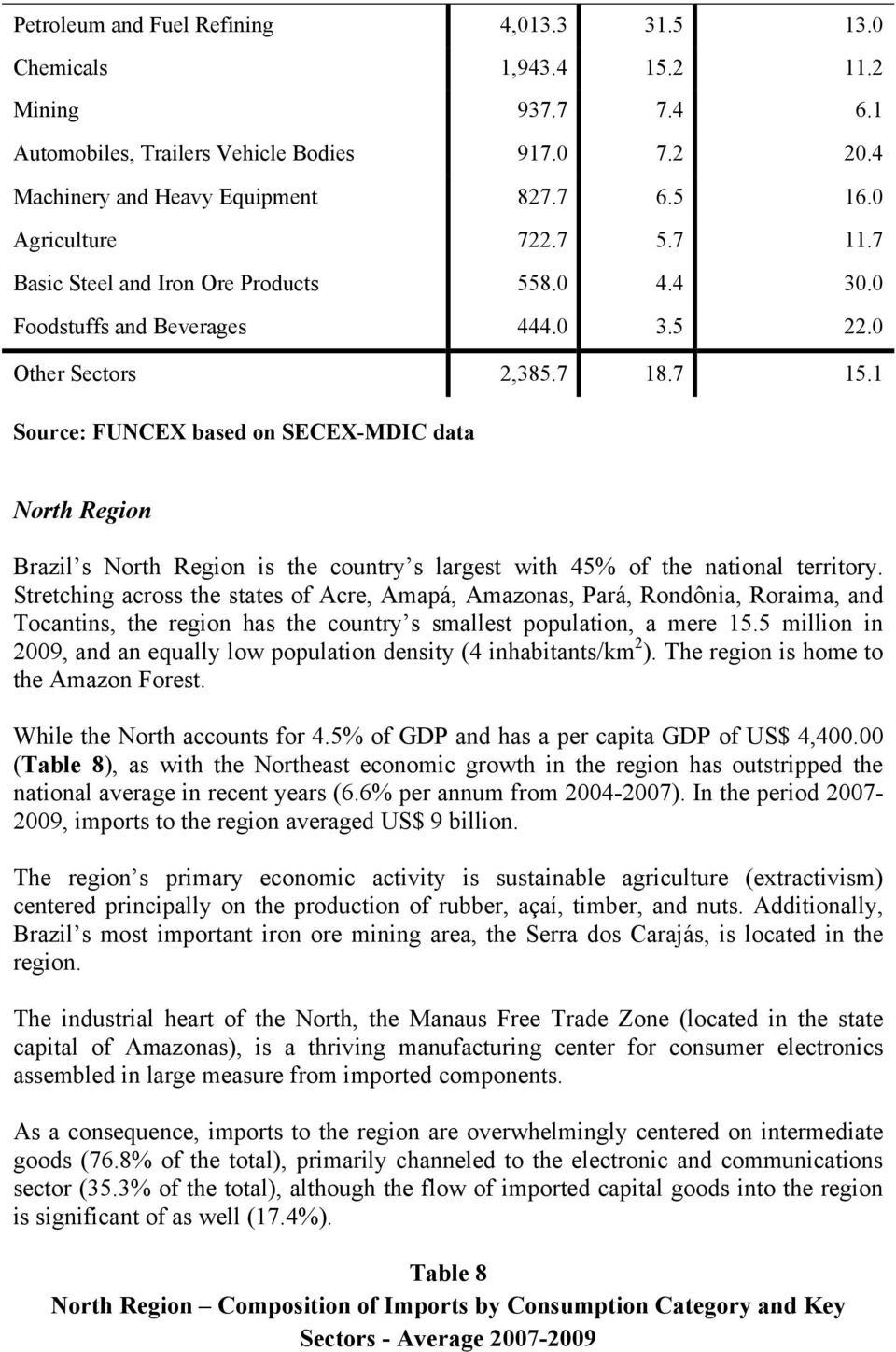
17 Products US$ (million) Share (%) Annual Growth (%) Total 9, Consumption Categories Intermediate Goods 6, Capital Goods 1, Fuel Non-Durable Goods Durable Goods Sectors Electronics and Communications 3, Machinery and Heavy Equipment Chemicals Medical/Hospital, Industrial Automation, and Precision Equipment Electrical Machinery, Devices, and Equipment Other Transportation Equipment Office and Computer Equipment Automobiles Trailers Vehicle Bodies Mining Other Sectors 1, Source: FUNCEX based on SECEX-MDIC data Center-West Region The Center-West Region occupies approximately 19% of the country s land area. Encompassing the states of Goiás, Mato Grosso, Mato Grosso do Sul, and the Federal District, site of Brazil s capital city, the region has a population of nearly 14 million inhabitants and a population density of 8.6 in habitants/km 2. The Center-West accounts for approximately 8% of national output and has a per capita GDP of US$ 4, In the period , imports to the region were US$ 7.4 billion, a total which has grown at a blistering 26.2% per annum in recent years. Agribusiness constitutes the region s principal economic activity, in particular soy and cotton production. However, the Center-West is home to an expanding industrial base in agro-industry, chemical production, and automobile manufacturing.

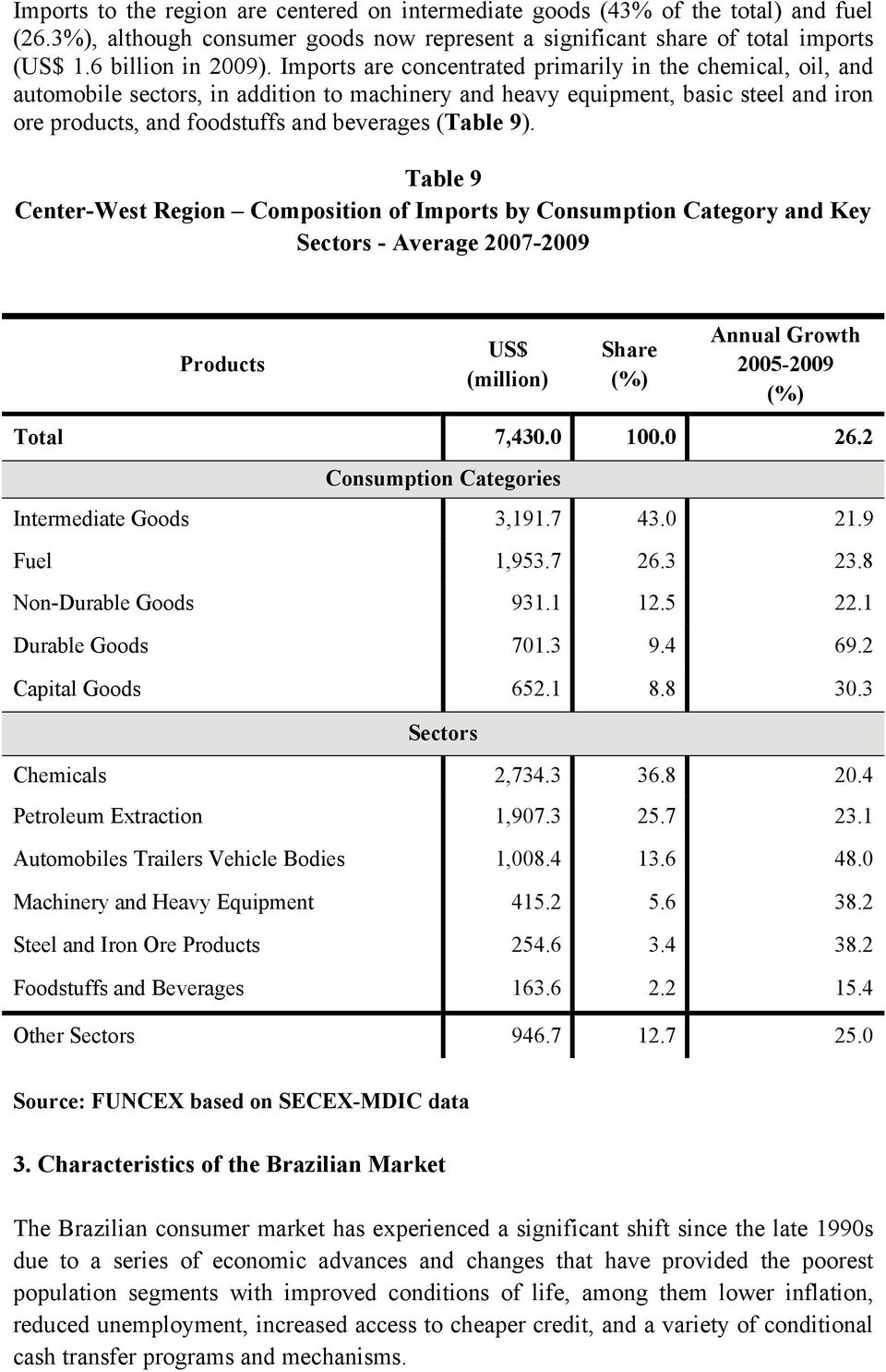
18 Imports to the region are centered on intermediate goods (43% of the total) and fuel (26.3%), although consumer goods now represent a significant share of total imports (US$ 1.6 billion in 2009). Imports are concentrated primarily in the chemical, oil, and automobile sectors, in addition to machinery and heavy equipment, basic steel and iron ore products, and foodstuffs and beverages (Table 9). Table 9 Center-West Region Composition of Imports by Consumption Category and Key Sectors - Average Products US$ (million) Share (%) Annual Growth (%) Total 7, Consumption Categories Intermediate Goods 3, Fuel 1, Non-Durable Goods Durable Goods Capital Goods Sectors Chemicals 2, Petroleum Extraction 1, Automobiles Trailers Vehicle Bodies 1, Machinery and Heavy Equipment Steel and Iron Ore Products Foodstuffs and Beverages Other Sectors Source: FUNCEX based on SECEX-MDIC data 3. Characteristics of the Brazilian Market The Brazilian consumer market has experienced a significant shift since the late 1990s due to a series of economic advances and changes that have provided the poorest population segments with improved conditions of life, among them lower inflation, reduced unemployment, increased access to cheaper credit, and a variety of conditional cash transfer programs and mechanisms.
19 This has produced three basic advances: Median family income has risen 12% over the past five years; 1 Income inequality has dropped, as measured by the Gini coefficient of registered in 2009, the lowest rate in 30 years; 2 Consumption patterns have become highly diversified as individuals devote proportionally less of their income to cover basic expenses (food and housing) and proportionally more toward other goods and services. Market Segmentation and Profile of Consumers As recently as just a few years ago, the consumer market was centered almost exclusively on socioeconomic segments A and B (upper middle and high income earners). This focus on the two segments, notwithstanding their significance in absolute terms, prevented the country from reaching its full potential. The recent growth of the economy has enabled a new and substantial contingent of Brazilians in socioeconomic segments C and D to join the broader consumer market. Indeed, these groups have increasingly become the focus of corporate advertising and marketing campaigns. There are today nearly 20 million families, or about 60 million individuals, with an average monthly income of R$ 2, (nearly US$ 1, at 2010 exchange rates). 3 In general, consumers in socioeconomic segments C and D are individuals whose needs have not yet been fully satisfied and who are, according to various qualitative studies, highly optimistic about their future income prospects and express a strong desire to increase their consumption levels, both in terms of quantity and product variety. Therefore, foreign companies should no longer look upon Brazil as a sophisticated and restricted niche market, but as a broad, diversified consumer market offering potential suppliers a vast range of opportunities in distinct price and quality segments. Factors Conditioning the Demand for Locally Produced Goods versus Imported Goods 1 Source: National Household Sample Survey (Pesquisa Nacional por Amostra de Domicilios PNAD), 2009, and Household Budget Survey (Pesquisa de Orcamentos Familiares POF), 2008/2009, prepared by the Brazilian Institute for Geography and Statistics (Instituto Brasileiro de Geografia e Estatística IBGE) ( 2 The lower the Gini coefficient, the lower the level of income inequality. 3 Based on the IBGE s 2008/2009 POF.

20 Recently, Brazil completed 20 years of market opening. As a consequence, consolidation of an import culture is still a work in progress for companies and individual consumers alike. However, there is far less resistance today to the purchase of imported goods. Companies now recognize that imported goods can offer a cheaper and more efficient alternative, including lower costs, a critical factor to ensure the competitiveness of their products, especially in the case of exporting firms. In regard to individual consumers, the distinctions made between products are far more centered on quality and price factors than on origin. Above all, consumers seek guaranteed post-sale technical assistance services and the full exercise of their rights before suppliers, as in the case of defective products. Therefore the sales strategies adopted by exporters should focus particular attention on these aspects through: implementation of an efficient and accessible customer assistance network; supply of detailed product information; establishment of efficient communications channels with consumers (telephone and online) to clarify questions regarding the operation of products and provide solutions to problems relating to factory defects; launch of advertising campaigns emphasizing the three factors above and reinforcing for consumers the company s genuine and real concern with ensuring customer satisfaction. PART II ORGANIZING AND STRUCTURING TRADE TO BRAZIL Despite its unique features and characteristics, exporting to Brazil involves the same basic procedures required to export to any other country. Market research to identify potential importers; Knowledge of existing business practices in the country; Understanding of the government procurement system, taking into account the public sector s significant influence on internal demand;

21 Identification and active use of trade promotion mechanisms, including trade fairs and missions; Identification and evaluation of the most effective distribution channels available; Basic understanding of trade logistics in the country; Knowledge of the procedures governing the relevant financial aspects of import transactions: payment form, currency, and financing mechanisms. 1. Identification of Potential Brazilian Importers This is not always an easy task, particularly in a country with a significant volume of imports and with more than 40,000 direct import firms, in addition to innumerable businesses engaged in indirect importing. To assist companies, the Brazilian Government provides, through the Trade and Investment Promotion Department (DPR) of the Ministry of External Relations, two directories with information on Brazilian importers at the Catalogue of Brazilian Importers (Catálogo de Importadores Brasileiros) and the Brazilian Tradings Directory (Diretorio Tradings do Brasil). Catalogue of Brazilian Importers Provides basic information on all Brazilian companies that have imported goods in recent years: company name, goods imported, countries of origin of imports, and import value range. For most companies, detailed contact information is provided as well, including address, telephone number, Web site, address, contact person in the trade/commercial section, etc. The Catalogue has comprehensive information on 7,672 companies, company-product lists, and product descriptions in Spanish, Portuguese, and English. The listed companies account for 78.32% of total yearly imports into the country. The Catalogue includes a search engine that allows users to research companies by different attributes: company name, the company s most common import items, the company s yearly import value ranges, and the Brazilian state in which the company operates. The Catalogue is available at:
22 Brazilian Tradings Directory List of Brazilian companies specializing in export and import activities prepared by the Brazilian Agency for Export and Investment Promotion (Agência Brasileira de Promocão de Exportações e Investimentos Apex-Brasil). In addition to import/export brokerage services, the listed companies provide market data and analysis, customs, logistical and financial, and shipment consolidation consulting services. The Directory includes a search engine that allows users to research companies by different attributes: company name, the company s most common export or import items, countries with which the company typically conduct business, value range of goods traded by the company, and Brazilian state in which the company is based. The Catalogue is available at: 2. Government Procurement Government procurement in Brazil is governed by Law 8666 of June 21, 1993, which mandates the establishment of competitive bidding procedures for public procurements of goods and services, including those delivered from abroad. All ministries, quasi-government (mixed capital) enterprises, self-governing bodies, and other State agencies are required, for the purpose of importing goods and services from abroad, to publish bid notices open to all participants wishing to take part in a price quotation procedure. The selection criteria are set forth in the bid notice, although in the majority of cases the lowest price criterion prevails, provided the respective technical requirements and supply conditions in connection with the respective product are met. IMPORTANT: In the case of a tie between a domestic and foreign supplier, by law preference must be given to the domestic supplier. In general, a bank guarantee must be submitted with the proposal, in order to cover the costs of a new bidding procedure in the event the winning bidder fails or opts not to sign the supply or service execution contract. All bidding procedures are published on the Internet. The federal government operates a Procurement Portal: 3. Trade Promotion Trade Fairs and Exhibits in Brazil (by sector)
23 Trade fairs and exhibits for a variety of products and sectors are held in Brazil virtually every year, primarily in the country s largest cities. Foreign exporters are invited to take part or visit these events. The Ministry of External Relations provides a search engine to allow users to identify trade shows held in the country by different attributes: sector, location (state), trade promotion institution, scope (international, national, regional, state, or municipal), name of trade show, and date of event. The information is available at: through the following links Trade Shows and Tourism / Trade Shows in Brazil. Trade Missions to Brazil Brazilian Embassies and Consulates, as well as the various Chambers of Commerce and the Ministry of External Relations, supported by other State agencies and ministries, are available to public and private entities in countries wishing to organize trade missions to Brazil. In general, the missions are organized and coordinated between related entities in Brazil and the country of origin, such as Chambers of Commerce and Industry Associations, with the support of the Brazilian Embassy and the respective country s diplomatic representation in Brazil. Annex II to this publication provides information on official agencies, chambers of commerce, industry associations, and other pertinent institutions in Brazil, as well as Brazilian Embassies and Consulates in South America. Advertising and Marketing in Brazil A number of advertising, trade promotion, and marketing channels aimed at specific target markets across every region of Brazil are available to foreign exporters. Information on the broad range of companies specializing in advertising activities can be obtained from Brazilian Embassies and Consulates abroad or through the diplomatic representations of the exporter s country in Brazil. This strategy is particularly useful for companies capable of allocating significant resources to product promotion. Business Travel
24 Following the preliminary contact with future and potential Brazilian importers, foreign exporters should seriously consider the possibility of traveling to Brazil to enter into direct contact with suppliers. Prior to traveling, exporters should take some basic steps to ensure their visit to Brazil is as productive as possible. In addition to the routine procedures, such as preparing a list of competitive product prices in advance for the Brazilian market, product samples and catalogues, and business cards and booking hotel and flight reservations ahead of time, attention should be given to three additional factors: Entry visas: Brazil waives visa requirements for the citizens of South American countries (except Venezuela) arriving in Brazil on business or for pleasure for a period of up to 90 days. Entry to the country is granted through presentation of a civil identification card issued by an official agency in the country of origin. Although travelers from other countries must have valid passports to enter Brazil, in many cases visa requirements are waived for a limited period. For further information on specific country requirements, visit the Ministry of Tourism s Web site: Vaccinations: the Brazilian Government requires an international certificate of vaccination against yellow fever ( Yellow Card ) for travelers from countries in the Amazon Basin. The National Health Surveillance Agency (Agência Nacional de Vigilância Sanitaria ANVISA) has primary responsibility for control and enforcement of the pertinent vaccinations. For more information, go to ANVISA s Web site: Letter of Invitation: in general, issuance of business visas to Brazil requires presentation of a certified letter from a Brazilian company addressed to the consular service clearly laying out the objective of the visit. 4. Trade Practices General Characteristics of Trade Practices Brazilian importers generally conduct in-depth research on suppliers throughout the global market. Therefore, exporters should have a firm grasp of the competitive advantages of their products and clearly lay these out for potential clients.
25 After swapping detailed technical and business information on proposed transactions, importers will request issuance of a Pro Forma Invoice. While this does not indicate a formal product order, the invoice is required to meet internal company procedures to finalize transactions. There are three critical steps in the preliminary negotiations between parties: unit price, delivery schedule, and payment form. Determining unit price requires setting out the pertinent sales conditions, referred to by the abbreviation Incoterms currently applied in international commercial transactions. The delivery schedule in Brazil is contingent not only on the means of transportation employed, but on the time required by Brazilian customs to nationalize the respective products (see Part V). The payment form should be determined in accordance with the existing modalities (see section 7 below). Use of Product Catalogues and Samples Exporters are urged to present comprehensive productive catalogues, including in electronic format and over the Internet. In addition, in many cases providing product samples is equally important and can be carried out by the exporter s representative in Brazil (as applicable) or directly by the exporter s main office. Pursuant to Brazilian law, while product samples are classified as imports they are subject to simplified customs procedures and exempt from import duties or other obligations applied to regular imports (See Part V, section 7). Litigation and Disputes In the case of legal actions and disputes between the parties, depending on the payment form, the respective issues may be resolved as per the rules and regulations of the International Chamber of Commerce ICC or, where an agreement is not reached, through the courts in the jurisdiction established by contract, which may be located in the supplying or purchasing country alike. 5. Distribution Channels Exporters have four options for placing their products on the Brazilian market, depending on their business interests and local demand. Direct Export
26 Under this approach, exporters negotiate directly with importers in Brazil, whether individuals or companies. This modality tends to require more time and greater financial resources from exporters. Direct export involves detailed market research to identify potential buyers and continuous telephone contacts and correspondence. Often, exporters must travel to Brazil to negotiate directly with buyers. Similarly, Brazilian importers prefer direct contact with suppliers, to the extent the exchanges foster trust and allow for immediate and direct decision making. The modality also makes it easier to clarify technical questions regarding a given product. The primary benefit involves the opportunity to negotiate more favorable financial terms and conditions through the elimination of intermediaries. Indirect Export Under this modality, rather than dealing directly with the companies to which the respective products are to be supplied, exporters work through brokers. In Brazil, brokerage services are divided into two types of organizations: trading companies and commercial importers. For small-scale enterprises, introducing their products through brokers is often the best strategy, given the extensive knowledge brokerage firms have of the domestic market and their close ties with potential buyers. Both of these advantages serve to facilitate product advertising in target markets. As a consequence, market research and transaction costs are reduced, as brokers handle the related business and customs procedures to ensure the entry of the imported goods into Brazil. Trading companies are centered more on large import orders. As such, in general exporters must work with large product volumes for immediate or scheduled shipment. Further, these companies usually maintain nationwide operations. Brazil law mandates that trading companies obtain special licenses and that they be constituted as publicly traded companies with a minimum capital requirement as established by the National Monetary Council (Conselho Monetário Nacional). Commercial importers are prevalent in Brazil, as they are governed by less stringent rules of incorporation. These firms have a greater tendency to work with small import volumes and operate, by and large, at the regional level. IMPORTANT: In the event of substantial import volumes, execution of an exclusive import agreement may be advisable, through which the trading company or commercial importer acts as the sole supplier of the foreign good in Brazil. Exporters are urged to
27 take into account the company s commercial and financial capacity prior to concluding the exclusivity agreement. Commercial Representatives Exporters may opt to secure independent professional services or companies to act as their commercial representatives in Brazil, compensating them through commissions based on sales volumes. These professional services do not import directly, but focus on identifying Brazilian clients for imported products. Commission payments, generally calculated on the basis of the FOB value of the transaction, may combine three modalities commonly employed in Brazil: Memorandum Account: the commission amount is deposited in a Brazilian bank, which, following payment to the exporter, proceeds to transferring the negotiated commission to the commercial representative. Receivable: the Brazilian bank pays the total amount of the bill of sale to the exporter, who then transfers the commission directly to the commercial representative. This requires a trustworthy financial relationship between the parties. Deductible: in this case the importer deducts the commission from the transaction amount, transferring it directly to the commercial representative. As in the case above, this modality requires a high level of trust between the parties. IMPORTANT: Exporters are urged to carefully select their commercial representative and to restrict the related activities to the representative s local market, whether an entire region, state, or city, given the breadth and complexity of the Brazilian market. Opening an Office in Brazil Exporters that find promising opportunities in the Brazilian market may choose to open a local office to maintain direct and ongoing contacts with potential importers. The office could also assume primary responsibility for the pertinent import procedures, in which case it must be registered as a commercial import firm. There are no administrative, currency, or customs impediments to opening a branch office of a foreign company in Brazilian territory. Indeed, affiliates may be controlled either by Brazilian or foreign shareholders. Affiliates are considered domestic
28 companies for purposes of all the applicable business liability, tax, legal, and public registration and licensing requirements. 6. Import Logistics Maritime Shipments Maritime shipping is the most common modality for importing goods into Brazil, including those originating in neighboring states of South America. The preference of importers and exporters for maritime shipping is based on cost advantages, particularly in the case of large product volumes. Brazilian maritime shipping companies are represented by a network of maritime agencies located in the country s largest cities. These firms are authorized to negotiate freight costs with exporters and importers and to issue bills of lading and cargo documents. Annex III provides the complete list and location of Brazilian ports, including inland ports. Air Shipments The primary advantage of air shipments involve speed of delivery, although the associated costs are far higher than those for maritime shipments. There are a number of airline companies offering international air cargo services from abroad to virtually any destination in Brazil. In addition express air delivery (courier) services are available to ship documents as well as small orders. The majority of Brazilian airline companies are members of the International Air Transport Association IATA or the International Civil Aviation Organization ICAO. These organizations require airlines to charge pre-established freights and to list the contents of cargo on the respective airway bills AWB. For destinations located in the North, Northeast, and Center-West Regions, transshipment is required at airports in the country s Southeast Region, including Viracopos (São Paulo) or Galeão (Rio de Janeiro). As a consequence, delivery times to these areas are longer. Ground Shipments Given that almost every South American country borders Brazil, ground shipments are a viable option for regional trade. There are a number of ground transportation routes and
29 specialized firms available to transport cargo from South America s Pacific Coast to destination points in Brazil. The continued expansion of the MERCOSUR customs union greatly facilitates transportation between Brazil, Argentina, Uruguay, and Paraguay. Companies within the bloc are able to move goods with an International Cargo Manifest ICM, which authorizes cargo shipments on all member State roads and highways. It is important to note that Brazilian importers can secure clearance for goods shipped by ground transportation at border checkpoints equipped with advance customs posts of the Federal Revenue Department. Annex III provides the comprehensive list and locations of Brazilian customs posts. All transportation companies engaged in shipping cargo on South American roads must be duly authorized and comply with the regional International Ground Transport Agreement IGTA. The agency with primary responsibility for regulating and enforcing ground transportation in Brazil is the National Agency for Ground Transportation (Agência Nacional de Transportes Terrestres ANTT) ( Rail Shipments Te use of railway networks for international cargo shipments in Brazil is not highly developed and is limited to the bordering countries of Argentina, Paraguay, and Bolivia. Freight costs are computed based on the equivalent of 3.5 cubic meters of cargo, although goods may also be shipped as single vehicle freight. For rail cargo shipments, International Rail Transport ITF waybills are used. International Cargo Insurance The purchase of international cargo insurance, generally executed by importers, is not required. However, companies tend to purchase and issue policies through Brazilian insurance operators as a means to guarantee their commercial and financial transactions. Insurance may be purchased directly from operators without the participation of insurance brokers, which are not required in the Brazilian market. Exporters should provide importers with all cargo data prior to shipping the respective merchandise so as to ensure all relevant information relating to cargo coverage is submitted to the insurance operator, based on the corresponding shipment modality.
30 Insurance premiums are contingent on the specific coverage purchased, namely: Port-to-Port: port of origin to port of destination; Warehouse-to-Warehouse: customs warehouse of origin to destination; House-to-House: complete logistics door-to-door. IMPORTANT: Insurance premiums in conjunction with freight costs and FOB customs values are used to compute import duties (see Part IV). 7. Payment Forms Advance Payment Advance payment is the most secure payment form available to exporters, to the extent the importer transfers the respective amounts in advance through wire transactions. However, the modality poses a significant financial risk for Brazilian importers in the event of the non-delivery of purchased goods. Collection Document Collection documents should only be used when there is significant trust between the parties, as the modality poses a major risk for exporters by virtue of the fact that banks only process the documents submitted by exporters after loading of the respective merchandise and serve as mere collection agents, offering no guarantees as to receipt of the corresponding amounts from the importer. Exporters must fully comply with the requirements of collection documents. Indeed, in addition to prompting suspension of payment, any discrepancies identified in the documentation could have logistical and customs ramifications for the importer and result, moreover, in application of the fines and penalties provided for under Brazilian customs regulations. Letter of Credit Brazilian banks can offer firm payment guarantees to foreign exporters, provided the documentation submitted by the exporter is in strict compliance with the related credit requirements. In this case, the currency exchange contract represents a financial agreement between the importer and the bank issuing the letter of credit.
31 However, importers may not prefer this option in relation to a collection document, as they are required to bear the costs of opening a letter of credit with a financial institution. IMPORTANT: Letters of Credit offer an advantage in the case of South American exporters: specifically, there is no need to request confirmation of the credit by virtue of the Reciprocal Credit Agreement RCA currently in effect in Latin America, an instrument to which the region s central banks have broadly adhered. Rather, the only requirement is a guarantee from the issuing bank as to the irrevocability of the document Foreign Exchange Transactions Foreign Exchange Contract The movement of currency into and out of Brazil requires execution of a currency exchange contract by the Brazilian importer. The instrument must comply with the rules and regulations of the Central Bank of Brazil, which are set forth in the International Currency and Capital Market Regulation (Regulamento do Mercado de Câmbio e Capitais Internacionais RMCCI). 5 Under the rules and regulations of the Brazilian Central Bank, importers must clearly link the respective Import Declaration to the currency exchange contract, demonstrating that payment was made to the foreign exporter, a process referred to in Brazil as foreign exchange coverage. At the time of import, Brazilian companies should use an Import Agreement Type 2 for foreign exchange contracted for the import of goods payable within a term of not more than 360 days, for transactions not subject to registration with the Central Bank, or in cash or in advance, for transactions subject to registration with the Central Bank. Simplified Foreign Exchange Procedures The Brazilian foreign exchange market has rapidly moved to streamline procedures and enable greater freedom of action in currency transactions. A floating exchange regime is employed in which rates are determined by the market and through targeted interventions by the Central Bank. 4 Further information on the RCA is available at: or 5 Available at
32 Brazilian export companies may maintain resources abroad for the purpose settling overseas obligations, including payments to firms from which goods are imported. In these cases, foreign exchange contracts are not required. Another recent innovation is the Local Currency Payment System (Sistema de Pagamentos em Moeda Local SML), through which foreign trade transactions can be settled in the local currencies of the respective countries, without the need for a foreign exchange contract. The system is already used in commercial transactions between Brazil and Argentina, and Brazil has expressed an interest in expanding the system to other nations in the region. 6 Trade between Brazil and bordering and neighboring States may also be conducted in reais, thereby exempting Brazilian importers from executing foreign exchange contracts. FOREIGN EXCHANGE FLOWS FOR BRAZILIAN IMPORTS GOODS SHIPPED FROM ABROAD OVERSEAS BANK ISSUES DOCUMENTS BRAZILIAN BANK NOTIFIES IMPORTER OF ARRIVAL OF DOCUMENTS FOREIGN EXCHANGE CONTRACT FOR IMPORTS PAYABLE IN CASH WITHDRAWAL AUTHORIZATION FOR IMPORTS PAYABLE IN INSTALLMENTS BRAZILIAN BANK DELIVERS DOCUMENTS TO IMPORTER CENTRAL BANK MONITORS TRANSACTION 6 Further information on the System is available on the Brazilian Central Bank s Web site:
33 9. Financing of Imports Brazilian importers have access to a series of public and private financing lines. The National Economic and Social Development Bank (Banco Nacional de Desenvolvimento Econômico e Social BNDES), for example, provides financing to importers, principally for products and inputs used in finished export goods, an operation known as drawback (see Part V, section 9). Private banks also offer a range of credit lines, from letters of credit through short-, medium-, and long-term financing options. PART III ADMINISTRATIVE PROCEDURES FOR IMPORTING Importing into Brazil involves procedures similar in complexity to those found in any other country. All import procedures are performed through the Integrated Foreign Trade System (Sistema Integrado de Comercio Exterior SISCOMEX), which interconnects government agencies to all agents engaged in export and import activities. The Foreign Trade Secretariat (Secretaria de Comércio Exterior SECEX), a subordinate body of the Ministry of Development, Industry, and Foreign Trade (MDIC), has primary responsibility for implementing the mechanisms and instruments employed in the oversight and enforcement of export and import transactions. Additional key agencies include the Brazilian Federal Revenue Department (Secretaria da Receita Federal do Brasil SRFB), a unit of the Ministry of Finance, responsible for the applicable customs, fiscal, and tax procedures, and the Brazilian Central Bank (BACEN), responsible for implementing the country s financial and foreign exchange rules. The administrative procedures for importing into Brazil involve the following requirements: (i) certification of the importer s eligibility on the SISCOMEX; (ii) classification of the imported goods; (iii) submission of the Pro Form Invoice; (iv) registration of the transaction on the SISCOMEX; (v) import licensing (licensing requirements are waived for the bulk of goods);
34 (vi) loading of goods in the country of origin; (vi) issuance of international documents and customs clearance (see Part V); (vii) contracting of foreign exchange; (ix) payment of applicable duties (see Part IV); (x) issuance of Import Declaration; (xi) release of cargo in Brazil. 1. SISCOMEX The Integrated Foreign Trade System (Sistema Integrado de Comercio Exterior SISCOMEX) is a consolidated information database through which the registration, monitoring, and control of foreign trade transactions are performed. SISCOMEX fosters integrated actions by all foreign trade oversight agencies, providing follow-up, guidance, and control of the various stages of the export and import process. Under the SISCOMEX, government agencies are classified as managing or consenting bodies. Managing Bodies: SECEX, SRFB, and BACEN; Consenting Bodies: agencies charged with reviewing and approving (or denying), within the scope of their duties and powers, export or import transactions involving specific types of goods, by virtue of the nature of the respective products or of the transaction in question. To execute the export or import of goods through the SISCOMEX, the respective company or its representative must register for the transaction on the SISCOMEX through obtainment of a password. The participation of legally constituted entities in foreign trade transactions requires a prior review by SRFB of all registration and tax information. The SISCOMEX may be accessed at: 2. Classification of Goods
35 Goods sold on the international market by the country are classified based on the Common Nomenclature of MERCOSUR (CNM), a system also adopted by Argentina, Paraguay, and Uruguay. The CNM classification codes are made up of eight numbers and are compatible with the Harmonized System (HS), the standard international classification system. The precise classification of goods purchased by importers serves to avoid the assessment of penalties by customs authorities, in addition to offering access to the tariff benefits provided for in Brazil s bilateral and multilateral trade agreements. CNM codes can be obtained on the Brazilian Federal Revenue Department s Web site: The full list of CNM items, including the associated import duties, are available at: 3. Pro Forma Invoice To facilitate the applicable administrative import procedures, foreign exporters should furnish the most comprehensive commercial and technical information possible, with a view to ensuring precise classification of the imported product and, by extension, compliance of the related purchase with Brazilian administrative and customs requirements. The information should be included in the Pro Form Invoice developed from the negotiation concluded between the exporter and the importer. full identification of the importer and exporter; description of the imported goods, specifying their characteristics, with a view to facilitating customs classification and assessment of the applicable duties and tariffs; country of origin; unit price in foreign currency; form of sale in accordance with negotiated Incoterms; total value (based on the negotiated Incoterms, separate freight amounts and international insurance totals should be submitted);
36 term of validity of the proposal; cargo weight (net and total); loading and unloading points (ports, airports, or border areas through which goods will pass); payment form. 4. Import License As a general rule, licenses are waived for Brazilian imports. Importers or their legal representatives are only required to register the Import Declaration (ID) in the SISCOMEX for purposes of initiating the respective customs clearance procedures. However, some goods are subject to licenses in cases in which the applicable legislation requires prior authorization of specific agencies of the Brazilian Public Administration or in which specific conditions apply. Licensing may be automatic or non-automatic by virtue of the fiscal classification of the product under the Common Nomenclature of MERCOSUR (CNM). In these cases, importers must apply for an Import License (IL) on the SISCOMEX, furnishing, to this end, commercial, financial, exchange, and tax information pertinent to the intended transaction. The IL must be registered in advance, pursuant to the applicable legislation, and prior to the beginning of customs clearance procedures. Loading of goods abroad, with the exceptions provided for by law, may only occur following authorization of the import license. The maximum period for processing of LI applications is 10 business days, in the case of Automatic Licensing, and 60 days, in the case of Non-Automatic Licensing, as of the date of registration in the SISCOMEX. As a general rule, both categories of licenses run for 60 days, with a view to providing the necessary time for the loading of cargo abroad. 7 While importers are ultimately responsible for complying with Brazilian rules and regulations, exporters have an obligation to provide all necessary information in a timely fashion, in particular the pertinent technical details of the product, essential not only for ensuring precise classification, but prior compliance with all requirements of the responsible consenting bodies as well. 7 Go to:
37 In certain cases, physical inspections of imported goods and issuance of the respective certification will be required. 5. Consenting Bodies To enforce and authorize the entry of products into the national territory, the government maintains a number of oversight and control agencies tasked primarily with reviewing and granting permissions for the import of goods through issuance of the respective Import Licenses on the SISCOMEX. Annex I lists the pertinent consenting bodies for Brazilian imports, in addition to their telephone numbers and addresses, citations of the legislation regulating each agency s activities, and a brief summary of their duties and powers The update table is available on the MDIC s Web site. 8 The consenting bodies with the greatest involvement in Brazil s foreign trade are DECEX/SECEX (MDIC), ANVISA, MAPA, and SUFRAMA. Department of Foreign Trade Transactions (Departamento de Operações de Comércio Exterior DECEX) Serves as the consenting body for products subject to special procedures: a) Imports under the Special Customs Drawback Regime (see Part V, section 9). b) imports subject to tariff quotas; c) imports subject to Similarity Tests for which fiscal benefits (waiver or reduction of import duties) is sought, such as in the case of the ex-tariff system (See Part IV, section 9); d) Imports of used goods: in general, the import of used goods is prohibited, except in certain cases provided for by law. National Health Surveillance Agency (Agência Nacional Vigilância Sanitária ANVISA) Exercises primary responsibility for the regulation, control, and oversight of products with an impact on human health medications, diagnostic reagents, cosmetics, cleaning 8
38 and disinfectant products, foodstuffs, tobacco products, medical products, blood, and blood products. Brazilian health law requires companies interested in importing controlled products subject to health controls to register with the National Health Surveillance Agency prior to importing the target goods. 9 The health requirements in effect are aimed at specific product categories, as laid out in Annex XLIV of ANVISA RDC 350/ Exporters should be prepared to provide information and clarify questions on all appropriate loading, transport, unloading, and storage conditions, so as to ensure the integrity of imported goods, including their quality, safety, and effectiveness. Ministry of Agriculture, Livestock, and Food Supply (Ministério da Agricultura, Pecuária e Abastecimento MAPA) MAPA has primary responsibility for enforcing and controlling the international transport of live animals, animal and plant products, plants and plant parts, genetic plant and animal material, animal feed, veterinary products, chemical fertilizers, as well as cardboard, cartons, boxes, and wrapping and packaging materials derived from wood, with a view to: preventing the entry of pests and diseases capable of posing a risk to the health of plants and animal herds in Brazil; guaranteeing the entry of animal and plant products and agricultural inputs in compliance with the applicable standards; and issuing the required phytosanitary and zoo-sanitary certificates for export products. Import authorizations should be requested in advance from the competent units of MAPA s Secretariat for Agricultural Defense or the Federal Superintendence for Agriculture in the interested party s jurisdiction, in accordance with the applicable SISCOMEX registration rules. 9 Information on how to obtain a Permit and License is provided at: 10 Available at:
39 Enforcement and inspection measures are conducted upon the arrival of goods to Brazil, including the pertinent agricultural surveillance procedures, which are performed by the individual Agricultural Surveillance Services (Serviços de Vigilância Agropecuária SVA) and the Agricultural Surveillance Units (Unidades de Vigilância Agropecuária UVAGROs) stationed at Brazilian airports, ports, border checkpoints, and special customs posts. 11 Manaus Free Trade Superintendency (Superintendência da Zona Franca de Manaus SUFRAMA) The Manaus Free Trade Zone Superintendency (SUFRAMA) serves as the consenting body for imports brought into Brazil by companies operating in the Manaus Free Trade Zone. Imports to the area are subject to non-automatic licensing procedures. The respective Import Licenses may be obtained after cargo loading at the point of origin. PART IV GENERAL TAX TREATMENT FOR IMPORTS The applicable tax treatment for Brazilian imports includes the Import Tax (Imposto de Importação II) as well as a number of additional levies assessed to products sold on the domestic market, with a view to ensuring goods produced in Brazil receive equal treatment. While computing the levies assessed on imported goods may be quite complex, the SISCOMEX can automatically calculate the applicable obligations by simply entering the classification of the respective goods and their customs value. IMPORTANT: to avoid the cumulative payment of levies, Brazilian law provides that a credit be extended upon payment of obligations at the time of import, which the importer can then use to offset equivalent levies assessed in subsequent transactions. 12 In practice, therefore, the levy applies only to the value added of the imported good. 1. Import Tax (IT) Federal tax assessed for exclusively economic (regulatory) ends and protection. The tax applies only to products imported from abroad. 11 See the Handbook of Operational Procedures for International Agricultural Surveillance (Manual de Procedimentos Operacionais da Vigilância Agropecuária Internacional), available at: in the Services section, SISLEGIS link. 12 The offset does not apply to the import tax.
40 The Import Tax is selective, as it varies according to country origin of the imported goods (due to trade agreements, see Part VI, section 1) and the characteristics of the respective product. The applicable rates are set forth in the Common External Tariff (CET), the customs duty assessed by the member States of MERCOSUR. There is a specific rate for each item of the Common Nomenclature of MERCOSUR (CNM). 13 The tax is computed on the basis of the customs value of the imported goods. 14 As a general rule, the customs value is calculated based on the Free on Board (FOB) value plus the corresponding freight and international insurance amounts. The Import Tax is calculated through application of the CET rates to the respective tax base. The rates currently set forth in the CET are all ad valorem. The Import Tax adheres to the following formula: II = CET (%) x Customs Value 2. Excise Tax (Imposto sobre Produtos Industrializados IPI) A federal tax which also varies according to the characteristics of the respective product. As with the Import Tax, a specific rate applies (Excise Tax Index TIPI) for each item of the Common Nomenclature of MERCOSUR (CNM). The IPI is selectively applied as well. That is, the weight of the levy differs by virtue of the product s strategic importance, so that the most essential products are exempted. The obligation is calculated on the basis of the customs value of the respective product plus the amount of the Import Tax. 15 The tax is computed through application of the rates established in the TIPI. IPI = TIPI (%) x (Customs Value + II) 13 The import tax rates applicable to each item of the CNM can be found at www4.receita.fazenda.gov.br/simulador or 14 Determined pursuant to Article VII of the General Agreement on Tariffs and Trade GATT/WTO. 15 Some of the products in chapters 21 and 22 of the CNM (beverages) are subject to tax based on unit or quantity, as the case may be.
41 3. Social Integration Program Contribution (Programa de Integração Social PIS) and Social Security Financing Contribution (Contribuição para o Financiamento da Seguridade Social - COFINS) Federal social contributions aimed at funding social security. Since 2004, the contributions have been applied to imported products, in order to ensure domestically produced goods receive equal treatment. Imported goods are taxed at the same rate as domestic products. A fixed rate is applied to both contributions: 1.65% for the PIS and 7.6% for the COFINS. Calculation of both contributions is based on the customs value of the goods plus the applicable goods and services tax (Imposto sobre Circulação de Mercadorias e de Serviços ICMS, see section 4 below) on the imported goods and the total value of the contributions themselves, as these are included in the end price of the goods (gross up). In this light, the contributions adhere to the following formula: PIS = 1.65% x (Customs Value + ICMS + PIS + COFINS) COFINS = 7.6% x (Customs Value + ICMS + PIS + COFINS) 4. Goods and Services Tax (Imposto sobre a Circulação de Mercadorias e Prestação de Serviços ICMS) A state tax on the circulation of goods on the domestic market and on interstate and inter-municipal transportation services, as well as telecommunications services. The tax also applies, in general, to imported goods, in order to ensure domestically produced goods receive equal treatment. The tax rate differs by virtue of the importance of the product and may range from zero, for essential goods, to 25%. Each state and the Federal District have their own ICMS legislation, including different rates and distinct tax treatment. Therefore, to estimate the total tax obligation, it is necessary to know in which state the respective good will be sold. The ICMS is calculated by adding the customs value, the IT, the IPI, the ICMS itself (gross up), any other applicable levies on the imported goods, and the pertinent import customs expenses, namely the costs relating to import clearance, such as warehousing, wharfage, etc.
42 The estimated tax obligation, which can only be calculated following arrival of the good as total customs costs are not known prior to this point is based on the following formula: ICMS = ICMS Rate (%) x (Customs Value + II + IPI + ICMS + PIS + COFINS + Customs Expenses) or ICMS = ICMS Rate (%) x [(Customs Value + II + IPI + PIS + COFINS + Customs Expenses)/(1 - ICMS Rate)] 5. Contribution for Intervention in the Economic Domain (Contribuição de Intervenção no Domínio Econômico CIDE-Combustíveis) The Contribution for Intervention in the Economic Domain is a federal tax assessed to regulate fuel prices. The CIDE-Fuel applies to the import and sale of gasoline, diesel, aviation kerosene, fuel oil, liquefied petroleum gas, and ethanol. The contribution is calculated based on sale volumes, to which a fixed value is assessed for each unit sold. As such, the contribution adheres to the following formula: 6. Additional Freight for the Renovation of the Merchant Marine (Adicional ao Frete para Renovação da Marinha Mercante AFRMM) The AFRMM is a federal social contribution for intervention in the economic domain assessed on the value of international freight or cabotage and aimed at providing resources to support the government s efforts to develop the Brazilian merchant marine and shipbuilding and repair industry. The additional freight is assessed on a percentage of the port-to-port water transport service, including port and other expenses listed on the bill of lading. Additional freight rates vary according to the type of navigation: 25% for long-course navigation; 10% for cabotage navigation; and 40% for inland and river navigation. The AFRMM is not assessed on freight originating in the Member States of MERCOSUR and those included under international agreements signed by Brazil that expressly waive the additional freight charge, such as the Economic Complementation
43 Agreements executed with the member countries of the Latin American Integration Association ALADI (see Part V, section 1). 7. SISCOMEX Use Fee Aimed at covering the Import Declaration registration costs on the Integrated Foreign Trade System SISCOMEX. The fee varies according to the CNM classification number under which the Import Declaration is registered. 8. Additional Costs In addition to the items listed above, imports are subject to other international commercial transaction fees relating, which are regularly assessed in virtually every country: Wharfage (movement of goods at port); Warehousing; Import licensing costs; Customs clearance costs; Transport of goods to the premises of the local company; Bank fees relating to opening of credit lines, etc. 9. Ex-Tariff Created to reduce the Import Tax on capital goods and computer and telecommunications equipment for which a domestically produced equivalent does not exist or which is in short supply, and, additionally, the import of which the government has an interest in promoting. The mechanism provides for a reduction of the Import Tax to 2% for a period of up to two years, provided the absence of sufficient domestic production is demonstrated. Modification of the Import Tax rate and the respective publication of a corresponding ex-tariff applies to goods listed under the CET as capital goods or computer and telecommunications equipment, including parts and components, for which a domestically produced equivalent does not exist The list of ex-tariffs is updated periodically. Additional information on the mechanism is available at:
44 10. Examples of Import Fees and Duties Product Electric engines CNM Classification Country of Origin China Customs Value (CIF) R$ 70, DUTIES Import Tax 6% R$ 4, IPI 4% R$ 2, ICMS 18% R$ 12, PIS (specific formula) R$ COFINS (specific formula) R$ FEES AFRMM 25% of freight R$ SISCOMEX Use Fee R$ Wharfage (port fee schedule) R$ Warehousing (port fee schedule) R$ Customs Broker (optional) R$ Domestic Freight R$ Domestic Insurance R$ Total R$ 93, IMPORTANT: With a view to providing guidance to importers, the Brazilian Revenue Department offers an import tax simulation model at: ( By entering the CNM code and ICMS rate, the simulation automatically processes the federal tax obligation (Import Tax, IPI, PIS, and COFINS) and determines whether the product is subject to additional duties in connection with applicable trade protection measures. Importers may also verify the accuracy of the product classification by crossreferencing the imported good with the CNM code provided by the simulation. PART V CUSTOMS PROCEDURES The objective of customs procedures is to verify the accuracy of the information provided by the importer in respect of the imported goods, the corresponding
45 documentation, and the applicable laws, with a view to securing the clearance and release of the imported goods to the importer. All goods arriving from abroad, whether imported on a permanent or temporary basis or subject to payment or waiver of the applicable Import Tax must be submitted to customs clearance procedures. Import clearance procedures are process through the respective Import Declaration (ID) registered on the Integrated Foreign Trade System (SISCOMEX). CUSTOMS FLOWCHART FOR BRAZILIAN IMPORTS License (where applicable ) Confirmation of Cargo Direct Account Debit Record of Import Declaration Customs Inspection Classification Green Yellow Red Gray Submission of Documents Distribution Customs Verification/Review Customs Clearance Matching of Cargo Identification Number to the Electronic Bill of Lading (Merchant Marine Database) Release of Imported Goods
46 1. Required Documents for Customs Clearance Customs clearance procedures for imported goods begin at the time the importer or the authorized legal representative registers the Import Declaration on the SISCOMEX, generally upon arrival of the respective goods in Brazil. Upon registration, importers are required to pay all applicable federal levies. The supporting documentation for the information provided in the Import Declaration includes: the original copy of the bill of lading or equivalent document; the original copy of the commercial invoice signed by the exporter; the packing list; and any other document required by virtue of international agreements or specific laws. Among the information required in the Import Declaration is full identification of the importer and buyer or ordering party, in the event these are not the same person/company, and identification, classification, customs value, and origin of the imported goods. IMPORTANT: if any of the customs clearance procedures for imported goods is not initiated within the time periods prescribed by law, namely 45 to 90 days from arrival of the respective goods in Brazil, the cargo is classified as abandoned, leading to forfeiture and designation of the products to one of the ends provided for by law. The same rule applies in the event the pertinent customs clearance procedures are interrupted for a period of 60 days, either by virtue of any action or omission on the part of the importer 2. Regular Customs Clearance In general, customs clearance procedures are processed on the SISCOMEX following registration of the importer and respective legal representatives in the system. However, there are exceptions based on the nature of the imported goods, the transaction, and/or the status of the exporter or importer in which the applicable customs clearance procedures are executed through the completion of specific forms, in lieu of registration in the system. Examples:
47 Imports executed by diplomatic representations, products samples with no commercial value, and goods aimed at humanitarian assistance: in these cases, Simplified Import Declarations (SIDs) are used; Customs clearance of express remittances: executed without registration in the SISCOMEX based on the Express Remittance Declarations for imports or exports. 3. Simplified Customs Clearance Simplified customs clearance procedures may be processed on the SISCOMEX through completion of a Simplified Import Declaration (SID). The following operations may be executed through electronic SIDs: goods with a total value equal to or less than US$ 3,000.00; donations; goods cleared for temporary entry into Brazil; unaccompanied passenger baggage; and operations not subject to SISCOMEX registration. 4. Importing Goods via Postal Delivery or Courier Service Import operations involving deliveries that require timely transport and immediate receipt by the address are generally carried out through the SID mechanism. The system is subject to a distinct tax treatment: federal levies (IPI, Import Tax, PIS, and COFINS) are combined under a single rate of 60%. The ICMS (state tax) is paid separately. The following are subject to express delivery: documents; books, booklets, and newspapers without commercial ends; other goods intended for legally constituted entities up to a maximum of 3, or individuals up to a maximum of US$ 5,000.00, without exchange coverage; international orders. However, the following may not be imported through the express delivery system: prohibited goods;
48 used or refurbished consumer goods, except those intended for personal use; currency; firearms and ammunition; tobacco and tobacco products; any other goods for which air transport is prohibited, pursuant to the applicable laws. Easy Import Service The Brazilian Postal and Telegraph Company (Empresa Brasileira de Correios e Telégrafos ECT) created the Easy Import ( Importa Fácil ) service, a mechanism widely used for small and lightweight orders that are consistent with accepted postal transportation standards. 17 The service is offered through the following modalities: Easy Import Legal Entities goods valued up to US$ 3,000.00; Easy Import Signed Delivery goods valued up to US$ 10,000.00; Easy Import Individuals goods valued from US$ to US$ 3,000.00; Easy Import Orders goods valued up to US$ ; Re-importation, intended for the return of goods exported under the temporary customs export regime. This modality is not subject to taxes or duties. 5. Importing on behalf of Third Parties Imports on behalf of third parties involve operations in which a legally constituted entity carries out, through a signed contract, the required customs clearance procedures for goods acquired by another party. Registration of the Import Declaration (ID) requires prior authorization of the contracted party through the SISCOMEX for the purpose of authorizing the entity to serve as the buyer s importer for the period prescribed by contract. 17 For more information on the Easy Import system, go to:
49 6. Importing by Order Imports by order are operations in which a legally constituted entity executes, by virtue of a signed contract, the applicable customs clearance procedures for goods acquired by that party abroad, for the purpose of resale to a pre-established ordering company. Transactions completed in whole or in part with resources of the ordering party are not considered imports by order. Registration of the Import Declaration (ID) requires prior authorization of the ordering party and importer and previous verification of their business relationship through the SISCOMEX. 7. Importing Sample Products The import of product samples, catalogues, and advertising material is an essential tool for effective trade promotion by foreign exporters, in particular those taking part in trade fairs and business meetings in Brazil. Brazilian law offers expedited procedures for this category of goods through the temporary admission regime (see section 10 below). Under the regime, goods may be imported for a period of up to one year, renewable once for an equal period, free of taxes or duties. The regime applies specifically to goods used in the following cases: Cultural, artistic, and scientific exhibits; Trade and industrial fairs; Trade showcases (displays); Product samples with commercial value. 8. Parameters (Green, Yellow, Red, and Gray Channels) After the Import Declaration is registered, the applicable customs clearance procedures are initiated. The ID is submitted to review by the tax authorities, at which time the imported goods are designated to one of the inspection channels. This designation procedure is referred to as parametrization. There are four verification and inspection channels: green, yellow, red, and gray.
50 Green Channel: no customs verification or inspection procedures are conducted and the goods are forwarded for clearance and subsequent nationalization. Yellow Channel: All supporting documentation and the information furnished by the importer in the ID is reviewed. Red Channel: In addition to reviewing the pertinent documentation, a physical inspection is conducted of the imported goods. Gray Channel: Document reviews and physical inspections are performed for purposes of verifying the amount declared in the commercial invoice and identifying potential evidence of fraud, including with regard to the declared price of the imported goods. Designation of the enforcement channel is executed through the SISCOMEX, in accordance with the parameters established by the General Coordination of the Customs System (Coordenação Geral do Sistema Aduaneiro COANA), which takes into account the following factors: the tax standing of the importer; trading patterns of the importer; nature, volume, or value of the imported goods; total applicable duties and taxes; origin, provenance, and destination of the goods; administrative and tax treatment; characteristics of the imported goods. 9. Customs Clearance Customs clearance is the final stage of the import process. It consists of the release of the imported goods to the importer and issuance of the Proof of Import (PI), certifying formal nationalization of the respective products. 10. Special Customs Regimes
51 Special Customs Regimes were established with a view to stimulating economic development and growth in Brazil. In essence, they allow for the entry or exist of goods into the customs territory or out of Brazil free of taxes and duties. Drawback Applies to goods used as inputs in the manufacture of products intended for export. Encompasses the import of raw materials, parts, and components through the suspension, waiver, or rebate of taxes and duties. Suspension: the importer is temporarily released from paying the applicable import duties; however, permanent waiver is only authorized after the imports brought into the country are verified against the exports provided for under the respective Concession Act (Ato Concessório); Waiver: the importer is exempted from paying the required import. To this end, performance of the applicable import and export operations must be demonstrated through identification of the electronic documents entered in the SISCOMEX; Rebate: the importer pays the applicable import duties and subsequently receives a full or partial rebate. Authorization for drawback under the Suspension or Waiver modality is provided by SECEX, subject to review and oversight of the Brazilian Federal Revenue Department. Authorization and enforcement of drawback under the Rebate modality is executed by the Brazilian Federal Revenue Department. Temporary Admission A customs regime intended to enable the entry of certain goods into the country, for pre-determined objectives and time periods, through the total or partial suspension of the applicable import duties. Importers undertake to re-export the products following termination of the established time period. The regime is designed to facilitate the temporary entry into Brazil of: Goods intended for the organization of or participation in cultural, artistic, scientific, commercial, and sporting events, for assistance and rescue operations,
52 for packaging and transportation of other goods, and for trials and testing. In these cases, importers are granted full waiver of the applicable duties; Machinery and equipment imported under operational lease agreements for the execution of economic activities (the delivery of services or manufacture of other products). In these cases, importers are granted partial waiver of the applicable duties and authorized to pay proportional assessments based on the time the respective goods remain in the country; and Goods intended for enhancement and maintenance activities (assembly, renovation, workovers, repairs, restoration, among others, applied to the respective products. In these cases, the full suspension of import duty payments is granted. IMPORTANT: entry into the customs territory of goods subject to commercial leases contracted with leasing firms based abroad does not fall under the temporary admission regime and is subject to the general rules and regulations governing regular import operations. Customs Warehousing This regime provides for warehousing of foreign goods in a public customs house through suspension of the applicable import duties. The key advantage of the regime is that it offers the opportunity for partial nationalization of goods as they are sold. In addition to warehousing, goods authorized entry under this regime may be used in the following operations: Exhibits, demonstrations, and tests; Processing activities; and Maintenance or repair work. Duty-Free Warehousing Allows for the warehousing of foreign goods in customs houses for the purpose of ensuring trade flows between neighboring countries and third countries.
53 The regime is only authorized under international treaties or agreements signed by Brazil. To date, agreements have been concluded between Brazil and Paraguay and Bolivia. Duty-free warehousing facilities have been placed into operation in the Port of Santos and Paranaguá and are currently being used by Paraguay for goods exported to and imported from other countries. Back-to-Back Credits The operation enables importers to purchase goods from exporters with instructions that the goods be forwarded to third countries without passing though Brazilian territory. The purchase, known as back-to-back, is executed on behalf of the Brazilian importer and must be duly authorized by the Central Bank and the Foreign Trade Department DECEX, as it constitutes a financial transaction not involving physical transport of the goods through Brazilian territory. Back-to-back credits offer the following advantages: Logistical reduced freight, insurance, and other costs; Faster delivery times; and Lower financial and foreign exchange costs. Customs Transit This regime waives the applicable import duties for the movement of goods under customs control between two points in Brazil. Customs transit is employed to transport imported goods which have not yet been nationalized from a port, airport, or border checkpoint to a designated customs clearance unit. Similarly, the regime is applied for the movement of exported goods from the designated customs clearance unit to the respective port, airport, or border checkpoint. Special Computerized Industrial Warehousing Regime (Regime Especial de Entreposto Industrial sob Controle Informatizado RECOF) RECOF enables direct delivery of imported goods to the importer s fiscal domicile, through suspension of the applicable duties under the customs transit regime, for use in industrial processing, manufacturing, and assembly activities.
54 Special Import Regime for Crude Oil and Oil Products (REPEX) Through this regime, crude oil and oil products can be imported for purposes of subsequent export, to which end the applicable duties are waived. Special Customs Regime for Petroleum and Natural Gas Exploration and Production Goods (REPETRO) Under this regime, goods intended for the exploration and exploitation of oil and natural gas reserves may be exported and imported through application of the fictitious exit mechanism, by which the target goods remain within the domestic market but the related operation is deemed an export transaction. Oil exploration platforms provide a good example. While the platforms are produced in Brazil and remain in operation in Brazil they are exported by PETROBRÁS to a subsidiary abroad, which leases the equipment from PETROBRÁS in Brazil. The regime also applies to raw materials, parts, and components imported under the drawback system, through suspension of the applicable duties, which are then processed in the country and sold as fictitious exports. Special Inputs Import Regime (Regime Especial de Importação de Insumos RECOM) The regime authorizes the import, without exchange coverage, on behalf of an ordering party based abroad, of parts and components used in the domestic manufacture of goods. Automobile manufacturers based in Brazil are the primary beneficiaries of this regime. Export Processing Zones (Zonas de Processamento de Exportacão ZPE) ZPEs are free trade zones tied to companies that produce for export. The regime provides for the import of raw materials, parts, and components and suspension of the applicable import duties for the processing and sale of the finished product abroad. A part of the resulting production is supplied to the domestic market. The portion sold on the domestic market is subject to all duties and contributions applicable to the import transaction as well as the contributions suspended at the time of import and purchase of the respective inputs on the domestic market. Free Trade Zones
55 These are defined as free traded areas subject to fiscal benefits aimed at incentivizing the establishment of industrial, commercial, and agricultural centers. The fiscal benefit in free trade zones is waiver of the Import Tax and IPI. There are two free trade zones in Brazil: Manaus (Amazonas) and Macapá (Amapá). PART VI CONDITIONS FOR MARKET ACCESS 1. Tariff Preferences Brazilian importers can take advantage of tax incentives through the agreements signed by Brazil with other countries and economic blocs. Tariff preferences only cover the Import Tax and do not apply to any other applicable import duties. To secure a tariff preference for goods exported to Brazil, three conditions must be met: i) a bilateral or multilateral agreement or treaty must be in effect between the country of origin and Brazil; ii) the product must be covered under the respective agreement or treaty; iii) the product must meet the minimum requirements of origin provided for under the agreement or treaty to ensure designation as an originating product in the exporting country, avoiding, in this way, characterization as a back-to-back operation. IMPORTANT: The tax incentive is effectively formalized during the customs clearance process, at which time the importer is required to present the certificate of origin issued by the authorized agency in the exporting country to customs authorities. The certificate must include the legal bases for invoking the applicable trade agreement. Failure to present the certificate of origin results in forfeiture of the respective preferences, subjecting the importer to the regular applicable import duties. The principal trade agreements to which Brazil is party include the Economic Complementation Agreement (ECA), signed within the scope of the Latin American Integration Association (ALADI). There are two sources that provide the terms and conditions of the agreements currently in effect for Brazil: the official Web site of the Ministry of Development, Industry, and Foreign Trade (MDIC):
56 5; the official Web site of the Ministry of External Relations (MRE) ( the government agency with primary responsibility for the negotiation and follow-up of trade agreements. Table 10 Trade Agreements Signed by Brazil Agreement Parties Observations LATIN AMERICAN COUNTRIES Brazil, Argentina, Agreement establishing MERCOSUR. Signed in ACE-18 Paraguay, and Uruguay November ACE-35 ACE-36 ACE-53 ACE-55 ACE-58 ACE-59 ACE-38 ACE-41 ACE-62 MERCOSUR and Chile MERCOSUR and Bolivia Brazil and Mexico MERCOSUR and Mexico Signed in November Establishes a free trade pact between the parties. Signed in December Establishes a free trade area between the countries. Signed in August Established fixed preferences for nearly 800 items of NALADI/HS. In effect since 2003, regulates trade in automotive products: automobiles, vehicles with a Total Gross Weight of up to 8,845 kg, farm tractors, harvesters, self-propelled farm equipment, selfpropelled road equipment, auto parts. MERCOSUR and Peru Signed in November Establishes free trade area between the parties. MERCOSUR, Colombia, Signed in December Establishes free trade Ecuador, and Venezuela area between the parties. Brazil and Guyana Partial Reach Agreement signed in June Confers reciprocal preferences on a limited set of products. Brazil and Suriname Partial Reach Agreement signed in April Consists in Brazilian concession of a quota of 10,000 tons of rice from Suriname free of import duties. MERCOSUR and Cuba Signed in July Confers reciprocal preferences on a limited set of products. PARTIES OUTSIDE LATIN AMERICA MERCOSU R-India MERCOSUR and India In effect since June Confers reciprocal preferences on a limited set of products. Aimed at future establishment of a free trade area.
57 MERCOSU R-Israel MERCOSU R-Southern African Customs Union MERCOSU R-Egypt MERCOSUR and Israel MERCOSUR, South Africa, Namibia, Botswana, Lesotho, and Swaziland MERCOSUR and Egypt Signed in December Establishes free trade area between the parties. Signed in December 2008 Confers reciprocal preferences on a limited set of products. NOT YET IN EFFECT. Awaiting ratification of the parties. Free trade agreement signed in August NOT YET IN EFFECT. Awaiting ratification of the parties. EXAMPLE For a better understanding of the impact of trade agreements on import duties, a comparison between a CET operation subject to duties and a MERCOSUR operation is provided below. (i) Import Duties under CET Product: Home Weight Scales Items Home Weight Scales CNM Classification Country of Origin United States Customs Value (CIF) R$ 150, TAXES AND DUTIES Import Tax 8% R$ 12, IPI 12% R$ 19, ICMS (gross up) 18% R$ 42, PIS (specific formula) R$ 1, COFINS (specific formula) R$ 11, AFRMM 25% of Freight R$ 1, Other Fees and Costs R$ Total R$ 238, (ii) Import Duties through MERCOSUR Product: Home Weight Scales
58 Items Home Weight Scales CNM Classification Country of Origin Argentina Customs Value (CIF) R$ 150, TAXES AND DUTIES IPI 12% R$ 18, Import Tax 0% ICMS (gross up) 18% R$ 39, PIS (specific formula) R$ 1, COFINS (specific formula)) R$ 11, AFRMM Products from MERCOSUR member States are not subject to this obligation Other Fees and Costs R$ Total R$ 221, (iii) Comparison CET x MERCOSUR Import Duties In comparing the applicable import duties, importing goods from the MERCOSUR zone offers the following tangible advantage: IT: difference of R$ 12, IPI: difference of R$ 1, ICMS: difference of R$ 2, AFRMM: difference of R$ 1, Total Amount: difference of R$17, Observation: both operations share the same warehousing, wharfage, freight and domestic insurance, customs broker, and other smaller costs. 2. Sanitary, Phytosanitary, and Zoo-Sanitary Controls Sanitary Controls Items: medications, cosmetic/beauty products, perfumes, personal hygiene products, foodstuffs, cleaning/disinfectant products, medical products, in vitro diagnostic products.
59 Regulatory Agency: National Health Surveillance Agency (Agência Nacional de Vigilância Sanitária ANVISA). For more information go to: Phytosanitary Controls Items: plants, plant products and byproducts, and agricultural materials. Regulatory Agency: Department of Plant Health (Departamento de Sanidade Vegetal DSV) of the Ministry of Agriculture, Livestock, and Food Supply (MAPA). For more information go to: See Directive 40 of June 30, 2008, available at: Zoo-Sanitary Controls Items: Animal products. Regulatory Agency: Federal Inspection Service (Serviço de Inspeção Federal SIF) of the Ministry of Agriculture, Livestock, and Food Supply (MAPA). For more information go to: See Directive 40 of June 30, 2008, available at: IMPORTANT: the import and export of live animal species, products and subproducts derived from Brazilian wildlife and exotic wildlife are controlled by the Brazilian Institute for the Environment and Renewable Natural Resources (Instituto Brasileiro do Meio Ambiente e dos Recursos Naturais Renováveis IBAMA) ( 3. Packaging and Labeling Requirements A number of imported and domestically produced goods are subject to specific packaging and labeling requirements in Brazil. Examples include: foodstuffs in general; animal products, whether intended for consumption or for processing by other establishments;
60 toys; medications/prescription drugs; cosmetic/beauty supplies. Primary Regulatory Agencies: National Institute of Metrology, Standardization, and Industrial Quality (Instituto Nacional de Metrologia, Normalização e Qualidade Industrial INMETRO); the Ministry of Agriculture, Livestock, and Food Supply (MAPA); and the National Health Surveillance Agency (ANVISA). For more information go to: Trademarks, Patents, and Intellectual Property The Brazilian agency with primary responsibility for the registration and control of industrial and intellectual property rights is the National Institute for Intellectual Property (Instituto Nacional de Propriedade Intelectual INPI). The Agency registers trademarks, patents, computer programs, industrial designs, geographic indications, and integrated circuit topography. It also certifies technology transfers and corporate franchise agreements. For more information go to: 5. Approval and Certification of Imported Products, Certifications of Conformity The Brazilian agency with primary responsibility for approving and certifying products and conformity assessment in the National Institute of Metrology, Standardization, and Industrial Quality (Instituto Nacional de Metrologia, Normalização e Qualidade Industrial INMETRO). Approval, certification, and conformity assessment procedures apply to a range of items, from electrical plugs and bicycle rims to automobiles and home appliances. For more information go to: 6. Trade Defense To defend domestic industry from unfair trade practices by foreign suppliers, including the use of dumping measures and export subsidies, or by virtue of difficulties faced by
61 specific domestic industries during times of import surges, Brazil may apply trade defense measures. Trade defense measures in Brazil adhere to the rules of the World Trade Organization, which provide for the mandatory investigation of alleged unfair trade practices, including the right of defense of all interested parties. The agency with primary responsibility for reviewing and deciding on the bases and merits of the applications for investigations into matters relating to dumping, subsidies, and safeguards is the Trade Defense Department (Departamento de Defesa Comercial DECOM), a unit of the Foreign Trade Secretariat (SECEX-MDIC). Anti-Dumping Dumping is defined as the introduction of a good on the domestic market under one of the drawback modalities at lower than prevailing market prices. Anti-dumping measures include charging an additional amount for import operations, with a view to neutralizing the harmful effects of the goods subject to dumping. Anti-dumping measures may be calculated through application of ad valorem, fixed, or variable duties, or any combination of these. Ad valorem duties are applied to the customs value of the goods in question. Offset Measures Direct offset measures may be applied for purposes of offsetting subsidies conferred by the exporting country to the manufacture, production, export, or transportation of any good sold in Brazil, provided the imported good is shown to cause harm to domestic industry. Offset measures consist of the assessment of an amount equal to or less than the actionable subsidy for the purpose of neutralizing the negative effects caused by the subsidy. Offset measures are calculated through the application of ad valorem, specific, fixed, or variable duties, or by any combination of these. Ad valorem duties are applied to the customs value of the goods in question. Safeguards Safeguard measures may be applied if it is shown that the import of a given product has increased to a level that causes (or threatens to cause) serious harm to domestic manufacturers of similar or competing goods.
62 Safeguard measures are applied to the extent necessary to prevent or compensate the damage caused and facilitate the adaptation of domestic industry. There are two types of safeguard measures: (i) increase in the Import Tax based on an additional CET applied through an ad valorem or specific duty, or by a combination of the two; or (ii) application of quantitative restrictions. PART VII GENERAL RECOMMENDATIONS FOR EXPORTERS 1. Trade Habits Brazilian entrepreneurs and executives are generally cordial and prefer to dispense with unnecessary formalities. However, this does not mean they are unduly flexible negotiators. Brazilian importers want to receive all of the technical and commercial information on the goods they purchase and the respective prices, including the respective customs classification. With the related data in hand, importers can prepare the appropriate import schedules that take into account the applicable duties, warehousing, and port costs, enabling more efficient and timely decisions about purchases. Therefore, exporters should make all product information available. To the extent possible, no questions should go unanswered, as this could prompt delays in client decision. The absence of any data or information could make clients think twice about concluding a business deal. Another essential piece of information involves loading periods in the country of origin, to the extent that, depending on the means of transportation employed, transit times become an important element in planning for the roll-out and sale of a particular product on the domestic market. Extreme care should be taken with the volumes offered. For example, order volumes may be substantial in the case of human consumption products, given the size of the Brazilian market. Therefore, exporters should be certain of their capacity to supply the negotiated amounts within the agreed deadlines. Clients should not be pressured in the hope of obtaining an immediate decision, insofar as concomitant queries into the applicable customs rules are usually conducted, which can delay the decision-making process.
63 What can happen at business meetings is clients may request submission of the Pro Forma Invoice. As such, exporters are urged to have company letterhead with them. Some importers will raise key contractual issues in business meetings, with the final draft concluded subsequently by fax or . Once a proposal has been formalized, the respective price and payment form should not be modified. Commercial contracts are not usually concluded for small- or medium-sized purchases, as the Pro Forma Invoice serves this purpose. In the event the negotiation involves goods and amounts which, in the exporter s view, require a formal instrument, execution of a contract may be proposed that includes all of the procedures to be fulfilled by both parties. The contract may be notarized and the competent jurisdiction for settling any and all disputes selected. The competent jurisdiction may be located in Brazil or in the exporting country. Formal instruments should be prepared in the two working languages. 2. Important Tips In Brazil, business meetings are generally held in company offices. It is rare for clients to schedule meetings at a hotel or in their residence, as is customary in other countries. Adopt an objective and direct approach in meetings, be clear and firm with regard to prices, timetables, and payment forms. Do not be concerned if assistants or cell phones interrupt the meeting, even during sales pitches. Pause and continue the presentation as naturally as possible. In general, Brazilian executives negotiate business deals alone or with another company representative engaged in the particular field or project. Company catalogues and Web sites should be made available in a number of languages, including Portuguese, to ensure specific technical information does not have to be translated or explained during meetings. Guarantees, post-sale technical assistance, replacements, maintenance, or any other obligations required following the sale should be clearly laid out, primarily those relating to financial matters.
64 Brazilian executives will not always directly state their lack of interest in purchasing the product. Generally, they will allow the business negotiation to run its course until it becomes clear to the visitor that a deal is not possible. The reputation of Brazilians as not being punctual does not apply to the business sector. Indeed, Brazilian executives are punctual and will frequently call in advance if they are unable to meet at the scheduled time. In regard to dress codes, men and women alike should wear formal business attire. Do not be surprised if prior to the meeting lighthearted comments are made about a report in the media or about the preferred soccer (football) teams of meeting participants. These are common ice-breakers in Brazil. At the outset of meetings, coffee is served in small cups. The coffee is strong, quite different from that found in other Latin American countries. Brazilians are interested in the stories foreign visitors have to tell. Generally, visitors are asked to offer some observations or to report on a significant factor development in their country. Never offer comments on the country s political or economic situation, much less about issues relating to Brazilian foreign trade with which one disagrees, as this could give rise to inconvenient comparisons. Presentations should be objective, succinct, clear, and, in the event technical information is required, avoid excessive detail. One should assume that the client has an adequate understanding of the sale product. In general, very few questions will be posed during presentations. However, a number of questions relating to all aspects of a particular product, including in regard to prices, will most certainly be raised afterward. Depending on the relationship established in the business meeting, a lunch or dinner invitation may be extended with a view to continuing the negotiation. As such, lunch or dinner invitations should not be viewed as social gatherings. Visitors are unlikely to be invited to meet the families of clients, a practice more prevalent in other countries. However, after all pertinent business matters have been discussed, Brazilians enjoy engaging in informal conversations about their personal lives.
65 Visitors should take the initiative to treat their hosts, even in cases in which clients insist on paying the check. The gesture will be looked on favorably, not so much from a financial standpoint, as for the thoughtfulness of the act. On leaving the establishment, the client may want to take his or her visitors back to their hotel. Visitors should accept, for it is important to Brazilian to ensure the comfort and safety of their guests. 3. What Not To Do Certain attitudes should be avoided, as they could affect the client s view of the company and jeopardize the business deal: Failing to respond immediately to client s; Pledging to export in excess of the company s true production capacity; Adjusting the price following formal submission of the Pro Forma Invoice; Failing to send the promised product samples; Unilaterally modifying the agreed payment form; Imposing Incoterms not accepted by the client; Shipping goods of lesser quality than guaranteed; Failing to deliver required documents in a timely fashion; Failing to provide explanations for discrepancies in required documentation; Neglecting to invite the client to visit one s country and company Putting forth negative views of one s country or of Brazil; Failing to implement product modifications requested by the client; Refusing to collaborate in cases of insurance compensation; Insinuating the possibility of default if payment is not executed through a letter of credit;
66 Insisting on advance payment due to a lack of trust; Announcing contracting of a credit insurance policy, suggesting a lack of trust; Criticizing Brazilian customs procedures; Declaring a dislike for the Portuguese language; Commenting that Brazil s major cities are chaotic; Criticizing Brazilian food; Demonstrating exaggerated fear with respect to urban crime in Brazil; Excessively praising one s country, particularly through comparisons to Brazil. ANNEX I: CONSENTING BODIES FOR IMPORTS INTO BRAZIL Agency Contact Information Items Duties Film and audiovisual products ANCINE National Cinema Agency ANEEL National Electric Power Agency ANP National Petroleum Agency Agência Nacional do Cinema Praça Pio X nº 54 10º andar Centro Rio de Janeiro (RJ) CEP: Tel.: (21) Agência Nacional de Energia Elétrica SGAN Módulo J - 2.º andar - salas 212/213 - Brasília (DF) - CEP Telephone: Agência Nacional de Petróleo Electric power products Compliance with legal requirements, including issuance of certificates of registration of production, licensing, distribution contracts, copies, and payments to CONDECINE Compliance with regulatory provisions prescribed by law Petroleum, gas, and fuel products Compliance with requirements provided for in Av. Rio Branco, º andar Rio de Janeiro (RJ) CEP: Telephone: specific Directives regarding the registration of products, importers, and buyers Agência Nacional de Products with an impact Issues health
67 ANVISA National Health Surveillance Agency CNEN National Nuclear Energy Commission Vigilância Sanitária SEPN 515 Bloco B Edifício Omega 5º andar Brasília (DF) CEP: Telephone: /1026 Comissão Nacional de Energia Nuclear Rua General Severiano nº 90 sala 400A Botafogo Rio de Janeiro (RJ) CEP: Telephone: /2337 on human health: medications/prescription drugs, diagnostic reagents, cosmetic/beauty products, cleaning/disinfectant products, foodstuffs, tobacco products, medical products, blood, and blood products Radioactive products surveillance regulations for imported goods Protection of humans and the environment from potential negative effects of ionizing radiation. Nuclear non-proliferation control, radiation protections, and nuclear safety COTAC Civil Air Transport Coordinating Commission DECEX Department of Foreign Trade Operations DFPC Comissão de Coordenação do Transporte Aéreo Civil COMAER, Ministério da Defesa Rua Santa Luzia nº 651 M2 -sala 214 Castelo Rio de Janeiro (RJ) CEP: Telephone: Departamento de Operações de Comércio Exterior Esplanada dos Ministérios, Bloco J - Brasília (DF) CEP Telephone: / Exército Brasileiro - Diretoria de Fiscalização de Produtos Controlados (DFPC) QG EX Products relating to air transportation Various Products controlled by the Brazilian Army, including specific types of weapons and military hardware Compliance with Brazilian Aeronautical Certification Regulations and the applicable legislation. Review of obtainment of quota and non-quota tariffs, equivalent national products, used materials, drawback, and statistical monitoring of strategically sensitive goods to domestic industry Review of prior import authorizations by Army Command Esplanada - Bloco H
68 DNPM National Department of Mineral Production Ministry of Mines and Energy DPF Federal Police Department Ministry of Justice ECT Brazilian Postal and Telegraph Company IBAMA Brazilian Institute for the Environment and Renewable Natural Resources 4º andar SMU - Brasília (DF) CEP: Telephone: /4391 e fax Departamento Nacional de Produção Mineral do Ministério de Minas e Energia SAN Quadra 1 Bloco B 3º andar sala 305-A Brasília (DF) CEP: Telephone: Departamento de Polícia Federal do Ministério da Justiça SAIS Quadra 7 Lote 23 Brasília (DF) CEP: Telephone: Empresa Brasileira de Correios e Telégrafos SBN - Quadra 1 - Conj. 3 - Bloco A - 7.º andar - Ed. Sede - Brasília (DF) - Tel.: Ministério do Meio Ambiente SAIN Av. L 4 Norte - Edif. Sede do IBAMA - Bloco B - Sub solo Brasília (DF) - CEP Tel.: Specific mineral products Chemical products directly or indirectly aimed at the illegal development of narcotics, psychotropic drugs, or substances causing physical or psychic dependence Postal deliveries Living species, products and sub-products derived from Brazilian wildlife and exotic wildlife species. Products with a potential environmental impact Compliance with requirements provided for in the Kimberley Process Certification Scheme KPCS in the case of rough diamonds and asbestos. Compliance with legal requirements. Inspection, review, and authorization of imports Compliance with Postal Law Compliance with International Convention on trade in endangered species of wild fauna and flora (CITES). Oversight of battery disposal and negative environmental impacts. Compliance with Montreal Protocol on substances that deplete the Ozone layer. Compliance with Basel Convention
69 INMETRO National Institute of Metrology, Standardization, and Industrial Quality MAPA Ministry of Agriculture, Livestock, and Food Supply Instituto Nacional de Metrologia, Normalização e Qualidade Industrial Rua Santa Alexandrina, º andar - CEP Rio de Janeiro (RJ) - Telephone /2874 Ministério da Agricultura, Pecuária e Abastecimento Esplanada dos Ministérios - Anexo B - 4.º andar s/424 B - CEP Brasília (DF) - tel: Ministério da Ciência e Tecnologia Various Animal, plants, and the related products, byproducts, parts, subproducts, residues of economic value and agricultural inputs Compliance with mandatory labeling requirements under the Brazilian Labeling Program Fulfill regulatory criteria governing oversight, inspection, quality control, and risk analysis procedures established by the competent bodies of MAPA, in accordance with the applicable SISCOMEX registration rules and standards MCT Ministry of Science and Technology SUFRAMA Manaus Free Trade Zone Superintendence SPO SAI Área 5 Quadra 3 Bloco F 1º piso Setor Policial Brasília (DF) CEP: Telephone: Superintendência da Zona Franca de Manaus Rua Ministro João Gonçalves de Souza S/Nº.º - Distrito Industrial - Manaus (AM) - CEP Tel.: /7020 Electronic components and other intended for companies located in the Manaus Free Trade Zone Compliance with the Chemical Weapons Convention Concession of tax incentives to companies located in areas under the authority of SUFRAMA ANNEX II: PUBLIC AGENCIES AND INSTITUTIONS 1. Brazilian Government Agencies Involved with Foreign Trade
70 MINISTRY OF EXTERNAL RELATIONS (MRE) Brasilia Federal District Esplanada dos Ministérios, Bloco H - CEP Web site: Trade and Investment Promotion Department Anexo 1, 5º andar, sala 534 Telephone: (61) Within the MRE, the support provided to entrepreneurs by the Trade and Investment Promotion Department (DPR) deserves special mention. Key activities performed by the unit include: the development and implementation of policies to stimulate exports, draw foreign investment, and internationalize Brazilian companies, as well as the organization of events aimed at promoting the country, its productive capacities and technologies, and so forth. Among the Department s multiple duties are the implementation of trade intelligence activities, such as the preparation of studies and market research analyses; the development of publications (including this guide); the organization of business delegations, thematic seminars, business meetings, and events aimed at attracting investment; participation in international trade fairs; dissemination of tourist destinations, etc. DPR manages the BrasilGlobalNet ( portal, which serves as an interface between the Department s activities and the general public. The system provides access to all of the content laid out above (studies, research, publications, etc.) free of charge as well as registration information on trade-related events organized by the Department (missions, seminars, fairs, etc.). It also contributes to promoting contacts between importers and exporters by posting a range of opportunities in the trade, investment, and technology transfer fields. The site also includes a Showroom, where companies can design their own product demonstration pages. Of Itamaraty s more than 200 posts abroad Embassies, Missions, Consulates 100 have Trade Promotion Sectors (SECOMs), under the DPR s coordination, which serve as trade promotion antennas. With offices in every region and continent of the globe, the SECOMs represent the most extensive trade promotion network available to Brazilian executives and entrepreneurs interested in internationalizing their business and to foreign executives and entrepreneurs seeking to purchase Brazilian products and services or in obtaining information on the domestic market. The DPR is organized into five specialized divisions: Trade Information Division (DIC) produces and publishes information on foreign trade, prepares market research studies, publications, and statistical analyses; responds to trade-related inquiries by Brazilian executives and
71 entrepreneurs regarding business opportunities. The Division also has primary responsibility for the Program of Competitive Substitution of Imports (PSCI) aimed at increasing imports from South American countries, in addition to the Export Promotion Program to the United Nations System (PPE-ONU-MRE) and the MERCOSUR Joint Trade Promotion Program. Trade and Investment Promotion Programs Division (DPG) coordinates DPR s strategic planning; organizes activities aimed at attracting foreign investment to the public and private sectors; manages the Investment Promotion and Technology Transfer System for Companies (SIPRI); assists companies in the effort to internationalize their operations; and has primary responsibility for personnel training in the area of trade promotion. Trade Promotion Operations Division (DOC) organizes trade missions, seminars, business meetings, and and promotional events in Brazil and abroad, including on official missions of the President of the Republic; provides support to visits and missions of foreign importers and investors to the country; and offers assistance in publicizing events of interest to Brazilian entrepreneurs and business leaders. Trade Fairs and Tourism Division (DFT) promotes the participation of Brazilian enterprises, including small- and medium-sized business, in industry and multi-industry fairs abroad, in addition monitoring tourism policies and organizing activities to promote Brazilian destinations. Financial Administration Sector (CGF) manages the Department s budget; plans and organizes the execution of payments in Brazil and abroad relating to the activities of the DPR s Divisions and SECOMs. MINISTRY OF AGRICULTURY, LIVESTOCK, AND FOOD SUPPLY Brasilia Federal District Esplanada dos Ministérios, Bloco D, 8º andar CEP l Web site: MINISTRY OF SCIENCE AND TECHNOLOGY Brasilia Federal District Esplanada dos Ministérios, Bloco E, 4º andar CEP Web site:
72 MINISTRY OF AGRARIAN DEVELOPMENT Brasília Federal District Esplanada dos Ministérios, Bloco A, 8º Andar CEP Web site: MINISTRY OF DEVELOPMENT, INDUSTRY, AND FOREIGN TRADE Brasilia Federal District Esplanada dos Ministérios, Bloco J, 6º andar CEP Web site: MINISTRY OF FINANCE Brasilia Federal District Esplanada dos Ministérios, Bloco P, 5º andar CEP Web site: MINISTRY OF MINES AND ENERGY Brasilia Federal District Esplanada dos Ministérios, Bloco U, 8º andar CEP Web site: MINISTRY OF TRANSPORTATION Brasilia Federal District Esplanada dos Ministérios, Bloco R, 6º andar CEP Web site: MINISTRY OF CULTURE Brasilia Federal District Esplanada dos Ministérios, Bloco B, sala 401 CEP Web site: MINISTRY OF THE ENVIRONMENT Brasilia Federal District Esplanada dos Ministérios, Bloco B, 5º ao 9º andar CEP Web site:
73 2. Chambers of Commerce Represented in Brazil ARGENTINE-BRAZILIAN CHAMBER OF COMMERCE SÃO PAULO Rua do Rocio, Conj. 801 e Ed. Meliá Confort Business Vila Olímpia - São Paulo - SP CEP Telephone: (11) Fax: [email protected] Web site: ARGENTINE-BRAZILIAN CHAMBER OF COMMERCE AND INDUSTRY RIO GRANDE SUL AND SANTA CATARINA Av. Alberto Bins, Hotel Plaza São Rafael - 1º subsolo Porto Alegre - RS Brasil CEP: Telephone: (51) [email protected] BRAZILIAN-BOLIVIAN CHAMBER OF COMMERCE AND INDUSTRY Av. Cásper Líbero 390 cj º andar São Paulo - Brasil CEP: Telefax: (11) [email protected] BRAZILIAN-CHILEAN CHAMBER OF COMMERCE Av. Paulista 509, 12º andar, Caixa Postal Conj São Paulo - Brasil CEP: Telephone: (11) Fax: (11) [email protected] Web site: BRAZILIAN-CUBAN CHAMBER OF COMMERCE AND INDUSTRY Rua Uruguai, Jardim América São Paulo - Brasil Telefax: (11) [email protected] Web site: BRAZILIAN-PARAGUAYAN CHAMBER OF COMMERCE Rua São Clemente, Cobertura
74 Rio de Janeiro - Brasil CEP: Telephone: (21) /3740 Fax: (21) Web site: [email protected] PERUVIAN-BRAZILIAN CHAMBER OF COMMERCE AND INDUSTRY Rua Paulo Afonso, 200-2º andar - Brás São Paulo Brasil CEP: VENEZUELAN-BRAZILIAN CHAMBER OF COMMERCE AND INDUSTRY Rua Sergipe, Conj. 705, 7º andar São Paulo - Brasil CEP: Telephone: (11) Fax: (11) [email protected] SOUTHERN CONE-MERCOSUR INTERNATIONAL CHAMBER OF COMMERCE Main Office Manoel Isidoro da Silveira, C Lagoa da Conceição - Florianópolis - SC CEP Telephone: (48) Fax. : (48) Web site: CHAMBER OF COMMERCE OF MERCOSUR AND THE AMERICAS Av. Ipiranga,344-11º andar Ed. Itália São Paulo - Brasil CEP: Telephone: (11) [email protected] 3. Key Industry Associations and Entities CNI NATIONAL CONFEDERATION OF INDUSTRY Brasilia SBN - Quadra 01 - Bloco C - Ed. Roberto Simonsen - CEP Telephone: (61) / Fax: (61) Web site:
75 The CNI provides a Catologue of Brazilian Exporters available at: CINs INTERNATIONAL BUSINESS CENTERS Institutions engaged on behalf of the internationalization of Brazilian companies. Each state maintains a CIN connected to the respective Federation of Industry. The primary duty of the CINs is to organize international mission The CIN-NETWORK, coordinated by the National Confederation of Industry, encompasses all of the state CIN. Web site: [email protected] CNC - NATIONAL CONFEDERATION OF COMMERCE IN GOODS, SERVICES, AND TOURSIM Rio de Janeiro Av. General Justo, 307 Centro CEP Tel: (21) Fax: (21) Brasília SBN Q1 Bloco B, nº 14 CEP Tel: (61) Fax: (61) Web site: CNA BRAZILIAN CONFEDERATION OF AGRICULTURE AND LIVESTOCK Brasilia SGAN Quadra 601, Módulo K - Brasília, DF CEP Tel: (61) Fax: (61) Web site: AEB FOREIGN TRADE ASSOCIATION OF BRAZIL Rio de Janeiro Av. General Justo, 335-4º andar Rio de Janeiro RJ CEP Tel: (21) Fax: (21) Web site: [email protected] ABRACEX BRAZILIAN FOREIGN TRADE ASSOCIATION São Paulo Alameda Joaquim Eugênio de Lima, 1467 CEP Telefax: (11)
76 Web site: AIAB BRAZILIAN ASSOCIATION OF AEROSPACE INDUSTRIES Rua José Alves dos Santos, 281, sala 203 São José dos Campos CEP Tel: (12) Fax: (12) Web site: ABECITRUS BRAZILIAN ASSOCIATION OF CITRUS FRUIT EXPORTERS Av. Pres. Vargas, 2001, cj 21 - Ribeirão Preto SP CEP Tel: (16) Fax (16) Web site: [email protected] ABEF BRAZILIAN ASSOCIATION OF POULTRY EXPORTERS Av. Brigadeiro Faria Lima, 1912, 20º andar, cj. 20 L São Paulo SP CEP Tel: (11) Fax: (11) Web site: [email protected] ABIA BRAZILIAN ASSOCIATION OF FOODSTUFF INDUSTRIES Av. Brigadeiro Faria Lima, 1478, 11º andar CEP São Paulo/SP Tel: (11) Fax: (11) Web site: [email protected] ABIEC BRAZILIAN ASSOCIATION OF MEAT EXPORTING INDUSTRIES Av. Brigadeiro Faria Lima, 1912, 14º andar - conj J CEP São Paulo/SP Tel: (11) Fax: (11) Web site: [email protected] ABIMA BRAZILIAN ASSOCIATION OF PASTA INDUSTRIES Av. Brigadeiro Faria Lima, Conj. 913, 9º andar CEP São Paulo/SP Tel: (11)
77 Fax: (11) extension 117 Web site: ABIP BRAZILIAN ASSOCIATION OF BAKING AND CONFECTIONERY INDUSTRIES SHN Qd 02 Bloco H n 30 Lj 55 Sobre Loja Mix Metropolitan Flat CEP Brasília DF Telefax: (61) Web site: [email protected] ABITRIGO BRAZILIAN ASSOCIATION OF WHEAT INDUSTRIES Rua Jerônimo da Veiga, andar CEP São Paulo SP Tel: (11) Fax: (11) Web site: [email protected] ABEIVA BRAZILIAN ASSOCIATION OF AUTOMOBILE IMPORTERS Rua Dr. Renato Paes de Barros, 717 conj andar CEP São Paulo - SP Telefax: (11) / / Web site: [email protected] AEA BRAZILIAN ASSOCIATION OF AUTOMOBILE ENGINEERING Rua Salvador Correia, 80 São Paulo SP - CEP: Tel: (11) Fax: (11) Web site: [email protected] ANFAVEA NATIONAL ASSOCIATION OF AUTOMOBILE MANUFACTURERS Avenida Indianópolis, São Paulo - SP - Brasil CEP Tel: (11) Fax: (11) Web site: [email protected] FENABRAVE NATIONAL FEDERATION OF AUTOMOBILE DISTRIBUTORS Av. Indianópolis, Planalto Paulista - São Paulo SP - CEP
78 Tel: (11) Fax: (11) Web site: SINDIPEÇAS NATIONAL ASSOCIATION OF AUTOPARTS MANUFACTURERS Av. Santo Amaro, CEP São Paulo - SP Tel: (11) Fax: (11) Web site: sindipecas@sindipecas org.br ABRABE BRAZILIAN BEVERAGES ASSOCIATION Av. Nove de Julho, 5017, 1º andar - CEP São Paulo - SP Tel: (11) Fax: (11) Web site: [email protected] ABDIB BRAZILIAN ASSOCIATION OF INFRASTRUCTURE AND BASIC INDUSTRY Praça Monteiro Lobato, 36 Butantã - São Paulo SP - CEP Tel: (11) Fax: (11) Web site: [email protected] ABIMAQ BRAZILIAN ASSOCIATION OF MACHINERY AND EQUIPMENT MANUFACTURERS Avenida Jabaquara, CEP São Paulo - SP Tel: (11) /6428 Fax: (11) Web site: [email protected] SIMEFRE INTER-STATE ASSOCIATION OF HIGHWAY AND RAIL MATERIALS AND EQUIPMENT INDUSTRIES Av. Paulista, andar, cj. 801 CEP São Paulo SP Telefax: (11) Web site: [email protected]
79 ABRACICLO BRAZILIAN ASSOCIATION OF MOTORCYCLE, BRICANTES DE MOTOCICLETAS, MOTORBIKE, MOPED, BICYCLE, AND RELATED MANUFACTURERS Rua Américo Brasiliense, Cj.907 a S. Paulo/SP - CEP Tel: (11) Fax:(11) Web site: [email protected] ABRINQ BRAZILIAN ASSOCIATION OF TOY MANUFACTURERS Av. Santo Amaro, andar São Paulo SP CEP Tel: (11) Fax: (11) Web site: [email protected] ABIC BRAZILIAN COFFEE ASSOCIATION Rua Visc. de Inhaúma, 50 8 andar Rio de Janeiro RJ CEP Tel: (21) Fax: (21) Web site: [email protected] ABICS - ASSOCIAÇÃO BRASILEIRA DAS INDÚSTRIAS DE CAFÉ SOLÚVEL Av. Paulista, 1313, 9 andar, conjunto São Paulo SP - CEP Tel: (11) Fax (11) Web site: [email protected] BRACELPA - BRAZILIAN CELLULOS AND PAPER ASSOCIATION Rua Olimpíadas, 66 9 andar São Paulo SP CEP Tel: (11) Fax: (11) Web site: [email protected] SINDICEL SÃO PAULO ELECTRICAL CONDUCTOR, WIRE DRAWING, AND NONFERROUS METAL ROLLING INDUSTRY ASSOCIATION Av. Dr. Cardoso de Melo, Bloco II - 9º andar - conj São Paulo/SP - CEP Telefax.: (11) Web site: [email protected]
80 ANAMACO NATIONAL ASSOCIATION OF BUILDING MATERIALS MERCHANTS Rua Norma Pieruccini Giannoti, CEP São Paulo SP Tel.: (11) Fax: (11) Web site: [email protected] APEOP SÃO PAULO ASSOCIATION OF PUBLIC WORKS COMPANIES Rua Avanhandava, 126-9º andar - CEP: São Paulo - SP Tel: (11) Fax: (11) Web site: [email protected] ASFAMAS BRAZILIAN ASSOCIATION OF SANITATION MATERIALS AND EQUIPMENT PLANTS Rua General Furtado Nascimento, 684 conj. 64 CEP São Paulo - SP Telefax: (11) Web site: [email protected] CBIC BRAZILIAN CHAMBER OF THE CONSTRUCTION INDUSTRY SCN - Quadra 01 - Bloco E - Edifício Central Park - 13º Andar - CEP Brasília - DF Tel: (61) Fax: (61) Web site: [email protected] SINDUSCON-SP SÃO PAULO STATE CIVIL CONSTRUCTION INDUSTRY ASSOCIATION Rua Dona Veridiana, São Paulo SP Tel: (11) / Fax: (11) Web site: [email protected] ABECE BRAZILIAN ASSOCIATION OF STRUCTURAL ENGINEERING AND CONSULTING Av. Brig. Faria Lima, 1993 conjunto 61 São Paulo SP CEP Tel: (11) Fax: (11) Web site:
81 ABIHPEC BRAZILIAN PERSONAL HYGIENE, PERFUME, AND COSEMTICS INDUSTRY ASSOCIATION Av. Paulista, andar conj São Paulo SP CEP Tel: (11) Fax: (11) Web site: ABICALÇADOS - ASSOCIAÇÃO BRASILEIRA DAS INDÚSTRIAS DE CALÇADOS Rua Aluízio de Azevedo, 60 - CEP Novo Hamburgo - RS Tel: (51) Fax: (51) Web site: [email protected] ABRAMEQ BRAZILIAN ASSOCIATION OF MACHINERY ANDS EQUIPMENT FOR THE LEATHER, FOOTWEAR, AND RELATED INDUSTRIES Rua Lucas de Oliveira, 49 Sala 304 Novo Hamburgo - RS - CEP: Tel: (51) Fax: (51) Web site: [email protected] ASSINTECAL BRAZILIAN FOOTWEAR COMPONENTS INDUSTRY ASSOCIATION Rua Júlio de Castilhos, 526 Centro Novo Hamburgo CEP: Tel: (51) Fax: (51) Web site: [email protected] SINDAG NATIONAL PESITICIDE MANUFACTURERS ASSOCIATION Av. Iraí, 393, 11º andar, conj. 114 CEP São Paulo - SP Tel: (11) Fax: (11) Web site: [email protected] ABINEE BRAZILIAN ELECTRIC AND ELECTRONIC INDUSTRY ASSOCIATION
82 Av. Paulista, º andar São Paulo SP CEP Tel: (11) Fax: (11) Web site: ELETROS NATIONAL ASSOCIATION OF ELECTRONIC PRODUCT MANUFACTURERS Rua Alexandre Dumas, 1901 Bloco B 4º andar São Paulo - SP - CEP Tel: (11) Fax: (11) extension 1 Web site: [email protected] ABRE BRAZILIAN PACKAGING ASSOCIATION Rua Oscar Freire, º andar - cj São Paulo - SP Tel: (11) Fax: (11) Web site: [email protected] ABIQUIF BRAZILIAN ASSOCIATION OF PHARMOCHEMICAL INDUSTRIES Avenida Calógeras, 15 10º andar Centro Rio de Janeiro - CEP Tel: (21) Fax: (21) Web site: [email protected] ABIFER BRAZILIAN RAILWAY INDUSTRY ASSOCIATION Av. Paulista, º andar cj. 801 São Paulo - SP - CEP: Tel: (11) Fax: (11) Web site: [email protected] ABRAFAS BRAZILIAN ASSOCIATION OF ARTIFICIAL AND SYNTHETIC FIBER MANUFACTURERS Rua Marquês de Itu, 968 Vila Buarque São Paulo - SP - CEP: Tel: (11) Fax: (11) Web site: [email protected]
83 IBGM BRAZILIAN INSTITUTE OF GEMSTONES AND PRECIOUS METALS SCN Centro Empresarial Liberty Mall Bloco A cj.1105 Brasília DF - CEP: Tel: (61) Fax: (61) Web site: [email protected] ABIGRAF BRAZILIAN PRINTING INDUSTRY CONFEDERATION Rua do Paraíso, 529 Paraíso São Paulo - SP - CEP: Tel: (11) Fax: (11) Web site: [email protected] ABM BRAZILIAN METALLURGY, MATERIALS, AND MINING ASSOCIATION Rua Antonio Comparato, 218 Campo Belo São Paulo SP CEP Tel: (11) Fax: (11) Web site: [email protected] BRAZILIAN STEEL INSTITUTE Av. Rio Branco, º andar Rio de Janeiro RJ - CEP Tel: (21) Fax: (21) Web site: [email protected] SEBRAE BRAZILIAN MICRO AND SMALL BUSINESS SUPPORT SERVICE SEPN Quadra 515, Lote 32, Bloco C, Brasília DF CEP Tel: (61) / Fax: (61) Web site: IBP BRAZILIAN PETROLEUM AND GAS INSTITUTE Av. Almirante Barroso, 52 26º andar sala 2602 Rio de Janeiro RJ - CEP: Tel: (21) Fax: (21) Web site: [email protected]
84 IBRAM BRAZILIAN MINING INSTITUTE SHIS QL.12, cj. 0 Casa 04 Brasília - DF - CEP: Tel: (61) Fax: (061) Web site: [email protected] ONIP NATIONAL ORGANIZATION OF THE PETROLEUM INDUSTRY Av. Graça Aranha, 1/5º andar Rio de Janeiro, RJ Tel: (21) Fax: (21) Web site: [email protected] ABIMOVEL BRAZILIAN REAL ESTATE INDUSTRY ASSOCIATION Av. Brig. Faria Lima, º andar - Conj São Paulo - SP Tel: (11) / Fax: (11) Web site: [email protected] SINAVAL NATIONAL SHIPBUILDING ASSOCIATION Av. Churchill, 94 2º andar cjs. 210 a 215 Rio de Janeiro RJ - CEP Tel: (21) Fax: (21) Web site: [email protected] ABIOVE BRAZILIAN VEGETABLE OIL INDUSTRY ASSOCIATION Av. Vereador José Diniz, º andar cj.73 São Paulo SP - CEP Tel: (11) Fax: (11) Web site: [email protected] ABIPLAST BRAZILIAN PLASTIC INDUSTRY ASSOCIATION Av. Paulista, º andar cj. 81/82 São Paulo SP - CEP Tel: (11) Fax: (11) Web site: [email protected]
85 ABIPLA BRAZILIAN ASSOCIATION OF CLEANING AND RELATED PRODUCTS Av. Brig. Faria Lima, º andar cj.111 São Paulo SP CEP Tel: (11) /3405 Fax: (11) Web site: ABIFINA BRAZILIAN ASSOCIATION OF FINE CHEMICAL, BIOTECHNOLOGY, AND RELATED SPECIALTY INDUSTRIES Av. Churchill 129 SL 1102 Rio de Janeiro RJ CEP Tel: (21) Fax: (21) Web site: ABIQUIM BRAZILIAN CHEMICAL INDUSTRY ASSOCIATION Av. Chedid Jafet, 222 Bloco C 4º andar São Paulo - CEP: Tel: (11) Fax: (11) Web site: [email protected] ABIT BRAZILIAN TEXTILE INDUSTRY ASSOCIATION Rua Marquês de Itu, 968 Vila Buarque São Paulo SP - CEP Tel: (11) Fax: (11) Web site: [email protected] ABRAVEST BRAZILIAN APPAREL ASSOCIATION Rua Chico Pontes, 1500 Mart Center Vila Guilherme São Paulo SP CEP Tel: (11) / (11) Fax: (11) Web site: [email protected] 4. Major Banks CENTRAL BANK OF BRAZIL Setor Bancário Sul SBS Quadra 3 Bloco B Ed. Sede Cep
86 Brasília Distrito Federal. Tel.: (61) BANK OF BRAZIL Setor Bancário Sul SBS Quadra 1 Bloco A Lote 23 Ed. Sede I Cep Brasília Distrito Federal. Tel.: (61) Web site: BANK OF BRAZIL OFFICES ABROAD Asunción Paraguay Calle Oliva y Nuestra Señora de La Asunción. Tel.: Fax: [email protected] Buenos Aires Argentina Calle Sarmiento 487 (C1041AAI) Tel.: Fax: [email protected] Caracas Venezuela Av. Francisco de Miranda Centro Lido Piso 9 Oficina 93A, Torre A - El Rosal 1067-A. Tel.: / Fax: [email protected] Ciudad del Este Paraguay Calle Nanawa, 107 Esquina Monsenhor Rodrigues Centro Tel.: Fax: [email protected] La Paz Bolivia Avenida 16 de Julho, 1642 El Prado. Tel.: Fax: [email protected] Lima Peru Av. Camino Real Piso 9 - Torre El Pilar - San Isidro Tel.: / Fax: [email protected]
87 BNDES NATIONAL ECONOMIC AND SOCIAL DEVELOPMENT BANK Business Services Av. República do Chile, 100-1º andar - Sala Centro Rio de Janeiro - RJ Tel.: (21) Fax: (21) [email protected] BNDES Telephone No.: (21) FEBRABAN BRAZILIAN FEDERATION OF BANKS (INCLUDING PRIVATE INSTITUTIONS) Rua Líbero Badaró, º andar (auditorium, library, and classrooms/meeting rooms - 22º andar) Cep São Paulo SP. Tel.: (11) Fax: (11) Brazilian Transportation Companies ASSOCIATIONS SYNDARMA NATIONAL ASSOCIATION OF MARITIME NAVIGATION COMPANIES Rio de Janeiro Rua Visconde de Inhaúma, 134 Grupo 1005 Centro CEP: Tel: (21) Fax: (21) Web site: [email protected] SINDARIO ASSOCIATION OF MARITIME NAVIGATION AND RELATED AGENCIES OF RIO DE JANEIRO Rio de Janeiro Rua Conselheiro Saraiva, nº 28/3º andar Centro CEP Tels: (21) / Fax: (21) Web site: ABRAEC BRAZILIAN ASSOCIATION OF INTERNATIONAL EXPRESS CARGO TRANSPORTATION SERVICES São Paulo Av. Santo Amaro, 1826 Conjunto 13 CEP Tel: (11)
88 Fax: (11) Web site: NTC & LOGÍSTICA NATIONAL ASSOCIATION OF CARGO TRANSPORTATION AND LOGISTICS São Paulo Rua Orlando Monteiro, nº 1 - Vila Maria Tel: (11) Web site: INTERNATIONAL AIR TRANSPORTATION COMPANIES ABSA AEROLINHAS BRASILEIRAS S/A Campinas - SP Rua Orlando Monteiro, nº 1 - Vila Maria Aeroporto Internacional de Viracopos - Rodovia Santos Dumont, Km 66 s/nº Sistema Viário Principal Lado Esquerdo s/nº - Bairro Viracopos Tel: (19) Fax: (19) Web site: AEROLÍNEAS ARGENTINAS S.A São Paulo Alameda Santos, 2441, 14º andar Cerqueira César CEP: Tel: (11) Fax: (11) Web site: AEROTRANSPORTES MAS DE CARGA S.A DE C.V. - MAS AIR Campinas SP Rodovia Santos Dumont, Km 66, SVP L.E. Sala 1 A VIRACOPOS CEP: Tel: (19) Web site: AMERICAN AIRLINES INC. São Paulo Rua Dr. Fernandes Coelho, 64, 7º ao 9º ANDARES CEP: Tel: (11) Web site: DELTA AIRLINES Rio de Janeiro Rua do Ouvidor, 161, 15º andar Centro CEP Tel: (21) Fax: (21) Web site:
89 IBÉRIA LINEAS AEREAS DE ESPAÑA S.A. São Paulo Rua Araújo, 216, 3º andar Centro CEP Tel: (11) Web site: LAN CARGO S.A Rio de Janeiro Av. Marechal Câmara, 160, sala 1307 CEP: Tel: (19) Fax: (19) Web site: LINEA AÉREA CARGUEIRA DE COLÔMBIA - LANCO São Paulo Rua da Consolação, 247, 12º andar Cerqueira César CEP Tel: (11) Fax: (11) LUFTHANSA CARGO A.G São Paulo Rua Gomes de Carvalho, 1356, 13º andar/parte Vila Olímpia CEP: Tel: (11) Web site: OCEANAIR LINHAS AÉREAS S/A. (AVIANCA) São Paulo Av. Washington Luiz, 7059 Campo Belo CEP Telefax: (11) / 1012 Web site: TRANS AMERICAN AIR LINES - TACA PERU Guarulhos SP Rodovia Hélio Schmidt s/n, 1 º piso, Asa D, Sala63 - CEP: Aeroporto Internacional de Guarulhos UNITED AIRLINES INC. São Paulo Av. Paulista, 777, Conj. 91/92 e 101/102 Cerqueira César CEP VARIG LOGÍSTICA S/A São Paulo Rua Gomes de Carvalho, Vila Olímpia CEP Web site: VRG LINHAS AÉREAS S/A (VARIG) Rio de Janeiro Av. Vinte de Janeiro, s/n, Terminal de Passageiros 02 - Aeroporto Internacional do
90 Galeão/Antônio Carlos Jobim, Nível de Embarque, entre os eixos 53-54/E-G, Segmento D CEP Tel: (11) Fax: (11) Web site: TAM LINHAS AÉREAS S/A. São Paulo Avenida Jurandir n.º 856 Lote 4, 2º andar Jardim Aeroporto CEP Tel.: (11) / Fax: (11) / PABX: (11) Web site: MARITIME TRANSPORTATION COMPANIES ACERGY BRASIL S.A. Rua México, 3 - Sala Centro Rio de Janeiro / RJ CEP: Tel: (21) Fax: (21) [email protected] ALIANÇA NAVEGAÇÃO E LOGÍSTICA LTDA. Rua Verbo Divino nº Chácara Sto. Antonio São Paulo / SP CEP: Tel: (11) / Fax: (11) [email protected] ASTROMARÍTIMA NAVEGAÇÃO S.A. Av. Lauro Muller nº Grupo Botafogo Rio de Janeiro / RJ CEP: Tel: (21) / Fax: (21) [email protected] BOURBON OFFSHORE MARÍTIMA S.A. Ladeira de Nossa Senhora nº 163-3º Andar - Glória Rio de Janeiro / RJ CEP: Tel: (21) / Fax: (21) [email protected] BRAM OFFSHORE TRANSPORTES MARÍTIMOS LTDA.
91 Rua da Assembléia nº 10 - Sala Centro Rio de Janeiro / RJ CEP: Tel: (21) / Fax: (21) [email protected] COMPANHIA BRASILEIRA DE OFFSHORE Av. Pasteur nº 110-9º Andar - Botafogo Rio de Janeiro / RJ CEP: Tel: (21) / Fax: (21) [email protected] COMPANHIA DE NAVEGAÇÃO NORSUL Av. Augusto Severo nº 8-8º Andar - Glória Rio de Janeiro / RJ CEP: Tel: (21) / Fax: (21) [email protected] COMPANHIA LIBRA DE NAVEGAÇÃO Av. Rio Branco nº 4-6º e 7º Andares - Centro Rio de Janeiro / RJ CEP: Tel: (21) / Fax: (21) [email protected] EMPRESA DE NAVEGAÇÃO ELCANO S.A. Praia de Botafogo nº º Andar Botafogo Rio de Janeiro / RJ CEP: Tel: (21) / Fax: (21) [email protected] FINARGE NAVEGAÇÃO DO BRASIL LTDA. Av. Rio Branco nº 89 - Grupo Centro Rio de Janeiro / RJ CEP: Tel: (21) / Fax: (21) [email protected] FLUMAR TRANSP. DE QUÍMICOS E GASES LTDA. Av. Paulista nº º e 18º Andares - Bela Vista São Paulo / SP
92 CEP: Tel: (11) / Fax: (11) [email protected] GRANÉIS DO BRASIL MARÍTIMA LTDA. Rua Lauro Müller nº Salas Botafogo Rio de Janeiro / RJ CEP: Tel: (21) / (21) Fax: (21) [email protected] H. DANTAS - COMÉRCIO NAVEGAÇÃO E INDÚSTRIAS LTDA. Rua Sacadura Cabral nº 51-4º Andar - Saúde Rio de Janeiro / RJ CEP: Tel: (21) / Fax: (21) [email protected] LOCAR GUINDASTES E TRANSPORTES INTERMODAIS LTDA. Rua João Pedro Blumenthal, nº Cidade Industrial Satélite de São Paulo Guarulhos / SP CEP: Tel: (11) / Fax: (11) [email protected] LOG-IN LOGÍSTICA INTERMODAL S.A. Praia de Botafogo nº Bloco B - Sala Botafogo Rio de Janeiro / RJ CEP: Tel: (21) Fax: (21) [email protected] MAERSK BRASIL BRASMAR LTDA. Praia do Flamengo nº 154-2º Andar - Flamengo Rio de Janeiro / RJ CEP: Tel: (21) [email protected] MERCOSUL LINE NAVEGAÇÃO E LOGÍSTICA LTDA. Rua Senador Feijó, Nº 14-3º andar - Ed. Executivo Center - Centro Santos / SP CEP: Tel: (13) [email protected]
93 NORSKAN OFFSHORE LTDA. Rua Lauro Müller nº Salas 2802 a Botafogo Rio de Janeiro / RJ CEP: Tel: (21) / Fax: (21) [email protected] NTL NAVEGAÇÃO E LOGÍSTICA S.A. Praça Floriano, 55 - Sala Cinelândia Rio de Janeiro / RJ CEP: Tel: (21) [email protected] PANCOAST NAVEGAÇÃO LTDA. Av. Lauro Muller nº Gr Botafogo Rio de Janeiro / RJ CEP: Tel: (21) Fax: (21) [email protected] SAVEIROS, CAMUYRANOS - SER. MAR. S.A. Rua Jardim Botânico nº 518-3º Andar - Jd. Botânico Rio de Janeiro / RJ CEP: Tel: (21) / Fax: (21) [email protected] SIEM CONSUB S.A. Av. Rio Branco nº º Andar - Centro Rio de Janeiro / RJ CEP: Tel: (21) [email protected] SKYMAR LTDA. Rua Lauro Muller, 116 Grupo: Botafogo Rio de Janeiro / RJ CEP: Tel: (21) [email protected] SOBRARE - SERVEMAR S.A. Rua Jardim Botânico nº 518-3º Andar - Jd. Botânico Rio de Janeiro / RJ
94 CEP: Tel: (21) / Fax: (21) [email protected] SULNORTE SERVIÇOS MARÍTIMOS LTDA. Av. Venezuela nº 03 - Sala Centro Rio de Janeiro / RJ CEP: Tel: (21) / Fax: (21) [email protected] TRANSHIP TRANSPORTES MARÍTIMOS LTDA. Praça XV de Novembro, 34-5º Andar - Centro Rio de Janeiro / RJ CEP: Tel: (21) Fax: (21) [email protected] TRICO SERVIÇOS MARÍTIMOS LTDA. Praia de Botafogo, 501 Sala Botafogo Rio de Janeiro / RJ CEP: Tel: (21) Fax: (21) [email protected] VESSEL LOG - CIA. BRASILEIRA DE NAVEGAÇÃO E LOGÍSTICA Praça Floriano, 55 - Sala Cinelândia Rio de Janeiro / RJ CEP: Tel: (21) / (21) [email protected] INTERNATIONAL GROUND TRANSPORTATION COMPANIES ABC CARGAS LTDA (ABC INTEGRATED LOGISTICS) São Bernardo do Campo SP Avenida Antártico, Nº 475, 4º andar, salas 41 E 42 Jardim do Mar CEP: 09, Telefax: (11) [email protected] Shipping License: CHILE, PERU, VENEZUELA, ARGENTINA, URUGUAY ÁLAMO LOGÍSTICA E TRANSPORTE INTERMODAL LTDA. Santos SP Rua Brás Cubas, 03/09, - 10º andar, salas 17 E 18 Centro CEP: 11, Telefax: (13)
95 Shipping License: PARAGUAY, CHILE, ARGENTINA, URUGUAY, ALL AMÉRICA LATINA LOGÍSTICA INTERMODAL S.A. Curitiba PR Rua Emílio Bertolini no 100 Vila Oficinas, Cajuru CEP: Tel: (41) Fax: (41) Shipping License: PARAGUAY, ARGENTINA, URUGUAY, BRASIL CARGO TRANSPORTES INTERNACIONAIS LTDA. Campinas SP Rua Alberto de Grande, nº 63 Jardim Nova Mercedes CEP: 13, Tel: (19) Fax: (19) Shipping License: ARGENTINA, CESARI EMPRESA MULTIMODAL DE MOVIMENTAÇÃO DE MATERIAIS LTDA. Cubatão SP Estrada Engenheiro Plínio der Queiroz, s/nº (Rodovia SP 55) CEP: 11, Tel: (13) Fax: (13) Shipping License: ARGENTINA, URUGUAY. CIRLOG TRANSPORTES LTDA. Mauá SP Av. João Ramalho nº 2190 Vila Noêmia CEP: Telefax: (11) Shipping License: ARGENTINA. FRAICON TRANSPORTES E LOGÍSTICA INTERNACIONAL LTDA. São Paulo Avenida José César de Oliveira nº 181, Conjunto 810 Vila Hamburguesa CEP: Telefax: (11) [email protected] Shipping License: CHILE, ARGENTINA. GODOY & BAPTISTELLA TRANSPORTES E LOGÍSTICA LTDA. São Paulo Rua Abílio Figueiredo, nº 92, Sala 81 Centro CEP: Tel: (11) Fax: (11) [email protected] Shipping License: ARGENTINA.
96 GOLDEN CARGO TRANSPORTES E LOGÍSTICA LTDA. São Paulo Rodovia Anhanguera, Km 17,5 Vila Nova Jaraquá CEP: Tel: (11) Fax: (11) [email protected] Shipping License: PARAGUAY, BOLIVIA, ARGENTINA. JULIO SIMÕES LOGÍSTICA S/A São Paulo Av. Angélica, 2346, 16o andar, escritório 161, Ed. New England Consolação CEP: Tel: (11) Fax: (11) [email protected] Shipping License: ARGENTINA. PRIMAX TRANSPORTES PESADOS LTDA. São Paulo Rua Maria Ciufuli Zanfelice nº 440 Lapa CEP: Tel: (11) Fax: (11) [email protected] Shipping License: PARAGUAY, CHILE, PERU, BOLIVIA, ARGENTINA, URUGUAY. RODOVIÁRIO SCHIO LTDA. São Paulo Av. Cândido Portinari, nº 1188 vila Piauí CEP: Tel: (11) Fax: (11) [email protected] Shipping License: CHILE, VENEZUELA, ARGENTINA, URUGUAY. TGA LOGÍSTICA E TRANSPORTES NACIONAIS E INTERNACIONAIS LTDA. São Paulo Av. José César de Oliveira, nº 181, conjuntos 205 e 206 Vila Leopoldina CEP: Telefax: (11) [email protected] Shipping License: CHILE, ARGENTINA, URUGUAY. TKT CRONOCARGO TRANSPORTES, COMÉRCIO E REMOÇÕES LTDA. São Paulo Rua Capitão Pacheco e Chaves, 394 Vila Prudente CEP: Telefax: (11) [email protected] Shipping License: ARGENTINA.
97 TNT ARAÇATUBA TRANSPORTES E LOGÍSTICA S.A. São Paulo Av. Alexandre Colares, nº 500, 3º andar Vila Jaguará CEP: Tel: (11) / Fax: (11) [email protected] Shipping License: PARAGUAI, CHILE, PERU, BOLÍVIA, ARGENTINA, URUGUAY. TRANSPORTES PANAZZOLO LTDA. São Paulo Estrada dos Mirandas, 23 Jardim Maria Duarte CEP: Tel: (11) Fax: (11) [email protected] Shipping License: PARAGUAY, CHILE, BOLIVIA, ARGENTINA, URUGUAY. TNT MERCÚRIO CARGAS E ENCOMENDAS EXPRESSAS S.A. Porto Alegre RS Av. Sertório, nº 6500, 1º andar Vila Aliança CEP: Tel: (51) Fax: (51) [email protected] Shipping License: CHILE, ARGENTINA, URUGUAY. TRANSPORTES PESADOS MINAS LTDA. (TRANSPESMINAS) Belo Horizonte MG Rodovia Anel rodoviário, Km 21,5 A São Gabriel CEP: Tel: (31) Fax: (31) [email protected] Shipping License: CHILE, ARGENTINA, URUGUAY. EXPRESS DELIVERY SERVICES DHL EXPRESS São Paulo Avenida Santa Marina, 1660 CEP Tel: (11) Fax: (11) Web site: FEDEX DO BRASIL São Paulo Av. das Nações Unidas, º andar CEP Tel: (11) Web site: MESSENGER EXPRESS/BRASIL
98 Rio de Janeiro Rua Pedro Guedes, 55 CEP Tel: (21) Fax: (21) Web site: OCASA São Paulo Av. Pedro Bueno, 1069/71 Jardim Aeroporto CEP Tel: (11) Web site: OCS/YACON Rio de Janeiro Rua Senador Dantas, 117 Sl. 305 Centro CEP Tel: (11) Web site: [email protected] SKYNET São Paulo Rua Jaguaretê, 347 CEP Tel: (11) Fax: (11) Web site: [email protected] SKYMED/WINGS São Paulo Rua Nelson Brissac, 792 CEP Tel: (11) /5685/6089/ [email protected] SKYPOSTAL SERVICOS DE COURIER São Paulo Av. Pe. Antonio José dos Santos, 449, 2º andar CEP Tel: (11) Web site: [email protected] TNT EXPRESS BRASIL São Paulo Av. Marginal Direita do Rio Tiete, 2500 CEP Tel: (11) Web site: UPS São Paulo
99 Rua Dom Aguirre, 554 CEP Tel: Web site: WORLD COURIER DO BRASIL São Paulo Via Anhanguera, s/n Km 15 Box 7 Pirituba CEP Tel: (11) Fax: (11) Web site: [email protected] 1. National Holidays ANNEX III: GENERAL INFORMATION Feriado Date New Year s Day January 1 Carnaval* Passion of Christ* February or March March or April Easter April 20 Tiradentes April 21 Labor Day May 1 Corpus Christi* May or June Brazilian Independence Day September 7 Our Lady of Aparecida October 12 All Souls Day November 2 Proclamation of the Republic November 15 Christmas December 25 * Holidays with varying dates. 2. Time Zones In relation to official Brasilia time: Country/City Argentina Buenos Aires Time Difference 0h Bolivia La Paz -1h
100 Chile Santiago -1h Colombia Santa Fé de Bogotá -2h Ecuador Quito -2h Paraguay Asunción -1h Peru Lima -2h Uruguay Montevideo 0h Venezuela Caracas -1h Brazilian territory has 4 time zones. Official Brasilia time is 3 behind Greenwich Mean Time (GMT). Official Brasilia Time covers most states, including those of the South, Southeast, Center-West, and Northeast Regions. -1 hour in relation to official Brasilia time -4 hours GMT Official Brasilia Time -3 hours GMT + 1h. in relation to Official Brasilia Time. - 2 hours GMT Acre, Amazonas, Rondônia, Roraima, Pará, Mato Grosso, and Mato Grosso do Sul Rio Grande do Sul, Santa Catarina, Paraná, São Paulo, Rio de Janeiro, Minas Gerais, Espírito Santo, Goiás, Brasilia (DF), Tocantins, Piauí, Maranhão, Bahia, Sergipe, Alagoas, Pernambuco, Paraíba, Rio Grande do Norte, Ceará, and Amapá. Fernando de Noronha Island 3. Business and Bank Hours GOVERNMENT AGENCIES: 9:00 a.m. 6:00 p.m. (in general) BANKING HOURS: 10:00 a.m. 4:00 p.m. OFFICES AND SHOPS: 9:00 a.m. 6:00 p.m. 4. Telephone Calls Dial 00 + (operator code, if applicable) + (country code 55 for Brazil) + (city code) + telephone number Telephone Codes in State Capitals: Area Area City/State City/State Code Code Aracaju Alagoas 79 Manaus Amazonas 92
101 Belém Pará 91 Natal Rio Grande do Norte 84 Belo Horizonte Minas Gerais 31 Palmas Tocantins 63 Boa Vista Roraima 95 Porto Alegre Rio Grande do Sul 51 Brasília Distrito Federal 61 Porto Velho Rondônia 69 Campo Grande Mato Grosso do Sul 67 Recife Pernambuco 81 Cuiabá Mato Grosso 65 Rio Branco Acre 68 Florianópolis Santa Catarina 48 Rio de Janeiro Rio de Janeiro 21 Fortaleza Ceará 85 Salvador Bahia 71 Goiânia Goiás 62 São Luís Maranhão 98 João Pessoa Paraíba 83 São Paulo São Paulo 11 Macapá Amapá 96 Teresina Piauí 86 Maceió Alagoas 82 Vitória Espírito Santo Customs Facilities Major ports, airports, and border checkpoints administered by the customs authority. AIRPORTS: For more information, go to: Name Contact Distance from City Center AJU Aracaju Airport SE (79) km BEL Belém International Airport PA (91) km CNF Tancredo Neves/Confins International Airport - MG (31) km BVB Boa Vista International Airport RR (95) / km BSB Juscelino Kubitschek International Airport DF (61) km CGR Campo Grande International Airport MS (67) km CPQ Viracopos / Campinas International Airport - SP CGB Marechal Rondon International Airport MT (19) km (65) km CWB Afonso Pena International Airport PR (41) km FLN Florianópolis International Airport (48) km FOR Pinto Martins International Airport CE (85) km GYN Santa Genoveva Airport GO (62) km GRU Guarulhos International Airport - SP (11) km JPA Presidente Castro Pinto Airport - PB (83) km MCP Macapá International Airport AP (96) km
102 MCZ Maceió International Airport AL (82) km MAO Eduardo Gomes International Airport AM (92) km NAT Augusto Severo Airport RN (84) / km PMW Palmas Airport TO 63) km PNZ Petrolina Airport PE (87) km POA Salgado Filho International Airport RS (51) km PVH Porto Velho Airport RO (69) km REC Guararapes International Airport PE (81) km RBR Presidente Médici International Airport AC GIG Antonio Carlos Jobim International Airport RJ SSA Deputado Luís Eduardo Magalhães Airport BA (68) km (21) km (71) km SLZ Marechal Cunha Machado Airport MA (98) / km THE Teresina Airport PI (86) / km VIX Vitória Airport ES (27) km SEA, RIVER, AND INLAND PORTS: For more information, go to: Name Contact Information Area Served Location Port of Angra dos Reis RJ Port of Aratu BA Port of Areia Branca RN Port of Barra do Riacho Av. dos Reis Magos, S/Nº CEP: Angra dos Reis (RJ) Tel.:(24) Telefax: (24) Via Matoin, S/Nº - ZIP CIA - Baía de Aratu CEP: Candeias (BA) Tel.: (71) Telefax: (71) Cais Tertuliano Fernandes, 81 CEP: Areia Branca (RN) PABX:(84) Tel.:(84) Telefax:(84) Caminho da Barra do Riacho, S/Nº CEP: Aracruz (ES) Southern Rio de Janeiro and Minas Gerais states, northern São Paulo and Goiás states. States of Bahia, Sergipe and Alagoas, western Pernambuco and eastern Minas Gerais. Lower River Grande do Norte, especially Macau, Mossoró, and Areia Branca. PORTOCEL private Southern coast of Rio de Janeiro state. Baía de Todos os Santos, near the entrance to Cotegipe Channel. 26 km northeast of the city of Areia Branca (RN), the port-island is about 14km from the coast. Municipality of Barra do
103 ES Tel.:(27) , (27) Telefax:(27) Port of Belém PA Port of Cabedelo PB. Port of Cáceres MT Port of Charqueadas - RS Port of Corumbá/ Ladário MS Av. Presidente Vargas, 41-2º andar-centro CEP: Belém (PA) PABX: (91) Tel.: (91) , Telefax: (91) [email protected] Rua Presidente João Pessoa, S/Nº - Centro CEP: Cabedelo (PB) PABX: (83) Tel.: (83) Telefax: (83) [email protected] Rua Dom Bosco, S/Nº CEP: Cáceres (MT) Tel.: (65) Praça Oswaldo Cruz, 15-3º andar CEP: Porto Alegre (RS) Tel.: (51) Telefax: (51) Rua Treze de Junho, 960 CEP: Corumbá (MS) Tel.: (67) e (67) (Corumbá-MS) e (67) (Ladário- MS;); Telefax: (67) terminal. Managed by Aracruz Celulose S/A and Celulose Nipo- Brasileira - Cenibra. Pará state, extreme northern Goiás and southwestern Maranhão. States of Paraíba, Pernambuco and Rio Grande do Norte. Northeastern São Paulo state and southwestern Mato Grosso. Central region of Rio Grande do Sul state. Northwestern Mato Grosso do Sul, southern Mato Grosso and southeastern Bolivia. Riacho. Right margin of Guajará bay, in front of Ilha das Onças, city of Belém (PA). Right margin of the estuary of the River Paraíba do Norte, in front of Ilha da Restinga, northwest section of the city of Cabedelo Left margin of Paraguai river, in the Pantanal region, municipality of Cáceres, state of Mato Grosso. Right margin of Jacuí river, municipality of Charqueadas, about 60km from Porto Alegre Right margin of the Paraguai River, in the cities of Corumbá and Ladário, located in the Pantanal region of Mato Grosso.
104 Port of Estrela RS Port of Forno RJ Praça Oswaldo Cruz, 15-3º andar CEP: Porto Alegre (RS) Administração do Porto Fluvial de Estrela (APFE) Av. Augusto Frederico Markus, S/Nº CEP: Estrela (RS) Tel.: (51) Telefax: (51) [email protected] Rua Santa Cruz, 100 CEP: Arraial do Cabo (RJ) Tel.: (24) Telefax: (24) [email protected] Central, northeastern, northern, and northwestern Rio Grande do Sul state. Lakes region of Rio de Janeiro state. Companhia Nacional de Álcalis, Refinaria Nacional de Sal and Salinas Perynas are located in the rear area of the port. Left margin of Taquari River, municipality of Estrela (RS), 142km from Porto Alegre by river. Municipality of Arraial do Cabo, southeast part of the coast of Rio de Janeiro state. Port of Fortaleza CE Porto de Ilhéus BA Praça Amigos da Marinha, S/Nº - Mucuripe CEP: Fortaleza (CE) Tel.: (85) site: [email protected] Av. Alm. Aurélio Linhares, 432 CEP: Ilhéus (BA) Tel.: (73) Telefax: (73) Ceará state and western Rio Grande do Norte. Southeastern and western Bahia state and the Ilhéus Technology Park. Mucuripe Cove, city of Fortaleza, state capital of Ceará. Ponta do Malhado, city of Ilhéus, southern coast of Bahia state. Port of Imbituba SC Porto de Itajaí SC Port of Itaqui MA CEP: Imbituba (SC) PABX: , Tel.: (48) , Telefax: (48) [email protected] Av. Cel. Eugênio Müller, 622 CEP: Itajaí (SC) Tel.: (47) , Telefax: (47) , porto@portoitajaí.com.br Porto de Itaqui, S/Nº CEP: São Luís (MA) Tel.: (98) , Santa Catarina and Rio Grande do Sul states. Santa Catarina state, especially the municipality of Blumenau, and part of Rio Grande do Sul state. Maranhão and Tocantins states, Open cove adjacent to Imbituba Point, southern coast of Santa Catarina state. Municipality of Itajaí, at the southern end of the Itajaí-Açu River, northern coast of Santa Catarina state. Baía de São Marcos, municipality
105 Port of Macapá AP Port of Maceió AL Port of Manaus AM Port of Natal RN Porto of Niterói RJ Port of Paranaguá - PR Telefax: (98) [email protected] Rua Filinto Müller, nº Novo Horizonte Santana CEP: Macapá (AP) Tel.: (96) Telefax: (96) Rua Sá e Albuquerque, S/Nº CEP: Jaraguá Maceió (AL) PABX.: (82) Tel.: (82) Telefax: (82) [email protected] Rua Taqueirinha, nº 25 - Centro CEP: Manaus (AM) PABX: (92) Tel.: (92) e (92) / Telefax: (92) [email protected] Av. Engº Hildebrando de Góis, 220 Ribeira CEP: Natal (RN) PABX: (84) Tel.: (84) Telefax: (84) [email protected] Av. Feliciano Sodré, S/Nº - Centro CEP: Niterói (RJ) Tel.: (21) Fax: (21) Rua Antonio Pereira, 161 CEP: Paranaguá (PR) PABX: (41) Tel.: (41) Telefax: (41) , [email protected] southwestern Pará, northern of Goiás, and northeastern Mato Grosso. Amapá state and municipalities of Afuá and Chaves. Alagoas state. Most of Amazonas state and Roraima and Rondônia states. Rio Grande do Norte state. Municipality of Niterói. Paraná state and part of São Paulo, Santa Catarina, Rio Grande do Sul, and Mato Grosso do Sul states. Also includes Paraguay, which utilizes a duty-free warehouse at the site. of São Luís (MA). Left margin of the Amazon river, a 18km of the city of Macapá, state capital of Amapá state. Eastern area of the city of Maceió (AL), between the beaches of Pajuçara and Jaraguá. Left margin of the River Negro, city of Manaus, Amazonas capital state. City of Natal (RN), at the right margin of the Potengi River, 3km from ricer mouth. Eastern side of Guanabara Bay, city of Niterói, Rio de Janeiro state. City of Paranaguá, Paraná state, at the south margin of Paranaguá Bay. Port of Rua Benjamin Constant, 215 Surrounding Municipality
106 Pelotas RS CEP: Pelotas (RS) PABX: (53) Tel.: (53) Telefax: (53) [email protected] areas of the Patos Lagoon and part of the centralsouthern Rio Grande do Sul state. of Pelotas, mid region of Rio Grande do Sul state. Port of Pirapora MG Ponta do Ubu Terminal ES Port of Porto Alegre RS Praça do Porto, 70 Distrito Industrial CEP: Pirapora (MG) Tel.: (38) e (38) Telefax: (38) Rodovia do Sol S/Nºº Caixa Postal Anchieta - ES CEP.: Tel.: (27) Ramal 255/262 Fax.: (27) Av. Mauá, Centro CEP: Porto Alegre (RS) PABX: (51) , , Tel.: (51) Telefax: (51) , , [email protected] Municipalities of Pirapora (MG), Juazeiro (BA), and Petrolina (PE). Managed by Samarco Mineração S/A. Rio Grande do Sul state, especially the Porto Alegre Caxias and neighboring municipalities. South margin of São Francisco river, at the industrial district of Pirapora (MG). Ponta de Ubu, coast of Espírito Santo state. Left margin of the Guaíba River, northwestern section of the city of Porto Alegre (RS). Port of Porto Velho RO Port of Presidente Epitácio SP Port of Recife PE Rua Terminal dos Milagres, 400 Bairro da Balsa CEP: Porto Velho (RO) Tel.: (69) , , , Telefax: (69) Av. Brigadeiro Faria Lima, nº º andar Cep: São Paulo (SP) Tel.: (11) , e Telefax: (11) Praça Artur Oscar, S/Nº - Encruzilhada CEP: Recife (PE) PABX: (81) , Tel.: (81) Telefax: (81) [email protected] Rondônia state, southern Amazonas state and eastern Acre state. Northeastern São Paulo state and southeastern Mato Grosso do Sul. States of Pernambuco, Paraíba, Rio Grande do Norte, portions of Alagoas, coastal area of Right margin of the Madeira River, approximately 80 km from the mouth of the Jamari River. Located on the left margin of the Paraná River, municipality of Presidente Epitácio (SP), on the Mato Grosso do Sul state line. Centraleastern portion of the city of Recife, capital of Pernambuco state.
107 Port of Rio de Janeiro RJ Porto do Rio de Janeiro Av. Rodrigues Alves, nº 20-4º andar - Praça Mauá CEP: Rio de Janeiro (RJ) Tel.: (21) e Telefax: (21) Sergipe, southeastern Piauí, southern Ceará, and northeastern Bahia. States of Rio de Janeiro, Minas Gerais, Espírito Santo and areas of southwestern Goiás and southern Bahia. Westerns side of Guanabara bay, city of Rio de Janeiro. Port of Salvador BA Port of Santos SP Av. da França, Estação Marítima - Comércio CEP: Salvador (BA) PABX.: (71) Tel.: (71) , Telefax: (71) [email protected] Av. Conselheiro Rodrigues Alves, S/Nº Macuco CEP: Santos (SP) PABX: (13) Tel.: (13) Telefax: (13) [email protected] Entire state of Bahia. São Paulo state and a large area of Mato Grosso do Sul, Mato Grosso, Goiás, Minas Gerais, and Paraná. Baía de Todos os Santos, Salvador (BA). Coast of São Paulo state, extending along an estuary 2 km from the Atlantic Ocean. Port of Sepetiba RJ Port of Suape PE Estrada da Ilha da Madeira S/Nºº, Km 18 Rio Santos, Município de Itaguaí CEP: Itaguaí (RJ) Tel.: (21) e (21) Telefax: (21) Av. Portuária, Km 10 da Rodovia PE Engenho Massangana Município de Ipojuca (PE) CEP: PABX: (81) Tel.: (81) e Fax: (81) e [email protected] Rio de Janeiro, Minas Gerais, and southwestern Goiás. Pernambuco state and portions of the states of Alagoas and Paraíba. Northern coast of Sepetiba Bay, municipality of Itaguaí, Rio de Janeiro state. Southern coast of Pernambuco state, approximately 40 km south of Recife. ANNEX IV: GLOSSARY
108 Trade Agreement: agreement signed between two or more countries for the purpose of lowering trade barriers. Economic Complementation Agreement: agreement between the member States of Aladi encompassing particular industrial products used to complement industrial processes the member States wish to facilitate through tariff concessions for purposes of reciprocal trade. Tariff Agreement: instrument aimed at the joint establishment of customs tariffs applied by two or more countries, e.g. MERCOSUR. Annotation: annotations in a document. Trade Barriers: administrative or tax restrictions designed to inhibit trade. Tax Base: amount considered for computing tax obligations. Transshipment: transfer of goods from one vessel to another. Bill of Exchange: draft or promissory note for term exports. Nationalized Cargo: customs cleared goods. Letter of Credit: bank document guaranteeing payment to the exporter. Certificate of Good Standing: document certifying the absence of any pending or unpaid tax obligations. GSP Certificate of Origin: document granting tax incentives to importers under the General System of Preferences. Broker Commission: compensation paid to a commercial agent for brokerage services. Bill of Lading: document certifying receipt of cargo by the transporter. Quota Restriction: trade policy involving the establishment of a quota regime on the sale of a particular good. Foreign Exchange Contract: bank document used in Brazil to determine the equivalent value in reais of a given amount of foreign currency. Brokerage Fee: percentage paid to a foreign exchange or insurance agent. Fiscal Debt: payable or pending tax debt.
109 Duty-Free Warehouse: customs warehouse used to store goods from bordering countries. Duty Evasion: goods brought into the country without undergoing the applicable customs procedures. Customs Duty: Levy assessed on a specific imported good. Bonded Warehouse: facility under the authority of customs authorities located in a secondary zone. Ex-Tariff: regime granting reduced Import Tax rates. Commercial Invoice: document required at the time of import clearance. Consular Invoice: document required at the time of import clearance or certified consular signature on the commercial invoice. Pro Forma Invoice: preliminary document in a business negotiation undertaken between a buyer and a seller. Bank Guarantee: pledge by a bank to honor all amounts deposited as payment to a company or entity. Import without Exchange Coverage: import transactions not requiring currency remittances to the exporter. Incoterms: international abbreviations used to specify buyer and seller obligations in the shipments of goods. Official Report: document prepared by experts justifying and providing the bases for their conclusions. Import License: document authorizing the purchase of foreign goods. International Cargo Manifest ICM: document used for ground transportation of goods. Forfeiture: abandonment of cargo at customs. Border Checkpoint: facility located on a land border between two countries. Dry Customs Post: customs warehouse used to store goods in secondary zones.
110 Receipt: instrument certifying payment of a debt or obligation. Re-Import: Reentry of goods into the country of origin, which were not nationalized in the importing country. Customs Regulations: set of rules and norms issued by the Brazilian Federal Revenue Department for purposes of export and import oversight and enforcement. Draft: same as a bill of exchange or promissory note. General System of Preferences GSP: mechanism under the WTO through which developed nations grant tariff reductions for specific products from less developed or developing countries. Common External Tariff CET: applied by the MERCOSUR member States to imports from third countries. Liability Agreement: document setting forth guarantees to the tax authorities in regard to pending levies or obligations. Primary Zone: port facilities, airports, or border checkpoints under the oversight of the Brazilian Federal Revenue Department. Secondary Zone: location used for storing imported goods situated outside port facilities, airports, or border checkpoints. Annotation: annotations in a document. Bank Guarantee: pledge by a bank to honor all amounts deposited as payment to a company or entity. Bill of Exchange: draft or promissory note for term exports. Bill of Lading: document certifying receipt of cargo by the transporter.
111 Bonded Warehouse: facility under the authority of customs authorities located in a secondary zone. Border Checkpoint: facility located on a land border between two countries. Broker Commission: compensation paid to a commercial agent for brokerage services. Brokerage Fee: percentage paid to a foreign exchange or insurance agent. Certificate of Good Standing: document certifying the absence of any pending or unpaid tax obligations. Commercial Invoice: document required at the time of import clearance. Common External Tariff CET: applied by the MERCOSUR member States to imports from third countries. Consular Invoice: document required at the time of import clearance or certified consular signature on the commercial invoice. Customs Regulations: set of rules and norms issued by the Brazilian Federal Revenue Department for purposes of export and import oversight and enforcement. Draft: same as a bill of exchange or promissory note. Dry Customs Post: customs warehouse used to store goods in secondary zones. Duty Evasion: goods brought into the country without undergoing the applicable customs procedures. Duty-Free Warehouse: customs warehouse used to store goods from bordering countries. Economic Complementation Agreement: agreement between the member States of ALADI encompassing particular industrial products used to complement industrial processes the member States wish to facilitate through tariff concessions for purposes of reciprocal trade. Ex-Tariff: regime granting reduced Import Tax rates. Foreign Exchange Contract: bank document used in Brazil to determine the equivalent value in reais of a given amount of foreign currency. Fiscal Debt: payable tax debt.
112 Forfeiture: abandonment of cargo in customs. General System of Preferences GSP: mechanism under the WTO through which developed nations grant tariff reductions for specific products from less developed or developing countries. GSP Certificate of Origin: document providing tax incentives to importers under the General System of Preferences. International Cargo Manifest ICM: document used for ground transportation of goods. Import License: document authorizing the purchase of foreign goods. Incoterms: international abbreviations used to specify buyer and seller obligations in the shipments of goods. Letter of Credit: bank document guaranteeing payment to the exporter. Liability Agreement: document setting forth guarantees to the tax authorities in regard to pending levies or obligations. Nationalized Cargo: customs cleared goods. Official Report: document prepared by experts justifying and providing the bases for their conclusions. Primary Zone: port facilities, airports, or border checkpoints under the oversight of the Brazilian Federal Revenue Department. Pro Forma Invoice: preliminary document in a business negotiation undertaken between a buyer and a seller. Quota Restriction: trade policy establishing a quota regime on a particular trade item. Receipt: instrument certifying payment of a debt or obligation. Re-Import: Reentry of goods into the country of origin, which were not nationalized in the importing country. Secondary Zone: location used for storing imported goods situated outside port facilities, airports, or border checkpoints.
113 Tariff: levy assessed on imported goods. Tariff Agreement: instrument aimed at the joint establishment of customs tariffs applied by two or more countries, e.g. MERCOSUR. Tax Base: amount considered for computing tax obligations. Trade Agreement: agreement signed between two or more countries for the purpose of lowering trade barriers. Trade Barriers: administrative or tax restrictions designed to inhibit trade. Transshipment: transfer of goods from one vessel to another.
Industrial area with Hangar. Land area: 90.000 sqm Hangar area: 5.000 sqm Office area: 250 sqm Brazil Espírito Santo Serra Highway BR 101 North
 Industrial area with Hangar Land area: 90.000 sqm Hangar area: 5.000 sqm Office area: 250 sqm Brazil Espírito Santo Serra Highway BR 101 North Property Location Brasil, Espírito Santo, Serra - Highway
BRAZIL MEANS BUSINESS. In spite of the world financial crisis, Brazil remains an appealing business destination.
 BRAZIL MEANS BUSINESS In spite of the world financial crisis, Brazil remains an appealing business destination. GDP compared Latin America (in trillions of US$) REGIONAL DISPARITIES % of total GDP (2008)
Brazil s Response to Lower Commodity Prices Will Infrastructure Improvements Support Further Expansion?
 Brazil s Response to Lower Commodity Prices Will Infrastructure Improvements Support Further Expansion? By Dr. Michael Cordonnier www.soybeansandcorn.com [email protected] 630-325-0192 (Chicago) Overview
Brazil February Production Update and Weekly Crop Condition Report
 February 27, 2014 Informa Economics South American Crop Reporting Service Brazil February Production Update and Weekly Crop Condition Report The Informa Economics staff in Brazil conducted its survey between
Thailand s Logistics
 Thailand s Logistics Over the past fourteen years, overall international trade with Thailand has grown 340% and manufacturing trade 370%; this growth, aided in part by the nation s bilateral trade agreements
Manaus Free Trade Zone. Meeting with Taipei Delegation Brasília, October 25 th, 2013
 Manaus Free Trade Zone Meeting with Taipei Delegation Brasília, October 25 th, 2013 MANAUS FREE TRADE ZONE (ZFM) MANAGEMENT MODEL PRESIDENCY OF THE REPUBLIC Ministry of Development, Industry and Foreign
World Manufacturing Production
 Quarterly Report World Manufacturing Production Statistics for Quarter III, 2013 Statistics Unit www.unido.org/statistics Report on world manufacturing production, Quarter III, 2013 UNIDO Statistics presents
2 nd Annual LatAm International Mining Conference 13 14 March 2013, Rio de Janeiro, Brazil
 2 nd Annual LatAm International Mining Conference 13 14 March 2013, Rio de Janeiro, Brazil The Significance of the Mining Industry for Brazil 13 March, 2013 PRESENTATION IBRAM Brazilian Mining Association
WTM Origin Market Seminar 2013. Brazil
 WTM Origin Market Seminar 2013 Brazil Brazil s Population Population 198.7 million (5 th in the world) Annual growth rate: 1.1% Relatively young population Diverse Ethnicity strong cultural links between
INSTITUTO DE DESENVOLVIMENTO INTEGRADO DE MINAS GERAIS. The Minas Gerais Investment Promotion Agency
 The Minas Gerais Investment Promotion Agency INDI MISSION To attract, consolidate and retain industrial, commercial and services projects in Minas Gerais. ATTRIBUTION INDI is: The official investment promotion
TABLE 2 CONSANGUINEOUS MARRIAGE IN THE AMERICAS
 TABLE 2 CONSANGUINEOUS MARRIAGE IN THE AMERICAS Region/country Location Collection Study Sample Consanguinity Consanguinity Coefficient of Reference period population size (%) types inbreeding (α) Caribbean
Fifty years of Australia s trade
 Fifty years of Australia s trade Introduction This edition of Australia s Composition of Trade marks the publication s 50th anniversary. In recognition of this milestone, this article analyses changes
Technological Innovation in Brazil - Data Report
 Technological Innovation in Brazil - Data Report Maria Cecília Junqueira Lustosa Universidade Federal de Alagoas, Brazil [email protected] This data report is part of the project The PBR-5 Network
Dialogues for creating a collective platform of business cooperation between Brazil and Nigeria.
 Photo by Alexandre Lopes 13-15 AUGUST, 2013 Everest Rio Hotel Ipanema. Brazil Dialogues for creating a collective platform of business cooperation between Brazil and Nigeria. Organized by Partners PRESENTATION
General Trading Companies
 Last upated: July 13, 2011 Rating Methodology by Sector General Trading Companies General trading companies operate in a broad array of industries, including metals, energy, machinery, food, chemicals,
World Manufacturing Production
 Quarterly Report World Manufacturing Production Statistics for Quarter IV, 2013 Statistics Unit www.unido.org/statistics Report on world manufacturing production, Quarter IV, 2013 UNIDO Statistics presents
Economic Change in India
 Adam Cagliarini and Mark Baker* India has become an increasingly important part of the global economic landscape over the past decade. Its economy has become more open to international trade, its workforce
Belo Horizonte and Rio de Janeiro, October 15th 2015
 Belo Horizonte and Rio de Janeiro, October 15th 2015 Minas Gerais: a large and important state 226,000 square miles (Larger than France or Spain) 20 million people (Comparable to Australia) 2 nd largest
How to export to Brazil January, 2007
 How to export to Brazil January, 2007 Produced by Fundação Centro de Estudos do Comércio Exterior FUNCEX to the Ministry of External Relations Trade Promotion Department, in the context of the program
Migration diversity in Brazil: where are the poor people?
 Migration diversity in Brazil: where are the poor people? Denise Helena França Marques Doutorando no Cedeplar/UFMG [email protected] André Braz Golgher Professor do Cedeplar/UFMG [email protected]
3 rd Brazil - China Capital Markets Forum
 3 rd Brazil - China Capital Markets Forum Ilan Goldfajn Chief Economist, Itaú Unibanco Partner, Itaú BBA August 30 th, 2012 In Brief World: consolidating a scenario of low growth. Slow recovery in the
The Need for International Weather Data and Related Products at the U.S. Department of Agriculture. Presented to. CoCoRaHS
 The Need for International Weather Data and Related Products at the U.S. Department of Agriculture Presented to CoCoRaHS Weather Talk Webinar Series February 26, 2015 WASDE Report USDA Situation and Outlook
MACROECONOMIC AND FISCAL ASSESSMENT
 Public Sector Financial Management Program (RRP SAM 46384) A. BACKGROUND MACROECONOMIC AND FISCAL ASSESSMENT 1. Samoa is composed of about 10 islands, 4 inhabited, and several uninhabited islets situated
The Brazilian Economy and Investment Opportunities
 The Brazilian Economy and Investment Guido Mantega Minister of Finance Brazilian Infrastructure Concession Program US$ 235 billion in the coming years Largest concession program in recent decades Investment:
U.S. Agriculture and International Trade
 Curriculum Guide I. Goals and Objectives A. Understand the importance of exports and imports to agriculture and how risk management is affected. B. Understand factors causing exports to change. C. Understand
Logistics Performance and trade facilitation?
 WORLD BANK GROUP Logistics Performance and trade facilitation? Jean-François ARVIS, The World Bank ISEL Douane française Le Havre Novembre 2012 FROM BUSINESS TO MACRO LOGISTICS Semantic Logistics = art
In 2012, GNP in constant prices increased by 1.8% compared with 2011.
 8 Economy In 2012, GNP in constant prices increased by 1.8% compared with 2011. The building and construction sector fell by 7.7% in value added terms in 2012 compared to 2011. Manufacturing industry decreased
How To Manage A Gas Shipping System In Petrobras
 Real Time Commercial Supervision at Petrobras Anthony Collins, Energy Solutions International Odilia Dauzacker, Transportadora Brasileira Gasoduto Bolívia-Brasil S.A. William Fernandez, Energy Solutions
1Q06 Earnings Results Conference Call
 1Q06 Earnings Results Conference Call 0 Forward Looking Statements Notice Information and Outlook The material shown is a presentation of general information about Rossi Residencial S.A. s record until
CALL FOR PROMOTION OF RESEARCHER CONNECT TRAINING COURSES FOR COMMUNICATION SKILLS IN 17 BRAZILIAN STATES
 CALL FOR PROMOTION OF RESEARCHER CONNECT TRAINING COURSES FOR COMMUNICATION SKILLS IN 17 BRAZILIAN STATES 1. Overview This call aims at selecting higher education institutions in 17 Brazilian states to
PANAMA. 1. General trends
 Economic Survey of Latin America and the Caribbean 2014 1 PANAMA 1. General trends The Panamanian economy continued on its growth path of recent years, posting an 8.4% expansion in 2013, thanks in large
The Brazilian water transportation sector Regulation overview
 The Brazilian water transportation sector Regulation overview SEP Mission Shanghai Fernando Antonio Brito Fialho Director-General of ANTAQ Brazil: General information Total area Area total 8,514,876Km²
The Healthcare market in Brazil
 www.pwc.com.br The Healthcare market in Brazil Brazilian Healthcare market: one of the most promising and attractive in the world Context Fifth largest country in area and population, with 8.51 million
Doing Business in. Rio Grande do Sul. April 2015
 Doing Business in Rio Grande do Sul April 2015 TOTAL GDP US$ 3,38 TRILLION VENEZUELA URUGUAY PARAGUAY ARGENTINA BRAZIL POPULATION 295 MILLION INHABITANTS Source: http://www.mercosur.int e Banco Mundial
Economic Overview. East Asia managed to weather the global recession by relying on export-oriented
 Economic Overview Economic growth remains strong in East Asia and retains healthy momentum thanks to strong commodity prices and increases in exports. leads the region in growth and its GDP is expected
Brazilian Mission to Denmark. Brazil s Port Sector. Fernando Antonio Brito Fialho National Agency for Waterway Transportation Director-General
 Brazilian Mission to Denmark Brazil s Port Sector Fernando Antonio Brito Fialho National Agency for Waterway Transportation Director-General Denmark, January 28th, 2009 Rio de Janeiro Sao Paulo Iguassu
OPPORTUNITIES IN RUSSIAN ON-LINE MARKET AND LOGISTICS SOLUTIONS FOR DELIVERIES
 OPPORTUNITIES IN RUSSIAN ON-LINE MARKET AND LOGISTICS SOLUTIONS FOR DELIVERIES CISLog Oy 30.03.2014 1 Introduction This report has been conducted based on an assignment of Hamina/Kotka regional development
Cooling Air Conditioning Business in Brazil
 Hitachi Review Vol. 58 (29), No. 6 287 Cooling Air Conditioning Business in Brazil Shigekichi Kouchiyama Yoshikazu Amou Machio Amano OVERVIEW: Air conditioning in Brazil is primarily used for cooling and
U.S. Trade Overview, 2013
 U.S. Trade Overview, 213 Stephanie Han & Natalie Soroka Trade and Economic Analysis Industry and Analysis Department of Commerce International Trade Administration October 214 Trade: A Vital Part of the
CUBAN FOREIGN INVESTMENT LEGISLATION
 CUBAN FOREIGN INVESTMENT LEGISLATION Decree Law 50 of 1982 ( Decree Law 50 ) was Cuba s first foreign investment act authorizing the formation of international joint-ventures with foreign investors. In
Consumer Credit Worldwide at year end 2012
 Consumer Credit Worldwide at year end 2012 Introduction For the fifth consecutive year, Crédit Agricole Consumer Finance has published the Consumer Credit Overview, its yearly report on the international
Brazilian Aviation Agenda 2020
 Brazilian Aviation Agenda 2020 1 Mission To encourage the habit of flying in Brazil by planning, implementing, and supporting actions and programs to promote the growth of civil aviation in a consistent
I. World trade developments
 I. World trade developments World merchandise exports grew by 2 per cent in value terms in 2013 while exports of commercial services increased by per cent. Key developments in 2013: a snapshot Trade data
Shipping Instructions for General Cargoes only Attention: For Cosmetics, Food, Beverages and Medical Products additional instructions will be given
 Shipping Instructions for General Cargoes only Attention: For Cosmetics, Food, Beverages and Medical Products additional instructions will be given 6th LABACE'2009 13-15/8/2009 Vasp Hangar - Congonhas
ALMEIDA ADVOGADOS BUSINESS LAW B USINESS LAW. Expertise, Commitment, Attention to Detail and Understanding BRASIL SAO PAULO RIO DE JANEIRO BRASILIA
 SAO PAULO RIO DE JANEIRO IA BELO HORIZONTE Expertise, Commitment, Attention to Detail and Understanding BUSINESS LAW EXPERTISE Year after year, Almeida Advogados expands across sectors and specialties,
BALANCE OF PAYMENTS AND FOREIGN DEBT
 BALANCE OF PAYMENTS AND FOREIGN DEBT V 1. BALANCE OF PAYMENTS In 1997, the external current account deficit was 8.1 billion krónur, corresponding to 1. percent of GDP. It declined from 8.9 b.kr., or 1.8
SS6E1 The student will analyze different economic systems.
 Brazil & Cuba Standards SS6E1 The student will analyze different economic systems. a. Compare how traditional, command, and market, economies answer the economic questions of 1-what to produce, 2-how to
student. They should complete the
 Brazil & Cuba Standards SS6E1 The student will analyze different economic systems. a. Compare how traditional, command, and market, economies answer the economic questions of 1- what to produce, 2-how
Brazil. Challenges in the Market
 Brazil Type of Market: Large/Emerging Brazil has strong Health IT market potential for U.S. companies during this report s three-year time horizon, as sector development is currently at an early stage,
Brazil. How does Travel & Tourism compare to other sectors? GDP. Size. Share. Brazil GDP Impact by Industry. Brazil GDP Impact by Industry
 Brazil The Sugarloaf Mountain in Rio de Janeiro Agriculture Automotive Manufacturing Banking Chemicals Manufacturing Communications ducation Financial Services Higher ducation Mining Other Service xports
DHL Customs Services Documentation WayBill Commercial Invoice Packing List. Online Solutions DHL Import Online Express DHL ProView
 INDEX Introduction What can be imported by mode required Customs process Taxes and fees Operational flow to Brazil What can be imported by to Brazil mode required Customs process Taxes and fees WayBill
TURKISH CONTRACTING IN THE INTERNATIONAL MARKET
 Brief overview TURKISH CONTRACTING IN THE INTERNATIONAL MARKET Construction plays a crucial role in Turkey s economic development, accounting for 5.9% of GDP and employing some 1.8 million people. When
Metropolitan Regions in Brazil: sharing a federative governance experience
 Metropolitan Regions in Brazil: sharing a federative governance experience Dr. Marco Aurélio Costa Technician on Planning and Research / IPEA Network National Coordinator IPEA - Institute for Applied Economic
BUYING AGENCY AGREEMENT
 THIS AGREEMENT ( Agreement ) is made this day of, 20xx, by and between, with its principal place of business at referred to hereinafter as Buyer, and, with its principal office at, hereinafter referred
The Global Chemical Industry: US, China and Global Status and Opportunities, 2015
 The Global Chemical Industry: US, China and Global Status and Opportunities, 2015 August 28, 2005 American Chemical Society Martha Gilchrist Moore Moore Economics [email protected] Opportunities
LITIGATION AND ARBITRATION IN BRAZIL: AN OVERVIEW
 Presentation made at the China Economic and Trade Arbitration Commission - CIETAC Prof. Dr. Durval de Noronha Goyos Jr. President - Noronha Advogados Beijing November 1, 2012. Sao Paulo Rio de Janeiro
A Trade Agenda that Gets Results
 A Trade Agenda that Gets Results Annex to the Canadian Chamber of Commerce Election Platform June 2015 A Trade Agenda that Gets Results The Canadian Chamber of Commerce 1 Canada s next government should
Incoterms 2010 Workshop. November 2010
 Incoterms 2010 Workshop AGENDA Introduction to the International Trade Terms Trade Terms: EXW; FCA; FAS; FOB; CFR; CIF Trade Terms: CPT; CIP; DAT; DAP;DDP Important Notes on Obligations, Risks and Exposure
Foward-Looking Statements
 1 2 Foward-Looking Statements Certain of the statements contained herein are forward-looking statements based on Management s current estimates regarding future performance that may result in material
KEY STATISTICS AND TRENDS. in International Trade 2014
 UNITED NATIONS CONFERENCE ON TRADE AND DEVELOPMENT KEY STATISTICS AND TRENDS in International Trade 2014 UNITED NATIONS CONFERENCE ON TRADE AND DEVELOPMENT KEY STATISTICS AND TRENDS in International Trade
1. HOW THE GLOBAL ENVIRONMENT HAS CHANGED
 CHAPTER 1 In a universe with a single currency, there would be no foreign exchange market, no foreign exchange rates, no foreign exchange. But in our world of mainly national currencies, the foreign exchange
ANALYSIS OF NZ MERCHANDISE TRADE DATA YEAR ENDED JUNE 2013
 Page 1 of 14 ANALYSIS OF NZ MERCHANDISE TRADE DATA YEAR ENDED JUNE 2013 SUMMARY Provisional merchandise trade data for the June 2013 month was released in July. The June 2013 data provides us with our
Recent trends of dynamically growing and developing life insurance markets in Asia
 Recent trends of dynamically growing and developing life insurance markets in Asia Tomikazu HIRAGA, Ph.D. and LL.M. General Manager for Asia, NLI Research Institute Asia is a growth market where foreign
THE CASE STUDY OF BRAZIL. ANDRE DE FAZIO, MSc PORT DEVELOPMENTS IN AN EMERGING COUNTRY
 THE CASE STUDY OF BRAZIL ANDRE DE FAZIO, MSc PORT DEVELOPMENTS IN AN EMERGING COUNTRY São Paulo, May 2014 ANDRE DE FAZIO, MSC Academic Record: MSc - Maritime Economics and Logistics (MEL) Erasmus Univ.
Globalization and International Trade
 12 Globalization and International Trade Globalization refers to the growing interdependence of countries resulting from the increasing integration of trade, finance, people, and ideas in one global marketplace.
TYPES OF ECONOMIC SYSTEMS Definition Key Terms Countries
 Cuba Brazil TYPES OF ECONOMIC SYSTEMS Definition Key Terms Countries 1) Market economy An economic system in which individuals own and operate the factors of production. 2) Command economy An economic
Presidential Decree Law No. 01/P, March 17, 2008
 Contents Section I... General Provisions... Section II... Foreign Exchange Trading... Section III... Opening and using of bank deposit accounts in foreign currency by a resident and a nonresident of the
Marine Insurance: Challenges and Opportunities D&RM
 Marine Insurance: Challenges and Opportunities Disclaimer The material in this program is designed to provide subject-related information of a general nature. There is no intention to render judgments
D&CP OFFICE OF FOREIGN MISSIONS. Resource Summary ($ in thousands)
 Resource Summary Appropriations FY 2011 Actual Funds 4,089 3,937 3,975 38 Program Description The (OFM) was established pursuant to the Foreign Missions Act of 1982. Its primary missions are to: Facilitate
India s Services Exports
 Markus Hyvonen and Hao Wang* Exports of services are an important source of demand for the Indian economy and account for a larger share of output than in most major economies. The importance of India
Automation Industry Market Report
 Automation Industry Market Report The Global Industrial Automation Industry After weathering a difficult economic recession, the global automation industry is once again on the upswing, with many industry
CHILE AND BOLIVIA S ACCESS TO THE SEA. MYTH AND REALITY.
 CHILE AND BOLIVIA S ACCESS TO THE SEA. MYTH AND REALITY. June 2014 1 I. THE FACTS ON BOLIVIA S ACCESS TO THE SEA More than 20% of the countries in the world are landlocked. Of these countries, Bolivia
Chapter 9 Exporting Services
 Chapter 9 Exporting Services In this chapter... Role of the service sector in the United States and in world economies Differences between service and product exporting Places where service exporters can
Overview. Main Findings
 This Report reflects the latest trends observed in the data published in March 2014. Remittance Prices Worldwide is available at http://remittanceprices.worldbank.org Overview The Remittance Prices Worldwide*
Mexico Shipments Made Simple. Third-party logistics providers help streamline the U.S. Mexico cross-border process WHITE PAPER
 Mexico Shipments Made Simple Third-party logistics providers help streamline the U.S. Mexico cross-border process WHITE PAPER Introduction With the cost of manufacturing rising in Asia, many companies
Canada Export Requirements Incoterms
 Canada Export Requirements Incoterms Topics of Discussion Canada export requirements Terms of sale Insurance Documentation Export Process Are there export restrictions? What are the import conditions?
Regulation in the Brazilian waterway sector
 Regulation in the Brazilian waterway sector Fernando Fialho Director-general Netherlands February, 2011 General data about Brazil Total area 8.514.876 Km² States 27 Coast 8.511 Km Population 192 million
The Economic Outlook of Hong Kong. in the Context of China s 12th Five-Year Plan
 The Economic Outlook of Hong Kong in the Context of China s 12th Five-Year Plan A Speech by Dr Victor Fung to the Students and Professionals at Savantas Liberal Arts Academy 匯 賢 智 庫 學 苑 on 21 May 2011
ENVIRONMENTAL PERFORMANCE REVIEW OF BRAZIL. Main findings and recommendations
 ENVIRONMENTAL PERFORMANCE REVIEW OF BRAZIL Main findings and recommendations Nathalie Girouard and Ivana Capozza OECD Environment Directorate Brasília, 4 November 2015 Outline Brazil s economic and social
SHIPPING BUSINESS Group One Syllabus
 SHIPPING BUSINESS Group One Syllabus THE SHIPPING BUSINESS ENTITY Thoroughly understand the concept of Limited Liability as applied to commercial companies. Understand the differences between private and
Transport Insurance for International trade
 Transport Insurance for International trade 1) International trade insurance indemnifies importers and exporters against various types of losses, including damage to goods in transit, products injuring
LOGISTICS & CUSTOMS CONSIDERATIONS IN TURKEY. How to use Turkey as a Gateway for Your Products Getting your Products into Turkey- Tariff Issues
 LOGISTICS & CUSTOMS CONSIDERATIONS IN TURKEY How to use Turkey as a Gateway for Your Products Getting your Products into Turkey- Tariff Issues Presented by Ercan Korkut, BILIN Global Logistics, 3 1.1 0.2
The Evolving External Orientation of Manufacturing: A Profile of Four Countries
 The Evolving External Orientation of Manufacturing: A Profile of Four Countries José Campa and Linda S. Goldberg Changes in exchange rates, shifts in trade policy, and other international developments
HAS BRAZIL REALLY TAKEN OFF? BRAZIL LONG-RUN ECONOMIC GROWTH AND CONVERGENCE
 HAS BRAZIL REALLY TAKEN OFF? BRAZIL LONG-RUN ECONOMIC GROWTH AND CONVERGENCE COUNTRY PROFILE: A COUNTRY IN TRANSFORMATION POLICY RECOMENDATIONS COUNTRY PROFILE Brazilian Equivalent Population in The World