
EUROPEAN OFFICE FORECAST
|
|
|
- Geoffrey Brooks
- 10 years ago
- Views:
Transcription
1 EUROPEAN OFFICE FORECAST A Cushman & Wakefield Research Publication JULY 15

2

3 CONTENTS Executive Summary 2 Western Europe Amsterdam 6 Barcelona 7 Brussels 8 Dublin 9 Frankfurt Lisbon 11 London 12 Luxembourg 13 Madrid 14 Milan 15 Munich 16 At the time of writing, the uncertainty surrounding Greece is greater than ever, with an upcoming Greek referendum, the suspension of bail-out talks and loan default. Therefore, the likelihood of a Greek exit from the Eurozone has now increased to a probability of 50% or more, according to economic sources. Throughout this report we point to those economies where a potential Grexit may have a greater impact than others, but the economic scenario underlying our occupancy market forecasts was created at a time when the probability of Grexit was less than 50%. As such, the assumption in this report is that Greece will remain inside the Eurozone, with the alternative scenario outside the scope of this publication. Paris 17 Stockholm 18 Central & Eastern Europe Bratislava Bucharest 21 Budapest 22 Istanbul 23 Moscow 24 Prague 25 Warsaw 26 Office Data Table 27 Contacts 28 CUSHMAN & WAKEFIELD 1

4 EUROPEAN OFFICE FORECAST WHAT S IN STORE FOR EUROPEAN OFFICES In a period of high pricing in the European real estate markets, investors into office real estate will be questioning if there is enough momentum in the occupier market over the next few years to support the current pricing levels found in the core real estate markets around Europe. Indeed, in recent years, parts of Europe have experienced relatively sluggish tenant activity by historical standards occurring in stark contrast to the buoyant QE-fuelled investment market. The amount of office space completed across the main markets in Europe has risen over the last months, but with increasing amounts of pent-up demand also being satisfied, tighter supply levels will follow with a continued decline in the overall European vacancy rate expected. This is supported by the fact that only a quarter of the markets surveyed reported an increase in vacancy between now and the end of 17, and all are marginal apart from Moscow, Warsaw and Istanbul the reasons for this are explained later in the report. In addition, cities such as Brussels and Amsterdam, for example, are seeing older stock removed from the market and are being converted into alternative uses such as residential premises and hotels. Prime office space in particular will see a shortage as new, high-quality space is removed from the market with speed, bolstered by the number of occupiers continuing to upgrade their premises before supply falls further. This trend is exerting additional upward pressure on headline rental figures, spurred on by generally better economic conditions. Some markets will see the withdrawal of incentives by landlords before rental growth materialises. In addition, a larger proportion of the development pipeline has already been secured under pre-lease agreements, and with pre-let activity climbing higher, new developments will not be able to help loosen the tight vacancy of high-quality supply in many markets. In Western Europe, the outlook is generally positive: 12 out of 13 surveyed markets are anticipating some rental growth over the next 3 years, with of these likely to see rises that are higher than the -year-average. This robust regional performance highlights the building momentum of the occupier market in these Western locations. In Western Europe, 12 out of 13 surveyed markets are anticipating some rental growth over the next 3 years, with of these likely to see rises higher than the -year average. 12.0% London s City is forecast to see double digit rental growth in 15, at 12.0%. Sustaining its strong trajectory, Dublin is forecast to see the highest rental growth in Europe, at 15.4% per annum in The city experienced exceptional rental acceleration in and H1 15, supporting particularly strong growth rates in 15, although deceleration is expected to occur in While Ireland has benefited from a pick-up in economic growth and a buoyant technology sector, what s really fuelling Dublin s skyrocketing growth is the lack of development that occurred during the country s downturn. As demand returns to the market, supply cannot keep up, helping to consistently lift rental rates. The Spanish markets of Madrid and Barcelona are the 2nd and 3rd best performers, respectively, in the forecast period. Similarly to Dublin, Spain s office sector has benefited from economic recovery driving improvements in occupier demand during a period when office development activity is low, helping to fuel office rental growth. 2 CUSHMAN & WAKEFIELD

5 London is going from strength to strength as supply constraints in the City intensify. Combined with a robust occupier market, rents are climbing and are forecast to reach 12% growth in 15. Frankfurt is also performing well, with falling quality space availability and a pick-up in demand supporting positive rental growth. Paris, on the other hand, is facing some challenges as a faltering economy over the past two years has dampened business sentiment and, consequently, slowed the occupational market. Occupiers are now shelving expansion plans to focus on cost cutting and the rationalisation of their space. The only market in Western Europe not expected to have positive office rental growth over the next three years is Brussels, with a forecast rate of -0.6% per annum. This negative growth is underpinned by a below-average economic performance as well as the fact that many decentralised / peripheral areas in the city are better placed to satisfy large-scale requirements due to the wider availability of space. As such, it is likely that CBD office take-up volumes will be limited. In Central and Eastern Europe, the outlook is generally less positive than Western Europe with three out of the seven markets surveyed expecting rental falls over the next three years (Warsaw, Istanbul and Moscow). Five of those markets are forecast to have lower rental growth over the next three years compared to the ten-year average, a consequence of new net supply outstripping new net demand. Momentum in the European office occupier market continues to be positive, with the southern European economies as well as London and Stockholm the stand-out performers. However, there are also some supply-driven concerns that are beginning to emerge in certain markets, particularly Central & Eastern Europe and also London. James Young Head of EMEA Off ces, Cushman & Wakef eld EUROPEAN OFFICE RENTAL GROWTH FORECAST (15-17) 3 year forecast average year historical average 15 Prime rental growth (% pa) Dublin Barcelona Madrid Stockholm London: City Munich Paris: CBD Lisbon Frankfurt Luxembourg Amsterdam Milan Prague Budapest Bratislava Bucharest Brussels Istanbul Warsaw Moscow CUSHMAN & WAKEFIELD 3

6 EUROPEAN OFFICE FORECAST REPORT This excess development activity across the CEE region that we are forecasting may be partly a response to the increased liquidity caused by quantitative easing. As pricing is pushed higher by the weight of investment capital searching for yield, higher returning opportunities further up the risk spectrum begin to look more appealing. Given the relatively healthy economic performance of many of the CEE economies over recent years and the positive outlook, developers and investors have started construction or obtained planning on projects that total more than expected occupier demand. The amount of new supply now looks like it may slow rental growth or even lead to a decline in some locations over the next three years. The best performing CEE markets are expected to be Prague and Budapest, albeit with just 0.8% per annum rental growth each. In Prague, this modest rental growth is likely to be back loaded with stability over the next few years, while Budapest is set for some moderate increases in on the back of little rental movement seen recently. The weakest rental growth outlook is for Moscow at -7% over 15-17, where the much publicized sanctions and the low oil price have taken their toll on business prospects and occupier demand. 0.8% Budapest and Prague are forecast to see the strongest rental growth in the CEE region in 15-17, at 0.8% per annum. EUROPEAN OFFICE SUPPLY DEMAND BALANCE (15-17) 12 demand is greater than supply Western Europe Central & Eastern Europe Net absorption as % stock - 3 year forecast average Milan 2 Lisbon 3 Amsterdam 4 Paris: CBD 5 Madrid 6 Barcelona 7 Stockholm 8 Dublin 9 Munich Frankfurt Budapest 12 Brussels 13 Moscow 14 London: City 15 Bratislava 16 Luxembourg 17 Prague 18 Warsaw 19 Bucharest Istanbul supply is greater than demand Net additions as % stock - 3 year forecast average 4 CUSHMAN & WAKEFIELD

7 WESTERN EUROPE CUSHMAN & WAKEFIELD 5

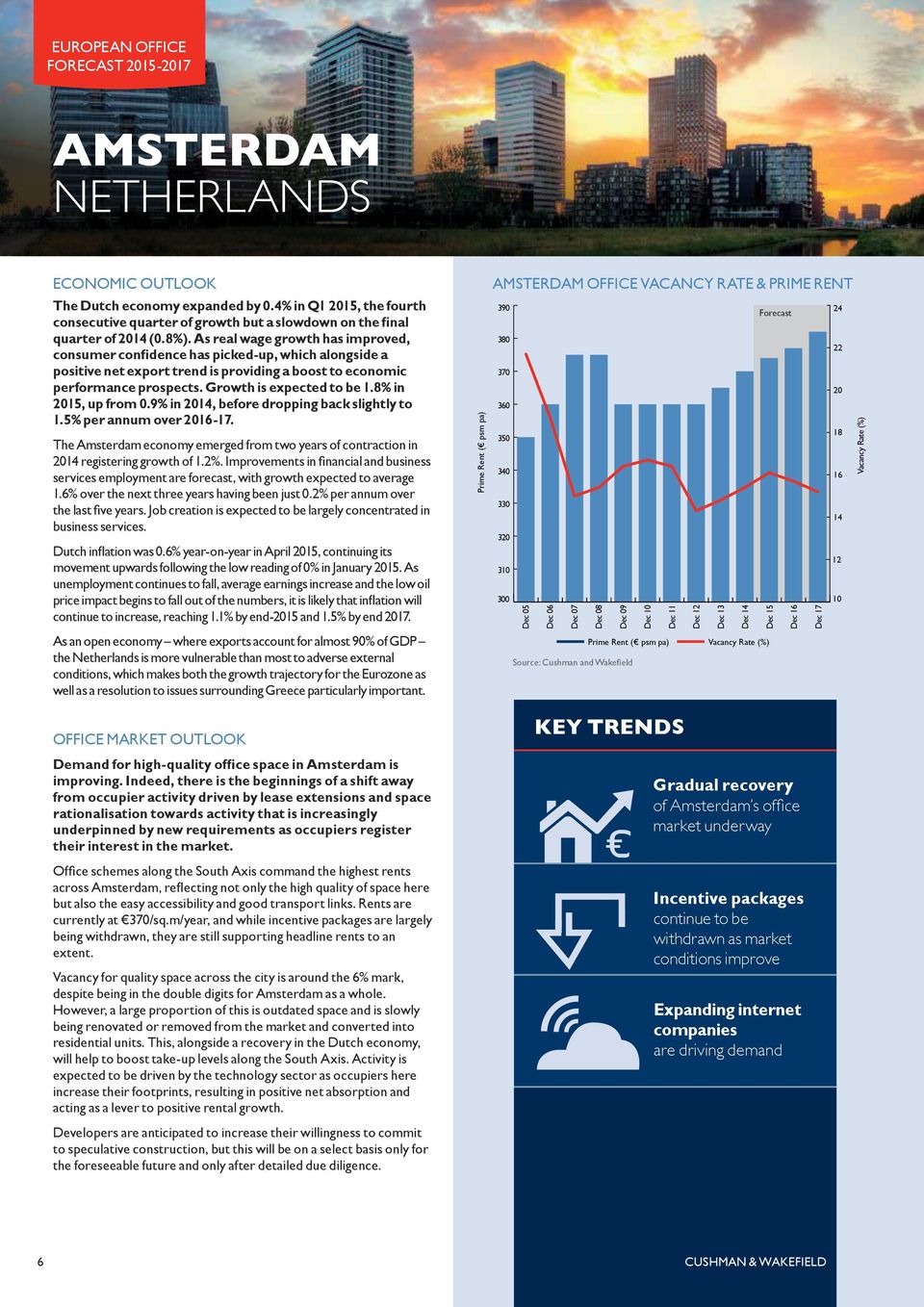
8 EUROPEAN OFFICE FORECAST AMSTERDAM NETHERLANDS The Dutch economy expanded by 0.4% in Q1 15, the fourth consecutive quarter of growth but a slowdown on the final quarter of 14 (0.8%). As real wage growth has improved, consumer confidence has picked-up, which alongside a positive net export trend is providing a boost to economic performance prospects. Growth is expected to be 1.8% in 15, up from 0.9% in 14, before dropping back slightly to 1.5% per annum over The Amsterdam economy emerged from two years of contraction in 14 registering growth of 1.2%. Improvements in financial and business services employment are forecast, with growth expected to average 1.6% over the next three years having been just 0.2% per annum over the last five years. Job creation is expected to be largely concentrated in business services. Dutch inflation was 0.6% year-on-year in April 15, continuing its movement upwards following the low reading of 0% in January 15. As unemployment continues to fall, average earnings increase and the low oil price impact begins to fall out of the numbers, it is likely that inflation will continue to increase, reaching 1.1% by end-15 and 1.5% by end 17. As an open economy where exports account for almost 90% of GDP the Netherlands is more vulnerable than most to adverse external conditions, which makes both the growth trajectory for the Eurozone as well as a resolution to issues surrounding Greece particularly important. Demand for high-quality office space in Amsterdam is improving. Indeed, there is the beginnings of a shift away from occupier activity driven by lease extensions and space rationalisation towards activity that is increasingly underpinned by new requirements as occupiers register their interest in the market. Office schemes along the South Axis command the highest rents across Amsterdam, reflecting not only the high quality of space here but also the easy accessibility and good transport links. Rents are currently at 370/sq.m/year, and while incentive packages are largely being withdrawn, they are still supporting headline rents to an extent. Vacancy for quality space across the city is around the 6% mark, despite being in the double digits for Amsterdam as a whole. However, a large proportion of this is outdated space and is slowly being renovated or removed from the market and converted into residential units. This, alongside a recovery in the Dutch economy, will help to boost take-up levels along the South Axis. Activity is expected to be driven by the technology sector as occupiers here increase their footprints, resulting in positive net absorption and acting as a lever to positive rental growth. Developers are anticipated to increase their willingness to commit to speculative construction, but this will be on a select basis only for the foreseeable future and only after detailed due diligence. AMSTERDAM OFFICE VACANCY RATE & PRIME RENT Dec Gradual recovery of Amsterdam s office market underway Incentive packages continue to be withdrawn as market conditions improve Expanding internet companies are driving demand CUSHMAN & WAKEFIELD
9 BARCELONA SPAIN The Spanish economy continued its impressive recovery in Q1 15, recording quarterly growth of 0.9% and marking the seventh straight quarter of expansion. Business services and manufacturing are performing well, with the latter in particular boosted by Euro depreciation. The labour market is also improving, with unemployment at 23% down from a peak of 26%. GDP is forecast to grow by 2.8% in 15 which would be the strongest annual number since 07. The Barcelona economy is estimated to have grown by 1.5% in 14, following three years of contraction. Growth in financial and business services employment was 1.7% in 14 which is forecast to accelerate to 3.7% in 15 before dropping back to around 2% per annum in Spain has suffered from deflation since mid-14, with the April 15 reading at -0.7%. Although deflation is likely to remain for the majority of 15, by the end of the year some inflationary pressure is expected to re-emerge. The forecast is for inflation of around 1%. A key downside risk to the Spanish outlook is the election this year. Two of the four main parties support a reversal of the landmark labour reforms of 12 that are widely accredited with helping to turn around the labour market and promote job creation. The Barcelona office market appears to be on the road to recovery after a period of stagnation. Prime rents in the CBD ticked up at the beginning of 15 and are expected to increase by 3.1% over the course of the year. This is bolstered by improvements in the economy supporting healthier occupier demand levels as well as dwindling amounts of quality supply particularly as construction was reined in following the Global Financial Crisis. This situation is reflected by the fact that, in 14, only two buildings were under construction totalling 6,500 sq.m in the decentralised area of the city, both of which were pre-let and reached completion in Q1 15. However, the beginning of 15 saw four schemes break ground albeit only one building is being developed in the city centre with completion expected in 17. The low level of new supply combined with a growing trend in the city center for space transformation from office to residential and hotel use is expected to cause a lack of supply in the future. The subsequent decline in the vacancy rate, as excess supply is absorbed, will see competition increase amongst occupiers looking to secure space in the city centre. As a result, headline rents are expected to see upward growth across the forecast period. An increase in new tenants entering the market will also support healthier rates of positive net absorption and push vacancy rates down to around 6.8% in 19: a level not seen since the middle of 08. BARCELONA OFFICE VACANCY RATE & PRIME RENT Dec Healthier market balance expected over 2-3 years as fundamentals improve Low development likely to persist over the forecast period Space transformations in the city centre placing downwards pressure on quality space CUSHMAN & WAKEFIELD 7

10 EUROPEAN OFFICE FORECAST BRUSSELS BELGIUM Belgium s GDP growth was estimated at 0.3% in the first quarter of 15: a continuation of the modest performance experienced throughout 13 and 14 and just below the Eurozone average of 0.4%. Household confidence improved during the first part of 15, and this is likely to drive consumption over the remainder of the year, taking economic growth to around 1.5%. This would be the strongest annual growth rate since 11. Economic expansion in Brussels was estimated at 0.6% in 14, which was double the pace achieved in 13 but modest in a European context. Financial and business services employment has increased by 0.8% per annum on average over the last five years. Over the next three years, employment in these areas is forecast to grow by 1.5% per annum, with job creation focused on the professional and administrative sectors. Inflation in Belgium was 0.4% in April 15 having re-emerged from four consecutive months of deflationary readings. The energy component of inflation fell by % over the year to March 15. The forecast for end 15 is for 1% rising to around 2% in 16 and 1.5% in 17. A loss of competitiveness has been a major issue for Belgium s export sector due to wage indexation and high non-wage labour costs the danger is that this becomes a long-term problem. BRUSSELS OFFICE VACANCY RATE & PRIME RENT Dec The low level of available quality supply in Brussels is acting as a support to headline rents, which have been stable at 275/sq.m/year for the last 18 months. This is, however, masking the attractive incentive packages that landlords are offering to tenants in a bid to limit void periods. On the flip side, it is also stimulating some churn of space in the Brussels market as, although the decision making process remains lengthy, a growing number of companies are using the current conditions to upgrade their office space in what remains a tenant-led environment. In addition, further space is due to complete in 15 and, while 76% in the CBD Leopold area has already been secured under pre-let agreements, there is still some speculative space coming through. This, coupled with the fragile state of the economy and slow recovery of the overall market, has subdued demand levels particularly from new occupiers and will dampen any prospects of rental growth. Indeed, rents are anticipated to decline over the next months before seeing positive growth again in 17, underpinned by a strengthening in the occupier base and a fall in vacancy. These factors combined are expected to further squeeze the already limited amount of Grade A space in the central submarkets of the capital. Incentives supporting headline rents Public sector remains a key driver of demand Lack of available Grade A space diminishing rental growth prospects 8 CUSHMAN & WAKEFIELD

11 DUBLIN IRELAND Ireland s recovery is continuing, with GDP growth of 4.8% in 14 s the strongest performance since the onset of the financial crisis, underpinned by a strong export sector. Labour market conditions are strengthening, and this combined with falling consumer prices is providing a welcome tonic to the still highly indebted households. GDP growth in 15 is forecast to be 3.7%, holding at this rate in 16 before dropping back slightly to 2.9% in 17. Dublin s GDP is estimated to have grown by 4.5% in 14, driven by solid performances from information & communications as well as the financial, professional and administrative services. Indeed, financial and business services employment increased by 2.2% in 14 the strongest rate since 07 but this is expected to moderate to 1.6% per annum over the next three years. Ireland has been in deflationary territory since January 15, with the latest reading at -0.7%. Inflation is expected to gradually pick-up during 15, ending the year at 1.4% before increasing to 1.6% in 16 and 2.2% in 17. Ireland s economy is forecast to be one the fastest-growing in the EU again this year, with the ECB s programme of quantitative easing expected to help boost the export sector. Further, the impact of a weaker Euro should help to cost competitiveness relative to key export markets in the UK and US. DUBLIN OFFICE VACANCY RATE & PRIME RENT Dec Dublin s real estate market continues to move from strength to strength, underpinned by the robust economic recovery that is positively impacting business confidence and rising levels of employment. The occupational market is firmly in the hands of the landlord as there remains a dearth of speculative development. Across the capital, there are only three new schemes which are under construction: two have already been earmarked, and the remaining one has just restarted following a standstill. Even allowing for buildings under renovation, the space available is inadequate for the demand registering interest in taking space. The lack of supply is a mounting issue as the option for expanding companies to move into larger premises is no longer realistic in some areas indeed, finding suitable space is potentially of more concern for tenants than rents. Signs of deferred expansion and satellite offices around Dublin already exist. Strong rental growth has been seen over the past few years and the situation is not expected to change. Rents are forecast to grow until at least the end of 17, when additional schemes are expected to come onto market and help ease the pressure on rents somewhat. Landlord favourable city centre at least for the short term Strong rental growth supported by low construction volumes IT sector dominates the market, particularly from US firms CUSHMAN & WAKEFIELD 9

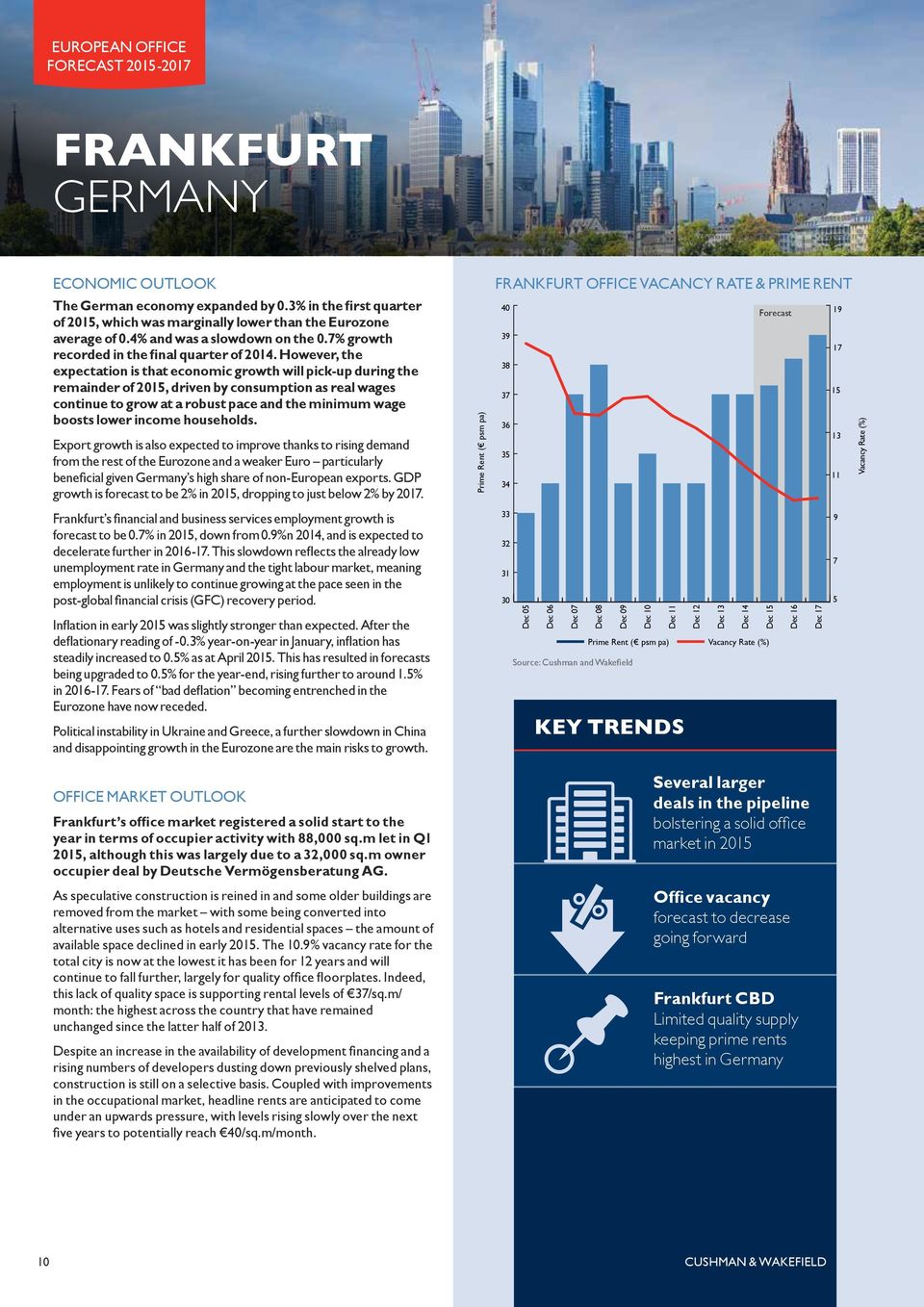
12 EUROPEAN OFFICE FORECAST FRANKFURT GERMANY The German economy expanded by 0.3% in the first quarter of 15, which was marginally lower than the Eurozone average of 0.4% and was a slowdown on the 0.7% growth recorded in the final quarter of 14. However, the expectation is that economic growth will pick-up during the remainder of 15, driven by consumption as real wages continue to grow at a robust pace and the minimum wage boosts lower income households. Export growth is also expected to improve thanks to rising demand from the rest of the Eurozone and a weaker Euro particularly beneficial given Germany s high share of non-european exports. GDP growth is forecast to be 2% in 15, dropping to just below 2% by 17. Frankfurt s financial and business services employment growth is forecast to be 0.7% in 15, down from 0.9%n 14, and is expected to decelerate further in This slowdown reflects the already low unemployment rate in Germany and the tight labour market, meaning employment is unlikely to continue growing at the pace seen in the post-global financial crisis (GFC) recovery period. Inflation in early 15 was slightly stronger than expected. After the deflationary reading of -0.3% year-on-year in January, inflation has steadily increased to 0.5% as at April 15. This has resulted in forecasts being upgraded to 0.5% for the year-end, rising further to around 1.5% in Fears of bad deflation becoming entrenched in the Eurozone have now receded. Political instability in Ukraine and Greece, a further slowdown in China and disappointing growth in the Eurozone are the main risks to growth. Frankfurt s office market registered a solid start to the year in terms of occupier activity with 88,000 sq.m let in Q1 15, although this was largely due to a 32,000 sq.m owner occupier deal by Deutsche Vermögensberatung AG. As speculative construction is reined in and some older buildings are removed from the market with some being converted into alternative uses such as hotels and residential spaces the amount of available space declined in early 15. The.9% vacancy rate for the total city is now at the lowest it has been for 12 years and will continue to fall further, largely for quality office floorplates. Indeed, this lack of quality space is supporting rental levels of 37/sq.m/ month: the highest across the country that have remained unchanged since the latter half of 13. Despite an increase in the availability of development financing and a rising numbers of developers dusting down previously shelved plans, construction is still on a selective basis. Coupled with improvements in the occupational market, headline rents are anticipated to come under an upwards pressure, with levels rising slowly over the next five years to potentially reach 40/sq.m/month. FRANKFURT OFFICE VACANCY RATE & PRIME RENT Dec Several larger deals in the pipeline bolstering a solid office market in 15 Office vacancy forecast to decrease going forward Frankfurt CBD Limited quality supply keeping prime rents highest in Germany CUSHMAN & WAKEFIELD
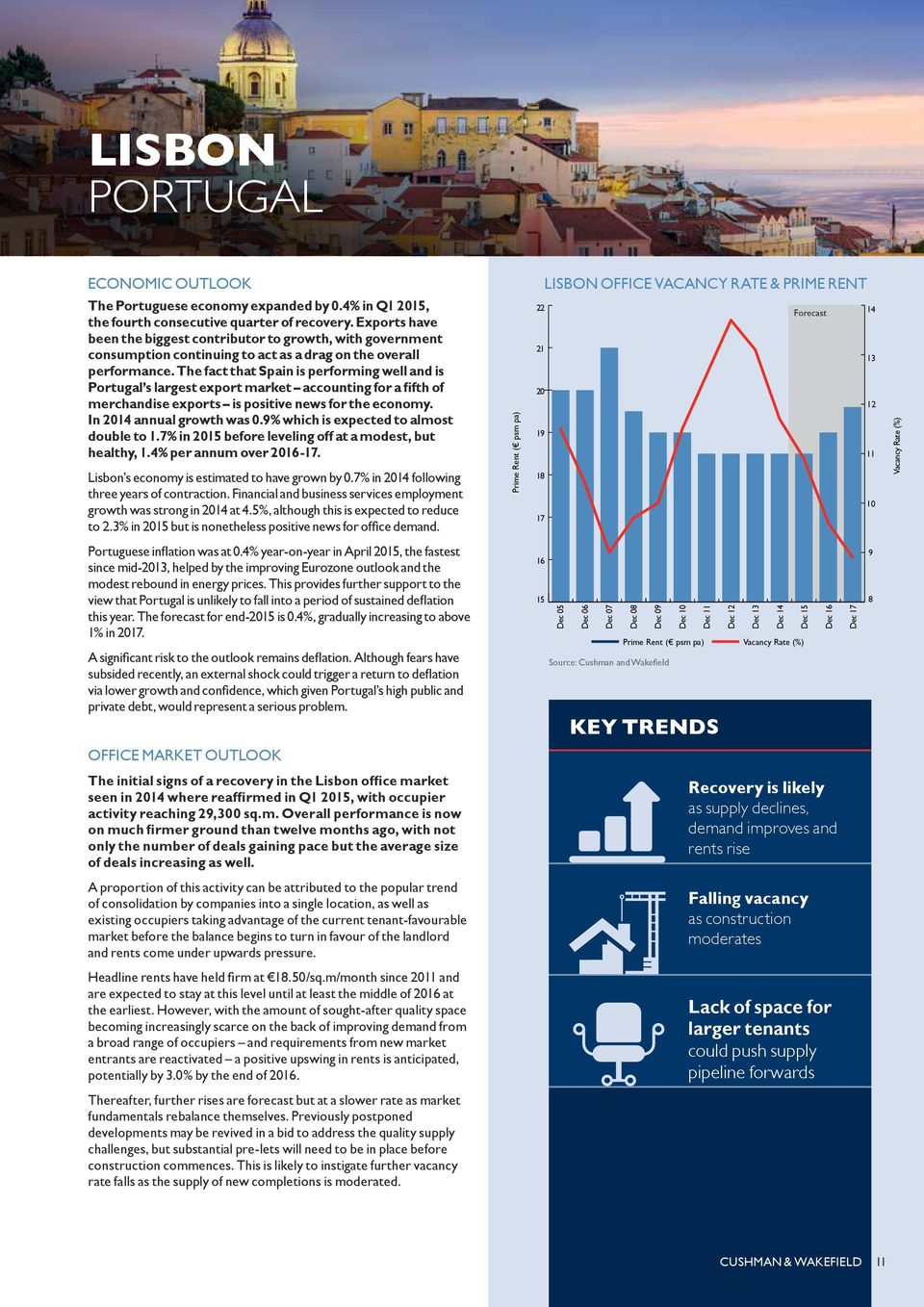
13 LISBON PORTUGAL The Portuguese economy expanded by 0.4% in Q1 15, the fourth consecutive quarter of recovery. Exports have been the biggest contributor to growth, with government consumption continuing to act as a drag on the overall performance. The fact that Spain is performing well and is Portugal s largest export market accounting for a fifth of merchandise exports is positive news for the economy. In 14 annual growth was 0.9% which is expected to almost double to 1.7% in 15 before leveling off at a modest, but healthy, 1.4% per annum over Lisbon s economy is estimated to have grown by 0.7% in 14 following three years of contraction. Financial and business services employment growth was strong in 14 at 4.5%, although this is expected to reduce to 2.3% in 15 but is nonetheless positive news for office demand. Portuguese inflation was at 0.4% year-on-year in April 15, the fastest since mid-13, helped by the improving Eurozone outlook and the modest rebound in energy prices. This provides further support to the view that Portugal is unlikely to fall into a period of sustained deflation this year. The forecast for end-15 is 0.4%, gradually increasing to above 1% in 17. A significant risk to the outlook remains deflation. Although fears have subsided recently, an external shock could trigger a return to deflation via lower growth and confidence, which given Portugal s high public and private debt, would represent a serious problem LISBON OFFICE VACANCY RATE & PRIME RENT Dec 9 8 The initial signs of a recovery in the Lisbon office market seen in 14 where reaffirmed in Q1 15, with occupier activity reaching 29,300 sq.m. Overall performance is now on much firmer ground than twelve months ago, with not only the number of deals gaining pace but the average size of deals increasing as well. A proportion of this activity can be attributed to the popular trend of consolidation by companies into a single location, as well as existing occupiers taking advantage of the current tenant-favourable market before the balance begins to turn in favour of the landlord and rents come under upwards pressure. Headline rents have held firm at 18.50/sq.m/month since 11 and are expected to stay at this level until at least the middle of 16 at the earliest. However, with the amount of sought-after quality space becoming increasingly scarce on the back of improving demand from a broad range of occupiers and requirements from new market entrants are reactivated a positive upswing in rents is anticipated, potentially by 3.0% by the end of 16. Thereafter, further rises are forecast but at a slower rate as market fundamentals rebalance themselves. Previously postponed developments may be revived in a bid to address the quality supply challenges, but substantial pre-lets will need to be in place before construction commences. This is likely to instigate further vacancy rate falls as the supply of new completions is moderated. Recovery is likely as supply declines, demand improves and rents rise Falling vacancy as construction moderates Lack of space for larger tenants could push supply pipeline forwards CUSHMAN & WAKEFIELD 11
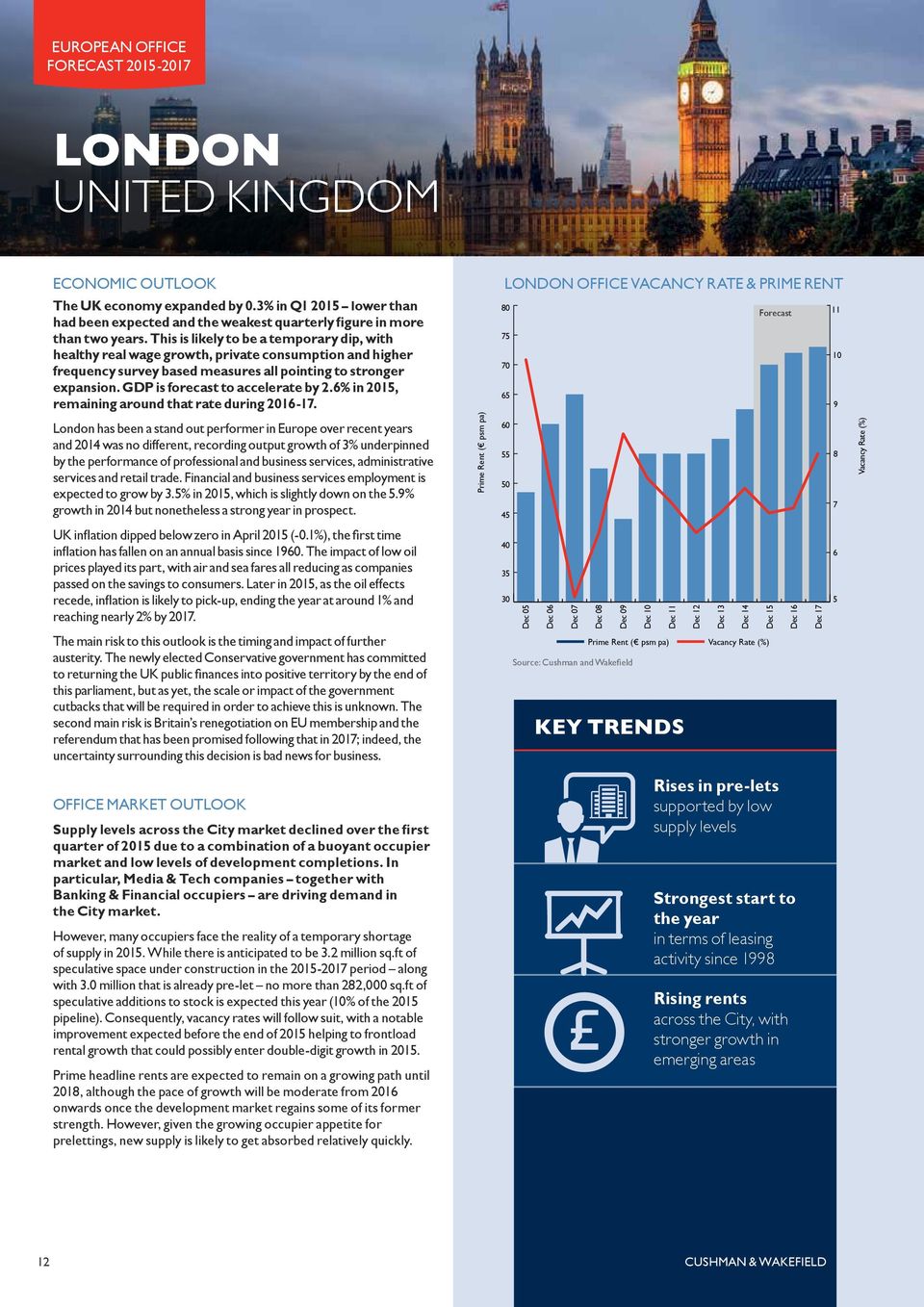
14 EUROPEAN OFFICE FORECAST LONDON UNITED KINGDOM The UK economy expanded by 0.3% in Q1 15 lower than had been expected and the weakest quarterly figure in more than two years. This is likely to be a temporary dip, with healthy real wage growth, private consumption and higher frequency survey based measures all pointing to stronger expansion. GDP is forecast to accelerate by 2.6% in 15, remaining around that rate during London has been a stand out performer in Europe over recent years and 14 was no different, recording output growth of 3% underpinned by the performance of professional and business services, administrative services and retail trade. Financial and business services employment is expected to grow by 3.5% in 15, which is slightly down on the 5.9% growth in 14 but nonetheless a strong year in prospect. UK inflation dipped below zero in April 15 (-0.1%), the first time inflation has fallen on an annual basis since The impact of low oil prices played its part, with air and sea fares all reducing as companies passed on the savings to consumers. Later in 15, as the oil effects recede, inflation is likely to pick-up, ending the year at around 1% and reaching nearly 2% by 17. The main risk to this outlook is the timing and impact of further austerity. The newly elected Conservative government has committed to returning the UK public finances into positive territory by the end of this parliament, but as yet, the scale or impact of the government cutbacks that will be required in order to achieve this is unknown. The second main risk is Britain s renegotiation on EU membership and the referendum that has been promised following that in 17; indeed, the uncertainty surrounding this decision is bad news for business. LONDON OFFICE VACANCY RATE & PRIME RENT Dec 6 5 Supply levels across the City market declined over the first quarter of 15 due to a combination of a buoyant occupier market and low levels of development completions. In particular, Media & Tech companies together with Banking & Financial occupiers are driving demand in the City market. However, many occupiers face the reality of a temporary shortage of supply in 15. While there is anticipated to be 3.2 million sq.ft of speculative space under construction in the period along with 3.0 million that is already pre-let no more than 282,000 sq.ft of speculative additions to stock is expected this year (% of the 15 pipeline). Consequently, vacancy rates will follow suit, with a notable improvement expected before the end of 15 helping to frontload rental growth that could possibly enter double-digit growth in 15. Prime headline rents are expected to remain on a growing path until 18, although the pace of growth will be moderate from 16 onwards once the development market regains some of its former strength. However, given the growing occupier appetite for prelettings, new supply is likely to get absorbed relatively quickly. Rises in pre-lets supported by low supply levels Strongest start to the year in terms of leasing activity since 1998 Rising rents across the City, with stronger growth in emerging areas 12 CUSHMAN & WAKEFIELD
15 LUXEMBOURG LUXEMBOURG After a solid recovery in 13 and 14, growth is expected to ease slightly in 15 to 2.6%. This marks an upgrade to previous forecasts, however, and the majority of indicators remain upbeat. Ongoing recovery in the Eurozone should offer a significant boost to the Luxembourg economy given its close ties with the rest of the continent. Economic growth is expected to further accelerate to 2.9% per annum over Short-term and medium-term prospects for Luxembourg are bright, with growth likely to remain significantly ahead of most Western European countries. Luxembourg s financial and business services employment growth is expected to average 2% per annum over the next three years which is slightly below the impressive growth of 2.8% seen over the last five years. Job creation is likely to be strongest in the real estate and the administrative and support sectors. Inflation has been hovering around zero over recent months after a brief period of deflation. Akin to many parts of Europe, inflation is expected to pick-up slightly during 15 as the low oil price effects start to fall out of the statistics. CPI is forecast to be 0.5% by end-15, increasing to around 2% in Downside risks are mainly external; any further tension between Russia and EU could impact exports, while a deeper crisis in Greece could damage financial markets across Europe, a sector which is integral to Luxembourg s economy. Take-up levels in Luxembourg s office market were robust in Q1 and are expected to remain positive throughout the year. This is bolstered by some sizeable deals by the European Commission which, at the time of writing, are in negotiation stages and expected to complete before the end of June. In addition, ongoing demand from financial institutions and business services companies will continue to support activity levels, with the focus very much on central areas of the capital. Prime rents have, so far, remained stable at 45/sq.m/month in the CBD and 33/sq.m/ month in Kirchberg, and these levels are expected to stabilise despite more robust occupier activity as demand and supply fundamentals remain in balance over the next 18 months. However, there are signs that quality space is becoming increasingly scarce, and as such more schemes are expected to break ground, bringing the potential to nudge the overall vacancy rate up albeit still at low levels to peak in 16 at just over 6%. Thereafter vacancy is anticipated to decline as demand strengths despite a rise in the amount of construction delivering new space to the market. The fall in availability will go hand in hand with positive rental growth, although this is expected to be gradual and confined to the central areas of the city. In the decentralised and peripheral areas of the capital where activity is more muted and the markets suffer from an overhang of supply any rental uplifts will be limited. LUXEMBOURG OFFICE VACANCY RATE & PRIME RENT Dec Limited quality space supporting rental growth after 16 Nearly 40% of development in is pre-let or for owner-occupation Highest vacancy in the decentralised submarket CUSHMAN & WAKEFIELD 13

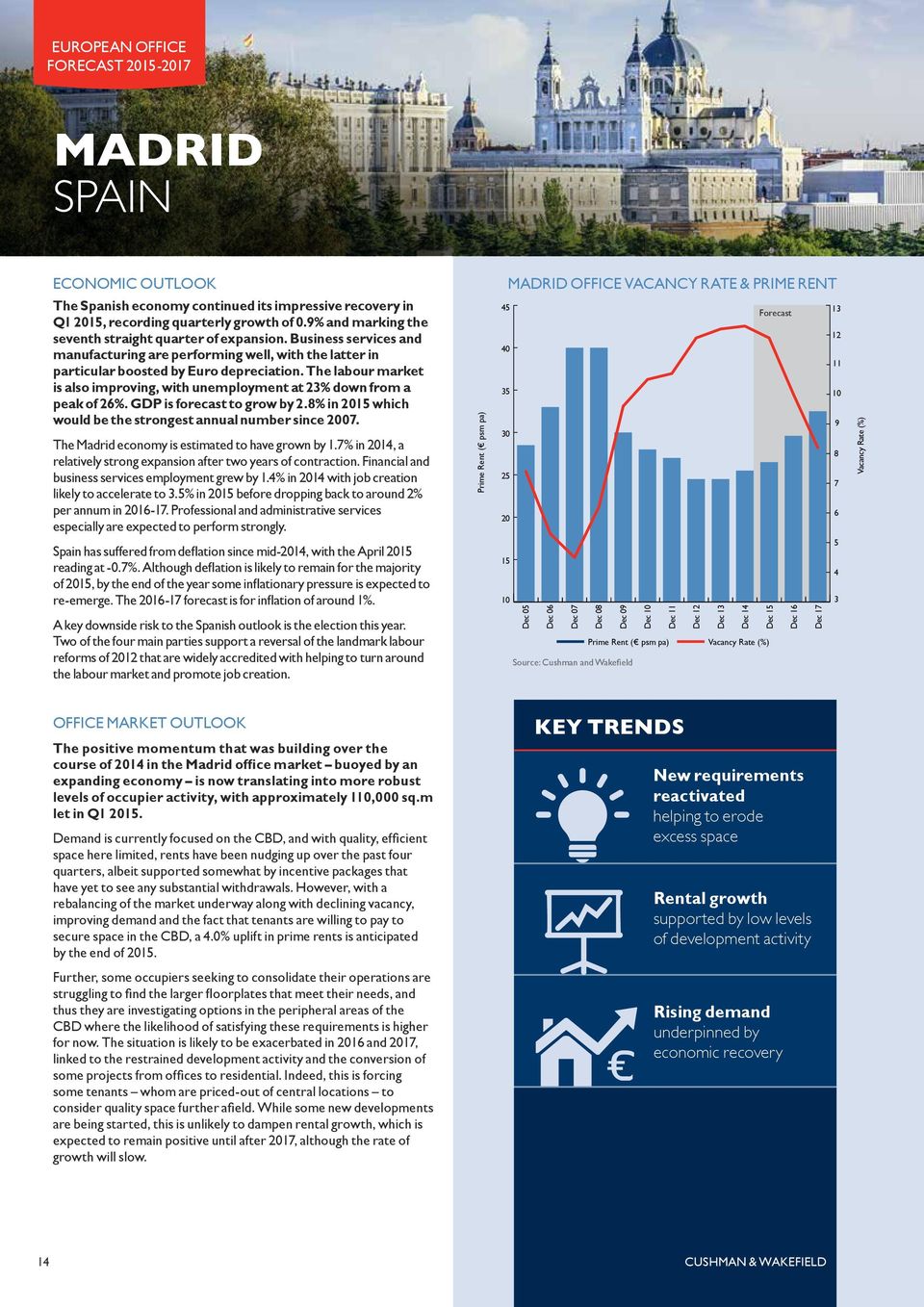
16 EUROPEAN OFFICE FORECAST MADRID SPAIN The Spanish economy continued its impressive recovery in Q1 15, recording quarterly growth of 0.9% and marking the seventh straight quarter of expansion. Business services and manufacturing are performing well, with the latter in particular boosted by Euro depreciation. The labour market is also improving, with unemployment at 23% down from a peak of 26%. GDP is forecast to grow by 2.8% in 15 which would be the strongest annual number since 07. The Madrid economy is estimated to have grown by 1.7% in 14, a relatively strong expansion after two years of contraction. Financial and business services employment grew by 1.4% in 14 with job creation likely to accelerate to 3.5% in 15 before dropping back to around 2% per annum in Professional and administrative services especially are expected to perform strongly. Spain has suffered from deflation since mid-14, with the April 15 reading at -0.7%. Although deflation is likely to remain for the majority of 15, by the end of the year some inflationary pressure is expected to re-emerge. The forecast is for inflation of around 1%. A key downside risk to the Spanish outlook is the election this year. Two of the four main parties support a reversal of the landmark labour reforms of 12 that are widely accredited with helping to turn around the labour market and promote job creation. MADRID OFFICE VACANCY RATE & PRIME RENT Dec The positive momentum that was building over the course of 14 in the Madrid office market buoyed by an expanding economy is now translating into more robust levels of occupier activity, with approximately 1,000 sq.m let in Q1 15. Demand is currently focused on the CBD, and with quality, efficient space here limited, rents have been nudging up over the past four quarters, albeit supported somewhat by incentive packages that have yet to see any substantial withdrawals. However, with a rebalancing of the market underway along with declining vacancy, improving demand and the fact that tenants are willing to pay to secure space in the CBD, a 4.0% uplift in prime rents is anticipated by the end of 15. Further, some occupiers seeking to consolidate their operations are struggling to find the larger floorplates that meet their needs, and thus they are investigating options in the peripheral areas of the CBD where the likelihood of satisfying these requirements is higher for now. The situation is likely to be exacerbated in 16 and 17, linked to the restrained development activity and the conversion of some projects from offices to residential. Indeed, this is forcing some tenants whom are priced-out of central locations to consider quality space further afield. While some new developments are being started, this is unlikely to dampen rental growth, which is expected to remain positive until after 17, although the rate of growth will slow. New requirements reactivated helping to erode excess space Rental growth supported by low levels of development activity Rising demand underpinned by economic recovery 14 CUSHMAN & WAKEFIELD
17 MILAN ITALY The Italian economy expanded by 0.3% in Q1 15, ending a three-year recession. This is a positive development that is expected to continue over subsequent quarters, albeit with very modest rates of growth. In 15, GDP is forecast to expand by 0.5% increasing to 1% by 17. It s worth noting that output is currently around % lower than in early 08, putting the size of the recovery task into context: Italy will still underperform compared with the main Eurozone countries over Milan has been consistently outperforming the national economy over recent years, a pattern which is likely to continue over the next three years. Financial and business services employment grew by 1.5% per annum over -14, which will be maintained over this period, albeit with moderately stronger growth in 15 before trailing off slightly in The best performing sector is likely to be professional and administrative services. Italian inflation fluctuated around zero in the first part of 15, but there is likely to be some modest inflationary pressures starting to re-emerge later in 15 as the low oil price effects start to recede. CPI is forecast to end 15 at 0.4% before rising gradually to 1% by 17. A potential upside risk surround the implementation of structural reforms. If the current government can accelerate these reforms then this would aid the recovery. Introduced in March 15, the new labour reforms are yet to take effect but may provide a boost going forward MILAN OFFICE VACANCY RATE & PRIME RENT Dec The Milan office market had a positive start to 15, with prime locations in the capital seeing significant demand from both local and international occupiers. Short-term prospects for the occupational market are stable, with landlords taking a flexible approach to lease negotiations. Stabilised rents in the short-term before gradual growth from 16 Incentives remain commonplace, and Milan will continue to witness occupiers upgrading their space or streamlining their operations into a single HQ building. Flexible, modern space is therefore expected to remain in good demand and, given the general lack of such space, a rise in pre-lease contracts in new developments or substantial refurbishments is anticipated. Demand improving from both local and international corporates In addition, only just over a quarter of all space under construction is being built speculatively a trend that is expected for the foreseeable future as developers remain cautious in the current market. All of these factors, plus the tight planning restrictions in the city centre, will support headline rental growth which will gather momentum as 16 approaches. Gradual return of new development and refurbishment activities CUSHMAN & WAKEFIELD 15

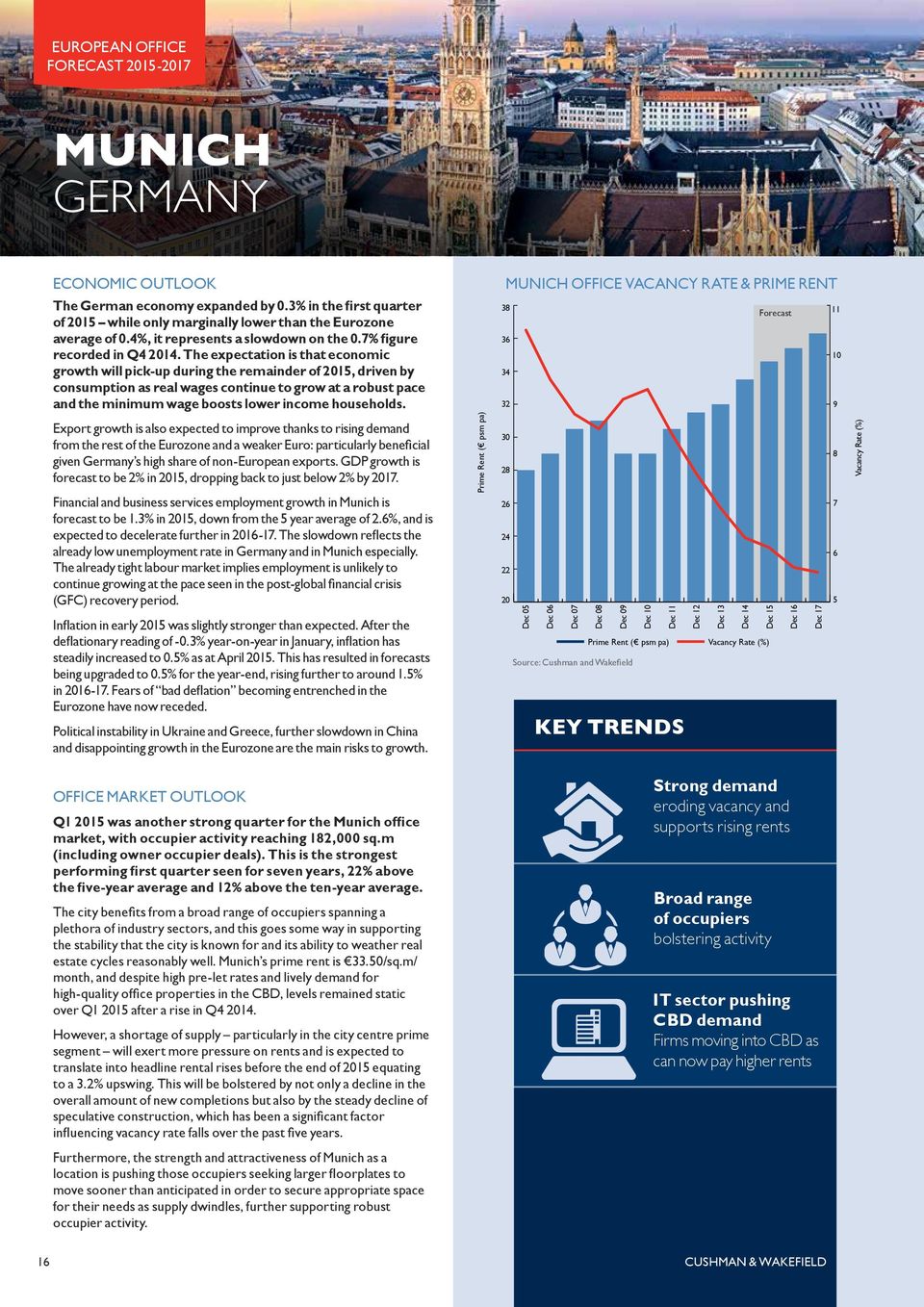
18 EUROPEAN OFFICE FORECAST MUNICH GERMANY The German economy expanded by 0.3% in the first quarter of 15 while only marginally lower than the Eurozone average of 0.4%, it represents a slowdown on the 0.7% figure recorded in Q4 14. The expectation is that economic growth will pick-up during the remainder of 15, driven by consumption as real wages continue to grow at a robust pace and the minimum wage boosts lower income households. Export growth is also expected to improve thanks to rising demand from the rest of the Eurozone and a weaker Euro: particularly beneficial given Germany s high share of non-european exports. GDP growth is forecast to be 2% in 15, dropping back to just below 2% by 17. Financial and business services employment growth in Munich is forecast to be 1.3% in 15, down from the 5 year average of 2.6%, and is expected to decelerate further in The slowdown reflects the already low unemployment rate in Germany and in Munich especially. The already tight labour market implies employment is unlikely to continue growing at the pace seen in the post-global financial crisis (GFC) recovery period. Inflation in early 15 was slightly stronger than expected. After the deflationary reading of -0.3% year-on-year in January, inflation has steadily increased to 0.5% as at April 15. This has resulted in forecasts being upgraded to 0.5% for the year-end, rising further to around 1.5% in Fears of bad deflation becoming entrenched in the Eurozone have now receded. Political instability in Ukraine and Greece, further slowdown in China and disappointing growth in the Eurozone are the main risks to growth. MUNICH OFFICE VACANCY RATE & PRIME RENT Dec Q1 15 was another strong quarter for the Munich office market, with occupier activity reaching 182,000 sq.m (including owner occupier deals). This is the strongest performing first quarter seen for seven years, 22% above the five-year average and 12% above the ten-year average. The city benefits from a broad range of occupiers spanning a plethora of industry sectors, and this goes some way in supporting the stability that the city is known for and its ability to weather real estate cycles reasonably well. Munich s prime rent is 33.50/sq.m/ month, and despite high pre-let rates and lively demand for high-quality office properties in the CBD, levels remained static over Q1 15 after a rise in Q4 14. However, a shortage of supply particularly in the city centre prime segment will exert more pressure on rents and is expected to translate into headline rental rises before the end of 15 equating to a 3.2% upswing. This will be bolstered by not only a decline in the overall amount of new completions but also by the steady decline of speculative construction, which has been a significant factor influencing vacancy rate falls over the past five years. Furthermore, the strength and attractiveness of Munich as a location is pushing those occupiers seeking larger floorplates to move sooner than anticipated in order to secure appropriate space for their needs as supply dwindles, further supporting robust occupier activity. Strong demand eroding vacancy and supports rising rents Broad range of occupiers bolstering activity IT sector pushing CBD demand Firms moving into CBD as can now pay higher rents 16 CUSHMAN & WAKEFIELD
19 PARIS FRANCE French GDP expanded by 0.6% in the first quarter of 15, stronger than anticipated due to a boost to consumption from oil related factors, which have now diminished. It is unlikely that this degree of strength will be maintained into subsequent quarters, albeit annual growth is estimated to be 1.4% for 15, which would be the best year since 11. However, this performance would still see France slightly underperforming compared with the Eurozone as a whole (1.6% forecast for 15). Next year, the expectation is for slightly faster growth of 1.7% as the investment climate improves and depreciation of the Euro feeds through into moderately healthier export growth. However, the growth gap with the Eurozone will not begin to close until 18. Financial and business services employment growth in Paris has averaged of 0.7% per annum over the last five years, and a very modest increase to 0.8% is expected over the next three years. This stability is unlikely to lead to significantly more office space demand overall, but the two sectors that are expected to see the best job creation over the next three years are information and communications and business services. French inflation improved slightly in March 15 with a zero reading: the first non-negative reading since December 14. As oil prices have gradually increased, the likelihood of sustained deflation during 15 has receded. The forecast for end 15 is 0.6% increasing to 1.5% by end 17. The main downside risks to the economic outlook are uncertainty stemming from fiscal tightening and a slowdown in the implementation of structural reforms that will enhance France s competitiveness. In addition, further risks remain in the strained relationship between the EU and Greece as well as any potential deceleration in the Eurozone s recovery. Prime rents in Paris CBD have been declining for the past two years as economic growth faltered and occupiers shelved expansion plans to focus on cost cutting and the rationalisation of their space. Lease renewals were commonplace, and absorption fell into negative territory as new requirements held back from registering an interest in entering the market. However, as business sentiment improves, rising activity should follow suit, although progress is expected to be slow. Despite the scarcity of Grade A space which is unlikely to be resolved in the short-term rental levels are not anticipated to gain the lost ground until the latter half of 16 or even early 17. This is likely to come to fruition when a more sustained pick-up in demand impacts market dynamics, with a number of significant lease expiries anticipated, and a healthier balance between market fundamentals is apparent. Therefore, 15 is expected to be the year of transition before a modest recovery is seen in the Paris office market in PARIS OFFICE VACANCY RATE & PRIME RENT Dec Space erosion of both Grade A and the best secondhand space in Paris CBD Net absorption to turn positive as demand improves Sustained demand from high-added value activity sectors CUSHMAN & WAKEFIELD 17

20 EUROPEAN OFFICE FORECAST STOCKHOLM SWEDEN The Swedish economy expanded by 2.1% in 14 following a very strong end to the year. GDP growth in Q4 stood at 1.1% quarter-on-quarter, driven by solid consumer spending and investment. Exports also improved over this period as demand from the rest of Europe strengthened. Following a stream of better than expected macro news, many economists raised both the GDP growth and inflation forecasts for 15, with the former now expected to grow by 2% in 15, 2.8% in 16 and 2.2% in 17. Stockholm s economy is estimated to have grown by 3% in 14, outperforming most other European cities. Financial and business services employment has increased by 2.4% per annum on average over the last five years and is forecast to grow by 1.9% per annum over the next three, with job creation focused on the information and communication sector as well as administrative services. Sweden has been dipping in and out of deflation since the end of 12, which has led the Riksbank to move interest rates into negative territory (-0.25%) while continuing QE. Further policy action, real wage growth and a reduction in the impact from low oil prices are likely to push inflation gradually upwards over the coming quarters to 1% by the end of 15. CPI is forecast to move above the 2% target rate in An important risk for Sweden is the level of household indebtedness, which was at 174% of GDP in Q4 14. Plans to introduce tighter repayment rules for new mortgages could help. The strength of the Swedish kroner has also been an issue over recent times given the openness of the Swedish economy and the importance of exports to growth; indeed, exports account for 45% of GDP. Robust economic growth and solid employment expansion are buoying healthy occupier demand levels, which are eroding the overhang of space in Stockholm s office market. As a result, vacancy rates are declining and rental levels rising as occupiers continue to compete for space. Indeed, the strength of demand across a broad range of occupiers has seen the market shift its balance from being in the hands of the tenant to one where landlords are withdrawing incentive packages and occupiers are willing to pay the asking rents. However, the focus is very much on quality space in Stockholm s central areas, although some more peripheral locations such as Solna are seeing rising levels of interest as they can offer the much sought-after space that expanding companies are after. The tight development pipeline will see availability dwindle further and is expected to hit 7.2% in 17 half the level seen in 06. This is despite the new supply deliveries that will not pick-up until late 16/early 17, most of which are expected to be pre-let before construction is complete. All of these factors will contribute to an imbalance between demand and supply and further support rental growth, which is expected to be strongest in 15 at around %-11%. After this, the rate of growth is expected to slow but remain in positive territory between 3.6%-2.5% per year. STOCKHOLM OFFICE VACANCY RATE & PRIME RENT Dec Very low vacancy for quality space will persist for the next 2-3 years Strong demand has triggered speculative construction in quality suburban areas Positive rental growth expected across most submarkets CUSHMAN & WAKEFIELD

21 CENTRAL & EASTERN EUROPE CUSHMAN & WAKEFIELD 19
22 EUROPEAN OFFICE FORECAST BRATISLAVA SLOVAKIA The preliminary estimate of Q1 GDP growth was 0.8% quarter-on-quarter, reflecting an annual rate of 2.6%, which maintains the impressive economic performance of the last two years. The economic performance has been driven by a healthy domestic economy as the labour market improves and the consumer sector continues to gain momentum. The outlook for the Slovak Republic is very healthy with 2.8% growth expected in 15 rising to just above 3% in Financial and business services employment in Bratislava has averaged 1.6% growth over the last 5 years, but a modest improvement in the rate of job creation is anticipated over at an average of 1.9% per annum. This is likely to support office demand going forwards, particularly in the information and communications sector as well as business services. The Slovak Republic has been in deflation since December 14, with the most recent reading at -0.2% year-on-year. Given that inflation is slow and earnings are set to rise by over 4% in 15, consumers are likely to benefit considerably from higher real disposable incomes which should push up inflation in the medium term. Inflation is forecast to improve to around 1% year-on-year by year-end 15 before gradually rising to 2.5% by the end of 17. BRATISLAVA OFFICE VACANCY RATE & PRIME RENT Dec The Bratislava office sector has seen a shift away from occupier activity driven primarily by space rationalisation to one that is now seeing some expansion-supported demand. However, this is still limited as are the prospects of positive rental growth; prime rents are anticipated to remain at the current 15.00/sq.m/month until at least the end of 16 when a more healthy balance between supply and demand is expected. 40,000 sq.m of new space is expected to be delivered over the course of 15, most of which is already reserved by pre-lease agreements, and despite falls in the vacancy rate it remains stubbornly in double digits. Developers remain reluctant to commit to speculative construction as occupiers still have a plethora of choice to suit their requirements. Indeed, realising income streams to cover development costs is still not obvious, and this is having a secondary impact in terms of securing development funding. More significant improvements are expected from 17 and beyond as the economy expands further and more noticeable advancements are seen in the labour market, which will pave the way for more sustained levels of occupational activity. Progress, however, will be gradual, and in the short term prime rents are unlikely to change. The decreasing vacancy at the quality end of the market will see the gradual withdrawal of incentives continue and some speculative developments break ground, along with marginal positive rental growth. Nevertheless, rents at the end of 17 are expected to still be around 30% off their 07 peak. Rental growth holds until labour market improvements take hold Rising demand due to robust shared service / BPO sectors Little new supply with limited speculative development CUSHMAN & WAKEFIELD
23 BUCHAREST ROMANIA The Romanian economy expanded by 1.6% in Q1 15, continuing the positive performance of H2 14. Healthy economic growth in the second half of 14 resulted in annual expansion of 2.8%, which did mark a slowdown from its performance in 13. This is attributed to a deceleration in investment, government spending and exports, which was partially offset by a rebound in household spending. The economy continues to perform well in comparison with the rest of Europe. However, it ceded its title as the leader of growth in Central and Eastern Europe to Poland and Hungary. Economic growth is expected to pick-up slightly, to around 3.0% per annum over Financial and business services (F&BS) employment in Bucharest is forecast to marginally contract during 15, mainly attributable to the information and communications sector, but this does follow five years of very strong F&BS employment growth (6.3% per annum) since the Global Financial Crisis. Inflation was 0.8% in Q1 15 and is expected to reach the year s lowest level at the year-end following a VAT reduction on food from 24% to 9% starting in June. Expectations are for inflation to steadily increase over the next few years, reaching 2.7% by 17. Ongoing Greek exit concerns and tensions in Ukraine, as well as more muted than expected recovery in the Eurozone, remain the main downside risks to growth. On the upside, better progress on structural reform as imposed by the IMF could improve the pace of growth over the medium term. BUCHAREST OFFICE VACANCY RATE & PRIME RENT Dec Prime rents in the Bucharest office market have held firm at 19.00/sq.m/month since 12 as the city s overall vacancy rate remained unmoved in double digit territory and economic growth slowed in a lagged response to the Global Financial Crisis. Headline rents are expected to come under downward pressure over the remainder of 15, falling by 2.6% to a four-year low and reaching 18.50/sq.m/month by the end of 15. This is despite the economic improvements in the Romanian economy that are filtering down to better business sentiment. However, landlords continue to offer incentive packages in a bid to secure major tenants and limit void periods. These incentives will need to be withdrawn before positive rental growth takes hold, which is expected by the end of 16 but progress will be slow. The overall construction pipeline rose to 345,000 sq.m as at the end of March 15 and consists of mostly speculative space. The majority of activity is focused in the northern and central areas of the city, which have seen new office schemes breaking ground. This will act as a further deterrent to positive rental growth. Large speculative construction pipeline limiting positive rental growth Barbu Vacarescu - Dimitrie Pompeiu to undergo intensive redevelopment IC&T Sector to remain primary source of demand CUSHMAN & WAKEFIELD 21
24 EUROPEAN OFFICE FORECAST BUDAPEST HUNGARY The Hungarian economy expanded by 0.6% in Q1 15, which was lower than the 0.9% growth recorded in Q4 14 but continues the impressive performance experienced over the last two years: in 14 Hungary was the strongest growing of the European economies. The government announced a tax reduction package for next year, equivalent to around 0.5% GDP, which will lower income tax and the bank levy. This should help boost private consumption and lending growth, both of which will support the economy going forwards. Budapest s financial and business services (F&BS) employment growth is forecast to be 2.3% in 15, down from 4.4% in 14 and following several years of strong growth rates. In the medium term, unfavourable population projections are hampering employment growth potential, along with the increasing role of the state in the financial sector (nationalisation). Together these factors are driving the anticipated slowdown in F&BS employment growth over Deflationary pressures have been evident since Q2 14 and have led to further monetary easing, with base rates falling from 2.3% in mid-14 to 1.65% in Q2 15. The expectation is that inflationary pressure will re-emerge in late 15, driven by low unemployment and positive wage growth, with inflation reaching 3% by end-17. Downside risks to the central forecast scenario include further anti-business policy-making, ongoing uncertainty regarding Ukraine and Russia, and sluggish growth in the Eurozone. The recovery of the Budapest office market is expected to continue, supported by more robust economic conditions pushing through. While this has helped to improve levels of business confidence and an increase in occupier activity has also been noted it has not yet translated into positive rental growth. Indeed, headline rents in Q1 15 remained at 21.00/sq.m/month in the CBD, the same level seen for the past five years that is also supported by incentive packages such as rent-free periods and/or contributions to fit out. However, as the amount of vacant space gradually declines from the historic highs to below neighbour Prague s vacancy level for the first time, and speculative completions slow, conditions will pave the way for some positive upswing in rents. This is, however, likely to be confined to select submarkets and quality space only with second hand space still trading at a substantial discount. A more positive market performance will also be helped by an increase in new requirements and reactivated expansions while lease renewals contribute a falling share of total market activity. BUDAPEST OFFICE VACANCY RATE & PRIME RENT Dec Recovery underway but progress will be slow Lack of Grade A Little new office supply hindering larger occupiers Grades A & B supply disparity Vacancy ranges from -12% vs. % CUSHMAN & WAKEFIELD
25 ISTANBUL TURKEY The economy finished 14 strongly, with Q4 GDP growth rising 0.7% quarter-on-quarter, driven by robust consumption as falling oil prices helped boost spending and resulting in growth of 2.9% for 14. However, this was the slowest annual growth recorded since the 09 recession. The outlook for the national economy is for some improvement, with GDP growth forecast to increase to 3.3% in 15 before accelerating to 5.0% per annum between 16 and 19. Prospects for financial and business services employment in Istanbul are healthy, with growth expected to average 3.2% over This rate of growth compares favourably with other EMEA cities but would represent a slowdown from the impressive 8.0% per annum achieved over the last years. Inflationary pressures were subsiding on the back of lower oil prices, but Lira weakness and high food price inflation have prompted some recent upward revisions in the CPI forecast albeit the outlook (5.7% over 15-19) is still lower inflation than the last five years (8.1% over -14). Medium term risks remain, however, primarily linked to the large current account deficit, sustained pressure on the Lira and the potential for significant economic policy changes following the country s recent election. Although the Istanbul office market is seeing rising levels of occupier activity, this is being matched by a healthy development pipeline that is keeping headline rents stable at US$45/sq.m/month in the most sought after locations of the CBD and Atasehir. However, almost half of this is attributed to owner occupier deals as corporates continue to struggle with the lack of available quality space. Going forward, healthy demand levels are anticipated from a broad base of occupiers, and with improving finance conditions, developer activity continues apace. Currently there is 1.8 million sq.m of new space under construction in Istanbul, with the largest project the 140,000 sq.m Vadistanbul scheme in the Cendere submarket due for completion in the first half of 16. Solid construction activity is having a dual impact on the market; on the one hand, occupiers now have more choice with regards to their real estate needs, and on the other hand, with new space being delivered, positive rental growth is being capped. The vacancy rate will rise from the 13 low of 9% to potentially reach 23% at the end of 17. Take-up is expected to ease from 16 onwards, linked to the high proportion of owner occupiers securing space but also partly due to existing occupiers moving within the market as they seek more flexible lease terms. As a result, space is churned by these tenants rather than new market entrants, some of whom are cautious as they wait to see how the geopolitical issues in the area play out. ISTANBUL OFFICE VACANCY RATE & PRIME RENT Dec Large construction pipeline capping rental growth New infrastructure developments expanding the market Rising pre-lets / pre-sales set to benefit from lower price levels CUSHMAN & WAKEFIELD 23
26 EUROPEAN OFFICE FORECAST MOSCOW RUSSIA The Russian economy contracted by 1.9% in Q1 15, a rate less than many economists had feared but still following on from the weak economic performance seen in 14 (just 0.6% year-on-year growth). Consumption, investment and exports all slowed significantly as sanctions, a depreciating rouble and low oil prices impacted activity and confidence. Although the economy is forecast to be in recession for most of 15 (-3.5% year-on-year), the recent firming of oil prices, stabilising rouble and central bank interest rate reductions have modestly improved an otherwise poor outlook. Economic growth is set to re-emerge in 16, albeit at 1.0% significantly below the -year average of 3.5% per annum. Financial and business services employment in Moscow has grown by around 2.5% per annum over the last years, but as macro-economic and geopolitical issues weigh on business confidence, growth is likely to slow to just 0.5% per annum over This will inevitably feed through into the office occupational market as lower demand for space. At 16.9%, inflation climbed to a 13-year high in Q1 15, attributed to the rapid depreciation of the rouble in late 14 and the import ban on some food items. Inflation is expected to remain high in 15 at around 15% before falling back to 7% in 16. Medium-term risks for Russia s economy remain prominent and include a prolonged period of US/EU sanctions, high sensitivity to oil prices in an environment where global supply remains elevated, and further conflict with Ukraine. In the longer term, a declining and ageing population will also present sustained challenges. MOSCOW OFFICE VACANCY RATE & PRIME RENT Dec The complex geopolitical situation in Russia as well as the macroeconomic difficulties that the country is facing have dampened interest for office space in Moscow, with demand in Q1 15 subdued to levels not seen in 09. There is some churn in the market, but this is linked to current occupiers that are seeking to relocate and/or rationalise their accommodation rather than expansion-driven demand. This is also reflected somewhat in the average deal size being smaller than that seen 12 months ago. This has severely impacted on headline rents, which declined by 6.6% over 14 and are expected to slide another 25% over the course of 15 as demand weakens further, unemployment rises, international occupiers take a wait-and-see approach and large amounts of space are returned to the market, causing the overall vacancy rate to rise to nearly %. The depreciation of the rouble is an additional factor impacting the market, leading landlords to offer short-term local currency contracts or to fix the exchange rate to the US Dollar or Euro to prevent further losses. Going forward, the situation will begin to show signs of stabilisation from 16, although progress will be slow. Development projects will be put on hold and new developments reined in until more robust fundamentals are evident. Positive rental growth will only return to the market in 17 at the earliest, but it may be 4-5 years before the office market recovers fully. Market strain from geopolitical tensions and macroeconomic uncertainties First recovery signs expected 16 at the earliest Green technology & sustainable buildings spurred by high competition for tenants 24 CUSHMAN & WAKEFIELD
27 PRAGUE CZECH REPUBLIC The Czech economy expanded by an impressive 1.7% quarter-on-quarter in Q1 15: a much stronger rate than forecast as manufacturing performance improved significantly, particularly the manufacturing of motor vehicles, other transport equipment and machinery. The Czech economy continues to show positive signs after a poor 12-13, with growth forecast to average just under 3% per annum over Prague s employment in financial and business services increased by 1.9% in 14, following a reduction of -0.2% in 13. While financial services have performed weakly over recent years, business services as well as information and communications have been expanding. These two subsectors are expected to be the key drivers of employment growth over 15-17, which is set to average around 1.5% per annum: a notable improvement from the five year historic average of -0.5% per annum. Czech CPI increased to 0.5% in April 15, a positive change to the very low readings in early 15. Fears of deflation have receded as real wages continue to increase and consumption prospects improve. Inflation is expected to gradually increase during the course of 15 and 16, reaching 2% year-on-year by 17. The instability in Ukraine and Russia is a potential risk to growth. In addition, the Czech economy s reliance on foreign capital makes it exposed to external factors such as a deterioration in external financing conditions. Meanwhile, healthy public debt levels and well-capitalised banks should shield the economy from potential outside shocks. PRAGUE OFFICE VACANCY RATE & PRIME RENT Dec Demand levels in Prague s office market have improved over the past year. However, at the same time a series of new speculative schemes were also delivered, creating a tenant-favourable market and putting downward pressure on headline rents. Indeed, these have come off the boil, declining by around 3.6% over the past 12 months in Prague s CBD. This has seen landlords offer attractive incentive packages in a bid to limit void periods. Occupier sentiment has been broadly positive; however, net absorption is low, with the bulk of activity driven by renegotiations and renewals as existing occupiers opt to take advantage of the available opportunities in which to upgrade their accommodation on more flexible lease terms. The ITT, financial and professional services sectors are the most active and should remain so as 15 progresses. The next months should see headline rents begin to show some positive growth mainly within prime projects and locations but progress will be slow and relate to the best-of-the best schemes. Prague s vacancy rate remains in double digits and thus offers tenants choice, although the majority of oversupply is of secondary quality released back to the market as tenants upgrade and/or consolidate. There is potential for a further 8,000 sq.m to enter the market in 15, and with only 25% with pre-let agreements secured, it will take some time before the Prague office market finds a healthy balance once more between supply and demand. Gradual rental growth but only if speculative construction declines Flexible leases Tenants are in a strong position to secure Rising demand albeit supply will continue to outweigh any growth in demand CUSHMAN & WAKEFIELD 25
28 EUROPEAN OFFICE FORECAST WARSAW POLAND The Polish economy maintained its strong momentum in Q4 14 as it expanded by 0.7% quarter-on-quarter: the seventh straight quarter of growth above 0.5%. This culminated in an annual growth of 3.4%, primarily domestically driven with fixed investment, private consumption and government spending all contributing most significantly to performance. The outlook is positive for 15-17, with annual expansion estimated to be above 3.5% throughout the period. Warsaw s financial and business services sector recorded strong employment growth in 14 (5.6%), with particularly buoyant rates from professional and administrative services as well as information and communications. Although growth is set to drop back slightly in 15 to 3.3%, the rate of expansion is still healthy in a European context. Polish CPI fell below zero in August 14, reaching -1.3% on an annual basis in March 15 and marking a record low. The subsequent April CPI reading showed some improvement at 0.8% year-on-year, but ongoing deflationary pressures have prompted the central bank to cut rates to an all-time low of 1.5%. This will provide a further boost to already robust growth. CPI is set to remain minimal in 15 before gradually rising to around 2.5% year-on-year by the year-end 17. Risks are skewed to the downside, with political instability in the region and the potential for continued sluggish growth in the Eurozone. Entrenchment of deflationary pressures may deter private consumption but is unlikely given clear acceleration in economic growth. WARSAW OFFICE VACANCY RATE & PRIME RENT Dec Warsaw s office market performance is benefiting from a strengthening of the economy and positive business confidence. Occupier activity over the first half of 15 was healthy, and while some of this was due to new market entrants successfully completing their outstanding requirements, a large proportion is attributed to lease renegotiations and existing occupiers moving within the market. The continued positive absorption of space has seen the city s vacancy rate marginally decrease as at the end of March 15 However, despite robust demand levels, the current fast pace of development completions is expected to exacerbate the supply situation over the next months. This is putting headline rents under downward pressure as the balance between supply and demand tilts to the former, causing the market to become more tenant-favourable, with rents supported by rent-free periods and/or contributions to fit out. Going forward, while net absorption remains positive and indeed strengthens, rents are expected to decline. Space under construction stands at approximately 543,000 sq.m, due to complete by the end of 16, and currently just under 18% of this has been agreed under pre-let arrangements albeit some schemes will see completion dates pushed back. In addition, the only schemes currently in planning stages that are likely to go ahead are those able to secure pre-lets and thus guaranteeing some or all of the income from the development. Office oversupply will persist dampening rental growth prospects Heavy competition between existing and pipeline schemes Public institutions are key drivers of demand 26 CUSHMAN & WAKEFIELD
29 OFFICE FORECAST DATA TABLE City Local Measurement Rent Rental Growth Vacancy Rate (Local currency) ( /sq.m/yr) 15 (% p/a) 16 (% p/a) 17 (% p/a) AMSTERDAM EUR/sq.m/year % 1.0% 1.3% 16.1% 15.7% 15.2% BARCELONA EUR/sq.m/month %.5% 9.7% 11.2% 9.5% 8.1% BRUSSELS EUR/sq.m/year % -0.7% 1.9%.3%.7%.2% DUBLIN EUR/sq.m/year % 12.0% 5.0% 11.5% 9.6% 8.5% FRANKFURT EUR/sq.m/month % 2.3% 2.1%.5% 9.8% 9.9% LISBON EUR/sq.m/month % 3.0% 2.7%.9% 9.6% 8.9% LONDON (CITY) GBP/sq.ft/year % 2.8% 1.4% 6.8% 6.9% 8.0% LUXEMBOURG EUR/sq.m/month % 0.0% 3.3% 5.3% 6.2% 5.3% MADRID EUR/sq.m/month % 11.5%.0% 11.9%.0% 8.2% MILAN EUR/sq.m/year % 1.1% 2.1% 11.7% 11.2% 11.4% MUNICH EUR/sq.m/month % 2.2% 2.7% 6.1% 5.7% 5.6% PARIS EUR/sq.m/year % 2.3% 2.7% 7.7% 7.3% 7.2% STOCKHOLM SEK/sq.m/year 4, % 3.6% 2.6% 7.9% 7.5% 7.2% BRATISLAVA EUR/sq.m/month % 0.2% 0.9% 12.5% 11.9% 11.8% BUCHAREST EUR/sq.m/month % 1.4% 1.3% 12.5%.8%.1% BUDAPEST EUR/sq.m/month % 1.2% 0.0% 14.3% 13.8% 14.3% ISTANBUL USD/sq.m/month % -2.2% -2.3%.7% 21.7% 23.0% MOSCOW USD/sq.m/year % 0.0% 5.0% 19.3% 19.4% 19.5% PRAGUE EUR/sq.m/month % 0.0% 2.4% 16.8% 16.5% 15.6% WARSAW EUR/sq.m/month % -6.1% -4.3% 14.6% 17.4% 18.8% WESTERN EUROPE CENTRAL & EASTERN EUROPE CUSHMAN & WAKEFIELD 27
30 EUROPEAN OFFICE FORECAST CONTACTS & CAVEATS James Young Partner Head of EMEA Offices Direct: +44 (0) Joanna Tano Director Head of EMEA Central Research & Consultancy Direct: +44 (0) Mark Unsworth Senior Research Consultant EMEA Central Research & Consultancy Direct: +44 (0) Sources Cushman & Wakefield, Oxford Economics ing, Financial Times (Exchange Rates). This report has been prepared by Cushman & Wakefield and its local partners globally, with special thanks to the following offices: Activ Property Services SRL (Romania) and Lisney LLP (Ireland). All graphs and tables consist of Cushman & Wakefield data. London's analysis refers to the City of London submarket. Caveats ed rental growth rates derive from December 14 rental figures Currency conversion rates are December 14 month-end spot rates Definitions PRIME RENT: Consistently achievable headline rental figure that relate to new prime, well located, high specification units of a standard size commensurate within the predefined market area, assuming there is always existing demand and available supply. Prime rents should reflect the tone of the market at the top end, even if no new leases have been signed within the survey period whilst in no case should these take into account any incentives such as rent free periods etc. The standard unit sizes should typically be looking at 1,000 sq.m for offices. VACANCY RATE: Calculated by dividing total availability by total stock (expressed as a %) Erin Can Marketing & Editorial Manager EMEA Central Research & Consultancy [email protected] Direct: +44 (0) Cushman & Wakefield advises and represents clients on all aspects of property occupancy and investment. Founded in 1917, it has 259 offices in 60 countries, employing more than 16,000 professionals. It offers a complete range of services to its occupier and investor clients for all property types, including leasing, sales and acquisitions, equity, debt and structured finance, corporate finance and investment banking, appraisal, consulting, corporate services, and property, facilities, project and risk management. To learn more, visit cushmanwakefield.com London W1A 3BG cushmanwakefield.com This report has been prepared solely for information purposes. It does not purport to be a complete description of the markets or developments contained in this material. The information on which this report is based has been obtained from sources we believe to be reliable, but we have not independently verified such information and we do not guarantee that the information is accurate or complete. 15 Cushman & Wakefield. All rights reserved. Cushman & Wakefield, LLP Portman Square London W1A 3BG cushmanwakefield.com 28 CUSHMAN & WAKEFIELD
31 CUSHMAN & WAKEFIELD
32 cushmanwakefield.com
Property Times Europe Q3 2010 Short supply improves rental outlook
 1999 2000 2001 2002 2003 2004 2005 2006 2007 2011 2012 2013 2014 Property Times Europe Short supply improves rental outlook 19 October Contents Overview 1 Market Statistics 2 Office Market Overview 3 Outlook
Rebound after a slow start
 DTZ Research PROPERTY TIMES Rebound after a slow start Europe Office Q2 2015 28 August 2015 Contents Take-up 2 New office supply 3 Vacancy ratio 4 Prime office rents 5 Outlook 6 Definitions 7 3 million
European office market recovery continues but at varying speeds
 The Jones Lang LaSalle Office Property Clock Q2 2013 European office market recovery continues but at varying speeds European Prime Office Rental Index continues upward trend Aggregate European leasing
EMEA Office MarketView
 EMEA Office MarketView 20 CBRE Global Research and Consulting EMEA PRIME YIELD 7.6 BPS EU-27 VACANCY RATE 0.11 PP EMEA PRIME RENT 0.5% EMEA CAPITAL VALUE 1.9% TAKE-UP 9.6% EMEA OFFICE MARKETS SET FOR IMPROVEMENT
European office sector recovery continuing Divergence in speed and strength remains
 The Jones Lang LaSalle Office Property Clock Q3 2013 European office sector recovery continuing Divergence in speed and strength remains European Office Rental Index decreases q-o-q Aggregate European
LARGE OFFICE SPACE Where to find 5,000 sq m in Europe
 EMEA Office July 2015 LARGE OFFICE SPACE Where to find 5,000 sq m in Europe HIGHLIGHTS The availability of large office premises has reduced by 12% year-on-year Choice is limited - only 19% of options
European office rental struggle amidst subdued demand
 The Jones Lang LaSalle Office Property Clock - Q2 2012 European office rental struggle amidst subdued demand The European rental index records a second successive modest fall (-0.2%) The European vacancy
EMEA Office MarketView
 EMEA Office MarketView 2014 CBRE Global Research and Consulting EMEA PRIME YIELD 7.9 BPS EU-28 VACANCY RATE 0.02 PP EMEA PRIME RENT 0.3% EMEA CAPITAL VALUE 1.8% TAKE-UP 17% TAKE-UP STILL SUBDUED BUT SOME
DEUTSCHE ASSET & WEALTH MANAGEMENT REAL ESTATE OUTLOOK
 Research Report DEUTSCHE ASSET & WEALTH MANAGEMENT REAL ESTATE OUTLOOK Second Quarter 2013 Economic Outlook Business and consumer spending to drive recovery Quantitative easing beginning its expected unwinding
INFLATION REPORT PRESS CONFERENCE. Thursday 4 th February 2016. Opening remarks by the Governor
 INFLATION REPORT PRESS CONFERENCE Thursday 4 th February 2016 Opening remarks by the Governor Good afternoon. At its meeting yesterday, the Monetary Policy Committee (MPC) voted 9-0 to maintain Bank Rate
PERSONAL RETIREMENT SAVINGS ACCOUNT INVESTMENT REPORT
 PENSIONS INVESTMENTS LIFE INSURANCE PERSONAL RETIREMENT SAVINGS ACCOUNT INVESTMENT REPORT FOR PERSONAL RETIREMENT SAVINGS ACCOUNT () PRODUCTS WITH AN ANNUAL FUND MANAGEMENT CHARGE OF 1% - JULY 201 Thank
DTZ Foresight European Fair Value Q3 2010 Non-core markets drive temperature rise
 DTZ Foresight European Fair Value Q3 Non-core markets drive temperature rise 18 November Contents Overview 1 Fair Value Index 2 Fair Value Classifications 3 European Market Classifications 4 European versus
Outlook for European Real Estate in 2013. Mark Charlton, Head of Research & Forecasting
 Outlook for European Real Estate in 2013 Mark Charlton, Head of Research & Forecasting Tuesday 20 th November 2012 Europe - uncertainty continues to buffet sentiment Oct 06 Oct 07 Oct 08 Oct 09 Oct 10
UK Economic Forecast Q1 2015
 UK Economic Forecast Q1 2015 David Kern, Chief Economist at the BCC The main purpose of the BCC Economic Forecast is to articulate a BCC view on economic topics that are relevant to our members, and to
OVERVIEW. A cyclical upswing is underway favoured by several temporary tailwinds
 OVERVIEW A cyclical upswing is underway favoured by several temporary tailwinds whose strength underpins an upward revision to the growth forecast this year The outlook for economic growth in the EU has
Monetary policy assessment of 13 September 2007 SNB aiming to calm the money market
 Communications P.O. Box, CH-8022 Zurich Telephone +41 44 631 31 11 Fax +41 44 631 39 10 Zurich, 13 September 2007 Monetary policy assessment of 13 September 2007 SNB aiming to calm the money market The
2013 2014e 2015f. www.economics.gov.nl.ca. Real GDP Growth (%)
 The global economy recorded modest growth in 2014. Real GDP rose by 3.4%, however, economic performance varied by country and region (see table). Several regions turned in a lackluster performance. The
Project LINK Meeting New York, 20-22 October 2010. Country Report: Australia
 Project LINK Meeting New York, - October 1 Country Report: Australia Prepared by Peter Brain: National Institute of Economic and Industry Research, and Duncan Ironmonger: Department of Economics, University
UK Economic Forecast Q3 2014
 UK Economic Forecast Q3 2014 David Kern, Chief Economist at the BCC The main purpose of the BCC Economic Forecast is to articulate a BCC view on economic topics that are relevant to our members, and to
European office sector recovery gains momentum
 The Jones Lang LaSalle Office Property Clock Q4 2013 European office sector recovery gains momentum European Office Rental Index increases q-o-q Aggregate European leasing volume up 18% on Q3 Completions
RICS Global Commercial Property Monitor Q3 2014
 Simon Rubinsohn Chief Economist [email protected] +44 (0)207334 3774 RICS ECONOMICS RICS Global Commercial Property Monitor Q3 2014 * RICS Occupier Sentiment Index (OSI) is constructed by taking an unweighted
X. INTERNATIONAL ECONOMIC DEVELOPMENT 1/
 1/ X. INTERNATIONAL ECONOMIC DEVELOPMENT 1/ 10.1 Overview of World Economy Latest indicators are increasingly suggesting that the significant contraction in economic activity has come to an end, notably
EUROSYSTEM STAFF MACROECONOMIC PROJECTIONS FOR THE EURO AREA
 EUROSYSTEM STAFF MACROECONOMIC PROJECTIONS FOR THE EURO AREA On the basis of the information available up to 22 May 2009, Eurosystem staff have prepared projections for macroeconomic developments in the
Agents summary of business conditions
 Agents summary of business conditions April Consumer demand had continued to grow moderately. Housing market transactions had picked up modestly since the start of the year, but were lower than a year
Insurance Market Outlook
 Munich Re Economic Research May 2014 Premium growth is again slowly gathering momentum After a rather restrained 2013 (according to partly preliminary data), we expect growth in global primary insurance
Outlook for Australian Property Markets 2010-2012. Perth
 Outlook for Australian Property Markets 2010-2012 Perth Outlook for Australian Property Markets 2010-2012 Perth residential Population growth expected to remain at above average levels through to 2012
Joint Economic Forecast Spring 2013. German Economy Recovering Long-Term Approach Needed to Economic Policy
 Joint Economic Forecast Spring 2013 German Economy Recovering Long-Term Approach Needed to Economic Policy Press version Embargo until: Thursday, 18 April 2013, 11.00 a.m. CEST Joint Economic Forecast
Meeting with Analysts
 CNB s New Forecast (Inflation Report II/2015) Meeting with Analysts Petr Král Prague, 11 May, 2015 1 Outline Assumptions of the forecast The new macroeconomic forecast Comparison with the previous forecast
July 2014. UK Commercial & Residential Property Markets Review: July 2014 1
 July 2014 UK Commercial & Residential Property Markets Review: July 2014 1 UK Commercial & Residential Property Markets Review: July 2014 2 UK COMMERCIAL & RESIDENTIAL PROPERTY MARKETS REVIEW: JULY 2014
West End of London Office Property Market Outlook
 September 2011 West End of London Office Property Market Outlook Mark Callender, Head of Property Research, Schroders By contrast with the pedestrian recovery of the overall UK economy, the West End of
LEE BUSI N ESS SCHOOL UNITED STATES QUARTERLY ECONOMIC FORECAST. U.S. Economic Growth to Accelerate. Chart 1. Growth Rate of U.S.
 CENTER FOR BUSINESS & ECONOMIC RESEARCH LEE BUSI N ESS SCHOOL UNITED STATES QUARTERLY ECONOMIC FORECAST O U.S. Economic Growth to Accelerate ver the past few years, U.S. economic activity has remained
Euro Zone s Economic Outlook and What it Means for the United States
 WELCOME TO THE WEBINAR WEBINAR LINK: HTTP://FRBATL.ADOBECONNECT.COM/ECONOMY/ DIAL-IN NUMBER (MUST USE FOR AUDIO): 855-377-2663 ACCESS CODE: 71032685 Euro Zone s Economic Outlook and What it Means for the
Summary. Economic Update 1 / 7 May 2016
 Economic Update Economic Update 1 / 7 Summary 2 Global World GDP is forecast to grow only 2.4% in 2016, weighed down by emerging market weakness and increasing uncertainty. 3 Eurozone The modest eurozone
Statement to Parliamentary Committee
 Statement to Parliamentary Committee Opening Remarks by Mr Glenn Stevens, Governor, in testimony to the House of Representatives Standing Committee on Economics, Sydney, 14 August 2009. The Bank s Statement
interim report 2004June 30, 2004
 interim report 2004June 30, 2004 Macroeconomic trends In the first quarter of 2004, the euro-area economy grew 0.6% sequentially. This represented a faster pace of growth than in the previous quarters.
Commercial Property Newsletter
 Commercial Property Newsletter November 2010 Inside: Irish Commercial Property Commentary UK Commercial Property Commentary - Irish Life UK Property Fund Information European Commercial Property Commentary
Research paper London property market snapshot JULY 2015
 Research paper London property market snapshot JULY 2015 UK economy The average asking price increased by 3pc between May and June as buyers and sellers reacted to the vote. There was a major surprise
The global economy Banco de Portugal Lisbon, 24 September 2013 Mr. Pier Carlo Padoan OECD Deputy Secretary-General and Chief Economist
 The global economy Banco de Portugal Lisbon, 24 September 213 Mr. Pier Carlo Padoan OECD Deputy Secretary-General and Chief Economist Summary of presentation Global economy slowly exiting recession but
Meeting with Analysts
 CNB s New Forecast (Inflation Report IV/) Meeting with Analysts Tibor Hlédik Prague, 7 November, Outline Assumptions of the forecast The new macroeconomic forecast Comparison with the previous forecast
Agents summary of business conditions
 Agents summary of business conditions February Consumer demand had continued to grow at a moderate pace. Housing market activity had remained subdued relative to levels in H. Investment intentions for
may 2014 Improved Household Spending & Global Environment Expected to Accelerate Economic Growth A Cushman & Wakefield Research Publication
 United States economic update A Cushman & Wakefield Research Publication may 2014 The Thaw is Here Improved Household Spending & Global Environment Expected to Accelerate Economic Growth Summary & Conclusions
Global Real Estate Outlook
 Global Real Estate Outlook August 2014 The Hierarchy of Economic Performance, 2014-2015 China Indonesia India Poland South Korea Turkey Australia Mexico United Kingdom Sweden United States Canada South
Economic Review, April 2012
 Economic Review, April 2012 Author Name(s): Malindi Myers, Office for National Statistics Abstract This note provides some wider economic analysis to support the Statistical Bulletin relating to the latest
Sofia City Report H2 2014
 Sofia City Report H2 2014 BG H2 Sofia City Report H2 2014 Economy/Investment Economy During the third quarter of 2014, GDP contracted by 0.4%, causing a modest growth of 1.5% for the entire year, expressing
Manpower Employment Outlook Survey Ireland
 Manpower Employment Outlook Survey Ireland Q1 215 Country Name Employment Outlook The Manpower Employment Outlook Survey for the first quarter 215 was conducted by interviewing a representative sample
Contents. Key points from the 2014 Q4 Survey 4. General economic environment 5. Market conditions and the economy 6. Cash flow and risk 9 M&A 11
 The Deloitte CFO Survey 2014 Q4 Results 2 Contents Key points from the 2014 Q4 Survey 4 General economic environment 5 Market conditions and the economy 6 Cash flow and risk 9 M&A 11 A note on methodology
percentage points to the overall CPI outcome. Goods price inflation increased to 4,6
 South African Reserve Bank Press Statement Embargo on Delivery 28 January 2016 Statement of the Monetary Policy Committee Issued by Lesetja Kganyago, Governor of the South African Reserve Bank Since the
March 2016 ECB staff macroeconomic projections for the euro area 1
 March 2016 ECB staff macroeconomic projections for the euro area 1 1 Euro area outlook: overview and key features The economic recovery in the euro area is expected to continue, albeit with less momentum
Warsaw Office MarketView
 Warsaw Office MarketView H1 213 CBRE Global Research and Consulting OFFICE STOCK 4. M SQ M OFFICE VACANCY 1.5% OFFICE TAKE-UP 334, SQ M COMPLETION 152, SQ M UNDER CONSTRUCTION 7.8% Y-O-Y GENERAL OVERVIEW
THE RETURN OF CAPITAL EXPENDITURE OR CAPEX CYCLE IN MALAYSIA
 PUBLIC BANK BERHAD ECONOMICS DIVISION MENARA PUBLIC BANK 146 JALAN AMPANG 50450 KUALA LUMPUR TEL : 03 2176 6000/666 FAX : 03 2163 9929 Public Bank Economic Review is published bi monthly by Economics Division,
Monetary Policy Report
 Monetary Policy Report February 15 S V E R I G E S R I K S B A N K Correction 15--13 Two figures on page 3 were switched around in the previous version of the report. This meant that references to Figures
Be prepared Four in-depth scenarios for the eurozone and for Switzerland
 www.pwc.ch/swissfranc Be prepared Four in-depth scenarios for the eurozone and for Introduction The Swiss economy is cooling down and we are currently experiencing unprecedented levels of uncertainty in
Explanation beyond exchange rates: trends in UK trade since 2007
 Explanation beyond exchange rates: trends in UK trade since 2007 Author Name(s): Michael Hardie, Andrew Jowett, Tim Marshall & Philip Wales, Office for National Statistics Abstract The UK s trade performance
Austerity policy and consolidation measures hit EU SMEs hardest. Chart 1. SME Business Climate Index 64,7 59,3 55,1
 55,1 56,4 59,3 60,7 58,8 64,7 65,5 64,1 69,2 67,5 73,2 72,1 70,8 70,5 78,7 78,6 72,6 75,9 75,5 75,9 The EU Craft and SME Barometer 2012/H2 The EU in recession: SME Climate Index down to 67.5 Austerity
RICS Global Commercial Property Monitor Q2 2014
 Simon Rubinsohn Chief Economist [email protected] +44 (0)207334 3774 RICS ECONOMICS RICS Global Commercial Property Monitor Q2 2014 * RICS Occupier Sentiment Index (OSI) is constructed by taking an unweighted
Economic and Steel Market Outlook 2014-2015
 Economic and Steel Market Outlook 2014-2015 Q1-2014 Report from EUROFER s Economic Committee 1) 23 rd January 2014 EU macro-economic overview (y-o-y change in %) EUROFER Forecast January 2014 EU 2012 2013
RETAIL : OFFICE : INDUSTRIAL. UK Commercial Property Market Overview June 2009
 RETAIL : OFFICE : INDUSTRIAL UK Commercial Property Market Overview June 2009 MARCH 2009 UK Commercial Property Market Overview June 2009 2 KEY HIGHLIGHTS Total returns fell by 7.1% over Q1 2009 according
SEPTEMBER 2015 ECB STAFF MACROECONOMIC PROJECTIONS FOR THE EURO AREA 1
 SEPTEMBER 2015 STAFF MACROECONOMIC PROJECTIONS FOR THE EURO AREA 1 1. EURO AREA OUTLOOK: OVERVIEW AND KEY FEATURES The recovery in activity in the euro area is expected to continue, albeit at a somewhat
MBA Forecast Commentary Joel Kan
 MBA Forecast Commentary Joel Kan Mortgage Originations Estimates Revised Higher MBA Economic and Mortgage Finance Commentary: February 2016 In our most recent forecast, we presented revisions to our mortgage
Strategy Document 1/03
 Strategy Document / Monetary policy in the period 5 March to 5 June Discussed by the Executive Board at its meeting of 5 February. Approved by the Executive Board at its meeting of 5 March Background Norges
Adelaide CBD Office Market
 SPRING 2015 MARKET TRENDS Leasing demand strengthened in the year to July 2015, led by take up from the Government and regulatory authorities and Utilities, Mining and resources sectors. Supply additions
Projections for the Portuguese economy: 2016-2018
 Projections for the Portuguese economy: 2016-2018 7 Projections for the Portuguese economy: 2016-2018 1. Introduction Projections for the Portuguese economy point to a moderate recovery in economic activity
Carat forecasts growth of 5.0% for 2012 and 5.3% in 2013 with digital advertising overtaking newspapers sooner than expected
 23 August 2012 Carat forecasts growth of 5.0% for 2012 and 5.3% in 2013 with digital advertising overtaking newspapers sooner than expected Carat, the world s leading independent media communications agency,
Outlook for Economic Activity and Prices
 Not to be released until : p.m. Japan Standard Time on Saturday, January 3, 16. January 3, 16 Bank of Japan Outlook for Economic Activity and Prices January 16 (English translation prepared by the Bank's
OBSERVATION. TD Economics ARE CANADIANS PREPARED FOR HIGHER INTEREST RATES?
 OBSERVATION TD Economics May, ARE CANADIANS PREPARED FOR HIGHER INTEREST RATES? Highlights With the Bank of Canada recently signalling that interest rates may rise sooner than many were anticipating, the
An outlook on the Spanish economy Official Monetary and Financial Institutions Forum (OMFIF), London
 09.02.2016 An outlook on the Spanish economy Official Monetary and Financial Institutions Forum (OMFIF), London Luis M. Linde Governor I would like to thank OMFIF and Mr. David Marsh for the invitation
South African Reserve Bank. Statement of the Monetary Policy Committee. Issued by Lesetja Kganyago, Governor of the South African Reserve Bank
 South African Reserve Bank PRESS STATEMENT EMBARGO DELIVERY 17 March 2016 Statement of the Monetary Policy Committee Issued by Lesetja Kganyago, Governor of the South African Reserve Bank Since the previous
Background. Key points
 Background Employment forecasts over the three years to March 2018 1 are presented in this report. These employment forecasts will inform the Ministry s advice relating to immigration priorities, and priority
THE NETHERLANDS CAPITAL MARKETS OUTLOOK 2015
 THE NETHERLANDS CAPITAL MARKETS OUTLOOK 2015 CONTENTS CAPITAL MARKETS OUTLOOK 2015 CONTENTS CAPITAL MARKETS OUTLOOK 2015 INTRODUCTION CAPITAL MARKETS OUTLOOK 2015 6 THE NETHERLANDS ECONOMY 8 CAPITAL FLOWS
Recent Developments in Economic Activity, Prices, and Monetary Policy
 June 23, 2016 Bank of Japan Recent Developments in Economic Activity, Prices, and Monetary Policy Speech at a Meeting with Business Leaders in Ishikawa Takahide Kiuchi Member of the Policy Board (English
ARC Assigns BBB Rating to Italy
 ARC Assigns BBB Rating to Italy ISSUER RATINGS DATE Republic of Italy August 28, 2015 ISSUER RATINGS - FOREIGN CURRENCY Medium and Long Term BBB (BBB, Stable) ISSUER RATINGS - LOCAL CURRENCY Medium and
COMMERCIAL LEASE TRENDS FOR 2014
 COMMERCIAL LEASE TRENDS FOR 2014 Notes from a Presentation given by N B Maunder Taylor BSc (Hons) MRICS, Partner of Maunder Taylor The following is a written copy of the presentation given by Nicholas
Main trends in industry in 2014 and thoughts on future developments. (April 2015)
 Main trends in industry in 2014 and thoughts on future developments (April 2015) Development of the industrial sector in 2014 After two years of recession, industrial production returned to growth in 2014.
BANK OF ISRAEL Office of the Spokesperson and Economic Information. Report to the public on the Bank of Israel s discussions prior to deciding on the
 BANK OF ISRAEL Office of the Spokesperson and Economic Information September 7, 2015 Report to the public on the Bank of Israel s discussions prior to deciding on the General interest rate for September
Office Rents map EUROPE, MIDDLE EAST AND AFRICA. Accelerating success.
 Office Rents map EUROPE, MIDDLE EAST AND AFRICA Accelerating success. FINLAND EMEA Office Rents H2 212 NORWAY Oslo 38.3 5.4% 7.% 295, SWEDEN Stockholm 44.7 4.5% 3.% 5, Tallinn 13.4 44,2 21. 5.25% 1.% 12,
Domestic Activity. Graph 6.2 Terms of Trade Log scale, 2013/14 average = 100
 6. Economic Outlook 6 The International Economy The outlook for GDP growth of Australia s major trading partners (MTPs) is unchanged from the November Statement. Over the next few years, growth is expected