
Agents summary of business conditions
|
|
|
- Aubrie Melton
- 10 years ago
- Views:
Transcription
1 Agents summary of business conditions February Consumer demand had continued to grow at a moderate pace. Housing market activity had remained subdued relative to levels in H. Investment intentions for the next twelve months were consistent with modest growth overall. Business services turnover growth had remained robust. output growth for the domestic market had eased further. Construction output growth had eased slightly, but had been robust overall. Corporate credit availability had improved slightly over recent months. Employment intentions had eased slightly for manufacturing and business services firms, but were consistent with modest headcount growth overall. Recruitment difficulties had changed little, at a level somewhat above normal. Capacity utilisation was at broadly normal levels in manufacturing, but slightly above normal for services. Growth in total labour costs per employee had been steady, although contacts reported increasing wage pressures in some subsectors with skills shortages. Materials costs and imported finished goods prices had remained lower than a year earlier. Output prices were broadly flat for manufacturers on a year earlier, although they had risen moderately for business services. Profitability growth had edged higher. Consumer price inflation had fallen further for goods. Moderate rates of inflation in services prices had continued. This publication is a summary of monthly reports compiled by the Bank of England s Agents following discussions with contacts in the period between late December and late January. It provides information on the state of business conditions from companies across all sectors of the economy. The report does not represent the Bank s own views, nor does it represent the views of any particular company or region. The Bank s Monetary Policy Committee uses the intelligence provided by the Agents, in conjunction with information from other sources, to assist its understanding and assessment of current economic conditions. A copy of this publication can be found at: default.aspx. The Bank of England has Agencies for Central Southern England, the East Midlands, Greater London, the North East, the North West, Northern Ireland, Scotland, the South East & East Anglia, the South West, Wales, the West Midlands & Oxfordshire, and Yorkshire & the Humber. The Bank s assessment of current monetary and economic conditions, and the outlook for inflation, are contained in the Inflation Report, obtained from: default.aspx.
2 Agents summary of business conditions February Demand Consumption Retail sales values had continued to grow at a moderate pace during the past three months, although some contacts reported an easing in growth since November, when demand had been boosted by Black Friday. Seasonal trading had been strongest in the non-food retail sector, where sales growth was reported to have been higher than a year earlier. However, sales values growth in the grocery sector had slowed further, in part reflecting further price discounting. Some retailers reported slightly weaker-than-expected levels of demand during their January Sales. Demand for consumer services was increasing more quickly than for goods. Annual growth of spending at pubs, restaurants, hotels and leisure attractions had picked up a little over Christmas. And the number of rail journeys and passengers at regional airports had seen robust growth in recent months. There were some reports that a revival in household real disposable incomes, in part reflecting falls in fuel prices, was starting to have a positive impact on consumer demand. Housing market Housing market activity had remained subdued in most regions compared with a year earlier. However, some early signs of a pickup in activity were reported, particularly in the new build sector, where some large house builders noted improved levels of reservations. In the secondary market, activity appeared to be relatively stronger in the market for lower value homes, reflecting demand among first-time buyers, downsizers and investors. Business investment Investment intentions in manufacturing had eased back further this month, but indicated a modest increase over the next twelve months (Chart ). Some contacts had delayed investment programmes, often due to the weakness in overseas demand. Falls in oil prices had also led to a retrenchment in spending plans within the oil and gas sector. Intentions were relatively stronger in services, implying modest growth in capital spending. Two particular factors were often cited as drivers: catch-up spending following a period of underinvestment and plans for commercial property related investment, though some supermarkets had reduced their expansion plans. The forthcoming General Election had created a degree of uncertainty, but that was rarely reported to have affected investment spending. Exports export growth had steadied somewhat, albeit at a low rate, after recent falls. US demand had continued to strengthen. But growth in the euro area had slowed slightly, and export volumes to Russia had weakened, in part reflecting the effect of trade restrictions. Services export growth had remained stronger than for manufactured goods. Professional Chart Investment intentions services companies had reported growth in a range of markets. Contacts in construction-related services had generally seen demand in the Middle East holding up well to date. Across manufacturing and services, suppliers to the oil and gas sector were expecting the fall in oil prices to depress their export activity over the next year. Output Services Over the coming twelve months Business services Growth in business services turnover had remained robust (Chart ). Rising corporate finance, commercial real estate and M&A activity had acted as drivers of growth in law, accountancy and banking. Architects, surveyors and engineering consultants had seen increasing workloads from commercial property development and infrastructure projects. Haulage, warehousing, and courier services contacts reported increasing activity, as demand within retail and construction companies had continued to strengthen. Private sector demand for IT services had remained robust. Business discretionary spending on travel, conferencing and hospitality had risen. Publishing had remained weak, however, due to structural changes in the sector, with growth in digital sales insufficient to offset the continuing decline in demand for printed media. Service companies exposed to the oil industry expected a sharp fall in demand during. Growth in manufacturing output for the domestic market had eased further (Chart ). Companies in automotive-related supply chains reported continued robust growth in production. Manufacturers of construction products had also reported strong output growth. Household consumer goods producers had benefited from rising consumer confidence. The fall in oil prices had reduced new orders across oil and gas supply chains. Declines in food commodity prices over the past year had decreased demand for agricultural machinery.

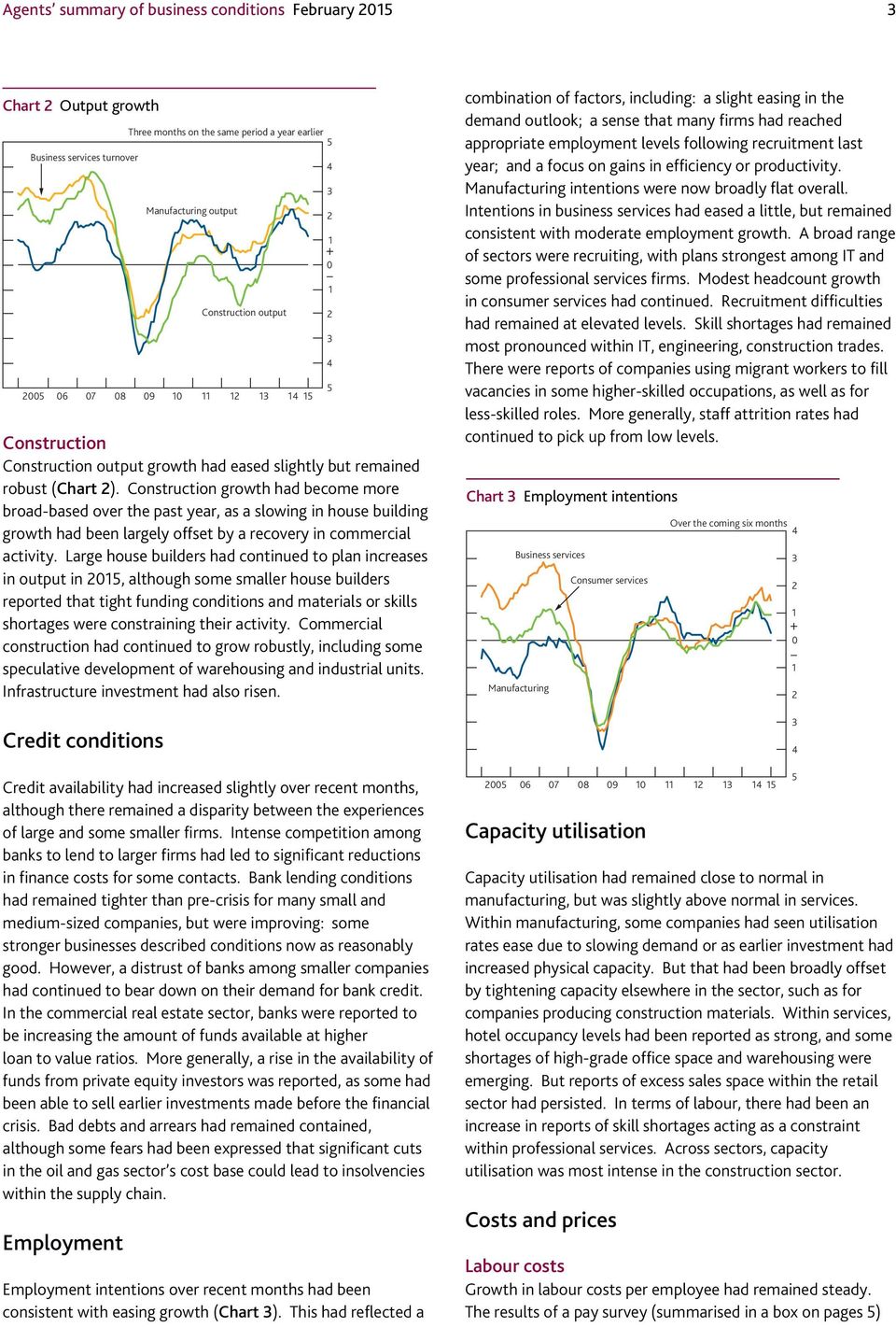
3 Agents summary of business conditions February Chart Output growth Business services turnover Construction Construction output growth had eased slightly but remained robust (Chart ). Construction growth had become more broad-based over the past year, as a slowing in house building growth had been largely offset by a recovery in commercial activity. Large house builders had continued to plan increases in output in, although some smaller house builders reported that tight funding conditions and materials or skills shortages were constraining their activity. Commercial construction had continued to grow robustly, including some speculative development of warehousing and industrial units. Infrastructure investment had also risen. Credit conditions Credit availability had increased slightly over recent months, although there remained a disparity between the experiences of large and some smaller firms. Intense competition among banks to lend to larger firms had led to significant reductions in finance costs for some contacts. Bank lending conditions had remained tighter than pre-crisis for many small and medium-sized companies, but were improving: some stronger businesses described conditions now as reasonably good. However, a distrust of banks among smaller companies had continued to bear down on their demand for bank credit. In the commercial real estate sector, banks were reported to be increasing the amount of funds available at higher loan to value ratios. More generally, a rise in the availability of funds from private equity investors was reported, as some had been able to sell earlier investments made before the financial crisis. Bad debts and arrears had remained contained, although some fears had been expressed that significant cuts in the oil and gas sector s cost base could lead to insolvencies within the supply chain. Employment output Construction output Employment intentions over recent months had been consistent with easing growth (Chart ). This had reflected a combination of factors, including: a slight easing in the demand outlook; a sense that many firms had reached appropriate employment levels following recruitment last year; and a focus on gains in efficiency or productivity. intentions were now broadly flat overall. Intentions in business services had eased a little, but remained consistent with moderate employment growth. A broad range of sectors were recruiting, with plans strongest among IT and some professional services firms. Modest headcount growth in consumer services had continued. Recruitment difficulties had remained at elevated levels. Skill shortages had remained most pronounced within IT, engineering, construction trades. There were reports of companies using migrant workers to fill vacancies in some higher-skilled occupations, as well as for less-skilled roles. More generally, staff attrition rates had continued to pick up from low levels. Chart Employment intentions Business services Consumer services Capacity utilisation Capacity utilisation had remained close to normal in manufacturing, but was slightly above normal in services. Within manufacturing, some companies had seen utilisation rates ease due to slowing demand or as earlier investment had increased physical capacity. But that had been broadly offset by tightening capacity elsewhere in the sector, such as for companies producing construction materials. Within services, hotel occupancy levels had been reported as strong, and some shortages of high-grade office space and warehousing were emerging. But reports of excess sales space within the retail sector had persisted. In terms of labour, there had been an increase in reports of skill shortages acting as a constraint within professional services. Across sectors, capacity utilisation was most intense in the construction sector. Costs and prices Over the coming six months Labour costs Growth in labour costs per employee had remained steady. The results of a pay survey (summarised in a box on pages )
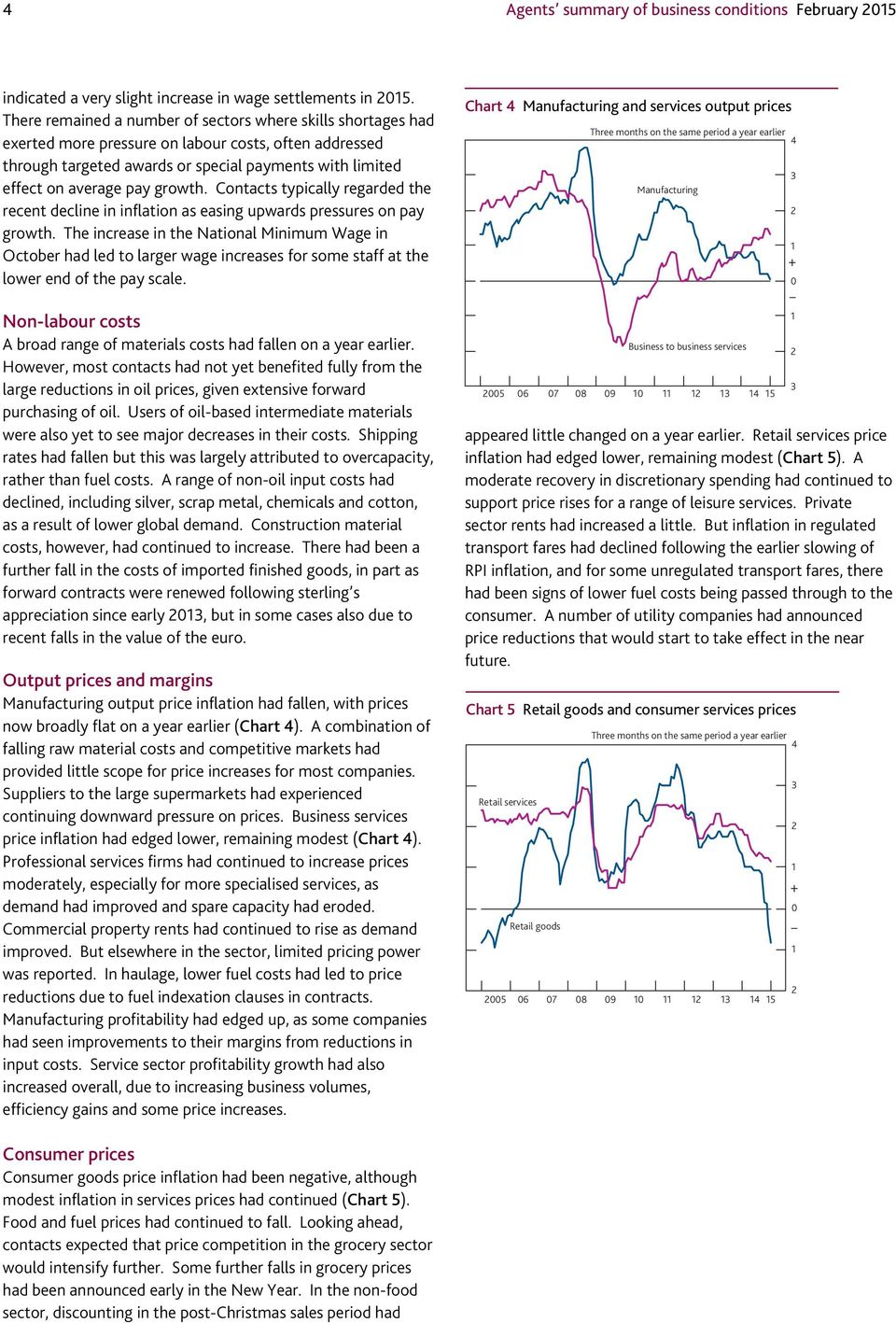
4 Agents summary of business conditions February indicated a very slight increase in wage settlements in. There remained a number of sectors where skills shortages had exerted more pressure on labour costs, often addressed through targeted awards or special payments with limited effect on average pay growth. Contacts typically regarded the recent decline in inflation as easing upwards pressures on pay growth. The increase in the National Minimum Wage in October had led to larger wage increases for some staff at the lower end of the pay scale. Non-labour costs A broad range of materials costs had fallen on a year earlier. However, most contacts had not yet benefited fully from the large reductions in oil prices, given extensive forward purchasing of oil. Users of oil-based intermediate materials were also yet to see major decreases in their costs. Shipping rates had fallen but this was largely attributed to overcapacity, rather than fuel costs. A range of non-oil input costs had declined, including silver, scrap metal, chemicals and cotton, as a result of lower global demand. Construction material costs, however, had continued to increase. There had been a further fall in the costs of imported finished goods, in part as forward contracts were renewed following sterling s appreciation since early, but in some cases also due to recent falls in the value of the euro. Output prices and margins output price inflation had fallen, with prices now broadly flat on a year earlier (Chart ). A combination of falling raw material costs and competitive markets had provided little scope for price increases for most companies. Suppliers to the large supermarkets had experienced continuing downward pressure on prices. Business services price inflation had edged lower, remaining modest (Chart ). Professional services firms had continued to increase prices moderately, especially for more specialised services, as demand had improved and spare capacity had eroded. Commercial property rents had continued to rise as demand improved. But elsewhere in the sector, limited pricing power was reported. In haulage, lower fuel costs had led to price reductions due to fuel indexation clauses in contracts. profitability had edged up, as some companies had seen improvements to their margins from reductions in input costs. Service sector profitability growth had also increased overall, due to increasing business volumes, efficiency gains and some price increases. Chart and services output prices Business to business services appeared little changed on a year earlier. Retail services price inflation had edged lower, remaining modest (Chart ). A moderate recovery in discretionary spending had continued to support price rises for a range of leisure services. Private sector rents had increased a little. But inflation in regulated transport fares had declined following the earlier slowing of RPI inflation, and for some unregulated transport fares, there had been signs of lower fuel costs being passed through to the consumer. A number of utility companies had announced price reductions that would start to take effect in the near future. Chart Retail goods and consumer services prices Retail services Retail goods Consumer prices Consumer goods price inflation had been negative, although modest inflation in services prices had continued (Chart ). Food and fuel prices had continued to fall. Looking ahead, contacts expected that price competition in the grocery sector would intensify further. Some further falls in grocery prices had been announced early in the New Year. In the non-food sector, discounting in the post-christmas sales period had
5 Agents summary of business conditions February Agents survey on pay and labour costs The Agents have conducted an annual pay survey since 998, asking private-sector contacts about their expected pay settlements for the year ahead, and the key drivers of any changes to growth in total labour costs per employee. This year 6 firms responded, with a combined UK employment of 977, staff. The results of the survey have been weighted by employment. The average pay settlement was expected to increase slightly to.% in, from.% in (Chart A). These figures remain well below pre-crisis growth rates, although there has been a very gradual drift upwards in settlements over the past few years. Looking across sectors, pay settlements in and those expected for were a little higher in construction than in other parts of the economy. Chart A Pay settlements by sector settlement Expectations for Total Construction Consumer services Business services Per cent This year s survey, in common with recent years, saw a clear majority of expected settlements in the range % to %. Fewer firms were expecting to freeze pay in than in the previous year, and there were no reductions in pay reported for or expected for. Around 9% of firms in the sample (covering % of employees), reported that collective wage bids had been made for. A little over half of those bids were reported to have been higher in than in. A modest balance of respondents expected total labour costs per employee to increase more rapidly in the coming year than in the previous twelve months (Chart B). That balance suggests that the pickup in growth of total labour costs per employee in may be a little greater than that for settlements. Across sectors, expectations of increases in growth of labour costs per employee were strongest for construction. Chart B Expected growth in total labour costs relative to the previous year versus versus Net balance Significantly lower (>. percentage points) Slightly lower (. percentage points. percentage points) Unchanged Percentage of employment Slightly higher (. percentage points. percentage points) Significantly higher ( >. percentage points) As in last year s survey, the factor most commonly cited as expected to increase growth in total labour costs per employee in the coming year was staff retention and recruitment (Chart C). As well as upward pressure from higher productivity growth, a number of respondents also cited a positive influence from the National Minimum Wage, or pressure to pay the Living Wage (captured within other in Chart C). But there were some countervailing downward pressures, particularly from inflation expectations and from the ability to pass on cost increases in to price. These reflected the significant fall in inflation and reports from some contacts that competition in their markets made it difficult to raise prices, particularly in a low-inflation environment. Chart C Influences on expected growth in total labour costs per employee in relative to Retention and recruitment Changes in productivity Other Changes in average hours worked Changes to composition of employment Changes to employer pension contributions Ability to pass on cost increases to price Inflation expectations Net balance, per cent

Agents summary of business conditions
 Agents summary of business conditions April Consumer demand had continued to grow moderately. Housing market transactions had picked up modestly since the start of the year, but were lower than a year
Agents summary of business conditions
 Agents summary of business conditions July Annual growth in the value of retail sales and consumer services had risen slightly over the first six months of the year, but remained modest. Activity in the
INFLATION REPORT PRESS CONFERENCE. Thursday 4 th February 2016. Opening remarks by the Governor
 INFLATION REPORT PRESS CONFERENCE Thursday 4 th February 2016 Opening remarks by the Governor Good afternoon. At its meeting yesterday, the Monetary Policy Committee (MPC) voted 9-0 to maintain Bank Rate
UK Economic Forecast Q3 2014
 UK Economic Forecast Q3 2014 David Kern, Chief Economist at the BCC The main purpose of the BCC Economic Forecast is to articulate a BCC view on economic topics that are relevant to our members, and to
Economic Review, April 2012
 Economic Review, April 2012 Author Name(s): Malindi Myers, Office for National Statistics Abstract This note provides some wider economic analysis to support the Statistical Bulletin relating to the latest
percentage points to the overall CPI outcome. Goods price inflation increased to 4,6
 South African Reserve Bank Press Statement Embargo on Delivery 28 January 2016 Statement of the Monetary Policy Committee Issued by Lesetja Kganyago, Governor of the South African Reserve Bank Since the
Strategy Document 1/03
 Strategy Document / Monetary policy in the period 5 March to 5 June Discussed by the Executive Board at its meeting of 5 February. Approved by the Executive Board at its meeting of 5 March Background Norges
X. INTERNATIONAL ECONOMIC DEVELOPMENT 1/
 1/ X. INTERNATIONAL ECONOMIC DEVELOPMENT 1/ 10.1 Overview of World Economy Latest indicators are increasingly suggesting that the significant contraction in economic activity has come to an end, notably
Svein Gjedrem: Prospects for the Norwegian economy
 Svein Gjedrem: Prospects for the Norwegian economy Speech by Mr Svein Gjedrem, Governor of Norges Bank (Central Bank of Norway), at Sparebank 1 SR-Bank Stavanger, Stavanger, 26 March 2010. The text below
FSB Voice of Small Business Index. Quarter 2, 2014
 FSB Voice of Small Business Index Quarter 2, 2014 FSB Voice of Small Business Index 2014 Contents Q2 snapshot 3 FSB National Chairman 4 Economist s view 5 Regional Small Business Indices 9 Sector Small
Meeting with Analysts
 CNB s New Forecast (Inflation Report IV/) Meeting with Analysts Tibor Hlédik Prague, 7 November, Outline Assumptions of the forecast The new macroeconomic forecast Comparison with the previous forecast
Labour market outlook, spring 2015 SUMMARY
 Labour market outlook, spring 2015 SUMMARY Ura 2015:4 Labour market outlook Spring 2015 Summary The next few years will be characterised both by continued improvements in job growth and more people entering
UK Economic Forecast Q1 2015
 UK Economic Forecast Q1 2015 David Kern, Chief Economist at the BCC The main purpose of the BCC Economic Forecast is to articulate a BCC view on economic topics that are relevant to our members, and to
Meeting with Analysts
 CNB s New Forecast (Inflation Report II/2015) Meeting with Analysts Petr Král Prague, 11 May, 2015 1 Outline Assumptions of the forecast The new macroeconomic forecast Comparison with the previous forecast
Monetary policy assessment of 13 September 2007 SNB aiming to calm the money market
 Communications P.O. Box, CH-8022 Zurich Telephone +41 44 631 31 11 Fax +41 44 631 39 10 Zurich, 13 September 2007 Monetary policy assessment of 13 September 2007 SNB aiming to calm the money market The
FSB VOICE OF SMALL BUSINESS INDEX. @fsb_policy fsb.org.uk
 Q2 FSB VOICE OF SMALL BUSINESS INDEX QUARTER 2, 2016 @fsb_policy fsb.org.uk fsb.org.uk CONTENTS Q2 Snapshot 4 FSB National Chairman 5 Economist s view 6 FSB executive summary.....................................
DTZ Insight Public administration employment Major office markets weather the storm
 DTZ Insight Public administration employment Major office markets weather the storm 27 October 2010 Contents Introduction 2 Trends in office based employment 3 Impact on office markets 8 Appendix 1: Methodology
6. Economic Outlook. The International Economy. Graph 6.2 Terms of Trade Log scale, 2012/13 average = 100
 6. Economic Outlook The International Economy Growth of Australia s major trading partners is expected to be around its long-run average in 015 and 016 (Graph 6.1). Forecasts for 015 have been revised
5. Price and Wage Developments
 . Price and Wage Developments Recent Developments in Inflation Inflation rose in the December quarter, following a low September quarter outcome (Table.; Graph.). Indicators of underlying inflation increased
Why is inflation low?
 Why is inflation low? MONETARY POLICY REPORT 5 Inflation has been low in Sweden in recent years and fell further in the latter part of, mainly because the rate of price increase for services slowed down.
EUROSYSTEM STAFF MACROECONOMIC PROJECTIONS FOR THE EURO AREA
 EUROSYSTEM STAFF MACROECONOMIC PROJECTIONS FOR THE EURO AREA On the basis of the information available up to 22 May 2009, Eurosystem staff have prepared projections for macroeconomic developments in the
July 2014. UK Commercial & Residential Property Markets Review: July 2014 1
 July 2014 UK Commercial & Residential Property Markets Review: July 2014 1 UK Commercial & Residential Property Markets Review: July 2014 2 UK COMMERCIAL & RESIDENTIAL PROPERTY MARKETS REVIEW: JULY 2014
Jarle Bergo: Monetary policy and the outlook for the Norwegian economy
 Jarle Bergo: Monetary policy and the outlook for the Norwegian economy Speech by Mr Jarle Bergo, Deputy Governor of Norges Bank, at the Capital markets seminar, hosted by Terra-Gruppen AS, Gardermoen,
THE RETURN OF CAPITAL EXPENDITURE OR CAPEX CYCLE IN MALAYSIA
 PUBLIC BANK BERHAD ECONOMICS DIVISION MENARA PUBLIC BANK 146 JALAN AMPANG 50450 KUALA LUMPUR TEL : 03 2176 6000/666 FAX : 03 2163 9929 Public Bank Economic Review is published bi monthly by Economics Division,
Box 3.1: Business Costs of Singapore s Manufacturing and Services Sectors
 Economic Survey of Singapore 213 Box 3.1: Business Costs of Singapore s Manufacturing and Services Sectors Business costs in the manufacturing and services sectors have increased after a period of decline
Explanation beyond exchange rates: trends in UK trade since 2007
 Explanation beyond exchange rates: trends in UK trade since 2007 Author Name(s): Michael Hardie, Andrew Jowett, Tim Marshall & Philip Wales, Office for National Statistics Abstract The UK s trade performance
CANADA AND U.S. AUTO SALES: ROOM FOR FUR- THER GROWTH? October 2014. Factors supporting the U.S. sales outlook: Employment Growth
 93619 CANADA AND U.S. AUTO SALES: ROOM FOR FUR- THER GROWTH? October 2014 Canadian and U.S. auto sales have strengthened significantly from recession lows. Canadian new motor vehicle sales have surprised
Project LINK Meeting New York, 20-22 October 2010. Country Report: Australia
 Project LINK Meeting New York, - October 1 Country Report: Australia Prepared by Peter Brain: National Institute of Economic and Industry Research, and Duncan Ironmonger: Department of Economics, University
PROJECTION OF THE FISCAL BALANCE AND PUBLIC DEBT (2012 2027) - SUMMARY
 PROJECTION OF THE FISCAL BALANCE AND PUBLIC DEBT (2012 2027) - SUMMARY PUBLIC FINANCE REVIEW February 2013 SUMMARY Key messages The purpose of our analysis is to highlight the risks that fiscal policy
Statement by. Janet L. Yellen. Chair. Board of Governors of the Federal Reserve System. before the. Committee on Financial Services
 For release at 8:30 a.m. EST February 10, 2016 Statement by Janet L. Yellen Chair Board of Governors of the Federal Reserve System before the Committee on Financial Services U.S. House of Representatives
LEE BUSI N ESS SCHOOL UNITED STATES QUARTERLY ECONOMIC FORECAST. U.S. Economic Growth to Accelerate. Chart 1. Growth Rate of U.S.
 CENTER FOR BUSINESS & ECONOMIC RESEARCH LEE BUSI N ESS SCHOOL UNITED STATES QUARTERLY ECONOMIC FORECAST O U.S. Economic Growth to Accelerate ver the past few years, U.S. economic activity has remained
MBA Forecast Commentary Joel Kan, [email protected]
 MBA Forecast Commentary Joel Kan, [email protected] Weak First Quarter, But Growth Expected to Recover MBA Economic and Mortgage Finance Commentary: May 2015 Broad economic growth in the US got off to a slow
EAST AYRSHIRE COUNCIL CABINET 21 OCTOBER 2009 TREASURY MANAGEMENT ANNUAL REPORT FOR 2008/2009 AND UPDATE ON 2009/10 STRATEGY
 EAST AYRSHIRE COUNCIL CABINET 21 OCTOBER 2009 TREASURY MANAGEMENT ANNUAL REPORT FOR 2008/2009 AND UPDATE ON 2009/10 STRATEGY Report by Executive Head of Finance and Asset Management 1 PURPOSE OF REPORT
Background. Key points
 Background Employment forecasts over the three years to March 2018 1 are presented in this report. These employment forecasts will inform the Ministry s advice relating to immigration priorities, and priority
 Jobs Fair 2013 Thursday 12 th September WCC is bringing back its hugely successful jobs fair at the Guildhall. We had 2000 people looking for jobs or changes in career at the last one so if you are looking
Domestic Activity. Graph 6.2 Terms of Trade Log scale, 2013/14 average = 100
 6. Economic Outlook 6 The International Economy The outlook for GDP growth of Australia s major trading partners (MTPs) is unchanged from the November Statement. Over the next few years, growth is expected
OVERVIEW. A cyclical upswing is underway favoured by several temporary tailwinds
 OVERVIEW A cyclical upswing is underway favoured by several temporary tailwinds whose strength underpins an upward revision to the growth forecast this year The outlook for economic growth in the EU has
COMMISSION OPINION. of XXX. on the Draft Budgetary Plan of ITALY
 EUROPEAN COMMISSION Brussels, XXX [ ](2013) XXX draft COMMISSION OPINION of XXX on the Draft Budgetary Plan of ITALY EN EN COMMISSION OPINION of XXX on the Draft Budgetary Plan of ITALY GENERAL CONSIDERATIONS
UK outsourcing across the private and public sectors. An updated national, regional and constituency picture
 UK outsourcing across the private and public sectors An updated national, regional and constituency picture Report prepared by Oxford Economics for the Business Services Association November 2012 Contents
Joint Economic Forecast Spring 2013. German Economy Recovering Long-Term Approach Needed to Economic Policy
 Joint Economic Forecast Spring 2013 German Economy Recovering Long-Term Approach Needed to Economic Policy Press version Embargo until: Thursday, 18 April 2013, 11.00 a.m. CEST Joint Economic Forecast
BAHAMAS. 1. General trends
 Economic Survey of Latin America and the Caribbean 2014 1 BAHAMAS 1. General trends Growth in the Bahamian economy slowed in 2013 to 0.7%, down from 1.0% in 2012, dampened by a decline in stopover tourism,
Trends in Lending. April 2011
 Trends in Lending April 11 BANK OF ENGLAND Trends in Lending April 11 This quarterly publication presents the Bank of England s assessment of the latest trends in lending to the UK economy. (1) It draws
Caucasus and Central Asia: Oil Price Decline and Regional Spillovers Darken the Outlook
 Caucasus and Central Asia: Oil Price Decline and Regional Spillovers Darken the Outlook Economic activity in the Caucasus and Central Asia (CCA) will continue to decelerate in 215 mainly as a consequence
Monetary Policy Summary and minutes of the Monetary Policy Committee meeting ending on 3 February 2016
 Monetary Policy Summary and minutes of the Monetary Policy Committee meeting ending on 3 February 2016 Publication date: 4 February 2016 These are the minutes of the Monetary Policy Committee meeting ending
PROJECTIONS FOR THE PORTUGUESE ECONOMY: 2015-2017. Box 1 Projection assumptions
 PROJECTIONS FOR THE PORTUGUESE ECONOMY: 2015-2017 Box 1 Projection assumptions Projections for the Portuguese economy: 2015-2017 7 Projections for the Portuguese economy: 2015-2017 1. Introduction Projections
Business Outlook Survey Results of the Spring 2016 Survey Vol. 13.1 1 April 2016
 Business Outlook Survey Results of the Spring 2016 Survey Vol. 13.1 1 April 2016 Business sentiment in the spring Business Outlook Survey improved but remains subdued overall. The positive impetus coming
The chain. Unravelling the links between sales
 The chain Unravelling the links between sales Autumn 2015 The story so far Contents More homes have been sold without an onward chain in 2015 than in any of the previous years. The growth in the number
ENGINEERING LABOUR MARKET
 ENGINEERING LABOUR MARKET in Canada Projections to 2025 JUNE 2015 ENGINEERING LABOUR MARKET in Canada Projections to 2025 Prepared by: MESSAGE FROM THE CHIEF EXECUTIVE OFFICER Dear colleagues: Engineers
Jarle Bergo: Monetary policy and cyclical developments
 Jarle Bergo: Monetary policy and cyclical developments Speech by Mr Jarle Bergo, Deputy Governor of Norges Bank (Central Bank of Norway), at Sparebanken Sogn og Fjordane, Førde, 18 October 2004. The text
CHEMSYSTEMS. Report Abstract. Quarterly Business Analysis Quarter 1, 2012
 CHEMSYSTEMS PPE PROGRAM Report Abstract Quarterly Business Analysis Petrochemical Cost Price and Margin for Olefins, Polyolefins, Vinyls, Aromatics, Styrenics, Polyester Intermediates and Propylene Derivatives.
South African Reserve Bank. Statement of the Monetary Policy Committee. Issued by Lesetja Kganyago, Governor of the South African Reserve Bank
 South African Reserve Bank PRESS STATEMENT EMBARGO DELIVERY 17 March 2016 Statement of the Monetary Policy Committee Issued by Lesetja Kganyago, Governor of the South African Reserve Bank Since the previous
Managing trade credit risk in the recovering economy. July 2015
 Managing trade credit risk in the recovering economy July 201 1 QBE - Managing trade credit risk in the recovering economy Introduction In our latest survey of UK businesses, 22% of respondents reported
Quarterly Credit Conditions Survey Report
 Quarterly Credit Conditions Survey Report Contents List of Charts 2 List of Tables 3 Background 4 Overview 5 Credit Market Conditions 8 Personal Lending 10 Micro Business Lending 13 Small Business Lending
TIMING YOUR INVESTMENT STRATEGIES USING BUSINESS CYCLES AND STOCK SECTORS. Developed by Peter Dag & Associates, Inc.
 TIMING YOUR INVESTMENT STRATEGIES USING BUSINESS CYCLES AND STOCK SECTORS Developed by Peter Dag & Associates, Inc. 5 4 6 7 3 8 3 1 2 Fig. 1 Introduction The business cycle goes through 4 major growth
Statement to Parliamentary Committee
 Statement to Parliamentary Committee Opening Remarks by Mr Glenn Stevens, Governor, in testimony to the House of Representatives Standing Committee on Economics, Sydney, 14 August 2009. The Bank s Statement
The Business Credit Index
 The Business Credit Index April 8 Published by the Credit Management Research Centre, Leeds University Business School April 8 1 April 8 THE BUSINESS CREDIT INDEX During the last ten years the Credit Management
International Trade Monitor
 British Small and Medium-Sized Enterprises Split Over Health of the UK Economy Overall SME importer and exporter confidence sees dip in Q1 Increase in SMEs hurt by sterling volatility Eurozone concerns
IT Monitor / Q2 2015. IT Monitor Q2-2015. Latest salary and vacancy trends across the IT industry in the UK. computer people. computerpeople.co.
 IT Monitor Q2-2015 Latest salary and vacancy trends across the IT industry in the UK.co.uk Pay rates boosted while businesses play it safe Q2 was borne of the uncertainty that a General Election brings,
Main Economic & Financial Indicators Russian Federation
 Main Economic & Financial Indicators Russian Federation 02 NOVEMBER 201 NAOKO ISHIHARA ECONOMIST ECONOMIC RESEARCH OFFICE (LONDON) T +44-(0)20-777-2179 E [email protected] Overview The Bank of
Employment Outlook to November 2018
 Based on the Department of Employment s 2014 employment projections Table of Contents Introduction... 2 Projected employment growth by industry... 3 Projected employment growth by skill level... 5 Projected
Monetary Policy Report
 Monetary Policy Report February 15 S V E R I G E S R I K S B A N K Correction 15--13 Two figures on page 3 were switched around in the previous version of the report. This meant that references to Figures
Manpower Employment Outlook Survey Norway
 Manpower Employment Outlook Survey Norway Q2 2015 The Manpower Employment Outlook Survey for the second quarter 2015 was conducted by interviewing a representative sample of 751 employers in Norway. All
Property IQ. After a sterling year, what next? Q4 2014. Authors. Real Estate
 Q4 2014 Real Estate Property IQ After a sterling year, what next? 2014 was an outstanding year for UK commercial property. The latest monthly IPD figures show annual total returns have climbed to 20%,
Explaining Russia s New Normal
 Explaining Russia s New Normal Chris Weafer of Macro-Advisory This Op- Ed appeared on BNE.eu on September 11 2015 One of the slogans now regularly deployed to describe Russia s current economic condition
INTERNATIONAL MONETARY FUND. Russian Federation Concluding Statement for the 2012 Article IV Consultation Mission. Moscow, June 13, 2012
 INTERNATIONAL MONETARY FUND Russian Federation Concluding Statement for the 2012 Article IV Consultation Mission Moscow, June 13, 2012 The Russian economy has recovered from the 2008-09 crisis and is now
UK Business Confidence Monitor Q2 2016
 UK Business Confidence Monitor 216 BUSINESS WITH CONFIDENCE icaew.com/bcm 216 Overall confidence +.8 Domestic sales Profit growth drops sharply continue to slow declines further Key points Confidence remains