
OBSERVATION. TD Economics ARE CANADIANS PREPARED FOR HIGHER INTEREST RATES?
|
|
|
- Felix Armstrong
- 10 years ago
- Views:
Transcription
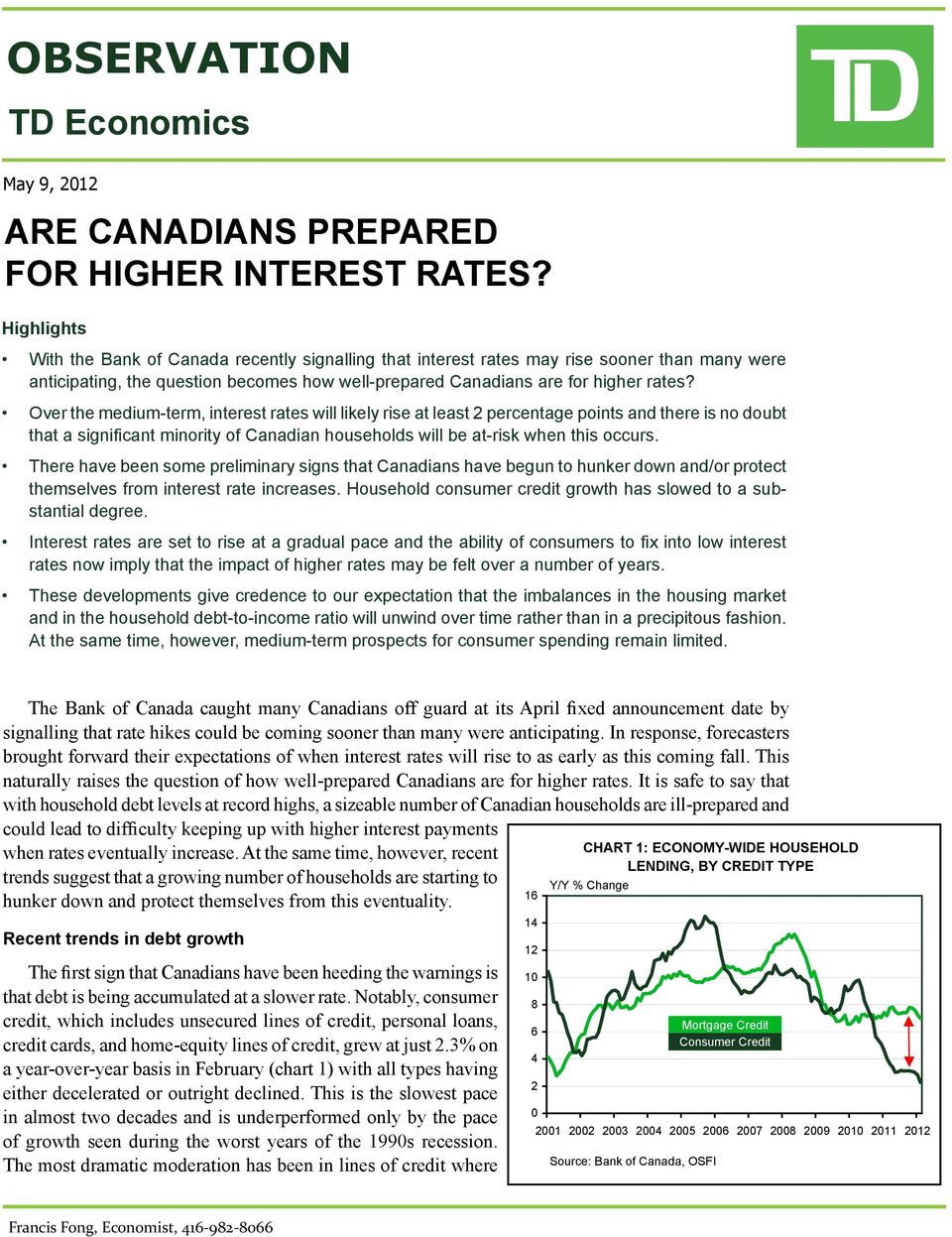
1 OBSERVATION TD Economics May, ARE CANADIANS PREPARED FOR HIGHER INTEREST RATES? Highlights With the Bank of Canada recently signalling that interest rates may rise sooner than many were anticipating, the question becomes how well-prepared Canadians are for higher rates? Over the medium-term, interest rates will likely rise at least percentage points and there is no doubt that a significant minority of Canadian households will be at-risk when this occurs. There have been some preliminary signs that Canadians have begun to hunker down and/or protect themselves from interest rate increases. Household consumer credit growth has slowed to a substantial degree. Interest rates are set to rise at a gradual pace and the ability of consumers to fix into low interest rates now imply that the impact of higher rates may be felt over a number of years. These developments give credence to our expectation that the imbalances in the housing market and in the household debt-to-income ratio will unwind over time rather than in a precipitous fashion. At the same time, however, medium-term prospects for consumer spending remain limited. The Bank of Canada caught many Canadians off guard at its April fixed announcement date by signalling that rate hikes could be coming sooner than many were anticipating. In response, forecasters brought forward their expectations of when interest rates will rise to as early as this coming fall. This naturally raises the question of how well-prepared Canadians are for higher rates. It is safe to say that with household debt levels at record highs, a sizeable number of Canadian households are ill-prepared and could lead to difficulty keeping up with higher interest payments when rates eventually increase. At the same time, however, recent trends suggest that a growing number of households are starting to hunker down and protect themselves from this eventuality. Recent trends in debt growth The first sign that Canadians have been heeding the warnings is that debt is being accumulated at a slower rate. Notably, consumer credit, which includes unsecured lines of credit, personal loans, credit cards, and home-equity lines of credit, grew at just.% on a year-over-year basis in February (chart 1) with all types having either decelerated or outright declined. This is the slowest pace in almost two decades and is underperformed only by the pace of growth seen during the worst years of the 1s recession. The most dramatic moderation has been in lines of credit where 1 1 CHART 1: ECONOMY-WIDE HOUSEHOLD LENDING, BY CREDIT TYPE Source: Bank of Canada, OSFI Mortgage Credit Consumer Credit Francis Fong, Economist, 1--
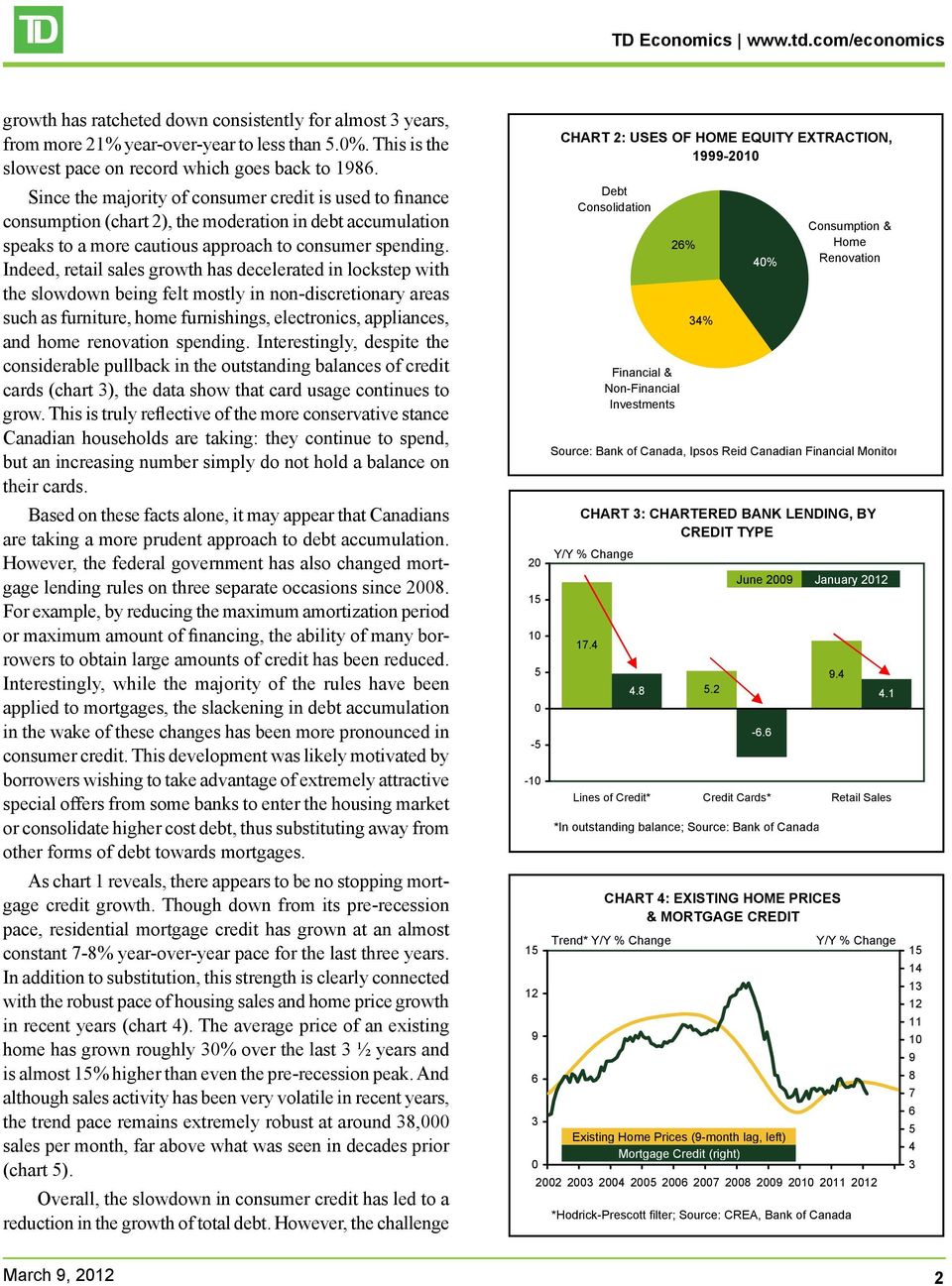
2 growth has ratcheted down consistently for almost years, from more 1% year-over-year to less than.%. This is the slowest pace on record which goes back to 1. Since the majority of consumer credit is used to finance consumption (chart ), the moderation in debt accumulation speaks to a more cautious approach to consumer spending. Indeed, retail sales growth has decelerated in lockstep with the slowdown being felt mostly in non-discretionary areas such as furniture, home furnishings, electronics, appliances, and home renovation spending. Interestingly, despite the considerable pullback in the outstanding balances of credit cards (chart ), the data show that card usage continues to grow. This is truly reflective of the more conservative stance Canadian households are taking: they continue to spend, but an increasing number simply do not hold a balance on their cards. Based on these facts alone, it may appear that Canadians are taking a more prudent approach to debt accumulation. However, the federal government has also changed mortgage lending rules on three separate occasions since. For example, by reducing the maximum amortization period or maximum amount of financing, the ability of many borrowers to obtain large amounts of credit has been reduced. Interestingly, while the majority of the rules have been applied to mortgages, the slackening in debt accumulation in the wake of these changes has been more pronounced in consumer credit. This development was likely motivated by borrowers wishing to take advantage of extremely attractive special offers from some banks to enter the housing market or consolidate higher cost debt, thus substituting away from other forms of debt towards mortgages. As chart 1 reveals, there appears to be no stopping mortgage credit growth. Though down from its pre-recession pace, residential mortgage credit has grown at an almost constant 7-% year-over-year pace for the last three years. In addition to substitution, this strength is clearly connected with the robust pace of housing sales and home price growth in recent years (chart ). The average price of an existing home has grown roughly % over the last ½ years and is almost % higher than even the pre-recession peak. And although sales activity has been very volatile in recent years, the trend pace remains extremely robust at around, sales per month, far above what was seen in decades prior (chart ). Overall, the slowdown in consumer credit has led to a reduction in the growth of total debt. However, the challenge - - CHART : USES OF HOME EQUITY EXTRACTION, 1- Debt Consolidation CHART : CHARTERED BANK LENDING, BY CREDIT TYPE 17. Financial & Non-Financial Investments. % %. % June January -. Lines of Credit* Credit Cards* Retail Sales *In outstanding balance; Source: Bank of Canada Consumption & Home Renovation Source: Bank of Canada, Ipsos Reid Canadian Financial Monitor. CHART : EXISTING HOME PRICES & MORTGAGE CREDIT Trend* Existing Home Prices (-month lag, left) Mortgage Credit (right) 7 11 *Hodrick-Prescott filter; Source: CREA, Bank of Canada March,
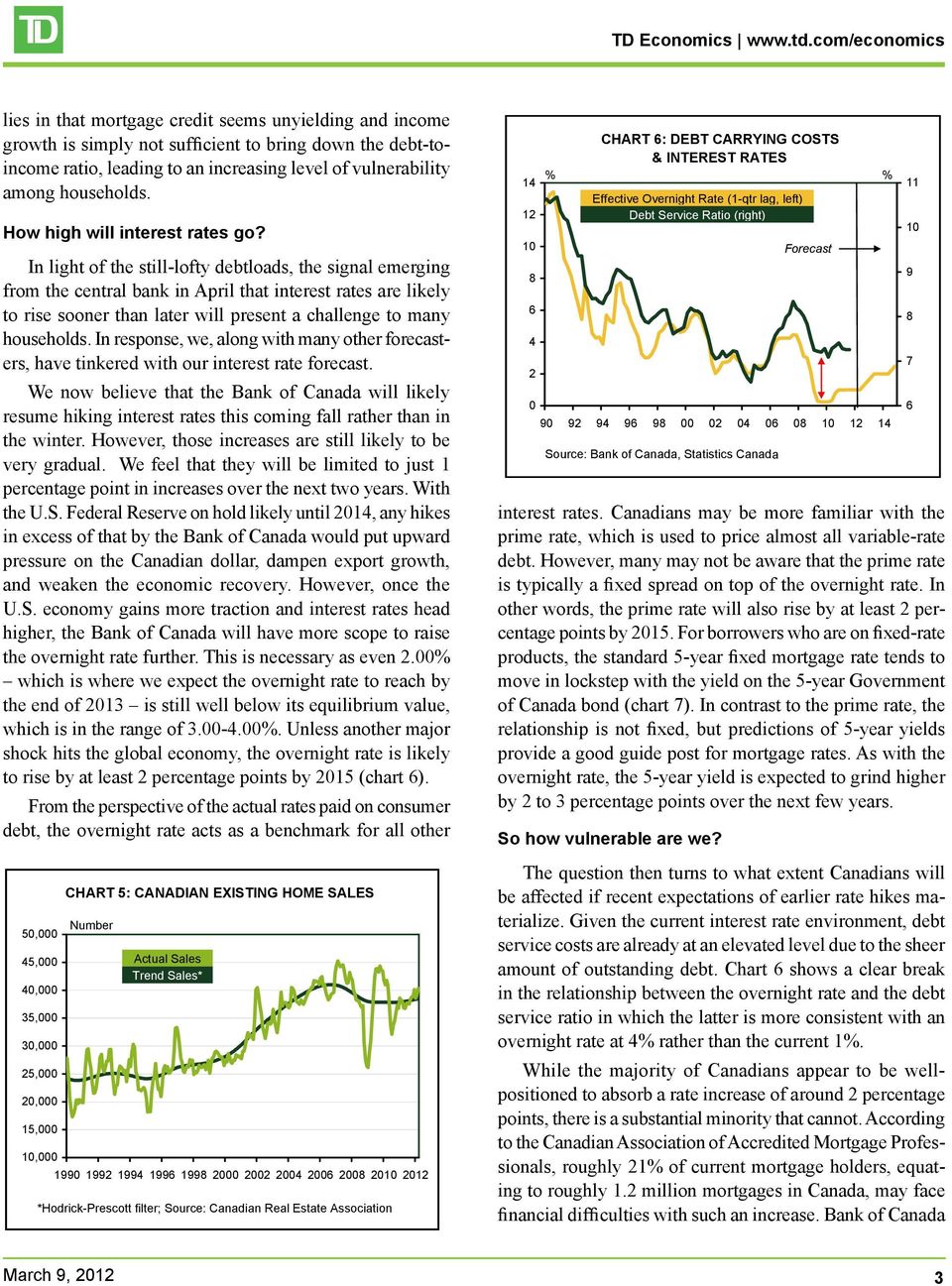
3 lies in that mortgage credit seems unyielding and income growth is simply not sufficient to bring down the debt-toincome ratio, leading to an increasing level of vulnerability among households. How high will interest rates go? In light of the still-lofty debtloads, the signal emerging from the central bank in April that interest rates are likely to rise sooner than later will present a challenge to many households. In response, we, along with many other forecasters, have tinkered with our interest rate forecast. We now believe that the Bank of Canada will likely resume hiking interest rates this coming fall rather than in the winter. However, those increases are still likely to be very gradual. We feel that they will be limited to just 1 percentage point in increases over the next two years. With the U.S. Federal Reserve on hold likely until 1, any hikes in excess of that by the Bank of Canada would put upward pressure on the Canadian dollar, dampen export growth, and weaken the economic recovery. However, once the U.S. economy gains more traction and interest rates head higher, the Bank of Canada will have more scope to raise the overnight rate further. This is necessary as even.% which is where we expect the overnight rate to reach by the end of 1 is still well below its equilibrium value, which is in the range of.-.%. Unless another major shock hits the global economy, the overnight rate is likely to rise by at least percentage points by (chart ). From the perspective of the actual rates paid on consumer debt, the overnight rate acts as a benchmark for all other,,,,,,,,, CHART : CANADIAN EXISTING HOME SALES Number Actual Sales Trend Sales* *Hodrick-Prescott filter; Source: Canadian Real Estate Association CHART : DEBT CARRYING COSTS & INTEREST RATES % % 1 11 Effective Overnight Rate (1-qtr lag, left) Debt Service Ratio (right) 1 Source: Bank of Canada, Statistics Canada Forecast interest rates. Canadians may be more familiar with the prime rate, which is used to price almost all variable-rate debt. However, many may not be aware that the prime rate is typically a fixed spread on top of the overnight rate. In other words, the prime rate will also rise by at least percentage points by. For borrowers who are on fixed-rate products, the standard -year fixed mortgage rate tends to move in lockstep with the yield on the -year Government of Canada bond (chart 7). In contrast to the prime rate, the relationship is not fixed, but predictions of -year yields provide a good guide post for mortgage rates. As with the overnight rate, the -year yield is expected to grind higher by to percentage points over the next few years. So how vulnerable are we? The question then turns to what extent Canadians will be affected if recent expectations of earlier rate hikes materialize. Given the current interest rate environment, debt service costs are already at an elevated level due to the sheer amount of outstanding debt. Chart shows a clear break in the relationship between the overnight rate and the debt service ratio in which the latter is more consistent with an overnight rate at % rather than the current 1%. While the majority of Canadians appear to be wellpositioned to absorb a rate increase of around percentage points, there is a substantial minority that cannot. According to the Canadian Association of Accredited Mortgage Professionals, roughly 1% of current mortgage holders, equating to roughly 1. million mortgages in Canada, may face financial difficulties with such an increase. Bank of Canada 7 March,
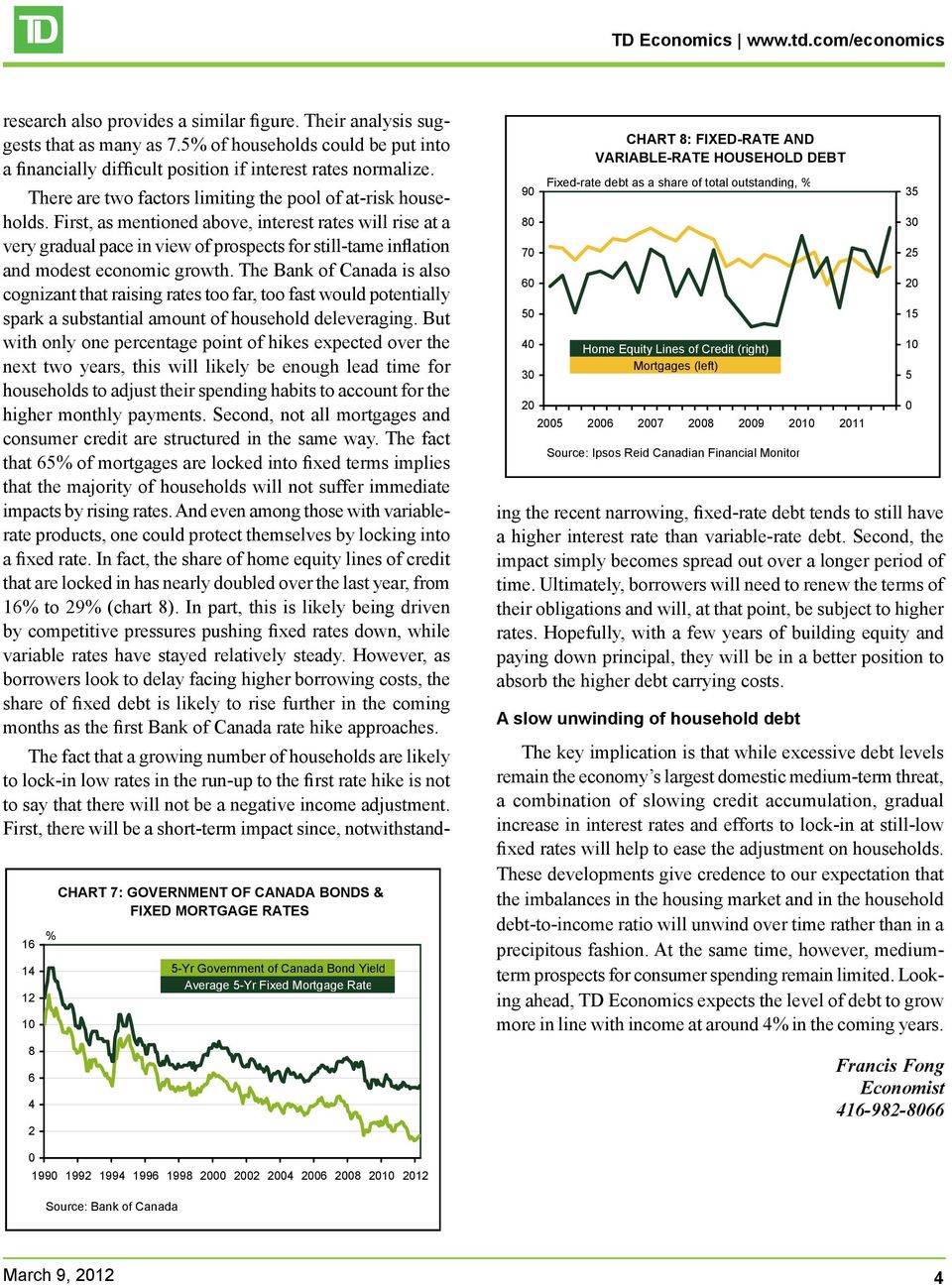
4 research also provides a similar figure. Their analysis suggests that as many as 7.% of households could be put into a financially difficult position if interest rates normalize. There are two factors limiting the pool of at-risk households. First, as mentioned above, interest rates will rise at a very gradual pace in view of prospects for still-tame inflation and modest economic growth. The Bank of Canada is also cognizant that raising rates too far, too fast would potentially spark a substantial amount of household deleveraging. But with only one percentage point of hikes expected over the next two years, this will likely be enough lead time for households to adjust their spending habits to account for the higher monthly payments. Second, not all mortgages and consumer credit are structured in the same way. The fact that % of mortgages are locked into fixed terms implies that the majority of households will not suffer immediate impacts by rising rates. And even among those with variablerate products, one could protect themselves by locking into a fixed rate. In fact, the share of home equity lines of credit that are locked in has nearly doubled over the last year, from 1% to % (chart ). In part, this is likely being driven by competitive pressures pushing fixed rates down, while variable rates have stayed relatively steady. However, as borrowers look to delay facing higher borrowing costs, the share of fixed debt is likely to rise further in the coming months as the first Bank of Canada rate hike approaches. The fact that a growing number of households are likely to lock-in low rates in the run-up to the first rate hike is not to say that there will not be a negative income adjustment. First, there will be a short-term impact since, notwithstand- 1 1 % CHART 7: GOVERNMENT OF CANADA BONDS & FIXED MORTGAGE RATES -Yr Government of Canada Bond Yield Average -Yr Fixed Mortgage Rate 7 CHART : FIXED-RATE AND VARIABLE-RATE HOUSEHOLD DEBT Fixed-rate debt as a share of total outstanding, % Home Equity Lines of Credit (right) Mortgages (left) 7 11 Source: Ipsos Reid Canadian Financial Monitor ing the recent narrowing, fixed-rate debt tends to still have a higher interest rate than variable-rate debt. Second, the impact simply becomes spread out over a longer period of time. Ultimately, borrowers will need to renew the terms of their obligations and will, at that point, be subject to higher rates. Hopefully, with a few years of building equity and paying down principal, they will be in a better position to absorb the higher debt carrying costs. A slow unwinding of household debt The key implication is that while excessive debt levels remain the economy s largest domestic medium-term threat, a combination of slowing credit accumulation, gradual increase in interest rates and efforts to lock-in at still-low fixed rates will help to ease the adjustment on households. These developments give credence to our expectation that the imbalances in the housing market and in the household debt-to-income ratio will unwind over time rather than in a precipitous fashion. At the same time, however, mediumterm prospects for consumer spending remain limited. Looking ahead, TD Economics expects the level of debt to grow more in line with income at around % in the coming years. Francis Fong Economist Source: Bank of Canada March,
5 This report is provided by TD Economics. It is for information purposes only and may not be appropriate for other purposes. The report does not provide material information about the business and affairs of TD Bank Group and the members of TD Economics are not spokespersons for TD Bank Group with respect to its business and affairs. The information contained in this report has been drawn from sources believed to be reliable, but is not guaranteed to be accurate or complete. The report contains economic analysis and views, including about future economic and financial markets performance. These are based on certain assumptions and other factors, and are subject to inherent risks and uncertainties. The actual outcome may be materially different. The Toronto-Dominion Bank and its affiliates and related entities that comprise TD Bank Group are not liable for any errors or omissions in the information, analysis or views contained in this report, or for any loss or damage suffered. March,
CANADA AND U.S. AUTO SALES: ROOM FOR FUR- THER GROWTH? October 2014. Factors supporting the U.S. sales outlook: Employment Growth
 93619 CANADA AND U.S. AUTO SALES: ROOM FOR FUR- THER GROWTH? October 2014 Canadian and U.S. auto sales have strengthened significantly from recession lows. Canadian new motor vehicle sales have surprised
Small Business Lending *
 Reserve Small Business Bank of Lending Australia Bulletin Small Business Lending * These notes were prepared in response to a request from the House of Representatives Standing Committee on Financial Institutions
OBSERVATION. TD Economics. COMPARING AND CONTRASTING CANADIAN AND AMERICAN CONSUMERS Some Stylized Facts
 OBSERVATION TD Economics December 18, 213 COMPARING AND CONTRASTING CANADIAN AND AMERICAN CONSUMERS Some Stylized Facts A recent trend over the past decade has been a greater push for companies to span
Statement to Parliamentary Committee
 Statement to Parliamentary Committee Opening Remarks by Mr Glenn Stevens, Governor, in testimony to the House of Representatives Standing Committee on Economics, Sydney, 14 August 2009. The Bank s Statement
DEUTSCHE ASSET & WEALTH MANAGEMENT REAL ESTATE OUTLOOK
 Research Report DEUTSCHE ASSET & WEALTH MANAGEMENT REAL ESTATE OUTLOOK Second Quarter 2013 Economic Outlook Business and consumer spending to drive recovery Quantitative easing beginning its expected unwinding
18 ECB STYLISED FACTS OF MONEY AND CREDIT OVER THE BUSINESS CYCLE
 Box 1 STYLISED FACTS OF MONEY AND CREDIT OVER THE BUSINESS CYCLE Over the past three decades, the growth rates of MFI loans to the private sector and the narrow monetary aggregate M1 have displayed relatively
Logo and tagline. 2014 Investment Shareholders Update. meridiancu.ca 1-866-592-2226. Dear Shareholder,
 2014 Investment Shareholders Update Dear Shareholder, As we look back on the first half of 2014, I m happy to report that Meridian s continued focus on serving and meeting the needs of our Members while
TIMING YOUR INVESTMENT STRATEGIES USING BUSINESS CYCLES AND STOCK SECTORS. Developed by Peter Dag & Associates, Inc.
 TIMING YOUR INVESTMENT STRATEGIES USING BUSINESS CYCLES AND STOCK SECTORS Developed by Peter Dag & Associates, Inc. 5 4 6 7 3 8 3 1 2 Fig. 1 Introduction The business cycle goes through 4 major growth
THE STATE OF THE ECONOMY
 THE STATE OF THE ECONOMY CARLY HARRISON Portland State University Following data revisions, the economy continues to grow steadily, but slowly, in line with expectations. Gross domestic product has increased,
THE POTENTIAL MACROECONOMIC EFFECT OF DEBT CEILING BRINKMANSHIP
 OCTOBER 2013 THE POTENTIAL MACROECONOMIC EFFECT OF DEBT CEILING BRINKMANSHIP Introduction The United States has never defaulted on its obligations, and the U. S. dollar and Treasury securities are at the
Q1 1990 Q1 1996 Q1 2002 Q1 2008 Q1
 August 2015 Canada s debt burden By Richard J. Wylie, CFA Vice-President, Investment Strategy, Assante Wealth Management Much ink has been spilled over the past several years regarding the extent of the
Adjusting to a Changing Economic World. Good afternoon, ladies and gentlemen. It s a pleasure to be with you here in Montréal today.
 Remarks by David Dodge Governor of the Bank of Canada to the Board of Trade of Metropolitan Montreal Montréal, Quebec 11 February 2004 Adjusting to a Changing Economic World Good afternoon, ladies and
FIXED INCOME STRATEGY HIGHLIGHTS OCTOBER, 2015
 FIXED INCOME STRATEGY HIGHLIGHTS OCTOBER, 2015 IN BRIEF: The U.S. Fixed Income Markets During the third quarter, the U.S. economy showed continued progress coupled with a decline in the U.S. unemployment
The Effects of Funding Costs and Risk on Banks Lending Rates
 The Effects of Funding Costs and Risk on Banks Lending Rates Daniel Fabbro and Mark Hack* After falling for over a decade, the major banks net interest margins appear to have stabilised in a relatively
BANK OF ISRAEL Office of the Spokesperson and Economic Information. Report to the public on the Bank of Israel s discussions prior to deciding on the
 BANK OF ISRAEL Office of the Spokesperson and Economic Information September 7, 2015 Report to the public on the Bank of Israel s discussions prior to deciding on the General interest rate for September
Large and Small Companies Exhibit Diverging Bankruptcy Trends
 JANUARY, 22 NUMBER 2-1 D I V I S I O N O F I N S U R A N C E Bank Trends Analysis of Emerging Risks In Banking WASHINGTON, D.C. ALAN DEATON (22) 898-738 [email protected] Large and Small Companies Exhibit
Bond Market Momentum, Valuation and Risks
 Bond Market Momentum, Valuation and Risks New Zealand Fixed Income Monthly Commentary August 1 [email protected] + 89 Global bond yields stabilised in July, as markets weighed up two opposing
What Explains Trends in Household Debt in Canada?
 3 What Explains Trends in Household Debt in Canada? Allan Crawford, Adviser, and Umar Faruqui, Financial Stability Department The aggregate debt-to-income ratio of Canadian households has trended upward
INFLATION REPORT PRESS CONFERENCE. Thursday 4 th February 2016. Opening remarks by the Governor
 INFLATION REPORT PRESS CONFERENCE Thursday 4 th February 2016 Opening remarks by the Governor Good afternoon. At its meeting yesterday, the Monetary Policy Committee (MPC) voted 9-0 to maintain Bank Rate
FEDERAL RESERVE BULLETIN
 FEDERAL RESERVE BULLETIN VOLUME 38 May 1952 NUMBER 5 Business expenditures for new plant and equipment and for inventory reached a new record level in 1951 together, they exceeded the previous year's total
An outlook on the Spanish economy Official Monetary and Financial Institutions Forum (OMFIF), London
 09.02.2016 An outlook on the Spanish economy Official Monetary and Financial Institutions Forum (OMFIF), London Luis M. Linde Governor I would like to thank OMFIF and Mr. David Marsh for the invitation
Global Financials Update April 13, 2012
 Global Financials Update April 13, 2012 Global Market Update After posting a fairly strong and consistent rally over much of the last six months, the global equity markets have changed course over the
UK Economic Forecast Q1 2015
 UK Economic Forecast Q1 2015 David Kern, Chief Economist at the BCC The main purpose of the BCC Economic Forecast is to articulate a BCC view on economic topics that are relevant to our members, and to
MBA Forecast Commentary Joel Kan, [email protected]
 MBA Forecast Commentary Joel Kan, [email protected] Weak First Quarter, But Growth Expected to Recover MBA Economic and Mortgage Finance Commentary: May 2015 Broad economic growth in the US got off to a slow
Banks Funding Costs and Lending Rates
 Cameron Deans and Chris Stewart* Over the past year, lending rates and funding costs have both fallen in absolute terms but have risen relative to the cash rate. The rise in funding costs, relative to
percentage points to the overall CPI outcome. Goods price inflation increased to 4,6
 South African Reserve Bank Press Statement Embargo on Delivery 28 January 2016 Statement of the Monetary Policy Committee Issued by Lesetja Kganyago, Governor of the South African Reserve Bank Since the
An Approach to Stress Testing the Canadian Mortgage Portfolio
 Financial System Review December 2007 An Approach to Stress Testing the Canadian Mortgage Portfolio Moez Souissi I n Canada, residential mortgage loans account for close to 47 per cent of the total loan
CREDIT UNION TRENDS REPORT
 CREDIT UNION TRENDS REPORT CUNA Mutual Group Economics July 2 (May 2 data) Highlights First quarter data revisions were modest. The number of credit unions was revised down by and assets and loans were
Main Street. Economic information. By Jason P. Brown, Economist, and Andres Kodaka, Research Associate
 THE Main Street ECONOMIST: ECONOMIST Economic information Agricultural for the and Cornhusker Rural Analysis State S e Issue p t e m b2, e r 214 2 1 Feed de er ra al l RR e es se er rv ve e BBa an nk k
United States Personal Savings and Debt Trends February 2015
 United States Personal Savings and Debt Trends February 2015 Annually the Minnesota Private College Council analyzes savings and debt trends. This brief report spans 1960 to 2014, examining trends in:
Increasing farm debt amid decreasing interest rates: An explanation
 Increasing farm debt amid decreasing interest rates: An explanation Compiled by Economic Research Division DIRECTORATE: ECONOMIC SERVICES December 2010 agriculture, forestry & fisheries Department: Agriculture,
Real estate: The impact of rising interest rates
 Fall 015 TIAA-CREF Asset Management Real estate: The impact of rising interest rates Overview TIAA-CREF Global Real Estate Strategy & Research Martha Peyton, Ph.D. Managing Director Edward F. Pierzak,
EUROSYSTEM STAFF MACROECONOMIC PROJECTIONS FOR THE EURO AREA
 EUROSYSTEM STAFF MACROECONOMIC PROJECTIONS FOR THE EURO AREA On the basis of the information available up to 22 May 2009, Eurosystem staff have prepared projections for macroeconomic developments in the
Understanding Fixed Income
 Understanding Fixed Income 2014 AMP Capital Investors Limited ABN 59 001 777 591 AFSL 232497 Understanding Fixed Income About fixed income at AMP Capital Our global presence helps us deliver outstanding
The Bank of Canada s Analytic Framework for Assessing the Vulnerability of the Household Sector
 The Bank of Canada s Analytic Framework for Assessing the Vulnerability of the Household Sector Ramdane Djoudad INTRODUCTION Changes in household debt-service costs as a share of income i.e., the debt-service
UK Economic Forecast Q3 2014
 UK Economic Forecast Q3 2014 David Kern, Chief Economist at the BCC The main purpose of the BCC Economic Forecast is to articulate a BCC view on economic topics that are relevant to our members, and to
Salt Lake Housing Forecast
 2015 Salt Lake Housing Forecast A Sustainable Housing Market By James Wood Director of the Bureau of Economic and Business Research Commissioned by the Salt Lake Board of REALTORS By year-end 2013 home
Svein Gjedrem: Prospects for the Norwegian economy
 Svein Gjedrem: Prospects for the Norwegian economy Speech by Mr Svein Gjedrem, Governor of Norges Bank (Central Bank of Norway), at Sparebank 1 SR-Bank Stavanger, Stavanger, 26 March 2010. The text below
Econ 330 Exam 1 Name ID Section Number
 Econ 330 Exam 1 Name ID Section Number MULTIPLE CHOICE. Choose the one alternative that best completes the statement or answers the question. 1) If during the past decade the average rate of monetary growth
MACROECONOMIC OVERVIEW
 MACROECONOMIC OVERVIEW MAY 20 Koç Holding CONTENTS Global Economy... 3 Global Financial Markets... 3 Global Economic Growth Forecasts... 3 Turkey Macroeconomic Indicators... Economic Growth... Industrial
Student Loan Borrowing and Repayment Trends, 2015
 Student Loan Borrowing and Repayment Trends, 2015 April 16, 2015 Andrew Haughwout, Donghoon Lee, Joelle Scally, Wilbert van der Klaauw The views presented here are those of the authors and do not necessarily
SUN LIFE GLOBAL INVESTMENTS (CANADA) INC.
 SUN LIFE GLOBAL INVESTMENTS (CANADA) INC. ANNUAL MANAGEMENT REPORT OF FUND PERFORMANCE for the financial year ended December 31, 2014 Sun Life BlackRock Canadian Universe Bond Fund This annual management
Report to the public on the Bank of Israel s discussions prior to deciding on. the interest rate for January 2015
 BANK OF ISRAEL Office of the Spokesperson and Economic Information January 12, 2015 Report to the public on the Bank of Israel s discussions prior to deciding on General the interest rate for January 2015
BALANCE SHEET HIGHLIGHTS
 Home Capital Reports Q1 Earnings: Diluted Earnings per Share of $0.92; adjusted diluted earnings per share of $0.96 Dividend of $0.24 per common share. Toronto, May 4, 2016 - Home Capital today reported
Today s bond market is riskier and more volatile than in several generations. As
 Fixed Income Approach 2014 Volume 1 Executive Summary Today s bond market is riskier and more volatile than in several generations. As interest rates rise so does the anxiety of fixed income investors
If Some Dare Call It Treason, Was Milton Friedman a Traitor?
 N O R T H E R N T R U S T G L O B A L E C O N O M I C R E S E A R C H If Some Dare Call It Treason, Was Milton Friedman a Traitor? September 211 Paul L. Kasriel, Chief Economist PH: 312.444.4145 4 4 [email protected]
A Checklist for a Bond Market Sell-off
 A Checklist for a Bond Market Sell-off New Zealand Fixed Income Monthly Commentary February 2013 [email protected] +64 4 460 8309 Just like 2011 and 2012, the start of a new year has again prompted
Personal debt ON LABOUR AND INCOME
 ON LABOUR AND INCOME Personal debt Although the economy and population are almost times the size of s, the two countries show several similarities. Both have relatively high per-capita income and living
Contacts: Investor Relations Evan Black & Kristina Carbonneau 800.493.8219 [email protected]
 Contacts: Investor Relations Evan Black & Kristina Carbonneau 800.493.8219 [email protected] Media Relations Laurie Kight 214.801.6455 [email protected] Santander
MBA Forecast Commentary Joel Kan
 MBA Forecast Commentary Joel Kan Mortgage Originations Estimates Revised Higher MBA Economic and Mortgage Finance Commentary: February 2016 In our most recent forecast, we presented revisions to our mortgage
Predicting the US Real GDP Growth Using Yield Spread of Corporate Bonds
 International Department Working Paper Series 00-E-3 Predicting the US Real GDP Growth Using Yield Spread of Corporate Bonds Yoshihito SAITO [email protected] Yoko TAKEDA [email protected]
Frequently Asked Questions Q3 2006
 Frequently Asked Questions Q3 2006 1. Were there any unusual or one-time items in your Q3 results? CIBC s reported diluted earnings per share (EPS) for the third quarter were $1.86. Our EPS was increased
REPORT OF THE MAINE STATE REVENUE FORECASTING COMMITTEE
 REPORT OF THE MAINE STATE REVENUE FORECASTING COMMITTEE December 2013 Michael Allen, Chair Associate Commissioner for Tax Policy James Breece University of Maine System Melissa Gott State Budget Officer
PROJECTION OF THE FISCAL BALANCE AND PUBLIC DEBT (2012 2027) - SUMMARY
 PROJECTION OF THE FISCAL BALANCE AND PUBLIC DEBT (2012 2027) - SUMMARY PUBLIC FINANCE REVIEW February 2013 SUMMARY Key messages The purpose of our analysis is to highlight the risks that fiscal policy
The U.S. Economy after September 11. 1. pushing us from sluggish growth to an outright contraction. b and there s a lot of uncertainty.
 Presentation to the University of Washington Business School For delivery November 15, 2001 at approximately 8:05 AM Pacific Standard Time (11:05 AM Eastern) By Robert T. Parry, President and CEO of the
Lecture 4: The Aftermath of the Crisis
 Lecture 4: The Aftermath of the Crisis 2 The Fed s Efforts to Restore Financial Stability A financial panic in fall 2008 threatened the stability of the global financial system. In its lender-of-last-resort
Welcome. 1. Agenda. 2. Ground Rules. 3. Introductions. Loan To Own 2
 Loan To Own Welcome 1. Agenda 2. Ground Rules 3. Introductions Loan To Own 2 Objectives Identify various types of installment loans Identify the factors lenders use to make home loan decisions Identify
(April 1, 2015 June 30, 2015)
 Financial Results Summary of Consolidated Financial Results For the Three-month Period Ended June 30, 2015 (IFRS basis) (April 1, 2015 June 30, 2015) *This document is an English translation of materials
The Return of Saving
 Martin Feldstein the u.s. savings rate and the global economy The savings rate of American households has been declining for more than a decade and recently turned negative. This decrease has dramatically
Statement by. Janet L. Yellen. Chair. Board of Governors of the Federal Reserve System. before the. Committee on Financial Services
 For release at 8:30 a.m. EST February 10, 2016 Statement by Janet L. Yellen Chair Board of Governors of the Federal Reserve System before the Committee on Financial Services U.S. House of Representatives
X. INTERNATIONAL ECONOMIC DEVELOPMENT 1/
 1/ X. INTERNATIONAL ECONOMIC DEVELOPMENT 1/ 10.1 Overview of World Economy Latest indicators are increasingly suggesting that the significant contraction in economic activity has come to an end, notably
An Alternative to Fixed Rate Bonds
 An Alternative to Fixed Rate Bonds Voya Senior Loans Suite offered by Aston Hill Financial Seeks to pay high income in various rate environments One of the world s largest dedicated senior loan teams Five
Research. What Impact Will Ballooning Government Debt Levels Have on Government Bond Yields?
 Research What Impact Will Ballooning Government Debt Levels Have on Government Bond Yields? The global economy appears to be on the road to recovery and the risk of a double dip recession is receding.
Defining Housing Equity Withdrawal
 Housing Reserve Equity Bank of Australia Bulletin February 23 Housing Equity The increase in housing prices in recent years has contributed to rising household wealth and has helped to underpin continued