
Colorado Springs Utilities Interconnection Guidelines For Transmission to Transmission Interconnections Version 1 12/04/2007
|
|
|
- Lilian Fletcher
- 10 years ago
- Views:
Transcription
1 Colorado Springs Utilities Interconnection Guidelines For Transmission to Transmission Interconnections Version 1 12/04/2007

2 I.INTRODUCTION AND GENERAL POLICY 5 A. INTRODUCTION...5 B. THE COLORADO SPRINGS UTILITIES SYSTEM...5 C. GUIDELINE AUTHORITY...5 D. GUIDELINE OBJECTIVES AND LIMITATIONS...6 E. INTERCONNECTION PROCESS...6 F. FINANCIAL OBLIGATION OF THE INTERCONNECTION PARTY...6 G. OWNERSHIP, OPERATION...6 H. OPERATION SUBJECT TO TRANSMISSION OPERATOR...7 I. NERC AND WECC POLICIES AND STANDARDS COMPLIANCE...7 J. REGULATORY APPROVALS AND PERMITS.. 7 II. INTERCONNECTION TECHNICAL REQUIREMENTS 9 A. TRANSMISSION INTERCONNECTION SUBSTATION CONFIGURATION...9 B. MODELING INFORMATION...9 C. PROTECTIVE DEVICES...9 D. INTERFERENCE...10 E. VOLTAGE, HARMONICS, AND FLICKER...10 F. FREQUENCY AND FREQUENCY CONTROL...11 G. TRANMSISSION REACTIVE CAPABILITY...11 H. FAULT CURRENT...12 I. SYSTEM RESTORATION AND BLACK START CAPABILITY...12 J. DISCONNECT DEVICE/POINT OF DEMARCATION...12 K. EFFECTIVE GROUNDING...12 III.EQUIPMENT, PROTECTION AND CONTROL REQUIREMENTS 13 A. FAULT CLEARING B. UTILITY GRADE RELAYS...13 C. MINIMUM PROTECTION REQUIREMENTS...13 D. REDUNDANT/BACKUP PROTECTION...14 E. SYNCHRONIZATION OF GENERATION...14 F. STATION POWER/STATION SERVICES

3 G. GROUNDING SYSTEM...15 H. COMMUNICATION CHANNEL (S)...15 I. METERING AND TELEMETRY...15 J. SUPERVISORY CONTROL AND DATA ACQUISITION (SCADA)...15 K. VOLTAGE AND BIL VALUES...16 IV. INTERCONNECTION PROCESS 17 A. TRANSMISSION SERVICE REQUEST...17 B. TRANSMISSION TO TRANSMISSION INTERCONNECTION REQUEST STEPS...17 V. ACCEPTANCE TESTING AND INSPECTION REQUIREMENTS 18 A. GENERAL...18 B. DEMONSTRATION...19 C. FUTURE CHANGES IN REQUIREMENTS...20 D. PERFORMANCE OF TESTS...21 E. TESTING EQUIPMENT...21 F. COLORADO SPRINGS UTILITIES SUPPLIED EQUIPMENT...21 G. FINAL DESIGN/AS-BUILT DOCUMENTS...21 VI. OPERATION AND MAINTENANCE GUIDELINES 23 A. NORMAL CONDITIONS...23 B. ABNORMAL CONDITIONS...23 C. ENERGIZATION OF COLORADO SPRINGS UTILITIES EQUIPMENT BY THE INTERCONNECTION PARTY. 23 D. MAINTENANCE NOTIFICATION...23 E. MAINTENANCE...24 F. DESIGN CHANGES AFTER COMMERCIAL OPERATION...24 G. OPERATING DATA SUBMITTALS...24 H. OPERATIONAL LOG...24 I. COMMUNICATION WITH COLORADO SPRINGS UTILITIES OPERATIONS...24 VII. GLOSSARY 26 VIII. REFERENCES 32 APPENDIX A: COLORADO SPRINGS UTILITIES METERING AND TELEMETRY REQUIREMENTS GENERAL METERING ACCURACY, TESTING, AND REPAIR
4 3. METERING AND TELEMETRY FUNCTION REQUIREMENTS

5 I. INTRODUCTION AND GENERAL POLICY A. INTRODUCTION The Interconnection Guidelines for Transmission to Transmission Interconnections (Guidelines) describe the requirements for connecting a transmission system to an electric transmission system owned and operated by Colorado Springs Utilities. One purpose of these Interconnection Guidelines is to comply with the requirements of NERC standard FAC 001-0, Facility Connection Requirements, by maintaining and publishing facility connection requirements. These Guidelines should be considered a "User's Guide" to the interconnection process for the Interconnection Party and Colorado Springs Utilities employees. In this document, certain words and abbreviations are identified as having specific meanings. These words and abbreviations are given in bold face type when initially defined. These words and abbreviations can also be found in the GLOSSARY section of this document. B. THE COLORADO SPRINGS UTILITIES SYSTEM 1. DESCRIPTION OF COLORADO SPRINGS UTILITIES SYSTEM Colorado Spring Utilities owns and operates a transmission system in and around Colorado Springs, Colorado. 2. RELIABILITY REGION The Colorado Springs Utilities transmission system is located in the Western Electricity Coordinating Council (WECC). 3. OPEN ACCESS TRANSMISSION TARIFFS The Colorado Springs Utilities transmission system is subject to the Open Access Transmission Tariff (OATT). The OATT is posted at the website address: C. GUIDELINE AUTHORITY The requirements set forth by this document are intended to comply with the Federal Power Act (FPA), the Public Utility Regulatory Policies Act (PURPA), the FERC Final Rules, all local, state and federal regulatory agency requirements and the applicable requirements of other entities related to owners and operators of electric systems and associated interconnected generation, such as NERC or WECC. The Interconnection Party should keep abreast of changes in regulatory requirements and comply with them as they develop. The Final Rules and the OATT implementing them are subject to change from time-to-time. The Interconnection Party should consult the applicable OATT to ensure that the most up to date OATT requirements are used in the project design, operation and maintenance requirements. NERC has established standards and practices for the reliable design and operation of the electric transmission system. NERC and WECC modify and update their requirements from time to time. The Interconnection Party should also consult the websites of NERC ( and WECC ( to ensure that the most up-to-date requirements are used in the project design, operation and maintenance requirements. This Guideline is periodically updated, but the Guideline may not reflect the most up-to-date information. 5

6 Various American National Standards Institute (ANSI) and Institute of Electrical and Electronic Engineers (IEEE) standards also affect interconnection of generation and are mentioned in this Guideline. ANSI and IEEE update and revise these standards from time to time. The Interconnection Party should plan its generation project using the latest revision of referenced ANSI/IEEE standards because Colorado Springs Utilities considers them to be automatically incorporated into this Guideline. D. GUIDELINE OBJECTIVES AND LIMITATIONS These Guidelines serve as a reference for establishing Colorado Springs Utilities/Interconnection Party interconnection to operate Generation in parallel with a Colorado Springs Utilities electric transmission system (Colorado Springs Utilities System). The technical terms used in this guide are defined in the GLOSSARY. Pursuant to the OATT, Colorado Springs Utilities will permit any eligible Interconnection Party to operate generating equipment in parallel with the Colorado Springs Utilities System. The OATT and these Guidelines state the minimum requirements for independently owned transmission to safely and effectively interconnect to Colorado Springs Utilities electric transmission system. These Guidelines are formulated to provide the Interconnection Party with a reliable interconnection that minimizes scheduling conflicts and other restrictions that could result in output restrictions while providing Colorado Springs Utilities with the flexibility and authority necessary to preserve reliability. All of the elements necessary for Colorado Springs Utilities to achieve this flexibility will be under the control of Colorado Springs Utilities. All of the elements necessary for the Interconnection Party to control, operate, and maintain its generation facility will be under the control of the Interconnection Party. The objective is a clear line or point of demarcation between the Colorado Springs Utilities and the Interconnection Party s equipment, maintenance, and operating responsibilities. Any responsibilities and liabilities between Colorado Springs Utilities and the Interconnection Party will be detailed in the generation interconnection agreement between Colorado Springs Utilities and the Interconnection Party. The terms approve, approved, and approval used through out this document mean acceptance. Approval by Colorado Springs Utilities does not mean that Colorado Springs Utilities endorses or is held responsible for the safety or reliability of a Interconnection Party s design and facility. E. INTERCONNECTION PROCESS The process for an Interconnection Party to interconnect to the Colorado Springs Utilities Transmission System is described in Section IV. F. FINANCIAL OBLIGATION OF THE INTERCONNECTION PARTY The financial obligation of the Interconnection Party and Colorado Springs Utilities will be determined in the negotiation of the Interconnection Agreement. G. OWNERSHIP, OPERATION Colorado Springs Utilities will normally own and operate all transmission facilities constructed for the interconnection of an Interconnection Party s transmission facilities to the Colorado Springs Utilities System that are determined to be part of the transmission system Network Facilities, as defined in Final Rules. Colorado Springs Utilities shall own all Colorado Springs Utilities Interconnection Facilities and System Upgrades that Colorado Springs Utilities determines that it is appropriate to own. This includes, but is not limited to, revenue meters, relaying, control systems, breakers, switches, bus 6

7 work, and transmission lines. Colorado Springs Utilities may, at its option, contract with the Interconnection Party or a third party for construction of any or all of these facilities. The Interconnection Party will normally construct, own, operate and maintain all Interconnection Party Interconnection Facilities, unless the parties agree in the transmission Interconnection Agreement that Colorado Springs Utilities will construct these facilities. If the Interconnection Party plans to contract with Colorado Springs Utilities to operate or maintain the Interconnection Party s Interconnection Facilities, specific design considerations may be required that go beyond the minimum technical requirements described in this document. To ensure the safety of Colorado Springs Utilities personnel and to minimize the opportunity for human error, the Interconnection Party may be required to use certain Colorado Springs Utilities design standards or certain approved equipment manufacturers which may include but are not limited to: control panel layouts, ground grid designs, personal ground attachments placed in approved locations, electrical clearances, and lighting of the electrical equipment for night operating. The Interconnection Party will pay for the training of Colorado Springs Utilities personnel, if required, to operate and maintain this Interconnection Party-owned equipment. The Interconnection Party will be required to maintain their own stock of any necessary spare/emergency parts and make them available to Colorado Springs Utilities maintenance personnel or contract employees. All equipment, whether provided by Colorado Springs Utilities or the Interconnection Party, whose operation or failure can result in the separation of a Colorado Springs Utilities System, must conform to the technical specifications of this Guideline. H. OPERATION SUBJECT TO TRANSMISSION OPERATOR Operation of all interconnected transmission equipment must be under the direction of a NERCcertified Transmission Operator. Colorado Springs Utilities is a NERC-certified Transmission Operator for the transmission and generation within their area. I. NERC AND WECC POLICIES AND STANDARDS COMPLIANCE As discussed in Section II.D., all interconnections operated normally interconnected with the Colorado Springs Utilities System must satisfy NERC policies and standards and WECC s system design standards for interconnections including providing data and other information. The interconnecting Interconnection Party and Colorado Springs Utilities must agree on how the Interconnection Party will accomplish these requirements. The Interconnection Party must agree to assist Colorado Springs Utilities in determining the Interconnection Party s compliance with the NERC and the Reliability Region s policies and standards and provide such information as required by NERC or the Reliability Region. J. REGULATORY APPROVALS AND PERMITS The schedule for interconnection and commercial operation of a new interconnection depends on obtaining regulatory approvals and permits for construction of required facilities. Interconnection facilities and system upgrades typically require several permits and regulatory approvals. The Interconnection Party is responsible for obtaining all required permits and regulatory approvals for its interconnection facilities. Colorado Springs Utilities is responsible for obtaining approval for the permits and regulatory approvals necessary for any Colorado Springs Utilities Interconnection Facilities or System Upgrades. The Interconnection Party's responsibility for the cost of Colorado Springs Utilities permits and regulatory approvals will be determined by the OATT. 7

8 In addition, regulatory approvals may be required to be obtained by neighboring systems if interconnection of the Interconnection Party s transmission facilities will make it necessary for system upgrades to be constructed on these systems. The lead-time for obtaining these regulatory approvals and permits is often lengthy. This lead-time should not be underestimated. 8

9 II. INTERCONNECTION TECHNICAL REQUIREMENTS The requirements in this document apply to Transmission to Transmission interconnections with the Colorado Springs Utilities System. This applies to all rotating generators and inverter installations. If you have question, please contact Colorado Springs Utilities. A. TRANSMISSION INTERCONNECTION SUBSTATION CONFIGURATION An Interconnection Party s transmission facilities may interconnect at an existing Colorado Springs Utilities station or via a connection into an existing Colorado Springs Utilities transmission line. The configuration requirements of the interconnection depend on where the physical interconnection is to occur and the performance of the system with the proposed interconnection. Colorado Springs Utilities uses four standard substation configurations in various parts of its system: Single Bus, Ring Bus, Main & Transfer Bus, and Breaker-and-a-half Bus design. If the Interconnection Party interconnects to an existing Colorado Springs Utilities substation, the interconnection must conform, at a minimum, to the original designed configuration of the substation. Generally, Colorado Springs Utilities will not allow a Ring Bus of greater than five breakers. Adding a sixth breaker will require conversion of the station into a Breaker-and-half Bus design. Colorado Springs Utilities, at its sole discretion, may consider different configurations due to physical limitations at the site. The Facilities Study will determine final configuration of the Interconnecting Facilities. The Interconnection Facilities configuration will be allowed only if it does not jeopardize the transmission system s ability to operate reliably and safely during normal and emergency conditions and maintenance activities. Any circuit breaker that can directly impact the reliability and the security of the Colorado Springs Utilities System will be under the sole ownership and control of Colorado Springs Utilities. In some cases, this will require the installation of an additional breaker in the facility of the Interconnection Party in order for the Interconnection Party to exercise maintenance control, ongoing operational control, and personnel safety. B. MODELING INFORMATION All transmission facilities characteristics and one-line diagrams must be available for modeling in transient/voltage stability, short circuit, and relay setting calculation programs. The Interconnection Party shall provide to the Transmission Provider, at the time of application for interconnection, the model data for the transmission facilities and any associated power conversion equipment and controls if an appropriate IEEE standard model exists. If an IEEE model does not exist, the Interconnection Party shall provide suitable user model(s) and associated documentation for use with dynamic and transient stability simulations of their equipment. The modeling data must be provided in both General Electric s PSLF format and Power Technologies Inc. s PSSE format for connections to Colorado Springs Utilities system, or as instructed by the entity doing the studies. The Interconnection Party shall provide, upon request, the model data for the proposed generation and any associated power conversion equipment and protective devices for use with an Electromagnetic Transients Program (EMTP), Alternate Transients Program (ATP), or PSCAD program. C. PROTECTIVE DEVICES The Interconnection Party is responsible for the overall safe and effective operation of their generating facility. Certain protective devices (relays, circuit breakers, etc.) that are specified by Colorado Springs Utilities must be installed at the location where the Interconnection Party desires to connect with the Colorado Springs Utilities System. The purpose of these devices is to promptly disconnect the Interconnection Party's transmission facilities from Colorado Springs Utilities System 9
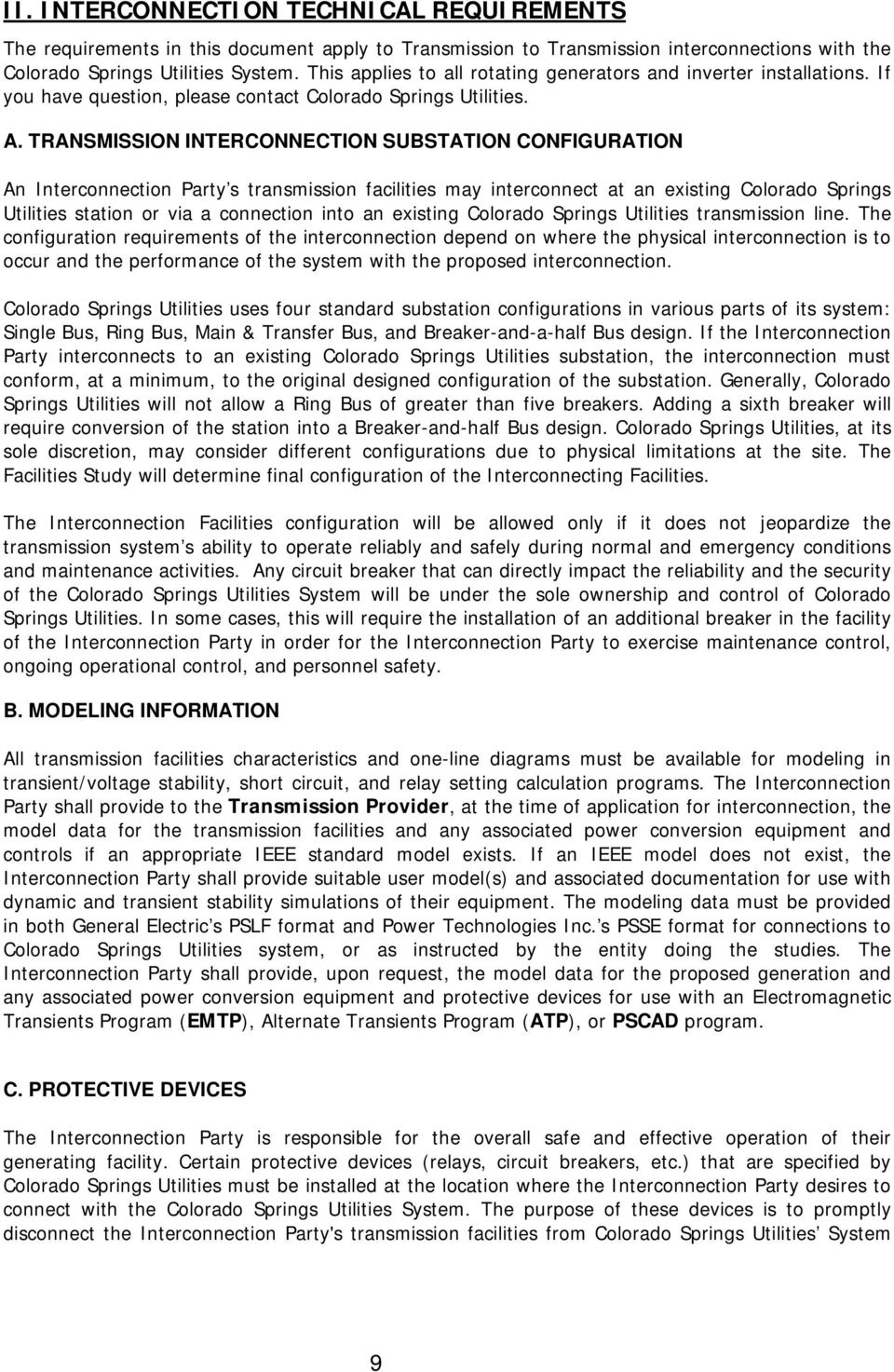
10 whenever faults or abnormal operating conditions occur. Other modifications to the electrical system configuration or protective relays may be required in order to accommodate transmission interconnection. Colorado Springs Utilities will not be responsible for primary protection of equipment in the Interconnection Party s substation or Transmission Facility. Protective devices (e.g. relays, circuit breakers) must be installed by the Interconnection Party to the full extent required by all applicable standards to disconnect the Interconnection Party's transmission facilities from the Colorado Springs Utilities System whenever a fault or abnormality occurs (including local breaker-failure tripping whenever the normal relaying does not work). Such equipment must coordinate with existing Colorado Springs Utilities equipment and provide comparable levels of protection as practiced on Colorado Springs Utilities System. The protective devices differ with the size of the installation. The specific requirements will be determined in the Interconnection and Facilities Studies. Major factors generally determining the type of protective devices required include: 1. The type and size of the Interconnection Party's transmission equipment. 2. The location and system voltage level of the Interconnection Party s connection to Colorado Springs Utilities System. 3. The manner in which the installation will operate (one-way versus two-way power flow). However, this Guideline does not address all of the nuances and complexities involved in designing a protection scheme or for integrating additional transmission facilities into an interconnected electric transmission system. The Interconnection Party is responsible for designing their own protection scheme and should consult an expert in the field of system protection, transmission controls, etc. Specific protective device requirements are described in Section III below. D. INTERFERENCE Operation of the transmission interconnection by the Interconnection Party must not cause unusual fluctuation or disturbance on, or inductive interference with the Colorado Springs Utilities System, other generators or loads connected to the Colorado Springs Utilities System. If such fluctuations or disturbance occur, the Interconnection Party will be required to install suitable apparatus to reasonably correct or limit such fluctuation, disturbance, or interference at no expense to Colorado Springs Utilities or Colorado Springs Utilities other Interconnection Parties or customers. E. VOLTAGE, HARMONICS, AND FLICKER The interconnection of the Interconnection Party's transmission facilities with Colorado Springs Utilities System shall not cause any reduction in the quality of service on the Colorado Springs Utilities System. No abnormal voltages, frequencies, or interruptions will be permitted. If high-voltage or low-voltage complaints, transient voltage complaints, and/or harmonic (voltage distortion) complaints result from operation of an Interconnection Party's transmission facilities, the Interconnection Party s transmission facilities may be disconnected from Colorado Springs Utilities System until the Interconnection Party resolves the problem. The Interconnection Party is responsible for the expense of keeping their Transmission system(s) in good working order so that the voltage, harmonics, power factor (PF), and VAr requirements are always met. 1. STEADY STATE VOLTAGE RANGE The Interconnection Party should expect a normal transmission operating voltage range of +/- 5% from nominal. The Interconnection Party should contact Colorado Springs Utilities to determine the normal operating voltage at their point of interconnection. During system contingency or emergency operation, operating voltages may vary up to +/- 10% from nominal. The Customer s 10

11 equipment should be designed with the appropriate equipment to operate and maintain adequate voltage under these conditions. 2. DYNAMIC VOLTAGE RANGE WECC requires that for a single contingency, transient voltage dips cannot exceed 25% at load buses, or 30% at non-load buses, and frequency cannot dip below 59.6 Hz for 6 cycles or more at a load bus. For multiple contingencies, transient voltage dips cannot exceed 30% at any bus and cannot exceed 20% for more than 40 cycles at any load bus, and frequency cannot dip below 59.0 Hz for 6 cycles or more at a load bus. The addition of any new transmission interconnection cannot produce system performance that is out of compliance with the values stated above. 3. FLICKER AND OTHER VOLTAGE VARIATIONS Interconnection Party s are not allowed to produce voltage fluctuations, as defined and discussed in IEEE 519 and IEEE 1453, that adversely impact adjacent customers and Interconnection Party s or that exceeds the following limits: Fluctuations Per Maximum Allowable Voltage Hour Fluctuation Fewer than 2 3.0% 2 to % 11 to % More than % In some cases, depending on the proximity of sensitive loads, it may be necessary to restrict the maximum allowable voltage fluctuation to no more that 2%. The Customer will be responsible for corrections if their facility is the cause of objectionable voltage fluctuations. In addition, where starting or energizing Customer load or equipment will have an adverse impact on Colorado Springs Utilities System voltage, corrective measures may be required on the part of the Customer to limit the voltage changes. 4. HARMONICS The Interconnection Party shall not be allowed to introduce, excessive distortion to the Colorado Springs Utilities voltage and current waveforms per the most current revision of IEEE Standard 519. The harmonic distortion measurements shall be made at the PoI between the Customer and the Colorado Springs Utilities System and be within the limits specified in the tables below. Colorado Springs Utilities advises the Customer to account for harmonics during the early stages of planning and design. F. FREQUENCY AND FREQUENCY CONTROL The energy delivered to Colorado Springs Utilities System must be 60 Hz sinusoidal alternating current at a standard voltage and phase rotation. Colorado Springs Utilities phase rotation is ABC. The Interconnection Party should verify rotation with Colorado Springs Utilities before purchasing any equipment. G. TRANSMISSION LINE REACTIVE CAPABILITY All interconnections will be reactive compensated pursuant to good utility practice to ensure proper operation of the interconnection. Interconnection Party must provide their own reactive support for their transmission facilities. 11

12 H. FAULT CURRENT Colorado Springs Utilities protective equipment fault current capability is based on the use of equipment with greater capability than the maximum fault current available at a location. The Interconnection Party s equipment capability must exceed the maximum fault current available. On the Colorado Springs Utilities System, this value may be 30,000 amps. The exact value of available fault current depends upon location and circuit configuration and will be determined in the Interconnection Facilities studies. The Interconnection Party must work closely with Colorado Springs Utilities at the time of the interconnection design to determine the available fault current at the specific location of interconnection. In addition this value may increase over time due to growth and changes in the interconnected power system. Therefore, the Interconnection Party should make accommodations for reasonable increases in fault current in designing its Facility. I. SYSTEM RESTORATION AND BLACK START CAPABILITY Under an extreme emergency, large portions of the U. S. electric power grid may shut down. The Colorado Springs Utilities in conjunction with Rocky Mountain Power Pool and WECC have developed a process for restoring the Colorado Springs Utilities system. Colorado Springs Utilities may need to obtain more black start capability from time to time. If the Interconnection Party is interested in pursuing this service, indicate so on your application to get the specific details and requirements. J. DISCONNECT DEVICE/POINT OF DEMARCATION A disconnect device must be installed to isolate Colorado Springs Utilities System from the Interconnection Party s generation. This disconnect shall be installed and owned by the Interconnection Party and shall provide a visible air gap to establish required clearances for maintenance and repair work of the Colorado Springs Utilities System. Colorado Springs Utilities does not consider the integral switch available on some circuit-switchers as an acceptable way to meet this requirement. Colorado Springs Utilities may require the design to allow the application of personnel safety grounds on Colorado Springs Utilities side of the disconnect device. OSHA lockout/tag requirements must be followed. The disconnecting device must be accessible at all times to Colorado Springs Utilities personnel. The Disconnects should allow being padlocked in the open position with a standard Colorado Springs Utilities padlock. The Interconnection Party shall not remove any padlocks or Colorado Springs Utilities safety tags. The Interconnection Party must provide access to disconnect at all times (24 hours a day telephone number, guard desk, etc.). The disconnecting equipment must be clearly labeled. The disconnecting equipment shall be approved for the specific application and location. K. EFFECTIVE GROUNDING Colorado Springs Utilities maintains effective grounding on its transmission systems, as defined by IEEE 142. All Interconnection Party facilities connected to Colorado Springs Utilities System must be effectively grounded per the IEEE 142 requirement. These calculations should be made as if the Colorado Springs Utilities system was disconnected from the Interconnection Party (The Interconnection Party must meet the effective grounded system criterion independent of the Colorado Springs Utilities system). IEEE 142 requires that: The positive sequence reactance is greater than the zero sequence resistance (X > R ); and the zero sequence reactance is less than three times the positive sequence reactance 1 0 (X < 3X )

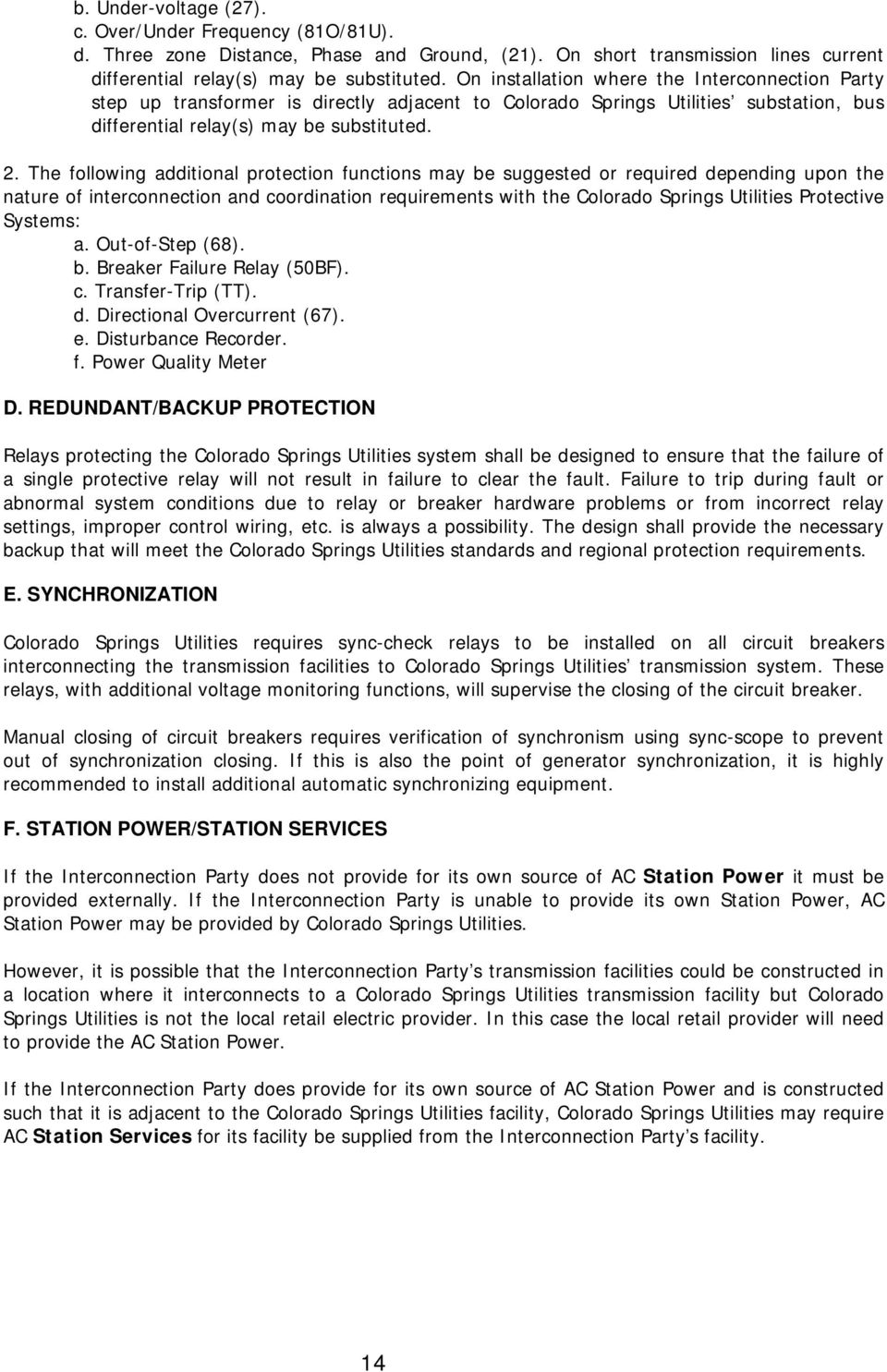
13 III. EQUIPMENT, PROTECTION AND CONTROL REQUIREMENTS This section indicates the minimum Colorado Springs Utilities design requirements for the major components of transmission facilities interconnecting to the Colorado Springs Utilities transmission system. Any facilities constructed by the interconnection customer that will be ultimately owned by Colorado Springs Utilities shall be designed using Colorado Springs Utilities substation and transmission design and material standards, which will be made available upon request. A. FAULT CLEARING 1. A fully rated circuit breaker is required to be installed by the Interconnection Party on the HV side of the Interconnection Party s GSU transformer. This device will be installed and owned by the Interconnection Party. Sync-check relay(s) must be installed with the circuit breaker to ensure synchronous closing. Breaker failure relaying shall also be included. Circuit breakers shall meet the latest applicable ANSI and IEEE standards and shall be suitable for the local environment and system operating conditions. Circuit breakers must be capable of interrupting present and future available fault current at the location at which they are being installed. Fault currents will increase on the Colorado Springs Utilities system over time, the Interconnection Party needs to periodically check fault levels to ensure their breaker meets these ever increasing values. It is presumed that the installation meets the NEC/NESC certified by appropriate authorities to ensure safety of Colorado Springs Utilities personnel. 2. Application of ground-switches to trigger remote tripping is not an acceptable practice. 3. The Interconnection Party must immediately and automatically isolate any faulted or failed equipment from the Colorado Springs Utilities System. This automatic equipment must be compatible with the existing transmission protection equipment. Colorado Springs Utilities will require approval only for those portions of the Interconnection Party s design that pertain directly to the protection of Colorado Springs Utilities System. Colorado Springs Utilities may make suggestions or comment on other areas; however, the Interconnection Party is responsible for the design of protection schemes associated with their transmission facility. B. UTILITY GRADE RELAYS Utility grade protective and control relays are required for all generation facilities interconnected to the Colorado Springs Utilities System. The applicable relays are described in the next section (C. Minimum Protection Requirements) or as designated by the Facilities Study. The relays must: 1. Meet or exceed ANSI/IEEE Standards for protective relays (i.e., C37.90, C , C and C ). 2. Have documentation covering application, testing, maintenance, and service. 3. Give positive indication of what caused a trip (Targets). 4. Colorado Springs Utilities approved test switches are required to facilitate testing. The Interconnection Party is strongly encouraged to use microprocessor-based protective relays. The self-diagnostic abilities, the sequence of events capabilities, and the increased flexibility of application are highly desirable. Colorado Springs Utilities may require that microprocessor style relays be utilized for certain interface relay applications. C. MINIMUM PROTECTION REQUIREMENTS 1. The following functions are required as a minimum to protect Colorado Springs Utilities equipment. The Facilities Study will determine specific protective requirements. a. Over-voltage (59). 13

14 b. Under-voltage (27). c. Over/Under Frequency (81O/81U). d. Three zone Distance, Phase and Ground, (21). On short transmission lines current differential relay(s) may be substituted. On installation where the Interconnection Party step up transformer is directly adjacent to Colorado Springs Utilities substation, bus differential relay(s) may be substituted. 2. The following additional protection functions may be suggested or required depending upon the nature of interconnection and coordination requirements with the Colorado Springs Utilities Protective Systems: a. Out-of-Step (68). b. Breaker Failure Relay (50BF). c. Transfer-Trip (TT). d. Directional Overcurrent (67). e. Disturbance Recorder. f. Power Quality Meter D. REDUNDANT/BACKUP PROTECTION Relays protecting the Colorado Springs Utilities system shall be designed to ensure that the failure of a single protective relay will not result in failure to clear the fault. Failure to trip during fault or abnormal system conditions due to relay or breaker hardware problems or from incorrect relay settings, improper control wiring, etc. is always a possibility. The design shall provide the necessary backup that will meet the Colorado Springs Utilities standards and regional protection requirements. E. SYNCHRONIZATION Colorado Springs Utilities requires sync-check relays to be installed on all circuit breakers interconnecting the transmission facilities to Colorado Springs Utilities transmission system. These relays, with additional voltage monitoring functions, will supervise the closing of the circuit breaker. Manual closing of circuit breakers requires verification of synchronism using sync-scope to prevent out of synchronization closing. If this is also the point of generator synchronization, it is highly recommended to install additional automatic synchronizing equipment. F. STATION POWER/STATION SERVICES If the Interconnection Party does not provide for its own source of AC Station Power it must be provided externally. If the Interconnection Party is unable to provide its own Station Power, AC Station Power may be provided by Colorado Springs Utilities. However, it is possible that the Interconnection Party s transmission facilities could be constructed in a location where it interconnects to a Colorado Springs Utilities transmission facility but Colorado Springs Utilities is not the local retail electric provider. In this case the local retail provider will need to provide the AC Station Power. If the Interconnection Party does provide for its own source of AC Station Power and is constructed such that it is adjacent to the Colorado Springs Utilities facility, Colorado Springs Utilities may require AC Station Services for its facility be supplied from the Interconnection Party s facility. 14
15 G. GROUNDING SYSTEM The Interconnection Party is responsible for the appropriate safety grounding of their equipment. At the point of interconnection, the Interconnection Party s grounding equipment must be compatible with Colorado Springs Utilities grounding equipment. The Interconnection Party shall submit the grounding system study and design for Colorado Springs Utilities review prior to construction. The ground grid design must comply with IEEE 80 and properly address site extremes. Site tests should be completed to determine soil resistivity prior to ground grid design. H. COMMUNICATION CHANNEL(S) Colorado Springs Utilities may require that a communication channel and associated communication equipment be installed as part of the protective scheme. This channel may consist of power line carrier, leased telephone line, pilot wire circuit, fiber optic cable, radio, or other means. Communication channels may be needed for telemetry, SCADA, monitoring, relay/fault recorders, metering, or protection/control purposes. The Facilities Study will determine the specific communication channel requirements. I. METERING AND TELEMETRY The interconnection may be required to have metering installed such that the delivery of power between the Interconnection Party and the Colorado Springs Utilities System can be determined. The metering installation shall be of billing accuracy. The metering installation will be owned and maintained by Colorado Springs Utilities. The metering installation includes the CTs, VTs, meter, recorder, remote communication unit (usually a modem), and any auxiliaries required. Colorado Springs Utilities may require in special circumstances, a readily available power quality meter (a.k.a. power quality monitor) be installed. Additional detail on revenue class metering and telemetry to the Colorado Springs Utilities System Control Center is provided in Appendix A. Control area boundaries may require additional metering (including RTU) for control area metering Interchange. J. SUPERVISORY CONTROL AND DATA ACQUISITION (SCADA) Certain Interconnection Party substations with a 115 kv or greater voltage circuit breaker must provide remote control of the circuit breaker to the Colorado Springs Utilities Transmission operators. The equipment data and statuses, which are to be provided, as applicable, include, but are not limited to what may be provided: 1. Breaker position. 2. Switch position. 3. Bus voltage and alarming. 4. Loss of AC and DC voltage alarms. 5. Transmission Line MW and MVAr values. 6. Lockout relay status. 7. Other control and data points as necessary to provide comparable control and indication to Colorado Springs Utilities control standard. 8. Digital Fault (Transient)/Dynamic recorder trouble alarm. 9. Protective Relay malfunction alarms. 10. Energy accumulator or integrator. 11. Various alarms associated with substations. 15

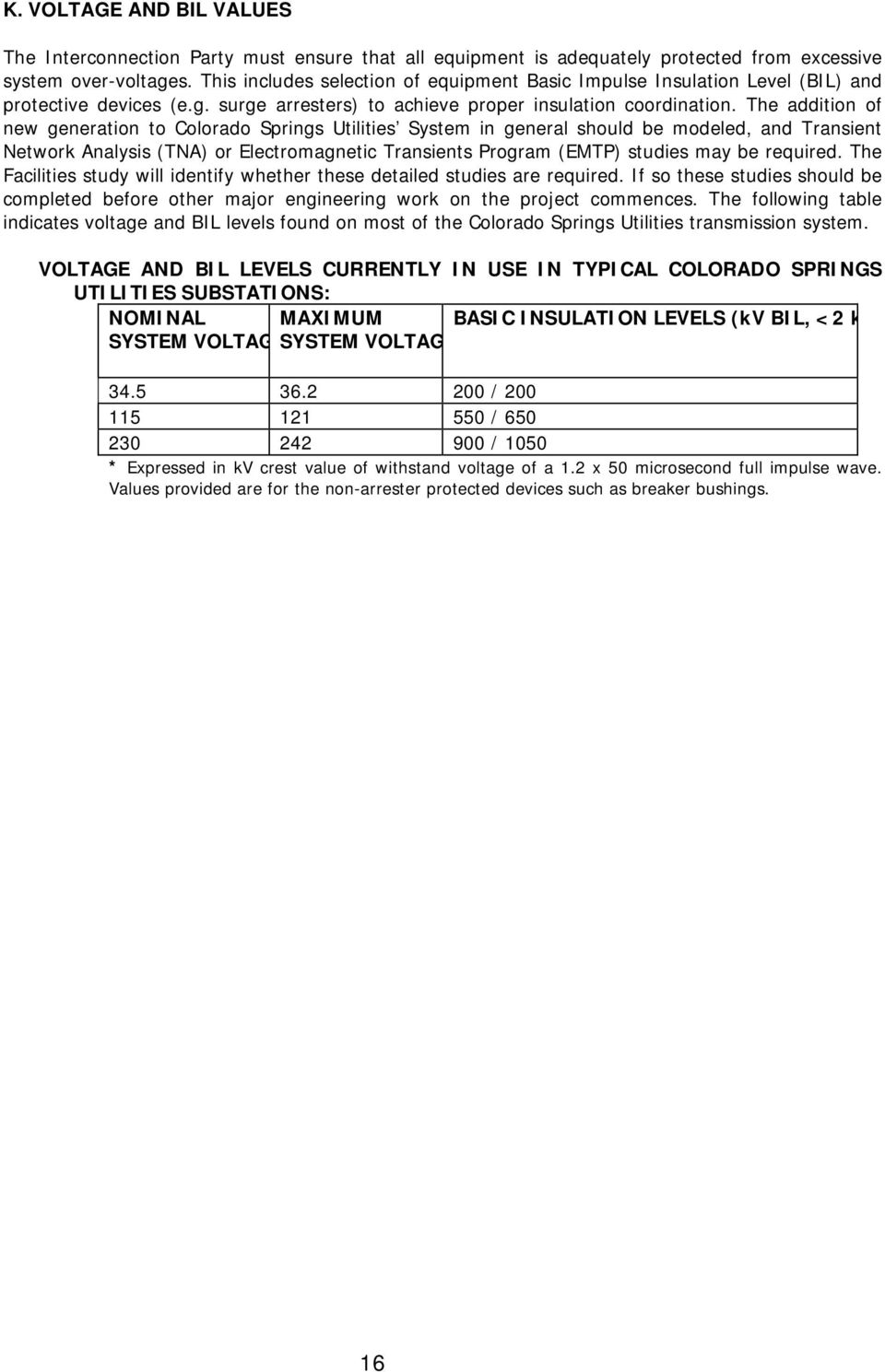
16 K. VOLTAGE AND BIL VALUES The Interconnection Party must ensure that all equipment is adequately protected from excessive system over-voltages. This includes selection of equipment Basic Impulse Insulation Level (BIL) and protective devices (e.g. surge arresters) to achieve proper insulation coordination. The addition of new generation to Colorado Springs Utilities System in general should be modeled, and Transient Network Analysis (TNA) or Electromagnetic Transients Program (EMTP) studies may be required. The Facilities study will identify whether these detailed studies are required. If so these studies should be completed before other major engineering work on the project commences. The following table indicates voltage and BIL levels found on most of the Colorado Springs Utilities transmission system. VOLTAGE AND BIL LEVELS CURRENTLY IN USE IN TYPICAL COLORADO SPRINGS UTILITIES SUBSTATIONS: NOMINAL MAXIMUM BASIC INSULATION LEVELS (kv BIL, <2 k SYSTEM VOLTAG SYSTEM VOLTAG / / / 1050 * Expressed in kv crest value of withstand voltage of a 1.2 x 50 microsecond full impulse wave. Values provided are for the non-arrester protected devices such as breaker bushings. 16
17 IV. INTERCONNECTION PROCESS A. TRANSMISSION SERVICE REQUEST Note: As determined by FERC, a request for interconnection does not constitute a request for transmission service. The process described herein is not sufficient, nor intended to determine the capability of the transmission network to supply the electric load power and energy requirements. In addition, a signed Interconnection Agreement does not provide the interconnection customer with any rights to transmission service. A customer desiring transmission service from Colorado Springs Utilities or the appropriate ISO must follow the procedures of the Colorado Springs Utilities OATT or the ISO OATT in requesting transmission service. B. TRANSMISSION TO TRANSMISSION INTERCONNECTION REQUESTS STEPS 1. Interconnection Party provides a study to Colorado Springs Utilities documenting the need for interconnection, alternatives, coordination with regional plans, and the detailed design of the facilities (e.g. breakers, capacity needs, timelines). If Interconnection Party can not provide a study, Colorado Springs Utilities will perform a study at the Interconnection Party s expense. 2. Colorado Springs Utilities will review and approve the study for the interconnection request or will identify issues and next steps to resolve the issues. 3. Upon resolution of the issues, if any, Colorado Springs Utilities and the Interconnection Party will work together towards the completion of the interconnection. 4. Prior to Colorado Springs Utilities initiating engineering, procurement, construction or installation of any facilities related to the interconnection of the applicant s substation facilities to the system, an Interconnection Agreement or Engineering and Procurement Agreement (E&P) must be executed between Colorado Springs Utilities and the applicant. The Interconnection Agreement will define the terms and conditions under which Colorado Springs Utilities will construct the facilities to interconnect the new substation and, in some cases, will upgrade portions of the transmission system. The Interconnection Agreement will also allocate the costs of the interconnection facilities, system upgrades between the applicant and Colorado Springs Utilities and prescribe the design requirements for interconnection of the applicant s substation facility. The E&P agreement will allow Colorado Springs Utilities to begin any engineering or material procurement during the negotiation of the Interconnection Agreement if an expedited schedule is required. Once the Interconnection Agreement is executed, Colorado Springs Utilities will proceed with the interconnection process and the Interconnection Agreement will be filed with the applicable regulatory agency. 17

18 V. ACCEPTANCE TESTING AND INSPECTION REQUIREMENTS Colorado Springs Utilities requires all Interconnection Parties proposing to interconnect to the Colorado Springs Utilities System be in compliance with the applicable testing and/or performance requirements. A. GENERAL Prior to the actual operation of Interconnection Party-owned generation with the Colorado Springs Utilities System, all pertinent contracts must be signed and all equipment modifications must be complete. Interconnection Party s are required to demonstrate the correct operation of all interface protective and control devices to Colorado Springs Utilities. Colorado Springs Utilities shall define and witness, but is not responsible for performing this demonstration. The Interconnection Party must provide detailed information on the protective relaying, metering, and control (including sync-check) equipment that will interface with the Colorado Springs Utilities System. This is usually provided on a relaying and metering one-line (and possibly a three-line) diagram. Basic proposed AC and DC schematics or specification of logic may also be provided at this time. This information is required 90 days before the Interconnection party in-service date, along with a listing of the specific relays, etc., including information on the manufacturer, model number, relay ranges, etc. Colorado Springs Utilities requires at least two sets of any design documentation packages sent. If any subsequent changes are made, the Interconnection Party shall provide Colorado Springs Utilities a set of revised one-lines, schematics, construction drawings, etc. Based on this information, Colorado Springs Utilities will develop and deliver to the Interconnection Party the required demonstration test details within 30 days after receipt of information from Interconnection Party. A coordination meeting shall be held with Colorado Springs Utilities and the Interconnection Party to clarify any questions that may exist before start-up testing begins. The Customer is also required to hold a coordination meeting with the Colorado Springs Utilities Transmission Control Center to establish a specific switching sequence for the initial energizing of the Interconnection Facilities. The switching procedure will include a sign-off provision for the Customer. Scheduling of demonstration testing should be coordinated through Colorado Springs Utilities with a minimum of 3 business days notice. All testing shall be completed at least 7 days prior to the planned in-service date to provide time to resolve problems identified during testing. If no problems are identified then the equipment can be placed in service without delay. Based on the amount of generation and the type of generation at the site, Colorado Springs Utilities may, at Colorado Springs Utilities sole discretion, require only a design and relay settings review and not require a site visit. Interconnection Party s shall be responsible for determining their own relay settings. At least 60 days before startup testing, the Interconnection Party must supply the proposed settings for the relays, including support documentation (e.g. calculations, fault studies, time over-current relay coordination curves, etc.) for approval by Colorado Springs Utilities. The Interconnection Party shall supply certified test reports for Colorado Springs Utilities required protective relaying, interlocks, and any equipment directly connected to Colorado Springs Utilities System (Interconnection Party s transformers and/or breakers). Certified test reports shall be sealed by a registered Professional Engineer (P.E.). Colorado Springs Utilities personnel may require witnessing some or all of the tests, calibrations, and the relay setting applications. The final as-built documentation for the interconnection facilities, including all drawings and final as left relay settings, must be provided by the Interconnection Party to Colorado Springs Utilities no later than 90 days after commercial operation commences. Colorado Springs Utilities requires that the Interconnection Party s facilities that are an integral part of the Colorado Springs Utilities System, or may disrupt the Colorado Springs Utilities system due to 18

19 mis-operation or failure must undergo a similar level of testing and checkout. The demonstration testing indicated above is employed to ensure that the Interconnection Party has completed the appropriate testing and checkout. Specific regional requirements may apply and may be obtained from the regional Colorado Springs Utilities representative by request. The Interconnection Party must assign one qualified and proficient relay and controls person to be the main point of contact throughout the commissioning phase of the project. This person should have adequate field experience in relaying and control of high-voltage equipment (46 kv and above). This person s experience should include polarity checks, phase-outs, relay calibration, and trip testing for multiple large projects. This person will also insure adherence to these Guidelines. The Interconnection Party must also provide qualified electricians, technicians and operators to perform the demonstration testing. The Interconnection Party must supply all personal protective equipment and designate any procedures necessary to assure that safety precautions are taken while working near energized equipment. Inspection and approval by Colorado Springs Utilities does not constitute a warranty or relieve the Interconnection Party of responsibility for the operating condition or installation of the equipment, and may not be relied upon by the Interconnection Party for that purpose. Once the facility is interconnected, Colorado Springs Utilities will retain the right to inspect the facility if the operation is suspected of causing problems for other Colorado Springs Utilities Interconnection Party s or customers and retains the right to inspect the facility of the Interconnection Party at Colorado Springs Utilities discretion. B. DEMONSTRATION The Interconnection Party and Colorado Springs Utilities shall follow the following steps in assuring that the new facilities have been adequately tested prior to energization. 1. CONSTRUCTION TESTING DOCUMENTATION REVIEW The Interconnection Party must complete field-testing of all their electrical equipment prior to energization. This includes physical testing of equipment such as transformers and circuit breakers per the manufacturers recommendations. This testing also includes setting and testing of relays and control systems per the manufacturers recommendations, as well as verifying Colorado Springs Utilities approved relay settings. The extent of testing shall be consistent with the level of testing specified in the International Electrical Testing Association (NETA) or National Institute for Certification in Engineering Technologies (NICET). These tests shall be completed prior to demonstration testing as outlined in the following paragraph. Colorado Springs Utilities may require being a witness to some of these testing activities. Colorado Springs Utilities will notify the Interconnection Party prior to the start of testing if witness testing is required. In some cases, review of these test reports shall constitute sufficient demonstration that proper testing has been completed. The Interconnection Party must submit reports for all tests performed for approval by Colorado Springs Utilities. All revisions and changes found on field drawings shall be shown on the Interconnection Party drawing and copies provided to Colorado Springs Utilities for approval by Colorado Springs Utilities. A written record must be kept of all tests showing date, personnel performing test, signature or initial of person completing tests, equipment or material tested, results, and type of testing equipment used by manufacturer, model type, and model serial number. The test sheets must show all equipment nameplate data (including for all bushings and surge arresters). Two copies of the final test reports must be submitted. Three copies of application software and instruction books are to be supplied to Colorado Springs Utilities along with the test reports. 19

20 The Interconnection Party must download settings and programs from each relay and programmable logic controller after testing to retrieve all as-left-in-service settings, and shall copy these files onto a formatted 3.5" floppy disk or CD-ROM, or the data to Colorado Springs Utilities. For non-microprocessor-based relays, test sheets or reports for each device are to be completely filled out. All relay setting sheets are to be checked against as-left settings on the corresponding relay device and signed as being complete by the responsible technical person. The disks, test sheets, reports, and settings are to be labeled with equipment identification numbers, relay type numbers, and relay device numbers and returned to Colorado Springs Utilities with the test reports 2. DEMONSTRATION TESTS Demonstration tests must be employed to ensure that each of the required protection systems and protective devices operate correctly. These tests are used to verify that the Interconnection Party has completed testing as indicated in the preceding paragraph. These tests also verify synchronizing equipment and the proper operation of the Colorado Springs Utilities Interconnection Party interface protective relays. Colorado Springs Utilities will produce the demonstration test requirements and deliver them to the Interconnection Party. Upon performance and certification of the Demonstration, the Interconnection Party will be granted approval for operation of their generating equipment in parallel with Colorado Springs Utilities System. Unsuccessful demonstration may lead to delays in the Interconnection Party facility inservice date. Colorado Springs Utilities and the Interconnection Party will develop an initial energization procedure at least two weeks prior to energization. If deemed necessary by Colorado Springs Utilities, a meeting will be held on site within one week of the energization date to discuss any particulars of the initial energization. The actual demonstration requirements will depend upon the final, approved AC/DC schematics, relay settings, etc. This demonstration is intended to be non-destructive. However, Colorado Springs Utilities will not be liable for any equipment damage or injury resulting from the use of these guidelines. It is the responsibility of the Interconnection Party to demonstrate the operation of all protective devices in a safe manner and in a manner that does not adversely affect the Interconnection Party or any equipment on the Colorado Springs Utilities System. Colorado Springs Utilities recommends that similar tests be performed for the Interconnection Party s other relays to insure the adequacy of all protective relaying. 3. POST IN-SERVICE TESTS These tests are employed for verification of relay connections under actual load conditions. This is commonly known as load checking. These checks are completed by directly measuring actual operating quantities in differential, distance, and overcurrent relays. This also includes spotchecking of metering and SCADA systems. Post in-service tests may also include online tests of substation equipment including insulating oil tests of power transformers and infraredthermography testing. C. FUTURE CHANGES IN REQUIREMENTS From time to time new requirements for testing, reporting, equipment and/or performance are established by WECC, NERC, etc., for interconnected generation. The Interconnection Party should take steps so it is notified of any changes by the applicable entity. If a Interconnection Party fails to comply with these requirements and Colorado Springs Utilities is required to pay monetary penalties assessed to Colorado Springs Utilities as the Transmission Operator responsible for regional interconnected system reliability. Colorado Springs Utilities will bill the Interconnection Party for any monetary penalty resulting from the non-performance of the Interconnection Party. 20

21 D. PERFORMANCE OF TESTS The Interconnection Party must test all wire, cable, electrical equipment, and systems installed by the Interconnection Party or connected by the Interconnection party to assure proper installation, adjustment, setting, connection, and functioning. The Interconnection Party must inform Colorado Springs Utilities of any equipment or system that fails testing or that is deficient in any matter. The extent of testing where modifications are made to existing circuits shall be sufficient to check the entire trip/control/ct/vt path as if it were new. Colorado Springs Utilities will not be responsible for any damage to equipment or material due to Interconnection Party s inadequate, substandard, improper test procedures or test apparatus handling. Colorado Springs Utilities reserves the option to assign its personnel to assist the Interconnection Party in checking out certain control schemes where Colorado Springs Utilities concludes such assistance is necessary to meet the project schedule. If Colorado Springs Utilities should exercise this option, the Interconnection Party will be notified in advance of the extent of Colorado Springs Utilities involvement. Colorado Springs Utilities also reserves the right to shut down testing activities if, in Colorado Springs Utilities opinion or the opinion of Colorado Springs Utilities designated representative, the Interconnection Party is using unsafe practices or is in violation of applicable local, state, or federal safety regulations. Colorado Springs Utilities requires compliance with the most conservative of the safety practices as provided by OSHA, NESC, or Colorado Springs Utilities safety practices whenever work is being performed in an energized facility. E. TESTING EQUIPMENT The Interconnection Party must provide all equipment necessary to perform the tests required by Colorado Springs Utilities. A list of testing equipment shall be submitted to Colorado Springs Utilities for approval prior to the beginning of the testing. Test instrument type (manufacturer, type, serial number) and associated calibration certifications shall be submitted to Colorado Springs Utilities prior to the commencement of any testing. The equipment certification shall be renewed at least annually and shall be traceable to the National Bureau of Standards. Colorado Springs Utilities will review the list and notify the Interconnection Party of any testing items that are not acceptable or are missing from the list. The Interconnection Party shall correct this deficiency prior to the start of testing. F. COLORADO SPRINGS UTILITIES SUPPLIED EQUIPMENT Any Colorado Springs Utilities supplied equipment that is factory calibrated (transducers, pressure switches, tuners, etc.) shall be tested to verify calibration. The Interconnection Party may not modify calibration settings without authorization from Colorado Springs Utilities. If equipment does not meet specifications, the Interconnection Party should notify Colorado Springs Utilities of the problem immediately. Colorado Springs Utilities will then direct the Interconnection Party on how to proceed. If the Interconnection Party modifies factory settings without authorization, Colorado Springs Utilities will not be responsible for any costs associated with repair, replacement, or re-calibration of the Interconnection Party s equipment. G. FINAL DESIGN/AS-BUILT DOCUMENTS The Interconnection Party must at the time of demonstration testing have a complete set of construction drawings and documentation available. These documents should represent a complete set of information showing exactly how the facility has been built and the logic behind how the control systems will operate. The documents shall include but are not limited to one-line diagrams, meter and relaying diagrams (M&R), AC and DC elementary diagrams (schematic drawings), circuit lists, Programmable Logic Controller (PLC) and relay logic, and any other appropriate or necessary 21
22 information. Colorado Springs Utilities should be provided a duplicate copy of this documentation at least two weeks prior to demonstration testing. A coordination meeting with Colorado Springs Utilities should be held to clarify any questions on documentation or testing requirements before demonstration testing begins. 22
23 VI. OPERATION AND MAINTENANCE GUIDELINES General guidelines will be stated below, but any specific guidelines will be defined in the Interconnection Agreement between Colorado Springs Utilities and the Interconnection Party. The Interconnection Party shall operate within the applicable guidelines of this document and any other specific requirements as stated in the Interconnect Agreement, the Power Purchase Agreement, the Transmission Service Agreement, or the Ancillary Services Agreement, if applicable. A. NORMAL CONDITIONS The Interconnection party must operate according to the instructions and approval given by the Colorado Springs Utilities Transmission Control Center personnel: 1. The Interconnection Party has twenty-four hour support available. B. ABNORMAL CONDITIONS Colorado Springs Utilities reserves the right to open the interconnection for any of the following reasons: 1. Colorado Springs Utilities line maintenance work on Colorado Springs Utilities System. 2. Colorado Springs Utilities System emergency. 3. Inspection of a Interconnection Party's generating equipment and protective equipment reveals a hazardous condition. 4. Failure of the Interconnection Party to provide maintenance and testing reports when required. 5. Interconnection Party's generating equipment interferes with other Colorado Springs Utilities customers or Interconnection Party s or with the operation of Colorado Springs Utilities System. 6. Interconnection Party has modified the generating equipment that affects CSU equipment without the knowledge and approval of Colorado Springs Utilities or has not installed CSU required protective devices. 7. Personnel or public safety are threatened. 8. Interconnection Party fails to comply with applicable OSHA Safety Tagging and Lockout requirements. Changes to the Colorado Springs Utilities System or the addition of other Interconnection Party s with loads or generators in the vicinity may require modifications to the interconnection protective devices. If such changes are required, the Interconnection Party may be subject to future charges for these modifications. C. ENERGIZATION OF COLORADO SPRINGS UTILITIES EQUIPMENT BY THE INTERCONNECTION PARTY The Interconnection Party must not energize a de-energized Colorado Springs Utilities circuit (unless specifically authorized and requested by Colorado Springs Utilities). D. MAINTENANCE NOTIFICATION The Interconnection Party must notify Colorado Springs Utilities as provided for in the applicable OATT of any unusual conditions including, but not limited to the following: 1. Partial operating capability due to equipment limitations. 2. Scheduled outage periods and return to service expectations. Return to service notification must be updated daily to reflect the recent progress or the lack of progress. 23
24 E. MAINTENANCE Interconnection protective devices owned by the Interconnection Party should be maintained and inspected according to manufacturer recommendations and/or industry standards. Procedures must be established for visual and operational inspections. Provisions should be established for equipment maintenance and testing. Equipment should include, but not be limited to: 1. Circuit Breakers 2. Protective Relays 3. Control Batteries Colorado Springs Utilities maintains the right to review the maintenance, calibration, and operation data of all protective equipment for protecting Colorado Springs Utilities facilities, customers, and other Interconnection Party s. The Interconnection Party is responsible for providing the necessary test accessories (such as relay test plugs, instruction manuals, wiring diagrams, etc.) required to test these protective devices. Verification testing may include the tripping of the intertie breaker. If Colorado Springs Utilities performs work on the premises of the Interconnection Party, Colorado Springs Utilities operating personnel may make an inspection of the work area. If hazardous working conditions are detected, the Interconnection Party must correct the unsafe conditions before Colorado Springs Utilities personnel will perform their work. F. DESIGN CHANGES AFTER COMMERCIAL OPERATION Any modifications to the Interconnection party requiring Colorado Springs Utilities protective relaying and interlocks after the date of commercial operation must be reviewed and approved by Colorado Springs Utilities prior to implementing any changes. Demonstration of Relay Calibration, Trip Tests, and On-Line Tests may be required depending on the extent of the design change. Setting changes of any interconnection protection or synchronizing device must be approved by Colorado Springs Utilities with a hard copy of the changes forwarded to the designated Colorado Springs Utilities representative. Any "Field Modification" or "As Built" AC/DC protection and synchronizing schematics associated with any Colorado Springs Utilities required interconnection device must be forwarded to the designated Colorado Springs Utilities representative. G. OPERATING DATA SUBMITTALS The Interconnection Party must provide operating data and equipment modeling to Colorado Springs Utilities and/or the appropriate regional reliability organization to support the following: 1. NERC compliance program(s). 2. WECC compliance program(s). 3. Federal, state and local regulatory programs. H. OPERATIONAL LOG Interconnection Party s must maintain an operating log at each generating facility indicating changes in operating status, maintenance outages, trip indications, or other unusual conditions found upon inspection. I. COMMUNICATION WITH COLORADO SPRINGS UTILITIES OPERATIONS The Colorado Springs Utilities representative will provide the Interconnection Party with the names and telephone numbers of the Colorado Springs Utilities Control Center and Operations Coordination personnel responsible for Colorado Springs Utilities System at the interconnection. The Interconnection Party will provide Colorado Springs Utilities with the names and telephone numbers of the personnel with responsibility for operating the Interconnection Facilities. 24
25 The contact(s) of the Interconnection Party should include at least one 24/7-telephone number. Contacts should be able to provide information on equipment status, explanation of events on the Interconnection Party s equipment, and relay target and alarm information when asked to do so by In addition, the Interconnection Party should contact Colorado Springs Utilities whenever: 1. Problems with the Interconnection are detected that could result in mis-operation of interconnection protection or other interconnection equipment. 2. The Interconnection has opened by protective relay action. 3. Interconnection transmission facilities problems result in an outage to a portion of the Colorado Springs Utilities System. 4. The Interconnection Party intends to initiate switching to parallel the Interconnection Party s and the Colorado Springs Utilities System. 5. The Interconnection Party intends to initiate switching to break the parallel interconnection between Interconnection Party s and the Colorado Springs Utilities System. 25
26 VII. GLOSSARY AGC (Automatic Generation Control): An EMS based system that sends raise and lower instructions to the governors of the generators in the balancing area for the purpose of matching the generation output to the area load. Alternating Current (AC): That form of electric current that alternates or changes in magnitude and polarity (direction) in a regular pattern for a given time period. Ampere: The unit of current flow of electricity. It is to electricity as the number of gallons per minute is to the flow of water. One-ampere (A) flow of current is equal to one coulomb per second flow. ANSI: American National Standards Institute. Apparent Power: For single-phase power, the current in amperes multiplied by the voltage equals the apparent power in volt-amperes (VA). Apparent power for 3-phase power equals the phase to neutral voltage multiplied by the line current multiplied by 3. ATP (Alternate Transients Program): A digital computer modeling program that is typically utilized for performing high frequency lightning and/or switching induced transient power system studies. This is similar to EMTP and is not supported by the Electric Power Research Institute (EPRI). Automatic: Self-acting, operated by its own mechanism when actuated by some impersonal influence as, for example, a change in current strength; not manual; without personal intervention. Automatic Reclosing: A circuit breaker has automatic reclosing when means are provided for closing without manual intervention after it has tripped under abnormal conditions. AVR (Automatic Voltage Regulator): A control system component associated with a generator s field excitation system and is used to automatically regulate and control the generator terminal voltage. Capacity: The number of amperes of electric current a wire will carry without becoming unduly heated; the maximum ability of a machine, apparatus, or device under existing service conditions; the load for which a transformer, transmission circuit, apparatus, station, or system is rated. Circuit: A conducting path through which an electric current is intended to flow. Circuit Breaker: A device for interrupting a circuit between separable contacts under normal or fault conditions. The interrupting ability of the device is normally rated or sized such that it exceeds the maximum fault current that is available at the location of application. Current: A flow of electric charge measured in amperes (A). CT (Current Transformer): A transformer intended for metering, protective, or control purposes and which is designed to have its primary winding connected in series with a circuit carrying the current to be measured or controlled. A current transformer normally reduces current magnitudes to levels which can be handled by control, protection, and metering equipment. A CT secondary circuit must never be open-circuited while energized. Demand: The rate at which electric power is delivered to or by a system; normally expressed in kilowatts (kw), megawatts (MW), or kilovolt-amperes (kva). 26
27 Disconnect: A device used to isolate a piece of equipment and which has a minimal ability or no ability to interrupt current. A disconnect may be gang-operated (all poles switched simultaneously) or individually operated. Dynamic Voltage Excursion: Transient change in system voltage magnitude, typically associated with a condition following clearing a system short-circuit or fault. Energy Losses: The general term applied to energy lost in the operation of an electrical system. Losses can be classified as Transformation Losses, Transmission Line Losses, or System Losses. EMS (Energy Management System): The computer system Colorado Springs Utilities uses to provide real-time status and remote control of its electrical transmission system. EMTP (Electromagnetic Transients Program): A digital computer modeling program that permits the analysis of the transient behavior of electrical networks. This program is presently supported by Electric Power Research Institute (EPRI). FERC (Federal Energy Regulatory Commission): (Formerly the Federal Power Commission, or FPC.) FERC is an independent body within the Department of Energy (DOE) regulating interstate transmission and the prices of electricity and natural gas. It also licenses hydroelectric projects and regulates interconnections, construction work in progress, rates for wholesale Interconnection Party s, utility accounting practices, and procedures. Frequency: The number of alternating cycles occurring in a given interval of time (usually one second) in an electric current or voltage. Frequency is commonly expressed in hertz (Hz). Fuse: A short piece of conducting material of low melting point, which is inserted in a circuit for the purpose of opening the circuit when the current reaches a certain value. Ground: A term used in electrical work in referring to the earth as the zero potential conductor or reference plain. For safety purposes, circuits are grounded while any work is being done on or near a circuit or piece of equipment in the circuit. This is usually called protective or safety grounding. Hertz (Hz): The term denoting frequency. Historically, frequency was referred to as cycles per second. IEEE: Institute of Electrical and Electronics Engineers, Inc. Interconnection Facilities: The facilities required to make the physical connection between the Interconnection Party s generation facility and the Colorado Springs Utilities transmission system. This may include new substation and transmission facilities as well as other system upgrades to be owned by Colorado Springs Utilities. Interconnection Facilities Study: A study conducted by the Transmission Provider or a third party consultant for the Interconnection Party to determine a list of facilities, the cost of those facilities, and the time required to interconnect the Generating Facility with the Transmission Provider s Transmission System. Interruption: A temporary discontinuance of the supply of electric power. Interconnection Party: Party requesting to interconnect with the Colorado Springs Utilities Transmission System. 27
28 IPP (Independent Power Interconnection Party): An organization that is not a utility and that operates a power plant that produces energy and sells it to a utility. Island: A part of an interconnected system that may become isolated from the rest of the system during a system disturbance and start operating as a subsystem with its own generation, transmission, and distribution capability. The islanded system and the main interconnected system may operate at different frequencies and voltages. ISO (Independent System Operator): Entities corporately separate from the owners of transmission and other power market participants approved by FERC to direct the operation of the transmission system. ITC (Independent Transmission Company): Entities corporately separate from the owners of transmission and other power market participants approved by FERC to direct the operation of the transmission system. Kilovolt (kv): One thousand volts. Kilovolt-Ampere (kva): One thousand-volt ampere. See the definition for Apparent Power. Kilowatt (kw): An electric unit of power that equals 1,000 Watts. Lagging Power Factor: Occurs when reactive power flows in the same direction as real power. Leading Power Factor: Occurs when reactive power flows in the opposite direction of real power. Line Losses: Electrical energy converted to heat in the resistance of all transmission and/or distribution lines and other electrical equipment. Megavolt-Ampere (MVA): One million-volt ampere. See definition for Apparent Power. Megawatt (MW): An electrical unit of power that equals one million watts. NERC (North American Electric Reliability Corporation): NERC is a national organization responsible for establishing the operating and planning standards to assure the reliability of the electric grid. OATT (Open Access Transmission Tariff): The FERC approved tariff for provision of transmission service to the Interconnection Party. One-Line Diagram: A diagram in which several conductors are represented by a single line and in which various devices or pieces of equipment are denoted by simplified symbols. The purpose of such a diagram is to present an electrical circuit or circuits in a simple way so that their function can be readily grasped. On-Line Testing: Testing typically performed as part of commissioning a new generation facility, specifically as it pertains to energized equipment ultimately operating in parallel / interconnected with the power system. Parallel Operation: The operation of a Interconnection Party-owned generator while connected to the Utilities grid. Parallel operation may be required solely for the operating convenience of the customer or Interconnection Party, or for the intentional interchange of power with the Utilities grid. 28
29 Peak Load: The maximum electric power consumed in a stated period. Point of Change of Ownership (PoCo): The point where the Interconnection Party s Interconnection Facilities connect to Colorado Springs Utilities Interconnection Facilities. Programmable Logic Controller (PLC): A special form of micro-processor based controller that uses a programmable memory to store instructions ( ladder logic ), and to implement functions such as logic sequencing, timing, and arithmetic in order to control machines and processes. Point of Energy Exchange: The point in the delivery system where one party takes delivery of the energy from the other party. This point is defined in the contract between Colorado Springs Utilities and the Interconnection Party. It is usually the point where facility ownership changes. For transmission-connected Interconnection Party s, this is usually at a location at the transmission voltage level. This is often referred to as the PoI or PoD. Point of Interchange: See Point of Energy Exchange. Point of Interconnection (PoI): The point where the Interconnection Facilities connect to the Transmission Provider's Transmission System. Point of Metering: The point where metering equipment (meters, transducers, current transformers, voltage transformers, etc.) is or will be installed to measure the power flow and energy exchange between Colorado Springs Utilities and the Interconnection Party. Power (Actual, Active, or Real Power): The time rate of transferring or transforming energy or the power that accomplishes work, measured in Watts. Power Factor (PF): The ratio of actual power (kw) to apparent power (kva). Power Flow: One-way power flow is the condition where the flow of power is entirely into or out of the facility of the Interconnection Party. Two-way power flow is the condition where the net flow of power may be either into or out of the facility depending on the operation of the generator and other Interconnection Party load. Professional Engineer (P.E.): A licensed professional engineer registered with the State of Colorado. Programmable Logic Controller (PLC): A special form of micro-processor based controller that uses a programmable memory too store instructions ( ladder logic ), and to implement functions such as logic sequencing, timing, and arithmetic in order to control machines and processes. PSCAD: A transient analysis software program, similar to ATP and EMTP. PSCAD - is a simulation program similar to EMTP and ATP programs. PSCAD is a registered trade mark of Manitoba HVDC research center Inc. Protection: All of the relays and other equipment that are used to open the necessary circuit breakers and fuses to automatically clear or disconnect lines or equipment when trouble develops. Reactive Power (VAr): The power that oscillates back and forth between inductive and capacitive circuit elements without ever being used. The function of reactive power is to establish and sustain the electric and magnetic fields that are required to perform useful work in AC systems. 29
30 Relay: A device that is operated by a variation in the condition of one electric circuit to affect the operation of another device in the same or in another electric circuit. Remote Terminal Unit (RTU): A device installed at a substation or generation facility, and at an CSU Operations Control Center, and is used to provide communication for remote control and indication of substation or generation facility equipment from the CSU Operations Control Center. Station Power: The electric power used for the heating, lighting, air-conditioning and office equipment needs of the buildings on a Generation Facility s site, and for operating the electric equipment that is on the Generating Facility s site. Station Service: The electric energy needs of the Transmission Provider s substation equipment. Switch: A device for making, breaking, or changing the connections in an electric circuit. System: The entire generating, transmitting, and distributing facilities of an electric system. THD (Total Harmonic Distortion): A measure of the amount of the non-fundamental content that an electrical waveform contains. The non-fundamental (60 Hz) part consists of frequency components that are integer multiples of the fundamental. Transformer: An electric device, without continuously moving parts, in which electromagnetic induction transforms electric energy from one circuit to one or more other circuits at the same frequency, usually with changes in the magnitudes of the voltage and current. Transient Network Analysis (TNA): A digital computer modeling program that permits the analysis of the transient behavior of electrical networks. Transmission Owner: An entity that owns, leases or otherwise possesses an interest in the portion of the Transmission System at ht e Point of Interconnection and may be a Party to the Interconnection Agreement to the extent necessary. Transmission Provider: The public utility (or its designated agent) that owns, controls, or operates transmission or distribution facilities used for the transmission of electricity in interstate commerce and provides transmission service under the OATT. The Transmission Provider includes the Transmission Owner when the Transmission Owner is separate from the Transmission Provider. Utility Grade Relays: Relays that meet IEEE C37.90, C , C , C VAr: Volt-ampere reactive, see Reactive Power. VAr Capability Testing: Testing performed with a generation facility interconnected with the CSU power system in order to verify or determine the generation facility's net reactive power (VAr) output and corresponding power factor, typically as measured at the PoI. Voltage: Electric potential or potential difference expressed in volts (V). Volt-Ampere: A unit of apparent power (VA) in an alternating-current circuit. VT (Voltage Transformer): A transformer intended for metering, protective, or control purposes and which is designed to have its primary winding connected either between the primary conductors to be measured or between a conductor and ground. A voltage transformer normally reduces voltage 30
31 magnitudes to levels which can be handled by control, protection, and metering equipment. The historic term for a VT is potential transformer. Watt-Hour: A unit of work or energy equivalent to the power of one Watt operating for one hour (Wh). WECC (Western Electricity Coordination Council): a NERC reliability region. An organization of power suppliers in the Western States that plans for power availability by coordinating power exchanges between members. WECC s current members include investor-owned companies such as Colorado Springs Utilities, municipal systems, rural cooperatives, the Western Area Power Administration, Bonneville Power Administration, and the US Bureau of Reclamation. Wye or "Y" Connected Circuit (Star Connected): A three-phase circuit in which windings of all three phases have one common neutral point connection. 31
32 VIII. REFERENCES The following list of references has been utilized in preparation of this document and/or should be consulted for further information/clarification. When the following publications/standards are superseded by an approved revision, the latest revision shall apply. ANSI C2-2002, National Electrical Safety Code. ANSI C (R2005), Electric Power Systems and Equipment - Voltage Ratings (60HZ). IEEE Std. C TM 2003, IEEE Guide for Abnormal Frequency Protection for Power Generating Plants, ANSI/ IEEE C , IEEE Standard for Relays and Relay Systems Associated with Electric Power Apparatus. IEEE Std C TM 2002, IEEE Standard for Surge Withstand Capability (SWC) Tests for Relays and Relay Systems Associated with Electric Power Apparatus. IEEE Std C TM -2004, IEEE Standard for Withstand Capability of Relay Systems to Radiated Electromagnetic Interference from Transceivers. IEEE Std C , IEEE Standard Electrostatic Discharge Tests for Protective Relays. IEEE Std C37.95 TM 2002, IEEE Guide for Protective Relaying of Utility-Consumer Interconnections. IEEE Std , IEEE Guide for Safety in AC Substation Grounding. IEEE Std , IEEE Recommended Practice for Grounding of Industrial and Commercial Power Systems IEEE Green Book (Color Book Series). IEEE Std , IEEE Recommended Practice for Protection and Coordination of Industrial and Commercial Power Systems IEEE Buff Book (Color Book Series). IEEE Std , IEEE Recommended Practice for Emergency and Standby Power Systems for Industrial and Commercial Applications IEEE Orange Book (Color Book Series). IEEE , IEEE Recommended Practices and Requirements for Harmonic Control in Electrical Power Systems. IEEE 1453 TM -2004, IEEE Recommended Practice for Measurement and Limits of Voltage Fluctuations and Associated Light Flicker on AC Power Systems IEEE Std , IEEE Recommended Practice for Powering and Grounding Electronic Equipment IEEE Emerald Book (Color Book Series). NERC Reference Document, Reliability Considerations for Integrating Non-Utility Generating Facilities with the Bulk Electric Systems, April 1987, North American Electric Reliability Council, Princeton, NJ
33 NERC Document, Integrating Non-Utility Generators - Reliability Considerations for Integrating Non- Utility Generating Facilities with the Bulk Electric Systems, January 1992, North American Electric Reliability Council, Princeton, NJ NERC/WECC Planning Standards September NFPA , National Electrical Code OSHA Safety Tagging and Lockout Procedures. Standardization of Generation Interconnection Agreements and Procedures, Order No. 2003, Fed. Reg. Vol. 68, No. 160 (August 19, 2003). WECC Coordinated Off-nominal Frequency Load Shedding and Restoration Plan (dated November 25, 1997) 33
34 APPENDIX A: COLORADO SPRINGS UTILITIES METERING AND TELEMETRY REQUIREMENTS 1. GENERAL The information in Appendix A outlines the requirements that shall apply for interconnecting the Interconnection Party to the Colorado Springs Utilities System. In those cases where the Power Purchase Agreement, Interconnection Agreement, or Ancillary Services Agreement provisions differ from these requirements, the contract provisions shall take precedence. The meter installation will be capable of measuring Real Power (Watts, kw, or MW), Reactive Power (VArs, KVArs, or MVArs), Voltage (V or kv), Current (A), Watt-hours (Whr, kwhr, or MWhr), and VArhours (VAr-hours, kvar-hours, or MVAr-hours). The metering shall have memory capable of a minimum of 4-channel, hourly data recording for 60 days. Additional channels for data recording may be required at the discretion of Colorado Springs Utilities. High side or low side metering (with either a fixed billing Transformer Loss Compensation (TLC), a Meter Programmed or MV90 software calculated TLC) will be used when a Interconnection Party owns the facility transformer. Low side metering may be required when the unit of the Interconnection Party is embedded into another entity s electric system such as in an industrial plant. In this case, there may be a Transformer Loss Compensation adjustment within the metering. The metering installation shall have remote dial-up data-retrieval capability. The CSU required billing (revenue) meter, net generation metering, gross generation metering, and associated transducers, instrument transformers (CTs, VTs) will be specified and owned by Colorado Springs Utilities, but could be purchased and installed by the Interconnection Party or CSU, CSU, as identified during the project design phases, and determined on a case-by-case basis. Colorado Springs Utilities will furnish meter and programs according to Colorado Springs Utilities specifications. 2. METERING ACCURACY, TESTING, AND REPAIR A. METERING ACCURACY REVENUE METERING The metering shall have an accuracy of + or 0.5%. Any current or voltage transformers that are used for metering will adhere to the Accuracy Classifications for Metering listed in ANSI C57.13 Colorado Springs Utilities requires 3-element metering accuracy for all circuits; however, 2-element metering may be acceptable where necessary. The Voltage Transformers (VT) and Current Transformers (CT) must be metering accuracy class devices. Metering CTs and VTs are required to be independent of the protection system CTs. As long as the burden is not determined by Colorado Springs Utilities to be excessive, additional secondary windings on the VTs can be used for other purposes such as protective relaying. All of these VT secondary supplies used for non-revenue metering purposes (e.g. relaying) shall be separately fused from the metering VT secondary supplies. All voltage and current transformers used for interconnect metering with continuous flows less than 20% of full scale nameplate rating of the current transformers shall conform to ±0.15% metering accuracy class or better. All current transformers shall conform to ANSI metering accuracy class ±0.3% for Burdens B0.1 thru B1.8 and shall have a continuous current thermal rating factor (TRF) sized appropriately for the application. All voltage transformers shall meet ANSI metering accuracy class ±0.3% for all standard burdens. The current transformers and voltage transformers used to meter bi-directional power flow shall meet ANSI C57.13 requirements for instrument transformers. MW and MVAr transducers shall be 3-element transducers with an accuracy of ±0.2% or better. Note that the metering used for local (panel) and remote (SCADA) indication and monitoring purposes does not typically need to conform to the higher accuracy requirements of the revenue metering, and are typically supplied off of the relaying accuracy CTs (bushing CTs), CVTs, etc. 34
35 B. PERIODIC TESTING The metering equipment shall be tested periodically, and re-calibrated to maintain the required accuracy. The meter testing frequency shall at a minimum be based on current Colorado Springs Utilities Practices. Colorado Springs Utilities present testing practices are based on the type of metering situation and the jointly agreed to requirements of both parties involved. Typically, the metering equipment at non-colorado Springs Utilities generation sites is tested annually. The Interconnection Party, at its option, may participate in the periodic testing. The party performing the testing must notify the witnessing party at least a week in advance, preferably more. If the proposed date is not acceptable, then an alternative time acceptable to both parties must be worked out. The owner of the meter shall analyze and distribute any maintenance, repair, and test results to all parties receiving the meter readings per the request of such parties. C. METER AND TELEMETRY EQUIPMENT REPAIR The owner of the metering and telemetry equipment is responsible for ensuring that the equipment is adequately maintained and is repaired within a reasonable time after a failure is detected. The repair or replacement of a bad meter must be completed within 24 hours after it has been detected. If the metering cannot be repaired within that time, Colorado Springs Utilities may require that the Interconnection Party cease all generation until the meter has been repaired. All changes, repairs, and replacements of the meter must be coordinated with the Colorado Springs Utilities Meter Department. 3. METERING AND TELEMETRY FUNCTION REQUIREMENTS The meter and telemetry requirements define Colorado Springs Utilities required functionality for meters, metering related equipment (telephone lines, current transformers, voltage transformers, etc.), and telemetry equipment (Remote Terminal Units [RTUs], transmitters, receivers, etc.). Three major factors generally determine the type of metering and telemetry required: a. The type and size of the customer s equipment. b. The location of the customer on the Colorado Springs Utilities System. c. The manner in which the installation will operate (one-way vs. two-way power flow). d. Customer distribution connected generation e. Customer desire to have other than Colorado Springs Utilities provide ancillary services. Each request will be handled individually, and Colorado Springs Utilities will solely determine the metering and telemetry modifications and/or additions required. Colorado Springs Utilities will work with the customer to achieve an installation that meets the requirements of both the customer and Colorado Springs Utilities. The metering requirements and cost responsibility will be stated in the Interconnection Agreement. A. MEASURED VALUES AND METERING REQUIRED 1. Real Energy Usage (Watt-hours) 2. Power factor or Reactive Energy Usage (Power Factor, VAR-hours, or Q- hours) 3. Interval Recorder to capture hourly energy use (some meters provide this capability within the meter and is an acceptable substitute) 4. The ability for Colorado Springs Utilities to remotely interrogate the meter and data 35
36 B. ADDITIONAL MEASURED VALUES, METERING, AND TELMETRY WHEN TELEMETRY EQUIPMENT IS REQUIRED 1. Status of high side interrupting and/or disconnecting device 2. Real Power Flow (Watts) 3. Reactive Power Flow (VARs), at Colorado Springs Utilities discretion 5. Voltage (steady state 60 Hz and possibly transients) at the point of connection to XE (Volts), at Colorado Springs Utilities discretion 5. Amps at the point of connection to Colorado Springs Utilities 6. Harmonics voltage and current (if PQM meter is required) 7. Remote Terminal Unit or Data Link to telemeter all measured values to Colorado Springs Utilities Energy Management System. This will capture the hourly energy usage; thus, eliminating the need for an interval recorder if the energy usage can be measured in MWhs. Recording and communication of the data to Colorado Springs Utilities EMS through a dedicated communication medium a minimum of every 24 seconds. C. ENERGY LOSSES If the energy is not measured at the point where the energy exchange between Colorado Springs Utilities and the Interconnection Party has been defined by contract, energy losses must be determined. Accounting for the losses may be done either by attributing losses to the monthly accounting of exchanged energy or by attributing losses directly to the energy registered on the meter. Should a loss compensated meter be used, power transformer performance test results and/or line impedances must be supplied to Colorado Springs Utilities prior to installation. Transmission System Losses may not be applied through a compensated meter; only Transformation Losses and/or specific Line Losses may be applied through a compensated meter. D. METER READING General practice is to perform meter readings at midnight on the first day of the month. For most cases, the meter read day will be the last day of the month. All Interconnection metering points will have recording devices that are required to be interrogated by remote communication. Colorado Springs Utilities has the ability to share an existing telephone line with the Interconnection Party, but it may be necessary to install a new communications line. The communications circuit cost (telephone lines, telephone charges, etc.) to allow remote reading of the meter at a non-colorado Springs Utilities facility is the responsibility of the Interconnection Party. Other communications options may be available for meter data retrieval, depending on service territory. 36
ATTACHMENT G. Network Operating Agreement
 ATTACHMENT G Network Operating Agreement 1. PURPOSE OF NETWORK OPERATING AGREEMENT The purpose of this Agreement is to identify contractual requirements related to Network Integration Transmission Service
Generation Interconnection System Impact Study Report. For. PJM Generation Interconnection Request Queue Position X1-114.
 Generation Interconnection System Impact Study Report For PJM Generation Interconnection Request Queue Position X1-114 Sandyston January 2012 Preface The intent of the System Impact Study is to determine
Title 20 PUBLIC SERVICE COMMISSION. Subtitle 50 SERVICE SUPPLIED BY ELECTRIC COMPANIES. Chapter 02 Engineering
 Title 20 PUBLIC SERVICE COMMISSION Subtitle 50 SERVICE SUPPLIED BY ELECTRIC COMPANIES Chapter 02 Engineering Authority: Public Utility Companies Article, 2-121, 5-101 and 5-303, Annotated Code of Maryland.
SPECIFICATION COG-2007
 Cleco Power LLC SPECIFICATION COG-2007 FOR PARALLEL OPPERATION OF CUSTOMER-OWNED GENERATION ON CLECO S ELECTRICAL SYSTEM Revised: March 7, 2014 CONTENTS ITEM NO. TITLE PAGE NO. 1.0 Scope 3 2.0 Policy On
TERMS AND CONDITIONS
 Virginia Electric and Power Company TERMS AND CONDITIONS XXIV. GENERATOR INTERCONNECTION STANDARD Electric generator interconnection service includes only the ability to interconnect an electric generator
Engineering innovation
 Eaton's Electrical Engineering Services & Systems Solutions Focus Seamless Solutions for Reliable, Efficient and Safe Power Systems Engineering innovation Progressive solutions for today s power systems
Technical Requirements. For Generating Facilities Interconnecting. To The Distribution System. Salt River Project
 Technical Requirements For Generating Facilities Interconnecting To The Distribution System Salt River Project Effective June 6, 2012 1-1 TABLE OF CONTENTS 1. NOTICE OF DISCLAIMER AND USE OF REFERENCES
Residential Solar Service Agreement (RSSA) Customer Sited Solar Photovoltaic Systems
 Residential Solar Service Agreement (RSSA) Customer Sited Solar Photovoltaic Systems This Agreement is made and entered into this day of, 20, ( Effective Date ) by and between the Orlando Utilities Commission
D. Infrared scanning reports with pictures printed in a final report with any deficiencies and actions taken to rectify.
 SECTION 263354 STATIC UPS TESTING AND COMMISSIONING PART 1 - GENERAL 1.1 SUMMARY A. Section Includes 1. System start-up services. 2. Battery charging. 3. Load bank testing. 4. Battery load testing. 5.
ELECTRICAL ENGINEERING DESIGN CRITERIA APPENDIX F
 ELECTRICAL ENGINEERING DESIGN CRITERIA APPENDIX F TABLE OF CONTENTS Appendix F - Electrical Engineering Design Criteria F.1 Introduction...F-1 F.2 Codes and Standards...F-1 F.3 Switchyard and Transformers...F-1
SDG&E Electric Distribution System Interconnection Handbook. <Revised as of 10/21/2015>
 TABLE OF CONTENTS 1 Introduction... 1 1.1 Purposes... 1 1.2 Applicability and Related Tariffs... 1 1.3 Interconnection Agreement Required... 1 1.4 Technical Requirement... 1
Midwest Reliability Organization Procedure For NERC PRC-012
 Midwest Reliability Organization Procedure For NERC PRC-012 A. Introduction The following procedure developed by the MRO Protective Relay Subcommittee (PRS) and Transmission Assessment Subcommittee (TAS)
Federal Wage System Job Grading Standards for Electric Power Controlling, 5407. Table of Contents
 Federal Wage System Job Grading Standards for Electric Power Controlling, 5407 Table of Contents WORK COVERED... 2 WORK NOT COVERED...2 TITLES... 2 GRADE LEVELS... 2 SPECIAL ADDITIONAL RESPONSIBILITIES...
Effective: September 10, 2006 Vermont Attachment 1 to Rule 5.500 Public Service Board Page 1 of 6
 Public Service Board Page 1 of 6 STANDARD APPLICATION FOR INTERCONNECTION OF GENERATION RESOURCES IN PARALLEL TO THE ELECTRIC SYSTEM OF: (Interconnecting Utility) Preamble and Instructions: An owner of
-1- PSEG-LI Update of LIPA SGIP Full Docw-NYISO reqmts above 10 MW 10-27-14
 PSEG-Long Island Smart Grid Small Generator Interconnection Procedures for New Distributed Resources 20 MW or Less Connected in Parallel with LIPA s Radial Distribution Systems -1- PSEG-LI Update of LIPA
AUSTIN ENERGY INTERCONNECTION GUIDE FOR CUSTOMER-OWNED POWER PRODUCTION FOR FACILITIES UP TO 10MW A INTERCONNECTION CLASSIFICATIONS...
 AUSTIN ENERGY INTERCONNECTION GUIDE FOR CUSTOMER-OWNED POWER PRODUCTION FOR FACILITIES UP TO 10MW TABLE OF CONTENTS PAGE INTRODUCTION... 4 A INTERCONNECTION CLASSIFICATIONS... 5 B. APPLICATION PROCESS
Scope of Restoration Plan
 RWG Area Restoration Review Worksheet (10/28/09) EOP-006-02 Directory 8 EOP-005 NYSRG Rule G Text Restoration Plan Requirement R1.Each Reliability Coordinator shall have a Reliability Coordinator Area
References... 4. Appendices... 5. I. INTRODUCTION... 6 A. Background... 6 B. Standards... 6
 ISO New England Operating Procedure No. 14 - Technical Requirements for Generators, Demand Resources, Asset Related Demands and Alternative Technology Regulation Resources Effective Date: January 29, 2015
PG&E Transmission Interconnection Handbook. Section L3: SUBSTATION DESIGN FOR LOAD-ONLY ENTITIES AND TRANSMISSION-ONLY ENTITIES
 Section L3: SUBSTATION DESIGN FOR LOAD-ONLY ENTITIES AND TRANSMISSION-ONLY ENTITIES PURPOSE This section provides substation design information for Load Entities interconnected at transmission voltage
Unitil Energy Systems, Inc. Interconnection Standards For Inverters Sized Up To 100 kva
 Unitil Energy Systems, Inc. Interconnection Standards For Inverters Sized Up To 100 kva Issued: August 2009 SIZED UP TO 100 KVA TABLE OF CONTENTS 1.0 Introduction... 1 1.1 Applicability... 1 1.2 Definitions...
Test & Data Management Software
 Test & Data Management Software TDMS protective relays energy meters transducers power quality CT-VT-PT transformers ground grid circuit breakers batteries surge arresters The Integrated Testing Solution
FVSU-33201301 REPAIR & UPGRADE FIBER OPTIC 280000-1 SECTION 280000 FIRE ALARM SYSTEM CONNECTIVITY
 FVSU-33201301 REPAIR & UPGRADE FIBER OPTIC 280000-1 SECTION 280000 FIRE ALARM SYSTEM CONNECTIVITY PART 1 - GENERAL 1.1 SUMMARY A. Section Includes: 1. Fire-alarm control unit. 2. Addressable interface
PSEG-LONG ISLAND SMART GRID SMALL GENERATOR INTERCONNECTION SCREENING CRITERIA FOR OPERATING IN PARALLEL WITH LIPA S DISTRIBUTION SYSTEM
 PSEG-LONG ISLAND SMART GRID SMALL GENERATOR INTERCONNECTION SCREENING CRITERIA FOR OPERATING IN PARALLEL WITH LIPA S DISTRIBUTION SYSTEM PSEG-LI SGSGIP DG Screening Criteria 5-29-14 Table of Contents I.
Summary of CIP Version 5 Standards
 Summary of CIP Version 5 Standards In Version 5 of the Critical Infrastructure Protection ( CIP ) Reliability Standards ( CIP Version 5 Standards ), the existing versions of CIP-002 through CIP-009 have
Telemetry system for cathodic protection equipment of underground metal pipelines
 RECOMMENDATION PCRA 009 June 2010 Rev. 0 Committee for Cathodic Protection and Associated Coatings Telemetry system for cathodic protection equipment of underground metal pipelines DISCLAIMER: The present
PacifiCorp Original Sheet No. 476 FERC Electric Tariff, Substitute 6 th Rev Volume No. 11 APPENDIX 2 TO SGIP
 PacifiCorp Original Sheet No. 476 APPENDIX 2 TO SGIP SMALL GENERATOR INTERCONNECTION REQUEST (Application Form) Transmission Provider: Designated Contact Person: Address: Telephone Number: An Interconnection
Interconnection of Generators to EDI s Distribution System
 Interconnection of Generators to EDI s Distribution System May 22, 2002 This document sets forth the guidelines for connecting a power producing facility to the Alberta Interconnected Electric System through
San Diego Gas & Electric Company FERC Order 717 Transmission Function Employee Job Descriptions August 10, 2015. Electric Grid Operations
 San Diego Gas & Electric Company FERC Order 717 Transmission Function Employee Job Descriptions August 10, 2015 Electric Grid Operations Director Electric Grid Operations: Responsible for overall transmission
Guidelines for Generation, Tie-Line, and Substation Interconnections
 Guidelines for Generation, Tie-Line, and Substation Interconnections Otter Tail Power Company compiled this document with input from others. Otter Tail Power Company gratefully acknowledges permission
N.J.A.C. 14:8-4 NET METERING FOR CLASS I RENEWABLE ENERGY SYSTEMS
 N.J.A.C. 14:8-4 NET METERING FOR CLASS I RENEWABLE ENERGY SYSTEMS 14:8-4.1 Scope This subchapter sets forth net metering requirements that apply to electric power suppliers, basic generation service providers
TDMS Test & Data Management Software
 Test & Data Management Software TDMS protective relays energy meters transducers power quality CT-VT-PT transformers ground grid circuit breakers batteries surge arresters The Integrated Testing Solution
Green Power Connection Net Energy Metering Engineering Review Process in Delaware and Speeding Up the Application Fee Process
 Green Power Connection Net Energy Metering Engineering Review Process in Delaware and Speeding Up the Application Fee Process Presented by: Marianne Mannschreck Date: Welcome A Look at the Net Energy Metering
FIT TIER 2 Application
 FIT TIER 2 Application Application Information The below information Auto-Fills from your registration information: Building Permit Application Date: Project Completion Date: Name: Address: City: State:
San Diego Gas & Electric Company FERC Order 717 Transmission Function Employee Job Descriptions June 4, 2015. Electric Grid Operations
 San Diego Gas & Electric Company FERC Order 717 Transmission Function Employee Job Descriptions June 4, 2015 Electric Grid Operations Director Electric Grid Operations: Responsible for overall transmission
SOUTH CAROLINA. Standard for Interconnecting Small Generation 100 kw or Less with Electric Power Systems (EPS) (Interconnection Standard)
 SOUTH CAROLINA Standard for Interconnecting Small Generation 100 kw or Less with Electric Power Systems (EPS) (Interconnection Standard) 1. Overview: This Standard contains the requirements, in addition
Typical Data Requirements Data Required for Power System Evaluation
 Summary 66 Carey Road Queensbury, NY 12804 Ph: (518) 792-4776 Fax: (518) 792-5767 www.nepsi.com [email protected] Harmonic Filter & Power Capacitor Bank Application Studies This document describes NEPSI
OPERATIONS CAPITAL. The Operations Capital program for the test years is divided into two categories:
 Filed: September 0, 00 EB-00-0 Tab Schedule Page of OPERATIONS CAPITAL.0 INTRODUCTION Operations Capital funds enhancements and replacements to the facilities required to operate the Hydro One Transmission
Eaton s E-Series protective relay family
 E-Series protective relays Feeder distribution relays Motor relays Transformer relays Generator relays Eaton s E-Series protective relay family Microprocessor-based design Eaton s E-Series relay family
6. The estimated costs here do not include any applicable ITCC tax
 General Notes and Clarifications: 1. The following estimated costs are based on past experiences and are intended to provide an order of magnitude of the total project cost given the major system components.
Unified requirements for systems with voltages above 1 kv up to 15 kv
 (1991) (Rev.1 May 2001) (Rev.2 July 2003) (Rev.3 Feb 2015) Unified requirements for systems with voltages above 1 kv up to 15 kv 1. General 1.1 Field of application The following requirements apply to
Session 10: General Overview of Interconnection Standards & Grid Codes for High Penetration PV October 21, 2015 Santiago, Chile
 Session 10: General Overview of Interconnection Standards & Grid Codes for High Penetration PV October 21, 2015 Santiago, Chile Michael Coddington National Renewable Energy Laboratory Golden, Colorado,
Distribution Operations with High-penetration of Beyond the Meter Intermittent Renewables. Bob Yinger Southern California Edison April 15, 2014
 1 Distribution Operations with High-penetration of Beyond the Meter Intermittent Renewables Bob Yinger Southern California Edison April 15, 2014 Southern California Edison SCE provides power to: Nearly
Part 1 System Modeling & Studies for Existing Systems
 Part 1 System Modeling & Studies for Existing Systems Operation Technology, Inc. Copyright 2009 Result of rapid release of energy due to an arcing fault between two conductors. Bus voltages > 208V Temperatures
FRCC Standards Handbook. FRCC Automatic Underfrequency Load Shedding Program. Revision Date: July 2003
 F R C C FRCC Standards Handbook FRCC Automatic Underfrequency Load Shedding Program Revision Date: July 2003 FRCC Underfrequency Load Shedding Program Modification and Approval Process Requests to modify
TURBOtech srl. SED-635 Digital Excitation System. Industrial Electronics Sector FEATURES
 SED-635 Digital Excitation System SED-635 is a complete excitation system capable of adapting to control synchronous generators of any size. The integration of the TOUCH SCREEN operator interface and a
Electric utilities may vary in their application of end-to-end testing
 An Application Case of End-to-End Relay Testing of Communication-Based Protection Schemes Using GPS-Synchronized Secondary Injection Feature by J. Ariza, Megger USA G. Ibarra, CFE, Mexico Electric utilities
HIGH VOLTAGE SHORE CONNECTION
 Guide for High Voltage Shore Connection GUIDE FOR HIGH VOLTAGE SHORE CONNECTION NOVEMBER 2011 American Bureau of Shipping Incorporated by Act of Legislature of the State of New York 1862 Copyright 2011
INDEPENDENCE POWER & LIGHT DEPARTMENT Independence, Missouri. Schedule NM-1 Customer-Generator Net Metering Contract Service Rider
 AVAILABLE Electric Service is available under this schedule in the entire area served by the Department s existing secondary and primary voltage distribution systems. APPLICABLE To any customer normally
Transfer Equipment Controls
 Control Types Manual Transfer Switches Nonautomatic Transfer Switches Automatic Transfer Switches The type of control system for the transfer switch will vary depending on the type of switching equipment
Nuclear Power Plant Electrical Power Supply System Requirements
 1 Nuclear Power Plant Electrical Power Supply System Requirements Željko Jurković, Krško NPP, [email protected] Abstract Various regulations and standards require from electrical power system of the
IESO Supply Deliverability Guidelines
 PUBLIC IMO_GDL_0021 IESO Supply Deliverability Guidelines Issue 3.0 This document is to be used to evaluate long-term system adequacy and connection assessments Public Disclaimer The posting of documents
Electric Field Operations Organization
 NSTAR Electric Transmission Function Job Summaries Electric Field Operations Organization Vice President, Electric Field Operations (Transmission) This position has primary responsibility for the planning,
26 3213.13 Diesel Engine Driven Generators Page 1 of 6
 Last Update: December 8, 2014 A. Description of System Consultant s Handbook Page 1 of 6 1. Provide a diesel engine driven electric generating unit, factory assembled, tested and certified to operate at
Product Description Full Voltage Starting Electric Fire Pump Controllers FTA1000
 Product Description Full Voltage Starting Electric Fire Pump Controllers FTA1000 Description Firetrol FTA1000 Full Voltage Fire Pump Controllers are intended for use with electric motor driven fi re pumps
Electrical Shore Connections / Cold Ironing
 STANDARD FOR CERTIFICATION No. 2.25 Electrical Shore Connections / Cold Ironing JULY 2014 The electronic pdf version of this document found through http://www.dnv.com is the officially binding version
EMTP STUDIES PERFORMED TO INSERT LONG AC CABLES IN THE FRENCH GRID
 Tension (kv) Impedance (Ohms) EMTP STUDIES PERFORMED TO INSERT LONG AC CABLES IN THE FRENCH GRID frequency (Hz) Simon DESCHANVRES Yannick VERNAY RTE, CNER, Substations Department t (ms) EMTP-RV Users Group
Load Dispatcher (Class Code 5223) Task List
 A. Load Dispatching, General Load Dispatcher (Class Code 5223) Task List 1. Prior to work shift speaks to Load Dispatcher(s), reviews hardcopy and computer logs, and looks at the dispatcher's diagram board
Quality Procedures and Work Instructions Manual
 Quality Procedures and Work Instructions Manual Revision Number: (1) ISSUED TO: MANUAL NO: REVISION NO: ISSUE DATE: President Date 1 ii. Table of Contents 1 of 4 0 Section Number Name Revision Date i.
LEHI CITY POWER NET METERING STANDARDS For Customer-Owned Electric Generating Systems
 LEHI CITY POWER NET METERING STANDARDS For Customer-Owned Electric Generating Systems A. General This Net Metering Standard for Customer-Owned Grid Connected Electric Generating Systems sets forth the
CalMod Design-Build Electrification Services
 SECTION 28 16 00 INTRUSION DETECTION SYSTEM PART 1 - GENERAL 1.1 DESCRIPTION A. This section describes the detailed technical requirements for the Intrusion Detection System (IDS), where the Contractor
INSTRUCTIONS FOR BUILDINGS WITH FIRE PROTECTION EQUIPMENT
 INSTRUCTIONS FOR BUILDINGS WITH FIRE PROTECTION EQUIPMENT FIRE EXTINGUISHERS,SPRINKLER SYSTEMS AND FIRE ALARMS Attachment #1 Inspection of Fire Extinguishers Fire Extinguishers must be tested according
Arc Terminator Active Arc-Resistant Switchgear
 Arc Terminator Active Arc-Resistant Switchgear Increasing safety and productivity by extinguishing internal arcing faults within the switchgear. The Square D Arc Terminator from Schneider Electric offers
TRANSMISSION Field Services (January 30, 2014)
 TRANSMISSION Field Services (January 30, 2014) Vice President Transmission Field Services The Vice President - Transmission Region Operations is responsible for the safe, reliable, cost-effective, and
ATTACHMENT F. Electric Utility Contact Information Utility Name. For Office Use Only
 ATTACHMENT F CATEGORY 2 GENERATOR INTERCONNECTION APPLICATION FOR ALL PROJECTS WITH AGGREGATE GENERATOR OUTPUT OF MORE THAN 20 KW BUT LESS THAN OR EQUAL TO 150 KW Also Serves as Application for Category
T-016: Paralleling Application Manual
 Application Engineering T-016: Paralleling Application Manual English Original Instructions 6-2014 A040W370 (Issue 4) Table of Contents 1. INTRODUCTION... 1 1.1 Overview... 1 1.2 About This Manual...
NORTH CAROLINA INTERCONNECTION PROCEDURES, FORMS, AND AGREEMENTS. For State-Jurisdictional Generator Interconnections. Effective June 16, 2009
 Carolina Power & Light Company 63 d/b/a Progress Energy Carolinas, Inc. (North Carolina Only) NORTH CAROLINA INTERCONNECTION PROCEDURES, FORMS, AND AGREEMENTS For State-Jurisdictional Generator Interconnections
Emergency Power System Services Industrial UPS, Batteries, Chargers, Inverters and Static Switches
 Emergency Power System Services Industrial UPS, Batteries, Chargers, Inverters and Static Switches Downtime Is Not An Option The industrial uninterruptible power supply (UPS) is the foundation of your
TECHNICAL INTERCONNECTION REQUIREMENTS FOR DISTRIBUTED GENERATION. Micro Generation & Small Generation, 3-phase, less than 30 kw
 TECHNICAL INTERCONNECTION REQUIREMENTS FOR DISTRIBUTED GENERATION Micro Generation & Small Generation, 3-phase, less than 30 kw i COPYRIGHT 2010 HYDRO ONE NETWORKS INC. ALL RIGHTS RESERVED ii LIMITATION
Request for Payment Instructions Wholesale Distribution Access Tariff (WDAT) Attachment I - GIP
 Grid Interconnection & Contract Development Request for Payment Instructions Wholesale Distribution Access Tariff (WDAT) Attachment I - GIP Submittal Instructions Prior to submitting your application and
APPLICATION CASE OF THE END-TO-END RELAY TESTING USING GPS-SYNCHRONIZED SECONDARY INJECTION IN COMMUNICATION BASED PROTECTION SCHEMES
 APPLICATION CASE OF THE END-TO-END RELAY TESTING USING GPS-SYNCHRONIZED SECONDARY INJECTION IN COMMUNICATION BASED PROTECTION SCHEMES J. Ariza G. Ibarra Megger, USA CFE, Mexico Abstract This paper reviews
Guidelines for the Substation Maintenance Electrician Apprenticeship. January, 2011
 Guidelines for the Substation Maintenance Electrician Apprenticeship January, 2011 Substation Maintenance Electrician Apprenticeship Table of Contents Substation Maintenance Electrician Apprenticeship...
THE CONNECTICUT LIGHT AND POWER COMPANY TERMS AND CONDITIONS FOR ELECTRIC SUPPLIERS PAGE 1 OF 18
 TERMS AND CONDITIONS FOR ELECTRIC SUPPLIERS PAGE 1 OF 18 1. Applicability 1A. The following Terms and Conditions shall apply to every registered Electric Supplier authorized to do business within Connecticut
Portland General Electric Company P.U.C. Oregon No. E-18 Original Sheet No. C-1 RULE C CONDITIONS GOVERNING CUSTOMER ATTACHMENT TO FACILITIES
 P.U.C. Oregon No. E-18 Original Sheet No. C-1 RULE C CONDITIONS GOVERNING CUSTOMER ATTACHMENT TO FACILITIES 1. Acceptance of Electricity Service By establishing or requesting a POD or by continuing an
RIG Acceptance Test (RAT) Procedures
 RIG Acceptance Test (RAT) Procedures RIG Acceptance Test (RAT) Procedure 0 Print Date 2 /20/2007 REVISION HISTORY REVISON NO. DATE DESCRIPTION 1.0 Initial Release 0 Update Logo and Links i RIG Acceptance
LTR Series Uninterruptible Power Systems 700 VA - 2.1 KVA. General Specification
 08/17/12 Rev2 LTR Series General Specification 700 VA to 2.1 KVA 1.0 General LTR Series Uninterruptible Power Systems 700 VA - 2.1 KVA General Specification This specification describes the features and
FIRE ALARM AND DETECTION SYSTEMS SECTION 16721
 PART 1 - GENERAL 1.01 WORK INCLUDED FIRE ALARM AND DETECTION SYSTEMS SECTION 16721 A. Provide a complete fully addressable, power limited, fire detection and evacuation system. The system shall be connected
THE CONNECTICUT LIGHT AND POWER COMPANY, DBA EVERSOURCE ENERGY TERMS AND CONDITIONS FOR ELECTRIC SUPPLIERS PAGE 1 OF 20
 TERMS AND CONDITIONS FOR ELECTRIC SUPPLIERS PAGE 1 OF 20 1. Applicability 1A. The following Terms and Conditions shall apply to every registered Electric Supplier authorized to do business within Connecticut
CONTRACT FOR THE SALE AND PURCHASE OF ELECTRICITY GENERATED BY WIND POWER
 CONTRACT FOR THE SALE AND PURCHASE OF ELECTRICITY GENERATED BY WIND POWER ASSISTANCE TO ENERGY SECTOR TO STRENGTHEN ENERGY SECURITY AND REGIONAL INTEGRATION CONTRACT NUMBER EPP-I-08-03-00008-00 AUGUST,
Transmission Function Employees Job Titles and Descriptions 18 C.F.R 358.7(f)(1)
 Date of Last Change to the Provided Information August 27 th, 2015 Director, Transmission Operations The employee in this position is responsible for effectively managing the operation of FirstEnergy Utilities
Job Descriptions. Job Title Reports To Job Description TRANSMISSION SERVICES Manager, Transmission Services. VP Compliance & Standards
 Updated July 11, 2013 Job Descriptions Job Title Reports To Job Description TRANSMISSION SERVICES VP Compliance & Standards Develops strategy and business plans for efficient, safe, reliable, regulatorycompliant
Future grid infrastructure Field tests of LVDC distribution
 Future grid infrastructure Field tests of LVDC distribution LUT LVDC Research Group: Andrey Lana, Pasi Nuutinen, Antti Pinomaa, Tero Kaipia, Pasi Peltoniemi, Aleksi Mattsson, Jarmo Partanen Introduction
Local Back-up Protection for an Electric Power System
 MULTILIN GER-3178 GE Power Management Local Back-up Protection for an Electric Power System LOCAL BACK UP PROTECTION FOR AN ELECTRIC POWER SYSTEM J. BERDY TABLE OF CONTENTS Transmission Line Back-Up Protection...............................................
Submit shop drawings for equipment provided under this section Shop drawings shall indicate:
 Section 16435 - SWITCHBOARDS Introduction Part 1 - General Reference The work under this section is subject to requirements of the Contract Documents including the General Conditions, Supplementary Conditions,
TABLE OF CONTENTS 1.0 INTRODUCTION... 2 1.1 PURPOSE... 2 1.2 DEVIATION... 2 4.0 INTERTIE PROTECTION REQUIREMENTS... 4
 Page: 1 of 14 KEY BULLETIN POINTS: THIS GUIDE OUTLINES MINIMUM REQUIREMENTS FOR CONNECTION OF CUSTOMER-OWNED EMERGENCY AND STANDBY (ESG) TO THE GEORGIA POWER COMPANY (GPC) DISTRIBUTION SYSTEM. THESE ARE
Power Quality Standards for Electric Service
 Power Quality Standards for Electric Service Effective June 1, 2008 A transition period will exist from June 1 through December 31, 2008 in which installations may be approved and connected as long as
Invitation to Bid FIRE ALARM & DETECTION SYSTEM
 Invitation to Bid FIRE ALARM & DETECTION SYSTEM Responses to an Invitation to Bid will be received by the Purchasing Supervisor, Sumner County Board of Education, 1500 Airport Road, Gallatin, TN 37066
Electric Operations Manager
 CITY OF ANAHEIM invites applications for the position of: Electric Operations Manager SALARY: $10,602.75 - $14,578.75 Monthly $127,233.00 - $174,945.00 Annually OPENING DATE: 04/07/16 CLOSING DATE: Continuous
Harmonics and Noise in Photovoltaic (PV) Inverter and the Mitigation Strategies
 Soonwook Hong, Ph. D. Michael Zuercher Martinson Harmonics and Noise in Photovoltaic (PV) Inverter and the Mitigation Strategies 1. Introduction PV inverters use semiconductor devices to transform the
Addendum #2 Contract UK-11-13
 Addendum #2 Contract UK-11-13 Utilities Kingston Purchase and Replacement of Switchgear at Kingston Hydro Substation MS11 March 25, 2011 Delivered to: All RFP recipients Total number of pages: Nine (9)
Key Concepts Of Distributed Generation
 Key Concepts Of Distributed Generation National Grid - April 29, 2015 International Association of Electrical Inspectors Western Massachusetts Chapter - Springfield MA Bob Moran, Jim Kehrer, Patti Cox,
ABB PSPS Erich Steinmann; Generator control-2013
 ABB PSPS Erich Steinmann; Generator control-2013 GENERATOR CONTROL THE MODULAR SOLUTION FOR GENERATORS To make sure that power is efficiently converted into electric energy, it is necessary to supervise