
Fast and Robust Normal Estimation for Point Clouds with Sharp Features
|
|
|
- Anabel Maxwell
- 10 years ago
- Views:
Transcription


1 1/37 Fast and Robust Normal Estimation for Point Clouds with Sharp Features Alexandre Boulch & Renaud Marlet University Paris-Est, LIGM (UMR CNRS), Ecole des Ponts ParisTech Symposium on Geometry Processing 2012

2 2/37 Normal estimation Normal estimation for point clouds Our method Experiments Conclusion

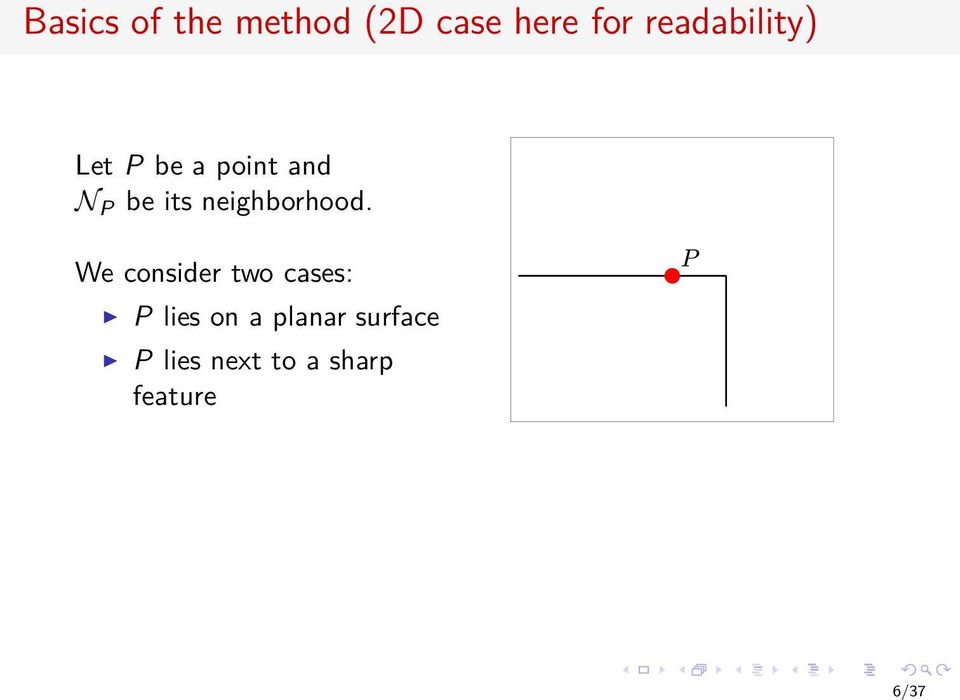
3 3/37 Normal Estimation Normal estimation for point clouds Our method Experiments Conclusion
4 4/37 Data Point clouds from photogrammetry or laser acquisition: may be noisy Sensitivity to noise Robustness to noise

5 4/37 Data Point clouds from photogrammetry or laser acquisition: may be noisy may have outliers Regression Plane P

6 4/37 Data Point clouds from photogrammetry or laser acquisition: may be noisy may have outliers most often have sharp features Smoothed sharp features Preserved sharp features

7 4/37 Data Point clouds from photogrammetry or laser acquisition: may be noisy may have outliers most often have sharp features may be anisotropic Sensitivity to anisotropy Robustness to anisotropy

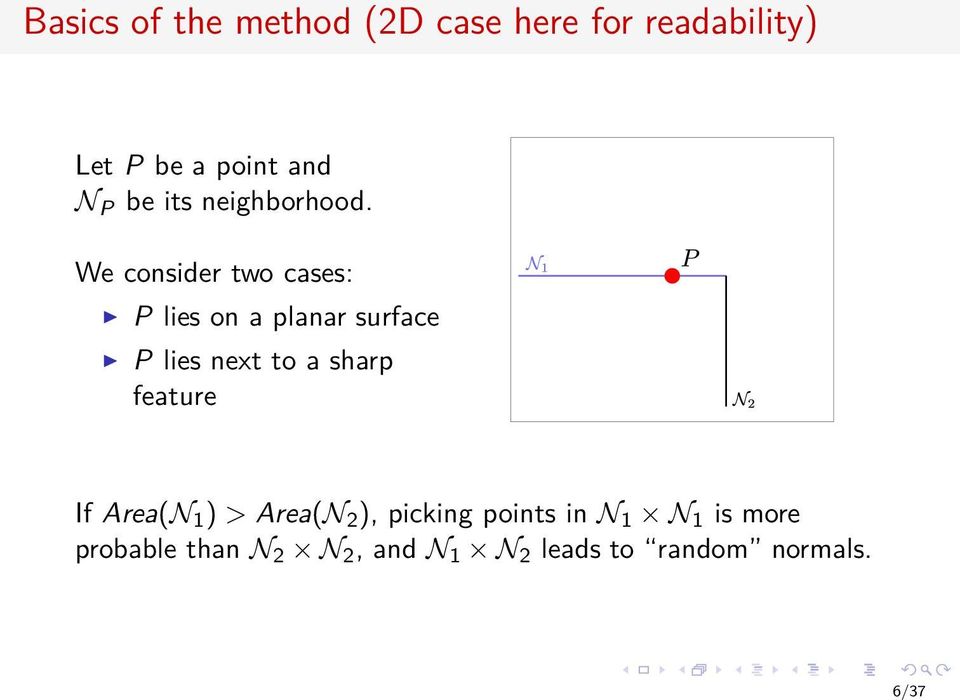
8 4/37 Data Point clouds from photogrammetry or laser acquisition: may be noisy may have outliers most often have sharp features may be anisotropic may be huge (more than 20 million points)

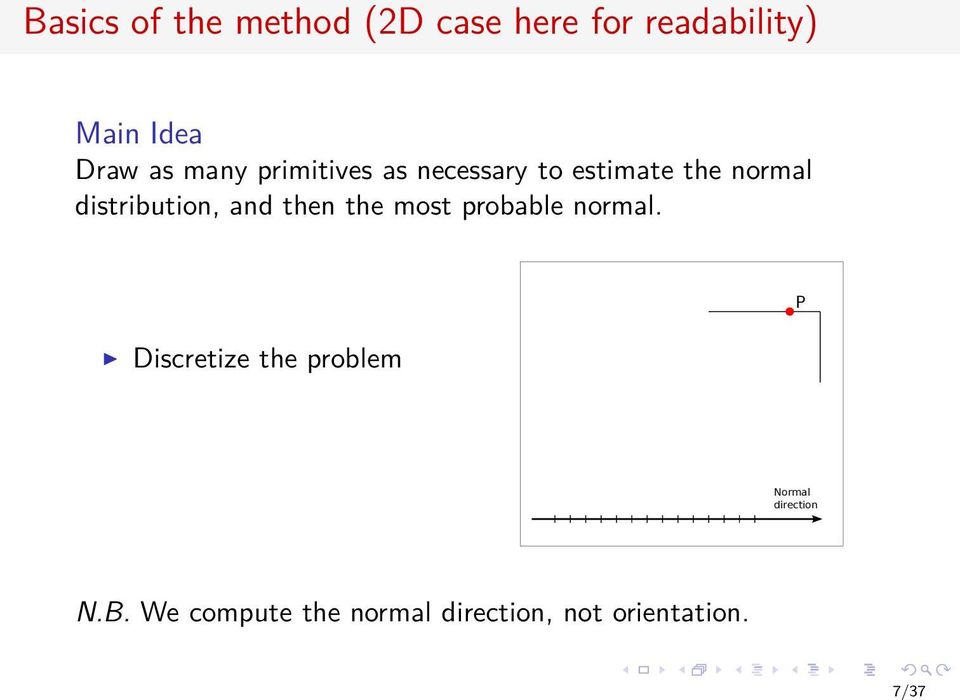
9 5/37 Normal Estimation Normal estimation for point clouds Our method Experiments Conclusion

10 6/37 Basics of the method (2D case here for readability) Let P be a point and N P be its neighborhood.

11 6/37 Basics of the method (2D case here for readability) Let P be a point and N P be its neighborhood. We consider two cases: P lies on a planar surface

12 6/37 Basics of the method (2D case here for readability) Let P be a point and N P be its neighborhood. We consider two cases: P lies on a planar surface

13 6/37 Basics of the method (2D case here for readability) Let P be a point and N P be its neighborhood. We consider two cases: P lies on a planar surface P lies next to a sharp feature
14 6/37 Basics of the method (2D case here for readability) Let P be a point and N P be its neighborhood. We consider two cases: P lies on a planar surface P lies next to a sharp feature

15 6/37 Basics of the method (2D case here for readability) Let P be a point and N P be its neighborhood. We consider two cases: P lies on a planar surface P lies next to a sharp feature If Area(N 1 ) > Area(N 2 ), picking points in N 1 N 1 is more probable than N 2 N 2, and N 1 N 2 leads to random normals.
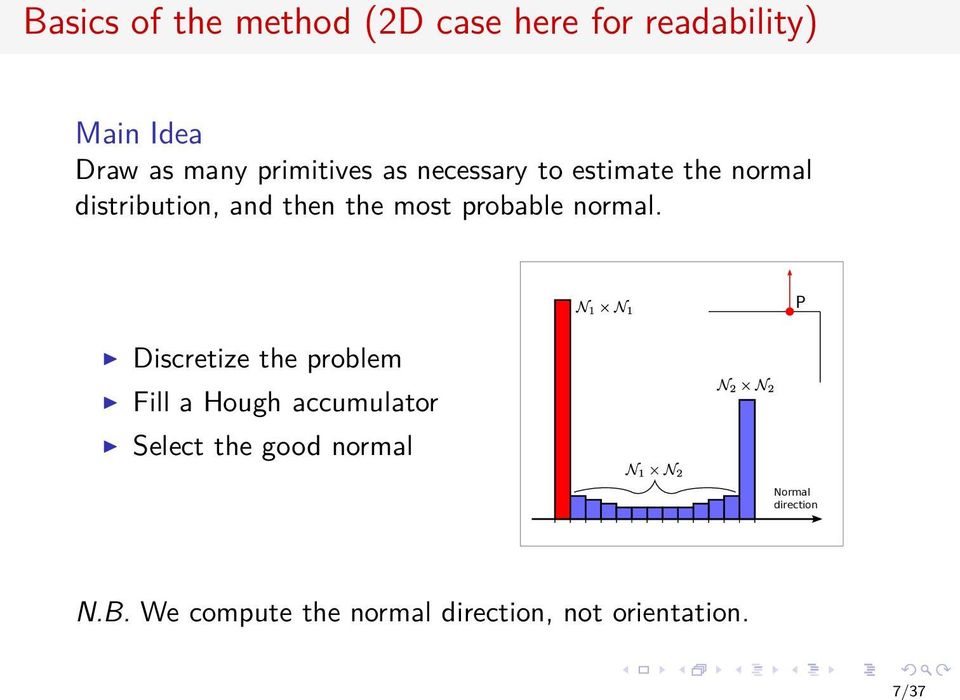
16 Basics of the method (2D case here for readability) Main Idea Draw as many primitives as necessary to estimate the normal distribution, and then the most probable normal. P Discretize the problem Normal direction N.B. We compute the normal direction, not orientation. 7/37
17 Basics of the method (2D case here for readability) Main Idea Draw as many primitives as necessary to estimate the normal distribution, and then the most probable normal. P Discretize the problem Fill a Hough accumulator Normal direction N.B. We compute the normal direction, not orientation. 7/37

18 Basics of the method (2D case here for readability) Main Idea Draw as many primitives as necessary to estimate the normal distribution, and then the most probable normal. P Discretize the problem Fill a Hough accumulator Select the good normal Normal direction N.B. We compute the normal direction, not orientation. 7/37
19 8/37 Robust Randomized Hough Transform T, number of primitives picked after T iteration. T min, number of primitives to pick M, number of bins of the accumulator ˆp m, empirical mean of the bin m p m, theoretical mean of the bin m

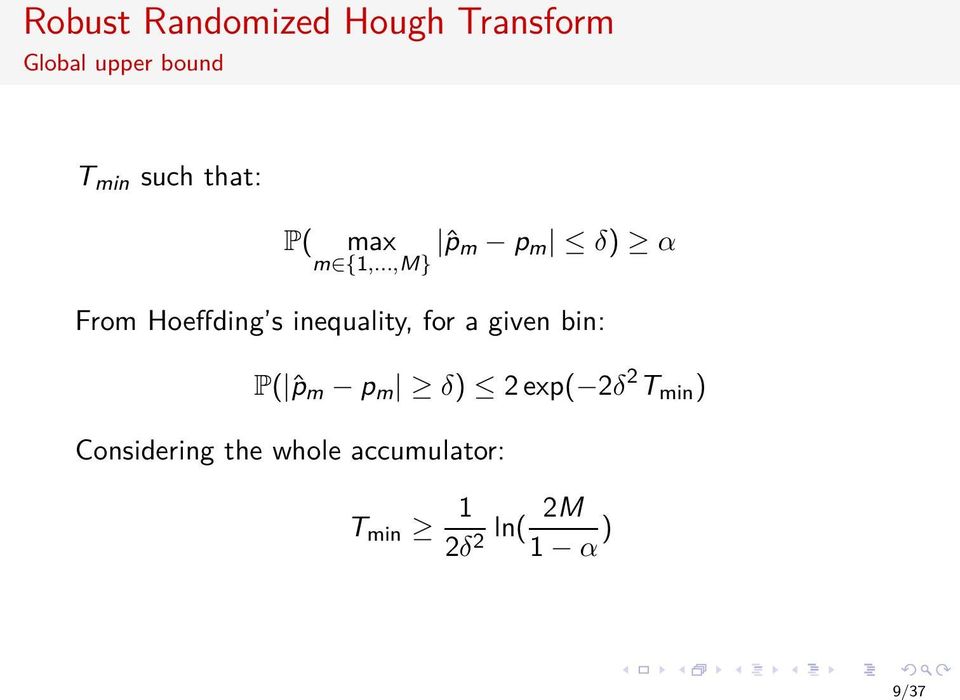
20 9/37 Robust Randomized Hough Transform Global upper bound T min such that: P( max m {1,...,M} ˆp m p m δ) α From Hoeffding s inequality, for a given bin: P( ˆp m p m δ) 2 exp( 2δ 2 T min ) Considering the whole accumulator: T min 1 2M ln( 2δ2 1 α )

21 10/37 Robust Randomized Hough Transform Confidence Interval Idea: if we pick often enough the same bin, we want to stop drawing primitives. From the Central Limit Theorem, we can stop if: 1 ˆp m1 ˆp m2 2 T i.e. the confidence intervals of the most voted bins do not intersect (confidence level 95%)

22 11/37 Accumulator Our primitives are planes directions (defined by two angles). We use the accumulator of Borrmann & al (3D Research, 2011). Fast computing Bins of similar area


23 12/37 Discretization issues P The use of a discrete accumulator may be a cause of error.
24 12/37 Discretization issues P The use of a discrete accumulator may be a cause of error.
25 12/37 Discretization issues P The use of a discrete accumulator may be a cause of error. Solution Iterate the algorithm using randomly rotated accumulators.
26 13/37 Normal Selection P Normal directions obtained by rotation of the accumulator Mean over all the normals Best confidence Mean over best cluster
27 14/37 Dealing with anisotropy The robustness to anisotropy depends of the way we select the planes (triplets of points) Sensitivity to anisotropy Robustness to anisotropy
28 15/37 Random point selection among nearest neighbors Dealing with anisotropy The triplets are randomly selected among the K nearest neighbors. Fast but cannot deal with anisotropy.
29 16/37 Uniform point selection on the neighborhood ball Dealing with anisotropy Pick a point Q in the neighborhood ball Q P
30 16/37 Uniform point selection on the neighborhood ball Dealing with anisotropy Pick a point Q in the neighborhood ball Consider a small ball around Q Q P
31 16/37 Uniform point selection on the neighborhood ball Dealing with anisotropy Pick a point Q in the neighborhood ball Consider a small ball around Q Pick a point randomly in the small ball Q P
32 16/37 Uniform point selection on the neighborhood ball Dealing with anisotropy Pick a point Q in the neighborhood ball Consider a small ball around Q Pick a point randomly in the small ball Iterate to get a triplet Deals with anisotropy, but for a high computation cost.
33 17/37 Cube discretization of the neighborhood ball Dealing with anisotropy Discretize the neighborhood ball P
34 17/37 Cube discretization of the neighborhood ball Dealing with anisotropy Discretize the neighborhood ball Pick a cube P
35 17/37 Cube discretization of the neighborhood ball Dealing with anisotropy Discretize the neighborhood ball Pick a cube Pick a point randomly in this cube P
36 17/37 Cube discretization of the neighborhood ball Dealing with anisotropy Discretize the neighborhood ball Pick a cube Pick a point randomly in this cube Iterate to get a triplet Good compromise between speed and robustness to anisotropy.
37 18/37 Normal Estimation Normal estimation for point clouds Our method Experiments Conclusion
38 19/37 Methods used for comparison Regression Hoppe & al (SIGGRAPH,1992): plane fitting Cazals & Pouget (SGP, 2003): jet fitting Noise Outliers Sharp fts Anisotropy Fast Plane fitting Jet fitting
39 19/37 Methods used for comparison Regression Hoppe & al (SIGGRAPH,1992): plane fitting Cazals & Pouget (SGP, 2003): jet fitting Voronoï diagram Dey & Goswami (SCG, 2004): NormFet Noise Outliers Sharp fts Anisotropy Fast Plane fitting Jet fitting NormFet
40 19/37 Methods used for comparison Regression Hoppe & al (SIGGRAPH,1992): plane fitting Cazals & Pouget (SGP, 2003): jet fitting Voronoï diagram Dey & Goswami (SCG, 2004): NormFet Sample Consensus Models Li & al (Computer & Graphics, 2010) Plane fitting Jet fitting NormFet Sample Consensus Noise Outliers Sharp fts Anisotropy Fast
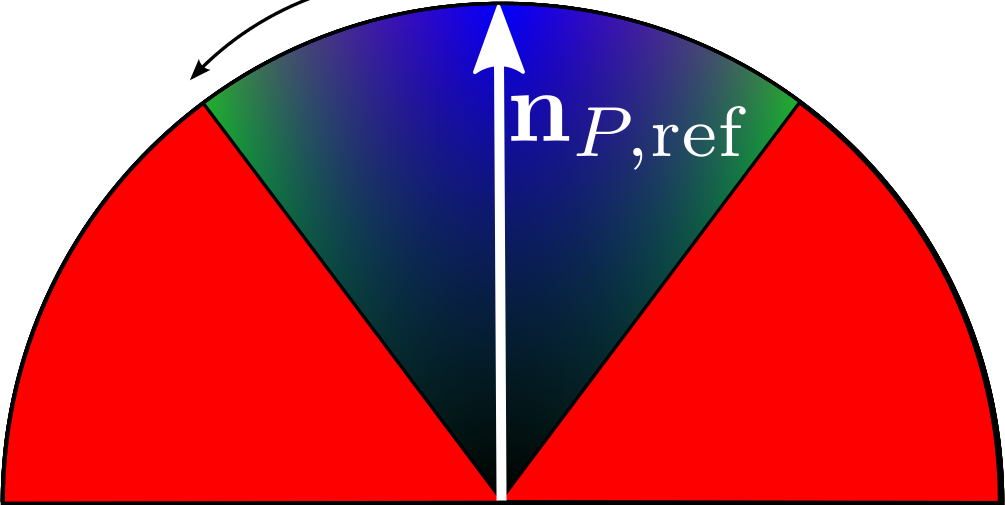
41 20/37 Precision Two error measures: Root Mean Square (RMS): RMS = 1 2 n P,ref n P,est C P C Root Mean Square with threshold (RMS_τ): RMS_τ = 1 C vp 2 P C where { v P = n P,ref n P,est if n P,ref n P,est < τ π 2 otherwise More suited for sharp features
42 21/37 Visual on error distances Same RMS, different RMS τ
43 22/37 Precision (with noise) Precision for cube uniformly sampled, depending on noise.
44 23/37 Precision (with noise and anisotropy) Precision for a corner with anisotropy, depending on noise.
45 24/37 Computation time Computation time for sphere, function of the number of points.
46 25/37 Robustness to outliers Noisy model (0.2%) + 100% of outliers.
47 26/37 Robustness to outliers Noisy model (0.2%) + 200% of outliers.
48 Robustness to anisotropy 27/37
49 Preservation of sharp features 28/37
50 29/37 Robustness to natural noise, outliers and anisotropy Point cloud created by photogrammetry.
51 30/37 Normal Estimation Normal estimation for point clouds Our method Experiments Conclusion
52 31/37 Conclusion Plane fitting Jet fitting NormFet Sample Consensus Our method Noise Outliers Sharp fts Anisotropy Fast Compared to state-of-the-art methods that preserve sharp features, our normal estimator is: at least as precise at least as robust to noise and outliers almost 10x faster robust to anisotropy
53 32/37 Code available Web site Two versions under GPL license: for Point Cloud Library ( for CGAL (
54 33/37 Computation time T min =700 T min =300 n rot =5 n rot =2 w/o with w/o with Model (# vertices) interv. interv. interv. interv. Armadillo (173k) 21 s 20 s 3 s 3 s Dragon (438k) 55 s 51 s 8 s 7 s Buddha (543k) s 10 s Circ. Box (701k) s 12 s Omotondo (998k) s 10 s Statuette (5M) Room (6.6M) Lucy (14M)
55 34/37 Parameters K or r: number of neighbors or neighborhood radius, T min : number of primitives to explore, n φ : parameter defining the number of bins, n rot : number of accumulator rotations, c: presampling or discretization factor (anisotropy only), a cluster : tolerance angle (mean over best cluster only).
56 Efficiency 35/37
57 36/37 Influence of the neighborhood size K = 20 K = 200 K = 400
58 37/37 Precision (with noise) Precision for cube uniformly sampled, depending on noise.
Segmentation of building models from dense 3D point-clouds
 Segmentation of building models from dense 3D point-clouds Joachim Bauer, Konrad Karner, Konrad Schindler, Andreas Klaus, Christopher Zach VRVis Research Center for Virtual Reality and Visualization, Institute
521466S Machine Vision Assignment #7 Hough transform
 521466S Machine Vision Assignment #7 Hough transform Spring 2014 In this assignment we use the hough transform to extract lines from images. We use the standard (r, θ) parametrization of lines, lter the
PCL - SURFACE RECONSTRUCTION
 PCL - SURFACE RECONSTRUCTION TOYOTA CODE SPRINT Alexandru-Eugen Ichim Computer Graphics and Geometry Laboratory PROBLEM DESCRIPTION 1/2 3D revolution due to cheap RGB-D cameras (Asus Xtion & Microsoft
PHOTOGRAMMETRIC TECHNIQUES FOR MEASUREMENTS IN WOODWORKING INDUSTRY
 PHOTOGRAMMETRIC TECHNIQUES FOR MEASUREMENTS IN WOODWORKING INDUSTRY V. Knyaz a, *, Yu. Visilter, S. Zheltov a State Research Institute for Aviation System (GosNIIAS), 7, Victorenko str., Moscow, Russia
Arrangements And Duality
 Arrangements And Duality 3.1 Introduction 3 Point configurations are tbe most basic structure we study in computational geometry. But what about configurations of more complicated shapes? For example,
Robust NURBS Surface Fitting from Unorganized 3D Point Clouds for Infrastructure As-Built Modeling
 81 Robust NURBS Surface Fitting from Unorganized 3D Point Clouds for Infrastructure As-Built Modeling Andrey Dimitrov 1 and Mani Golparvar-Fard 2 1 Graduate Student, Depts of Civil Eng and Engineering
On Fast Surface Reconstruction Methods for Large and Noisy Point Clouds
 On Fast Surface Reconstruction Methods for Large and Noisy Point Clouds Zoltan Csaba Marton, Radu Bogdan Rusu, Michael Beetz Intelligent Autonomous Systems, Technische Universität München {marton,rusu,beetz}@cs.tum.edu
Geometry and Topology from Point Cloud Data
 Geometry and Topology from Point Cloud Data Tamal K. Dey Department of Computer Science and Engineering The Ohio State University Dey (2011) Geometry and Topology from Point Cloud Data WALCOM 11 1 / 51
Normal Estimation for Point Clouds: A Comparison Study for a Voronoi Based Method
 Eurographics Symposium on Point-Based Graphics (2005) M. Pauly, M. Zwicker, (Editors) Normal Estimation for Point Clouds: A Comparison Study for a Voronoi Based Method Tamal K. Dey Gang Li Jian Sun The
Jiří Matas. Hough Transform
 Hough Transform Jiří Matas Center for Machine Perception Department of Cybernetics, Faculty of Electrical Engineering Czech Technical University, Prague Many slides thanks to Kristen Grauman and Bastian
MA 323 Geometric Modelling Course Notes: Day 02 Model Construction Problem
 MA 323 Geometric Modelling Course Notes: Day 02 Model Construction Problem David L. Finn November 30th, 2004 In the next few days, we will introduce some of the basic problems in geometric modelling, and
How To Analyze Ball Blur On A Ball Image
 Single Image 3D Reconstruction of Ball Motion and Spin From Motion Blur An Experiment in Motion from Blur Giacomo Boracchi, Vincenzo Caglioti, Alessandro Giusti Objective From a single image, reconstruct:
CS 534: Computer Vision 3D Model-based recognition
 CS 534: Computer Vision 3D Model-based recognition Ahmed Elgammal Dept of Computer Science CS 534 3D Model-based Vision - 1 High Level Vision Object Recognition: What it means? Two main recognition tasks:!
Modelling, Extraction and Description of Intrinsic Cues of High Resolution Satellite Images: Independent Component Analysis based approaches
 Modelling, Extraction and Description of Intrinsic Cues of High Resolution Satellite Images: Independent Component Analysis based approaches PhD Thesis by Payam Birjandi Director: Prof. Mihai Datcu Problematic
So which is the best?
 Manifold Learning Techniques: So which is the best? Todd Wittman Math 8600: Geometric Data Analysis Instructor: Gilad Lerman Spring 2005 Note: This presentation does not contain information on LTSA, which
CHAPTER 5 PREDICTIVE MODELING STUDIES TO DETERMINE THE CONVEYING VELOCITY OF PARTS ON VIBRATORY FEEDER
 93 CHAPTER 5 PREDICTIVE MODELING STUDIES TO DETERMINE THE CONVEYING VELOCITY OF PARTS ON VIBRATORY FEEDER 5.1 INTRODUCTION The development of an active trap based feeder for handling brakeliners was discussed
Mean Value Coordinates
 Mean Value Coordinates Michael S. Floater Abstract: We derive a generalization of barycentric coordinates which allows a vertex in a planar triangulation to be expressed as a convex combination of its
Surface Reconstruction from Point Clouds
 Autonomous Systems Lab Prof. Roland Siegwart Bachelor-Thesis Surface Reconstruction from Point Clouds Spring Term 2010 Supervised by: Andreas Breitenmoser François Pomerleau Author: Inna Tishchenko Abstract
IEEE TRANSACTIONS ON VISUALISATION AND COMPUTER GRAPHICS 1. Voronoi-based Curvature and Feature Estimation from Point Clouds
 IEEE TRANSACTIONS ON VISUALISATION AND COMPUTER GRAPHICS 1 Voronoi-based Curvature and Feature Estimation from Point Clouds Quentin Mérigot, Maks Ovsjanikov, and Leonidas Guibas Abstract We present an
Point Cloud Segmentation via Constrained Nonlinear Least Squares Surface Normal Estimates
 Point Cloud Segmentation via Constrained Nonlinear Least Squares Surface Normal Estimates Edward Castillo Radiation Oncology Department University of Texas MD Anderson Cancer Center, Houston TX [email protected]
Geography 4203 / 5203. GIS Modeling. Class (Block) 9: Variogram & Kriging
 Geography 4203 / 5203 GIS Modeling Class (Block) 9: Variogram & Kriging Some Updates Today class + one proposal presentation Feb 22 Proposal Presentations Feb 25 Readings discussion (Interpolation) Last
Automatic Building Facade Detection in Mobile Laser Scanner point Clouds
 Automatic Building Facade Detection in Mobile Laser Scanner point Clouds NALANI HETTI ARACHCHIGE 1 & HANS-GERD MAAS 1 Abstract: Mobile Laser Scanner (MLS) has been increasingly used in the modeling of
Un point de vue bayésien pour des algorithmes de bandit plus performants
 Un point de vue bayésien pour des algorithmes de bandit plus performants Emilie Kaufmann, Telecom ParisTech Rencontre des Jeunes Statisticiens, Aussois, 28 août 2013 Emilie Kaufmann (Telecom ParisTech)
How To Create A Surface From Points On A Computer With A Marching Cube
 Surface Reconstruction from a Point Cloud with Normals Landon Boyd and Massih Khorvash Department of Computer Science University of British Columbia,2366 Main Mall Vancouver, BC, V6T1Z4, Canada {blandon,khorvash}@cs.ubc.ca
Recovering Primitives in 3D CAD meshes
 Recovering Primitives in 3D CAD meshes Roseline Bénière a,c, Gérard Subsol a, Gilles Gesquière b, François Le Breton c and William Puech a a LIRMM, Univ. Montpellier 2, CNRS, 161 rue Ada, 34392, France;
Big Ideas in Mathematics
 Big Ideas in Mathematics which are important to all mathematics learning. (Adapted from the NCTM Curriculum Focal Points, 2006) The Mathematics Big Ideas are organized using the PA Mathematics Standards
IMPLICIT SHAPE MODELS FOR OBJECT DETECTION IN 3D POINT CLOUDS
 IMPLICIT SHAPE MODELS FOR OBJECT DETECTION IN 3D POINT CLOUDS Alexander Velizhev 1 (presenter) Roman Shapovalov 2 Konrad Schindler 3 1 Hexagon Technology Center, Heerbrugg, Switzerland 2 Graphics & Media
GRADES 7, 8, AND 9 BIG IDEAS
 Table 1: Strand A: BIG IDEAS: MATH: NUMBER Introduce perfect squares, square roots, and all applications Introduce rational numbers (positive and negative) Introduce the meaning of negative exponents for
H.Calculating Normal Vectors
 Appendix H H.Calculating Normal Vectors This appendix describes how to calculate normal vectors for surfaces. You need to define normals to use the OpenGL lighting facility, which is described in Chapter
Algebra 1 2008. Academic Content Standards Grade Eight and Grade Nine Ohio. Grade Eight. Number, Number Sense and Operations Standard
 Academic Content Standards Grade Eight and Grade Nine Ohio Algebra 1 2008 Grade Eight STANDARDS Number, Number Sense and Operations Standard Number and Number Systems 1. Use scientific notation to express
SEGMENTATION OF POINT CLOUDS USING SMOOTHNESS CONSTRAINT
 ISPRS Commission V Symposium 'Image Engineering and Vision Metrology' SEGMENTATION OF POINT CLOUDS USING SMOOTHNESS CONSTRAINT T. Rabbani a, F. A. van den Heuvel b, G. Vosselman c a* Section of Optical
Delaunay Based Shape Reconstruction from Large Data
 Delaunay Based Shape Reconstruction from Large Data Tamal K. Dey Joachim Giesen James Hudson Ohio State University, Columbus, OH 4321, USA Abstract Surface reconstruction provides a powerful paradigm for
Flocking and Steering Behaviors. 15-462: Computer Graphics April 08, 2010
 Flocking and Steering Behaviors 15-462: Computer Graphics April 08, 2010 Outline Real Flocks Our Foreflocks Particle Systems to Modified Models Flocking Behaviors Separation Cohesion Alignment Additional
Intersection of a Line and a Convex. Hull of Points Cloud
 Applied Mathematical Sciences, Vol. 7, 213, no. 13, 5139-5149 HIKARI Ltd, www.m-hikari.com http://dx.doi.org/1.12988/ams.213.37372 Intersection of a Line and a Convex Hull of Points Cloud R. P. Koptelov
Imputing Values to Missing Data
 Imputing Values to Missing Data In federated data, between 30%-70% of the data points will have at least one missing attribute - data wastage if we ignore all records with a missing value Remaining data
Common Core Unit Summary Grades 6 to 8
 Common Core Unit Summary Grades 6 to 8 Grade 8: Unit 1: Congruence and Similarity- 8G1-8G5 rotations reflections and translations,( RRT=congruence) understand congruence of 2 d figures after RRT Dilations
Solving Geometric Problems with the Rotating Calipers *
 Solving Geometric Problems with the Rotating Calipers * Godfried Toussaint School of Computer Science McGill University Montreal, Quebec, Canada ABSTRACT Shamos [1] recently showed that the diameter of
Claudio J. Tessone. Pau Amengual. Maxi San Miguel. Raúl Toral. Horacio Wio. Eur. Phys. J. B 39, 535 (2004) http://www.imedea.uib.
 Horacio Wio Raúl Toral Eur. Phys. J. B 39, 535 (2004) Claudio J. Tessone Pau Amengual Maxi San Miguel http://www.imedea.uib.es/physdept Models of Consensus vs. Polarization, or Segregation: Voter model,
Fast Point Feature Histograms (FPFH) for 3D Registration
 Fast Point Feature Histograms (FPFH) for 3D Registration Radu Bogdan Rusu, Nico Blodow, Michael Beetz Intelligent Autonomous Systems, Technische Universität München {rusu,blodow,beetz}@cs.tum.edu Abstract
Efficient Storage, Compression and Transmission
 Efficient Storage, Compression and Transmission of Complex 3D Models context & problem definition general framework & classification our new algorithm applications for digital documents Mesh Decimation
NEW MEXICO Grade 6 MATHEMATICS STANDARDS
 PROCESS STANDARDS To help New Mexico students achieve the Content Standards enumerated below, teachers are encouraged to base instruction on the following Process Standards: Problem Solving Build new mathematical
3D Human Face Recognition Using Point Signature
 3D Human Face Recognition Using Point Signature Chin-Seng Chua, Feng Han, Yeong-Khing Ho School of Electrical and Electronic Engineering Nanyang Technological University, Singapore 639798 [email protected]
From Scattered Samples to Smooth Surfaces
 From Scattered Samples to Smooth Surfaces Kai Hormann 1 California Institute of Technology (a) (b) (c) (d) Figure 1: A point cloud with 4,100 scattered samples (a), its triangulation with 7,938 triangles
AMARILLO BY MORNING: DATA VISUALIZATION IN GEOSTATISTICS
 AMARILLO BY MORNING: DATA VISUALIZATION IN GEOSTATISTICS William V. Harper 1 and Isobel Clark 2 1 Otterbein College, United States of America 2 Alloa Business Centre, United Kingdom [email protected]
Prentice Hall Algebra 2 2011 Correlated to: Colorado P-12 Academic Standards for High School Mathematics, Adopted 12/2009
 Content Area: Mathematics Grade Level Expectations: High School Standard: Number Sense, Properties, and Operations Understand the structure and properties of our number system. At their most basic level
MATHS LEVEL DESCRIPTORS
 MATHS LEVEL DESCRIPTORS Number Level 3 Understand the place value of numbers up to thousands. Order numbers up to 9999. Round numbers to the nearest 10 or 100. Understand the number line below zero, and
Dual Marching Cubes: Primal Contouring of Dual Grids
 Dual Marching Cubes: Primal Contouring of Dual Grids Scott Schaefer and Joe Warren Rice University 6100 Main St. Houston, TX 77005 [email protected] and [email protected] Abstract We present a method for
Anatomic Surface Reconstruc1on from Sampled Point Cloud Data and Prior Models
 Anatomic Surface Reconstruc1on from Sampled Point Cloud Data and Prior Models Deyu Sun, Maryam E. Rettmann, David R. Holmes III, Cristian Linte, Bruce Cameron, Jiquan Liu, Douglas Packer, Richard A. Robb
Data Mining Practical Machine Learning Tools and Techniques
 Ensemble learning Data Mining Practical Machine Learning Tools and Techniques Slides for Chapter 8 of Data Mining by I. H. Witten, E. Frank and M. A. Hall Combining multiple models Bagging The basic idea
A PHOTOGRAMMETRIC APPRAOCH FOR AUTOMATIC TRAFFIC ASSESSMENT USING CONVENTIONAL CCTV CAMERA
 A PHOTOGRAMMETRIC APPRAOCH FOR AUTOMATIC TRAFFIC ASSESSMENT USING CONVENTIONAL CCTV CAMERA N. Zarrinpanjeh a, F. Dadrassjavan b, H. Fattahi c * a Islamic Azad University of Qazvin - [email protected]
DAMAGED ROAD TUNNEL LASER SCANNER SURVEY
 University of Brescia - ITALY DAMAGED ROAD TUNNEL LASER SCANNER SURVEY Prof. Giorgio Vassena [email protected] WORKFLOW - Demand analysis - Instruments choice - On field operations planning - Laser
Current Standard: Mathematical Concepts and Applications Shape, Space, and Measurement- Primary
 Shape, Space, and Measurement- Primary A student shall apply concepts of shape, space, and measurement to solve problems involving two- and three-dimensional shapes by demonstrating an understanding of:
Knowledge Discovery and Data Mining. Structured vs. Non-Structured Data
 Knowledge Discovery and Data Mining Unit # 2 1 Structured vs. Non-Structured Data Most business databases contain structured data consisting of well-defined fields with numeric or alphanumeric values.
Closest Pair Problem
 Closest Pair Problem Given n points in d-dimensions, find two whose mutual distance is smallest. Fundamental problem in many applications as well as a key step in many algorithms. p q A naive algorithm
VRSPATIAL: DESIGNING SPATIAL MECHANISMS USING VIRTUAL REALITY
 Proceedings of DETC 02 ASME 2002 Design Technical Conferences and Computers and Information in Conference Montreal, Canada, September 29-October 2, 2002 DETC2002/ MECH-34377 VRSPATIAL: DESIGNING SPATIAL
An introduction to Global Illumination. Tomas Akenine-Möller Department of Computer Engineering Chalmers University of Technology
 An introduction to Global Illumination Tomas Akenine-Möller Department of Computer Engineering Chalmers University of Technology Isn t ray tracing enough? Effects to note in Global Illumination image:
A Genetic Algorithm-Evolved 3D Point Cloud Descriptor
 A Genetic Algorithm-Evolved 3D Point Cloud Descriptor Dominik Wȩgrzyn and Luís A. Alexandre IT - Instituto de Telecomunicações Dept. of Computer Science, Univ. Beira Interior, 6200-001 Covilhã, Portugal
Solving Curved Linear Programs via the Shadow Simplex Method
 Solving Curved Linear rograms via the Shadow Simplex Method Daniel Dadush 1 Nicolai Hähnle 2 1 Centrum Wiskunde & Informatica (CWI) 2 Bonn Universität CWI Scientific Meeting 01/15 Outline 1 Introduction
2013 MBA Jump Start Program. Statistics Module Part 3
 2013 MBA Jump Start Program Module 1: Statistics Thomas Gilbert Part 3 Statistics Module Part 3 Hypothesis Testing (Inference) Regressions 2 1 Making an Investment Decision A researcher in your firm just
Lesson 2: Circles, Chords, Diameters, and Their Relationships
 Circles, Chords, Diameters, and Their Relationships Student Outcomes Identify the relationships between the diameters of a circle and other chords of the circle. Lesson Notes Students are asked to construct
Epipolar Geometry. Readings: See Sections 10.1 and 15.6 of Forsyth and Ponce. Right Image. Left Image. e(p ) Epipolar Lines. e(q ) q R.
 Epipolar Geometry We consider two perspective images of a scene as taken from a stereo pair of cameras (or equivalently, assume the scene is rigid and imaged with a single camera from two different locations).
Data Mining. Cluster Analysis: Advanced Concepts and Algorithms
 Data Mining Cluster Analysis: Advanced Concepts and Algorithms Tan,Steinbach, Kumar Introduction to Data Mining 4/18/2004 1 More Clustering Methods Prototype-based clustering Density-based clustering Graph-based
ART Extension for Description, Indexing and Retrieval of 3D Objects
 ART Extension for Description, Indexing and Retrieval of 3D Objects Julien Ricard, David Coeurjolly, Atilla Baskurt LIRIS, FRE 2672 CNRS, Bat. Nautibus, 43 bd du novembre 98, 69622 Villeurbanne cedex,
Data Mining Cluster Analysis: Advanced Concepts and Algorithms. Lecture Notes for Chapter 9. Introduction to Data Mining
 Data Mining Cluster Analysis: Advanced Concepts and Algorithms Lecture Notes for Chapter 9 Introduction to Data Mining by Tan, Steinbach, Kumar Tan,Steinbach, Kumar Introduction to Data Mining 4/18/2004
( ) = ( ) = {,,, } β ( ), < 1 ( ) + ( ) = ( ) + ( )
 { } ( ) = ( ) = {,,, } ( ) β ( ), < 1 ( ) + ( ) = ( ) + ( ) max, ( ) [ ( )] + ( ) [ ( )], [ ( )] [ ( )] = =, ( ) = ( ) = 0 ( ) = ( ) ( ) ( ) =, ( ), ( ) =, ( ), ( ). ln ( ) = ln ( ). + 1 ( ) = ( ) Ω[ (
Tracking devices. Important features. 6 Degrees of freedom. Mechanical devices. Types. Virtual Reality Technology and Programming
 Tracking devices Virtual Reality Technology and Programming TNM053: Lecture 4: Tracking and I/O devices Referred to head-tracking many times Needed to get good stereo effect with parallax Essential for
Robust Blind Watermarking Mechanism For Point Sampled Geometry
 Robust Blind Watermarking Mechanism For Point Sampled Geometry Parag Agarwal Balakrishnan Prabhakaran Department of Computer Science, University of Texas at Dallas MS EC 31, PO Box 830688, Richardson,
An Introduction to Point Pattern Analysis using CrimeStat
 Introduction An Introduction to Point Pattern Analysis using CrimeStat Luc Anselin Spatial Analysis Laboratory Department of Agricultural and Consumer Economics University of Illinois, Urbana-Champaign
R-trees. R-Trees: A Dynamic Index Structure For Spatial Searching. R-Tree. Invariants
 R-Trees: A Dynamic Index Structure For Spatial Searching A. Guttman R-trees Generalization of B+-trees to higher dimensions Disk-based index structure Occupancy guarantee Multiple search paths Insertions
Creating a 2D Geometry Model
 Creating a 2D Geometry Model This section describes how to build a 2D cross section of a heat sink and introduces 2D geometry operations in COMSOL. At this time, you do not model the physics that describe
HowTo Rhino & ICEM. 1) New file setup: choose Millimeter (automatically converts to Meters if imported to ICEM)
 HowTo Rhino & ICEM Simple 2D model 1) New file setup: choose Millimeter (automatically converts to Meters if imported to ICEM) 2) Set units: File Properties Units: Model units: should already be Millimeters
Exploratory data analysis (Chapter 2) Fall 2011
 Exploratory data analysis (Chapter 2) Fall 2011 Data Examples Example 1: Survey Data 1 Data collected from a Stat 371 class in Fall 2005 2 They answered questions about their: gender, major, year in school,
Pre-Algebra 2008. Academic Content Standards Grade Eight Ohio. Number, Number Sense and Operations Standard. Number and Number Systems
 Academic Content Standards Grade Eight Ohio Pre-Algebra 2008 STANDARDS Number, Number Sense and Operations Standard Number and Number Systems 1. Use scientific notation to express large numbers and small
Computational Geometry. Lecture 1: Introduction and Convex Hulls
 Lecture 1: Introduction and convex hulls 1 Geometry: points, lines,... Plane (two-dimensional), R 2 Space (three-dimensional), R 3 Space (higher-dimensional), R d A point in the plane, 3-dimensional space,
Foundations of Data Science 1
 Foundations of Data Science 1 John Hopcroft Ravindran Kannan Version 3/03/2013 These notes are a first draft of a book being written by Hopcroft and Kannan and in many places are incomplete. However, the
DATA MINING CLUSTER ANALYSIS: BASIC CONCEPTS
 DATA MINING CLUSTER ANALYSIS: BASIC CONCEPTS 1 AND ALGORITHMS Chiara Renso KDD-LAB ISTI- CNR, Pisa, Italy WHAT IS CLUSTER ANALYSIS? Finding groups of objects such that the objects in a group will be similar
Topological Data Analysis Applications to Computer Vision
 Topological Data Analysis Applications to Computer Vision Vitaliy Kurlin, http://kurlin.org Microsoft Research Cambridge and Durham University, UK Topological Data Analysis quantifies topological structures
Solving Simultaneous Equations and Matrices
 Solving Simultaneous Equations and Matrices The following represents a systematic investigation for the steps used to solve two simultaneous linear equations in two unknowns. The motivation for considering
Multimedia Databases. Wolf-Tilo Balke Philipp Wille Institut für Informationssysteme Technische Universität Braunschweig http://www.ifis.cs.tu-bs.
 Multimedia Databases Wolf-Tilo Balke Philipp Wille Institut für Informationssysteme Technische Universität Braunschweig http://www.ifis.cs.tu-bs.de 14 Previous Lecture 13 Indexes for Multimedia Data 13.1
Consolidated Visualization of Enormous 3D Scan Point Clouds with Scanopy
 Consolidated Visualization of Enormous 3D Scan Point Clouds with Scanopy Claus SCHEIBLAUER 1 / Michael PREGESBAUER 2 1 Institute of Computer Graphics and Algorithms, Vienna University of Technology, Austria
Monash University Clayton s School of Information Technology CSE3313 Computer Graphics Sample Exam Questions 2007
 Monash University Clayton s School of Information Technology CSE3313 Computer Graphics Questions 2007 INSTRUCTIONS: Answer all questions. Spend approximately 1 minute per mark. Question 1 30 Marks Total
Clustering. Data Mining. Abraham Otero. Data Mining. Agenda
 Clustering 1/46 Agenda Introduction Distance K-nearest neighbors Hierarchical clustering Quick reference 2/46 1 Introduction It seems logical that in a new situation we should act in a similar way as in
Voronoi Treemaps in D3
 Voronoi Treemaps in D3 Peter Henry University of Washington [email protected] Paul Vines University of Washington [email protected] ABSTRACT Voronoi treemaps are an alternative to traditional rectangular
Classifying Large Data Sets Using SVMs with Hierarchical Clusters. Presented by :Limou Wang
 Classifying Large Data Sets Using SVMs with Hierarchical Clusters Presented by :Limou Wang Overview SVM Overview Motivation Hierarchical micro-clustering algorithm Clustering-Based SVM (CB-SVM) Experimental
Computer Graphics Global Illumination (2): Monte-Carlo Ray Tracing and Photon Mapping. Lecture 15 Taku Komura
 Computer Graphics Global Illumination (2): Monte-Carlo Ray Tracing and Photon Mapping Lecture 15 Taku Komura In the previous lectures We did ray tracing and radiosity Ray tracing is good to render specular
5.4 Closest Pair of Points
 5.4 Closest Pair of Points Closest Pair of Points Closest pair. Given n points in the plane, find a pair with smallest Euclidean distance between them. Fundamental geometric primitive. Graphics, computer
Medial Axis Construction and Applications in 3D Wireless Sensor Networks
 Medial Axis Construction and Applications in 3D Wireless Sensor Networks Su Xia, Ning Ding, Miao Jin, Hongyi Wu, and Yang Yang Presenter: Hongyi Wu University of Louisiana at Lafayette Outline Introduction
Clustering & Visualization
 Chapter 5 Clustering & Visualization Clustering in high-dimensional databases is an important problem and there are a number of different clustering paradigms which are applicable to high-dimensional data.
In mathematics, there are four attainment targets: using and applying mathematics; number and algebra; shape, space and measures, and handling data.
 MATHEMATICS: THE LEVEL DESCRIPTIONS In mathematics, there are four attainment targets: using and applying mathematics; number and algebra; shape, space and measures, and handling data. Attainment target
Monte Carlo Path Tracing
 CS294-13: Advanced Computer Graphics Lecture #5 University of California, Berkeley Wednesday, 23 September 29 Monte Carlo Path Tracing Lecture #5: Wednesday, 16 September 29 Lecturer: Ravi Ramamoorthi
Data Preprocessing. Week 2
 Data Preprocessing Week 2 Topics Data Types Data Repositories Data Preprocessing Present homework assignment #1 Team Homework Assignment #2 Read pp. 227 240, pp. 250 250, and pp. 259 263 the text book.
MODERN VOXEL BASED DATA AND GEOMETRY ANALYSIS SOFTWARE TOOLS FOR INDUSTRIAL CT
 MODERN VOXEL BASED DATA AND GEOMETRY ANALYSIS SOFTWARE TOOLS FOR INDUSTRIAL CT C. Reinhart, C. Poliwoda, T. Guenther, W. Roemer, S. Maass, C. Gosch all Volume Graphics GmbH, Heidelberg, Germany Abstract:
Pennsylvania System of School Assessment
 Pennsylvania System of School Assessment The Assessment Anchors, as defined by the Eligible Content, are organized into cohesive blueprints, each structured with a common labeling system that can be read
Knowledge Discovery and Data Mining
 Knowledge Discovery and Data Mining Unit # 11 Sajjad Haider Fall 2013 1 Supervised Learning Process Data Collection/Preparation Data Cleaning Discretization Supervised/Unuspervised Identification of right
Data Mining Clustering (2) Sheets are based on the those provided by Tan, Steinbach, and Kumar. Introduction to Data Mining
 Data Mining Clustering (2) Toon Calders Sheets are based on the those provided by Tan, Steinbach, and Kumar. Introduction to Data Mining Outline Partitional Clustering Distance-based K-means, K-medoids,