
Creating a 2D Geometry Model
|
|
|
- Prosper Jack Griffith
- 9 years ago
- Views:
Transcription
1 Creating a 2D Geometry Model This section describes how to build a 2D cross section of a heat sink and introduces 2D geometry operations in COMSOL. At this time, you do not model the physics that describe the operation of the heat sink. Assume that you want to estimate the maximum amount of heat dissipated by a heat sink placed around a resistor for high-power applications. The heat sink consists of an extruded aluminum profile as in Figure 5-1. If you neglect the effects at the ends of the elongated heat sink, you can simplify the model and obtain a decent estimate of the heat dissipated by creating a 2D cross section. Figure 5-1: Example of a 3D heat sink model with cross section. CREATING A BASIC 2D GEOMETRY MODEL 1 Double-click the COMSOL icon to launch COMSOL. The Model Wizard opens. 2 On the Select Space Dimension page, click the 2D button. 3 Click the Finish button ( ). CREATING PARAMETERS FOR GEOMETRY PARAMETERIZATION The following steps explain how to create two circles to form the core of the heat sink in Figure 5-1. To investigate different dimensions of the heat sink, parameterize the geometry. Start by defining the radius of the outer arc of the heat sink, the radius of the inner arc, and the thickness and the length of the heat sink flanges. 1

2 1 In the Model Builder, right-click Global Definitions ( ) and select Parameters ( ). 2 In the Parameters table, enter these settings: NAME EXPRESSION VALUE DESCRIPTION R1 5[mm] m Radius Circle 1 R2 2.5[mm] m Radius Circle 2 d 1[mm] m Height L 5[mm] m Width ADDING TWO CIRCLES WITH PREDEFINED PARAMETERS 1 In the Model Builder, right-click Geometry 1 and select Circle ( ). 2 Under Size, enter R1 in the Radius field. 3 Click the Build Selected button ( ). A circle with radius R1 displays in the Graphics window. 4 Right-click Geometry 1 and select Circle ( ). 5 Under Size, enter R2 in the Radius field. 6 Click the Build Selected button ( ). A circle with radius R2 displays in the Graphics window. Click the Zoom Extents button ( ) to see both circles. SUBTRACTING THE SMALLER CIRCLE 1 In the Model Builder, right-click Geometry 1 and select Boolean Operations> Difference ( ). 2 Under Difference, click the Activate Selection button ( ) to activate the Objects to add list for choosing objects. 3 In the Graphics window, select the object c1 (the larger circle) by left- and then right-clicking it. C1 is highlighted in red, then blue and added to the Objects to add list. 4 Click the Activate Selection button ( )to activate the Objects to subtract list. 5 Select the object c2 (the smaller circle) by left- and then right-clicking it. C2 is highlighted in red, then blue and added to the Objects to subtract list. 2

3 6 Click the Build Selected button ( ). The object dif1 is created by subtracting the smaller circle from the larger circle. INTERSECTING WITH RECTANGLE 1 In the Model Builder, right-click Geometry 1 and select Rectangle ( ). 2 Under Size: a In the Width field enter 2*R1. b In the Height field, enter R1. 3 Under Position, enter -R1 in the x field. 4 Click the Build Selected button ( ). The interaction operation creates the object r1 (not related to the circle radius), which coincides with the intersecting area of the two input objects. 5 In the Model Builder, right-click Geometry 1 and select Boolean Operations> Intersection ( ). 6 Select both objects, dif1 (the combined circle) and r1 (the rectangle), by left-clicking and then right-clicking them. Each object is highlighted in red, then blue and added to the Input Objects list. 3

4 7 Click the Build Selected button ( ) to create the object int1. ADDING A RECTANGLE TO CREATE A FLANGE 1 In the Model Builder, right-click Geometry 1 and select Rectangle ( ). 2 Under Size: a In the Width field, enter L. b In the Height field, enter d. 3 Under Position: a In the x field enter -(2/3*R1+L). b In the y field enter -d/2. 4 Click the Build Selected button ( ). The object r2 (not related to the circle radius) is created. Next, round the sharp edges of the flange by using fillets. Click the Zoom Extents button ( ). ADDING A FILLET TO ROUND THE FLANGE EDGES 1 In the Model Builder, right-click Geometry 1 and select Fillet ( ). 2 Select Vertices 1 and 4 (the left-hand corners) on object r2 (the small rectangle). 3 Click the Add to Selection button ( ) to add these points to the Vertices to fillet section. 4 On the Fillet page, under Radius, enter d/3 in the Radius field. 4

5 5 Click the Build Selected button ( ) to create object fil1. ADDING ROTATE OPERATIONS TO CREATE FIVE FLANGES Rotate the flange 45 degrees and keep the original input object to create five flanges on top of the heat sink. Adding Rotate 1 to Create Object Rot1 1 In the Model Builder, right-click Geometry 1 and select Transforms>Rotate ( ). 2 Select object fil1 (the filleted rectangle) and add it to the Input Objects list. 3 On the Rotate page, under Input, select the Keep input objects check box. 4 Under Rotation Angle, enter -45 in the Rotation field. 5 Click the Build Selected button ( ) to create object rot1. Click the Zoom Extents button ( ). Adding Three More Rotations to the Model 1 In the Model Builder, right-click Geometry 1 and select Transforms>Rotate ( ). 2 Select the object rot1 (the resulting rotated filleted rectangle) to add it to the Input Objects list. 3 On the Rotate page, under Input, select the Keep input objects check box. 4 Under the Rotation Angle section, enter -45 in the Rotation field. 5 Click the Build Selected button ( ). to create object rot2. 5

6 6 Repeat the above steps to create object rot3 and rot4. Use object rot2 to create rot3 and object rot3 to create rot4. 7 When done, click the Zoom Extents button ( ) to view the completed object. REMOVING INTERIOR BOUNDARIES IN UNION OPERATIONS 1 In the Model Builder, right-click Geometry 1 and select Boolean Operations> Union ( ). 2 Select the objects int1, fil1, rot1, rot2, rot3, and rot4. 3 Under Union, click to clear the Keep interior boundaries check box to remove the internal boundaries in the union operation. 4 Click the Build All button ( ). Click the Zoom Extents button ( ). The final geometry is shown in Figure 5-2. Figure 5-2: Final 2D object created in the Model Builder. VIEWING THE GEOMETRY SEQUENCE Figure 5-3 shows the geometry sequence used to create Figure 5-2. All primitive objects and the fillet operation are parameterized through the radius of the inner and outer heat sink arcs, the length and thickness of the flanges, and the radius of the fillets. You can change the parameter values in the Parameters table or for any object to create 6


7 alternative heat sink geometries. The sequence still remains and when you click the Build All button ( ) a new geometry is created. Figure 5-3: an example of a 2D geometry sequence. RE-RUNNING THE GEOMETRY SEQUENCE WITH DIFFERENT PARAMETERS 1 In the Model Builder, under Global Definitions, click Parameters ( ). 2 Under Parameters, enter the following settings in the table. Replace the previous data:. NAME EXPRESSION VALUE DESCRIPTION R1 4e-3[m] m Radius Circle 1 R2 2.5e-3[m] m Radius Circle 2 d 1e-3[m] m Height L 7e-3[m] m Width 3 In the Model Builder, click Geometry 1. 7

8 4 Click the Build All button ( ). Click the Zoom Extents button ( ) to view the geometry as defined by the new parameters. 8

9 Creating a 3D Geometry Model Figure 5-4 shows the geometry of a heat sink used for cooling microprocessors. This section describes the steps to create this geometry and introduces 3D drawing tools and techniques. Figure 5-4: Example of a 3D heat sink model. Creating 3D Geometries Using the Model Builder CREATING A BASIC 3D GEOMETRY MODEL 1 Double-click the COMSOL icon to launch COMSOL. The Model Wizard opens. 2 On the Select Space Dimension page, click the 3D button. 3 Click the Finish button ( ). CREATING PARAMETERS FOR GEOMETRY PARAMETERIZATION 1 In the Model Builder, right-click Global Definitions and select Parameters ( ). 2 In the Parameters table, enter these settings: NAME EXPRESSION VALUE DESCRIPTION L1 1.5e Pillar thickness (in the heat sink) L2 3e Pillar Length (in the heat sink) 9

10 USING WORK PLANES TO CREATE A BÉZIER POLYGON Use work planes to create 2D geometries, which you then extrude or revolve to create 3D objects. Creating a Bézier Polygon 1 In the Model Builder, right-click Geometry 1 and select Work Plane ( ). 2 Under Work Plane, select xz-plane from the Plane list. 3 Under the Work Plane 1 node, right-click Geometry and select More Primitives>Bézier Polygon ( ). 4 On the Bézier Polygon page, under Polygon Segments, click Add Linear. Segment 1 (linear) displays in the Added segments list. 5 Under Control points: a In row 1, enter -2e-3 in the x edit field. b In row 2, enter -4e-3 in the x edit field. 6 Click Add Linear to add Segment 2 (linear) to the Added segments list. Some of the Control points are automatically filled in with values; the control points from the previous line are already filled in as the starting points for the next line. 7 Under Control points, in row 2, enter 2e-3 in the y field. 8 Click Add Linear to add Segment 3 (linear) to the Added segments list. a In row 2, enter -2e-3 in the x edit field. b In row 2, enter 4e-3 in the y edit field. 9 Click Add Linear to add Segment 4 (linear) to the Added segments list. 10 Under Control points, in row 2, enter 0 in the y edit field. 11 Click Close Curve. 10

11 12 Click the Build Selected button ( ) and the Zoom Extents button ( ). REVOLVING A 2D OBJECT TO CREATE A 3D OBJECT 1 In the Model Builder, right-click Work Plane1 and select Revolve ( ). The Revolve page opens in the Settings window and the 2D Bézier Polygon displays in the Graphics window. 2 On the Revolve page, under Revolution Angles, enter 90 in the End angle field. Note: The Revolution Axis corresponds to the position of the y-axis in the work plane s 2D coordinate system. 3 Under General, select the Keep input objects check box. Work Plane1 is required for the next steps. 4 Click the Build Selected button ( ) and the Zoom Extents button ( ) to view the object rev1. ADDING AN EXTRUSION AND UNION 1 In the Model Builder, right-click Work Plane1 and select Extrude ( ). 2 Under Distances from Work Plane, enter -2e-2 in the Distances row. 11

12 3 Click the Build Selected button ( ) and the Zoom Extents button ( )to view the object ext1. 4 In the Model Builder, right-click Geometry 1 and select Boolean Operations> Union ( ). 5 Select the objects rev1 and ext1 and add them to the Input objects section. 6 On the Union page, under Union, click to clear the Keep interior boundaries check box to remove the interior boundary between the corner section and the edge section of the heat sink. 7 Click the Build Selected button ( ). Objects rev1 and ext1 are combined to create object uni1. ADDING A ROTATION TO THE 3D OBJECT 1 In the Model Builder, right-click Geometry 1 and select Transforms>Rotate ( ). 2 Select the object uni1 and add it to the Input objects section under Input. 3 Select the Keep input objects check box to leave the input object intact as a rotation of the object is created. 4 Under Rotation Angle, enter -90 in the Rotation field. 5 Under Point on Axis of Rotation: a In the x edit field, enter 1e-2. b In the y edit field, enter 1e-2. 6 Click the Build Selected button ( ) and the Zoom Extents button ( ) to view the object rot1. 12

13 CREATING UNION 2 1 In the Model Builder, right-click Geometry 1 and select Boolean Operations> Union ( ). 2 Select the objects uni1 and rot1 and add them to the Input objects section on the Union page. 3 Under Union, click to clear the Keep interior boundaries check box. 4 Click the Build Selected button ( ) to create object uni2. ADDING A SECOND ROTATION 1 In the Model Builder, right-click Geometry1 and select Transforms>Rotate ( ). 2 Select the object uni2 and add it to the Input objects section under Input. 3 Select the Keep input objects check box. 4 Under Rotation Angle, enter -180 in the Rotation field. 5 Under Point on Axis of Rotation: a In the x edit field, enter 1e-2. b In the y edit field, enter 1e-2. 6 Click the Build Selected button ( ). 13

14 CREATING UNION 3 1 Right-click Geometry 1 and select Boolean Operations>Union. The Union page opens in the Settings window. 2 Select the objects uni2 and rot2 and add them to the Input objects section under Union. 3 Click to clear the Keep interior boundaries check box. 4 Click the Build Selected button ( ) to create object uni3. CREATING WORK PLANE 2 AND ADDING A SQUARE 1 In the Model Builder, right-click Geometry 1 and select Work Plane. The Work Plane page opens in the Settings window and a Work Plane 2 node is added in the Model Builder. 2 Click the Build Selected button ( ). 3 To the right of the Settings window, click the Show Work Plane button ( ). Note that you can use the projection of the 3D geometry on the xy-plane as a guide for creating the middle section of the heat sink base. 4 In the Model Builder, under Work Plane 2, right-click Geometry and select Square. The Square page opens in the Settings window. 5 Under Size, enter 2.4e-2 in the Side length edit field. 6 Under Position: a Select Center from the Base list. b In the x edit field, enter 1e-2. c In the y edit field, enter 1e-2. 7 Click the Build Selected button ( ) and the Zoom Extents button ( ). 14

15 TRIMMING THE SQUARE TO FIT USING THE FILLET OPERATION 1 In the Model Builder, under Work Plane 2, right-click Geometry and select Fillet ( ). 2 Add points 1, 2, 3, and 4 on the object sq1 to the Vertices to fillet section under Points. 3 Under Radius, enter 2e-3 in the Radius edit field. 4 Click the Build Selected button.( ) 15

16 ADDING EXTRUDE 2 AND COMBINING OBJECTS TO COMPLETE THE BASE 1 In the Model Builder, right-click Geometry 1 and select Extrude ( ). 2 Under Distances from Work Plane, enter 4e-3 in the Distances row. 3 Click the Build Selected button ( ). 4 In the Model Builder, right-click Geometry 1 and select Boolean Operations> Union ( ). 5 Select the objects uni3 and ext2 to add to the Input objects section under Union. 6 Click the Build Selected button ( ) to create object uni4. This completes the base of the heat sink. 16

17 DRAWING THE UPPER PART OF THE HEAT SINK Creating a Work Plane and a Square 1 In the Model Builder, right-click Geometry 1 and select Work Plane ( ). The Work Plane page opens in the Settings window and a Work Plane 3 node is added in the Model Builder. 2 Under Work Plane, enter 4e-3 in the z-coordinate edit field. 3 From the 3D projection list, select Entire 3D geometry to visualize the projected edges of the heat sink s base in the work plane. 4 Click the Build Selected button ( ). 5 To the right of the Settings window, click the Show Work Plane button ( ). 6 In the Model Builder, under Work Plane 3, right-click Geometry and select Square ( ). 7 Under Size, enter L2 in the Side length edit field. 8 Click the Build Selected button ( ) to create square sq1 with side length L2. 17

18 ADDING ARRAYS 1 In the Model Builder, under Work Plane 3, right-click Geometry and select Transforms>Array ( ). 2 Add the object sq1 to the Input objects section under Input. 3 Under Size: a In the x edit field, enter 3. b In the y edit field, enter 3. 4 Under Displacement: a In the x edit field, enter 1e-2-L2/2. b In the y edit field, enter 1e-2-L2/2. 5 Click the Build Selected button ( ). Adding Extrude 3 and Combining Objects (Union) 1 In the Model Builder, right-click Geometry 1 and select Extrude ( ). 2 Under Distances from Work Plane, enter L1 in the Distances row. 3 Click the Build Selected button ( ) and the Zoom Extents button ( ). 4 Right-click Geometry 1 again and select Boolean Operations>Union ( ). 18

19 5 Add all the objects to the Input objects list under Union. 6 Click the Build All button ( ) to complete the heat sink geometry. THE GEOMETRY SEQUENCE Figure 5-5 shows the list of the geometry in the Model Builder used to create Figure 5-4. You can edit any node for each of the drawing operations. In this case, the upper part of the heat sink is parameterized, through the thickness and height of the heat sink pillars. You can edit the parameter values defined previously to change the heat sink geometry. 19

Turbulent Flow Through a Shell-and-Tube Heat Exchanger
 Turbulent Flow Through a Shell-and-Tube Heat Exchanger Introduction This model describes a part of a shell-and-tube heat exchanger (see Figure 1), where hot water enters from above. The cooling medium,
SolidWorks: Mirror, Revolve, and. Introduction to Robotics
 SolidWorks: Mirror, Revolve, and Circular Pattern Introduction to Robotics Let s Review At this point we have learned the following: Extrude Boss/Base Extruded Cut Adding Relations and Dimensions Linear
Introduction to CATIA V5
 Introduction to CATIA V5 Release 16 (A Hands-On Tutorial Approach) Kirstie Plantenberg University of Detroit Mercy SDC PUBLICATIONS Schroff Development Corporation www.schroff.com www.schroff-europe.com
2013 Getting Started Guide
 2013 Getting Started Guide The contents of this guide and accompanying exercises were originally created by Nemetschek Vectorworks, Inc. Vectorworks Fundamentals Getting Started Guide Created using: Vectorworks
Introduction to Autodesk Inventor for F1 in Schools
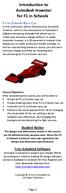 Introduction to Autodesk Inventor for F1 in Schools F1 in Schools Race Car In this course you will be introduced to Autodesk Inventor, which is the centerpiece of Autodesk s digital prototyping strategy
Basic 2D Design Be sure you have the latest information!
 Basic 2D Design mastercam x getting started tutorials Basic 2D Design December 2011 Be sure you have the latest information! Information might have been changed or added since this document was published.
Part Design. Preface What's New? Getting Started Basic Tasks Advanced Tasks Workbench Description Customizing Glossary Index
 Part Design Preface What's New? Getting Started Basic Tasks Advanced Tasks Workbench Description Customizing Glossary Index Dassault Systèmes 1994-99. All rights reserved. Preface The CATIA Version 5 Part
. Address the following issues in your solution:
 CM 3110 COMSOL INSTRUCTIONS Faith Morrison and Maria Tafur Department of Chemical Engineering Michigan Technological University, Houghton, MI USA 22 November 2012 Zhichao Wang edits 21 November 2013 revised
Introduction to Autodesk Inventor for F1 in Schools
 F1 in Schools race car Introduction to Autodesk Inventor for F1 in Schools In this course you will be introduced to Autodesk Inventor, which is the centerpiece of Autodesk s Digital Prototyping strategy
CHEG 3128 Heat, Mass, & Kinetics Laboratory Diffusion in Laminar Flow Regimes Modeling and COMSOL Tutorial Tutorial by Andrea Kadilak
 CHEG 3128 Heat, Mass, & Kinetics Laboratory Diffusion in Laminar Flow Regimes Modeling and COMSOL Tutorial Tutorial by Andrea Kadilak Introduction COMSOL is a computer modeling software package that will
Understand the Sketcher workbench of CATIA V5.
 Chapter 1 Drawing Sketches in Learning Objectives the Sketcher Workbench-I After completing this chapter you will be able to: Understand the Sketcher workbench of CATIA V5. Start a new file in the Part
CATIA Wireframe & Surfaces TABLE OF CONTENTS
 TABLE OF CONTENTS Introduction... 1 Wireframe & Surfaces... 2 Pull Down Menus... 3 Edit... 3 Insert... 4 Tools... 6 Generative Shape Design Workbench... 7 Bottom Toolbar... 9 Tools... 9 Analysis... 10
Drawing a Bedroom Floorplan
 Appendix A Drawing a Bedroom Floorplan In this chapter, you will learn the following to World Class standards: Draw a Bedroom Floorplan Draw the Bedroom Walls Draw and Dimension the Bedroom Door Draw and
Solved with COMSOL Multiphysics 4.3
 Vibrating String Introduction In the following example you compute the natural frequencies of a pre-tensioned string using the 2D Truss interface. This is an example of stress stiffening ; in fact the
Laminar Flow in a Baffled Stirred Mixer
 Laminar Flow in a Baffled Stirred Mixer Introduction This exercise exemplifies the use of the rotating machinery feature in the CFD Module. The Rotating Machinery interface allows you to model moving rotating
SolidWorks. SolidWorks Teacher Guide. and Student Courseware
 SolidWorks SolidWorks Teacher Guide and Student Courseware SolidWorks Corporation Outside the U.S.: +1-978-371-5011 300 Baker Avenue Fax: +1-978-371-7303 Concord, Massachusetts 01742 USA Email: [email protected]
SolidWorks Implementation Guides. Sketching Concepts
 SolidWorks Implementation Guides Sketching Concepts Sketching in SolidWorks is the basis for creating features. Features are the basis for creating parts, which can be put together into assemblies. Sketch
SpaceClaim Introduction Training Session. A SpaceClaim Support Document
 SpaceClaim Introduction Training Session A SpaceClaim Support Document In this class we will walk through the basic tools used to create and modify models in SpaceClaim. Introduction We will focus on:
YouthQuest Quick Key FOB Project
 YouthQuest Quick Key FOB Project This project is designed to demonstrate how to use the 3D design application, Moment of inspiration, to create a custom key fob for printing on the Cube3 3D printer. Downloading
TABLE OF CONTENTS. INTRODUCTION... 5 Advance Concrete... 5 Where to find information?... 6 INSTALLATION... 7 STARTING ADVANCE CONCRETE...
 Starting Guide TABLE OF CONTENTS INTRODUCTION... 5 Advance Concrete... 5 Where to find information?... 6 INSTALLATION... 7 STARTING ADVANCE CONCRETE... 7 ADVANCE CONCRETE USER INTERFACE... 7 Other important
 Edinburgh COLLEGE of ART ARCHITECTURE 3D Modelling in AutoCAD - tutorial exercise The screen The graphics area This is the part of the screen in which the drawing will be created. The command prompt area
Part Number: PMT1080-ENG Rev. 1
 2010 Dassault Systèmes, All Rights Reserved DraftSight and the DraftSight logos are trademarks of Dassault Systèmes or its subsidiaries in the US and/or other countries. Other brand or product names are
Chapter 1. Creating Sketches in. the Sketch Mode-I. Evaluation chapter. Logon to www.cadcim.com for more details. Learning Objectives
 Chapter 1 Creating Sketches in Learning Objectives the Sketch Mode-I After completing this chapter you will be able to: Use various tools to create a geometry. Dimension a sketch. Apply constraints to
Essay 5 Tutorial for a Three-Dimensional Heat Conduction Problem Using ANSYS Workbench
 Essay 5 Tutorial for a Three-Dimensional Heat Conduction Problem Using ANSYS Workbench 5.1 Introduction The problem selected to illustrate the use of ANSYS software for a three-dimensional steadystate
An introduction to 3D draughting & solid modelling using AutoCAD
 An introduction to 3D draughting & solid modelling using AutoCAD Faculty of Technology University of Plymouth Drake Circus Plymouth PL4 8AA These notes are to be used in conjunction with the AutoCAD software
SolidWorks Tutorial 3 MAGNETIC BLOCK
 SolidWorks Tutorial 3 MAGNETIC BLOCK Magnetic Block In this exercise you will make a magnetic block. To do so, you will create a few parts, which you will assemble. You will learn the following new applications
SolidWorks Tutorial 4 CANDLESTICK
 SolidWorks Tutorial 4 CANDLESTICK Candlestick In this tutorial you will make a simple container and a candlestick out of sheetmetal. You will learn about working with sheet metal in SolidWorks. We will
What s New V 11. Preferences: Parameters: Layout/ Modifications: Reverse mouse scroll wheel zoom direction
 What s New V 11 Preferences: Reverse mouse scroll wheel zoom direction Assign mouse scroll wheel Middle Button as Fine tune Pricing Method (Manufacturing/Design) Display- Display Long Name Parameters:
Generative Shape Design
 Generative Shape Design Preface What's New Getting Started Basic Tasks Advanced Tasks Workbench Description Glossary Index Dassault Systèmes 1994-99. All rights reserved. Preface CATIA Version 5 Generative
Shape Dictionary YR to Y6
 Shape Dictionary YR to Y6 Guidance Notes The terms in this dictionary are taken from the booklet Mathematical Vocabulary produced by the National Numeracy Strategy. Children need to understand and use
39 Symmetry of Plane Figures
 39 Symmetry of Plane Figures In this section, we are interested in the symmetric properties of plane figures. By a symmetry of a plane figure we mean a motion of the plane that moves the figure so that
WORKBOOK MODELING OF MULTI- MEMBER MACHINES
 WORKBOOK MODELING OF MULTI- MEMBER MACHINES LUBLIN 2014 0 Author: Mirosław Ferdynus Desktop publishing: Mirosław Ferdynus Technical editor: Mirosław Ferdynus Figures: Mirosław Ferdynus Cover and graphic
AutoCAD Workbook 3D DRA 54 Hartnell College Engineering Technology Parviz D. Entekhabi
 AutoCAD Workbook 3D AutoCAD Workbook 3D DRA 54 Hartnell College Engineering Technology Parviz D. Entekhabi 1 Lesson 01 Creating a Basic 3D Surface Model Elevation & Thickness AutoCAD Workbook 3D To work
Chapter 9. Editing Features. Learning Objectives
 Chapter 9 Editing Features Learning Objectives After completing this chapter, you will be able to: Edit features. Edit sketches of the sketch based features. Edit the sketch plane of the sketch based features.
Heat Transfer by Free Convection
 Heat Transfer by Free Convection Introduction This example describes a fluid flow problem with heat transfer in the fluid. An array of heating tubes is submerged in a vessel with fluid flow entering at
ME 24-688 Week 11 Introduction to Dynamic Simulation
 The purpose of this introduction to dynamic simulation project is to explorer the dynamic simulation environment of Autodesk Inventor Professional. This environment allows you to perform rigid body dynamic
Sketcher. Preface What's New? Getting Started Basic Tasks Customizing Workbench Description Glossary Index
 Sketcher Preface What's New? Getting Started Basic Tasks Customizing Workbench Description Glossary Index Dassault Systèmes 1994-99. All rights reserved. Preface CATIA Version 5 Sketcher application makes
Introduction to the TI-Nspire CX
 Introduction to the TI-Nspire CX Activity Overview: In this activity, you will become familiar with the layout of the TI-Nspire CX. Step 1: Locate the Touchpad. The Touchpad is used to navigate the cursor
Convert 2D to 3D in AutoPOL Bend Simulator
 Convert 2D to 3D in AutoPOL Bend Simulator This document gives an introduction of how to convert 2D DXF/DWG files into 3D models in AutoPOL Bend simulator. The AutoPOL 3D concept A 3D model with correct
Basic AutoSketch Manual
 Basic AutoSketch Manual Instruction for students Skf-Manual.doc of 3 Contents BASIC AUTOSKETCH MANUAL... INSTRUCTION FOR STUDENTS... BASIC AUTOSKETCH INSTRUCTION... 3 SCREEN LAYOUT... 3 MENU BAR... 3 FILE
Castle Modeling. In this PDF tutorial we will be modeling a simple castle as pictured above.
 Course: 3D Design Title: Castle Modeling Blender: Version 2.6X Level: Beginning Author; Neal Hirsig ([email protected]) May, 2012 This tutorial assumes that you already know how to: Display orthographic
7 Enclosed Areas. When you have completed this chapter, you will be able to:
 7 Enclosed Areas Our designs so far have consisted entirely of open linework, except for a brief introduction to Fill Attributes on page 3-15. Closed linework may delineate an Area, such as a section of
Sheet Metal Design. Preface What's New? Getting Started Basic Tasks Workbench Description Customizing Glossary Index
 Sheet Metal Design Preface What's New? Getting Started Basic Tasks Workbench Description Customizing Glossary Index Dassault Systèmes 1994-99. All rights reserved. Preface The V5 CATIA - Sheet Metal Design
Tutorial for laboratory project #2 Using ANSYS Workbench. For Double Pipe Heat Exchanger
 Tutorial for laboratory project #2 Using ANSYS Workbench For Double Pipe Heat Exchanger 1. Preparing ANSYS Workbench Go to Start Menu/All Programs/Simulation/ANSYS 12.1/Workbench. In the toolbox menu in
Getting Started With DraftSight A Guide For AEC Users
 Getting Started With DraftSight A Guide For AEC Users DraftSight.com Facebook.com/DraftSight Welcome to DraftSight a valuable tool for any AEC professional! DraftSight is more than a free, professional-grade
Making 3D Threads in Feature Based Solid Modelers
 Making 3D Threads in Feature Based Solid Modelers THREAD BASICS Making true geometric threads in feature-based solid modelers is a fairly straightforward process and can be handled using several different
Datum > Curve KIM,ME,NIU
 Datum > Curve Intersect First create at least one quilt on the surface of the model. Feature > Surface (> New) > Copy (do not use offset that creates a surface off the solid surface even with zero offset)
SketchUp Instructions
 SketchUp Instructions Every architect needs to know how to use SketchUp! SketchUp is free from Google just Google it and download to your computer. You can do just about anything with it, but it is especially
Begin creating the geometry by defining two Circles for the spherical endcap, and Subtract Areas to create the vessel wall.
 ME 477 Pressure Vessel Example 1 ANSYS Example: Axisymmetric Analysis of a Pressure Vessel The pressure vessel shown below is made of cast iron (E = 14.5 Msi, ν = 0.21) and contains an internal pressure
Ingham County Equalization/Tax Mapping Viewer Tutorial
 MAP LAYERS (RIGHT SIDE) All data layers listed here can be displayed on the map. To display a layer, make sure that the box is checked (by default parcel and city layers are displayed, uncheck to turn
To draw a line. To create a construction line by specifying two points
 Drawing Lines, Polygons and Rectangles The line is the basic object in AutoCAD. You can create a variety of lines: single lines, multiple line segments with and without arcs, multiple parallel lines, and
3D Viewer. user's manual 10017352_2
 EN 3D Viewer user's manual 10017352_2 TABLE OF CONTENTS 1 SYSTEM REQUIREMENTS...1 2 STARTING PLANMECA 3D VIEWER...2 3 PLANMECA 3D VIEWER INTRODUCTION...3 3.1 Menu Toolbar... 4 4 EXPLORER...6 4.1 3D Volume
Structure Design. Preface What's New? Getting Started Basic Tasks Advanced Tasks Workbench Description Customizing Glossary Index
 Structure Design Preface What's New? Getting Started Basic Tasks Advanced Tasks Workbench Description Customizing Glossary Index Dassault Systèmes 1994-2000. All rights reserved. Preface CATIA Version
Drawing an Approximate Representation of an Involute Spur Gear Tooth Project Description
 Drawing an Approximate Representation of an Involute Spur Gear Tooth Project Description Create a solid model and a working drawing of the 24 pitch gears specified below. It is only necessary to create
Pro/ENGINEER Wildfire 5.0 Introduction to Surface Modeling
 Introduction Several advanced surface types are available as listed below. Variable Section Sweep Boundary Blend Section to Surfaces Blend Surface to Surface Blend A surface is created by sweeping a single
The number of parameters required for authoring an ipart depends on the type of the part you are publishing.
 Publishing and Styles In This Exercise This Skill Builder demonstrates how to create a tube and pipe ipart, publish it into a custom Tube & Pipe Library, create a style using published parts, and then
Part Design. Page 1 1997 2001 DASSAULT SYSTEMES. IBM Product Lifecycle Management Solutions / Dassault Systemes
 Part Design Page 1 Tutorial Objectives Description This tutorial is an introduction to Part Design. Message This tutorial illustrates how CATIA can Design precise 3D mechanical parts with an intuitive
SOEM 024: Computer Aided Design. E. Rozos
 SOEM 024: Computer Aided Design E. Rozos 3D Design with AutoCAD 2002 Isometric Drawings 3D coordinates, views Wire-frame 3D modelling, extruding Primitive objects Boolean operators Terminology Boolean
Welcome to CorelDRAW, a comprehensive vector-based drawing and graphic-design program for the graphics professional.
 Creating a logo Welcome to CorelDRAW, a comprehensive vector-based drawing and graphic-design program for the graphics professional. In this tutorial, you will create a logo for an imaginary coffee shop.
AutoCAD 2009. New Icon Quick Reference
 AutoCAD 2009 New Quick Reference Contents Chapter 1 New Quick Reference..................... 1 Toolbars................................... 1 3D Navigation Toolbar........................ 1 CAD Standards
Sheet Metal Design: Beyond Bends and Flanges
 11/30/2005-8:00 am - 9:30 am Room:Pelican 1 (Swan) Walt Disney World Swan and Dolphin Resort Orlando, Florida Sheet Metal Design: Beyond Bends and Flanges Anthony B. Rodriguez - KETIV Technologies MA31-2
Advanced Surface Modeling
 This sample chapter is for review purposes only. Copyright The Goodheart-Willcox Co., Inc. ll rights reserved. Chapter dvanced Modeling Learning Objectives fter completing this chapter, you will be able
Creating Smart Models From Scan Data
 Rapidform Tech Tip Creating Smart Models From Scan Data Related Product Version Rapidform XOR3 Goal To create a smart model from scan data. A smart model is a parametric model that uses parameters intelligently
Torchmate CAD User s Guide
 Torchmate CAD User s Guide Revised May 2011 Table of Contents: Overview of the Manual Installation and Setup Important Configuration Changes Overview of Menus Navigation and Selection Methods Basic CAD
Autodesk Fusion 360 Badge Guide: Design an F1 in Schools Trophy
 Autodesk Fusion 360 Badge Guide: Design an F1 in Schools Trophy Abstract: Gain basic understanding of creating 3D models in Fusion 360 by designing an F1 in Schools trophy. This badge may be claimed by
VIDEO SCRIPT: 8.2.1 Data Management
 VIDEO SCRIPT: 8.2.1 Data Management OUTLINE/ INTENT: Create and control a simple numeric list. Use numeric relationships to describe simple geometry. Control lists using node lacing settings. This video
Creating Your Own 3D Models
 14 Creating Your Own 3D Models DAZ 3D has an extensive growing library of 3D models, but there are times that you may not find what you want or you may just want to create your own model. In either case
Algebra Geometry Glossary. 90 angle
 lgebra Geometry Glossary 1) acute angle an angle less than 90 acute angle 90 angle 2) acute triangle a triangle where all angles are less than 90 3) adjacent angles angles that share a common leg Example:
Quickstart for Desktop Version
 Quickstart for Desktop Version What is GeoGebra? Dynamic Mathematics Software in one easy-to-use package For learning and teaching at all levels of education Joins interactive 2D and 3D geometry, algebra,
Mastercam X6 Basic 3D Design
 Basic 3D Design mastercam x getting started tutorials Mastercam X6 Basic 3D Design December 2011 Be sure you have the latest information! Information might have been changed or added since this document
LESSON 7: IMPORTING AND VECTORIZING A BITMAP IMAGE
 LESSON 7: IMPORTING AND VECTORIZING A BITMAP IMAGE In this lesson we ll learn how to import a bitmap logo, transform it into a vector and perform some editing on the vector to clean it up. The concepts
GeoGebra. 10 lessons. Gerrit Stols
 GeoGebra in 10 lessons Gerrit Stols Acknowledgements GeoGebra is dynamic mathematics open source (free) software for learning and teaching mathematics in schools. It was developed by Markus Hohenwarter
Learning Autodesk. Modeling, Analysis and Animation SDC. Randy H. Shih. Better Textbooks. Lower Prices. PUBLICATIONS www.sdcpublications.
 Learning Autodesk Inventor 2012 Modeling, Analysis and Animation Randy H. Shih SDC Better Textbooks. Lower Prices. PUBLICATIONS www.sdcpublications.com Schroff Development Corporation Visit the following
Area. Area Overview. Define: Area:
 Define: Area: Area Overview Kite: Parallelogram: Rectangle: Rhombus: Square: Trapezoid: Postulates/Theorems: Every closed region has an area. If closed figures are congruent, then their areas are equal.
Piston Ring. Problem:
 Problem: A cast-iron piston ring has a mean diameter of 81 mm, a radial height of h 6 mm, and a thickness b 4 mm. The ring is assembled using an expansion tool which separates the split ends a distance
Wireframe and Surface
 Wireframe and Surface Preface What's New Getting Started Basic Tasks Workbench Description Glossary Index Dassault Systèmes 1994-99. All rights reserved. Preface CATIA Version 5 Wireframe and Surface allows
LiveLink for Matlab. User s Guide VERSION 4.3
 TM LiveLink for Matlab User s Guide VERSION 4.3 LiveLink for MATLAB User s Guide 2009 2012 COMSOL Protected by U.S. Patents 7,519,518; 7,596,474; and 7,623,991. Patents pending. This Documentation and
Tutorial Creating Vector Graphics
 Tutorial Creating Vector Graphics This tutorial will guide you through the creation of your own vector graphic and show you how best to meet the specific criteria for our print process. We recommend designing
Getting Started with CATIA Version 5
 WB Getting Started with CATIA Version 5 Page 1 CATIA User Interface Let s review the following key features: Multi-document support Standard and specific menus & toolbars (File, Edit, Insert, ) Standard
4 Manipulating Elements
 4 Manipulating Elements In the context of this course, Manipulation of elements means moving, copying, rotating, scaling and some other similar operations. We will find that manipulations are always a
CATIA for Design and Engineering. Version 5 Releases 14 & 15. David S. Kelley. Central Michigan University SDC
 CATIA for Design and Engineering ersion 5 Releases 4 & 5 David S. Kelley Central Michigan University SDC PUBLICATIONS Schroff Development Corporation www.schroff.com www.schroff-europe.com TUTORIAL Extruded
Composite Surfaces Tutorial
 Composite Surfaces Tutorial 4-1 Composite Surfaces Tutorial This tutorial will use the same model as the Materials & Loading Tutorial (with some modifications), to demonstrate how to perform a circular
Welcome to CorelDRAW, a comprehensive vector-based drawing and graphic-design program for the graphics professional.
 Workspace tour Welcome to CorelDRAW, a comprehensive vector-based drawing and graphic-design program for the graphics professional. In this tutorial, you will become familiar with the terminology and workspace
Tip of the Week: Creating Geometry from AutoCAD Drawings
 PTC Email Newsletter March 4, 2002 PTC Product Focus: Assembly Performance Extension (APX) Tip of the Week: Creating Geometry from AutoCAD Drawings Training: Upcoming Training Classes PTC Product Focus:
Fireworks CS4 Tutorial Part 1: Intro
 Fireworks CS4 Tutorial Part 1: Intro This Adobe Fireworks CS4 Tutorial will help you familiarize yourself with this image editing software and help you create a layout for a website. Fireworks CS4 is the
Autodesk Fusion 360: Assemblies. Overview
 Overview In this module you will learn how different components can be put together to create an assembly. We will use several tools in Fusion 360 to make sure that these assemblies are constrained appropriately
511 - Creating Structural Frame Designs
 4 th Generation VLC courtesy of Edison2 511 - Creating Structural Frame Designs Rahul Kulkarni, Manager, Product Design, Pune Center, Siemens PLM Software #SEU13 Agenda: 511 - Creating Structural Frame
PRACTICAS DE AUTOCAD LIMAC 1 PRACTICE CHAIR
 PRACTICAS DE AUTOCAD LIMAC 1 PRACTICE CHAIR PRACTICAS DE AUTOCAD LIMAC 2 Setting Up for 3D Entiles Make or verify the setting shown in the chair drawing settings thable Command: VPOINT enter a view point
ABAQUS/CAE Tutorial: Analysis of an Aluminum Bracket
 H. Kim FEA Tutorial 1 ABAQUS/CAE Tutorial: Analysis of an Aluminum Bracket Hyonny Kim last updated: August 2004 In this tutorial, you ll learn how to: 1. Sketch 2D geometry & define part. 2. Define material
Visual Tutorial Basic Edition 1. Visual. Basic Edition Tutorial. www.visuallightingsoftware.com
 Visual Tutorial Basic Edition 1 Visual Basic Edition Tutorial www.visuallightingsoftware.com Visual Tutorial Basic Edition 2 Basic Edition Tutorial Introduction In this tutorial, you will use the Visual
SOLIDWORKS: SKETCH RELATIONS
 Sketch Feature: The shape or topology of the initial sketch or model is important, but exact geometry and dimensions of the initial sketched shapes are NOT. It recommended to work in the following order:
Visualization of 2D Domains
 Visualization of 2D Domains This part of the visualization package is intended to supply a simple graphical interface for 2- dimensional finite element data structures. Furthermore, it is used as the low
9 Area, Perimeter and Volume
 9 Area, Perimeter and Volume 9.1 2-D Shapes The following table gives the names of some 2-D shapes. In this section we will consider the properties of some of these shapes. Rectangle All angles are right
Angle - a figure formed by two rays or two line segments with a common endpoint called the vertex of the angle; angles are measured in degrees
 Angle - a figure formed by two rays or two line segments with a common endpoint called the vertex of the angle; angles are measured in degrees Apex in a pyramid or cone, the vertex opposite the base; in
Solved with COMSOL Multiphysics 4.0a. COPYRIGHT 2010 COMSOL AB.
 Permanent Magnet Introduction This example shows how to model the magnetic field surrounding a permanent magnet. It also computes the force with which it acts on a nearby iron rod. Thanks to the symmetry
Window Glass Design 5 According to ASTM E 1300
 A User s Guide to: Window Glass Design 5 According to ASTM E 1300 A product of: 1 Table of Contents Table of Contents List of Figures Chapter 1: Window Glass Design 5 1.1 Introduction 1.2 Features ii iv
Modeling Curved Surfaces
 Modeling Cylindrical and Curved Theory Views of Cylinders Contour Lines Extruded Surfaces Revolved Surfaces & Cutouts Profile Shape Axis of Revolution Swept Surfaces & Cutouts Profile Shape Path Curves
10. THERM DRAWING TIPS
 10. THERM DRAWING TIPS 10.1. Drawing Tips The THERM User's Manual describes in detail how to draw cross-sections in THERM. This section of the NFRC Simualation Training Manual presents some additional
Drawing Basic Shapes:
 : Title: : Version: 1.0 First edition: November 2004 Contents Overview...ii Copyright and trademark information...ii Feedback... ii Acknowledgments...ii Modifications and updates... ii... iii Drawing