
Jiří Matas. Hough Transform
|
|
|
- Erik Golden
- 10 years ago
- Views:
Transcription

1 Hough Transform Jiří Matas Center for Machine Perception Department of Cybernetics, Faculty of Electrical Engineering Czech Technical University, Prague Many slides thanks to Kristen Grauman and Bastian Leibe

2 Why HT and not Recognition with Local Features? Strengths: applicable to many objects (e.g. in image stitching) is real-time scales well to very large problems (retrieval of millions of images) handles occlusion well insensitive to a broad class of image transformations Weaknesses: applicable to recognition of specific objects (no categorization) applicable only to objects with distinguished local features Slide credit: David Lowe 2

3 Why HT and not the Scanning Window (Viola-Jones) Method? Strengths: applicable to many classes of objects not restricted to specific objects often real-time Weaknesses: extension to a large number of classes not straightforward (standard implementation: linear complexity in the number of classes) occlusion handling not easy full 3D recognition requires too many windows to be checked training time is potentially very long 3/25

4 Hough Transform A method for detecting geometric primitives based on evaluation of an objective function: is the parameter space, are tokens (image points of interest) Origin: Detection of straight lines Examples of for different geometric primitives: Straight line: Circle: Parameters evaluated on a grid Discretization of : 4

5 Comparison: Template Matching and HT Template Matching: for all! 2 J(!) = 0 for all x = (x; y) 2 Image = for all x i» tokens if satisfies J(!) = J(!) + p(x) else /* nothing */ Complexity: O(j j jpj) HT: (basic idea: each token votes for all primitives it is consistent with) for all find x i (x i ) J(!) = J(!) + p(x i ) Complexity: O(j (x i )j jpj); j (x i )j j j 5

6 Hough Transform for Straight Lines 1. Define the minimal parametrisation (p,q) of the space of lines: Most common: angle distance from origin (½, µ) Other options: tangent of angle intercept (a,b), nearest point to center, Quantize the Hough space: Identify the maximum and minimum values of a and b, and the number of cells, 3. Create an accumulator array A(p,q); set all values to zero 4. (if gradient available) : For all edge points (x i,y i ) in the image Use gradient direction Compute a from the equation Increment A(p,q) by one (if gradient not available): For all edge points (x i,y i ) in the image Increment A(p,q) by one for all lines incident on x,y 5. For all cells in A(p,q) Search for the maximum value of A(p,q) Calculate the equation of the line 6. To reduce the effect of noise more than one element (elements in a neighborhood) in the accumulator array are increased 6

7 HT for Straight Lines: Variations Representation of a line Usual form y = a x + b has a singularity around 90º. Can be overcome by considering two cases, y = a x + b and x = a y + b Common parametrization parameterization: x cos( ) + y sin( ) = y Using gradient orientation Uses not only point but also orientation consistent with the edge orientation Variables: In HT: for x P; ; Á : P! h0; ¼) (x i ; Á(x i )) Can be used by weighting the strength of the vote by: Ã line orientation, Á gradient orientation y x ρ já Ãj θ K. Grauman, B. Leibe 7

8 Examples Hough transform for a square (left) and a circle (right) K. Grauman, B. Leibe 8

9 Hough Transform: Noisy Line ρ Tokens Votes θ Problem: Finding the true maximum K. Grauman, B. Leibe Slide credit: David Lowe 9

10 Hough Transform: Noisy Input ρ Tokens Votes θ Problem: Lots of spurious maxima K. Grauman, B. Leibe Slide credit: David Lowe 10

11 HT for different primitive: circles, circles with fixed radius circles squares with a known orientation and size rectangles 11

12 HT for multiple instances 1. p 1 = HT(P; ) : strongest result of HT 2. Set 3. Unvote 4. P 1 = P n p 1 p 1 p 2 = HT(P 1 ; ) 5. Cont. to get as many instances as required Greedy Sequential 12

13 Hough Transform Problems 1. Search space (accumulator size) gets prohibitively large easily Line segments: Circular arc: r; c x ; c y ; t 1 ; t 2 2. Cost function must be additive. 3. Greedy assignment rule of a token to primitive 4. No global objective function for multiple primitives (global optimization for one primitive only) 13

14 When is the Hough transform useful? Textbooks often imply that it is useful mostly for finding lines In fact, it can be very effective for recognizing arbitrary shapes or objects (Generalized HT) The key to efficiency is to have each feature (token) determine as many parameters as possible For example, lines can be detected much more efficiently from small edge elements (or points with local gradients) than from just points For object recognition, each token should predict location, scale, and orientation (4D array) Bottom line: The Hough transform can extract feature groupings from clutter in linear time! K. Grauman, B. Leibe Slide credit: David Lowe 14

15 Generalized Hough Transform [Ballard81] Generalization for an arbitrary contour or shape Choose reference point for the contour (e.g. center) For each point on the contour remember where it is located w.r.t. to the reference point Remember radius r and angle relative to the contour tangent Recognition: whenever you find a contour point, calculate the tangent angle and vote for all possible reference points Instead of reference point, can also vote for transformation The same idea can be used with local features! K. Grauman, B. Leibe Slide credit: Bernt Schiele 15

16 Gen. Hough Transform with Local Features For every feature, store possible occurrences For new image, let the matched features vote for possible object positions Object identity Pose Relative position K. Grauman, B. Leibe 16

17 Finding Consistent Configurations Global spatial models Generalized Hough Transform [Lowe99] RANSAC [Obdrzalek02, Chum05, Nister06] Basic assumption: object is planar Assumption is often justified in practice Valid for many structures on buildings Sufficient for small viewpoint variations on 3D objects K. Grauman, B. Leibe 17


18 3D Object Recognition Gen. HT for Recognition Typically only 3 feature matches needed for recognition Extra matches provide robustness Affine model can be used for planar objects [Lowe99] K. Grauman, B. Leibe Slide credit: David Lowe 18

19 Comparison Gen. Hough Transform Advantages Very effective for recognizing arbitrary shapes or objects Can handle high percentage of outliers (>95%) Extracts groupings from clutter in linear time Disadvantages Quantization issues Only practical for small number of dimensions (up to 4) Improvements available Probabilistic Extensions Continuous Voting Space [Leibe08] RANSAC Advantages General method suited to large range of problems Easy to implement Independent of number of dimensions Disadvantages Only handles moderate number of outliers (<50%) Many variants available, e.g. PROSAC: Progressive RANSAC [Chum05] Preemptive RANSAC [Nister05] K. Grauman, B. Leibe 19

20 RHT = Randomized Hough Transform [Xu93] In: Out: E = fe i g; m( ; e) = 0 S1 ; S2 ; :::; SN Repeat: I. Hypothesis 1. Select random M feature points e k1 ; :::; e km 2. Compute k : m( k ; e kj ) = 0; j = 1; :::; M II. Pre-Verification 3. Add 1 to accumulator k ( k ) > T 1 4. If (accumulator ) goto III. Else goto I. III. Verification 5. Find support for k 6. If (support ) output 7. Reset accumulator ( k ) > T 2 k Proc v Out Omega-S-N, a v algoritmu Omega-N 20

21 Probabilistic Hough Transform [Kiryati et al. 91] Idea: Evaluate Algorithm: NX i=1 p(x i ; ) using only a fraction f = k MAX N 1. Select points at random 2. Perform standard HT Analysis: k MAX Selection of k MAX is incorrect of N points x i the number L of selected points from L N points of a line in a random subset of k MAX points is governed by hypergeometric, not binomial distance L N L L P (L N ) = N k MAX L N N k MAX ¹ = N ¾ 2 = k MAX L N (N L N ) N 2 µ 1 k MAX 1 N 1 21
22 Idea: 1. PHT = Monte Carlo Evaluation of N X i=1 p(x i ; ) 2. Apply standard MC analysis to find k MAX in PHT to guarantee Pffalse positiveg and Pffalse negativeg < ² Algorithm: 1. Select a random point 2. Vote and return it 3. Finish if k MAX reached 22
23 CHT = Cascaded Hough Transform [Tuytelaars et al. 97] Finds structures at different hierarchical levels by iterating one kind of HT (fixed points, fixed lines, lines of fixed points, pencils of fixed lines) Uses duality of lines and points in image and parameter spaces Algorithm: 1. First HT: detects lines in the image and keeps dominant peaks in the parameter space 2. Second HT: detects lines of collinear peaks in parameter space and keeps vertices where several straight lines in the original image intersect (vanishing points) 3. Third HT: applied to the peaks of thto detect collinear vertices (vanishing lines) 23

24 CHT: Experiments Lines belonging to one of the three detected vanishing points Aerial image of buildings and streets (left), the corresponding edges (right) 24
25 macros.tex sfmath.sty cmpitemize.tex Thank you for your attention. 25
CS 534: Computer Vision 3D Model-based recognition
 CS 534: Computer Vision 3D Model-based recognition Ahmed Elgammal Dept of Computer Science CS 534 3D Model-based Vision - 1 High Level Vision Object Recognition: What it means? Two main recognition tasks:!
Camera geometry and image alignment
 Computer Vision and Machine Learning Winter School ENS Lyon 2010 Camera geometry and image alignment Josef Sivic http://www.di.ens.fr/~josef INRIA, WILLOW, ENS/INRIA/CNRS UMR 8548 Laboratoire d Informatique,
Circle Object Recognition Based on Monocular Vision for Home Security Robot
 Journal of Applied Science and Engineering, Vol. 16, No. 3, pp. 261 268 (2013) DOI: 10.6180/jase.2013.16.3.05 Circle Object Recognition Based on Monocular Vision for Home Security Robot Shih-An Li, Ching-Chang
MA 323 Geometric Modelling Course Notes: Day 02 Model Construction Problem
 MA 323 Geometric Modelling Course Notes: Day 02 Model Construction Problem David L. Finn November 30th, 2004 In the next few days, we will introduce some of the basic problems in geometric modelling, and
IMPLICIT SHAPE MODELS FOR OBJECT DETECTION IN 3D POINT CLOUDS
 IMPLICIT SHAPE MODELS FOR OBJECT DETECTION IN 3D POINT CLOUDS Alexander Velizhev 1 (presenter) Roman Shapovalov 2 Konrad Schindler 3 1 Hexagon Technology Center, Heerbrugg, Switzerland 2 Graphics & Media
PHOTOGRAMMETRIC TECHNIQUES FOR MEASUREMENTS IN WOODWORKING INDUSTRY
 PHOTOGRAMMETRIC TECHNIQUES FOR MEASUREMENTS IN WOODWORKING INDUSTRY V. Knyaz a, *, Yu. Visilter, S. Zheltov a State Research Institute for Aviation System (GosNIIAS), 7, Victorenko str., Moscow, Russia
Computer Vision & Digital Image Processing. Edge linking and boundary detection
 Computer Vision & Digital Image Processing Edge Linking and Boundary Detection Dr. D. J. Jackson Lecture 17-1 Edge linking and boundary detection Ideally, edge detection techniques yield pixels lying only
Part-Based Recognition
 Part-Based Recognition Benedict Brown CS597D, Fall 2003 Princeton University CS 597D, Part-Based Recognition p. 1/32 Introduction Many objects are made up of parts It s presumably easier to identify simple
PARAMETRIC MODELING. David Rosen. December 1997. By carefully laying-out datums and geometry, then constraining them with dimensions and constraints,
 1 of 5 11/18/2004 6:24 PM PARAMETRIC MODELING David Rosen December 1997 The term parametric modeling denotes the use of parameters to control the dimensions and shape of CAD models. Think of a rubber CAD
Computational Geometry. Lecture 1: Introduction and Convex Hulls
 Lecture 1: Introduction and convex hulls 1 Geometry: points, lines,... Plane (two-dimensional), R 2 Space (three-dimensional), R 3 Space (higher-dimensional), R d A point in the plane, 3-dimensional space,
Data Mining. Cluster Analysis: Advanced Concepts and Algorithms
 Data Mining Cluster Analysis: Advanced Concepts and Algorithms Tan,Steinbach, Kumar Introduction to Data Mining 4/18/2004 1 More Clustering Methods Prototype-based clustering Density-based clustering Graph-based
521466S Machine Vision Assignment #7 Hough transform
 521466S Machine Vision Assignment #7 Hough transform Spring 2014 In this assignment we use the hough transform to extract lines from images. We use the standard (r, θ) parametrization of lines, lter the
Curriculum Map by Block Geometry Mapping for Math Block Testing 2007-2008. August 20 to August 24 Review concepts from previous grades.
 Curriculum Map by Geometry Mapping for Math Testing 2007-2008 Pre- s 1 August 20 to August 24 Review concepts from previous grades. August 27 to September 28 (Assessment to be completed by September 28)
Recognition. Sanja Fidler CSC420: Intro to Image Understanding 1 / 28
 Recognition Topics that we will try to cover: Indexing for fast retrieval (we still owe this one) History of recognition techniques Object classification Bag-of-words Spatial pyramids Neural Networks Object
3D Model based Object Class Detection in An Arbitrary View
 3D Model based Object Class Detection in An Arbitrary View Pingkun Yan, Saad M. Khan, Mubarak Shah School of Electrical Engineering and Computer Science University of Central Florida http://www.eecs.ucf.edu/
Copyrighted Material. Chapter 1 DEGREE OF A CURVE
 Chapter 1 DEGREE OF A CURVE Road Map The idea of degree is a fundamental concept, which will take us several chapters to explore in depth. We begin by explaining what an algebraic curve is, and offer two
Fast and Robust Normal Estimation for Point Clouds with Sharp Features
 1/37 Fast and Robust Normal Estimation for Point Clouds with Sharp Features Alexandre Boulch & Renaud Marlet University Paris-Est, LIGM (UMR CNRS), Ecole des Ponts ParisTech Symposium on Geometry Processing
Vector storage and access; algorithms in GIS. This is lecture 6
 Vector storage and access; algorithms in GIS This is lecture 6 Vector data storage and access Vectors are built from points, line and areas. (x,y) Surface: (x,y,z) Vector data access Access to vector
Clustering & Visualization
 Chapter 5 Clustering & Visualization Clustering in high-dimensional databases is an important problem and there are a number of different clustering paradigms which are applicable to high-dimensional data.
Segmentation of building models from dense 3D point-clouds
 Segmentation of building models from dense 3D point-clouds Joachim Bauer, Konrad Karner, Konrad Schindler, Andreas Klaus, Christopher Zach VRVis Research Center for Virtual Reality and Visualization, Institute
Local features and matching. Image classification & object localization
 Overview Instance level search Local features and matching Efficient visual recognition Image classification & object localization Category recognition Image classification: assigning a class label to
Linear Threshold Units
 Linear Threshold Units w x hx (... w n x n w We assume that each feature x j and each weight w j is a real number (we will relax this later) We will study three different algorithms for learning linear
L 2 : x = s + 1, y = s, z = 4s + 4. 3. Suppose that C has coordinates (x, y, z). Then from the vector equality AC = BD, one has
 The line L through the points A and B is parallel to the vector AB = 3, 2, and has parametric equations x = 3t + 2, y = 2t +, z = t Therefore, the intersection point of the line with the plane should satisfy:
Multi-View Object Class Detection with a 3D Geometric Model
 Multi-View Object Class Detection with a 3D Geometric Model Joerg Liebelt IW-SI, EADS Innovation Works D-81663 Munich, Germany [email protected] Cordelia Schmid LEAR, INRIA Grenoble F-38330 Montbonnot,
Practical Tour of Visual tracking. David Fleet and Allan Jepson January, 2006
 Practical Tour of Visual tracking David Fleet and Allan Jepson January, 2006 Designing a Visual Tracker: What is the state? pose and motion (position, velocity, acceleration, ) shape (size, deformation,
Object Recognition. Selim Aksoy. Bilkent University [email protected]
 Image Classification and Object Recognition Selim Aksoy Department of Computer Engineering Bilkent University [email protected] Image classification Image (scene) classification is a fundamental
J. P. Oakley and R. T. Shann. Department of Electrical Engineering University of Manchester Manchester M13 9PL U.K. Abstract
 A CURVATURE SENSITIVE FILTER AND ITS APPLICATION IN MICROFOSSIL IMAGE CHARACTERISATION J. P. Oakley and R. T. Shann Department of Electrical Engineering University of Manchester Manchester M13 9PL U.K.
Clustering. Adrian Groza. Department of Computer Science Technical University of Cluj-Napoca
 Clustering Adrian Groza Department of Computer Science Technical University of Cluj-Napoca Outline 1 Cluster Analysis What is Datamining? Cluster Analysis 2 K-means 3 Hierarchical Clustering What is Datamining?
We can display an object on a monitor screen in three different computer-model forms: Wireframe model Surface Model Solid model
 CHAPTER 4 CURVES 4.1 Introduction In order to understand the significance of curves, we should look into the types of model representations that are used in geometric modeling. Curves play a very significant
FURTHER VECTORS (MEI)
 Mathematics Revision Guides Further Vectors (MEI) (column notation) Page of MK HOME TUITION Mathematics Revision Guides Level: AS / A Level - MEI OCR MEI: C FURTHER VECTORS (MEI) Version : Date: -9-7 Mathematics
Probabilistic Latent Semantic Analysis (plsa)
 Probabilistic Latent Semantic Analysis (plsa) SS 2008 Bayesian Networks Multimedia Computing, Universität Augsburg [email protected] www.multimedia-computing.{de,org} References
Environmental Remote Sensing GEOG 2021
 Environmental Remote Sensing GEOG 2021 Lecture 4 Image classification 2 Purpose categorising data data abstraction / simplification data interpretation mapping for land cover mapping use land cover class
Principles of Data Mining by Hand&Mannila&Smyth
 Principles of Data Mining by Hand&Mannila&Smyth Slides for Textbook Ari Visa,, Institute of Signal Processing Tampere University of Technology October 4, 2010 Data Mining: Concepts and Techniques 1 Differences
Section 1.1. Introduction to R n
 The Calculus of Functions of Several Variables Section. Introduction to R n Calculus is the study of functional relationships and how related quantities change with each other. In your first exposure to
DEFINITION 5.1.1 A complex number is a matrix of the form. x y. , y x
 Chapter 5 COMPLEX NUMBERS 5.1 Constructing the complex numbers One way of introducing the field C of complex numbers is via the arithmetic of matrices. DEFINITION 5.1.1 A complex number is a matrix of
Recovering Primitives in 3D CAD meshes
 Recovering Primitives in 3D CAD meshes Roseline Bénière a,c, Gérard Subsol a, Gilles Gesquière b, François Le Breton c and William Puech a a LIRMM, Univ. Montpellier 2, CNRS, 161 rue Ada, 34392, France;
Parametric Equations and the Parabola (Extension 1)
 Parametric Equations and the Parabola (Extension 1) Parametric Equations Parametric equations are a set of equations in terms of a parameter that represent a relation. Each value of the parameter, when
Combining Local Recognition Methods for Better Image Recognition
 Combining Local Recognition Methods for Better Image Recognition Bart Lamiroy Patrick Gros y Sylvaine Picard INRIA CNRS DGA MOVI GRAVIR z IMAG INRIA RHÔNE-ALPES ZIRST 655, Av. de l Europe Montbonnot FRANCE
Randomized Trees for Real-Time Keypoint Recognition
 Randomized Trees for Real-Time Keypoint Recognition Vincent Lepetit Pascal Lagger Pascal Fua Computer Vision Laboratory École Polytechnique Fédérale de Lausanne (EPFL) 1015 Lausanne, Switzerland Email:
In mathematics, there are four attainment targets: using and applying mathematics; number and algebra; shape, space and measures, and handling data.
 MATHEMATICS: THE LEVEL DESCRIPTIONS In mathematics, there are four attainment targets: using and applying mathematics; number and algebra; shape, space and measures, and handling data. Attainment target
Classification of Fingerprints. Sarat C. Dass Department of Statistics & Probability
 Classification of Fingerprints Sarat C. Dass Department of Statistics & Probability Fingerprint Classification Fingerprint classification is a coarse level partitioning of a fingerprint database into smaller
SolidWorks Implementation Guides. Sketching Concepts
 SolidWorks Implementation Guides Sketching Concepts Sketching in SolidWorks is the basis for creating features. Features are the basis for creating parts, which can be put together into assemblies. Sketch
AdaBoost. Jiri Matas and Jan Šochman. Centre for Machine Perception Czech Technical University, Prague http://cmp.felk.cvut.cz
 AdaBoost Jiri Matas and Jan Šochman Centre for Machine Perception Czech Technical University, Prague http://cmp.felk.cvut.cz Presentation Outline: AdaBoost algorithm Why is of interest? How it works? Why
Exam 1 Sample Question SOLUTIONS. y = 2x
 Exam Sample Question SOLUTIONS. Eliminate the parameter to find a Cartesian equation for the curve: x e t, y e t. SOLUTION: You might look at the coordinates and notice that If you don t see it, we can
Projective Geometry: A Short Introduction. Lecture Notes Edmond Boyer
 Projective Geometry: A Short Introduction Lecture Notes Edmond Boyer Contents 1 Introduction 2 11 Objective 2 12 Historical Background 3 13 Bibliography 4 2 Projective Spaces 5 21 Definitions 5 22 Properties
Segmentation & Clustering
 EECS 442 Computer vision Segmentation & Clustering Segmentation in human vision K-mean clustering Mean-shift Graph-cut Reading: Chapters 14 [FP] Some slides of this lectures are courtesy of prof F. Li,
Common Core Unit Summary Grades 6 to 8
 Common Core Unit Summary Grades 6 to 8 Grade 8: Unit 1: Congruence and Similarity- 8G1-8G5 rotations reflections and translations,( RRT=congruence) understand congruence of 2 d figures after RRT Dilations
Categorical Data Visualization and Clustering Using Subjective Factors
 Categorical Data Visualization and Clustering Using Subjective Factors Chia-Hui Chang and Zhi-Kai Ding Department of Computer Science and Information Engineering, National Central University, Chung-Li,
Prentice Hall Algebra 2 2011 Correlated to: Colorado P-12 Academic Standards for High School Mathematics, Adopted 12/2009
 Content Area: Mathematics Grade Level Expectations: High School Standard: Number Sense, Properties, and Operations Understand the structure and properties of our number system. At their most basic level
(Refer Slide Time: 1:42)
 Introduction to Computer Graphics Dr. Prem Kalra Department of Computer Science and Engineering Indian Institute of Technology, Delhi Lecture - 10 Curves So today we are going to have a new topic. So far
Arrangements And Duality
 Arrangements And Duality 3.1 Introduction 3 Point configurations are tbe most basic structure we study in computational geometry. But what about configurations of more complicated shapes? For example,
Automated Process for Generating Digitised Maps through GPS Data Compression
 Automated Process for Generating Digitised Maps through GPS Data Compression Stewart Worrall and Eduardo Nebot University of Sydney, Australia {s.worrall, e.nebot}@acfr.usyd.edu.au Abstract This paper
Core Maths C2. Revision Notes
 Core Maths C Revision Notes November 0 Core Maths C Algebra... Polnomials: +,,,.... Factorising... Long division... Remainder theorem... Factor theorem... 4 Choosing a suitable factor... 5 Cubic equations...
11.1. Objectives. Component Form of a Vector. Component Form of a Vector. Component Form of a Vector. Vectors and the Geometry of Space
 11 Vectors and the Geometry of Space 11.1 Vectors in the Plane Copyright Cengage Learning. All rights reserved. Copyright Cengage Learning. All rights reserved. 2 Objectives! Write the component form of
+ 4θ 4. We want to minimize this function, and we know that local minima occur when the derivative equals zero. Then consider
 Math Xb Applications of Trig Derivatives 1. A woman at point A on the shore of a circular lake with radius 2 miles wants to arrive at the point C diametrically opposite A on the other side of the lake
OBJECT TRACKING USING LOG-POLAR TRANSFORMATION
 OBJECT TRACKING USING LOG-POLAR TRANSFORMATION A Thesis Submitted to the Gradual Faculty of the Louisiana State University and Agricultural and Mechanical College in partial fulfillment of the requirements
MVA ENS Cachan. Lecture 2: Logistic regression & intro to MIL Iasonas Kokkinos [email protected]
 Machine Learning for Computer Vision 1 MVA ENS Cachan Lecture 2: Logistic regression & intro to MIL Iasonas Kokkinos [email protected] Department of Applied Mathematics Ecole Centrale Paris Galen
PHOTON mapping is a practical approach for computing global illumination within complex
 7 The Photon Mapping Method I get by with a little help from my friends. John Lennon, 1940 1980 PHOTON mapping is a practical approach for computing global illumination within complex environments. Much
Going Big in Data Dimensionality:
 LUDWIG- MAXIMILIANS- UNIVERSITY MUNICH DEPARTMENT INSTITUTE FOR INFORMATICS DATABASE Going Big in Data Dimensionality: Challenges and Solutions for Mining High Dimensional Data Peer Kröger Lehrstuhl für
Circle Name: Radius: Diameter: Chord: Secant:
 12.1: Tangent Lines Congruent Circles: circles that have the same radius length Diagram of Examples Center of Circle: Circle Name: Radius: Diameter: Chord: Secant: Tangent to A Circle: a line in the plane
Unit 7 Quadratic Relations of the Form y = ax 2 + bx + c
 Unit 7 Quadratic Relations of the Form y = ax 2 + bx + c Lesson Outline BIG PICTURE Students will: manipulate algebraic expressions, as needed to understand quadratic relations; identify characteristics
Biggar High School Mathematics Department. National 5 Learning Intentions & Success Criteria: Assessing My Progress
 Biggar High School Mathematics Department National 5 Learning Intentions & Success Criteria: Assessing My Progress Expressions & Formulae Topic Learning Intention Success Criteria I understand this Approximation
Cluster Analysis: Advanced Concepts
 Cluster Analysis: Advanced Concepts and dalgorithms Dr. Hui Xiong Rutgers University Introduction to Data Mining 08/06/2006 1 Introduction to Data Mining 08/06/2006 1 Outline Prototype-based Fuzzy c-means
Surface Normals and Tangent Planes
 Surface Normals and Tangent Planes Normal and Tangent Planes to Level Surfaces Because the equation of a plane requires a point and a normal vector to the plane, nding the equation of a tangent plane to
Solutions to old Exam 1 problems
 Solutions to old Exam 1 problems Hi students! I am putting this old version of my review for the first midterm review, place and time to be announced. Check for updates on the web site as to which sections
Lecture 2: Homogeneous Coordinates, Lines and Conics
 Lecture 2: Homogeneous Coordinates, Lines and Conics 1 Homogeneous Coordinates In Lecture 1 we derived the camera equations λx = P X, (1) where x = (x 1, x 2, 1), X = (X 1, X 2, X 3, 1) and P is a 3 4
Data Mining Cluster Analysis: Advanced Concepts and Algorithms. Lecture Notes for Chapter 9. Introduction to Data Mining
 Data Mining Cluster Analysis: Advanced Concepts and Algorithms Lecture Notes for Chapter 9 Introduction to Data Mining by Tan, Steinbach, Kumar Tan,Steinbach, Kumar Introduction to Data Mining 4/18/2004
3. INNER PRODUCT SPACES
 . INNER PRODUCT SPACES.. Definition So far we have studied abstract vector spaces. These are a generalisation of the geometric spaces R and R. But these have more structure than just that of a vector space.
Clustering. 15-381 Artificial Intelligence Henry Lin. Organizing data into clusters such that there is
 Clustering 15-381 Artificial Intelligence Henry Lin Modified from excellent slides of Eamonn Keogh, Ziv Bar-Joseph, and Andrew Moore What is Clustering? Organizing data into clusters such that there is
Lecture 9: Geometric map transformations. Cartographic Transformations
 Cartographic Transformations Analytical and Computer Cartography Lecture 9: Geometric Map Transformations Attribute Data (e.g. classification) Locational properties (e.g. projection) Graphics (e.g. symbolization)
SOLUTIONS. f x = 6x 2 6xy 24x, f y = 3x 2 6y. To find the critical points, we solve
 SOLUTIONS Problem. Find the critical points of the function f(x, y = 2x 3 3x 2 y 2x 2 3y 2 and determine their type i.e. local min/local max/saddle point. Are there any global min/max? Partial derivatives
Figure 2.1: Center of mass of four points.
 Chapter 2 Bézier curves are named after their inventor, Dr. Pierre Bézier. Bézier was an engineer with the Renault car company and set out in the early 196 s to develop a curve formulation which would
Unsupervised Data Mining (Clustering)
 Unsupervised Data Mining (Clustering) Javier Béjar KEMLG December 01 Javier Béjar (KEMLG) Unsupervised Data Mining (Clustering) December 01 1 / 51 Introduction Clustering in KDD One of the main tasks in
Introduction to Autodesk Inventor for F1 in Schools
 F1 in Schools race car Introduction to Autodesk Inventor for F1 in Schools In this course you will be introduced to Autodesk Inventor, which is the centerpiece of Autodesk s Digital Prototyping strategy
Distinctive Image Features from Scale-Invariant Keypoints
 Distinctive Image Features from Scale-Invariant Keypoints David G. Lowe Computer Science Department University of British Columbia Vancouver, B.C., Canada [email protected] January 5, 2004 Abstract This paper
A QUICK GUIDE TO THE FORMULAS OF MULTIVARIABLE CALCULUS
 A QUIK GUIDE TO THE FOMULAS OF MULTIVAIABLE ALULUS ontents 1. Analytic Geometry 2 1.1. Definition of a Vector 2 1.2. Scalar Product 2 1.3. Properties of the Scalar Product 2 1.4. Length and Unit Vectors
Edge tracking for motion segmentation and depth ordering
 Edge tracking for motion segmentation and depth ordering P. Smith, T. Drummond and R. Cipolla Department of Engineering University of Cambridge Cambridge CB2 1PZ,UK {pas1001 twd20 cipolla}@eng.cam.ac.uk
Machine Learning and Data Mining. Regression Problem. (adapted from) Prof. Alexander Ihler
 Machine Learning and Data Mining Regression Problem (adapted from) Prof. Alexander Ihler Overview Regression Problem Definition and define parameters ϴ. Prediction using ϴ as parameters Measure the error
Statistical Machine Learning
 Statistical Machine Learning UoC Stats 37700, Winter quarter Lecture 4: classical linear and quadratic discriminants. 1 / 25 Linear separation For two classes in R d : simple idea: separate the classes
Build Panoramas on Android Phones
 Build Panoramas on Android Phones Tao Chu, Bowen Meng, Zixuan Wang Stanford University, Stanford CA Abstract The purpose of this work is to implement panorama stitching from a sequence of photos taken
Morphological segmentation of histology cell images
 Morphological segmentation of histology cell images A.Nedzved, S.Ablameyko, I.Pitas Institute of Engineering Cybernetics of the National Academy of Sciences Surganova, 6, 00 Minsk, Belarus E-mail [email protected]
Using Lexical Similarity in Handwritten Word Recognition
 Using Lexical Similarity in Handwritten Word Recognition Jaehwa Park and Venu Govindaraju Center of Excellence for Document Analysis and Recognition (CEDAR) Department of Computer Science and Engineering
CHAPTER FIVE. 5. Equations of Lines in R 3
 118 CHAPTER FIVE 5. Equations of Lines in R 3 In this chapter it is going to be very important to distinguish clearly between points and vectors. Frequently in the past the distinction has only been a
Why? A central concept in Computer Science. Algorithms are ubiquitous.
 Analysis of Algorithms: A Brief Introduction Why? A central concept in Computer Science. Algorithms are ubiquitous. Using the Internet (sending email, transferring files, use of search engines, online
Introduction to Autodesk Inventor for F1 in Schools
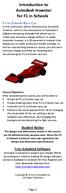 Introduction to Autodesk Inventor for F1 in Schools F1 in Schools Race Car In this course you will be introduced to Autodesk Inventor, which is the centerpiece of Autodesk s digital prototyping strategy
A Study on M2M-based AR Multiple Objects Loading Technology using PPHT
 A Study on M2M-based AR Multiple Objects Loading Technology using PPHT Sungmo Jung, Seoksoo Kim * Department of Multimedia Hannam University 133, Ojeong-dong, Daedeok-gu, Daejeon-city Korea [email protected],
Year 9 set 1 Mathematics notes, to accompany the 9H book.
 Part 1: Year 9 set 1 Mathematics notes, to accompany the 9H book. equations 1. (p.1), 1.6 (p. 44), 4.6 (p.196) sequences 3. (p.115) Pupils use the Elmwood Press Essential Maths book by David Raymer (9H
Grade 7 & 8 Math Circles Circles, Circles, Circles March 19/20, 2013
 Faculty of Mathematics Waterloo, Ontario N2L 3G Introduction Grade 7 & 8 Math Circles Circles, Circles, Circles March 9/20, 203 The circle is a very important shape. In fact of all shapes, the circle is
Bildverarbeitung und Mustererkennung Image Processing and Pattern Recognition
 Bildverarbeitung und Mustererkennung Image Processing and Pattern Recognition 1. Image Pre-Processing - Pixel Brightness Transformation - Geometric Transformation - Image Denoising 1 1. Image Pre-Processing
Scan Conversion of Filled Primitives Rectangles Polygons. Many concepts are easy in continuous space - Difficult in discrete space
 [email protected] CSE 480/580 Lecture 7 Slide 1 2D Primitives I Point-plotting (Scan Conversion) Lines Circles Ellipses Scan Conversion of Filled Primitives Rectangles Polygons Clipping In graphics must
cos Newington College HSC Mathematics Ext 1 Trial Examination 2011 QUESTION ONE (12 Marks) (b) Find the exact value of if. 2 . 3
 1 QUESTION ONE (12 Marks) Marks (a) Find tan x e 1 2 cos dx x (b) Find the exact value of if. 2 (c) Solve 5 3 2x 1. 3 (d) If are the roots of the equation 2 find the value of. (e) Use the substitution
GEOMETRIC MENSURATION
 GEOMETRI MENSURTION Question 1 (**) 8 cm 6 cm θ 6 cm O The figure above shows a circular sector O, subtending an angle of θ radians at its centre O. The radius of the sector is 6 cm and the length of the
Automatic Building Facade Detection in Mobile Laser Scanner point Clouds
 Automatic Building Facade Detection in Mobile Laser Scanner point Clouds NALANI HETTI ARACHCHIGE 1 & HANS-GERD MAAS 1 Abstract: Mobile Laser Scanner (MLS) has been increasingly used in the modeling of
Composite Surfaces Tutorial
 Composite Surfaces Tutorial 4-1 Composite Surfaces Tutorial This tutorial will use the same model as the Materials & Loading Tutorial (with some modifications), to demonstrate how to perform a circular
Modelling, Extraction and Description of Intrinsic Cues of High Resolution Satellite Images: Independent Component Analysis based approaches
 Modelling, Extraction and Description of Intrinsic Cues of High Resolution Satellite Images: Independent Component Analysis based approaches PhD Thesis by Payam Birjandi Director: Prof. Mihai Datcu Problematic