
New Hampshire Requirements for Electric Service Connections
|
|
|
- Sydney Cole
- 10 years ago
- Views:
Transcription
1 New Hampshire Requirements for Electric Service Connections Revised June 2015

2 SAFETY FIRST The safety of customers, contractors, company employees, and the general public is the number one priority of providing electric service connections. This booklet has been prepared to establish standardized rules and regulations for the installation of electric service connections made within the areas served by Eversource (hereinafter referred to as the Company ). Any service not installed in accordance with the terms and conditions of this booklet will not be connected to the Company s system. Willful disregard of these rules and regulations will result in the service being disconnected. 2

3 TABLE OF CONTENTS Drawing # Page List of Company Offices NH Public Utilities Commission Map of Area Served by the Company 6 7 List of Municipalities Partially or Wholly Served by the Company 8,9 DTRs (Distribution Standards) and Construction Requirements Service and Meter Socket Locations 10 Overhead Services Minimum Clearances Overhead Service Entrance Temp/Perm 1ph Service mounted on pedestal Single and Multiple Mobile Home Overhead Trimming Clearances Underground Cable Installation Temporary/Permanent Service Services in Conduit Mobile Home Pedestal Installation Secondary Cable Enclosure Installation Secondary and Service Risers Cable Riser Standoff Bracket Installation Pad Mounted Equipment Location to Building Transformers Location and Mechanical Protection Environmental Considerations Oil Detention for Pad Mounted Transformers Requirements for Pad Mounted Transformer Slabs Equipment Grounding Grid 1Ø Transformer Foundation Detail 3Ø Transformer Slab Detail 75 to 500 kva, 15 kv 3Ø Transformer Slab Detail 75 to 2500 kva, 34 kv PSNH Concrete Pull Box Single and Three Phase Sector Cabinet Foundation Partial List of Pre-cast Suppliers , ,

4 TABLE OF CONTENTS Section 1 - General Information Drawing # Page Articles Section 2 - Service Voltages Low Voltage Service - Articles High Voltage Service - Articles Section 3 - Metering General - Articles Meter Mounting Devices - Company Owned - Articles Meter Mounting Devices - Customer Owned - Articles Meter Mounting Devices - Installation - Articles Sealing of Metering Equipment - Articles Locations - Articles Single Phase Installations Article Three Phase Installations - Articles Transformer Rated Installations Articles Section 4 - Overhead Service Low Voltage Service - Articles High Voltage Service - Articles Section 5 - Underground Service Definitions - Articles General - Articles Underground Electric Distribution Facilities - Articles Underground Secondary Service From Underground Secondary Network - Article Underground Service From Underground Primary Network - Articles Underground Service From Company OverheadLines - Article Section 6 - Grounding Articles Section 7 - Utilization Equipment Specifications General - Article Motor/Motor Driven Equipment IIncluding Air Conditioning Equipment Articles Voltage Sensitive Equipment - Article

5 TABLE OF CONTENTS Drawing # Page Section 8 - Radio and Television Equipment - Articles Section 9 - Generating Equipment Owned By Customers General - Article Standby Generating Equipment - Articles Conjunctional Generating Equipment - Article Qualifying Co-generators, Qualifying Small Power Producers, and Limited Electrical Energy Producers- Articles Section 10 - Water Heating General - Article Uncontrolled Water Heating - Article Rate LCS Water Heating (Radio Controlled Option) - Article Plumbing for Water Heaters - Article Section 11 - Space Heating General - Article Rate LCS Space Heating (Radio Controlled Option) - Article Meter Standards Overhead Single Meter - Outdoor 04-3-G-1 67 Overhead Double Vertical 04-3-G-2 68 Overhead Double Horizontal 04-3-G-3 69 Uncontrolled Water Heater 04-3-G Socket amp 3 Phase 4 Wire Wye 04-3-G-26B 71 Water Heating Non-Simultaneous 04-3-G HeatSmart Typical Direct Metered Installation 3-G HeatSmart PIP-Socket Extender Wiring 3-G Water Heater Typical Plumbing 04-3-G Underground Service Double Meter Vertical 04-3-G-8 76 Important Information for Builders and Contractors 77 5

6 To initiate work requests or for information regarding electrical service requirements, please contact: Eversource NH Construction Services Support Center Mon- Fri 7am- 5pm Bedford Area Work Center 12 Bellemore Drive, Bedford NH Berlin Area Work Center 68 Jericho Road, Berlin NH Chocorua Area Work Center 169 White Mountain Hwy, Tamworth, NH Derry Area Work Center 16 A Street, Derry NH Epping Area Work Center 265 Calef Highway, Epping NH Hooksett Area Work Center 8 Eastpoint Drive, Hooksett NH Keene Area Work Center 19 Production Avenue, Keene NH Lancaster Area Work Center 425 Main Street, Lancaster NH Milford Area Work Center 138 Elm Street, Milford NH Nashua Area Work Center 370 Amherst Street, Nashua NH Newport Area Work Center 280 Sunapee Street, Newport NH Portsmouth Area Work Center 1700 Lafayette Road, Portsmouth NH Rochester Area Work Center 74 Old Dover Rd, Rochester NH Tilton Area Work Center 64 Business Park Drive, Tilton NH Questions or Concerns not adequately addressed by the Company may be directed to: New Hampshire Public Utilities Commission

7 7

8 TOWN Municipalities partially or wholly served by Eversource NH Eversource Area Work Center TOWN Eversource Area Work Center TOWN Albany Chocurua Chichester* Tilton Gilmanton* Tilton Alexandria* Tilton Claremont* Newport Gilsum Keene Allenstown* Hookett Clarksville* Lancaster Goffstown Bedford Alstead* Keene Colebrook* Lancaster Gorham Berlin Eversource Area Work Center Alton* Rochester, Tilton Columbia* Lancaster Goshen* Newport Bedford, Milford, Amherst Nashua Concord* Bedford, Tilton Grafton* Tilton Andover* Tilton Contoocook* Bedford Grantham Newport Antrim Keene Conway* Chocurua Greenfield Keene Atkinson* Derry Cornish* Newport Greenland* Portsmouth Auburn* Derry, Hookett Croydon* Newport Green's Grant Berlin Barnstead* Tilton Dalton Lancaster Greenville Milford Barrington Epping, Rochester Danbury* Tilton Hampstead* Derry Bath* Tilton, Lancaster Danville* Derry Hampton* Portsmouth Bean's Grant Lancaster Deerfield* Hookett, Epping Hancock Keene Bedford Bedford, Milford Deering Bedford, Keene Hanover* Tilton Belmont* Tilton Derry* Derry Harrisville Keene Bennington Keene Dover Rochester Haverhill* Tilton Berlin Berlin Dublin Keene Hebron* Tilton Bethlehem* Lancaster Dummer Berlin Henniker Bedford, Keene Boscawen* Bedford, Tilton Dunbarton* Bedford Hill* Tilton Bow* Bedford Durham* Epping, Rochester Hillsborough Bedford, Keene Bradford Keene, Newport Easton* Lancaster Hinsdale Keene Brentwood* Epping Eaton* Chocurua Hollis Milford, Nashua Bridgewater* Tilton Effingham* Chocurua Hooksett Bedford, Hookett Bristol* Tilton Enfield* Newport Hopkinton* Bedford Brookfield* Rochester Epping* Epping Hudson Derry, Nashua Hookett, Epping, Brookline Milford, Nashua Epsom* Tilton Jaffrey Keene Cambridge Berlin Errol Berlin Jefferson Berlin, Lancaster Campton* Tilton Farmington* Rochester Keene Keene Candia* Hookett Fitzwilliam Keene Laconia* Tilton Canterbury* Tilton Francestown Bedford, Keene Lancaster Lancaster Carroll Lancaster Franconia Lancaster Landaff* Tilton Charlestown* Newport Franklin* Tilton Lee* Epping, Rochester Chatham Chocurua Freedom* Chocurua Lempster* Newport Chester* Derry, Epping Fremont* Epping Lisbon* Lancaster, Tilton Chesterfield Keene Gilford* Tilton Litchfield Derry, Hookett, Nashua * denotes municipalities are served by multiple utility companies. NOTE: Contact CSSC at for the names of other utilities providing service to municipalities partially served by Eversource NH. 8

9 Municipalities partially or wholly served by Eversource NH Eversource Area Eversource Area Eversource Area TOWN TOWN TOWN Work Center Work Center Work Center Littleton* Lancaster North Hampton* Portsmouth Stark Berlin, Lancaster Derry, Hookett, Londonderry* Northfield* Tilton Nashua Stewartstown* Lancaster Loudon* Tilton Northumberland Lancaster Stoddard Keene Lyman* Tilton Northwood* Epping Strafford Epping, Rochester Lyme* Tilton Nottingham* Epping Stratford Lancaster Lyndeboro Keene, Milford Orange* Tilton Stratham* Portsmouth Madbury Epping, Rochester Orford* Tilton Success Berlin Madison* Chocurua Ossipee* Chocurua Sugar Hill* Lancaster, Tilton Manchester Bedford, Hookett Pelham* Derry Sullivan Keene Marlborough Keene Pembroke Hookett Sunapee* Newport Marlow* Keene Peterborough Keene Surry* Keene Martin's Location Berlin Piermont* Tilton Sutton* Bedford, Newport Mason Milford Pinkham's Grant Berlin Swanzey Keene Meredith* Tilton Pittsburg* Lancaster Tamworth* Chocurua Bedford, Milford, Merrimack Temple Keene, Milford Nashua Pittsfield* Tilton Middleton Rochester Plainfield* Newport Thornton* Tilton Milan Berlin Plymouth* Tilton Tilton Tilton Milford Milford Portsmouth Portsmouth Troy Keene Millsfield Berlin Randolph Berlin Tuftonboro* Chocurua Milton Rochester Raymond* Epping, Hookett Unity* Newport Mont Vernon Milford Richmond Keene Wakefield* Rochester Nashua Nashua Rindge Keene Warner Bedford, Newport Nelson Keene Rochester Rochester Washington* Keene Bedford, Keene, New Boston Waterville* Chocurua Milford Rollinsford Rochester New Castle Portsmouth Roxbury Keene Weare Bedford New Durham* Rochester Rye Portsmouth Webster* Bedford Bedford, Newport, Wentworth's Salisbury* Berlin New Hampton* Tilton Tilton Location New Ipswich Keene, Milford Sanbornton* Tilton Westmoreland Keene New London Newport Sandown* Derry Whitefield Lancaster Newbury Newport Sandwich* Chocurua Wilmot* Newport, Tilton Newfields Epping Sharon Keene Wilton Milford Newington Portsmouth Shelburne Berlin Winchester Keene Newmarket Epping Somersworth Rochester Windham* Derry, Nashua Newport* Newport Springfield* Newport Windsor Keene * denotes municipalities are served by multiple utility companies. NOTE: Contact CSSC at for the names of other utilities providing service to municipalities partially served by Eversource NH. 9


10 Service Attachments and Meter Locations Please consult with an Eversource Technician prior to installing any meter socket to ensure acceptable placement on the structure. Acceptable Service Attachment Meter Socket Location Attachment to gable end of house, 12' to 25' above finish grade. Generally meter should be located on gable end, driveway side of house. No shrubs, debris, fences or other structures in 4' side x 3' deep x 6' high space. (Article 324) Unacceptable Article Over roof, not accessible by ladder Article Mast not strong enough or guyed. Article 325 -Meter on back of house Article Meter above 5 ft Article Attachment too high. DTR Conductors too close to window/door. Article Meter not accessible Article Meter Enclosed For more information: NH Construction Services Support Ctr [email protected] Monday - Friday 7 AM - 5 PM updated CSSC 06/22/

11 GENERAL This Standard specifies the clearance of services, 300 volts or less to ground. These clearances define the position of these conductors when they are at rest. For triplex and quadruplex cables which are not attached to buildings, refer to other pages in Section 04. The dimensions shown above are based on Rule 232 for vertical clearance, and Rule 234 for horizontal clearances and for clearances adjacent to buildings. CLEARANCE FROM COMMUNICATIONS CABLES Power company service drops, running above and parallel to communications service drops, shall have a minimum of 12 inches of clearance at any point in the span and at the building (in part, from the National Electrical Code 1996 edition Article (4)). 12 TO ATTACHMENT POINT NOTE 3 12 NOTE 4 16 OVER CULTIVATED FIELDS, PASTURES, ORCHARDS, ETC. 16 OVER ALL DRIVEWAYS NOTES 5 AND 6 12 SPACES ACCESSIBLE TO PEDESTRIANS ONLY NOTE 2 UNACCEPTABLE NOTE 8 12 OVER SIDEWALK 16 OVER STREETS AND HIGHWAYS 11 NOTE 7 12 NOTES 1 AND 2 FIGURE 1 Vertical clearances above all surfaces must be maintained with the conductor at its worst sag condition. See Section 32 TO PEDESTRIANS 5 AWAY FROM WALLS, WINDOWS AND PROJECTIONS NOTE 10 Notes 1. This clearance applies above flat roofs, balconies, and areas restricted to pedestrians only or to vehicles not exceeding 8 feet in height. Whenever possible, locate the service so that these service connections can be directly reached from a ladder placed securely on the ground. 2. Where the height of attachment at the building does not permit service drops to meet this value, the clearance may be reduced to 10 feet 6 inches. 3. The distance to the bottom of drip loops may be reduced to 10 feet 6 inches. 4. This clearance may be decreased to 3 feet 6 inches if the roof is NOT accessible to pedestrians by means of a doorway, ramp, window, stairway, or a permanently mounted ladder whose bottom rung is closer than 8 feet to the ground or other accessible surface. 5. This includes residential, commercial, and industrial driveways, parking lots, and other areas subject to truck traffic. 6. Where the height of attachment at the building does not permit service drops to meet this value, the clearance may be reduced to 12 feet 6 inches over residential driveways only. 7. The clearance of a service that is below the level of an area accessible to pedestrians must be maintained with the service conductor at 0 F, initial sag. See Section Service attachment located above building extension as shown in figure 1 is not acceptable because the service connections cannot be directly reached from a ladder placed securely on the ground. 9. Clearances shall conform to governmental requirements if the clearances are greater than those shown above (when crossing state highways in Massachusetts, for example). 10.Service conductors shall not be installed beneath openings through which material may be moved, nor shall they obstruct entrance to these openings (in part, from the National Electrical Code 1996 edition Article 230 9). ORIGINAL 7/5/90 APPROVED 9/17/99 MINIMUM CLEARANCES FOR SERVICES VOLTS TO GROUND BASED ON NESC RULES 232 AND 234 NORTHEAST UTILITIES DESIGN & APPLICATION STANDARD DTR

12 WEATHER HEAD MOUNTED ABOVE POINT (HOOK) OF ATTACHMENT HOUSE HOOK MAXIMUM BREAKING STRENGTH 1000 LBS 18 MIN NOTE 6 SERVICE MAST BRACKET MIN 12 0 ABOVE FINISHED GROUND LEVEL. NOTE 5 NEUTRAL LOOP LONGER THAN LIVE WIRES (MIN 12 0 ABOVE FINISHED GROUND LEVEL) CONNECTIONS MADE WITH H CONNECTORS AND PLASTIC COVERS ON LIVE WIRES SERVICE ENTRANCE CABLE WEATHERPROOF CONNECTOR NOTE 3 NOTE 1 FIGURE 1 NOTE 4 FIGURE 2 SPACER MALLEABLE STRAPS AND 4 MIN GALV. LAG IN STUD MAY BE SUBSTITUTED FOR MOUNTING CLAMPS AND BOLTS. STEEL STRAPS ARE NOT APPROVED. MOUNTING CLAMPS WITH BOLTS THROUGH STUD METER MOUNTING DEVICE 5 FROM FINISHED GRADE 6 MIN 5 0 METER MOUNTING DEVICE (LOCATION TO BE ACCEPTABLE TO THE COMPANY) TABLE showing the size of Galvanized Rigid support and the maximum Max Conduit Support distance in inches from the Loaded (Do Not Use roof to the conductor deadend Tension Aluminum Conduit) Conductor Lbs / 2 3 #4 & #2 Triplex /0 Triplex #2 Quadruplex /0 Quadruplex CUSTOMER RESPONSIBILITY 1. Furnish and install service mast, if required, adequate in strength to support service drop and sufficient height to meet minimum clearance (as shown in TABLE). 2. The meter mounting device shall be installed approximately 5 feet above the final grade except where specifically approved otherwise by the Company. It shall be plumb level and attached to the finished exterior of the building with rust resistant screws extending through the finish and into the sheathing. 3. Furnish and install service entrance cable from meter mounting device to service entrance switch box. 4. Furnish, install and connect NEC approved ground electrodes. 5. Equipment and installation must comply with the latest revision of the National Electrical Code and local codes. COMPANY RESPONSIBILITY 1. Furnish meter mounting device. 2. Furnish and install service entrance cable to meter mounting device (single phase service only 200 amps or less). Notes 1. Service attachment located above a building extension as shown in figure 1 is not acceptable because service connections cannot be directly reached from a ladder placed securely on the ground. 2. Consideration should be given to place service attachment high enough on the building to allow communication company attachment below it with the NESC required 12 inch separation. 3. Apply rubber silicone sealant to the weatherproof cable connector at top of meter. 4. Neutral loops shall be longer than the live conductor loops so that live wires part first under extreme tensions (figure 2). 5. The distance to the bottom of drip loops may be reduced to 10 6 if voltage is 300 volts or less to ground and 10 feet for 150 volts or less to ground. 6. See DTR for clearances beyond the house that shall be maintained in accordance with the NESC. ORIGINAL 7/25/94 APPROVED 8/4/05 NORTHEAST UTILITIES OVERHEAD SERVICE ENTRANCE 200 AMPS AND SMALLER CONSTRUCTION STANDARD DTR

13 METER MOUNTING DEVICE SERVICE ENTRANCE CABLE COMPANY POLE ELEVATION SERVICE DROP 2 x 12 PLANK 16 MIN 12 MIN ROAD 5 NEMA 3R ENCLOSED SWITCH BOX WEATHERPROOF RECEPTACLE WITH GROUND FAULT CIRCUIT INTERRUPTER FOR TEMPORARY SERVICE ONLY COMPANY RESPONSIBILITY 1. Furnish meter mounting device, for permanent services only. 2. Furnish and install meter service entrance cable to meter mounting devices. UPRIGHT 8 GROUND ELECTRODES CUSTOMER RESPONSIBILITY 1. Install meter mounting device with rust resistant screws on a 2 x 12 plank. 2. Provide NEMA 3R enclosed switch box below meter mounting device. 3. Furnish, install, and connect NEC approved ground electrodes. 4. Furnish and install service entrance cable from meter mounting device to switch box. 5. Equipment and installation must comply with the latest edition of the National Electrical Code, National Electrical Safety Code, and all local codes MINIMUM CUSTOMER RESPONSIBILITY for Permanent Service Only 1. Furnish and install treated upright no less than solid 6 x 6 or laminated from three 2 x 6 uprights set 4 in the ground suitably braced and sufficiently stable to support a person on a ladder and tall enough to provide the required 12 or 16 of clearance, (See elevation view) or a substitute acceptable by the Company. 2. Furnish and install 2 PVC conduit on upright if upright is suitable for climbing. CUSTOMER RESPONSIBILITY for Temporary Service Only 1. Furnish and install treated upright no less than 4 x 6 set 4 in the ground suitably braced and sufficiently stable to support a person on a ladder and tall enough to provide the required 12 or 16 of clearance (See elevation view), or a substitute acceptable by the Company. 2. Furnish and install meter mounting device, weatherproof receptacle with ground fault circuit interrupter below switch box. 3. Furnish, install, and connect NEC approved ground electrodes. ORIGINAL 7/25/94 APPROVED TEMPORARY OR PERMANENT SINGLE PHASE SERVICE MOUNTED ON METER PEDESTAL NORTHEAST UTILITIES CONSTRUCTION STANDARD DTR

14 APPLY RUBBER SILICONE SEALANT PRIVATELY OWNED POLE (NOT PSNH) SERVICE ENTRANCE CABLE METER MOUNTING DEVICE METER MOUNTING DEVICES BACKGROUND 3 / 4 EXTERIOR GRADE PLYWOOD 2 x 12 PLANK EXTERIOR GRADE 5 5 NEMA 3R SERVICE ENTRANCE SWITCH BOXES FOUR WIRE CABLE TO MOBILE HOME FOUR WIRE CABLES TO MOBILE HOMES TREATED UPRIGHTS 4 MIN 8 GROUND ELECTRODES 4 MIN 8 GROUND ELECTRODES 2 5 MIN 12 6 MIN 12 6 MIN COMPANY POLE 24 ± IF UPRIGHT IS MORE THAN 50 FROM POLE, GUY OR BRACE TO BE FURNISHED AND INSTALLED BY CUSTOMER. 16 MIN ROAD ELEVATION 12 MIN COMPANY RESPONSIBILITY 1. Furnish meter mounting device. 2. Furnish and install meter service entrance cable to meter mounting devices. CUSTOMER RESPONSIBILITY 1. Furnish and install treated upright no less than solid 6 x 6 or laminated from three 2 x 6 uprights set 4 feet in the ground suitably braced and sufficiently stable to support a person on a ladder and tall enough to provide the required 12 feet or 16 feet of clearance (see elevation view). Any substitute shall be acceptable to the Company. 2. Install meter mounting device with rust resistant screws on a 2 x 12 plank or 3 / 4 inch exterior grade plywood as shown above. 3. Furnish and install 2 inch PVC conduit on upright if upright is suitable for climbing. 4. Furnish, install, and connect NEC approved ground electrodes. 5. Furnish and install service entrance cable from meter mounting device to switch box(es). 6. Furnish and install NEMA 3R switch boxes with overcurrent devices. 7. Equipment and installation shall comply with the latest edition of the National Electrical Code, National Electrical Safety Code, and all local codes. ORIGINAL 7/25/94 APPROVED 8/4/05 OVERHEAD SERVICE SINGLE AND MULTIPLE MOBILE HOME 200 AMPS AND SMALLER NORTHEAST UTILITIES CONSTRUCTION STANDARD DTR

15 SINGLE PHASE THREE PHASE Notes 1. Overhead Primary ( kv) Conductors See single phase and three phase figures. Minimum ten feet clearance to the nearest primary conductor. Species recognized as fast growing and/or structurally weak are to be removed; examples include red maple, ash, white pine, cherry, silver maple, poplar, birch and willow. All other trees and limbs are to be trimmed back to suitable laterals consistent with approved arboricultural practices. 2. Hazardous Trees Trees and/or limbs up to 16 inches diameter at breast height outside or inside the specified trim zone shall be removed when deemed structurally weak and likely to be a risk to the electrical system. 3. Secondary And Service Wire Conductors Vegetation shall be trimmed if necessary to prevent hard rubbing and chafing which could lead to wear and failure of the conductors. 4. Inspections An inspection of proper trimming clearances will be made by a PSNH representative. New services will not be installed or energized unless properly cleared of vegetation. ORIGINAL 10/21/03 APPROVED 7/22/14 VEGETATION CLEARING SPECIFICATION FOR NEW SERVICES NORTHEAST UTILITIES DESIGN & APPLICATION STANDARD DTR

16 FINISHED GRADE CAUTION TAPE 12 OTHER UTILITIES D 12 CONDUIT (SEE NOTE 8 FOR SIZE) FUEL OR WATER LINE 18 MIN IN ALL DIRECTIONS D = 36 inches for primary voltage cable 30 inches for secondary cables Notes 1. All non metallic conduit and fittings shall be electrical grade, Schedule 40 PVC, and shall conform to the applicable sections of NEMA TC and be UL Listed. Only gray colored conduit will be accepted. Any PVC conduit not having the proper NEMA and UL markings will not be accepted. All steel conduits shall conform to ASTM A120 and be rigid galvanized steel. All PVC conduit joints must be cemented. Steel fittings shall be sealed with compound. 2. All 90 degree sweeps will be made using rigid galvanized steel with a minimum radius of 24 inches for three inch, 36 inches for four and five inch, and 48 inches for six inch conduit. All steel sweeps within eighteen inches of surface shall be properly grounded. 3. A ten foot horizonal sections of rigid galvanized steel conduit will be required at each sweep for primary. For secondary and services a ten foot horizontal section if schedule 40 as per ANSI/NEMA TC The conduit should cross paved areas at approximately 90 degrees. 5. Backfill may be made with excavated material or comparable, unless material is deemed unsuitable by PSNH. Backfill shall be free of frozen lumps, rocks, debris, and rubbish. Organic material shall not be used as backfill. Backfill shall be thoroughly compacted in six inch layers. 6. A suitable pulling string, capable of 200 pounds of pull, must be installed in the conduit before PSNH is notified to install cable. The string should be blown into the conduit after the run is assembled to avoid bonding the string to the conduit. 7. Routing of the conduit and inspection prior to backfill will be provided by PSNH. Installation of the conduit will be done by the contractor. The PSNH supervisor must be notified two business days prior to backfilling the trench. In the event that a cable cannot be successfully pulled through the completed conduit system due to a construction error, it will be the contractor s responsibility to locate and repair the involved conduit. The contractor will be responsible for all resulting expenses. 8. Normal conduit sizes for PSNH are three inch for single phase primary and secondary voltage cables, four inch for three phase secondary, and five inch for three phase primary. 9. All conduit installations must conform to the current edition of the National Electric Safety Code, state and local codes and ordinances, and where applicable, the National Electric Code. ORIGINAL 04/10/06 APPROVED 4/9/12 PRIMARY/SECONDARY CABLE INSTALLATION NORTHEAST UTILITIES CONSTRUCTION STANDARD DTR

17 1/2 : 1 PERMANENT METER BOX GROUND WIRE BY CUSTOMER URD CABLE, WRAPPED IN TRANSPARENT PVC COVER SC TEMPORARY METER BOX CUSTOMER RESPONSIBILITY SWITCH BOX GFI OUTLET TEMPORARY PLYWOOD SUPPORT 60 EXPANSION FITTING TEMPORARY 2 x 6 36 FOUNDATION FINISHED GRADE 12 GROUND ELECTRODES 6 MIN 30 CAUTION TAPE CUSTOMER RESPONSIBILITY 1. The meter mounting device shall be installed approximately 5 feet above the final grade except where specifically approved otherwise by the Company. It shall be plumb level and attached to the finished exterior of the building with rust resistant screws extending through the finish and into the sheathing. 2. Furnish, install, and connect NEC approved ground electrodes. 3. Furnish and install service entrance cable from meter mounting device to switch box. 4. Furnish and install Schedule 40 PVC conduit except as noted. Install caution tape 12 inches below grade. Provide a rigid steel elbow. 5. Equipment and installation must comply with the latest edition of the National Electrical Code (NEC) and all local codes. Expansion joint in conduit shall comply with NEC 300 7(b). 6. For services in excess of 200 feet servicing homes larger than 3,000 square feet, parallel 3 inch conduits shall be installed to a below ground service enclosure located no more than 10 feet from the meter mounting device. A single 3 inch conduit from the service enclosure to the meter mounting device is sufficient, see DTR For services with any elevation change, PSNH may require a service enclosure located no more than ten feet from meter mounting device. COMPANY RESPONSIBILITY 1. Furnish meter mounting device (permanent service only). Furnish caution tape. 2. Furnish and install cable and meter. 3. Attach 2 1 / 2 x 2 1 / 2 adhesive backed signs: WARNING, UNDERGROUND CABLE and 3 x 5 ELECTRIC SERVICE IN CONDUIT. See MAT L Attach lettering to identify the source. See DTR Section 43. ORIGINAL 10/21/03 APPROVED 4/7/11 3 CONDUIT TEMPORARY/PERMANENT UNDERGROUND SERVICE 400 AMP & BELOW NORTHEAST UTILITIES CONSTRUCTION STANDARD DTR

18 Page 1 of 2 SERVICE TRENCH By Customer The trench shall be in as direct a line as possible without reverse bends from the distribution facility to the customer service entrance. In order to minimize cable pulling forces, no more than two bends (not including riser at house or pole) exceeding a total combined change of 45 degrees shall be permitted. 1. Trench shall be of such depth to accommodate 30 inches minimum cover for service cables in conduit. 2. In order to prevent the conduit from being pulled out of the meter box, conduit shall be installed on virgin or well tamped soil. Trench bottom shall be undisturbed or relatively smooth earth, well tamped, and free of any debris that may be detrimental to the conduit. 3. Conduit in the trench should have a 4 inch per 100 feet downward pitch toward the distribution facility, if physically possible. (This provides drainage away from the service entrance, and prevents stagnant water in the duct.) 4. Backfill shall not contain frozen material or stones larger than 2 inches in maximum dimension. Care shall be exercised to avoid damage to conduit during backfilling. Backfill shall be compacted, and shall be completed before the Company schedules cable installation. 5. When required, coordination with telephone, cable TV, or other utilities is the Customer s responsibility. CONDUIT By Customer Standard conduit shall be minimum 3 inch diameter, rigid PVC, heavy wall, sunlight resistant (6 percent 7 percent titanium dioxide by weight), Schedule 40 as per ANSI/NEMA TC All 90 degree sweeps will be made using rigid galvanized steel with a minimum radius of 24 inches for three inch, 36 inches for four inch, and 48 inches for five inch. 2. Conduit should cross paved areas at approximately 90 degrees. 3. A 1 / 4 inch diameter nylon pull rope, including 10 feet of slack, shall be installed in the conduit. Secure the pull line to a plastic conduit plug (e.g., SC for 3 inch diameter), at each end of the conduit run. Plugged ends of the conduit shall be left accessible. SERVICE FROM POLE If service is from an overhead system, a grounded 90 degree galvanized steel bend shall be installed at the pole. See DTR SERVICE FROM HANDHOLE/TRANSFORMER Extend conduit to distribution facility and mate to previously installed 10 foot conduit stub. Tie pull lines, slide conduit sleeve over both ends and secure with conduit cement. See DTR CAUTION Customer shall not enter any Company structure because it could be energized. LIMITATIONS In the event that a cable cannot be successfully pulled through the completed conduit system due to construction, it will be the contractors responsibility to locate and repair the involved conduit. The contractor will be responsible for all resulting expenses. COMPANY CONSIDERATIONS Services in conduit shall be identified at the transformer or handhole with a brass SVC IN CNDT tag. To aid troubleshooting, conduit service shall be clearly designated on mapping records. ORIGINAL 12/6/12 APPROVED SERVICES IN CONDUIT 600 VOLT AND BELOW NORTHEAST UTILITIES DESIGN & APPLICATION STANDARD DTR

19 Page 2 of 2 NOTE 1 NOTE 2 NOTE 3 SLIP JOINT FOR EXPANSION CAUTION TAPE GROUND RODS 6 MINIMUM Notes 1. Set meter socket plumb (by Customer). 2. Attach 2 1 / 2 x 2 1 / 2 adhesive backed signs: WARNING, UNDERGROUND CABLE and 3 x 5 ELECTRIC SERVICE IN CONDUIT. See SPC s L and L Attach lettering to identify the source. See DTR and DTR Note Furnish standard meter mounting device (permanent service only). Furnish caution tape. ORIGINAL 12/6/12 APPROVED SERVICES IN CONDUIT 600 VOLT AND BELOW NORTHEAST UTILITIES DESIGN & APPLICATION STANDARD DTR

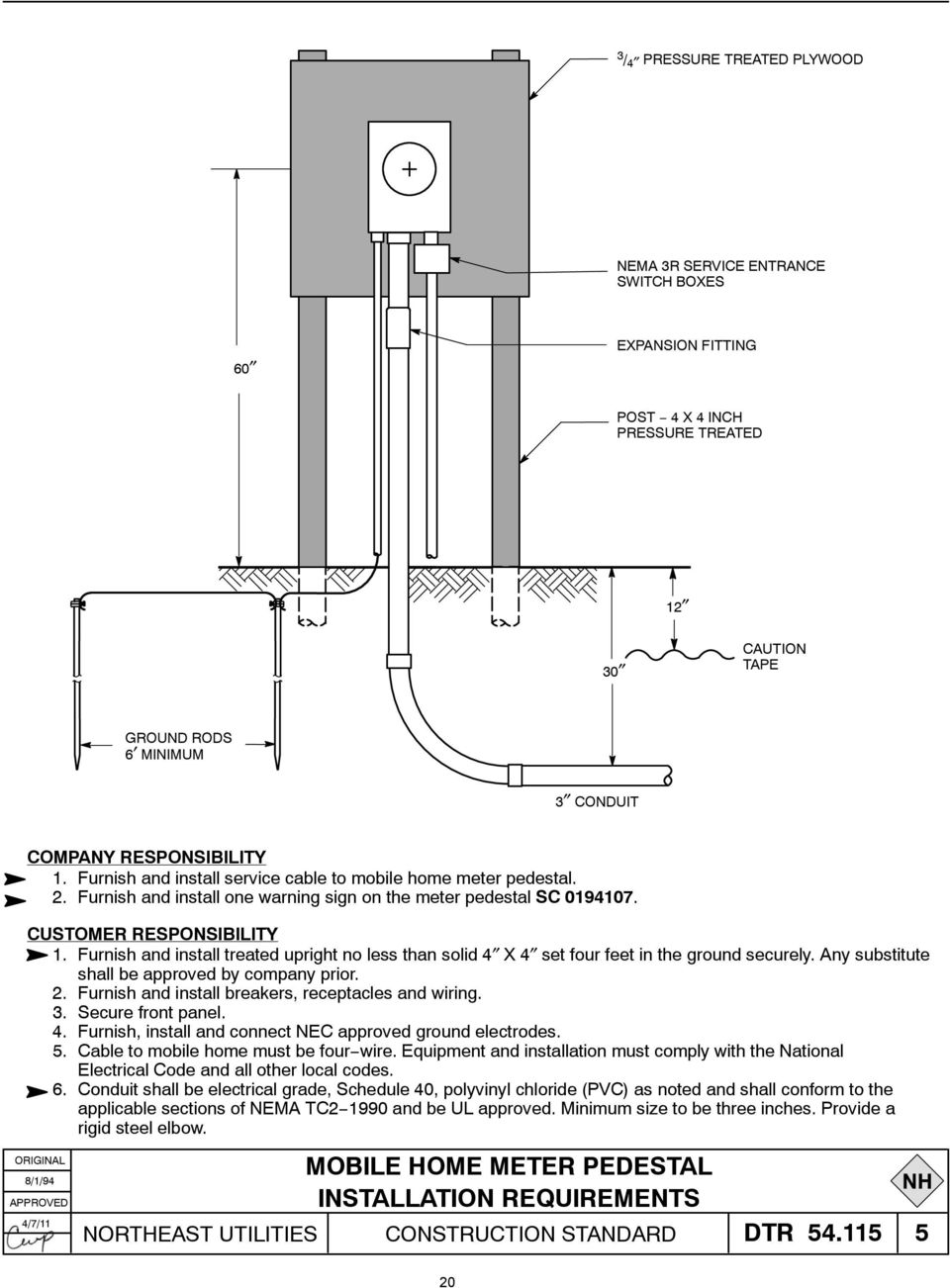
20 3 / 4 PRESSURE TREATED PLYWOOD NEMA 3R SERVICE ENTRANCE SWITCH BOXES 60 EXPANSION FITTING POST 4 X 4 INCH PRESSURE TREATED CAUTION TAPE GROUND RODS 6 MINIMUM 3 CONDUIT COMPANY RESPONSIBILITY 1. Furnish and install service cable to mobile home meter pedestal. 2. Furnish and install one warning sign on the meter pedestal SC CUSTOMER RESPONSIBILITY 1. Furnish and install treated upright no less than solid 4 X 4 set four feet in the ground securely. Any substitute shall be approved by company prior. 2. Furnish and install breakers, receptacles and wiring. 3. Secure front panel. 4. Furnish, install and connect NEC approved ground electrodes. 5. Cable to mobile home must be four wire. Equipment and installation must comply with the National Electrical Code and all other local codes. 6. Conduit shall be electrical grade, Schedule 40, polyvinyl chloride (PVC) as noted and shall conform to the applicable sections of NEMA TC and be UL approved. Minimum size to be three inches. Provide a rigid steel elbow. ORIGINAL 8/1/94 APPROVED 4/7/11 NORTHEAST UTILITIES MOBILE HOME METER PEDESTAL INSTALLATION REQUIREMENTS CONSTRUCTION STANDARD DTR
21 ABOVE GROUND PEDESTAL 4 6 ABOVE GRADE SC SWEEP 3 24 TO 36 RADIUS 30 NOTE 2 BELOW GROUND ENCLOSURE SC MIN NOTE 2 Notes 1. All PVC conduit shall be UL approved, gray in color, and at least Schedule 40 electrical grade that meets NEMA TC requirements. Rigid galvanized steel conduit may also be used. CAUTION: See NOTE 2 Galvanized Sweep Elbows. 2. All sweep elbows shall be galvanized steel type approved for electrical cables and have approved sealing compound applied to threaded coupling. 3. Temporary approved conduit end caps shall be placed on the exposed ends of conduit. Necessary measures shall be taken to prevent water, sand, and other objects from entering the conduit during and after construction. After construction is complete, seal conduits using proper methods (one method is expanding polyurethane foam sealant). 4. A suitable pulling string, capable of 200 pounds of pull, shall be installed in the conduit system. Avoid bonding the string to the conduit with the fresh PVC cement. 5. A sweep elbow and a 10 foot section of conduit, with a watertight end cap, shall be installed for all known future load to be fed from an enclosure. 6. Remove all organic topsoil under enclosure and compact native material. Backfill, if necessary, with clean, well compacted gravel. 7. Watertight, URD service entrance multiple outlet connectors shall be used in the below ground enclosure. 8. On below ground enclosure, bring both conduits in at one end. This will allow the secondaries to be installed lengthwise in the enclosure so that working slack is available. ORIGINAL 9/19/94 APPROVED 4/7/11 NORTHEAST UTILITIES TYPICAL SECONDARY CABLE ENCLOSURE INSTALLATION CONSTRUCTION STANDARD DTR
22 See DSEM Section for trench specifications CABLE GRIP ATTACHMENT NOTE 2 SECONDARY OR NEUTRAL ATTACHMENT 2 NOTE 1 SCHEDULE 40 PVC 36 MAX WARNING SIGN SCHEDULE 80 PVC NOTE 4 6 RISER POLE FINISHED GRADE A A SEE DTR CURB/EDGE OF ROADWAY 90 STEEL BEND (ELBOW) 4 MIN GROUND CLAMP #6 OR #4 COPPER WIRE TRAFFIC FLOW A A GROUND ROD NOTE 3 MINIMUM 12 Notes 1. Top of conduit to extend at least 2 inches above the neutral/secondary attachment. 2. Seal conduit from water entry at top of riser for services installed in conduit for the entire run. See DTR Steel conduit shall be grounded. If the steel elbow is installed in a nonmetallic conduit installation, it shall also be grounded. Use 5/ 8 x 8 galvanized steel ground rod and ground clamp. 4. Preferred location for riser placement is on field side of pole opposite the direction of traffic. Check riser path for obstructions, and coordinate with other utilities for placement of risers and any equipment. (Road side of pole opposite the direction of traffic is reserved for road crossings.) 5. Contact the toll free telephone number to locate buried cables before driving ground rods. ORIGINAL 11/23/76 APPROVED 3/18/13 SECONDARY AND SERVICE RISERS 600 VOLT CABLE NORTHEAST UTILITIES CONSTRUCTION STANDARD DTR
23 2 2 SECONDARY OR NEUTRAL ATTACHMENT RISER POLE NOTE 1 SEE DTR CURB/EDGE OF ROADWAY TRAFFIC FLOW A A 8 MIN FINISHED GRADE 18 MIN TYPICAL CONDUIT STANDOFF BRACKET INSTALLATIONS Notes 1. Install the intermediate standoff bracket equidistant from the upper and lower brackets. 2. Whenever possible install electrical facilities nearest to the pole. 3. Preferred location for riser placement is on field side of pole opposite the direction of traffic. Check riser path for obstructions, and coordinate with other utilities for placement of risers and any equipment. (Road side of pole opposite the direction of traffic is reserved for road crossings.) ORIGINAL 8/16/94 APPROVED 7/13/11 CABLE RISER STANDOFF BRACKET INSTALLATION NORTHEAST UTILITIES CONSTRUCTION STANDARD DTR
24 3 NOTE 1 5 BUILDING TRANSFORMER 3 5 MAX È È È È È È È È È È È È È È È È È È È È È È ÈÈÈÈÈÈÈÈÈÈÈÈÈÈÈÈÈÈÈÈÈÈÈÈÈÈ ÈÈÈÈÈÈÈÈÈÈÈÈÈÈÈÈÈÈÈÈÈÈÈÈÈÈ CURB NOTE 2 10 FRONT BOUNDARY OF CLEAR AREA NOTE 1 TRAVELED WAY CONCRETE PAD PROTECTIVE VEHICLE POSTS IF REQUIRED Notes 1. To inspect, provide access, operate elbow connectors and ventilate the transformer, the above specified clear area distances to buildings or shrubs shall be maintained. The distance from the building is to the concrete transformer pad. Property line shall be considered an obstruction, since fences, shrubs, etc. may be installed at a future date by adjacent property owners. Because of the possibility of cooling fins overhanging the pad, side clearances to be increased to 5 feet for transformers 1000 kva and larger. 2. If no curb exists, or transformer is located closer than 10 feet to the traveled way, protective vehicle posts ( ) shall be installed as specified in DTR Top of transformer pad shall be installed 3 inches above final grade. 4. Transformer shall not be located on steep grades where access to or elbow operation is made difficult. 5. Transformer shall meet the minimum distances to doors, windows, fire escapes, air intakes and walls as specified in DTR Transformer is not to be located with its doors facing the building. 7. Refer to DTR for specific instructions on the installation of the transformer pad. 8. Refer to DSEM Section and DTR (NH) for information on environmental considerations. ORIGINAL 4/10/91 APPROVED 7/8/10 PAD MOUNTED TRANSFORMERS LOCATION TO BUILDINGS AND ROADWAYS NORTHEAST UTILITIES CONSTRUCTION STANDARD DTR
25 GENERAL Pad mounted oil insulated equipment (such as transformers, transclosures, switches, etc) should be installed so as to be accessible, not constitute an environmental hazard or a fire hazard, and be protected from damage. In URD areas transformers installed at residential front lot lines are not subject to the requirements of this Standard, refer to DTR LOCATION The pad mounted equipment should be installed at a location where permanent access will be assured for future operation and maintenance as well as to permit installation, replacement and removal of the equipment by means of a winch truck with the boom up. Where noise may be a problem, careful consideration should be given when selecting a location. Areas subject to flooding should be avoided, as should other environmentally sensitive areas noted in DSEM Section The building owner s and/or tenant s fire insurance carrier may restrict the proximity of the equipment to doors, windows or combustible materials and such requirements are the responsibility of the customer subject to the requirements of Northeast Utilities. In the absence of other requirements, the equipment shall be located with the following minimum clearances from various building facilities. The distances mentioned in this section shall not supersede any local ordinance or code which requires greater clearances. Minimum Distance In Front of To Side of Below Item In Feet In Feet In Feet Door Air intake Window Fire escape Combustible wall 6 6 Noncombustible wall 5 3 Fuel tanks (above and below grade) Natural gas or propane connections CT/MA 3 3 NH Gasoline dispensing unit OIL SUMP If the surrounding grade pitches toward critical areas, it is recommended that an oil sump be provided. This should consist of 3/4 inch trap rock fill under and around the equipment pad adequate to contain the quantity of oil in the equipment to be installed at the given location. ADDITIONAL FIRE PROTECTION If the building owner s and/or tenant s combustible facilities adjacent to the equipment require fire protection beyond that provided by oil sump, it shall be their responsibility to provide such protection in the form of space separation, fire resistant barriers, automatic spray systems, other oil containment facilities, or other means approved by their fire insurance company. EQUIPMENT PROTECTION Where pad mounted equipment would be exposed to possible damage by vehicular traffic, protective bumpers are to be installed on exposed sides. Galvanized steel pipes 4 inch minimum diameter filled with concrete, I beams 5 inch minimum, or other suitable means of protection may be used as bumpers. Such pipes or I beams shall extend 42 inch minimum both above and below grade. Heavier bumpers set deeper should be considered where exposed to heavy trucks. Bumpers should be 10 foot minimum from the operating side of concrete pad and on the other sides 36 inch minimum from equipment or pad, whichever projects farther. The maximum spacing between bumpers on exposed sides should be 60 inches. EQUIPMENT LOCKS Any equipment, with provisions for locking, that is left on site and is accessible to the general public, shall be padlocked. This includes installations that are not complete and not energized. Completed pad mount transformer installations shall meet TAMPERPROOF EQUIPMENT LOCK requirements, DTR ORIGINAL 12/6/73 APPROVED 1/25/02 NORTHEAST UTILITIES PAD MOUNTED OIL INSULATED EQUIPMENT LOCATION AND MECHANICAL PROTECTION DESIGN & APPLICATION STANDARD DTR
26 Overhead Design Section Environmental Considerations ENVIRONMENTAL CONSIDERATIONS Permits Prior to the start of construction, all necessary environmental permits, whether federal, state and/or local should be secured. It should be noted that jurisdiction over utility company activities varies within each state, and exemptions may exist for some utility maintenance activities. Where environmental considerations exist, our policy is typically to notify and consult with local agencies regarding significant maintenance activities, even in cases where we do not have a legal requirement to do so. Work in areas where the following issues exist will usually draw public attention, and may require permits: Coastal zone Inland wetlands Tidal wetlands Water bodies (rivers, lakes, streams, ponds, etc.) Scenic roads (these are state designated) Historic districts Tree trimming/removal Cultural/archaeological sites. Specific issues for each project should be addressed with the appropriate Regional/Zone Environmental Coordinator. Placement of Oil filled Distribution Equipment Oil filled equipment must be placed in the best possible environmental location, considering the potential for oil spills and the effect on the environment, and avoiding sensitive sites whenever feasible. Sensitive sites include hospitals, schools, food preparation centers, agricultural areas, inland wetlands and water bodies, etc. For pad mounted transformers, refer to DTR Section 42 for more information. The locating of oil filled equipment should consider: Waterways (e.g., adjacent to a stream, catch basin); public health (e.g., school yard); vandalism potential (e.g., location); and damage potential (e.g., sharp curve, large trees, etc.). Where the placement of the oil filled equipment is questionable, consult the appropriate Regional/Zone Environmental Coordinator. The following guidelines are recommended, where possible, to avoid placement of oil filled equipment in the vicinity of water resources: 200 feet from rivers/perennial streams/bodies of water/inland and tidal wetlands 400 feet from public drinking water supply. Asbestos Precautions Projects involving removal and disposal of asbestos containing duct or cable require that sufficient precautions be taken to prevent the asbestos from becoming friable (crumbling). This might be a concern on projects requiring duct or riser repair/replacement or cable replacements (e.g., Orangeberg, Transite, Parkway, etc.). For further information refer to the Environmental Coordinators Manual, or contact the Environmental, Health and Safety Department. Northeast Utilities May 2001 Distribution System Engineering Manual 26
27 3/8 : 1 TRANSFORMER SLAB (90 x 96 ) 3 / 4 STONE FILLED TRENCH SURROUNDING TRANSFORMER SLAB (SEE TABLE BELOW FOR WIDTH) STONE FILLED MOAT FINISHED GRADE TRANSFORMER SLAB CLAY MATERIAL Notes To calculate dimension of the stone filled moat: 1. Convert gallons of oil in the transformer to cubic feet: Divide gallons by 7.48 to get cubic feet of oil. 2. Divide this number by 0.35 to determine the volume of stone filled moat required. 3. From the table below select the width necessary to contain the oil. 4. In environmentally sensitive areas, seal all conduits. See DTR Refer to DSEM Section for when an oil detention moat should be used. Volume in Cubic Feet of 24 Deep Stone Filled Moat Width of Moat (Feet) Slab Dimensions in Inches 66 x x x ORIGINAL 8/5/03 APPROVED 7/8/10 OIL DETENTION FOR PAD MOUNTED TRANSFORMERS NORTHEAST UTILITIES CONSTRUCTION STANDARD DTR
28 28
29 GROUND ROD NEC APPROVED CONNECTOR 12 CONCRETE SLAB OR SECTOR FOUNDATION 12 CABLE COMPARTMENT 8 SLACK LEADS SHALL BE IN 1 PVC CONDUIT SLEEVE IF BROUGHT THROUGH CONCRETE. #2 BARE STRANDED COPPER GROUND GRID 24 NEC APPROVED CONNECTOR GROUND ROD CUSTOMER RESPONSIBILITY The ground grid shall be supplied and installed by the customer and is to be buried at least 12 inches below grade. Eight feet of extra wire for each ground grid leg shall be left exposed in the cable compartment to allow for the connection to the transformer. The two 8 foot ground rods may be either galvanized steel or copperweld and they shall be connected to the grid with NEC approved connectors. ORIGINAL 2/4/94 APPROVED 8/4/05 PAD MOUNT EQUIPMENT GROUNDING GRID NORTHEAST UTILITIES CONSTRUCTION STANDARD DTR
30 30
31 31
32 32
33 33
34 34
35 Pre-cast Concrete Suppliers Partial List The following is a partial list of suppliers of pre-cast concrete products in the State of New Hampshire. This is not intended to be a comprehensive list and Eversource is in no way recommending any particular supplier. Central NH Concrete Corp. Route 114, Henniker (603) Concrete Systems Inc. 14 Park Ave., Hudson (603) Andrew J. Foss, Inc. Watson Corner Rd., Farmington (603) Gilbert Block Co. Inc. Province Rd., Laconia (603) Michie Corp. PO Box 870, Henniker (603) Phoenix Precast Products 77 Regional Dr., Concord Any changes to this list must be reviewed and approved by the Supervisor- Construction Services Support Center Rev. 01/15/14 35
36 SECTION 1 - General Information Article These requirements have been developed to ensure reliable and adequate service to the user of electricity and to improve communication and coordination between Customers, Contractors, Architects, Engineers, Civic Planning Groups, and the Company. These requirements supplement the Company s Tariff as filed from time to time with the New Hampshire Public Utilities Commission and contain the most recent revisions (at the time of publishing) to the Company s Construction and Meter Standards The character of electric service made available in accordance with rate provisions will differ to some extent from one location to another on the Company s system. Customers, Contractors, Architects, Engineers, and Civic Planning Groups should therefore determine from the Company the types of service available for any new installation and for any existing installation which is to be enlarged or modified It is impractical to attempt to cover in a booklet of this type all Company approved Standards or all of the conditions and problems which may be encountered in various installations. Accordingly, Customers, Contractors, Architects, Engineers, and Civic Planning Groups are urged to make use of the advisory services of the Company s New Service Technicians, and Account Executives without charge or obligation. Electric distribution system design services, after the initial design (i.e. redesign at a developer s or Customer s request or due to municipal requirements), and inspections after a failed inspection will be billed to the developer or Customer, unless the failed inspection was caused by PSNH s design With respect to Customer s wiring and electrical installations, no requirement, interpretation, or standard specified in this booklet is intended to supersede or conflict with the standards and regulations of the National Electrical Code (hereinafter referred to as the NEC), or with any state or municipal law, rule, or ordinance now in force or hereafter enacted or promulgated. The Company shall have no obligation to determine whether or not the Customer s wiring and electrical installations are proper and safe or comply with the NEC or any other code or regulation in effect at the Customer s location. However, if it should come to the Company s attention that the Customer s wiring and electrical installations are not proper and safe, or do not comply with such codes, the Company shall have the right to refuse or discontinue service. In all municipalities which require permits 36
37 SECTION 1 - General Information Article and/or certificates of inspection for electrical work, it shall be the responsibility of the Customer or Contractor to obtain such documents from the proper authorities and provide copies to the Company before electric service is provided Safe and adequate access shall be maintained to Company owned equipment located on a Customer s premises. The Company shall have free right at all reasonable times to enter the Customer s premises to enable the Company to install, read, inspect, repair, remove, replace, disconnect, or otherwise maintain its meters, equipment, facilities, and for all other proper purposes. The Customer, if a tenant, shall authorize and request his landlord to permit the Company to enter said premises. If safe and adequate access to the meter is not available for the Company s employees, the Company reserves the right to discontinue service upon proper notice. The Customer shall not permit access to the Company s meters, equipment, and facilities located on his premises by other than an authorized representative of the Company or of the New Hampshire Public Utilities Commission. In case of loss or damage to Company property on the Customer s premises due to Customer negligence, the Customer shall pay to the Company the value of such property or the cost of repairs All employees authorized by the Company to visit the Customer s premises are required to carry means of identification which will be shown upon request. The Company will be responsible for the actions and workmanship of such employees Should the use or operation of any equipment by a Customer including but not limited to electric motors, welders, electronic power supplies or speed controls, adversely affect the Company s ability to render adequate service to others, the Company reserves the right to discontinue service until suitable corrections are made by the Customer The Company reserves the right to install protective apparatus so arranged as to disconnect or limit service to the Customer if the Company s capability to render service at the point of delivery is exceeded The Company will make or cause to be made, application for any necessary street permits or licenses for its facilities, and will not be required to make electricity available on the premises of the Customer until a reasonable time after such permits or licenses are granted. 37
38 SECTION 1 - General Information Article Construction of lines on or across private property will be done only if the Customer provides, without expense or cost to the Company, the necessary permits, easements, and consents for a satisfactory right-of-way for the erection, maintenance, and operation of a line to be used exclusively to serve the Customer. The Customer shall also be responsible for any on-going fees associated with any required permits or consents for rights-of-way located on or across private property. The Company shall be responsible for the construction and maintenance of all electric distribution facilities to serve the customer's premises, as outlined in Section 34 of the Tariff. Additionally, per RSA 370:12, customers requiring a line extension on private property may opt to hire and pay a private line contractor, licensed by the state and approved by the Company, to construct a required overhead or underground power line extension on private property. The contractor shall supply and install all materials as specified by the Company. Line extensions must be designed by the Company and built to its specifications in order for the Company to assume ownership of the line. The Company has the right to not accept a customer built line extension that does not conform to the Company s specifications. Customers may not contract with private line contractors to construct line extensions along public ways The actual cost to the Company of moving meters and services shall be billed to the Customer in the following cases: (a) If a meter or service is relocated on the same premises at the request of the Customer. (b) If a meter or service is discontinued or removed temporarily at the request, or for the convenience, of the Customer. (c) If a service is covered instead of being moved or temporarily removed, the actual cost to the Company of covering the service that exceeds the cost of one crew hour shall be billed to the Customer The cost of installing and removing a temporary overhead or underground service, which is not converted to a permanent service, shall be billed to the Customer. 38
39 SECTION 1 - General Information Article The Distribution and Meter Standards included in this booklet are not all inclusive of Company Standards. Because Distribution and Meter Standards are revised periodically and are subject to Article 103, the Standards in this booklet may be obsolete. Any person who is uncertain or has a question as to the latest standard applicable, should contact the nearest Work Center for information before proceeding Installation of oil filled equipment within 400 feet of public or community water systems are subject to special requirements. Customers, Contractors, Architects, Engineers, and Civic Planning Groups should determine from the Company the requirements applicable to any new installations and for any existing installation which is to be enlarged or modified. The Company s requirements were developed based on NH Department of Environmental Services rules which are available on their web site. 39
40 SECTION 2 Service Voltages Article Low Voltage Service 200. Low voltage service for secondary rate Customers will be supplied from the nearest suitable distribution line of the Company at one of the following standard service voltages. All loads shall be balanced as equally as possible. Phase Wires Nominal Voltage Article Reference / / , / The foregoing voltages are nominal and subject to reasonable variations in accordance with regulatory commission standards Single-phase, three wire, grounded neutral service is generally available for residential, small commercial and industrial use. Except as provided for in Article 203, the voltage shall be 120/ In some areas, the only available service is three-phase, four-wire 120/208 volts wye connected. In these areas all services shall be three-phase, fourwire except that small commercial and industrial loads of 100 amperes or less, and residential buildings with one or two dwelling units shall be supplied through single-phase, three-wire 120/208 volt services. Residential buildings with three or more dwelling units may be supplied through a threephase, four-wire service with individual single-phase, three-wire subservices and meters such that the loads on each of the three phases shall be balanced as nearly as possible /208 and 277/480 volt three-phase, four-wire wye are the available voltages for commercial and industrial services and can be supplied where three-phase distribution is available except areas included in Article Three-phase, three-wire service at nominal voltage of 240, 480, or 600 volts is available for current Customers at existing locations only. Any major upgrade to the Customer s premises or service entrance may require upgrade to a three-phase, four-wire system. The Company reserves the right to remove Company owned equipment supplying three-phase, three-wire services if such services should become inactive. 40
41 SECTION 2 Service Voltages Article In locations where space limitations or other factors make it impossible or inadvisable, in the opinion of the Company, for a primary rate Customer (Rate GV or Rate LG) to have transforming apparatus devoted to their exclusive use, low voltage service shall be supplied to such a Customer in accordance with Tariff provisions from Company-owned transforming apparatus which also supplies other Customers. The transforming apparatus rental fee will be based upon the equivalent transforming apparatus that would be required for the exclusive use by the Customer Each residence in a new or newly renovated multi-tenant building will be metered separately and each meter will be billed as an individual Customer. Hotels, motels, dormitories, time share condominiums, and campgrounds are excluded from this requirement and may be master metered. Master metering is defined as the use of a single meter to supply electric service to a building that contains two or more residences Reference PUC High Voltage Service 208. High voltage service for primary or transmission rate Customers will be supplied at one of the following standard service voltages as available at the Customer s location. Phase Wires Nominal Voltage 3 4 2,400/4, ,800/8, ,200/12, ,920/34, , , The foregoing voltages are nominal and subject to reasonable variations in accordance with regulatory commission standards. All loads shall be balanced as equally as possible among the three phases Under certain circumstances, primary rate Customers may be supplied with low voltage service instead of high voltage service. See Article 206. Customers supplied by a high voltage service are responsible for the installation and maintenance of all secondary equipment, in addition to equipment as described in Articles 415 and
42 SECTION 3 - Metering Article General 300. The Company may refuse to connect a service or install a meter on any metering installation that does not conform to the requirements in this booklet Where interference with proper registration of an electric meter has been established, the Customer or person responsible for the interference, as determined by a Company investigation, may be required to reimburse the Company for lost revenue, damages to equipment, expenses incurred during the investigation, and may be subject to criminal prosecution Meters will be furnished, owned, and maintained by the Company and shall be installed, removed, and changed only by authorized Company employees A means must be provided by the Customer for disconnecting the service entrance conductors from all ungrounded conductors in the building or structure. The disconnection means shall comply with NEC Article 230 Section VI In multiple meter installations, each meter mounting device and Customer disconnecting means shall be permanently marked by the Customer and/or landlord to indicate the location which it serves, as required by the NEC, Section When apartment/condominium units are renumbered, it is the Customer s and/or landlord s responsibility to notify the Company of such a change Typical meter installations are shown in Meter Standards 04-3-G-1, 2, 3, 8, 11, 26B, 34, 38 and Unmetered (line) conductors shall not be run in a trough with metered (load) conductors Jumpers or other devices that result in unmetered electric service shall not be used Meters shall not be installed on Company owned poles except when providing service to equipment located on that pole, as in the case of cable TV power supplies or where, in the Company s sole determination, it is necessary to install a meter on a pole. Meters shall not be attached to Company owned padmount transformers unless authorized by a Meter & Service Supervisor. 42
43 SECTION 3 - Metering Article Meter Mounting Devices - Company Owned 309. Meter mounting devices will normally be furnished, owned, and maintained by the Company The Customer may be held responsible for all undue damage to Company metering equipment. If the Company deems it appropriate, meters installed outdoors in isolated locations or where accidental or malicious damage is likely, shall be moved to an alternate location or installed in a protective enclosure at the Customer s expense Meter mounting devices may be obtained by contacting the Company Work Center which serves the area in which the service will be located. Meter Mounting Devices - Customer Owned 312. Meter mounting devices, enclosures, or meter pedestals may be supplied by the Customer provided that they meet UL requirements and are approved by the Company s Meter and Service Supervisor prior to installation. Although ring-less construction is preferred, ring-type sockets may be acceptable on multiple position metering or other installations at the discretion of the Meter and Service Supervisor Meter mounting devices provided by the Customer shall include all necessary parts (fifth terminals, hubs, connectors, etc.), shall remain the property of the Customer, and shall be maintained either by the Customer, or by the Company at the Customer s expense A manual lever bypass is required on all three phase and all 320 amp single phase, self-contained meter mounting devices. The block must be provided with a plastic protective shield and flashover barriers between the phases. No bypass or locking jaws will be allowed in single phase self-contained or network sockets When the Customer provides meter mounting devices, the Company, upon written application, will reimburse the Customer an amount based upon the cost of meter mounting devices normally used by the Company. 43
44 SECTION 3 - Metering Article Meter Mounting Devices Installation 316. The meter mounting devices shall be installed by the Customer approximately five feet above final grade, except where specifically approved otherwise by the Company. It shall be plumb, level, and attached to the finished exterior of the building, or to a suitable pressure treated backboard permanently attached to the building, with screws sufficiently long to extend through the exterior finish and into the sheathing. Rust resistant screws shall be used in damp areas. See Meter Standard 04-3-G-1. If the sheathing will not support the installation, other provisions shall be made to ensure a sturdy and stable base for the meter mounting device and the service entrance cable. The Company shall not be liable for damage to a structure caused by water penetration behind the meter mounting device. Meter mounting device locations must be approved by the Company prior to installation All attachments of meter mounting devices should allow for future removal of equipment. Explosive anchors shall not be used Multiple position meter mounting devices shall be mounted so that the center of any meter is not over six feet, nor less than two feet six inches, above the final grade surface In cases where the meter is mounted outside on an upright remote from the building being served, the customer shall provide a fused disconnect or circuit breaker in a weatherproof enclosure immediately below the meter mounting device. Sealing of Meter Equipment 320. Three phase and transformer rated meters will be sealed by the Company in an approved manner, and seals shall not be broken by the Customer or his representative Single phase meters will be sealed by the Company in an approved manner, and seals shall not be broken by the Customer or his representative without prior approval of the local Company Work Center The Company reserves the right to seal all points of access to unmetered conductors. These seals shall not be broken by the Customer or his representative without prior approval of the local Company Work Center. 44
45 SECTION 3 - Metering Article The Company monitors all metering equipment and services for tampering or unmetered wires and will investigate all instances of broken or altered seals. Locations 324. Each meter location shall be designated by the Company. The location must be safely accessible to the Company during normal working hours for reading and servicing the meter. Sufficient wall space and a clear work area of at least three feet in front of the meter, free of shrubbery or other obstructions, shall be provided by the Customer. Generally, meter locations will be on the driveway end of the house to facilitate access. Enclosures shall not be built around meter mounting devices The preferred location for all meters is outdoors. The meter location will be chosen to protect the meter from falling ice and snow, heavy amount of water, or other environmental hazards. Meter locations will generally be on the gable end of the house, unless otherwise agreed to in advance by a Company Representative When outdoor meter locations are not feasible, meters will be located indoors near the service entrance in a clean, dry, and vibration free location with adequate illumination When indoor meter locations are not conveniently accessible to Company employees through a public entrance, Customers are requested to provide utility service doors, or keys by which authorized Company employees may gain access to metering equipment Inside meter locations may be designated by the Company under the following conditions: a. To avoid undue damage to the meter. b. Multiple meter installations where a main switch is required on the line side of the meters. c. When the Company specifies instrument transformer metering. d. Commercial and industrial installations where the meter is readily accessible Meters in multiple occupancy buildings not over two floors in height shall be grouped in one central location, unless otherwise designated by the Company. Meters in multiple occupancy buildings of over two floors in height may be grouped in suitable meter rooms, clearly marked and used only for electric service equipment. 45
46 SECTION 3 - Metering Article Electric meters must be located a minimum of three feet from natural gas or propane meters, regulators, or vents, and ten feet from gas cylinders and fuel tanks. Single Phase Installations 331. Single phase services will be metered with three wire, socket type meters except as otherwise designated by the Company. Three wires or a three conductor cable shall be run from the meter mounting device to the service entrance cabinet. For single phase, 120 volt loads not in excess of 20 amperes, two wires may be run by the Customer from the meter mounting device to the service entrance cabinet. Three Phase Installations 332. Three phase services 400 amperes or less and 480 volts or less will normally be metered with a socket type meter except as otherwise designated by the Company A disconnecting means and overcurrent device shall be installed on the line side of each 277/480 volt self-contained meter mounting device or on any selfcontained meter installation where the line-to-line voltage is greater than 300 volts. Transformer Rated Installations 334. Electrical services with a current rating larger than 400 amperes or voltage in excess of 480 volts will generally require instrument transformers. This determination will be made by the Company The Company will furnish and the Customer shall install the necessary instrument transformers and enclosures The Company shall furnish any connectors necessary to attach the service conductors to the instrument transformers if such connectors are not provided with the instrument transformer enclosure, or if the connectors provided are not suitable for the service conductors being used at the installation The Customer shall furnish and install all necessary conduit between the instrument transformer enclosure and the meter mounting device. Generally the minimum trade size of this conduit will be 1 ¼ inches. 46
47 SECTION 3 - Metering Article If the instrument transformers are located on a Company owned structure, the Company will install the instrument transformers and conduit on the structure The Company will furnish and install all secondary wiring from the instrument transformers to the meter mounting device No Customer owned equipment shall be placed in the instrument transformer enclosure The load terminals of instrument transformers or meter mounting devices shall not be used as a junction or distribution point for the Customer s wiring unless specifically authorized by the Company. 47
48 SECTION 4 Overhead Service Article Low Voltage Service 400. Before proceeding with the wiring of a new building or the rewiring of an existing building, a service entrance location shall be arranged with the nearest Company work center Only one service of the same characteristics will be run to a single building except as otherwise permitted by the NEC The point of attachment of a service to a Customer s building shall not be less than 12 feet nor more than 25 feet above permanent ground level. The ground shall be reasonably level to permit the use of a ladder by Company employees to attach the service. Service attachments shall be so installed as to permit the service connections to be directly reached from a ladder placed securely on the ground, and as to permit the maintenance of the following minimum clearances as per the National Electrical Safety Code (hereinafter referred to as the NESC). Twelve feet above finished grade, sidewalks, residential driveways, and commercial areas not subject to truck traffic. Sixteen feet above roads, streets, alleys, residential driveways, cultivated fields, and areas subject to truck traffic. For other areas and uses see the NESC, and DTR The maximum length of service drop which the Company will install is determined by the characteristics of the load to be served and the terrain over which the service drop passes. Under no circumstances will attachments be made to trees Where a building is too low to provide minimum clearance, the Customer shall install a service mast of suitable height and strength, guyed if deemed necessary. When such a service mast is installed, the Customer shall assume full responsibility for it, including roof leaks and the ability of the installation to support the required service drop. Per NEC requirements, only power service drop conductors may be attached to such mast. See DTR When temporary service is required, the installation shall be in accordance with DTR Temporary is defined as one year by the Federal Energy 48
49 SECTION 4 Overhead Service Article Regulatory Commission. To continue service beyond this time, the service must be converted to a permanent service and meet all pertinent requirements of this booklet It is recommended that the service entrance provided for single family residences be single-phase 120/240 volt with a minimum capacity of 100 amps For single-phase entrances of 200 amps capacity and less, the Company will furnish and install the service drop and service entrance cable to the meter mounting device in accordance with DTR , except that in cases where the meter mounting device is located inside the building the customer must furnish and install the service entrance cable For single-phase service entrances larger than 200 amps, and for all low voltage three-phase service entrances, the Company will furnish and install the service drop to the point of attachment to the building or other location, and connectors to connect the service drop to the Customer s service entrance conductors. The Customer shall furnish and install all necessary conduit and cable beyond the service drop point of attachment Where it is considered necessary by the Company for the proper installation of large capacity overhead services, the Company will furnish and the Customer shall install, under the Company s direction, suitable eye bolt(s) in the building s exterior wall to support the service drop(s) For services to semi-permanent mobile homes, the Customer shall install the meter mounting device and service entrance switchbox on an upright separated from the mobile home. See DTR In trailer parks, the Company will install poles not less than one hundred feet apart, and the park owner or operator shall install and maintain a suitable service entrance board with meter mounting devices, service entrance switchboxes, and mobile home connection receptacles. See DTR for suggested method of installation Meter mounting devices may be temporarily detached from buildings by Company personnel at the customer s request for remodeling purposes. This is to be considered temporary in nature and provisions for re-attachment must be made by the customer within one year. 49
50 SECTION 4 Overhead Service Article For service to buildings with asbestos siding, the customer must install a suitable mast for the installation of service conductors. High Voltage Service 414. High voltage service will be supplied from the nearest suitable high voltage line in accordance with Tariff provisions. The Customer shall arrange with the Company for the construction of service extensions and other facilities necessary to supply such service Substation foundations, structures, equipment support poles, and all necessary transformers, controlling, and regulating apparatus shall be furnished, owned, and maintained by the Customer at his expense. However, transformers, controlling, and regulating apparatus may be rented from the Company in accordance with Tariff provisions. 50
51 SECTION 5 Underground Service Article Definitions 500. Customer(s): One or more individuals, a developer, municipality, civic authority, or other duly authorized organization responsible for community planning, development, or redevelopment programs who may contract with the Company for the installation of underground electric distribution facilities or for electric service Development: A single parcel of land or contiguous parcels of land used for building construction and under the ownership and control of one or more individuals or a partnership or corporation (referred to as the developer) who can contract with the Company for the establishment of an underground electrical distribution system in the entire Development or a portion thereof Excess Costs: The amount by which the installed cost of a padmounted transformer exceeds the installed cost of an equivalent overhead transformer. The Company reserves the right to determine Excess Costs or portions thereof on the basis of average cost formulas consistently and equitably applied to all qualifying installations as defined by the Company Urban Areas: A high-density business district devoted primarily to commercial and/or industrial uses as determined by the Company Underground Distribution System: An underground system utilizing a conventional manhole/duct/vault system. Such systems include both network and non-network systems typically found in established urban areas Underground Residential Distribution: An underground system consisting of cable in conduit found in residential areas Payment Terms: Each customer shall make a lump sum payment of the costs prior to the start of construction. General 507. Underground electric distribution facilities will be provided by the Company when feasible and practicable, and when consistent with the normal availability of manpower and the orderly scheduling of construction projects, all as reasonably determined by the Company. Subject to the above stated limitations on the availability of underground facilities, such facilities will be provided by the Company on a consistent and equitable basis to all who qualify. Such underground facilities will be provided in accordance with 51
52 SECTION 5 Underground Service Article mutually acceptable plans and agreements between the Company and the Customer and in accordance with the provisions of these requirements. It is the intent of the Company that such underground distribution facilities will generally consist of those facilities located within or immediately adjacent to the boundaries of a tract or area under the ownership and control of the Customer, and associated primarily with service to occupants of that tract or area. It is understood that the Company may be required to install overhead facilities in order to meet its electric service obligations unless acceptable plans and agreements are finalized in sufficient time to permit the installation of underground facilities to meet such obligations The Company will furnish, install, own, and maintain all underground electric distribution facilities necessary to provide proper service under the provisions of the Company s Tariff and these Requirements The Customer will furnish and install to the Company s specifications, and the Company will own and maintain, all necessary non-electrical facilities required for the Company to install underground electric distribution facilities described in this Section. These facilities include, but are not limited to; trenching, backfill, conduits, ducts, concrete slabs and manholes For new installations the Customer is responsible for the cost of such installations, as specified in the Company s Tariff Underground electric service lateral and meter mounting device locations will be established by the Company upon application Easements satisfactory to the Company shall be provided by the Customer at no cost to the Company The Company should be consulted in advance with respect to service to highrise buildings or other structures which may involve unusual electric service requirements. Failure to do so may impact Customer schedules due to long lead times for some equipment and the availability of sufficient Company manpower No permanent overhead service will be supplied in any area served exclusively from underground electric distribution facilities The Company reserves the right to determine any of the costs or portions thereof specified under the provisions of this Section on the basis of average cost formulas consistently and equitably applied to all qualifying installations as defined by the Company. 52
53 SECTION 5 Underground Service Article In some cases the type, nature, and/or size of the service requested by a Customer may not be available at a desired location Replacement of the Company s primary overhead facilities with underground facilities as requested by a Customer may be done at the expense of the Customer and at the discretion of the Company after a determination by the Company has been made on the impact to the system and/or future expansions. The Customer is responsible for the Excess Cost of the underground installation plus cost of premature retirement and removal of the existing overhead facilities less any salvage value of the existing overhead facilities. The Company reserves the right to refuse the replacement if, in the Company s opinion, placing the line underground may result in operational or other problems In the case of underground facilities, a Customer shall not erect or maintain or permit to be erected or maintained any building, structure, or septic system over such facilities, shall not plant or permit to be planted any trees or shrubs over such facilities, and shall not substantially change the grade over or adjacent to such facilities Adequate clearances shall be maintained between the padmounted electrical equipment and the surrounding area A minimum of a ten foot clearance in front of the equipment doors and accessibility for PSNH heavy duty vehicles shall be maintained at all times. Protective barriers/bumpers are necessary in areas where vehicle traffic or snow removal equipment may cause damage to the equipment. The Customer must contact the Company to determine appropriate clearances. Clearances from doors, windows, air intakes, and fire escapes shall conform to Company Standards. See DTR and DTR for additional requirements. These clearances shall not supersede any local ordinance or code which requires greater clearance. If additional fire protection is necessary for insurance and/or other purposes, it is the responsibility of the building/property owner and/or Customer to provide additional protection. 53
54 SECTION 5 Underground Service Article vehicle traffic or snow removal equipment may cause damage to the equipment. The Customer must contact the Company to determine appropriate clearances. Clearances from doors, windows, air intakes, and fire escapes shall conform to Company Standards. See DTR and DTR for additional requirements. These clearances shall not supersede any local ordinance or code which requires greater clearance. If additional fire protection is necessary for insurance and/or other purposes, it is the responsibility of the building/property owner and/or Customer to provide additional protection The following requirements are applicable to new Customer owned vaults and locations where there is a major upgrade to the Customer s service. Customer vaults shall conform to NEC through 48 (2008 or latest revision). All oil-filled equipment shall be positioned such that anyone operating the unit can exit without having to go toward the unit. A minimum of a three foot clearance between equipment and the vault wall is necessary, unless a greater distance is required to operate the equipment. Each vault shall be equipped with two means of exit. Exit doors shall swing out and be equipped with panic bars, pressure plates, etc. that are normally latched but open under simple pressure. Both new and existing Customer vaults shall under no circumstances be used by Customers for storage or contain any equipment not specified by the Company. Doors shall be kept locked, access being allowed only to qualified persons. When vault locations are not conveniently accessible to Company employees through a public entrance, Customers are requested to provide utility service doors, or keys by which authorized Company employees may gain access. Company owned oil filled equipment shall not be installed in vaults. Underground Electric Distribution Facilities 521. The costs for new installations of underground electric distribution facilities (exclusive of lighting facilities) will be apportioned as follows: A. The following underground electric distribution facilities will be provided entirely at the Company s expense and pertain to the installation of underground electric facilities on public property: 1. Underground facilities leaving substations where the installation of overhead facilities, in the sole judgment of the Company, would detract substantially from the appearance of the immediate area or is not feasible. 54
55 SECTION 5 Underground Service Article Underground facilities in areas where overhead facilities would be impaired by substantial above-ground congestion or by proximity to buildings or other structures, in the sole judgment of the Company. 3. Underground facilities where the cost to construct required new facilities overhead or to replace or supplement inadequate existing overhead facilities, would exceed the cost of the underground installation. B. For distribution facilities not qualifying under 521(A): 1. The Customer shall pay to the Company the costs for the underground facilities as specified in the Company s Tariff. 2. The Customer shall furnish at his expense and to Company specifications all trenching, backfilling, manholes, duct bank, conduit, and transformer slabs necessary for the installation of underground electric distribution facilities including lighting facilities, if any. See Appendix for applicable standards. The Customer should contact the Company s local Work Center for specifications Where agreements to take lighting service under the Company s Tariff have been executed, standard facilities for the underground source of power for street or area lighting will be provided by the Company, the additional cost of such underground facilities will be apportioned as specified in the Company s Tariff. Any trenching, backfilling, conduit, and transformer slabs required for the installation of a standard source of power for street or area lighting will be provided by the Customer at his expense. The Customer should contact the Company s local Work Center for specifications. Underground Secondary Service From Underground Secondary Network 523. In areas where the Company maintains an underground secondary distribution system (i.e. a secondary network), service will be furnished, installed, owned, and maintained by the Company to the Customer s main switch. The Customer will be responsible for the installation of all facilities described in Article 509 to the Company s manhole.. 55
56 SECTION 5 Underground Service Article Underground Service From Underground Primary Network 524. (This section does not apply to services detailed in Article 521 of this book.) In underground areas where there is no underground secondary distribution system, or where, in the Company s opinion, the amount or nature of the Customer s load is such that the load will not be fed from such a system, the Customer will be fed from the primary underground distribution system. These types of services are subject to negotiations between the Customer and the Company. Due to the nature of this type of supply, Customers should contact the Company as soon as possible to determine the apportionment of costs As deemed necessary by the Company, residential, commercial, and industrial Customers may be required to provide adequate space on private property for Company/Customer owned transformers, switchgear, and protective equipment. The procurement of the necessary easements will be the responsibility of the Customer. The location of such equipment will be designated or approved by the Company. See DTRs , In certain instances, it may be necessary for the Company to install equipment on private property which is used to serve more than one Customer. The cost associated with the duct bank, cables, conduit, manholes, switchgear, and concrete slabs located on public property or located on private property when such facilities are utilized to provide service to additional customers, shall be negotiated between the affected Customers and the Company. The procurement of the necessary easements will be the responsibility of the affected Customers Customers taking underground service from a primary source may be required to provide, own, and maintain the main disconnect switch, transformer slab, switchgear, duct bank, conduit, and manholes which are exclusively for the Customer s use. The Customer will buy or rent transformation and be responsible for locating transformation and services in accordance with Tariff provisions. Underground Low Voltage Service From Company Overhead Lines 528. The Company may limit, at its discretion, the size of underground low voltage services from its overhead lines to those which can physically be installed on its poles. The Company may require the installation of a padmounted transformer or a pole on the Customer s property which is dedicated to providing the low voltage service. 56
57 SECTION 6 - Grounding Article A permanent and effective grounding electrode system furnished, installed, and maintained by the Customer is an essential part of any two or three wire, single phase and any four wire three phase installation, and must be used for equipment grounding on three phase three wire installations. The Company will not be liable for electrical equipment damage due to loss of the Company s service neutral if the Customer s electric service entrance is not properly grounded in accordance with the provisions of this booklet and the NEC The grounded service entrance conductor must be connected at each individual service entrance switchbox, including the water heating service entrance switchbox, if any. The grounding electrode system must be connected to the grounded service entrance conductor, preferably in the meter mounting device A grounding electrode system consists of one or more grounding electrodes bonded together and connected to the grounded service entrance conductor by a grounding electrode conductor. A grounding electrode may consist of a metal underground water pipe in direct contact with the earth for ten feet or more, and supplemented by and bonded to an additional approved made electrode or approved made electrodes of driven ground rods, driven pipes, or buried plates. Approved electrodes shall comply with NEC section and As far as practicable, made electrodes shall be embedded below permanent moisture level. If rod or pipe electrodes are used, they shall be driven full length. When rock bottom is encountered, the electrode may be driven at an oblique angle, up to 45 degrees from vertical, or buried full length in a trench at least 2 ½ feet deep. Where more than one electrode system is used, each electrode of one system shall not be less than six feet from any electrode of another system The grounding electrode conductor shall be connected to the grounding electrode by suitable lugs, pressure connectors, clamps, or other listed means. Connections depending on solder shall not be used. The grounding electrode clamps must be compatible with the material of the electrode, electrode conductor, and the environment. Not more than one conductor shall be connected to the grounding electrode by a single clamp or fitting unless the clamp or fitting is approved for multiple conductors Where the resistance of the made electrode to ground is more than 25 ohms, at least two made electrodes, at a minimum of six feet apart and bonded together, shall be used. 57
58 SECTION 6 - Grounding Article The size of the grounding electrode conductor shall not be smaller than specified in the following chart, except the grounding electrode conductor connected to made electrodes (Article 602) need not be larger than No. 6 copper wire. The grounding electrode conductor shall be run in conduit, electrical metallic tubing, or cable armor if the size is smaller than No. 4 copper except as permitted by the NEC. Reference NEC Size of Largest Service Entrance Conductor or Equivalent Area for Parallel Conductors Aluminum Size of Grounding Electrode Conductor Copper 1/0 or smaller 8 2/0 or 3/0 6 4/0 or 250 kcmil 4 Over 250 kcmil through 500 kcmil 2 Over 500 kcmil through 900 kcmil 1/0 Over 900 kcmil through 1750 kcmil 2/0 Over 1750 kcmil 3/ Meter mounting devices, instrument transformer enclosures, and metal conduit installed by the Customer must be grounded by a grounding electrode system A suitable means must be provided by the Customer for attachment of other utilities to the Customer's grounding electrode system. Attachments to the meter mounting device are not acceptable. 58
59 SECTION 7 Utilization Equipment Specifications Article General 700. When Customer owned equipment could or actually does interfere with the operation of any components of the Company s electric system or the electric supply to others, the Company reserves the right to refuse service or to disconnect the service upon proper notice. Such instances include, but are not limited to, harmonic distortion, poor power factor, voltage fluctuations, and unacceptable transformer and capacitor installations. Customers should consult with the Company in advance of making any commitments for large motors, air conditioning equipment, welders, X-ray machines, electric tankless water heaters, phase converters, or other equipment which may have a high instantaneous electric demand. The Company will determine the effect such installations may have on the Company s system. Should the Company determine that the installation is likely to cause interference with the electric system or the electric service to others, the Company may refuse to connect service, discontinue service, require the Customer to make modifications to their system or require that the Customer pay the cost of modifications to the Company s system to enable the equipment to be operated. It is the Customer s responsibility to determine and correct the problems such equipment may have on their own system. Motor/Motor Driven Equipment Including Air Conditioning Equipment 701. The Customer should ascertain from the Company the character of service for the proposed location and application before purchasing motors and motor driven equipment. In general, motors of 3 hp. or less will be supplied from single phase services, and motors larger than 3 hp. will be supplied from three phase services The electrical limitations of the supply circuits may, in some cases, make it necessary to limit the size of the largest motor to be operated on any given part of the Company s system. Written information as to such limitations is available upon inquiry to the Company In general, single phase 120/240 volt and three phase 120/208 volt equipment with an instantaneous draw of 68 amps or less, and three phase 277/480 volt equipment with an instantaneous draw of 30 amps or less, may be installed without modifications to the equipment or the Company s system. The installation of equipment which has an instantaneous draw which is greater than specified in this paragraph may only be done upon written approval by the Company. 59
60 SECTION 7 Utilization Equipment Specifications Article Upon application to the Company, the Company will determine those locations where exceptions to rules of this Section may be permissible. All exceptions to these rules must be in writing All motors and motor driven equipment should be equipped with suitable protective devices. Among such devices to be considered are those to provide clearance at the beginning and end of interruptions to service against overloads, voltage and frequency variations, single phase operation of polyphase motors, and reversal of rotation in poly-phase motors The Company will not be responsible for damage caused to Customer owned equipment where such damage is caused by the absence, failure, or misapplication of any Customer owned protective device. The Company will not be held responsible for damage caused by lightning or other acts of nature. Voltage Sensitive Equipment 707. Customers owning or planning to purchase computer, reproduction, X-ray equipment or other voltage sensitive equipment, should consult the manufacturer of their equipment, and install suitable devices on their system to protect against power system transients and/or loss of voltage. 60
61 SECTION 8 Radio and Television Equipment Article Antenna wires or masts shall not be attached to Company owned poles Antenna guy wires should not pass over or under Company wires nor run in the proximity of wires carrying voltages in excess of 150 volts to ground Antenna lead-in wires should be run and supported so as to prevent them from swinging closer than two feet from conductors of 250 volts or less to ground, or 10 feet from conductors of more than 250 volts to ground Structures supporting outdoor antennas should be located to eliminate the possibility of such structures falling into, or otherwise making accidental contact with, Company overhead conductors of over 150 volts to ground If in the Company s opinion, the Customer s antenna guy wires, lead-in wires, or structures supporting outdoor antennas are located so as to interfere with the supply of electric service to the Customer, the Company shall have the right to discontinue or refuse service to the Customer until suitable changes in the antenna system are made The Company has no authority to require the correction or removal of equipment belonging to others which may be causing interference with reception of radio, television, or other communication signals. 61
62 SECTION 9 Generating Equipment Owned By Customers Article General 900. The installation, connection, and operation of Customer-owned generating equipment by a Customer who takes service from the Company may be restricted under the provisions of rates in the Company s Tariff. The Customer shall contact the Company to obtain this information as part of the Customer s planning to make an installation of generating equipment. Prior to operation of Customer-owned generating equipment, the Company shall have the right to inspect any Customer-owned controlling and safety equipment associated with the generating equipment, together with the manner in which the generator is electrically connected to the Customer s load and/or Company s electrical system to assure itself that the operation of this equipment will not create an undue risk of damage or injury to the Company or its other Customers. Customers should contact the Company well in advance of equipment installation in order to allow sufficient time for the Company to conduct the necessary interconnection studies. Standby Generating Equipment 901. Customers may install generating equipment to serve as a standby source of electricity to supply all or a part of the Customer s load in the event of an interruption in the supply of electricity from the Company. The Customer s interconnection shall be arranged so that no electrical connection can occur between the Company s service and the Customer s standby source of supply. The standby source shall be controlled through the use of a double throw switch or equivalent, installed in a manner acceptable to the Company, and designed to prevent the possibility of any electrical connection between the Company s normal electrical supply and the Customer s standby source. Standby generator connections into the meter mounting device are not allowed At the Company s discretion, the Customer s standby source may be allowed to interconnect and operate in parallel with the Company s supply provided certain conditions set forth by the Company are addressed by the Customer. Any Customer planning to interconnect standby generation in this manner must notify the Company in advance and obtain approval for the method of connection. 62
63 SECTION 9 Generating Equipment Owned By Customers Article Conjunctional Generating Equipment 903. Customers may install generating equipment to serve as a source of electricity which is operated in parallel with electric service taken from the Company. Such service from the Company is called conjunctional service. In certain cases, a conjunctional service Customer may elect to sell to the Company all of the output from the Customer s generating equipment, or the portion of the output in excess of the Customer s internal load. Customers who want to sell energy to the Company should refer to Articles 904 and 905 below. Generator connections into the meter mounting devise are not allowed. Customers with qualifying generating equipment have the option of being serviced under the Net Metering rules established by the NH PUC. Prior to installing generating equipment, Customers shall contact the Company to obtain the proper application form. The Company will review the application to ensure the equipment can safely be connected and operate in parallel with the Company s electric distribution system. The approved application will be returned to the Customer. After installation of the generator, a Certificate of Completion must be completed by the Customer and delivered to the Company. The form requires a signature from the town electrical inspector. If the town does not have an electrical inspector, a New Hampshire licensed electrician must approve the installation. Once the Company reviews the completed certificate, a meter technician will visit the property to install a new net meter. Once the proper meter has been installed, the Customer will receive notification from the Company that the customer is officially enrolled in the net metering program. No operation of the generator is permitted until all these steps are completed. The Company is not responsible for improper billing that my result whenever the Customer operates a generator prior to the proper new meter being installed. Net Metering is not compatible with sub-meter installations. Qualifying Co-generators, Qualifying Small Power Producers, and Limited Electrical Energy Producers 904. Customers (and in some instances persons who are not Customers) may install generating equipment which meets the criteria established in federal regulations for qualifying cogeneration facilities or qualifying small power production facilities, or in State of New Hampshire regulations for limited electrical energy producers, and may want to sell some or all of the electric energy they produce to the Company. In order to qualify under the Federal or State regulation, such producers (herein called supplemental energy 63
64 SECTION 9 Generating Equipment Owned By Customers Article 905 producers) must either be a qualifying co-generator or produce energy using biomass, waste, or renewable resources such as solar, wind, and water as a primary energy source, and must meet certain other criteria Any person interested in developing a supplemental energy production facility and selling energy to the Company should contact the Supplemental Energy Sources Department at the Company s General Office in Manchester. This contact should be made at an early date in the planning process in order to allow sufficient time for the Company to conduct the necessary interconnection studies, and for both parties to discuss and complete an agreement for the purchase of energy from the facility. All matters relating to the arrangements for interconnection with, and the purchase of power from, supplemental energy producers shall be coordinated by the Supplemental Energy Sources Department. 64
65 SECTION 10 Water Heating Article Electricity taken under any of the Company s residential or general service rates may be used as a source for water heating in homes and other buildings. Electricity for water heating purposes is also available at special prices for existing or new Customers subject to certain restrictions set forth in the applicable rate schedules. The subsections below list several of the optional rate schedules that are available for electric water heating on the date this booklet was published, and refer to standard wiring diagrams at the back of the booklet applicable to the electric service option. Copies of the currently effective rate schedules and standard wiring diagrams are available upon request to the Company. Uncontrolled Water Heating Uncontrolled water heating service is available to Customers with approved water heaters under certain residential rates or General Service Rate G. The standard meter installations are shown in Meter Standards 04-3-G-2, 04-3-G- 8, 04-3-G-11. Uncontrolled water heaters may have either one or two heating elements, but when there are two elements they must be electrically connected so that both elements cannot operate simultaneously. A typical wiring diagram illustrating an uncontrolled water heater with two elements wired for non-simultaneous operation is shown in Meter Standard 04-3-G-34. The wiring diagram for a single element uncontrolled water heater would be similar, except that there would be no upper heating element, and the conductor labeled E would be typically connected to Terminal 2 of the high limit temperature switch. Rate LCS Water Heating (Radio Controlled Option) Electric water heating service under the radio-controlled option of Rate LCS is available to Residential Service Rate R and General Service Rate G customers when taken in conjunction with electric space heating service under the radio-controlled option of Rate LCS. Electric water heating service will be interrupted when electric space heating is interrupted by the Company under the radio-controlled option of Rate LCS. The standard meter installation is shown in Meter Standard 04-3-G-43. Plumbing for Water Heaters A typical plumbing diagram for the installation of electric water heaters is shown in Meter Standard 04-3-G
66 SECTION 11 Space Heating Article General Electricity taken under any of the Company s residential or general service rates may be used as a source for space heating in homes and other buildings. Electricity for space heating purposes is also available at special prices for existing or new Customers subject to certain restrictions set forth in the applicable rate schedules. The subsection below describes one of the optional rate schedules available for electric space heating purposes on the date this booklet was published, and refers to standard wiring diagrams at the back of the booklet applicable to that service option Copies of the currently effective rate schedules and standard wiring diagrams are available upon request to the Company. Rate LCS Space Heating (Radio-Controlled Option) Electric space heating service is available under Load Controlled Service Rate LCS to Residential Service Rate R and General Service Rate G customers who have permanently installed conventional electric space heating (e.g. electric resistance or heat pump) when a dynamic electric thermal storage system or a wood or coal stove is available for use as a backup during times when service is interrupted by the Company. The availability of the radio-controlled option shall be limited to those premises which have electric space heating as the sole source of space heating, excluding the wood stove or coal stove. The wood or coal stove or dynamic electric thermal storage heater must be permanently installed and sized to adequately heat the premises main living area. The standard meter installation is shown in Meter Standard 04-3-G
67 67
68 68
69 69
70 70
71 71
72 72
73 73
74 74
75 75
76 76
77 IMPORTANT INFORMATION FOR BUILDERS AND CONTRACTORS Eversource NH Construction Services Support Center (CSSC) Mon-Fri, 7am 5pm Phone Website. Eversource NH Customer Service Mon Fri, 7am 7pm Residential Customers Business Customers Streetlight Repairs Theft of Service Eversource NH Energy Efficiency Residential Business Dig Safe
New Hampshire Satellite 50/8777 77. New Hampshire Cable. Cable Provider
 Satellite 50/8777 77 50/950 New Hampshire New Hampshire HD D2 Classics D3 Acworth 03601 No Alexandria/Bristol 03222 Metrocast Laconia 17 717 x x Allenstown 03275 Comcast Concord 18 811 288 289 Alstead
2012 DP-8 LOW AND MODERATE INCOME HOMEOWNERS PROPERTY TAX RELIEF
 000DP81211862 LOW AND MODERATE INCOME HOMEOWNERS PROPERTY TAX RELIEF This claim must be postmarked no earlier than May 1, 2013 and no later than June 30, 2013. The Low and Moderate Homeowners Property
2014 DP-8 LOW AND MODERATE INCOME HOMEOWNERS PROPERTY TAX RELIEF
 000DP81311862 LOW AND MODERATE INCOME HOMEOWNERS PROPERTY TAX RELIEF This claim must be postmarked no earlier than May 1, 2015 and no later than June 30, 2015. The Low and Moderate Homeowners Property
BUILDERS AND CONTRACTORS GUIDE FOR ELECTRIC SERVICE
 BUILDERS AND CONTRACTORS GUIDE FOR ELECTRIC SERVICE Toll Free Telephone Numbers Residential Services 800.454.3853 Commercial Services 800.653.5307 Utility Locating Company N.C. 800.632.4949 S.C. 888.721.7877
Please check with your local inspection authority for any additional requirements before installation.
 Specifications for Residential Overhead Electric Service Installation This brochure addresses most typical residential overhead service installations. Variances for the following specifications must be
This illustrated Handbook for Electric Service
 Handbook for Electric Service Foreword This illustrated Handbook for Electric Service clearly defines everyone s responsibilities for installing new Basic, Large Basic and Temporary electric service, and
NEW SERVICE INSTALLATION STEPS. Common Slow Downs. Other Necessary Steps
 NEW SERVICE INSTALLATION STEPS Here is the step-by-step process required to fulfill your service installation request. Please take a few minutes to review the steps, become familiar with key milestones
Electric Engineering Division FIBER CONDUIT RULES AND REGULATIONS
 Electric Engineering Division FIBER CONDUIT RULES AND REGULATIONS TABLE OF CONTENTS I. RULES AND REGULATIONS A. TABLE OF CONTENTS... 2 B. TERMS AND DEFINITIONS... 3 C. DEVELOPER S/CONTRACTOR S RESPONSIBILITIES...
IRRIGATION PUMPING Table of Contents - Section 900
 IRRIGATION PUMPING Table of Contents - Section 900 PARAGRAPH 900.1 GENERAL 1 900.2 METERING REQUIREMENTS 1 900.3 CUSTOMER S CONTROL EQUIPMENT 2 900.4 SERVICE CONDUCTOR REQUIREMENTS 2 900.5 RECOMMENDATIONS
PRIMARY SERVICE LINE: The Company's conductors which connect the supply line with a transformer located on private property.
 INTRODUCTION These rules are issued for use by Customers, builders, electrical contractors, architects, engineers, etc. The rules require the installation of safe and adequate wiring and electrical equipment,
AT&T Specifications Trenching Conduit Boxes and M anholes Aerial Entrance Masts Service Cabinets Bonding and Grounding
 AT&T Specifications Trenching Conduit Boxes and M anholes Aerial Entrance Masts Service Cabinets Bonding and Grounding A Guide for California Developers of Com m ercial Property This guide consists of
Electrical for Detached Garages: Updated Feb 19, 2016 for 2015 CE Code in force Jan. 1, 2016. Underground branch circuit feeding a detached garage:
 Electrical for Detached Garages: Updated Feb 19, 2016 for 2015 CE Code in force Jan. 1, 2016 * Garage construction requires permits (electrical, building) * Permits must be applied for at the time. * Dial
Gas Meter Clearances and Service Installation Requirements
 March 2015 Gas Meter Clearances and Service Installation Requirements Builder/Owner/Developer Requirements Call PSE s Customer Construction Services 1-888-321-7779 or visit PSE.com/CustomerConstruction
New Hampshire Occupational Employment & Wages 2015
 New Hampshire Occupational Employment & Wages 2015 based on the May 2014 survey by the Occupational Employment Statistics (OES) Program State of New Hampshire Margaret Wood Hassan, Governor New Hampshire
CARROLL COUNTY ELECTRICAL DEPARTMENT SERVICE POLICIES. EFFECTIVE MARCH 1, 1995 Revised 1/01/2013
 CARROLL COUNTY ELECTRICAL DEPARTMENT SERVICE POLICIES EFFECTIVE MARCH 1, 1995 Revised 1/01/2013 CARROLL COUNTY ELECTRICAL DEPARTMENT 103 WEST PARIS ST. P. O. BOX 527 HUNTINGDON, TENNESSEE 38344 Telephone
Underground Commercial Electric Service
 Underground Commercial Electric Service SCANA Corporation 2013 Revised: June 2013 Table of Contents SECTION PAGE I. Specification and Requirements 2 A. General B. Definition of Terms C. Company and Developer
Underground Service Requirements and Instructions
 This packet includes all FKEC underground service requirements, instructions, procedures and drawings. If you are considering underground power service please review this document in its entirety (3 page
ELECTRICAL SERVICE REQUIREMENTS FOR MOBILE HOME DEVELOPMENTS
 Prepared by: ABB1 ELECTRICAL SERVICE REQUIREMENTS FOR MOBILE HOME DEVELOPMENTS 052521 Asset Type: Electric Metering Function: Construction Issued by: Quoc Hoang (QxH1) Date: 07-01-16 Rev. #06: This document
ELECTRIC SERVICE HANDBOOK
 ELECTRIC SERVICE HANDBOOK Revised July 2006 Table of Contents Electric Construction Title: Electric Service Handbook Page No. TOC Rev. July-06 Section 1: Introduction...1-010 Section 2: DP&L Offices...2-010
ELECTRIC SERVICE HANDBOOK General Information Residential Service Portable/Standby Generators Temporary Service Commercial Service Metering
 ELECTRIC SERVICE HANDBOOK General Information Residential Service Portable/Standby Generators Temporary Service Commercial Service Metering Requirements Clearance Requirements August 2015 A current version
Electrical Service Guidelines
 Electrical Service Guidelines Middle Tennessee Electric Membership Corporation Revised: May 23, 2013 MTEMC's Electrical Guidelines TABLE OF CONTENTS Right-of-Way Clearance Guide 3 MTEMC Requirements 4
PLEASE NOTE. For more information concerning the history of these regulations, please see the Table of Regulations.
 PLEASE NOTE This document, prepared by the Legislative Counsel Office, is an office consolidation of this regulation, current to August 1, 2013. It is intended for information and reference purposes only.
MOBILE HOME SERVICE REQUIREMENTS GAS
 ELECTRIC AND GAS 1.0 INDEX 1.0 INDEX 2.0 PURPOSE 3.0 GENERAL 4.0 REFERENCE MATERIAL 5.0 TYPICAL UNDERGROUND UTILITY LAYOUT 6.0 METER PAD DETAILS 7.0 GENERAL INSTALLATION PROCEDURES 8.0 PEDESTAL SPECIFICATIONS
Gas Meter Clearances and Service Installation Requirements
 March 2016 Gas Meter Clearances and Service Installation Requirements Builder/Owner/Developer Requirements Call PSE's Customer Construction Services 1 888 321 7779 or visit PSE.com/CustomerConstruction
TABLE OF CONTENTS. PUD SERVICE TERRITORY & CONTACTS... Page 1. NEW SERVICE QUESTIONNAIRE... Page 2. GENERAL... Page 3
 UNDERGROUND TABLE OF CONTENTS PUD SERVICE TERRITORY & CONTACTS... Page 1 NEW SERVICE QUESTIONNAIRE... Page 2 GENERAL... Page 3 TRENCHING SECONDARY (120/240 volts)... Page 3 CONDUITS FOR PUD-INSTALLED CONDUCTORS...
Multiple Meter Installation - 200 Amperes Per Position -Single Phase, Self-contained
 Overhead Meters TABLE OF CONTENTS D D Consumer Service Pole for Mobile Home Park Temporary Service -wire Single Phase D. Overhead Meter Installation - Single Phase D. Connection Diagram - Single Phase
CONSTRUCTION STANDARD ELECTRIC OPERATIONS ORGANIZATION
 Page 1 of 11 ****This Standard Supercedes BECo CS2.13-2.3 & ComElectric OH Construction Manual, System Grounding Section, drawings CGND, GRDSUM, and C2**** 1.0 Bill of Materials GROUNDING AND BONDING POLE-MOUNTED
COMMERCIAL CONDUIT RULES AND REGULATION
 Electric Engineering Division COMMERCIAL CONDUIT RULES AND REGULATION S:\COO_ACM_US_Electric_Telecommunications\COO_ET_Engineering\Conduit Policies\Residential 1805 NE 30th Ave., Bldg. 400 Ocala, FL 34470-4875
REQUIREMENTS AND SPECIFICATIONS FOR HIGH VOLTAGE CUSTOMER BUILT FACILITIES PEPCO ENGINEERING
 REQUIREMENTS AND SPECIFICATIONS FOR HIGH VOLTAGE CUSTOMER BUILT FACILITIES PEPCO ENGINEERING Revised October, 2013 TABLE OF CONTENTS 1.0 INTRODUCTION... 3 2.0 REQUIRED DRAWINGS... 3 2.1 Site Plan... 3
MISCELLANEOUS ELECTRICAL JOBS REQUIRING PERMITS
 MISCELLANEOUS ELECTRICAL JOBS REQUIRING PERMITS 01. SAFETY INSPECTION of service equipment at FPL Power Source 02. Construction GFI power outlets (Temp Pole for Construction) 03. 90 day temporary power
SPECIFICATIONS FOR THE INSTALLATION OF FIRE ALARM SYSTEMS, SPRINKLER SYSTEMS, AND MASTER BOXES IN THE POQUONNOCK BRIDGE FIRE DISTRICT
 SPECIFICATIONS FOR THE INSTALLATION OF FIRE ALARM SYSTEMS, SPRINKLER SYSTEMS, AND MASTER BOXES IN THE POQUONNOCK BRIDGE FIRE DISTRICT The purpose of these specifications is to insure that there are minimum
TS 813 GROUNDING AND BONDING TTD 813.001 TRAFFIC SIGNAL INSTALLATION AND CONTROLLER CABINET GROUNDING SYSTEM TTD 813.005 CONTROLLER CABINET GROUNDING
 TORONTO TRANSPORTATION January 2012 TS 813 GROUNDING AND BONDING TABLE OF CONTENTS 1. DRAWINGS TTD 813.001 TRAFFIC SIGNAL INSTALLATION AND CONTROLLER CABINET GROUNDING SYSTEM TTD 813.005 CONTROLLER CABINET
ELECTRIC SERVICE GUIDELINES (For Indiana)
 ELECTRIC SERVICE GUIDELINES (For Indiana) FOR COMMERCIAL / INDUSTRIAL DEVELOPMENTS ELECTRIC SERVICE GUIDELINES FOR COMMERCIAL/INDUSTRIAL DEVELOPMENTS INTRODUCTION... 2 WHAT YOU NEED TO OBTAIN ELECTRIC
Requirements for the Attachment of Communication Cable Facilities on PPL Poles
 Page 99 of 137 Requirements for the Attachment of Communication Cable Facilities on Replaces: URS-3002 URS-3004 URS-101C-304 A-157649 Page 100 of 137 Reference Notes for Drawings: General 1. The term communication
ELECTRIC METERING COMMERCIAL & INDUSTRIAL
 ELECTRIC METERING COMMERCIAL & 1.0 INDEX 1.0 INDEX 2.0 SCOPE 3.0 GENERAL REQUIREMENTS 4.0 METER LOCATIONS 5.0 UNDERGROUND TERMINATIONS 6.0 METERING TRANSFORMER ENCLOSURES 7.0 SINGLE CUSTOMER METER INSTALLATIONS
How To Get A Power Line Extension
 GUIDELINES FOR COMMERCIAL ELECTRIC SERVICE HOOKUP 1 Steps to Commercial Service Pay the Design Deposit Commercial Buildings: Up to 1, sq ft = $1,. 1, 5, sq ft = $2,. Over 5, sq ft = $3,. Commercial jobs
CONTENTS. Yale University Design Standards. Underground Electrical Duct Bank. A. Summary. B. System Design and Performance Requirements
 16600 Underground Electrical Duct Bank This document provides design standards only, and is not intended for use, in whole or in part, as a specification. Do not copy this information verbatim in specifications
Electrical Code Regulation
 Electrical Code Regulation St. Clair County has adopted the 2005 National Electrical Code in its entirety for the unincorporated areas of the county and all communities that have contracted with the county
Indianapolis Power & Light Company
 Indianapolis Power & Light Company Electric Service and Meter Manual The Electric Service & Meter Manual is not copyrighted and permission is hereby given to reproduce this document. However, the Indianapolis
INSTALLATION GUIDELINES for SOLAR PHOTOVOLTAIC SYSTEMS 1
 City of Cotati Building Division 201 W. Sierra Ave. Cotati, CA 94931 707 665-3637 Fax 792-4604 INSTALLATION GUIDELINES for SOLAR PHOTOVOLTAIC SYSTEMS 1 Any PV system on a new structures should be included
Hyperlinks are Inactive
 Prepared by: NIB/EOB PLANNING GUIDE FOR SINGLE CUSTOMER SUBSTATIONS SERVED FROM TRANSMISSION LINES 05503 Department: Electric T&D Section: T&D Engineering and Technical Support Approved by: G.O. Duru (GOD)
800 Communications Circuits
 ARTICLE 800 Communications Circuits INTRODUCTION TO ARTICLE 800 COMMUNICATIONS CIRCUITS This article has its roots in telephone technology. Consequently, it addresses telephone and related systems that
CONSOLIDATED EDISON CO. OF NEW YORK, INC. 4 IRVING PLACE NEW YORK, NY 10003 DISTRIBUTION ENGINEERING DEPARTMENT SUBSTATION & EQUIPMENT SECTION
 CONSOLIDATED EDISON CO. OF NEW YORK, INC. 4 IRVING PLACE NEW YORK, NY 10003 DISTRIBUTION ENGINEERING DEPARTMENT SUBSTATION & EQUIPMENT SECTION SPECIFICATION EO-5023 REVISION 3 MARCH 2003 REQUIREMENTS FOR
*N Pleasant View -Genesis 239 Pleasant St. Concord NH 03301 224-6561 N Birchwood Nursing Home Chester Rd. Derry NH 03038 432-3801
 *N Harborside-Northwood 30 Colby Court Bedford NH 03110 625-6462 N Laurel -Genesis 480 Donald St. Bedford NH 03110 627-4147 *N Ridgewood -Genesis 25 Ridgewood Rd. Bedford NH 03110 623-8805 N Coos County
2. What building projects are exempted? (permit not required)
 BUILDING AND SAFETY DEPARTMENT 1. What building projects require a permit? Following is a list of projects that require building permits based on Appendix chapter 1 of the California Building Code and
METER REQUIREMENTS GENERAL REQUIREMENTS SECTION D
 12 - ELECTRIC SERVICE HANDBOOK SECTION D METER REQUIREMENTS This chapter gives you information on Central Lincoln s metering requirements. It's divided into three sections: General requirements This section
3. TYPES OF SERVICE AVAILABLE. 3.1 Scope
 3. TYPES OF SERVICE AVAILABLE 3.1 Scope UI supplies 60 hertz, alternating current with different voltage and ampere ratings. Not all voltage and ampere ratings are available throughout the entire service
All work must conform to the National Electric Code, latest edition, and all other applicable codes and regulations.
 DIVISION 16 ELECTRICAL SECTION 16100 - ELECTRICAL PART 1 - GENERAL SCOPE All electrical work as shown on the drawings and as necessary to provide a complete electrical system. Include primary service,
Town House 11265 Center Highway North Huntingdon, PA 15642
 APPENDIX C SPECIFICATIONS FOR THE CONSTRUCTION OF BUILDING LATERAL SANITARY SEWERS DECEMBER 2004, INCLUDING AMENDMENTS ADOPTED ON FEBRUARY 6, 2008 AND APRIL 2, 2008; EFFECTIVE ON MAY 1, 2008 Town House
GROWTH MANAGEMENT DEPARTMENT 201 SE 3 rd ST, (Second Floor), Ocala, FL 34471 (352) 629-8421; FAX: (352) 629-8264
 BUILDING CODE GUIDELINES FOR ELECTRICAL INSPECTIONS Building Code compliance is the obligation of design professionals and/or contractors. Plan Review and Inspection Guidelines are intended to be used
SERVICE ENTRANCE REQUIREMENTS MANUAL
 SERVICE ENTRANCE REQUIREMENTS MANUAL 7th Edition 2012 TABLE OF CONTENTS BTU General Policies and Procedures... 3 SECTION 1: Temporary Construction Meter Poles... 5 Temporary Overhead Fed Meter Pole...
2014 NEC Guide Lines for Home Owner Doing Electrical Work on their Property
 2014 NEC Guide Lines for Home Owner Doing Electrical Work on their Property A brief summary of the most used code references for residential wiring State of Idaho Division of Building Safety Electrical
Conduit Fittings & Accessories Directional Drilling Conduit Utility Duct Telephone Duct Residential Boxes
 CANTEX INC. 301 Commerce Ste 2700 Fort Worth, Texas 76102 817-215-7000 Fax: 817-215-7001 Conduit Fittings & Accessories Directional Drilling Conduit Utility Duct Telephone Duct Residential Boxes YOUR FULL
LIHTC Properties. Housing Management Resources, Inc. Concord, NH 603-624-1323. Dover, NH 603-742-9560
 Addison Place Dover Housing Authority Dover, NH 603-742-9560 Alstead Senior Housing Alstead, NH 603-641-2163 Ammonoosuc Green Atlantic Heights Avery Hill The Hodges Company Beech Hill Preservation Management
Specifications for Residential Property Owners Connection to New Public Sewer
 Specifications for Residential Property Owners Connection to New Public Sewer Spalding Tract property owners are required to connect to the community sewer system when construction is complete and the
Electric Service Conversion Overhead-to-Underground. Minnesota
 Electric Service Conversion Overhead-to-Underground Xcel Energy Electric Connections Minnesota Process Please fill out these forms and complete this checklist to begin your application process: 1) Overhead-to-Underground
When is a Permit Required? What Types of Permits are Required? The most common types of projects that require permits are:
 When is a Permit Required? The most common types of projects that require permits are: -New Houses or buildings -Room Additions or Expansions -Structural repairs, remodeling and alterations -Accessory
Chapter 9. Bonding and Grounding
 Chapter 9 Bonding and Grounding Objectives Describe why the cable should be bonded Describe bonding and grounding procedures Define Bonding and Grounding Explain Safety Benefits and intent of bonding and
Electric Service Guide for Commercial Construction
 Electric Service Guide for Commercial Construction Contents Contacting KCP&L... 2 Voltages... 2 Temporary Service... 2 Customer-Provided Temporary Service... 2 KCP&L-Provided Temporary Service.... 2 Current
Policy and Guidelines for Electric Service
 Policy and Guidelines for Electric Service FRANKLIN MUNICIPAL POWER & LIGHT 1050 Pretlow Street Franklin, VA 23851 757-562-8568 757-562-7883 Fax January 2008 Franklin Power & Light HELPFUL TELEPHONE NUMBERS
GUIDELINES FOR UTILITY INSTALLATIONS Part 1 - Wire Lines and Communications Cables
 Engineering Department SEPTEMBER, 2007 GUIDELINES FOR UTILITY INSTALLATIONS Part 1 - Wire Lines and Communications Cables General Requirements This section applies to all public and private utilities,
ELECTRICAL GUIDELINES FOR SINGLE-FAMILY HOME OWNERS:
 ELECTRICAL GUIDELINES FOR SINGLE-FAMILY HOME OWNERS: Chapter 12 of the Burlington Code of ordinances allows owner occupants of single family homes to do their own wiring if they choose. If you choose to
Walking and Working Surface Checklist:
 Walking and Working Surfaces Purpose: This information is presented to improve the level of safety in our operations, and to inform you that we will comply with the OSHA Standard 29 CFR 1910.23. Responsibility:
The work of this Section includes furnishing and installing Reinforced Concrete Pressure Pipe as shown on the Drawings and as specified.
 Section 33 0200- Page 1 of 4 PART 1 - GENERAL 1.1 DESCRIPTION OF WORK The work of this Section includes furnishing and installing Reinforced Concrete Pressure Pipe as shown on the Drawings and as specified.
0095.05 June 30. 2011 July 18, 2014 1 of 7
 Standard Number: Superseding: Effective Date: Page: 0095.05 June 30. 2011 July 18, 2014 1 of 7 Pole Attachments, Automated Meter Reading and Cellular Phone Antennas 1. Scope 2. Application This standard
SECTION 02630 STORM DRAINAGE SYSTEM
 SECTION 02630 PART 1 - GENERAL 1.01 DESCRIPTION A. Section includes specifications for storm drainage systems including modifications and connections to existing storm drainage systems. 1.02 REFERENCE
ELECTRIC SYSTEM BULLETIN No. 754/759
 SUPPLEMENT TO SPECIFICATIONS FOR ELECTRICAL INSTALLATIONS OUTDOOR PADMOUNTED OR VAULT ENCLOSED THREE PHASE TRANSFORMER ELECTRIC SYSTEM BULLETIN No. 754/759 October 2007 (Supersedes issue dated December
Merrimac Municipal Light Department. Residential Developments Policy
 Merrimac Municipal Light Department Residential Developments Policy General: This document provides specific instructions for the provision of underground electrical facilities associated with the construction
3. Contractor shall ensure that all permits are obtained prior to any construction. Contractor shall be responsible for all utility fees.
 The following shall serve as the minimum requirements for contractors performing work in relation to the Authority s potable water and sanitary sewer system(s), appurtenances and service connections. General:
CITY OF SELMA, TEXAS Inspection Checklist: Commercial
 Rev Y71004 The Permits and Inspections Department welcomes you to the City of Selma. The following information is provided to you as guidance through the inspection process. The City of Selma provides
Specifications for Lightning Protection. ASAE Engineering Practice
 Chapter 8: Lightning Specifications for Lightning Protection ASAE safety standards are not laws. They are recommended voluntary standards used by designers, engineers, manufacturers and users of the equipment,
SECTION 16402 UNDERGROUND ELECTRIC SERVICE
 SECTION 16402 UNDERGROUND ELECTRIC SERVICE PART 1 GENERAL 1.1 SUMMARY A. Description of System 1. Furnish all labor, materials, and equipment for below grade work external to buildings as required, and
LS 2540 SEWER LATERALS AND INSPECTION TEES
 LS 2540 SEWER LATERALS AND INSPECTION TEES A. Summary B. Submittals C. Site Information D. Sewer Pipe and Fittings E. Lateral Locations F. Lateral Installation G. Inspection Tee Installation H. Removal
EARTHING AND BONDING AT SECONDARY SUBSTATIONS
 DISTRIBUTION CONSTRUCTION MANUAL SECTION 4 - SUBSTATIONS ISSUE B SEPT 1996 4.4.4 EARTHING AND BONDING AT SECONDARY SUBSTATIONS 1 SCOPE This section of the Distribution Construction Manual lays down the
Electric Service and Meter Installations Manual SCANA Corporation 2013
 Electric Service and Meter Installations Manual SCANA Corporation 2013 Revised: June 2013 On file with South Carolina Public Service Commission Table of Contents Section 1: Introduction 1 Customer Call
Mobile Home Pre-Inspection Checklist
 Mobile Home Pre-Inspection Checklist TWO (2) STEP INSPECTION PROCESS STEP ONE: CALL FOR THE FIRST INSPECTION WHEN THESE ITEMS ARE COMPLETE. 1. Septic tank installed and plumbing complete. (SEE PLUMBING
2012 Edition Redbook 11.0 GENERAL DRAWINGS AND STANDARDS
 2012 Edition Redbook 11.0 GENERAL DRAWINGS AND STANDARDS Minimum Vertical Clearances Above Ground and Roofs D1 Minimum Pool Clearances D2 Minimum Clearances of Wires Adjacent to Buildings and Other Structures
SECTION 31 20 00 EARTH MOVING
 SECTION 31 20 00 PART 1 - GENERAL 1.01 DESCRIPTION A. This Section describes the requirements for excavating, filling, and grading for earthwork at Parking Structure, new exit stair and as required to
4. REQUEST FOR ELECTRIC SERVICE. 4.1 General Service Information
 4. REQUEST FOR ELECTRIC SERVICE To establish an electric service, temporary or permanent, contact UI s Customer Care Center by calling: 1-800-722-5584 (7:00 a.m. 7:00 p.m., Monday Friday and 7:00 AM to
CITY OF VAUGHAN SCHEDULE O LOT GRADING DESIGN FOR RESIDENTIAL DEVELOPMENT
 Page 1 CITY OF VAUGHAN SCHEDULE O LOT GRADING DESIGN FOR RESIDENTIAL DEVELOPMENT CIVIC CENTRE 2141 MAJOR MACKENZIE DRIVE MAPLE ONTARIO L6A 1T1 905-832-2281 Page 2 SECTION 1 - GENERAL OBJECTIVES To provide
2010 Residential Water Heater Replacement Check List
 2010 Residential Water Heater Replacement Check List The intent of this check list is to provide installers a general reference for the enforcement of code requirements in the Greater San Diego Area. This
INSTALLATION OF A BAY WINDOW
 INSTALLATION OF A BAY WINDOW Installation of a Bay Window These instructions relate to the replacement of an existing bay window or replacement of a straight window with a new bay window, in an opening
Homeowner Information Guide Electrical Safety. British Columbia Safety Authority
 Homeowner Information Guide Electrical Safety British Columbia Safety Authority The following information should be carefully reviewed before performing any electrical work. The information contained in
SIERRA LAKES COUNTY WATER DISTRICT P.O. Box 1039, Soda Springs, CA 95728-1039 (7300 Short Road, Serene Lakes)
 SIERRA LAKES COUNTY WATER DISTRICT P.O. Box 1039, Soda Springs, CA 95728-1039 (7300 Short Road, Serene Lakes) Maintenance Office Administrative Office Billing Office 530-426-7802 530-426-7800 916-332-4872
Installation Instructions For Slider Casement Air Conditioners
 Installation Instructions For Slider Casement Air Conditioners NOTE: These instructions describe installation in a typical wood framed window with a wood SLIDE-BY sash, or installation in a metal CASEMENT
Air-Conditioning, Heating, and Refrigeration Institute. Sheet Metal and Air-Conditioning Contractors National Association
 Air-Conditioning, Heating, and Refrigeration Institute Sheet Metal and Air-Conditioning Contractors National Association GUIDELINE B-1997 ACKNOWLEDGEMENT These guidelines for Roof Mounted Outdoor Air-
SECTION 18370 SIGNAL WIRE AND CABLE
 SECTION 18370 PART 1 - GENERAL 1.01 DESCRIPTION A. Section includes requirements for all cable and wire required for signal and signal power system wiring to wayside shelters, junction boxes, and factory
APPLICATION FOR DEMOLITION & RIGHT-OF OF-WAY PERMIT
 APPLICATION FOR DEMOLITION & RIGHT-OF OF-WAY PERMIT City of Swartz Creek 8083 Civic Drive Swartz Creek, MI 48473 810-635-4464 Fee Received: $ Date: / / Receipt No: Demolition Permit (including Right of
Bethel Township Municipal Authority (BTMA) RESIDENTIAL SEWER CONNECTION MANUAL
 155 E. Front Street (rear) Lititz, PA 17543 Phone (717) 625-1930 Fax (717) 625-1931 Bethel Township Municipal Authority (BTMA) RESIDENTIAL SEWER CONNECTION MANUAL CONSTRUCTION SPECIFICATIONS AND DETAILS
TYPICAL FIRE SAFETY INSPECTION VIOLATIONS
 TYPICAL FIRE SAFETY INSPECTION VIOLATIONS The following is a list of typical violations often found by inspectors and a generic solution. You can use this list to improve the safety of your facility, to
STREETLIGHT SYSTEM GROUNDING AND BONDING
 Page: 1 of 8 STREETLIGHT SYSTEM GROUNDING AND BONDING 1. Scope This Construction Standard covers the grounding and bonding requirements for single phase streetlight systems served by the Looped Radial
TELUS Residential Service Conduit Requirements for Stand Alone Homes and Duplexes in Fibre Only Communities
 1 TELUS Residential Service Conduit Requirements for Stand Alone Homes and Duplexes in Fibre Only Communities Beginning in January 2010 TELUS began designing new subdivisions within the Top 48 population
CLIENT. Inspection Report. 271 Front St. Alert Bay, B.C. Island Building Inspections V ANCOUVER I SLAND B. C.
 CLIENT Inspection Report 271 Front St. Alert Bay, B.C. Island Building Inspections 2013 V ANCOUVER I SLAND B. C. Elevation Photos For the Property at 271 Front Street Alert Bay, BC ELEVATION PICTURES Front
ELECTRICAL CONTRACTORS THE UNIVERSITY OF TENNESSEE KNOXVILLE, TENNESSEE SECTION 16050 PAGE 1
 KNOXVILLE, TENNESSEE SECTION 16050 PAGE 1 PART 1 - GENERAL 1.01 RELATED DOCUMENTS: SECTION 16050 A. Drawings and general provisions of Contract, including General and Supplementary Conditions and Division-1
Wellesley Municipal Light Plant. Standard Requirements for Electric Service
 Wellesley Municipal Light Plant Standard Requirements for Electric Service Index Section 1... General Information Section 2..General Requirements for Service Section 3. Types of Available Service Section
Section 4 Electric Service: Overhead CAUTION
 Section 4 Electric Service: Overhead 4.1. Scope This section provides instructions and minimum clearance requirements for attaching permanent, overhead services to residential and nonresidential properties.
Electric Service Manual
 Table of Contents SECTION 1... 5 INTRODUCTION... 5 SECTION 2... 7 DEFINITIONS... 7 COMPANY... 7 CUSTOMER... 7 OVERHEAD SERVICE DROP... 7 UNDERGROUND SERVICE DROP... 7 SERVICE ENTRANCE... 7 SERVICE EQUIPMENT...
INDUSTRY WIDE LABOR-MANAGEMENT SAFETY COMMITTEE SAFETY BULLETIN #23
 INDUSTRY WIDE LABOR-MANAGEMENT SAFETY COMMITTEE SAFETY BULLETIN #23 GUIDELINES FOR WORKING WITH PORTABLE POWER DISTRIBUTION SYSTEMS AND OTHER ELECTRICAL EQUIPMENT "ADDENDUM C" WORKING WITH 480 VOLT SYSTEMS