
LokPilot V3.0. User manual 7. edition, November LokPilot V3.0
|
|
|
- Basil Lyons
- 10 years ago
- Views:
Transcription
1 LokPilot V3.0 User manual 7. edition, November 2009 LokPilot V3.0 LokPilot V3.0 DCC LokPilot V3.0 M4 LokPilot micro V3.0 LokPilot micro V3.0 DCC LokPilot Fx V3.0 LokPilot Fx micro V3.0 P/N
2 2 Contents 1.Declaration of conformity WEEE-Declaration (Europe only) Important Notes Please read this chapter first How this manual helps you Introduction The LokPilot Family The Members of the LokPilot Family LokPilot V3.0 Decoders an Overview LokPilot V LokPilot V3.0 DCC LokPilot V3.0 M LokPilot micro V LokPilot micro V3.0 DCC LokPilot Fx V LokPilot Fx micro V General Properties of all Decoders Operating Modes Motor Control Analogue Mode Functions Programming Operational Reliability Protection Future included Installing the Decoder Requirements for Installation Installing the Decoder Locomotives with 8-pole NEM 652-Interface Locomotives with 6-pole NEM 651-Interface Locomotives with 21MTC Interface Connecting C-Sine motors ( SoftDrive-Sinus ) Locomotives without Interface Wiring Diagram for LokPilot or LokPilot micro Wiring Diagram for a LokPilot XL Decoder Colour Coding by Märklin Motor and Track Connections Connecting DC and Coreless Motors Connecting Universal Motors Connecting Functions Overload Protection of Function Outputs Suitable Light Bulbs Connecting the Light Outputs, AUX1 and AUX Purpose of AUX3 and AUX LokPilot with 21MTC Interface LokPilot Fx V LokPilot Fx micro V Suitable Smoke Generators Connecting Capacitors All LokPilot H Integral PowerPack in Initial Operation Factory Default Values Digital Operating Modes DCC Mode DCC Speed Steps ( flashing lights ) Auto-detection of DCC Speed Steps Motorola Mode Speed Steps Extended Motorola Address Range Selectrix Mode M4, the mfx Compatible Mode Analogue Mode Analogue DC operation Analogue AC Operation... 22

3 3 8. Decoder Settings (Programming) Adjustable Properties of Decoders Configuration Variables (CVs) Standardisation in the NMRA Bits and Bytes M4 Configuration Range M4, the mfx compatible protocol by ESU Programming with popular Digital Systems Programming with DCC Systems Programming with the ESU ECoS Programming with Märklin Changing the Programming Mode The Short Mode Long mode Programming with the Märklin Mobile Station Programming with the Märklin Central Station Programming with the ESU LokProgrammer Address Settings Short Addresses in DCC Mode Long Addresses in DCC Mode Motorola Address Addresses in the M4-Mode Adapting the Driving Characteristics Acceleration and Deceleration Switching Acceleration / Deceleration Shunting Mode Starting Voltage, Maximum and Medium Speed Speed Curve Changing between Operating Modes Changing from Digital to Analogue DC Changing from Digital to Analogue AC Changing from Analogue to Digital (directional bit) Changing from Digital to Digital Changing modes with Analogue Mode turned off Brake Sectors DC Brake Mode Märklin Brake Mode Selectrix Diode Brake Sector Constant Brake Distance Constant Linear Brake Distance Linear Brake Distance Settings for Analogue Operation DC Analogue Operation AC Analogue Operation Motor Control ol Adjusting Load Compensation Parameter for frequently used Motors Adjustments for other Motors / Fine Tuning Parameter K Parameter I Reference Voltage Turning off Load Compensation Adapting Load Control Frequency Dynamic Drive Control: Up and Down the Hill Settings for the C-Sinus Motor Function outputs Physical function outputs Allocation of Function Buttons (Function Mapping) Special Effects on Function Outputs Switching on Outputs and Different Options Adjust Lamp Brightness Digital Couplers Pulse Mode for Telex Coupler Mode for Krois and ROCO... 39

4 4 Contents Automatic Coupler Function Blinker lights Period for Blinker Lights Examples for Typical Settings Analogue Settings LGB Pulse Sequence Mode Swiss Headlight Mode Decoder Reset With DCC Systems or 6020/ With Märklin systems (M4-decoders only) With the ESU LokProgrammer Special Functions Directional Bit Saving the Operating Status Multiple traction with LokSound Locomotives RailCom Firmware Update Accessories Change over skis HAMO Magnets Wire Harnesses with 8-pole or 6-pole Socket Mounting Adapter 21MTC Support and Assistance Technical Data List of all supported CVs DCC Decoders M4-Decoder Appendix How to programm long addresses Warranty Declaration of conformity We, ESU electronic solutions ulm GmbH & Co KG, Industriestraße 5, D Ulm, declare in sole responsibility that the products to which this declaration refers, namely LokPilot V3.0, LokPilot V3.0 DCC, LokPilot V3.0 M4, LokPilot micro V3.0, LokPilot micro V3.0 DCC,, LokPilot Fx V3.0, are in compliance with the following standards: EN : 1988 / 6: 1994 EN 50088: 1996 EN 55014, part 1 + part 2: 1993 EN : 1995 EN 60742: 1995 EN : 1998 according to the directive 88 / 378 / EWG 89 / 336 / EWG 73 / 23 / EWG 2. WEEE-Declaration Disposal of obsolete electrical and electronic equipment (as practised in the European Union and other European countries with dedicated collection systems). This mark on the product, the packaging or the relevant documentation indicates that this product must not be treated like household waste. Instead this product should be disposed of at a suitable collection point for recycling of electrical and electronic appliances. Thus you contribute to avoid negative impact on the environment and people s health that could be caused by inappropriate disposal. Recycling of materials contributes to preserve our natural resources. For more information regarding recycling of this product, please contact your local administration, your waste collection service or the dealer / shop where you purchased this product.
5 5 Important notes 3. Important Notes Please read this chapter first We congratulate you to your purchase of an ESU LokPilot decoder. This manual will guide you step by step through the features of your LokPilot decoder. Please read this manual carefully. Although the LokPilot has been design as a robust device an incorrect connection may lead to faults or even to the destruction of the device. Avoid any costly experiments. Copyright by ESU electronic solutions ulm GmbH & Co KG. Electrical characteristics and dimensions are subject to change without prior notice. All rights reserved. ESU might not be held responsible for any damage or consequential loss or damage chaused by inappropriate use of the product, abnormal operating conditions, unauthorized modifications to the products etc...not suitable for children under 14 years of age. Inappropriate use may result in injury due to sharp points and edges. Märklin is a registered trademark of the company Gebr.Märklin and Cie. GmbH, Göppingen, Germany. RailCom is a registered trademark of the company Lenz Elektronik GmbH, Giessen, Germany. All the other trade marks are owned by their respective right holders. ESU electronic solutions ulm GmbH & Co. KG continues to develop the products according to the company s politics. Therefore, ESU reserves the right to carry out changes and improvements on the products listed in this manual at any time and without any advanced note. Duplications and reproductions of this documentation are strictly forbidden and need to be allowed by ESU in writing. The LokPilot is exclusively intended for use with model train layouts only. It may only be operated with the components listed here. Any other use is not permitted. Any wiring has to be carried out while power is disconnected. Please make sure that no voltage reaches the locomotive while converting it, above all not accidently. Avoid mechanical force or pressure on the decoder. Do not remove the heat shrink sleeve on the decoder. Make sure that neither the LokPilot decoder nor any blank wire ends may come into contact with the engine chassis (risk of short circuit). Cover any blank ends of unused wires. Never solder on the circuit board, extend cables if necessary Never wrap the decoder in insulation tape, since this may cause overheating Adhere to the wiring principles as outlined in this manual for wiring any external components. Other circuitry may cause damage to the LokPilot. Make sure that no wires are squeezed or cut by the model s transmission parts when reassembling the engine Any power supply must be protected by a fuse or circuit breaker to avoid any potential hazards such as burning cables in case of a short circuit. Only use transformers specifically designed for model trains that bear the VDE/EN marks. Never operate the LokPilot unattended. The LokPilot is not a (children s) toy. Do not expose to wet and humid conditions
6 6 How this manual helps you 4. How this manual helps you This manual is divided into several chapters that show you stepby-step how to install a LokPilot decoder. Chapter 5 provides an overview over the characteristics of each type of LokPilot decoder. Chapter 6 describes installation of the decoder in detail. Please make yourself familiar with the type of motor and the type of interface installed in your locomotive prior to working through chapters 6.2. to 6.5. You can operate LokPilot Decoders with most commercially available control systems for model trains. Chapter 7 provides an overview which digital and analogue systems can drive LokPilot decoders and which special issues to consider. You will find the factory default settings for the function buttons in chapter 7.1. You may adjust the default settings of your LokPilot decoder as desired. Chapters 8 to 16 explain which parameters are adjustable and how to do it. We recommend, that you at least read chapters 8 and 9 regarding address settings as well as chapter 11 concerning motor control in order to be able to adapt your LokPilot decoder optimally to your model locomotive. Chapter 20 lists all technical data as well as supported CVs and will assist you in case of questions. If not stated otherwise all information refers to all types of the LokPilot family. Should one particular decoder not support a specific function, then this is clearly mentioned. 5. Introduction The LokPilot Family 5.1. The Members of the LokPilot Family Once more ESU introduced an even more advanced version of the popular LokPilot decoder with its third generation LP (V3.0). All LokPilot V3.0 decoders complement the excellent properties of their predecessors and expand their capabilities by further functions. These developments further improve the driving characteristics, the operational reliability, and the flexibility of the decoders. The LokPilot decoder is the first choice for any sophisticated model train enthusiast that places great value on excellent load control, outstanding driving characteristics at low speed, and the utmost flexibility due to adaptation to specific requirements. LokPilot decoders automatically detect the operating mode and are suitable for all commonly used motors. LokPilot decoders of the third generation offer you flexibility and reliability that you would expect from a state-of-the-art decoder. Future standards do not represent a problem either: due to the flash technology, you can update the decoder at any time. In order to suit the different scales and the related current draw of the model locomotives, all LokPilot V3.0 decoders come in various options that we now would like to introduce to you LokPilot V3.0 The LokPilot V3.0 is a multi-protocol decoder. It supports the Märklin / Motorola format, the DCC-format and Selectrix. It can also work on analogue DC or AC layouts. Thus, it is ideally suitable for mixed Motorola / DCC environments. Due to its manifold lighting functions and its adaptability to different applications, it is the perfect all-rounder for your H0 locomotives.

7 LokPilot V3.0 decoders - an overview LokPilot V3.0 Decoders an Overview LokPilot micro LokPilot micro LokPilot V3.0 LokPilot V3.0 LokPilot V3.0 LokPilot LokPilot LokPilot Fx V3.0 V3.0 DCC DCC M4 XL V3.0 Fx micro V3.0 DCC Operation Ok Ok Ok Ok - Ok Ok Ok Motorola Operation Ok - Ok - Ok Ok Ok Ok M4 Operation Ok Selectrix Operation Ok Ok Ok Analogue DC Operation Ok Ok Ok Ok Ok Ok Ok Ok Analogue AC Operation - - Ok - Ok Ok Ok Ok DCC programming modes Ok Ok Ok Ok - Ok Ok Ok Motorola programming mode using 6021, Mobile Station, Central Station Ok - Ok - Ok Ok Ok Ok M4 programming including automatic recognition Ok RailCom option Ok Ok Ok Ok - Ok Ok Ok continuous motor current 0.75A 0.75A 1.1A 1.1A 1.1A 3.0A - - function output current 2/140mA 2/140mA 4/250 ma 4/250mA 4/250mA 8/600mA 4/140mA 6/250mA integrated PowerPack buffer capacitor connection type 6 pin 6 pin 6 pin 6 pin 8 pin 6 pin 21MTC 8 pin 6 pin 8 pin 21MTC screwing 6 pin 8 pin 21MTC direct harness direct harness harness harness harness harness harness terminal harness harness ESU item-number LokPilot V3.0 DCC The LokPilot V3.0 DCC is a thoroughbred DCC decoder. Except for the Motorola and Selectrix protocol, it supports all functions of the LokPilot V3.0. In analogue mode, it can only operate on DC powered layouts. The LokPilot V3.0 DCC is best suited for the DCC purist who does not require multi-protocol operation and does not want to pay for it either LokPilot V3.0 M4 The LokPilot V3.0 M4 is designed for the M4 data format. Besides the new central units for Märklin systems with the mfx -data format, it is also suitable for the older models such as Delta or control unit 6020 resp Of course, you may also run it with analogue alternating current. The LokPilot V3.0 M4 represents the first choice for all friends of the new world. 7

8 8 LokPilot V3.0 M The is a powerful multi-protocol decoder for Motorola and DCC best suited for the larger scales: It can handle a motor current of 3.0A and offers 8 function outputs. Furthermore, dirty tracks finally do not spoil your fun anymore due to the integral PowerPack energy buffer LokPilot micro V3.0 The LokPilot micro V3.0 is a real multi talent. Besides DCC and Motorola and Selectrix and a maximum current draw of 0.75A, it is ideal for the small scales with little room for decoders LokPilot micro V3.0 DCC The LokPilot micro V3.0 DCC is a real power package: with a permitted current draw of 0.75 A this DCC decoder with RailCom option offers the best solution for small locomotives in N and TT-scale as well as small H0 locomotives with limited room LokPilot Fx V3.0 The LokPilot Fx V3.0 is intended for vehicles without motors. It has 6 function outputs. It supports the Motorola as well as the DCC format and is at home on analogue DC and AC layouts. This LokPilot is ideal for using it in combination with another LokPilot or LokSound decoder LokPilot Fx V3.0 The LokPilot micro FX V3.0 decoder is used for locos which are too small for its big brother, the LokPilot Fx V3.0. It has four function outputs and can be operated with the Motorola and the DCC format. It also proves it s worth on analogue DCC layouts General Properties of all Decoders Operating Modes All LokPilot V3.0 decoders (with the exception of the pure DCC decoders) are true multi-protocol decoders with automatic detection of the operating mode on-the-fly. The decoder analyses the track signal and filters out the part that is reserved for it. Changing from digital to analogue and back represents no problem whatsoever. This is important in case your storage (fiddle) yard still works in analogue mode. Furthermore, all LokPilot decoders support the relevant brake modes such as ROCO, Lenz or Märklin and stop as intended. LokPilot decoders achieve the maximum compatibility with the operating system in order to enable you to simulate even some unusual operational requirements. Provided the digital system supports them, then the LokPilot V3.0 supports and automatically detects the DCC protocol with 14, 28, or 128 speed steps. Of course, operation with the long 4- digit addresses is possible as well. Contrary to the original Märklin -decoders, LokPilot V3.0 decoders support up to 255 addresses and 28 speed steps in Motorola mode. With the appropriate command station such as for instance the ESU ECoS, you can expand the system limits of the Motorola system considerably. Some LokPilot decoders also support the Selectrix mode or M4 mode (mfx compatible) Motor Control The most important function of digital decoders is motor control. All LokPilot V3.0 decoders are designed for universal use and therefore can control all commonly available DC motors, regardless if they are by ROCO, Fleischmann, Brawa, Mehano, Bemo, LGB, Hübner, Märklin or others. Coreless motors (such as Faulhaber or Maxon ) also work fine with LokPilot. You may continue to use any universal motors provided you replace the stator coils with a permanent magnet.

9 General Properties of all Decoders You will find more info on this topic in chapter Fourth generation load compensation works with 16 resp. 32 khz and assures extremely silent operation, particularly with coreless motors. Due to 10-bit technology, your locomotives will crawl at a snail s pace if so desired. Load compensation is easily adjustable to various motor and gear combinations (compare with chapter 11). With Dynamic Drive Control (DCC), you can limit the influence of load control. Thus, you can control your locomotive in small throttle notches for instance in the yard or on turnouts while the locomotive responds like the prototype at high speed on the main line (for instance when climbing a gradient). In other words, if you do not change the throttle setting then the locomotive will slow down up the hill, as does the prototype. There is more info on this in chapter The minimum and maximum speed of the LokPilot V3.0 is adjustable by setting three points or the speed table with 28 entries. The table is effective for all speed step ratings (14, 28, and 128 speed steps); many decoders by others do not offer this feature. Due to unique load compensation by ESU, there are no visible jerks between speed steps even in 14-speed-step-mode Analogue Mode Quite a few LokPilot decoders replace analogue directional relays. Therefore, you can not only set the starting speed and the maximum speed as well as pre-select which functions should be active in analogue mode: even load compensation works in analogue mode! Therefore, LokPilot V3.0 decoders are ideal for analogue locomotives: finally, you can slow down your older, fast running locomotives Functions Standard features for LokPilot V3.0 decoders include the following features: acceleration and brake times can be separately adjusted and switched, and of course, you can switch the shunting mode. The brightness of all function outputs can be separately set and allocated to the desired function buttons (function mapping). There is a wide range of options: dimmer, flickering firebox, gyrolight and mars-light, flash and double flash, blinker and alternate blinker as well as switch functions with timers (e.g.: for Telex) and a special coupler function for remote controlled couplers by Krois and ROCO. The unique ESU function mapping enables you to allocate every function to the function buttons F1 to F15; even multiple allocations are possible. You will find more info on this in chapter Programming Where intended, LokPilot decoders support all programming modes including POM (Programming-On-the-Main). You can use any NMRA-DCC compatible command station for this purpose. Even with the Märklin central units 6020, 6021, Mobile Station and Central Station all settings are adjusted electronically. Most LokPilot V3.0 decoders support a simple-touse programming procedure. Owners of the ESU ECoS enjoy an even more comfortable method of programming: you can read all possible settings in plain text on the large display and easily adjust them even during operation! Operational Reliability LokPilot decoders store the current operating status. Thanks to this data storage, the decoder will start again as quickly as possible after a service interruption. Some decoders also have an integral PowerPack that assures continuous power even in case of poor electrical contact Protection All function outputs as well as the motor output have protection against overload and short circuit. We want you to enjoy your LokPilot decoders for a long time Future included All LokPilot V3.0 decoders are suitable for firmware updates due to the flash memory. You may add new software functions at a later stage. 9

10 10 Installing the Decoder 6. Installing the Decoder 6.1. Requirements for Installation The locomotive must be in perfect technical condition prior to the conversion: Only a locomotive with faultless mechanical properties and smooth running characteristics in analogue mode is worth converting to digital. Check and replace all wear and tear parts such as motor brushes, wheel contacts, light bulbs etc., if necessary. Please take note of the remarks in chapter 3 in order to prevent possible damage of the decoder during installation! 6.2. Installing the Decoder The components on the decoder must under no circumstances touch any metal parts of the locomotive since this could lead to short circuits and damage or even destruction of the decoder. Therefore, all LokPilot decoders (with the exception of the ones with the 21MTC-interface) come with a protective shrink sleeve. Never wrap the decoder in insulating tape. Should there be no ventilation around the decoder, then this may lead to a heat build-up and ultimately to the destruction of the decoder. Rather apply the insulating tape to the metal parts of the locomotive. Mount the decoder at a suitable location. In most model locomotives, there is a dedicated space for the decoder. To hold the decoder in place use double sided adhesive tape or some (just a little) hot glue Locomotives with 8-pole NEM 652-Interface Some LokPilot V3.0 decoders are supplied with an 8-pole interface as per NEM 652 (refer to Fig 1). Installation in locomotives with this interface is particularly easy: Remove the locomotive body. Please observe the instructions in the manual of your locomotive! Remove the dummy plug from the socket and keep it in a suitable place for later use. AUX2 -- right motor terminal -- right track connection -- rearlight -- common(+pole) -- AUX1 -- headlight -- left track connection -- left motor terminal -- AUX2 -- (orange) AUX3 -- right track connection -- rearlight -- common(+pole) -- AUX1 -- headlight -- left track connection -- (gray) AUX4 -- Pin Description Color 1 right motor terminal orange 2 rear light yellow 3 output AUX1 green 4 left track connection black 5 left motor terminal gray 6 headlight white 7 common (+pole) blue 8 right track connection red LokPilot V LokPilot V3.0 DCC LokPilot V3.0 M LokPilot Fx V3.0 Figure 1: LokPilot V3.0 (DCC/M4), LokPilot Fx V3.0 - NEM652 Insert the plug of the decoder in such a way that pin 1 of the plug (this is the side with the red / orange wires) sits next to the corner of the socket that is usually marked with *, +, or 1. Please make sure that the pins are straight when inserting the plug. Do not rely on the assumption that the wires of the harness have to face in a certain direction: the only reliable reference is the marking of pin

11 6.4. Locomotives with 6-pole NEM 651-Interface Some LokPilot V3.0 decoders have a 6-pole NEM 651 plug (as per Fig. 2). Installation in locomotives with this interface is particularly easy: Remove the locomotive body. Please observe the instructions in the manual of your locomotive! Remove the dummy plug from the socket and keep it in a suitable place for later use. Insert the plug of the decoder in such a way that pin 1 of the plug (this is the side with the red / orange wires) sits next to the corner of the socket that is usually marked with *, +, or 1. Please make sure that the pins are straight when inserting the plug. (violet) AUX2 -- right motor terminal -- right track connection -- rearlight -- (blue) common(+pole) -- (green) AUX1 -- headlight -- left track connection -- left motor terminal LokPilot V3.0 n.c. 1 n.c. 2 n.c. 3 AUX4 4 n.c. 5 n.c. 6 rearlight 7 headlight 8 n.c. 9 n.c. 10 Index pin right track 21 left track 20 GND 19 right motor 18 left motor 17 n.c. 16 common (+) 15 AUX1 14 AUX2 13 AUX3 12 VCC LokPilot V3.0 (blue) common(+pole) -- right motor terminal -- left motor terminal -- right track connection -- left track connection -- headlight -- rearlight -- soldering pad AUX1 (Logic level!) -- (blue) common(+pole) - right motor terminal - left motor terminal right track connection left track connection headlight rearlight soldering pad AUX1 (Logic level!) LokPilot micro V LokPilot micro V3.0 DCC LokPilot micro V LokPilot micro V3.0 DCC n.c. 1 n.c. 2 n.c. 3 AUX4 4 n.c. 5 n.c. 6 rearlight 7 headlight 8 n.c. 9 n.c. 10 Indexpin right track 21 left track 20 GND 19 n.c. 18 n.c. 17 n.c. 16 common (+) 15 AUX1 14 AUX2 13 AUX3 12 VCC How to connect the decoder: LokPilot Fx V3.0 Insertion of decoder with Pin Description Color 1 right motor terminal orange 2 left motor terminal gray 3 right track connection red 4 left track connection black 5 headlight white 6 rear light yellow locomotive pcb locomotive pcb Connector to the top (e.g.. Hobby trade, HAG, Märklin) Insertion of decoder with connector to the bottom (e.g. Brawa) Figure 2: LokPilot V3.0 (DCC), LokPilot micro V3.0 - NEM651 Figure 3: LokPilot V3.0, LokPilot V3.0 M4-21MTC 11

12 12 Installing the Decoder 6.5. Locomotives with 21MTC Interface Some LokPilot decoders are available with a variant of the 21MTC interface as per Fig. 3. Installation in locomotives with this interface is particularly easy since the plug-socket connector facilitates the mechanical fixing as well. Remove the locomotive body. Please observe the instructions in the manual of your locomotive! Remove the dummy plug from the socket and keep it in a suitable place for later use Search for the missing pin in the plug on the circuit board of the locomotive. The missing pin serves as the marker. Memorise its location. You can insert the decoder in two ways: either the pins are put through the decoder; the socket of the decoder remains visible after installation (mounting on top) or the decoder is inserted in such a way that the pins go straight into the socket. Once the decoder sits in the socket, the socket is hidden from view. This method is common for Brawa locomotives. Which of the two mounting positions is the correct one depends solely on the locomotive. The position of the marker-pin is the crucial indicator. Plug the decoder into the socket in such a way that the locomotive interface corresponds with the decoder. Do not apply too much pressure when inserting the plug. The decoder must go in without force. Check if the decoder sits correctly Connecting C-Sine motors ( SoftDrive-Sinus ) The LokPilot decoder cannot drive the newer Märklin -models with C-Sine motors (also called SoftDrive-Sinus ) directly. To facilitate this, a circuit board supplied with the locomotive is required. Märklin uses the 21MTC interface installed on this circuit board and thus utilises the normal motor commands form the decoder for the exchange of information. Both the LokPilot V3.0 and the LokPilot V3.0 M4 with the 21MTC interface are suitable for controlling the C-Sine control electronics provided some parameters are set accordingly. Chapter explains the necessary steps. Some Trix locomotives have the same C-Sine motor; however, the control electronics in Trix locomotives communicate in a different manner with the decoder. Currently it is not possible to run such locomotives with LokPilot decoders even though they have the same (mechanically identical) interface Locomotives without Interface All LokPilot decoders have the interface (plug). There is no wiresonly version. Please remove the plug at the end of the harness should this become necessary. Please do not extend any wires at the decoder end. If necessary use an extension harness (also refer to chapter 18).

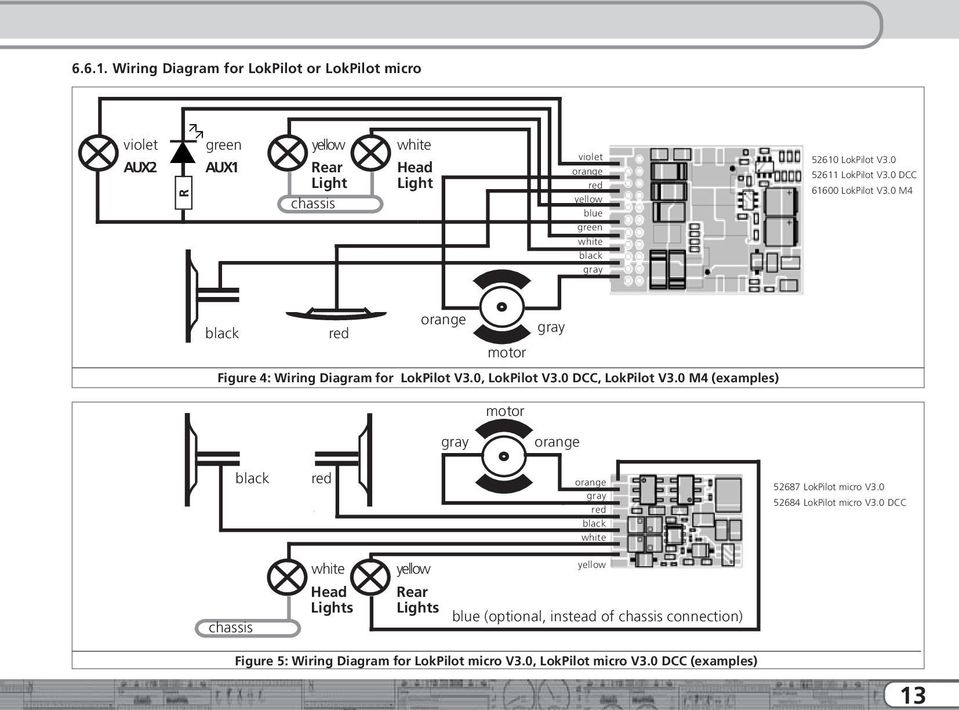
13 Wiring Diagram for LokPilot or LokPilot micro violet green yellow white AUX2 AUX1 Rear Head Light Light chassis R violet orange red yellow blue green white black gray LokPilot V LokPilot V3.0 DCC LokPilot V3.0 M4 orange black red gray motor Figure 4: Wiring Diagram for LokPilot V3.0, LokPilot V3.0 DCC, LokPilot V3.0 M4 (examples) motor gray orange black red orange gray red black white LokPilot micro V LokPilot micro V3.0 DCC chassis white Head Lights yellow Rear Lights yellow blue (optional, instead of chassis connection) Figure 5: Wiring Diagram for LokPilot micro V3.0, LokPilot micro V3.0 DCC (examples) 13
14 Installing the Decoder Wiring Diagram for a LokPilot XL Decoder Motor right motor terminal left motor terminal Head Lights Rear Lights Common (+Pole) left track connection right track connection AUX6 AUX5 AUX4 AUX3 AUX2 AUX1 Figure 6: Wiring diagram for (wiring example) gray AUX4 orange AUX3 violet AUX2 R green yellow white AUX1 Rear Lights Head Lights chassis violet orange red yellow blue green LokPilot Fx V3.0 white black gray black red Figure 7: Wiring diagram for LokPilot Fx V3.0 (wiring example) 14

15 Colour Coding by Märklin Märklin uses a different colour coding system compared to the DCC colours. Please refer to Fig. 8 for more information Motor and Track Connections Firstly, please cut all wires installed in the locomotive. Take special care to remove any connections to the chassis: the motor leads must be positively potential-free, in other words the may not have any contact to the chassis or body or the wheels and wheel contacts. It is particularly easy to overlook such connections in Fleischmann locomotives. Make notes of which motor lead connects the motor with the right and the left wheel contact. This avoids mistakes and assures that your locomotive runs in the right direction. Please check all connections with an Ohmmeter. Search for short circuits, particularly between the motor leads and the wheel contacts. Connect the red wire to the right rail pickup or the centre pick up in AC models. Connect the black wire to the left rail pickup or the chassis in AC models. Connect the orange wire with the motor terminal, which originally lead to the right wheel pick up (centre pick up in AC models). The grey wire goes to the terminal, which originally connected to the left rail (chassis for AC models) Connecting DC and Coreless Motors You may use all DC motors commonly used for model trains provided they do not exceed the current limit of the decoder. In some cases with the 5-pole High Performance Drive by Märklin, you may find three anti-interference capacitors: the two capacitors connected directly to the motor leads and the motor housing MUST be removed (also refer to Fig. 9 on the following page). Description Märklin color ESU color (following NMRA DCC standard) AC: Power pickup show ( Schleifer ) (Center Rail) red red DC: right track connection AC: Outside Rails brown black DC: left track connection left motor terminal blue orange right motor terminal green gray common (rectified track voltage) (+Pole) for function outputs orange blue function output Rearlights yellow yellow function output Headlights gray white function output AUX1 brown/red green function output AUX2 brown/green violet function output AUX3 (logic level only occasionally, depending on decoder type) brown/yellow - function output AUX4 (logic level only occasionally, depending on decoder type) brown/white - Figure 8: Colour coding by Märklin in contrast to the DCC wiring code 15

16 Installing the Decoder Connecting Universal Motors with HAMO-Conversions Do not wire universal motors installed in many older Märklin locomotives (also known as AC motors) directly to LokPilot decoders. You must modify the motor by first installing permanent magnets so called HAMO magnets. You may purchase these magnets from your ESU dealer. We supply three types of magnets. Please refer to chapter for more information regarding motor conversions with permanent magnets Connecting Additional Functions You can wire any kind of load such as light bulbs, LEDs (light emitting diodes), smoke generators or similar devices to the function outputs provided the maximum current draw is less than that of the decoder output. The permitted maximum current draw per function output is listed in chapter 20 under Technical Data. Please make sure that the load does not exceed the permitted maximum current and there are no short circuits. The outputs of the LokPilot have protection but if an external voltage is applied, the outputs may suffer damage or destruction. remove capacitors! orange grey Figure 9: 5-pole Märklin motor Overload Protection of Function Outputs The function outputs of LokPilot decoders have electronic protection against overload and short circuit. The decoder keeps checking the sum of all function output currents. If the current is too high, the decoder will switch off the outputs. After about 1 second, the decoder tries to switch them on again. Should the current still be too high perhaps due to a short circuit the same procedure starts again. When using light bulbs (incandescent lamps) please note the following: they draw a very high inrush current when they are switched on, that becomes lower after a few moments. Therefore, it can happen with 12V bulbs that the headlights flash briefly during switch-on and then extinguish due to the overload protection of the decoder. It is important to install the correct bulbs Suitable Light Bulbs Only install bulbs rated 16V or higher and with a nominal current, that does not exceed 50 ma. Many older models by ROCO and Fleischmann have 12V bulbs installed. They draw a high current, become very hot, and may cause damage to the locomotive. Replace them with 16V bulbs Connecting the Light Outputs as well as AUX1 and AUX2 This procedure depends on the wiring of the lights and auxiliary functions in the locomotive: a) The lamps / function outputs are insulated from the common pole (ground) (i.e.: the locomotive chassis); therefore they are potential free. Fig. 4 shows the correct wiring for the outputs AUX1 and AUX2. The functions of the locomotive must be potential-free, in other words there may not be any other connection to the function besides the wires from the decoder. The voltage at these outputs is about 1.5V lower than the track voltage. The blue wire is the plus-pole ; the function output the minuspole. If LEDs are installed (also refer to Fig. 4, output AUX1), then a resistor must be wired in series with the LEDs. It should have a

17 17 rating of between 470 Ohms and 2.2 kohms. Running the LEDs without this resistor will lead to their destruction! b) The lamps / function outputs are wired (together) against the chassis of the locomotive (as in most locomotives by Märklin as well as in most older locomotives by Fleischmann and ROCO ). This scenario is illustrated for the light outputs in Fig. 4 (the headlights can of course also be wired as in a) ). The wiring is simpler but the available voltage is about half. This type of connection is not suitable for multi-protocol operation. Both M4 and Motorola packets are asymmetrical. Therefore, the function outputs do not have continuous power. This leads to a rhythmic flicker of the headlights (pulsing) that becomes particularly obvious with LEDs. Furthermore, the headlights will only work in one direction in analogue DC mode. Whether it will be the forward lights or the backup lights depends on which way you have placed your locomotive on the track. Solder the backup lights to the yellow wire, the headlights to the white one. The green wire connects to the function output AUX1. The purple wire goes to the function output AUX2. If your locomotive is wired according to option b), then it is ready for use. Otherwise, you must connect the remaining wires of all bulbs and functions together to the blue wire. This pole may not have any connection to the chassis! As shown in Fig. 4 it is possible to use both options in the same locomotive Purpose of AUX3 and AUX LokPilot with 21MTC Interface LokPilot decoders with 21MTC interface have two additional outputs besides the 4 standard outputs, namely AUX3 and AUX4. Since they are pure logic-outputs, it is not possible to connect any external loads directly. External power transistors are required. Connect AUX3 and AUX4 via the interface; there are no wire leads. In terms of their functionality, AUX3 and AUX4 are equal to the other outputs LokPilot Fx V3.0 The LokPilot Fx V3.0 offers up to 6 function outputs (also refer to Fig. 7). You can access the outputs AUX3 and AUX4 via the orange resp. the grey wire. For all other LokPilot decoders the orange and grey wires are the motor leads. The LokPilot Fx V3.0 is an exception LokPilot Fx micro V3.0 The LokPilot Fx micro V3.0 offers up to 4 function outputs. You can access the outputs AUX1 and AUX2 via the orange resp. the grey wire. For all other LokPilot decoders the orange and grey wires are the motor leads. The LokPilot Fx V3.0 is an exception Suitable Smoke Generators Unfortunately, it is not an easy task to find the right smoke generator for each locomotive. The amount of smoke generated depends on the following factors: a) Track voltage The track voltage varies depending on the command station. Therefore, it is possible that a locomotive generates smoke when driven by one digital system but does not generate any smoke with another system. Even 1V variation makes a big difference. b) Type and tolerance of the Seuthe smoke generator and the smoke distillate Seuthe smoke generators have considerable production tolerances. Therefore, it is possible that one unit works perfectly well while another does not. Type of distillate and filling level have an influence as well. c) Setting the decoder output For correct smoking action you should set the AUX output to Dimmer as well as full Brightness. More info in chapter 12.
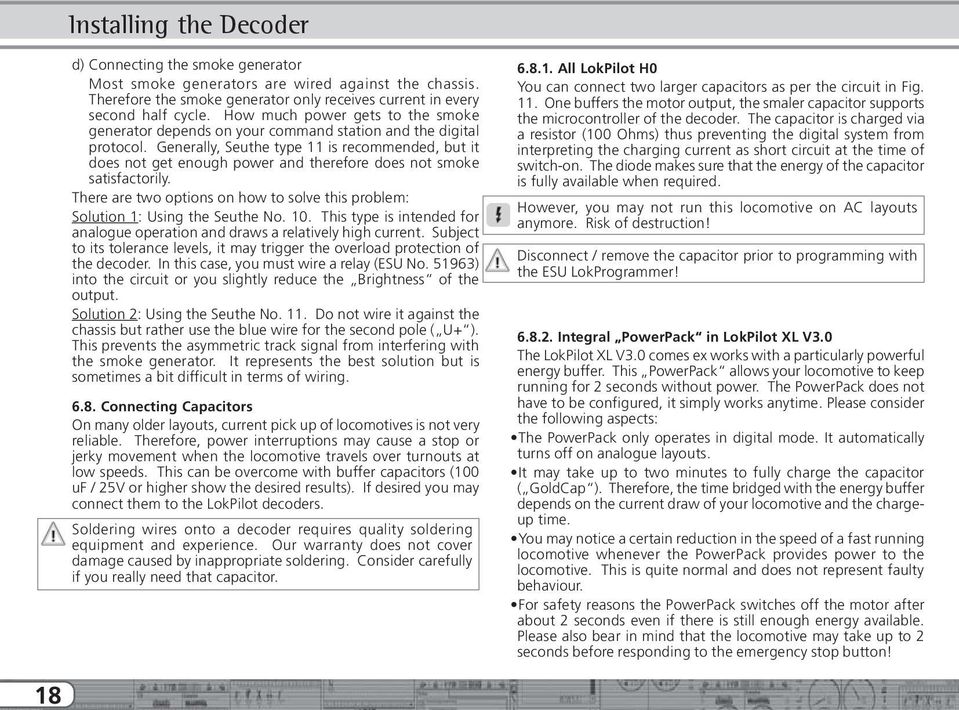
18 18 Installing the Decoder d) Connecting the smoke generator Most smoke generators are wired against the chassis. Therefore the smoke generator only receives current in every second half cycle. How much power gets to the smoke generator depends on your command station and the digital protocol. Generally, Seuthe type 11 is recommended, but it does not get enough power and therefore does not smoke satisfactorily. There are two options on how to solve this problem: Solution 1: Using the Seuthe No. 10. This type is intended for analogue operation and draws a relatively high current. Subject to its tolerance levels, it may trigger the overload protection of the decoder. In this case, you must wire a relay (ESU No ) into the circuit or you slightly reduce the Brightness of the output. Solution 2: Using the Seuthe No. 11. Do not wire it against the chassis but rather use the blue wire for the second pole ( U+ ). This prevents the asymmetric track signal from interfering with the smoke generator. It represents the best solution but is sometimes a bit difficult in terms of wiring Connecting Capacitors On many older layouts, current pick up of locomotives is not very reliable. Therefore, power interruptions may cause a stop or jerky movement when the locomotive travels over turnouts at low speeds. This can be overcome with buffer capacitors (100 uf / 25V or higher show the desired results). If desired you may connect them to the LokPilot decoders. Soldering wires onto a decoder requires quality soldering equipment and experience. Our warranty does not cover damage caused by inappropriate soldering. Consider carefully if you really need that capacitor All LokPilot H0 You can connect two larger capacitors as per the circuit in Fig. 11. One buffers the motor output, the smaler capacitor supports the microcontroller of the decoder. The capacitor is charged via a resistor (100 Ohms) thus preventing the digital system from interpreting the charging current as short circuit at the time of switch-on. The diode makes sure that the energy of the capacitor is fully available when required. However, you may not run this locomotive on AC layouts anymore. Risk of destruction! Disconnect / remove the capacitor prior to programming with the ESU LokProgrammer! Integral PowerPack in The comes ex works with a particularly powerful energy buffer. This PowerPack allows your locomotive to keep running for 2 seconds without power. The PowerPack does not have to be configured, it simply works anytime. Please consider the following aspects: The PowerPack only operates in digital mode. It automatically turns off on analogue layouts. It may take up to two minutes to fully charge the capacitor ( GoldCap ). Therefore, the time bridged with the energy buffer depends on the current draw of your locomotive and the chargeup time. You may notice a certain reduction in the speed of a fast running locomotive whenever the PowerPack provides power to the locomotive. This is quite normal and does not represent faulty behaviour. For safety reasons the PowerPack switches off the motor after about 2 seconds even if there is still enough energy available. Please also bear in mind that the locomotive may take up to 2 seconds before responding to the emergency stop button!
19 Initial Operation 7. Initial Operation LokPilot V LokPilot V3.0 DCC LokPilot V3.0 M Factory Default Values 2200µF 25V 470µF 6,3V N Ω,1/4 Watt 1N4007 GND U+ (positive pole) GND U+ (positive pole) The address is set to 03 with 14 speed steps. LokPilot V3.0 LokPilot V3.0 DCC LokPilot V3.0 M4 LokPilot micro V3.0 LokPilot micro V3.0 DCC LokPilot Fx micro V3.0 F1 switches output AUX1. F2 switches output AUX2. F3 switches the shunting mode on and off. F4 switches the acceleration and deceleration on and off. F5 switches output AUX3 (if available). F6 switches output AUX4 (if available). F7 switches output AUX5 (if available). F8 switches output AUX6 (if available). 100Ω,1/4 Watts Figure 11: 2200µF + 470µF capacitor with LokPilot LokPilot Fx V3.0 F1 switches output AUX1. F2 switches output AUX2. F3 switches output AUX3. F4 switches output AUX4. Does the locomotive move in both directions? Does the indicated direction of travel correspond with the actual one? If not, are the motor leads swapped or is the 8-pole plug inserted the wrong way round? Switch on the lights: do they work properly? If you have installed a LokPilot with an 8-pole plug, check if the plug sits in the socket correctly. 19
20 20 Initial operation 7.2. Digital Operating Modes In the following chapters, we describe operation of the LokPilot with different digital systems. Since not every LokPilot supports all digital systems, we state which chapter is applicable for which type DCC Mode LokPilot V3.0 LokPilot V3.0 DCC LokPilot micro V3.0 LokPilot micro V3.0 DCC LokPilot Fx V3.0 LokPilot Fx micro V3.0 Remove any capacitors that are wired into the track feeders (e.g. ROCO feeder track). This could impair the functionality of the decoder. The LokPilot works with any DCC system. Unfortunately, the DCC protocol also brings some difficulties into the game. One of them occurs so often that we deal with it right away DCC Speed Steps ( flashing lights ) Lights do not work with DCC systems: DCC locomotives run with 14, 28, or 128 speed steps. The decoder must know the speed step setting of the command station. The command station must be able to operate with this mode and must be set accordingly. If this is not the case, the following problems may occur: You cannot switch the lights with F0 at all. The lights keep switching on and off dependent on the speed step. In this case, make sure that the speed step settings of decoder and command station are the same Auto-detection of DCC Speed Steps LokPilot decoders implement auto-detection to avoid the above problem. We have tested this with the following systems: ESU ECoS Bachmann E-Z-Command Dynamis ROCO Lokmaus2 and Lokmaus3 Uhlenbrock Intellibox Lenz Digital plus V2.3 ZIMO MX1 When operating with Lenz digital plus V3.0 the auto-detect feature does not work at 14 speed steps. Select 28 / 128 speed steps instead. The LokPilot tries to establish the speed step setting every time it receives power (i.e.: after switching on the power on your layout or the track sector where your locomotive is located) and the lights are switched on. This process requires that you switch on the lights and turn the throttle until the lights light up continuously. Should you change the speed step setting during operation then you must interrupt the power to the decoder for a short moment in order to activate the auto-detection. This auto-detect feature can be turned off with bit 4 in CV 49 (also refer to the CV table in chapter 12.1). Then you have to set the correct speed step with bit 5 in CV 29.

21 Motorola Mode LokPilot V3.0 LokPilot V3.0 M4 LokPilot micro V3.0 LokPilot Fx V3.0 LokPilot Fx micro V3.0 The LokPilot works with all Märklin devices and compatible systems that are in the market until now. The functions F1 to F4 can only be activated with the so-called new Motorola format. In order to activate this you must set the DIP-switch 2 on your 6021 to the upper position ( On ). LokPilot decoders support two special features in Motorola mode: Speed Steps While the original Motorola system used by the following central units, namely Märklin central unit 6021, Delta and Mobile Station, only supports 14 speed steps, the LokPilot decoder can also handle the 28-speed step mode. In conjunction with suitable command stations (e.g.: ESU ECoS, in Motorola 28 mode) this leads to smoother control of your locomotives. No changes are required on the decoder Selectrix Mode LokPilot V3.0 LokPilot micro V3.0 You may operate the LokPilot with any Selectrix compatible command station with access to the functions lights and F1. For programming any parameters, you must use the DCC programming mode. It is not possible to program it with a pure Selectrix system. Any changes programmed in DCC are also valid for operation with Selectrix command stations. As soon as a decoder receives commands in Motorola or DCC format (whenever it receives a signal packet with information addressed to it), the Selectrix receiver switches off automatically. This allows trouble-free mixed operation with Selectrix / DCC / Motorola. The Selectrix receiver turns on again as soon as the decoder detects a power interruption M4 Mode LokPilot V3.0 M Extended Motorola Address Range While the original Motorola format only knows the addresses from 01 to 80, the LokPilot offers the following range of addresses: LokPilot V LokPilot V3.0 M LokPilot micro V LokPilot Fx V LokPilot Fx micro V Chapter 9 explains how to set the address. The LokPilot M4 is recognised and embedded into the system automatically by the Märklin systems devices Central Station and Mobile Station immediately after placing the locomotive onto the track. This process runs automatically and does not require any specific decoder settings. As soon as the decoder receives a valid M4 data packet (whenever the decoder recognizes that it is run by an M4 capable central unit) it will ignore Motorola data packets. Only after interrupting power to the decoder briefly or if it does not receive any M4 data packets for about 4 seconds will it accept Motorola data packets again. 21
22 22 Initial Operation 7.3. Analogue Mode All LokPilot decoders are set ex factory to operate in analogue mode as well. Please take note of the remarks in chapter 10.4 if the decoder should move repeatedly from analogue into digital sectors and back Analogue DC operation LokPilot V3.0 LokPilot V3.0 DCC LokPilot micro V3.0 LokPilot micro V3.0 DCC LokPilot Fx V3.0 LokPilot Fx micro V3.0 LokPilot decoders work on conventional DC layouts. Ex works, load compensation is active. This provides smooth control of your locomotives even at low speeds (in DC mode as well). Since load compensation requires about 3 4 Volts as base voltage you must turn the throttle further than normal (=locomotives without decoder) before the locomotive starts moving Analogue AC Operation LokPilot V3.0 LokPilot Fx V3.0 LokPilot V3.0 M4 Other LokPilot decoders than the ones mentioned above are not suitable for analogue AC mode. AC will definitely lead to the destruction of the decoder! Where intended, LokPilot decoders support operation with AC transformers. Therefore, the LokPilot decoder can simply replace the old directional relay. Load compensation is active (similar to DC mode) and provides smooth control and slow-speedperformance you have never seen before. The LokPilot V3.0 recognised the pulse for changing direction as usual. Just wait until the locomotive has stopped prior to changing direction. Never issue the Change of Direction command to a moving locomotive! This could lead to damaged gears! We cannot recommend the use of the old (blue) Märklin transformers that where originally designed for 110/220 Volt. Depending on their age and their tolerance range, the pulse for changing direction could be too high in case of increased mains voltage and therefore destroy the LokPilot decoder. Do yourself and your locomotives a favour and purchase a suitable Märklin transformer (220V version = No. 6647, 110V version = No. 6646) your locomotives and decoders will thank you with longer product life! 8. Decoder Settings (Programming) Chapter 8 covers setting various parameters of the LokPilot decoder. Should you not be familiar with the handling of CVs please take the time to read these occasionally quite complex instructions. After an introduction into the world of parameters in chapter 8.1, we explain in the following section 8.2 how to change various parameters in DCC mode and with Märklin central units. The chapters 9 to 16 explain which parameters have what kind of influence on the behaviour of the LokPilot decoder Adjustable Properties of Decoders The hardware determines some features such as the number of function outputs as well as the maximum permitted current of the motor output and therefore they are not programmable. Nevertheless, there are plenty of possibilities to influence the behaviour of the LokPilot decoder by adjusting software-governed properties.
23 Programming There is at least one memory space within the decoder reserved for each adjustable parameter where numbers or letters can be stored. You could visualize the storage spaces as index cards in a large file box. In order to enable you to find the right card again, they all have numbers and / or names outlining the properties of this particular card such as locomotive address or maximum speed. Then imagine that you can write information onto these cards. Adjusting the settings means nothing else but erasing one entry and replacing it with another. Moreover, you could do that at any time. However, you cannot write onto every card: some bits of information like the manufacturer s code are firmly encoded. Thus, you can determine the content of the storage spaces in the decoder even during operation and of course, the decoder will follow the instructions. Via the procedure known as Programming, you can enter the desired data into the storage spaces. The philosophy regarding the structure of and access to these storage spaces in the decoder varies greatly between manufacturers. While most LokPilot decoders utilise the CV concept as outlined in chapter , Märklin applies a different concept with M4 that is illustrated in chapter Configuration Variables (CVs) LokPilot V3.0 LokPilot V3.0 DCC LokPilot micro V3.0 LokPilot micro V3.0 DCC LokPilot Fx V3.0 LokPilot Fx micro V3.0 Almost all Configuration Variables (CVs) LokPilot decoders follow the CV concept developed in the US. CV stands for Configuration Variable and indicates that the storage cells described above are not only variable but they also determine the behaviour of the decoder Standardisation in the NMRA The NMRA (National Model Railroad Association) has defined which CVs determine certain parameters of a decoder. The DCC standard allocates fixed numbers for certain CVs (adherence is obligatory). This greatly simplifies things for the user since decoders of most manufacturers comply with this standard and therefore dealing with CVs requires the same process with the same CV-numbers regardless of the manufacturer. The DCC concept permits to enter numbers ranging from 0 to 255 into CVs. Each CV carries only one number. While the position number is predetermined, the range of values may vary. Not all CVs must accept values ranging from 0 to 255. The permitted values for LokPilot decoders are listed in the table in chapter showing all available CVs Bits and Bytes Most CVs contain numbers: CV 1 for instance contains the locomotive address. This can be any number between 1 and 127. While most CVs expect numbers to be entered, some others are rather like a collection point of various switches, that administer different functions in one CV (mainly on or off): CVs 29 and 49 are good examples: you must calculate the value for these CVs yourself. The value depends on which settings you want to program: Have a look at the explanations for CV 29 in the table in chapter 20.1.: firstly, decide which options should be active. The column Value has two numbers for each option. If the option is switched off, the value is 0. Otherwise, it is a number between 1 and 128. Add all the values for the respective options to arrive at the correct value for this CV. 23
24 Programming 24 Example: Let us assume you want to run trains with the ECoS in DCC mode with 128 speed steps. Analogue detection should be active (because you also want to drive your locomotive in analogue mode). All other options are not active. Therefore, you must write the value 6 in CV 29 ( = 6) M4 Configuration Range LokPilot V3.0 M4 The NMRA CV concept as described above has some disadvantages: On the one hand dealing with collection CVs such as CV 29 with its binary format is complicated while on the other hand you can only enter one value (!). How could one possibly store locomotive names with this method? Furthermore, it is not possible for the command station to find out, which CVs a decoder supports. The NMRA has simply forgotten to define a mechanism for providing feedback from the decoder to the command station regarding the supported CVs. With the introduction of the M4 system the user does not have to deal with CVs, values and the binary system. The command station should rather request the decoder to provide this kind of information and then enable the user to enter any values in an easy way on the graphic interface. For instance, you do not have to enter the value 15 in CV 3 on an M4 capable command station but rather set the acceleration time to 10 seconds. Thanks to M4 you do not have to remember that CV 3 contains the value for the acceleration time and that the value 15 is equivalent to about 10 seconds. This kind of complex technology is hidden in the M4 command station. Therefore the M4 system does not cater for a direct method of influencing the memory spaces, the so-called M4 configuration area of the decoder. Generally, M4 only permits access via the command station. This method has only one drawback. How can the owners of other command stations that are not M4 capable access the configuration area? This is facilitated by means of a register concept that is somewhat similar to the NMRA DCC CVs. Unfortunately this does not provide access to all characteristics of the M4 decoder. In chapter 20 you will find a list with all decoder parameters that cannot be accessed with non-m4 command stations. You can only write them by using the Motorola protocol but you cannot read any decoder data. Therefore M4 decoders cannot be programmed with pure DCC command stations since the parameters can only be accessed with either the M4 or the Motorola protocol. In order to utilise the full capability of the LokPilot M4, we recommend to program them either with an M4 capable command station or with the ESU LokProgrammer. Any settings programmed there are also valid when operating the decoder with another command station M4, the mfx compatible protocol by ESU Since the mfx data protocol was introduced, it has been protected by Märklin as a trade mark. This is why ESU decided in January 2009 to use the name "M4" for all their decoders. M4 is technically 100% compatible with mfx. All ESU decoders and command stations which are M4 compatible can be easily combined with the corresponding Märklin -mfx products. We would like to apologise for this inevitable change of names due to reasons of trademark Programming with popular Digital Systems As already explained it is not possible to program every type of LokPilot with every command station in the market. This chapter explains which options are available.
25 Programming with DCC Systems LokPilot V3.0 LokPilot V3.0 DCC LokPilot micro V3.0 LokPilot micro V3.0 DCC LokPilot Fx V3.0 LokPilot Fx micro V3.0 LokPilot decoders support all NMRA programming modes as there are the programming track modes (Direct Mode, Register Mode, Paged Mode) and the mode for the main ( POM, Programming on the Main ). Programming on the Main enables you to program your decoders comfortably without having to remove the locomotive form the layout. In this case, the command station talks directly to the decoder by using its locomotive address, for instance: Locomotive number 50, write the value 7 into CV 3!. Thus knowing the locomotive address is a precondition. Unfortunately, you cannot read CV values. However, with RailCom you can read CV values on the main. More on this topic in chapter 16. Assuming you have a suitable DCC system you can read CV values on the programming track. You can also reprogram the locomotive address without knowing the old address since the command station simply transmits the command Write value 7 in CV 3!. Each decoder receiving this command will execute it. ESU counts the bits from 0 to 7 as laid out in the standards while others (e.g.: Lenz) count the bits from 1 to 8. Please bear this in mind when you program one of our decoders with another digital system Programming with the ESU ECoS LokPilot V3.0 LokPilot V3.0 DCC LokPilot V3.0 M4 LokPilot micro V3.0 LokPilot micro V3.0 DCC LokPilot Fx V3.0 LokPilot Fx micro V3.0 The owners of an ESU ECoS can comfortably program LokPilot decoders. ECoS has a library of Decoder Profiles that help you to program decoders with the graphic display. All CVs are stored in the decoder profile thus enabling the ECoS to read them and to display them on the screen. Chapter of the ECoS manual provides more information on this topic. Please make sure that you always use the latest ECoS firmware version. Whenever we expand the range of the LokPilot family, only an update will add the required decoder profile. With ECoS you can program LokPilot M4 decoders only to a limited degree. For technical reasons, there is no decoder profile for a LokPilot M4 decoder. You can only access the CVs as listed in chapter You can access them with the Motorola programming mode as described in chapter in the ECoS manual Programming with Märklin 6021 LokPilot V3.0 LokPilot V3.0 M4 LokPilot micro V3.0 LokPilot Fx V3.0 LokPilot Fx micro V3.0 The Märklin central unit 6021 works differently: Since it does not comply with the NMRA DCC standards, LokPilot decoders start a special, obligatory programming procedure. Reading of values is not permitted. There are two modes: In the short mode parameters with a number below 80 can be set provided the desired value is also lower than 80. In the long mode, all parameters with values from 0 to 255 are adjustable. Since the display of the 6020 /6021 is limited to two-digit numbers, values must be split and entered in two separate steps.
26 26 Programming The is capable of handling both the short and the long mode. LokPilot V3.0 decoders starting with software version support the long mode. The LokPilot micro V3.0 as well as the the LokPilot Fx V3.0 and the LokPilot Fx micro V3.0 can only handle the short mode Changing the Programming Mode Enter the programming mode with the 6020/6021: The throttle must be set to No other locomotives may be on on the layout. Watch out for flashing signals of the locomotive! Press the Stop and Go buttons of the 6021 simultaneously until a reset has been triggered (alternately pull the mains plug of the transformer). Press the Stop button in order to switch off the track voltage. Enter the current decoder address. If you do not know the current address, simply enter 80. Activate the change-of-direction button (turn the throttle knob to the left beyond the arrestor until you hear a click sound), hold it in this position and then press the Go button. Please bear in mind that the 6020/6021 only permits you to enter values from 1 to 80. The value 0 is missing. Always enter 80 instead of The Short Mode The decoder is in the short mode (the headlights flash periodically in brief intervals). Now enter the number of the CV that you want to adjust e.g.: 01. Always enter this number with two digits. For confirmation activate the change-of-direction routine (now the lights flash twice very quickly). Now enter the new value for the desired CV, e.g.: 15 (two digits). For confirmation activate the change-of-direction routine (now the lights light up for about one second). Then you can enter other CVs as desired. Selecting 80 allows you to exit the programming mode. Alternately you can switch off the track voltage and then on again (press the Stop button on the 6021, then the Go button) Long mode You access the long mode by entering the value 07 in CV 07 while in the short mode. The decoder confirms the change to the long mode by slowly flashing lights. Enter the hundred-digit and the ten-digit (decade) of the CV that you want to change. Example: If you want to adjust CV 124, you enter 12. For confirmation activate the change-of-direction routine (now the lights flash periodically: long short long short - etc.) Now enter the unit of the CV ( 4 in this example). For confirmation activate the change-of-direction routine. Now the decoder expects the entry of the CV value. The lights flash periodically: long short short). Now enter the hundred-digit and the ten-digit (decade) of the new CV value (as a two-digit number). Example: You want to write the value 135. Therefore, you enter 13. For confirmation activate the change-of-direction routine. Now the lights flash periodically: long short short short). Now enter the unit of the new CV value as a two-digit number ( 05 in this example). For confirmation activate the change-of-direction routine (now the lights light up for about one second). Now you can adjust more CVs in long mode. Exit the long mode by switching off the track voltage and then on again (press the Stop button on the 6021, then the Go button).
27 Programming with the Märklin Mobile Station LokPilot V3.0 M4 Like any other M4 decoder, the LokPilot M4 reports automatically to the Mobile Station and can be programmed with the mechanisms described there. LokPilot V3.0 LokPilot micro V3.0 LokPilot Fx V3.0 LokPilot Fx micro V3.0 With the Mobile Station, you can also adjust some of the CVs. Use the Register Programming Menu to facilitate this. As with the 6021, you can only enter values between 1 and 80. The possible CV values are also limited to that range from 1 to 80. You will find the programming menu in the locomotive menu of the Mobile Station. It is only available for certain locomotives. Of course, this works only for a programmable locomotive. Proceed as follows: Enter a new locomotive in the database. How you do this is explained in the manual for the Mobile Station. Select locomotive The locomotive Ex 3/3 is shown as active on the display. By pressing the MENU / ESC button you can now change any of the settings such as name, address, etc. in the heading CHANGE LOCOMOTIVE. The last function shown is Register Programming (REG). Select this for writing CVs. Then select the CV (called REG on the Mobile Station ) and then the desired value and confirm by pressing the change-ofdirection button. The Mobile Station will program the new value into the decoder. Please remove all other locomotives prior to programming! Programming with the Märklin Central Station LokPilot V3.0 M4 Like any other M4 decoder, the LokPilot M4 reports automatically to the Central Station and you can program them with the mechanisms described there. LokPilot V3.0 LokPilot micro V3.0 LokPilot Fx V3.0 LokPilot Fx micro V3.0 With the Central Station, you can program the CVs 1 to 80 via the Motorola programming menu. Unfortunately, you can only enter values between 1 and 80. Find more information regarding this programming mode in chapter 8 of the manual of the Central Station.
28 Programming & Address Settings Programming with the ESU LokProgrammer LokPilot V3.0 LokPilot V3.0 DCC LokPilot V3.0 M4 LokPilot micro V3.0 LokPilot micro V3.0 DCC LokPilot Fx V3.0 LokPilot Fx micro V3.0 The LokProgrammer / offers the easiest and most comfortable way of setting the CVs of LokPilot decoders: simply by a few mouse clicks on an MS-Windows computer. The computer saves you to look for the various CV numbers and values. More information is contained in the manual for the LokProgrammer. You can access all properties of ESU decoders with the LokProgrammer. Since this works independently form the data format it also works for M4 decoders. 9. Address Settings Each LokPilot decoder requires a definite address to be addressable for the central unit. Depending on the type of decoder and the digital system, there are several possibilities how to allocate addresses Long Addresses in DCC Mode LokPilot V3.0 LokPilot V3.0 DCC LokPilot micro V3.0 LokPilot micro V3.0 DCC LokPilot Fx V3.0 LokPilot Fx micro V3.0 You can operate LokPilot decoders also with long addresses (4- digit addresses). The supported values range from The long address is stored in the CVs 17 and 18. You must activate the long address by setting bit 5 in CV 29. Bit 5 in CV 29 switches between short and long address. The decoder can only respond to one address at a time. If you want to use your LokPilot with the long address it is practical to program this address directly with your digital system: most modern digital systems (e.g.: ESU ECoS, Bachmann E-Z Command Dynamis ) have a menu for programming long addresses. The command station not only programs CV 29 correctly but also assures the correct storage of the values for the long address in CV 17 and 18. If you want to enter the long address manually in CV 17 and 18 please refer to chapter Short Addresses in DCC Mode LokPilot V3.0 LokPilot V3.0 DCC LokPilot micro V3.0 LokPilot micro V3.0 DCC LokPilot Fx V3.0 LokPilot Fx micro V3.0 Normally you would control LokPilot decoders with the short address that is stored in CV 1. In DCC mode, the permitted values range from 1 to 127. In order to enable the decoder to listen to the short address you must delete bit 5 in CV 29. Some digital systems (e.g.: ROCO Lokmaus2, Lenz digital plus, Lenz compact) only support the values 1 99 as short address.
29 29 Address settings 9.3. Motorola Address You can also operate many LokPilot decoders with the Motorola format. The address for this operating mode is stored in CV Addresses in the M4 Mode LokPilot V3.0 M4 LokPilot V3.0 LokPilot micro V3.0 LokPilot Fx V3.0 LokPilot Fx micro V3.0 This address is identical to the short address in DCC mode as described in chapter 9.1. The LokPilot decoder responds both to commands in DCC and in Motorola mode at the same time. The permitted values are listed in chapter Märklin digital devices (6020, 6021, Delta ) can only work with addresses from 1 to 80. Should you have entered a higher value in CV 1 you will not be able to drive this locomotive with the above Märklin central units. LokPilot V3.0 M4 The LokPilot M4 accepts values from 1 to 255 in CV 1. With suitable command stations such as the ESU ECoS, you have about three times as many addresses available compared to the original Märklin decoders. The LokPilot M4 decoder accepts commands to this address only when operated with a non-mfx command station. As soon as a LokPilot M4 decoder receives a valid mfx data packet it switches automatically to the M4 operating mode and ignores Motorola commands. The M4 systems also use addresses for directing commands to a locomotive. However, the addresses are allocated automatically when the decoder first reports to the central unit. Neither can the user program these addresses nor can he read them. 10. Adapting the Driving Characteristics Acceleration and Deceleration Acceleration and brake time can be set independently from each other. Therefore, you could for instance program a short acceleration and a much longer brake time. The time for accelerating from 0 to maximum speed is adjusted in CV 3 while deceleration is set in CV 4. Permitted values are 0 (no delay) to 63. The times set in these CVs work speed dependant. Therefore, the acceleration distance and the brake distance are longer at high speeds. In other words, the faster the locomotive moves, the longer is the distance until it stops. For information on how to set a brake distance independently of the speed refer to chapter Switching Acceleration / Deceleration LokPilot decoders can deactivate acceleration and deceleration by the push of a button. This is particularly handy for shunting since your locomotive responds directly to the throttle. The default setting for this function is function button F4.
30 Adapting the Driving Characteristics Shunting Mode The default setting for the shunting mode is F4. It reduces the speed to about 50%. Thus, you have smoother control of your locomotive in the lower speed ranges, which is important for shunting, particularly in the 14-speed-step mode. The values of the start, mid and maximum speed are dependent on each other. Selecting a mid speed that is lower than the start speed or higher than the maximum speed could lead to some erratic driving performance. Therefore always adhere to the principle: start voltage < mid speed < maximum speed Starting Voltage, Maximum and Medium Speed LokPilot V3.0 LokPilot micro V3.0 LokPilot V3.0 DCC LokPilot micro V3.0 DCC LokPilot decoders know internally 255 speed steps. They can be adapted to the characteristic of the locomotive and allocated to the actually available speed steps (14, 28, or 128): The NMRA defined two options to facilitate this: Motor characteristic via CV 2, 5, and 6 (Fig. 12): enter the start voltage in CV 2 and the maximum speed in CV 5. CV 6 corresponds with the speed at a medium speed step. Thus, you can define a kink in the speed curve. This mode is active if bit 4 = 0 in CV Speed Curve LokPilot V3.0 LokPilot micro V3.0 LokPilot V3.0 DCC LokPilot micro V3.0 DCC You may also define your own speed curve: simply enter the desired values in the CVs 67 to 94 (also refer to Fig. 13). The decoder will superimpose these 28 values onto the real speed steps. Thus, you can adapt the driving performance optimally to your locomotive. This mode is only active if bit 4 in CV 29 is set. We recommend using the ESU LokProgrammer for easy and comfortable programming. When this mode is active, the settings in CV 2, CV 5, and CV 6 have no influence. 64 CV CV 6 32 CV Figure 12: speed settings using CV 2, 6, Figure 13 : speed curve
31 31 LokPilot V3.0 M4 Each M4 decoder has its own speed curve. However, it is only accessible with an M4 capable central unit or with the ESU LokProgrammer Changing between Operating Modes You may change from a digital to an analogue sector of your layout on-the-fly at any time. The locomotive behaves as follows: Changing from Digital to Analogue DC When the decoder enters the analogue DC sector, it monitors the polarity of the track voltage. If the polarity (and the resulting direction of travel as per NEM) matches the the direction of travel in digital mode the locomotive will continue without stopping at the speed that corresponds to the analogue voltage. If the polarity does not match than the behaviour depends on the settings in CV 51. If the DC brake mode is active in CV 51 then the locomotive will slow down to a stop with the programmed deceleration, if not, then the locomotive will change the direction and back out of the analogue sector. Chapter 10.5 provides detailed info about brake sectors and the appropriate settings Changing from Digital to Analogue AC If a locomotive travels into an analogue AC sector, it will continue onwards in the same direction at a speed corresponding to the analogue track voltage Changing from Analogue to Digital (directional bit) When entering the digital sector the locomotive compares the current direction of movement with the digital signals arriving via the track: If the actual direction matches the one as per the digital signal, the locomotive continues onwards at a speed corresponding with the digital signals. Does the direction not match the commands from the digital system, then the behaviour depends on the settings in the directional bit (also refer to chapter for more details): If the directional bit has been set, then the decoder ignores the directional commands from the central unit, the locomotive continues in the same direction; only the speed will be adjusted according to the commands from the central unit. Therefore, the actual direction of movement does not match the direction as intended by the central unit for the time being; however, this changes once a change-of-direction-command is activated at the central unit. If the directional bit has not been set, then the locomotive slows down and stops according to the programmed deceleration, changes its direction and returns to the conventional sector. What happens next is described in chapter resp Changing from Digital to Digital LokPilot V3.0 LokPilot micro V3.0 LokPilot Fx V3.0 LokPilot Fx micro V3.0 Travelling between sectors with different digital protocols, namely Motorola and DCC is possible at any time. The LokPilot decoder interprets each valid data package from the command station.
32 32 Adapting the Driving Characteristics LokPilot V3.0 Travelling from Selectrix to DCC or Motorola is only possible after a short power interruption (also refer to chapter 7.2.3). LokPilot V3.0 M Brake Sectors Brake sectors have the purpose to slow down the locomotive independently from the commands issued by the command station. Frequently, this function serves for stopping a train in front of a red signal. If a LokPilot detects a brake command, it will slow down with the programmed deceleration and then stop. After this enforced stop, the locomotive will accelerate again as per the programmed values in CV 3. Depending on the type of digital system, there are several options on how to influence the decoder so that it stops the train DC Brake Mode As mentioned in chapter travelling from Motorola to M4 is possible at any time, as soon as the decoder receives a valid M4 package. When travelling in the opposite direction, e.g.: from M4 to Motorola (when for instance the locomotive changes to a sector of the layout that is still controlled by a 6021) the decoder will accept the Motorola package only after about 4 seconds. The first 4 seconds the locomotive continues at the previous speed and direction Changing modes with Analogue Mode turned off LokPilot V3.0 LokPilot V3.0 DCC LokPilot micro V3.0 LokPilot micro V3.0 DCC LokPilot Fx V3.0 LokPilot Fx micro V3.0 Perhaps you have disabled analogue mode on your decoder (bit 2 in CV 29 is deleted). When the locomotive moves from the digital sector into the analogue one, the locomotive will continue with the set speed and direction. However, you cannot issue any commands to that locomotive until is back in a digital sector. Under certain circumstances, the decoder interprets the analogue DC voltage as brake sector and slows down to a stop; please refer to chapter LokPilot V3.0 LokPilot V3.0 DCC LokPilot micro V3.0 LokPilot micro V3.0 DCC LokPilot Fx V3.0 LokPilot Fx micro V3.0 In order to activate the DC brake mode you must set bit 0 in CV 51. The LokPilot decoder will start brake once it moves from a digital sector into a DC sector provided the brake mode is active and the polarity of the track voltage does NOT match the current direction of travel. The locomotive will stop taking into account the programmed deceleration Märklin Brake Mode LokPilot V3.0 LokPilot V3.0 M4 LokPilot micro V3.0 LokPilot Fx V3.0 LokPilot Fx micro V3.0 In principle, the Märklin modules / apply a DC voltage to the track instead of the digital signals. Provided bit 0 in CV 51 is set, then LokPilot decoders detect this voltage and will stop the train.
33 The signal generated by these modules looks the same as DC from conventional DC-transformers. The LokPilot could possible misinterpret this and switch to the analogue mode instead of brake. The logic works as follows: If the last package received prior to detecting analogue DC was in the Motorola format, the decoder assumes this is a Märklin brake section and stops. If the last package received prior to detecting analogue DC was in the DCC format, the decoder assumes this is an analogue sector. If you wish to control the LokPilot decoder with DCC signals and keep your Märklin brake sectors then you should switch off the DC analogue mode by deleting bit 1 in CV 50. The LokPilot will stop as desired Selectrix Diode Brake Sector LokPilot V3.0 LokPilot micro V3.0 LokPilot decoders also detect the Selectrix -diode brake sector and stop as desired Constant Brake Distance LokPilot V3.0 LokPilot V3.0 DCC An attractive function hides behind CV 254 (ESU brake mode): Here you can set a constant distance for braking the train, from the beginning of the brake sector to the stopping point. Thus, it is possible to stop the train right in front of a red signal regardless of the speed. The LokPilot simply calculates the required brake effect. The higher the value in CV 254, the longer is the brake distance. Simply make some trials on a test track in order to find the values best suited to your locomotive. If CV 254 is set to 0, then the normal time mode as per chapter will automatically turn on. The constant brake distance is only active in brake sectors. When you turn the throttle back to 0, the locomotive will slow down as per the value in CV 4. Via CV245 (available as of firmware ) you can chose how the LokPilot should decelerate Constant Linear Braking Distance CV245=0: If the locomotive is relatively slow at the time of the braking command, it continues to drive slowly ahead for some time until it stops. If the locomotive drives very quickly when entering the braking command, it will be stopped earlier, but with the same delay. Figure 14 shows this quite clearly Linear Braking Distance CV246=1: The loco starts immediately to stop linearly after receiving the braking command. The dashed line in Figure 14 shows the linear braking distance. speed train A) slows down linearly: immediately after reaching the braking point, it slows down linearly and stops at the stop point. train B) is fast, continues to drive only a short distance to the defined braking point, slows down and stops at the stop point. train C) also continues to tavel to the definedbraking point, slows down and stops at the same point. entry into brake sector desired stop point (defined by CV 254) Figure 14: constant brake distance way 33
34 34 Adapting the Driving Characteristics Settings for Analogue Operation You can adjust the acceleration and maximum speed of the LokPilot separately for analogue DC and AC mode. Thus, you can adapt the speed of your locomotive also to analogue operations. You will have to determine suitable values by trial and error since they depend on the type of transformer (throttle) and the drive system of your locomotive. Please note that (with the exception of the LokPilot V3.0 M4) load compensation is always active ex works, even in analogue mode. This gives you smooth control even at very low speeds DC Analogue Operation LokPilot V3.0 LokPilot V3.0 DCC LokPilot micro V3.0 LokPilot micro V3.0 DCC LokPilot Fx V3.0 LokPilot Fx micro V3.0 You can adjust the starting and maximum speed in DC analogue mode with the CVs 125 and AC Analogue Operation LokPilot V3.0 LokPilot V3.0 M4 LokPilot Fx V3.0 You can adjust the starting and maximum speed in AC analogue mode with the CVs 127 and Motor Control LokPilot V3.0 LokPilot V3.0 DCC LokPilot V3.0 M4 LokPilot micro V3.0 LokPilot micro V3.0 DCC 4th generation load compensation enables LokPilot decoders to execute precise motor control. Even with the default settings, most locomotives run perfectly Adjusting Load Compensation Should you find after programming and doing the initial test that the locomotive does not run smoothly particularly at low speed or that the locomotive jerks a little after having stopped or if your are simply unsatisfied with the driving performance, then you should adjust the load compensation of your LokPilot decoder. Due to the large number of different types of motors and drive systems there is no single setting that suits all. Load compensation can be influenced with 4 CVs. Firstly, check if the irregular performance is due to any mechanical faults. Bent driving rods are one common cause. When you turn off load compensation as shown in chapter 10.2 and the problem persists then it is likely there is a mechanical fault Parameter for frequently used Motors We have listed the correct settings for the most common motors in the following table (Fig. 15). If a motor is missing, it means either that the default settings produce good results or that we have not yet sufficient experience about these motors. Set the suitable values and test-drive your locomotive.
35 35 Motor Control Adjustments for other Motors / Fine Tuning Unfortunately, the motors available in the market have considerable variations due to tolerances. This is even true for the same type. Therefore, LokPilot decoders enable you to adapt load compensation to the motor with CVs 53, 54 and 55. If the recommended values above do not lead to acceptable results, you can further optimise them. However, before doing this you must make sure that there are no capacitors wired between the motor terminals and the chassis. The commutator of the motor must be clean and the drive system should run freely. The wheel contacts and other contact plates of the locomotive must also be clean and make reliable contact Parameter K Parameter K, stored in CV 54, influences how strongly load control will affect the driving performance. The higher the value, the more load control will respond to any changes and try to adjust the revs of the motor. Parameter K needs adjustment if the locomotive runs unevenly (jerks) in speed step 1. Reduce the value of CV 54 by 5 and test-run the locomotive to see if there are any improvements. Repeat these steps until the locomotive runs smoothly at speed step 1. With some motors, it may be necessary to set the starting voltage to a value between 4 and 6 in order to arrive at good results. type of motor remarks CV 2 CV 53 CV 54 CV 55 Fleischmann motor Märklin SFCM small Scheibenkollektormotor using Magnet Märklin LFCM big Scheibenkollektormotor using Magnet Märklin DCM Trommelkollektormotor using Magnet Märklin 5*-high performance motor Märklin locomotives using Maxon motors HAG motors Trix locomotives using Maxon Motor remove the motor EMC capacitors from the main board! Piko locomotives Gützold locomotives (set Motor-frequency to 15 khz, refer chapter 10.3.) Faulhaber motors CV55 depends on flywheel: Sometimes CV55= LGB locomotives Using Rivarossi Locomotives from old production (before Hornby!) Trix, Fleischmann, Roco Nscale CV 55 depends of size of flywheel Figure 15: table of BACK-EMF settings for widely used motors
36 36 Motor Control Parameter I Parameter I, stored in CV 55 provides important information to the decoder on how much inertia the motor has. Motors with large flywheels naturally have more inertia than smaller ones or coreless motors. Adjust parameter I if the locomotive jerks somewhat just before it stops or jumps at lower speeds (lower third of the speed step range) or simply does not run smoothly. Reduce the value by 5 starting with the default value for motors with very small or no flywheels. Increase the value by 5 starting with the default value for motors with large flywheels. Test again and repeat this procedure until you arrive at the desired result Reference Voltage In CV 53, you set the EMF reference voltage generated by the motor at maximum revs. This parameter may have to be adapted subject to the track voltage and the efficiency of the motor. If the locomotive reaches maximum speed when the throttle is set to about a third and the top third of the throttle has no influence on the speed, then you should reduce the value of CV 53. Reduce the value by 5 8 and test the locomotive again. Repeat this process until the locomotive just reaches its maximum speed when the throttle is fully open Turning off Load Compensation LokPilot V3.0 LokPilot micro V3.0 LokPilot V3.0 DCC LokPilot micro V3.0 DCC Occasionally it may be beneficial to turn off load control; simply delete bit 0 in CV 49. LokPilot V3.0 M4 You can also switch off load compensation by writing the value 0 in CV 56 ( Control Influence ). With load control turned off, the starting voltage in CV 2 should be increased until the locomotive starts moving at speed step 1 or Adapting Load Control Frequency LokPilot V3.0 LokPilot V3.0 DCC LokPilot V3.0 M4 LokPilot micro V3.0 LokPilot micro V3.0 DCC In the LokPilot decoders load control works normally with 32 khz. Sometimes it can be useful to reduce this frequency by half: For motors with little power due to high inductivity. If suppressors (such as capacitors, chokes, etc.) disturb load control but cannot be removed. Delete bit 2 in CV 49 in order to set the PWM frequency from 32 KHz to about 16 khz.
37 11.4. Dynamic Drive Control: Up and Down the Hill LokPilot V3.0 LokPilot V3.0 DCC LokPilot V3.0 M4 LokPilot micro V3.0 LokPilot micro V3.0 DCC Dynamic Drive Control (DCC) of your LokPilot decoder enables you to adapt load control, as you may desire. Full control over the entire speed range (constant speed) is not always prototypical. Therefore you can set the degree to which load control will be effective between 0 (no load control) and 100% (load compensation over the full range), At low speeds it is advisable to have 100% load compensation in order to prevent the locomotive form getting stuck or from running away without any load. The impact of load control should recede with increasing speed in order to have the full un-harnessed power of the motor available when the throttle is fully open. Thus, the locomotive will respond to certain changes in the main line such as gradients. The locomotive will run faster downhill and become slower climbing the hill. The desired degree of load control influence is set in CV 56. It is particularly meaningful to reduce the influence of load control whenever you run consists. This allows for better driving properties of all locomotives in the consist Settings for the C-Sinus Motor LokPilot decoders with the 21MTC interface can drive the new C-Sinus motors indirectly via the circuit board installed in the locomotive. The LokPilot can generate all necessary signals provided you readjust certain settings: Load compensation must be turned off as described in chapter The control electronics of the motor also need a switched logic voltage provided by the LokPilot on output AUX4. AUX4 must therefore be active while the locomotive is stopped and while it is moving (in both directions!). LokPilot V3.0 Write the values below into the respective CVs: CV CV CV Value CV CV LokPilot V3.0 M4 Use the LokProgrammer or the Central Station in order to activate AUX4 for the stationary locomotive and for the moving locomotive in both directions as shown in Fig. 16. Figure 16: settings for c-sinus with LokPilot M4 37
38 Function outputs Function outputs Physical function outputs LokPilot decoders have up to 8 physical function outputs. Headlights and Backup Lights are used for lighting, the remaining ones (AUX1 to AUX6) are freely available. Other functions include Shunting Mode, Acceleration / Deceleration On/Off as well as virtual functions like Sound On/Off. We explain the importance of the latter in chapter 15. The function buttons ( F buttons ) of your command station or throttle activate the function outputs. Generally, F0 is the lighting button, while we count the remaining buttons from F1 upwards Allocation of Function Buttons (Function Mapping) LokPilot V3.0 LokPilot V3.0 DCC LokPilot micro V3.0 LokPilot micro V3.0 DCC LokPilot Fx V3.0 LokPilot Fx micro V3.0 You can allocate the functions freely to any function button. ESU uses the so-called extended Mapping. It has the advantage that you can link each output to any button. Furthermore, the allocation can vary between forward and reverse as well. It is also possible to switch several functions simultaneously. Two CVs (so called control CVs A and B) are allocated to each function button. They enable you to determine the behaviour of the button. Generally, we can say: All function buttons are directional. So if you change anything do not forget to adjust both directions. Some digital systems do not support all functions. Each physical output must first be switched on and then linked to a function button. Figure 17 on the following double page provides an overview about all possible combinations. LokPilot micro V3.0, LokPilot micro V3.0 DCC, LokPilot Fx V3.0 and LokPilot Fx micro V3.0 support the function buttons F0 to F12, the other LokPilot decoders F0 to F15. We will have a look at some examples in order to clarify the procedures, but first we have to explain two more properties of the function outputs Special Effects on Function Outputs Switching on Outputs and Different Options Each function output can / must be unlocked prior to using it. Furthermore, each output offers the choice of 12 different lighting effects: Dimmer: normal continuous output Blinker lights: the output flashes with an adjustable frequency. Inverse blinker lights: The output flashes as above but in the opposite direction. This feature enables you to set up alternate blinkers. Strobe: flash light. Double Strobe: double flash light. Firebox: flickering light simulating the open firebox. Zoom: slow fade-in and fade-out of light, for steam locomotives or petroleum lanterns Mars light Gyro light Rule 17: for US steam locomotives. Headlights and back-up lights are dimmed when the locomotive stops and go to full brightness when the locomotive moves again. Can be separately controlled for headlights and back-up lights. Pulse: output turns off automatically after a certain time. This is ideal for Telex un-couplers. Coupler function: for controlling couplers by Krois and ROCO
39 39 There is a CV for each output (starting with CV 113. Also compare the table in chapter 21.1.), where the desired lighting effect is set. Allocate a specific number to each lighting effect that you want to enter in the corresponding control CV. Please note that you can turn off each output that is not needed by entering 0. The two logical functions Shunting Mode and Switch off Acceleration and Deceleration do not need configuration CVs Adjust Lamp Brightness In order to adapt the light intensity of the lamps the decoder can dim the brightness of each lamp in 15 steps. This is achieved by clocking, that means the lamps are switched on and off very quickly and very often. This feature can be set independently for each output. The desired value for the brightness (0 15) must be added to the value of the corresponding control CV that determines the lighting effects (starting with CV 113, also refer to the table in chapter 21.1). Since the adjustment of brightness is achieved by so-called pulse width modulation the voltage at the output terminals remains constant. This adjustment of brightness is therefore not suitable for adjusting the output voltage to suit lamps with lower nominal voltage! It is essential that you refer to chapter for more details! Pulse Mode for Telex In order to operate the Märklin Telex coupler we have created the Pulse function: the brightness value takes on a special role in this case: the value determines how long a function should remain switched. The brightness value 0 means 0.5 seconds; the value 15 corresponds to about 8 seconds. After this predetermined time, the decoder turns off this function. This prevents overheating the windings of the coupler Coupler Mode for Krois and ROCO Krois and ROCO couplers need a special high frequency PWM signal to avoid burning the copper windings of the coil. This special function Coupler provides this type of signal. In this mode, the output switches on at 100% for 250 ms and then reduces the output power by switching to the PWM-signal. The ratio between Off and On time can be set by adjusting the Brightness Value from 0 (completely off) to 15 (connected through = 100% output). A value of 243 has proven to be a good number for ROCO couplers (this corresponds with a PWM value of 3). This coupler function is only available on outputs AUX1 and AUX Automatic Coupler Function LokPilot V3.0 LokPilot V3.0 DCC Digital Couplers LokPilot V3.0 LokPilot V3.0 DCC LokPilot Fx V3.0 LokPilot Fx micro V3.0 Some LokPilot decoders can directly control digital couplers. Subject to the type of coupler, you must adjust certain settings. From firmware version on the LokPilot decoder is able to do the automatic decoupling. When you push the function button the loco drives backwards against the train and then removes from it again. This procedure can be influenced via three CVs. In CV246 the speed that moves the loco will be stored (or defined) (0-255). If this value is 0, the automatic coupler function is not active.
40 40 Figure 13: Function mapping - factory default values for LokPilot V3.0 Funct.- Description Control Headlight Back-up lights AUX 1 AUX 2 AUX 3 AUX 4 AUX 5 AUX 6 button CV A (if available) (if available) (if available) (if available) vaule FS(f) stand forward 129 FS(r) stand backward 132 FF(f) drive forward 135 FF(r) drive backward 138 F0 light forward F0 light backward F1 key F1 forward F1 key F1 backward F2 key F2 forward F2 key F2 backward F3 key F3 forward 159 F3 key F3 backward 162 F4 key F4 forward 165 F4 key F4 backward 168 F5 key F5 forward F5 key F5 backward F6 key F6 forward F6 key F6 backward F7 key F7 forward F7 key F7 backward F8 key F8 forward F8 key F8 backward F9 key F9 forward 195 F9 key F9 backward 198 F10 key F10 forward 201 F10 key F10 backward 204 F11 key F11 forward 207 F11 key F11 backward 210 F12 key F12 forward 213 F12 key F12 backward 216 F13 key F13 forward* 219 F13 key F13 backward* 222 F14 key F14 forward* 225 F14 key F14 backward* 228 F15 key F15 forward* 231 F15 key F15 backward* 234 * except for LokPilot micro V3.0, LokPilot micro V3.0 DCC, LokPilot Fx V3.0, LokPilot Fx micro V3.0
41 41 Funct.- Control Acceleration Shunting Sound Dynamic Button CV B ON/OFF mode On/Off On / Off brake FS(f) 130 FS(r) 133 FF(f) 136 FF(r) 139 F0 142 F0 145 F1 148 F1 151 F2 154 F2 157 F F F F F5 172 F5 175 F6 178 F6 181 F7 184 F7 187 F8 190 F8 193 F9 196 F9 199 F F F F F F F F F F F F15 235
42 42 Function Outputs In CV 247 the time of pushing is to be entered. In CV248 the time of removing is to be entered. The time of pushing should be higher than the time of removing to make sure that the loco stops in a safe distance away from the train. The function output of the options pulse or coupler needs to be configurated correctly to make the automatic decoupling work Blinker lights Period for Blinker Lights If you have selected the Blinker or Inverse Blinker mode for an output then the duration of the blinker period (and thus the blinker frequency) is set for all outputs in CV 112. The blinker period can be set in 63 steps. It is always a multiple of 65.5 milliseconds Examples for Typical Settings Example 1: smoke generator on AUX 1 and F5. Let us assume you want to connect a smoke generator to output AUX1 and activate it with function button F5. The output AUX1 must be unlocked and allocated to button F5. Firstly, we activate the output and set it to dimmer function (100% continuous output; no flashing, etc.) and the brightness should be 100%. CV 115 is responsible for output AUX1. Calculate the value to be entered in CV 115 as follows: 15 for maximum brightness. Now you must link the function button F5 with the output AUX1: have a look at Fig. 13: control CV 171 (in the third column) is responsible for F5 Forward. Which functions should be switched with F5 must be entered in CV 171. If you follow the line for F5 in the table in Fig. 13 to the right until it meets the column for AUX1 then you find a number in the header line above. In our example, the number is 4. Enter this value into CV 171. Then the F5 button will switch the output AUX1. Thus, the function is programmed for forward travel. Now enter the same values in CV 174 in order to activate the same for travelling in reverse. Example 2: Blinker beacon on AUX2 and F6. You want to wire a blinker beacon to AUX2 and allocate it to the F6 button. The brightness should be 6/15 of the maximum brightness. The blinker period and the On / Off ratio must be set as described above. Firstly, we must unlock the output AUX2 and set it to blinker function. We do this in CV 116. In our example we enter the value 16 (for blinker) + 5 (for 6/15 of maximum brightness) = 21. Then you must link the output AUX2 to the function button F6 with the control CV 177. In CV 177, you enter the functions to be controlled by the F6 button. If you follow the line for F6 Forward in the table in Fig. 13 to the right until it meets the column for AUX2 then you find the number 8 in the header line. You must enter this value in CV 177. Now the F6 Forward button controls the output AUX2. To set the same for reverse you must enter the value 8 in CV 180. Example 3: Brake time On / Off with F5. Here the acceleration and brake time should be activated and turned off with F5. Since acceleration and deceleration are not physical outputs but logical functions, you donto have to configure this function. All you have to do is allocate the button F5 to the function Deactivate Brake Time : enter the value 1 in CV 172; should this function also be active in reverse, enter the value 1 in CV 175.
43 Decoder Reset Analogue Settings LokPilot V3.0 LokPilot V3.0 DCC LokPilot V3.0 M4 LokPilot micro V3.0 LokPilot micro V3.0 DCC LokPilot Fx V3.0 LokPilot Fx micro V3.0 With the CVs 13 and 14, you can predetermine which function buttons should be switched in analogue mode. Thus, you simulate pressing an F button. The ex works default settings switch on the directional headlights (F0 is on!) as well as F1 (ex works allocated to AUX1) LGB Pulse Sequence Mode LokPilot V3.0 LokPilot V3.0 DCC LokPilot micro V3.0 LokPilot micro V3.0 DCC LokPilot Fx V3.0 LokPilot Fx micro V3.0 It is possible to switch to pulse sequence mode for operations with the LGB command station and the Roco Lokmaus I. In this mode, the decoder counts the number of times the F1 button is pressed in order to activate the desired function. Thus, it is possible to reach all function buttons by repeated pushing of the F1 button Swiss Headlight Mode LokPilot V3.0 LokPilot V3.0 DCC LokPilot micro V3.0 LokPilot micro V3.0 DCC LokPilot Fx V3.0 LokPilot Fx micro V3.0 Function mapping enables you to set many different configurations. The Swiss headlight mode is a good example. We need a third lighting circuit that switches the left lower headlight of the A - headlight configuration whenever the lights are turned on. This third circuit must work independently form the direction of travel. Figure 18 shows one option of how to wire this arrangement with AUX1 (green wire) being used for the third circuit. All you have to do now is to program the decoder in such a way that it always switches on that third circuit when the lighting function is active. Enter the value 5 in CV 141 and the value 6 in CV 144. That s it! 13. Decoder Reset You can reset decoder to the default settings at any time With DCC Systems or 6020/6021 Enter the value 08 in CV With Märklin systems (M4-decoder) M4 decoders can be reset to factory default values with the Central Station or the Mobile Station via the reset command in the locomotive menu. Rear Headlights yellow = Light On = Light Off green Front Headlights white Figure 18: Swiss headlight mode 43
44 Special Functions With the ESU LokProgrammer Enter the value 08 in CV 08 in the option Read / Write CVs in the menue Edit CVs. 14. Special Functions You may not yet be aware of some other highly specialised functions offered by LokPilot decoders Directional Bit The directional bit determines the driving behaviour when transiting from an analogue into a digital sector (also refer to chapter ). If you want to set this directional bit, then bit 1 in CV 124 must be set Saving the Operating Status LokPilot decoders can record the current operating status. The decoder will start up / accelerate or continue as programmed after a power interruption. You can store the following data: Direction of travel: Saves the direction in Motorola (old) mode. Status of functions: Remembers which functions where on or off and switches them as per the previous status. Current speed: If this is set, the the locomotive will continue with exactly that speed after a power interruption regardless of the commands transmitted from the command station. Accelerate with delay as per CV 3: Use this with in conjunction with the previous option: if this option is set, then the locomotive will accelerate (as programmed in CV 3) after a power interruption. If this option is not set, then the locomotive will attempt to reach the previous speed as quickly as possible. We recommend turning off this option since it overrules the effects of the programmed acceleration. This option is actually only intended for operation with the 6020 since the 6020 does not transmit any commands after being switched on. The default setting records the direction, the status of the functions and the current speed. LokPilot V3.0 LokPilot V3.0 DCC The decoder can detect the duration of a power interruption: If the power interruption is shorter than 2 seconds the decoder assumes a poor contact and will try to reach the previous speed as quickly as possible provided the feature Current Speed has been set. If the interruption takes longer, then the decoder assumes to be in a brake sector (perhaps ahead of a red signal) with intentional power cut-off. As soon as this sector receives power again, the decoder will accelerate as per the settings in CV Multiple traction with LokSound Locomotives LokPilot V3.0 LokPilot micro V3.0 LokPilot V3.0 DCC LokPilot micro V3.0 DCC At times one would like to use multiple headers for a train made up of locomotives with LokSound decoders and others with LokPilot decoders. The problem is that the locomotive with the LokPilot will start moving immediately while the one with the LokSound decoder remains stationary until the engine (the diesel sound) has reved up.
45 45 RailCom & Firmware Update To avoid this you can activate Acceleration Delay in the LokPilot V3.0 with CV 253. Acceleration will only commence after the time programmed in CV 253. Fine-tune the performance of both (or all) decoders by testing their behaviour. The LokSound decoder delays acceleration only if the sound is turned on. Therefore, the LokPilot decoder must also know if the sound is turned on or off. For that reason, LokPilot decoders also support the function Sound On / Off. Of course, this is a fictitious function only. Via this virtual function, the LokPilot can find out if the sound is actually switched on in the LokSound decoder and delay departure if necessary. Therefore, you must allocate the function Sound On / Off in the function mapping of the LokPilot decoder as well as in the LokSound decoder. The factory default setting for turning on the sound in LokSound decoders is F1. Write in CV 148 = 4 and CV 151 = RailCom LokPilot V3.0 LokPilot V3.0 DCC LokPilot micro V3.0 LokPilot micro V3.0 DCC LokPilot Fx V3.0 LokPilot Fx micro V3.0 RailCom was developed by Lenz Elektronik, Giessen and is a technology for transmitting information from the decoder back to the command station. Until now DCC, systems could only transmit data from the command station to the decoder but could never be sure if the decoder actually received the commands. The locomotive can send the following information to the command station: Locomotive address: the decoder transmits its address on request by Broadcast. Detectors in a certain track sector can detect this command. Thus, the command station can find out the location of that particular locomotive. CV information: the decoder can provide feedback about all CV values to the command station per RailCom. In future, a programming track will not be necessary any more. Meta data: the decoder can transmit status information such as motor load, current draw of the motor, temperature etc. to the command station. In order for RailCom to work all decoders and the command station must be equipped accordingly. LokPilot decoders are RailCom -ready in terms of their hardware. However, it may be necessary to carry out a firmware update in order to activate it. Relevant information regarding the status of the implementation of RailCom is available on our homepage. Prior to use RailCom must be unlocked by setting bit 3 in CV 29. CV 28 offers further options. Ex works, RailCom is not active in ESU decoders. 17. Firmware Update You can update LokPilot decoders with new operating software (so-called firmware) at any time. This is useful for fixing bugs and implementing new functions. You can carry out the update yourself without having to remove the decoder from the locomotive. All you need is the ESU LokProgrammer. The most recent version of the firmware can be downloaded free of charge from our website. Updates which are carried out by our service department will not be treated as a case of warranty. Therefore we will charge you for this service. Please inquire about the cost on our website before you send in a decoder. Only change the firmware if you want to fix bugs that are relevant to you or if you want to introduce new essential functions. Otherwise, never change the configuration of a system that works reliably.
46 46 Accessories & Support and assistance 18. Accessories You will get detailed information regarding accessories at your dealer or on our homepage Switching the Centre pick-up The circuit board for switching the centre pick-up only for the decoder with the 21MTC interface is intended for vehicles with two pick-ups. Thus, you can activate the forward pick-up in the direction of movement. This is ideal for block control! HAMO Magnets One cannot drive the universal motors in many Märklin models directly with a LokPilot decoder. Firstly, you must replace the stator coil with a permanent magnet. ESU supplies the following magnets: Permanent magnet as , for rotor , D=24.5 mm, for motor plate , , Permanent magnet as , for rotor , D=18.0 mm, for motor plate Permanent magnet as , for rotor , D=18.0 mm, for motor plate Wire Harnesses with 8-pole or 6-pole Socket If the locomotive you want to convert does not have an interface and you do not want to remove the plug from the decoder then you can use the harness or 51951: first install the suitable harness and then plug in the decoder Mounting Adapter 21MTC If you wish to convert a locomotive with a LokPilot decoder with the 21MTC interface, the adapter plate comes in handy: it has a socket for plugging in the LokPilot but also has solder points for connecting the original wiring of the locomotive. This is ideal for converting Märklin locomotives. 19. Support and assistance Your model train dealer or hobby shop is your competent partner for all questions regarding your LokPilot decoder. In fact he is your competent partner for all questions around model trains. Of course, you may also contact us directly. For enquiries please use either or fax (don t forget to provide your own fax-no. or address) and we will reply within a few days. Please call our hotline only in case of complex enquiries that can t be dealt with by or fax. The hotline is often very busy and you may encounter delays. Rather send an or fax and also check our website for more information. You will find many hints under Support / FAQ and even feedback from other users that may help you with your particular question. Of course we will always assist you; please contact us at: United states (English support), please contact: Phone: Tuesday & Thursday 9:00am - 3:00pm (CT) Fax: [email protected] Mail: ESU LLC th Ave SE St Cloud Minnesota Germany and other countries, please contact: Phone: ++49 ( 0) Tuesday & Wednesday 10:00am - 12:00am Fax: ++49 ( 0) [email protected] Mail: ESU GmbH & Co. KG - Technischer Support - D Ulm Website:
47 Technical Data LokPilot micro LokPilot micro LokPilot V3.0 LokPilot V3.0 LokPilot V3.0 LokPilot XL LokPilot Fx LokPilot Fx V3.0 V3.0 DCC DCC M4 V3.0 V3.0 micro V3.0 Operation Voltage 5 25V 5 25V 5 40V 5 27V 5 40V 5 40V 5 40V 5-25 V DCC operation using 14/28/128 Fahrstufen, Ok Ok Ok Ok - Ok Ok Ok 2-digit and 4-digit addresses; automatic recognition of operational mode Motorola (old & new), with 14/28 speed steps Ok - Ok - Ok Ok Ok Ok address range for Motorola -mode M4-operation with automatic recognition Ok Selectrix -operation Ok - Ok - - Ok - - Analog DC Operation Ok Ok Ok Ok - Ok Ok Ok Analog AC Operation - - Ok - Ok Ok Ok - DCC-programming (direct, page, register-mode) Ok Ok Ok Ok - Ok OkOk Motorola -Programming mode using 6021, Mobile Station, or Central Station - - Ok - Ok Ok Ok Ok M4-Programming procedure Ok Märklin brake section Ok - Ok - Ok Ok Ok Ok Brake on DC, Roco brake section Ok Ok Ok Ok - Ok Ok Ok Selectrix brake mode (with diodes) Ok - Ok - - Ok - - Shunting mode Ok Ok Ok Ok Ok Ok - - RailCom Option (by Firmwareupgrade) - Ok Ok Ok - Ok Ok Ok Continuous motor load 0.75A 0.75A 1.1A 1.1A 1.1A 3.0A - - 4th generation back-emf control, overload protected 16/32 khz 16/32 khz 16/32 khz 16/32 khz 16/32 khz 16/32 khz - - Number of Function outputs 2 / 140mA 2 / 140mA 4 / 250 ma 4 / 250mA 4 / 250mA 8 / 600mA 6 / 250mA 4/140mA Total loa of all function outputs 280mA 280mA 500mA 500mA 500mA 2000mA 500mA 500mA Supported function keys (mappable) F0 - F12 F0 - F12 F0 - F15 F0 - F15 F0 - F15 F0 - F15 F0 - F12 F0 - F12 Integrated PowerPack backup capacitor Ok - - Dimensions in mm: 13.5x9.0x3,0 13.5x9.0x x15.5x x15.5x x15.5x5.5 64x25x x15.5x x9.9x3.0
48 List of all supported CVs DCC Decoders On the following pages, we have listed all CVs of LokPilot decoders in a table. Please refer to the CV concept as outlined in chapter 5.1. Please only change CVs if you are certain about their purpose and the impact of your action. Wrong CV settings can lead to impaired performance or may cause your LokPilot not to respond at all. CV Name Description Range Def. 1 primary address Address of engine (For LokPilot V3.0, : Ragne = 1-255) Start voltage* Sets the minimum speed of the engine Acceleration This value multiplied by is the time from stop to maximum speed 4 Decelearation This value multiplied by is the time from maximum speed to stop (=brake time) 5 Maximum speed* Maximum speed of the engine Medium speed* Medium speed of engine Version number Internal software version of LokPilot decoder Manufacturer s ID Manufacturers s ID - ESU Writing value 8 in this CV triggers a reset to factory default values 13 Analogue mode F1-F8 Status of functions F1 to F8 in analogue mode * not for LokPilot Fx V3.0 and LokPilot Fx micro V3.0 Bit Function value 0 Function F1 1 1 Function F2 2 2 Function F3 4 3 Function F4 8 4 Function F Function F Function F Function F8 128
49 CV Name Description Range Def. 14 Analogue mode FL, Status of function FL, F9 to F12 in analogue mode F9-F12 Bit Function value 0 Function FL(f) 1 1 Function FL(r) 2 2 Function F9(f) 4 3 Function F10 (f) 8 4 Function F Function F Function F9(r) 64 7 Function F10 (r) Extended engine address long addrss of engine CV CV 17 contains the byte with higher value (bit 6 and bit 7 must be, 9999 always active), CV18 contains the byte with the lower value. Only active, when function is enabled using CV 29 (see below) 19 Consist address Additional address for consist operation Value 0 or 128 means: consist address ist disabled consist address active, normal direction consist address active, reverse direction 21 Consist mode F1-F8 Status of functions F1 to F8 in Consist mode Bit Function Value 0 Function F1 1 1 Function F2 2 2 Function F3 4 3 Function F4 8 4 Function F Function F Function F Function F
50 50 List of all supported CVs CV Name Description Range Value 22 Consist Mode FL, F9-F12 Status of fucntions FL, F9 to F12 in Consist mode Bit Function Value 0 Function FL(f) 1 1 Function FL(r) 2 2 Function F9(f) 4 3 Function F10(f) 8 4 Function F Function F Function F9(r) 64 7 Function F10(r) RailCom Configuration Settings for RailCom 2 Bit Function Value 0 Channel 1 Address broadcast Channel 1 Address broadcast disabled 0 Channel 1 Address broadcast enabled 1 1 Data transmission on Channel 2 No data transmission allowed on Channel 2 0 data transmission allowed on Channel Command Acknowledgement on Channel 1 No command Acknowledgement on Channel 1 (disabled) 0 Command Acknowledgement on Channel 1 allowed (enabled) 4
51 CV Name Description Range Value 29 Configuration register The most complex CV within the DCC standards. 4 This register contains important information, some of which are only relevant for DCC operation Bit Function Value 0 Reverse direction of travel (forward becomes reverse) Normal direction 0 Reversed direction 1 1 Speed steps (For DCC-opearation only) 14 speed steps 0 28 or 128 speed steps 2 2 analog operation Disable analog operation (no function on conventional layout) 0 Enable analog operation 4 3 RailCom communication Disable RailCom 0 Enable RailCom 8 4 Selection of speed curve speed curve through CV 2, 5, 6 0 speed curve through CV Selection of engine address (only for DCC operation) short addresses (CV 1) in DCC mode 0 long addresses (CV 17+CV18) in DCC mode 32 51
52 List of all supported CVs CV Name Description Range Value 49 Extended Additional important settings for LokPilot Decoders Configuration Bit Description Value 0 Enable Load control (Back-EMF) (not for LokPilot Fx V3.0) 1 Disable Load control (Back-EMF) 0 1 Motor PWM frequency 16 khz motor pulse frequency 0 32 khz motor pulse frequency 2 2 Märklin Delta Mode Disable Märklin Delta Mode (Headlights controlled by command station) 0 Enable Märklin Delta Mode (Headlights are always ON) 4 3 Märklin 2. Adresse Märklin 2. Adresse Disable 0 Märklin 2. Adresse Enable 8 4 Automatic DCC speed step detection Disable DCC speed step detection 0 Enable DCC speed step detection 16 5 LGB function button mode (sequencial LGB functions) Disable LGB function button mode 0 Enable LGB function button mode 32 6 Zimo Manual Function Disable Zimo Manual Function 0 Enable Zimo Manual Function 64 7 Function key toggle mode Functionstastentrigger beim Wechsel Aus=>An 0 Functionstastentrigger bei jedem Flankenwechsel
53 53 CV Name Description Range Value 50 Analogue mode Selection of allowed analogue modes Bit Function Value 0 AC Analogue Mode (if implemented. Please refer to section 7.3.) Disable AC Analog Mode 0 Enable AC Analog Mode 1 1 DC Analogue mode Disable DC Analogue mode 0 Enable DC Analogue Mode 2 51 Brake modes Selection of desired (allowed) brake modes 3 Bit Function Value 0 Märklin brake mode Disable Märklin brake mode 0 Enable Märklin brake mode 1 1 Zimo brake mode (will eventually not work on all ZIMO layouts) Disable Zimo brake mode 0 Enable Zimo brake mode 2 2 reserved 3 Lenz DC brake mode (brake-on-dc) Disable Lenz brake mode 0 Enable Lenz brake mode 8 53 Control Reference voltage Defines the Back EMF voltage, which the motor should generate at (not for LokPilot Fx) maximum speed. The higher the efficiency of the motor, the higher this value may be set. If the engine does not reach maximum speed, reduce this parameter 54 Load Control parameter K K -component of the internal PI-controller. Defines the effect of load control (not for LokPilot Fx) The higher the value, the stronger the effect of Back EMF control 55 Load Control parameter I I -component of the internal PI-controller. Defines the momentum (inertia) (not for LokPilot Fx) of the motor. The higher the momentum of the motor (large flywheel or bigger motor diameter, the lower this value has to be set.
54 54 List of all supported CVs CV Name Description Range Value 56 Operating range of load control % (not for LokPilot Fx) Defines up to which speed in % load control will be active. A value of 32 indicates that load control will be effective up to half speed. 66 Forward Trimm Divided by 128 is the factor used to multiply the motor voltage when driving (not for LokPilot Fx) forward. The value 0 deactivates the trim. 67- Speed table Defines motor voltage for speed steps The values in between will be interpolated. 95 Reverse Trimm Divided by 128 is the factor used to multiply the motor voltage when driving (not for LokPilot Fx) backwards. Value 0 deactivates the trim. 112 Blinking light Blinking frequency of Strobe effects Always a multiple of milliseconds. 113 Headlight configuration Configurations of headlights Description Value Continuous (dimmer) Vol blinking (Phase 1) Vol + 16 blinking (Phase 2) Vol + 32 Strobe light Vol + 48 Double Strobe light Vol + 64 Fire box Vol + 80 Smoke generator Vol + 96 Headlight bright/dim Vol Marslight Vol Gyrolight Vol Rule 17 for head light Vol Rule 17 for rear light Vol Output Pulse (time-restricted) Vol Vol = brightness. Range 0 (dark) - 15 (maximum)
55 55 CV Name Description Range Value 114 Back-up light Configuration of back-up lights configuration Description Value continuous (dimmer) Vol blinking (Phase 1) Vol + 16 blinking (Phase 2) Vol + 32 Strobe light Vol + 48 Double Strobe light Vol + 64 Fire box Vol + 80 Smoke generator Vol + 96 Headlight bright/dim Vol Marslight Vol Gyrolight Vol Rule 17 for head light Vol Rule 17 for rear light Vol Output Pulse (time-restricted) Vol Vol = brightness. Range 0 (dark) - 15 (maximum) 115 AUX 1 configuration Configuration of output AUX Description Value continuous (dimmer) Vol blinking (Phase 1) Vol + 16 blinking (Phase 2) Vol + 32 Strobe light Vol + 48 Double Strobe light Vol + 64 Fire box Vol + 80 Smoke generator Vol + 96 Headlight bright/dim Vol Marslight Vol Gyrolight Vol Rule 17 for head light Vol Rule 17 for rear light Vol Output Pulse (time-restricted) Vol Output digital coupler (see for details chapter ) Vol Vol = bightness. Range 0 (dark) - 15 (maximum)
56 56 List of all supported CVs CV Name Description Range Value 116 AUX 2 configuration Configuration of output AUX Description Value continuous (dimmer) Vol blinking (Phase 1) Vol + 16 blinking (Phase 2) Vol + 32 Strobe light Vol + 48 Double Strobe light Vol + 64 Fire box Vol + 80 Smoke generator Vol + 96 Headlight bright/dim Vol Marslight Vol Gyrolight Vol Rule 17 for head light Vol Rule 17 for rear light Vol Output Pulse (time-restricted) Vol Output digital coupler (see for details chapter ) Vol Vol = bightness. Range 0 (dark) - 15 (maximum) 117 AUX 3 configuration Configuration of output AUX (21MTC Version only) Description Value (LokPilot Fx V3.0) continuous (dimmer) Vol () blinking (Phase 1) Vol + 16 blinking (Phase 2) Vol + 32 Strobe light Vol + 48 Double Strobe light Vol + 64 Fire box Vol + 80 Smoke generator Vol + 96 Headlight bright/dim Vol Marslight Vol Gyrolight Vol Rule 17 for head light Vol Rule 17 for rear light Vol Output Pulse (time-restricted) Vol Vol = bightness. Range 0 (dark) - 15 (maximum)
57 57 CV Name Description Range Value 118 AUX 4 configuration Configuration of output AUX (21MTC Version only) Description Value (LokPilot Fx V3.0) continuous (dimmer) Vol () blinking (Phase 1) Vol + 16 blinking (Phase 2) Vol + 32 Strobe light Vol + 48 Double Strobe light Vol + 64 Fire box Vol + 80 Smoke generator Vol + 96 Headlight bright/dim Vol Marslight Vol Gyrolight Vol Rule 17 for head light Vol Rule 17 for rear light Vol Output Pulse (time-restricted) Vol Vol = bightness. Range 0 (dark) - 15 (maximum) 119 AUX 5 configuration Configuration of output AUX () Description Value continuous (dimmer) Vol blinking (Phase 1) Vol + 16 blinking (Phase 2) Vol + 32 Strobe light Vol + 48 Double Strobe light Vol + 64 Fire box Vol + 80 Smoke generator Vol + 96 Headlight bright/dim Vol Marslight Vol Gyrolight Vol Rule 17 for head light Vol Rule 17 for rear light Vol Output Pulse (time-restricted) Vol Vol = bightness. Range 0 (dark) - 15 (maximum)
58 58 List of all supported CVs CV Name Description Range Value 120 AUX 6 configuration Configuration of output AUX (LokPilot XL only) Description Value continuous (dimmer) Vol blinking (Phase 1) Vol + 16 blinking (Phase 2) Vol + 32 Strobe light Vol + 48 Double Strobe light Vol + 64 Fire box Vol + 80 Smoke generator Vol + 96 Headlight bright/dim Vol Marslight Vol Gyrolight Vol Rule 17 for head light Vol Rule 17 for rear light Vol Output Pulse (time-restricted) Vol Vol = bightness. Range 0 (dark) - 15 (maximum) 124 Auxiliary settings Controls auxiliary settings of the LokSound decoder 6 Description Value Store direction (Motorola ) 1 Store function state 2 Store current speed setting 4 Start again with acceleration ramp 8 No emergency stop during direction switch for Motorola operation 16 No PWM in analog operation 64 No PWM for function outputs for analog operation (interconnection) Voltage of engine Analog DC (not for LokPilot Fx V3.0 and LokPilot Fx micro V3.0) Maximum speed (not for LokPilot Fx V3.0 and LokPilot Fx micro V3.0) Analog DC 127 Voltage of engine Analog AC (not for LokPilot micro V3.0, LokPilot micro V3.0 DCC, LokPilot Fx V3.0 & Fx micro) Maximum speed (not for LokPilot micro V3.0, LokPilot micro V3.0 DCC, LokPilot Fx V3.0 & Analog AC LokPilot Fx micro V3.0)
59 59 CV Name Description Range Value 129 Assignment of function button Assignment of function outputs that are activated in status stop-forward Stop Forward A Bit Description Value 0 headlights 1 1 back-up lights 2 2 function output AUX function output AUX function output AUX 3 (if available) 16 5 function output AUX 4 (if available) 32 6 function output AUX 5 (if available) 64 7 function output AUX 6 (if available) Assignment of function button Assignment of function outputs that are activated in status stop-forward Stop Forward B Bit Description Value 0 acceleration on / off 1 1 shunting mode on / off 2 2 sound on / off 4 7 Dynamic brake Assignment of function button Assignment of function outputs that are activated in status stop-back-up Stop back-up A Bit Description Value 0 headlights 1 1 back-up lights 2 2 function output AUX function output AUX function output AUX 3 (if available) 16 5 function output AUX 4 (if available) 32 6 function output AUX 5 (if available) 64 7 function output AUX 6 (if available) Assignment of function button Assignment of function outputs that are activated in status stop-back-up Stop back-up B Bit Description Value 0 acceleration on / off 1 1 shunting mode on / off 2 2 sound on / off 4 7 Dynamic brake 128
60 60 List of all supported CVs CV Name Description Range Value 135 Assignment of function button Assignment of function outputs that are activated in status running-forward Running forward A Bit Description Value 0 headlights 1 1 back-up lights 2 2 function output AUX function output AUX function output AUX 3 (if available) 16 5 function output AUX 4 (if available) 32 6 function output AUX 5 (if available) 64 7 function output AUX 6 (if available) Assignment of function button Assignment of function outputs that are activated in status running-forward Running forward B Bit Description Value 0 acceleration on / off 1 1 shunting mode on / off 2 2 sound on / off 4 7 Dynamic brake Assignment of function button Assignment of function outputs that are activated in status running-back-up Running back-up A Bit Description Value 0 headlights 1 1 back-up lights 2 2 function output AUX function output AUX function output AUX 3 (if available) 16 5 function output AUX 4 (if available) 32 6 function output AUX 5 (if available) 64 7 function output AUX 6 (if available) Assignment of function button Assignment of function outputs that are activated in status running-back-up Running back-up B Bit Description Value 0 acceleration on / off 1 1 shunting mode on / off 2 2 sound on / off 4 7 Dynamic brake 128
61 61 CV Name Description Range Value 141 Assignment of function button Assignment of function outputs that are activated in status headlight-forward headlight forward A Bit Description Value 0 headlights 1 1 back-up lights 2 2 function output AUX function output AUX function output AUX 3 (if available) 16 5 function output AUX 4 (if available) 32 6 function output AUX 5 (if available) 64 7 function output AUX 6 (if available) Assignment of function button Assignment of function outputs that are activated in status headlight-forward headlight forward B Bit Description Value 0 acceleration on / off 1 1 shunting mode on / off 2 2 sound on / off 4 7 Dynamic brake Assignment of function button Assignment of function outputs that are activated in status headlight-revserse headlight reverse A Bit Description Value 0 headlights 1 1 back-up lights 2 2 function output AUX function output AUX function output AUX 3 (if available) 16 5 function output AUX 4 (if available) 32 6 function output AUX 5 (if available) 64 7 function output AUX 6 (if available) Assignment of function button Assignment of function outputs that are activated in status headlight-revserse headlight reverse B Bit Description Value 0 acceleration on / off 1 1 shunting mode on / off 2 2 sound on / off 4 7 Dynamic brake 128
62 62 List of all supported CVs CV Name Description Range Value 147 Assignment of function button Assignment of function outputs that are activated in status F1- forward F1 Forward A Bit Description Value 0 headlights 1 1 back-up lights 2 2 function output AUX function output AUX function output AUX 3 (if available) 16 5 function output AUX 4 (if available) 32 6 function output AUX 5 (if available) 64 7 function output AUX 6 (if available) Assignment of function button Assignment of function outputs that are activated in status F1- forward F1 Forward B Bit Description Value 0 acceleration on / off 1 1 shunting mode on / off 2 2 sound on / off 4 7 Dynamic brake Assignment of function button Assignment of function outputs that are activated in status F1- reverse F1 Reverse A Bit Description Value 0 headlights 1 1 back-up lights 2 2 function output AUX function output AUX function output AUX 3 (if available) 16 5 function output AUX 4 (if available) 32 6 function output AUX 5 (if available) 64 7 function output AUX 6 (if available) Assignment of function button Assignment of function outputs that are activated in status F1- reverse F1 Reverse B Bit Description Value 0 acceleration on / off 1 1 shunting mode on / off 2 2 sound on / off 4 7 Dynamic brake 128
63 CV Name Description Range Value 153 Assignment of function button Assignment of function outputs that are activated in status F2 - forward F2 forward A refer to CV Assignment of function button Assignment of function outputs that are activated in status F2 - forward F2 forward B refer to CV Assignment of function button Assignment of function outputs that are activated in status F2 - reverse F2 reverse A refer to CV Assignment of function button Assignment of function outputs that are activated in status F2 - reverse F2 reverse B refer to CV Assignment of function button Assignment of function outputs that are activated in status F3 - forward F3 forward A refer to CV Assignment of function button Assignment of function outputs that are activated in status F3 - forward F3 forward B refer to CV Assignment of function button Assignment of function outputs that are activated in status F3 - reverse F3 reverse A refer to CV Assignment of function button Assignment of function outputs that are activated in status F3 - reverse F3 reverse B refer to CV Assignment of function button Assignment of function outputs that are activated in status F4 - forward F4 forward A refer to CV Assignment of function button Assignment of function outputs that are activated in status F4 - forward F4 forward B refer to CV Assignment of function button Assignment of function outputs that are activated in status F4 - reverse F4 reverse A refer to CV Assignment of function button Assignment of function outputs that are activated in status F4 - reverse F4 reverse B refer to CV Assignment of function button Assignment of function outputs that are activated in status F5 - forward F5 forward A refer to CV
64 64 List of all supported CVs CV Name Description Range Value 172 Assignment of function button Assignment of function outputs that are activated in status F5 - forward F5 Forward B refer to CV Assignment of function button Assignment of function outputs that are activated in status F5 - reverse F5 Reverse A refer to CV Assignment of function button Assignment of function outputs that are activated in status F5 - reverse F5 Reverse B refer to CV Assignment of function button Assignment of function outputs that are activated in status F6 - forward F6 Forward A refer to CV Assignment of function button Assignment of function outputs that are activated in status F6 - forward F6 Forward B refer to CV Assignment of function button Assignment of function outputs that are activated in status F6 - reverse F6 Reverse A refer to CV Assignment of function button Assignment of function outputs that are activated in status F6 - reverse F6 Reverse B refer to CV Assignment of function button Assignment of function outputs that are activated in status F7 - forward F7 Forward A refer to CV Assignment of function button Assignment of function outputs that are activated in status F7 - forward F7 Forward B refer to CV Assignment of function button Assignment of function outputs that are activated in status F7 - reverse F7 Reverse A refer to CV Assignment of function button Assignment of function outputs that are activated in status F7 - reverse F7 Reverse B refer to CV Assignment of function button Assignment of function outputs that are activated in status F8 - forward F8 Forward A refer to CV Assignment of function button Assignment of function outputs that are activated in status F8 - forward F8 Forward B refer to CV 130
65 CV Name Description Range Value 192 Assignment of function button Assignment of function outputs that are activated in status F8 - reverse F8 Reverse A refer to CV Assignment of function button Assignment of function outputs that are activated in status F8 - reverse F8 Reverse B refer to CV Assignment of function button Assignment of function outputs that are activated in status F9 - forward F9 Forward A refer to CV Assignment of function button Assignment of function outputs that are activated in status F9 - forward F9 Forward B refer to CV Assignment of function button Assignment of function outputs that are activated in status F9 - reverse F9 Reverse A refer to CV Assignment of function button Assignment of function outputs that are activated in status F9 - reverse F9 Reverse B refer to CV Assignment of function button Assignment of function outputs that are activated in status F10 - forward F10 Forward A refer to CV Assignment of function button Assignment of function outputs that are activated in status F10 - forward F10 Forward B refer to CV Assignment of function button Assignment of function outputs that are activated in status F10 - revserse F10 Reverse A refer to CV Assignment of function button Assignment of function outputs that are activated in status F10 - revserse F10 Reverse B refer to CV Assignment of function button Assignment of function outputs that are activated in status F11 - forward F11 Forward A refer to CV Assignment of function button Assignment of function outputs that are activated in status F11 - forward F11 Forward B refer to CV Assignment of function button Assignment of function outputs that are activated in status F11 - revserse F12 Reverse A refer to CV
66 66 List of all supported CVs CV Name Description Range Value 211 Assignment of function button Assignment of function outputs that are activated in status F11 - reverse F11 Reverse B refer to CV Assignment of function button Assignment of function outputs that are activated in status F12 - forward F12 Forward A refer to CV Assignment of function button Assignment of function outputs that are activated in status F12 - forward F12 Forward B refer to CV Assignment of function button Assignment of function outputs that are activated in status F12 - reverse F12 Reverse A refer to CV Assignment of function button Assignment of function outputs that are activated in status F12 - reverse F12 Reverse B refer to CV Assignment of function button Assignment of function outputs that are activated in status F13 - forward F13 Forward A refer to CV Assignment of function button Assignment of function outputs that are activated in status F13 - forward F13 Forward B refer to CV Assignment of function button Assignment of function outputs that are activated in status F13 - reverse F13 Reverse A refer to CV Assignment of function button Assignment of function outputs that are activated in status F13 - reverse F13 Reverse B refer to CV Assignment of function button Assignment of function outputs that are activated in status F14 - forward F14 Forward A refer to CV Assignment of function button Assignment of function outputs that are activated in status F14 - forward F14 Forward B refer to CV Assignment of function button Assignment of function outputs that are activated in status F14 - reverse F14 Reverse A refer to CV Assignment of function button Assignment of function outputs that are activated in status F14 - reverse F14 Reverse B refer to CV 130
67 67 CV Name Description Range Value 231 Assignment of function button Assignment of function outputs that are activated in status F15 - forward F15 Forward A refer to CV Assignment of function button Assignment of function outputs that are activated in status F15 - forward F15 Forward B refer to CV Assignment of function button Assignment of function outputs that are activated in status F15 - reverse F15 Reverse A refer to CV Assignment of function button Assignment of function outputs that are activated in status F15 - reverse F15 Reverse B refer to CV Constant stopping mode Determines nature of the constant stopping mode; only active if CV245 is higher than 0 0, 1 0 Bit Function Value 0 Decoder stopps constantly linear 0 0 Decoder stopps linearly Automatic decoupling Speed of the loco while decoupling; the higher the value, the faster the loco Driving speed Value 0 switches the automatic coupler off. Automatic decoupling is only active if the function output is adjusted to pulse or coupler. 247 Decoupling - Removing time This value multiplied with defines the time the loco needs for moving away from the train (automatic decoupling). 248 Decoupling - Pushing time This value multiplied with defines the time the loco needs for pushing against the train (automatic decoupling). 253 Start inhibitor decelerates start for the time given. Enables syncronized start of locos with LokSound decoders (for tractions) 254 Constant stopping distance A Value > 0 forces the stopping distance independent of speed being kept
68 68 List of all supported CVs (M4-Decoder) M4-Decoder Value settings, which can be reached via Motorola programming. Important: All values have to be multiplied by 4, if used together with a Central Station or the ESU LokProgrammer, as a value setting of is adequate!!! CV Name Description Range Value 01 Engine address Address of engine Starting voltage determines the minimum speed Acceleration This value multiplied by 0.25 is the time from stop to maximum speed 04 Deceleration This value multiplied by 0.25 is the time from maximum speed to stop Maximum speed Maximum speed of loco Factory reset Resets decoder to default values Load control Determines the back EMF voltage that the motor should supply at maximum parameter 1 speed. The more efficient the motor, the higher this value may be. Reduce (control reference) this value if the engine does not reach its designed maximum speed. 54 Load control K-component of the internal PI-controller Parameter 2 Determines how strongly load control effects. The higher the value, the stronger the decoder controls the motor. 55 Load control I-component of the internal PI-controller Parameter 3 The monumentum of the motor determines parameter 3. Motors with large flywheels or large diameter require a smaller value. 56 Load control influence % Determines how strongly load control is active. 78 Starting voltage in analogue mode AC Maximum speed in analogue mode AC
69 For your personal notes: 69
70 Appendix 22. Appendix How to programm long addresses As described in chapter 9.2., the long address is separated into two CVs. In CV17 you will find the higher-vauled byte of the address. This byte determines the section, in which the address will lie. Is there, e.g., a value of 192 in CV17, the extended address can accept values between 0 and 255. Is there a value of 193 in CV17, the extended address can accept values between 256 and 511. This can be continued up to a value of 231 in CV17, then the extended address can take a value of 9984 and In fig. 18 all possible sections are listed. To calculate the values refer to the following: First determine the address desired, e.g Refer to the values shown in fig. 19, and choose the address section concerend. In the right column next to the address section chosen you will find the numerical value you have to write in C17, here our example for 207: CV 18 is appraised as follows: address desired 4007 minus first address found in address section =============================== ===== equals value of CV Figure 167 is now the value you have to write in CV18, thus your decoder is responsive to address If you wish to read out your addresses, please read out CV17 and CV18 one after another and flip the process: Let s say you read out the following: CV17 = 196; CV 18 = 147. For the corresponding address section look on fig. 19. The first possible address of this section is Now you have to add it to the value of CV18, and you will just know the address of the loco: ==== = 1473 Address sections Address sections Addresses sections from to CV17 from to CV17 from to CV Figure 19: Scale of extended loco addresses!
71 23. Warranty 24 months warranty form date of purchase Dear customer, Congratulations on purchasing this ESU product. This quality product was manufactured applying the most advanced production methods and processes and was subjected to stringent quality checks and tests. Therefore ESU electronic solutions ulm GmbH & Co. KG grants you a warranty for the purchase of ESU products that far exceeds the national warranty as governed by legislation in your country and beyond the warranty from your authorized ESU dealer. ESU grants an extended manufacturer s warranty of 24 months from date of purchase. Warranty conditions: This warranty is valid for all ESU products that have been purchased from an authorised dealer. No claims will be accepted without proof of purchase. The filled in warranty certificate together with your ESU dealer s receipt serves as proof of purchase. We recommend keeping the warranty certificate together with the receipt. In case of claim please fill in the enclosed fault description as detailed and precise as possible and return it with your faulty product. Extend of warranty / exclusions: This warranty covers free of charge repair or replacement of the faulty part, provided the failure is demonstrably due to faulty design, manufacturing, material or transport. Please use the appropriate postage stamps when shipping the decoder to ESU. Any further claims are excluded. The warranty expires: 1. In case of wear and tear due to normal use 2. In case of conversions of ESU - products with parts not approved by the manufacturer. 3. In case of modifications of parts, particularly missing shrink sleeves, or wires directly extended on the decoder. 4. In case of inappropriate use (different to the intended use as specified by the manufacturer). 5. If the instructions as laid down in the user manual by ESU electronic solutions ulm GmbH & Co. KG were not adhere to. Due to liability reasons any inspections or repairs can only be carried out on products that are not installed in a locomotive or carriage. Any locomotive sent to ESU for inspection will be returned without even touching it. There is no extension of the warranty period due to any repairs or replacements carried out by ESU. You may submit your warranty claims either at your retailer or by shipping the product in question with the warranty certificate, the receipt of purchase and fault description directly to ESU electronic solutions ulm GmbH & Co. KG : ESU GmbH & Co. KG - Garantieabteilung - Industriestrasse 5 D Ulm 71
72 Trouble Shooting Sheet 1. Personal information (Please use block letters) Name:... Street:... ZIP code/ city:... Country: Telephone:... Date:... Signature: Product details and system enviroment Art.No.: Date of purchase: Address : Operation mode: AC Analog AC Digital DC Analog DC Digital ( DCC ) Command station: ECoS Märklin 6021 ROCO Digital LGB MZS Intellibox Lenz Digital andere: 3. Error description headlight output front no sound wire harness headlight output rear wrong sound change direction problems motor output short circuit without any function (DOA) programming AUX outputs fail Other problems: 4. Proof of purchase (please enclose this document!) Please enclose your receipt / invoice. Otherwise no warranty possible! 5. Additional information: 6. Your retailer: 72 retailer s stamp or address
Multi-Protocol decoder 76 200 with Load regulation
 Multi-Protocol decoder 76 2 with Load regulation For locomotives with universal motors on digital layouts operating in the DCC and Motorola data format. Features 76 2 Load regulated multi-protocol decoder
Multi-Protocol decoder 76 400
 Multi-Protocol decoder 76 For locomotives with DC motors on digital layouts operating in the DCC- and Motorola data format. Features Regulated multi-protocol decoder for DCC and Motorola Suitable for DC
User Manual. LokSound V3.0 / V3.5 LokSoundXL LokSound micro. 4 th edition, August 2005. user manual LokSound / LokSoundXL V3.5, 4th edition, 08/2005 1
 User Manual LokSound V3.0 / V3.5 LokSoundXL LokSound micro 4 th edition, August 2005 user manual LokSound / LokSoundXL V3.5, 4th edition, 08/2005 1 contens Index 1. Introduction... 3 2. Characteristics
Hatton s MD4 Decoder. Thank you for purchasing Hatton s Decoders.
 Thank you for purchasing Hatton s Decoders. Hatton s MD4 Decoder Our decoder meets all NMRA DCC specifications and will give good performance out of the pack, however by using this manual, you can learn
SwitchPilot. User manual Third edition, October 2008. 51800 SwitchPilot 51801 SwitchPilot Extension 51802 SwitchPilot Servo P/N 04708-07029
 User manual Third edition, October 2008 51800 51801 Extension 51802 Servo P/N 04708-07029 1 2 Contents 1. Declaration of conformity... 3 2. WEEE declaration... 3 3. Important notes Please read this chapter
i ChatterBox! Motorcycle Security
 i Before you Start the Installation * Please read this manual to become familiar with the requirements necessary to complete the installation. * Use a high quality multi-meter to test all wires before
Gantry Crane 1:87. Description. Packing contents. Unpacking. Roof assembly
 Gantry Crane 1:87 Description This gantry crane was built in large numbers and can still be found at many load tracks today. This finished model is constructed very finely in detailed plastic. Quiet miniature
MTH SD70ACe DCC Ready Soundtraxx AT-1000 EMD 710 Sound Decoder Install Revised June 1, 2011
 303 447-9251 Fax: 303 447-1406 [email protected] Introduction MTH SD70ACe DCC Ready Soundtraxx AT-1000 EMD 710 Sound Decoder Install Revised June 1, 2011 The MTH DCC Ready SD70ACe has very little
Complete Train Control. Run Your Trains, Not Your Track!
 DN136D Fits Many N and HO Scale Locomotives.55 x.404 x.2 13.9mm x 10.3mm x 5 mm Features: FX3 Function outputs for prototypical lighting effects and on/off control: Digitrax Program Digitrax 2 Basic, SuperSonic
BLOCK OCCUPANCY DETECTOR WITH SEMAPHORE OPERATION BOD1/DAP4-BR
 BLOCK OCCUPANCY DETECTOR WITH SEMAPHORE OPERATION BOD1/DAP4-BR This Block Occupancy Detector recognises the current drawn by moving trains within a block, and can operate a number of built-in programs
Quick Start Guide. For Bachmann DCC Sound-Equipped Locomotives. Featuring Tsunami DCC Sound Technology by SoundTraxx
 Quick Start Guide For Bachmann DCC Sound-Equipped Locomotives Featuring Tsunami DCC Sound Technology by SoundTraxx 16-Bit Sound Processor Automatic Dual Mode Decoder for DC and DCC Operation Notice The
1R / 4-BUTTON SERIES
 Button 1 1R / 4-BUTTON SERIES VEHICLE SECURITY SYSTEM Standard Features: Two 4-Button Remote Transmitters Status indicator (LED) Valet / override switch Multi-tone siren Dual stage impact detector Remote
User manual DinaSys DTC/DTS and DTC/DTZ
 PiCommIT has developed the DinaSys DTC/DTS and DinaSys DTC/DTZ turntable controller for the Fleischmann / Marklin Turntables in scale H0, H0m, TT, N and Z. One of the most important starting point was
GAUGEMASTER PRODIGY EXPRESS
 GAUGEMASTER PRODIGY EXPRESS DCC01 USER MANUAL Version 1.1 2011 T A B L E O F C O N T E N T S 1 Getting Started Introduction Specifications and Features Quick Start Connecting to Your Layout Running a Loco
How To Make A Feedback Decoder For A Model Railroad
 BMD16N version 1.2 Feedback decoder with 16 contacts for the S88-bus Compatible with a.o. Märklin Digital, Uhlenbrock Intellibox, Fleischmann Twin-Center and LDT HSI-88 Compatible with the s88-n standard
User and installation manual
 User and installation manual aquaero 5 The information contained in this manual is subject to change without prior notice. All rights reserved. Current as of April 2011 ENGLISH: PAGE 1 DEUTSCH: SEITE 13
INSTRUCTION MANUAL. Non-Sound Decoder MX618 - MX634 and Sound Decoder MX640 - MX648 Page 1
 Non-Sound Decoder MX618 - MX634 and Sound Decoder MX64 - MX648 Page 1 INSTRUCTION MANUAL MX618N18 Next 18 NEM 651 MX621N MX632 MX63 MTC 21 MX644C MX63P16 PluX 16 NEXT 18 DECODER SUBMINIATURE and MINIATURE
MODEL 5010 DUAL CHANNEL SMOKE/FIRE DETECTION MODULE
 DESCRIPTION MODEL 5010 DUAL CHANNEL SMOKE/FIRE DETECTION MODULE DESCRIPTION The SST Model 5010 Two Channel Smoke/Fire Detection Module provides two independent detection input channels for the NOVA-5000
WIRING HARNESS FOR AS635P4. BLUE PLUG RED, BLUE, BLACK, WHITE - Plug in dual stage sensor harness
 WIRING HARNESS FOR AS635P4 ANTENNA NOT USED 5 PIN WHITE PLUG 2 PIN WHITE PLUG GREEN - PARKING BRAKE INPUT (-) BLUE - NOT USED 3 PIN BLUE PLUG RED, BLUE, BLACK, WHITE - Plug in dual stage sensor harness
www.sebury.com.cn Digital Keypad Use s Manual
 K3 K4 www.sebury.com.cn Digital Keypad Use s Manual Contents Introduction Introduction Specifications Intramural Interface Circuit 3 Mounting 3 Wiring 5 Power UP 7 Engineer Programming Mode 7 The K3/K4
TS510 & TS500. Installation & User Guide. Compatible Equipment
 Installation & User Guide Compatible Equipment TS510 REM - Remote Keypad 9040 - Loudspeaker DC54/58 - Digital Communicator SD1+ - Speech Dialler 496525 Issue A 1 of 10 TS510 and TS500 Overview Introduction
Complete Train Control. Run Your Trains, Not Your Track!
 DN126M2 Features: FX3 Function outputs for prototypical lighting effects and on/off control: Digitrax Program 2 Basic, SuperSonic DIRect Decoder Transponder Motor Automatic Decoder Digitrax Complete Train
ECEN 1400, Introduction to Analog and Digital Electronics
 ECEN 1400, Introduction to Analog and Digital Electronics Lab 4: Power supply 1 INTRODUCTION This lab will span two lab periods. In this lab, you will create the power supply that transforms the AC wall
POINTS POSITION INDICATOR PPI4
 POINTS POSITION INDICATOR PPI4 Advanced PPI with Adjustable Brightness & Simplified Wiring Monitors the brief positive operating voltage across points motors when they are switched Lights a corresponding
BMD16N-SD. version 1.2
 BMD16NSD version 1.2 Feedback decoder with 16 contacts with integrated current detection for the S88bus Compatible with a.o. Märklin Digital, Uhlenbrock Intellibox, Fleischmann TwinCenter and LDT HSI88
CM705B - Universal Expander Module CM707B - Plug On Zone Expander Security Systems
 CM705B - Universal Expander Module CM707B - Plug On Zone Expander Security Systems EN Security System CM705B CM705B - Universal Expander Module The CM705B universal expander provides a cost effective way
SYSTEM 4C. C R H Electronics Design
 SYSTEM 4C C R H Electronics Design SYSTEM 4C All in one modular 4 axis CNC drive board By C R Harding Specifications Main PCB & Input PCB Available with up to 4 Axis X, Y, Z, A outputs. Independent 25
PUSH BUTTON START INSTALLATION MANUAL
 PUSH BUTTON START INSTALLATION MANUAL ALTHOUGH THIS PRODUCT HAS BEEN THOROUGHLY TESTED KPIERSON TECHNOLOGIES ASSUMES NO RESPONSIBILITY FOR ANY DAMAGE THAT MAY RESULT BY THE INSTALLATION OF THIS PRODUCT.
Technical data. General specifications. Indicators/operating means. 30 Hz Multiplex operation 30 Hz / n, n = number of sensors, n 5
 Model Number Single head system Features Parameterization interface for the application-specific adjustment of the sensor setting via the service program ULTRA 000 programmable switch outputs Hysteresis
INSTALLATION MANUAL 3RP / 5RP 4-BUTTON SERIES VEHICLE SECURITY SYSTEMS
 3RP / 5RP 4-BUTTON SERIES VEHICLE SECURITY SYSTEMS INSTALLATION MANUAL Before you begin the installation Read the INSTRUCTIONS! Always use a multi-meter when verifying vehicle wiring. Before mounting the
TX GSM SMS Auto-dial Alarm System. Installation and User Manual
 TX GSM SMS Auto-dial Alarm System Installation and User Manual Product Features: 1. 16 wireless zones, 3 wired zones alarm system, suitable for small to medium size offices and homes. 2. The system uses
535T Window Automation System
 535T Window Automation System Installation Guide NOTE: This product is intended for installation by a professional installer only! Any attempt to install this product by any person other than a trained
BUILDING INSTRUCTIONS
 etap2hw 38 mm I2C to LCD Interface BUILDING INSTRUCTIONS October 2013 P. Verbruggen Rev 1.01 15-Oct-13 Page 1 Table of Contents Chapter 1 General Information 1.1 ESD Precautions 1.2 Further Supplies 1.3
Complete Train Control. Run Your Trains, Not Your Track!
 Complete Train Control Run Your Trains, Not Your Track! DN163K0a Fits Kato N-P42 Genesis, PA-1, E8 and Other Locomotives N Scale Mobile Decoder DCC Plug N Play 1.5 Amp/2.0 Amp Peak 6 FX 3 Functions, 0.5
Technical Description. Transistor D.C. Chopper Controller Type GS 24 S
 Technical Description Transistor D.C. Chopper Controller Type GS 24 S Table of contents 1. Getting started guide 2. General information 2.1. Characteristics 2.2. Accessories 3. Information about the Machine
Multi Function, User Configurable Remote Vehicle Security System with 4 Button Replaceable Membrane Remote Transmitter
 MODEL PRO-9744 INSTALLATION MANUAL Multi Function, User Configurable Remote Vehicle Security System with 4 Button Replaceable Membrane Remote Transmitter This System Allows The Transmitter Buttons To Be
Addendum to the Operating Instructions
 Drive Technology \ Drive Automation \ System Integration \ Services Addendum to the Operating Instructions MOVIMOT with AS-Interface and AC Motor DT/DV Unit Replacement MOVIMOT MM..C -> MM..D with MLK3A
Total solder points: 167 Difficulty level: beginner 1 2 3 4 5 advanced DMX CONTROLLED RELAY K8072 ILLUSTRATED ASSEMBLY MANUAL
 Total solder points: 167 Difficulty level: beginner 1 2 3 4 5 advanced DMX CONTROLLED RELAY K8072 Control a relay by means of the wellknown DMX512 protocol. ILLUSTRATED ASSEMBLY MANUAL H8072IP-1 Features
Shunt lock function 3066
 Version: January 2004 Contents Alarm System Activation unit Deactivation unit Digital locking cylinder or Smart Relay 1.0 Method of Operation 4 1.1 General 4 1.2 Turning the Alarm System On 4 1.3 Turning
Points Position Indicator (PPI1) for Points Motors with Common Ground
 Points Position Indicator (PPI1) for Points Motors with Common Ground Monitors Points Action and Operates Leds on a Control Panel Monitors the brief positive operating voltage across points motors when
Harford County Modular Model Railroad Fall 2014
 Great Scale Model Train Show Digital Command Control of Your Model Railroad Presented by Harford County Modular Railroad 1 Topics for Today What is Digital Command Control How DCC works (compared to DC)
Installation and Operating Manual
 Installation and Operating Manual XL-660 Digital Access Control Station Your Partner in Access Control summitaccesscontrol.com Contents Two-Year Limited Warranty 3 PARTS CHECKLIST 4 INTRODUCTION 5 INSTALLATION
Part Number: 250-1859
 General Applicability 2010 Honda Insight 07- Kia Optima / Forte / Rondo/ 10- Sedona / 12 Soul 10- Hyundai Tucson / Elantra Touring ETC 2012 Accent / Elantra/ Genesis Recommended Tools Safety Tools Gloves,
The $25 Son of a cheap timer This is not suitable for a beginner. You must have soldering skills in order to build this kit.
 The $25 Son of a cheap timer This is not suitable for a beginner. You must have soldering skills in order to build this kit. Micro Wizard has been manufacturing Pinewood Derby timers for over 10 years.
Brake module AX5021. Documentation. Please read this document carefully before installing and commissioning the brake module!
 Documentation Brake module AX5021 Please read this document carefully before installing and commissioning the brake module! Version : 1.2 : 2012.03.05 Date Article-no. : TDmlAX-5021-0000-0200 Page 2/8
HCS-3300/3302/3304 USB Remote Programmable Laboratory Grade Switching Mode Power Supply
 1. INTRODUCTION HCS-3300/3302/3304 USB Remote Programmable Laboratory Grade Switching Mode Power Supply User Manual This family of efficient, upgraded SMPS with small form factor, auto cross over CV CC,
DALI RC BASIC SO. Control unit Operating instructions
 DALI RC BASIC SO Control unit Operating instructions Contents Safety... 4 General instructions 4 Safety instructions 4 Description... 5 Purpose and application 5 Function 5 Light control 5 Brightness
The ACD pro replaces any resistance based controller and is suitable for nearly any motor within the current rating.
 1. Main Features Non contact trigger. Minimal maintenance. Microcontroller- based PWM control. New braking behavior and high acceleration. Adjustable brake sensitivity and choke. Suitable for all motors
Peak Atlas IT. RJ45 Network Cable Analyser Model UTP05. Designed and manufactured with pride in the UK. User Guide
 GB05-6 Peak Atlas IT RJ45 Network Cable Analyser Model UTP05 Designed and manufactured with pride in the UK User Guide Peak Electronic Design Limited 2001/2012 In the interests of development, information
Snap-It. This is an accessory (switch machine) decoder
 Snap-It $19.95 For use with most twin coil switch machines such as: Atlas, LifeLike, Peco, Bachmann, NJ, Rix, Kemtron and others Dimensions: 1.80" x 1.50" (46 x 38 mm) This is an accessory (switch machine)
Mobile Device Power Monitor Battery Connection Quick Start Guide
 Mobile Device Power Monitor Battery Connection Quick Start Guide Distributed By: Monsoon Solutions, Inc. www.msoon.com Introduction The Power Tool software and the Mobile Device Power Monitor hardware
LS1024B / LS2024B/ LS3024B. Solar Charge Controller USER MANUAL
 EPSOLAR LS1024B / LS2024B/ LS3024B Solar Charge Controller USER MANUAL Thank you very much for selecting our product! This manual offers important information and suggestions with respect to installation,
Electronic Power Control
 Service. Self-Study Programme 210 Electronic Power Control Design and Function With the Electronic Power Control system, the throttle valve is actuated only by an electric motor. This eliminates the need
Inwall 4 Input / 4 Output Module
 Inwall 4 Input / 4 Output Module IO44C02KNX Product Handbook Product: Inwall 4 Input / 4 Output Module Order Code: IO44C02KNX 1/27 INDEX 1. General Introduction... 3 2. Technical data... 3 2.1 Wiring Diagram...
ILISC515-A Shift Interlock (Manual Lift Door) 2015 Ford Transit, 3.7L and 3.5L
 An ISO 9001:2008 Registered Company ILISC515-A Shift Interlock (Manual Lift Door) 2015 Ford Transit, 3.7L and 3.5L Introduction The ILISC515-A is a microprocessor driven system for controlling wheelchair
Companion Service Guide
 Companion Service Guide This Service Guide contains: Troubleshooting Replacement Instructions Contact Information Golden Technologies 401 Bridge Street Old Forge, PA 18518 Toll-free: 800-624-6374 Fax:
UM-X Field display for continous level sensors
 Technical Documentation Field display for continous level sensors 10/2007 Edition: 1 Item No.: 207120 FAFNIR GmbH Bahrenfelder Str. 19 D-22765 Hamburg Telephone: +49 (0)40-39 82 07-0 Fax: +49 (0)40-3 90
GLOLAB Universal Telephone Hold
 GLOLAB Universal Telephone Hold 1 UNIVERSAL HOLD CIRCUIT If you have touch tone telephone service, you can now put a call on hold from any phone in the house, even from cordless phones and phones without
543-0032-00, 943-0032-00. User s Manual
 543-0032-00, 943-0032-00 User s Manual 1 Comfort Alert Diagnostics Faster Service And Improved Accuracy The Comfort Alert diagnostics module is a breakthrough innovation for troubleshooting heat pump and
Draper Low Voltage, Remote Control, Serial and Network Wiring Guide
 Draper Low Voltage, Remote Control, Serial and Network Wiring Guide Copyright 2007 Draper Inc. Form LV-RC-Serial-Network_Wiring07 Print ed in U.S.A. Draper Low Voltage, Remote Control, Serial and Network
INSTALLATION GUIDE. www.security.soundstream.com FCC ID NOTICE
 AL.1 AUTO SECURITY SYSTEM INSTALLATION GUIDE www.security.soundstream.com FCC ID NOTICE This device complies with Part 15 of the FCC rules. Operation is subject to the following conditions: 1. This device
ALARM ANNUNCIATOR ME - 3010 INSTRUCTION MANUAL
 ALARM ANNUNCIATOR ME - 3010 INSTRUCTION MANUAL INTRODUCTION... 2.. TECHNICAL DATA... 3 ACCESSORIES... 5. INSTALLATION... 7 OPERATION... 12. TECHNICAL INFORMATION... 13 MAINTENANCE... 14. CONFIGURATIONS...
e-ask electronic Access Security Keyless-entry
 e-ask electronic Access Security Keyless-entry e-fob Keyless-entry entry System Full-Function Function Installation Manual FCC ID: TV2EFOB1 (UM20 ~ 22793-02) Table of Contents Introduction... 1 e-fob Operation
HYDRA HV OPERATION MANUAL. 2.0 Making Connections on your HYDRA speed control. Rosin core electrical solder
 HYDRA HV OPERATION MANUAL Starting Power Safe power on arming program helps prevent motor from accidentally turning on. Always use extreme care with high power systems. Auto shut down when signal is lost
Total solder points: 57 Difficulty level: beginner 1 2 3 4 5 advanced 3 TO 30VDC / 3A POWER SUPPLY K7203 ILLUSTRATED ASSEMBLY MANUAL H7203IP-1
 Total solder points: 57 Difficulty level: beginner 1 2 3 4 5 advanced 3 TO 30VDC / 3A POWER SUPPLY K7203 A power supply for all our kits, based on a stabilised DC voltage of 30V. ILLUSTRATED ASSEMBLY MANUAL
Econami Digital Sound Decoder Electric Quick Start Guide Software Release 1.3
 Econami Digital Sound Decoder Electric Quick Start Guide Software Release 1.3 Previous software versions included Notice The information in this document is subject to change without notice. SoundTraxx
MIC-BP4 Bi-Phase Converter Card For the MIC400 series camera
 MIC-BP4 Bi-Phase Converter Card for the MIC400 PTZ Camera Series Bosch Security Systems EN Installation and Operation Manual BP4 Bi-phase card Installation and Operation Manual AAAEN 2 MIC-BP4 Bi-Phase
Introduction. Drenth Motorsport Gearboxes Fleuweweg 10 7468 AG Enter The Netherlands Phone: +31 (0)547 38 26 96 Fax: +31 (0)547 38 20 65
 25.03.0023 Introduction The display comes with a software application. With the software application information shown on the display can be adjusted. There are different modes to adjust: the shape of
EWR2 WIRELESS SIGNAL REPEATER
 SIGNAL REPEATER User manual v1.2 Compatible with: ESIM364 v02.07.11 and up EPIR3 v01.01.00 and up EWP1 v16 and up EKB3W v8 and up EW1 v33 and up EWS1 v16 and up EWD1 v19 and up EWK1 v19 and up EWS2 v15
EET272 Worksheet Week 9
 EET272 Worksheet Week 9 answer questions 1-5 in preparation for discussion for the quiz on Monday. Finish the rest of the questions for discussion in class on Wednesday. Question 1 Questions AC s are becoming
Fitting a Hornby 4 Function Decoder and a PCB Lighting Board to a Hornby Inter City 125 (HST) The lighting board is made by Black Cat Technology
 Fitting a Hornby 4 Function Decoder and a PCB Lighting Board to a Hornby Inter City 125 (HST) The lighting board is made by Black Cat Technology All photographs and text are copyright to myself so please
..OR How To Protect your 3-Phase Equipment Investment with 3-Phase Monitors from Time Mark...
 ..OR How To Protect your 3-Phase Equipment Investment with 3-Phase Monitors from Time Mark... TIME MARK CORPORATION 11440 EAST PINE STREET TULSA, OK 74116 USA tel 918 438-1220 fax 918 437-7584 www.time-mark.com
OPTI Series Decoder Manual
 OPTI Series Decoder Manual DCC25 Standard size decoders with 8 pin JST harness DCC26 Mini Decoders with 8 pin JST harness Thank you for purchasing an OPTI series decoder. We are sure that out of the packet,
Scorpius Installation Guide Version 1.7
 Scorpius Installation Guide Version 1.7 Updates on yellow since Version 1.5 Updates on green since Version 1.6 CONTROLLER Install 2 x AAA batteries by removing casing and knob screws. Ensure polarity is
Model AM2. Installation Guide
 Model AM2 Installation Guide NOTE: This product is intended for installation by a professional installer only! Any attempt to install this product by any person other than a trained professional may result
Decoder Fitting for OO Gauge Models
 Decoder Fitting for OO Gauge Models Bachmann's Class 03 diesel shunting locomotive sits alongside a pile of plug and play decoders of various types and some of the basic tools required for plug and play
PS 155 WIRELESS INTERCOM USER MANUAL
 PS 155 INTERFACE TO SIMPLEX WIRELESS INTERCOM USER MANUAL Issue 2011 ASL Intercom BV DESIGNED AND MANUFACTURED BY: ASL INTERCOM BV ZONNEBAAN 42 3542 EG UTRECHT THE NETHERLANDS PHONE: +31 (0)30 2411901
DC and DCC Operation of Atlas Gold Series HO Scale C424/C425 Diesel Locomotives
 DC and DCC Operation of Atlas Gold Series HO Scale C424/C425 Diesel Locomotives equipped with ESU LokSound Select Sound-Decoders 12 May 2014, Version 1.1 for ESU Firmware Version 4.10.9171 Quick Start
ANTI-THEFT SYSTEM. 1995 Volvo 850 DESCRIPTION & OPERATION BASIC ALARM. 1995-96 ACCESSORIES & EQUIPMENT Volvo Anti-Theft Systems
 ANTI-THEFT SYSTEM 1995 Volvo 850 1995-96 ACCESSORIES & EQUIPMENT Volvo Anti-Theft Systems 850 DESCRIPTION & OPERATION WARNING: Deactivate air bag system before performing any service operation. For 1995
maxon motor maxon motor control EPOS Positioning Controller Cable Starting Set Edition June 2006 part number 302287 Positioning Controller
 control EPOS Positioning Controller Cable Starting Set Edition June 2006 24/1 part number 302287 Positioning Controller Documentation Cable Starting Set 1 Table of contents 1 Table of contents... 2 2 Table
Taurus Super-S3 LCM. Dual-Bay RAID Storage Enclosure for two 3.5-inch Serial ATA Hard Drives. User Manual March 31, 2014 v1.2 www.akitio.
 Dual-Bay RAID Storage Enclosure for two 3.5-inch Serial ATA Hard Drives User Manual March 31, 2014 v1.2 www.akitio.com EN Table of Contents Table of Contents 1 Introduction... 1 1.1 Technical Specifications...
AC-115 Compact Networked Single Door Controller. Installation and User Manual
 AC-115 Compact Networked Single Controller Installation and User Manual December 2007 Table of Contents Table of Contents 1. Introduction...5 1.1 Key Features... 6 1.2 Technical Specifications... 7 2.
Analog Servo Drive 25A8
 Description Power Range NOTE: This product has been replaced by the AxCent family of servo drives. Please visit our website at www.a-m-c.com or contact us for replacement model information and retrofit
G-100/200 Operation & Installation
 G-100/200 Operation & Installation 2 Contents 7 Installation 15 Getting Started 16 GPS Mode Setup 18 Wheel Sensor Mode Setup 20 Fuel Calibration 23 Basic Operation 24 Telemetery Screen 27 Entering a Distance
ECR Shelf System Installation Guide Centralized Rack Mount Call Recording
 Hardware & Installation Guide Algo Communication Products Ltd. Customer Support and Sales Tel: 1.877.884.2546 Fax: 604.437.5726 Email: [email protected] [email protected] www.algosolutions.com
TT TOYS TOYS - OWNER S MANUAL. We are delighted that you have decided to purchase this TT Toys Toys children s car.
 TT TOYS TOYS - OWNER S MANUAL We are delighted that you have decided to purchase this TT Toys Toys children s car. This owner s manual contains important information for the safe assembly, handling and
Tutorials Drawing a 555 timer circuit
 Step 1 of 10: Introduction This tutorial shows you how to make an electronic circuit using Livewire and PCB Wizard 3. You should follow this tutorial to learn the basic skills you will need to use Livewire
SECURITY SYSTEM ADP-CAN
 INSTALLATION INSTRUCTION SECURITY SYSTEM ADP-CAN Introduction Motorcar security system ADP-CAN is for motorcars provided with CAN net. It is for the work with the motorcar factory security systems or remote
************* OWNER'S MANUAL BAMF800/2 BAMF1250/2 BAMF1800/2 BAMF2200/2 BAMF2600/2 BAMF1200/4 BAMF1600/4 BAMF2000/1D BAMF4000/1D BAMF5500/1D
 ************* OWNER'S MANUAL BAMF800/2 BAMF1250/2 BAMF1800/2 BAMF2200/2 BAMF2600/2 BAMF1200/4 BAMF1600/4 BAMF2000/1D BAMF4000/1D BAMF5500/1D INTRODUCTION Power Acoustik amplifiers provide high-performance
Metis Products GPRS AutoDialer Version 2.0
 Firmware Version 3.06 Page 1 of 24 GENERAL... 4 COPYRIGHT... 4 DISCLAIMER... 4 FCC CONFORMANCE... 4 HARDWARE SETUP... 5 AUTODIALER CONNECTIONS... 5 TRIGGER OPTION LINK (LK2)... 6 Active Low Trigger...
INSTRUCTIONS FOR USE Pro-Ject Phono Box II USB
 INSTRUCTIONS FOR USE Pro-Ject Phono Box II USB Dear music lover, thank you for purchasing a PRO-JECT AUDIO phono amplifier. In order to achieve maximum performance and reliability you should study these
Configuration Variables For Digital Command Control, All Scales
 This document received approval from the NMRA Board of Trustees in July 1995, March 1997, July 2003, and July 2006. Changes since the last approved version are indicated by change bars on the left or right
SYSTEM 45. C R H Electronics Design
 SYSTEM 45 C R H Electronics Design SYSTEM 45 All in one modular 4 axis CNC drive board By C R Harding Specifications Main PCB & Input PCB Available with up to 4 Axis X, Y, Z, & A outputs. Independent 25
OPERATING INSTRUCTIONS Model ST-888 DTMF ANI/ENI Display Decoder
 P R O D U C T G R O U P OPERATING INSTRUCTIONS Model ST-888 DTMF ANI/ENI Display Decoder Manual # 600-0901 November 30, 1999 Rev. D - 99068 DESCRIPTION The ST-888 Mobilecall Display Decoder is a desktop
High voltage power supply (1 to 20 KV)
 High voltage power supply ( to 0 KV) Ammar Ahmed Khan, Muhammad Wasif, Muhammad Sabieh Anwar This documentation is divided into two parts, the first part provides a brief overview about the key features
Instruction Manual. This Manual covers the use of: SmartSwitch Servo Kit. DCC Stationary Decoder PLEASE READ THESE INSTRUCTIONS FULLY BEFORE USE
 built by Instruction Manual This Manual covers the use of: PLS-125 PLS-130 PLS-135 SmartSwitch Servo Kit SmartFrog DCC Stationary Decoder PLEASE READ THESE INSTRUCTIONS FULLY BEFORE USE Contents Introduction
Combi B Alarm box. Mounting instructions
 Combi B Alarm box Mounting instructions EN Mounting instructions Alarm box Combi B VdS, G113064, G113065, G113066 Table of Contents 1 Description... 3 2 System overview... 3 3 Structure... 3 3.1 Power
PRELIMINARY MANUAL STAGE COLOR 48. Preliminary User Guide. Official version will follow soon on: WWW.BRITEQ-LIGHTING.COM TABLE OF CONTENTS
 STGE COO 48 Preliminary User Guide Official version will follow soon on: WWW.BITEQ-IGHTIG.COM TBE OF COTETS 1. Safety Instruction 2. Technical Specification 3. How To Set The Unit 4. How To Control The