
Classification - Examples r j C max given: n jobs with processing times p 1,..., p n and release dates
|
|
|
- Kristin Daniels
- 9 years ago
- Views:
Transcription
1 Lecture 2 Scheduling 1 Classification - Examples -1-1 r j C max given: n jobs with processing times p 1,..., p n and release dates r 1,..., r n jobs have to be scheduled without preemption on one machine taking into account the earliest starting times of the jobs, such that the makespan is minimized n = 4, p = (2, 4, 2, 3), r = (5, 4, 0, 3)
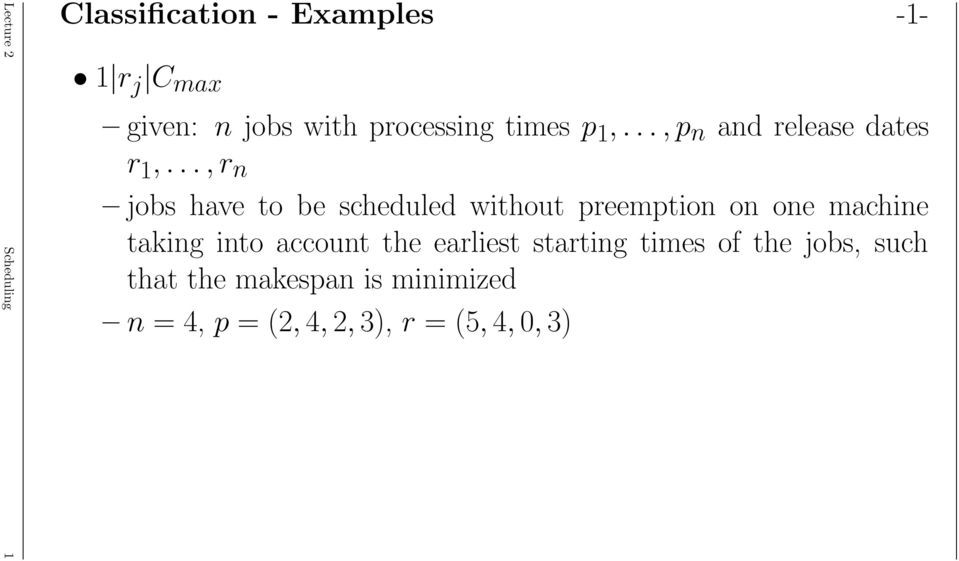
2 Lecture 2 Scheduling 2 Classification - Examples -1-1 r j C max given: n jobs with processing times p 1,..., p n and release dates r 1,..., r n jobs have to be scheduled without preemption on one machine taking into account the earliest starting times of the jobs, such that the makespan is minimized n = 4, p = (2, 4, 2, 3), r = (5, 4, 0, 3) Feasible Schedule with C max = 12 (schedule is optimal)

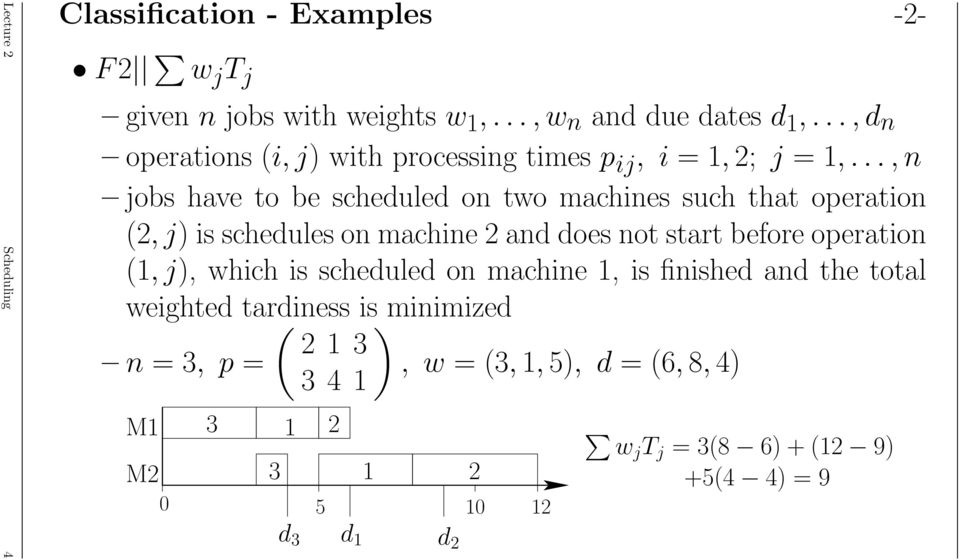
3 Lecture 2 Scheduling 3 Classification - Examples -2- F 2 w j T j given n jobs with weights w 1,..., w n and due dates d 1,..., d n operations (i, j) with processing times p ij, i = 1, 2; j = 1,..., n jobs have to be scheduled on two machines such that operation (2, j) is schedules on machine 2 and does not start before operation (1, j), which is scheduled on machine 1, is finished and the total weighted tardiness ( is ) minimized n = 3, p =, w = (3, 1, 5), d = (6, 8, 4) 3 4 1

4 Lecture 2 Scheduling 4 Classification - Examples -2- F 2 w j T j given n jobs with weights w 1,..., w n and due dates d 1,..., d n operations (i, j) with processing times p ij, i = 1, 2; j = 1,..., n jobs have to be scheduled on two machines such that operation (2, j) is schedules on machine 2 and does not start before operation (1, j), which is scheduled on machine 1, is finished and the total weighted tardiness ( is ) minimized n = 3, p =, w = (3, 1, 5), d = (6, 8, 4) M wj T j = 3(8 6) + (12 9) M (4 4) = d 3 d 1 d 2
5 Lecture 2 Scheduling 5 Classes of Schedules Nondelay Schedules: A feasible schedule is called a nondelay schedule if no machine is kept idle while a job/an operation is waiting for processing Example: P 3 prec C max n = 6 p = (1, 1, 2, 2, 3, 3)

6 Lecture 2 Scheduling 6 Classes of Schedules Nondelay Schedules: A feasible schedule is called a nondelay schedule if no machine is kept idle while a job/an operation is waiting for processing Example: P 3 prec C max n = 6 p = (1, 1, 2, 2, 3, 3) Best nondelay: M1 M2 M Optimal M1 M2 M

7 Lecture 2 Scheduling 7 Classes of Schedules Remark: restricted to non preemptive schedules Active Schedules: A feasible schedule is called active if it is not possible to construct another schedule by changing the order of processing on the machines and having at least one job/operation finishing earlier and no job/operation finishing later. Semi-Active Schedules: A feasible schedule is called semi-active if no job/operation can be finishing earlier without changing the order of processing on any one of the machines. -2-
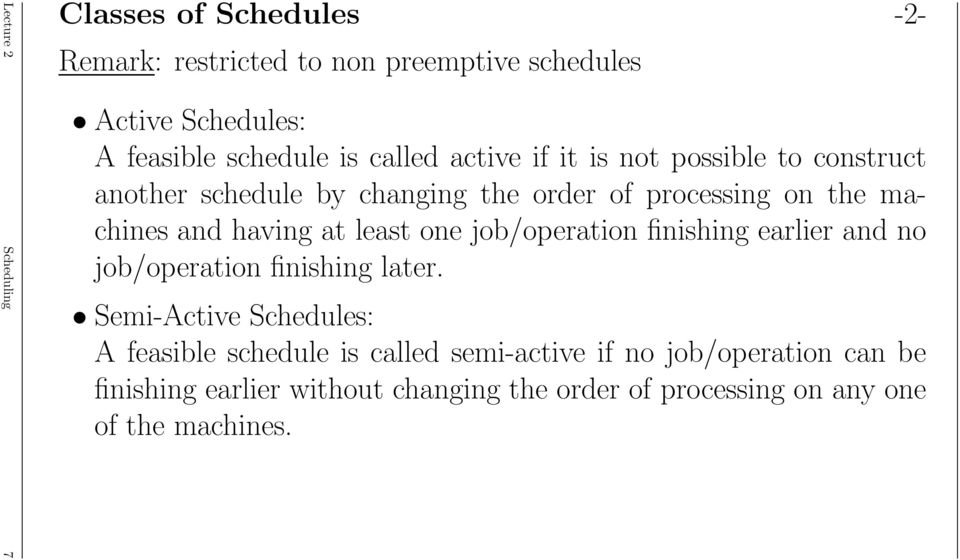
8 Lecture 2 Scheduling 8 Classes of Schedules Examples of (semi)-active schedules: Prec: 1 2; 2 3 not semi-active M1 M
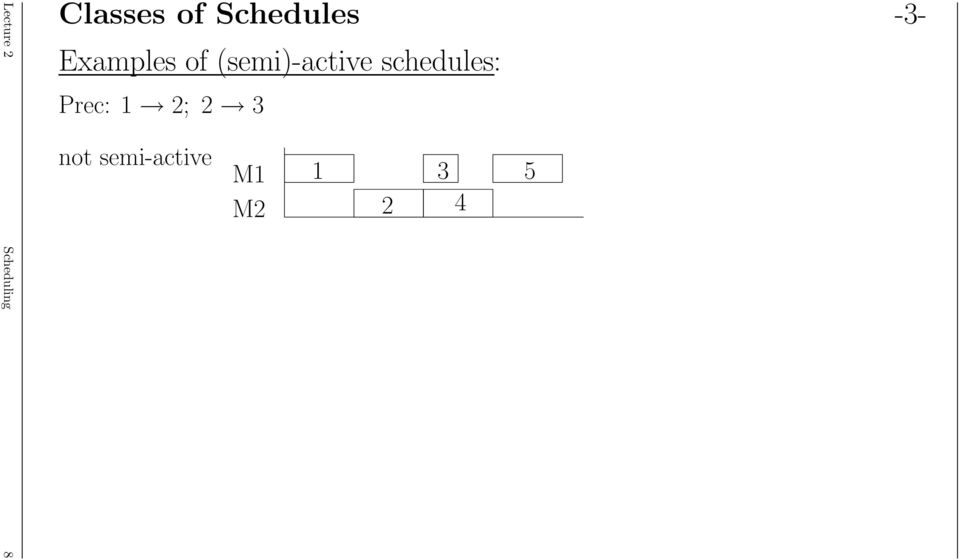
9 Lecture 2 Scheduling 9 Classes of Schedules Examples of (semi)-active schedules: Prec: 1 2; 2 3 not semi-active semi-active M1 M2 M1 M

10 Lecture 2 Scheduling 10 Classes of Schedules Examples of (semi)-active schedules: Prec: 1 2; 2 3 not semi-active semi-active active M1 M2 M1 M2 M1 M
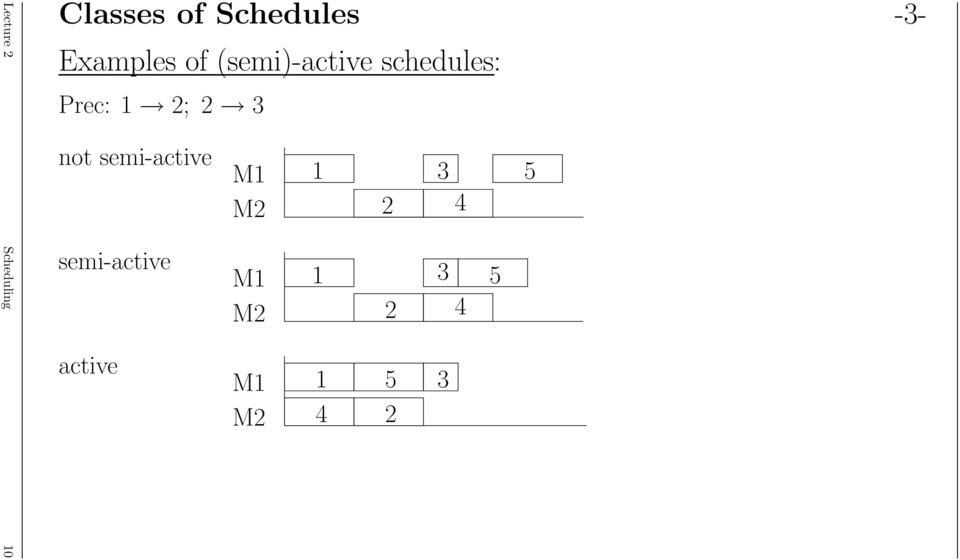
11 Lecture 2 Scheduling 11 Classes of Schedules Properties: every nonpreemptive nondelay schedule is active every active schedule is semiactive if the objective criterion is regular, the set of active schedules contains an optimal schedule (regular = non decreasing with respect to the completion times) Summary: All schedules -4- x non- delay active optimal schedule Semi active

12 Lecture 2 Scheduling 12 Research topics for Scheduling determine boarder line between polynomially solvable and NP-hard models for polynomially solvable models find the most efficient solution method (low complexity) for NP-hard models develop enumerative methods (DP, branch and bound, branch and cut,...) develop heuristic approached (priority based, local search,...) consider approximation methods (with quality guarantee)

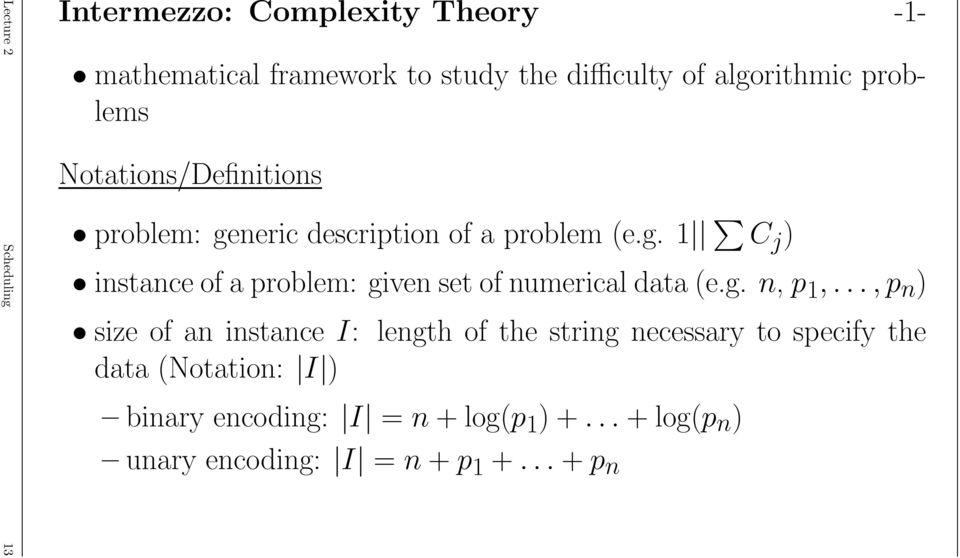
13 Lecture 2 Scheduling 13 Intermezzo: Complexity Theory -1- mathematical framework to study the difficulty of algorithmic problems Notations/Definitions problem: generic description of a problem (e.g. 1 C j ) instance of a problem: given set of numerical data (e.g. n, p 1,..., p n ) size of an instance I: length of the string necessary to specify the data (Notation: I ) binary encoding: I = n + log(p 1 ) log(p n ) unary encoding: I = n + p p n
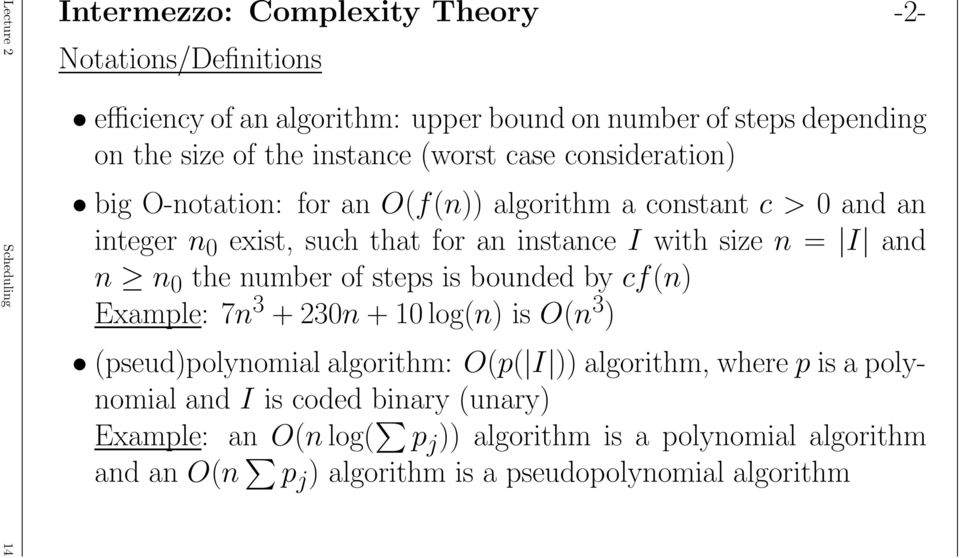
14 Lecture 2 Scheduling 14 Intermezzo: Complexity Theory -2- Notations/Definitions efficiency of an algorithm: upper bound on number of steps depending on the size of the instance (worst case consideration) big O-notation: for an O(f(n)) algorithm a constant c > 0 and an integer n 0 exist, such that for an instance I with size n = I and n n 0 the number of steps is bounded by cf(n) Example: 7n n + 10 log(n) is O(n 3 ) (pseud)polynomial algorithm: O(p( I )) algorithm, where p is a polynomial and I is coded binary (unary) Example: an O(n log( p j )) algorithm is a polynomial algorithm and an O(n p j ) algorithm is a pseudopolynomial algorithm
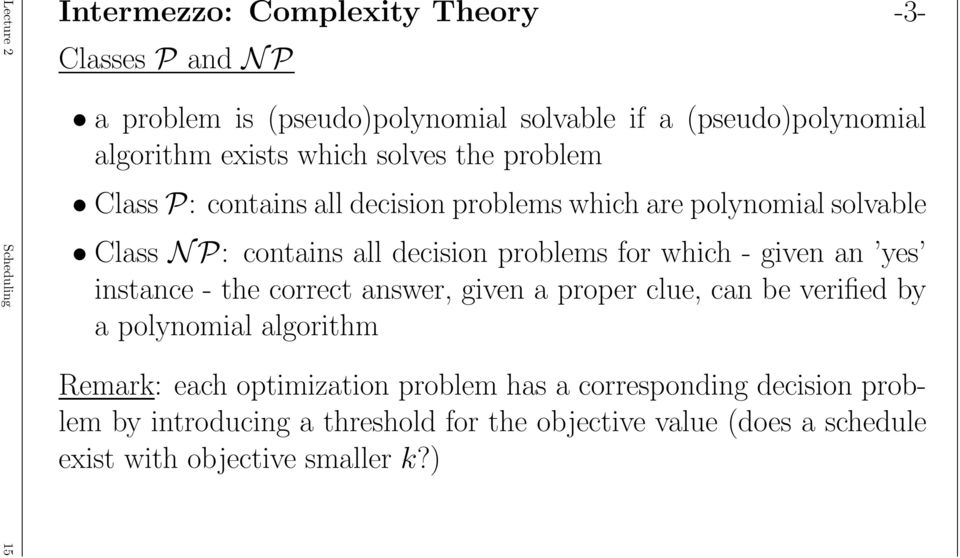
15 Lecture 2 Scheduling 15 Intermezzo: Complexity Theory -3- Classes P and N P a problem is (pseudo)polynomial solvable if a (pseudo)polynomial algorithm exists which solves the problem Class P: contains all decision problems which are polynomial solvable Class N P: contains all decision problems for which - given an yes instance - the correct answer, given a proper clue, can be verified by a polynomial algorithm Remark: each optimization problem has a corresponding decision problem by introducing a threshold for the objective value (does a schedule exist with objective smaller k?)
16 Lecture 2 Scheduling 16 Intermezzo: Complexity Theory -4- Polynomial reduction a decision problem P polynomially reduces to a problem Q, if a polynomial function g exists that transforms instances of P to instances of Q such that I is a yes instance of P if and only is g(i) is a yes instance of Q Notation: P Q NP-complete a decision problem P N P is called NP-complete if all problems from the class N P polynomially reduce to P an optimization problem is called NP-hard if the corresponding decision problem is NP-complete

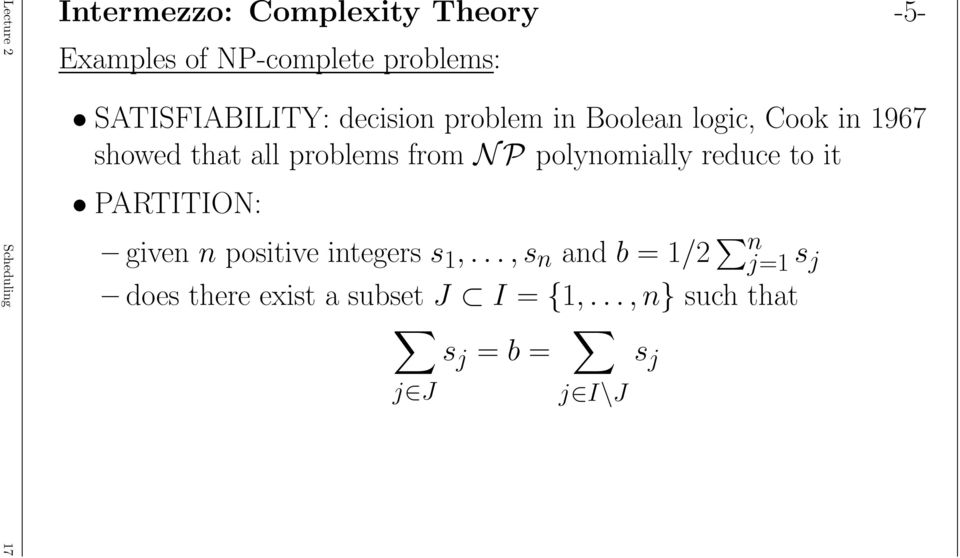
17 Lecture 2 Scheduling 17 Intermezzo: Complexity Theory -5- Examples of NP-complete problems: SATISFIABILITY: decision problem in Boolean logic, Cook in 1967 showed that all problems from N P polynomially reduce to it PARTITION: given n positive integers s 1,..., s n and b = 1/2 n j=1 s j does there exist a subset J I = {1,..., n} such that s j = b = j J j I\J s j
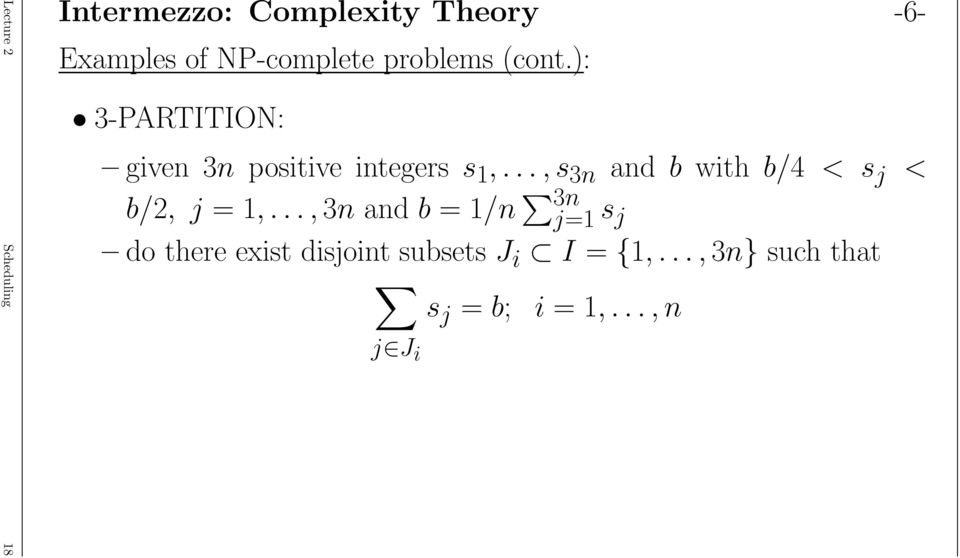
18 Lecture 2 Scheduling 18 Intermezzo: Complexity Theory -6- Examples of NP-complete problems (cont.): 3-PARTITION: given 3n positive integers s 1,..., s 3n and b with b/4 < s j < b/2, j = 1,..., 3n and b = 1/n 3n j=1 s j do there exist disjoint subsets J i I = {1,..., 3n} such that s j = b; i = 1,..., n j J i
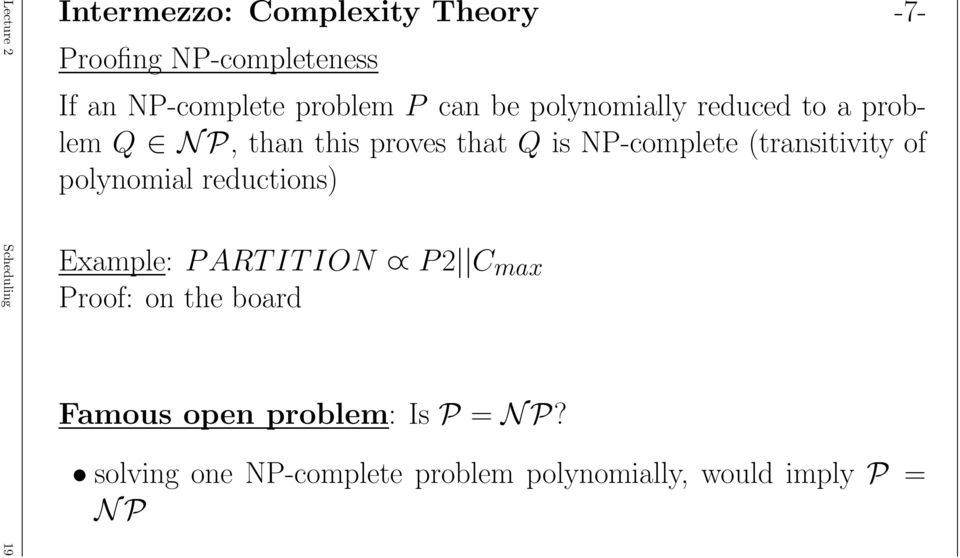
19 Lecture 2 Scheduling 19 Intermezzo: Complexity Theory -7- Proofing NP-completeness If an NP-complete problem P can be polynomially reduced to a problem Q N P, than this proves that Q is NP-complete (transitivity of polynomial reductions) Example: P ART IT ION P 2 C max Proof: on the board Famous open problem: Is P = N P? solving one NP-complete problem polynomially, would imply P = N P
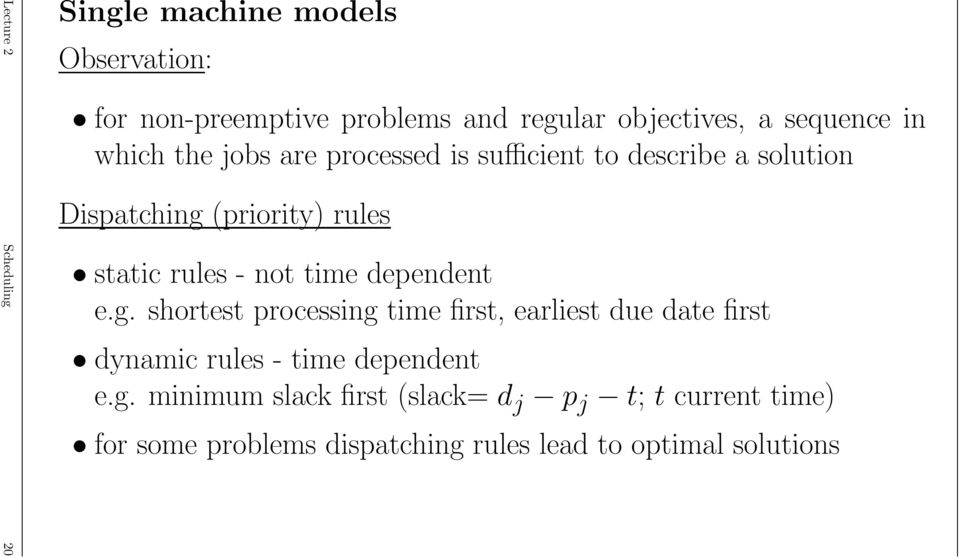
20 Lecture 2 Scheduling 20 Single machine models Observation: for non-preemptive problems and regular objectives, a sequence in which the jobs are processed is sufficient to describe a solution Dispatching (priority) rules static rules - not time dependent e.g. shortest processing time first, earliest due date first dynamic rules - time dependent e.g. minimum slack first (slack= d j p j t; t current time) for some problems dispatching rules lead to optimal solutions
21 Lecture 2 Scheduling 21 Single machine models: 1 w j C j -1- Given: n jobs with processing times p 1,..., p n and weights w 1,..., w n Consider case: w 1 =... = w n (= 1):
22 Lecture 2 Scheduling 22 Single machine models: 1 w j C j -1- Given: n jobs with processing times p 1,..., p n and weights w 1,..., w n Consider special case: w 1 =... = w n (= 1): SPT-rule: shortest processing time first Theorem: SPT is optimal for 1 C j Proof: by an exchange argument (on board) Complexity: O(n log(n))
23 Lecture 2 Scheduling 23 Single machine models: 1 w j C j -2- General case WSPT-rule: weighted shortest processing time first, i.e. sort jobs by increasing p j /w j -values Theorem: WSPT is optimal for 1 w j C j Proof: by an exchange argument (exercise) Complexity: O(n log(n)) Further results: 1 tree w j C j can be solved by in polynomial time (O(n log(n))) (see [Brucker 2004]) 1 prec C j is NP-hard in the strong sense (see [Brucker 2004])
24 Lecture 2 Scheduling 24 Single machine models: 1 prec f max -1- Given: n jobs with processing times p 1,..., p n regular functions f 1,..., f n objective criterion f max = max{f 1 (C 1 ),..., f n (C n )} Observation: completion time of last job = p j
25 Lecture 2 Scheduling 25 Single machine models: 1 prec f max -1- Given: n jobs with processing times p 1,..., p n regular functions f 1,..., f n objective criterion f max = max{f 1 (C 1 ),..., f n (C n )} Observation: completion time of last job = p j Method plan backwards from p j to 0 from all available jobs (jobs from which all successors have already been scheduled), schedule the job which is cheapest on that position
26 Lecture 2 Scheduling 26 Single machine models: 1 prec f max -2- S set of already scheduled jobs (initial: S = ) J set of all jobs, which successors have been scheduled (initial: all jobs without successors) t time where next job will be completed (initial: t = p j ) Algorithm 1 prec f max (Lawler s Algorithm) REPEAT select j J such that h j (t) = min k J f k (t); schedule j such that it completes at t; add j to S, delete j from J and update J; t := t p j ; UNTIL J =.
27 Lecture 2 Scheduling 27 Single machine models: 1 prec f max -3- Theorem: Algorithm 1 prec f max is optimal for 1 prec f max Proof: on the board Complexity: O(n 2 )
Classification - Examples
 Lecture 2 Scheduling 1 Classification - Examples 1 r j C max given: n jobs with processing times p 1,...,p n and release dates r 1,...,r n jobs have to be scheduled without preemption on one machine taking
Scheduling Single Machine Scheduling. Tim Nieberg
 Scheduling Single Machine Scheduling Tim Nieberg Single machine models Observation: for non-preemptive problems and regular objectives, a sequence in which the jobs are processed is sufficient to describe
Single machine models: Maximum Lateness -12- Approximation ratio for EDD for problem 1 r j,d j < 0 L max. structure of a schedule Q...
 Lecture 4 Scheduling 1 Single machine models: Maximum Lateness -12- Approximation ratio for EDD for problem 1 r j,d j < 0 L max structure of a schedule 0 Q 1100 11 00 11 000 111 0 0 1 1 00 11 00 11 00
Scheduling Shop Scheduling. Tim Nieberg
 Scheduling Shop Scheduling Tim Nieberg Shop models: General Introduction Remark: Consider non preemptive problems with regular objectives Notation Shop Problems: m machines, n jobs 1,..., n operations
Complexity Theory. IE 661: Scheduling Theory Fall 2003 Satyaki Ghosh Dastidar
 Complexity Theory IE 661: Scheduling Theory Fall 2003 Satyaki Ghosh Dastidar Outline Goals Computation of Problems Concepts and Definitions Complexity Classes and Problems Polynomial Time Reductions Examples
Single machine parallel batch scheduling with unbounded capacity
 Workshop on Combinatorics and Graph Theory 21th, April, 2006 Nankai University Single machine parallel batch scheduling with unbounded capacity Yuan Jinjiang Department of mathematics, Zhengzhou University
JUST-IN-TIME SCHEDULING WITH PERIODIC TIME SLOTS. Received December May 12, 2003; revised February 5, 2004
 Scientiae Mathematicae Japonicae Online, Vol. 10, (2004), 431 437 431 JUST-IN-TIME SCHEDULING WITH PERIODIC TIME SLOTS Ondřej Čepeka and Shao Chin Sung b Received December May 12, 2003; revised February
Real Time Scheduling Basic Concepts. Radek Pelánek
 Real Time Scheduling Basic Concepts Radek Pelánek Basic Elements Model of RT System abstraction focus only on timing constraints idealization (e.g., zero switching time) Basic Elements Basic Notions task
Approximability of Two-Machine No-Wait Flowshop Scheduling with Availability Constraints
 Approximability of Two-Machine No-Wait Flowshop Scheduling with Availability Constraints T.C. Edwin Cheng 1, and Zhaohui Liu 1,2 1 Department of Management, The Hong Kong Polytechnic University Kowloon,
Tutorial 8. NP-Complete Problems
 Tutorial 8 NP-Complete Problems Decision Problem Statement of a decision problem Part 1: instance description defining the input Part 2: question stating the actual yesor-no question A decision problem
Factors to Describe Job Shop Scheduling Problem
 Job Shop Scheduling Job Shop A work location in which a number of general purpose work stations exist and are used to perform a variety of jobs Example: Car repair each operator (mechanic) evaluates plus
Duplicating and its Applications in Batch Scheduling
 Duplicating and its Applications in Batch Scheduling Yuzhong Zhang 1 Chunsong Bai 1 Shouyang Wang 2 1 College of Operations Research and Management Sciences Qufu Normal University, Shandong 276826, China
Real-Time Scheduling (Part 1) (Working Draft) Real-Time System Example
 Real-Time Scheduling (Part 1) (Working Draft) Insup Lee Department of Computer and Information Science School of Engineering and Applied Science University of Pennsylvania www.cis.upenn.edu/~lee/ CIS 41,
Introduction to Scheduling Theory
 Introduction to Scheduling Theory Arnaud Legrand Laboratoire Informatique et Distribution IMAG CNRS, France [email protected] November 8, 2004 1/ 26 Outline 1 Task graphs from outer space 2 Scheduling
5 INTEGER LINEAR PROGRAMMING (ILP) E. Amaldi Fondamenti di R.O. Politecnico di Milano 1
 5 INTEGER LINEAR PROGRAMMING (ILP) E. Amaldi Fondamenti di R.O. Politecnico di Milano 1 General Integer Linear Program: (ILP) min c T x Ax b x 0 integer Assumption: A, b integer The integrality condition
Approximation Algorithms
 Approximation Algorithms or: How I Learned to Stop Worrying and Deal with NP-Completeness Ong Jit Sheng, Jonathan (A0073924B) March, 2012 Overview Key Results (I) General techniques: Greedy algorithms
Algorithm Design and Analysis
 Algorithm Design and Analysis LECTURE 27 Approximation Algorithms Load Balancing Weighted Vertex Cover Reminder: Fill out SRTEs online Don t forget to click submit Sofya Raskhodnikova 12/6/2011 S. Raskhodnikova;
Common Approaches to Real-Time Scheduling
 Common Approaches to Real-Time Scheduling Clock-driven time-driven schedulers Priority-driven schedulers Examples of priority driven schedulers Effective timing constraints The Earliest-Deadline-First
Aperiodic Task Scheduling
 Aperiodic Task Scheduling Jian-Jia Chen (slides are based on Peter Marwedel) TU Dortmund, Informatik 12 Germany Springer, 2010 2014 年 11 月 19 日 These slides use Microsoft clip arts. Microsoft copyright
NP-complete? NP-hard? Some Foundations of Complexity. Prof. Sven Hartmann Clausthal University of Technology Department of Informatics
 NP-complete? NP-hard? Some Foundations of Complexity Prof. Sven Hartmann Clausthal University of Technology Department of Informatics Tractability of Problems Some problems are undecidable: no computer
! Solve problem to optimality. ! Solve problem in poly-time. ! Solve arbitrary instances of the problem. #-approximation algorithm.
 Approximation Algorithms 11 Approximation Algorithms Q Suppose I need to solve an NP-hard problem What should I do? A Theory says you're unlikely to find a poly-time algorithm Must sacrifice one of three
Offline sorting buffers on Line
 Offline sorting buffers on Line Rohit Khandekar 1 and Vinayaka Pandit 2 1 University of Waterloo, ON, Canada. email: [email protected] 2 IBM India Research Lab, New Delhi. email: [email protected]
Completion Time Scheduling and the WSRPT Algorithm
 Completion Time Scheduling and the WSRPT Algorithm Bo Xiong, Christine Chung Department of Computer Science, Connecticut College, New London, CT {bxiong,cchung}@conncoll.edu Abstract. We consider the online
Abstract Title: Planned Preemption for Flexible Resource Constrained Project Scheduling
 Abstract number: 015-0551 Abstract Title: Planned Preemption for Flexible Resource Constrained Project Scheduling Karuna Jain and Kanchan Joshi Shailesh J. Mehta School of Management, Indian Institute
Lecture Outline Overview of real-time scheduling algorithms Outline relative strengths, weaknesses
 Overview of Real-Time Scheduling Embedded Real-Time Software Lecture 3 Lecture Outline Overview of real-time scheduling algorithms Clock-driven Weighted round-robin Priority-driven Dynamic vs. static Deadline
Fairness in Routing and Load Balancing
 Fairness in Routing and Load Balancing Jon Kleinberg Yuval Rabani Éva Tardos Abstract We consider the issue of network routing subject to explicit fairness conditions. The optimization of fairness criteria
5.1 Bipartite Matching
 CS787: Advanced Algorithms Lecture 5: Applications of Network Flow In the last lecture, we looked at the problem of finding the maximum flow in a graph, and how it can be efficiently solved using the Ford-Fulkerson
Lecture 7: NP-Complete Problems
 IAS/PCMI Summer Session 2000 Clay Mathematics Undergraduate Program Basic Course on Computational Complexity Lecture 7: NP-Complete Problems David Mix Barrington and Alexis Maciel July 25, 2000 1. Circuit
List Scheduling in Order of α-points on a Single Machine
 List Scheduling in Order of α-points on a Single Machine Martin Skutella Fachbereich Mathematik, Universität Dortmund, D 4422 Dortmund, Germany [email protected] http://www.mathematik.uni-dortmund.de/
Topic: Greedy Approximations: Set Cover and Min Makespan Date: 1/30/06
 CS880: Approximations Algorithms Scribe: Matt Elder Lecturer: Shuchi Chawla Topic: Greedy Approximations: Set Cover and Min Makespan Date: 1/30/06 3.1 Set Cover The Set Cover problem is: Given a set of
Stiffie's On Line Scheduling Algorithm
 A class of on-line scheduling algorithms to minimize total completion time X. Lu R.A. Sitters L. Stougie Abstract We consider the problem of scheduling jobs on-line on a single machine and on identical
Scheduling Real-time Tasks: Algorithms and Complexity
 Scheduling Real-time Tasks: Algorithms and Complexity Sanjoy Baruah The University of North Carolina at Chapel Hill Email: [email protected] Joël Goossens Université Libre de Bruxelles Email: [email protected]
NP-Completeness and Cook s Theorem
 NP-Completeness and Cook s Theorem Lecture notes for COM3412 Logic and Computation 15th January 2002 1 NP decision problems The decision problem D L for a formal language L Σ is the computational task:
Near Optimal Solutions
 Near Optimal Solutions Many important optimization problems are lacking efficient solutions. NP-Complete problems unlikely to have polynomial time solutions. Good heuristics important for such problems.
CSC2420 Spring 2015: Lecture 3
 CSC2420 Spring 2015: Lecture 3 Allan Borodin January 22, 2015 1 / 1 Announcements and todays agenda Assignment 1 due next Thursday. I may add one or two additional questions today or tomorrow. Todays agenda
Dimensioning an inbound call center using constraint programming
 Dimensioning an inbound call center using constraint programming Cyril Canon 1,2, Jean-Charles Billaut 2, and Jean-Louis Bouquard 2 1 Vitalicom, 643 avenue du grain d or, 41350 Vineuil, France [email protected]
Real-Time Software. Basic Scheduling and Response-Time Analysis. René Rydhof Hansen. 21. september 2010
 Real-Time Software Basic Scheduling and Response-Time Analysis René Rydhof Hansen 21. september 2010 TSW (2010e) (Lecture 05) Real-Time Software 21. september 2010 1 / 28 Last Time Time in a real-time
Lecture 19: Introduction to NP-Completeness Steven Skiena. Department of Computer Science State University of New York Stony Brook, NY 11794 4400
 Lecture 19: Introduction to NP-Completeness Steven Skiena Department of Computer Science State University of New York Stony Brook, NY 11794 4400 http://www.cs.sunysb.edu/ skiena Reporting to the Boss Suppose
3. Scheduling issues. Common approaches /1. Common approaches /2. Common approaches /3. 2012/13 UniPD / T. Vardanega 23/01/2013. Real-Time Systems 1
 Common approaches /1 3. Scheduling issues Clock-driven (time-driven) scheduling Scheduling decisions are made beforehand (off line) and carried out at predefined time instants The time instants normally
Discrete Optimization
 Discrete Optimization [Chen, Batson, Dang: Applied integer Programming] Chapter 3 and 4.1-4.3 by Johan Högdahl and Victoria Svedberg Seminar 2, 2015-03-31 Todays presentation Chapter 3 Transforms using
THROUGHPUT OPTIMIZATION IN ROBOTIC CELLS
 Contents Preface xv 1. ROBOTIC CELLS IN PRACTICE 1 1.1 Cellular Manufacturing 2 1.2 Robotic Cell Flowshops 3 1.3 Throughput Optimization 7 1.4 Historical Overview 9 1.5 Applications 11 2. A CLASSIFICATION
24. The Branch and Bound Method
 24. The Branch and Bound Method It has serious practical consequences if it is known that a combinatorial problem is NP-complete. Then one can conclude according to the present state of science that no
8.1 Min Degree Spanning Tree
 CS880: Approximations Algorithms Scribe: Siddharth Barman Lecturer: Shuchi Chawla Topic: Min Degree Spanning Tree Date: 02/15/07 In this lecture we give a local search based algorithm for the Min Degree
Why? A central concept in Computer Science. Algorithms are ubiquitous.
 Analysis of Algorithms: A Brief Introduction Why? A central concept in Computer Science. Algorithms are ubiquitous. Using the Internet (sending email, transferring files, use of search engines, online
NP-Completeness I. Lecture 19. 19.1 Overview. 19.2 Introduction: Reduction and Expressiveness
 Lecture 19 NP-Completeness I 19.1 Overview In the past few lectures we have looked at increasingly more expressive problems that we were able to solve using efficient algorithms. In this lecture we introduce
MIP-Based Approaches for Solving Scheduling Problems with Batch Processing Machines
 The Eighth International Symposium on Operations Research and Its Applications (ISORA 09) Zhangjiajie, China, September 20 22, 2009 Copyright 2009 ORSC & APORC, pp. 132 139 MIP-Based Approaches for Solving
Applied Algorithm Design Lecture 5
 Applied Algorithm Design Lecture 5 Pietro Michiardi Eurecom Pietro Michiardi (Eurecom) Applied Algorithm Design Lecture 5 1 / 86 Approximation Algorithms Pietro Michiardi (Eurecom) Applied Algorithm Design
Exponential time algorithms for graph coloring
 Exponential time algorithms for graph coloring Uriel Feige Lecture notes, March 14, 2011 1 Introduction Let [n] denote the set {1,..., k}. A k-labeling of vertices of a graph G(V, E) is a function V [k].
Chapter 11. 11.1 Load Balancing. Approximation Algorithms. Load Balancing. Load Balancing on 2 Machines. Load Balancing: Greedy Scheduling
 Approximation Algorithms Chapter Approximation Algorithms Q. Suppose I need to solve an NP-hard problem. What should I do? A. Theory says you're unlikely to find a poly-time algorithm. Must sacrifice one
Literature Review of Single Machine Scheduling Problem with Uniform Parallel Machines
 Intelligent Information Management, 2010, 2, 457-474 doi:10.4236/iim.2010.28056 Published Online August 2010 (http://www.scirp.org/journal/iim) Literature Review of Single Machine Scheduling Problem with
Page 1. CSCE 310J Data Structures & Algorithms. CSCE 310J Data Structures & Algorithms. P, NP, and NP-Complete. Polynomial-Time Algorithms
 CSCE 310J Data Structures & Algorithms P, NP, and NP-Complete Dr. Steve Goddard [email protected] CSCE 310J Data Structures & Algorithms Giving credit where credit is due:» Most of the lecture notes
A Beam Search Heuristic for Multi-Mode Single Resource Constrained Project Scheduling
 A Beam Search Heuristic for Multi-Mode Single Resource Constrained Project Scheduling Chuda Basnet Department of Management Systems The University of Waikato Private Bag 3105 Hamilton [email protected]
! Solve problem to optimality. ! Solve problem in poly-time. ! Solve arbitrary instances of the problem. !-approximation algorithm.
 Approximation Algorithms Chapter Approximation Algorithms Q Suppose I need to solve an NP-hard problem What should I do? A Theory says you're unlikely to find a poly-time algorithm Must sacrifice one of
Heuristic Algorithms for Open Shop Scheduling to Minimize Mean Flow Time, Part I: Constructive Algorithms
 Heuristic Algorithms for Open Shop Scheduling to Minimize Mean Flow Time, Part I: Constructive Algorithms Heidemarie Bräsel, André Herms, Marc Mörig, Thomas Tautenhahn, Jan Tusch, Frank Werner Otto-von-Guericke-Universität,
A generalized job-shop problem with more than one resource demand per task
 A generalized job-shop problem with more than one resource demand per task Joachim Schauer Cornelius Schwarz Abstract We study a generalized job-shop problem called the Laser Sharing Problem with fixed
Constraint-Based Scheduling: A Tutorial
 Constraint-Based Scheduling: A Tutorial Claude Le Pape ILOG S. A. 9, rue de Verdun F-94253 Gentilly Cedex Tel: +33 1 49 08 29 67 Fax: +33 1 49 08 35 10 Email: [email protected] Given a set of resources with
CSC 373: Algorithm Design and Analysis Lecture 16
 CSC 373: Algorithm Design and Analysis Lecture 16 Allan Borodin February 25, 2013 Some materials are from Stephen Cook s IIT talk and Keven Wayne s slides. 1 / 17 Announcements and Outline Announcements
CS 3719 (Theory of Computation and Algorithms) Lecture 4
 CS 3719 (Theory of Computation and Algorithms) Lecture 4 Antonina Kolokolova January 18, 2012 1 Undecidable languages 1.1 Church-Turing thesis Let s recap how it all started. In 1990, Hilbert stated a
11. APPROXIMATION ALGORITHMS
 11. APPROXIMATION ALGORITHMS load balancing center selection pricing method: vertex cover LP rounding: vertex cover generalized load balancing knapsack problem Lecture slides by Kevin Wayne Copyright 2005
OHJ-2306 Introduction to Theoretical Computer Science, Fall 2012 8.11.2012
 276 The P vs. NP problem is a major unsolved problem in computer science It is one of the seven Millennium Prize Problems selected by the Clay Mathematics Institute to carry a $ 1,000,000 prize for the
Arithmetic Coding: Introduction
 Data Compression Arithmetic coding Arithmetic Coding: Introduction Allows using fractional parts of bits!! Used in PPM, JPEG/MPEG (as option), Bzip More time costly than Huffman, but integer implementation
Minimizing the Number of Machines in a Unit-Time Scheduling Problem
 Minimizing the Number of Machines in a Unit-Time Scheduling Problem Svetlana A. Kravchenko 1 United Institute of Informatics Problems, Surganova St. 6, 220012 Minsk, Belarus [email protected] Frank
The Trip Scheduling Problem
 The Trip Scheduling Problem Claudia Archetti Department of Quantitative Methods, University of Brescia Contrada Santa Chiara 50, 25122 Brescia, Italy Martin Savelsbergh School of Industrial and Systems
CAD Algorithms. P and NP
 CAD Algorithms The Classes P and NP Mohammad Tehranipoor ECE Department 6 September 2010 1 P and NP P and NP are two families of problems. P is a class which contains all of the problems we solve using
Computer Algorithms. NP-Complete Problems. CISC 4080 Yanjun Li
 Computer Algorithms NP-Complete Problems NP-completeness The quest for efficient algorithms is about finding clever ways to bypass the process of exhaustive search, using clues from the input in order
Bounded Cost Algorithms for Multivalued Consensus Using Binary Consensus Instances
 Bounded Cost Algorithms for Multivalued Consensus Using Binary Consensus Instances Jialin Zhang Tsinghua University [email protected] Wei Chen Microsoft Research Asia [email protected] Abstract
Dynamic programming. Doctoral course Optimization on graphs - Lecture 4.1. Giovanni Righini. January 17 th, 2013
 Dynamic programming Doctoral course Optimization on graphs - Lecture.1 Giovanni Righini January 1 th, 201 Implicit enumeration Combinatorial optimization problems are in general NP-hard and we usually
The P versus NP Solution
 The P versus NP Solution Frank Vega To cite this version: Frank Vega. The P versus NP Solution. 2015. HAL Id: hal-01143424 https://hal.archives-ouvertes.fr/hal-01143424 Submitted on 17 Apr
1. Nondeterministically guess a solution (called a certificate) 2. Check whether the solution solves the problem (called verification)
 Some N P problems Computer scientists have studied many N P problems, that is, problems that can be solved nondeterministically in polynomial time. Traditionally complexity question are studied as languages:
The Model Checker SPIN
 The Model Checker SPIN Author: Gerard J. Holzmann Presented By: Maulik Patel Outline Introduction Structure Foundation Algorithms Memory management Example/Demo SPIN-Introduction Introduction SPIN (Simple(
2. (a) Explain the strassen s matrix multiplication. (b) Write deletion algorithm, of Binary search tree. [8+8]
![2. (a) Explain the strassen s matrix multiplication. (b) Write deletion algorithm, of Binary search tree. [8+8]](/thumbs/40/21097758.jpg "2. (a) Explain the strassen s matrix multiplication. (b) Write deletion algorithm, of Binary search tree. [8+8]") Code No: R05220502 Set No. 1 1. (a) Describe the performance analysis in detail. (b) Show that f 1 (n)+f 2 (n) = 0(max(g 1 (n), g 2 (n)) where f 1 (n) = 0(g 1 (n)) and f 2 (n) = 0(g 2 (n)). [8+8] 2. (a)
Code No: R05220502 Set No. 1 1. (a) Describe the performance analysis in detail. (b) Show that f 1 (n)+f 2 (n) = 0(max(g 1 (n), g 2 (n)) where f 1 (n) = 0(g 1 (n)) and f 2 (n) = 0(g 2 (n)). [8+8] 2. (a)
Quantum and Non-deterministic computers facing NP-completeness
 Quantum and Non-deterministic computers facing NP-completeness Thibaut University of Vienna Dept. of Business Administration Austria Vienna January 29th, 2013 Some pictures come from Wikipedia Introduction
NP-Completeness. CptS 223 Advanced Data Structures. Larry Holder School of Electrical Engineering and Computer Science Washington State University
 NP-Completeness CptS 223 Advanced Data Structures Larry Holder School of Electrical Engineering and Computer Science Washington State University 1 Hard Graph Problems Hard means no known solutions with
Load Balancing and Rebalancing on Web Based Environment. Yu Zhang
 Load Balancing and Rebalancing on Web Based Environment Yu Zhang This report is submitted as partial fulfilment of the requirements for the Honours Programme of the School of Computer Science and Software
SIMS 255 Foundations of Software Design. Complexity and NP-completeness
 SIMS 255 Foundations of Software Design Complexity and NP-completeness Matt Welsh November 29, 2001 [email protected] 1 Outline Complexity of algorithms Space and time complexity ``Big O'' notation Complexity
Distributed Load Balancing for Machines Fully Heterogeneous
 Internship Report 2 nd of June - 22 th of August 2014 Distributed Load Balancing for Machines Fully Heterogeneous Nathanaël Cheriere [email protected] ENS Rennes Academic Year 2013-2014
On-line machine scheduling with batch setups
 On-line machine scheduling with batch setups Lele Zhang, Andrew Wirth Department of Mechanical Engineering The University of Melbourne, VIC 3010, Australia Abstract We study a class of scheduling problems
Scheduling a sequence of tasks with general completion costs
 Scheduling a sequence of tasks with general completion costs Francis Sourd CNRS-LIP6 4, place Jussieu 75252 Paris Cedex 05, France [email protected] Abstract Scheduling a sequence of tasks in the acceptation
Efficiency of algorithms. Algorithms. Efficiency of algorithms. Binary search and linear search. Best, worst and average case.
 Algorithms Efficiency of algorithms Computational resources: time and space Best, worst and average case performance How to compare algorithms: machine-independent measure of efficiency Growth rate Complexity
The Goldberg Rao Algorithm for the Maximum Flow Problem
 The Goldberg Rao Algorithm for the Maximum Flow Problem COS 528 class notes October 18, 2006 Scribe: Dávid Papp Main idea: use of the blocking flow paradigm to achieve essentially O(min{m 2/3, n 1/2 }
How To Solve A Minimum Set Covering Problem (Mcp)
 Measuring Rationality with the Minimum Cost of Revealed Preference Violations Mark Dean and Daniel Martin Online Appendices - Not for Publication 1 1 Algorithm for Solving the MASP In this online appendix
A Working Knowledge of Computational Complexity for an Optimizer
 A Working Knowledge of Computational Complexity for an Optimizer ORF 363/COS 323 Instructor: Amir Ali Ahmadi TAs: Y. Chen, G. Hall, J. Ye Fall 2014 1 Why computational complexity? What is computational
A Study of Crossover Operators for Genetic Algorithm and Proposal of a New Crossover Operator to Solve Open Shop Scheduling Problem
 American Journal of Industrial and Business Management, 2016, 6, 774-789 Published Online June 2016 in SciRes. http://www.scirp.org/journal/ajibm http://dx.doi.org/10.4236/ajibm.2016.66071 A Study of Crossover
Guessing Game: NP-Complete?
 Guessing Game: NP-Complete? 1. LONGEST-PATH: Given a graph G = (V, E), does there exists a simple path of length at least k edges? YES 2. SHORTEST-PATH: Given a graph G = (V, E), does there exists a simple
Proximal mapping via network optimization
 L. Vandenberghe EE236C (Spring 23-4) Proximal mapping via network optimization minimum cut and maximum flow problems parametric minimum cut problem application to proximal mapping Introduction this lecture:
Online Scheduling for Cloud Computing and Different Service Levels
 2012 IEEE 201226th IEEE International 26th International Parallel Parallel and Distributed and Distributed Processing Processing Symposium Symposium Workshops Workshops & PhD Forum Online Scheduling for