
Common Approaches to Real-Time Scheduling
|
|
|
- Dwayne Edwards
- 9 years ago
- Views:
Transcription
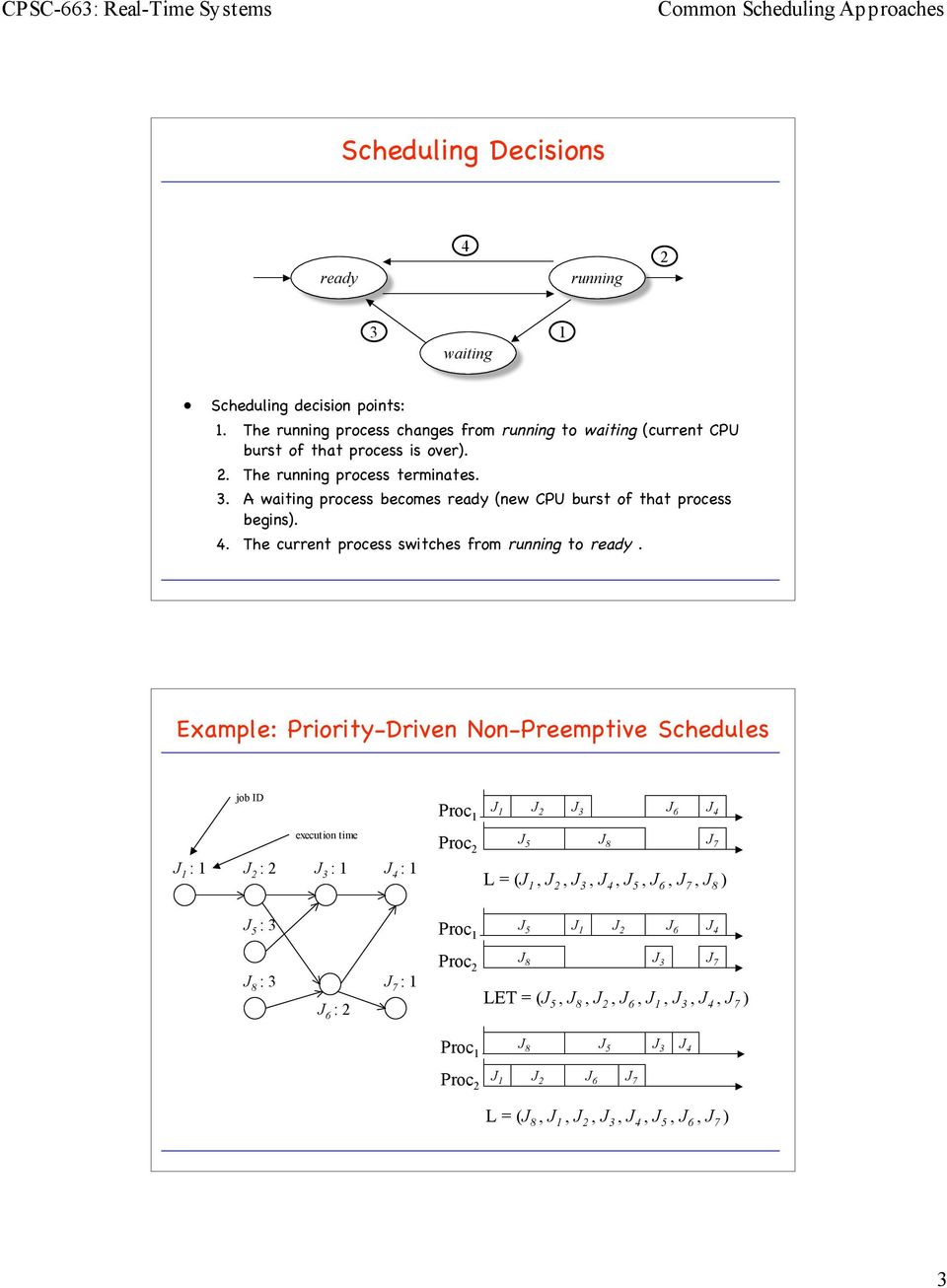
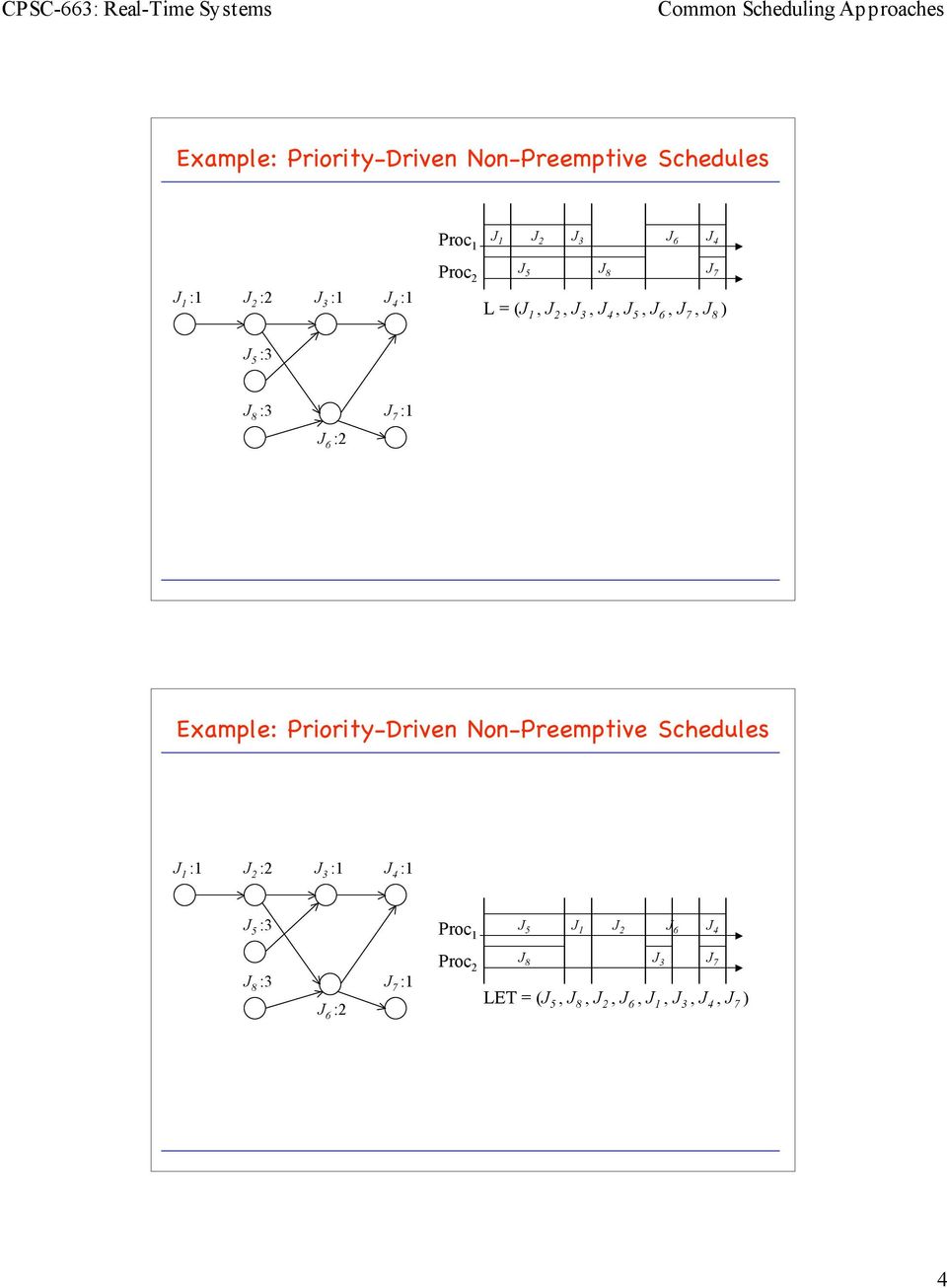
1 Common Approaches to Real-Time Scheduling Clock-driven time-driven schedulers Priority-driven schedulers Examples of priority driven schedulers Effective timing constraints The Earliest-Deadline-First EDF Scheduler and its optimality Common Approaches to Real-Time Scheduling Clock-driven time-driven schedulers Scheduling decisions are made at specific time instants, which are typically chosen a priori. Priority-driven schedulers Scheduling decisions are made when particular events in the system occur, e.g. a job becomes available processor becomes idle Work-conserving: processor is busy whenever there is work to be done.

2 Clock-Driven Time-Driven -- Overview Scheduling decision time: point in time when scheduler decides which job to execute next. Scheduling decision time in clock-driven schedulers is defined a priori. For example: Scheduler periodically wakes up and generates a portion of the schedule. scheduler job A B C D C A C Special case: When job parameters are known a priori, schedule can be pre-computed off-line, and stored as a table table-driven schedulers. Priority-Driven -- Overview Basic rule: Never leave processor idle when there is work to be done. such schedulers are also called work conserving Based on list-driven, greedy scheduling. Examples: FIFO, LIFO, SET, LET, EDF. Possible implementation of preemptive priority-driven scheduling: Assign priorities to jobs. Scheduling decisions are made when ob becomes ready Processor becomes idle Priorities of jobs change At each scheduling decision time, choose ready task with highest priority. In non-preemptive case, scheduling decisions are made only when processor becomes idle. 2

3 Scheduling Decisions ready 4 running 2 3 waiting Scheduling decision points:. The running process changes from running to waiting current CPU burst of that process is over. 2. The running process terminates. 3. A waiting process becomes ready new CPU burst of that process begins. 4. The current process switches from running to ready. job ID execution time : 2 : 2 : 4 : L, 2,, 4, 5, 6, 7, 8 5 : 3 Proc : 3 6 : 2 7 : 8 7 LET 5, 8, 2, 6,,, 4, L 8,, 2,, 4, 5, 6, 7 3
4 2 6 4 : 2 :2 : 4 : L, 2,, 4, 5, 6, 7, 8 5 :3 8 :3 6 :2 7 : : 2 :2 : 4 : 5 :3 Proc :3 6 :2 7 : 8 7 LET 5, 8, 2, 6,,, 4, 7 4
5 : 2 :2 : 4 : 5 :3 8 :3 6 :2 7 : L 8,, 2,, 4, 5, 6, : 2 :2 : 4 : 5 : L, 2,, 4, 5, 6, 7, 8 Proc :3 6 :2 7 : 8 7 LET 5, 8, 2, 6,,, 4, L 8,, 2,, 4, 5, 6, 7 5

6 Effective Timing Constraints Timing constraints often inconsistent with precedence constraints. Example: d > d 2, but 2 Effective timing constraints on single processor: Effective release time: r i eff : max {ri, {r j eff j i } Effective deadline: d i eff : min {di, {r j eff j i } Theorem: A set of obs can be feasibly scheduled on a processor if and only if it can be feasibly scheduled to meet all effective release times and deadlines. Interlude: The EDF Algorithm The EDF Earliest-Deadline-First Algorithm: At any time, execute that available job with the earliest deadline. Theorem: Optimality of EDF In a system one processor and with preemptions allowed, EDF can produce a feasible schedule of a job set with arbitrary release times and deadlines iff such a schedule exists. Proof: by schedule transformation. 6
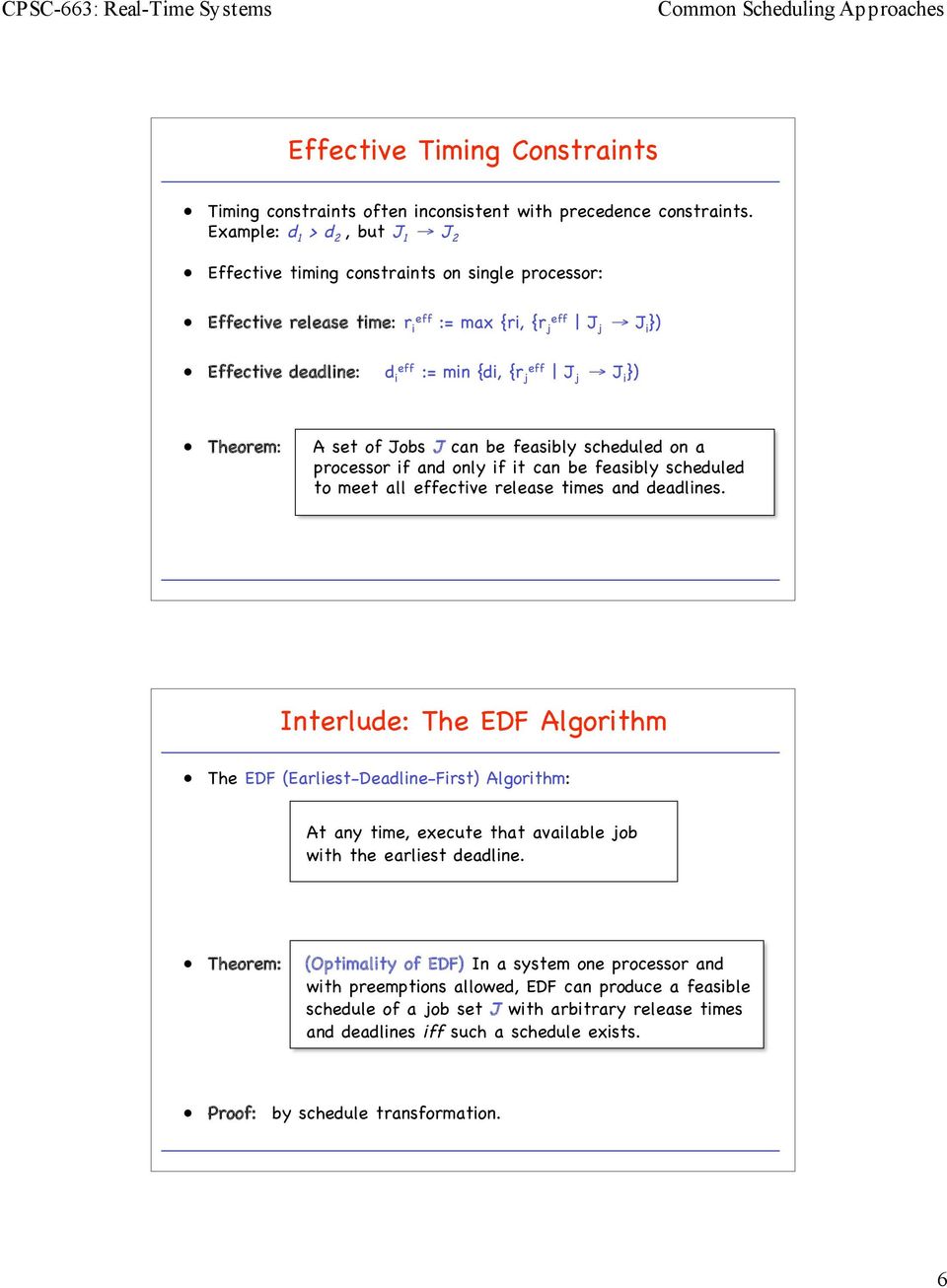
7 Proof of Optimality of EDF Assume that arbitrary schedule S meets timing constraints. For S to not be an EDF schedule, we must have the following situation: S is EDF up to here interval A interval B portion of j portion of i r i, r j d i d j Proof of Optimality of EDF 2 We now have two cases. Case : LA > LB A B portion of j portion of i r i, r j B d i d j 7
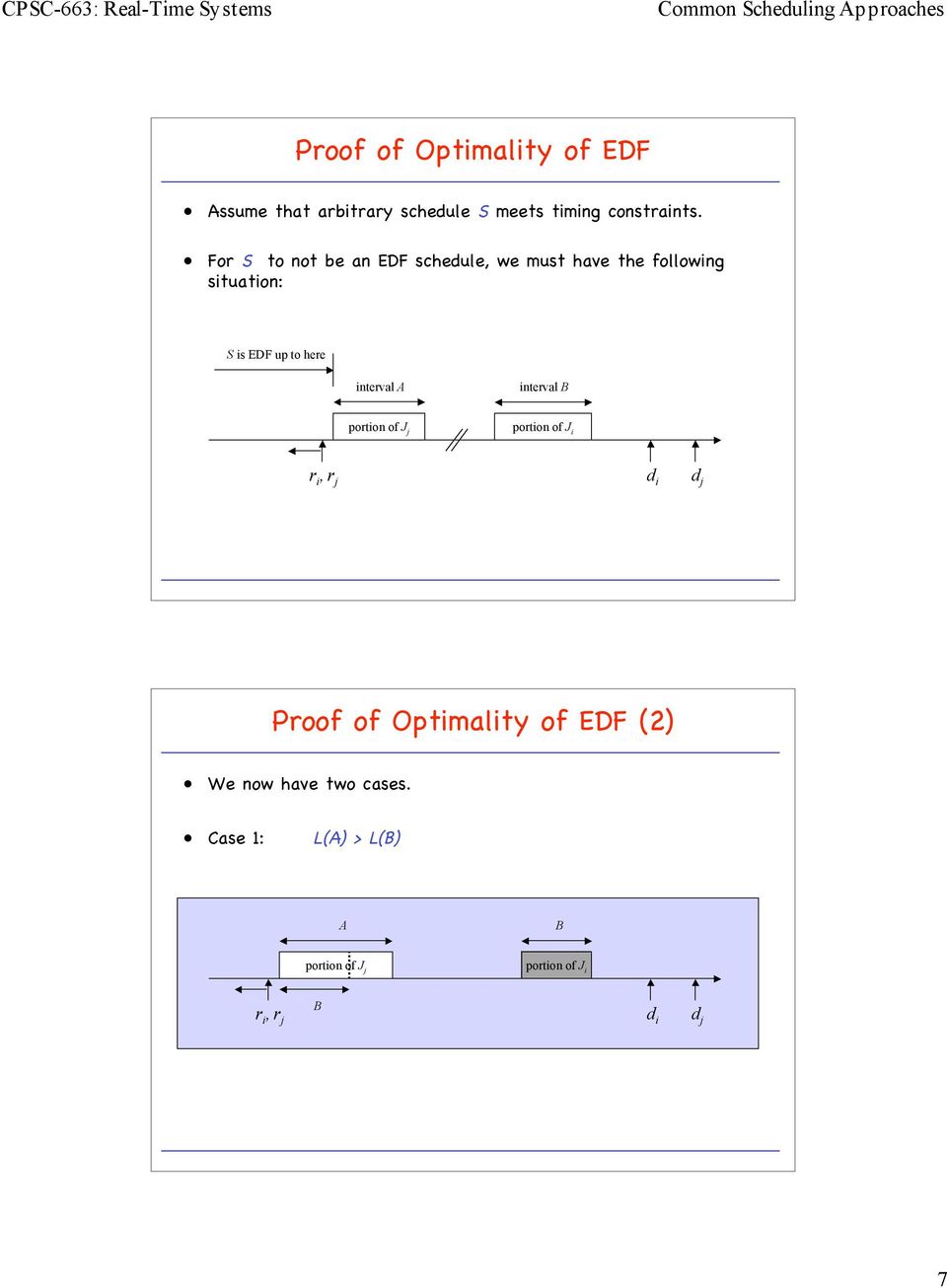
8 Proof of Optimality of EDF 3 We now have two cases. Case 2: LA < LB A B portion of j portion of i r i, r j A d i d j EDF Not Always Optimal Case : When preemption is not allowed: 2 3 r i 0, 2, 4, d i 0, 4, 2, e i Case 2: On more than one processor: 2 3 ri 0, 0, 0, di 4, 4, 5, ei 5 2 8

9 Preemptive Scheduling of obs with Arbitrary Release Times, Deadlines, Execution Times Determine schedule over a hyperperiod. Formulate scheduling problem as network flow problem. I 2 I 2 Source e i i I j I j Sink n- I m- n I m I I m r r 2 d d 2 r 3 r 4 d 4 d 3 t NP Completeness of Non-Preempt Deadline Scheduling Theorem: The problem of scheduling a non-preemptable set of jobs,..., i,... n, each with release time r i, deadline d i, and execution time e i is NP-complete. Proof: Transformation from PARTITION [Garey/ohnson,979] Given: Finite set A {A,..., A i,..., A m }, each element of size a i. Let Partition A into two sets, each of same size. Define a job set,..., m+, as follows: B/2 B/2 m+ 0 B/2 B/2+ B+ 9

Lecture Outline Overview of real-time scheduling algorithms Outline relative strengths, weaknesses
 Overview of Real-Time Scheduling Embedded Real-Time Software Lecture 3 Lecture Outline Overview of real-time scheduling algorithms Clock-driven Weighted round-robin Priority-driven Dynamic vs. static Deadline
Commonly Used Approaches to Real-Time Scheduling
 Integre Technical Publishing Co., Inc. Liu January 13, 2000 8:46 a.m. chap4 page 60 C H A P T E R 4 Commonly Used Approaches to Real-Time Scheduling This chapter provides a brief overview of three commonly
3. Scheduling issues. Common approaches /1. Common approaches /2. Common approaches /3. 2012/13 UniPD / T. Vardanega 23/01/2013. Real-Time Systems 1
 Common approaches /1 3. Scheduling issues Clock-driven (time-driven) scheduling Scheduling decisions are made beforehand (off line) and carried out at predefined time instants The time instants normally
Real-Time Scheduling (Part 1) (Working Draft) Real-Time System Example
 Real-Time Scheduling (Part 1) (Working Draft) Insup Lee Department of Computer and Information Science School of Engineering and Applied Science University of Pennsylvania www.cis.upenn.edu/~lee/ CIS 41,
Priority-Driven Scheduling
 Priority-Driven Scheduling Advantages of Priority-Driven Scheduling Priority-driven scheduling is easy to implement. It does not require the information on the release times and execution times of the
Real Time Scheduling Basic Concepts. Radek Pelánek
 Real Time Scheduling Basic Concepts Radek Pelánek Basic Elements Model of RT System abstraction focus only on timing constraints idealization (e.g., zero switching time) Basic Elements Basic Notions task
Periodic Task Scheduling
 Periodic Task Scheduling Radek Pelánek Motivation and Assumptions Examples of Periodic Tasks sensory data acquisition control loops action planning system monitoring Motivation and Assumptions Simplifying
Real-time Scheduling of Periodic Tasks (1) Advanced Operating Systems Lecture 2
 Real-time Scheduling of Periodic Tasks (1) Advanced Operating Systems Lecture 2 Lecture Outline Scheduling periodic tasks The rate monotonic algorithm Definition Non-optimality Time-demand analysis...
Lecture 3 Theoretical Foundations of RTOS
 CENG 383 Real-Time Systems Lecture 3 Theoretical Foundations of RTOS Asst. Prof. Tolga Ayav, Ph.D. Department of Computer Engineering Task States Executing Ready Suspended (or blocked) Dormant (or sleeping)
Aperiodic Task Scheduling
 Aperiodic Task Scheduling Jian-Jia Chen (slides are based on Peter Marwedel) TU Dortmund, Informatik 12 Germany Springer, 2010 2014 年 11 月 19 日 These slides use Microsoft clip arts. Microsoft copyright
Module 6. Embedded System Software. Version 2 EE IIT, Kharagpur 1
 Module 6 Embedded System Software Version 2 EE IIT, Kharagpur 1 Lesson 30 Real-Time Task Scheduling Part 2 Version 2 EE IIT, Kharagpur 2 Specific Instructional Objectives At the end of this lesson, the
Real-Time Task Scheduling for Energy-Aware Embedded Systems 1
 Real-Time Task Scheduling for Energy-Aware Embedded Systems 1 Vishnu Swaminathan and Krishnendu Chakrabarty Dept. of Electrical & Computer Engineering Duke University Durham, NC 27708 fvishnus,[email protected]
Scheduling Aperiodic and Sporadic Jobs in Priority- Driven Systems
 Scheduling Aperiodic and Sporadic Jobs in Priority- Driven Systems Ingo Sander [email protected] Liu: Chapter 7 IL2212 Embedded Software 1 Outline l System Model and Assumptions l Scheduling Aperiodic Jobs l
Classification - Examples
 Lecture 2 Scheduling 1 Classification - Examples 1 r j C max given: n jobs with processing times p 1,...,p n and release dates r 1,...,r n jobs have to be scheduled without preemption on one machine taking
Scheduling Real-time Tasks: Algorithms and Complexity
 Scheduling Real-time Tasks: Algorithms and Complexity Sanjoy Baruah The University of North Carolina at Chapel Hill Email: [email protected] Joël Goossens Université Libre de Bruxelles Email: [email protected]
Today. Intro to real-time scheduling Cyclic executives. Scheduling tables Frames Frame size constraints. Non-independent tasks Pros and cons
 Today Intro to real-time scheduling Cyclic executives Scheduling tables Frames Frame size constraints Generating schedules Non-independent tasks Pros and cons Real-Time Systems The correctness of a real-time
174: Scheduling Systems. Emil Michta University of Zielona Gora, Zielona Gora, Poland 1 TIMING ANALYSIS IN NETWORKED MEASUREMENT CONTROL SYSTEMS
 174: Scheduling Systems Emil Michta University of Zielona Gora, Zielona Gora, Poland 1 Timing Analysis in Networked Measurement Control Systems 1 2 Introduction to Scheduling Systems 2 3 Scheduling Theory
Scheduling Single Machine Scheduling. Tim Nieberg
 Scheduling Single Machine Scheduling Tim Nieberg Single machine models Observation: for non-preemptive problems and regular objectives, a sequence in which the jobs are processed is sufficient to describe
Aperiodic Task Scheduling
 Aperiodic Task Scheduling Gerhard Fohler Mälardalen University, Sweden [email protected] Real-Time Systems Gerhard Fohler 2005 Non Periodic Tasks So far periodic events and tasks what about others?
4. Fixed-Priority Scheduling
 Simple workload model 4. Fixed-Priority Scheduling Credits to A. Burns and A. Wellings The application is assumed to consist of a fixed set of tasks All tasks are periodic with known periods This defines
Introduction to Scheduling Theory
 Introduction to Scheduling Theory Arnaud Legrand Laboratoire Informatique et Distribution IMAG CNRS, France [email protected] November 8, 2004 1/ 26 Outline 1 Task graphs from outer space 2 Scheduling
Real-time scheduling algorithms, task visualization
 Rochester Institute of Technology RIT Scholar Works Theses Thesis/Dissertation Collections 2006 Real-time scheduling algorithms, task visualization Kevin Churnetski Follow this and additional works at:
The simple case: Cyclic execution
 The simple case: Cyclic execution SCHEDULING PERIODIC TASKS Repeat a set of aperiodic tasks at a specific rate (cycle) 1 2 Periodic tasks Periodic tasks (the simplified case) Scheduled to run Arrival time
REAL TIME OPERATING SYSTEMS. Lesson-18:
 REAL TIME OPERATING SYSTEMS Lesson-18: Round Robin Time Slicing of tasks of equal priorities 1 1. Common scheduling models 2 Common scheduling models Cooperative Scheduling of ready tasks in a circular
Operating System Aspects. Real-Time Systems. Resource Management Tasks
 Operating System Aspects Chapter 2: Basics Chapter 3: Multimedia Systems Communication Aspects and Services Multimedia Applications and Communication Multimedia Transfer and Control Protocols Quality of
Global Multiprocessor Real-Time Scheduling as a Constraint Satisfaction Problem
 Global Multiprocessor Real-Time Scheduling as a Constraint Satisfaction Problem Liliana Cucu-Grosean & Olivier Buffet INRIA Nancy Grand-Est 615 rue du Jardin Botanique 54600 Villers-lès-Nancy, France [email protected]
Partition Scheduling in APEX Runtime Environment for Embedded Avionics Software
 Partition Scheduling in APEX Runtime Environment for Embedded Avionics Software Yang-Hang Lee CISE Department, University of Florida Gainesville, FL 32611 Phone: (352) 392-1536 Fax: (352) 392-1220 Email:
Scheduling Shop Scheduling. Tim Nieberg
 Scheduling Shop Scheduling Tim Nieberg Shop models: General Introduction Remark: Consider non preemptive problems with regular objectives Notation Shop Problems: m machines, n jobs 1,..., n operations
Multi-core real-time scheduling
 Multi-core real-time scheduling Credits: Anne-Marie Déplanche, Irccyn, Nantes (many slides come from her presentation at ETR, Brest, September 2011) 1 Multi-core real-time scheduling! Introduction: problem
CPU SCHEDULING (CONT D) NESTED SCHEDULING FUNCTIONS
 CPU SCHEDULING CPU SCHEDULING (CONT D) Aims to assign processes to be executed by the CPU in a way that meets system objectives such as response time, throughput, and processor efficiency Broken down into
Objectives. Chapter 5: CPU Scheduling. CPU Scheduler. Non-preemptive and preemptive. Dispatcher. Alternating Sequence of CPU And I/O Bursts
 Objectives Chapter 5: CPU Scheduling Introduce CPU scheduling, which is the basis for multiprogrammed operating systems Describe various CPU-scheduling algorithms Discuss evaluation criteria for selecting
Earliest Due Date (EDD) [Ferrari] Delay EDD. Jitter EDD
![Earliest Due Date (EDD) [Ferrari] Delay EDD. Jitter EDD](/thumbs/27/12282414.jpg "Earliest Due Date (EDD) [Ferrari] Delay EDD. Jitter EDD") Earliest Due Date (EDD) [Ferrari] Based on EDF Delay-EDD vs. jitter-edd Works for periodic message models (single packet in period): (pi,, Di) Partition end-to-end deadline D i into local deadlines D i,k
Earliest Due Date (EDD) [Ferrari] Based on EDF Delay-EDD vs. jitter-edd Works for periodic message models (single packet in period): (pi,, Di) Partition end-to-end deadline D i into local deadlines D i,k
W4118 Operating Systems. Instructor: Junfeng Yang
 W4118 Operating Systems Instructor: Junfeng Yang Outline Introduction to scheduling Scheduling algorithms 1 Direction within course Until now: interrupts, processes, threads, synchronization Mostly mechanisms
Efficient Scheduling Of On-line Services in Cloud Computing Based on Task Migration
 Efficient Scheduling Of On-line Services in Cloud Computing Based on Task Migration 1 Harish H G, 2 Dr. R Girisha 1 PG Student, 2 Professor, Department of CSE, PESCE Mandya (An Autonomous Institution under
Exercises : Real-time Scheduling analysis
 Exercises : Real-time Scheduling analysis Frank Singhoff University of Brest June 2013 Exercise 1 : Fixed priority scheduling and Rate Monotonic priority assignment Given a set of tasks defined by the
Minimizing the Number of Machines in a Unit-Time Scheduling Problem
 Minimizing the Number of Machines in a Unit-Time Scheduling Problem Svetlana A. Kravchenko 1 United Institute of Informatics Problems, Surganova St. 6, 220012 Minsk, Belarus [email protected] Frank
Process Scheduling. Process Scheduler. Chapter 7. Context Switch. Scheduler. Selection Strategies
 Chapter 7 Process Scheduling Process Scheduler Why do we even need to a process scheduler? In simplest form, CPU must be shared by > OS > Application In reality, [multiprogramming] > OS : many separate
Comparison between scheduling algorithms in RTLinux and VxWorks
 Comparison between scheduling algorithms in RTLinux and VxWorks Linköpings Universitet Linköping 2006-11-19 Daniel Forsberg ([email protected]) Magnus Nilsson ([email protected]) Abstract The
Real-Time Software. Basic Scheduling and Response-Time Analysis. René Rydhof Hansen. 21. september 2010
 Real-Time Software Basic Scheduling and Response-Time Analysis René Rydhof Hansen 21. september 2010 TSW (2010e) (Lecture 05) Real-Time Software 21. september 2010 1 / 28 Last Time Time in a real-time
Algorithm Design and Analysis
 Algorithm Design and Analysis LECTURE 27 Approximation Algorithms Load Balancing Weighted Vertex Cover Reminder: Fill out SRTEs online Don t forget to click submit Sofya Raskhodnikova 12/6/2011 S. Raskhodnikova;
Chapter 5 Process Scheduling
 Chapter 5 Process Scheduling CPU Scheduling Objective: Basic Scheduling Concepts CPU Scheduling Algorithms Why Multiprogramming? Maximize CPU/Resources Utilization (Based on Some Criteria) CPU Scheduling
CPU Scheduling. CPU Scheduling
 CPU Scheduling Electrical and Computer Engineering Stephen Kim ([email protected]) ECE/IUPUI RTOS & APPS 1 CPU Scheduling Basic Concepts Scheduling Criteria Scheduling Algorithms Multiple-Processor Scheduling
CPU Scheduling. Basic Concepts. Basic Concepts (2) Basic Concepts Scheduling Criteria Scheduling Algorithms Batch systems Interactive systems
 Basic Concepts Scheduling Criteria Scheduling Algorithms Batch systems Interactive systems Based on original slides by Silberschatz, Galvin and Gagne 1 Basic Concepts CPU I/O Burst Cycle Process execution
Readings for this topic: Silberschatz/Galvin/Gagne Chapter 5
 77 16 CPU Scheduling Readings for this topic: Silberschatz/Galvin/Gagne Chapter 5 Until now you have heard about processes and memory. From now on you ll hear about resources, the things operated upon
Real- Time Scheduling
 Real- Time Scheduling Chenyang Lu CSE 467S Embedded Compu5ng Systems Readings Ø Single-Processor Scheduling: Hard Real-Time Computing Systems, by G. Buttazzo. q Chapter 4 Periodic Task Scheduling q Chapter
Announcements. Basic Concepts. Histogram of Typical CPU- Burst Times. Dispatcher. CPU Scheduler. Burst Cycle. Reading
 Announcements Reading Chapter 5 Chapter 7 (Monday or Wednesday) Basic Concepts CPU I/O burst cycle Process execution consists of a cycle of CPU execution and I/O wait. CPU burst distribution What are the
Chapter 19: Real-Time Systems. Overview of Real-Time Systems. Objectives. System Characteristics. Features of Real-Time Systems
 Chapter 19: Real-Time Systems System Characteristics Features of Real-Time Systems Chapter 19: Real-Time Systems Implementing Real-Time Operating Systems Real-Time CPU Scheduling VxWorks 5.x 19.2 Silberschatz,
Online Scheduling for Cloud Computing and Different Service Levels
 2012 IEEE 201226th IEEE International 26th International Parallel Parallel and Distributed and Distributed Processing Processing Symposium Symposium Workshops Workshops & PhD Forum Online Scheduling for
Off-line Optimal Multiprocessor Scheduling of Dependent Periodic Tasks
 Off-line Optimal Multiprocessor Scheduling of Dependent Periodic Tasks Mikel Cordovilla, Frédéric Boniol, Eric Noulard, Claire Pagetti ONERA, Toulouse, France, Email: [email protected] ENSEEIHT,
Effective Scheduling Algorithm and Scheduler Implementation for use with Time-Triggered Co-operative Architecture
 http://dx.doi.org/10.5755/j01.eee.20.6.7282 ELEKTRONIKA IR ELEKTROTECHNIKA, ISSN 1392 1215, VOL. 20, NO. 6, 2014 Effective Scheduling Algorithm and Scheduler Implementation for use with Time-Triggered
REAL-TIME SCHEDULING FOR ENERGY HARVESTING SENSOR NODES
 REAL-TIME SCHEDULING FOR ENERGY HARVESTING SENSOR NODES C. Moser 1, D. Brunelli 2, L. Thiele 1, L. Benini 2 1 Computer Engineering and Networks Laboratory Swiss Federal Institute of Technology (ETH) Zurich,
2. is the number of processes that are completed per time unit. A) CPU utilization B) Response time C) Turnaround time D) Throughput
 Import Settings: Base Settings: Brownstone Default Highest Answer Letter: D Multiple Keywords in Same Paragraph: No Chapter: Chapter 5 Multiple Choice 1. Which of the following is true of cooperative scheduling?
Improved Handling of Soft Aperiodic Tasks in Offline Scheduled Real-Time Systems using Total Bandwidth Server
 Improved Handling of Soft Aperiodic Tasks in Offline Scheduled Real-Time Systems using Total Bandwidth Server Gerhard Fohler, Tomas Lennvall Mälardalen University Västeras, Sweden gfr, tlv @mdh.se Giorgio
Processor Scheduling. Queues Recall OS maintains various queues
 Processor Scheduling Chapters 9 and 10 of [OS4e], Chapter 6 of [OSC]: Queues Scheduling Criteria Cooperative versus Preemptive Scheduling Scheduling Algorithms Multi-level Queues Multiprocessor and Real-Time
LAB 5: Scheduling Algorithms for Embedded Systems
 LAB 5: Scheduling Algorithms for Embedded Systems Say you have a robot that is exploring an area. The computer controlling the robot has a number of tasks to do: getting sensor input, driving the wheels,
ICS 143 - Principles of Operating Systems
 ICS 143 - Principles of Operating Systems Lecture 5 - CPU Scheduling Prof. Nalini Venkatasubramanian [email protected] Note that some slides are adapted from course text slides 2008 Silberschatz. Some
A Constant-Approximate Feasibility Test for Multiprocessor Real-Time Scheduling
 Algorithmica manuscript No. (will be inserted by the editor) A Constant-Approximate Feasibility Test for Multiprocessor Real-Time Scheduling Vincenzo Bonifaci Alberto Marchetti-Spaccamela Sebastian Stiller
2. (a) Explain the strassen s matrix multiplication. (b) Write deletion algorithm, of Binary search tree. [8+8]
![2. (a) Explain the strassen s matrix multiplication. (b) Write deletion algorithm, of Binary search tree. [8+8]](/thumbs/40/21097758.jpg "2. (a) Explain the strassen s matrix multiplication. (b) Write deletion algorithm, of Binary search tree. [8+8]") Code No: R05220502 Set No. 1 1. (a) Describe the performance analysis in detail. (b) Show that f 1 (n)+f 2 (n) = 0(max(g 1 (n), g 2 (n)) where f 1 (n) = 0(g 1 (n)) and f 2 (n) = 0(g 2 (n)). [8+8] 2. (a)
Code No: R05220502 Set No. 1 1. (a) Describe the performance analysis in detail. (b) Show that f 1 (n)+f 2 (n) = 0(max(g 1 (n), g 2 (n)) where f 1 (n) = 0(g 1 (n)) and f 2 (n) = 0(g 2 (n)). [8+8] 2. (a)
Operating Systems. III. Scheduling. http://soc.eurecom.fr/os/
 Operating Systems Institut Mines-Telecom III. Scheduling Ludovic Apvrille [email protected] Eurecom, office 470 http://soc.eurecom.fr/os/ Outline Basics of Scheduling Definitions Switching
Real-Time Database Systems: Concepts and Design
 Real-Time Database Systems: Concepts and Design Saud A. Aldarmi Department of Computer Science The University of York April 1998 Abstract This qualifying dissertation is intended to review the state-of-the-art
Operating Systems Concepts: Chapter 7: Scheduling Strategies
 Operating Systems Concepts: Chapter 7: Scheduling Strategies Olav Beckmann Huxley 449 http://www.doc.ic.ac.uk/~ob3 Acknowledgements: There are lots. See end of Chapter 1. Home Page for the course: http://www.doc.ic.ac.uk/~ob3/teaching/operatingsystemsconcepts/
JUST-IN-TIME SCHEDULING WITH PERIODIC TIME SLOTS. Received December May 12, 2003; revised February 5, 2004
 Scientiae Mathematicae Japonicae Online, Vol. 10, (2004), 431 437 431 JUST-IN-TIME SCHEDULING WITH PERIODIC TIME SLOTS Ondřej Čepeka and Shao Chin Sung b Received December May 12, 2003; revised February
Performance Comparison of RTOS
 Performance Comparison of RTOS Shahmil Merchant, Kalpen Dedhia Dept Of Computer Science. Columbia University Abstract: Embedded systems are becoming an integral part of commercial products today. Mobile
! Solve problem to optimality. ! Solve problem in poly-time. ! Solve arbitrary instances of the problem. !-approximation algorithm.
 Approximation Algorithms Chapter Approximation Algorithms Q Suppose I need to solve an NP-hard problem What should I do? A Theory says you're unlikely to find a poly-time algorithm Must sacrifice one of
OPERATING SYSTEMS SCHEDULING
 OPERATING SYSTEMS SCHEDULING Jerry Breecher 5: CPU- 1 CPU What Is In This Chapter? This chapter is about how to get a process attached to a processor. It centers around efficient algorithms that perform
Complexity Theory. IE 661: Scheduling Theory Fall 2003 Satyaki Ghosh Dastidar
 Complexity Theory IE 661: Scheduling Theory Fall 2003 Satyaki Ghosh Dastidar Outline Goals Computation of Problems Concepts and Definitions Complexity Classes and Problems Polynomial Time Reductions Examples
The Design and Implementation of Real-Time Schedulers in RED-Linux
 The Design and Implementation of Real-Time Schedulers in RED-Linux KWEI-JAY LIN, SENIOR MEMBER, IEEE AND YU-CHUNG WANG Invited Paper Researchers in the real-time system community have designed and studied
Process Scheduling CS 241. February 24, 2012. Copyright University of Illinois CS 241 Staff
 Process Scheduling CS 241 February 24, 2012 Copyright University of Illinois CS 241 Staff 1 Announcements Mid-semester feedback survey (linked off web page) MP4 due Friday (not Tuesday) Midterm Next Tuesday,
CPU Scheduling. Core Definitions
 CPU Scheduling General rule keep the CPU busy; an idle CPU is a wasted CPU Major source of CPU idleness: I/O (or waiting for it) Many programs have a characteristic CPU I/O burst cycle alternating phases
Performance Analysis of a Telephone System with both Patient and Impatient Customers
 Performance Analysis of a Telephone System with both Patient and Impatient Customers Yiqiang Quennel Zhao Department of Mathematics and Statistics University of Winnipeg Winnipeg, Manitoba Canada R3B 2E9
Scheduling. Yücel Saygın. These slides are based on your text book and on the slides prepared by Andrew S. Tanenbaum
 Scheduling Yücel Saygın These slides are based on your text book and on the slides prepared by Andrew S. Tanenbaum 1 Scheduling Introduction to Scheduling (1) Bursts of CPU usage alternate with periods
List Scheduling in Order of α-points on a Single Machine
 List Scheduling in Order of α-points on a Single Machine Martin Skutella Fachbereich Mathematik, Universität Dortmund, D 4422 Dortmund, Germany [email protected] http://www.mathematik.uni-dortmund.de/
4003-440/4003-713 Operating Systems I. Process Scheduling. Warren R. Carithers ([email protected]) Rob Duncan ([email protected])
 4003-440/4003-713 Operating Systems I Process Scheduling Warren R. Carithers ([email protected]) Rob Duncan ([email protected]) Review: Scheduling Policy Ideally, a scheduling policy should: Be: fair, predictable
Dimensioning an inbound call center using constraint programming
 Dimensioning an inbound call center using constraint programming Cyril Canon 1,2, Jean-Charles Billaut 2, and Jean-Louis Bouquard 2 1 Vitalicom, 643 avenue du grain d or, 41350 Vineuil, France [email protected]
Implementing a General Real-Time Scheduling Framework in the RED-Linux Real-Time Kernel
 Implementing a General Real-Time Scheduling Framework in the RED-Linux Real-Time Kernel Yu-Chung Wang and Kwei-Jay Lin Department of Electrical and Computer Engineering University of California, Irvine
Chapter 11. 11.1 Load Balancing. Approximation Algorithms. Load Balancing. Load Balancing on 2 Machines. Load Balancing: Greedy Scheduling
 Approximation Algorithms Chapter Approximation Algorithms Q. Suppose I need to solve an NP-hard problem. What should I do? A. Theory says you're unlikely to find a poly-time algorithm. Must sacrifice one
Scheduling to Minimize Power Consumption using Submodular Functions
 Scheduling to Minimize Power Consumption using Submodular Functions Erik D. Demaine MIT [email protected] Morteza Zadimoghaddam MIT [email protected] ABSTRACT We develop logarithmic approximation algorithms
Speed Control and Scheduling of Data Mules in Sensor Networks
 Speed Control and Scheduling of Data Mules in Sensor Networks RYO SUGIHARA and RAJESH K. GUPTA University of California, San Diego Unlike traditional multihop forwarding among stationary sensor nodes,
On-line machine scheduling with batch setups
 On-line machine scheduling with batch setups Lele Zhang, Andrew Wirth Department of Mechanical Engineering The University of Melbourne, VIC 3010, Australia Abstract We study a class of scheduling problems
CPU Scheduling. CSC 256/456 - Operating Systems Fall 2014. TA: Mohammad Hedayati
 CPU Scheduling CSC 256/456 - Operating Systems Fall 2014 TA: Mohammad Hedayati Agenda Scheduling Policy Criteria Scheduling Policy Options (on Uniprocessor) Multiprocessor scheduling considerations CPU
REAL TIME OPERATING SYSTEMS. Lesson-10:
 REAL TIME OPERATING SYSTEMS Lesson-10: Real Time Operating System 1 1. Real Time Operating System Definition 2 Real Time A real time is the time which continuously increments at regular intervals after