
The Model Checker SPIN
|
|
|
- Hollie Fitzgerald
- 9 years ago
- Views:
Transcription
1 The Model Checker SPIN Author: Gerard J. Holzmann Presented By: Maulik Patel

2 Outline Introduction Structure Foundation Algorithms Memory management Example/Demo

3 SPIN-Introduction Introduction SPIN (Simple( Promela INterpreter terpreter): Tool for software model checking. Written by Gerard Holzmann and others. System to be verified is described in PROMELA (Pro( Process Meta Language). Properties to be verified are expressed as LTL formulae. Also works as simulator.

4 SPIN-Introduction Introduction(cont (cont.) SPIN does not actually perform model-checking itself, but instead generates C sources for a problem-specific model checker. Options to further speed up the process and save memory: Partial order reduction State compression Bit-state state hashing

5 SPIN-Introduction Introduction(cont (cont.) SPIN aims to provide: Program like notation to specify design choices unambiguously. Concise notation for expressing general correctness requirements. A methodology for establishing the logical consistency of the design choices.

6 Basic Structure
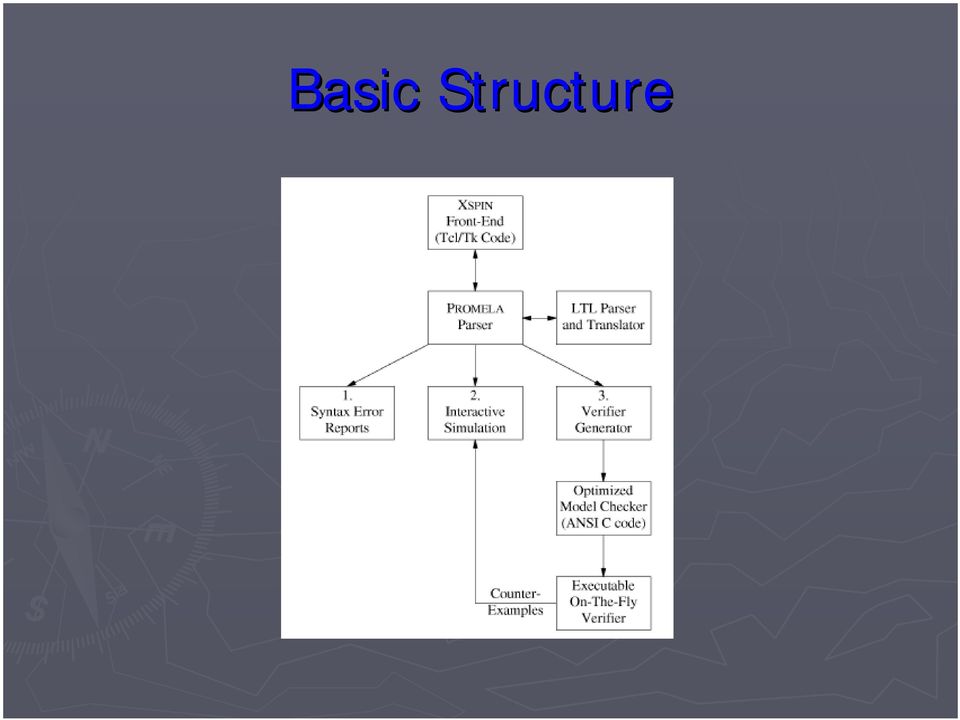
7 Foundation The predecessors of SPIN were limited to standard safety properties and limited liveness properties. Automata theoretic model became the formal basis for temporal logic model checking in SPIN. Description of a concurrent system in PROMELA is one or more process templates ( (proctype definitions). Each template is translated into a finite automate.

8 Foundation The global system behavior (asynchronous interleaving product) is also an automaton. Correctness claim (temporal logic formula) is converted into Buchi automaton. Combined behaviour: : synchronous product of the system and claim Correctness claims are used to specify undesirable behaviours of the system. In worst case, reachability graph has the size of the Cartesian product of the components of the system.

9 LTL Requirements SPIN uses negative correctness claims. Positive claim requires to prove that all executions of the system are included in the language of the claim. Size of state space is At most the Cartesian product of the system and claim. At least size of their sum. Negative claim requires to prove that the intersection of language of the system and of the claim is empty. Size of state space is In the size of the Cartesian product of the system and claim in worst case. Zero for the best case.

10 LTL Requirements(Cont (Cont.) A Buchi automaton accepts a system execution iff there exists at least one acceptance cycle. We need to prove the absence of acceptance cycles to prove correctness of the system. The nested depth-first search algorithm is used for this purpose.

11 SPIN Verification System description: PROMELA Templates Correctness claim: LTL Formula Buchi Automaton Buchi Automaton Negated LTL Formula Asynchronous interleaving product: Global system behavior Automaton for negated LTL formula Counter example Acceptance cycle exists Synchronous Product: Combined behavior Absence of acceptance cycle No execution satisfies Negated claim

12 Algorithms Nested depth-first search From LTL formula to Buchi automaton Partial order reduction Memory management

13 Nested Depth-First Search Tarjan s depth-first search adds two integer numbers to every state reached: the dfs-number and the lowlink-number. number. This algorithm is not compatible with the bit-state hashing techniques. Nested depth-first search: For an accepting cycle to exist in the reachability graph, at least one accepting state must be both reachable from the initial system state and it much be reachable from itself.

14 Nested Depth-First Search(Cont (Cont.) Two searches are performed. If acceptance cycle exists, complete execution sequence is constructed which acts as the counter example of a correctness claim. It cannot detect all possible acceptance cycles. In SPIN, this algorithm is extended with an optional weak fairness constraint.

15 Buchi Automata LTL formula can contain: Lower case propositional symbol p. Combined with unary or binary, Boolean and/or temporal operators.

16 Buchi Automata(Cont (Cont.) [] (p U q) = G (p U q) [] (<> p) = GFP

17 Partial Order Reduction To reduce the number of reachable states that must be explored. Validity of an LTL formula is insensitive to the order in which concurrent and independent events are interleaved in the depth-first search. Implementation is based on a static reduction technique. Best case performance:

18 Partial Order Reduction(Cont (Cont.) It cannot cause significant increase of the memory requirement, compared to exhaustive searches. It is not sensitive to decisions about process or variable orderings. Correctness properties were verified using the theorem prover HOL.

19 Memory Management A main goal of researchers is to devise techniques that can economize the memory requirements without incurring unrealistic increases in runtime requirements. Two such techniques are used in SPIN: State compression Bit-state hashing

20 State Compression Static Huffman encoding and run-length encoding techniques can be effective for this purpose. A different technique was added to SPIN in late Every process and channel has relatively small number of local states. s Store local states separately from global states and use unique indices to the local state tables inside the global state tables.
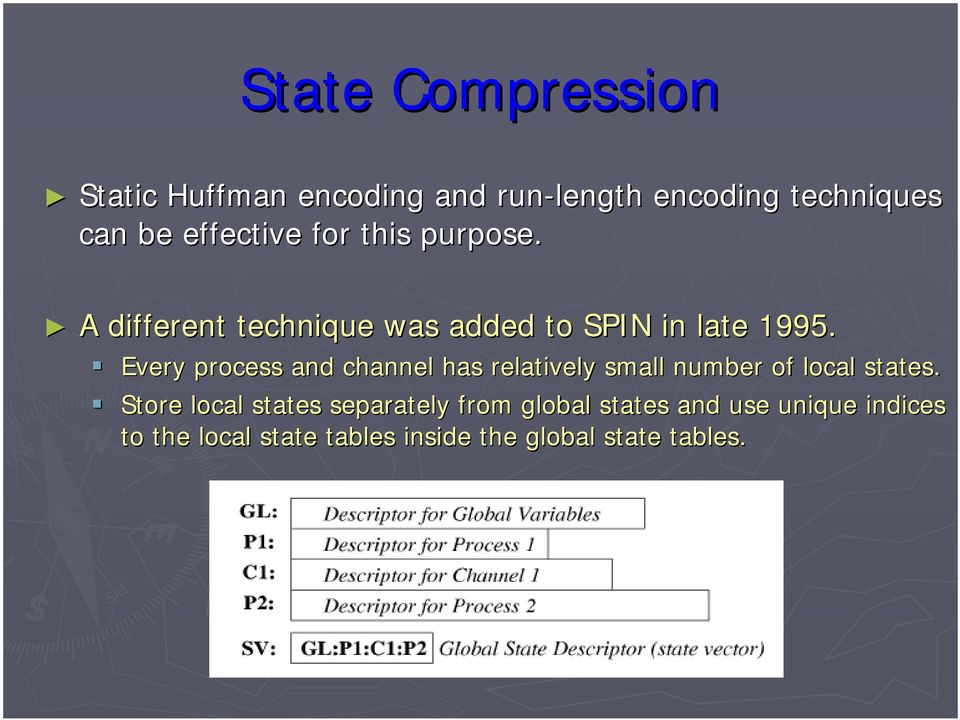
21 State Compression In practice, most commonly observed reduction is 60 to 80 percent.
22 Bit-State Hashing 2 bits of memory are used to store a reachable state. S : width of system state M : total machine memory (bytes) L : M/S (maximum number of states that can be stored) R : total number of reachable states generated by SPIN When R>L, problem coverage of verification run is M/(R x S). Ex: M=10 8 bytes, S=10 3 bytes and R=10 6 states problem coverage=0.1 (10%)
23 Bit-State Hashing Bit-state hashing technique produces problem coverage close to 1 (100%).
24 Example Leader Election P 1 P 6 P 2 Preceived < P i : reject Preceived > P i : pass Preceived == P i : P 3 P 5 P 4 Winner has the largest identifier. Unidirectional ring. Process can decide to join at a later point in the execution.
25 Example Leader Election Properties: No more than on leader : [] (nr_leader( <= 1) There must be one leader: <>[] (nr_leader( == 1) Leader must have largest identifier Modify algorithm for processes to defer their decision to participate in the election. A process would decide to participate (only when) first receiving a message concerning the election.
26 PROMELA Example Copied from: Lecture SPIN-INTRO: Introduction To SPIN (Matt Dwyer, John Hatcliff)
27 SPIN Data Structures Copied from: Lecture SPIN-INTRO: Introduction To SPIN (Matt Dwyer, John Hatcliff)
28 SPIN Demo
29 Question 1 Partial order reduction algorithm generates reduced state space with only representatives of classes of execution sequences that are distinguishable for a given correctness property. What criteria is used to distinguish the execution sequences?
30 Question 2 Second property of partial order reduction: The reduction method is not sensitive to decision about process or variable ordering. How does it affect the performance of SPIN?
31 Question 3 How does the weak fairness constraint in SPIN affects nested depth-first search?
Formal Verification by Model Checking
 Formal Verification by Model Checking Natasha Sharygina Carnegie Mellon University Guest Lectures at the Analysis of Software Artifacts Class, Spring 2005 1 Outline Lecture 1: Overview of Model Checking
Software Engineering using Formal Methods
 Software Engineering using Formal Methods Model Checking with Temporal Logic Wolfgang Ahrendt 24th September 2013 SEFM: Model Checking with Temporal Logic /GU 130924 1 / 33 Model Checking with Spin model
Testing LTL Formula Translation into Büchi Automata
 Testing LTL Formula Translation into Büchi Automata Heikki Tauriainen and Keijo Heljanko Helsinki University of Technology, Laboratory for Theoretical Computer Science, P. O. Box 5400, FIN-02015 HUT, Finland
tutorial: hardware and software model checking
 tutorial: hardware and software model checking gerard holzmann and anuj puri { gerard anuj } @research.bell-labs.com Bell Labs, USA outline introduction (15 mins) theory and algorithms system modeling
Fundamentals of Software Engineering
 Fundamentals of Software Engineering Model Checking with Temporal Logic Ina Schaefer Institute for Software Systems Engineering TU Braunschweig, Germany Slides by Wolfgang Ahrendt, Richard Bubel, Reiner
Today s Agenda. Automata and Logic. Quiz 4 Temporal Logic. Introduction Buchi Automata Linear Time Logic Summary
 Today s Agenda Quiz 4 Temporal Logic Formal Methods in Software Engineering 1 Automata and Logic Introduction Buchi Automata Linear Time Logic Summary Formal Methods in Software Engineering 2 1 Buchi Automata
Formal Verification of Software
 Formal Verification of Software Sabine Broda Department of Computer Science/FCUP 12 de Novembro de 2014 Sabine Broda (DCC-FCUP) Formal Verification of Software 12 de Novembro de 2014 1 / 26 Formal Verification
Model Checking of Software
 Model Checking of Software Patrice Godefroid Bell Laboratories, Lucent Technologies SpecNCheck Page 1 August 2001 A Brief History of Model Checking Prehistory: transformational programs and theorem proving
Lecture 9 verifying temporal logic
 Basics of advanced software systems Lecture 9 verifying temporal logic formulae with SPIN 21/01/2013 1 Outline for today 1. Introduction: motivations for formal methods, use in industry 2. Developing models
Software Model Checking: Theory and Practice
 Software Model Checking: Theory and Practice Lecture: Specification Checking - LTL Model Checking Copyright 2004, Matt Dwyer, John Hatcliff, and Robby. The syllabus and all lectures for this course are
logic language, static/dynamic models SAT solvers Verified Software Systems 1 How can we model check of a program or system?
 5. LTL, CTL Last part: Alloy logic language, static/dynamic models SAT solvers Today: Temporal Logic (LTL, CTL) Verified Software Systems 1 Overview How can we model check of a program or system? Modeling
http://aejm.ca Journal of Mathematics http://rema.ca Volume 1, Number 1, Summer 2006 pp. 69 86
 Atlantic Electronic http://aejm.ca Journal of Mathematics http://rema.ca Volume 1, Number 1, Summer 2006 pp. 69 86 AUTOMATED RECOGNITION OF STUTTER INVARIANCE OF LTL FORMULAS Jeffrey Dallien 1 and Wendy
Automata-based Verification - I
 CS3172: Advanced Algorithms Automata-based Verification - I Howard Barringer Room KB2.20: email: [email protected] March 2006 Supporting and Background Material Copies of key slides (already
The Course. http://www.cse.unsw.edu.au/~cs3153/
 The Course http://www.cse.unsw.edu.au/~cs3153/ Lecturers Dr Peter Höfner NICTA L5 building Prof Rob van Glabbeek NICTA L5 building Dr Ralf Huuck NICTA ATP building 2 Plan/Schedule (1) Where and When Tuesday,
Algorithmic Software Verification
 Algorithmic Software Verification (LTL Model Checking) Azadeh Farzan What is Verification Anyway? Proving (in a formal way) that program satisfies a specification written in a logical language. Formal
Model Checking: An Introduction
 Announcements Model Checking: An Introduction Meeting 2 Office hours M 1:30pm-2:30pm W 5:30pm-6:30pm (after class) and by appointment ECOT 621 Moodle problems? Fundamentals of Programming Languages CSCI
Static Program Transformations for Efficient Software Model Checking
 Static Program Transformations for Efficient Software Model Checking Shobha Vasudevan Jacob Abraham The University of Texas at Austin Dependable Systems Large and complex systems Software faults are major
INF5140: Specification and Verification of Parallel Systems
 INF5140: Specification and Verification of Parallel Systems Lecture 7 LTL into Automata and Introduction to Promela Gerardo Schneider Department of Informatics University of Oslo INF5140, Spring 2007 Gerardo
LTL Model Checking with Logic Based Petri Nets
 LTL Model Checking with Logic Based Petri Nets Tristan M. Behrens and Jürgen Dix IfI Technical Report Series IfI-07-04 Impressum Publisher: Institut für Informatik, Technische Universität Clausthal Julius-Albert
Formal verification of contracts for synchronous software components using NuSMV
 Formal verification of contracts for synchronous software components using NuSMV Tobias Polzer Lehrstuhl für Informatik 8 Bachelorarbeit 13.05.2014 1 / 19 Problem description and goals Problem description
Using Patterns and Composite Propositions to Automate the Generation of Complex LTL
 University of Texas at El Paso DigitalCommons@UTEP Departmental Technical Reports (CS) Department of Computer Science 8-1-2007 Using Patterns and Composite Propositions to Automate the Generation of Complex
Introduction to SPIN. Acknowledgments. Parts of the slides are based on an earlier lecture by Radu Iosif, Verimag. Ralf Huuck. Features PROMELA/SPIN
 Acknowledgments Introduction to SPIN Parts of the slides are based on an earlier lecture by Radu Iosif, Verimag. Ralf Huuck Ralf Huuck COMP 4152 1 Ralf Huuck COMP 4152 2 PROMELA/SPIN PROMELA (PROcess MEta
A Classification of Model Checking-based Verification Approaches for Software Models
 A Classification of Model Checking-based Verification Approaches for Software Models Petra Brosch, Sebastian Gabmeyer, Martina Seidl Sebastian Gabmeyer Business Informatics Group Institute of Software
T-79.186 Reactive Systems: Introduction and Finite State Automata
 T-79.186 Reactive Systems: Introduction and Finite State Automata Timo Latvala 14.1.2004 Reactive Systems: Introduction and Finite State Automata 1-1 Reactive Systems Reactive systems are a class of software
Validated Templates for Specification of Complex LTL Formulas
 Validated Templates for Specification of Complex LTL Formulas Salamah Salamah Department of Electrical, computer, Software, and Systems Engineering Embry Riddle Aeronautical University 600 S. Clyde Morris
Model Checking based Software Verification
 Model Checking based Software Verification 18.5-2006 Keijo Heljanko [email protected] Department of Computer Science and Engineering Helsinki University of Technology http://www.tcs.tkk.fi/~kepa/ 1/24
System modeling. Budapest University of Technology and Economics Department of Measurement and Information Systems
 System modeling Business process modeling how to do it right Partially based on Process Anti-Patterns: How to Avoid the Common Traps of Business Process Modeling, J Koehler, J Vanhatalo, IBM Zürich, 2007.
Finding Liveness Errors with ACO
 Hong Kong, June 1-6, 2008 1 / 24 Finding Liveness Errors with ACO Francisco Chicano and Enrique Alba Motivation Motivation Nowadays software is very complex An error in a software system can imply the
Runtime Verification for Real-Time Automotive Embedded Software
 Runtime Verification for Real-Time Automotive Embedded Software S. Cotard, S. Faucou, J.-L. Béchennec, A. Queudet, Y. Trinquet 10th school of Modelling and Verifying Parallel processes (MOVEP) Runtime
Classification - Examples
 Lecture 2 Scheduling 1 Classification - Examples 1 r j C max given: n jobs with processing times p 1,...,p n and release dates r 1,...,r n jobs have to be scheduled without preemption on one machine taking
MODEL CHECKING OF SERVICES WORKFLOW RECONFIGURATION: A PERSPECTIVE ON DEPENDABILITY
 MODEL CHECKING OF SERVICES WORKFLOW RECONFIGURATION: A PERSPECTIVE ON DEPENDABILITY 1 Juan Carlos Polanco Aguilar 1 Koji Hasebe 1 Manuel Mazzara 2 Kazuhiko Kato 1 1 University of Tsukuba Department of
On the Modeling and Verification of Security-Aware and Process-Aware Information Systems
 On the Modeling and Verification of Security-Aware and Process-Aware Information Systems 29 August 2011 What are workflows to us? Plans or schedules that map users or resources to tasks Such mappings may
Formal Verification and Linear-time Model Checking
 Formal Verification and Linear-time Model Checking Paul Jackson University of Edinburgh Automated Reasoning 21st and 24th October 2013 Why Automated Reasoning? Intellectually stimulating and challenging
CSI 333 Lecture 1 Number Systems
 CSI 333 Lecture 1 Number Systems 1 1 / 23 Basics of Number Systems Ref: Appendix C of Deitel & Deitel. Weighted Positional Notation: 192 = 2 10 0 + 9 10 1 + 1 10 2 General: Digit sequence : d n 1 d n 2...
Specification and Analysis of Contracts Lecture 1 Introduction
 Specification and Analysis of Contracts Lecture 1 Introduction Gerardo Schneider [email protected] http://folk.uio.no/gerardo/ Department of Informatics, University of Oslo SEFM School, Oct. 27 - Nov.
Temporal Logics. Computation Tree Logic
 Temporal Logics CTL: definition, relationship between operators, adequate sets, specifying properties, safety/liveness/fairness Modeling: sequential, concurrent systems; maximum parallelism/interleaving
Software Verification: Infinite-State Model Checking and Static Program
 Software Verification: Infinite-State Model Checking and Static Program Analysis Dagstuhl Seminar 06081 February 19 24, 2006 Parosh Abdulla 1, Ahmed Bouajjani 2, and Markus Müller-Olm 3 1 Uppsala Universitet,
Model Checking LTL Properties over C Programs with Bounded Traces
 Noname manuscript No. (will be inserted by the editor) Model Checking LTL Properties over C Programs with Bounded Traces Jeremy Morse 1, Lucas Cordeiro 2, Denis Nicole 1, Bernd Fischer 1,3 1 Electronics
Introducing Formal Methods. Software Engineering and Formal Methods
 Introducing Formal Methods Formal Methods for Software Specification and Analysis: An Overview 1 Software Engineering and Formal Methods Every Software engineering methodology is based on a recommended
Software Model Checking: Theory and Practice
 Software Model Checking: Theory and Practice Lecture: Secification Checking - Temoral Logic Coyright 2004, Matt Dwyer, John Hatcliff, and Robby. The syllabus and all lectures for this course are coyrighted
Stylianos Basagiannis
 Interlocking control by Distributed Signal Boxes Technical Report (TR) 4 Stylianos Basagiannis Supervisors: Dr Andrew Pombortsis, Dr Panagiotis Katsaros Aristotle University of Thessaloniki Department
24 Uses of Turing Machines
 Formal Language and Automata Theory: CS2004 24 Uses of Turing Machines 24 Introduction We have previously covered the application of Turing Machine as a recognizer and decider In this lecture we will discuss
Model checking test models. Author: Kevin de Berk Supervisors: Prof. dr. Wan Fokkink, dr. ir. Machiel van der Bijl
 Model checking test models Author: Kevin de Berk Supervisors: Prof. dr. Wan Fokkink, dr. ir. Machiel van der Bijl February 14, 2014 Abstract This thesis is about model checking testing models. These testing
Introduction to Promela and SPIN. LACL, Université Paris 12
 Introduction to Promela and SPIN LACL, Université Paris 12 Promela = Process Meta Language A specification language! No programming language! Used for system description : Specify an abstraction of the
Model Checking II Temporal Logic Model Checking
 1/32 Model Checking II Temporal Logic Model Checking Edmund M Clarke, Jr School of Computer Science Carnegie Mellon University Pittsburgh, PA 15213 2/32 Temporal Logic Model Checking Specification Language:
Combining Software and Hardware Verification Techniques
 Formal Methods in System Design, 21, 251 280, 2002 c 2002 Kluwer Academic Publishers. Manufactured in The Netherlands. Combining Software and Hardware Verification Techniques ROBERT P. KURSHAN VLADIMIR
Monitoring Metric First-order Temporal Properties
 Monitoring Metric First-order Temporal Properties DAVID BASIN, FELIX KLAEDTKE, SAMUEL MÜLLER, and EUGEN ZĂLINESCU, ETH Zurich Runtime monitoring is a general approach to verifying system properties at
SHARED HASH TABLES IN PARALLEL MODEL CHECKING
 SHARED HASH TABLES IN PARALLEL MODEL CHECKING IPA LENTEDAGEN 2010 ALFONS LAARMAN JOINT WORK WITH MICHAEL WEBER AND JACO VAN DE POL 23/4/2010 AGENDA Introduction Goal and motivation What is model checking?
Automata-Based Verification of Temporal Properties on Running Programs Dimitra Giannakopoulou Klaus Havelund
 Automata-Based Verification of Temporal Properties on Running Programs Dimitra Giannakopoulou Klaus Havelund RIACS Technical Report 01.21 August 2001 Presented at the 16 th IEEE International Conference
Software safety - DEF-STAN 00-55
 Software safety - DEF-STAN 00-55 Where safety is dependent on the safety related software (SRS) fully meeting its requirements, demonstrating safety is equivalent to demonstrating correctness with respect
Introduction to Formal Methods. Các Phương Pháp Hình Thức Cho Phát Triển Phần Mềm
 Introduction to Formal Methods Các Phương Pháp Hình Thức Cho Phát Triển Phần Mềm Outline Introduction Formal Specification Formal Verification Model Checking Theorem Proving Introduction Good papers to
Bounded LTL Model Checking with Stable Models
 Under consideration for publication in Theory and Practice of Logic Programming 1 Bounded LTL Model Checking with Stable Models KEIJO HELJANKO and ILKKA NIEMELÄ Helsinki University of Technology Department
Automatic Verification of UML-based System on Chip Design
 Automatic Verification of UML-based System on Chip Design Abstract In this paper we apply a fully automated flow to formally verify System on Chip (SoC) UML models. In the proposed approach, we verify
Automata Theory. Şubat 2006 Tuğrul Yılmaz Ankara Üniversitesi
 Automata Theory Automata theory is the study of abstract computing devices. A. M. Turing studied an abstract machine that had all the capabilities of today s computers. Turing s goal was to describe the
Verifying Real-Time Embedded Software by Means of Automated State-based Online Testing and the SPIN Model Checker Application to RTEdge Models
 Verifying Real-Time Embedded Software by Means of Automated State-based Online Testing and the SPIN Model Checker Application to RTEdge Models A thesis submitted to the Faculty of Graduate and Postdoctoral
Finding Liveness Errors with ACO
 Finding Liveness Errors with ACO Francisco Chicano and Enrique Alba Abstract Model Checking is a well-known and fully automatic technique for checking software properties, usually given as temporal logic
Software Model Checking Extracting Verification Models from Source Code
 Software Model Checking Extracting Verification Models from Source Code GERARD J. HOLZMANN and MARGARET H. SMITH Bell Laboratories, Lucent Technologies, 600 Mountain Avenue, Murray Hill, NJ 07974, USA
INF5140: Specification and Verification of Parallel Systems
 Motivation INF5140: Specification and Verification of Parallel Systems Lecture 1 Introduction: Formal Methods Gerardo Schneider Department of Informatics University of Oslo INF5140, Spring 2009 Outline
CS 3719 (Theory of Computation and Algorithms) Lecture 4
 CS 3719 (Theory of Computation and Algorithms) Lecture 4 Antonina Kolokolova January 18, 2012 1 Undecidable languages 1.1 Church-Turing thesis Let s recap how it all started. In 1990, Hilbert stated a
Logic in Computer Science: Logic Gates
 Logic in Computer Science: Logic Gates Lila Kari The University of Western Ontario Logic in Computer Science: Logic Gates CS2209, Applied Logic for Computer Science 1 / 49 Logic and bit operations Computers
Introduction to Automata Theory. Reading: Chapter 1
 Introduction to Automata Theory Reading: Chapter 1 1 What is Automata Theory? Study of abstract computing devices, or machines Automaton = an abstract computing device Note: A device need not even be a
Business Process Verification: The Application of Model Checking and Timed Automata
 Business Process Verification: The Application of Model Checking and Timed Automata Luis E. Mendoza Morales Processes and Systems Department, Simón Bolívar University, P.O. box 89000, Baruta, Venezuela,
Formal Verification Toolkit for Requirements and Early Design Stages
 Formal Verification Toolkit for Requirements and Early Design Stages Julia M. Badger 1 and Sheena Judson Miller 2 1 NASA Johnson Space Center, Houston, TX 77058, USA 2 Barrios Technology, Houston, TX 77058,
Introduction to Software Verification
 Introduction to Software Verification Orna Grumberg Lectures Material winter 2013-14 Lecture 4 5.11.13 Model Checking Automated formal verification: A different approach to formal verification Model Checking
Unified Static and Runtime Verification of Object-Oriented Software
 Unified Static and Runtime Verification of Object-Oriented Software Wolfgang Ahrendt 1, Mauricio Chimento 1, Gerardo Schneider 2, Gordon J. Pace 3 1 Chalmers University of Technology, Gothenburg, Sweden
From Workflow Design Patterns to Logical Specifications
 AUTOMATYKA/ AUTOMATICS 2013 Vol. 17 No. 1 http://dx.doi.org/10.7494/automat.2013.17.1.59 Rados³aw Klimek* From Workflow Design Patterns to Logical Specifications 1. Introduction Formal methods in software
SCADE Suite in Space Applications
 SCADE Suite in Space Applications at EADS David Lesens 09/10/2008 Overview Introduction Historical use of SCADE at EADS Astrium ST Why using SCADE? The Automatic Transfer Vehicle (ATV) M51 and Vega R&T
Today s topics. Digital Computers. More on binary. Binary Digits (Bits)
 Today s topics! Binary Numbers! Brookshear.-.! Slides from Prof. Marti Hearst of UC Berkeley SIMS! Upcoming! Networks Interactive Introduction to Graph Theory http://www.utm.edu/cgi-bin/caldwell/tutor/departments/math/graph/intro
6.080/6.089 GITCS Feb 12, 2008. Lecture 3
 6.8/6.89 GITCS Feb 2, 28 Lecturer: Scott Aaronson Lecture 3 Scribe: Adam Rogal Administrivia. Scribe notes The purpose of scribe notes is to transcribe our lectures. Although I have formal notes of my
Software Quality Exercise 1
 Software Quality Exercise Model Checking Information. Dates Release: 7.0.0.5pm Deadline: 07.0.0.5pm Discussion:.0.0. Formalities While this exercise can be solved and handed in in groups of three, every
Verification of multiagent systems via ordered binary decision diagrams: an algorithm and its implementation
 Verification of multiagent systems via ordered binary decision diagrams: an algorithm and its implementation Franco Raimondi Alessio Lomuscio Department of Computer Science King s College London London
Feature Specification and Automated Conflict Detection
 Feature Specification and Automated Conflict Detection AMY P. FELTY University of Ottawa and KEDAR S. NAMJOSHI Bell Laboratories Large software systems, especially in the telecommunications field, are
The ProB Animator and Model Checker for B
 The ProB Animator and Model Checker for B A Tool Description Michael Leuschel and Michael Butler Department of Electronics and Computer Science University of Southampton Highfield, Southampton, SO17 1BJ,
Automata and Formal Languages
 Automata and Formal Languages Winter 2009-2010 Yacov Hel-Or 1 What this course is all about This course is about mathematical models of computation We ll study different machine models (finite automata,
School of Computer Science
 School of Computer Science Computer Science - Honours Level - 2014/15 October 2014 General degree students wishing to enter 3000- level modules and non- graduating students wishing to enter 3000- level
Development of dynamically evolving and self-adaptive software. 1. Background
 Development of dynamically evolving and self-adaptive software 1. Background LASER 2013 Isola d Elba, September 2013 Carlo Ghezzi Politecnico di Milano Deep-SE Group @ DEIB 1 Requirements Functional requirements
Runtime Verification - Monitor-oriented Programming - Monitor-based Runtime Reflection
 Runtime Verification - Monitor-oriented Programming - Monitor-based Runtime Reflection Martin Leucker Technische Universität München (joint work with Andreas Bauer, Christian Schallhart et. al) FLACOS
LTL Satisfiability Checking
 Software Tools for Technology Transfer manuscript No. (will be inserted by the editor) LTL Satisfiability Checking Kristin Y. Rozier 1, Moshe Y. Vardi 2 1 NASA Ames Research Center, Moffett Field, California,
6.852: Distributed Algorithms Fall, 2009. Class 2
 .8: Distributed Algorithms Fall, 009 Class Today s plan Leader election in a synchronous ring: Lower bound for comparison-based algorithms. Basic computation in general synchronous networks: Leader election
TEACHING MODEL CHECKING TO UNDERGRADUATES
 STUDIA UNIV. BABEŞ BOLYAI, INFORMATICA, Volume LV, Number 3, 2010 TEACHING MODEL CHECKING TO UNDERGRADUATES A.VESCAN AND M. FRENŢIU Abstract. The way program verification is taught in our faculty is firstly
The Halting Problem is Undecidable
 185 Corollary G = { M, w w L(M) } is not Turing-recognizable. Proof. = ERR, where ERR is the easy to decide language: ERR = { x { 0, 1 }* x does not have a prefix that is a valid code for a Turing machine
Software Verification/Validation Methods and Tools... or Practical Formal Methods
 Software Verification/Validation Methods and Tools... or Practical Formal Methods John Rushby Computer Science Laboratory SRI International Menlo Park, CA John Rushby, SR I Practical Formal Methods: 1
Theory of Computation Chapter 2: Turing Machines
 Theory of Computation Chapter 2: Turing Machines Guan-Shieng Huang Feb. 24, 2003 Feb. 19, 2006 0-0 Turing Machine δ K 0111000a 01bb 1 Definition of TMs A Turing Machine is a quadruple M = (K, Σ, δ, s),