
Scheduling Single Machine Scheduling. Tim Nieberg
|
|
|
- Bertina Curtis
- 9 years ago
- Views:
Transcription
1 Scheduling Single Machine Scheduling Tim Nieberg

2 Single machine models Observation: for non-preemptive problems and regular objectives, a sequence in which the jobs are processed is sufficient to describe a solution Dispatching (priority) rules static rules - not time dependent e.g. shortest processing time first, earliest due date first dynamic rules - time dependent e.g. minimum slack first (slack= d j p j t; t current time) for some problems dispatching rules lead to optimal solutions
3 Single machine models: 1 w j C j Given: n jobs with processing times p 1,...,p n and weights w 1,...,w n Consider case: w 1 =... = w n (= 1):
4 Single machine models: 1 w j C j Given: n jobs with processing times p 1,...,p n and weights w 1,...,w n Consider special case: w 1 =... = w n (= 1): SPT-rule: shortest processing time first Theorem: SPT is optimal for 1 C j Proof: by an exchange argument (on board) Complexity: O(n log(n))
5 Single machine models: 1 w j C j General case WSPT-rule: weighted shortest processing time first, i.e. sort jobs by increasing p j /w j -values Theorem: WSPT is optimal for 1 w j C j Proof: by an exchange argument (exercise) Complexity: O(n log(n)) Further results: 1 tree w j C j can be solved by in polynomial time (O(n log(n))) (see [Brucker 2004]) 1 prec C j is NP-hard in the strong sense (see [Brucker 2004])

6 Single machine models: 1 prec f max Given: n jobs with processing times p 1,...,p n precedence constraints between the jobs regular functions f 1,...,f n objective criterion f max = max{f 1 (C 1 ),...,f n (C n )} Observation: completion time of last job = p j

7 Single machine models: 1 prec f max Given: n jobs with processing times p 1,...,p n precedence constraints between the jobs regular functions f 1,...,f n objective criterion f max = max{f 1 (C 1 ),...,f n (C n )} Observation: Method completion time of last job = p j plan backwards from p j to 0 from all available jobs (jobs from which all successors have already been scheduled), schedule job which is cheapest on that position
8 Single machine models: 1 prec f max S set of already scheduled jobs (initial: S = ) J set of all jobs, which successors have been scheduled (initial: all jobs t time where next job will be completed (initial: t = p j ) Algorithm 1 prec f max (Lawler s Algorithm) REPEAT select j J such that f j (t) = min k J f k (t); schedule j such that it completes at t; add j to S, delete j from J and update J; t := t p j ; UNTIL J =.
9 Single machine models: 1 prec f max Theorem: Algorithm 1 prec f max is optimal for 1 prec f max Proof: on the board Complexity: O(n 2 )
10 Single machine models: Maximum Lateness Problem 1 L max : Earliest due date first (EDD) is optimal for 1 L max (Jackson s EDD rule) Proof: special case of Lawler s algorithm
11 Single machine models: Maximum Lateness Problem 1 L max : Earliest due date first (EDD) is optimal for 1 L max (Jackson s EDD rule) Proof: special case of Lawler s algorithm Problem 1 r j C max : 1 r j C max 1 L max define d j := K r j, with constant K > maxr j reversing the optimal schedule of this 1 L max -problem gives an optimal schedule for the 1 r j C max -problem
12 Single machine models: Maximum Lateness Problem 1 prec L max : if d j < d k whenever j k, any EDD schedule respects the precedence constraints, i.e. in this case EDD is optimal defining d j := min{d j,d k p k } if j k does not increase L max in any feasible schedule
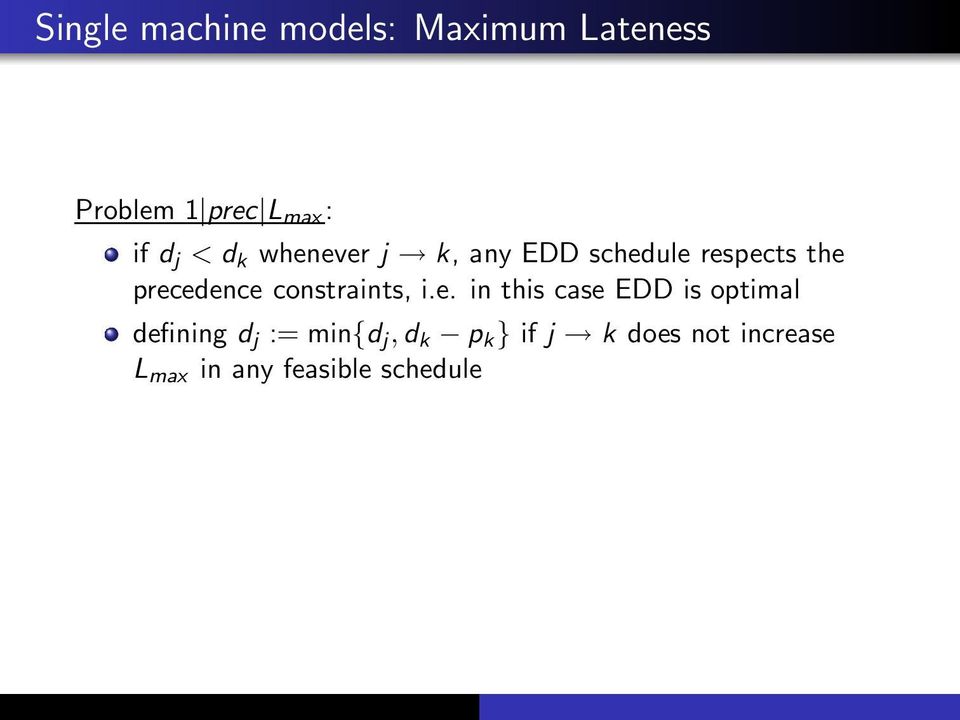
13 Single machine models: Maximum Lateness Problem 1 prec L max : if d j < d k whenever j k, any EDD schedule respects the precedence constraints, i.e. in this case EDD is optimal defining d j := min{d j,d k p k } if j k does not increase L max in any feasible schedule Algorithm 1 prec L max 1 make due dates consistent: set d j = min{d j,min k j k d k p k } 2 apply EDD rule with modified due dates

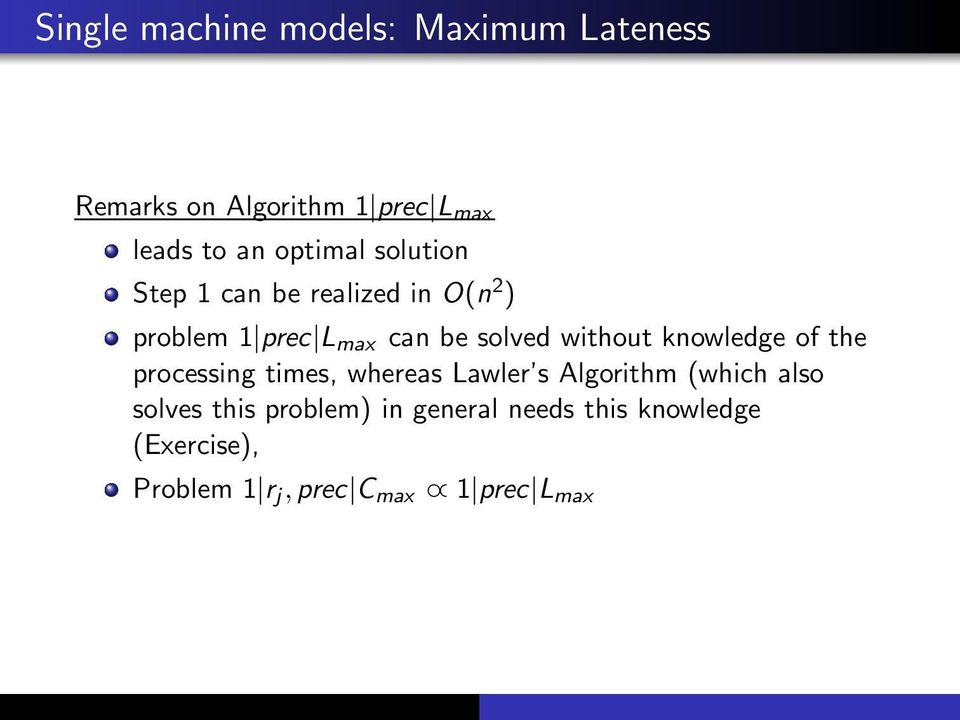
14 Single machine models: Maximum Lateness Remarks on Algorithm 1 prec L max leads to an optimal solution Step 1 can be realized in O(n 2 ) problem 1 prec L max can be solved without knowledge of the processing times, whereas Lawler s Algorithm (which also solves this problem) in general needs this knowledge (Exercise), Problem 1 r j,prec C max 1 prec L max
15 Single machine models: Maximum Lateness Problem 1 r j L max : problem 1 r j L max is NP-hard Proof: by reduction from 3-PARTITION (on the board)

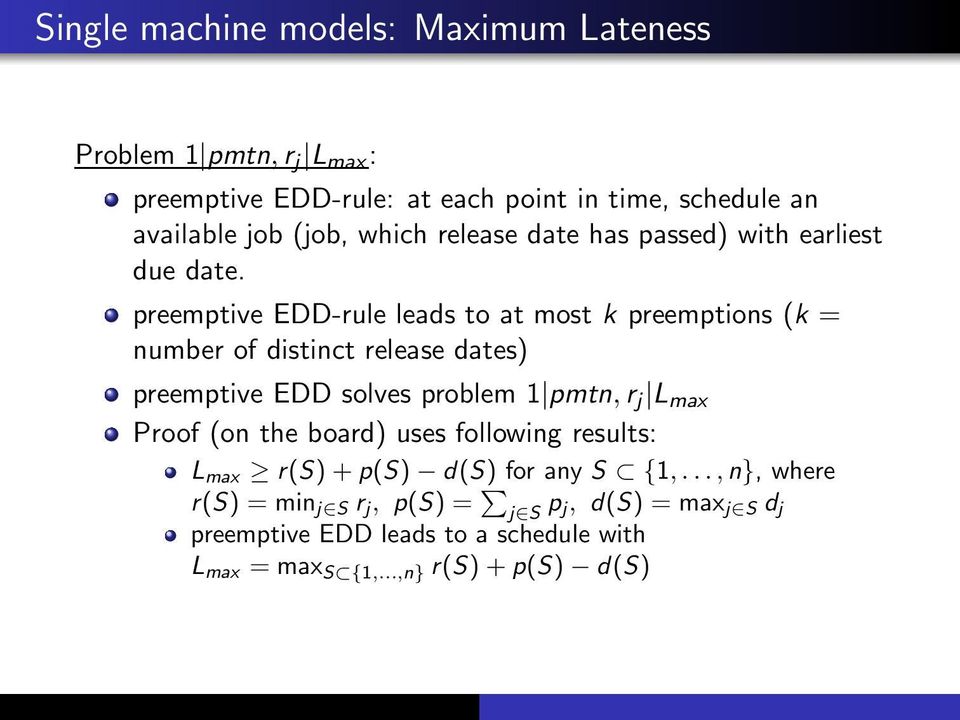
16 Single machine models: Maximum Lateness Problem 1 pmtn,r j L max : preemptive EDD-rule: at each point in time, schedule an available job (job, which release date has passed) with earliest due date. preemptive EDD-rule leads to at most k preemptions (k = number of distinct release dates)

17 Single machine models: Maximum Lateness Problem 1 pmtn,r j L max : preemptive EDD-rule: at each point in time, schedule an available job (job, which release date has passed) with earliest due date. preemptive EDD-rule leads to at most k preemptions (k = number of distinct release dates) preemptive EDD solves problem 1 pmtn,r j L max Proof (on the board) uses following results: L max r(s) + p(s) d(s) for any S {1,..., n}, where r(s) = min j S r j, p(s) = j S p j, d(s) = max j S d j preemptive EDD leads to a schedule with L max = max S {1,...,n} r(s) + p(s) d(s)
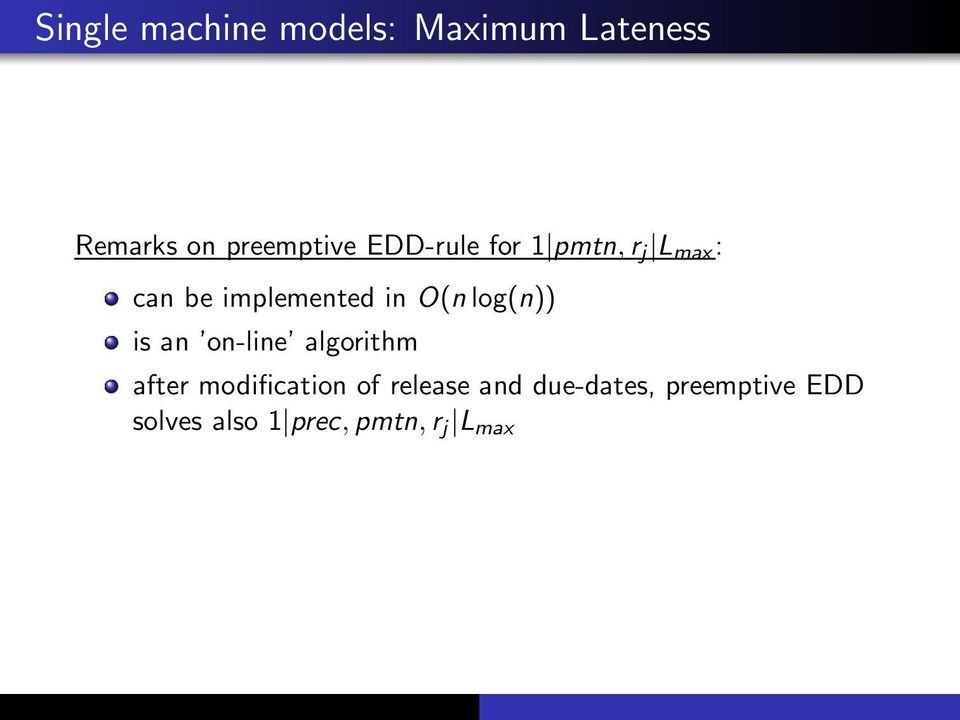
18 Single machine models: Maximum Lateness Remarks on preemptive EDD-rule for 1 pmtn,r j L max : can be implemented in O(n log(n)) is an on-line algorithm after modification of release and due-dates, preemptive EDD solves also 1 prec,pmtn,r j L max
19 Single machine models: Maximum Lateness Approximation algorithms for problem 1 r j L max : a polynomial algorithm A is called an α-approximation for problem P if for every instance I of P algorithm A yields an objective value f A (I) which is bounded by a factor α of the optimal value f (I); i.e. f A (I) αf (I)
20 Single machine models: Maximum Lateness Approximation algorithms for problem 1 r j L max : a polynomial algorithm A is called an α-approximation for problem P if for every instance I of P algorithm A yields an objective value f A (I) which is bounded by a factor α of the optimal value f (I); i.e. f A (I) αf (I) for the objective L max, α-approximation does not make sense since L max may get negative for the objective T max, an α-approximation with a constant α implies P = N P (if T max = 0 an α-approximation is optimal)
21 Single machine models: Maximum Lateness The head-body-tail problem (1 r j,d j < 0 L max ) n jobs job j: release date r j (head), processing time p j (body), delivery time q j (tail) starting time S j r j ; completion time C j = S j + p j delivered at C j + q j goal: minimize max n j=1 C j + q j
22 Single machine models: Maximum Lateness The head-body-tail problem (1 r j,d j < 0 L max ), (cont.) define d j = q j, i.e. the due dates get negative! result: min n j=1 C j + q j = min n j=1 C j d j = min n j=1 L j = L max head-body-tail problem equivalent with 1 r j L max -problem with negative due dates Notation: 1 r j,d j < 0 L max an instance of the head-body-tail problem defined by n triples (r j,p j,q j ) is equivalent to an inverse instance defined by n triples (q j,p j,r j ) for the head-body-tail problem considering approximation algorithms makes sense
23 Single machine models: Maximum Lateness The head-body-tail problem (1 r j,d j < 0 L max ), (cont.) L max r(s) + p(s) + q(s) for any S {1,...,n}, where r(s) = min r j, p(s) = p j, q(s) = min q j j S j S j S (follows from L max r(s) + p(s) d(s))
24 Single machine models: Maximum Lateness Approximation ratio for EDD for problem 1 r j,d j < 0 L max structure of a schedule S t = r(q) C c Q c critical job c of a schedule: job with L c = maxl j critical sequence Q: jobs processed in the interval [t,c c ], where t is the earliest time that the machine is not idle in [t,c c ] if q c = min j Q q j the schedule is optimal since then L max (S) = L c = C c d c = r(q) + p(q) + q(q) L max Notation: L max denotes the optimal value
25 Single machine models: Maximum Lateness Approximation ratio for EDD for problem 1 r j,d j < 0 L max structure of a schedule Q b c... 0 r(q) S b C c Q interference job b: last scheduled job from Q with q b < q c Lemma: For the objective value L max (EDD) of an EDD schedule we have: (Proofs on the board) 1 L max (EDD) L max < q c 2 L max (EDD) L max < p b Theorem: EDD is 2-approximation algorithm for 1 r j,d j < 0 L max
26 Single machine models: Maximum Lateness Approximation ratio for EDD for problem 1 r j,d j < 0 L max Remarks: EDD is also a 2-approximation for 1 prec, r j, d j < 0 L max (uses modified release and due dates) by an iteration technique the approximation factor can be reduced to 3/2
27 Single machine models: Maximum Lateness Enumerative methods for problem 1 r j L max we again will use head-body-tail notation Simple branch and bound method: branch on level i of the search tree by selecting a job to be scheduled on position i if in a node of the search tree on level i the set of already scheduled jobs is denoted by S and the finishing time of the jobs from S by t, for position i we only have to consider jobs k with r k < min j / S (max{t, r j} + p j ) lower bound: solve for remaining jobs 1 r j, pmtn L max search strategy: depth first search + selecting next job via lower bound
28 Single machine models: Maximum Lateness Advanced b&b-methods for problem 1 r j L max node of search tree = restricted instance restrictions = set of precedence constraints branching = adding precedence constraints between certain pairs of jobs after adding precedence constraints, modify release and due dates apply EDD to instance given in a node critical sequence has no interference job: EDD solves instance optimal backtrack critical sequence has an interference job: branch
29 Single machine models: Maximum Lateness Advanced b&b-methods for problem 1 r j L max (cont.) branching, given set Q, critical job c, interference job b, and set Q of jobs from Q following b Q b c... 0 r(q) S b C c Q L max = S b +p b +p(q )+q(q ) < r(q )+p b +p(q )+q(q ) if b is scheduled between jobs of Q the value is at least r(q ) + p b + p(q ) + q(q ); i.e. worse than the current schedule
30 Single machine models: Maximum Lateness Advanced b&b-methods for problem 1 r j L max (cont.) branching, given sequence Q, critical job c, interference job b, and set Q of jobs from Q following b Q b c... 0 r(q) S b C c Q L max = S b +p b +p(q )+q(q ) < r(q )+p b +p(q )+q(q ) if b is scheduled between jobs of Q the value is at least r(q ) + p b + p(q ) + q(q ); i.e. worse than the current schedule branch by adding either b Q or Q b
31 Single machine models: Maximum Lateness Advanced b&b-methods for problem 1 r j L max (cont.) lower bounds in a node: maximum of lower bound of parent node r(q ) + p(q ) + q(q ) r(q {b}) + p(q {b}) + q(q {b}) using the modified release and due dates upper bound UB: best value of the EDD schedules discard a node if lower bound UB search strategy: select node with minimum lower bound
32 Single machine models: Maximum Lateness Advanced b&b-methods for problem 1 r j L max (cont.) speed up possibility: let k / Q {b} with r(q ) + p k + p(q ) + q(q ) UB if r(q ) + p(q ) + p k + q k UB then add k Q if r k + p k + p(q ) + q(q ) UB then add Q k
33 Single machine models: Number of Tardy Jobs Problem 1 U j : Structure of an optimal schedule: set S 1 of jobs meeting their due dates set S 2 of jobs being late jobs of S 1 are scheduled before jobs from S 2 jobs from S 1 are scheduled in EDD order jobs from S 2 are scheduled in an arbitrary order Result: a partition of the set of jobs into sets S 1 and S 2 is sufficient to describe a solution
34 Single machine models: Number of Tardy Jobs Algorithm 1 U j 1 enumerate jobs such that d 1... d n ; 2 S 1 := ; t := 0; 3 FOR j:=1 TO n DO 4 S 1 := S 1 {j}; t := t + p j ; 5 IF t > d j THEN 6 Find job k with largest p k value in S 1 ; 7 S 1 := S 1 \ {k}; t := t p k ; 8 END 9 END
35 Single machine models: Number of Tardy Jobs Remarks Algorithm 1 U j Principle: schedule jobs in order of increasing due dates and always when a job gets late, remove the job with largest processing time; all removed jobs are late complexity: O(n log(n)) Example: n = 5; p = (7,8,4,6,6); d = (9,17,18,19,21)
36 Single machine models: Number of Tardy Jobs Remarks Algorithm 1 U j Principle: schedule jobs in order of increasing due dates and always when a job gets late, remove the job with largest processing time; all removed jobs are late complexity: O(n log(n)) Example: n = 5; p = (7,8,4,6,6); d = (9,17,18,19,21) d 3 20
37 Single machine models: Number of Tardy Jobs Remarks Algorithm 1 U j Principle: schedule jobs in order of increasing due dates and always when a job gets late, remove the job with largest processing time; all removed jobs are late complexity: O(n log(n)) Example: n = 5; p = (7,8,4,6,6); d = (9,17,18,19,21) d 5
38 Single machine models: Number of Tardy Jobs Remarks Algorithm 1 U j Principle: schedule jobs in order of increasing due dates and always when a job gets late, remove the job with largest processing time; all removed jobs are late complexity: O(n log(n)) Example: n = 5; p = (7,8,4,6,6); d = (9,17,18,19,21) Algorithm 1 U j computes an optimal solution Proof on the board
39 Single machine models: Weighted Number of Tardy Jobs Problem 1 w j U j problem 1 w j U j is NP-hard even if all due dates are the same; i.e. 1 d j = d w j U j is NP-hard Proof on the board (reduction from PARTITION) priority based heuristic (WSPT-rule): schedule jobs in increasing p j /w j order
40 Single machine models: Weighted Number of Tardy Jobs Problem 1 w j U j problem 1 w j U j is NP-hard even if all due dates are the same; i.e. 1 d j = d w j U j is NP-hard Proof on the board (reduction from PARTITION) priority based heuristic (WSPT-rule): schedule jobs in increasing p j /w j order WSPT may perform arbitrary bad for 1 w j U j :
41 Single machine models: Weighted Number of Tardy Jobs Problem 1 w j U j problem 1 w j U j is NP-hard even if all due dates are the same; i.e. 1 d j = d w j U j is NP-hard Proof on the board (reduction from PARTITION) priority based heuristic (WSPT-rule): schedule jobs in increasing p j /w j order WSPT may perform arbitrary bad for 1 w j U j : n = 3;p = (1,1,M); w = (1 + ǫ,1,m ǫ);d = (1 + M,1 + M,1 + M) wj U j (WSPT)/ w j U j (opt) = (M ǫ)/(1 + ǫ)
42 Single machine models: Weighted Number of Tardy Jobs Dynamic Programming for 1 w j U j assume d 1... d n as for 1 U j a solution is given by a partition of the set of jobs into sets S 1 and S 2 and jobs in S 1 are in EDD order Definition: F j (t) := minimum criterion value for scheduling the first j jobs such that the processing time of the on-time jobs is at most t F n (T) with T = n j=1 p j is optimal value for problem 1 w j U j Initial conditions: F j (t) = { for t < 0; j = 1,...,n 0 for t 0; j = 0 (1)
43 Single machine models: Weighted Number of Tardy Jobs Dynamic Programming for 1 w j U j (cont.) if 0 t d j and j is late in the schedule corresponding to F j (t), we have F j (t) = F j 1 (t) + w j if 0 t d j and j is on time in the schedule corresponding to F j (t), we have F j (t) = F j 1 (t p j )
44 Single machine models: Weighted Number of Tardy Jobs Dynamic Programming for 1 w j U j (cont.) if 0 t d j and j is late in the schedule corresponding to F j (t), we have F j (t) = F j 1 (t) + w j if 0 t d j and j is on time in the schedule corresponding to F j (t), we have F j (t) = F j 1 (t p j ) summarizing, we get for j = 1,...,n: { min{f j 1 (t p j ),F j 1 (t) + w j } F j (t) = F j (d j ) for 0 t d j for d j < t T (2)
45 Single machine models: Weighted Number of Tardy Jobs DP-algorithm for 1 w j U j 1 initialize F j (t) according to (1) 2 FOR j := 1 TO n DO 3 FOR t := 0 TO T DO 4 update F j (t) according to (2) 5 wj U j (OPT) = F n (d n )
46 Single machine models: Weighted Number of Tardy Jobs DP-algorithm for 1 w j U j 1 initialize F j (t) according to (1) 2 FOR j := 1 TO n DO 3 FOR t := 0 TO T DO 4 update F j (t) according to (2) 5 wj U j (OPT) = F n (d n ) complexity is O(n n j=1 p j) thus, algorithm is pseudopolynomial
47 Single machine models: Total Tardiness Basic results: 1 T j is NP-hard preemption does not improve the criterion value 1 pmtn T j is NP-hard idle times do not improve the criterion value Lemma 1: If p j p k and d j d k, then an optimal schedule exist in which job j is scheduled before job k. Proof: exercise this lemma gives a dominance rule
48 Single machine models: Total Tardiness Structural property for 1 T j let k be a fixed job and Ĉk be latest possible completion time of job k in an optimal schedule define ˆd j = { d j max{d k,ĉ k } for j k for j = k Lemma 2: Any optimal sequence w.r.t. ˆd 1,..., ˆd n is also optimal w.r.t. d 1,...,d n. Proof on the board
49 Single machine models: Total Tardiness Structural property for 1 T j (cont.) let d 1... d n let k be the job with p k = max{p 1,...,p n } Lemma 1 implies that an optimal schedule exists where {1,...,k 1} k Lemma 3: There exists an integer δ, 0 δ n k for which an optimal schedule exist in which {1,...,k 1,k+1,...,k+δ} k and k {k+δ+1,...,n}. Proof on the board
50 Single machine models: Total Tardiness DP-algorithm for 1 T j Definition: F j (t) := minimum criterion value for scheduling the first j jobs starting their processing at time t by Lemma 3 we get: there exists some δ {1,...,j} such that F j (t) is achieved by scheduling 1 first jobs 1,...,k 1, k + 1,...,k + δ in some order 2 followed by job k starting at t + k+δ l=1 p l p k 3 followed by jobs k + δ + 1,...,j in some order where p k = max j l=1 p l
51 Single machine models: Total Tardiness DP-algorithm for 1 T j (cont.) {1,...,j} {1,...,k 1, k + 1,...,k + δ} k {k + δ + 1,...,j} Definition: J(j, l, k) := {i i {j, j + 1,...,l}; p i p k ; i k}
52 Single machine models: Total Tardiness DP-algorithm for 1 T j (cont.) {1,...,j} {1,...,k 1, k + 1,...,k + δ} k {k + δ + 1,...,j} Definition: J(j, l, k) := {i i {j, j + 1,...,l}; p i p k ; i k} {1,...,j} J(1, k + δ, k) k J(k + δ + 1, j, k)
53 Single machine models: Total Tardiness DP-algorithm for 1 T j (cont.) {1,...,j} J(1, k + δ, k) k J(k + δ + 1, j, k) Definition: J(j, l, k) := {i i {j, j + 1,...,l}; p i p k ; i k} V(J(j, l, k), t) := minimum criterion value for scheduling the jobs from J(j, l, k) starting their processing at time t
54 Single machine models: Total Tardiness DP-algorithm for 1 T j (cont.) t t J(j, l, k) J(j, k + δ, k ) k J(k + δ + 1, l, k ) C k (δ) we get: V (J(j,l,k),t) = min δ where p k = max{p j j J(j,l,k)} and C k (δ) = t + p k + j V(J(j,k +δ,k ) p j {V (J(j,k + δ,k ),t) + max{0,c k (δ) d k } +V (J(k + δ + 1,l,k ),C k (δ)))} V (,t) = 0, V ({j},t) = max{0,t + p j d j }
55 Single machine models: Total Tardiness DP-algorithm for 1 T j (cont.) optimal value of 1 T j is given by V ({1,...,n},0) complexity: at most O(n 3 ) subsets J(j, l, k) at most p j values for t each recursion (evaluation V(J(j, l, k), t)) costs O(n) (at most n values for δ) total complexity: O(n 4 p j ) (pseudopolynomial)
Single machine models: Maximum Lateness -12- Approximation ratio for EDD for problem 1 r j,d j < 0 L max. structure of a schedule Q...
 Lecture 4 Scheduling 1 Single machine models: Maximum Lateness -12- Approximation ratio for EDD for problem 1 r j,d j < 0 L max structure of a schedule 0 Q 1100 11 00 11 000 111 0 0 1 1 00 11 00 11 00
Classification - Examples
 Lecture 2 Scheduling 1 Classification - Examples 1 r j C max given: n jobs with processing times p 1,...,p n and release dates r 1,...,r n jobs have to be scheduled without preemption on one machine taking
Scheduling Shop Scheduling. Tim Nieberg
 Scheduling Shop Scheduling Tim Nieberg Shop models: General Introduction Remark: Consider non preemptive problems with regular objectives Notation Shop Problems: m machines, n jobs 1,..., n operations
Single machine parallel batch scheduling with unbounded capacity
 Workshop on Combinatorics and Graph Theory 21th, April, 2006 Nankai University Single machine parallel batch scheduling with unbounded capacity Yuan Jinjiang Department of mathematics, Zhengzhou University
Completion Time Scheduling and the WSRPT Algorithm
 Completion Time Scheduling and the WSRPT Algorithm Bo Xiong, Christine Chung Department of Computer Science, Connecticut College, New London, CT {bxiong,cchung}@conncoll.edu Abstract. We consider the online
Real Time Scheduling Basic Concepts. Radek Pelánek
 Real Time Scheduling Basic Concepts Radek Pelánek Basic Elements Model of RT System abstraction focus only on timing constraints idealization (e.g., zero switching time) Basic Elements Basic Notions task
List Scheduling in Order of α-points on a Single Machine
 List Scheduling in Order of α-points on a Single Machine Martin Skutella Fachbereich Mathematik, Universität Dortmund, D 4422 Dortmund, Germany [email protected] http://www.mathematik.uni-dortmund.de/
Approximability of Two-Machine No-Wait Flowshop Scheduling with Availability Constraints
 Approximability of Two-Machine No-Wait Flowshop Scheduling with Availability Constraints T.C. Edwin Cheng 1, and Zhaohui Liu 1,2 1 Department of Management, The Hong Kong Polytechnic University Kowloon,
Introduction to Scheduling Theory
 Introduction to Scheduling Theory Arnaud Legrand Laboratoire Informatique et Distribution IMAG CNRS, France [email protected] November 8, 2004 1/ 26 Outline 1 Task graphs from outer space 2 Scheduling
Stiffie's On Line Scheduling Algorithm
 A class of on-line scheduling algorithms to minimize total completion time X. Lu R.A. Sitters L. Stougie Abstract We consider the problem of scheduling jobs on-line on a single machine and on identical
Aperiodic Task Scheduling
 Aperiodic Task Scheduling Jian-Jia Chen (slides are based on Peter Marwedel) TU Dortmund, Informatik 12 Germany Springer, 2010 2014 年 11 月 19 日 These slides use Microsoft clip arts. Microsoft copyright
Common Approaches to Real-Time Scheduling
 Common Approaches to Real-Time Scheduling Clock-driven time-driven schedulers Priority-driven schedulers Examples of priority driven schedulers Effective timing constraints The Earliest-Deadline-First
JUST-IN-TIME SCHEDULING WITH PERIODIC TIME SLOTS. Received December May 12, 2003; revised February 5, 2004
 Scientiae Mathematicae Japonicae Online, Vol. 10, (2004), 431 437 431 JUST-IN-TIME SCHEDULING WITH PERIODIC TIME SLOTS Ondřej Čepeka and Shao Chin Sung b Received December May 12, 2003; revised February
Complexity Theory. IE 661: Scheduling Theory Fall 2003 Satyaki Ghosh Dastidar
 Complexity Theory IE 661: Scheduling Theory Fall 2003 Satyaki Ghosh Dastidar Outline Goals Computation of Problems Concepts and Definitions Complexity Classes and Problems Polynomial Time Reductions Examples
Online Scheduling for Cloud Computing and Different Service Levels
 2012 IEEE 201226th IEEE International 26th International Parallel Parallel and Distributed and Distributed Processing Processing Symposium Symposium Workshops Workshops & PhD Forum Online Scheduling for
Offline sorting buffers on Line
 Offline sorting buffers on Line Rohit Khandekar 1 and Vinayaka Pandit 2 1 University of Waterloo, ON, Canada. email: [email protected] 2 IBM India Research Lab, New Delhi. email: [email protected]
Scheduling Real-time Tasks: Algorithms and Complexity
 Scheduling Real-time Tasks: Algorithms and Complexity Sanjoy Baruah The University of North Carolina at Chapel Hill Email: [email protected] Joël Goossens Université Libre de Bruxelles Email: [email protected]
Duplicating and its Applications in Batch Scheduling
 Duplicating and its Applications in Batch Scheduling Yuzhong Zhang 1 Chunsong Bai 1 Shouyang Wang 2 1 College of Operations Research and Management Sciences Qufu Normal University, Shandong 276826, China
The Trip Scheduling Problem
 The Trip Scheduling Problem Claudia Archetti Department of Quantitative Methods, University of Brescia Contrada Santa Chiara 50, 25122 Brescia, Italy Martin Savelsbergh School of Industrial and Systems
Dynamic programming. Doctoral course Optimization on graphs - Lecture 4.1. Giovanni Righini. January 17 th, 2013
 Dynamic programming Doctoral course Optimization on graphs - Lecture.1 Giovanni Righini January 1 th, 201 Implicit enumeration Combinatorial optimization problems are in general NP-hard and we usually
Fairness in Routing and Load Balancing
 Fairness in Routing and Load Balancing Jon Kleinberg Yuval Rabani Éva Tardos Abstract We consider the issue of network routing subject to explicit fairness conditions. The optimization of fairness criteria
The Goldberg Rao Algorithm for the Maximum Flow Problem
 The Goldberg Rao Algorithm for the Maximum Flow Problem COS 528 class notes October 18, 2006 Scribe: Dávid Papp Main idea: use of the blocking flow paradigm to achieve essentially O(min{m 2/3, n 1/2 }
8.1 Min Degree Spanning Tree
 CS880: Approximations Algorithms Scribe: Siddharth Barman Lecturer: Shuchi Chawla Topic: Min Degree Spanning Tree Date: 02/15/07 In this lecture we give a local search based algorithm for the Min Degree
A Beam Search Heuristic for Multi-Mode Single Resource Constrained Project Scheduling
 A Beam Search Heuristic for Multi-Mode Single Resource Constrained Project Scheduling Chuda Basnet Department of Management Systems The University of Waikato Private Bag 3105 Hamilton [email protected]
Minimizing the Number of Machines in a Unit-Time Scheduling Problem
 Minimizing the Number of Machines in a Unit-Time Scheduling Problem Svetlana A. Kravchenko 1 United Institute of Informatics Problems, Surganova St. 6, 220012 Minsk, Belarus [email protected] Frank
3. Scheduling issues. Common approaches /1. Common approaches /2. Common approaches /3. 2012/13 UniPD / T. Vardanega 23/01/2013. Real-Time Systems 1
 Common approaches /1 3. Scheduling issues Clock-driven (time-driven) scheduling Scheduling decisions are made beforehand (off line) and carried out at predefined time instants The time instants normally
5 INTEGER LINEAR PROGRAMMING (ILP) E. Amaldi Fondamenti di R.O. Politecnico di Milano 1
 5 INTEGER LINEAR PROGRAMMING (ILP) E. Amaldi Fondamenti di R.O. Politecnico di Milano 1 General Integer Linear Program: (ILP) min c T x Ax b x 0 integer Assumption: A, b integer The integrality condition
Scheduling a sequence of tasks with general completion costs
 Scheduling a sequence of tasks with general completion costs Francis Sourd CNRS-LIP6 4, place Jussieu 75252 Paris Cedex 05, France [email protected] Abstract Scheduling a sequence of tasks in the acceptation
! Solve problem to optimality. ! Solve problem in poly-time. ! Solve arbitrary instances of the problem. #-approximation algorithm.
 Approximation Algorithms 11 Approximation Algorithms Q Suppose I need to solve an NP-hard problem What should I do? A Theory says you're unlikely to find a poly-time algorithm Must sacrifice one of three
Dimensioning an inbound call center using constraint programming
 Dimensioning an inbound call center using constraint programming Cyril Canon 1,2, Jean-Charles Billaut 2, and Jean-Louis Bouquard 2 1 Vitalicom, 643 avenue du grain d or, 41350 Vineuil, France [email protected]
A Linear Programming Based Method for Job Shop Scheduling
 A Linear Programming Based Method for Job Shop Scheduling Kerem Bülbül Sabancı University, Manufacturing Systems and Industrial Engineering, Orhanlı-Tuzla, 34956 Istanbul, Turkey [email protected]
CSC2420 Spring 2015: Lecture 3
 CSC2420 Spring 2015: Lecture 3 Allan Borodin January 22, 2015 1 / 1 Announcements and todays agenda Assignment 1 due next Thursday. I may add one or two additional questions today or tomorrow. Todays agenda
On-line machine scheduling with batch setups
 On-line machine scheduling with batch setups Lele Zhang, Andrew Wirth Department of Mechanical Engineering The University of Melbourne, VIC 3010, Australia Abstract We study a class of scheduling problems
Real-Time Scheduling (Part 1) (Working Draft) Real-Time System Example
 Real-Time Scheduling (Part 1) (Working Draft) Insup Lee Department of Computer and Information Science School of Engineering and Applied Science University of Pennsylvania www.cis.upenn.edu/~lee/ CIS 41,
Near Optimal Solutions
 Near Optimal Solutions Many important optimization problems are lacking efficient solutions. NP-Complete problems unlikely to have polynomial time solutions. Good heuristics important for such problems.
24. The Branch and Bound Method
 24. The Branch and Bound Method It has serious practical consequences if it is known that a combinatorial problem is NP-complete. Then one can conclude according to the present state of science that no
Chapter 11. 11.1 Load Balancing. Approximation Algorithms. Load Balancing. Load Balancing on 2 Machines. Load Balancing: Greedy Scheduling
 Approximation Algorithms Chapter Approximation Algorithms Q. Suppose I need to solve an NP-hard problem. What should I do? A. Theory says you're unlikely to find a poly-time algorithm. Must sacrifice one
Factors to Describe Job Shop Scheduling Problem
 Job Shop Scheduling Job Shop A work location in which a number of general purpose work stations exist and are used to perform a variety of jobs Example: Car repair each operator (mechanic) evaluates plus
Lecture Outline Overview of real-time scheduling algorithms Outline relative strengths, weaknesses
 Overview of Real-Time Scheduling Embedded Real-Time Software Lecture 3 Lecture Outline Overview of real-time scheduling algorithms Clock-driven Weighted round-robin Priority-driven Dynamic vs. static Deadline
Approximation Algorithms
 Approximation Algorithms or: How I Learned to Stop Worrying and Deal with NP-Completeness Ong Jit Sheng, Jonathan (A0073924B) March, 2012 Overview Key Results (I) General techniques: Greedy algorithms
Two Algorithms for the Student-Project Allocation Problem
 Two Algorithms for the Student-Project Allocation Problem David J. Abraham 1, Robert W. Irving 2, and David F. Manlove 2 1 Computer Science Department, Carnegie-Mellon University, 5000 Forbes Ave, Pittsburgh
A Note on Maximum Independent Sets in Rectangle Intersection Graphs
 A Note on Maximum Independent Sets in Rectangle Intersection Graphs Timothy M. Chan School of Computer Science University of Waterloo Waterloo, Ontario N2L 3G1, Canada [email protected] September 12,
A Computer Application for Scheduling in MS Project
 Comput. Sci. Appl. Volume 1, Number 5, 2014, pp. 309-318 Received: July 18, 2014; Published: November 25, 2014 Computer Science and Applications www.ethanpublishing.com Anabela Tereso, André Guedes and
R u t c o r Research R e p o r t. A Method to Schedule Both Transportation and Production at the Same Time in a Special FMS.
 R u t c o r Research R e p o r t A Method to Schedule Both Transportation and Production at the Same Time in a Special FMS Navid Hashemian a Béla Vizvári b RRR 3-2011, February 21, 2011 RUTCOR Rutgers
A simpler and better derandomization of an approximation algorithm for Single Source Rent-or-Buy
 A simpler and better derandomization of an approximation algorithm for Single Source Rent-or-Buy David P. Williamson Anke van Zuylen School of Operations Research and Industrial Engineering, Cornell University,
Applied Algorithm Design Lecture 5
 Applied Algorithm Design Lecture 5 Pietro Michiardi Eurecom Pietro Michiardi (Eurecom) Applied Algorithm Design Lecture 5 1 / 86 Approximation Algorithms Pietro Michiardi (Eurecom) Applied Algorithm Design
Constraint-Based Scheduling: A Tutorial
 Constraint-Based Scheduling: A Tutorial Claude Le Pape ILOG S. A. 9, rue de Verdun F-94253 Gentilly Cedex Tel: +33 1 49 08 29 67 Fax: +33 1 49 08 35 10 Email: [email protected] Given a set of resources with
A Branch and Bound Algorithm for Solving the Binary Bi-level Linear Programming Problem
 A Branch and Bound Algorithm for Solving the Binary Bi-level Linear Programming Problem John Karlof and Peter Hocking Mathematics and Statistics Department University of North Carolina Wilmington Wilmington,
! Solve problem to optimality. ! Solve problem in poly-time. ! Solve arbitrary instances of the problem. !-approximation algorithm.
 Approximation Algorithms Chapter Approximation Algorithms Q Suppose I need to solve an NP-hard problem What should I do? A Theory says you're unlikely to find a poly-time algorithm Must sacrifice one of
Clustering and scheduling maintenance tasks over time
 Clustering and scheduling maintenance tasks over time Per Kreuger 2008-04-29 SICS Technical Report T2008:09 Abstract We report results on a maintenance scheduling problem. The problem consists of allocating
Heuristic Algorithms for Open Shop Scheduling to Minimize Mean Flow Time, Part I: Constructive Algorithms
 Heuristic Algorithms for Open Shop Scheduling to Minimize Mean Flow Time, Part I: Constructive Algorithms Heidemarie Bräsel, André Herms, Marc Mörig, Thomas Tautenhahn, Jan Tusch, Frank Werner Otto-von-Guericke-Universität,
Integrated support system for planning and scheduling... 2003/4/24 page 75 #101. Chapter 5 Sequencing and assignment Strategies
 Integrated support system for planning and scheduling... 2003/4/24 page 75 #101 Chapter 5 Sequencing and assignment Strategies 5.1 Overview This chapter is dedicated to the methodologies used in this work
The Student-Project Allocation Problem
 The Student-Project Allocation Problem David J. Abraham, Robert W. Irving, and David F. Manlove Department of Computing Science, University of Glasgow, Glasgow G12 8QQ, UK Email: {dabraham,rwi,davidm}@dcs.gla.ac.uk.
Guessing Game: NP-Complete?
 Guessing Game: NP-Complete? 1. LONGEST-PATH: Given a graph G = (V, E), does there exists a simple path of length at least k edges? YES 2. SHORTEST-PATH: Given a graph G = (V, E), does there exists a simple
A Near-linear Time Constant Factor Algorithm for Unsplittable Flow Problem on Line with Bag Constraints
 A Near-linear Time Constant Factor Algorithm for Unsplittable Flow Problem on Line with Bag Constraints Venkatesan T. Chakaravarthy, Anamitra R. Choudhury, and Yogish Sabharwal IBM Research - India, New
Algorithm Design and Analysis
 Algorithm Design and Analysis LECTURE 27 Approximation Algorithms Load Balancing Weighted Vertex Cover Reminder: Fill out SRTEs online Don t forget to click submit Sofya Raskhodnikova 12/6/2011 S. Raskhodnikova;
1 Approximating Set Cover
 CS 05: Algorithms (Grad) Feb 2-24, 2005 Approximating Set Cover. Definition An Instance (X, F ) of the set-covering problem consists of a finite set X and a family F of subset of X, such that every elemennt
CSE 4351/5351 Notes 7: Task Scheduling & Load Balancing
 CSE / Notes : Task Scheduling & Load Balancing Task Scheduling A task is a (sequential) activity that uses a set of inputs to produce a set of outputs. A task (precedence) graph is an acyclic, directed
6.852: Distributed Algorithms Fall, 2009. Class 2
 .8: Distributed Algorithms Fall, 009 Class Today s plan Leader election in a synchronous ring: Lower bound for comparison-based algorithms. Basic computation in general synchronous networks: Leader election
Production Planning Solution Techniques Part 1 MRP, MRP-II
 Production Planning Solution Techniques Part 1 MRP, MRP-II Mads Kehlet Jepsen Production Planning Solution Techniques Part 1 MRP, MRP-II p.1/31 Overview Production Planning Solution Techniques Part 1 MRP,
Steiner Tree Approximation via IRR. Randomized Rounding
 Steiner Tree Approximation via Iterative Randomized Rounding Graduate Program in Logic, Algorithms and Computation μπλ Network Algorithms and Complexity June 18, 2013 Overview 1 Introduction Scope Related
Abstract Title: Planned Preemption for Flexible Resource Constrained Project Scheduling
 Abstract number: 015-0551 Abstract Title: Planned Preemption for Flexible Resource Constrained Project Scheduling Karuna Jain and Kanchan Joshi Shailesh J. Mehta School of Management, Indian Institute
Dynamic programming formulation
 1.24 Lecture 14 Dynamic programming: Job scheduling Dynamic programming formulation To formulate a problem as a dynamic program: Sort by a criterion that will allow infeasible combinations to be eli minated
A Practical Scheme for Wireless Network Operation
 A Practical Scheme for Wireless Network Operation Radhika Gowaikar, Amir F. Dana, Babak Hassibi, Michelle Effros June 21, 2004 Abstract In many problems in wireline networks, it is known that achieving
Periodic Task Scheduling
 Periodic Task Scheduling Radek Pelánek Motivation and Assumptions Examples of Periodic Tasks sensory data acquisition control loops action planning system monitoring Motivation and Assumptions Simplifying
Reinforcement Learning
 Reinforcement Learning LU 2 - Markov Decision Problems and Dynamic Programming Dr. Joschka Bödecker AG Maschinelles Lernen und Natürlichsprachliche Systeme Albert-Ludwigs-Universität Freiburg [email protected]
About the inverse football pool problem for 9 games 1
 Seventh International Workshop on Optimal Codes and Related Topics September 6-1, 013, Albena, Bulgaria pp. 15-133 About the inverse football pool problem for 9 games 1 Emil Kolev Tsonka Baicheva Institute
Analysis of Algorithms I: Optimal Binary Search Trees
 Analysis of Algorithms I: Optimal Binary Search Trees Xi Chen Columbia University Given a set of n keys K = {k 1,..., k n } in sorted order: k 1 < k 2 < < k n we wish to build an optimal binary search
1.204 Lecture 10. Greedy algorithms: Job scheduling. Greedy method
 1.204 Lecture 10 Greedy algorithms: Knapsack (capital budgeting) Job scheduling Greedy method Local improvement method Does not look at problem globally Takes best immediate step to find a solution Useful
4. Fixed-Priority Scheduling
 Simple workload model 4. Fixed-Priority Scheduling Credits to A. Burns and A. Wellings The application is assumed to consist of a fixed set of tasks All tasks are periodic with known periods This defines
A Note on the Bertsimas & Sim Algorithm for Robust Combinatorial Optimization Problems
 myjournal manuscript No. (will be inserted by the editor) A Note on the Bertsimas & Sim Algorithm for Robust Combinatorial Optimization Problems Eduardo Álvarez-Miranda Ivana Ljubić Paolo Toth Received:
OR topics in MRP-II. Mads Jepsens. OR topics in MRP-II p.1/25
 OR topics in MRP-II Mads Jepsens OR topics in MRP-II p.1/25 Overview Why bother? OR topics in MRP-II p.2/25 Why bother? Push and Pull systems Overview OR topics in MRP-II p.2/25 Overview Why bother? Push
Discrete Optimization
 Discrete Optimization [Chen, Batson, Dang: Applied integer Programming] Chapter 3 and 4.1-4.3 by Johan Högdahl and Victoria Svedberg Seminar 2, 2015-03-31 Todays presentation Chapter 3 Transforms using
Aperiodic Task Scheduling
 Aperiodic Task Scheduling Gerhard Fohler Mälardalen University, Sweden [email protected] Real-Time Systems Gerhard Fohler 2005 Non Periodic Tasks So far periodic events and tasks what about others?
Reinforcement Learning
 Reinforcement Learning LU 2 - Markov Decision Problems and Dynamic Programming Dr. Martin Lauer AG Maschinelles Lernen und Natürlichsprachliche Systeme Albert-Ludwigs-Universität Freiburg [email protected]
Closest Pair of Points. Kleinberg and Tardos Section 5.4
 Closest Pair of Points Kleinberg and Tardos Section 5.4 Closest Pair of Points Closest pair. Given n points in the plane, find a pair with smallest Euclidean distance between them. Fundamental geometric