
Cross-Flow turbine design for variable operating conditions
|
|
|
- Bernard Booker
- 9 years ago
- Views:
Transcription
1 Available online at Procedia Engineering 00 (2014) th International Conference on Computing and Control for the Water Industry, CCWI2013 Cross-Flow turbine design for variable operating conditions Marco Sinagra a, Vincenzo Sammartano a, Costanza Aricò a, Alfonso Collura b, Tullio Tucciarelli a,* a Università di Palermo, Dipartimento Ingegneria Civile, Ambientale, Aerospaziale, dei Materiali, Viale delle Scienze, Palermo 90128, b Istituto Nazionale di Astrofisica, Osservatorio Astronomico di Palermo Giuseppe Salvatore Vaiana, Piazza del Parlamento, 1, Palermo 90134, Italy Abstract The potential energy hidden in water resources is becoming more and more a significant economic value. The value of the hydroelectric energy is often magnified by the proximity of the turbine to pumps or other energy sinks owned by the same water manager. Cross-flow or Banki-Michel turbines are a very efficient and economic choice that allows a very good cost/benefit ratio for energy production located at the end of conduits carrying water from a water source to a tank. In the paper the optimum design of a cross-flow turbine is sought after, assuming a flow rate variable in time. Regulation of the discharge entering in the turbine is a key issue, which is faced adopting a shaped semicircular segment, moved inside the main case around the rotating impeller. The maximum efficiency of the turbine is attained by setting the velocity of the particles entering the impeller at about twice the velocity of the rotating system at the impeller inlet. If energy losses along the pipe are negligible, closing and opening the inlet surface with the semicircular segment allows always a constant hydraulic head and a constant velocity at the impeller inlet, even with different flow rate entering values. Observed reduction of the turbine efficiency along with the inlet surface reduction is first investigated; a design methodology, using also CFD simulations, is then proposed; finally, the same methodology is applied to a real site in Sicily, selected in the context of the HYDROENERGY P.O. - F.E.S.R. European project The Authors. Published by Elsevier Ltd. Selection and peer-review under responsibility of the CCWI2013 Committee. Keywords: Turbines; Cross-flow; Energy saving. * Corresponding author. Tel.: address: [email protected] The Authors. Published by Elsevier Ltd. Selection and peer-review under responsibility of the CCWI2013 Committee.

2 Sinagra M. et al./ Procedia Engineering 00 (2014) Introduction Hydropower has been for more than a century the major source of energy and is, still now, the major source of renewable energy worldwide. The number of new large hydro-plants per year is at present undergoing a strong reduction, due to an increased social sensitivity to the river ecological and transport equilibrium, which leaves a very limited number of sites available for new large hydro-plant construction. On the other hand, the on-going transformation of the centralized system of energy production and transportation into a more flexible distributed system (smart grids) has given a strong input to the construction of micro and pico hydro-energy production devices (from few to 1000 kw). This type of turbine can be easily installed: 1) along small rivers, where it is possible to transform the potential hydraulic energy dissipated along a short reach between two river sections in electricity, without diverting the minimum flow rate required by the reach ecological equilibrium, 2) at the end of a water pipe delivering the water from a main source (spring, water well, natural or artificial basin) to a tank serving a city water district, 3) at the end of a sewer pipe delivering the treated waste water to its final receiving water body. We define total efficiency the ratio between the output power of the turbine and the mechanical energy of the mass passing per unit time trough the upper inlet of the hydroelectric plant, measured with respect to the level of the turbine axis. This inlet is a river section in case 1) and a pipe section in cases 2) and 3). The total efficiency η t can be estimated as: Pout ηt = γ Q H t (1a), where P out is the output power, Q is the discharge and H t is the topographic jump between the inlet location and the turbine axis. Unless the source is an artificial basin and discharge regulation is carried out from the same hydraulic plant where the turbine is located, the discharge delivered to the turbine changes according to the river level or to the spring natural flow (Fig.1). Fig.1. Turbine installed at an aqueduct end If no dissipation valves are installed along the pipe, the pipe section will be only partially filled up by the water for some extension after the inlet. In this part of the pipe a free surface flow will occur, with abrupt transformation in pressurized flow at the intersection between the pipe and the energy line. The hydraulic head H c immediately before the turbine depends on its characteristic curve (Fig. 2a), unless a specific discharge regulation system is installed inside the turbine.

3 Sinagra M. et al./ Procedia Engineering 00 (2014) a) b) Fig. 2. a) Characteristic and efficiency curves for a generic turbine. b) Efficiencies versus discharges for Kaplan, Pelton, Francis, Cross flow and Propeller turbine The efficiency of the turbine is defined as: P γ QH out η = (1b). c H c can be much smaller than both H and H t, where H is the hydraulic head resulting at the aqueduct end in the case of pressurized flow along the entire pipe. H is related to H t by the following curve of pipe energy losses: 2 Ht H = K1 Q (2), where K 1 depends on the pipe size and material. In many cases we can neglect energy losses along the pipe and set H = H t. The output power of the turbine is given by: out ( ) γ ( ) P = η Q Q H Q (3), c The turbine efficiency η and the hydraulic head H c can be much lower than respectively η max and H t far from the optimal discharge value (where η max is the maximum efficiency). Moreover, if we want to avoid any free flow condition inside the pipe, the mechanical energy corresponding to the head difference H-H c must be dissipated by an extra valve that has to be installed along the pipe. All this inconvenient can be avoided by the use of a discharge regulator inside the turbine. An optimum regulator should allow the turbine characteristic curve and the curve of the pipe energy losses, to match each other and should guarantee an efficiency η always close to the η max value. If pipe energy losses are negligible, this is equivalent to keep a constant H c = H t hydraulic head for all the possible discharge values. 2. Existing turbine regulation systems Documentation provided by the companies that construct turbines usually includes the characteristic curve (for one or many possible regulation conditions) and the efficiency curve, defined as in Eq. (1b). Not many information are available about the attainable total efficiency, as defined in Eq. (1a). A good efficiency (as defined in Eq. 1b) under variable operating conditions can be attained with two different approaches: hydraulic and electrical regulation.
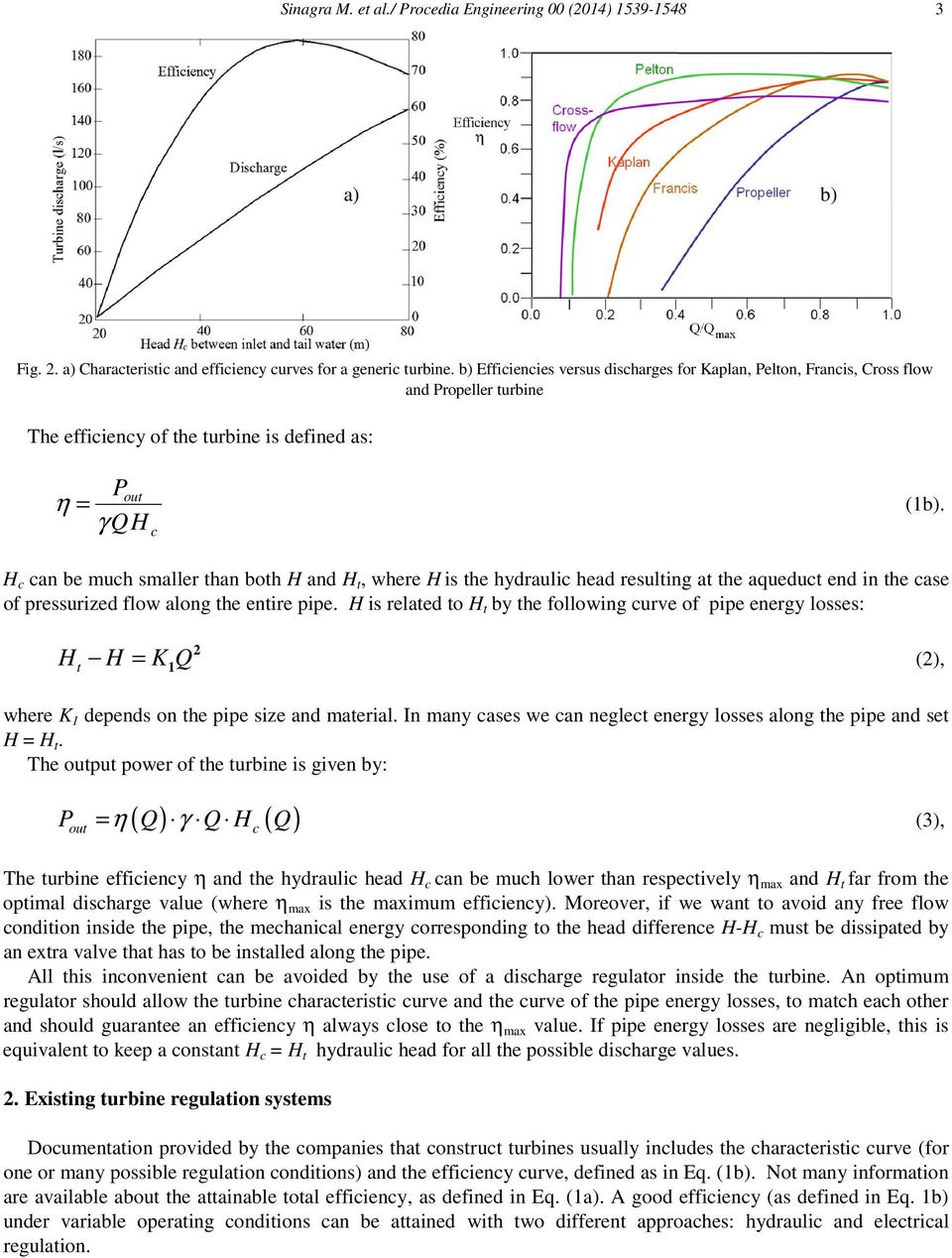
4 Sinagra M. et al./ Procedia Engineering 00 (2014) The hydraulic regulation, often more flexible and efficient than the electrical one (Carravetta et al., 2013), depends on the type of turbine: needle stroke for Pelton turbines, adjustable guide vanes for Francis turbine, fixed or adjustable guide vanes or adjustable runner blades for Diagonal or Kaplan turbine (Panish, 2002; Singh, 2009). Pelton turbines can have multiple needles, which can be set in on/off position according to the available discharge. The reverse pumps have no regulation system, so in order to obtain a flexibility of the turbine related to the variability of discharge and/or head drop, hydraulic regulation has to be done with a series/parallel hydraulic circuit (Carravetta and Giugni, 2006; Carravetta et al., 2013). This circuit consists of a by-pass conduit and of a pressure reducing valve in series with the turbine. Recent power electronic devices allow regulating electrical voltage and frequency in order to vary the generator speed (Joshi et al., 2005; Ramuz et al., 2005). When turbines are coupled with asynchronous generators, like it happens in most of the hydropower plants, the electronic regulation allows an almost constant ratio between the inlet particle velocity and the impeller rotational speed, for different discharge values. This leads also to a constant efficiency, because efficiency is mainly related to the above mentioned velocity ratio, but has little effect on the turbine characteristic curve and H c can be much smaller than the total head H t. The cost of the regulation system is of course a central issue. Adjustable runner blades or guide vanes have a cost that is proportional to their number, which usually is very large (30-40), multiple needle strokes for Pelton turbines require also a continuous switching on/off the single strokes and some of them can remain unused most of the time. Electronic devises are still very expensive. See in Fig. 2b the efficiency curves of several types of turbines The traditional Ossberger cross-flow turbine The Banki-Michell turbine is a simple and economic turbine appropriate for micro-hydropower plants. The peak efficiency of this turbine is somewhat less than a Kaplan, Francis or Pelton turbine, but its relative efficiency is close to one within a large range, especially above the optimum discharge value. The Banki-Michell turbine has a drum-shaped runner consisting of two parallel discs connected together near their rims by a series of curved blades (see Fig. 3a). The turbine has an horizontal rotational shaft, unlike Pelton and Turgo turbines, which can have either horizontal or vertical shaft orientation. The water flow enters through the cylinder defined by the two disk circumferences (also called impeller inlet) and it crosses twice the channels confined by each blade couple. After entering the impeller through a channel, the particle leaves it through another one. Going through the impeller twice provides additional efficiency. When the water leaves the runner, it also helps to clean the runner of small debris and pollution. So the cross-flow turbines get cleaned as the water leaves the runner (small sand particles, grass, leaves, etc. get washed away), preventing losses. Other turbine types get clogged easily, and consequently face power losses despite higher nominal efficiencies. The edges of the blades are sharpened to reduce resistance to the flow of water and the blades are welded to the disks. A design methodology for the standard Banki-Michel turbine has been recently proposed by the authors (Sammartano et al., 2013). The most important parameter for the turbine efficiency is the angle α between the particles trajectories along the circumference of the impeller inlet and the tangent to the same circumference. The optimal efficiency is obtained when the shape of the nozzle allows a constant velocity norm V along the impeller inlet and a very small α value. The lower limit for α is given by the need to limit the impeller width and by the additional resistance caused by the consequent small channel cross-section area existing between each couple of blades. The optimal efficiency is obtained for a ratio between the inlet particle velocity and the machine rotating velocity equal to approximately two. The efficiency drops slowly for larger ratios and more quickly for lower ratios, up to a theoretical zero value for a ratio equal to one. The Banki-Michell turbine is often called cross-flow, due to special geometry of its impeller, or also Ossberger, from the name of the industry that carries on its production since The efficiency of the traditional Ossberger cross-flow turbine is well documented in the case of constant discharge. See for example the historical overview of cross flow turbine described in Khosrowpanah et al. paper (1984). In the Ossberger cross-flow turbine the hydraulic head can be regulated by using a hydraulic flap that is easily installed into the nozzle upstream the impeller (Fig. 3a). In this system the flap is rotated around its axis according

5 Sinagra M. et al./ Procedia Engineering 00 (2014) to the actual discharge, as it is simply shown in the same Fig. 3a, with the aim to reduce the inlet cross-section and to keep an inlet velocity norm close to the optimal value. On the other hand it is easy to recognize that the flap leads to: 1) local particle deceleration inside the nozzle downstream the flap, and corresponding energy losses, 2) irregular velocity distribution along the impeller inlet and corresponding departure from the optimal norm and direction values. The result is a relatively poor efficiency curve, especially for partially closed positions of the hydraulic flap. Experimental and numerical studies (Costa Pereira and Borges, 1996; Kokubu et al., 2011) show that the use of hydraulic flap inside the nozzle could increase the efficiency of the turbine for given discharge, but this device cannot be used to guarantee a constant H at the turbine inlet. Other researchers tried to improve the efficiency of the cross-flow by inserting some kind of guide inside the impeller (Kokubu et al., 2011; Haurissa et al., 2012) or adding a draft tube to redesign the shape of the guide vanes (Kaniecki, 2002). a) b) Fig. 3. a) Hydraulic Flap in an Ossberger cross-flow turbine. b) Section of the cross-flow with the Cink control device The Czech engineer Miroslav Cink introduced a further development of the cross-flow radial turbine. This cross-flow turbine has a circular profiled segment for inflow regulation (see Fig. 3b). The main difference between the Cink and the original Ossberger systems is that in the first one the particles immediately enter the impeller after the restriction given by the circular segment, without any preliminary deceleration, and exchange their energy with the impeller. There are no particular information about the fluid-dynamic efficiency of the turbine, based on experiments or CFD analysis, but the Cink regulation system seems the most promising one for the goal of achieving high total efficiency values, because it provides a variable reduction of the impeller inlet surface, without any additional dissipation inside the nozzle. Moreover, it will be shown in the next sections that its design fits quite well with the cross-flow design recently proposed by the authors (Sammartano et al., 2013). 3. Energy transfer optimization The relationship between the hydraulic head immediately before the turbine and the norm V of the inlet velocity is given by: V = c in 2gH c (4), where c in is a coefficient that would be exactly one if the pressure along the inlet circumference were exactly zero, along with the energy losses inside the nozzle. The actual c in can be estimated a posteriori by running simulations where the hydraulic head H c is given as upstream boundary condition. Preliminary numerical tests suggest that its value changes between 0.85 and 0.7, according to the actual size of the turbine, but it remains almost constant by changing the impeller inlet closure. This implies that, assuming a constant value for different segment rotation, both velocity norm V and head H

6 Sinagra M. et al./ Procedia Engineering 00 (2014) remain constant when the inlet surface area is reduced proportionally to the actual discharge by rotating the circular segment. Using a simple pressure control at the end of the pipe, immediately before the turbine, it is possible to regulate the closure of the inlet area in order to keep constant the H c value, as well as the optimal particle velocity (Sammartano et al., 2013). In the above mentioned paper authors have provided simple criteria for the design of a cross-flow turbine without discharge regulation. If we include the regulation system in a cross flow turbine designed only for the maximum discharge according to these criteria, and carry on CFD simulations with different impeller inlet closures, we observe that the efficiency drops along with the closure extension. To better understand the reason of such reduction, we need to remind that the energy exchanged between the water particles and each channel of the rotating impeller along a time interval t is given by the Euler s equation only if all the particle streamlines enter and leave the channel along t. In this case the Euler s equation is written as: ( ) E ρ Q V U V U t c = t c (5), where ρ is the water density, Q c is the discharge entering and leaving the single channel, V 1 and V 2 are the velocities of the particles respectively entering and leaving the channel, U 1 and U 2 are the corresponding velocities of the rotating reference system. The energy exchanged inside a single channel along t is different from the l.h.s. of Eq. (5) if, along that time, the particle streamlines only partially cover the channel extension, which is the case of channels crossing the beginning or the end of the impeller inlet along t. For a given blade channel and within a fixed t, three cases can occur: a) within t time fluid particles are entering along all the inlet channel section and are leaving along all the outlet channel section (which is the case of fully developed exchange, when Eq. (5) holds); b) within t time no particles are entering along all the inlet channel section or are leaving along all the outlet channel section (no entering or leaving flux and zero exchanged energy); c) at least for a fraction of t particles are entering/leaving in/out the blade channel along a part of the channel inlet/outlet section. This case will hold close to the inlet initial and final points (see Fig. 4). To compute the energy exchange in the case c) we can divide the total flow inside the channel in an infinite number of stream tubes with infinitesimal section, each one with its specific discharge q per unit length and initial and final sections located inside the channel (see Fig. 4), but changing along the time. The energy exchanged along time t in case c), according to this simplified scheme, is equal to: ( ) (6), E = ρ q V U V U dsdt c t t, L i i f f where L is the blade distance measured along the inlet arc, V i and U i are respectively the particle and the reference system velocity at the first section of the stream tube, V f and U f are respectively the particle and the reference system velocity at the final section of the stream tube. V i and V f are equal to V 1 and V 2 only if the first or the final stream sections are respectively on the inlet or the outlet channel section. We investigate step 1 of the energy transfer, when the flow enters inside the impeller and most of its energy is exchanged with the same impeller. Observe that, if the last particle of the stream tube is located before the channel outlet section (Fig. 4a), the second scalar product in Eq. (6) is greater than the corresponding scalar product in Eq. (5), because of the smaller angle β f between V f and U f. Also, if the first particle of the streamline is located after the channel inlet section (Fig. 4b), the first scalar product in Eq. (6), for given particle and reference system velocity norm, is smaller than the corresponding scalar product in Eq. (5), because of the larger angle β i between V i and U i. The integral in Eq. (6) will be, for these reasons, always smaller than the result obtained in case a) and given by the r.h.s. of Eq. (5). The efficiency of the overall mechanism will increase, of course, as much as the number of channels falling in case c) is small with respect to the channels falling in case a). To do that, assuming a given rotational speed, it seems important to increase the λ angle and to reduce the channel extension by increasing the D 2 /D 1 ratio. The

7 Sinagra M. et al./ Procedia Engineering 00 (2014) effect of the increment of the D 2 /D 1 ratio is, for given number of blades, a smaller curvature of the trajectories most internal to the channel with respect to the trajectories of the particles moving close to the blade surface. Fig. 4. a) larger angle β i between V i and U i; b) smaller angle β f between V f and U f To avoid this reduction, it is possible to increase the number of blades N b (and corresponding channels) and to reduce the thickness of each blade. Because the strains in each blade are proportional to the momentum entering in each channel, the increment of the blade number and the corresponding momentum reduction allows also a reduction of the blade thickness. 4. Turbine design The turbine designer has to select the best values of the following parameters (see Fig. 5): 1) the α angle between the particle velocity direction and the tangent direction at the impeller inlet, 2) the λ max angle facing the fully opened circular segment, 3) the outer impeller diameter D 1, 4) the inner impeller diameter D 2 and the N b blades number. The width B of the impeller, the initial β 1 and final β 2 angles between the blade tangent and the reference system velocity directions, as well as the nozzle shape, can be derived according to Sammartano et al. (2013) given the previous parameters. The thickness of the blades can be chosen according to the structural strains computed in preliminary tests. A possible strategy for the choice of the primary parameters 1-4 is: 1) Select α. It has been shown in Sammartano et al. (2013) that the optimum α value, according to Euler's equation, is zero, but this value leads to an infinite B impeller width. Other lower limits for α are given by the corresponding high velocity variability along each channel inlet, as well as constructive difficulties in matching the corresponding angles. A largely accepted compromise is α = 15. 2) According to the observations in section 3, the λ max impeller inlet angle should be as large as possible to get a constant efficiency for increasing closure values. On the other hand, because the extension of the semicircular segment has to be the same of the impeller inlet (to be able to get a complete closure) it is easy to realize (see Fig. 5) that an excessive length would stop the second flow channel crossing, in the case of fully opened segment, with consequent reduction of the produced energy. According to preliminary testing this maximum angle is ) Apply the strategy proposed in Sammartano et al. (2013) to compute the D 1 value, which leads to the relationship: V opt ωd cosα 1 = (7), where the norm V opt of the velocity at the impeller inlet is selected according to Eq. (4), adopting an initial c in =

8 Sinagra M. et al./ Procedia Engineering 00 (2014) coefficient; the ω angular velocity of the reference system depends on the number of electrical poles of the asynchronous generator and on the electric network frequency. 4) The remaining D 2 and N b parameters are chosen according to the following iterative computational procedure: Given a known discharge versus time curve Q(t), along with a constant hydraulic head H = H t immediately before the turbine, select the maximum Q max and the modal Q mod value. Compute the impeller width B (Fig.5) corresponding to Q max and λ = λ max according to Sammartano et al. (2013). Select the λ = λ mod inlet angle corresponding to Q mod and to the V velocity norm given by Eq. (4), that is: λ mod λ Q Q max mod = (8), max Select an initial N b number and an initial D 2 /D 1 ratio. According to the results of section 3, this ratio should be larger for smaller λ mod angles. Compute the corresponding efficiency. For given impeller inlet angle and Q = Q mod, optimize N b and D 2 /D 1 with the help of CFD simulations. Observe that c in coefficient (Eq. 4) has been initially arbitrary set. This choice can be tested by comparing the value adopted in step 3) with the value returning from Eq. 4 using the actually computed velocity. If the test is negative, all the procedure has to be repeated with the value given by Eq. 4, until convergence is attained. 5. Application to a real site Fig. 5. Vertical section and a plane view of the cross-flow turbine The following case study investigates the economic benefit of the replacement of a flow control valve with the proposed cross flow turbine in the outlet node of an oversized water pipeline. The pipeline, 10 km long, supplies fresh water to the drinking water plant of Palermo town (Italy), named Risalaimi. The free surface of the lower tank is located at an altitude of m a.m.s.l. and the upper reservoir, named Cozzo Tondo is located at an altitude of m a.m.s.l. The tanks are connected by a cast-iron pipeline with diameter 900 mm. In the pipe, near the lower tank, is installed a flow control valve. The upper reservoir is fed by a pumping station composed of four parallel pumps, with a nominal flow rate of 0.2 m 3 /s each. Even if the reservoir has some capacity, the water manager wants to maintain an almost constant water level and the entire pumped discharge has to be delivered to the lower tank. In order to do that, the flow in the downstream pipe is controlled by different opening degrees of the flow control valve that have to be

9 Sinagra M. et al./ Procedia Engineering 00 (2014) automatically selected according to the measured trend of the upstream pressure. Fig. 6 shows the monthly mean flow distribution, measured in the year 2010, which can be assumed also unvaried in the next subsequent years. The peak demand attains in the original discharge hydrograph a maximum value of m 3 /s. Fig. 6. Monthly mean flows at the year 2010 The procedure described in section 4 has been applied for the turbine design. In order to ensure the water demand even in exceptional conditions, the maximum discharge Q max selected in step 4) of the design procedure is equal to m 3 /s. The rotational speed has been set to a fixed value of 360 RPM. In steps 1-3 of the design procedure, an outer diameter D 1 = 385 mm has been computed. The Q mod discharge used to optimize the N b and D 2 /D 1 ratio in step 4) is equal to 0.62 m 3 /s; in this condition the control device reduces the impeller inlet section up to a corresponding λ mod angle equal to 90.7 (Eq. 8). The width B of the impeller, computed according to Sammartano et al. (2013) is equal to 530 mm. The blade and the circular segment thickness have been assumed equal to 5 mm. The optimum design carried out by means of 2D simulations of the CFX-ANSYS code (Sammartano et al., 2013), and outlined in point 4), required three iterations to finally converge to a c in coefficient equal to In this case the proposed procedure led to a D 2 /D 1 optimal ratio equal to 0.65 and a number of blades equal to 50. Observe that the optimal ratio D 2 /D 1 is consistent with the same value already found by many authors (Aziz and Desai, 1993; Aziz and Totapally, 1994) for the case of a simple cross-flow turbine without discharge regulation, and a fixed angle equal to 90. Fig. 7 shows the efficiency curve of the designed turbine. The characteristic curve is horizontal (H c = H t ) for all the plotted discharge range, and would increase for larger values. Fig. 7. Efficiency and λ curve of the designed turbine Observe in Fig. 7 that the efficiency is almost constant despite the large variation of the discharge. The maximum efficiency is equal to 0.89 at 80% of Q max (that is for Q = Q mod ) and the minimum efficiency is equal to 0.73 at 20% of Q max. Assuming an 8 poles asynchronous generator coupled to the turbine, with efficiency equal to 0.93, and a belt drive efficiency equal to 0.95, the average annual electricity production of "Risalaimi" plant amounts to 722 MWh, divided as shown in Fig. 8. Taking into account that the cost of electricity for the water

10 Sinagra M. et al./ Procedia Engineering 00 (2014) treatment plant is equal to 0.22 /kwh, the installation of the cross flow turbine would allow an annual benefit of about 160, Conclusions Fig. 8. Averaged monthly energy production at the year 2010 The paper has outlined a simple but rigorous procedure for the design of a cross-flow turbine with discharge regulator, which allows a constant upstream hydraulic head, if the head losses from the water source to the turbine are negligible. The construction and the management cost of the regulation system, including automation, are very low (no more that 1 /W). In the specific test case the discharge variability is significant only for few months a year, but the use of regulation is still convenient, also because it avoids the cost of dissipation. Acknowledgements The research has been supported by Hydroenergy project, PO FESR , Sicily. References Aziz, N.M., Desai, V.R., A Laboratory Study to Improve the Efficiency of Cross-Flow Turbines. In Engineering Report; Department of Civil Engineering, Clemson University, Clemson, SC, USA. Aziz, N.M., Totapally, H.G.S., Design Parameter Refinement for Improved Cross-Flow Turbine Performance; In Engineering Report; Departement of Civil Engineering, Clemson University, Clemson, SC, USA. Carravetta, A., del Giudice, G., Fecarotta, O., Ramos, H., PAT Design Strategy for Energy Recovery in Water Distribution Networks by Electrical Regulation. Energies 2013, 6, Carravetta, A., Giugni, M., Functionality factors in the management and rehabilitation of water networks. Management of water networks. Proceedings of the Conference «Efficient Management of Water Networks. Design and Rehabilitation Tech-niques». Ferrara, pp Costa Pereira, N. H., Borges, J. E., Study of the nozzle flow in a cross-flow turbine. International Journal of Mechanical Sciences. Vol. 38, No. 3, pp Haimerl, L.A., The Cross-Flow turbine. Water Power, Vol. 12, No. 1, pp Haurissa, J., Wahyudi, S., Irawan, Y. S., Soenoko, R., The Cross Flow Turbine Behavior towards the Turbine Rotation Quality, Efficiency, and Generated Power. Journal of Applied Sciences Research, Vol. 8, No. 1, Joshi, S., Gordon, A., Holloway, L., Chang, L., Kojabadi, H. M., Development of a Stand Alone Micro-Hydro System usingpump as Turbine Technology for Low HeadSites in Remote Areas. Proceedings of the 20th Power System Conference. Kaniecki, M., Modernization of the out flow system of cross-flow turbines. Task Quarterly 6, No. 4, Khosrowpanah, S., Albertson, M. L., Fiuzat, A. A., Historical overview of cross flow turbine. Water Power & Dam Construction, Vol. 36, No. 10, pp Kokubu, K., Son, S.-W., Kanemoto. T., Choi, Y.-D., Internal flow analysis on a micro cross-flow type hydro turbine at very low specific speed range. Proceedings 11th Asian International Conference on Fluid Machinery and the 3rd Fluid Power Technology Exhibition, November 21-23, IIT Madras, Chennai, India. Paish, O., Small hydro power: technology and currentstatus. Renewable and Sustainable Energy Reviews, 6, Ramuz, D., Cama, M., Sebeloue, M., Tamarin, O., Roubaud, F., Clergeot, H., Kauffmann, J. M., Modelling and Simulation of a Doubly Fed Induction Generator in stand-alone Variable Speed Hydro Turbine. Proceedings of the European Conference on Power Electronics and Applications, EPE Dresden. Sammartano, V., Aricò, C., Carravetta, A., Fecarotta, O., Tucciarelli, T., Banki-Michell Optimal Design by Computational Fluid Dynamics Testing and Hydrodynamic Analysis. Energies 2013, 6(5), Singh, D., Resource assessment handbook. Asian and Pacific centre for transfer of technology of the united nations Economic and Social Commission for Asia and the Pacific (ESCAP),

Design and manufacturing of Crossflow, Pelton, Kaplan and Francis turbines
 Design and manufacturing of Crossflow, Pelton, Kaplan and Francis turbines Founded in 1990 as a manufacturer of hydro power plant equipment In 2005, the company underwent complete modernization and extended
What are the Benefits?
 Micro hydro power system introduction Not everyone is lucky enough to have a source of running water near their homes. But for those with river-side homes or live-on boats, small water generators (micro-hydro
RECYCLED MICRO HYDROPOWER GENERATION USING HYDRAULIC RAM PUMP (HYDRAM)
 IMPACT: International Journal of Research in Engineering & Technology (IMPACT: IJRET) Vol., Issue 3, Aug 23, - Impact Journals RECYCLED MICRO HYDROPOWER GENERATION USING HYDRAULIC RAM PUMP (HYDRAM) C.
KEYWORDS Micro hydro turbine, Turbine testing, Cross flow turbine
 DEVELOPMENT OF COST EFFECTIVE TURBINE FOR HILLY AREAS [Blank line 11 pt] A. Tamil Chandran, Senior Research Engineer Fluid Control Research Institute, Kanjikode west, Plalakkad, Kerala, India [email protected]
Differential Relations for Fluid Flow. Acceleration field of a fluid. The differential equation of mass conservation
 Differential Relations for Fluid Flow In this approach, we apply our four basic conservation laws to an infinitesimally small control volume. The differential approach provides point by point details of
Mini & Micro Hydro Power Generation. EBARA Hatakeyama Memorial Fund Tokyo, Japan
 Mini & Micro Hydro Power Generation EBARA Hatakeyama Memorial Fund Tokyo, Japan Definitions Large Scale hydro power generation : Capacity 100(MW) Most of them involve major construction of dams. Small
Experiment 3 Pipe Friction
 EML 316L Experiment 3 Pipe Friction Laboratory Manual Mechanical and Materials Engineering Department College of Engineering FLORIDA INTERNATIONAL UNIVERSITY Nomenclature Symbol Description Unit A cross-sectional
UCCS ENSC/PES 2500: Renewable Energy Spring 2011 Test 3 name:
 UCCS ENSC/PES 2500: Renewable Energy Spring 2011 Test 3 name: 1. These waves travel through the body of the Earth and are called S waves. a. Transverse b. Longitudinal c. Amplitude d. Trough 2. These waves
Chapter 3.5: Fans and Blowers
 Part I: Objective type questions and answers Chapter 3.5: Fans and Blowers 1. The parameter used by ASME to define fans, blowers and compressors is a) Fan ration b) Specific ratio c) Blade ratio d) Twist
HYDROMATRIX Jebel Aulia - Sudan
 HYDROMATRIX Jebel Aulia - Sudan www.andritz.com HYDROMATRIX - Concept Jebel Aulia - Sudan HYDROMATRIX is a new concept of hydraulic energy generation, which has been developed by an American engineer in
Analytical Approach for Cost Estimation of Low Head Small Hydro Power Schemes
 Analytical Approach for Cost Estimation of Low Head Small Hydro Power Schemes S.K. Singal and R.P. Saini Alternate Hydro Energy Centre, Indian Institute of Technology, Roorkee, India Email : [email protected]
A Simplified 3d Model Approach in Constructing the Plain Vane Profile of A Radial Type Submersible Pump Impeller
 Research Journal of Engineering Sciences ISSN 2278 9472 A Simplified 3d Model Approach in Constructing the Plain Vane Profile of A Radial Type Submersible Pump Impeller Abstract Gundale V.A. 1, Joshi G.R.
Chapter 10. Flow Rate. Flow Rate. Flow Measurements. The velocity of the flow is described at any
 Chapter 10 Flow Measurements Material from Theory and Design for Mechanical Measurements; Figliola, Third Edition Flow Rate Flow rate can be expressed in terms of volume flow rate (volume/time) or mass
Design and Analysis of Cross Flow Turbine for Micro Hydro Power Application using Sewerage Water
 Research Journal of Applied Sciences, Engineering and Technology 8(7): 821-828, 2014 ISSN: 2040-7459; e-issn: 2040-7467 Maxwell Scientific Organization, 2014 Submitted: February 28, 2014 Accepted: May
Performance Improvement of Pump-turbine for Large Capacity Pumped Storage Power Plant in USA
 Performance Improvement of Pump-turbine for Large Capacity Pumped Storage Power Plant in USA 198 Performance Improvement of Pump-turbine for Large Capacity Pumped Storage Power Plant in USA 300-MW Pump-turbine
DEVELOPMENT OF HIGH SPEED RESPONSE LAMINAR FLOW METER FOR AIR CONDITIONING
 DEVELOPMENT OF HIGH SPEED RESPONSE LAMINAR FLOW METER FOR AIR CONDITIONING Toshiharu Kagawa 1, Yukako Saisu 2, Riki Nishimura 3 and Chongho Youn 4 ABSTRACT In this paper, we developed a new laminar flow
DESIGN OF SMALL HYDRO ELECTRIC PROJECT USING TAILRACE EXTENSION SCHEME
 DESIGN OF SMALL HYDRO ELECTRIC PROJECT USING TAILRACE EXTENSION SCHEME Delson Jose 1, Lini Varghese 2, Renjini G. 3 1,2B.Tech Scholars Engineering College, Cheruthuruthy, Thrissur, 3Assistant Professor,
Exploring the potential of energy recovery using micro hydropower systems in water supply systems
 Water Utility Journal 7: 25-33, 2014. 2014 E.W. Publications Exploring the potential of energy recovery using micro hydropower systems in water supply systems I. Kougias *, T. Patsialis, A. Zafirakou and
CENTRIFUGAL PUMP SELECTION, SIZING, AND INTERPRETATION OF PERFORMANCE CURVES
 CENTRIFUGAL PUMP SELECTION, SIZING, AND INTERPRETATION OF PERFORMANCE CURVES 4.0 PUMP CLASSES Pumps may be classified in two general types, dynamic and positive displacement. Positive displacement pumps
Chapter 8: Flow in Pipes
 Objectives 1. Have a deeper understanding of laminar and turbulent flow in pipes and the analysis of fully developed flow 2. Calculate the major and minor losses associated with pipe flow in piping networks
Hydroelectric Power (3 Semester Hours)
 ECET 3811 Hydroelectric Power (3 Semester Hours) I. Course Overview: Hydroelectric power is a form of hydropower which exploits the movement of water to generate electricity. Hydroelectricity is a well-established
Minor losses include head losses through/past hydrants, couplers, valves,
 Lecture 10 Minor Losses & Pressure Requirements I. Minor Losses Minor (or fitting, or local ) hydraulic losses along pipes can often be estimated as a function of the velocity head of the water within
Relevance of Modern Optimization Methods in Turbo Machinery Applications
 Relevance of Modern Optimization Methods in Turbo Machinery Applications - From Analytical Models via Three Dimensional Multidisciplinary Approaches to the Optimization of a Wind Turbine - Prof. Dr. Ing.
GEOMETRIC, THERMODYNAMIC AND CFD ANALYSES OF A REAL SCROLL EXPANDER FOR MICRO ORC APPLICATIONS
 2 nd International Seminar on ORC Power Systems October 7 th & 8 th, 213 De Doelen, Rotterdam, NL GEOMETRIC, THERMODYNAMIC AND CFD ANALYSES OF A REAL SCROLL EXPANDER FOR MICRO ORC APPLICATIONS M. Morini,
Amir Bashirzadeh Tabrizi, Nassir Gifani. TOOSSAB Consulting Engineers Company e-mail: [email protected], [email protected].
 International Renewable Energy Congress November 5-7, 2010 Sousse, Tunisia Economical and Environmental Effects of Pressure Reducer Valve Substituting by Small Hydro Power-Plants in Gravity Water Transmission
S.1 Introduction to the Case Study on Micro-Hydro Power Plants
 S.1 Introduction to the Case Study on Micro-Hydro Power Plants Micro-Hydro power is an alternative technology for power generation. This section provides a case study on the design and development of a
oil liquid water water liquid Answer, Key Homework 2 David McIntyre 1
 Answer, Key Homework 2 David McIntyre 1 This print-out should have 14 questions, check that it is complete. Multiple-choice questions may continue on the next column or page: find all choices before making
Using CFD to improve the design of a circulating water channel
 2-7 December 27 Using CFD to improve the design of a circulating water channel M.G. Pullinger and J.E. Sargison School of Engineering University of Tasmania, Hobart, TAS, 71 AUSTRALIA Abstract Computational
CHAPTER 9 CHANNELS APPENDIX A. Hydraulic Design Equations for Open Channel Flow
 CHAPTER 9 CHANNELS APPENDIX A Hydraulic Design Equations for Open Channel Flow SEPTEMBER 2009 CHAPTER 9 APPENDIX A Hydraulic Design Equations for Open Channel Flow Introduction The Equations presented
NUMERICAL ANALYSIS OF WELLS TURBINE FOR WAVE POWER CONVERSION
 Engineering Review Vol. 32, Issue 3, 141-146, 2012. 141 NUMERICAL ANALYSIS OF WELLS TURBINE FOR WAVE POWER CONVERSION Z. 1* L. 1 V. 2 M. 1 1 Department of Fluid Mechanics and Computational Engineering,
Head Loss in Pipe Flow ME 123: Mechanical Engineering Laboratory II: Fluids
 Head Loss in Pipe Flow ME 123: Mechanical Engineering Laboratory II: Fluids Dr. J. M. Meyers Dr. D. G. Fletcher Dr. Y. Dubief 1. Introduction Last lab you investigated flow loss in a pipe due to the roughness
Chapter 2. Derivation of the Equations of Open Channel Flow. 2.1 General Considerations
 Chapter 2. Derivation of the Equations of Open Channel Flow 2.1 General Considerations Of interest is water flowing in a channel with a free surface, which is usually referred to as open channel flow.
CENTRIFUGAL PUMP OVERVIEW Presented by Matt Prosoli Of Pumps Plus Inc.
 CENTRIFUGAL PUMP OVERVIEW Presented by Matt Prosoli Of Pumps Plus Inc. 1 Centrifugal Pump- Definition Centrifugal Pump can be defined as a mechanical device used to transfer liquid of various types. As
Performance prediction of a centrifugal pump working in direct and reverse mode using Computational Fluid Dynamics
 European Association for the Development of Renewable Energies, Environment and Power Quality (EA4EPQ) International Conference on Renewable Energies and Power Quality (ICREPQ 10) Granada (Spain), 23rd
Flow Physics Analysis of Three-Bucket Helical Savonius Rotor at Twist Angle Using CFD
 Vol.3, Issue.2, March-April. 2013 pp-739-746 ISSN: 2249-6645 Flow Physics Analysis of Three-Bucket Helical Savonius Rotor at Twist Angle Using CFD Pinku Debnath, 1 Rajat Gupta 2 12 Mechanical Engineering,
Executive Summary: PA No. 12 Micro-hydro at Graham Hill Water Treatment Plant
 Executive Summary: PA No. 12 Micro-hydro at Graham Hill Water Treatment Plant Description A micro-hydro project at SCWD s Graham Hill Water Treatment Plant (WTP) would replace an exisiting non-operational
Commissioning of 87,000-kW Kaplan Turbine and Generator for Otori Power Station
 Commissioning of 87,000-kW Kaplan Turbine and Generator for Otori Power Station 126 Commissioning of 87,000-kW Kaplan Turbine and Generator for Otori Power Station Asami Sato Keiichi Goto OVERVIEW: The
Pico Power: A Boon for Rural Electrification
 Advance in Electronic and Electric Engineering. ISSN 2231-1297, Volume 3, Number 7 (2013), pp. 865-872 Research India Publications http://www.ripublication.com/aeee.htm Pico Power: A Boon for Rural Electrification
The original OSSBERGER Crossflow Turbine
 The original OSSBERGER Crossflow Turbine History The history of the original OSSBERGER Crossflow Turbine started with an intellectual exchange between two highly innovative geniuses: the Australian inventor
FLUID MECHANICS. TUTORIAL No.7 FLUID FORCES. When you have completed this tutorial you should be able to. Solve forces due to pressure difference.
 FLUID MECHANICS TUTORIAL No.7 FLUID FORCES When you have completed this tutorial you should be able to Solve forces due to pressure difference. Solve problems due to momentum changes. Solve problems involving
Lecture 24 Flumes & Channel Transitions. I. General Characteristics of Flumes. Flumes are often used:
 Lecture 24 Flumes & Channel Transitions I. General Characteristics of Flumes Flumes are often used: 1. Along contours of steep slopes where minimal excavation is desired 2. On flat terrain where it is
AN ECONOMICAL AND TECHNICAL CASE STUDY FOR A SMALL HYDROPOWER SYSTEM
 AN ECONOMICAL AND TECHNICAL CASE STUDY FOR A SMALL HYDROPOWER SYSTEM Dumitru Dan POP 1, Vasile Simion CRĂCIUN, Liviu Neamţ, Radu Tîrnovan, Teodor VAIDA Technical University of Cluj Napoca, [email protected]
Application Example: Quality Control. Turbines: 3D Measurement of Water Turbines
 Application Example: Quality Control Turbines: 3D Measurement of Water Turbines Measuring Systems: ATOS, TRITOP Keywords: Kaplan, Francis, Pelton, angles 3D scanning of turbines was performed successfully
CFD SIMULATION OF SDHW STORAGE TANK WITH AND WITHOUT HEATER
 International Journal of Advancements in Research & Technology, Volume 1, Issue2, July-2012 1 CFD SIMULATION OF SDHW STORAGE TANK WITH AND WITHOUT HEATER ABSTRACT (1) Mr. Mainak Bhaumik M.E. (Thermal Engg.)
with engineered reliability
 Pelton turbines Cover picture Machined bucket backside, Workshop, St. Pölten, Austria Model test set up for dynamic measurements Akköy, Turkey Harnessing the power of water Pelton nozzle with engineered
Compatibility and Accuracy of Mesh Generation in HyperMesh and CFD Simulation with Acusolve for Torque Converter
 Compatibility and Accuracy of Mesh Genen in HyperMesh and CFD Simulation with Acusolve for Converter Kathiresan M CFD Engineer Valeo India Private Limited Block - A, 4th Floor, TECCI Park, No. 176 Rajiv
Dimensional analysis is a method for reducing the number and complexity of experimental variables that affect a given physical phenomena.
 Dimensional Analysis and Similarity Dimensional analysis is very useful for planning, presentation, and interpretation of experimental data. As discussed previously, most practical fluid mechanics problems
HYDROPOWER SYSTEMS BY APPOINTMENT TO H.M. THE QUEEN WATER TURBINE ENGINEERS, GILBERT GILKES & GORDON LTD, KENDAL
 HYDROPOWER SYSTEMS BY APPOINTMENT TO H.M. THE QUEEN WATER TURBINE ENGINEERS, GILBERT GILKES & GORDON LTD, KENDAL 1 WWW.GILKES.COM CONTENTS THE COMPANY 3 GILKES HYDROPOWER 5 GILKES PACKAGE 7 TURBINE SELECTION
Micro-Hydro. Module 4.1. 4.1.1 Introduction. Tokyo Electric Power Co. (TEPCO)
 Module 4.1 Micro-Hydro 4.1.1 Introduction Tokyo Electric Power Co. (TEPCO) Workshop on Renewable Energies November 14-25, 2005 Nadi, Republic of the Fiji Islands Subjects to be Covered in Workshop Potential
MICRO-HYDROPOWER NEED FOR ENERGY FOR RURAL DEVELOPMENT. By: Payman Hassan Rashed
 MICRO-HYDROPOWER NEED FOR ENERGY FOR RURAL DEVELOPMENT Significant water resources are found in many developing countries. In areas where adequate water resources are present, harnessing the power of falling
FLUID FLOW Introduction General Description
 FLUID FLOW Introduction Fluid flow is an important part of many processes, including transporting materials from one point to another, mixing of materials, and chemical reactions. In this experiment, you
Characteristics of Centrifugal Blower and Its Effective Use in High Static Pressure Area
 Characteristics of Centrifugal Blower and Its Effective Use in High Static Pressure Area Masayuki TAKAHASHI With small fans, selecting the right fan that most fits the purpose is extremely important from
Water hammering in fire fighting installation
 Water hammering in fire fighting installation Forward One of major problems raised in the fire fighting network installed at Pioneer company for pharmaceutical industry /Sulaymania was the high water hammering
MICRO HYDRO POWER GENERATING EQUIPMENT
 MICRO HYDRO POWER GENERATING EQUIPMENT TOSHIBA TOSHIBA ENGINEERING In general, specifications of hydroelectric power system vary depending upon the installation location. The hydro turbine and generator
MIKE 21 FLOW MODEL HINTS AND RECOMMENDATIONS IN APPLICATIONS WITH SIGNIFICANT FLOODING AND DRYING
 1 MIKE 21 FLOW MODEL HINTS AND RECOMMENDATIONS IN APPLICATIONS WITH SIGNIFICANT FLOODING AND DRYING This note is intended as a general guideline to setting up a standard MIKE 21 model for applications
2. Parallel pump system Q(pump) = 300 gpm, h p = 270 ft for each of the two pumps
 Pumping Systems: Parallel and Series Configurations For some piping system designs, it may be desirable to consider a multiple pump system to meet the design requirements. Two typical options include parallel
Pumps: Convert mechanical energy (often developed from electrical source) into hydraulic energy (position, pressure and kinetic energy).
 HYDRAULIC MACHINES Used to convert between hydraulic and mechanical energies. Pumps: Convert mechanical energy (often developed from electrical source) into hydraulic energy (position, pressure and kinetic
Use of OpenFoam in a CFD analysis of a finger type slug catcher. Dynaflow Conference 2011 January 13 2011, Rotterdam, the Netherlands
 Use of OpenFoam in a CFD analysis of a finger type slug catcher Dynaflow Conference 2011 January 13 2011, Rotterdam, the Netherlands Agenda Project background Analytical analysis of two-phase flow regimes
A LAMINAR FLOW ELEMENT WITH A LINEAR PRESSURE DROP VERSUS VOLUMETRIC FLOW. 1998 ASME Fluids Engineering Division Summer Meeting
 TELEDYNE HASTINGS TECHNICAL PAPERS INSTRUMENTS A LAMINAR FLOW ELEMENT WITH A LINEAR PRESSURE DROP VERSUS VOLUMETRIC FLOW Proceedings of FEDSM 98: June -5, 998, Washington, DC FEDSM98 49 ABSTRACT The pressure
Fluid Mechanics Prof. S. K. Som Department of Mechanical Engineering Indian Institute of Technology, Kharagpur
 Fluid Mechanics Prof. S. K. Som Department of Mechanical Engineering Indian Institute of Technology, Kharagpur Lecture - 20 Conservation Equations in Fluid Flow Part VIII Good morning. I welcome you all
HYDRAULICS. H91.8D/C - Computerized Open Surface Tilting Flow Channel - 10, 12.5, 15 and 20 m long
 HYDRAULICS H91.8D/C - Computerized Open Surface Tilting Flow Channel - 10, 12.5, 15 and 20 m long 1. General The series of channels H91.8D has been designed by Didacta Italia to study the hydrodynamic
Chapter 5 MASS, BERNOULLI AND ENERGY EQUATIONS
 Fluid Mechanics: Fundamentals and Applications, 2nd Edition Yunus A. Cengel, John M. Cimbala McGraw-Hill, 2010 Chapter 5 MASS, BERNOULLI AND ENERGY EQUATIONS Lecture slides by Hasan Hacışevki Copyright
UCCS PES/ENSC 2500: Renewable Energy Spring 2014 Test 3 name:
 UCCS PES/ENSC 2500: Renewable Energy Spring 2014 Test 3 name: 1. When a wind turbine is positioned between radio, television or microwave transmitter and receiver it can sometime reflect some of the in
GT2011 46090 ANALYSIS OF A MICROGASTURBINE FED BY NATURAL GAS AND SYNTHESIS GAS: MGT TEST BENCH AND COMBUSTOR CFD ANALYSIS
 ASME Turbo Expo 2011 June 6 10, 2011 Vancouver, Canada GT 2011 46090 ANALYSIS OF A MICROGASTURBINE FED BY NATURAL GAS AND SYNTHESIS GAS: MGT TEST BENCH AND COMBUSTOR CFD ANALYSIS M. Cadorin 1,M. Pinelli
PICO HYDRO: CLEAN POWER FROM SMALL STREAMS
 PICO YDRO: CLEAN POWER FROM SMALL STREAMS KAMARUZZAMAN SOPIAN AND JUARI AB. RAZAK Solar Energy Research Institute Universiti Kebangsaan Malaysia 43600 Bangi, Selangor Darul Ehsan MALAYSIA [email protected]
CHAPTER 6: ELECTROMECHANICAL EQUIPMENT CONTENTS LIST OF FIGURES. Guide on How to Develop a Small Hydropower Plant ESHA 2004
 CHAPTER 6: ELECTROMECHANICAL EQUIPMENT CONTENTS 6 Electromechanical equipment... 154 6.1 Powerhouse...154 6.2 Hydraulic turbines...156 6.2.1 Types and configuration...156 6.2.2 Specific speed and similitude...168
Wind Turbine Power Calculations
 Wind Turbine Power Calculations RWE npower renewables Mechanical and Electrical Engineering Power Industry INTRODUCTION RWE npower is a leading integrated UK energy company and is part of the RWE Group,
AN EFFECT OF GRID QUALITY ON THE RESULTS OF NUMERICAL SIMULATIONS OF THE FLUID FLOW FIELD IN AN AGITATED VESSEL
 14 th European Conference on Mixing Warszawa, 10-13 September 2012 AN EFFECT OF GRID QUALITY ON THE RESULTS OF NUMERICAL SIMULATIONS OF THE FLUID FLOW FIELD IN AN AGITATED VESSEL Joanna Karcz, Lukasz Kacperski
NUMERICAL ANALYSIS OF THE EFFECTS OF WIND ON BUILDING STRUCTURES
 Vol. XX 2012 No. 4 28 34 J. ŠIMIČEK O. HUBOVÁ NUMERICAL ANALYSIS OF THE EFFECTS OF WIND ON BUILDING STRUCTURES Jozef ŠIMIČEK email: [email protected] Research field: Statics and Dynamics Fluids mechanics
Design of Micro-Hydro-Electric Power Station
 International Journal of Engineering and Advanced Technology (IJEAT) ISSN: 2249 8958, Volume-3, Issue-3, February 214 Design of Micro-Hydro-Electric Power Station Bilal Abdullah Nasir Abstract: Micro-hydro-electric
Small-Micro Hydro Facilitation & Innovative Technologies in Japan
 1 HYDROVISION2006 Oregon Convention Center, Portland, Oregon USA July 31 August 5, 2006 Innovative Small and Medium Hydro Technologies Workshop By IEA Small Hydro Annex-2 2 & NRCan - CETC Small-Micro Hydro
Chapter 2 Pump Types and Performance Data
 Chapter 2 Pump Types and Performance Data Abstract Centrifugal pumps are used for transporting liquids by raising a specified volume flow to a specified pressure level. Pump performance at a given rotor
HEAT TRANSFER ANALYSIS IN A 3D SQUARE CHANNEL LAMINAR FLOW WITH USING BAFFLES 1 Vikram Bishnoi
 HEAT TRANSFER ANALYSIS IN A 3D SQUARE CHANNEL LAMINAR FLOW WITH USING BAFFLES 1 Vikram Bishnoi 2 Rajesh Dudi 1 Scholar and 2 Assistant Professor,Department of Mechanical Engineering, OITM, Hisar (Haryana)
FLUID MECHANICS. TUTORIAL No.8A WATER TURBINES. When you have completed this tutorial you should be able to
 FLUID MECHAICS TUTORIAL o.8a WATER TURBIES When you have completed this tutorial you should be able to Explain the significance of specific speed to turbine selection. Explain the general principles of
Advance Electronic Load Controller for Micro Hydro Power Plant
 Journal of Energy and Power Engineering 8 (2014) 1802-1810 D DAVID PUBLISHING Advance Electronic Load Controller for Micro Hydro Power Plant Dipesh Shrestha, Ankit Babu Rajbanshi, Kushal Shrestha and Indraman
Micro-hydro applications in rural areas
 OASYS South Asia: Dundee Workshop 20 Micro-hydro applications in rural areas Dr Arthur Williams Dept. of Electrical & Electronic Engineering University of Nottingham, UK Types of hydropower Conventional
Turbulence Modeling in CFD Simulation of Intake Manifold for a 4 Cylinder Engine
 HEFAT2012 9 th International Conference on Heat Transfer, Fluid Mechanics and Thermodynamics 16 18 July 2012 Malta Turbulence Modeling in CFD Simulation of Intake Manifold for a 4 Cylinder Engine Dr MK
SURFACE TENSION. Definition
 SURFACE TENSION Definition In the fall a fisherman s boat is often surrounded by fallen leaves that are lying on the water. The boat floats, because it is partially immersed in the water and the resulting
ORC TURBOGENERATOR TYPE CHP - Organic Rankine Cycle Turbogenerator fed by thermal oil, for the combined production of electric energy and heat -
 Doc. : 08C00031_e Date : 10.02.2009 Page : 1 / 9 ORC TURBOGENERATOR TYPE CHP - Organic Rankine Cycle Turbogenerator fed by thermal oil, for the combined production of electric - (Preliminary) Doc. : 08C00031_e
The Cross Flow Turbine Behavior towards the Turbine Rotation Quality, Efficiency, and Generated Power
 The Cross Flow Turbine Behavior towards the Turbine Rotation Quality, Efficiency, and Generated Power Jusuf Haurissa, Slamet Wahyudi, Yudy Surya Irawan, Rudy Soenoko To cite this version: Jusuf Haurissa,
www.klmtechgroup.com TABLE OF CONTENT
 Page : 1 of 26 Project Engineering Standard www.klmtechgroup.com KLM Technology #03-12 Block Aronia, Jalan Sri Perkasa 2 Taman Tampoi Utama 81200 Johor Bahru Malaysia TABLE OF CONTENT SCOPE 2 REFERENCES
CHAPTER 2 HYDRAULICS OF SEWERS
 CHAPTER 2 HYDRAULICS OF SEWERS SANITARY SEWERS The hydraulic design procedure for sewers requires: 1. Determination of Sewer System Type 2. Determination of Design Flow 3. Selection of Pipe Size 4. Determination
2.0 BASIC CONCEPTS OF OPEN CHANNEL FLOW MEASUREMENT
 2.0 BASIC CONCEPTS OF OPEN CHANNEL FLOW MEASUREMENT Open channel flow is defined as flow in any channel where the liquid flows with a free surface. Open channel flow is not under pressure; gravity is the
TURBINE SELECTION RANGE
 GILKES GILKESTURGO TURGOIMPULSE IMPULSEHYDRO HYDROTURBINE TURBINE TURBINE SELECTION On 17th August 1856 we received our first order for a water turbine. It produced mechanical power to drive agricultural
Frequently Asked Questions (FAQs) on Hydropower
 Frequently Asked Questions (FAQs) on Hydropower What are the advantages of Hydropower? A renewable source of energy - saves scarce fuel reserves. Non-polluting and hence environment friendly. Long life
Short-cut design of small hydroelectric plants
 Renewable Energy 19 (2000) 545±563 www.elsevier.com/locate/renene Short-cut design of small hydroelectric plants N.G. Voros*, C.T. Kiranoudis, Z.B. Maroulis Department of Chemical Engineering, National
Review Questions PHYS 2426 Exam 2
 Review Questions PHYS 2426 Exam 2 1. If 4.7 x 10 16 electrons pass a particular point in a wire every second, what is the current in the wire? A) 4.7 ma B) 7.5 A C) 2.9 A D) 7.5 ma E) 0.29 A Ans: D 2.
Appendix 4-C. Open Channel Theory
 4-C-1 Appendix 4-C Open Channel Theory 4-C-2 Appendix 4.C - Table of Contents 4.C.1 Open Channel Flow Theory 4-C-3 4.C.2 Concepts 4-C-3 4.C.2.1 Specific Energy 4-C-3 4.C.2.2 Velocity Distribution Coefficient
Multiphase Flow - Appendices
 Discovery Laboratory Multiphase Flow - Appendices 1. Creating a Mesh 1.1. What is a geometry? The geometry used in a CFD simulation defines the problem domain and boundaries; it is the area (2D) or volume
Module 9: Basics of Pumps and Hydraulics Instructor Guide
 Module 9: Basics of Pumps and Hydraulics Instructor Guide Activities for Unit 1 Basic Hydraulics Activity 1.1: Convert 45 psi to feet of head. 45 psis x 1 ft. = 103.8 ft 0.433 psi Activity 1.2: Determine
Chapter 28 Fluid Dynamics
 Chapter 28 Fluid Dynamics 28.1 Ideal Fluids... 1 28.2 Velocity Vector Field... 1 28.3 Mass Continuity Equation... 3 28.4 Bernoulli s Principle... 4 28.5 Worked Examples: Bernoulli s Equation... 7 Example
Candidate Number. General Certificate of Education Advanced Level Examination June 2014
 entre Number andidate Number Surname Other Names andidate Signature General ertificate of Education dvanced Level Examination June 214 Physics PHY4/1 Unit 4 Fields and Further Mechanics Section Wednesday
FAN PROTECTION AGAINST STALLING PHENOMENON
 FAN PROTECTION AGAINST STALLING PHENOMENON Roberto Arias Álvarez 1 Javier Fernández López 2 2 1 ZITRON Technical Director [email protected] ZITRON Technical Pre Sales Management [email protected]
Flow Measurement Options for Pipeline and Open Channel Flow
 Flow Measurement Options for Pipeline and Open Channel Flow October 2013 Presented by Molly Skorpik - 2013 Montana Association of Dam and Canal Systems Conference Irrigation Training and Research Center
Forces on Large Steam Turbine Blades
 Forces on Large Steam Turbine Blades RWE npower Mechanical and Electrical Engineering Power Industry INTRODUCTION RWE npower is a leading integrated UK energy company and is part of the RWE Group, one
Theory of turbo machinery / Turbomaskinernas teori. Chapter 4
 Theory of turbo machinery / Turbomaskinernas teori Chapter 4 Axial-Flow Turbines: Mean-Line Analyses and Design Power is more certainly retained by wary measures than by daring counsels. (Tacitius, Annals)
Manufacturing Equipment Modeling
 QUESTION 1 For a linear axis actuated by an electric motor complete the following: a. Derive a differential equation for the linear axis velocity assuming viscous friction acts on the DC motor shaft, leadscrew,
Power Recovery Turbines
 Power Recovery Turbines Fixed and Variable Geometry Vertical Horizontal Bulletin PS-90-1 (E) Pump Supplier To The World Flowserve is the driving force in the global industrial pump marketplace. No other