
Lectures notes on orthogonal matrices (with exercises) Linear Algebra II - Spring 2004 by D. Klain
|
|
|
- Stewart Watkins
- 9 years ago
- Views:
Transcription
1 Lectures notes on orthogonal matrices (with exercises) Linear Algebra II - Spring 2004 by D. Klain 1. Orthogonal matrices and orthonormal sets An n n real-valued matrix A is said to be an orthogonal matrix if or, equivalently, if A T = A 1. If we view the matrix A as a family of column vectors: A = A T A = I, (1) A 1 A 2 A n then A T A = A T 1 A T 2. A 1 A 2 A 3 = A T 1 A 1 A T 1 A 2 A T 1 A n A T 2 A 1 A T 2 A 2 A T 2 A n A T n A T n A 1 A T n A 2 A T n A n So the condition (1) asserts that A is an orthogonal matrix iff A T i A j = { 1 if i = j 0 if i j that is, iff the columns of A form an orthonormal set of vectors. Orthogonal matrices are also characterized by the following theorem. Theorem 1 Suppose that A is an n n matrix. The following statements are equivalent: 1. A is an orthogonal matrix. 2. AX = X for all X R n. 3. AX AY = X Y for all X, Y R n. In other words, a matrix A is orthogonal iff A preserves distances and iff A preserves dot products. Proof: We will prove that
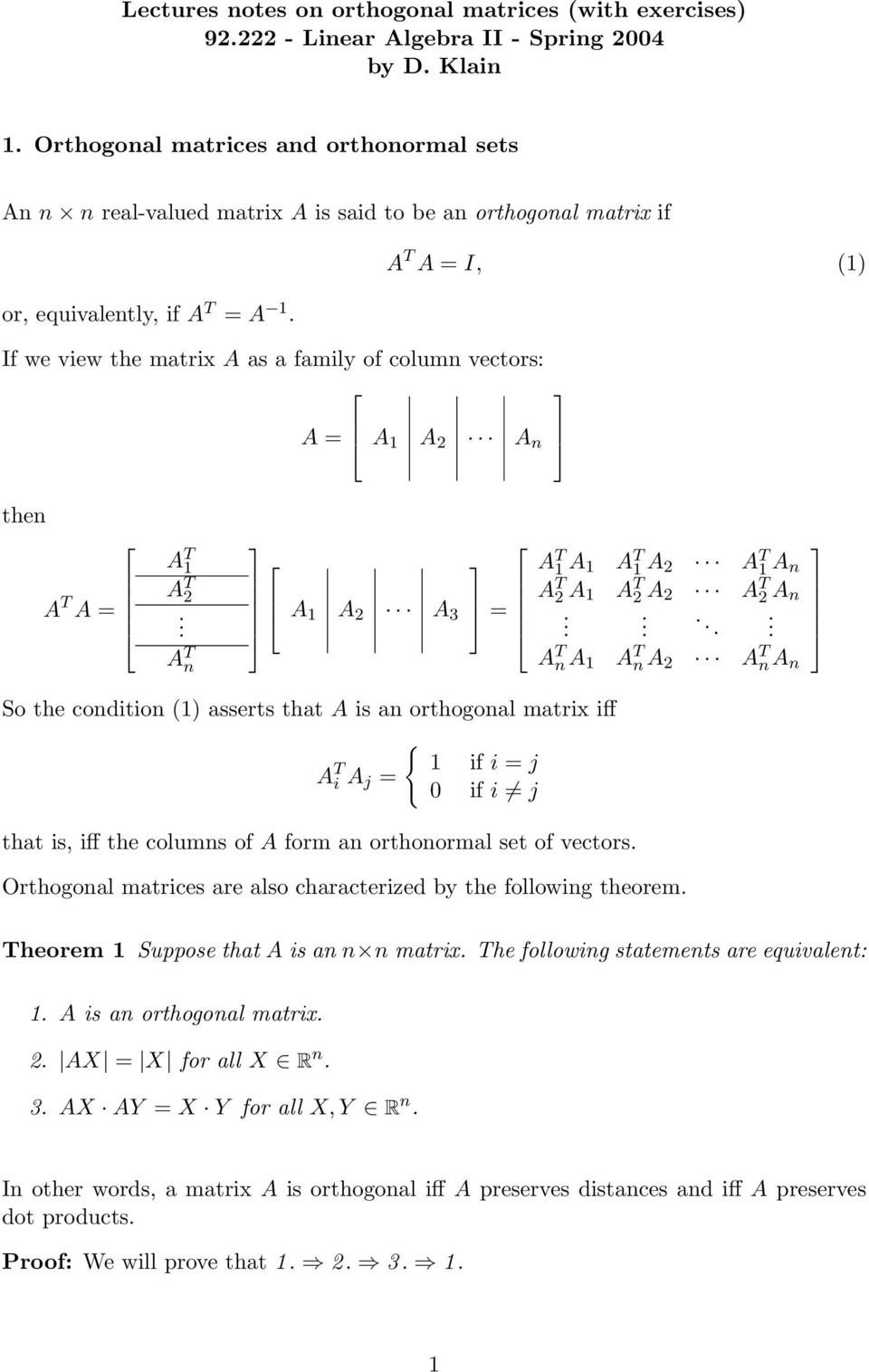
2 1. 2. : Suppose that A is orthogonal, so that A T A = I. For all column vectors X R n, we have so that AX = X. AX 2 = (AX) T AX = X T A T AX = X T IX = X T X = X 2, : Suppose that A is a square matrix such that AX = X for all X R n. Then, for all X, Y R n, we have X + Y 2 = (X + Y ) T (X + Y ) = X T X + 2X T Y + Y T Y = X 2 + 2X T Y + Y 2 and similarly, A(X + Y ) 2 = AX + AY 2 = (AX + AY ) T (AX + AY ) = AX 2 + 2(AX) T AY + AY 2. Since AX = X and AY = Y and A(X +Y ) = X +Y, it follows that (AX) T AY = X T Y. In other words, AX AY = X Y : Suppose that A is a square matrix such that AX AY = X Y for all X, Y R n Let e i denote the i-th standard basis vector for R n, and let A i denote the i-th column of A, as above. Then { A T i A j = (Ae i ) T 1 if i = j Ae j = Ae i Ae j = e i e j = 0 if i j so that the columns of A are an orthonormal set, and A is an orthogonal matrix. We conclude this section by observing two useful properties of orthogonal matrices. Proposition 2 Suppose that A and B are orthogonal matrices. 1. AB is an orthogonal matrix. 2. Either det(a) = 1 or det(a) = 1. The proof is left to the exercises. Note: The converse is false. There exist matrices with determinant ±1 that are not orthogonal. 2. The n-reflections Theorem Recall that if u R n is a unit vector and W = u then H = I 2uu T is the reflection matrix for the subspace W. Since reflections preserve distances, it follows from Theorem 1 that H must be an orthogonal matrix. (You can also verify condition (1) directly.) We also showed earlier in the course that H = H 1 = H T and H 2 = I. It turns out that every orthogonal matrix can be expressed as a product of reflection matrices. 2
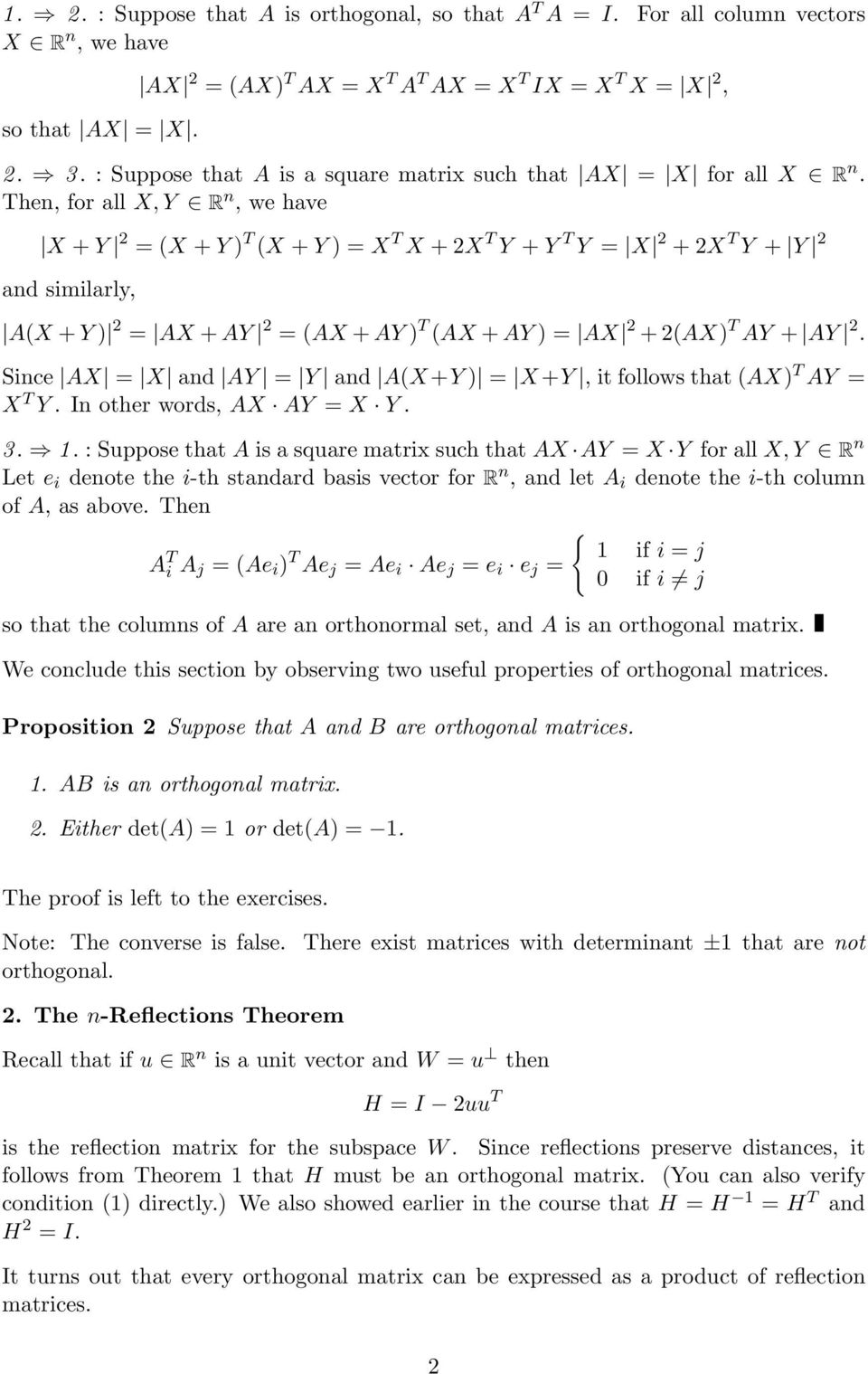
3 Theorem 3 (n-reflections Theorem) Let A be an n n orthogonal matrix. There exist n n reflection matrices H 1, H 2,..., H k such that A = H 1 H 2 H k, where 0 k n. In other words, every n n orthogonal matrix can be expressed as a product of at most n reflections. Proof: The theorem is trivial in dimension 1. Assume it holds in dimension n 1. For the n-dimensional case, let z = Ae n, and let H be a reflection of R n that exchanges z and e n. Then HAe n = Hz = e n, so HA fixes e n. Moreover, HA is also an orthogonal matrix by Proposition 2, so HA preserves distances and angles. In particular, if we view R n 1 as the hyperplane e n, then HA must map R n 1 to itself. By the induction assumption, HA must be expressible as a product of at most n 1 reflections on R n 1, which extend (along the e n direction) to reflections of R n as well. In other words, either HA = I or HA = H 2 H k, where k n. Setting H 1 = H, and keeping in mind that HH = I (since H is a reflection!), we have A = HHA = H 1 H 2 H k. Proposition 4 If H is a reflection matrix, then det H = 1. Proof: See Exercises. Corollary 5 If A is an orthogonal matrix and A = H 1 H 2 H k, then det A = ( 1) k. So an orthogonal matrix A has determinant equal to +1 iff A is a product of an even number of reflections. 3. Classifying 2 2 Orthogonal Matrices Suppose that A is a 2 2 orthogonal matrix. We know from the first section that the columns of A are unit vectors and that the two columns are perpendicular (orthonormal!). Any unit vector u in the plane R 2 lies on the unit circle centered at the origin, and so can be expressed in the form u = (cos θ, sin θ) for some angle θ. So we can describe the first column of A as follows: cos θ?? A = sin θ?? What are the possibilities for the second column? Since the second column must be a unit vector perpendicular to the first column, there remain only two choices: cos θ sin θ cos θ sin θ A = or A = sin θ cos θ sin θ cos θ 3
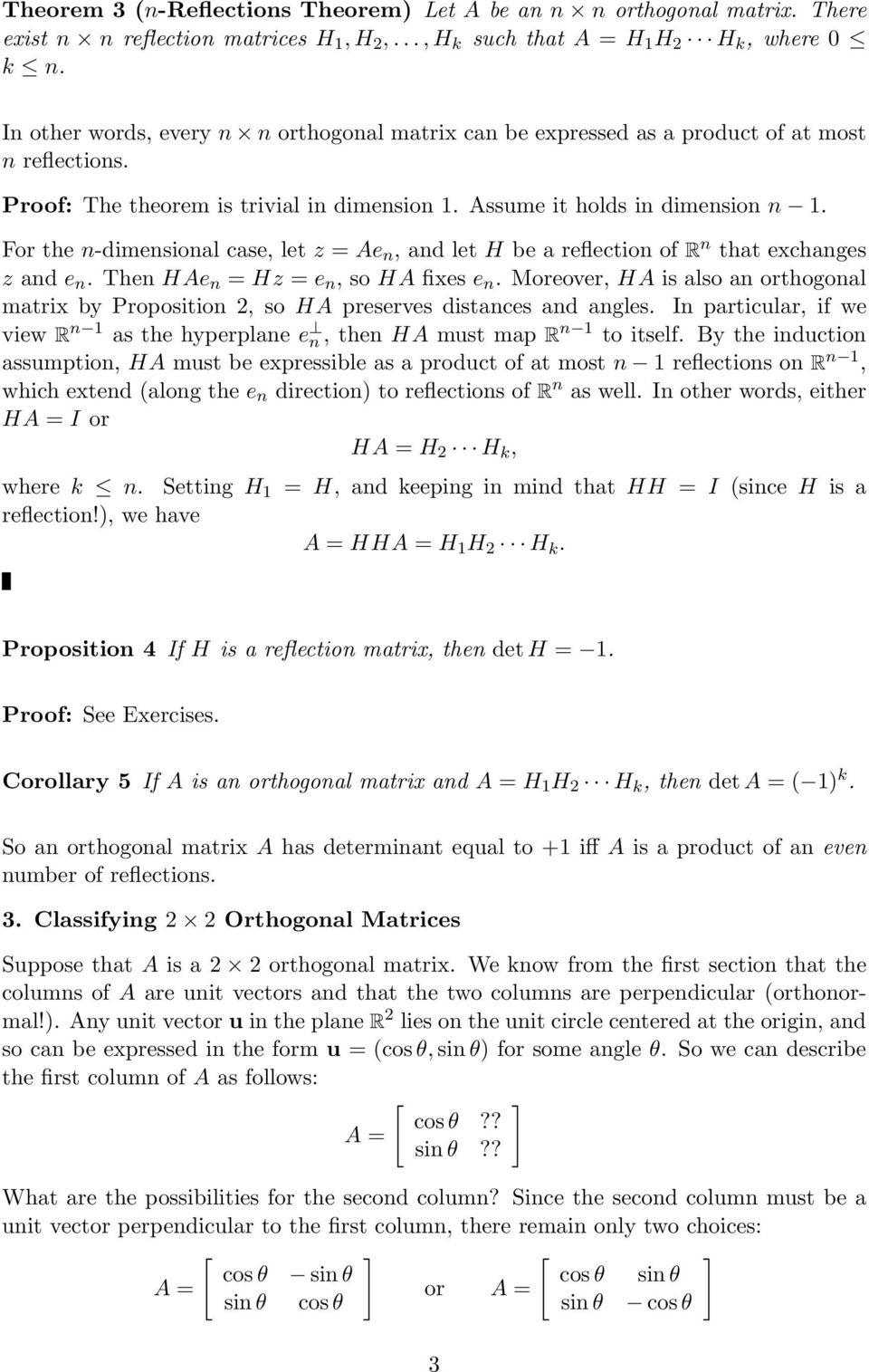
4 The first case is the rotation matrix, which rotates R 2 counterclockwise around the origin by the angle θ. The second case is a reflection across the line that makes an angle θ/2 from the x-axis (counterclockwise). But which is which? You can check that the rotation matrix (on the left) has determinant 1, while the reflection matrix (on the right) has determinant -1. This is consistent with Proposition 4 and Corollary 5, since a rotation of R 2 can always be expressed as a product of two reflections (how?). 4. Classifying 3 3 Orthogonal Matrices The n-reflection Theorem 3 leads to a complete description of the 3 orthogonal matrices. In particular, a 3 3 orthogonal matrix must a product of 0, 1, 2, or 3 reflections. Theorem 6 Let A be a 3 3 orthogonal matrix. 1. If det A = 1 then A is a rotation matrix. 2. If det A = 1 and A T = A, then either A = I or A is a reflection matrix. 3. If det A = 1 and A T A, then A is a product of 3 reflections (that is, A is a non-trivial rotation followed by a reflection). Proof: By Theorem 3, A is a product of 0, 1, 2, or 3 reflections. Note that if A = H 1 H k, then det A = ( 1) k. If det A = 1 then A must be a product of an even number of reflections, either 0 reflections (so that A = I, the trivial rotation), or 2 reflections, so that A is a rotation. If det A = 1 then A must be a product of an odd number of reflections, either 1 or 3. If A is a single reflection then A = H for some Householder matrix H. In this case we observed earlier that H T = H so A T = A. Conversely, if det A = 1 and A T = A then det( A) = 1 (since A is a 3 3 matrix) and A T = A = A 1 as well. It follows that A is a rotation that squares to the identity. If A I, then the only time this happens is when we rotate by the angle π (that is, 180 o ) around some axis. But if A is a 180 o rotation around some axis, then A = ( A) must be the reflection across the equatorial plane for that axis (draw a picture!). So A is a single reflection. Finally if det A = 1 and A T A, then A cannot be a rotation or a pure reflection, so A must be a product of at least 3 reflections. Corollary 7 Let A be a 3 3 orthogonal matrix. 1. If det A = 1 then A is a rotation matrix. 2. If det A = 1 then A is a rotation matrix. 4
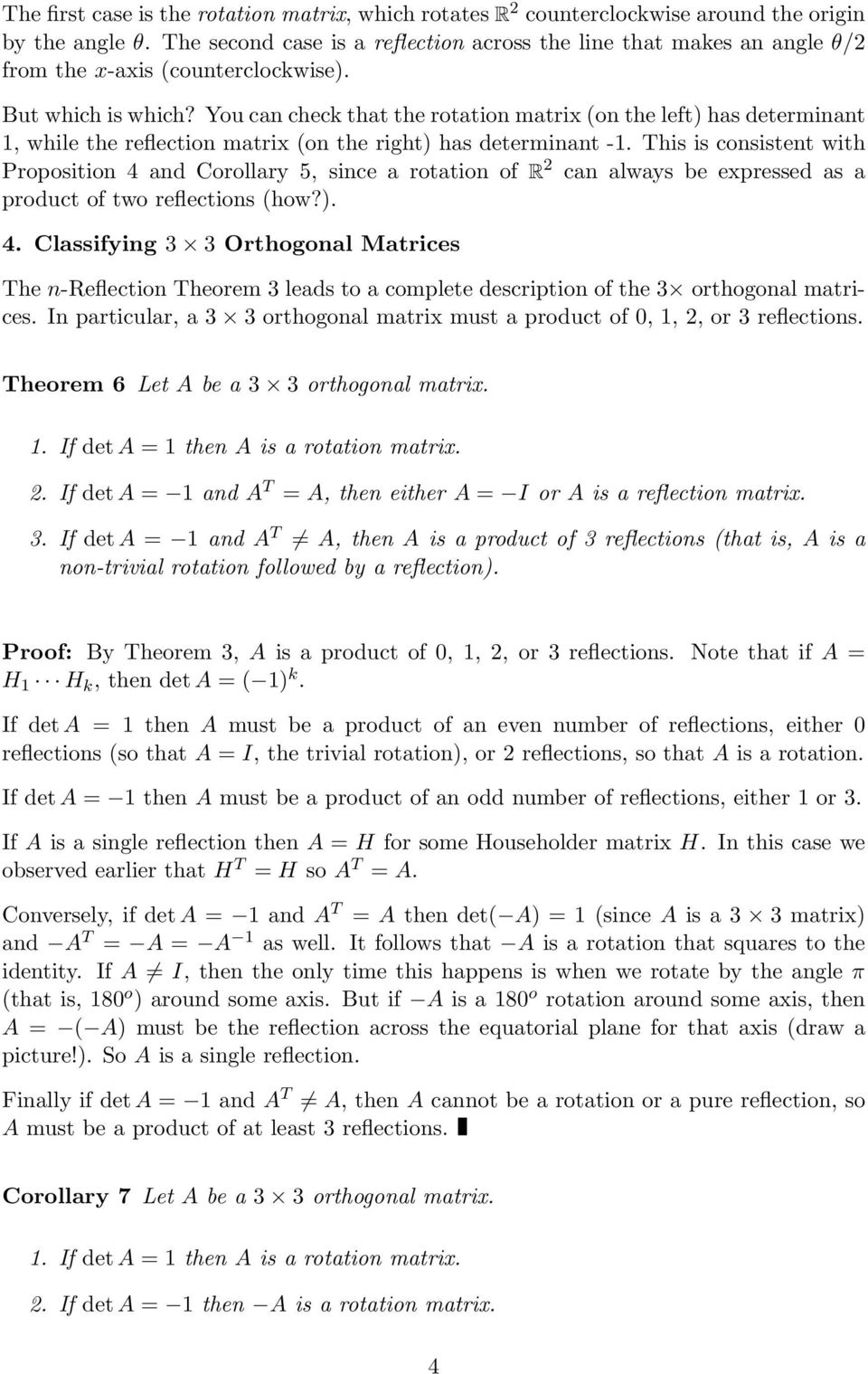
5 Proof: If det A = 1 then A is a rotation matrix, by Theorem 6. If det A = 1 then det( A) = ( 1) 3 det A = 1. Since A is also orthogonal, A must be a rotation. Corollary 8 Suppose that A and B are 3 3 rotation matrices. Then AB is also a rotation matrix. Proof: If A and B are 3 3 rotation matrices, then A and B are both orthogonal with determinant +1. It follows that AB is orthogonal, and det AB = det A det B = 1 1 = 1. Theorem 6 then implies that AB is also a rotation matrix. Note that the rotations represented by A, B, and AB may each have completely different angles and axes of rotation! Given two rotations A and B around two different axes of rotation, it is far from obvious that AB will also be a rotation (around some mysterious third axis). But this is true, by Corollary 8. Later on we will see how to compute precisely the angle and axis of rotation of a rotation matrix. Exercises: 1. (a) Suppose that A is an orthogonal matrix. Prove that either det A = 1 or det A = 1. (b) Find a 2 2 matrix A such that det A = 1, but also such that A is not an orthogonal matrix. 2. Suppose that A and B are orthogonal matrices. Prove that AB is an orthogonal matrix. 3. Suppose that H = I 2uu T is a reflection matrix. Let v 1,..., v n 1 be an orthonormal basis for the subspace u. (Here u denotes the orthogonal complement to the line spanned by u.) (a) What is Hu =? (b) What is Hv i =? (c) Let M be the matrix with columns as follows M = v 1 v n 1 u What is HM =? What are the columns of HM? (d) By comparing det HM to det M prove that det H = (a) Give a geometric description (and sketch) of the reflection performed by the matrix cos θ sin θ H 1 = sin θ cos θ 5
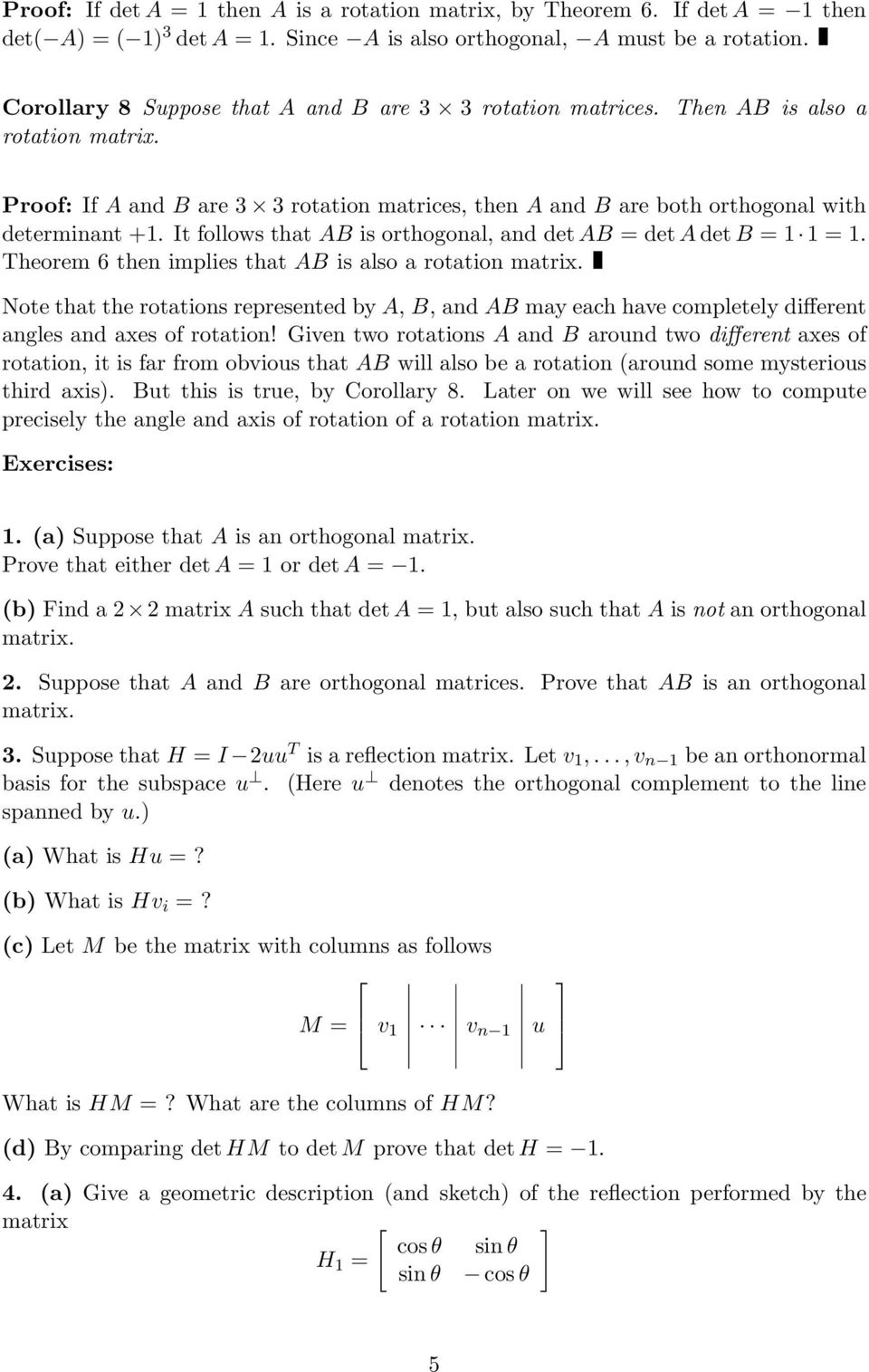
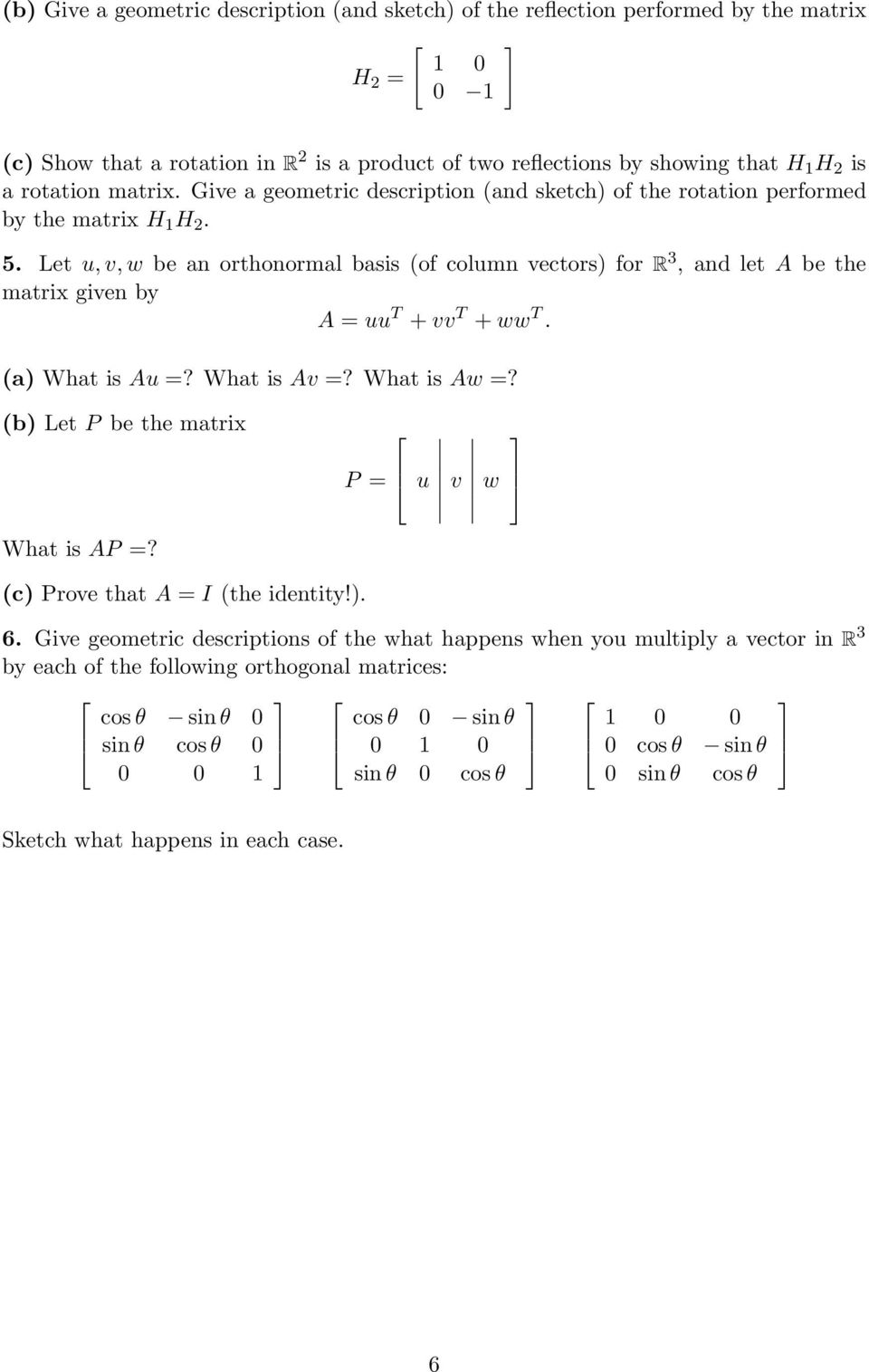
6 (b) Give a geometric description (and sketch) of the reflection performed by the matrix H 2 = [ ] (c) Show that a rotation in R 2 is a product of two reflections by showing that H 1 H 2 is a rotation matrix. Give a geometric description (and sketch) of the rotation performed by the matrix H 1 H Let u, v, w be an orthonormal basis (of column vectors) for R 3, and let A be the matrix given by A = uu T + vv T + ww T. (a) What is Au =? What is Av =? What is Aw =? (b) Let P be the matrix P = u v w What is AP =? (c) Prove that A = I (the identity!). 6. Give geometric descriptions of the what happens when you multiply a vector in R 3 by each of the following orthogonal matrices: cos θ sin θ 0 cos θ 0 sin θ sin θ cos θ cos θ sin θ sin θ 0 cos θ 0 sin θ cos θ Sketch what happens in each case. 6
Chapter 17. Orthogonal Matrices and Symmetries of Space
 Chapter 17. Orthogonal Matrices and Symmetries of Space Take a random matrix, say 1 3 A = 4 5 6, 7 8 9 and compare the lengths of e 1 and Ae 1. The vector e 1 has length 1, while Ae 1 = (1, 4, 7) has length
Orthogonal Projections
 Orthogonal Projections and Reflections (with exercises) by D. Klain Version.. Corrections and comments are welcome! Orthogonal Projections Let X,..., X k be a family of linearly independent (column) vectors
ISOMETRIES OF R n KEITH CONRAD
 ISOMETRIES OF R n KEITH CONRAD 1. Introduction An isometry of R n is a function h: R n R n that preserves the distance between vectors: h(v) h(w) = v w for all v and w in R n, where (x 1,..., x n ) = x
Recall the basic property of the transpose (for any A): v A t Aw = v w, v, w R n.
 ORTHOGONAL MATRICES Informally, an orthogonal n n matrix is the n-dimensional analogue of the rotation matrices R θ in R 2. When does a linear transformation of R 3 (or R n ) deserve to be called a rotation?
Inner Product Spaces and Orthogonality
 Inner Product Spaces and Orthogonality week 3-4 Fall 2006 Dot product of R n The inner product or dot product of R n is a function, defined by u, v a b + a 2 b 2 + + a n b n for u a, a 2,, a n T, v b,
Similarity and Diagonalization. Similar Matrices
 MATH022 Linear Algebra Brief lecture notes 48 Similarity and Diagonalization Similar Matrices Let A and B be n n matrices. We say that A is similar to B if there is an invertible n n matrix P such that
Lecture 14: Section 3.3
 Lecture 14: Section 3.3 Shuanglin Shao October 23, 2013 Definition. Two nonzero vectors u and v in R n are said to be orthogonal (or perpendicular) if u v = 0. We will also agree that the zero vector in
Chapter 6. Orthogonality
 6.3 Orthogonal Matrices 1 Chapter 6. Orthogonality 6.3 Orthogonal Matrices Definition 6.4. An n n matrix A is orthogonal if A T A = I. Note. We will see that the columns of an orthogonal matrix must be
α = u v. In other words, Orthogonal Projection
 Orthogonal Projection Given any nonzero vector v, it is possible to decompose an arbitrary vector u into a component that points in the direction of v and one that points in a direction orthogonal to v
Linear Algebra Notes for Marsden and Tromba Vector Calculus
 Linear Algebra Notes for Marsden and Tromba Vector Calculus n-dimensional Euclidean Space and Matrices Definition of n space As was learned in Math b, a point in Euclidean three space can be thought of
[1] Diagonal factorization
![[1] Diagonal factorization](/thumbs/40/21671034.jpg "[1] Diagonal factorization") 8.03 LA.6: Diagonalization and Orthogonal Matrices [ Diagonal factorization [2 Solving systems of first order differential equations [3 Symmetric and Orthonormal Matrices [ Diagonal factorization Recall:
8.03 LA.6: Diagonalization and Orthogonal Matrices [ Diagonal factorization [2 Solving systems of first order differential equations [3 Symmetric and Orthonormal Matrices [ Diagonal factorization Recall:
1 Symmetries of regular polyhedra
 1230, notes 5 1 Symmetries of regular polyhedra Symmetry groups Recall: Group axioms: Suppose that (G, ) is a group and a, b, c are elements of G. Then (i) a b G (ii) (a b) c = a (b c) (iii) There is an
5. Orthogonal matrices
 L Vandenberghe EE133A (Spring 2016) 5 Orthogonal matrices matrices with orthonormal columns orthogonal matrices tall matrices with orthonormal columns complex matrices with orthonormal columns 5-1 Orthonormal
Orthogonal Projections and Orthonormal Bases
 CS 3, HANDOUT -A, 3 November 04 (adjusted on 7 November 04) Orthogonal Projections and Orthonormal Bases (continuation of Handout 07 of 6 September 04) Definition (Orthogonality, length, unit vectors).
MAT 200, Midterm Exam Solution. a. (5 points) Compute the determinant of the matrix A =
 MAT 200, Midterm Exam Solution. (0 points total) a. (5 points) Compute the determinant of the matrix 2 2 0 A = 0 3 0 3 0 Answer: det A = 3. The most efficient way is to develop the determinant along the
Problem Set 5 Due: In class Thursday, Oct. 18 Late papers will be accepted until 1:00 PM Friday.
 Math 312, Fall 2012 Jerry L. Kazdan Problem Set 5 Due: In class Thursday, Oct. 18 Late papers will be accepted until 1:00 PM Friday. In addition to the problems below, you should also know how to solve
LINEAR ALGEBRA W W L CHEN
 LINEAR ALGEBRA W W L CHEN c W W L Chen, 1997, 2008 This chapter is available free to all individuals, on understanding that it is not to be used for financial gain, and may be downloaded and/or photocopied,
Geometry of Vectors. 1 Cartesian Coordinates. Carlo Tomasi
 Geometry of Vectors Carlo Tomasi This note explores the geometric meaning of norm, inner product, orthogonality, and projection for vectors. For vectors in three-dimensional space, we also examine the
x1 x 2 x 3 y 1 y 2 y 3 x 1 y 2 x 2 y 1 0.
 Cross product 1 Chapter 7 Cross product We are getting ready to study integration in several variables. Until now we have been doing only differential calculus. One outcome of this study will be our ability
Au = = = 3u. Aw = = = 2w. so the action of A on u and w is very easy to picture: it simply amounts to a stretching by 3 and 2, respectively.
 Chapter 7 Eigenvalues and Eigenvectors In this last chapter of our exploration of Linear Algebra we will revisit eigenvalues and eigenvectors of matrices, concepts that were already introduced in Geometry
Recall that two vectors in are perpendicular or orthogonal provided that their dot
 Orthogonal Complements and Projections Recall that two vectors in are perpendicular or orthogonal provided that their dot product vanishes That is, if and only if Example 1 The vectors in are orthogonal
1 VECTOR SPACES AND SUBSPACES
 1 VECTOR SPACES AND SUBSPACES What is a vector? Many are familiar with the concept of a vector as: Something which has magnitude and direction. an ordered pair or triple. a description for quantities such
Chapter 6. Linear Transformation. 6.1 Intro. to Linear Transformation
 Chapter 6 Linear Transformation 6 Intro to Linear Transformation Homework: Textbook, 6 Ex, 5, 9,, 5,, 7, 9,5, 55, 57, 6(a,b), 6; page 7- In this section, we discuss linear transformations 89 9 CHAPTER
Adding vectors We can do arithmetic with vectors. We ll start with vector addition and related operations. Suppose you have two vectors
 1 Chapter 13. VECTORS IN THREE DIMENSIONAL SPACE Let s begin with some names and notation for things: R is the set (collection) of real numbers. We write x R to mean that x is a real number. A real number
Cross product and determinants (Sect. 12.4) Two main ways to introduce the cross product
 Cross product and determinants (Sect. 12.4) Two main ways to introduce the cross product Geometrical definition Properties Expression in components. Definition in components Properties Geometrical expression.
Math 215 HW #6 Solutions
 Math 5 HW #6 Solutions Problem 34 Show that x y is orthogonal to x + y if and only if x = y Proof First, suppose x y is orthogonal to x + y Then since x, y = y, x In other words, = x y, x + y = (x y) T
NOTES ON LINEAR TRANSFORMATIONS
 NOTES ON LINEAR TRANSFORMATIONS Definition 1. Let V and W be vector spaces. A function T : V W is a linear transformation from V to W if the following two properties hold. i T v + v = T v + T v for all
Mathematics Course 111: Algebra I Part IV: Vector Spaces
 Mathematics Course 111: Algebra I Part IV: Vector Spaces D. R. Wilkins Academic Year 1996-7 9 Vector Spaces A vector space over some field K is an algebraic structure consisting of a set V on which are
Solutions to Math 51 First Exam January 29, 2015
 Solutions to Math 5 First Exam January 29, 25. ( points) (a) Complete the following sentence: A set of vectors {v,..., v k } is defined to be linearly dependent if (2 points) there exist c,... c k R, not
28 CHAPTER 1. VECTORS AND THE GEOMETRY OF SPACE. v x. u y v z u z v y u y u z. v y v z
 28 CHAPTER 1. VECTORS AND THE GEOMETRY OF SPACE 1.4 Cross Product 1.4.1 Definitions The cross product is the second multiplication operation between vectors we will study. The goal behind the definition
Linear algebra and the geometry of quadratic equations. Similarity transformations and orthogonal matrices
 MATH 30 Differential Equations Spring 006 Linear algebra and the geometry of quadratic equations Similarity transformations and orthogonal matrices First, some things to recall from linear algebra Two
Systems of Linear Equations
 Systems of Linear Equations Beifang Chen Systems of linear equations Linear systems A linear equation in variables x, x,, x n is an equation of the form a x + a x + + a n x n = b, where a, a,, a n and
Inner product. Definition of inner product
 Math 20F Linear Algebra Lecture 25 1 Inner product Review: Definition of inner product. Slide 1 Norm and distance. Orthogonal vectors. Orthogonal complement. Orthogonal basis. Definition of inner product
1 2 3 1 1 2 x = + x 2 + x 4 1 0 1
 (d) If the vector b is the sum of the four columns of A, write down the complete solution to Ax = b. 1 2 3 1 1 2 x = + x 2 + x 4 1 0 0 1 0 1 2. (11 points) This problem finds the curve y = C + D 2 t which
Lecture 1: Schur s Unitary Triangularization Theorem
 Lecture 1: Schur s Unitary Triangularization Theorem This lecture introduces the notion of unitary equivalence and presents Schur s theorem and some of its consequences It roughly corresponds to Sections
Dot product and vector projections (Sect. 12.3) There are two main ways to introduce the dot product
 Dot product and vector projections (Sect. 12.3) Two definitions for the dot product. Geometric definition of dot product. Orthogonal vectors. Dot product and orthogonal projections. Properties of the dot
Section 1.1. Introduction to R n
 The Calculus of Functions of Several Variables Section. Introduction to R n Calculus is the study of functional relationships and how related quantities change with each other. In your first exposure to
Orthogonal Diagonalization of Symmetric Matrices
 MATH10212 Linear Algebra Brief lecture notes 57 Gram Schmidt Process enables us to find an orthogonal basis of a subspace. Let u 1,..., u k be a basis of a subspace V of R n. We begin the process of finding
MATH 304 Linear Algebra Lecture 9: Subspaces of vector spaces (continued). Span. Spanning set.
 MATH 304 Linear Algebra Lecture 9: Subspaces of vector spaces (continued). Span. Spanning set. Vector space A vector space is a set V equipped with two operations, addition V V (x,y) x + y V and scalar
Inner Product Spaces
 Math 571 Inner Product Spaces 1. Preliminaries An inner product space is a vector space V along with a function, called an inner product which associates each pair of vectors u, v with a scalar u, v, and
9 Multiplication of Vectors: The Scalar or Dot Product
 Arkansas Tech University MATH 934: Calculus III Dr. Marcel B Finan 9 Multiplication of Vectors: The Scalar or Dot Product Up to this point we have defined what vectors are and discussed basic notation
Notes on Orthogonal and Symmetric Matrices MENU, Winter 2013
 Notes on Orthogonal and Symmetric Matrices MENU, Winter 201 These notes summarize the main properties and uses of orthogonal and symmetric matrices. We covered quite a bit of material regarding these topics,
by the matrix A results in a vector which is a reflection of the given
 Eigenvalues & Eigenvectors Example Suppose Then So, geometrically, multiplying a vector in by the matrix A results in a vector which is a reflection of the given vector about the y-axis We observe that
CS3220 Lecture Notes: QR factorization and orthogonal transformations
 CS3220 Lecture Notes: QR factorization and orthogonal transformations Steve Marschner Cornell University 11 March 2009 In this lecture I ll talk about orthogonal matrices and their properties, discuss
3 Orthogonal Vectors and Matrices
 3 Orthogonal Vectors and Matrices The linear algebra portion of this course focuses on three matrix factorizations: QR factorization, singular valued decomposition (SVD), and LU factorization The first
3. INNER PRODUCT SPACES
 . INNER PRODUCT SPACES.. Definition So far we have studied abstract vector spaces. These are a generalisation of the geometric spaces R and R. But these have more structure than just that of a vector space.
THE DIMENSION OF A VECTOR SPACE
 THE DIMENSION OF A VECTOR SPACE KEITH CONRAD This handout is a supplementary discussion leading up to the definition of dimension and some of its basic properties. Let V be a vector space over a field
4.5 Linear Dependence and Linear Independence
 4.5 Linear Dependence and Linear Independence 267 32. {v 1, v 2 }, where v 1, v 2 are collinear vectors in R 3. 33. Prove that if S and S are subsets of a vector space V such that S is a subset of S, then
8 Square matrices continued: Determinants
 8 Square matrices continued: Determinants 8. Introduction Determinants give us important information about square matrices, and, as we ll soon see, are essential for the computation of eigenvalues. You
Examination paper for TMA4115 Matematikk 3
 Department of Mathematical Sciences Examination paper for TMA45 Matematikk 3 Academic contact during examination: Antoine Julien a, Alexander Schmeding b, Gereon Quick c Phone: a 73 59 77 82, b 40 53 99
1 Introduction to Matrices
 1 Introduction to Matrices In this section, important definitions and results from matrix algebra that are useful in regression analysis are introduced. While all statements below regarding the columns
LINEAR ALGEBRA. September 23, 2010
 LINEAR ALGEBRA September 3, 00 Contents 0. LU-decomposition.................................... 0. Inverses and Transposes................................. 0.3 Column Spaces and NullSpaces.............................
Geometric Transformations
 Geometric Transformations Definitions Def: f is a mapping (function) of a set A into a set B if for every element a of A there exists a unique element b of B that is paired with a; this pairing is denoted
MATH 304 Linear Algebra Lecture 20: Inner product spaces. Orthogonal sets.
 MATH 304 Linear Algebra Lecture 20: Inner product spaces. Orthogonal sets. Norm The notion of norm generalizes the notion of length of a vector in R n. Definition. Let V be a vector space. A function α
MATH 304 Linear Algebra Lecture 18: Rank and nullity of a matrix.
 MATH 304 Linear Algebra Lecture 18: Rank and nullity of a matrix. Nullspace Let A = (a ij ) be an m n matrix. Definition. The nullspace of the matrix A, denoted N(A), is the set of all n-dimensional column
Notes on Symmetric Matrices
 CPSC 536N: Randomized Algorithms 2011-12 Term 2 Notes on Symmetric Matrices Prof. Nick Harvey University of British Columbia 1 Symmetric Matrices We review some basic results concerning symmetric matrices.
Vector Math Computer Graphics Scott D. Anderson
 Vector Math Computer Graphics Scott D. Anderson 1 Dot Product The notation v w means the dot product or scalar product or inner product of two vectors, v and w. In abstract mathematics, we can talk about
APPLICATIONS. are symmetric, but. are not.
 CHAPTER III APPLICATIONS Real Symmetric Matrices The most common matrices we meet in applications are symmetric, that is, they are square matrices which are equal to their transposes In symbols, A t =
MATRIX ALGEBRA AND SYSTEMS OF EQUATIONS. + + x 2. x n. a 11 a 12 a 1n b 1 a 21 a 22 a 2n b 2 a 31 a 32 a 3n b 3. a m1 a m2 a mn b m
 MATRIX ALGEBRA AND SYSTEMS OF EQUATIONS 1. SYSTEMS OF EQUATIONS AND MATRICES 1.1. Representation of a linear system. The general system of m equations in n unknowns can be written a 11 x 1 + a 12 x 2 +
Notes on Determinant
 ENGG2012B Advanced Engineering Mathematics Notes on Determinant Lecturer: Kenneth Shum Lecture 9-18/02/2013 The determinant of a system of linear equations determines whether the solution is unique, without
MAT 1341: REVIEW II SANGHOON BAEK
 MAT 1341: REVIEW II SANGHOON BAEK 1. Projections and Cross Product 1.1. Projections. Definition 1.1. Given a vector u, the rectangular (or perpendicular or orthogonal) components are two vectors u 1 and
MAT188H1S Lec0101 Burbulla
 Winter 206 Linear Transformations A linear transformation T : R m R n is a function that takes vectors in R m to vectors in R n such that and T (u + v) T (u) + T (v) T (k v) k T (v), for all vectors u
160 CHAPTER 4. VECTOR SPACES
 160 CHAPTER 4. VECTOR SPACES 4. Rank and Nullity In this section, we look at relationships between the row space, column space, null space of a matrix and its transpose. We will derive fundamental results
MATRIX ALGEBRA AND SYSTEMS OF EQUATIONS
 MATRIX ALGEBRA AND SYSTEMS OF EQUATIONS Systems of Equations and Matrices Representation of a linear system The general system of m equations in n unknowns can be written a x + a 2 x 2 + + a n x n b a
Section 1.4. Lines, Planes, and Hyperplanes. The Calculus of Functions of Several Variables
 The Calculus of Functions of Several Variables Section 1.4 Lines, Planes, Hyperplanes In this section we will add to our basic geometric understing of R n by studying lines planes. If we do this carefully,
3. Let A and B be two n n orthogonal matrices. Then prove that AB and BA are both orthogonal matrices. Prove a similar result for unitary matrices.
 Exercise 1 1. Let A be an n n orthogonal matrix. Then prove that (a) the rows of A form an orthonormal basis of R n. (b) the columns of A form an orthonormal basis of R n. (c) for any two vectors x,y R
University of Lille I PC first year list of exercises n 7. Review
 University of Lille I PC first year list of exercises n 7 Review Exercise Solve the following systems in 4 different ways (by substitution, by the Gauss method, by inverting the matrix of coefficients
is in plane V. However, it may be more convenient to introduce a plane coordinate system in V.
 .4 COORDINATES EXAMPLE Let V be the plane in R with equation x +2x 2 +x 0, a two-dimensional subspace of R. We can describe a vector in this plane by its spatial (D)coordinates; for example, vector x 5
The Matrix Elements of a 3 3 Orthogonal Matrix Revisited
 Physics 116A Winter 2011 The Matrix Elements of a 3 3 Orthogonal Matrix Revisited 1. Introduction In a class handout entitled, Three-Dimensional Proper and Improper Rotation Matrices, I provided a derivation
Math 312 Homework 1 Solutions
 Math 31 Homework 1 Solutions Last modified: July 15, 01 This homework is due on Thursday, July 1th, 01 at 1:10pm Please turn it in during class, or in my mailbox in the main math office (next to 4W1) Please
Review Jeopardy. Blue vs. Orange. Review Jeopardy
 Review Jeopardy Blue vs. Orange Review Jeopardy Jeopardy Round Lectures 0-3 Jeopardy Round $200 How could I measure how far apart (i.e. how different) two observations, y 1 and y 2, are from each other?
MATH2210 Notebook 1 Fall Semester 2016/2017. 1 MATH2210 Notebook 1 3. 1.1 Solving Systems of Linear Equations... 3
 MATH0 Notebook Fall Semester 06/07 prepared by Professor Jenny Baglivo c Copyright 009 07 by Jenny A. Baglivo. All Rights Reserved. Contents MATH0 Notebook 3. Solving Systems of Linear Equations........................
Math 115A HW4 Solutions University of California, Los Angeles. 5 2i 6 + 4i. (5 2i)7i (6 + 4i)( 3 + i) = 35i + 14 ( 22 6i) = 36 + 41i.
 Math 5A HW4 Solutions September 5, 202 University of California, Los Angeles Problem 4..3b Calculate the determinant, 5 2i 6 + 4i 3 + i 7i Solution: The textbook s instructions give us, (5 2i)7i (6 + 4i)(
Eigenvalues and Eigenvectors
 Chapter 6 Eigenvalues and Eigenvectors 6. Introduction to Eigenvalues Linear equations Ax D b come from steady state problems. Eigenvalues have their greatest importance in dynamic problems. The solution
GROUPS ACTING ON A SET
 GROUPS ACTING ON A SET MATH 435 SPRING 2012 NOTES FROM FEBRUARY 27TH, 2012 1. Left group actions Definition 1.1. Suppose that G is a group and S is a set. A left (group) action of G on S is a rule for
Matrix Representations of Linear Transformations and Changes of Coordinates
 Matrix Representations of Linear Transformations and Changes of Coordinates 01 Subspaces and Bases 011 Definitions A subspace V of R n is a subset of R n that contains the zero element and is closed under
v 1 v 3 u v = (( 1)4 (3)2, [1(4) ( 2)2], 1(3) ( 2)( 1)) = ( 10, 8, 1) (d) u (v w) = (u w)v (u v)w (Relationship between dot and cross product)
![v 1 v 3 u v = (( 1)4 (3)2, [1(4) ( 2)2], 1(3) ( 2)( 1)) = ( 10, 8, 1) (d) u (v w) = (u w)v (u v)w (Relationship between dot and cross product)](/thumbs/40/20880945.jpg "v 1 v 3 u v = (( 1)4 (3)2, [1(4) ( 2)2], 1(3) ( 2)( 1)) = ( 10, 8, 1) (d) u (v w) = (u w)v (u v)w (Relationship between dot and cross product)") 0.1 Cross Product The dot product of two vectors is a scalar, a number in R. Next we will define the cross product of two vectors in 3-space. This time the outcome will be a vector in 3-space. Definition
0.1 Cross Product The dot product of two vectors is a scalar, a number in R. Next we will define the cross product of two vectors in 3-space. This time the outcome will be a vector in 3-space. Definition
Solving Systems of Linear Equations
 LECTURE 5 Solving Systems of Linear Equations Recall that we introduced the notion of matrices as a way of standardizing the expression of systems of linear equations In today s lecture I shall show how
Methods for Finding Bases
 Methods for Finding Bases Bases for the subspaces of a matrix Row-reduction methods can be used to find bases. Let us now look at an example illustrating how to obtain bases for the row space, null space,
Computing Orthonormal Sets in 2D, 3D, and 4D
 Computing Orthonormal Sets in 2D, 3D, and 4D David Eberly Geometric Tools, LLC http://www.geometrictools.com/ Copyright c 1998-2016. All Rights Reserved. Created: March 22, 2010 Last Modified: August 11,
THREE DIMENSIONAL GEOMETRY
 Chapter 8 THREE DIMENSIONAL GEOMETRY 8.1 Introduction In this chapter we present a vector algebra approach to three dimensional geometry. The aim is to present standard properties of lines and planes,
Linear Maps. Isaiah Lankham, Bruno Nachtergaele, Anne Schilling (February 5, 2007)
 MAT067 University of California, Davis Winter 2007 Linear Maps Isaiah Lankham, Bruno Nachtergaele, Anne Schilling (February 5, 2007) As we have discussed in the lecture on What is Linear Algebra? one of
Unified Lecture # 4 Vectors
 Fall 2005 Unified Lecture # 4 Vectors These notes were written by J. Peraire as a review of vectors for Dynamics 16.07. They have been adapted for Unified Engineering by R. Radovitzky. References [1] Feynmann,
LS.6 Solution Matrices
 LS.6 Solution Matrices In the literature, solutions to linear systems often are expressed using square matrices rather than vectors. You need to get used to the terminology. As before, we state the definitions
MA106 Linear Algebra lecture notes
 MA106 Linear Algebra lecture notes Lecturers: Martin Bright and Daan Krammer Warwick, January 2011 Contents 1 Number systems and fields 3 1.1 Axioms for number systems......................... 3 2 Vector
Numerical Analysis Lecture Notes
 Numerical Analysis Lecture Notes Peter J. Olver 5. Inner Products and Norms The norm of a vector is a measure of its size. Besides the familiar Euclidean norm based on the dot product, there are a number
I. GROUPS: BASIC DEFINITIONS AND EXAMPLES
 I GROUPS: BASIC DEFINITIONS AND EXAMPLES Definition 1: An operation on a set G is a function : G G G Definition 2: A group is a set G which is equipped with an operation and a special element e G, called
Lecture L3 - Vectors, Matrices and Coordinate Transformations
 S. Widnall 16.07 Dynamics Fall 2009 Lecture notes based on J. Peraire Version 2.0 Lecture L3 - Vectors, Matrices and Coordinate Transformations By using vectors and defining appropriate operations between
1 Sets and Set Notation.
 LINEAR ALGEBRA MATH 27.6 SPRING 23 (COHEN) LECTURE NOTES Sets and Set Notation. Definition (Naive Definition of a Set). A set is any collection of objects, called the elements of that set. We will most
The Determinant: a Means to Calculate Volume
 The Determinant: a Means to Calculate Volume Bo Peng August 20, 2007 Abstract This paper gives a definition of the determinant and lists many of its well-known properties Volumes of parallelepipeds are
Applications of Fermat s Little Theorem and Congruences
 Applications of Fermat s Little Theorem and Congruences Definition: Let m be a positive integer. Then integers a and b are congruent modulo m, denoted by a b mod m, if m (a b). Example: 3 1 mod 2, 6 4
Vectors Math 122 Calculus III D Joyce, Fall 2012
 Vectors Math 122 Calculus III D Joyce, Fall 2012 Vectors in the plane R 2. A vector v can be interpreted as an arro in the plane R 2 ith a certain length and a certain direction. The same vector can be
Applied Linear Algebra
 Applied Linear Algebra OTTO BRETSCHER http://www.prenhall.com/bretscher Chapter 7 Eigenvalues and Eigenvectors Chia-Hui Chang Email: [email protected] National Central University, Taiwan 7.1 DYNAMICAL
Linear Algebra Review. Vectors
 Linear Algebra Review By Tim K. Marks UCSD Borrows heavily from: Jana Kosecka [email protected] http://cs.gmu.edu/~kosecka/cs682.html Virginia de Sa Cogsci 8F Linear Algebra review UCSD Vectors The length
WHEN DOES A CROSS PRODUCT ON R n EXIST?
 WHEN DOES A CROSS PRODUCT ON R n EXIST? PETER F. MCLOUGHLIN It is probably safe to say that just about everyone reading this article is familiar with the cross product and the dot product. However, what
MATH10212 Linear Algebra. Systems of Linear Equations. Definition. An n-dimensional vector is a row or a column of n numbers (or letters): a 1.
 MATH10212 Linear Algebra Textbook: D. Poole, Linear Algebra: A Modern Introduction. Thompson, 2006. ISBN 0-534-40596-7. Systems of Linear Equations Definition. An n-dimensional vector is a row or a column
5.3 The Cross Product in R 3
 53 The Cross Product in R 3 Definition 531 Let u = [u 1, u 2, u 3 ] and v = [v 1, v 2, v 3 ] Then the vector given by [u 2 v 3 u 3 v 2, u 3 v 1 u 1 v 3, u 1 v 2 u 2 v 1 ] is called the cross product (or
9.4. The Scalar Product. Introduction. Prerequisites. Learning Style. Learning Outcomes
 The Scalar Product 9.4 Introduction There are two kinds of multiplication involving vectors. The first is known as the scalar product or dot product. This is so-called because when the scalar product of
Introduction to Matrices for Engineers
 Introduction to Matrices for Engineers C.T.J. Dodson, School of Mathematics, Manchester Universit 1 What is a Matrix? A matrix is a rectangular arra of elements, usuall numbers, e.g. 1 0-8 4 0-1 1 0 11
CONTROLLABILITY. Chapter 2. 2.1 Reachable Set and Controllability. Suppose we have a linear system described by the state equation
 Chapter 2 CONTROLLABILITY 2 Reachable Set and Controllability Suppose we have a linear system described by the state equation ẋ Ax + Bu (2) x() x Consider the following problem For a given vector x in