
Solubility Product Constant
|
|
|
- Austen Griffin
- 9 years ago
- Views:
Transcription
1 Solubility Product Constant Page 1 In general, when ionic compounds dissolve in water, they go into solution as ions. When the solution becomes saturated with ions, that is, unable to hold any more, the excess solid settles to the bottom of the container and an equilibrium is established between the undissolved solid and the dissolved ions. For example, when enough calcium oxalate is introduced into solution for it to become saturated, the following equilibrium is established. CaC 2 O 4(s) Ca +2 + C O 2 (aq 4 (aq) If we write an equilibrium expression for this situation, we obtain: = [Ca +2 ][C 2 O 4 2 ] Note that the solid itself does not appear as a denominator in the expression since it is a it is not in the same phase as the aqueous ions. In general, the solubility product constant ( ), is the equilibrium constant for the solubility equilibrium of a slightly soluble ionic compound. Like all equilibrium constants, the is temperature dependent, but at a given temperature it remains relatively constant. It also noteworthy, that, just like any equilibrium expression, each ion concentration in the expression is raised to the power of its coefficient in the solubility equation. For example, the expression for CaCO 3(s) Ca +2 + CO 2 (aq) 3 (aq) is = [Ca +2 ][CO 3 ] but for the equation PbI 2(s) Pb +2 (aq) + 2 I 1 (aq) = [Pb +2 ][I 1 ] 2 note that the concentration of the iodide ion is squared. Calculating from the Solubility Suppose the solubility of silver chloride, AgCl, is 1.9 x 10⁻³ g/l. Calculate its. 1mole AgCl 1.9 x 10⁻³ grams AgCl ( grams AgCl )=1.33x10 5 moles AgCl So, if we were to mix solid AgCl in a liter of solution, 1.33 x 10⁻⁵ mol will dissolve to form 1.33 x 10⁻⁵ mol of each ion. If we substitute these equilibrium concentrations into the expression, we obtain; AgCl (s) Ag +1 (aq) + Cl-1 (aq) = [Ag +1 ][Cl -1 ] = (1.33 x 10⁻⁵ ) (1.33 x 10⁻⁵ ) = 1.76 x 10⁻¹⁰

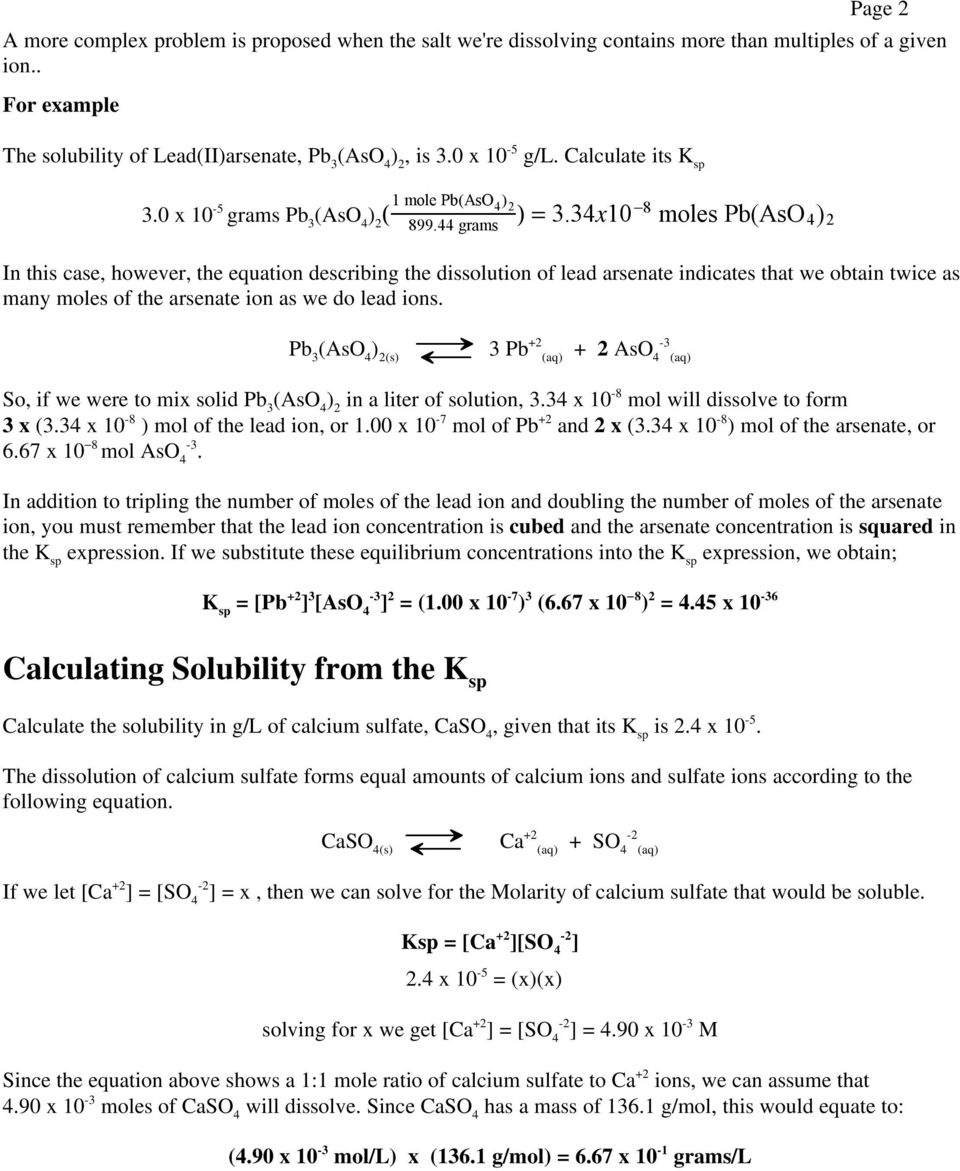
2 A more complex problem is proposed when the salt we're dissolving contains more than multiples of a given ion.. For example Page 2 The solubility of Lead(II)arsenate, Pb 3, is 3.0 x 10⁻⁵ g/l. Calculate its 3.0 x 10⁻⁵ grams Pb 3 ( 1mole Pb grams )=3.34x10 8 moles Pb In this case, however, the equation describing the dissolution of lead arsenate indicates that we obtain twice as many moles of the arsenate ion as we do lead ions. Pb 3 (s) 3 Pb AsO -3 (aq) 4 (aq) So, if we were to mix solid Pb 3 in a liter of solution, 3.34 x 10⁻⁸ mol will dissolve to form 3 x (3.34 x 10-8 ) mol of the lead ion, or 1.00 x 10⁻⁷ mol of Pb +2 and 2 x (3.34 x 10-8 ) mol of the arsenate, or 6.67 x 10 8 mol AsO 4-3. In addition to tripling the number of moles of the lead ion and doubling the number of moles of the arsenate ion, you must remember that the lead ion concentration is cubed and the arsenate concentration is squared in the expression. If we substitute these equilibrium concentrations into the expression, we obtain; = [Pb +2 ] 3 [AsO 4-3 ] 2 = (1.00 x 10⁻⁷ ) 3 (6.67 x 10 8 = 4.45 x Calculating Solubility from the Calculate the solubility in g/l of calcium sulfate, CaSO 4, given that its is 2.4 x The dissolution of calcium sulfate forms equal amounts of calcium ions and sulfate ions according to the following equation. CaSO 4(s) Ca +2 + SO (aq) 4 (aq) If we let [Ca +2 ] = [SO 4 ] = x, then we can solve for the Molarity of calcium sulfate that would be soluble. Ksp = [Ca +2 ][SO 4 ] 2.4 x 10-5 = (x)(x) solving for x we get [Ca +2 ] = [SO 4 ] = 4.90 x 10⁻³ M Since the equation above shows a 1:1 mole ratio of calcium sulfate to Ca +2 ions, we can assume that 4.90 x 10⁻³ moles of CaSO 4 will dissolve. Since CaSO 4 has a mass of g/mol, this would equate to: (4.90 x 10⁻³ mol/l) x (136.1 g/mol) = 6.67 x 10⁻¹ grams/l
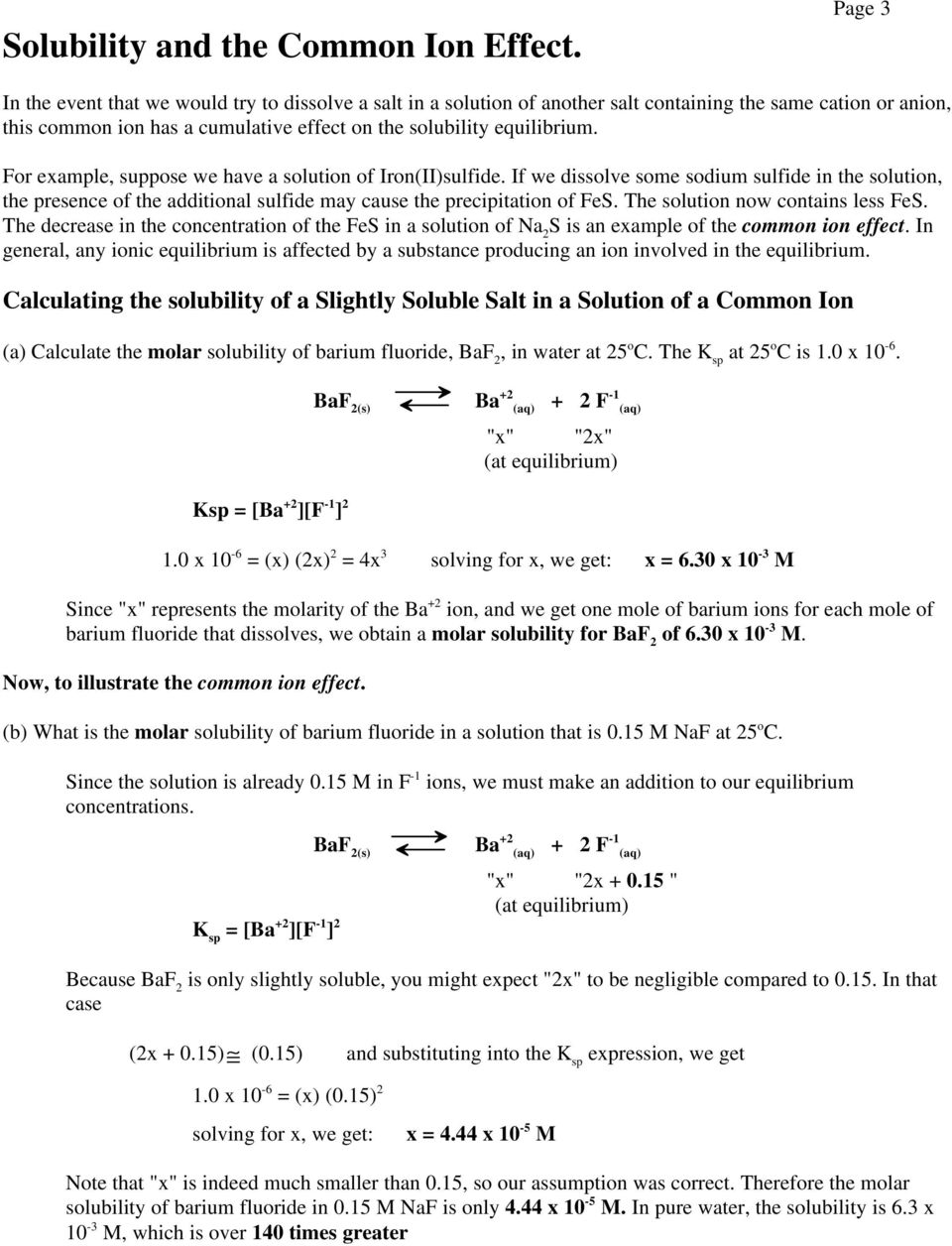
3 Solubility and the Common Ion Effect. Page 3 In the event that we would try to dissolve a salt in a solution of another salt containing the same cation or anion, this common ion has a cumulative effect on the solubility equilibrium. For example, suppose we have a solution of Iron(II)sulfide. If we dissolve some sodium sulfide in the solution, the presence of the additional sulfide may cause the precipitation of FeS. The solution now contains less FeS. The decrease in the concentration of the FeS in a solution of Na 2 S is an example of the common ion effect. In general, any ionic equilibrium is affected by a substance producing an ion involved in the equilibrium. Calculating the solubility of a Slightly Soluble Salt in a Solution of a Common Ion (a) Calculate the molar solubility of barium fluoride, BaF 2, in water at 25 o C. The at 25 o C is 1.0 x BaF 2(s) Ba +2 (aq) + 2 F -1 (aq) "x" "2x" (at equilibrium) Ksp = [Ba +2 ][F -1 ] x 10-6 = (x) (2x = 4x 3 solving for x, we get: x = 6.30 x 10⁻³ M Since "x" represents the molarity of the Ba +2 ion, and we get one mole of barium ions for each mole of barium fluoride that dissolves, we obtain a molar solubility for BaF 2 of 6.30 x 10⁻³ M. Now, to illustrate the common ion effect. (b) What is the molar solubility of barium fluoride in a solution that is 0.15 M NaF at 25 o C. Since the solution is already 0.15 M in F -1 ions, we must make an addition to our equilibrium concentrations. = [Ba +2 ][F -1 ] 2 BaF 2(s) Ba (aq) F-1 (aq) "x" "2x " (at equilibrium) Because BaF 2 is only slightly soluble, you might expect "2x" to be negligible compared to In that case (2x ) (0.15) and substituting into the expression, we get 1.0 x 10-6 = (x) (0.15 solving for x, we get: x = 4.44 x 10⁻⁵ M Note that "x" is indeed much smaller than 0.15, so our assumption was correct. Therefore the molar solubility of barium fluoride in 0.15 M NaF is only 4.44 x 10⁻⁵ M. In pure water, the solubility is 6.3 x 10⁻³ M, which is over 140 times greater
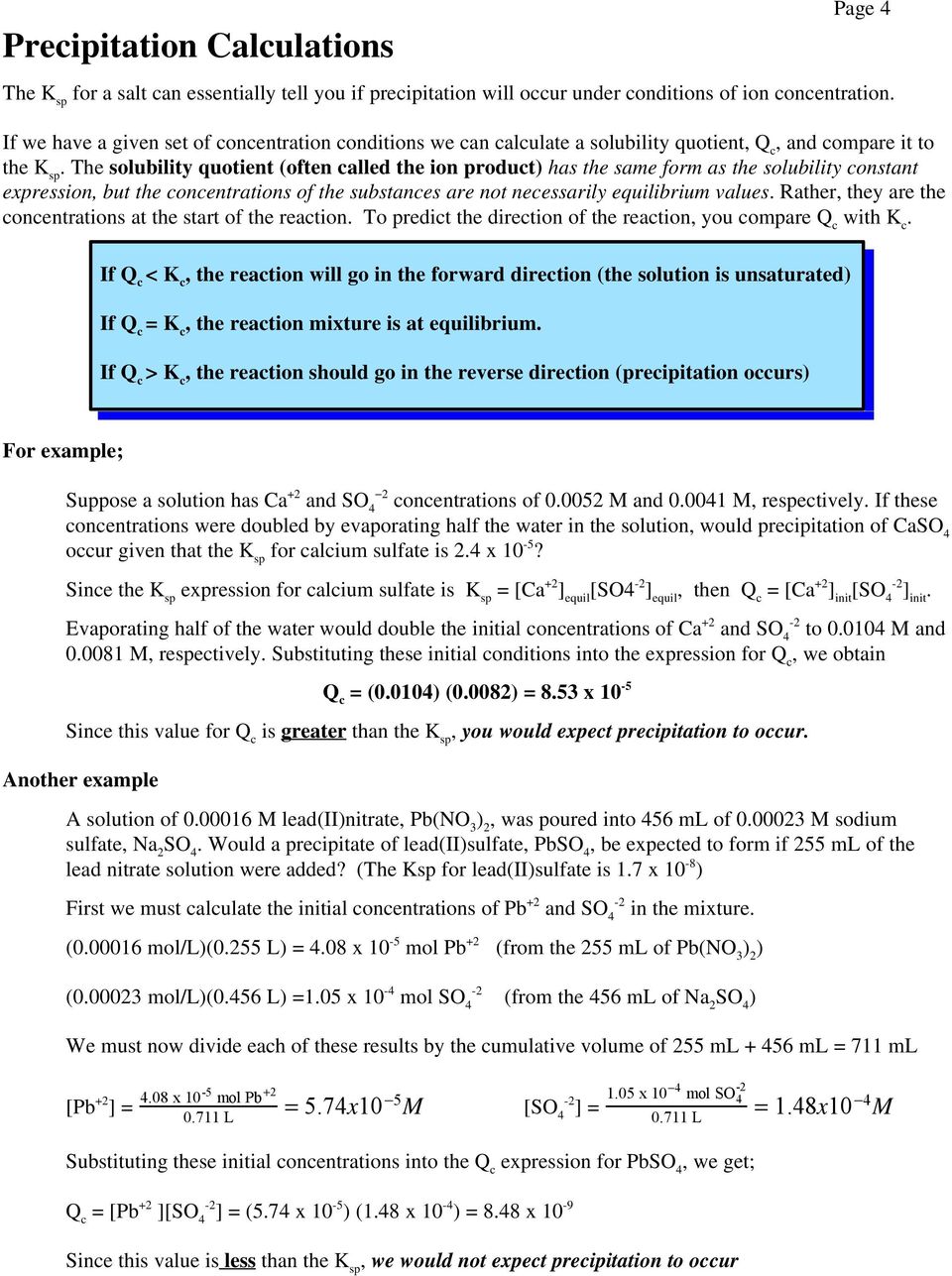
4 Precipitation Calculations The for a salt can essentially tell you if precipitation will occur under conditions of ion concentration. If we have a given set of concentration conditions we can calculate a solubility quotient, Q c, and compare it to the. The solubility quotient (often called the ion product) has the same form as the solubility constant expression, but the concentrations of the substances are not necessarily equilibrium values. Rather, they are the concentrations at the start of the reaction. To predict the direction of the reaction, you compare Q c with K c. If Q c < K c, the reaction will go in the forward direction (the solution is unsaturated) If Q c = K c, the reaction mixture is at equilibrium. If Q c > K c, the reaction should go in the reverse direction (precipitation occurs) Page 4 For example; Suppose a solution has Ca +2 and SO 4 2 concentrations of M and M, respectively. If these concentrations were doubled by evaporating half the water in the solution, would precipitation of CaSO 4 occur given that the for calcium sulfate is 2.4 x 10⁻⁵? Since the expression for calcium sulfate is = [Ca +2 ] equil [SO4 ] equil, then Q c = [Ca +2 ] init [SO 4 ] init. Evaporating half of the water would double the initial concentrations of Ca +2 and SO 4 to M and M, respectively. Substituting these initial conditions into the expression for Q c, we obtain Q c = (0.0104) (0.0082) = 8.53 x 10⁻⁵ Since this value for Q c is greater than the, you would expect precipitation to occur. Another example A solution of M lead(ii)nitrate, Pb(NO 3, was poured into 456 ml of M sodium sulfate, Na 2 SO 4. Would a precipitate of lead(ii)sulfate, PbSO 4, be expected to form if 255 ml of the lead nitrate solution were added? (The Ksp for lead(ii)sulfate is 1.7 x 10⁻⁸ ) First we must calculate the initial concentrations of Pb +2 and SO 4 in the mixture. ( mol/l)(0.255 L) = 4.08 x 10⁻⁵ mol Pb +2 (from the 255 ml of Pb(NO 3 ) ( mol/l)(0.456 L) =1.05 x 10⁻⁴ mol SO 4 (from the 456 ml of Na 2 SO 4 ) We must now divide each of these results by the cumulative volume of 255 ml ml = 711 ml [Pb x10 ] = -5 mol Pb +2 =5.74x10 5 M [SO 4 ] = L 1.05 x10 4 mol SO L =1.48x10 4 M Substituting these initial concentrations into the Q c expression for PbSO 4, we get; Q c = [Pb +2 ][SO 4 ] = (5.74 x 10⁻⁵ ) (1.48 x 10⁻⁴ ) = 8.48 x 10⁻⁹ Since this value is less than the, we would not expect precipitation to occur
5 Completeness of Precipitation Page 5 In the real world, the concentration of certain ions in drinking water or surface water can be determined by precipitating the ion of interest, filtering it out of the solution, and simply weighing the dried solid. In order for this to be an accurate analysis, we must be assured that most of the ion of interest was precipitated and very little remained in solution. For example, Lead chromate, PbCrO 4, is a yellow pigment used in paints. Suppose 0.50 L of a 1.0 x 10⁻⁵ M Pb(C 2 H 3 O 2 ) and 0.50 L of a 1.0 x 10⁻³ M K 2 CrO 4 solution are mixed. Calculate the equilibrium concentration of Pb +2 ion remaining in the solution after PbCrO 4 precipitates. What is the percentage of Pb +2 remaining in solution after the precipitation has occurred. (The for PbCrO 4 is 1.8 x ) First, let us assume a limiting reagent problem where all the lead chromate that is possible precipitates. Then using the, determine how much could redissolve. Pb +2 (aq) + CrO 4 (aq) PbCrO 4(s) initial 5 x 10⁻⁶ mol 5 x 10⁻⁴ mol 0 final 0 (5 x 10⁻⁴ )- (5 x 10⁻⁶ ) 5 x 10⁻⁴ mol = 4.95 x 10⁻⁴ mol The cumulative volume of the two solutions is now 1.0 L, so we now have 5 x 10⁻⁴ mol solid PbCrO 4 in contact with a solution containing 4.95 x 10⁻⁴ M CrO 4 ions. Let us now calculate how much of the solid lead chromate could possibly redissolve in the presence of this excess chromate ion. PbCrO 4(s) Pb +2 (aq) + CrO 4 (aq) initial x 10-4 M change +x +x equilibrium x 4.95 x 10⁻⁴ M + x Substituting into the Ksp expression for lead chromate, we obtain Ksp = [Pb +2 ][CrO 4 ] 1.8 x = (x)(x x 10-4 ) = (x)(4.95 x 10⁻⁴ )...assuming x is negligible compared to 4.95 x 10⁻⁴ Solving for "x" we get x= 1.8x x10 4 =3.64x10 11 MPb +2 remaininginsolution The number of moles of Pb +2 in the solution prior to precipitation was 5.0 x 10⁻⁶ mol, so the percentage of Pb +2 remaining in the solution is: 3.64x x10 6 x100%=7.3x10 4 % and would generally be considered a complete precipitation.

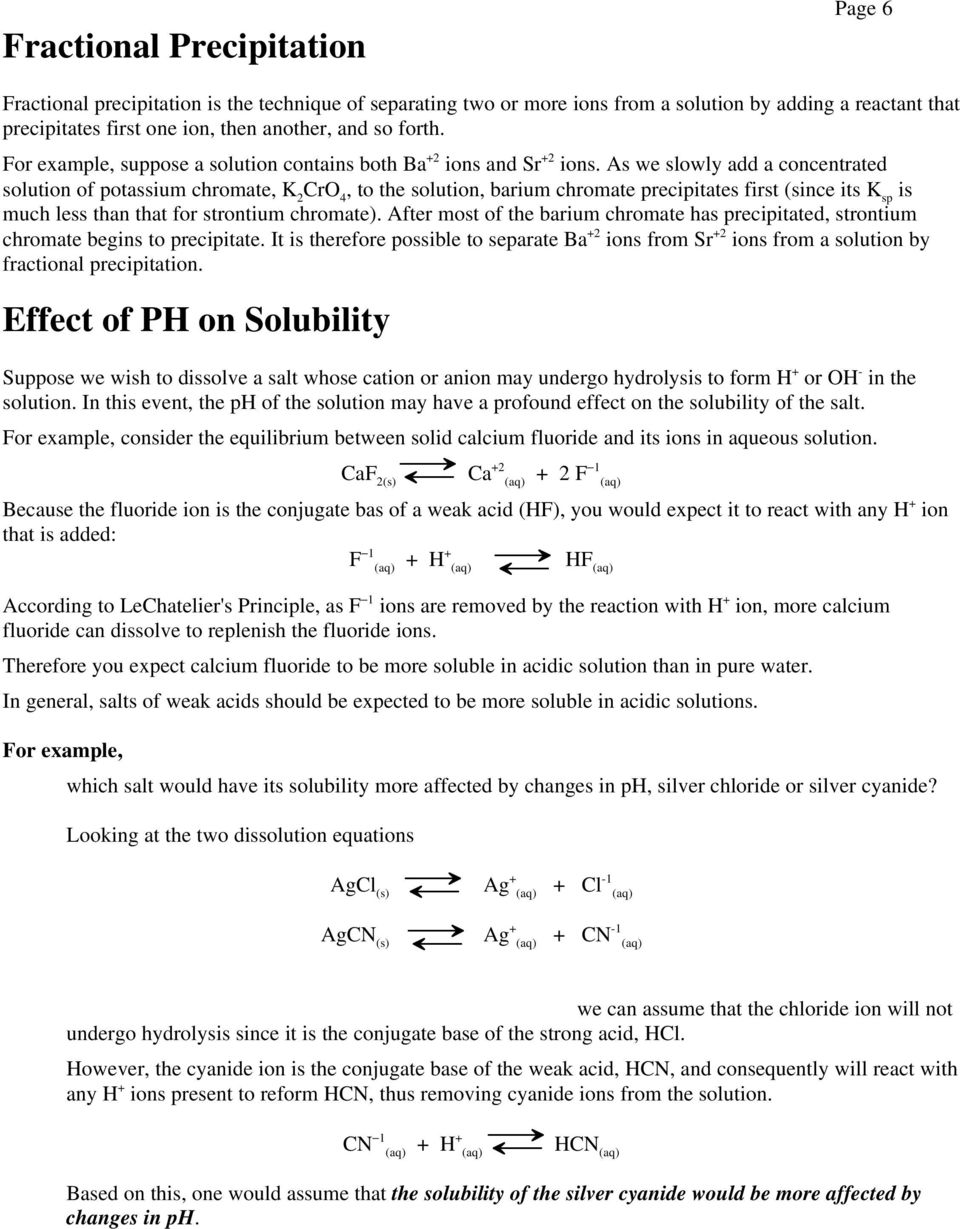
6 Fractional Precipitation Page 6 Fractional precipitation is the technique of separating two or more ions from a solution by adding a reactant that precipitates first one ion, then another, and so forth. For example, suppose a solution contains both Ba +2 ions and Sr +2 ions. As we slowly add a concentrated solution of potassium chromate, K 2 CrO 4, to the solution, barium chromate precipitates first (since its is much less than that for strontium chromate). After most of the barium chromate has precipitated, strontium chromate begins to precipitate. It is therefore possible to separate Ba +2 ions from Sr +2 ions from a solution by fractional precipitation. Effect of PH on Solubility Suppose we wish to dissolve a salt whose cation or anion may undergo hydrolysis to form H + or OH - in the solution. In this event, the ph of the solution may have a profound effect on the solubility of the salt. For example, consider the equilibrium between solid calcium fluoride and its ions in aqueous solution. CaF 2(s) Ca (aq) F 1 (aq) Because the fluoride ion is the conjugate bas of a weak acid (HF), you would expect it to react with any H + ion that is added: F 1 (aq) + H+ (aq) HF (aq) According to LeChatelier's Principle, as F 1 ions are removed by the reaction with H + ion, more calcium fluoride can dissolve to replenish the fluoride ions. Therefore you expect calcium fluoride to be more soluble in acidic solution than in pure water. In general, salts of weak acids should be expected to be more soluble in acidic solutions. For example, which salt would have its solubility more affected by changes in ph, silver chloride or silver cyanide? Looking at the two dissolution equations AgCl (s) Ag + (aq) + Cl-1 (aq) AgCN (s) Ag + (aq) + CN-1 (aq) we can assume that the chloride ion will not undergo hydrolysis since it is the conjugate base of the strong acid, HCl. However, the cyanide ion is the conjugate base of the weak acid, HCN, and consequently will react with any H + ions present to reform HCN, thus removing cyanide ions from the solution. CN 1 (aq) + H+ (aq) HCN (aq) Based on this, one would assume that the solubility of the silver cyanide would be more affected by changes in ph.
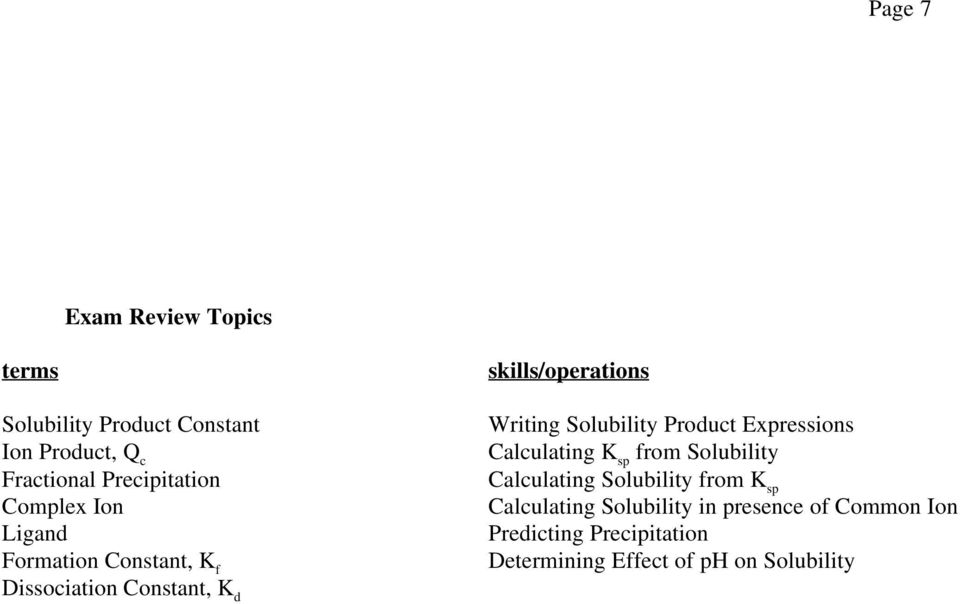
7 Page 7 Exam Review Topics terms Solubility Product Constant Ion Product, Q c Fractional Precipitation Complex Ion Ligand Formation Constant, K f skills/operations Writing Solubility Product Expressions Calculating from Solubility Calculating Solubility from Calculating Solubility in presence of Common Ion Predicting Precipitation Determining Effect of ph on Solubility Dissociation Constant, K d
Chemistry 132 NT. Solubility Equilibria. The most difficult thing to understand is the income tax. Solubility and Complex-ion Equilibria
 Chemistry 13 NT The most difficult thing to understand is the income tax. Albert Einstein 1 Chem 13 NT Solubility and Complex-ion Equilibria Module 1 Solubility Equilibria The Solubility Product Constant
General Chemistry II Chapter 20
 1 General Chemistry II Chapter 0 Ionic Equilibria: Principle There are many compounds that appear to be insoluble in aqueous solution (nonelectrolytes). That is, when we add a certain compound to water
Solubility Product. Application of Equilibrium concepts
 Solubility Product Application of Equilibrium concepts Introduction In even the most insoluble compounds, a few ions at the least dissolve. We can treat dissolving as a mini reaction in which the cation(s)
Copyright 2009 by Pearson Education, Inc. Upper Saddle River, New Jersey 07458 All rights reserved.
 Sample Exercise 17.1 Calculating the ph When a Common Ion is Involved What is the ph of a solution made by adding 0.30 mol of acetic acid and 0.30 mol of sodium acetate to enough water to make 1.0 L of
MOLARITY = (moles solute) / (vol.solution in liter units)
 CHEM 101/105 Stoichiometry, as applied to Aqueous Solutions containing Ionic Solutes Lect-05 MOLES - a quantity of substance. Quantities of substances can be expressed as masses, as numbers, or as moles.
Tutorial 4 SOLUTION STOICHIOMETRY. Solution stoichiometry calculations involve chemical reactions taking place in solution.
 T-27 Tutorial 4 SOLUTION STOICHIOMETRY Solution stoichiometry calculations involve chemical reactions taking place in solution. Of the various methods of expressing solution concentration the most convenient
Molarity of Ions in Solution
 APPENDIX A Molarity of Ions in Solution ften it is necessary to calculate not only the concentration (in molarity) of a compound in aqueous solution but also the concentration of each ion in aqueous solution.
Name: Class: Date: 2 4 (aq)
 Name: Class: Date: Unit 4 Practice Test Multiple Choice Identify the choice that best completes the statement or answers the question. 1) The balanced molecular equation for complete neutralization of
Solution a homogeneous mixture = A solvent + solute(s) Aqueous solution water is the solvent
 Solution a homogeneous mixture = A solvent + solute(s) Aqueous solution water is the solvent Water a polar solvent: dissolves most ionic compounds as well as many molecular compounds Aqueous solution:
Solubility of Salts - Ksp. Ksp Solubility
 Solubility of Salts - Ksp We now focus on another aqueous equilibrium system, slightly soluble salts. These salts have a Solubility Product Constant, K sp. (We saw this in 1B with the sodium tetraborate
6 Reactions in Aqueous Solutions
 6 Reactions in Aqueous Solutions Water is by far the most common medium in which chemical reactions occur naturally. It is not hard to see this: 70% of our body mass is water and about 70% of the surface
Writing Chemical Equations
 Writing Chemical Equations Chemical equations for solution reactions can be written in three different forms; molecular l equations, complete ionic i equations, and net ionic equations. In class, so far,
Chemistry 51 Chapter 8 TYPES OF SOLUTIONS. A solution is a homogeneous mixture of two substances: a solute and a solvent.
 TYPES OF SOLUTIONS A solution is a homogeneous mixture of two substances: a solute and a solvent. Solute: substance being dissolved; present in lesser amount. Solvent: substance doing the dissolving; present
Chemistry Ch 15 (Solutions) Study Guide Introduction
 Chemistry Ch 15 (Solutions) Study Guide Introduction Name: Note: a word marked (?) is a vocabulary word you should know the meaning of. A homogeneous (?) mixture, or, is a mixture in which the individual
Equilibrium Constants The following equilibrium constants will be useful for some of the problems.
 1 CH302 Exam 4 Practice Problems (buffers, titrations, Ksp) Equilibrium Constants The following equilibrium constants will be useful for some of the problems. Substance Constant Substance Constant HCO
Chapter 8: Chemical Equations and Reactions
 Chapter 8: Chemical Equations and Reactions I. Describing Chemical Reactions A. A chemical reaction is the process by which one or more substances are changed into one or more different substances. A chemical
1. Read P. 368-375, P. 382-387 & P. 429-436; P. 375 # 1-11 & P. 389 # 1,7,9,12,15; P. 436 #1, 7, 8, 11
 SCH3U- R.H.KING ACADEMY SOLUTION & ACID/BASE WORKSHEET Name: The importance of water - MAKING CONNECTION READING 1. Read P. 368-375, P. 382-387 & P. 429-436; P. 375 # 1-11 & P. 389 # 1,7,9,12,15; P. 436
Answer Key, Problem Set 5 (With explanations)--complete
 Chemistry 122 Mines, Spring 2016 Answer Key, Problem Set 5 (With explanations)complete 1. NT1; 2. NT2; 3. MP; 4. MP (15.38); 5. MP (15.40); 6. MP (15.42); 7. NT3; 8. NT4; 9. MP; 10. NT5; 11. NT6; 12. MP;
Chemical Equations. Chemical Equations. Chemical reactions describe processes involving chemical change
 Chemical Reactions Chemical Equations Chemical reactions describe processes involving chemical change The chemical change involves rearranging matter Converting one or more pure substances into new pure
Chemistry 12 Tutorial 10 Ksp Calculations
 Chemistry 12 Tutorial 10 Ksp Calculations Welcome back to the world of calculations. In Tutorial 10 you will be shown: 1. What is meant by Ksp. 2. How to write a "Ksp expression" from a net ionic equation.
stoichiometry = the numerical relationships between chemical amounts in a reaction.
 1 REACTIONS AND YIELD ANSWERS stoichiometry = the numerical relationships between chemical amounts in a reaction. 2C 8 H 18 (l) + 25O 2 16CO 2 (g) + 18H 2 O(g) From the equation, 16 moles of CO 2 (a greenhouse
Honors Chemistry: Unit 6 Test Stoichiometry PRACTICE TEST ANSWER KEY Page 1. A chemical equation. (C-4.4)
 Honors Chemistry: Unit 6 Test Stoichiometry PRACTICE TEST ANSWER KEY Page 1 1. 2. 3. 4. 5. 6. Question What is a symbolic representation of a chemical reaction? What 3 things (values) is a mole of a chemical
Number of moles of solute = Concentration (mol. L ) x Volume of solution (litres) or n = C x V
 44 CALCULATIONS INVOLVING SOLUTIONS INTRODUCTION AND DEFINITIONS Many chemical reactions take place in aqueous (water) solution. Quantities of such solutions are measured as volumes, while the amounts
Name period Unit 9: acid/base equilibrium
 Name period Unit 9: acid/base equilibrium 1. What is the difference between the Arrhenius and the BronstedLowry definition of an acid? Arrhenious acids give H + in water BronstedLowry acids are proton
Chapter 3: Stoichiometry
 Chapter 3: Stoichiometry Key Skills: Balance chemical equations Predict the products of simple combination, decomposition, and combustion reactions. Calculate formula weights Convert grams to moles and
Acid/Base Definition. Acid/Base Reactions. Major vs. Minor Species. Terms/Items you Need to Know. you need to memorize these!!
 Acid/Base Reactions some covalent compounds have weakly bound H atoms and can lose them to water (acids) some compounds produce OH in water solutions when they dissolve (bases) acid/base reaction are very
Aqueous Solutions. Water is the dissolving medium, or solvent. Some Properties of Water. A Solute. Types of Chemical Reactions.
 Aqueous Solutions and Solution Stoichiometry Water is the dissolving medium, or solvent. Some Properties of Water Water is bent or V-shaped. The O-H bonds are covalent. Water is a polar molecule. Hydration
Chem 31 Fall 2002. Chapter 3. Stoichiometry: Calculations with Chemical Formulas and Equations. Writing and Balancing Chemical Equations
 Chem 31 Fall 2002 Chapter 3 Stoichiometry: Calculations with Chemical Formulas and Equations Writing and Balancing Chemical Equations 1. Write Equation in Words -you cannot write an equation unless you
Experiment 1 Chemical Reactions and Net Ionic Equations
 Experiment 1 Chemical Reactions and Net Ionic Equations I. Objective: To predict the products of some displacement reactions and write net ionic equations. II. Chemical Principles: A. Reaction Types. Chemical
EXPERIMENT 12 A SOLUBILITY PRODUCT CONSTANT
 PURPOSE: 1. To determine experimentally the molar solubility of potassium acid tartrate in water and in a solution of potassium nitrate. 2. To examine the effect of a common ion on the solubility of slightly
Experiment 5. Chemical Reactions A + X AX AX A + X A + BX AX + B AZ + BX AX + BZ
 Experiment 5 Chemical Reactions OBJECTIVES 1. To observe the various criteria that are used to indicate that a chemical reaction has occurred. 2. To convert word equations into balanced inorganic chemical
Common Ion Effects. CH 3 CO 2 (aq) + Na + (aq)
 Common Ion Effects If two reactions both involve the same ion, then one reaction can effect the equilibrium position of the other reaction. The ion that appears in both reactions is the common ion. Buffers
Precipitation Titration: Determination of Chloride by the Mohr Method by Dr. Deniz Korkmaz
 Precipitation Titration: Determination of Chloride by the Mohr Method by Dr. Deniz Korkmaz Introduction Titration is a process by which the concentration of an unknown substance in solution is determined
APPENDIX B: EXERCISES
 BUILDING CHEMISTRY LABORATORY SESSIONS APPENDIX B: EXERCISES Molecular mass, the mole, and mass percent Relative atomic and molecular mass Relative atomic mass (A r ) is a constant that expresses the ratio
Experiment 8 - Double Displacement Reactions
 Experiment 8 - Double Displacement Reactions A double displacement reaction involves two ionic compounds that are dissolved in water. In a double displacement reaction, it appears as though the ions are
Practical Lesson No 4 TITRATIONS
 Practical Lesson No 4 TITRATIONS Reagents: 1. NaOH standard solution 0.1 mol/l 2. H 2 SO 4 solution of unknown concentration 3. Phenolphthalein 4. Na 2 S 2 O 3 standard solution 0.1 mol/l 5. Starch solution
4.1 Stoichiometry. 3 Basic Steps. 4. Stoichiometry. Stoichiometry. Butane Lighter 2C 4 H 10 + 13O 2 10H 2 O + 8CO 2
 4. Stoichiometry 1. Stoichiometric Equations 2. Limiting Reagent Problems 3. Percent Yield 4. Limiting Reagent Problems 5. Concentrations of Solutes 6. Solution Stoichiometry 7. ph and Acid Base Titrations
Unit 2: Quantities in Chemistry
 Mass, Moles, & Molar Mass Relative quantities of isotopes in a natural occurring element (%) E.g. Carbon has 2 isotopes C-12 and C-13. Of Carbon s two isotopes, there is 98.9% C-12 and 11.1% C-13. Find
Chemical Equations & Stoichiometry
 Chemical Equations & Stoichiometry Chapter Goals Balance equations for simple chemical reactions. Perform stoichiometry calculations using balanced chemical equations. Understand the meaning of the term
Review for Solving ph Problems:
 Review for Solving ph Problems: Acid Ionization: HA H 2 O A - H 3 O CH 3 COOH H 2 O CH 3 COO - H 3 O Base Ionization: B H 2 O BH OH - 1) Strong Acid complete dissociation [H ] is equal to original [HA]
Chemistry: Chemical Equations
 Chemistry: Chemical Equations Write a balanced chemical equation for each word equation. Include the phase of each substance in the equation. Classify the reaction as synthesis, decomposition, single replacement,
Appendix D. Reaction Stoichiometry D.1 INTRODUCTION
 Appendix D Reaction Stoichiometry D.1 INTRODUCTION In Appendix A, the stoichiometry of elements and compounds was presented. There, the relationships among grams, moles and number of atoms and molecules
W1 WORKSHOP ON STOICHIOMETRY
 INTRODUCTION W1 WORKSHOP ON STOICHIOMETRY These notes and exercises are designed to introduce you to the basic concepts required to understand a chemical formula or equation. Relative atomic masses of
SCH 4C1 Unit 2 Problem Set Questions taken from Frank Mustoe et all, "Chemistry 11", McGraw-Hill Ryerson, 2001
 SCH 4C1 Unit 2 Problem Set Questions taken from Frank Mustoe et all, "Chemistry 11", McGraw-Hill Ryerson, 2001 1. A small pin contains 0.0178 mol of iron. How many atoms of iron are in the pin? 2. A sample
Properties of Aqueous Solutions of Acids and Bases. CHAPTER 10 Acids, Bases and Salts. Properties of Aqueous Solutions of Acids and Bases
 CAPTER Acids, Bases and Salts Properties of Aqueous Solutions of Acids and Bases Strong and Weak Acids Acids are substances that generate in aqueous solutions. Strong acids ionize 0% in water. That is,
1. When the following equation is balanced, the coefficient of Al is. Al (s) + H 2 O (l)? Al(OH) 3 (s) + H 2 (g)
 1. When the following equation is balanced, the coefficient of Al is. Al (s) + H 2 O (l)? Al(OH) (s) + H 2 (g) A) 1 B) 2 C) 4 D) 5 E) Al (s) + H 2 O (l)? Al(OH) (s) + H 2 (g) Al (s) + H 2 O (l)? Al(OH)
SAMPLE PROBLEM 8.1. Solutions of Electrolytes and Nonelectrolytes SOLUTION STUDY CHECK
 Solutions of Electrolytes and Nonelectrolytes SAMPLE PROBLEM 8.1 Indicate whether solutions of each of the following contain only ions, only molecules, or mostly molecules and a few ions: a. Na 2 SO 4,
Chemical Equations and Chemical Reactions. Chapter 8.1
 Chemical Equations and Chemical Reactions Chapter 8.1 Objectives List observations that suggest that a chemical reaction has taken place List the requirements for a correctly written chemical equation.
CHM1 Review for Exam 12
 Topics Solutions 1. Arrhenius Acids and bases a. An acid increases the H + concentration in b. A base increases the OH - concentration in 2. Strong acids and bases completely dissociate 3. Weak acids and
Chapter 17. The best buffer choice for ph 7 is NaH 2 PO 4 /Na 2 HPO 4. 19)
 Chapter 17 2) a) HCl and CH 3 COOH are both acids. A buffer must have an acid/base conjugate pair. b) NaH 2 PO 4 and Na 2 HPO 4 are an acid/base conjugate pair. They will make an excellent buffer. c) H
Chapter 7: Chemical Reactions
 Chapter 7 Page 1 Chapter 7: Chemical Reactions A chemical reaction: a process in which at least one new substance is formed as the result of a chemical change. A + B C + D Reactants Products Evidence that
PART I: MULTIPLE CHOICE (30 multiple choice questions. Each multiple choice question is worth 2 points)
 CHEMISTRY 123-07 Midterm #1 Answer key October 14, 2010 Statistics: Average: 74 p (74%); Highest: 97 p (95%); Lowest: 33 p (33%) Number of students performing at or above average: 67 (57%) Number of students
ph: Measurement and Uses
 ph: Measurement and Uses One of the most important properties of aqueous solutions is the concentration of hydrogen ion. The concentration of H + (or H 3 O + ) affects the solubility of inorganic and organic
Additional Lecture: TITRATION BASICS
 Additional Lecture: TITRATION BASICS 1 Definition and Applications Titration is the incremental addition of a reagent solution (called titrant) to the analyte until the reaction is complete Common applications:
EXPERIMENT 7 Reaction Stoichiometry and Percent Yield
 EXPERIMENT 7 Reaction Stoichiometry and Percent Yield INTRODUCTION Stoichiometry calculations are about calculating the amounts of substances that react and form in a chemical reaction. The word stoichiometry
CHAPTERS 15 FAKE TEST QUESTIONS. 1. According to the Brønsted Lowry definition, which species can function both as an acid and as a base?
 You might need to know the following K values: CHAPTERS 15 FAKE TEST QUESTIONS CH 3 COOH K a = 1.8 x 10 5 Benzoic Acid K a = 6.5 x 10 5 HNO 2 K a = 4.5 x 10 4 NH 3 K b = 1.8 x 10 5 HF K a = 7.2 x 10 4
Steps for balancing a chemical equation
 The Chemical Equation: A Chemical Recipe Dr. Gergens - SD Mesa College A. Learn the meaning of these arrows. B. The chemical equation is the shorthand notation for a chemical reaction. A chemical equation
IB Chemistry 1 Mole. One atom of C-12 has a mass of 12 amu. One mole of C-12 has a mass of 12 g. Grams we can use more easily.
 The Mole Atomic mass units and atoms are not convenient units to work with. The concept of the mole was invented. This was the number of atoms of carbon-12 that were needed to make 12 g of carbon. 1 mole
UNIT (6) ACIDS AND BASES
 UNIT (6) ACIDS AND BASES 6.1 Arrhenius Definition of Acids and Bases Definitions for acids and bases were proposed by the Swedish chemist Savante Arrhenius in 1884. Acids were defined as compounds that
Moles. Moles. Moles. Moles. Balancing Eqns. Balancing. Balancing Eqns. Symbols Yields or Produces. Like a recipe:
 Like a recipe: Balancing Eqns Reactants Products 2H 2 (g) + O 2 (g) 2H 2 O(l) coefficients subscripts Balancing Eqns Balancing Symbols (s) (l) (aq) (g) or Yields or Produces solid liquid (pure liquid)
Description of the Mole Concept:
 Description of the Mole Concept: Suppose you were sent into the store to buy 36 eggs. When you picked them up you would get 3 boxes, each containing 12 eggs. You just used a mathematical device, called
Chapter 16: Tests for ions and gases
 The position of hydrogen in the reactivity series Hydrogen, although not a metal, is included in the reactivity series because it, like metals, can be displaced from aqueous solution, only this time the
2. DECOMPOSITION REACTION ( A couple have a heated argument and break up )
 TYPES OF CHEMICAL REACTIONS Most reactions can be classified into one of five categories by examining the types of reactants and products involved in the reaction. Knowing the types of reactions can help
Stoichiometry and Aqueous Reactions (Chapter 4)
 Stoichiometry and Aqueous Reactions (Chapter 4) Chemical Equations 1. Balancing Chemical Equations (from Chapter 3) Adjust coefficients to get equal numbers of each kind of element on both sides of arrow.
Calculation of Molar Masses. Molar Mass. Solutions. Solutions
 Molar Mass Molar mass = Mass in grams of one mole of any element, numerically equal to its atomic weight Molar mass of molecules can be determined from the chemical formula and molar masses of elements
NET IONIC EQUATIONS. A balanced chemical equation can describe all chemical reactions, an example of such an equation is:
 NET IONIC EQUATIONS A balanced chemical equation can describe all chemical reactions, an example of such an equation is: NaCl + AgNO 3 AgCl + NaNO 3 In this case, the simple formulas of the various reactants
H 2 + O 2 H 2 O. - Note there is not enough hydrogen to react with oxygen - It is necessary to balance equation.
 CEMICAL REACTIONS 1 ydrogen + Oxygen Water 2 + O 2 2 O reactants product(s) reactant substance before chemical change product substance after chemical change Conservation of Mass During a chemical reaction,
Complexometric Titrations
 Complexometric Titrations Complexometric titrations are based on the formation of a soluble complex upon the reaction of the species titrated with the titrant. M + L ML In the module Chemistry 2 you were
UNIT (4) CALCULATIONS AND CHEMICAL REACTIONS
 UNIT (4) CALCULATIONS AND CHEMICAL REACTIONS 4.1 Formula Masses Recall that the decimal number written under the symbol of the element in the periodic table is the atomic mass of the element. 1 7 8 12
IB Chemistry. DP Chemistry Review
 DP Chemistry Review Topic 1: Quantitative chemistry 1.1 The mole concept and Avogadro s constant Assessment statement Apply the mole concept to substances. Determine the number of particles and the amount
Formulae, stoichiometry and the mole concept
 3 Formulae, stoichiometry and the mole concept Content 3.1 Symbols, Formulae and Chemical equations 3.2 Concept of Relative Mass 3.3 Mole Concept and Stoichiometry Learning Outcomes Candidates should be
CHEMISTRY II FINAL EXAM REVIEW
 Name Period CHEMISTRY II FINAL EXAM REVIEW Final Exam: approximately 75 multiple choice questions Ch 12: Stoichiometry Ch 5 & 6: Electron Configurations & Periodic Properties Ch 7 & 8: Bonding Ch 14: Gas
ATOMS. Multiple Choice Questions
 Chapter 3 ATOMS AND MOLECULES Multiple Choice Questions 1. Which of the following correctly represents 360 g of water? (i) 2 moles of H 2 0 (ii) 20 moles of water (iii) 6.022 10 23 molecules of water (iv)
CHEMICAL REACTIONS. Chemistry 51 Chapter 6
 CHEMICAL REACTIONS A chemical reaction is a rearrangement of atoms in which some of the original bonds are broken and new bonds are formed to give different chemical structures. In a chemical reaction,
Chapter 17. How are acids different from bases? Acid Physical properties. Base. Explaining the difference in properties of acids and bases
 Chapter 17 Acids and Bases How are acids different from bases? Acid Physical properties Base Physical properties Tastes sour Tastes bitter Feels slippery or slimy Chemical properties Chemical properties
Aqueous Ions and Reactions
 Aqueous Ions and Reactions (ions, acids, and bases) Demo NaCl(aq) + AgNO 3 (aq) AgCl (s) Two clear and colorless solutions turn to a cloudy white when mixed Demo Special Light bulb in water can test for
Colligative Properties
 CH302 LaBrake and Vanden Bout Colligative Properties PROBLEM #1: Give the molecular formula, the van t hoff factor for the following Ionic Compounds as well as guess the solubility of the compounds. If
Chemical Reactions in Water Ron Robertson
 Chemical Reactions in Water Ron Robertson r2 f:\files\courses\1110-20\2010 possible slides for web\waterchemtrans.doc Properties of Compounds in Water Electrolytes and nonelectrolytes Water soluble compounds
Unit 7 Stoichiometry. Chapter 12
 Unit 7 Stoichiometry Chapter 12 Objectives 7.1 use stoichiometry to determine the amount of substance in a reaction 7.2 determine the limiting reactant of a reaction 7.3 determine the percent yield of
Chem101: General Chemistry Lecture 9 Acids and Bases
 : General Chemistry Lecture 9 Acids and Bases I. Introduction A. In chemistry, and particularly biochemistry, water is the most common solvent 1. In studying acids and bases we are going to see that water
Chapter 14 Solutions
 Chapter 14 Solutions 1 14.1 General properties of solutions solution a system in which one or more substances are homogeneously mixed or dissolved in another substance two components in a solution: solute
Q.1 Classify the following according to Lewis theory and Brønsted-Lowry theory.
 Acid-base A4 1 Acid-base theories ACIDS & BASES - IONIC EQUILIBRIA 1. LEWIS acid electron pair acceptor H, AlCl 3 base electron pair donor NH 3, H 2 O, C 2 H 5 OH, OH e.g. H 3 N: -> BF 3 > H 3 N BF 3 see
Chem 1100 Chapter Three Study Guide Answers Outline I. Molar Mass and Moles A. Calculations of Molar Masses
 Chem 1100 Chapter Three Study Guide Answers Outline I. Molar Mass and Moles A. Calculations of Molar Masses B. Calculations of moles C. Calculations of number of atoms from moles/molar masses 1. Avagadro
ACID-BASE TITRATIONS: DETERMINATION OF CARBONATE BY TITRATION WITH HYDROCHLORIC ACID BACKGROUND
 #3. Acid - Base Titrations 27 EXPERIMENT 3. ACID-BASE TITRATIONS: DETERMINATION OF CARBONATE BY TITRATION WITH HYDROCHLORIC ACID BACKGROUND Carbonate Equilibria In this experiment a solution of hydrochloric
6) Which compound is manufactured in larger quantities in the U.S. than any other industrial chemical?
 MULTIPLE CHOICE. Choose the one alternative that best completes the statement or answers the question. 1) Which statement concerning Arrhenius acid-base theory is not correct? A) Acid-base reactions must
Chapter 1 The Atomic Nature of Matter
 Chapter 1 The Atomic Nature of Matter 6. Substances that cannot be decomposed into two or more simpler substances by chemical means are called a. pure substances. b. compounds. c. molecules. d. elements.
Acid-Base Titrations. Setup for a Typical Titration. Titration 1
 Titration 1 Acid-Base Titrations Molarities of acidic and basic solutions can be used to convert back and forth between moles of solutes and volumes of their solutions, but how are the molarities of these
One problem often faced in qualitative analysis is to test for one ion in a
 Chemistry 112 Laboratory: Silver Group Analysis Page 11 ANALYSIS OF THE SILVER GROUP CATIONS Ag + Pb Analysis of a Mixture of Cations One problem often faced in qualitative analysis is to test for one
Aqueous Chemical Reactions
 Name: Date: Lab Partners: Lab section: Aqueous Chemical Reactions The purpose of this lab is to introduce you to three major categories of reactions that occur in aqueous solutions: precipitation reactions,
Chemistry B11 Chapter 4 Chemical reactions
 Chemistry B11 Chapter 4 Chemical reactions Chemical reactions are classified into five groups: A + B AB Synthesis reactions (Combination) H + O H O AB A + B Decomposition reactions (Analysis) NaCl Na +Cl
Chapter 16 Acid-Base Equilibria
 Chapter 16 Acid-Base Equilibria Learning goals and key skills: Understand the nature of the hydrated proton, represented as either H + (aq) or H 3 O + (aq) Define and identify Arrhenuis acids and bases.
Atomic mass is the mass of an atom in atomic mass units (amu)
 Micro World atoms & molecules Laboratory scale measurements Atomic mass is the mass of an atom in atomic mass units (amu) By definition: 1 atom 12 C weighs 12 amu On this scale 1 H = 1.008 amu 16 O = 16.00
Stoichiometry. Lecture Examples Answer Key
 Stoichiometry Lecture Examples Answer Key Ex. 1 Balance the following chemical equations: 3 NaBr + 1 H 3 PO 4 3 HBr + 1 Na 3 PO 4 2 C 3 H 5 N 3 O 9 6 CO 2 + 3 N 2 + 5 H 2 O + 9 O 2 2 Ca(OH) 2 + 2 SO 2
Moles, Molecules, and Grams Worksheet Answer Key
 Moles, Molecules, and Grams Worksheet Answer Key 1) How many are there in 24 grams of FeF 3? 1.28 x 10 23 2) How many are there in 450 grams of Na 2 SO 4? 1.91 x 10 24 3) How many grams are there in 2.3
Balancing Chemical Equations Worksheet
 Balancing Chemical Equations Worksheet Student Instructions 1. Identify the reactants and products and write a word equation. 2. Write the correct chemical formula for each of the reactants and the products.
NH 3 + H 2 O + OH - NH 4. Acid-Base Concepts -- Chapter 15 + H + Conjugate Acid-Base Pairs: - H + base. acid
 Acid-Base Concepts -- Chapter 15 1. Arrhenius Acid-Base Concept (last semester) Acid: H+ supplier Base: OH- supplier 2. Brønsted-Lowry Acid-Base Concept (more general) (a) Definition (H+ transfer) Acid:
Limiting Reagent Worksheet #1
 Limiting Reagent Worksheet #1 1. Given the following reaction: (Balance the equation first!) C 3 H 8 + O 2 -------> CO 2 + H 2 O a) If you start with 14.8 g of C 3 H 8 and 3.44 g of O 2, determine the
Similarities The ph of each of these solutions is the same; that is, the [H + ] is the same in both beakers (go ahead and count).
![Similarities The ph of each of these solutions is the same; that is, the [H + ] is the same in both beakers (go ahead and count).](/thumbs/40/20752996.jpg "Similarities The ph of each of these solutions is the same; that is, the [H + ] is the same in both beakers (go ahead and count).") Compare 1 L of acetate buffer solution (0.50 mol of acetic acid and 0.50 mol sodium acetate) to 1 L of HCl solution AcO - AcO - H+ Cl - AcO - AcO - Cl - Cl - AcO - Cl - Cl - Cl - Cl - AcO - AcO - AcO -
Compare 1 L of acetate buffer solution (0.50 mol of acetic acid and 0.50 mol sodium acetate) to 1 L of HCl solution AcO - AcO - H+ Cl - AcO - AcO - Cl - Cl - AcO - Cl - Cl - Cl - Cl - AcO - AcO - AcO -