
Limiting Reagent Worksheet #1
|
|
|
- Cecilia Simmons
- 9 years ago
- Views:
Transcription
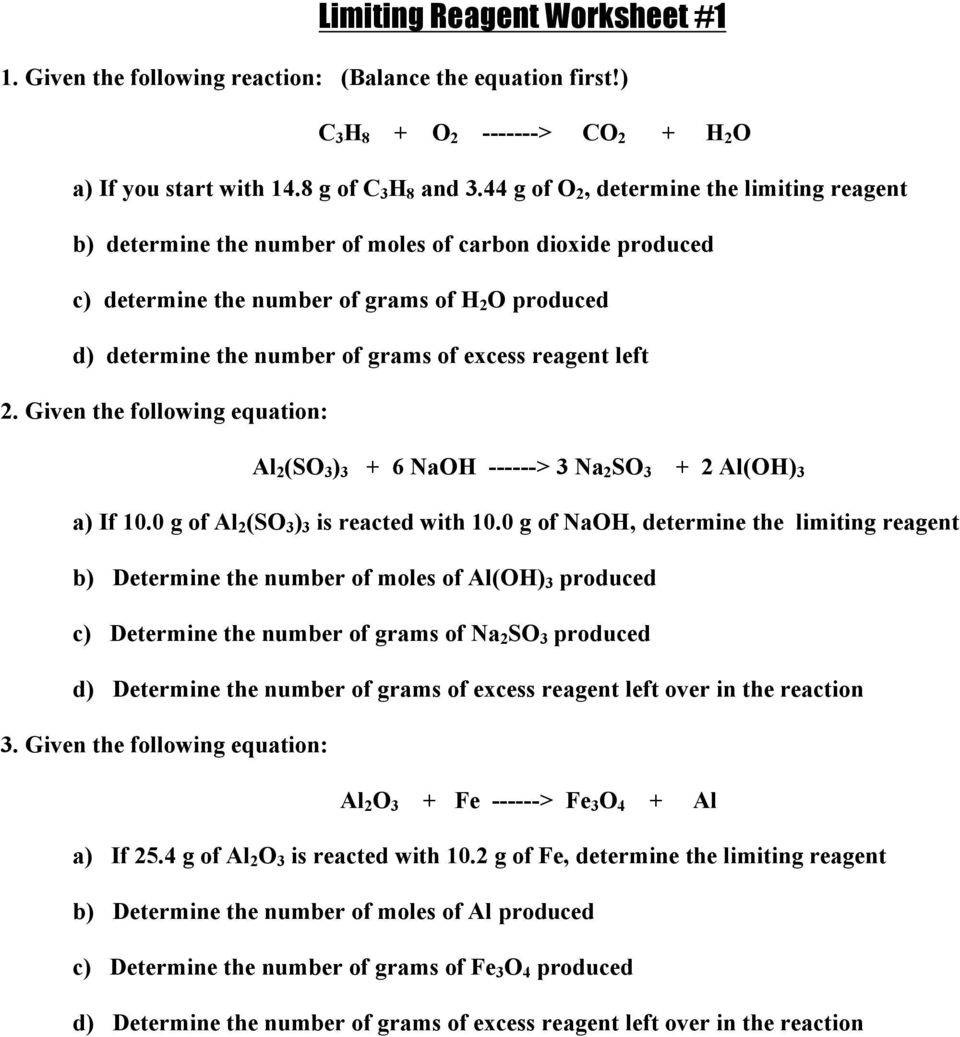
1 Limiting Reagent Worksheet #1 1. Given the following reaction: (Balance the equation first!) C 3 H 8 + O > CO 2 + H 2 O a) If you start with 14.8 g of C 3 H 8 and 3.44 g of O 2, determine the limiting reagent b) determine the number of moles of carbon dioxide produced c) determine the number of grams of H 2 O produced d) determine the number of grams of excess reagent left 2. Given the following equation: Al 2 (SO 3 ) NaOH > 3 Na 2 SO Al(OH) 3 a) If 10.0 g of Al 2 (SO 3 ) 3 is reacted with 10.0 g of NaOH, determine the limiting reagent b) Determine the number of moles of Al(OH) 3 produced c) Determine the number of grams of Na 2 SO 3 produced d) Determine the number of grams of excess reagent left over in the reaction 3. Given the following equation: Al 2 O 3 + Fe > Fe 3 O 4 + Al a) If 25.4 g of Al 2 O 3 is reacted with 10.2 g of Fe, determine the limiting reagent b) Determine the number of moles of Al produced c) Determine the number of grams of Fe 3 O 4 produced d) Determine the number of grams of excess reagent left over in the reaction
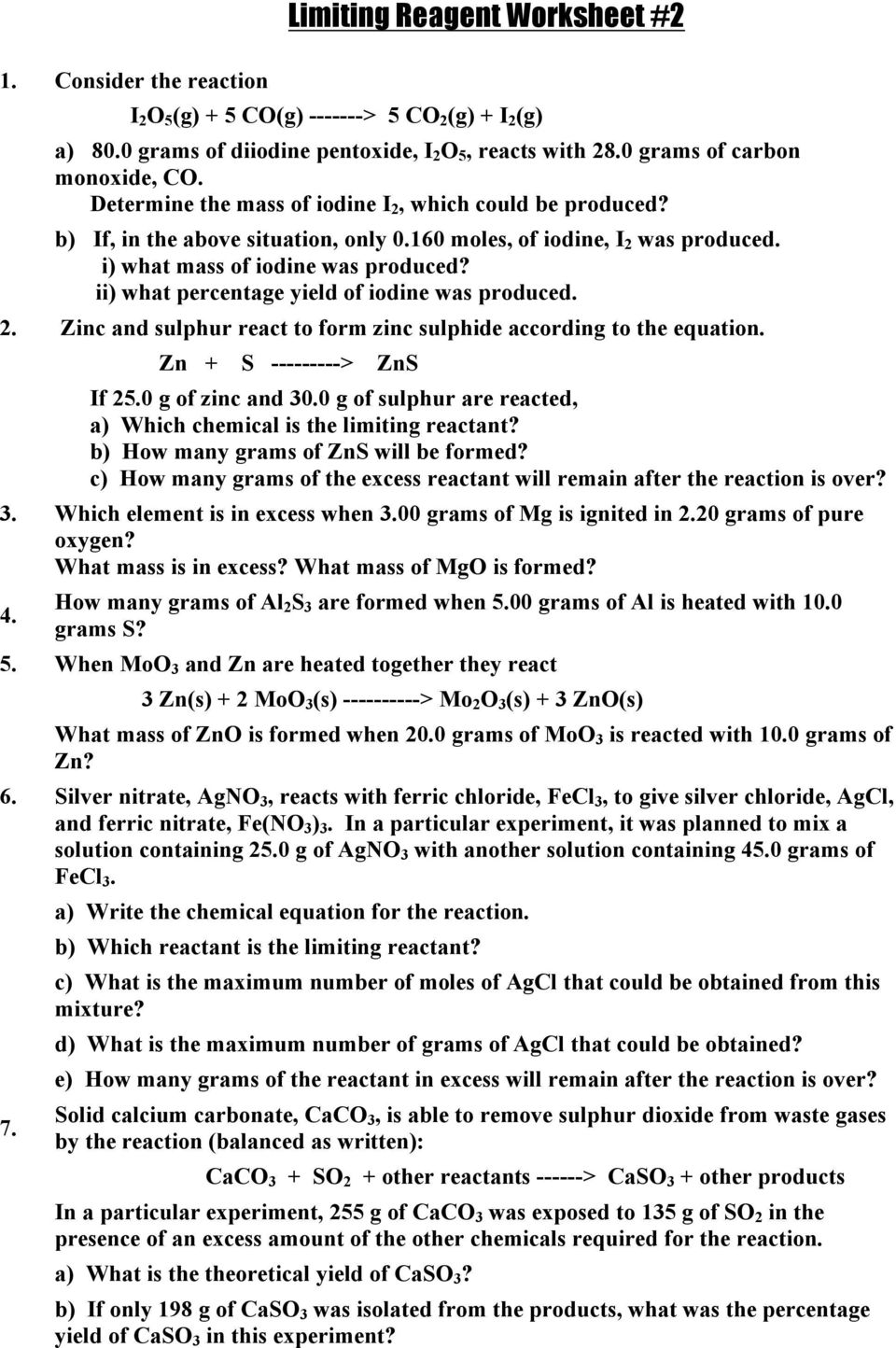
2 1. Consider the reaction Limiting Reagent Worksheet #2 I 2 O 5 (g) + 5 CO(g) > 5 CO 2 (g) + I 2 (g) a) 80.0 grams of diiodine pentoxide, I 2 O 5, reacts with 28.0 grams of carbon monoxide, CO. Determine the mass of iodine I 2, which could be produced? b) If, in the above situation, only moles, of iodine, I 2 was produced. i) what mass of iodine was produced? ii) what percentage yield of iodine was produced. 2. Zinc and sulphur react to form zinc sulphide according to the equation. Zn + S > ZnS If 25.0 g of zinc and 30.0 g of sulphur are reacted, a) Which chemical is the limiting reactant? b) How many grams of ZnS will be formed? c) How many grams of the excess reactant will remain after the reaction is over? 3. Which element is in excess when 3.00 grams of Mg is ignited in 2.20 grams of pure oxygen? What mass is in excess? What mass of MgO is formed? 4. How many grams of Al 2 S 3 are formed when 5.00 grams of Al is heated with 10.0 grams S? 5. When MoO 3 and Zn are heated together they react 3 Zn(s) + 2 MoO 3 (s) > Mo 2 O 3 (s) + 3 ZnO(s) What mass of ZnO is formed when 20.0 grams of MoO 3 is reacted with 10.0 grams of Zn? 6. Silver nitrate, AgNO 3, reacts with ferric chloride, FeCl 3, to give silver chloride, AgCl, and ferric nitrate, Fe(NO 3 ) 3. In a particular experiment, it was planned to mix a solution containing 25.0 g of AgNO 3 with another solution containing 45.0 grams of FeCl a) Write the chemical equation for the reaction. b) Which reactant is the limiting reactant? c) What is the maximum number of moles of AgCl that could be obtained from this mixture? d) What is the maximum number of grams of AgCl that could be obtained? e) How many grams of the reactant in excess will remain after the reaction is over? Solid calcium carbonate, CaCO 3, is able to remove sulphur dioxide from waste gases by the reaction (balanced as written): CaCO 3 + SO 2 + other reactants > CaSO 3 + other products In a particular experiment, 255 g of CaCO 3 was exposed to 135 g of SO 2 in the presence of an excess amount of the other chemicals required for the reaction. a) What is the theoretical yield of CaSO 3? b) If only 198 g of CaSO 3 was isolated from the products, what was the percentage yield of CaSO 3 in this experiment?
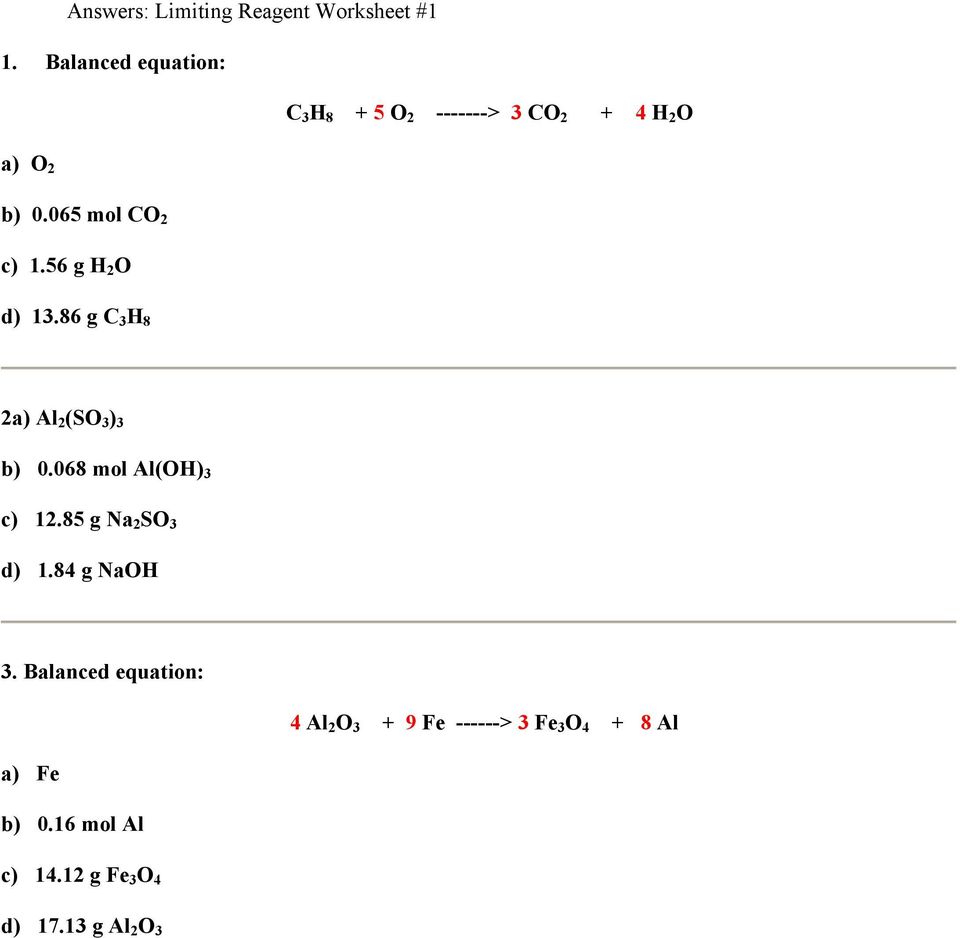
3 Answers: Limiting Reagent Worksheet #1 1. Balanced equation: C 3 H O > 3 CO H 2 O a) O 2 b) mol CO 2 c) 1.56 g H 2 O d) g C 3 H 8 2a) Al 2 (SO 3 ) 3 b) mol Al(OH) 3 c) g Na 2 SO 3 d) 1.84 g NaOH 3. Balanced equation: 4 Al 2 O Fe > 3 Fe 3 O Al a) Fe b) 0.16 mol Al c) g Fe 3 O 4 d) g Al 2 O 3
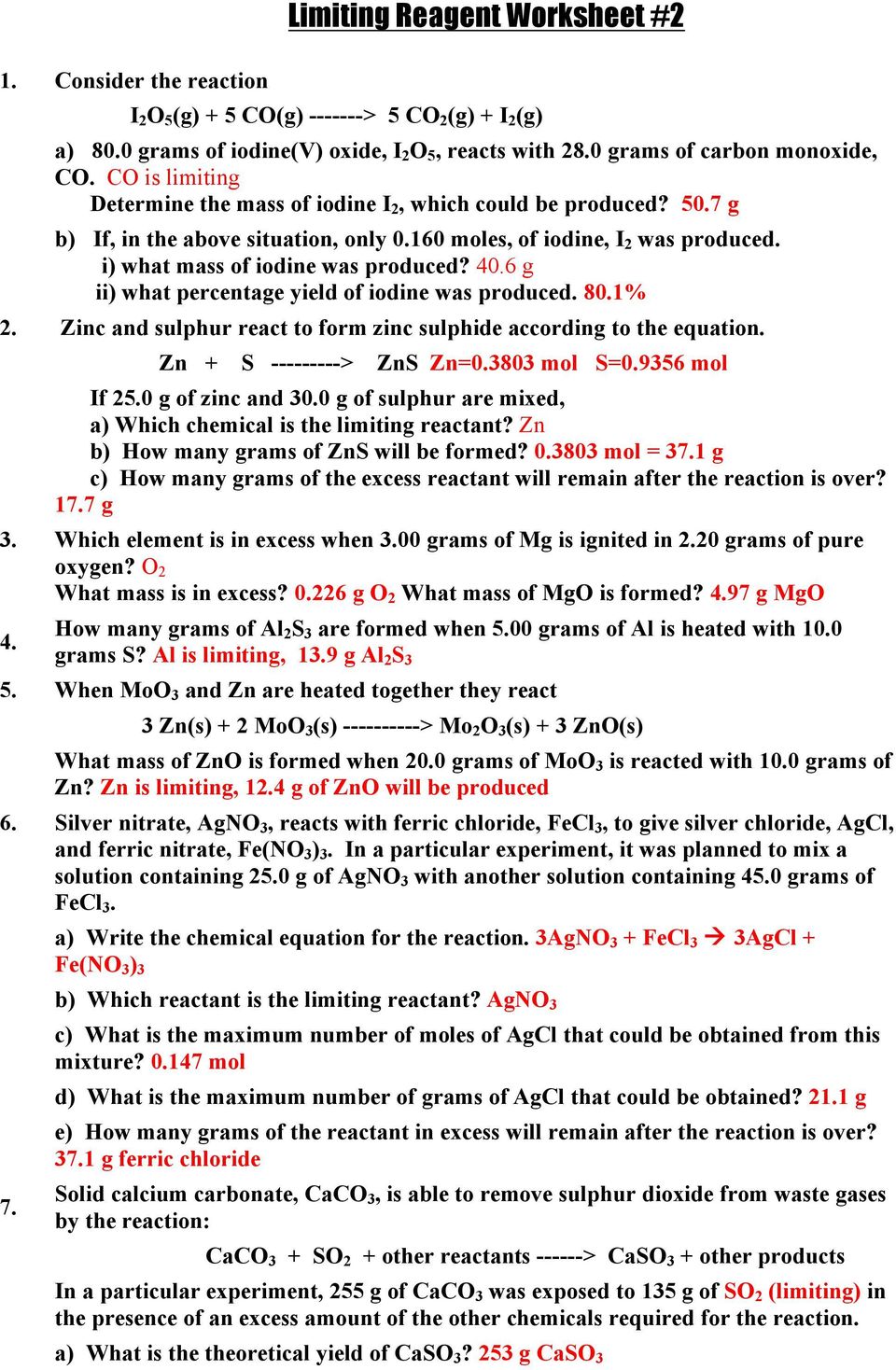
4 Limiting Reagent Worksheet #2 1. Consider the reaction I 2 O 5 (g) + 5 CO(g) > 5 CO 2 (g) + I 2 (g) a) 80.0 grams of iodine(v) oxide, I 2 O 5, reacts with 28.0 grams of carbon monoxide, CO. CO is limiting Determine the mass of iodine I 2, which could be produced? 50.7 g b) If, in the above situation, only moles, of iodine, I 2 was produced. i) what mass of iodine was produced? 40.6 g ii) what percentage yield of iodine was produced. 80.1% 2. Zinc and sulphur react to form zinc sulphide according to the equation. Zn + S > ZnS Zn= mol S= mol If 25.0 g of zinc and 30.0 g of sulphur are mixed, a) Which chemical is the limiting reactant? Zn b) How many grams of ZnS will be formed? mol = 37.1 g c) How many grams of the excess reactant will remain after the reaction is over? 17.7 g 3. Which element is in excess when 3.00 grams of Mg is ignited in 2.20 grams of pure oxygen? O 2 What mass is in excess? g O 2 What mass of MgO is formed? 4.97 g MgO 4. How many grams of Al 2 S 3 are formed when 5.00 grams of Al is heated with 10.0 grams S? Al is limiting, 13.9 g Al 2 S 3 5. When MoO 3 and Zn are heated together they react 3 Zn(s) + 2 MoO 3 (s) > Mo 2 O 3 (s) + 3 ZnO(s) What mass of ZnO is formed when 20.0 grams of MoO 3 is reacted with 10.0 grams of Zn? Zn is limiting, 12.4 g of ZnO will be produced 6. Silver nitrate, AgNO 3, reacts with ferric chloride, FeCl 3, to give silver chloride, AgCl, and ferric nitrate, Fe(NO 3 ) 3. In a particular experiment, it was planned to mix a solution containing 25.0 g of AgNO 3 with another solution containing 45.0 grams of FeCl 3. a) Write the chemical equation for the reaction. 3AgNO 3 + FeCl 3 3AgCl + Fe(NO 3 ) 3 7. b) Which reactant is the limiting reactant? AgNO 3 c) What is the maximum number of moles of AgCl that could be obtained from this mixture? mol d) What is the maximum number of grams of AgCl that could be obtained? 21.1 g e) How many grams of the reactant in excess will remain after the reaction is over? 37.1 g ferric chloride Solid calcium carbonate, CaCO 3, is able to remove sulphur dioxide from waste gases by the reaction: CaCO 3 + SO 2 + other reactants > CaSO 3 + other products In a particular experiment, 255 g of CaCO 3 was exposed to 135 g of SO 2 (limiting) in the presence of an excess amount of the other chemicals required for the reaction. a) What is the theoretical yield of CaSO 3? 253 g CaSO 3
5 b) If only 198 g of CaSO 3 was isolated from the products, what was the percentage yield of CaSO 3 in this experiment? 78.3%

Tutorial 4 SOLUTION STOICHIOMETRY. Solution stoichiometry calculations involve chemical reactions taking place in solution.
 T-27 Tutorial 4 SOLUTION STOICHIOMETRY Solution stoichiometry calculations involve chemical reactions taking place in solution. Of the various methods of expressing solution concentration the most convenient
Unit 10A Stoichiometry Notes
 Unit 10A Stoichiometry Notes Stoichiometry is a big word for a process that chemist s use to calculate amounts in reactions. It makes use of the coefficient ratio set up by balanced reaction equations
Stoichiometry Review
 Stoichiometry Review There are 20 problems in this review set. Answers, including problem set-up, can be found in the second half of this document. 1. N 2 (g) + 3H 2 (g) --------> 2NH 3 (g) a. nitrogen
Chem 1100 Chapter Three Study Guide Answers Outline I. Molar Mass and Moles A. Calculations of Molar Masses
 Chem 1100 Chapter Three Study Guide Answers Outline I. Molar Mass and Moles A. Calculations of Molar Masses B. Calculations of moles C. Calculations of number of atoms from moles/molar masses 1. Avagadro
CHEMICAL REACTIONS AND REACTING MASSES AND VOLUMES
 CHEMICAL REACTIONS AND REACTING MASSES AND VOLUMES The meaning of stoichiometric coefficients: 2 H 2 (g) + O 2 (g) 2 H 2 O(l) number of reacting particles 2 molecules of hydrogen react with 1 molecule
How To Calculate Mass In Chemical Reactions
 We have used the mole concept to calculate mass relationships in chemical formulas Molar mass of ethanol (C 2 H 5 OH)? Molar mass = 2 x 12.011 + 6 x 1.008 + 1 x15.999 = 46.069 g/mol Mass percentage of
Unit 9 Stoichiometry Notes (The Mole Continues)
 Unit 9 Stoichiometry Notes (The Mole Continues) is a big word for a process that chemist s use to calculate amounts in reactions. It makes use of the coefficient ratio set up by balanced reaction equations
10 Cl atoms. 10 H2O molecules. 8.3 mol HCN = 8.3 mol N atoms 1 mol HCN. 2 mol H atoms 2.63 mol CH2O = 5.26 mol H atoms 1 mol CH O
 Chem 100 Mole conversions and stoichiometry worksheet 1. How many Ag atoms are in.4 mol Ag atoms? 6.0 10 Ag atoms 4.4 mol Ag atoms = 1.46 10 Ag atoms 1 mol Ag atoms. How many Br molecules are in 18. mol
Moles. Balanced chemical equations Molar ratios Mass Composition Empirical and Molecular Mass Predicting Quantities Equations
 Moles Balanced chemical equations Molar ratios Mass Composition Empirical and Molecular Mass Predicting Quantities Equations Micro World atoms & molecules Macro World grams Atomic mass is the mass of an
1. When the following equation is balanced, the coefficient of Al is. Al (s) + H 2 O (l)? Al(OH) 3 (s) + H 2 (g)
 1. When the following equation is balanced, the coefficient of Al is. Al (s) + H 2 O (l)? Al(OH) (s) + H 2 (g) A) 1 B) 2 C) 4 D) 5 E) Al (s) + H 2 O (l)? Al(OH) (s) + H 2 (g) Al (s) + H 2 O (l)? Al(OH)
SCH 4C1 Unit 2 Problem Set Questions taken from Frank Mustoe et all, "Chemistry 11", McGraw-Hill Ryerson, 2001
 SCH 4C1 Unit 2 Problem Set Questions taken from Frank Mustoe et all, "Chemistry 11", McGraw-Hill Ryerson, 2001 1. A small pin contains 0.0178 mol of iron. How many atoms of iron are in the pin? 2. A sample
Formulae, stoichiometry and the mole concept
 3 Formulae, stoichiometry and the mole concept Content 3.1 Symbols, Formulae and Chemical equations 3.2 Concept of Relative Mass 3.3 Mole Concept and Stoichiometry Learning Outcomes Candidates should be
Chem 31 Fall 2002. Chapter 3. Stoichiometry: Calculations with Chemical Formulas and Equations. Writing and Balancing Chemical Equations
 Chem 31 Fall 2002 Chapter 3 Stoichiometry: Calculations with Chemical Formulas and Equations Writing and Balancing Chemical Equations 1. Write Equation in Words -you cannot write an equation unless you
W1 WORKSHOP ON STOICHIOMETRY
 INTRODUCTION W1 WORKSHOP ON STOICHIOMETRY These notes and exercises are designed to introduce you to the basic concepts required to understand a chemical formula or equation. Relative atomic masses of
1. Read P. 368-375, P. 382-387 & P. 429-436; P. 375 # 1-11 & P. 389 # 1,7,9,12,15; P. 436 #1, 7, 8, 11
 SCH3U- R.H.KING ACADEMY SOLUTION & ACID/BASE WORKSHEET Name: The importance of water - MAKING CONNECTION READING 1. Read P. 368-375, P. 382-387 & P. 429-436; P. 375 # 1-11 & P. 389 # 1,7,9,12,15; P. 436
MOLES AND MOLE CALCULATIONS
 35 MOLES ND MOLE CLCULTIONS INTRODUCTION The purpose of this section is to present some methods for calculating both how much of each reactant is used in a chemical reaction, and how much of each product
Chemistry 12 Worksheet 1-1 - Measuring Reaction Rates
 Chemistry 12 Worksheet 1-1 - Measuring Reaction Rates 1. A chemist wishes to determine the rate of reaction of zinc with hydrochloric acid. The equation for the reaction is: Zn (s) + 2HCl (aq) oh 2(g)
Chapter 5. Chemical Reactions and Equations. Introduction. Chapter 5 Topics. 5.1 What is a Chemical Reaction
 Introduction Chapter 5 Chemical Reactions and Equations Chemical reactions occur all around us. How do we make sense of these changes? What patterns can we find? 1 2 Copyright The McGraw-Hill Companies,
Chemistry: Chemical Equations
 Chemistry: Chemical Equations Write a balanced chemical equation for each word equation. Include the phase of each substance in the equation. Classify the reaction as synthesis, decomposition, single replacement,
Chapter 1 The Atomic Nature of Matter
 Chapter 1 The Atomic Nature of Matter 6. Substances that cannot be decomposed into two or more simpler substances by chemical means are called a. pure substances. b. compounds. c. molecules. d. elements.
Balancing Chemical Equations Worksheet
 Balancing Chemical Equations Worksheet Student Instructions 1. Identify the reactants and products and write a word equation. 2. Write the correct chemical formula for each of the reactants and the products.
Chemistry B11 Chapter 4 Chemical reactions
 Chemistry B11 Chapter 4 Chemical reactions Chemical reactions are classified into five groups: A + B AB Synthesis reactions (Combination) H + O H O AB A + B Decomposition reactions (Analysis) NaCl Na +Cl
Stoichiometry. Lecture Examples Answer Key
 Stoichiometry Lecture Examples Answer Key Ex. 1 Balance the following chemical equations: 3 NaBr + 1 H 3 PO 4 3 HBr + 1 Na 3 PO 4 2 C 3 H 5 N 3 O 9 6 CO 2 + 3 N 2 + 5 H 2 O + 9 O 2 2 Ca(OH) 2 + 2 SO 2
IB Chemistry. DP Chemistry Review
 DP Chemistry Review Topic 1: Quantitative chemistry 1.1 The mole concept and Avogadro s constant Assessment statement Apply the mole concept to substances. Determine the number of particles and the amount
Honors Chemistry: Unit 6 Test Stoichiometry PRACTICE TEST ANSWER KEY Page 1. A chemical equation. (C-4.4)
 Honors Chemistry: Unit 6 Test Stoichiometry PRACTICE TEST ANSWER KEY Page 1 1. 2. 3. 4. 5. 6. Question What is a symbolic representation of a chemical reaction? What 3 things (values) is a mole of a chemical
Chapter 6 Chemical Calculations
 Chapter 6 Chemical Calculations 1 Submicroscopic Macroscopic 2 Chapter Outline 1. Formula Masses (Ch 6.1) 2. Percent Composition (supplemental material) 3. The Mole & Avogadro s Number (Ch 6.2) 4. Molar
Moles. Moles. Moles. Moles. Balancing Eqns. Balancing. Balancing Eqns. Symbols Yields or Produces. Like a recipe:
 Like a recipe: Balancing Eqns Reactants Products 2H 2 (g) + O 2 (g) 2H 2 O(l) coefficients subscripts Balancing Eqns Balancing Symbols (s) (l) (aq) (g) or Yields or Produces solid liquid (pure liquid)
Chapter 6 Notes Science 10 Name:
 6.1 Types of Chemical Reactions a) Synthesis (A + B AB) Synthesis reactions are also known as reactions. When this occurs two or more reactants (usually elements) join to form a. A + B AB, where A and
Experiment 5. Chemical Reactions A + X AX AX A + X A + BX AX + B AZ + BX AX + BZ
 Experiment 5 Chemical Reactions OBJECTIVES 1. To observe the various criteria that are used to indicate that a chemical reaction has occurred. 2. To convert word equations into balanced inorganic chemical
Number of moles of solute = Concentration (mol. L ) x Volume of solution (litres) or n = C x V
 44 CALCULATIONS INVOLVING SOLUTIONS INTRODUCTION AND DEFINITIONS Many chemical reactions take place in aqueous (water) solution. Quantities of such solutions are measured as volumes, while the amounts
CHEMICAL REACTIONS. Chemistry 51 Chapter 6
 CHEMICAL REACTIONS A chemical reaction is a rearrangement of atoms in which some of the original bonds are broken and new bonds are formed to give different chemical structures. In a chemical reaction,
2. The percent yield is the maximum amount of product that can be produced from the given amount of limiting reactant.
 UNIT 6 stoichiometry practice test True/False Indicate whether the statement is true or false. moles F 1. The mole ratio is a comparison of how many grams of one substance are required to participate in
Part One: Mass and Moles of Substance. Molecular Mass = sum of the Atomic Masses in a molecule
 CHAPTER THREE: CALCULATIONS WITH CHEMICAL FORMULAS AND EQUATIONS Part One: Mass and Moles of Substance A. Molecular Mass and Formula Mass. (Section 3.1) 1. Just as we can talk about mass of one atom of
Chemical Calculations: Formula Masses, Moles, and Chemical Equations
 Chemical Calculations: Formula Masses, Moles, and Chemical Equations Atomic Mass & Formula Mass Recall from Chapter Three that the average mass of an atom of a given element can be found on the periodic
Sample Exercise 3.1 Interpreting and Balancing Chemical Equations
 Sample Exercise 3.1 Interpreting and Balancing Chemical Equations The following diagram represents a chemical reaction in which the red spheres are oxygen atoms and the blue spheres are nitrogen atoms.
Name Class Date. Section: Calculating Quantities in Reactions. Complete each statement below by writing the correct term or phrase.
 Skills Worksheet Concept Review Section: Calculating Quantities in Reactions Complete each statement below by writing the correct term or phrase. 1. All stoichiometric calculations involving equations
Answers and Solutions to Text Problems
 Chapter 7 Answers and Solutions 7 Answers and Solutions to Text Problems 7.1 A mole is the amount of a substance that contains 6.02 x 10 23 items. For example, one mole of water contains 6.02 10 23 molecules
UNIT (4) CALCULATIONS AND CHEMICAL REACTIONS
 UNIT (4) CALCULATIONS AND CHEMICAL REACTIONS 4.1 Formula Masses Recall that the decimal number written under the symbol of the element in the periodic table is the atomic mass of the element. 1 7 8 12
Chapter 3! Stoichiometry: Calculations with Chemical Formulas and Equations. Stoichiometry
 Chapter 3! : Calculations with Chemical Formulas and Equations Anatomy of a Chemical Equation CH 4 (g) + 2O 2 (g) CO 2 (g) + 2 H 2 O (g) Anatomy of a Chemical Equation CH 4 (g) + 2 O 2 (g) CO 2 (g) + 2
2. DECOMPOSITION REACTION ( A couple have a heated argument and break up )
 TYPES OF CHEMICAL REACTIONS Most reactions can be classified into one of five categories by examining the types of reactants and products involved in the reaction. Knowing the types of reactions can help
Unit 6 The Mole Concept
 Chemistry Form 3 Page 62 Ms. R. Buttigieg Unit 6 The Mole Concept See Chemistry for You Chapter 28 pg. 352-363 See GCSE Chemistry Chapter 5 pg. 70-79 6.1 Relative atomic mass. The relative atomic mass
Name Date Class STOICHIOMETRY. SECTION 12.1 THE ARITHMETIC OF EQUATIONS (pages 353 358)
 Name Date Class 1 STOICHIOMETRY SECTION 1.1 THE ARITHMETIC OF EQUATIONS (pages 353 358) This section explains how to calculate the amount of reactants required or product formed in a nonchemical process.
Chapter 3: Stoichiometry
 Chapter 3: Stoichiometry Key Skills: Balance chemical equations Predict the products of simple combination, decomposition, and combustion reactions. Calculate formula weights Convert grams to moles and
Chemistry Themed. Types of Reactions
 Chemistry Themed Types of Reactions 1 2 Chemistry in the Community-2015-2016 Types of Reactions Date In-Class Assignment Homework T 10/20 TEST on Reactivity of Metals and Redox None W 10/21 Late Start
Calculating Atoms, Ions, or Molecules Using Moles
 TEKS REVIEW 8B Calculating Atoms, Ions, or Molecules Using Moles TEKS 8B READINESS Use the mole concept to calculate the number of atoms, ions, or molecules in a sample TEKS_TXT of material. Vocabulary
English already has many collective nouns for fixed, given numbers of objects. Some of the more common collective nouns are shown in Table 7.1.
 96 Chapter 7: Calculations with Chemical Formulas and Chemical Reactions Chemical reactions are written showing a few individual atoms or molecules reacting to form a few atoms or molecules of products.
Appendix D. Reaction Stoichiometry D.1 INTRODUCTION
 Appendix D Reaction Stoichiometry D.1 INTRODUCTION In Appendix A, the stoichiometry of elements and compounds was presented. There, the relationships among grams, moles and number of atoms and molecules
Chapter 3 Mass Relationships in Chemical Reactions
 Chapter 3 Mass Relationships in Chemical Reactions Student: 1. An atom of bromine has a mass about four times greater than that of an atom of neon. Which choice makes the correct comparison of the relative
Moles, Molecules, and Grams Worksheet Answer Key
 Moles, Molecules, and Grams Worksheet Answer Key 1) How many are there in 24 grams of FeF 3? 1.28 x 10 23 2) How many are there in 450 grams of Na 2 SO 4? 1.91 x 10 24 3) How many grams are there in 2.3
Stoichiometry Limiting Reagent Laboratory. Chemistry 118 Laboratory University of Massachusetts, Boston
 Chemistry 118 Laboratory University of Massachusetts, Boston STOICHIOMETRY - LIMITING REAGENT --------------------------------------------------------------------------------------------------------------------------------------------
Chapter 3. Chemical Reactions and Reaction Stoichiometry. Lecture Presentation. James F. Kirby Quinnipiac University Hamden, CT
 Lecture Presentation Chapter 3 Chemical Reactions and Reaction James F. Kirby Quinnipiac University Hamden, CT The study of the mass relationships in chemistry Based on the Law of Conservation of Mass
Chapter 8: Chemical Equations and Reactions
 Chapter 8: Chemical Equations and Reactions I. Describing Chemical Reactions A. A chemical reaction is the process by which one or more substances are changed into one or more different substances. A chemical
11-1 Stoichiometry. Represents
 11-1 Stoichiometry What is stoichiometry? Calculations that relate the quantities of substances. It is the study of quantitative (measurable amounts) relationships in chemical reactions and equations.
Chapter 1: Moles and equations. Learning outcomes. you should be able to:
 Chapter 1: Moles and equations 1 Learning outcomes you should be able to: define and use the terms: relative atomic mass, isotopic mass and formula mass based on the 12 C scale perform calculations, including
Writing, Balancing and Predicting Products of Chemical Reactions.
 Writing, Balancing and Predicting Products of Chemical Reactions. A chemical equation is a concise shorthand expression which represents the relative amount of reactants and products involved in a chemical
APPENDIX B: EXERCISES
 BUILDING CHEMISTRY LABORATORY SESSIONS APPENDIX B: EXERCISES Molecular mass, the mole, and mass percent Relative atomic and molecular mass Relative atomic mass (A r ) is a constant that expresses the ratio
1. How many hydrogen atoms are in 1.00 g of hydrogen?
 MOLES AND CALCULATIONS USING THE MOLE CONCEPT INTRODUCTORY TERMS A. What is an amu? 1.66 x 10⁻²⁴ g B. We need a conversion to the macroscopic world. 1. How many hydrogen atoms are in 1.00 g of hydrogen?
Atomic Structure. Name Mass Charge Location Protons 1 +1 Nucleus Neutrons 1 0 Nucleus Electrons 1/1837-1 Orbit nucleus in outer shells
 Atomic Structure called nucleons Name Mass Charge Location Protons 1 +1 Nucleus Neutrons 1 0 Nucleus Electrons 1/1837-1 Orbit nucleus in outer shells The number of protons equals the atomic number This
Calculation of Molar Masses. Molar Mass. Solutions. Solutions
 Molar Mass Molar mass = Mass in grams of one mole of any element, numerically equal to its atomic weight Molar mass of molecules can be determined from the chemical formula and molar masses of elements
Solution a homogeneous mixture = A solvent + solute(s) Aqueous solution water is the solvent
 Solution a homogeneous mixture = A solvent + solute(s) Aqueous solution water is the solvent Water a polar solvent: dissolves most ionic compounds as well as many molecular compounds Aqueous solution:
Unit 2: Quantities in Chemistry
 Mass, Moles, & Molar Mass Relative quantities of isotopes in a natural occurring element (%) E.g. Carbon has 2 isotopes C-12 and C-13. Of Carbon s two isotopes, there is 98.9% C-12 and 11.1% C-13. Find
Sample Problem: STOICHIOMETRY and percent yield calculations. How much H 2 O will be formed if 454 g of. decomposes? NH 4 NO 3 N 2 O + 2 H 2 O
 STOICHIOMETRY and percent yield calculations 1 Steps for solving Stoichiometric Problems 2 Step 1 Write the balanced equation for the reaction. Step 2 Identify your known and unknown quantities. Step 3
Balancing Chemical Equations
 Balancing Chemical Equations PART I: Background Information: Word and Formula Equations The first step in writing a chemical equation is to identify the facts to be represented. It is helpful to write
Unit 7 Stoichiometry. Chapter 12
 Unit 7 Stoichiometry Chapter 12 Objectives 7.1 use stoichiometry to determine the amount of substance in a reaction 7.2 determine the limiting reactant of a reaction 7.3 determine the percent yield of
Aqueous Solutions. Water is the dissolving medium, or solvent. Some Properties of Water. A Solute. Types of Chemical Reactions.
 Aqueous Solutions and Solution Stoichiometry Water is the dissolving medium, or solvent. Some Properties of Water Water is bent or V-shaped. The O-H bonds are covalent. Water is a polar molecule. Hydration
Problem Solving. Percentage Yield
 Skills Worksheet Problem Solving Percentage Yield Although we can write perfectly balanced equations to represent perfect reactions, the reactions themselves are often not perfect. A reaction does not
stoichiometry = the numerical relationships between chemical amounts in a reaction.
 1 REACTIONS AND YIELD ANSWERS stoichiometry = the numerical relationships between chemical amounts in a reaction. 2C 8 H 18 (l) + 25O 2 16CO 2 (g) + 18H 2 O(g) From the equation, 16 moles of CO 2 (a greenhouse
Atomic mass is the mass of an atom in atomic mass units (amu)
 Micro World atoms & molecules Laboratory scale measurements Atomic mass is the mass of an atom in atomic mass units (amu) By definition: 1 atom 12 C weighs 12 amu On this scale 1 H = 1.008 amu 16 O = 16.00
EDULABZ. Na 2 + H 2 CO 3. O + CO 2 (b) CaO + H 2. + NaCl AgCl + NaNO 3 3. Which of the following reactions does not take place?
 4 TRANSFORMATION OF SUBSTANCE I. Multiple choice questions: (Tick the correct option). 1. The reaction between magnesium and oxygen is: (a) an endothermic reaction (b) an exothermic reaction (c) a catalysed
CP Chemistry Review for Stoichiometry Test
 CP Chemistry Review for Stoichiometry Test Stoichiometry Problems (one given reactant): 1. Make sure you have a balanced chemical equation 2. Convert to moles of the known substance. (Use the periodic
Chapter 4: Chemical and Solution Stoichiometry
 Chapter 4: Chemical and Solution Stoichiometry (Sections 4.1-4.4) 1 Reaction Stoichiometry The coefficients in a balanced chemical equation specify the relative amounts in moles of each of the substances
Calculations and Chemical Equations. Example: Hydrogen atomic weight = 1.008 amu Carbon atomic weight = 12.001 amu
 Calculations and Chemical Equations Atomic mass: Mass of an atom of an element, expressed in atomic mass units Atomic mass unit (amu): 1.661 x 10⁻²⁴ g Atomic weight: Average mass of all isotopes of a given
ATOMS. Multiple Choice Questions
 Chapter 3 ATOMS AND MOLECULES Multiple Choice Questions 1. Which of the following correctly represents 360 g of water? (i) 2 moles of H 2 0 (ii) 20 moles of water (iii) 6.022 10 23 molecules of water (iv)
Balancing Chemical Equations
 Why? Balancing Chemical Equations Atoms are neither created nor destroyed in a chemical reaction, they are just rearranged. In other words, in a chemical reaction, what goes into the reaction must come
Topic 4 National Chemistry Summary Notes. Formulae, Equations, Balancing Equations and The Mole
 Topic 4 National Chemistry Summary Notes Formulae, Equations, Balancing Equations and The Mole LI 1 The chemical formula of a covalent molecular compound tells us the number of atoms of each element present
6 Reactions in Aqueous Solutions
 6 Reactions in Aqueous Solutions Water is by far the most common medium in which chemical reactions occur naturally. It is not hard to see this: 70% of our body mass is water and about 70% of the surface
GCSE Chemistry. Making Salts Instructions and answers for teachers
 GCSE Chemistry Making Salts Instructions and answers for teachers The Activity: Learning Outcomes: To be able to recall the names and chemical formulae for commonly used acids To understand how salts can
Chapter 5, Calculations and the Chemical Equation
 1. How many iron atoms are present in one mole of iron? Ans. 6.02 1023 atoms 2. How many grams of sulfur are found in 0.150 mol of sulfur? [Use atomic weight: S, 32.06 amu] Ans. 4.81 g 3. How many moles
Steps for balancing a chemical equation
 The Chemical Equation: A Chemical Recipe Dr. Gergens - SD Mesa College A. Learn the meaning of these arrows. B. The chemical equation is the shorthand notation for a chemical reaction. A chemical equation
Stoichiometry. 1. The total number of moles represented by 20 grams of calcium carbonate is (1) 1; (2) 2; (3) 0.1; (4) 0.2.
 Stoichiometry 1 The total number of moles represented by 20 grams of calcium carbonate is (1) 1; (2) 2; (3) 01; (4) 02 2 A 44 gram sample of a hydrate was heated until the water of hydration was driven
DETERMINING THE ENTHALPY OF FORMATION OF CaCO 3
 DETERMINING THE ENTHALPY OF FORMATION OF CaCO 3 Standard Enthalpy Change Standard Enthalpy Change for a reaction, symbolized as H 0 298, is defined as The enthalpy change when the molar quantities of reactants
Problem Solving. Stoichiometry of Gases
 Skills Worksheet Problem Solving Stoichiometry of Gases Now that you have worked with relationships among moles, mass, and volumes of gases, you can easily put these to work in stoichiometry calculations.
Concept 1. The meaning and usefulness of the mole. The mole (or mol) represents a certain number of objects.
 Chapter 3. Stoichiometry: Mole-Mass Relationships in Chemical Reactions Concept 1. The meaning and usefulness of the mole The mole (or mol) represents a certain number of objects. SI def.: the amount of
EXPERIMENT 7 Reaction Stoichiometry and Percent Yield
 EXPERIMENT 7 Reaction Stoichiometry and Percent Yield INTRODUCTION Stoichiometry calculations are about calculating the amounts of substances that react and form in a chemical reaction. The word stoichiometry
neutrons are present?
 AP Chem Summer Assignment Worksheet #1 Atomic Structure 1. a) For the ion 39 K +, state how many electrons, how many protons, and how many 19 neutrons are present? b) Which of these particles has the smallest
EXTRACTION OF METALS
 1 EXTRACTION OF METALS Occurrence ores of some metals are very common (iron, aluminium) others occur only in limited quantities in selected areas ores need to be purified before being reduced to the metal
Chemical Equations and Chemical Reactions. Chapter 8.1
 Chemical Equations and Chemical Reactions Chapter 8.1 Objectives List observations that suggest that a chemical reaction has taken place List the requirements for a correctly written chemical equation.
Chemical Equations & Stoichiometry
 Chemical Equations & Stoichiometry Chapter Goals Balance equations for simple chemical reactions. Perform stoichiometry calculations using balanced chemical equations. Understand the meaning of the term
Chapter 3 Stoichiometry
 Chapter 3 Stoichiometry 3-1 Chapter 3 Stoichiometry In This Chapter As you have learned in previous chapters, much of chemistry involves using macroscopic measurements to deduce what happens between atoms
Decomposition. Composition
 Decomposition 1. Solid ammonium carbonate is heated. 2. Solid calcium carbonate is heated. 3. Solid calcium sulfite is heated in a vacuum. Composition 1. Barium oxide is added to distilled water. 2. Phosphorus
Stoichiometry Limiting Reagent Laboratory. Chemistry 118 Laboratory University of Massachusetts, Boston
 Chemistry 118 Laboratory University of Massachusetts, Boston STOICHIOMETRY - LIMITING REAGENT -----------------------------------------------------------------------------------------------------------------------------
IB Chemistry 1 Mole. One atom of C-12 has a mass of 12 amu. One mole of C-12 has a mass of 12 g. Grams we can use more easily.
 The Mole Atomic mass units and atoms are not convenient units to work with. The concept of the mole was invented. This was the number of atoms of carbon-12 that were needed to make 12 g of carbon. 1 mole
Name: Class: Date: 2 4 (aq)
 Name: Class: Date: Unit 4 Practice Test Multiple Choice Identify the choice that best completes the statement or answers the question. 1) The balanced molecular equation for complete neutralization of
CHEMISTRY COMPUTING FORMULA MASS WORKSHEET
 CHEMISTRY COMPUTING FORMULA MASS WORKSHEET Directions: Find the formula mass of the following compounds. Round atomic masses to the tenth of a decimal place. Place your final answer in the FORMULA MASS
Chapter 16: Tests for ions and gases
 The position of hydrogen in the reactivity series Hydrogen, although not a metal, is included in the reactivity series because it, like metals, can be displaced from aqueous solution, only this time the
Periodic Table, Valency and Formula
 Periodic Table, Valency and Formula Origins of the Periodic Table Mendelѐѐv in 1869 proposed that a relationship existed between the chemical properties of elements and their atomic masses. He noticed
Word Equations and Balancing Equations. Video Notes
 Word Equations and Balancing Equations Video Notes In this lesson, you will: Use the law of conservation of mass and provide standard rules for writing and balancing equations. Write and balance equations
Chemistry Post-Enrolment Worksheet
 Name: Chemistry Post-Enrolment Worksheet The purpose of this worksheet is to get you to recap some of the fundamental concepts that you studied at GCSE and introduce some of the concepts that will be part
The 5 Types of Chemical Reactions (Chapter 11) By C B 6 th period
 The 5 Types of Chemical Reactions (Chapter 11) By C B 6 th period 1) Combination Reactions Is also referred to as a synthesis reaction It is a chemical change in which two or more substances react to form
H 2 + O 2 H 2 O. - Note there is not enough hydrogen to react with oxygen - It is necessary to balance equation.
 CEMICAL REACTIONS 1 ydrogen + Oxygen Water 2 + O 2 2 O reactants product(s) reactant substance before chemical change product substance after chemical change Conservation of Mass During a chemical reaction,