
Geometry Progress Ladder
|
|
|
- Aubrey Lawson
- 9 years ago
- Views:
Transcription
1 Geometry Progress Ladder Maths Makes Sense Foundation End-of-year objectives page 2 Maths Makes Sense 1 2 End-of-block objectives page 3 Maths Makes Sense 3 4 End-of-block objectives page 4 Maths Makes Sense 5 6 End-of-block objectives page 5 2 Oxford University Press 2012 Maths Makes Sense Geometey Progress Ladder

2 Maths Makes Sense Foundation End-of-year objectives Counting Number Writing Participate in stories, songs and rhymes involving number, repetition and actions Count forwards starting at any number (0 1000) Count backwards starting at any number (0 1000) Count up to 10 objects when asked How many...?, and reply with the correct number Count objects when asked How much is there here? and reply with, for example, [number] cups Read, say and match numbers 0 9 Read, say and match numbers Sequence numbers in order Match the number of objects to the numeral Recognise and say numbers greater than 20 in an everyday context Play simple games that involve use of number Recognise and write numbers from 0 9 Recognise and write numbers from Recognise and write fractions: ½ ¼ Copy and write Maths Stories, e.g = 1 Calculating Shape Position Read what an addition or subtraction Maths Story with 1-digit whole numbers including ½ and ¼ (with a whole-number answer) says Read what an addition or subtraction Maths Story with 1-digit whole numbers including ½ and ¼ (with a whole-number answer) means Act the Real Story for an addition or subtraction Maths Story with 1-digit whole numbers including ½ and ¼ with cups Act out a Real-Life Story an addition or subtraction Maths Story with 1-digit whole numbers including ½ and ¼ using, e.g. pennies Share objects into equal groups and count how many in each group Participate in role play prompted by a Maths Story Recognise, name and describe 2D shapes Play simple games that involve use of number, pattern, shape and language Follow instructions that involve positional language Give directions that include positional language Sorting and data Measure Problem-solving Sort objects such as playing cards, number cards, coloured objects, 2D and 3D shapes according to criteria Read information from a simple block graph Make a simple block graph using blocks or bricks Use comparative language, such as bigger/smaller, shorter/ longer, heavier/lighter to compare quantities. Tell the time using o clock Use sand timers to measure minutes Use knowledge and skills of counting to solve simple problems, e.g. counting pairs of socks Use knowledge and skills of songs and rhymes to join in with a modified song or rhyme, e.g. Three Little Dickie Birds Use knowledge and skills of number and calculating to solve simple problems, e.g. sharing nine cakes between three friends Use knowledge and skills of shape, position, sorting and measure to solve simple problems, e.g. building a room with construction bricks 2
![and reply with, for example, [number] cups Read, say and match numbers 0 9 Read, say and match numbers 10 20 Sequence numbers in order Match the number of objects to the numeral Recognise and say](/docs-images/46/21699988/images/page_2.jpg "numbers greater than 20 in an everyday context Play simple games that involve use of number Recognise and write numbers from 0 9 Recognise and write numbers from 10 20 Recognise and write fractions:")
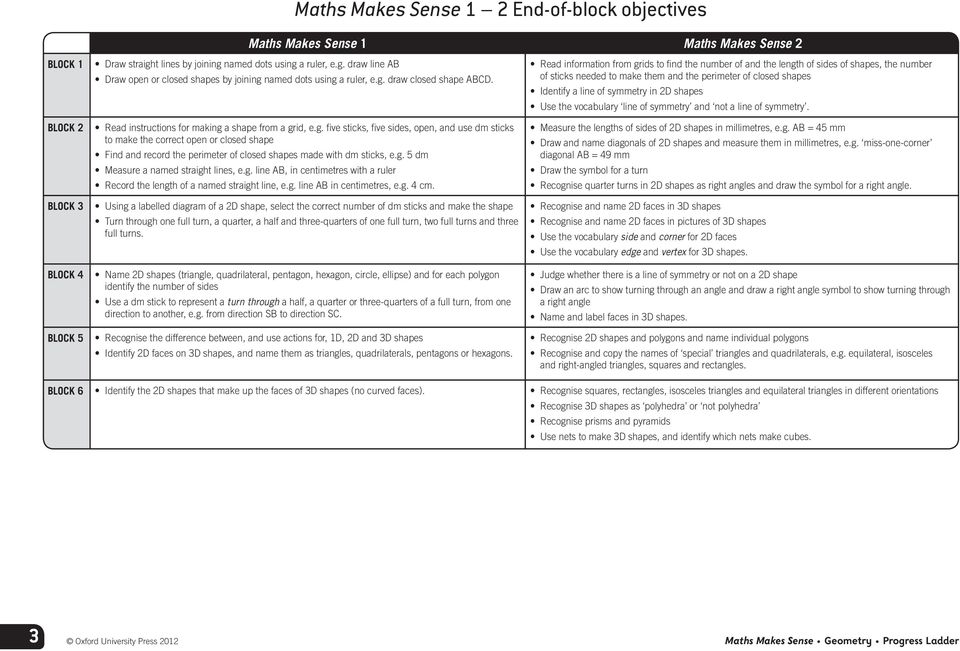
3 Maths Makes Sense 1 2 End-of-block objectives Maths Makes Sense 1 Maths Makes Sense 2 Draw straight lines by joining named dots using a ruler, e.g. draw line AB Draw open or closed shapes by joining named dots using a ruler, e.g. draw closed shape ABCD. Read instructions for making a shape from a grid, e.g. five sticks, five sides, open, and use dm sticks to make the correct open or closed shape Find and record the perimeter of closed shapes made with dm sticks, e.g. 5 dm Measure a named straight lines, e.g. line AB, in centimetres with a ruler Record the length of a named straight line, e.g. line AB in centimetres, e.g. 4 cm. Using a labelled diagram of a 2D shape, select the correct number of dm sticks and make the shape Turn through one full turn, a quarter, a half and three-quarters of one full turn, two full turns and three full turns. Name 2D shapes (triangle, quadrilateral, pentagon, hexagon, circle, ellipse) and for each polygon identify the number of sides Use a dm stick to represent a turn through a half, a quarter or three-quarters of a full turn, from one direction to another, e.g. from direction SB to direction SC. Recognise the difference between, and use actions for, 1D, 2D and 3D shapes Identify 2D faces on 3D shapes, and name them as triangles, quadrilaterals, pentagons or hexagons. Read information from grids to find the number of and the length of sides of shapes, the number of sticks needed to make them and the perimeter of closed shapes Identify a line of symmetry in 2D shapes Use the vocabulary line of symmetry and not a line of symmetry. Measure the lengths of sides of 2D shapes in millimetres, e.g. AB = 45 mm Draw and name diagonals of 2D shapes and measure them in millimetres, e.g. miss-one-corner diagonal AB = 49 mm Draw the symbol for a turn Recognise quarter turns in 2D shapes as right angles and draw the symbol for a right angle. Recognise and name 2D faces in 3D shapes Recognise and name 2D faces in pictures of 3D shapes Use the vocabulary side and corner for 2D faces Use the vocabulary edge and vertex for 3D shapes. Judge whether there is a line of symmetry or not on a 2D shape Draw an arc to show turning through an angle and draw a right angle symbol to show turning through a right angle Name and label faces in 3D shapes. Recognise 2D shapes and polygons and name individual polygons Recognise and copy the names of special triangles and quadrilaterals, e.g. equilateral, isosceles and right-angled triangles, squares and rectangles. BLOCK 6 Identify the 2D shapes that make up the faces of 3D shapes (no curved faces). Recognise squares, rectangles, isosceles triangles and equilateral triangles in different orientations Recognise 3D shapes as polyhedra or not polyhedra Recognise prisms and pyramids Use nets to make 3D shapes, and identify which nets make cubes. 3
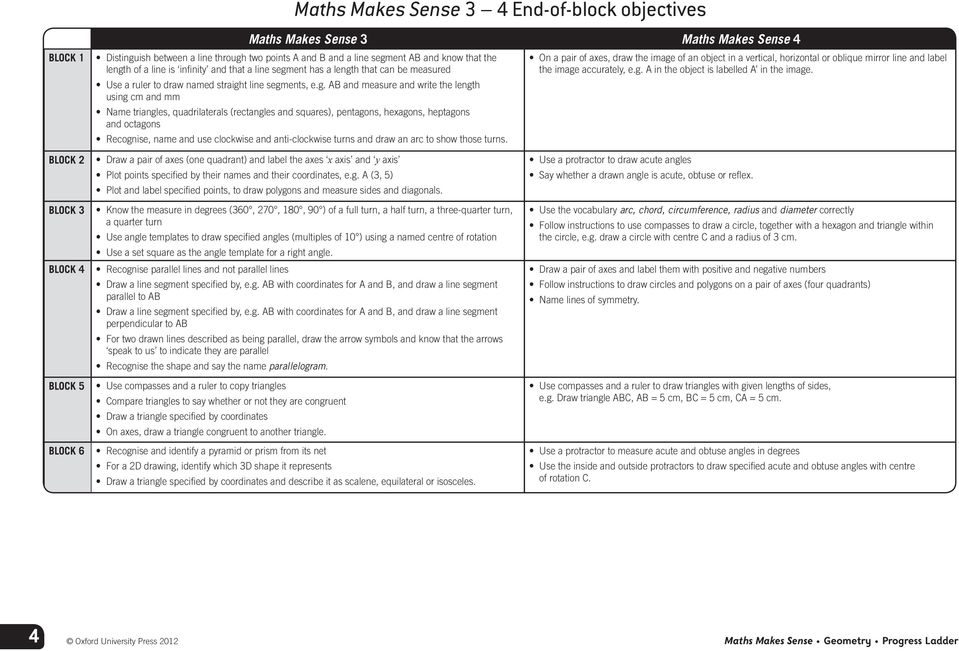
4 Maths Makes Sense 3 4 End-of-block objectives Maths Makes Sense 3 Maths Makes Sense 4 Distinguish between a line through two points A and B and a line segment AB and know that the length of a line is infinity and that a line segment has a length that can be measured Use a ruler to draw named straight line segments, e.g. AB and measure and write the length using cm and mm Name triangles, quadrilaterals (rectangles and squares), pentagons, hexagons, heptagons and octagons Recognise, name and use clockwise and anti-clockwise turns and draw an arc to show those turns. On a pair of axes, draw the image of an object in a vertical, horizontal or oblique mirror line and label the image accurately, e.g. A in the object is labelled A in the image. BLOCK 6 Draw a pair of axes (one quadrant) and label the axes x axis and y axis Plot points specified by their names and their coordinates, e.g. A (3, 5) Plot and label specified points, to draw polygons and measure sides and diagonals. Know the measure in degrees (360, 270, 180, 90 ) of a full turn, a half turn, a three-quarter turn, a quarter turn Use angle templates to draw specified angles (multiples of 10 ) using a named centre of rotation Use a set square as the angle template for a right angle. Recognise parallel lines and not parallel lines Draw a line segment specified by, e.g. AB with coordinates for A and B, and draw a line segment parallel to AB Draw a line segment specified by, e.g. AB with coordinates for A and B, and draw a line segment perpendicular to AB For two drawn lines described as being parallel, draw the arrow symbols and know that the arrows speak to us to indicate they are parallel Recognise the shape and say the name parallelogram. Use compasses and a ruler to copy triangles Compare triangles to say whether or not they are congruent Draw a triangle specified by coordinates On axes, draw a triangle congruent to another triangle. Recognise and identify a pyramid or prism from its net For a 2D drawing, identify which 3D shape it represents Draw a triangle specified by coordinates and describe it as scalene, equilateral or isosceles. Use a protractor to draw acute angles Say whether a drawn angle is acute, obtuse or reflex. Use the vocabulary arc, chord, circumference, radius and diameter correctly Follow instructions to use compasses to draw a circle, together with a hexagon and triangle within the circle, e.g. draw a circle with centre C and a radius of 3 cm. Draw a pair of axes and label them with positive and negative numbers Follow instructions to draw circles and polygons on a pair of axes (four quadrants) Name lines of symmetry. Use compasses and a ruler to draw triangles with given lengths of sides, e.g. Draw triangle ABC, AB = 5 cm, BC = 5 cm, CA = 5 cm. Use a protractor to measure acute and obtuse angles in degrees Use the inside and outside protractors to draw specified acute and obtuse angles with centre of rotation C. 4
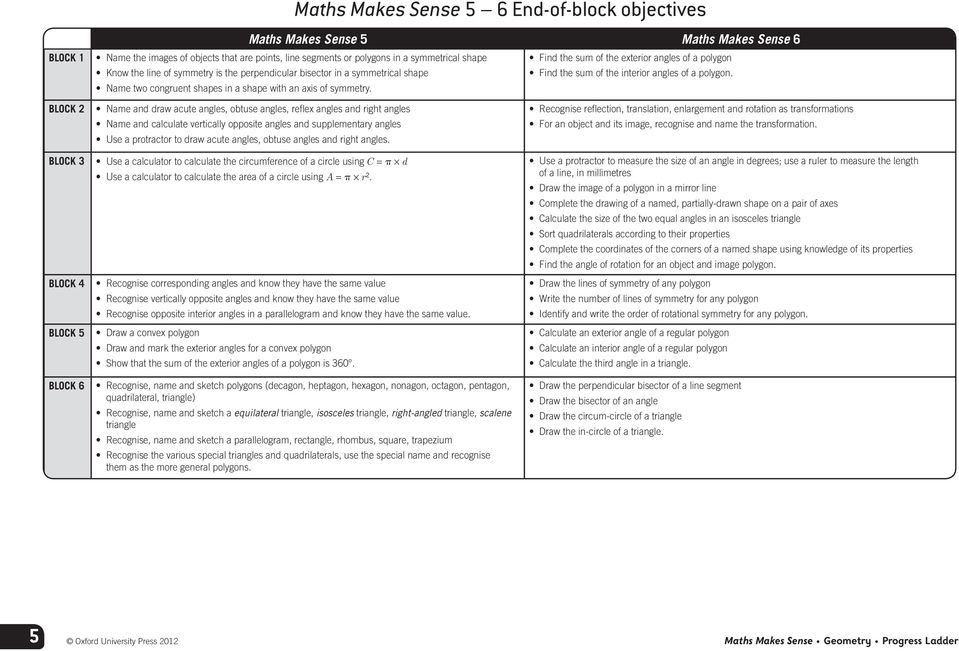
5 Maths Makes Sense 5 6 End-of-block objectives Maths Makes Sense 5 Maths Makes Sense 6 Name the images of objects that are points, line segments or polygons in a symmetrical shape Find the sum of the exterior angles of a polygon Know the line of symmetry is the perpendicular bisector in a symmetrical shape Find the sum of the interior angles of a polygon. Name two congruent shapes in a shape with an axis of symmetry. BLOCK 6 Name and draw acute angles, obtuse angles, reflex angles and right angles Name and calculate vertically opposite angles and supplementary angles Use a protractor to draw acute angles, obtuse angles and right angles. Use a calculator to calculate the circumference of a circle using C = p d Use a calculator to calculate the area of a circle using A = p r². Recognise corresponding angles and know they have the same value Recognise vertically opposite angles and know they have the same value Recognise opposite interior angles in a parallelogram and know they have the same value. Draw a convex polygon Draw and mark the exterior angles for a convex polygon Show that the sum of the exterior angles of a polygon is 360. Recognise, name and sketch polygons (decagon, heptagon, hexagon, nonagon, octagon, pentagon, quadrilateral, triangle) Recognise, name and sketch a equilateral triangle, isosceles triangle, right-angled triangle, scalene triangle Recognise, name and sketch a parallelogram, rectangle, rhombus, square, trapezium Recognise the various special triangles and quadrilaterals, use the special name and recognise them as the more general polygons. Recognise reflection, translation, enlargement and rotation as transformations For an object and its image, recognise and name the transformation. Use a protractor to measure the size of an angle in degrees; use a ruler to measure the length of a line, in millimetres Draw the image of a polygon in a mirror line Complete the drawing of a named, partially-drawn shape on a pair of axes Calculate the size of the two equal angles in an isosceles triangle Sort quadrilaterals according to their properties Complete the coordinates of the corners of a named shape using knowledge of its properties Find the angle of rotation for an object and image polygon. Draw the lines of symmetry of any polygon Write the number of lines of symmetry for any polygon Identify and write the order of rotational symmetry for any polygon. Calculate an exterior angle of a regular polygon Calculate an interior angle of a regular polygon Calculate the third angle in a triangle. Draw the perpendicular bisector of a line segment Draw the bisector of an angle Draw the circum-circle of a triangle Draw the in-circle of a triangle. 5
Angles that are between parallel lines, but on opposite sides of a transversal.
 GLOSSARY Appendix A Appendix A: Glossary Acute Angle An angle that measures less than 90. Acute Triangle Alternate Angles A triangle that has three acute angles. Angles that are between parallel lines,
11.3 Curves, Polygons and Symmetry
 11.3 Curves, Polygons and Symmetry Polygons Simple Definition A shape is simple if it doesn t cross itself, except maybe at the endpoints. Closed Definition A shape is closed if the endpoints meet. Polygon
Arithmetic 1 Progress Ladder
 Arithmetic 1 Progress Ladder Maths Makes Sense Foundation End-of-year objectives page 2 Maths Makes Sense 1 2 End-of-block objectives page 3 Maths Makes Sense 3 4 End-of-block objectives page 4 Maths Makes
Target To know the properties of a rectangle
 Target To know the properties of a rectangle (1) A rectangle is a 3-D shape. (2) A rectangle is the same as an oblong. (3) A rectangle is a quadrilateral. (4) Rectangles have four equal sides. (5) Rectangles
Which two rectangles fit together, without overlapping, to make a square?
 SHAPE level 4 questions 1. Here are six rectangles on a grid. A B C D E F Which two rectangles fit together, without overlapping, to make a square?... and... International School of Madrid 1 2. Emily has
Unit 8 Angles, 2D and 3D shapes, perimeter and area
 Unit 8 Angles, 2D and 3D shapes, perimeter and area Five daily lessons Year 6 Spring term Recognise and estimate angles. Use a protractor to measure and draw acute and obtuse angles to Page 111 the nearest
Chapter 8 Geometry We will discuss following concepts in this chapter.
 Mat College Mathematics Updated on Nov 5, 009 Chapter 8 Geometry We will discuss following concepts in this chapter. Two Dimensional Geometry: Straight lines (parallel and perpendicular), Rays, Angles
Shape Dictionary YR to Y6
 Shape Dictionary YR to Y6 Guidance Notes The terms in this dictionary are taken from the booklet Mathematical Vocabulary produced by the National Numeracy Strategy. Children need to understand and use
Geometry of 2D Shapes
 Name: Geometry of 2D Shapes Answer these questions in your class workbook: 1. Give the definitions of each of the following shapes and draw an example of each one: a) equilateral triangle b) isosceles
Algebra Geometry Glossary. 90 angle
 lgebra Geometry Glossary 1) acute angle an angle less than 90 acute angle 90 angle 2) acute triangle a triangle where all angles are less than 90 3) adjacent angles angles that share a common leg Example:
Level 1 - Maths Targets TARGETS. With support, I can show my work using objects or pictures 12. I can order numbers to 10 3
 Ma Data Hling: Interpreting Processing representing Ma Shape, space measures: position shape Written Mental method s Operations relationship s between them Fractio ns Number s the Ma1 Using Str Levels
2. If C is the midpoint of AB and B is the midpoint of AE, can you say that the measure of AC is 1/4 the measure of AE?
 MATH 206 - Midterm Exam 2 Practice Exam Solutions 1. Show two rays in the same plane that intersect at more than one point. Rays AB and BA intersect at all points from A to B. 2. If C is the midpoint of
MATHS LEVEL DESCRIPTORS
 MATHS LEVEL DESCRIPTORS Number Level 3 Understand the place value of numbers up to thousands. Order numbers up to 9999. Round numbers to the nearest 10 or 100. Understand the number line below zero, and
UNIT H1 Angles and Symmetry Activities
 UNIT H1 Angles and Symmetry Activities Activities H1.1 Lines of Symmetry H1.2 Rotational and Line Symmetry H1.3 Symmetry of Regular Polygons H1.4 Interior Angles in Polygons Notes and Solutions (1 page)
Numeracy Targets. I can count at least 20 objects
 Targets 1c I can read numbers up to 10 I can count up to 10 objects I can say the number names in order up to 20 I can write at least 4 numbers up to 10. When someone gives me a small number of objects
Mathematics K 6 continuum of key ideas
 Mathematics K 6 continuum of key ideas Number and Algebra Count forwards to 30 from a given number Count backwards from a given number in the range 0 to 20 Compare, order, read and represent to at least
Grade 3 Core Standard III Assessment
 Grade 3 Core Standard III Assessment Geometry and Measurement Name: Date: 3.3.1 Identify right angles in two-dimensional shapes and determine if angles are greater than or less than a right angle (obtuse
Charlesworth School Year Group Maths Targets
 Charlesworth School Year Group Maths Targets Year One Maths Target Sheet Key Statement KS1 Maths Targets (Expected) These skills must be secure to move beyond expected. I can compare, describe and solve
Estimating Angle Measures
 1 Estimating Angle Measures Compare and estimate angle measures. You will need a protractor. 1. Estimate the size of each angle. a) c) You can estimate the size of an angle by comparing it to an angle
Biggar High School Mathematics Department. National 5 Learning Intentions & Success Criteria: Assessing My Progress
 Biggar High School Mathematics Department National 5 Learning Intentions & Success Criteria: Assessing My Progress Expressions & Formulae Topic Learning Intention Success Criteria I understand this Approximation
56 questions (multiple choice, check all that apply, and fill in the blank) The exam is worth 224 points.
 6.1.1 Review: Semester Review Study Sheet Geometry Core Sem 2 (S2495808) Semester Exam Preparation Look back at the unit quizzes and diagnostics. Use the unit quizzes and diagnostics to determine which
SGS4.3 Stage 4 Space & Geometry Part A Activity 2-4
 SGS4.3 Stage 4 Space & Geometry Part A Activity 2-4 Exploring triangles Resources required: Each pair students will need: 1 container (eg. a rectangular plastic takeaway container) 5 long pipe cleaners
CAMI Education linked to CAPS: Mathematics
 - 1 - TOPIC 1.1 Whole numbers _CAPS curriculum TERM 1 CONTENT Mental calculations Revise: Multiplication of whole numbers to at least 12 12 Ordering and comparing whole numbers Revise prime numbers to
39 Symmetry of Plane Figures
 39 Symmetry of Plane Figures In this section, we are interested in the symmetric properties of plane figures. By a symmetry of a plane figure we mean a motion of the plane that moves the figure so that
Intermediate Math Circles October 10, 2012 Geometry I: Angles
 Intermediate Math Circles October 10, 2012 Geometry I: Angles Over the next four weeks, we will look at several geometry topics. Some of the topics may be familiar to you while others, for most of you,
of surface, 569-571, 576-577, 578-581 of triangle, 548 Associative Property of addition, 12, 331 of multiplication, 18, 433
 Absolute Value and arithmetic, 730-733 defined, 730 Acute angle, 477 Acute triangle, 497 Addend, 12 Addition associative property of, (see Commutative Property) carrying in, 11, 92 commutative property
Lesson 1.1 Building Blocks of Geometry
 Lesson 1.1 Building Blocks of Geometry For Exercises 1 7, complete each statement. S 3 cm. 1. The midpoint of Q is. N S Q 2. NQ. 3. nother name for NS is. 4. S is the of SQ. 5. is the midpoint of. 6. NS.
Line Segments, Rays, and Lines
 HOME LINK Line Segments, Rays, and Lines Family Note Help your child match each name below with the correct drawing of a line, ray, or line segment. Then observe as your child uses a straightedge to draw
EVERY DAY COUNTS CALENDAR MATH 2005 correlated to
 EVERY DAY COUNTS CALENDAR MATH 2005 correlated to Illinois Mathematics Assessment Framework Grades 3-5 E D U C A T I O N G R O U P A Houghton Mifflin Company YOUR ILLINOIS GREAT SOURCE REPRESENTATIVES:
Angle - a figure formed by two rays or two line segments with a common endpoint called the vertex of the angle; angles are measured in degrees
 Angle - a figure formed by two rays or two line segments with a common endpoint called the vertex of the angle; angles are measured in degrees Apex in a pyramid or cone, the vertex opposite the base; in
The National Curriculum 2014 Programmes of Study for Mathematics
 The National Curriculum 2014 Programmes of Study for Mathematics Information inserted by the Lancashire Mathematics Team to support schools and teachers in identifying elements of the curriculum that have
Conjectures for Geometry for Math 70 By I. L. Tse
 Conjectures for Geometry for Math 70 By I. L. Tse Chapter Conjectures 1. Linear Pair Conjecture: If two angles form a linear pair, then the measure of the angles add up to 180. Vertical Angle Conjecture:
SPRING UNIT 14. second half. Line symmetry and reflection. Measuring angles. Naming and estimating angles. Drawing angles
 PART SPRING second half SHAPE AND SPACE SECTION Line symmetry and reflection SECTION Measuring angles SECTION Naming and estimating angles SECTION Drawing angles SECTION 5 Calculations involving angles
Primary Curriculum 2014
 Primary Curriculum 2014 Suggested Key Objectives for Mathematics at Key Stages 1 and 2 Year 1 Maths Key Objectives Taken from the National Curriculum 1 Count to and across 100, forwards and backwards,
9 Area, Perimeter and Volume
 9 Area, Perimeter and Volume 9.1 2-D Shapes The following table gives the names of some 2-D shapes. In this section we will consider the properties of some of these shapes. Rectangle All angles are right
Geometry and Measurement
 The student will be able to: Geometry and Measurement 1. Demonstrate an understanding of the principles of geometry and measurement and operations using measurements Use the US system of measurement for
Grade 8 Mathematics Geometry: Lesson 2
 Grade 8 Mathematics Geometry: Lesson 2 Read aloud to the students the material that is printed in boldface type inside the boxes. Information in regular type inside the boxes and all information outside
Math 5th grade. Create your own number and explain how to use expanded form to show place value to the ten millions place.
 Number Properties and Operations Whole number sense and addition and subtraction are key concepts and skills developed in early childhood. Students build on their number sense and counting sense to develop
Area. Area Overview. Define: Area:
 Define: Area: Area Overview Kite: Parallelogram: Rectangle: Rhombus: Square: Trapezoid: Postulates/Theorems: Every closed region has an area. If closed figures are congruent, then their areas are equal.
Conjectures. Chapter 2. Chapter 3
 Conjectures Chapter 2 C-1 Linear Pair Conjecture If two angles form a linear pair, then the measures of the angles add up to 180. (Lesson 2.5) C-2 Vertical Angles Conjecture If two angles are vertical
Section 1: How will you be tested? This section will give you information about the different types of examination papers that are available.
 REVISION CHECKLIST for IGCSE Mathematics 0580 A guide for students How to use this guide This guide describes what topics and skills you need to know for your IGCSE Mathematics examination. It will help
MATHEMATICS Y6 Geometry 6750 Use co-ordinates and extend to 4 quadrants Equipment MathSphere www.mathsphere.co.uk
 MATHEMATICS Y6 Geometry 675 Use co-ordinates and etend to quadrants Paper, pencil, ruler Equipment MathSphere 675 Use co-ordinates and etend to quadrants. Page Concepts Children should be familiar with
Teaching Guidelines. Knowledge and Skills: Can specify defining characteristics of common polygons
 CIRCLE FOLDING Teaching Guidelines Subject: Mathematics Topics: Geometry (Circles, Polygons) Grades: 4-6 Concepts: Property Diameter Radius Chord Perimeter Area Knowledge and Skills: Can specify defining
Cambridge Primary Mathematics Curriculum Framework (with codes)
 Cambridge Primary Mathematics Curriculum Framework (with codes) Contents Introduction Stage 1...1 Stage 2...5 Stage 3...9 Stage 4...14 Stage 5...18 Stage 6...24 Note on codes Each learning objective has
The University of the State of New York REGENTS HIGH SCHOOL EXAMINATION GEOMETRY. Tuesday, August 13, 2013 8:30 to 11:30 a.m., only.
 GEOMETRY The University of the State of New York REGENTS HIGH SCHOOL EXAMINATION GEOMETRY Tuesday, August 13, 2013 8:30 to 11:30 a.m., only Student Name: School Name: The possession or use of any communications
Number Sense and Operations
 Number Sense and Operations representing as they: 6.N.1 6.N.2 6.N.3 6.N.4 6.N.5 6.N.6 6.N.7 6.N.8 6.N.9 6.N.10 6.N.11 6.N.12 6.N.13. 6.N.14 6.N.15 Demonstrate an understanding of positive integer exponents
Definitions, Postulates and Theorems
 Definitions, s and s Name: Definitions Complementary Angles Two angles whose measures have a sum of 90 o Supplementary Angles Two angles whose measures have a sum of 180 o A statement that can be proven
NEW MEXICO Grade 6 MATHEMATICS STANDARDS
 PROCESS STANDARDS To help New Mexico students achieve the Content Standards enumerated below, teachers are encouraged to base instruction on the following Process Standards: Problem Solving Build new mathematical
numerical place value additional topics rounding off numbers power of numbers negative numbers addition with materials fundamentals
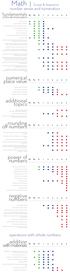 Math Scope & Sequence fundamentals number sense and numeration of the decimal system Count to 10 by units Associate number to numeral (1-10) KN 1 KN 1 KN 2 KN 2 Identify odd and even numbers/numerals and
ISAT Mathematics Performance Definitions Grade 4
 ISAT Mathematics Performance Definitions Grade 4 EXCEEDS STANDARDS Fourth-grade students whose measured performance exceeds standards are able to identify, read, write, represent, and model whole numbers
1. A student followed the given steps below to complete a construction. Which type of construction is best represented by the steps given above?
 1. A student followed the given steps below to complete a construction. Step 1: Place the compass on one endpoint of the line segment. Step 2: Extend the compass from the chosen endpoint so that the width
Illinois State Standards Alignments Grades Three through Eleven
 Illinois State Standards Alignments Grades Three through Eleven Trademark of Renaissance Learning, Inc., and its subsidiaries, registered, common law, or pending registration in the United States and other
Geometry Module 4 Unit 2 Practice Exam
 Name: Class: Date: ID: A Geometry Module 4 Unit 2 Practice Exam Multiple Choice Identify the choice that best completes the statement or answers the question. 1. Which diagram shows the most useful positioning
Three-Dimensional Figures or Space Figures. Rectangular Prism Cylinder Cone Sphere. Two-Dimensional Figures or Plane Figures
 SHAPE NAMES Three-Dimensional Figures or Space Figures Rectangular Prism Cylinder Cone Sphere Two-Dimensional Figures or Plane Figures Square Rectangle Triangle Circle Name each shape. [triangle] [cone]
Math 531, Exam 1 Information.
 Math 531, Exam 1 Information. 9/21/11, LC 310, 9:05-9:55. Exam 1 will be based on: Sections 1A - 1F. The corresponding assigned homework problems (see http://www.math.sc.edu/ boylan/sccourses/531fa11/531.html)
2006 Geometry Form A Page 1
 2006 Geometry Form Page 1 1. he hypotenuse of a right triangle is 12" long, and one of the acute angles measures 30 degrees. he length of the shorter leg must be: () 4 3 inches () 6 3 inches () 5 inches
CSU Fresno Problem Solving Session. Geometry, 17 March 2012
 CSU Fresno Problem Solving Session Problem Solving Sessions website: http://zimmer.csufresno.edu/ mnogin/mfd-prep.html Math Field Day date: Saturday, April 21, 2012 Math Field Day website: http://www.csufresno.edu/math/news
Mathematics Materials for Tomorrow s Teachers
 M2T2 E 1 Geometry Mathematics Materials for Tomorrow s Teachers STATE GOAL 9: Use geometric methods to analyze, categorize, and draw conclusions about points, lines, planes, and space. Statement of Purpose:
GEOMETRY CONCEPT MAP. Suggested Sequence:
 CONCEPT MAP GEOMETRY August 2011 Suggested Sequence: 1. Tools of Geometry 2. Reasoning and Proof 3. Parallel and Perpendicular Lines 4. Congruent Triangles 5. Relationships Within Triangles 6. Polygons
The University of the State of New York REGENTS HIGH SCHOOL EXAMINATION GEOMETRY. Student Name:
 GEOMETRY The University of the State of New York REGENTS HIGH SCHOOL EXAMINATION GEOMETRY Wednesday, August 18, 2010 8:30 to 11:30 a.m., only Student Name: School Name: Print your name and the name of
Key Stage 2 Mathematics Programme of Study
 Deeloping numerical reasoning Identify processes and connections Represent and communicate Reiew transfer mathematical to a ariety of contexts and eeryday situations identify the appropriate steps and
MENSURATION. Definition
 MENSURATION Definition 1. Mensuration : It is a branch of mathematics which deals with the lengths of lines, areas of surfaces and volumes of solids. 2. Plane Mensuration : It deals with the sides, perimeters
Tennessee Mathematics Standards 2009-2010 Implementation. Grade Six Mathematics. Standard 1 Mathematical Processes
 Tennessee Mathematics Standards 2009-2010 Implementation Grade Six Mathematics Standard 1 Mathematical Processes GLE 0606.1.1 Use mathematical language, symbols, and definitions while developing mathematical
Convert between units of area and determine the scale factor of two similar figures.
 CHAPTER 5 Units of Area c GOAL Convert between units of area and determine the scale factor of two. You will need a ruler centimetre grid paper a protractor a calculator Learn about the Math The area of
Chapter 18 Symmetry. Symmetry of Shapes in a Plane 18.1. then unfold
 Chapter 18 Symmetry Symmetry is of interest in many areas, for example, art, design in general, and even the study of molecules. This chapter begins with a look at two types of symmetry of two-dimensional
Geometry Regents Review
 Name: Class: Date: Geometry Regents Review Multiple Choice Identify the choice that best completes the statement or answers the question. 1. If MNP VWX and PM is the shortest side of MNP, what is the shortest
Selected practice exam solutions (part 5, item 2) (MAT 360)
 Selected practice exam solutions (part 5, item ) (MAT 360) Harder 8,91,9,94(smaller should be replaced by greater )95,103,109,140,160,(178,179,180,181 this is really one problem),188,193,194,195 8. On
Everyday Mathematics CCSS EDITION CCSS EDITION. Content Strand: Number and Numeration
 CCSS EDITION Overview of -6 Grade-Level Goals CCSS EDITION Content Strand: Number and Numeration Program Goal: Understand the Meanings, Uses, and Representations of Numbers Content Thread: Rote Counting
Everyday Mathematics GOALS
 Copyright Wright Group/McGraw-Hill GOALS The following tables list the Grade-Level Goals organized by Content Strand and Program Goal. Content Strand: NUMBER AND NUMERATION Program Goal: Understand the
My Year 1 Maths Targets
 My Year 1 Maths Targets Number number and place value I can count to and across 100, forwards and backwards, beginning with 0 or 1, or from any given number. I can count in multiples of twos, fives and
The University of the State of New York REGENTS HIGH SCHOOL EXAMINATION GEOMETRY. Student Name:
 GEOMETRY The University of the State of New York REGENTS HIGH SCHOOL EXAMINATION GEOMETRY Thursday, June 17, 2010 1:15 to 4:15 p.m., only Student Name: School Name: Print your name and the name of your
Unit 6 Direction and angle
 Unit 6 Direction and angle Three daily lessons Year 4 Spring term Unit Objectives Year 4 Recognise positions and directions: e.g. describe and find the Page 108 position of a point on a grid of squares
Integrated Math Concepts Module 10. Properties of Polygons. Second Edition. Integrated Math Concepts. Solve Problems. Organize. Analyze. Model.
 Solve Problems Analyze Organize Reason Integrated Math Concepts Model Measure Compute Communicate Integrated Math Concepts Module 1 Properties of Polygons Second Edition National PASS Center 26 National
Geometry Enduring Understandings Students will understand 1. that all circles are similar.
 High School - Circles Essential Questions: 1. Why are geometry and geometric figures relevant and important? 2. How can geometric ideas be communicated using a variety of representations? ******(i.e maps,
Vocabulary checklist. Year 7. Applying mathematics and solving problems. Numbers and the number system
 Vocabulary checklist Year 7 This list contains the key words used in the Year 7 teaching programme and supplement of examples. Some words will be familiar to pupils in Year 7 from earlier work. For definitions
Chapter 3.1 Angles. Geometry. Objectives: Define what an angle is. Define the parts of an angle.
 Chapter 3.1 Angles Define what an angle is. Define the parts of an angle. Recall our definition for a ray. A ray is a line segment with a definite starting point and extends into infinity in only one direction.
The University of the State of New York REGENTS HIGH SCHOOL EXAMINATION GEOMETRY. Wednesday, January 28, 2015 9:15 a.m. to 12:15 p.m.
 GEOMETRY The University of the State of New York REGENTS HIGH SCHOOL EXAMINATION GEOMETRY Wednesday, January 28, 2015 9:15 a.m. to 12:15 p.m., only Student Name: School Name: The possession or use of any
Conjunction is true when both parts of the statement are true. (p is true, q is true. p^q is true)
 Mathematical Sentence - a sentence that states a fact or complete idea Open sentence contains a variable Closed sentence can be judged either true or false Truth value true/false Negation not (~) * Statement
Chapters 6 and 7 Notes: Circles, Locus and Concurrence
 Chapters 6 and 7 Notes: Circles, Locus and Concurrence IMPORTANT TERMS AND DEFINITIONS A circle is the set of all points in a plane that are at a fixed distance from a given point known as the center of
Problem of the Month: William s Polygons
 Problem of the Month: William s Polygons The Problems of the Month (POM) are used in a variety of ways to promote problem solving and to foster the first standard of mathematical practice from the Common
ACT Math Vocabulary. Altitude The height of a triangle that makes a 90-degree angle with the base of the triangle. Altitude
 ACT Math Vocabular Acute When referring to an angle acute means less than 90 degrees. When referring to a triangle, acute means that all angles are less than 90 degrees. For eample: Altitude The height
Chapter 6 Notes: Circles
 Chapter 6 Notes: Circles IMPORTANT TERMS AND DEFINITIONS A circle is the set of all points in a plane that are at a fixed distance from a given point known as the center of the circle. Any line segment
Shapes & Designs Notes
 Problem 1.1 Definitions: regular polygons - polygons in which all the side lengths and angles have the same measure edge - also referred to as the side of a figure tiling - covering a flat surface with
Scope and Sequence KA KB 1A 1B 2A 2B 3A 3B 4A 4B 5A 5B 6A 6B
 Scope and Sequence Earlybird Kindergarten, Standards Edition Primary Mathematics, Standards Edition Copyright 2008 [SingaporeMath.com Inc.] The check mark indicates where the topic is first introduced
1A: Understand numbers, ways of representing numbers, relationships among numbers, and number systems.
 NCTM STANDARD 1: Numbers and Operations Kindergarten Grade 2 1A: Understand numbers, ways of representing numbers, relationships among numbers, and number systems. Kindergarten Grade One Grade Two 1. Count
GEOMETRY COMMON CORE STANDARDS
 1st Nine Weeks Experiment with transformations in the plane G-CO.1 Know precise definitions of angle, circle, perpendicular line, parallel line, and line segment, based on the undefined notions of point,
Mathematics standards
 Mathematics standards Grade 6 Summary of students performance by the end of Grade 6 Reasoning and problem solving Students represent and interpret routine and non-routine mathematical problems in a range
Florida Geometry EOC Assessment Study Guide
 Florida Geometry EOC Assessment Study Guide The Florida Geometry End of Course Assessment is computer-based. During testing students will have access to the Algebra I/Geometry EOC Assessments Reference
Third Grade Shapes Up! Grade Level: Third Grade Written by: Jill Pisman, St. Mary s School East Moline, Illinois Length of Unit: Eight Lessons
 Third Grade Shapes Up! Grade Level: Third Grade Written by: Jill Pisman, St. Mary s School East Moline, Illinois Length of Unit: Eight Lessons I. ABSTRACT This unit contains lessons that focus on geometric
Algebra III. Lesson 33. Quadrilaterals Properties of Parallelograms Types of Parallelograms Conditions for Parallelograms - Trapezoids
 Algebra III Lesson 33 Quadrilaterals Properties of Parallelograms Types of Parallelograms Conditions for Parallelograms - Trapezoids Quadrilaterals What is a quadrilateral? Quad means? 4 Lateral means?
Volume of Right Prisms Objective To provide experiences with using a formula for the volume of right prisms.
 Volume of Right Prisms Objective To provide experiences with using a formula for the volume of right prisms. www.everydaymathonline.com epresentations etoolkit Algorithms Practice EM Facts Workshop Game
GeoGebra. 10 lessons. Gerrit Stols
 GeoGebra in 10 lessons Gerrit Stols Acknowledgements GeoGebra is dynamic mathematics open source (free) software for learning and teaching mathematics in schools. It was developed by Markus Hohenwarter
Star and convex regular polyhedra by Origami.
 Star and convex regular polyhedra by Origami. Build polyhedra by Origami.] Marcel Morales Alice Morales 2009 E D I T I O N M O R A L E S Polyhedron by Origami I) Table of convex regular Polyhedra... 4
The University of the State of New York REGENTS HIGH SCHOOL EXAMINATION GEOMETRY. Thursday, August 13, 2015 8:30 to 11:30 a.m., only.
 GEOMETRY The University of the State of New York REGENTS HIGH SCHOOL EXAMINATION GEOMETRY Thursday, August 13, 2015 8:30 to 11:30 a.m., only Student Name: School Name: The possession or use of any communications
Assessment For The California Mathematics Standards Grade 4
 Introduction: Summary of Goals GRADE FOUR By the end of grade four, students understand large numbers and addition, subtraction, multiplication, and division of whole numbers. They describe and compare
Unit 9. Unit 10. Unit 11. Unit 12. Introduction Busy Ant Maths Year 2 Medium-Term Plans. Number - Geometry - Position & direction
 Busy Ant Maths Year Medium-Term Plans Unit 9 Geometry - Position & direction Unit 0 ( Temperature) Unit Statistics Unit Fractions (time) 8 Busy Ant Maths Year Medium-Term Plans Introduction Unit Geometry
43 Perimeter and Area
 43 Perimeter and Area Perimeters of figures are encountered in real life situations. For example, one might want to know what length of fence will enclose a rectangular field. In this section we will study
The University of the State of New York REGENTS HIGH SCHOOL EXAMINATION GEOMETRY. Thursday, August 16, 2012 8:30 to 11:30 a.m.
 GEOMETRY The University of the State of New York REGENTS HIGH SCHOOL EXAMINATION GEOMETRY Thursday, August 16, 2012 8:30 to 11:30 a.m., only Student Name: School Name: Print your name and the name of your
The University of the State of New York REGENTS HIGH SCHOOL EXAMINATION GEOMETRY. Wednesday, January 29, 2014 9:15 a.m. to 12:15 p.m.
 GEOMETRY The University of the State of New York REGENTS HIGH SCHOOL EXAMINATION GEOMETRY Wednesday, January 29, 2014 9:15 a.m. to 12:15 p.m., only Student Name: School Name: The possession or use of any
The University of the State of New York REGENTS HIGH SCHOOL EXAMINATION GEOMETRY. Tuesday, January 26, 2016 1:15 to 4:15 p.m., only.
 GEOMETRY The University of the State of New York REGENTS HIGH SCHOOL EXAMINATION GEOMETRY Tuesday, January 26, 2016 1:15 to 4:15 p.m., only Student Name: School Name: The possession or use of any communications