
WORK SCHEDULE: MATHEMATICS 2007
|
|
|
- Samson Shaw
- 9 years ago
- Views:
Transcription
1 , K

2 WORK SCHEDULE: MATHEMATICS 00 GRADE MODULE TERM... LO NUMBERS, OPERATIONS AND RELATIONSHIPS able to recognise, represent numbers and their relationships, and to count, estimate, calculate and check with competence and confidence in solving problems.. describes and illustrates the historical and cultural development of numbers;. recognises, classifies and represents the following numbers in order to describe and compare them:.. numbers written in exponent form; including squares and cubes of natural numbers and their square roots and cube roots;.. multiples and factors;.. irrational numbers in the context of measurement (e.g. square and cube roots on non-perfect squares and cubes);. estimates and calculates by selecting suitable steps for solving problems that involve the following:.. multiple steps with rational numbers (including division with fractions and decimals);.. exponents.

3 WORK SCHEDULE: MATHEMATICS 00 LO PATTERNS FUNCTIONS AND ALGEBRA able to recognise, represent patterns and relationships, as well as to solve problems, using algebraic language and skills.. investigates and extends numerical and geometrical patterns to find relationships and rules, including patterns that:.. are presented in physical or diagrammatic form;.. are not limited to series with constant difference or ratio;.. occur in natural and cultural contexts;.. are created by the learner him/herself;.. are presented in tables;.. are presented algebraically;. describes, explains and justifies observed relationships or rules in own words or in algebra;. represents and uses relationships between variables to determine input an output values in a variety of ways by making use of:.. verbal descriptions;.. flow diagrams;.. tables;.. formulas and equations;

4 WORK SCHEDULE: MATHEMATICS 00. builds mathematical models that represent, describe and provide solutions to problem situations, thereby revealing responsibility towards the environment and the health of other people (including problems in the contexts of human rights, social, economic, cultural and environmental issues);. is able to determine, analyse and interpret the equivalence of different descriptions of the same relationship or rule which can be represented:.. verbally;.. by means of flow diagrams;.. in tables;.. by means of equations or expressions to thereby select the most practical representation of a given situation;. is able to use conventions of algebraic notation and the variable, reconcilable and distributive laws to:.. classify terms like even and odd and to account for the classification;.. assemble equal terms;.. multiply or divide an algebraic expression with one, two, or three terms by a monomial;

5 WORK SCHEDULE: MATHEMATICS 00.. simplify algebraic expressions in bracketed notation using one or two sets of brackets and two types of operation;.. compare different versions of algebraic expressions having one or two operations, select those that are equivalent and motivate the selected examples;.. rewrite algebraic expressions, formulas or equations in context in simpler or more usable form;. is able to interpret and use the following algebraic ideas in context: term, expression, coefficient, exponent (or index), basis, constant, variable, equation, formula (or rule).

6 WORK SCHEDULE: MATHEMATICS 00 GRADE MODULE TERM... LO NUMBERS, OPERATIONS AND RELATIONSHIPS able to recognise, represent numbers and their relationships, and to count, estimate, calculate and check with competence and confidence in solving problems.. recognises, classifies and represents the following numbers in order to compare them:.. integers;.. additive and multiplicative inverses;. uses a range of techniques to perform calculations including:.. using the commutative, associative and distributive properties with rational numbers;.. using a calculator;. uses a range of strategies to check solutions and judges the reasonableness of solutions.

7 WORK SCHEDULE: MATHEMATICS 00 LO PATTERNS FUNCTIONS AND ALGEBRA able to recognise, represent patterns and relationships, as well as to solve problems, using algebraic language and skills.. solves equations by inspection, trialand-improvement or algebraic processes (additive and multiplicative inverses), checking the solution by substitution;. is able to use conventions of algebraic notation and the variable, reconcilable and distributive laws to:.. simplify algebraic expressions in bracketed notation using one or two sets of brackets and two types of operation;.. rewrite algebraic expressions, formulas or equations in context in simpler or more usable form.

8 WORK SCHEDULE: MATHEMATICS 00 LO SPACE AND SHAPE (GEOMETRY) able to represent characteristics and relationships between twodimensional shapes and threedimensional objects in a variety of orientations and positions.. in contexts that include those that may be used to build awareness of social, cultural and environmental issues, describes and classifies geometric figures and solids in terms of properties, including:.. sides, angles and diagonals and their interrelationships, with focus on triangles and quadrilaterals (e.g. types of triangles and quadrilaterals);. uses vocabulary to describe parallel lines cut by a transversal, perpendicular lines, intersecting lines and triangles in terms of angle relationships (e.g. vertically opposite, corresponding). LO MEASUREMENT able to use appropriate measuring units, instruments and formulae in a variety of contexts.. estimates, compares, measures and draws angles accurate to one degree using protractors.

9 WORK SCHEDULE: MATHEMATICS 00 GRADE MODULE TERM... LO NUMBERS, OPERATIONS AND RELATIONSHIPS able to recognise, represent numbers and their relationships, and to count, estimate, calculate and check with competence and confidence in solving problems.. recognises, classifies an represents the following numbers to compare them:.. decimals, fractions and percentages;.. additive and multiplicative inverses;.. multiples and factors;.. irrational numbers in the context of measurement (e.g. π and square and cube roots of nonperfect squares and cubes);. recognises and uses equivalent forms of the rational numbers listed above;. estimates and calculates by selecting and using operations appropriate to solving problems that involve:.. rounding off;.. multiple operations with rational numbers (including division with fractions and decimals);. uses a range of techniques to perform calculations, including:.. using the commutative, associative and distributive properties with rational numbers;.. using a calculator;

10 WORK SCHEDULE: MATHEMATICS 00. recognises, describes and uses:.. algorithms for finding equivalent fractions;.. the commutative, associative and distributive properties with rational numbers (the expectation is that learners should be able to use these properties and not necessarily to know the names of the properties). LO SPACE AND SHAPE (GEOMETRY) able to represent characteristics and relationships between twodimensional shapes and threedimensional objects in a variety of orientations and positions.. in context that include those that may be used to build awareness of social, cultural and environmental issues, describes and classifies geometric figures and solids in terms of properties, including:.. sides, angles and diagonals and their interrelationships, with focus on triangles and quadrilaterals (e.g. types of triangles and quadrilaterals).

11 WORK SCHEDULE: MATHEMATICS 00 LO MEASUREMENT able to use appropriate measuring units, instruments and formulae in a variety of contexts.. solves problems involving:.. length;.. perimeter and area of polygonals and circles;. solves problems using a range of strategies including:.. estimating;.. calculating to at least two decimal positions;.. using and converting between appropriate SI units;. describes the meaning of and uses π in calculations involving circles and discusses its historical development in measurement;. calculates, by selecting and using appropriate formulae:.. perimeter of polygons and circles;.. area of triangles, rectangles circles and polygons by decomposition into triangles and rectangles;

12 WORK SCHEDULE: MATHEMATICS 00. investigates (alone and / or as a member of a group or team) the relationship between the sides of a right-angled triangle to develop the Theorem of Pythagoras;. uses the Theorem of Pythagoras to calculate a missing length in a rightangled triangle leaving irrational answers in surd form ();. describes and illustrates ways of measuring in different cultures throughout history (e.g. determining right angles using knotted string leading to the Theorem of Pythagoras).

13 WORK SCHEDULE: MATHEMATICS 00 GRADE MODULE TERM... LO NUMBERS, OPERATIONS AND RELATIONSHIPS able to recognise, represent numbers and their relationships, and to count, estimate, calculate and check with competence and confidence in solving problems.. solves problems in context, inclusive of contexts that can be used to promote awareness of other learning areas, and of human rights, social, economic and environmental issues, like:.. financial contexts (including profit and loss, budgets, accounts, loans, simple interest, hire purchase, rates of exchange);.. measuring in the context of the Natural Sciences and technology;. solves problems dealing with ratio and rate.

14 WORK SCHEDULE: MATHEMATICS 00 LO SPACE AND SHAPE (GEOMETRY) The learner will be able to represent characteristics and relationships between twodimensional shapes and threedimensional objects in a variety of orientations and positions.. describes and classifies geometric figures and threedimensional objects in terms of properties in contexts inclusive of those that can be used to promote awareness of social, cultural and environmental issues, including:.. sides, angles and diagonals and their relationships, focusing on triangles and quadrilaterals (e.g. types of triangles and quadrilaterals);. uses vocabulary to describe parallel lines that are cut by a transverse, perpendicular or intersection line, as well as triangles, with reference to angular relationships (e.g. vertically opposite, corresponding);. uses a pair of compasses, a ruler and a protractor for accurately constructing geometric figures so that specific properties may be investigated and nets may be designed;. designs and uses nets to make models of geometric threedimensional objects that have been studied in the preceding grades and up till now;. uses proportion to describe the effect of expansion and reduction on the properties of geometric figures;. draws and interprets sketches of geometric three-dimensional objects from several perspectives, focusing on the retention of properties.

15 WORK SCHEDULE: MATHEMATICS 00 LO MEASUREMENT able to use appropriate measuring units, instruments and formulae in a variety of contexts.. solves more complicated problems involving time, inclusive of the ratio between time, distance and speed;. solves problems involving the following:.. length;.. circumference and area of polygons and circles;.. volume and exterior area of rectangular prisms and cylinders;. solves problems using a variety of strategies, including:.. estimation;.. calculation to at least two decimal points;.. use and converting between appropriate S.I. units;. calculates the following with the use of appropriate formulas:.. circumference of polygons and circles;.. area of triangles, right angles and polygons by means of splitting up to triangles and right angles;.. volume of prisms with triangular and rectangular bases and cylinders;. estimates, compares, measures and draws triangles accurately to within one degree.

CAMI Education linked to CAPS: Mathematics
 - 1 - TOPIC 1.1 Whole numbers _CAPS curriculum TERM 1 CONTENT Mental calculations Revise: Multiplication of whole numbers to at least 12 12 Ordering and comparing whole numbers Revise prime numbers to
Senior Phase Grade 8 Today Planning Pack MATHEMATICS
 M780636110236 Senior Phase Grade 8 Today Planning Pack MATHEMATICS Contents: Work Schedule: Page Grade 8 2 Lesson Plans: Grade 8 4 Rubrics: Rubric 1: Recognising, classifying and representing numbers...22
Number Sense and Operations
 Number Sense and Operations representing as they: 6.N.1 6.N.2 6.N.3 6.N.4 6.N.5 6.N.6 6.N.7 6.N.8 6.N.9 6.N.10 6.N.11 6.N.12 6.N.13. 6.N.14 6.N.15 Demonstrate an understanding of positive integer exponents
Math 0980 Chapter Objectives. Chapter 1: Introduction to Algebra: The Integers.
 Math 0980 Chapter Objectives Chapter 1: Introduction to Algebra: The Integers. 1. Identify the place value of a digit. 2. Write a number in words or digits. 3. Write positive and negative numbers used
Pre-Algebra 2008. Academic Content Standards Grade Eight Ohio. Number, Number Sense and Operations Standard. Number and Number Systems
 Academic Content Standards Grade Eight Ohio Pre-Algebra 2008 STANDARDS Number, Number Sense and Operations Standard Number and Number Systems 1. Use scientific notation to express large numbers and small
FOREWORD. Executive Secretary
 FOREWORD The Botswana Examinations Council is pleased to authorise the publication of the revised assessment procedures for the Junior Certificate Examination programme. According to the Revised National
Algebra 1 2008. Academic Content Standards Grade Eight and Grade Nine Ohio. Grade Eight. Number, Number Sense and Operations Standard
 Academic Content Standards Grade Eight and Grade Nine Ohio Algebra 1 2008 Grade Eight STANDARDS Number, Number Sense and Operations Standard Number and Number Systems 1. Use scientific notation to express
Common Core Unit Summary Grades 6 to 8
 Common Core Unit Summary Grades 6 to 8 Grade 8: Unit 1: Congruence and Similarity- 8G1-8G5 rotations reflections and translations,( RRT=congruence) understand congruence of 2 d figures after RRT Dilations
MATHS LEVEL DESCRIPTORS
 MATHS LEVEL DESCRIPTORS Number Level 3 Understand the place value of numbers up to thousands. Order numbers up to 9999. Round numbers to the nearest 10 or 100. Understand the number line below zero, and
In mathematics, there are four attainment targets: using and applying mathematics; number and algebra; shape, space and measures, and handling data.
 MATHEMATICS: THE LEVEL DESCRIPTIONS In mathematics, there are four attainment targets: using and applying mathematics; number and algebra; shape, space and measures, and handling data. Attainment target
Prentice Hall Connected Mathematics 2, 7th Grade Units 2009
 Prentice Hall Connected Mathematics 2, 7th Grade Units 2009 Grade 7 C O R R E L A T E D T O from March 2009 Grade 7 Problem Solving Build new mathematical knowledge through problem solving. Solve problems
Senior Phase Grade 9 Today Planning Pack MATHEMATICS
 M780636110304 Senior Phase Grade 9 Today Planning Pack MATHEMATICS Contents: Work Schedule: Page Grade 9 2 Lesson Plans: Grade 9 4 Rubrics: Rubric 1: Recognising, classifying and representing numbers 19
Glencoe. correlated to SOUTH CAROLINA MATH CURRICULUM STANDARDS GRADE 6 3-3, 5-8 8-4, 8-7 1-6, 4-9
 Glencoe correlated to SOUTH CAROLINA MATH CURRICULUM STANDARDS GRADE 6 STANDARDS 6-8 Number and Operations (NO) Standard I. Understand numbers, ways of representing numbers, relationships among numbers,
Assessment Anchors and Eligible Content
 M07.A-N The Number System M07.A-N.1 M07.A-N.1.1 DESCRIPTOR Assessment Anchors and Eligible Content Aligned to the Grade 7 Pennsylvania Core Standards Reporting Category Apply and extend previous understandings
Florida Department of Education/Office of Assessment January 2012. Grade 6 FCAT 2.0 Mathematics Achievement Level Descriptions
 Florida Department of Education/Office of Assessment January 2012 Grade 6 FCAT 2.0 Mathematics Achievement Level Descriptions Grade 6 FCAT 2.0 Mathematics Reporting Category Fractions, Ratios, Proportional
NEW MEXICO Grade 6 MATHEMATICS STANDARDS
 PROCESS STANDARDS To help New Mexico students achieve the Content Standards enumerated below, teachers are encouraged to base instruction on the following Process Standards: Problem Solving Build new mathematical
of surface, 569-571, 576-577, 578-581 of triangle, 548 Associative Property of addition, 12, 331 of multiplication, 18, 433
 Absolute Value and arithmetic, 730-733 defined, 730 Acute angle, 477 Acute triangle, 497 Addend, 12 Addition associative property of, (see Commutative Property) carrying in, 11, 92 commutative property
Tennessee Mathematics Standards 2009-2010 Implementation. Grade Six Mathematics. Standard 1 Mathematical Processes
 Tennessee Mathematics Standards 2009-2010 Implementation Grade Six Mathematics Standard 1 Mathematical Processes GLE 0606.1.1 Use mathematical language, symbols, and definitions while developing mathematical
The Australian Curriculum Mathematics
 The Australian Curriculum Mathematics Mathematics ACARA The Australian Curriculum Number Algebra Number place value Fractions decimals Real numbers Foundation Year Year 1 Year 2 Year 3 Year 4 Year 5 Year
Higher Education Math Placement
 Higher Education Math Placement Placement Assessment Problem Types 1. Whole Numbers, Fractions, and Decimals 1.1 Operations with Whole Numbers Addition with carry Subtraction with borrowing Multiplication
Biggar High School Mathematics Department. National 5 Learning Intentions & Success Criteria: Assessing My Progress
 Biggar High School Mathematics Department National 5 Learning Intentions & Success Criteria: Assessing My Progress Expressions & Formulae Topic Learning Intention Success Criteria I understand this Approximation
Common Core State Standards for Mathematics Accelerated 7th Grade
 A Correlation of 2013 To the to the Introduction This document demonstrates how Mathematics Accelerated Grade 7, 2013, meets the. Correlation references are to the pages within the Student Edition. Meeting
Welcome to Math 7 Accelerated Courses (Preparation for Algebra in 8 th grade)
 Welcome to Math 7 Accelerated Courses (Preparation for Algebra in 8 th grade) Teacher: School Phone: Email: Kim Schnakenberg 402-443- 3101 [email protected] Course Descriptions: Both Concept and Application
Such As Statements, Kindergarten Grade 8
 Such As Statements, Kindergarten Grade 8 This document contains the such as statements that were included in the review committees final recommendations for revisions to the mathematics Texas Essential
with functions, expressions and equations which follow in units 3 and 4.
 Grade 8 Overview View unit yearlong overview here The unit design was created in line with the areas of focus for grade 8 Mathematics as identified by the Common Core State Standards and the PARCC Model
MATH 095, College Prep Mathematics: Unit Coverage Pre-algebra topics (arithmetic skills) offered through BSE (Basic Skills Education)
 MATH 095, College Prep Mathematics: Unit Coverage Pre-algebra topics (arithmetic skills) offered through BSE (Basic Skills Education) Accurately add, subtract, multiply, and divide whole numbers, integers,
numerical place value additional topics rounding off numbers power of numbers negative numbers addition with materials fundamentals
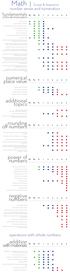 Math Scope & Sequence fundamentals number sense and numeration of the decimal system Count to 10 by units Associate number to numeral (1-10) KN 1 KN 1 KN 2 KN 2 Identify odd and even numbers/numerals and
Algebra Geometry Glossary. 90 angle
 lgebra Geometry Glossary 1) acute angle an angle less than 90 acute angle 90 angle 2) acute triangle a triangle where all angles are less than 90 3) adjacent angles angles that share a common leg Example:
McDougal Littell California:
 McDougal Littell California: Pre-Algebra Algebra 1 correlated to the California Math Content s Grades 7 8 McDougal Littell California Pre-Algebra Components: Pupil Edition (PE), Teacher s Edition (TE),
Prentice Hall: Middle School Math, Course 1 2002 Correlated to: New York Mathematics Learning Standards (Intermediate)
 New York Mathematics Learning Standards (Intermediate) Mathematical Reasoning Key Idea: Students use MATHEMATICAL REASONING to analyze mathematical situations, make conjectures, gather evidence, and construct
Functional Math II. Information CourseTitle. Types of Instruction
 Functional Math II Course Outcome Summary Riverdale School District Information CourseTitle Functional Math II Credits 0 Contact Hours 135 Instructional Area Middle School Instructional Level 8th Grade
LESSON 4 Missing Numbers in Multiplication Missing Numbers in Division LESSON 5 Order of Operations, Part 1 LESSON 6 Fractional Parts LESSON 7 Lines,
 Saxon Math 7/6 Class Description: Saxon mathematics is based on the principle of developing math skills incrementally and reviewing past skills daily. It also incorporates regular and cumulative assessments.
Performance Level Descriptors Grade 6 Mathematics
 Performance Level Descriptors Grade 6 Mathematics Multiplying and Dividing with Fractions 6.NS.1-2 Grade 6 Math : Sub-Claim A The student solves problems involving the Major Content for grade/course with
Overview. Essential Questions. Grade 8 Mathematics, Quarter 4, Unit 4.3 Finding Volume of Cones, Cylinders, and Spheres
 Cylinders, and Spheres Number of instruction days: 6 8 Overview Content to Be Learned Evaluate the cube root of small perfect cubes. Simplify problems using the formulas for the volumes of cones, cylinders,
1. Mathematics Content/Alignment with the Standards Correlation to California Algebra Readiness Standards
 PROGRAM DESCRIPTION The goal of Prentice Hall Connecting to Algebra is to fully prepare students for success in Algebra 1 by thoroughly covering the Algebra Readiness standards outlined by the California
Topic: Unit 1-Variables, Expressions, and Integers
 Grade 7th Topic: Unit 1-Variables, Expressions, and Integers Essential Questions/Enduring CC.7.NS.1 Apply and extend previous understandings of operations with fractions to add, subtract, multiply, and
Mathematics Scope and Sequence, K-8
 Standard 1: Number and Operation Goal 1.1: Understands and uses numbers (number sense) Mathematics Scope and Sequence, K-8 Grade Counting Read, Write, Order, Compare Place Value Money Number Theory K Count
Voyager Sopris Learning Vmath, Levels C-I, correlated to the South Carolina College- and Career-Ready Standards for Mathematics, Grades 2-8
 Page 1 of 35 VMath, Level C Grade 2 Mathematical Process Standards 1. Make sense of problems and persevere in solving them. Module 3: Lesson 4: 156-159 Module 4: Lesson 7: 220-223 2. Reason both contextually
10 th Grade Math Special Education Course of Study
 10 th Grade Math Special Education Course of Study Findlay City Schools 2006 Table of Contents 1. Findlay City Schools Mission Statement 2. 10 th Grade Math Curriculum Map 3. 10 th Grade Math Indicators
MATH 0110 Developmental Math Skills Review, 1 Credit, 3 hours lab
 MATH 0110 Developmental Math Skills Review, 1 Credit, 3 hours lab MATH 0110 is established to accommodate students desiring non-course based remediation in developmental mathematics. This structure will
Prentice Hall Mathematics Courses 1-3 Common Core Edition 2013
 A Correlation of Prentice Hall Mathematics Courses 1-3 Common Core Edition 2013 to the Topics & Lessons of Pearson A Correlation of Courses 1, 2 and 3, Common Core Introduction This document demonstrates
Scope and Sequence KA KB 1A 1B 2A 2B 3A 3B 4A 4B 5A 5B 6A 6B
 Scope and Sequence Earlybird Kindergarten, Standards Edition Primary Mathematics, Standards Edition Copyright 2008 [SingaporeMath.com Inc.] The check mark indicates where the topic is first introduced
EVERY DAY COUNTS CALENDAR MATH 2005 correlated to
 EVERY DAY COUNTS CALENDAR MATH 2005 correlated to Illinois Mathematics Assessment Framework Grades 3-5 E D U C A T I O N G R O U P A Houghton Mifflin Company YOUR ILLINOIS GREAT SOURCE REPRESENTATIVES:
Current Standard: Mathematical Concepts and Applications Shape, Space, and Measurement- Primary
 Shape, Space, and Measurement- Primary A student shall apply concepts of shape, space, and measurement to solve problems involving two- and three-dimensional shapes by demonstrating an understanding of:
Standards and progression point examples
 Mathematics Progressing towards Foundation Progression Point 0.5 At 0.5, a student progressing towards the standard at Foundation may, for example: connect number names and numerals with sets of up to
GRADES 7, 8, AND 9 BIG IDEAS
 Table 1: Strand A: BIG IDEAS: MATH: NUMBER Introduce perfect squares, square roots, and all applications Introduce rational numbers (positive and negative) Introduce the meaning of negative exponents for
Illinois State Standards Alignments Grades Three through Eleven
 Illinois State Standards Alignments Grades Three through Eleven Trademark of Renaissance Learning, Inc., and its subsidiaries, registered, common law, or pending registration in the United States and other
Chapter 111. Texas Essential Knowledge and Skills for Mathematics. Subchapter B. Middle School
 Middle School 111.B. Chapter 111. Texas Essential Knowledge and Skills for Mathematics Subchapter B. Middle School Statutory Authority: The provisions of this Subchapter B issued under the Texas Education
Everyday Mathematics CCSS EDITION CCSS EDITION. Content Strand: Number and Numeration
 CCSS EDITION Overview of -6 Grade-Level Goals CCSS EDITION Content Strand: Number and Numeration Program Goal: Understand the Meanings, Uses, and Representations of Numbers Content Thread: Rote Counting
COMMON CORE STATE STANDARDS FOR MATHEMATICS 3-5 DOMAIN PROGRESSIONS
 COMMON CORE STATE STANDARDS FOR MATHEMATICS 3-5 DOMAIN PROGRESSIONS Compiled by Dewey Gottlieb, Hawaii Department of Education June 2010 Operations and Algebraic Thinking Represent and solve problems involving
Grade 5 Math Content 1
 Grade 5 Math Content 1 Number and Operations: Whole Numbers Multiplication and Division In Grade 5, students consolidate their understanding of the computational strategies they use for multiplication.
ISAT Mathematics Performance Definitions Grade 4
 ISAT Mathematics Performance Definitions Grade 4 EXCEEDS STANDARDS Fourth-grade students whose measured performance exceeds standards are able to identify, read, write, represent, and model whole numbers
Everyday Mathematics GOALS
 Copyright Wright Group/McGraw-Hill GOALS The following tables list the Grade-Level Goals organized by Content Strand and Program Goal. Content Strand: NUMBER AND NUMERATION Program Goal: Understand the
For example, estimate the population of the United States as 3 times 10⁸ and the
 CCSS: Mathematics The Number System CCSS: Grade 8 8.NS.A. Know that there are numbers that are not rational, and approximate them by rational numbers. 8.NS.A.1. Understand informally that every number
Charlesworth School Year Group Maths Targets
 Charlesworth School Year Group Maths Targets Year One Maths Target Sheet Key Statement KS1 Maths Targets (Expected) These skills must be secure to move beyond expected. I can compare, describe and solve
Curriculum Map by Block Geometry Mapping for Math Block Testing 2007-2008. August 20 to August 24 Review concepts from previous grades.
 Curriculum Map by Geometry Mapping for Math Testing 2007-2008 Pre- s 1 August 20 to August 24 Review concepts from previous grades. August 27 to September 28 (Assessment to be completed by September 28)
Unit 1: Integers and Fractions
 Unit 1: Integers and Fractions No Calculators!!! Order Pages (All in CC7 Vol. 1) 3-1 Integers & Absolute Value 191-194, 203-206, 195-198, 207-210 3-2 Add Integers 3-3 Subtract Integers 215-222 3-4 Multiply
Quick Reference ebook
 This file is distributed FREE OF CHARGE by the publisher Quick Reference Handbooks and the author. Quick Reference ebook Click on Contents or Index in the left panel to locate a topic. The math facts listed
Geometry Course Summary Department: Math. Semester 1
 Geometry Course Summary Department: Math Semester 1 Learning Objective #1 Geometry Basics Targets to Meet Learning Objective #1 Use inductive reasoning to make conclusions about mathematical patterns Give
Key Topics What will ALL students learn? What will the most able students learn?
 2013 2014 Scheme of Work Subject MATHS Year 9 Course/ Year Term 1 Key Topics What will ALL students learn? What will the most able students learn? Number Written methods of calculations Decimals Rounding
Grade 6 Mathematics Assessment. Eligible Texas Essential Knowledge and Skills
 Grade 6 Mathematics Assessment Eligible Texas Essential Knowledge and Skills STAAR Grade 6 Mathematics Assessment Mathematical Process Standards These student expectations will not be listed under a separate
Indiana State Core Curriculum Standards updated 2009 Algebra I
 Indiana State Core Curriculum Standards updated 2009 Algebra I Strand Description Boardworks High School Algebra presentations Operations With Real Numbers Linear Equations and A1.1 Students simplify and
Big Ideas in Mathematics
 Big Ideas in Mathematics which are important to all mathematics learning. (Adapted from the NCTM Curriculum Focal Points, 2006) The Mathematics Big Ideas are organized using the PA Mathematics Standards
MINISTRY OF EDUCATION
 Republic of Namibia MINISTRY OF EDUCATION NAMIBIA SENIOR SECONDARY CERTIFICATE (NSSC) MATHEMATICS SYLLABUS ORDINARY LEVEL SYLLABUS CODE: 4324 GRADES 11-12 FOR IMPLEMENTATION IN 2006 FOR FIRST EXAMINATION
Prentice Hall Mathematics: Course 1 2008 Correlated to: Arizona Academic Standards for Mathematics (Grades 6)
 PO 1. Express fractions as ratios, comparing two whole numbers (e.g., ¾ is equivalent to 3:4 and 3 to 4). Strand 1: Number Sense and Operations Every student should understand and use all concepts and
Math Placement Test Study Guide. 2. The test consists entirely of multiple choice questions, each with five choices.
 Math Placement Test Study Guide General Characteristics of the Test 1. All items are to be completed by all students. The items are roughly ordered from elementary to advanced. The expectation is that
National 5 Mathematics Course Assessment Specification (C747 75)
 National 5 Mathematics Course Assessment Specification (C747 75) Valid from August 013 First edition: April 01 Revised: June 013, version 1.1 This specification may be reproduced in whole or in part for
Geometry and Measurement
 The student will be able to: Geometry and Measurement 1. Demonstrate an understanding of the principles of geometry and measurement and operations using measurements Use the US system of measurement for
KEANSBURG SCHOOL DISTRICT KEANSBURG HIGH SCHOOL Mathematics Department. HSPA 10 Curriculum. September 2007
 KEANSBURG HIGH SCHOOL Mathematics Department HSPA 10 Curriculum September 2007 Written by: Karen Egan Mathematics Supervisor: Ann Gagliardi 7 days Sample and Display Data (Chapter 1 pp. 4-47) Surveys and
Grade 6 Mathematics Performance Level Descriptors
 Limited Grade 6 Mathematics Performance Level Descriptors A student performing at the Limited Level demonstrates a minimal command of Ohio s Learning Standards for Grade 6 Mathematics. A student at this
Pennsylvania System of School Assessment
 Pennsylvania System of School Assessment The Assessment Anchors, as defined by the Eligible Content, are organized into cohesive blueprints, each structured with a common labeling system that can be read
Section 1: How will you be tested? This section will give you information about the different types of examination papers that are available.
 REVISION CHECKLIST for IGCSE Mathematics 0580 A guide for students How to use this guide This guide describes what topics and skills you need to know for your IGCSE Mathematics examination. It will help
Georgia Standards of Excellence Curriculum Map. Mathematics. GSE 8 th Grade
 Georgia Standards of Excellence Curriculum Map Mathematics GSE 8 th Grade These materials are for nonprofit educational purposes only. Any other use may constitute copyright infringement. GSE Eighth Grade
Answer Key For The California Mathematics Standards Grade 7
 Introduction: Summary of Goals GRADE SEVEN By the end of grade seven, students are adept at manipulating numbers and equations and understand the general principles at work. Students understand and use
Mathematics. Programme of study for key stage 3 and attainment targets (This is an extract from The National Curriculum 2007)
 Mathematics Programme of study for key stage 3 and attainment targets (This is an extract from The National Curriculum 2007) Crown copyright 2007 Qualifications and Curriculum Authority 2007 Curriculum
Grade 6 Mathematics Common Core State Standards
 Grade 6 Mathematics Common Core State Standards Standards for Mathematical Practice HOW make sense of problems, persevere in solving them, and check the reasonableness of answers. reason with and flexibly
Florida Algebra 1 End-of-Course Assessment Item Bank, Polk County School District
 Benchmark: MA.912.A.2.3; Describe the concept of a function, use function notation, determine whether a given relation is a function, and link equations to functions. Also assesses MA.912.A.2.13; Solve
Area of Parallelograms (pages 546 549)
 A Area of Parallelograms (pages 546 549) A parallelogram is a quadrilateral with two pairs of parallel sides. The base is any one of the sides and the height is the shortest distance (the length of a perpendicular
How does one make and support a reasonable conclusion regarding a problem? How does what I measure influence how I measure?
 Middletown Public Schools Mathematics Unit Planning Organizer Subject Mathematics Grade/Course Grade 7 Unit 3 Two and Three Dimensional Geometry Duration 23 instructional days (+4 days reteaching/enrichment)
Algebra I Credit Recovery
 Algebra I Credit Recovery COURSE DESCRIPTION: The purpose of this course is to allow the student to gain mastery in working with and evaluating mathematical expressions, equations, graphs, and other topics,
Polynomial Operations and Factoring
 Algebra 1, Quarter 4, Unit 4.1 Polynomial Operations and Factoring Overview Number of instructional days: 15 (1 day = 45 60 minutes) Content to be learned Identify terms, coefficients, and degree of polynomials.
Florida Math 0018. Correlation of the ALEKS course Florida Math 0018 to the Florida Mathematics Competencies - Lower
 Florida Math 0018 Correlation of the ALEKS course Florida Math 0018 to the Florida Mathematics Competencies - Lower Whole Numbers MDECL1: Perform operations on whole numbers (with applications, including
For examination in June and November 2016. Also available for examination in March 2016 for India only.
 SYLLABUS Cambridge IGCSE Mathematics 0580 For examination in June and November 2016. Also available for examination in March 2016 for India only. This syllabus is approved for use in England, Wales and
Mathematics. GCSE subject content and assessment objectives
 Mathematics GCSE subject content and assessment objectives June 2013 Contents Introduction 3 Subject content 4 Assessment objectives 11 Appendix: Mathematical formulae 12 2 Introduction GCSE subject criteria
Algebra and Geometry Review (61 topics, no due date)
 Course Name: Math 112 Credit Exam LA Tech University Course Code: ALEKS Course: Trigonometry Instructor: Course Dates: Course Content: 159 topics Algebra and Geometry Review (61 topics, no due date) Properties
Curriculum Overview YR 9 MATHS. SUPPORT CORE HIGHER Topics Topics Topics Powers of 10 Powers of 10 Significant figures
 Curriculum Overview YR 9 MATHS AUTUMN Thursday 28th August- Friday 19th December SUPPORT CORE HIGHER Topics Topics Topics Powers of 10 Powers of 10 Significant figures Rounding Rounding Upper and lower
Bridging Documents for Mathematics
 Bridging Documents for Mathematics 5 th /6 th Class, Primary Junior Cycle, Post-Primary Primary Post-Primary Card # Strand(s): Number, Measure Number (Strand 3) 2-5 Strand: Shape and Space Geometry and
Mathematics K 6 continuum of key ideas
 Mathematics K 6 continuum of key ideas Number and Algebra Count forwards to 30 from a given number Count backwards from a given number in the range 0 to 20 Compare, order, read and represent to at least
Numeracy Targets. I can count at least 20 objects
 Targets 1c I can read numbers up to 10 I can count up to 10 objects I can say the number names in order up to 20 I can write at least 4 numbers up to 10. When someone gives me a small number of objects
Algebra 1 Course Information
 Course Information Course Description: Students will study patterns, relations, and functions, and focus on the use of mathematical models to understand and analyze quantitative relationships. Through
Questions. Strategies August/September Number Theory. What is meant by a number being evenly divisible by another number?
 Content Skills Essential August/September Number Theory Identify factors List multiples of whole numbers Classify prime and composite numbers Analyze the rules of divisibility What is meant by a number
Mathematics. Mathematical Practices
 Mathematical Practices 1. Make sense of problems and persevere in solving them. 2. Reason abstractly and quantitatively. 3. Construct viable arguments and critique the reasoning of others. 4. Model with
Anchorage School District/Alaska Sr. High Math Performance Standards Algebra
 Anchorage School District/Alaska Sr. High Math Performance Standards Algebra Algebra 1 2008 STANDARDS PERFORMANCE STANDARDS A1:1 Number Sense.1 Classify numbers as Real, Irrational, Rational, Integer,
MATH 60 NOTEBOOK CERTIFICATIONS
 MATH 60 NOTEBOOK CERTIFICATIONS Chapter #1: Integers and Real Numbers 1.1a 1.1b 1.2 1.3 1.4 1.8 Chapter #2: Algebraic Expressions, Linear Equations, and Applications 2.1a 2.1b 2.1c 2.2 2.3a 2.3b 2.4 2.5
Prentice Hall Mathematics, Algebra 1 2009
 Prentice Hall Mathematics, Algebra 1 2009 Grades 9-12 C O R R E L A T E D T O Grades 9-12 Prentice Hall Mathematics, Algebra 1 Program Organization Prentice Hall Mathematics supports student comprehension
CCSS-M Critical Areas: Kindergarten
 CCSS-M Critical Areas: Kindergarten Critical Area 1: Represent and compare whole numbers Students use numbers, including written numerals, to represent quantities and to solve quantitative problems, such
Grade 5 Mathematics Curriculum Guideline Scott Foresman - Addison Wesley 2008. Chapter 1: Place, Value, Adding, and Subtracting
 Grade 5 Math Pacing Guide Page 1 of 9 Grade 5 Mathematics Curriculum Guideline Scott Foresman - Addison Wesley 2008 Test Preparation Timeline Recommendation: September - November Chapters 1-5 December
Mathematics standards
 Mathematics standards Grade 6 Summary of students performance by the end of Grade 6 Reasoning and problem solving Students represent and interpret routine and non-routine mathematical problems in a range
The program also provides supplemental modules on topics in geometry and probability and statistics.
 Algebra 1 Course Overview Students develop algebraic fluency by learning the skills needed to solve equations and perform important manipulations with numbers, variables, equations, and inequalities. Students
CRLS Mathematics Department Algebra I Curriculum Map/Pacing Guide
 Curriculum Map/Pacing Guide page 1 of 14 Quarter I start (CP & HN) 170 96 Unit 1: Number Sense and Operations 24 11 Totals Always Include 2 blocks for Review & Test Operating with Real Numbers: How are