
MAT 242 Test 2 SOLUTIONS, FORM T
|
|
|
- Scot Warren Wells
- 9 years ago
- Views:
Transcription
1 MAT 242 Test 2 SOLUTIONS, FORM T Let v =, v 5 2 =, v 3 =, and v 5 4 = a. [ points] The set { v, v 2, v 3, v 4 } is linearly dependent. Find a nontrivial linear combination of these vectors that adds up to. To do this, you need to find a nontrivial solution to c v + c 2 v 2 + c 3 v 3 + c 4 v 4 =, whose matrix looks like [ v v 2 v 3 v 4 ], or RREF The nontrivial solutions are thus given by c = 2t c 2 = 5t c 3 = t c 4 = where t can be any real number Choosing t = produces the linear combination 2v 5v 2 + v 3. Grading: +5 points for setting up the system of linear equations; +5 points for parameterizing it; +5 points for finding a linear combination. Grading for common mistakes: +7 points (total) for using the column space method instead. 4 3 b. [ points] Is the vector in the span of { v 6, v 2, v 3, v 4 }? Justify your answer. 5 You must determine whether the augmented matrix [ v v 2 v 3 v 4 u] is a system that has at least one solution RREF Since this system has no solutions, the vector is not in the span. Grading: +4 points for setting up the matrix, +4 points for the RREF, +3 points for determining how many solutions there were, +4 points for answering NO. Grading for common mistakes: 8 points for using instead of u. 2
![To do this, you need to find a nontrivial solution to c v + c 2 v 2 + c 3 v 3 + c 4 v 4 =, whose matrix looks like [ v v 2 v 3 v 4 ], or 5 3 5 3 3 3 3 2 5 RREF 5 5 3 3 7 3 The nontrivial solutions](/docs-images/46/21301367/images/page_1.jpg "are thus given by c = 2t c 2 = 5t c 3 = t c 4 = where t can be any real number Choosing t = produces the linear combination 2v 5v 2 + v 3.")
2 MAT 242 Test 2 SOLUTIONS, FORM T 2. [25 points] For the matrix A below, find a basis for the null space of A, a basis for the row space of A, a basis for the column space of A, the rank of A, and the nullity of A. The reduced row echelon form of A is the matrix R given below A = R = To find a basis for the null space, you need to solve the system of linear equations A x =, or equivalently, R x =. Parameterizing the solutions to this equation, and writing the answer in expanded form, produces x x 3 = α + α 2 so x 4 x , is a basis for the null space of A. The nullity is the number of vectors in this basis, namely 2. A basis for the row space can be found by taking the nonzero rows of R: {[,, 5, 2, ], [,, 3,, ], [,,,, ]} A basis for the column space can be found by taking the columns of A which have pivots in them, so ,, is a basis for the column space of A. Lastly, the rank of A is the number of vectors in a basis for the row space (or column space) of A, so the rank of A is 3. Grading: +5 points for each of: finding a basis for the null space, a basis for the row space, a basis for the column space, the nullity, and the rank. Grading for common mistakes: 3 points for forgetting a variable in the parameterization; 3 points for choosing columns of R for the column space of A; 3 points for choosing rows from A for the row space of A; 3 points for choosing the non-pivot columns of A for the null space of A. 3

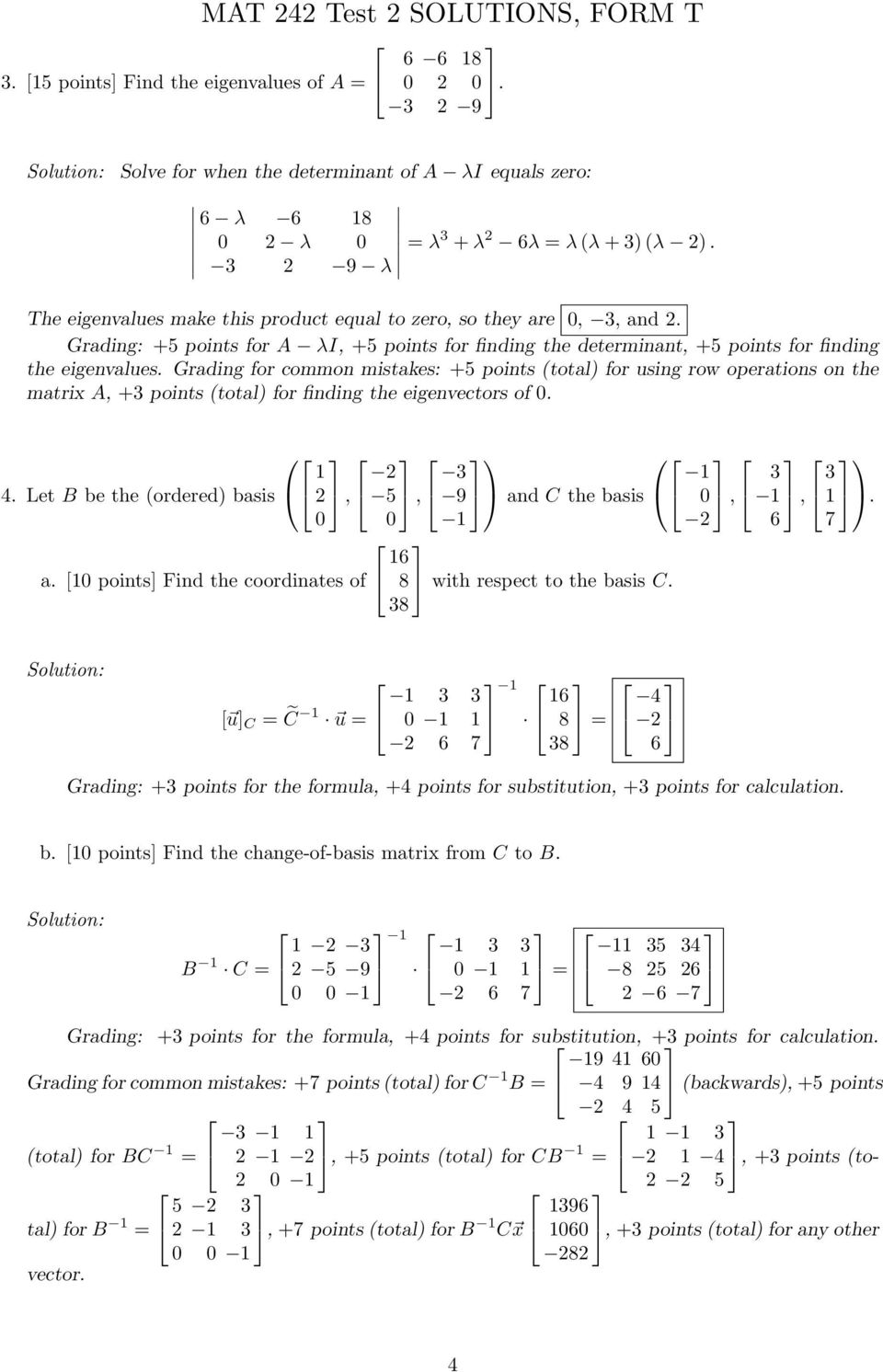
3 MAT 242 Test 2 SOLUTIONS, FORM T [5 points] Find the eigenvalues of A = Solve for when the determinant of A λi equals zero: 6 λ λ λ = λ3 + λ 2 6λ = λ (λ + 3) (λ 2). The eigenvalues make this product equal to zero, so they are, 3, and 2. Grading: +5 points for A λi, +5 points for finding the determinant, +5 points for finding the eigenvalues. Grading for common mistakes: +5 points (total) for using row operations on the matrix A, +3 points (total) for finding the eigenvectors of. 4. Let B be the (ordered) basis 2, 2 5, 3 9 and C the basis, 3, a. [ points] Find the coordinates of 6 8 with respect to the basis C. 38 [ u] C = C u = = Grading: +3 points for the formula, +4 points for substitution, +3 points for calculation. b. [ points] Find the change-of-basis matrix from C to B. 2 3 B C = = Grading: +3 points for the formula, +4 points for substitution, +3 points for calculation Grading for common mistakes: +7 points (total) for C B = (backwards), +5 points (total) for BC = 2 2, +5 points (total) for CB = 3 2 4, +3 points (total) for B = , +7 points (total) for B C x 396 6, +3 points (total) for any other 282 vector. 4
4 MAT 242 Test 2 SOLUTIONS, FORM T 5. The eigenvalues of the matrix A = are (with multiplicity 2) and 2 (with multiplicity ). 2 2 (You do not need to find these.) Do the following for the matrix A: a. [ points] Find a basis for the eigenspace of each eigenvalue. The eigenspace of an eigenvalue λ is the null space of A λi. So, if λ =, A ()I = RREF, 2 2 whose solutions (with a vector of s on the right-hand side) are parameterized by and a basis for the eigenspace of is If λ = 2, whose solutions are parameterized by and a basis for the eigenspace of 2 is x = s + t x 3,. A (2)I = RREF 3 2, 2 4 x = s 3 2 x Grading: +3 points for A λi, +3 points for the RREF, +4 points for finding the null space basis. Grading for common mistakes: +5 points (total) for finding the column space of A lambdai. b. [ points] Is the matrix A diagonalizable? If so, find matrices D and P such that A = P DP and D is a diagonal matrix. If A is not diagonalizable explain carefully why it is not. YES. The dimension of each eigenspace equals the (given) multiplicity of each eigenvalue. The matrix P can be constructed by gluing the basis vectors together; then the (i, i) entry in D is the eigenvalue that the ith column of P belongs to. One pair of matrices that diagonalizes A is D = and P = Grading: +3 points for YES, +7 points for P and D. Full credit marked + points was given for an answer consistent with any mistakes made in part (a). 5

5 MAT 242 Test 2 SOLUTIONS, FORM W Let S =,,,, a. [ points] Find a basis for the subspace W spanned by S, and the dimension of W. To find a basis, use the column space (CS) approach: Glue the vectors together to get the matrix Ṽ, find the RREF, and take the original vectors that have pivots in their columns: Ṽ = 2 RREF A basis for the subspace will consist of the columns of Ṽ which have a pivot in their column, namely ,,. The dimension of the subspace is the number of vectors in this basis, which is 3. Grading: +5 points for Ṽ, +5 points for the RREF, +5 points for the dimension. Grading for common mistakes: +5 points (total) for finding a basis for the null space; 3 points for using the columns of the RREF. 7 b. [ points] Is the vector in the span of S? Justify your answer. 4 3 You must determine whether the augmented matrix [ v v 2 v 3 v 4 u] is a system that has at least one solution RREF Since this system has infinitely many solutions, it has at least one, and the vector is in the span. Grading: +4 points for setting up the matrix, +4 points for the RREF, +3 points for determining how many solutions there were, +4 points for answering YES. Grading for common mistakes: 8 points for using instead of u. 2

6 MAT 242 Test 2 SOLUTIONS, FORM W 2. [25 points] For the matrix A below, find a basis for the null space of A, a basis for the row space of A, a basis for the column space of A, the rank of A, and the nullity of A. The reduced row echelon form of A is the matrix R given below A = R = To find a basis for the null space, you need to solve the system of linear equations A x =, or equivalently, R x =. Parameterizing the solutions to this equation, and writing the answer in expanded form, produces 5 so x 3 = α x + α 3 2 x , 5 is a basis for the null space of A. The nullity is the number of vectors in this basis, namely 2. A basis for the row space can be found by taking the nonzero rows of R: {[,,, 5 ], [,, 3, 5 ]} A basis for the column space can be found by taking the columns of A which have pivots in them, so , is a basis for the column space of A. Lastly, the rank of A is the number of vectors in a basis for the row space (or column space) of A, so the rank of A is 2. Grading: +5 points for each of: finding a basis for the null space, a basis for the row space, a basis for the column space, the nullity, and the rank. Grading for common mistakes: 3 points for forgetting a variable in the parameterization; 3 points for choosing columns of R for the column space of A; 3 points for choosing rows from A for the row space of A; 3 points for choosing the non-pivot columns of A for the null space of A. 3

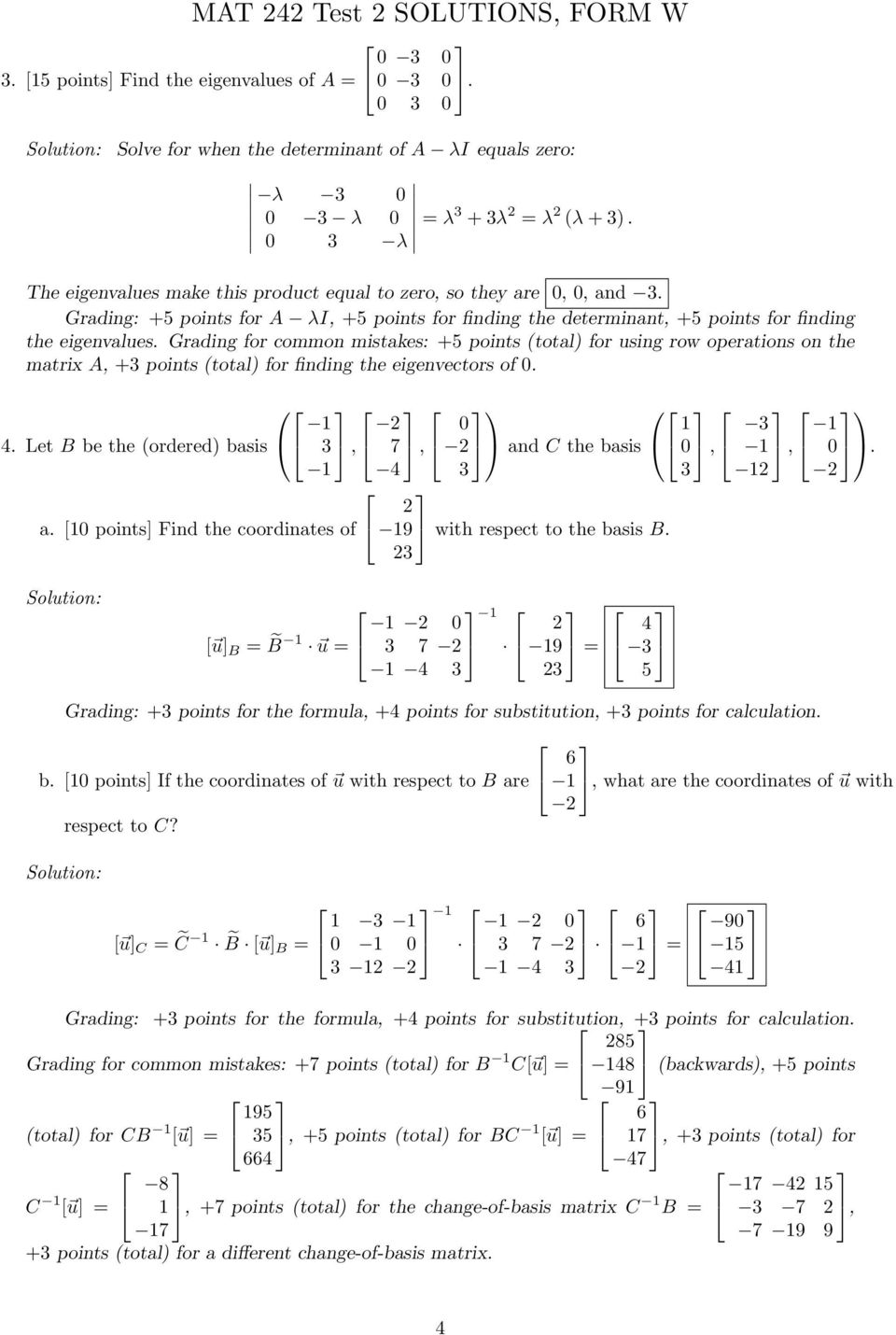
7 MAT 242 Test 2 SOLUTIONS, FORM W 3. [5 points] Find the eigenvalues of A = Solve for when the determinant of A λi equals zero: λ 3 3 λ 3 λ = λ3 + 3λ 2 = λ 2 (λ + 3). The eigenvalues make this product equal to zero, so they are,, and 3. Grading: +5 points for A λi, +5 points for finding the determinant, +5 points for finding the eigenvalues. Grading for common mistakes: +5 points (total) for using row operations on the matrix A, +3 points (total) for finding the eigenvectors of. 4. Let B be the (ordered) basis 3, 2 7, 2 and C the basis, 3, a. [ points] Find the coordinates of 9 with respect to the basis B. 23 [ u] B = B 2 u = = Grading: +3 points for the formula, +4 points for substitution, +3 points for calculation. b. [ points] If the coordinates of u with respect to B are 6, what are the coordinates of u with 2 respect to C? [ u] C = C B [ u] B = = Grading: +3 points for the formula, +4 points for substitution, +3 points for calculation. Grading for common mistakes: +7 points (total) for B C[ u] = (backwards), +5 points 9 (total) for CB [ u] = , +5 points (total) for BC [ u] = 7, +3 points (total) for C [ u] = , +7 points (total) for the change-of-basis matrix C B = 3 7 2, points (total) for a different change-of-basis matrix. 4
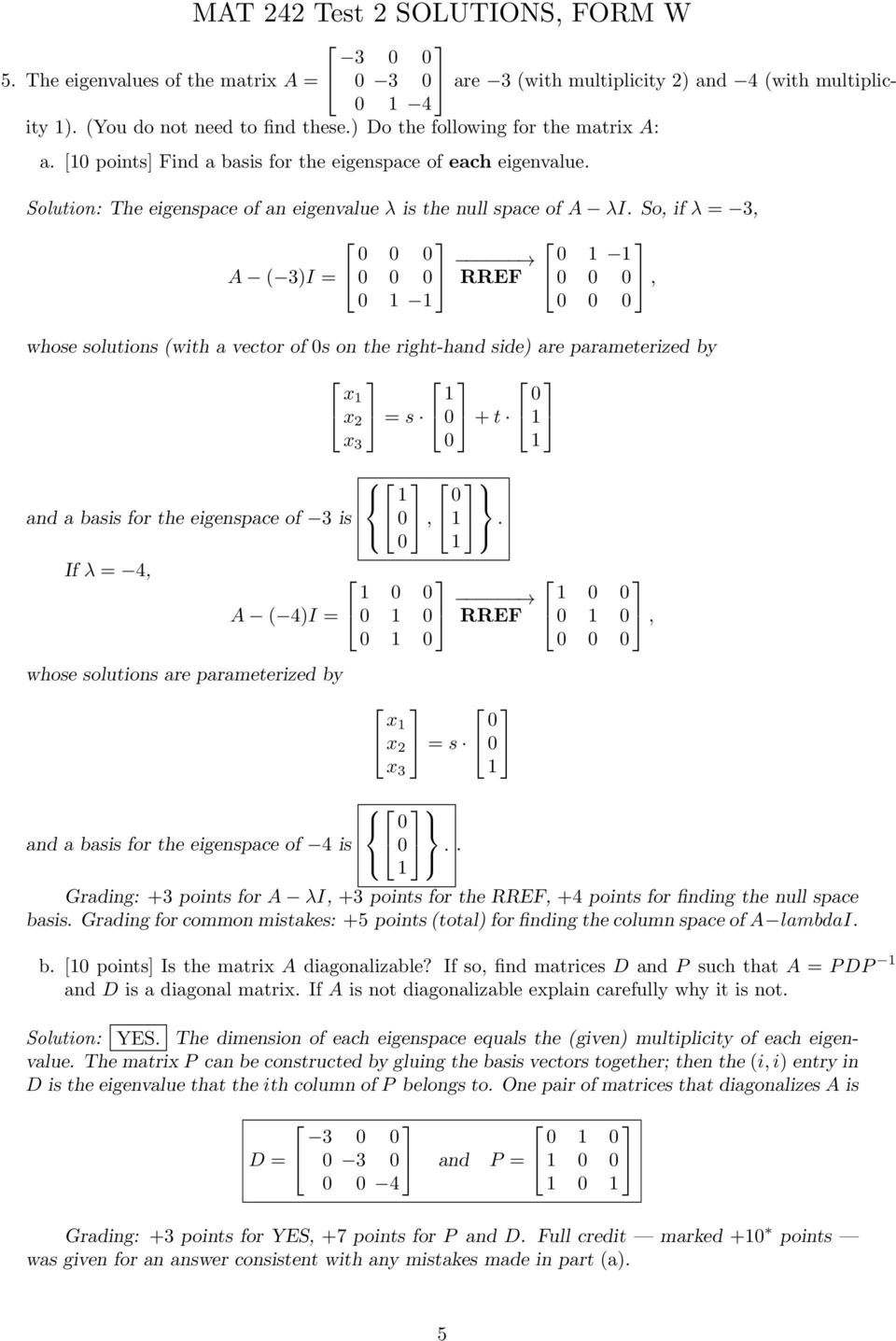
8 MAT 242 Test 2 SOLUTIONS, FORM W 5. The eigenvalues of the matrix A = 3 3 are 3 (with multiplicity 2) and 4 (with multiplicity ). (You do not need to find these.) Do the following for the matrix 4 A: a. [ points] Find a basis for the eigenspace of each eigenvalue. The eigenspace of an eigenvalue λ is the null space of A λi. So, if λ = 3, A ( 3)I = RREF, whose solutions (with a vector of s on the right-hand side) are parameterized by and a basis for the eigenspace of 3 is If λ = 4, whose solutions are parameterized by and a basis for the eigenspace of 4 is x = s + t x 3,. A ( 4)I = RREF, x = s x 3.. Grading: +3 points for A λi, +3 points for the RREF, +4 points for finding the null space basis. Grading for common mistakes: +5 points (total) for finding the column space of A lambdai. b. [ points] Is the matrix A diagonalizable? If so, find matrices D and P such that A = P DP and D is a diagonal matrix. If A is not diagonalizable explain carefully why it is not. YES. The dimension of each eigenspace equals the (given) multiplicity of each eigenvalue. The matrix P can be constructed by gluing the basis vectors together; then the (i, i) entry in D is the eigenvalue that the ith column of P belongs to. One pair of matrices that diagonalizes A is D = 3 3 and P = 4 Grading: +3 points for YES, +7 points for P and D. Full credit marked + points was given for an answer consistent with any mistakes made in part (a). 5
9 MAT 242 Test 2 SOLUTIONS, FORM O Let S =,,,, a. [ points] Find a basis for the subspace W spanned by S, and the dimension of W. To find a basis, use the column space (CS) approach: Glue the vectors together to get the matrix Ṽ, find the RREF, and take the original vectors that have pivots in their columns: Ṽ = 4 2 RREF A basis for the subspace will consist of the columns of Ṽ which have a pivot in their column, namely 3 4 3,,. The dimension of the subspace is the number of vectors in this basis, which is 3. Grading: +5 points for Ṽ, +5 points for the RREF, +5 points for the dimension. Grading for common mistakes: +5 points (total) for finding a basis for the null space; 3 points for using the columns of the RREF. 65 b. [ points] Is the vector in the span of S? Justify your answer You must determine whether the augmented matrix [ v v 2 v 3 v 4 u] is a system that has at least one solution RREF Since this system has no solutions, the vector is not in the span. Grading: +4 points for setting up the matrix, +4 points for the RREF, +3 points for determining how many solutions there were, +4 points for answering NO. Grading for common mistakes: 8 points for using instead of u. 2

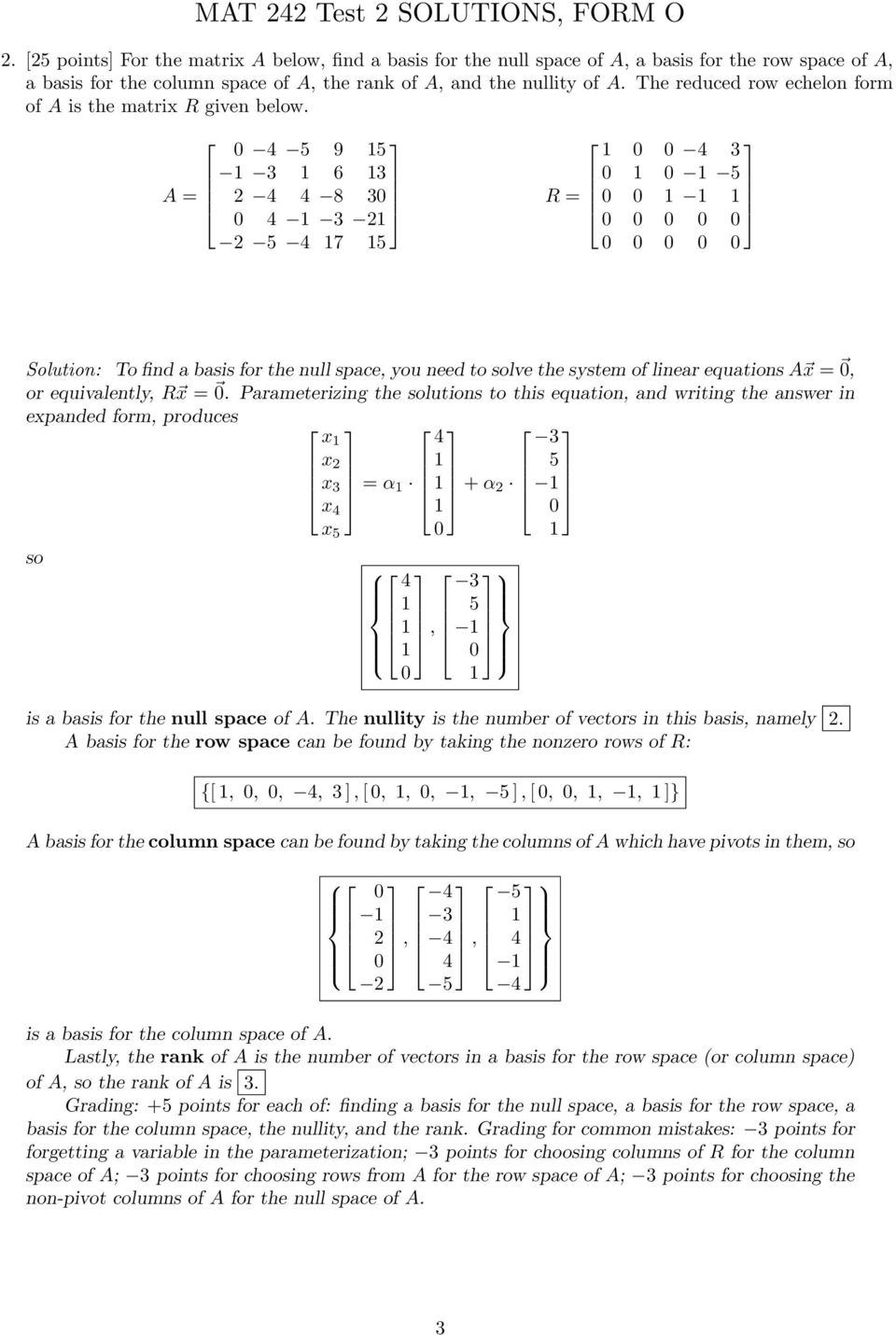
10 MAT 242 Test 2 SOLUTIONS, FORM O 2. [25 points] For the matrix A below, find a basis for the null space of A, a basis for the row space of A, a basis for the column space of A, the rank of A, and the nullity of A. The reduced row echelon form of A is the matrix R given below A = R = To find a basis for the null space, you need to solve the system of linear equations A x =, or equivalently, R x =. Parameterizing the solutions to this equation, and writing the answer in expanded form, produces x x 3 = α + α 2 so x 4 x , is a basis for the null space of A. The nullity is the number of vectors in this basis, namely 2. A basis for the row space can be found by taking the nonzero rows of R: {[,,, 4, 3 ], [,,,, 5 ], [,,,, ]} A basis for the column space can be found by taking the columns of A which have pivots in them, so , 4, is a basis for the column space of A. Lastly, the rank of A is the number of vectors in a basis for the row space (or column space) of A, so the rank of A is 3. Grading: +5 points for each of: finding a basis for the null space, a basis for the row space, a basis for the column space, the nullity, and the rank. Grading for common mistakes: 3 points for forgetting a variable in the parameterization; 3 points for choosing columns of R for the column space of A; 3 points for choosing rows from A for the row space of A; 3 points for choosing the non-pivot columns of A for the null space of A. 3
11 MAT 242 Test 2 SOLUTIONS, FORM O 3. [5 points] Find the eigenvalues of A = Solve for when the determinant of A λi equals zero: λ 4 2 λ 2 2 λ = λ3 4λ = λ (λ + 2) (λ 2). The eigenvalues make this product equal to zero, so they are, 2, and 2. Grading: +5 points for A λi, +5 points for finding the determinant, +5 points for finding the eigenvalues. Grading for common mistakes: +5 points (total) for using row operations on the matrix A, +3 points (total) for finding the eigenvectors of. 4. Let B be the (ordered) basis,, 2 3 and C the basis 3, 2, a. [ points] Find the coordinates of 3 38 with respect to the basis C. 8 [ u] C = C u = = Grading: +3 points for the formula, +4 points for substitution, +3 points for calculation. b. [ points] If the coordinates of u with respect to B are 8, what are the coordinates of u with respect to C? [ u] C = C B [ u] B = = Grading: +3 points for the formula, +4 points for substitution, +3 points for calculation. Grading for common mistakes: +7 points (total) for B C[ u] = (backwards), +5 points 6 (total) for CB [ u] = , +5 points (total) for BC [ u] = 2, +3 points (total) for C [ u] = , +7 points (total) for the change-of-basis matrix C B = 2 7, points (total) for a different change-of-basis matrix. 4
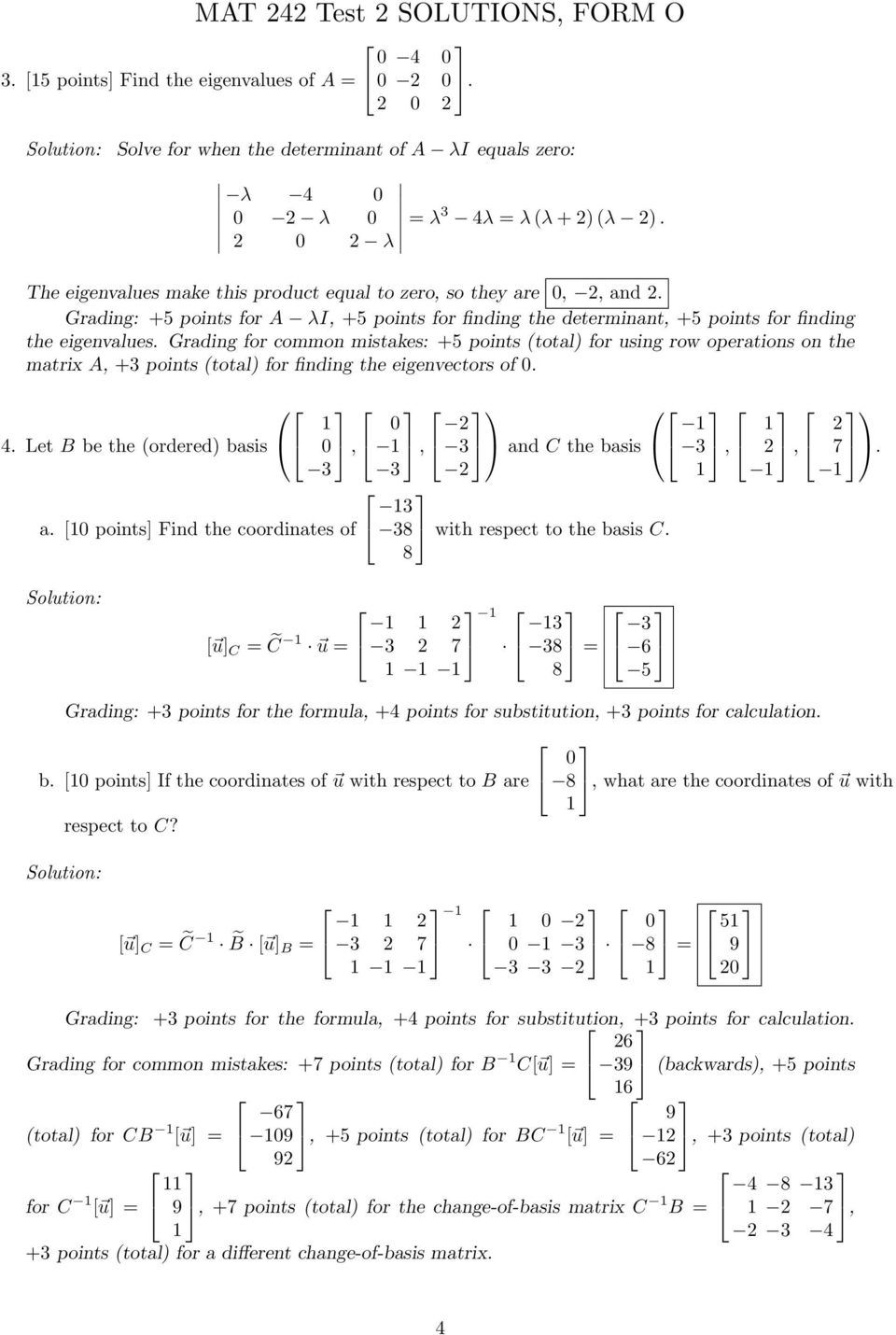
12 MAT 242 Test 2 SOLUTIONS, FORM O The eigenvalues of the matrix A = 3 6 are 5 (with multiplicity 2) and 3 (with multiplicity ). (You do not need to find these.) Do the following for the matrix 8 A: a. [ points] Find a basis for the eigenspace of each eigenvalue. The eigenspace of an eigenvalue λ is the null space of A λi. So, if λ = 5, 6 32 A ( 5)I = 8 6 RREF 2, 8 6 whose solutions (with a vector of s on the right-hand side) are parameterized by and a basis for the eigenspace of 5 is If λ = 3, whose solutions are parameterized by and a basis for the eigenspace of 3 is x = s + t 2 x 3, A (3)I = 6 6 RREF 2, 8 8 x = s 2 x Grading: +3 points for A λi, +3 points for the RREF, +4 points for finding the null space basis. Grading for common mistakes: +5 points (total) for finding the column space of A lambdai. b. [ points] Is the matrix A diagonalizable? If so, find matrices D and P such that A = P DP and D is a diagonal matrix. If A is not diagonalizable explain carefully why it is not. YES. The dimension of each eigenspace equals the (given) multiplicity of each eigenvalue. The matrix P can be constructed by gluing the basis vectors together; then the (i, i) entry in D is the eigenvalue that the ith column of P belongs to. One pair of matrices that diagonalizes A is D = 5 5 and P = Grading: +3 points for YES, +7 points for P and D. Full credit marked + points was given for an answer consistent with any mistakes made in part (a). 5

Similarity and Diagonalization. Similar Matrices
 MATH022 Linear Algebra Brief lecture notes 48 Similarity and Diagonalization Similar Matrices Let A and B be n n matrices. We say that A is similar to B if there is an invertible n n matrix P such that
MATH 423 Linear Algebra II Lecture 38: Generalized eigenvectors. Jordan canonical form (continued).
 MATH 423 Linear Algebra II Lecture 38: Generalized eigenvectors Jordan canonical form (continued) Jordan canonical form A Jordan block is a square matrix of the form λ 1 0 0 0 0 λ 1 0 0 0 0 λ 0 0 J = 0
Orthogonal Diagonalization of Symmetric Matrices
 MATH10212 Linear Algebra Brief lecture notes 57 Gram Schmidt Process enables us to find an orthogonal basis of a subspace. Let u 1,..., u k be a basis of a subspace V of R n. We begin the process of finding
MAT 200, Midterm Exam Solution. a. (5 points) Compute the determinant of the matrix A =
 MAT 200, Midterm Exam Solution. (0 points total) a. (5 points) Compute the determinant of the matrix 2 2 0 A = 0 3 0 3 0 Answer: det A = 3. The most efficient way is to develop the determinant along the
Solutions to Math 51 First Exam January 29, 2015
 Solutions to Math 5 First Exam January 29, 25. ( points) (a) Complete the following sentence: A set of vectors {v,..., v k } is defined to be linearly dependent if (2 points) there exist c,... c k R, not
by the matrix A results in a vector which is a reflection of the given
 Eigenvalues & Eigenvectors Example Suppose Then So, geometrically, multiplying a vector in by the matrix A results in a vector which is a reflection of the given vector about the y-axis We observe that
MATH 551 - APPLIED MATRIX THEORY
 MATH 55 - APPLIED MATRIX THEORY FINAL TEST: SAMPLE with SOLUTIONS (25 points NAME: PROBLEM (3 points A web of 5 pages is described by a directed graph whose matrix is given by A Do the following ( points
MAT 242 Test 3 SOLUTIONS, FORM A
 MAT Test SOLUTIONS, FORM A. Let v =, v =, and v =. Note that B = { v, v, v } is an orthogonal set. Also, let W be the subspace spanned by { v, v, v }. A = 8 a. [5 points] Find the orthogonal projection
Methods for Finding Bases
 Methods for Finding Bases Bases for the subspaces of a matrix Row-reduction methods can be used to find bases. Let us now look at an example illustrating how to obtain bases for the row space, null space,
University of Lille I PC first year list of exercises n 7. Review
 University of Lille I PC first year list of exercises n 7 Review Exercise Solve the following systems in 4 different ways (by substitution, by the Gauss method, by inverting the matrix of coefficients
Chapter 6. Orthogonality
 6.3 Orthogonal Matrices 1 Chapter 6. Orthogonality 6.3 Orthogonal Matrices Definition 6.4. An n n matrix A is orthogonal if A T A = I. Note. We will see that the columns of an orthogonal matrix must be
Lecture Notes 2: Matrices as Systems of Linear Equations
 2: Matrices as Systems of Linear Equations 33A Linear Algebra, Puck Rombach Last updated: April 13, 2016 Systems of Linear Equations Systems of linear equations can represent many things You have probably
Au = = = 3u. Aw = = = 2w. so the action of A on u and w is very easy to picture: it simply amounts to a stretching by 3 and 2, respectively.
 Chapter 7 Eigenvalues and Eigenvectors In this last chapter of our exploration of Linear Algebra we will revisit eigenvalues and eigenvectors of matrices, concepts that were already introduced in Geometry
( ) which must be a vector
 MATH 37 Linear Transformations from Rn to Rm Dr. Neal, WKU Let T : R n R m be a function which maps vectors from R n to R m. Then T is called a linear transformation if the following two properties are
MATH 304 Linear Algebra Lecture 18: Rank and nullity of a matrix.
 MATH 304 Linear Algebra Lecture 18: Rank and nullity of a matrix. Nullspace Let A = (a ij ) be an m n matrix. Definition. The nullspace of the matrix A, denoted N(A), is the set of all n-dimensional column
Reduced echelon form: Add the following conditions to conditions 1, 2, and 3 above:
 Section 1.2: Row Reduction and Echelon Forms Echelon form (or row echelon form): 1. All nonzero rows are above any rows of all zeros. 2. Each leading entry (i.e. left most nonzero entry) of a row is in
Notes on Orthogonal and Symmetric Matrices MENU, Winter 2013
 Notes on Orthogonal and Symmetric Matrices MENU, Winter 201 These notes summarize the main properties and uses of orthogonal and symmetric matrices. We covered quite a bit of material regarding these topics,
Examination paper for TMA4115 Matematikk 3
 Department of Mathematical Sciences Examination paper for TMA45 Matematikk 3 Academic contact during examination: Antoine Julien a, Alexander Schmeding b, Gereon Quick c Phone: a 73 59 77 82, b 40 53 99
1 0 5 3 3 A = 0 0 0 1 3 0 0 0 0 0 0 0 0 0 0
 Solutions: Assignment 4.. Find the redundant column vectors of the given matrix A by inspection. Then find a basis of the image of A and a basis of the kernel of A. 5 A The second and third columns are
Linearly Independent Sets and Linearly Dependent Sets
 These notes closely follow the presentation of the material given in David C. Lay s textbook Linear Algebra and its Applications (3rd edition). These notes are intended primarily for in-class presentation
Linear Algebra Review. Vectors
 Linear Algebra Review By Tim K. Marks UCSD Borrows heavily from: Jana Kosecka [email protected] http://cs.gmu.edu/~kosecka/cs682.html Virginia de Sa Cogsci 8F Linear Algebra review UCSD Vectors The length
1 Sets and Set Notation.
 LINEAR ALGEBRA MATH 27.6 SPRING 23 (COHEN) LECTURE NOTES Sets and Set Notation. Definition (Naive Definition of a Set). A set is any collection of objects, called the elements of that set. We will most
x + y + z = 1 2x + 3y + 4z = 0 5x + 6y + 7z = 3
 Math 24 FINAL EXAM (2/9/9 - SOLUTIONS ( Find the general solution to the system of equations 2 4 5 6 7 ( r 2 2r r 2 r 5r r x + y + z 2x + y + 4z 5x + 6y + 7z 2 2 2 2 So x z + y 2z 2 and z is free. ( r
4: EIGENVALUES, EIGENVECTORS, DIAGONALIZATION
 4: EIGENVALUES, EIGENVECTORS, DIAGONALIZATION STEVEN HEILMAN Contents 1. Review 1 2. Diagonal Matrices 1 3. Eigenvectors and Eigenvalues 2 4. Characteristic Polynomial 4 5. Diagonalizability 6 6. Appendix:
Math 115A HW4 Solutions University of California, Los Angeles. 5 2i 6 + 4i. (5 2i)7i (6 + 4i)( 3 + i) = 35i + 14 ( 22 6i) = 36 + 41i.
 Math 5A HW4 Solutions September 5, 202 University of California, Los Angeles Problem 4..3b Calculate the determinant, 5 2i 6 + 4i 3 + i 7i Solution: The textbook s instructions give us, (5 2i)7i (6 + 4i)(
Notes on Determinant
 ENGG2012B Advanced Engineering Mathematics Notes on Determinant Lecturer: Kenneth Shum Lecture 9-18/02/2013 The determinant of a system of linear equations determines whether the solution is unique, without
MATRIX ALGEBRA AND SYSTEMS OF EQUATIONS. + + x 2. x n. a 11 a 12 a 1n b 1 a 21 a 22 a 2n b 2 a 31 a 32 a 3n b 3. a m1 a m2 a mn b m
 MATRIX ALGEBRA AND SYSTEMS OF EQUATIONS 1. SYSTEMS OF EQUATIONS AND MATRICES 1.1. Representation of a linear system. The general system of m equations in n unknowns can be written a 11 x 1 + a 12 x 2 +
160 CHAPTER 4. VECTOR SPACES
 160 CHAPTER 4. VECTOR SPACES 4. Rank and Nullity In this section, we look at relationships between the row space, column space, null space of a matrix and its transpose. We will derive fundamental results
Row Echelon Form and Reduced Row Echelon Form
 These notes closely follow the presentation of the material given in David C Lay s textbook Linear Algebra and its Applications (3rd edition) These notes are intended primarily for in-class presentation
x y The matrix form, the vector form, and the augmented matrix form, respectively, for the system of equations are
 Solving Sstems of Linear Equations in Matri Form with rref Learning Goals Determine the solution of a sstem of equations from the augmented matri Determine the reduced row echelon form of the augmented
Applied Linear Algebra I Review page 1
 Applied Linear Algebra Review 1 I. Determinants A. Definition of a determinant 1. Using sum a. Permutations i. Sign of a permutation ii. Cycle 2. Uniqueness of the determinant function in terms of properties
Similar matrices and Jordan form
 Similar matrices and Jordan form We ve nearly covered the entire heart of linear algebra once we ve finished singular value decompositions we ll have seen all the most central topics. A T A is positive
13 MATH FACTS 101. 2 a = 1. 7. The elements of a vector have a graphical interpretation, which is particularly easy to see in two or three dimensions.
 3 MATH FACTS 0 3 MATH FACTS 3. Vectors 3.. Definition We use the overhead arrow to denote a column vector, i.e., a linear segment with a direction. For example, in three-space, we write a vector in terms
These axioms must hold for all vectors ū, v, and w in V and all scalars c and d.
 DEFINITION: A vector space is a nonempty set V of objects, called vectors, on which are defined two operations, called addition and multiplication by scalars (real numbers), subject to the following axioms
SALEM COMMUNITY COLLEGE Carneys Point, New Jersey 08069 COURSE SYLLABUS COVER SHEET. Action Taken (Please Check One) New Course Initiated
 SALEM COMMUNITY COLLEGE Carneys Point, New Jersey 08069 COURSE SYLLABUS COVER SHEET Course Title Course Number Department Linear Algebra Mathematics MAT-240 Action Taken (Please Check One) New Course Initiated
Math 312 Homework 1 Solutions
 Math 31 Homework 1 Solutions Last modified: July 15, 01 This homework is due on Thursday, July 1th, 01 at 1:10pm Please turn it in during class, or in my mailbox in the main math office (next to 4W1) Please
MATH10212 Linear Algebra. Systems of Linear Equations. Definition. An n-dimensional vector is a row or a column of n numbers (or letters): a 1.
 MATH10212 Linear Algebra Textbook: D. Poole, Linear Algebra: A Modern Introduction. Thompson, 2006. ISBN 0-534-40596-7. Systems of Linear Equations Definition. An n-dimensional vector is a row or a column
Systems of Linear Equations
 Systems of Linear Equations Beifang Chen Systems of linear equations Linear systems A linear equation in variables x, x,, x n is an equation of the form a x + a x + + a n x n = b, where a, a,, a n and
Abstract: We describe the beautiful LU factorization of a square matrix (or how to write Gaussian elimination in terms of matrix multiplication).
 MAT 2 (Badger, Spring 202) LU Factorization Selected Notes September 2, 202 Abstract: We describe the beautiful LU factorization of a square matrix (or how to write Gaussian elimination in terms of matrix
Recall that two vectors in are perpendicular or orthogonal provided that their dot
 Orthogonal Complements and Projections Recall that two vectors in are perpendicular or orthogonal provided that their dot product vanishes That is, if and only if Example 1 The vectors in are orthogonal
MATRIX ALGEBRA AND SYSTEMS OF EQUATIONS
 MATRIX ALGEBRA AND SYSTEMS OF EQUATIONS Systems of Equations and Matrices Representation of a linear system The general system of m equations in n unknowns can be written a x + a 2 x 2 + + a n x n b a
Solving Systems of Linear Equations Using Matrices
 Solving Systems of Linear Equations Using Matrices What is a Matrix? A matrix is a compact grid or array of numbers. It can be created from a system of equations and used to solve the system of equations.
Section 6.1 - Inner Products and Norms
 Section 6.1 - Inner Products and Norms Definition. Let V be a vector space over F {R, C}. An inner product on V is a function that assigns, to every ordered pair of vectors x and y in V, a scalar in F,
Solving Linear Systems, Continued and The Inverse of a Matrix
 , Continued and The of a Matrix Calculus III Summer 2013, Session II Monday, July 15, 2013 Agenda 1. The rank of a matrix 2. The inverse of a square matrix Gaussian Gaussian solves a linear system by reducing
1 Introduction to Matrices
 1 Introduction to Matrices In this section, important definitions and results from matrix algebra that are useful in regression analysis are introduced. While all statements below regarding the columns
Name: Section Registered In:
 Name: Section Registered In: Math 125 Exam 3 Version 1 April 24, 2006 60 total points possible 1. (5pts) Use Cramer s Rule to solve 3x + 4y = 30 x 2y = 8. Be sure to show enough detail that shows you are
NOTES ON LINEAR TRANSFORMATIONS
 NOTES ON LINEAR TRANSFORMATIONS Definition 1. Let V and W be vector spaces. A function T : V W is a linear transformation from V to W if the following two properties hold. i T v + v = T v + T v for all
Vector Spaces 4.4 Spanning and Independence
 Vector Spaces 4.4 and Independence October 18 Goals Discuss two important basic concepts: Define linear combination of vectors. Define Span(S) of a set S of vectors. Define linear Independence of a set
LINEAR ALGEBRA. September 23, 2010
 LINEAR ALGEBRA September 3, 00 Contents 0. LU-decomposition.................................... 0. Inverses and Transposes................................. 0.3 Column Spaces and NullSpaces.............................
Lecture 5: Singular Value Decomposition SVD (1)
 EEM3L1: Numerical and Analytical Techniques Lecture 5: Singular Value Decomposition SVD (1) EE3L1, slide 1, Version 4: 25-Sep-02 Motivation for SVD (1) SVD = Singular Value Decomposition Consider the system
[1] Diagonal factorization
![[1] Diagonal factorization](/thumbs/40/21671034.jpg "[1] Diagonal factorization") 8.03 LA.6: Diagonalization and Orthogonal Matrices [ Diagonal factorization [2 Solving systems of first order differential equations [3 Symmetric and Orthonormal Matrices [ Diagonal factorization Recall:
8.03 LA.6: Diagonalization and Orthogonal Matrices [ Diagonal factorization [2 Solving systems of first order differential equations [3 Symmetric and Orthonormal Matrices [ Diagonal factorization Recall:
MATH2210 Notebook 1 Fall Semester 2016/2017. 1 MATH2210 Notebook 1 3. 1.1 Solving Systems of Linear Equations... 3
 MATH0 Notebook Fall Semester 06/07 prepared by Professor Jenny Baglivo c Copyright 009 07 by Jenny A. Baglivo. All Rights Reserved. Contents MATH0 Notebook 3. Solving Systems of Linear Equations........................
DATA ANALYSIS II. Matrix Algorithms
 DATA ANALYSIS II Matrix Algorithms Similarity Matrix Given a dataset D = {x i }, i=1,..,n consisting of n points in R d, let A denote the n n symmetric similarity matrix between the points, given as where
Section 8.2 Solving a System of Equations Using Matrices (Guassian Elimination)
 Section 8. Solving a System of Equations Using Matrices (Guassian Elimination) x + y + z = x y + 4z = x 4y + z = System of Equations x 4 y = 4 z A System in matrix form x A x = b b 4 4 Augmented Matrix
4.5 Linear Dependence and Linear Independence
 4.5 Linear Dependence and Linear Independence 267 32. {v 1, v 2 }, where v 1, v 2 are collinear vectors in R 3. 33. Prove that if S and S are subsets of a vector space V such that S is a subset of S, then
Chapter 20. Vector Spaces and Bases
 Chapter 20. Vector Spaces and Bases In this course, we have proceeded step-by-step through low-dimensional Linear Algebra. We have looked at lines, planes, hyperplanes, and have seen that there is no limit
Math 215 HW #6 Solutions
 Math 5 HW #6 Solutions Problem 34 Show that x y is orthogonal to x + y if and only if x = y Proof First, suppose x y is orthogonal to x + y Then since x, y = y, x In other words, = x y, x + y = (x y) T
LS.6 Solution Matrices
 LS.6 Solution Matrices In the literature, solutions to linear systems often are expressed using square matrices rather than vectors. You need to get used to the terminology. As before, we state the definitions
Recall the basic property of the transpose (for any A): v A t Aw = v w, v, w R n.
 ORTHOGONAL MATRICES Informally, an orthogonal n n matrix is the n-dimensional analogue of the rotation matrices R θ in R 2. When does a linear transformation of R 3 (or R n ) deserve to be called a rotation?
Vector and Matrix Norms
 Chapter 1 Vector and Matrix Norms 11 Vector Spaces Let F be a field (such as the real numbers, R, or complex numbers, C) with elements called scalars A Vector Space, V, over the field F is a non-empty
4 MT210 Notebook 4 3. 4.1 Eigenvalues and Eigenvectors... 3. 4.1.1 Definitions; Graphical Illustrations... 3
 MT Notebook Fall / prepared by Professor Jenny Baglivo c Copyright 9 by Jenny A. Baglivo. All Rights Reserved. Contents MT Notebook. Eigenvalues and Eigenvectors................................... Definitions;
MA106 Linear Algebra lecture notes
 MA106 Linear Algebra lecture notes Lecturers: Martin Bright and Daan Krammer Warwick, January 2011 Contents 1 Number systems and fields 3 1.1 Axioms for number systems......................... 3 2 Vector
Chapter 17. Orthogonal Matrices and Symmetries of Space
 Chapter 17. Orthogonal Matrices and Symmetries of Space Take a random matrix, say 1 3 A = 4 5 6, 7 8 9 and compare the lengths of e 1 and Ae 1. The vector e 1 has length 1, while Ae 1 = (1, 4, 7) has length
Section 1.7 22 Continued
 Section 1.5 23 A homogeneous equation is always consistent. TRUE - The trivial solution is always a solution. The equation Ax = 0 gives an explicit descriptions of its solution set. FALSE - The equation
18.06 Problem Set 4 Solution Due Wednesday, 11 March 2009 at 4 pm in 2-106. Total: 175 points.
 806 Problem Set 4 Solution Due Wednesday, March 2009 at 4 pm in 2-06 Total: 75 points Problem : A is an m n matrix of rank r Suppose there are right-hand-sides b for which A x = b has no solution (a) What
SYSTEMS OF EQUATIONS AND MATRICES WITH THE TI-89. by Joseph Collison
 SYSTEMS OF EQUATIONS AND MATRICES WITH THE TI-89 by Joseph Collison Copyright 2000 by Joseph Collison All rights reserved Reproduction or translation of any part of this work beyond that permitted by Sections
8 Square matrices continued: Determinants
 8 Square matrices continued: Determinants 8. Introduction Determinants give us important information about square matrices, and, as we ll soon see, are essential for the computation of eigenvalues. You
Linear algebra and the geometry of quadratic equations. Similarity transformations and orthogonal matrices
 MATH 30 Differential Equations Spring 006 Linear algebra and the geometry of quadratic equations Similarity transformations and orthogonal matrices First, some things to recall from linear algebra Two
Eigenvalues, Eigenvectors, Matrix Factoring, and Principal Components
 Eigenvalues, Eigenvectors, Matrix Factoring, and Principal Components The eigenvalues and eigenvectors of a square matrix play a key role in some important operations in statistics. In particular, they
Numerical Analysis Lecture Notes
 Numerical Analysis Lecture Notes Peter J. Olver 6. Eigenvalues and Singular Values In this section, we collect together the basic facts about eigenvalues and eigenvectors. From a geometrical viewpoint,
1.5 SOLUTION SETS OF LINEAR SYSTEMS
 1-2 CHAPTER 1 Linear Equations in Linear Algebra 1.5 SOLUTION SETS OF LINEAR SYSTEMS Many of the concepts and computations in linear algebra involve sets of vectors which are visualized geometrically as
1 2 3 1 1 2 x = + x 2 + x 4 1 0 1
 (d) If the vector b is the sum of the four columns of A, write down the complete solution to Ax = b. 1 2 3 1 1 2 x = + x 2 + x 4 1 0 0 1 0 1 2. (11 points) This problem finds the curve y = C + D 2 t which
r (t) = 2r(t) + sin t θ (t) = r(t) θ(t) + 1 = 1 1 θ(t) 1 9.4.4 Write the given system in matrix form x = Ax + f ( ) sin(t) x y 1 0 5 z = dy cos(t)
 Solutions HW 9.4.2 Write the given system in matrix form x = Ax + f r (t) = 2r(t) + sin t θ (t) = r(t) θ(t) + We write this as ( ) r (t) θ (t) = ( ) ( ) 2 r(t) θ(t) + ( ) sin(t) 9.4.4 Write the given system
MATH 304 Linear Algebra Lecture 9: Subspaces of vector spaces (continued). Span. Spanning set.
 MATH 304 Linear Algebra Lecture 9: Subspaces of vector spaces (continued). Span. Spanning set. Vector space A vector space is a set V equipped with two operations, addition V V (x,y) x + y V and scalar
Linear Algebra I. Ronald van Luijk, 2012
 Linear Algebra I Ronald van Luijk, 2012 With many parts from Linear Algebra I by Michael Stoll, 2007 Contents 1. Vector spaces 3 1.1. Examples 3 1.2. Fields 4 1.3. The field of complex numbers. 6 1.4.
Introduction to Matrix Algebra
 Psychology 7291: Multivariate Statistics (Carey) 8/27/98 Matrix Algebra - 1 Introduction to Matrix Algebra Definitions: A matrix is a collection of numbers ordered by rows and columns. It is customary
Linear Algebra Notes
 Linear Algebra Notes Chapter 19 KERNEL AND IMAGE OF A MATRIX Take an n m matrix a 11 a 12 a 1m a 21 a 22 a 2m a n1 a n2 a nm and think of it as a function A : R m R n The kernel of A is defined as Note
December 4, 2013 MATH 171 BASIC LINEAR ALGEBRA B. KITCHENS
 December 4, 2013 MATH 171 BASIC LINEAR ALGEBRA B KITCHENS The equation 1 Lines in two-dimensional space (1) 2x y = 3 describes a line in two-dimensional space The coefficients of x and y in the equation
Brief Introduction to Vectors and Matrices
 CHAPTER 1 Brief Introduction to Vectors and Matrices In this chapter, we will discuss some needed concepts found in introductory course in linear algebra. We will introduce matrix, vector, vector-valued
Math 333 - Practice Exam 2 with Some Solutions
 Math 333 - Practice Exam 2 with Some Solutions (Note that the exam will NOT be this long) Definitions (0 points) Let T : V W be a transformation Let A be a square matrix (a) Define T is linear (b) Define
Solving Systems of Linear Equations
 LECTURE 5 Solving Systems of Linear Equations Recall that we introduced the notion of matrices as a way of standardizing the expression of systems of linear equations In today s lecture I shall show how
Bindel, Spring 2012 Intro to Scientific Computing (CS 3220) Week 3: Wednesday, Feb 8
 Spaces and bases Week 3: Wednesday, Feb 8 I have two favorite vector spaces 1 : R n and the space P d of polynomials of degree at most d. For R n, we have a canonical basis: R n = span{e 1, e 2,..., e
Linear Algebra and TI 89
 Linear Algebra and TI 89 Abdul Hassen and Jay Schiffman This short manual is a quick guide to the use of TI89 for Linear Algebra. We do this in two sections. In the first section, we will go over the editing
2.2/2.3 - Solving Systems of Linear Equations
 c Kathryn Bollinger, August 28, 2011 1 2.2/2.3 - Solving Systems of Linear Equations A Brief Introduction to Matrices Matrices are used to organize data efficiently and will help us to solve systems of
Linear Algebraic Equations, SVD, and the Pseudo-Inverse
 Linear Algebraic Equations, SVD, and the Pseudo-Inverse Philip N. Sabes October, 21 1 A Little Background 1.1 Singular values and matrix inversion For non-smmetric matrices, the eigenvalues and singular
α = u v. In other words, Orthogonal Projection
 Orthogonal Projection Given any nonzero vector v, it is possible to decompose an arbitrary vector u into a component that points in the direction of v and one that points in a direction orthogonal to v
a 11 x 1 + a 12 x 2 + + a 1n x n = b 1 a 21 x 1 + a 22 x 2 + + a 2n x n = b 2.
 Chapter 1 LINEAR EQUATIONS 1.1 Introduction to linear equations A linear equation in n unknowns x 1, x,, x n is an equation of the form a 1 x 1 + a x + + a n x n = b, where a 1, a,..., a n, b are given
Math 2270 - Lecture 33 : Positive Definite Matrices
 Math 2270 - Lecture 33 : Positive Definite Matrices Dylan Zwick Fall 2012 This lecture covers section 6.5 of the textbook. Today we re going to talk about a special type of symmetric matrix, called a positive
Least-Squares Intersection of Lines
 Least-Squares Intersection of Lines Johannes Traa - UIUC 2013 This write-up derives the least-squares solution for the intersection of lines. In the general case, a set of lines will not intersect at a
Inner products on R n, and more
 Inner products on R n, and more Peyam Ryan Tabrizian Friday, April 12th, 2013 1 Introduction You might be wondering: Are there inner products on R n that are not the usual dot product x y = x 1 y 1 + +
Inner Product Spaces and Orthogonality
 Inner Product Spaces and Orthogonality week 3-4 Fall 2006 Dot product of R n The inner product or dot product of R n is a function, defined by u, v a b + a 2 b 2 + + a n b n for u a, a 2,, a n T, v b,
Solutions to Homework Section 3.7 February 18th, 2005
 Math 54W Spring 5 Solutions to Homeork Section 37 Februar 8th, 5 List the ro vectors and the column vectors of the matrix The ro vectors are The column vectors are ( 5 5 The matrix ( (,,,, 4, (5,,,, (
4.3-4.4 Systems of Equations
 4.3-4.4 Systems of Equations A linear equation in 2 variables is an equation of the form ax + by = c. A linear equation in 3 variables is an equation of the form ax + by + cz = d. To solve a system of
Chapter 12 Modal Decomposition of State-Space Models 12.1 Introduction The solutions obtained in previous chapters, whether in time domain or transfor
 Lectures on Dynamic Systems and Control Mohammed Dahleh Munther A. Dahleh George Verghese Department of Electrical Engineering and Computer Science Massachuasetts Institute of Technology 1 1 c Chapter
Factorization Theorems
 Chapter 7 Factorization Theorems This chapter highlights a few of the many factorization theorems for matrices While some factorization results are relatively direct, others are iterative While some factorization
7. LU factorization. factor-solve method. LU factorization. solving Ax = b with A nonsingular. the inverse of a nonsingular matrix
 7. LU factorization EE103 (Fall 2011-12) factor-solve method LU factorization solving Ax = b with A nonsingular the inverse of a nonsingular matrix LU factorization algorithm effect of rounding error sparse
T ( a i x i ) = a i T (x i ).
 Chapter 2 Defn 1. (p. 65) Let V and W be vector spaces (over F ). We call a function T : V W a linear transformation form V to W if, for all x, y V and c F, we have (a) T (x + y) = T (x) + T (y) and (b)
LINEAR ALGEBRA W W L CHEN
 LINEAR ALGEBRA W W L CHEN c W W L Chen, 1997, 2008 This chapter is available free to all individuals, on understanding that it is not to be used for financial gain, and may be downloaded and/or photocopied,
Arithmetic and Algebra of Matrices
 Arithmetic and Algebra of Matrices Math 572: Algebra for Middle School Teachers The University of Montana 1 The Real Numbers 2 Classroom Connection: Systems of Linear Equations 3 Rational Numbers 4 Irrational