
Chapter 6 Notes Science 10 Name:
|
|
|
- Dina Carroll
- 9 years ago
- Views:
Transcription
1 6.1 Types of Chemical Reactions a) Synthesis (A + B AB) Synthesis reactions are also known as reactions. When this occurs two or more reactants (usually elements) join to form a. A + B AB, where A and B represent elements The elements may form compounds, like the following: Sodium metal and chlorine gas combine to form sodium chloride. 2Na + Cl 2 2NaCl Magnesium metal reacts with oxygen gas to form magnesium oxide. 2Mg + O 2 2MgO Or the elements may form compounds, like the following: Nitrogen gas and oxygen gas join to form dinitrogen monoxide. 2N 2 + O 2 2N 2 O 1. Complete and balance the following synthesis (combination) reactions. Remember to consider the chemical formulas of the products carefully before you begin to balance. (a) Mg + N2 (b) Al + F2 (c) K + O2 (d) Cd + I2 (e) Cs + P4 1

2 2. Identify whether or not each of the following chemical equations is a synthesis (combination) reaction. (a) 2H2 + O2 2H2O (d) S8 + 12O2 8SO3 (b) 2Al + 3CuCl2 2AlCl3 + 3Cu (e) 2Ti + 3 Cl2 2TiCl3 (c) 2KClO3 2KCl + 3O2 b) Decomposition (AB A + B) Decomposition reactions are the of synthesis reactions. A compound down into two or more products (often elements). AB A + B where A and B represent elements Ionic compounds may to produce elements, like the following: Table salt, sodium chloride, can be broken down into sodium metal and chlorine gas by salt at 800ºC and running through it. 2NaCl 2Na + Cl 2 Or covalent compounds may decompose into elements, like the following: By running through water, the water molecules into hydrogen and oxygen gases. 2H 2 O 2H 2 + O 2 2

3 1. Complete and balance the following decomposition reactions. Remember to check for diatomic elements as you write the formulas of the products. (a) AuCl3 (b) K2O (c) MgF2 (d) Ca3N2 (e) CsI 2. Identify each reaction as synthesis, decomposition, or neither. (a) CO2 C + O2 (b) 2AgCl + Cu CuCl2 + 2Ag (c) 2Cr + 3F2 2CrF3 (d) CaI2 + Na2CO3 2NaCl + CaCO3 (e) 2NaClO3 2NaCl + 3O2 c) Single Replacement Single replacement reactions replace one element from a compound with a separate element added as a reactant. A compound and an element react, and the element switches places with part of the original compound. A + BC B + AC where A is a, or A + BC C + BA where A is a -metal 3

4 When A is a metal: Aluminum foil in a solution of copper(ii) chloride produces solid copper and aluminum chloride. 2Al + 3CuCl 2 3Cu + 2AlCl 3 When A is a non-metal: When fluorine is bubbled through a sodium iodide solution, iodine and sodium fluoride are produced. F 2 + 2NaI I 2 + 2NaF 1. Complete and balance the following single replacement reactions. (a) PbCl 4 + Al (b) Na + Cu 2 O (c) CuF 2 + Mg (d) Cl 2 + CsBr (e) Be + Fe(NO 3 ) 2 2. Classify each reaction as synthesis, decomposition, or single replacement. (a) 2N2O 2N2 + O2 (b) Au(NO3)3 + 3Ag Au + 3AgNO3 (c) CH4 C + 2H2 (d) 2NH4Br + Cl2 2NH4Cl + Br2 (e) Br2 + I2 2IBr 4

5 d) Double Replacement (AB + CD AD + CB) Double replacement reactions elements between two compounds reacting together to form two new compounds. Two compounds react, with elements places between the original compounds. Two solutions react to form a (ppt, solid) and another solution Ionic solution + ionic solution ionic solution + ionic AB + CD AD + CB When potassium chromate and silver nitrate react, they form a red, silver chromate, in a of potassium nitrate. K 2 CrO 4 + 2AgNO 3 Ag 2 CrO 4 + 2KNO 3 1. Complete and balance the following double replacement reactions. You do not need to decide which product(s) form a precipitate or to show states in the balanced equation. (a) CaS + NaOH (b) K 3 PO 4 + MgI 2 (c) SrCl 2 + Pb(NO 3 ) 2 (d) AlCl 3 + CuNO 3 5

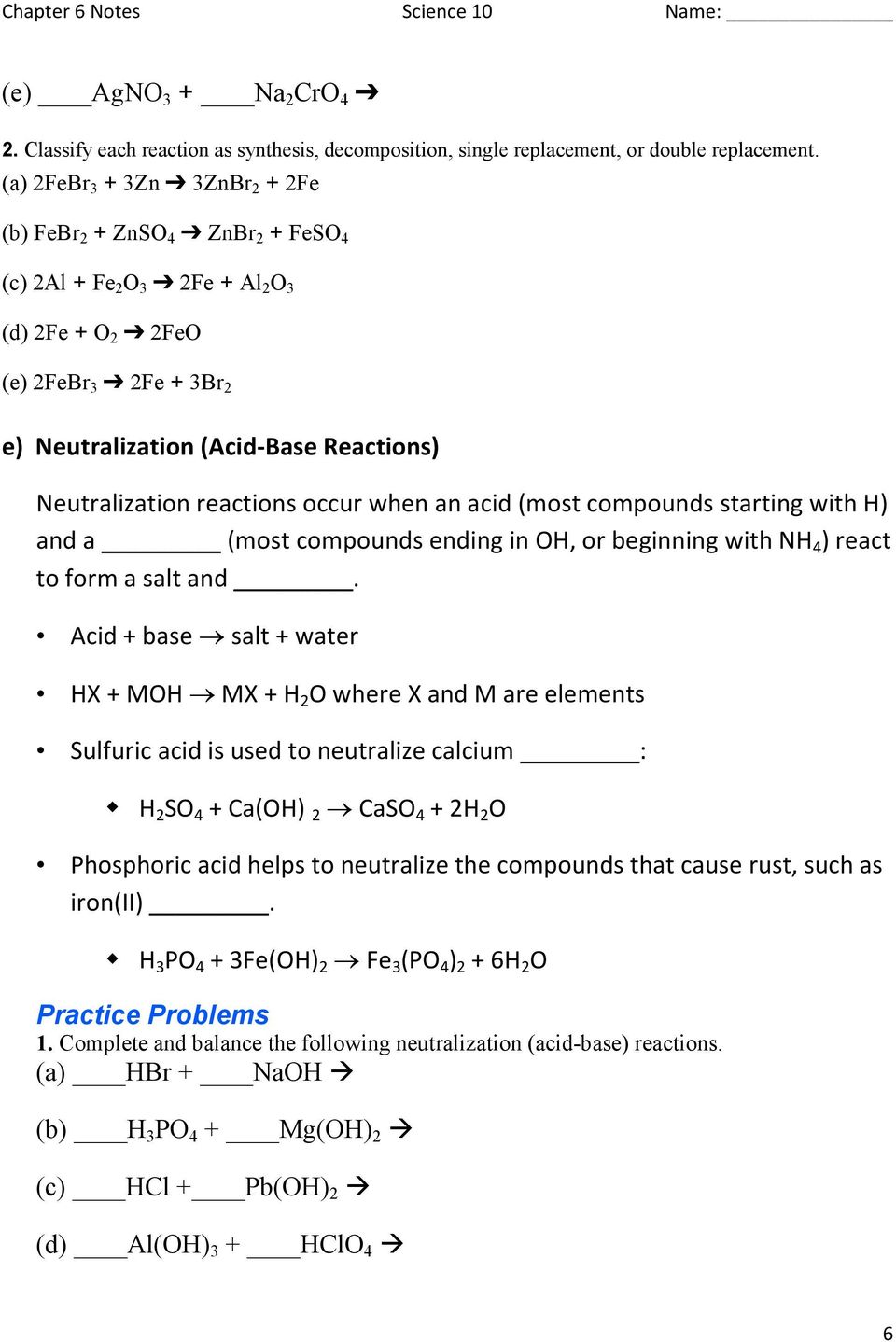
6 (e) AgNO 3 + Na 2 CrO 4 2. Classify each reaction as synthesis, decomposition, single replacement, or double replacement. (a) 2FeBr 3 + 3Zn 3ZnBr 2 + 2Fe (b) FeBr 2 + ZnSO 4 ZnBr 2 + FeSO 4 (c) 2Al + Fe 2 O 3 2Fe + Al 2 O 3 (d) 2Fe + O 2 2FeO (e) 2FeBr 3 2Fe + 3Br 2 e) Neutralization (Acid-Base Reactions) Neutralization reactions occur when an acid (most compounds starting with H) and a (most compounds ending in OH, or beginning with NH 4 ) react to form a salt and. Acid + base salt + water HX + MOH MX + H 2 O where X and M are elements Sulfuric acid is used to neutralize calcium : H 2 SO 4 + Ca(OH) 2 CaSO 4 + 2H 2 O Phosphoric acid helps to neutralize the compounds that cause rust, such as iron(ii). H 3 PO 4 + 3Fe(OH) 2 Fe 3 (PO 4 ) 2 + 6H 2 O 1. Complete and balance the following neutralization (acid-base) reactions. (a) HBr + NaOH (b) H 3 PO 4 + Mg(OH) 2 (c) HCl + Pb(OH) 2 (d) Al(OH) 3 + HClO 4 6
7 2. Classify each reaction as synthesis, decomposition, single replacement, double replacement, or neutralization. (a) 2HCl + Zn ZnCl 2 + H 2 (b) 2HCl H 2 + Cl 2 (c) 2HCl + Sr(OH) 2 SrCl 2 + 2H 2 O (d) 2HCl + Pb(NO 2 ) 2 2HNO 2 + PbCl 2 f) Combustion Combustion reactions occur when a compound or element reacts with to release and produce an. Also sometimes referred to as combustion. C X H Y + O 2 CO 2 + H 2 O where X and Y represent integers Natural gas ( ) is burned in furnaces to heat homes. CH 4 + O 2 CO 2 + 2H 2 O An acetylene torch is used to metals together. 2C 2 H 2 + 5O 2 4CO 2 + 2H 2 O Carbohydrates like glucose combine with oxygen in our body to release energy. C 6 H 12 O 6 + 6O 2 6CO 2 + 6H 2 O 1. Complete and balance the following combustion reactions. (a) C 3 H 8 + O 2 (b) C 4 H 10 + O 2 (c) C 2 H 4 + O 2 7

8 (d) C 6 H 12 O 6 + O 2 (e) C 12 H 22 O 11 + O 2 2. Classify each reaction as synthesis, decomposition, single replacement, double replacement, neutralization, or combustion. (a) 3Ca(NO3)2 + 2Na3PO4 6NaNO3 + Ca3(PO4)2 (b) Ca(OH)2 + H2SO4 2H2O + CaSO4 (c) 2C6H6 + 15O2 12CO2 + 6H2O (d) 6Mg + P4 2Mg3P2 (e) C2H6O + 3O2 2CO2 + 3H2O Summary of Types of Chemical Reactions 8

9 For each of the following reactions, classify the reaction type and then predict what the products will be. Then write the skeleton equation and balance it. 1. Fe 2 O 3 2. Al + NiBr 3 3. Cl 2 + NiBr 2 4. HCl + Mg(OH) 2 5. C 18 H 38 + O 2 6. Li + N 2 7. AgNO 3 + Na 2 CrO Factors Affecting the Rate of Chemical Reactions Often, controlling the rate of a chemical reaction is as important as having the reaction occur in the first place. Altering certain factors can determine the at which a chemical reaction occurs. To make a reaction happen quickly: Increase the where the reaction occurs. Increase the of reactants. Increase the amount of area that reacts. Add a or remove an. To make a reaction happen slowly: the temperature where the reaction occurs. the concentration of reactants. the amount of surface area that reacts. a catalyst or an inhibitor. 9

10 a) Temperature Temperature is the energy of molecules. The more energy molecules have, the higher the temperature. When molecules have more energy, they around more, into other molecules more, and therefore react. The rate of reaction changes with the temperature. Higher temperature = reaction rate, and vice versa. Sometimes we want slower reactions (we use a to prevent spoilage). Sometimes we want faster reactions (we food to speed up the production of new molecules). Learning Check (p ) 1. Heating a light stick can make it glow brighter. Why? The brighter light of a hot glow stick is due to a faster reaction rate caused by heating. 2. What happens to the rate of a chemical reaction when the temperature is raised? Raising the temperature of a chemical reaction increases the reaction rate. 3. What does cooling do to the frequency at which particles of reactants can collide? Cooling decreases the frequency at which particles of reactants can collide. 4. How does cooling affect the energy of the collisions between particles? Cooling lowers the energy of the collisions between reactant particles. b) Concentration Concentration refers to how many molecules of a substance exist in a certain. Concentration is how much is dissolved in. Concentration is measured in mass per unit volume (g/l). 10

11 Usually, the higher the concentration of reactants, the faster the reaction occurs. c) Surface Area Since there are molecules per unit volume in high concentrations, there are more for molecules to collide and react. A splint of wood glows brighter in highly oxygen than in normal with a lower concentration of oxygen. Chemical reactions occur when and where atoms and compounds collide. Therefore, the more atoms and molecules there are to collide, the higher the reaction rate. Increasing surface area the rate of reaction. Surface area can be increased by creating pieces. A substance has far more surface area than one large. The increase in surface area must also be exposed for reaction; a powder only reacts more quickly if it is in contact with the other reactant(s). Reading Check (p. p ) 1. How does increasing concentration result in an increase in reaction rate? 2. Can the concentration of a substance change if it is a gas? 3. Can the concentration of a solution change if it is an aqueous solution? 11

12 4. How does increasing the surface area of a reactant increase reaction rate? d) Catalysts Sometimes, increasing the temperature or concentration is not a desirable method to increase reaction rate. Changing these two variables may be impractical or dangerous. An alternate technique is to use a catalyst. A catalyst is a chemical that allows a reaction to occur more without actually participating in the reaction itself. The catalyst speeds up the reaction rate but does not get up as a reactant. Catalysts often the amount of energy necessary to break the bonds in the reactants. are an example of biological catalysts. Saliva has enzymes that help speed the breakdown of when they enter the mouth. A catalytic converter is a device installed in cars to. Car exhaust passes through the catalytic converter before leaving the car. Catalysts found in the honeycomb-shaped filters in the converter help to change many of the pollutants into substances. carbon monoxide is changed into CO 2. Hydrocarbons are converted into CO 2 and. Nitrogen oxides are changed into and. Non-metal oxide 2N 2 O 3 2N 2 + 3O 2 12

Writing and Balancing Chemical Equations
 Name Writing and Balancing Chemical Equations Period When a substance undergoes a chemical reaction, chemical bonds are broken and new bonds are formed. This results in one or more new substances, often
Balancing Chemical Equations Worksheet
 Balancing Chemical Equations Worksheet Student Instructions 1. Identify the reactants and products and write a word equation. 2. Write the correct chemical formula for each of the reactants and the products.
Steps for balancing a chemical equation
 The Chemical Equation: A Chemical Recipe Dr. Gergens - SD Mesa College A. Learn the meaning of these arrows. B. The chemical equation is the shorthand notation for a chemical reaction. A chemical equation
2. DECOMPOSITION REACTION ( A couple have a heated argument and break up )
 TYPES OF CHEMICAL REACTIONS Most reactions can be classified into one of five categories by examining the types of reactants and products involved in the reaction. Knowing the types of reactions can help
Stoichiometry Review
 Stoichiometry Review There are 20 problems in this review set. Answers, including problem set-up, can be found in the second half of this document. 1. N 2 (g) + 3H 2 (g) --------> 2NH 3 (g) a. nitrogen
6 Reactions in Aqueous Solutions
 6 Reactions in Aqueous Solutions Water is by far the most common medium in which chemical reactions occur naturally. It is not hard to see this: 70% of our body mass is water and about 70% of the surface
Chapter 5. Chemical Reactions and Equations. Introduction. Chapter 5 Topics. 5.1 What is a Chemical Reaction
 Introduction Chapter 5 Chemical Reactions and Equations Chemical reactions occur all around us. How do we make sense of these changes? What patterns can we find? 1 2 Copyright The McGraw-Hill Companies,
SCH 4C1 Unit 2 Problem Set Questions taken from Frank Mustoe et all, "Chemistry 11", McGraw-Hill Ryerson, 2001
 SCH 4C1 Unit 2 Problem Set Questions taken from Frank Mustoe et all, "Chemistry 11", McGraw-Hill Ryerson, 2001 1. A small pin contains 0.0178 mol of iron. How many atoms of iron are in the pin? 2. A sample
Chapter 8: Chemical Equations and Reactions
 Chapter 8: Chemical Equations and Reactions I. Describing Chemical Reactions A. A chemical reaction is the process by which one or more substances are changed into one or more different substances. A chemical
Chemical Equations and Chemical Reactions. Chapter 8.1
 Chemical Equations and Chemical Reactions Chapter 8.1 Objectives List observations that suggest that a chemical reaction has taken place List the requirements for a correctly written chemical equation.
Chemistry Themed. Types of Reactions
 Chemistry Themed Types of Reactions 1 2 Chemistry in the Community-2015-2016 Types of Reactions Date In-Class Assignment Homework T 10/20 TEST on Reactivity of Metals and Redox None W 10/21 Late Start
Chapter 11. Electrochemistry Oxidation and Reduction Reactions. Oxidation-Reduction Reactions. Oxidation-Reduction Reactions
 Oxidation-Reduction Reactions Chapter 11 Electrochemistry Oxidation and Reduction Reactions An oxidation and reduction reaction occurs in both aqueous solutions and in reactions where substances are burned
1. When the following equation is balanced, the coefficient of Al is. Al (s) + H 2 O (l)? Al(OH) 3 (s) + H 2 (g)
 1. When the following equation is balanced, the coefficient of Al is. Al (s) + H 2 O (l)? Al(OH) (s) + H 2 (g) A) 1 B) 2 C) 4 D) 5 E) Al (s) + H 2 O (l)? Al(OH) (s) + H 2 (g) Al (s) + H 2 O (l)? Al(OH)
David A. Katz Chemist, Educator, Science Communicator, and Consultant Department of Chemistry, Pima Community College
 WRITING CHEMICAL EQUATIONS 2004, 2002, 1989 by David A. Katz. All rights reserved. Permission for classroom used provided original copyright is included. David A. Katz Chemist, Educator, Science Communicator,
Experiment 1 Chemical Reactions and Net Ionic Equations
 Experiment 1 Chemical Reactions and Net Ionic Equations I. Objective: To predict the products of some displacement reactions and write net ionic equations. II. Chemical Principles: A. Reaction Types. Chemical
Unit 10A Stoichiometry Notes
 Unit 10A Stoichiometry Notes Stoichiometry is a big word for a process that chemist s use to calculate amounts in reactions. It makes use of the coefficient ratio set up by balanced reaction equations
Writing, Balancing and Predicting Products of Chemical Reactions.
 Writing, Balancing and Predicting Products of Chemical Reactions. A chemical equation is a concise shorthand expression which represents the relative amount of reactants and products involved in a chemical
Moles. Balanced chemical equations Molar ratios Mass Composition Empirical and Molecular Mass Predicting Quantities Equations
 Moles Balanced chemical equations Molar ratios Mass Composition Empirical and Molecular Mass Predicting Quantities Equations Micro World atoms & molecules Macro World grams Atomic mass is the mass of an
H 2 + O 2 H 2 O. - Note there is not enough hydrogen to react with oxygen - It is necessary to balance equation.
 CEMICAL REACTIONS 1 ydrogen + Oxygen Water 2 + O 2 2 O reactants product(s) reactant substance before chemical change product substance after chemical change Conservation of Mass During a chemical reaction,
Answers and Solutions to Text Problems
 Chapter 7 Answers and Solutions 7 Answers and Solutions to Text Problems 7.1 A mole is the amount of a substance that contains 6.02 x 10 23 items. For example, one mole of water contains 6.02 10 23 molecules
Balancing Chemical Equations Practice
 Science Objectives Students will describe what reactants and products in a chemical equation mean. Students will explain the difference between coefficients and subscripts in chemical equations. Students
Solution. Practice Exercise. Concept Exercise
 Example Exercise 8.1 Evidence for a Reaction Which of the following is experimental evidence for a chemical reaction? (a) Pouring vinegar on baking soda gives foamy bubbles. (b) Mixing two solutions produces
Chemistry: Chemical Equations
 Chemistry: Chemical Equations Write a balanced chemical equation for each word equation. Include the phase of each substance in the equation. Classify the reaction as synthesis, decomposition, single replacement,
Reactions in Aqueous Solution
 CHAPTER 7 1. Water is the most universal of all liquids. Water has a relatively large heat capacity and a relatively large liquid range, which means it can absorb the heat liberated by many reactions while
Chapter 8 - Chemical Equations and Reactions
 Chapter 8 - Chemical Equations and Reactions 8-1 Describing Chemical Reactions I. Introduction A. Reactants 1. Original substances entering into a chemical rxn B. Products 1. The resulting substances from
stoichiometry = the numerical relationships between chemical amounts in a reaction.
 1 REACTIONS AND YIELD ANSWERS stoichiometry = the numerical relationships between chemical amounts in a reaction. 2C 8 H 18 (l) + 25O 2 16CO 2 (g) + 18H 2 O(g) From the equation, 16 moles of CO 2 (a greenhouse
Chapter 7: Chemical Reactions
 Chapter 7 Page 1 Chapter 7: Chemical Reactions A chemical reaction: a process in which at least one new substance is formed as the result of a chemical change. A + B C + D Reactants Products Evidence that
Chemical Equations. Chemical Equations. Chemical reactions describe processes involving chemical change
 Chemical Reactions Chemical Equations Chemical reactions describe processes involving chemical change The chemical change involves rearranging matter Converting one or more pure substances into new pure
Decomposition. Composition
 Decomposition 1. Solid ammonium carbonate is heated. 2. Solid calcium carbonate is heated. 3. Solid calcium sulfite is heated in a vacuum. Composition 1. Barium oxide is added to distilled water. 2. Phosphorus
Experiment 5. Chemical Reactions A + X AX AX A + X A + BX AX + B AZ + BX AX + BZ
 Experiment 5 Chemical Reactions OBJECTIVES 1. To observe the various criteria that are used to indicate that a chemical reaction has occurred. 2. To convert word equations into balanced inorganic chemical
NAMING QUIZ 3 - Part A Name: 1. Zinc (II) Nitrate. 5. Silver (I) carbonate. 6. Aluminum acetate. 8. Iron (III) hydroxide
 NAMING QUIZ 3 - Part A Name: Write the formulas for the following compounds: 1. Zinc (II) Nitrate 2. Manganese (IV) sulfide 3. Barium permanganate 4. Sulfuric acid 5. Silver (I) carbonate 6. Aluminum acetate
Department of Chemical Engineering Review Sheet Chemical Reactions Prepared by Dr. Timothy D. Placek from various sources
 Department of Chemical Engineering Review Sheet Chemical Reactions Prepared by Dr. Timothy D. Placek from various sources Introduction This document is intended to help you review the basics of writing
Aqueous Solutions. Water is the dissolving medium, or solvent. Some Properties of Water. A Solute. Types of Chemical Reactions.
 Aqueous Solutions and Solution Stoichiometry Water is the dissolving medium, or solvent. Some Properties of Water Water is bent or V-shaped. The O-H bonds are covalent. Water is a polar molecule. Hydration
Chemistry B11 Chapter 4 Chemical reactions
 Chemistry B11 Chapter 4 Chemical reactions Chemical reactions are classified into five groups: A + B AB Synthesis reactions (Combination) H + O H O AB A + B Decomposition reactions (Analysis) NaCl Na +Cl
CHEMICAL REACTIONS. Chemistry 51 Chapter 6
 CHEMICAL REACTIONS A chemical reaction is a rearrangement of atoms in which some of the original bonds are broken and new bonds are formed to give different chemical structures. In a chemical reaction,
Atomic Structure. Name Mass Charge Location Protons 1 +1 Nucleus Neutrons 1 0 Nucleus Electrons 1/1837-1 Orbit nucleus in outer shells
 Atomic Structure called nucleons Name Mass Charge Location Protons 1 +1 Nucleus Neutrons 1 0 Nucleus Electrons 1/1837-1 Orbit nucleus in outer shells The number of protons equals the atomic number This
Chapter 16: Tests for ions and gases
 The position of hydrogen in the reactivity series Hydrogen, although not a metal, is included in the reactivity series because it, like metals, can be displaced from aqueous solution, only this time the
Chapter 5 Chemical Quantities and Reactions. Collection Terms. 5.1 The Mole. A Mole of a Compound. A Mole of Atoms.
 Chapter 5 Chemical Quantities and Reactions 5.1 The Mole Collection Terms A collection term states a specific number of items. 1 dozen donuts = 12 donuts 1 ream of paper = 500 sheets 1 case = 24 cans 1
Moles. Moles. Moles. Moles. Balancing Eqns. Balancing. Balancing Eqns. Symbols Yields or Produces. Like a recipe:
 Like a recipe: Balancing Eqns Reactants Products 2H 2 (g) + O 2 (g) 2H 2 O(l) coefficients subscripts Balancing Eqns Balancing Symbols (s) (l) (aq) (g) or Yields or Produces solid liquid (pure liquid)
Chapter 6: Writing and Balancing Chemical Equations. AB A + B. CaCO3 CaO + CO2 A + B C. AB + C AC + B (or AB + C CB + A)
 78 Chapter 6: Writing and Balancing Chemical Equations. It is convenient to classify chemical reactions into one of several general types. Some of the more common, important, reactions are shown below.
CHEMISTRY COMPUTING FORMULA MASS WORKSHEET
 CHEMISTRY COMPUTING FORMULA MASS WORKSHEET Directions: Find the formula mass of the following compounds. Round atomic masses to the tenth of a decimal place. Place your final answer in the FORMULA MASS
NET IONIC EQUATIONS. A balanced chemical equation can describe all chemical reactions, an example of such an equation is:
 NET IONIC EQUATIONS A balanced chemical equation can describe all chemical reactions, an example of such an equation is: NaCl + AgNO 3 AgCl + NaNO 3 In this case, the simple formulas of the various reactants
UNIT (4) CALCULATIONS AND CHEMICAL REACTIONS
 UNIT (4) CALCULATIONS AND CHEMICAL REACTIONS 4.1 Formula Masses Recall that the decimal number written under the symbol of the element in the periodic table is the atomic mass of the element. 1 7 8 12
Name: Class: Date: 2 4 (aq)
 Name: Class: Date: Unit 4 Practice Test Multiple Choice Identify the choice that best completes the statement or answers the question. 1) The balanced molecular equation for complete neutralization of
Physical Changes and Chemical Reactions
 Physical Changes and Chemical Reactions Gezahegn Chaka, Ph.D., and Sudha Madhugiri, Ph.D., Collin College Department of Chemistry Objectives Introduction To observe physical and chemical changes. To identify
Experiment 8 - Double Displacement Reactions
 Experiment 8 - Double Displacement Reactions A double displacement reaction involves two ionic compounds that are dissolved in water. In a double displacement reaction, it appears as though the ions are
General Chemistry Lab Experiment 6 Types of Chemical Reaction
 General Chemistry Lab Experiment 6 Types of Chemical Reaction Introduction Most ordinary chemical reactions can be classified as one of five basic types. The first type of reaction occurs when two or more
Topic 4 National Chemistry Summary Notes. Formulae, Equations, Balancing Equations and The Mole
 Topic 4 National Chemistry Summary Notes Formulae, Equations, Balancing Equations and The Mole LI 1 The chemical formula of a covalent molecular compound tells us the number of atoms of each element present
Chemistry 51 Chapter 8 TYPES OF SOLUTIONS. A solution is a homogeneous mixture of two substances: a solute and a solvent.
 TYPES OF SOLUTIONS A solution is a homogeneous mixture of two substances: a solute and a solvent. Solute: substance being dissolved; present in lesser amount. Solvent: substance doing the dissolving; present
Chemical Reactions 2 The Chemical Equation
 Chemical Reactions 2 The Chemical Equation INFORMATION Chemical equations are symbolic devices used to represent actual chemical reactions. The left side of the equation, called the reactants, is separated
Formulae, stoichiometry and the mole concept
 3 Formulae, stoichiometry and the mole concept Content 3.1 Symbols, Formulae and Chemical equations 3.2 Concept of Relative Mass 3.3 Mole Concept and Stoichiometry Learning Outcomes Candidates should be
PART I: MULTIPLE CHOICE (30 multiple choice questions. Each multiple choice question is worth 2 points)
 CHEMISTRY 123-07 Midterm #1 Answer key October 14, 2010 Statistics: Average: 74 p (74%); Highest: 97 p (95%); Lowest: 33 p (33%) Number of students performing at or above average: 67 (57%) Number of students
= 11.0 g (assuming 100 washers is exact).
 CHAPTER 8 1. 100 washers 0.110 g 1 washer 100. g 1 washer 0.110 g = 11.0 g (assuming 100 washers is exact). = 909 washers 2. The empirical formula is CFH from the structure given. The empirical formula
Aqueous Ions and Reactions
 Aqueous Ions and Reactions (ions, acids, and bases) Demo NaCl(aq) + AgNO 3 (aq) AgCl (s) Two clear and colorless solutions turn to a cloudy white when mixed Demo Special Light bulb in water can test for
W1 WORKSHOP ON STOICHIOMETRY
 INTRODUCTION W1 WORKSHOP ON STOICHIOMETRY These notes and exercises are designed to introduce you to the basic concepts required to understand a chemical formula or equation. Relative atomic masses of
Monatomic Ions. A. Monatomic Ions In order to determine the charge of monatomic ions, you can use the periodic table as a guide:
 Monatomic Ions Ions are atoms that have either lost or gained electrons. While atoms are neutral, ions are charged particles. A loss of electrons results in a positive ion or cation (pronounced cat-eye-on
Nomenclature of Ionic Compounds
 Nomenclature of Ionic Compounds Ionic compounds are composed of ions. An ion is an atom or molecule with an electrical charge. Monatomic ions are formed from single atoms that have gained or lost electrons.
EXPERIMENT 8: Activity Series (Single Displacement Reactions)
 EPERIMENT 8: Activity Series (Single Displacement Reactions) PURPOSE a) Reactions of metals with acids and salt solutions b) Determine the activity of metals c) Write a balanced molecular equation, complete
CHEM 110: CHAPTER 3: STOICHIOMETRY: CALCULATIONS WITH CHEMICAL FORMULAS AND EQUATIONS
 1 CHEM 110: CHAPTER 3: STOICHIOMETRY: CALCULATIONS WITH CHEMICAL FORMULAS AND EQUATIONS The Chemical Equation A chemical equation concisely shows the initial (reactants) and final (products) results of
Santa Monica College Chemistry 11
 Types of Reactions Objectives The objectives of this laboratory are as follows: To perform and observe the results of a variety of chemical reactions. To become familiar with the observable signs of chemical
Balancing chemical equations
 Balancing chemical equations The law of conservation of mass In order to balance a chemical equation, it is important to understand the law of conservation of mass. Definition 1: The law of conservation
Unit 9 Stoichiometry Notes (The Mole Continues)
 Unit 9 Stoichiometry Notes (The Mole Continues) is a big word for a process that chemist s use to calculate amounts in reactions. It makes use of the coefficient ratio set up by balanced reaction equations
IB Chemistry. DP Chemistry Review
 DP Chemistry Review Topic 1: Quantitative chemistry 1.1 The mole concept and Avogadro s constant Assessment statement Apply the mole concept to substances. Determine the number of particles and the amount
IB Chemistry 1 Mole. One atom of C-12 has a mass of 12 amu. One mole of C-12 has a mass of 12 g. Grams we can use more easily.
 The Mole Atomic mass units and atoms are not convenient units to work with. The concept of the mole was invented. This was the number of atoms of carbon-12 that were needed to make 12 g of carbon. 1 mole
Calculations and Chemical Equations. Example: Hydrogen atomic weight = 1.008 amu Carbon atomic weight = 12.001 amu
 Calculations and Chemical Equations Atomic mass: Mass of an atom of an element, expressed in atomic mass units Atomic mass unit (amu): 1.661 x 10⁻²⁴ g Atomic weight: Average mass of all isotopes of a given
Chemical Reactions in Water Ron Robertson
 Chemical Reactions in Water Ron Robertson r2 f:\files\courses\1110-20\2010 possible slides for web\waterchemtrans.doc Properties of Compounds in Water Electrolytes and nonelectrolytes Water soluble compounds
Molar Mass Worksheet Answer Key
 Molar Mass Worksheet Answer Key Calculate the molar masses of the following chemicals: 1) Cl 2 71 g/mol 2) KOH 56.1 g/mol 3) BeCl 2 80 g/mol 4) FeCl 3 162.3 g/mol 5) BF 3 67.8 g/mol 6) CCl 2 F 2 121 g/mol
Solution a homogeneous mixture = A solvent + solute(s) Aqueous solution water is the solvent
 Solution a homogeneous mixture = A solvent + solute(s) Aqueous solution water is the solvent Water a polar solvent: dissolves most ionic compounds as well as many molecular compounds Aqueous solution:
In the box below, draw the Lewis electron-dot structure for the compound formed from magnesium and oxygen. [Include any charges or partial charges.
 Name: 1) Which molecule is nonpolar and has a symmetrical shape? A) NH3 B) H2O C) HCl D) CH4 7222-1 - Page 1 2) When ammonium chloride crystals are dissolved in water, the temperature of the water decreases.
1. Read P. 368-375, P. 382-387 & P. 429-436; P. 375 # 1-11 & P. 389 # 1,7,9,12,15; P. 436 #1, 7, 8, 11
 SCH3U- R.H.KING ACADEMY SOLUTION & ACID/BASE WORKSHEET Name: The importance of water - MAKING CONNECTION READING 1. Read P. 368-375, P. 382-387 & P. 429-436; P. 375 # 1-11 & P. 389 # 1,7,9,12,15; P. 436
Tutorial 4 SOLUTION STOICHIOMETRY. Solution stoichiometry calculations involve chemical reactions taking place in solution.
 T-27 Tutorial 4 SOLUTION STOICHIOMETRY Solution stoichiometry calculations involve chemical reactions taking place in solution. Of the various methods of expressing solution concentration the most convenient
4.3 Reaction Stoichiometry
 196 Chapter 4 Stoichiometry of Chemical Reactions 4.3 Reaction Stoichiometry By the end of this section, you will be able to: Explain the concept of stoichiometry as it pertains to chemical reactions Use
CHAPTER 5: MOLECULES AND COMPOUNDS
 CHAPTER 5: MOLECULES AND COMPOUNDS Problems: 1-6, 9-13, 16, 20, 31-40, 43-64, 65 (a,b,c,e), 66(a-d,f), 69(a-d,f), 70(a-e), 71-78, 81-82, 87-96 A compound will display the same properties (e.g. melting
Redox and Electrochemistry
 Name: Thursday, May 08, 2008 Redox and Electrochemistry 1. A diagram of a chemical cell and an equation are shown below. When the switch is closed, electrons will flow from 1. the Pb(s) to the Cu(s) 2+
I N V E S T I C E D O R O Z V O J E V Z D Ě L Á V Á N Í CHEMICAL REACTIONS
 Chemical reaction = process during which original substances change to new substances, reactants turn to... The bonds of reactants... and new bonds are... The classification of reactions: 1. Classification
Chapter 4 Chemical Reactions
 Chapter 4 Chemical Reactions I) Ions in Aqueous Solution many reactions take place in water form ions in solution aq solution = solute + solvent solute: substance being dissolved and present in lesser
WRITING CHEMICAL FORMULA
 WRITING CHEMICAL FORMULA For ionic compounds, the chemical formula must be worked out. You will no longer have the list of ions in the exam (like at GCSE). Instead you must learn some and work out others.
Chem 1100 Chapter Three Study Guide Answers Outline I. Molar Mass and Moles A. Calculations of Molar Masses
 Chem 1100 Chapter Three Study Guide Answers Outline I. Molar Mass and Moles A. Calculations of Molar Masses B. Calculations of moles C. Calculations of number of atoms from moles/molar masses 1. Avagadro
Bonding Practice Problems
 NAME 1. When compared to H 2 S, H 2 O has a higher 8. Given the Lewis electron-dot diagram: boiling point because H 2 O contains stronger metallic bonds covalent bonds ionic bonds hydrogen bonds 2. Which
neutrons are present?
 AP Chem Summer Assignment Worksheet #1 Atomic Structure 1. a) For the ion 39 K +, state how many electrons, how many protons, and how many 19 neutrons are present? b) Which of these particles has the smallest
MOLES AND MOLE CALCULATIONS
 35 MOLES ND MOLE CLCULTIONS INTRODUCTION The purpose of this section is to present some methods for calculating both how much of each reactant is used in a chemical reaction, and how much of each product
Test Review # 9. Chemistry R: Form TR9.13A
 Chemistry R: Form TR9.13A TEST 9 REVIEW Name Date Period Test Review # 9 Collision theory. In order for a reaction to occur, particles of the reactant must collide. Not all collisions cause reactions.
Types of Reactions. CHM 130LL: Chemical Reactions. Introduction. General Information
 Introduction CHM 130LL: Chemical Reactions We often study chemistry to understand how and why chemicals (reactants) can be transformed into different chemicals (products) via a chemical reaction: Reactants
Chapter 3 Mass Relationships in Chemical Reactions
 Chapter 3 Mass Relationships in Chemical Reactions Student: 1. An atom of bromine has a mass about four times greater than that of an atom of neon. Which choice makes the correct comparison of the relative
1. What is the molecular formula of a compound with the empirical formula PO and a gram-molecular mass of 284 grams?
 Name: Tuesday, May 20, 2008 1. What is the molecular formula of a compound with the empirical formula PO and a gram-molecular mass of 284 grams? 2 5 1. P2O 5 3. P10O4 2. P5O 2 4. P4O10 2. Which substance
English already has many collective nouns for fixed, given numbers of objects. Some of the more common collective nouns are shown in Table 7.1.
 96 Chapter 7: Calculations with Chemical Formulas and Chemical Reactions Chemical reactions are written showing a few individual atoms or molecules reacting to form a few atoms or molecules of products.
Limiting Reagent Worksheet #1
 Limiting Reagent Worksheet #1 1. Given the following reaction: (Balance the equation first!) C 3 H 8 + O 2 -------> CO 2 + H 2 O a) If you start with 14.8 g of C 3 H 8 and 3.44 g of O 2, determine the
CHEMISTRY II FINAL EXAM REVIEW
 Name Period CHEMISTRY II FINAL EXAM REVIEW Final Exam: approximately 75 multiple choice questions Ch 12: Stoichiometry Ch 5 & 6: Electron Configurations & Periodic Properties Ch 7 & 8: Bonding Ch 14: Gas
Balancing Chemical Equations
 Balancing Chemical Equations Academic Success Center Science Tutoring Area Science Tutoring Area Law of Conservation of Mass Matter cannot be created nor destroyed Therefore the number of each type of
Study Guide For Chapter 7
 Name: Class: Date: ID: A Study Guide For Chapter 7 Multiple Choice Identify the choice that best completes the statement or answers the question. 1. The number of atoms in a mole of any pure substance
Chapter 5, Calculations and the Chemical Equation
 1. How many iron atoms are present in one mole of iron? Ans. 6.02 1023 atoms 2. How many grams of sulfur are found in 0.150 mol of sulfur? [Use atomic weight: S, 32.06 amu] Ans. 4.81 g 3. How many moles
Moles, Molecules, and Grams Worksheet Answer Key
 Moles, Molecules, and Grams Worksheet Answer Key 1) How many are there in 24 grams of FeF 3? 1.28 x 10 23 2) How many are there in 450 grams of Na 2 SO 4? 1.91 x 10 24 3) How many grams are there in 2.3
4. Balanced chemical equations tell us in what molar ratios substances combine to form products, not in what mass proportions they combine.
 CHAPTER 9 1. The coefficients of the balanced chemical equation for a reaction give the relative numbers of molecules of reactants and products that are involved in the reaction.. The coefficients of the
CP Chemistry Review for Stoichiometry Test
 CP Chemistry Review for Stoichiometry Test Stoichiometry Problems (one given reactant): 1. Make sure you have a balanced chemical equation 2. Convert to moles of the known substance. (Use the periodic
Properties. Chapter 13: Chemical Reactions. Physical and Chemical Properties and Changes. Chemical Reactions. Chemical Reaction Rearrangement of Atoms
 Properties Chapter 13 Chapter 13: Chemical Reactions Chemical Homework: All questions Reactions the Multiple- Choice and the odd-numbered questions on Exercises sections at the end of the chapter. Properties
Balancing Chemical Equations
 Why? Balancing Chemical Equations Atoms are neither created nor destroyed in a chemical reaction, they are just rearranged. In other words, in a chemical reaction, what goes into the reaction must come
APPENDIX B: EXERCISES
 BUILDING CHEMISTRY LABORATORY SESSIONS APPENDIX B: EXERCISES Molecular mass, the mole, and mass percent Relative atomic and molecular mass Relative atomic mass (A r ) is a constant that expresses the ratio
General Chemistry II Chapter 20
 1 General Chemistry II Chapter 0 Ionic Equilibria: Principle There are many compounds that appear to be insoluble in aqueous solution (nonelectrolytes). That is, when we add a certain compound to water
HOMEWORK 4A. Definitions. Oxidation-Reduction Reactions. Questions
 HOMEWORK 4A Oxidation-Reduction Reactions 1. Indicate whether a reaction will occur or not in each of following. Wtiring a balcnced equation is not necessary. (a) Magnesium metal is added to hydrochloric
Appendix D. Reaction Stoichiometry D.1 INTRODUCTION
 Appendix D Reaction Stoichiometry D.1 INTRODUCTION In Appendix A, the stoichiometry of elements and compounds was presented. There, the relationships among grams, moles and number of atoms and molecules