
Balancing Chemical Equations
|
|
|
- Marian Cannon
- 9 years ago
- Views:
Transcription
1 Why? Balancing Chemical Equations Atoms are neither created nor destroyed in a chemical reaction, they are just rearranged. In other words, in a chemical reaction, what goes into the reaction must come out of the reaction. Using this knowledge and some bookkeeping skills, all unbalanced chemical equations can be balanced. Learning Objective Learn the steps to balancing a chemical equation. Success Criteria Demonstrate the ability to balance a chemical reaction. Prerequisites Writing chemical formulas, chemical reaction nomenclature New Concepts Coefficient Balanced reaction Definitions In your own words, write definitions of the terms in the New Concepts section. POGIL /6

2 Model 1 The following figures show the combination of hydrogen and oxygen to produce water. Illustrations from: Figure 1 1 molecule of hydrogen + 1 molecule of oxygen 1 molecule of water Figure 2 2 molecules of reactants 2 molecules of product Figure 3 Key Questions 4 H atoms in reactants 4 H atoms in products 2 O atoms in reactants 2 O atoms in products 1. In Figure 1 there is one molecule of H 2 and one molecule of O 2 on the left side of the equation and one molecule of H 2 O on the right. Even though there is 1 of everything, why is this reaction not balanced? 2. In Figure 2 there are two molecules on the left and two molecules on the right. Even though there are 2 on the left and 2 on the right, why is this reaction not balanced? 3. In Figure 3, how many reactant molecules and product molecules are shown in the model? POGIL /6

3 4. Does Figure 3 represent a balanced equation? Explain your answer. 5. What condition must be met in order for there to be a balance between reactants and products? Exercises: 1. Write the balanced equation to show the reaction between hydrogen gas and oxygen gas to form water. (Hint: look at the model for guidance.) 2. Identify whether the following is a balanced chemical equation. Explain why or why not. If not, write the balanced equation. H 2 O 2 H 2 O + O 2 3. If mercury (Hg) and oxygen (O 2 ) were reacted to form mercury (II) oxide (HgO), how many molecules of each reactant and product would be needed to balance the equation? POGIL /6
4 Information: Figure 4 below illustrates the Haber process, a method (reaction) used to produce ammonia that was developed during World War I. When the Allies blocked off all trade routes going to and from Germany, the Germans lost access to their source of sodium nitrate and potassium nitrate which were needed to make explosives. In response to the need for a source of nitrates, chemist Fritz Haber developed what is now known as the Haber Process, which combines molecular nitrogen from the air with molecular hydrogen to form ammonia gas. (Note: air is 78% nitrogen, so this synthesis is very clever because air is free and abundant.). Using the Haber Process the Germans had an uninterrupted source of nitrogen in a form that could be used to make the nitrates needed for explosives. ( Model 2 Figure 4 shows the reaction between hydrogen and nitrogen to produce ammonia. Key Questions Fig Describe what is depicted in the first diagram shown at the top of Figure 4. POGIL /6

5 2. Does the first diagram at the top of Figure 4 represent a balanced chemical equation? Why or why not? Explain your reasoning in terms the type and number of each atom present. 3. Describe what is depicted in the second diagram shown in the middle of Figure Does the second diagram in the middle of Figure 4 represent a balanced chemical equation? Why or why not? Explain your reasoning in terms the number and type of each atom present. 5. Describe what is depicted in the third diagram shown at the bottom of Figure Does the third diagram at the bottom of Figure 4 represent a balanced chemical equation? Why or why not? Explain your reasoning in terms the number and type of each atom present. Exercises: 1. Write a balance reaction equation for hydrogen reacting with nitrogen to produce ammonia. POGIL /6
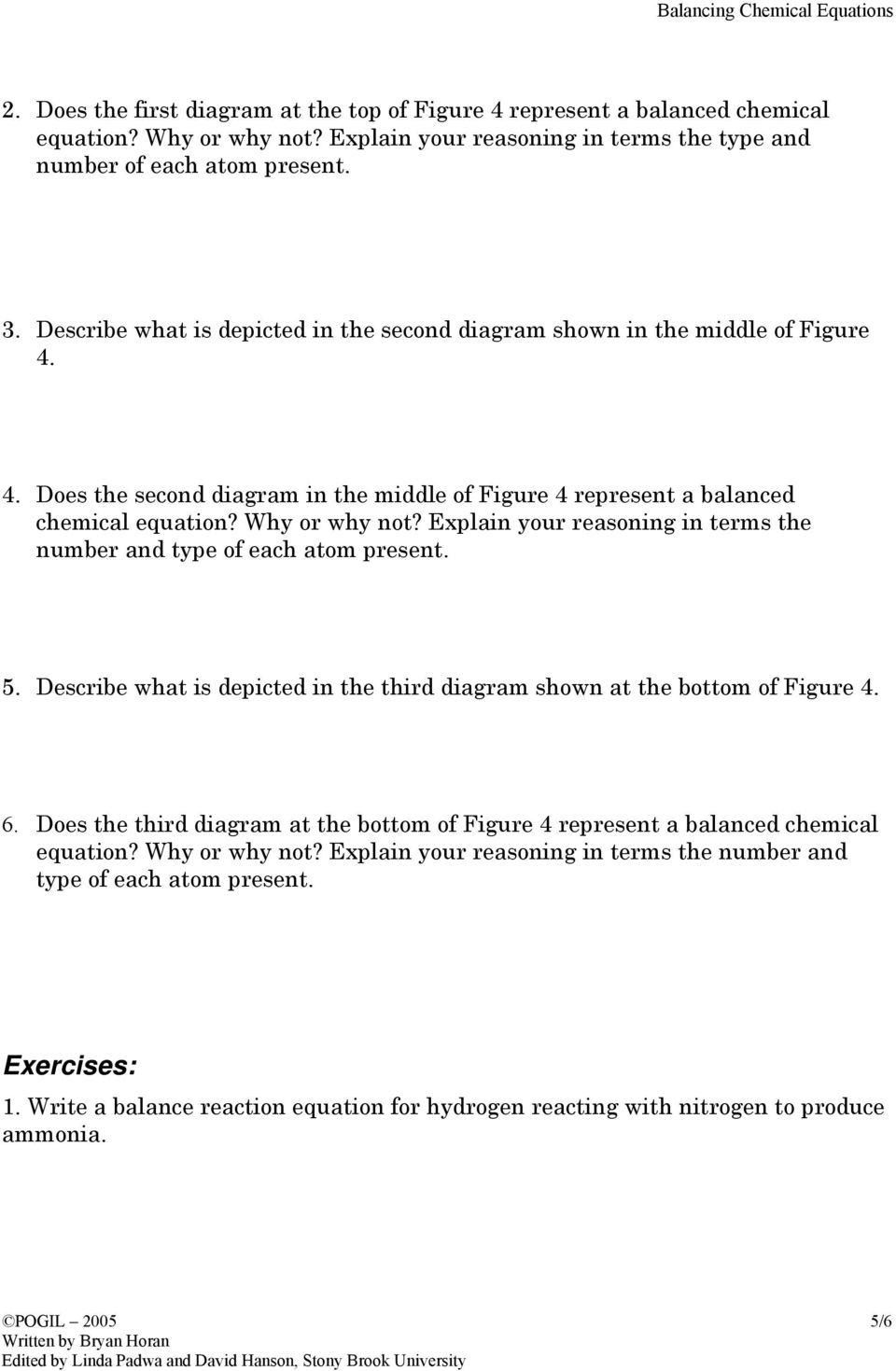
6 2. Using the smallest whole number coefficients, balance the following reactions. Draw diagrams like those in Figure 4 for Equations a, b, and f. a. HgO Hg + O 2 b. Fe + O 2 Fe 2 O 3 c. KClO 3 KCl + O 2 d. Ca(OH) 2 + H 2 SO 4 HOH + CaSO 4 e. Cu + AgNO 3 Cu(NO 3 ) 2 + Ag f. C 2 H 6 + O 2 CO 2 + H 2 O Problems Write the formulas for the components in each reaction and, using the smallest whole number coefficients, balance each equation. 1. Zinc metal reacts with hydrochloric acid to produce hydrogen gas and aqueous zinc chloride. 2. Solid carbon reacts with oxygen gas to produce carbon dioxide gas. 3. Solid sodium chloride is broken down into its elements. POGIL /6
Chem 1100 Chapter Three Study Guide Answers Outline I. Molar Mass and Moles A. Calculations of Molar Masses
 Chem 1100 Chapter Three Study Guide Answers Outline I. Molar Mass and Moles A. Calculations of Molar Masses B. Calculations of moles C. Calculations of number of atoms from moles/molar masses 1. Avagadro
Stoichiometry Review
 Stoichiometry Review There are 20 problems in this review set. Answers, including problem set-up, can be found in the second half of this document. 1. N 2 (g) + 3H 2 (g) --------> 2NH 3 (g) a. nitrogen
Writing and Balancing Chemical Equations
 Name Writing and Balancing Chemical Equations Period When a substance undergoes a chemical reaction, chemical bonds are broken and new bonds are formed. This results in one or more new substances, often
Balancing Chemical Equations Worksheet
 Balancing Chemical Equations Worksheet Student Instructions 1. Identify the reactants and products and write a word equation. 2. Write the correct chemical formula for each of the reactants and the products.
Stoichiometry. What is the atomic mass for carbon? For zinc?
 Stoichiometry Atomic Mass (atomic weight) Atoms are so small, it is difficult to discuss how much they weigh in grams We use atomic mass units an atomic mass unit (AMU) is one twelfth the mass of the catbon-12
7-5.5. Translate chemical symbols and the chemical formulas of common substances to show the component parts of the substances including:
 7-5.5 Translate chemical symbols and the chemical formulas of common substances to show the component parts of the substances including: NaCl [salt], H 2 O [water], C 6 H 12 O 6 [simple sugar], O 2 [oxygen
Unit 10A Stoichiometry Notes
 Unit 10A Stoichiometry Notes Stoichiometry is a big word for a process that chemist s use to calculate amounts in reactions. It makes use of the coefficient ratio set up by balanced reaction equations
Chapter 5. Chemical Reactions and Equations. Introduction. Chapter 5 Topics. 5.1 What is a Chemical Reaction
 Introduction Chapter 5 Chemical Reactions and Equations Chemical reactions occur all around us. How do we make sense of these changes? What patterns can we find? 1 2 Copyright The McGraw-Hill Companies,
Unit 9 Stoichiometry Notes (The Mole Continues)
 Unit 9 Stoichiometry Notes (The Mole Continues) is a big word for a process that chemist s use to calculate amounts in reactions. It makes use of the coefficient ratio set up by balanced reaction equations
YIELD YIELD REACTANTS PRODUCTS
 Balancing Chemical Equations A Chemical Equation: is a representation of a chemical reaction in terms of chemical formulas Example: 1. Word Description of a Chemical Reaction When methane gas (CH 4 ) burns
2. The percent yield is the maximum amount of product that can be produced from the given amount of limiting reactant.
 UNIT 6 stoichiometry practice test True/False Indicate whether the statement is true or false. moles F 1. The mole ratio is a comparison of how many grams of one substance are required to participate in
Name: Teacher: Pd. Date:
 Name: Teacher: Pd. Date: STAAR Tutorial : Energy and Matter: Elements, Compounds, and Chemical Equations: 6.5C Differentiate between elements and compounds on the most basic level. 8.5F Recognize whether
Word Equations and Balancing Equations. Video Notes
 Word Equations and Balancing Equations Video Notes In this lesson, you will: Use the law of conservation of mass and provide standard rules for writing and balancing equations. Write and balance equations
Chapter 8: Chemical Equations and Reactions
 Chapter 8: Chemical Equations and Reactions I. Describing Chemical Reactions A. A chemical reaction is the process by which one or more substances are changed into one or more different substances. A chemical
Balancing chemical equations
 Balancing chemical equations The law of conservation of mass In order to balance a chemical equation, it is important to understand the law of conservation of mass. Definition 1: The law of conservation
Chemical Equations and Chemical Reactions. Chapter 8.1
 Chemical Equations and Chemical Reactions Chapter 8.1 Objectives List observations that suggest that a chemical reaction has taken place List the requirements for a correctly written chemical equation.
Chemistry B11 Chapter 4 Chemical reactions
 Chemistry B11 Chapter 4 Chemical reactions Chemical reactions are classified into five groups: A + B AB Synthesis reactions (Combination) H + O H O AB A + B Decomposition reactions (Analysis) NaCl Na +Cl
Chemical Equations. Chemical Equations. Chemical reactions describe processes involving chemical change
 Chemical Reactions Chemical Equations Chemical reactions describe processes involving chemical change The chemical change involves rearranging matter Converting one or more pure substances into new pure
CHEMICAL REACTIONS AND REACTING MASSES AND VOLUMES
 CHEMICAL REACTIONS AND REACTING MASSES AND VOLUMES The meaning of stoichiometric coefficients: 2 H 2 (g) + O 2 (g) 2 H 2 O(l) number of reacting particles 2 molecules of hydrogen react with 1 molecule
20.2 Chemical Equations
 All of the chemical changes you observed in the last Investigation were the result of chemical reactions. A chemical reaction involves a rearrangement of atoms in one or more reactants to form one or more
CHEMICAL FORMULAS AND EQUATIONS
 reflect Imagine that you and three other classmates had enough supplies and the recipe to make one pepperoni pizza. The recipe might include a ball of dough, a cup of pizza sauce, a cup of cheese, and
Chapter 8 - Chemical Equations and Reactions
 Chapter 8 - Chemical Equations and Reactions 8-1 Describing Chemical Reactions I. Introduction A. Reactants 1. Original substances entering into a chemical rxn B. Products 1. The resulting substances from
IB Chemistry 1 Mole. One atom of C-12 has a mass of 12 amu. One mole of C-12 has a mass of 12 g. Grams we can use more easily.
 The Mole Atomic mass units and atoms are not convenient units to work with. The concept of the mole was invented. This was the number of atoms of carbon-12 that were needed to make 12 g of carbon. 1 mole
CHEMICAL REACTIONS. Chemistry 51 Chapter 6
 CHEMICAL REACTIONS A chemical reaction is a rearrangement of atoms in which some of the original bonds are broken and new bonds are formed to give different chemical structures. In a chemical reaction,
MOLES AND MOLE CALCULATIONS
 35 MOLES ND MOLE CLCULTIONS INTRODUCTION The purpose of this section is to present some methods for calculating both how much of each reactant is used in a chemical reaction, and how much of each product
Name Date Class STOICHIOMETRY. SECTION 12.1 THE ARITHMETIC OF EQUATIONS (pages 353 358)
 Name Date Class 1 STOICHIOMETRY SECTION 1.1 THE ARITHMETIC OF EQUATIONS (pages 353 358) This section explains how to calculate the amount of reactants required or product formed in a nonchemical process.
Writing, Balancing and Predicting Products of Chemical Reactions.
 Writing, Balancing and Predicting Products of Chemical Reactions. A chemical equation is a concise shorthand expression which represents the relative amount of reactants and products involved in a chemical
Summer Holidays Questions
 Summer Holidays Questions Chapter 1 1) Barium hydroxide reacts with hydrochloric acid. The initial concentration of the 1 st solution its 0.1M and the volume is 100ml. The initial concentration of the
Balancing Chemical Equations Practice
 Science Objectives Students will describe what reactants and products in a chemical equation mean. Students will explain the difference between coefficients and subscripts in chemical equations. Students
Chemical Reactions 2 The Chemical Equation
 Chemical Reactions 2 The Chemical Equation INFORMATION Chemical equations are symbolic devices used to represent actual chemical reactions. The left side of the equation, called the reactants, is separated
Chapter 3: Stoichiometry
 Chapter 3: Stoichiometry Key Skills: Balance chemical equations Predict the products of simple combination, decomposition, and combustion reactions. Calculate formula weights Convert grams to moles and
Chemical Calculations: Formula Masses, Moles, and Chemical Equations
 Chemical Calculations: Formula Masses, Moles, and Chemical Equations Atomic Mass & Formula Mass Recall from Chapter Three that the average mass of an atom of a given element can be found on the periodic
Balancing Chemical Equations
 Balancing Chemical Equations Academic Success Center Science Tutoring Area Science Tutoring Area Law of Conservation of Mass Matter cannot be created nor destroyed Therefore the number of each type of
Chapter 6 Notes Science 10 Name:
 6.1 Types of Chemical Reactions a) Synthesis (A + B AB) Synthesis reactions are also known as reactions. When this occurs two or more reactants (usually elements) join to form a. A + B AB, where A and
Mole Notes.notebook. October 29, 2014
 1 2 How do chemists count atoms/formula units/molecules? How do we go from the atomic scale to the scale of everyday measurements (macroscopic scale)? The gateway is the mole! But before we get to the
Calculations and Chemical Equations. Example: Hydrogen atomic weight = 1.008 amu Carbon atomic weight = 12.001 amu
 Calculations and Chemical Equations Atomic mass: Mass of an atom of an element, expressed in atomic mass units Atomic mass unit (amu): 1.661 x 10⁻²⁴ g Atomic weight: Average mass of all isotopes of a given
Moles. Moles. Moles. Moles. Balancing Eqns. Balancing. Balancing Eqns. Symbols Yields or Produces. Like a recipe:
 Like a recipe: Balancing Eqns Reactants Products 2H 2 (g) + O 2 (g) 2H 2 O(l) coefficients subscripts Balancing Eqns Balancing Symbols (s) (l) (aq) (g) or Yields or Produces solid liquid (pure liquid)
CHEM 120 Online: Chapter 6 Sample problems Date: 2. Which of the following compounds has the largest formula mass? A) H2O B) NH3 C) CO D) BeH2
 CHEM 120 Online: Chapter 6 Sample problems Date: 1. To determine the formula mass of a compound you should A) add up the atomic masses of all the atoms present. B) add up the atomic masses of all the atoms
Calculating Atoms, Ions, or Molecules Using Moles
 TEKS REVIEW 8B Calculating Atoms, Ions, or Molecules Using Moles TEKS 8B READINESS Use the mole concept to calculate the number of atoms, ions, or molecules in a sample TEKS_TXT of material. Vocabulary
Chapter 7: Chemical Reactions
 Chapter 7 Page 1 Chapter 7: Chemical Reactions A chemical reaction: a process in which at least one new substance is formed as the result of a chemical change. A + B C + D Reactants Products Evidence that
Chapter 1 The Atomic Nature of Matter
 Chapter 1 The Atomic Nature of Matter 6. Substances that cannot be decomposed into two or more simpler substances by chemical means are called a. pure substances. b. compounds. c. molecules. d. elements.
Formulae, stoichiometry and the mole concept
 3 Formulae, stoichiometry and the mole concept Content 3.1 Symbols, Formulae and Chemical equations 3.2 Concept of Relative Mass 3.3 Mole Concept and Stoichiometry Learning Outcomes Candidates should be
W1 WORKSHOP ON STOICHIOMETRY
 INTRODUCTION W1 WORKSHOP ON STOICHIOMETRY These notes and exercises are designed to introduce you to the basic concepts required to understand a chemical formula or equation. Relative atomic masses of
Lewis Dot Structures of Atoms and Ions
 Why? The chemical properties of an element are based on the number of electrons in the outer shell of its atoms. We use Lewis dot structures to map these valence electrons in order to identify stable electron
Chemistry Themed. Types of Reactions
 Chemistry Themed Types of Reactions 1 2 Chemistry in the Community-2015-2016 Types of Reactions Date In-Class Assignment Homework T 10/20 TEST on Reactivity of Metals and Redox None W 10/21 Late Start
Chemistry Post-Enrolment Worksheet
 Name: Chemistry Post-Enrolment Worksheet The purpose of this worksheet is to get you to recap some of the fundamental concepts that you studied at GCSE and introduce some of the concepts that will be part
Other Stoich Calculations A. mole mass (mass mole) calculations. GIVEN mol A x CE mol B. PT g A CE mol A MOLE MASS :
 Chem. I Notes Ch. 12, part 2 Using Moles NOTE: Vocabulary terms are in boldface and underlined. Supporting details are in italics. 1 MOLE = 6.02 x 10 23 representative particles (representative particles
Liquid phase. Balance equation Moles A Stoic. coefficient. Aqueous phase
 STOICHIOMETRY Objective The purpose of this exercise is to give you some practice on some Stoichiometry calculations. Discussion The molecular mass of a compound is the sum of the atomic masses of all
CHAPTER 3: MATTER. Active Learning Questions: 1-6, 9, 13-14; End-of-Chapter Questions: 1-18, 20, 24-32, 38-42, 44, 49-52, 55-56, 61-64
 CHAPTER 3: MATTER Active Learning Questions: 1-6, 9, 13-14; End-of-Chapter Questions: 1-18, 20, 24-32, 38-42, 44, 49-52, 55-56, 61-64 3.1 MATTER Matter: Anything that has mass and occupies volume We study
IB Chemistry. DP Chemistry Review
 DP Chemistry Review Topic 1: Quantitative chemistry 1.1 The mole concept and Avogadro s constant Assessment statement Apply the mole concept to substances. Determine the number of particles and the amount
Aqueous Solutions. Water is the dissolving medium, or solvent. Some Properties of Water. A Solute. Types of Chemical Reactions.
 Aqueous Solutions and Solution Stoichiometry Water is the dissolving medium, or solvent. Some Properties of Water Water is bent or V-shaped. The O-H bonds are covalent. Water is a polar molecule. Hydration
Honors Chemistry: Unit 6 Test Stoichiometry PRACTICE TEST ANSWER KEY Page 1. A chemical equation. (C-4.4)
 Honors Chemistry: Unit 6 Test Stoichiometry PRACTICE TEST ANSWER KEY Page 1 1. 2. 3. 4. 5. 6. Question What is a symbolic representation of a chemical reaction? What 3 things (values) is a mole of a chemical
Chapter 3. Chemical Reactions and Reaction Stoichiometry. Lecture Presentation. James F. Kirby Quinnipiac University Hamden, CT
 Lecture Presentation Chapter 3 Chemical Reactions and Reaction James F. Kirby Quinnipiac University Hamden, CT The study of the mass relationships in chemistry Based on the Law of Conservation of Mass
Chem 31 Fall 2002. Chapter 3. Stoichiometry: Calculations with Chemical Formulas and Equations. Writing and Balancing Chemical Equations
 Chem 31 Fall 2002 Chapter 3 Stoichiometry: Calculations with Chemical Formulas and Equations Writing and Balancing Chemical Equations 1. Write Equation in Words -you cannot write an equation unless you
Stoichiometry. 1. The total number of moles represented by 20 grams of calcium carbonate is (1) 1; (2) 2; (3) 0.1; (4) 0.2.
 Stoichiometry 1 The total number of moles represented by 20 grams of calcium carbonate is (1) 1; (2) 2; (3) 01; (4) 02 2 A 44 gram sample of a hydrate was heated until the water of hydration was driven
Experiment 5. Chemical Reactions A + X AX AX A + X A + BX AX + B AZ + BX AX + BZ
 Experiment 5 Chemical Reactions OBJECTIVES 1. To observe the various criteria that are used to indicate that a chemical reaction has occurred. 2. To convert word equations into balanced inorganic chemical
Chapter 3 Mass Relationships in Chemical Reactions
 Chapter 3 Mass Relationships in Chemical Reactions Student: 1. An atom of bromine has a mass about four times greater than that of an atom of neon. Which choice makes the correct comparison of the relative
Moles. Balanced chemical equations Molar ratios Mass Composition Empirical and Molecular Mass Predicting Quantities Equations
 Moles Balanced chemical equations Molar ratios Mass Composition Empirical and Molecular Mass Predicting Quantities Equations Micro World atoms & molecules Macro World grams Atomic mass is the mass of an
David A. Katz Chemist, Educator, Science Communicator, and Consultant Department of Chemistry, Pima Community College
 WRITING CHEMICAL EQUATIONS 2004, 2002, 1989 by David A. Katz. All rights reserved. Permission for classroom used provided original copyright is included. David A. Katz Chemist, Educator, Science Communicator,
CHEMISTRY COMPUTING FORMULA MASS WORKSHEET
 CHEMISTRY COMPUTING FORMULA MASS WORKSHEET Directions: Find the formula mass of the following compounds. Round atomic masses to the tenth of a decimal place. Place your final answer in the FORMULA MASS
B) atomic number C) both the solid and the liquid phase D) Au C) Sn, Si, C A) metal C) O, S, Se C) In D) tin D) methane D) bismuth B) Group 2 metal
 1. The elements on the Periodic Table are arranged in order of increasing A) atomic mass B) atomic number C) molar mass D) oxidation number 2. Which list of elements consists of a metal, a metalloid, and
Sample Exercise 3.1 Interpreting and Balancing Chemical Equations
 Sample Exercise 3.1 Interpreting and Balancing Chemical Equations The following diagram represents a chemical reaction in which the red spheres are oxygen atoms and the blue spheres are nitrogen atoms.
Chapter 6: Writing and Balancing Chemical Equations. AB A + B. CaCO3 CaO + CO2 A + B C. AB + C AC + B (or AB + C CB + A)
 78 Chapter 6: Writing and Balancing Chemical Equations. It is convenient to classify chemical reactions into one of several general types. Some of the more common, important, reactions are shown below.
CP Chemistry Review for Stoichiometry Test
 CP Chemistry Review for Stoichiometry Test Stoichiometry Problems (one given reactant): 1. Make sure you have a balanced chemical equation 2. Convert to moles of the known substance. (Use the periodic
H 2 + O 2 H 2 O. - Note there is not enough hydrogen to react with oxygen - It is necessary to balance equation.
 CEMICAL REACTIONS 1 ydrogen + Oxygen Water 2 + O 2 2 O reactants product(s) reactant substance before chemical change product substance after chemical change Conservation of Mass During a chemical reaction,
Concept 1. The meaning and usefulness of the mole. The mole (or mol) represents a certain number of objects.
 Chapter 3. Stoichiometry: Mole-Mass Relationships in Chemical Reactions Concept 1. The meaning and usefulness of the mole The mole (or mol) represents a certain number of objects. SI def.: the amount of
Chapter 16: Tests for ions and gases
 The position of hydrogen in the reactivity series Hydrogen, although not a metal, is included in the reactivity series because it, like metals, can be displaced from aqueous solution, only this time the
AP CHEMISTRY 2013 SCORING GUIDELINES
 AP CHEMISTRY 2013 SCORING GUIDELINES Question 4 (15 points) For each of the following three reactions, write a balanced equation for the reaction in part (i) and answer the question about the reaction
Solution a homogeneous mixture = A solvent + solute(s) Aqueous solution water is the solvent
 Solution a homogeneous mixture = A solvent + solute(s) Aqueous solution water is the solvent Water a polar solvent: dissolves most ionic compounds as well as many molecular compounds Aqueous solution:
ATOMS. Multiple Choice Questions
 Chapter 3 ATOMS AND MOLECULES Multiple Choice Questions 1. Which of the following correctly represents 360 g of water? (i) 2 moles of H 2 0 (ii) 20 moles of water (iii) 6.022 10 23 molecules of water (iv)
Chemistry: Chemical Equations
 Chemistry: Chemical Equations Write a balanced chemical equation for each word equation. Include the phase of each substance in the equation. Classify the reaction as synthesis, decomposition, single replacement,
Number of moles of solute = Concentration (mol. L ) x Volume of solution (litres) or n = C x V
 44 CALCULATIONS INVOLVING SOLUTIONS INTRODUCTION AND DEFINITIONS Many chemical reactions take place in aqueous (water) solution. Quantities of such solutions are measured as volumes, while the amounts
1. What is the molecular formula of a compound with the empirical formula PO and a gram-molecular mass of 284 grams?
 Name: Tuesday, May 20, 2008 1. What is the molecular formula of a compound with the empirical formula PO and a gram-molecular mass of 284 grams? 2 5 1. P2O 5 3. P10O4 2. P5O 2 4. P4O10 2. Which substance
HOMEWORK 4A. Definitions. Oxidation-Reduction Reactions. Questions
 HOMEWORK 4A Oxidation-Reduction Reactions 1. Indicate whether a reaction will occur or not in each of following. Wtiring a balcnced equation is not necessary. (a) Magnesium metal is added to hydrochloric
Chem 115 POGIL Worksheet - Week 4 Moles & Stoichiometry Answers
 Key Questions & Exercises Chem 115 POGIL Worksheet - Week 4 Moles & Stoichiometry Answers 1. The atomic weight of carbon is 12.0107 u, so a mole of carbon has a mass of 12.0107 g. Why doesn t a mole of
2. DECOMPOSITION REACTION ( A couple have a heated argument and break up )
 TYPES OF CHEMICAL REACTIONS Most reactions can be classified into one of five categories by examining the types of reactants and products involved in the reaction. Knowing the types of reactions can help
PART I: MULTIPLE CHOICE (30 multiple choice questions. Each multiple choice question is worth 2 points)
 CHEMISTRY 123-07 Midterm #1 Answer key October 14, 2010 Statistics: Average: 74 p (74%); Highest: 97 p (95%); Lowest: 33 p (33%) Number of students performing at or above average: 67 (57%) Number of students
Limiting Reagent Worksheet #1
 Limiting Reagent Worksheet #1 1. Given the following reaction: (Balance the equation first!) C 3 H 8 + O 2 -------> CO 2 + H 2 O a) If you start with 14.8 g of C 3 H 8 and 3.44 g of O 2, determine the
Unit 6 The Mole Concept
 Chemistry Form 3 Page 62 Ms. R. Buttigieg Unit 6 The Mole Concept See Chemistry for You Chapter 28 pg. 352-363 See GCSE Chemistry Chapter 5 pg. 70-79 6.1 Relative atomic mass. The relative atomic mass
Chem 115 POGIL Worksheet - Week 4 Moles & Stoichiometry
 Chem 115 POGIL Worksheet - Week 4 Moles & Stoichiometry Why? Chemists are concerned with mass relationships in chemical reactions, usually run on a macroscopic scale (grams, kilograms, etc.). To deal with
SCH 4C1 Unit 2 Problem Set Questions taken from Frank Mustoe et all, "Chemistry 11", McGraw-Hill Ryerson, 2001
 SCH 4C1 Unit 2 Problem Set Questions taken from Frank Mustoe et all, "Chemistry 11", McGraw-Hill Ryerson, 2001 1. A small pin contains 0.0178 mol of iron. How many atoms of iron are in the pin? 2. A sample
Coimisiún na Scrúduithe Stáit State Examinations Commission
 2015. M33 Coimisiún na Scrúduithe Stáit State Examinations Commission LEAVING CERTIFICATE EXAMINATION, 2015 CHEMISTRY ORDINARY LEVEL TUESDAY, 16 JUNE AFTERNOON 2.00 TO 5.00 400 MARKS Answer eight questions
Chemistry 65 Chapter 6 THE MOLE CONCEPT
 THE MOLE CONCEPT Chemists find it more convenient to use mass relationships in the laboratory, while chemical reactions depend on the number of atoms present. In order to relate the mass and number of
English already has many collective nouns for fixed, given numbers of objects. Some of the more common collective nouns are shown in Table 7.1.
 96 Chapter 7: Calculations with Chemical Formulas and Chemical Reactions Chemical reactions are written showing a few individual atoms or molecules reacting to form a few atoms or molecules of products.
Chemical Equations & Stoichiometry
 Chemical Equations & Stoichiometry Chapter Goals Balance equations for simple chemical reactions. Perform stoichiometry calculations using balanced chemical equations. Understand the meaning of the term
Steps for balancing a chemical equation
 The Chemical Equation: A Chemical Recipe Dr. Gergens - SD Mesa College A. Learn the meaning of these arrows. B. The chemical equation is the shorthand notation for a chemical reaction. A chemical equation
Appendix D. Reaction Stoichiometry D.1 INTRODUCTION
 Appendix D Reaction Stoichiometry D.1 INTRODUCTION In Appendix A, the stoichiometry of elements and compounds was presented. There, the relationships among grams, moles and number of atoms and molecules
4.3 Reaction Stoichiometry
 196 Chapter 4 Stoichiometry of Chemical Reactions 4.3 Reaction Stoichiometry By the end of this section, you will be able to: Explain the concept of stoichiometry as it pertains to chemical reactions Use
Chemical Reactions Practice Test
 Chemical Reactions Practice Test Chapter 2 Name Date Hour _ Multiple Choice Identify the choice that best completes the statement or answers the question. 1. The only sure evidence for a chemical reaction
EXPERIMENT 8: Activity Series (Single Displacement Reactions)
 EPERIMENT 8: Activity Series (Single Displacement Reactions) PURPOSE a) Reactions of metals with acids and salt solutions b) Determine the activity of metals c) Write a balanced molecular equation, complete
Chemistry Final Study Guide
 Name: Class: Date: Chemistry Final Study Guide Multiple Choice Identify the choice that best completes the statement or answers the question. 1. The electrons involved in the formation of a covalent bond
Solution. Practice Exercise. Concept Exercise
 Example Exercise 9.1 Atomic Mass and Avogadro s Number Refer to the atomic masses in the periodic table inside the front cover of this textbook. State the mass of Avogadro s number of atoms for each of
WRITING CHEMICAL FORMULA
 WRITING CHEMICAL FORMULA For ionic compounds, the chemical formula must be worked out. You will no longer have the list of ions in the exam (like at GCSE). Instead you must learn some and work out others.
GCSE Chemistry Quiz Chemical Reactions
 GCSE Chemistry Quiz Chemical Reactions A chemical reaction is a process where the molecular structure changes. Chemical reactions are all around us. We can see many reactions such as fireworks and explosions.
Periodic Table, Valency and Formula
 Periodic Table, Valency and Formula Origins of the Periodic Table Mendelѐѐv in 1869 proposed that a relationship existed between the chemical properties of elements and their atomic masses. He noticed
Chemical Reactions in Water Ron Robertson
 Chemical Reactions in Water Ron Robertson r2 f:\files\courses\1110-20\2010 possible slides for web\waterchemtrans.doc Properties of Compounds in Water Electrolytes and nonelectrolytes Water soluble compounds
Chapter 3! Stoichiometry: Calculations with Chemical Formulas and Equations. Stoichiometry
 Chapter 3! : Calculations with Chemical Formulas and Equations Anatomy of a Chemical Equation CH 4 (g) + 2O 2 (g) CO 2 (g) + 2 H 2 O (g) Anatomy of a Chemical Equation CH 4 (g) + 2 O 2 (g) CO 2 (g) + 2
Chemistry CA 2 Practice
 hemistry 2 Practice Some questions (c) 2015 by Region 10 Educational Service enter. Some questions (c) 2015 by Progress Testing. Page 2 1 Which of the following is the mass in grams of 4.25 10³ mol of
Nomenclature and the Periodic Table To name compounds and to determine molecular formulae from names a knowledge of the periodic table is helpful.
 Nomenclature and the Periodic Table To name compounds and to determine molecular formulae from names a knowledge of the periodic table is helpful. Atomic Number = number of protons Mass Number = number
General Chemistry Lab Experiment 6 Types of Chemical Reaction
 General Chemistry Lab Experiment 6 Types of Chemical Reaction Introduction Most ordinary chemical reactions can be classified as one of five basic types. The first type of reaction occurs when two or more