
Chapter 4: Chemical and Solution Stoichiometry
|
|
|
- Marian Willis
- 9 years ago
- Views:
Transcription
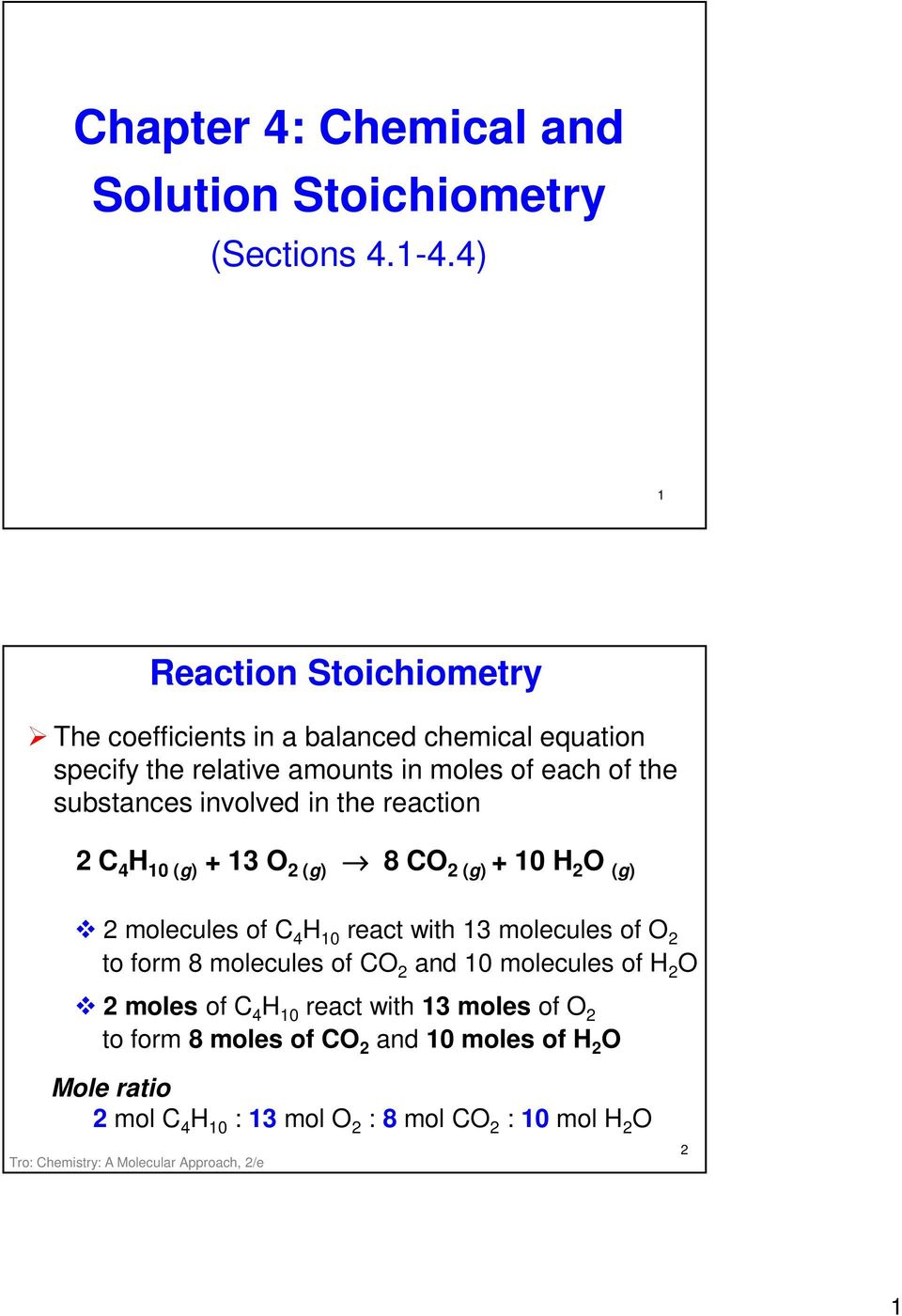
1 Chapter 4: Chemical and Solution Stoichiometry (Sections ) 1 Reaction Stoichiometry The coefficients in a balanced chemical equation specify the relative amounts in moles of each of the substances involved in the reaction 2 C 4 H 10 (g) + 1 O 2 (g) 8 CO 2 (g) + 10 H 2 O (g) 2 molecules of C 4 H 10 react with 1 molecules of O 2 to form 8 molecules of CO 2 and 10 molecules of H 2 O 2 moles of C 4 H 10 react with 1 moles of O 2 to form 8 moles of CO 2 and 10 moles of H 2 O Mole ratio 2 mol C 4 H 10 : 1 mol O 2 : 8 mol CO 2 : 10 mol H 2 O 2 1
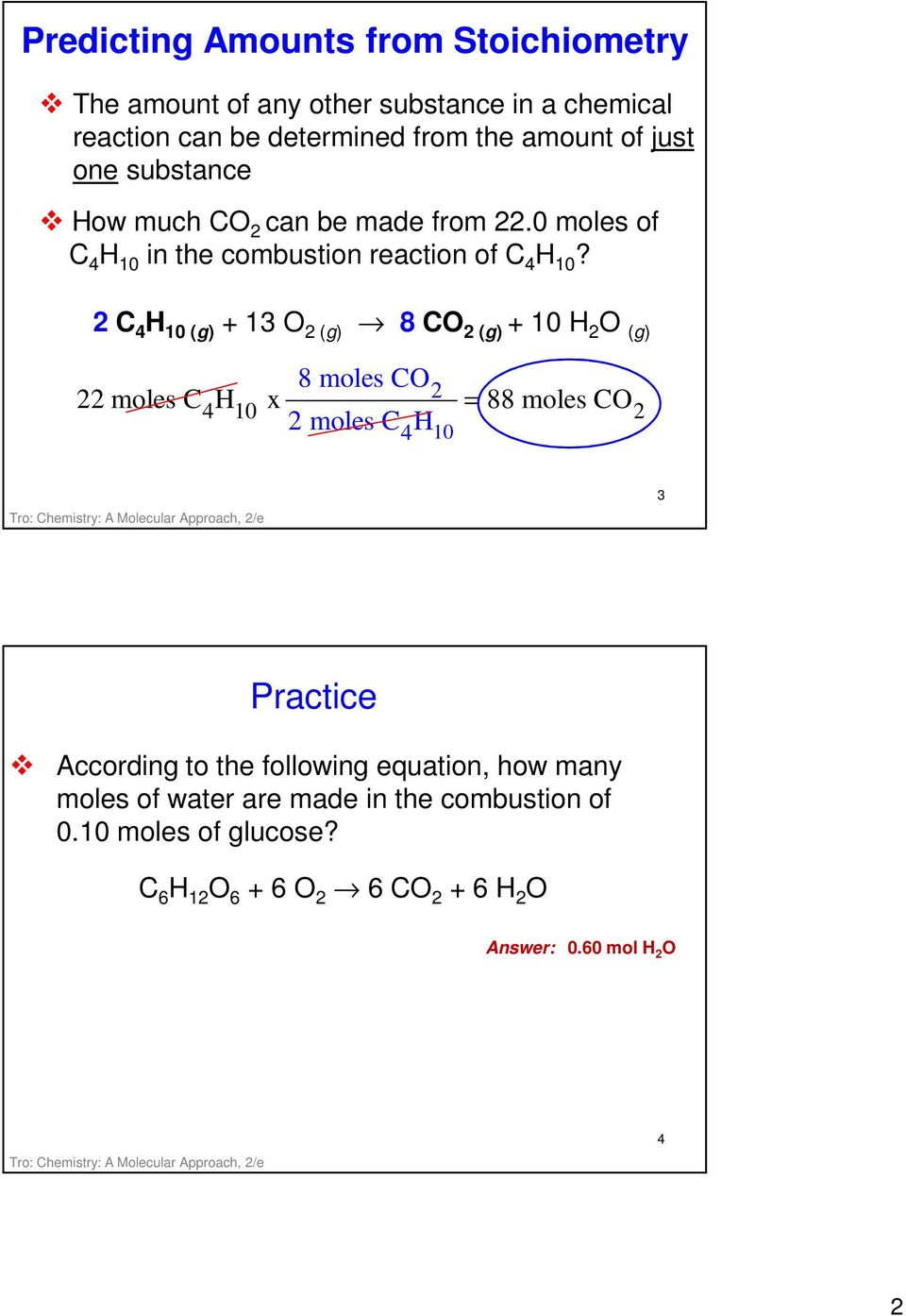
2 Predicting Amounts from Stoichiometry The amount of any other substance in a chemical reaction can be determined from the amount of just one substance How much CO 2 can be made from 22.0 moles of C 4 H 10 in the combustion reaction of C 4 H 10? 2 C 4 H 10 (g) + 1 O 2 (g) 8 CO 2 (g) + 10 H 2 O (g) 8 moles CO 22 moles C H x 88 mo = les CO 2 moles C 2 4H10 Practice According to the following equation, how many moles of water are made in the combustion of 0.10 moles of glucose? C 6 H 12 O O 2 6 CO H 2 O Answer: 0.60 mol H 2 O 4 2
3 Stoichiometry and Chemical Reactions The most common stoichiometric problem will present you with a certain mass of a reactant and then ask the amount or mass of product that can be formed. This is called mass-to-mass stoichiometry problem 5 Predicting Amounts from Stoichiometry Cont. What if the mass of a substance is given, how do we know how much of another substance is needed (reactant) or is produced (product)? 1. You cannot convert mass (g) of one substance directly to mass (g) of another substance in a given reaction. 2. However, you can convert mass to moles, then use their mole ratio to convert moles to grams of another substance. 6

4 Predicting Amounts from Stoichiometry Cont. Mass-to-Mass Conversions 7 Solving Mass-Mass Stoichiometry Goal: To calculate the mass of product(s) given the mass of a reactant 1. Balance the chemical equation. 2. Convert the known mass of reactant to moles using MM as a conversion factor.. Use the mole or stoichiometric ratio of reactant to product to convert moles of reactant to moles of product. 4. Finally, use the MM of the product to convert its moles to mass. 8 4

5 Solving Mass-Mass Stoichiometry - Cont. Example: Estimate the mass of CO 2 produced in 2007 by the combustion of.5 x g gasoline. Assuming that gasoline is octane, C 8 H 18, the equation for the reaction is 2 C 8 H 18 (l) + 25 O 2 (g) 16 CO 2 (g) + 18 H 2 O (g) Follow the process: g C 8 H 18 mol C 8 H 18 mol CO 2 g CO 2 Use MM Use mole ratio in balanced equation Use MM 9 Example: Estimate the mass of CO 2 produced in 2007 by the combustion of.5 x g gasoline Given: Find: Conceptual Plan:.4 x g C 8 H 18 g CO 2 g C 8 H 18 mol C 8 H 18 mol CO 2 g CO 2 Relationships: 2 C 8 H 18 (l) + 25 O 2 (g) 16 CO 2 (g) + 18 H 2 O (g) 1 mol C 8 H 18 = g; 1 mol CO 2 = 44.01g, 2 mol C 8 H 18 :16 mol CO
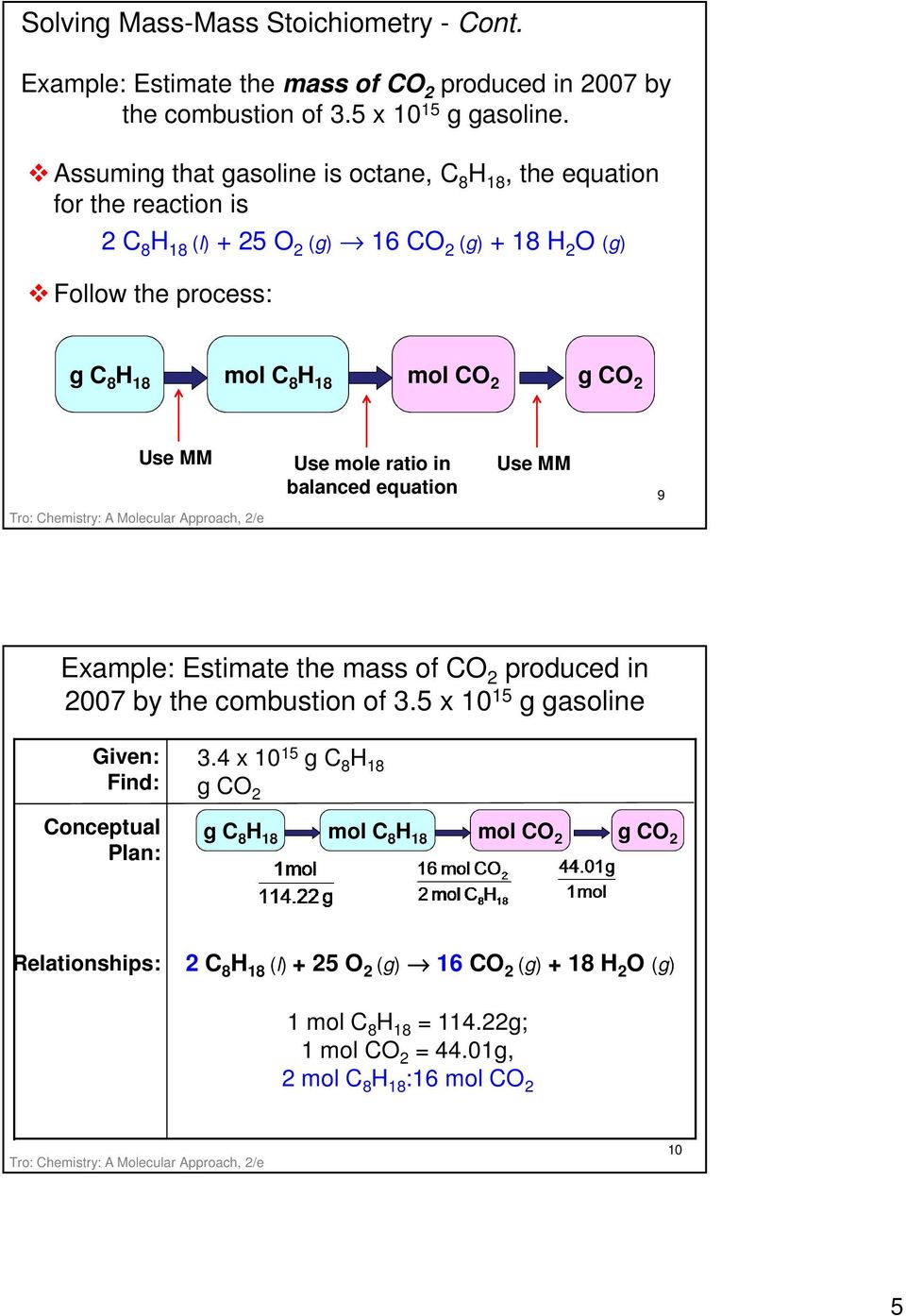
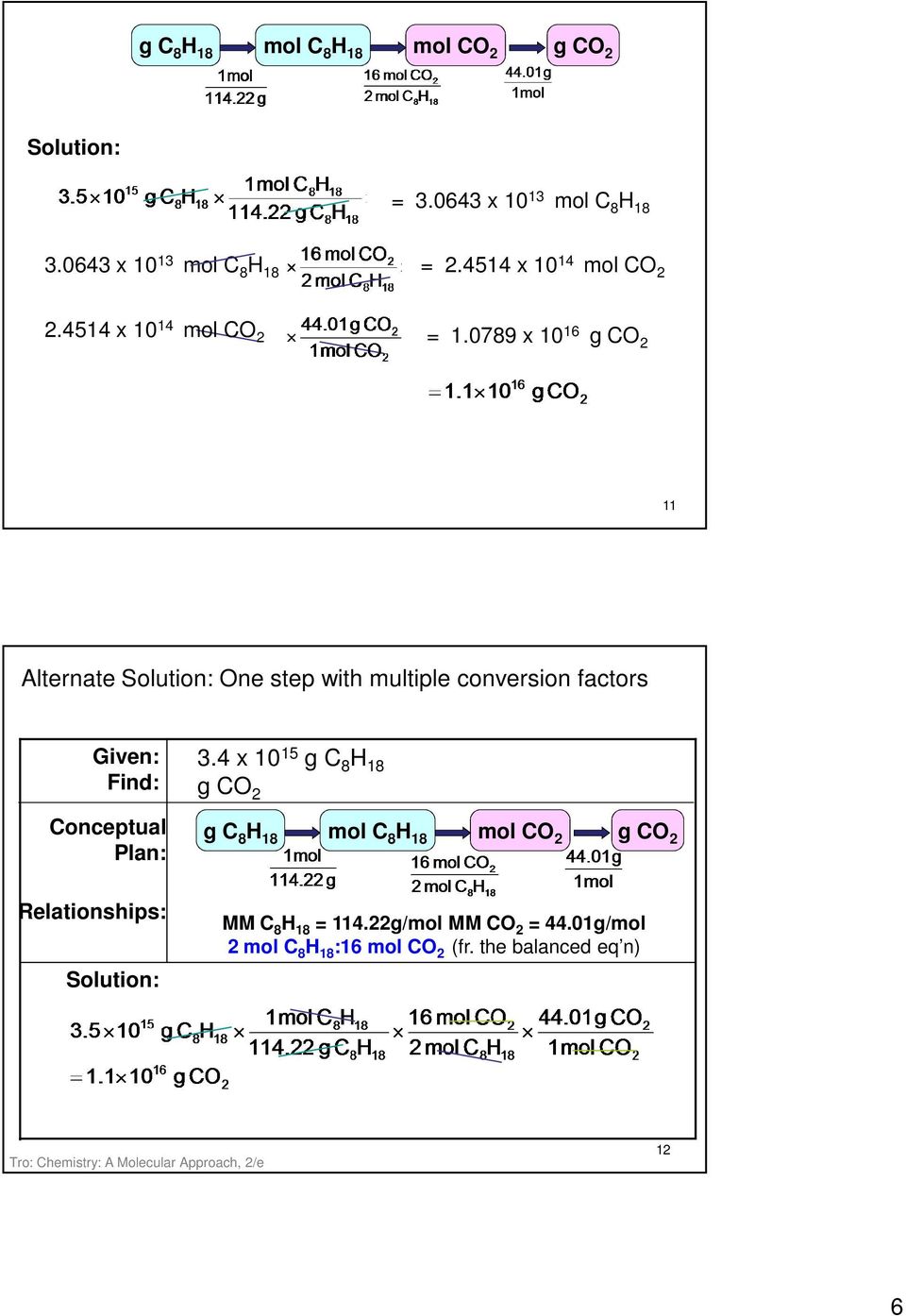
6 g C 8 H 18 mol C 8 H 18 mol CO 2 g CO 2 Solution: =.064 x 10 1 mol C 8 H x 10 1 mol C 8 H 18 = x mol CO x mol CO 2 = x g CO 2 11 Alternate Solution: One step with multiple conversion factors Given: Find: Conceptual Plan: Relationships: Solution:.4 x g C 8 H 18 g CO 2 g C 8 H 18 mol C 8 H 18 mol CO 2 g CO 2 MM C 8 H 18 = g/mol MM CO 2 = 44.01g/mol 2 mol C 8 H 18 :16 mol CO 2 (fr. the balanced eq n) 12 6
7 Mass-Mass Stoichiometry Cont. Your turn: (1) How many grams of chlorine gas can be liberated from the decomposition of 64.0 g of AuCl by the reaction: Relationships: 2 AuCl (s) 2 Au (s) + Cl 2 (g) Answer: 22.4 g Cl 2 g AuCl mol AuCl mol Cl 2 g Cl 2 1 mol AuCl 0.29 g AuCl mol Cl2 2 mol AuCl g Cl2 1 mol Cl2 1 Limiting reactant, theoretical yield, and percent yield 14 7

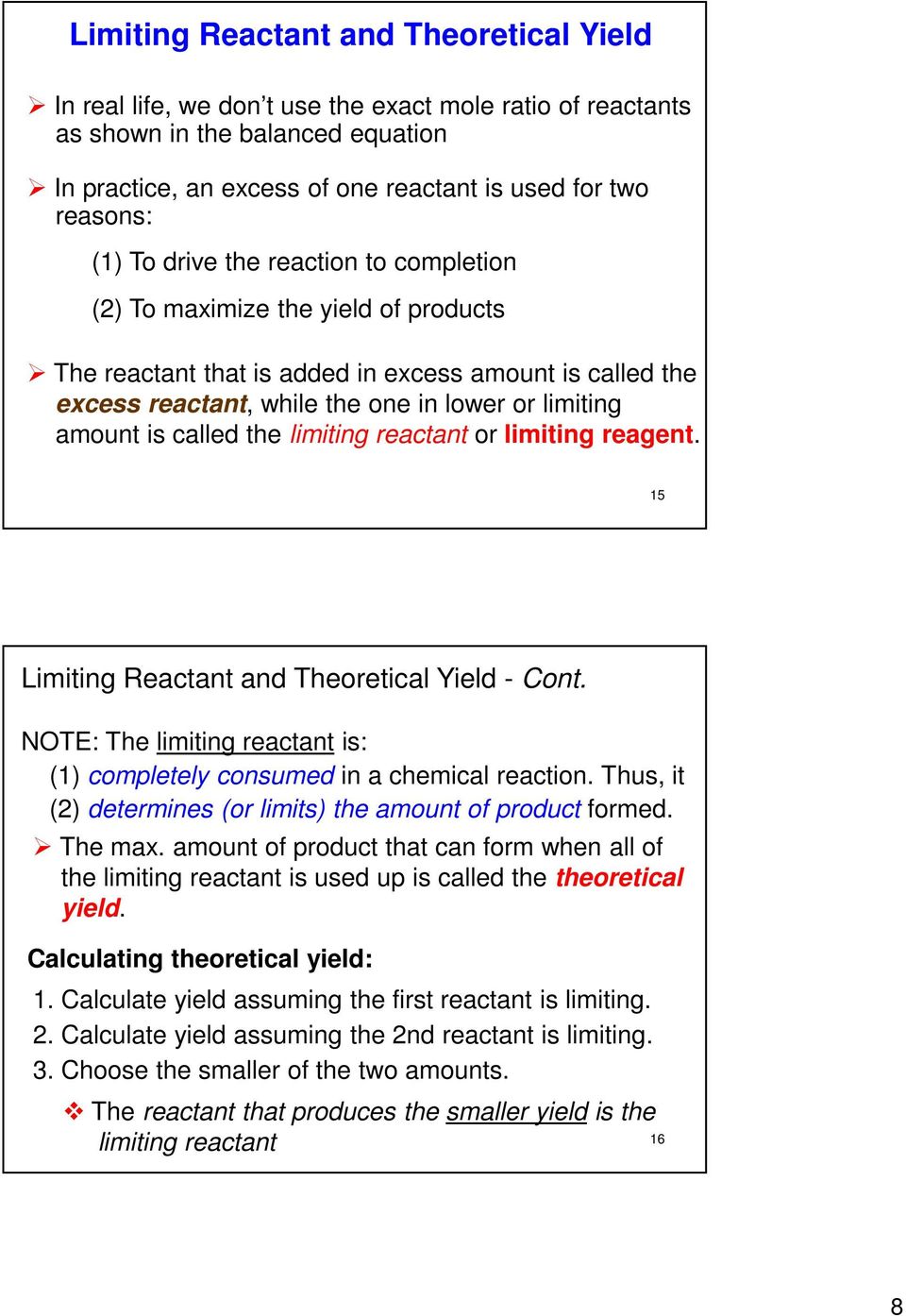
8 Limiting Reactant and Theoretical Yield In real life, we don t use the exact mole ratio of reactants as shown in the balanced equation In practice, an excess of one reactant is used for two reasons: (1) To drive the reaction to completion (2) To maximize the yield of products The reactant that is added in excess amount is called the excess reactant, while the one in lower or limiting amount is called the limiting reactant or limiting reagent. 15 Limiting Reactant and Theoretical Yield - Cont. NOTE: The limiting reactant is: (1) completely consumed in a chemical reaction. Thus, it (2) determines (or limits) the amount of product formed. The max. amount of product that can form when all of the limiting reactant is used up is called the theoretical yield. Calculating theoretical yield: 1. Calculate yield assuming the first reactant is limiting. 2. Calculate yield assuming the 2nd reactant is limiting.. Choose the smaller of the two amounts. The reactant that produces the smaller yield is the limiting reactant 16 8
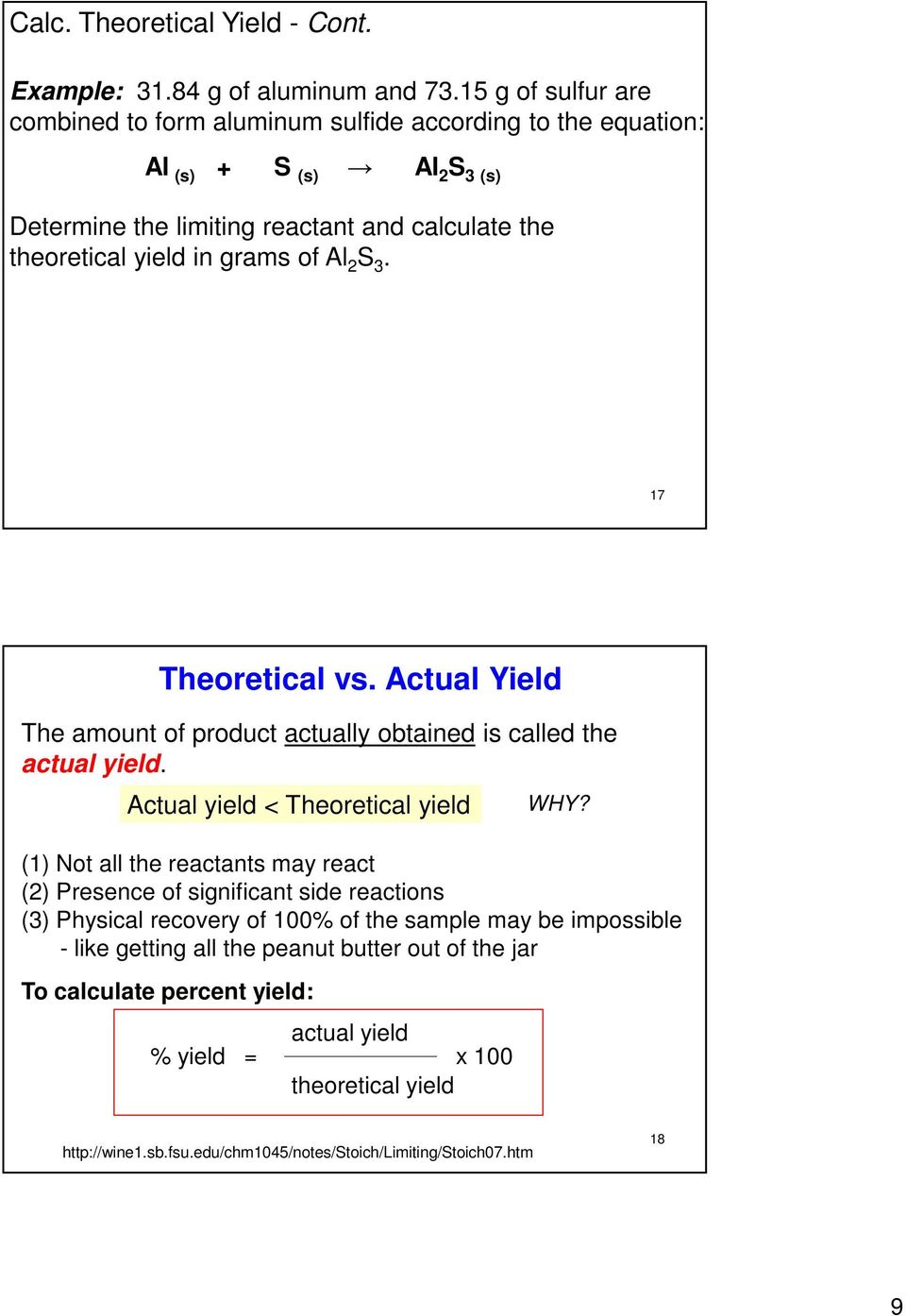
9 Calc. Theoretical Yield - Cont. Example: 1.84 g of aluminum and 7.15 g of sulfur are combined to form aluminum sulfide according to the equation: Al (s) + S (s) Al 2 S (s) Determine the limiting reactant and calculate the theoretical yield in grams of Al 2 S. 17 Theoretical vs. Actual Yield The amount of product actually obtained is called the actual yield. Actual yield < Theoretical yield WHY? (1) Not all the reactants may react (2) Presence of significant side reactions () Physical recovery of 100% of the sample may be impossible - like getting all the peanut butter out of the jar To calculate percent yield: % yield = actual yield x 100 theoretical yield
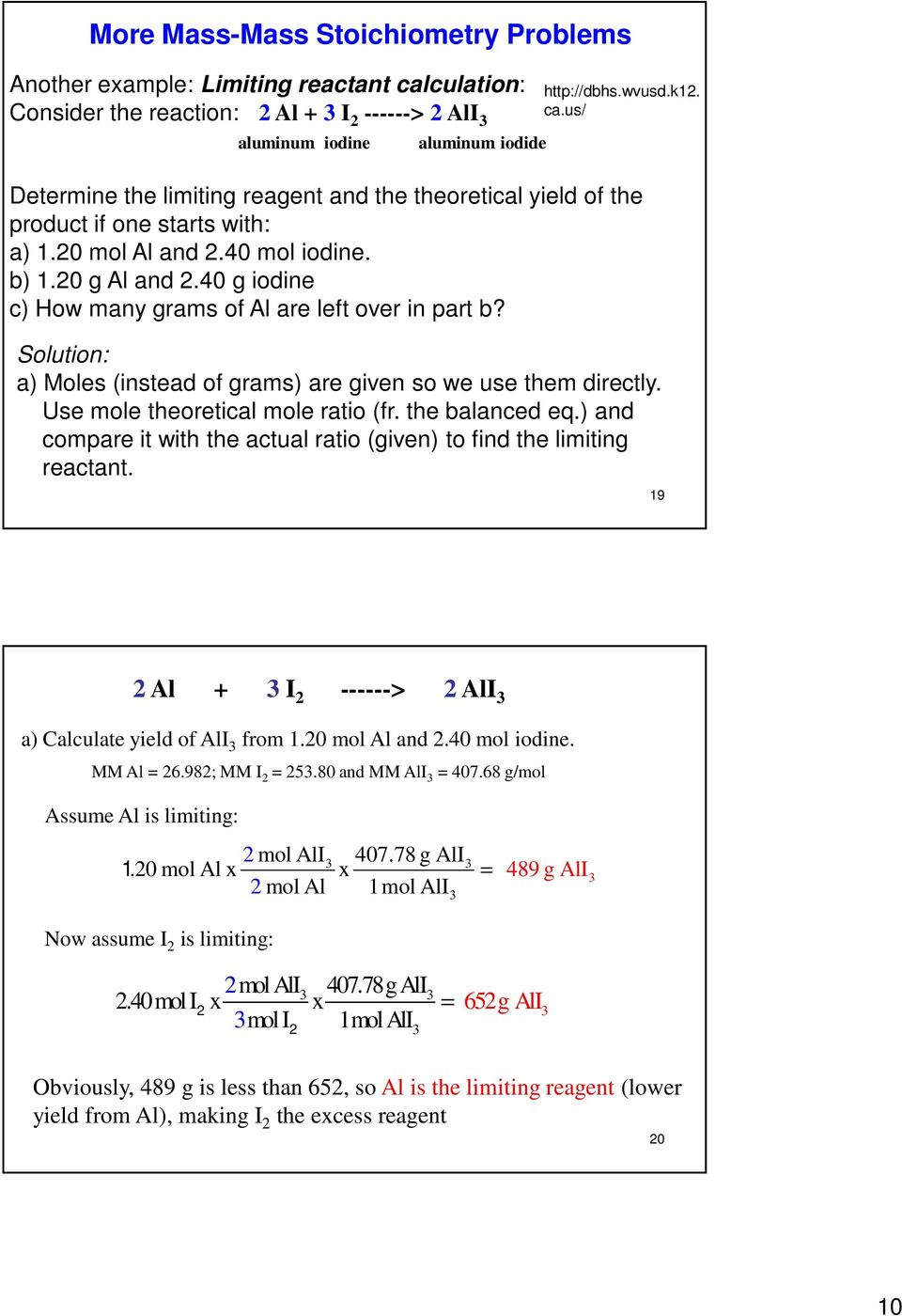
10 More Mass-Mass Stoichiometry Problems Another example: Limiting reactant calculation: Consider the reaction: 2 Al + I > 2 AlI aluminum iodine aluminum iodide ca.us/ Determine the limiting reagent and the theoretical yield of the product if one starts with: a) 1.20 mol Al and 2.40 mol iodine. b) 1.20 g Al and 2.40 g iodine c) How many grams of Al are left over in part b? Solution: a) Moles (instead of grams) are given so we use them directly. Use mole theoretical mole ratio (fr. the balanced eq.) and compare it with the actual ratio (given) to find the limiting reactant Al + I > 2 AlI a) Calculate yield of AlI from 1.20 mol Al and 2.40 mol iodine. MM Al = ; MM I 2 = and MM AlI = g/mol Assume Al is limiting: 1 2 mol AlI 2 mol Al.20 mol Al x x Now assume I 2 is limiting: g AlI 1 mol AlI = 489 g AlI 2 mol AlI 2.40 mol I 2 x x mol I g AlI 1 mo l AlI = 652 g Al I Obviously, 489 g is less than 652, so Al is the limiting reagent (lower yield from Al), making I 2 the excess reagent 20 10
11 Solution Cont. (b) Determine the yield of the AlI if one starts with 1.20 g Al and 2.40 g I 2. MM Al = ; MM I 2 = and MM AlI = g/mol WORK: 2 Al + I > 2 AlI (i) Calc. yield of the AlI assuming Al is limiting 1 mol Al 2 mol AlI g AlI 1.20 g Al x x g Al 2 mol Al 1 mol AlI x = 18.1 g AlI (ii) Calc. yield of the AlI assuming I 2 is limiting 1 mol I 2 2 mol AlI g AlI 2.40 g I 2 x x x g I 2 mol I2 1 mol AlI = 2.57 g AlI 21 (iii) Pick the lower of two yields because it came from the limiting reactant. This is the theoretical yield of product. Thus: limiting reactant is I 2 and theoretical yield of AlI is 2.57 g 22 11

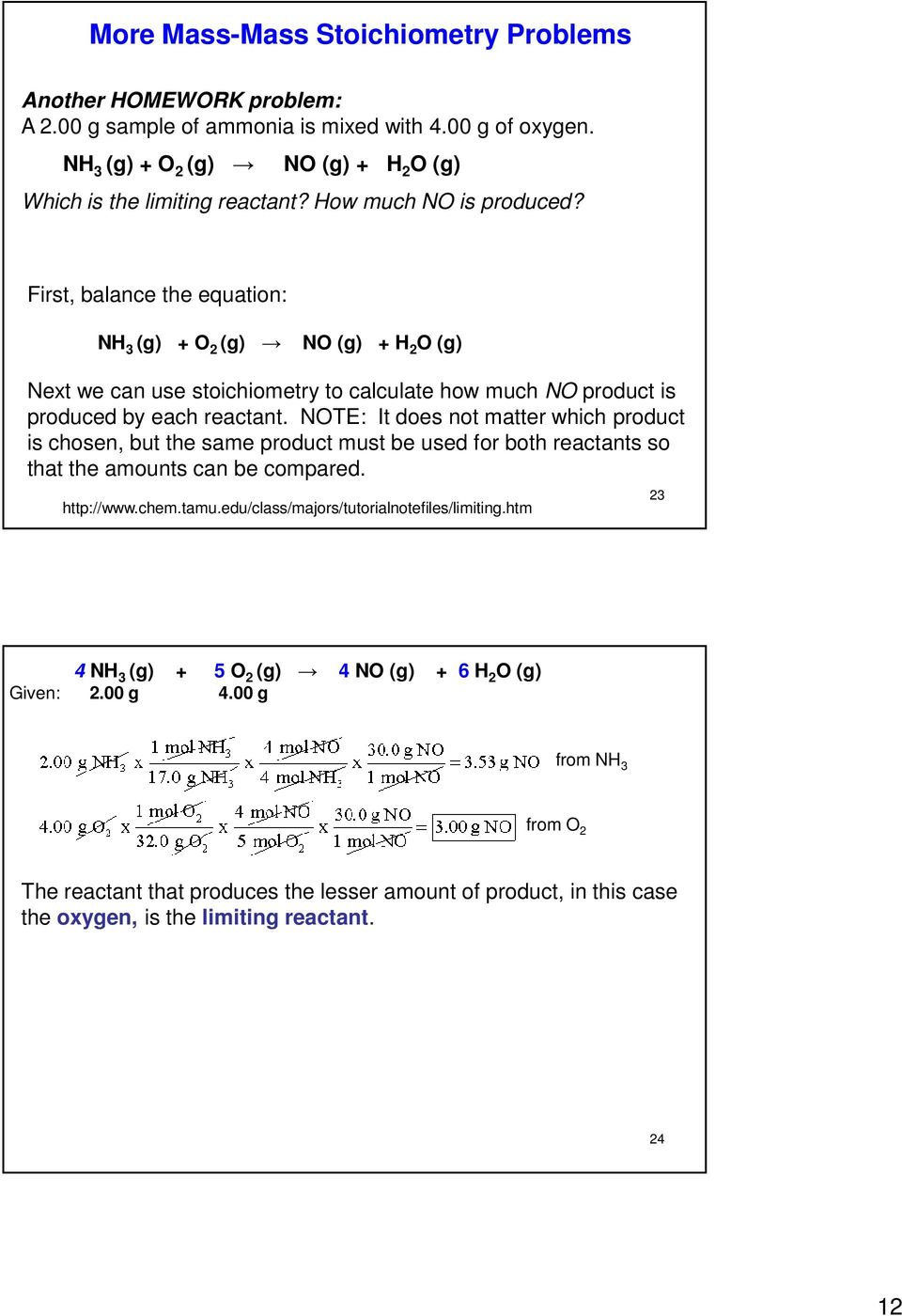
12 More Mass-Mass Stoichiometry Problems Another HOMEWORK problem: A 2.00 g sample of ammonia is mixed with 4.00 g of oxygen. NH (g) + O 2 (g) NO (g) + H 2 O (g) Which is the limiting reactant? How much NO is produced? First, balance the equation: NH (g) + O 2 (g) NO (g) + H 2 O (g) Next we can use stoichiometry to calculate how much NO product is produced by each reactant. NOTE: It does not matter which product is chosen, but the same product must be used for both reactants so that the amounts can be compared NH (g) + 5 O 2 (g) 4 NO (g) + 6 H 2 O (g) Given: 2.00 g 4.00 g from NH from O 2 The reactant that produces the lesser amount of product, in this case the oxygen, is the limiting reactant
Sample Problem: STOICHIOMETRY and percent yield calculations. How much H 2 O will be formed if 454 g of. decomposes? NH 4 NO 3 N 2 O + 2 H 2 O
 STOICHIOMETRY and percent yield calculations 1 Steps for solving Stoichiometric Problems 2 Step 1 Write the balanced equation for the reaction. Step 2 Identify your known and unknown quantities. Step 3
Name Date Class STOICHIOMETRY. SECTION 12.1 THE ARITHMETIC OF EQUATIONS (pages 353 358)
 Name Date Class 1 STOICHIOMETRY SECTION 1.1 THE ARITHMETIC OF EQUATIONS (pages 353 358) This section explains how to calculate the amount of reactants required or product formed in a nonchemical process.
Calculating Atoms, Ions, or Molecules Using Moles
 TEKS REVIEW 8B Calculating Atoms, Ions, or Molecules Using Moles TEKS 8B READINESS Use the mole concept to calculate the number of atoms, ions, or molecules in a sample TEKS_TXT of material. Vocabulary
How To Calculate Mass In Chemical Reactions
 We have used the mole concept to calculate mass relationships in chemical formulas Molar mass of ethanol (C 2 H 5 OH)? Molar mass = 2 x 12.011 + 6 x 1.008 + 1 x15.999 = 46.069 g/mol Mass percentage of
Chapter 8: Quantities in Chemical Reactions
 Ch 8 Page 1 Chapter 8: Quantities in Chemical Reactions Stoichiometry: the numerical relationship between chemical quantities in a balanced chemical equation. Ex. 4NH 3 + 5O 2 4NO + 6H 2 O The reaction
Chapter 3. Chemical Reactions and Reaction Stoichiometry. Lecture Presentation. James F. Kirby Quinnipiac University Hamden, CT
 Lecture Presentation Chapter 3 Chemical Reactions and Reaction James F. Kirby Quinnipiac University Hamden, CT The study of the mass relationships in chemistry Based on the Law of Conservation of Mass
11-1 Stoichiometry. Represents
 11-1 Stoichiometry What is stoichiometry? Calculations that relate the quantities of substances. It is the study of quantitative (measurable amounts) relationships in chemical reactions and equations.
1. How many hydrogen atoms are in 1.00 g of hydrogen?
 MOLES AND CALCULATIONS USING THE MOLE CONCEPT INTRODUCTORY TERMS A. What is an amu? 1.66 x 10⁻²⁴ g B. We need a conversion to the macroscopic world. 1. How many hydrogen atoms are in 1.00 g of hydrogen?
IB Chemistry 1 Mole. One atom of C-12 has a mass of 12 amu. One mole of C-12 has a mass of 12 g. Grams we can use more easily.
 The Mole Atomic mass units and atoms are not convenient units to work with. The concept of the mole was invented. This was the number of atoms of carbon-12 that were needed to make 12 g of carbon. 1 mole
Balance the following equation: KClO 3 + C 12 H 22 O 11 KCl + CO 2 + H 2 O
 Balance the following equation: KClO 3 + C 12 H 22 O 11 KCl + CO 2 + H 2 O Ans: 8 KClO 3 + C 12 H 22 O 11 8 KCl + 12 CO 2 + 11 H 2 O 3.2 Chemical Symbols at Different levels Chemical symbols represent
10 Cl atoms. 10 H2O molecules. 8.3 mol HCN = 8.3 mol N atoms 1 mol HCN. 2 mol H atoms 2.63 mol CH2O = 5.26 mol H atoms 1 mol CH O
 Chem 100 Mole conversions and stoichiometry worksheet 1. How many Ag atoms are in.4 mol Ag atoms? 6.0 10 Ag atoms 4.4 mol Ag atoms = 1.46 10 Ag atoms 1 mol Ag atoms. How many Br molecules are in 18. mol
Chemical Equations & Stoichiometry
 Chemical Equations & Stoichiometry Chapter Goals Balance equations for simple chemical reactions. Perform stoichiometry calculations using balanced chemical equations. Understand the meaning of the term
Introductory Chemistry, 3 rd Edition Nivaldo Tro. Roy Kennedy Massachusetts Bay Community College Wellesley Hills, Maqqwertd ygoijpk[l
 Introductory Chemistry, 3 rd Edition Nivaldo Tro Quantities in Car an octane and oxygen molecules and carbon dioxide and water Chemical Reactions Roy Kennedy Massachusetts Bay Community College Wellesley
Chem 31 Fall 2002. Chapter 3. Stoichiometry: Calculations with Chemical Formulas and Equations. Writing and Balancing Chemical Equations
 Chem 31 Fall 2002 Chapter 3 Stoichiometry: Calculations with Chemical Formulas and Equations Writing and Balancing Chemical Equations 1. Write Equation in Words -you cannot write an equation unless you
Other Stoich Calculations A. mole mass (mass mole) calculations. GIVEN mol A x CE mol B. PT g A CE mol A MOLE MASS :
 Chem. I Notes Ch. 12, part 2 Using Moles NOTE: Vocabulary terms are in boldface and underlined. Supporting details are in italics. 1 MOLE = 6.02 x 10 23 representative particles (representative particles
Unit 7 Stoichiometry. Chapter 12
 Unit 7 Stoichiometry Chapter 12 Objectives 7.1 use stoichiometry to determine the amount of substance in a reaction 7.2 determine the limiting reactant of a reaction 7.3 determine the percent yield of
CHEMICAL EQUILIBRIUM (ICE METHOD)
 CHEMICAL EQUILIBRIUM (ICE METHOD) Introduction Chemical equilibrium occurs when opposing reactions are proceeding at equal rates. The rate at which the products are formed from the reactants equals the
Part One: Mass and Moles of Substance. Molecular Mass = sum of the Atomic Masses in a molecule
 CHAPTER THREE: CALCULATIONS WITH CHEMICAL FORMULAS AND EQUATIONS Part One: Mass and Moles of Substance A. Molecular Mass and Formula Mass. (Section 3.1) 1. Just as we can talk about mass of one atom of
Stoichiometry. What is the atomic mass for carbon? For zinc?
 Stoichiometry Atomic Mass (atomic weight) Atoms are so small, it is difficult to discuss how much they weigh in grams We use atomic mass units an atomic mass unit (AMU) is one twelfth the mass of the catbon-12
Jenn Maeng Lesson overview
 Jenn Maeng Lesson overview Subject: Chemistry Grade: 10-12 Topic: Stoichiometry Concepts: Stoichiometric Conversions Essential How do we quantify changes in systems? questions: Objectives Students will
Name Class Date. Section: Calculating Quantities in Reactions. Complete each statement below by writing the correct term or phrase.
 Skills Worksheet Concept Review Section: Calculating Quantities in Reactions Complete each statement below by writing the correct term or phrase. 1. All stoichiometric calculations involving equations
Chapter 3! Stoichiometry: Calculations with Chemical Formulas and Equations. Stoichiometry
 Chapter 3! : Calculations with Chemical Formulas and Equations Anatomy of a Chemical Equation CH 4 (g) + 2O 2 (g) CO 2 (g) + 2 H 2 O (g) Anatomy of a Chemical Equation CH 4 (g) + 2 O 2 (g) CO 2 (g) + 2
Chapter 3: Stoichiometry
 Chapter 3: Stoichiometry Key Skills: Balance chemical equations Predict the products of simple combination, decomposition, and combustion reactions. Calculate formula weights Convert grams to moles and
Stoichiometry. Lecture Examples Answer Key
 Stoichiometry Lecture Examples Answer Key Ex. 1 Balance the following chemical equations: 3 NaBr + 1 H 3 PO 4 3 HBr + 1 Na 3 PO 4 2 C 3 H 5 N 3 O 9 6 CO 2 + 3 N 2 + 5 H 2 O + 9 O 2 2 Ca(OH) 2 + 2 SO 2
Formulas, Equations and Moles
 Chapter 3 Formulas, Equations and Moles Interpreting Chemical Equations You can interpret a balanced chemical equation in many ways. On a microscopic level, two molecules of H 2 react with one molecule
2. The percent yield is the maximum amount of product that can be produced from the given amount of limiting reactant.
 UNIT 6 stoichiometry practice test True/False Indicate whether the statement is true or false. moles F 1. The mole ratio is a comparison of how many grams of one substance are required to participate in
Honors Chemistry: Unit 6 Test Stoichiometry PRACTICE TEST ANSWER KEY Page 1. A chemical equation. (C-4.4)
 Honors Chemistry: Unit 6 Test Stoichiometry PRACTICE TEST ANSWER KEY Page 1 1. 2. 3. 4. 5. 6. Question What is a symbolic representation of a chemical reaction? What 3 things (values) is a mole of a chemical
CHEMICAL FORMULA COEFFICIENTS AND SUBSCRIPTS. Chapter 3: Molecular analysis 3O 2 2O 3
 Chapter 3: Molecular analysis Read: BLB 3.3 3.5 H W : BLB 3:21a, c, e, f, 25, 29, 37,49, 51, 53 Supplemental 3:1 8 CHEMICAL FORMULA Formula that gives the TOTAL number of elements in a molecule or formula
Atomic Masses. Chapter 3. Stoichiometry. Chemical Stoichiometry. Mass and Moles of a Substance. Average Atomic Mass
 Atomic Masses Chapter 3 Stoichiometry 1 atomic mass unit (amu) = 1/12 of the mass of a 12 C atom so one 12 C atom has a mass of 12 amu (exact number). From mass spectrometry: 13 C/ 12 C = 1.0836129 amu
Stoichiometry Review
 Stoichiometry Review There are 20 problems in this review set. Answers, including problem set-up, can be found in the second half of this document. 1. N 2 (g) + 3H 2 (g) --------> 2NH 3 (g) a. nitrogen
Chem 1100 Chapter Three Study Guide Answers Outline I. Molar Mass and Moles A. Calculations of Molar Masses
 Chem 1100 Chapter Three Study Guide Answers Outline I. Molar Mass and Moles A. Calculations of Molar Masses B. Calculations of moles C. Calculations of number of atoms from moles/molar masses 1. Avagadro
STOICHIOMETRY OF COMBUSTION
 STOICHIOMETRY OF COMBUSTION FUNDAMENTALS: moles and kilomoles Atomic unit mass: 1/12 126 C ~ 1.66 10-27 kg Atoms and molecules mass is defined in atomic unit mass: which is defined in relation to the 1/12
The Mole Concept. The Mole. Masses of molecules
 The Mole Concept Ron Robertson r2 c:\files\courses\1110-20\2010 final slides for web\mole concept.docx The Mole The mole is a unit of measurement equal to 6.022 x 10 23 things (to 4 sf) just like there
Chapter 6 Chemical Calculations
 Chapter 6 Chemical Calculations 1 Submicroscopic Macroscopic 2 Chapter Outline 1. Formula Masses (Ch 6.1) 2. Percent Composition (supplemental material) 3. The Mole & Avogadro s Number (Ch 6.2) 4. Molar
Chem 115 POGIL Worksheet - Week 4 Moles & Stoichiometry
 Chem 115 POGIL Worksheet - Week 4 Moles & Stoichiometry Why? Chemists are concerned with mass relationships in chemical reactions, usually run on a macroscopic scale (grams, kilograms, etc.). To deal with
Mole Notes.notebook. October 29, 2014
 1 2 How do chemists count atoms/formula units/molecules? How do we go from the atomic scale to the scale of everyday measurements (macroscopic scale)? The gateway is the mole! But before we get to the
4.1 Stoichiometry. 3 Basic Steps. 4. Stoichiometry. Stoichiometry. Butane Lighter 2C 4 H 10 + 13O 2 10H 2 O + 8CO 2
 4. Stoichiometry 1. Stoichiometric Equations 2. Limiting Reagent Problems 3. Percent Yield 4. Limiting Reagent Problems 5. Concentrations of Solutes 6. Solution Stoichiometry 7. ph and Acid Base Titrations
IB Chemistry. DP Chemistry Review
 DP Chemistry Review Topic 1: Quantitative chemistry 1.1 The mole concept and Avogadro s constant Assessment statement Apply the mole concept to substances. Determine the number of particles and the amount
Stoichiometry Exploring a Student-Friendly Method of Problem Solving
 Stoichiometry Exploring a Student-Friendly Method of Problem Solving Stoichiometry comes in two forms: composition and reaction. If the relationship in question is between the quantities of each element
CH3 Stoichiometry. The violent chemical reaction of bromine and phosphorus. P.76
 CH3 Stoichiometry The violent chemical reaction of bromine and phosphorus. P.76 Contents 3.1 Counting by Weighing 3.2 Atomic Masses 3.3 The Mole 3.4 Molar Mass 3.5 Percent Composition of Compounds 3.6
MASS RELATIONSHIPS IN CHEMICAL REACTIONS
 MASS RELATIONSHIPS IN CHEMICAL REACTIONS 1. The mole, Avogadro s number and molar mass of an element. Molecular mass (molecular weight) 3. Percent composition of compounds 4. Empirical and Molecular formulas
Chapter 1 The Atomic Nature of Matter
 Chapter 1 The Atomic Nature of Matter 6. Substances that cannot be decomposed into two or more simpler substances by chemical means are called a. pure substances. b. compounds. c. molecules. d. elements.
Calculations with Chemical Formulas and Equations
 Chapter 3 Calculations with Chemical Formulas and Equations Concept Check 3.1 You have 1.5 moles of tricycles. a. How many moles of seats do you have? b. How many moles of tires do you have? c. How could
stoichiometry = the numerical relationships between chemical amounts in a reaction.
 1 REACTIONS AND YIELD ANSWERS stoichiometry = the numerical relationships between chemical amounts in a reaction. 2C 8 H 18 (l) + 25O 2 16CO 2 (g) + 18H 2 O(g) From the equation, 16 moles of CO 2 (a greenhouse
Appendix D. Reaction Stoichiometry D.1 INTRODUCTION
 Appendix D Reaction Stoichiometry D.1 INTRODUCTION In Appendix A, the stoichiometry of elements and compounds was presented. There, the relationships among grams, moles and number of atoms and molecules
The Mole and Molar Mass
 The Mole and Molar Mass 1 Molar mass is the mass of one mole of a substance. Molar mass is numerically equal to atomic mass, molecular mass, or formula mass. However the units of molar mass are g/mol.
Problem Solving. Stoichiometry of Gases
 Skills Worksheet Problem Solving Stoichiometry of Gases Now that you have worked with relationships among moles, mass, and volumes of gases, you can easily put these to work in stoichiometry calculations.
The Mole Concept and Atoms
 Copyright The McGraw-Hill Companies, Inc. Permission required for reproduction or display. Chapter 4 24 September 2013 Calculations and the Chemical Equation The Mole Concept and Atoms Atoms are exceedingly
Ch. 6 Chemical Composition and Stoichiometry
 Ch. 6 Chemical Composition and Stoichiometry The Mole Concept [6.2, 6.3] Conversions between g mol atoms [6.3, 6.4, 6.5] Mass Percent [6.6, 6.7] Empirical and Molecular Formula [6.8, 6.9] Bring your calculators!
CP Chemistry Review for Stoichiometry Test
 CP Chemistry Review for Stoichiometry Test Stoichiometry Problems (one given reactant): 1. Make sure you have a balanced chemical equation 2. Convert to moles of the known substance. (Use the periodic
Chemistry B11 Chapter 4 Chemical reactions
 Chemistry B11 Chapter 4 Chemical reactions Chemical reactions are classified into five groups: A + B AB Synthesis reactions (Combination) H + O H O AB A + B Decomposition reactions (Analysis) NaCl Na +Cl
Concept 1. The meaning and usefulness of the mole. The mole (or mol) represents a certain number of objects.
 Chapter 3. Stoichiometry: Mole-Mass Relationships in Chemical Reactions Concept 1. The meaning and usefulness of the mole The mole (or mol) represents a certain number of objects. SI def.: the amount of
Unit 9 Stoichiometry Notes (The Mole Continues)
 Unit 9 Stoichiometry Notes (The Mole Continues) is a big word for a process that chemist s use to calculate amounts in reactions. It makes use of the coefficient ratio set up by balanced reaction equations
Unit 2: Quantities in Chemistry
 Mass, Moles, & Molar Mass Relative quantities of isotopes in a natural occurring element (%) E.g. Carbon has 2 isotopes C-12 and C-13. Of Carbon s two isotopes, there is 98.9% C-12 and 11.1% C-13. Find
Chapter 3 Mass Relationships in Chemical Reactions
 Chapter 3 Mass Relationships in Chemical Reactions Student: 1. An atom of bromine has a mass about four times greater than that of an atom of neon. Which choice makes the correct comparison of the relative
Moles. Moles. Moles. Moles. Balancing Eqns. Balancing. Balancing Eqns. Symbols Yields or Produces. Like a recipe:
 Like a recipe: Balancing Eqns Reactants Products 2H 2 (g) + O 2 (g) 2H 2 O(l) coefficients subscripts Balancing Eqns Balancing Symbols (s) (l) (aq) (g) or Yields or Produces solid liquid (pure liquid)
Calculations and Chemical Equations. Example: Hydrogen atomic weight = 1.008 amu Carbon atomic weight = 12.001 amu
 Calculations and Chemical Equations Atomic mass: Mass of an atom of an element, expressed in atomic mass units Atomic mass unit (amu): 1.661 x 10⁻²⁴ g Atomic weight: Average mass of all isotopes of a given
Sample Exercise 3.1 Interpreting and Balancing Chemical Equations
 Sample Exercise 3.1 Interpreting and Balancing Chemical Equations The following diagram represents a chemical reaction in which the red spheres are oxygen atoms and the blue spheres are nitrogen atoms.
Chemical Composition. Introductory Chemistry: A Foundation FOURTH EDITION. Atomic Masses. Atomic Masses. Atomic Masses. Chapter 8
 Introductory Chemistry: A Foundation FOURTH EDITION by Steven S. Zumdahl University of Illinois Chemical Composition Chapter 8 1 2 Atomic Masses Balanced equation tells us the relative numbers of molecules
CHEMICAL REACTIONS AND REACTING MASSES AND VOLUMES
 CHEMICAL REACTIONS AND REACTING MASSES AND VOLUMES The meaning of stoichiometric coefficients: 2 H 2 (g) + O 2 (g) 2 H 2 O(l) number of reacting particles 2 molecules of hydrogen react with 1 molecule
Chapter 5, Calculations and the Chemical Equation
 1. How many iron atoms are present in one mole of iron? Ans. 6.02 1023 atoms 2. How many grams of sulfur are found in 0.150 mol of sulfur? [Use atomic weight: S, 32.06 amu] Ans. 4.81 g 3. How many moles
MOLES AND MOLE CALCULATIONS
 35 MOLES ND MOLE CLCULTIONS INTRODUCTION The purpose of this section is to present some methods for calculating both how much of each reactant is used in a chemical reaction, and how much of each product
Unit 10A Stoichiometry Notes
 Unit 10A Stoichiometry Notes Stoichiometry is a big word for a process that chemist s use to calculate amounts in reactions. It makes use of the coefficient ratio set up by balanced reaction equations
THE MOLE / COUNTING IN CHEMISTRY
 1 THE MOLE / COUNTING IN CHEMISTRY ***A mole is 6.0 x 10 items.*** 1 mole = 6.0 x 10 items 1 mole = 60, 00, 000, 000, 000, 000, 000, 000 items Analogy #1 1 dozen = 1 items 18 eggs = 1.5 dz. - to convert
Worksheet # 8 Graham/09 Due
 CHE 100 Worksheet # 8 Graham/09 Name Key Due 1. According to the law of definite proportions, if a sample of a compound contains 7.00 grams of sulfur and 3.50 grams of oxygen, then another sample of the
CHEMISTRY. Matter and Change. Section 13.1 Section 13.2 Section 13.3. The Gas Laws The Ideal Gas Law Gas Stoichiometry
 CHEMISTRY Matter and Change 13 Table Of Contents Chapter 13: Gases Section 13.1 Section 13.2 Section 13.3 The Gas Laws The Ideal Gas Law Gas Stoichiometry State the relationships among pressure, temperature,
Limiting Reagent Worksheet #1
 Limiting Reagent Worksheet #1 1. Given the following reaction: (Balance the equation first!) C 3 H 8 + O 2 -------> CO 2 + H 2 O a) If you start with 14.8 g of C 3 H 8 and 3.44 g of O 2, determine the
Chapter 3. Mass Relationships in Chemical Reactions
 Chapter 3 Mass Relationships in Chemical Reactions This chapter uses the concepts of conservation of mass to assist the student in gaining an understanding of chemical changes. Upon completion of Chapter
Chem 115 POGIL Worksheet - Week 4 Moles & Stoichiometry Answers
 Key Questions & Exercises Chem 115 POGIL Worksheet - Week 4 Moles & Stoichiometry Answers 1. The atomic weight of carbon is 12.0107 u, so a mole of carbon has a mass of 12.0107 g. Why doesn t a mole of
Chapter Three: STOICHIOMETRY
 p70 Chapter Three: STOICHIOMETRY Contents p76 Stoichiometry - The study of quantities of materials consumed and produced in chemical reactions. p70 3-1 Counting by Weighing 3-2 Atomic Masses p78 Mass Mass
Liquid phase. Balance equation Moles A Stoic. coefficient. Aqueous phase
 STOICHIOMETRY Objective The purpose of this exercise is to give you some practice on some Stoichiometry calculations. Discussion The molecular mass of a compound is the sum of the atomic masses of all
CHAPTER 3 MASS RELATIONSHIPS IN CHEMICAL REACTIONS
 CHAPTER 3 MASS RELATIONSHIPS IN CHEMICAL REACTIONS This chapter reviews the mole concept, balancing chemical equations, and stoichiometry. The topics covered in this chapter are: Atomic mass and average
Return to Lab Menu. Stoichiometry Exploring the Reaction between Baking Soda and Vinegar
 Return to Lab Menu Stoichiometry Exploring the Reaction between Baking Soda and Vinegar Objectives -to observe and measure mass loss in a gas forming reaction -to calculate CO 2 loss and correlate to a
Determination of the Empirical Formula of Magnesium Oxide
 Determination of the Empirical Formula of Magnesium Oxide GOAL AND OVERVIEW The quantitative stoichiometric relationships governing mass and amount will be studied using the combustion reaction of magnesium
Chemical Calculations: Formula Masses, Moles, and Chemical Equations
 Chemical Calculations: Formula Masses, Moles, and Chemical Equations Atomic Mass & Formula Mass Recall from Chapter Three that the average mass of an atom of a given element can be found on the periodic
Molar Mass Worksheet Answer Key
 Molar Mass Worksheet Answer Key Calculate the molar masses of the following chemicals: 1) Cl 2 71 g/mol 2) KOH 56.1 g/mol 3) BeCl 2 80 g/mol 4) FeCl 3 162.3 g/mol 5) BF 3 67.8 g/mol 6) CCl 2 F 2 121 g/mol
4.3 Reaction Stoichiometry
 196 Chapter 4 Stoichiometry of Chemical Reactions 4.3 Reaction Stoichiometry By the end of this section, you will be able to: Explain the concept of stoichiometry as it pertains to chemical reactions Use
MOLECULAR MASS AND FORMULA MASS
 1 MOLECULAR MASS AND FORMULA MASS Molecular mass = sum of the atomic weights of all atoms in the molecule. Formula mass = sum of the atomic weights of all atoms in the formula unit. 2 MOLECULAR MASS AND
EXPERIMENT 7 Reaction Stoichiometry and Percent Yield
 EXPERIMENT 7 Reaction Stoichiometry and Percent Yield INTRODUCTION Stoichiometry calculations are about calculating the amounts of substances that react and form in a chemical reaction. The word stoichiometry
Answers and Solutions to Text Problems
 Chapter 7 Answers and Solutions 7 Answers and Solutions to Text Problems 7.1 A mole is the amount of a substance that contains 6.02 x 10 23 items. For example, one mole of water contains 6.02 10 23 molecules
Lecture Topics Atomic weight, Mole, Molecular Mass, Derivation of Formulas, Percent Composition
 Mole Calculations Chemical Equations and Stoichiometry Lecture Topics Atomic weight, Mole, Molecular Mass, Derivation of Formulas, Percent Composition Chemical Equations and Problems Based on Miscellaneous
Chapter 1: Moles and equations. Learning outcomes. you should be able to:
 Chapter 1: Moles and equations 1 Learning outcomes you should be able to: define and use the terms: relative atomic mass, isotopic mass and formula mass based on the 12 C scale perform calculations, including
= 16.00 amu. = 39.10 amu
 Using Chemical Formulas Objective 1: Calculate the formula mass or molar mass of any given compound. The Formula Mass of any molecule, formula unit, or ion is the sum of the average atomic masses of all
Chemical Reactions in Water Ron Robertson
 Chemical Reactions in Water Ron Robertson r2 f:\files\courses\1110-20\2010 possible slides for web\waterchemtrans.doc Properties of Compounds in Water Electrolytes and nonelectrolytes Water soluble compounds
Stoichiometry. Unit Outline
 3 Stoichiometry Unit Outline 3.1 The Mole and Molar Mass 3.2 Stoichiometry and Compound Formulas 3.3 Stoichiometry and Chemical Reactions 3.4 Stoichiometry and Limiting Reactants 3.5 Chemical Analysis
CHEMICAL REACTIONS. Chemistry 51 Chapter 6
 CHEMICAL REACTIONS A chemical reaction is a rearrangement of atoms in which some of the original bonds are broken and new bonds are formed to give different chemical structures. In a chemical reaction,
Solution. Practice Exercise. Concept Exercise
 Example Exercise 9.1 Atomic Mass and Avogadro s Number Refer to the atomic masses in the periodic table inside the front cover of this textbook. State the mass of Avogadro s number of atoms for each of
CONSERVATION OF MASS During a chemical reaction, matter is neither created nor destroyed. - i. e. the number of atoms of each element remains constant
 1 CHEMICAL REACTINS Example: Hydrogen + xygen Water H + H + + - Note there is not enough hydrogen to react with oxygen - It is necessary to balance equation. reactants products + H + H (balanced equation)
Module 5: Combustion Technology. Lecture 33: Combustion air calculation
 1 P age Module 5: Combustion Technology Lecture 33: Combustion air calculation 2 P age Keywords: Heat of combustion, stoichiometric air, excess air, natural gas combustion Combustion air calculation The
SUPPLEMENTARY TOPIC 3 ENERGY AND CHEMICAL REACTIONS
 SUPPLEMENTARY TOPIC 3 ENERGY AND CHEMICAL REACTIONS Rearranging atoms. In a chemical reaction, bonds between atoms in one or more molecules (reactants) break and new bonds are formed with other atoms to
Chemical Quantities and Aqueous Reactions
 4 Chemical Quantities and Aqueous Reactions I feel sorry for people who don t understand anything about chemistry. They are missing an important source of happiness. Linus Pauling (1901 1994) 4.1 Climate
1. What is the molecular formula of a compound with the empirical formula PO and a gram-molecular mass of 284 grams?
 Name: Tuesday, May 20, 2008 1. What is the molecular formula of a compound with the empirical formula PO and a gram-molecular mass of 284 grams? 2 5 1. P2O 5 3. P10O4 2. P5O 2 4. P4O10 2. Which substance
SYMBOLS, FORMULAS AND MOLAR MASSES
 SYMBOLS, FORMULAS AND MOLAR MASSES OBJECTIVES 1. To correctly write and interpret chemical formulas 2. To calculate molecular weights from chemical formulas 3. To calculate moles from grams using chemical
Lecture 5, The Mole. What is a mole?
 Lecture 5, The Mole What is a mole? Moles Atomic mass unit and the mole amu definition: 12 C = 12 amu. The atomic mass unit is defined this way. 1 amu = 1.6605 x 10⁻²⁴ g How many 12 C atoms weigh 12 g?
Word Equations and Balancing Equations. Video Notes
 Word Equations and Balancing Equations Video Notes In this lesson, you will: Use the law of conservation of mass and provide standard rules for writing and balancing equations. Write and balance equations
Chemical Reactions 2 The Chemical Equation
 Chemical Reactions 2 The Chemical Equation INFORMATION Chemical equations are symbolic devices used to represent actual chemical reactions. The left side of the equation, called the reactants, is separated
The Mole. 6.022 x 10 23
 The Mole 6.022 x 10 23 Background: atomic masses Look at the atomic masses on the periodic table. What do these represent? E.g. the atomic mass of Carbon is 12.01 (atomic # is 6) We know there are 6 protons
Experiment 3 Limiting Reactants
 3-1 Experiment 3 Limiting Reactants Introduction: Most chemical reactions require two or more reactants. Typically, one of the reactants is used up before the other, at which time the reaction stops. The
SCH 4C1 Unit 2 Problem Set Questions taken from Frank Mustoe et all, "Chemistry 11", McGraw-Hill Ryerson, 2001
 SCH 4C1 Unit 2 Problem Set Questions taken from Frank Mustoe et all, "Chemistry 11", McGraw-Hill Ryerson, 2001 1. A small pin contains 0.0178 mol of iron. How many atoms of iron are in the pin? 2. A sample
PART I: MULTIPLE CHOICE (30 multiple choice questions. Each multiple choice question is worth 2 points)
 CHEMISTRY 123-07 Midterm #1 Answer key October 14, 2010 Statistics: Average: 74 p (74%); Highest: 97 p (95%); Lowest: 33 p (33%) Number of students performing at or above average: 67 (57%) Number of students