
Sample Exercise 3.1 Interpreting and Balancing Chemical Equations
|
|
|
- Sybil Short
- 9 years ago
- Views:
Transcription
1 Sample Exercise 3.1 Interpreting and Balancing Chemical Equations The following diagram represents a chemical reaction in which the red spheres are oxygen atoms and the blue spheres are nitrogen atoms. (a) Write the chemical formulas for the reactants and products. (b) Write a balanced equation for the reaction. (c) Is the diagram consistent with the law of conservation of mass? (a) The left box, which represents the reactants, contains two kinds of molecules, those composed of two oxygen atoms (O 2 ) and those composed of one nitrogen atom and one oxygen atom (NO). The right box, which represents the products, contains only molecules composed of one nitrogen atom and two oxygen atoms (NO 2 ). (b) The unbalanced chemical equation is O 2 + NO NO 2 (unbalanced) This equation has three O atoms on the left side of the arrow and two O atoms on the right side. We can increase the number of O atoms by placing a coefficient 2 on the product side: O 2 + NO 2 NO 2 (unbalanced)

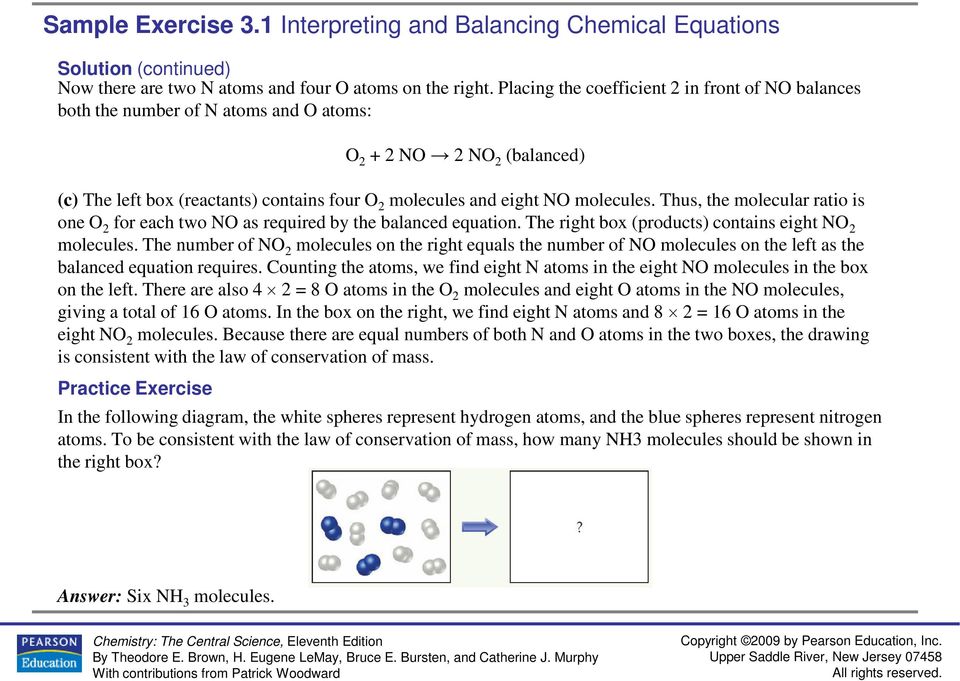
2 Sample Exercise 3.1 Interpreting and Balancing Chemical Equations (continued) Now there are two N atoms and four O atoms on the right. Placing the coefficient 2 in front of NO balances both the number of N atoms and O atoms: O NO 2 NO 2 (balanced) (c) The left box (reactants) contains four O 2 molecules and eight NO molecules. Thus, the molecular ratio is one O 2 for each two NO as required by the balanced equation. The right box (products) contains eight NO 2 molecules. The number of NO 2 molecules on the right equals the number of NO molecules on the left as the balanced equation requires. Counting the atoms, we find eight N atoms in the eight NO molecules in the box on the left. There are also 4 2 = 8 O atoms in the O 2 molecules and eight O atoms in the NO molecules, giving a total of 16 O atoms. In the box on the right, we find eight N atoms and 8 2 = 16 O atoms in the eight NO 2 molecules. Because there are equal numbers of both N and O atoms in the two boxes, the drawing is consistent with the law of conservation of mass. In the following diagram, the white spheres represent hydrogen atoms, and the blue spheres represent nitrogen atoms. To be consistent with the law of conservation of mass, how many NH3 molecules should be shown in the right box? Answer: Six NH 3 molecules.
3 Sample Exercise 3.2 Balancing Chemical Equations Balance this equation: Na(s) + H 2 O(l) NaOH(aq) + H 2 (g) Begin by counting each kind of atom on both sides of the arrow. The Na and O atoms are balanced one Na and one O on each side but there are two H atoms on the left and three H atoms on the right. Thus, we need to increase the number of H atoms on the left. To begin balancing H, let s try placing the coefficient 2 in front of H 2 O: Beginning this way does not balance H but does increase the number of H atoms among the reactants, which we need to do. Adding the coefficient 2 causes O to be unbalanced; we will take care of that after we balance H. Now that we have 2 H 2 O on the left, we can balance H by putting the coefficient 2 in front of NaOH on the right: Na(s) + 2 H 2 O(l) 2 NaOH(aq) + H 2 (g) Na(s) + 2 H 2 O(l) 2 NaOH(aq) + H 2 (g)

4 Sample Exercise 3.2 Balancing Chemical Equations (continued) Balancing H in this way fortuitously brings O into balance. But notice that Na is now unbalanced, with one Na on the left and two on the right. To rebalance Na, we put the coefficient 2 in front of the reactant: 2Na(s) + 2 H 2 O(l) 2 NaOH(aq) + H 2 (g) Finally, we check the number of atoms of each element and find that we have two Na atoms, four H atoms, and two O atoms on each side of the equation. The equation is balanced. Comment Notice that in balancing this equation, we moved back and forth placing a coefficient in front of H 2 O, then NaOH, and finally Na. In balancing equations, we often find ourselves following this pattern of moving back and forth from one side of the arrow to the other, placing coefficients first in front of a formula on one side and then in front of a formula on the other side until the equation is balanced. You can always tell if you have balanced your equation correctly, no matter how you did it, by checking that the number of atoms of each element is the same on both sides of the arrow. Balance the following equations by providing the missing coefficients: (a) _Fe(s) + _O 2 (g) _Fe 2 O 3 (s) (b) _C 2 H 4 (g) + _O 2 (g) _CO 2 (g) + _H 2 O(g) (c) _Al(s) + _HCl(aq) _AlCl 3 (aq) + _H2(g) Answers: (a) 4, 3, 2; (b) 1, 3, 2, 2; (c) 2, 6, 2, 3

5 Sample Exercise 3.3 Writing Balanced Equations for Combination and Decomposition Reactions Write balanced equations for the following reactions: (a) The combination reaction that occurs when lithium metal and fluorine gas react. (b) The decomposition reaction that occurs when solid barium carbonate is heated. (Two products form: a solid and a gas.) (a) The symbol for lithium is Li. With the exception of mercury, all metals are solids at room temperature. Fluorine occurs as a diatomic molecule (see Figure 2.19). Thus, the reactants are Li(s) and F 2 (g). The product will be composed of a metal and a nonmetal, so we expect it to be an ionic solid. Lithium ions have a 1+ charge, Li +, whereas fluoride ions have a 1 charge, F.Thus, the chemical formula for the product is LiF. The balanced chemical equation is 2 Li(s) + F 2 (g) 2 LiF(s) (b) The chemical formula for barium carbonate is BaCO 3. As noted in the text, many metal carbonates decompose to form metal oxides and carbon dioxide when heated. In Equation 3.7, for example, CaCO 3 decomposes to form CaO and CO 2. Thus, we would expect that BaCO 3 decomposes to form BaO and CO 2. Barium and calcium are both in group 2A in the periodic table, which further suggests they would react in the same way: BaCO 3 (s) BaO(s) + CO 2 (g)

6 Sample Exercise 3.3 Writing Balanced Equations for Combination and Decomposition Reactions Write balanced chemical equations for the following reactions: (a) Solid mercury(ii) sulfide decomposes into its component elements when heated. (b) The surface of aluminum metal undergoes a combination reaction with oxygen in the air. Answer: (a) HgS(s) Hg(l) + S(s) (b) 4 Al(s) + 3 O 2 (g) 2 Al 2 O 3 (s)

7 Sample Exercise 3.4 Writing Equations for Combustion Reactions Write the balanced equation for the reaction that occurs when methanol, CH 3 OH(l), is burned in air. When any compound containing C, H, and O is combusted, it reacts with the O 2 (g) in air to produce CO 2 (g) and H 2 O(g). Thus, the unbalanced equation is CH 3 OH(l) + O 2 (g) CO 2 (g) + H 2 O(g) In this equation the C atoms are balanced with one carbon on each side of the arrow. Because CH 3 OH has four H atoms, we place the coefficient 2 in front of H 2 O to balance the H atoms: CH 3 OH(l) + O 2 (g) CO 2 (g) + 2 H 2 O(g) Adding the coefficient balances H but gives four O atoms in the products. Because there are only three O atoms in the reactants (one in CH 3 OH and two in O 2 ), we are not finished yet. We can place the fractional coefficient 2/3 in front of O 2 to give a total of four O atoms in the reactants (there are 2/3 2 = 3 O atoms in 3/2 O 2 ): Although the equation is now balanced, it is not in its most conventional form because it contains a fractional coefficient. If we multiply each side of the equation by 2, we will remove the fraction and achieve the following balanced equation: 2 CH 3 OH(l) + 3 O 2 (g) 2 CO 2 (g) + 4 H 2 O(g)

8 Sample Exercise 3.4 Writing Equations for Combustion Reactions Write the balanced equation for the reaction that occurs when ethanol, C 2 H 5 OH(l), is burned in air. Answer: C 2 H 5 OH(l) + 3 O 2 (g) 2 CO 2 (g) + 3 H 2 O(g)

9 Sample Exercise 3.5 Calculating formula Weights Calculate the formula weight of (a) sucrose, C1 2 H 22 O 11 (table sugar), and (b) calcium nitrate, Ca(NO 3 ) 2. (a) By adding the atomic weights of the atoms in sucrose, we find the formula weight to be amu: (b) If a chemical formula has parentheses, the subscript outside the parentheses is a multiplier for all atoms inside. Thus, for Ca(NO3)2, we have Calculate the formula weight of (a) Al(OH) 3 and (b) CH 3 OH. Answer: (a) 78.0 amu, (b) 32.0 amu

10 Sample Exercise 3.6 Calculating Percentage Composition Calculate the percentage of carbon, hydrogen, and oxygen (by mass) in C 12 H 22 O 11. Let s examine this question using the problem-solving steps in the Strategies in Chemistry: Problem Solving essay that appears on the next page. Analyze We are given a chemical formula, C 12 H 22 O 11, and asked to calculate the percentage by mass of its component elements (C, H, and O). Plan We can use Equation 3.10, relying on a periodic table to obtain the atomic weight of each component element. The atomic weights are first used to determine the formula weight of the compound. (The formula weight of C 12 H 22 O 11, amu, was calculated in Sample Exercise 3.5.) We must then do three calculations, one for each element. Solve Using Equation 3.10, we have Check The percentages of the individual elements must add up to 100%, which they do in this case. We could have used more significant figures for our atomic weights, giving more significant figures for our percentage composition, but we have adhered to our suggested guideline of rounding atomic weights to one digit beyond the decimal point. Calculate the percentage of nitrogen, by mass, in Ca(NO 3 ) 2. Answer: 17.1%

11 Sample Exercise 3.7 Estimating Numbers in Atoms Without using a calculator, arrange the following samples in order of increasing numbers of carbon atoms: 12 g 12 C, 1 mol C 2 H 2, molecules of CO 2. Analyze We are given amounts of different substances expressed in grams, moles, and number of molecules and asked to arrange the samples in order of increasing numbers of C atoms. Plan To determine the number of C atoms in each sample, we must convert g 12 C, 1 mol C 2 H 2, and molecules CO 2 all to numbers of C atoms. To make these conversions, we use the definition of mole and Avogadro s number. Solve A mole is defined as the amount of matter that contains as many units of the matter as there are C atoms in exactly 12 g of 12 C. Thus, 12 g of 12 C contains 1 mol of C atoms (that is, C atoms). One mol of C 2 H 2 contains C 2 H 2 molecules. Because there are two C atoms in each C 2 H 2 molecule, this sample contains C atoms. Because each CO 2 molecule contains one C atom, the sample of CO 2 contains C atoms. Hence, the order is 12 g 12 C ( C atoms) < CO 2 molecules ( C atoms) < 1 mol C 2 H 2 ( C atoms). Check We can check our results by comparing the number of moles of C atoms in each sample because the number of moles is proportional to the number of atoms. Thus, 12 g of 12 C is 1 mol C; 1 mol of C 2 H 2 contains 2 mol C, and molecules of CO 2 contain 1.5 mol C, giving the same order as above: 12 g 12 C (1 mol C) < CO 2 molecules (1.5 mol C) < 1 mol C 2 H 2 (2 mol C). Without using a calculator, arrange the following samples in order of increasing number of O atoms: 1 mol H 2 O, 1 mol CO 2, molecules O 3. Answer: 1 mol H 2 O ( O atoms) molecules O 3 ( O atoms) 1 mol CO 2 ( O atoms)

12 Sample Exercise 3.8 Converting Moles to Atoms Calculate the number of H atoms in mol of C 6 H 12 O 6. Analyze We are given both the amount of a substance (0.350 mol) and its chemical formula (C 6 H 12 O 6 ). The unknown is the number of H atoms in the sample. Plan Avogadro s number provides the conversion factor between the number of moles of C 6 H 12 O 6 and the number of molecules of C 6 H 12 O 6. Once we know the number of molecules of C 6 H 12 O 6, we can use the chemical formula, which tells us that each molecule of C 6 H 12 O 6 contains 12 H atoms. Thus, we convert moles of C 6 H 12 O 6 to molecules of C 6 H 12 O 6 and then determine the number of atoms of H from the number of molecules of C 6 H 12 O 6 : Moles C 6 H 12 O 6 molecules C 6 H 12 O 6 atoms H Check The magnitude of our answer is reasonable. It is a large number about the magnitude of Avogadro s number. We can also make the following ballpark calculation: Multiplying gives about molecules. Multiplying this result by 12 gives = H atoms, which agrees with the previous, more detailed calculation. Because we were asked for the number of H atoms, the units of our answer are correct. The given data had three significant figures, so our answer has three significant figures.

13 Sample Exercise 3.8 Converting Moles to Atoms Calculate the number of H atoms in mol of C 6 H 12 O 6. How many oxygen atoms are in (a) 0.25 mol Ca(NO 3 ) 2 and (b) 1.50 mol of sodium carbonate? Answer: (a) , (b)

14 Sample Exercise 3.9 Calculating Molar Mass What is the mass in grams of mol of glucose, C 6 H 12 O 6? Analyze We are given a chemical formula and asked to determine its molar mass. Plan The molar mass of a substance is found by adding the atomic weights of its component atoms. Solve Because glucose has a formula weight of amu, one mole of this substance has a mass of g. In other words, C 6 H 12 O 6 has a molar mass of g/mol. Check The magnitude of our answer seems reasonable, and g/mol is the appropriate unit for the molar mass. Comment Glucose is sometimes called dextrose. Also known as blood sugar, glucose is found widely in nature, occurring in honey and fruits. Other types of sugars used as food are converted into glucose in the stomach or liver before the body uses them as energy sources. Because glucose requires no conversion, it is often given intravenously to patients who need immediate nourishment. People who have diabetes must carefully monitor the amount of glucose in their blood (See Chemistry and Life box in Section 3.6). Calculate the molar mass of Ca(NO 3 ) 2. Answer: g/mol

15 Sample Exercise 3.10 Converting Grams to Moles Calculate the number of moles of glucose (C 6 H 12 O 6 ) in g of C 6 H 12 O 6. Analyze We are given the number of grams of a substance and its chemical formula and asked to calculate the number of moles. Plan The molar mass of a substance provides the factor for converting grams to moles. The molar mass of C 6 H 12 O 6 is g/mol (Sample Exercise 3.9). Solve Using 1 mol C 6 H 12 O 6 =180.0 g C 6 H 12 O 6 to write the appropriate conversion factor, we have Check Because g is less than the molar mass, a reasonable answer is less than one mole. The units of our answer (mol) are appropriate. The original data had four significant figures, so our answer has four significant figures. How many moles of sodium bicarbonate (NaHCO 3 ) are in 508 g of NaHCO 3? Answer: 6.05 mol NaHCO 3

16 Sample Exercise 3.11 Converting Moles to Grams Calculate the mass, in grams, of mol of calcium nitrate. Analyze We are given the number of moles and the name of a substance and asked to calculate the number of grams in the sample. Plan To convert moles to grams, we need the molar mass, which we can calculate using the chemical formula and atomic weights. Solve Because the calcium ion is Ca 2+ and the nitrate ion is NO 3, calcium nitrate is Ca(NO 3 ) 2. Adding the atomic weights of the elements in the compound gives a formula weight of amu. Using 1 mol Ca(NO 3 ) 2 = g Ca(NO 3 ) 2 to write the appropriate conversion factor, we have Check The number of moles is less than 1, so the number of grams must be less than the molar mass, g. Using rounded numbers to estimate, we have = 75 g. The magnitude of our answer is reasonable. Both the units (g) and the number of significant figures (3) are correct. What is the mass, in grams, of (a) 6.33 mol of NaHCO 3 and (b) mol of sulfuric acid? Answer: (a) 532 g, (b) g

17 Sample Exercise 3.12 Calculating the Number of Molecules and Number of Atoms from Mass (a) How many glucose molecules are in 5.23 g of C 6 H 12 O 6? (b) How many oxygen atoms are in this sample? Analyze We are given the number of grams and the chemical formula and asked to calculate (a) the number of molecules and (b) the number of O atoms in the sample. (a) Plan The strategy for determining the number of molecules in a given quantity of a substance is summarized in Figure We must convert 5.23 g C 6 H 12 O 6 to moles C 6 H 12 O 6, which can then be converted to molecules C 6 H 12 O 6. The first conversion uses the molar mass of C 6 H 12 O 6 : 1 mol C 6 H 12 O 6 = g C 6 H 12 O 6. The second conversion uses Avogadro s number. Solve Molecules C 6 H 12 O 6 Check The magnitude of the answer is reasonable. Because the mass we began with is less than a mole, there should be fewer than molecules. We can make a ballpark estimate of the answer: 5/200 = mol; = = molecules. The units (molecules) and significant figures (three) are appropriate.

18 Sample Exercise 3.12 Calculating the Number of Molecules and Number of Atoms from Mass (continued) (b) Plan To determine the number of O atoms, we use the fact that there are six O atoms in each molecule of C 6 H 12 O 6. Thus, multiplying the number of molecules C 6 H 12 O 6 by the factor (6 atoms O/1 molecule C 6 H 12 O 6 ) gives the number of O atoms. Solve Check The answer is simply 6 times as large as the answer to part (a). The number of significant figures (three) and the units (atoms O) are correct. (a) How many nitric acid molecules are in 4.20 g of HNO 3? (b) How many O atoms are in this sample? Answer: (a) molecules HNO 3, (b) atoms O

19 Sample Exercise 3.13 Calculating Empirical Formula Ascorbic acid (vitamin C) contains 40.92% C, 4.58% H, and 54.50% O by mass. What is the empirical formula of ascorbic acid? Analyze We are to determine an empirical formula of a compound from the mass percentages of its elements. Plan The strategy for determining the empirical formula involves the three steps given in Figure Solve We first assume, for simplicity, that we have exactly 100 g of material (although any mass can be used). In 100 g of ascorbic acid, therefore, we have Second, we calculate the number of moles of each element: Third, we determine the simplest whole-number ratio of moles by dividing each number of moles by the smallest number of moles, 3.406:

20 Sample Exercise 3.13 Calculating Empirical Formula (continued) The ratio for H is too far from 1 to attribute the difference to experimental error; in fact, it is quite close to 1 1/3. This suggests that if we multiply the ratio by 3, we will obtain whole numbers: The whole-number mole ratio gives us the subscripts for the empirical formula: Check It is reassuring that the subscripts are moderately sized whole numbers. Otherwise, we have little by which to judge the reasonableness of our answer. A g sample of methyl benzoate, a compound used in the manufacture of perfumes, contains g of carbon, g of hydrogen, and g of oxygen. What is the empirical formula of this substance? Answer: C 4 H 4 O

21 Sample Exercise 3.14 Determining a Molecular Formula Mesitylene, a hydrocarbon that occurs in small amounts in crude oil, has an empirical formula of C 3 H 4. The experimentally determined molecular weight of this substance is 121 amu. What is the molecular formula of mesitylene? Analyze We are given an empirical formula and a molecular weight and asked to determine a molecular formula. Plan The subscripts in the molecular formula of a compound are whole-number multiples of the subscripts in its empirical formula. To find the appropriate multiple, we must compare the molecular weight with the formula weight of the empirical formula. Solve First, we calculate the formula weight of the empirical formula, C 3 H 4 : 3(12.0 amu) + 4(1.0 amu) = 40.0 amu Next, we divide the molecular weight by the empirical formula weight to obtain the multiple used to multiply the subscripts in C 3 H 4 : Only whole-number ratios make physical sense because we must be dealing with whole atoms. The 3.02 in this case could result from a small experimental error in the molecular weight. We therefore multiply each subscript in the empirical formula by 3 to give the molecular formula: C 9 H 12.
22 Sample Exercise 3.14 Determining a Molecular Formula Check We can have confidence in the result because dividing the molecular weight by the formula weight yields nearly a whole number. Ethylene glycol, the substance used in automobile antifreeze, is composed of 38.7% C, 9.7% H, and 51.6% O by mass. Its molar mass is 62.1 g/mol. (a) What is the empirical formula of ethylene glycol? (b) What is its molecular formula? Answers: (a) CH 3 O, (b) C 2 H 6 O 2
23 Sample Exercise 3.15 Determining Empirical Formula by Combustion Analysis Isopropyl alcohol, a substance sold as rubbing alcohol, is composed of C, H, and O. Combustion of g of isopropyl alcohol produces g of CO 2 and g of H 2 O. Determine the empirical formula of isopropyl alcohol. Analyze We are told that isopropyl alcohol contains C, H, and O atoms and given the quantities of CO 2 and H 2 O produced when a given quantity of the alcohol is combusted. We must use this information to determine the empirical formula for isopropyl alcohol, a task that requires us to calculate the number of moles of C, H, and O in the sample. Plan We can use the mole concept to calculate the number of grams of C present in the CO 2 and the number of grams of H present in the H 2 O. These amounts are the quantities of C and H present in the isopropyl alcohol before combustion. The number of grams of O in the compound equals the mass of the isopropyl alcohol minus the sum of the C and H masses. Once we have the number of grams of C, H, and O in the sample, we can then proceed as in Sample Exercise We can calculate the number of moles of each element, and determine the mole ratio, which gives the subscripts in the empirical formula. Solve To calculate the number of grams of C, we first use the molar mass of CO 2, 1 mol CO 2 = 44.0 g CO 2, to convert grams of CO 2 to moles of CO 2. Because each CO 2 molecule has only 1 C atom, there is 1 mol of C atoms per mole of CO 2 molecules. This fact allows us to convert the moles of CO 2 to moles of C. Finally, we use the molar mass of C, 1 mol C =1 2.0 g C, to convert moles of C to grams of C. Combining the three conversion factors, we have
24 Sample Exercise 3.15 Determining Empirical Formula by Combustion Analysis (continued) The calculation of the number of grams of H from the grams of H 2 O is similar, although we must remember that there are 2 mol of H atoms per 1 mol of H 2 O molecules: The total mass of the sample, g, is the sum of the masses of the C, H, and O. Thus, we can calculate the mass of O as follows: We then calculate the number of moles of C, H, and O in the sample: To find the empirical formula, we must compare the relative number of moles of each element in the sample. The relative number of moles of each element is found by dividing each number by the smallest number, The mole ratio of C:H:O so obtained is 2.98:7.91:1.00. The first two numbers are very close to the whole numbers 3 and 8, giving the empirical formula C 3 H 8 O. Check The subscripts work out to be moderately sized whole numbers, as expected.
25 Sample Exercise 3.15 Determining Empirical Formula by Combustion Analysis (a) Caproic acid, which is responsible for the foul odor of dirty socks, is composed of C, H, and O atoms. Combustion of a g sample of this compound produces g CO 2 and g H 2 O. What is the empirical formula of caproic acid? (b) Caproic acid has a molar mass of 116 g/mol. What is its molecular formula? Answers: (a) C 3 H 6 O, (b) C 6 H 12 O 2
26 Sample Exercise 3.16 Calculating Amounts of Reactants and Products How many grams of water are produced in the oxidation of 1.00 g of glucose, C 6 H 12 O 6? C 6 H 12 O 6 (s) + 6 O 2 (g) 6 CO 2 (g) + 6 H 2 O(l) Analyze We are given the mass of a reactant and are asked to determine the mass of a product in the given equation. Plan The general strategy, as outlined in Figure 3.13, requires three steps. First, the amount of C 6 H 12 O 6 must be converted from grams to moles. Second, we can use the balanced equation, which relates the moles of C 6 H 12 O 6 to the moles of H 2 O: 1 mol C 6 H 12 O 6 6 mol H 2 O. Third, we must convert the moles of H 2 O to grams. Solve First, use the molar mass of C 6 H 12 O 6 to convert from grams C 6 H 12 O 6 to moles C 6 H 12 O 6 : Second, use the balanced equation to convert moles of C 6 H 12 O 6 to moles of H 2 O: Third, use the molar mass of H 2 O to convert from moles of H 2 O to grams of H 2 O: The steps can be summarized in a diagram like that in Figure 3.13:
27 Sample Exercise 3.16 Calculating Amounts of Reactants and Products (continued) Check An estimate of the magnitude of our answer, 18/180 = 0.1 and = 0.6, agrees with the exact calculation. The units, grams H 2 O, are correct. The initial data had three significant figures, so three significant figures for the answer is correct. Comment An average person ingests 2 L of water daily and eliminates 2.4 L. The difference between 2 L and 2.4 L is produced in the metabolism of foodstuffs, such as in the oxidation of glucose. (Metabolism is a general term used to describe all the chemical processes of a living animal or plant.) The desert rat (kangaroo rat), on the other hand, apparently never drinks water. It survives on its metabolic water. The decomposition of KClO 3 is commonly used to prepare small amounts of O 2 in the laboratory: 2 KClO 3 (s) 2 KCl(s) + 3 O 2 (g). How many grams of O 2 can be prepared from 4.50 g of KClO 3? Answer: 1.77 g
28 Sample Exercise 3.17 Calculating Amounts of Reactants and Products Solid lithium hydroxide is used in space vehicles to remove the carbon dioxide exhaled by astronauts. The lithium hydroxide reacts with gaseous carbon dioxide to form solid lithium carbonate and liquid water. How many grams of carbon dioxide can be absorbed by 1.00 g of lithium hydroxide? Analyze We are given a verbal description of a reaction and asked to calculate the number of grams of one reactant that reacts with 1.00 g of another. Plan The verbal description of the reaction can be used to write a balanced equation: 2 LiOH(s) + CO 2 (g) Li 2 CO 3 (s) + H 2 O(l) We are given the grams of LiOH and asked to calculate grams of CO 2. We can accomplish this task by using the following sequence of conversions: Grams LiOH moles LiOH moles CO 2 grams CO The conversion from grams of LiOH to moles of LiOH requires the molar mass of LiOH ( = g/mol). The conversion of moles of LiOH to LiOH ( = g/mol) moles of CO 2 is based on the balanced chemical equation: 2 mol LiOH 1 mol CO 2. To convert the number of moles of CO 2 to grams, we must use the molar mass of CO 2 : (16.00) = g/mol.
29 Sample Exercise 3.17 Calculating Amounts of Reactants and Products (continued) Check Notice that , 24 2 = 48, and 44/48 is slightly less than 1. The magnitude of the answer is reasonable based on the amount of starting LiOH; the significant figures and units are appropriate, too. Propane, C 3 H 8, is a common fuel used for cooking and home heating. What mass of O 2 is consumed in the combustion of 1.00 g of propane? Answer: 3.64 g
30 Sample Exercise 3.18 Calculating the Amount of Product Formed from a Limiting Reactant The most important commercial process for converting N 2 from the air into nitrogen-containing compounds is based on the reaction of N 2 and H 2 to form ammonia (NH 3 ): N 2 (g) + 3 H 2 (g) 2 NH 3 (g) How many moles of NH 3 can be formed from 3.0 mol of N 2 and 6.0 mol of H 2? Analyze We are asked to calculate the number of moles of product, NH 3, given the quantities of each reactant, N 2 and H 2, available in a reaction. Thus, this is a limiting reactant problem. Plan If we assume that one reactant is completely consumed, we can calculate how much of the second reactant is needed in the reaction. By comparing the calculated quantity with the available amount, we can determine which reactant is limiting. We then proceed with the calculation, using the quantity of the limiting reactant. Solve The number of moles of H 2 needed for complete consumption of 3.0 mol of N 2 is: Because only 6.0 mol H 2 is available, we will run out of H 2 before the N 2 is gone, and H 2 will be the limiting reactant. We use the quantity of the limiting reactant, H 2, to calculate the quantity of NH 3 produced: Comment The table on the right summarizes this example:
31 Sample Exercise 3.18 Calculating the Amount of Product Formed from a Limiting Reactant (continued) Notice that we can calculate not only the number of moles of NH 3 formed but also the number of moles of each of the reactants remaining after the reaction. Notice also that although the number of moles of H 2 present at the beginning of the reaction is greater than the number of moles of N 2 present, the H 2 is nevertheless the limiting reactant because of its larger coefficient in the balanced equation. Check The summarizing table shows that the mole ratio of reactants used and product formed conforms to the coefficients in the balanced equation, 1:3:2. Also, because H 2 is the limiting reactant, it is completely consumed in the reaction, leaving 0 mol at the end. Because 6.0 mol H 2 has two significant figures, our answer has two significant figures. Consider the reaction 2 Al(s) + 3 Cl 2 (g) 2 AlCl 3 (s). A mixture of 1.50 mol of Al and 3.00 mol of Cl 2 is allowed to react. (a) Which is the limiting reactant? (b) How many moles of AlCl 3 are formed? (c) How many moles of the excess reactant remain at the end of the reaction? Answers: (a) Al, (b) 1.50 mol, (c) 0.75 mol Cl 2
32 Sample Exercise 3.19 Calculating the Amount of Product Formed from a Limiting Reactant Consider the following reaction that occurs in a fuel cell: 2 H 2 (g) + O 2 (g) 2 H 2 O (g) This reaction, properly done, produces energy in the form of electricity and water. Suppose a fuel cell is set up with 150 g of hydrogen gas and 1500 grams of oxygen gas (each measurement is given with two significant figures). How many grams of water can be formed? Analyze We are asked to calculate the amount of a product, given the amounts of two reactants, so this is a limiting reactant problem. Plan We must first identify the limiting reagent. To do so, we can calculate the number of moles of each reactant and compare their ratio with that required by the balanced equation. We then use the quantity of the limiting reagent to calculate the mass of water that forms. Solve From the balanced equation, we have the following stoichiometric relations: Using the molar mass of each substance, we can calculate the number of moles of each reactant:
33 Sample Exercise 3.19 Calculating the Amount of Product Formed from a Limiting Reactant (continued) Thus, there are more moles of H 2 than O 2. The coefficients in the balanced equation indicate, however, that the reaction requires 2 moles of H 2 for every 1 mole of O 2. Therefore, to completely react all the O 2, we would need 2 47 = 94 moles of H 2. Since there are only 75 moles of H 2, H 2 is the limiting reagent. We therefore use the quantity of H 2 to calculate the quantity of product formed. We can begin this calculation with the grams of H 2, but we can save a step by starting with the moles of H 2 that were calculated previously in the exercise: Check The magnitude of the answer seems reasonable. The units are correct, and the number of significant figures (two) corresponds to those in the numbers of grams of the starting materials. Comment The quantity of the limiting reagent, H 2, can also be used to determine the quantity of O 2 used (37.5 mol = 1200 g). The number of grams of the excess oxygen remaining at the end of the reaction equals the starting amount minus the amount consumed in the reaction, 1500 g 1200 g = 300 g. A strip of zinc metal with a mass of 2.00 g is placed in an aqueous solution containing 2.50 g of silver nitrate, causing the following reaction to occur: Zn(s) + 2 AgNO 3 (aq) 2 Ag(s) + Zn(NO 3 ) 2 (aq)
34 Sample Exercise 3.19 Calculating the Amount of Product Formed from a Limiting Reactant (continued) (a) Which reactant is limiting? (b) How many grams of Ag will form? (c) How many grams of Zn(NO 3 ) 2 will form? (d) How many grams of the excess reactant will be left at the end of the reaction? Answers: (a) AgNO 3, (b) 1.59 g, (c) 1.39 g, (d) 1.52 g Zn
35 Sample Exercise 3.20 Calculating the Theoretical Yield and the Percent Yield for a Reaction Adipic acid, H 2 C 6 H 8 O 4, is used to produce nylon. The acid is made commercially by a controlled reaction between cyclohexane (C 6 H 12 ) and O 2 : 2 C 6 H 12 (l) + 5 O 2 (g) 2 H 2 C 6 H 8 O 4 (l) + 2 H 2 O(g) (a) Assume that you carry out this reaction starting with 25.0 g of cyclohexane and that cyclohexane is the limiting reactant. What is the theoretical yield of adipic acid? (b) If you obtain 33.5 g of adipic acid from your reaction, what is the percent yield of adipic acid? Analyze We are given a chemical equation and the quantity of the limiting reactant (25.0 g of C 6 H 12 ). We are asked first to calculate the theoretical yield of a product (H 2 C 6 H 8 O 4 ) and then to calculate its percent yield if only 33.5 g of the substance is actually obtained. Plan (a) The theoretical yield, which is the calculated quantity of adipic acid formed in the reaction, can be calculated using the following sequence of conversions: g C 6 H 12 mol C 6 H 12 mol H 2 C 6 H 8 O 4 g H 2 C 6 H 8 O 4
36 Sample Exercise 3.20 Calculating the Theoretical Yield and the Percent Yield for a Reaction (continued) (b) The percent yield is calculated by comparing the actual yield (33.5 g) to the theoretical yield using Equation Solve Check Our answer in (a) has the appropriate magnitude, units, and significant figures. In (b) the answer is less than 100% as necessary. Imagine that you are working on ways to improve the process by which iron ore containing Fe 2 O 3 is converted into iron. In your tests you carry out the following reaction on a small scale: Fe 2 O 3 (s) + 3 CO(g) 2 Fe(s) + 3 CO 2 (g) (a) If you start with 150 g of Fe 2 O 3 as the limiting reagent, what is the theoretical yield of Fe? (b) If the actual yield of Fe in your test was 87.9 g, what was the percent yield? Answers: (a) 105 g Fe, (b) 83.7%
Moles. Balanced chemical equations Molar ratios Mass Composition Empirical and Molecular Mass Predicting Quantities Equations
 Moles Balanced chemical equations Molar ratios Mass Composition Empirical and Molecular Mass Predicting Quantities Equations Micro World atoms & molecules Macro World grams Atomic mass is the mass of an
Chapter 3. Chemical Reactions and Reaction Stoichiometry. Lecture Presentation. James F. Kirby Quinnipiac University Hamden, CT
 Lecture Presentation Chapter 3 Chemical Reactions and Reaction James F. Kirby Quinnipiac University Hamden, CT The study of the mass relationships in chemistry Based on the Law of Conservation of Mass
Chapter 6 Chemical Calculations
 Chapter 6 Chemical Calculations 1 Submicroscopic Macroscopic 2 Chapter Outline 1. Formula Masses (Ch 6.1) 2. Percent Composition (supplemental material) 3. The Mole & Avogadro s Number (Ch 6.2) 4. Molar
Chapter 3 Mass Relationships in Chemical Reactions
 Chapter 3 Mass Relationships in Chemical Reactions Student: 1. An atom of bromine has a mass about four times greater than that of an atom of neon. Which choice makes the correct comparison of the relative
Chapter 3: Stoichiometry
 Chapter 3: Stoichiometry Key Skills: Balance chemical equations Predict the products of simple combination, decomposition, and combustion reactions. Calculate formula weights Convert grams to moles and
Chem 1100 Chapter Three Study Guide Answers Outline I. Molar Mass and Moles A. Calculations of Molar Masses
 Chem 1100 Chapter Three Study Guide Answers Outline I. Molar Mass and Moles A. Calculations of Molar Masses B. Calculations of moles C. Calculations of number of atoms from moles/molar masses 1. Avagadro
Formulas, Equations and Moles
 Chapter 3 Formulas, Equations and Moles Interpreting Chemical Equations You can interpret a balanced chemical equation in many ways. On a microscopic level, two molecules of H 2 react with one molecule
The Mole Concept. The Mole. Masses of molecules
 The Mole Concept Ron Robertson r2 c:\files\courses\1110-20\2010 final slides for web\mole concept.docx The Mole The mole is a unit of measurement equal to 6.022 x 10 23 things (to 4 sf) just like there
IB Chemistry 1 Mole. One atom of C-12 has a mass of 12 amu. One mole of C-12 has a mass of 12 g. Grams we can use more easily.
 The Mole Atomic mass units and atoms are not convenient units to work with. The concept of the mole was invented. This was the number of atoms of carbon-12 that were needed to make 12 g of carbon. 1 mole
Chemical Equations & Stoichiometry
 Chemical Equations & Stoichiometry Chapter Goals Balance equations for simple chemical reactions. Perform stoichiometry calculations using balanced chemical equations. Understand the meaning of the term
IB Chemistry. DP Chemistry Review
 DP Chemistry Review Topic 1: Quantitative chemistry 1.1 The mole concept and Avogadro s constant Assessment statement Apply the mole concept to substances. Determine the number of particles and the amount
Study Guide For Chapter 7
 Name: Class: Date: ID: A Study Guide For Chapter 7 Multiple Choice Identify the choice that best completes the statement or answers the question. 1. The number of atoms in a mole of any pure substance
MASS RELATIONSHIPS IN CHEMICAL REACTIONS
 MASS RELATIONSHIPS IN CHEMICAL REACTIONS 1. The mole, Avogadro s number and molar mass of an element. Molecular mass (molecular weight) 3. Percent composition of compounds 4. Empirical and Molecular formulas
Chapter 3! Stoichiometry: Calculations with Chemical Formulas and Equations. Stoichiometry
 Chapter 3! : Calculations with Chemical Formulas and Equations Anatomy of a Chemical Equation CH 4 (g) + 2O 2 (g) CO 2 (g) + 2 H 2 O (g) Anatomy of a Chemical Equation CH 4 (g) + 2 O 2 (g) CO 2 (g) + 2
Unit 10A Stoichiometry Notes
 Unit 10A Stoichiometry Notes Stoichiometry is a big word for a process that chemist s use to calculate amounts in reactions. It makes use of the coefficient ratio set up by balanced reaction equations
Chapter 1 The Atomic Nature of Matter
 Chapter 1 The Atomic Nature of Matter 6. Substances that cannot be decomposed into two or more simpler substances by chemical means are called a. pure substances. b. compounds. c. molecules. d. elements.
Calculating Atoms, Ions, or Molecules Using Moles
 TEKS REVIEW 8B Calculating Atoms, Ions, or Molecules Using Moles TEKS 8B READINESS Use the mole concept to calculate the number of atoms, ions, or molecules in a sample TEKS_TXT of material. Vocabulary
Concept 1. The meaning and usefulness of the mole. The mole (or mol) represents a certain number of objects.
 Chapter 3. Stoichiometry: Mole-Mass Relationships in Chemical Reactions Concept 1. The meaning and usefulness of the mole The mole (or mol) represents a certain number of objects. SI def.: the amount of
Atomic mass is the mass of an atom in atomic mass units (amu)
 Micro World atoms & molecules Laboratory scale measurements Atomic mass is the mass of an atom in atomic mass units (amu) By definition: 1 atom 12 C weighs 12 amu On this scale 1 H = 1.008 amu 16 O = 16.00
Ch. 10 The Mole I. Molar Conversions
 Ch. 10 The Mole I. Molar Conversions I II III IV A. What is the Mole? A counting number (like a dozen) Avogadro s number (N A ) 1 mole = 6.022 10 23 representative particles B. Mole/Particle Conversions
Chapter Three: STOICHIOMETRY
 p70 Chapter Three: STOICHIOMETRY Contents p76 Stoichiometry - The study of quantities of materials consumed and produced in chemical reactions. p70 3-1 Counting by Weighing 3-2 Atomic Masses p78 Mass Mass
1. What is the molecular formula of a compound with the empirical formula PO and a gram-molecular mass of 284 grams?
 Name: Tuesday, May 20, 2008 1. What is the molecular formula of a compound with the empirical formula PO and a gram-molecular mass of 284 grams? 2 5 1. P2O 5 3. P10O4 2. P5O 2 4. P4O10 2. Which substance
Unit 3 Notepack Chapter 7 Chemical Quantities Qualifier for Test
 Unit 3 Notepack Chapter 7 Chemical Quantities Qualifier for Test NAME Section 7.1 The Mole: A Measurement of Matter A. What is a mole? 1. Chemistry is a quantitative science. What does this term mean?
SCH 4C1 Unit 2 Problem Set Questions taken from Frank Mustoe et all, "Chemistry 11", McGraw-Hill Ryerson, 2001
 SCH 4C1 Unit 2 Problem Set Questions taken from Frank Mustoe et all, "Chemistry 11", McGraw-Hill Ryerson, 2001 1. A small pin contains 0.0178 mol of iron. How many atoms of iron are in the pin? 2. A sample
Chemical Calculations: The Mole Concept and Chemical Formulas. AW Atomic weight (mass of the atom of an element) was determined by relative weights.
 1 Introduction to Chemistry Atomic Weights (Definitions) Chemical Calculations: The Mole Concept and Chemical Formulas AW Atomic weight (mass of the atom of an element) was determined by relative weights.
Unit 9 Stoichiometry Notes (The Mole Continues)
 Unit 9 Stoichiometry Notes (The Mole Continues) is a big word for a process that chemist s use to calculate amounts in reactions. It makes use of the coefficient ratio set up by balanced reaction equations
Problem Solving. Stoichiometry of Gases
 Skills Worksheet Problem Solving Stoichiometry of Gases Now that you have worked with relationships among moles, mass, and volumes of gases, you can easily put these to work in stoichiometry calculations.
W1 WORKSHOP ON STOICHIOMETRY
 INTRODUCTION W1 WORKSHOP ON STOICHIOMETRY These notes and exercises are designed to introduce you to the basic concepts required to understand a chemical formula or equation. Relative atomic masses of
Moles. Moles. Moles. Moles. Balancing Eqns. Balancing. Balancing Eqns. Symbols Yields or Produces. Like a recipe:
 Like a recipe: Balancing Eqns Reactants Products 2H 2 (g) + O 2 (g) 2H 2 O(l) coefficients subscripts Balancing Eqns Balancing Symbols (s) (l) (aq) (g) or Yields or Produces solid liquid (pure liquid)
Chemistry B11 Chapter 4 Chemical reactions
 Chemistry B11 Chapter 4 Chemical reactions Chemical reactions are classified into five groups: A + B AB Synthesis reactions (Combination) H + O H O AB A + B Decomposition reactions (Analysis) NaCl Na +Cl
Stoichiometry. What is the atomic mass for carbon? For zinc?
 Stoichiometry Atomic Mass (atomic weight) Atoms are so small, it is difficult to discuss how much they weigh in grams We use atomic mass units an atomic mass unit (AMU) is one twelfth the mass of the catbon-12
Other Stoich Calculations A. mole mass (mass mole) calculations. GIVEN mol A x CE mol B. PT g A CE mol A MOLE MASS :
 Chem. I Notes Ch. 12, part 2 Using Moles NOTE: Vocabulary terms are in boldface and underlined. Supporting details are in italics. 1 MOLE = 6.02 x 10 23 representative particles (representative particles
Stoichiometry. Unit Outline
 3 Stoichiometry Unit Outline 3.1 The Mole and Molar Mass 3.2 Stoichiometry and Compound Formulas 3.3 Stoichiometry and Chemical Reactions 3.4 Stoichiometry and Limiting Reactants 3.5 Chemical Analysis
Part One: Mass and Moles of Substance. Molecular Mass = sum of the Atomic Masses in a molecule
 CHAPTER THREE: CALCULATIONS WITH CHEMICAL FORMULAS AND EQUATIONS Part One: Mass and Moles of Substance A. Molecular Mass and Formula Mass. (Section 3.1) 1. Just as we can talk about mass of one atom of
Calculation of Molar Masses. Molar Mass. Solutions. Solutions
 Molar Mass Molar mass = Mass in grams of one mole of any element, numerically equal to its atomic weight Molar mass of molecules can be determined from the chemical formula and molar masses of elements
Chapter 5 Chemical Quantities and Reactions. Collection Terms. 5.1 The Mole. A Mole of a Compound. A Mole of Atoms.
 Chapter 5 Chemical Quantities and Reactions 5.1 The Mole Collection Terms A collection term states a specific number of items. 1 dozen donuts = 12 donuts 1 ream of paper = 500 sheets 1 case = 24 cans 1
Chapter 3 Stoichiometry
 Chapter 3 Stoichiometry 3-1 Chapter 3 Stoichiometry In This Chapter As you have learned in previous chapters, much of chemistry involves using macroscopic measurements to deduce what happens between atoms
Mole Notes.notebook. October 29, 2014
 1 2 How do chemists count atoms/formula units/molecules? How do we go from the atomic scale to the scale of everyday measurements (macroscopic scale)? The gateway is the mole! But before we get to the
Atomic Masses. Chapter 3. Stoichiometry. Chemical Stoichiometry. Mass and Moles of a Substance. Average Atomic Mass
 Atomic Masses Chapter 3 Stoichiometry 1 atomic mass unit (amu) = 1/12 of the mass of a 12 C atom so one 12 C atom has a mass of 12 amu (exact number). From mass spectrometry: 13 C/ 12 C = 1.0836129 amu
Calculations and Chemical Equations. Example: Hydrogen atomic weight = 1.008 amu Carbon atomic weight = 12.001 amu
 Calculations and Chemical Equations Atomic mass: Mass of an atom of an element, expressed in atomic mass units Atomic mass unit (amu): 1.661 x 10⁻²⁴ g Atomic weight: Average mass of all isotopes of a given
Chemical Calculations: Formula Masses, Moles, and Chemical Equations
 Chemical Calculations: Formula Masses, Moles, and Chemical Equations Atomic Mass & Formula Mass Recall from Chapter Three that the average mass of an atom of a given element can be found on the periodic
THE MOLE / COUNTING IN CHEMISTRY
 1 THE MOLE / COUNTING IN CHEMISTRY ***A mole is 6.0 x 10 items.*** 1 mole = 6.0 x 10 items 1 mole = 60, 00, 000, 000, 000, 000, 000, 000 items Analogy #1 1 dozen = 1 items 18 eggs = 1.5 dz. - to convert
Stoichiometry. Lecture Examples Answer Key
 Stoichiometry Lecture Examples Answer Key Ex. 1 Balance the following chemical equations: 3 NaBr + 1 H 3 PO 4 3 HBr + 1 Na 3 PO 4 2 C 3 H 5 N 3 O 9 6 CO 2 + 3 N 2 + 5 H 2 O + 9 O 2 2 Ca(OH) 2 + 2 SO 2
Chapter 5. Chemical Reactions and Equations. Introduction. Chapter 5 Topics. 5.1 What is a Chemical Reaction
 Introduction Chapter 5 Chemical Reactions and Equations Chemical reactions occur all around us. How do we make sense of these changes? What patterns can we find? 1 2 Copyright The McGraw-Hill Companies,
Solution. Practice Exercise. Concept Exercise
 Example Exercise 9.1 Atomic Mass and Avogadro s Number Refer to the atomic masses in the periodic table inside the front cover of this textbook. State the mass of Avogadro s number of atoms for each of
Lecture 5, The Mole. What is a mole?
 Lecture 5, The Mole What is a mole? Moles Atomic mass unit and the mole amu definition: 12 C = 12 amu. The atomic mass unit is defined this way. 1 amu = 1.6605 x 10⁻²⁴ g How many 12 C atoms weigh 12 g?
Balance the following equation: KClO 3 + C 12 H 22 O 11 KCl + CO 2 + H 2 O
 Balance the following equation: KClO 3 + C 12 H 22 O 11 KCl + CO 2 + H 2 O Ans: 8 KClO 3 + C 12 H 22 O 11 8 KCl + 12 CO 2 + 11 H 2 O 3.2 Chemical Symbols at Different levels Chemical symbols represent
CHEMICAL REACTIONS. Chemistry 51 Chapter 6
 CHEMICAL REACTIONS A chemical reaction is a rearrangement of atoms in which some of the original bonds are broken and new bonds are formed to give different chemical structures. In a chemical reaction,
Chapter 5, Calculations and the Chemical Equation
 1. How many iron atoms are present in one mole of iron? Ans. 6.02 1023 atoms 2. How many grams of sulfur are found in 0.150 mol of sulfur? [Use atomic weight: S, 32.06 amu] Ans. 4.81 g 3. How many moles
The Mole and Molar Mass
 The Mole and Molar Mass 1 Molar mass is the mass of one mole of a substance. Molar mass is numerically equal to atomic mass, molecular mass, or formula mass. However the units of molar mass are g/mol.
Chemical Equations and Chemical Reactions. Chapter 8.1
 Chemical Equations and Chemical Reactions Chapter 8.1 Objectives List observations that suggest that a chemical reaction has taken place List the requirements for a correctly written chemical equation.
1. How many hydrogen atoms are in 1.00 g of hydrogen?
 MOLES AND CALCULATIONS USING THE MOLE CONCEPT INTRODUCTORY TERMS A. What is an amu? 1.66 x 10⁻²⁴ g B. We need a conversion to the macroscopic world. 1. How many hydrogen atoms are in 1.00 g of hydrogen?
Chemistry Final Study Guide
 Name: Class: Date: Chemistry Final Study Guide Multiple Choice Identify the choice that best completes the statement or answers the question. 1. The electrons involved in the formation of a covalent bond
Name Date Class STOICHIOMETRY. SECTION 12.1 THE ARITHMETIC OF EQUATIONS (pages 353 358)
 Name Date Class 1 STOICHIOMETRY SECTION 1.1 THE ARITHMETIC OF EQUATIONS (pages 353 358) This section explains how to calculate the amount of reactants required or product formed in a nonchemical process.
Balancing Chemical Equations Worksheet
 Balancing Chemical Equations Worksheet Student Instructions 1. Identify the reactants and products and write a word equation. 2. Write the correct chemical formula for each of the reactants and the products.
Chapter 1: Moles and equations. Learning outcomes. you should be able to:
 Chapter 1: Moles and equations 1 Learning outcomes you should be able to: define and use the terms: relative atomic mass, isotopic mass and formula mass based on the 12 C scale perform calculations, including
Chapter 6 Notes. Chemical Composition
 Chapter 6 Notes Chemical Composition Section 6.1: Counting By Weighing We can weigh a large number of the objects and find the average mass. Once we know the average mass we can equate that to any number
Honors Chemistry: Unit 6 Test Stoichiometry PRACTICE TEST ANSWER KEY Page 1. A chemical equation. (C-4.4)
 Honors Chemistry: Unit 6 Test Stoichiometry PRACTICE TEST ANSWER KEY Page 1 1. 2. 3. 4. 5. 6. Question What is a symbolic representation of a chemical reaction? What 3 things (values) is a mole of a chemical
How much does a single atom weigh? Different elements weigh different amounts related to what makes them unique.
 How much does a single atom weigh? Different elements weigh different amounts related to what makes them unique. What units do we use to define the weight of an atom? amu units of atomic weight. (atomic
How To Calculate Mass In Chemical Reactions
 We have used the mole concept to calculate mass relationships in chemical formulas Molar mass of ethanol (C 2 H 5 OH)? Molar mass = 2 x 12.011 + 6 x 1.008 + 1 x15.999 = 46.069 g/mol Mass percentage of
Writing and Balancing Chemical Equations
 Name Writing and Balancing Chemical Equations Period When a substance undergoes a chemical reaction, chemical bonds are broken and new bonds are formed. This results in one or more new substances, often
Name Class Date. Section: Calculating Quantities in Reactions. Complete each statement below by writing the correct term or phrase.
 Skills Worksheet Concept Review Section: Calculating Quantities in Reactions Complete each statement below by writing the correct term or phrase. 1. All stoichiometric calculations involving equations
Chem 31 Fall 2002. Chapter 3. Stoichiometry: Calculations with Chemical Formulas and Equations. Writing and Balancing Chemical Equations
 Chem 31 Fall 2002 Chapter 3 Stoichiometry: Calculations with Chemical Formulas and Equations Writing and Balancing Chemical Equations 1. Write Equation in Words -you cannot write an equation unless you
7. 1.00 atm = 760 torr = 760 mm Hg = 101.325 kpa = 14.70 psi. = 0.446 atm. = 0.993 atm. = 107 kpa 760 torr 1 atm 760 mm Hg = 790.
 CHATER 3. The atmosphere is a homogeneous mixture (a solution) of gases.. Solids and liquids have essentially fixed volumes and are not able to be compressed easily. have volumes that depend on their conditions,
MOLES AND MOLE CALCULATIONS
 35 MOLES ND MOLE CLCULTIONS INTRODUCTION The purpose of this section is to present some methods for calculating both how much of each reactant is used in a chemical reaction, and how much of each product
Chemical Proportions in Compounds
 Chapter 6 Chemical Proportions in Compounds Solutions for Practice Problems Student Textbook page 201 1. Problem A sample of a compound is analyzed and found to contain 0.90 g of calcium and 1.60 g of
Chemical Equations. Chemical Equations. Chemical reactions describe processes involving chemical change
 Chemical Reactions Chemical Equations Chemical reactions describe processes involving chemical change The chemical change involves rearranging matter Converting one or more pure substances into new pure
Lecture Topics Atomic weight, Mole, Molecular Mass, Derivation of Formulas, Percent Composition
 Mole Calculations Chemical Equations and Stoichiometry Lecture Topics Atomic weight, Mole, Molecular Mass, Derivation of Formulas, Percent Composition Chemical Equations and Problems Based on Miscellaneous
We know from the information given that we have an equal mass of each compound, but no real numbers to plug in and find moles. So what can we do?
 How do we figure this out? We know that: 1) the number of oxygen atoms can be found by using Avogadro s number, if we know the moles of oxygen atoms; 2) the number of moles of oxygen atoms can be found
Stoichiometry. 1. The total number of moles represented by 20 grams of calcium carbonate is (1) 1; (2) 2; (3) 0.1; (4) 0.2.
 Stoichiometry 1 The total number of moles represented by 20 grams of calcium carbonate is (1) 1; (2) 2; (3) 01; (4) 02 2 A 44 gram sample of a hydrate was heated until the water of hydration was driven
Chemical Composition. Introductory Chemistry: A Foundation FOURTH EDITION. Atomic Masses. Atomic Masses. Atomic Masses. Chapter 8
 Introductory Chemistry: A Foundation FOURTH EDITION by Steven S. Zumdahl University of Illinois Chemical Composition Chapter 8 1 2 Atomic Masses Balanced equation tells us the relative numbers of molecules
2. The percent yield is the maximum amount of product that can be produced from the given amount of limiting reactant.
 UNIT 6 stoichiometry practice test True/False Indicate whether the statement is true or false. moles F 1. The mole ratio is a comparison of how many grams of one substance are required to participate in
Name: Class: Date: 2 4 (aq)
 Name: Class: Date: Unit 4 Practice Test Multiple Choice Identify the choice that best completes the statement or answers the question. 1) The balanced molecular equation for complete neutralization of
Chemistry: Chemical Equations
 Chemistry: Chemical Equations Write a balanced chemical equation for each word equation. Include the phase of each substance in the equation. Classify the reaction as synthesis, decomposition, single replacement,
F321 MOLES. Example If 1 atom has a mass of 1.241 x 10⁻²³ g 1 mole of atoms will have a mass of 1.241 x 10-23 g x 6.02 x 10 23 = 7.
 Moles 1 MOLES The mole the standard unit of amount of a substance (mol) the number of particles in a mole is known as Avogadro s constant (N A ) Avogadro s constant has a value of 6.02 x 10 23 mol -1.
Unit 2: Quantities in Chemistry
 Mass, Moles, & Molar Mass Relative quantities of isotopes in a natural occurring element (%) E.g. Carbon has 2 isotopes C-12 and C-13. Of Carbon s two isotopes, there is 98.9% C-12 and 11.1% C-13. Find
YIELD YIELD REACTANTS PRODUCTS
 Balancing Chemical Equations A Chemical Equation: is a representation of a chemical reaction in terms of chemical formulas Example: 1. Word Description of a Chemical Reaction When methane gas (CH 4 ) burns
Stoichiometry of Formulas and Equations
 sil07204_ch03_69-107 8/22/05 15:16 Page 69 CHAPTER THREE Stoichiometry of Formulas and Equations Key Principles The mole (mol) is the standard unit for amount of substance and consists of Avogadro s number
Chemistry Post-Enrolment Worksheet
 Name: Chemistry Post-Enrolment Worksheet The purpose of this worksheet is to get you to recap some of the fundamental concepts that you studied at GCSE and introduce some of the concepts that will be part
Element of same atomic number, but different atomic mass o Example: Hydrogen
 Atomic mass: p + = protons; e - = electrons; n 0 = neutrons p + + n 0 = atomic mass o For carbon-12, 6p + + 6n 0 = atomic mass of 12.0 o For chlorine-35, 17p + + 18n 0 = atomic mass of 35.0 atomic mass
CHEM 110: CHAPTER 3: STOICHIOMETRY: CALCULATIONS WITH CHEMICAL FORMULAS AND EQUATIONS
 1 CHEM 110: CHAPTER 3: STOICHIOMETRY: CALCULATIONS WITH CHEMICAL FORMULAS AND EQUATIONS The Chemical Equation A chemical equation concisely shows the initial (reactants) and final (products) results of
Formulae, stoichiometry and the mole concept
 3 Formulae, stoichiometry and the mole concept Content 3.1 Symbols, Formulae and Chemical equations 3.2 Concept of Relative Mass 3.3 Mole Concept and Stoichiometry Learning Outcomes Candidates should be
The Mole Concept and Atoms
 Copyright The McGraw-Hill Companies, Inc. Permission required for reproduction or display. Chapter 4 24 September 2013 Calculations and the Chemical Equation The Mole Concept and Atoms Atoms are exceedingly
UNIT (4) CALCULATIONS AND CHEMICAL REACTIONS
 UNIT (4) CALCULATIONS AND CHEMICAL REACTIONS 4.1 Formula Masses Recall that the decimal number written under the symbol of the element in the periodic table is the atomic mass of the element. 1 7 8 12
AS1 MOLES. oxygen molecules have the formula O 2 the relative mass will be 2 x 16 = 32 so the molar mass will be 32g mol -1
 Moles 1 MOLES The mole the standard unit of amount of a substance the number of particles in a mole is known as Avogadro s constant (L) Avogadro s constant has a value of 6.023 x 10 23 mol -1. Example
stoichiometry = the numerical relationships between chemical amounts in a reaction.
 1 REACTIONS AND YIELD ANSWERS stoichiometry = the numerical relationships between chemical amounts in a reaction. 2C 8 H 18 (l) + 25O 2 16CO 2 (g) + 18H 2 O(g) From the equation, 16 moles of CO 2 (a greenhouse
Chemistry 65 Chapter 6 THE MOLE CONCEPT
 THE MOLE CONCEPT Chemists find it more convenient to use mass relationships in the laboratory, while chemical reactions depend on the number of atoms present. In order to relate the mass and number of
Calculations with Chemical Formulas and Equations
 Chapter 3 Calculations with Chemical Formulas and Equations Concept Check 3.1 You have 1.5 moles of tricycles. a. How many moles of seats do you have? b. How many moles of tires do you have? c. How could
Ch. 6 Chemical Composition and Stoichiometry
 Ch. 6 Chemical Composition and Stoichiometry The Mole Concept [6.2, 6.3] Conversions between g mol atoms [6.3, 6.4, 6.5] Mass Percent [6.6, 6.7] Empirical and Molecular Formula [6.8, 6.9] Bring your calculators!
Chem 115 POGIL Worksheet - Week 4 Moles & Stoichiometry
 Chem 115 POGIL Worksheet - Week 4 Moles & Stoichiometry Why? Chemists are concerned with mass relationships in chemical reactions, usually run on a macroscopic scale (grams, kilograms, etc.). To deal with
PART I: MULTIPLE CHOICE (30 multiple choice questions. Each multiple choice question is worth 2 points)
 CHEMISTRY 123-07 Midterm #1 Answer key October 14, 2010 Statistics: Average: 74 p (74%); Highest: 97 p (95%); Lowest: 33 p (33%) Number of students performing at or above average: 67 (57%) Number of students
1. When the following equation is balanced, the coefficient of Al is. Al (s) + H 2 O (l)? Al(OH) 3 (s) + H 2 (g)
 1. When the following equation is balanced, the coefficient of Al is. Al (s) + H 2 O (l)? Al(OH) (s) + H 2 (g) A) 1 B) 2 C) 4 D) 5 E) Al (s) + H 2 O (l)? Al(OH) (s) + H 2 (g) Al (s) + H 2 O (l)? Al(OH)
Chapter 8: Chemical Equations and Reactions
 Chapter 8: Chemical Equations and Reactions I. Describing Chemical Reactions A. A chemical reaction is the process by which one or more substances are changed into one or more different substances. A chemical
Percent Composition and Molecular Formula Worksheet
 Percent Composition and Molecular Formula Worksheet 1. What s the empirical formula of a molecule containing 65.5% carbon, 5.5% hydrogen, and 29.0% 2. If the molar mass of the compound in problem 1 is
Name Date Class CHEMICAL QUANTITIES. SECTION 10.1 THE MOLE: A MEASUREMENT OF MATTER (pages 287 296)
 10 CHEMICAL QUANTITIES SECTION 10.1 THE MOLE: A MEASUREMENT OF MATTER (pages 287 296) This section defines the mole and explains how the mole is used to measure matter. It also teaches you how to calculate
Stoichiometry Review
 Stoichiometry Review There are 20 problems in this review set. Answers, including problem set-up, can be found in the second half of this document. 1. N 2 (g) + 3H 2 (g) --------> 2NH 3 (g) a. nitrogen
Problem Solving. Empirical Formulas
 Skills Worksheet Problem Solving Empirical Formulas Suppose you analyze an unknown compound that is a white powder and find that it is composed of 36.5% sodium, 38.1% oxygen, and 25.4% sulfur. You can
CHEM 120 Online: Chapter 6 Sample problems Date: 2. Which of the following compounds has the largest formula mass? A) H2O B) NH3 C) CO D) BeH2
 CHEM 120 Online: Chapter 6 Sample problems Date: 1. To determine the formula mass of a compound you should A) add up the atomic masses of all the atoms present. B) add up the atomic masses of all the atoms
Sample Problem: STOICHIOMETRY and percent yield calculations. How much H 2 O will be formed if 454 g of. decomposes? NH 4 NO 3 N 2 O + 2 H 2 O
 STOICHIOMETRY and percent yield calculations 1 Steps for solving Stoichiometric Problems 2 Step 1 Write the balanced equation for the reaction. Step 2 Identify your known and unknown quantities. Step 3
The Empirical Formula of a Compound
 The Empirical Formula of a Compound Lab #5 Introduction A look at the mass relationships in chemistry reveals little order or sense. The ratio of the masses of the elements in a compound, while constant,