
Functional Anatomy of Prokaryotic and Eukaryotic Cells
|
|
|
- Randall McKinney
- 9 years ago
- Views:
Transcription
1 Chapter 4 Functional Anatomy of Prokaryotic and Eukaryotic Cells Prokaryotic and Eukaryotic Cells Distinguishing characteristics of prokaryotic (prenucleus) cells are: 1. Genetic material (DNA) is one circular chromosome and is not enclosed within a membrane. 2. Lacking other membrane-enclosed organelles. 3. No histone proteins associated with DNA. 4. Cell walls almost always contain peptidoglycan. 5. Usually divide by binary fission. Distinguishing characteristics of eukaryotic (true nucleus) cells are: 1. Nucleus bounded by a membrane. 2. DNA of chromosomes consistently associated with proteins called histones and nonhistones. 3. Possess mitotic apparatus. 4. Possess membrane-enclosed organelles such as mitochondria, endoplasmic reticulum, and sometimes chloroplasts. THE PROKARYOTIC CELL Size, Shape, and Arrangement of Bacterial Cells Bacteria range in size from 0.2 to 2.0 m in diameter and 2 to 8 m in length. Basic bacterial shapes are the spherical coccus (meaning berry ), the rod-shaped bacillus (meaning little staff ), and the spiral. Diplococci form pairs; streptococci form chains; tetrads divide in two planes, forming groups of four; sarcinae divide in three regular planes and form cubelike packets; staphylococci divide in irregular, random planes and form grapelike clusters. Most bacilli are single rods, but they can appear in pairs diplobacilli or in chains streptobacilli. Coccobacilli are ovals. Vibrios slightly curved, commalike rods are also included among spiral bacteria. Spirilla have a helical corkscrew shape and are motile by means of flagella. Spirochetes are shaped like spirilla but have axial filaments for motility. Pleomorphic bacteria have an irregular morphology; if they maintain a single shape, they are monomorphic. 37
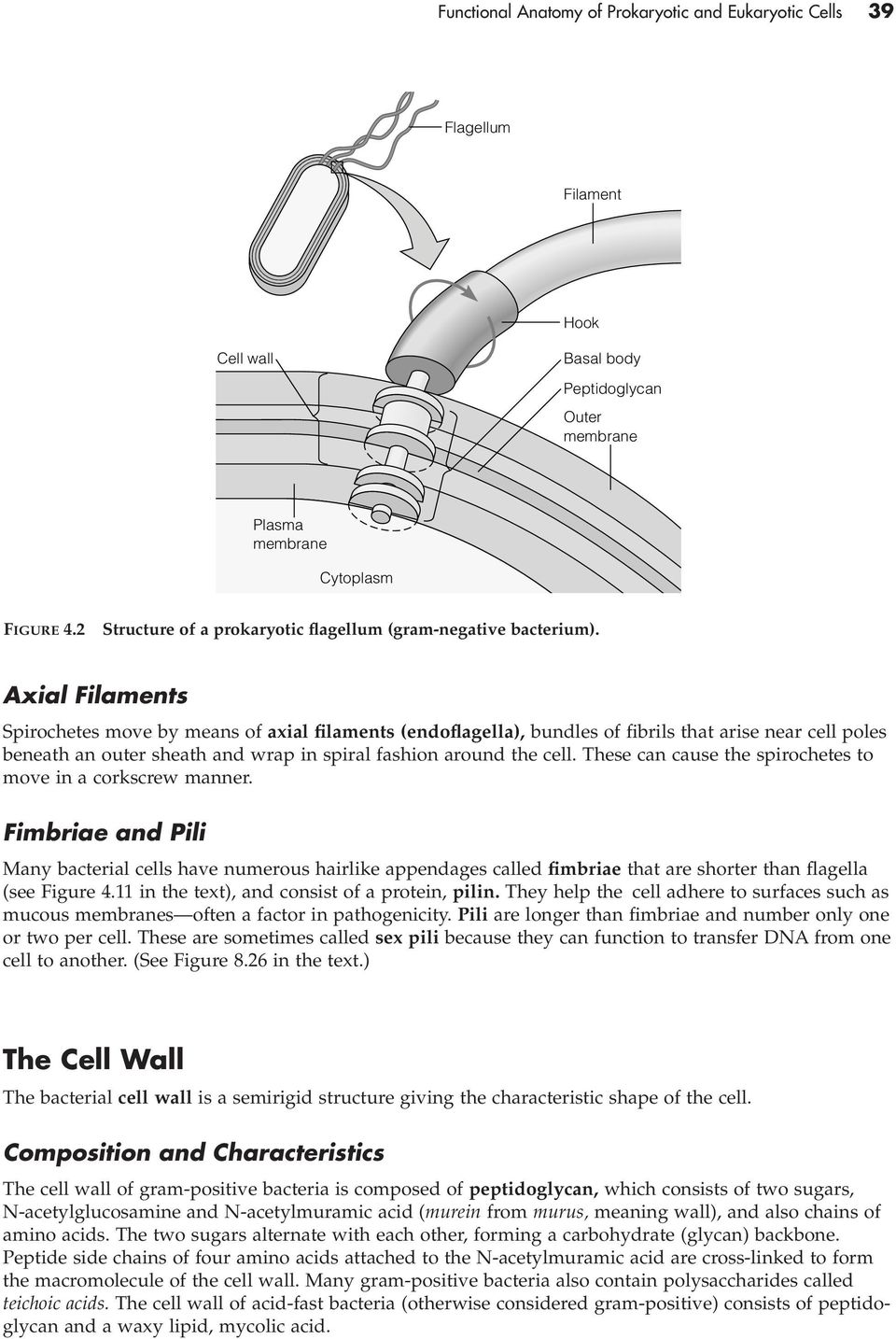
2 38 Chapter 4 Capsule Cytoplasm Ribosomes Inclusion Cell wall Plasma membrane Nuclear area (nucleoid) containing DNA Plasmid Capsule Cell wall Plasma membrane Fimbriae Flagella FIGURE 4.1 Structure of a typical prokaryotic (bacterial) cell. In this diagram, the cell has been sectioned lengthwise to reveal the internal structures. Structures External to the Cell Wall Glycocalyx The general term for substances surrounding bacterial cells is glycocalyx, which is usually a polysaccharide, polypeptide, or both. If organized and tightly attached, it is called a capsule (Figure 4.1). If unorganized and loosely attached, the glycocalyx is called a slime layer. If made of sugars, it is called an extracellular polysaccharide. The glycocalyx aids in attachment to surfaces; capsules contribute to pathogenicity by protecting from phagocytosis, an important part of the body s defenses. Flagella Flagellar filaments are composed of a protein, flagellin. The base of the flagellar filament widens to a hook. Attached to the hook is a basal body (a rod with rings), which anchors the flagellum to the cell wall and plasma membrane (Figure 4.2). The basal body of gram-negative bacteria is anchored to the cell wall and plasma membrane; in gram-positive bacteria, it is anchored only at the plasma membrane. Flagella, when present, are arranged in one of four basic ways: monotrichous (single polar flagellum); lophotrichous (two or more polar flagella at one end of the cell); amphitrichous (a single flagellum at each end of the cell); and peritrichous (flagella distributed over the cell). Flagella may spin clockwise or counterclockwise, producing directional movement (a run or swim ) or random changes in direction ( tumbles ). Movement to or from a stimulus is called taxis; the stimulus may be chemicals (chemotaxis) or light (phototaxis). A flagellar protein, H antigen, is useful for helping distinguish between serovars, or variation within a species.

3 Functional Anatomy of Prokaryotic and Eukaryotic Cells 39 Flagellum Filament Hook Cell wall Basal body Peptidoglycan Outer membrane Plasma membrane Cytoplasm FIGURE 4.2 Structure of a prokaryotic flagellum (gram-negative bacterium). Axial Filaments Spirochetes move by means of axial filaments (endoflagella), bundles of fibrils that arise near cell poles beneath an outer sheath and wrap in spiral fashion around the cell. These can cause the spirochetes to move in a corkscrew manner. Fimbriae and Pili Many bacterial cells have numerous hairlike appendages called fimbriae that are shorter than flagella (see Figure 4.11 in the text), and consist of a protein, pilin. They help the cell adhere to surfaces such as mucous membranes often a factor in pathogenicity. Pili are longer than fimbriae and number only one or two per cell. These are sometimes called sex pili because they can function to transfer DNA from one cell to another. (See Figure 8.26 in the text.) The Cell Wall The bacterial cell wall is a semirigid structure giving the characteristic shape of the cell. Composition and Characteristics The cell wall of gram-positive bacteria is composed of peptidoglycan, which consists of two sugars, N-acetylglucosamine and N-acetylmuramic acid (murein from murus, meaning wall), and also chains of amino acids. The two sugars alternate with each other, forming a carbohydrate (glycan) backbone. Peptide side chains of four amino acids attached to the N-acetylmuramic acid are cross-linked to form the macromolecule of the cell wall. Many gram-positive bacteria also contain polysaccharides called teichoic acids. The cell wall of acid-fast bacteria (otherwise considered gram-positive) consists of peptidoglycan and a waxy lipid, mycolic acid.
4 40 Chapter 4 The cell wall of gram-negative bacteria also contains peptidoglycans, but only thin layers. These cells have a lipoprotein, lipopolysaccharide (LPS), and a phospholipid outer membrane surrounding their peptidoglycan layers. A periplasm (a fluid-filled space) is found between the outer membrane and the plasma membrane. The outer membrane also provides resistance to phagocytosis and the action or complement (also part of host defenses). When the cell disintegrates in the host s bloodstream, the lipid portion of the LPS (Lipid A) is released as an endotoxin that can cause illness. Materials may penetrate the outer membrane through channels called porins. Mycoplasma bacteria do not have cell walls. They are unique also in having sterols in their plasma membranes. Archaea do not have peptidoglycan in their walls, but have a similar substance, pseudomurein. Some bacteria of the genus Proteus may spontaneously, or in response to penicillin, lose their cell walls and become L-forms. Later, they may spontaneously revert to walled bacteria. Damage to the Cell Wall Lysozyme an enzyme occurring in tears, mucus, and saliva damages the cell walls of many grampositive bacteria. A bacterium that has lost its cell wall and is surrounded only by the plasma membrane is a protoplast. Gram-negative cells treated with lysozyme retain much of the outer membrane layer and are called spheroplasts. Both are sensitive to rupture by osmotic lysis. Structures Internal to the Cell Wall Plasma (Cytoplasmic) Membrane The plasma (cytoplasmic) membrane is just internal to the cell wall and encloses the cytoplasm. In prokaryotes it consists primarily of phospholipids and proteins. Eukaryotic plasma membranes also contain sterols, making them more rigid. Both prokaryotic and eukaryotic membranes have a twolayered structure, molecules in parallel rows, called a phospholipid bilayer. One end (phosphate) is water soluble and the other (hydrocarbon) is insoluble. The water-soluble ends are on the outside of the bilayer. Protein molecules are embedded in the membrane; along with phospholipids, they may move freely within the membrane. This arrangement is called the fluid mosaic model. The most important function of the plasma membrane is as a selective barrier. It is selectively permeable (semipermeable), and certain molecules and ions pass through, whereas others do not. Several factors affect permeability. Large molecules such as proteins cannot pass; smaller molecules such as amino acids and simple sugars can pass if uncharged. (The phosphate end of the bilayer is charged.) Lipidsoluble substances, because of the phospholipid content, pass more easily. Plasma membranes contain enzymes that help break down nutrients and produce more energy. The chromatophores or thylakoids, which contain pigments and enzymes for bacterial photosynthesis, are found in the plasma membranes. Mesosomes are folds in the plasma membrane that may be only an artifact of preparation for electron microscopy. Movement of Materials Across Membranes Material crosses plasma membranes by passive processes such as simple diffusion (movement of molecules or ions from an area of higher concentration to an area of lower concentration). At equilibrium, the concentration gradient has been eliminated. Osmosis is the movement of solvent molecules across a selectively permeable membrane. Osmotic pressure is the force with which a solvent (such as water) moves from a solution of lower solute concentration (such as dissolved sugar) to a solution of higher solute concentration. Isotonic (isoosmotic) solutions have equal solute concentrations on both sides of the membrane. Hypotonic (hypoosmotic) solutions have a lower concentration of solutes outside the cell than inside; this is the case with most bacteria. Hypertonic (hyperosmotic) solutions have a higher concentration of solutes outside the cell, and bacterial cells placed in such solutions lose water by osmosis and shrink, and the cytoplasm collapses within the cell wall. Facilitated diffusion, an active process, occurs when a carrier protein (permease) combines with and transports a substance across the mem-

5 Functional Anatomy of Prokaryotic and Eukaryotic Cells 41 brane, but only where a concentration gradient is present. Active transport requires cell energy (ATP) and also involves carrier proteins moving substances across the plasma membrane. In group translocation, the substance is chemically altered during transport. Once inside, the plasma membrane is impermeable. This is important for low-concentration substances. Cytoplasm, Nuclear Area, Inclusions, and Ribosomes The term cytoplasm refers to everything inside the plasma membrane. It has many inclusions, such as metachromatic granules of stored phosphate (volutin), polysaccharide granules of glycogen and starch, lipid inclusions such as poly- -hydroxybutyric acid, and sulfur granules. The cytoplasm also contains many ribosomes, the sites of protein synthesis. Carboxysomes are inclusions found in bacteria that use carbon dioxide as their sole source of carbon. Gas vacuoles or gas vesicles help some bacteria maintain buoyancy. The bacterial chromosome, which contains the genetic information, is a single, long, circular molecule of DNA found in the nuclear area, or nucleoid. Small circular DNA molecules, plasmids, are not connected to the chromosome and replicate independently. Plasmids do not contain normally essential genes but may provide a selective advantage under abnormal conditions antibiotic resistance, for example. Magnetosomes are inclusions of iron oxide formed by a few gram-negative bacteria that aid the microbe in orienting itself environmentally. Endospores Endospores are highly resistant bodies formed by a few bacterial species, such as Bacillus and Clostridium. Sporulation or sporogenesis is the process of their formation. First, there is an ingrowth of the plasma membrane (spore septum), A small portion of the cytoplasm and newly replicated bacterial chromosome is then surrounded by a membrane, the forespore. A thick spore coat of protein forms around this membrane. The endospore core is dehydrated and contains considerable dipicolinic acid, as well as a few essential materials necessary to return it to its vegetative state, which is accomplished through the process of germination. THE EUKARYOTIC CELL Flagella and Cilia Eukaryotic flagella are relatively long; cilia are more numerous and are shorter. Both are involved in locomotion, and both contain small tubules of protein called microtubules. The Cell Wall and Glycocalyx Most algae and some fungi have cell walls containing cellulose, and often fungi have chitin as well. Yeast cell walls contain the polysaccharides glucan and mannan. No eukaryotic cell wall contains peptidoglycans. Protozoa have a flexible outer covering called a pellicle. In animal cells the plasma membrane is covered by sticky carbohydrates called the glycocalyx. Plasma (Cytoplasmic) Membrane In eukaryotic cells, the plasma membrane, which contains sterols, may be the external cell covering. Substances cross the membrane by mechanisms similar to those in prokaryotes. In addition, a process of engulfment, endocytosis, brings particles, even some viruses, into the cell. Examples are phagocytosis,
6 42 Chapter 4 used by white blood cells to engulf and destroy bacteria (Chapter 16), and pinocytosis, by which liquids and dissolved substances enter cells. Cytoplasm Cytoplasm is the matrix in which various cellular components are found. The complex internal structure of microfilaments, intermediate filaments, and microtubules is called the cytoskeleton. Movement of cytoplasm from one part of a cell to another, cytoplasmic streaming, can move a cell over a surface. Organelles In eukaryotes, unlike prokaryotes, many important enzymes are found in, and functions carried out by, organelles. Nucleus. The nucleus is an oval organelle containing the DNA. It is surrounded by a nuclear envelope. Nuclear pores in the nuclear membrane allow the nucleus to communicate with the endoplasmic reticulum of the cytoplasm. The nucleoplasm is a gel-like fluid in the nucleus. Nucleoli, which may be the center for the synthesis of ribosomal RNA, are present. DNA is combined with protein histones and nonhistones. The combination is called a nucleosome. When the cell is not reproducing, DNA and associated proteins are visible as a mass called chromatin. When reproducing, chromatin becomes visible as rodlike bodies called chromosomes. Endoplasmic Reticulum and Ribosomes. Within the cytoplasm there is a network of flattened sacs, or cisterns, called the endoplasmic reticulum (ER). Its function is to synthesize and store lipids and proteins, and to transport them. The ends of the cisterns pinch off into secretory vesicles, which transport substances within the cell. Rough ER has ribosomes bound to it and smooth ER does not. Ribosomes are the sites of protein synthesis in the cell. Golgi Complex. The Golgi complex consists of a network of flattened sacs, called cisterns (see previous paragraph), stacked like dishes. Like ER, these function to export substances from the cell and transport substances within it. The Golgi complex receives proteins and lipids from the ER and delivers them to secretory vesicles. Mitochondria. Mitochondria are organelles with a smooth outer membrane and an inner membrane arranged in a series of folds called cristae. The semifluid center of the mitochondrion is called the matrix. Enzymes forming ATP are located on the cristae which is one reason why mitochondria are called powerhouses of the cell. Chloroplasts. Photosynthesizing cells contain membrane-bounded structures called chloroplasts, which contain chlorophyll and enzymes involved in photosynthesis. The chlorophyll is found in membranes called thylakoids. Stacks of thylakoids are called grana. Lysosomes. White blood cells, which destroy bacteria by phagocytosis, contain many lysosomes. These are membrane-enclosed spheres containing powerful digestive enzymes. Vacuoles. A vacuole is a space (cavity) in cytoplasm that serves for storage and other functions. Peroxisomes. Peroxisomes are organelles similar in structure to lysosomes, but smaller. They contain enzymes that oxidize various organic substances. The enzyme catalase that decomposes toxic H 2 O 2 (hydrogen peroxide) is also present.

7 Functional Anatomy of Prokaryotic and Eukaryotic Cells 43 TABLE 4.1 Principal Differences Between Prokaryotic and Eukaryotic Cells Characteristic Prokaryotic Eukaryotic Size of cell Typically m in diameter Typically m in diameter Nucleus No nuclear membrane or nucleoli True nucleus, consisting of nuclear membrane and nucleoli Membrane-enclosed Absent Present; examples include lysosomes, Golgi organelles complex, endoplasmic reticulum, mitochondria, and chloroplasts Flagella Consist of two protein building blocks Complex; consist of multiple microtubules Glycocalyx Present as a capsule or slime layer Present in some cells that lack a cell wall Cell wall Usually present; chemically complex When present, chemically simple (typical bacterial cell wall includes peptidoglycan) Plasma membrane No carbohydrates and generally Sterols and carbohydrates that serve as lacks sterols receptors present Cytoplasm No cytoskeleton or cytoplasmic Cytoskeleton; cytoplasmic streaming streaming Ribosomes Smaller size (70S) Larger size (80S); smaller size (70S) in organelles Chromosome (DNA) Single circular chromosome; Multiple linear chromosomes with histones lacks histones arrangement Cell division Binary fission Mitosis Sexual reproduction No meiosis; transfer of DNA Involves meiosis fragments only Centrosomes. The centrosome consists of a pericentriolar area, which is the organizing center for the mitotic spindle that plays a critical role in cell division. Within this area are located centrioles, arrays of microtubules that play a role in the formation or regeneration of cilia and flagella. Centrioles. Centrioles are bundles of microtubules that probably play a role in cell division. Table 4.1 outlines the principal differences between prokaryotic and eukaryotic cells. The Evolution of Eukaryotes The theory explaining the origin of eukaryotes from prokaryotes, pioneered by Lynn Margulis, is the endosymbiotic theory. Larger bacterial (prokaryotic) cells are presumed to have engulfed smaller bacterial cells (one organism living within another is called endosymbiosis) and eventually evolve into eukaryotic cells. Mitochondria and chloroplasts in eukaryotic cells are considered evidence for the theory. They resemble prokaryotic cells and can reproduce independently of their eukaryotic host cell.
8 44 Chapter 4 Self-Tests In the matching section, there is only one answer to each question; however, the lettered options (a, b, c, etc.) may be used more than once or not at all. I. Matching 1. Helical; move by flagella, if present. 2. Spherical; in chains. 3. Divide in three regular planes; spheres form cubelike packets. 4. Helical; axial filaments for motility. 5. A simple, commalike curve. 6. Name means little staff. 7. Ovals. a. Sarcinae b. Tetrads c. Streptococci d. Spirochetes e. Vibrios f. Bacilli g. Cocci h. Spirilla i. Diplococci j. Coccobacilli II. Matching 1. Golgi complex. 2. Meiosis occurs in reproduction. a. Eukaryotic cell b. Prokaryotic cell 3. Single circular chromosome without histones. 4. Sterols generally present in cell membrane. 5. Cell wall almost always contains peptidoglycans. 6. Nucleus bounded by a membrane.

9 Functional Anatomy of Prokaryotic and Eukaryotic Cells 45 III. Matching 1. Contain pigments for photosynthesis by bacteria; found in the plasma membrane. 2. Gram-negative bacterial cells after their treatment with lysozyme. 3. Specialized external structures that assist in the transfer of genetic material between cells. 4. Numerous short, hairlike appendages that help in attachment to mucous membranes. 5. General term for substances surrounding bacterial cells. 6. Polysaccharides found in the cell wall of many grampositive bacteria. 7. Inclusions of iron oxide. a. Glycocalyx b. Flagellin c. Fimbriae d. Sex pili e. Capsules f. Teichoic acids g. Spheroplasts h. Protoplasts i. Chromatophores j. Chloroplasts k. Magnetosomes IV. Matching 1. Metachromatic granules of stored phosphate in prokaryotes. 2. Entrance of fluids and dissolved substances into eukaryotic cells. 3. Membrane-enclosed spheres in phagocytic cells that contain powerful digestive enzymes. 4. The powerhouses of the cell. 5. A gel-like fluid found in the eukaryotic nucleus. 6. A folded inner membrane found in mitochondria. 7. Sometimes contributes to movement of a cell. a. Volutin b. Plasmids c. Cristae d. Zymogens e. Ribosomes f. Nucleoplasm g. Lysosomes h. Mitochondria i. Phagocytosis j. Pinocytosis k. Cytoplasmic streaming

10 46 Chapter 4 V. Matching 1. Arrangement of flagella distributed over the entire cell. 2. A single flagellum at each end of the cell. 3. A widening at the base of the flagellar filament. 4. An enzyme affecting gram-positive cell walls; found in tears. 5. A compound found in bacterial endospores. 6. A compound frequently found in the cell walls of yeasts. a. Exocytosis b. Dipicolinic acid c. Chitin d. Lysozyme e. Hook f. Peritrichous g. Amphitrichous h. Lophotrichous i. Monotrichous j. Flagellin VI. Matching 1. Closely involved in protein synthesis. 2. Structure(s) characteristic of both eukaryotic and prokaryotic plasma membranes. 3. Found in the flagella and cilia of eukaryotic cells. a. Phospholipid bilayer b. Transverse septum c. Microtubules d. Ribosomes VII. Matching 1. Highly resistant bodies formed by a few bacterial species. 2. Small circular DNA molecules that are not connected with the main chromosome. 3. The semifluid center portion of the mitochondrion. 4. A substance similar to peptidoglycan that is found in the cell wall of archaea. a. Plasmids b. Endospores c. Pseudomurein d. Matrix e. Pleomorphic 5. Bacteria with irregular morphology.

11 Functional Anatomy of Prokaryotic and Eukaryotic Cells 47 VIII. Matching 1. Extracellular polymeric substances on some bacterial cells; may help cells adhere to surfaces. 2. Bacterial cell with thin peptidoglycan layer, outer membrane of lipopolysaccharide. 3. Protein that forms fimbriae. 4. Bundles of microtubules that probably play a role in cell division of eukaryotic cells. a. Glycocalyx b. Pilin c. Gram-positive d. Gram-negative e. Centrioles f. L-forms 5. Bacteria that have lost their cell walls and may later spontaneously regain them. IX. Matching 1. ER associated with ribosomes. 2. Ingrowth of plasma membrane before endospore formation. 3. Anchors the flagella of bacteria to the cell wall and plasma membrane. a. Septum b. Forespore c. Rough ER d. Smooth ER e. Basal body Fill in the Blanks 1. Chemically, the capsule is a, a polypeptide, or both. 2. Capsules protect pathogenic bacteria from, a process by which protective host cells engulf and destroy microorganisms. 3. The Golgi complex consists of flattened sacs called that are connected to the endoplasmic reticulum. 4. The complex consists of four to eight flattened sacs connected to the endoplasmic reticulum. The function is largely secretion of proteins, lipids, and carbohydrates. 5. The term means a lower concentration of solutes outside the cell than inside.

12 48 Chapter 4 6. Three examples of passive diffusion across membranes are,, and. 7. The protein in the flagellar filaments of bacteria is called. 8. DNA in eukaryotic cells is combined with protein and nonhistones. Critical Thinking 1. What is a glycocalyx? How is the presence of a glycocalyx related to bacterial virulence? 2. What substances are able to cross the plasma membrane most easily? 3. Describe how a bacterial cell will respond to the following osmotic pressures: isotonic, hypotonic, hypertonic. 4. How is the presence of peptidoglycan in bacterial cells clinically significant? 5. Discuss the endosymbiont hypothesis. Is there any evidence to support the endosymbiont hypothesis?

13 Functional Anatomy of Prokaryotic and Eukaryotic Cells 49 Answers Matching I. 1. h 2. c 3. a 4. d 5. e 6.f 7. j II. 1. a 2. a 3. b 4. a 5. b 6. a III. 1. i 2. g 3. d 4. c 5. a 6. f 7. k IV. 1. a 2. j 3. g 4. h 5. f 6. c 7. k V. 1. f 2. g 3. e 4. d 5. b 6. c VI. 1. d 2. a 3. c VII. 1. b 2. a 3. d 4. c 5. e VIII. 1. a 2. d 3. b 4. e 5. f IX. 1. c 2. a 3. e Fill in the Blanks 1. polysaccharide 2. phagocytosis 3. cisterns 4. Golgi 5. hypotonic 6. simple diffusion; osmosis; facilitated diffusion 7. flagellin 8. histones Critical Thinking 1. The glycocalyx is a sticky, viscous, gelatinous polymer that surrounds some bacterial cells. It may be composed of polysaccharide, polypeptide, or a combination of these two substances. Depending on how the material is arranged and attached to the cell, it may be referred to as a slime layer or a capsule. The glycocalyx is associated with bacterial virulence because it helps protect the bacterium from phagocytosis by white blood cells and helps the bacterium to adhere to and colonize a host. 2. Substances that dissolve easily in lipids can most easily cross the plasma membrane. These include oxygen, carbon dioxide, and nonpolar organic molecules. Also, small molecules such as water are able to cross the plasma membrane easily. 3. There will be no change in a bacterial cell in an isotonic solution; water leaves and enters the cell at the same rate. A bacterial cell placed in a hypotonic solution will undergo osmotic lysis because more water will enter the cell than the cell wall can contain. A hypertonic solution will cause a bacterial cell to undergo plasmolysis, the osmotic loss of water due to increased solutes outside of the cell. 4. Peptidoglycan is a substance that is found in varying quantities in most prokaryotic cells. Peptidoglycan is unique to prokaryotic cells and is never found in eukaryotic cells. Antibiotics such as the penicillins and the cephalosporins act specifically against peptidoglycan and therefore have low toxicity in humans. These drugs prevent the formation of the peptide cross-bridges of peptidoglycan, preventing synthesis of a functional cell wall. 5. The endosymbiont hypothesis addresses the evolution of eukaryotic cells, specifically the origin of their mitochondria and chloroplasts. This hypothesis proposes that eukaryotic cells evolved from symbiotic relationships between prokaryotic cells having different metabolic abilities. Evidence supporting the endosymbiont theory is seen in mitochondria and chloroplasts. Both organelles have 70S ribosomes, the type seen in prokaryotic cells, rather than the typical 80S eukaryotic ribosomes. Also, mitochondria and chloroplasts multiply and grow within eukaryotic cells.

14

Chapter 2: Cell Structure and Function pg. 70-107
 UNIT 1: Biochemistry Chapter 2: Cell Structure and Function pg. 70-107 Organelles are internal structures that carry out specialized functions, interacting and complementing each other. Animal and plant
Chapter 4: A Tour of the Cell. 1. Cell Basics. Limits to Cell Size. 1. Cell Basics. 2. Prokaryotic Cells. 3. Eukaryotic Cells
 Chapter 4: A Tour of the Cell 1. Cell Basics 2. Prokaryotic Cells 3. Eukaryotic Cells 1. Cell Basics Limits to Cell Size There are 2 main reasons why cells are so small: If cells get too large: 1) there
Lecture 4 Cell Membranes & Organelles
 Lecture 4 Cell Membranes & Organelles Structure of Animal Cells The Phospholipid Structure Phospholipid structure Encases all living cells Its basic structure is represented by the fluidmosaic model Phospholipid
Biology 101 Chapter 4 Cells as the Basic Unit of Life. The Cell Theory Major Contributors: Galileo = first observations made with a microscope
 Biology 101 Chapter 4 Cells as the Basic Unit of Life The Cell Theory Major Contributors: Galileo = first observations made with a microscope Robert Hooke = first to observe small compartments in dead
Cytology. Living organisms are made up of cells. Either PROKARYOTIC or EUKARYOTIC cells.
 CYTOLOGY Cytology Living organisms are made up of cells. Either PROKARYOTIC or EUKARYOTIC cells. A. two major cell types B. distinguished by structural organization See table on handout for differences.
Cell Structure & Function!
 Cell Structure & Function! Chapter 3! The most exciting phrase to hear in science, the one that heralds new discoveries, is not 'Eureka!' but 'That's funny.! -- Isaac Asimov Animal Cell Plant Cell Cell
cells - relatively simple cells - lack nuclear membrane and many organelles - bacteria and their relatives are all prokaryotic
 Cell Biology A cell is chemical system that is able to maintain its structure and reproduce. Cells are the fundamental unit of life. All living things are cells or composed of cells. 1 The interior contents
Microscopes. Eukaryotes Eukaryotic cells are characterized by having: DNA in a nucleus that is bounded by a membranous nuclear envelope
 CH 6 The Cell Microscopy Scientists use microscopes to visualize cells too small to see with the naked eye. In a light microscope (LM), visible light is passed through a specimen and then through glass
Organelles and Their Functions
 Organelles and Their Functions The study of cell organelles and their functions is a fascinating part of biology. The current article provides a brief description of the structure of organelles and their
AP BIOLOGY 2006 SCORING GUIDELINES. Question 1
 AP BIOLOGY 2006 SCORING GUIDELINES Question 1 A major distinction between prokaryotes and eukaryotes is the presence of membrane-bound organelles in eukaryotes. (a) Describe the structure and function
Review of the Cell and Its Organelles
 Biology Learning Centre Review of the Cell and Its Organelles Tips for most effective learning of this material: Memorize the names and structures over several days. This will help you retain what you
The Cell: Organelle Diagrams
 The Cell: Organelle Diagrams Fig 7-4. A prokaryotic cell. Lacking a true nucleus and the other membrane-enclosed organelles of the eukaryotic cell, the prokaryotic cell is much simpler in structure. Only
Plasma Membrane hydrophilic polar heads
 The Parts of the Cell 3 main parts in ALL cells: plasma membrane, cytoplasm, genetic material this is about the parts of a generic eukaryotic cell Plasma Membrane -is a fluid mosaic model membrane is fluid
Cell Structure and Function
 Bio 100 - Cells 1 Cell Structure and Function Tenets of Cell Theory 1. All living things are made up of one or more cells 2. Cells are the basic living units within organisms, and the chemical reactions
CELLS: PLANT CELLS 20 FEBRUARY 2013
 CELLS: PLANT CELLS 20 FEBRUARY 2013 Lesson Description In this lesson we will discuss the following: The Cell Theory Terminology Parts of Plant Cells: Organelles Difference between plant and animal cells
Compartmentalization of the Cell. Objectives. Recommended Reading. Professor Alfred Cuschieri. Department of Anatomy University of Malta
 Compartmentalization of the Cell Professor Alfred Cuschieri Department of Anatomy University of Malta Objectives By the end of this session the student should be able to: 1. Identify the different organelles
Comparing Plant And Animal Cells
 Comparing Plant And Animal Cells http://khanacademy.org/video?v=hmwvj9x4gny Plant Cells shape - most plant cells are squarish or rectangular in shape. amyloplast (starch storage organelle)- an organelle
Membrane Structure and Function
 Membrane Structure and Function Part A Multiple Choice 1. The fluid mosaic model describes membranes as having A. a set of protein channels separated by phospholipids. B. a bilayer of phospholipids in
THE HISTORY OF CELL BIOLOGY
 SECTION 4-1 REVIEW THE HISTORY OF CELL BIOLOGY Define the following terms. 1. cell 2. cell theory Write the correct letter in the blank. 1. One early piece of evidence supporting the cell theory was the
Anatomy and Physiology Placement Exam 2 Practice with Answers at End!
 Anatomy and Physiology Placement Exam 2 Practice with Answers at End! General Chemical Principles 1. bonds are characterized by the sharing of electrons between the participating atoms. a. hydrogen b.
7.2 Cell Structure. Lesson Objectives. Lesson Summary. Cell Organization Eukaryotic cells contain a nucleus and many specialized structures.
 7.2 Cell Structure Lesson Objectives Describe the structure and function of the cell nucleus. Describe the role of vacuoles, lysosomes, and the cytoskeleton. Identify the role of ribosomes, endoplasmic
The Cell Interior and Function
 The Cell Interior and Function 5 5.0 CHAPTER PREVIEW Investigate and understand the organization and function of the cell interior. Define the differences between eukaryotic and prokaryotic cell structure.
3.1 AS Unit: Cells, Exchange and Transport
 3.1 AS Unit: Cells, Exchange and Transport Module 1: Cells 1.1.1 Cell Structure Candidates should be able to: (a) state the resolution and magnification that can be achieved by a light microscope, a transmission
Chapter 3. Cellular Structure and Function Worksheets. 39 www.ck12.org
 Chapter 3 Cellular Structure and Function Worksheets (Opening image copyright by Sebastian Kaulitzki, 2010. Used under license from Shutterstock.com.) Lesson 3.1: Introduction to Cells Lesson 3.2: Cell
Multiple Choice Questions
 Chapter 5 THE FUNDAMENTAL UNIT OF LIFE Multiple Choice Questions 1. Which of the following can be made into crystal? (a) A Bacterium (b) An Amoeba (c) A Virus (d) A Sperm 2. A cell will swell up if (a)
Date: Student Name: Teacher Name: Jared George. Score: 1) A cell with 1% solute concentration is placed in a beaker with a 5% solute concentration.
 Biology Keystone (PA Core) Quiz Homeostasis and Transport - (BIO.A.4.1.1 ) Plasma Membrane, (BIO.A.4.1.2 ) Transport Mechanisms, (BIO.A.4.1.3 ) Transport Facilitation Student Name: Teacher Name: Jared
Bacterial (Prokaryotic) Cell. Common features of all cells. Tour of the Cell. Eukaryotic Cell. Plasma Membrane defines inside from outside
 www.denniskunkel.com Tour of the Cell www.denniskunkel.com Today s Topics Properties of all cells Prokaryotes and Eukaryotes Functions of Major Cellular Organelles Information, Synthesis&Transport,, Vesicles
Bacterial Cell Structure
 3 Bacterial Cell Structure 1 3.1 The Prokaryote Controversy 1. List the characteristics originally used to describe prokaryotic cells 2. Form an opinion on the prokaryote controversy using current evidence
Biological cell membranes
 Unit 14: Cell biology. 14 2 Biological cell membranes The cell surface membrane surrounds the cell and acts as a barrier between the cell s contents and the environment. The cell membrane has multiple
Cells. Structure, Function and Homeostasis
 Cells Structure, Function and Homeostasis Characteristics of Cells Basic unit of life anything alive is made of cells Plasma membrane (skin) that separates them from the environment. Skeletonsfor protection
Six major functions of membrane proteins: Transport Enzymatic activity
 CH 7 Membranes Cellular Membranes Phospholipids are the most abundant lipid in the plasma membrane. Phospholipids are amphipathic molecules, containing hydrophobic and hydrophilic regions. The fluid mosaic
Plant and Animal Cells
 Plant and Animal Cells a. Explain that cells take in nutrients in order to grow, divide and to make needed materials. S7L2a b. Relate cell structures (cell membrane, nucleus, cytoplasm, chloroplasts, and
4. Biology of the Cell
 4. Biology of the Cell Our primary focus in this chapter will be the plasma membrane and movement of materials across the plasma membrane. You should already be familiar with the basic structures and roles
Eukaryotes. www.njctl.org PSI Biology Eukaryotes & Gene Expression
 Eukaryotes The Eukaryotic Cell Classwork 1. Identify two characteristics that are shared by all cells. 2. Suppose you are investigating a cell that contains a nucleus. Would you categorize this cell as
1.1.2. thebiotutor. AS Biology OCR. Unit F211: Cells, Exchange & Transport. Module 1.2 Cell Membranes. Notes & Questions.
 thebiotutor AS Biology OCR Unit F211: Cells, Exchange & Transport Module 1.2 Cell Membranes Notes & Questions Andy Todd 1 Outline the roles of membranes within cells and at the surface of cells. The main
Cells & Cell Organelles
 Cells & Cell Organelles The Building Blocks of Life H Biology Types of cells bacteria cells Prokaryote - no organelles Eukaryotes - organelles animal cells plant cells Cell size comparison Animal cell
Cell and Membrane Practice. A. chromosome B. gene C. mitochondrion D. vacuole
 Name: ate: 1. Which structure is outside the nucleus of a cell and contains N?. chromosome. gene. mitochondrion. vacuole 2. potato core was placed in a beaker of water as shown in the figure below. Which
Biology I. Chapter 7
 Biology I Chapter 7 Interest Grabber NOTEBOOK #1 Are All Cells Alike? All living things are made up of cells. Some organisms are composed of only one cell. Other organisms are made up of many cells. 1.
Introduction to the Cell: Plant and Animal Cells
 Introduction to the Cell: Plant and Animal Cells Tissues, Organs, and Systems of Living Things Cells, Cell Division, and Animal Systems and Plant Systems Cell Specialization Human Systems All organisms
Lesson Aim To explain the human body at a microscopic level, including the structure and function of cells, tissues and membranes.
 LESSON 1. CELLS & TISSUES Lesson Aim To explain the human body at a microscopic level, including the structure and function of cells, tissues and membranes. THE CELL All living matter is composed of functional
INTRODUCTION TO THE CELL
 CHAPTER 1: STRUCTURE AND FUNCTION OF THE CELL INTRODUCTION TO THE CELL Both living and non-living things are composed of molecules made from chemical elements such as Carbon, Hydrogen, Oxygen, and Nitrogen.
Keystone Review Practice Test Module A Cells and Cell Processes. 1. Which characteristic is shared by all prokaryotes and eukaryotes?
 Keystone Review Practice Test Module A Cells and Cell Processes 1. Which characteristic is shared by all prokaryotes and eukaryotes? a. Ability to store hereditary information b. Use of organelles to control
Cell Structure and Function. Eukaryotic Cell: Neuron
 Cell Structure and Function Eukaryotic Cell: Neuron Cell Structure and Function Eukaryotic Cells: Blood Cells Cell Structure and Function Prokaryotic Cells: Bacteria Cell Structure and Function All living
* The cell is the basic structural and functional unit of life. * Organismal activity depends on individual and collective activity of cells.
 Define Cell * The cell is the basic structural and functional unit of life. * Organismal activity depends on individual and collective activity of cells. * Biochemical activities of cells are dictated
RAD 223. Radiography physiology. Lecture Notes. First lecture: Cell and Tissue
 RAD 223 Radiography physiology Lecture Notes First lecture: Cell and Tissue Physiology: the word physiology derived from a Greek word for study of nature. It is the study of how the body and its part work
Quick Hit Activity Using UIL Science Contests For Formative and Summative Assessments of Pre-AP and AP Biology Students
 Quick Hit Activity Using UIL Science Contests For Formative and Summative Assessments of Pre-AP and AP Biology Students Activity Title: Quick Hit Goal of Activity: To perform formative and summative assessments
Cellular Structure and Function
 Chapter Test A CHAPTER 7 Cellular Structure and Function Part A: Multiple Choice In the space at the left, write the letter of the term or phrase that best answers each question. 1. Which defines a cell?
Ch. 8 - The Cell Membrane
 Ch. 8 - The Cell Membrane 2007-2008 Phospholipids Phosphate head hydrophilic Fatty acid tails hydrophobic Arranged as a bilayer Phosphate attracted to water Fatty acid repelled by water Aaaah, one of those
Homeostasis and Transport Module A Anchor 4
 Homeostasis and Transport Module A Anchor 4 Key Concepts: - Buffers play an important role in maintaining homeostasis in organisms. - To maintain homeostasis, unicellular organisms grow, respond to the
Given these characteristics of life, which of the following objects is considered a living organism? W. X. Y. Z.
 Cell Structure and Organization 1. All living things must possess certain characteristics. They are all composed of one or more cells. They can grow, reproduce, and pass their genes on to their offspring.
Organization and Structure of Cells
 Organization and Structure of Cells All living things fall into one of the two categories: prokaryotes eukaryotes The distinction is based on whether or not a cell has a nucleus. Prokaryotic cells do not
7. A selectively permeable membrane only allows certain molecules to pass through.
 CHAPTER 2 GETTING IN & OUT OF CELLS PASSIVE TRANSPORT Cell membranes help organisms maintain homeostasis by controlling what substances may enter or leave cells. Some substances can cross the cell membrane
Biology Chapter 7 Practice Test
 Biology Chapter 7 Practice Test Multiple Choice Write the letter that best answers the question or completes the statement on the line provided. 1. The work of Schleiden and Schwann can be summarized by
Membrane Structure and Function
 Membrane Structure and Function -plasma membrane acts as a barrier between cells and the surrounding. -plasma membrane is selective permeable -consist of lipids, proteins and carbohydrates -major lipids
FIGURE 2.18. A. The phosphate end of the molecule is polar (charged) and hydrophilic (attracted to water).
 PLASMA MEMBRANE 1. The plasma membrane is the outermost part of a cell. 2. The main component of the plasma membrane is phospholipids. FIGURE 2.18 A. The phosphate end of the molecule is polar (charged)
Cell Unit Practice Test #1
 ell Unit Practice Test #1 Name: ate: 1. Which organelle is primarily concerned with the conversion of potential energy of organic compounds into suitable form for immediate use by the cell?. mitochondria.
The Living Cell from the Biology: The Science of Life Series. Pre-Test
 1 Pre-Test Directions: Answer each question TRUE OR FALSE. 1. The instructions for making proteins are stored in molecules of DNA. 2. Proteins are made in the nucleus. 3. All cells are surrounded by a
Osmosis, Diffusion and Cell Transport
 Osmosis, Diffusion and Cell Transport Types of Transport There are 3 types of transport in cells: 1. Passive Transport: does not use the cell s energy in bringing materials in & out of the cell 2. Active
AP Biology-Chapter #6 & 7 Review
 DO NOT WRITE ON THIS TEST- USE ANSWER DOCUMENT AP Biology-Chapter #6 & 7 Review Multiple Choice Identify the choice that best completes the statement or answers the question. 1. All of the following are
CELL MEMBRANES, TRANSPORT, and COMMUNICATION. Teacher Packet
 AP * BIOLOGY CELL MEMBRANES, TRANSPORT, and COMMUNICATION Teacher Packet AP* is a trademark of the College Entrance Examination Board. The College Entrance Examination Board was not involved in the production
The general structure of bacteria
 The general structure of bacteria The uni-cellular organisms Viruses Herpes virus, HIV, influenza virus The procaryotic organisms Escherichia, Salmonella, Pseudomonas Streptococcus, Staphylococcus, Neisseria
Chapter 5 Organelles. Lesson Objectives List the organelles of the cell and their functions. Distinguish between plant and animal cells.
 Chapter 5 Organelles Lesson Objectives List the organelles of the cell and their functions. Distinguish between plant and animal cells. Check Your Understanding What is a cell? How do we visualize cells?
PRESTWICK ACADEMY NATIONAL 5 BIOLOGY CELL BIOLOGY SUMMARY
 Name PRESTWICK ACADEMY NATIONAL 5 BIOLOGY CELL BIOLOGY SUMMARY Cell Structure Identify animal, plant, fungal and bacterial cell ultrastructure and know the structures functions. Plant cell Animal cell
Cell Biology - Part 2 Membranes
 Cell Biology - Part 2 Membranes The organization of cells is made possible by membranes. Membranes isolate, partition, and compartmentalize cells. 1 Membranes isolate the inside of the cell from the outside
The Cell Teaching Notes and Answer Keys
 The Cell Teaching Notes and Answer Keys Subject area: Science / Biology Topic focus: The Cell: components, types of cells, organelles, levels of organization Learning Aims: describe similarities and differences
CHAPTER 5.1 5.2: Plasma Membrane Structure
 CHAPTER 5.1 5.2: Plasma Membrane Structure 1. Describe the structure of a phospholipid molecule. Be sure to describe their behavior in relationship to water. 2. What happens when a collection of phospholipids
Section 7-3 Cell Boundaries
 Note: For the past several years, I ve been puzzling how to integrate new discoveries on the nature of water movement through cell membranes into Chapter 7. The Section below is a draft of my first efforts
Cell Structure and Function
 CHAPTER 3 CELL STRUCTURE AND FUNCTION Vocabulary Practice cell theory vacuole concentration gradient cytoplasm lysosome osmosis organelle centriole isotonic prokaryotic cell cell wall hypertonic eukaryotic
Cellular Energy. 1. Photosynthesis is carried out by which of the following?
 Cellular Energy 1. Photosynthesis is carried out by which of the following? A. plants, but not animals B. animals, but not plants C. bacteria, but neither animals nor plants D. all living organisms 2.
BME 42-620 Engineering Molecular Cell Biology. Lecture 02: Structural and Functional Organization of
 BME 42-620 Engineering Molecular Cell Biology Lecture 02: Structural and Functional Organization of Eukaryotic Cells BME42-620 Lecture 02, September 01, 2011 1 Outline A brief review of the previous lecture
MORPHOLOGY AND CLASSIFICATION OF BACTERIA
 1 MORPHOLOGY AND CLASSIFICATION OF BACTERIA 1.1 INTRODUCTION Microorganisms are a heterogeneous group of several distinct classes of living beings. Based on the difference in cellular organization and
Objective: On a team of no more than (2). Build to illustrate a 3D model of a PLANT or ANIMAL cell. 10 pts.
 THE CELL model: Activity 4.1 Science / Biology Objective: On a team of no more than (2). Build to illustrate a 3D model of a PLANT or ANIMAL cell. - Your models should clearly demonstrate the following
COMPARISON OF PLANT AND ANIMAL CELLS SIMILARITIES IN PLANT & ANIMAL CELLS
 COMPARISON OF PLANT AND ANIMAL CELLS Cells vary widely in structure and function, even within the same organism. The human body, for example, has more than 200 different types of cells, each with a specialized
2. Which type of macromolecule contains high-energy bonds and is used for long-term energy storage?
 Energy Transport Study Island 1. During the process of photosynthesis, plants use energy from the Sun to convert carbon dioxide and water into glucose and oxygen. These products are, in turn, used by the
called a cell wall. The cell wall protects against mechanical stress and keeps the cell from becoming over-filled with water.
 What are Cells? By: Byron Norelius About Cells A cell is the basic unit of life. All living organisms are composed of one (unicellular) or more (multicellular) cells. In unicellular organisms, like many
3120-1 - Page 1. Name:
 Name: 1) Which series is arranged in correct order according to decreasing size of structures? A) DNA, nucleus, chromosome, nucleotide, nitrogenous base B) chromosome, nucleus, nitrogenous base, nucleotide,
Buddhist Chi Hong Chi Lam Memorial College A.L. Bio. Notes (by Denise Wong) The Cell... Page 28
 The Cell... Page 28 Organelles of cells: Introduction : - The cell is the fundamental unit of life. - The modern Cell theory states : i) All living organisms are composed of cells. ii) All new cells are
7.2 Cells: A Look Inside
 CHAPTER 7 CELL STRUCTURE AND FUNCTION 7.2 Cells: A Look Inside Imagine a factory that makes thousands of cookies a day. Ingredients come into the factory, get mixed and baked, then the cookies are packaged.
The Lipid Bilayer Is a Two-Dimensional Fluid
 The Lipid Bilayer Is a Two-Dimensional Fluid The aqueous environment inside and outside a cell prevents membrane lipids from escaping from bilayer, but nothing stops these molecules from moving about and
MCAS Biology. Review Packet
 MCAS Biology Review Packet 1 Name Class Date 1. Define organic. THE CHEMISTRY OF LIFE 2. All living things are made up of 6 essential elements: SPONCH. Name the six elements of life. S N P C O H 3. Elements
chapter3 Cell Structure and Function
 chapter3 Cell Structure and Function Chapter Concepts 3.1 the cellular level of Organization What does the cell theory state? 46 What instruments would a scientist use to study and view small cells? 46
Week 1 EOC Review Cell Theory, Cell Structure, Cell Transport
 Week 1 EOC Review Cell Theory, Cell Structure, Cell Transport Benchmarks: SC.912.L.14.1 Describe the scientific theory of cells (cell theory) and relate the history of its discovery to the processes of
Use of the Microscope and Cytology
 Use of the Microscope and Cytology Introduction: A true study of anatomy not only considers the large, visible structures of an organism, but also the small structures that provide the organism its form
UNIT 1 - CHAPTER 3: CELLS. 2. Describe the general characteristics of a composite cell.
 LEARNING OUTCOMES: UNIT 1 - CHAPTER 3: CELLS 3.1 Introduction 1. Explain how cells differ from one another. 3.2 A Composite Cell 2. Describe the general characteristics of a composite cell. 3. Explain
Chapter 8. Movement across the Cell Membrane. AP Biology
 Chapter 8. Movement across the Cell Membrane More than just a barrier Expanding our view of cell membrane beyond just a phospholipid bilayer barrier phospholipids plus Fluid Mosaic Model In 1972, S.J.
Prokaryotic and Eukaryotic Cells
 Lab 2- Bio 201 Prokaryotic and Eukaryotic Cells Name: OBJECTIVES To explore cell structure and morphology in prokaryotes and eukaryotes. To gain more experience using the microscope, and in particular,
1. When applying the process of science, which of these is tested? a. an observation b. a result c. a hypothesis d. a question e.
 BCOR 11 Exam 1, 2004 MULTIPLE CHOICE. Choose the one alternative that best completes the statement or answers the question. 1. When applying the process of science, which of these is tested? a. an observation
BSC 2010 - Exam I Lectures and Text Pages. The Plasma Membrane Structure and Function. Phospholipids. I. Intro to Biology (2-29) II.
 BSC 2010 - Exam I Lectures and Text Pages I. Intro to Biology (2-29) II. Chemistry of Life Chemistry review (30-46) Water (47-57) Carbon (58-67) Macromolecules (68-91) III. Cells and Membranes Cell structure
Name Date Period. 2. When a molecule of double-stranded DNA undergoes replication, it results in
 DNA, RNA, Protein Synthesis Keystone 1. During the process shown above, the two strands of one DNA molecule are unwound. Then, DNA polymerases add complementary nucleotides to each strand which results
Cell Membrane & Tonicity Worksheet
 NAME ANSWER KEY DATE PERIOD Cell Membrane & Tonicity Worksheet Composition of the Cell Membrane & Functions The cell membrane is also called the PLASMA membrane and is made of a phospholipid BI-LAYER.
Modes of Membrane Transport
 Modes of Membrane Transport Transmembrane Transport movement of small substances through a cellular membrane (plasma, ER, mitochondrial..) ions, fatty acids, H 2 O, monosaccharides, steroids, amino acids
CELL/ PHOTOSYNTHESIS/ CELLULAR RESPIRATION Test 2011 ANSWER 250 POINTS ANY WAY IN WHICH YOU WANT
 CELL/ PHOTOSYNTHESIS/ CELLULAR RESPIRATION Test 2011 ANSWER 250 POINTS ANY WAY IN WHICH YOU WANT Completion: complete each statement. (1 point each) 1. All cells arise from. 2. The basic unit of structure
The Nucleus: DNA, Chromatin And Chromosomes
 The Nucleus: DNA, Chromatin And Chromosomes Professor Alfred Cuschieri Department of Anatomy, University of Malta. Objectives By the end of this unit the student should be able to: 1. List the major structural
Lecture 8. Protein Trafficking/Targeting. Protein targeting is necessary for proteins that are destined to work outside the cytoplasm.
 Protein Trafficking/Targeting (8.1) Lecture 8 Protein Trafficking/Targeting Protein targeting is necessary for proteins that are destined to work outside the cytoplasm. Protein targeting is more complex
THE LIVING CELL. Cells also have variety of shapes. Plant cells are often rectangular or polygonal, while egg cells are usually spherical.
 THE LIVING CELL A Tour of the cell The cell is the smallest and the basic unit of structure of all organisms. There are two main types or categories of cells: prokaryotic cells and eukaryotic cells. Prokaryotic
the plant & animal cell
 6.1 Basic unit of life Biology Biology Structure & functions of 06 the plant & animal cell In 1665, Robert Hooke observed a section of a cork using a microscope prepared by him. He discovered a structure
pathway that involves taking in heat from the environment at each step. C.
 Study Island Cell Energy Keystone Review 1. Cells obtain energy by either capturing light energy through photosynthesis or by breaking down carbohydrates through cellular respiration. In both photosynthesis
Cells are tiny building blocks that make up all living things. Cells are so small that you need a microscope to see them.
 FC01 CELLS s are tiny building blocks that make up all living things. s are so small that you need a microscope to see them. ANIMAL CELL PLANT CELL This is the control centre of the cell. It contains chromosomes
CELL ANALOGY: AIRPORT. By: Joe Behrmann and Isaac Thompson
 CELL ANALOGY: AIRPORT By: Joe Behrmann and Isaac Thompson MITOCHONDRIA Location: The Mitochondria of a cell is located in both plant and animal cells. They are found floating throughout the cell. Function: