
chapter3 Cell Structure and Function
|
|
|
- Cuthbert Page
- 10 years ago
- Views:
Transcription
1 chapter3 Cell Structure and Function Chapter Concepts 3.1 the cellular level of Organization What does the cell theory state? 46 What instruments would a scientist use to study and view small cells? Eukaryotic Cells What boundary is found in all cells? What additional boundary is found in plant cells? 49 What do you call the small structures in eukaryotic cells that carry out specific functions? 49 What is the function of the nucleus? 52 What membranous system within eukaryotic cells is involved in the production, modification, transportation, storage, secretion, and/or digestion of macromolecules? What energy transformation structures are present in plant and animal cells? What does each structure produce? What is the composition of the cytoskeleton, and what is its function? What structures are responsible for movement of the cell? Prokaryotic Cells What is the major difference between prokaryotic and eukaryotic cells? Evolution of the Eukaryotic Cell What hypothesis suggests how eukaryotic cells arose? 63 A CHICKEN s egg is large enough to hold in your hand while most cells take a microscope to see them. A chicken s egg is big because much of it is stored food for growth of an embryo. Cells are incredibly variable. Bacterial cell looks simple compared to those within our nervous system. However, the bacterial cell is the entire organism; that senses the environment, obtains food, gets rid of waste, and reproduces. In contrast, a human being is composed of approximately 10 trillion cells. Each type of human cell is specialized to perform specific functions, but it still has to do many of the same things a bacterial cell is required to do. Cells have still other differences. Some bacteria, such as thermophilic (heat-loving) ones, live in boiling sulfur springs, while others exist as parasites within the human body. Most bacterial and fungal cells, acquire energy by decomposing the dead remains of organisms, but plant cells are able to get their energy from the sun. Regardless of their differences, there are certain structures that every cell must have and certain functions it must perform. This chapter discusses the contents of a generalized cell.

2 46 Part I cell biology 3.1 The Cellular Level of Organization The cell marks the boundary between the nonliving and the living. The molecules that serve as food for a cell and the macromolecules that make up a cell are not alive, and yet the cell is alive. Thus, the answer to what life is must lie within the cell, because the smallest living organisms are unicellular, while larger organisms are multicellular that is, composed of many cells. The diversity of cells is exemplified by the many types in the human body, such as muscle cells and nerve cells. But despite variety of form and function, cells contain the same components. The basic components that are common to all cells regardless of their specializations are the subject of this chapter. The Science Focus on these two pages introduces you to the microscopes most used today to study cells. Electron microscopy and biochemical analysis have revealed that a cell actually contains tiny specialized structures called organelles that perform specific cellular functions. Today, we are accustomed to thinking of living things as being constructed of cells. But the word cell didn t enter biology until the seventeenth century. Antonie van Leeuwenhoek of Holland is now famous for making his own microscopes and observing all sorts of tiny things that no one had seen before. Robert Hooke, an Englishman, confirmed Leeuwenhoek s observations and was the first to use the term cell. The tiny chambers he observed in the honeycomb structure of cork reminded him of the rooms, or cells, in a monastery. A hundred years later in the 1830s the German microscopist Matthias Schleiden said that plants are composed of cells; his counterpart, Theodor Schwann, said that animals are also made up of living units called cells. This was quite a feat, because aside from their own exhausting work, both had to take into consideration the studies of many other microscopists. Rudolf Virchow, another German microscopist, later came to the conclusion that cells don t suddenly appear; rather, they come from preexisting cells. Today, the cell theory, which states that all organisms are made up of basic living units called cells and that cells come only from preexisting cells, is a basic theory of biology. The cell theory states the following: All organisms are composed of one or more cells. Cells are the basic living unit of structure and function in organisms. All cells come only from other cells. t science focus Microscopy Today Three types of microscopes are most commonly used today: the compound light microscope, transmission electron microscope, and scanning electron microscope. Figure 3A depicts these microscopes, along with a micrograph of red blood cells viewed with each one. In a compound light microscope, light rays passing through a specimen are brought to a focus by a set of glass lenses, and the resulting image is then viewed by the human eye. In the transmission electron microscope, electrons passing through a specimen are brought to a focus by a set of magnetic lenses, and the resulting Tissue was stained. eye ocular lens objective lens specimen condenser light source Compound light microscope FIGURE 3A Blood vessels and red blood cells viewed with three different types of microscopes. 25 µm blood vessel red blood cells
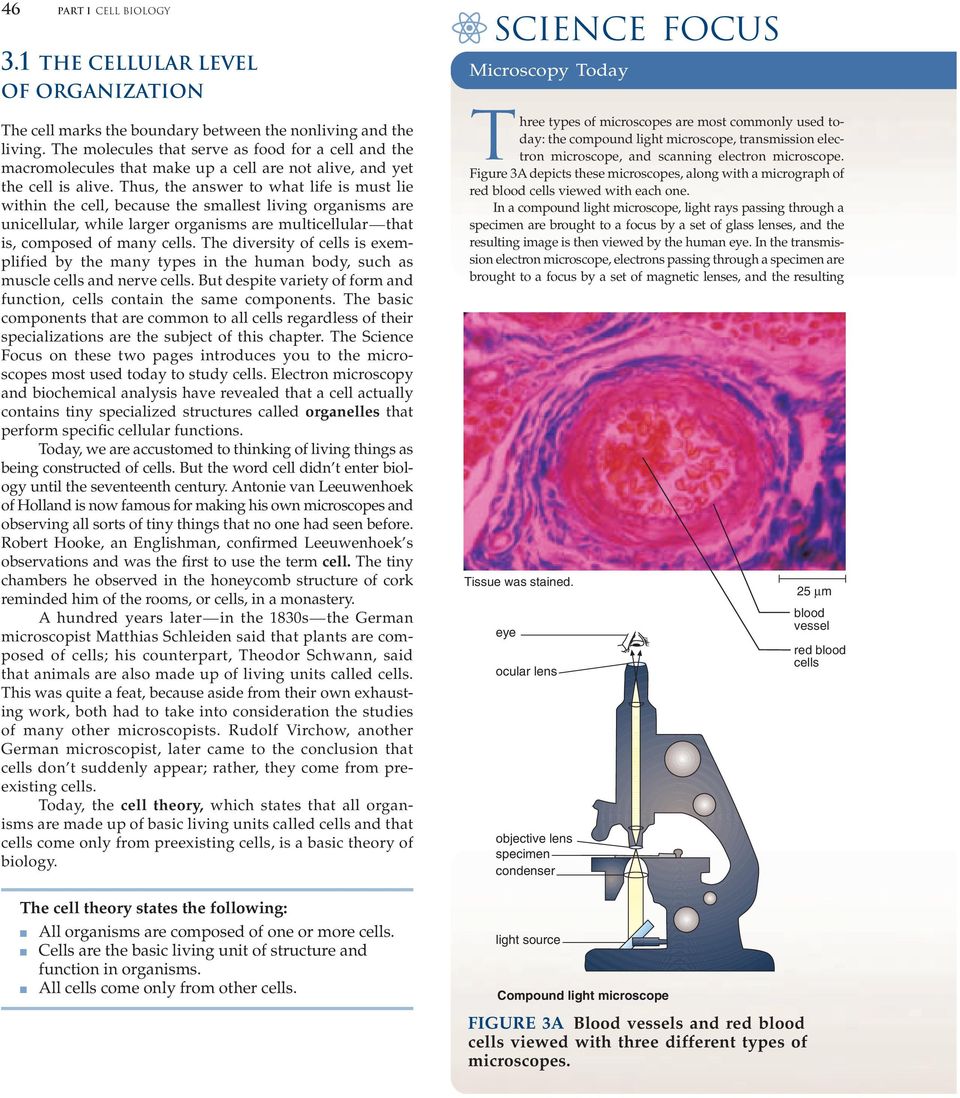
3 Chapter 3 cell structure and function 47 image is projected onto a fluorescent screen or photographic film. The magnification produced by an electron microscope is much higher than that of a light microscope (50,000X compared to 1,000X). Also, the ability of the electron microscope to make out detail is much greater. The distance needed to distinguish two points as separate is much less for an electron microscope than for a light microscope (10 nm compared to 200 nm 1 ). The greater 1 nm nanometer. See Appendix C, Metric System. resolving power of the electron microscope is due to the fact that electrons travel at a much shorter wavelength than do light rays. However, because electrons travel only in a vacuum, the object is always dried out before viewing, whereas even living objects can be observed with a light microscope. A scanning electron microscope provides a three-dimensional view of the surface of an object. A narrow beam of electrons is scanned over the surface of the specimen, which has been coated with a thin layer of metal. The metal gives off secondary electrons, which are collected to produce a television-type picture of the specimen s surface on a screen. A picture obtained using a light microscope is sometimes called a photomicrograph, and a picture resulting from the use of an electron microscope is called a transmission electron micrograph (TEM) or a scanning electron micrograph (SEM), depending on the type of microscope used. Micrograph was colored. electron beam 14 µm blood vessel red blood cells Micrograph was colored. electron beam 10 µm blood vessel red blood cells condenser condensers specimen objective lens scanning coil projector lens observation or photograph objective lens secondary electrons specimen electron detector TV viewing screen Transmission electron microscope Scanning electron microscope

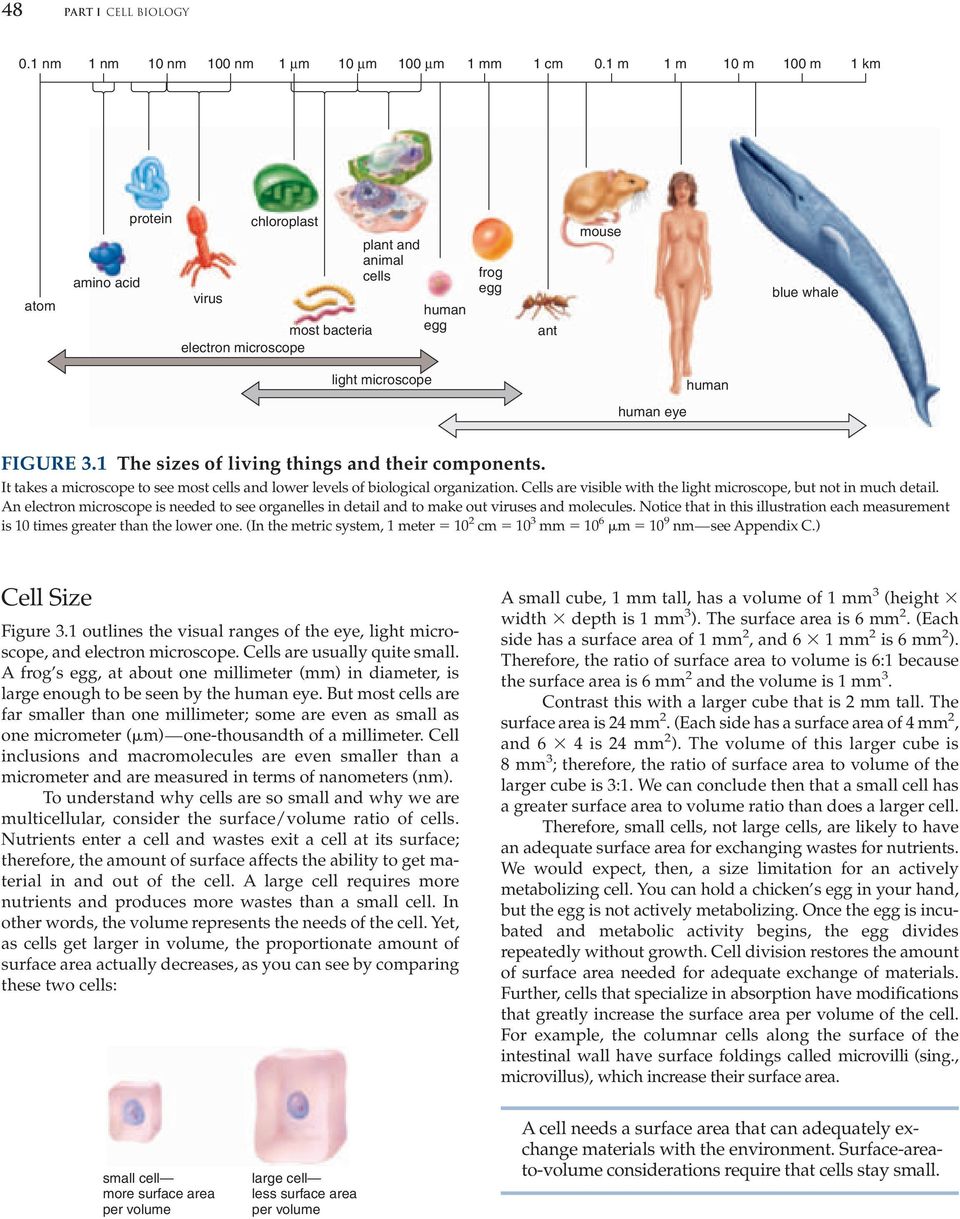
4 48 Part I cell biology 0.1 nm 1 nm 10 nm 100 nm 1 µm 10 µm 100 µm 1 mm 1 cm 0.1 m 1 m 10 m 100 m 1 km atom amino acid protein virus chloroplast most bacteria electron microscope plant and animal cells human egg frog egg ant mouse blue whale light microscope human human eye FIGURE 3.1 The sizes of living things and their components. It takes a microscope to see most cells and lower levels of biological organization. Cells are visible with the light microscope, but not in much detail. An electron microscope is needed to see organelles in detail and to make out viruses and molecules. Notice that in this illustration each measurement is 10 times greater than the lower one. (In the metric system, 1 meter 10 2 cm 10 3 mm 10 6 m 10 9 nm see Appendix C.) Cell Size Figure 3.1 outlines the visual ranges of the eye, light microscope, and electron microscope. Cells are usually quite small. Afrog s egg, at about one millimeter (mm) in diameter, is large enough to be seen by the human eye. But most cells are far smaller than one millimeter; some are even as small as one micrometer ( m) one-thousandth of a millimeter. Cell inclusions and macromolecules are even smaller than a micrometer and are measured in terms of nanometers (nm). To understand why cells are so small and why we are multicellular, consider the surface/volume ratio of cells. Nutrients enter a cell and wastes exit a cell at its surface; therefore, the amount of surface affects the ability to get material in and out of the cell. A large cell requires more nutrients and produces more wastes than a small cell. In other words, the volume represents the needs of the cell. Yet, as cells get larger in volume, the proportionate amount of surface area actually decreases, as you can see by comparing these two cells: Asmall cube, 1 mm tall, has a volume of 1 mm 3 (height width depth is 1 mm 3 ). The surface area is 6 mm 2. (Each side has a surface area of 1 mm 2, and 6 1 mm 2 is 6 mm 2 ). Therefore, the ratio of surface area to volume is 6:1 because the surface area is 6 mm 2 and the volume is 1 mm 3. Contrast this with a larger cube that is 2 mm tall. The surface area is 24 mm 2. (Each side has a surface area of 4 mm 2, and 6 4 is 24 mm 2 ). The volume of this larger cube is 8mm 3 ; therefore, the ratio of surface area to volume of the larger cube is 3:1. We can conclude then that a small cell has a greater surface area to volume ratio than does a larger cell. Therefore, small cells, not large cells, are likely to have an adequate surface area for exchanging wastes for nutrients. We would expect, then, a size limitation for an actively metabolizing cell. You can hold a chicken s egg in your hand, but the egg is not actively metabolizing. Once the egg is incubated and metabolic activity begins, the egg divides repeatedly without growth. Cell division restores the amount of surface area needed for adequate exchange of materials. Further, cells that specialize in absorption have modifications that greatly increase the surface area per volume of the cell. For example, the columnar cells along the surface of the intestinal wall have surface foldings called microvilli (sing., microvillus), which increase their surface area. small cell more surface area per volume large cell less surface area per volume A cell needs a surface area that can adequately exchange materials with the environment. Surface-areato-volume considerations require that cells stay small.
5 Chapter 3 cell structure and function Eukaryotic Cells Eukaryotic cells, one of the two major types of cells, have a nucleus. A nucleus is a large structure that controls the workings of the cell because it contains the genes. Both animals and plants have eukaryotic cells. Outer Boundaries of Animal and Plant Cells Animal and plant cells are surrounded by a plasma membrane, that consists of a phospholipid bilayer in which protein molecules are embedded: protein molecules phospholipid bilayer The plasma membrane is a living boundary that separates the living contents of the cell from the nonliving surrounding environment. Inside the cell, the nucleus is surrounded by the cytoplasm, a semifluid medium that contains organelles. The plasma membrane regulates the entrance and exit of molecules into and out of the cytoplasm. Plant cells (but not animal cells) have a permeable but protective cell wall, in addition to a plasma membrane. Many plant cells have both a primary and secondary cell wall. A main constituent of a primary cell wall is cellulose molecules. Cellulose molecules form fibrils that lie at right angles to one another for added strength. The secondary cell wall, if present, forms inside the primary cell wall. Such secondary cell walls contain lignin, a substance that makes them even stronger than primary cell walls. Organelles of Animal and Plant Cells Originally the term organelle referred to only membranous structures, but we will use it to include any well-defined subcellular structure (Table 3.1). Just as all the assembly lines of a factory are in operation at the same time, so all the organelles of a cell function simultaneously. Raw materials enter a factory and then are turned into various products by different departments. In the same way, chemicals are taken up by the cell and then processed by the organelles. The cell is a beehive of activity the entire 24 hours of every day. Both animal cells (Fig. 3.2) and plant cells (Fig. 3.3) contain mitochondria, while only plant cells have chloroplasts. Only animal cells have centrioles. All the organelles have an assigned color that is used to represent them in the illustrations throughout the text. TABLE 3.1 EUKARYOTIC STRUCTURES IN ANIMAL CELLS AND PLANT CELLS Name Composition Function Cell wall* Contains cellulose Support and protection fibrils Plasma Phospholipid bilayer Defines cell boundary; membrane with embedded regulation of molecule proteins passage into and out of cells Nucleus Nuclear envelope, Storage of genetic nucleoplasm, information; synthesis of chromatin, and DNA and RNA nucleoli Nucleolus Concentrated area Ribosomal subunit of chromatin, RNA, formation and proteins Ribosome Protein and RNA in Protein synthesis two subunits Endoplasmic Membranous Synthesis and/or reticulum flattened channels modification of proteins (ER) and tubular canals and other substances, and distribution by vesicle formation Rough ER Studded with Protein synthesis ribosomes Smooth ER Having no ribosomes Various; lipid synthesis in some cells Golgi Stack of membranous Processing, packaging, apparatus saccules and distribution of proteins and lipids Lysosome Membranous vesicle Intracellular digestion containing digestive enzymes Vacuole and Membranous sacs Storage of substances vesicle Peroxisome Membranous vesicle Various metabolic tasks containing specific enzymes Mitochondrion Inner membrane Cellular respiration (cristae) bounded by an outer membrane Chloroplast* Membranous grana Photosynthesis bounded by two membranes Cytoskeleton Microtubules, Shape of cell and intermediate movement of its filaments, actin parts filaments Cilia and pattern of Movement of cell flagella microtubules Centriole** pattern of Formation of basal microtubules bodies *Plant cells only **Animal cells only

6 50 Part I cell biology nuclear pore chromatin nucleolus nucleus nuclear envelope polyribosome actin filament (within cytoskeleton) rough ER ribosome (attached to rough ER) centriole mitochondrion smooth ER peroxisome vacuole cytoplasm ribosomes (in cytoplasm) Golgi apparatus vesicle lysosome plasma membrane microtubule (within cytoskeleton) a. plasma membrane nuclear envelope chromatin nucleolus endoplasmic reticulum b. FIGURE 3.2 Animal cell anatomy. a. Generalized drawing. b. Transmission electron micrograph. See Table 3.1 for a description of these structures, along with a listing of their functions. 50 nm

7 Chapter 3 cell structure and function 51 microtubule (within cytoskeleton) chloroplast central vacuole nuclear pore chromatin nucleolus nuclear envelope nucleus ribosomes (in cytoplasm) rough ER ribosome (attached to rough ER) smooth ER cell wall plasma membrane Golgi apparatus cytoplasm actin filament (within cytoskeleton) mitochondrion cell wall of adjacent cell a. peroxisome mitochondrion nucleus ribosomes central vacuole plasma membrane chloroplast cell wall b. 1 µm FIGURE 3.3 Plant cell anatomy. a. Generalized drawing. b. Transmission electron micrograph of a young leaf cell. See Table 3.1 for a description of these structures, along with a listing of their functions.

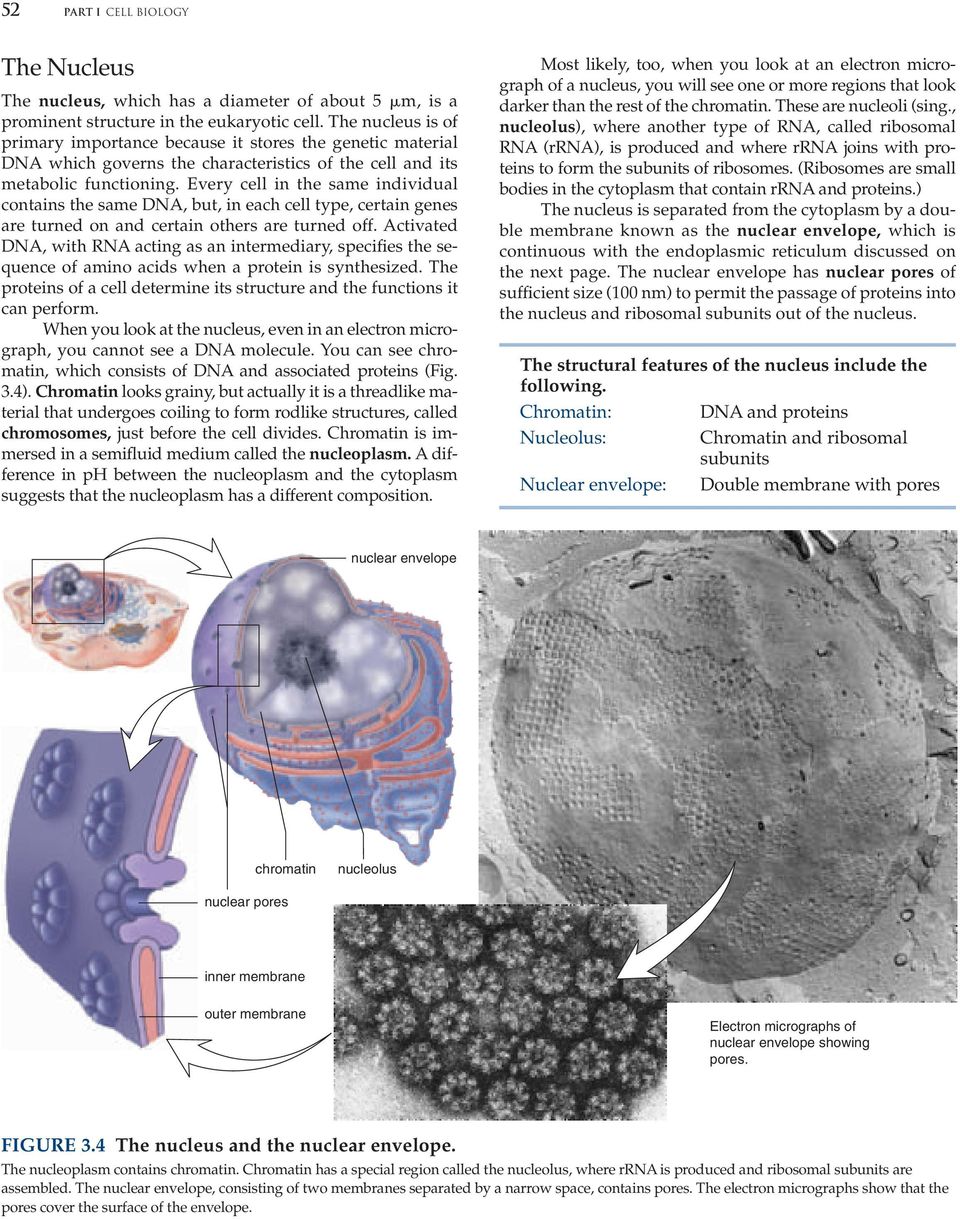
8 52 Part I cell biology The Nucleus The nucleus, which has a diameter of about 5 m, is a prominent structure in the eukaryotic cell. The nucleus is of primary importance because it stores the genetic material DNA which governs the characteristics of the cell and its metabolic functioning. Every cell in the same individual contains the same DNA, but, in each cell type, certain genes are turned on and certain others are turned off. Activated DNA, with RNA acting as an intermediary, specifies the sequence of amino acids when a protein is synthesized. The proteins of a cell determine its structure and the functions it can perform. When you look at the nucleus, even in an electron micrograph, you cannot see a DNA molecule. You can see chromatin, which consists of DNA and associated proteins (Fig. 3.4). Chromatin looks grainy, but actually it is a threadlike material that undergoes coiling to form rodlike structures, called chromosomes, just before the cell divides. Chromatin is immersed in a semifluid medium called the nucleoplasm. A difference in ph between the nucleoplasm and the cytoplasm suggests that the nucleoplasm has a different composition. Most likely, too, when you look at an electron micrograph of a nucleus, you will see one or more regions that look darker than the rest of the chromatin. These are nucleoli (sing., nucleolus), where another type of RNA, called ribosomal RNA (rrna), is produced and where rrna joins with proteins to form the subunits of ribosomes. (Ribosomes are small bodies in the cytoplasm that contain rrna and proteins.) The nucleus is separated from the cytoplasm by a double membrane known as the nuclear envelope, which is continuous with the endoplasmic reticulum discussed on the next page. The nuclear envelope has nuclear pores of sufficient size (100 nm) to permit the passage of proteins into the nucleus and ribosomal subunits out of the nucleus. The structural features of the nucleus include the following. Chromatin: DNA and proteins Nucleolus: Chromatin and ribosomal subunits Nuclear envelope: Double membrane with pores nuclear envelope chromatin nucleolus nuclear pores inner membrane outer membrane Electron micrographs of nuclear envelope showing pores. FIGURE 3.4 The nucleus and the nuclear envelope. The nucleoplasm contains chromatin. Chromatin has a special region called the nucleolus, where rrna is produced and ribosomal subunits are assembled. The nuclear envelope, consisting of two membranes separated by a narrow space, contains pores. The electron micrographs show that the pores cover the surface of the envelope.
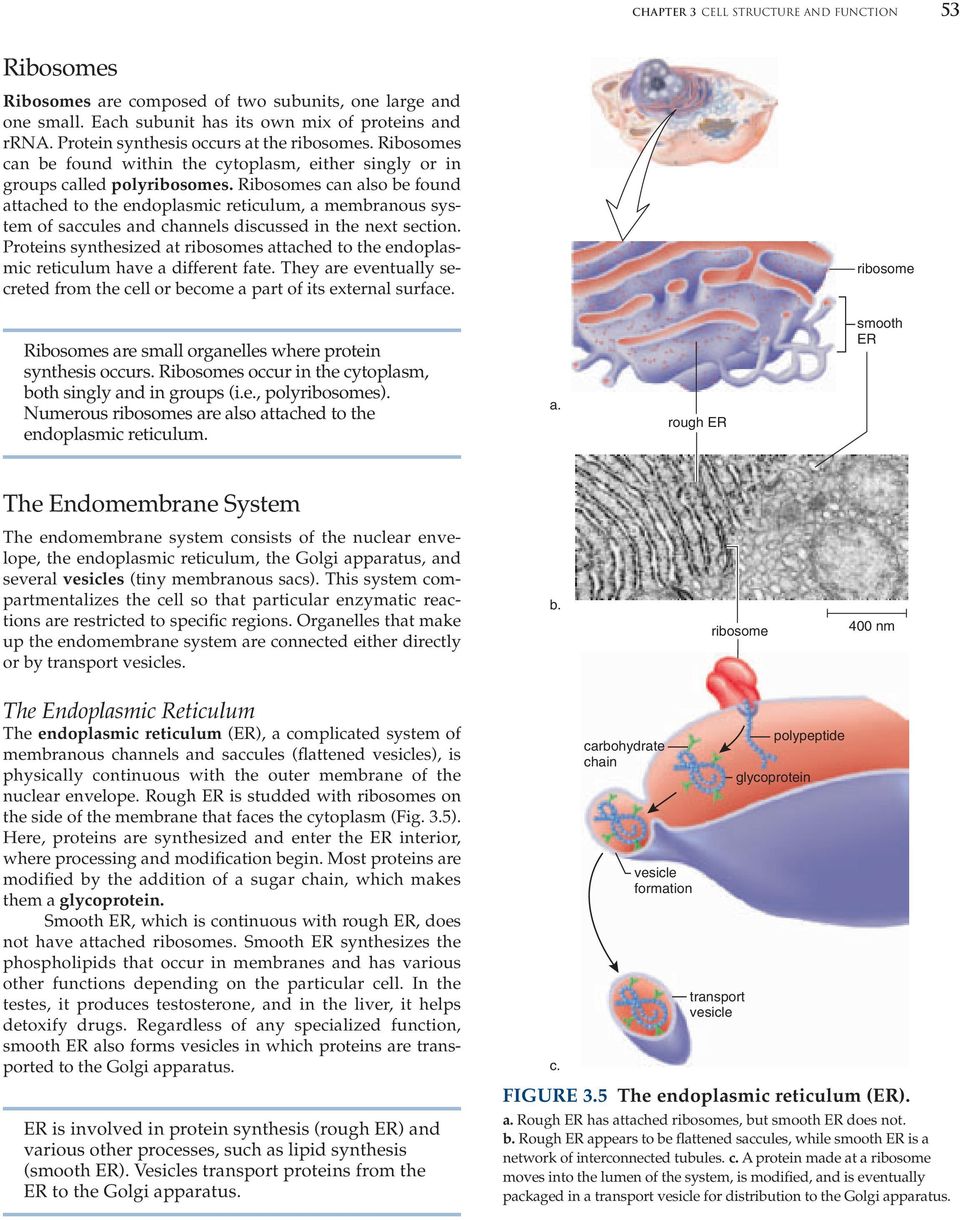
9 Chapter 3 cell structure and function 53 Ribosomes Ribosomes are composed of two subunits, one large and one small. Each subunit has its own mix of proteins and rrna. Protein synthesis occurs at the ribosomes. Ribosomes can be found within the cytoplasm, either singly or in groups called polyribosomes. Ribosomes can also be found attached to the endoplasmic reticulum, a membranous system of saccules and channels discussed in the next section. Proteins synthesized at ribosomes attached to the endoplasmic reticulum have a different fate. They are eventually secreted from the cell or become a part of its external surface. ribosome Ribosomes are small organelles where protein synthesis occurs. Ribosomes occur in the cytoplasm, both singly and in groups (i.e., polyribosomes). Numerous ribosomes are also attached to the endoplasmic reticulum. a. rough ER smooth ER The Endomembrane System The endomembrane system consists of the nuclear envelope, the endoplasmic reticulum, the Golgi apparatus, and several vesicles (tiny membranous sacs). This system compartmentalizes the cell so that particular enzymatic reactions are restricted to specific regions. Organelles that make up the endomembrane system are connected either directly or by transport vesicles. b. ribosome 400 nm The Endoplasmic Reticulum The endoplasmic reticulum (ER), a complicated system of membranous channels and saccules (flattened vesicles), is physically continuous with the outer membrane of the nuclear envelope. Rough ER is studded with ribosomes on the side of the membrane that faces the cytoplasm (Fig. 3.5). Here, proteins are synthesized and enter the ER interior, where processing and modification begin. Most proteins are modified by the addition of a sugar chain, which makes them a glycoprotein. Smooth ER, which is continuous with rough ER, does not have attached ribosomes. Smooth ER synthesizes the phospholipids that occur in membranes and has various other functions depending on the particular cell. In the testes, it produces testosterone, and in the liver, it helps detoxify drugs. Regardless of any specialized function, smooth ER also forms vesicles in which proteins are transported to the Golgi apparatus. ER is involved in protein synthesis (rough ER) and various other processes, such as lipid synthesis (smooth ER). Vesicles transport proteins from the ER to the Golgi apparatus. c. carbohydrate chain vesicle formation transport vesicle polypeptide glycoprotein FIGURE 3.5 The endoplasmic reticulum (ER). a. Rough ER has attached ribosomes, but smooth ER does not. b. Rough ER appears to be flattened saccules, while smooth ER is a network of interconnected tubules. c. Aprotein made at a ribosome moves into the lumen of the system, is modified, and is eventually packaged in a transport vesicle for distribution to the Golgi apparatus.
10 54 Part I cell biology rough ER synthesizes proteins and packages them in vesicles. smooth ER synthesizes lipids and performs other functions. transport vesicles from rough ER. transport vesicles from smooth ER. lysosome digest molecules or old cell parts. Golgi apparatus modifies lipids and proteins; sorts and packages them in vesicles. secretory vesicles fuse with the plasma membrane as secretion occurs. incoming vesicle brings substances into the cell. FIGURE 3.6 Endomembrane system. The organelles in the endomembrane system work together to carry out the functions noted. The Golgi Apparatus The Golgi apparatus is named for Camillo Golgi, who discovered its presence in cells in The Golgi apparatus consists of a stack of three to twenty slightly curved saccules whose appearance can be compared to a stack of pancakes (Fig. 3.6). In animal cells, one side of the stack (the inner face) is directed toward the ER, and the other side of the stack (the outer face) is directed toward the plasma membrane. Vesicles can frequently be seen at the edges of the saccules. The Golgi apparatus receives protein and also lipidfilled vesicles that bud from the smooth ER. These molecules then move through the Golgi from the inner face to the outer face. How this occurs is still being debated. According to the maturation saccule model, the vesicles fuse to form an inner face saccule, which matures as it gradually becomes a saccule at the outer face. According to the stationary saccule model, the molecules move through stable saccules from the inner face to the outer face by shuttle vesicles. It is likely that both models apply, depending on the organism and the type of cell. During their passage through the Golgi apparatus, glycoproteins have their sugar chains modified before they are repackaged in secretory vesicles. Secretory vesicles proceed to the plasma membrane, where they discharge their contents. Because this is secretion, the Golgi apparatus is said to be involved in processing, packaging, and secretion. The Golgi apparatus is also involved in the formation of lysosomes, vesicles that contain proteins and remain within the cell. How does the Golgi apparatus direct traffic in other words, what makes it direct the flow of proteins to different destinations? It now seems that proteins made at the rough ER have specific molecular tags that serve as zip codes to tell the Golgi apparatus whether they belong in a lysosome or in a secretary vesicle. The final sugar chain serves as a tag that directs proteins to their final destination.

11 Chapter 3 cell structure and function 55 Lysosomes Lysosomes are membrane-bounded vesicles produced by the Golgi apparatus. Lysosomes contain hydrolytic digestive enzymes. Sometimes macromolecules are brought into a cell by vesicle formation at the plasma membrane (Fig. 3.6). When a lysosome fuses with such a vesicle, its contents are digested by lysosomal enzymes into simpler subunits that then enter the cytoplasm. Some white blood cells defend the body by engulfing pathogens by vesicle formation. When lysosomes fuse with these vesicles, the bacteria are digested. Even parts of a cell are digested by its own lysosomes (called autodigestion). Normal cell rejuvenation takes place in this manner. Lysosomes contain many enzymes for digesting all sorts of molecules. The absence or malfunction of one of these results in a so-called lysosomal storage disease. Occasionally, a child inherits the inability to make a lysosomal enzyme, and therefore has a lysosomal storage disease. Instead of being degraded, the molecule accumulates inside lysosomes, and illness develops when they swell and crowd the other organelles. In Tay Sachs disease, the cells that surround nerve cells cannot break down a particular lipid, and the nervous system is affected. At about six months, the infant can no longer see and, then, gradually loses hearing and even the ability to move. Death follows at about three years of age. The endomembrane system consists of the endoplasmic reticulum, Golgi apparatus, lysosomes, and transport vesicles. Vacuoles A vacuole is a large membranous sac. A vesicle is smaller than a vacuole. Animal cells have vacuoles, but they are much more prominent in plant cells. Typically, plant cells have a large central vacuole so filled with a watery fluid that it gives added support to the cell (see Fig. 3.3). Vacuoles store substances. Plant vacuoles contain not only water, sugars, and salts but also pigments and toxic molecules. The pigments are responsible for many of the red, blue, or purple colors of flowers and some leaves. The toxic substances help protect a plant from herbivorous animals. The vacuoles present in unicellular protozoans are quite specialized, and they include contractile vacuoles for ridding the cell of excess water and digestive vacuoles for breaking down nutrients. FIGURE 3.7 Peroxisomes. Peroxisomes Peroxisomes, similar to lysosomes, are membrane-bounded vesicles that enclose enzymes (Fig. 3.7). However, the enzymes in peroxisomes are synthesized by cytoplasmic ribosomes and transported into a peroxisome by carrier proteins. Typically, peroxisomes contain enzymes whose action results in hydrogen peroxide (H 2 O 2 ): RH 2 O 2 R H 2 O µm Peroxisomes are vesicles that oxidize organic substances with a resulting buildup of hydrogen peroxide. Peroxisomes contain the enzyme catalase, which breaks down hydrogen peroxide (H 2 O 2 ) to water and oxygen. R remainder of molecule Hydrogen peroxide, a toxic molecule, is immediately broken down to water and oxygen by another peroxisomal enzyme called catalase. The enzymes in a peroxisome depend on the function of the cell. Peroxisomes are especially prevalent in cells that are synthesizing and breaking down fats. In the liver, some peroxisomes break down fats and others produce bile salts from cholesterol. In the movie Lorenzo s Oil, the cells lacked a carrier protein to transport an enzyme into peroxisomes. As a result, long chain fatty acids accumulate in his brain and Lorenzo suffers from neurological damage. Plant cells also have peroxisomes. In germinating seeds, they oxidize fatty acids into molecules that can be converted to sugars needed by the growing plant. In leaves, peroxisomes can carry out a reaction that is opposite to photosynthesis the reaction uses up oxygen and releases carbon dioxide. Vacuoles are larger than vesicles. Plants are well known for having a large central vacuole area for storage of various molecules. Typically, the enzymes in peroxisomes break down molecules and as a result produce hydrogen peroxide molecules.

12 56 Part I cell biology Energy-Related Organelles Life is possible only because of a constant input of energy used for maintenance and growth. Chloroplasts and mitochondria are the two eukaryotic membranous organelles that specialize in converting energy to a form that can be used by the cell. Chloroplasts use solar energy to synthesize carbohydrates, and carbohydrate-derived products are broken down in mitochondria (sing., mitochondrion) to produce ATP molecules, as shown in the following diagram: solar energy carbohydrate (high chemical energy) Only plants, algae, and cyanobacteria are capable of carrying on photosynthesis in this manner: solar energy + carbon dioxide + water carbohydrate + oxygen Plants and algae have chloroplasts while cyanobacteria carry on photosynthesis within independent thylakoids. Solar energy is the ultimate source of energy for cells because nearly all organisms, either directly or indirectly, use the carbohydrates produced by photosynthesizers as an energy source. All organisms carry on cellular respiration, the process by which the chemical energy of carbohydrates is converted to that of ATP (adenosine triphosphate). ATP is the common carrier of chemical energy in cells. All organisms, except bacteria, complete the process of cellular respiration in mitochondria. Cellular respiration can be represented by this equation: chloroplast mitochondrion carbohydrate + oxygen carbon dioxide + water + energy CO 2 + H 2 O (low chemical energy) ATP usable energy for cells Here energy is in the form of ATP molecules. When a cell needs energy, ATP supplies it. The energy of ATP is used for synthetic reactions, active transport, and all energy-requiring processes in cells. double membrane outer membrane inner membrane granum independent thylakoids stroma 500 nm a. b. overlapping thylakoids FIGURE 3.8 Chloroplast structure. a. Electron micrograph. b. Generalized drawing in which the outer and inner membranes have been cut away to reveal the grana.
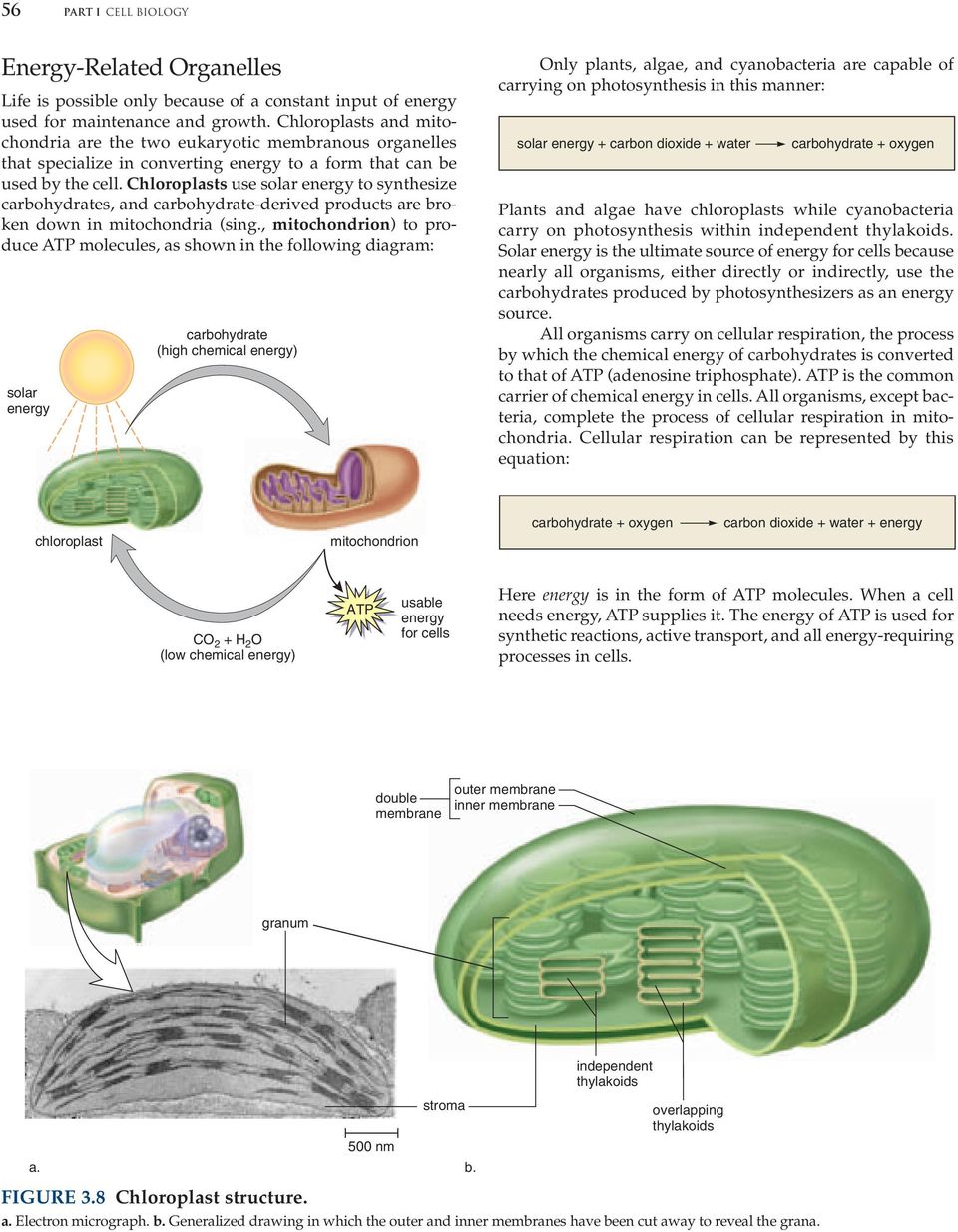
13 Chapter 3 cell structure and function 57 Chloroplasts Plant and algal cells contain chloroplasts, the organelles that allow them to produce their own organic food. Chloroplasts are about 4 6 m in diameter and 1 5 m in length; they belong to a group of organelles known as plastids. Among the plastids are also the amyloplasts, common in roots, which store starch, and the chromoplasts, common in leaves, which contain red and orange pigments. A chloroplast is green, of course, because it contains the green pigment chlorophyll. A chloroplast is bounded by two membranes that enclose a fluid-filled space called the stroma (Fig. 3.8). A membrane system within the stroma is organized into interconnected flattened sacs called thylakoids. In certain regions, the thylakoids are stacked up in structures called grana (sing., granum). There can be hundreds of grana within a single chloroplast (Fig. 3.8). Chlorophyll, which is located within the thylakoid membranes of grana, captures the solar energy needed to enable chloroplasts to produce carbohydrates. The stroma also contains DNA, ribosomes, and enzymes that synthesize carbohydrates from carbon dioxide and water. Mitochondria All eukaryotic cells, including those of plants and algae, contain mitochondria. This means that plant cells contain both chloroplasts and mitochondria. Most mitochondria are usually m in diameter and 2 5 m in length. Mitochondria, like chloroplasts, are bounded by a double membrane (Fig. 3.9). In mitochondria, the inner fluidfilled space is called the matrix. The matrix contains DNA, ribosomes, and enzymes that break down carbohydrate products, releasing energy to be used for ATP production. The inner membrane of a mitochondrion invaginates to form cristae. Cristae provide a much greater surface area to accommodate the protein complexes and other participants that produce ATP. Mitochondria and chloroplasts are able to make some proteins, but others are imported from the cytoplasm. Chloroplasts and mitochondria are membranous organelles whose structures lend themselves to the energy transfers that occur within them. a. 200 nm double membrane outer membrane inner membrane cristae matrix b. FIGURE 3.9 Mitochondrion structure. a. Electron micrograph. b. Generalized drawing in which the outer membrane and portions of the inner membrane have been cut away to reveal the cristae.

14 58 Part I cell biology The Cytoskeleton The cytoskeleton is a network of interconnected filaments and tubules that extends from the nucleus to the plasma membrane in eukaryotic cells. Prior to the 1970s, it was believed that the cytoplasm was an unorganized mixture of organic molecules. Then, high-voltage electron microscopes, which can penetrate thicker specimens, showed that the cytoplasm is instead highly organized. It contains actin filaments, microtubules, and intermediate filaments. The technique of immunofluorescence microscopy identified the makeup of these protein fibers within the cytoskeletal network (Fig. 3.10). The name cytoskeleton is convenient in that it compares the cytoskeleton to the bones and muscles of an animal. Bones and muscles give an animal structure and produce movement. Similarly, the fibers of the cytoskeleton maintain cell shape and cause the cell and its organelles to move. The cytoskeleton is dynamic; assembly occurs when monomers join a fiber and disassembly occurs when monomers leave a fiber. Assembly and disassembly occur at rates that are measured in seconds and minutes. The entire cytoskeletal network can even disappear and reappear at various times in the life of a cell. a. microtubules in cell kinesin receptor kinesin vesicle ATP b. vesicles move along microtubules FIGURE 3.11 Microtubules. a. Microtubules are visible in this cell due to a technique called immunofluorescence. b. Microtubules act as tracks along which organelles move. The motor molecule kinesin, bound to a vesicle, breaks down ATP and uses the energy to move along the microtubule. centrosome microtubule intermediate filament FIGURE 3.10 The cytoskeleton. plasma membrane actin filament Diagram comparing the size relationship of microtubules, intermediate filaments, and intermediate filaments. Microtubule construction is controlled by the centrosome. Microtubules Microtubules are small, hollow cylinders about 25 nm in diameter and from 0.2 to 25 m in length. Microtubules are made of a globular protein called tubulin. When microtubules assemble, tubulin molecules come together as dimers, and the dimers arrange themselves in rows. Microtubules have 13 rows of tubulin dimers surrounding what appears in electron micrographs to be an empty central core. In many cells, microtubule assembly is under the control of a microtubule organizing center, MTCO, called the centrosome. The centrosome lies near the nucleus. Before a cell divides, the microtubules assemble into a structure called a spindle that distributes chromosomes in an orderly manner. At the end of cell division, the spindle disassembles, and the microtubules reassemble once again into their former array. When the cell is not dividing, microtubules help maintain the shape of the cell and act as tracks along which organelles can move. Motor molecules are proteins that derive energy from ATP to propell themselves along a protein filament or microtubule. Whereas, the motor molecule myosin is associated with actin filaments, the motor
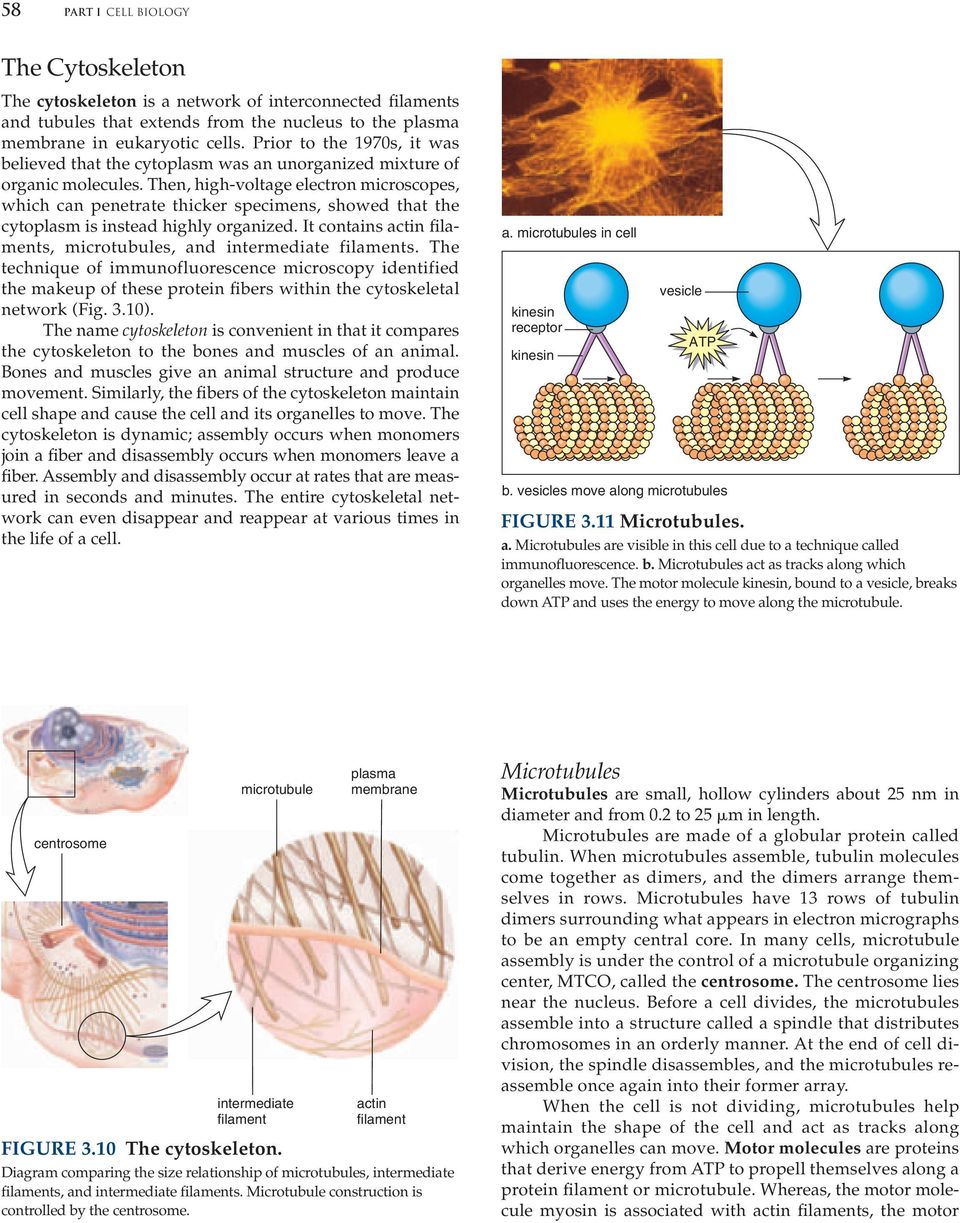
15 Chapter 3 cell structure and function 59 a. Actin filaments in cell actin filament a. Intermediate filaments (IF) in cell fibrous subunits ATP ADP + P myosin molecules anchor head membrane b. Actin and myosin interact FIGURE 3.12 Actin filaments. a. Actin filaments are visible in this cell due to a technique called immunofluorescence. b. In the presence of ATP, myosin, a motor molecule, attaches to an actin filament, pulls it, and then reattaches at a different location. This is the mechanism that allows muscle to contract. b. IF anchor organelles FIGURE 3.13 Intermediate filaments. a. Intermediates are visible in this cell due to a technique called immunofluorescence. b. Fibrous subunits account for the ropelike structure of intermediate filaments. molecules kinesin and dynein move along microtubules. One type of kinesin is responsible for moving vesicles along microtubules, including microtubules, including the transport vesicles of the endomembrane system. The vesicle is bonded to the kinesin, and then kinensin walks along the microtubule by attaching and reattaching itself further along the microtubule. There are different types of kinesin proteins, each specialized to move one kind of vesicle or cellular organelle. One type of dynein molecule, called cytoplasmic dynein, is closely related to the dynein found in flagella (Fig. 3.11). Actin Filaments Actin filaments (formerly called microfilaments) are long, extremely thin fibers (about 7 nm in diameter) that occur in bundles or meshlike networks. The actin filament contains two chains of globular actin monomers twisted about one another in a helical manner. Actin filaments play a structural role by forming a dense complex web just under the plasma membrane, to which they are anchored by special proteins. Also, the assembly and disassembly of a network of actin filaments lying beneath the plasma membrane accounts for the formation of pseudopods, extensions that allow certain cells to move in an amoeboid fashion. Actin filaments are seen in the microvilli that project from intestinal cells, and their presence most likely accounts for the ability of microvilli to alternately shorten and extend into the intestine. In plant cells, actin filaments apparently form the tracks along which chloroplasts circulate or stream in a particular direction. How are actin filaments involved in the movement of the cell and its organelles? They interact with motor molecule called myosin. Myosin has both a head and a tail. In the presence of ATP, the myosin head attaches, and then reattaches to an actin filament at a more distant location (Fig. 3.12). In muscle cells, the tails of several muscle myosin molecules are joined to form a thick filament. In nonmuscle cells, cytoplasmic myosin tails are bound to membranes, but the heads still interact with actin. During animal cell division, the two new cells form when actin, in conjunction with myosin, pinches off the cells from one another. Intermediate Filaments Intermediate filaments (8 11 nm in diameter) are intermediate in size between actin filaments and microtubules. They are ropelike assemblies of fibrous polypeptides (Fig. 3.13) that support the nuclear envelope and the plasma membrane. In the skin, intermediate filaments made of the protein keratin give great mechanical strength to skin cells. Recent work has shown intermediate filaments to be highly dynamic. They also are able to assemble and disassemble in the same manner as actin filaments and microtubules. The cytoskeleton contains microtubules, actin filaments, and intermediate filaments. These maintain cell shape and allow organelles to move within the cytoplasm. Sometimes they are also involved in movement of the cell itself.
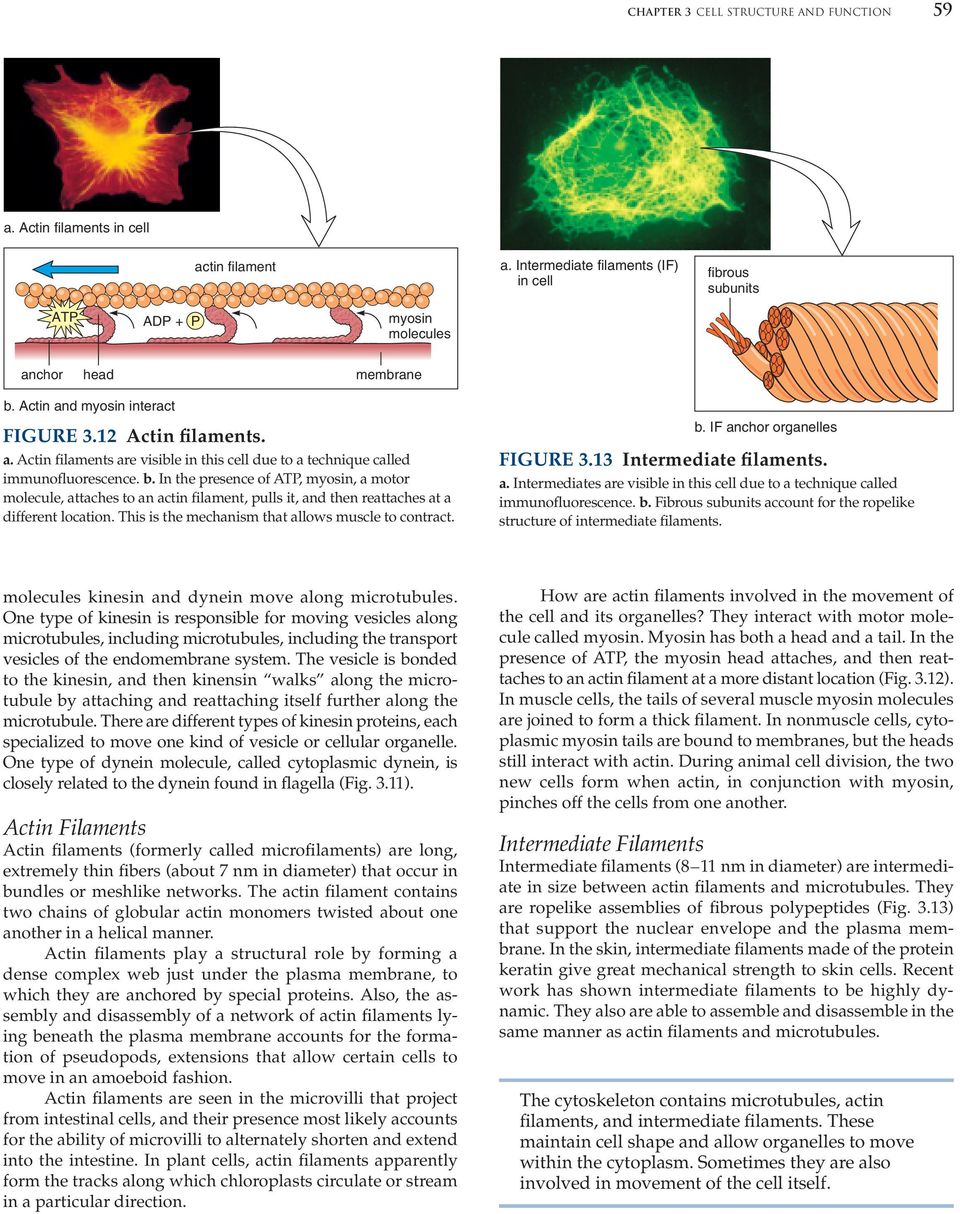
16 60 Part I cell biology one microtubule triplet one pair of centrioles two pairs of centrioles 200 nm FIGURE 3.14 Centrioles. Left and top right. A nondividing cell contains a pair of centrioles in a centrosome outside the nucleus. Bottom, right. Just before a cell divides, the centrosome divides so that there are two pairs of centrioles. During cell division, the centrosomes separate so that each new cell has one pair of centrioles. Centrioles Centrioles are short cylinders with a 9 0 pattern of microtubule triplets that is, a ring having nine sets of triplets with none in the middle (Fig. 3.14). In animal cells, a centrosome contains two centrioles lying at right angles to each other. The centrosome is the major microtubule organizing center for the cell, and centrioles may be involved in the process of microtubule assembly and disassembly. Before an animal cell divides, the centrioles replicate, and the members of each pair are again at right angles to one another (Fig. 3.14). Then, each pair becomes part of a separate centrosome. During cell division, the centrosomes move apart and may function to organize the mitotic spindle. Plant cells have the equivalent of a centrosome, but it does not contain centrioles, suggesting that centrioles are not necessary to the assembly of cytoplasmic microtubules. Centrioles are believed to give rise to basal bodies that direct the organization of microtubules within cilia and flagella. In other words, a basal body does for a cilium (or flagellum) what the centrosome does for the cell. Centrioles, which are short cylinders with a 9 0 pattern of microtubule triplets, may be involved in microtubule formation and in the organization of cilia and flagella. Cilia and Flagella Cilia and flagella are hairlike projections that can move either in an undulating fashion, like a whip, or stiffly, like an oar. Cells that have these organelles are capable of movement. For example, unicellular paramecia move by means of cilia, whereas sperm cells move by means of flagella. The cells that line our upper respiratory tract have cilia that sweep debris trapped within mucus back up into the throat, where it can be swallowed. This action helps keep the lungs clean. In eukaryotic cells, cilia are much shorter than flagella, but they have a similar construction. Both are membranebounded cylinders enclosing a matrix area. In the matrix are nine microtubule doublets arranged in a circle around two central microtubules. Therefore, they have a 9 2 pattern of microtubules. Cilia and flagella move when the microtubule doublets slide past one another (Fig. 3.15). As mentioned, each cilium and flagellum has a basal body lying in the cytoplasm at its base. Basal bodies have the same circular arrangement of microtubule triplets as centrioles and are believed to be derived from them. The basal body initiates polymerization of the nine outer doublets of a cilium or flagellum Cilia and flagella, which have a 9 2 pattern of microtubules, enable some cells to move.
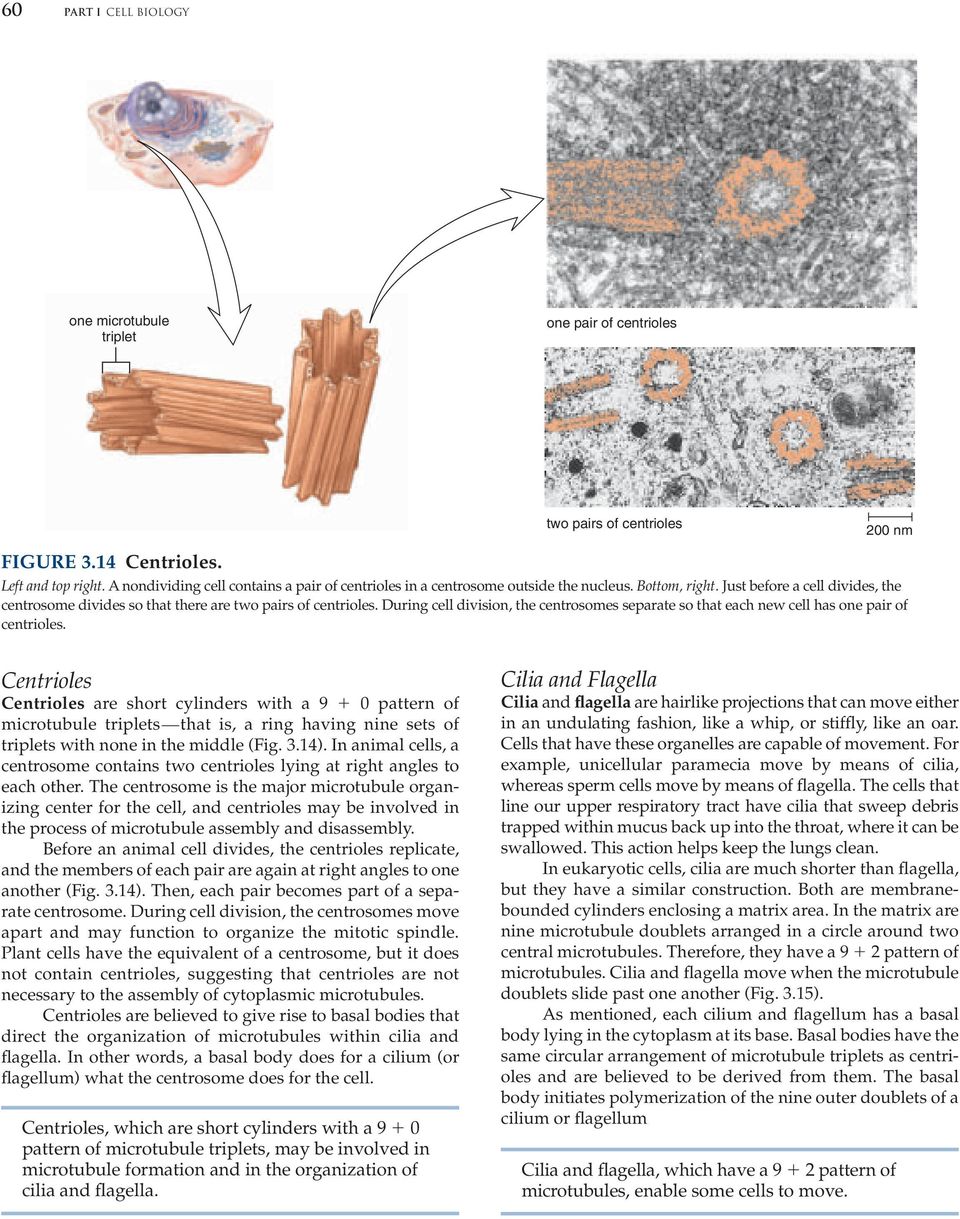
17 - visual focus The shaft of flagellum has a ring of nine microtubule doublets anchored to a central pair of microtubules. outer microtubule doublet dynein side arms central microtubules radial spokes flagellum Flagellum cross section 25 nm dynein side arm plasma membrane The side arms of each doublet are composed of dynein, a motor molecule. Sperm Flagellum shaft ATP triplets In the presence of ATP, the dynein side arms reach out to their neighbors, and bending occurs. The basal body of a flagellum has a ring of nine microtubule triplets with no central microtubules. Basal body Basal body cross section 100 nm FIGURE 3.15 Structure of a flagellum or cilium. A basal body, derived from a centriole, is at the base of a flagellum or cilium. The shaft of a flagellum (or cilium) contains microtubule doublets whose side arms are motor molecules that cause the flagellum (such as those of sperm) to move. Without the ability of sperm to move to the egg, human reproduction would not be possible. 61

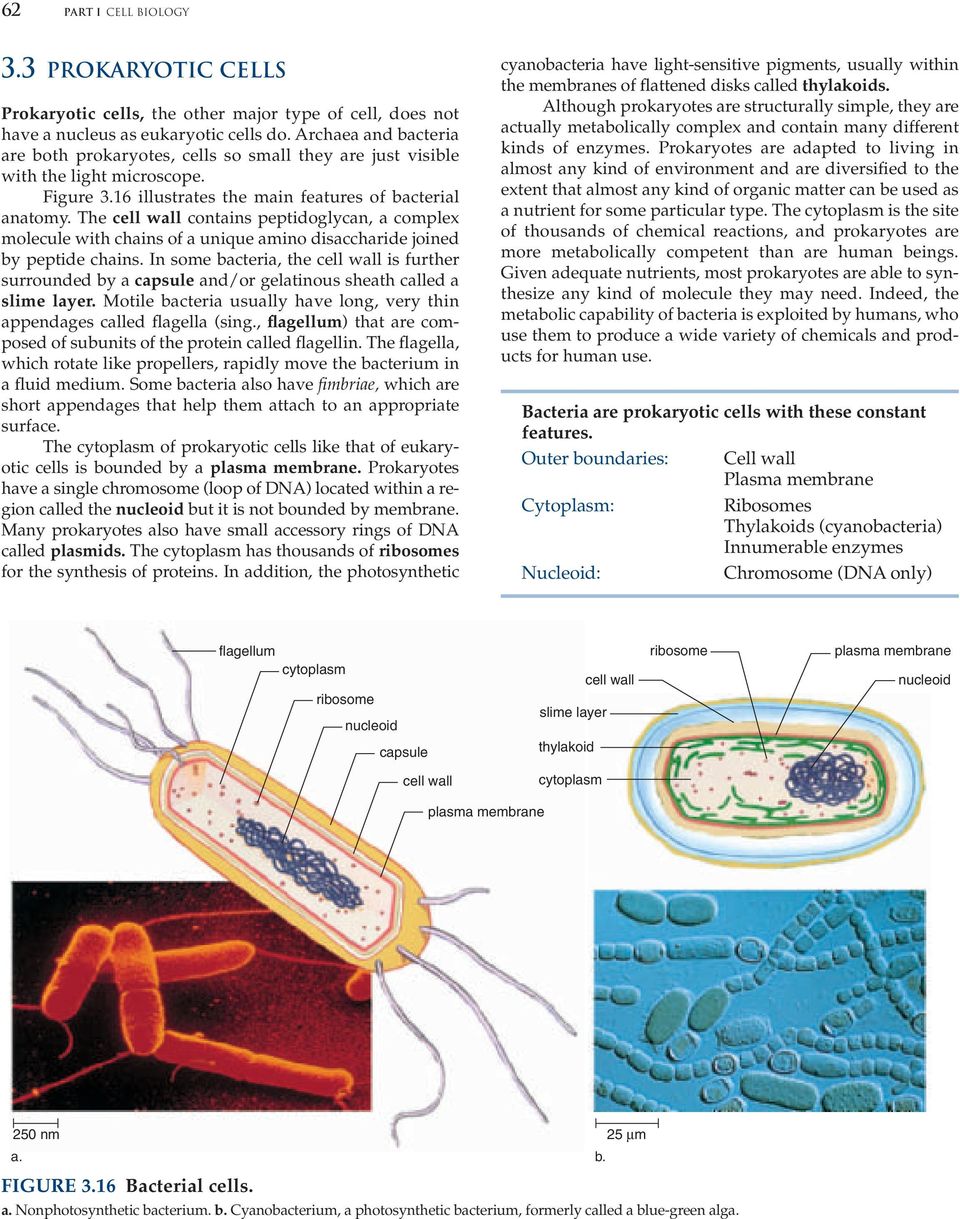
18 62 Part I cell biology 3.3 Prokaryotic Cells Prokaryotic cells, the other major type of cell, does not have a nucleus as eukaryotic cells do. Archaea and bacteria are both prokaryotes, cells so small they are just visible with the light microscope. Figure 3.16 illustrates the main features of bacterial anatomy. The cell wall contains peptidoglycan, a complex molecule with chains of a unique amino disaccharide joined by peptide chains. In some bacteria, the cell wall is further surrounded by a capsule and/or gelatinous sheath called a slime layer. Motile bacteria usually have long, very thin appendages called flagella (sing., flagellum) that are composed of subunits of the protein called flagellin. The flagella, which rotate like propellers, rapidly move the bacterium in a fluid medium. Some bacteria also have fimbriae, which are short appendages that help them attach to an appropriate surface. The cytoplasm of prokaryotic cells like that of eukaryotic cells is bounded by a plasma membrane. Prokaryotes have a single chromosome (loop of DNA) located within a region called the nucleoid but it is not bounded by membrane. Many prokaryotes also have small accessory rings of DNA called plasmids. The cytoplasm has thousands of ribosomes for the synthesis of proteins. In addition, the photosynthetic cyanobacteria have light-sensitive pigments, usually within the membranes of flattened disks called thylakoids. Although prokaryotes are structurally simple, they are actually metabolically complex and contain many different kinds of enzymes. Prokaryotes are adapted to living in almost any kind of environment and are diversified to the extent that almost any kind of organic matter can be used as a nutrient for some particular type. The cytoplasm is the site of thousands of chemical reactions, and prokaryotes are more metabolically competent than are human beings. Given adequate nutrients, most prokaryotes are able to synthesize any kind of molecule they may need. Indeed, the metabolic capability of bacteria is exploited by humans, who use them to produce a wide variety of chemicals and products for human use. Bacteria are prokaryotic cells with these constant features. Outer boundaries: Cell wall Plasma membrane Cytoplasm: Ribosomes Thylakoids (cyanobacteria) Innumerable enzymes Nucleoid: Chromosome (DNA only) flagellum cytoplasm cell wall ribosome plasma membrane nucleoid ribosome nucleoid slime layer capsule thylakoid cell wall cytoplasm plasma membrane 250 nm 25 µm a. b. FIGURE 3.16 Bacterial cells. a. Nonphotosynthetic bacterium. b. Cyanobacterium, a photosynthetic bacterium, formerly called a blue-green alga.
19 Chapter 3 cell structure and function Evolution of the Eukaryotic Cell How did the eukaryotic cell arise? Invagination of the plasma membrane might explain the origin of the nuclear envelope and organelles, such as the endoplasmic reticulum and the Golgi apparatus. Some believe that the other organelles could also have arisen in this manner. Another, more interesting, hypothesis has been put forth. It has been observed that, in the laboratory, an amoeba infected with bacteria can become dependent upon them. Some investigators believe that mitochondria and chloroplasts are derived from prokaryotes that were taken up by a much larger cell (Fig. 3.17). Perhaps mitochondria were originally aerobic heterotrophic bacteria, and chloroplasts were originally cyanobacteria. The host eukaryotic cell would have benefited from an ability to utilize oxygen or synthesize organic food when, by chance, the prokaryote was taken up and not destroyed. In other words, after these prokaryotes entered by endocytosis, a symbiotic relationship would have been established. Some of the evidence for this endosymbiotic hypothesis is as follows: 1. Mitochondria and chloroplasts are similar to bacteria in size and in structure. 2. Both organelles are bounded by a double membrane the outer membrane may be derived from the engulfing vesicle, and the inner one may be derived from the plasma membrane of the original prokaryote. 3. Mitochondria and chloroplasts contain a limited amount of genetic material and divide by splitting. Their DNA (deoxyribonucleic acid) is a circular loop like that of prokaryotes. 4. Although most of the proteins within mitochondria and chloroplasts are now produced by the eukaryotic host, they do have their own ribosomes and they do produce some proteins. Their ribosomes resemble those of prokaryotes. 5. The RNA (ribonucleic acid) base sequence of the ribosomes in chloroplasts and mitochondria also suggests a prokaryotic origin of these organelles. It is also just possible that the flagella of eukaryotes are derived from an elongated bacterium that became attached to a host cell (Fig. 3.17). However, it is important to remember that the flagella of eukaryotes are constructed differently. In any case, the acquisition of basal bodies, which could have become centrioles, may have led to the ability to form a spindle during cell division. According to the endosymbiotic hypothesis, heterotrophic bacteria became mitochondria, and cyanobacteria became chloroplasts after being taken up by precursors to modern-day eukaryotic cells. plasma membrane aerobic bacterium nucleus nuclear envelope endoplasmic reticulum bacterium Animal cell has a flagellum and mitochondria. cyanobacterium Cell has a nucleus and other organelles. FIGURE 3.17 Evolution of the eukaryotic cell. Cell has mitochondria. Plant cell has chloroplasts and mitochondria. Invagination of the plasma membrane could account for the formation of the nucleus and certain other organelles. The endosymbiotic hypothesis suggests that mitochondria, chloroplasts, and flagella are derived from prokaryotes that were taken up by a much larger eukaryotic cell.

20 u bioethical focus Use of Stem Cells Stem cells are immature cells that develop into mature, differentiated cells that make up the adult body. For example, the red bone marrow contains stem cells for all the many different types of blood cells in the bloodstream. Embryonic cells are an even more suitable source of stem cells. The early embryo is simply a ball of cells, and each of these cells has the potential to become any type of cell in the body a muscle cell, a nerve cell, or a pancreatic cell, for example. The use of stem cells from aborted embryos or frozen embryos left over from fertility procedures is controversial. Even though quadriplegics, like Christopher Reeve, and others with serious illnesses may benefit from this research, so far the government will not fund such research. One senator said it reminds him of the rationalization used by Nazis when they experimented on death camp inmates after all, they are going to be killed anyway. Parkinson disease and Alzheimer disease are debilitating neurological disorders that people fear. It is possible that one day these disorders could be cured by supplying the patient with new nerve cells in a critical area of the brain. Suppose you had one of these disorders. Would you want to be denied a cure because the government doesn t support experimentation on human embryonic stem cells? There are other possible sources of stem cells. It turns out that the adult body not only has blood stem cells, it also has neural stem cells in the brain. It has even been possible to coax blood stem cells and neural stem cells to become some other types of mature cells found in the body. A possible source of blood stem cells is a baby s umbilical cord, and it is now possible to store umbilical blood for future use. Once researchers have the know-how, it may eventually be possible to use any type of stem cell to cure many of the disorders afflicting human beings. Decide Your Opinion 1. Should researchers have access to embryonic stem cells? Any source or just certain sources? Which sources and why? 2. Should an individual have access to stem cells from just his own body? Also from a relative s body? Also from a child s umbilical cord? From embryonic cells? 3. Should differentiated cells from whatever source eventually be available for sale to patients who need them? After all, you are now able to buy artificial parts, why not living parts? Summarizing the Concepts 3.1 The Cellular Level of Organization All organisms are composed of cells, the smallest units of living matter. Cells are capable of self-reproduction, and new cells come only from preexisting cells. Cells are so small they are measured in micrometers. Cells must remain small in order to have an adequate amount of surface area per cell volume for exchange of molecules with the environment. 3.2 Eukaryotic Cells The nucleus of eukaryotic cells, which include animal and plant cells, is bounded by a nuclear envelope containing pores. These pores serve as passageways between the cytoplasm and the nucleoplasm. Within the nucleus, the chromatin is a complex of DNA and protein. In dividing cells, the DNA is found in discrete structures called chromosomes. The nucleolus is a special region of the chromatin where rrna is produced and where proteins from the cytoplasm gather to form ribosomal subunits. These subunits are joined in the cytoplasm. Ribosomes are organelles that function in protein synthesis. They can be bound to ER or can exist within the cytoplasm singly or in groups called polyribosomes. The endomembrane system includes the ER (both rough and smooth), the Golgi apparatus, the lysosomes, and other types of vesicles and vacuoles. The endomembrane system serves to compartmentalize the cell and keep the various biochemical reactions separate from one another. Newly produced proteins enter the ER lumen, where they may be modified before proceeding to the interior of the smooth ER. The smooth ER has various metabolic functions depending on the cell type, but it also forms vesicles that carry proteins and lipids to the Golgi apparatus. The Golgi apparatus processes proteins and repackages them into lysosomes, which carry out intracellular digestion, or into vesicles that fuse with the plasma membrane. Following fusion, secretion occurs. Vacuoles are large storage sacs, and vesicles are smaller ones. The large single plant cell vacuole not only stores substances but also lends support to the plant cell. Peroxisomes contain enzymes that were produced by cytoplasmic ribosomes. These enzymes oxidize molecules by producing hydrogen peroxide that is subsequently broken down. Cells require a constant input of energy to maintain their structure. Chloroplasts capture the energy of the sun and carry on photosynthesis, which produces carbohydrates. Carbohydratederived products are broken down in mitochondria at the same time as ATP is produced. This is an oxygen-requiring process called cellular respiration. The cytoskeleton contains actin filaments, intermediate filaments, and microtubules. These maintain cell shape and allow the cell and its organelles to move. Microtubules radiate out from the centrosome and are present in centrioles, cilia, and flagella. They serve as tracks along which vesicles and other organelles move due to the action of specific motor molecules. Actin filaments, the thinnest filaments, interact with the motor molecule myosin in muscle cells to bring about contraction; in other cells, they pinch off daughter cells and have other dynamic functions. Intermediate filaments support the nuclear envelope and the plasma membrane and probably participate in cell-to-cell junctions. 3.3 Prokaryotic Cells Prokaryotic cells do not have a nucleus. They do have a plasma membrane and cytoplasm. Prokaryotic cells have a nucleoid that is not bounded by a nuclear envelope. They also lack most of the other organelles that compartmentalize eukaryotic cells. 3.4 Evolution of the Eukaryotic Cell The nuclear envelope, most likely, evolved through invagination of the plasma membrane, but mitochondria and chloroplasts may have arisen through endosymbiotic events. 64

21 Chapter 3 cell structure and function 65 Testing Yourself Choose the best answer for each question. 1. Proteins produced at cytoplasmic ribosomes are a. used in the cell. b. used by other cells. c. never used at all. d. None of the above is correct. 2. Which is associated with DNA? a. chromatin b. chromosome c. nucleus d. All of the above are correct. 3. Secondary cell walls are found in and contain. a. animals, ligand b. animals, cellulose c. plants, ligand d. plants, cellulose 4. Which is characteristic of prokaryotic cells? a. nucleus b. mitochondria c. nucleoid d. All of the above are correct. 5. Eukaryotic cells are associated with, and prokaryotic cells are associated with. a. chloroplasts, nucleus b. chloroplasts, chloroplasts c. thylakoids, chloroplasts d. chloroplasts, thylakoids For questions 6 9, match the statements to the terms in the key. Key: a. chloroplasts b. amyloplasts c. vacuoles d. nucleus 6. All eukaryotic cells 7. Photosynthetic site 8. Stores starch 9. May contain toxins 10. The Golgi apparatus can be found in cells. a. animal b. plant c. bacteria d. Both a and b are correct. 11. are (is) produced by the Golgi and contains. a. Lysosomes, DNA b. Mitochondria, DNA c. Lysosomes, enzymes d. Nucleus, DNA 12. Mitochondria and chloroplasts contain and are able to synthesize. a. RNA, fatty acids b. DNA, proteins c. DNA, fatty acids d. cholesterol, fatty acids 13. Which of these are involved in the movement of structures inside a cell? a. actin b. microtubules c. centrioles d. All of the above are correct. 14. Peroxisomes import enzymes from the and are numerous in cells breaking down. a. Golgi, glucose b. Golgi, fats c. cytoplasm, glucose d. cytoplasm, fats 15. Which of these could you see with a light microscope? a. atom b. amino acid c. proteins d. None of the above is correct. For questions 16 20, match the structure to the function in the key. Key: a. movement of cell b. processing of proteins c. photosynthesis d. ribosome formation e. synthesizes phospholipids 16. Chloroplasts 17. Flagella 18. Golgi 19. Smooth ER 20. Nucleolus 21. Which of these depicts a hypothesized evolutionary scenario? a. cyanobacteria mitochondria b. Golgi mitochondria c. mitochondria cyanobacteria d. cyanobacteria chloroplast 22. Vacuoles are more common in a. animal cells. b. plant cells. c. Both a and b are correct. d. Neither a nor b is correct. 23. A 9 2 formation refers to a. cilia. b. flagella. c. centrioles. d. Both a and b are correct.
22 66 Part I cell biology 24. The waste products of photosynthesis are a. carbohydrates and oxygen. b. carbon dioxide and water. c. oxygen and water. d. carbohydrates and water. 25. Label the structures in this prokaryotic cell. 31. Which of the following structures would be found in both plant and animal cells? a. centrioles b. chloroplasts c. cell wall d. mitochondria e. All of these are found in both types of cells. b. c. d. e. Understanding the Terms a. 26. The cell theory states: a. Cells form as organelles and molecules become grouped together in an organized manner. b. The normal functioning of an organism does not depend on its individual cells. c. The cell is the basic unit of life. d. Only eukaryotic organisms are made of cells. 27. The small size of cells is best correlated with a. the fact that they are self-reproducing. b. their prokaryotic versus eukaryotic nature. c. an adequate surface area for exchange of materials. d. their vast versatility. e. All of the above are correct. 28. Mitochondria a. are involved in cellular respiration. b. break down ATP to release energy for cells. c. contain grana and cristae. d. have a convoluted outer membrane. e. All of the above are correct. 29. Which of these is broken down during cellular respiration? a. carbon dioxide b. water c. carbohydrate d. oxygen e. Both c and d are correct. 30. Which of the following is not one of the three components of the cytoskeleton? a. flagella b. actin filaments c. microtubules d. intermediate filaments capsule 62 cell 46 cell theory 46 cell wall 49, 62 centriole 60 centrosome 58 chloroplast 56 chromatin 52 chromosome 52 cilium (pl., cilia) 60 cristae 57 cytoplasm 49 cytoskeleton 58 endoplasmic reticulum (ER) 53 endosymbiotic hypothesis 63 eukaryotic cell 49 flagellum (pl., flagella) 60, 62 glycoprotein 53 Golgi apparatus 54 granum (pl., grana) 57 lysosome 55 matrix 57 microtubule 58 mitochondrion 56 motor molecule 58 nuclear envelope 52 nuclear pore 52 nucleoid 62 nucleolus (pl., nucleoli) 52 nucleoplasm 52 nucleus 52 organelle 46 peroxisome 55 plasma membrane 49, 62 plasmid 62 polyribosome 53 prokaryotic cell 62 ribosome 53, 62 secretion 54 slime layer 62 stroma 57 thylakoid 57, 62 vacuole 55 vesicle 53 Match the terms to these definitions: a. Unstructured semifluid substance that fills the space between cells in connective tissues or inside organelles. b. Dark-staining, spherical body in the nucleus that produces ribosomal subunits. c. Internal framework of the cell, consisting of microtubules, actin filaments, and intermediate filaments. d. Organelle consisting of saccules and vesicles that processes, packages, and distributes molecules about or from the cell. e. System of membranous saccules and channels in the cytoplasm, often with attached ribosomes.
Cell Structure & Function!
 Cell Structure & Function! Chapter 3! The most exciting phrase to hear in science, the one that heralds new discoveries, is not 'Eureka!' but 'That's funny.! -- Isaac Asimov Animal Cell Plant Cell Cell
Plasma Membrane hydrophilic polar heads
 The Parts of the Cell 3 main parts in ALL cells: plasma membrane, cytoplasm, genetic material this is about the parts of a generic eukaryotic cell Plasma Membrane -is a fluid mosaic model membrane is fluid
Biology 101 Chapter 4 Cells as the Basic Unit of Life. The Cell Theory Major Contributors: Galileo = first observations made with a microscope
 Biology 101 Chapter 4 Cells as the Basic Unit of Life The Cell Theory Major Contributors: Galileo = first observations made with a microscope Robert Hooke = first to observe small compartments in dead
Microscopes. Eukaryotes Eukaryotic cells are characterized by having: DNA in a nucleus that is bounded by a membranous nuclear envelope
 CH 6 The Cell Microscopy Scientists use microscopes to visualize cells too small to see with the naked eye. In a light microscope (LM), visible light is passed through a specimen and then through glass
Chapter 2: Cell Structure and Function pg. 70-107
 UNIT 1: Biochemistry Chapter 2: Cell Structure and Function pg. 70-107 Organelles are internal structures that carry out specialized functions, interacting and complementing each other. Animal and plant
Review of the Cell and Its Organelles
 Biology Learning Centre Review of the Cell and Its Organelles Tips for most effective learning of this material: Memorize the names and structures over several days. This will help you retain what you
Cell Structure and Function. Eukaryotic Cell: Neuron
 Cell Structure and Function Eukaryotic Cell: Neuron Cell Structure and Function Eukaryotic Cells: Blood Cells Cell Structure and Function Prokaryotic Cells: Bacteria Cell Structure and Function All living
Cytology. Living organisms are made up of cells. Either PROKARYOTIC or EUKARYOTIC cells.
 CYTOLOGY Cytology Living organisms are made up of cells. Either PROKARYOTIC or EUKARYOTIC cells. A. two major cell types B. distinguished by structural organization See table on handout for differences.
The Cell: Organelle Diagrams
 The Cell: Organelle Diagrams Fig 7-4. A prokaryotic cell. Lacking a true nucleus and the other membrane-enclosed organelles of the eukaryotic cell, the prokaryotic cell is much simpler in structure. Only
Bacterial (Prokaryotic) Cell. Common features of all cells. Tour of the Cell. Eukaryotic Cell. Plasma Membrane defines inside from outside
 www.denniskunkel.com Tour of the Cell www.denniskunkel.com Today s Topics Properties of all cells Prokaryotes and Eukaryotes Functions of Major Cellular Organelles Information, Synthesis&Transport,, Vesicles
CELLS: PLANT CELLS 20 FEBRUARY 2013
 CELLS: PLANT CELLS 20 FEBRUARY 2013 Lesson Description In this lesson we will discuss the following: The Cell Theory Terminology Parts of Plant Cells: Organelles Difference between plant and animal cells
Chapter 4: A Tour of the Cell. 1. Cell Basics. Limits to Cell Size. 1. Cell Basics. 2. Prokaryotic Cells. 3. Eukaryotic Cells
 Chapter 4: A Tour of the Cell 1. Cell Basics 2. Prokaryotic Cells 3. Eukaryotic Cells 1. Cell Basics Limits to Cell Size There are 2 main reasons why cells are so small: If cells get too large: 1) there
cells - relatively simple cells - lack nuclear membrane and many organelles - bacteria and their relatives are all prokaryotic
 Cell Biology A cell is chemical system that is able to maintain its structure and reproduce. Cells are the fundamental unit of life. All living things are cells or composed of cells. 1 The interior contents
Lecture 4 Cell Membranes & Organelles
 Lecture 4 Cell Membranes & Organelles Structure of Animal Cells The Phospholipid Structure Phospholipid structure Encases all living cells Its basic structure is represented by the fluidmosaic model Phospholipid
Introduction to the Cell: Plant and Animal Cells
 Introduction to the Cell: Plant and Animal Cells Tissues, Organs, and Systems of Living Things Cells, Cell Division, and Animal Systems and Plant Systems Cell Specialization Human Systems All organisms
Biology I. Chapter 7
 Biology I Chapter 7 Interest Grabber NOTEBOOK #1 Are All Cells Alike? All living things are made up of cells. Some organisms are composed of only one cell. Other organisms are made up of many cells. 1.
The Cell Interior and Function
 The Cell Interior and Function 5 5.0 CHAPTER PREVIEW Investigate and understand the organization and function of the cell interior. Define the differences between eukaryotic and prokaryotic cell structure.
Comparing Plant And Animal Cells
 Comparing Plant And Animal Cells http://khanacademy.org/video?v=hmwvj9x4gny Plant Cells shape - most plant cells are squarish or rectangular in shape. amyloplast (starch storage organelle)- an organelle
Plant and Animal Cells
 Plant and Animal Cells a. Explain that cells take in nutrients in order to grow, divide and to make needed materials. S7L2a b. Relate cell structures (cell membrane, nucleus, cytoplasm, chloroplasts, and
Compartmentalization of the Cell. Objectives. Recommended Reading. Professor Alfred Cuschieri. Department of Anatomy University of Malta
 Compartmentalization of the Cell Professor Alfred Cuschieri Department of Anatomy University of Malta Objectives By the end of this session the student should be able to: 1. Identify the different organelles
Cells & Cell Organelles
 Cells & Cell Organelles The Building Blocks of Life H Biology Types of cells bacteria cells Prokaryote - no organelles Eukaryotes - organelles animal cells plant cells Cell size comparison Animal cell
Chapter 5 Organelles. Lesson Objectives List the organelles of the cell and their functions. Distinguish between plant and animal cells.
 Chapter 5 Organelles Lesson Objectives List the organelles of the cell and their functions. Distinguish between plant and animal cells. Check Your Understanding What is a cell? How do we visualize cells?
Cells. Structure, Function and Homeostasis
 Cells Structure, Function and Homeostasis Characteristics of Cells Basic unit of life anything alive is made of cells Plasma membrane (skin) that separates them from the environment. Skeletonsfor protection
The microscope is an important tool.
 KEY CONCEPT Microscopes allow us to see inside the cell. BEFORE, you learned Some organisms are unicellular and some are multicellular A microscope is necessary to study most cells The cell theory describes
Organelles and Their Functions
 Organelles and Their Functions The study of cell organelles and their functions is a fascinating part of biology. The current article provides a brief description of the structure of organelles and their
THE HISTORY OF CELL BIOLOGY
 SECTION 4-1 REVIEW THE HISTORY OF CELL BIOLOGY Define the following terms. 1. cell 2. cell theory Write the correct letter in the blank. 1. One early piece of evidence supporting the cell theory was the
3.1 AS Unit: Cells, Exchange and Transport
 3.1 AS Unit: Cells, Exchange and Transport Module 1: Cells 1.1.1 Cell Structure Candidates should be able to: (a) state the resolution and magnification that can be achieved by a light microscope, a transmission
7.2 Cell Structure. Lesson Objectives. Lesson Summary. Cell Organization Eukaryotic cells contain a nucleus and many specialized structures.
 7.2 Cell Structure Lesson Objectives Describe the structure and function of the cell nucleus. Describe the role of vacuoles, lysosomes, and the cytoskeleton. Identify the role of ribosomes, endoplasmic
Chapter 3. Cellular Structure and Function Worksheets. 39 www.ck12.org
 Chapter 3 Cellular Structure and Function Worksheets (Opening image copyright by Sebastian Kaulitzki, 2010. Used under license from Shutterstock.com.) Lesson 3.1: Introduction to Cells Lesson 3.2: Cell
7.2 Cells: A Look Inside
 CHAPTER 7 CELL STRUCTURE AND FUNCTION 7.2 Cells: A Look Inside Imagine a factory that makes thousands of cookies a day. Ingredients come into the factory, get mixed and baked, then the cookies are packaged.
Biology Chapter 7 Practice Test
 Biology Chapter 7 Practice Test Multiple Choice Write the letter that best answers the question or completes the statement on the line provided. 1. The work of Schleiden and Schwann can be summarized by
RAD 223. Radiography physiology. Lecture Notes. First lecture: Cell and Tissue
 RAD 223 Radiography physiology Lecture Notes First lecture: Cell and Tissue Physiology: the word physiology derived from a Greek word for study of nature. It is the study of how the body and its part work
the plant & animal cell
 6.1 Basic unit of life Biology Biology Structure & functions of 06 the plant & animal cell In 1665, Robert Hooke observed a section of a cork using a microscope prepared by him. He discovered a structure
Cellular Structure and Function
 Chapter Test A CHAPTER 7 Cellular Structure and Function Part A: Multiple Choice In the space at the left, write the letter of the term or phrase that best answers each question. 1. Which defines a cell?
pathway that involves taking in heat from the environment at each step. C.
 Study Island Cell Energy Keystone Review 1. Cells obtain energy by either capturing light energy through photosynthesis or by breaking down carbohydrates through cellular respiration. In both photosynthesis
Cell Structure and Function
 Bio 100 - Cells 1 Cell Structure and Function Tenets of Cell Theory 1. All living things are made up of one or more cells 2. Cells are the basic living units within organisms, and the chemical reactions
The Cell Teaching Notes and Answer Keys
 The Cell Teaching Notes and Answer Keys Subject area: Science / Biology Topic focus: The Cell: components, types of cells, organelles, levels of organization Learning Aims: describe similarities and differences
Cell and Membrane Practice. A. chromosome B. gene C. mitochondrion D. vacuole
 Name: ate: 1. Which structure is outside the nucleus of a cell and contains N?. chromosome. gene. mitochondrion. vacuole 2. potato core was placed in a beaker of water as shown in the figure below. Which
Cellular Energy. 1. Photosynthesis is carried out by which of the following?
 Cellular Energy 1. Photosynthesis is carried out by which of the following? A. plants, but not animals B. animals, but not plants C. bacteria, but neither animals nor plants D. all living organisms 2.
called a cell wall. The cell wall protects against mechanical stress and keeps the cell from becoming over-filled with water.
 What are Cells? By: Byron Norelius About Cells A cell is the basic unit of life. All living organisms are composed of one (unicellular) or more (multicellular) cells. In unicellular organisms, like many
Multiple Choice Questions
 Chapter 5 THE FUNDAMENTAL UNIT OF LIFE Multiple Choice Questions 1. Which of the following can be made into crystal? (a) A Bacterium (b) An Amoeba (c) A Virus (d) A Sperm 2. A cell will swell up if (a)
2. Which type of macromolecule contains high-energy bonds and is used for long-term energy storage?
 Energy Transport Study Island 1. During the process of photosynthesis, plants use energy from the Sun to convert carbon dioxide and water into glucose and oxygen. These products are, in turn, used by the
The Living Cell from the Biology: The Science of Life Series. Pre-Test
 1 Pre-Test Directions: Answer each question TRUE OR FALSE. 1. The instructions for making proteins are stored in molecules of DNA. 2. Proteins are made in the nucleus. 3. All cells are surrounded by a
Student name ID # 2. (4 pts) What is the terminal electron acceptor in respiration? In photosynthesis? O2, NADP+
 1. Membrane transport. A. (4 pts) What ion couples primary and secondary active transport in animal cells? What ion serves the same function in plant cells? Na+, H+ 2. (4 pts) What is the terminal electron
Cells. Introduction WSBCTC 1
 Cells Cells are the fundamental unit of life. All living things are composed of cells. While there are several characteristics that are common to all cells, such as the presence of a cell membrane, cytoplasm,
Eukaryotes. www.njctl.org PSI Biology Eukaryotes & Gene Expression
 Eukaryotes The Eukaryotic Cell Classwork 1. Identify two characteristics that are shared by all cells. 2. Suppose you are investigating a cell that contains a nucleus. Would you categorize this cell as
tissues are made of cells that work together, organs are )
 Study Guide Cells Unit Test Matching. Write the letter of the correct response on the line. You may use the responses more than once. A. proteins B. simple carbohydrates C. complex carbohydrates D. lipids
An Overview of Cells and Cell Research
 An Overview of Cells and Cell Research 1 An Overview of Cells and Cell Research Chapter Outline Model Species and Cell types Cell components Tools of Cell Biology Model Species E. Coli: simplest organism
AP BIOLOGY 2006 SCORING GUIDELINES. Question 1
 AP BIOLOGY 2006 SCORING GUIDELINES Question 1 A major distinction between prokaryotes and eukaryotes is the presence of membrane-bound organelles in eukaryotes. (a) Describe the structure and function
Anatomy and Physiology Placement Exam 2 Practice with Answers at End!
 Anatomy and Physiology Placement Exam 2 Practice with Answers at End! General Chemical Principles 1. bonds are characterized by the sharing of electrons between the participating atoms. a. hydrogen b.
THE LIVING CELL. Cells also have variety of shapes. Plant cells are often rectangular or polygonal, while egg cells are usually spherical.
 THE LIVING CELL A Tour of the cell The cell is the smallest and the basic unit of structure of all organisms. There are two main types or categories of cells: prokaryotic cells and eukaryotic cells. Prokaryotic
Keystone Review Practice Test Module A Cells and Cell Processes. 1. Which characteristic is shared by all prokaryotes and eukaryotes?
 Keystone Review Practice Test Module A Cells and Cell Processes 1. Which characteristic is shared by all prokaryotes and eukaryotes? a. Ability to store hereditary information b. Use of organelles to control
Plant and Animal Cells
 Plant and Animal Cells Cell Scientists Hans and Zacharias Janssen Dutch lens grinders, father and son produced first compound microscope (2 lenses) Robert Hooke (1665) English Scientist looked at a thin
Chloroplasts and Mitochondria
 Name: KEY Period: Chloroplasts and Mitochondria Plant cells and some Algae contain an organelle called the chloroplast. The chloroplast allows plants to harvest energy from sunlight to carry on a process
Biological cell membranes
 Unit 14: Cell biology. 14 2 Biological cell membranes The cell surface membrane surrounds the cell and acts as a barrier between the cell s contents and the environment. The cell membrane has multiple
Photosynthesis and Cellular Respiration. Stored Energy
 Photosynthesis and Cellular Respiration Stored Energy What is Photosynthesis? plants convert the energy of sunlight into the energy in the chemical bonds of carbohydrates sugars and starches. SUMMARY EQUATION:
PRESTWICK ACADEMY NATIONAL 5 BIOLOGY CELL BIOLOGY SUMMARY
 Name PRESTWICK ACADEMY NATIONAL 5 BIOLOGY CELL BIOLOGY SUMMARY Cell Structure Identify animal, plant, fungal and bacterial cell ultrastructure and know the structures functions. Plant cell Animal cell
Cell Unit Practice Test #1
 ell Unit Practice Test #1 Name: ate: 1. Which organelle is primarily concerned with the conversion of potential energy of organic compounds into suitable form for immediate use by the cell?. mitochondria.
Eukaryotic Cells Organelles Cell Wall cell wall
 Eukaryotic Cells Think back to Schwann and Schleiden. It wasn t until that fateful lunch that Schwann realized he was seeing cells. After that moment cell biology knowledge exploded (just a saying; it
Quick Hit Activity Using UIL Science Contests For Formative and Summative Assessments of Pre-AP and AP Biology Students
 Quick Hit Activity Using UIL Science Contests For Formative and Summative Assessments of Pre-AP and AP Biology Students Activity Title: Quick Hit Goal of Activity: To perform formative and summative assessments
UNIT 1 - Living Organisms and the Environment Situations. Cells
 Lesson Summaries HUMAN AND SOCIAL BIOLOGY UNIT 1 - Living Organisms and the Environment Situations Lesson 2 Cells OBJECTIVES At the end of this lesson you will be able to: a) Describe the structure of
Prokaryotic and Eukaryotic Cells
 Lab 2- Bio 201 Prokaryotic and Eukaryotic Cells Name: OBJECTIVES To explore cell structure and morphology in prokaryotes and eukaryotes. To gain more experience using the microscope, and in particular,
Lesson Aim To explain the human body at a microscopic level, including the structure and function of cells, tissues and membranes.
 LESSON 1. CELLS & TISSUES Lesson Aim To explain the human body at a microscopic level, including the structure and function of cells, tissues and membranes. THE CELL All living matter is composed of functional
Buddhist Chi Hong Chi Lam Memorial College A.L. Bio. Notes (by Denise Wong) The Cell... Page 28
 The Cell... Page 28 Organelles of cells: Introduction : - The cell is the fundamental unit of life. - The modern Cell theory states : i) All living organisms are composed of cells. ii) All new cells are
OBJECTIVES PROCEDURE. Lab 2- Bio 160. Name:
 Lab 2- Bio 160 Name: Prokaryotic and Eukaryotic Cells OBJECTIVES To explore cell structure and morphology in prokaryotes and eukaryotes. To gain more experience using the microscope. To obtain a better
Given these characteristics of life, which of the following objects is considered a living organism? W. X. Y. Z.
 Cell Structure and Organization 1. All living things must possess certain characteristics. They are all composed of one or more cells. They can grow, reproduce, and pass their genes on to their offspring.
BME 42-620 Engineering Molecular Cell Biology. Lecture 02: Structural and Functional Organization of
 BME 42-620 Engineering Molecular Cell Biology Lecture 02: Structural and Functional Organization of Eukaryotic Cells BME42-620 Lecture 02, September 01, 2011 1 Outline A brief review of the previous lecture
The Cell. Grade 8 Activity Plan
 The Cell Grade 8 Activity Plan Plant Cell Project Objectives: 1. To identify cell organelles and their functions. 2. To demonstrate the difference between plant and animal cells. Keywords/concepts: cells,
1. The diagram below represents a biological process
 1. The diagram below represents a biological process 5. The chart below indicates the elements contained in four different molecules and the number of atoms of each element in those molecules. Which set
Name Date Period. 2. When a molecule of double-stranded DNA undergoes replication, it results in
 DNA, RNA, Protein Synthesis Keystone 1. During the process shown above, the two strands of one DNA molecule are unwound. Then, DNA polymerases add complementary nucleotides to each strand which results
Electron Transport Generates a Proton Gradient Across the Membrane
 Electron Transport Generates a Proton Gradient Across the Membrane Each of respiratory enzyme complexes couples the energy released by electron transfer across it to an uptake of protons from water in
CELL/ PHOTOSYNTHESIS/ CELLULAR RESPIRATION Test 2011 ANSWER 250 POINTS ANY WAY IN WHICH YOU WANT
 CELL/ PHOTOSYNTHESIS/ CELLULAR RESPIRATION Test 2011 ANSWER 250 POINTS ANY WAY IN WHICH YOU WANT Completion: complete each statement. (1 point each) 1. All cells arise from. 2. The basic unit of structure
Gymnázium, Brno, Slovanské nám. 7, WORKBOOK - Biology WORKBOOK. www.gymnaslo.agb.cz
 WORKBOOK www.gymnaslo.agb.cz Subjekt: Biology Teacher: Iva Kubištová Student:.. School year:../. This material was prepared with using http://biologygmh.com/ Topics: 1. 2. 3. Cell Structure and Function
INTRODUCTION TO THE CELL
 CHAPTER 1: STRUCTURE AND FUNCTION OF THE CELL INTRODUCTION TO THE CELL Both living and non-living things are composed of molecules made from chemical elements such as Carbon, Hydrogen, Oxygen, and Nitrogen.
Lecture 8. Protein Trafficking/Targeting. Protein targeting is necessary for proteins that are destined to work outside the cytoplasm.
 Protein Trafficking/Targeting (8.1) Lecture 8 Protein Trafficking/Targeting Protein targeting is necessary for proteins that are destined to work outside the cytoplasm. Protein targeting is more complex
PLANT AND ANIMAL CELL ORGANELLES
 reflect The heart is an example of an organ. Think for a minute about your body. It s organized into parts that perform specific functions. For example, your heart functions to help transport materials
Comparing Plant and Animal Cells
 1.2 Comparing Plant and Animal Cells Here is a summary of what you will learn in this section: Plant and animal cell structures are called organelles. Plant and animal cells perform some similar functions,
4a. A Busy Factory. Cell Structure: An Overview
 4a. A Busy Factory Imagine a bustling factory manufacturing the latest must-have gadget. Whether they make bicycles, cell phones, or hot air balloons, most factories are set up in essentially the same
PLANT CELLS AND ANIMAL CELLS
 PLANT CELLS AND ANIMAL CELLS General Science, Biology, Anatomy, Physiology Grades 6 12 OBJECTIVES CONTENT THINKING SKILL/PROCESS Students will learn the role of cells as building blocks of all living structures.
Animal & Plant Cell Slides
 Animal & Plant Cell Slides Category: Biology Type: Class Experiment, 60 min class Materials: 2 Glass Slides 2 Cover Slips 1 Bottle of methylene blue (optional) 1 Plastic tray 1 Bottle of iodine 1 Plastic
Cellular Reproduction
 9 Cellular Reproduction section 1 Cellular Growth Before You Read Think about the life cycle of a human. On the lines below, write some of the stages that occur in the life cycle of a human. In this section,
Unit I: Introduction To Scientific Processes
 Unit I: Introduction To Scientific Processes This unit is an introduction to the scientific process. This unit consists of a laboratory exercise where students go through the QPOE2 process step by step
3120-1 - Page 1. Name:
 Name: 1) Which series is arranged in correct order according to decreasing size of structures? A) DNA, nucleus, chromosome, nucleotide, nitrogenous base B) chromosome, nucleus, nitrogenous base, nucleotide,
Look for these related items from Learning Resources :
 Look for these related items from Learning Resources : LER 1901 Cross Section Plant Cell LER 1902 Cross Section Heart Model LER 1903 Cross Section Brain Model LER 2437 Cross Section Earth Model For a dealer
Cells and Systems Unit 2 Test
 Cells and Systems Unit 2 Test Student Name Class 1. Characteristics of living organisms include all of the following, EXCEPT... A. they need energy and produce wastes B. they reproduce and grow C. they
Cells are tiny building blocks that make up all living things. Cells are so small that you need a microscope to see them.
 FC01 CELLS s are tiny building blocks that make up all living things. s are so small that you need a microscope to see them. ANIMAL CELL PLANT CELL This is the control centre of the cell. It contains chromosomes
PHOTOSYNTHESIS AND CELLULAR RESPIRATION
 reflect Wind turbines shown in the photo on the right are large structures with blades that move in response to air movement. When the wind blows, the blades rotate. This motion generates energy that is
Review Questions Photosynthesis
 Review Questions Photosynthesis 1. Describe a metabolic pathway. In a factory, labor is divided into small individual jobs. A carmaker, for example, will have one worker install the front windshield, another
2007 7.013 Problem Set 1 KEY
 2007 7.013 Problem Set 1 KEY Due before 5 PM on FRIDAY, February 16, 2007. Turn answers in to the box outside of 68-120. PLEASE WRITE YOUR ANSWERS ON THIS PRINTOUT. 1. Where in a eukaryotic cell do you
Living things: Cells Living things:
 unit 1 The cell is the smallest unit capable of living an independent existence. Most cells contain a nucleus which controls the way they work; the only cells in the human body with no nuclei are the red
Visualizing Cell Processes
 Visualizing Cell Processes A Series of Five Programs produced by BioMEDIA ASSOCIATES Content Guide for Program 3 Photosynthesis and Cellular Respiration Copyright 2001, BioMEDIA ASSOCIATES www.ebiomedia.com
AP Biology-Chapter #6 & 7 Review
 DO NOT WRITE ON THIS TEST- USE ANSWER DOCUMENT AP Biology-Chapter #6 & 7 Review Multiple Choice Identify the choice that best completes the statement or answers the question. 1. All of the following are
7.1 What Are Cells? You are made of cells. A cell is the basic unit of structure and function in a living thing. CHAPTER 7
 CELL STRUCTURE AND FUNCTION 7.1 What Are Cells? Look closely at the skin on your arm. Can you see that it is made of cells? Of course not! Your skin cells are much too small to see with your eyes. Now
Chapter 12: The Cell Cycle
 Name Period Chapter 12: The Cell Cycle Overview: 1. What are the three key roles of cell division? State each role, and give an example. Key Role Reproduction Growth and development Tissue removal Example
Eukaryotic Cell Structure: Organelles in Animal & Plant Cells Why are organelles important and how are plants and animals different?
 Why? Eukaryotic Cell Structure: Organelles in Animal & Plant Cells Why are organelles important and how are plants and animals different? The cell is the basic unit and building block of all living things.
1. f. Students know usable energy is captured from sunlight by chloroplasts and is stored through the synthesis of sugar from carbon dioxide.
 1. The fundamental life processes of plants and animals depend on a variety of chemical reactions that occur in specialized areas of the organism s cells. As a basis for understanding this concept: 1.
1.1.2. thebiotutor. AS Biology OCR. Unit F211: Cells, Exchange & Transport. Module 1.2 Cell Membranes. Notes & Questions.
 thebiotutor AS Biology OCR Unit F211: Cells, Exchange & Transport Module 1.2 Cell Membranes Notes & Questions Andy Todd 1 Outline the roles of membranes within cells and at the surface of cells. The main
Plant and Animal Cells
 Plant and Animal Cells Strand Topic Life Systems Investigating organelles and their functions in cells of living things Primary SOL LS.2 The student will investigate and understand that all living things
* Is chemical energy potential or kinetic energy? The position of what is storing energy?
 Biology 1406 Exam 2 - Metabolism Chs. 5, 6 and 7 energy - capacity to do work 5.10 kinetic energy - energy of motion : light, electrical, thermal, mechanical potential energy - energy of position or stored