
The Nucleus: DNA, Chromatin And Chromosomes
|
|
|
- Amanda Atkinson
- 9 years ago
- Views:
Transcription
1 The Nucleus: DNA, Chromatin And Chromosomes Professor Alfred Cuschieri Department of Anatomy, University of Malta. Objectives By the end of this unit the student should be able to: 1. List the major structural components of the nucleus 2. Name the fundamental properties of DNA 3. Explain the role of proteins in the organization of DNA, chromatin and chromosomes 4. Outline the structure and functions of nuclear pores 5. Name the types of molecules that pass between the nucleus and the cytoplasm 6. Identify the components of the nucleolus, their composition and major functions Practical skills objectives The student should be able to: Identify the ultrastructural components of the nucleus and nucleolus in electron micrographs Distinguish between eu- and hetero- chromatin Identify variations in shape, size and texture of nuclei in histological sections Interpret the significance of prominent nucleoli in cells. Recommended Reading The World of the Cell Becker WM, Kleinsmith LJ, Hardin J Chapter 16: The structural basis of cellular information: DNA, chromosomes and the nucleus

2 Components and functions of the nucleus. The nuclear envelope consists of two membranes enclosing a space, surrounds the nucleus, and is traversed by nuclear pores Controls movement of molecules between nucleus and cytoplasm Chromatin and nuclear matrix Formed of the genetic material (DNA) and associated proteins The nucleolus Produces ribosomal RNA The nuclear envelope consists of two membranes enclosing a space The cytoplasmic surface of the outer membrane has numerous ribosomes and is continuous with RER The nuclear surface of the inner membrane is associated with a nuclear lamina for the attachment of chromatin At the nuclear pore (P) the two membranes are fused Nuclear pores: Are membrane-bound channels nm diameter Regulate passage of substances between nucleus and cytoplasm Vary in number according to the cell s function and stage of development Consist of proteins forming a distinct complex as shown in the diagram:
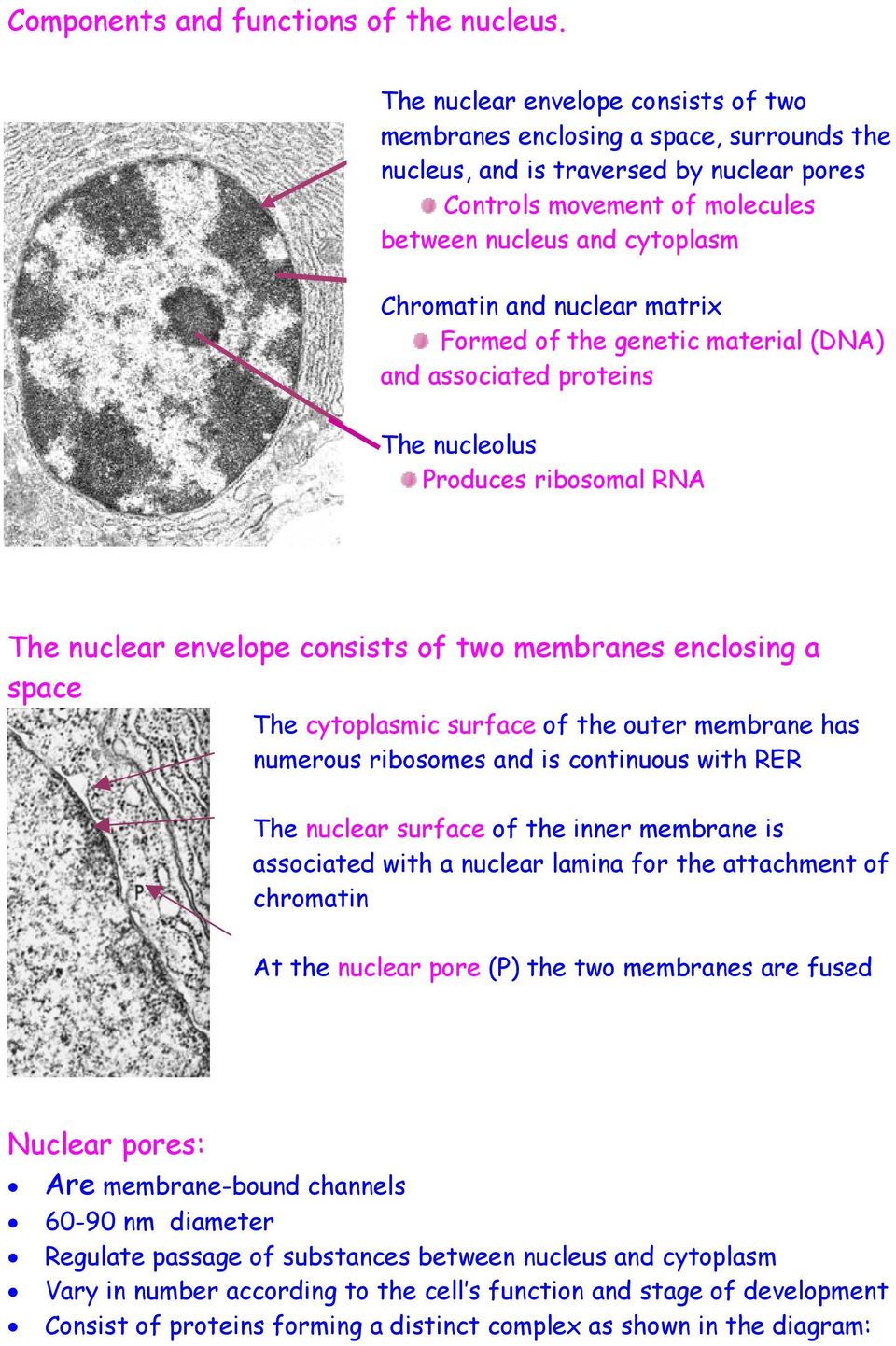
3 an annulus of 8 proteins radial spokes a central plug Nuclear pore complexes can be isolated by chemical treatment 1. Differential centrifugation separates the nuclei 2. NaHCO 3 makes the chromatin soluble - the remaining nuclear envelopes are termed nuclear ghosts 3. Differential centrifugation separate the nuclear ghosts 4. Detergents are used to dissolve the lipid membranes the isolated pore complexes (protein) remain 5. Centrifugation isolates the pore complexes The pore complexes have a distinct structure consisting of a rosette of 8 granules. Passage of Substances Through Nuclear Pores The molecules that pass from the cytoplasm into the nucleus are mainly: (a) Ions; (b) Nucleotides for DNA synthesis; (c) Proteins for binding to DNA The molecules that pass from the nucleus into the cytoplasm are m-rna and r-rna bound to protein as RNA-protein complexes.
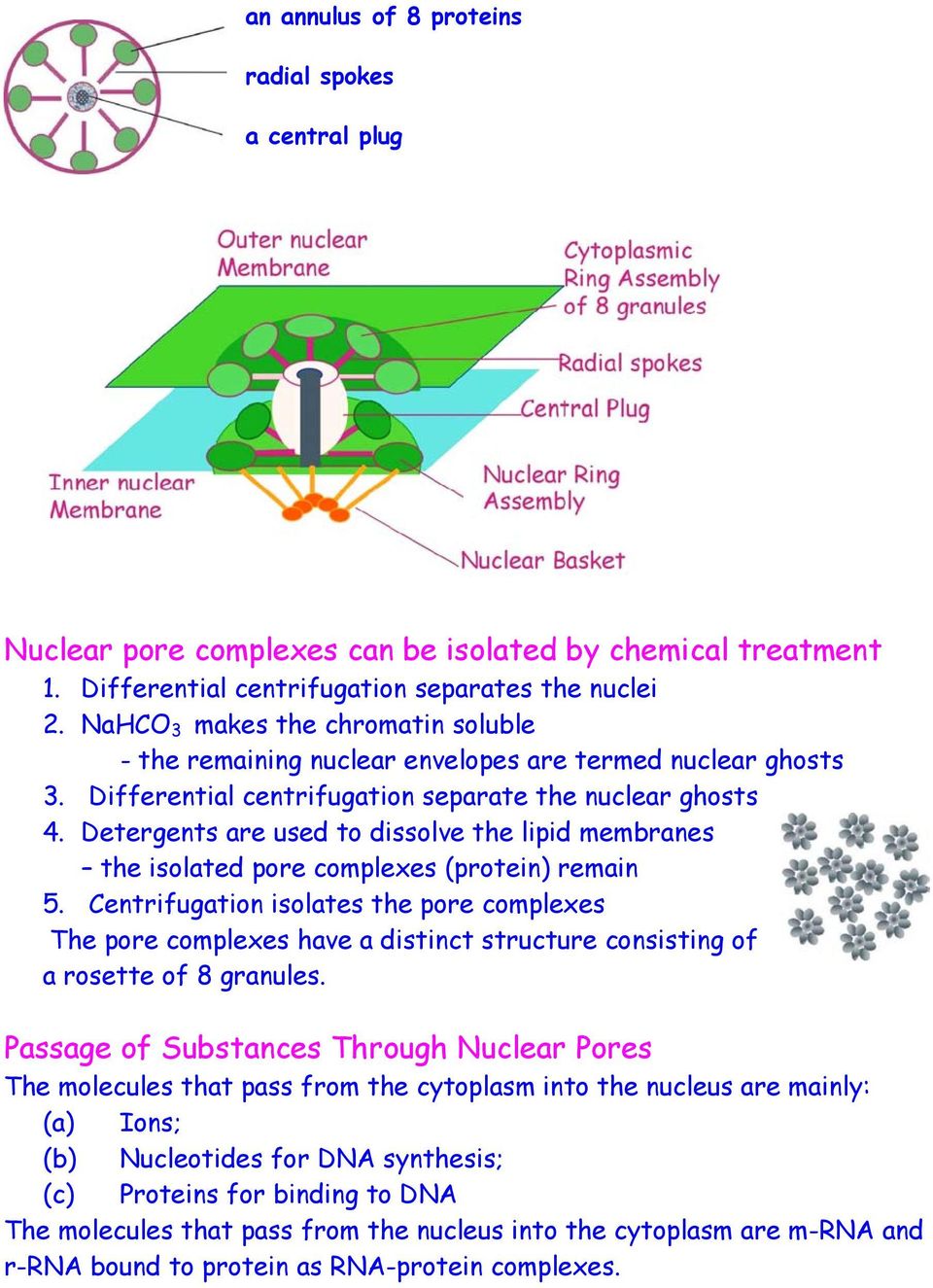
4 Protein molecules require a special mechanism to pass through the nuclear pores: - a signal at the -COOH end of the protein - a signal receptor at the pore boundary Protein - membrane-bound ATPase to releases energy for the process A fibrous lamina is situated on the nuclear surface of the nuclear envelope: - It consists of proteins. - It has a woven fibrillar structure - It serves to anchor the chromatin to the nuclear envelope The main proteins of nuclear envelope are: 1. Pore proteins: Large pore proteins (known as gp210) - Anchor the pore complex to membrane Small pore protein (known as p62) - Regulate transport through the pore 2. Lamins: Consist of 3 types: Lamins A, B, C Form a meshwork of filaments (similar to intermediate filaments) in the nuclear lamina Bind chromatin to receptor proteins in the inner membrane of the nuclear envelope. They are attached in the following sequence: Receptor protein Lamin B Lamins A & C Chromatin
5 The nucleus consists of fibrillar material termed chromatin Chromatin in nuclei exists as: a. heterochromatin - closely packed or condensed fibrils, where DNA is inactive. b. euchromation - loosely packed fibrils, where active transcription occurs The amount of euchromatin reflects the state of activity of the nucleus. Nuclei of cells that are actively synthesising proteins have a large amount of euchromatin (e.g. neurons renewing their organelles; plasma cells producing antibodies). Cells that are not actively synthesizing protein have heterochromatic nuclei (e.g. circulating lymphocytes are inactive cells in transit; sperm cells have very closely packed heterochromatin) The nuclear material consists of DNA Histone protein Non-histone chromosome protein RNA DNA and proteins are organised in a highly regular pattern to form nucleosomes and chromatin. The proteins regulate the packing of DNA. Proteins constitute over 80% of the total mass of nuclear material, while DNA forms 15 to 20%. There are 5 histone proteins associated with DNA Two molecules each of histones H2A, H2B, H3 and H4 form a histone core.

6 DNA is wound around the histone cores - two turns of DNA around each core form a nucleosome. The DNA of each nucleosome contains 146 nucleotide pairs. The stretch of DNA between one nucleosome and the next is called linker DNA. H1 histone is associated with the linker DNA. Nucleosomes can be isolated from chromatin by treatment with a hypotonic solution in an aqueous medium. H1 histones are responsible for the primary coiling of DNA When chromatin is exposed to dextran sulphate, it is depleted of histones. The histone-depleted chromatin forms free loops of DNA emanating from the chromatin mass. Further coiling of chromatin fibres is responsible for different levels and types of packaging. This supercoiling is dependent on the non-histone chromosome proteins. (NHCP) Among the large variety of NHCP are two enzymes which control the supercoiling are topoisomerase II and topoisimerase I. Complex coiling of nucleosome chains form chromatin fibrils. Chromatin fibres have a diameter of nm diameter. 20nm Note that the chromatin in electron micrographs has a fibrillar structure. Each fibril is a chromatin fiber with a diameterof 20-30nm.

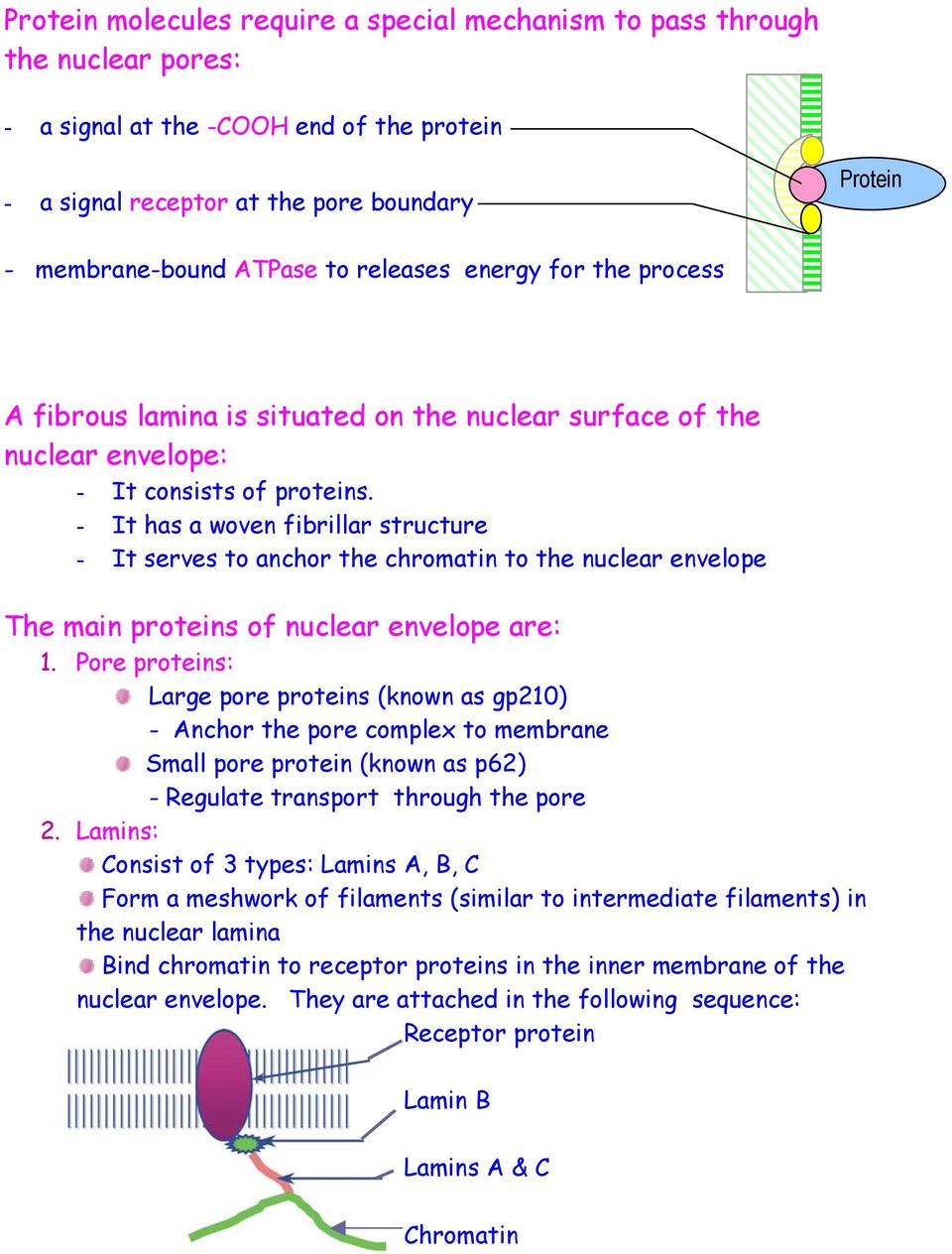
7 The nucleolus consists of: A dense fibrillar part, consisting of DNA, carries the message for synthesis of r-rna A pale granular part, consisting of r-rna is combined with protein to form ribonucleoprotein particles The presence of a prominent nucleolus indicates that the cell is actively synthesizing protein. A prominent nucleolus is present in proteinsecreting cells such as those of the pancreas, plasma cells, developing blood cell precursors and others The nuclear matrix is a residual network of protein fibrils remaining after: Removal of nuclear envelope (using detergent) Removal of histones (using high salt concentration) Removal of DNA (using nuclease) The DNA Molecule Consists of a Long Nucleotide Chain. Each nucleotide consists of 3 elements: 1. A pentose sugar molecule (deoxyribose) 2. A phosphate group that links one nucleotide to another 3. A base that could be one of the following: Adenine Cytosine Thymine Guanine Some Features of the DNA Molecule DNA is a very long molecule consisting of two strands of nucleotides. The two polynucleotide strands run in opposite directions Each strand has a polarity indicated by 3 and 5 ends Specific base pairing links the two strands: Adenine always pairs with Thymine; Cytosine always pairs with Guanine
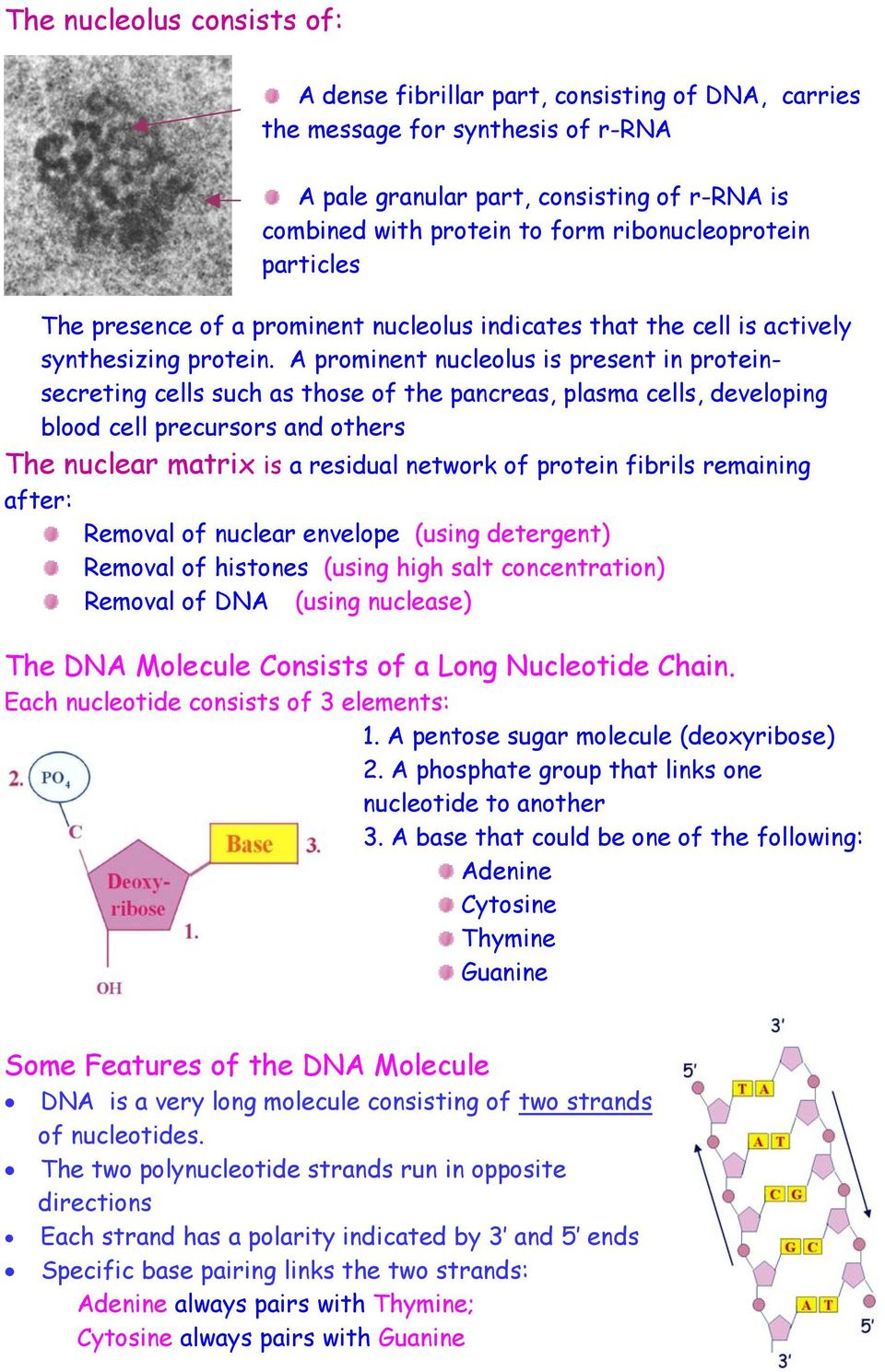
8 Characteristics Of DNA - Shape and size: The DNA molecule: * has the form of a double helix * has a diameter of 2 nm. * one spiral turn = 3.4 nm length contains 10 base pairs. Note: 1 nanometre (nm) = 10-9 m. DNA has 3 basic properties 1. DNA REPLICATES ITSELF DNA makes an identical copy of itself. This function is possible because of specific base pairing. The two DNA strands separate by breaking open the H-bonds linking the bases. Each DNA strand serves as a template for the synthesis of a complementary chain of nucleotides. Specific base pairing ensures that the sequence of bases is preserved on both molecules of DNA. DNA replication is the basis of propagation of life. DNA replication involves two main steps: 1. The two strands of DNA separate:
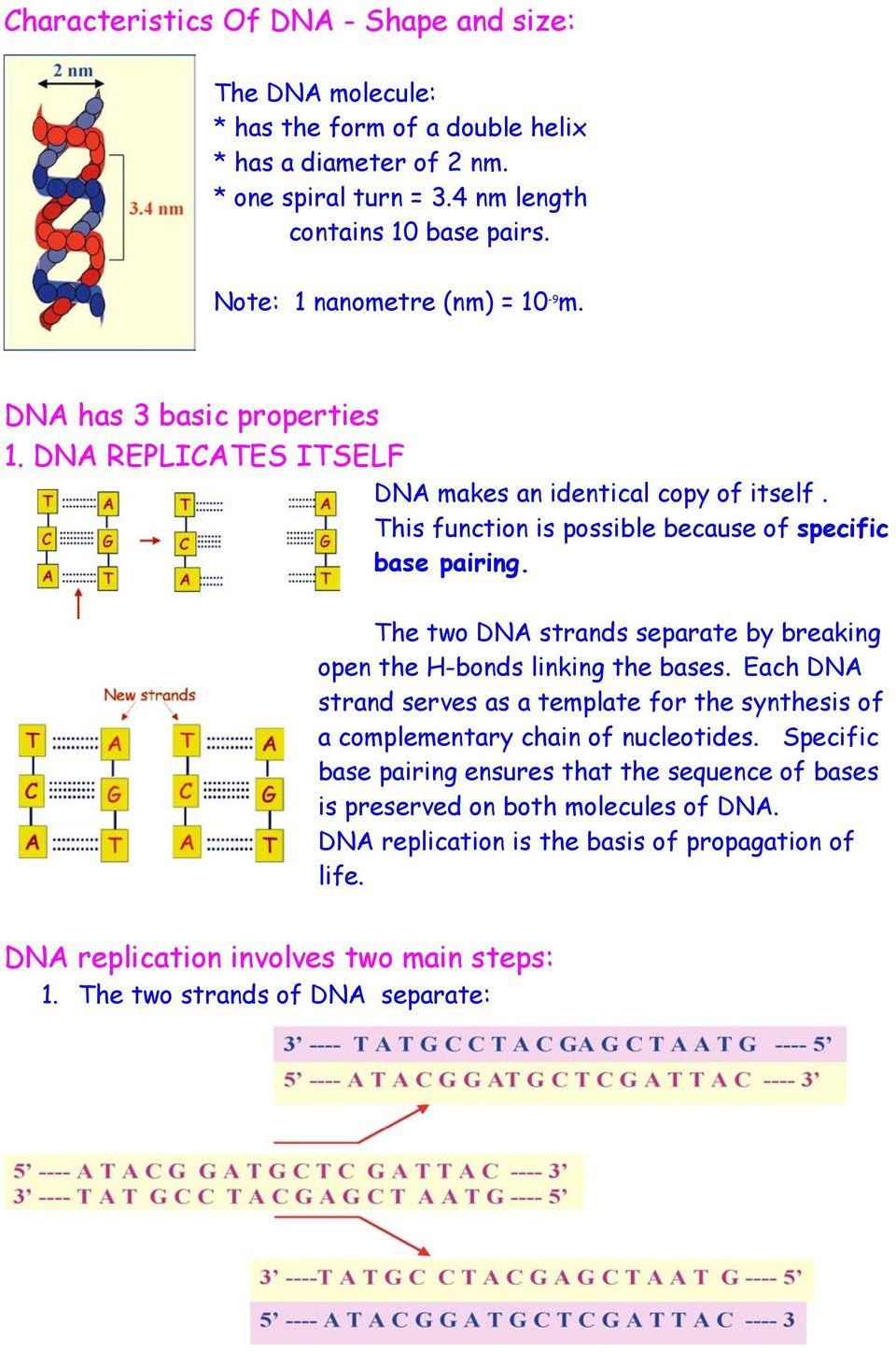
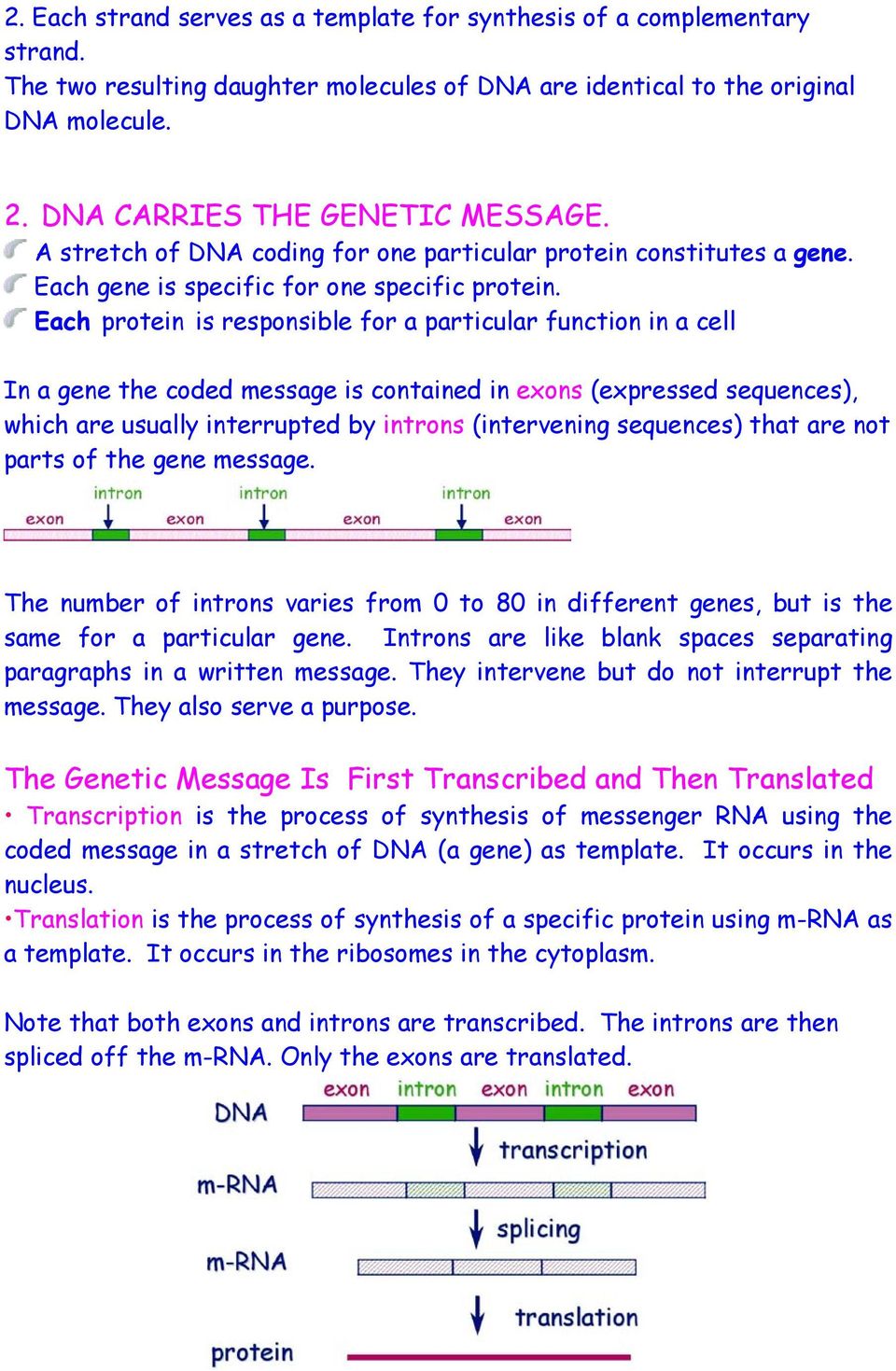
9 2. Each strand serves as a template for synthesis of a complementary strand. The two resulting daughter molecules of DNA are identical to the original DNA molecule. 2. DNA CARRIES THE GENETIC MESSAGE. A stretch of DNA coding for one particular protein constitutes a gene. Each gene is specific for one specific protein. Each protein is responsible for a particular function in a cell In a gene the coded message is contained in exons (expressed sequences), which are usually interrupted by introns (intervening sequences) that are not parts of the gene message. The number of introns varies from 0 to 80 in different genes, but is the same for a particular gene. Introns are like blank spaces separating paragraphs in a written message. They intervene but do not interrupt the message. They also serve a purpose. The Genetic Message Is First Transcribed and Then Translated Transcription is the process of synthesis of messenger RNA using the coded message in a stretch of DNA (a gene) as template. It occurs in the nucleus. Translation is the process of synthesis of a specific protein using m-rna as a template. It occurs in the ribosomes in the cytoplasm. Note that both exons and introns are transcribed. The introns are then spliced off the m-rna. Only the exons are translated.
10 Translation Requires 3 Types of RNA i. Messenger-RNA (m-rna) - Serves as a template for the formation of a specific protein. - Is specific - There is one m-rna for each protein. ii. Ribosomal-RNA (r-rna) - Is required for the assembly of ribosomes. - Ribosomes are the machines that synthesize proteins based on the m-rna template. Ribosomes are non-specific i.e. they are used in the synthesis of all proteins. iii. Transfer-RNA (t-rna) - Transfers the appropriate amino-acid to a growing protein chain - There is one t-rna for each amino-acid 3. DNA IS UNIVERSAL Whatever the living organism - bacteria, plants, animals or man - the basic structure of DNA is the same. Only the sequence of bases differs and consequently the genetic message; the resulting proteins and their specific functions are also different. Because DNA is universal, DNA from one organism can be grafted on to the DNA of another organism. This is the basis of genetic engineering. Note the main processes that occur within the nucleus: Replication - the process of synthesis of DNA, which occurs prior to mitosis of meiosis Transcription - the process of synthesis of m-rna, a copy (transcript) of the genetic message in one gene Synthesis of r-rna - important components of the ribosomes Synthesis of t-rna - to be used in the cytoplasm for translation of proteins

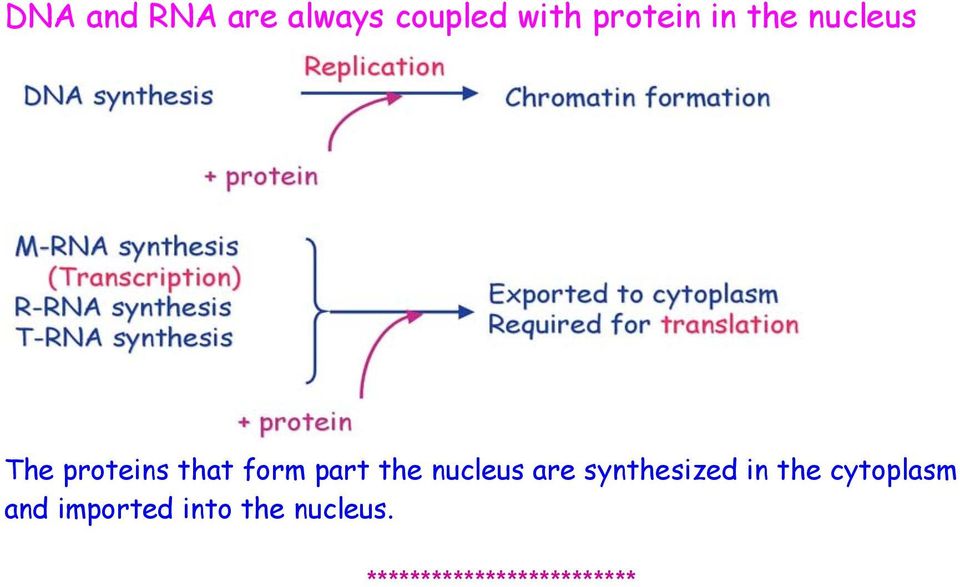
11 DNA and RNA are always coupled with protein in the nucleus The proteins that form part the nucleus are synthesized in the cytoplasm and imported into the nucleus. *************************
Compartmentalization of the Cell. Objectives. Recommended Reading. Professor Alfred Cuschieri. Department of Anatomy University of Malta
 Compartmentalization of the Cell Professor Alfred Cuschieri Department of Anatomy University of Malta Objectives By the end of this session the student should be able to: 1. Identify the different organelles
Genetic information (DNA) determines structure of proteins DNA RNA proteins cell structure 3.11 3.15 enzymes control cell chemistry ( metabolism )
 Biology 1406 Exam 3 Notes Structure of DNA Ch. 10 Genetic information (DNA) determines structure of proteins DNA RNA proteins cell structure 3.11 3.15 enzymes control cell chemistry ( metabolism ) Proteins
DNA Replication & Protein Synthesis. This isn t a baaaaaaaddd chapter!!!
 DNA Replication & Protein Synthesis This isn t a baaaaaaaddd chapter!!! The Discovery of DNA s Structure Watson and Crick s discovery of DNA s structure was based on almost fifty years of research by other
Molecular Genetics. RNA, Transcription, & Protein Synthesis
 Molecular Genetics RNA, Transcription, & Protein Synthesis Section 1 RNA AND TRANSCRIPTION Objectives Describe the primary functions of RNA Identify how RNA differs from DNA Describe the structure and
From DNA to Protein
 Nucleus Control center of the cell contains the genetic library encoded in the sequences of nucleotides in molecules of DNA code for the amino acid sequences of all proteins determines which specific proteins
Transcription and Translation of DNA
 Transcription and Translation of DNA Genotype our genetic constitution ( makeup) is determined (controlled) by the sequence of bases in its genes Phenotype determined by the proteins synthesised when genes
2. The number of different kinds of nucleotides present in any DNA molecule is A) four B) six C) two D) three
 Chem 121 Chapter 22. Nucleic Acids 1. Any given nucleotide in a nucleic acid contains A) two bases and a sugar. B) one sugar, two bases and one phosphate. C) two sugars and one phosphate. D) one sugar,
Cell Division CELL DIVISION. Mitosis. Designation of Number of Chromosomes. Homologous Chromosomes. Meiosis
 Cell Division CELL DIVISION Anatomy and Physiology Text and Laboratory Workbook, Stephen G. Davenport, Copyright 2006, All Rights Reserved, no part of this publication can be used for any commercial purpose.
Name Date Period. 2. When a molecule of double-stranded DNA undergoes replication, it results in
 DNA, RNA, Protein Synthesis Keystone 1. During the process shown above, the two strands of one DNA molecule are unwound. Then, DNA polymerases add complementary nucleotides to each strand which results
Translation Study Guide
 Translation Study Guide This study guide is a written version of the material you have seen presented in the replication unit. In translation, the cell uses the genetic information contained in mrna to
Lecture 26: Overview of deoxyribonucleic acid (DNA) and ribonucleic acid (RNA) structure
 Lecture 26: Overview of deoxyribonucleic acid (DNA) and ribonucleic acid (RNA) structure Nucleic acids play an important role in the storage and expression of genetic information. They are divided into
Name Class Date. Figure 13 1. 2. Which nucleotide in Figure 13 1 indicates the nucleic acid above is RNA? a. uracil c. cytosine b. guanine d.
 13 Multiple Choice RNA and Protein Synthesis Chapter Test A Write the letter that best answers the question or completes the statement on the line provided. 1. Which of the following are found in both
Answer: 2. Uracil. Answer: 2. hydrogen bonds. Adenine, Cytosine and Guanine are found in both RNA and DNA.
 Answer: 2. Uracil Adenine, Cytosine and Guanine are found in both RNA and DNA. Thymine is found only in DNA; Uracil takes its (Thymine) place in RNA molecules. Answer: 2. hydrogen bonds The complementary
PRACTICE TEST QUESTIONS
 PART A: MULTIPLE CHOICE QUESTIONS PRACTICE TEST QUESTIONS DNA & PROTEIN SYNTHESIS B 1. One of the functions of DNA is to A. secrete vacuoles. B. make copies of itself. C. join amino acids to each other.
3120-1 - Page 1. Name:
 Name: 1) Which series is arranged in correct order according to decreasing size of structures? A) DNA, nucleus, chromosome, nucleotide, nitrogenous base B) chromosome, nucleus, nitrogenous base, nucleotide,
Structure and Function of DNA
 Structure and Function of DNA DNA and RNA Structure DNA and RNA are nucleic acids. They consist of chemical units called nucleotides. The nucleotides are joined by a sugar-phosphate backbone. The four
Nucleotides and Nucleic Acids
 Nucleotides and Nucleic Acids Brief History 1 1869 - Miescher Isolated nuclein from soiled bandages 1902 - Garrod Studied rare genetic disorder: Alkaptonuria; concluded that specific gene is associated
Control of Gene Expression
 Home Gene Regulation Is Necessary? Control of Gene Expression By switching genes off when they are not needed, cells can prevent resources from being wasted. There should be natural selection favoring
Sample Questions for Exam 3
 Sample Questions for Exam 3 1. All of the following occur during prometaphase of mitosis in animal cells except a. the centrioles move toward opposite poles. b. the nucleolus can no longer be seen. c.
The Steps. 1. Transcription. 2. Transferal. 3. Translation
 Protein Synthesis Protein synthesis is simply the "making of proteins." Although the term itself is easy to understand, the multiple steps that a cell in a plant or animal must go through are not. In order
Lecture 1 MODULE 3 GENE EXPRESSION AND REGULATION OF GENE EXPRESSION. Professor Bharat Patel Office: Science 2, 2.36 Email: [email protected].
 Lecture 1 MODULE 3 GENE EXPRESSION AND REGULATION OF GENE EXPRESSION Professor Bharat Patel Office: Science 2, 2.36 Email: [email protected] What is Gene Expression & Gene Regulation? 1. Gene Expression
PRESTWICK ACADEMY NATIONAL 5 BIOLOGY CELL BIOLOGY SUMMARY
 Name PRESTWICK ACADEMY NATIONAL 5 BIOLOGY CELL BIOLOGY SUMMARY Cell Structure Identify animal, plant, fungal and bacterial cell ultrastructure and know the structures functions. Plant cell Animal cell
From DNA to Protein. Proteins. Chapter 13. Prokaryotes and Eukaryotes. The Path From Genes to Proteins. All proteins consist of polypeptide chains
 Proteins From DNA to Protein Chapter 13 All proteins consist of polypeptide chains A linear sequence of amino acids Each chain corresponds to the nucleotide base sequence of a gene The Path From Genes
DNA, RNA, Protein synthesis, and Mutations. Chapters 12-13.3
 DNA, RNA, Protein synthesis, and Mutations Chapters 12-13.3 1A)Identify the components of DNA and explain its role in heredity. DNA s Role in heredity: Contains the genetic information of a cell that can
Complex multicellular organisms are produced by cells that switch genes on and off during development.
 Home Control of Gene Expression Gene Regulation Is Necessary? By switching genes off when they are not needed, cells can prevent resources from being wasted. There should be natural selection favoring
A disaccharide is formed when a dehydration reaction joins two monosaccharides. This covalent bond is called a glycosidic linkage.
 CH 5 Structure & Function of Large Molecules: Macromolecules Molecules of Life All living things are made up of four classes of large biological molecules: carbohydrates, lipids, proteins, and nucleic
To be able to describe polypeptide synthesis including transcription and splicing
 Thursday 8th March COPY LO: To be able to describe polypeptide synthesis including transcription and splicing Starter Explain the difference between transcription and translation BATS Describe and explain
GENE REGULATION. Teacher Packet
 AP * BIOLOGY GENE REGULATION Teacher Packet AP* is a trademark of the College Entrance Examination Board. The College Entrance Examination Board was not involved in the production of this material. Pictures
The Cell: Organelle Diagrams
 The Cell: Organelle Diagrams Fig 7-4. A prokaryotic cell. Lacking a true nucleus and the other membrane-enclosed organelles of the eukaryotic cell, the prokaryotic cell is much simpler in structure. Only
Protein Synthesis How Genes Become Constituent Molecules
 Protein Synthesis Protein Synthesis How Genes Become Constituent Molecules Mendel and The Idea of Gene What is a Chromosome? A chromosome is a molecule of DNA 50% 50% 1. True 2. False True False Protein
Proteins and Nucleic Acids
 Proteins and Nucleic Acids Chapter 5 Macromolecules: Proteins Proteins Most structurally & functionally diverse group of biomolecules. : o Involved in almost everything o Enzymes o Structure (keratin,
12.1 The Role of DNA in Heredity
 12.1 The Role of DNA in Heredity Only in the last 50 years have scientists understood the role of DNA in heredity. That understanding began with the discovery of DNA s structure. In 1952, Rosalind Franklin
13.2 Ribosomes & Protein Synthesis
 13.2 Ribosomes & Protein Synthesis Introduction: *A specific sequence of bases in DNA carries the directions for forming a polypeptide, a chain of amino acids (there are 20 different types of amino acid).
Cytology. Living organisms are made up of cells. Either PROKARYOTIC or EUKARYOTIC cells.
 CYTOLOGY Cytology Living organisms are made up of cells. Either PROKARYOTIC or EUKARYOTIC cells. A. two major cell types B. distinguished by structural organization See table on handout for differences.
Appendix C DNA Replication & Mitosis
 K.Muma Bio 6 Appendix C DNA Replication & Mitosis Study Objectives: Appendix C: DNA replication and Mitosis 1. Describe the structure of DNA and where it is found. 2. Explain complimentary base pairing:
RNA & Protein Synthesis
 RNA & Protein Synthesis Genes send messages to cellular machinery RNA Plays a major role in process Process has three phases (Genetic) Transcription (Genetic) Translation Protein Synthesis RNA Synthesis
Lab # 12: DNA and RNA
 115 116 Concepts to be explored: Structure of DNA Nucleotides Amino Acids Proteins Genetic Code Mutation RNA Transcription to RNA Translation to a Protein Figure 12. 1: DNA double helix Introduction Long
Lecture Series 7. From DNA to Protein. Genotype to Phenotype. Reading Assignments. A. Genes and the Synthesis of Polypeptides
 Lecture Series 7 From DNA to Protein: Genotype to Phenotype Reading Assignments Read Chapter 7 From DNA to Protein A. Genes and the Synthesis of Polypeptides Genes are made up of DNA and are expressed
Replication Study Guide
 Replication Study Guide This study guide is a written version of the material you have seen presented in the replication unit. Self-reproduction is a function of life that human-engineered systems have
Eukaryotes. www.njctl.org PSI Biology Eukaryotes & Gene Expression
 Eukaryotes The Eukaryotic Cell Classwork 1. Identify two characteristics that are shared by all cells. 2. Suppose you are investigating a cell that contains a nucleus. Would you categorize this cell as
The Lipid Bilayer Is a Two-Dimensional Fluid
 The Lipid Bilayer Is a Two-Dimensional Fluid The aqueous environment inside and outside a cell prevents membrane lipids from escaping from bilayer, but nothing stops these molecules from moving about and
DNA. Discovery of the DNA double helix
 DNA Replication DNA Discovery of the DNA double helix A. 1950 s B. Rosalind Franklin - X-ray photo of DNA. C. Watson and Crick - described the DNA molecule from Franklin s X-ray. What is DNA? Question:
Genetics Module B, Anchor 3
 Genetics Module B, Anchor 3 Key Concepts: - An individual s characteristics are determines by factors that are passed from one parental generation to the next. - During gamete formation, the alleles for
Ms. Campbell Protein Synthesis Practice Questions Regents L.E.
 Name Student # Ms. Campbell Protein Synthesis Practice Questions Regents L.E. 1. A sequence of three nitrogenous bases in a messenger-rna molecule is known as a 1) codon 2) gene 3) polypeptide 4) nucleotide
Chapter 18 Regulation of Gene Expression
 Chapter 18 Regulation of Gene Expression 18.1. Gene Regulation Is Necessary By switching genes off when they are not needed, cells can prevent resources from being wasted. There should be natural selection
The Structure, Replication, and Chromosomal Organization of DNA
 Michael Cummings Chapter 8 The Structure, Replication, and Chromosomal Organization of DNA David Reisman University of South Carolina History of DNA Discoveries Friedrich Miescher Isolated nuclein from
The Cell Interior and Function
 The Cell Interior and Function 5 5.0 CHAPTER PREVIEW Investigate and understand the organization and function of the cell interior. Define the differences between eukaryotic and prokaryotic cell structure.
Chapter 4: A Tour of the Cell. 1. Cell Basics. Limits to Cell Size. 1. Cell Basics. 2. Prokaryotic Cells. 3. Eukaryotic Cells
 Chapter 4: A Tour of the Cell 1. Cell Basics 2. Prokaryotic Cells 3. Eukaryotic Cells 1. Cell Basics Limits to Cell Size There are 2 main reasons why cells are so small: If cells get too large: 1) there
Given these characteristics of life, which of the following objects is considered a living organism? W. X. Y. Z.
 Cell Structure and Organization 1. All living things must possess certain characteristics. They are all composed of one or more cells. They can grow, reproduce, and pass their genes on to their offspring.
Thymine = orange Adenine = dark green Guanine = purple Cytosine = yellow Uracil = brown
 1 DNA Coloring - Transcription & Translation Transcription RNA, Ribonucleic Acid is very similar to DNA. RNA normally exists as a single strand (and not the double stranded double helix of DNA). It contains
a. Ribosomal RNA rrna a type ofrna that combines with proteins to form Ribosomes on which polypeptide chains of proteins are assembled
 Biology 101 Chapter 14 Name: Fill-in-the-Blanks Which base follows the next in a strand of DNA is referred to. as the base (1) Sequence. The region of DNA that calls for the assembly of specific amino
RAD 223. Radiography physiology. Lecture Notes. First lecture: Cell and Tissue
 RAD 223 Radiography physiology Lecture Notes First lecture: Cell and Tissue Physiology: the word physiology derived from a Greek word for study of nature. It is the study of how the body and its part work
Bacterial (Prokaryotic) Cell. Common features of all cells. Tour of the Cell. Eukaryotic Cell. Plasma Membrane defines inside from outside
 www.denniskunkel.com Tour of the Cell www.denniskunkel.com Today s Topics Properties of all cells Prokaryotes and Eukaryotes Functions of Major Cellular Organelles Information, Synthesis&Transport,, Vesicles
Cellular Respiration Worksheet 1. 1. What are the 3 phases of the cellular respiration process? Glycolysis, Krebs Cycle, Electron Transport Chain.
 Cellular Respiration Worksheet 1 1. What are the 3 phases of the cellular respiration process? Glycolysis, Krebs Cycle, Electron Transport Chain. 2. Where in the cell does the glycolysis part of cellular
Today you will extract DNA from some of your cells and learn more about DNA. Extracting DNA from Your Cells
 DNA Based on and adapted from the Genetic Science Learning Center s How to Extract DNA from Any Living Thing (http://learn.genetics.utah.edu/units/activities/extraction/) and BioRad s Genes in a bottle
3.1 AS Unit: Cells, Exchange and Transport
 3.1 AS Unit: Cells, Exchange and Transport Module 1: Cells 1.1.1 Cell Structure Candidates should be able to: (a) state the resolution and magnification that can be achieved by a light microscope, a transmission
* The cell is the basic structural and functional unit of life. * Organismal activity depends on individual and collective activity of cells.
 Define Cell * The cell is the basic structural and functional unit of life. * Organismal activity depends on individual and collective activity of cells. * Biochemical activities of cells are dictated
Organelle Speed Dating Game Instructions and answers for teachers
 Organelle Speed Dating Game Instructions and answers for teachers These instructions should accompany the OCR resources GCSE (9 1) Combined Science 21 st Century Science B Organelle Speed Dating Game learner
Cell Structure and Function. Eukaryotic Cell: Neuron
 Cell Structure and Function Eukaryotic Cell: Neuron Cell Structure and Function Eukaryotic Cells: Blood Cells Cell Structure and Function Prokaryotic Cells: Bacteria Cell Structure and Function All living
ISTEP+: Biology I End-of-Course Assessment Released Items and Scoring Notes
 ISTEP+: Biology I End-of-Course Assessment Released Items and Scoring Notes Page 1 of 22 Introduction Indiana students enrolled in Biology I participated in the ISTEP+: Biology I Graduation Examination
The Molecules of Cells
 The Molecules of Cells I. Introduction A. Most of the world s population cannot digest milk-based foods. 1. These people are lactose intolerant because they lack the enzyme lactase. 2. This illustrates
Lecture 4 Cell Membranes & Organelles
 Lecture 4 Cell Membranes & Organelles Structure of Animal Cells The Phospholipid Structure Phospholipid structure Encases all living cells Its basic structure is represented by the fluidmosaic model Phospholipid
Biology 101 Chapter 4 Cells as the Basic Unit of Life. The Cell Theory Major Contributors: Galileo = first observations made with a microscope
 Biology 101 Chapter 4 Cells as the Basic Unit of Life The Cell Theory Major Contributors: Galileo = first observations made with a microscope Robert Hooke = first to observe small compartments in dead
CELLS IN THE NERVOUS SYSTEM
 NEURONS AND GLIA CELLS IN THE NERVOUS SYSTEM Glia Insulates, supports, and nourishes neurons Neurons Process information Sense environmental changes Communicate changes to other neurons Command body response
2007 7.013 Problem Set 1 KEY
 2007 7.013 Problem Set 1 KEY Due before 5 PM on FRIDAY, February 16, 2007. Turn answers in to the box outside of 68-120. PLEASE WRITE YOUR ANSWERS ON THIS PRINTOUT. 1. Where in a eukaryotic cell do you
Control of Gene Expression
 Control of Gene Expression What is Gene Expression? Gene expression is the process by which informa9on from a gene is used in the synthesis of a func9onal gene product. What is Gene Expression? Figure
CELLS: PLANT CELLS 20 FEBRUARY 2013
 CELLS: PLANT CELLS 20 FEBRUARY 2013 Lesson Description In this lesson we will discuss the following: The Cell Theory Terminology Parts of Plant Cells: Organelles Difference between plant and animal cells
CHAPTER 6: RECOMBINANT DNA TECHNOLOGY YEAR III PHARM.D DR. V. CHITRA
 CHAPTER 6: RECOMBINANT DNA TECHNOLOGY YEAR III PHARM.D DR. V. CHITRA INTRODUCTION DNA : DNA is deoxyribose nucleic acid. It is made up of a base consisting of sugar, phosphate and one nitrogen base.the
The sequence of bases on the mrna is a code that determines the sequence of amino acids in the polypeptide being synthesized:
 Module 3F Protein Synthesis So far in this unit, we have examined: How genes are transmitted from one generation to the next Where genes are located What genes are made of How genes are replicated How
Chapter 11: Molecular Structure of DNA and RNA
 Chapter 11: Molecular Structure of DNA and RNA Student Learning Objectives Upon completion of this chapter you should be able to: 1. Understand the major experiments that led to the discovery of DNA as
Control of Gene Expression
 Control of Gene Expression (Learning Objectives) Explain the role of gene expression is differentiation of function of cells which leads to the emergence of different tissues, organs, and organ systems
Algorithms in Computational Biology (236522) spring 2007 Lecture #1
 Algorithms in Computational Biology (236522) spring 2007 Lecture #1 Lecturer: Shlomo Moran, Taub 639, tel 4363 Office hours: Tuesday 11:00-12:00/by appointment TA: Ilan Gronau, Taub 700, tel 4894 Office
Biochemistry of Cells
 Biochemistry of Cells 1 Carbon-based Molecules Although a cell is mostly water, the rest of the cell consists mostly of carbon-based molecules Organic chemistry is the study of carbon compounds Carbon
Guided Notes: Chapter 9 Cellular Reproduction
 Guided Notes: Cellular Reproduction When do cells divide? Cells grow and function normally until they become too. Cell size is because increases faster than This means that there is not enough area on
AS Biology Unit 2 Key Terms and Definitions. Make sure you use these terms when answering exam questions!
 AS Biology Unit 2 Key Terms and Definitions Make sure you use these terms when answering exam questions! Chapter 7 Variation 7.1 Random Sampling Sampling a population to eliminate bias e.g. grid square
Cells & Cell Organelles
 Cells & Cell Organelles The Building Blocks of Life H Biology Types of cells bacteria cells Prokaryote - no organelles Eukaryotes - organelles animal cells plant cells Cell size comparison Animal cell
7.2 Cell Structure. Lesson Objectives. Lesson Summary. Cell Organization Eukaryotic cells contain a nucleus and many specialized structures.
 7.2 Cell Structure Lesson Objectives Describe the structure and function of the cell nucleus. Describe the role of vacuoles, lysosomes, and the cytoskeleton. Identify the role of ribosomes, endoplasmic
Basic Concepts of DNA, Proteins, Genes and Genomes
 Basic Concepts of DNA, Proteins, Genes and Genomes Kun-Mao Chao 1,2,3 1 Graduate Institute of Biomedical Electronics and Bioinformatics 2 Department of Computer Science and Information Engineering 3 Graduate
Cell Unit Practice Test #1
 ell Unit Practice Test #1 Name: ate: 1. Which organelle is primarily concerned with the conversion of potential energy of organic compounds into suitable form for immediate use by the cell?. mitochondria.
1 Mutation and Genetic Change
 CHAPTER 14 1 Mutation and Genetic Change SECTION Genes in Action KEY IDEAS As you read this section, keep these questions in mind: What is the origin of genetic differences among organisms? What kinds
1.1.2. thebiotutor. AS Biology OCR. Unit F211: Cells, Exchange & Transport. Module 1.2 Cell Membranes. Notes & Questions.
 thebiotutor AS Biology OCR Unit F211: Cells, Exchange & Transport Module 1.2 Cell Membranes Notes & Questions Andy Todd 1 Outline the roles of membranes within cells and at the surface of cells. The main
Cell Structure & Function!
 Cell Structure & Function! Chapter 3! The most exciting phrase to hear in science, the one that heralds new discoveries, is not 'Eureka!' but 'That's funny.! -- Isaac Asimov Animal Cell Plant Cell Cell
Module 3 Questions. 7. Chemotaxis is an example of signal transduction. Explain, with the use of diagrams.
 Module 3 Questions Section 1. Essay and Short Answers. Use diagrams wherever possible 1. With the use of a diagram, provide an overview of the general regulation strategies available to a bacterial cell.
CHROMOSOME STRUCTURE CHROMOSOME NUMBERS
 CHROMOSOME STRUCTURE 1. During nuclear division, the DNA (as chromatin) in a Eukaryotic cell's nucleus is coiled into very tight compact structures called chromosomes. These are rod-shaped structures made
Academic Nucleic Acids and Protein Synthesis Test
 Academic Nucleic Acids and Protein Synthesis Test Multiple Choice Identify the letter of the choice that best completes the statement or answers the question. 1. Each organism has a unique combination
Lesson Aim To explain the human body at a microscopic level, including the structure and function of cells, tissues and membranes.
 LESSON 1. CELLS & TISSUES Lesson Aim To explain the human body at a microscopic level, including the structure and function of cells, tissues and membranes. THE CELL All living matter is composed of functional
Chapter 2: Cell Structure and Function pg. 70-107
 UNIT 1: Biochemistry Chapter 2: Cell Structure and Function pg. 70-107 Organelles are internal structures that carry out specialized functions, interacting and complementing each other. Animal and plant
Lecture 8. Protein Trafficking/Targeting. Protein targeting is necessary for proteins that are destined to work outside the cytoplasm.
 Protein Trafficking/Targeting (8.1) Lecture 8 Protein Trafficking/Targeting Protein targeting is necessary for proteins that are destined to work outside the cytoplasm. Protein targeting is more complex
Central Dogma. Lecture 10. Discussing DNA replication. DNA Replication. DNA mutation and repair. Transcription
 Central Dogma transcription translation DNA RNA Protein replication Discussing DNA replication (Nucleus of eukaryote, cytoplasm of prokaryote) Recall Replication is semi-conservative and bidirectional
DNA (genetic information in genes) RNA (copies of genes) proteins (functional molecules) directionality along the backbone 5 (phosphate) to 3 (OH)
 DNA, RNA, replication, translation, and transcription Overview Recall the central dogma of biology: DNA (genetic information in genes) RNA (copies of genes) proteins (functional molecules) DNA structure
Viruses. Viral components: Capsid. Chapter 10: Viruses. Viral components: Nucleic Acid. Viral components: Envelope
 Viruses Chapter 10: Viruses Lecture Exam #3 Wednesday, November 22 nd (This lecture WILL be on Exam #3) Dr. Amy Rogers Office Hours: MW 9-10 AM Too small to see with a light microscope Visible with electron
2. True or False? The sequence of nucleotides in the human genome is 90.9% identical from one person to the next. False (it s 99.
 1. True or False? A typical chromosome can contain several hundred to several thousand genes, arranged in linear order along the DNA molecule present in the chromosome. True 2. True or False? The sequence
Protein Synthesis. Page 41 Page 44 Page 47 Page 42 Page 45 Page 48 Page 43 Page 46 Page 49. Page 41. DNA RNA Protein. Vocabulary
 Protein Synthesis Vocabulary Transcription Translation Translocation Chromosomal mutation Deoxyribonucleic acid Frame shift mutation Gene expression Mutation Point mutation Page 41 Page 41 Page 44 Page
Chapter 5. The Structure and Function of Macromolecule s
 Chapter 5 The Structure and Function of Macromolecule s Most Macromolecules are polymers: Polymer: (poly: many; mer: part) Large molecules consisting of many identical or similar subunits connected together.
cells - relatively simple cells - lack nuclear membrane and many organelles - bacteria and their relatives are all prokaryotic
 Cell Biology A cell is chemical system that is able to maintain its structure and reproduce. Cells are the fundamental unit of life. All living things are cells or composed of cells. 1 The interior contents
DNA Paper Model Activity Level: Grade 6-8
 Karen Mayes DNA Paper Model Activity Level: Grade 6-8 Students will be able to: 1. Identify the component molecules of DNA. 2. Construct a model of the DNA double-helix. 3. Identify which bases are found
MCAS Biology. Review Packet
 MCAS Biology Review Packet 1 Name Class Date 1. Define organic. THE CHEMISTRY OF LIFE 2. All living things are made up of 6 essential elements: SPONCH. Name the six elements of life. S N P C O H 3. Elements
Coding sequence the sequence of nucleotide bases on the DNA that are transcribed into RNA which are in turn translated into protein
 Assignment 3 Michele Owens Vocabulary Gene: A sequence of DNA that instructs a cell to produce a particular protein Promoter a control sequence near the start of a gene Coding sequence the sequence of
CCR Biology - Chapter 8 Practice Test - Summer 2012
 Name: Class: Date: CCR Biology - Chapter 8 Practice Test - Summer 2012 Multiple Choice Identify the choice that best completes the statement or answers the question. 1. What did Hershey and Chase know