
Three-Phase Induction Motor
|
|
|
- Irma Hensley
- 9 years ago
- Views:
Transcription
1 EXPERIMENT Induction motor Three-Phase Induction Motors 208V LL OBJECTIVE This experiment demonstrates the performance of squirrel-cage induction motors and the method for deriving electrical equivalent circuits from test data. REFERENCES 1. Electric Machinery, Fitzgerald, Kingsley, and Umans, McGraw-Hill Book Company, 1983, Chapter Electric Machinery and Transformers, Kosow, Irving L., Prentice-Hall, Inc., Electromechanical Energy Conversion, Brown, David, and Hamilton, E. P., MacMillan Publishing Company, Electromechanics and Electric Machines, Nasar, S. A., and Unnewehr, L. E., John Wiley and Sons, BACKGROUND INFORMATION The three-phase squirrel-cage induction motor can, and many times does, have the same armature (stator) winding as the three-phase synchronous motor. As in the synchronous motor, applying three-phase currents to the armature creates a synchronously-rotating magnetic field. The induction motor rotor is a completely short-circuited conductive cage. Figures 1 and 2 illustrate the rotor construction. Revised: April 11, of 10

2 Figure 1: Induction machine construction. Figure 2: Squirrel-case rotor. Revised: April 11, of 10
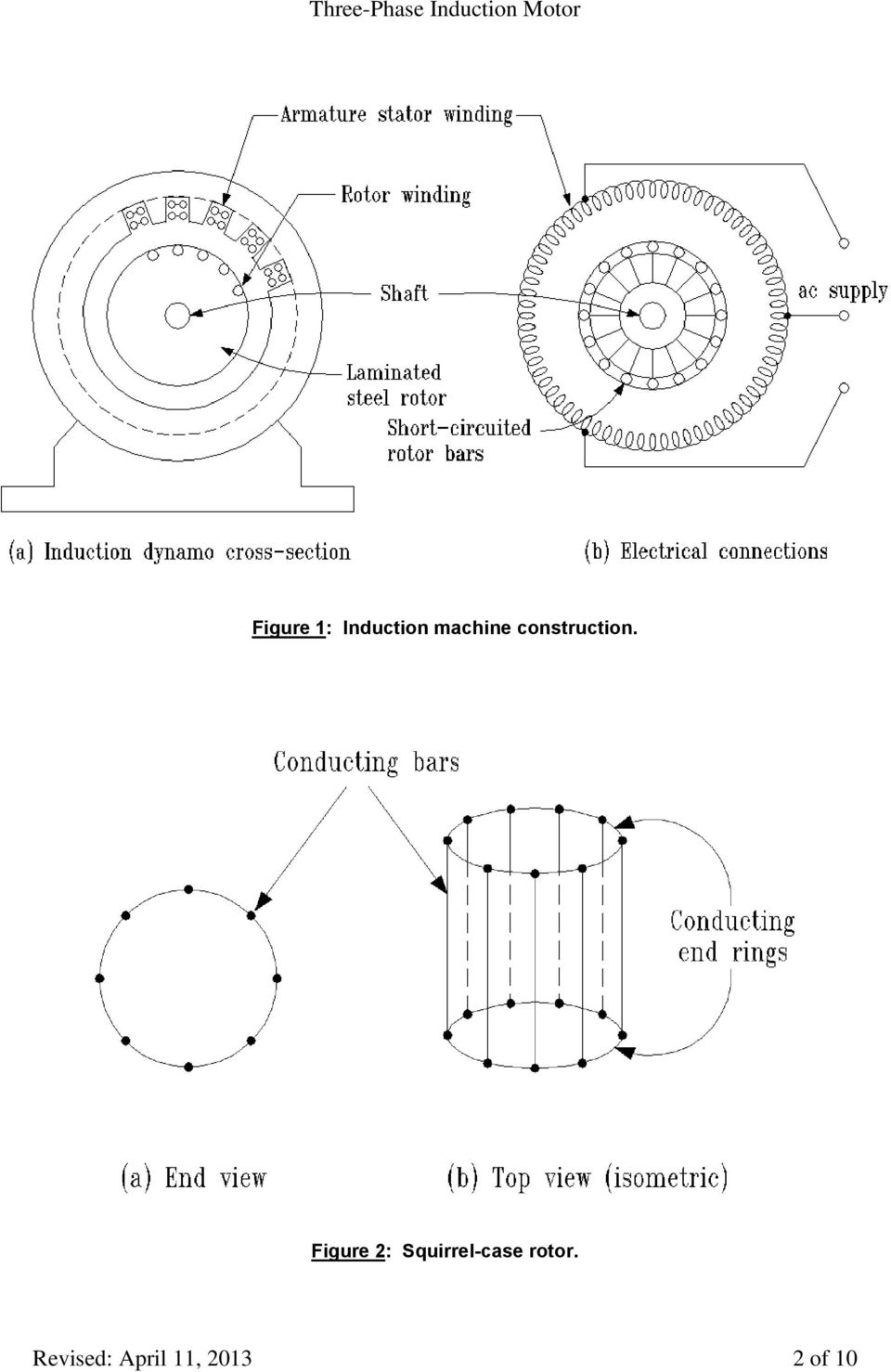
3 The rotor receives its excitation by induction from the armature field. Hence, the induction machine is a doubly-excited machine in the same sense as the synchronous and DC machines. The basic principle of operation is described by Faraday s Law. If we assume that the machine rotor is at a standstill and the armature is excited, then the armature-produced rotating field is moving with respect to the rotor. In fact, the relative speed between the rotating field and the rotor is synchronous speed. For this condition, the rotating field induces a large voltage in the rotor bars. The large voltage causes a large current in the squirrel-case which, in turn, creates a magnetic field in the rotor. The rotor magnetic field interacts with the armature magnetic field, and a torque is produced. If the produced torque is larger than any load torque, the rotor begins to turn. As the rotor accelerates, the speed difference between the rotor and the armature field is reduced. This reduced speed difference (or slip) causes the induced rotor voltage to be reduced, the rotor current to be reduced, the rotor flux to be reduced, and the torque produced by the machine to be reduced. Eventually, the torque produced by the motor equals the torque demanded by the load, and the motor settles to an equilibrium rotor speed. This equilibrium rotor speed must be less than synchronous speed since there must be a slip to produce torque. The frequency-dependent nature of the rotor impedances causes the torque versus speed characteristic of the induction motor to be quite non-linear. Figure 3 shows a typical characteristic. Figure 3: Typical induction motor torque-speed curve. Designers have learned to design rotors for specific torque characteristics. The National Electrical Manufacturers Association NEMA has classified and standard designs which satisfy a range of torquespeed characteristics. Figure 4 shows the NEMA designs and the rotor bar geometries that produce the responses. Revised: April 11, of 10

4 Figure 4: Effects of rotor bar geometry on torque characteristics in squirrel-case machines. The induction motor is normally modeled as an equivalent electrical circuit. Figure 5 shows typical equivalent circuits. Revised: April 11, of 10

5 Figure 5: Two forms of equivalent circuits of an induction motor. Remember SLIP =( SPEED syn SPEED m) / SPEED syn P = T ω Q S 2 P r' Pdev I 2 2 (1 slip ) 2 slip T = P/ω 2 for one phase Rsc = Psc / I 2 SC Xsc = Q SC / I 2 SC R 1= 6.6Ώ R2=Rsc R1 X1 = X2 = Xsc / 2 pf = P/S Z1 = R1 + J X1 Vcore = Voc ( Ioc)(Z1) Pcore =Poc R1(Ioc 2 ) Qcore= Qoc X1(Ioc 2 ) Rc = (Vcore) 2 / Pcore Xm = (Vcore) 2 / Qcore Revised: April 11, of 10

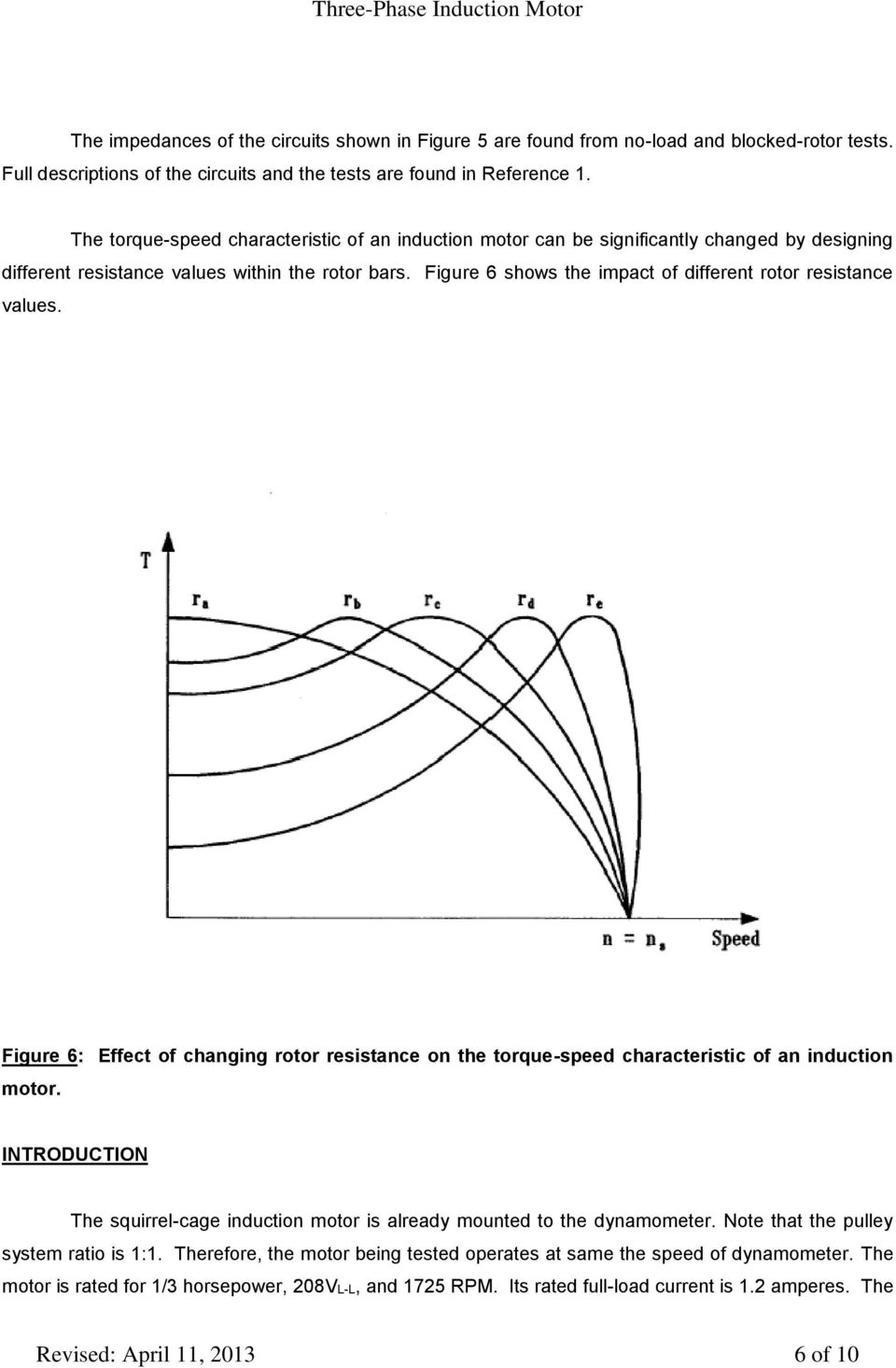
6 The impedances of the circuits shown in Figure 5 are found from no-load and blocked-rotor tests. Full descriptions of the circuits and the tests are found in Reference 1. The torque-speed characteristic of an induction motor can be significantly changed by designing different resistance values within the rotor bars. Figure 6 shows the impact of different rotor resistance values. Figure 6: Effect of changing rotor resistance on the torque-speed characteristic of an induction motor. INTRODUCTION The squirrel-cage induction motor is already mounted to the dynamometer. Note that the pulley system ratio is 1:1. Therefore, the motor being tested operates at same the speed of dynamometer. The motor is rated for 1/3 horsepower, 208VL-L, and 1725 RPM. Its rated full-load current is 1.2 amperes. The Revised: April 11, of 10
7 stator resistance was measured by an ohmmeter and is 6.6 /phase. This is the R 1 value to be used for the equivalent circuit. Note that R 1 cannot be neglected for the no-load tests. The neutral of the motor is not accessible; however, since the motor is balanced, its effective neutral will be very close to the power supply neutral. We cannot run a test to measure the actual starting torque at rated voltage. The current is very high and quickly burns the motor. SUGGESTED PROCEDURE 1. Connect the system shown in Figure 7. Note that the measured voltages are line-to-line values, measured currents are phase currents, and measured power is for one phase only. Run the no-load test at rated voltage (208VL-L). Record I, VL-L, P1 -. V L-L Rated V L-N Calculated I Line P in phase 208V L-L Secure the motor with the clamp. Run the blocked-rotor test at rated line current (1.2A). Record I, VL-L, P1 -. Note line voltage will be less than 40V V L-L V L-N Calculated I Line P in phase 1.2A 2. Remove the rotor lock from the dynamometer and apply rated voltage to the induction motor. Place all five switches on the load bank in the up position. Adjust the dynamometer field to load the induction motor to rated current (1.2A). Measure the torque and speed. V L-L Rated I Line Rated P in phase RPM Torque V Dyn I Dyn 208V 1.2A 3. For the following test, do not let the machine run above rated current for sustained periods of time. a) Using 100% of rated voltage (208VL-L), maintain constant, take the measurements shown to complete the table below, as motor armature current is varied from rated current (1.2A) to 1.5 Amps. Control the induction motor line current by adjusting the dynamometer field. Revised: April 11, of 10

8 Vmot L-L Imot RPM Torque Vd Id 208 V 1.2 A 208 V 1.25 A 208 V 1.3 A 208 V 1.35 A 208 V 1.4 A 208 V 1.45 A 208 V 1.5 A 100 % Voltage Line-to-Line b) Repeat part a using 90% of rated voltage. Complete the table below.. Vmot L-L Imot RPM Torque Vd Id 187 V 1.2 A 187 V 1.25A 187 V 1.3 A 187 V 1.35 A 187 V 1.4 A 187 V 1.45 A 187 V 1.5 A 90 % Voltage Line-to-Line c) Repeat part a using 80% of rated voltage. Complete the table below. Vmot L-L Imot RPM Torque Vd Id 166 V 1.2 A 166 V 1.25A 166 V 1.3 A 166V 1.35 A 166 V 1.4 A 166 V 1.45 A 166V 1.5 A 80 % Voltage Line-to-Line Install the dynamometer lock for the next class. Revised: April 11, of 10

9 REPORT 1. Derive an equivalent circuit like Figure 5 for the tested machine. Assume a NEMA D motor. X1 = X2 in the equivalent circuit. 2. Plot the torque vs. speed and current vs. speed from the experiment data. Note: Plot the three different voltage cases for torque on the same plot. Plot the three different voltage cases for current on the same plot. 3. Using the equivalent circuit, plot torque vs. speed curves and current vs. speed for 80%, 90% and 100% of rated voltage as speed varies from 1 to 1800 RPM. Note: Plot the three different voltage cases for torque on the same plot. Plot the three different voltage cases for current on the same plot. Compare the calculated data with the measured data include MATLAB program listing and plot output. 4. Increase the resistor in the rotor by 2, of the equivalent circuit and recalculate the curves as above. This new set of curves is equivalent to adding resistance to the rotor of the machine. Note: Plot the three different voltage cases for torque on the same plot. Plot the three different voltage cases for current on the same plot. 5. Comment on the differences noted between using stator voltage control and adding rotor resistance, to control the speed of the motor. 6. Explain why the induction motor slows down as the load is increased. 7. Explain how the three-phase induction motor develops starting torque. Revised: April 11, of 10

10 FIGURE 7: INDUCTION MOTOR TEST CONNECTION Revised: April 11, of 10

Equipment: Power Supply, DAI, Wound rotor induction motor (8231), Electrodynamometer (8960), timing belt.
 Lab 13: Wound rotor induction motor. Objective: to examine the construction of a 3-phase wound rotor induction motor; to understand exciting current, synchronous speed and slip in this motor; to determine
Equipment: Power Supply, DAI, Synchronous motor (8241), Electrodynamometer (8960), Tachometer, Timing belt.
 Lab 9: Synchronous motor. Objective: to examine the design of a 3-phase synchronous motor; to learn how to connect it; to obtain its starting characteristic; to determine the full-load characteristic of
Lab 8: DC generators: shunt, series, and compounded.
 Lab 8: DC generators: shunt, series, and compounded. Objective: to study the properties of DC generators under no-load and full-load conditions; to learn how to connect these generators; to obtain their
Lab 14: 3-phase alternator.
 Lab 14: 3-phase alternator. Objective: to obtain the no-load saturation curve of the alternator; to determine the voltage regulation characteristic of the alternator with resistive, capacitive, and inductive
SYNCHRONOUS MACHINES
 SYNCHRONOUS MACHINES The geometry of a synchronous machine is quite similar to that of the induction machine. The stator core and windings of a three-phase synchronous machine are practically identical
Unit 33 Three-Phase Motors
 Unit 33 Three-Phase Motors Objectives: Discuss the operation of wound rotor motors. Discuss the operation of selsyn motors. Discuss the operation of synchronous motors. Determine the direction of rotation
NO LOAD & BLOCK ROTOR TEST ON THREE PHASE INDUCTION MOTOR
 INDEX NO. : M-142 TECHNICAL MANUAL FOR NO LOAD & BLOCK ROTOR TEST ON THREE PHASE INDUCTION MOTOR Manufactured by : PREMIER TRADING CORPORATION (An ISO 9001:2000 Certified Company) 212/1, Mansarover Civil
Equipment: Power Supply, DAI, Universal motor (8254), Electrodynamometer (8960), timing belt.
 Lab 12: The universal motor. Objective: to examine the construction of the universal motor; to determine its no-load and full-load characteristics while operating on AC; to determine its no-load and full-load
Introduction. Three-phase induction motors are the most common and frequently encountered machines in industry
 Induction Motors Introduction Three-phase induction motors are the most common and frequently encountered machines in industry - simple design, rugged, low-price, easy maintenance - wide range of power
2. A conductor of length 2m moves at 4m/s at 30 to a uniform magnetic field of 0.1T. Which one of the following gives the e.m.f. generated?
 Extra Questions - 2 1. A straight length of wire moves through a uniform magnetic field. The e.m.f. produced across the ends of the wire will be maximum if it moves: a) along the lines of magnetic flux
DHANALAKSHMI COLLEGE OF ENGINEERING DEPARTMENT OF ELECTRICAL AND ELECTRONICS ENGINEERING EE2302 - ELECTRICAL MACHINES II UNIT-I SYNCHRONOUS GENERATOR
 1 DHANALAKSHMI COLLEGE OF ENGINEERING DEPARTMENT OF ELECTRICAL AND ELECTRONICS ENGINEERING Constructional details Types of rotors EE2302 - ELECTRICAL MACHINES II UNIT-I SYNCHRONOUS GENERATOR PART A 1.
13 ELECTRIC MOTORS. 13.1 Basic Relations
 13 ELECTRIC MOTORS Modern underwater vehicles and surface vessels are making increased use of electrical actuators, for all range of tasks including weaponry, control surfaces, and main propulsion. This
Motor Fundamentals. DC Motor
 Motor Fundamentals Before we can examine the function of a drive, we must understand the basic operation of the motor. It is used to convert the electrical energy, supplied by the controller, to mechanical
IV. Three-Phase Induction Machines. Induction Machines
 IV. Three-Phase Induction Machines Induction Machines 1 2 3 4 5 6 7 8 9 10 11 12 13 Example 1: A 480V, 60 Hz, 6-pole, three-phase, delta-connected induction motor has the following parameters: R 1 =0.461
ET 332b Ac Electric Machines and Power Systems
 Instructor: Dr. Carl Spezia, PE Office: Engr. D110 Phone: 453-7839 E-mail: [email protected] ET 332b Ac Electric Machines and Power Systems Office Hours: 9:00 am - 10:00 am M-W-F 2:00 pm - 3:00 pm M-W-F
AC Induction Motor Slip What It Is And How To Minimize It
 AC Induction Motor Slip What It Is And How To Minimize It Mauri Peltola, ABB Oy, Helsinki, Finland The alternating current (AC) induction motor is often referred to as the workhorse of the industry because
Induction Motor Theory
 PDHonline Course E176 (3 PDH) Induction Motor Theory Instructor: Jerry R. Bednarczyk, P.E. 2012 PDH Online PDH Center 5272 Meadow Estates Drive Fairfax, VA 22030-6658 Phone & Fax: 703-988-0088 www.pdhonline.org
Motors and Generators
 Motors and Generators Electro-mechanical devices: convert electrical energy to mechanical motion/work and vice versa Operate on the coupling between currentcarrying conductors and magnetic fields Governed
INDUCTION MOTOR PERFORMANCE TESTING WITH AN INVERTER POWER SUPPLY, PART 2
 INDUCTION MOTOR PERFORMANCE TESTING WITH AN INVERTER POWER SUPPLY, PART 2 By: R.C. Zowarka T.J. Hotz J.R. Uglum H.E. Jordan 13th Electromagnetic Launch Technology Symposium, Potsdam (Berlin), Germany,
THREE-PHASE INDUCTION MOTOR March 2007
 THREE-PHASE INDUCTION MOTOR March 2007 A. PREPARATION 1. Introduction 2. The Rotating Field 3. Rotor Currents 4. Induction Motor Equivalent Circuit 5. Torque and Power Characteristics 6. Operation Beyond
Principles and Working of DC and AC machines
 BITS Pilani Dubai Campus Principles and Working of DC and AC machines Dr Jagadish Nayak Constructional features BITS Pilani Dubai Campus DC Generator A generator consists of a stationary portion called
How To Understand And Understand The Electrical Power System
 DOE-HDBK-1011/4-92 JUNE 1992 DOE FUNDAMENTALS HANDBOOK ELECTRICAL SCIENCE Volume 4 of 4 U.S. Department of Energy Washington, D.C. 20585 FSC-6910 Distribution Statement A. Approved for public release;
8 Speed control of Induction Machines
 8 Speed control of Induction Machines We have seen the speed torque characteristic of the machine. In the stable region of operation in the motoring mode, the curve is rather steep and goes from zero torque
Application for Small Generator Facility Interconnection Tier 2, Tier 3 or Tier 4 Interconnection
 Application for Small Generator Facility Interconnection Tier 2, Tier 3 or Tier 4 Interconnection (See ARSD chapter 20:10:36 for the requirements for a Tier 2, Tier 3, or Tier 4 Interconnection.) Applicant/Interconnection
DIRECT CURRENT GENERATORS
 DIRECT CURRENT GENERATORS Revision 12:50 14 Nov 05 INTRODUCTION A generator is a machine that converts mechanical energy into electrical energy by using the principle of magnetic induction. This principle
Control of Motor Characteristics by Squirrel-Cage Rotor Design
 394 CHAPTER 7 INDUCTION MOTORS Control of Motor Characteristics by Squirrel-Cage Rotor Design The reactance X 2 in an induction motor equivalent circuit represents the referred form of the rotor s leakage
Technical Guide No. 100. High Performance Drives -- speed and torque regulation
 Technical Guide No. 100 High Performance Drives -- speed and torque regulation Process Regulator Speed Regulator Torque Regulator Process Technical Guide: The illustrations, charts and examples given in
Power Quality Paper #3
 The Effect of Voltage Dips On Induction Motors by: M D McCulloch 1. INTRODUCTION Voltage depressions caused by faults on the system affect the performance of induction motors, in terms of the production
Equipment: Power Supply, DAI, Variable resistance (8311), Variable inductance (8321)
 Lab 4: 3-phase circuits. Objective: to study voltage-current relationships in 3-phase circuits; to learn to make delta and Y connections; to calculate and measure real, apparent, and reactive powers. Equipment:
INDUCTION REGULATOR. Objective:
 INDUCTION REGULATOR Objective: Using a wound rotor induction motor an Induction Regulator, study the effect of rotor position on the output voltage of the regulator. Also study its behaviour under load
SECTION 4 ELECTRIC MOTORS UNIT 17: TYPES OF ELECTRIC MOTORS
 SECTION 4 ELECTRIC MOTORS UNIT 17: TYPES OF ELECTRIC MOTORS UNIT OBJECTIVES After studying this unit, the reader should be able to Describe the different types of open single-phase motors used to drive
Direct Current Motors
 Direct Current Motors DC MOTORS The DC machine can operate as a generator and as a motor. Chap 5. Electrical Machines by Wildi, 6 e Lecturer: R. Alba-Flores Alfred State College Spring 2008 When a DC machine
Synchronous motor. Type. Non-excited motors
 Synchronous motor A synchronous electric motor is an AC motor in which the rotation rate of the shaft is synchronized with the frequency of the AC supply current; the rotation period is exactly equal to
How the efficiency of induction motor is measured?
 How the efficiency of induction motor is measured? S. Corino E. Romero L.F. Mantilla Department of Electrical Engineering and Energy E.T.S.I.I. y T. Universidad de Cantabria Avda de Los Castros, 395 Santander
Equipment: Power Supply, DAI, Transformer (8341), Variable resistance (8311), Variable inductance (8321), Variable capacitance (8331)
 Lab 5: Single-phase transformer operations. Objective: to examine the design of single-phase transformers; to study the voltage and current ratios of transformers; to study the voltage regulation of the
AC Motor Speed. n s = synchronous speed (in RPM), f = frequency (in Hz), and p = the number of poles
 AC Induction Motors Simplest and most rugged electric motor Consists of wound stator and rotor assembly AC in the primary member (stator) induces current in the secondary member (rotor) Combined electromagnetic
Keywords: synchronous generator, synchronous motor, automatic voltage regulator, V- curves, synchronizing power, hunting, excitation system
 SYNCHRONOUS MACHINES Tze-Fun Chan Hong Kong Polytechnic University, Hong Kong, China Keywords: synchronous generator, synchronous motor, automatic voltage regulator, V- curves, synchronizing power, hunting,
SIMULATION AND SPEED CONTROL OF INDUCTION MOTOR DRIVES
 SIMULATION AND SPEED CONTROL OF INDUCTION MOTOR DRIVES A THESIS SUBMITTED IN PARTIAL FULFILMENT OF THE REQUIREMENTS FOR THE DEGREE OF Bachelor of Technology In ELECTRICAL ENGINEERING By AMITPAL SINGH I.S.
ELECTRICAL ENGINEERING Vol. III - Induction Motor and Self-Excited Induction Generator - Tze-Fun Chan
 INDUCTION MOTOR AND SELFEXCITED INDUCTION GENERATOR TzeFun Chan The Hong Kong Polytechnic University, Hung Hom, Kowloon, Hong Kong, China Keywords: threephase induction motor, singlephase induction motor,
Physical Address: City: State: Zip Code:
 Application for Small Generator Facility Interconnection Tier 2, Tier 3 or Tier 4 Interconnection (For Small Generator Facilities with Electric Nameplate Capacities of 10 MW and less) Applicant Contact
AC generator theory. Resources and methods for learning about these subjects (list a few here, in preparation for your research):
 AC generator theory This worksheet and all related files are licensed under the Creative Commons Attribution License, version 1.0. To view a copy of this license, visit http://creativecommons.org/licenses/by/1.0/,
ATTACHMENT F. Electric Utility Contact Information Utility Name. For Office Use Only
 ATTACHMENT F CATEGORY 2 GENERATOR INTERCONNECTION APPLICATION FOR ALL PROJECTS WITH AGGREGATE GENERATOR OUTPUT OF MORE THAN 20 KW BUT LESS THAN OR EQUAL TO 150 KW Also Serves as Application for Category
Basics of Electricity
 Basics of Electricity Generator Theory PJM State & Member Training Dept. PJM 2014 8/6/2013 Objectives The student will be able to: Describe the process of electromagnetic induction Identify the major components
Prof. Krishna Vasudevan, Prof. G. Sridhara Rao, Prof. P. Sasidhara Rao
 6 Synchronous motor 6.1 Principle of operation In order to understand the principle of operation of a synchronous motor, let us examine what happens if we connect the armature winding (laid out in the
Principles of Adjustable Frequency Drives
 What is an Adjustable Frequency Drive? An adjustable frequency drive is a system for controlling the speed of an AC motor by controlling the frequency of the power supplied to the motor. A basic adjustable
On the Influence of Stator Slot shape on the Energy Conservation Associated with the Submersible Induction Motors
 American Journal of Applied Sciences 8 (4): 393-399, 2011 ISSN 1546-9239 2010 Science Publications On the Influence of Stator Slot shape on the Energy Conservation Associated with the Submersible Induction
AC Generators and Motors
 AC Generators and Motors Course No: E03-008 Credit: 3 PDH A. Bhatia Continuing Education and Development, Inc. 9 Greyridge Farm Court Stony Point, NY 10980 P: (877) 322-5800 F: (877) 322-4774 [email protected]
Mathematical Modeling and Dynamic Simulation of a Class of Drive Systems with Permanent Magnet Synchronous Motors
 Applied and Computational Mechanics 3 (2009) 331 338 Mathematical Modeling and Dynamic Simulation of a Class of Drive Systems with Permanent Magnet Synchronous Motors M. Mikhov a, a Faculty of Automatics,
CHAPTER 5 SYNCHRONOUS GENERATOR
 CHPTER 5 SYNCHRONOUS GENERTOR Summary: 1. Synchronous Generator Construction 2. The Speed of Rotation of a Synchronous Generator 3. The Internal Generated Voltage of a Synchronous Generator 4. The Equivalent
How to Turn an AC Induction Motor Into a DC Motor (A Matter of Perspective) Steve Bowling Application Segments Engineer Microchip Technology, Inc.
 1 How to Turn an AC Induction Motor Into a DC Motor (A Matter of Perspective) Steve Bowling Application Segments Engineer Microchip Technology, Inc. The territory of high-performance motor control has
SYNCHRONOUS MACHINE TESTING WITH MOTOR CIRCUIT ANALYSIS INSTRUMENTATION
 SYNCHRONOUS MACHINE TESTING WITH MOTOR CIRCUIT ANALYSIS INSTRUMENTATION Introduction Howard W. Penrose, Ph.D., CMRP Vice President, Engineering and Reliability Services Dreisilker Electric Motors, Inc.
Synchronous generators are built in large units, their rating ranging from tens to hundreds of megawatts.
 II. Synchronous Generators Synchronous machines are principally used as alternating current (AC) generators. They supply the electric power used by all sectors of modern societies: industrial, commercial,
The V-CURVE Analysis and Study of Synchronous Motors Using MATLAB program
 The V-CURVE Analysis and Study of Synchronous Motors Using MATLAB program E-mail: [email protected] Electrical Engineering Department, Engineering College, Salahaddin University -Hawler, Hawler, Kurdistan
chapter6 Electrical machines and motors Unit 1 outcome 6
 Electrical machines and motors chapter6 Unit 1 outcome 6 The principles of magnetism are central to many of the tasks you will carry out as an electrician. Magnetism, like gravity, is a fundamental force.
NATIONAL CERTIFICATE (VOCATIONAL)
 NATIONAL CERTIFICATE (VOCATIONAL) SUBJECT GUIDELINES ELECTRICAL PRINCIPLES AND PRACTICE NQF Level 4 September 2007 ELECTRICAL PRINCIPLES AND PRACTICE LEVEL 4 CONTENTS INTRODUCTION 1 DURATION AND TUITION
APPLICATION GUIDELINE FOR ELECTRIC MOTOR DRIVE EQUIPMENT FOR NATURAL GAS COMPRESSORS
 APPLICATION GUIDELINE FOR ELECTRIC MOTOR DRIVE EQUIPMENT FOR NATURAL GAS COMPRESSORS RELEASE VERSION 4.0 May 2009 Gas Machinery Research Council Southwest Research Institute APPLICATION GUIDELINE FOR ELECTRIC
FREQUENCY CONTROLLED AC MOTOR DRIVE
 FREQUENCY CONTROLLED AC MOTOR DRIVE 1.0 Features of Standard AC Motors The squirrel cage induction motor is the electrical motor motor type most widely used in industry. This leading position results mainly
AC-Synchronous Generator
 Design Description AC Generators come in two basic types synchronous and non-synchronous. Synchronous generators lock in with the fundamental line frequency and rotate at a synchronous speed related to
AN887. AC Induction Motor Fundamentals INTRODUCTION BASIC CONSTRUCTION AND OPERATING PRINCIPLE. Stator
 AC Induction Motor Fundamentals AN887 Author: INTRODUCTION Rakesh Parekh Microchip Technology Inc. AC induction motors are the most common motors used in industrial motion control systems, as well as in
How To Measure Power Of A Permanent Magnet Synchronous Motor
 Freescale Semiconductor Document Number:AN4680 Application Note Rev. 0, 02/2013 PMSM Electrical Parameters Measurement by: Viktor Bobek 1 Introduction The vector control, also known as the field-oriented
Introduction. Upon completion of Basics of AC Motors you should be able to:
 Table of Contents Introduction...2 AC Motors...4 Force and Motion...6 AC Motor Construction... 12 Magnetism... 17 Electromagnetism... 19 Developing a Rotating Magnetic Field...24 Rotor Rotation...29 Motor
(3) Explosion proof. Designed to prevent ignition of any explosive gases or dust and dirt which may surround the motor.
 ELECTRIC MOTORS Enclosures for Motors Types of motor enclosures generally used in farm applications: (1) Open type; drip proof or splash-proof. A general purpose motor for use in dry locations which are
Chapter 11 SERVO VALVES. Fluid Power Circuits and Controls, John S.Cundiff, 2001
 Chapter 11 SERVO VALVES Fluid Power Circuits and Controls, John S.Cundiff, 2001 Servo valves were developed to facilitate the adjustment of fluid flow based on the changes in the load motion. 1 Typical
Modelling, Simulation and Performance Analysis of A Variable Frequency Drive in Speed Control Of Induction Motor
 International Journal of Engineering Inventions e-issn: 78-7461, p-issn: 319-6491 Volume 3, Issue 5 (December 013) PP: 36-41 Modelling, Simulation and Performance Analysis of A Variable Frequency Drive
UNIVERSITY OF WATERLOO ELECTRICAL & COMPUTER ENGINEERING DEPARTMENT ME269 ELECTROMECHANICAL DEVICES AND POWER PROCESSING.
 UNIVERSITY OF WATERLOO ELECTRICAL & COMPUTER ENGINEERING DEPARTMENT ME269 ELECTROMECHANICAL DEVICES AND POWER PROCESSING. Group # First Name Last Name UserID @uwaterloo.ca Experiment #3: DIRECT CURRENT
AND8008/D. Solid State Control Solutions for Three Phase 1 HP Motor APPLICATION NOTE
 Solid State Control Solutions for Three Phase 1 HP Motor APPLICATION NOTE INTRODUCTION In all kinds of manufacturing, it is very common to have equipment that has three phase motors for doing different
Application Information
 Moog Components Group manufactures a comprehensive line of brush-type and brushless motors, as well as brushless controllers. The purpose of this document is to provide a guide for the selection and application
Tuning Up DC Motors and Generators for Commutation and Performance
 Tuning Up DC Motors and Generators for Commutation and Performance Rich Hall- National Electrical Carbon Western Mining Electrical Association June 8, 2007, Billings Montana Sometimes your machine may
GENERATOR SELECTION. a. Three phase - 120/208V, 3 phase, 4W wye; 277/408, 3 phase, 4W wye; * 120/240V 3 phase, 4W Delta
 GENERATOR SELECTION Generators must be sized to handle their load based on the continuous KW, kilowatt load, and KVA, kilovoltamp load, and the worst case starting load KW + KVA. They must be derated for
ELECTRIC MOTORS. Energy Efficiency Reference Guide STATOR POLE COMMUTATOR LINE
 ELECTRIC MOTORS Energy Efficiency Reference Guide STATOR POLE N BRUSH COMMUTATOR S LINE DISCLAIMER: Neither CEA Technologies Inc. (CEATI), the authors, nor any of the organizations providing funding support
Modeling and Simulation of a Large Chipper Drive
 The Open Electrical & Electronic Engineering Journal, 009, 3, 1-8 1 Modeling and Simulation of a Large Chipper Drive Open Access Christian Kral, Anton Haumer, Hansjörg Kapeller and Gert Pascoli Austrian
PM734F - Technical Data Sheet Winding 28
 - Technical Data Sheet Winding 28 SPECIFICATIONS & OPTIONS STANDARDS STAMFORD AC generators are designed to meet the performance requirements of IEC EN 60034-1. Other international standards, including
TERMINAL MARKINGS AND INTERNAL WIRING DIAGRAMS SINGLE PHASE AND POLYPHASE MOTORS MEETING NEMA STANDARDS
 INTRODUCTION The following represents the most up-to-date information on motor terminal marking for proper connection to power source for all alternating current motors manufactured in accordance with
6. Synchronous machine dynamics
 1 6. Synchronous machine dynamics In the middle of eighties, the present Type 59 synchronous machine model program was implemented and put into practical use in EMTP. In the first half of nineties, also
Effective: September 10, 2006 Vermont Attachment 1 to Rule 5.500 Public Service Board Page 1 of 6
 Public Service Board Page 1 of 6 STANDARD APPLICATION FOR INTERCONNECTION OF GENERATION RESOURCES IN PARALLEL TO THE ELECTRIC SYSTEM OF: (Interconnecting Utility) Preamble and Instructions: An owner of
TERMINAL MARKINGS AND CONNECTIONS PART WINDING START
 TERMINAL MARKINGS AND CONNECTIONS PART WINDING START NEMA NOMENCLATURE 6 LEADS 7 7 3 9 8 Delta 3 9 8 Wye OPER. 9 MODE L L L3 OPEN 7 START 3 7,8,9 T T T3 T7 T8 T9 RUN,7,8 3,9 3 8 MOTOR LEADS 3 7 Double
CHAPTER 4 DESIGN OF INTEGRAL SLOT AND FRACTIONAL SLOT BRUSHLESS DC MOTOR
 47 CHAPTER 4 DESIGN OF INTEGRAL SLOT AND FRACTIONAL SLOT BRUSHLESS DC MOTOR 4.1 INTRODUCTION This chapter deals with the design of 24 slots 8 poles, 48 slots 16 poles and 60 slots 16 poles brushless dc
PI734D - Technical Data Sheet
 PI734D - Technical Data Sheet PI734D SPECIFICATIONS & OPTIONS STANDARDS Newage Stamford industrial generators meet the requirements of BS EN 60034 and the relevant sections of other national and international
AUTOMATED, FULL LOAD MOTOR TESTING AT PRODUCTION SPEEDS
 AUTOMATED, FULL LOAD MOTOR TESTING AT PRODUCTION SPEEDS Abstract: Revolutionary test method coupled with innovative automation yields superior motor performance measurement data without sacrifice of production
PacifiCorp Original Sheet No. 476 FERC Electric Tariff, Substitute 6 th Rev Volume No. 11 APPENDIX 2 TO SGIP
 PacifiCorp Original Sheet No. 476 APPENDIX 2 TO SGIP SMALL GENERATOR INTERCONNECTION REQUEST (Application Form) Transmission Provider: Designated Contact Person: Address: Telephone Number: An Interconnection
PI734B - Technical Data Sheet
 PI734B - Technical Data Sheet PI734B SPECIFICATIONS & OPTIONS STANDARDS Newage Stamford industrial generators meet the requirements of BS EN 60034 and the relevant sections of other national and international
Large Generators and High Power Drives
 Large Generator and High Power Drive Content of lecture 1. Manufacturing of Large Electrical Machine 2. Heating and cooling of electrical machine 3. Eddy current loe in winding ytem 4. Excitation of ynchronou
Short Circuit Current Calculations
 Introduction Several sections of the National Electrical Code relate to proper overcurrent protection. Safe and reliable application of overcurrent protective devices based on these sections mandate that
UCI274C - Technical Data Sheet
 - Technical Data Sheet SPECIFICATIONS & OPTIONS STANDARDS Newage Stamford industrial generators meet the requirements of BS EN 60034 and the relevant section of other international standards such as BS000,
Simulation and Analysis of PWM Inverter Fed Induction Motor Drive
 Simulation and Analysis of PWM Inverter Fed Induction Motor Drive C.S.Sharma, Tali Nagwani Abstract Sinusoidal Pulse Width Modulation variable speed drives are increasingly applied in many new industrial
UCI274H - Technical Data Sheet
 - Technical Data Sheet SPECIFICATIONS & OPTIONS STANDARDS Newage Stamford industrial generators meet the requirements of BS EN 60034 and the relevant section of other international standards such as BS000,
ADJUSTABLE FREQUENCY DRIVES APPLICATION GUIDE
 ADJUSTABLE FREQUENCY DRIVES APPLICATION GUIDE Adjustable Frequency Drives Application Guide Table of Contents Introduction....................................................................................
Renewable Energy Laboratory for Engineering Students
 dspace User Conference 2010 India Sept 24 th 10 Renewable Energy Laboratory for Engineering Students H.T Jadhav, S. D. Joshi Rajarambapu Institute Of Technology ABSTRACT Renewal Energy is now included
Module Title: Electrotechnology for Mech L7
 CORK INSTITUTE OF TECHNOLOGY INSTITIÚID TEICNEOLAÍOCHTA CHORCAÍ Autumn Examinations 2012 Module Title: Electrotechnology for Mech L7 Module Code: ELEC7007 School: School of Mechanical, Electrical and Process
MATHEMATICAL MODELING OF BLDC MOTOR WITH CLOSED LOOP SPEED CONTROL USING PID CONTROLLER UNDER VARIOUS LOADING CONDITIONS
 VOL. 7, NO., OCTOBER ISSN 89-668 6- Asian Research Publishing Network (ARPN). All rights reserved. MATHEMATICAL MODELING OF BLDC MOTOR WITH CLOSED LOOP SPEED CONTROL USING PID CONTROLLER UNDER VARIOUS
DYNAMIC MODEL OF INDUCTION MOTORS FOR VECTOR CONTROL. Dal Y. Ohm Drivetech, Inc., Blacksburg, Virginia
 DYNAMIC MODEL OF INDUCTION MOTORS FOR VECTOR CONTROL Dal Y. Ohm Drivetech, Inc., Blacksburg, Virginia ABSTRACT: Although traditional perphase equivalent circuit has been widely used in steadystate analysis
SHIP SERVICE GENERATORS (AC)
 CHAPTER 14 SHIP SERVICE GENERATORS (AC) INTRODUCTION All generators change mechanical energy into electrical energy. This is the easiest way to transfer power over distances. Fuel is used to operate the
Speed Control Methods of Various Types of Speed Control Motors. Kazuya SHIRAHATA
 Speed Control Methods of Various Types of Speed Control Motors Kazuya SHIRAHATA Oriental Motor Co., Ltd. offers a wide variety of speed control motors. Our speed control motor packages include the motor,
PHASE CONVERSION TECHNOLOGY OVERVIEW
 Dr. Larry Meiners, Ph.D. PHASE CONVERSION TECHNOLOGY OVERVIEW Introduction A wide variety of commercial and industrial electrical equipment requires three-phase power. Electric utilities do not install
The DC Motor/Generator Commutation Mystery. Commutation and Brushes. DC Machine Basics
 The DC Motor/Generator Commutation Mystery One small, yet vital piece of the DC electric motor puzzle is the carbon brush. Using the correct carbon brush is a key component for outstanding motor life,
Data Sheet. AC Industrial Electric Motors
 Data Pack B Issued ovember 2005 1502325812 Data Sheet AC Industrial Electric Motors Standards organisations The RS-ABB range of ac induction motors is produced to common European standards, these being
WIND TURBINE TECHNOLOGY
 Module 2.2-2 WIND TURBINE TECHNOLOGY Electrical System Gerhard J. Gerdes Workshop on Renewable Energies November 14-25, 2005 Nadi, Republic of the Fiji Islands Contents Module 2.2 Types of generator systems
Real-Time Digital Simulator Enabled Hardware-in-the-Loop Electric Machine Drive Lab
 1 Real-Time Digital Simulator Enabled Hardware-in-the-Loop Electric Machine Drive Lab Hossein G. Aghamolki and Zhixin Miao Department of Electrical Engineering University of South Florida, Tampa, FL 3362
Basics on electric motors. EJ Moyer, U. Chicago
 Basics on electric motors EJ Moyer, U. Chicago April 29, 2010 Background Electric motors are essentially inverse generators: a current through coils of wire causes some mechanical device to rotate. The