
AN887. AC Induction Motor Fundamentals INTRODUCTION BASIC CONSTRUCTION AND OPERATING PRINCIPLE. Stator
|
|
|
- Alan Warner
- 9 years ago
- Views:
Transcription
1 AC Induction Motor Fundamentals AN887 Author: INTRODUCTION Rakesh Parekh Microchip Technology Inc. AC induction motors are the most common motors used in industrial motion control systems, as well as in main powered home appliances. Simple and rugged design, low-cost, low maintenance and direct connection to an AC power source are the main advantages of AC induction motors. Various types of AC induction motors are available in the market. Different motors are suitable for different applications. Although AC induction motors are easier to design than DC motors, the speed and the torque control in various types of AC induction motors require a greater understanding of the design and the characteristics of these motors. This application note discusses the basics of an AC induction motor; the different types, their characteristics, the selection criteria for different applications and basic control techniques. BASIC CONSTRUCTION AND OPERATING PRINCIPLE Like most motors, an AC induction motor has a fixed outer portion, called the stator and a rotor that spins inside with a carefully engineered air gap between the two. Virtually all electrical motors use magnetic field rotation to spin their rotors. A three-phase AC induction motor is the only type where the rotating magnetic field is created naturally in the stator because of the nature of the supply. DC motors depend either on mechanical or electronic commutation to create rotating magnetic fields. A single-phase AC induction motor depends on extra electrical components to produce this rotating magnetic field. Two sets of electromagnets are formed inside any motor. In an AC induction motor, one set of electromagnets is formed in the stator because of the AC supply connected to the stator windings. The alternating nature of the supply voltage induces an Electromagnetic Force (EMF) in the rotor (just like the voltage is induced in the transformer secondary) as per Lenz s law, thus generating another set of electromagnets; hence the name induction motor. Interaction between the magnetic field of these electromagnets generates twisting force, or torque. As a result, the motor rotates in the direction of the resultant torque. Stator The stator is made up of several thin laminations of aluminum or cast iron. They are punched and clamped together to form a hollow cylinder (stator core) with slots as shown in Figure 1. Coils of insulated wires are inserted into these slots. Each grouping of coils, together with the core it surrounds, forms an electromagnet (a pair of poles) on the application of AC supply. The number of poles of an AC induction motor depends on the internal connection of the stator windings. The stator windings are connected directly to the power source. Internally they are connected in such a way, that on applying AC supply, a rotating magnetic field is created. FIGURE 1: A TYPICAL STATOR DS00887A-page 1

2 Rotor The rotor is made up of several thin steel laminations with evenly spaced bars, which are made up of aluminum or copper, along the periphery. In the most popular type of rotor (squirrel cage rotor), these bars are connected at ends mechanically and electrically by the use of rings. Almost 90% of induction motors have squirrel cage rotors. This is because the squirrel cage rotor has a simple and rugged construction. The rotor consists of a cylindrical laminated core with axially placed parallel slots for carrying the conductors. Each slot carries a copper, aluminum, or alloy bar. These rotor bars are permanently short-circuited at both ends by means of the end rings, as shown in Figure 2. This total assembly resembles the look of a squirrel cage, which gives the rotor its name. The rotor slots are not exactly parallel to the shaft. Instead, they are given a skew for two main reasons. The first reason is to make the motor run quietly by reducing magnetic hum and to decrease slot harmonics. The second reason is to help reduce the locking tendency of the rotor. The rotor teeth tend to remain locked under the stator teeth due to direct magnetic attraction between the two. This happens when the number of stator teeth are equal to the number of rotor teeth. The rotor is mounted on the shaft using bearings on each end; one end of the shaft is normally kept longer than the other for driving the load. Some motors may have an accessory shaft on the non-driving end for mounting speed or position sensing devices. Between the stator and the rotor, there exists an air gap, through which due to induction, the energy is transferred from the stator to the rotor. The generated torque forces the rotor and then the load to rotate. Regardless of the type of rotor used, the principle employed for rotation remains the same. Speed of an Induction Motor The magnetic field created in the stator rotates at a synchronous speed (N S ). EQUATION 1: f Ns = P where: N S = the synchronous speed of the stator magnetic field in RPM P = the number of poles on the stator f = the supply frequency in Hertz The magnetic field produced in the rotor because of the induced voltage is alternating in nature. To reduce the relative speed, with respect to the stator, the rotor starts running in the same direction as that of the stator flux and tries to catch up with the rotating flux. However, in practice, the rotor never succeeds in catching up to the stator field. The rotor runs slower than the speed of the stator field. This speed is called the Base Speed (N b ). The difference between N S and N b is called the slip. The slip varies with the load. An increase in load will cause the rotor to slow down or increase slip. A decrease in load will cause the rotor to speed up or decrease slip. The slip is expressed as a percentage and can be determined with the following formula: EQUATION 2: % slip = Ns x100 Nb Ns where: N S = the synchronous speed in RPM N b = the base speed in RPM FIGURE 2: A TYPICAL SQUIRREL CAGE ROTOR End Ring Conductors End Ring Shaft Bearing Bearing Skewed Slots DS00887A-page 2

3 TYPES OF AC INDUCTION MOTORS Generally, induction motors are categorized based on the number of stator windings. They are: Single-phase induction motor Three-phase induction motor Single-Phase Induction Motor There are probably more single-phase AC induction motors in use today than the total of all the other types put together. It is logical that the least expensive, lowest maintenance type motor should be used most often. The single-phase AC induction motor best fits this description. As the name suggests, this type of motor has only one stator winding (main winding) and operates with a single-phase power supply. In all single-phase induction motors, the rotor is the squirrel cage type. The single-phase induction motor is not self-starting. When the motor is connected to a single-phase power supply, the main winding carries an alternating current. This current produces a pulsating magnetic field. Due to induction, the rotor is energized. As the main magnetic field is pulsating, the torque necessary for the motor rotation is not generated. This will cause the rotor to vibrate, but not to rotate. Hence, the singlephase induction motor is required to have a starting mechanism that can provide the starting kick for the motor to rotate. The starting mechanism of the single-phase induction motor is mainly an additional stator winding (start/ auxiliary winding) as shown in Figure 3. The start winding can have a series capacitor and/or a centrifugal switch. When the supply voltage is applied, current in the main winding lags the supply voltage due to the main winding impedance. At the same time, current in the start winding leads/lags the supply voltage depending on the starting mechanism impedance. Interaction between magnetic fields generated by the main winding and the starting mechanism generates a resultant magnetic field rotating in one direction. The motor starts rotating in the direction of the resultant magnetic field. Once the motor reaches about 75% of its rated speed, a centrifugal switch disconnects the start winding. From this point on, the single-phase motor can maintain sufficient torque to operate on its own. Except for special capacitor start/capacitor run types, all single-phase motors are generally used for applications up to 3/4 hp only. Depending on the various start techniques, singlephase AC induction motors are further classified as described in the following sections. FIGURE 3: SINGLE-PHASE AC INDUCTION MOTOR WITH AND WITHOUT A START MECHANISM Capacitor Centrifugal Switch Rotor Rotor Input Power Main Winding Input Power Main Winding Single-Phase AC Induction Motor without Start Mechanism Start Winding Single-Phase AC Induction Motor with Start Mechanism DS00887A-page 3

4 Split-Phase AC Induction Motor The split-phase motor is also known as an induction start/induction run motor. It has two windings: a start and a main winding. The start winding is made with smaller gauge wire and fewer turns, relative to the main winding to create more resistance, thus putting the start winding s field at a different angle than that of the main winding which causes the motor to start rotating. The main winding, which is of a heavier wire, keeps the motor running the rest of the time. FIGURE 4: Input Power TYPICAL SPLIT-PHASE AC INDUCTION MOTOR Main Winding Centrifugal Switch Rotor Start Winding The starting torque is low, typically 100% to 175% of the rated torque. The motor draws high starting current, approximately 700% to 1,000% of the rated current. The maximum generated torque ranges from 250% to 350% of the rated torque (see Figure 9 for torque-speed curve). Good applications for split-phase motors include small grinders, small fans and blowers and other low starting torque applications with power needs from 1/20 to 1/3 hp. Avoid using this type of motor in any applications requiring high on/off cycle rates or high torque. Capacitor Start AC Induction Motor This is a modified split-phase motor with a capacitor in series with the start winding to provide a start boost. Like the split-phase motor, the capacitor start motor also has a centrifugal switch which disconnects the start winding and the capacitor when the motor reaches about 75% of the rated speed. Since the capacitor is in series with the start circuit, it creates more starting torque, typically 200% to 400% of the rated torque. And the starting current, usually 450% to 575% of the rated current, is much lower than the split-phase due to the larger wire in the start circuit. Refer to Figure 9 for torque-speed curve. A modified version of the capacitor start motor is the resistance start motor. In this motor type, the starting capacitor is replaced by a resistor. The resistance start motor is used in applications where the starting torque requirement is less than that provided by the capacitor start motor. Apart from the cost, this motor does not offer any major advantage over the capacitor start motor. FIGURE 5: Input Power TYPICAL CAPACITOR START INDUCTION MOTOR They are used in a wide range of belt-drive applications like small conveyors, large blowers and pumps, as well as many direct-drive or geared applications. Permanent Split Capacitor (Capacitor Run) AC Induction Motor A permanent split capacitor (PSC) motor has a run type capacitor permanently connected in series with the start winding. This makes the start winding an auxiliary winding once the motor reaches the running speed. Since the run capacitor must be designed for continuous use, it cannot provide the starting boost of a starting capacitor. The typical starting torque of the PSC motor is low, from 30% to 150% of the rated torque. PSC motors have low starting current, usually less than 200% of the rated current, making them excellent for applications with high on/off cycle rates. Refer to Figure 9 for torque-speed curve. The PSC motors have several advantages. The motor design can easily be altered for use with speed controllers. They can also be designed for optimum efficiency and High-Power Factor (PF) at the rated load. They re considered to be the most reliable of the single-phase motors, mainly because no centrifugal starting switch is required. FIGURE 6: Input Power Main Winding Capacitor Rotor TYPICAL PSC MOTOR Main Winding Start Winding Capacitor Centrifugal Switch Rotor Start Winding Permanent split-capacitor motors have a wide variety of applications depending on the design. These include fans, blowers with low starting torque needs and intermittent cycling uses, such as adjusting mechanisms, gate operators and garage door openers. DS00887A-page 4

5 Capacitor Start/Capacitor Run AC Induction Motor This motor has a start type capacitor in series with the auxiliary winding like the capacitor start motor for high starting torque. Like a PSC motor, it also has a run type capacitor that is in series with the auxiliary winding after the start capacitor is switched out of the circuit. This allows high overload torque. FIGURE 7: TYPICAL CAPACITOR START/RUN INDUCTION MOTOR Start Cap Run Cap Centrifugal Switch Shaded-Pole AC Induction Motor Shaded-pole motors have only one main winding and no start winding. Starting is by means of a design that rings a continuous copper loop around a small portion of each of the motor poles. This shades that portion of the pole, causing the magnetic field in the shaded area to lag behind the field in the unshaded area. The reaction of the two fields gets the shaft rotating. Because the shaded-pole motor lacks a start winding, starting switch or capacitor, it is electrically simple and inexpensive. Also, the speed can be controlled merely by varying voltage, or through a multi-tap winding. Mechanically, the shaded-pole motor construction allows high-volume production. In fact, these are usually considered as disposable motors, meaning they are much cheaper to replace than to repair. Rotor FIGURE 8: TYPICAL SHADED-POLE INDUCTION MOTOR Input Power Main Winding Copper Ring Shaded Portion of Pole Start Winding This type of motor can be designed for lower full-load currents and higher efficiency (see Figure 9 for torquespeed curve). This motor is costly due to start and run capacitors and centrifugal switch. It is able to handle applications too demanding for any other kind of single-phase motor. These include woodworking machinery, air compressors, high-pressure water pumps, vacuum pumps and other high torque applications requiring 1 to 10 hp. Supply Line Unshaded Portion of Pole The shaded-pole motor has many positive features but it also has several disadvantages. It s low starting torque is typically 25% to 75% of the rated torque. It is a high slip motor with a running speed 7% to 10% below the synchronous speed. Generally, efficiency of this motor type is very low (below 20%). The low initial cost suits the shaded-pole motors to low horsepower or light duty applications. Perhaps their largest use is in multi-speed fans for household use. But the low torque, low efficiency and less sturdy mechanical features make shaded-pole motors impractical for most industrial or commercial use, where higher cycle rates or continuous duty are the norm. Figure 9 shows the torque-speed curves of various kinds of single-phase AC induction motors. DS00887A-page 5

6 FIGURE 9: TORQUE-SPEED CURVES OF DIFFERENT TYPES OF SINGLE-PHASE INDUCTION MOTORS Capacitor Start and Run Torque (% of Full-Load Torque) Capacitor Start Split-Phase PSC Shaded-Pole Changeover of Centrifugal Switch Speed (%) THREE-PHASE AC INDUCTION MOTOR Three-phase AC induction motors are widely used in industrial and commercial applications. They are classified either as squirrel cage or wound-rotor motors. These motors are self-starting and use no capacitor, start winding, centrifugal switch or other starting device. They produce medium to high degrees of starting torque. The power capabilities and efficiency in these motors range from medium to high compared to their single-phase counterparts. Popular applications include grinders, lathes, drill presses, pumps, compressors, conveyors, also printing equipment, farm equipment, electronic cooling and other mechanical duty applications. Squirrel Cage Motor Almost 90% of the three-phase AC Induction motors are of this type. Here, the rotor is of the squirrel cage type and it works as explained earlier. The power ratings range from one-third to several hundred horsepower in the three-phase motors. Motors of this type, rated one horsepower or larger, cost less and can start heavier loads than their single-phase counterparts. Wound-Rotor Motor The slip-ring motor or wound-rotor motor is a variation of the squirrel cage induction motor. While the stator is the same as that of the squirrel cage motor, it has a set of windings on the rotor which are not short-circuited, but are terminated to a set of slip rings. These are helpful in adding external resistors and contactors. The slip necessary to generate the maximum torque (pull-out torque) is directly proportional to the rotor resistance. In the slip-ring motor, the effective rotor resistance is increased by adding external resistance through the slip rings. Thus, it is possible to get higher slip and hence, the pull-out torque at a lower speed. A particularly high resistance can result in the pull-out torque occurring at almost zero speed, providing a very high pull-out torque at a low starting current. As the motor accelerates, the value of the resistance can be reduced, altering the motor characteristic to suit the load requirement. Once the motor reaches the base speed, external resistors are removed from the rotor. This means that now the motor is working as the standard induction motor. This motor type is ideal for very high inertia loads, where it is required to generate the pull-out torque at almost zero speed and accelerate to full speed in the minimum time with minimum current draw. DS00887A-page 6

7 FIGURE 10: Wound Rotor Brush TYPICAL WOUND-ROTOR INDUCTION MOTOR Slip Ring External Rotor Resistance The downside of the slip ring motor is that slip rings and brush assemblies need regular maintenance, which is a cost not applicable to the standard cage motor. If the rotor windings are shorted and a start is attempted (i.e., the motor is converted to a standard induction motor), it will exhibit an extremely high locked rotor current typically as high as 1400% and a very low locked rotor torque, perhaps as low as 60%. In most applications, this is not an option. Modifying the speed torque curve by altering the rotor resistors, the speed at which the motor will drive a particular load can be altered. At full load, you can reduce the speed effectively to about 50% of the motor synchronous speed, particularly when driving variable torque/variable speed loads, such as printing presses or compressors. Reducing the speed below 50% results in very low efficiency due to higher power dissipation in the rotor resistances. This type of motor is used in applications for driving variable torque/ variable speed loads, such as in printing presses, compressors, conveyer belts, hoists and elevators. TORQUE EQUATION GOVERNING MOTOR OPERATION The motor load system can be described by a fundamental torque equation. EQUATION 3: T T l J dω m dj = ω dt m dt where: T = the instantaneous value of the developed motor torque (N-m or lb-inch) T l = the instantaneous value of the load torque (N-m or lb-inch) ω m = the instantaneous angular velocity of the motor shaft (rad/sec) J = the moment of inertia of the motor load system (kg-m 2 or lb-inch 2 ) For drives with constant inertia, (dj/dt) = 0. Therefore, the equation would be: EQUATION 4: T = T l + J dω m dt This shows that the torque developed by the motor is counter balanced by a load torque, T l and a dynamic torque, J(dω m /dt). The torque component, J(dω/dt), is called the dynamic torque because it is present only during the transient operations. The drive accelerates or decelerates depending on whether T is greater or less than T l. During acceleration, the motor should supply not only the load torque, but an additional torque component, J(dω m /dt), in order to overcome the drive inertia. In drives with large inertia, such as electric trains, the motor torque must exceed the load torque by a large amount in order to get adequate acceleration. In drives requiring fast transient response, the motor torque should be maintained at the highest value and the motor load system should be designed with the lowest possible inertia. The energy associated with the dynamic torque, J(dω m /dt), is stored in the form of kinetic energy (KE) given by, J(ω 2 m /2). During deceleration, the dynamic torque, J(dω m /dt), has a negative sign. Therefore, it assists the motor developed torque T and maintains the drive motion by extracting energy from the stored kinetic energy. To summarize, in order to get steady state rotation of the motor, the torque developed by the motor (T) should always be equal to the torque requirement of the load (T l ). The torque-speed curve of the typical three-phase induction motor is shown in Figure 11. DS00887A-page 7

8 FIGURE 11: TYPICAL TORQUE-SPEED CURVE OF 3-PHASE AC INDUCTION MOTOR Pull-out Torque Current (% of Motor Full-Load Current) 7 x FLC LRC 6 x FLC 5 x FLC 4 x FLC LRT 3 x FLC 2 x FLC 1 x FLC Full Voltage Stator Current Full Voltage Start Torque Pull-up Torque Sample Load Torque Curve 2 x FLT 1 x FLT Torque (% of Motor Full-Load Torque) 10% 20% 30% 40% 50% 60% 70% 80% 90% 100% Rotor Speed (% of Full Speed) STARTING CHARACTERISTIC Induction motors, at rest, appear just like a short circuited transformer and if connected to the full supply voltage, draw a very high current known as the Locked Rotor Current. They also produce torque which is known as the Locked Rotor Torque. The Locked Rotor Torque (LRT) and the Locked Rotor Current (LRC) are a function of the terminal voltage of the motor and the motor design. As the motor accelerates, both the torque and the current will tend to alter with rotor speed if the voltage is maintained constant. The starting current of a motor with a fixed voltage will drop very slowly as the motor accelerates and will only begin to fall significantly when the motor has reached at least 80% of the full speed. The actual curves for the induction motors can vary considerably between designs but the general trend is for a high current until the motor has almost reached full speed. The LRC of a motor can range from 500% of Full-Load Current (FLC) to as high as 1400% of FLC. Typically, good motors fall in the range of 550% to 750% of FLC. The starting torque of an induction motor starting with a fixed voltage will drop a little to the minimum torque, known as the pull-up torque, as the motor accelerates and then rises to a maximum torque, known as the breakdown or pull-out torque, at almost full speed and then drop to zero at the synchronous speed. The curve of the start torque against the rotor speed is dependant on the terminal voltage and the rotor design. The LRT of an induction motor can vary from as low as 60% of FLT to as high as 350% of FLT. The pull-up torque can be as low as 40% of FLT and the breakdown torque can be as high as 350% of FLT. Typically, LRTs for medium to large motors are in the order of 120% of FLT to 280% of FLT. The PF of the motor at start is typically , rising to a maximum as the motor accelerates and then falling again as the motor approaches full speed. RUNNING CHARACTERISTIC Once the motor is up to speed, it operates at a low slip, at a speed determined by the number of the stator poles. Typically, the full-load slip for the squirrel cage induction motor is less than 5%. The actual full-load slip of a particular motor is dependant on the motor design. The typical base speed of the four pole induction motor varies between 1420 and 1480 RPM at 50 Hz, while the synchronous speed is 1500 RPM at 50 Hz. The current drawn by the induction motor has two components: reactive component (magnetizing current) and active component (working current). The magnetizing current is independent of the load but is dependant on the design of the stator and the stator voltage. The actual magnetizing current of the induction motor can vary, from as low as 20% of FLC for the large two pole machine, to as high as 60% for the small eight pole machine. The working current of the motor is directly proportional to the load. DS00887A-page 8

9 The tendency for the large machines and high-speed machines is to exhibit a low magnetizing current, while for the low-speed machines and small machines the tendency is to exhibit a high magnetizing current. A typical medium sized four pole machine has a magnetizing current of about 33% of FLC. A low magnetizing current indicates a low iron loss, while a high magnetizing current indicates an increase in iron loss and a resultant reduction in the operating efficiency. Typically, the operating efficiency of the induction motor is highest at 3/4 load and varies from less than 60% for small low-speed motors to greater than 92% for large high-speed motors. The operating PF and efficiencies are generally quoted on the motor data sheets. LOAD CHARACTERISTIC In real applications, various kinds of loads exist with different torque-speed curves. For example, Constant Torque, Variable Speed Load (screw compressors, conveyors, feeders), Variable Torque, Variable Speed Load (fan, pump), Constant Power Load (traction drives), Constant Power, Constant Torque Load (coiler drive) and High Starting/Breakaway Torque followed by Constant Torque Load (extruders, screw pumps). The motor load system is said to be stable when the developed motor torque is equal to the load torque requirement. The motor will operate in a steady state at a fixed speed. The response of the motor to any disturbance gives us an idea about the stability of the motor load system. This concept helps us in quickly evaluating the selection of a motor for driving a particular load. In most drives, the electrical time constant of the motor is negligible as compared to its mechanical time constant. Therefore, during transient operation, the motor can be assumed to be in an electrical equilibrium, implying that the steady state torque-speed curve is also applicable to the transient operation. As an example, Figure 12 shows torque-speed curves of the motor with two different loads. The system can be termed as stable, when the operation will be restored after a small departure from it, due to a disturbance in the motor or load. For example, disturbance causes a reduction of ω m in speed. In the first case, at a new speed, the motor torque (T) is greater than the load torque (T l ). Consequently, the motor will accelerate and the operation will be restored to X. Similarly, an increase of ω m in the speed, caused by a disturbance, will make the load torque (T l ) greater than the motor torque (T), resulting in a deceleration and restoration of the point of operation to X. Hence, at point X, the system is stable. In the second case, a decrease in the speed causes the load torque (T l ) to become greater than the motor torque (T), the drive decelerates and the operating point moves away from Y. Similarly, an increase in the speed will make the motor torque (T) greater than the load torque (T l ), which will move the operating point further away from Y. Thus, at point Y, the system is unstable. This shows that, while in the first case, the motor selection for driving the given load is the right one; in the second case, the selected motor is not the right choice and requires changing for driving the given load. The typical existing loads with their torque-speed curves are described in the following sections. FIGURE 12: TORQUE-SPEED CURVE SAME MOTOR WITH TWO DIFFERENT LOADS ω m T T l ω m T X Y T l 0 Torque 0 Torque DS00887A-page 9

10 Constant Torque, Variable Speed Loads The torque required by this type of load is constant regardless of the speed. In contrast, the power is linearly proportional to the speed. Equipment, such as screw compressors, conveyors and feeders, have this type of characteristic. FIGURE 13: CONSTANT TORQUE, VARIABLE SPEED LOADS FIGURE 15: CONSTANT POWER LOADS Torque Power Speed Torque Power Speed Constant Power, Constant Torque Loads This is common in the paper industry. In this type of load, as speed increases, the torque is constant with the power linearly increasing. When the torque starts to decrease, the power then remains constant. Variable Torque, Variable Speed Loads This is most commonly found in the industry and sometimes is known as a quadratic torque load. The torque is the square of the speed, while the power is the cube of the speed. This is the typical torque-speed characteristic of a fan or a pump. FIGURE 16: CONSTANT POWER, CONSTANT TORQUE LOADS Torque Power FIGURE 14: VARIABLE TORQUE, VARIABLE SPEED LOADS Speed Torque Power Speed High Starting/Breakaway Torque Followed by Constant Torque This type of load is characterized by very high torque at relatively low frequencies. Typical applications include extruders and screw pumps. Constant Power Loads This type of load is rare but is sometimes found in the industry. The power remains constant while the torque varies. The torque is inversely proportional to the speed, which theoretically means infinite torque at zero speed and zero torque at infinite speed. In practice, there is always a finite value to the breakaway torque required. This type of load is characteristic of the traction drives, which require high torque at low speeds for the initial acceleration and then a much reduced torque when at running speed. FIGURE 17: HIGH STARTING/ BREAKAWAY TORQUE FOLLOWED BY CONSTANT TORQUE Torque Speed DS00887A-page 10

11 MOTOR STANDARDS Worldwide, various standards exist which specify various operating and constructional parameters of a motor. The two most widely used parameters are the National Electrical Manufacturers Association (NEMA) and the International Electrotechnical Commission (IEC). NEMA NEMA sets standards for a wide range of electrical products, including motors. NEMA is primarily associated with motors used in North America. The standards developed represent the general industry practices and are supported by manufacturers of electrical equipment. These standards can be found in the NEMA Standard Publication No. MG 1. Some large AC motors may not fall under NEMA standards. They are built to meet the requirements of a specific application. They are referred to as above NEMA motors. IEC IEC is a European-based organization that publishes and promotes worldwide, the mechanical and electrical standards for motors, among other things. In simple terms, it can be said that the IEC is the international counterpart of the NEMA. The IEC standards are associated with motors used in many countries. These standards can be found in the IEC The motors which meet or exceed these standards are referred to as IEC motors. The NEMA standards mainly specify four design types for AC induction motors Design A, B, C and D. Their typical torque-speed curves are shown in Figure 18. Design A has normal starting torque (typically % of rated) and relatively high starting current. The breakdown torque is the highest of all the NEMA types. It can handle heavy overloads for a short duration. The slip is <= 5%. A typical application is the powering of injection molding machines. Design B is the most common type of AC induction motor sold. It has a normal starting torque, similar to Design A, but offers low starting current. The locked rotor torque is good enough to start many loads encountered in the industrial applications. The slip is <= 5%. The motor efficiency and full-load PF are comparatively high, contributing to the popularity of the design. The typical applications include pumps, fans and machine tools. Design C has high starting torque (greater than the previous two designs, say 200%), useful for driving heavy breakaway loads like conveyors, crushers, stirring machines, agitators, reciprocating pumps, compressors, etc. These motors are intended for operation near full speed without great overloads. The starting current is low. The slip is <= 5%. Design D has high starting torque (higher than all the NEMA motor types). The starting current and full-load speed are low. The high slip values (5-13%) make this motor suitable for applications with changing loads and subsequent sharp changes in the motor speed, such as in machinery with energy storage flywheels, punch presses, shears, elevators, extractors, winches, hoists, oil-well pumping, wire-drawing machines, etc. The speed regulation is poor, making the design suitable only for punch presses, cranes, elevators and oil well pumps. This motor type is usually considered a special order item. FIGURE 18: TORQUE-SPEED CURVES OF DIFFERENT NEMA STANDARD MOTORS Design A Torque (% of Full-Load Torque) Design D Design C Design B Speed (%) DS00887A-page 11

12 Recently, NEMA has added one more design Design E in its standard for the induction motor. Design E is similar to Design B, but has a higher efficiency, high starting currents and lower full-load running currents. The torque characteristics of Design E are similar to IEC metric motors of similar power parameters. The IEC Torque-Speed Design Ratings practically mirror those of NEMA. The IEC Design N motors are similar to NEMA Design B motors, the most common motors for industrial applications. The IEC Design H motors are nearly identical to NEMA Design C motors. There is no specific IEC equivalent to the NEMA Design D motor. The IEC Duty Cycle Ratings are different from those of NEMA s. Where NEMA usually specifies continuous, intermittent or special duty (typically expressed in minutes), the IEC uses nine different duty cycle designations (IEC 34-1). The standards, shown in Table 1, apart from specifying motor operating parameters and duty cycles, also specify temperature rise (insulation class), frame size (physical dimension of the motor), enclosure type, service factor and so on. TABLE 1: MOTOR DUTY CYCLE TYPES AS PER IEC STANDARDS No. Ref. Duty Cycle Type Description 1 S1 Continuous running Operation at constant load of sufficient duration to reach the thermal equilibrium. 2 S2 Short-time duty Operation at constant load during a given time, less than required to reach the thermal equilibrium, followed by a rest enabling the machine to reach a temperature similar to that of the coolant (2 Kelvin tolerance). 3 S3 Intermittent periodic duty A sequence of identical duty cycles, each including a period of operation at constant load and a rest (without connection to the mains). For this type of duty, the starting current does not significantly affect the temperature rise. 4 S4 Intermittent periodic duty with starting 5 S5 Intermittent periodic duty with electric braking 6 S6 Continuous operation periodic duty 7 S7 Continuous operation periodic duty with electric braking 8 S8 Continuous operation periodic duty with related load and speed changes 9 S9 Duty with non-periodic load and speed variations A sequence of identical duty cycles, each consisting of a significant period of starting, a period under constant load and a rest period. A sequence of identical cycles, each consisting of a period of starting, a period of operation at constant load, followed by rapid electric braking and a rest period. A sequence of identical duty cycles, each consisting of a period of operation at constant load and a period of operation at no-load. There is no rest period. A sequence of identical duty cycles, each consisting of a period of starting, a period of operation at constant load, followed by an electric braking. There is no rest period. A sequence of identical duty cycles, each consisting of a period of operation at constant load corresponding to a predetermined speed of rotation, followed by one or more periods of operation at another constant load corresponding to the different speeds of rotation (e.g., duty ). There is no rest period. The period of duty is too short to reach the thermal equilibrium. Duty in which, generally, the load and the speed vary non-periodically within the permissible range. This duty includes frequent overloads that may exceed the full loads. DS00887A-page 12

13 TYPICAL NAME PLATE OF AN AC INDUCTION MOTOR A typical name plate on an AC induction motor is shown in Figure 19. FIGURE 19: A TYPICAL NAME PLATE <Name of Manufacturer> ORD. No. TYPE H.P. AMPS R.P.M. DUTY CLASS INSUL 1N HIGH EFFICIENCY CONT F NEMA DESIGN B FRAME SERVICE FACTOR VOLTS HERTZ DATE NEMA NOM. EFF. 286T /15/ <Address of Manufacturer> 3 PH Y 4 POLE TABLE 2: NAME PLATE TERMS AND THEIR MEANINGS Term Description Volts Rated terminal supply voltage. Amps Rated full-load supply current. H.P. Rated motor output. R.P.M Rated full-load speed of the motor. Hertz Rated supply frequency. Frame External physical dimension of the motor based on the NEMA standards. Duty Motor load condition, whether it is continuos load, short time, periodic, etc. Date Date of manufacturing. Class Insulation Insulation class used for the motor construction. This specifies max. limit of the motor winding temperature. NEMA Design This specifies to which NEMA design class the motor belongs to. Service Factor Factor by which the motor can be overloaded beyond the full load. NEMA Nom. Motor operating efficiency at full load. Efficiency PH Specifies number of stator phases of the motor. Pole Specifies number of poles of the motor. Specifies the motor safety standard. Y Specifies whether the motor windings are start (Y) connected or delta ( ) connected. DS00887A-page 13

14 NEED FOR THE ELECTRICAL DRIVE Apart from the nonlinear characteristics of the induction motor, there are various issues attached to the driving of the motor. Let us look at them one by one. Earlier motors tended to be over designed to drive a specific load over its entire range. This resulted in a highly inefficient driving system, as a significant part of the input power was not doing any useful work. Most of the time, the generated motor torque was more than the required load torque. For the induction motor, the steady state motoring region is restricted from 80% of the rated speed to 100% of the rated speed due to the fixed supply frequency and the number of poles. When an induction motor starts, it will draw very high inrush current due to the absence of the back EMF at start. This results in higher power loss in the transmission line and also in the rotor, which will eventually heat up and may fail due to insulation failure. The high inrush current may cause the voltage to dip in the supply line, which may affect the performance of other utility equipment connected on the same supply line. When the motor is operated at a minimum load (i.e., open shaft), the current drawn by the motor is primarily the magnetizing current and is almost purely inductive. As a result, the PF is very low, typically as low as 0.1. When the load is increased, the working current begins to rise. The magnetizing current remains almost constant over the entire operating range, from no load to full load. Hence, with the increase in the load, the PF will improve. When the motor operates at a PF less than unity, the current drawn by the motor is not sinusoidal in nature. This condition degrades the power quality of the supply line and may affect performances of other utility equipment connected on the same line. The PF is very important as many distribution companies have started imposing penalties on the customer drawing power at a value less than the set limit of the PF. This means the customer is forced to maintain the full-load condition for the entire operating time or else pay penalties for the light load condition. While operating, it is often necessary to stop the motor quickly and also reverse it. In applications like cranes or hoists, the torque of the drive motor may have to be controlled so that the load does not have any undesirable acceleration (e.g., in the case of lowering of loads under the influence of gravity). The speed and accuracy of stopping or reversing operations improve the productivity of the system and the quality of the product. For the previously mentioned applications, braking is required. Earlier, mechanical brakes were in use. The frictional force between the rotating parts and the brake drums provided the required braking. However, this type of braking is highly inefficient. The heat generated while braking represents loss of energy. Also, mechanical brakes require regular maintenance. In many applications, the input power is a function of the speed like fan, blower, pump and so on. In these types of loads, the torque is proportional to the square of the speed and the power is proportional to the cube of speed. Variable speed, depending upon the load requirement, provides significant energy saving. A reduction of 20% in the operating speed of the motor from its rated speed will result in an almost 50% reduction in the input power to the motor. This is not possible in a system where the motor is directly connected to the supply line. In many flow control applications, a mechanical throttling device is used to limit the flow. Although this is an effective means of control, it wastes energy because of the high losses and reduces the life of the motor valve due to generated heat. When the supply line is delivering the power at a PF less than unity, the motor draws current rich in harmonics. This results in higher rotor loss affecting the motor life. The torque generated by the motor will be pulsating in nature due to harmonics. At high speed, the pulsating torque frequency is large enough to be filtered out by the motor impedance. But at low speed, the pulsating torque results in the motor speed pulsation. This results in jerky motion and affects the bearings life. The supply line may experience a surge or sag due to the operation of other equipment on the same line. If the motor is not protected from such conditions, it will be subjected to higher stress than designed for, which ultimately may lead to its premature failure. All of the previously mentioned problems, faced by both consumers and the industry, strongly advocated the need for an intelligent motor control. With the advancement of solid state device technology (BJT, MOSFET, IGBT, SCR, etc.) and IC fabrication technology, which gave rise to high-speed microcontrollers capable of executing real-time complex algorithm to give excellent dynamic performance of the AC induction motor, the electrical Variable Frequency Drive became popular. DS00887A-page 14

15 VARIABLE FREQUENCY DRIVE (VFD) The VFD is a system made up of active/passive power electronics devices (IGBT, MOSFET, etc.), a highspeed central controlling unit (a microcontroller, like the PIC18 or the PIC16) and optional sensing devices, depending upon the application requirement. A typical modern-age intelligent VFD for the threephase induction motor with single-phase supply is shown in Figure 20. FIGURE 20: TYPICAL VFD Rectifier Filter Inverter Main Supply 115/230 VAC 60/50 Hz PFC + Attenuator and Isolator 3-Phase Induction Motor SMPS Isolator 6 Gate Signals Feedback Device Display and Control Panel PIC Microcontroller Isolator and Driver RS-232 Link Note: The presence of particular component(s) and location(s) will depend on the features provided and the technology used in the specific VFD by the manufacturer. The basic function of the VFD is to act as a variable frequency generator in order to vary speed of the motor as per the user setting. The rectifier and the filter convert the AC input to DC with negligible ripple. The inverter, under the control of the PICmicro microcontroller, synthesizes the DC into three-phase variable voltage, variable frequency AC. Additional features can be provided, like the DC bus voltage sensing, OV and UV trip, overcurrent protection, accurate speed/position control, temperature control, easy control setting, display, PC connectivity for real-time monitoring, Power Factor Correction (PFC) and so on. With the rich feature set of the PICmicro microcontroller, it is possible to integrate all the features necessary into a single chip solution so as to get advantages, such as reliability, accurate control, space saving, cost saving and so on. The base speed of the motor is proportional to supply frequency and is inversely proportional to the number of stator poles. The number of poles cannot be changed once the motor is constructed. So, by changing the supply frequency, the motor speed can be changed. But when the supply frequency is reduced, the equivalent impedance of electric circuit reduces. This results in higher current drawn by the motor and a higher flux. If the supply voltage is not reduced, the magnetic field may reach the saturation level. Therefore, in order to keep the magnetic flux within working range, both the supply voltage and the frequency are changed in a constant ratio. Since the torque produced by the motor is proportional to the magnetic field in the air gap, the torque remains more or less constant throughout the operating range. DS00887A-page 15

16 FIGURE 21: V/f CURVE VRATED Voltage TMAX Constant Torque Region Constant Power Region Torque VMIN 0 Min Speed Base Speed Speed As seen in Figure 21, the voltage and the frequency are varied at a constant ratio up to the base speed. The flux and the torque remain almost constant up to the base speed. Beyond the base speed, the supply voltage can not be increased. Increasing the frequency beyond the base speed results in the field weakening and the torque reduces. Above the base speed, the torque governing factors become more nonlinear as the friction and windage losses increase significantly. Due to this, the torque curve becomes nonlinear. Based on the motor type, the field weakening can go up to twice the base speed. This control is the most popular in industries and is popularly known as the constant V/f control. By selecting the proper V/f ratio for a motor, the starting current can be kept well under control. This avoids any sag in the supply line, as well as heating of the motor. The VFD also provides overcurrent protection. This feature is very useful while controlling the motor with higher inertia. Since almost constant rated torque is available over the entire operating range, the speed range of the motor becomes wider. User can set the speed as per the load requirement, thereby achieving higher energy efficiency (especially with the load where power is proportional to the cube speed). Continuous operation over almost the entire range is smooth, except at very low speed. This restriction comes mainly due to the inherent losses in the motor, like frictional, windage, iron, etc. These losses are almost constant over the entire speed. Therefore, to start the motor, sufficient power must be supplied to overcome these losses and the minimum torque has to be developed to overcome the load inertia. The PFC circuit at the input side of the VFD helps a great deal to maintain an approximate unity PF. By executing a complex algorithm in real-time using the PICmicro microcontroller, the user can easily limit flow of harmonics from line to motor and hence, near unity PF power can be drawn from the line. By incorporating the proper EMI filter, the noise flow from the VFD to the line can entirely be stopped. As the VFD is in between the supply line and the motor, any disturbance (sag or surge) on the supply line does not get transmitted to the motor side. With the use of various kinds of available feedback sensors, the VFD becomes an intelligent operator in true sense. Due to feedback, the VFD will shift motor torquespeed curve, as per the load and the input condition. This helps to achieve better energy efficiency. With the VFD, the true four quadrant operation of the motor is possible (i.e., forward motoring and braking, reverse motoring and braking). This means that it eliminates the need for mechanical brakes and efficiently reuses the Kinetic Energy (KE) of the motor. However, for safety reasons, in many applications like hoists and cranes, the mechanical brakes are kept as a standby in case of electrical brake failure. Care must be taken while braking the motor. If the input side of the VFD is uncontrolled, then regenerative braking is not possible (i.e., the KE from the motor cannot be returned back to the supply.) If the filter DC link capacitor is not sufficiently large enough, then the KE, while braking, will raise the DC bus voltage level. This will increase the stress level on the power devices as well as the DC link capacitor. This may lead to permanent damage to the device/capacitor. It is always advisable to use the dissipative mean (resistor) to limit the energy returning to the DC link by dissipating a substantial portion in the resistor. Compared to the mechanical braking, the electrical braking is frictionless. There is no wear and tear in the electrical braking. As a result, the repetitive braking is done more efficiently with the electrical braking. DS00887A-page 16

17 A single VFD has the capability to control multiple motors. The VFD is adaptable to almost any operating condition. There is no need to refuel or warm up the motor. For the given power rating, the control and the drive provided by the VFD depends solely on the algorithm written into it. This means that for a wide range of power ratings, the same VFD can be used. Due to ever evolving technology, the price of semiconductors has reduced drastically in the past 15 years and the trend is still continuing. This means the user can have an intelligent VFD at such an inexpensive rate that the investment cost can be recovered within 1 to 2 years, depending upon the features of VFD. VFD as Energy Saver Let us have a look at the classical case of the centrifugal pump and how the use of the VFD provides the user the most energy efficient solution at a low cost. Any centrifugal pump follows the Affinity laws, which are represented in terms of the curves shown in Figure 22. FIGURE 22: TYPICAL CENTRIFUGAL PUMP CHARACTERISTICS 100 Flow % Pressure Power 0 % Speed 100 In simple terms, this means that the water flow, head pressure and power are directly proportional to the (speed), (speed) 2 and (speed) 3, respectively. In terms of mathematical equations, they are represented as: EQUATION 5: Flow2 Speed = Flow Speed Head2 Speed2 Power2 Speed2 ; = and = 1 Head1 Speed1 Power1 Speed1 Note: Subscripts (1) and (2) signify two different operating points. DS00887A-page 17

18 Let us say that the user wants a centrifugal pump for water flow of 100 gallons/minute for a pressure head of 50 feet continuously and occasionally needs a peak flow of 200 gallons/minute. The curves of load and pump are as shown in Figure 23. It can be observed that for an occasional peak requirement of 200 gallons/ minute, the user is forced to go for an over designed pump, which means higher investment cost. Also, if the pump is run directly with supply, without any control of flow, the pump continuously runs at a speed higher than required. This translates into more power input to the pump (Affinity laws) and hence a higher energy bill. Also, the user does not have any control overflow. For years, to control flow, the throttle value was implemented. Closing this mechanical part partially, to regulate the flow, shifts the operating point to the left of the curve and increases the pressure head (as shown in Figure 23). But it adds to the frictional loss and the overall system loss. With continuous frictional loss, the heating of the valve takes place, which brings down it s life considerably. The maintenance cost of the valve adds to the operating cost of the pump. An increase in the pressure head means higher power input, which further increases the energy loss. FIGURE 23: CHARACTERISTIC OF CENTRIFUGAL PUMP WITH LOAD WITH AND WITHOUT VFD 180 Pump Curve 180 Pump Curve Pressure Head (feet) Load Curve Required Operating Point Pressure Head (feet) Load Curve with Throttled Valve Load Curve Pump Curve with VFD Flow (gallon/minute) Flow (gallon/minute) With use of the VFD, users can avoid all of the previously mentioned problems. First, the VFD can adjust the speed of the pump to a new required speed in order to get the needed flow. This process is like replacing the present pump with the new pump having modified characteristics (as shown in Figure 23). Reduction in the speed means reduction in the pressure head and reduction in the power consumption; no frictional loss and hence no maintenance cost. The difference in the pressure head (as shown in Figure 23) due to the operating points of the pump, with and without the VFD, leads to almost an 85% savings in energy. This implies that there is no need to over design the pump and a pump of lower rating can be installed (lower investment cost). An occasional need for higher flow can be taken care of by the VFD. Running the pump at an overrated speed by the field weakening can meet the higher load requirement. DS00887A-page 18

19 CONTROL TECHNIQUES Various speed control techniques implemented by modern-age VFD are mainly classified in the following three categories: Scalar Control (V/f Control) Vector Control (Indirect Torque Control) Direct Torque Control (DTC) Scalar Control In this type of control, the motor is fed with variable frequency signals generated by the PWM control from an inverter using the feature rich PICmicro microcontroller. Here, the V/f ratio is maintained constant in order to get constant torque over the entire operating range. Since only magnitudes of the input variables frequency and voltage are controlled, this is known as scalar control. Generally, the drives with such a control are without any feedback devices (openloop control). Hence, a control of this type offers low cost and is an easy to implement solution. In such controls, very little knowledge of the motor is required for frequency control. Thus, this control is widely used. A disadvantage of such a control is that the torque developed is load dependent as it is not controlled directly. Also, the transient response of such a control is not fast due to the predefined switching pattern of the inverter. However, if there is a continuous block to the rotor rotation, it will lead to heating of the motor regardless of implementation of the overcurrent control loop. By adding a speed/position sensor, the problem relating to the blocked rotor and the load dependent speed can be overcome. However, this will add to the system cost, size and complexity. There are a number of ways to implement scalar control. The popular schemes are described in the following sections. SIX-STEP PWM The inverter of the VFD has six distinct switching states. When it is switched in a specific order, the threephase AC induction motor can be rotated. The advantage of this method is that there is no intermediate calculation required and thus, is easiest to implement. Also, the magnitude of the fundamental voltage is more than than the DC bus. The disadvantage is higher loworder harmonics which cannot be filtered by the motor inductance. This means higher losses in the motor, higher torque ripple and jerky operation at low speed. SPACE VECTOR MODULATION PWM (SVMPWM) This control technique is based on the fact that threephase voltage vectors of the induction motor can be converted into a single rotating vector. Rotation of this space vector can be implemented by VFD to generate three-phase sine waves. The advantages are less harmonic magnitude at the PWM switching frequency due to averaging, less memory requirement compared to sinusoidal PWM, etc. The disadvantages are not full utilization of the DC bus voltage, more calculation required, etc. SVMPWM WITH OVERMODULATION Implementation of SVMPWM with overmodulation can generate a fundamental sine wave of amplitude greater than the DC bus level. The disadvantage is complicated calculation, line-to-line waveforms are not clean and the THD increases, but still less than the THD of the six-step PWM method. SINUSOIDAL PWM In this method, the sinusoidal weighted values are stored in the PICmicro microcontroller and are made available at the output port at user defined intervals. The advantage of this technique is that very little calculation is required. Only one look-up table of the sine wave is required, as all the motor phases are 120 electrical degrees displaced. The disadvantage of this method is that the magnitude of the fundamental voltage is less than 90%. Also, the harmonics at PWM switching frequency have significant magnitude. DS00887A-page 19

20 Vector Control This control is also known as the field oriented control, flux oriented control or indirect torque control. Using field orientation (Clarke-Park transformation), three-phase current vectors are converted to a two-dimensional rotating reference frame (d-q) from a three-dimensional stationary reference frame. The d component represents the flux producing component of the stator current and the q component represents the torque producing component. These two decoupled components can be independently controlled by passing though separate PI controllers. The outputs of the PI controllers are transformed back to the three-dimensional stationary reference plane using the inverse of the Clarke-Park transformation. The corresponding switching pattern is pulse width modulated and implemented using the SVM. This control simulates a separately exited DC motor model, which provides an excellent torque-speed curve. The transformation from the stationary reference frame to the rotating reference frame is done and controlled with reference to a specific flux linkage space vector (stator flux linkage, rotor flux linkage or magnetizing flux linkage). In general, there exists three possibilities for such selection and hence, three different vector controls. They are: Stator flux oriented control Rotor flux oriented control Magnetizing flux oriented control As the torque producing component in this type of control is controlled only after transformation is done and is not the main input reference, such control is known as indirect torque control. The most challenging and ultimately, the limiting feature of the field orientation, is the method whereby the flux angle is measured or estimated. Depending on the method of measurement, the vector control is divided into two subcategories: direct and indirect vector control. In direct vector control, the flux measurement is done by using the flux sensing coils or the Hall devices. This adds to additional hardware cost and in addition, measurement is not highly accurate. Therefore, this method is not a very good control technique. The more common method is indirect vector control. In this method, the flux angle is not measured directly, but is estimated from the equivalent circuit model and from measurements of the rotor speed, the stator current and the voltage. One common technique for estimating the rotor flux is based on the slip relation. This requires the measurement of the rotor position and the stator current. With current and position sensors, this method performs reasonably well over the entire speed range. The most high-performance VFDs in operation today employ indirect field orientation based on the slip relation. The main disadvantage of this method is the need of the rotor position information using the shaft mounted encoder. This means additional wiring and component cost. This increases the size of the motor. When the drive and the motor are far apart, the additional wiring poses a challenge. To overcome the sensor/encoder problem, today s main research focus is in the area of a sensorless approach. The advantages of the vector control are to better the torque response compared to the scalar control, full-load torque close to zero speed, accurate speed control and performance approaching DC drive, among others. But this requires a complex algorithm for speed calculation in real-time. Due to feedback devices, this control becomes costly compared to the scalar control. DS00887A-page 20

21 Direct Torque Control (DTC) The difference between the traditional vector control and the DTC is that the DTC has no fixed switching pattern. The DTC switches the inverter according to the load needs. Due to elimination of the fixed switching pattern (characteristic of the vector and the scalar control), the DTC response is extremely fast during the instant load changes. Although the speed accuracy up to 0.5% is ensured with this complex technology, it eliminates the requirement of any feedback device. The block diagram of the DTC implementation is shown in Figure 24. The heart of this technology is its adaptive motor model. This model is based on the mathematical expressions of basic motor theory. This model requires information about the various motor parameters, like stator resistance, mutual inductance, saturation coefficiency, etc. The algorithm captures all these details at the start from the motor without rotating the motor. But rotating the motor for a few seconds helps in the tuning of the model. The better the tuning, the higher the accuracy of speed and torque control. With the DC bus voltage, the line currents and the present switch position as inputs, the model calculates actual flux and torque of the motor. These values are fed to two-level comparators of the torque and flux, respectively. The output of these comparators is the torque and flux reference signals for the optimal switch selection table. Selected switch position is given to the inverter without any modulation, which means faster response time. The external speed set reference signal is decoded to generate the torque and flux reference. Thus, in the DTC, the motor torque and flux become direct controlled variables and hence, the name Direct Torque Control. The advantage of this technology is the fastest response time, elimination of feedback devices, reduced mechanical failure, performance nearly the same as the DC machine without feedback, etc. The disadvantage is due to the inherent hysteresis of the comparator, higher torque and flux ripple exist. Since switching is not done at a very high frequency, the loworder harmonics increases. It is believed that the DTC can be implemented using an Artificial Intelligence model instead of the model based on mathematical equations. This will help in better tuning of the model and less dependence on the motor parameters. FIGURE 24: DTC BLOCK DIAGRAM Mains Rectifier External Torque Reference Speed Reference Speed Controller Torque Reference Torque Reference Controller Internal Torque Reference Torque Comparator Flux Comparator Optimal Switch Selector DC Bus 3-Phase Inverter Flux Optimization Flux Braking Calculated Speed Flux Reference Controller Internal Flux Reference Adaptive Motor Model Switch Position DC Voltage Line 1 Current Line 2 Current 3-Phase Induction Motor DS00887A-page 21
22 SUMMARY The AC induction motor drive is the fastest growing segment of the motor control market. There are various reasons for this growth. They are: Ease of programming Low investment cost for development Flexibility to add additional features with minimal increase in hardware cost Faster time to market Same VFD for wide ranges of motors with different ratings Reduced total part count and hence, compact design Reliability of the end product Ease of mass production Ever decreasing cost of semiconductors due to advancement in fabrication technology Energy efficient solution Microchip has positioned itself to target the motor control market, where our advanced designs, progressive process technology and industry leading product performance enables us to deliver decidedly superior performance over our competitors, which includes the best of the industry. These products are positioned to provide a complete product solution for embedded control applications found throughout the consumer, automotive and industrial control markets. Microchip products are meeting the unique design requirements of the motion control embedded applications. DS00887A-page 22
23 Note the following details of the code protection feature on Microchip devices: Microchip products meet the specification contained in their particular Microchip Data Sheet. Microchip believes that its family of products is one of the most secure families of its kind on the market today, when used in the intended manner and under normal conditions. There are dishonest and possibly illegal methods used to breach the code protection feature. All of these methods, to our knowledge, require using the Microchip products in a manner outside the operating specifications contained in Microchip's Data Sheets. Most likely, the person doing so is engaged in theft of intellectual property. Microchip is willing to work with the customer who is concerned about the integrity of their code. Neither Microchip nor any other semiconductor manufacturer can guarantee the security of their code. Code protection does not mean that we are guaranteeing the product as unbreakable. Code protection is constantly evolving. We at Microchip are committed to continuously improving the code protection features of our products. Attempts to break microchip s code protection feature may be a violation of the Digital Millennium Copyright Act. If such acts allow unauthorized access to your software or other copyrighted work, you may have a right to sue for relief under that Act. Information contained in this publication regarding device applications and the like is intended through suggestion only and may be superseded by updates. It is your responsibility to ensure that your application meets with your specifications. No representation or warranty is given and no liability is assumed by Microchip Technology Incorporated with respect to the accuracy or use of such information, or infringement of patents or other intellectual property rights arising from such use or otherwise. Use of Microchip s products as critical components in life support systems is not authorized except with express written approval by Microchip. No licenses are conveyed, implicitly or otherwise, under any intellectual property rights. Trademarks The Microchip name and logo, the Microchip logo, Accuron, dspic, KEELOQ, MPLAB, PIC, PICmicro, PICSTART, PRO MATE and PowerSmart are registered trademarks of Microchip Technology Incorporated in the U.S.A. and other countries. AmpLab, FilterLab, microid, MXDEV, MXLAB, PICMASTER, SEEVAL, SmartShunt and The Embedded Control Solutions Company are registered trademarks of Microchip Technology Incorporated in the U.S.A. Application Maestro, dspicdem, dspicdem.net, dspicworks, ECAN, ECONOMONITOR, FanSense, FlexROM, fuzzylab, In-Circuit Serial Programming, ICSP, ICEPIC, microport, Migratable Memory, MPASM, MPLIB, MPLINK, MPSIM, PICkit, PICDEM, PICDEM.net, PICtail, PowerCal, PowerInfo, PowerMate, PowerTool, rflab, rfpic, Select Mode, SmartSensor, SmartTel and Total Endurance are trademarks of Microchip Technology Incorporated in the U.S.A. and other countries. Serialized Quick Turn Programming (SQTP) is a service mark of Microchip Technology Incorporated in the U.S.A. All other trademarks mentioned herein are property of their respective companies. 2003, Microchip Technology Incorporated, Printed in the U.S.A., All Rights Reserved. Printed on recycled paper. Microchip received ISO/TS-16949:2002 quality system certification for its worldwide headquarters, design and wafer fabrication facilities in Chandler and Tempe, Arizona and Mountain View, California in October The Company s quality system processes and procedures are for its PICmicro 8-bit MCUs, KEELOQ code hopping devices, Serial EEPROMs, microperipherals, non-volatile memory and analog products. In addition, Microchip s quality system for the design and manufacture of development systems is ISO 9001:2000 certified. DS00887A-page 23
24 WORLDWIDE SALES AND SERVICE AMERICAS Corporate Office 2355 West Chandler Blvd. Chandler, AZ Tel: Fax: Technical Support: Web Address: Atlanta 3780 Mansell Road, Suite 130 Alpharetta, GA Tel: Fax: Boston 2 Lan Drive, Suite 120 Westford, MA Tel: Fax: Chicago 333 Pierce Road, Suite 180 Itasca, IL Tel: Fax: Dallas 4570 Westgrove Drive, Suite 160 Addison, TX Tel: Fax: Detroit Tri-Atria Office Building Northwestern Highway, Suite 190 Farmington Hills, MI Tel: Fax: Kokomo 2767 S. Albright Road Kokomo, IN Tel: Fax: Los Angeles Von Karman, Suite 1090 Irvine, CA Tel: Fax: Phoenix 2355 West Chandler Blvd. Chandler, AZ Tel: Fax: San Jose 1300 Terra Bella Avenue Mountain View, CA Tel: Toronto 6285 Northam Drive, Suite 108 Mississauga, Ontario L4V 1X5, Canada Tel: Fax: ASIA/PACIFIC Australia Suite 22, 41 Rawson Street Epping 2121, NSW Australia Tel: Fax: China - Beijing Unit 706B Wan Tai Bei Hai Bldg. No. 6 Chaoyangmen Bei Str. Beijing, , China Tel: Fax: China - Chengdu Rm , 24th Floor, Ming Xing Financial Tower No. 88 TIDU Street Chengdu , China Tel: Fax: China - Fuzhou Unit 28F, World Trade Plaza No. 71 Wusi Road Fuzhou , China Tel: Fax: China - Hong Kong SAR Unit 901-6, Tower 2, Metroplaza 223 Hing Fong Road Kwai Fong, N.T., Hong Kong Tel: Fax: China - Shanghai Room 701, Bldg. B Far East International Plaza No. 317 Xian Xia Road Shanghai, Tel: Fax: China - Shenzhen Rm. 1812, 18/F, Building A, United Plaza No Binhe Road, Futian District Shenzhen , China Tel: Fax: China - Shunde Room 401, Hongjian Building No. 2 Fengxiangnan Road, Ronggui Town Shunde City, Guangdong , China Tel: Fax: China - Qingdao Rm. B505A, Fullhope Plaza, No. 12 Hong Kong Central Rd. Qingdao , China Tel: Fax: India Divyasree Chambers 1 Floor, Wing A (A3/A4) No. 11, O Shaugnessey Road Bangalore, , India Tel: Fax: Japan Benex S-1 6F , Shinyokohama Kohoku-Ku, Yokohama-shi Kanagawa, , Japan Tel: Fax: Korea 168-1, Youngbo Bldg. 3 Floor Samsung-Dong, Kangnam-Ku Seoul, Korea Tel: Fax: or Singapore 200 Middle Road #07-02 Prime Centre Singapore, Tel: Fax: Taiwan Kaohsiung Branch 30F - 1 No. 8 Min Chuan 2nd Road Kaohsiung 806, Taiwan Tel: Fax: Taiwan Taiwan Branch 11F-3, No. 207 Tung Hua North Road Taipei, 105, Taiwan Tel: Fax: EUROPE Austria Durisolstrasse 2 A-4600 Wels Austria Tel: Fax: Denmark Regus Business Centre Lautrup hoj 1-3 Ballerup DK-2750 Denmark Tel: Fax: France Parc d Activite du Moulin de Massy 43 Rue du Saule Trapu Batiment A - ler Etage Massy, France Tel: Fax: Germany Steinheilstrasse 10 D Ismaning, Germany Tel: Fax: Italy Via Quasimodo, Legnano (MI) Milan, Italy Tel: Fax: Netherlands P. A. De Biesbosch 14 NL-5152 SC Drunen, Netherlands Tel: Fax: United Kingdom 505 Eskdale Road Winnersh Triangle Wokingham Berkshire, England RG41 5TU Tel: Fax: /24/03 DS00887A-page 24
AC Induction Motor Slip What It Is And How To Minimize It
 AC Induction Motor Slip What It Is And How To Minimize It Mauri Peltola, ABB Oy, Helsinki, Finland The alternating current (AC) induction motor is often referred to as the workhorse of the industry because
SECTION 4 ELECTRIC MOTORS UNIT 17: TYPES OF ELECTRIC MOTORS
 SECTION 4 ELECTRIC MOTORS UNIT 17: TYPES OF ELECTRIC MOTORS UNIT OBJECTIVES After studying this unit, the reader should be able to Describe the different types of open single-phase motors used to drive
DIRECT CURRENT GENERATORS
 DIRECT CURRENT GENERATORS Revision 12:50 14 Nov 05 INTRODUCTION A generator is a machine that converts mechanical energy into electrical energy by using the principle of magnetic induction. This principle
SYNCHRONOUS MACHINES
 SYNCHRONOUS MACHINES The geometry of a synchronous machine is quite similar to that of the induction machine. The stator core and windings of a three-phase synchronous machine are practically identical
FREQUENCY CONTROLLED AC MOTOR DRIVE
 FREQUENCY CONTROLLED AC MOTOR DRIVE 1.0 Features of Standard AC Motors The squirrel cage induction motor is the electrical motor motor type most widely used in industry. This leading position results mainly
We will discuss common industrial applications with guides for the proper use of electric motors on these.
 INTRODUCTION: Baldor Electric Company has prepared this Specifiers Guide to help you cover all the bases when you are specifying electric motors. It will cover in a generic way most of the subjects which
8 Speed control of Induction Machines
 8 Speed control of Induction Machines We have seen the speed torque characteristic of the machine. In the stable region of operation in the motoring mode, the curve is rather steep and goes from zero torque
Principles of Adjustable Frequency Drives
 What is an Adjustable Frequency Drive? An adjustable frequency drive is a system for controlling the speed of an AC motor by controlling the frequency of the power supplied to the motor. A basic adjustable
2. A conductor of length 2m moves at 4m/s at 30 to a uniform magnetic field of 0.1T. Which one of the following gives the e.m.f. generated?
 Extra Questions - 2 1. A straight length of wire moves through a uniform magnetic field. The e.m.f. produced across the ends of the wire will be maximum if it moves: a) along the lines of magnetic flux
AC Motor Speed. n s = synchronous speed (in RPM), f = frequency (in Hz), and p = the number of poles
 AC Induction Motors Simplest and most rugged electric motor Consists of wound stator and rotor assembly AC in the primary member (stator) induces current in the secondary member (rotor) Combined electromagnetic
DHANALAKSHMI COLLEGE OF ENGINEERING DEPARTMENT OF ELECTRICAL AND ELECTRONICS ENGINEERING EE2302 - ELECTRICAL MACHINES II UNIT-I SYNCHRONOUS GENERATOR
 1 DHANALAKSHMI COLLEGE OF ENGINEERING DEPARTMENT OF ELECTRICAL AND ELECTRONICS ENGINEERING Constructional details Types of rotors EE2302 - ELECTRICAL MACHINES II UNIT-I SYNCHRONOUS GENERATOR PART A 1.
Synchronous motor. Type. Non-excited motors
 Synchronous motor A synchronous electric motor is an AC motor in which the rotation rate of the shaft is synchronized with the frequency of the AC supply current; the rotation period is exactly equal to
Speed Control Methods of Various Types of Speed Control Motors. Kazuya SHIRAHATA
 Speed Control Methods of Various Types of Speed Control Motors Kazuya SHIRAHATA Oriental Motor Co., Ltd. offers a wide variety of speed control motors. Our speed control motor packages include the motor,
Introduction. Upon completion of Basics of AC Motors you should be able to:
 Table of Contents Introduction...2 AC Motors...4 Force and Motion...6 AC Motor Construction... 12 Magnetism... 17 Electromagnetism... 19 Developing a Rotating Magnetic Field...24 Rotor Rotation...29 Motor
Equipment: Power Supply, DAI, Wound rotor induction motor (8231), Electrodynamometer (8960), timing belt.
 Lab 13: Wound rotor induction motor. Objective: to examine the construction of a 3-phase wound rotor induction motor; to understand exciting current, synchronous speed and slip in this motor; to determine
Induction Motor Theory
 PDHonline Course E176 (3 PDH) Induction Motor Theory Instructor: Jerry R. Bednarczyk, P.E. 2012 PDH Online PDH Center 5272 Meadow Estates Drive Fairfax, VA 22030-6658 Phone & Fax: 703-988-0088 www.pdhonline.org
Line Reactors and AC Drives
 Line Reactors and AC Drives Rockwell Automation Mequon Wisconsin Quite often, line and load reactors are installed on AC drives without a solid understanding of why or what the positive and negative consequences
Lab 14: 3-phase alternator.
 Lab 14: 3-phase alternator. Objective: to obtain the no-load saturation curve of the alternator; to determine the voltage regulation characteristic of the alternator with resistive, capacitive, and inductive
Unit 33 Three-Phase Motors
 Unit 33 Three-Phase Motors Objectives: Discuss the operation of wound rotor motors. Discuss the operation of selsyn motors. Discuss the operation of synchronous motors. Determine the direction of rotation
Understanding Variable Speed Drives
 Understanding Variable Speed Drives April 1, 1997 Solomon S. Turkel, Solomon S. When applied properly, the variable frequency drive (VFD) is the most effective motor controller in the industry today. Modern
Specifying a Variable Frequency Drive s
 Specifying a Variable Frequency Drive s Put on by Bruce Reeves and Jeremy Gonzales Dykman Electrical Covering the Western US For all of your VFD and Soft Start and Motor Needs How To Specify a Variable
chapter6 Electrical machines and motors Unit 1 outcome 6
 Electrical machines and motors chapter6 Unit 1 outcome 6 The principles of magnetism are central to many of the tasks you will carry out as an electrician. Magnetism, like gravity, is a fundamental force.
Drives Low Voltage. Adjustable Frequency. Adjustable Frequency Drives Low Voltage 32.0-1. Contents
 June 2006 Sheet 17.0-1 Adjustable Frequency Drives Low Voltage Contents Application Guide Basic Motor and Adjustable Frequency Drive Theory..................0-2 AC Motors...................................................0-2
Equipment: Power Supply, DAI, Synchronous motor (8241), Electrodynamometer (8960), Tachometer, Timing belt.
 Lab 9: Synchronous motor. Objective: to examine the design of a 3-phase synchronous motor; to learn how to connect it; to obtain its starting characteristic; to determine the full-load characteristic of
Motors and Generators
 Motors and Generators Electro-mechanical devices: convert electrical energy to mechanical motion/work and vice versa Operate on the coupling between currentcarrying conductors and magnetic fields Governed
How to Turn an AC Induction Motor Into a DC Motor (A Matter of Perspective) Steve Bowling Application Segments Engineer Microchip Technology, Inc.
 1 How to Turn an AC Induction Motor Into a DC Motor (A Matter of Perspective) Steve Bowling Application Segments Engineer Microchip Technology, Inc. The territory of high-performance motor control has
Motor Fundamentals. DC Motor
 Motor Fundamentals Before we can examine the function of a drive, we must understand the basic operation of the motor. It is used to convert the electrical energy, supplied by the controller, to mechanical
Data Sheet. AC Industrial Electric Motors
 Data Pack B Issued ovember 2005 1502325812 Data Sheet AC Industrial Electric Motors Standards organisations The RS-ABB range of ac induction motors is produced to common European standards, these being
TERMINAL MARKINGS AND CONNECTIONS PART WINDING START
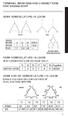 TERMINAL MARKINGS AND CONNECTIONS PART WINDING START NEMA NOMENCLATURE 6 LEADS 7 7 3 9 8 Delta 3 9 8 Wye OPER. 9 MODE L L L3 OPEN 7 START 3 7,8,9 T T T3 T7 T8 T9 RUN,7,8 3,9 3 8 MOTOR LEADS 3 7 Double
13 ELECTRIC MOTORS. 13.1 Basic Relations
 13 ELECTRIC MOTORS Modern underwater vehicles and surface vessels are making increased use of electrical actuators, for all range of tasks including weaponry, control surfaces, and main propulsion. This
AND8008/D. Solid State Control Solutions for Three Phase 1 HP Motor APPLICATION NOTE
 Solid State Control Solutions for Three Phase 1 HP Motor APPLICATION NOTE INTRODUCTION In all kinds of manufacturing, it is very common to have equipment that has three phase motors for doing different
TECHNICAL INFORMATION Bulletin
 Peerless Pump Company 2005 Dr. M.L. King Jr. Street, P.O. Box 7026, Indianapolis, IN 46207-7026, USA Telephone: (317) 925-9661 Fax: (317) 924-7338 www.peerlesspump.com www.epumpdoctor.com TECHNICAL INFORMATION
Application Information
 Moog Components Group manufactures a comprehensive line of brush-type and brushless motors, as well as brushless controllers. The purpose of this document is to provide a guide for the selection and application
Introduction. Three-phase induction motors are the most common and frequently encountered machines in industry
 Induction Motors Introduction Three-phase induction motors are the most common and frequently encountered machines in industry - simple design, rugged, low-price, easy maintenance - wide range of power
Equipment: Power Supply, DAI, Universal motor (8254), Electrodynamometer (8960), timing belt.
 Lab 12: The universal motor. Objective: to examine the construction of the universal motor; to determine its no-load and full-load characteristics while operating on AC; to determine its no-load and full-load
Section 10. Application Manual for NEMA Motors. Special Applications
 Special Applications 1 Power Factor Correction 1 Methods of Starting 3AC Induction Motors 5 3 Duty Cycles and Inertia 3 4 Horsepower Determination 30 5 Formulas and General Data 34 Power Factor Correction
Basics of Electricity
 Basics of Electricity Generator Theory PJM State & Member Training Dept. PJM 2014 8/6/2013 Objectives The student will be able to: Describe the process of electromagnetic induction Identify the major components
NO LOAD & BLOCK ROTOR TEST ON THREE PHASE INDUCTION MOTOR
 INDEX NO. : M-142 TECHNICAL MANUAL FOR NO LOAD & BLOCK ROTOR TEST ON THREE PHASE INDUCTION MOTOR Manufactured by : PREMIER TRADING CORPORATION (An ISO 9001:2000 Certified Company) 212/1, Mansarover Civil
Technical Guide No. 100. High Performance Drives -- speed and torque regulation
 Technical Guide No. 100 High Performance Drives -- speed and torque regulation Process Regulator Speed Regulator Torque Regulator Process Technical Guide: The illustrations, charts and examples given in
ELECTRICAL ENGINEERING Vol. III - Induction Motor and Self-Excited Induction Generator - Tze-Fun Chan
 INDUCTION MOTOR AND SELFEXCITED INDUCTION GENERATOR TzeFun Chan The Hong Kong Polytechnic University, Hung Hom, Kowloon, Hong Kong, China Keywords: threephase induction motor, singlephase induction motor,
Torque motors. direct drive technology
 Torque motors direct drive technology Why Direct Drive Motors? Fast and effective Direct-drive technology in mechanical engineering is defined as the use of actuators which transfer their power directly
Variable Frequency Drives - a Comparison of VSI versus LCI Systems
 Variable Frequency Drives - a Comparison of VSI versus LCI Systems Introduction TMEIC is a leader in the innovative design and manufacture of large ac variable f requency drive systems. TMEIC has been
DC GENERATOR THEORY. LIST the three conditions necessary to induce a voltage into a conductor.
 DC Generators DC generators are widely used to produce a DC voltage. The amount of voltage produced depends on a variety of factors. EO 1.5 LIST the three conditions necessary to induce a voltage into
Modelling, Simulation and Performance Analysis of A Variable Frequency Drive in Speed Control Of Induction Motor
 International Journal of Engineering Inventions e-issn: 78-7461, p-issn: 319-6491 Volume 3, Issue 5 (December 013) PP: 36-41 Modelling, Simulation and Performance Analysis of A Variable Frequency Drive
VARIABLE FREQUENCY DRIVES THEORY, APPLICATION, AND TROUBLESHOOTING
 VARIABLE FREQUENCY DRIVES THEORY, APPLICATION, AND TROUBLESHOOTING BY HOWARD W. PENROSE UNIVERSITY OF ILLINOIS AT CHICAGO ENERGY RESOURCES CENTER 851 SOUTH MORGAN STREET ROOM 1213, SEO, MC156 CHICAGO,
SYNCHRONOUS MACHINE TESTING WITH MOTOR CIRCUIT ANALYSIS INSTRUMENTATION
 SYNCHRONOUS MACHINE TESTING WITH MOTOR CIRCUIT ANALYSIS INSTRUMENTATION Introduction Howard W. Penrose, Ph.D., CMRP Vice President, Engineering and Reliability Services Dreisilker Electric Motors, Inc.
ADJUSTABLE FREQUENCY DRIVES APPLICATION GUIDE
 ADJUSTABLE FREQUENCY DRIVES APPLICATION GUIDE Adjustable Frequency Drives Application Guide Table of Contents Introduction....................................................................................
Generator Stator Protection, under/over voltage, under /over frequency and unbalanced loading. Ramandeep Kaur Aujla S.NO 250447392
 1 Generator Stator Protection, under/over voltage, under /over frequency and unbalanced loading By Ramandeep Kaur Aujla S.NO 250447392 ES 586b: Theory and applications of protective relays Department of
Phase-Control Alternatives for Single-Phase AC Motors Offer Smart, Low-Cost, Solutions Abstract INTRODUCTION
 Phase-Control Alternatives for Single-Phase AC Motors Offer Smart, Low-Cost, Solutions by Howard Abramowitz, Ph.D EE, President, AirCare Automation Inc. Abstract - Single Phase AC motors continue to be
What Is Regeneration?
 What Is Regeneration? Braking / Regeneration Manual Regeneration Overview Revision 1.0 When the rotor of an induction motor turns slower than the speed set by the applied frequency, the motor is transforming
Understanding the Alternator
 http://www.autoshop101.com THIS AUTOMOTIVE SERIES ON ALTERNATORS HAS BEEN DEVELOPED BY KEVIN R. SULLIVAN PROFESSOR OF AUTOMOTIVE TECHNOLOGY AT SKYLINE COLLEGE SAN BRUNO, CALIFORNIA ALL RIGHTS RESERVED
Power Quality Paper #3
 The Effect of Voltage Dips On Induction Motors by: M D McCulloch 1. INTRODUCTION Voltage depressions caused by faults on the system affect the performance of induction motors, in terms of the production
AC generator theory. Resources and methods for learning about these subjects (list a few here, in preparation for your research):
 AC generator theory This worksheet and all related files are licensed under the Creative Commons Attribution License, version 1.0. To view a copy of this license, visit http://creativecommons.org/licenses/by/1.0/,
(3) Explosion proof. Designed to prevent ignition of any explosive gases or dust and dirt which may surround the motor.
 ELECTRIC MOTORS Enclosures for Motors Types of motor enclosures generally used in farm applications: (1) Open type; drip proof or splash-proof. A general purpose motor for use in dry locations which are
Drive circuit basics + V. τ e. Industrial Circuits Application Note. Winding resistance and inductance
 ndustrial Circuits Application Note Drive circuit basics For a given size of a stepper motor, a limited space is available for the windings. n the process of optimizing a stepper motor drive system, an
Rotary Phase Converters
 FACTS from Ronk Electrical Industries, Inc. Bulletin 11981 Rotary Phase Converters ROTOVERTER Pat. No. 3,670,238 ROTO-CON Pat. No. 4,158,225 What are the ROTO-CON and ROTOVERTER power converters? The ROTO-CON
Simple Analysis for Brushless DC Motors Case Study: Razor Scooter Wheel Motor
 Simple Analysis for Brushless DC Motors Case Study: Razor Scooter Wheel Motor At first glance, a brushless direct-current (BLDC) motor might seem more complicated than a permanent magnet brushed DC motor,
The Right Drive to Maximize Efficiency and Production for Large Overland Conveyors
 The Right Drive to Maximize Efficiency and Production for Large Overland Conveyors By: Nicole Hampton, P.Eng. ABSTRACT: This paper examines various drive systems available for large overland conveyors,
Prof. Krishna Vasudevan, Prof. G. Sridhara Rao, Prof. P. Sasidhara Rao
 6 Synchronous motor 6.1 Principle of operation In order to understand the principle of operation of a synchronous motor, let us examine what happens if we connect the armature winding (laid out in the
How to Optimize Performance and Minimize Size in High Speed Applications High Performance Brushless DC Motors
 thinkmotion How to Optimize Performance and Minimize Size in High Speed Applications High Performance Brushless DC Motors I. Introduction II. III. IV. Optimization of a Brushless DC motor for high speed
Digital Energy ITI. Instrument Transformer Basic Technical Information and Application
 g Digital Energy ITI Instrument Transformer Basic Technical Information and Application Table of Contents DEFINITIONS AND FUNCTIONS CONSTRUCTION FEATURES MAGNETIC CIRCUITS RATING AND RATIO CURRENT TRANSFORMER
AC Generators and Motors
 AC Generators and Motors Course No: E03-008 Credit: 3 PDH A. Bhatia Continuing Education and Development, Inc. 9 Greyridge Farm Court Stony Point, NY 10980 P: (877) 322-5800 F: (877) 322-4774 [email protected]
Chen. Vibration Motor. Application note
 Vibration Motor Application note Yangyi Chen April 4 th, 2013 1 Table of Contents Pages Executive Summary ---------------------------------------------------------------------------------------- 1 1. Table
DC MOTOR ANALYSIS & TROUBLESHOOTING
 DC MOTOR ANALYSIS & TROUBLESHOOTING By Don Shaw Condition assessment of DC motors requires a basic understanding of the design and operating characteristics of the various types available: the series motor,
Mathematical Modeling and Dynamic Simulation of a Class of Drive Systems with Permanent Magnet Synchronous Motors
 Applied and Computational Mechanics 3 (2009) 331 338 Mathematical Modeling and Dynamic Simulation of a Class of Drive Systems with Permanent Magnet Synchronous Motors M. Mikhov a, a Faculty of Automatics,
IV. Three-Phase Induction Machines. Induction Machines
 IV. Three-Phase Induction Machines Induction Machines 1 2 3 4 5 6 7 8 9 10 11 12 13 Example 1: A 480V, 60 Hz, 6-pole, three-phase, delta-connected induction motor has the following parameters: R 1 =0.461
GENERATOR SELECTION. a. Three phase - 120/208V, 3 phase, 4W wye; 277/408, 3 phase, 4W wye; * 120/240V 3 phase, 4W Delta
 GENERATOR SELECTION Generators must be sized to handle their load based on the continuous KW, kilowatt load, and KVA, kilovoltamp load, and the worst case starting load KW + KVA. They must be derated for
ELECTRIC MOTORS. Energy Efficiency Reference Guide STATOR POLE COMMUTATOR LINE
 ELECTRIC MOTORS Energy Efficiency Reference Guide STATOR POLE N BRUSH COMMUTATOR S LINE DISCLAIMER: Neither CEA Technologies Inc. (CEATI), the authors, nor any of the organizations providing funding support
KINETIC ENERGY RECOVERY SYSTEM BY MEANS OF FLYWHEEL ENERGY STORAGE
 ADVANCED ENGINEERING 3(2009)1, ISSN 1846-5900 KINETIC ENERGY RECOVERY SYSTEM BY MEANS OF FLYWHEEL ENERGY STORAGE Cibulka, J. Abstract: This paper deals with the design of Kinetic Energy Recovery Systems
WIND TURBINE TECHNOLOGY
 Module 2.2-2 WIND TURBINE TECHNOLOGY Electrical System Gerhard J. Gerdes Workshop on Renewable Energies November 14-25, 2005 Nadi, Republic of the Fiji Islands Contents Module 2.2 Types of generator systems
Torque control MSF Softstarter
 Torque control MSF Softstarter INTRODUCTION Soft starting an AC motor refers to any one of several starting methods that limit the starting current and torque of the motor. The method discussed in this
32VFD Variable Frequency Drives for Centrifugal Chillers
 32VFD 32VFD Variable Frequency Drives for Centrifugal Chillers ENERGY-SAVING CONTROL FOR CENTRIFUGAL CHILLERS Reduce energy consumption in your existing centrifugal chiller Your chiller was specified to
Fundamentals of Inverter Fed Motors
 Fundamentals of Inverter Fed Motors Technical Manual 10/02 MN780 Contents Page The Growing Use Of Inverters.................................................................. 1 How Inverters Affect Motors....................................................................
Single-Phase AC Synchronous Generator
 ST Series Single-Phase AC Synchronous Generator Instructions for Operation and Maintenance English to English translation by R.G. Keen, May 2004. ST Series of Single-Phase AC Synchronous Generators Description
PRODUCTS DC MOTORS BLPM MOTORS AC MOTORS CONTROLLERS
 D R I V E S Y S T E M S PRODUCTS DC MOTORS BLPM MOTORS AC MOTORS CONTROLLERS The vision of Iskra Avtoelektrika is to be: One of the world's leading manufacturers of electric motors and controllers for
ABB drives. Technical guide No. 4 Guide to variable speed drives
 ABB drives Technical guide No. 4 Guide to variable speed drives 2 Guide to variable speed drives Technical guide No. 4 Technical guide No. 4 Guide to variable speed drives Copyright 2011 ABB. All rights
How the efficiency of induction motor is measured?
 How the efficiency of induction motor is measured? S. Corino E. Romero L.F. Mantilla Department of Electrical Engineering and Energy E.T.S.I.I. y T. Universidad de Cantabria Avda de Los Castros, 395 Santander
Power Electronics. Prof. K. Gopakumar. Centre for Electronics Design and Technology. Indian Institute of Science, Bangalore.
 Power Electronics Prof. K. Gopakumar Centre for Electronics Design and Technology Indian Institute of Science, Bangalore Lecture - 1 Electric Drive Today, we will start with the topic on industrial drive
CHAPTER 4 DESIGN OF INTEGRAL SLOT AND FRACTIONAL SLOT BRUSHLESS DC MOTOR
 47 CHAPTER 4 DESIGN OF INTEGRAL SLOT AND FRACTIONAL SLOT BRUSHLESS DC MOTOR 4.1 INTRODUCTION This chapter deals with the design of 24 slots 8 poles, 48 slots 16 poles and 60 slots 16 poles brushless dc
Modeling and Simulation of a Large Chipper Drive
 The Open Electrical & Electronic Engineering Journal, 009, 3, 1-8 1 Modeling and Simulation of a Large Chipper Drive Open Access Christian Kral, Anton Haumer, Hansjörg Kapeller and Gert Pascoli Austrian
PI144K - Winding 311 APPROVED DOCUMENT. Technical Data Sheet. Generator Solutions AS
 PI144K - Winding 311 Technical Data Sheet PI144K SPECIFICATIONS & OPTIONS STANDARDS TERMINALS & TERMINAL BOX Stamford industrial generators meet the requirements of BS EN 60034 and the relevant section
*ADVANCED ELECTRIC GENERATOR & CONTROL FOR HIGH SPEED MICRO/MINI TURBINE BASED POWER SYSTEMS
 *ADVANCED ELECTRIC GENERATOR & CONTROL FOR HIGH SPEED MICRO/MINI TURBINE BASED POWER SYSTEMS Jay Vaidya, President Electrodynamics Associates, Inc. 409 Eastbridge Drive, Oviedo, FL 32765 and Earl Gregory,
PI044E - Winding 311 APPROVED DOCUMENT. Technical Data Sheet
 PI044E - Winding 311 Technical Data Sheet PI044E SPECIFICATIONS & OPTIONS STANDARDS Stamford industrial generators meet the requirements of BS EN 60034 and the relevant section of other international standards
DC Motor control Reversing
 January 2013 DC Motor control Reversing and a "Rotor" which is the rotating part. Basically there are three types of DC Motor available: - Brushed Motor - Brushless Motor - Stepper Motor DC motors Electrical
C Standard AC Motors
 C Standard AC Standard AC C-1 Overview, Product Series... C-2 Constant... C-9 C-21 C-113 Reversible C-147 Overview, Product Series Constant Reversible Electromagnetic Brake C-155 Electromagnetic Brake
UCI274C - Technical Data Sheet
 - Technical Data Sheet SPECIFICATIONS & OPTIONS STANDARDS Newage Stamford industrial generators meet the requirements of BS EN 60034 and the relevant section of other international standards such as BS000,
The DC Motor/Generator Commutation Mystery. Commutation and Brushes. DC Machine Basics
 The DC Motor/Generator Commutation Mystery One small, yet vital piece of the DC electric motor puzzle is the carbon brush. Using the correct carbon brush is a key component for outstanding motor life,
PM734F - Technical Data Sheet Winding 28
 - Technical Data Sheet Winding 28 SPECIFICATIONS & OPTIONS STANDARDS STAMFORD AC generators are designed to meet the performance requirements of IEC EN 60034-1. Other international standards, including
UCI274H - Technical Data Sheet
 - Technical Data Sheet SPECIFICATIONS & OPTIONS STANDARDS Newage Stamford industrial generators meet the requirements of BS EN 60034 and the relevant section of other international standards such as BS000,
Power Quality. Voltage Sag Ride-through Mitigation in Sequence by Increasing Cost
 Power Quality Voltage Sag Ride-through Mitigation in Sequence by Increasing Cost A voltage sag is defined as a decrease in voltage magnitude below 90% of nominal, but not a complete interruption. The typical
PI734D - Technical Data Sheet
 PI734D - Technical Data Sheet PI734D SPECIFICATIONS & OPTIONS STANDARDS Newage Stamford industrial generators meet the requirements of BS EN 60034 and the relevant sections of other national and international
PI734B - Technical Data Sheet
 PI734B - Technical Data Sheet PI734B SPECIFICATIONS & OPTIONS STANDARDS Newage Stamford industrial generators meet the requirements of BS EN 60034 and the relevant sections of other national and international
SAFETY PRECAUTIONS AND INSTRUCTIONS FOR USE OF TECHNICAL INFORMATION
 SAFETY PRECAUTIONS AND INSTRUCTIONS FOR USE OF TECHNICAL INFORMATION Please read and understand the product instruction manual before installing, servicing or operating Yaskawa products. Technical content
AC-Synchronous Generator
 Design Description AC Generators come in two basic types synchronous and non-synchronous. Synchronous generators lock in with the fundamental line frequency and rotate at a synchronous speed related to
1150 hp motor design, electromagnetic and thermal analysis
 115 hp motor design, electromagnetic and thermal analysis Qasim Al Akayshee 1, and David A Staton 2 1 Mawdsley s Ltd., The Perry Centre, Davey Close, Waterwells, Gloucester GL2 4AD phone: +44 1452 888311
Centrifugal Fans and Pumps are sized to meet the maximum
 Fans and Pumps are sized to meet the maximum flow rate required by the system. System conditions frequently require reducing the flow rate. Throttling and bypass devices dampers and valves are installed
26 3213.13 Diesel Engine Driven Generators Page 1 of 6
 Last Update: December 8, 2014 A. Description of System Consultant s Handbook Page 1 of 6 1. Provide a diesel engine driven electric generating unit, factory assembled, tested and certified to operate at
How To Understand And Understand The Electrical Power System
 DOE-HDBK-1011/4-92 JUNE 1992 DOE FUNDAMENTALS HANDBOOK ELECTRICAL SCIENCE Volume 4 of 4 U.S. Department of Energy Washington, D.C. 20585 FSC-6910 Distribution Statement A. Approved for public release;
Three-Phase Induction Motor
 EXPERIMENT Induction motor Three-Phase Induction Motors 208V LL OBJECTIVE This experiment demonstrates the performance of squirrel-cage induction motors and the method for deriving electrical equivalent