
ET 332b Ac Electric Machines and Power Systems
|
|
|
- Silas Bridges
- 9 years ago
- Views:
Transcription
1 Instructor: Dr. Carl Spezia, PE Office: Engr. D110 Phone: ET 332b Ac Electric Machines and Power Systems Office Hours: 9:00 am - 10:00 am M-W-F 2:00 pm - 3:00 pm M-W-F Textbook: References: Electrical Machines, Theory, Operation, Applications, Adjustment, and Control, 2nd Edition, Charles I. Hubert Electric Machinery and Transformers, Irving L. Kosow Grading Scale: % A 89-80% B 79-70% C 69-60% D 59-below F Hour Exams (3 at 100 points each) 50% Final Exam (200 points) 20% Homework 10% Laboratory Experiments/Activities 20% Total 100% Course Policies 1. Late Work and Makeup Exams No make-up exams. All homework handed in at the beginning of the period it is due. No late homework accepted without prior approval. Late lab grades reduced by 5% per working day starting from due date. 2. Attendance Policies Class attendance is required and attendance will be taken at the beginning of every period. Students are allowed four unexcused absences. Any further absences will reduce the TOTAL grade by 5% per day absent. Note: the final exam is optional for all students that have a 90% or higher average on the hour exams, homework, and experiment/activities Spring 2016 et332b16.docx 1

2 Ac Electric Machines and Power Systems Course Description and Prerequisites This course introduces the theory and operation of DC and AC machines with an emphasis on the testing and measurement of machine characteristics and parameters. Laboratory exercises will demonstrate the theoretical concepts and give experience using various types of measurement devices and software. Prerequisite: Engineering Technology 304a Course Performance Criteria At the end of this course, you will be able to: 1.) Find the voltage current and power in a single phase ac circuit using phasor analysis, 2.) Construct a power triangle for an ac load, 3.) Compute the power factor of an ac load, 4.) Compute the voltages and currents in three-phase delta and wye connected loads and sources, 5.) Solve simple balanced three-phase ac systems, 6.) Identify the types of mechanical loads attached to motors in industry, 7.) Draw the equivalent circuit model of single phase transformers, 8.) Find transformer parameters using open circuit and short circuit tests 9.) Use the per unit system to perform power system calculations, 10.) Compute transformer efficiency and voltage regulation, 11.) Interpret nameplate data on transformers and ac motors, 12.) Make three phase transformer connections, 13.) Compute load division between parallel transformers, 14.) Explain the operation of three-phase induction motors 15.) Calculate motor currents, power, speed and torque using an equivalent circuit model, 16.) Measure and calculate motor losses and efficiency, 17.) Connect power meters and measure ac power and power factor, 18.) Conduct no-load and locked-rotor tests to find motor circuit parameters, 19.) Explain how synchronous motors operate, 20.) Perform motor calculation using and equivalent circuit model, 21.) Explain how induction generators operate. 22.) Explain how synchronous motors can be used for power factor correction and calculate their impact, 23.) Explain how synchronous alternators operate, 24.) Perform alternator calculations, 25.) Make three-phase power and energy metering connections and interpret a watthour meter reading. Spring 2016 et332b16.docx 2

3 Ac Electric Machines and Power Systems Emergency Procedures SIUC is committed to providing a safe and healthy environment for study and work. Because some health and safety circumstances are beyond our control, we ask that you become familiar with the SIUC Emergency Response Plan and Building Emergency Response Team (BERT) program. Emergency response information is available on the BERT website at Department of Public Safety s website (disaster drop down) and in the Emergency Response Guidelines pamphlet. Know how to respond to each type of emergency. Instructors will provide guidance and direction to students in the classroom in the event of an emergency affecting your location. It is important that you follow these instructions and stay with your instructor during an evacuation or sheltering emergency. The Building Emergency Response Team will assist your instructor in evacuating the building or sheltering within the facility. Final Examination Schedule Policy This course will follow the University schedule for final examinations. The course instructor will not administer the final exam prior to the published University date. Academic Dishonesty Policy Students may be subject to disciplinary proceedings resulting in an academic penalty or disciplinary penalty for academic dishonesty. Academic dishonesty includes, but is not limited to, cheating on a test, plagiarism, or collusion. References to the Student Conduct Code,(e.g. plagiarism policy). ADA Statement for Students Requiring Special Accommodations: As per Section 504 of the Vocational Rehabilitation Act of 1973 and the American Disabilities Act (ADA) of 1990, if accommodations are needed, inform the instructor as soon as possible. Spring 2016 et332b16.docx 3

4 Ac Machines and Power Systems Course Outline Fundamentals of Ac Analysis Single phase ac analysis Time and phasor representations Series circuits Parallel circuits Power triangle Power Factor Appendix A Class Notes Three phase ac analysis Double subscript notation Wye connected sources Delta connected sources Phase sequence Solution of three phase circuits balanced and unbalanced Review of Basic Mechanics Physic of mechanical motion, force, Torque, transformation of energy. Torque-speed relationships for mechanical loads Power and Energy Measurements Phase sequence identification Single phase power measurements Three phase power measurements Two-Wattmeter method Reactive power metering Load characteristics and demand Energy Metering Transformer Principles Construction and classification Transformer action with sinusoidal input voltages Ideal transformer model Equivalent circuit for transformers Voltage regulation Per unit/percent system Per unit/percent transformer impedances Transformer efficiency Class Notes Class Notes and Handouts Chapter 2 Sections 2-2 to 2-5 Sections 2-7 to 2-14 Spring 2016 out32b16.docx
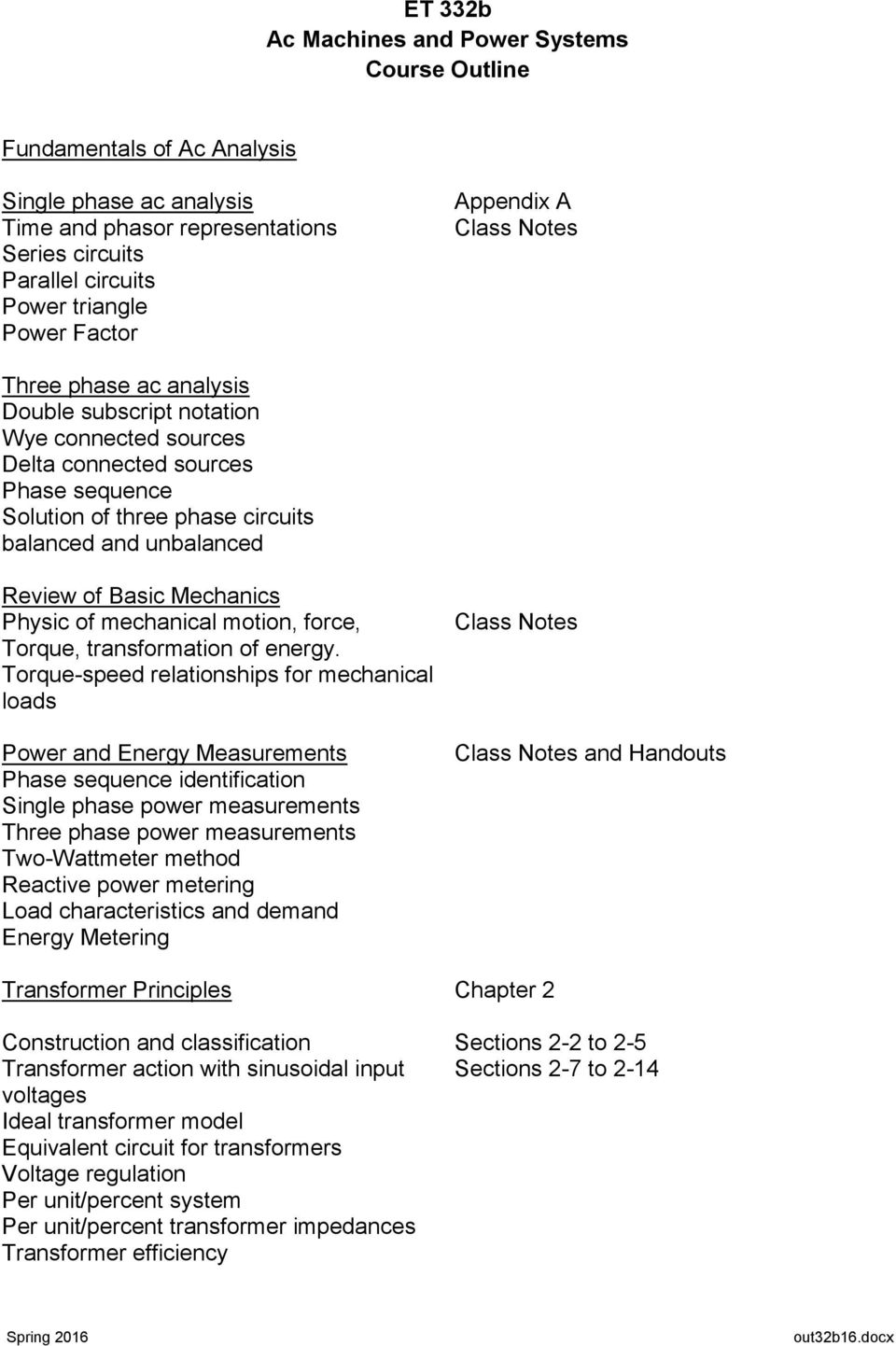
5 Ac Machines and Power Systems Course Outline Open circuit/short circuit tests TEST 1 Transformer Connections and Operation Terminal markings and connections Nameplate ratings Autotransformer connections Parallel operation of transformers Load division between transformers Three phase transformer connections Instrument transformers Chapter 3 Sections 3-1 to 3-4 Sections 3-6 to 3-7 Sections 3-10, 3-11, 3-12, 3-14 Three Phase induction motors Induction motor action Rotating Magnetic field Equivalent circuit of the Induction motor Developed power and torque Losses and efficiency Chapter 4 Sections 4-1 to 4-15 Application of three phase induction motors NEMA Classifications Locked rotor inrush currents Wound-rotor motors Effects of voltage unbalance Induction motor parameters Determination of Induction motor parameters Blocked rotor tests No-load tests Dynamic braking of induction motors Induction motor starting and control Induction Generator Operation Chapter 5 Sections 5-1 to 5-3 Sections 5-6 to 5-7 Sections 5-9 to 5-14 Sections 5-16 to 5-18 Section 5-15 TEST 2 Spring 2016 out32b16.docx 2

6 Ac Machines and Power Systems Course Outline Synchronous Motors Construction and motor starting Equivalent circuit model Synchronous motor power equation Load changes effects on motor Effects of field excitation changes Synchronous motor losses and efficiency Synchronous condenser operation of synchronous motors Synchronous Generators (Alternators) Motor to generator transition Synchronous generator power equation Generator loading Paralleling Synchronous generators Prime mover and generator control Motoring of synchronous generators Safe paralleling of alternators Loss of field excitation effects Load division between Alternators Final review Chapter 8 Sections 8-1 to 8-9 Sections 8-11 to 8-12 Chapter 9 Sections 9-1 to 9-13 Test 3 Final exam (comprehensive) Spring 2016 out32b16.docx 3


7 Spring 2016 out32b16.docx 4

8 332B Homework list Homework # Source Assignment Date Due Turned in? Grade Received 1 Handout cpmathhw.wp5 2 Handout sglephhw.wp5 3 Handout spqhw.wp5 4 Handout pfhw.wp5 5 Handout hw3phs1.wp5 6 Handout hw3phs4.wp5, hw3phs3.wp5 7 Handout hw3phs2.wp5, pfcorr.wp5 8 Handout wyedhw.wp5, tqspd.wp5 9 Handout meterhw.wp Handout puprob.docx , Handout 3phtxhw.wp , & 4-4 Handout ind-hw1.wp Handout indhw1.wp , , 8-2, , Mistake in problem statement. Use a voltage of 482 V instead of 432V. Spring 2016 out32b16.docx 5

9 Laboratory Activities and Experiments 1.) Power Laboratory Safety and Work Procedures/Delta and Wye Voltage Connections (Hampden Experiment 3) Students learn safety rules for working with high (above electronic board level) voltages. Avoiding electric shock and other safety hazards encountered in the power lab are covered. This lab covers the basic operation of the transformers, fractionalhorsepower ac motors and alternators. Students perform lab experiments to prove voltage relationships for fundamental three phase connections. Students observe three-phase alternator operation. 2.) Wye Connected Alternators (Hampden Experiment 4) Students observe the effects of load balance on a wye-connected alternator. Students see a practical application of Kirchhoff's current law for ac systems. Phasor addition of currents produces a net current of zero in the neutral conductor of a wyeconnected load. The experiment demonstrates the effect of unbalance on the current flow in the neutral. 3.) Transformer Voltage, Current and Impedance Ratios (Handout Experiment 2) This experiment examines ideal and non-ideal operation of a transformer. The turns ratio is used to determine how a transformer changes voltage, current and impedance levels. The experiment shows how to derive the ratios for each of these quantities. The effects of adding load on the ideal transformer ratio formulas are experimentally determined. 4.) Transformer Open Circuit Test (Handout Experiment 3) The effects of magnetizing the iron core of a transformer are included in the basic theory of the transformer. The exciting current of a small transformer is measured. The power losses of a transformer core are measured. These values are used to determine an equivalent circuit that accounts for the magnetizing effects of the iron core. Spring 2014 lab332b4a.docx

10 Laboratory Activities and Experiments 5.) Transformer Short Circuit Test (Handout Experiment 4) The series impedance effects of a transformer are identified and measured experimentally. The leakage reactance and the series winding resistances are measured using a method called the short circuit test. These effects are included in a model that more accurately represents the actual operation of a transformer under load 6.) Direction of Rotation of Three-Phase Motors (Hampden Experiment 12) The effects of phase sequence on the direction of motor rotation are examined. Students will be able to correctly connect a three-phase motor to a voltage supply and have it rotate in the desired direction. The relationship between motor poles and synchronous speed is explained. 7.) Starting Characteristics of Squirrel-cage Induction Motors (Hampden Experiment 13) The electrical and mechanical characteristics of a squirrel-cage induction motor during start-up are explored experimentally. The maximum torque of a three-phase motor is estimated from reduced voltage tests. The mathematical relationships between motor terminal voltage and torque are used to make this calculation. 8.) Running Characteristics of Squirrel-cage Induction Motors (Hampden Experiment 14) Students will observe the changes on motor speed and terminal current as it is loaded. The two-wattmeter method of active power and power factor measurement is introduced and used to measure quantities in this experiment. 9.) Losses and Efficiency of Induction Motors (Hampden Experiment 16) The power losses are measured and an operating efficiency is computed for a fractional horsepower motor. The types of losses incurred in induction motor operation are identified and measured either directly or indirectly. A locked rotor test is performed to find the equivalent resistance of the motor. Spring 2014 lab332b4a.docx

11 Laboratory Activities and Experiments 10.) Starting and Synchronizing Synchronous Machines (Hampden Experiment 19) The synchronous machine can operate as either a generator or motor. In either case, procedures must be followed to safely connect the machine to the system. Synchronous machines must be rotating at nearly synchronous speed before they are connected to the power system. The experiment shows how the synchronous machine is started and how it operates under load. 11.) Load Characteristics of Ac Generators (Hampden Experiment 5) The load-terminal voltage characteristics of an alternator are experimentally determined. Resistive and reactive load combinations are connected to the terminals of a small alternator. The effects of armature resistance, reactance, and armature reaction are discussed and the observed in practice. The effects of capacitive and inductive loads on the terminal voltage and power factor are also observed. If time permits 12.) Paralleling Alternators (Hampden Experiment 7) The necessary conditions for the parallel operation of alternators are examined. An alternator is synchronized with and infinite bus using phasing lamps. Two alternators are paralleled using phasing lamps. The factors that affect power flow and operating frequency are observed. Spring 2014 lab332b4a.docx

12 Laboratory Experiment Format You will perform several experiments on different topics during the course of the semester. The following information outlines the format used to document the experiment results and the procedures used to find the results. Type all experiment reports submitted this semester. Use this format on Experiments 3, 4, and 5. The first page of every experiment report will be a cover page that will include the following items: Experiment number Experiment title Course number Student name. Center these items in the middle of the page. An example cover page is attached. This template is available from the course website. The following section describes the body of the experiment report. Number the pages in the body of the report at the bottom center. Do not number the first page of the report. This page displays the title information described above. The body of the experiment has four sections: 1.) Objective 2.) Procedure 3.) Data and discussion of results 4.) Conclusion. In the objective, you will explain the purpose for doing the experiment. You will also identify the major points you wish to learn about in the experiment. Example: Find the resistance and inductance of a separately excited dc motor. In the procedure section, give a summary of the methods used to measure and collect the data required in the experiment. Make this section in the form of numbered steps. Example: 1. Connect a variable ac voltage source to the motor terminals. 2. Adjust the supply until motor stator current vale is equal to motor rating. Combine several small tasks into a single numbered topic to reduce the number of numbered subsections. The data and results section documents the information collected during the experiment. Represent all data in a clear concise form. Use tables and graphs to collect and display the data into a presentable form. Use the correct units on all Spring 2014 exformat.doc

13 experimental quantities. Label the axis of the graphs and give them appropriate titles. Discuss the significance of the data and graphs contained in this section. Software tools, such as Excel and MathCAD, make graphs and calculations simple to produce. Use these tools whenever possible. MathCAD makes it possible to produce an entire lab report that includes all sample calculations graphs and supporting procedures and discussions without using many other software packages. Show sample calculations in the body of the report. Large data tables and other supporting calculations not directly related to the main topics of the experiment should be included in an appendix located after the main report. An appendix is not required when data tables are short. (10 entries or less) Use figures to show how test setups were connected. Schematics of the models and circuits constructed for the experiment should also be included. Various software packages make drawing figures for lab experiments less laborious. AutoCAD, Visio, Paintbrush, CircuitMaker, Multisim or any other graphic program can create images. Use cut/paste tools to transfer the graphic from one application to another. In the conclusion section of the report, summarize the knowledge gained in the experiment. The report body should be double-spaced and typewritten. Spring 2014 lab332b4a.docx

14 Southern Illinois University at Carbondale Department of Technology ET 332b Electromagnetic Principles and Devices Experiment # Experiment Title Reported by: name of student Performed By: student name 1 student name 2 student name 3 Date Performed: Spring 2014 lab332b4a.docx

15 Laboratory Report Grading and Attendance Policies Grading The following table shows the point distribution and graded items for the ET 332 lab report. You will receive maximum points if all listed items are included and correct. For all experiments EXCEPT 3, 4, and 5, only include the pages from the lab handout that show data and have answers to questions. For the format of these labs see the handout labeled, Laboratory Experiment Format. This includes both the De-Briefing and Quick Quiz sections. Produce all graph and figures using a computer program such as Excel. Include the graphs required by the lab procedures and any additional ones specified by the lab instructor. Late labs will have point totals reduced by 5 points per working day. After one week, late labs will not be accepted Attendance Students are expected to be seated in the lab at the scheduled starting time. An attendance sheet will be circulated at the beginning of the lab period. Everyone is responsible for signing this sheet. Anyone entering the lab after the scheduled starting time will be considered late and the work that they are intending to hand in will be considered late by one day. The lab instructor will be available before the lab period begins to answer questions and assist in experimental setups. Item Points Comments Title Page 5 pts The title page must follow the given format exactly to receive credit. See the examples in the syllabus and from the lab T.A. De-Briefing Questions 20 pts Complete all short answer questions correctly and completely. You should print question responses clearly. Unreadable responses will be considered wrong. Use complete sentences and good grammar. Graphs are sometimes included in this section. Always use a computer program to generate these plots. Additional tables of the collected data can be included with the graphs, but are not required. Experimental Results 10 pts All data tables must be filled and contain reasonably accurate values. Write all values clearly. The data tables must be signed by the T..A. before leaving lab. Unsigned data will receive no credit. Quick Quiz 20 pts Correctly answer all multiple choice questions listed in the lab handout. Include these pages in the report. Discussion 45 pts To receive maximum credit for the discussion section, each topic in the discussion point handout must be included and thoroughly explained. The discussion can be up to three pages in length. It must be typed with no greater than a 12 point font and double spaced. Spring 2014 lab332b4a.docx

Unit 33 Three-Phase Motors
 Unit 33 Three-Phase Motors Objectives: Discuss the operation of wound rotor motors. Discuss the operation of selsyn motors. Discuss the operation of synchronous motors. Determine the direction of rotation
DHANALAKSHMI COLLEGE OF ENGINEERING DEPARTMENT OF ELECTRICAL AND ELECTRONICS ENGINEERING EE2302 - ELECTRICAL MACHINES II UNIT-I SYNCHRONOUS GENERATOR
 1 DHANALAKSHMI COLLEGE OF ENGINEERING DEPARTMENT OF ELECTRICAL AND ELECTRONICS ENGINEERING Constructional details Types of rotors EE2302 - ELECTRICAL MACHINES II UNIT-I SYNCHRONOUS GENERATOR PART A 1.
Lab 14: 3-phase alternator.
 Lab 14: 3-phase alternator. Objective: to obtain the no-load saturation curve of the alternator; to determine the voltage regulation characteristic of the alternator with resistive, capacitive, and inductive
UNIVERSITY OF WATERLOO ELECTRICAL & COMPUTER ENGINEERING DEPARTMENT ME269 ELECTROMECHANICAL DEVICES AND POWER PROCESSING.
 UNIVERSITY OF WATERLOO ELECTRICAL & COMPUTER ENGINEERING DEPARTMENT ME269 ELECTROMECHANICAL DEVICES AND POWER PROCESSING. Group # First Name Last Name UserID @uwaterloo.ca Experiment #3: DIRECT CURRENT
SYNCHRONOUS MACHINES
 SYNCHRONOUS MACHINES The geometry of a synchronous machine is quite similar to that of the induction machine. The stator core and windings of a three-phase synchronous machine are practically identical
2. A conductor of length 2m moves at 4m/s at 30 to a uniform magnetic field of 0.1T. Which one of the following gives the e.m.f. generated?
 Extra Questions - 2 1. A straight length of wire moves through a uniform magnetic field. The e.m.f. produced across the ends of the wire will be maximum if it moves: a) along the lines of magnetic flux
Chapter 24. Three-Phase Voltage Generation
 Chapter 24 Three-Phase Systems Three-Phase Voltage Generation Three-phase generators Three sets of windings and produce three ac voltages Windings are placed 120 apart Voltages are three identical sinusoidal
Application for Small Generator Facility Interconnection Tier 2, Tier 3 or Tier 4 Interconnection
 Application for Small Generator Facility Interconnection Tier 2, Tier 3 or Tier 4 Interconnection (See ARSD chapter 20:10:36 for the requirements for a Tier 2, Tier 3, or Tier 4 Interconnection.) Applicant/Interconnection
Three-Phase Induction Motor
 EXPERIMENT Induction motor Three-Phase Induction Motors 208V LL OBJECTIVE This experiment demonstrates the performance of squirrel-cage induction motors and the method for deriving electrical equivalent
13 ELECTRIC MOTORS. 13.1 Basic Relations
 13 ELECTRIC MOTORS Modern underwater vehicles and surface vessels are making increased use of electrical actuators, for all range of tasks including weaponry, control surfaces, and main propulsion. This
ECE 431. Experiment #1. Three-Phase ac Measurements. PERFORMED: 26 January 2005 WRITTEN: 28 January 2005. Jason Wells
 ECE 41 Experiment #1 Three- ac Measurements PERFORMED: 6 January 005 WRTTEN: 8 January 005 Jason Wells LEADER: Jason Wells RECORDER: Nathaniel Hakes 1 ntroduction The primary objectives of the experiment
SOUTHWEST COLLEGE Department of Mathematics
 SOUTHWEST COLLEGE Department of Mathematics COURSE SYLLABUS MATH 1314: College Algebra INSTRUCTOR: E-MAIL: Fatemeh Salehibakhsh [email protected] Office Hours M - W 2:30 3:00 PM Friday 11:00 AM 2:00
Keywords: synchronous generator, synchronous motor, automatic voltage regulator, V- curves, synchronizing power, hunting, excitation system
 SYNCHRONOUS MACHINES Tze-Fun Chan Hong Kong Polytechnic University, Hong Kong, China Keywords: synchronous generator, synchronous motor, automatic voltage regulator, V- curves, synchronizing power, hunting,
ELPT 1419 FUNDAMENTALS OF ELECTRICITY I
 SYLLABUS ELPT 1419 FUNDAMENTALS OF ELECTRICITY I INDUSTRIAL AND COMMERCIAL ELECTRICITY BRAZOSPORT COLLEGE LAKE JACKSON TEXAS PREPARED BY: DATE: August 27, 2013 INSTRUCTOR RECOMMENDED BY: RECOMMENDED BY:
Syllabus FINANCE 330 Spring 2016 Section 003
 Syllabus FINANCE 330 Spring 2016 Section 003 Professor: Mr. Timothy Marlo Office: Room 128, Rehn Hall Office Phone: 453-1420 E-Mail: [email protected] In-Office Hours: Tuesday and Thursday 9:30-10:30 am Appt.
Basics of Electricity
 Basics of Electricity Generator Theory PJM State & Member Training Dept. PJM 2014 8/6/2013 Objectives The student will be able to: Describe the process of electromagnetic induction Identify the major components
Central Alabama Community College
 Central Alabama Community College I. ILT 160 DC Fundamentals 3 Credit Hours II. Course Description This course provides a study of atomic theory, direct current (DC), properties of conductors and insulators,
Syllabus: Fundamentals of Electrical Engineering
 Syllabus: Fundamentals of Electrical Engineering Instructors Dr.-Ing. Saša Bukvić-Schäfer Email: [email protected] Dr.-Ing. Antonio Notholt-Vergara Email: [email protected] Syllabus: Fundamentals
NATIONAL CERTIFICATE (VOCATIONAL)
 NATIONAL CERTIFICATE (VOCATIONAL) SUBJECT GUIDELINES ELECTRICAL PRINCIPLES AND PRACTICE NQF Level 4 September 2007 ELECTRICAL PRINCIPLES AND PRACTICE LEVEL 4 CONTENTS INTRODUCTION 1 DURATION AND TUITION
Physical Address: City: State: Zip Code:
 Application for Small Generator Facility Interconnection Tier 2, Tier 3 or Tier 4 Interconnection (For Small Generator Facilities with Electric Nameplate Capacities of 10 MW and less) Applicant Contact
Three phase circuits
 Three phase circuits THREE PHASE CIRCUITS THREE-PHASE ADVANTAGES 1. The horsepower rating of three-phase motors and the kva rating of three-phase transformers are 150% greater than single-phase motors
Equipment: Power Supply, DAI, Synchronous motor (8241), Electrodynamometer (8960), Tachometer, Timing belt.
 Lab 9: Synchronous motor. Objective: to examine the design of a 3-phase synchronous motor; to learn how to connect it; to obtain its starting characteristic; to determine the full-load characteristic of
Induction Motor Theory
 PDHonline Course E176 (3 PDH) Induction Motor Theory Instructor: Jerry R. Bednarczyk, P.E. 2012 PDH Online PDH Center 5272 Meadow Estates Drive Fairfax, VA 22030-6658 Phone & Fax: 703-988-0088 www.pdhonline.org
Effective: September 10, 2006 Vermont Attachment 1 to Rule 5.500 Public Service Board Page 1 of 6
 Public Service Board Page 1 of 6 STANDARD APPLICATION FOR INTERCONNECTION OF GENERATION RESOURCES IN PARALLEL TO THE ELECTRIC SYSTEM OF: (Interconnecting Utility) Preamble and Instructions: An owner of
PELLISSIPPI STATE COMMUNITY COLLEGE MASTER SYLLABUS PROJECT SCHEDULING W/LAB ENGT 2021
 PELLISSIPPI STATE COMMUNITY COLLEGE MASTER SYLLABUS PROJECT SCHEDULING W/LAB ENGT 2021 Class Hours: 3:0 Credit Hours: 3:0 Laboratory Hours:2:0 Date Revised: Fall 2012 Catalog Course Description: This course
PacifiCorp Original Sheet No. 476 FERC Electric Tariff, Substitute 6 th Rev Volume No. 11 APPENDIX 2 TO SGIP
 PacifiCorp Original Sheet No. 476 APPENDIX 2 TO SGIP SMALL GENERATOR INTERCONNECTION REQUEST (Application Form) Transmission Provider: Designated Contact Person: Address: Telephone Number: An Interconnection
Lab 8: DC generators: shunt, series, and compounded.
 Lab 8: DC generators: shunt, series, and compounded. Objective: to study the properties of DC generators under no-load and full-load conditions; to learn how to connect these generators; to obtain their
Social Psychology Syllabus
 Social Psychology Syllabus PSYC 307/001 Spring 2014 Lecture: MWF 12:00-12:50 p.m. in Wham 105 Instructor: Rebecca Kietlinski. M.A. Office Location: Life Science II Rm. 275F Office Hours: 10:00 a.m. to
Three-phase AC circuits
 Three-phase AC circuits This worksheet and all related files are licensed under the Creative Commons Attribution License, version 1.0. To view a copy of this license, visit http://creativecommons.org/licenses/by/1.0/,
REPORT ON CANDIDATES WORK IN THE CARIBBEAN ADVANCED PROFICIENCY EXAMINATION MAY/JUNE 2008 ELECTRICAL AND ELECTRONIC TECHNOLOGY (TRINIDAD AND TOBAGO)
 CARIBBEAN EXAMINATIONS COUNCIL REPORT ON CANDIDATES WORK IN THE CARIBBEAN ADVANCED PROFICIENCY EXAMINATION MAY/JUNE 2008 ELECTRICAL AND ELECTRONIC TECHNOLOGY (TRINIDAD AND TOBAGO) Copyright 2008 Caribbean
IV. Three-Phase Induction Machines. Induction Machines
 IV. Three-Phase Induction Machines Induction Machines 1 2 3 4 5 6 7 8 9 10 11 12 13 Example 1: A 480V, 60 Hz, 6-pole, three-phase, delta-connected induction motor has the following parameters: R 1 =0.461
REHB 474 Introduction to Staff Supervision Fall, 2015 COURSE SYLLABUS
 REHB 474 Introduction to Staff Supervision Fall, 2015 COURSE SYLLABUS Course Title: Introduction to Staff Supervision Course Number: REHB 474 Credit Hours: 3 Location & Time: Monday 2-4:50 pm, Communication
PELLISSIPPI STATE COMMUNITY COLLEGE MASTER SYLLABUS ORIENTATION TO SPORT MANAGEMENT PHED 1001. Laboratory Hours: 0.0 Date Revised: Spring 2011
 PELLISSIPPI STATE COMMUNITY COLLEGE MASTER SYLLABUS ORIENTATION TO SPORT MANAGEMENT PHED 1001 Class Hours: 1.0 Credit Hours: 1.0 Laboratory Hours: 0.0 Date Revised: Spring 2011 NOTE: PHED 1010 through
Equipment: Power Supply, DAI, Transformer (8341), Variable resistance (8311), Variable inductance (8321), Variable capacitance (8331)
 Lab 5: Single-phase transformer operations. Objective: to examine the design of single-phase transformers; to study the voltage and current ratios of transformers; to study the voltage regulation of the
ACADEMIC INTERGRITY POLICY
 Western Michigan University, Electrical and Computer Engineering Department ECE 4300/5300 Electric Power Systems (3-0), Spring 2016 Course Information and Policies CRN: 11647-100/14042-100 9:30-10:20 a.m.
PELLISSIPPI STATE COMMUNITY COLLEGE MASTER SYLLABUS ORIENTATION TO EXERCISE SCIENCE PHED 1000. Laboratory Hours: 0.0 Date Revised: Spring 2011
 PELLISSIPPI STATE COMMUNITY COLLEGE MASTER SYLLABUS ORIENTATION TO EXERCISE SCIENCE PHED 1000 Class Hours: 1.0 Credit Hours: 1.0 Laboratory Hours: 0.0 Date Revised: Spring 2011 Catalog Course Description:
Fall 2015 - HCM 360-Online US Health Care Systems
 Instructor: Dr. Thomas Shaw, Associate Professor Office: Room 123, CASA Phone: 618-453-7217 EMAIL: [email protected] Office Hours: Monday & Thursday 9:00 am 12:00 am CST. (Subject to change at instructor s
Synchronous motor. Type. Non-excited motors
 Synchronous motor A synchronous electric motor is an AC motor in which the rotation rate of the shaft is synchronized with the frequency of the AC supply current; the rotation period is exactly equal to
ATTACHMENT F. Electric Utility Contact Information Utility Name. For Office Use Only
 ATTACHMENT F CATEGORY 2 GENERATOR INTERCONNECTION APPLICATION FOR ALL PROJECTS WITH AGGREGATE GENERATOR OUTPUT OF MORE THAN 20 KW BUT LESS THAN OR EQUAL TO 150 KW Also Serves as Application for Category
Motor Fundamentals. DC Motor
 Motor Fundamentals Before we can examine the function of a drive, we must understand the basic operation of the motor. It is used to convert the electrical energy, supplied by the controller, to mechanical
8 Speed control of Induction Machines
 8 Speed control of Induction Machines We have seen the speed torque characteristic of the machine. In the stable region of operation in the motoring mode, the curve is rather steep and goes from zero torque
Equipment: Power Supply, DAI, Variable resistance (8311), Variable inductance (8321)
 Lab 4: 3-phase circuits. Objective: to study voltage-current relationships in 3-phase circuits; to learn to make delta and Y connections; to calculate and measure real, apparent, and reactive powers. Equipment:
Application Information
 Moog Components Group manufactures a comprehensive line of brush-type and brushless motors, as well as brushless controllers. The purpose of this document is to provide a guide for the selection and application
KIN 323 Methods of Teaching Secondary Physical Education Spring 2016
 KIN 323 Methods of Teaching Secondary Physical Education Spring 2016 Class schedule: 1:15 pm- 2:30 pm TR Davies Hall 0137 Jan. 19-May 13, 2016 Course Description: The purpose of this course is for physical
BALANCED THREE-PHASE CIRCUITS
 BALANCED THREE-PHASE CIRCUITS The voltages in the three-phase power system are produced by a synchronous generator (Chapter 6). In a balanced system, each of the three instantaneous voltages have equal
Equipment: Power Supply, DAI, Wound rotor induction motor (8231), Electrodynamometer (8960), timing belt.
 Lab 13: Wound rotor induction motor. Objective: to examine the construction of a 3-phase wound rotor induction motor; to understand exciting current, synchronous speed and slip in this motor; to determine
Department of Electrical and Electronic Engineering, California State University, Sacramento
 Department of Electrical and Electronic Engineering, California State University, Sacramento Engr 17 Introductory Circuit Analysis, graded, 3 units Instructor: Tatro - Spring 2016 Section 2, Call No. 30289,
Prof. Krishna Vasudevan, Prof. G. Sridhara Rao, Prof. P. Sasidhara Rao
 6 Synchronous motor 6.1 Principle of operation In order to understand the principle of operation of a synchronous motor, let us examine what happens if we connect the armature winding (laid out in the
PELLISSIPPI STATE TECHNICAL COMMUNITY COLLEGE MASTER SYLLABUS PROJECT SCHEDULING W/LAB CET 2021
 PELLISSIPPI STATE TECHNICAL COMMUNITY COLLEGE MASTER SYLLABUS PROJECT SCHEDULING W/LAB CET 2021 Class Hours: 2.0 Credit Hours: 3.0 Laboratory Hours: 3.0 Revised: Fall 07 Catalog Course Description: This
Synchronous generators are built in large units, their rating ranging from tens to hundreds of megawatts.
 II. Synchronous Generators Synchronous machines are principally used as alternating current (AC) generators. They supply the electric power used by all sectors of modern societies: industrial, commercial,
Three-Phase AC Power Circuits
 Electricity and New Energy Three-Phase AC Power Circuits Student Manual 86360-F0 Order no.: 86360-00 Revision level: 10/2014 By the staff of Festo Didactic Festo Didactic Ltée/Ltd, Quebec, Canada 2010
PM734F - Technical Data Sheet Winding 28
 - Technical Data Sheet Winding 28 SPECIFICATIONS & OPTIONS STANDARDS STAMFORD AC generators are designed to meet the performance requirements of IEC EN 60034-1. Other international standards, including
UNIVERSITY OF NORTH CAROLINA AT CHARLOTTE. Department of Electrical and Computer Engineering
 UNIVERSITY OF NORTH CAROLINA AT CHARLOTTE Department of Electrical and Computer Engineering Experiment No. 10 - Balanced Three-Phase Networks Overview: Three-phase networks can be connected either in a
Alabama Department of Postsecondary Education. Representing The Alabama Community College System
 Alabama Department of Postsecondary Education Representing The Alabama Community College System Central Alabama Community College MTH 100 Intermediate Algebra Prerequisite: MTH 092 or MTH 098 or appropriate
PELLISSIPPI STATE COMMUNITY COLLEGE MASTER SYLLABUS COST ESTIMATING W/LAB CET 2012. Class Hours: 3:0 Credit Hours: 4:0
 PELLISSIPPI STATE COMMUNITY COLLEGE MASTER SYLLABUS COST ESTIMATING W/LAB CET 2012 Class Hours: 3:0 Credit Hours: 4:0 Laboratory Hours:3:0 Date Revised: Fall 2012 Catalog Course Description: Entry Level
UCI274C - Technical Data Sheet
 - Technical Data Sheet SPECIFICATIONS & OPTIONS STANDARDS Newage Stamford industrial generators meet the requirements of BS EN 60034 and the relevant section of other international standards such as BS000,
UCI274H - Technical Data Sheet
 - Technical Data Sheet SPECIFICATIONS & OPTIONS STANDARDS Newage Stamford industrial generators meet the requirements of BS EN 60034 and the relevant section of other international standards such as BS000,
PELLISSIPPI STATE COMMUNITY COLLEGE MASTER SYLLABUS INTRODUCTION TO STATISTICS MATH 2050
 PELLISSIPPI STATE COMMUNITY COLLEGE MASTER SYLLABUS INTRODUCTION TO STATISTICS MATH 2050 Class Hours: 2.0 Credit Hours: 3.0 Laboratory Hours: 2.0 Date Revised: Fall 2013 Catalog Course Description: Descriptive
PELLISSIPPI STATE COMMUNITY COLLEGE MASTER SYLLABUS CNC MILLING MET 2700
 PELLISSIPPI STATE COMMUNITY COLLEGE MASTER SYLLABUS CNC MILLING MET 2700 Class Hours:.0 Credit Hours: 4.0 Laboratory Hours: 0.0 Revised: Fall 2015 Catalog Course Description: CNC Milling is a state-of-the-art
MKTG 435 International Marketing Course Syllabus Spring 2013. Phone: (618)453-7778 Email: [email protected]
 MKTG 435 International Marketing Course Syllabus Spring 2013 Instructor: Office: Office Hours: Class Web Page: Required Text: Tyson Ang Phone: (618)453-7778 Email: [email protected] Rehn Hall 235 A Monday,
PHY116 GLENDALE COMMUNITY COLLEGE Fall 2015
 PHY116 GLENDALE COMMUNITY COLLEGE Fall 2015 PHY 116 University Physics II A general physics course using calculus to develop the principles of electromagnetism and optics. Recommended for majors in the
3-Phase AC Calculations Revisited
 AN110 Dataforth Corporation Page 1 of 6 DID YOU KNOW? Nikola Tesla (1856-1943) came to the United States in 1884 from Yugosiavia. He arrived during the battle of the currents between Thomas Edison, who
MATH 2 Course Syllabus Spring Semester 2007 Instructor: Brian Rodas
 MATH 2 Course Syllabus Spring Semester 2007 Instructor: Brian Rodas Class Room and Time: MC83 MTWTh 2:15pm-3:20pm Office Room: MC38 Office Phone: (310)434-8673 E-mail: rodas [email protected] Office Hours:
El Camino College Chemistry 1B: General Chemistry II Instructor: Dr. Melvin Kantz Office: Chem 133 email: [email protected]
 El Camino College Chemistry 1B: General Chemistry II Instructor: Dr. Melvin Kantz Office: Chem 133 Spring 2013 email: [email protected] Section 1245 Lecture: Monday, Wednesday 06:00PM - 08:30PM, Chemistry,
Small Business Management BUSG 2309 Course Syllabus
 Small Business Management BUSG 2309 Course Syllabus Semester with course reference number: Fall 24285 Course location, time: Spring Branch, Thursdays 6:30-8:30 PM, Hybrid Instructor D.S. (Steve) Ferguson,
INDUCTION REGULATOR. Objective:
 INDUCTION REGULATOR Objective: Using a wound rotor induction motor an Induction Regulator, study the effect of rotor position on the output voltage of the regulator. Also study its behaviour under load
Introduction. Three-phase induction motors are the most common and frequently encountered machines in industry
 Induction Motors Introduction Three-phase induction motors are the most common and frequently encountered machines in industry - simple design, rugged, low-price, easy maintenance - wide range of power
Mathematics Spring Branch Campus
 Communication Instructor: Bon Crowder Email: [email protected] Twitter: @mathfour (http://twitter.com/mathfour) Text or voice: 713-557-8048 Backchannel and outside of class discussions will be via Tweetchat
PI734D - Technical Data Sheet
 PI734D - Technical Data Sheet PI734D SPECIFICATIONS & OPTIONS STANDARDS Newage Stamford industrial generators meet the requirements of BS EN 60034 and the relevant sections of other national and international
PI734B - Technical Data Sheet
 PI734B - Technical Data Sheet PI734B SPECIFICATIONS & OPTIONS STANDARDS Newage Stamford industrial generators meet the requirements of BS EN 60034 and the relevant sections of other national and international
Occupational Profile: Electrical & Electronics Engineering Technician
 Occupational Profile: Electrical & Electronics Engineering Technician A competent Electrical & Electronics Engineering Technician should be able to demonstrate the following skills and competences: 1.
Geza Bottlik ISE310L Facilities and Logistics Fall 2013 08/09/13 Instructor:
 Instructor: Geza Bottlik, E-mail: [email protected] Office Hours: Tuesdays, 3:30 P.M. 4:30 P.M., Room GER 202 Phone 213 740 5050 or by appointment. (Try Thursday 3:30 5:00 P.M.) TA: TBD Office Hours: TBD
How To Understand And Understand The Electrical Power System
 DOE-HDBK-1011/4-92 JUNE 1992 DOE FUNDAMENTALS HANDBOOK ELECTRICAL SCIENCE Volume 4 of 4 U.S. Department of Energy Washington, D.C. 20585 FSC-6910 Distribution Statement A. Approved for public release;
THREE-PHASE POWER SYSTEMS ECE 454/554: Power Systems Laboratory
 THREE-PHSE POER SYSTEMS ECE 5/55: Power Systems Laboratory Contributors: Dr... El-Keib Mr. Clifton Black Dr. Tim. Haskew Mr. Johnny Carlisle Mr. Neil Hutchins Objectives Learn how to perform measurements
NO LOAD & BLOCK ROTOR TEST ON THREE PHASE INDUCTION MOTOR
 INDEX NO. : M-142 TECHNICAL MANUAL FOR NO LOAD & BLOCK ROTOR TEST ON THREE PHASE INDUCTION MOTOR Manufactured by : PREMIER TRADING CORPORATION (An ISO 9001:2000 Certified Company) 212/1, Mansarover Civil
Single and Three Phase Transformer Testing Using Static Motor Circuit Analysis Techniques
 Single and Three Phase Transformer Testing Using Static Motor Circuit Analysis Techniques Howard W. Penrose, Ph.D On behalf of ALL-TEST Pro, LLC Old Saybrook, CT Introduction Field and shop testing of
Topic Suggested Teaching Suggested Resources
 Lesson 1 & 2: DC Networks Learning Outcome: Be able to apply electrical theorems to solve DC network problems Electrical theorems and DC network problems Introduction into the unit contents, aims & objectives
PSE 6031 SYLLABUS (Tentative)
 PSE 6031 SYLLABUS (Tentative) Power Electronics (3 credits) Friday Afternoon: 1:00-3:00 PM 15 Virtual Class Meetings (no face-face meetings) Pre-requisites: All coursework to qualify for the upper division
ELECTRICAL ENGINEERING
 ELECTRICAL ENGINEERING The master degree programme of Teacher Training in Electronical Engineering is designed to develop graduates competencies in the field of Curriculum Development and Instructional
How To Pass Physics 161
 PHYSICS 161 ADVANCED PRINCIPLES OF PHYSICS SPRING 2015 Prof. Gene Bickers QUESTIONNAIRE Please complete and turn in the following: NAME (printed) NAME (signed) USC IDENTIFICATION NUMBER MAJOR MATH COURSES
HTA 435: Hospitality Marketing Management Spring 2011 Tuesday 2-3:15 306 Quigley Hall
 HTA 435: Hospitality Marketing Management Spring 2011 Tuesday 2-3:15 306 Quigley Hall Instructor: Nicole L. Davis, PhD. Office Hours: M 2-4p and T/R 9-11a Office: Quigley 207B Phone: 453-7516 Email: [email protected]
Lecture Notes ELE A6
 ecture Notes EE A6 Ramadan El-Shatshat Three Phase circuits 9/12/2006 EE A6 Three-phase Circuits 1 Three-phase Circuits 9/12/2006 EE A6 Three-phase Circuits 2 Advantages of Three-phase Circuits Smooth
Dually Fed Permanent Magnet Synchronous Generator Condition Monitoring Using Stator Current
 Summary Dually Fed Permanent Magnet Synchronous Generator Condition Monitoring Using Stator Current Joachim Härsjö, Massimo Bongiorno and Ola Carlson Chalmers University of Technology Energi och Miljö,
PHY 201 College Physics I Science Department
 PHY 201 College Physics I Science Department Catalog Course Description: This is the first in a sequence of physics courses. Topics include mechanics, wave motion, sound, heat, electromagnetism, optics,
Motors and Generators
 Motors and Generators Electro-mechanical devices: convert electrical energy to mechanical motion/work and vice versa Operate on the coupling between currentcarrying conductors and magnetic fields Governed
1 Introduction. 2 The Symmetrical Component Transformation. J.L. Kirtley Jr.
 Massachusetts Institute of Technology Department of Electrical Engineering and Computer Science 6.06 Introduction to Power Systems Class Notes Chapter 4 Introduction To Symmetrical Components J.L. Kirtley
ANGELO STATE UNIVERSITY/GLEN ROSE HIGH SCHOOL TRIGONOMETRY WITH ANALYTIC GEOMETRY MATH 1353 SPRING OF 2016
 ANGELO STATE UNIVERSITY/GLEN ROSE HIGH SCHOOL TRIGONOMETRY WITH ANALYTIC GEOMETRY MATH 1353 SPRING OF 2016 I. INSTRUCTOR MRS. JAMI LOVELADY Office: 504 Phone: 254-898-3824 Conference/Planning Period -
COUN 512: Life-Span Development SPRING 2016 Course Instructor: Jody Giles, Ph.D.
 COUN 512: Life-Span Development SPRING 2016 Course Instructor: Jody Giles, Ph.D. Office Hours: Wednesday 2:00-3:00 Course Description: Investigates physical, intellectual and social development throughout
ECE475 Control System Analysis ABET Syllabus. ECE 326. Prerequisite topics: knowledge of Laplace transforms and Bode plots.
 ECE475 Control System Analysis ABET Syllabus Catalog Data: ECE 475: Control System Analysis. Three (3) credit hours. Classical and modern feedback control system analysis and methods: stability, root locus,
Chapter 12: Three Phase Circuits
 Chapter 12: Three Phase Circuits 12.1 What Is a Three Phase Circuit? 12.2 Balance Three Phase Voltages 12.3 Balance Three Phase Y to Y Connection 12.4 Other Balance Three Phase Connections 12.5 Power in
HCM434F - Winding 311 APPROVED DOCUMENT. Technical Data Sheet
 HCM434F - Winding 311 Technical Data Sheet HCM434F SPECIFICATIONS & OPTIONS STANDARDS Marine generators may be certified to Lloyds, DnV, Bureau Veritas, ABS, Germanischer-Lloyd or RINA. Other standards
BA 561: Database Design and Applications Acct 565: Advanced Accounting Information Systems Syllabus Spring 2015
 BA 561: Database Design and Applications Acct 565: Advanced Accounting Information Systems Syllabus Spring 2015 Course Logistics Where Rehn 18 2:00 4:45 Tuesday Instructor Dr. Jim Nelson Rehn 208A Office
PI144K - Winding 311 APPROVED DOCUMENT. Technical Data Sheet. Generator Solutions AS
 PI144K - Winding 311 Technical Data Sheet PI144K SPECIFICATIONS & OPTIONS STANDARDS TERMINALS & TERMINAL BOX Stamford industrial generators meet the requirements of BS EN 60034 and the relevant section
THREE-PHASE INDUCTION MOTOR March 2007
 THREE-PHASE INDUCTION MOTOR March 2007 A. PREPARATION 1. Introduction 2. The Rotating Field 3. Rotor Currents 4. Induction Motor Equivalent Circuit 5. Torque and Power Characteristics 6. Operation Beyond
Fall 2013. Lecture: MWRF: 12 noon - 12:50 p.m. at Moulton 214. Lab at Moulton 217: Sec. 2: M 9 a.m. - 11:50 a.m.; Sec. 3: M 2 p.m. - 4:50 p.m.
 Physics 109 College Physics II Fall 2013 1 Lecture: MWRF: 12 noon - 12:50 p.m. at Moulton 214 Lab at Moulton 217: Sec. 2: M 9 a.m. - 11:50 a.m.; Sec. 3: M 2 p.m. - 4:50 p.m. Instructor: Dr. Hiroshi Matsuoka
COURSE DESCRIPTION AND PREREQUISITES
 ACCT 204 Managerial Accounting The College of Charleston Spring 2014 Classes: Section: 07 Tues./Thurs. 9:25am-10:40am Tate 315 06 - Tues./Thurs 10:50 am 12:05pm Tate 315 Instructor: Gerry H. Grant, Ph.D.,
DIRECT CURRENT GENERATORS
 DIRECT CURRENT GENERATORS Revision 12:50 14 Nov 05 INTRODUCTION A generator is a machine that converts mechanical energy into electrical energy by using the principle of magnetic induction. This principle