
Level 3 Diploma in Women s Hairdressing (South Africa)
|
|
|
- Gloria Knight
- 9 years ago
- Views:
Transcription
1 Level 3 Diploma in Women s Hairdressing (South Africa) Qualification handbook for centres Level 3 Diploma in Women s Hairdressing (South Africa) September 2015 Version 1.4

2 About City & Guilds City & Guilds is the UK s leading provider of vocational qualifications, offering over 500 awards across a wide range of industries, and progressing from entry level to the highest levels of professional achievement. With over 8500 centres in 100 countries, City & Guilds is recognised by employers worldwide for providing qualifications that offer proof of the skills they need to get the job done. City & Guilds Group The City & Guilds Group includes City & Guilds, ILM (the Institute of Leadership & Management, which provides management qualifications, learning materials and membership services), City & Guilds NPTC (which offers land-based qualifications and membership services) and City & Guilds Centre for Skills Development. City & Guilds also manages the Engineering Council Examinations on behalf of the Engineering Council. Equal opportunities City & Guilds fully supports the principle of equal opportunities and we are committed to satisfying this principle in all our activities and published material. A copy of our equal opportunities policy statement is available on the City & Guilds website. Copyright The content of this document is, unless otherwise indicated, The City and Guilds of London Institute and may not be copied, reproduced or distributed without prior written consent. However, approved City & Guilds centres and candidates studying for City & Guilds qualifications may photocopy this document free of charge and/or include a PDF version of it on centre intranets on the following conditions: centre staff may copy the material only for the purpose of teaching candidates working towards a City & Guilds qualification, or for internal administration purposes candidates may copy the material only for their own use when working towards a City & Guilds qualification The Standard Copying Conditions (which can be found on the City & Guilds website) also apply. Please note: National Occupational Standards are not The City and Guilds of London Institute. Please check the conditions upon which they may be copied with the relevant Sector Skills Council. Publications City & Guilds publications are available on the City & Guilds website or from our Publications Sales department at the address below or by telephoning +44 (0) or faxing +44 (0) Every effort has been made to ensure that the information contained in this publication is true and correct at the time of going to press. However, City & Guilds products and services are subject to continuous development and improvement and the right is reserved to change products and services from time to time. City & Guilds cannot accept liability for loss or damage arising from the use of information in this publication. City & Guilds 1 Giltspur Street London EC1A 9DD T +44 (0) F +44 (0) [email protected]

3 Level 3 Diploma in Women s Hairdressing (South Africa) Qualification handbook for centres Qualification title Number Ofqual ref. Level 3 Diploma in Women s Hairdressing (South Africa) /9099/9 September 2015 Version 1.4 Level 3 Diploma in Women s Hairdressing (South Africa) 1

4 City & Guilds Skills for a brighter future Version and date Change detail Section 1.2 November 2013 Amendment to error in overall RoC 2. Qualification Structure chart re unit 311 the credit value amended to 4 and the GLH amended to 37. Overall recommended GLH changed to reflect this and amended to March 2014 Updated range unit 303 (p.24) Units 1.4 September 2015 Removed reference to the development of example unit resource list (p.9) Resource requirements 2 Level 3 Diploma in Women s Hairdressing (South Africa)

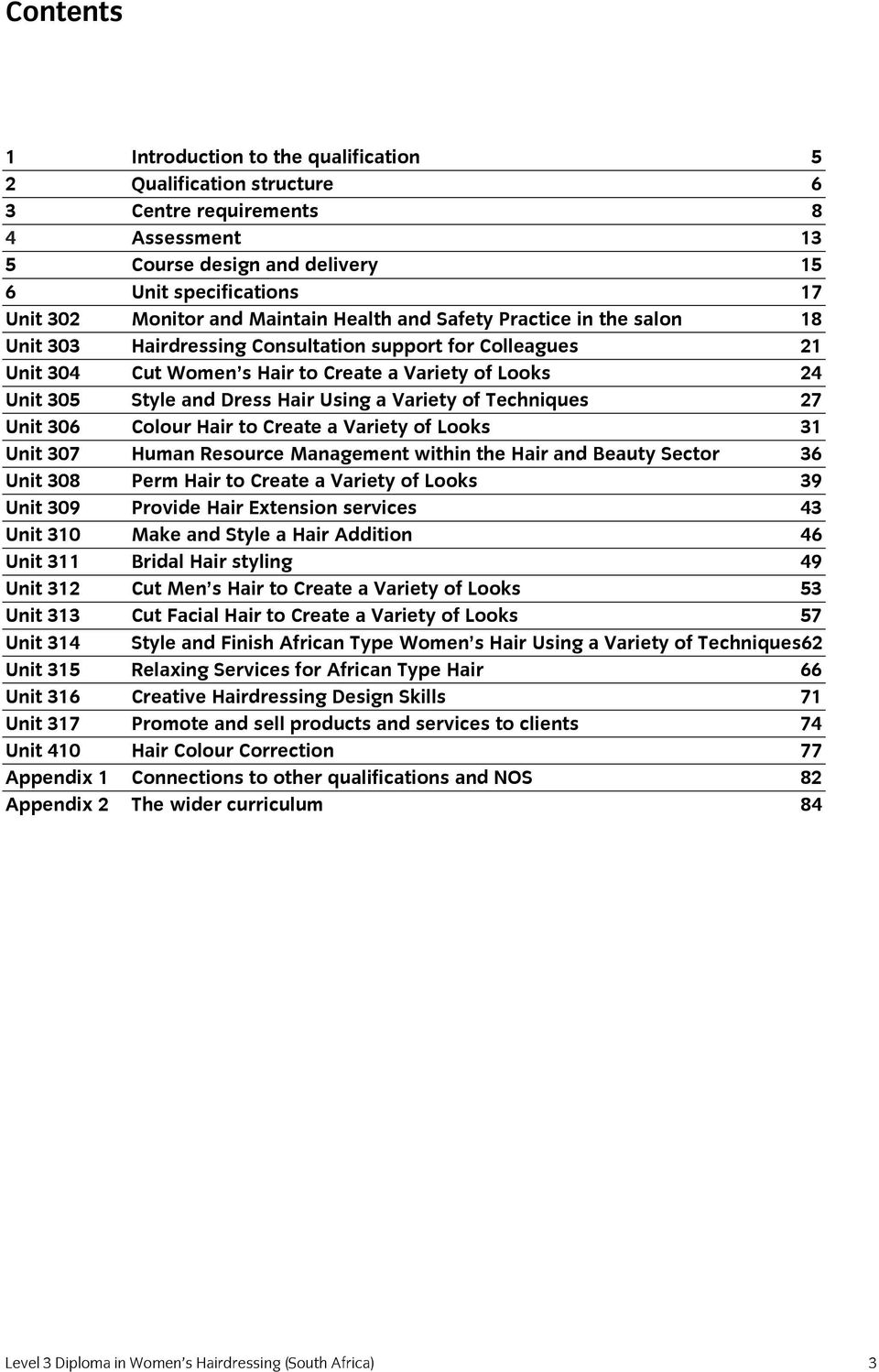
5 Contents 1 Introduction to the qualification 5 2 Qualification structure 6 3 Centre requirements 8 4 Assessment 13 5 Course design and delivery 15 6 Unit specifications 17 Unit 302 Monitor and Maintain Health and Safety Practice in the salon 18 Unit 303 Hairdressing Consultation support for Colleagues 21 Unit 304 Cut Women s Hair to Create a Variety of Looks 24 Unit 305 Style and Dress Hair Using a Variety of Techniques 27 Unit 306 Colour Hair to Create a Variety of Looks 31 Unit 307 Human Resource Management within the Hair and Beauty Sector 36 Unit 308 Perm Hair to Create a Variety of Looks 39 Unit 309 Provide Hair Extension services 43 Unit 310 Make and Style a Hair Addition 46 Unit 311 Bridal Hair styling 49 Unit 312 Cut Men s Hair to Create a Variety of Looks 53 Unit 313 Cut Facial Hair to Create a Variety of Looks 57 Unit 314 Style and Finish African Type Women s Hair Using a Variety of Techniques62 Unit 315 Relaxing Services for African Type Hair 66 Unit 316 Creative Hairdressing Design Skills 71 Unit 317 Promote and sell products and services to clients 74 Unit 410 Hair Colour Correction 77 Appendix 1 Connections to other qualifications and NOS 82 Appendix 2 The wider curriculum 84 Level 3 Diploma in Women s Hairdressing (South Africa) 3
6 City & Guilds Skills for a brighter future 4 Level 3 Diploma in Women s Hairdressing (South Africa)

7 1 Introduction to the qualification This document contains the information that centres need to offer the following qualification: Qualification title and level Level 3 Diploma in Women s Hairdressing (South Africa) City & Guilds qualification number Qualification accreditation number Last registration date Last certification date /9099/9 31/1/ /1/2018 The following documents contain essential information on City & Guilds qualifications and should be referred to in conjunction with this handbook. These documents are available on line from Publication Providing City & Guilds qualifications a guide to centre and qualification approval Ensuring quality Walled Garden Content This provides detailed information about the processes which must be followed and requirements which must be met for a centre to achieve approved centre status, or to offer a particular qualification. This has updates on City & Guilds assessment and policy issues This contains details of the qualification structure, registration and certification procedures and fees. Qualifications summary These qualifications are based on the National Occupational Standards. They are preparation for work qualifications which require learners to develop the skills and knowledge required in the hair industry. Opportunities for progression The Level 3 Diplomas/Awards in Hairdressing and Barbering are suitable for people who have taken a level 2 or level 3 qualifications, and/or have been working in the industry and are looking to accredit their skills and knowledge. These qualifications provide progression opportunities for those with intentions of progressing into employment or onto a NVQ/SVQ level 3 qualification. Level 3 Diploma in Women s Hairdressing (South Africa) 5

8 2 Qualification structure Level 3 Diploma in Women s Hairdressing (South Africa) 500/9099/9 A minimum of 80 credits is required to achieve the Level 3 Diploma in Women s Hairdressing (South Africa). All mandatory units must be achieved. Learners can elect to undertake elective units and / or Evolve assessments for the mandatory units. The recommended GLH is 635 hours. Mandatory Units (all must be completed) Credits GLH 302 Monitor and maintain health and safety 4 24 practice in the salon 303 Hairdressing consultation support for colleagues Cut women s hair to create a variety of looks Style and dress hair using a variety of 7 60 Techniques 306 Colour hair to create a variety of looks Human Resource Management within the Hair and 7 60 beauty Sector 308 Perm hair to create a variety of looks Provide Hair Extension services Bridal Hairstyling Creative Hairdressing Design Skills Promote and sell products and services to clients Hair Colour Correction Women's Hairdressing and Barbering Knowledge Test Elective Units and Evolve Tests (none of these units or tests have to be completed) 310 Make and Style a Hair Addition Cut men s hair to create a variety of looks Cut facial hair to create a variety of looks Style and finish African Type Women s hair using a variety 5 41 of techniques 315 Relaxing services for African Type hair Carry out and Monitor Health and Safety Practice in the Salon 603 Consultation Support for Colleagues on Hair Services 604 Cut Women's Hair to Create a Variety of Looks 605 Style and Dress Hair using a Variety of Techniques 606 Colour Hair to Create a Variety of Looks 607 Human Resources Management 608 Perm Hair to Create a Variety of Looks 609 Hair Extensions 610 Make and Style a Hair Addition 611 Bridal Hairstyling 612 Cut Men's Hair to Create a Variety of Looks 613 Cut Facial Hair to Create a Variety of Looks 616 Creative Hairdressing Design Skills 710 Colour Correction 6 Level 3 Diploma in Women s Hairdressing (South Africa)

9 2.1 Qualification support materials City & Guilds also provides the following publications and resources specifically for this qualification: Description Assessment Pack Qualification Handbook Fast track approval forms Candidate logbook Smartscreen How to access Downloadable from our website Downloadable from our website Please contact your regional office direct. Downloadable from our website to place an order or via the walled garden The Assessment pack is password protected the password is available on the Walled Garden. Level 3 Diploma in Women s Hairdressing (South Africa) 7

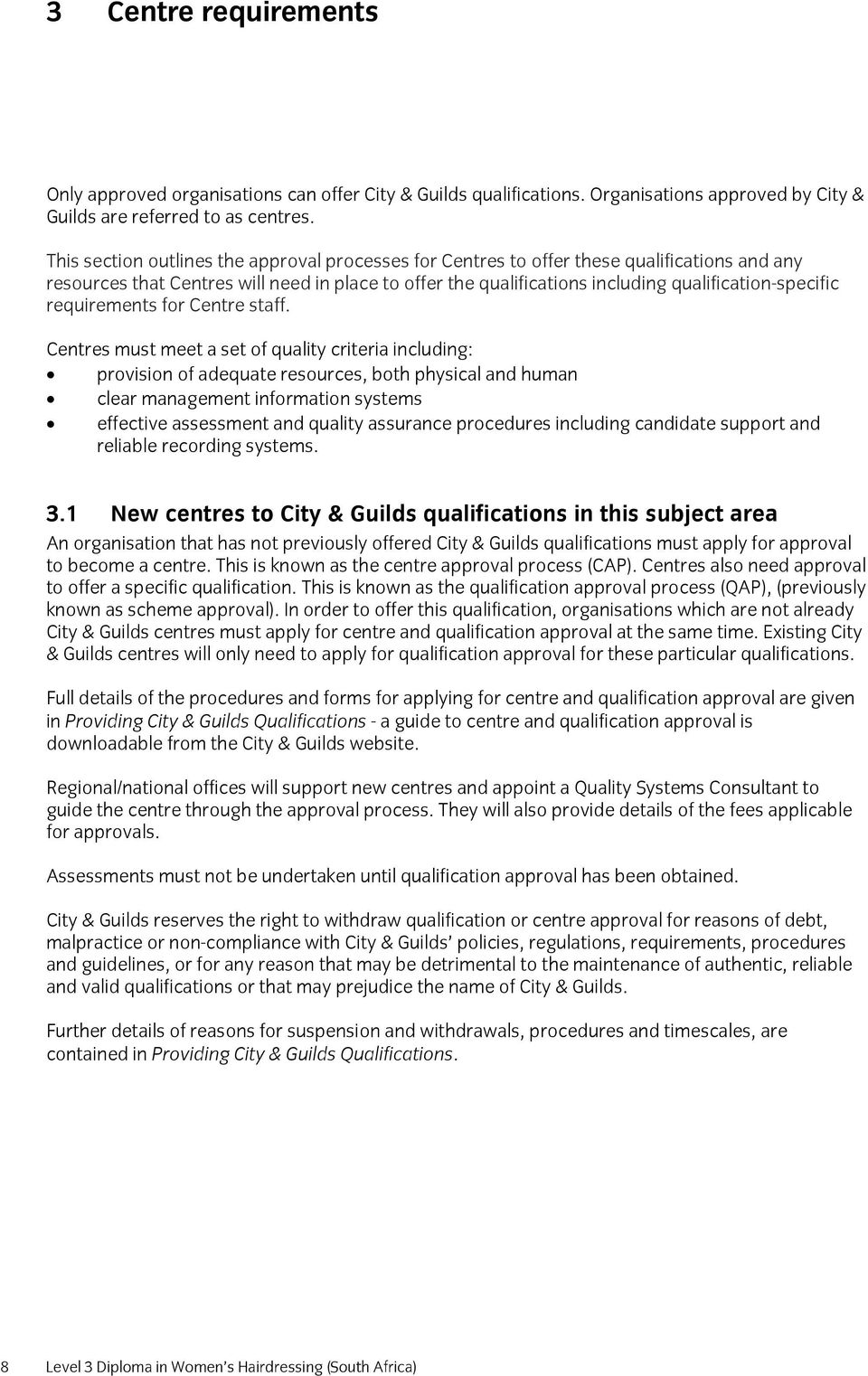
10 3 Centre requirements Only approved organisations can offer City & Guilds qualifications. Organisations approved by City & Guilds are referred to as centres. This section outlines the approval processes for Centres to offer these qualifications and any resources that Centres will need in place to offer the qualifications including qualification-specific requirements for Centre staff. Centres must meet a set of quality criteria including: provision of adequate resources, both physical and human clear management information systems effective assessment and quality assurance procedures including candidate support and reliable recording systems. 3.1 New centres to City & Guilds qualifications in this subject area An organisation that has not previously offered City & Guilds qualifications must apply for approval to become a centre. This is known as the centre approval process (CAP). Centres also need approval to offer a specific qualification. This is known as the qualification approval process (QAP), (previously known as scheme approval). In order to offer this qualification, organisations which are not already City & Guilds centres must apply for centre and qualification approval at the same time. Existing City & Guilds centres will only need to apply for qualification approval for these particular qualifications. Full details of the procedures and forms for applying for centre and qualification approval are given in Providing City & Guilds Qualifications - a guide to centre and qualification approval is downloadable from the City & Guilds website. Regional/national offices will support new centres and appoint a Quality Systems Consultant to guide the centre through the approval process. They will also provide details of the fees applicable for approvals. Assessments must not be undertaken until qualification approval has been obtained. City & Guilds reserves the right to withdraw qualification or centre approval for reasons of debt, malpractice or non-compliance with City & Guilds policies, regulations, requirements, procedures and guidelines, or for any reason that may be detrimental to the maintenance of authentic, reliable and valid qualifications or that may prejudice the name of City & Guilds. Further details of reasons for suspension and withdrawals, procedures and timescales, are contained in Providing City & Guilds Qualifications. 8 Level 3 Diploma in Women s Hairdressing (South Africa)
11 3.2 Centres already offering City & Guilds qualification in this subject area Centres approved to offer 6902 Diplomas in Hairdressing and Barbering, N/SVQ Level 3 or above in Hairdressing (3014/3008) may apply for approval for the 3002 Level 3 Award/Diploma in Hairdressing and Barbering using the fast track approval form, available from the City & Guilds website providing there have been no changes to the way the qualifications are delivered, and if they meet all of the approval criteria specified in the fast track form guidance notes Fast track approval is available for 12 months from the launch of the qualification. After this time, the qualification is subject to the standard Qualification Approval Process. It is the centre s responsibility to check that fast track approval is still current at the time of application. 3.3 Resource requirements Physical resources Centres must have access to the range of services, professional products, tools, materials and equipment in the centre or workplace to ensure learners have the opportunity to cover all of the practical activities. The equipment must meet industry standards and be capable of being used under normal working conditions. Use of simulation (head block and fake body parts) The use of head blocks and fake body parts for summative assessment may only be used for the following units. Level 3 Unit Perm to create a variety of looks Simulation for these units should only be used once the use of models, peers and clients has been exhausted (the best form of assessment would always be on a real person, as this is a preparation for employment qualification). If a head block or fake body part has been used in a summative assessment then this needs to be recorded by the Assessor. Realistic learning environment requirements (RLE) All City & Guilds VRQs must be assessed in facilities that meet acceptable, current industry standards for the specific qualification area. Centres must ensure that access to the range of services or treatments and required professional products, tools, materials and equipment is maintained in the centre and / or workplace to meet the qualification needs and enable candidates to cover all of the required practical activities. The learning and assessment setting should incorporate a real, or simulated but realistic learning environment. These facilities must provide candidates with experience of working in and under realistic commercial conditions during assessment. The learning environment must meet any bye-laws, legislation or legal authority requirements that would affect a similar commercial establishment as well as meeting the requirements of a vocational education establishment. Level 3 Diploma in Women s Hairdressing (South Africa) 9

12 For the purpose of City & Guilds VRQs clients are defined as people seeking the service or treatment being assessed, which can include friends, peers, models and family members. There is no requirement for these clients to pay. A suitable, controlled area for testing must be provided and arrangements must be made for the secure storage of assessment materials and records. Acceptable facilities for Evolve online testing must be maintained where the VRQ requires online testing of knowledge and understanding Centre staff Centre staff must satisfy the requirements for occupational expertise for these qualifications. Quality assurance coordinators and assessors must: 1. have verifiable and relevant current or real industry experience and competence of the occupational working area at or above the level being assessed and evidence of the quality of occupational experience to ensure the credibility of the assessment judgements. Appropriate evidence will include: curriculum vitae and references achievement of a relevant qualification continuing professional development (CPD) 2. only assess in their acknowledged area of occupational competence 3. participate in training activities for their continued professional development 4. be competent in making accurate assessment decisions: it is recommended that assessors hold, or are working towards, Learning and Development unit A1; or hold units D32 and D33 and assess to A1 standard. Internal quality assurers (IQAs previously called IVs) and assessors must have verifiable and relevant current industry experience and competence of the occupational working area at or above the level being assessed, and evidence of the quality of occupational experience to ensure the credibility of the assessment judgements. Newly qualified hairdressers, barbers, therapists, makeup artists and nail technicians must have gained significant post qualification commercial experience before commencing these roles. For the avoidance of doubt, those who have no occupational experience cannot asses these VRQs. Appropriate evidence will include CVs, References, Qualification Certificates, CPD records, Product Evidence, Video Evidence. This list is not exhaustive and other relevant methods may be considered. Please contact your Qualification Consultant for guidance. i. Staff must only assess or quality assure in their acknowledged area of occupational competence. ii. Staff must participate in relevant training activities for their continued professional development (see CPD requirements). Assessors and quality assurers of VRQs must be competent and experienced in making accurate assessment decisions; it is therefore highly recommended that the assessor and quality assurance qualification have been obtained or that they are being worked towards. It is highly recommended that new VRQ assessors work towards or hold either the Learning and Development unit A1 or the relevant TAQA unit. Assessor and verifier requirements While the Assessor/Verifier (A/V) units are valued as qualifications for centre staff, they are not currently a requirement for the qualifications. 10 Level 3 Diploma in Women s Hairdressing (South Africa)

13 Continuous professional development (CPD) in VRQs For City & Guilds VRQs centre staff must continue to meet the requirements for occupational expertise for the specific qualification(s) they assess or quality assure. Assessors and quality assurers must be able to demonstrate how they keep their technical skills and knowledge up-to-date and to the occupational level in which they are assessing and/or quality assuring Continuing Professional Development (CPD) must take place throughout the careers of assessors and quality assurers This must include the completion of a minimum number of 30 hours CPD in each twelve month period using activities approved for CPD which do not have to be consecutive. (see below). The CPD requirement must be carried out on one or a combination of the types of activities listed below. No activity will carry a 'double hours' allowance. 'hands on' delivery of relevant services/treatments to fee paying clients in a commercial salon that can be shown to develop individual skill and knowledge levels undertaking technical training that develops new and/or updates existing skills and/or knowledge levels further relevant qualifications. The following activities will not count towards CPD: reading the trade press and books listening to tapes and watching DVDs. Individuals must provide relevant and suitable evidence that CPD has taken place within each 12 month period to be measured from 1 September - 31 August. Calculating CPD hours a) CPD for existing assessors and quality assurers is measured within each 12 month period, taken from 1 September 31 August each year. b) CPD hours for new assessors and quality assurers shall be measured from the date their duties commence. c) Assessors and quality assurers who take leave from assessment or quality assurance duties during any twelve month period will be able to collect CPD pro rata. d) The CPD hours for part time assessors and quality assurers will be calculated pro rata based on a nominal 37 hour week. However, a minimum of 5 hours CPD in any twelve month period must be carried out by all part time assessors and quality assurers. For example, an assessor contracted for 7 hours/week : 7 37 x 100 = approx. 20% of a full time assessor. 20% x 30 hours = 6 hours CPD in any 12 month period. e) A nominal time of 30 hours per technical unit achieved has been set, regardless of the unit. f) If you are an assessor and quality assurer, you only have to do the minimum of 30 hours CPD, not 60 hours. 3.4 Candidate entry requirements There are no formal entry requirements for candidates undertaking these qualifications. However, centres must ensure that candidates have the potential and opportunity to gain the qualification successfully. Some of the qualifications are not suitable for pre-16 candidates, these are indicated in Section Quality Assurance Internal quality assurance Approved centres must have effective quality assurance systems to ensure optimum delivery and assessment of qualifications. Level 3 Diploma in Women s Hairdressing (South Africa) 11

14 Quality assurance includes initial centre approval, qualification approval and the centre s own internal procedures for monitoring quality. Centres are responsible for internal quality assurance, and City & Guilds is responsible for external quality assurance. Full details and guidance on the internal and external quality assurance requirements and procedures are provided in Providing City & Guilds Qualifications. This document also explains the tasks, activities and responsibilities of quality assurance staff. External quality assurance External verifiers are appointed by City & Guilds to approve centres, and to monitor the assessment and internal quality assurance carried out by centres. External verification is carried out to ensure that there is validity, reliability and good practice in centres. To carry out their quality assurance role, external verifiers/moderators must have appropriate occupational and verifying knowledge and expertise. City & Guilds external verifiers attend training and development designed to keep them up-to-date, to facilitate standardisation between verifiers and to share good practice. External verifiers: The role of the external verifier is to: provide advice and support to centre staff ensure the quality and consistency of assessments within and between centres by the use of systematic sampling visit centres regularly to ensure they continue to meet the centre and qualification approval criteria provide feedback to centres and City & Guilds. External quality assurance for the qualifications will be provided by the usual City & Guilds quality assurance process. Further details of the role of external verifiers are given in Providing City & Guilds Qualifications. 3.6 Registration and certification Full details of City & Guilds administrative procedures for these qualifications are provided online to City & Guilds registered centres via the Walled Garden. This information includes details on: registration enrolment numbers fees entry for examinations certification. These details are also available on Walled Garden. Centres should follow all guidance carefully, particularly noting that fees, registration and certification end dates for the qualifications are subject to change. Centres should be aware of time constraints regarding the registration and certification periods for the qualifications, which are specified on the Walled Garden. 12 Level 3 Diploma in Women s Hairdressing (South Africa)

15 4 Assessment The summative assessments for the qualifications require the candidates to undertake: practical tasks, and knowledge and understanding task(s) in an assignment or an on-line tests. NB Candidates can use either the on-line test or knowledge tasks in the assignments. Learners are not required to undertake both for a unit, but can use a combination to achieve the qualification. On-line tests City & Guilds have produced on-line tests for each unit to cover the knowledge and understanding assessment requirements. The on-line assessments are available via the Evolve system. Information on how to become a Evolve centre can be found on our website To register your candidates on the qualification and Evolve, it is important to use the correct number. Please refer to the Walled Garden for these numbers. It is important to remember that once a candidate has registered onto the qualification (including Evolve) there is the flexibility to use either Evolve or the knowledge tasks in the assignments. A combination of both is acceptable. Centres are required to set up a Evolve profile in order to offer online examinations to learners. Setting up a Evolve profile is a simple process that need only be completed once by the centre. Details of how to set up the profile and Evolve technical requirements are available on the City & Guilds website ( /e-assessment). The Evolve section of the website also has details of the Evolve helpline for technical queries and downloads for centres and candidates about Evolve examinations. Service / Treatment times in VRQs Service times in VRQs are not generally specified; however the overall preparation for work objective of City & Guilds VRQs requires that all practical assessments, unless specifically stated should be completed within commercially acceptable times relevant to the level of qualification involved. The relevant N/SVQ maximum service times may be used as a guide, although these should not be applied strictly. Assessors should use their professional discretion, particularly for situations where client factors would require additional time in normal commercial practice. To ensure consistency across assessors centres should develop agreed maximum service times for use within their centre. Glossary of terms & Guidance notes Technical training - external and internal workshops and training sessions can be used.. Commercial salon - this is defined as a salon where the majority of stylists/therapists are already qualified and the main function of the salon is not training and assessment. If a training salon in a centre is closed and reopened as a commercial salon e.g. during holiday periods, then this is an acceptable location for CPD to be undertaken Qualification work - the aim of this option is to encourage assessors and quality assurers to gain new knowledge and skills. Work undertaken for this option must lead to a formally assessed and accredited qualification 30 hours can be claimed on the achievement of any technical unit qualification in any one CPD year. Level 3 Diploma in Women s Hairdressing (South Africa) 13

16 14 Level 3 Diploma in Women s Hairdressing (South Africa)

17 5 Course design and delivery Recommended delivery strategies Centre staff should familiarise themselves with the structure, content and assessment requirements of the qualifications before designing a course programme. In particular, staff should consider the skills and knowledge related to the National Occupational Standards. Provided that the requirements for the qualification are met, centres may design course programmes of study in any way that they feel best meets the needs and capabilities of their candidates. Centres may wish to include topics as part of the course programme, which will not be assessed through the qualifications. Relationship to other qualifications and wider curriculum City & Guilds recommends centres address the wider curriculum, where appropriate, when designing and delivering the course. Centres should also consider links to the National Occupational Standards, Key/Core Skills and other related qualifications. The following relationship tables are provided to assist centres with the design and delivery of the qualifications: relationship to National Occupational Standards can be found in Appendix 1 opportunities to address social, moral, spiritual and cultural issues during the delivery of the qualifications have been identified, and can be found in Appendix 2. Health and safety The requirement to follow safe working practices is an integral part of all City & Guilds qualifications and assessments, and it is the responsibility of centres to ensure that all relevant health and safety requirements are in place before candidates start practical assessments. Should a candidate fail to follow health and safety practice and procedures during an assessment (for example, practical assessment, assignment) the assessment must be stopped and the candidate advised of the reasons why. The candidate should be informed that they have failed the assessment. Candidates may retake the assessment at a later date, at the discretion of the centre. In any cases of doubt, guidance should be sought from the external verifier. Data protection and confidentiality Centres offering these qualifications may need to provide City & Guilds with personal data for staff and candidates. Guidance on data protection and the obligations of City & Guilds and centres are explained in Providing City & Guilds Qualifications. Level 3 Diploma in Women s Hairdressing (South Africa) 15

18 Initial assessment and induction Centres will need to make an initial assessment of each candidate prior to the start of their programme to ensure they are entered for an appropriate type and level of qualification. The initial assessment should identify any specific training needs the candidate has, and the support and guidance they may require when working towards their qualifications. City & Guilds recommends that centres provide an induction programme to ensure the candidate fully understands the requirements of the qualifications they will work towards, their responsibilities as a candidate, and the responsibilities of the centre. It may be helpful to record the information on a learning contract. Further guidance about initial assessment and induction, as well as a learning contract that centres may use, are available in the Centre toolkit. Equal opportunities It is a requirement of centre approval that centres have an equal opportunities policy (see Providing City & Guilds Qualifications). The regulatory authorities require City & Guilds to monitor centres to ensure that equal opportunity policies are being followed. The City & Guilds equal opportunities policy is set out on the City & Guilds website, in Providing City & Guilds Qualifications and is also available from the City & Guilds Customer Relations department. Access to assessment City & Guilds guidance and regulations on access to assessment are designed to facilitate access to assessments and qualifications for candidates who are eligible for adjustments to assessment arrangements. Access arrangements are designed to allow attainment to be demonstrated. For further information, please see Access to assessment and qualifications, available on the City & Guilds website. Appeals Centres must have their own, auditable, appeals procedure that must be explained to candidates during their induction. Appeals must be fully documented by the quality assurance co-ordinator and made available to the external verifier or City & Guilds. Further information on appeals is given in Providing City & Guilds Qualifications. There is also appeals information for centres and learners on the City & Guilds website or available from the Customer Relations department. 16 Level 3 Diploma in Women s Hairdressing (South Africa)

19 6 Unit specifications The qualifications comprise of a number of units. A unit describes what is expected of a candidate in particular aspects of his/her job. Each unit is divided into learning outcomes which describe in further detail the skills and knowledge that a candidate should possess. Each learning outcome has a set of assessment criteria (performance, and knowledge and understanding) which specify the desired criteria that have to be satisfied before an individual can be said to have performed to the agreed standard. Range statements define the breadth or scope of a learning outcome and its assessment criteria by setting out the various circumstances in which they are to be applied. Structure of units The units in these qualifications are written in a standard format and comprise the following: title unit reference rationale, aim and any entry requirements (where specified) list of learning outcomes for the unit statement of guided learning hours connections with other qualifications, eg NOS assessment details learning outcomes in detail expressed as practical skills and underpinning knowledge. Level 3 Diploma in Women s Hairdressing (South Africa) 17

20 Unit 302 Monitor and Maintain Health and Safety Practice in the salon Level: 3 Credit value: 4 UAN number: R/600/8780 Unit aims The aim of this unit is about making sure that statutory and work place instruction are being carried out in order to monitor the operation of health and safety procedures The skills developed by the learner include monitoring, maintaining and supporting health, safety and security practices in the salon and following and carrying out emergency procedures. The knowledge acquired by the learner will enable them to understand and explain the main provision of the Health and Safety at Work Act, assess hazards and carry out risk assessments and monitor emergency procedures requirements. Learning outcomes There are two learning outcomes to this unit. The learner will: 1. Be able to carry out a risk assessment 2. Be able to monitor health and safety in the salon Guided learning hours It is recommended that 24 guided learning hours should be allocated for this unit, although patterns of delivery are likely to vary. Details of the relationship between the unit and relevant national occupational standards This unit is linked to the hairdressing NOS, unit G22 Monitor procedures to safely control work operations. Endorsement of the unit by a sector or other appropriate body (if required) This unit is endorsed by Habia. Assessment This unit will be assessed by: knowledge and understanding task(s) in an assignment or an on-line test 18 Level 3 Diploma in Women s Hairdressing (South Africa)

21 Unit 302 Outcome 1 Monitor and Maintain Health and Safety Practice in the salon Be able to carry out a risk assessment Practical skills 1. carry out risk assessments and take necessary actions. Underpinning knowledge 1. state the reason for carrying out risk assessments 2. describe the procedures for carrying out a risk assessment 3. describe when risk assessments should be carried out 4. outline necessary actions to take following a risk assessment. Range Reason for carrying out risk assessments To ensure safety in the salon. When risk assessments should be carried out Change to salon environment, new service or product, personal circumstances. Necessary actions Record the risk assessment, report to salon manager or owner, update risk assessment information, inform staff. Level 3 Diploma in Women s Hairdressing (South Africa) 19
22 Unit 302 Outcome 2 Monitor and Maintain Health and Safety Practice in the salon Be able to monitor health and safety in the salon Practical skills 1. monitor and support the work of others to ensure compliance with health and safety requirements. Underpinning knowledge 1. outline the health and safety support that should be provided to staff 2. outline procedures for dealing with different types of security breaches 3. explain the need for insurance. Range Support Clarification of existing requirements, induction for new staff, updating of information, specific training. Insurance Public liability, product and treatment liability, employer s liability. 20 Level 3 Diploma in Women s Hairdressing (South Africa)
23 Unit 303 Hairdressing Consultation support for Colleagues Level: 3 Credit value: 3 UAN number: H/600/9061 Unit aims The aim of this unit is about the particular skills involved in supporting colleagues, analysing problems reported during consultation with clients. The knowledge gained in this unit includes consultation techniques, recognising skin, hair and scalp disorders, use of confidential information. Learning outcomes There is one learning outcome to this unit. The learner will: 1. Be able to provide consultation support to colleagues Guided learning hours It is recommended that 30 guided learning hours should be allocated for this unit, although patterns of delivery are likely to vary. Details of the relationship between the unit and relevant national occupational standards This unit is linked to the hairdressing NOS, unit G21 Provide hairdressing consultation services. Endorsement of the unit by a sector or other appropriate body (if required) This unit is endorsed by Habia Assessment This unit will be assessed by: practical tasks, and knowledge and understanding task(s) in an assignment or an on-line test Level 3 Diploma in Women s Hairdressing (South Africa) 21
24 Unit 303 Outcome 1 Hairdressing Consultation support for Colleagues Be able to provide consultation support to colleagues Practical skills 1. communicate effectively with colleagues and their clients in a manner that maintains client goodwill, trust and confidentiality 2. deal with analysis problems reported by colleagues promptly 3. make sure client records are accurately completed 4. balance the client requirements with salon resources 5. provide the type of support required for the reported analysis problems 6. provide clear recommendations based on client requirements and the outcome of analysis of their hair, skin and scalp Underpinning knowledge The learner can 1. explain how and why tests are carried out for different services 2. state the likely causes of adverse hair, skin and scalp conditions 3. state which adverse hair, skin and scalp conditions should be referred to other specialists 4. explain the salon s policy for referring clients to other specialists when requested services are not offered 5. describe how to take part in group discussions in a way that will maintain client goodwill and confidentiality 6. state the importance of recording client responses to questions about contra-indications Range Analysis problems Unrecognised hair conditions, unrecognised skin and scalp conditions, unrealistic and persistent client requests, unexpected test results. Client records Salon service record cards, written client responses to questions about contra-indications. Type of support Technical clarification to colleagues, visual identification of adverse hair, skin or scalp conditions, specific recommendations to clients with unrealistic expectations, referral to other specialists. Recommendations Specific advice on delivery of requested service and use of products, alternative services, alternative products, referral to other salons, referral to other specialists. 22 Level 3 Diploma in Women s Hairdressing (South Africa)
25 Adverse hair, skin and scalp conditions Pediculosis capitas, scabies, tinea capitis, eczema, psoriasis, folliculitis, keloids, dandruff, alopecia, in-growing hair and impetigo. Other specialists Pharmacist, General Practitioner, Registered Trichologist Level 3 Diploma in Women s Hairdressing (South Africa) 23
26 Unit 304 Cut Women s Hair to Create a Variety of Looks Level: 3 Credit value: 8 UAN number: Y/600/8635 Unit aims The aim of this unit is to provide the learner with the knowledge and skills to cut women s hair to create a variety of looks. The skills developed by the learner include graduation, layering, and club cutting, scissor-over-comb, clipper-over-comb, texturising, freehand, tapering and thinning. The ability to combine and adapt cutting techniques to create highly personalised looks will also be developed. The knowledge acquired by the learner will enable them to understand how to maximise the potential of the clients hair taking into account all factors, the effect cutting hair at different angles has on the haircut, the importance of applying the correct degree of tension to the hair when cutting and the safety considerations that must be taken into account. Learning outcomes There are two learning outcomes to this unit. The learner will: 1. Be able to prepare for cutting hair 2. Be able to provide a cutting service Guided learning hours It is recommended that 75 guided learning hours should be allocated for this unit, although patterns of delivery are likely to vary. Details of the relationship between the unit and relevant national occupational standards This unit is linked to the hairdressing NOS, unit GH16 Creatively cut hair using a combination of techniques. Endorsement of the unit by a sector or other appropriate body (if required) This unit is endorsed by Habia. Assessment This unit will be assessed by: practical tasks, and knowledge and understanding task(s) in an assignment or an online test 24 Level 3 Diploma in Women s Hairdressing (South Africa)
27 Unit 304 Outcome 1 Cut Women s Hair to Create a Variety of Looks Be able to prepare for cutting hair Practical skills 1. prepare themselves, the client and work area for cutting services 2. use suitable consultation techniques to identify service objectives 3. evaluate the potential of the hair to achieve the desired look by identifying influencing factors 4. provide clear recommendations to the client based on factors Underpinning knowledge 1. describe the range of looks for women 2. explain how to achieve looks for women using a combination of cutting techniques 3. explain the safety considerations that must be taken into account 4. describe the factors that need to be considered when cutting hair 5. explain how to maximise the potential of the client s hair taking into account identified factors 6. describe the different consultation techniques used to identify service objectives 7. describe the salon s requirements for client preparation, preparing themselves and the work area Range Consultation techniques Verbal: questioning techniques, language used, tone of voice. Non-verbal: listening techniques, body language, eye contact, facial expression. Use of: visual aids, client records. Factors Hair: wet, dry, curly, straight. Client requirements, hair texture, length and density, hair growth patterns, head/face shapes/features, client lifestyle, elasticity, contra-indications. Looks Short graduation, long graduation, reverse graduation, asymmetric, textured, disconnected. Cutting techniques Club cutting, scissor over comb, clipper over comb, texturising, freehand, tapering, thinning, disconnecting. Safety considerations Handling scissors, protection from infection and cross infection, handling electrical equipment, deportment, trip hazards from hair cuttings, first aid procedures Level 3 Diploma in Women s Hairdressing (South Africa) 25
28 Unit 304 Outcome 2 Cut Women s Hair to Create a Variety of Looks Be able to provide a cutting service Practical skills 1. communicate and behave in a professional manner 2. select and use cutting tools and equipment required to achieve the desired look 3. establish and follow guidelines where required to achieve the required look 4. combine and personalise cutting techniques to take account of the identified factors and the desired look 5. position themselves and the client correctly throughout the service to ensure the accuracy of the cut 6. check the cut to ensure required balance, weight distribution and shape 7. create a finished cut that is to the satisfaction of the client 8. provide suitable aftercare advice 9. follow safe and hygienic working practices. Underpinning knowledge 1. outline safe and hygienic working practices 2. describe the correct use and routine maintenance of cutting tools and equipment 3. explain the effect cutting hair at different angles has on the finished look 4. state the importance of applying the correct degree of tension to the hair when cutting 5. state the importance of checking the cut 6. describe the aftercare advice that should be provided 7. state how to communicate and behave within a salon environment. Range Communicate Speaking, listening, body language, reading recording, following instructions using a range of related terminology. Cutting tools and equipment Scissors, electrical clippers, razor, thinning scissors. Look Short graduation, long graduation, reverse graduation, asymmetric, textured, disconnected. Cutting techniques Club cutting, scissor over comb, clipper over comb, texturising, freehand, tapering, thinning, disconnecting. Aftercare advice Recommend time intervals between cuts, how to maintain the look, suitable styling and finishing products to use, identifying additional services. Effects of cutting hair Importance of applying correct degree of tension Safe and hygienic working practices Methods of sterilisation, disposal of contaminated waste, health and safety legislation, PPE, positioning of client and self, removal of accessories. 26 Level 3 Diploma in Women s Hairdressing (South Africa)
29 Unit 305 Style and Dress Hair Using a Variety of Techniques Level: 3 Credit value: 7 UAN number: R/600/8634 Unit aims The aim of this unit is to provide the learner with the knowledge and skills to style women s hair using a variety of techniques. The skills developed by the learner include the use of hair-up techniques on long hair to create a personalised effect. The knowledge acquired by the learner will enable them to understand how the use of products during styling can prolong the style. Learning outcomes There are two learning outcomes to this unit. The learner will: 1. Be able to prepare for a styling service 2. Be able to provide a styling service Guided learning hours It is recommended that 60 guided learning hours should be allocated for this unit, although patterns of delivery are likely to vary. Details of the relationship between the unit and relevant national occupational standards This unit is linked to the hairdressing NOS, unit GH19 Creatively style and dress hair. Endorsement of the unit by a sector or other appropriate body (if required) This unit is endorsed by Habia. Assessment This unit will be assessed by: practical tasks, and knowledge and understanding task(s) in an assignment or an on-line test Level 3 Diploma in Women s Hairdressing (South Africa) 27
30 Unit 305 Outcome 1 Style and Dress Hair Using a Variety of Techniques Be able to prepare for a styling service Practical skills 1. prepare themselves, the client and work area for styling services 2. use suitable consultation techniques to identify service objectives 3. evaluate the potential of the hair to achieve the desired style by identifying the influencing factors 4. provide clear recommendations to the client based on factors. Underpinning knowledge 1. explain the safety considerations that must be taken into account when styling and dressing hair 2. describe the factors that need to be considered when styling and dressing hair 3. describe the physical effects of styling on the hair 4. describe the effect humidity has on the hair during setting 5. state the importance of planning hair-up styles for special occasions 6. describe a range of styles for women 7. describe the different consultation techniques used to identify service objectives 8. describe the salon s requirement for client preparation, preparing themselves and the work area. Range Consultation techniques Open and closed questions, use of visual aids. Factors Hair: wet, dry, curly, straight. Head and face shape, growth patterns, hair density, hair length, image, occasion, haircut, elasticity, hair texture, contra-indications. Safety considerations Handling and maintaining equipment, checks before use, protection from infection and cross infection, deportment, first aid procedures. Physical effects Appearance of the hair, structural changes Hair up styles Plaiting, braiding, twists, knots, barrel curls, weaving. 28 Level 3 Diploma in Women s Hairdressing (South Africa)
31 Unit 305 Outcome 2 Style and Dress Hair Using a Variety of Techniques Be able to provide a styling service Practical skills 1. communicate and behave in a professional manner 2. select and use products, tools and equipment to achieve the desired effect 3. position them self and the client correctly throughout the service 4. combine and adapt styling techniques to achieve the desired effects 5. personalise dressing techniques to take account of influencing factors 6. create a finished style that is to the satisfaction of the client 7. provide suitable aftercare advice 8. follow safe and hygienic working practices. Underpinning knowledge 1. describe the correct use and routine maintenance of styling equipment and tools 2. describe the techniques used for styling and dressing 3. explain the importance of using styling and finishing products on the hair 4. explain the importance of controlling and securing long hair effectively 5. explain the importance of considering tension in hair-up styles 6. explain the effects of incorrect use of heat on the hair and scalp 7. state the purposes of backcombing and back brushing when dressing hair 8. describe the methods used to secure ornamentation in hair-up styles 9. describe the aftercare advice that should be provided 10. outline safe and hygienic working practices 11. state how to communicate and behave within a salon environment. Range Communicate Speaking, listening, body language, reading, recording, following instructions using a range of related terminology. Products Styling: lotions, mousses, gels, heat protectors. Finishing: sprays, waxes, gels, serums, dressing creams, oils. Tools and equipment Hand held dryer, hood dryer, diffuser, nozzle, rollers secured with pins, pin curl clips, round brushes, flat brushes, straighteners, curling tongs, heated rollers. Styling techniques Setting, blow drying, finger-drying, pin curling, finger waving, use of heated styling equipment, waving, smoothing, straightening. Curling: point to root, root to point. Dressing techniques Backcombing, back brushing, shaping, moulding, rolls, knots, twists, plaits, curls, woven effects. Factors Hair: wet, dry, curly, straight. Level 3 Diploma in Women s Hairdressing (South Africa) 29
32 Head and face shape, growth patterns, hair density, hair length, image, occasion, haircut, elasticity, hair texture, contra-indications. Aftercare advice How to maintain the look, suitable styling and finishing products to use, identifying additional services. Safe and hygienic working practices Methods of sterilisation, disposal of contaminated waste, health and safety legislation, PPE, positioning of client and stylist, removal of accessories. Hair-up styles Plaiting, braiding, twists, knots, barrel curls, weaving. Effects of incorrect use of heat Temperature, direction of air flow, frequency of use. Purposes of backcombing and back brushing Styling: duration, shape, securing. 30 Level 3 Diploma in Women s Hairdressing (South Africa)
33 Unit 306 Colour Hair to Create a Variety of Looks Level: 3 Credit value: 11 UAN number: D/600/8636 Unit aims The aim of this unit is to provide the learner with the knowledge and skills to colour hair to create a variety of looks. The skills developed by the learner include using combination techniques and colours to create a personalised colour service. The knowledge acquired by the learner will enable them to understand how to select suitable techniques and products, and solve colour problems identified during the service. Learning outcomes There are two learning outcomes to this unit. The learner will: 1. Be able to prepare for a colouring service 2. Be able to provide a colouring service Guided learning hours It is recommended that 90 guided learning hours should be allocated for this unit, although patterns of delivery are likely to vary. Details of the relationship between the unit and relevant national occupational standards This unit is linked to the hairdressing NOS, unit GH17 Colour hair using a variety of techniques. Endorsement of the unit by a sector or other appropriate body (if required) This unit is endorsed by Habia. Assessment This unit will be assessed by: practical tasks, and knowledge and understanding task(s) in an assignment or an on-line test Level 3 Diploma in Women s Hairdressing (South Africa) 31
34 Unit 306 Outcome 1 Colour Hair to Create a Variety of Looks Be able to prepare for a colouring service Practical skills 1. prepare themselves, the client and work area for colouring services 2. use suitable consultation techniques to identify service objectives 3. evaluate the potential of the hair to achieve the desired look by identifying influencing factors. 4. provide clear recommendations to the client based on factors Underpinning knowledge 1. describe the range of colouring techniques 2. describe the factors that need to be considered when colouring and lightening hair 3. describe the effects that colouring and lightening products have on the hair structure 4. explain how natural hair pigmentation affects colour selection 5. explain the reasons for pre-lightening 6. explain the importance of carrying out tests prior and during the colouring process and recording the results 7. explain the principles of colour selection 8. explain how the international colour chart is used to select colour 9. explain how to remedy correction requirements identified during consultation 10. explain how to use pre-softening and pre-pigmenting during a colouring service 11. state what percentage and volume strength hydrogen peroxide means 12. describe the different consultation techniques used to identify service objectives 13. describe the salon s requirement for client preparation, preparing themselves and the work area 14. explain the safety considerations that must be taken into account when colouring and lightening hair. Range Consultation techniques Open and closed questions, use of visual aids. Factors Skin tone, previous services, existing colour, lifestyle, hair condition, results of tests, client requirements, hair cut, strength of hydrogen peroxide, density, porosity, percentage of white hair. Colouring techniques Combination of colour, combination of techniques, weaving, slicing, block, full-head, partial head. Products Quasi-permanent, semi-permanent, permanent, lightener, toner, temporary 32 Level 3 Diploma in Women s Hairdressing (South Africa)
35 Pre-lightening Pre-lightener: product that removes melanin and pheomelanin and does not deposit tone. Tests Skin, elasticity, porosity, incompatibility, test cutting, colour development strand test. Correction requirements Base too dark, base too light, colour fade, restoring depth and tone, neutralising colour tone, translucent result Safety considerations Handling and maintaining equipment, checks before use, protection from infection and cross infection, deportment, first aid procedures, risk of allergic reaction. Level 3 Diploma in Women s Hairdressing (South Africa) 33
36 Unit 306 Outcome 2 Colour Hair to Create a Variety of Looks Be able to provide a colouring service Practical skills 1. communicate and behave in a professional manner 2. select and use colouring techniques, products, tools and equipment to colour the hair 3. prepare and apply the colour and lightening products to complement the desired look 4. position themselves and the client correctly throughout the service 5. monitor the development of the colour accurately following manufacturers instructions 6. remedy problems that may occur during the colouring process 7. check that the colour is thoroughly removed from the hair and scalp without disturbing any packages still requiring development 8. apply a suitable conditioner or post colour treatment to the hair following manufacturers instructions 9. create a finished look that is to the satisfaction of the client 10. provide suitable aftercare advice 11. follow safe and hygienic working practices. Underpinning knowledge 1. describe the correct use and routine maintenance of tools and equipment 2. describe the colouring process for the range of colour and lightening products 3. describe how to remedy colour problems identified during colouring and lightening processes 4. state the importance of restoring the hairs ph after colouring 5. describe the aftercare advice that should be provided 6. outline safe and hygienic working practices 7. state how to communicate and behave within a salon environment. Range Communicate Speaking, listening, body language, reading, recording, following instructions using a range of related terminology. Colouring techniques Slicing, Block colour, weaving Tools and equipment Brush and bowl, colour packages (foils/wraps), foil, applicator bottle, spatula, steamer, infra-red, drying equipment. Products Quasi-permanent, semi-permanent, permanent, lightener, toner. Problems Colour result, adverse reaction, seepage, hair deterioration. Aftercare advice How to maintain colour, suitable shampoo and conditioning products, future salon services, use of heated styling equipment, how lifestyle can affect the durability of colour. Safe and hygienic working practices 34 Level 3 Diploma in Women s Hairdressing (South Africa)
37 Methods of sterilisation, disposal of contaminated waste, health and safety legislation, PPE, positioning of client and stylist, removal and accessories Level 3 Diploma in Women s Hairdressing (South Africa) 35
38 Unit 307 Human Resource Management within the Hair and Beauty Sector Level: 3 Credit value: 7 UAN number: M/601/2481 Unit aims The aim of this unit is allow the learner to develop an understanding of human resources management in relation to the hair and beauty sector; covering relevant employment legislation, modes of employment and relevant legislation to these employment options, employment rights and responsibilities, recruitment methods, job description, contracts of employment, appraisal systems, Continual Professional Development (CPD) and training opportunities. Learning outcomes There are two learning outcomes to this unit. The learner will: 1. Be able to research Human Resource Management 2. Be able to carry out a practical presentation Guided learning hours It is recommended that 60 guided learning hours should be allocated for this unit, although patterns of delivery are likely to vary. Endorsement of the unit by a sector or other appropriate body (if required) This unit is endorsed by Habia. Assessment This unit will be assessed by: practical tasks, and knowledge and understanding task(s) in an assignment or an on-line test 36 Level 3 Diploma in Women s Hairdressing (South Africa)
39 Unit 307 Outcome 1 Human Resource Management within the Hair and Beauty Sector Be able to research Human Resource Management Practical skills 1. research into Human Resource Management 2. use a variety of presentation methods including ICT 3. communicate and behave in a professional manner 4. follow safe and hygienic working practices Underpinning knowledge 1. describe the purpose of job descriptions 2. describe the purpose of contracts employment 3. state methods of employment options 4. explain relevant employment legislation, rights and responsibilities 5. identify a range of ICT applications that can be used in the hair and beauty sector 6. explain how to communicate in a professional manner Range Communicate Speaking, listening, body language, reading, following instructions, giving instructions, presentation. Safe and hygienic working practices Methods of sterilisation, disposal of contaminated waste, health and safety legislation, PPE, positioning of client and stylist, removal and accessories. Employment options Self employment, full or part time, permanent or temporary. Rights and responsibilities Rights: contract of employment, minimum wage, safe working environment, training (CPD) Responsibilities: work safely to meet salon and legal requirements. ICT applications Internet searches, word processing, spreadsheets, databases, presentations. Level 3 Diploma in Women s Hairdressing (South Africa) 37
40 Unit 307 Outcome 2 Human Resource Management within the Hair and Beauty Sector Be able to carry out a practical presentation Practical skills 1. present a practical demonstration 2. evaluate the presentation Underpinning knowledge 1. state the cost implications of staff 2. describe the methodology of retaining staff 3. describe the function of industry associations Range Methodology of retaining staff Psychology of team behaviour, effective communication, motivation, conflict resolution, appraisals. Industry associations Advisory, Conciliation of Arbitration Services (ACAS), Hair and Beauty Industry (Habia), National Hairdressers Federation (NHF), Federation of Holistic Therapists (FHT), Guild of Holistic Therapists, Guild of Beauty Therapists, Guild of Nail Technicians, British International Spa Associations (BISA), Hairdressing Council, Guild of Hairdressers, Fellowship of British Hairdressing. 38 Level 3 Diploma in Women s Hairdressing (South Africa)
41 Unit 308 Perm Hair to Create a Variety of Looks Level: 3 Credit value: 7 UAN number: F/600/8533 Unit aims The aim of this unit is to provide the learner with the knowledge and skills to perm hair to create a variety of looks. The skills developed by the learner include a variety of winding techniques to create a personalised service. The knowledge acquired by the learner will enable them to understand the importance of selecting suitable winding techniques and how to problem solve. Learning outcomes There are two learning outcomes to this unit. The learner will: 1. Be able to prepare to creatively perm the hair 2. Be able to creatively perm hair Guided learning hours It is recommended that 60 guided learning hours should be allocated for this unit, although patterns of delivery are likely to vary. Details of the relationship between the unit and relevant national occupational standards This unit is linked to the hairdressing NOS, unit GH22 Create a variety of permed effects. Endorsement of the unit by a sector or other appropriate body (if required) This unit is endorsed by Habia. Assessment This unit will be assessed by: practical tasks, and knowledge and understanding task(s) in an assignment or an on-line test Level 3 Diploma in Women s Hairdressing (South Africa) 39
42 Unit 308 Outcome 1 Perm Hair to Create a Variety of Looks Be able to prepare to creatively perm the hair Practical skills 1. prepare themselves, the client and work area for creatively perming hair 2. use suitable consultation techniques to identify service objectives 3. evaluate the potential of the hair to achieve the desired look by identifying influencing factors 4. provide clear recommendations based on factors. Underpinning knowledge 1. describe the salon s requirements for client preparation, preparing them self and the work area 2. compare the range of perming products, tools and equipment and the effects produced 3. describe the different consultation techniques used to identify service objectives 4. explain the importance of carrying out the necessary tests prior to and during the service and recording the results 5. explain the importance of following manufacturers instructions 6. describe the factors that need to be considered 7. explain the safety considerations that must be taken into account 8. describe the salon s requirement for client preparation, preparing themselves and the work area. Range Consultation techniques Open and closed questions, use of visual aids. Factors Client requirements, hair texture, hair growth patterns, hair cut and length, hair density, direction and degree of movement required, client lifestyle, test results, previous services, degree of existing curl, temperature. Perming products Acid, alkaline. Tools and equipment Pin-tail comb, wide tooth comb, perm rods (this includes any suitable medium used), band protectors, heat radiating equipment, sponge, bowl, applicator bottle. Tests Porosity, elasticity, incompatibility, development test curl, pre-perm test curl. Safety considerations Client preparation, PPE, COSHH, manufacturers instructions, client/self positioning, visual checks of electrical equipment, sterilising tools/equipment, first aid procedures, protection from infection and cross infection. Requirements for client preparation Preparing the hair for different typed of perm, protection for the client, protection for self, positioning the client and self. 40 Level 3 Diploma in Women s Hairdressing (South Africa)
43 Unit 308 Outcome 2 Perm Hair to Create a Variety of Looks Be able to creatively perm hair Practical skills 1. communicate and behave in a professional manner 2. select and use products and winding techniques, which take into account the influencing factors 3. follow safe and hygienic working practices 4. monitor the development of the perming and neutralising processes, following manufacturers instructions 5. use creative finishing techniques to achieve the desired look 6. confirm the client s satisfaction with the finished effect 7. provide suitable aftercare advice. Underpinning knowledge 1. explain the effects of perming products and neutralisers on the molecular structure of the hair 2. describe how the chemical composition of different types and strengths of perming products affects their use on different hair types 3. describe the use of pre-perm and post-perm treatments on the hair structure 4. explain the importance of accurate timing and thorough rinsing of products 5. explain the sectioning and winding techniques that are suitable for different types of hair and the effects that can be created 6. outline safe and hygienic working practices 7. describe the types and causes of problems that can occur during the perming and neutralising and how to remedy them 8. state how to communicate and behave within a salon environment 9. describe the aftercare advice that should be provided Range Communicate Speaking, listening, body language, reading, recording, following instructions, using a range of related terminology. Winding techniques Spiral, hopscotch, directional, stack, double, piggyback, weaving, root. Factors Client requirements, hair texture, hair growth patterns, hair cut and length, hair density, direction and degree of movement required, client lifestyle, test results, previous services, degree of existing curl, temperature. Safe and hygienic working practices Methods of sterilisation, disposal of contaminated waste, health and safety legislation, PPE, positioning of client and stylist, removal of accessories. Aftercare advice How to maintain perm, styling and finishing products, shampoo and conditioning products, future salon services available. Perming products Acid, alkaline. Level 3 Diploma in Women s Hairdressing (South Africa) 41
44 Problems Causes and remedial action for: discolouration of hair, pull burns, hair breakage, curl good when wet, poor when dry, uneven curl result. 42 Level 3 Diploma in Women s Hairdressing (South Africa)
45 Unit 309 Provide Hair Extension services Level: 3 Credit value: 5 UAN number: A/600/9034 Unit aims The aim of this unit is about creating a variety of styles using a variety of techniques for attaching hair extensions. The knowledge gained in this unit includes use of products and hair attachments, methods of attaching the added hair, health and safety. Learning outcomes There are two learning outcomes to this unit. The learner will: 1. Be able prepare for hair extensions services 2. Be able to attach and remove hair extensions Guided learning hours It is recommended that 45 guided learning hours should be allocated for this unit, although patterns of delivery are likely to vary. Details of the relationship between the unit and relevant national occupational standards This unit is linked to the hairdressing NOS, unit GH23 Provide creative hair extension service. Endorsement of the unit by a sector or other appropriate body This unit is endorsed by Habia. Assessment This unit will be assessed by: practical tasks, and knowledge and understanding task(s) in an assignment or an on-line test Level 3 Diploma in Women s Hairdressing (South Africa) 43
46 Unit 309 Outcome 1 Provide Hair Extension services Be able prepare for hair extensions services Practical skills 1. prepare themselves, the client and the work area for hair extensions services 2. use suitable consultation techniques to identify service objectives 3. evaluate the hair and scalp for suitability of hair extension services 4. provide clear recommendations based on factors 5. prepare hair extensions. Underpinning knowledge 1. explain the influencing factors that need to be considered when preparing for hair extension services 2. explain the safety considerations that must be taken into account 3. describe the different consultation techniques used to identify service objectives 4. describe the salon s requirements for client preparation, preparing themselves and the work area. Range Consultation techniques Open and closed questions, use of visual aids. Factors Attachment method, direction and fall of hair extensions, the quantity of added hair, the need to blend clients hair and hair extensions, hair growth pattern, clients own hair length, hair texture, density, elasticity, evident hair damage, traction alopecia, lifestyle, hairstyle. Safety considerations Handling and maintaining equipment, checks before use, protection from infection and cross infection, deportment, first aid procedures. 44 Level 3 Diploma in Women s Hairdressing (South Africa)
47 Unit 309 Outcome 2 Provide Hair Extension services Be able to attach and remove hair extensions Practical skills 1. communicate and behave in a professional manner 2. prepare the hair in suitable sections allowing the hair to fall into direction required 3. use suitable hair extension methods to meet the hair type being worked on, taking into account influencing factors and following manufacturers instructions 4. position themselves and the client appropriately throughout the service 5. check the balance and shape throughout the service 6. use suitable tension throughout the service 7. provide hair extensions to the satisfaction of the client 8. monitor and make adjustments throughout the service 9. remove hair extensions following manufacturers instructions 10. follow safe and hygienic work practices 11. provide suitable after care advice. Underpinning knowledge 1. describe how to remedy problems that may occur during the service 2. describe the after care advice that should be provided 3. outline safe and hygienic working practices 4. state how to communicate and behave in a salon environment. Range Communicate Speaking, listening, body language, reading, recording, following instructions using a range of related terminology. Extension methods Bonded, plaited, sewing. Factors Attachment method, direction and fall of hair extensions, the quantity of added hair, the need to blend clients hair and hair extensions, hair growth pattern, clients own hair length, hair texture, density, elasticity, evident hair damage, traction alopecia, lifestyle, hairstyle. Safe and hygienic working practices Methods of sterilisation, disposal of contaminated waste, health and safety legislation, PPE, positioning of client and stylist, removal of accessories. After care advice Suitable homecare products, tools and equipment, hair care, how to maintain their style, types of problems that can arise and courses of action. Problems Traction alopecia, matting, dreadlocks, discomfort/sensitivity, glue burns, allergy, ineffective bonding. Level 3 Diploma in Women s Hairdressing (South Africa) 45
48 Unit 310 Make and Style a Hair Addition Level: 3 Credit value: 7 UAN number: K/600/8638 Unit aims The aim of this unit is allow the learner to discover how to make a simple hair addition using the wigmaking technique of weaving a weft. The learner will develop and extend their creative and imaginative skills, through the use of perming and/or colouring techniques. The learner will then be able to develop a mood board to plan how they would incorporate their designed hair addition into a creative hair design. The learners interest will be engaged through the experiential and innovative aspects of this unit, and their skills of dexterity will be strengthened. The learner will have the opportunity to work with others in small groups to research and produce their findings, and participate in a short verbal presentation to an audience of peers. Learning outcomes There are two learning outcomes to this unit. The learner will: 1 Be able to develop a mood board 2 Be able to make and style a hair addition Guided learning hours It is recommended that 60 guided learning hours should be allocated for this unit, although patterns of delivery are likely to vary. Endorsement of the unit by a sector or other appropriate body (if required) This unit is endorsed by Habia. Assessment This unit will be assessed by: practical tasks, and knowledge and understanding task(s) in an assignment or an on-line test 46 Level 3 Diploma in Women s Hairdressing (South Africa)
49 Unit 310 Make and Style a Hair Addition Outcome 1 1 Be able to develop a mood board Practical skills 1. develop a mood board which incorporates woven hair additions and accessories, and takes into account influencing factors Underpinning knowledge 1. describe how to develop a mood board 2. outline the purpose of a mood board 3. outline how to present a mood board which incorporates hair additions, accessories and ornamentation 4. describe the main styles of wigs and hair additions used in historical civilisations and cultures 5. explain how wigs and hair additions are used in modern society 6. describe the employment opportunities for wig making and hair additions specialists 7. describe the influencing factors that need to be considered when creating a hair addition Range Accessories Feathers, ribbons, flowers. Influencing factors Ornamentation, hair length, hair colour, degree of curl, gender, and culture, fashion trends, desired finished result. Purpose of a mood board Creativity, linked themes, choice of specialised techniques. Level 3 Diploma in Women s Hairdressing (South Africa) 47
50 Unit 310 Outcome 2 Make and Style a Hair Addition Be able to make and style a hair addition Practical skills 1. communicate and behave in a professional manner 2. select products, tools, equipment and accessories to achieve the desired effect 3. produce a woven weft of hair on a weaving frame 4. produce a final finished hair addition 5. style the woven weft of hair using permanent styling techniques 6. present the final finished style addition 7. provide suitable aftercare advice 8. record techniques, products, tools, equipment and accessories used to achieve 9. follow safe and hygienic working practices 10. evaluate the finished hair design Underpinning knowledge 1. describe how to maintain hair additions 2. describe hair styling techniques for hair additions for men and women 3. describe the aftercare advice that should be provided 4. outline safe and hygienic working practices 5. state how to communicate and behave within a salon environment Range Communicate Speaking, listening, body language, reading, recording, following instructions using a range of related terminology linked to creative hair design. Products, tools, equipment and accessories Styling products, finishing products, hand held dryer, hood dryer, diffuser, nozzle, round brushes, flat brushes, rollers secured with pins, pin curls, straighteners, curling tongs, heated rollers. Permanent styling techniques Colouring, perming. Aftercare advice Maintenance of style, removal and care of the temporary hair extension. Safe and hygienic working practices Methods of sterilisation, disposal of contaminated waste, health and safety legislation, PPE, instructions to others and own responsibility. 48 Level 3 Diploma in Women s Hairdressing (South Africa)
51 Unit 311 Bridal Hair styling Level: 3 Credit value: 4 UAN number: K/600/9059 Unit aims The aim of this unit is about the creating of a variety of bridal styles for women using a variety of techniques. The knowledge gained in this unit includes, use of ornamentation, selection and use of products and equipment, health and safety. Learning outcomes There are two learning outcomes to this unit. The learner will: 1. Be able to prepare for bridal hairstyling services 2. Be able to create a variety of bridal effects Guided learning hours It is recommended that 37 guided learning hours should be allocated for this unit, although patterns of delivery are likely to vary. Details of the relationship between the unit and relevant national occupational standards This unit is linked to the hairdressing NOS, unit GH20 Creatively dress long hair. Endorsement of the unit by a sector or other appropriate body (if required) This unit is endorsed by Habia. Assessment This unit will be assessed by: practical tasks, and knowledge and understanding task(s) in an assignment or an on-line test Level 3 Diploma in Women s Hairdressing (South Africa) 49
52 Unit 311 Outcome 1 Bridal Hair styling Be able to prepare for bridal hairstyling services Practical skills 1. prepare themselves, the client and the work area for bridal hairstyling services 2. use suitable consultation techniques to identify service objectives 3. evaluate the clients existing hair length, texture and density 4. provide clear recommendation to the client based on the factors identified. Underpinning knowledge 1. describe the range of looks for bridal occasions 2. explain how to achieve the different looks for bridal occasions 3. describe the factors to be consider when styling bridal hair 4. explain the range of additional accessories available for bridal hair 5. explain the range of additional services and products available to support bridal hair styling 6. explain the health and safety considerations that must be taken into account 7. describe the different consultation techniques used to identify service objectives 8. describe the salon s requirements for client preparation, preparing themselves and the work area. Range Consultation techniques Open and closed questions, use of visual aids. Factors Hair: wet, dry, curly, straight. Head and face shape, growth patterns, hair density, hair length, image, occasion, haircut, elasticity, hair texture, contra-indications. Looks Roll, pleats, knots, twists, plats, curls, woven effects. Services Cutting, colouring, styling, perming, straightening. Products Styling: lotions, mousses, gels, heat protectors. Finishing: sprays, waxes, gels, serums, dressing creams, oils. Safety considerations Handling and maintaining equipment, checks before use, protection from infection and cross infection, deportment, first aid procedures. 50 Level 3 Diploma in Women s Hairdressing (South Africa)
53 Unit 311 Outcome 2 Bridal Hair styling Be able to create a variety of bridal effects Practical skills 1. communicate and behave in a professional manner 2. select and use hair styling products, tools and materials, ornamentation and added hair to achieve desired look 3. use techniques that take into account the identified factors for the finished look 4. position them self and the client appropriately throughout the service 5. follow safe and hygienic work practices 6. check the balance and shape throughout the service to ensure correct proportion 7. create the finished Bridal style to the satisfaction of the client 8. provide suitable aftercare advice. Underpinning knowledge 1. describe the correct use of products, tools and materials 2. explain the use of ornamentation in Bridal hair styling 3. explain the advantages of added hair and hair pieces when styling Bridal hair 4. describe how to remedy problems that may occur during the bridal hairstyling service 5. describe the after care advice that should be provided 6. outline safe and hygienic working practices 7. state how to communicate and behave in a professional manner. Range Communicate Speaking, listening, body language, reading, recording, following instructions using a range of related terminology. Products Styling: lotions, mousses, gels, heat protectors. Finishing: sprays, waxes, gels, serums, dressing creams, oils. Tools Hand held dryer, hood dryer, diffuser, nozzle, rollers secured with pins, pin curl clips, round brushes, flat brushes, straighteners, curling tongs, heated rollers. Materials Flowers, ribbons, beads, feathers, hair bands. Factors Hair: wet, dry, curly, straight. Head and face shape, growth patterns, hair density, hair length, image, occasion, haircut, elasticity, hair texture, contra-indications. Safe and hygienic work practices Methods of sterilisation, disposal of contaminated waste, health and safety legislation, PPE, positioning of client and stylist, removal of accessories. Aftercare advice Level 3 Diploma in Women s Hairdressing (South Africa) 51
54 How to maintain the look, suitable styling and finishing products to use, identifying additional services. Problems Client discomfort, hair texture/type not suitable for styling, fixing headdress or veil, securing ornamentation, balance of the hair style, securing style, availability of resources. 52 Level 3 Diploma in Women s Hairdressing (South Africa)
55 Unit 312 Cut Men s Hair to Create a Variety of Looks Level: 3 Credit value: 5 UAN number: K/600/9062 Unit aims The aim of this unit is to provide the learner with the knowledge and skills to cut men s hair into a variety of fashion looks. The skills developed by the learner include layering, club cutting, scissor over comb, use of clippers, texturising/thinning, using a razoring and freehand. The knowledge acquired by the learner will enable them to understand how to choose suitable cutting techniques and tools, work carefully and efficiently and to give aftercare advice and information on further salon services. Learning outcomes There are two learning outcomes to this unit. The learner will: 1. Be able to prepare for a cutting service 2. Be able to provide a cutting service Guided learning hours It is recommended that 44 guided learning hours should be allocated for this unit, although patterns of delivery are likely to vary. Details of the relationship between the unit and relevant national occupational standards This unit is linked to the hairdressing NOS, unit GB8 Creatively cut hair using a combination of barbering techniques. Endorsement of the unit by a sector or other appropriate body (if required) This unit is endorsed by Habia. Assessment This unit will be assessed by: practical tasks, and knowledge and understanding task(s) in an assignment or an on-line test Level 3 Diploma in Women s Hairdressing (South Africa) 53
56 Unit 312 Outcome 1 Cut Men s Hair to Create a Variety of Looks Be able to prepare for a cutting service Practical skills 1. prepare them self, the client and work area for cutting services 2. use suitable consultation techniques to identify service objectives and any contra-indications 3. evaluate the potential of the hair to achieve the desired look by identifying influencing factors 4. provide clear recommendations to the client based on factors. Underpinning knowledge 1. describe the range of looks for men 2. explain how to achieve looks for men using a combination of cutting techniques 3. explain the safety considerations that must be taken into account 4. describe the factors that need to be considered when cutting hair 5. explain how to maximise the potential of the client s hair taking into account identified factors 6. state the known causes of male pattern baldness 7. describe the typical patterns of male pattern baldness 8. state the importance of cutting to the natural hairline in barbering 9. state the effects created by different sized clipper blades and attachments 10. state the risk of in-growing hair from continual close cutting on the skin 11. describe the different consultation techniques used to identify service objectives 12. describe the salon s requirements for client preparation, preparing them self and the work area. Range Consultation techniques Open and closed questions, use of visual aids. Factors Hair: wet, dry, curly, straight. Client requirements, hair texture, length and density, hair growth patterns, head/face shapes/features, presence of facial hair, neck shapes, client lifestyle, elasticity, contra-indications, natural hairline, presence of male pattern baldness, presence of added hair. Looks Graduated, traditional, fashion, textured, disconnected. Cutting techniques Layering, club cutting, scissor over comb, use of clippers, texturising, thinning, using a razor, freehand, tapering, graduating, fading, disconnecting. Safety considerations Handling scissors, handling razors, handling electrical equipment, protection from infection and cross infection, deportment, trip hazards from hair cuttings, disposal of sharps, first aid procedures. 54 Level 3 Diploma in Women s Hairdressing (South Africa)
57 Unit 312 Outcome 2 Cut Men s Hair to Create a Variety of Looks Be able to provide a cutting service Practical skills 1. communicate and behave in a professional manner 2. select and use cutting tools and equipment required to achieve the desired look 3. establish and follow guidelines where required to achieve the required look 4. combine and personalise cutting techniques to take account of the identified factors and the desired look 5. position them self and the client appropriately throughout the service 6. check the finished cut to ensure required balance, weight distribution and shape 7. remove unwanted hair outside the desired outline shape 8. create balanced and shaped sideburns that suit the required look 9. create a finished cut that is to the satisfaction of the client 10. provide suitable aftercare advice 11. follow safe and hygienic working practices. Underpinning knowledge 1. outline safe and hygienic working practices 2. describe the correct use and routine maintenance of cutting tools and equipment 3. explain the effect cutting hair at different angles has on the finished look 4. state the importance of applying the correct degree of tension to the hair when cutting 5. state the importance of checking the cut 6. explain how to make sure that sideburns are cut level 7. describe the aftercare advice that should be provided 8. state how to communicate and behave within a salon environment. Range Communicate Speaking, listening, body language, reading, recording, following instructions using a range of related terminology. Cutting tools and equipment Scissors, electrical clippers, clipper attachments, razor, thinning scissors, cutting comb. Look Graduated, traditional, fashion, textured, disconnected. Factors Hair: wet, dry, curly, straight. Client requirements, hair texture, length and density, hair growth patterns, head/face shapes/features, presence of facial hair, neck shapes, client lifestyle, elasticity, contra-indications, natural hairline, presence of male pattern baldness, presence of added hair. Aftercare advice Recommended time intervals between cuts, how to maintain the look, suitable styling and finishing products to use, identifying additional services. Level 3 Diploma in Women s Hairdressing (South Africa) 55
58 Safe and hygienic working practices Methods of sterilisation, disposal of contaminated waste, health and safety legislation, PPE, positioning of client and stylist, removal of accessories. Effect cutting hair at different angles has on the finished look Angles to create graduation, angles to create asymmetric looks. Importance of applying the correct degree of tension Elasticity of hair when wet and dry, accuracy of work. Importance of checking the cut Even balance, accuracy of cut to the guideline, even weight distribution, desired shape. 56 Level 3 Diploma in Women s Hairdressing (South Africa)
59 Unit 313 Cut Facial Hair to Create a Variety of Looks Level: 3 Credit value: 4 UAN number: D/600/9060 Unit aims The aim of this unit is to provide the learner with the knowledge and skills to cut beards and moustaches to create a variety of looks. The skills developed by the learner include the use of scissors, clippers and attachments to create a variety of facial hair shapes by scissor over comb, clipper over comb, and freehand cutting techniques. The knowledge acquired by the learner will enable them to understand how to identify and create a variety of traditional, current and emerging beard and moustache looks, factors to consider prior to and during cutting, selection and use of tools and equipment, specific safety considerations to be taken into account when cutting facial hair. Learning outcomes There are two learning outcomes to this unit. The learner will: 1. Be able to prepare for cutting a facial hair service 2. Be able to provide a cutting service Guided learning hours It is recommended that 32 guided learning hours should be allocated for this unit, although patterns of delivery are likely to vary. Details of the relationship between the unit and relevant national occupational standards This unit is linked to the hairdressing NOS, unit GB7 Design and create a range of facial hair shapes. Endorsement of the unit by a sector or other appropriate body This unit is endorsed by Habia. Assessment This unit will be assessed by: practical tasks, and knowledge and understanding task(s) in an assignment or an on-line test Level 3 Diploma in Women s Hairdressing (South Africa) 57
60 Unit 313 Outcome 1 Cut Facial Hair to Create a Variety of Looks Be able to prepare for cutting a facial hair service Practical skills 1. prepare them self, the client and work area for cutting facial hair services 2. use suitable consultation techniques to identify service objectives 3. evaluate the client s existing facial hair shape and its potential to achieve the desired look by identifying influencing factors 4. provide clear recommendations to the client based on factors. Underpinning knowledge 1. describe the range of looks for facial hair shapes 2. explain how to achieve different looks for facial hair using a combination of cutting techniques 3. explain the safety considerations that must be taken into account when cutting facial hair 4. describe the factors that need to be considered when cutting facial hair 5. explain how to maximise the potential of the client s facial hair taking into account identified factors 6. state the effects created by different sized clipper blades and attachments 7. describe how to remedy the types of problems that can occur when cutting facial hair 8. state the effects of continual close cutting on the skin 9. describe the potential risk of in-growing hair 10. describe the different consultation techniques used to identify service objectives 11. describe the salon s requirement for client preparation, preparing them self and the work area. Range Consultation techniques Open and closed questions, use of visual aids. Factors Client requirements, client lifestyle, suspected infections, suspected infestations, hair density, hair growth patterns, head/face shapes/features, hairstyle, adverse skin conditions, contra-indications, facial piercing, facial contours. Facial hair Moustaches only, partial beard and moustache, full beard and moustache. Cutting techniques Scissor over comb, clipper over comb, freehand. Safety considerations Handling scissors, handling razors, handling electrical equipment, protection from infection and cross infection, protection from hair clippings, deportment, trip hazards from hair cuttings, disposal of sharps, first aid procedures. Problems Client discomfort 58 Level 3 Diploma in Women s Hairdressing (South Africa)
61 Requirements for client preparation Gowned and protected, use of barber chair with headrest. Level 3 Diploma in Women s Hairdressing (South Africa) 59
62 Unit 313 Outcome 2 Cut Facial Hair to Create a Variety of Looks Be able to provide a cutting service Practical skills 1. communicate and behave in a professional manner 2. select and use tools and equipment required to achieve the desired look 3. establish and follow guidelines where required to achieve the required look 4. adapt and personalise cutting techniques to take account of the identified factors and the desired look 5. position self and client appropriately throughout the service 6. check the cut to ensure required balance, weight distribution and shape 7. create clear, defined and accurate facial hair outlines to achieve the desired look 8. remove any unwanted hair outside the outline shape 9. create a new facial hair finished look that is to the satisfaction of the client 10. follow safe and hygienic working practice 11. provide suitable aftercare advice. Underpinning knowledge 1. describe the correct use and routine maintenance of cutting tools and equipment 2. state how to follow and establish guidelines for a new look 3. state the importance of checking the cut 4. state the importance of considering weight distribution and working with natural growth patterns 5. describe the aftercare advice that should be provided 6. outline safe and hygienic working practices 7. state how to communicate and behave in a salon environment. Range Communicate Speaking, listening, body language, reading, recording, following instructions using a range of related terminology. Tools and equipment Scissors, electrical clippers, clipper attachments, razor, cutting comb. Cutting techniques Scissor over comb, clipper over comb, freehand. Facial hair Moustaches only, partial beard and moustache, full beard and moustache. Safe and hygienic working practice Methods of sterilisation, disposal of contaminated waste, health and safety legislation, PPE, positioning of client and stylist, removal of accessories. 60 Level 3 Diploma in Women s Hairdressing (South Africa)
63 Aftercare advice Recommended time intervals between cuts, how to maintain the look, importance of regularly exfoliating the skin outside of the facial hair shape, types of suitable exfoliating products, identifying additional services, potential for style change. Importance of checking the cut Even balance, accuracy of cut to the guideline, even weight distribution, desired shape. Level 3 Diploma in Women s Hairdressing (South Africa) 61
64 Unit 314 Style and Finish African Type Women s Hair Using a Variety of Techniques Level: 3 Credit value: 5 UAN number: A/600/8532 Unit aims The aim of this unit is to provide the learner with the knowledge and skills to style and finish African Caribbean women s hair using a variety of techniques. The skills developed by the learner include the use of curling, straightening, smoothing and moulding techniques to create a personalised effect. The knowledge acquired by the learner will enable them to understand how styling the hair affects the hair structure, how the use of products during and after styling can enhance and prolong the style, and be able to provide comprehensive aftercare advice. Learning outcomes There are two learning outcomes to this unit. The learner will: 1. Be able to prepare for a styling service 2. Be able to provide a styling service Guided learning hours It is recommended that 41 guided learning hours should be allocated for this unit, although patterns of delivery are likely to vary. Details of the relationship between the unit and relevant national occupational standards This unit is linked to the hairdressing NOS, unit AH31 Creatively style and dress African type hair. Endorsement of the unit by a sector or other appropriate body This unit is endorsed by Habia. Assessment This unit will be assessed by: practical tasks, and knowledge and understanding task(s) in an assignment or an on-line test 62 Level 3 Diploma in Women s Hairdressing (South Africa)
65 Unit 314 Outcome 1 Style and Finish African Type Women s Hair Using a Variety of Techniques Be able to prepare for a styling service Practical skills 1. prepare themselves, the client and work area for styling service 2. use suitable consultation techniques to identify service objectives 3. evaluate the potential of the hair to achieve the desired style by identifying the influencing factors 4. provide clear recommendations to the client based on factors. Underpinning knowledge 1. explain the safety considerations that must be taken into account 2. describe the consultation techniques used to identify service objectives 3. describe the factors that need to be considered when styling and dressing hair 4. describe the physical effects of styling on the hair 5. describe the effect humidity has on the hair during setting 6. describe the salon s requirements for client preparation, preparing themselves and the work area 7. describe a range of styles for women. Range Consultation techniques Open and closed questions, use of visual aids. Factors Hair: natural, wet, dry, curly, straight. Client requirements, hair texture, length, density, hair growth patterns, head/face shapes/features, client lifestyle, elasticity, porosity. Safety considerations Maintenance of equipment, checks before use, use of equipment, deportment, protection from infection and cross infection, first aid procedures. Requirements for client preparation Preparing the hair for different types of styling, protection for the client, positioning the client and self. Styles Above shoulder, below shoulder, classic, fashion. Level 3 Diploma in Women s Hairdressing (South Africa) 63
66 Unit 314 Outcome 2 Style and Finish African Type Women s Hair Using a Variety of Techniques Be able to provide a styling service Practical skills 1. communicate and behave in a professional manner 2. select and use products, tools and equipment to achieve the desired effect 3. position themselves and the client appropriately throughout the service 4. combine and adapt styling techniques to achieve the desired effects 5. personalise dressing techniques to take account of influencing factors 6. secure added hair and effectively blend with the natural hair 7. incorporate and secure ornamentation effectively into the desired look 8. create a finished style that is to the satisfaction of the client 9. provide suitable aftercare advice 10. follow safe and hygienic working practices. Underpinning knowledge 1. describe the correct use and routine maintenance of styling equipment and tools 2. describe the techniques used for styling and dressing 3. explain the importance of using styling and finishing products on the hair 4. explain the importance of controlling and securing long hair effectively 5. explain the importance of considering tension in hair-up styles 6. explain the effects of incorrect use of heat on the hair and scalp 7. state the purposes of backcombing and back brushing when dressing hair 8. describe the methods used to secure added hair and ornamentation during styling 9. describe the aftercare advice that should be provided 10. outline safe and hygienic working practices 11. state how to communicate and behave within a salon environment. Range Communicate Speaking, listening, body language, reading, recording, following instructions using a range of related terminology. Products Lotions, mousse/foam, gel, spritz, oil, spray, wax, thermal protector, activator/moisturiser. Tools and equipment Fine tooth combs, large tooth combs, handheld dryer, hood dryer, diffuser, nozzle, curling tongs/irons, straighteners, heated rollers, flat irons, thermal irons, thermal stove, brushes Styling aids: pins, grips, covered bands. Styling techniques Curling, straightening, smoothing, pin curling, fingerwaving, brickwind, directional wind, croquignole, root to point, point to root, setting, blow drying, finger drying. Dressing techniques 64 Level 3 Diploma in Women s Hairdressing (South Africa)
67 Backcombing, back brushing, shaping, moulding, rolls, knots, twists, plaits/braids, curls, woven effects, weaving. Aftercare advice Suitable styling equipment, how to recreate the style, how to maintain the hairs condition, identifying additional services. Safe and hygienic working practices Methods of sterilisation, disposal of contaminated waste, health and safety legislation, PPE, positioning of client and stylist, removal of accessories. Importance of considering tension Elasticity of hair when wet and dry, accuracy of work. Level 3 Diploma in Women s Hairdressing (South Africa) 65
68 Unit 315 Relaxing Services for African Type Hair Level: 3 Credit value: 5 UAN number: D/600/8538 Unit aims The aim of this unit is about providing specialist relaxing services, including corrective procedures. Learners will develop the ability to analyse issues and problems that arise from relaxing hair, as well as the ability to deal with different kinds of hair and produce varied textured effects on the head. Learning outcomes There are two learning outcomes to this unit. The learner will: 1. Be able to prepare to provide a variety of relaxing services 2. Be able to provide relaxing services Guided learning hours It is recommended that 44 guided learning hours should be allocated for this unit, although patterns of delivery are likely to vary. Details of the relationship between the unit and relevant national occupational standards This unit is linked to the hairdressing NOS, unit AH26 Provide a variety of relaxing services. Endorsement of the unit by a sector or other appropriate body This unit is endorsed by Habia. Assessment This unit will be assessed by: practical tasks, and knowledge and understanding task(s) in an assignment or an on-line test 66 Level 3 Diploma in Women s Hairdressing (South Africa)
69 Unit 315 Outcome 1 Relaxing Services for African Type Hair Be able to prepare to provide a variety of relaxing services Practical skills The learner can 1. prepare themselves, the client and the work area for relaxing services 2. use suitable consultation techniques to identify the service objectives 3. evaluate the potential of the hair to achieve the desired style by identifying the influencing factors 4. provide clear recommendations to the client based on factors 5. select products, tools and equipment based on the results of their analysis 6. apply pre-relaxing products to: protect the scalp even out the porosity of the hair. Underpinning knowledge 1. describe the salon s requirements for client preparation, preparing themselves and the work area 2. explain the safety considerations that must be taken into account 3. describe the different consultation techniques used to identify service objectives 4. explain the importance of hair and scalp analysis and tests 5. explain the importance of applying scalp protection and pre-relaxing products before the service. Range Consultation techniques Open and closed questions, use of visual aids. Factors Hair: virgin hair, chemically treated, curly, straight Client requirements, hair texture, length and density, hair growth patterns, head/face shapes/features, client lifestyle, elasticity, hair and scalp conditions, previous chemical treatments. Products Lye, no lye, pre and post relaxer treatment, neutralising shampoo, barrier cream. Tools and equipment Applicator brush, tail comb, non metallic bowl. Requirements for client preparation Preparing the hair for different types of relaxer, protection for the client, protection for self, positioning the client and self. Level 3 Diploma in Women s Hairdressing (South Africa) 67
70 Safety considerations Client preparation, PPE, COSHH, manufacturers instructions, client/self positioning, visual checks of electrical equipment, sterilising tools/equipment, first aid procedures. Tests Incompatibility test, strand test, pre-perm test, elasticity test, curl test and development curl test. 68 Level 3 Diploma in Women s Hairdressing (South Africa)
71 Unit 315 Outcome 2 Relaxing Services for African Type Hair Be able to provide relaxing services Practical skills 1. communicate and behave in a professional manner 2. use products, tools and equipment to achieve the desired affect 3. position them self and the client appropriately throughout the service 4. carry out relaxing services using suitable application techniques 5. monitor the development of the product and remedy any problems 6. remove chemicals in a way that minimises risk of hair damage 7. achieve the desired degree of straightness 8. apply a suitable post-conditioning treatment 9. follow safe and hygienic working practices 10. provide suitable aftercare advice. Underpinning knowledge 1. describe how the different chemical ingredients in relaxing products affect the hair structure 2. explain the importance of using pre and post relaxing treatments and how the active ingredients affect the hair structure 3. explain the effect of neutralising shampoos on the hair structure 4. explain how the ph of relaxing products affects the ph balance of the hair, and the procedures used to restore the natural ph balance of the hair 5. explain the application techniques for relaxing the hair 6. explain the importance of accurate timing and thorough rinsing of products 7. describe the potential problems with relaxing hair and how to remedy them 8. explain the importance of following manufacturers instructions when using relaxing products 9. outline safe and hygienic working practices 10. describe the aftercare advice that should be provided 11. state how to communicate and behave within a salon environment. Range Communicate Speaking, listening, body language, reading, recording, following instructions using a range of related terminology. Products Lye, no lye, pre and post relaxer treatment, neutralising shampoo, barrier cream. Tools and equipment Applicator brush, tail comb, non metallic bowl. Application techniques Comb, brush, flowing manufacturer s instructions Level 3 Diploma in Women s Hairdressing (South Africa) 69
72 Problems Causes and remedial action for: under-processed hair, over processed hair skin/scalp irritation, breakage, discolouration. Safe and hygienic work practices Methods of sterilisation, disposal of contaminated waste, health and safety legislation, PPE, positioning of client and stylist, removal of accessories. Aftercare advice Recommended time intervals between relaxing service, how to maintain the look, suitable styling and finishing products to use, how to maintain the condition of the hair, identifying additional services. 70 Level 3 Diploma in Women s Hairdressing (South Africa)
73 Unit 316 Creative Hairdressing Design Skills Level: 3 Credit value: 8 UAN number: H/600/8637 Unit aims The aim of this unit is allow the learner to develop their personal creativity by exploring, researching and demonstrating a variety of complex creative dressing techniques, incorporating a range of temporary hair extensions, accessories and ornamentation. The learner will then be able to develop a mood board to plan and incorporate their hair extensions, accessories and ornamentation into a creative hair design, to achieve different, finished looks. Learning outcomes There are two learning outcomes to this unit. The learner will: 1. Be able to plan an image 2. Be able to create an image Guided learning hours It is recommended that 60 guided learning hours should be allocated for this unit, although patterns of delivery are likely to vary. Details of the relationship between the unit and relevant national occupational standards (if appropriate) This unit is linked to the hairdressing NOS, unit GH21 Develop and enhance your creative hairdressing skills. Endorsement of the unit by a sector or other appropriate body (if required) This unit is endorsed by Habia. Assessment This unit will be assessed by: practical tasks, and knowledge and understanding task(s) in an assignment or an on-line test Level 3 Diploma in Women s Hairdressing (South Africa) 71
74 Unit 316 Outcome 1 Creative Hairdressing Design Skills Be able to plan an image Practical skills The learner can : 1. identify opportunities for creating a total look 2. research ideas for developing the image of the total look 3. create and provide a detailed design plan for the total look 4. agree design plan with others involved in a manner which promotes good working relationships 5. evaluate the design plan. Underpinning knowledge 1. explain how to research and develop ideas for creating an image for a total look 2. describe ways of combining styling, dressing and finishing techniques to create the completed total look 3. explain ways of presenting a created image and look effectively 4. describe methods of evaluating the design plan 5. describe the potential commercial benefits of developing and creating design work 6. state the importance of accurate planning, attention to detail and working to timescales 7. explain how the venue could affect design plans 8. describe how to remedy problems that may occur with the different opportunities for creating an image. Range Opportunities Hairdressing competition work, hair show, photographic session. Image Avant-garde, based on a theme, commercial. Design Plan Creative techniques, combination of styling, dressing and finishing techniques, clothes, make-up, accessories, tools and equipment, products, media (video, photographs), budget. Styling, dressing and finishing techniques Pin-curling, finger-waving, twisting, knotting, plaiting, weaving and incorporation of temporary hair extensions (wefts, pin-curls, ringlets, switches, wiglets), accessories and ornamentation. Problems Availability of models, space limitations, venue restriction, budget, availability of resources. 72 Level 3 Diploma in Women s Hairdressing (South Africa)
75 Unit 316 Outcome 2 Creative Hairdressing Design Skills Be able to create an image Practical skills 1. communicate and behave in a professional manner 2. select other services to complement the image and look 3. select and use products, tools and equipment required to achieve the image 4. use and combine techniques and skills to present the image 5. create the finished image to the requirements of the final design plan 6. evaluate the finished result 7. follow safe and hygienic working practices. Underpinning knowledge 1. explain the safety considerations that must be taken into account 2. outline the skills required for presenting the image 3. explain how other services can develop and complement the image and look 4. outline safe and hygienic working practices 5. state how to communicate and behave within a salon environment. Range Communicate Speaking, listening, body language, reading, recording, following instructions using a range of related terminology. Services Cutting, colouring, styling and dressing, perming, straightening, adding hair. Image Avant-garde, based on a theme, commercial. Design Plan Creative techniques, combination of styling, dressing and finishing techniques, clothes, make-up, accessories, tools and equipment, products, media (video, photographs), budget. Safe and hygienic working practices Methods of sterilisation, disposal of contaminated waste, health and safety legislation, PPE, positioning of client and stylist, removal of accessories. Safety considerations Handling and maintaining equipment, checks before use, protection from infection and cross infection, deportment, first aid procedures. Skills required for presenting the image Verbal, visual, body language, multi media. Level 3 Diploma in Women s Hairdressing (South Africa) 73
76 Unit 317 Promote and sell products and services to clients Level: 3 Credit value: 4 UAN number: J/601/5337 Unit aim This is a preparation for work unit which is based on capability and knowledge. This unit is about the promoting and selling products to clients, in order to give advice on services and products Learning outcomes There are two learning outcomes to this unit. The learner will: 1. Be able to promote and sell hair and beauty products 2. Be able to understand how to evaluate the promotion of products and services. Guided learning hours It is recommended that 34 guided learning hours should be allocated for this unit, although patterns of delivery are likely to vary. Details of the relationship between the unit and relevant national standards This unit is linked to the Beauty Therapy and Hairdressing NOS, unit G18/H32. Support of the unit by a sector or other appropriate body This unit is endorsed by Habia. Assessment This unit will be assessed by: practical tasks, and knowledge and understanding task(s) in an assignment or an on-line test. 74 Level 3 Diploma in Women s Hairdressing (South Africa)
77 Unit 317 Outcome 1 Promote and sell products and services to clients Be able to promote and sell hair and beauty products Practical skills 1. identify selling opportunities 2. use effective communication techniques 3. interpret buying signals and the client s intentions 4. manage clients expectations to achieve a realistic objective 5. Introduce products and/or services to clients 6. use effective selling techniques to close a sale Underpinning knowledge 1. explain the benefits to the salon of promoting services and products to the client 2. explain the importance of product and service knowledge when selling 3. explain communication techniques used to promote products and services 4. explain the differences between the terms features and benefits 5. describe the stages of the sale process 6. describe how to manage client expectations 7. explain how to interpret buying signals 8. explain the legislation that affects the selling of services or products Range Communication techniques Verbal: questioning techniques, language used, tone of voice Non-verbal: listening techniques, body language, eye contact, facial expressions Use of: visual aids, client records Benefits Increased sales, productivity and business Stages of the sales process Identify need, identify product to meet the need, demonstrating product, overcoming obstacles, closing sales. Manage Setting manageable and realistic parameters Legislation Data protection act, trades descriptions acts, sale and supply of goods act, consumer protection act, consumer safety act, prices act. Level 3 Diploma in Women s Hairdressing (South Africa) 75
78 Unit 317 Outcome 2 Promote and sell products and services to clients Be able to understand how to evaluate the promotion of products and services Practical skills 1. review effectiveness of selling techniques Underpinning knowledge 1. explain the importance of reviewing selling techniques 2. explain different methods of evaluating selling techniques 3. describe how to implement improvements in their own selling techniques 4. evaluate the effectiveness of advertising services and products to a target audience 5. explain the importance of how to set and agree sales target/objectives Range Methods of evaluation Visual, verbal, written feedback, repeat business 76 Level 3 Diploma in Women s Hairdressing (South Africa)
79 Unit 410 Hair Colour Correction Level: 4 Credit value: 12 UAN number: F/601/4347 Unit aims The aim of this unit is about the advanced skills necessary to determine and correct more complex colouring problems. To achieve this unit the learner must be able to remove artificial colour, remove bands of colour, recolour lightened hair and recolour hair that has had artificial colour removed. Learning outcomes There are two learning outcomes to this unit. The learner will: 1. Be able to prepare for colour correction services. 2. Be able to provide a colouring service. Guided learning hours It is recommended that 112 guided learning hours should be allocated for this unit, although patterns of delivery are likely to vary. Details of the relationship between the unit and relevant national standards This unit is linked to the hairdressing NOS, unit GH18 Provide colour correction services. Support of the unit by a sector or other appropriate body (if required) This unit is endorsed by Habia. Assessment This unit will be assessed by: practical tasks, and knowledge and understanding task(s) in an assignment or an on-line test Level 3 Diploma in Women s Hairdressing (South Africa) 77
80 Unit 410 Outcome 1 Hair Colour Correction Be able to prepare for colour correction service Practical skills 1. Prepare themselves, the client and work area for colouring services 2. Use suitable consultation techniques to identify service objectives. 3. Accurately identify hair colour problems 4. Evaluate the potential of the hair to achieve the desired look by identifying influencing factors. 5. Outline hair colour correction products and techniques required for different hair colour problems. 6. Provide clear recommendations to the client based on factors. Underpinning knowledge 1. Describe the factors that need to be considered when correcting hair colour. 2. Describe the effects that colouring and lightening products have on the hair structure. 3. Explain how natural hair pigmentation affects colour selection. 4. Explain the reasons for pre-lightening. 5. Explain the importance of carrying out tests prior and during the colouring process and recording the results. 6. Explain the principles of Colour Selection. 7. Explain how the International colour chart is used to select a colour. 8. Explain how to use pre-softening and pre-pigmenting during a colour correction service. 9. Explain how to remove artificial colour. 10. State what percentage and volume strength hydrogen peroxide means. 11. Explain how to select the correct strength hydrogen peroxide for correcting different hair colour problems. 12. Describe the different consultation techniques used to identify service objectives. 13. Describe the salon s requirement for client preparation, preparing themselves and the work area. 14. Explain the safety considerations that must be taken into account when colouring and lightening hair. Range Consultation techniques Open and closed questions, use of visual aids. Problems Colour result, adverse reaction, seepage, hair deterioration, removing artificial colour, bands of colour, recolouring hair. Factors Skin tone, previous services, exsisting colour, lifestyle, hair condition, results of tests, client requirements, hair cut, strength of hydrogen peroxide, high density, high porosity, sequence of application, skin disorders, incompatible products. Products Quasi-permanent, semi permanent, permanent, lightener, toner, colour removers. Techniques Remove artificial colour, recolour hair, remove bands, correct highlight and lowlights. 78 Level 3 Diploma in Women s Hairdressing (South Africa)
81 Pre-lightening Pre-lightener. Product that removes melanin and pheomelanin and does not deposit tone. Tests Skin, elasticity, porosity, incompatability, test cutting, colour development strand test. Safety considerations Handling and maintaining equipment, checks before use, protection from infection and cross infection, deportment, first aid procedures, risk of allergic reaction, PPE. Level 3 Diploma in Women s Hairdressing (South Africa) 79
82 Unit 410 Outcome 2 Hair Colour Correction Be able to provide a colouring service Practical knowledge 1. Communicate and behave in a professional manner. 2. Select and use colour correction techniques, products, tools and equipment to colour the hair. 3. Prepare and apply the colour correction products to the hair to correct hair colour problems. 4. Position themselves and the client appropriately throughout the service. 5. Monitor the development of the colour correction accurately following manufacturer s instructions. 6. Remedy problems that may occur during the colour correction service. 7. Check that the colour is thoroughly removed from the hair and scalp without disturbing any areas still requiring development. 8. Apply a suitable conditioner or post colour treatment to the hair following manufacturer s instructions. 9. Create a finished look that is to the satisfaction of the client. 10. Provide suitable aftercare advice. 11. Evaluate the effectiveness of colour correction. 12. Follow safe and hygienic working practices. Underpinning knowledge 1. Describe the correct use and routine maintenance of tools and equipment. 2. Explain the importance of accurate timing and monitoring of the colour correction process. 3. Explain the types and causes of problems which may occur during the colour correction process. 4. Describe how to remedy colour problems during colour correction processes. 5. State the importance of restoring the hairs ph after colouring. 6. Describe the aftercare advice that should be provided. 7. Outline the safe and hygienic working practices. 8. State how to communicate and behave within a salon environment. Range Communicate Speaking, listening, body language, reading, recording, following instructions using a range of related terminology. Techniques Remove artificial colour, recolour hair, remove bands, correct highlight and lowlights. Products Quasi-permanent, semi permanent, permanent, lightener, toner, colour removers. Tools and equipment Brush and bowl, colour packages, (foils/wraps), foil, applicator bottle, spatula, steamer, infra-red, drying equipment. Problems Colour result, adverse reaction, seepage, hair deterioration, removing artificial colour, bands of colour, recolouring hair. 80 Level 3 Diploma in Women s Hairdressing (South Africa)
83 Aftercare advice How to maintain colour, suitable shampoo and conditioning products, future salon services, use of heated styling equipment, how lifestyle can affect the durability of colour. Safe and hygienic working practices Methods of sterilisation, disposal of contaminated waste, health and safety legislation, PPE, positioning of client and stylist, removal and accessories. Level 3 Diploma in Women s Hairdressing (South Africa) 81
84 Appendix 1 Connections to other qualifications and NOS City & Guilds has identified the connections to other qualifications and the NOS. This mapping is provided as guidance and suggests areas of overlap and commonality between the qualifications. It does not imply that candidates completing units in one qualification are automatically covering all of the content of the qualifications listed in the mapping. Centres are responsible for checking the different requirements of all qualifications they are delivering and ensuring that candidates meet requirements of all units/qualifications. For example, a qualification may provide knowledge towards an N/SVQ, but centres are responsible for ensuring that the candidate has met all of the knowledge requirements specified in the N/SVQ standards. The qualifications have connections to: N/SVQ in Hairdressing Level 3 N/SVQ in Barbering Level Level 3 Diploma in Women s Hairdressing (South Africa)
85 Relationship to NVQ Standards The following grid maps the knowledge covered in the City & Guilds Level 3 Awards and Diplomas in Hairdressing and Barbering against the underpinning knowledge of the Level 3 N/SVQ in Hairdressing, Level 3 N/SVQ in Barbering and Level 3 N/SVQ Hairdressing (Combined Hair Types) VRQ Level 3 Awards and Diplomas Unit G22 Unit G18 Unit G21 Unit GH16 Unit GH17 Unit GH18 Unit GH19 Unit GH20 Unit GH21 Unit 302 Unit 303 Unit 304 Unit 305 Unit 306 Unit 307 Unit 308 Unit 309 Unit 310 Unit 311 Unit 312 Unit 313 Unit 314 Unit 315 Unit 316 Unit 410 Unit GH22 Unit GH23 Unit G11 Unit H32 Unit GB6 Unit GB7 Unit GB8 Unit GB9 AH26 AH31 AH32 Level 3 Diploma in Women s Hairdressing (South Africa) 83
86 Appendix 2 The wider curriculum Delivery of these units can contribute to the learner s understanding of spiritual, moral, ethical, social and cultural issues in the following manner: Spiritual/Moral/Ethical: Providing quality of service and value for money has an important moral/ethical dimension, as does the importance of respecting client confidentiality. Appreciating and respecting other s beliefs, values, gender and disabilities is key to building good client and working relationships. It underpins all of the units in these qualifications. Social/Cultural: Learning how to communicate effectively and to develop good relationships with others their peers, assessors/teachers, supervisors, and clients will be key to their career success and the success of the salon. It underpins all of the units in these qualifications. Environmental/Health and Safety: Understanding the importance of maintaining cleanliness in the salon, the safe disposal of waste products, and ensuring that the salon environment is congenial and free of avoidable risks, is key to providing good service. It underpins all of the units in these qualifications. 84 Level 3 Diploma in Women s Hairdressing (South Africa)
87 Useful contacts Type Contact Query UK learners T: +44 (0) E: International learners T: +44 (0) F: +44 (0) E: General qualification information General qualification information Centres T: +44 (0) Exam entries F: +44 (0) Registrations/enrolment E: Certificates Invoices Missing or late exam materials Nominal roll reports Results Single subject T: +44 (0) Exam entries qualifications F: +44 (0) Results F: +44 (0) (BB forms) E: Certification Missing or late exam materials Incorrect exam papers Forms request (BB, results entry) Exam date and time change International T: +44 (0) Results awards F: +44 (0) Entries E: Enrolments Invoices Missing or late exam materials Nominal roll reports Walled Garden T: +44 (0) Re-issue of password or username F: +44 (0) Technical problems E: Entries Results Evolve Navigation User/menu option problems Employer T: +44 (0) Employer solutions E: Mapping Accreditation Development Skills Consultancy Publications T: +44 (0) Logbooks F: +44 (0) Centre documents Forms Free literature If you have a complaint, or any suggestions for improvement about any of the services that City & Guilds provides, [email protected]
88 Published by City & Guilds 1 Giltspur Street London EC1A 9DD T +44 (0) F +44 (0) City & Guilds is a registered charity established to promote education and training
Level 3 Awards/Diplomas in Beauty Therapy (3003) Qualification handbook for centres
 Level 3 Awards/Diplomas in Beauty Therapy (3003) Qualification handbook for centres www.cityandguilds.com October 2014 Version 5.2 About City & Guilds City & Guilds is the UK s leading provider of vocational
Level 4 Diploma in Management Practice and Advanced Techniques in the Hair and Beauty Sector (5450)
 Level 4 Diploma in Management Practice and Advanced Techniques in the Hair and Beauty Sector (5450) Qualification handbook for centres www.cityandguilds.com August 2014 Version 5.0 Level 4 Diploma in Management
Level 2 Diploma in Women s Hairdressing (South Africa) Qualification handbook for centres
 Level 2 Diploma in Women s Hairdressing (South Africa) Qualification handbook for centres www.cityandguilds.com September 2015 Version 1.4 About City & Guilds City & Guilds is the UK s leading provider
VTCT Level 2 NVQ Diploma in Hairdressing (QCF)
 VTCT Level 2 NVQ Diploma in Hairdressing (QCF) Operational start date: 1 May 2015 Credit value: 64 Guided learning hours (GLH): 561-592 Qualification number: 601/5886/4 Statement of unit achievement By
Level 1 Award in ICT Systems Support (7276-11)
 Level 1 Award in ICT Systems Support (7276-11) Qualification handbook 501/1174/7 500/6805/2 www.cityandguilds.com September 2010 Version 1.0 About City & Guilds City & Guilds is the UK s leading provider
Hair. level 2 diploma in hairdressing. Candidate name: Candidate number:
 Hair level 2 diploma in hairdressing Candidate name: 7 Candidate number: an introduction to itec ITEC is the premier International Awarding Organisiation for qualifications in Beauty, Complementary and
Level 3 IVQs in Teaching, Training and Assessing Learning (1106)
 Level 3 IVQs in Teaching, Training and Assessing Learning (1106) Level 3 IVQ Advanced Diploma in Teaching, Training and Assessing Learning (1106-21) (500/5753/4) www.cityandguilds.com September 2006 Version
QUALIFICATION HANDBOOK
 QUALIFICATION HANDBOOK Level 4 Award in the Design and Verification of Electrical Installations (2396-01) November 2011 Version 1.0 Qualification at a glance Subject area City & Guilds number 2396 Age
Hair. level 2 diploma in HairdressinG Practices. Candidate name: Candidate number:
 Hair level 2 diploma in HairdressinG Practices Candidate name: Candidate number: an introduction to itec ITEC is the premier International Awarding Organisation for qualifications in Beauty, Complementary
Level 2 Diploma for Software developers (7266-22)
 Level 2 Diploma for Software developers (7266-22) Qualification handbook 500/1729/9 www.cityandguilds.com September 2007 Version 1.0 About City & Guilds City & Guilds is the UK s leading provider of vocational
Level 2 IVQ Diploma in Training Skills (1106-02)
 Level 2 IVQ Diploma in Training Skills (1106-02) Qualification handbook for centres 500/5784/4 www.cityandguilds.com October 2007 Version 3.0 ( May 2009) About City & Guilds City & Guilds is the UK s leading
Cut hair using basic techniques
 Cut hair using basic techniques UN2GH12 H/600/1039 Learner name: Learner number: VTCT is the specialist awarding body for the Hairdressing, Beauty Therapy, Complementary Therapy and Sport and Active Leisure
Level 2 Certificate in Warehousing and Storage Skills (QCF)
 Level 2 Certificate in Warehousing and Storage Skills (QCF) Qualification Handbook www.cityandguilds.com September 2010 Version 1.1 Level 2 Certificate 1016-02 QAN 501/1082/2 About City & Guilds City &
Level 2/3 Certificate in Principles of Business and Administration (4475)
 Level 2/3 Certificate in Principles of Business and Administration (4475) Assessment guide Level 2 501/01596 Level 3 501/0093/2 www.cityandguilds.com April 2012 Version 1.1 About City & Guilds City & Guilds
Level 3 Advanced Diploma in ICT Systems Support (7266-27)
 Level 3 Advanced Diploma in ICT Systems Support (7266-27) Qualification handbook 500/1870/X www.cityandguilds.com September 2007 Version 1.0 About City & Guilds City & Guilds is the UK s leading provider
QUALIFICATION HANDBOOK
 QUALIFICATION HANDBOOK Level 3 Award in Requirements for Electrical Installations BS7671: June 2008 (2011) (2382-12) October 2011 Version 1.1 (October 2011) Version 1.2 (March 2012) Qualification at a
Level 3 Certificate in Community Justice (7499-01)
 Level 3 Certificate in Community Justice (7499-01) Qualification handbook QCA Number 500/1868/1 www.cityandguilds.com February 2008 Version 1.0 About City & Guilds City & Guilds is the UK s leading provider
Level 3 Certificate in assessing candidates using a range of methods (7317)
 Level 3 Certificate in assessing candidates using a range of methods (7317) Candidate guide A1 Assess candidates using a range of methods www.cityandguilds.com November 2004 About City & Guilds City &
Level 3 Diploma in Health and Social Care (Adults) for England (4222-31)
 Level 3 Diploma in Health and Social Care (Adults) for England (4222-31) Candidate logbook 501/1194/2 All pathways www.cityandguilds.com June 2011 Version 1.0 About City & Guilds As the UK s leading vocational
SKAGH23 (SQA Unit Code F7AP 04) Provide creative hair extension services
 Overview This unit is about the skills required to provide a full hair extension service to clients. It includes preparing and creatively selecting, blending and placing hair extensions to add length,
Level 5 Certificate/Diploma in Primary Care and Health Management (4419-05/06)
 Level 5 Certificate/Diploma in Primary Care and Health Management (4419-05/06) www.cityandguilds.com March 2012 Version 1.0 Assessment guide for assignments Instructions for assessors and candidates About
Level 4 Diploma in Hospitality Management (7148-41)
 Level 4 Diploma in Hospitality Management (7148-41) Candidate logbook 600/6626/X www.cityandguilds.com June 2013 Version 1.0 About City & Guilds As the UK s leading vocational education organisation, City
Level 2 NVQ in Warehousing and Storage (1009)
 Level 2 NVQ in Warehousing and Storage (1009) Candidate logbook QCA number - 500/4022/4 www.cityandguilds.com June 2008 Version 1.0 About City & Guilds City & Guilds is the UK s leading provider of vocational
Level 1/2/3 Award in Business Finance (8990)
 Level 1/2/3 Award in Business Finance (8990) Qualification handbook 500/4376/6 Level 1 500/4377/8 Level 2 500/4306/7 Level 3 www.cityandguilds.com May 2009 Version 2.0 About City & Guilds City & Guilds
QUALIFICATION HANDBOOK
 QUALIFICATION HANDBOOK Level 2 Extended Certificate in Health Informatics (7450-12) February 2012 Version 1.0 Qualification at a glance Subject area City & Guilds number 7450 Health Informatics Age group
Level 2 Certificate in Accounting (7437-02)
 Level 2 Certificate in Accounting (7437-02) Qualification handbook for centres 501/0004/X www.cityandguilds.com October 2010 Version 1.0 About City & Guilds City & Guilds is the UK s leading provider of
Entry 3 Award, Certificate and Diploma in Employability and Personal Development (7546) Candidate logbook
 Entry 3 Award, Certificate and Diploma in Employability and Personal Development (7546) Candi logbook www.cityandguilds.com January 2011 Version 4.0 (November 2013) About City & Guilds City & Guilds is
Level 2 Certificate in International Trade and Logistics Operations (3293-01)
 Level 2 Certificate in International Trade and Logistics Operations (3293-01) Qualification handbook 501/1989/8 www.cityandguilds.com April 2011 Version 1.1 (June 2011) About City & Guilds As the UK s
Level 3 Advanced Diploma for IT Professionals (7266-25 and 7266-29 - FL3E)
 Level 3 Advanced Diploma for IT Professionals (7266-25 and 7266-29 - FL3E) Qualification handbook 500/1724/X 500/3314/1 www.cityandguilds.com July 2009 Version 2.0 About City & Guilds City & Guilds is
Level 3 Certificate in the Certification of Electrical Installations (Design, Erection and Verification of Electrical Installations) (2391-20)
 Level 3 Certificate in the Certification of Electrical Installations (Design, Erection and Verification of Electrical Installations) (2391-20) www.cityandguilds.com March 2007 Version 1.0 Qualification
Levels 1 & 2 in Cleaning and Support Services Skills (QCF)
 Levels 1 & 2 in Cleaning and Support Services Skills (QCF) Qualification Handbook Level 1 Award/Certificate 7648-01 Award 500/9760/X Certificate 500/9209/1 www.cityandguilds.com May 2011 Version 1.1 Level
Colour hair using a variety of techniques
 Colour hair using a variety of techniques H/600/1042 Learner name: Learner number: VTCT is the specialist awarding body for the Hairdressing, Beauty Therapy, Complementary Therapy and Sport and Active
Level 2 NVQ Certificate in Pharmacy Service Skills (QCF) (5355-02)
 Level 2 NVQ Certificate in Pharmacy Service Skills (QCF) (5355-02) Qualification handbook for centres 500/9234/0 www.cityandguilds.com September 2010 Version 3.0 (May 2013) About City & Guilds City & Guilds
5528-02/03/04 Level 2/3/4 Diploma in Business Administration. August 2014 Version 1.4 (August 2015)
 QUALIFICATION HANDBOOK 5528-02/03/04 Level 2/3/4 Diploma in Business Administration August 2014 Version 1.4 (August 2015) Qualification at a glance Subject area Business and Administration City & Guilds
QUALIFICATION HANDBOOK
 QUALIFICATION HANDBOOK Level 2 and 3 NVQ Certificate in Rail Engineering Traction and Rolling Stock (7597-05/10) September 2011 Version 1.1 (September 2011) Qualification at a glance Subject area Rail
(2377) V2.0 2013 H N IO T A IC IF L A U Q
 QUALIFICATION HANDBOOK Level 3 Awards in the In-Service Inspection and Testing of Electrical Equipment (PAT) and the Management Requirements for the Maintenance of Electrical Equipment (2377) V2.0 December
Level 3 NVQ Certificate/Diploma in Business and Administration (4428-03/93)
 Level 3 NVQ Certificate/Diploma in Business and Administration (4428-03/93) Qualification handbook for centres www.cityandguilds.com August 2011 ersion 1.3 (Aug 2011) Level 3 NVQ Certificate in Business
This unit should enable learners to prepare for and provide basic styling techniques for men under supervision.
 Unit 14: Styling Men s Hair Unit code: A/502/3795 QCF Level: BTEC Level 1 Credit value: 3 Guided learning hours: 30 Unit aim This unit should enable learners to prepare for and provide basic styling techniques
nail art the service. It also covers
 n4 nail art This unit is about creating nail art designs on the client s hands and feet. It covers consulting with the client to establish their individual nail art design requirements and recognising
Level 2 and 3 Award/Certificate/Diploma in Business Administration/Support (4475-02/03/12/13/22/23)
 Level 2 and 3 Award/Certificate/Diploma in Business Administration/Support (4475-02/03/12/13/22/23) Qualification handbook for centres 600/1648/6 600/1646/2 501/0159/6 501/0093/2 600/8254/9 600/8120/X
Level 3 NVQ Certificate in Installing and Commissioning Air Conditioning and Heat Pump Systems (6187-03)
 Level 3 NVQ Certificate in Installing and Commissioning Air Conditioning and Heat Pump Systems (6187-03) Candidate performance evidence logbook 600/0900/7 www.cityandguilds.com February 2012 Version 1.0
Level 1/2/3 NVQ Certificate & Diplomas in Hairdressing and Barbering (6008)
 Level 1/2/3 NVQ Certificate & Diplomas in Hairdressing and Barbering (6008) October 2015 Version 1.3 Assessor Guide About City & Guilds As the UK s leading vocational education organisation, City & Guilds
Hair & Beauty Qualification Gateway. Rules of Combination January 2015 Version 1
 Hair & Beauty Qualification Gateway Rules of Combination January 2015 Version 1 Contents Hair & Beauty Portfolio Qualification Approval Gateways 3 1 Introduction to Qualification Approval Gateways 4 2
Level 2 NVQ Award/Certificate/Diploma in Business and Administration (4428-02/92)
 Level 2 NVQ Award/Certificate/Diploma in Business and Administration (4428-02/92) Qualification handbook for centres www.cityandguilds.com November 2012 Version 1.4 (Nov 2012) Level 2 NVQ Award in Business
Level 3 Certificate, Subsidiary Diploma, 90-Credit Diploma, Diploma, Extended Diploma in Countryside Management (0076-03)
 Level 3 Certificate, Subsidiary Diploma, 90-Credit Diploma, Diploma, Extended Diploma in Countryside Management (0076-03) Qualification handbook for centres 500/8559/1 500/8560/8 600/6113/3 500/8561/X
This unit should enable learners to prepare and carry out basic hair styling for women under supervision.
 Unit 13: Styling Women s Hair Unit code: F/502/3796 QCF Level: BTEC Level 1 Credit value: 3 Guided learning hours: 30 Unit aim This unit should enable learners to prepare and carry out basic hair styling
QUALIFICATION HANDBOOK
 Level 2 Award in Biohazard Cleaning (2045-02) QUALIFICATION HANDBOOK November 2013 Version 1.1 Qualification at a glance Subject area City & Guilds number 2045-02 Age group approved 16-18, 19+ Entry requirements
Level 3 ICT systems and network management (7540-368)
 Level 3 ICT systems and network management (7540-368) Systems and Principles (QCF) Assignment guide for Candidates Assignment C (This assignment can be used as evidence of achievement of 7540-031 Level
Level 3 ICT systems and network management (7540-368)
 Level 3 ICT systems and network management (7540-368) Systems and Principles (QCF) Assignment guide for Candidates Assignment A (This assignment can be used as evidence of achievement of 7540-031 Level
Level 2 Diploma in Health and Social Care (Adults) for England (4222-21)
 Level 2 Diploma in Health and Social Care (Adults) for England (4222-21) Qualification handbook for centres 501/1306/9 www.cityandguilds.com September 2015 Version 6.1 About City & Guilds City & Guilds
Handout. Techniques for blow drying and finger drying hair. Notes.
 H10.5.1 Techniques for blow drying and finger drying hair As fashions in hairdressing constantly change, the techniques used to achieve the looks also change. Techniques used for styling, hair are: Blow
Certificate/Diploma in Vocational Paralegal Studies Level 2/3
 Certificate/Diploma in Vocational Paralegal Studies Level 2/3 7461-02, -03 Contains guidance for assessors and candidates (V1.2) August 2006 V/AG/9/04 Publications and enquiries City & Guilds publications
Rules of Combination Handbook for Business Administration
 ROC HANDOOK Rules of Combination Handbook for usiness 9097 Level 2 and 3 usiness and apprenticeship Level 1 NVQ Award in usiness and 4428/01 500/9516/X Level 1 NVQ Certificate in usiness and 4428/01 500/9871/8
English Skills (3847) Portfolio development workpacks
 English Skills (3847) Portfolio development workpacks www.cityandguilds.com October 2013 Version 1.0 Assessment guidance About City & Guilds As the UK s leading vocational education organisation, City
Supporting Teaching and Learning in Schools
 QCF Supporting Teaching and Learning in Schools OCR Level 3 Certificate in Supporting Teaching and Learning in Schools Scheme code 04468 Scheme code 04469 Scheme code 04470 Centre Handbook OCR Level 3
Shampoo, condition and treat the hair and scalp
 Shampoo, condition and treat the hair and scalp T/506/9383 Learner name: NVQ Learner number: VTCT is the specialist awarding organisation for the Hairdressing, Beauty Therapy, Complementary Therapy, Hospitality
Level 5 NVQ in Occupational Health and Safety Practice (3644) Candidate logbook
 Level 5 NVQ in Occupational Health and Safety Practice (3644) Candidate logbook Publications and enquiries The publications listed below are available free of charge from Publications Sales City & Guilds
Level 4 NVQ in Sales (6770)
 Level 4 NVQ in Sales (6770) Standards and assessment requirements V 0.3 Q500/1865/6 www.cityandguilds.com August 2007 Version 3.0 Level 2 NVQ in Sales (6770) 1 About City & Guilds City & Guilds is the
Level 3 Customer support provision for the IT professional (7540-030/7630-323)
 Level 3 Customer support provision for the IT professional (7540-030/7630-323) Systems and Principles (QCF) Assignment guide for Candidates Assignment A www.cityandguilds.com September 2012 Version 7.0
Awards, Certificates and Diplomas in Employability and Personal Development (7546) Level 1 Unit handbook for centres
 Awards, Certificates and Diplomas in Employability and Personal Development (7546) Level 1 Unit handbook for centres www.cityandguilds.com February 2014 Version 5.0 About City & Guilds City & Guilds is
Level 2 Certificate in Understanding the Safe Handling of Medicines (QCF)
 Skillsfirst Awards Handbook Level 2 Certificate in Understanding the Safe Handling of Medicines (QCF) SHMC2 Suite 215 Fort Dunlop Fort Parkway Birmingham B24 9FD www.skillsfirst.co.uk Contents Page Section
Unit GH23 (City & Guilds Unit 045) Provide creative hair extension services Optional
 GH23 hair extensions No other hairdressing service can transform hair like extensions can! Long, flowing, straight, shiny hair or volume and colour can be added to a variety of hair lengths: no wonder
Level 3 Install, configure and integrate networked hardware and software (7540-361)
 Level 3 Install, configure and integrate networked hardware and software (7540-361) Systems and Principles (QCF) Assignment guide for Candidates Assignment B www.cityandguilds.com July 2010 Version 4.0
Level 2 NVQ Diploma in Beauty Therapy General (QCF)
 Level 2 NVQ Diploma in Beauty Therapy General (QCF) Accreditation start date: 1 August 2010 Credit value: 54 Guided learning hours (GLH): 458-469 Qualification number: 500/8839/7 Statement of unit achievement
Nail art application
 Nail art application UV30333 K/502/3470 Learner name: VRQ Learner number: VTCT is the specialist awarding body for the Hairdressing, Beauty Therapy, Complementary Therapy and Sport and Active Leisure sectors,
Styling women s hair UV30338 F/502/3796 VRQ. Learner name: Learner number:
 Styling women s hair UV30338 F/502/3796 Learner name: VRQ Learner number: VTCT is the specialist awarding body for the Hairdressing, Beauty Therapy, Complementary Therapy and Sport and Active Leisure sectors,
Level 3 Diploma for Children s Care, Learning and Development (4227-06) (Wales and Northern Ireland)
 Level 3 Diploma for Children s Care, Learning and Development (4227-06) (Wales and Northern Ireland) Qualification handbook for centres 501/1410/4 Group A units (Mandatory) www.cityandguilds.com December
ILM Guide to the External Quality Assurance Policy for Centre and Providers. V April 2013
 ILM Guide to the External Quality Assurance Policy for Centre and Providers Contents Document Change History 3 Scope 4 Activity Planning with your External Verifier 9 External Verifier Sampling 6 The Centre
Level 3 Certificate in Printing and Graphic Communications (5261)
 Level 3 Certificate in Printing and Graphic Communications (5261) Scheme handbook www.city-and-guilds.co.uk Publications and enquiries City & Guilds publications are available from Publications Sales City
G21 Provide hairdressing consultation services
 Provide hairdressing consultation services Level 3 Hairdressing Trainer Guidance Notes The Learning Support Unit you have recently purchased makes reference to Key/Core Skill Opportunities. From September
VTCT Level 1 Certificate in an Introduction to the Hair and Beauty Sector (QCF)
 VTCT Level 1 Certificate in an Introduction to the Hair and Beauty Sector (QCF) Operational start date: 1 September 2009 Credit value: 15 Guided learning hours (GLH): 119-140 Qualification number: 500/6839/8
VTCT Level 3 NVQ Diploma in Hospitality Supervision and Leadership (QCF)
 VTCT Level 3 NVQ Diploma in Hospitality Supervision and Leadership (QCF) Operational start date: 1 March 2012 Credit value: 37 Guided learning hours (GLH): 206-276 Qualification number: 600/4532/2 Statement
Training, Assessment and Quality Assurance (6317)
 Training, Assessment and Quality Assurance (6317) Frequently asked questions www.cityandguilds.com Aug 2011 Version 1.7 Contents 1. Who developed these qualifications? 4 2. What does TAQA stand for? 4
Specification. Edexcel NVQ qualification. Edexcel Level 3 NVQ Certificate in Management (QCF)
 Specification Edexcel NVQ qualification Edexcel Level 3 NVQ Certificate in Management (QCF) For first registration August 2010 Edexcel, a Pearson company, is the UK s largest awarding organisation offering
Level 2 Certificate/Diploma in Medical Administration (4419-01)
 Level 2 Certificate/Diploma in Medical Administration (4419-01) Qualification handbook www.cityandguilds.com August 2009 Version 1.3(June 2011) 500/6778/3 500/6694/8 About City & Guilds City & Guilds is
Level 5 Diploma in Leadership for Children s Care, Learning and Development (Advanced Practice) Wales and Northern Ireland (4227-07/97)
 Level 5 Diploma in Leadership for Children s Care, Learning and Development (Advanced Practice) Wales and Northern Ireland (4227-07/97) Qualification handbook for centres 501/1930/8 Group A Units (Mandatory)
Start IT (itq) Data management software (4249-014)
 Start IT (itq) Data management software (4249-014) Assignment guide for Candidates Assignment A QCA Ref: R/502/2216 www.cityandguilds.com May 2009 Version 1.0 About City & Guilds City & Guilds is the UK
Level 3 Advanced Technical Diploma in Leisure, Travel and Tourism (450) (4782-31)
 Level 3 Advanced Technical Diploma in Leisure, Travel and Tourism (450) (4782-31) September 2015 Version 1.0 Qualification Handbook Qualification at a glance Industry area City & Guilds qualification number
Level 3 Certificate in Fitting Protective Horse Rider Equipment (BETA 10) Qualification handbook Version 2 September 2011
 Level 3 Certificate in Fitting Protective Horse Rider Equipment (In association with the British Equestrian Trade Association) (BETA 10) www.nptc.org.uk Qualification handbook Version 2 September 2011
IAM Level 2. NVQ Certificate in Business and Administration. Qualification handbook. 2012 edition
 IAM Level 2 NVQ Certificate in Business and Administration Qualification handbook 2012 edition Published by the IAM IAM 2012 Registered charity number 254807 Published 2012 All rights reserved. This publication
Level 3 Advanced Technical Diploma in Business Travel (450) (4782-32)
 Level 3 Advanced Technical Diploma in Business Travel (450) (4782-32) September 2015 Version 1.0 Qualification Handbook Qualification at a glance Industry area City & Guilds qualification number Travel
Level 5 Certificate/Diploma in Primary Care Management (4415-05)
 Level 5 Certificate/Diploma in Primary Care Management (4415-05) www.cityandguilds.com September 2008 Version 1.1 (December 2008) Qualification handbook OfQuals 500/4103/4 About City & Guilds City & Guilds
EDI Level 3 Assessing Qualifications. EDI Level 4 Internal Quality Assurance Qualifications. EDI Level 4 External Quality Assurance Qualifications
 Vocational Qualifications EDI Level 3 Assessing Qualifications EDI Level 4 Internal Quality Assurance Qualifications EDI Level 4 External Quality Assurance Qualifications Candidate Pack Effective from:
Level 1 Award, Certificate and Diploma in Creative Techniques [7111] Level 1 2D units
![Level 1 Award, Certificate and Diploma in Creative Techniques [7111] Level 1 2D units](/thumbs/36/17352097.jpg "Level 1 Award, Certificate and Diploma in Creative Techniques [7111] Level 1 2D units") Level 1 Award, Certificate and Diploma in Creative Techniques [7111] Level 1 2D units www.cityandguilds.com October 2009 Version 1.3 About City & Guilds City & Guilds is the UK s leading provider of vocational
Level 1 Award, Certificate and Diploma in Creative Techniques [7111] Level 1 2D units www.cityandguilds.com October 2009 Version 1.3 About City & Guilds City & Guilds is the UK s leading provider of vocational
IQ Level 3 NVQ Diploma in Management (QCF) Specification
 IQ Level 3 NVQ Diploma in Management (QCF) Specification Regulation No: 600/6699/4 Page 1 of 94 IQB/0.2/115 Version 1.0 10/10/2012 Author CZ Contents Page Introduction... 4 About this Qualification (Description,
Hair extensions Unit 309 1
 309 Hair extensions Hair extensions are one of the main growth areas in hairdressing, and generate a large income. In this unit you will gain the skills and knowledge to work safely when preparing, adding
Qualification Specification. Higher Apprenticeship in Retail Management Level 4 (England)
 Qualification Specification Higher Apprenticeship in Retail Management Level 4 (England) Version 2.0 (July 2016) Page 1 of 21 This qualification specification covers the following qualifications: Qualification
Level 2 Certificate in Warehousing and Storage Principles (1012)
 Level 2 Certificate in Warehousing and Storage Principles (1012) Qualification handbook 500/5764/9 www.cityandguilds.com October 2013 Version 2.1 About City & Guilds City & Guilds is the UK s leading provider
QCF. Residential childcare. Centre Handbook
 QCF Residential childcare Centre Handbook OCR Level 3 Diploma for Residential Childcare (England) Entry code 10405 OCR Level 5 Diploma in Leadership and Management for Residential Childcare (England) Entry
Shampoo and conditioning
 Shampoo and conditioning UV30336 L/502/3753 Learner name: VRQ Learner number: VTCT is the specialist awarding body for the Hairdressing, Beauty Therapy, Complementary Therapy and Sport and Active Leisure
Level 1 Fundamentals of computing systems and customer care (7266/7267-111)
 Level 1 Fundamentals of computing systems and customer care (7266/7267-111) e-quals Assignment guide for Candidates Assignment A www.cityandguilds.com/e-quals07 September 2009 Version 2.1 About City &
Level 2 Diploma in ICT Professional Competence (4520-02)
 Level 2 Diploma in ICT Professional Competence (4520-02) Qualification handbook 501/1789/0 www.cityandguilds.com June 2011 Version 5.0 (November 2015) About City & Guilds As the UK s leading vocational
Level 1/2/3 Award in Customer Service (8992)
 Level 1/2/3 Award in Customer Service (8992) Qualification handbook Ofqual Level 1: 500/3682/8 Ofqual Level 2: 500/3681/6 Ofqual Level 3: 500/3680/4 www.cityandguilds.com October 2008 Version 6.0 (September
Certificate and Diplomas in ICT Professional Competence (4520-01/02/03/04)
 Certificate and Diplomas in ICT Professional Competence (4520-01/02/03/04) Levels 1-4 unit handbook for centres www.cityandguilds.com July 2011 Version 1.2 (May 2012) About City & Guilds As the UK s leading
QUALIFICATION HANDBOOK
 QUALIFICATION HANDBOOK Level 2 Certificate in Assisting and Moving Individuals for Social Care Settings (0402-01) Level 3 Award in Inducting others in the Assisting and Moving of Individuals in Social
Level 3 ICT systems and network management (7540-368)
 Level 3 ICT systems and network management (7540-368) Systems and Principles (QCF) Assignment guide for Candidates Assignment B (This assignment can be used as evidence of achievement of 7540-031 Level
Beauty Therapy. Issued by. SkillsActive
 Beauty Therapy Issued by SkillsActive Beauty Therapy Information on the Issuing Authority for this framework: SkillsActive The Apprenticeship sector for occupations in sports coaching, active leisure,
QUALIFICATION SPECIFICATIONS ILM LEVEL 7 CERTIFICATE IN EXECUTIVE COACHING AND LEADERSHIP MENTORING
 QUALIFICATION SPECIFICATIONS ILM LEVEL 7 CERTIFICATE IN EXECUTIVE COACHING AND LEADERSHIP MENTORING QS/L7CECLM/0911 Circulation of Qualification Specifications These Qualification Specifications are provided
.CITY & GUILDS..CENTRE MANUAL.
 .CITY & GUILDS..CENTRE MANUAL. Version 7.0 February 2015 CENTRE INFORMATION Document change history This is the 7th version of the, previously referred to as the Supporting Customer Excellence Centre Manual.