
IAM Level 2. NVQ Certificate in Business and Administration. Qualification handbook edition
|
|
|
- Ashlie Thomas
- 9 years ago
- Views:
Transcription
1 IAM Level 2 NVQ Certificate in Business and Administration Qualification handbook 2012 edition

2 Published by the IAM IAM 2012 Registered charity number Published 2012 All rights reserved. This publication may not be reprinted or reproduced, or utilised in any form or by any electronic, mechanical or other means, now known or hereafter invented, including photocopying and recording, or any information storage and retrieval system, without permission in writing from the publishers. Design by AyDesignWorks

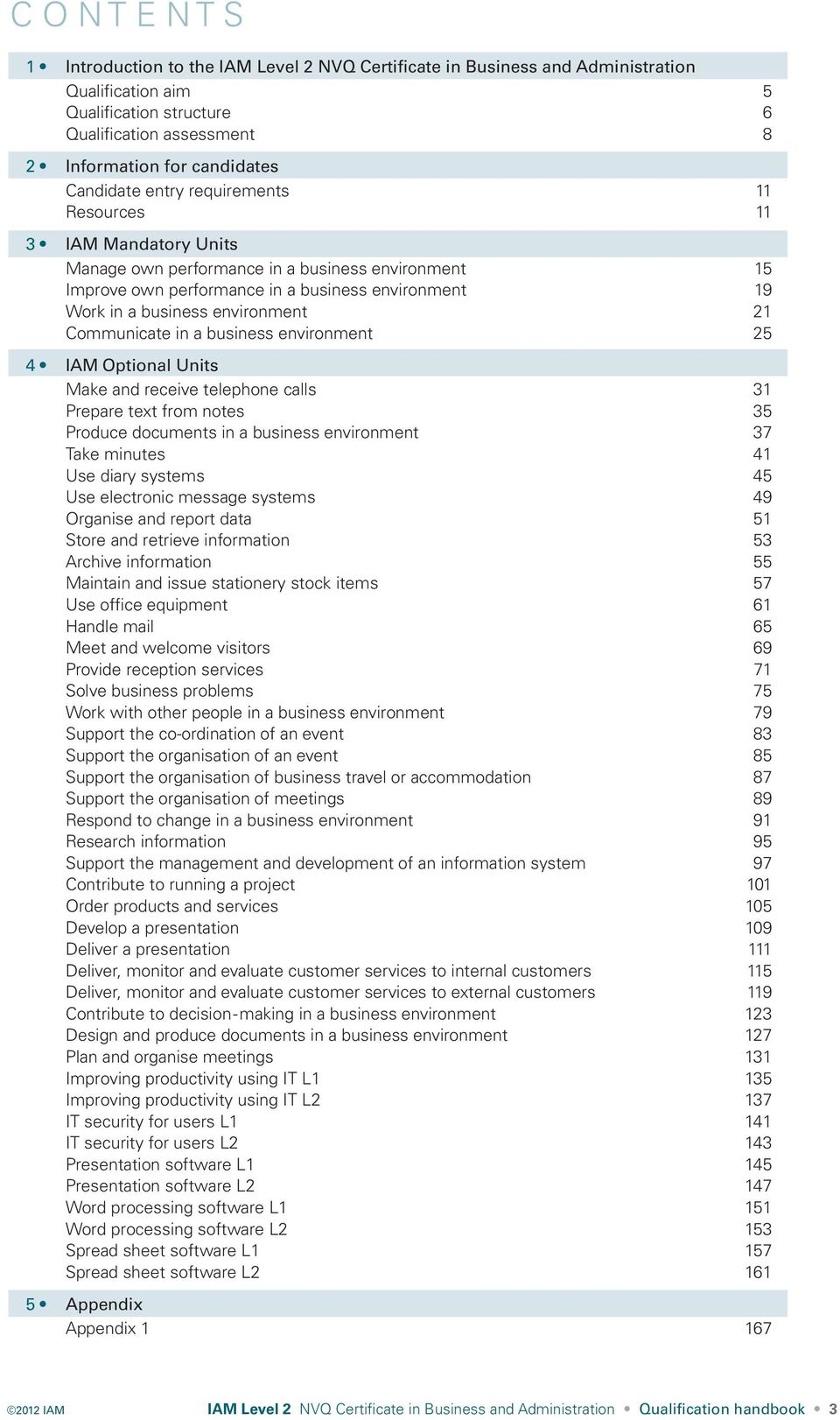
3 C O N T E N T S 1 Introduction to the IAM Level 2 NVQ Certificate in Business and Administration Qualification aim 5 Qualification structure 6 Qualification assessment 8 2 Information for candidates Candidate entry requirements 11 Resources 11 3 IAM Mandatory Units Manage own performance in a business environment 15 Improve own performance in a business environment 19 Work in a business environment 21 Communicate in a business environment 25 4 IAM Optional Units Make and receive telephone calls 31 Prepare text from notes 35 Produce documents in a business environment 37 Take minutes 41 Use diary systems 45 Use electronic message systems 49 Organise and report data 51 Store and retrieve information 53 Archive information 55 Maintain and issue stationery stock items 57 Use office equipment 61 Handle mail 65 Meet and welcome visitors 69 Provide reception services 71 Solve business problems 75 Work with other people in a business environment 79 Support the co-ordination of an event 83 Support the organisation of an event 85 Support the organisation of business travel or accommodation 87 Support the organisation of meetings 89 Respond to change in a business environment 91 Research information 95 Support the management and development of an information system 97 Contribute to running a project 101 Order products and services 105 Develop a presentation 109 Deliver a presentation 111 Deliver, monitor and evaluate customer services to internal customers 115 Deliver, monitor and evaluate customer services to external customers 119 Contribute to decision- making in a business environment 123 Design and produce documents in a business environment 127 Plan and organise meetings 131 Improving productivity using IT L1 135 Improving productivity using IT L2 137 IT security for users L1 141 IT security for users L2 143 Presentation software L1 145 Presentation software L2 147 Word processing software L1 151 Word processing software L2 153 Spread sheet software L1 157 Spread sheet software L Appendix Appendix IAM IAM Level 2 NVQ Certificate in Business and Administration Qualification handbook 3
4 This page is intentionally blank 4 IAM Level 2 NVQ Certificate in Business and Administration Qualification handbook 2012 IAM

5 Introduction to the IAM Level 2 NVQ Certificate in Business and Administration 1 Introduction to the Level 2 NVQ Certificate in Business and Administration The IAM Level 2 NVQ Certificate in Business and Administration provides candidates with a high quality, nationally recognised qualification. This qualification is a competence based qualification. It is aimed at people who already have experience of office-based skills and wish to specialise in business and administration functions. Candidates can develop knowledge and skills in challenging activities such as problem solving and team working as well as giving the learner the option to tailor their NVQ to suit their individual needs of their employer. It is a competence and credit based qualification which provides valuable opportunities for individuals to develop skills, gain underpinning knowledge and understanding and demonstrate competence in the workplace. Qualification accreditation information Accreditation number: 600/4919/4 Review date: 31/12/ IAM IAM Level 2 NVQ Certificate in Business and Administration Qualification handbook 5

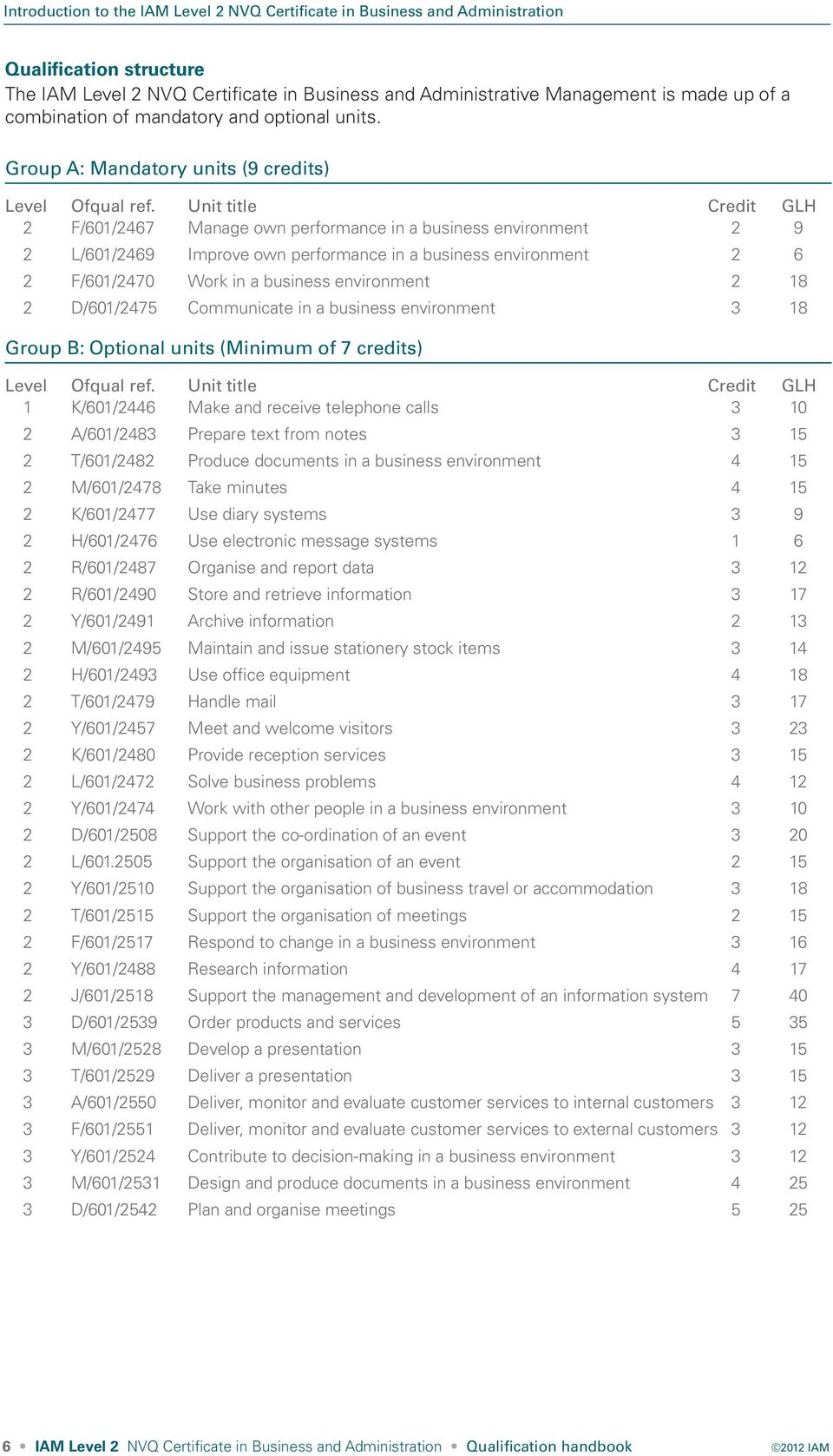
6 Introduction to the IAM Level 2 NVQ Certificate in Business and Administration Qualification structure The IAM Level 2 NVQ Certificate in Business and Administrative Management is made up of a combination of mandatory and optional units. Group A: Mandatory units (9 credits) Level Ofqual ref. Unit title Credit GLH 2 F/601/2467 Manage own performance in a business environment L/601/2469 Improve own performance in a business environment F/601/2470 Work in a business environment D/601/2475 Communicate in a business environment 3 18 Group B: Optional units (Minimum of 7 credits) Level Ofqual ref. Unit title Credit GLH 1 K/601/2446 Make and receive telephone calls A/601/2483 Prepare text from notes T/601/2482 Produce documents in a business environment M/601/2478 Take minutes K/601/2477 Use diary systems H/601/2476 Use electronic message systems R/601/2487 Organise and report data R/601/2490 Store and retrieve information Y/601/2491 Archive information M/601/2495 Maintain and issue stationery stock items H/601/2493 Use office equipment T/601/2479 Handle mail Y/601/2457 Meet and welcome visitors K/601/2480 Provide reception services L/601/2472 Solve business problems Y/601/2474 Work with other people in a business environment D/601/2508 Support the co-ordination of an event L/ Support the organisation of an event Y/601/2510 Support the organisation of business travel or accommodation T/601/2515 Support the organisation of meetings F/601/2517 Respond to change in a business environment Y/601/2488 Research information J/601/2518 Support the management and development of an information system D/601/2539 Order products and services M/601/2528 Develop a presentation T/601/2529 Deliver a presentation A/601/2550 Deliver, monitor and evaluate customer services to internal customers F/601/2551 Deliver, monitor and evaluate customer services to external customers Y/601/2524 Contribute to decision-making in a business environment M/601/2531 Design and produce documents in a business environment D/601/2542 Plan and organise meetings IAM Level 2 NVQ Certificate in Business and Administration Qualification handbook 2012 IAM
7 Introduction to the IAM Level 2 NVQ Certificate in Business and Administration Group C Optional units (Maximum of 5 credits) Level Ofqual ref. Unit title Credit GLH 1 T/502/4153 Improving productivity using IT J/502/4156 Improving productivity using IT R/502/4256 IT security for users Y/502/4257 IT security for users K/502/4621 Presentation software M/502/4622 Presentation software L/502/4627 Word processing software R/502/4628 Word processing software A/502/4624 Spread sheet software F/502/4625 Spread sheet software 4 30 Barred unit combinations Ofqual ref. Unit title Barred unit ref Barred unit title T/502/4153 Improving productivity using IT J/502/4156 Improving productivity using IT R/502/4256 IT security for users Y/502/4257 IT security for users K/502/4621 Presentation software M/502/4622 Presentation software L/502/4627 Word processing software R/502/4628 Word processing software A/502/4624 Spread sheet software F/502/4625 Spread sheet software M/601/2531 Design and produce documents in T/601/2482 Produce documents in a business a business environment environment Rule of combination (RoC) To achieve the IAM Level 2 NVQ Certificate in Business and Administration candidates must achieve a minimum of 21 credits of which a minimum of 14 credits must be at level 2. Candidates must complete all four mandatory units, worth 9 credits, plus a minimum of 7 credits from Group B. The remaining 5 credits can come from Group B or C but only a maximum of 5 credits can be taken from group C. Imported units This qualification includes imported units from e-skills IAM IAM Level 2 NVQ Certificate in Business and Administration Qualification handbook 7

8 Introduction to the IAM Level 2 NVQ Certificate in Business and Administration Qualification assessment Assessment strategy For the full CFA assessment strategy please see Appendix 1. Assessment guidance The CFA have produced an assessment guidance document which can be downloaded from their website: B&A%20QCF%20Assessment%20Guidance%20_ _V3.pdf Assessment method Candidates will be required to complete a portfolio of evidence. Centres get free access to the IAM electronic portfolio as part of their centre accreditation. Realistic working environments (RWE) Where the candidate is subject to a work environment and is producing performance evidence subject to all of the following conditions: Office environment Tools to do the job Time pressures Work problems Accountability There are two ways of achieving this: A suitable working environment is available for the assessment of competence being achieved. 1, This can be either the administration office already in place at the college or a smaller version which is used by lecturers with all the necessary working office equipment, stationery etc. 2. Learners are classroom based for all the underpinning knowledge and go out on work placement for a minimum of three nine weeks depending on the level of the qualification being assessed. The higher the level, the longer the learner will need to acquire the necessary experience. IAM quality coordinators will need to approve the RWE on an individual basis before any assessment can begin. Authenticity is essential and approval needs to be endorsed on an annual basis by the IAM quality coordinator. 8 IAM Level 2 NVQ Certificate in Business and Administration Qualification handbook 2012 IAM

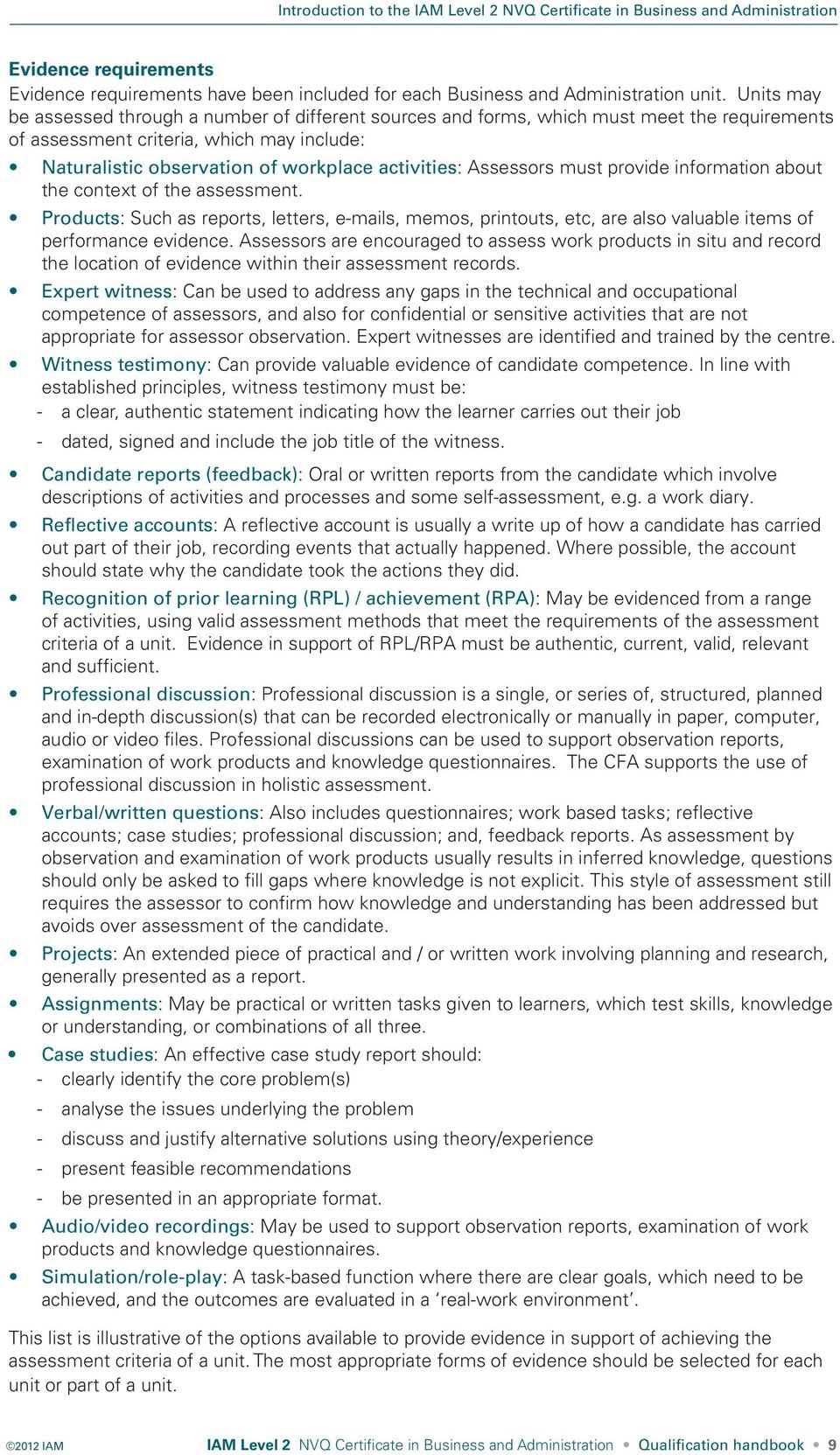
9 Introduction to the IAM Level 2 NVQ Certificate in Business and Administration Evidence requirements Evidence requirements have been included for each Business and Administration unit. Units may be assessed through a number of different sources and forms, which must meet the requirements of assessment criteria, which may include: Naturalistic observation of workplace activities: Assessors must provide information about the context of the assessment. Products: Such as reports, letters, s, memos, printouts, etc, are also valuable items of performance evidence. Assessors are encouraged to assess work products in situ and record the location of evidence within their assessment records. Expert witness: Can be used to address any gaps in the technical and occupational competence of assessors, and also for confidential or sensitive activities that are not appropriate for assessor observation. Expert witnesses are identified and trained by the centre. Witness testimony: Can provide valuable evidence of candidate competence. In line with established principles, witness testimony must be: - a clear, authentic statement indicating how the learner carries out their job - dated, signed and include the job title of the witness. Candidate reports (feedback): Oral or written reports from the candidate which involve descriptions of activities and processes and some self-assessment, e.g. a work diary. Reflective accounts: A reflective account is usually a write up of how a candidate has carried out part of their job, recording events that actually happened. Where possible, the account should state why the candidate took the actions they did. Recognition of prior learning (RPL) / achievement (RPA): May be evidenced from a range of activities, using valid assessment methods that meet the requirements of the assessment criteria of a unit. Evidence in support of RPL/RPA must be authentic, current, valid, relevant and sufficient. Professional discussion: Professional discussion is a single, or series of, structured, planned and in-depth discussion(s) that can be recorded electronically or manually in paper, computer, audio or video files. Professional discussions can be used to support observation reports, examination of work products and knowledge questionnaires. The CFA supports the use of professional discussion in holistic assessment. Verbal/written questions: Also includes questionnaires; work based tasks; reflective accounts; case studies; professional discussion; and, feedback reports. As assessment by observation and examination of work products usually results in inferred knowledge, questions should only be asked to fill gaps where knowledge is not explicit. This style of assessment still requires the assessor to confirm how knowledge and understanding has been addressed but avoids over assessment of the candidate. Projects: An extended piece of practical and / or written work involving planning and research, generally presented as a report. Assignments: May be practical or written tasks given to learners, which test skills, knowledge or understanding, or combinations of all three. Case studies: An effective case study report should: - clearly identify the core problem(s) - analyse the issues underlying the problem - discuss and justify alternative solutions using theory/experience - present feasible recommendations - be presented in an appropriate format. Audio/video recordings: May be used to support observation reports, examination of work products and knowledge questionnaires. Simulation/role-play: A task-based function where there are clear goals, which need to be achieved, and the outcomes are evaluated in a real-work environment. This list is illustrative of the options available to provide evidence in support of achieving the assessment criteria of a unit. The most appropriate forms of evidence should be selected for each unit or part of a unit IAM IAM Level 2 NVQ Certificate in Business and Administration Qualification handbook 9
10 This page is intentionally blank 10 IAM Level 2 NVQ Certificate in Business and Administration Qualification handbook 2012 IAM

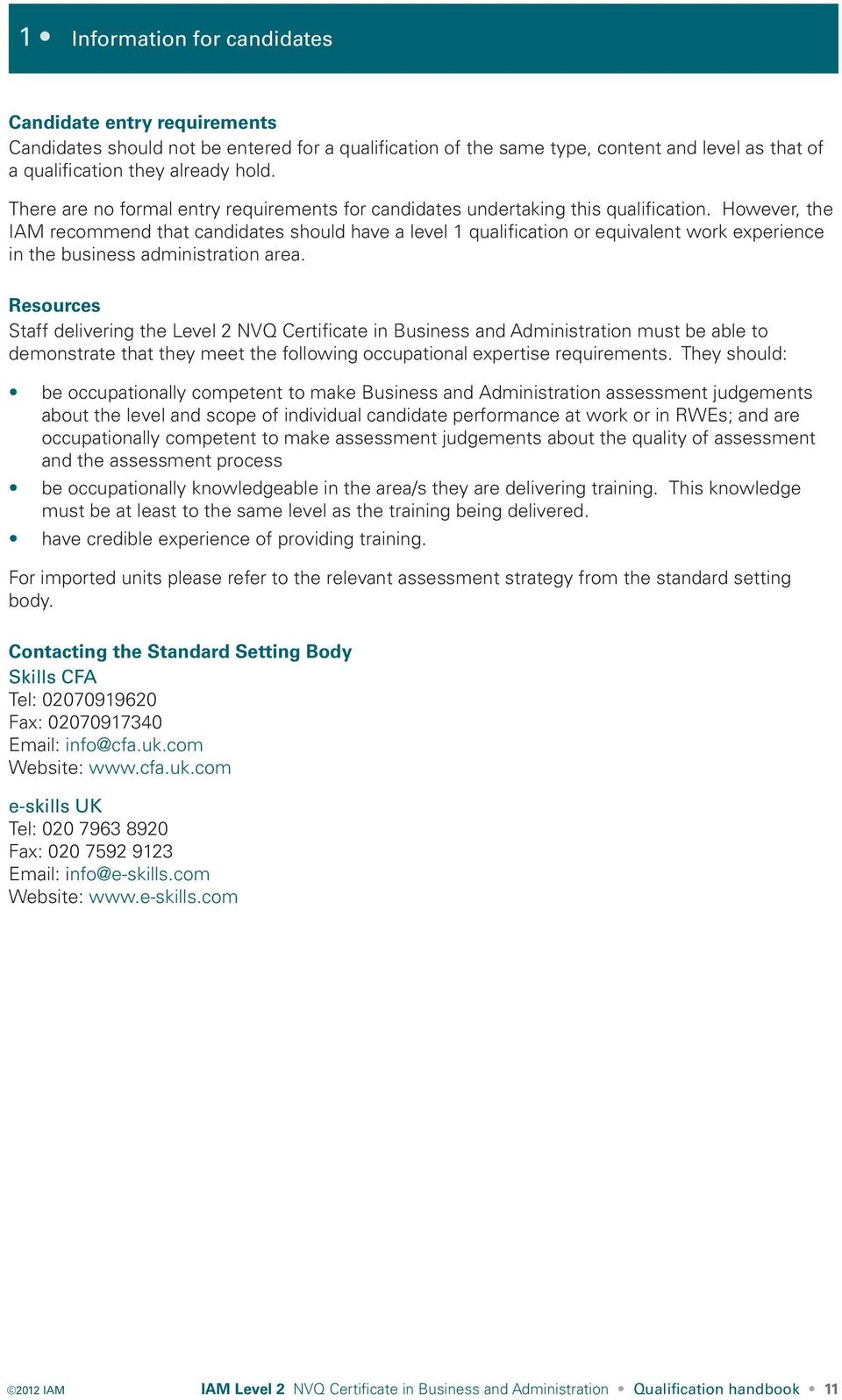
11 1 Information for candidates Candidate entry requirements Candidates should not be entered for a qualification of the same type, content and level as that of a qualification they already hold. There are no formal entry requirements for candidates undertaking this qualification. However, the IAM recommend that candidates should have a level 1 qualification or equivalent work experience in the business administration area. Resources Staff delivering the Level 2 NVQ Certificate in Business and Administration must be able to demonstrate that they meet the following occupational expertise requirements. They should: be occupationally competent to make Business and Administration assessment judgements about the level and scope of individual candidate performance at work or in RWEs; and are occupationally competent to make assessment judgements about the quality of assessment and the assessment process be occupationally knowledgeable in the area/s they are delivering training. This knowledge must be at least to the same level as the training being delivered. have credible experience of providing training. For imported units please refer to the relevant assessment strategy from the standard setting body. Contacting the Standard Setting Body Skills CFA Tel: Fax: [email protected] Website: e-skills UK Tel: Fax: [email protected] Website: IAM IAM Level 2 NVQ Certificate in Business and Administration Qualification handbook 11
12 This page is intentionally blank 12 IAM Level 2 NVQ Certificate in Business and Administration Qualification handbook 2012 IAM

13 3 IAM Mandatory units Manage own performance in a business environment Evaluate and improve own performance in a business environment Work in a business environment Communicate in a business environment 2012 IAM IAM Level 2 NVQ Certificate in Business and Administration Qualification handbook 13
14 This page is intentionally blank 14 IAM Level 2 NVQ Certificate in Business and Administration Qualification handbook 2012 IAM

15 Manage own performance in a business environment Level 2 Credit 2 GLH 9 Unit aim This unit is about taking responsibility for managing, prioritising and being accountable for your own work in a business environment. Learning outcomes This unit has four learning outcomes. The candidate will: 01 Understand how to plan work and be accountable to others 02 Understand how to behave in a way that supports effective working 03 Be able to plan and be responsible for own work, supported by others 04 Behave in a way that supports effective working 2012 IAM IAM Level 2 NVQ Certificate in Business and Administration Qualification handbook 15

16 Manage own performance in a business environment Outcome 01: Understand how to plan work and be accountable to others 1.1 Outline guidelines, procedures and codes of practice relevant to personal work 1.2 Explain the purpose of planning work, and being accountable to others for own work 1.3 Explain the purpose and benefits of agreeing realistic targets for work 1.4 Explain how to agree realistic targets 1.5 Describe ways of planning work to meet agreed deadlines 1.6 Explain the purpose of keeping other people informed about progress 1.7 Explain the purpose and benefits of letting other people know work plans need to be changed 1.8 Describe types of problems that may occur during work 1.9 Describe ways of seeking assistance with getting help to resolve problems 1.10 Explain the purpose and benefits of recognising and learning from mistakes Outcome 02: Understand how to behave in a way that supports effective working 2.1 Explain the purpose and benefits of agreeing and setting high standards for own work 2.2 Describe ways of setting high standards for work 2.3 Explain the purpose and benefits of taking on new challenges if they arise 2.4 Explain the purpose and benefits of adapting to change 2.5 Explain the purpose and benefits of treating others with honesty, respect and consideration 2.6 Explain why own behaviour in the workplace is important 2.7 Describe types of behaviour at work that show honesty, respect and consideration and those that do not 16 IAM Level 2 NVQ Certificate in Business and Administration Qualification handbook 2012 IAM
17 Manage own performance in a business environment Outcome 03: Be able to plan and be responsible for own work, supported by others 3.1 Agree realistic targets and achievable timescales for own work 3.2 Plan work tasks to make best use of own time and available resources 3.3 Confirm effective working methods with others 3.4 Identify and report problems occurring in own work, using the support of other people when necessary 3.5 Keep other people informed of progress 3.6 Complete work tasks to agreed deadlines or re-negotiate timescales and plans in good time 3.7 Take responsibility for own work and accept responsibility for any mistakes made 3.8 Follow agreed work guidelines, procedures and, where needed, codes of practice Outcome 04: Behave in a way that supports effective working 4.1 Set high standards for own work and show commitment to achieving these standards 4.2 Agree to take on new challenge(s) if they arise 4.3 Adapt to new ways of working 4.4 Treat other people with honesty, respect and consideration 4.5 Help and support other people in work tasks 2012 IAM IAM Level 2 NVQ Certificate in Business and Administration Qualification handbook 17
18 This page is intentionally blank 18 IAM Level 2 NVQ Certificate in Business and Administration Qualification handbook 2012 IAM

19 Improve own performance in a business environment Level 2 Credit 2 GLH 9 Unit aim This unit is about identifying way of improving performance at work by encouraging feedback from others and maintaining a learning plan to record new learning and career opportunities. Learning outcomes This unit has three learning outcomes. The candidate will: 01 Understand how to improve own performance 02 Be able to improve own performance using feedback 03 Be able to agree own development needs using a learning plan 2012 IAM IAM Level 2 NVQ Certificate in Business and Administration Qualification handbook 19
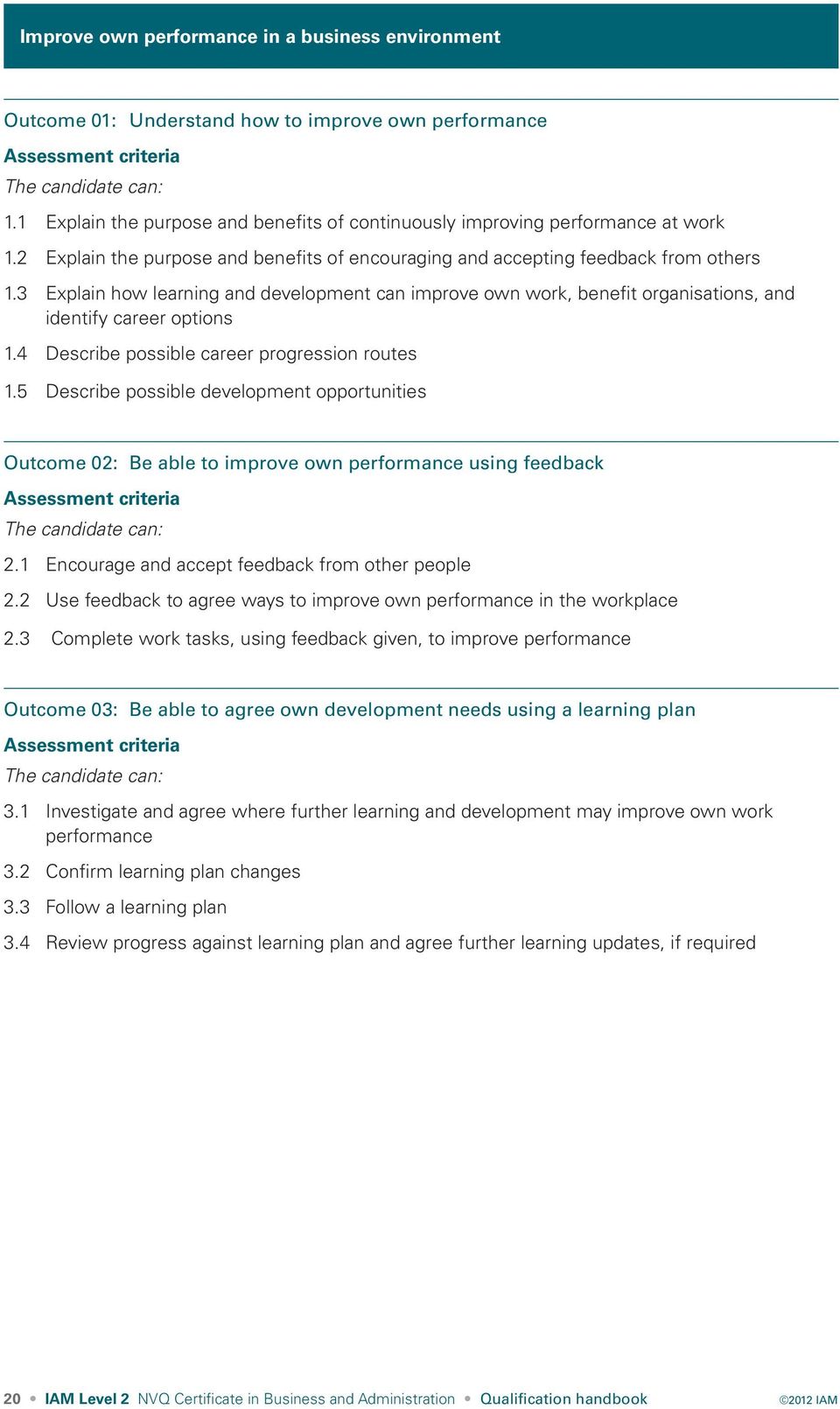
20 Improve own performance in a business environment Outcome 01: Understand how to improve own performance 1.1 Explain the purpose and benefits of continuously improving performance at work 1.2 Explain the purpose and benefits of encouraging and accepting feedback from others 1.3 Explain how learning and development can improve own work, benefit organisations, and identify career options 1.4 Describe possible career progression routes 1.5 Describe possible development opportunities Outcome 02: Be able to improve own performance using feedback 2.1 Encourage and accept feedback from other people 2.2 Use feedback to agree ways to improve own performance in the workplace 2.3 Complete work tasks, using feedback given, to improve performance Outcome 03: Be able to agree own development needs using a learning plan 3.1 Investigate and agree where further learning and development may improve own work performance 3.2 Confirm learning plan changes 3.3 Follow a learning plan 3.4 Review progress against learning plan and agree further learning updates, if required 20 IAM Level 2 NVQ Certificate in Business and Administration Qualification handbook 2012 IAM
21 Work in a business environment Level 2 Credit 2 GLH 18 Unit aim This unit is about being able to behave, and make contributions to work tasks and procedures, in a business environment, in ways that support diversity, security and confidentiality at work, reduction of waste and improve efficiency. Learning outcomes This unit has eight learning outcomes. The candidate will: 01 Understand how to respect other people at work 02 Understand how to maintain security and confidentiality at work and deal with concerns 03 Understand the purpose and procedures for keeping waste to a minimum in a business environment 04 Understand procedures for disposal of hazardous materials 05 Know how to support sustainability in an organisation 06 Be able to respect and support other people at work in an organisation 07 Be able to maintain security and confidentiality 08 Be able to support sustainability and minimise waste in an organisation 2012 IAM IAM Level 2 NVQ Certificate in Business and Administration Qualification handbook 21
22 Work in a business environment Outcome 01:1Understand how to respect other people at work 1.1 Describe what is meant by diversity and why it should be valued 1.2 Describe how to treat other people in a way that is sensitive to their needs 1.3 Describe how to treat other people in a way that respects their abilities, background, values, customs and beliefs 1.4 Describe ways in which it possible to learn from others at work Outcome 02: Understand how to maintain security and confidentiality at work and deal with concerns 2.1 Describe the purpose and benefits of maintaining security and confidentiality at work 2.2 Describe requirements for security and confidentiality in an organisation 2.3 Describe legal requirements for security and confidentiality, as required 2.4 Describe procedures for dealing with concerns about security and confidentiality in an organisation Outcome 03: Understand the purpose and procedures for keeping waste to a minimum in a business environment 3.1 Explain the purpose of keeping waste to a minimum 3.2 Describe the main causes of waste that may occur in a business environment 3.3 Describe ways of keeping waste to a minimum 3.4 Identify ways of using technology to reduce waste 3.5 Outline the purpose and benefits of recycling 3.6 Describe organisational procedures for recycling materials Outcome 04: Understand procedures for disposal of hazardous materials 4.1 Describe the benefits of procedures for the recycling and disposal of hazardous materials 4.2 Describe organisational procedures for the recycling and disposal of hazardous materials
23 Work in a business environment Outcome 05: Know how to support sustainability in an organisation 5.1 Outline the purpose of improving efficiency and minimising waste 5.2 Describe ways of improving own working methods and use of technology to achieve efficiency and reduce waste Outcome 06: Be able to respect and support other people at work in an organisation 6.1 Complete work tasks alongside other people in a way that shows respect for a) backgrounds b) abilities c) values, customs and beliefs 6.2 Complete work tasks with other people in a way that is sensitive to their needs 6.3 Use feedback and guidance from other people to improve own way of working 6.4 Follow organisational procedures and legal requirements in relation to discrimination legislation, as required Outcome 07: Be able to maintain security and confidentiality 7.1 Keep property secure, following organisational procedures and legal requirements, as required 7.2 Keep information secure and confidential, following organisational procedures and legal requirements 7.3 Follow organisational procedures to report concerns about security / confidentiality, as required Outcome 08: Be able to support sustainability and minimise waste in an organisation 8.1 Complete work tasks, keeping waste to a minimum 8.2 Use technology in work task(s) in ways that minimise waste 8.3 Follow procedures for recycling and disposal of hazardous materials, as required 8.4 Follow procedures for the maintenance of equipment in own work 2012 IAM IAM Level 2 NVQ Certificate in Business and Administration Qualification handbook 23
24 This page is intentionally blank 24 IAM Level 2 NVQ Certificate in Business and Administration Qualification handbook 2012 IAM
25 Communicate in a business environment Level 2 Credit 3 GLH 18 Unit aim This unit is about being able to communicate clearly and accurately, in writing and verbally, with other people in a business environment. Learning outcomes This unit has eight learning outcomes. The candidate will: 01 Understand the purpose of planning communication 02 Understand how to communicate in writing 03 Understand how to communicate verbally 04 Be able to plan communication 05 Be able to plan communication 06 Be able to communicate in writing 07 Be able to communicate verbally 08 Be able to identify and agree ways of developing communication skills 2012 IAM IAM Level 2 NVQ Certificate in Business and Administration Qualification handbook 25
26 Work in a business environment Outcome 01: Understand the purpose of planning communication 1.1 Explain reasons for knowing the purpose of communication 1.2 Explain reasons for knowing the audience to whom the communication is being presented 1.3 Describe different methods of communication 1.4 Describe when to use different methods of communication Outcome 02: Understand how to communicate in writing 2.1 Identify different sources of information that may be used when preparing written communication 2.2 Describe the communication principles for using electronic forms of written communication in a business environment 2.3 Describe the reasons for using language that suits the purpose of written communication 2.4 Describe ways of organising, structuring and presenting written information so it meets the needs of an audience 2.5 Describe ways of checking for the accuracy of written information 2.6 Explain the purpose of accurate use of grammar, punctuation and spelling 2.7 Explain what is meant by plain English, and why it is used 2.8 Explain the need to proofread and check written work 2.9 Explain how to identify work that is important and work that is urgent 2.10 Describe organisational procedures for saving and filing written communications Outcome 03: Understand how to communicate verbally 3.1 Describe ways of verbally presenting information and ideas clearly 3.2 Explain ways of making contributions to discussions that help to move them forward 3.3 Describe methods of active listening 3.4 Explain the purpose of summarising verbal communications
27 Work in a business environment Outcome 04: Understand the purpose of feedback in developing communication skills 4.1 Describe ways of getting feedback on communications 4.2 Explain the purpose of using feedback to develop communication skills Outcome 05: Be able to plan communication 5.1 Identify the purpose of communications and the audience(s) 5.2 Select methods of communication to be used 5.3 Confirm methods of communication, as required Outcome 06: Be able to communicate in writing 6.1 Find and select information needed for written communications 6.2 Organise, structure and present information so that it is clear, accurate and meets the needs of the audience 6.3 Use language that suits the purpose of written communication and the audience 6.4 Use accurate grammar, spelling and punctuation, and plain English to make sure that meaning is clear 6.5 Proofread and check written communications and make amendments, as required 6.6 Confirm what is important and what is urgent 6.7 Produce written communications to meet agreed deadlines 6.8 Keep a file copy of written communications sent Outcome 07: Be able to communicate verbally 7.1 Verbally present information and ideas to others clearly and accurately 7.2 Make contributions to discussion(s) that move the discussion forward 7.3 Actively listen to information given by other people, and make relevant responses 7.4 Ask relevant questions to clarify own understanding, as required 7.5 Summarise verbal communication(s) and agree that the correct meaning has been understood 2012 IAM IAM Level 2 NVQ Certificate in Business and Administration Qualification handbook 27
28 Work in a business environment Outcome 08: Be able to identify and agree ways of developing communication skills 8.1 Get feedback to confirm whether the communication has achieved its purpose 8.2 Use feedback to identify and agree ways of improving own communication skills 28 IAM Level 2 NVQ Certificate in Business and Administration Qualification handbook 2012 IAM
29 3 IAM Optional units Make and receive telephone calls Prepare text from notes Produce documents in a business environment Take minutes Use diary systems Use electronic message systems Organise and report data Store and retrieve information Archive information Maintain and issue stationery stock items Use office equipment Handle mail Meet and welcome visitors Provide reception services Solve business problems Work with other people in a business environment Support the co-ordination of an event Support the organisation of an event Support the organisation of business travel or accommodation Support the organisation of meetings Respond to change in a business environment Research information Support the management and development of an information system Contribute to running a project Order products and services Develop a presentation Deliver a presentation Deliver, monitor and evaluate customer services to internal customers Deliver, monitor and evaluate customer services to external customers Contribute to decision- making in a business environment Design and produce documents in a business environment Plan and organise meetings Improving productivity using IT Improving productivity using IT IT security for users IT security for users Presentation software Presentation software Word processing software Word processing software Spread sheet software Spread sheet software 2012 IAM IAM Level 2 NVQ Certificate in Business and Administration Qualification handbook 29
30 This page is intentionally blank 30 IAM Level 2 NVQ Certificate in Business and Administration Qualification handbook 2012 IAM
31 Make and receive telephone calls Level 1 Credit 3 GLH 10 Unit aim This unit is about making and receiving telephone calls, and transferring calls when necessary, in a business environment. Learning outcomes This unit has four learning outcomes. The candidate will: 01 Understand how to make telephone calls 02 Understand how to receive and transfer telephone calls 03 Be able to make telephone calls 04 Be able to receive telephone calls 2012 IAM IAM Level 2 NVQ Certificate in Business and Administration Qualification handbook 31
32 Make and receive telephone calls Outcome 01: Understand how to make telephone calls 1.1 Describe the different features of telephone systems and how to use them 1.2 Give reasons for identifying the purpose of a call before making it 1.3 Describe different ways of obtaining the names and numbers of people that need to be contacted 1.4 Describe how to use a telephone system to make contact with people inside and outside an organisation 1.5 Explain the purpose of giving a positive image of self and own organisation 1.6 Explain the purpose of summarising the outcomes of a telephone conversation before ending the call 1.7 Describe how to identify problems and who to refer them to 1.8 Describe organisation structures and communication channels within an organisation 1.9 Describe how to follow organisational procedures when making a telephone call 1.10 Explain how to report telephone system faults Outcome 02: Understand how to receive and transfer telephone calls 2.1 Describe how to identify callers and their needs 2.2 Explain the purpose of giving accurate and up to date information to callers 2.3 Explain the purpose of confidentiality and security when dealing with callers 2.4 Describe the types of information that could affect confidentiality and security and how to handle these 2.5 Describe ways of identifying the appropriate person to whom a call is transferred 2.6 Describe the information to be given when transferring calls or leaving messages 2.7 Describe how to identify problems and who to refer them to 2.8 Describe how to follow organisational procedures when receiving a telephone call 2.9 Explain how to report telephone system faults 32 IAM Level 2 NVQ Certificate in Business and Administration Qualification handbook 2012 IAM
33 Make and receive telephone calls Outcome 03: Be able to make telephone calls 3.1 Identify the purpose of the call 3.2 Obtain the name and number of the person to be contacted 3.3 Make contact with the person 3.4 Communicate information to achieve the purpose of the call 3.5 Project a positive image of self and organisation 3.6 Summarise the outcomes of the conversation before ending a call 3.7 Report telephone system faults, if necessary Outcome 04: Be able to receive telephone calls 4.1 Answer a phone following organisational procedures 4.2 Give a positive image of self and organisation 4.3 Identify the caller, where they are calling from, and what they need 4.4 Give accurate and up to date information whilst protecting confidentiality and security 4.5 Transfer calls, if required 4.6 Take and pass on messages according to the caller s needs 4.7 Summarise the outcomes of the conversation before ending the call 4.8 Report telephone system faults, if necessary 2012 IAM IAM Level 2 NVQ Certificate in Business and Administration Qualification handbook 33
34 This page is intentionally blank 34 IAM Level 2 NVQ Certificate in Business and Administration Qualification handbook 2012 IAM
35 Prepare text from notes Level 2 Credit 3 GLH 15 Unit aim This unit is about preparing different types of text from own notes and notes written by other people to meet agreed timescales. Learning outcomes This unit has four learning outcomes. The candidate will: 01 Understand preparing text from notes 02 Understand the purpose and benefits of following procedures when preparing text from notes 03 Be able to prepare for text from notes 04 Be able to prepare text from notes 2012 IAM IAM Level 2 NVQ Certificate in Business and Administration Qualification handbook 35
36 Prepare text from notes Outcome 01: Understand preparing text from notes 1.1 Describe different types of documents that may be produced from notes and the formats to be followed 1.2 Explain the difference between producing text from own notes and producing text from others notes Outcome 02: Understand the purpose and benefits of following procedures when preparing text from notes 2.1 Explain the benefits of agreeing the purpose, format and deadline for preparing text from notes 2.2 Explain the purpose of accuracy including spelling, grammar and punctuation when preparing text from notes 2.3 Describe ways of checking finished documents for accuracy and correctness, and the purpose of doing so 2.4 Explain the purpose of storing text and notes safely and securely, and ways of doing so 2.5 Explain the purpose of confidentiality and data protection when preparing text from notes 2.6 Explain the purpose and benefits of meeting deadlines Outcome 03: Be able to prepare for text from notes 3.1 Agree the purpose, format and deadlines for texts Outcome 04: Be able to prepare text from notes 4.1 Input text using keyboard skills 4.2 Format text to agreed style and layout, making efficient use of available technology 4.3 Clarify text requirements when necessary 4.4 Read and check texts for accuracy 4.5 Edit and correct texts, as required 4.6 Store texts and original notes safely and securely following organisational procedures 4.7 Produce texts to the required format and within agreed timelines 36 IAM Level 2 NVQ Certificate in Business and Administration Qualification handbook 2012 IAM
37 Produce documents in a business environment Level 2 Credit 4 GLH 15 Unit aim This unit is about preparing high quality and attractive documents to agreed layouts, formats and styles to meet agreed deadlines. Learning outcomes This unit has five learning outcomes. The candidate will: 01 Understand the purpose of producing high quality and attractive documents in a business environment 02 Know the resources and technology available and how to use them when producing documents in a business environment 03 Understand the purpose of following procedures when producing documents in a business environment 04 Be able to prepare for tasks 05 Be able to produce documents to agreed specifications 2012 IAM IAM Level 2 NVQ Certificate in Business and Administration Qualification handbook 37
38 Produce documents in a business environment Outcome 01: Understand the purpose of producing high quality and attractive documents in a business environment 1.1 Outline different types of documents that may be produced and the different styles that could be used 1.2 Describe different formats in which text may be presented 1.3 Explain the purpose and benefits of producing high quality and attractive documents Outcome 02: Know the resources and technology available and how to use them when producing documents in a business environment 2.1 Describe the types of resources available for producing high quality and attractive documents 2.2 Outline ways of using different resources to produce documents 2.3 Describe different types of technology available for inputting, formatting and editing text, and their main features Outcome 03: Understand the purpose of following procedures when producing documents in a business environment 3.1 Explain the benefits of agreeing the purpose, content, style, and deadlines for producing documents 3.2 Outline different ways of organising content needed for documents 3.3 Outline ways of integrating and laying out text and non-text 3.4 Describe ways of checking finished documents for accuracy including spelling, grammar and punctuation and correctness, and the purpose of doing so 3.5 Explain the purpose of storing documents safely and securely, and ways of doing so 3.6 Explain the purpose of confidentiality and data protection when preparing documents 3.7Explain the purpose and benefits of meeting deadlines 38 IAM Level 2 NVQ Certificate in Business and Administration Qualification handbook 2012 IAM
39 Produce documents in a business environment Outcome 04: Be able to prepare for tasks 4.1 Confirm the purpose, content, style and deadlines for documents Outcome 05: Be able to produce documents to agreed specifications 5.1 Prepare resources needed to produce documents 5.2 Organise the content required to produce documents 5.3 Make use of technology, as required 5.4 Format and produce documents to an agreed style 5.5 Integrate non-text objects into an agreed layout, if required 5.6 Check texts for accuracy 5.7 Edit and correct texts, as required 5.8 Clarify document requirements, when necessary 5.9 Store documents safely and securely following organisational procedures 5.10 Present documents to the required format and within the agreed deadlines 2012 IAM IAM Level 2 NVQ Certificate in Business and Administration Qualification handbook 39
40 This page is intentionally blank 40 IAM Level 2 NVQ Certificate in Business and Administration Qualification handbook 2012 IAM
41 Take minutes Level 2 Credit 4 GLH 15 Unit aim This unit is about taking minutes at different kinds of meetings, where an accurate record is needed of decisions made and actions agreed. Learning outcomes This unit has five learning outcomes. The candidate will: 01 Understand the task of taking minutes at meetings 02 Understand the role of the chair and other formal responsibilities in meetings 03 Know how to take minutes at meetings 04 Be able to prepare for taking 05 Be able to minute meetings 2012 IAM IAM Level 2 NVQ Certificate in Business and Administration Qualification handbook 41
42 Take minutes Outcome 01: Understand the task of taking minutes at meetings 1.1 Describe the purpose of meetings 1.2 Describe legal and organisational requirements that may apply to minute taking 1.3 Explain the purpose of minutes as an accurate record of discussions and decisions 1.4 Describe the purpose of documents and terms that are commonly used in meetings Outcome 02: Understand the role of the chair and other formal responsibilities in meetings 2.1 Explain the role of the chair and other formal responsibilities within meetings 2.2 Describe how to work in partnership with the chair when taking minutes Outcome 03: Know how to take minutes at meetings 3.1 Explain the purpose of listening actively when taking minutes 3.2 Explain how to listen actively when minute taking 3.3 Describe how to take notes during discussions held at meetings 3.4 Explain the purpose of getting clarification 3.5 Describe how to get clarification 3.6 Describe different types of minutes and their purpose 3.7 Describe the different styles of writing that may be used in minute taking 3.8 Explain how to sort, select and structure information to produce minutes 3.9 Explain what is meant by using the correct tone and professional language in minutes
43 Take minutes Outcome 04: Be able to prepare for taking 4.1 Prepare for taking minutes, as minutes required 4.2 Communicate with the meeting chair, as required 4.3 Note any changes to the agenda, matters arising and action points from last meeting Outcome 05: Be able to minute meetings 5.1 Take notes at a meeting of all items required 5.2 Produce accurate minutes that record the meaning of discussions and decisions taken 5.3 Make sure minutes are in the agreed style 5.4 Make sure the process for signing off minutes and / or action points has been agreed 5.5 Check minutes and make necessary amendments 5.6 Agree minutes with the relevant people and circulate them within the agreed timescales 5.7 Follow organisational requirements for confidentiality and security of information, as required 5.8 Make sure follow-up actions, and who is responsible for taking the actions, have been clearly identified 5.9 Store notes and minutes following organisational procedures 5.10 Follow legal and organisational requirements for minute taking, as necessary 2012 IAM IAM Level 2 NVQ Certificate in Business and Administration Qualification handbook 43
44 This page is intentionally blank 44 IAM Level 2 NVQ Certificate in Business and Administration Qualification handbook 2012 IAM
45 Use a diary system Level 2 Credit 3 GLH 9 Unit aim This unit covers the skills, knowledge and understanding learners need to prepare for, deliver and evaluate a presentation for an audience. Learning outcomes This unit has five learning outcomes. The candidate will: 01 Understand the purpose of preparing for and evaluating a presentation 02 Understand the techniques used in enhancing a presentation 03 Be able to prepare for delivery of a presentation 04 Be able to deliver a presentation 05 Be able to evaluate a presentation 2012 IAM IAM Level 2 NVQ Certificate in Business and Administration Qualification handbook 45
46 Use a diary system Outcome 01: Understand the purpose of preparing for and evaluating a presentation 1.1 Explain the purpose of using different types of presentation and equipment 1.2 Explain different ways of delivering presentations and their features 1.3 Explain the procedures to be followed when preparing a presentation 1.4 Explain the benefits of preparing for giving a presentation 1.5 Describe the types of problems that may occur with equipment and how to deal with them 1.6 Explain the purpose and benefits of contingency planning 1.7 Explain the purpose and benefits of collecting feedback from the audience on the presentation 1.8 Explain the purpose and benefits of evaluating presentations and own performance Outcome 02: Understand the techniques used in enhancing a presentation 2.1 Explain and illustrate how presentations may be enhanced by materials and equipment 2.2 Explain and illustrate how presentations may be enhanced by use of communication and interpersonal skills 2.3 Describe how to gauge audience reaction to the presentation 2.4 Explain the purpose and benefits of summarising important features of the presentation 2.5 Describe the purpose and benefits of giving the audience opportunities to ask questions Outcome 03: Be able to prepare for delivery of a presentation 3.1 Select any equipment needed and plan how to use it to best effect 3.2 Make contingency plans in case of equipment failure or other problems, if required 3.3 Practise the presentation and its timing 3.4 Obtain feedback on planned presentation and make adjustments, if required 46 IAM Level 2 NVQ Certificate in Business and Administration Qualification handbook 2012 IAM
47 Use a diary system Outcome 04: Be able to deliver a presentation 4.1 Check equipment and resources 4.2 Circulate presentation materials 4.3 Introduce self to audience and state aims of the presentation 4.4 Address the audience, speaking clearly and confidently, using language to suit the topic and audience 4.5 Vary tone, pace and volume to emphasise key points 4.6 Gauge audience reaction during the presentation and adapt if required 4.7 Summarise throughout the presentation to emphasise key points and help to maintain audience interest 4.8 Use body language in a way that reinforces presented information 4.9 Use equipment, where appropriate, to enhance the presentation, and deal with any problems that may occur 4.10 Provide the audience with opportunities to ask questions 4.11 Listen carefully to questions and respond in a way that meets the audience s needs Outcome 05: Be able to evaluate a presentation 5.1 Collect feedback on the presentation 5.2 Reflect on own performance and identify learning points 5.3 Evaluate the presentation and own performance and identify changes that will improve future presentations 2012 IAM IAM Level 2 NVQ Certificate in Business and Administration Qualification handbook 47
48 This page is intentionally blank 48 IAM Level 2 NVQ Certificate in Business and Administration Qualification handbook 2012 IAM
49 Use electronic message systems Level 2 Credit 1 GLH 6 Unit aim This unit is about organising and updating messages using an electronic message system. Learning outcomes This unit has two learning outcomes. The candidate will: 01 Understand the use of electronic message systems 02 Be able to use electronic message systems 2012 IAM IAM Level 2 NVQ Certificate in Business and Administration Qualification handbook 49
50 Use electronic message systems Outcome 01: Understand the use of electronic message systems 1.1 Describe the main types of electronic message systems 1.2 Describe the different features of electronic message systems 1.3 Explain the purpose of keeping an electronic message system up to date 1.4 Describe how to use an electronic message system to check and delete or discard messages 1.5 Explain the purpose of leaving clear messages for others Outcome 02: Be able to use electronic message systems 2.1 Keep a message system up to date 2.2 Check system for messages 2.3 Respond to messages within agreed timescales 2.4 Delete messages when dealt with This page is intentionally blank 2.5 Select the information to be given when taking or leaving messages 2.6 Leave messages on other people s systems, if required 50 IAM Level 2 NVQ Certificate in Business and Administration Qualification handbook 2012 IAM
51 Organise and report data Level 2 Credit 3 GLH 12 Unit aim This unit is about organising and reporting data to the agreed format and timescales.. Learning outcomes This unit has three learning outcomes. The candidate will: 01 Understand how to organise and report data that has been researched 02 Be able to organise data 03 Be able to report data 2012 IAM IAM Level 2 NVQ Certificate in Business and Administration Qualification handbook 51
52 Organise and report data Outcome 01: Understand how to organise and report data that has been researched 1.1 Describe different ways of organising data that has been researched 1.2 Describe different ways of reporting data 1.3 Describe the purpose of presenting data to the agreed format and timescale Outcome 02: Be able to organise data 2.1 Organise data so that it can be reported 2.2 Check the accuracy of the data, and make adjustments, if required 2.3 Obtain feedback on data collected, if required Outcome 03: Be able to report data 3.1 Present data in agreed format 3.2 Present data to agreed timescale 52 IAM Level 2 NVQ Certificate in Business and Administration Qualification handbook 2012 IAM
53 Store and retrieve information Level 2 Credit 3 GLH 17 Unit aim This unit is about storing and retrieving information securely and within confidentiality requirements of the organisation. Learning outcomes This unit has three learning outcomes. The candidate will: 01 Understand processes and procedures for storing and retrieving information 02 Be able to store information 03 Be able to retrieve information 2012 IAM IAM Level 2 NVQ Certificate in Business and Administration Qualification handbook 53
54 Store and retrieve information Outcome 01: Understand processes and procedures for storing and retrieving information 1.1 Explain the purpose of storing and retrieving required information 1.2 Describe different information systems and their main features 1.3 Explain the purpose of legal and organisational requirements for the security and confidentiality of information 1.4 Explain the purpose of confirming information to be stored and retrieved 1.5 Describe ways of checking information for accuracy 1.6 Explain the purpose of checking information for accuracy 1.7 Explain the purpose of providing information to agreed format and timescales 1.8 Describe the types of information that may be deleted 1.9 Describe problems that may occur with information systems and how to deal with them, when necessary Outcome 02: Be able to store information 2.1 Identify, confirm and collect information to be stored 2.2 Follow legal and organisational procedures for security and confidentiality of information to be stored 2.3 Store information in approved locations 2.4 Check and update stored information, if required 2.5 Delete stored information, if required 2.6 Deal with, or refer problems, if required Outcome 03: Be able to retrieve information 3.1 Confirm and identify information to be retrieved 3.2 Follow legal and organisational procedures for security and confidentiality of information 3.3 Locate and retrieve the required information 3.4 Check and update information, if required 3.5 Provide information in the agreed format and timescale 3.6 Deal with, or refer problems if required 54 IAM Level 2 NVQ Certificate in Business and Administration Qualification handbook 2012 IAM
55 Archive information Level 2 Credit 2 GLH 13 Unit aim This unit is about deciding and agreeing the information to be archived and deleted within a business environment, including working with external archive systems if this function is outsourced from an organisation. Learning outcomes This unit has two learning outcomes. The candidate will: 01 Understand procedures for archiving information 02 Be able to archive information 2012 IAM IAM Level 2 NVQ Certificate in Business and Administration Qualification handbook 55
56 Archive information Outcome 01: Understand procedures for archiving information 1.1 Explain why and when required information should be archived 1.2 Explain the purpose of agreeing retention periods for archiving information 1.3 Describe procedures to be followed for archiving information, including legal requirements, if required 1.4 Explain the purpose of organisational and legal requirements for the security and confidentiality of archived information 1.5 Explain the purpose of deciding and agreeing information to be archived 1.6 Describe procedures for recording and keeping archived information 1.7 Explain how to retrieve archived information 1.8 Describe how to delete information from an archive system 1.9 Describe problems that may occur with systems containing archived information and how to deal with them or refer them 1.10 Describe the purpose of conforming to requirements of an external archive system, if outsourced from the organisation Outcome 02: Be able to archive information 2.1 Decide and agree the information to be archived, retrieved and deleted 2.2 Decide and agree on the retention period for information being archived 2.3 Follow legal and organisational policies and procedures for security and confidentiality of information 2.4 Archive information to the agreed brief and timescale 2.5 Maintain and update a record of information archived 2.6 Resolve or refer problems, if required 2.7 Retrieve archived information on request 2.8 Delete archived information, if required 2.9 Conform to requirements of external archive systems, if outsourced from the organisation 56 IAM Level 2 NVQ Certificate in Business and Administration Qualification handbook 2012 IAM
57 Maintain and issue stationery stock items Level 2 Credit 3 GLH 14 Unit aim This unit is about the procedures involved in keeping a stock of business items that will be used in a business environment in order to complete the day to day work of the organisation. Learning outcomes This unit has eight learning outcomes. The candidate will: 01 Understand procedures for maintaining and issuing stationery stock items 02 Know how to handle, store and dispose of stationery stock items 03 Understand problems that may occur with maintaining and issuing stationery stock items and how to deal with them 04 Understand how to make recommendations for improving stationery stock handling 05 Be able to maintain stationery stock levels 06 Be able to issue items from stationery stock 07 Be able to deal with unwanted or damaged items of stationery stock 08 Be able to make recommendations to improve stationery stock handling 2012 IAM IAM Level 2 NVQ Certificate in Business and Administration Qualification handbook 57
58 Maintain and issue stationery stock items Outcome 01: Understand procedures for maintaining and issuing stationery stock items 1.1 Outline organisational requirements for ordering, taking delivery, storing, stock-taking, issuing and disposing of stationery stock items 1.2 Outline ways of keeping up-to-date, accurate and legible records of stationery stock items 1.3. Explain the purpose of knowing the level of demand for stationery stock items and how this may affect requirements for ordering and stock held 1.4 Outline other factors that may affect the future level of demand for stationery stock held 1.5 Give examples of suppliers that may be used when ordering stationery stock items 1.6 Outline differences between ordering stationery stock items from internal and external suppliers 1.7 Outline organisational procedures for issuing stationery stock items 1.8 Outline when it may be necessary to ask for receipts for stationery stock items issued Outcome 02: Know how to handle, store and dispose of stationery stock items 2.1 Outline organisational procedures for handling and storing stationery stock items safely and securely 2.2 Outline organisational procedures for the correct and safe disposal of stationery stock items Outcome 03: Understand problems that may occur with maintaining and issuing stationery stock items and how to deal with them 3.1 Describe types of problems that may occur with deliveries and stationery stock items 3.2 Describe organisational procedures for dealing with problems Outcome 04: Understand how to make recommendations for improving stationery stock handling 4.1 Describe organisational procedures for recommending improvements for ordering, taking delivery, storing, stock-taking, issuing and disposing of unwanted or damaged stationery stock items 58 IAM Level 2 NVQ Certificate in Business and Administration Qualification handbook 2012 IAM
59 Maintain and issue stationery stock items Outcome 05: Be able to maintain stationery stock levels 5.1 Maintain stationery stock items to required levels 5.2 Handle and store stationery stock safely and securely, maintaining its condition and following organisational procedures 5.3 Carry out stock-takes as instructed and report problems 5.4 Order stationery stock from suppliers within limits of own authority 5.5 Chase up orders with suppliers 5.6 Check incoming deliveries against orders and report any problems 5.7 Keep up-to-date, accurate and legible records of stationery stock delivered and held Outcome 06: Be able to issue items from stationery stock 6.1 Issue stationery stock items as requested, following organisational procedures 6.2 Keep up-to-date, accurate and legible records of stationery stock items issued Outcome 07: Be able to deal with unwanted or damaged items of stationery stock 7.1 Dispose of unwanted or damaged stationery stock items safely, following organisational procedures and legal requirements Outcome 08: Be able to make recommendations to improve stationery stock handling 8.1 Identify and recommend ways in which systems for receiving, issuing and disposing of stationery stock could be improved, as required 2012 IAM IAM Level 2 NVQ Certificate in Business and Administration Qualification handbook 59
60 This page is intentionally blank 60 IAM Level 2 NVQ Certificate in Business and Administration Qualification handbook 2012 IAM
61 Use office equipment Level 2 Credit 4 GLH 18 Unit aim This unit is about using a variety of different office equipment following manufacturer s and organisational guidelines. Learning outcomes This unit has seven learning outcomes. The candidate will: 01 Know about different types of office equipment and its uses 02 Understand the purpose of following instructions and health and safety procedures 03 Understand how to use equipment in a way that minimises waste 04 Know about the different types of problems that may occur when using equipment and how to deal with them 05 Understand the purpose of meeting work standards and deadlines 06 Understand the purpose of leaving equipment and the work area ready for the next user 07 Be able to use office equipment 2012 IAM IAM Level 2 NVQ Certificate in Business and Administration Qualification handbook 61
62 Maintain and issue stationery stock items Outcome 01: Know about different types of office equipment and its uses 1.1 Identify different types of equipment and their uses 1.2 Describe the different features of different types of office equipment 1.3 Explain why different types of equipment are chosen for tasks Outcome 02: Understand the purpose of following instructions and health and safety procedures 2.1 Explain the purpose of following manufacturer s instructions when using equipment 2.2 Explain the purpose of following organisational instructions when using equipment 2.3 Identify health and safety procedures for using different types of equipment 2.4 Explain the purpose of following health and safety procedures when using equipment 2.5 Explain the purpose of keeping equipment clean and hygienic Outcome 03: Understand how to use equipment in a way that minimises waste 3.1 Give examples of waste when using equipment 3.2 Give examples of ways to reduce waste 3.3 Explain the purpose of minimising waste Outcome 04: Know about the different types of problems that may occur when using equipment and how to deal with them 4.1 Give examples of equipment problems 4.2 Explain the purpose of following manufacturer s instructions and organisational procedures when dealing with problems 4.3 Give examples of how to deal with problems 62 IAM Level 2 NVQ Certificate in Business and Administration Qualification handbook 2012 IAM
63 Maintain and issue stationery stock items Outcome 05: Understand the purpose of meeting work standards and deadlines 5.1 Explain the purpose of meeting work standards and deadlines when using equipment Outcome 06: Understand the purpose of leaving equipment and the work area ready for the next user 6.1 Explain the purpose of leaving equipment and the work area ready for the next user Outcome 07: Be able to use office equipment 7.1 Locate and select equipment needed for a task 7.2 Use equipment following manufacturer s and organisational guidelines 7.3 Use equipment minimising waste 7.4 Keep equipment clean and hygienic 7.5 Deal with equipment problems following manufacturer s and organisational procedures 7.6 Refer problems, if required 7.7 Make sure final work product meets agreed requirements 7.8 Make sure that product is delivered to agreed timescale 7.9 Make sure equipment, resources and work area are ready for the next user 2012 IAM IAM Level 2 NVQ Certificate in Business and Administration Qualification handbook 63
64 This page is intentionally blank 64 IAM Level 2 NVQ Certificate in Business and Administration Qualification handbook 2012 IAM
65 Handle mail Level 2 Credit 3 GLH 17 Unit aim This unit is about using a variety of different office equipment following manufacturer s and organisational guidelines. Learning outcomes This unit has five learning outcomes. The candidate will: 01 Understand security procedures when handling mail or packages 02 Understand the range of available internal and external mail services 03 Be able to receive, distribute and collect internal mail or packages 04 Be able to follow procedures for despatching mail or packages 05 Be able to resolve, report or refer problems that may occur in handling mail or packages 2012 IAM IAM Level 2 NVQ Certificate in Business and Administration Qualification handbook 65
66 Handle mail Outcome 01: Understand security procedures when handling mail or packages 1.1 Explain the purpose of security procedures for handling mail or packages 1.2 Give examples of security procedures for handling mail in organisation(s) Outcome 02: Understand the range of available internal and external mail services 2.1. Explain the purpose of distributing and dispatching mail to the correct recipient within agreed timescales 2.2 State the organisational structure and names, roles and locations of individuals and teams 2.3 Give examples of internal and external mail services available to organisations 2.4 Give reasons for selecting internal and external mail services 2.5 Describe the methods of calculating postage charges for mail or packages 2.6 Describe the types of problems that may occur with incoming and outgoing mail and how to deal with these Outcome 03: Be able to receive, distribute and collect internal mail or packages 3.1 Receive, check and sort incoming mail or packages 3.2 Identify and deal with unwanted junk mail or damaged items 3.3 Identify and deal with suspicious items 3.4 Distribute incoming mail or packages 3.5 Collect, sort and prioritise outgoing mail or packages 66 IAM Level 2 NVQ Certificate in Business and Administration Qualification handbook 2012 IAM
67 Handle mail Outcome 04: Be able to follow procedures for despatching mail or packages 4.1 Identify best options for despatching mail 4.2 Agree a cost for despatching mail or packages 4.3 Arrange services to collect outgoing mail or packages, if required 4.4 Identify and prepare items for urgent or special delivery, where necessary 4.5 Calculate correct postage charges for outgoing mail or packages 4.6 Record postage costs 4.7 Despatch outgoing mail or packages to agreed timescale Outcome 05: Be able to resolve, report or refer problems that may occur in handling mail or packages 5.1 Identify where a problem may exist with incoming and outgoing mail or packages 5.2 Resolve, report or refer problems with incoming and outgoing mail or packages 2012 IAM IAM Level 2 NVQ Certificate in Business and Administration Qualification handbook 67
68 This page is intentionally blank 68 IAM Level 2 NVQ Certificate in Business and Administration Qualification handbook 2012 IAM
69 Meet and welcome visitors Level 2 Credit 3 GLH 23 Unit aim This unit covers the procedures to follow and hospitality to offer when meeting and welcoming visitors to business premises Learning outcomes This unit has two learning outcomes. The candidate will: 01 Understand procedures for meeting and welcoming visitors 02 Be able to meet and welcome visitors 2012 IAM IAM Level 2 NVQ Certificate in Business and Administration Qualification handbook 69
70 Meet and welcome visitors Outcome 01: Understand procedures for meeting and welcoming visitors 1.1. Describe different reasons for people visiting a business, their requirements and how their needs may be met 1.2 Explain the purpose of dealing with visitors promptly and courteously 1.3 Explain the purpose of presenting a positive image of self and the organisation 1.4 Explain the purpose of following health, safety and security procedures when dealing with visitors, including own responsibilities 1.5 Describe different types of problems that may occur with visitors including, conflict and aggression 1.6 Describe ways of dealing with different problems and when to refer them to an appropriate colleague 1.7 Explain the purpose of communicating with visitors 1.8 Describe organisation structures and communication channels within the organisation Outcome 02: Be able to meet and welcome visitors 2.1 Greet visitor(s) and make them feel welcome 2.2 Identify visitors and the reason for their visit 2.3 Use the organisation s systems to receive and record visitors, as appropriate 2.4 Make sure visitors needs are met 2.5 Present positive image of self and the organisation 2.6 Follow health, safety and security procedures, as required 2.7 Inform others of visitors arrival, as required, in line with appropriate communication channels 2.8 Deal with any problems that may occur, or refer problems to the appropriate person 2.9 Follow procedures for departing visitors, as required 70 IAM Level 2 NVQ Certificate in Business and Administration Qualification handbook 2012 IAM
71 Provide reception services Level 2 Credit 3 GLH 15 Unit aim This unit is about providing a reception service in a business environment, acting as the first point of contact between a business, its clients and the public. Learning outcomes This unit has four learning outcomes. The candidate will: 01 Understand the purpose of reception services in a business 02 Understand the purpose of reception services in a business environment 03 Understand the procedures to be followed when providing reception services 04 Understand ways of improving reception services and developing own role 2012 IAM IAM Level 2 NVQ Certificate in Business and Administration Qualification handbook 71
72 Provide reception services Outcome 01: Understand the purpose of reception services in a business environment 1.1 Explain the purpose of the receptionist role as the first point of contact between the public / client and an organisation 1.2 Explain the purpose of presenting a positive image of self and the organisation 1.3 Explain how to present a positive image of self and the organisation Outcome 02: Understand the procedures to be followed when providing reception services 2.1 Describe the structure and lines of communication in an organisation 2.2 Explain how the structure in an organisation affects lines of communication 2.3 Explain the purpose of entry, departure, security and confidentiality procedures, including own responsibilities 2.4 Explain how to carry out entry, departure, security and confidentiality procedures in a reception area 2.5 Explain the purpose of health and safety procedures when providing a reception service, including own responsibilities 2.6 Explain how to carry out health and safety procedures in a reception area 2.7 Describe the emergency procedures and your role within them 2.8 Describe the types of problems that may occur with visitors including, conflict and aggression 2.9 Explain ways of dealing with problems and when to refer them to an appropriate colleague Outcome 03: Understand ways of improving reception services and developing own role 3.1 Explain the purpose of suggesting ideas for improving a reception area 3.2 Explain the purpose of carrying out additional duties, if applicable, and give examples 72 IAM Level 2 NVQ Certificate in Business and Administration Qualification handbook 2012 IAM
73 Provide reception services Outcome 04: Provide a reception service 4.1 Present a positive image of self and the organisation 4.2 Provide individuals with requested information and other useful information, within guidelines on confidentiality 4.3 Follow entry and exit security procedures, if required 4.4 Follow relevant health and safety procedures 4.5 Deal with problems that may occur, if necessary 4.6 Refer problems, as required 4.7 Make sure a reception area gives a positive image of the organisation 4.8 Make suggestions for improving a reception area, as required 4.9 Follow organisational procedures in the event of an accident or emergency, as required 4.10 Look for and complete additional task(s) during quiet periods, as required 2012 IAM IAM Level 2 NVQ Certificate in Business and Administration Qualification handbook 73
74 This page is intentionally blank 74 IAM Level 2 NVQ Certificate in Business and Administration Qualification handbook 2012 IAM
75 Solve business problems Level 2 Credit 4 GLH 12 Unit aim This unit is about recognising that there is a problem with the way work is being carried out in a business environment and working with other people to agree a solution. Learning outcomes This unit has six learning outcomes. The candidate will: 01 Know how to recognise business problems and their causes 02 Understand techniques for solving business problems 03 Know how to review approaches and solutions to business problems04 04 Be able to recognise business problems 05 Be able to plan and carry out a solution to a business problem 06 Be able to review a solution to the business problem 2012 IAM IAM Level 2 NVQ Certificate in Business and Administration Qualification handbook 75
76 Solve business problems Outcome 01: Know how to recognise business problems and their causes 1.1 Outline ways of recognising when a business problem exists 1.2 Describe how to identify possible causes of business problems Outcome 02: Understand techniques for solving business problems 2.1 Describe different ways of solving a business problem 2.2 Outline different ways of planning to solve a business problem 2.3 Give reasons for having support and feedback from others when solving the business problem 2.4 Explain the purpose of checking progress and adjusting approaches to solving a business problem 2.5 Describe ways of recognising when a business problem has been solved Outcome 03: Know how to review approaches and solutions to business problems 3.1 Outline ways of reviewing approaches to solving business problems 3.2 Outline ways of reviewing the effectiveness of solutions to business problems Outcome 04: Be able to recognise business problems 4.1 Identify a business problem 4.2 Confirm own understanding of a business problem 4.3 Work with others to agree what the business problem is 76 IAM Level 2 NVQ Certificate in Business and Administration Qualification handbook 2012 IAM
77 Solve business problems Outcome 05: Be able to plan and carry out a solution to a business problem 5.1 Agree an approach for how to solve the business problem 5.2 Develop a plan to solve the business problem 5.3 Identify ways of deciding that the business problem has been solved 5.4 Agree approaches to solving the business problem, with others as required 5.5 Carry out a plan to solve the business problem, involving others as required 5.6 Use support and feedback from others to reach a solution 5.7 Check progress towards solving the business problem 5.8 Use feedback and progress reports to adjust the plan, as required 5.9 Confirm that the business problem has been solved, with others as required Outcome 06: Be able to review a solution to the business problem 6.1 Review an approach to solving a business problem for its effectiveness 6.2 Review a solution to the business problem for its effectiveness 6.3 Identify alternative approaches and solutions for possible effectiveness 2012 IAM IAM Level 2 NVQ Certificate in Business and Administration Qualification handbook 77
78 This page is intentionally blank 78 IAM Level 2 NVQ Certificate in Business and Administration Qualification handbook 2012 IAM
79 Work with other people in a business environment Level 2 Credit 3 GLH 10 Unit aim This unit is about working within a team, sharing responsibility with others to make sure that a team can achieve agreed goals and objectives. Learning outcomes This unit has ten learning outcomes. The candidate will: 01: Understand how your role fits with organisational values and practices 02: Understand how to work as part of a team to achieve goals and objectives 03: Understand how to communicate as part of a team 04: Understand the contribution of individuals within a team 05: Understand how to deal with problems and disagreements 06: Understand the purpose of feedback when working as a team 07: Be able to work in a way that fits with organisational values and practices08 08: Be able to work in a team to achieve goals and objectives 09: Be able to deal with or refer problems in a team 10: Be able to use feedback on objectives in a team 2012 IAM IAM Level 2 NVQ Certificate in Business and Administration Qualification handbook 79
80 Work with other people in a business environment Outcome 01: Understand how your role fits with organisational values and practices 1.1 Describe the sector in which your organisation operates 1.2 Describe your organisation s missions and purpose 1.3 Compare you organisation to other types of organisation in your sector 1.4 Outline your responsibilities 1.5 Describe how your role fits into your organisation s structure 1.6 Describe how your role contributes to the organisation s operations 1.7 Outline the policies, procedures, systems and values of your organisation that are relevant to your role 1.8 Outline who you would consult if unsure about organisational policies, procedures, systems and values Outcome 02: Understand how to work as part of a team to achieve goals and objectives 2.1 Explain the purpose of working with other people to achieve goals and objectives 2.2 Identify situations in which working with others can achieve positive results 2.3 Explain the purpose and benefits of agreeing work goals and plans when working with others 2.4 Describe situations in which team members might support each other 2.5 Describe ways of providing support to other people in a team 2.6 Explain the purpose of agreeing quality measures with a team Outcome 03: Understand how to communicate as part of a team 3.1 Explain the purpose of communicating with other people in a team 3.2 Identify different methods of communication and when to use them 80 IAM Level 2 NVQ Certificate in Business and Administration Qualification handbook 2012 IAM
81 Work with other people in a business environment Outcome 04: Understand the contribution of individuals within a team 4.1 Explain the purpose of recognising the strengths of others 4.2 Explain the value of diversity within teams 4.3 Explain the purpose of respecting individuals working within a team Outcome 05: Understand how to deal with problems and disagreements 5.1 Describe the types of problems and disagreements that may occur when working with other people in a team 5.2 Describe ways of dealing with problems and disagreements when working with other people in a team Outcome 06: Understand the purpose of feedback when working as a team 6.1 Explain the purpose of giving and receiving constructive feedback 6.2 Describe ways of using feedback to improve own work, and a team as a whole Outcome 07: Be able to work in a way that fits with organisational values and practices 7.1 Follow organisational policies, systems and procedures relevant to your role 7.2 Apply relevant organisational values across all aspects of your work 7.3 Work with outside organisations and individuals in a way that protects the image of your organisation, when relevant 7.4 Seek guidance when unsure about organisational policies, systems, procedures and values 2012 IAM IAM Level 2 NVQ Certificate in Business and Administration Qualification handbook 81
82 Work with other people in a business environment Outcome 08: Be able to work in a team to achieve goals and objectives 8.1 Communicate effectively with other people in a team 8.2 Contribute to the agreement of work objectives and quality measures with a team, to achieve a positive outcome 8.3 Make sure work goals and objectives are achieved in a way that makes best use of own abilities in a team 8.4 Provide support to members of a team, if required 8.5 Show respect for individuals in a team 8.6 Make sure own work meets agreed quality standards and is on time Outcome 09: Be able to deal with or refer problems in a team 9.1 Identify problem(s) or disagreement(s) in a team 9.2 Resolve problem(s) or disagreement(s) within limits of own authority and experience 9.3 Refer problems, as required Outcome 10: Be able to use feedback on objectives in a team 10.1 Contribute to providing constructive feedback on the achievement of objectives to a team 10.2 Receive constructive feedback on own work 10.3 Use feedback on achievement of objectives to identify improvements in own work 82 IAM Level 2 NVQ Certificate in Business and Administration Qualification handbook 2012 IAM
83 Support the co-ordination of an event Level 2 Credit 3 GLH 20 Unit aim Learning outcomes This unit has two learning outcomes. The candidate will: 01 Understand the role and purpose of supporting the co-ordination of an event 02 Be able to support the co-ordination of an event 2012 IAM IAM Level 2 NVQ Certificate in Business and Administration Qualification handbook 83
84 Support the co-ordination of an event Outcome 01 Understand the role and purpose of supporting the co-ordination of an event 1.1 Describe the range of support activities that may be required when supporting the coordination of an event 1.2 Identify the responsibilities involved in supporting the co-ordination of an event 1.3 Describe the types of problems that may occur during events and how to deal with these 1.4 Describe the points to observe when clearing and vacating an event 1.5 Describe the types of follow-up activities that may be required to carry out the co-ordination of an event Outcome 02 Be able to support the co-ordination of an event 2.1 Contribute to the co-ordination of an event by: a) preparing the venue and making sure all necessary resources and supporting activities are in place b) arranging resources during an event, in line with agreed plans c) helping delegates to feel welcome d) meeting delegates needs throughout an event e) resolving or referring problems, as required f) liaising with the management of the venue to make sure facility resources are in place g) clearing, and vacating the venue according to the terms of the contract h) preparing and circulating papers, or completing other follow up actions following the event, if required 84 IAM Level 2 NVQ Certificate in Business and Administration Qualification handbook 2012 IAM
85 Support the organisation of an event Level 2 Credit 2 GLH 15 Unit aim Learning outcomes This unit has two learning outcomes. The candidate will: 01 Understand the role and purpose of providing support with the organisation of an event 02 Be able to support the organisation of an event 2012 IAM IAM Level 2 NVQ Certificate in Business and Administration Qualification handbook 85
86 Support the organisation of an event Outcome 01 Understand the role and purpose of providing support with the organisation of an event 1.1 Describe the role and responsibilities required when supporting the organisation of an event 1.2 Identify a range of support activities that may be required when supporting the organisation of an event 1.3 Identify the purpose and value of giving assistance with organising an event 1.4 Describe the different types of events and their main features 1.5 Describe the types of risks associated with events and how to minimise these 1.6 Outline the types of information that delegates will need 1.7 Explain how to identify suitable venues for different types of events 1.8 Describe the types of resources needed to prepare for different types of events 1.9 Outline the different special requirements that delegates may have and how to meet these 1.10 Describe the health, safety and security requirements that need to be considered when organising events Outcome 02 Be able to support the organisation of an event 2.1 Contribute to the organisation of an event by: a) supporting the implementation of the plan for the event to meet agreed objectives b) identifying resources and support needed for organising an event c) identifying and costing suitable venues d) arranging resources and production of event materials e) preparing and sending of invitations to delegates f) co-ordinating delegate responses g) liaising with the venue to confirm event requirements h) providing delegates with joining instructions and event materials i) rehearsing arrangements to make sure the event runs smoothly, if required j) following all legal and contractual requirements k) following the relevant health, safety and security requirements for the event 86 IAM Level 2 NVQ Certificate in Business and Administration Qualification handbook 2012 IAM
87 Support the organisation of business travel or accommodation Level 2 Credit 3 GLH 18 Unit aim Learning outcomes This unit has three learning outcomes. The candidate will: 01 Understand the purpose of confirming a brief and budget for business travel or accommodation 02 Know the sources of information and facilities available to make business travel or accommodation arrangements 03 Be able to support the organisation with business travel or accommodation arrangements 2012 IAM IAM Level 2 NVQ Certificate in Business and Administration Qualification handbook 87
88 Support the organisation of business travel or accommodation Outcome 01 Understand the purpose of confirming a brief and budget for business travel or accommodation 1.1 Explain the purpose of obtaining and confirming instructions for arranging business travel or accommodation 1.2 Explain the purpose and benefits of confirming the requirements of a brief and budget for business travel or accommodation arrangements 1.3 Explain the purpose of following the requirements of a brief and budget for business travel or accommodation arrangements 1.4 Describe how to support the organisation of business travel or accommodation to meet expectations 1.5 Describe the main types of business travel or accommodation arrangements that may need to be made and the procedures to follow 1.6 Describe how to obtain best value for money when making business travel or accommodation arrangements 1.7 Describe how to keep records of business travel or accommodation arrangements 1.8 Outline the documents and information to provide to the person who is travelling and how to obtain these 1.9 Describe the types of problems that may occur with business travel or accommodation arrangements and the correct procedures to follow in order to deal with these problems Outcome 02: Know the sources of information and facilities available to make business travel or accommodation arrangements 2.1 Describe sources of information, and the facilities available, for making business travel or accommodation arrangements Outcome 03: Be able to support the organisation with business travel or accommodation arrangements 3.1 Confirm the brief and budget for business travel or accommodation arrangements 3.2 Check a draft itinerary and schedule with organiser or traveller(s) 3.3 dentify suitable business travel or accommodation options 3.4 Book suitable business travel or accommodation arrangements, following instructions: a) to meet the brief and budget using available sources of information and facilities b) obtaining best value for money c) making payment or agreeing payment arrangements 3.5 Obtain confirmations, and collate documents for business travel or accommodation arrangements 3.6 Maintain records of business travel or accommodation arranged 3.7 Provide the organiser or traveller(s) with an itinerary and required documents in good time 3.8 Confirm with the organiser or traveller(s) that itinerary and documents meet requirements 3.9 Resolve or refer problems to the appropriate person 88 IAM Level 2 NVQ Certificate in Business and Administration Qualification handbook 2012 IAM
89 Support the organisation of meetings Level 2 Credit 4 GLH 18 Unit aim This unit is about supporting the planning and organisation of meetings. Learning outcomes This unit has three learning outcomes. The candidate will: 01 Understand the arrangements to be made to support the planning and organising of meetings 02 Be able to prepare for a meeting 03 Be able to follow up a meeting 2012 IAM IAM Level 2 NVQ Certificate in Business and Administration Qualification handbook 89
90 Support the organisation of meetings Outcome 01: Understand the arrangements to be made to support the planning and organising of meetings 1.1 Describe the role and responsibilities for supporting the organiser of the meeting 1.2 Describe different types of meetings and their main features 1.3 Describe how to help plan meetings to meet agreed aims and objectives 1.4 Describe the types of resources that may be needed for different types of meetings 1.5 Describe health, safety and security arrangements to follow when organising meetings 1.6 Explain the purpose of following the agreed brief, plan and the resources required, for arranging a meeting 1.7 Identify the sources and types of information and services needed to arrange a meeting 1.8 Describe how to help the meeting organiser during the meeting 1.9 Describe the organisational procedures for clearing and vacating a meeting room Outcome 02: Be able to prepare for a meeting 2.1 Confirm the purpose and venue of a meeting 2.2 Confirm a budget for a meeting, if required 2.3 Organise and confirm venue, equipment and catering requirement, if required requirements 2.4 Invite attendees and confirm attendance 2.5 Collate and dispatch papers for a meeting within agreed timescales 2.6 Make sure attendees needs are met 2.7 Make sure equipment and layout of the rooms meets the meeting brief 2.8 Keep records of arrangements made and services used 2.9 Attend to any requirements during the meeting as directed by the meeting organiser Outcome 03: Be able to follow up a meeting 3.1 Follow organisation procedures for clearing a meeting room 3.2 Circulate a meeting record to agreed timescales 3.3 Make sure arrangements for payments have been met, if required 3.4 Contribute to the evaluation of arrangements made for meetings, as required 90 IAM Level 2 NVQ Certificate in Business and Administration Qualification handbook 2012 IAM
91 Respond to change in a business environment Level 2 Credit 3 GLH 16 Unit aim This unit is about recognising the affects of changes in workplace activities and the people who carry them out. Learning outcomes This unit has five learning outcomes. The candidate will: 01 Understand the causes and effects of change in a business environment 02 Understand own role in supporting change 03 Understand own role in responding to change 04 Be able to respond to change 05 Be able to support the evaluation of change 2012 IAM IAM Level 2 NVQ Certificate in Business and Administration Qualification handbook 91
92 Respond to change in a business environment Outcome 01: Understand the causes and effects of change in a business environment 1.1 Give examples of changes in working practices in a business environment, and explain why they are happening 1.2 Describe the possible effects of changes in working practices on people within a business environment 1.3 Explain how change can benefit an organisation, team and individual Outcome 02: Understand own role in supporting change 2.1 Describe ways in which individuals can support change in a business environment 2.2 Explain the purpose and benefits of contributing to planning for change 2.3 Explain how individuals can prepare for changes within a business environment and in ways of working 2.4 Describe the types of support that people need during change 2.5 Explain the benefits of good communication with others and accurate information during change 2.6 Describe how to identify the effects of changes on own work and reasons for doing so 2.7 Explain the purpose of reviewing the effects of changes on people, processes and outcomes 2.8 Describe ways of reviewing the effects of changes on people, processes and outcomes Outcome 03: Understand own role in responding to change 3.1 Explain the purpose of change as part of a process of continuous improvement 3.2 Explain the possible effects of changes on own values 3.3 Explain the benefits of responding positively to changes 92 IAM Level 2 NVQ Certificate in Business and Administration Qualification handbook 2012 IAM
93 Respond to change in a business environment Outcome 04: Be able to respond to change 4.1 Identify changes needed in own area of work 4.2 Make suggestions for change 4.3 Complete own work tasks using changed procedures or ways of working 4.4 Identify where training or other support is needed 4.5 Actively seek support, as required 4.6 Give support to other people during change, or seek support, as required 4.7 Ask questions to clarify issues Outcome 05: Be able to support the evaluation of change 5.1 Give feedback on the effects of changes in own work 5.2 Make suggestions for further actions, as required Work with other people on 2012 IAM IAM Level 2 NVQ Certificate in Business and Administration Qualification handbook 93
94 This page is intentionally blank 94 IAM Level 2 NVQ Certificate in Business and Administration Qualification handbook 2012 IAM
95 Research information Level 2 Credit 4 GLH 17 Unit aim This unit is about organising suitable data that has been researched using different sources of information. Learning outcomes This unit has two learning outcomes. The candidate will: 01 Understand procedures for researching information 02 Be able to research information for others 2012 IAM IAM Level 2 NVQ Certificate in Business and Administration Qualification handbook 95
96 Research information Outcome 01: Understand procedures for researching information 1.1 Give reasons for agreeing objectives and deadlines for researching information 1.2 Give reasons for identifying and agreeing sources of information 1.3 Explain the purpose of recording and storing information researched Outcome 02: Be able to research information for others 2.1 Agree aims, objectives and deadlines for the information search 2.2 Identify sources of information 2.3 Search for and obtain data 2.4 Check that data is suitable for the purpose of the research 2.5 Record the data and store it securely 2.6 Make a record of information sources used This page is intentionally blank 2.7 Meet deadlines for completing research 96 IAM Level 2 NVQ Certificate in Business and Administration Qualification handbook 2012 IAM
97 Support the management and development of an information system Level 2 Credit 7 GLH 40 Unit aim This unit is about supporting the management and evaluation of an information system to meet identified needs in a business environment. Learning outcomes This unit has four learning outcomes. The candidate will: 01 Understand how to contribute to the management of an information system 02 Understand how to contribute to the review and further development of an information system 03 Be able to contribute to the management of an information system 04 Be able to contribute to the evaluation of an information system 2012 IAM IAM Level 2 NVQ Certificate in Business and Administration Qualification handbook 97
98 Support the management and development of an information system Outcome 01: Understand how to contribute to the management of an information system 1.1 Explain the purpose of managing information to meet requirements 1.2 Explain the purpose and value of supporting training for users and giving or requesting ongoing support 1.3 Explain the purpose of complying with legal and organisation requirements when using an information system 1.4 Explain the purpose of contributing to the monitoring of an information system in use 1.5 Explain the purpose of contributing to the maintenance and updating of an information system 1.6 Describe ways of contributing to the maintenance and updating of an information system 1.7 Describe the types of problems that may occur with an information system and how to deal with them Outcome 02: Understand how to contribute to the review and further development of an information system 2.1 Explain the purpose and value of contributing to the continuous improvement of an information system 2.2 Explain how to identify problems in an information system and report them 2.3 Describe ways of contributing to the resolution of problems in an information system Outcome 03: Be able to contribute to the management of an information system 3.1 Contribute to training on the use of an information system 3.2 Contribute to supporting users, if required 3.3 Monitor own use of an information system 3.4 Confirm legal and organisational requirements for handling information are followed 3.5 Make sure a system is maintained and updated, within limits of own authority 3.6 Identify and report problems when they occur 3.7 Resolve problems within limits of own authority 98 IAM Level 2 NVQ Certificate in Business and Administration Qualification handbook 2012 IAM
99 Support the management and development of an information system Outcome 04: Be able to contribute to the evaluation of an information system 4.1 Provide feedback on performance of an information system 4.2 Contribute to the evaluation of feedback and prioritising of development needs, if required 4.3 Contribute information to enable further system development 2012 IAM IAM Level 2 NVQ Certificate in Business and Administration Qualification handbook 99
100 This page is intentionally blank 100 IAM Level 2 NVQ Certificate in Business and Administration Qualification handbook 2012 IAM
101 Contribute to running a project Level 3 Credit 5 GLH 30 Unit aim This unit is about contributing to achieving project s agreed aims and objectives as it impacts on stakeholders Learning outcomes This unit has six learning outcomes. The candidate will: 01 Understand how to contribute to agree to a project brief 02 Understand how to contribute to a project 03 Understand how to contribute to agree to a project brief 04 Understand how to contribute to a project 05 Understand the purpose of contributing to the evaluation of a project 06 Be able to contribute to preparing and planning a projec 2012 IAM IAM Level 2 NVQ Certificate in Business and Administration Qualification handbook 101
102 Contribute to running a project Outcome 01: Understand how to contribute to agree to a project brief 1.1 Describe the difference between routine work and taking part in a project 1.2 Explain the advantages and disadvantages of using projects and when projects are appropriate 1.3 Explain the project-planning methodologies appropriate to the types of projects run and the tools that can be used to assist project planning and control 1.4 Explain the purpose and benefits of identifying stakeholders involved in the project 1.5 Explain the purpose of contributing to agreeing a project s purpose, scope, timescale, costs, aims and objectives 1.6 Explain the purpose of agreeing a budget for a project 1.7 Describe how to estimate types and quantity of resources needed to run a project 1.8 Describe how to identify project risks and develop contingency plans, if required Outcome 02: Understand how to contribute to a project 2.1 Describe the types of information needed to monitor projects and the methods that can be used to give information 2.2 Describe how to estimate and control resources in an area of work during a project 2.3 Explain the purpose of reporting own progress during a project 2.4 Outline reasons for seeking advice in response to unexpected events 2.5 Explain the purpose and benefits of contributing towards achieving projects within agreed timescales 2.6 Explain the purpose and benefits of keeping records of all project activity within the scope of own work 2.7 Describe different ways of communicating with those involved in or affected by a project to make sure it runs smoothly Outcome 03: Understand the purpose of contributing to the evaluation of a project 3.1 Describe different types of methods available to monitor projects 3.2 Explain the purpose of making own contributions when evaluating projects 3.3 Describe how to learn lessons for the future for own work 102 IAM Level 2 NVQ Certificate in Business and Administration Qualification handbook 2012 IAM
103 Contribute to running a project Outcome 04: Be able to contribute to preparing and planning a project 4.1 Confirm the purpose of the project with all stakeholders 4.2 Confirm project scope, timescale, aims and objectives 4.3 Contribute to the preparation of a project specification 4.4 Confirm all types of resources for all stakeholders 4.5 Confirm with all stakeholders, the project plan and timed use of all types of resources for an area of work 4.6 Contribute to identifying risks and develop contingency plans for an area of work Outcome 05: Be able to contribute to running a project 5.1 Implement a project 5.2 Communicate with all stakeholders involved with or affected by a project 5.3 Adapt project plans for stakeholders to respond to unexpected events and risks 5.4 Provide interim reports on project progress to relevant stakeholders 5.5 Achieve required outcomes for relevant stakeholders on time and to budget 5.6 Seek advice in response to unexpected events, if required 5.7 Keep records of project activity Outcome 06: Be able to contribute to evaluating the outcomes of a project 6.1 Evaluate project for all stakeholders 6.2 Report on the degree to which a project met its aims and objectives for all stakeholders 6.3 Report on project strengths and areas for improvement for all stakeholders 2012 IAM IAM Level 2 NVQ Certificate in Business and Administration Qualification handbook 103
104 This page is intentionally blank 104 IAM Level 2 NVQ Certificate in Business and Administration Qualification handbook 2012 IAM
105 Order products and services Level 3 Credit 5 GLH 35 Unit aim This unit is about the ordering and supply of products and services for an organisation, ensuring that the products and services supplied meet the needs of the organisation and represent the best value for money. Learning outcomes This unit has six learning outcomes. The candidate will: 01 Understand how to identify, select and negotiate the supply of products and services 02 Understand organisational requirements and policies for the ordering and supply of products and services 03 Understand how to monitor, evaluate and improve procedures for the ordering and supply of products and services 04 Be able to follow organisational procedures for the ordering and supply of products and services 05 Be able to maintain relationships with suppliers of products and services and deal with problems 06 Be able to monitor, evaluate and make recommendations to improve the ordering and supply of products and services 2012 IAM IAM Level 2 NVQ Certificate in Business and Administration Qualification handbook 105
106 Order products and services Outcome 01: Understand how to identify, select and negotiate the supply of products and services 1.1 Identify different sources of information on products and services for an organisation 1.2 Explain how to use different sources of information on products and services 1.3 Describe how to write a specification for a product or service 1.4 Identify sources of products and services that meet the quality expectations of an organisation 1.5 Explain the purpose of selecting products and services that represent best value for money 1.6 Describe how to negotiate best value for money 1.7 Explain the purpose of developing and maintaining good relationships with suppliers, and ways of doing so 1.8 Describe a supply chain and how it works Outcome 02: Understand organisational requirements and policies for the ordering and supply of products and services 2.1 Describe the procedures for the ordering and supply of products and services for an organisation 2.2 Describe the needs and priorities for the ordering and supply of products and services for an organisation 2.3 Explain the purpose of having organisational policies for the acceptance of gifts and hospitality Outcome 03: Understand how to monitor, evaluate and improve procedures for the ordering and supply of products and services 3.1 Explain the purpose of monitoring and evaluating procedures for the ordering and supply of products and services, and ways of doing so 3.2 Describe actions that may be taken to improve efficiency in the ordering and supply of products and services 3.3 Describe ways of getting better value for money for products and services provided 106 IAM Level 2 NVQ Certificate in Business and Administration Qualification handbook 2012 IAM
107 Order products and services Outcome 04: Be able to follow organisational procedures for the ordering and supply of products and services 4.1 Use available information to keep up to date with products and services in own area of work 4.2 Agree a budget and specification for products or services to be ordered 4.3 Identify sources of products and services that meet the quality specification(s) of the organisation 4.4 Select the product or service which represents best value for money 4.5 Procure product(s) or service(s) following organisational procedures 4.6 Negotiate with selected supplier(s) to reach an agreement which offers good value for money and which is acceptable to both parties, within limits of own authority 4.7 Agree a contact for the supply of product(s) or service(s), within limits of own authority Outcome 05: Be able to maintain relationships with suppliers of products and services and deal with problems 5.1 Take actions to create and maintain partnerships with suppliers to improve quality and cut costs, within limits of own authority 5.2 Monitor the performance of suppliers in line with the terms of the contract 5.3 Deal with problems as they occur, seeking support from others, where necessary Outcome 06: Be able to monitor, evaluate and make recommendations to improve the ordering and supply of products and services 6.1 Monitor the ordering and supply of products and services for effectiveness and efficiency 6.2 Evaluate the ordering and supply of products and services and identify areas for improvement 6.3 Suggest ways to improve effectiveness and efficiency and obtain better value for money for 2012 IAM IAM Level 2 NVQ Certificate in Business and Administration Qualification handbook 107
108 This page is intentionally blank 108 IAM Level 2 NVQ Certificate in Business and Administration Qualification handbook 2012 IAM
109 Develop a presentation Level 3 Credit 5 GLH 15 Unit aim This unit is about developing a presentation. Learning outcomes This unit has two learning outcomes. The candidate will: 01 Understand the purpose of preparing for and evaluating a presentation 02 Be able to develop a presentation 2012 IAM IAM Level 2 NVQ Certificate in Business and Administration Qualification handbook 109
110 Develop a presentation Outcome 01: Understand the purpose of preparing for and evaluating a presentation 1.1 Explain the purpose of using different types of presentation and equipment to provide information 1.2 Explain the procedures to be followed when preparing a presentation, including planning, preparation of content, materials, and contingencies 1.3 Explain the benefits of preparing for giving a presentation 1.4 Explain and illustrate how presentations may be enhanced by materials and equipment 1.5 Explain the purpose and benefits of reflecting on the feedback obtained of the written presentation Outcome 02: Be able to develop a presentation 2.1 Agree and confirm audience, purpose, content, style and timing of a presentation 2.2 Research and plan a presentation 2.3 Select any equipment needed for the presentation 2.4 Prepare content, shape and structure of a presentation to achieve its purpose and suit needs of audience 2.5 Obtain feedback on planned presentation and make adjustments, if required 2.6 Produce presentation handouts 2.7 Collect feedback on the written presentation 2.8 Reflect on the feedback obtained of the written presentation and identify learning points 2.9 Identify changes that will improve future written presentations 110 IAM Level 2 NVQ Certificate in Business and Administration Qualification handbook 2012 IAM
111 Deliver a presentation Level 3 Credit 3 GLH 15 Unit aim This unit covers the skills, knowledge and understanding learners need to prepare for, deliver and evaluate a presentation for an audience. Learning outcomes This unit has five learning outcomes. The candidate will: 01 Understand the purpose of preparing for and evaluating a presentation 02 Understand the techniques used in enhancing a presentation 03 Be able to prepare for delivery of a presentation 04 Be able to deliver a presentation 05 Be able to evaluate a presentation 2012 IAM IAM Level 2 NVQ Certificate in Business and Administration Qualification handbook 111
112 Deliver a presentation Outcome 01: Understand the purpose of preparing for and evaluating a presentation 1.1 Explain the purpose of using different types of presentation and equipment 1.2 Explain different ways of delivering presentations and their features 1.3 Explain the procedures to be followed when preparing a presentation 1.4 Explain the benefits of preparing for giving a presentation 1.5 Describe the types of problems that may occur with equipment and how to deal with them 1.6 Explain the purpose and benefits of contingency planning 1.7 Explain the purpose and benefits of collecting feedback from the audience on the presentation 1.8 Explain the purpose and benefits of evaluating presentations and own performance Outcome 02: Understand the techniques used in enhancing a presentation 2.1 Explain and illustrate how presentations may be enhanced by materials and equipment 2.2 Explain and illustrate how presentations may be enhanced by use of communication and interpersonal skills 2.3 Describe how to gauge audience reaction to the presentation 2.4 Explain the purpose and benefits of summarising important features of the presentation 2.5 Describe the purpose and benefits of giving the audience opportunities to ask questions Outcome 03: Be able to prepare for delivery of a presentation 3.1 Select any equipment needed and plan how to use it to best effect 3.2 Make contingency plans in case of equipment failure or other problems, if required 3.3 Practise the presentation and its timing 3.4 Obtain feedback on planned presentation and make adjustments, if required 112 IAM Level 2 NVQ Certificate in Business and Administration Qualification handbook 2012 IAM
113 Deliver a presentation Outcome 04: Be able to deliver a presentation 4.1 Check equipment and resources 4.2 Circulate presentation materials 4.3 Introduce self to audience and state aims of the presentation 4.4 Address the audience, speaking clearly and confidently, using language to suit the topic and audience 4.5 Vary tone, pace and volume to emphasise key points 4.6 Gauge audience reaction during the presentation and adapt if required 4.7 Summarise throughout the presentation to emphasise key points and help to maintain audience interest 4.8 Use body language in a way that reinforces presented information 4.9 Use equipment, where appropriate, to enhance the presentation, and deal with any problems that may occur 4.10 Provide the audience with opportunities to ask questions 4.11 Listen carefully to questions and respond in a way that meets the audience s needs Outcome 05: Be able to evaluate a presentation 5.1 Collect feedback on the presentation 5.2 Reflect on own performance and identify learning points 5.3 Evaluate the presentation and own performance and identify changes that will improve future presentations 2012 IAM IAM Level 2 NVQ Certificate in Business and Administration Qualification handbook 113
114 This page is intentionally blank 114 IAM Level 2 NVQ Certificate in Business and Administration Qualification handbook 2012 IAM
115 Deliver, monitor and evaluate customer services to internal customers Level 3 Credit 3 GLH 12 Unit aim This unit is about providing and continuously improving customer services to external customers. Learning outcomes This unit has ten learning outcomes. The candidate will: 01 Understand the meaning of internal customer 02 Know the types of products and services relevant to internal customers 03 Understand how to deliver customer service that meets or exceeds internal customer expectations 04 Understand the purpose of quality standards and timescales for delivering customer service 05 Understand how to deal with internal customer service problems 06 Understand how to monitor and evaluate internal customer service and the benefits of this 07 Be able to build positive working relationships with internal customers 08 Be able to deliver customer services to agreed quality standards and timescales 09 Be able to deal with internal customer service problems and complaints 10 Be able to monitor and evaluate customer services to internal customers 2012 IAM IAM Level 2 NVQ Certificate in Business and Administration Qualification handbook 115
116 Deliver, monitor and evaluate customer services to internal customers Outcome 01: Understand the meaning of internal customer 1.1 Describe what is meant by internal customers Outcome 02: Know the types of products and services relevant to internal customers 2.1 Describe the products and services offered by own organisation to internal customers Outcome 03: Understand how to deliver customer service that meets or exceeds internal customer expectations 3.1 Explain the purpose and value of identifying internal customer needs and expectations 3.2 Explain why customer service must meet or exceed internal customer expectations 3.3 Explain the value of meeting or This exceeding page is internal intentionally customer blankexpectations 3.4 Explain the purpose and value of building positive working relationships Outcome 04: Understand the purpose of quality standards and timescales for delivering customer service 4.1 Identify quality standards for own organisation and work 4.2 Explain the value of agreeing quality standards and timescales 4.3 Explain how to set and meet quality standards and timescales with internal customers Outcome 05: Understand how to deal with internal customer service problems 5.1 Describe the types of problems that internal customers may have 5.2 Explain ways of dealing with problems 5.3 Explain the purpose and value of a complaints procedure, if applicable 116 IAM Level 2 NVQ Certificate in Business and Administration Qualification handbook 2012 IAM
117 Deliver, monitor and evaluate customer services to internal customers Outcome 06: Understand how to monitor and evaluate internal customer service and the benefits of this 6.1 Explain the purpose and benefits of monitoring internal customer satisfaction and how to do so 6.2 Describe techniques for collecting and evaluating customer feedback 6.3 Explain the benefits of continuous improvement Outcome 07: Be able to build positive working relationships with internal customers 7.1 Identify internal customers 7.2 Confirm internal customer needs in terms of products and services 7.3 Confirm internal customer needs in terms of quality standards and timescales 7.4 Agree procedures to be followed if internal customer needs are not met Outcome 08: Be able to deliver customer services to agreed quality standards and timescales 8.1 Provide customer service(s) to agreed quality standards 8.2 Provide customer service(s) to agreed timescales 8.3 Check internal customer needs and expectations have been met Outcome 09: Be able to deal with internal customer service problems and complaints 9.1 Follow procedures, within agreed timescale, to a. process problems and complaints b. resolve problems and complaints c. refer problems and complaints, where necessary 2012 IAM IAM Level 2 NVQ Certificate in Business and Administration Qualification handbook 117
118 Deliver, monitor and evaluate customer services to internal customers Outcome 10 Be able to monitor and evaluate customer services to internal customers 10.1 Obtain and record internal customer feedback 10.2 Analyse and evaluate internal customer feedback 10.3 Take action that will lead to improvement in customer service(s) to internal customers 118 IAM Level 2 NVQ Certificate in Business and Administration Qualification handbook 2012 IAM
119 Deliver, monitor and evaluate customer services to external customers Level 3 Credit 3 GLH 12 Unit aim This unit is about providing and continuously improving customer services to external customers. Learning outcomes This unit has ten learning outcomes. The candidate will: 01 Understand the meaning of external customers 02 Know the types of products and services relevant to external customers 03 Understand how to deliver customer service that meets or exceeds external customer expectations 04 Understand the purpose of quality standards and timescales for customer service to external customers 05 Understand how to deal with customer service problems for external customers 06 Understand how to monitor and evaluate external customer service and the benefits of this 07 Be able to build positive working relationships with external customers 08 Be able to deliver external customer services to agreed quality standards and timescales 09 Be able to deal with customer service problems and complaints for external customers 10 Be able to monitor and evaluate services to external customers 2012 IAM IAM Level 2 NVQ Certificate in Business and Administration Qualification handbook 119
120 Deliver, monitor and evaluate customer services to external customers Outcome 01: Understand the meaning of external customers 1.1 Describe what is meant by external customers Outcome 02: Know the types of products and services relevant to external customers 2.1. Describe the products and services offered by the organisation to external customers Outcome 03: Understand how to deliver customer service that meets or exceeds external customer expectations 3.1 Explain the purpose and value of identifying customer needs and expectations 3.2 Explain why customer service must meet or exceed customer expectations 3.3 Explain the value of meeting or This exceeding page is customer intentionally expectations blank 3.4 Explain the purpose and value of building positive working relationships Outcome 04: Understand the purpose of quality standards and timescales for customer service to external customers 4.1 Identify quality standards for own organisation and work 4.2 Explain the value of agreeing quality standards and timescales 4.3 Explain how to set and meet quality standards and timescales with external customers Outcome 05: Understand how to deal with customer service problems for external customers 5.1 Describe the types of problems that external customers may have 5.2 Explain the consequences of not meeting external customer needs and expectations 5.3 Explain ways of dealing with external customer services problems 5.4 Explain the purpose and value of a complaints procedure 120 IAM Level 2 NVQ Certificate in Business and Administration Qualification handbook 2012 IAM
121 Deliver, monitor and evaluate customer services to external customers Outcome 06: Understand how to monitor and evaluate external customer service and the benefits of this 6.1 Explain the purpose and benefits of monitoring external customer satisfaction and how to do so 6.2 Describe techniques for collecting and evaluating external customer feedback 6.3 Explain the benefits of continuous improvement Outcome 07: Be able to build positive working relationships with external customers 7.1 Identify external customers 7.2 Confirm external customer needs in terms of products and services 7.3 Confirm external customer needs in terms of quality standards and timescales 7.4 Agree procedures to be followed if external customer needs are not met Outcome 08: Be able to deliver external customer services to agreed quality standards and timescales 8.1 Provide external customer service(s) to agreed quality standards 8.2 Provide external customer service(s) to agreed timescales 8.3 Check external customer needs and expectations have been met Outcome 09: Be able to deal with customer service problems and complaints for external customers 9.1 Follow procedures, within agreed timescale, to a) process problems and complaints b) resolve problems and complaints c) refer problems and complaints, where necessary 2012 IAM IAM Level 2 NVQ Certificate in Business and Administration Qualification handbook 121
122 Deliver, monitor and evaluate customer services to external customers Outcome 010 Be able to monitor and evaluate services to external customers 10.1 Obtain and record external customer feedback 10.2 Analyse and evaluate external customer feedback 10.3 Take actions that will lead to improvement in service(s) to external customers 122 IAM Level 2 NVQ Certificate in Business and Administration Qualification handbook 2012 IAM
123 Contribute to decision-making in a business environment Level 3 Credit 3 GLH 12 Unit aim This unit is about contributing to the decision-making process made in a business environment. Learning outcomes This unit has five learning outcomes. The candidate will: 01 Understand the purpose and process of decision-making 02 Understand how to prepare to contribute to decision-making 03 Understand how to contribute to decision-making 04 Be able to prepare contributions to decision-making 05 Be able to make contributions to decision-making 2012 IAM IAM Level 2 NVQ Certificate in Business and Administration Qualification handbook 123
124 Contribute to decision-making in a business environment Outcome 01: Understand the purpose and process of decision-making 1.1 Identify situations where decision-making is required 1.2 Explain key stages in the decision-making process Outcome 02: Understand how to prepare to contribute to decision-making 2.1 Understand the purpose of knowing the context in which a decision is being made 2.2 Describe the role and responsibilities of a person contributing to decision-making 2.3 Describe possible limitations on a person contributing to decision-making 2.4 Identify sources of information that can be used to inform decision-making 2.5 Explain how to research information to be used to inform decision-making Outcome 03: Understand how to contribute to decision-making 3.1 Explain the purpose of contributing to meetings and other discussions where decisions are being made, and ways of doing so 3.2 Explain how to structure own ideas and information 3.3 Explain the purpose and benefits of respecting other people s contributions to the decisionmaking process 3.4 Explain the purpose of listening and responding to other people during the decision-making process, and ways of doing so 3.5 Explain how to use evidence, argument, questioning and assertiveness to influence outcomes 3.6 Explain the purpose of collective responsibility Outcome 04: Be able to prepare contributions to decision-making 4.1 Identify sources of information needed 4.2 Research and collect information to add value to the decision-making process 124 IAM Level 2 NVQ Certificate in Business and Administration Qualification handbook 2012 IAM
125 Contribute to decision-making in a business environment Outcome 05: Be able to make contributions to decision-making 5.1 Present information to others and develop ideas, using accurate and current information 5.2 Make constructive, relevant and timely contributions to meeting(s) or other discussions to contribute to making a decision 5.3 Provide additional information, when asked, to contribute to making a decision 5.4 Contribute to identifying and agreeing criteria for making a decision 5.5 Contribute to structuring ideas and information in a way that helps other people understand own ideas 5.6 Listen to other people s contributions adapting own ideas as necessary 5.7 Contribute to reviewing information provided for a decision to be made 5.8 Confirm support for an agreed decision 2012 IAM IAM Level 2 NVQ Certificate in Business and Administration Qualification handbook 125
126 This page is intentionally blank 126 IAM Level 2 NVQ Certificate in Business and Administration Qualification handbook 2012 IAM
127 Design and produce documents in a business environment Level 3 Credit 4 GLH 25 Unit aim This unit is about designing and preparing high quality and attractive documents to agreed layouts formats and styles. Learning outcomes This unit has four learning outcomes. The candidate will: 01 Understand the purpose and value of designing and producing high quality and attractive documents 02 Know the resources available to design and produce documents and how to use them 03 Understand the purpose and value of following procedures when designing and producing documents 04 Be able to design and produce documents to agreed specifications 2012 IAM IAM Level 2 NVQ Certificate in Business and Administration Qualification handbook 127
128 Design and produce documents in a business environment Outcome 01: Understand the purpose and value of designing and producing high quality and attractive documents 1.1 Describe different types of documents that may be designed and produced and the different styles that could be used 1.2 Describe different formats in which text may be presented 1.3 Explain the purpose and benefits of designing and producing high quality and attractive documents Outcome 02: Know the resources available to design and produce documents and how to use them 2.1 Describe the types of resources needed to design and produce high quality and attractive documents 2.2 Explain the purpose and benefits of using different types of resource to design and produce high quality and attractive documents 2.3 Describe different types of technology available for inputting, formatting and editing text, and their main features Outcome 03: Understand the purpose and value of following procedures when designing and producing documents 3.1 Explain the value and benefits of agreeing the purpose, content, style, and deadlines for the design and production of documents 3.2 Describe ways of researching and organising content needed for documents 3.3 Describe ways of integrating and laying out text and non-text 3.4 Describe ways of checking finished documents for accuracy - including spelling, grammar and punctuation - and correctness, and the purpose of doing so 3.5 Explain the purpose of storing documents safely and securely, and ways of doing so 3.6 Explain the purpose of confidentiality and data protection when preparing documents 3.7 Explain the purpose and benefits of meeting deadlines 128 IAM Level 2 NVQ Certificate in Business and Administration Qualification handbook 2012 IAM
129 Design and produce documents in a business environment Outcome 04: Be able to design and produce documents to agreed specifications 4.1 Agree the purpose, content, style and deadlines for documents 4.2 Identify and prepare resources needed to design and produce documents 4.3 Research and organise the content required for documents 4.4 Make appropriate and efficient use of technology, as required 4.5 Design, format and produce documents to an agreed style 4.6 Integrate non-text objects into an agreed layout, if required 4.7 Check texts and objects for accuracy 4.8 Edit and correct texts and objects as required 4.9 Clarify document requirements, if necessary 4.10 Store documents safely and securely following organisational procedures 4.11 Present documents to the required format, and within the agreed deadlines 2012 IAM IAM Level 2 NVQ Certificate in Business and Administration Qualification handbook 129
130 This page is intentionally blank 130 IAM Level 2 NVQ Certificate in Business and Administration Qualification handbook 2012 IAM
131 Plan and organise meetings Level 3 Credit 5 GLH 25 Unit aim This unit is about planning and organising meetings to meet the agreed purpose of the meeting. Learning outcomes This unit has four learning outcomes. The candidate will: 01 Understand the arrangements and actions required for planning and organising meetings 02 Be able to prepare for a meeting 03 Be able to support running a meeting 04 How to follow up a meeting 2012 IAM IAM Level 2 NVQ Certificate in Business and Administration Qualification handbook 131
132 Design and produce documents in a business environment Outcome 01: Understand the arrangements and actions required for planning and organising meetings 1.1 Explain the role of the person planning and organising a meeting 1.2 Describe the different types of meetings and their main features 1.3 Explain how to plan meetings that meet agreed aims and objectives 1.4 Explain the purpose of agreeing a brief for the meeting 1.5 Explain how to identify suitable venues for different types of meetings 1.6 Describe the types of resources needed for different types of meetings 1.7 Outline the main points that should be covered by an agenda and meeting papers 1.8 Explain the purpose of meeting attendees needs and special requirements, and providing them with information required for meetings 1.9 Describe the health, safety and security requirements that need to be considered when organising meetings 1.10 Explain the purpose and benefits of briefing the chair before a meeting 1.11 Explain the purpose of welcoming and providing suitable refreshments to attendees, if required 1.12 Describe the types of information, advice and support that may be need to be provided during a meeting 1.13 Describe the types of problems that may occur during a meeting and how to solve them 1.14 Explain what should be included in a record of a meeting, and the purpose of ensuring the record is accurate and approved 1.15 Explain how to record actions and follow up, if required 1.16 Explain the purpose of collecting and evaluating participant feedback from the meeting 1.17 Describe how to agree learning points to improve the organisation of future meetings Outcome 02: Be able to prepare for a meeting 2.1 Agree and prepare the meeting brief, checking with others, if required 2.2 Agree a budget for the meeting, if required 2.3 Prepare and agree an agenda and meeting papers 2.4 Organise and confirm venue, equipment and catering requirements, when necessary 2.5 Invite attendees, confirm attendance and identify any special requirements 2.6 Arrange catering, if required 2.7 Arrange the equipment and layout of the room, if required 2.8 Make sure the chair receives appropriate briefing 132 IAM Level 2 NVQ Certificate in Business and Administration Qualification handbook 2012 IAM
133 Design and produce documents in a business environment Outcome 03: Be able to support running a meeting 3.1 Welcome attendees and offer suitable refreshments (if required) 3.2 Make sure attendees have full set of papers 3.3 Make sure a person has been nominated to take minutes, if required 3.4 Provide information, advice and support when required Outcome 04: How to follow up a meeting 4.1 Produce a record of the meeting 4.2 Seek approval for the meeting record, amend as required 4.3 Respond to requests for amendments and arrange recirculation of a revised meeting record 4.4 Follow up action points, if required 4.5 Evaluate meeting arrangements, and external services where used 4.6 Evaluate participant feedback from the meeting and share results with relevant people, where used 4.7 Summarise learning points and use these to identify improvements that can be made to future meeting arrangements and support 2012 IAM IAM Level 2 NVQ Certificate in Business and Administration Qualification handbook 133
134 This page is intentionally blank 134 IAM Level 2 NVQ Certificate in Business and Administration Qualification handbook 2012 IAM
135 Improving productivity using IT Level 1 Credit 3 GLH 20 Unit aim The use of IT tools and systems can improve the productivity and efficiency of work activities in a variety of contexts. This unit is about the skills and knowledge needed by the IT user to plan and review their use of predefined or commonly used IT tools for straightforward or routine activities. As a result of reviewing their work, they will be able to identify and use automated methods or alternative ways of working to improve productivity. An activity will typically be straightforward or routine because: the task or context will be familiar and involve few factors (e.g. time available, audience needs, message, structure); the techniques used will be familiar or commonly undertaken. Learning outcomes This unit has three learning outcomes. The candidate will: 01 Plan the use of appropriate IT systems and software to meet requirements 02 Use IT systems and software efficiently to complete planned tasks 03 Review the selection and use of IT tools to make sure that work activities are successful 2012 IAM IAM Level 2 NVQ Certificate in Business and Administration Qualification handbook 135
136 Improving productivity using IT Outcome 01: Plan the use of appropriate IT systems and software to meet requirements 1.1 Identify the purpose for using IT 1.2 Identify the methods, skills and resources required to complete the task successfully 1.3 Plan how to carry out the task using IT to achieve the required purpose and outcome 1.4 Identify reasons for choosing particular IT systems and software applications for the task 1.5 Select IT systems and software applications as appropriate for the purpose 1.6 Identify any legal or local guidelines or constraints that may affect the task or activity Outcome 02: Use IT systems and software efficiently to complete planned tasks 2.1 Identify automated routines to improve productivity 2.2 Use automated routines that aid efficient processing or presentation 2.3 Complete planned tasks using IT Outcome 03: Review the selection and use of IT tools to make sure that work activities are successful 3.1 Review outcomes to make sure they meet the requirements of the task and are fit for purpose 3.2 Decide whether the IT tools selected were appropriate for the task and purpose 3.3 Identify the strengths and weaknesses of the completed task 3.4 Identify ways to make further improvements to work Content: Improving Productivity Using IT Plan the use of appropriate IT systems and software to meet requirements Purpose for using IT, who, when, where; reasons for choosing application and process, time, cost, productivity, efficiency; Legal constraints; copyright, data protection, licences. Use IT systems and software efficiently to complete planned tasks Automated routines; shortcuts, customise menus and toolbars, pre-set macros, templates. Review the selection and use of IT tools to make sure that work activities are successful Review of tools, iportfolios, review of process, improvements to work, efficiency, spell check, accuracy, clarity, speed, impact on others; outcomes, quality, intentions, audience, recommendations. 136 IAM Level 2 NVQ Certificate in Business and Administration Qualification handbook 2012 IAM
137 Improving productivity using IT Level 2 Credit 4 GLH 30 Unit aim The use of IT tools and systems can improve the productivity and efficiency of work activities in a variety of contexts. This unit is about the skills and knowledge needed by the IT User to plan and review their use of predefined or commonly used IT tools for activities that are at times non-routine or unfamiliar. As a result of reviewing their work, they will be able to identify and use automated methods or alternative ways of working to improve productivity. An activity will typically be non-routine or unfamiliar because: the task or context is likely to require some preparation, clarification or research (to separate the components and to identify what factors need to be considered, e.g. time available, audience needs, accessibility of source, types of content, message and meaning) before an approach can be planned; the techniques required will involve a number of steps and at times be non-routine or unfamiliar. Learning outcomes This unit has three learning outcomes. The candidate will: 01 Plan, select and use appropriate IT systems and software for different purposes 02 Review and adapt the ongoing use of IT tools and systems to make sure that activities are successful 03 Develop and test solutions to improve the ongoing use of IT tools and systems 2012 IAM IAM Level 2 NVQ Certificate in Business and Administration Qualification handbook 137
138 Improving productivity using IT Outcome 01: Plan, select and use appropriate IT systems and software for different purposes 1.1 Describe the purpose for using IT 1.2 Describe the methods, skills and resources required to complete the task successfully 1.3 Plan how to carry out tasks using IT to achieve the required purpose and outcome 1.4 Describe any factors that may affect the task 1.5 Select and use IT systems and software applications to complete planned tasks and produce effective outcomes 1.6 Describe how the purpose and outcomes have been met by the chosen IT systems and software applications 1.7 Describe any legal or local guidelines or constraints that may apply to the task or activity Outcome 02: Review and adapt the ongoing use of IT tools and systems to make sure that activities are successful 2.1 Review ongoing use of IT tools and techniques and change the approach as needed 2.2 Describe whether the IT tools selected were appropriate for the task and purpose 2.3 Assess strengths and weaknesses of final work 2.4 Describe ways to make further improvements to work 2.5 Review outcomes to make sure they match requirements and are fit for purpose Outcome 03: Develop and test solutions to improve the ongoing use of IT tools and systems 3.1 Review the benefits and drawbacks of IT tools and systems used, in terms of productivity and efficiency 3.2 Describe ways to improve productivity and efficiency 3.3 Develop solutions to improve own productivity in using IT 3.4 Test solutions to ensure that they work as intended 138 IAM Level 2 NVQ Certificate in Business and Administration Qualification handbook 2012 IAM
139 Improving productivity using IT Content: Improving Productivity Using IT Plan, select and use appropriate IT systems and software for different purposes Purpose for using IT, who, when, where; Planning, what, how, where, audience, skills, applications, process; Benefits of chosen application and process, time, cost, productivity, efficiency; Legal constraints; copyright, data protection, licences. Review and adapt the ongoing use of IT tools and systems to make sure that activities are successful Analysis of tools, iportfolios, review of process, improvements to work, efficiency, spell check, accuracy, clarity, speed, impact on others; outcomes, quality, intentions, audience, recommendations. Develop and test solutions to improve the ongoing use of IT tools and systems Ways to improve productivity and efficiency, shortcuts, customisation, record macros, streamline work processes, record quality improvements IAM IAM Level 2 NVQ Certificate in Business and Administration Qualification handbook 139
140 This page is intentionally blank 140 IAM Level 2 NVQ Certificate in Business and Administration Qualification handbook 2012 IAM
141 IT for security users Level 1 Credit 1 GLH 10 Unit aim This is the ability to protect hardware, software and the data within an IT system against theft, malfunction and unauthorised access. This unit is about the skills and knowledge needed by the IT user to identify day-to-day security risks and the laws and guidelines that affect the use of IT; and use simple methods to protect software and personal data (e.g. risks from people getting access to it who are not authorised, from viruses or from hardware not working properly). Learning outcomes This unit has one learning outcomes. The candidate will: 01 Use appropriate methods to minimise security risks to IT 2012 IAM IAM Level 2 NVQ Certificate in Business and Administration Qualification handbook 141
142 IT security for users Outcome 01: Use appropriate methods to minimise security risks to IT 1.1 Identify security issues that may threaten system performance 1.2 Take appropriate security precautions to protect IT systems and data 1.3 Identify threats to information security associated with the widespread use of technology 1.4 Take appropriate precautions to keep information secure 1.5 Follow relevant guidelines and procedures for the secure use of IT 1.6 Describe why it is important to backup data securely 1.7 Ensure personal data is backed up to appropriate media Content: IT Security for Users Use appropriate methods to minimise security risks to IT General computing; E-safety: System threats; spam, trojans, viruses, spyware, hackers, scams, system precautions; access controls, firewall settings, safe storage of information, identity theft, unsecured networks, username and passwords, password strengths, online identity; Protection good practice; access controls, security measures, software updates, backing up systems and key data, security local guidelines, national e-safety advice. 142 IAM Level 2 NVQ Certificate in Business and Administration Qualification handbook 2012 IAM
143 IT for security users Level 2 Credit 2 GLH 15 Unit aim This is the ability to protect hardware, software and the data within an IT system against theft, malfunction and unauthorised access. This unit is about the skills and knowledge needed by the IT User to avoid common security risks and control access to software and data; and use a wider range of methods to protect software and data (e.g. from exchanging information by or when downloading software from the Internet). Learning outcomes This unit has one learning outcomes. The candidate will: 01 Select and use appropriate methods to minimise security risk to IT systems and data 2012 IAM IAM Level 2 NVQ Certificate in Business and Administration Qualification handbook 143
144 IT security for users Outcome 01: Select and use appropriate methods to minimise security risk to IT systems and data 1.1 Describe the security issues that may threaten system performance 1.2 Apply a range of security precautions to protect IT systems and data 1.3 Describe the threats to system and information security and integrity 1.4 Keep information secure and manage personal access to information sources securely 1.5 Describe ways to protect hardware, software and data and minimise security risk 1.6 Apply guidelines and procedures for the secure use of IT 1.7 Describe why it is important to backup data and how to do so securely 1.8 Select and use effective backup procedures for systems and data Content: IT Security for Users Select and use appropriate methods to minimise security risk to IT systems and data General computing; E-safety: System threats; spam, trojans, viruses, spyware, hackers, scams, system precautions; access controls, anti virus software, internet security, firewall settings, safe storage of information, back up, identity theft, unsecured networks, username and passwords, password strengths, Facebook, online identity,; Protection good practice; access controls, security measures, software updates, backing up systems and key data, security local guidelines, national e-safety advice. 144 IAM Level 2 NVQ Certificate in Business and Administration Qualification handbook 2012 IAM
145 Presentation software Level 1 Credit 3 GLH 20 Unit aim This is the ability to use software applications to produce effective presentations, which include a combination of media (e.g. images, animation and sound) for education, entertainment or information sharing. This unit is about the skills and knowledge required by an IT user to use a range of basic presentation software tools and techniques to produce straightforward or routine presentations. Any aspect that is unfamiliar will require support and advice from others. Presentation tools and techniques at this level are described as basic because: the software tools and functions will be predefined or commonly used; the range of entry, manipulation and outputting techniques will be straightforward or routine; the inputting, manipulating and outputting of the information will be predetermined, straightforward or routine. Learning outcomes This unit has three learning outcomes. The candidate will: 01 Input and combine text and other information within presentation slides 02 Use presentation software tools to structure, edit and format slides 03 Prepare slides for presentation to meet needs 2012 IAM IAM Level 2 NVQ Certificate in Business and Administration Qualification handbook 145
146 Presentation software Outcome 01: Input and combine text and other information within presentation slides 1.1 Identify what types of information are required for the presentation 1.2 Select and use different slide layouts as appropriate for different types of information 1.3 Enter information into presentation slides so that it is ready for editing and formatting 1.4 Identify any constraints which may affect the presentation 1.5 Combine information of different forms or from different sources for presentations 1.6 Store and retrieve presentation files effectively, in line with local guidelines and conventions where available Outcome 02: Use presentation software tools to structure, edit and format slides 2.1 Identify what slide structure to use 2.2 Select and use an appropriate template to structure slides 2.3 Select and use appropriate techniques to edit slides 2.4 Select and use appropriate techniques to format slides Outcome 03: Prepare slides for presentation to meet needs 3.1 Identify how to present slides to meet needs and communicate effectively 3.2 Prepare slides for presentation 3.3 Check presentation meets needs, using IT tools and making corrections as necessary Content: Presentation Software Input and combine text and other information within presentation slides Presentations: text, graphics, images, clip-art, animation, sound, video, copyright, acknowledgement of sources, files. Use presentation software tools to structure, edit and format slides Presentations: format slides, layout, outlines, existing templates; insert text, graphics, images, clipart, nature of audience, sound, video, copyright,, templates, animations and transitions, printouts, bullet points, images, adding slides. Prepare slides for presentation to meet needs Presentations: Audience needs, timings, transition, view and re-order slides, rehearsal, handouts, and speaker notes, check presentations for accuracy, formatting, structure. 146 IAM Level 2 NVQ Certificate in Business and Administration Qualification handbook 2012 IAM
147 Presentation software Level 2 Credit 4 GLH 30 Unit aim This is the ability to use software applications to produce effective presentations, which include a combination of media (e.g. images, animation and sound) for education, entertainment or information sharing. This unit is about the skills and knowledge required by an IT user to select and use a wide range of intermediate presentation software tools and techniques effectively to produce presentations that are at times non-routine or unfamiliar. Any aspect that is unfamiliar may require support and advice from others. Presentation tools and techniques at this level will be described as intermediate because: the software tools and functions used will be at times non-routine or unfamiliar; the choice and use of input, manipulation and output techniques will need to take account of a number of factors or elements; the user will take some responsibility for inputting, structuring, editing and presenting the information, which at times may be non-routine or unfamiliar. Learning outcomes This unit has three learning outcomes. The candidate will: 01 Input and combine text and other information within presentation slides 02 Use presentation software tools to structure, edit and format slide sequences 03 Prepare slideshow for presentation 2012 IAM IAM Level 2 NVQ Certificate in Business and Administration Qualification handbook 147
148 Presentation software Outcome 01: Input and combine text and other information within presentation slides 1.1 Identify what types of information are required for the presentation 1.2 Enter text and other information using layouts appropriate to type of information 1.3 Insert charts and tables into presentation slides 1.4 Insert images, video or sound to enhance the presentation 1.5 Identify any constraints which may affect the presentation 1.6 Organise and combine information of different forms or from different sources for presentations 1.7 Store and retrieve presentation files effectively, in line with local guidelines and conventions where available Outcome 02: Use presentation software tools to structure, edit and format slide sequences 2.1 Identify what slide structure and themes to use 2.2 Select, change and use appropriate templates for slides 2.3 Select and use appropriate techniques to edit slides and presentations to meet needs 2.4 Select and use appropriate techniques to format slides and presentations 2.5 Identify what presentation effects to use to enhance the presentation 2.6 Select and use animation and transition effects appropriately to enhance slide sequences Outcome 03: Prepare slideshow for presentation 3.1 Describe how to present slides to meet needs and communicate effectively 3.2 Prepare slideshow for presentation 3.3 Check presentation meets needs, using IT tools and making corrections as necessary 3.4 Identify and respond to any quality problems with presentations to ensure that presentations meet needs 148 IAM Level 2 NVQ Certificate in Business and Administration Qualification handbook 2012 IAM
149 Presentation software Content: Presentation Software Input and combine text and other information within presentation slides Presentations: text, graphics, images, clip-art, animation, sound, video, copyright. Use presentation software tools to structure, edit and format slide sequences Presentations: nature of audience, layout, outlines, text, graphics, images, clip-art, animation, nature of audience, sound, video, copyright,, templates, animations and transitions, printouts, bullet points, images, Master slide, Title master, logos, adding slides, audio, fly-ins, hyperlinks. Prepare slideshow for presentation Presentations: Audience needs, timings, view and re-order slides, rehearsal, effects, handouts, notes, check presentations for accuracy IAM IAM Level 2 NVQ Certificate in Business and Administration Qualification handbook 149
150 This page is intentionally blank 150 IAM Level 2 NVQ Certificate in Business and Administration Qualification handbook 2012 IAM
151 Word processing software Level 1 Credit 3 GLH 20 Unit aim This is the ability to use a software application designed for the creation, editing and production of largely text-based documents. This unit is about the skills and knowledge required by an IT user to use a range of basic word processing software tools and techniques to produce appropriate, straightforward or routine documents. Any aspect that is unfamiliar will require support and advice from others. Word processing tools and techniques will be described as basic because: the software tools and functions will be predetermined or commonly used; the techniques needed for text entry, manipulation and outputting will be straightforward or routine. Learning outcomes This unit has three learning outcomes. The candidate will: 01 Enter, edit and combine text and other information accurately within word processing documents 02 Structure information within word processing documents 03 Use word processing software tools to format and present documents 2012 IAM IAM Level 2 NVQ Certificate in Business and Administration Qualification handbook 151
152 Word processing software Outcome 01: Enter, edit and combine text and other information accurately within word processing documents 1.1 Identify what types of information are needed in documents 1.2 Identify what templates are available and when to use them 1.3 Use keyboard or other input method to enter or insert text and other information 1.4 Combine information of different types or from different sources into a document 1.5 Enter information into existing tables, forms and templates 1.6 Use editing tools to amend document content 1.7 Store and retrieve document files effectively, in line with local guidelines and conventions where available Outcome 02: Structure information within word processing documents 2.1 Create and modify tables to organise tabular or numeric information 2.2 Select and apply heading styles to text Outcome 03: Use word processing software tools to format and present documents 3.1 Identify what formatting to use to enhance presentation of the document 3.2 Select and use appropriate techniques to format characters and paragraphs 3.3 Select and use appropriate page layout to present and print documents 3.4 Check documents meet needs, using IT tools and making corrections as necessary Content: Word Processing Software Enter, edit and combine text and other information accurately within word processing documents Word processing: Text, numbers, images, tables, columns, rows, cells, borders; templates, forms, keyboard, edit, store files, label files. Structure information within word processing documents Word processing: add tables, manage columns and rows, headings. Use word processing software tools to format and present documents Word processing: audience, format characters, paragraphs, page layout, spell check, grammar check, margins, page breaks, accuracy, clarity, print preview. 152 IAM Level 2 NVQ Certificate in Business and Administration Qualification handbook 2012 IAM
153 Word processing software Level 2 Credit 4 GLH 30 Unit aim This is the ability to use a software application designed for the creation, editing and production of largely text-based documents. This unit is about the skills and knowledge required by an IT user to select and use a range of intermediate word processing software tools and techniques to produce documents that are at times non-routine or unfamiliar. Any aspect that is unfamiliar may require support and advice from others. Word processing tools and techniques will be described as intermediate because: the software tools and functions will be at times non-routine or unfamiliar; the choice of techniques will need to take account of a number of factors or elements; the user will take some responsibility for the inputting, manipulating and outputting of the information. Learning outcomes This unit has three learning outcomes. The candidate will: 01 Enter and combine text and other information accurately within word processing documents 02 Create and modify layout and structures for word processing documents 03 Use word processing software tools to format and present documents effectively to meet requirements 2012 IAM IAM Level 2 NVQ Certificate in Business and Administration Qualification handbook 153
154 Word processing software Outcome 01: Enter and combine text and other information accurately within word processing documents 1.1 Identify what types of information are needed in documents 1.2 Use appropriate techniques to enter text and other information accurately and efficiently 1.3 Select and use appropriate templates for different purposes 1.4 Identify when and how to combine and merge information from other software or other documents 1.5 Select and use a range of editing tools to amend document content 1.6 Combine or merge information within a document from a range of sources 1.7 Store and retrieve document and template files effectively, in line with local guidelines and conventions where available Outcome 02: Create and modify layout and structures for word processing documents 2.1 Identify the document requirements for structure and style 2.2 Identify what templates and styles are available and when to use them 2.3 Create and modify columns, tables and forms to organise information 2.4 Select and apply styles to text Outcome 03: Use word processing software tools to format and present documents effectively to meet requirements 3.1 Identify how the document should be formatted to aid meaning 3.2 Select and use appropriate techniques to format characters and paragraphs 3.3 Select and use appropriate page and section layouts to present and print documents 3.4 Describe any quality problems with documents 3.5 Check documents meet needs, using IT tools and making corrections as necessary 3.6 Respond appropriately to quality problems with documents so that outcomes meet needs 154 IAM Level 2 NVQ Certificate in Business and Administration Qualification handbook 2012 IAM
155 Word processing software Content: Word Processing Software Enter and combine text and other information accurately within word processing documents Word processing: Formatting, inputting information, combine information, Layout Styles, bullet points, outline numbering, audience, text, numbers, images, tables, columns, rows, cells, borders, mail merge, hyperlink, store files, label files, version control. Create and modify layout and structures for word processing documents Word processing: Importing Pictures, spacing, indenting and justifying paragraphs, tabs, styles, managing large documents, outline view, templates, graphics, images, text wrap, resizing & cropping images. Use word processing software tools to format and present documents effectively to meet requirements Word processing: spell check, grammar check, margins, page breaks, accuracy, clarity, print preview IAM IAM Level 2 NVQ Certificate in Business and Administration Qualification handbook 155
156 This page is intentionally blank 156 IAM Level 2 NVQ Certificate in Business and Administration Qualification handbook 2012 IAM
157 Spreadsheet software Level 1 Credit 3 GLH 20 Unit aim This is the ability to use a software application designed to record data in rows and columns, perform calculations with numerical data and present information using charts and graphs. This unit is about the skills and knowledge required by an IT user to use a range of basic spreadsheet software tools and techniques to produce, present and check spreadsheets that are straightforward or routine. Any aspect that is unfamiliar will require support and advice from others. Spreadsheet software tools and techniques will be described as basic because: the tools, formulas and functions involved will be predetermined or commonly used (e.g. sum, divide, multiply, take away and fractions); the range of data entry, manipulation, formatting and outputting techniques are straightforward; the structure and functionality of the spreadsheet will be predetermined or familiar. Learning outcomes This unit has three learning outcomes. The candidate will: 01 Use a spreadsheet to enter, edit and organise numerical and other data 02 Use appropriate formulas and tools to summarise and display spreadsheet information 03 Select and use appropriate tools and techniques to present spreadsheet information effectively 2012 IAM IAM Level 2 NVQ Certificate in Business and Administration Qualification handbook 157
158 Spreadsheet software Outcome 01: Use a spreadsheet to enter, edit and organise numerical and other data 1.1 Identify what numerical and other information is needed and how the spreadsheet should be structured to meet needs 1.2 Enter and edit numerical and other data accurately 1.3 Store and retrieve spreadsheet files effectively, in line with local guidelines and conventions where available Outcome 02: Use appropriate formulas and tools to summarise and display spreadsheet information 2.1 Identify how to summarise and display the required information 2.2 Use functions and formulas to meet calculation requirements 2.3 Use spreadsheet tools and techniques to summarise and display information Outcome 03: Select and use appropriate tools and techniques to present spreadsheet information effectively 3.1 Select and use appropriate tools and techniques to format spreadsheet cells, rows and columns 3.2 Identify which chart or graph type to use to display information 3.3 Select and use appropriate tools and techniques to generate, develop and format charts and graphs 3.4 Select and use appropriate page layout to present and print spreadsheet information 3.5 Check information meets needs, using spreadsheet tools and making corrections as necessary 158 IAM Level 2 NVQ Certificate in Business and Administration Qualification handbook 2012 IAM
159 Spreadsheet software Content: Spreadsheet Software Use a spreadsheet to enter, edit and organise numerical and other data Spreadsheets: browser tools, charts, adding new data, trend lines and forecasting, CSV files. Use appropriate formulas and tools to summarise and display spreadsheet information Spreadsheets: insert data into existing spreadsheet, edit single cell content, edit rows and columns, simple formulae, built-in functions, e.g. SUM, function assistant, formatting tables of data, totals. Select and use appropriate tools and techniques to present spreadsheet information effectively Spreadsheets: format cells, format rows and columns, format charts and graphs, page layout, print preview, check information, accuracy, fitness for purpose IAM IAM Level 2 NVQ Certificate in Business and Administration Qualification handbook 159
160 This page is intentionally blank 160 IAM Level 2 NVQ Certificate in Business and Administration Qualification handbook 2012 IAM
161 Spreadsheet software Level 2 Credit 4 GLH 20 Unit aim This is the ability to use a software application designed to record data in rows and columns, perform calculations with numerical data and present information using charts and graphs. This unit is about the skills and knowledge required by an IT user to select and use a wide range of intermediate spreadsheet software tools and techniques to produce, present, and check spreadsheets that are at times non-routine or unfamiliar. Any aspect that is unfamiliar may require support and advice from others. Spreadsheet software tools and techniques will be described as intermediate because: the range of data entry, manipulation and outputting techniques will be at times non-routine or unfamiliar; the tools, formulas and functions needed to analyse and interpret the data requires knowledge and understanding (e.g. mathematical, logical, statistical or financial); the user will take some responsibility for setting up or developing the structure and functionality of the spreadsheet. Learning outcomes This unit has three learning outcomes. The candidate will: 01 Use a spreadsheet to enter, edit and organise numerical and other data 02 Select and use appropriate formulas and data analysis tools to meet requirements 03 Select and use tools and techniques to present and format spreadsheet information 2012 IAM IAM Level 2 NVQ Certificate in Business and Administration Qualification handbook 161
162 Spreadsheet software Outcome 01: Use a spreadsheet to enter, edit and organise numerical and other data 1.1 Identify what numerical and other information is needed in the spreadsheet and how it should be structured 1.2 Enter and edit numerical and other data accurately 1.3 Combine and link data across worksheets 1.4 Store and retrieve spreadsheet files effectively, in line with local guidelines and conventions where available Outcome 02: Select and use appropriate formulas and data analysis tools to meet requirements 2.1 Identify which tools and techniques to use to analyse and manipulate data to meet requirements 2.2 Select and use a range of appropriate functions and formulas to meet calculation requirements 2.3 Use a range of tools and techniques to analyse and manipulate data to meet requirements Outcome 03: Select and use tools and techniques to present and format spreadsheet information 3.1 Plan how to present and format spreadsheet information effectively to meet needs 3.2 Select and use appropriate tools and techniques to format spreadsheet cells, rows, columns and worksheets 3.3 Select and format an appropriate chart or graph type to display selected information 3.4 Select and use appropriate page layout to present and print spreadsheet information 3.5 Check information meets needs, using spreadsheet tools and making corrections as necessary 3.6 Describe how to find errors in spreadsheet formulas 3.7 Respond appropriately to any problems with spreadsheets 162 IAM Level 2 NVQ Certificate in Business and Administration Qualification handbook 2012 IAM
163 Spreadsheet software Content: Spreadsheet Software Use a spreadsheet to enter, edit and organise numerical and other data Spreadsheets: charts, adding new data, trend lines and forecasting, structure, components, cells, rows, columns, tabs, pages, worksheets, store and retrieve, CSV files. Select and use appropriate formulas and data analysis tools to meet requirements Spreadsheets: analyse and insert data, edit cell content, edit rows and columns, use absolute and relative cell references, formulae, built-in functions, function assistant, formatting tables of data, using borders, cell merge, justification, text wrap, mail merge and printing, sort and display order. Select and use tools and techniques to present and format spreadsheet information Spreadsheets: format cells, format rows and columns, number of decimal places, format charts and graphs, pie chart, bar chart, column, single line graph, shading, page layout, print preview, check information, accuracy, reveal formulae, validity, using help, problems with spreadsheets, circular reference IAM IAM Level 2 NVQ Certificate in Business and Administration Qualification handbook 163
164 This page is intentionally blank 164 IAM Level 2 NVQ Certificate in Business and Administration Qualification handbook 2012 IAM
165 5 Appendix 2012 IAM IAM Level 2 NVQ Certificate in Business and Administration Qualification handbook 165
166 This page is intentionally blank 166 IAM Level 2 NVQ Certificate in Business and Administration Qualification handbook 2012 IAM
167 Appendix 1 CFA Assessment Strategy 2009 Business & Administration Standards December 2009 Final version approved April Introduction 1.1 The Business & Administration Assessment Strategy is designed to provide awarding organisations with a robust and flexible approach to deliver assessment for Business & Administration NVQs/SVQs and competence based qualifications. 2 External quality control 2.1 Awarding organisations will provide qualifications and quality assurance that support their delivery to all Business & Administration NVQs/SVQs and competence-based qualification assessment centres in line with regulatory requirements in England, Scotland, Wales and Northern Ireland. 2.2 Awarding organisations must use independent assessment for competence based qualifications. 2.3 Awarding organisations will supply the Council for Administration (CFA) with reports: Quarterly: provide registration and achievement data at unit and qualification levels 3 Assessing performance 3.1 Assessment of all units at any level of Business & Administration NVQs/SVQs and competence-based qualifications may be based on either candidate performance at work or through simulation, as necessary (See Section 4 below). 4 Simulation of NVQ/SVQ units 4.1 If a unit or part of a unit at any level is simulated, it must be undertaken in a realistic working environment (RWE). 4.2 Awarding organisations will provide guidance for centres on RWEs. Awarding organisations will make sure RWEs, provide an environment which replicates the key characteristics of the workplace in which the skill to be assessed is normally employed. 4.3 Units which have been imported by the CFA in their Business & Administration NVQs/ SVQs and competence-based qualifications will be assessed in compliance with their relevant assessment strategies. Final version approved April IAM IAM Level 2 NVQ Certificate in Business and Administration Qualification handbook 167
168 Appendix 1 5 Occupational expertise to assess performance, and moderate and verify assessments 5.1 Candidates can be assessed, moderated or verified at work either by: OR a) Assessors, moderators or verifiers who have achieved or are working towards achievement of the appropriate regulatory body approved unit qualifications for assessment, moderation or verification; b) A trainer, supervisor or manager, employed by an organisation, who must either: I. have achieved or be in the process of achieving the appropriate II. regulatory body approved unit qualifications for assessment, III. moderation or verification; or, VI. Seek guidance and approval from an awarding organisation to V. demonstrate that the; Organisation has appropriate processes in place to facilitate assessment, moderation or verification functions Trainer, supervisor or manager is able to map their assessment, moderation or verification skills and knowledge 100% to the NOS upon which the qualifications above are based. 5.2 Assessors must be occupationally competent to make Business & Administration assessment judgements about the level and scope of individual candidate performance at work or in RWEs; and, occupationally competent to make assessment judgements about the quality of assessment and the assessment process. 5.3 External Moderators/Verifiers or Internal Moderators/Verifiers must be occupationally competent to make Business & Administration moderation and verification judgements about the quality of assessment and the assessment process. 5.4 Awarding organisations will supply full information on the requirements for internal and external moderation / verification activities to Business & Administration assessment centres. 5.5 The sector requires all assessors, moderators and verifiers to maintain current Business & Administration competence to deliver these functions. The CFA recognises this can be achieved in many ways but must be recorded in individual continual professional development (CPD) records that are maintained in Business & Administration assessment centres 168 IAM Level 2 NVQ Certificate in Business and Administration Qualification handbook 2012 IAM
169 This page is intentionally blank 2012 IAM IAM Level 2 NVQ Certificate in Business and Administration Qualification handbook 169
170 2012 IAM The Institute of Administrative Management (IAM) 6 Graphite Square, Vauxhall Walk, London, SE11 5EE Tel: Fax: [email protected]
Level 3 NVQ Certificate/Diploma in Business and Administration (4428-03/93)
 Level 3 NVQ Certificate/Diploma in Business and Administration (4428-03/93) Qualification handbook for centres www.cityandguilds.com August 2011 ersion 1.3 (Aug 2011) Level 3 NVQ Certificate in Business
Level 2 NVQ Award/Certificate/Diploma in Business and Administration (4428-02/92)
 Level 2 NVQ Award/Certificate/Diploma in Business and Administration (4428-02/92) Qualification handbook for centres www.cityandguilds.com November 2012 Version 1.4 (Nov 2012) Level 2 NVQ Award in Business
IAM Level 2 Certificate in Principles of Business and Administration
 IAM Level 2 Certificate in Principles of Business and Administration Qualification aim The IAM Level 2 Certificate in Principles of Business and Administration aims to develop learners knowledge and understanding
Business Administration. Level 2 Diploma in Business Administration (QCF) 2014 Skills CFA B&A units L1 Page 1
 Business Administration Level 2 Diploma in Business Administration (QCF) 2014 Skills CFA B&A units L1 Page 1 Level 2 Diploma in Business Administration (combined qualification) Qualification Title Credit
QUALIFICATION HANDBOOK
 QUALIFICATION HANDBOOK Level 2 Extended Certificate in Health Informatics (7450-12) February 2012 Version 1.0 Qualification at a glance Subject area City & Guilds number 7450 Health Informatics Age group
Business Administration. Level 3 Diploma in Business Administration (QCF) 2014 Skills CFA Level 3 Diploma in Business Administration (QCF) Page 1
 Business Administration Level 3 Diploma in Business Administration (QCF) 2014 Level 3 Diploma in Business Administration (QCF) Page 1 Level 3 Diploma in Business Administration (combined qualification)
5528-02/03/04 Level 2/3/4 Diploma in Business Administration. August 2014 Version 1.4 (August 2015)
 QUALIFICATION HANDBOOK 5528-02/03/04 Level 2/3/4 Diploma in Business Administration August 2014 Version 1.4 (August 2015) Qualification at a glance Subject area Business and Administration City & Guilds
EDI Level 1-2 NVQ Award in Business and Administration. EDI Level 1-4 NVQ Certificate in Business and Administration
 Vocational Qualifications EDI Level 1-2 NVQ Award in Business and Administration EDI Level 1-4 NVQ Certificate in Business and Administration EDI Level 2-4 NVQ Diploma in Business and Administration Specification
datasheet Award/Certificate/Diploma in Business and Administration Main features of the qualifications Introduction Target audience
 Award/Certificate/Diploma in Business and Administration 04704 Level 2 Award in Business and Administration 04705 Level 2 Certificate in Business and Administration 04706 Level 2 Diploma in Business and
Level 5 NVQ in Occupational Health and Safety Practice (3644) Candidate logbook
 Level 5 NVQ in Occupational Health and Safety Practice (3644) Candidate logbook Publications and enquiries The publications listed below are available free of charge from Publications Sales City & Guilds
QUALIFICATION HANDBOOK
 QUALIFICATION HANDBOOK Level 2 and 3 NVQ Certificate in Rail Engineering Traction and Rolling Stock (7597-05/10) September 2011 Version 1.1 (September 2011) Qualification at a glance Subject area Rail
Level 2 Certificate in Warehousing and Storage Skills (QCF)
 Level 2 Certificate in Warehousing and Storage Skills (QCF) Qualification Handbook www.cityandguilds.com September 2010 Version 1.1 Level 2 Certificate 1016-02 QAN 501/1082/2 About City & Guilds City &
VTCT Level 3 NVQ Diploma in Hospitality Supervision and Leadership (QCF)
 VTCT Level 3 NVQ Diploma in Hospitality Supervision and Leadership (QCF) Operational start date: 1 March 2012 Credit value: 37 Guided learning hours (GLH): 206-276 Qualification number: 600/4532/2 Statement
M/601/2478. This unit is about taking minutes at different kinds of meetings, where an accurate record is needed of decisions made and actions agreed.
 Oxford Cambridge and RSA Unit Title: Take minutes OCR unit number 209 Sector unit number M/601/2478 Level: 2 Credit value: 4 Guided learning hours: 15 Unit purpose and aim This unit is about taking minutes
datasheet Certificate/Diploma in Business and Administration Main features of the qualifications Introduction Target audience
 Certificate/Diploma in Business and Administration 04707 Level 3 Certificate in Business and Administration 04708 Level 3 Diploma in Business and Administration Main features of the qualifications The
IQ Level 3 NVQ Diploma in Management (QCF) Specification
 IQ Level 3 NVQ Diploma in Management (QCF) Specification Regulation No: 600/6699/4 Page 1 of 94 IQB/0.2/115 Version 1.0 10/10/2012 Author CZ Contents Page Introduction... 4 About this Qualification (Description,
EDI Level 3 Assessing Qualifications. EDI Level 4 Internal Quality Assurance Qualifications. EDI Level 4 External Quality Assurance Qualifications
 Vocational Qualifications EDI Level 3 Assessing Qualifications EDI Level 4 Internal Quality Assurance Qualifications EDI Level 4 External Quality Assurance Qualifications Candidate Pack Effective from:
Specification. Edexcel NVQ qualification. Edexcel Level 3 NVQ Certificate in Management (QCF)
 Specification Edexcel NVQ qualification Edexcel Level 3 NVQ Certificate in Management (QCF) For first registration August 2010 Edexcel, a Pearson company, is the UK s largest awarding organisation offering
Customer Service. Level 2 Diploma in Customer Service (QCF) 2014 Skills CFA Level 2 Diploma in Customer Service (QCF) Page 1
 Customer Service Level 2 Diploma in Customer Service (QCF) 2014 Level 2 Diploma in Customer Service (QCF) Page 1 Level 2 Diploma in Customer Service (combined qualification) Qualification Title Credit
Reiki Core Curriculum
 Reiki Core Curriculum Contents: 1. Introduction 2. The overall aims of the course 3. The learning outcomes and competencies to be achieved 4. Assessment of Students 5. Tutor Qualifications 6. Teaching
Level 3 Diploma in Hospitality Supervision and Leadership (NVQ) (7250) Logbook
 Level 3 Diploma in Hospitality Supervision and Leadership (NVQ) (7250) Logbook www.cityandguilds.com December 2009 Version 1.6 2 About the qualification 2.2 The structure of the Level 3 Diploma in Hospitality
Qualification Specification. Higher Apprenticeship in Business & Professional Administration Level 4 (England)
 Qualification Specification Higher Apprenticeship in Business & Professional Administration Level 4 (England) Version 2.0 (July 2016) Qualification Specification: Business Administration: Higher Apprenticeship
Level 2 Diploma in Business and Administration (combined qualification)
 UNIT DATA SHEET Level 2 Diploma in Business and Administration (combined qualification) Pathway for Apprenticeship requires 60 credits = 45 from the combined NVQ and 15 from transferable skills for English,
Documents. Unit reference number: Y/506/1809 QCF level: 2 Credit value: 3 Guided learning hours: 24. Unit summary
 Unit 25: Produce Business Documents Unit reference number: Y/506/1809 QCF level: 2 Credit value: 3 Guided learning hours: 24 Unit type: Competence Unit summary A key part of the role of business administrator
IAM Level 4. Diploma in Business and Administrative Management. Qualification handbook. 2011 edition
 IAM Level 4 Diploma in Business and Administrative Management Qualification handbook 2011 edition Published by the IAM IAM 2011 Registered charity number 254807 Published 2011 All rights reserved. This
Set objectives and provide support for team members (B5)
 Unit Title: Unit Number 25 Level: 3 Credit value: 5 Guided learning hours: 35 Unit expiry date: 28/2/2010 Unit purpose and aim Set and provide support for team (B5) This purpose of this unit is to provide
Unit title Utilise Social Networking and Social Media to Promote Music SQA code H6HR 04. SCQF level 5. SCQF credit points
 Unit title Utilise Social Networking and Social Media to Promote Music SQA code H6HR 04 SCQF level 5 SCQF credit points SSC ref 2 COM25 History of changes Publication date: March 2012 Version: 02 (November
QCF. Residential childcare. Centre Handbook
 QCF Residential childcare Centre Handbook OCR Level 3 Diploma for Residential Childcare (England) Entry code 10405 OCR Level 5 Diploma in Leadership and Management for Residential Childcare (England) Entry
QCF. Business Administration. Centre Handbook. OCR Level 2 Diploma in Business Administration Entry code 10383. Oxford Cambridge and RSA
 Oxford Cambridge and RSA QCF Business Administration Centre Handbook OCR Level 2 Diploma in Business Administration Entry code 10383 OCR 2014 September 2014 OCR Level 2 Diploma in Business Administration
Fact Sheet - Level 2 Diploma in Business Administration (QCF)
 Fact Sheet - Level 2 Diploma in Business Administration (QCF) Combined (Competence and Knowledge) qualification This Apprenticeship framework consists of the following elements- Level 2 Diploma in Business
Apprenticeships and Vocational Training
 Apprenticeships and Vocational Training Business and Administration qualifications are adaptable to almost any organisation. Candidates will gain transferable skills through the qualification enabling
Level 3 Certificate in assessing candidates using a range of methods (7317)
 Level 3 Certificate in assessing candidates using a range of methods (7317) Candidate guide A1 Assess candidates using a range of methods www.cityandguilds.com November 2004 About City & Guilds City &
Management. Level 4 NVQ Diploma in Management (QCF) 2014 Skills CFA Level 4 NVQ Diploma in Management (QCF) Page 1
 Management Level 4 NVQ Diploma in Management (QCF) 2014 Skills CFA Level 4 NVQ Diploma in Management (QCF) Page 1 Level 4 NVQ Diploma in Management Qualification Title Credit Value Level 4 Structure Reference
Business and Administration NVQ L2 Certificate mandatory unit content. Independent Enquiry
 This map accompanies the PLTS Guide for practitioners which can be downloaded from www.cfa.uk.com The guide includes: an explanation about the importance of PLTS general principles for delivery where there
Recognition of Prior Learning (RPL) for BSB30415 Certificate III in Business Administration
 w: www.rplengine.com.au e: [email protected] t: 1800 RPL ENG (1800 775 364) p: PO Box 92, Varsity Lakes, QLD, 4227 This RPL kit is used as the first step in assessing candidates against the
Business, Administration and IT Qualifications
 Business, Administration and IT Qualifications For further information contact us: Tel. +44 (0) 8707 202909 Email. [email protected] www.lcci.org.uk London Chamber of Commerce and Industry (LCCI) International
ITEC Level 2 Diploma in Business Administration Rationale
 2 Diploma in Business Administration Rationale Aims and Objectives The 2 Diploma in Business Administration is a vocational qualification regulated by Ofqual within the Qualifications and Framework. It
Recognition (RPL) Guide
 Recognition (RPL) Guide RPL Guide Version 3 January 2012 & Industry Queensland TABLE OF CONTENTS RECOGNITION OF PRIOR LEARNING (RPL) GUIDE... 2 Introduction... 2 What is Recognition?... 2 What Recognition
EDI Level 3 NVQ in Customer Service
 EDI Level 3 NVQ in Customer Service Candidate Pack Effective from: 1 August 2006 Accreditation Number: 100/6105/8 Subject code : N2263 ASNC1235 Vision Statement Our vision is to contribute to the achievements
Rules of Combination Handbook for Business Administration
 ROC HANDOOK Rules of Combination Handbook for usiness 9097 Level 2 and 3 usiness and apprenticeship Level 1 NVQ Award in usiness and 4428/01 500/9516/X Level 1 NVQ Certificate in usiness and 4428/01 500/9871/8
Digital Industries Apprenticeship: Assessment Plan. Cyber Security Technologist. April 2016
 Digital Industries Apprenticeship: Assessment Plan Cyber Security Technologist April 2016 1 Digital Industries Apprenticeships: Assessment Plan 1. General Introduction and Overview The apprenticeship Standard
ILM Level 3 Certificate in Using Active Operations Management in the Workplace (QCF)
 PAGE 1 ILM Level 3 Certificate in Using Active Operations Management in the Workplace (QCF) CONTENTS Qualification Overview: ILM Level 5 Award, Certificate and Diploma in Management APPENDICES Appendix
Level 2 Certificate in Understanding the Safe Handling of Medicines (QCF)
 Skillsfirst Awards Handbook Level 2 Certificate in Understanding the Safe Handling of Medicines (QCF) SHMC2 Suite 215 Fort Dunlop Fort Parkway Birmingham B24 9FD www.skillsfirst.co.uk Contents Page Section
Criteria for the Diploma Qualifications in Business, Administration and Finance at Levels 1, 2 and 3
 Criteria for the Diploma Qualifications in Business, Administration and September 2011 Ofqual/11/5051 Contents The criteria... 4 Introduction... 4 Aims... 4 Themes... 5 Structure... 5 Foundation level...
Criteria for the Diploma qualifications in business, administration and finance at levels 1, 2 and 3
 Criteria for the Diploma qualifications in business, administration and finance at levels 1, 2 and 3 Version 2 July 2007 QCA/07/3319 Contents Purpose... 4 Aims... 5 Diversity and inclusion... 7 Structure...
Management and Leadership. Level 5 NVQ Diploma in Management and Leadership (QCF)
 Management and Leadership Level 5 NVQ Diploma in Management and Leadership (QCF) 2014 Skills CFA Level 5 NVQ Diploma in Management and Leadership (QCF) Page 1 Level 5 NVQ Diploma in Management and Leadership
IAM Level 6. Diploma in Business and Administrative Management. Qualification handbook. 2011 edition
 IAM Level 6 Diploma in Business and Administrative Management Qualification handbook 2011 edition Published by the IAM IAM 2011 Registered charity number 254807 Published 2011 All rights reserved. This
Level 2 Certificate in Accounting (7437-02)
 Level 2 Certificate in Accounting (7437-02) Qualification handbook for centres 501/0004/X www.cityandguilds.com October 2010 Version 1.0 About City & Guilds City & Guilds is the UK s leading provider of
Identify questions to answer and problems to resolve
 Level 3 Business & Administration mandatory knowledge units mapped to Personal Learning and Thinking Skills This map accompanies the PLTS Guide for practitioners which can be downloaded from www.cfa.uk.com
QCF. Warehousing and Storage Logistics Operations. Centre Handbook
 Centre Handbook QCF Warehousing and Storage Logistics Operations Level 2 Certificate in Warehousing and Storage Level 3 Certificate in Logistics Operations Scheme code 04419 Scheme code 04420 OCR 2013
CPP30411 Certificate III Security Operations Recognition of Prior Learning & Current Competency Kit. Evidence Matrix and Collation Report
 CPP30411 Certificate III Security Operations Recognition of Prior Learning & Current Competency Kit Evidence Matrix and Collation Report Applicant Name Date of Application Personal &Organisational details
Pearson Edexcel BTEC Level 7 Diploma in Strategic Management and Leadership
 Pearson Edexcel BTEC Level 7 Diploma in Strategic Management and Leadership at the London College of Business Programme Title Awarding Body Pearson Edexcel BTEC Level 7 Diploma in Strategic Management
Levels 1 & 2 in Cleaning and Support Services Skills (QCF)
 Levels 1 & 2 in Cleaning and Support Services Skills (QCF) Qualification Handbook Level 1 Award/Certificate 7648-01 Award 500/9760/X Certificate 500/9209/1 www.cityandguilds.com May 2011 Version 1.1 Level
Certificate III in Government PSP30112 Description
 Certificate III in Government PSP30112 Description This generalist qualification covers entry-level competencies for a career in the public sector, with a particular focus on meeting the ethical and legislative
Customer Service. Level 3 Diploma in Customer Service (QCF) 2014 Skills CFA Level 3 Diploma in Customer Service (QCF) Page 1
 Customer Service Level 3 Diploma in Customer Service (QCF) 2014 Level 3 Diploma in Customer Service (QCF) Page 1 Level 3 Diploma in Customer Service (combined qualification) Qualification Title Credit
Qualification Specification. Higher Apprenticeship in Retail Management Level 4 (England)
 Qualification Specification Higher Apprenticeship in Retail Management Level 4 (England) Version 2.0 (July 2016) Page 1 of 21 This qualification specification covers the following qualifications: Qualification
POSITION DESCRIPTION, PERFORMANCE MEASURES AND TARGETS
 POSITION DESCRIPTION, PERFORMANCE MEASURES AND TARGETS Attachment 1 Position Title: Administration Assistant Responsible to: Office Manager Responsibility: Office Administration Current Incumbent: (Vacant)
IAM Levels 4 and 5. Certificate in Business and Administrative Management. Qualification handbook. 2011 edition
 IAM Levels 4 and 5 Certificate in Business and Administrative Management Qualification handbook 2011 edition Published by the IAM IAM 2011 Registered charity number 254807 Published 2011 All rights reserved.
Level 6 Certificate in Managing the Supply Chain
 Level 6 Certificate in Managing the Supply Chain Regulator Ofqual Qualification Reference Number 600/7830/3 Qualification Start Date 1 February 2013 Last Date for Registration 31 December 2017 Available
Specification ISMM Level 2 NVQ Certificate in Sales (QCF)
 Specification ISMM Level 2 NVQ Certificate in Sales (QCF) Level 2 NVQ Competence Based Qualification for the Apprenticeship Valid from 01.12.12 Version 3 Ofqual regulated The Institute of Sales and Marketing
Pearson Edexcel Level 3 Certificate in Hospitality Retail Outlet Management (QCF) Specification
 Pearson Edexcel Level 3 Certificate in Hospitality Retail Outlet Management (QCF) Specification NVQ/Competence-based qualification First registration January 2014 Pearson Education Limited is one of the
Level 4 NVQ in Sales (6770)
 Level 4 NVQ in Sales (6770) Standards and assessment requirements V 0.3 Q500/1865/6 www.cityandguilds.com August 2007 Version 3.0 Level 2 NVQ in Sales (6770) 1 About City & Guilds City & Guilds is the
Vocational Qualifications. EDI Level 3 NVQ Diploma in Customer Service. Specification
 Vocational Qualifications EDI Level 3 NVQ Diploma in Customer Service Specification Effective from: 1 August 2010 Accreditation number: 500/8823/3 QCFS0106A For further information contact us: Tel. +44
Supporting Teaching and Learning in Schools
 QCF Supporting Teaching and Learning in Schools OCR Level 3 Certificate in Supporting Teaching and Learning in Schools Scheme code 04468 Scheme code 04469 Scheme code 04470 Centre Handbook OCR Level 3
Level 2/3 Award/Certificate/Diploma in Medical Administration (5519)
 www.cityandguilds.com October 2013 Version 2.0 Level 2/3 Award/Certificate/Diploma in Medical Administration (5519) Assessment guide for Written Examinations, Assignments and Work Experience Instructions
Digital Industries Apprenticeship: Assessment Plan. Infrastructure Technician. March 2016
 Digital Industries Apprenticeship: Assessment Plan Infrastructure Technician March 2016 1 2 Digital Industries Apprenticeships: Infrastructure Technician Assessment Plan 1. General Introduction and Overview
Management. Level 3 Diploma in Management (QCF) 2014 Skills CFA Level 3 Diploma in Management (QCF) Page 1
 Management Level 3 Diploma in Management (QCF) 2014 Skills CFA Level 3 Diploma in Management (QCF) Page 1 Level 3 Diploma in Management (combined qualification) Qualification Title Credit Value 55 Level
Level 2 and 3 Award/Certificate/Diploma in Business Administration/Support (4475-02/03/12/13/22/23)
 Level 2 and 3 Award/Certificate/Diploma in Business Administration/Support (4475-02/03/12/13/22/23) Qualification handbook for centres 600/1648/6 600/1646/2 501/0159/6 501/0093/2 600/8254/9 600/8120/X
Specification. Issue 5. First teaching September 2010
 Pearson BTEC Entry Level Award in Business Administration (Entry 3) (QCF) Pearson BTEC Level 1 Award/Certificate/ Diploma in Business Administration (QCF) Specification Issue 5 First teaching September
Lead a team to improve customer service
 Lead a team to improve customer service H/601/1568 Learner name: Learner number: VTCT is the specialist awarding body for the Hairdressing, Beauty Therapy, Complementary Therapy, Hospitality and Catering
REC Level 4 Diploma in Recruitment Management (QCF) 600/8564/2
 REC Level 4 Diploma in Recruitment Management (QCF) 600/8564/2 Version 1-20.07.13 Disclaimer: Every effort has been made to ensure that the information contained in this document is true and correct at
Set objectives and provide support for team members (B5) OCR Unit Number: 3
 Unit Title: Set and provide support for team (B5) OCR Unit Number: 3 Unit Number: M/600/9600 Level: 3 Credit value: 5 Guided learning hours: 35 Unit purpose and aim This purpose of this unit is to provide
Level 2 NVQ in Warehousing and Storage (1009)
 Level 2 NVQ in Warehousing and Storage (1009) Candidate logbook QCA number - 500/4022/4 www.cityandguilds.com June 2008 Version 1.0 About City & Guilds City & Guilds is the UK s leading provider of vocational
Qualification and Assessment Specification
 Qualification and Assessment Specification NOCN Level 3 Award in Skills for Employment, Training and Personal Qualification No: 601/1683/3 NOCN Level 3 Certificate in Skills for Employment, Training and
Relationship Manager (Banking) Assessment Plan
 Relationship Manager (Banking) Assessment Plan ST0184/AP03 1. Introduction and Overview The Relationship Manager (Banking) is an apprenticeship that takes 3-4 years to complete and is at a Level 6. It
VPQ Level 6 Business, Management and Enterprise
 VPQ Level 6 Business, Management and Enterprise VPQ Level 6 Certificate in Business, Management and Enterprise The VPQ Level 6 Certificate in Business, Management and Enterprise is a 30 credit qualification.
Assessment Strategy for. Audit Practice, Tax Practice, Management Consulting Practice and Business Accounting Practice.
 Assessment Strategy for Audit Practice, Tax Practice, Management Consulting Practice and Business Accounting Practice December 2013 Introduction This Assessment Strategy has been designed to apply to qualifications
Chartered Manager Degree Apprenticeship Assessment Plan
 Chartered Manager Degree Apprenticeship Assessment Plan Crown copyright 2015 You may re-use this information (not including logos) free of charge in any format or medium, under the terms of the Open Government
Advanced Certificate in Professional Business and Enterprise Support Services. Qualification and Unit Specification
 Advanced Certificate in Professional Business and Enterprise Support Services Qualification and Unit Specification Contents Page Qualification Overview.............................................. 3 Unit
CACHE Qualification Specification. CACHE Level 3 Diploma for the Children and Young People s Workforce (QCF)
 CACHE Qualification Specification CACHE Level 3 Diploma for the Children and Young People s Workforce (QCF) CACHE Level 3 Diploma for the Children and Young People s Workforce (QCF) CACHE Copyright 2012
Edexcel Level 3 Awards and Certificate in Assessing the Quality of Assessment (QCF)
 Edexcel Level 3 Awards and Certificate in Assessing the Quality of Assessment (QCF) Specification Edexcel specialist qualification First teaching September 2010 Issue 2 Pearson Education Ltd is one of
University Centre at Blackburn College. Abbreviated Programme Specification Containing Both Core + Supplementary Information
 Abbreviated Programme Specification Containing Both Core + Supplementary Information The Degree consistently involves both employers in all stages of the programme delivery including design, delivery,
Assessor s guidelines for the SVQs in Advice and Guidance at levels 2, 3, and 4
 Assessor s guidelines for the SVQs in Advice and Guidance at levels 2, 3, and 4 Publication date: May 2008 Publication code: DB4483 Published by the Scottish Qualifications Authority The Optima Building,
32 PROMOTE, MONITOR AND MAINTAIN HEALTH, SAFETY AND SECURITY IN THE WORKING ENVIRONMENT
 Unit overview Elements of competence 32a 32b 32c Monitor and maintain the safety and security of the working environment Promote health and safety in the working environment Minimise risks arising from
Deliver, monitor and evaluate customer service to external customers OCR unit number 329 Sector unit number F/601/2551
 Oxford Cambridge and RSA Unit Title: Deliver, monitor and evaluate customer service to external OCR unit number 329 Sector unit number Level: 3 Credit value: 3 Guided learning hours: 12 F/601/2551 Unit
IAM Level 6 Extended Diploma in Business and Administrative Management
 IAM Level 6 Extended Diploma in Business and Administrative Qualification handbook Autumn 2012 edition Published by the IAM IAM 2012 Registered charity number 254807 Published 2012 All rights reserved.
QTC Training & Education. Certificate IV of Project Management BSB41507 Study by Correspondence
 Certificate IV of Project Management BSB41507 Study by Correspondence Career-relevant, Accredited and Industry Endorsed Because QTC vocational courses are developed in consultation with relevant industry
Level 2 NVQ Certificate in Pharmacy Service Skills (QCF) (5355-02)
 Level 2 NVQ Certificate in Pharmacy Service Skills (QCF) (5355-02) Qualification handbook for centres 500/9234/0 www.cityandguilds.com September 2010 Version 3.0 (May 2013) About City & Guilds City & Guilds
Understanding the Principles and Practices of Assessment
 Title: Level: 3 Credit value: 3 General Guidance This unit assesses a candidate assessor s knowledge of the principles and practices of in a learning and development context. Evidence for this unit could
Awards, Certificates and Diplomas in Employability and Personal Development (7546) Level 1 Unit handbook for centres
 Awards, Certificates and Diplomas in Employability and Personal Development (7546) Level 1 Unit handbook for centres www.cityandguilds.com February 2014 Version 5.0 About City & Guilds City & Guilds is
Change Management Practitioner Competencies
 1 change-management-institute.com Change Management Institute 2008 Reviewed 2010, 2012 Change Management Practitioner Competencies The Change Management Practitioner competency model sets an independent
BTEC Level 3 in Information Technology. Assignment Brief. Unit 1 Communication and Employability Skills for IT
 BTEC Level 3 in Information Technology BTEC Level 3 in Information Technology In order to ensure that this resource offers high quality support for the associated BTEC qualification, it has been through
Level 3 Diploma in Health and Social Care (Adults) for England (4222-31)
 Level 3 Diploma in Health and Social Care (Adults) for England (4222-31) Candidate logbook 501/1194/2 All pathways www.cityandguilds.com June 2011 Version 1.0 About City & Guilds As the UK s leading vocational
CACHE. Course Handbook. Level 2 Award, Level 2 Certificate and Level 2 Diploma in Child Care and Education
 CACHE Course Handbook Level 2 Award, Level 2 Certificate and Level 2 Diploma in Child Care and Education Syllabus, Regulations and Assessment Materials 5th edition CACHE 2011 Except as allowed by law,
Dr Ruby Training College
 Dr Ruby Training College We focus on those, who are from non-english, Asian background Certificate IV in Training and Assessment RTO: 32382 www.drrubytraining.com.au 01.2014 1 Introduction of Certificate
Hair. level 2 diploma in HairdressinG Practices. Candidate name: Candidate number:
 Hair level 2 diploma in HairdressinG Practices Candidate name: Candidate number: an introduction to itec ITEC is the premier International Awarding Organisation for qualifications in Beauty, Complementary
Unit purpose and aim. The learner may explain: What documentation the candidates organisation uses The company policies and procedures on
 Unit Title: Assess in the work environment OCR unit number 2 Sector unit number 2 Level: 3 Credit value: 6 Guided learning hours: 30 Unit accreditation number: H/601/5314 Unit purpose and aim The aim of
Key skills for developing employability
 Key skills for developing employability First published 2001 6.00 Qualifications and Curriculum Authority 2001 ISBN 1 85838 481 8 Reproduction, storage, adaption or translation, in any form or by any means,
Entry 3 Award, Certificate and Diploma in Employability and Personal Development (7546) Candidate logbook
 Entry 3 Award, Certificate and Diploma in Employability and Personal Development (7546) Candi logbook www.cityandguilds.com January 2011 Version 4.0 (November 2013) About City & Guilds City & Guilds is
Managing a Business Event
 Unit 18: Managing a Business Event Unit code: QCF Level 3: Credit value: 10 Guided learning hours: 60 Aim and purpose F/502/5449 BTEC National The aim of this unit is to develop learners skills in and