
IQ Level 3 NVQ Diploma in Management (QCF) Specification
|
|
|
- Theodore Hill
- 9 years ago
- Views:
Transcription
1 IQ Level 3 NVQ Diploma in Management (QCF) Specification Regulation No: 600/6699/4 Page 1 of 94 IQB/0.2/115 Version /10/2012 Author CZ
2 Contents Page Introduction... 4 About this Qualification (Description, Objectives, Aims, Purpose)... 5 Structure (Credit, Rules of Combination, Guided Learning Hours)... 5 Delivery... 6 Assessment... 7 Age range and Geographical Coverage... 7 Learner entry requirements... 7 Progression... 7 Tutor requirements... 7 Centre Requirements... 7 Unit 1: Manage own professional development within an organisation L/600/ Unit 1 Guidance on Delivery and Assessment... 9 Unit 2: Set objectives and provide support for team members M/600/ Unit 2 Guidance on Delivery and Assessment Unit 3: Plan, allocate and monitor work of a team Y/600/ Unit 3 Guidance on Delivery and Assessment Unit 4: Manage the achievement of customer satisfaction A/600/ Unit 4 Guidance on Delivery and Assessment Unit 5: Support individuals to develop and take responsibility for their performance D/600/ Unit 5 Guidance on Delivery and Assessment Unit 6: Manage customer service in own area of responsibility D/600/ Unit 6 Guidance on Delivery and Assessment Unit 7: Manage personal development F/600/ Unit 7 Guidance on Delivery and Assessment Unit 8: Address performance problems affecting team members F/600/ Unit 8 Guidance on Delivery and Assessment Unit 9: Build, support and manage a team F/600/ Unit 9 Guidance on Delivery and Assessment Unit 10: Make effective decisions F/600/ Unit 10 Guidance on Delivery and Assessment Unit 11: Ensure compliance with legal, regulatory, ethical and social requirements H/600/ Unit 11 Guidance on Delivery and Assessment Unit 12: Develop working relationships with colleagues H/600/ Unit 12 Guidance on Delivery and Assessment Unit 13: Plan, allocate and monitor work in own area of responsibility H/600/ Unit 13 Guidance on Delivery and Assessment Unit 14: Participate in meetings H/600/ Unit 14 Guidance on Delivery and Assessment Unit 15: Know how to follow disciplinary procedures H/600/ Unit 15 Guidance on Delivery and Assessment Unit 16: Communicate information and knowledge H/600/ Unit 16 Guidance on Delivery and Assessment Unit 17: Manage a tendering process H/600/ Unit 17 Guidance on Delivery and Assessment Unit 18: Plan and manage a project J/600/ Unit 18 Guidance on Delivery and Assessment Unit 19: Develop working relationships with colleagues and stakeholders K/600/ Page 2 of 94 IQB/0.2/115 Version /10/2012 Author CZ
3 Unit 19 Guidance on Delivery and Assessment Unit 20: Managing grievance procedures K/600/ Unit 20 Guidance on Delivery and Assessment Unit 21: Manage physical resources K/600/ Unit 21 Guidance on Delivery and Assessment Unit 22: Develop and implement marketing plans K/600/ Unit 22 Guidance on Delivery and Assessment Unit 23: Manage risk in own area of responsibility L/600/ Unit 23 Guidance on Delivery and Assessment Unit 24: Review risk management processes in own area of responsibility L/600/ Unit 24 Guidance on Delivery and Assessment Unit 25: Support team members in identifying, developing and implementing new ideas L/600/ Unit 25 Guidance on Delivery and Assessment Unit 26: Develop and implement a risk assessment plan in own area of responsibility L/600/ Unit 26 Guidance on Delivery and Assessment Unit 27: Procure supplies L/600/ Unit 27 Guidance on Delivery and Assessment Unit 28: Manage or support equality of opportunity, diversity and inclusion in own area of responsibility M/600/ Unit 28 Guidance on Delivery and Assessment Unit 29: Implement change in own area of responsibility M/600/ Unit 29 Guidance on Delivery and Assessment Unit 30: Support learning and development within own area of responsibility M/600/ Unit 30 Guidance on Delivery and Assessment Unit 31: Support the management of redundancies in own area of responsibility M/600/ Unit 31 Guidance on Delivery and Assessment Unit 32: Manage the environmental impact of work activities M/600/ Unit 32 Guidance on Delivery and Assessment Unit 33: Analyse the market in which your organisation operates M/600/ Unit 33 Guidance on Delivery and Assessment Unit 34: Develop, maintain and review personal networks R/600/ Unit 34 Guidance on Delivery and Assessment Unit 35: Manage conflict in a team R/600/ Unit 35 Guidance on Delivery and Assessment Unit 36: Provide leadership and direction for own area of responsibility T/600/ Unit 36 Guidance on Delivery and Assessment Unit 37: Recruit staff in own area of responsibility T/600/ Unit 37 Guidance on Delivery and Assessment Unit 38: Manage knowledge in own area of responsibility T/600/ Unit 38 Guidance on Delivery and Assessment Unit 39: Lead and manage meetings Y/600/ Unit 39 Guidance on Delivery and Assessment Unit 40: Prepare for and support quality audits Y/600/ Unit 40 Guidance on Delivery and Assessment Appendix A Appendix B - Additional Requirements for Qualifications that use the title NVQ within the QCF Resources Page 3 of 94 IQB/0.2/115 Version /10/2012 Author CZ
4 Industry Qualifications IQ is approved by the UK s national regulator of qualifications Ofqual and by the Scottish regulator SQA Accreditation. It was launched in 2011 to provide users and learners with the objective of achieving the highest levels of assessment integrity, customer service and sector engagement. Uniquely, it is a membership based awarding organisation bringing together the best of UK vocational education in a not for profit environment. Further information can be found on the IQ web-site Introduction This specification is intended for trainers, centres and learners. General information regarding centre approval, registration, IQR (IQ s candidate management system), assessment papers, certification, reasonable adjustments, special consideration, appeals procedures, are available from the website. This document should be read in conjunction with the IQ QMS Centre guide available from the website. Website: Enquiries: Page 4 of 94 IQB/0.2/115 Version /10/2012 Author CZ

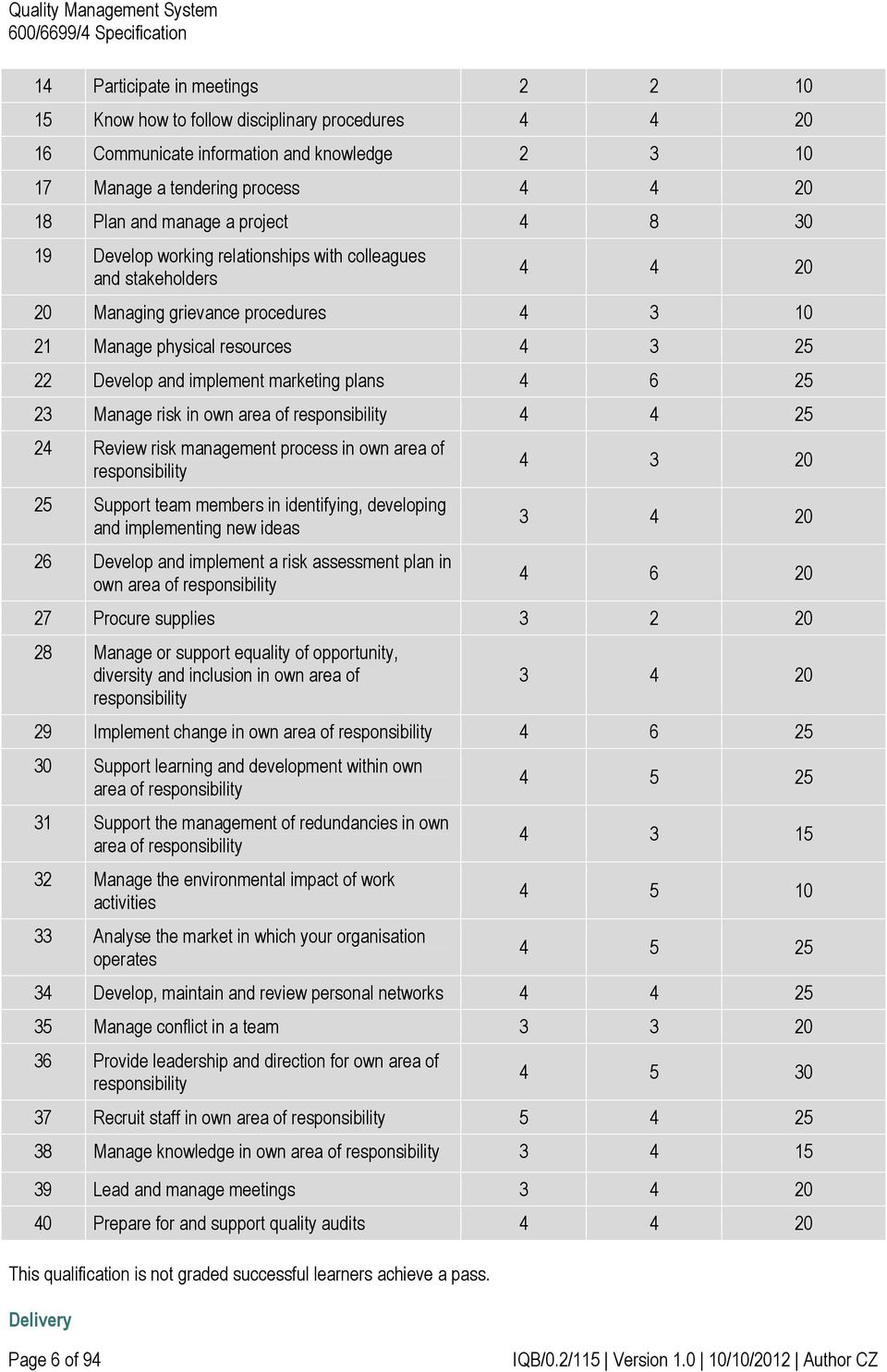
5 About this Qualification (Description, Objectives, Aims, Purpose) The IQ Level 3 NVQ Diploma in Management (QCF) is a qualification aimed at individuals who work as managers. It provides formal recognition of their competence in leadership and management and as a generic qualification it is applicable to a variety of sectors. In the mandatory units, all learners will cover the essentials of managing their own professional development, setting objectives, providing support for team members and how to plan, allocate and monitor team work. There are a range of optional units allowing learners scope to choose those areas most relevant to them, including but not limited to customer satisfaction, compliance and quality audits, performance, team leadership, market analysis, grievance and disciplinary procedures, risk assessment and management, recruitment, meetings, tendering processes, implementing change, professional relationships, resources, equality and diversity, learning and development and the environmental impact of work activities. Objectives of the qualification include preparing learners to progress to a qualification in the same subject area but at a higher level or requiring more specific knowledge, skills and understanding, meeting relevant programmes of learning, preparing learners for employment and supporting a role in the workplace. This qualification is the competence component of the Advanced Apprenticeship in Management. Structure (Credit, Rules of Combination, Guided Learning Hours) To achieve the IQ Level 3 NVQ Diploma in Management (QCF) learners must complete a minimum of 37 credits: 14 credits from the 3 units in the Mandatory Group, and a minimum of 23 credits from the Optional Group. At least 19 credits must be at Level 3 within the whole qualification. Page 5 of 94 Unit Level Credit Guided Learning Hours Mandatory Group 1 Manage own professional development within an organisation 2 Set objectives and provide support for team members Plan, allocate and monitor work of a team Optional Group 4 Manage the achievement of customer satisfaction Support individuals to develop and take responsibility for their performance 6 Manage customer service in own area of responsibility Manage personal development Address performance problems affecting team members Build, support and manage a team Make effective decisions Ensure compliance with legal, regulatory, ethical and social requirements Develop working relationships with colleagues Plan, allocate and monitor work in own area of responsibility IQB/0.2/115 Version /10/2012 Author CZ
6 14 Participate in meetings Know how to follow disciplinary procedures Communicate information and knowledge Manage a tendering process Plan and manage a project Develop working relationships with colleagues and stakeholders Managing grievance procedures Manage physical resources Develop and implement marketing plans Manage risk in own area of responsibility Review risk management process in own area of responsibility 25 Support team members in identifying, developing and implementing new ideas 26 Develop and implement a risk assessment plan in own area of responsibility Procure supplies Manage or support equality of opportunity, diversity and inclusion in own area of responsibility Implement change in own area of responsibility Support learning and development within own area of responsibility 31 Support the management of redundancies in own area of responsibility 32 Manage the environmental impact of work activities 33 Analyse the market in which your organisation operates Develop, maintain and review personal networks Manage conflict in a team Provide leadership and direction for own area of responsibility Recruit staff in own area of responsibility Manage knowledge in own area of responsibility Lead and manage meetings Prepare for and support quality audits This qualification is not graded successful learners achieve a pass. Delivery Page 6 of 94 IQB/0.2/115 Version /10/2012 Author CZ
7 Guided learning hours are It is the responsibility of training centres to decide the appropriate course duration, based on their learners ability and level of existing knowledge. It is possible, therefore, that the number of Guided Learning Hours can vary from one training centre to another according to learners' needs. Guided learning hours are all times when a member of provider staff is present to give specific guidance towards the learning aim being studied on the programme. This definition includes lectures, tutorials, and supervised study. It does not include hours where supervision or assistance is of a general nature and is not specific to the study of the learners. Assessment All units in this qualification are assessed by portfolio. Evidence for this qualification must come from the learners consistent performance in the workplace and must meet the requirements of CFA s Assessment Strategy Management & Leadership Standards August 2011 (Appendix A located at the end of this document). Further guidance for each unit can be found in the assessment guidance relevant to each unit. All Assessment Criteria must be met in each relevant unit to achieve this qualification. Assessment for this qualification must also meet the requirements for Additional Requirements for Qualifications that use the title NVQ within the QCF (Appendix B located at the end of this document). An Achievement Record for this qualification which includes the forms necessary to map and claim knowledge and competence is available to download from the IQ website. Age range and Geographical Coverage This qualification is approved for learners 18 plus in England Wales and Northern Ireland. Learner entry requirements There are no formal entry requirements. However, learners should be able to work at level 2 or above and be proficient in the use of the English Language. Progression Learners who have achieved the Level 3 NVQ Certificate in Management (QCF) can progress to this qualification using credits already achieved as they both feature the same range of units. Upon achieving the Diploma, learners can progress to the Level 5 NVQ Diploma in Management (QCF) using credits already achieved as there is an overlap of units. Learners can also progress to a variety of knowledge-based qualifications, one of which can form the knowledge component of the apprenticeship including: the Level 3 Certificate in First Line Management, the Level 3 Certificate in Management, the Level 3 Certificate in Management Principles, the Level 3 Certificate in Effective Management, the Level 3 Certificate in Leadership, the Level Certificate in Leadership and Management or the Level 3 Certificate in Principles of Management. Tutor requirements All trainers delivering this qualification must meet the requirements as per CFA s Assessment Strategy Management & Leadership Standards August See Appendix A at the end of this document. Centre Requirements Centres must be approved by IQ in order to offer this qualification. Page 7 of 94 IQB/0.2/115 Version /10/2012 Author CZ
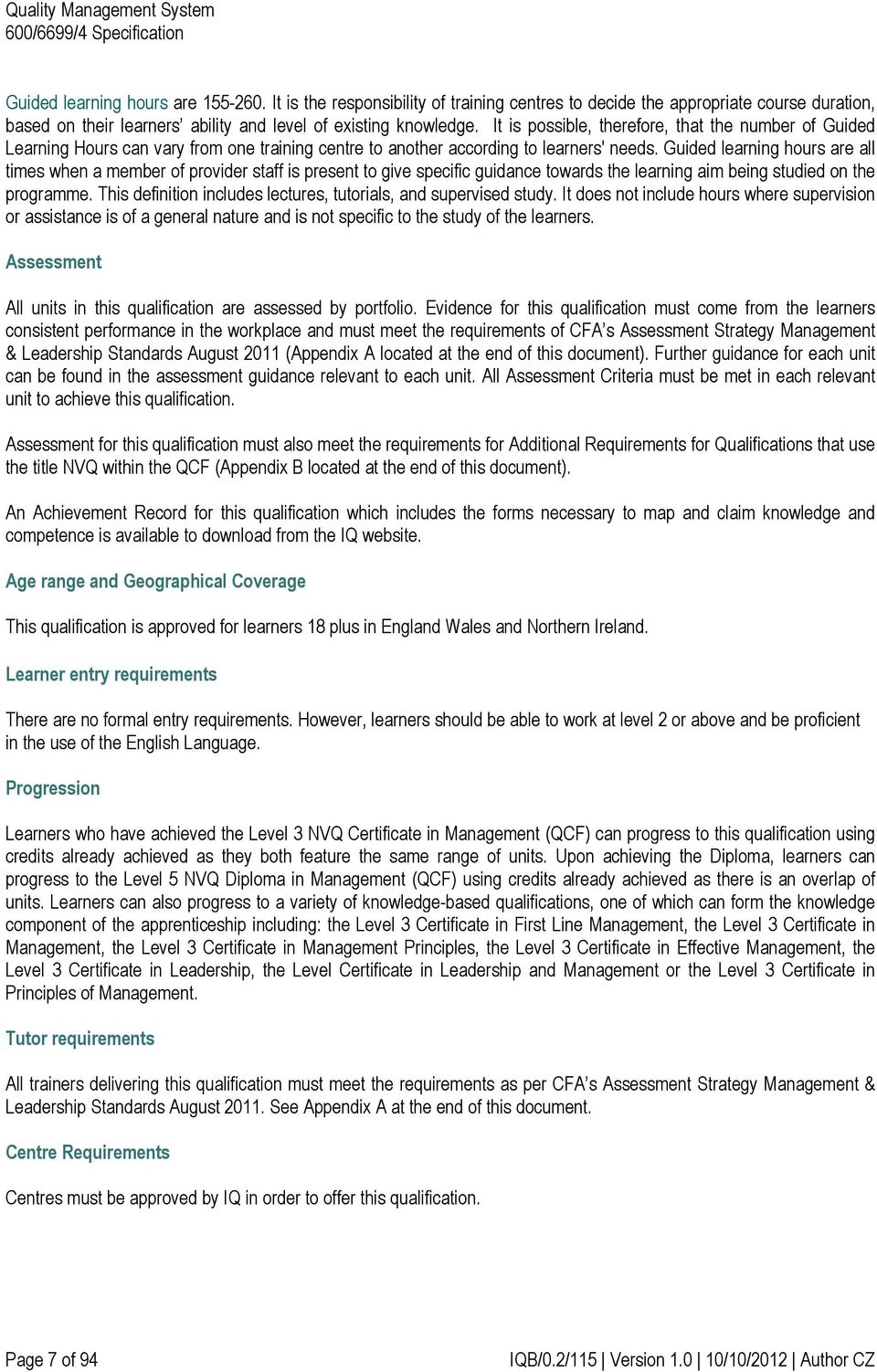
8 Unit 1: Manage own professional development within an organisation L/600/9586 Guided Learning Hours: Unit Level: Unit Credit: Unit grid: Learning outcomes/assessment Criteria Learning Outcome - The learner will: Assessment criteria - The learner can: 1. Be able to assess own career goals and personal development 1.1 Identify own career and personal goals 1.2 Assess how own career goals affect work role and professional development 2. Be able to set personal work objectives 2.1 Agree SMART (Specific, Measurable, Achievable, Realistic and Time-bound) personal work objectives in line with organisational objectives 3. Be able to produce a personal development plan 3.1 Identify gaps between objectives set, own current knowledge and skills 4. Be able to implement and monitor own personal development plan 3.2 Produce a development plan 4.1 Plan activities identified in own development plan 4.2 Explain how to monitor and review own personal development plan Page 8 of 94 IQB/0.2/115 Version /10/2012 Author CZ

9 Unit 1 Guidance on Delivery and Assessment Delivery This unit develops the learner s competence in managing their own professional development within an organisation, including the ability to assess their career goals and personal development, set personal work objectives and also produce, implement and monitor their own personal development plan. Assessment Evidence for this unit must demonstrate the learner s consistent competence in the workplace. Assessment is by portfolio. Simulation is not allowed for any performance evidence within this unit (further guidance can be found in the Assessment Strategy Management & Leadership Standards August 2011). See section 4.1 of Appendix A at the end of this document. Links This unit is based on the National Occupational Standards unit MSC A2 Manage your own resources and professional development. Page 9 of 94 IQB/0.2/115 Version /10/2012 Author CZ

10 Unit 2: Set objectives and provide support for team members M/600/9600 Guided Learning Hours: Unit Level: Unit Credit: Unit grid: Learning outcomes/assessment Criteria Learning Outcome - The learner will: 1. Be able to communicate a team s purpose and objectives to the team members 2. Be able to develop a plan with team members showing how team objectives will be met 3. Be able to support team members identifying opportunities and providing support 4. Be able to monitor and evaluate progress and recognise individual and team achievement Assessment criteria - The learner can: 1.1 Describe the purpose of a team 1.2 Set team objectives with its members which are SMART (Specific, Measurable, Achievable, Realistic and Time-bound) 1.3 Communicate the team s purpose and objectives to its members 2.1 Discuss with team members how team objectives will be met 2.2 Ensure team members participate in the planning process and think creatively 2.3 Develop plans to meet team objectives 2.4 Set SMART personal work objectives with team members 3.1 Identify opportunities and difficulties faced by team members 3.2 Discuss identified opportunities and difficulties with team members 3.3 Provide advice and support to team members to overcome identified difficulties and challenges 3.4 Provide advice and support to team members to make the most of identified opportunities 4.1 Monitor and evaluate individual and team activities and progress 4.2 Provide recognition when individual and team objectives have been achieved Page 10 of 94 IQB/0.2/115 Version /10/2012 Author CZ

11 Unit 2 Guidance on Delivery and Assessment Delivery This unit develops the learner s competence to set objectives and provide support for team members. They should be able to communicate a team s purpose and objectives to the team members, develop a plan with them showing how the team objectives will be met and support them in identifying opportunities. It covers the ability to monitor and evaluate progress and recognise individual and team achievement. Assessment Evidence for this unit must demonstrate the learner s consistent competence in the workplace. Assessment is by portfolio. Simulation is not allowed for any performance evidence within this unit (further guidance can be found in the Assessment Strategy Management & Leadership Standards August 2011). See section 4.1 of Appendix A at the end of this document. Links This unit is based on the National Occupational Standards unit MSC B5 Provide leadership for your team. Page 11 of 94 IQB/0.2/115 Version /10/2012 Author CZ

12 Unit 3: Plan, allocate and monitor work of a team Y/600/9669 Guided Learning Hours: Unit Level: Unit Credit: Unit grid: Learning outcomes/assessment Criteria Learning Outcome - The learner will: Assessment criteria - The learner can: 1. Be able to plan work for a team 1.1 Agree team objectives with own manager 2. Be able to allocate work across a team 2.1 Discuss team plans with a team 3. Be able to manage team members to achieve team objectives 4. Be able to monitor and evaluate the performance of team members 1.2 Develop a plan for a team to meet agreed objectives, taking into account capacity and capabilities of the team 2.2 Agree work allocation and SMART (Specific, Measurable, Achievable, Realistic and Time-bound) objectives with team members 2.3 Agree standard of work required by team 3.1 Support all team members in order to achieve team objectives 4.1 Assess team members work against agreed standards and objectives 4.2 Identify and monitor conflict within a team 4.3 Identify causes for team members not meeting team objectives 5. Be able to improve the performance of a team 5.1 Identify ways of improving team performance 5.2 Provide constructive feedback to team members to improve their performance 5.3 Implement identified ways of improving team performance Page 12 of 94 IQB/0.2/115 Version /10/2012 Author CZ

13 Unit 3 Guidance on Delivery and Assessment Delivery This unit develops the learner s competence to plan, allocate and monitor the work of a team. This includes allocating work across the team, managing team members in order to achieve team objectives, monitoring and evaluating the performance of each member and the ability to improve the performance of the team. Assessment Evidence for this unit must demonstrate the learner s consistent competence in the workplace. Assessment is by portfolio. Simulation is not allowed for any performance evidence within this unit (further guidance can be found in the Assessment Strategy Management & Leadership Standards August 2011). See section 4.1 of Appendix A at the end of this document. Links This unit is based on the National Occupational Standards unit MSC D5 Allocate and check work in your team. Page 13 of 94 IQB/0.2/115 Version /10/2012 Author CZ

14 Unit 4: Manage the achievement of customer satisfaction A/600/9793 Guided Learning Hours: Unit Level: Unit Credit: Unit grid: Learning outcomes/assessment Criteria Learning Outcome - The learner will: 1. Be able to understand customer service standards required in own organisation 2. Be able to implement sustainable processes for customer satisfaction 3. Be able to manage and support colleagues in delivering customer service standards 4. Be able to manage and develop culture in own organisation to support customer service standards 5. Be able to monitor customer service levels for continuous improvement Assessment criteria - The learner can: 1.1 Explain customer service standards within own organisation 1.2 Describe customer service best practice in own sector using research techniques 2.1 Define sustainable processes taking into account environmental issues 2.2 Identify sustainable processes to support customer service standards 2.3 Produce a plan for implementation 2.4 State customer service standards with relevant key stakeholders 2.5 Ensure resources are provided to deliver agreed standards of customer service 3.1 Communicate customer service roles and responsibilities with employees in own organisation 4.1 Evaluate the culture in own organisation 4.2 Identify techniques for improving motivation amongst employees 4.3 Describe motivational strategies for improving customer service standards 5.1 Describe methods of measuring customer satisfaction 5.2 Develop processes for monitoring customer satisfaction, including customer feedback mechanisms 5.3 Review employee performance to ensure customer service standards and organisational values are met 5.4 Analyse and monitor customer service Page 14 of 94 IQB/0.2/115 Version /10/2012 Author CZ
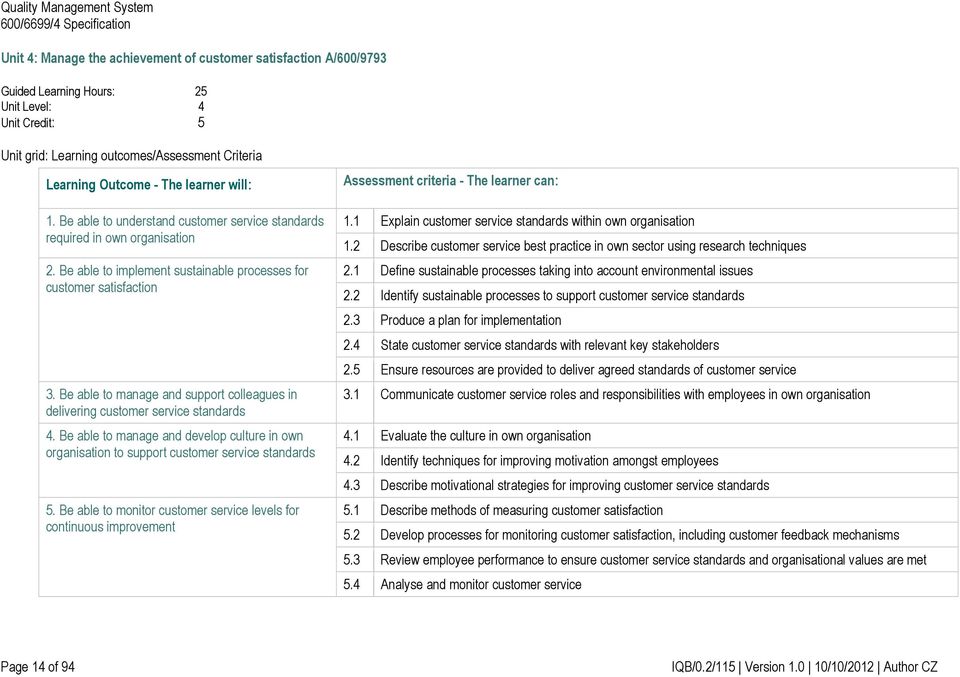
15 Unit 4 Guidance on Delivery and Assessment Delivery This unit develops the learners competence to manage the achievement of customer satisfaction. It covers understanding customer service standards, implementing sustainable processes, managing and supporting colleagues in delivering customer service standards, managing and developing culture in the organisation and monitoring customer service levels for continuous improvement. Assessment Evidence for this unit must demonstrate the learner s consistent competence in the workplace. Assessment is by portfolio. Simulation is not allowed for any performance evidence within this unit (further guidance can be found in the Assessment Strategy Management & Leadership Standards August 2011). See section 4.1 of Appendix A at the end of this document. Links This unit is based on the National Occupational Standards unit MSC F11 Manage the achievement of customer satisfaction. Page 15 of 94 IQB/0.2/115 Version /10/2012 Author CZ

16 Unit 5: Support individuals to develop and take responsibility for their performance D/600/9690 Guided Learning Hours: Unit Level: Unit Credit: Unit grid: Learning outcomes/assessment Criteria Learning Outcome - The learner will: 1. Be able to agree their performance development needs with an individual 2. Be able to understand how to help an individual create a development plan 3. Be able to support an individual in implementing their development plan 4. Be able to evaluate an individual s progress against a development plan and provide feedback for continual performance improvement Assessment criteria - The learner can: 1.1 Explain the standards of performance required for current or future role with an individual 1.2 Identify and agree the performance development needs for the individual 2.1 Identify options available to support an individual in meeting desired standards of performance 2.2 Explain specific actions needed to achieve objectives 2.3 Explain the process for an individual to create a development plan 3.1 Describe the opportunities provided for an individual to improve performance 3.2 Explain the outcome to an individual for improved performance 4.1 Monitor and evaluate an individual s progress against their development plan 4.2 Implement feedback to make development plan revisions 4.3 Explain how to encourage individuals to take responsibility for continuing their performance development Page 16 of 94 IQB/0.2/115 Version /10/2012 Author CZ

17 Unit 5 Guidance on Delivery and Assessment Delivery This unit develops the learner s competence in supporting individuals to develop and take responsibility for their performance. They should be able to agree their performance development needs with an individual, understand how to help an individual create a development plan, support an individual in implementing their development plan and evaluate an individual s progress against a development plan, providing feedback for continual performance improvement. Assessment Evidence for this unit must demonstrate the learner s consistent competence in the workplace. Assessment is by portfolio. Simulation is not allowed for any performance evidence within this unit (further guidance can be found in the Assessment Strategy Management & Leadership Standards August 2011). See section 4.1 of Appendix A at the end of this document. Links This unit is based on the National Occupational Standards unit MSC D13 Support individuals to develop and maintain their performance. Page 17 of 94 IQB/0.2/115 Version /10/2012 Author CZ

18 Unit 6: Manage customer service in own area of responsibility D/600/9804 Guided Learning Hours: Unit Level: Unit Credit: Unit grid: Learning outcomes/assessment Criteria Learning Outcome - The learner will: 1. Be able to establish and communicate measurable customer service standards for own area of responsibility 2. Be able to support staff in meeting customer service standards 3. Be able to monitor and evaluate customer service performance, systems and processes Assessment criteria - The learner can: 1.1 State organisational, legal and regulatory requirements for customer service standards 1.2 Explain expected standards for customer service performance to employees in own area of responsibility 1.3 Describe measurement criteria to monitor customer service performance 2.1 Identify staff and other resources to meet customer service standards 2.2 Communicate roles and responsibilities to employees and provide support 2.3 Describe how to resolve customer service queries within own organisation s policy 3.1 Monitor customer service performance against established criteria 3.2 Analyse feedback from staff and customers on the quality of customer service 3.3 Evaluate customer feedback and identify areas for improvement 3.4 Recommend changes to customer service processes or standards based on performance evaluation Page 18 of 94 IQB/0.2/115 Version /10/2012 Author CZ
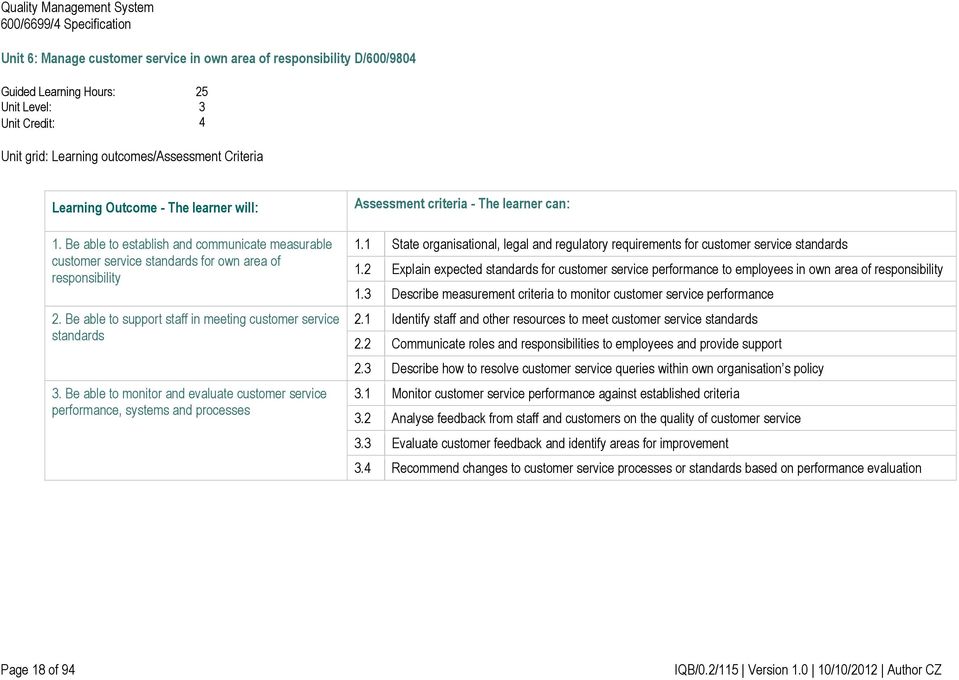
19 Unit 6 Guidance on Delivery and Assessment Delivery This unit develops the learner s competence to manage customer service in their own area of responsibility. It includes the ability to establish and communicate measurable customer service standards for their area of responsibility, supporting staff in meeting customer service standards and monitoring and evaluating customer service performance, systems and processes. Assessment Evidence for this unit must demonstrate the learner s consistent competence in the workplace. Assessment is by portfolio. Simulation is not allowed for any performance evidence within this unit (further guidance can be found in the Assessment Strategy Management & Leadership Standards August 2011). See section 4.1 of Appendix A at the end of this document. Links This unit is based on the National Occupational Standards unit MSC F17 Manage the delivery of customer service in your area of responsibility. Page 19 of 94 IQB/0.2/115 Version /10/2012 Author CZ
20 Unit 7: Manage personal development F/600/9469 Guided Learning Hours: Unit Level: Unit Credit: Unit grid: Learning outcomes/assessment Criteria Learning Outcome - The learner will: 1. Be able to identify and agree performance requirements of own work role Assessment criteria - The learner can: 1.1 Outline work role performance requirements with those they report to 2. Be able to measure and progress against objectives 2.1 Identify ways that progress will be measured against own work objectives 3. Be able to identify gaps in skills and knowledge in own performance 4. Be able to carry out and assess activities within own development plan 3.1 Explain knowledge and skills required for own work role 3.2 Identify opportunities and resources available for personal development 3.3 Produce a development plan to address own needs and agree with line manager 4.1 Plan activities in own development plan that address identified needs 4.2 Collect feedback from colleagues on the result of development activities on own performance 4.3 Assess the success of activities carried out as part of own development plan Page 20 of 94 IQB/0.2/115 Version /10/2012 Author CZ
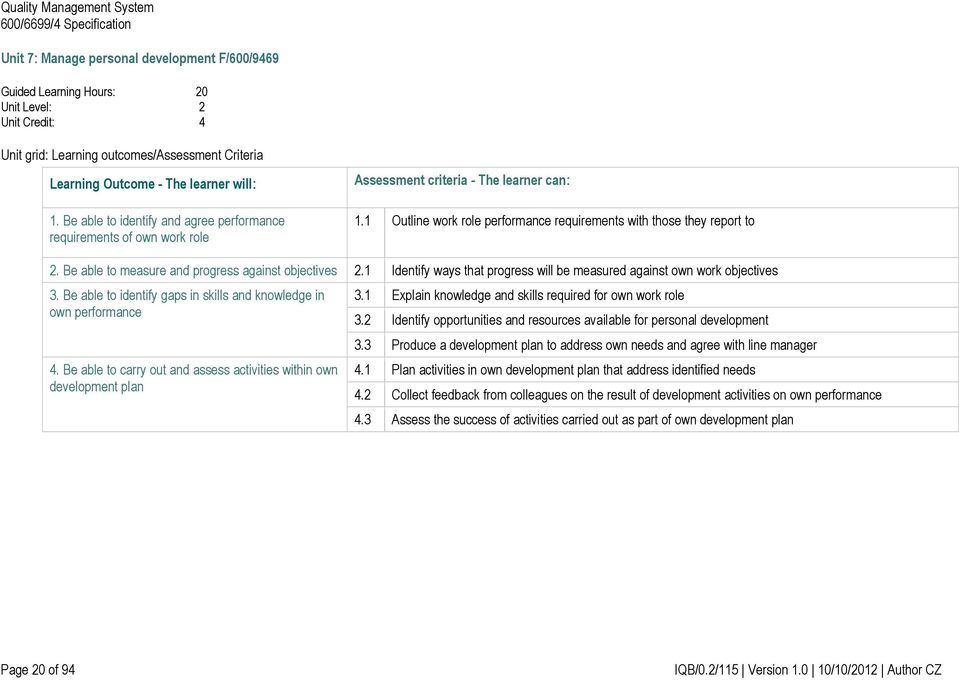
21 Unit 7 Guidance on Delivery and Assessment Delivery This unit develops the learner s competence to manage personal development. The learner should be able to identify and agree the performance requirements of their own work role, measure and progress against objectives, identify gaps in skills and knowledge in their performance and be able to carry out and assess activities within their own development plan. Assessment Evidence for this unit must demonstrate the learner s consistent competence in the workplace. Assessment is by portfolio. Simulation is not allowed for any performance evidence within this unit (further guidance can be found in the Assessment Strategy Management & Leadership Standards August 2011). See section 4.1 of Appendix A at the end of this document. Links This unit is based on the National Occupational Standards unit MSC A1 Manage your own resources. Page 21 of 94 IQB/0.2/115 Version /10/2012 Author CZ
22 Unit 8: Address performance problems affecting team members F/600/9679 Guided Learning Hours: Unit Level: Unit Credit: Unit grid: Learning outcomes/assessment Criteria Learning Outcome - The learner will: 1. Understand legal requirements, industry regulations, organisational policies and professional codes concerning performance 2. Be able to identify performance problems of team members 3. Be able to discuss performance problems with team members 4. Be able to set a course of action to deal with identified problems with team members Assessment criteria - The learner can: 1.1 Identify legal requirements, industry regulations, organisational policies and professional codes concerning performance 1.2 Explain limits of own authority relating to performance problems 2.1 Assess team member s performance against performance criteria 2.2 Evaluate causes of identified performance problems 3.1 Identify performance problems to the attention of the team member concerned 3.2 Explain an organisation s policies for managing performance problems to the team member concerned 3.3 Develop a confidential record of discussions with team members about problems affecting their performance 4.1 Explain and discuss alternative courses of action with the team member concerned 4.2 Identify the course of action with the team member concerned 4.3 Review and revise confidential records of discussions with team members about problems affecting their performance Page 22 of 94 IQB/0.2/115 Version /10/2012 Author CZ
23 Unit 8 Guidance on Delivery and Assessment Delivery This unit develops the learner s knowledge and competence to address performance problems affecting team members. They should understand legal requirements, industry regulations, organisational policies and professional codes concerning performance. It covers the learner s ability to identify performance problems of team members, discuss the problems with them and to set a course of action to deal with the identified problems with team members. Assessment Evidence for this unit must demonstrate the learner s consistent competence in the workplace. Assessment is by portfolio. Simulation is not allowed for any performance evidence within this unit (further guidance can be found in the Assessment Strategy Management & Leadership Standards August 2011). See section 4.1 of Appendix A at the end of this document. Links This unit is based on the National Occupational Standards unit MSC D8 Help team members address problems affecting their performance. Page 23 of 94 IQB/0.2/115 Version /10/2012 Author CZ
24 Unit 9: Build, support and manage a team F/600/9682 Guided Learning Hours: Unit Level: Unit Credit: Unit grid: Learning outcomes/assessment Criteria Learning Outcome - The learner will: Assessment criteria - The learner can: 1. Understand the purpose and required attributes of a team and select those that match the team s requirements 2. Be able to induct team members and communicate their roles and responsibilities 1.1 Explain the role of a team in the achievement of a specific project or activity 1.2 Identify the attributes needed within the team to achieve its objectives 1.3 Analyse the skills and knowledge of potential and current team members against the identified needs 1.4 Identify individuals whose attributes most closely match the identified requirements 2.1 Communicate project aims and objectives to team members 3. Understand how to support team development 3.1 Identify the stages of team development 4. Be able to manage team performance and understand how to disband a team 2.2 Explain how to introduce team members to each other and discuss each member s role and responsibilities 3.2 Explain how to resolve conflict between team members 3.3 Describe methods of encouraging team members to share knowledge and skills to achieve project objectives 3.4 Explain how to encourage open communication, trust and respect between team members 4.1 Monitor and review the performance of a team against its purpose 4.2 Communicate project developments and to team members and support any change in roles or responsibilities 4.3 Communicate team and individual successes to the all team members 5. Understand how to disband team 5.1 Explain how to prepare team members for project conclusion 5.2 Describe how team is disbanded Page 24 of 94 IQB/0.2/115 Version /10/2012 Author CZ
25 Unit 9 Guidance on Delivery and Assessment Delivery This unit develops the learner s knowledge and competence in building, supporting and managing a team, including understanding how to support team development and the purpose and required attributes of the team, selecting them accordingly. It covers the ability to induct team members, communicate their roles and responsibilities, manage team performance and understand how to disband a team. Assessment Evidence for this unit must demonstrate the learner s consistent competence in the workplace. Assessment is by portfolio. Simulation is not allowed for any performance evidence within this unit (further guidance can be found in the Assessment Strategy Management & Leadership Standards August 2011). See section 4.1 of Appendix A at the end of this document. Links This unit is based on the National Occupational Standards unit MSC D9 Build and manage teams. Page 25 of 94 IQB/0.2/115 Version /10/2012 Author CZ
26 Unit 10: Make effective decisions F/600/9715 Guided Learning Hours: Unit Level: Unit Credit: Unit grid: Learning outcomes/assessment Criteria Learning Outcome - The learner will: Assessment criteria - The learner can: 1. Be able to identify circumstances that require a decision to be made 2. Be able to collect information to inform decisionmaking 3. Be able to analyse information to inform decisionmaking 1.1 Explain the circumstances requiring a decision to be made 1.2 State the desired objective(s) for making a decision 1.3 Establish criteria on which to base the decision, in line with own organisation 2.1 Identify information needed to inform the decision-making process 2.2 Communicate with stakeholders affected by the decision 2.3 Explain how to inform stakeholders about the decision-making process 3.1 Identify information for validity and relevance to the decision-making process 3.2 Analyse information and against established criteria 4. Be able to make a decision 4.1 Apply decision-making technique(s) to determine a decision 4.2 Explain the decision made in line with desired objectives 4.3 Communicate the decision taken to relevant stakeholders Page 26 of 94 IQB/0.2/115 Version /10/2012 Author CZ
27 Unit 10 Guidance on Delivery and Assessment Delivery This unit develops the learner s competence to make effective decisions. It includes identifying circumstances that require a decision to be made, collecting and analysing information to inform the decision-making and the ability to make the decision. Assessment Evidence for this unit must demonstrate the learner s consistent competence in the workplace. Assessment is by portfolio. Simulation is not allowed for any performance evidence within this unit (further guidance can be found in the Assessment Strategy Management & Leadership Standards August 2011). See section 4.1 of Appendix A at the end of this document. Links This unit is based on the National Occupational Standards unit MSC E10 Take effective decisions. Page 27 of 94 IQB/0.2/115 Version /10/2012 Author CZ
28 Unit 11: Ensure compliance with legal, regulatory, ethical and social requirements H/600/9609 Guided Learning Hours: Unit Level: Unit Credit: Unit grid: Learning outcomes/assessment Criteria Learning Outcome - The learner will: 1. Be able to monitor the operational compliance of procedures in meeting legal, regulatory, ethical and social requirements 2. Be able to identify and make recommendations on areas of non-compliance with procedures for legal, regulatory, ethical and social requirements relating to own area of responsibility Assessment criteria - The learner can: 1.1 Monitor the operational compliance of procedures in meeting legal, regulatory, ethical and social requirements 2.1 Identify areas of non-compliance with legal, regulatory, ethical and social procedures 2.2 Examine reasons for non-compliance with procedures 2.3 Make recommendations for corrections to ensure compliance with procedures Page 28 of 94 IQB/0.2/115 Version /10/2012 Author CZ
29 Unit 11 Guidance on Delivery and Assessment Delivery This unit develops the learner s competence to ensure compliance with legal, regulatory, ethical and social requirements. It covers the ability to monitor the operational compliance of procedures in meeting legal, regulatory, ethical and social requirements and identify and make recommendations on any areas of non-compliance relating to their own area of responsibility. Assessment Evidence for this unit must demonstrate the learner s consistent competence in the workplace. Assessment is by portfolio. Simulation is not allowed for any performance evidence within this unit (further guidance can be found in the Assessment Strategy Management & Leadership Standards August 2011). See section 4.1 of Appendix A at the end of this document. Links This unit is based on the National Occupational Standards unit MSC B8 Ensure compliance with legal, regulatory, ethical and social requirements. Page 29 of 94 IQB/0.2/115 Version /10/2012 Author CZ
30 Unit 12: Develop working relationships with colleagues H/600/9660 Guided Learning Hours: Unit Level: Unit Credit: Unit grid: Learning outcomes/assessment Criteria Learning Outcome - The learner will: Assessment criteria - The learner can: 1. Understand the benefits of working with colleagues 1.1 Describe the benefits of productive working relationships 2. Be able to establish working relationships with colleagues 3. Be able to act in a professional and respectful manner when working with colleagues 2.1 Identify colleagues within own and other organisations 2.2 Agree the roles and responsibilities for colleagues 3.1 Explain how to display behaviour that shows professionalism 4. Be able to communicate with colleagues 4.1 Identify, information to others clearly and concisely 5. Be able to identify potential work-related difficulties and explore solutions 4.2 Explain how to receive and clarify own understanding of information 5.1 Identify potential work-related difficulties and conflicts of interest 5.2 Explain how to resolve identified potential difficulties. Page 30 of 94 IQB/0.2/115 Version /10/2012 Author CZ
31 Unit 12 Guidance on Delivery and Assessment Delivery This unit develops the learner s knowledge and competence to develop working relationships with colleagues, including understanding the benefits of working with colleagues. It covers the ability to establish working relationships with colleagues, act in a professional and respectful manner when working with them, communicate with them and identify and explore solutions to potential work-related difficulties. Assessment Evidence for this unit must demonstrate the learner s consistent competence in the workplace. Assessment is by portfolio. Simulation is not allowed for any performance evidence within this unit (further guidance can be found in the Assessment Strategy Management & Leadership Standards August 2011). See section 4.1 of Appendix A at the end of this document. Links This unit is based on the National Occupational Standards unit MSC D1 Develop productive working relationships with colleagues. Page 31 of 94 IQB/0.2/115 Version /10/2012 Author CZ
32 Unit 13: Plan, allocate and monitor work in own area of responsibility H/600/9674 Guided Learning Hours: Unit Level: Unit Credit: Unit grid: Learning outcomes/assessment Criteria Learning Outcome - The learner will: 1. Be able to produce a work plan for own area of responsibility 2. Be able to allocate and agree responsibilities with team members 3. Be able to monitor the progress and quality of work in own area of responsibility and provide feedback 4. Be able to review and amend plans of work for own area of responsibility and communicate changes Assessment criteria - The learner can: 1.1 Explain the context in which work is to be undertaken 1.2 Identify the skills base and the resources available 1.3 Examine priorities and success criteria needed for the team 1.4 Produce a work plan for own area of responsibility 2.1 Identify team members responsibilities for identified work activities 2.2 Agree responsibilities and SMART (Specific, Measurable, Achievable, Realistic and Time-bound) objectives with team members 3.1 Identify ways to monitor progress and quality of work 3.2 Monitor and evaluate progress against agreed standards and provide feedback to team members 4.1 Review and amend work plan where changes are needed 4.2 Communicate changes to team members Page 32 of 94 IQB/0.2/115 Version /10/2012 Author CZ
33 Unit 13 Guidance on Delivery and Assessment Delivery This unit develops the learner s competence to plan, allocate and monitor work in their own area of responsibility. They should be able to produce a work plan for their own area of responsibility, allocate and agree responsibilities with team members and monitor the progress and quality of work in this area of responsibility and provide feedback. It includes the ability to review and amend plans of work for own area of responsibility and communicate changes. Assessment Evidence for this unit must demonstrate the learner s consistent competence in the workplace. Assessment is by portfolio. Simulation is not allowed for any performance evidence within this unit (further guidance can be found in the Assessment Strategy Management & Leadership Standards August 2011). See section 4.1 of Appendix A at the end of this document. Links This unit is based on the National Occupational Standards unit MSC D6 Allocate and monitor the progress and quality of work in your area of responsibility. Page 33 of 94 IQB/0.2/115 Version /10/2012 Author CZ
34 Unit 14: Participate in meetings H/600/9688 Guided Learning Hours: Unit Level: Unit Credit: Unit grid: Learning outcomes/assessment Criteria Learning Outcome - The learner will: Assessment criteria - The learner can: 1. Be able to prepare for a meeting 1.1 Explain meeting objectives prior to the meeting 1.2 Identify own role and prepare as necessary 2. Be able to participate in a meeting 2.1 Contribute to meeting discussions using evidence to support own opinions 3. Be able to communicate information to relevant stakeholders 2.2 Acknowledge other viewpoints presented at a meeting 2.3 Seek clarification or confirmation of own understanding of outcomes 3.1 Communicate information from the meeting to those who have an interest, in line with any organisational protocol Page 34 of 94 IQB/0.2/115 Version /10/2012 Author CZ
35 Unit 14 Guidance on Delivery and Assessment Delivery This unit develops the learner s competence to participate in meetings. It includes meeting preparation, participation and the ability to communicate information to relevant stakeholders. Assessment Evidence for this unit must demonstrate the learner s consistent competence in the workplace. Assessment is by portfolio. Simulation is not allowed for any performance evidence within this unit (further guidance can be found in the Assessment Strategy Management & Leadership Standards August 2011). See section 4.1 of Appendix A at the end of this document. Links This unit is based on the National Occupational Standards unit MSC D12 Participate in meetings. Page 35 of 94 IQB/0.2/115 Version /10/2012 Author CZ
36 Unit 15: Know how to follow disciplinary procedures H/600/9691 Guided Learning Hours: Unit Level: Unit Credit: Unit grid: Learning outcomes/assessment Criteria Learning Outcome - The learner will: 1. Be able to understand performance expectations of an organisation 2. Be able to identify and use communication methods to assess potential cases of misconduct or unsatisfactory performance 3. Be able to know how to informally deal with cases of minor misconduct or unsatisfactory performance 4. Be able to follow an organisation s formal disciplinary procedure Assessment criteria - The learner can: 1.1 Explain an organisation s required standards of conduct and performance 1.2 Explain an organisation s formal disciplinary procedure 2.1 Explain how to identify when an individual s performance falls below organisational standards 2.2 Identify communication methods used to gather information on potential cases of misconduct or unsatisfactory performance 3.1 Identify the differences between misconduct, gross misconduct and unsatisfactory performance, and how each should be handled 3.2 Evaluate whether a case of misconduct or unsatisfactory performance can be dealt with informally 3.3 Assess methods available to improve performance or behaviour 3.4 Explain the importance of recording informal disciplinary proceedings 4.1 Explain the importance of seeking advice and guidance from specialists prior to taking action 4.2 Explain when to follow formal disciplinary procedures 4.3 Assess the importance of communicating disciplinary procedures to individuals 4.4 Explain how to record and store information throughout the disciplinary process Page 36 of 94 IQB/0.2/115 Version /10/2012 Author CZ
37 Unit 15 Guidance on Delivery and Assessment Delivery This unit develops the learner s competence in knowing how to follow disciplinary procedures. It includes being able to understand the performance expectations of an organisation, identifying and using communication methods to assess potential cases of misconduct or unsatisfactory performance, how to informally deal with cases of minor misconduct or unsatisfactory performance and the ability to follow an organisation s formal disciplinary procedure. Assessment Evidence for this unit must demonstrate the learner s consistent competence in the workplace. Assessment is by portfolio. Simulation is not allowed for any performance evidence within this unit (further guidance can be found in the Assessment Strategy Management & Leadership Standards August 2011). See section 4.1 of Appendix A at the end of this document. Links This unit is based on the National Occupational Standards unit MSC D14 Initiate and follow disciplinary procedure. Page 37 of 94 IQB/0.2/115 Version /10/2012 Author CZ
38 Unit 16: Communicate information and knowledge H/600/9724 Guided Learning Hours: Unit Level: Unit Credit: Unit grid: Learning outcomes/assessment Criteria Learning Outcome - The learner will: 1. Be able to identify the information required, and its reliability, for communication 2. Be able to understand communication techniques and methods 3. Be able to communicate information and knowledge using appropriate techniques and methods 4. Be able to adapt communication techniques and methods according to target audience response Assessment criteria - The learner can: 1.1 Explain the information and knowledge that needs communicating 1.2 Identify the target audience requiring the information and knowledge 2.1 Identify what techniques and methods can be used to communicate information and knowledge 2.2 Explain how to select the most appropriate technique and method 3.1 Communicate to target audience using the appropriate techniques and methods 3.2 Explain how the target audience has received and understood the information communicated 4.1 Explain how to modify communication techniques and methods in response to verbal and non-verbal feedback Page 38 of 94 IQB/0.2/115 Version /10/2012 Author CZ
39 Unit 16 Guidance on Delivery and Assessment Delivery This unit develops the learner s ability to communicate information and knowledge. It includes identifying the information required and its reliability for communication, understanding communication techniques and methods, communicating information and knowledge using appropriate techniques and methods and ability to adapt communication techniques and methods according to target audience response. Assessment Evidence for this unit must demonstrate the learner s consistent competence in the workplace. Assessment is by portfolio. Simulation is not allowed for any performance evidence within this unit (further guidance can be found in the Assessment Strategy Management & Leadership Standards August 2011). See section 4.1 of Appendix A at the end of this document. Links This unit is based on the National Occupational Standards unit MSC E11 Communicate information and knowledge. Page 39 of 94 IQB/0.2/115 Version /10/2012 Author CZ
40 Unit 17: Manage a tendering process H/600/9738 Guided Learning Hours: Unit Level: Unit Credit: Unit grid: Learning outcomes/assessment Criteria Learning Outcome - The learner will: Assessment criteria - The learner can: 1. Understand tendering processes 1.1 Explain the legal requirements of a tendering process 2. Be able to draw up a specification for required products or services 3. Be able to write an invitation to tender document and communicate it to prospective suppliers 4. Understand how to respond fairly to pre-tender queries 1.2 Explain organisational tendering policies and processes 1.3 Explain how to seek specialist support for the tendering process 2.1 Consult with colleagues to identify and agree requirements for products or services 2.2 Draw up a specification that describes the products or services required 3.1 Write an invitation to tender outlining required specifications and organisational tendering processes 3.2 Communicate the invitation to tender to prospective suppliers 4.1 Explain how to respond to pre-tender queries in ways that ensure all prospective suppliers have the same information 5. Be able to evaluate received tenders 5.1 Establish criteria with which to evaluate received tenders 6. Be able to select a supplier and provide post-tender feedback 5.2 Receive, record and open tenders in line with stated tendering process 5.3 Seek clarification from prospective suppliers where necessary 5.4 Evaluate tenders against established criteria 6.1 Offer a contract to the chosen supplier 6.2 Inform unsuccessful suppliers of the outcome and provide feedback Page 40 of 94 IQB/0.2/115 Version /10/2012 Author CZ
41 Unit 17 Guidance on Delivery and Assessment Delivery This unit develops the learner s knowledge and competence to manage a tendering process, including understanding tendering processes and how to respond fairly to pre-tender queries. It covers the ability to draw up a specification for required products or services, write an invitation to tender document and communicate it to prospective suppliers, evaluate received tenders and select a supplier and provide post-tender feedback. Assessment Evidence for this unit must demonstrate the learner s consistent competence in the workplace. Assessment is by portfolio. Simulation is not allowed for any performance evidence within this unit (further guidance can be found in the Assessment Strategy Management & Leadership Standards August 2011). See section 4.1 of Appendix A at the end of this document. Links This unit is based on the National Occupational Standards unit MSC E16 Select suppliers through a tendering process. Page 41 of 94 IQB/0.2/115 Version /10/2012 Author CZ
42 Unit 18: Plan and manage a project J/600/9750 Guided Learning Hours: Unit Level: Unit Credit: Unit grid: Learning outcomes/assessment Criteria Learning Outcome - The learner will: Assessment criteria - The learner can: 1. Understand the principles, processes, tools and techniques of project management 2. Be able to agree the scope and objectives of a project 3. Be able to identify the budget in order to develop a project plan 1.1 Describe the roles and responsibilities of a project manager 1.2 Explain how to apply principles, processes, tools and techniques of project management 2.1 Agree SMART (Specific, Measurable, Achievable, Realistic, and Time-bound) objectives and scope of the project with project sponsor(s) and stakeholders 3.1 Identify budget and time-scales in order to develop the project plan with stakeholders 3.2 Consult with stakeholders to negotiate the project plan 3.3 Identify potential risks and contingencies 3.4 Establish criteria and processes for evaluating the project on completion 4. Be able to implement a project plan 4.1 Allocate roles and responsibilities to project team members 4.2 Provide resources identified in the project plan 4.3 Brief project team members on the project plan and their roles and responsibilities 4.4 Implement a project plan using project management tools and techniques 5. Be able to manage a project to its conclusion 5.1 Apply a range of project management tools and techniques to monitor, control and review progress 5.2 Provide support to project team members Page 42 of 94 IQB/0.2/115 Version /10/2012 Author CZ
43 Unit 18 Guidance on Delivery and Assessment Delivery This unit develops the learner s knowledge and competence to plan and manage a project, including understanding the principles, processes, tools and techniques of project management. It covers the ability to agree the scope and objectives of a project, to identify the budget in order to develop a project plan, implement the plan and manage it to its conclusion. Assessment Evidence for this unit must demonstrate the learner s consistent competence in the workplace. Assessment is by portfolio. Simulation is not allowed for any performance evidence within this unit (further guidance can be found in the Assessment Strategy Management & Leadership Standards August 2011). See section 4.1 of Appendix A at the end of this document. Links This unit is based on the National Occupational Standards unit MSC F1 Manage a project. Page 43 of 94 IQB/0.2/115 Version /10/2012 Author CZ
44 Unit 19: Develop working relationships with colleagues and stakeholders K/600/9661 Guided Learning Hours: Unit Level: Unit Credit: Unit grid: Learning outcomes/assessment Criteria Learning Outcome - The learner will: 1. Know how to identify stakeholders and their relevance to an organisation 2. Understand how to establish working relationships with colleagues and stakeholders 3. Be able to create an environment of trust and mutual respect with colleagues and stakeholders Assessment criteria - The learner can: 1.1 Identify an organisation s stakeholders 1.2 Evaluate the roles, responsibilities, interests and concerns of stakeholders 1.3 Assess the importance of identified stakeholders 2.1 Clarify how to agree a common sense of purpose with colleagues and stakeholders 2.2 Summarise how to create an environment of trust and mutual respect with colleagues and stakeholders 3.1 Review and revise the needs and motivations of colleagues and stakeholders 3.2 Demonstrate interaction with colleagues and stakeholders that allows respect for the views and actions of others Page 44 of 94 IQB/0.2/115 Version /10/2012 Author CZ
45 Unit 19 Guidance on Delivery and Assessment Delivery This unit develops the learner s knowledge and competence to develop working relationships with colleagues and stakeholders. They should know how to identify stakeholders and their relevance to an organisation, understand how to establish working relationships with colleagues and stakeholders and be able to create an environment of trust and mutual respect with colleagues and stakeholders. Assessment Evidence for this unit must demonstrate the learner s consistent competence in the workplace. Assessment is by portfolio. Simulation is not allowed for any performance evidence within this unit (further guidance can be found in the Assessment Strategy Management & Leadership Standards August 2011). See section 4.1 of Appendix A at the end of this document. Links This unit is based on the National Occupational Standards unit MSC D2 Develop productive working relationships with colleagues and stakeholders. Page 45 of 94 IQB/0.2/115 Version /10/2012 Author CZ
46 Unit 20: Managing grievance procedures K/600/9692 Guided Learning Hours: Unit Level: Unit Credit: Unit grid: Learning outcomes/assessment Criteria Learning Outcome - The learner will: Assessment criteria - The learner can: 1. Understand how to prevent potential grievances 1.1 Identify situations that are likely to lead to grievances in an organisation 2. Understand an organisation s grievance policy and procedure and deal with concerns raised by individuals informally 1.2 Explain how to prevent potential grievances 2.1 Explain an organisation s grievance policy and procedure 2.2 Identify the circumstances where a concern may be dealt with informally 2.3 Explain the methods used to deal informally with concerns 3. Understand how to follow grievance procedures 3.1 Explain how to follow an organisation s written grievance procedure 3.2 Explain the importance of communicating grievance procedures 3.3 Identify how to seek advice and guidance from specialists or colleagues when dealing with grievances 3.4 Explain how to record and store information throughout the grievance process Page 46 of 94 IQB/0.2/115 Version /10/2012 Author CZ
47 Unit 20 Guidance on Delivery and Assessment Delivery This unit develops the learner s knowledge of managing grievance procedures. It includes understanding how to prevent potential grievances, an organisation s grievance policy and procedure and deal with concerns informally raised by individuals and how to follow grievance procedures. Assessment Evidence for this unit must demonstrate the learner s consistent competence in the workplace. Assessment is by portfolio. Simulation is not allowed for any performance evidence within this unit (further guidance can be found in the Assessment Strategy Management & Leadership Standards August 2011). See section 4.1 of Appendix A at the end of this document. Links This unit is based on the National Occupational Standards unit MSC D15 Initiate and follow grievance procedures. Page 47 of 94 IQB/0.2/115 Version /10/2012 Author CZ
48 Unit 21: Manage physical resources K/600/9711 Guided Learning Hours: Unit Level: Unit Credit: Unit grid: Learning outcomes/assessment Criteria Learning Outcome - The learner will: 1. Understand the importance of sustainability when using physical resources 2. Be able to identify resource requirements for own area of responsibility 3. Be able to obtain required resources for own area of responsibility 4. Be able to monitor and review the quality and usage of resources in own area of responsibility Assessment criteria - The learner can: 1.1 Explain the importance of using sustainable resources 1.2 Explain the potential impact of resource use on the environment 1.3 Explain how to use resources effectively and efficiently 1.4 Describe actions one can take to minimise any adverse environmental impact of using physical resources 2.1 Consult with colleagues to identify their planned activities and corresponding resource needs 2.2 Evaluate past resource use to inform expected future demand 2.3 Identify resource requirements for own area of responsibility 3.1 Submit a business case to procure required resources 3.2 Review and agree required resources with relevant individuals 3.3 Explain an organisation s processes for procuring agreed resources 4.1 Monitor the quality of resources against required specifications 4.2 Identify differences between actual and planned use of resources and take corrective action 4.3 Analyse the effectiveness and efficiency of resource use in own area of responsibility 4.4 Make recommendations to improve the effectiveness and efficiency of resource use Page 48 of 94 IQB/0.2/115 Version /10/2012 Author CZ
49 Unit 21 Guidance on Delivery and Assessment Delivery This unit develops the learner s knowledge and competence to manage physical resources, including understanding the importance of sustainability when using physical resources. It covers the ability to identify resource requirements, obtain required resources and monitor and review the quality and usage of resources within their own area of responsibility. Assessment Evidence for this unit must demonstrate the learner s consistent competence in the workplace. Assessment is by portfolio. Simulation is not allowed for any performance evidence within this unit (further guidance can be found in the Assessment Strategy Management & Leadership Standards August 2011). See section 4.1 of Appendix A at the end of this document. Links This unit is based on the National Occupational Standards unit MSC E8 Manage physical resources. Page 49 of 94 IQB/0.2/115 Version /10/2012 Author CZ
50 Unit 22: Develop and implement marketing plans K/600/9790 Guided Learning Hours: Unit Level: Unit Credit: Unit grid: Learning outcomes/assessment Criteria Learning Outcome - The learner will: 1. Be able to identify and prioritise marketing objectives for own area of responsibility 2. Be able to produce a marketing strategy in own area of responsibility 3. Be able to produce and implement a marketing plan for own area of responsibility 4. Monitor and evaluate the marketing plan in own area of responsibility Assessment criteria - The learner can: 1.1 Analyse the organisation s business plan to identify marketing objectives for own area of responsibility 1.2 Explain the organisation s culture, vision and values 1.3 Analyse and prioritise marketing objectives 2.1 Describe and evaluate the target markets for own organisation s products or services 2.2 Identify and consult with marketing specialists if required 2.3 Identify marketing tools and models to develop a strategy 2.4 Develop a marketing strategy based on key success criteria for own area of responsibility 3.1 Evaluate the resource requirements for the marketing plan 3.2 Produce a marketing plan based on the strategy 3.3 Agree roles and responsibilities of stakeholders 3.4 Communicate the marketing plan with key stakeholders 4.1 Monitor progress of the marketing plan against business objectives 4.2 Assess and evaluate the impact of the marketing plan 4.3 Revise future marketing plans based on the impact evaluation Page 50 of 94 IQB/0.2/115 Version /10/2012 Author CZ
51 Unit 22 Guidance on Delivery and Assessment Delivery This unit develops the learner s competence to develop and implement marketing plans. Within their own area of responsibility, they should be able to identify and prioritise marketing objectives, produce a marketing strategy, produce and implement a marketing plan and monitor and evaluate the marketing plan in own area of responsibility. Assessment Evidence for this unit must demonstrate the learner s consistent competence in the workplace. Assessment is by portfolio. Simulation is not allowed for any performance evidence within this unit (further guidance can be found in the Assessment Strategy Management & Leadership Standards August 2011). See section 4.1 of Appendix A at the end of this document. Links This unit is based on the National Occupational Standards unit MSC F4 Develop and implement marketing plans for your area of responsibility. Page 51 of 94 IQB/0.2/115 Version /10/2012 Author CZ
52 Unit 23: Manage risk in own area of responsibility L/600/9619 Guided Learning Hours: Unit Level: Unit Credit: Unit grid: Learning outcomes/assessment Criteria Learning Outcome - The learner will: Assessment criteria - The learner can: 1. Be able to undertake a risk evaluation for current and planned activities within own area of responsibility 2. Be able to minimise the impact and likelihood of potential risks occurring in own area of responsibility 1.1 Identify potential risks in current and planned activities within own area of responsibility 1.2 Assess the nature of identified risks and potential consequences 1.3 Evaluate the probability of identified risks occurring 2.1 Identify ways and means of minimising the impact and likelihood of potential risks 2.2 Allocate responsibility for risk management to relevant individuals within own area of responsibility 3. Be able to communicate identified risks 3.1 Provide information on identified risks to relevant stakeholders Page 52 of 94 IQB/0.2/115 Version /10/2012 Author CZ
53 Unit 23 Guidance on Delivery and Assessment Delivery This unit develops the learner s competence to manage risk in own area of responsibility. Within their own area of responsibility, they should be able to undertake a risk evaluation for current and planned activities, minimise the impact and likelihood of potential risks occurring and communicate any identified risks. Assessment Evidence for this unit must demonstrate the learner s consistent competence in the workplace. Assessment is by portfolio. Simulation is not allowed for any performance evidence within this unit (further guidance can be found in the Assessment Strategy Management & Leadership Standards August 2011). See section 4.1 of Appendix A at the end of this document. Links This unit is based on the National Occupational Standards unit MSC B10 Manage risk. Page 53 of 94 IQB/0.2/115 Version /10/2012 Author CZ
54 Unit 24: Review risk management processes in own area of responsibility L/600/9622 Guided Learning Hours: Unit Level: Unit Credit: Unit grid: Learning outcomes/assessment Criteria Learning Outcome - The learner will: 1. Be able to monitor and evaluate risk management processes within own area of responsibility Assessment criteria - The learner can: 1.1 Identify information from own area of responsibility to review the risk management process 1.2 Assess the effectiveness of the risk management process 2. Be able to improve the risk management process 2.1 Implement changes to the risk management process where potential improvements have been identified Page 54 of 94 IQB/0.2/115 Version /10/2012 Author CZ
55 Unit 24 Guidance on Delivery and Assessment Delivery This unit will ensure that learners are able to monitor, evaluate and improve risk management processes within own area of responsibility. Assessment Evidence for this unit must demonstrate the learner s consistent competence in the workplace. Assessment is by portfolio. Simulation is not allowed for any performance evidence within this unit (further guidance can be found in the Assessment Strategy Management & Leadership Standards August 2011). See section 4.1 of Appendix A at the end of this document. Links This unit is based on the National Occupational Standards unit MSC B10 Manage risk. Page 55 of 94 IQB/0.2/115 Version /10/2012 Author CZ
56 Unit 25: Support team members in identifying, developing and implementing new ideas L/600/9636 Guided Learning Hours: Unit Level: Unit Credit: Unit grid: Learning outcomes/assessment Criteria Learning Outcome - The learner will: 1. Be able to develop team ideas and develop the creativity of team members 2. Be able to assess the viability of team members ideas 3. Be able to support team members to implement ideas Assessment criteria - The learner can: 1.1 Encourage team members to identify ideas 1.2 Record team members ideas 2.1 Assess with team members the potential benefits and risks associated with an idea, and the resources required 3.1 Explain how to support team members in submitting formal proposals for approval 3.2 Explain to team members how to identify and overcome barriers to implementing an idea Page 56 of 94 IQB/0.2/115 Version /10/2012 Author CZ
57 Unit 25 Guidance on Delivery and Assessment Delivery This unit develops the learner s competence to support team members in identifying, developing and implementing new ideas, covering the ability to develop team ideas and the creativity of team members, assess the viability of team members ideas and support them in implementing their ideas. Assessment Evidence for this unit must demonstrate the learner s consistent competence in the workplace. Assessment is by portfolio. Simulation is not allowed for any performance evidence within this unit (further guidance can be found in the Assessment Strategy Management & Leadership Standards August 2011). See section 4.1 of Appendix A at the end of this document. Links This unit is based on the National Occupational Standards unit MSC C1 Encourage innovation in your team. Page 57 of 94 IQB/0.2/115 Version /10/2012 Author CZ
58 Unit 26: Develop and implement a risk assessment plan in own area of responsibility L/600/9703 Guided Learning Hours: Unit Level: Unit Credit: Unit grid: Learning outcomes/assessment Criteria Learning Outcome - The learner will: 1. Understand the legal requirements and personal responsibilities for health and safety within an organisation 2. Be able to promote the importance of health and safety practices 3. Be able to ensure that hazards and risks are identified and managed in own area of responsibility 4. Be able to monitor and review health and safety performance and policy in own area of responsibility Assessment criteria - The learner can: 1.1 State the legal requirements that apply to own role in relation to health and safety 1.2 Consult with specialist advisor(s) on health and safety policy and procedures 1.3 Explain an organisation s health and safety responsibilities 1.4 Describe health and safety responsibilities in own area of responsibility 2.1 Communicate an organisation s written health and safety policy to individuals within own area of responsibility 2.2 Allocate sufficient resources to deal with health and safety issues in own area of responsibility 3.1 Consult with colleagues on health and safety hazards and risks in own area of responsibility 3.2 Assess health and safety hazards and risks in own area of responsibility 3.3 Identify hazards and risks that require action to be taken to ensure compliance with legal and organisational requirements 3.4 Develop and implement a plan in own area of responsibility 4.1 Establish procedures that monitor health and safety performance in own area of responsibility 4.2 Review the health and safety performance of own area of responsibility 4.3 Review the health and safety policy in own area of responsibility Page 58 of 94 IQB/0.2/115 Version /10/2012 Author CZ
59 Unit 26 Guidance on Delivery and Assessment Delivery This unit develops the learner s knowledge and competence to develop and implement a risk assessment plan for their own area of responsibility. Within this area of responsibility, it covers the ability to promote the importance of health and safety practices, ensure that hazards and risks are identified and managed and to monitor and review health and safety performance and policy. They should understand the legal requirements and personal responsibilities for health and safety within an organisation. Assessment Evidence for this unit must demonstrate the learner s consistent competence in the workplace. Assessment is by portfolio. Simulation is not allowed for any performance evidence within this unit (further guidance can be found in the Assessment Strategy Management & Leadership Standards August 2011). See section 4.1 of Appendix A at the end of this document. Links This unit is based on the National Occupational Standards unit MSC E6 Ensure health and safety requirements are met in your area of responsibility. Page 59 of 94 IQB/0.2/115 Version /10/2012 Author CZ
60 Unit 27: Procure supplies L/600/9734 Guided Learning Hours: Unit Level: Unit Credit: Unit grid: Learning outcomes/assessment Criteria Learning Outcome - The learner will: Assessment criteria - The learner can: 1. Be able to identify requirements for supplies 1.1 Select colleagues to agree requirements for supplies 2. Be able to evaluate suppliers that meet identified requirements 1.2 Produce a specification for supply requirements 2.1 Identify suppliers that meet resource, organisational and legal requirements 2.2 Evaluate suppliers against requirements 3. Be able to select suppliers and obtain supplies 3.1 Select supplier(s) that best meet requirements 3.2 Explain how to agree with the contractual terms with selected supplier(s) 4. Be able to monitor supplier performance 4.1 Identify how to monitor supplier performance and delivery against agreed contractual terms 4.2 Explain the procedure for dealing with breaches of contract Page 60 of 94 IQB/0.2/115 Version /10/2012 Author CZ
61 Unit 27 Guidance on Delivery and Assessment Delivery This unit develops the learner s competence to procure supplies. This includes the ability to identify supply requirements, evaluate and select suppliers that meet the identified requirements, obtain the supplies and monitor the supplier s performance. Assessment Evidence for this unit must demonstrate the learner s consistent competence in the workplace. Assessment is by portfolio. Simulation is not allowed for any performance evidence within this unit (further guidance can be found in the Assessment Strategy Management & Leadership Standards August 2011). See section 4.1 of Appendix A at the end of this document. Links This unit is based on the National Occupational Standards unit MSC E15 Procure supplies. Page 61 of 94 IQB/0.2/115 Version /10/2012 Author CZ
62 Unit 28: Manage or support equality of opportunity, diversity and inclusion in own area of responsibility M/600/9628 Guided Learning Hours: 2 Unit Level: Unit Credit: Unit grid: Learning outcomes/assessment Criteria Learning Outcome - The learner will: 1. Understand own responsibilities under equality legislation, relevant codes of practice and own organisational policies 2. Be able to communicate an organisation s written equality, diversity and inclusion policy and procedures in own area of responsibility 3. Be able to monitor equality, diversity and inclusion within own area of responsibility Assessment criteria - The learner can: 1.1 Explain how equality of opportunity, diversity and inclusion relate to legal, industry requirements and organisational policies 1.2 Describe how equality of opportunity, diversity and inclusion are considered in planning in own area of responsibility 2.1 Outline an organisation s equality, diversity and inclusion policy and procedures 3.1 Monitor how equality, diversity and inclusion activities in own area of responsibility are in line with own organisation Page 62 of 94 IQB/0.2/115 Version /10/2012 Author CZ
63 Unit 28 Guidance on Delivery and Assessment Delivery This unit develops the learner s knowledge and competence to manage or support equality of opportunity, diversity and inclusion in their own area of responsibility, covering their ability to communicate an organisation s written equality, diversity and inclusion policy and procedures and to monitor them. It develops their understanding of their responsibilities under equality legislation, relevant codes of practice and organisational policies. Assessment Evidence for this unit must demonstrate the learner s consistent competence in the workplace. Assessment is by portfolio. Simulation is not allowed for any performance evidence within this unit (further guidance can be found in the Assessment Strategy Management & Leadership Standards August 2011). See section 4.1 of Appendix A at the end of this document. Links This unit is based on the National Occupational Standards unit MSC B11 Promote equality of opportunity, diversity and inclusion in your area of responsibility. Page 63 of 94 IQB/0.2/115 Version /10/2012 Author CZ
64 Unit 29: Implement change in own area of responsibility M/600/9659 Guided Learning Hours: Unit Level: Unit Credit: Unit grid: Learning outcomes/assessment Criteria Learning Outcome - The learner will: 1. Understand how to implement change in own area of responsibility 2. Be able to involve and support others through the change process 3. Be able to implement and monitor a plan for change in own area of responsibility Assessment criteria - The learner can: 1.1 Explain the main models and methods for managing change 2.1 Communicate the benefits of and reasons for change and how they relate to business objectives 2.2 Implement and agree a plan to support change 3.1 Apply SMART (Specific, Measurable, Achievable, Realistic and Time-bound) objectives with individuals and teams to plan for change 3.2 Assess opportunities and barriers to change 3.3 Review action plans and activities according to identified opportunities and barriers to change Page 64 of 94 IQB/0.2/115 Version /10/2012 Author CZ
65 Unit 29 Guidance on Delivery and Assessment Delivery This unit develops the learner s knowledge and competence to implement change in their own area of responsibility, including the ability to implement and monitor a plan for change in their own area of responsibility. It covers understanding how to implement change, involving and supporting others throughout the change process. Assessment Evidence for this unit must demonstrate the learner s consistent competence in the workplace. Assessment is by portfolio. Simulation is not allowed for any performance evidence within this unit (further guidance can be found in the Assessment Strategy Management & Leadership Standards August 2011). See section 4.1 of Appendix A at the end of this document. Links This unit is based on the National Occupational Standards unit MSC C6 Implement change. Page 65 of 94 IQB/0.2/115 Version /10/2012 Author CZ
66 Unit 30: Support learning and development within own area of responsibility M/600/9676 Guided Learning Hours: Unit Level: Unit Credit: Unit grid: Learning outcomes/assessment Criteria Learning Outcome - The learner will: 1. Be able to identify the learning needs of colleagues in own area of responsibility 2. Understand how to develop a learning environment in own area of responsibility 3. Be able to support colleagues in learning and its application 4. Be able to evaluate learning outcomes and future learning and development of colleagues Assessment criteria - The learner can: 1.1 Identify gaps between requirements of colleagues current or future work roles and their existing knowledge, understanding and skills 1.2 Prioritise learning needs of colleagues 1.3 Produce personal development plans for colleagues in own area of responsibility 2.1 Explain the benefits of continual learning and development 2.2 Explain how learning opportunities can be provided for own area of responsibility 3.1 Identify information, advice and guidance to support learning 3.2 Communicate to colleagues to take responsibility for their own learning 3.3 Explain to colleagues how to gain access to learning resources 3.4 Support colleagues to practise and reflect on what they have learned 4.1 Examine with each colleague, whether the learning activities undertaken have achieved the desired outcomes 4.2 Support colleagues when updating their personal development plan Page 66 of 94 IQB/0.2/115 Version /10/2012 Author CZ
67 Unit 30 Guidance on Delivery and Assessment Delivery This unit develops the learner s knowledge and competence to support learning and development within their own area of responsibility. It covers the ability to identify the learning needs of colleagues, support colleagues in learning and its application and the ability to evaluate learning outcomes and future learning and development of colleagues. The learner should understand how to develop a learning environment in own area of responsibility. Assessment Evidence for this unit must demonstrate the learner s consistent competence in the workplace. Assessment is by portfolio. Simulation is not allowed for any performance evidence within this unit (further guidance can be found in the Assessment Strategy Management & Leadership Standards August 2011). See section 4.1 of Appendix A at the end of this document. Links This unit is based on the National Occupational Standards unit MSC D7 Provide learning opportunities for colleagues. Page 67 of 94 IQB/0.2/115 Version /10/2012 Author CZ
68 Unit 31: Support the management of redundancies in own area of responsibility M/600/9693 Guided Learning Hours: Unit Level: Unit Credit: Unit grid: Learning outcomes/assessment Criteria Learning Outcome - The learner will: 1. Understand how to follow redundancy policy within own area of responsibility 2. Communicate information on redundancies to those affected 3. Understand how to support those affected by redundancies Assessment criteria - The learner can: 1.1 Explain own organisation s redundancy policy, processes and any appeals procedures 1.2 Identify how to access support from colleagues or specialists when following redundancy processes 2.1 Explain how continuous communication with those affected by the redundancy policy 2.2 Explain the form of communication required to inform individuals selected for redundancy 2.3 Assess how to maintain the morale of remaining individuals 3.1 Identify where support from colleagues or specialists may be accessed by those affected by redundancies Page 68 of 94 IQB/0.2/115 Version /10/2012 Author CZ
69 Unit 31 Guidance on Delivery and Assessment Delivery This unit develops the learner s knowledge and competence to support the management of redundancies in their own area of responsibility. Within their area of responsibility, they should understand how to follow redundancy policy and support those affected by any redundancies, being able to communicate information on redundancies to them. Assessment Evidence for this unit must demonstrate the learner s consistent competence in the workplace. Assessment is by portfolio. Simulation is not allowed for any performance evidence within this unit (further guidance can be found in the Assessment Strategy Management & Leadership Standards August 2011). See section 4.1 of Appendix A at the end of this document. Links This unit is based on the National Occupational Standards unit MSC D16 Manage redundancies in your area of responsibility. Page 69 of 94 IQB/0.2/115 Version /10/2012 Author CZ
70 Unit 32: Manage the environmental impact of work activities M/600/9712 Guided Learning Hours: Unit Level: Unit Credit: Unit grid: Learning outcomes/assessment Criteria Learning Outcome - The learner will: 1. Understand the legal requirements and environmental policies that impact on own area of responsibility 2. Understand how to assess the impact of work activities on the environment and how this can be minimised 3. Be able to assess and report on the environmental impact of work activities in own area of responsibility 4. Be able to organise work activities and resource use to minimise environmental impact 5. Be able to promote on-going improvement in environmental performance Assessment criteria - The learner can: 1.1 Explain the legal requirements that impact on own area of responsibility 1.2 Explain the environmental policies that impact on own area of responsibility 2.1 Explain what specialist advice is available to manage the environmental impact of work activities 2.2 Explain how to assess the impact of work activities and resources on the environment 2.3 Explain how to minimise the environmental impact of work activities 3.1 Assess the environmental impact of work activities and resource use 3.2 Produce a report on the environmental impact of work activities and resource use, with recommendations for improvement 4.1 Adapt the use of resources in own area of responsibility to reduce environmental impact 4.2 Organise activities in own area of responsibility to reduce environmental impact 5.1 Establish means by which individuals can identify and report opportunities for improving environmental performance 5.2 Communicate environmental benefits resulting from changes to work activities Page 70 of 94 IQB/0.2/115 Version /10/2012 Author CZ
71 Unit 32 Guidance on Delivery and Assessment Delivery This unit develops the learner s knowledge and competence to manage the environmental impact of work activities. It covers the ability to assess and report on the environmental impact of work activities within their area of responsibility, organise work activities and resource use to minimise environmental impact and to promote on-going improvement in environmental performance. The learner should understand the legal requirements and environmental policies that impact on their own area of responsibility, how to assess the impact of work activities on the environment and how this can be minimised. Assessment Evidence for this unit must demonstrate the learner s consistent competence in the workplace. Assessment is by portfolio. Simulation is not allowed for any performance evidence within this unit (further guidance can be found in the Assessment Strategy Management & Leadership Standards August 2011). See section 4.1 of Appendix A at the end of this document. Links This unit is based on the National Occupational Standards unit MSC E9 Manage the environmental impact of your work. Page 71 of 94 IQB/0.2/115 Version /10/2012 Author CZ
72 Unit 33: Analyse the market in which your organisation operates M/600/9791 Guided Learning Hours: Unit Level: Unit Credit: Unit grid: Learning outcomes/assessment Criteria Learning Outcome - The learner will: Assessment criteria - The learner can: 1. Be able to analyse customers needs 1.1 Assess the economic environment in which your organisation operates 2. Be able to analyse the market using research tools and techniques 3. Be able to communicate research findings to inform managerial decisions 1.2 Evaluate your customers needs and relate to own organisation 1.3 Analyse customer perception of own products/ services in comparison to competitors 2.1 Identify and utilise market research specialists if necessary 2.2 Analyse current and future macro and micro economic trends in own sector 2.3 Use recognised research tools to assess market trends and opportunities for growth 3.1 Produce a report based on research findings 3.2 Communicate the report to key individuals within own organisation 3.3 Evaluate feedback from key individuals 3.4 Revise and communicate updated report to key individuals 3.5 Monitor the economic environment and changes in customers needs Page 72 of 94 IQB/0.2/115 Version /10/2012 Author CZ
73 Unit 33 Guidance on Delivery and Assessment Delivery This unit develops the learner s competence to analyse the market in which their organisation operates. It includes the ability to analyse customers needs, analyse the market using research tools and techniques and to communicate research findings to inform managerial decisions. Assessment Evidence for this unit must demonstrate the learner s consistent competence in the workplace. Assessment is by portfolio. Simulation is not allowed for any performance evidence within this unit (further guidance can be found in the Assessment Strategy Management & Leadership Standards August 2011). See section 4.1 of Appendix A at the end of this document. Links This unit is based on the National Occupational Standards unit MSC F9 Build your organisation s understanding of its market and customers. Page 73 of 94 IQB/0.2/115 Version /10/2012 Author CZ
74 Unit 34: Develop, maintain and review personal networks R/600/9587 Guided Learning Hours: Unit Level: Unit Credit: Unit grid: Learning outcomes/assessment Criteria Learning Outcome - The learner will: Assessment criteria - The learner can: 1. Understand the benefits of networking and the need for data privacy 1.1 Evaluate the benefits of networking with individuals and organisations 1.2 Identify individuals and organisations that would provide benefits to own organisation and networks 1.3 Explain the need for confidentiality with networking contacts 2. Be able to develop a personal network of contacts 2.1 Develop networks that will provide personal and organisational benefit 2.2 Develop guidelines for working with networks in line with organisational procedures 3. Be able to review networking relationships 3.1 Assess the value own current personal network 3.2 Evaluate own experience with existing contacts and use these to inform future actions Page 74 of 94 IQB/0.2/115 Version /10/2012 Author CZ
75 Unit 34 Guidance on Delivery and Assessment Delivery This unit develops the learner s knowledge and competence to develop, maintain and review personal networks. They should understand the benefits of networking and the need for data privacy. The unit covers the ability to develop a personal network of contacts and review networking relationships. Assessment Evidence for this unit must demonstrate the learner s consistent competence in the workplace. Assessment is by portfolio. Simulation is not allowed for any performance evidence within this unit (further guidance can be found in the Assessment Strategy Management & Leadership Standards August 2011). See section 4.1 of Appendix A at the end of this document. Links This unit is based on the National Occupational Standards unit MSC A3 Develop your personal networks. Page 75 of 94 IQB/0.2/115 Version /10/2012 Author CZ
76 Unit 35: Manage conflict in a team R/600/9685 Guided Learning Hours: Unit Level: Unit Credit: Unit grid: Learning outcomes/assessment Criteria Learning Outcome - The learner will: 1. Be able to support team members understanding of their role and position within a team 2. Be able to take measures to minimise conflict within a team 3. Be able to understand how to encourage team members to resolve their own conflicts Assessment criteria - The learner can: 1.1 Communicate to team members the standards of work and behaviour expected of them 1.2 Explain how team members can work together and support each other 2.1 Identify issues with organisational structures, systems or procedures that are likely to give rise to conflict 2.2 Identify potential conflict between team members 2.3 Explain action required to avoid potential conflict and agree strategies for conflict resolution 3.1 Explain how team members can be encouraged to identify and resolve their own problems and conflicts Page 76 of 94 IQB/0.2/115 Version /10/2012 Author CZ
77 Unit 35 Guidance on Delivery and Assessment Delivery This unit develops the learner s competence to manage conflict in a team, covering the ability to support team members understanding of their role and position within a team and take measures to minimise conflict within the team. It should improve understanding of how to encourage team members to resolve their own conflicts. Assessment Evidence for this unit must demonstrate the learner s consistent competence in the workplace. Assessment is by portfolio. Simulation is not allowed for any performance evidence within this unit (further guidance can be found in the Assessment Strategy Management & Leadership Standards August 2011). See section 4.1 of Appendix A at the end of this document. Links This unit is based on the National Occupational Standards unit MSC D10 Reduce and manage conflict in your team. Page 77 of 94 IQB/0.2/115 Version /10/2012 Author CZ
78 Unit 36: Provide leadership and direction for own area of responsibility T/600/9601 Guided Learning Hours: Unit Level: Unit Credit: Unit grid: Learning outcomes/assessment Criteria Learning Outcome - The learner will: Assessment criteria - The learner can: 1. Be able to lead in own area of responsibility 1.1 Identify own strengths and ability to lead in a leadership role 2. Be able to provide direction and set objectives in own area of responsibility 3. Be able to communicate the direction for own area of responsibility and collect feedback to inform improvement 1.2 Evaluate strengths within own area of responsibility 2.1 Outline direction for own area of responsibility 2.2 Implement objectives with colleagues that align with those of the organisation 3.1 Communicate the agreed direction to individuals within own area of responsibility 3.2 Collect feedback to inform improvement 4. Be able to assess own leadership performance 4.1 Assess feedback on own leadership performance 4.2 Evaluate own leadership performance Page 78 of 94 IQB/0.2/115 Version /10/2012 Author CZ
79 Unit 36 Guidance on Delivery and Assessment Delivery This unit develops the learner s competence in providing leadership and direction for their own area of responsibility. Within this area of responsibility, the learner should be able to lead, provide direction and set objectives. It covers the ability to communicate the direction for their area of responsibility, collect feedback to inform improvement and assess their own leadership performance. Assessment Evidence for this unit must demonstrate the learner s consistent competence in the workplace. Assessment is by portfolio. Simulation is not allowed for any performance evidence within this unit (further guidance can be found in the Assessment Strategy Management & Leadership Standards August 2011). See section 4.1 of Appendix A at the end of this document. Links This unit is based on the National Occupational Standards unit MSC B6 Provide leadership in your area of responsibility. Page 79 of 94 IQB/0.2/115 Version /10/2012 Author CZ
80 Unit 37: Recruit staff in own area of responsibility T/600/9663 Guided Learning Hours: Unit Level: Unit Credit: Unit grid: Learning outcomes/assessment Criteria Learning Outcome - The learner will: 1. Be able to review human resource requirements to meet business objectives in own area of responsibility 2. Understand the importance of ensuring that recruitment and selection processes meet legal, regulatory, ethical and social requirements 3. Be able to participate in the recruitment and selection process 4. Be able to evaluate the recruitment and selection process and identify improvements for the future Assessment criteria - The learner can: 1.1 Examine the human resources required to meet objectives in own area of responsibility 1.2 Identify gaps between current and required human resources to meet objectives 1.3 Assess the options for human resource requirements to meet objectives 2.1 Explain how to ensure recruitment and selection processes are fair 2.2 Explain how to ensure that legal requirements, industry regulations, organisational policies and professional codes are met 2.3 Explain when to seek specialist expertise throughout the recruitment process 3.1 Consult with relevant others to produce or update job descriptions 3.2 Agree with colleagues the stages in the recruitment and selection process for identified vacancies 3.3 Identify the methods and criteria that will be used in the recruitment and selection process 4.1 Assess and select candidates using agreed methods and criteria 4.2 Evaluate the recruitment and selection methods and criteria used in own area of responsibility 4.3 Identify ways of improving future recruitment and selection Page 80 of 94 IQB/0.2/115 Version /10/2012 Author CZ
81 Unit 37 Guidance on Delivery and Assessment Delivery This unit develops the learner s knowledge and competence to recruit staff in their own area of responsibility. It covers the ability to review human resource requirements to meet business objectives, participate in and evaluate the recruitment and selection process, identifying improvements for the future. The learner should understand the importance of ensuring that recruitment and selection processes meet legal, regulatory, ethical and social requirements. Assessment Evidence for this unit must demonstrate the learner s consistent competence in the workplace. Assessment is by portfolio. Simulation is not allowed for any performance evidence within this unit (further guidance can be found in the Assessment Strategy Management & Leadership Standards August 2011). See section 4.1 of Appendix A at the end of this document. Links This unit is based on the National Occupational Standards unit MSC D3 Recruit, select and keep colleagues. Page 81 of 94 IQB/0.2/115 Version /10/2012 Author CZ
82 Unit 38: Manage knowledge in own area of responsibility T/600/9730 Guided Learning Hours: Unit Level: Unit Credit: Unit grid: Learning outcomes/assessment Criteria Learning Outcome - The learner will: Assessment criteria - The learner can: 1. Be able to understand existing knowledge management in own area of responsibility 1.1 Describe how knowledge is gained and applied in own area of responsibility 1.2 Explain how knowledge is shared in own area of responsibility 1.3 Outline how intellectual property is protected in own area of responsibility 2. Be able to develop knowledge 2.1 Identify established processes and procedures which can develop knowledge 2.2 Explain how to support individuals to ensure knowledge development processes are followed 3. Be able to share knowledge 3.1 Communicate established processes and procedures which share knowledge across own area of responsibility 4. Be able to monitor and evaluate knowledge management in own area of responsibility 3.2 Explain how to support individuals to ensure knowledge-sharing processes are followed 4.1 Assess the knowledge development process in own area of responsibility 4.2 Implement any changes to improve knowledge management 4.3 Monitor change and development in the knowledge development process Page 82 of 94 IQB/0.2/115 Version /10/2012 Author CZ
83 Unit 38 Guidance on Delivery and Assessment Delivery This unit develops the learner s competence to manage knowledge in their own area of responsibility. It includes the ability to understand existing knowledge management, develop knowledge, share it and monitor and evaluate knowledge management within their area of responsibility. Assessment Evidence for this unit must demonstrate the learner s consistent competence in the workplace. Assessment is by portfolio. Simulation is not allowed for any performance evidence within this unit (further guidance can be found in the Assessment Strategy Management & Leadership Standards August 2011). See section 4.1 of Appendix A at the end of this document. Links This unit is based on the National Occupational Standards unit MSC E12 Manage knowledge in your area of responsibility. Page 83 of 94 IQB/0.2/115 Version /10/2012 Author CZ
84 Unit 39: Lead and manage meetings Y/600/9686 Guided Learning Hours: Unit Level: Unit Credit: Unit grid: Learning outcomes/assessment Criteria Learning Outcome - The learner will: Assessment criteria - The learner can: 1. Be able to prepare to lead a meeting 1.1 Perform activities needed to be carried out in preparation for leading a meeting 1.2 Produce documentation in support of activities 2. Be able to manage meeting procedures 2.1 Identify any formal procedures that apply in own organisation 3. Be able to chair a meeting 3.1 Manage the agenda in co-operation with participants to ensure meeting objectives are met 3.2 Produce minutes of the meeting and allocate action points after discussions 4. Be able to undertake post-meeting tasks 4.1 Explain that the minutes of the meeting provide an accurate record of proceedings 4.2 Communicate and follow up meeting outcomes to relevant individuals 4.3 Evaluate whether the meeting s objectives were met and identify potential improvements Page 84 of 94 IQB/0.2/115 Version /10/2012 Author CZ
85 Unit 39 Guidance on Delivery and Assessment Delivery This unit develops the learner s competence to lead and manage meetings, covering the ability to prepare to lead the meeting, manage meeting procedures, chair a meeting and undertake post-meeting tasks. Assessment Evidence for this unit must demonstrate the learner s consistent competence in the workplace. Assessment is by portfolio. Simulation is not allowed for any performance evidence within this unit (further guidance can be found in the Assessment Strategy Management & Leadership Standards August 2011). See section 4.1 of Appendix A at the end of this document. Links This unit is based on the National Occupational Standards unit MSC D11 Lead meetings. Page 85 of 94 IQB/0.2/115 Version /10/2012 Author CZ
86 Unit 40: Prepare for and support quality audits Y/600/9798 Guided Learning Hours: Unit Level: Unit Credit: Unit grid: Learning outcomes/assessment Criteria Learning Outcome - The learner will: 1. Understand the quality standards and procedures that apply to own area of responsibility 2. Be able to monitor work in own area of responsibility against quality standards and procedures 3. Be able to prepare for a quality audit in own area of responsibility 4. Be able to discuss quality audit findings with the auditor 5. Be able to complete agreed actions following a quality audit Assessment criteria - The learner can: 1.1 Describe the quality standards and procedures that apply to own area of responsibility 2.1 Select and apply methods for monitoring work 3.1 Prepare and organise records and documentation for the quality auditor 3.2 Review previous quality audits and ensure agreed recommendations have been implemented 4.1 Discuss with the auditor the results of the audit and identify any areas for improvement 4.2 Agree corrective actions to remedy any identified issues, and set a date for their implementation 5.1 Take corrective action based on quality audit findings Page 86 of 94 IQB/0.2/115 Version /10/2012 Author CZ
87 Unit 40 Guidance on Delivery and Assessment Delivery This unit develops the learner s knowledge and competence to prepare for and support quality audits. It covers their ability to monitor work in their own area of responsibility against quality standards and procedures, prepare for the audit, discuss findings with the auditor and complete any agreed actions following the audit. The learner should understand the quality standards and procedures that apply to own area of responsibility. Assessment Evidence for this unit must demonstrate the learner s consistent competence in the workplace. Assessment is by portfolio. Simulation is not allowed for any performance evidence within this unit (further guidance can be found in the Assessment Strategy Management & Leadership Standards August 2011). See section 4.1 of Appendix A at the end of this document. Links This unit is based on the National Occupational Standards unit MSC F14 Prepare for and participate in quality audits. Page 87 of 94 IQB/0.2/115 Version /10/2012 Author CZ
88 Appendix A Assessment Strategy Management and Leadership Standards August Introduction 1.1 The Management & Leadership Assessment Strategy is designed to provide awarding organisations with a robust and flexible approach to deliver assessment for Management & Team Leading NVQs/SVQs and competence-based qualifications. 2 External quality control 2.1 Awarding organisations will provide qualifications and quality assurance that support their delivery to all Management & Team Leading NVQs/SVQs and competence-based qualification assessment centres in line with regulatory requirements in England, Scotland, Wales and Northern Ireland. 2.2 Awarding organisations will regularly carry out standard risk assessments in each Management & Team Leading NVQ/SVQ and competence-based qualification assessment centre and manage all identified risks appropriately. 2.3 Awarding organisations will consistently apply external verification processes at all Management & Team Leading NVQ/SVQ and competence-based qualification assessment centres, underpinned by standard risk assessment and risk management processes. 2.4 Awarding organisations will supply the CfA: Business Work (CfA) with quarterly reports on: Registration and achievement data at qualification level, and unit level where available 3 Assessing performance 3.1 Assessment of all units at any level of Management & Team Leading NVQs/SVQs and competence-based qualifications may be based on either candidate performance at work or through simulation, as necessary (See Section 4 below). 3.2 Units which have been imported by the CfA in their Management & Team Leading NVQs/SVQs and competencebased qualifications will be assessed in compliance with the imported assessment strategies. 4 Simulation of NVQ / SVQ units 4.1 Simulation must not be used, except in exceptional circumstances where natural work evidence is unlikely to occur. Agreement must be gained from the awarding organisation for the use of any simulation. If simulation is used, it should be used sparingly and should only form a small part of the evidence for the qualification. 5 Occupational expertise to assess performance, and moderate and verify assessments 5.1 Candidates work achievements must be assessed, moderated or verified at work by: a. Assessors, moderators or verifiers who have achieved, or are working towards achievement of, the appropriate regulatory body approved qualifications for assessment, moderation or verification; OR b. A trainer, supervisor or manager, elected by an employer, who must either: 1. Have achieved, or be working towards achieving, appropriate regulatory body approved unit qualifications for assessment, moderation or verification; OR 2. Seek guidance and approval from their awarding organisation to demonstrate that the: Organisation has appropriate processes in place to facilitate assessment, moderation or verification functions; Page 88 of 94 IQB/0.2/115 Version /10/2012 Author CZ
89 Trainer, supervisor or manager is able to map their assessment, moderation or verification skills and knowledge 100% to the National Occupational Standards upon which the qualifications above are based. This is known as the employer direct model in Scotland. 5.2 Assessors must be occupationally competent to make Management & Team Leading assessment judgements about the level and scope of individual candidate performance at work; and occupationally competent to make assessment judgements about the quality of assessment and the assessment process. 5.3 External Moderators/Verifiers or Internal Moderators /Verifiers must be occupationally competent to make Management & Team Leading moderation and verification judgements about the quality of assessment and the assessment process. 5.4 Awarding organisations will supply information on the requirements for internal and external moderation / verification activities to Management & Team Leading assessment centres. 5.5 The CfA and awarding organisations requires all assessors, moderators and verifiers to maintain current Management & Team Leading competence to deliver these functions. The CfA recognises this can be achieved in many ways but must be recorded in individual continual professional development (CPD) records that are maintained in Management & Team Leading assessment centres. Page 89 of 94 IQB/0.2/115 Version /10/2012 Author CZ
90 Appendix B - Additional Requirements for Qualifications that use the title NVQ within the QCF September 2009 This document has been produced by the Joint Awarding Body/SSC Working Practices Group which has been formed by the respective representative bodies to support and encourage effective working relationships between SSCs, submitting organisations and awarding organisations. The Group will update the document as necessary to make sure it is kept and to date and relevant and will consider developing additional guidance. Contents Purpose of document Background Additional requirements for qualifications that use the title NVQ within the QCF Introduction Assessment requirements Quality assurance requirements Page 90 of 94 IQB/0.2/115 Version /10/2012 Author CZ
91 Purpose of document 1. The purpose of this document is to make clear what additional requirements are needed to assess and quality assure qualifications that use the title NVQ within the QCF. 2. When an SSC/SSB and awarding organisation wants to use the title NVQ in the naming of a qualification within the QCF, the awarding organisation is required to make sure this qualification is assessed and quality assured in accordance with these additional requirements and other requirements described in the SSC/SSB assessment strategy. 3. The aims of these additional requirements are to ensure that all competence based qualifications that use the title NVQ within the QCF are o assessed consistently o quality assured consistently maintain the integrity of qualifications that use the title NVQ within the QCF establish the NVQ brand within the QCF keep bureaucracy associated with assessment and quality assurance of qualifications that use the title NVQ within the QCF to a minimum. Background 4. 1 At the heart of an NVQ is the concept of occupational competence; the ability to perform to the standards required in employment across a range of circumstances and to meet changing demands. NVQs are first and foremost about what people can do. They go beyond technical skills to include planning, problem solving, dealing with unexpected occurrences, working with other people and applying the knowledge and understanding that underpins overall competence. 5. NVQs are based entirely on National Occupational Standards (NOS) developed by an SSC/SSB, which describe the competence needed in an occupational role. 6. Qualifications that use the title NVQ within the QCF must comply with the rules of combination determined by the SSC/SSB. Awarding organisations are not allowed to develop another qualification that does not use the title NVQ within the QCF, if it uses the same rules of combination as a qualification that does use the title NVQ within the QCF. 7. The QCF offers increased flexibility in the way occupational competence can be assessed and demonstrated. Qualifications that use the title NVQ in the title within the QCF are just one way of assessing and demonstrating occupational competence. SSCs/SSBs are free to work with their awarding organisations to agree what qualifications will be used to assess occupational competence. Qualifications that use the title NVQ within the QCF, are not a preferred method for assessing occupational competence and all qualifications accredited through the QCF have equal status. 8. When developing a qualification for the QCF, including qualifications that use the title NVQ within the QCF, an awarding organisation must be a recognised awarding organisation and must meet the Qualification Requirements in the Regulatory Arrangements for the Qualifications and Credit Framework, published by The Office of the Qualifications and Examinations Regulator (Ofqual) in August The qualification regulators confirmed that a group of SSCs and SSBs would be free to develop specific, additional requirements about the way in which qualifications that use the title NVQ within the QCF will be assessed and quality assured. For those recognised awarding organisations that want to assess occupational competence through the use of qualifications that use the title NVQ within the QCF, it has been agreed by SSCs and SSBs that the following additional requirements must be met. Additional requirements for qualifications that use the title NVQ within the QCF Introduction 10. Qualifications that use the title NVQ within the QCF must be assessed and quality assured in accordance with the following additional requirements. 1 NCVQ s NVQ Criteria and Guidance Page 91 of 94 IQB/0.2/115 Version /10/2012 Author CZ
92 Assessment requirements 11. When a qualification uses the title NVQ within the QCF, awarding organisations are required to make sure their recognised assessment centres understand how learners are to be assessed. 12. Assessment methodologies must meet the assessment strategy developed in partnership between the relevant SSC or SSB and awarding organisations for the qualification. The assessment strategy must be published and made available separately and will include the requirements for assessment of qualifications that use the title NVQ within the QCF. The assessment criteria for each unit will be part of the units that make up the qualification. 13. Learners must complete real work activities in order to produce evidence to demonstrate they have met the NOS and are occupationally competent. 14. When a learner cannot complete a real work activity, simulation is allowed. 15. Simulation is allowed when: a learner is required to complete a work activity that does not occur on a regular basis and therefore opportunities to complete a particular work activity do not easily arise a learner is required to respond to a situation that rarely occurs, such as responding to an emergency situation the safety of a learner, other individuals and/or resources will be put at risk. 16. When simulation is used, assessors must be confident that the simulation replicates the workplace to such an extent that learners will be able to fully transfer their occupational competence to the workplace and real situations. 17. Units that must not be assessed by simulation must be identified by the SSC/SSB in the assessment strategy for the qualification or family of qualifications. 18. Learners must be assessed by assessors who are occupationally competent in the occupational areas they are assessing where they have sufficient and relevant technical/occupational competence in the unit, at or above the level of the unit being assessed and as defined by the assessment strategy for that qualification 2 who must hold or be working towards a suitable assessor qualification to confirm they understand assessment and how to assess learners must be fully conversant with the unit(s) against which the assessments and verification are to be undertaken. 19. All assessors must carry out assessment to the standards specified in the A units. 20. All assessment decisions made by a trainee assessor must be checked by a qualified assessor or an assessor recognised by an awarding organisation. 21. Trainee assessors must have a plan, which is overseen by the recognised assessment centre, to achieve the relevant assessor qualification(s) within an agreed timescale. Quality assurance requirements 22. When a qualification uses the title NVQ within the QCF, awarding organisations are required to make sure their recognised assessment centres understand how the qualification will be quality assured. 23. Qualifications that use the title NVQ within the QCF, must be verified 2 Currently an assessor could hold unit A1 and/or unit A2. Or from the past unit D32 and/or unit D33. SSCs also identify other suitable equivalent qualifications. Page 92 of 94 IQB/0.2/115 Version /10/2012 Author CZ
93 internally by an internal verifier, who is accountable to the assessment centre externally by an external verifier, who is accountable to the awarding organisation or an agent of the awarding organisation. 24. With reference to internal verification, internal verifiers must 3 hold or be working towards a suitable internal verifier qualification to confirm they understand how to internally verify assessments have sufficient and relevant technical/occupational familiarity in the unit(s) being verified be fully conversant with the standards and assessment criteria in the units to be assessed understand the awarding organisation s quality assurance systems and requirements for this qualification. 25. Trainee internal verifiers must have a plan, which is overseen by the recognised assessment centre, to achieve the internal verifier qualification within an agreed timescale. 26. With reference to external verification, external verifiers must 4 hold or be working towards a suitable external verification qualification to confirm they understand and are able to carry out external verification have no connections with the assessment centre, in order to maintain objectivity have sufficient and relevant technical/occupational understanding in the unit(s) being verified be fully conversant with the standards and performance criteria in the units to be assessed understand the awarding organisation s quality assurance systems for this qualification. 27. Trainee external verifiers must have a plan, which is overseen by the awarding organisation, to achieve the external verifier qualification within an agreed timescale. 28. Awarding organisations must decide the frequency of external monitoring activities. Any decision must be based on the risks associated with a qualification that is designed to help a learner demonstrate occupational competence an evaluation of the centre s performance and past record. 29. Awarding organisations will have in place suitably constituted audit processes, which are supported by naturally occurring quality assurance and monitoring systems that already exist in workplace assessment environments. 3 Currently an internal verifier needs to hold unit V1. Or from the past unit D34. SSCs also identify other suitable equivalent qualifications 4 Currently an external verifier needs to hold unit V2. Or from the past unit D35. Page 93 of 94 IQB/0.2/115 Version /10/2012 Author CZ
94 Resources Training Resources Centres may use their own, or published learner support materials in delivering the qualification. Whatever support materials centres choose to use, they should ensure that their delivery methodology adequately prepares the learner for assessment. IQ endorses published training resources and learner support materials by submitting the materials to a rigorous and robust quality assurance process, thus ensuring such materials are relevant, valid and appropriately support the qualification. Resources and Useful websites Health and Safety Executive CfA (Council for Administration) Management and Leadership Sector Equalities and Human Rights Commissions Page 94 of 94 IQB/0.2/115 Version /10/2012 Author CZ
Specification. Edexcel NVQ qualification. Edexcel Level 3 NVQ Certificate in Management (QCF)
 Specification Edexcel NVQ qualification Edexcel Level 3 NVQ Certificate in Management (QCF) For first registration August 2010 Edexcel, a Pearson company, is the UK s largest awarding organisation offering
Pearson Edexcel Level 5 NVQ Diploma in Management (QCF) Specification
 Pearson Edexcel Level 5 NVQ Diploma in Management (QCF) Specification NVQ/Competence-based qualification First registration February 2014 Edexcel and BTEC qualifications are awarded by Pearson, the UK
Qualification Specification. Higher Apprenticeship in Business & Professional Administration Level 4 (England)
 Qualification Specification Higher Apprenticeship in Business & Professional Administration Level 4 (England) Version 2.0 (July 2016) Qualification Specification: Business Administration: Higher Apprenticeship
VTCT Level 3 NVQ Diploma in Hospitality Supervision and Leadership (QCF)
 VTCT Level 3 NVQ Diploma in Hospitality Supervision and Leadership (QCF) Operational start date: 1 March 2012 Credit value: 37 Guided learning hours (GLH): 206-276 Qualification number: 600/4532/2 Statement
Management. Level 3 Diploma in Management (QCF) 2014 Skills CFA Level 3 Diploma in Management (QCF) Page 1
 Management Level 3 Diploma in Management (QCF) 2014 Skills CFA Level 3 Diploma in Management (QCF) Page 1 Level 3 Diploma in Management (combined qualification) Qualification Title Credit Value 55 Level
Management. Level 4 NVQ Diploma in Management (QCF) 2014 Skills CFA Level 4 NVQ Diploma in Management (QCF) Page 1
 Management Level 4 NVQ Diploma in Management (QCF) 2014 Skills CFA Level 4 NVQ Diploma in Management (QCF) Page 1 Level 4 NVQ Diploma in Management Qualification Title Credit Value Level 4 Structure Reference
Diploma in Management Level 4
 Diploma in Management Level 4 This qualification is accredited by OFQUAL as being Stand Alone and part of Apprenticeships. Learners must achieve 37 credits and above to gain the Diploma qualification.
QUALIFICATION HANDBOOK
 QUALIFICATION HANDBOOK Level 2 Extended Certificate in Health Informatics (7450-12) February 2012 Version 1.0 Qualification at a glance Subject area City & Guilds number 7450 Health Informatics Age group
EDI Level 3 Assessing Qualifications. EDI Level 4 Internal Quality Assurance Qualifications. EDI Level 4 External Quality Assurance Qualifications
 Vocational Qualifications EDI Level 3 Assessing Qualifications EDI Level 4 Internal Quality Assurance Qualifications EDI Level 4 External Quality Assurance Qualifications Candidate Pack Effective from:
datasheet QCF Contact Centre Operations What is an NVQ?
 QCF Contact Centre Operations Contact Centre Operations Level 2 Certificate (10265) Contact Centre Operations Level 3 Diploma (10268) Contact Centre Operations Level 4 Diploma (10269) OCR s qualifications
OIL AND GAS INDUSTRY COMPETENCE ASSESSMENT AND VERIFICATION GUIDELINES
 OIL AND GAS INDUSTRY COMPETENCE ASSESSMENT AND VERIFICATION GUIDELINES September 2013 AMENDMENT Revision 0 released September 2013 PAGES CHANGES MADE BY: CHECKED BY: H Sanderson APPROVED BY: P Lammiman
Pearson Edexcel Level 3 Certificate in Hospitality Retail Outlet Management (QCF) Specification
 Pearson Edexcel Level 3 Certificate in Hospitality Retail Outlet Management (QCF) Specification NVQ/Competence-based qualification First registration January 2014 Pearson Education Limited is one of the
Management and Leadership. Level 5 NVQ Diploma in Management and Leadership (QCF)
 Management and Leadership Level 5 NVQ Diploma in Management and Leadership (QCF) 2014 Skills CFA Level 5 NVQ Diploma in Management and Leadership (QCF) Page 1 Level 5 NVQ Diploma in Management and Leadership
Setting Standards Achieving Success
 Setting Standards Achieving Success Resolve F1 customer service problems Manage a project B5 Provide B10 leadership for your team Manage risk F5 team E14 Support E1 Manage a budget team and virtual working
Management & Leadership
 Management & Leadership Overview The Management and Leadership qualifications aim to contribute to the skills, knowledge and overall performance of management and aid career progression. The qualifications
EDI Level 3 Certificate in Customer Service
 Vocational Qualifications EDI Level 3 Certificate in Customer Service Specification Effective from: 1 August 2010 QCFS0110 Version 1 For further information contact us: Tel. +44 (0) 8707 202 909 Email.
Level 4 Diploma in Hospitality Management (7148-41)
 Level 4 Diploma in Hospitality Management (7148-41) Candidate logbook 600/6626/X www.cityandguilds.com June 2013 Version 1.0 About City & Guilds As the UK s leading vocational education organisation, City
Business Administration. Level 3 Diploma in Business Administration (QCF) 2014 Skills CFA Level 3 Diploma in Business Administration (QCF) Page 1
 Business Administration Level 3 Diploma in Business Administration (QCF) 2014 Level 3 Diploma in Business Administration (QCF) Page 1 Level 3 Diploma in Business Administration (combined qualification)
Level 1 Award in ICT Systems Support (7276-11)
 Level 1 Award in ICT Systems Support (7276-11) Qualification handbook 501/1174/7 500/6805/2 www.cityandguilds.com September 2010 Version 1.0 About City & Guilds City & Guilds is the UK s leading provider
5528-02/03/04 Level 2/3/4 Diploma in Business Administration. August 2014 Version 1.4 (August 2015)
 QUALIFICATION HANDBOOK 5528-02/03/04 Level 2/3/4 Diploma in Business Administration August 2014 Version 1.4 (August 2015) Qualification at a glance Subject area Business and Administration City & Guilds
Customer Service. Level 3 Diploma in Customer Service (QCF) 2014 Skills CFA Level 3 Diploma in Customer Service (QCF) Page 1
 Customer Service Level 3 Diploma in Customer Service (QCF) 2014 Level 3 Diploma in Customer Service (QCF) Page 1 Level 3 Diploma in Customer Service (combined qualification) Qualification Title Credit
Title: EAL Level 2 NVQ Diploma in BusinessImprovement Techniques (QCF) At a glance. Level: Credit value: Guided learning hours: Minimum learner age:
 Title: EAL Level 2 NVQ Diploma in BusinessImprovement Techniques (QCF) At a glance Qualification code: Level: Credit value: Guided learning hours: Minimum learner age: Registration end date: Certification
IAM Level 2. NVQ Certificate in Business and Administration. Qualification handbook. 2012 edition
 IAM Level 2 NVQ Certificate in Business and Administration Qualification handbook 2012 edition Published by the IAM IAM 2012 Registered charity number 254807 Published 2012 All rights reserved. This publication
Qualification Specification. Higher Apprenticeship in Retail Management Level 4 (England)
 Qualification Specification Higher Apprenticeship in Retail Management Level 4 (England) Version 2.0 (July 2016) Page 1 of 21 This qualification specification covers the following qualifications: Qualification
Qualification Outline
 Qualification Outline Certificate IV in Project Management Practice BSB41513 Get it done. Get it done well Web: www.kneedeep.com.au/certification.html Phone: +61 8 7127 4885 Email: [email protected]
Vocational Qualifications. EDI Level 3 NVQ Diploma in Customer Service. Specification
 Vocational Qualifications EDI Level 3 NVQ Diploma in Customer Service Specification Effective from: 1 August 2010 Accreditation number: 500/8823/3 QCFS0106A For further information contact us: Tel. +44
Customer Service. Level 2 Diploma in Customer Service (QCF) 2014 Skills CFA Level 2 Diploma in Customer Service (QCF) Page 1
 Customer Service Level 2 Diploma in Customer Service (QCF) 2014 Level 2 Diploma in Customer Service (QCF) Page 1 Level 2 Diploma in Customer Service (combined qualification) Qualification Title Credit
NOS. Supply Chain Management Occupational Standards
 NOS National Supply Chain Management Occupational Standards Contents Unit Supply Chain Management National Occupational Standards - Technical T1 Maintain operational relationships within the supply chain
Assessment Criteria The learner can: 1.1 Describe the purpose of a team
 Unit Title: Set objectives and provide support for team members OCR Unit No: 50 Sector Unit No: MSC B5 Level: 3 Credit value: 5 Guided learning hours: 35 Unit purpose and aim This purpose of this unit
Set objectives and provide support for team members (B5) OCR Unit Number: 3
 Unit Title: Set and provide support for team (B5) OCR Unit Number: 3 Unit Number: M/600/9600 Level: 3 Credit value: 5 Guided learning hours: 35 Unit purpose and aim This purpose of this unit is to provide
Unit purpose and aim. The Learner will: 1 Understand the structure of their organisation
 Unit Title: Understanding the employing organisation OCR unit number 7 Sector unit number EA3-3 Level: Level 3 Credit value: 3 Guided learning hours: 23 Unit accreditation number R/600/1764 Unit purpose
UK Business Support Framework Professionalising the Business Support Sector
 UK Business Support Framework Professionalising the Business Support Sector Introduction This document has been prepared by the Small Firms Enterprise Development Initiative (SFEDI), the Sector Skills
Edexcel Level 3 Awards and Certificate in Assessing the Quality of Assessment (QCF)
 Edexcel Level 3 Awards and Certificate in Assessing the Quality of Assessment (QCF) Specification Edexcel specialist qualification First teaching September 2010 Issue 2 Pearson Education Ltd is one of
Level 3 NVQ Certificate/Diploma in Business and Administration (4428-03/93)
 Level 3 NVQ Certificate/Diploma in Business and Administration (4428-03/93) Qualification handbook for centres www.cityandguilds.com August 2011 ersion 1.3 (Aug 2011) Level 3 NVQ Certificate in Business
BTEC International Quality Assurance Handbook 2015-16
 BTEC International Quality Assurance Handbook 2015-16 1. Introduction Contents How to use this handbook... 2 Introduction... 2 WHAT IS QUALITY ASSURANCE?... 2 WHICH QUALIFICATIONS DOES THIS HANDBOOK COVER?...
LEVEL 3 LEGAL SERVICES APPRENTICE QUALIFICATIONS FACTSHEET
 LEVEL 3 LEGAL SERVICES APPRENTICE QUALIFICATIONS FACTSHEET WHAT ARE THE CILEx LEVEL 3 LEGAL SERVICES APPRENTICE QUALIFICATIONS? What is an Apprenticeship? Apprenticeships are a combination of on-the-job
EDI Level 1-2 NVQ Award in Business and Administration. EDI Level 1-4 NVQ Certificate in Business and Administration
 Vocational Qualifications EDI Level 1-2 NVQ Award in Business and Administration EDI Level 1-4 NVQ Certificate in Business and Administration EDI Level 2-4 NVQ Diploma in Business and Administration Specification
Financial Services Core Competences
 The Sector Skills Council for financial services, accountancy and finance National Occupational Standards for the Financial Services Sector Financial Services Core Competences Final version approved September
IQ Level 2 Award in Awareness of Dementia (QCF) Specification
 IQ Level 2 Award in Awareness of Dementia (QCF) Specification Regulation No: 601/2247/X Page 1 of 26 IQB/0.2/209 Version 1.0 05/12/213 Author AW Contents Page Industry Qualifications... 3 Introduction...
Level 6 Certificate in Managing the Supply Chain
 Level 6 Certificate in Managing the Supply Chain Regulator Ofqual Qualification Reference Number 600/7830/3 Qualification Start Date 1 February 2013 Last Date for Registration 31 December 2017 Available
National Occupational Standards. Compliance
 National Occupational Standards Compliance NOTES ABOUT NATIONAL OCCUPATIONAL STANDARDS What are National Occupational Standards, and why should you use them? National Occupational Standards (NOS) are statements
BTEC Level 3 Certificate, BTEC Level 3 Subsidiary Diploma, BTEC Level 3 90-credit Diploma, BTEC Level 3 Diploma and BTEC Level 3 Extended Diploma in
 BTEC Level 3 Certificate, BTEC Level 3 Subsidiary Diploma, BTEC Level 3 90-credit Diploma, BTEC Level 3 Diploma and BTEC Level 3 Extended Diploma in Issue 3 Pearson Education Ltd is one of the UK s largest
Level 2 Certificate in Warehousing and Storage Skills (QCF)
 Level 2 Certificate in Warehousing and Storage Skills (QCF) Qualification Handbook www.cityandguilds.com September 2010 Version 1.1 Level 2 Certificate 1016-02 QAN 501/1082/2 About City & Guilds City &
QCF. Residential childcare. Centre Handbook
 QCF Residential childcare Centre Handbook OCR Level 3 Diploma for Residential Childcare (England) Entry code 10405 OCR Level 5 Diploma in Leadership and Management for Residential Childcare (England) Entry
HND Creative Media - Computer Game Design. Programme Specification
 HND Creative Media - Computer Game Design Programme Specification Programme Specification HND in Creative Media Production (Computer Game Design) Awarding Body: Teaching Institution: Final Award: Programme
Supporting Teaching and Learning in Schools
 QCF Supporting Teaching and Learning in Schools OCR Level 3 Certificate in Supporting Teaching and Learning in Schools Scheme code 04468 Scheme code 04469 Scheme code 04470 Centre Handbook OCR Level 3
Specification ISMM Level 2 NVQ Certificate in Sales (QCF)
 Specification ISMM Level 2 NVQ Certificate in Sales (QCF) Level 2 NVQ Competence Based Qualification for the Apprenticeship Valid from 01.12.12 Version 3 Ofqual regulated The Institute of Sales and Marketing
QCF. Business Administration. Centre Handbook. OCR Level 2 Diploma in Business Administration Entry code 10383. Oxford Cambridge and RSA
 Oxford Cambridge and RSA QCF Business Administration Centre Handbook OCR Level 2 Diploma in Business Administration Entry code 10383 OCR 2014 September 2014 OCR Level 2 Diploma in Business Administration
PROGRAMME SPECIFICATION COURSE TITLE: MSc Advanced Accounting
 PROGRAMME SPECIFICATION COURSE TITLE: MSc Advanced Accounting PLEASE NOTE. This specification provides a concise summary of the main features of the course and the learning outcomes that a typical student
ILM Level 3 Certificate in Using Active Operations Management in the Workplace (QCF)
 PAGE 1 ILM Level 3 Certificate in Using Active Operations Management in the Workplace (QCF) CONTENTS Qualification Overview: ILM Level 5 Award, Certificate and Diploma in Management APPENDICES Appendix
REC Level 4 Diploma in Recruitment Management (QCF) 600/8564/2
 REC Level 4 Diploma in Recruitment Management (QCF) 600/8564/2 Version 1-20.07.13 Disclaimer: Every effort has been made to ensure that the information contained in this document is true and correct at
Guide to Qualifications in Health and Social Care, Early Years and Childcare. Cyngor Gofal Cymru Care Council for Wales. Revised October 2014
 Guide to Qualifications in Health and Social Care, Early Years and Childcare Revised October 2014 Cyngor Gofal Cymru Care Council for Wales Hyder mewn Gofal - Confidence in Care Contact Details Care Council
LEVEL QCF. Accredited
 LEVEL QCF Accredited Issue 8 February 2015 Edexcel, BTEC and LCCI qualifications Edexcel, BTEC and LCCI qualifications are awarded by Pearson, the UK s largest awarding body offering academic and vocational
PERFORMANCE APPRAISAL AND DEVELOPMENT AND KSF ANNUAL REVIEW
 SECTION: HUMAN RESOURCES POLICY AND PROCEDURE No: 10.16 NATURE AND SCOPE: SUBJECT: POLICY AND PROCEDURE TRUST WIDE PERFORMANCE APPRAISAL AND DEVELOPMENT AND KSF ANNUAL REVIEW This policy explains the Performance
Level 3 Diploma in Hospitality Supervision and Leadership (NVQ) (7250) Logbook
 Level 3 Diploma in Hospitality Supervision and Leadership (NVQ) (7250) Logbook www.cityandguilds.com December 2009 Version 1.6 2 About the qualification 2.2 The structure of the Level 3 Diploma in Hospitality
TAE40110 Certificate IV in Training and Assessment
 TAE40110 Certificate IV in Training and Assessment Qualification Description This qualification reflects the roles of individuals delivering training and assessment services in the vocational education
Customer Service. Level 2 & Level 3 Certificate in. Specification. Including Guidance on the Customer Service Apprenticeship Framework
 Level 2 & Level 3 Certificate in Customer Service Specification Including Guidance on the Customer Service Apprenticeship Framework Ascentis Level 2 Certificate in Customer Service: Ofqual Accreditation
Volunteer Managers National Occupational Standards
 Volunteer Managers National Occupational Standards Contents 00 Forward 00 Section 1 Introduction 00 Who are these standards for? 00 Why should you use them? 00 How can you use them? 00 What s in a Standard?
Rules of Combination Handbook for Business Administration
 ROC HANDOOK Rules of Combination Handbook for usiness 9097 Level 2 and 3 usiness and apprenticeship Level 1 NVQ Award in usiness and 4428/01 500/9516/X Level 1 NVQ Certificate in usiness and 4428/01 500/9871/8
CPP50307 Diploma of Property Services (Agency Management)
 CPP50307 Diploma of Property Services (Agency Management) Release: 1 CPP50307 Diploma of Property Services (Agency Management) Modification History Description Pathways Information Licensing/Regulatory
Level 2 IVQ Diploma in Training Skills (1106-02)
 Level 2 IVQ Diploma in Training Skills (1106-02) Qualification handbook for centres 500/5784/4 www.cityandguilds.com October 2007 Version 3.0 ( May 2009) About City & Guilds City & Guilds is the UK s leading
IQ Functional Skills Qualification in Mathematics at. Entry Level 1 Entry Level 2 Entry Level 3 Level 1 Level 2. Qualification Guide
 IQ Functional Skills Qualification in Mathematics at Entry Level 1 Entry Level 2 Entry Level 3 Level 1 Level 2 Qualification Guide Version 2.0 Contents Gateway Qualifications and Industry Qualifications...
Set objectives and provide support for team members (B5)
 Unit Title: Unit Number 25 Level: 3 Credit value: 5 Guided learning hours: 35 Unit expiry date: 28/2/2010 Unit purpose and aim Set and provide support for team (B5) This purpose of this unit is to provide
LEVEL QCF. Accredited
 LEVEL QCF Accredited Issue 5 March 2015 Edexcel, BTEC and LCCI qualifications Edexcel, BTEC and LCCI qualifications are awarded by Pearson, the UK s largest awarding body offering academic and vocational
Qualification Information Booklet Level 2 Certificate in Lifting and Positioning Engineering Construction Loads
 Qualification Information Booklet Level 2 Certificate in Lifting and Positioning Engineering Construction Loads CONTENTS INTRODUCTION...3 1. WHAT IS AN ECITB QCF QUALIFICATION?...4 1.1 What is the process
Level 3 IVQs in Teaching, Training and Assessing Learning (1106)
 Level 3 IVQs in Teaching, Training and Assessing Learning (1106) Level 3 IVQ Advanced Diploma in Teaching, Training and Assessing Learning (1106-21) (500/5753/4) www.cityandguilds.com September 2006 Version
National 5 Health Sector: Skills for Work Course Specification
 National 5 Health Sector: Skills for Work Course Specification Valid from August 2013 This edition: August 2013, version 2.0 This specification may be reproduced in whole or in part for educational purposes
QUALIFICATION HANDBOOK
 QUALIFICATION HANDBOOK Level 2 and 3 NVQ Certificate in Rail Engineering Traction and Rolling Stock (7597-05/10) September 2011 Version 1.1 (September 2011) Qualification at a glance Subject area Rail
LEVEL QCF. Accredited
 LEVEL QCF Accredited Issue 9 February 2015 Edexcel, BTEC and LCCI qualifications Edexcel, BTEC and LCCI qualifications are awarded by Pearson, the UK s largest awarding body offering academic and vocational
Foundation Degree (Arts) International Hospitality Management
 Foundation Degree (Arts) International Programme Specification Programme Code: 2C44 Programme valid from September 2014 Valid for delivery at: University of Derby Derby College (from September 2015) CONTENTS
Proposed learner name:
 Proposed learner name: To achieve this qualification, candidates must complete a total of 45 credits, 19 credits from the mandatory units, 26 credits from the optional units. Candidates must achieve at
Assessment Strategy for. Audit Practice, Tax Practice, Management Consulting Practice and Business Accounting Practice.
 Assessment Strategy for Audit Practice, Tax Practice, Management Consulting Practice and Business Accounting Practice December 2013 Introduction This Assessment Strategy has been designed to apply to qualifications
Level 5 Certificate/Diploma in Primary Care Management (4415-05)
 Level 5 Certificate/Diploma in Primary Care Management (4415-05) www.cityandguilds.com September 2008 Version 1.1 (December 2008) Qualification handbook OfQuals 500/4103/4 About City & Guilds City & Guilds
Level 3 Advanced Diploma in ICT Systems Support (7266-27)
 Level 3 Advanced Diploma in ICT Systems Support (7266-27) Qualification handbook 500/1870/X www.cityandguilds.com September 2007 Version 1.0 About City & Guilds City & Guilds is the UK s leading provider
VPQ Level 6 Business, Management and Enterprise
 VPQ Level 6 Business, Management and Enterprise VPQ Level 6 Certificate in Business, Management and Enterprise The VPQ Level 6 Certificate in Business, Management and Enterprise is a 30 credit qualification.
ILM Level 5 QS/L5QSES/0510
 QUALIFICATION SPECIFICATIONS ILM Level 5 Qualifications in Social Enterprise Support QS/L5QSES/0510 Circulation of Qualification Specifications These Qualification Specifications are provided to centres
Central Services. Business Support Service JOB DESCRIPTION
 Central Services Business Support Service JOB DESCRIPTION POST: GRADE: Grade: Band 12 RESPONSIBLE TO: A Head of Business Support STAFF MANAGED: Team Leaders. In some instance, a Business Support Manager
MODERN APPRENTICESHIP
 A MODERN APPRENTICESHIP IN Electronic Security Systems at SCQF Level 6 FRAMEWORK DOCUMENT FOR SCOTLAND Skills for Security Approved November 2013 Skills for Security Kirkham House, John Comyn Drive, Worcester,
Level 4 NVQ in Sales (6770)
 Level 4 NVQ in Sales (6770) Standards and assessment requirements V 0.3 Q500/1865/6 www.cityandguilds.com August 2007 Version 3.0 Level 2 NVQ in Sales (6770) 1 About City & Guilds City & Guilds is the
Level 2 NVQ Award/Certificate/Diploma in Business and Administration (4428-02/92)
 Level 2 NVQ Award/Certificate/Diploma in Business and Administration (4428-02/92) Qualification handbook for centres www.cityandguilds.com November 2012 Version 1.4 (Nov 2012) Level 2 NVQ Award in Business
Arrangements for: SQA Level 2 Certificate in Plant Operations General Construction (Construction) (QCF) SQA Code: GD3R 54 Ofqual Code: 600/2724/1
 Arrangements for: SQA Level 2 Certificate in Plant Operations General Construction (Construction) (QCF) SQA Code: GD3R 54 Ofqual Code: 600/2724/1 Operational start date: 1 September 2011 Date of original
These qualifications have been accredited as part of the Qualifications and Credit Framework (QCF).
 OCR Awards, Certificates and Diplomas in Business Skills Level 2 Award (06683) Level 2 Certificate (06684) Level 2 Diploma (06685) Level 3 Award (06686) Level 3 Certificate (06687) Level 3 Diploma (06688)
IQ Level 3 Certificate in Principles of Glass Related Operations (QCF) Specification
 IQ Level 3 Certificate in Principles of Glass Related Operations (QCF) Specification Regulation No: 600/6953/3 Page 1 of 67 IQB/0.2/143 Version 1.0 06/02/2013 Author DM Contents Page Industry Qualifications...
Level 3 Certificate in Community Justice (7499-01)
 Level 3 Certificate in Community Justice (7499-01) Qualification handbook QCA Number 500/1868/1 www.cityandguilds.com February 2008 Version 1.0 About City & Guilds City & Guilds is the UK s leading provider
EDI Level 3 NVQ in Customer Service
 EDI Level 3 NVQ in Customer Service Candidate Pack Effective from: 1 August 2006 Accreditation Number: 100/6105/8 Subject code : N2263 ASNC1235 Vision Statement Our vision is to contribute to the achievements
Recognition of Prior Learning (RPL) Kit. BSB50607 Diploma of Human Resources Management
 Recognition of Prior Learning (RPL) Kit BSB50607 Diploma of Human Resources Management Applicant: Date: Diploma of Human Resources Management RPL Kit 1 Applicant declaration: I have completed the following
FSPFCC04(SQA Unit Code-F88P 04) Ensure you comply with regulations in your financial services environment
 Ensure you comply with regulations in your financial services Overview This Standard is about working within the regulatory of the financial services industry. Most organisations within financial services
Qualification specification
 Version2, March 2013 Qualification specification (QCF) Qualification accreditation number: 600/7558/2 Introduction 1 Qualification overview 1 Key facts 2 Qualification structure 3 Entry guidance 4 Geographical
Qualification Specification for OCN NI Level 3 Certificate in Holistic Health and Complementary Therapies (QCF) Qualification No: 601/2776/4
 Qualification Specification for OCN NI Level 3 Certificate in Holistic Health and Complementary Therapies (QCF) Qualification No: 601/2776/4 1 Qualification Regulation Information Qualification Number:
Apprenticeship Standard for Paralegal (Level 3) Assessment Plan
 Apprenticeship Standard for Paralegal (Level 3) Assessment Plan INTRODUCTION This assessment plan has been designed by a range of law firms and legal departments with experience in employing paralegals.
QTLS. Frequently asked questions. Contents
 QTLS Frequently asked questions www.cityandguilds.com January 2008 Version 2.0 Contents 1 Teacher training and QTLS framework questions 4 Q1. What is the QTLS framework? 4 Q2. What is the QCF? 4 Q3. What
Programme Specification and Curriculum Map for MSc Work Based Learning (Professional Network Engineering)
 Programme Specification and Curriculum Map for MSc Work Based Learning (Professional Network Engineering) 1. Programme title MSc Work Based Learning (Professional Network Engineering) 2. Awarding institution
Level 2 Diploma for Software developers (7266-22)
 Level 2 Diploma for Software developers (7266-22) Qualification handbook 500/1729/9 www.cityandguilds.com September 2007 Version 1.0 About City & Guilds City & Guilds is the UK s leading provider of vocational
POSTGRADUATE PROGRAMME SPECIFICATION
 POSTGRADUATE PROGRAMME SPECIFICATION Programme Title: Awarding Body: Teaching Institution: Final Awards: MSc International Accounting and Financial Management Staffordshire University Staffordshire University
Level 2 Diploma in Business and Administration (combined qualification)
 UNIT DATA SHEET Level 2 Diploma in Business and Administration (combined qualification) Pathway for Apprenticeship requires 60 credits = 45 from the combined NVQ and 15 from transferable skills for English,
QCF ITQ 2009. Centre Handbook
 QCF ITQ 2009 OCR Level 2 Diploma in IT User Skills (ITQ) Entry code 13996 OCR Level 3 Diploma in IT User Skills (ITQ) Entry code 13999 For use with Apprenticeships Updated October 2015 Centre Handbook
Level 2 Certificate in Preparing and Delivering a Sustainable Social Enterprise Activity (QCF)
 Level 2 Certificate in Preparing and Delivering a Sustainable Social Enterprise Activity (QCF) 601/0432/6 Qualification and Unit Specification 2013 SFEDI Awards Contents About SFEDI Awards... 3 Customer
CACHE. Course Handbook. Level 2 Award, Level 2 Certificate and Level 2 Diploma in Child Care and Education
 CACHE Course Handbook Level 2 Award, Level 2 Certificate and Level 2 Diploma in Child Care and Education Syllabus, Regulations and Assessment Materials 5th edition CACHE 2011 Except as allowed by law,
Careers and the world of work: roles and responsibilities
 Careers and the world of work: roles and responsibilities Careers and the world of work: roles and responsibilities Audience Headteachers, principals, governing bodies, management committees, careers and