
Level 3 Diploma for Children s Care, Learning and Development ( ) (Wales and Northern Ireland)
|
|
|
- Irene Karen Bond
- 10 years ago
- Views:
Transcription
1 Level 3 Diploma for Children s Care, Learning and Development ( ) (Wales and Northern Ireland) Qualification handbook for centres 501/1410/4 Group A units (Mandatory) December 2012 Version 2.4
2 About City & Guilds City & Guilds is the UK s leading provider of vocational qualifications, offering over 500 awards across a wide range of industries, and progressing from entry level to the highest levels of professional achievement. With over 8500 centres in 100 countries, City & Guilds is recognised by employers worldwide for providing qualifications that offer proof of the skills they need to get the job done. City & Guilds Group The City & Guilds Group includes City & Guilds, ILM (the Institute of Leadership & Management, which provides management qualifications, learning materials and membership services), City & Guilds NPTC (which offers land-based qualifications and membership services), City & Guilds HAB (the Hospitality Awarding Body), and City & Guilds Centre for Skills Development. City & Guilds also manages the Engineering Council Examinations on behalf of the Engineering Council. Equal opportunities City & Guilds fully supports the principle of equal opportunities and we are committed to satisfying this principle in all our activities and published material. A copy of our equal opportunities policy statement is available on our website. Copyright The content of this document is, unless otherwise indicated, The City and Guilds of London Institute and may not be copied, reproduced or distributed without prior written consent. However, approved City & Guilds centres and learners studying for City & Guilds qualifications may photocopy this document free of charge and/or include a PDF version of it on centre intranets on the following conditions: centre staff may copy the material only for the purpose of teaching learners working towards a City & Guilds qualification, or for internal administration purposes learners may copy the material only for their own use when working towards a City & Guilds qualification The Standard Copying Conditions (which can be found on our website) also apply. Please note: National Occupational Standards are not The City and Guilds of London Institute. Please check the conditions upon which they may be copied with the relevant Sector Skills Council. Publications City & Guilds publications are available from our website or from our Publications Sales department, using the contact details shown below. Every effort has been made to ensure that the information contained in this publication is true and correct at the time of going to press. However, City & Guilds products and services are subject to continuous development and improvement and the right is reserved to change products and services from time to time. City & Guilds cannot accept liability for loss or damage arising from the use of information in this publication. City & Guilds 1 Giltspur Street London EC1A 9DD T +44 (0) F +44 (0) [email protected]

3 Level 3 Diploma for Children s Care, Learning and Development ( ) (Wales and Northern Ireland) Qualification handbook for centres December 2012 Version 2.4 Version and date Change detail Section 2.4 December 2012 Qualification structure updated 1.1 Qualification structure Level 3 Diploma for Children's Care, Learning and Development (Wales and Northern Ireland) ( ) Mandatory units 1
4 City & Guilds Skills for a brighter future 2 Level 3 Diploma for Children's Care, Learning and Development (Wales and Northern Ireland) ( ) Mandatory units

5 Contents 1 Introduction to the qualification Qualification structure Opportunities for progression Qualification support materials 11 2 Centre requirements Centre approval Human Resources Role requirements Learner entry requirements Guidance for the assessment and verification for imported units Assessment decisions 15 3 Course design and delivery Initial assessment and induction Recommended delivery strategies Data protection, confidentiality and legal requirements 17 4 Assessment Summary of assessment methods Observation requirements Assignments Evidence requirements Recording forms Recognition of prior learning (RPL) 39 5 Mandatory units (optional units in separate handbook) 40 Unit 051 Unit 052 Unit 053 Unit 054 Promote Communication in Health, Social Care or Children s and Young People s Settings 42 Engage in Personal Development in Health, Social Care or Children s and Young People s Settings 48 Promote Equality and Inclusion in Health, Social Care or Children s and Young People s Settings 56 Principles for Implementing Duty of Care in Health, Social Care or Children s and Young People s Settings 61 Unit 022 Understand Child and Young Person Development 66 Unit 024 Promote Child and Young Person Development 74 Unit 025 Understand How to Safeguard the Wellbeing of Children and Young People 83 Unit 027 Support Children and Young People s Health and Safety 93 Unit 028 Develop Positive Relationships with Children, Young People and Others Involved in their Care 100 Unit 029 Working Together for the Benefit of Children and Young People 104 Level 3 Diploma for Children's Care, Learning and Development (Wales and Northern Ireland) ( ) Mandatory units 3

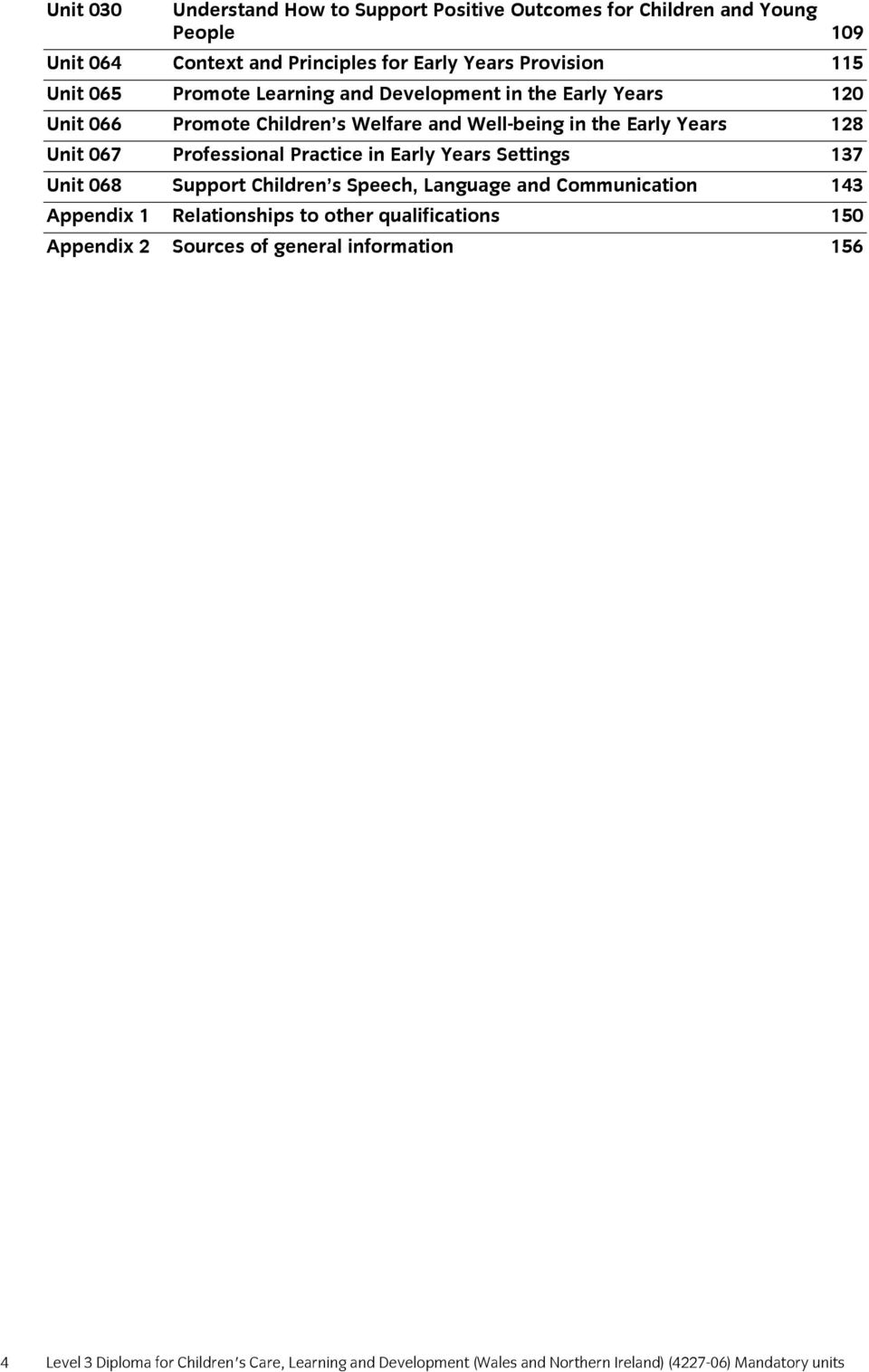
6 Unit 030 Understand How to Support Positive Outcomes for Children and Young People 109 Unit 064 Context and Principles for Early Years Provision 115 Unit 065 Promote Learning and Development in the Early Years 120 Unit 066 Promote Children s Welfare and Well-being in the Early Years 128 Unit 067 Professional Practice in Early Years Settings 137 Unit 068 Support Children s Speech, Language and Communication 143 Appendix 1 Relationships to other qualifications 150 Appendix 2 Sources of general information Level 3 Diploma for Children's Care, Learning and Development (Wales and Northern Ireland) ( ) Mandatory units
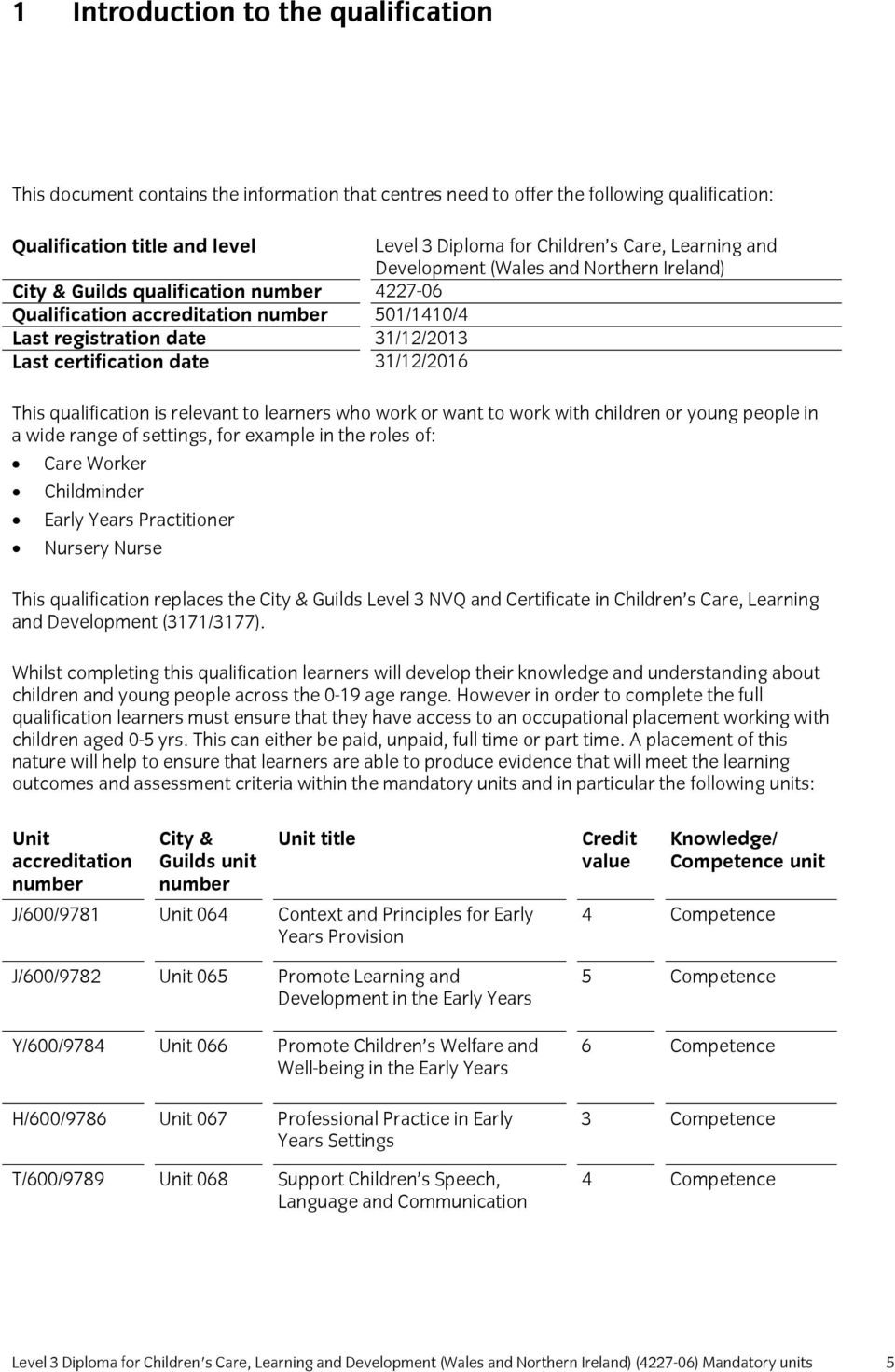
7 1 Introduction to the qualification This document contains the information that centres need to offer the following qualification: Qualification title and level Level 3 Diploma for Children s Care, Learning and Development (Wales and Northern Ireland) City & Guilds qualification number Qualification accreditation number 501/1410/4 Last registration date 31/12/2013 Last certification date 31/12/2016 This qualification is relevant to learners who work or want to work with children or young people in a wide range of settings, for example in the roles of: Care Worker Childminder Early Years Practitioner Nursery Nurse This qualification replaces the City & Guilds Level 3 NVQ and Certificate in Children s Care, Learning and Development (3171/3177). Whilst completing this qualification learners will develop their knowledge and understanding about children and young people across the 0-19 age range. However in order to complete the full qualification learners must ensure that they have access to an occupational placement working with children aged 0-5 yrs. This can either be paid, unpaid, full time or part time. A placement of this nature will help to ensure that learners are able to produce evidence that will meet the learning outcomes and assessment criteria within the mandatory units and in particular the following units: Unit accreditation number City & Guilds unit number Unit title J/600/9781 Unit 064 Context and Principles for Early Years Provision J/600/9782 Unit 065 Promote Learning and Development in the Early Years Y/600/9784 Unit 066 Promote Children s Welfare and Well-being in the Early Years H/600/9786 Unit 067 Professional Practice in Early Years Settings T/600/9789 Unit 068 Support Children s Speech, Language and Communication Credit value Knowledge/ Competence unit 4 Competence 5 Competence 6 Competence 3 Competence 4 Competence Level 3 Diploma for Children's Care, Learning and Development (Wales and Northern Ireland) ( ) Mandatory units 5
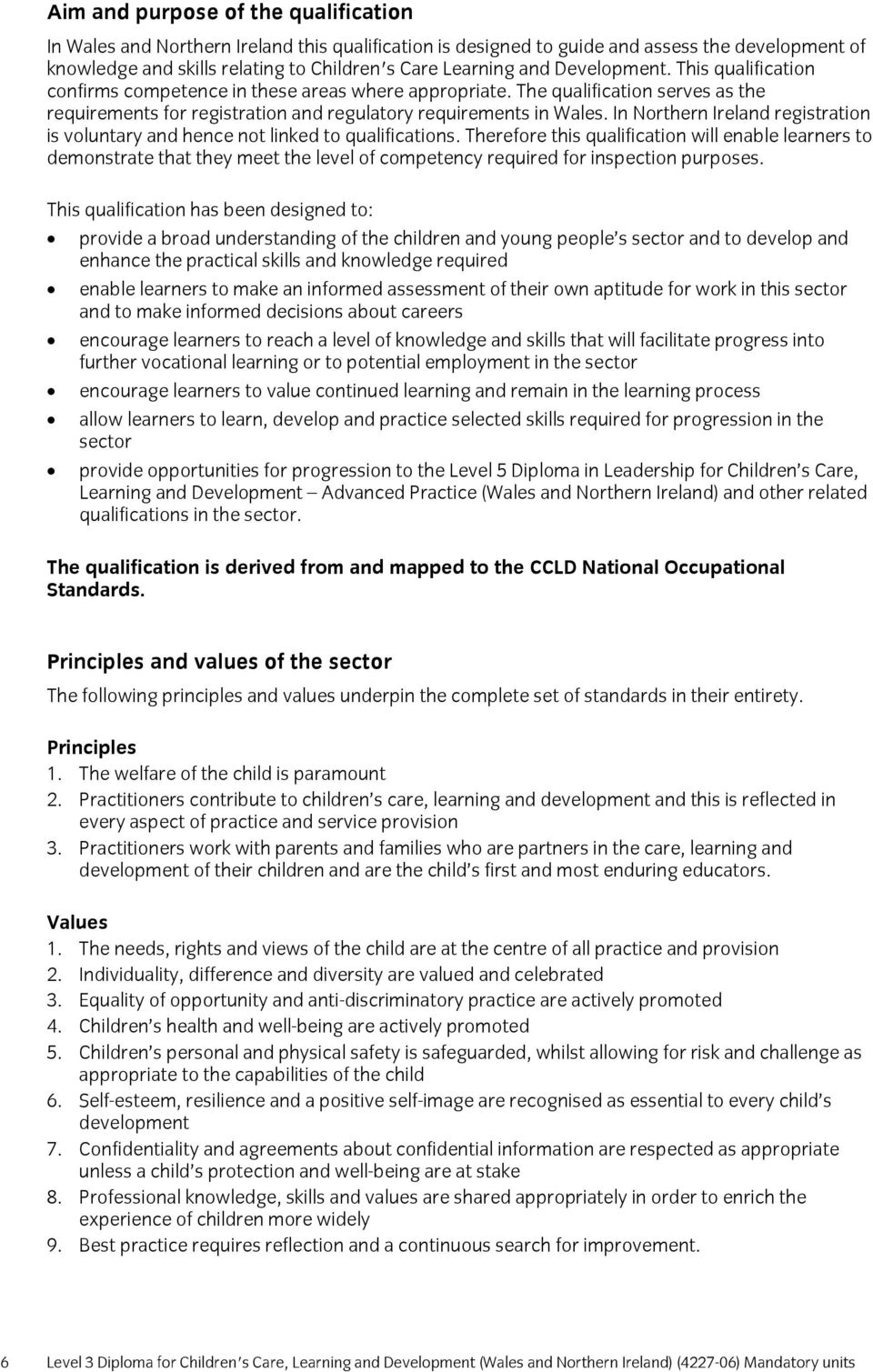
8 Aim and purpose of the qualification In Wales and Northern Ireland this qualification is designed to guide and assess the development of knowledge and skills relating to Children's Care Learning and Development. This qualification confirms competence in these areas where appropriate. The qualification serves as the requirements for registration and regulatory requirements in Wales. In Northern Ireland registration is voluntary and hence not linked to qualifications. Therefore this qualification will enable learners to demonstrate that they meet the level of competency required for inspection purposes. This qualification has been designed to: provide a broad understanding of the children and young people s sector and to develop and enhance the practical skills and knowledge required enable learners to make an informed assessment of their own aptitude for work in this sector and to make informed decisions about careers encourage learners to reach a level of knowledge and skills that will facilitate progress into further vocational learning or to potential employment in the sector encourage learners to value continued learning and remain in the learning process allow learners to learn, develop and practice selected skills required for progression in the sector provide opportunities for progression to the Level 5 Diploma in Leadership for Children s Care, Learning and Development Advanced Practice (Wales and Northern Ireland) and other related qualifications in the sector. The qualification is derived from and mapped to the CCLD National Occupational Standards. Principles and values of the sector The following principles and values underpin the complete set of standards in their entirety. Principles 1. The welfare of the child is paramount 2. Practitioners contribute to children s care, learning and development and this is reflected in every aspect of practice and service provision 3. Practitioners work with parents and families who are partners in the care, learning and development of their children and are the child s first and most enduring educators. Values 1. The needs, rights and views of the child are at the centre of all practice and provision 2. Individuality, difference and diversity are valued and celebrated 3. Equality of opportunity and anti-discriminatory practice are actively promoted 4. Children s health and well-being are actively promoted 5. Children s personal and physical safety is safeguarded, whilst allowing for risk and challenge as appropriate to the capabilities of the child 6. Self-esteem, resilience and a positive self-image are recognised as essential to every child s development 7. Confidentiality and agreements about confidential information are respected as appropriate unless a child s protection and well-being are at stake 8. Professional knowledge, skills and values are shared appropriately in order to enrich the experience of children more widely 9. Best practice requires reflection and a continuous search for improvement. 6 Level 3 Diploma for Children's Care, Learning and Development (Wales and Northern Ireland) ( ) Mandatory units
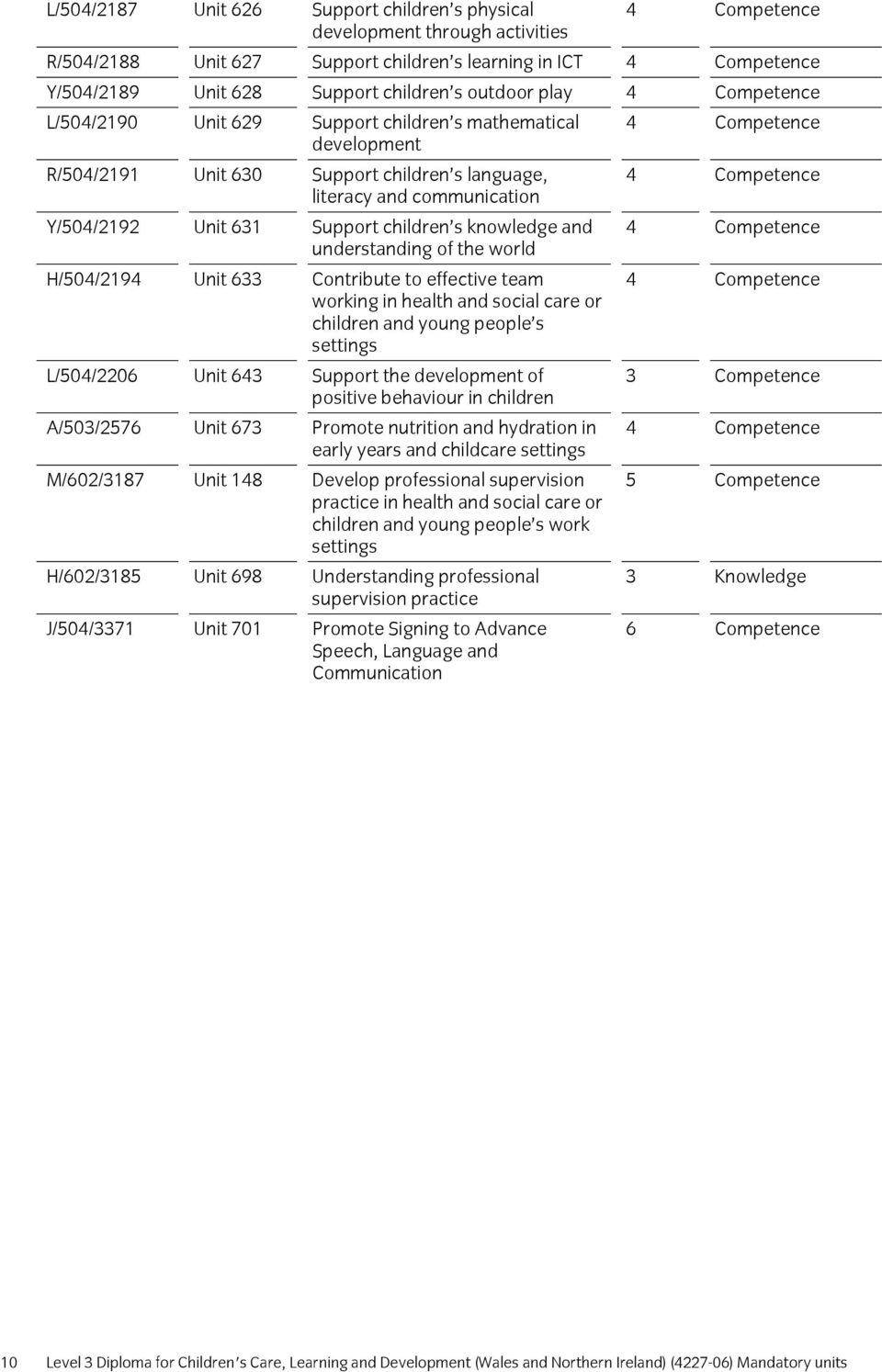
9 In order to be assessed as competent learners must demonstrate that they work within the context of the principles and values of the sector, relevant regulatory or inspection frameworks and Codes of Practice. Assessors will be expected to confirm this by signing the declaration form, Unit assessment and verification declaration. 1.1 Qualification structure Learners must gain a minimum of 65 credits to achieve the Level 3 Diploma for Children s Care, Learning and Development (Wales and Northern Ireland). To do this they must achieve 49 credits from the mandatory Group A of units and a minimum of 16 credits from optional Group B. Guided Learning Hours (GLH) Minimum Guided Learning Hours (GLH) are 450. Maximum Guided Learning Hours (GLH) are 460. The table below illustrates the unit titles, the credit value of each unit and whether it is a competence or knowledge unit. This handbook contains the mandatory Group A units only. Optional units can be found in a separate handbook, Level 3 Diploma for Children s Care, Learning and Development (Wales and Northern Ireland) Qualification handbook for centres Group B Optional units, which is available on the City & Guilds website, Unit accreditation number City & Guilds unit number Unit title Mandatory (Group A) L/601/1693 Unit 022 Understand Child and Young Person Development R/601/1694 Unit 024 Promote Child and Young Person Development Y/601/1695 Unit 025 Understand How to Safeguard the Wellbeing of Children and Young People D/601/1696 Unit 027 Support Children and Young People s Health and Safety H/601/1697 Unit 028 Develop Positive Relationships with Children, Young People and Others Involved in their Care K/601/1698 Unit 029 Working Together for the Benefit of Children and Young People M/601/1699 Unit 030 Understand How to Support Positive Outcomes for Children and Young People J/601/1434 Unit 051 Promote Communication in Health, Social Care or Children s and Young People s Settings A/601/1429 Unit 052 Engage in Personal Development in Health, Social Care or Children s and Young People s Settings Credit value Knowledge/ Competence unit 4 Knowledge 3 Competence 3 Knowledge 2 Competence 1 Competence 2 Competence 3 Knowledge 3 Competence 3 Competence Level 3 Diploma for Children's Care, Learning and Development (Wales and Northern Ireland) ( ) Mandatory units 7

10 Y/601/1437 Unit 053 Promote Equality and Inclusion in 2 Competence Health, Social Care or Children s and Young People s Settings R/601/1436 Unit 054 Principles for Implementing Duty of 1 Knowledge Care in Health, Social Care or Children s and Young People s Settings J/600/9781 Unit 064 Context and Principles for Early 4 Competence Years Provision J/600/9782 Unit 065 Promote Learning and 5 Competence Development in the Early Years L/600/9782 Unit 066 Promote Children s Welfare and 6 Competence Well-being in the Early Years H/600/9786 Unit 067 Professional Practice in Early Years 3 Competence Settings T/600/9789 Unit 068 Support Children s Speech, 4 Competence Language and Communication Optional (Group B) F/600/2036 Unit 015 Paediatric Emergency First Aid 1 Competence J/600/2037 Unit 016 Managing Paediatric Illness and 1 Competence Injury F/600/9777 Unit 033 Understand the Needs of Children 5 Knowledge and Young People who are Vulnerable and Experiencing Poverty and Disadvantage M/601/2884 Unit 035 Understand the Speech, Language 3 Knowledge and Communication Needs of Children and Young People with Behavioural, Social and Emotional Difficulties A/601/0121 Unit 075 Work with Babies and Young 6 Competence Children to Promote their Development and Learning D/601/0130 Unit 076 Care for the Physical and 6 Competence Nutritional Needs of Babies and Young Children H/601/0131 Unit 077 Lead and Manage a Community 6 Competence Based Early Years Setting M/601/0133 Unit 078 Promote Young Children s Physical 3 Competence Activity and Movement Skills Y/600/9770 Unit 079 Understand How to Set Up a Home 4 Knowledge Based Childcare Service T/601/0134 Unit 081 Support Disabled Children and 6 Competence Young People and those with Specific Requirements A/601/0135 Unit 082 Promote Creativity and Creative 5 Competence Learning in Young Children T/600/9775 Unit 083 Coordinate Special Educational 5 Competence Needs Provision K/601/0132 Unit 086 Support Children or Young People in their Own Home 4 Competence 8 Level 3 Diploma for Children's Care, Learning and Development (Wales and Northern Ireland) ( ) Mandatory units
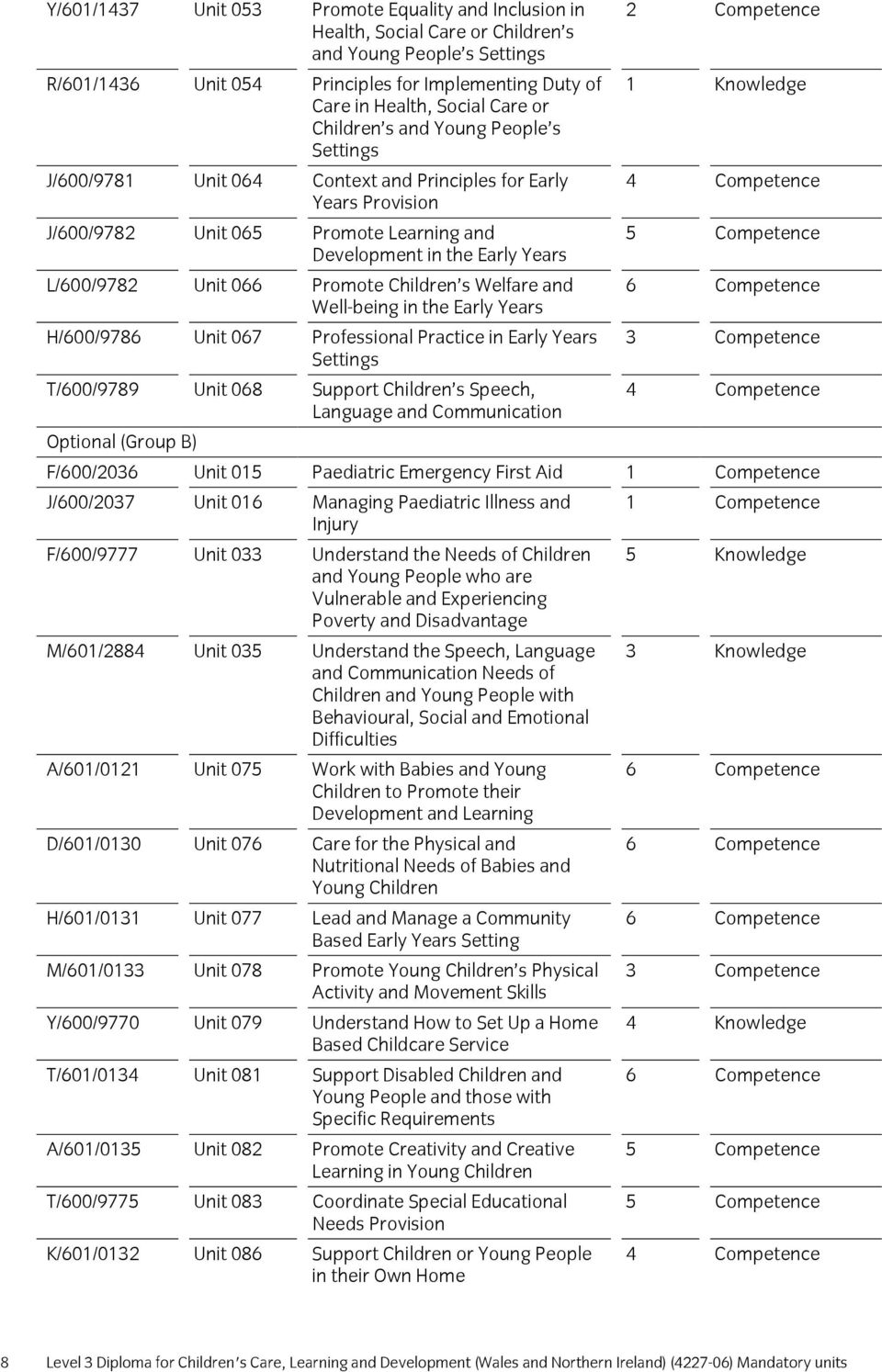
11 R/601/1369 Unit 094 Support Children and Young People 3 Competence to Have Positive Relationships L/601/2861 Unit 097 Support Positive Practice with 4 Competence Children and Young People with Speech, Language and Communication Needs Y/601/2877 Unit 099 Work with Parents, Families and 3 Competence Carers to Support their Children s Speech, Language and Communication Development H/502/4682 Unit 109 Enable Parents to Develop Ways of 3 Competence Handling Relationships and Behaviour that Contribute to Everyday Life with Children Y/502/4680 Unit 110 Work with Parents to Meet their 3 Competence Children s Needs J/502/4660 Unit 112 Engage Young Parents in 3 Competence Supporting their Children s Development Y/502/4663 Unit 113 Engage Fathers in their Children s 3 Competence Early Learning M/502/3812 Unit 114 Engage Parents in their Children s 3 Competence Early Learning F/601/4056 Unit 116 Support Use of Medication in Social 5 Competence Care Settings K/601/3225 Unit 124 Promote Children in Early Years 4 Competence Settings Acquiring a New Language through Immersion T/602/1876 Unit 125 Promote Children s Experiential 6 Competence Learning A/602/1880 Unit 126 Support Children and Young People 6 Competence with Physical Disabilities F/602/1881 Unit 127 Support Children and Young People 6 Competence with Learning Disabilities J/602/1882 Unit 128 Support Children and Young People 6 Competence with Autistic Spectrum Conditions L/602/1883 Unit 129 Support the Learning and 6 Competence Development of Children and Young People with Health Needs R/602/1884 Unit 130 Support Children and Young People 6 Competence with Sensory Loss J/601/8027 Unit 131 Move and Position Individuals in 4 Competence Accordance with their Plan of Care T/601/9450 Unit 132 Meet Food Safety Requirements 2 Competence when Providing Food and Drink for Individuals D/601/5750 Unit 133 Support Families who have a Child 3 Competence with a Disability F/601/3473 Unit 134 Understand Models of Disability 3 Knowledge A/504/2184 Unit 624 Support children s learning in Welsh language development 5 Competence Level 3 Diploma for Children's Care, Learning and Development (Wales and Northern Ireland) ( ) Mandatory units 9
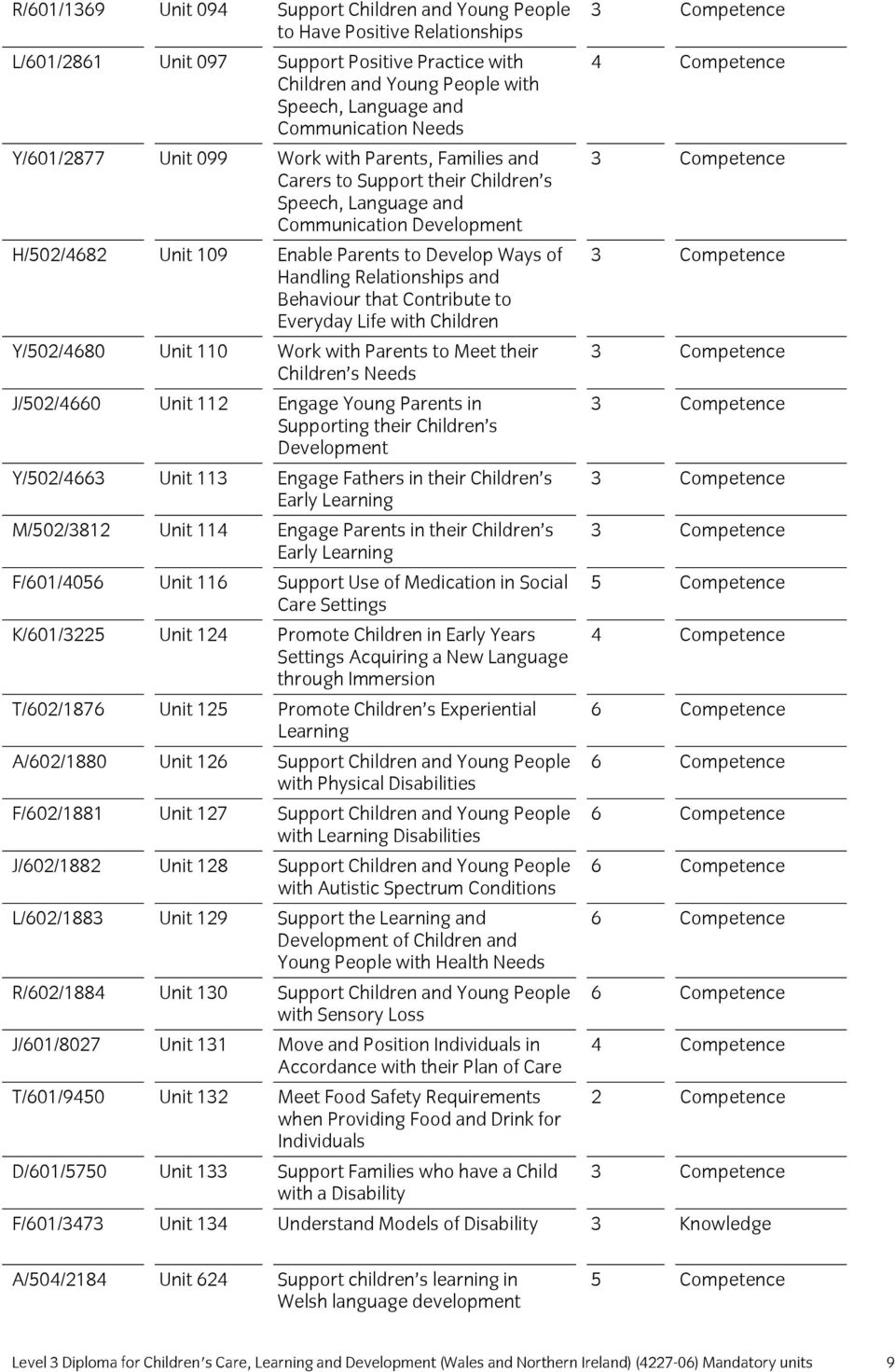
12 L/504/2187 Unit 626 Support children s physical 4 Competence development through activities R/504/2188 Unit 627 Support children s learning in ICT 4 Competence Y/504/2189 Unit 628 Support children s outdoor play 4 Competence L/504/2190 Unit 629 Support children s mathematical 4 Competence development R/504/2191 Unit 630 Support children s language, 4 Competence literacy and communication Y/504/2192 Unit 631 Support children s knowledge and 4 Competence understanding of the world H/504/2194 Unit 633 Contribute to effective team 4 Competence working in health and social care or children and young people s settings L/504/2206 Unit 643 Support the development of 3 Competence positive behaviour in children A/503/2576 Unit 673 Promote nutrition and hydration in 4 Competence early years and childcare settings M/602/3187 Unit 148 Develop professional supervision 5 Competence practice in health and social care or children and young people s work settings H/602/3185 Unit 698 Understanding professional 3 Knowledge supervision practice J/504/3371 Unit 701 Promote Signing to Advance Speech, Language and Communication 6 Competence 10 Level 3 Diploma for Children's Care, Learning and Development (Wales and Northern Ireland) ( ) Mandatory units
13 1.2 Opportunities for progression This qualification will enable progression within and between levels. It will allow learners who complete the requirements for a Diploma to take up continuing professional development opportunities through the optional units. It will allow movement up to another level and across sectors. This suite of units may support progression in/to employment in the following areas: Early Years Health and Social Care Children and Young People Youth and community work Progression into Children and Young People sector 1.3 Qualification support materials City & Guilds also provides the following publications and resources specifically for this qualification: Description Assignment guide for centres Assignment guide for learners Marking guide Community & Society Guidance updates Fast track approval forms SmartScreen available from Sept 2010 (covers mandatory units only) City & Guilds official learner textbook: Publication early 2011 (covers mandatory units only) How to access Level 3 Diploma for Children's Care, Learning and Development (Wales and Northern Ireland) ( ) Mandatory units 11
14 2 Centre requirements This section outlines the approval processes for Centres to offer this qualification and any resources that Centres will need in place to offer the qualifications including qualification-specific requirements for Centre staff. 2.1 Centre approval Centres new to City & Guilds To offer these qualifications, new centres will need to gain both centre and qualification approval. Please refer to Appendix 2 for further information. Centres already offering City & Guilds qualifications in this subject area Centres approved to offer the qualifications, Level 3 NVQ and the Certificate in Children s Care, Learning and Development, are required to complete a fast track approval form to receive approval for the new Level 3 Diploma for Children s Care, Learning and Development (Wales and Northern Ireland) ( ). The fast track approval form can be downloaded from the City & Guilds website. Centres will retain any outstanding sanctions. Direct claims status cannot be awarded until the External Quality Assurer has sampled across a full qualification. Existing City & Guilds centres not currently approved to offer qualifications in this area Those City & Guilds centres already approved to deliver City & Guilds qualifications but do not have experience of delivery in this subject area will need to go through the qualification approval process. Please refer to Appendix 2 for further information. Centre requirements on approval CCLD centres may apply for automatic approval to the Level 3 Diploma for Children s Care, Learning and Development (Wales and Northern Ireland). 2.2 Human Resources To meet the quality assurance criteria for these qualifications, the centre must ensure that the following internal roles are undertaken: Quality Assurance Coordinator Trainer/Tutor Assessor (occupationally competent and occupationally knowledgeable) Internal Quality Assurer Please note that centre staff are not expected to have had experience of working across the entire 0 19 years age range but are expected to update their knowledge through continuing and demonstrable professional development. Centre staff may undertake more than one role, eg tutor and assessor or Internal Quality Assurer, but must never internally verify their own assessments. 12 Level 3 Diploma for Children's Care, Learning and Development (Wales and Northern Ireland) ( ) Mandatory units
15 Continuing Professional Development (CPD) Centres are expected to support their staff in ensuring that their knowledge remains current. This includes currency within the occupational area and of best practice in delivery, mentoring, training, assessment and verification. It should also take account of any national or legislative developments. 2.3 Role requirements Assessor requirements The Assessors of competence based units must: Be occupationally competent - this means that each assessor must be able to carry out the full requirements within the competency units that they are assessing. Occupational competence means that they are also occupationally knowledgeable. Maintain their occupational competence through clearly demonstrable continuing learning and professional development. Hold or be working towards one of the following qualifications: o D32/D33 or A1 OR o The AI replacements (eg City & Guilds 6317, which includes the Level 3 Award in Assessing Competence in the Work Environment, or the Level 3 Certificate in Assessing Vocational Achievement) OR o Another suitable qualification equivalent/alternative in the assessment of work based performance. This must be agreed in advance with the External Quality Assurer OR o Assessors of competence based units may also make assessment decisions on knowledge based unit and learning outcomes. Assessors of knowledge based units and knowledge based Learning Outcomes must: Be occupationally knowledgeable. This means that each assessor should possess relevant knowledge and understanding to assess units designed to test specific knowledge and understanding or units where knowledge and understanding are components of competency. Maintain their occupational knowledge through clearly demonstrable continuing learning and professional development. Hold or be working towards one of the A1 replacement qualifications such as the City & Guilds 6317: o Level 3 Award in Assessing Vocational Competence OR o Level 3 Award in Assessing Vocationally Related Achievement OR o Level 3 Certificate in Assessing Vocational Achievement OR o Another suitable qualification in the assessment of knowledge. This must be agreed in advance with the External Quality Assurer. Teacher/trainer/tutor requirements: Northern Ireland Tutors and lecturers: A teaching qualification is not mandatory for appointment to posts in FE within Northern Ireland. Full-time and associate lecturers in FE without a teaching qualification (such as a BEd or a PGCE) are expected to complete the Postgraduate Certificate in Further and Higher Education delivered by the University of Ulster (the only recognised provider) within three years of taking up a post. Lecturers who go on to complete the Postgraduate Diploma in Further and Higher Education are also eligible to teach in schools. Issues surrounding a new award of Qualified Teaching, Learning and Skills (QTLS) are still under consultation with the Department for Employment and Learning in Northern Ireland (DELNI). For the latest information, visit Lifelong Learning UK (LLUK). Teachers: The General Teaching Council for Northern Ireland (GTCNI) has a statutory duty to determine who should be a member of the teaching profession in Northern Ireland. The GTCNI is a self-regulatory Level 3 Diploma for Children's Care, Learning and Development (Wales and Northern Ireland) ( ) Mandatory units 13
16 professional body for teachers. All teachers who wish to have their qualifications approved for the purposes of registration with the GTCNI and eligibility to teach should contact the GTCNI, 4th Floor Albany House, Great Victoria Street, Belfast, BT2 7AF. Any queries regarding qualifications should be referred to the GTCNI at the address above, or alternatively telephone: (028) or Teacher/trainer/tutor requirements: Wales The current position on teaching qualification requirements for the life long learning sector in Wales is set out in the following Welsh Assembly Government statement: al2008/?lang=en Please also see the following: Expert witness An expert witness must: 1. have a working knowledge of the QCF units on which their expertise is based 2. be occupationally competent in their area of expertise 3. have EITHER any qualification in assessment of workplace performance OR 4. a professional work role which involves evaluating the every day practice of staff. Internal verifiers/internal Quality Assurer Internal quality assurance is key to ensuring that the assessment of evidence for units is of consistent and appropriate quality. Those carrying out internal quality assurance role must be occupationally knowledgeable in the area they are assuring and be qualified to make quality assurance decisions. Guidance for the assessment and verification for imported units Where units have been developed by Sector Skills Councils or Standard Setting Bodies other than Skills for Skills for Care & Development any specific assessment requirements will be detailed in the unit itself. 2.4 Learner entry requirements There are no formal entry requirements for learners undertaking this Diploma. However, centres must ensure that learners have the potential and opportunity to gain evidence for the qualification in the work place. Some units require learners to be working within a particular context or with a particular age range for example units require learners to be working with children in the 0-5 age range. Learners should not be entered for a qualification of the same type, content and level as that of a qualification they already hold. Learners should choose optional units that are appropriate to their chosen work role. 14 Level 3 Diploma for Children's Care, Learning and Development (Wales and Northern Ireland) ( ) Mandatory units

17 Age restrictions This Level 3 Diploma is not approved for the use by those who are under 16 years of age. City & Guilds cannot accept any registrations for learners in this age group. There may also be age restrictions placed on individuals when undertaking certain work activities within the childcare sector. Where there is uncertainty about such restrictions these should be clarified with the appropriate regulator in the relevant home nation. Other legal considerations The following legal considerations apply to this qualification. Learners entering the children and young people s sector are legally required to undergo formal record check relevant to their home nation prior to taking up any employment/work placement. Centres, employers and placement providers will need to liaise closely with one another to ensure that any requirements for the particular work area are fully met. As the requirements vary between sectors and countries checks should be made with the appropriate regulatory body and/or government departments if centres, employers or placement providers are uncertain of the requirements. 2.5 Guidance for the assessment and verification for imported units TDA units These principles are derived from those developed by Skills for Care and Development (SfCD) and apply to those units developed by the TDA. 2.6 Assessment decisions Assessment decisions for criteria that must be assessed in the workplace, as identified in unit assessment requirements, must be made in a real work environment by an occupationally competent assessor. Assessment decisions for criteria that must be assessed in the workplace (competence based assessment criteria) must be made by an assessor with the expertise to make assessment decisions. Competence based assessment must include direct observation as the main source of evidence. Assessment decisions for criteria that must be assessed in the workplace (competence based assessment criteria) are identified in each unit assessment requirements. Assessment decisions must be made by an assessor with appropriate occupational competence. Observations must occur in a real work environment. In these units direct observation will be the main source of evidence Simulation may only be utilised as an assessment method for competence based assessment criteria where this is specified in the assessment requirements of the unit. Expert witnesses can be used for direct observation where: they have occupational expertise for specialist areas, or the observation is of a particularly sensitive nature have EITHER any qualification that includes assessment of workplace performance AND/OR a professional work role which involves evaluating the everyday practice of staff. The use of expert witnesses should be determined and agreed by the assessor. Assessment of criteria not identified in the unit assessment requirements as requiring assessment in the workplace may take place in or outside of a real work environment. Level 3 Diploma for Children's Care, Learning and Development (Wales and Northern Ireland) ( ) Mandatory units 15

18 3 Course design and delivery 3.1 Initial assessment and induction Centres will need to make an initial assessment of each learner prior to the start of their programme. This will help to ensure they are entered for an appropriate type and level of qualification. The initial assessment should identify: any specific training needs the learner has, and the support and guidance they may require when working towards their qualification. This is sometimes referred to as diagnostic testing any units the learner has already completed, or credit they have accumulated which is relevant to the qualification they are about to begin any other formal or informal training or experience for which the learner could receive recognition for prior learning (RPL). Further information about the use of RPL can be found at section 4.6 in this log book. City & Guilds recommends that centres provide an induction programme to ensure the learner fully understands the requirements of the qualification they will work towards, their responsibilities as a learner, and the responsibilities of the centre. This information should be recorded in a learning contract or a personalised learning plan or a similar document. 3.2 Recommended delivery strategies Centre staff should familiarise themselves with the structure, content and assessment requirements of the qualifications before designing a course programme. Centres may design course programmes of study in any way which: best meets the needs and capabilities of their learners satisfies the requirements of the qualifications. In particular, staff should consider the skills and knowledge related to the national occupational standards. The relationships to the relevant NOS can be found in each unit. When designing and delivering the course programme, centres might wish to incorporate other teaching and learning that is not assessed as part of the qualification. This might include the following: literacy, language and/or numeracy personal learning and thinking personal and social development employability City & Guilds recommends that, where appropriate, when designing and delivering the course centres should also consider links to the National Occupational Standards, Essential Skills Wales and Essential Skills,(Northern Ireland) and other related qualifications. 16 Level 3 Diploma for Children's Care, Learning and Development (Wales and Northern Ireland) ( ) Mandatory units
19 3.3 Data protection, confidentiality and legal requirements Data protection and confidentiality Data protection and confidentiality must not be overlooked when planning the delivery of this qualification. Centres offering these qualifications may need to provide City & Guilds with personal data for staff and learners. Guidance on data protection and the obligations of City & Guilds and centres are explained in Providing City & Guilds qualifications. Confidential records used as evidence Learners may quite appropriately cite confidential records as evidence in their qualification as long as the parent, or their advocate, has given written and informed consent for records to be used for this purpose. Where appropriate, learners should seek consent from individual children and young people. Confidential records should never be included in learners portfolio of evidence and should be examined in-situ by the qualified occupationally competent assessor. Assessors/learners should describe and record what evidence such documents have provided and where the evidence is located. External Quality Assurers may wish to discuss such evidence with the centre as part of the verification process, but would not normally require sight of confidential records. However, in the unlikely event that the EV should have concerns about the quality of such evidence, they will, after discussion and agreement with their lead verifier, acquaint the centre management with their concerns, and seek consent to access such records from the organisation which has responsibility for the safe keeping of the particular confidential records in question. Images of minors being used as evidence If videos or photographs of minors (those under 18) are used as the medium to present evidence as part of the qualifications the approved centre and the learners have responsibilities in terms of meeting child protection legislation. It is the responsibility of the approved centre to inform the learner of the following: 1. the need for the learner to obtain permission from the minor s parent/guardian prior to collecting the evidence 2. the importance of seeking consent from the children and young people concerned and their right to refuse to consent 3. the purpose of the use of photographs or video recordings 4. the period of time for which the photographs or video recordings are to be kept 5. their obligation to keep photographs or video recordings secure from unauthorised access 6. their obligations relating to storage of the photographs or video recordings which are kept electronically, and the associated security of using electronic systems 7. associated child protection legislation. Level 3 Diploma for Children's Care, Learning and Development (Wales and Northern Ireland) ( ) Mandatory units 17
20 4 Assessment 4.1 Summary of assessment methods This competence-based qualification is designed to be assessed in the learner s workplace as they undertake their normal work role. The evidence must at all times reflect the policies and procedures of the workplace as informed by current legislation, the relevant service standards and codes of practice for the sector. The majority of assessment for this competence-based qualification will take place in the workplace under real work conditions, using observations by a qualified assessor and/or testimony from an expert witness, work products etc. All the identified assessment criteria must be evidenced and a holistic approach to assessment is encouraged. Guidance on providing evidence for the extended age ranges This diploma applies to learners who are working with children and young people from 0-19 years. It is important to note that the requirement for the extended age range focuses on knowledge not competence. Learners need to have knowledge and understanding of children s development 0-19 years. Learners will be expected to demonstrate competence working with children 0-5yrs however opportunities to demonstrate competence working with older children can be achieved using the optional units. Centre staff are not expected to have experience of working across this entire age range but are expected to up date their knowledge through continuing and demonstrable professional development. Competence-based units There will be a combination of assessment methods for this qualification which meets the requirements of the competence units. Direct observation of learner's performance by a qualified occupationally competent assessor and the assessor's judgement on testimony from an Expert Witness Testimony are the main methods of assessment and main source of evidence. The evidence must at all times reflect the policies and procedures of the workplace as informed by current legislation, the relevant service standards and codes of practice for the sector. Knowledge-based units Learners may choose to undertake the assessment of knowledge in the following ways. Portfolio of evidence, using diverse range of assessment methods Externally set and internally verified assignments A combination of both of the above The evidence must at all times reflect the policies and procedures of the workplace as informed by current legislation, the relevant service standards and codes of practice for the sector. 18 Level 3 Diploma for Children's Care, Learning and Development (Wales and Northern Ireland) ( ) Mandatory units
21 4.2 Observation requirements The prime source of evidence for the competency based learning outcomes within this qualification is assessor observation. Where assessor observation would be difficult because of intrusion into areas of privacy and/or because activities occur rarely, expert witnesses may provide testimony for the occupationally specific units. Additional assessment methods or evidence sources In addition to observation, assessors should identify an appropriate mix of other assessment methods from the list below, to ensure that all the assessment criteria are sufficiently evidenced to allow them to demonstrate the consistency of the learner s practice for each unit. Expert witnesses may observe learner practice and provide testimony for competence based units. This will have parity with assessor observation for all competence based units across the qualification. If an assessor is unable to observe their learner she/he will identify an expert witness in the workplace, who will provide testimony of the learner s work based performance. Work products can be any relevant products of learners own work, or to which they have made a significant contribution, which demonstrate use and application within their practice. Please refer to section 3.3 of this document for further guidance in relation to Data Protection policy and legal requirements. Professional discussion should be in the form of a planned and structured review of learners practice, based on evidence and with outcomes captured by means of audio/visual or written records. The recorded outcomes are particularly useful as evidence of the learner s ability to evaluate their knowledge and practice across the qualification. Learner/ reflective accounts describe learners actions in particular situations and/or reflect on the reasons for practicing in the ways selected. Reflective accounts also provide evidence that learners can evaluate their knowledge and practice across the activities embedded in this qualification. Questions asked by assessors and answered by learners to supplement evidence generated by observations and any other evidence type used. Assessors may be able to infer some knowledge and understanding from observing learner practice. They may ask questions to confirm understanding and/or cover any outstanding areas. Questions may be asked orally or in writing but, in both cases, a record must be kept of the questions and responses. Witness testimonies should be from people who are in a position to provide evidence of learner competence. Where testimony is sought from individuals who are service users, care should be taken to ensure the purpose of the testimony is understood and no pressure is felt to provide it. Projects/Assignments Learners may have already completed a relevant project or assignment which can be mapped to the relevant standards and therefore provide evidence. Evidence from previous training courses and/or learning programmes which they have completed and which demonstrate their professional development may also be used. Refer to section 4.6 of this document for guidance on RPL. Case studies must be based on real work practice and experiences and will need to be authenticated by an assessor if used as evidence of a competent performance. Theoretical or simulated exercises would only be admissible as evidence of knowledge and understanding. 4.3 Assignments Assignments may be found in the City & Guilds assignment guides (Assignment Guide for Centres and Centre Guide for Learners), which are accessible as a free download from These are suggested assessments only. Centres may decide that some learners do not have the necessary skills to carry out an assignment. In these cases, a portfolio of evidence may be submitted. Centres may devise their own assignments. Level 3 Diploma for Children's Care, Learning and Development (Wales and Northern Ireland) ( ) Mandatory units 19
22 Centre staff should guide learners to ensure excessive evidence gathering is avoided. All assignments must be completed and assessed within the learner s period of registration. Centres should advise learners of any internal timescales for the completion and marking of individual assignments. Refer to the assignment guides for further guidance. The list of assignments provided for this qualification are listed below. Unit No Understand Child and Young Person Development Level Title Assessment Method Understand How to Safeguard the Wellbeing of Children and Young People Understand How to Support Positive Outcomes for Children and Young People Understand the Needs of Children and Young People who are Vulnerable and Experiencing Poverty and Disadvantage Understand the Speech, Language and Communication Needs of Children and Young People with Behavioural, Social and Emotional Difficulties Principles for Implementing Duty of Care in Health, Social Care or Children and Young People s Settings Understand How to Set Up a Home Based Childcare Service Assignment Graded as DMPX (Distinction/Merit/Pass/Fail) Externally set assignment, locally marked and externally quality assured. Assignment Graded as DMPX (Distinction/Merit/Pass/Fail) Externally set assignment, locally marked and externally quality assured. Assignment Graded as DMPX(Distinction/Merit/Pass/Fail) Externally set assignment, locally marked and externally quality assured. Assignment Graded as DMPX(Distinction/Merit/Pass/Fail) Externally set assignment, locally marked and externally quality assured. Assignment Graded as DMPX (Distinction/Merit/Pass/Fail) Externally set assignment, locally marked and externally quality assured. Assignment Graded as Pass or Refer only Externally set assignment, locally marked and externally quality assured Assignment Graded as DMPX (Distinction/Merit/Pass/Fail) Externally set assignment, locally marked and externally quality assured Understand Models of Disability Assignment Graded as DMPX (Distinction/Merit/Pass/Fail) Externally set assignment, locally marked and externally quality assured. 4.4 Evidence requirements Competence evidence requirements Detailed additional guidance is provided on a unit basis for the use of these and all other acceptable performance assessment methods. Notes on assessment methods, evidence requirements and sources of evidence are also provided on pages of this handbook. 20 Level 3 Diploma for Children's Care, Learning and Development (Wales and Northern Ireland) ( ) Mandatory units
23 The structure of this qualification makes it unlikely that any one assessor will have the necessary vocational competence to be able to assess every unit. Therefore the use of experts, able to contribute to learner s assessment, will be of considerable assistance to centres in providing learners with access to those who can testify to their competence in the workplace. It may also ensure that children s/young people s privacy and confidentiality are not infringed. Evidence of learner performance will be derived from assessor observation and/or testimony from an expert witness of the learner carrying out real work activities in the workplace. Assessor observation is not required for the knowledge units although knowledge can be inferred from performance. The qualified and occupationally competent assessor or coordinating assessor will decide on the appropriateness of all evidence including expert witness testimony and on whether or not it should be included in learners portfolios. Regardless of the evidence source, assessment method and means of recording, the legal requirements and best practice in relation to maintaining the confidentiality and rights to dignity and privacy of children, young people and their families must be upheld. Knowledge evidence requirements If the assessor cannot positively infer the knowledge and understanding from learners work practice they should question the learner or, if appropriate, use professional discussion to elicit the required knowledge. Assessors must retain records of questions and answers or the focus and outcomes of professional discussion. Professional discussion, where used, must be conducted by learners with a qualified occupationally knowledgeable assessor. Professional discussion is most appropriately used in the qualification to elicit underpinning knowledge to explain how to deal with contingencies and clarify or expand on evidence presented in portfolios. Professional discussion must be included in learners assessment plans and thereby agreed in advance with learners. The assessor should not use professional discussion merely to ask a set of prescribed knowledge questions. 4.5 Recording forms City & Guilds has developed these recording forms, for new and existing centres to use as appropriate. They can be copied as many times as needed. Although it is expected that new centres will use these forms, centres may devise or customise alternative forms. These must be approved for use by the External Quality Assurer, before they are used by learners and assessors at the centre. Alternatively, City & Guilds endorses a number of electronic recording systems. For details, go to the e-portfolios page on SmartScreen.co.uk. *Forms 4, 5, 6, 7, 9, 10 and 11, or approved alternatives, are a requirement. The other forms have been designed to support the assessment and recording process. Learner and centre details (Form 1) Form used to record learner and centre details, and the units/qualification(s) being assessed and details and signatures of assessor(s) and Internal Quality Assurer(s). This should be the first page of the learner portfolio. Learner profile (Form 2) Form used if the learner does not have an appropriate Curriculum Vitae (CV) for inclusion in the portfolio. Learner skill scan (Form 3) Form used to record the learner s existing skills and knowledge. Expert/witness status list (Form 4)* Form used to record the details of all those who have witnessed learner evidence. Level 3 Diploma for Children's Care, Learning and Development (Wales and Northern Ireland) ( ) Mandatory units 21
24 Assessment plan, review and feedback (Form 5)* Form used to record unit assessment plans, reviews and feedback to the learner. The form allows for a dated, ongoing record to be developed. Performance evidence record (Form 6)* Form used to record details of activities observed, witnessed or for which a reflective or self account has been produced. For some, a customised alternative record may be provided in the qualification handbook. Questioning evidence record (Form 7)* Form used to record the focus of, and responses to, assessor devised questions. (For qualifications which use question banks or online testing, the location of this evidence should be recorded on Form 9, Evidence location sheet.) Professional discussion evidence record (Form 8) Form used to record the scope and outcome of professional discussion if it is used Evidence location sheet (Form 9)* Form used to identify what requirements each piece of evidence covers and where it is located, including questioning records which are held elsewhere (for example, because they were conducted online). This form is available in portrait (9A) and landscape (9B) format. Unit assessment and verification declaration (Form 10)* Form used on completion of each unit to meet the OfQual requirement for a statement on authenticity. If this form is not used, there must be a written declaration, at unit level, signed and dated by the learner and the assessor, that the evidence is authentic and that the assessment was conducted under the specified conditions or context. (See Ensuring Quality, ref 5.4, page 28.) Summary of unit and qualification achievement (Form 11)* Form used to record the learner s on-going completion of units and progress to final achievement of the complete unit and/or qualification. This form is available in portrait (11A) and landscape (11B) format. Please photocopy the forms as required. 22 Level 3 Diploma for Children's Care, Learning and Development (Wales and Northern Ireland) ( ) Mandatory units
25 Form 1 Learner and centre details Keep a record of relevant contact details in the space provided below: City & Guilds qualification title: Qualification number: Level: Learner details Name: City & Guilds registration / unique learner number (ULN): Date enrolled with centre: Date registered with City & Guilds: Signature: Centre details Name: Contact number: Quality assurance co-ordinator name and contact (QAC) number: Number: Internal Quality Assurer details Name: Contact number: Signature: Position: Assessor details (1) Name: Signature: Contact number: Position: Type (please tick): Work-based Peripatetic Independent Assessing unit(s): (2) Name: Signature: Contact number: Position: Type (please tick): Work-based Peripatetic Independent Assessing unit(s): Level 3 Diploma for Children's Care, Learning and Development (Wales and Northern Ireland) ( ) Mandatory units Photocopy forms as required 23
26 Form 2 Learner profile If you have a CV you can use that instead of this form. Name: Place of work: Assessor: Outline of current job role: Previous relevant work roles and responsibilities, including voluntary work: Previous relevant qualifications and training: 24 Level 3 Diploma for Children's Care, Learning and Development (Wales and Northern Ireland) ( ) Mandatory units Photocopy forms as required
27 Form 3 Learner skill scan Learner name: Unit Duties Examples Experience/qualifications Training required Level 3 Diploma for Children's Care, Learning and Development (Wales and Northern Ireland) ( ) Mandatory units Photocopy forms as required 25
28 Form 4 Expert / witness status list Qualification title: Unit title: Learner name: Please ensure that all witnesses who have signed the learner s evidence or written a report are included on this witness status list. All necessary details must be included and signed by the witness as being correct. Witness name and signature Status* Professional relationship to learner** Unit or outcomes witnessed Date *Witness status categories 1. Occupational expert meeting specific qualification requirement for role of Expert Witness; 2. Occupational expert not familiar with the standards; 3. Non-expert familiar with the standards; 4. Non-expert not familiar with the standards. **Professional relationship to learner Manager = M Supervisor = S Colleague = Coll Customer = Cus Other (please specify) Assessor signature: Date: 26 Level 3 Diploma for Children's Care, Learning and Development (Wales and Northern Ireland) ( ) Mandatory units Photocopy forms as required
29 Form 5 Assessment plan, review and feedback Learner name: Assessor name: Unit number(s) and title(s): This record can be used for single and multiple unit planning. Remember that all planning should be SMART Specific, Measurable, Achievable, Realistic and Time Bound. Date action agreed What has to be done / What has been reviewed and the feedback / Record of judgment or outcome Date to be done by / Date done Learner and assessor signatures Evidence reference Level 3 Diploma for Children's Care, Learning and Development (Wales and Northern Ireland) ( ) Mandatory units Photocopy forms as required 27
30 Date action agreed What has to be done / What has been reviewed and the feedback / Record of judgment or outcome Date to be done by / Date done Learner and assessor signatures Evidence reference The above is an accurate record of the discussion. Learner signature: Date: Assessor signature: Date: 28 Level 3 Diploma for Children's Care, Learning and Development (Wales and Northern Ireland) ( ) Mandatory units Photocopy forms as required
31 Form 6 Performance evidence record Qualification/unit: Learner name: Use this form to record details of activities (tick as appropriate) Evidence ref(s): observed by your assessor seen by expert witness Unit number(s): seen by witness self / reflective account NB Your assessor may wish to ask you some questions relating to this activity. There is a separate sheet for recording these. The person who observed/witnessed your activity must sign and date overleaf. Unit(s) Learning outcome(s) Assessment criteria Evidence Level 3 Diploma for Children's Care, Learning and Development (Wales and Northern Ireland) ( ) Mandatory units Photocopy forms as required 29
32 Unit(s) Learning outcome(s) Assessment criteria Evidence I confirm that the evidence listed is my own work and was carried out under the conditions and context specified in the standards. Learner signature: Date: Assessor/Expert Witness* signature: Date: *delete as appropriate Internal Quality Assurer signature (if sampled): Date: 30 Level 3 Diploma for Children's Care, Learning and Development (Wales and Northern Ireland) ( ) Mandatory units Photocopy forms as required
33 Form 7 Questioning evidence record Unit: Learner name: Unit Learning outcome(s) Assessment criteria Questions Answers The above is an accurate record of the questioning. Learner signature: Date: Assessor signature: Date: Internal Quality Assurer signature (if sampled): Date: Level 3 Diploma for Children's Care, Learning and Development (Wales and Northern Ireland) ( ) Mandatory units Photocopy forms as required 31
34 Form 8 Professional discussion evidence record Learner name: Assessor name: Unit Learning outcome(s) Assessment criteria What is to be covered in the discussion Counter ref Outline record of discussion content 32 Level 3 Diploma for Children's Care, Learning and Development (Wales and Northern Ireland) ( ) Mandatory units Photocopy forms as required
35 Assessment decision and feedback to learner The above is an accurate record of the discussion. Learner signature: Date: Assessor signature: Date: Internal Quality Assurer signature (if sampled): Date: Level 3 Diploma for Children's Care, Learning and Development (Wales and Northern Ireland) ( ) Mandatory units Photocopy forms as required 33
36 Form 9A Evidence location sheet Learner name: Unit number/title: Item of evidence Loc* Ref Link to assessment criteria ( ) * Location key: P = portfolio, O = office (add further categories as appropriate) 34 Level 3 Diploma for Children's Care, Learning and Development (Wales and Northern Ireland) ( ) Mandatory units Photocopy forms as required
37 Level 3 Diploma for Children's Care, Learning and Development (Wales and Northern Ireland) ( ) Mandatory units Photocopy forms as required 35
38 Form 10 Unit assessment and verification declaration Qualification title: Unit number and title: Learner declaration I confirm that the evidence listed for this unit is my own work. Learner name: Signature: Date: City & Guilds registration / unique learner number (ULN): Assessor declaration I confirm that this learner has achieved all the requirements of this unit with the evidence listed. (Where there is more than one assessor, the co-ordinating assessor for the unit should sign this declaration.) Assessment was conducted under the specified conditions and context, and is valid, authentic, reliable, current and sufficient. Assessor name: Assessor signature: Date: Countersignature: (if relevant) Date: (For staff working towards the assessor qualification) Internal Quality Assurer declaration I have internally verified the assessment work on this unit by carrying out the following (please tick): sampling learner and assessment evidence discussion with learner observation of assessment practice other please state: Date: Date: Date: Date: I confirm that the learner s sampled work meets the standards specified for this unit and may be presented for external verification and/or certification. Not sampled Internal Quality Assurer name: Internal Quality Assurer signature: Date: Countersignature: (if relevant) Date: (For staff working towards the Internal Quality Assurer qualification) 36 Level 3 Diploma for Children's Care, Learning and Development (Wales and Northern Ireland) ( ) Mandatory units Photocopy forms as required
39 Form 11A Summary of unit and qualification achievement Learner name: Signature: City & Guilds registration number: Date: Centre name: Centre number: Unit Title Internal verification Date Types of evidence (see key) Grade achieved (if appropriate) Assessor * Signatures Learner IV* EV (if sampled) *If there is a second line assessor/iv, both must sign. Key for types of evidence (please extend if necessary): O = Observation; Q = Questioning; P = Work products; L = Learner/Reflective account; S = Simulation; PD = Professional discussion; A = Assignments, projects/case studies; WT = Witness testimony; ET = Expert witness testimony; RPL = Recognition of prior learning Competence has been demonstrated in all of the units/the qualification recorded above using the required assessment procedures and the specified conditions/contexts. The evidence meets the requirements for validity, authenticity, currency, reliability and sufficiency. Internal Quality Assurer signature: Date: Level 3 Diploma for Children's Care, Learning and Development (Wales and Northern Ireland) ( ) Mandatory units Photocopy forms as required 37
40 38 Level 3 Diploma for Children's Care, Learning and Development (Wales and Northern Ireland) ( ) Mandatory units Photocopy forms as required
41 4.6 Recognition of prior learning (RPL) Recognition of Prior Learning (RPL) is a process of using an individual s previous achievements to demonstrate competence within QCF. This is not a new process but expands on previously described terms like the accreditation of prior learning (APL), the recognition of experimental learning or the validation of informal learning by incorporating all types of prior learning and training. The Regulatory arrangements for the Qualifications and Credit Framework define RPL as follows: A method of assessment that considers whether a learner can demonstrate that they can meet the assessment requirements for a unit through knowledge, understanding or skills they already possess and do not need to develop through a course of learning. In the context of the QCF, the definition of RPL is quite specific and relates to assessment leading to the award of credit. Assessment for RPL is conducted against the learning outcomes and assessment criteria of a unit and is subject to exactly the same quality assurance requirements as any other kind of assessment within the QCF. RPL is the process of documenting, assessing, validating and certificating learning gained outside the formal education and training system. The RPL process is relevant where an individual has previously learnt something but has never received formal recognition for this learning through a qualification or other form of certification. Within the QCF an individual is able to claim that he or she knows or can do something already and does not need to attend a course to learn it again. If he or she can prove this claim (through assessment of relevant evidence), then credit can be awarded for that achievement in the same way as any other credits. RPL refers to an opportunity for learners to present competence or knowledge evidence which comes from a period prior to their registration for a particular qualification. The evidence presented e.g. certificates, witness testimonies etc, will need to provide sufficient detail to allow the assessor to apply an RPL assessment process. An example of RPL might be: A Learner has worked as a child minder for the last five years. They would like to achieve a Level 3 Diploma for Children s Care, Learning and Development and a unit has been recognised for RPL: Unit 079: Understand how to set up a Home Based Childcare service Assessment staff work through Learning Outcomes and assessment criteria ensuring that all are covered, using relevant methods for RPL such as: Witness Testimony, Reflective Accounts, Professional Discussion, etc. Unit is assessed using RPL (all learning will have been gained prior to registering for qualification). Level 3 Diploma for Children's Care, Learning and Development (Wales and Northern Ireland) ( ) Mandatory units 39
42 5 Mandatory units (optional units in separate handbook) Availability of units The Group A mandatory units for this qualification follow. The optional units are available in a separate document, entitled Level 3 Diploma for the Children s Care, Learning and Development (Wales and Northern Ireland) ( ), Qualification handbook for centres, Optional units. All units may also be obtained from the centre resources section of the City & Guilds website. The learning outcomes and assessment criteria are also viewable on The Register of Accredited Qualifications (The Register) www. register.ofqual.gov.uk. Structure of units The units in this qualification are written in a standard format and comprise the following: City & Guilds reference number unit accreditation number title level credit value unit aim relationship to NOS, other qualifications and frameworks endorsement by a sector or other appropriate body information on assessment learning outcomes which are comprised of a number of assessment criteria notes for guidance. Summary of mandatory units City & Guilds unit number SSC reference Title 022 CYP core 3.1 Understand Child and Young Person Development 024 CYP core 3.2 Promote Child and Young Person Development 025 CYP core 3.3 Understand How to Safeguard the Wellbeing of Children and Young People 027 CYP core 3.4 Support Children and Young People s Health and Safety 028 CYP core 3.5 Develop Positive Relationships with Children, Young People and Others Involved in their Care QCF unit Credits number L/601/ R/601/ Y/601/ D/601/ H/601/ Level 3 Diploma for Children's Care, Learning and Development (Wales and Northern Ireland) ( ) Mandatory units
43 029 CYP core 3.6 Working Together for the Benefit of Children and Young People 030 CYP core 3.7 Understand How to Support Positive Outcomes for Children and Young People 051 SHC 31 Promote Communication in Health, Social Care or Children s and Young People s Settings 052 SHC 32 Engage in Personal Development in Health, Social Care or Children s and Young People s Settings 053 SHC 33 Promote Equality and Inclusion in Health, Social Care or Children s and Young People s Settings 054 SHC 34 Principles for Implementing Duty of Care in Health, Social Care or Children s and Young People s Settings 064 EYMP1 Context and Principles for Early Years Provision 065 EYMP2 Promote Learning and Development in the Early Years 066 EYMP3 Promote Children s Welfare and Wellbeing in the Early Years 067 EYMP4 Professional Practice in Early Years Settings 068 EYMP5 Support Children s Speech, Language and Communication K/601/ M/601/ J/601/ A/601/ Y/601/ R/601/ J/600/ L/600/ Y/600/ H/600/ T/600/ Level 3 Diploma for Children's Care, Learning and Development (Wales and Northern Ireland) ( ) Mandatory units 41
44 Unit 051 Promote Communication in Health, Social Care or Children s and Young People s Settings Level: 3 Credit value: 3 UAN: J/601/1434 Unit aim This unit is aimed at those who work in health or social care settings or with children or young people in a wide range of settings. The unit explores the central importance of communication in such settings, and ways to overcome barriers to meet individual needs and preferences in communication. It also considers issues of confidentiality. Learning outcomes There are four learning outcomes to this unit. The learner will: 1. Understand why effective communication is important in the work setting 2. Be able to meet the communication and language needs, wishes and preferences of individuals 3. Be able to overcome barriers to communication 4. Be able to apply principles and practices relating to confidentiality Guided learning hours It is recommended that 10 hours should be allocated for this unit, although patterns of delivery are likely to vary. Details of the relationship between the unit and relevant national standards This unit is linked to: CCLD 301 GCU 1 GEN 22 HSC 31 Themes recur as knowledge requirements and core values throughout HSC NOS. Support of the unit by a sector or other appropriate body This unit is endorsed by Skills for Care and Development. Assessment This unit will be assessed by: learner portfolio of evidence. The unit must be assessed in accordance with Skills for Care and Development's QCF Assessment Principles. These have been included within the Centre requirements section of this handbook. Simulation is not permitted. 42 Level 3 Diploma for Children's Care, Learning and Development (Wales and Northern Ireland) ( ) Mandatory units
45 Unit 051 Outcome 1 Promote Communication in Health, Social Care or Children s and Young People s Settings Understand why effective communication is important in the work setting Assessment Criteria The learner can: 1. Identify the different reasons people communicate 2. Explain how communication affects relationships in the work setting. Level 3 Diploma for Children's Care, Learning and Development (Wales and Northern Ireland) ( ) Mandatory units 43
46 Unit 051 Outcome 2 Promote Communication in Health, Social Care or Children s and Young People s Settings Be able to meet the communication and language needs, wishes and preferences of individuals Assessment Criteria The learner can: 1. Demonstrate how to establish the communication and language needs, wishes and preferences of individuals 2. Describe the factors to consider when promoting effective communication 3. Demonstrate a range of communication methods and styles to meet individual needs 4. Demonstrate how to respond to an individual s reactions when communicating. Additional Guidance Communication methods include: a. non-verbal communication, eg eye contact touch physical gestures body language behaviour. b. verbal communication, eg vocabulary linguistic tone pitch. 44 Level 3 Diploma for Children's Care, Learning and Development (Wales and Northern Ireland) ( ) Mandatory units
47 Unit 051 Outcome 3 Promote Communication in Health, Social Care or Children s and Young People s Settings Be able to overcome barriers to communication Assessment Criteria The learner can: 1. Explain how people from different backgrounds may use and/or interpret communication methods in different ways 2. Identify barriers to effective communication 3. Demonstrate ways to overcome barriers to communication 4. Demonstrate strategies that can be used to clarify misunderstandings 5. Explain how to access extra support or services to enable individuals to communicate effectively. Additional Guidance Services may include: translation services interpreting services speech and language services advocacy services. Level 3 Diploma for Children's Care, Learning and Development (Wales and Northern Ireland) ( ) Mandatory units 45
48 Unit 051 Outcome 4 Promote Communication in Health, Social Care or Children s and Young People s Settings Be able to apply principles and practices relating to confidentiality Assessment Criteria The learner can: 1. Explain the meaning of the term confidentiality 2. Demonstrate ways to maintain confidentiality in day to day communication 3. Describe the potential tension between maintaining an individual s confidentiality and disclosing concerns. 46 Level 3 Diploma for Children's Care, Learning and Development (Wales and Northern Ireland) ( ) Mandatory units
49 Unit 051 Promote Communication in Health, Social Care or Children s and Young People s Settings Notes for guidance See page of this handbook (Level 3 Diploma for Children s Care, Learning and Development (Wales and Northern Ireland (4227) Qualification handbook Mandatory units) for important guidance about this qualification, including notes on assessment methods, evidence requirements and sources for evidence. Ensure that you have read these notes before undertaking this unit. Level 3 Diploma for Children's Care, Learning and Development (Wales and Northern Ireland) ( ) Mandatory units 47
50 Unit 052 Engage in Personal Development in Health, Social Care or Children s and Young People s Settings Level: 3 Credit value: 3 UAN number: A/601/1429 Unit aim This unit is aimed at those who work in health or social care settings or with children or young people in a wide range of settings. The unit considers personal development and reflective practice, which are both fundamental to such roles. Learning outcomes There are five learning outcomes to this unit. The learner will: 1. Understand what is required for competence in own work role 2. Be able to reflect on practice 3. Be able to evaluate own performance 4. Be able to agree a personal development plan 5. Be able to use learning opportunities and reflective practice to contribute to personal development Guided learning hours It is recommended that 10 hours should be allocated for this unit, although patterns of delivery are likely to vary. Details of the relationship between the unit and relevant national standards This unit is linked to CCLD 304 GCU 6 GEN 12 GEN 13 HSC 33 Themes recur as knowledge requirements, performance criteria and core values throughout HSC NOS. Support of the unit by a sector or other appropriate body This unit is endorsed by Skills for Care and Development. 48 Level 3 Diploma for Children's Care, Learning and Development (Wales and Northern Ireland) ( ) Mandatory units
51 Assessment This unit will be assessed by: learner portfolio of evidence. Simulation is not permitted. The unit must be assessed in accordance with Skills for Care and Development's QCF Assessment Principles. These have been included within the Centre requirements section of this handbook. Level 3 Diploma for Children's Care, Learning and Development (Wales and Northern Ireland) ( ) Mandatory units 49
52 Unit 052 Outcome 1 Engage in Personal Development in Health, Social Care or Children s and Young People s Settings Understand what is required for competence in own work role Assessment Criteria The learner can: 1. Describe the duties and responsibilities of own work role 2. Explain expectations about own work role as expressed in relevant standards. Additional Guidance Standards may include: Codes of practice Regulations Minimum standards National occupational standards 50 Level 3 Diploma for Children's Care, Learning and Development (Wales and Northern Ireland) ( ) Mandatory units
53 Unit 052 Outcome 2 Engage in Personal Development in Health, Social Care or Children s and Young People s Settings Be able to reflect on practice Assessment Criteria The learner can: 1. Explain the importance of reflective practice in continuously improving the quality of service provided 2. Demonstrate the ability to reflect on practice 3. Describe how own values, belief systems and experiences may affect working practice. Level 3 Diploma for Children's Care, Learning and Development (Wales and Northern Ireland) ( ) Mandatory units 51
54 Unit 052 Outcome 3 Engage in Personal Development in Health, Social Care or Children s and Young People s Settings Be able to evaluate own performance Assessment Criteria The learner can: 1. Evaluate own knowledge, performance and understanding against relevant standards 2. Demonstrate use of feedback to evaluate own performance and inform development. 52 Level 3 Diploma for Children's Care, Learning and Development (Wales and Northern Ireland) ( ) Mandatory units
55 Unit 052 Outcome 4 Engage in Personal Development in Health, Social Care or Children s and Young People s Settings Be able to agree a personal development plan Assessment Criteria The learner can: 1. Identify sources of support for planning and reviewing own development 2. Demonstrate how to work with others to review and prioritise own learning needs, professional interests and development opportunities 3. Demonstrate how to work with others to agree own personal development plan. Additional Guidance A personal development plan may have a different name but will record information such as agreed objectives for development, proposed activities to meet objectives, timescales for review, etc. Sources of support may include: Formal support Informal support Supervision Appraisal Within the organisation Beyond the organisation Others may include: The individual Carers Advocates Supervisor, line manager or employer Other professionals Level 3 Diploma for Children's Care, Learning and Development (Wales and Northern Ireland) ( ) Mandatory units 53
56 Unit 052 Outcome 5 Engage in Personal Development in Health, Social Care or Children s and Young People s Settings Be able to use learning opportunities and reflective practice to contribute to personal development Assessment Criteria The learner can: 1. Evaluate how learning activities have affected practice 2. Demonstrate how reflective practice has led to improved ways of working 3. Show how to record progress in relation to personal development. 54 Level 3 Diploma for Children's Care, Learning and Development (Wales and Northern Ireland) ( ) Mandatory units
57 Unit 052 Engage in Personal Development in Health, Social Care or Children s and Young People s Settings Notes for guidance See page of this handbook (Level 3 Diploma for Children s Care, Learning and Development (Wales and Northern Ireland (4227) Qualification handbook Mandatory units) for important guidance about this qualification, including notes on assessment methods, evidence requirements and sources for evidence. Ensure that you have read these notes before undertaking this unit. Level 3 Diploma for Children's Care, Learning and Development (Wales and Northern Ireland) ( ) Mandatory units 55
58 Unit 053 Promote Equality and Inclusion in Health, Social Care or Children s and Young People s Settings Level: 3 Credit value: 2 UAN number: Y/601/1437 Unit aim This unit is aimed at those who work in health or social care settings or with children or young people in a wide range of settings. The unit covers the topics of equality, diversity and inclusion and how to promote these in the work setting. Learning outcomes There are three learning outcomes to this unit. The learner will: 1. Understand the importance of diversity, equality and inclusion 2. Be able to work in an inclusive way 3. Be able to promote diversity, equality and inclusion Guided learning hours It is recommended that 8 hours should be allocated for this unit, although patterns of delivery are likely to vary. Details of the relationship between the unit and relevant national standards This unit is linked to: CCLD 305 GCU 5 HSC 34, HSC 35, HSC 3116 Themes recur as knowledge requirements and core values throughout HSC and CCLD NOS. Support of the unit by a sector or other appropriate body This unit is endorsed by Skills for Care and Development. Assessment This unit will be assessed by: learner portfolio of evidence. Simulation is not permitted. The unit must be assessed in accordance with Skills for Care and Development's QCF Assessment Principles. These have been included within the Centre requirements section of this handbook. 56 Level 3 Diploma for Children's Care, Learning and Development (Wales and Northern Ireland) ( ) Mandatory units
59 Unit 053 Outcome 1 Promote Equality and Inclusion in Health, Social Care or Children s and Young People s Settings Understand the importance of diversity, equality and inclusion Assessment Criteria The learner can: 1. Explain what is meant by: a. Diversity b. Equality c. Inclusion 2. Describe the potential effects of discrimination 3. Explain how inclusive practice promotes equality and supports diversity. Additional Guidance Effects may include effects on: the individual families or friends of the individual those who inflict discrimination wider society. Level 3 Diploma for Children's Care, Learning and Development (Wales and Northern Ireland) ( ) Mandatory units 57
60 Unit 053 Outcome 2 Promote Equality and Inclusion in Health, Social Care or Children s and Young People s Settings Be able to work in an inclusive way Assessment Criteria The learner can: 1. Explain how legislation and codes of practice relating to equality, diversity and discrimination apply to own work role 2. Show interaction with individuals that respects their beliefs, culture, values and preferences. 58 Level 3 Diploma for Children's Care, Learning and Development (Wales and Northern Ireland) ( ) Mandatory units
61 Unit 053 Outcome 3 Promote Equality and Inclusion in Health, Social Care or Children s and Young People s Settings Be able to promote diversity, equality and inclusion Assessment Criteria The learner can: 1. Demonstrate actions that model inclusive practice 2. Demonstrate how to support others to promote equality and rights 3. Describe how to challenge discrimination in a way that promotes change. Level 3 Diploma for Children's Care, Learning and Development (Wales and Northern Ireland) ( ) Mandatory units 59
62 Unit 053 Promote Equality and Inclusion in Health, Social Care or Children s and Young People s Settings Notes for guidance See page of this handbook (Level 3 Diploma for Children s Care, Learning and Development (Wales and Northern Ireland (4227) Qualification handbook Mandatory units) for important guidance about this qualification, including notes on assessment methods, evidence requirements and sources for evidence. Ensure that you have read these notes before undertaking this unit. 60 Level 3 Diploma for Children's Care, Learning and Development (Wales and Northern Ireland) ( ) Mandatory units
63 Unit 054 Principles for Implementing Duty of Care in Health, Social Care or Children s and Young People s Settings Level: 3 Credit value: 1 UAN number: R/601/1436 Unit aim This unit is aimed at those who work in health or social care settings or with children or young people in a wide range of settings. It considers how duty of care contributes to safe practice, and how to address dilemmas or complaints that may arise where there is a duty of care. Learning outcomes There are three learning outcomes to this unit. The learner will: 1. Understand how duty of care contributes to safe practice 2. Know how to address conflicts or dilemmas that may arise between an individual s rights and the duty of care 3. Know how to respond to complaints Guided learning hours It is recommended that 5 hours should be allocated for this unit, although patterns of delivery are likely to vary. Details of the relationship between the unit and relevant national standards This unit is linked to: CCLD 305 GCU 2 HSC 24, HSC 34, HSC 35 Themes recur as knowledge requirements and core values throughout HSC and CCLD NOS. Support of the unit by a sector or other appropriate body This unit is endorsed by Skills for Care and Development. Assessment This unit will be assessed by either: learner portfolio of evidence (054) an assignment covering Learning Outcomes and assessment criteria (055). Simulation is not permitted. The unit must be assessed in accordance with Skills for Care and Development's QCF Assessment Principles. These have been included within the Centre requirements section of this handbook. Level 3 Diploma for Children's Care, Learning and Development (Wales and Northern Ireland) ( ) Mandatory units 61
64 Unit 054 Outcome 1 Principles for Implementing Duty of Care in Health, Social Care or Children s and Young People s Settings Understand how duty of care contributes to safe practice Assessment Criteria The learner can: 1. Explain what it means to have a duty of care in own work role 2. Explain how duty of care contributes to the safeguarding or protection of individuals. 62 Level 3 Diploma for Children's Care, Learning and Development (Wales and Northern Ireland) ( ) Mandatory units
65 Unit 054 Outcome 2 Principles for Implementing Duty of Care in Health, Social Care or Children s and Young People s Settings Know how to address conflicts or dilemmas that may arise between an individual s rights and the duty of care Assessment Criteria The learner can: 1. Describe potential conflicts or dilemmas that may arise between the duty of care and an individual s rights 2. Describe how to manage risks associated with conflicts or dilemmas between an individual s rights and the duty of care 3. Explain where to get additional support and advice about conflicts and dilemmas. Level 3 Diploma for Children's Care, Learning and Development (Wales and Northern Ireland) ( ) Mandatory units 63
66 Unit 054 Outcome 3 Principles for Implementing Duty of Care in Health, Social Care or Children s and Young People s Settings Know how to respond to complaints Assessment Criteria The learner can: 1. Describe how to respond to complaints 2. Explain the main points of agreed procedures for handling complaints. 64 Level 3 Diploma for Children's Care, Learning and Development (Wales and Northern Ireland) ( ) Mandatory units
67 Unit 054 Principles for Implementing Duty of Care in Health, Social Care or Children s and Young People s Settings Notes for guidance See page of this handbook (Level 3 Diploma for Children s Care, Learning and Development (Wales and Northern Ireland (4227) Qualification handbook Mandatory units) for important guidance about this qualification, including notes on assessment methods, evidence requirements and sources for evidence. Ensure that you have read these notes before undertaking this unit. Level 3 Diploma for Children's Care, Learning and Development (Wales and Northern Ireland) ( ) Mandatory units 65
68 Unit 022 Understand Child and Young Person Development Level: 3 Credit value: 4 UAN number: L/601/1693 Unit aim This unit provides knowledge and understanding of how children and young people from birth to 19 years develop, including underpinning theoretical perspectives. It also includes actions taken when differences in development are identified and the potential effects of transitions on children and young people s development. Learning outcomes There are five learning outcomes to this unit. The learner will: 1. Understand the expected pattern of development for children and young people from birth - 19 years 2. Understand the factors that influence children and young people s development and how these affect practice 3. Understand how to monitor children and young people s development and interventions that should take place if this is not following the expected pattern 4. Understand the importance of early intervention to support the speech, language and communication needs of children and young people 5. Understand the potential effects of transitions on children and young people s development. Guided learning hours It is recommended that 30 hours should be allocated for this unit, although patterns of delivery are likely to vary. Details of the relationship between the unit and relevant national standards This unit is linked to: CCLD 303: Promote children s development HSC 36: Contribute to the assessment of children and young peoples' needs and the development of care plans CWDC Training, Support and Development Standards for Foster Care. Standard 5: Understand the development of children and young people. Support of the unit by a sector or other appropriate body This unit is endorsed by Skills for Care and Development. 66 Level 3 Diploma for Children's Care, Learning and Development (Wales and Northern Ireland) ( ) Mandatory units
69 Assessment This unit will be assessed by either: learner portfolio of evidence(022) an assignment covering Learning Outcomes and assessment criteria (023). Simulation is not permitted. The unit must be assessed in accordance with Skills for Care and Development's QCF Assessment Principles. These have been included within the Centre requirements section of this handbook. Level 3 Diploma for Children's Care, Learning and Development (Wales and Northern Ireland) ( ) Mandatory units 67
70 Unit 022 Outcome 1 Understand Child and Young Person Development Understand the expected pattern of development for children and young people from birth - 19 years Assessment Criteria The learner can: 1. Explain the sequence and rate of each aspect of development from birth 19 years 2. Explain the difference between sequence of development and rate of development and why the difference is important. Additional Guidance Developmental aspects are: Physical Communication Intellectual/cognitive Social, emotional and behavioural Moral. 68 Level 3 Diploma for Children's Care, Learning and Development (Wales and Northern Ireland) ( ) Mandatory units
71 Unit 022 Outcome 2 Understand Child and Young Person Development Understand the factors that influence children and young people s development and how these affect practice Assessment Criteria The learner can: 1. Explain how children and young people s development is influenced by a range of personal factors 2. Explain how children and young people s development is influenced by a range of external factors 3. Explain how theories of development and frameworks to support development influence current practice. Additional Guidance Personal factors are: a. health status b. disability c. sensory impairment d. learning difficulties. External factors are: a. poverty and deprivation b. family environment and background c. personal choices d. looked after/care status e. education. Theories of development are: a. cognitive (eg Piaget) b. psychoanalytic (eg Freud) c. humanist (eg Maslow) d. social learning (eg Bandura) e. operant conditioning (eg Skinner) f. Behaviourist (eg Watson). Frameworks to support development are: a. social pedagogy. Level 3 Diploma for Children's Care, Learning and Development (Wales and Northern Ireland) ( ) Mandatory units 69
72 Unit 022 Outcome 3 Understand Child and Young Person Development Understand how to monitor children and young people s development and interventions that should take place if this is not following the expected pattern Assessment Criteria The learner can: 1. Explain how to monitor children and young people s development using different methods 2. Explain the reasons why children and young people s development may not follow the expected pattern 3. Explain how disability may affect development 4. Explain how different types of interventions can promote positive outcomes for children and young people where development is not following the expected pattern. Additional Guidance Methods of assessing development needs may include: Assessment Frameworks Observation Standard measurements Information from carers and colleagues. Reasons why development is not following expected pattern may include: Disability Emotional Physical Environmental Cultural Social Learning needs Communication. Different types of interventions may include: Social worker Speech and language therapist Psychologist Psychiatrist Youth justice Physiotherapist Nurse specialist Additional learning support Assistive technology Health visitor. 70 Level 3 Diploma for Children's Care, Learning and Development (Wales and Northern Ireland) ( ) Mandatory units
73 Unit 022 Outcome 4 Understand Child and Young Person Development Understand the importance of early intervention to support the speech, language and communication needs of children and young people Assessment Criteria The learner can: 1. Analyse the importance of early identification of speech, language and communication delays and disorders and the potential risks of late recognition 2. Explain how multi agency teams work together to support speech, language and communication 3. Explain how play and activities are used to support the development of speech, language and communication. Level 3 Diploma for Children's Care, Learning and Development (Wales and Northern Ireland) ( ) Mandatory units 71
74 Unit 022 Outcome 5 Understand Child and Young Person Development Understand the potential effects of transitions on children and young people s development Assessment Criteria The learner can: 1. Explain how different types of transitions can affect children and young people s development 2. Evaluate the effect on children and young people of having positive relationships during periods of transition. Additional Guidance Types of transitions are: emotional, affected by personal experience, eg bereavement, entering/leaving care physical, eg moving to a new educational establishment, a new home/locality, from one activity to another physiological eg puberty, long-term medical conditions intellectual, eg moving from pre-school to primary, to post-primary. 72 Level 3 Diploma for Children's Care, Learning and Development (Wales and Northern Ireland) ( ) Mandatory units
75 Unit 022 Understand Child and Young Person Development Notes for guidance See page of this handbook (Level 3 Diploma for Children s Care, Learning and Development (Wales and Northern Ireland (4227) Qualification handbook Mandatory units) for important guidance about this qualification, including notes on assessment methods, evidence requirements and sources for evidence. Ensure that you have read these notes before undertaking this unit. Level 3 Diploma for Children's Care, Learning and Development (Wales and Northern Ireland) ( ) Mandatory units 73
76 Unit 024 Promote Child and Young Person Development Level: 3 Credit value: 3 UAN number: R/601/1694 Unit aim This unit provides a sound basis of knowledge, understanding and the competence required to promote children and young people s development and positive behaviour. It also includes how to support children and young people going through transitions in their lives. Learning outcomes There are six learning outcomes to this unit. The learner will: 1. Be able to assess the development needs of children or young people and prepare a development plan 2. Be able to promote the development of children or young people 3. Be able to support the provision of environments and services that promote the development of children or young people 4. Understand how working practices can impact on the development of children and young people 5. Be able to support children and young people s positive behaviour 6. Be able to support children and young people experiencing transitions. Guided learning hours It is recommended that 25 hours should be allocated for this unit, although patterns of delivery are likely to vary. Details of the relationship between the unit and relevant national standards This unit is linked to: CCLD 303: Promote children s development LDSS 10: Support the child or young person s successful transfer and transition in learning and development contexts HSC 36: Contribute to the assessment of children and young peoples' needs and the development of care plans CWDC Training, Support and Development Standards for Foster Care, Standard 5: Understand the development of children and young people UK Codes of Practice for Social Care Workers. Support of the unit by a sector or other appropriate body This unit is endorsed by Skills for Care and Development. 74 Level 3 Diploma for Children's Care, Learning and Development (Wales and Northern Ireland) ( ) Mandatory units
77 Assessment This unit will be assessed by: learner portfolio of evidence. Learning Outcomes 1, 2, 3, 5 and 6 must be assessed in a real work environment. Simulation is not permitted. Some reflection on practice should be included in the assessment. The unit must be assessed in accordance with Skills for Care and Development's QCF Assessment Principles. These have been included within the Centre requirements section of this handbook. Level 3 Diploma for Children's Care, Learning and Development (Wales and Northern Ireland) ( ) Mandatory units 75
78 Unit 024 Outcome 1 Promote Child and Young Person Development Be able to assess the development needs of children or young people and prepare a development plan Assessment Criteria The learner can: 1. Explain the factors that need to be taken into account when assessing development 2. Assess a child or young person s development in the following areas: a. Physical b. Communication c. Intellectual/cognitive d. Social, emotional and behavioural e. Moral. 3. Explain the selection of the assessment methods used 4. Develop a plan to meet the development needs of a child or young person in the work setting. Additional Guidance Factors that need to be taken into account when assessing development may include: Confidentiality and when, for the safety of the child or young person confidentiality must be breached Children s wishes and feelings Ethnic, linguistic and cultural background Disability or specific requirements (additional needs) Reliability of information Avoiding bias. Methods may include: Assessment Framework/s Observations Standard measurements Information from parent, carers, children and young people, other professionals and colleagues. Plan should feature: Encouraging child or young person to take responsibility for own development should feature in plan. 76 Level 3 Diploma for Children's Care, Learning and Development (Wales and Northern Ireland) ( ) Mandatory units
79 Unit 024 Outcome 2 Promote Child and Young Person Development Be able to promote the development of children or young people Assessment Criteria The learner can: 1. Implement the development plan for a child or young person according to own role and responsibilities, taking into account that development is holistic and interconnected 2. Evaluate and revise the development plan in the light of implementation 3. Explain the importance of a person centred and inclusive approach and give examples of how this is implemented in own work 4. Listen to children or young people and communicate in a way that encourages them to feel valued 5. Encourage children or young people to actively participate in decisions affecting their lives and the services they receive according to their age and abilities. Additional Guidance A development plan can be drawn from a lead practitioner s (eg a teacher s) overarching plan. Level 3 Diploma for Children's Care, Learning and Development (Wales and Northern Ireland) ( ) Mandatory units 77
80 Unit 024 Outcome 3 Promote Child and Young Person Development Be able to support the provision of environments and services that promote the development of children or young people Assessment Criteria The learner can: 1. Explain the features of an environment or service that promotes the development of children and young people 2. Demonstrate how own work environment or service is organised to promote the development of children or young people. Additional Guidance Features of an environment or service may include: Stimulating and attractive Well planned and organised Personalised and inclusive Encouraging and practising participation High quality policies in place and followed Regulatory requirements met Varied Meeting individual and group needs Providing appropriate risk and challenge Involving parents and carers where appropriate to setting or service. How own work environment or service is organised may include: Taking into account personal and external factors Providing specific activities such as play, learning, home visiting Providing services Measuring outcomes Communicating effectively and showing appropriate empathy and understanding Supporting participation Involving parents and carers where appropriate to setting or service Supporting children and young people s rights. 78 Level 3 Diploma for Children's Care, Learning and Development (Wales and Northern Ireland) ( ) Mandatory units
81 Unit 024 Outcome 4 Promote Child and Young Person Development Understand how working practices can impact on the development of children and young people Assessment Criteria The learner can: 1. Explain how own working practice can affect children and young people s development 2. Explain how institutions, agencies and services can affect children and young people s development. Level 3 Diploma for Children's Care, Learning and Development (Wales and Northern Ireland) ( ) Mandatory units 79
82 Unit 024 Outcome 5 Promote Child and Young Person Development Be able to support children and young people s positive behaviour Assessment Criteria The learner can: 1. Demonstrate how they work with children and young people to encourage positive behaviour 2. Evaluate different approaches to supporting positive behaviour. Additional Guidance Supporting positive behaviour may include: Least restrictive principle Reinforcing positive behaviour Modelling/positive culture Looking for reasons for inappropriate behaviour and adapting responses Individual behaviour planning Phased stages Planning interventions to reduce inappropriate behaviour Deescalate and diversion Containment Following management plans Boundary setting and negotiation Supporting children and young people s reflection on and management of own behaviour Anti-bullying strategies Time out (following up to date guidance) Use of physical intervention (following up to date guidance). 80 Level 3 Diploma for Children's Care, Learning and Development (Wales and Northern Ireland) ( ) Mandatory units
83 Unit 024 Outcome 6 Promote Child and Young Person Development Be able to support children and young people experiencing transitions Assessment Criteria The learner can: 1. Explain how to support children and young people experiencing different types of transitions 2. Demonstrate provision of structured opportunities for children or young people to explore the effects of transitions on their lives. Additional Guidance Different types of transitions may include: Emotional, affected by personal experience e.g. bereavement, entering/leaving care Physical e.g. moving to a new educational establishment, a new home/locality, from one activity to another Physiological eg puberty, long term medical conditions Intellectual eg moving from pre school to primary to post primary Smaller daily transitions. Level 3 Diploma for Children's Care, Learning and Development (Wales and Northern Ireland) ( ) Mandatory units 81
84 Unit 024 Promote Child and Young Person Development Notes for guidance See page of this handbook (Level 3 Diploma for Children s Care, Learning and Development (Wales and Northern Ireland (4227) Qualification handbook Mandatory units) for important guidance about this qualification, including notes on assessment methods, evidence requirements and sources for evidence. Ensure that you have read these notes before undertaking this unit. 82 Level 3 Diploma for Children's Care, Learning and Development (Wales and Northern Ireland) ( ) Mandatory units
85 Unit 025 Understand How to Safeguard the Wellbeing of Children and Young People Level: 3 Credit value: 3 UAN number: Y/601/1695 Unit aim This unit provides the knowledge and understanding required to support the safeguarding of children and young people. The unit contains material on e-safety. Learning outcomes There are seven learning outcomes to this unit. The learner will: 1. Understand the main legislation, guidelines, policies and procedures for safeguarding children and young people 2. Understand the importance of working in partnership with other organisations to safeguard children and young people 3. Understand the importance of ensuring children and young people s safety and protection in the work setting 4. Understand how to respond to evidence or concerns that a child or young person has been abused or harmed 5. Understand how to respond to evidence or concerns that a child or young person has been bullied 6. Understand how to work with children and young people to support their safety and wellbeing 7. Understand the importance of e-safety for children and young people. Guided learning hours It is recommended that 25 hours should be allocated for this unit, although patterns of delivery are likely to vary. Details of the relationship between the unit and relevant national standards This unit is linked to: CLD 305: Protect and promote children s rights LDSS NOS Unit 1: Contribute to the protection of children and young people from abuse HSC 34: Promote the well-being and protection of children and young people CWDC Training, support and development standards for Foster care. Standard 6: Safeguard children and young people UK Codes of Practice for Social Care Workers. Support of the unit by a sector or other appropriate body This unit is endorsed by Skills for Care and Development. Level 3 Diploma for Children's Care, Learning and Development (Wales and Northern Ireland) ( ) Mandatory units 83
86 Assessment This unit will be assessed by either: learner portfolio of evidence (025) an assignment covering Learning Outcomes and assessment criteria (026). The unit must be assessed in accordance with Skills for Care and Development's QCF Assessment Principles. These have been included within the Centre requirements section of this handbook. 84 Level 3 Diploma for Children's Care, Learning and Development (Wales and Northern Ireland) ( ) Mandatory units
87 Unit 025 Outcome 1 Understand How to Safeguard the Wellbeing of Children and Young People Understand the main legislation, guidelines, policies and procedures for safeguarding children and young people Assessment Criteria The learner can: 1. Outline current legislation, guidelines, policies and procedures within own UK Home Nation affecting the safeguarding of children and young people 2. Explain child protection within the wider concept of safeguarding children and young people 3. Analyse how national and local guidelines, policies and procedures for safeguarding affect day to day work with children and young people 4. Explain when and why inquiries and serious case reviews are required and how the sharing of the findings informs practice 5. Explain how the processes used by own work setting or service comply with legislation that covers data protection, information handling and sharing. Additional Guidance Day to day work may include: Childcare practice Child protection Risk assessment Ensuring the voice of the child or young person is heard (eg providing advocacy services) Supporting children and young people and others who may be expressing concerns. Level 3 Diploma for Children's Care, Learning and Development (Wales and Northern Ireland) ( ) Mandatory units 85
88 Unit 025 Outcome 2 Understand How to Safeguard the Wellbeing of Children and Young People Understand the importance of working in partnership with other organisations to safeguard children and young people Assessment Criteria The learner can: 1. Explain the importance of safeguarding children and young people 2. Explain the importance of a child or young person centred approach 3. Explain what is meant by partnership working in the context of safeguarding 4. Describe the roles and responsibilities of the different organisations that may be involved when a child or young person has been abused or harmed. Additional Guidance Different organisations may include: Social services NSPCC Health visiting GP Probation Police School Psychology service. 86 Level 3 Diploma for Children's Care, Learning and Development (Wales and Northern Ireland) ( ) Mandatory units
89 Unit 025 Outcome 3 Understand How to Safeguard the Wellbeing of Children and Young People Understand the importance of ensuring children and young people s safety and protection in the work setting Assessment Criteria The learner can: 1. Explain why it is important to ensure children and young people are protected from harm within the work setting 2. Explain policies and procedures that are in place to protect children and young people and adults who work with them 3. Evaluate ways in which concerns about poor practice can be reported whilst ensuring that whistleblowers and those whose practice or behaviour is being questioned are protected 4. Explain how practitioners can take steps to protect themselves within their everyday practice in the work setting and on off site visits. Additional Guidance Policies and procedures may include: Working in an open and transparent way Listening to children and young people Duty of care Whistle-blowing Power and positions of trust Propriety and behaviour Physical contact Intimate personal care Off site visits Photography and video Sharing concerns and recording/reporting incidents. Level 3 Diploma for Children's Care, Learning and Development (Wales and Northern Ireland) ( ) Mandatory units 87
90 Unit 025 Outcome 4 Understand How to Safeguard the Wellbeing of Children and Young People Understand how to respond to evidence or concerns that a child or young person has been abused or harmed Assessment Criteria The learner can: 1. Describe the possible signs, symptoms, indicators and behaviours that may cause concern in the context of safeguarding 2. Describe the actions to take if a child or young person alleges harm or abuse in line with policies and procedures of own setting 3. Explain the rights that children, young people and their carers have in situations where harm or abuse is suspected or alleged. 88 Level 3 Diploma for Children's Care, Learning and Development (Wales and Northern Ireland) ( ) Mandatory units
91 Unit 025 Outcome 5 Understand How to Safeguard the Wellbeing of Children and Young People Understand how to respond to evidence or concerns that a child or young person has been bullied Assessment Criteria The learner can: 1. Explain different types of bullying and the potential effects on children and young people 2. Outline the policies and procedures that should be followed in response to concerns or evidence of bullying and explain the reasons why they are in place 3. Explain how to support a child or young person and/or their family when bullying is suspected or alleged. Additional Guidance Bullying may include: Physical (pushing, kicking, hitting, pinching and other forms of violence or threats) Verbal (name-calling, insults, sarcasm, spreading rumours, persistent teasing) Emotional (excluding, tormenting, ridicule, humiliation) Cyber bullying (the use of Information and Communications Technology, particularly mobile phones and the internet, deliberately to upset someone else) Specific types of bullying, which can relate to all the above, such as homophobic or genderbased, racist, relating to special educational needs and disabilities. Level 3 Diploma for Children's Care, Learning and Development (Wales and Northern Ireland) ( ) Mandatory units 89
92 Unit 025 Outcome 6 Understand How to Safeguard the Wellbeing of Children and Young People Understand how to work with children and young people to support their safety and wellbeing Assessment Criteria The learner can: 1. Explain how to support children and young people s self-confidence and self-esteem 2. Analyse the importance of supporting resilience in children and young people 3. Explain why it is important to work with the child or young person to ensure they have strategies to protect themselves and make decisions about safety 4. Explain ways of empowering children and young people to make positive and informed choices that support their well being and safety. 90 Level 3 Diploma for Children's Care, Learning and Development (Wales and Northern Ireland) ( ) Mandatory units
93 Unit 025 Outcome 7 Understand How to Safeguard the Wellbeing of Children and Young People Understand the importance of e-safety for children and young people Assessment Criteria The learner can: 1. Explain the risks and possible consequences for children and young people of being online and of using a mobile phone 2. Describe ways of reducing risk to children and young people from: a. Social networking b. Internet use c. Buying online d. Using a mobile phone. Level 3 Diploma for Children's Care, Learning and Development (Wales and Northern Ireland) ( ) Mandatory units 91
94 Unit 025 Understand How to Safeguard the Wellbeing of Children and Young People Notes for guidance See page of this handbook (Level 3 Diploma for Children s Care, Learning and Development (Wales and Northern Ireland (4227) Qualification handbook Mandatory units) for important guidance about this qualification, including notes on assessment methods, evidence requirements and sources for evidence. Ensure that you have read these notes before undertaking this unit. 92 Level 3 Diploma for Children's Care, Learning and Development (Wales and Northern Ireland) ( ) Mandatory units
95 Unit 027 Support Children and Young People s Health and Safety Level: 3 Credit value: 2 UAN number: D/601/1696 Unit aim This unit provides the knowledge, understanding and skills required to support children and young people s health and safety. It requires a demonstration of competence in recognising hazards and undertaking risk assessments in the work setting. Learning outcomes There are four learning outcomes to this unit. The learner will: 1. Understand how to plan and provide environments and services that support children and young people s health and safety 2. Be able to recognise and manage risks to health, safety and security in a work setting or off site visits 3. Understand how to support children and young people to assess and manage risk for themselves 4. Understand appropriate responses to accidents, incidents emergencies and illness in work settings and off site visits. Guided learning hours It is recommended that 15 hours should be allocated for this unit, although patterns of delivery are likely to vary. Details of the relationship between the unit and relevant national standards This unit is linked to: CCLD 302: Develop and maintain a healthy, safe and secure environment for children HSC 32: Promote, monitor and maintain health, safety and security in the working environment LDSS Unit 2: Ensure your own actions reduce risk to health and safety CWDC Training, support and development standards for Foster care Standard 3: Understand health and safety, and healthy care UK Codes of Practice for Social Care Workers. Support of the unit by a sector or other appropriate body This unit is endorsed by Skills for Care and Development. Level 3 Diploma for Children's Care, Learning and Development (Wales and Northern Ireland) ( ) Mandatory units 93
96 Assessment This unit will be assessed by: learner portfolio of evidence. Assessment of Learning Outcome 2 must take place in a real work environment. Simulation is not permitted. The unit must be assessed in accordance with Skills for Care and Development's QCF Assessment Principles. These have been included within the Centre requirements section of this handbook. 94 Level 3 Diploma for Children's Care, Learning and Development (Wales and Northern Ireland) ( ) Mandatory units
97 Unit 027 Outcome 1 Support Children and Young People s Health and Safety Understand how to plan and provide environments and services that support children and young people s health and safety Assessment Criteria The learner can: 1. Describe the factors to take into account when planning healthy and safe indoor and outdoor environments and services 2. Explain how health and safety is monitored and maintained and how people in the work setting are made aware of risks and hazards and encouraged to work safely 3. Identify sources of current guidance for planning healthy and safe environments and services 4. Explain how current health and safety legislation, policies and procedures are implemented in own work setting or service. Additional Guidance Factors may include: The individual needs, age and abilities of the children and young people Specific risks to individuals such as pregnancy, sensory impairments The needs of carers where relevant The function and purpose of environments and services offered The duty of care Desired outcomes for the children and young people Lines of responsibility and accountability. Level 3 Diploma for Children's Care, Learning and Development (Wales and Northern Ireland) ( ) Mandatory units 95
98 Unit 027 Outcome 2 Support Children and Young People s Health and Safety Be able to recognise and manage risks to health, safety and security in a work setting or off site visits Assessment Criteria The learner can: 1. Demonstrate how to identify potential hazards to the health, safety and security of children or young people, families and other visitors and colleagues 2. Demonstrate ability to deal with hazards in the work setting or in off site visits 3. Undertake a health and safety risk assessment in own work setting or service illustrating how its implementation will reduce risk 4. Explain how health and safety risk assessments are monitored and reviewed. Additional Guidance Potential hazards may include: Physical Security Fire Food safety Personal safety. 96 Level 3 Diploma for Children's Care, Learning and Development (Wales and Northern Ireland) ( ) Mandatory units
99 Unit 027 Outcome 3 Support Children and Young People s Health and Safety Understand how to support children and young people to assess and manage risk for themselves Assessment Criteria The learner can: 1. Explain why it is important to take a balanced approach to risk management 2. Explain the dilemma between the rights and choices of children and young people and health and safety requirements 3. Give example from own practice of supporting children or young people to assess and manage risk. Additional Guidance Balanced approach to risk management must include: a. Taking into account child or young person s age, needs and abilities b. Avoiding excessive risk taking c. Not being excessively risk averse d. Recognising the importance of risk and challenge to a child or young person s development. Level 3 Diploma for Children's Care, Learning and Development (Wales and Northern Ireland) ( ) Mandatory units 97
100 Unit 027 Outcome 4 Support Children and Young People s Health and Safety Understand appropriate responses to accidents, incidents emergencies and illness in work settings and off site visits Assessment Criteria The learner can: 1. Explain the policies and procedures of the setting or service in response to accidents, incidents, emergencies and illness 2. Identify the correct procedures for recording and reporting accidents, incidents, injuries, signs of illness and other emergencies. Additional Guidance Accidents, incidents, emergencies and illness may include: Accidents involving children, young people or adults Incidents all types Emergencies such as fire, missing children or young people, evacuation Recognising signs of illness such as fever, rashes or unconsciousness and taking appropriate action. 98 Level 3 Diploma for Children's Care, Learning and Development (Wales and Northern Ireland) ( ) Mandatory units
101 Unit 027 Support Children and Young People s Health and Safety Notes for guidance See page of this handbook (Level 3 Diploma for Children s Care, Learning and Development (Wales and Northern Ireland (4227) Qualification handbook Mandatory units) for important guidance about this qualification, including notes on assessment methods, evidence requirements and sources for evidence. Ensure that you have read these notes before undertaking this unit. Level 3 Diploma for Children's Care, Learning and Development (Wales and Northern Ireland) ( ) Mandatory units 99
102 Unit 028 Develop Positive Relationships with Children, Young People and Others Involved in their Care Level: 3 Credit value: 1 UAN number: H/601/1697 Unit aim This unit aims to enable the learner to understand and practise the skills required to develop positive relationships with children, young people and carers. Learning outcomes There are two learning outcomes to this unit. The learner will: 1. Be able to develop positive relationships with children and young people 2. Be able to build positive relationships with people involved in the care of children and young people. Guided learning hours It is recommended that 8 hours should be allocated for this unit, although patterns of delivery are likely to vary. Details of the relationship between the unit and relevant national standards This unit is linked to: CCLD 301: Develop and promote positive relationships HSC 31: Promote effective communication for and about individuals CWDC Training, Support and Development Standards for Foster Carers. Standard 4: Know how to communicate effectively UK Codes of Practice for Social Care Workers. Support of the unit by a sector or other appropriate body This unit is endorsed by Skills for Care and Development. Assessment This unit will be assessed by: learner portfolio of evidence. This unit must be assessed in a real work environment. Simulation is not permitted. The unit must be assessed in accordance with Skills for Care and Development's QCF Assessment Principles. These have been included within the Centre requirements section of this handbook. 100 Level 3 Diploma for Children's Care, Learning and Development (Wales and Northern Ireland) ( ) Mandatory units
103 Unit 028 Outcome 1 Develop Positive Relationships with Children, Young People and Others Involved in their Care Be able to develop positive relationships with children and young people Assessment Criteria The learner can: 1. Explain why positive relationships with children and young people are important and how these are built and maintained 2. Demonstrate how to listen to and build relationships with children and young people 3. Evaluate own effectiveness in building relationships with children or young people. Additional Guidance How positive relationships are built and maintained may include: Communicating effectively Identifying and sorting out conflicts and disagreements Being consistent and fair Showing respect and courtesy Valuing and respecting individuality Keeping promises and honouring commitments Monitoring impact of own behaviour on others Keeping confidentiality as appropriate Recognising and responding appropriately to the power base underpinning relationships. Level 3 Diploma for Children's Care, Learning and Development (Wales and Northern Ireland) ( ) Mandatory units 101
104 Unit 028 Outcome 2 Develop Positive Relationships with Children, Young People and Others Involved in their Care Be able to build positive relationships with people involved in the care of children and young people Assessment Criteria The learner can: 1. Explain why positive relationships with people involved in the care of children and young people are important 2. Demonstrate how to build positive relationships with people involved in the care of children and young people. Additional Guidance People involved may include: Colleagues Organisational managers and supervisors (where appropriate) Carers Official visitors eg inspectorate for the UK home nation (where appropriate) Other visitors Colleagues from other agencies and services External partners. 102 Level 3 Diploma for Children's Care, Learning and Development (Wales and Northern Ireland) ( ) Mandatory units
105 Unit 028 Develop Positive Relationships with Children, Young People and Others Involved in their Care Notes for guidance See page of this handbook (Level 3 Diploma for Children s Care, Learning and Development (Wales and Northern Ireland (4227) Qualification handbook Mandatory units) for important guidance about this qualification, including notes on assessment methods, evidence requirements and sources for evidence. Ensure that you have read these notes before undertaking this unit. Level 3 Diploma for Children's Care, Learning and Development (Wales and Northern Ireland) ( ) Mandatory units 103
106 Unit 029 Working Together for the Benefit of Children and Young People Level: 3 Credit value: 2 UAN number: K/601/1698 Unit aim The unit is designed to enable the learner to understand the importance of multi agency and integrated working and to develop the skills of effective communication for professional purposes. It includes and assesses competence in information sharing between those involved in work with children and young people. Learning outcomes There are three learning outcomes to this unit. The learner will: 1. Understand integrated and multi agency working 2. Be able to communicate with others for professional purposes 3. Be able to support organisational processes and procedures for recording, storing and sharing information. Guided learning hours It is recommended that 15 hours should be allocated for this unit, although patterns of delivery are likely to vary. Details of the relationship between the unit and relevant national standards This unit is linked to the: CCLD 301: Promote children s development CCLD 431: Contribute to leadership and management of integrated childcare provision CCLD 323: Manage multi agency working arrangements HSC 31: Promote effective communication with, for and about individuals CWDC Training, Support and Development Standards for Foster Care, Standard 4: Know how to communicate effectively UK Codes of Practice for Social Care Workers. Support of the unit by a sector or other appropriate body This unit is endorsed by Skills for Care and Development. Assessment This unit will be assessed by: learner portfolio of evidence. Learning Outcomes 2 and 3 must be assessed in real work environments. Simulation is not permitted. The unit must be assessed in accordance with Skills for Care and Development's QCF Assessment Principles. These have been included within the Centre requirements section of this handbook. 104 Level 3 Diploma for Children's Care, Learning and Development (Wales and Northern Ireland) ( ) Mandatory units
107 Unit 029 Outcome 1 Working Together for the Benefit of Children and Young People Understand integrated and multi agency working Assessment Criteria The learner can: 1. Explain the importance of multi-agency working and integrated working 2. Analyse how integrated working practices and multi-agency working in partnership deliver better outcomes for children and young people 3. Describe the functions of external agencies with whom your work setting or service interacts 4. Explain common barriers to integrated working and multi-agency working and how these can be overcome 5. Explain how and why referrals are made between agencies 6. Explain the assessment frameworks that are used in own UK home nation. Level 3 Diploma for Children's Care, Learning and Development (Wales and Northern Ireland) ( ) Mandatory units 105
108 Unit 029 Outcome 2 Working Together for the Benefit of Children and Young People Be able to communicate with others for professional purposes Assessment Criteria The learner can: 1. Select appropriate communication methods for different circumstances 2. Demonstrate use of appropriate communication methods selected for different circumstances 3. Prepare reports that are accurate, legible, concise and meet legal requirements. Additional Guidance Appropriate communication may include: Use of electronic communication aids Use of pictorial and design communication aids such as Makaton Use of an interpreter when appropriate including British/Irish Sign Language interpreters Effective use of the telephone Preparing and delivering presentations Written communication - Notes of meetings - Personal records - Presentations - Letters - Formal reports - . Prepare reports In some settings where this is not a practitioner s lead responsibility (eg a school) it is acceptable for practitioners to produce an example report or to support the lead practitioner in completing reports that are accurate, legible, concise and meet legal requirements. 106 Level 3 Diploma for Children's Care, Learning and Development (Wales and Northern Ireland) ( ) Mandatory units
109 Unit 029 Outcome 3 Working Together for the Benefit of Children and Young People Be able to support organisational processes and procedures for recording, storing and sharing information Assessment Criteria The learner can: 1. Demonstrate own contribution to the development or implementation of processes and procedures for recording, storing and sharing information 2. Demonstrate how to maintain secure recording and storage systems for information: a. paper based b. electronic 3. Analyse the potential tension between maintaining confidentiality with the need to disclose information: a. where abuse of a child or young person is suspected b. when it is suspected that a crime has been/may be committed. Level 3 Diploma for Children's Care, Learning and Development (Wales and Northern Ireland) ( ) Mandatory units 107
110 Unit 029 Working Together for the Benefit of Children and Young People Notes for guidance See page of this handbook (Level 3 Diploma for Children s Care, Learning and Development (Wales and Northern Ireland (4227) Qualification handbook Mandatory units) for important guidance about this qualification, including notes on assessment methods, evidence requirements and sources for evidence. Ensure that you have read these notes before undertaking this unit. 108 Level 3 Diploma for Children's Care, Learning and Development (Wales and Northern Ireland) ( ) Mandatory units
111 Unit 030 Understand How to Support Positive Outcomes for Children and Young People Level: 3 Credit value: 3 UAN number: M/601/1699 Unit aim This unit aims to provide members of the children and young people s workforce with an understanding of the factors that can impact, both negatively and positively, on the outcomes and life chances of children and young people. It includes approaches to supporting positive outcomes including disability and specific requirements (additional needs). Learning outcomes There are four learning outcomes to this unit. The learner will: 1. Understand how the social, economic and cultural environment can impact on the outcomes and life chances of children and young people 2. Understand how practitioners can make a positive difference in outcomes for children and young people 3. Understand the possible impact of disability, special requirements (additional needs) and attitudes on positive outcomes for children and young people 4. Understand the importance of equality, diversity and inclusion in promoting positive outcomes for children and young people. Guided learning hours It is recommended that 25 hours should be allocated for this unit, although patterns of delivery are likely to vary. Details of the relationship between the unit and relevant national standards This unit is linked to: CCLD 308: Promote children s wellbeing and resilience HSC 38: Support children and young people to manage their lives HSC 310: Work with children and young people to prepare them for adulthood, citizenship and independence UK Codes of Practice for Social Care Workers. Support of the unit by a sector or other appropriate body This unit is endorsed by Skills for Care and Development. Assessment This unit will be assessed by either: learner portfolio of evidence (030) an assignment covering Learning Outcomes and assessment criteria (031). The unit must be assessed in accordance with Skills for Care and Development's QCF Assessment Principles. These have been included within the Centre requirements section of this handbook. Level 3 Diploma for Children's Care, Learning and Development (Wales and Northern Ireland) ( ) Mandatory units 109
112 Unit 030 Outcome 1 Understand How to Support Positive Outcomes for Children and Young People Understand how the social, economic and cultural environment can impact on the outcomes and life chances of children and young people Assessment Criteria The learner can: 1. Describe the social, economic and cultural factors that will impact on the lives of children and young people 2. Explain the importance and impact of poverty on outcomes and life chances for children and young people 3. Explain the role of children and young people s personal choices and experiences on their outcomes and life chances. Additional Guidance Social, economic and cultural factors may include: Personal choice Being in care system Poverty Housing and community Educational environment Offending or anti social behaviour Health status of self or family member Disability Health support (GP, health clinic, access to A & E etc) Addictions in family or self Bereavement and loss Family expectations and encouragement Religious beliefs and customs Ethnic/cultural beliefs and customs Marginalisation and exclusion. 110 Level 3 Diploma for Children's Care, Learning and Development (Wales and Northern Ireland) ( ) Mandatory units
113 Unit 030 Outcome 2 Understand How to Support Positive Outcomes for Children and Young People Understand how practitioners can make a positive difference in outcomes for children and young people Assessment Criteria The learner can: 1. Identify the positive outcomes for children and young people that practitioners should be striving to achieve 2. Explain the importance of designing services around the needs of children and young people 3. Explain the importance of active participation of children and young people in decisions affecting their lives 4. Explain how to support children and young people according to their age, needs and abilities to make personal choices and experiences that have a positive impact on their lives. Additional Guidance Positive outcomes for children and young people may include: Be healthy Stay safe Enjoy and achieve Make a positive contribution Achieve economic wellbeing. Level 3 Diploma for Children's Care, Learning and Development (Wales and Northern Ireland) ( ) Mandatory units 111
114 Unit 030 Outcome 3 Understand How to Support Positive Outcomes for Children and Young People Understand the possible impact of disability, special requirements (additional needs) and attitudes on positive outcomes for children and young people Assessment Criteria The learner can: 1. Explain the potential impact of disability on the outcomes and life chances of children and young people 2. Explain the importance of positive attitudes towards disability and specific requirements 3. Explain the social and medical models of disability and the impact of each on practice 4. Explain the different types of support that are available for disabled children and young people and those with specific requirements. Additional Guidance Support may include: Speech and language therapy Support from health professionals additional learning support Assistive technology Specialised services. 112 Level 3 Diploma for Children's Care, Learning and Development (Wales and Northern Ireland) ( ) Mandatory units
115 Unit 030 Outcome 4 Understand How to Support Positive Outcomes for Children and Young People Understand the importance of equality, diversity and inclusion in promoting positive outcomes for children and young people Assessment Criteria The learner can: 1. Explain the meaning of equality, diversity and inclusion in the context of positive outcomes for children and young people 2. Compare, giving examples, ways in which services for children, young people and their carers take account of and promote equality, diversity and inclusion to promote positive outcomes. Level 3 Diploma for Children's Care, Learning and Development (Wales and Northern Ireland) ( ) Mandatory units 113
116 Unit 030 Understand How to Support Positive Outcomes for Children and Young People Notes for guidance See page of this handbook (Level 3 Diploma for Children s Care, Learning and Development (Wales and Northern Ireland (4227) Qualification handbook Mandatory units) for important guidance about this qualification, including notes on assessment methods, evidence requirements and sources for evidence. Ensure that you have read these notes before undertaking this unit. 114 Level 3 Diploma for Children's Care, Learning and Development (Wales and Northern Ireland) ( ) Mandatory units
117 Unit 064 Context and Principles for Early Years Provision Level: 3 Credit value: 4 UAN number: J/600/9781 Unit aim This unit aims to familiarise learners with the requirements and principles of the early years framework within which they work. The unit also requires skills and knowledge relating to the implementation of the relevant framework. Learning outcomes There are three learning outcomes to this unit. The learner will: 1. Understand the purposes and principles of early years frameworks 2. Be able to provide environments within the work setting that support and extend children s development and learning in their early years 3. Understand how to work in partnership with carers. Guided learning hours It is recommended that 24 hours should be allocated for this unit, although patterns of delivery are likely to vary. Details of the relationship between the unit and relevant national standards This unit is linked to: CCLD 301 Develop and promote positive relationships CCLD 303 Promote children s development CCLD 304 Reflect on and develop practice CCLD 306 Plan and organise environments for children and families CCLD 308 Promote children s well-being and resilience CCLD 309 Plan and implement curriculum frameworks for early education CCLD 312 Plan and implement positive environments for babies and children under 3 years. Support of the unit by a sector or other appropriate body This unit is endorsed by Skills for Care and Development. Assessment This unit will be assessed by: learner portfolio of evidence Learning Outcome 2 must be assessed in real work environments. Simulation is not permitted. The unit must be assessed in accordance with Skills for Care and Development's QCF Assessment Principles. These have been included within the Centre requirements section of this handbook. Level 3 Diploma for Children's Care, Learning and Development (Wales and Northern Ireland) ( ) Mandatory units 115
118 Unit 064 Outcome 1 Context and Principles for Early Years Provision Understand the purposes and principles of early years frameworks Assessment Criteria The learner can: 1. Explain the legal status and principles of the relevant early years framework/s, and how national and local guidance materials are used in settings 2. Explain how different approaches to work with children in the early years has influenced current provision in the UK 3. Explain why early years frameworks emphasise a personal and individual approach to learning and development. Additional Guidance Relevant early years framework/s The early years framework/s relevant to the UK home nation Different approaches may include: Reggio Emilia High/Scope Montessori Steiner Common core Country specific: statutory or guidance. 116 Level 3 Diploma for Children's Care, Learning and Development (Wales and Northern Ireland) ( ) Mandatory units
119 Unit 064 Outcome 2 Context and Principles for Early Years Provision Be able to provide environments within the work setting that support and extend children s development and learning in their early years Assessment Criteria The learner can: 1. Prepare an area/s within the work setting, explaining how the area supports and extends children s learning and development 2. Monitor how children use the prepared area/s and evaluate how effective it has been in: a. Extending children s learning and development b. Encouraging high expectations of their achievement 3. Explain how the environment meets the needs of individual children. Level 3 Diploma for Children's Care, Learning and Development (Wales and Northern Ireland) ( ) Mandatory units 117
120 Unit 064 Outcome 3 Context and Principles for Early Years Provision Understand how to work in partnership with carers Assessment Criteria The learner can: 1. Explain the partnership model of working with carers 2. Review barriers to participation for carers and explain ways in which they can be overcome 3. Explain strategies to support carers who may react positively or negatively to partnership opportunities 4. Explain how effective multi agency working operates within early years provision and benefits children and carers. 118 Level 3 Diploma for Children's Care, Learning and Development (Wales and Northern Ireland) ( ) Mandatory units
121 Unit 064 Context and Principles for Early Years Provision Notes for guidance See page of this handbook (Level 3 Diploma for Children s Care, Learning and Development (Wales and Northern Ireland (4227) Qualification handbook Mandatory units) for important guidance about this qualification, including notes on assessment methods, evidence requirements and sources for evidence. Ensure that you have read these notes before undertaking this unit. Level 3 Diploma for Children's Care, Learning and Development (Wales and Northern Ireland) ( ) Mandatory units 119
122 Unit 065 Promote Learning and Development in the Early Years Level: 3 Credit value: 5 UAN number: L/600/9782 Unit aim This unit aims to prepare the learner to work with children in supporting their learning and development within the relevant early years frameworks within the UK Home Nations. The unit assesses competence in planning to meet children s needs and providing and supporting learning and development activities. Learning outcomes There are five learning outcomes to this unit. The learner will: 1. Understand the purpose and requirements of the areas of learning and development in the relevant early years framework 2. Be able to plan work with children and support children s participation in planning 3. Be able to promote children s learning and development according to the requirements of the relevant early years framework 4. Be able to engage with children in activities and experiences that support their learning and development 5. Be able to review own practice in supporting the learning and development of children in their early years Guided learning hours It is recommended that 40 hours should be allocated for this unit, although patterns of delivery are likely to vary. Details of the relationship between the unit and relevant national standards This unit is linked to: CCLD 303 Promote children s development CCLD 304 Reflect on and develop practice CCLD 309 Plan and implement curriculum frameworks for early education CCLD 310 Assess children's progress according to curriculum frameworks for early education. Support of the unit by a sector or other appropriate body This unit is endorsed by Skills for Care and Development. 120 Level 3 Diploma for Children's Care, Learning and Development (Wales and Northern Ireland) ( ) Mandatory units
123 Assessment This unit will be assessed by: learner portfolio of evidence. Learning Outcomes 2 5 must be assessed in real work environments. Simulation is not permitted. The unit must be assessed in accordance with Skills for Care and Development's QCF Assessment Principles. These have been included within the Centre requirements section of this handbook. Level 3 Diploma for Children's Care, Learning and Development (Wales and Northern Ireland) ( ) Mandatory units 121
124 Unit 065 Outcome 1 Promote Learning and Development in the Early Years Understand the purpose and requirements of the areas of learning and development in the relevant early years framework Assessment Criteria The learner can: 1. Explain each of the areas of learning and development and how these are interdependent 2. Describe the documented outcomes for children that form part of the relevant early years framework 3. Explain how the documented outcomes are assessed and recorded. Additional Guidance Relevant early years framework This refers to the frameworks for early years provision used within the relevant UK Home Nation. Each of the areas of learning and development As required by the frameworks within the relevant UK Home Nation Documented outcomes These are the desired outcomes for children that form the basis of the early years framework. They will vary according to the early years frameworks used in the relevant UK Home Nation. 122 Level 3 Diploma for Children's Care, Learning and Development (Wales and Northern Ireland) ( ) Mandatory units
125 Unit 065 Outcome 2 Promote Learning and Development in the Early Years Be able to plan work with children and support children s participation in planning Assessment Criteria The learner can: 1. Use different sources to plan work for an individual child or group of children 2. Engage effectively with children to encourage the child s participation and involvement in planning their own learning and development activities 3. Support the planning cycle for children s learning and development. Additional Guidance Different sources may include: Children s interest and preferences Observations and assessments Mothers, fathers and carers Colleagues in setting Professionals such as health visitors. Level 3 Diploma for Children's Care, Learning and Development (Wales and Northern Ireland) ( ) Mandatory units 123
126 Unit 065 Outcome 3 Promote Learning and Development in the Early Years Be able to promote children s learning and development according to the requirements of the relevant early years framework Assessment Criteria The learner can: 1. Explain how practitioners promote children s learning within the relevant early years framework 2. Prepare, set out and support activities and experiences that encourage learning and development in each area of the relevant early years framework. Additional Guidance How practitioners promote children s learning may include: Effective organisation and management Sensitive intervention Following child s interest and stage of development Supporting and facilitating Modelling Coaching Providing balance of child-initiated and adult-initiated play and activity. 124 Level 3 Diploma for Children's Care, Learning and Development (Wales and Northern Ireland) ( ) Mandatory units
127 Unit 065 Outcome 4 Promote Learning and Development in the Early Years Be able to engage with children in activities and experiences that support their learning and development Assessment Criteria The learner can: 1. Work alongside children engaging with them in order to support their learning and development 2. Explain the importance of engaging with a child to support sustained shared thinking 3. Use language that is accurate and appropriate in order to support and extend children s learning when undertaking activities. Additional Guidance Language includes: a. Mathematical language that enhances learning of mathematical concepts b. Open questions designed to promote and extend children s: thinking and communication curiosity problem solving and investigation c. Modelling use of language that is accurate and grammatically correct d. Using language in ways that extend children s vocabulary. Level 3 Diploma for Children's Care, Learning and Development (Wales and Northern Ireland) ( ) Mandatory units 125
128 Unit 065 Outcome 5 Promote Learning and Development in the Early Years Be able to review own practice in supporting the learning and development of children in their early years Assessment Criteria The learner can: 1. Reflect on own practice in supporting learning and development of children in their early years 2. Demonstrate how to use reflection to make changes in own practice. 126 Level 3 Diploma for Children's Care, Learning and Development (Wales and Northern Ireland) ( ) Mandatory units
129 Unit 065 Promote Learning and Development in the Early Years Notes for guidance See page of this handbook (Level 3 Diploma for Children s Care, Learning and Development (Wales and Northern Ireland (4227) Qualification handbook Mandatory units) for important guidance about this qualification, including notes on assessment methods, evidence requirements and sources for evidence. Ensure that you have read these notes before undertaking this unit. Level 3 Diploma for Children's Care, Learning and Development (Wales and Northern Ireland) ( ) Mandatory units 127
130 Unit 066 Promote Children s Welfare and Well-being in the Early Years Level: 3 Credit value: 6 UAN number: Y/600/9784 Unit aim This is a unit that is focused on children s welfare and well-being. It assesses the learner s ability to provide basic care in a hygienic environment. It includes understanding nutritional needs and the promotion of health and well-being. Learning outcomes There are six learning outcomes to this unit. The learner will: 1. Understand the welfare requirements of the relevant early years framework 2. Be able to keep early years children safe in the work setting 3. Understand the importance of promoting positive health and well -being for early years children 4. Be able to support hygiene and prevention of cross infection in the early years setting 5. Understand how to ensure children in their early years receive high quality, balanced nutrition to meet their growth and development needs 6. Be able to provide physical care for children. Guided learning hours It is recommended that 45 hours should be allocated for this unit, although patterns of delivery are likely to vary. Details of the relationship between the unit and relevant national standards This unit is linked to: CCLD 302 Develop and maintain a healthy, safe and secure environment for children CCLD 306 Plan and organise environments for children and families CCLD 307 Promote the health and physical development of children HSC 32 Promote, monitor and maintain health, safety and security in the working environment CWDC Training support and development standards for Foster care Standard 3: understand health and safety, and healthy care. Support of the unit by a sector or other appropriate body This unit is endorsed by Skills for Care and Development. 128 Level 3 Diploma for Children's Care, Learning and Development (Wales and Northern Ireland) ( ) Mandatory units
131 Assessment This unit will be assessed by: learner portfolio of evidence. Learning Outcomes 2, 4 and 6 must be assessed in a real work environment. Simulation is not permitted. The unit must be assessed in accordance with Skills for Care and Development's QCF Assessment Principles. These have been included within the Centre requirements section of this handbook. Level 3 Diploma for Children's Care, Learning and Development (Wales and Northern Ireland) ( ) Mandatory units 129
132 Unit 066 Outcome 1 Promote Children s Welfare and Well-being in the Early Years Understand the welfare requirements of the relevant early years framework Assessment Criteria The learner can: 1. Explain the welfare requirements and guidance of the relevant early years framework 2. Explain the lines of reporting and responsibility within the work setting. Additional Guidance Relevant early years framework The framework used within the relevant UK Home Country. 130 Level 3 Diploma for Children's Care, Learning and Development (Wales and Northern Ireland) ( ) Mandatory units
133 Unit 066 Outcome 2 Promote Children s Welfare and Well-being in the Early Years Be able to keep early years children safe in the work setting Assessment Criteria The learner can: 1. Demonstrate safe supervision of children whilst allowing the child to explore and manage risk and challenge 2. Explain systems for supporting children s safety when: a. Receiving children into the setting b. Ensuring their safety on departure c. During off -site visits 3. Demonstrate and evaluate how the environment, both inside and outside, and equipment and materials are checked and used to ensure safety 4. Explain, giving examples, why minimum requirements for: a. space b. staff ratios are necessary for children s safety. Level 3 Diploma for Children's Care, Learning and Development (Wales and Northern Ireland) ( ) Mandatory units 131
134 Unit 066 Outcome 3 Promote Children s Welfare and Well-being in the Early Years Understand the importance of promoting positive health and well -being for early years children Assessment Criteria The learner can: 1. Explain how to promote children s health and well-being in an early years work setting 2. Describe the roles of key health professionals and sources of professional advice in promoting positive health and well-being for early years children and their families and carers. 132 Level 3 Diploma for Children's Care, Learning and Development (Wales and Northern Ireland) ( ) Mandatory units
135 Unit 066 Outcome 4 Promote Children s Welfare and Well-being in the Early Years Be able to support hygiene and prevention of cross infection in the early years setting Assessment Criteria The learner can: 1. Demonstrate how equipment and each area of the setting is kept clean and hygienic 2. Demonstrate and evaluate measures taken in the setting to prevent cross infection 3. Explain how to prepare and store food, formula and breast milk safely according to health and safety guidelines. Level 3 Diploma for Children's Care, Learning and Development (Wales and Northern Ireland) ( ) Mandatory units 133
136 Unit 066 Outcome 5 Promote Children s Welfare and Well-being in the Early Years Understand how to ensure children in their early years receive high quality, balanced nutrition to meet their growth and development needs Assessment Criteria The learner can: 1. Plan balanced meals, snacks and drinks for children in their early years, following current government guidance on nutritional needs 2. Recognise why it is important to follow carer s instructions in respect of their child s food allergies or intolerances 3. Identify balanced meals, snacks and drinks for children in their early years, following current government guidance on nutritional needs 4. Describe methods of educating children and adults in effective food management. Additional Guidance Food management to include: a. portion control b. tackling under- and over-weight children c. food phobias. 134 Level 3 Diploma for Children's Care, Learning and Development (Wales and Northern Ireland) ( ) Mandatory units
137 Unit 066 Outcome 6 Promote Children s Welfare and Well-being in the Early Years Be able to provide physical care for children Assessment Criteria The learner can: 1. Demonstrate how to support children s personal care routines, showing respect to the child and using opportunities to encourage learning and development 2. Explain the regulations concerning management of medicines and how these are interpreted in the work setting 3. Explain how to protect themselves when lifting and handling children and equipment in the work setting. Additional Guidance Support children s personal care routines may include: Care of skin, hair, teeth allowing for differences based on carer s choice, ethnicity and culture. Sun awareness Care of nappy area Dressing and undressing Toileting Supporting independence and self care Encouraging and modelling good personal hygiene with children Engaging with the child during care routines to support learning and development within the responsibilities of your role within the setting. Level 3 Diploma for Children's Care, Learning and Development (Wales and Northern Ireland) ( ) Mandatory units 135
138 Unit 066 Promote Children s Welfare and Well-being in the Early Years Notes for guidance See page of this handbook (Level 3 Diploma for Children s Care, Learning and Development (Wales and Northern Ireland (4227) Qualification handbook Mandatory units) for important guidance about this qualification, including notes on assessment methods, evidence requirements and sources for evidence. Ensure that you have read these notes before undertaking this unit. 136 Level 3 Diploma for Children's Care, Learning and Development (Wales and Northern Ireland) ( ) Mandatory units
139 Unit 067 Professional Practice in Early Years Settings Level: 3 Credit value: 3 UAN number: H/600/9786 Unit aim This unit introduces the competence required for the application of principles and values in day-today practice. The unit includes the importance of evidence-based practice. It revisits the issues of professional practice, reflection and review and requires a focused approach to the development of strategies to address professional development in areas identified as challenging. Learning outcomes There are four learning outcomes to this unit. The learner will: 1. Understand the scope and purposes of the early years sector 2. Understand current policies and influences on the early years sector 3. Understand how to support diversity, inclusion and participation in early years settings 4. Be able to review own practice in promoting diversity, inclusion and participation in early years settings. Guided learning hours It is recommended that 20 hours should be allocated for this unit, although patterns of delivery are likely to vary. Details of the relationship between the unit and relevant national standards This unit is linked to: CCLD 305 Protect and promote children s rights UN Convention on Rights of the Child. Support of the unit by a sector or other appropriate body This unit is endorsed by Skills for Care and Development. Assessment This unit will be assessed by: learner portfolio of evidence. Learning Outcome 4 must be assessed in a real work environment. Simulation is not permitted. The unit must be assessed in accordance with Skills for Care and Development's QCF Assessment Principles. These have been included within the Centre requirements section of this handbook. Level 3 Diploma for Children's Care, Learning and Development (Wales and Northern Ireland) ( ) Mandatory units 137
140 Unit 067 Outcome 1 Professional Practice in Early Years Settings Understand the scope and purposes of the early years sector Assessment Criteria The learner can: 1. Explain how the range of early years settings reflects the scope and purpose of the sector. 138 Level 3 Diploma for Children's Care, Learning and Development (Wales and Northern Ireland) ( ) Mandatory units
141 Unit 067 Outcome 2 Professional Practice in Early Years Settings Understand current policies and influences on the early years sector Assessment Criteria The learner can: 1. Identify current policies, frameworks and influences on the early years 2. Explain the impact of current policies, frameworks and influences on the early years sector 3. Describe what is meant by evidence-based practice and give examples of how this has influenced work with children in their early years. Additional Guidance Current policies, frameworks and influences that are appropriate to the relevant UK Home Nation may include: United Nations Convention on the Rights of the Child (UNCRC) Current Equalities legislation Current research Social and economic influences such as work patterns and financial constraints. Level 3 Diploma for Children's Care, Learning and Development (Wales and Northern Ireland) ( ) Mandatory units 139
142 Unit 067 Outcome 3 Professional Practice in Early Years Settings Understand how to support diversity, inclusion and participation in early years settings Assessment Criteria The learner can: 1. Explain what is meant by: a. Diversity b. Inclusion c. Participation 2. Explain the importance of anti-discriminatory/anti bias practice, giving examples of how it is applied in practice with children and carers 3. Explain how the active participation of children in decisions affecting their lives promotes the achievement of positive outcomes 140 Level 3 Diploma for Children's Care, Learning and Development (Wales and Northern Ireland) ( ) Mandatory units
143 Unit 067 Outcome 4 Professional Practice in Early Years Settings Be able to review own practice in promoting diversity, inclusion and participation in early years settings Assessment Criteria The learner can: 1. Explain the importance of reviewing own practice as part of being an effective practitioner 2. Undertake a reflective analysis of own practice 3. Develop strategies to deal with areas of difficulty and challenge encountered in professional practice in early years settings. Level 3 Diploma for Children's Care, Learning and Development (Wales and Northern Ireland) ( ) Mandatory units 141
144 Unit 067 Professional Practice in Early Years Settings Notes for guidance See page of this handbook (Level 3 Diploma for Children s Care, Learning and Development (Wales and Northern Ireland (4227) Qualification handbook Mandatory units) for important guidance about this qualification, including notes on assessment methods, evidence requirements and sources for evidence. Ensure that you have read these notes before undertaking this unit. 142 Level 3 Diploma for Children's Care, Learning and Development (Wales and Northern Ireland) ( ) Mandatory units
145 Unit 068 Support Children s Speech, Language and Communication Level: 3 Credit value: 4 UAN number: T/600/9789 Unit aim The unit aims to provide a basis for understanding the importance of speech, language and communication for a child s overall development and explores the ways in which those working with children can support the development of speech, language and communication skills. Learning outcomes There are four learning outcomes to this unit. The learner will: 1. Understand the importance of speech, language and communication for children s overall development 2. Understand the importance and the benefits of adults supporting the speech, language and communication development of the children in own setting 3. Be able to provide support for the speech, language and communication development of the children in own setting 4. Be able to contribute to maintaining a positive environment that supports speech, language and communication. Guided learning hours It is recommended that 30 hours should be allocated for this unit, although patterns of delivery are likely to vary. Details of the relationship between the unit and relevant national standards This unit links to: The Speech, language and communication framework CCLD 301 Develop and promote positive relationships CCLD 312 Plan and implement positive environments for babies and children under 3 years This unit covers, or links to competences from the SLCF: Universal: A1, A5, A6, A8, A9, B1, B5, C1, C2, C3, C5, D1, D2 Enhanced: A4, B7, C1, C2, C3, C4, C15 Support of the unit by a sector or other appropriate body This unit is endorsed by Skills for Care and Development and the Communication Trust. Level 3 Diploma for Children's Care, Learning and Development (Wales and Northern Ireland) ( ) Mandatory units 143
146 Assessment This unit will be assessed by: learner portfolio of evidence. Learning Outcomes 3 and 4 must be assessed in a real work environment. Simulation is not permitted. The unit must be assessed in accordance with Skills for Care and Development's QCF Assessment Principles. These have been included within the Centre requirements section of this handbook. 144 Level 3 Diploma for Children's Care, Learning and Development (Wales and Northern Ireland) ( ) Mandatory units
147 Unit 068 Outcome 1 Support Children s Speech, Language and Communication Understand the importance of speech, language and communication for children s overall development Assessment Criteria The learner can: 1. Explain each of the terms: a. Speech b. Language c. Communication d. Speech, language and communication needs 2. Explain how speech, language and communication skills support each of the following areas in children s development: a. Learning b. Emotional c. Behaviour d. Social 3. Describe the potential impact of speech, language and communication difficulties on the overall development of a child, both currently and in the longer term. Additional Guidance Explain Taken from a leaflet produced by the Communications Consortium, Explaining Speech, Language and Communication Needs (SLCN) : Children and young people with speech, language and communication needs (SLCN) have difficulties in communicating with others; it may be that they cannot express themselves effectively or they may have difficulties in understanding what is being said to them. Alternatively those who support them may not understand their way of communicating. Children and young people may have difficulties across one or many of the different elements of speech, language and communication resulting in a communication breakdown. This may be minor and temporary, or it may be complex and long-term. Under this umbrella term, there will be many different labels used. The term needs refers both to the needs of the individual and to what society can do to support their inclusion. It implicitly looks both at the individual and the environment in which children play, learn, communicate and live. Level 3 Diploma for Children's Care, Learning and Development (Wales and Northern Ireland) ( ) Mandatory units 145
148 Unit 068 Outcome 2 Support Children s Speech, Language and Communication Understand the importance and the benefits of adults supporting the speech, language and communication development of the children in own setting Assessment Criteria The learner can: 1. Explain the ways in which adults can effectively support and extend the speech, language and communication development of children during the early years 2. Explain the relevant positive effects of adult support for the children and their carers 3. Explain how levels of speech and language development vary between children entering early years provision and need to be taken into account during settling in and planning. Additional Guidance Ways may include: The words and levels of language adults use with children (including the use of questions) Their conversations / interactions with children Information and activities used Work with parents / carers Positive effects may include improvements in: speech, language and communication skills social interaction behaviour emotional development / self confidence. 146 Level 3 Diploma for Children's Care, Learning and Development (Wales and Northern Ireland) ( ) Mandatory units
149 Unit 068 Outcome 3 Support Children s Speech, Language and Communication Be able to provide support for the speech, language and communication development of the children in own setting Assessment Criteria The learner can: 1. Demonstrate methods of providing support taking into account the: a. age b. specific needs c. abilities d. home language where this is different from that of setting e. interests of the children in own setting 2. Demonstrate how day to day activities within the setting can be used to encourage speech, language and communication development in young children 3. Demonstrate in own practice how to work with children to develop speech, language and communication in: a. 1:1 basis b. groups 4. Evaluate the effectiveness of speech, language and communication support for children in own setting. Additional Guidance Methods may include: adapting own language scaffolding the child s language giving children the time and opportunity to communicate facilitating communication between children with each other learning through play working with carers. Level 3 Diploma for Children's Care, Learning and Development (Wales and Northern Ireland) ( ) Mandatory units 147
150 Unit 068 Outcome 4 Support Children s Speech, Language and Communication Be able to contribute to maintaining a positive environment that supports speech, language and communication. Assessment Criteria The learner can: 1. Explain the importance of the environment in supporting speech, language and communication development 2. Review evidence about the key factors that provide a supportive speech, language and communication environment 3. Demonstrate how settings use the environment to provide effective support for speech, language and communication for all children. Additional Guidance Key factors may include: the physical environment staff roles and responsibilities training needs and opportunities views of the child appropriate involvement of carers. 148 Level 3 Diploma for Children's Care, Learning and Development (Wales and Northern Ireland) ( ) Mandatory units
151 Unit 068 Support Children s Speech, Language and Communication Notes for guidance See page of this handbook (Level 3 Diploma for Children s Care, Learning and Development (Wales and Northern Ireland (4227) Qualification handbook Mandatory units) for important guidance about this qualification, including notes on assessment methods, evidence requirements and sources for evidence. Ensure that you have read these notes before undertaking this unit. General guidance for all learning outcomes in this unit Communication is a complex, two-way process, reliant on a wide range of skills including listening, understanding and means of expression as well as interaction skills. Consideration of the complexity of this process and the many factors which can affect it underpins effective communication in practice. Level 3 Diploma for Children's Care, Learning and Development (Wales and Northern Ireland) ( ) Mandatory units 149
152 Appendix 1 Relationships to other qualifications Links to other qualifications and frameworks City & Guilds has identified the connections to other qualifications. This mapping is provided as guidance and suggests areas of overlap and commonality between the qualifications. It does not imply that learners completing units in one qualification are automatically covering all of the content of the qualifications listed in the mapping. Centres are responsible for checking the different requirements of all qualifications they are delivering and ensuring that learners meet requirements of all units/qualifications. For example, units within a QCF qualification may be similar in content to units in the NQF qualification which the learner may have already undertaken and this may present opportunities for APL/RPL. This qualification has connections to the: City & Guilds Level 2 Diploma for the Children and Young People s Workforce City & Guilds Level 3 Certificate in Working with Parents City & Guilds Level 2/3 Diploma for Children s Care, Learning and Development (Northern Ireland and Wales) City & Guilds in Level 2/3 Award/Certificate in Supporting Teaching and Learning in Schools City & Guilds unit Unit title SSC ref no. Unit linked to: 015 Paediatric Emergency First Aid PEFAP001 Early Years Foundation Stage Practice Guidance - DCSF This unit is mapped against EYDC standards. (Early Years Development Childcare) 016 Managing Paediatric Illness and Injury 022 Understand Child and Young Person Development MPII002 Early Years Foundation Stage Practice Guidance - DCSF This unit is mapped against EYDC standards (Early Years Development Childcare. CYP3.1 CCLD 303 HSC 36 CWDC Training, Support and Development Standards for Foster Care. Standard 5: Understand the development of children and young people 150 Level 3 Diploma for Children's Care, Learning and Development (Wales and Northern Ireland) ( ) Mandatory units
153 024 Promote Child and Young Person Development 025 Understand How to Safeguard the Wellbeing of Children and Young People 027 Support Children and Young People s Health and Safety 028 Develop Positive Relationships with Children, Young People and Others Involved in their Care 029 Working Together for the Benefit of Children and Young People 030 Understand How to Support Positive Outcomes for Children and Young People CYP3.2 CCLD 303 LDSS 10 HSC 36 CWDC Training, Support and Development Standards for Foster Care, Standard 5: Understand the development of children and young people UK Codes of Practice for Social Care Workers CYP3.3 CLD 305 LDSS NOS Unit 1 HSC 34 CWDC Training, support and development standards for Foster care. Standard 6: Safeguard children and young people UK Codes of Practice for Social Care Workers CYP3.4 CCLD 302 HSC 32 LDSS Unit 2 CWDC Training, support and development standards for Foster care Standard 3: Understand health and safety, and healthy care UK Codes of Practice for Social Care Workers. CYP3.5 CCLD 301 HSC 31 CWDC Training, Support and Development Standards for Foster Carers. Standard 4: Know how to communicate effectively UK Codes of Practice for Social Care Workers CYP3.6 CCLD 301 CCLD 431 CCLD 323 HSC 31 CWDC Training, Support and Development Standards for Foster Care, Standard 4: Know how to communicate effectively UK Codes of Practice for Social Care Workers. CYP3.7 CCLD 308 HSC 38 HSC 310 UK Codes of Practice for Social Care Workers Level 3 Diploma for Children's Care, Learning and Development (Wales and Northern Ireland) ( ) Mandatory units 151
154 033 Understand the Needs of Children and Young People who are Vulnerable and Experiencing Poverty and Disadvantage 035 Understand the speech, language and communication needs of children and young people 051 Promote Communication in Health, Social Care or Children s and Young People s Settings 052 Engage in Personal Development in Health, Social Care or Children s and Young People s Settings 053 Promote Equality and Inclusion in Health, Social Care or Children s and Young People s Settings 054 Principles for Implementing Duty of Care in Health, Social Care or Children s and Young People s Settings 067 Professional Practice in Early Years Settings 068 Support Children s Speech, Language and Communication 075 Work with Babies and Young Children to Promote their Development and Learning 076 Care for the Physical and Nutritional Needs of Babies and Young Children CYPOP17 DCSF Narrowing the Gap Guidance 2008 CYPOP22 Speech, language and communication framework Enhanced: Strand D. SHC 31 CCLD 301 GCU 1 GEN 22 HSC 31 Themes recur as knowledge requirements and core values throughout HSC NOS SHC 32 CCLD 304 GCU 6 GEN 12 GEN 13 HSC 33 Themes recur as knowledge requirements and core values throughout HSC NOS SHC 33 CCLD 305 GCU 5 HSC 34, HSC 35, HSC 3116 Themes recur as knowledge requirements and core values throughout HSC NOS SHC 34 CCLD 305 GCU 2 HSC 24, HSC 34, HSC 35 Themes recur as knowledge requirements and core values throughout HSC NOS EYMP4 CCLD 305 UN Convention on Rights of the Child. EYMP5 Speech, language and communication framework CCLD 301 CCLD 312 This unit covers, or links to competences from the SLCF: Universal: A1, A5, A6, A8, A9, B1, B5, C1, C2, C3, C5, D1, D2 Enhanced: A4, B7, C1, C2, C3, C4, C15 CYPOP1 CCLD 303 HSC 37 CYPOP2 CCLD 303 HSC Level 3 Diploma for Children's Care, Learning and Development (Wales and Northern Ireland) ( ) Mandatory units
155 077 Lead and Manage a Community Based Early Years Setting 078 Promote Young Children s Physical Activity and Movement Skills 079 Understand How to Set Up a Home Based Childcare Service 081 Support Disabled Children and Young People and those with Specific Requirements 082 Promote Creativity and Creative Learning in Young Children 083 Coordinate Special Educational Needs Provision 086 Support Children or Young People in their Own Home 087 Work with Children and Young People in a Residential Care Setting 094 Support Children and Young People to Have Positive Relationships 097 Support Positive Practice with Children and Young People with Speech, Language and Communication Needs 099 Work with Parents, Families and Carers to Support their Children s Speech, Language and Communication Development 109 Enable Parents to Develop Ways of Handling Relationships and Behaviour that Contribute to Everyday Life with Children 110 Work with Parents to Meet their Children s Needs CYPOP3 CCLD311 CCLD 317 CCLD 324 CCLD 329 CCLD 338 CYPOP4 CCLD 303 CCLD 307 CYPOP5 CCLD 302 CCLD 303 CCLD 305 CCLD 316 CYPOP6 CCLD 312 CCLD 418 NOS for Sensory Services-Standards 1 7 CYPOP7 CCLD 410 CYPOP16 CCLD 339 CYPOP37 HSC 319 CYPOP35 SC 323 Professional Practice in residential child care: all Standards CYPOP14 HSC 311 CCLD 301 Professional Practice in residential child care, Standard: 4.7 Training support and development standards for Foster Care, Standard 2.3 CYPOP15 Some competencies from CCLD 302, 306, 308, 312 Speech, Language and Communication Framework: Universal: Strand C; Enhanced: Strand C CYPOP21 Speech, Language and communication framework: Universal: G1, G2 Enhanced: C2, E4, G1, G2, G3, G4 Some links to competencies from CCLD 337 CYPOP27 This unit is based on WWP NOS 308. CYPOP28 The unit is developed from WWP 307 Level 3 Diploma for Children's Care, Learning and Development (Wales and Northern Ireland) ( ) Mandatory units 153
156 112 Engage Young Parents in Supporting their Children s Development 113 Engage Fathers in their Children s Early Learning 114 Engage Parents in their Children s Early Learning 116 Support Use of Medication in Social Care Settings 124 Promote Children in Early Years Settings Acquiring a New Language through Immersion 125 Promote Children s Experiential Learning 126 Support Chilren and Young People with Physical Disabilities 127 Support Children and Young People with Learning Disabilities 128 Support Children and Young People with Autistic Spectrum Conditions 129 Support the Learning and Development of Children and Young People with Health Needs 130 Support Children and Young People with Sensory Loss 131 Move and Position Individuals in Accordance with their Plan of Care 132 Meet Food Safety Requirements when Providing Food and Drink for Individuals 133 Support Families who have a Child with a Disability 134 Understand Models of Disability CYPOP38 WWP 310 WWP 312 CCLD 304 CCLD 317 CCLD 301 CYPOP39 WWP 310 WWP 312 CCLD 304 CCLD 317 CCLD 301 CYPOP40 WWP 310 WWP 312 CCLD 304 CCLD 317 CCLD 301 CYPOP46 HSC375 HSC221 HSC236 CYPOP 46 CCLD 347 CCLD FP OP 3.1 CCLD FP OP 3.2 CCLD FP OP 3.3 CCLD FP OP 3.4 CCLD FP OP 3.5 CCLD FP OP 3.6 HSC 2028 CCLD 303 CCLD 321 HSC 316 HSC 316 CCLD 321 HSC 316 CCLD 321 N/A N/A CHS6 HSC 2029 HSC 213 PD OP 3.5 N/A SS OP 3.1 Sensory Services 1, 2, 3, 10, Level 3 Diploma for Children's Care, Learning and Development (Wales and Northern Ireland) ( ) Mandatory units
157 Literacy, language, numeracy and ICT skills development This qualification includes opportunities to develop and practise many of the skills required for success in the following qualifications: Essential Skills (Wales) see: and Essential Skills (Northern Ireland) see: Level 3 Diploma for Children's Care, Learning and Development (Wales and Northern Ireland) ( ) Mandatory units 155
158 Appendix 2 Sources of general information The following documents contain essential information for centres delivering City & Guilds qualifications. They should be referred to in conjunction with this handbook. To download the documents and to find other useful documents, go to the Centres and Training Providers homepage on Providing City & Guilds qualifications a guide to centre and qualification approval contains detailed information about the processes which must be followed and requirements which must be met for a centre to achieve approved centre status, or to offer a particular qualification. Specifically, the document includes sections on: The centre and qualification approval process and forms Assessment, verification and examination roles at the centre Registration and certification of learners Non-compliance Complaints and appeals Equal opportunities Data protection Frequently asked questions. Ensuring quality contains updates and good practice exemplars for City & Guilds assessment and policy issues. Specifically, the document contains information on: Management systems Maintaining records Assessment Internal verification and quality assurance External verification. Access to Assessment & Qualifications provides full details of the arrangements that may be made to facilitate access to assessments and qualifications for learners who are eligible for adjustments in assessment. The centre homepage section of the City & Guilds website also contains useful information such on such things as: Walled Garden Find out how to register and certificate learners on line Qualifications and Credit Framework (QCF) Contains general guidance about the QCF and how qualifications will change, as well as information on the IT systems needed and FAQs Events Contains dates and information on the latest Centre events Online assessment Contains information on how to register for GOLA assessments. 156 Level 3 Diploma for Children's Care, Learning and Development (Wales and Northern Ireland) ( ) Mandatory units
159 Useful contacts UK learners General qualification information International learners General qualification information Centres Exam entries, Registrations/enrolment, Certificates, Invoices, Missing or late exam materials, Nominal roll reports, Results Single subject qualifications Exam entries, Results, Certification, Missing or late exam materials, Incorrect exam papers, Forms request (BB, results entry), Exam date and time change International awards Results, Entries, Enrolments, Invoices, Missing or late exam materials, Nominal roll reports Walled Garden Re-issue of password or username, Technical problems, Entries, Results, GOLA, Navigation, User/menu option, Problems Employer Employer solutions, Mapping, Accreditation, Development Skills, Consultancy Publications Logbooks, Centre documents, Forms, Free literature T: +44 (0) E: T: +44 (0) F: +44 (0) E: T: +44 (0) F: +44 (0) E: T: +44 (0) F: +44 (0) F: +44 (0) (BB forms) E: T: +44 (0) F: +44 (0) E: T: +44 (0) F: +44 (0) E: T: +44 (0) E: T: +44 (0) F: +44 (0) If you have a complaint, or any suggestions for improvement about any of the services that City & Guilds provides, [email protected]
160 Published by City & Guilds 1 Giltspur Street London EC1A 9DD T +44 (0) F +44 (0) City & Guilds is a registered charity established to promote education and training HB
Level 5 Diploma in Leadership for Children s Care, Learning and Development (Advanced Practice) Wales and Northern Ireland (4227-07/97)
 Level 5 Diploma in Leadership for Children s Care, Learning and Development (Advanced Practice) Wales and Northern Ireland (4227-07/97) Qualification handbook for centres 501/1930/8 Group A Units (Mandatory)
Level 2 Diploma in Health and Social Care (Adults) for Wales and Northern Ireland (4222-22)
 Level 2 Diploma in Health and Social Care (Adults) for Wales and Northern Ireland (4222-22) Qualification handbook for centres 501/1260/0 www.cityandguilds.com January 2013 Version 3.0 (September2015)
Level 3 Certificate in Community Justice (7499-01)
 Level 3 Certificate in Community Justice (7499-01) Qualification handbook QCA Number 500/1868/1 www.cityandguilds.com February 2008 Version 1.0 About City & Guilds City & Guilds is the UK s leading provider
Level 1 Award in ICT Systems Support (7276-11)
 Level 1 Award in ICT Systems Support (7276-11) Qualification handbook 501/1174/7 500/6805/2 www.cityandguilds.com September 2010 Version 1.0 About City & Guilds City & Guilds is the UK s leading provider
Level 2 NVQ in Warehousing and Storage (1009)
 Level 2 NVQ in Warehousing and Storage (1009) Candidate logbook QCA number - 500/4022/4 www.cityandguilds.com June 2008 Version 1.0 About City & Guilds City & Guilds is the UK s leading provider of vocational
Level 2 Certificate in International Trade and Logistics Operations (3293-01)
 Level 2 Certificate in International Trade and Logistics Operations (3293-01) Qualification handbook 501/1989/8 www.cityandguilds.com April 2011 Version 1.1 (June 2011) About City & Guilds As the UK s
Levels 1 & 2 in Cleaning and Support Services Skills (QCF)
 Levels 1 & 2 in Cleaning and Support Services Skills (QCF) Qualification Handbook Level 1 Award/Certificate 7648-01 Award 500/9760/X Certificate 500/9209/1 www.cityandguilds.com May 2011 Version 1.1 Level
Level 2 Diploma in Health and Social Care (Adults) for England (4222-21)
 Level 2 Diploma in Health and Social Care (Adults) for England (4222-21) Qualification handbook for centres 501/1306/9 www.cityandguilds.com September 2015 Version 6.1 About City & Guilds City & Guilds
Level 2 NVQ Award/Certificate/Diploma in Business and Administration (4428-02/92)
 Level 2 NVQ Award/Certificate/Diploma in Business and Administration (4428-02/92) Qualification handbook for centres www.cityandguilds.com November 2012 Version 1.4 (Nov 2012) Level 2 NVQ Award in Business
Level 3 IVQs in Teaching, Training and Assessing Learning (1106)
 Level 3 IVQs in Teaching, Training and Assessing Learning (1106) Level 3 IVQ Advanced Diploma in Teaching, Training and Assessing Learning (1106-21) (500/5753/4) www.cityandguilds.com September 2006 Version
Level 3 NVQ Certificate/Diploma in Business and Administration (4428-03/93)
 Level 3 NVQ Certificate/Diploma in Business and Administration (4428-03/93) Qualification handbook for centres www.cityandguilds.com August 2011 ersion 1.3 (Aug 2011) Level 3 NVQ Certificate in Business
Level 2 Certificate in Accounting (7437-02)
 Level 2 Certificate in Accounting (7437-02) Qualification handbook for centres 501/0004/X www.cityandguilds.com October 2010 Version 1.0 About City & Guilds City & Guilds is the UK s leading provider of
Level 2 Certificate in Warehousing and Storage Skills (QCF)
 Level 2 Certificate in Warehousing and Storage Skills (QCF) Qualification Handbook www.cityandguilds.com September 2010 Version 1.1 Level 2 Certificate 1016-02 QAN 501/1082/2 About City & Guilds City &
QCF. Residential childcare. Centre Handbook
 QCF Residential childcare Centre Handbook OCR Level 3 Diploma for Residential Childcare (England) Entry code 10405 OCR Level 5 Diploma in Leadership and Management for Residential Childcare (England) Entry
Level 2 Diploma for Software developers (7266-22)
 Level 2 Diploma for Software developers (7266-22) Qualification handbook 500/1729/9 www.cityandguilds.com September 2007 Version 1.0 About City & Guilds City & Guilds is the UK s leading provider of vocational
Level 3 Advanced Diploma for IT Professionals (7266-25 and 7266-29 - FL3E)
 Level 3 Advanced Diploma for IT Professionals (7266-25 and 7266-29 - FL3E) Qualification handbook 500/1724/X 500/3314/1 www.cityandguilds.com July 2009 Version 2.0 About City & Guilds City & Guilds is
Level 3 Advanced Diploma in ICT Systems Support (7266-27)
 Level 3 Advanced Diploma in ICT Systems Support (7266-27) Qualification handbook 500/1870/X www.cityandguilds.com September 2007 Version 1.0 About City & Guilds City & Guilds is the UK s leading provider
Level 2 and 3 Award/Certificate/Diploma in Business Administration/Support (4475-02/03/12/13/22/23)
 Level 2 and 3 Award/Certificate/Diploma in Business Administration/Support (4475-02/03/12/13/22/23) Qualification handbook for centres 600/1648/6 600/1646/2 501/0159/6 501/0093/2 600/8254/9 600/8120/X
Supporting Teaching and Learning in Schools
 QCF Supporting Teaching and Learning in Schools OCR Level 3 Certificate in Supporting Teaching and Learning in Schools Scheme code 04468 Scheme code 04469 Scheme code 04470 Centre Handbook OCR Level 3
QUALIFICATION HANDBOOK
 QUALIFICATION HANDBOOK Level 2 Extended Certificate in Health Informatics (7450-12) February 2012 Version 1.0 Qualification at a glance Subject area City & Guilds number 7450 Health Informatics Age group
Level 2/3 Certificate in Principles of Business and Administration (4475)
 Level 2/3 Certificate in Principles of Business and Administration (4475) Assessment guide Level 2 501/01596 Level 3 501/0093/2 www.cityandguilds.com April 2012 Version 1.1 About City & Guilds City & Guilds
Level 3 Certificate in assessing candidates using a range of methods (7317)
 Level 3 Certificate in assessing candidates using a range of methods (7317) Candidate guide A1 Assess candidates using a range of methods www.cityandguilds.com November 2004 About City & Guilds City &
Level 2 NVQ Certificate in Pharmacy Service Skills (QCF) (5355-02)
 Level 2 NVQ Certificate in Pharmacy Service Skills (QCF) (5355-02) Qualification handbook for centres 500/9234/0 www.cityandguilds.com September 2010 Version 3.0 (May 2013) About City & Guilds City & Guilds
Level 1/2/3 Award in Business Finance (8990)
 Level 1/2/3 Award in Business Finance (8990) Qualification handbook 500/4376/6 Level 1 500/4377/8 Level 2 500/4306/7 Level 3 www.cityandguilds.com May 2009 Version 2.0 About City & Guilds City & Guilds
Level 2 Certificate in Understanding the Safe Handling of Medicines (QCF)
 Skillsfirst Awards Handbook Level 2 Certificate in Understanding the Safe Handling of Medicines (QCF) SHMC2 Suite 215 Fort Dunlop Fort Parkway Birmingham B24 9FD www.skillsfirst.co.uk Contents Page Section
Best Practice Guidance for Learning and Assessment
 Best Practice Guidance for Learning and Assessment in Social Care, the Care of Children and Young People and Early Years in Wales consultationdocument Consultation closes 24 October 2014 How to submit
Level 3 Diploma in Dental Nursing (5234-01/91) January 2014 Version 1.1 (February 2015)
 Level 3 Diploma in Dental Nursing (5234-01/91) QUALIFICATION HANDBOOK January 2014 Version 1.1 (February 2015) Qualification at a glance Subject area City & Guilds number 5234 Age group approved 16+ Assessment
QUALIFICATION HANDBOOK
 QUALIFICATION HANDBOOK Level 2 Certificate in Assisting and Moving Individuals for Social Care Settings (0402-01) Level 3 Award in Inducting others in the Assisting and Moving of Individuals in Social
EDI Level 3 Assessing Qualifications. EDI Level 4 Internal Quality Assurance Qualifications. EDI Level 4 External Quality Assurance Qualifications
 Vocational Qualifications EDI Level 3 Assessing Qualifications EDI Level 4 Internal Quality Assurance Qualifications EDI Level 4 External Quality Assurance Qualifications Candidate Pack Effective from:
Level 5 Certificate/Diploma in Primary Care and Health Management (4419-05/06)
 Level 5 Certificate/Diploma in Primary Care and Health Management (4419-05/06) www.cityandguilds.com March 2012 Version 1.0 Assessment guide for assignments Instructions for assessors and candidates About
Level 3 Certificate, Subsidiary Diploma, 90-Credit Diploma, Diploma, Extended Diploma in Countryside Management (0076-03)
 Level 3 Certificate, Subsidiary Diploma, 90-Credit Diploma, Diploma, Extended Diploma in Countryside Management (0076-03) Qualification handbook for centres 500/8559/1 500/8560/8 600/6113/3 500/8561/X
Level 3 ICT systems and network management (7540-368)
 Level 3 ICT systems and network management (7540-368) Systems and Principles (QCF) Assignment guide for Candidates Assignment B (This assignment can be used as evidence of achievement of 7540-031 Level
Level 4 Diploma in Hospitality Management (7148-41)
 Level 4 Diploma in Hospitality Management (7148-41) Candidate logbook 600/6626/X www.cityandguilds.com June 2013 Version 1.0 About City & Guilds As the UK s leading vocational education organisation, City
Specification. Edexcel NVQ qualification. Edexcel Level 3 NVQ Certificate in Management (QCF)
 Specification Edexcel NVQ qualification Edexcel Level 3 NVQ Certificate in Management (QCF) For first registration August 2010 Edexcel, a Pearson company, is the UK s largest awarding organisation offering
CACHE Qualification Specification. CACHE Level 3 Diploma for the Children and Young People s Workforce (QCF)
 CACHE Qualification Specification CACHE Level 3 Diploma for the Children and Young People s Workforce (QCF) CACHE Level 3 Diploma for the Children and Young People s Workforce (QCF) CACHE Copyright 2012
QTLS. Frequently asked questions. Contents
 QTLS Frequently asked questions www.cityandguilds.com January 2008 Version 2.0 Contents 1 Teacher training and QTLS framework questions 4 Q1. What is the QTLS framework? 4 Q2. What is the QCF? 4 Q3. What
Level 3 ICT systems and network management (7540-368)
 Level 3 ICT systems and network management (7540-368) Systems and Principles (QCF) Assignment guide for Candidates Assignment A (This assignment can be used as evidence of achievement of 7540-031 Level
Level 4 NVQ in Sales (6770)
 Level 4 NVQ in Sales (6770) Standards and assessment requirements V 0.3 Q500/1865/6 www.cityandguilds.com August 2007 Version 3.0 Level 2 NVQ in Sales (6770) 1 About City & Guilds City & Guilds is the
QUALIFICATION HANDBOOK
 QUALIFICATION HANDBOOK Level 4 Award in the Design and Verification of Electrical Installations (2396-01) November 2011 Version 1.0 Qualification at a glance Subject area City & Guilds number 2396 Age
Entry 3 Award, Certificate and Diploma in Employability and Personal Development (7546) Candidate logbook
 Entry 3 Award, Certificate and Diploma in Employability and Personal Development (7546) Candi logbook www.cityandguilds.com January 2011 Version 4.0 (November 2013) About City & Guilds City & Guilds is
QCF. Business Administration. Centre Handbook. OCR Level 2 Diploma in Business Administration Entry code 10383. Oxford Cambridge and RSA
 Oxford Cambridge and RSA QCF Business Administration Centre Handbook OCR Level 2 Diploma in Business Administration Entry code 10383 OCR 2014 September 2014 OCR Level 2 Diploma in Business Administration
Support Staff Essential Training. Information
 Support Staff Essential Training Information Introduction These essential training materials are modular in design and intended for school support staff who have been recently or newly appointed, have
Level 3 ICT systems and network management (7540-368)
 Level 3 ICT systems and network management (7540-368) Systems and Principles (QCF) Assignment guide for Candidates Assignment C (This assignment can be used as evidence of achievement of 7540-031 Level
5528-02/03/04 Level 2/3/4 Diploma in Business Administration. August 2014 Version 1.4 (August 2015)
 QUALIFICATION HANDBOOK 5528-02/03/04 Level 2/3/4 Diploma in Business Administration August 2014 Version 1.4 (August 2015) Qualification at a glance Subject area Business and Administration City & Guilds
CACHE Level 3 Diploma in Early Years Education and Care (Early Years Educator) 601/2147/6
 CACHE Level 3 Diploma in Early Years Education and Care (Early Years Educator) 601/2147/6 CACHE 2013 1 CACHE Level 3 Diploma in Early Years Education and Care (Early Years Educator) CACHE Copyright 2013
Level 3 Awards/Diplomas in Beauty Therapy (3003) Qualification handbook for centres
 Level 3 Awards/Diplomas in Beauty Therapy (3003) Qualification handbook for centres www.cityandguilds.com October 2014 Version 5.2 About City & Guilds City & Guilds is the UK s leading provider of vocational
Level 3 Certificate in the Certification of Electrical Installations (Design, Erection and Verification of Electrical Installations) (2391-20)
 Level 3 Certificate in the Certification of Electrical Installations (Design, Erection and Verification of Electrical Installations) (2391-20) www.cityandguilds.com March 2007 Version 1.0 Qualification
VTCT Level 3 NVQ Diploma in Hospitality Supervision and Leadership (QCF)
 VTCT Level 3 NVQ Diploma in Hospitality Supervision and Leadership (QCF) Operational start date: 1 March 2012 Credit value: 37 Guided learning hours (GLH): 206-276 Qualification number: 600/4532/2 Statement
Playwork qualifications and careers NORTHERN IRELAND
 Playwork qualifications and careers NORTHERN IRELAND 2 What is play? All children and young people need to play. The impulse to play is innate. Play is a biological, psychological and social necessity,
- SVQ 2 Social Services (Children and Young People) at SCQF Level 6. - SVQ 3 Social Services (Children and Young People) at SCQF Level 7
 Social Services Healthcare SVQ 2, 3 4 Social Services (Children Young People) SVQ 2, 3 4 Introduction This strategy sets out recommendations specifications for the assessment quality control of SVQs in
EDI Level 3 NVQ in Customer Service
 EDI Level 3 NVQ in Customer Service Candidate Pack Effective from: 1 August 2006 Accreditation Number: 100/6105/8 Subject code : N2263 ASNC1235 Vision Statement Our vision is to contribute to the achievements
Level 3 Customer support provision for the IT professional (7540-030/7630-323)
 Level 3 Customer support provision for the IT professional (7540-030/7630-323) Systems and Principles (QCF) Assignment guide for Candidates Assignment A www.cityandguilds.com September 2012 Version 7.0
Edexcel Level 3 Awards and Certificate in Assessing the Quality of Assessment (QCF)
 Edexcel Level 3 Awards and Certificate in Assessing the Quality of Assessment (QCF) Specification Edexcel specialist qualification First teaching September 2010 Issue 2 Pearson Education Ltd is one of
IQ Level 3 NVQ Diploma in Management (QCF) Specification
 IQ Level 3 NVQ Diploma in Management (QCF) Specification Regulation No: 600/6699/4 Page 1 of 94 IQB/0.2/115 Version 1.0 10/10/2012 Author CZ Contents Page Introduction... 4 About this Qualification (Description,
Qualification and Assessment Specification
 Qualification and Assessment Specification NOCN Level 3 Award in Skills for Employment, Training and Personal Qualification No: 601/1683/3 NOCN Level 3 Certificate in Skills for Employment, Training and
Pearson BTEC Level 3 Diploma for Residential Childcare (England) (QCF) Specification
 Pearson BTEC Level 3 Diploma for Residential Childcare (England) (QCF) Specification Combined (Competence and Knowledge) qualification First registration January 2015 Edexcel, BTEC and LCCI qualifications
Level 3 NVQ Certificate in Installing and Commissioning Air Conditioning and Heat Pump Systems (6187-03)
 Level 3 NVQ Certificate in Installing and Commissioning Air Conditioning and Heat Pump Systems (6187-03) Candidate performance evidence logbook 600/0900/7 www.cityandguilds.com February 2012 Version 1.0
Assessment Strategy for. Audit Practice, Tax Practice, Management Consulting Practice and Business Accounting Practice.
 Assessment Strategy for Audit Practice, Tax Practice, Management Consulting Practice and Business Accounting Practice December 2013 Introduction This Assessment Strategy has been designed to apply to qualifications
Circular Number: FE12/09. Subject: QUALIFICATIONS REQUIRED TO TEACH IN INSTITUTIONS OF FURTHER AND HIGHER EDUCATION. Date of Issue: 23 November 2009
 Subject: QUALIFICATIONS REQUIRED TO TEACH IN INSTITUTIONS OF FURTHER AND HIGHER EDUCATION Circular Number: FE12/09 Date of Issue: 23 November 2009 Target Audience: Governing Bodies and Principals of Institutions
Level 2 IVQ Diploma in Training Skills (1106-02)
 Level 2 IVQ Diploma in Training Skills (1106-02) Qualification handbook for centres 500/5784/4 www.cityandguilds.com October 2007 Version 3.0 ( May 2009) About City & Guilds City & Guilds is the UK s leading
PRTL and Renewal 5. Continuous Learning and Development Standards Post Registration Training and Learning (PRTL) Guidance for Social Care Registrants
 PRTL and Renewal 5 Continuous Learning and Development Standards Post Registration Training and Learning (PRTL) Guidance for Social Care Registrants March 2012 Produced by: Northern Ireland Social Care
MENTOR PREPARATION FOR NURSING EDUCATION IN NORTHERN IRELAND
 MENTOR PREPARATION FOR NURSING EDUCATION IN NORTHERN IRELAND QUEEN S UNIVERSITY BELFAST UNIVERSITY OF ULSTER OPEN UNIVERSITY and BELFAST HEALTH AND SOCIAL CARE TRUST NORTHERN HEALTH AND SOCIAL CARE TRUST
Early Childhood Studies FT Programme Code ECS-FND-S UCAS Code Criteria for Admissions (Please see General Regulations)
 Date of Revision Date of Previous Revision Programme Specification A programme specification is required for any programme on which a student may be registered. All programmes of the University are subject
The University s course specification template has been developed to fulfil three main functions; it shall act:
 LONDON METROPOLITAN UNIVERSITY Course Specification template The University s course specification template has been developed to fulfil three main functions; it shall act: as a source of information for
QUALIFICATION HANDBOOK
 QUALIFICATION HANDBOOK Level 2 and 3 NVQ Certificate in Rail Engineering Traction and Rolling Stock (7597-05/10) September 2011 Version 1.1 (September 2011) Qualification at a glance Subject area Rail
Level 3 Diploma for Residential Childcare (England) (4340-31/81)
 Level 3 Diploma for Residential Childcare (England) (4340-31/81) [November 2014] Version 1.0 Qualification Handbook Qualification at a glance Age group approved 18+ Entry requirements Assessment types
Level 3 Designing and creating advanced websites (7540-355)
 Level 3 Designing and creating advanced websites (7540-355) Systems and Principles (QCF) Assignment guide for Candidates Assignment A www.cityandguilds.com March 2011 Version 1.0 About City & Guilds City
Level 3 Install, configure and integrate networked hardware and software (7540-361)
 Level 3 Install, configure and integrate networked hardware and software (7540-361) Systems and Principles (QCF) Assignment guide for Candidates Assignment B www.cityandguilds.com July 2010 Version 4.0
Rules of Combination Handbook for Business Administration
 ROC HANDOOK Rules of Combination Handbook for usiness 9097 Level 2 and 3 usiness and apprenticeship Level 1 NVQ Award in usiness and 4428/01 500/9516/X Level 1 NVQ Certificate in usiness and 4428/01 500/9871/8
Westminster Kingsway College. Childcare Courses. & Working with Children
 Westminster Kingsway College Childcare Courses & Working with Children Childcare Courses & Working with Children The Childcare sectors have always been popular with those who want to be involved in the
OIL AND GAS INDUSTRY COMPETENCE ASSESSMENT AND VERIFICATION GUIDELINES
 OIL AND GAS INDUSTRY COMPETENCE ASSESSMENT AND VERIFICATION GUIDELINES September 2013 AMENDMENT Revision 0 released September 2013 PAGES CHANGES MADE BY: CHECKED BY: H Sanderson APPROVED BY: P Lammiman
Level 5 Certificate/Diploma in Primary Care Management (4415-05)
 Level 5 Certificate/Diploma in Primary Care Management (4415-05) www.cityandguilds.com September 2008 Version 1.1 (December 2008) Qualification handbook OfQuals 500/4103/4 About City & Guilds City & Guilds
PROGRAMME SPECIFICATION. Foundation Degree (Working with Children: Education and Well-Being) Foundation Degree / Foundation Certificate
 PROGRAMME SPECIFICATION Foundation Degree (Working with Children: Education and Well-Being) Awarding institution: Institute of Education, University of London Teaching institution: Institute of Education,
Level 2 Certificate/Diploma in Medical Administration (4419-01)
 Level 2 Certificate/Diploma in Medical Administration (4419-01) Qualification handbook www.cityandguilds.com August 2009 Version 1.3(June 2011) 500/6778/3 500/6694/8 About City & Guilds City & Guilds is
QUALIFICATION HANDBOOK
 QUALIFICATION HANDBOOK Level 3 NVQ Diploma in Engineering Technical Support (Engineering Software Development) (1786-35) September 2011 Version 1.0 Qualification at a glance Subject area City & Guilds
Level 1 Fundamentals of computing systems and customer care (7266/7267-111)
 Level 1 Fundamentals of computing systems and customer care (7266/7267-111) e-quals Assignment guide for Candidates Assignment A www.cityandguilds.com/e-quals07 September 2009 Version 2.1 About City &
Social Media and Digital Marketing (England)
 Social Media and Digital Marketing (England) Latest framework version? Please use this link to see if this is the latest issued version of this framework: afo.sscalliance.org/frameworkslibrary/index.cfm?id=fr01743
English Skills (3847) Portfolio development workpacks
 English Skills (3847) Portfolio development workpacks www.cityandguilds.com October 2013 Version 1.0 Assessment guidance About City & Guilds As the UK s leading vocational education organisation, City
CDC 502 Support policies, procedures and practice to safeguard children and ensure their inclusion and well-being
 Child Care Occupational Standard MQF Level 5 CDC 501 Establish and develop working relationships CDC 502 Support policies, procedures and practice to safeguard children and ensure their inclusion and well-being
Systems and Principles Unit Syllabus
 Systems and Principles Unit Syllabus Level 2 Install, configure and maintain software 7540-230 www.cityandguilds.com September 2010 Version 1.0 About City & Guilds City & Guilds is the UK s leading provider
Level 3 Diploma in Health and Social Care (Adults) for England (4222-31)
 Level 3 Diploma in Health and Social Care (Adults) for England (4222-31) Candidate logbook 501/1194/2 All pathways www.cityandguilds.com June 2011 Version 1.0 About City & Guilds As the UK s leading vocational
Pearson Edexcel Level 5 NVQ Diploma in Management (QCF) Specification
 Pearson Edexcel Level 5 NVQ Diploma in Management (QCF) Specification NVQ/Competence-based qualification First registration February 2014 Edexcel and BTEC qualifications are awarded by Pearson, the UK
Pearson Edexcel Level 3 Certificate in Hospitality Retail Outlet Management (QCF) Specification
 Pearson Edexcel Level 3 Certificate in Hospitality Retail Outlet Management (QCF) Specification NVQ/Competence-based qualification First registration January 2014 Pearson Education Limited is one of the
QUALIFICATION HANDBOOK
 QUALIFICATION HANDBOOK Level 3 Award in Requirements for Electrical Installations BS7671: June 2008 (2011) (2382-12) October 2011 Version 1.1 (October 2011) Version 1.2 (March 2012) Qualification at a
Qualification Specification for OCN NI Level 3 Certificate in Holistic Health and Complementary Therapies (QCF) Qualification No: 601/2776/4
 Qualification Specification for OCN NI Level 3 Certificate in Holistic Health and Complementary Therapies (QCF) Qualification No: 601/2776/4 1 Qualification Regulation Information Qualification Number:
Qualifications for those on the Early Years and Childcare Registers
 Qualifications for those on the Early Years and Childcare Registers Guidance for inspectors on assessing the qualifications of those providing childcare on the Early Years and Childcare Registers. Published:
Level 3 Project management software (PM 7574-326)
 Level 3 Project management software (PM 7574-326) ITQ (QCF) Assignment guide for Candidates Assignment A www.cityandguilds.com January 2012 Version 1.0 About City & Guilds City & Guilds is the UK s leading
Job Description. BRANCH Integrated Services GRADE JM2
 DIRECTORATE People and Communities JOB TITLE Consultant Social Work Practitioner Job Description BRANCH Integrated Services GRADE JM2 SECTION Community Family Service Main Purpose of the Job To operate
EDI Level 1-2 NVQ Award in Business and Administration. EDI Level 1-4 NVQ Certificate in Business and Administration
 Vocational Qualifications EDI Level 1-2 NVQ Award in Business and Administration EDI Level 1-4 NVQ Certificate in Business and Administration EDI Level 2-4 NVQ Diploma in Business and Administration Specification
Specification. Issue 5. First teaching September 2010
 Pearson BTEC Entry Level Award in Business Administration (Entry 3) (QCF) Pearson BTEC Level 1 Award/Certificate/ Diploma in Business Administration (QCF) Specification Issue 5 First teaching September
Professional Graduate Certificate in Education (Post-compulsory Education)
 PROGRAMME SPECIFICATION Professional Graduate Certificate in Education (Post-compulsory Education) Postgraduate Certificate in Education (Post-compulsory Education) Incorporating Lifelong Learning UK (LLUK)
Level 4 Diploma in Management Practice and Advanced Techniques in the Hair and Beauty Sector (5450)
 Level 4 Diploma in Management Practice and Advanced Techniques in the Hair and Beauty Sector (5450) Qualification handbook for centres www.cityandguilds.com August 2014 Version 5.0 Level 4 Diploma in Management
PROGRAMME SPECIFICATION MSc Speech, Language and Communication Needs in Schools: Advanced Practice
 PROGRAMME SPECIFICATION MSc Speech, Language and Communication Needs in Schools: Advanced Practice Awarding body: Institute of Education, University of London / City University London Teaching Institutions:
Foundation Degree (Arts) Early Years Care and Education
 Foundation Degree (Arts) Early Years Care and Education Programme Specification Primary Purpose: Course management, monitoring and quality assurance. Secondary Purpose: Detailed information for students,
QUALIFICATION HANDBOOK
 Level 2 Award in Biohazard Cleaning (2045-02) QUALIFICATION HANDBOOK November 2013 Version 1.1 Qualification at a glance Subject area City & Guilds number 2045-02 Age group approved 16-18, 19+ Entry requirements
Unit purpose and aim. The learner may explain: What documentation the candidates organisation uses The company policies and procedures on
 Unit Title: Assess in the work environment OCR unit number 2 Sector unit number 2 Level: 3 Credit value: 6 Guided learning hours: 30 Unit accreditation number: H/601/5314 Unit purpose and aim The aim of
Job Description. contribute to the development and successful implementation of ATM s plans.
 Job Description Position: Curriculum and Operations Manager Salary Range: 34,295 to 38599 Reporting to: Director of Operations and Performance Responsible for: Programme Leader, Advance Teaching Practitioner,
e-quals Unit Syllabus Level 2 Designing and creating multi-page websites 7266 035 www.cityandguilds.com/e-quals07 March 2007 Version 1.
 e-quals Unit Syllabus Level 2 Designing and creating multi-page websites 7266 035 www.cityandguilds.com/e-quals07 March 2007 Version 1.0 About City & Guilds City & Guilds is the UK s leading provider of
Standards to support learning and assessment in practice. NMC standards for mentors, practice teachers and teachers
 Standards to support learning and assessment in practice NMC standards for mentors, practice teachers and teachers Front cover, from left to right: Julie Dalphinis, Clinical Learning Environment Lead (West)