
EDI Level 3 Assessing Qualifications. EDI Level 4 Internal Quality Assurance Qualifications. EDI Level 4 External Quality Assurance Qualifications
|
|
|
- Mary Hodge
- 9 years ago
- Views:
Transcription
1 Vocational Qualifications EDI Level 3 Assessing Qualifications EDI Level 4 Internal Quality Assurance Qualifications EDI Level 4 External Quality Assurance Qualifications Candidate Pack Effective from: 1 September 2010 Accreditation Numbers: 501/0702/1 501/0690/9 501/0699/5 501/0795/1 501/0701/X 501/0729/X 501/0781/1 501/0703/3 501/0704/5 501/0700/8 QCFS0224A For further information contact us: Tel. +44 (0) [email protected]
2

3 CONTENTS Introduction 1 What is the QCF? 2 Claiming Competence 4 Evidence Matrix 5 Learner Statement and Summative Assessor Statement 7 Appeals Procedure for Learners 11 Assessing and Assuring the Quality of Assessment Qualifications 13 Qualification Structure - EDI Level 3 Assessing Qualifications 15 Qualification Structure - EDI Level 4 Internal Quality Assurance Qualifications 23 Qualification Structure - EDI Level 4 External Quality Assurance Qualifications 29 Units of Assessment 35 Claims to Competence 59

4

5 Introduction About EDI EDI is one of the largest awarders of accredited vocational qualifications in the UK and has been involved in providing qualifications for employment for over 100 years. We work with over 1400 centres and we award over 140,000 vocational qualification certificates every year. Our vocational qualifications are developed in collaboration with industry and are used by students and employers as a benchmark for practical skills and quality. They include QCF Qualifications, National Vocational Qualifications (NVQs), Scottish Vocational Qualifications (SVQs), Vocationally Related Qualifications (VRQs), Technical Certificates, Apprenticeships and Skills for Life qualifications. EDI qualifications are accredited on the Qualifications and Credit Framework and are eligible for government funding. EDI offers unrivalled centre support, through online administration, resources and customer care. In addition, EDI provides a wide range of services for training providers, colleges, employers and schools including customised assessments, bespoke training programmes, innovative interactive online assessments mapped to the national curriculum, an electronic portfolio system, access to high volume printing and broadband facilities. For more details, please visit the EDI website: 1
6 2

7 What is the QCF? The Qualifications and Credit Framework (QCF) is a unitised qualification framework underpinned by a system of credit accumulation and transfer. Every unit on the framework will have a level and a credit value which is based on the notional learning hours for that specific unit (for further information see the section: What is credit?). The QCF is designed to allow learners to achieve credit for individual units or qualifications, providing learners with the opportunity to accumulate credit at their own pace and use it to claim for a qualification when they are ready. Qualifications within the QCF There are three sizes of qualifications in the QCF: Awards (1-12 credits) Certificates (13-36 credits) Diplomas (37 credits or more) It is possible to have all three of these qualifications at each level, for example, Level 1 Award, Certificate or Diploma in Business Skills. This is because the classification of the qualification as an Award, Certificate or Diploma refers to the size of the qualification, not the level of difficulty. Each qualification title will contain the level of qualification (e.g. Entry 2), the size (award/certificate/diploma) and details indicating the content of qualification. For example: EDI level 2 Award in Business Skills EDI level 1 Certificate in IT Users (ITQ) What is credit? Every unit and qualification on the QCF has been given a credit value, which denotes the number of credits that will be awarded to each candidate who successfully completes the unit or qualification. 1 credit represents 10 notional learning hours Notional learning hours represent the amount of time a learner is expected to take, on average, to complete the learning outcomes of the unit to the standard required within the assessment criteria. It is important to note that notional learning hours are not the same as guided learning hours (GLH). GLH represent the hours during which a tutor or trainer is present and contributing to the learning process. Notional learning hours represent the hours which are needed to successfully cover all the learning required to achieve the unit, either guided or independently. 3
8 Rules of Combination Every qualification on the QCF is structured through rules of combination. Rules of combination are important because they define the number of credits which need to be achieved and where these credits must come from in order for a learner to achieve the qualification. Rules of combination also state what the potential is for learners to transfer credits between qualifications and awarding bodies. The rules of combination for the EDI Assessing and Quality Assuring Qualifications are included later in this pack. Unique Learner Number and Personal Learner Record You will be provided with a Unique Learner Number (ULN), a ten digit number that will enable all units and qualifications that you achieve to be logged online within your Personal Learner Record (PLR). Once you have been allocated your ULN this number will be used to log all your future learning achievements. You will have access to your PLR, and you will also able to give training providers and/or employers access to your PLR to enable them to view your records as evidence of which units and qualifications you have achieved. 4

9 Claiming Competence Each of the units achieved will appear on the learner s certificate. If the learner does not complete the requirements for a full qualification, they will be awarded a unit certificate for the units in which the learner has demonstrated competence. With the exception of the knowledge-based units which are assessed by multiple-choice tests, in order to claim the unit(s) or the qualification, the learner will need to complete a claim to competence, which is split into two sections: the evidence matrix and learner statement and summative assessor statement. These are located at the rear of the Candidate Pack. Evidence Matrix The Evidence Matrix is designed to help with evidence collection. It is a mapping activity to ensure that learners have covered the Assessment Criteria contained in learning outcome, and is intended to help to keep the volume of evidence to a minimum. One Matrix should be completed for each unit. It is expected that a selection of various types of evidence will be used as appropriate; columns in the Matrix enable learners or assessors to enter the evidence type, eg Report, Log, Written Statement, and also the assessment method, eg Obs (= Observation), as shown in the Assessment method key. By inserting portfolio reference numbers in the boxes provided, learners will enable the Assessor, Internal Verifier and External Verifier to quickly locate the evidence which they are submitting to demonstrate their competence. Examples of types of evidence learners could provide to prove competence: Record of observation of performance in the workplace Professional discussion Reflective account Product evidence (eg implementation plans, correspondence, work records) Work-based projects Testimony from senior colleagues/clients Personal report of actions and circumstances Accreditation of Prior Learning/Achievement (APL/A) Special projects, assignments or simulations Records of questioning Other An example of the Evidence Matrix follows. 5

10 EVIDENCE MATRIX Candidate name: Qualification title: Registration number: Unit title Portfolio ref Evidence description Ass meth Learning Outcome Learning Outcome Assessment criteria (eg 1.1) The above evidence has been assessed against the standards for this element and has been judged for validity, authenticity, currency, reliability and sufficiency. Learner signature: Date: Assessment method key: Assessor signature Internal Verifier sig: (if sampled) Date: Date: 6 Obs = P = Q = Sim = Observation Product evidence Questioning Simulation/assignment Wt = A = Ot = Witness testimony APA/APL Other

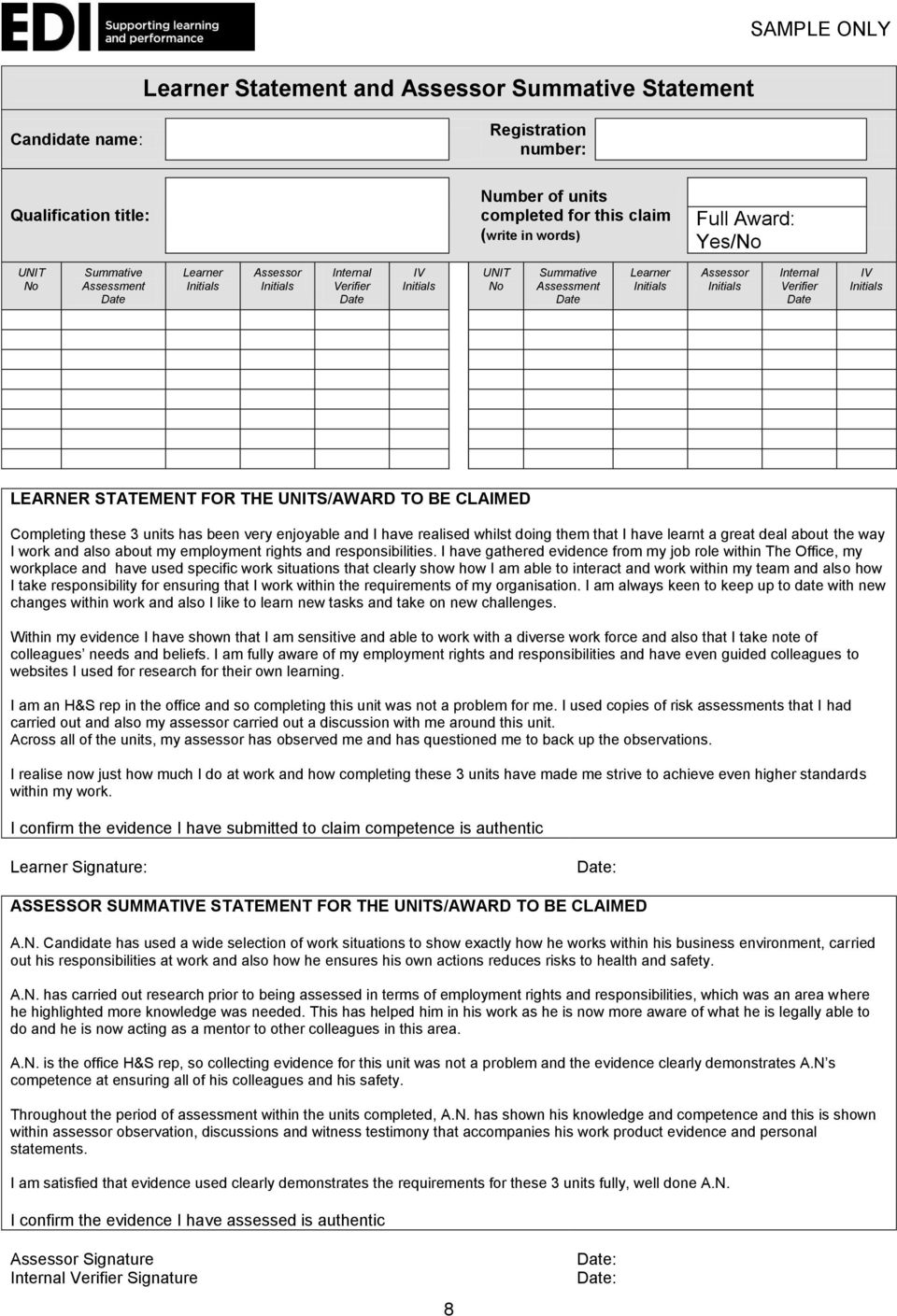
11 Learner statement and assessor summative statement Each time a learner completes a unit and has signed off the evidence matrix the assessor will be required to complete the details on the claim to competence form, ie. the unit number and the date of the summative assessment. Both learner and assessor are required to enter their initials. If the internal verifier has sampled that unit, he or she will also be required to enter the date and his or her initials. Once the learner has completed some or all of the units and decides that it is time to claim these, the learner will need to write a statement showing how he or she achieved the unit/s. This should show How the learner completed the units/award and what she or he has learnt from the experience How long the learner has been in his or her current role and working towards this qualification The assessment methods used to show competence How this has affected the way the learner approaches his or her job. The assessor is also required to write a statement. This should provide support for the learner s statement and any supplementary information about how the learner achieved the unit/s drawing on the learner s particular circumstances. An example of a completed claim to competence form with learner and assessor summative statements follows. This is for guidance only to give an indication of the kind of things that should be mentioned. A claim should only be submitted when there is sufficient evidence to fulfil all of the above. It is understood, however, that learners may not always have evidence to cover the full range of situations that are indicated. Nonetheless, the Claim to Competence cannot be agreed and signed by the assessor until the assessor is sure that the learner could operate across a range of different situations. As such, where visible evidence is not present, the assessor will need to interview the learner to cover these aspects. Overall it is recommended that the portfolio is as complete as possible in order to fully demonstrate and support the Claim to Competence and in order to clarify this claim to the assessor as effectively as possible. A completed CTC form (completed by both learner and assessor) and blank CTC form: 7
12 SAMPLE ONLY Learner Statement and Assessor Summative Statement Candidate name: Registration number: Qualification title: Number of units completed for this claim (write in words) Full Award: Yes/No UNIT No Summative Assessment Date Learner Initials Assessor Initials Internal Verifier Date IV Initials UNIT No Summative Assessment Date Learner Initials Assessor Initials Internal Verifier Date IV Initials LEARNER STATEMENT FOR THE UNITS/AWARD TO BE CLAIMED Completing these 3 units has been very enjoyable and I have realised whilst doing them that I have learnt a great deal about the way I work and also about my employment rights and responsibilities. I have gathered evidence from my job role within The Office, my workplace and have used specific work situations that clearly show how I am able to interact and work within my team and also how I take responsibility for ensuring that I work within the requirements of my organisation. I am always keen to keep up to date with new changes within work and also I like to learn new tasks and take on new challenges. Within my evidence I have shown that I am sensitive and able to work with a diverse work force and also that I take note of colleagues needs and beliefs. I am fully aware of my employment rights and responsibilities and have even guided colleagues to websites I used for research for their own learning. I am an H&S rep in the office and so completing this unit was not a problem for me. I used copies of risk assessments that I had carried out and also my assessor carried out a discussion with me around this unit. Across all of the units, my assessor has observed me and has questioned me to back up the observations. I realise now just how much I do at work and how completing these 3 units have made me strive to achieve even higher standards within my work. I confirm the evidence I have submitted to claim competence is authentic Learner Signature: Date: ASSESSOR SUMMATIVE STATEMENT FOR THE UNITS/AWARD TO BE CLAIMED A.N. Candidate has used a wide selection of work situations to show exactly how he works within his business environment, carried out his responsibilities at work and also how he ensures his own actions reduces risks to health and safety. A.N. has carried out research prior to being assessed in terms of employment rights and responsibilities, which was an area where he highlighted more knowledge was needed. This has helped him in his work as he is now more aware of what he is legally able to do and he is now acting as a mentor to other colleagues in this area. A.N. is the office H&S rep, so collecting evidence for this unit was not a problem and the evidence clearly demonstrates A.N s competence at ensuring all of his colleagues and his safety. Throughout the period of assessment within the units completed, A.N. has shown his knowledge and competence and this is shown within assessor observation, discussions and witness testimony that accompanies his work product evidence and personal statements. I am satisfied that evidence used clearly demonstrates the requirements for these 3 units fully, well done A.N. I confirm the evidence I have assessed is authentic Assessor Signature Internal Verifier Signature 8 Date: Date:
13 Learner Statement and Assessor Summative Statement Candidate name: Registration number: Qualification title: Number of units completed for this claim (write in words) Full Award: Yes/No UNIT No Summative Assessment Date Learner Initials Assessor Initials Internal Verifier Date IV Initials UNIT No Summative Assessment Date Learner Initials Assessor Initials Internal Verifier Date IV Initials LEARNER STATEMENT FOR THE UNITS/AWARD TO BE CLAIMED I confirm the evidence I have submitted to claim competence is authentic Learner Signature: Date: ASSESSOR SUMMATIVE STATEMENT FOR THE UNITS/AWARD TO BE CLAIMED I confirm the evidence I have assessed is authentic Assessor Signature Internal Verifier Signature 9 Date: Date:

14 10

15 Appeals Procedures for Learners If learners are dissatisfied with an assessment outcome, they have the right to appeal. The main reasons for an appeal are likely to be: Learners do not understand why they are not yet regarded as competent, because of unsatisfactory feedback from the Assessor Learners believe they are competent and that the Assessor has misjudged them, or has failed to utilise some vital evidence EDI expects most appeals from Learners to be resolved within the centre. EDI will only consider a learner s appeal after the centre s internal appeals procedure has been fully exhausted. Stage 1 Appeal to the Centre If learners have received a decision as to their competence with which they are dissatisfied, they have the right to appeal directly to the Assessor who carried out the assessment. This appeal must be in writing and clearly indicate: The points of disagreement The evidence in the portfolio that the learner believes meets the requirements of the Performance Criteria and/or knowledge for claiming competence The Assessor must give a clear judgement, in writing, to the learner within 10 working days stating justification for the decision. If learners are not satisfied with the outcome they can next appeal to the Centre s Internal Quality Assurer. This appeal must be in writing, but need not repeat the detail provided to the assessor. The original written appeal to the Assessor, and the Assessor s judgement, must be made available to the Internal Quality Assurer. Centres are entitled to have further internal phases to Stage 1 but must communicate this to all learners. The Internal Quality Assurer must give a clear judgement, in writing to the learner within 10 working days stating justification for the decision. Stage 2 Appeal to the awarding body A fee will be charged for an external review (please see current fee sheet). This fee will be refunded if the appeal is upheld. Learners who are not satisfied with the outcomes of the Internal Quality Assurer s decision and who have exhausted the Centre s internal appeals procedure may proceed by appealing to EDI. This appeal must be in writing to the Quality Assurance Manager, [email protected], be accompanied by copies of all documentation from Stage 1 and submitted within three weeks of the receipt of the outcome from the Internal Quality Assurer. Learners must also advise their centres that they have made a formal appeal to EDI. EDI will acknowledge receipt of the appeal within three working days. Upon receipt of the appeal, the Quality Assurance Manager will initiate an internal review. A fee will be charged (please see current fee sheet). This fee will be refunded if the appeal is upheld. 11

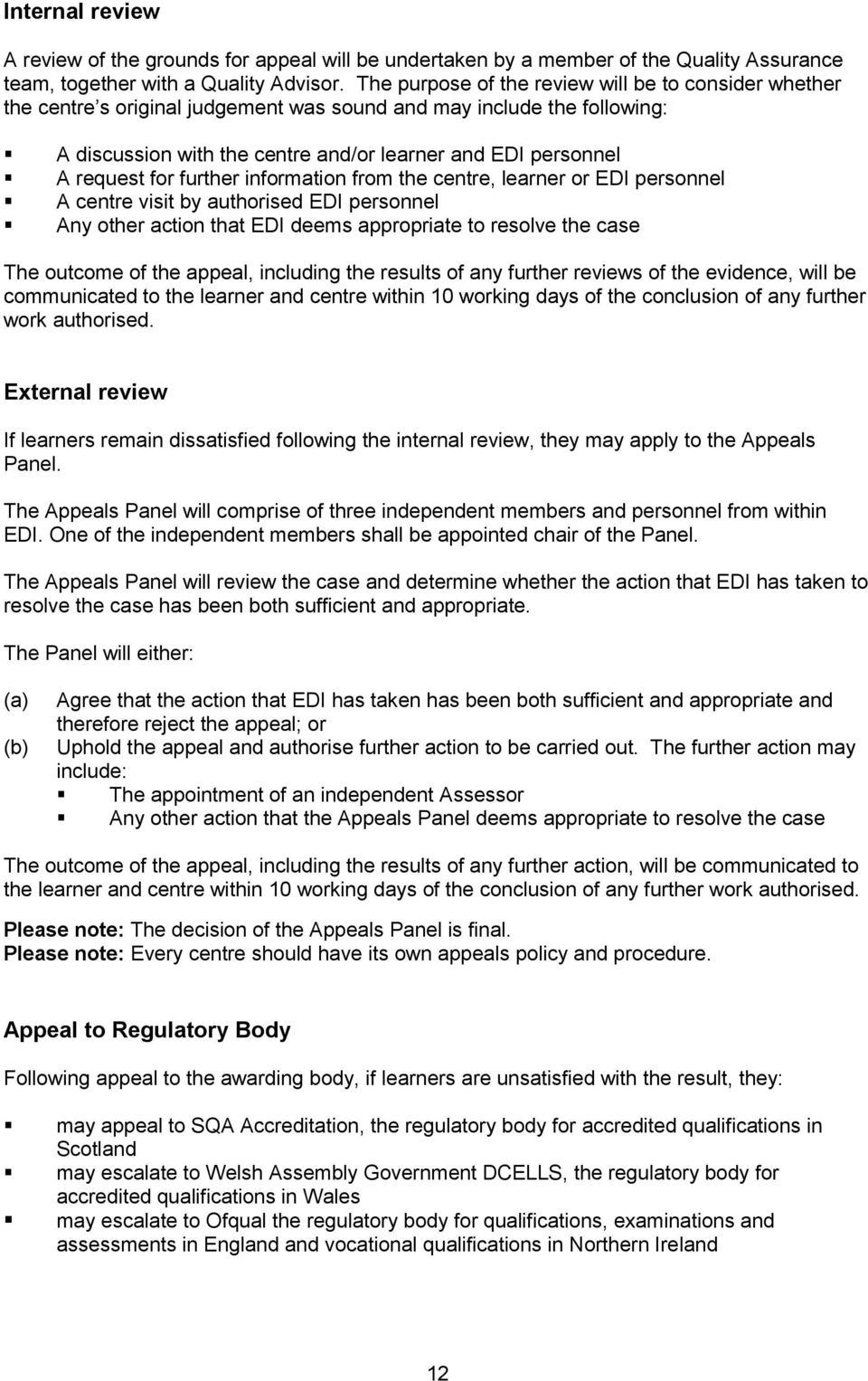
16 Internal review A review of the grounds for appeal will be undertaken by a member of the Quality Assurance team, together with a Quality Advisor. The purpose of the review will be to consider whether the centre s original judgement was sound and may include the following: A discussion with the centre and/or learner and EDI personnel A request for further information from the centre, learner or EDI personnel A centre visit by authorised EDI personnel Any other action that EDI deems appropriate to resolve the case The outcome of the appeal, including the results of any further reviews of the evidence, will be communicated to the learner and centre within 10 working days of the conclusion of any further work authorised. External review If learners remain dissatisfied following the internal review, they may apply to the Appeals Panel. The Appeals Panel will comprise of three independent members and personnel from within EDI. One of the independent members shall be appointed chair of the Panel. The Appeals Panel will review the case and determine whether the action that EDI has taken to resolve the case has been both sufficient and appropriate. The Panel will either: (a) (b) Agree that the action that EDI has taken has been both sufficient and appropriate and therefore reject the appeal; or Uphold the appeal and authorise further action to be carried out. The further action may include: The appointment of an independent Assessor Any other action that the Appeals Panel deems appropriate to resolve the case The outcome of the appeal, including the results of any further action, will be communicated to the learner and centre within 10 working days of the conclusion of any further work authorised. Please note: The decision of the Appeals Panel is final. Please note: Every centre should have its own appeals policy and procedure. Appeal to Regulatory Body Following appeal to the awarding body, if learners are unsatisfied with the result, they: may appeal to SQA Accreditation, the regulatory body for accredited qualifications in Scotland may escalate to Welsh Assembly Government DCELLS, the regulatory body for accredited qualifications in Wales may escalate to Ofqual the regulatory body for qualifications, examinations and assessments in England and vocational qualifications in Northern Ireland 12
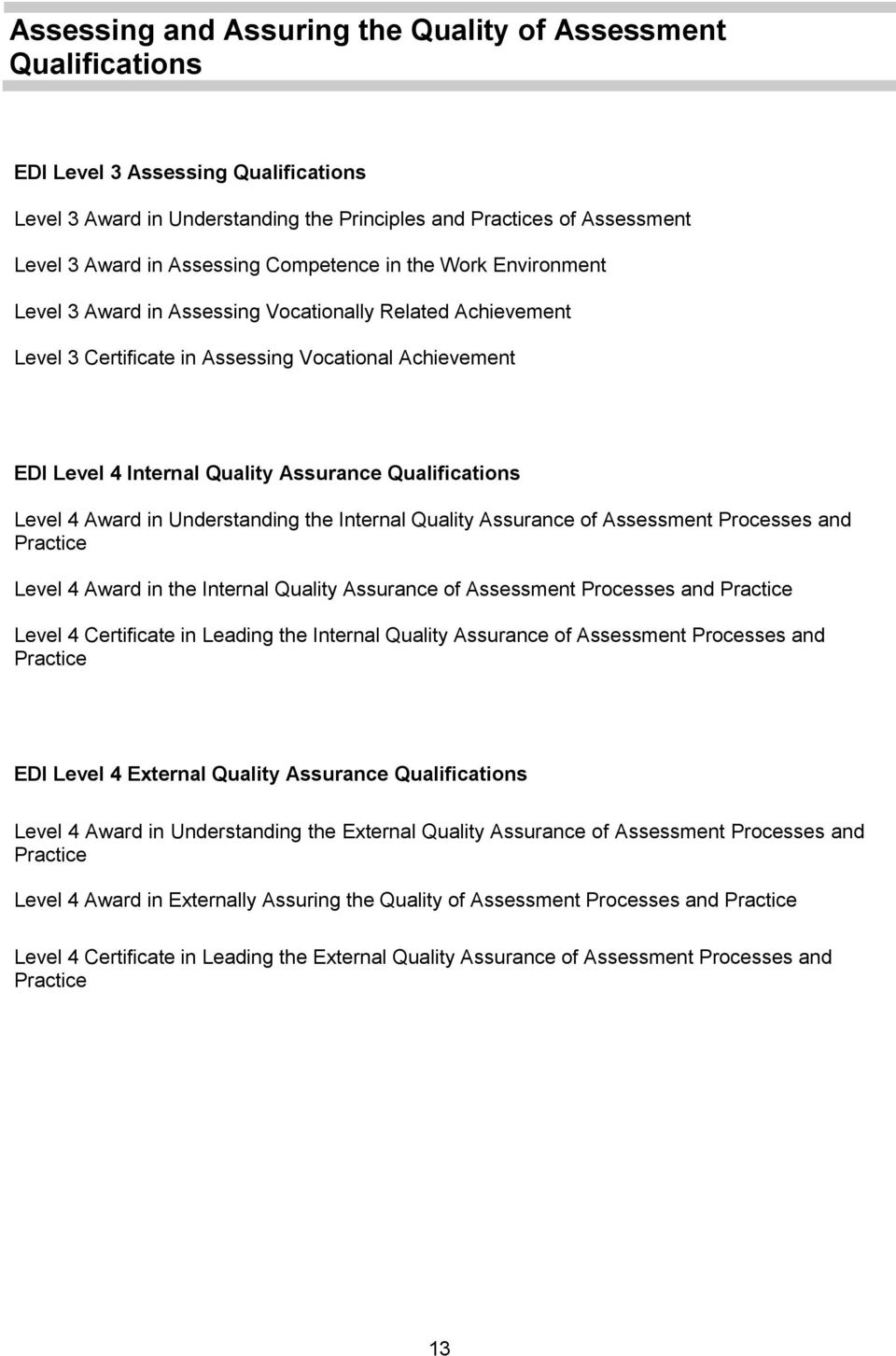
17 Assessing and Assuring the Quality of Assessment Qualifications EDI Level 3 Assessing Qualifications Level 3 Award in Understanding the Principles and Practices of Assessment Level 3 Award in Assessing Competence in the Work Environment Level 3 Award in Assessing Vocationally Related Achievement Level 3 Certificate in Assessing Vocational Achievement EDI Level 4 Internal Quality Assurance Qualifications Level 4 Award in Understanding the Internal Quality Assurance of Assessment Processes and Practice Level 4 Award in the Internal Quality Assurance of Assessment Processes and Practice Level 4 Certificate in Leading the Internal Quality Assurance of Assessment Processes and Practice EDI Level 4 External Quality Assurance Qualifications Level 4 Award in Understanding the External Quality Assurance of Assessment Processes and Practice Level 4 Award in Externally Assuring the Quality of Assessment Processes and Practice Level 4 Certificate in Leading the External Quality Assurance of Assessment Processes and Practice 13
18 14

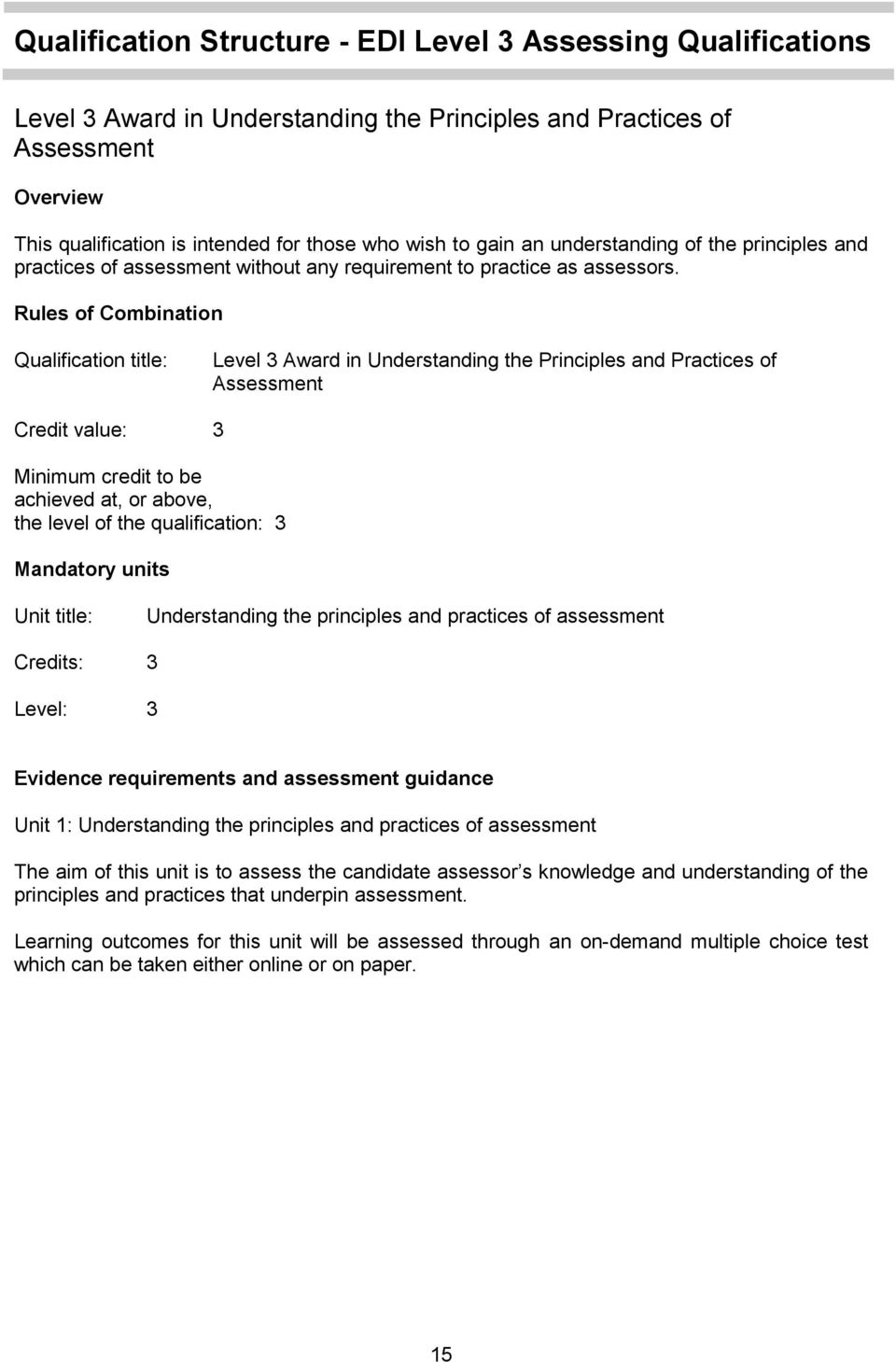
19 Qualification Structure - EDI Level 3 Assessing Qualifications Level 3 Award in Understanding the Principles and Practices of Assessment Overview This qualification is intended for those who wish to gain an understanding of the principles and practices of assessment without any requirement to practice as assessors. Rules of Combination Qualification title: Level 3 Award in Understanding the Principles and Practices of Assessment Credit value: 3 Minimum credit to be achieved at, or above, the level of the qualification: 3 Mandatory units Unit title: Understanding the principles and practices of assessment Credits: 3 Level: 3 Evidence requirements and assessment guidance Unit 1: Understanding the principles and practices of assessment The aim of this unit is to assess the candidate assessor s knowledge and understanding of the principles and practices that underpin assessment. Learning outcomes for this unit will be assessed through an on-demand multiple choice test which can be taken either online or on paper. 15
20 Level 3 Award in Assessing Competence in the Work Environment Overview This qualification is intended for assessors who assess occupational competence in an individual s work environment. It includes the following assessment methods (although not all of these require performance evidence): observation of performance in the work environment examining products of work questioning the learner discussing with the learner use of others (witness testimony) looking at learner statements recognising prior learning Rules of Combination Qualification title: Level 3 Award in Assessing Competence in the Work Environment Credit value: 9 Minimum credit to be achieved at, or above, the level of the qualification: 9 Mandatory units Unit title: Understanding the principles and practices of assessment Credits: 3 Level: 3 Unit title: Assess occupational competence in the work environment Credits: 6 Level: 3 Evidence requirements and assessment guidance Unit 1: Understanding the principles and practices of assessment The aim of this unit is to assess the candidate assessor s knowledge and understanding of the principles and practices that underpin assessment. Learning outcomes for this unit will be assessed through an on-demand multiple choice test which can be taken either online or on paper. Unit 2: Assess occupational competence in the work environment The aim of this unit is to assess the candidate assessor s performance in assessing occupational competence in an individual s work environment. There must be evidence to cover 16
21 all of the assessment methods listed in the unit. As a minimum, there must be performance evidence for the following assessment methods: observation of performance in the work environment examining products of work questioning the learner Simulations are not allowed. Other forms of evidence will be acceptable for the remaining assessment methods: discussing with the learner use of others (witness testimony) looking at learner statements recognising prior learning The candidate assessor s performance evidence must be assessed by observation, examining the products of work and questioning / discussions. There must be valid, authentic and sufficient evidence for all the assessment criteria. Holistic assessment is encouraged and one piece of evidence may be used to meet the requirements of more than one learning outcome or assessment criterion. There must be evidence of the candidate assessor carrying out at least two assessments of two learners occupational competence (four assessments in total). This occupational competence must not be in assessment itself. In other words, evidence for this unit must not come from assessing another candidate assessor who in turn is assessing someone else. 17
22 Level 3 Award in Assessing Vocationally Related Achievement Overview This qualification is intended for those who assess vocational skills, knowledge and understanding in environments other than the work environment (for example a workshop, classroom or other training environment). It includes the following assessment methods (although not all of these require performance evidence): assessments of the learner in simulated environments skills tests oral and written questions assignments projects case studies recognising prior learning Rules of Combination Qualification title: Level 3 Award in Assessing Vocationally Related Achievement Credit value: 9 Minimum credit to be achieved at, or above, the level of the qualification: 9 Mandatory units Unit title: Understanding the principles and practices of assessment Credits: 3 Level: 3 Unit title: Assess vocational skills, knowledge and understanding Credits: 6 Level: 3 Evidence requirements and assessment guidance Unit 1: Understanding the principles and practices of assessment The aim of this unit is to assess the candidate assessor s knowledge and understanding of the principles and practices that underpin assessment. Learning outcomes for this unit will be assessed through an on-demand multiple choice test which can be taken either online or on paper. 18
23 Unit 3: Assess vocational skills, knowledge and understanding The aim of this unit is to assess the candidate assessor s performance in assessing vocational skills, knowledge and understanding in environments other than the workplace for example workshops, classrooms or other training environments. There must be evidence to cover all of the assessment methods listed in the unit. As a minimum, there must be performance evidence for at least three of the following assessment methods: assessments of the learner in simulated environments skills tests oral and written questions assignments projects case studies recognising prior learning Simulations are not allowed. Other forms of evidence will be acceptable for the remaining assessment methods. The candidate assessor s performance evidence must be assessed by observation, examining the products of work and questioning/discussions. There must be valid, authentic and sufficient evidence for all the assessment criteria. Holistic assessment is encouraged and one piece of evidence may be used to meet the requirements of more than one learning outcome or assessment criterion. There must be evidence of the candidate assessor carrying out at least two assessments of two learners skills, knowledge and understanding (four assessments in total). 19
24 Level 3 Certificate in Assessing Vocational Achievement Overview This qualification is intended for those who assess both occupational competence in the work environment and vocational skills, knowledge and understanding in environments other than the workplace (for example a workshop, classroom or other training environment). Rules of Combination Qualification title: Level 3 Certificate in Assessing Vocational Achievement Credit value: 15 Minimum credit to be achieved at, or above, the level of the qualification: 15 Mandatory units Unit title: Understanding the principles and practices of assessment Credits: 3 Level: 3 Unit title: Assess occupational competence in the work environment Credits: 6 Level: 3 Unit title: Assess vocational skills, knowledge and understanding Credits: 6 Level: 3 Evidence requirements and assessment guidance Unit 1: Understanding the principles and practices of assessment The aim of this unit is to assess the candidate assessor s knowledge and understanding of the principles and practices that underpin assessment. Learning outcomes for this unit will be assessed through an on-demand multiple choice test which can be taken either online or on paper. Unit 2: Assess occupational competence in the work environment The aim of this unit is to assess the candidate assessor s performance in assessing occupational competence in an individual s work environment. There must be evidence to cover 20
25 all of the assessment methods listed in the unit. As a minimum, there must be performance evidence for the following assessment methods: observation of performance in the work environment examining products of work questioning the learner Simulations are not allowed. Other forms of evidence will be acceptable for the remaining assessment methods: discussing with the learner use of others (witness testimony) looking at learner statements recognising prior learning The candidate assessor s performance evidence must be assessed by observation, examining the products of work and questioning / discussions. There must be valid, authentic and sufficient evidence for all the assessment criteria. Holistic assessment is encouraged and one piece of evidence may be used to meet the requirements of more than one learning outcome or assessment criterion. There must be evidence of the candidate assessor carrying out at least two assessments of two learners occupational competence (four assessments in total). This occupational competence must not be in assessment itself. In other words, evidence for this unit must not come from assessing another candidate assessor who in turn is assessing someone else. Unit 3: Assess vocational skills, knowledge and understanding The aim of this unit is to assess the candidate assessor s performance in assessing vocational skills, knowledge and understanding in environments other than the workplace for example workshops, classrooms or other training environments. There must be evidence to cover all of the assessment methods listed in the unit. As a minimum, there must be performance evidence for at least three of the following assessment methods: assessments of the learner in simulated environments skills tests oral and written questions assignments projects case studies recognising prior learning Simulations are not allowed. Other forms of evidence will be acceptable for the remaining assessment methods. The candidate assessor s performance evidence must be assessed by observation, examining the products of work and questioning/discussions. There must be valid, authentic and sufficient evidence for all the assessment criteria. Holistic assessment is encouraged and one piece of evidence may be used to meet the requirements of more than one learning outcome or assessment criterion. There must be evidence of the candidate assessor carrying out at least two assessments of two learners skills, knowledge and understanding (four assessments in total). 21
26 22
27 Qualification Structure - EDI Level 4 Internal Quality Assurance Qualifications Level 4 Award in Understanding the Internal Quality Assurance of Assessment Processes and Practice Overview This qualification is intended for those who wish to gain an understanding of the principles and practices of internal quality assurance without any requirement to practice. Rules of Combination Qualification title: Level 4 Award in Understanding the Internal Quality Assurance of Assessment Processes and Practice Credit value: 6 Minimum credit to be achieved at, or above, the level of the qualification: 6 Mandatory units Unit title: Understanding the principles and practices of internally assuring the quality of assessment Credits: 6 Level: 4 Evidence requirements and assessment guidance Unit 4: Understanding the principles and practices of internally assuring the quality of assessment The aim of this unit is to assess knowledge and understanding of the principles and practices that underpin the internal quality assurance of assessment. Learning outcomes for this unit will be assessed through an on-demand multiple choice test which can be taken either online or on paper. 23
28 Level 4 Award in the Internal Quality Assurance of Assessment Processes and Practice Overview This qualification is intended for those who maintain the quality of assessment from within an organisation or assessment centre. Rules of Combination Qualification title: Level 4 Award in the Internal Quality Assurance of Assessment Processes and Practice Credit value: 12 Minimum credit to be achieved at, or above, the level of the qualification: 12 Mandatory units Unit title: Understanding the principles and practices of internally assuring the quality of assessment Credits: 6 Level: 4 Unit title: Internally assure the quality of assessment Credits: 6 Level: 4 Evidence requirements and assessment guidance Unit 4: Understanding the principles and practices of internally assuring the quality of assessment The aim of this unit is to assess knowledge and understanding of the principles and practices that underpin the internal quality assurance of assessment. Learning outcomes for this unit will be assessed through an on-demand multiple choice test which can be taken either online or on paper. 24
29 Unit 5: Internally assure the quality of assessment The aim of this unit is to assess the IQA candidate s performance in assuring the quality of assessment from within an organisation or assessment centre. All learning outcomes in this unit must be assessed using methods appropriate to the candidate IQA s performance. These must include: observation of performance examining products of work questioning Direct evidence of this kind may be supplemented, where necessary, by discussion, reflective accounts or witness testimony. Simulations are not allowed. There must be valid, authentic and sufficient evidence for all the assessment criteria. Holistic assessment is encouraged and one piece of evidence may be used to meet the requirements of more than one learning outcome or assessment criterion. Evidence must come from the IQA candidate s performance in the work environment. There must be evidence of the IQA candidate monitoring a minimum of two assessors, each with a minimum of two candidates of their own, through components of a qualification. 25
30 Level 4 Certificate in Leading the Internal Quality Assurance of Assessment Processes and Practice Overview This qualification is intended for those who lead a team of internal quality assurance staff. Rules of Combination Qualification title: Level 4 Certificate in Leading the Internal Quality Assurance of Assessment Processes and Practice Credit value: 17 Minimum credit to be achieved at, or above, the level of the qualification: 17 Mandatory units Unit title: Understanding the principles and practices of internally assuring the quality of assessment Credits: 6 Level: 4 Unit title: Internally assure the quality of assessment Credits: 6 Level: 4 Unit title: Plan, allocate and monitor the quality of work in own area of responsibility Credits: 5 Level: 4 Evidence requirements and assessment guidance Unit 4: Understanding the principles and practices of internally assuring the quality of assessment The aim of this unit is to assess knowledge and understanding of the principles and practices that underpin the internal quality assurance of assessment. Learning outcomes for this unit will be assessed through an on-demand multiple choice test which can be taken either online or on paper. 26
31 Unit 5: Internally assure the quality of assessment The aim of this unit is to assess the IQA candidate s performance in assuring the quality of assessment from within an organisation or assessment centre. All learning outcomes in this unit must be assessed using methods appropriate to the candidate IQA s performance. These must include: observation of performance examining products of work questioning Direct evidence of this kind may be supplemented, where necessary, by discussion, reflective accounts or witness testimony. Simulations are not allowed. There must be valid, authentic and sufficient evidence for all the assessment criteria. Holistic assessment is encouraged and one piece of evidence may be used to meet the requirements of more than one learning outcome or assessment criterion. Evidence must come from the IQA candidate s performance in the work environment. There must be evidence of the IQA candidate monitoring a minimum of two assessors, each with a minimum of two candidates of their own, through components of a qualification. Unit 8: Plan, allocate and monitor the quality of work in own area of responsibility The aim of this unit is to assess performance in leading the work of a team responsible for the internal quality assurance within an organisation or assessment centre. All learning outcomes in this unit must be assessed using methods appropriate to the candidate IQA s performance. These must include: observation of performance examining products of work questioning Direct evidence of this kind may be supplemented, where necessary, by discussion, reflective accounts or witness testimony. There must be valid, authentic and sufficient evidence for all the assessment criteria. Holistic assessment is encouraged and one piece of evidence may be used to meet the requirements of more than one learning outcome or assessment criterion. Evidence must come from performance in the work environment. 27
32 28
33 Qualification Structure - EDI Level 4 External Quality Assurance Qualifications Level 4 Award in Understanding the External Quality Assurance of Assessment Processes and Practice Overview This qualification is intended for those who wish to gain an understanding of the principles and practices of external quality assurance without any requirement to practice. Rules of Combination Qualification title: Level 4 Award in Understanding the External Quality Assurance of Assessment Processes and Practice Credit value: 6 Minimum credit to be achieved at, or above, the level of the qualification: 6 Mandatory units Unit title: Understanding the principles and practices of externally assuring the quality of assessment Credits: 6 Level: 4 Evidence requirements and assessment guidance Unit 6: Understanding the principles and practices of externally assuring the quality of assessment The aim of this unit is to assess knowledge and understanding of the principles and practices that underpin the external quality assurance of assessment. Learning outcomes for this unit will be assessed through an on-demand multiple choice test which can be taken either online or on paper. 29
34 Level 4 Award in Externally Assuring the Quality of Assessment Processes and Practice Overview This qualification is intended for those who maintain the quality of assessment from outside an organisation or assessment centre, usually on behalf of an awarding organisation. Rules of Combination Qualification title: Level 4 Award in Externally Assuring the Quality of Assessment Processes and Practice Credit value: 12 Minimum credit to be achieved at, or above, the level of the qualification: 12 Mandatory units Unit title: Understanding the principles and practices of externally assuring the quality of assessment Credits: 6 Level: 4 Unit title: Externally assure the quality of assessment Credits: 6 Level: 4 Evidence requirements and assessment guidance Unit 6: Understanding the principles and practices of externally assuring the quality of assessment The aim of this unit is to assess knowledge and understanding of the principles and practices that underpin the external quality assurance of assessment. Learning outcomes for this unit will be assessed through an on-demand multiple choice test which can be taken either online or on paper. Unit 7: Externally assure the quality of assessment The aim of this unit is to assess performance in assuring the quality of assessment from outside an organisation or assessment centre, usually on behalf of an awarding organisation. 30
35 All learning outcomes in this unit must be assessed using methods appropriate to the candidate EQA s performance. These must include: observation of performance examining products of work questioning Direct evidence of this kind may be supplemented, where necessary, by discussion, reflective accounts or witness testimony. Simulations are not allowed. There must be valid, authentic and sufficient evidence for all the assessment criteria. Holistic assessment is encouraged and one piece of evidence may be used to meet the requirements of more than one assessment criterion. Evidence must come from performance in the work environment. There must be evidence of carrying out at least two external centre visits, including the preparation for and actions after the actual visit itself. 31
36 Level 4 Certificate in Leading the External Quality Assurance of Assessment Processes and Practice Overview This qualification is intended for those who lead a team of people responsible for assuring the quality of assessment from outside an organisation or assessment centre, usually on behalf of an awarding organisation. Rules of Combination Qualification title: Level 4 Certificate in Leading the External Quality Assurance of Assessment Processes and Practice Credit value: 17 Minimum credit to be achieved at, or above, the level of the qualification: 17 Mandatory units Unit title: Understanding the principles and practices of externally assuring the quality of assessment Credits: 6 Level: 4 Unit title: Externally assure the quality of assessment Credits: 6 Level: 4 Unit title: Plan, allocate and monitor the quality of work in own area of responsibility Credits: 5 Level: 4 Evidence requirements and assessment guidance Unit 6: Understanding the principles and practices of externally assuring the quality of assessment The aim of this unit is to assess knowledge and understanding of the principles and practices that underpin the external quality assurance of assessment. Learning outcomes for this unit will be assessed through an on-demand multiple choice test which can be taken either online or on paper. 32
37 Unit 7: Externally assure the quality of assessment The aim of this unit is to assess performance in assuring the quality of assessment from outside an organisation or assessment centre, usually on behalf of an awarding organisation. All learning outcomes in this unit must be assessed using methods appropriate to the candidate EQA s performance. These must include: observation of performance examining products of work questioning Direct evidence of this kind may be supplemented, where necessary, by discussion, reflective accounts or witness testimony. Simulations are not allowed. There must be valid, authentic and sufficient evidence for all the assessment criteria. Holistic assessment is encouraged and one piece of evidence may be used to meet the requirements of more than one assessment criterion. Evidence must come from performance in the work environment. There must be evidence of carrying out at least two external centre visits, including the preparation for and actions after the actual visit itself. Unit 8: Plan, allocate and monitor the quality of work in own area of responsibility The aim of this unit is to assess performance in leading the work of a team responsible for the external quality assurance of assessment centres. All learning outcomes in this unit must be assessed using methods appropriate to the candidate EQA s performance. These must include: observation of performance examining products of work questioning Direct evidence of this kind may be supplemented, where necessary, by discussion, reflective accounts or witness testimony. There must be valid, authentic and sufficient evidence for all the assessment criteria. Holistic assessment is encouraged and one piece of evidence may be used to meet the requirements of more than one assessment criterion. Evidence must come from performance in the work environment. 33
38 34
39 Units of Assessment Unit 1: Understanding the principles and practices of assessment Credit value: 3 Level: 3 Guided learning Hours: 24 Unit 2: Assess occupational competence in the work environment Credit value: 6 Level: 3 Guided learning Hours: 30 Unit 3: Assess vocational skills, knowledge and understanding Credit value: 6 Level: 3 Guided learning Hours: 30 Unit 4: Understanding the principles and practices of internally assuring the quality of assessment Credit value: 6 Level: 4 Guided learning Hours: 45 Unit 5: Internally assure the quality of assessment Credit value: 6 Level: 4 Guided learning Hours: 45 Unit 6: Understanding the principles and practices of externally assuring the quality of assessment Credit value: 6 Level: 4 Guided learning Hours: 45 Unit 7: Externally assure the quality of assessment Credit value: 6 Level: 4 Guided learning Hours: 30 Unit 8: Plan, allocate and monitor work in own area of responsibility Credit value: 5 Level: 4 Guided learning Hours: 25 35
40 36
41 Unit 1 Understanding the Principles and Practices of Assessment Aim The aim of this unit is to assess the learning and development practitioner s knowledge and understanding of the principles and practices of assessment. Practitioner means anyone with a learning and development responsibility as the whole or a part of their role. Level 3 Credit 3 GLH 24 Learning outcomes The learner will: 1. Understand the principles and requirements of assessment Assessment criteria The learner can: 1.1 explain the functions of assessment in learning and development 1.2 define the key concepts and principles of assessment 1.3 explain the responsibilities of the assessor 1.4 identify the regulations and requirements relevant to assessment in own area of practice 2. Understand different types of assessment method 2.1 compare the strengths and limitations of a range of assessment methods with reference to the needs of individual learners 37
42 3. Understand how to plan assessment 3.1 summarise key factors to consider when planning assessment 3.2 evaluate the benefits of using a holistic approach to assessment 3.3 explain how to plan a holistic approach to assessment 3.4 summarise the types of risks that may be involved in assessment in own area of responsibility 3.5 explain how to minimise risks through the planning process 4. Understand how to involve learners and others in assessment 4.1 explain the importance of involving the learner and others in the assessment process 4.2 summarise types of information that should be made available to learners and others involved in the assessment process 4.3 explain how peer and self-assessment can be used effectively to promote learner involvement and personal responsibility in the assessment of l earning 4.4 explain how assessment arrangements can be adapted to meet the needs of individual learners 5. Understand how to make assessment decisions 5.1 explain how to judge whether evidence is: sufficient authentic current 5.2 explain how to ensure that assessment decisions are: made against specified criteria valid reliable fair 38
43 6. Understand quality assurance of the assessment process 6.1 evaluate the importance of quality assurance in the assessment process 6.2 summarise quality assurance and standardisation procedures in own area of practice 6.3 summarise the procedures to follow when there are disputes concerning assessment in own area of practice 7. Understand how to manage information relating to assessment 7.1 explain the importance of following procedures for the management of information relating to assessment 7.2 explain how feedback and questioning contribute to the assessment process 8. Understand the legal and good practice requirements in relation to assessment 8.1 explain legal issues, policies and procedures relevant to assessment, including those for confidentiality, health, safety and welfare 8.2 explain the contribution that technology can make to the assessment process 8.3 evaluate requirements for equality and diversity and, where appropriate, bilingualism in relation to assessment 8.4 explain the value of reflective practice and continuing professional development in the assessment process Assessment The learning outcomes for this unit will be assessed through an on-demand multiple choice test which can be taken either online or on paper. 39
44 40
45 Unit 2 Assess Occupational Competence in the Work Environment Aim The aim of this unit is to assess a learning and development practitioner s performance in carrying out assessments of occupational competence in a work environment. This unit requires evidence of using the following assessment methods: observation of performance in the work environment examining products of work questioning the learner discussing with the learner use of others (witness testimony) looking at learner statements recognising prior learning Practitioner means anyone with a learning and development responsibility as the whole or a part of their role. Level 3 Credit 6 GLH 30 Learning outcomes The learner will: 1. Be able to plan the assessment of occupational competence Assessment criteria The learner can: 1.1 plan assessment of occupational competence based on the following methods: observation of performance in the work environment examining products of work questioning the learner discussing with the learner use of others (witness testimony) looking at learner statements recognising prior learning 1.2 communicate the purpose, requirements and processes of assessing occupational competence to the learner plan the assessment of occupational 1.3 competence to address learner needs and current achievements 1.4 identify opportunities for holistic assessment 41
46 2. Be able to make assessment decisions about occupational competence 2.1 use valid, fair and reliable assessment methods including: observation of performance examining products of work questioning the learner discussing with the learner use of others (witness testimony) looking at learner statements recognising prior learning 2.2 make assessment decisions of occupational competence against specified criteria 2.3 follow standardisation procedures 2.4 provide feedback to learners that affirms achievement and identifies any further implications for learning, assessment and progression 3. Be able to provide required information following the assessment of occupational competence 3.1 maintain records of the assessment of occupational competence, its outcomes and learner progress 3.2 make assessment information available to authorised colleagues 3.3 follow procedures to maintain the confidentiality of assessment information 4. Be able to maintain legal and good practice requirements when assessing occupational competence 4.1 follow relevant policies, procedures and legislation for the assessment of occupational competence, including those for health, safety and welfare 4.2 apply requirements for equality and diversity and, where appropriate, bilingualism, when assessing occupational competence 4.3 evaluate own work in carrying out assessments of occupational competence 4.4 maintain the currency of own expertise and competence as relevant to own role in assessing occupational competence 42
47 Assessment Requirements Evidence must cover all of the assessment methods listed in the unit. As a minimum, there must be performance evidence for the following assessment methods: observation of performance in the work environment examining products of work questioning the learner Simulations are not allowed. Other forms of evidence will be acceptable for the remaining assessment methods: discussing with the learner use of others (witness testimony) looking at learner statements recognising prior learning The candidate assessor s performance evidence must be assessed by observation, examining the products of work and questioning / discussions. There must be valid, authentic and sufficient evidence for all the assessment criteria. Holistic assessment is encouraged and one piece of evidence may be used to meet the requirements of more than one learning outcome or assessment criterion. There must be evidence of the candidate assessor carrying out at least two assessments of two learners occupational competence (four assessments in total). This occupational competence must not be in assessment itself. In other words, evidence for this unit must not come from assessing another candidate assessor who in turn is assessing someone else. 43
48 44
49 Unit 3 Assess Vocational Skills, Knowledge and Understanding Aim The aim of this unit is to assess a learning and development practitioner s performance in carrying out the assessment of vocational skills, knowledge and understanding outside of the work environment. Assessment methods include: assessments of the learner in simulated environments skills tests oral and written questions assignments projects case studies recognising prior learning The unit does not require the design of assessments. Practitioner means anyone with a learning and development responsibility as the whole or a part of their role. Level 3 Credit 6 GLH 30 Learning outcomes The learner will: 1. Be able to prepare assessments of vocational skills, knowledge and understanding Assessment criteria The learner can: 1.1 select methods to assess vocational skills, knowledge and understanding which address learner needs and meet assessment requirements, including: assessments of the learner in simulated environments skills tests oral and written questions assignments projects case studies recognising prior learning prepare resources and conditions for the assessment of vocational skills, knowledge and understanding 1.3 communicate the purpose, requirements and processes of assessment of vocational skills, knowledge and understanding to learners
50 2. Be able to carry out assessments of vocational skills, knowledge and understanding 2.1 manage assessments of vocational skills, knowledge and understanding to meet assessment requirements 2.2 provide support to learners within agreed limitations 2.3 analyse evidence of learner achievement 2.4 make assessment decisions relating to vocational skills, knowledge and 2.5 understanding against specified criteria follow standardisation procedures 2.6 provide feedback to the learner that affirms achievement and identifies any further implications for learning, assessment and progression 3. Be able to provide required information following the assessment of vocational skills, knowledge and understanding 3.1 maintain records of the assessment of vocational skills, knowledge and understanding, its outcomes and learner progress 3.2 make assessment information available to authorised colleagues as required 3.3 follow procedures to maintain the confidentiality of assessment information 4. Be able to maintain legal and good practice requirements when assessing vocational skills, knowledge and understanding 4.1 follow relevant policies, procedures and legislation relating to the assessment of vocational skills, knowledge and understanding, including those for health, safety and welfare apply requirements for equality and diversity and, where appropriate, bilingualism 4.3 evaluate own work in carrying out assessments of vocational skills, knowledge and understanding 4.4 take part in continuing professional development to ensure current expertise and competence in assessing vocational skills, knowledge and understanding
51 Assessment Requirements There must be evidence to cover all of the assessment methods listed in the unit. As a minimum, there must be performance evidence for at least three of the following assessment methods: assessments of the learner in simulated environments skills tests oral and written questions assignments projects case studies recognising prior learning Simulations are not allowed. Other forms of evidence will be acceptable for the remaining assessment methods. The candidate assessor s performance evidence must be assessed by observation, examining the products of work and questioning/discussions. There must be valid, authentic and sufficient evidence for all the assessment criteria. Holistic assessment is encouraged and one piece of evidence may be used to meet the requirements of more than one learning outcome or assessment criterion. There must be evidence of the candidate assessor carrying out at least two assessments of two learners skills, knowledge and understanding (four assessments in total). 47
52 48
53 Unit 4 Understanding the Principles and Practices of Internally Assuring the Quality of Assessment Aim The aim of this unit is to assess the knowledge and understanding a learning and development practitioner requires for the internal quality assurance of assessment. Practitioner means anyone with a learning and development responsibility as the whole or a part of their role. Level 4 Credit 6 GLH 45 Learning outcomes The learner will: 1. Understand the context and principles of internal quality assurance Assessment criteria The learner can: 1.1 explain the functions of internal quality assurance in learning and development 1.2 explain the key concepts and principles of the internal quality assurance of assessment 1.3 explain the roles of practitioners involved in the internal and external quality assurance process 1.4 explain the regulations and requirements for internal quality assurance in own area of practice 2. Understand how to plan the internal quality assurance of assessment 2.1 evaluate the importance of planning and preparing internal quality assurance activities 2.2 explain what an internal quality assurance plan should contain 2.3 summarise the preparations that need to be made for internal quality assurance, including: information collection communications administrative arrangements resources 49
54 3. Understand techniques and criteria for monitoring the quality of assessment internally 3.1 evaluate different techniques for sampling evidence of assessment, including use of technology 3.2 explain the appropriate criteria to use for judging the quality of the assessment process 4. Understand how to internally maintain and improve the quality of assessment 4.1 summarise the types of feedback, support and advice that assessors may need to maintain and improve the quality of assessment 4.2 explain standardisation requirements in relation to assessment 4.3 explain relevant procedures regarding disputes about the quality of assessment 5. Understand how to manage information relevant to the internal quality assurance of assessment 6. Understand the legal and good practice requirements for the internal quality assurance of assessment 5.1 evaluate requirements for information management, data protection and confidentiality in relation to the internal quality assurance of assessment 6.1 evaluate legal issues, policies and procedures relevant to the internal quality assurance of assessment, including those for health, safety and welfare 6.2 evaluate different ways in which technology can contribute to the internal quality assurance of assessment 6.3 explain the value of reflective practice and continuing professional development in relation to internal quality assurance 6.4 evaluate requirements for equality and diversity and, where appropriate, bilingualism, in relation to the internal quality assurance of assessment Assessment The learning outcomes for this unit will be assessed through an on-demand multiple choice test which can be taken either online or on paper. 50
55 Unit 5 Internally Assure the Quality of Assessment Aim The aim of this unit is to assess the performance of a learning and development practitioner with responsibility for the internal quality assurance of assessment. Level 4 Credit 6 GLH 45 Learning outcomes The learner will: 1. Be able to plan the internal quality assurance of assessment Assessment criteria The learner can: 1.1 plan monitoring activities according to the requirements of own role 1.2 make arrangements for internal monitoring activities to assure quality 2. Be able to internally evaluate the quality of assessment 2.1 carry out internal monitoring activities to quality requirements 2.2 evaluate assessor expertise and competence in relation to the requirements of their role 2.3 evaluate the planning and preparation of assessment processes 2.4 determine whether assessment methods are safe, fair, valid and reliable 2.5 determine whether assessment decisions are made using the specified criteria 2.6 compare assessor decisions to ensure they are consistent 3. Be able to internally maintain and improve the quality of assessment 3.1 provide assessors with feedback, advice and support, including professional development opportunities, which help them to maintain and improve the quality of assessment 3.2 apply procedures to standardise assessment practices and outcomes 51
56 4. Be able to manage information relevant to the internal quality assurance of assessment 4.1 apply procedures for recording, storing and reporting information relating to internal quality assurance 4.2 follow procedures to maintain confidentiality of internal quality assurance information 5. Be able to maintain legal and good practice requirements when internally monitoring and maintaining the quality of assessment 5.1 apply relevant policies, procedures and legislation in relation to internal quality assurance, including those for health, safety and welfare 5.2 apply requirements for equality and diversity and, where appropriate, bilingualism, in relation to internal quality assurance 5.3 critically reflect on own practice in internally assuring the quality of assessment 5.4 maintain the currency of own expertise and competence in internally assuring the quality of assessment Assessment Requirements All learning outcomes in this unit must be assessed using methods appropriate to the candidate IQA s performance. These must include: observation of performance examining products of work questioning Direct evidence of this kind may be supplemented, where necessary, by discussion, reflective accounts or witness testimony. Simulations are not allowed. There must be valid, authentic and sufficient evidence for all the assessment criteria. Holistic assessment is encouraged and one piece of evidence may be used to meet the requirements of more than one learning outcome or assessment criterion. Evidence must come from the IQA candidate s performance in the work environment. There must be evidence of the IQA candidate monitoring a minimum of two assessors, each with a minimum of two candidates of their own, through components of a qualification. 52
57 Unit 6 Understanding the Principles and Practices of Externally Assuring the Quality of Assessment Aim The aim of this unit is to assess the knowledge and understanding a learning and development practitioner requires for the external quality assurance of assessment. Level 4 Credit 6 GLH 45 Learning outcomes The learner will: 1. Understand the context and principles of external quality assurance Assessment criteria The learner can: 1.1 analyse the functions of external quality assurance of assessment in learning and development 1.2 evaluate the key concepts and principles of external quality assurance of assessment 1.3 evaluate the roles of practitioners involved in the quality assurance process 1.4 explain the regulations and requirements for external and internal quality assurance in own area of practice 2. Understand how to plan the external quality assurance of assessment 2.1 evaluate the importance of planning and preparing external quality assurance activities 2.2 explain what an external quality assurance plan should contain 2.3 summarise the preparations that need to be made for external quality assurance activities, including: information collection communications administrative arrangements resources 2.4 explain how to adapt external monitoring and evaluation approaches to meet customer need without compromising quality standards 53
58 3. Understand how to externally evaluate the quality of assessment and internal quality assurance 3.1 explain the procedures for externally monitoring and evaluating internal quality assurance arrangements and practices 3.2 interpret the requirements for externally monitoring and evaluating internal assessment arrangements and practices 3.3 evaluate different techniques for externally sampling evidence of assessment, including those that use technology 4. Understand how to externally maintain and improve the quality of assessment 4.1 critically compare the types of feedback, support and advice that internal assessment and quality assurance staff may need to maintain and improve the quality of assessment 4.2 evaluate standardisation requirements relevant to the external quality assurance of assessment 4.3 explain the importance of providing feedback, support and advice to internal assessment and quality assurance staff that is consistent with standardisation requirements 4.4 explain the relevant procedures to follow when there are disputes concerning quality assurance and assessment 5. Understand how to manage information relevant to external quality assurance 6. Understand the legal and good practice requirements relating to external quality assurance 5.1 evaluate the requirements for information management, data protection and confidentiality in relation to external quality assurance 6.1 evaluate legal issues, policies and procedures that are relevant to external quality assurance, including those for health, safety and welfare 6.2 critically compare different ways in which technology can contribute to external quality assurance 6.3 evaluate requirements for equality and diversity and, where appropriate, bilingualism, in relation to the external quality assurance of assessment 6.4 explain the value of reflective practice and continuing professional development in relation to external quality assurance Assessment Learning outcomes for this unit will be assessed through an on-demand multiple choice test which can be taken either online or on paper. 54
59 Unit 7 Externally Assure the Quality of Assessment Aim The aim of this unit is to assess the performance of a learning and development practitioner with responsibility for the external quality assurance of assessment usually an external verifier. Level 4 Credit 6 GLH 30 Learning outcomes The learner will: 1. Be able to plan the external quality assurance of assessment Assessment criteria The learner can: 1.1 plan procedures for the external quality assurance of assessment 1.2 communicate procedures for external quality assurance to the organisations and individuals concerned 1.3 ensure arrangements and resources are in place for external monitoring and evaluation 2. Be able to externally evaluate internal quality assurance and assessment 2.1 carry out monitoring activities to quality requirements 2.2 evaluate the quality of internal quality assurance systems 2.3 evaluate the quality of internal administrative arrangements 2.4 evaluate the quality of internal staffing and internal staff expertise and competence 2.5 determine whether assessment arrangements, methods and decisions meet quality requirements 3. Be able to maintain and improve internal quality assurance processes 3.1 provide staff with feedback, advice and support which help them maintain and improve the quality of assessment 3.2 apply procedures for the standardisation of assessment practices and outcomes 55
60 4. Be able to manage information relevant to the external quality assurance of assessment 4.1 apply procedures for recording, storing, reporting information relating to external quality assurance 4.2 apply procedures to maintain confidentiality of information relating to external quality assurance 5. Be able to maintain legal and good practice requirements when externally monitoring and maintaining the quality of assessment 5.1 apply policies, procedures and legislation relevant to the external quality assurance of assessment, including those for health, safety and welfare 5.2 apply requirements for equality and diversity and, where appropriate, bilingualism, to the external quality assurance of assessment 5.3 critically reflect on own practice in externally assuring the quality of assessment 5.4 maintain the currency of own expertise and competence as relevant to external quality assurance Assessment Requirements All learning outcomes in this unit must be assessed using methods appropriate to the candidate EQA s performance. These must include: observation of performance examining products of work questioning Direct evidence of this kind may be supplemented, where necessary, by discussion, reflective accounts or witness testimony. Simulations are not allowed. There must be valid, authentic and sufficient evidence for all the assessment criteria. Holistic assessment is encouraged and one piece of evidence may be used to meet the requirements of more than one assessment criterion. Evidence must come from performance in the work environment. There must be evidence of carrying out at least two external centre visits, including the preparation for and actions after the actual visit itself. 56
61 Unit 8 Plan, Allocate and Monitor Work in own Area of Responsibility Aim This unit helps learners to plan, allocate and monitor work in own area of responsibility, and make any necessary changes to original work plans. Level 4 Credit 5 GLH 25 Learning outcomes The learner will: 1. Be able to produce a work plan for own area of responsibility. Assessment criteria The learner can: 1.1 Explain the context in which work is to be undertaken. 1.2 Identify the skills base and the resources available. 1.3 Examine priorities and success criteria needed for the team. 1.4 Produce a work plan for own area of responsibility. 2. Be able to allocate and agree responsibilities with team members. 2.1 Identify team members responsibilities for identified work activities. 2.2 Agree responsibilities and SMART (Specific, Measurable, Achievable, Realistic and Time-bound) objectives with team members. 3. Be able to monitor the progress and quality of work in own area of responsibility and provide feedback. 4. Be able to review and amend plans of work for own area of responsibility and communicate changes. 3.1 Identify ways to monitor progress and quality of work. 3.2 Monitor and evaluate progress against agreed standards and provide feedback to team members. 4.1 Review and amend work plan where changes are needed. 4.2 Communicate changes to team members. 57
62 Assessment Requirements All learning outcomes in this unit must be assessed using methods appropriate to the candidate EQA s performance. These must include: observation of performance examining products of work questioning Direct evidence of this kind may be supplemented, where necessary, by discussion, reflective accounts or witness testimony. There must be valid, authentic and sufficient evidence for all the assessment criteria. Holistic assessment is encouraged and one piece of evidence may be used to meet the requirements of more than one assessment criterion. Evidence must come from performance in the work environment. 58
63 EDI Level 3 Assessing Qualifications EDI Level 4 Internal Quality Assurance Qualifications EDI Level 4 External Quality Assurance Qualifications Claims to Competence 59
64 Learner Statement and Assessor Summative Statement Learner name: Qualification title: Registration number: Number of units completed for this claim (write in words) Full award: Yes/No Unit no Summative assessment date Learner initials Assessor initials Internal Verifier date IV initials Unit no Summative assessment date Learner initials Assessor initials Internal Verifier date IV initials LEARNER STATEMENT FOR THE UNITS/AWARD TO BE CLAIMED I confirm the evidence I have submitted to claim competence is authentic. Learner signature: Date: ASSESSOR SUMMATIVE STATEMENT FOR THE UNITS/AWARD TO BE CLAIMED I confirm the evidence I have assessed is authentic. Assessor signature: Internal Verifier signature: Date: Date:
65 EVIDENCE MATRIX Learner name: Qualification title: Registration number: Unit title Portfolio ref Evidence description Ass meth Learning outcome Learning outcome Assessment criteria (eg 1.1) The above evidence has been assessed against the standards for this element and has been judged for validity, authenticity, currency, reliability and sufficiency. Learner signature: Date: Assessment method key: Assessor signature Internal Verifier sig: (if sampled) Date: Date: Obs = P = Q = Sim = Observation Product evidence Questioning Simulation/assignment Wt = A = Ot = Witness testimony APA/APL Other
66 EDI International House Siskin Parkway East Middlemarch Business Park Coventry CV3 4PE UK Tel. +44 (0) Fax. +44 (0) Education Development International Plc All rights reserved. This publication in its entirety is the copyright of Education Development International Plc. Reproduction either in whole or in part is forbidden without the written permission from Education Development International Plc.
Vocational Qualifications. EDI Level 3 NVQ Diploma in Customer Service. Specification
 Vocational Qualifications EDI Level 3 NVQ Diploma in Customer Service Specification Effective from: 1 August 2010 Accreditation number: 500/8823/3 QCFS0106A For further information contact us: Tel. +44
EDI Level 1-2 NVQ Award in Business and Administration. EDI Level 1-4 NVQ Certificate in Business and Administration
 Vocational Qualifications EDI Level 1-2 NVQ Award in Business and Administration EDI Level 1-4 NVQ Certificate in Business and Administration EDI Level 2-4 NVQ Diploma in Business and Administration Specification
EDI Level 3 Certificate in Customer Service
 Vocational Qualifications EDI Level 3 Certificate in Customer Service Specification Effective from: 1 August 2010 QCFS0110 Version 1 For further information contact us: Tel. +44 (0) 8707 202 909 Email.
EDI Level 3 NVQ in Customer Service
 EDI Level 3 NVQ in Customer Service Candidate Pack Effective from: 1 August 2006 Accreditation Number: 100/6105/8 Subject code : N2263 ASNC1235 Vision Statement Our vision is to contribute to the achievements
Unit purpose and aim. The learner may explain: What documentation the candidates organisation uses The company policies and procedures on
 Unit Title: Assess in the work environment OCR unit number 2 Sector unit number 2 Level: 3 Credit value: 6 Guided learning hours: 30 Unit accreditation number: H/601/5314 Unit purpose and aim The aim of
QCF. Residential childcare. Centre Handbook
 QCF Residential childcare Centre Handbook OCR Level 3 Diploma for Residential Childcare (England) Entry code 10405 OCR Level 5 Diploma in Leadership and Management for Residential Childcare (England) Entry
Specification. Edexcel NVQ qualification. Edexcel Level 3 NVQ Certificate in Management (QCF)
 Specification Edexcel NVQ qualification Edexcel Level 3 NVQ Certificate in Management (QCF) For first registration August 2010 Edexcel, a Pearson company, is the UK s largest awarding organisation offering
QUALIFICATION HANDBOOK
 QUALIFICATION HANDBOOK Level 2 Extended Certificate in Health Informatics (7450-12) February 2012 Version 1.0 Qualification at a glance Subject area City & Guilds number 7450 Health Informatics Age group
IQ Level 3 NVQ Diploma in Management (QCF) Specification
 IQ Level 3 NVQ Diploma in Management (QCF) Specification Regulation No: 600/6699/4 Page 1 of 94 IQB/0.2/115 Version 1.0 10/10/2012 Author CZ Contents Page Introduction... 4 About this Qualification (Description,
BTEC International Quality Assurance Handbook 2015-16
 BTEC International Quality Assurance Handbook 2015-16 1. Introduction Contents How to use this handbook... 2 Introduction... 2 WHAT IS QUALITY ASSURANCE?... 2 WHICH QUALIFICATIONS DOES THIS HANDBOOK COVER?...
Supporting Teaching and Learning in Schools
 QCF Supporting Teaching and Learning in Schools OCR Level 3 Certificate in Supporting Teaching and Learning in Schools Scheme code 04468 Scheme code 04469 Scheme code 04470 Centre Handbook OCR Level 3
Edexcel Level 3 Awards and Certificate in Assessing the Quality of Assessment (QCF)
 Edexcel Level 3 Awards and Certificate in Assessing the Quality of Assessment (QCF) Specification Edexcel specialist qualification First teaching September 2010 Issue 2 Pearson Education Ltd is one of
Understanding the Principles and Practices of Assessment
 Title: Level: 3 Credit value: 3 General Guidance This unit assesses a candidate assessor s knowledge of the principles and practices of in a learning and development context. Evidence for this unit could
QCF. Warehousing and Storage Logistics Operations. Centre Handbook
 Centre Handbook QCF Warehousing and Storage Logistics Operations Level 2 Certificate in Warehousing and Storage Level 3 Certificate in Logistics Operations Scheme code 04419 Scheme code 04420 OCR 2013
QCF. Business Administration. Centre Handbook. OCR Level 2 Diploma in Business Administration Entry code 10383. Oxford Cambridge and RSA
 Oxford Cambridge and RSA QCF Business Administration Centre Handbook OCR Level 2 Diploma in Business Administration Entry code 10383 OCR 2014 September 2014 OCR Level 2 Diploma in Business Administration
Level 2 Certificate in Preparing and Delivering a Sustainable Social Enterprise Activity (QCF)
 Level 2 Certificate in Preparing and Delivering a Sustainable Social Enterprise Activity (QCF) 601/0432/6 Qualification and Unit Specification 2013 SFEDI Awards Contents About SFEDI Awards... 3 Customer
Qualification Specification. Higher Apprenticeship in Business & Professional Administration Level 4 (England)
 Qualification Specification Higher Apprenticeship in Business & Professional Administration Level 4 (England) Version 2.0 (July 2016) Qualification Specification: Business Administration: Higher Apprenticeship
OIL AND GAS INDUSTRY COMPETENCE ASSESSMENT AND VERIFICATION GUIDELINES
 OIL AND GAS INDUSTRY COMPETENCE ASSESSMENT AND VERIFICATION GUIDELINES September 2013 AMENDMENT Revision 0 released September 2013 PAGES CHANGES MADE BY: CHECKED BY: H Sanderson APPROVED BY: P Lammiman
Pearson Edexcel Level 3 Certificate in Hospitality Retail Outlet Management (QCF) Specification
 Pearson Edexcel Level 3 Certificate in Hospitality Retail Outlet Management (QCF) Specification NVQ/Competence-based qualification First registration January 2014 Pearson Education Limited is one of the
Level 3 Certificate in assessing candidates using a range of methods (7317)
 Level 3 Certificate in assessing candidates using a range of methods (7317) Candidate guide A1 Assess candidates using a range of methods www.cityandguilds.com November 2004 About City & Guilds City &
Qualification Information Booklet Level 2 Certificate in Lifting and Positioning Engineering Construction Loads
 Qualification Information Booklet Level 2 Certificate in Lifting and Positioning Engineering Construction Loads CONTENTS INTRODUCTION...3 1. WHAT IS AN ECITB QCF QUALIFICATION?...4 1.1 What is the process
Level 5 NVQ in Occupational Health and Safety Practice (3644) Candidate logbook
 Level 5 NVQ in Occupational Health and Safety Practice (3644) Candidate logbook Publications and enquiries The publications listed below are available free of charge from Publications Sales City & Guilds
VTCT Level 3 NVQ Diploma in Hospitality Supervision and Leadership (QCF)
 VTCT Level 3 NVQ Diploma in Hospitality Supervision and Leadership (QCF) Operational start date: 1 March 2012 Credit value: 37 Guided learning hours (GLH): 206-276 Qualification number: 600/4532/2 Statement
Pearson Edexcel Level 5 NVQ Diploma in Management (QCF) Specification
 Pearson Edexcel Level 5 NVQ Diploma in Management (QCF) Specification NVQ/Competence-based qualification First registration February 2014 Edexcel and BTEC qualifications are awarded by Pearson, the UK
Qualification Specification. Higher Apprenticeship in Retail Management Level 4 (England)
 Qualification Specification Higher Apprenticeship in Retail Management Level 4 (England) Version 2.0 (July 2016) Page 1 of 21 This qualification specification covers the following qualifications: Qualification
Assess Occupational Competence in the Work Environment
 Title: Level: 3 Credit value: 6 General Guidance This unit assesses a candidate assessor s competence in assessing the of others. Primary evidence for the learning outcomes and assessment criteria must
The Sector Skills Council for Active Leisure and Learning
 The Sector Skills Council for Active Leisure and Learning SHAPING SKILLS FOR THE FUTURE ASSESSMENT STRATEGY FOR NVQs & SVQs INTRODUCTION This document sets out the recommendations of SkillsActive, the
IAM Level 2. NVQ Certificate in Business and Administration. Qualification handbook. 2012 edition
 IAM Level 2 NVQ Certificate in Business and Administration Qualification handbook 2012 edition Published by the IAM IAM 2012 Registered charity number 254807 Published 2012 All rights reserved. This publication
Level 5 Diploma in Managing the Supply Chain (QCF) Qualification Specification
 Level 5 Diploma in Managing the Supply Chain (QCF) Qualification Specification Created: May 2012 Version: 1.0 Accreditation Number: 600/5605/8 Qualification Start Date: 1 st June 2012 Qualification Last
datasheet QCF Contact Centre Operations What is an NVQ?
 QCF Contact Centre Operations Contact Centre Operations Level 2 Certificate (10265) Contact Centre Operations Level 3 Diploma (10268) Contact Centre Operations Level 4 Diploma (10269) OCR s qualifications
Training, Assessment and Quality Assurance (6317)
 Training, Assessment and Quality Assurance (6317) Frequently asked questions www.cityandguilds.com Aug 2011 Version 1.7 Contents 1. Who developed these qualifications? 4 2. What does TAQA stand for? 4
Assessor s guidelines for the SVQs in Advice and Guidance at levels 2, 3, and 4
 Assessor s guidelines for the SVQs in Advice and Guidance at levels 2, 3, and 4 Publication date: May 2008 Publication code: DB4483 Published by the Scottish Qualifications Authority The Optima Building,
Level 6 Certificate in Managing the Supply Chain
 Level 6 Certificate in Managing the Supply Chain Regulator Ofqual Qualification Reference Number 600/7830/3 Qualification Start Date 1 February 2013 Last Date for Registration 31 December 2017 Available
Understand your role
 The CARE CERTIFICATE Understand your role What you need to know THE CARE CERTIFICATE WORKBOOK Standard Your role - Tasks, Behaviours and Standards of work Your role will have a job description. This tells
Contents Page. Introduction 1. About Core Skills 1 Recent changes 1. The new workplace-assessed Core Skills Units for 2008 2
 Contents Page Introduction 1 About Core Skills 1 Recent changes 1 The new workplace-assessed Core Skills Units for 2008 2 Levels 3 Communication 4 Numeracy 5 Information and Communication Technology 6
datasheet NVQ What is an NVQ? Who are these NVQs for? What is its purpose?
 NVQ OCR Level 1 NVQ in Contact Centre Operations (03447) OCR Level 2 NVQ in Contact Centre Operations (03448) OCR Level 3 NVQ for Contact Centre Professionals (03449) OCR Level 4 NVQ for Contact Centre
Post-accreditation monitoring report: The Chartered Institute of Personnel and Development. June 2007 QCA/07/3407
 Post-accreditation monitoring report: The Chartered Institute of Personnel and Development June 2007 QCA/07/3407 Contents Executive summary... 4 Accreditation conditions... 4 Observations... 5 Introduction...
Assess Workplace Competence Using Direct and Indirect Methods (FD41 04)
 Unit L&D9DI Assess Workplace Competence Using Direct and Indirect Methods (FD41 04) Source: Learning and Development Standard 9 Who this Unit is for This Unit is for those who assess in the workplace using
Digital Industries Apprenticeship: Assessment Plan. Cyber Security Technologist. April 2016
 Digital Industries Apprenticeship: Assessment Plan Cyber Security Technologist April 2016 1 Digital Industries Apprenticeships: Assessment Plan 1. General Introduction and Overview The apprenticeship Standard
Level 2 Certificate in Understanding the Safe Handling of Medicines (QCF)
 Skillsfirst Awards Handbook Level 2 Certificate in Understanding the Safe Handling of Medicines (QCF) SHMC2 Suite 215 Fort Dunlop Fort Parkway Birmingham B24 9FD www.skillsfirst.co.uk Contents Page Section
OCR Level 3 Cambridge Technical Certificate and Diplomas in IT 1
 OCR Level 3 Cambridge Technical Certificate in IT 05347 OCR Level 3 Cambridge Technical Introductory Diploma in IT 05349 OCR Level 3 Cambridge Technical Subsidiary Diploma in IT 05352 OCR Level 3 Cambridge
Level 2 NVQ Award/Certificate/Diploma in Business and Administration (4428-02/92)
 Level 2 NVQ Award/Certificate/Diploma in Business and Administration (4428-02/92) Qualification handbook for centres www.cityandguilds.com November 2012 Version 1.4 (Nov 2012) Level 2 NVQ Award in Business
QCF ITQ 2009. Centre Handbook
 QCF ITQ 2009 OCR Level 2 Diploma in IT User Skills (ITQ) Entry code 13996 OCR Level 3 Diploma in IT User Skills (ITQ) Entry code 13999 For use with Apprenticeships Updated October 2015 Centre Handbook
Arrangements for: SQA Level 2 Certificate in Plant Operations General Construction (Construction) (QCF) SQA Code: GD3R 54 Ofqual Code: 600/2724/1
 Arrangements for: SQA Level 2 Certificate in Plant Operations General Construction (Construction) (QCF) SQA Code: GD3R 54 Ofqual Code: 600/2724/1 Operational start date: 1 September 2011 Date of original
Level 2 NVQ in Warehousing and Storage (1009)
 Level 2 NVQ in Warehousing and Storage (1009) Candidate logbook QCA number - 500/4022/4 www.cityandguilds.com June 2008 Version 1.0 About City & Guilds City & Guilds is the UK s leading provider of vocational
Pearson BTEC Level 5 Award in Principles of Managing the Learning and Development Function (QCF)
 Pearson BTEC Level 5 Award in Principles of Managing the Learning and Development Function (QCF) BTEC Professional qualifications Specification First teaching August 2014 Pearson Education Limited is one
Assessment Strategy for SVQ 3 in Dental Nursing. Skills for Health
 Assessment Strategy for SVQ 3 in Dental Nursing Skills for Health 1. General Introduction This Assessment Strategy has been produced by Skills for Health in cooperation with sector representative and Awarding
CACHE Qualification Specification. CACHE Level 3 Diploma for the Children and Young People s Workforce (QCF)
 CACHE Qualification Specification CACHE Level 3 Diploma for the Children and Young People s Workforce (QCF) CACHE Level 3 Diploma for the Children and Young People s Workforce (QCF) CACHE Copyright 2012
Specification ISMM Level 2 NVQ Certificate in Sales (QCF)
 Specification ISMM Level 2 NVQ Certificate in Sales (QCF) Level 2 NVQ Competence Based Qualification for the Apprenticeship Valid from 01.12.12 Version 3 Ofqual regulated The Institute of Sales and Marketing
Level 5 Diploma in Leadership for Children s Care, Learning and Development (Advanced Practice) Wales and Northern Ireland (4227-07/97)
 Level 5 Diploma in Leadership for Children s Care, Learning and Development (Advanced Practice) Wales and Northern Ireland (4227-07/97) Qualification handbook for centres 501/1930/8 Group A Units (Mandatory)
Level 1 Award in ICT Systems Support (7276-11)
 Level 1 Award in ICT Systems Support (7276-11) Qualification handbook 501/1174/7 500/6805/2 www.cityandguilds.com September 2010 Version 1.0 About City & Guilds City & Guilds is the UK s leading provider
Level 2 NVQ Certificate in Pharmacy Service Skills (QCF) (5355-02)
 Level 2 NVQ Certificate in Pharmacy Service Skills (QCF) (5355-02) Qualification handbook for centres 500/9234/0 www.cityandguilds.com September 2010 Version 3.0 (May 2013) About City & Guilds City & Guilds
Qualifications and Credit Framework Requirements for Approved Centres. 2013 Version 2
 Qualifications and Credit Framework Requirements for Approved Centres JULY 2013 Version 2 Published by, CITB-ConstructionSkills, Bircham Newton, King s Lynn, Norfolk PE31 6RH First published June 2010,
Provide information and advice to learners and employers
 Provide information and advice to learners and employers UV30797 R/502/9554 Learner name: VRQ Learner number: VTCT is the specialist awarding body for the Hairdressing, Beauty Therapy, Complementary Therapy
Dr Ruby Training College
 Dr Ruby Training College We focus on those, who are from non-english, Asian background Certificate IV in Training and Assessment RTO: 32382 www.drrubytraining.com.au 01.2014 1 Introduction of Certificate
Advanced Certificate in Professional Business and Enterprise Support Services. Qualification and Unit Specification
 Advanced Certificate in Professional Business and Enterprise Support Services Qualification and Unit Specification Contents Page Qualification Overview.............................................. 3 Unit
ITEC Level 2 Diploma in Business Administration Rationale
 2 Diploma in Business Administration Rationale Aims and Objectives The 2 Diploma in Business Administration is a vocational qualification regulated by Ofqual within the Qualifications and Framework. It
QTC Training & Education. Certificate IV of Project Management BSB41507 Study by Correspondence
 Certificate IV of Project Management BSB41507 Study by Correspondence Career-relevant, Accredited and Industry Endorsed Because QTC vocational courses are developed in consultation with relevant industry
Qualification Specification for OCN NI Level 3 Certificate in Holistic Health and Complementary Therapies (QCF) Qualification No: 601/2776/4
 Qualification Specification for OCN NI Level 3 Certificate in Holistic Health and Complementary Therapies (QCF) Qualification No: 601/2776/4 1 Qualification Regulation Information Qualification Number:
Level 2 Certificate in Warehousing and Storage Skills (QCF)
 Level 2 Certificate in Warehousing and Storage Skills (QCF) Qualification Handbook www.cityandguilds.com September 2010 Version 1.1 Level 2 Certificate 1016-02 QAN 501/1082/2 About City & Guilds City &
Qualification and Assessment Specification
 Qualification and Assessment Specification NOCN Level 3 Award in Skills for Employment, Training and Personal Qualification No: 601/1683/3 NOCN Level 3 Certificate in Skills for Employment, Training and
Assessment Strategy for. Audit Practice, Tax Practice, Management Consulting Practice and Business Accounting Practice.
 Assessment Strategy for Audit Practice, Tax Practice, Management Consulting Practice and Business Accounting Practice December 2013 Introduction This Assessment Strategy has been designed to apply to qualifications
Level 3 NVQ Certificate/Diploma in Business and Administration (4428-03/93)
 Level 3 NVQ Certificate/Diploma in Business and Administration (4428-03/93) Qualification handbook for centres www.cityandguilds.com August 2011 ersion 1.3 (Aug 2011) Level 3 NVQ Certificate in Business
QAA Recognition Scheme for Access to Higher Education. The Access to Higher Education Diploma specification 2013
 QAA Recognition Scheme for Access to Higher Education The Access to Higher Education Diploma specification 2013 Contents Preface 1 Using this document 1 The Access to HE Diploma 2 Qualification characteristics
- SVQ 2 Social Services (Children and Young People) at SCQF Level 6. - SVQ 3 Social Services (Children and Young People) at SCQF Level 7
 Social Services Healthcare SVQ 2, 3 4 Social Services (Children Young People) SVQ 2, 3 4 Introduction This strategy sets out recommendations specifications for the assessment quality control of SVQs in
Level 2 Certificate in Accounting (7437-02)
 Level 2 Certificate in Accounting (7437-02) Qualification handbook for centres 501/0004/X www.cityandguilds.com October 2010 Version 1.0 About City & Guilds City & Guilds is the UK s leading provider of
QUALIFICATION HANDBOOK
 QUALIFICATION HANDBOOK Level 2 and 3 NVQ Certificate in Rail Engineering Traction and Rolling Stock (7597-05/10) September 2011 Version 1.1 (September 2011) Qualification at a glance Subject area Rail
Awarding body monitoring report for: English Speaking Board (International) Ltd (ESB) May 2009. Ofqual/09/4637
 Awarding body monitoring report for: English Speaking Board (International) Ltd (ESB) May 2009 Ofqual/09/4637 2009 Office of the Qualifications and Examinations Regulator 2 Contents Introduction...4 Regulating
Level 2 Diploma for Software developers (7266-22)
 Level 2 Diploma for Software developers (7266-22) Qualification handbook 500/1729/9 www.cityandguilds.com September 2007 Version 1.0 About City & Guilds City & Guilds is the UK s leading provider of vocational
Unit Title: Deal with Accidents and Emergencies
 Unit Credit Value: 2 Unit Level: Two Unit Guided Learning Hours: 14 Ofqual Unit Reference Number: D/501/5138 Unit Review Date: 31/10/2016 Unit Sector: 8.1 Sport, Leisure and Recreation Unit Summary This
QUALITY ASSURANCE MODEL: GUIDANCE NOTES
 QUALITY ASSURANCE MODEL: GUIDANCE NOTES Quality assurance principles, criteria, application process and on-going quality assurance arrangements for becoming an SCQF Credit Rating Body scqf scotland s
Libraries, Archives, Records and Information Management Services (England)
 Libraries, Archives, Records and Information Management Services (England) Issued by Learning and Skills Improvement Service Libraries, Archives, Records and Information Management Services (England) Information
Information Pack. TAE40110 Certificate IV in Training and Assessment. Central Coast Community College. Shirley Street (PO Box 156), Ourimbah NSW 2258
 TAE40110 Certificate IV in Training and Assessment Central Coast Community College Shirley Street (PO Box 156), Ourimbah NSW 2258 P: 02 4348 4300 I F: 02 4348 4345 E: [email protected] I W: ww.cccc.nsw.edu.au
CERTIFICATE SUITE QUALIFICATION HANDBOOK
 2016 Suite Cambridge TECHNICALS LEVEL 3 IT CERTIFICATE SUITE QUALIFICATION HANDBOOK OCR Level 3 Cambridge Technical Certificate in IT (05838) OCR Level 3 Cambridge Technical Extended Certificate in IT
Customer Service. Level 2 & Level 3 Certificate in. Specification. Including Guidance on the Customer Service Apprenticeship Framework
 Level 2 & Level 3 Certificate in Customer Service Specification Including Guidance on the Customer Service Apprenticeship Framework Ascentis Level 2 Certificate in Customer Service: Ofqual Accreditation
Shampoo, condition and treat the hair and scalp
 Shampoo, condition and treat the hair and scalp T/506/9383 Learner name: NVQ Learner number: VTCT is the specialist awarding organisation for the Hairdressing, Beauty Therapy, Complementary Therapy, Hospitality
Levels 1 & 2 in Cleaning and Support Services Skills (QCF)
 Levels 1 & 2 in Cleaning and Support Services Skills (QCF) Qualification Handbook Level 1 Award/Certificate 7648-01 Award 500/9760/X Certificate 500/9209/1 www.cityandguilds.com May 2011 Version 1.1 Level
Learner Guidance and Portfolio for the QCF Qualification in: Level 6 NVQ Diplomas in Construction Site Management (Construction)
 Learner Guidance and Portfolio for the Qualification in: Level 6 NVQ Diplomas in Construction Site Management (Construction) Learner name: Publication code: Z0367 Published by the Scottish Qualifications
www.gdc-uk.org Standards for Education Standards and requirements for providers of education and training programmes
 www.gdc-uk.org Standards for Education Standards and requirements for providers of education and training programmes November 2012 GDC Standards for Education The Standards for Education and the requirements
SPORT AND PHYSICAL ACTIVITY
 2016 Suite Cambridge TECHNICALS LEVEL 3 SPORT AND PHYSICAL ACTIVITY CERTIFICATE SUITE QUALIFICATION HANDBOOK OCR Level 3 Cambridge Technical Certificate in Sport and Physical Activity (05826) OCR Level
QUALIFICATION SPECIFICATIONS ILM LEVEL 7 CERTIFICATE IN EXECUTIVE COACHING AND LEADERSHIP MENTORING
 QUALIFICATION SPECIFICATIONS ILM LEVEL 7 CERTIFICATE IN EXECUTIVE COACHING AND LEADERSHIP MENTORING QS/L7CECLM/0911 Circulation of Qualification Specifications These Qualification Specifications are provided
Level 3 Diploma for Children s Care, Learning and Development (4227-06) (Wales and Northern Ireland)
 Level 3 Diploma for Children s Care, Learning and Development (4227-06) (Wales and Northern Ireland) Qualification handbook for centres 501/1410/4 Group A units (Mandatory) www.cityandguilds.com December
Credit Rating and Levelling Scottish Vocational Qualifications for the Scottish Credit and Qualifications Framework
 Credit Rating and Levelling Scottish Vocational Qualifications for the Scottish Credit and Qualifications Framework Guidance for Sector Skills Councils, Standard Setting Bodies, Awarding Bodies and Participants
Level 2 NVQ Diploma in Trowel Occupations (Construction) (6570-02) May 2014 Version 2.0
 QUALIFICATION HANDBOOK Level 2 NVQ Diploma in Trowel Occupations (Construction) (6570-02) May 2014 Version 2.0 Qualification at a glance Subject area City & Guilds number 6570 Age group approved 16-18,19+
ILM Level 3 Certificate in Using Active Operations Management in the Workplace (QCF)
 PAGE 1 ILM Level 3 Certificate in Using Active Operations Management in the Workplace (QCF) CONTENTS Qualification Overview: ILM Level 5 Award, Certificate and Diploma in Management APPENDICES Appendix
Lead a team to improve customer service
 Lead a team to improve customer service H/601/1568 Learner name: Learner number: VTCT is the specialist awarding body for the Hairdressing, Beauty Therapy, Complementary Therapy, Hospitality and Catering
Best Practice Guidance for Learning and Assessment
 Best Practice Guidance for Learning and Assessment in Social Care, the Care of Children and Young People and Early Years in Wales consultationdocument Consultation closes 24 October 2014 How to submit
The Retail Sector s Assessment Principles for the Qualifications & Credit Framework
 The Retail Sector s Assessment Principles for the Qualifications & Credit Framework Final version for use from January 2012 www.skillsmartretail.com Skillsmart Retail Retail Sector Assessment Principles
VTCT Level 2 NVQ Diploma in Hairdressing (QCF)
 VTCT Level 2 NVQ Diploma in Hairdressing (QCF) Operational start date: 1 May 2015 Credit value: 64 Guided learning hours (GLH): 561-592 Qualification number: 601/5886/4 Statement of unit achievement By
Establishing and operating HEA accredited provision policy
 Page 1 of 13 Establishing and operating HEA accredited provision policy 1. Introduction The Higher Education Academy (HEA) accredits initial and continuing professional development provision delivered
NOS. Supply Chain Management Occupational Standards
 NOS National Supply Chain Management Occupational Standards Contents Unit Supply Chain Management National Occupational Standards - Technical T1 Maintain operational relationships within the supply chain
ITEC Level 1 Certificate in Business Administration Lecturer Guidance Notes
 Level 1 Certificate in Business Administration Lecturer Guidance Notes Aims and Objectives The Level 1 Certificate in Business Administration is a vocational qualification regulated by Ofqual within the
5528-02/03/04 Level 2/3/4 Diploma in Business Administration. August 2014 Version 1.4 (August 2015)
 QUALIFICATION HANDBOOK 5528-02/03/04 Level 2/3/4 Diploma in Business Administration August 2014 Version 1.4 (August 2015) Qualification at a glance Subject area Business and Administration City & Guilds
LEVEL 3 LEGAL SERVICES APPRENTICE QUALIFICATIONS FACTSHEET
 LEVEL 3 LEGAL SERVICES APPRENTICE QUALIFICATIONS FACTSHEET WHAT ARE THE CILEx LEVEL 3 LEGAL SERVICES APPRENTICE QUALIFICATIONS? What is an Apprenticeship? Apprenticeships are a combination of on-the-job
Utilities Engineering Technician Trailblazer Assessment Plan ASSESSMENT PLAN. Utilities Engineering Technician
 Utilities Engineering Technician Trailblazer Assessment Plan ASSESSMENT PLAN Utilities Engineering Technician Jan Newberry, Training Manager, South West Water Chair of Trailblazer Project Team 18/08/2015
TAE40110 Certificate IV in Training and Assessment. Course Overview
 TAE40110 Certificate IV in Training and Assessment Course Overview Table of Contents Table of Contents... 1 1. Welcome... 2 1.1 VECCI Team... 2 2. TAE40110 Certificate IV in Training and Assessment...