
Level 3 Advanced Technical Diploma in Business Travel (450) ( )
|
|
|
- Godwin Hoover
- 10 years ago
- Views:
Transcription
1 Level 3 Advanced Technical Diploma in Business Travel (450) ( ) September 2015 Version 1.0 Qualification Handbook

2 Qualification at a glance Industry area City & Guilds qualification number Travel and Tourism Age group (Key Stage 5), 19+ Entry requirements Assessment Additional requirements to gain this qualification Grading Approvals Support materials Registration and certification External quality assurance Centres must ensure that any pre-requisites stated in the What is this qualification about? section are met. To gain this qualification, candidates must successfully achieve the following assessments: One externally set, externally moderated assignment One externally set, externally marked test, sat under examination conditions Optional unit assessments as required Employer involvement in the delivery and/or assessment of this qualification is essential for all candidates and will be externally quality assured. This qualification is graded Pass/Merit/Distinction/Distinction* For more information on grading, please see Section 7: Grading. These qualifications require full centre and qualification approval Sample assessments Guidance for delivery Guidance on use of marking grids Registration and certification of this qualification is through the Walled Garden, and is subject to end dates. This qualification is externally quality assured by City & Guilds, and its internally marked assignments are subject to external moderation. There is no direct claim status available for this qualification. Title and level Size (GLH) City & Guilds qualification number Ofqual accreditation number Level 3 Advanced Technical Diploma in Business Travel (450) /7515/1 2 Level 3 Advanced Technical Diploma in Business Travel (450) ( )

3 Contents 1 Introduction 5 What is this qualification about? 5 Qualification structure 7 Assessment requirements and employer involvement 8 2 Centre requirements 9 Approval 9 Resource requirements 9 Learner entry requirements 9 3 Delivering technical qualifications 10 Initial assessment and induction 10 Employer involvement 10 Support materials 10 4 Employer involvement 11 Qualification approval 11 Monitoring and reporting learner engagement 11 Types of involvement 11 Types of evidence 13 Quality assurance process 13 Sufficiency of involvement for each learner 13 Live involvement 13 Timing 13 5 Assessment 14 Summary of assessment methods and conditions 14 What is synoptic assessment? 16 How the assignment is synoptic for this qualification 16 External test for stretch, challenge and integration 16 Optional unit assessments and integration into the synoptic qualification content 16 Assessment objectives 17 Test specification 18 6 Moderation and standardisation of assessment 19 Internal standardisation 19 Supervision and authentication of internally assessed work 19 Moderation 20 Post-moderation procedures 20 Centres retaining evidence 20 Use of technology and innovation 20 7 Grading 21 Grade descriptors 21 8 Administration 23 External quality assurance 23 Level 3 Advanced Technical Diploma in Business Travel (450) ( ) 3

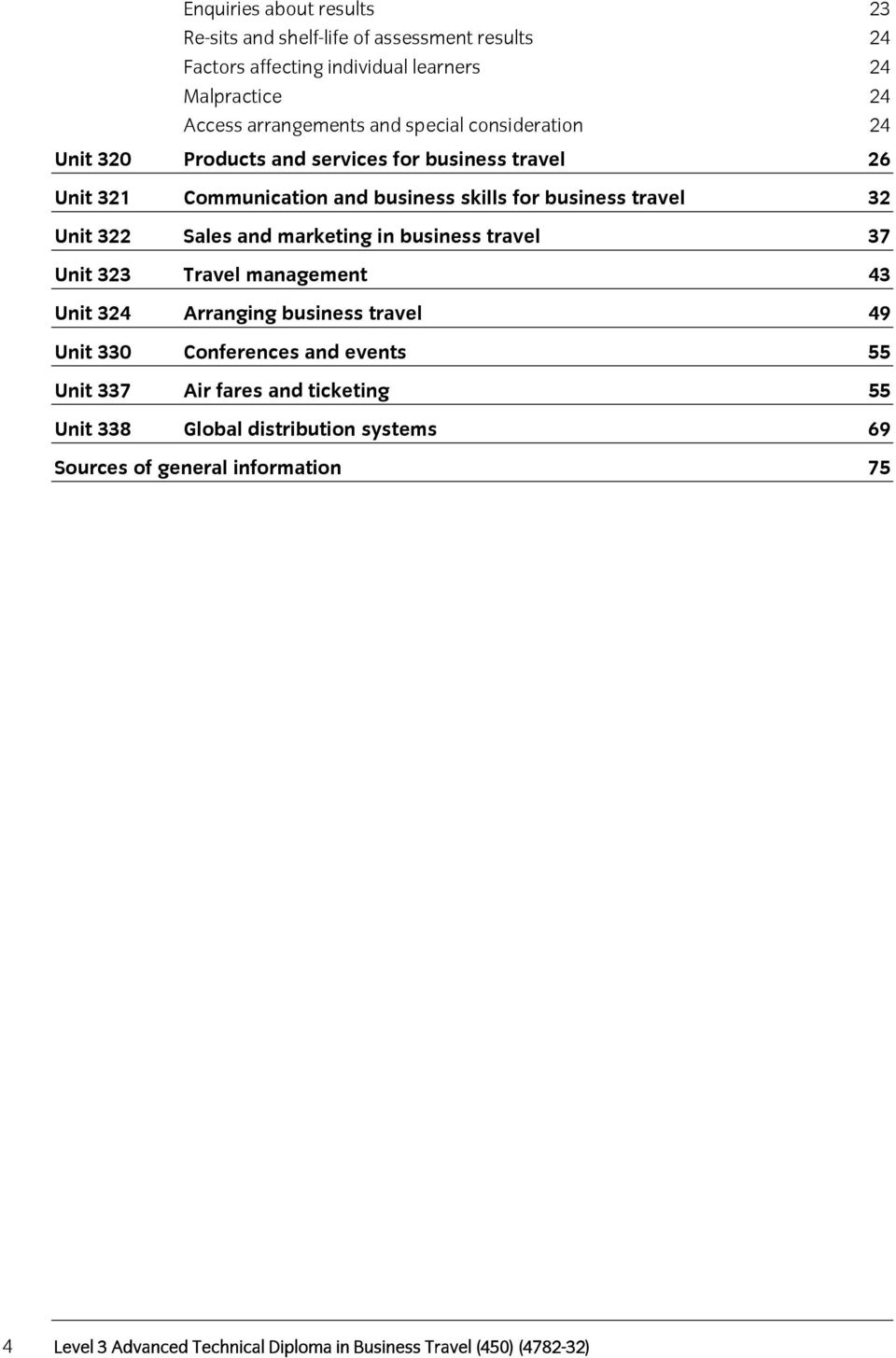
4 Enquiries about results 23 Re-sits and shelf-life of assessment results 24 Factors affecting individual learners 24 Malpractice 24 Access arrangements and special consideration 24 Unit 320 Products and services for business travel 26 Unit 321 Communication and business skills for business travel 32 Unit 322 Sales and marketing in business travel 37 Unit 323 Travel management 43 Unit 324 Arranging business travel 49 Unit 330 Conferences and events 55 Unit 337 Air fares and ticketing 55 Unit 338 Global distribution systems 69 Sources of general information 75 4 Level 3 Advanced Technical Diploma in Business Travel (450) ( )
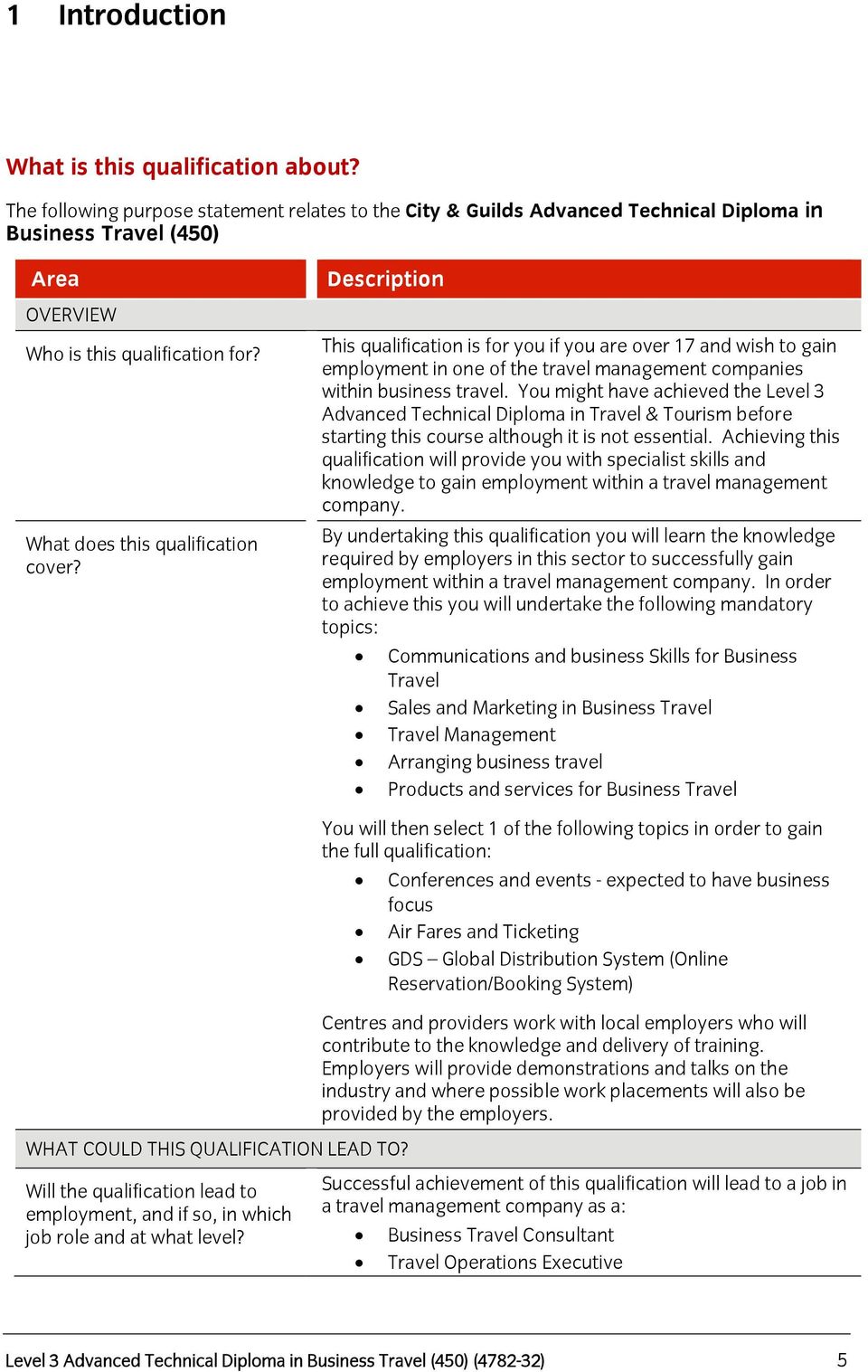
5 1 Introduction What is this qualification about? The following purpose statement relates to the City & Guilds Advanced Technical Diploma in Business Travel (450) Area OVERVIEW Who is this qualification for? What does this qualification cover? Description This qualification is for you if you are over 17 and wish to gain employment in one of the travel management companies within business travel. You might have achieved the Level 3 Advanced Technical Diploma in Travel & Tourism before starting this course although it is not essential. Achieving this qualification will provide you with specialist skills and knowledge to gain employment within a travel management company. By undertaking this qualification you will learn the knowledge required by employers in this sector to successfully gain employment within a travel management company. In order to achieve this you will undertake the following mandatory topics: Communications and business Skills for Business Travel Sales and Marketing in Business Travel Travel Management Arranging business travel Products and services for Business Travel WHAT COULD THIS QUALIFICATION LEAD TO? Will the qualification lead to employment, and if so, in which job role and at what level? You will then select 1 of the following topics in order to gain the full qualification: Conferences and events - expected to have business focus Air Fares and Ticketing GDS Global Distribution System (Online Reservation/Booking System) Centres and providers work with local employers who will contribute to the knowledge and delivery of training. Employers will provide demonstrations and talks on the industry and where possible work placements will also be provided by the employers. Successful achievement of this qualification will lead to a job in a travel management company as a: Business Travel Consultant Travel Operations Executive Level 3 Advanced Technical Diploma in Business Travel (450) ( ) 5
6 Business Development Will the qualification lead to further learning? If there are larger and/or smaller versions of this qualification or it is available at different skills levels, why should a student take this particular one? Successful completion of this qualification will enable you to apply for jobs in any one of the major travel management companies, such as American Express, Portman Travel, Giles Business Travel for example. You will have the opportunity to enter employment, or undertake further learning such as: University events management City & Guilds Advanced Technical Diploma in Leisure Travel & Tourism Travel Consultant Apprenticeship Business or Leisure You will choose this qualification if you are looking specifically for a career in business travel. You might typically have taken this as part of a 2 year programme, where you would have achieved the Level 3 Advanced Technical Diploma in Travel & Tourism in order to ensure you have the flexibility to move roles within the industry. Achieving both qualifications will give you more career options whether on the business travel side, or on the tourism side, however it is not essential to have completed the Level 3 Advanced Technical Diploma in Travel & Tourism. Achieving this qualification alone will provide you with skills that will ensure you meet the requirements to gain employment in the business travel sector. WHO SUPPORTS THIS QUALIFICATION? Industry GTMC 6 Level 3 Advanced Technical Diploma in Business Travel (450) ( )

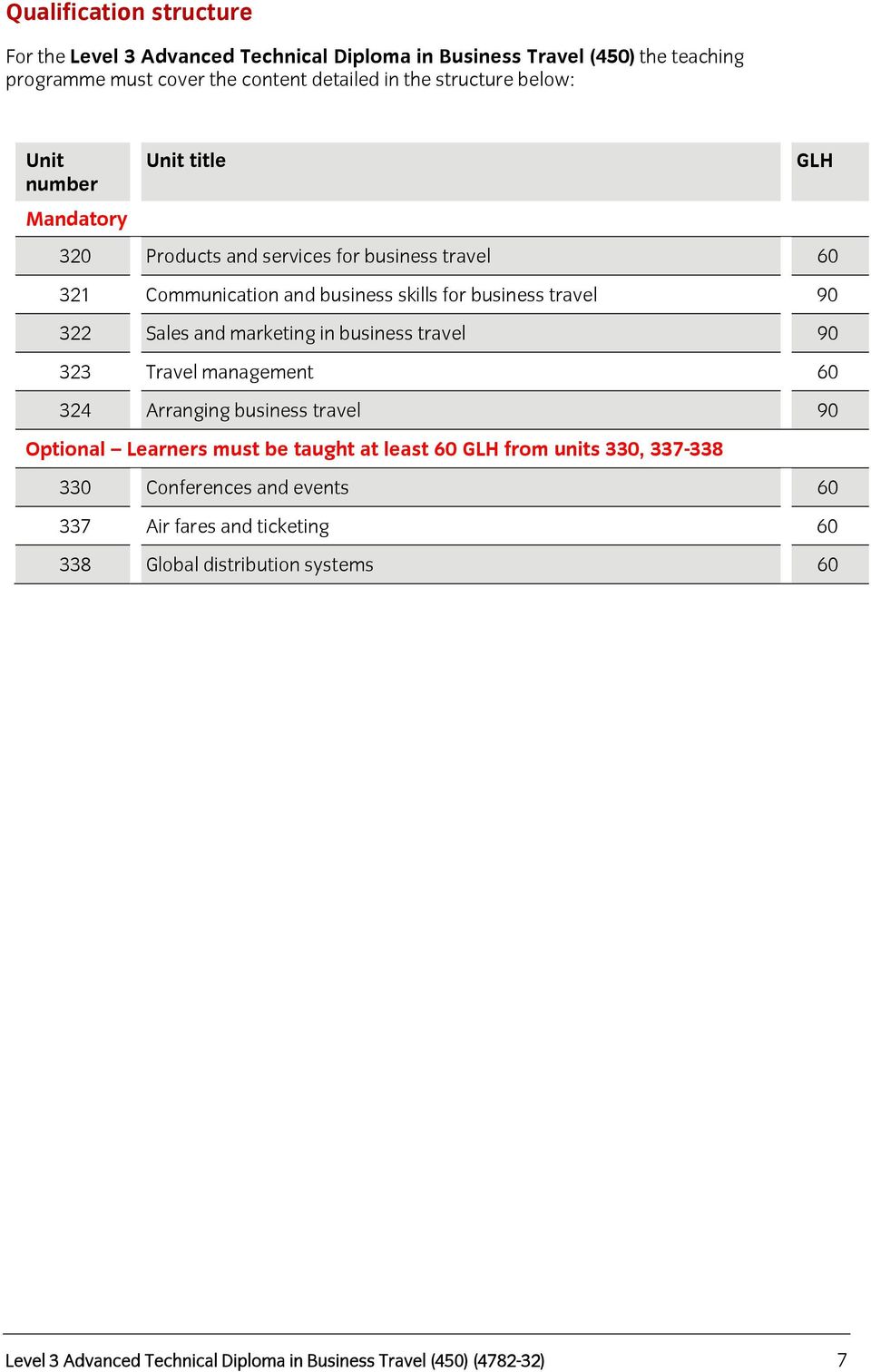
7 Qualification structure For the Level 3 Advanced Technical Diploma in Business Travel (450) the teaching programme must cover the content detailed in the structure below: Unit number Mandatory Unit title 320 Products and services for business travel Communication and business skills for business travel Sales and marketing in business travel Travel management Arranging business travel 90 Optional Learners must be taught at least 60 GLH from units 330, Conferences and events Air fares and ticketing Global distribution systems 60 GLH Level 3 Advanced Technical Diploma in Business Travel (450) ( ) 7
8 Assessment requirements and employer involvement To achieve the Level 3 Advanced Technical Diploma in Business Travel (450) candidates must successfully complete both the mandatory assessment components as well as the optional assessment components for their chosen optional units. Component number Mandatory Title 006 Externally set, externally moderated synoptic assignment 005 Externally set, externally marked test Optional 330 Conferences and events 337 Air fares and ticketing 338 Global distribution systems In addition, candidates must achieve the mandatory employer involvement requirement for this qualification before they can be awarded a qualification grade. For more information, please see guidance in Section 4: Employer involvement. Employer involvement Component number Mandatory Title 832 Employer involvement 8 Level 3 Advanced Technical Diploma in Business Travel (450) ( )

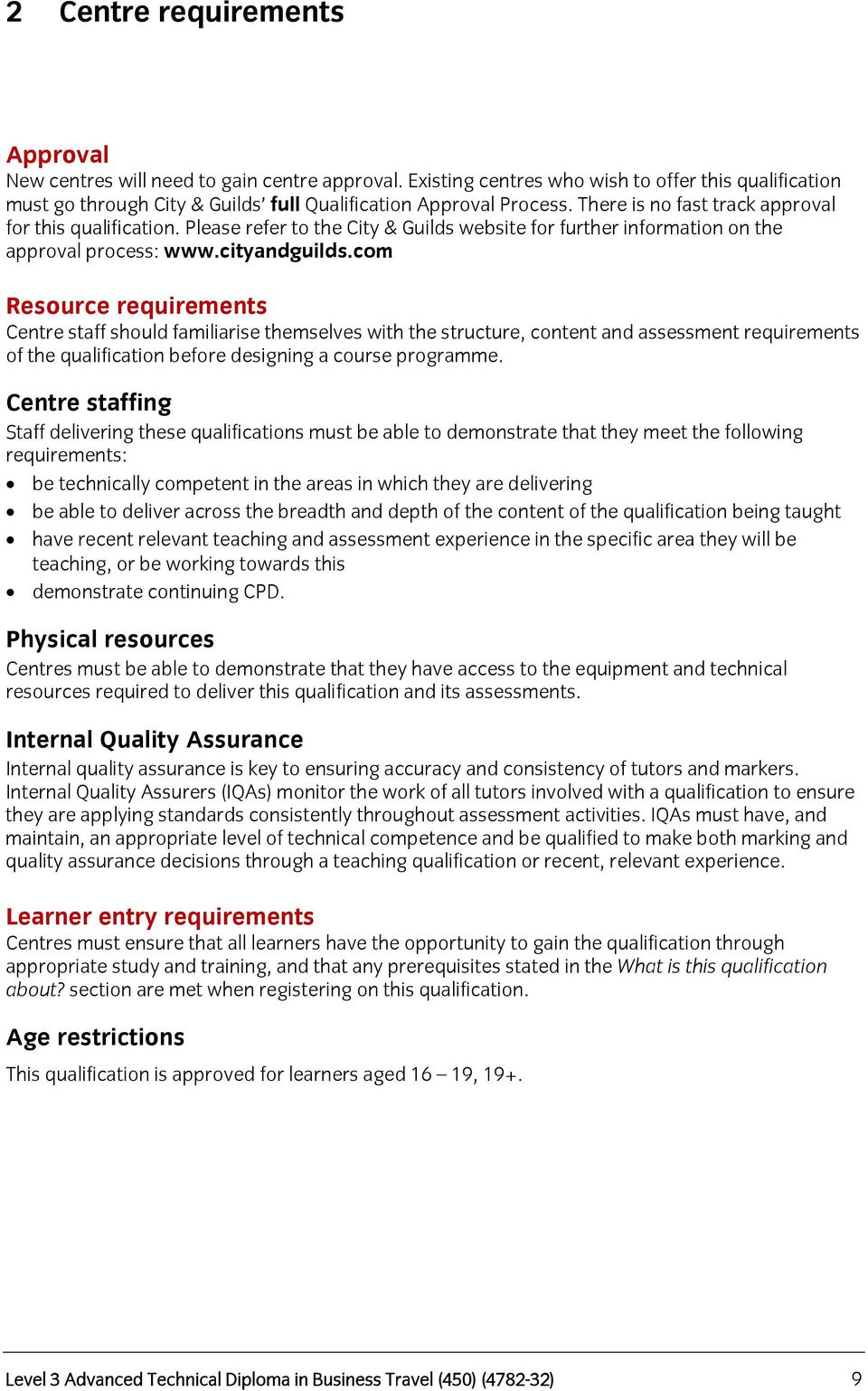
9 2 Centre requirements Approval New centres will need to gain centre approval. Existing centres who wish to offer this qualification must go through City & Guilds full Qualification Approval Process. There is no fast track approval for this qualification. Please refer to the City & Guilds website for further information on the approval process: Resource requirements Centre staff should familiarise themselves with the structure, content and assessment requirements of the qualification before designing a course programme. Centre staffing Staff delivering these qualifications must be able to demonstrate that they meet the following requirements: be technically competent in the areas in which they are delivering be able to deliver across the breadth and depth of the content of the qualification being taught have recent relevant teaching and assessment experience in the specific area they will be teaching, or be working towards this demonstrate continuing CPD. Physical resources Centres must be able to demonstrate that they have access to the equipment and technical resources required to deliver this qualification and its assessments. Internal Quality Assurance Internal quality assurance is key to ensuring accuracy and consistency of tutors and markers. Internal Quality Assurers (IQAs) monitor the work of all tutors involved with a qualification to ensure they are applying standards consistently throughout assessment activities. IQAs must have, and maintain, an appropriate level of technical competence and be qualified to make both marking and quality assurance decisions through a teaching qualification or recent, relevant experience. Learner entry requirements Centres must ensure that all learners have the opportunity to gain the qualification through appropriate study and training, and that any prerequisites stated in the What is this qualification about? section are met when registering on this qualification. Age restrictions This qualification is approved for learners aged 16 19, 19+. Level 3 Advanced Technical Diploma in Business Travel (450) ( ) 9
10 3 Delivering technical qualifications Initial assessment and induction An initial assessment of each learner should be made before the start of their programme to identify: if the learner has any specific training needs, support and guidance they may need when working towards their qualification, the appropriate type and level of qualification. We recommend that centres provide an introduction so that learners fully understand the requirements of the qualification, their responsibilities as a learner, and the responsibilities of the centre. This information can be recorded on a learning contract. Employer involvement Employer involvement is essential to maximise the value of each learner s experience. Centres are required to involve employers in the delivery of technical qualifications and/or their assessment, for every learner. This must be in place or planned before delivery programmes begin in order to gain qualification approval. See Section 4: Employer involvement for more detail. Support materials The following resources are available for this qualification: Description Sample assessments Guidance for delivery Guidance on use of marking grids How to access Available 2016 on the qualification pages on the City & Guilds Website: 10 Level 3 Advanced Technical Diploma in Business Travel (450) ( )

11 4 Employer involvement Department for Education (DfE) requirements state: Employer involvement in the delivery and/or assessment of technical qualifications provides a clear line of sight to work, enriches learning, raises the credibility of the qualification in the eyes of employers, parents and students and furthers collaboration between the learning and skills sector and industry. [Technical qualifications] must: require all students to undertake meaningful activity involving employers during their study; and be governed by quality assurance procedures run by the awarding organisation to confirm that education providers have secured employer involvement for every student. Extract from: Vocational qualifications for 16 to 19 year olds 2017 and 2018 performance tables: technical guidance for awarding organisations, DfE (2015) paragraphs City & Guilds will provide support and quality assurance of employer involvement. Qualification approval To be approved to offer City & Guilds technicals, the centres must provide an action plan showing how every learner will be able to experience meaningful employer involvement, and from where sufficient and suitable employer representatives are expected to be sourced for their learners. Centres must include in their plan sufficient activities throughout the learning programme that provide a range of employer interactions for learners. Centres must also describe how they will make contingencies for learners who may miss events through absence. Centres which cannot show sufficient commitment from employers and/or a credible activity plan will be given an action for improvement with a realistic timescale for completion. Approval will not be given if employer involvement cannot be assured either at the start of the qualification, or through an appropriate plan of action to address this requirement before the learner is certificated. Monitoring and reporting learner engagement Employer involvement is a formal component of this qualification so centres must gather evidence that demonstrates that each learner has been involved in meaningful employer based activities against the mandatory content before claiming the Employer involvement component for learners. Centres must record the range and type of employer involvement each learner has experienced. These records must be available for review by External Quality Assurers (EQAs) on request. Types of involvement Centres should note that to be eligible, employer involvement activities must relate to one or more elements of the mandatory content of this qualification. This does not mean that employer involvement in the optional units is not valuable, and centres are encouraged to consider this wherever appropriate. This will be quality assured by City & Guilds and any candidate who does not meet this criteria will not be able to achieve the qualification certificate. As the aim of employer involvement is to enrich learning and to give learners a taste of the expectations of employers in the industry area they are studying, centres are encouraged to work creatively with local employers. Level 3 Advanced Technical Diploma in Business Travel (450) ( ) 11
![[Technical qualifications] must: require all students to undertake meaningful activity involving employers during their study; and be governed by quality assurance procedures run by the awarding](/docs-images/42/14668260/images/page_11.jpg "organisation to confirm that education providers have secured employer involvement for every student.")
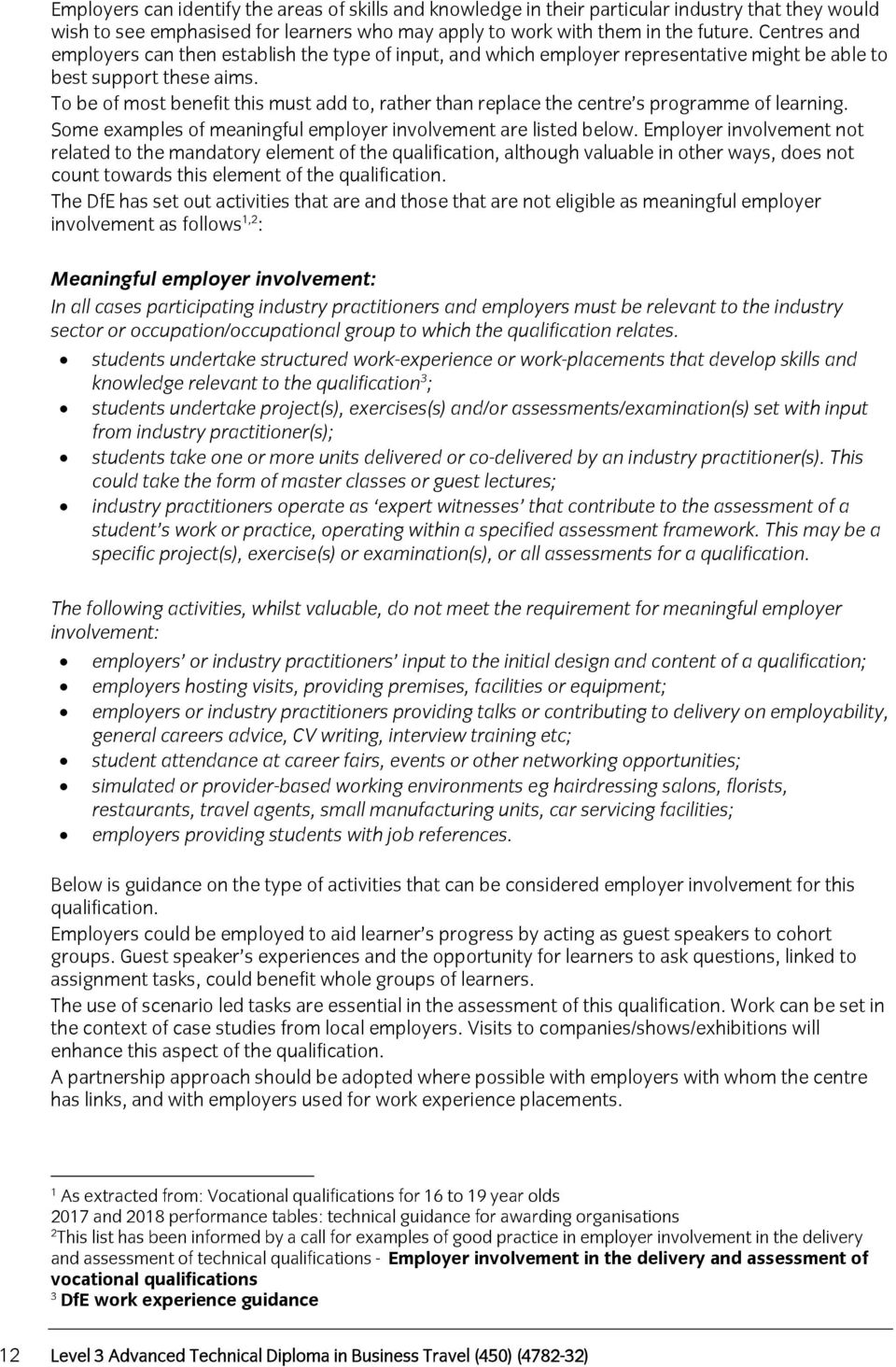
12 Employers can identify the areas of skills and knowledge in their particular industry that they would wish to see emphasised for learners who may apply to work with them in the future. Centres and employers can then establish the type of input, and which employer representative might be able to best support these aims. To be of most benefit this must add to, rather than replace the centre s programme of learning. Some examples of meaningful employer involvement are listed below. Employer involvement not related to the mandatory element of the qualification, although valuable in other ways, does not count towards this element of the qualification. The DfE has set out activities that are and those that are not eligible as meaningful employer involvement as follows 1,2 : Meaningful employer involvement: In all cases participating industry practitioners and employers must be relevant to the industry sector or occupation/occupational group to which the qualification relates. students undertake structured work-experience or work-placements that develop skills and knowledge relevant to the qualification 3 ; students undertake project(s), exercises(s) and/or assessments/examination(s) set with input from industry practitioner(s); students take one or more units delivered or co-delivered by an industry practitioner(s). This could take the form of master classes or guest lectures; industry practitioners operate as expert witnesses that contribute to the assessment of a student s work or practice, operating within a specified assessment framework. This may be a specific project(s), exercise(s) or examination(s), or all assessments for a qualification. The following activities, whilst valuable, do not meet the requirement for meaningful employer involvement: employers or industry practitioners input to the initial design and content of a qualification; employers hosting visits, providing premises, facilities or equipment; employers or industry practitioners providing talks or contributing to delivery on employability, general careers advice, CV writing, interview training etc; student attendance at career fairs, events or other networking opportunities; simulated or provider-based working environments eg hairdressing salons, florists, restaurants, travel agents, small manufacturing units, car servicing facilities; employers providing students with job references. Below is guidance on the type of activities that can be considered employer involvement for this qualification. Employers could be employed to aid learner s progress by acting as guest speakers to cohort groups. Guest speaker s experiences and the opportunity for learners to ask questions, linked to assignment tasks, could benefit whole groups of learners. The use of scenario led tasks are essential in the assessment of this qualification. Work can be set in the context of case studies from local employers. Visits to companies/shows/exhibitions will enhance this aspect of the qualification. A partnership approach should be adopted where possible with employers with whom the centre has links, and with employers used for work experience placements. 1 As extracted from: Vocational qualifications for 16 to 19 year olds 2017 and 2018 performance tables: technical guidance for awarding organisations 2 This list has been informed by a call for examples of good practice in employer involvement in the delivery and assessment of technical qualifications - Employer involvement in the delivery and assessment of vocational qualifications 3 DfE work experience guidance 12 Level 3 Advanced Technical Diploma in Business Travel (450) ( )
13 It would be helpful for tutors to develop a method of maintaining contact with a range of employers in the sectors who may be able to help with keeping the examples of legislation, policies and codes of practice used in the taught content up to date. Types of evidence The types of evidence required to support a claim for this component will vary depending on the nature of the involvement. Eg for a guest lecture it is expected that a synopsis of the lecture and register would be taken which each learner and the guest speaker will have signed; expert witnesses will be identified and will have signed the relevant assessment paperwork for each learner they have been involved in assessing; evidence of contribution from employers to the development of locally set or adapted assignments. Quality assurance process After approval and during the first year of delivery, EQAs will request final plans and records of employer involvement activities that have taken place to ensure that the plans are sufficient and to provide support and guidance if involvement is not sufficient. Evidence will be validated by EQAs before centres can claim the Employer Involvement component for each learner. Where employer involvement is not judged to be sufficient, certificates cannot be claimed for learners. Sufficiency of involvement for each learner It is expected that the centre will plan a range of activities that provide sufficient live involvement for each learner to have opportunities to interact directly with a range of individuals employed in the related industry. Centres must also provide contingencies for learners who may be absent for part of their teaching, so that they are not disadvantaged. Any absence that results in a learner missing arranged activities must be documented. Live involvement Learners will gain most benefit from direct interaction with employers and/or their staff; however the use of technology (eg the use of live webinars) is encouraged to maximise the range of interactions. Where learners are able to interact in real time with employers, including through the use of technology, this will be classed as live involvement. It is considered good practice to record learning activities, where possible, to allow learners to revisit their experience and to provide a contingency for absent learners. This is not classed as live involvement however, and any involvement of this type for a learner must be identified as contingency. Timing A learner who has not met the minimum requirements cannot be awarded the component, and will therefore not achieve the qualification. It is therefore important that employer involvement is not left until the end of the qualification, and that centres monitor and provide contingencies throughout the learning period. Level 3 Advanced Technical Diploma in Business Travel (450) ( ) 13

14 5 Assessment Summary of assessment methods and conditions Component numbers Assessment method 006 Externally moderated synoptic assignment Description and conditions These assignments are externally set, internally marked and externally moderated, and are designed to require the candidate to identify and use effectively in an integrated way an appropriate selection of skills, techniques, concepts, theories, and knowledge from across the whole content area. Candidates will be judged against the assessment objectives listed on page 17. Assignments will be released to centre staff towards the end of the learners programme, usually the week before Easter each year Centres will be required to maintain the security of all live assessment materials until assessment windows are open. Assignments will therefore be password protected and released to centres through a secure method. Guidance on equipment, resources and duration will be released as appropriate to ensure centres can plan for delivery of practical assignments in advance. The marking grids for the assignment will be available to centres from the start of the learning programme. Candidates who fail this assignment on first submission of marks will have one opportunity to re-sit, and must sit a new task or assignment different to the original assessment. If the re-sit is failed the candidate will fail the qualification as a whole, and cannot achieve the qualification within that academic year. Please note that for externally set assignments City & Guilds provides guidance and support to centres on the marking process and associated marking grid in the assessment pack for the qualification, and in the Guidance on the use of marking grids. 14 Level 3 Advanced Technical Diploma in Business Travel (450) ( )

15 Component numbers Assessment method 005 Externally marked test Externally moderated assignment Description and conditions This test is externally set and externally marked, and will be sat online through City & Guilds computer-based testing platform. The test is designed to assess candidate s depth and breadth of understanding across the mandatory content in the qualification at the end of the period of learning, and will be sat under invigilated examination conditions. See JCQ requirements for details: The test specification on page 18 shows the coverage of this test across the qualification content. Candidates who fail this test at the first sitting will have one opportunity to re-sit the test. If the re-sit is failed the candidate will fail the qualification as a whole, and cannot achieve the qualification within that academic year. These assignments are externally set, internally marked and externally moderated, and are designed to assess a specific optional task or area of the qualification. To do this, the candidate will be required to identify and use effectively an appropriate selection of skills, techniques, concepts, theories, and knowledge from across the whole content area. Assignments will be released to centre staff towards the end of the candidates learning programme, this is expected to be the week before Easter each year. Centres will be required to maintain the security of all live assessment materials until assessment windows open. Assignments will therefore be password protected and released to centres through a secure method. Guidance on equipment, resources and duration will be released as appropriate to ensure centres can plan for delivery of practical assignments in advance. Candidates who fail this assignment on first submission of marks will have only one opportunity to re-sit, and must sit a new task or assignment different to the original assessment. If the re-sit is failed the candidate will be a fail for the qualification as a whole, and cannot achieve the qualification within that academic year. Level 3 Advanced Technical Diploma in Business Travel (450) ( ) 15

16 What is synoptic assessment? Technical qualifications are based around the development of a toolkit of knowledge, understanding and skills that an individual needs in order to have the capability to work in a particular industry or occupational area. Individuals in all technical areas are expected to be able to apply their knowledge, understanding and skills in decision making to solve problems and achieve given outcomes independently and confidently. City & Guilds technical qualifications require candidates to draw together their learning from across the qualification to solve problems or achieve specific outcomes by explicitly assessing this through the synoptic assignment component. In this externally set, internally marked and externally moderated assessment the focus is on bringing together, selecting and applying learning from across the qualification rather than demonstrating achievement against units or subsets of the qualification content. The candidate will be given an appropriately levelled, substantial, occupationally relevant problem to solve or outcome to achieve. For example this might be in the form of a briefing from a client, leaving the candidate with the scope to select and carry out the processes required to achieve the client s wishes, as they would in the workplace. Candidates will be marked against assessment objectives (AOs) such as their breadth and accuracy of knowledge, understanding of concepts, and the quality of their technical skills as well as their ability to use what they have learned in an integrated way to achieve a considered and high quality outcome. These are detailed on page 17. How the assignment is synoptic for this qualification The typical assignment brief could be to prepare a pitch for new business based on a detailed client brief. This would include producing a customer service charter, cover the role of a travel management company (TMC), produce sample itineraries based on the brief, produce a report on what business class service means, and finally pitching the idea. This will require the candidate to draw on their knowledge and skills developed across the qualification content to complete these tasks effectively. This will require the candidate to identify and plan how to meet this the client s needs using their understanding of both the information available on destinations and business travel, and how these can be implemented. They will need to develop appropriate documentation and finally pitch for the business. External test for stretch, challenge and integration The external assessment will draw from across the mandatory content of the qualification, using a range of shorter questions to confirm breadth of knowledge and understanding. Extended response questions are included, giving candidates the opportunity to demonstrate higher level understanding and integration through discussion, analysis and evaluation, and ensuring the assessment can differentiate between just able and higher achieving candidates. Optional unit assessments and integration into the synoptic qualification content While the mandatory units for this qualification provide the main skills and knowledge required to work in travel and tourism the optional units provided give centres flexibility when devising programmes to meet local employment needs, where the purpose of the qualification demands this. The assessments for the optional units will require that the candidate has experienced the full breadth of mandatory learning of the qualification in order to better demonstrate the rounded performance expected at higher grades. 16 Level 3 Advanced Technical Diploma in Business Travel (450) ( )
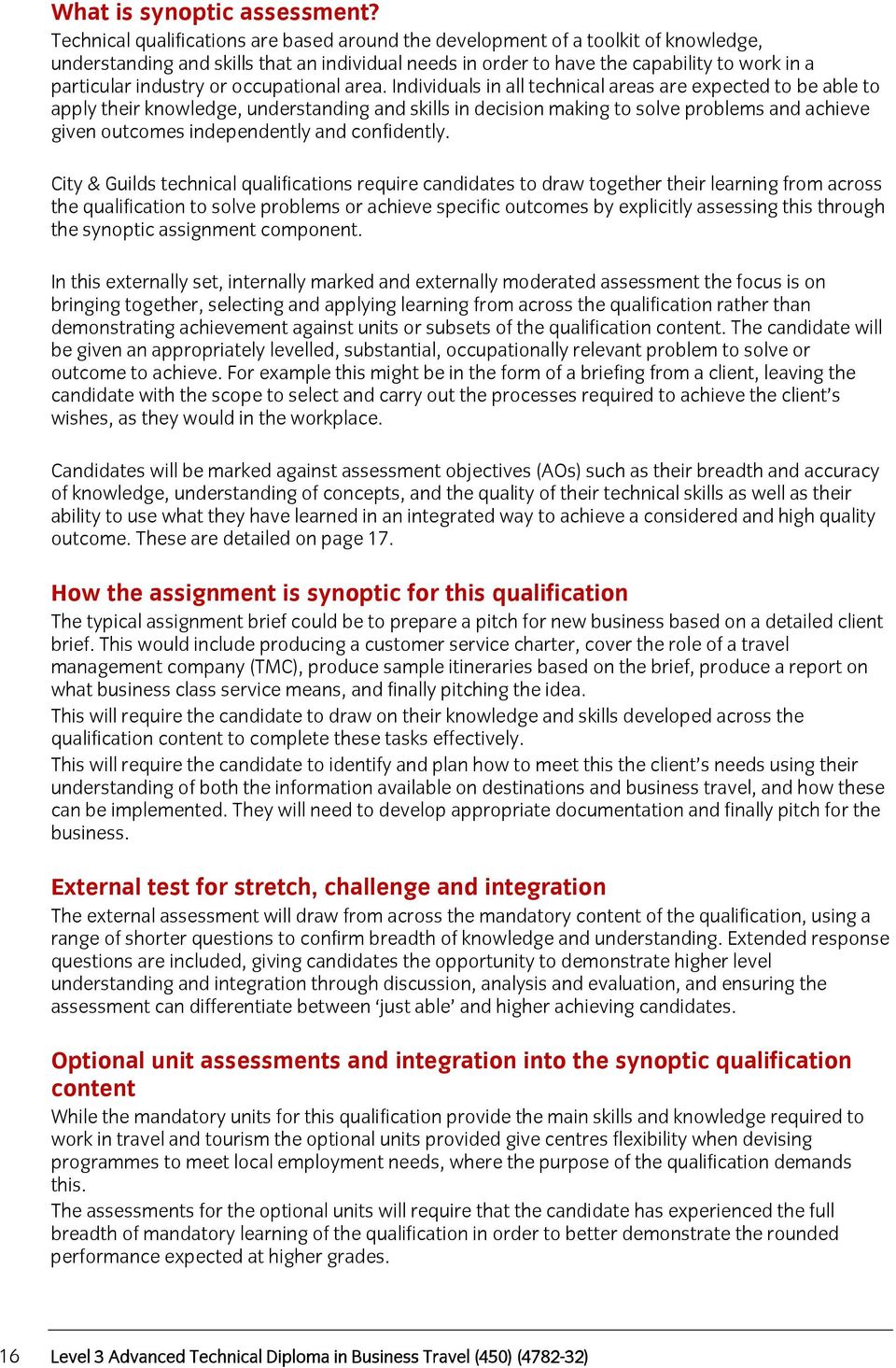
17 Assessment objectives The assessments for this qualification are set against a set of assessment objectives (AOs) which are used across all City & Guilds Technicals to promote consistency among qualifications of a similar purpose. They are designed to allow judgement of the candidate to be made across a number of different categories of performance. Each assessment for the qualification has been allocated a set number of marks against these AOs based on weightings recommended by stakeholders of the qualification. This mark allocation remains the same for all versions of the assessments, ensuring consistency across assessment versions and over time. The following table explains all AOs in detail, including weightings for the synoptic assignments. In some cases, due to the nature of a qualification s content, it is not appropriate to award marks for some AOs. Where this is the case these have been marked as N/A. Weightings for tests (AOs 1, 2 and 4 only) can be found with the test specification. Assessment objective AO1 Recalls knowledge from across the breadth of the qualification. AO2 Demonstrates understanding of concepts, theories and processes from across the breadth of the qualification. AO3 Demonstrates technical skills from across the breadth of the qualification. AO4 Applies knowledge, understanding and skills from across the breadth of the qualification in an integrated and holistic way to achieve specified purposes. AO5 Demonstrates perseverance in achieving high standards and attention to detail while showing an understanding of wider impact of their actions. AO6 Undertakes independent research for a purpose and uses information/data effectively. AO7 Demonstrates originality and creativity to experiment and innovate Level 3 Advanced Technical Diploma in Business Travel (450) Typical expected evidence of knowledge, understanding and skills Roles and responsibilities, terminology, travel geography, levels of service for business class travellers. service level agreement/travel policies, content of itineraries, business customer needs itineraries production and content, presentation, customer charter, levels of service offered. itineraries, presentation, customer charter, levels of service offered, personal reflect/ evaluation. Approximate weighting (Assignment) 10% 20% 10% 20% itineraries, presentation, customer charter. 10% Using a range of sources (e.g. internet, books, journals, relevant non-confidential workplace policies and procedures), selection of research material and sources Presentation, leaflets, customer charter, itineraries. 10% 10% Level 3 Advanced Technical Diploma in Business Travel (450) ( ) 17
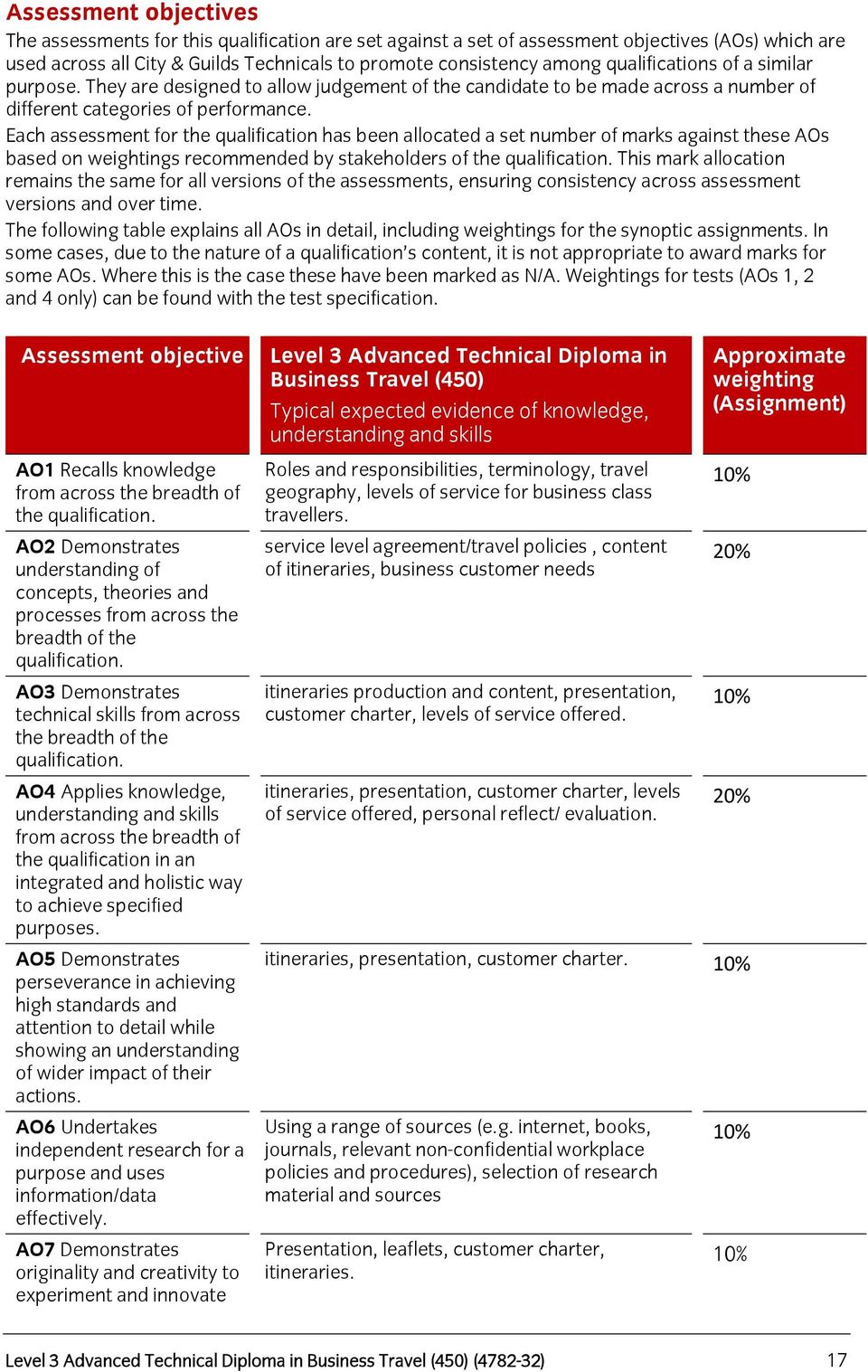
18 beyond conventional application of designs and/or use of materials. AO8 Communicates effectively, accurately and appropriately for the intended audience. use of accurate presentation, assignment and report writing skills, layout and presentation aid effective communication of information, coherence of arguments, well expressed sentence structure (syntax) and grammar 10% Test specification AO weightings per test AO AO1 Recalls knowledge from across the breadth of the qualification. AO2 Demonstrates understanding of concepts, theories and processes from across the breadth of the qualification. AO4 Applies knowledge, understanding and skills from across the breadth of the qualification in an integrated and holistic way to achieve specified purposes. Test (005) weighting (approx. %) The way the test covers the content of the qualification is laid out in the table below: Assessment type: Examiner marked, written test* Assessment conditions: Invigilated examination conditions Grading: X/P/M/D 005 Duration: 1 hour Unit Outcome Number of % marks 320 Products and services for business travel 6 10% 321 Communication and business skills for travel 6 10% 322 Sales and marketing in business travel 8 13% 324 Arranging business travel 28 46% N/A Integration across the units 12 20% Total *These tests are sat under invigilated examination conditions, as defined by the JCQ: Entry for tests can be made through the City & Guilds Walled Garden. 18 Level 3 Advanced Technical Diploma in Business Travel (450) ( )

19 6 Moderation and standardisation of assessment City & Guilds externally set assignments for technical qualifications are designed to draw from across the qualifications content, and to contribute a significant proportion towards the learner s final qualification grade. They are subject to a rigorous external quality assurance process known as external moderation. This process is detailed below. Internal standardisation For internally marked work 4 the centre is required to conduct internal standardisation to ensure that all work at the centre has been marked to the same standard. If two or more tutors are involved in marking assessments, one must be designated as the lead marker responsible for internal standardisation. The lead marker takes responsibility during standardisation for ensuring a single approach and standard is achieved. If there is a disagreement the lead marker will have the final say. For standardisation purposes, before final marking takes place, common pieces of work must be selected and marked by all markers, and any differences between interpretation and marks awarded must be discussed and reconciled at an internal standardisation session in which all markers must participate. The Internal Quality Assurer (IQA) must ensure that the training includes the use of reference and archive materials such as work from previous years as appropriate. The IQA must sign the Centre Declaration Sheet (CDS) to confirm that internal standardisation has taken place. If only one tutor has undertaken the marking, that person must sign this form. The completed record form must be attached to each candidate s work and the CDS must be submitted to City & Guilds during the moderation. The record form and CDS must be signed in order for the candidate s results to be processed. Supervision and authentication of internally assessed work The Head of Centre is responsible for ensuring that internally assessed work is conducted in accordance with City & Guilds requirements. City & Guilds requires: candidates to sign the Declaration of authenticity form to confirm that any work submitted is their own tutors to confirm on the record form that the work assessed is solely that of the candidate concerned and was conducted under the conditions laid down in the assessment documentation The tutor must be sufficiently aware of the candidate s standard and level of work to make a judgement whether the work submitted is within the expected ability and style of the candidate or whether a further investigation into the authenticity of the work is required. If the tutor is unable to sign the authentication statement for a particular candidate, then the candidate s work cannot be accepted for assessment. 4 For any internally assessed optional unit assignments, the same process must be followed where assessors must standardise their interpretation of the assessment and grading criteria. Level 3 Advanced Technical Diploma in Business Travel (450) ( ) 19

20 Moderation Moderation is the process where external examiners are standardised to a national standard in order to review centre marking of internally marked assessments. These examiners are referred to as moderators. Moderators will mark a representative sample of candidates work from every centre. Their marks act as a benchmark to inform City & Guilds whether centre marking is in line with the national standard. Where moderation shows that the centre is applying the marking criteria correctly, centre marks for the whole cohort will be accepted. Where moderation shows that the centre is either consistently too lenient or consistently too harsh in comparison to the national standard, an appropriate adjustment will be made to the marks of the whole cohort, retaining the centre s rank ordering. Where centre application of the marking criteria is inconsistent, an appropriate adjustment for the whole cohort may not be possible on the basis of the sample of candidate work. In these instances a complete remark of the candidate work may be necessary. This may be carried out by the centre based on feedback provided by the moderator, or carried out by the moderator directly. Moderation applies to all internally marked assignments. Following standardisation and marking, the centre submits all marks and candidate work to City & Guilds. This may involve digital or postal submission. The deadline for submission of evidence will be available on Walled Garden. In most cases candidate work will be submitted directly to the moderator for moderation, either postally or electronically. This includes written work, photographic and pictorial evidence, or video and audio evidence. For some qualifications there will be a requirement for moderators to visit centres to observe practical assessments being undertaken. This will be for qualifications where the assessment of essential learner skills can only be demonstrated through live observation. The purpose of these visits is to ensure that the centre is assessing the practical skills to the required standards, and to provide the moderators with additional evidence to be used during moderation. These visits will be planned in advance with the centre for all relevant qualifications. Post-moderation procedures Once the moderation process has been completed, the confirmed marks for the cohort are provided to the centre along with feedback from the moderator on the standard of marking at the centre, highlighting areas of good practice, and potential areas for improvement. This will inform future marking and internal standardisation activities. City & Guilds will then select a sample of work to be used for awarding, the process by which grade boundaries are set. Centres retaining evidence Centres must also retain assessment records for each candidate for a minimum of three years. To help prevent plagiarism or unfair advantage in future versions, candidate work may not be returned to candidates. Samples may however be retained by the centre as examples for future standardisation of marking. Use of technology and innovation City & Guilds will set evidence requirements for moderated assignments based on their fitness for purpose in terms of validity, reliability and manageability. This will include use of digital evidence and new technologies to support the moderation process wherever current available technology allows. 20 Level 3 Advanced Technical Diploma in Business Travel (450) ( )

21 7 Grading Awarding individual assessments Individual assessments will be graded pass/merit/distinction where relevant. The grade boundaries for pass and distinction for each assessment will be set through a judgemental process using technical experts. Merit will usually be set at the midpoint between pass and distinction. The grade descriptors for pass and distinction, and other relevant information (eg archived samples of candidate work and statistical evidence) will be used to determine the mark at which candidate performance in the assessment best aligns with the grade descriptor in the context of the qualification s purpose. Boundaries will be set for each version of each assessment to take into account relative difficulty. Grade descriptors To achieve a pass, a candidate will be able to Demonstrate the knowledge and understanding required to work in the occupational area, its principles, practices and legislation. Describe some of the main factors impacting on the occupation to show good understanding of how work tasks are shaped by the broader social, environmental and business environment it operates within. Use the technical industry specific terminology used in the industry accurately. Demonstrate the application of relevant theory and understanding to solve non-routine problems. Interpret a brief for complex work related tasks, identifying the key aspects, and showing a secure understanding of the application of concepts to specific work related tasks. Carry out planning which shows an ability to identify and analyse the relevant information in the brief and use knowledge and understanding from across the qualification (including complex technical information) to interpret what a fit for purpose outcome would be and develop a plausible plan to achieve it. Achieve an outcome which successfully meets the key requirements of the brief. Identify and reflect on the most obvious measures of success for the task and evaluate how successful they have been in meeting the intentions of the plan. Work safely throughout, independently carrying out tasks and procedures, and having some confidence in attempting the more complex tasks. To achieve a distinction, a candidate will be able to Demonstrate the excellent knowledge and understanding required to work to a high level in the occupational area, its principles, practices and legislation. Analyse the impact of different factors on the occupation to show deep understanding of how work tasks are shaped by the broader social, environmental, and business environment it operates within. Demonstrate the application of relevant theory and understanding to provide efficient and effective solutions to complex and non-routine problems. Analyse the brief in detail, showing confident understanding of concepts and themes from across the qualification content, bringing these together to develop a clear and stretching plan, that would credibly achieve an outcome that is highly fit for purpose. Achieve an outcome which shows an attention to detail in its planning, development and completion, so that it completely meets or exceeds the expectations of the brief to a high standard. Carry out an evaluation in a systematic way, focussing on relevant quality points, identifying areas of development/ improvement as well as assessing the fitness for purpose of the outcome. Level 3 Advanced Technical Diploma in Business Travel (450) ( ) 21
22 Awarding qualification grades, including Distinction* Qualification grades will be calculated based on a sum of the candidates achievement across the mandatory assessments, and taking into account the assessments weighting. Candidates achieving distinction* will be the highest achieving of the distinction candidates. The boundary for distinction* will be set at the midpoint between the distinction boundary and the maximum point score. The qualification grade is calculated automatically as follows, using a calculation approved by expert judges. All assessments must be achieved at a minimum of pass for the qualification to be awarded. The contribution of the assessments towards the overall qualification grade is as follows: Assessment method Grade scale % contribution Assignment (006) X/P/M/D 60% Test (005) X/P/M/D 40% Both assignments and tests are awarded (see Awarding individual assessments above), and candidates grades converted to points. All points between the pass, merit and distinction boundaries will be accessible to candidates. The range of points available for each assessment grade is listed in the table below. The points above the minimum for the grade are calculated based on the candidate s score in the assessment. Test: 40% Pass Merit Distinction Assignment: 60% The candidate s points for each assessment are added together, and the overall grade of the [INCLUDE TITLE] will then be determined using the following qualification grade boundaries. Qualification Grade Minimum points Distinction* 18 Distinction 15 Merit 10 Pass 5 22 Level 3 Advanced Technical Diploma in Business Travel (450) ( )
23 8 Administration Approved centres must have effective quality assurance systems to ensure valid and reliable delivery and assessment of qualifications. Quality assurance includes initial centre registration by City & Guilds and the centre s own internal procedures for monitoring quality assurance procedures. Consistent quality assurance requires City & Guilds and its associated centres to work together closely; our Quality Assurance Model encompasses both internal quality assurance (activities and processes undertaken within centres) and external quality assurance (activities and processes undertaken by City & Guilds). For this qualification, standards and rigorous quality assurance are maintained by the use of: internal quality assurance City & Guilds external moderation. In order to carry out the quality assurance role, Internal Quality Assurers (IQAs) must have and maintain an appropriate level of technical competence and have recent relevant assessment experience. For more information on the requirements, refer to Section 2: Centre requirements in this handbook. To meet the quality assurance criteria for this qualification, the centre must ensure that the following procedures are followed: suitable training of staff involved in the assessment of the qualification to ensure they understand the process of marking and standardisation completion by the person responsible for internal standardisation of the Centre Declaration Sheet to confirm that internal standardisation has taken place the completion by candidates and supervisors/tutors of the record form for each candidate s work. External quality assurance City & Guilds will undertake external moderation activities to ensure that the quality assurance criteria for this qualification are being met. Centres must ensure that they co-operate with City & Guilds staff and representatives when undertaking these activities. City & Guilds requires the Head of Centre to facilitate any inspection of the centre which is undertaken on behalf of City & Guilds make secure arrangements to receive, check and keep assessment material secure at all times, maintain the security of City & Guilds confidential material from receipt to the time when it is no longer confidential and keep completed assignment work and examination scripts secure from the time they are collected from the candidates to their dispatch to City & Guilds. Enquiries about results The services available for enquiries about results include a review of marking for assignment and test results. Requests must be submitted within the specified period after the publication of results for individual assessments. For further details of enquiries about results services, please visit the City & Guilds website at Level 3 Advanced Technical Diploma in Business Travel (450) ( ) 23
24 Re-sits and shelf-life of assessment results Candidates who have failed an assessment or wish to re-take it in an attempt to improve their grade, can re-sit this assessment once only. The best result will count towards the final qualification. Factors affecting individual learners If work is lost, City & Guilds should be notified immediately of the date of the loss, how it occurred, and who was responsible for the loss. Centres should use the JCQ form, JCQ/LCW, to inform City & Guilds Customer Services of the circumstances. Learners who move from one centre to another during the course may require individual attention. Possible courses of action depend on the stage at which the move takes place. Centres should contact City & Guilds at the earliest possible stage for advice about appropriate arrangements in individual cases. Malpractice Please refer to the City & Guilds guidance notes Managing cases of suspected malpractice in examinations and assessments. This document sets out the procedures to be followed in identifying and reporting malpractice by candidates and/or centre staff and the actions which City & Guilds may subsequently take. The document includes examples of candidate and centre malpractice and explains the responsibilities of centre staff to report actual or suspected malpractice. Centres can access this document on the City & Guilds website. Examples of candidate malpractice are detailed below (please note that this is not an exhaustive list): falsification of assessment evidence or results documentation plagiarism of any nature collusion with others copying from another candidate (including the use of ICT to aid copying), or allowing work to be copied deliberate destruction of another s work false declaration of authenticity in relation to assessments impersonation. These actions constitute malpractice, for which a penalty (eg disqualification from the assessment) will be applied. Where suspected malpractice is identified by a centre after the candidate has signed the declaration of authentication, the Head of Centre must submit full details of the case to City & Guilds at the earliest opportunity. Please refer to the form in the document Managing cases of suspected malpractice in examinations and assessments. Alternatively please complete the form, JCQ/M1. Copies of this form can be found on the JCQ website: Access arrangements and special consideration We have taken note of the provisions of equalities legislation in developing and administering this specification. We can make arrangements so that candidates with disabilities, special educational needs and temporary injuries can access the assessment. These arrangements must be made before assessment takes place. 24 Level 3 Advanced Technical Diploma in Business Travel (450) ( )
25 It is the responsibility of the centre to ensure at the start of a programme of learning that candidates will be able to access the requirements of the qualification. Please refer to the JCQ access arrangements and reasonable adjustments and Access arrangements - when and how applications need to be made to City & Guilds for more information. Both are available on the City & Guilds website: Special consideration We can give special consideration to candidates who have had a temporary illness, injury or indisposition at the time of the examination. Where we do this, it is given after the examination. Applications for either access arrangements or special consideration should be submitted to City & Guilds by the Examinations Officer at the centre. For more information please consult the current version of the JCQ document, A guide to the special consideration process. Level 3 Advanced Technical Diploma in Business Travel (450) ( ) 25
26 Unit 320 Products and services for business travel UAN: F/507/7454 Level: 3 GLH: 60 What is this unit about? This unit has been designed to enable learners to understand the broad range of products and services that are offered to Business Travellers. It will focus on the high value, low risk products that Business Travel Consultants in Travel Management Companies (TMCs) can sell to generate the most income and recognise the importance of these within business travel as a significant additional revenue generator. Through this unit learners will explore the products and services on offer, the benefits that these have for sales agencies (apart from simply generating money) and the benefits that they have for business travellers. There will also be an exploration of the levels of services available to business travellers and how this creates a VIP experience. There will also be an in-depth exploration of the Meetings, Incentives, Conference and Exhibitions (MICE) sector. In recent years this has grown significantly and is now becoming big business for TMCs, with some MICE specialists already in the market and the expenditure on this type of activity growing each year. Finally, learners will know how to sell products and services to business travellers by being able to focus on the key points to raise when selling items and ensuring that any objections are successfully overcome. Learning outcomes In this unit, learners will be able to 1. Understand the business class experience 2. Understand ancillary products and services in business travel 3. Understand the importance of MICE in business travel 4. Know how to sell to business travellers 26 Level 3 Advanced Technical Diploma in Business Travel (450) ( )
27 Scope of content This section gives details of the scope of content to be covered in the teaching of the unit to ensure that all the learning outcomes can be achieved. Learning Outcome 1. Understand the business class experience Topics 1.1 Airport arrival and transit 1.2 Flight experience 1.3 Additional services Topic 1.1 Learners will understand the products and services which are available at the airport for business travellers, eg: airport meet and greet (eg, valet parking, chauffeur options) dedicated check-in services fast-track security processes/ passport control / arrival immigration business class lounge (eg drinks, snacks, newspapers, Wi-Fi access, showers) priority boarding/disembarkation Topic 1.2 Learners will understand the facilities and service standards of a Business Class service on a long haul flight, eg: a la carte menu and drinks choices seat pitch and flat-bed options dedicated cabin crew quieter, to allow people to work on-board privacy seats in seat facilities (In-flight entertainment, in-seat massages, noise cancelling headphones) Topic 1.3 Learners will understand the range of services provided as part of the booking process, which further enhance the customer experience, eg: out-of-hours services booking options corporate/self/mobile personal assistant service remote concierge service (eg arranging theatre/sport event tickets, trip advice, dinner reservations) Learning outcome 2. Understand ancillary products and services in business travel Topics 2.1 Importance 2.2 Range of products and services 2.3 Benefits of products and services Level 3 Advanced Technical Diploma in Business Travel (450) ( ) 27
28 Ancillary products and services are used by TMCs not only to meet client needs and expectations but also as a way of generating significant revenue as a result of upselling. Topic 2.1 Learners will understand the importance of business travel organisations selling ancillary products and services, eg: meeting client needs/ expectations increasing revenue/ profits retaining business from clients providing wrap around support for clients Topic 2.2 Learners will understand the range of products and services available to business travel clients, eg: airport transport options (eg chauffeur services, car parking, valet parking) in-flight options (eg meal upgrades, class of flight upgrade, pre-booked seats, on-board Wi-Fi) passport and visa information (eg advice giving, chargeable support) health information (eg what areas have high risk, possible injections required) foreign exchange facilities pre-paid Wi-Fi facilities Topic 2. Learners will understand the benefits of different ancillary products and why business travellers would purchase them. Learning outcome 3. Understand the importance of MICE in business travel Topics 3.1 Definition 3.2 Scale 3.3 Additional services Topic 3.1 Learners will understand what is meant by MICE and the importance of this sector within Business Travel Services: Definition of MICE Meetings Incentive Travel Conference Events Importance, e.g. additional revenue for TMCs opportunities to incentivise staff 28 Level 3 Advanced Technical Diploma in Business Travel (450) ( )
29 Topic 3.2 Learners will understand the scale of MICE within the UK economy, eg: financial value of the sector number of dedicated companies number of UK jobs supported by MICE number of delegates attending MICE related activities annually (in UK and overseas) Topic 3.3 Learners will know the additional services MICE specialists also provide to business travellers as part of their service, eg: specific incentive travel (eg, major sporting events, reward trips) video/ conference calling promotion and management of events (including booking systems) accommodation for delegates Learning outcome 4. Know how to sell to business travellers Topics 4.1 Appropriate products 4.2 Presenting options 4.3 Overcoming objections 4.4 Confirming the sale Topic 4.1 Learners will know how to identify appropriate products for business travellers based on their requirements, eg: date of travel destination departure airport usual travel habits Topic 4.2 Learners will know how to present options for additional products and services to business travellers, eg: leading with benefits and not costs outlining how much time client would save creating a need that the client might not know they have Topic 4.3 Learners will know how to overcome objections to booking additional products and services for business travellers, eg: options are within agreed travel policy outlining benefits client might not know reinforcing the need for the service Level 3 Advanced Technical Diploma in Business Travel (450) ( ) 29
30 Topic 4.4 Learners will know how to close the sale around additional products and services, eg: creating a sense of urgency around booking the service whilst still available process for confirming the booking with the authorised person Guidance for delivery Whilst this unit focuses on the products and services that are available to business travellers, the delivering tutor should ensure that the scale of ancillary products and services for business travellers is made clear to learners with reference to the most recent information available for industry spend. The distinction should be made clear between those selling products and services, those supplying products and services and those using products and services and the benefits to all parties of meeting the traveller s needs at every stage of their journey. Learning outcome four should be delivered practically, giving learners the opportunity to develop their selling skills. Learning outcome three focuses on a major sector of the business travel industry the specialist services and complexities required for delivering MICE. This is an expanding area of the industry and a visit to a major travel event or conference would assist learners in understanding the scale of these enterprises. All opportunities to enhance learner skills with practical tasks should be encouraged (particularly for learning outcome four) and the support of local TMCs and guest speakers from industry should be sought after. The intention of this unit is to prepare learners for working in business travel so the delivery of the content should be done with this context in mind. Suggested learning resources The best resources for delivering this unit are to be had directly from TMCs and suppliers themselves, as well as referring to their websites which list the products and services they offer to their clients. Books Business Travel: Conferences, Incentive Travel, Exhibitions, Corporate Hospitality and Corporate Travel Davidson, R and Cope, B Published by: Financial Times/ Prentice Hall; 1 edition (13 Dec. 2002) ISBN: The Big Book of Sales Games Carlaw, P and Deming VK Published by: McGraw-Hill Professional (1 May 1999) ISBN: Meeting and Event Planning For Dummies Friedmann S Publisher: John Wiley & Sons Inc 2003 ISBN: Level 3 Advanced Technical Diploma in Business Travel (450) ( )
31 Planning and Management of Meetings, Expositions, Events and Conventions Fenich, GG Publisher: Pearson Education (US) 2014 ISBN: Journals, on line publications: (Economic impact of the meeting industry, 2006) %282%29.pdf (Global report of the meetings industry 2014) Videos Upselling Products and Services in Tourism and Hospitality Websites Virgin Trains First great western Trains Eurostar Heathrow Airport British Airways Virgin Atlantic Level 3 Advanced Technical Diploma in Business Travel (450) ( ) 31
32 Unit 321 Communication and business skills for business travel UAN: J/507/7455 Level: 3 GLH: 60 What is this unit about? This unit will provide learners with the office and communication skills that are fundamental to travel management companies (TMCs), including time management, written and verbal communication, client rapport building, and negotiation. Learners will be taught the standard of professionalism required by TMCs and understand its impact on clients. Learners will be expected to demonstrate these standards in practical activities. The industry s expectations of personal behaviour and appropriate use of social media are also covered, as well as key requirements such as data protection. Learners will get an understanding of the importance of team work to TMCs, including its impact on service levels. TMCs communicate by presentation for certain key activities, so it is vital that candidates have an opportunity to develop presentation skills, alongside an understanding of how and when they should be used. Learning outcomes: In this unit, learners will be able to: 1. Understand how to use the office and communication skills fundamental to TMCs 2. Demonstrate the standards of professionalism required by TMCs 3. Use presentations for TMCs 32 Level 3 Advanced Technical Diploma in Business Travel (450) ( )
33 Scope of content This section gives details of the scope of content to be covered in the teaching of the unit to ensure that all the learning outcomes can be achieved. Learning outcome: 1. Understand how to use the office and communication skills fundamental to TMCs Topics 1.1 Different types of communication 1.2 How and when to use office and communication skills 1.3 Use office and communication skills Topic 1.1 Learners will describe different types of communication used by TMCs, eg: Written communication: use of templates for consistency importance of relevant and complete information signatures house style Telephone: creating rapport professionalism first impressions tone and clarity body language standardised responses house style Topic 1.2 Learners will describe the office and communication skills that are fundamental to TMCs, including: Office: time management eg multi-tasking, deadlines, working to Service Level Agreements (SLAs) key office tools eg , scanner, photocopier, telephone, fax, payment processing Communications: negotiation rapport building appropriate communications for different groups (eg clients, suppliers, colleagues) Topic 1.3 Learners will be able to use office and communication skills to conduct calls and discuss business travel requirements with clients, and confirm in writing. Level 3 Advanced Technical Diploma in Business Travel (450) ( ) 33
34 Learning outcome: 2. Demonstrate the standards of professionalism required by TMCs Topics 2.1 standards of professionalism required 2.2 importance of team work in TMCs 2.3 impact of professionalism in TMCs Topic 2.1 Learners will know the standards of professionalism required, including: dress and personal appearance behaviour, conduct, office etiquette timekeeping appropriate use of social media both business and personal adherence to key regulations and legislation, including o Data Protection o client confidentiality Topic 2.2 Learners will understand the importance of team work to TMCs, including its impact on service levels, including: working together to ensure objectives are met, achieve results meeting SLAs to ensure others can carry out tasks Learners will describe the characteristics of good team work in TMCs, including: cooperation across departments clear allocation of tasks per role (eg team leader, senior travel consultant, junior travel consultant) appropriate share of workload Topic 2.3 Learners will explain the impact of professionalism in TMCs, eg: impact on clients and potential impact on business and the bottom line impact on suppliers and colleagues 34 Level 3 Advanced Technical Diploma in Business Travel (450) ( )
35 Learning outcome: 3. Use presentations for TMCs Topics 3.1 Uses of presentations in TMCs 3.2 Characteristics of effective presentations 3.3 Deliver presentations to audiences Topic 3.1 Learners will know the different uses of presentations in TMCs, including: sales for promotion, pitching account management client reporting, client retention, SLAs for new clients training Topic 3.2 Learners will know the characteristics of effective presentations, eg: different software platforms efficiency, clarity effective presentation of content use of imagery and animation including copyright as required consideration of audience relevance of content attention to detail impact of errors/mistakes Topic 3.3 Learners will understand the different skills and qualities required to deliver a presentation to an audience, eg: confidence preparation of speech preparation of materials timekeeping practicing answering questions Level 3 Advanced Technical Diploma in Business Travel (450) ( ) 35
36 Guidance for delivery Communication and business skills are a fundamental requirement for anyone who wishes to progress into the world of Business Travel, and this unit will assist learners to develop those skills. As such, it make a very good introductory unit to the Extended Diploma, as its tenets can then be applied across the qualification as a matter of on-going good practice. Travel Management Companies have contracts with organisations who have travel budgets that can be many millions of pounds. Although it is understood that any customer service facing agent needs to have good communication and a positive attitude, when the stakes are so high, there is an imperative for agents working within TMCs to be equipped with a totally professional outlook and range of skills to service their clients at the expected levels. It is therefore recommended that the delivering tutors on the Business Travel option of the Extended Diploma create a learning environment where acting professionally is part of the norm demonstrated by the learners. Hence any written work should comply with accepted conventions in spelling, grammar and punctuation; presentations on any subject across the units should be carried out complying with the principles of delivering effective presentations. Surprisingly, many young people go into the work place with no understanding of the expectations of behaviour and attitudes, or the operation of basic office equipment that they need to be familiar with, including how to answer and use the telephone. All the learning outcomes in this unit should therefore be delivered with a practical and interactive approach, allowing learners to develop confidence in the skills they will need in their career. Suggested learning resources Books Effective Communication Published by: Pan Macmillan (2009) ISBN: Business Skills All-in-One For Dummies Published by: John Wiley (2012) ISBN: Adair, J Editor: Burton, K Customer Service over the Phone Disney Institute, Be Our Guest: Perfecting the Art of Customer Service Published by: Disney Press 2011 ISBN: Coscia, S Journals and magazines Harvard Business Review Websites How to give powerful presentations 36 Level 3 Advanced Technical Diploma in Business Travel (450) ( )
37 Unit 322 Sales and marketing in business travel UAN: L/507/7456 Level: 3 GLH: 60 What is this unit about? This unit is designed to give learners a clear understanding of the business travel environment and how the organisations servicing business travellers differ from those servicing the leisure market. Travel Management Companies operate in a high value and extremely competitive market. They have to employ sophisticated sales and marketing techniques to ensure that they maintain and expand their client base. Learners will be introduced to the concept of business to business (B2B) marketing and sales and how this differs from direct marketing. They will be able to differentiate between sales and marketing activities, looking at each of these areas separately. Any large customer facing organisation needs to focus on its visibility and effectiveness on the web and this unit gives learners the opportunity to consider this rapidly changing environment in detail. Learning outcomes: In this unit, learners will be able to 1. Understand the business travel environment 2. Understand Business to Business (B2B) sales and the role of the account manager in sales 3. Understand marketing strategies for business travel Level 3 Advanced Technical Diploma in Business Travel (450) ( ) 37
38 Scope of content This section gives details of the scope of content to be covered in the teaching of the unit to ensure that all the learning outcomes can be achieved. Learning outcome 1. Understand the business travel environment Topics 1.1 Different types of business travel organisation 1.2 The characteristics of business travel organisations 1.3 Roles and responsibilities in business travel Topic 1.1 Learners will know the different types of business travel organisation, including: size small, medium, large general vs specialist (eg focus on a particular sector) The learner will be able to explain the term travel management company (TMC). Topic 1.2 Learners will know the characteristics of TMCs, including: importance of sales and marketing activities in TMCs types of products and services, including MICE (Meetings, Incentives, Conferences, Events) use of offline (personal contact) vs online corporate booking tools (CBTs) or self-booking tools (SBTs) Topic 1.3 Learners will understand the key roles and responsibilities within travel management companies, including: Sales dedicated to securing new business from corporate clients, on the ground, pitching and presenting to new customers, responding to Requests for Information (RFIs) Marketing support Sales team, produce sales and marketing materials, eg mailshots, manage websites Account Managers manage relationship with clients, follow up new leads secured by the Sales team Consultants operations, servicing clients by phone and s, making bookings, responsible for upselling Learners will understand how the roles work together, including how Sales and Marketing work together how Sales and Marketing hand over to Account Managers how Account Managers work with operations 38 Level 3 Advanced Technical Diploma in Business Travel (450) ( )
39 Learning outcome: 2. Understand Business to Business (B2B) sales and the role of the account manager in sales Topics 2.1 The sales process 2.2 Generating new business 2.3 Account managers role within Sales and Marketing Topic 2.1 Learners will know the purpose and stages of the B2B sales process, to include: initial cold calling establishing leads making first appointments, fact finding establishing type of business and needs presenting to the prospective client difference in approach for different account sizes eg from 50K up to 500K sales per annum Topic 2.2 Learners will understand how TMCs generate new leads from clients, including: ensuring visibility on the web, including management of web searches (eg Search Engine Optimisation SEO) using LinkedIn and other professional social media platforms capitalising on word of mouth leads visiting or calling business parks responding to tender documents or requests for information (RFI) and completion of these to timeframe Topic 2.3 Learners will understand the role of the account manager within sales, including: maintaining current business by managing relationships with clients and suppliers building business, supporting cost savings, maximising revenue Level 3 Advanced Technical Diploma in Business Travel (450) ( ) 39
40 Learning Outcome 3. Understand marketing strategies for business travel Topics 3.1 Different types of marketing activity 3.2 The use of market segmentation 3.3 Marketing strategies for TMCs Topic 3.1 Learners will understand the different types of marketing activity used by TMCs, including: managing the TMC website using social media developing mail shots and leaflet drops using bought databases, eg for specific industry sectors Learners will know the difference between a marketing campaign and a marketing strategy. Topic 3.2 Learners will know the different ways to segment the market, including by industry sector by revenue potential by type of product/service required by the client by company profile and business values Topic 3.3 Learners will know how to develop a marketing campaign for a TMC, including researching prospective clients setting objectives for marketing campaign designing marketing materials 40 Level 3 Advanced Technical Diploma in Business Travel (450) ( )
41 Guidance for delivery Learners will already have studied Marketing and Promotions in Travel and Tourism in the Foundation Diploma, and so there is the assumption in this unit that the basic principles of marketing will already be understood. Learners need to appreciate that the major difference between the two units is that TMCs are trying to attract and maintain the business of corporate clients, rather than individual travellers. These accounts can be worth many millions of pounds to the company managing their travel requirements and so their approach to sales and marketing is very different. Learning outcome one forms an introduction to the business travel environment, with a focus on how TMCs differ, the products and services they offer and key roles within the organisations. This business travel environment will not be familiar to the average learner who has a tendency to automatically link travel with holidays and so the differences from leisure travel must be clarified and emphasised throughout by the delivering tutor. A visit to a TMC, or having a visiting speaker would be invaluable in expanding the learners understanding by placing the unit in context. Learning outcome two focuses on the sales process and the ways that TMCs generate new business by cold calling and following up on leads. Increasingly important, of course, is activity that creates visibility on different internet platforms, including websites and social media, which can make or break an organisation s reputation. This topic will require individual research and evaluation by the learner, who could usefully compare the websites of different sizes of organisation, as well as contrasting them with how leisure travel and tourism business set up their web pages. It is essential that any case studies or resources used to deliver this topic are completely current. Larger TMCs will have very distinct Sales and Marketing teams with different functions, whereas these roles are often combined in smaller organisations, but learners need to understand the difference between the two. The role of the Account Manager is explored in more detail in unit xxx, Travel Management, but it is key to both maintaining the current client base, as well as identifying opportunities to expand the business with those clients. Learning outcome three focuses on the role of the Marketing department, again emphasising the importance of internet activity. Market segmentation is a concept that should be familiar to learners, but when the marketing is aimed at businesses, the parameters are not the same as when they are aimed at social groupings. This learning outcome lends itself to practical activities, where learners can develop their own campaign or strategy for a TMC. Level 3 Advanced Technical Diploma in Business Travel (450) ( ) 41
42 Suggested learning resources Books Profitable Social Media Marketing: How to Grow Your Kitchen, T; & Mirza, T Business Using Facebook, Twitter, Google+, Linkedin and More: 2 Published by: CreateSpace Independent Publishing Platform; 1 edition (2013) ISBN: Marketing: Twitter: The Top 100 Best Ways To Market Your Business & The Top 100 Best Ways To Use Twitter To Make Money: Published by: CreateSpace Independent Publishing Platform; (2015) ISBN: SBN-13: McCloud, A Marketing in Travel and Tourism Middleton, V; Fyall A; Morgan, M; & Ranchhod, A Published by: Routledge; 4 edition (20 Mar. 2009) ISBN: Marketing concepts and strategies Published by: Cengage Learning, 2012 ISBN Ferrell, O; Dibb, S; Simkin, L; & Pride, W Journals/magazines The Business Travel Magazine Business Traveller Buying Business Travel Websites The Advertising Association The Chartered Institute of Marketing Marketing donut (branding website) Small Business Computing: Customer Databases as Marketing Tools er-databases-as-marketing-tools.htm Marketing Donut: Marketing With Your Database Marketing Schools: B2B Marketing 42 Level 3 Advanced Technical Diploma in Business Travel (450) ( )
43 Unit 323 Travel management UAN: Y/507/7458 Level: 3 GLH: 60 What is this unit about? The purpose of this unit is for learners to gain an understanding of why organisations that spend a significant amount on travel arrangements use Travel Management Companies (TMCs) to service their travel needs and the added value they offer. Learners will gain an understanding of how travel policies are created and managed in order to maximise client savings in terms of their travel budget. The Account Manager is the main point of contact in managing the relationship and travel budgets on behalf of the client. Learners will gain an understanding of the role. Due to the international nature of the travel sector, clients will be working in different time zones and therefore continual services will be required 24 hours a day, 365 days a year. It is important that learners understand that in an increasingly volatile world, politically, economically and socially, TMCs need to be able to respond to customer needs rapidly and effectively. Learning outcomes: In this unit, learners will be able to 1. Understand the role of the TMC in arranging and applying travel policies 2. Understand the role of the Account Manager 3. Understand how TMCs support comprehensive travel needs Level 3 Advanced Technical Diploma in Business Travel (450) ( ) 43
44 Scope of content This section gives details of the scope of content to be covered in the teaching of the unit to ensure that all the learning outcomes can be achieved. Learning outcome: 1. Understand the role of the TMC in arranging and applying travel policies Topics 1.1 Travel policies 1.2 Preferred suppliers 1.3 Operational Service Level Agreements (SLA) Topic 1.1 Learners will understand how travel policies are negotiated and what they cover. Learners will understand how consultants manage the client travel policy, eg: class of travel authorisation process rate caps Topic 1.2 Learners will understand how important it is to ensure compliance with corporate supplier programmes, eg: negotiated special rates with accommodation, airlines, car rentals corporate loyalty schemes Topic 1.3 Learners will understand operational Service Level Agreements (SLA) and how they are used to manage client and TMCs service expectations, eg: response time to telephone and s resolving problems/complaints hours of operation/out of hours servicing staffing dedicated team/general self-booking tools (SBT) corporate booking tools (CBT) cost options (different fares or rates available/ numbers of choices offered) travel policy compliance booking authorisation procedures 44 Level 3 Advanced Technical Diploma in Business Travel (450) ( )
45 Learning outcome: 2. Understand the role of the Account Manager Topics 2.1 Client relationships 2.2 Reporting and analysis 2.3 Supplier relationship 2.4 Service costs Topic 2.1 The learner will understand the importance of creating and maintaining client relationships and the role of the account manager within that, eg: frequency of visits communication negotiating variance from policy troubleshooting following up problems/complaints identifying opportunities for expanding products or services provided Topic 2.2 The learner will understand how MIS (Management Information Systems) are used to provide different reports, according to the frequency and level of analysis required by the SLA, eg: airfare/rates savings advanced purchase savings price matching supplier non-compliance cost comparison analysis recommendations for cost control Topic 2.3 The learner will understand the services provided by the account manager in liaising and negotiating with suppliers on behalf of their clients, eg: Suppliers airlines/trains accommodation ancillaries Services assisting with client complaints or difficulties approaching suppliers for special rates/ fares ensuring special services for VIPs and commercially important personnel Topic 2.4 The learner will understand the different methods of charging for services, or generating income: transaction/ booking fees management fee hotel and car commissions nett fares Level 3 Advanced Technical Diploma in Business Travel (450) ( ) 45
46 Learning outcome: 3. Understand how TMCs support comprehensive travel needs Topics 3.1 Out of hours support 3.2 Crisis management 3.3 Incident management Topic 3.1 The learner will understand the need for TMCs to provide 24 hour support services, eg: changing itineraries dealing with supplier problems Topic 3.2 The learner will understand the need for TMCs to support clients in emergency and crisis situations, eg: terrorism attacks health epidemics natural disasters Topic 3.3 The learner will understand the need for TMCs to handle travel disruptions caused by outside factors, eg: industrial action adverse weather aircraft technical problems schedule changes 46 Level 3 Advanced Technical Diploma in Business Travel (450) ( )
47 Guidance for delivery How TMCs manage the travel arrangements for corporate clients will probably be an unfamiliar area for most learners, and a useful introduction to this subject would be an exploration of how large these travel budgets can be current data can be found freely on the internet, provided by organisations such as slideshare.net. Discussion needs to take place about added value, and expectations and needs of the business traveller, rather than focusing entirely on costs. Size, structure and range of services vary significantly across the sector, with only the largest, internationally based TMCs being able to manage the highest spending corporate accounts, which run to many millions of dollars. A visit to a local TMC should be undertaken wherever possible to ensure that learners are able to see operations first hand. Inviting a guest speaker to come in to talk about their organisation and their role within it will ensure that information is current in this rapidly moving and competitive industry. The larger TMCs have informative websites which explain in detail the benefits they provide to their clients. These company websites can provide a valuable research resource to aid learners overall understanding of how corporations delegate their travel management to specialist operators. Travel policies need to be agreed with the client and the TMC has a vital role in ensuring travellers compliance, with many employees tempted to book directly with suppliers to save time or to take advantage of individual reward programmes. The structure of fees payable to TMCs will depend on the range of services provided, but whatever has been agreed will require MIS tools to analyse the benefits of the programme to the client. It is the Account Manager s role to present the data, trouble shoot and identify areas of improvement or additional services that can be offered. These are complicated concepts which learners need to thoroughly understand in order to appreciate why TMCs operate successfully in the market. When considering the need for TMC services to be available round the clock, discussion about the practicalities of travel and the need for support when travelling through different time zones or in unstable parts of the world, can engage the learners, particularly when they consider topical incidents, be they terrorist, health scares or natural disasters. The understanding of learners can be further extended by encouraging the use of trade journals, trade press and independent research. Level 3 Advanced Technical Diploma in Business Travel (450) ( ) 47
48 Suggested learning resources It is vital that only the most up to date resources and information is used to teach this subject. Probably the most useful sources of information are the business travel journals which can be freely subscribed to and which highlight current issues and areas of interest both to TMCs and corporate travel buyers. Books Tips to create a great corporate travel policy + 10 essential questions for your travel management company Published By: Nigel Colley; 1 edition (21 May 2014) (Kindle edition 2014) ASIN: B00KHTDY9I Colley, N Business Travel: Conferences, Incentive Travel, Exhibitions, Corporate Hospitality and Corporate Travel Davidson, R and Cope, B Published by: Financial Times/ Prentice Hall; 1 edition (13 Dec. 2002) ISBN: Journals/magazines The Business Travel Magazine Business Traveller Buying Business Travel Business Travel and Events Websites Slideshare (search for travel related topics) Global Business Traveller Association Travelport Survey 8d1650da36c5.ashx 48 Level 3 Advanced Technical Diploma in Business Travel (450) ( )
49 Unit 324 Arranging business travel UAN: D/507/7459 Level: 3 GLH: 60 What is this unit about? The purpose of this unit is to introduce learners to the daily activities of a business travel consultant when working with a corporate client. The content focuses on the practicalities of offering and providing the products and services that directly meet the needs of their clients. Their journey will start by focusing on the profiling of clients, where information is put into place to inform the products and services that are offered. Consideration is then given to how the choices in transportation, accommodation and ancillaries are made. Finally, learners need to know the essential information that should be included in an itinerary and how to present the selected travel arrangements to their client. Learning outcomes: In this unit, learners will be able to 1. Understand the use of customer profiling in business travel 2. Understand how to arrange airfares and train fares for the business traveller 3. Understand how to arrange accommodation for the business traveller 4. Understand how to plan business travel itineraries Level 3 Advanced Technical Diploma in Business Travel (450) ( ) 49
50 Scope of content This section gives details of the scope of content to be covered in the teaching of the unit to ensure that all the learning outcomes can be achieved. Learning outcome: 1. Understand the use of customer profiling in business travel Topics 1.1 Components of profiles 1.2 Reasons for profiles Topic 1.1 Learners will understand the information need in a profile, including: Company details travel policy service level agreements route deals, authorised bookers out-of-hours contact form of payment (lodge card, corporate credit card, payment arrangements) Traveller details preferred suppliers loyalty cards and membership numbers special requests passport and visa records next of kin emergency contact Topic 1.2 Learners will understand the reasons for profiling, eg: ease of booking accuracy time saving personalised service customer satisfaction 50 Level 3 Advanced Technical Diploma in Business Travel (450) ( )
51 Learning outcome: 2. Understand how to arrange airfares and train fares for the business traveller Topics 2.1 Published airfares 2.2 Discounted airfares 2.3 UK and International rail fares for business travel Topic 2.1 Learners will understand the rules and options available when booking published airfares for clients, including: scheduled airline fares in different classes restricted/ unrestricted complex itineraries Topic 2.2 Learners will understand the rules and options available when booking discounted airfares for clients eg: airline net fares web fares low cost carrier fares availability advanced booking routing minimum/maximum stay amendment and refund restrictions ticket issue Topic 2.3 Learners will understand how to obtain rail fares to match client requirements, eg: times/dates of operation change points on-board facilities and services (including class, meals, sleepers) station facilities (including lounges) business travel packages (including executive) airport links and inter-station transfers discounts and promotions amendment and refund restrictions Level 3 Advanced Technical Diploma in Business Travel (450) ( ) 51
52 Learning outcome: 3. Understand how to arrange accommodation for the business traveller Topics 3.1 Accommodation rates 3.2 Required accommodation information 3.3 Guaranteeing reserved accommodation 3.4 Payment methods Topic 3.1 Learners will understand the different accommodation rates offered by the different suppliers, eg: Accommodation hotels apartments motels/inns meal options Rates corporate preferred client negotiated promotional rack 24 hour day delegate group discounts commission payable Topic 3.2 Learners will understand the information about accommodation required by business travellers, eg: location rates classification size and types of private facilities public facilities business and conference facilities commission rates check-in and check-out times room release cancellation policy Topic 3.3 Learners will understand the methods of guaranteeing reserved accommodation, including: credit card advance payment Travel Management Company (TMC) 52 Level 3 Advanced Technical Diploma in Business Travel (450) ( )
53 Topic 3.4 Learners will understand the methods of payment available to the business traveller for accommodation, including: credit card personal or corporate debit card cash Learning outcome: 4. Understand how to plan business travel itineraries Topics 4.1 Itinerary components 4.2 Customer preferences 4.3 Changes to itineraries Topic 4.1 Learners will understand the different components of itineraries, eg: dates departure and arrival points airport and terminal / train station departure and arrival times in local time elapsed time equipment details (aircraft, facilities) check in, including on-line options Accommodation: dates of arrival and departure address and contact details check-in, check-out times Ancillaries: car hire transfers foreign exchange Topic 4.2 Learners will understand what is meant by customer preferences, eg; accurate response to booking request alternative routings passport and visa checks preferred suppliers for accommodation/ transport/car rental permitted class of service special requirements Topic 4.3 Learners will understand changes to itineraries, to include; time date convenience refund and amendment fees Level 3 Advanced Technical Diploma in Business Travel (450) ( ) 53
54 Guidance for delivery The role of a sales consultant in a TMC is very high pressured and learners need to understand the expectations of the business traveller can be very different from a leisure traveller. Agents are required to be very familiar with the corporate client profile as well as the individual traveller, to ensure that their time is used effectively and they are offering products and services that offer value for money, while fulfilling the client needs. It will be beneficial, but not essential, for learners to study a GDS, while they are learning the processes that are taken into consideration when booking business travel. The concept of a client and traveller profile will not be a familiar one to learners, and the tutor will need to help them to understand the information contained in a profile and how this is created as a tool to enable bookings to be completed as efficiently as possible, allowing all essential information to be readily transferred into a new booking. While air fares and ticketing are studied in more depth in unit 337, learners need a basic understanding of the range of options available when making flight bookings and should be encouraged to use a range of websites (or GDS if available) to find the most appropriate flights and costs to meet different needs of business travellers. Cost and convenience are major factors that need to be considered alongside each other within the context of complex itineraries. Trains are often more appropriate than flights, particularly for domestic travel, and learners should practise looking at and understanding the train booking tools available on-line. Accommodation is a major cost within a corporate travel budget and it is as important to get these bookings right as it is to select the correct transport and fares. Good practice in delivering this unit would be to encourage learners to practise constructing appropriate itineraries for a number of pen portraits, using complex requirements. Different formats for presenting these should be considered, so that learners can decide on a format that is clear and interesting to look at. Ideally, learners would be able to get some direct experience of how a TMC sales consultant operates, either through work experience, visits, or visiting speakers. Without this exposure, it is even more important that the delivering tutor is completely up to date with current business travel operations practice. Suggested learning resources As a practical unit that requires resources to be completely up to date and current, the best sources of background information and relevant documentation will be from TMCs themselves, as well as articles and comments in trade journals. Journals/magazines Level 3 Advanced Technical Diploma in Business Travel (450) ( )
55 Unit 330 Conferences and events UAN: J/507/7469 Level: 3 GLH: 60 What is this unit about? The aim of this unit is to allow learners to explore the main aspects of the conference and events environment. This is an increasingly popular area of study for learners with a number of universities offering higher education courses in Event Management. There are also many employers ranging from hotels with conference facilities to specialist event planning and management companies seeking to recruit interested trainees. Learners will know the types of events, conference and exhibitions within the travel industry, including the range of venues which they might occur within and the facilities which might be used. Learners will be expected to plan an event or conference and evaluate the success of their plans. They will be introduced to researching appropriate events, conferences and exhibitions, including their target audiences, suppliers and the organisations that specialise in different types of conferences and events. Learners will also explore contingency planning to prevent issues becoming complaints, as well as identifying evaluation methods and appropriate sources of feedback. Learning outcomes In this unit, learners will be able to 1. Conferences and events within the travel industry 2. Plan conferences and events 3. Coordinate conferences and events 4. Evaluate conferences and events Level 3 Advanced Technical Diploma in Business Travel (450) ( ) 55
56 Scope of content This section gives details of the scope of content to be covered in the teaching of the unit to ensure that all the learning outcomes can be achieved. Learning outcome 1. Conferences and events within the travel industry Topics 1.1 Types of conferences and events 1.2 Organisers of conferences and events Topic 1.1 Learners will understand different types of conferences and events which are popular within the travel industry, including: Types of conferences and events e.g.: meetings exhibitions/trade fair incentive travel sport events weddings corporate entertainment Topic 1.2 Learners will understand who organise and attends conferences and events, including: Organisers e.g.: travel management companies event management companies wedding planner hotels exhibition centres, sport venues Learning outcome 2. Plan conferences and events Topics 2.1 Roles and responsibilities 2.2 Factors influencing success 2.3 Contingency planning 2.4 Success criteria Topic 2.1 Learners will understand the roles and responsibilities of personnel around conferences or events, including: Roles and responsibilities e.g.: marketing finance operations schedule health and safety legislation 56 Level 3 Advanced Technical Diploma in Business Travel (450) ( )
57 Topic 2.2 Learners will understand the factors that influence the success of a conference or event, including: Factors: location audience budget schedule Topic 2.3 Learners will understand the importance of contingency planning for all predictable problems, including: predictable problems e.g.: bad weather staff shortages equipment breakdown insufficient resources absence of speaker/principal/exhibitor health and Safety contingency planning e.g.: risk assessment alternative plans Topic 2.4 Learners will understand the criteria for measuring the success of conferences and events, including: delegate satisfaction financial profit client satisfaction achievement of aims and objectives Learning outcome 3. Co-ordinate conferences and events Topics 3.1 Plan a schedule 3.2 Methods of feedback 3.3 Potential problems Topic 3.1 Learners will understand how to plan and monitor a comprehensive schedule of events that takes into consideration possible changes, including: Plan the schedule of events: set up availability of resources timing attendance content feedback Level 3 Advanced Technical Diploma in Business Travel (450) ( ) 57
58 Participants needed e.g.: audience speakers exhibitors organisers contractors (e.g. catering, technical) Changes to schedule e.g.: activities overrunning venue needing to change times Topic 3.2 Learners will understand how to proactively gather feedback from delegates during conferences and events. Learners will understand the use of the following methods: Feedback verbal written formal informal social media Topic 3.3 Learners will understand the importance of responding to potential problems promptly e.g.: non-appearance of participants equipment breakdown variance in timing inappropriate content Learning outcome 4. Evaluate conferences and events Topics 4.1. Feedback and evaluation 4.2. Judging success 4.3. Make recommendations Topic 4.1 Learners will understand the main methods of evaluating conferences or events, to include the following: Methods of evaluation e.g.: self-assessment meetings statistics questionnaires Sources of information e.g.: social media feedback from outside bodies affected (e.g. general public) feedback from participants 58 Level 3 Advanced Technical Diploma in Business Travel (450) ( )
59 Topic 4.2 Learners will understand how to measure the success of conferences or events, including the following e.g.: aims and objectives met participant satisfaction financial profit legal requirements met Topic 4.3 Learners will understand the importance of making successful recommendations following completion of a conference or event, to include the following: Recommendations e.g.: changes in planning changes in content changes in timings for part or all the conference or event changes in resources required changes in performance of organisers Guidance for delivery It is important that learners have an understanding of the requirements of a wide variety of conferences and events. If possible, learners should be able to visit various events, observing the way in which the organisers meet the needs of visitors / delegates. It would be recommended for learners to have the opportunity to participate in the planning and operation of an event, such as those which would occur in educational settings. A visit to a major industry event in a national/international location will give an appreciation of a large scale venue and it would also be of value to research the organisation of internal events and conferences before planning the practical event or conference. Other external visits could include a hotel or local authority venue. Guest speakers from the industry could include event managers or conference producers from local companies. If a period of work experience is planned, involvement with companies organising events would be beneficial. Suggested learning resources Books Bladen, C; Kennell, J; Abson, E; Wilde, N. Events management: An Introduction Published by: Routledge, 2012 ISBN: Bowdin, G; O Toole, W; Allen, J. Harris, R. Events Management Published by: Routledge, 2010 ISBN: Capell, L Event Management for Dummies Published by: John Wiley & Sons, 2013 ISBN: Level 3 Advanced Technical Diploma in Business Travel (450) ( ) 59
60 Conway, D. Event Manager s Bible: The complete guide to Planning and Organising a Voluntary or Public Event Published by: How to books, 2009 ISBN: Lindsey, K. Planning and managing a Corporate Event Published by: How to books, 2011 ISBN: Shone, A and Parry,B Successful Event Management: A Practical Handbook (with Coursemate and ebook) Published by : Cengage learning, Inc ISBN: Journals and Magazines Conference and Exhibition Fact finder Business Travel World Conference and Incentive Travel Trade Journals (Travel Weekly, Travel Trade Gazette, Travel Bulletin) Leisure Management Websites Venue Finder World Travel Market International Confex Eventia Local and national events 60 Level 3 Advanced Technical Diploma in Business Travel (450) ( )
61 Unit 337 Air fares and ticketing UAN: D/507/7462 Level: 3 GLH: 60 What is this unit about? The purpose of this unit is for learners to construct a range of fares for given itineraries. Learners will be able to quote fares conforming to IATA standards and as such will equip the learner to study for IATA examinations. The unit is designed to provide competence in fares and ticketing; learners will study IATA geography, normal and special fares, mileage systems, e-tickets, baggage allowances and taxes. Learners will also explore different documents that are available and the knowledge needed to interpret them correctly. The course must be taught using an approved training course such as: Learn Travel Air Fares and Ticketing Level 1 Virgin / GTMC (VA1) Learning outcomes: In this unit, learners will be able to 1. IATA geography, terms and definitions 2. Fare types and rules 3. Select appropriate fares 4. Construct fares using the mileage system 5. Baggage allowances, taxes, fees and charges 6. Air travel documentation Level 3 Advanced Technical Diploma in Business Travel (450) ( ) 61
62 Scope of content This section gives details of the scope of content to be covered in the teaching of the unit to ensure that all the learning outcomes can be achieved. Learning outcome 1. IATA geography, terms and definitions Topics 1.1 IATA codes 1.2 IATA areas and sub-areas 1.3 Global Indicators 1.4 IATA terms and definitions Topic 1.1 Learners will know how to encode and decode IATA codes, including; Airports Cities Airlines Aircraft types Currencies Countries States Topic 1.2 Learners will know how to locate IATA traffic conference (TC) areas and sub-areas, including; IATA areas TC1 TC2 TC3 IATA sub-areas Europe Africa Middle East South Atlantic Mid Atlantic North Atlantic Asia South West Pacific Topic 1.3 Learners will understand Global Indicators and know how to apply them when costing itineraries, including, for example; EH - Eastern Hemisphere AP - Atlantic Pacific TS - Trans Siberian AT Atlantic PA Pacific WH- Western Hemisphere* 62 Level 3 Advanced Technical Diploma in Business Travel (450) ( )
63 FE Far East* *Depending on training materials. Topic 1.4 Learners will understand IATA terms and definitions including: Stopover Transfer Pricing unit Fare component Open jaw Learning outcome 2. Fare types and rules Topics 2.1 Fare types 2.2 Fare basis code 2.3 Restrictions applied on different fare types 2.4 Interpreting fare rules Topic 2.1 Learners will understand different fare types, including; Fare types Normal fares Secondary Levels Euro budget Excursion Super PEX/PEX Super APEX/APEX Topic 2.2 Learners will understand the elements which make up a fare basis code, including; Class / prime code Seasonal Code basic/low, shoulder, peak/high Day of the week Fare type Maximum validity Passenger Type Code student, youth, child, infant. Topic 2.3 Learners will understand the restrictions applied on different fare types, including: Stopovers Minimum and maximum stay Advanced purchase / deadline Changes to reservation / penalties / refunds Combinations Level 3 Advanced Technical Diploma in Business Travel (450) ( ) 63
64 Topic 2.4 Learners will know how to interpret fare rules. Published fare rules Standard condition SC101 Standard conditions SC100 Learning outcome 3. Select appropriate fares Topics 3.1 Reference materials 3.2 Appropriate fares 3.3 Discounts for specific passenger types Topic 3.1 Learners will know how to use reference materials to source fares, including: Course appendix, Passenger Air Tariffs or GDS Topic 3.2 Learners will know how to select the appropriate fare for the passenger s journey ensuring it complies with fare restrictions, including: Normal Secondary levels Euro budget Excursion Super PEX/PEX Super APEX/APEX Topic 3.3 Learners will know how to apply the applicable discounts for specific passenger types, including; child infant youth student senior citizens 64 Level 3 Advanced Technical Diploma in Business Travel (450) ( )
65 Learning outcome 4. Construct fares using the mileage system Topics 4.1 Neutral Unit of Construction (NUC) and currency conversion 4.2 Child and Infant discounts in NUCs 4.3 The mileage system 4.4 Construct fares using the mileage system Topic 4.1 Learners will understand why NUCs are used, and will know how to convert NUCs to local currency. This must include: IATA Rates of exchange Decimal units Notes Rounding units Topic 4.2 Learners will understand how to apply child and infant discounts to fares quoted in NUCs Calculate child and infant fares in NUCs Demonstrate how this is shown in a fare basis Topic 4.3 Learners will understand the mileage system, including: Ticketed point mileage (TPM) Maximum permitted mileage (MPM) Applying an excess mileage surcharge (EMS) Topic 4.4 Learners will know how to construct fares using the mileage system, for journeys including: One-ways (normal fares) Returns (normal fares) Learners know how to show the construction in an appropriate format, including: Linear / automated fare calculation entries Level 3 Advanced Technical Diploma in Business Travel (450) ( ) 65
66 Learning outcome 5. Baggage allowances, taxes, fees and charges Topics 5.1 Free baggage allowances 5.2 Excess baggage charges 5.3 Taxes, fees and charges Topic 5.1 Learners will know IATA standard free baggage allowances for sector fare journeys, including; Weight system Piece system Topic 5.2 Learners will know how to calculate excess baggage charges, including: Weight system Piece system Topic 5.3 Learners will understand taxes, fees and charges, including; Air passenger duty tax (APD) UK passenger Service charge (UB) Insurance and security surcharge (YQ / YR) TX and XT Learning outcome 6. Air travel documents Topics 6.1 Documents used in air travel 6.2 Terminology used on documents 6.3 Information displayed on documents 6.4 Payment methods Topic 6.1 Learners will know how to interpret documents commonly used in air travel including, for example: Electronic tickets Electronic Miscellaneous Documents The following documents are rarely used in industry as the electronic formats have superseded them, however the learners are still required to interpret them: Miscellaneous charges order (MCO) / Multipurpose documents (MPD) Automated Ticket and Boarding Pass (ATB tickets) 66 Level 3 Advanced Technical Diploma in Business Travel (450) ( )
67 Topic 6.2 Learners will understand terminology used on documents, including; Codes, abbreviations, technical terms: Coupon (CP) Carrier (CR) Flight (FLT) Board (BRD) Off Status (ST) this must include RQ, WL, OK, NS Form of payment (FOP) Tax (TX, XT) Topic 6.3 Learners will understand information displayed on documents, including; Passengers name Passenger name record Form of payment Tax boxes Linear entry Fares, fare basis Flights, carrier, route, timings Baggage Date of issue / Issuing Validity boxes Learners will know how to extract the above information from a ticket, as well as demonstrate how to complete a ticket with the correct information. Topic 6.4 Learners will understand different passenger payment methods and associated codes, including; cash cheque credit card debit card Invoice Travellers Cheques Guidance for delivery Any approved training course may be used for the delivery of this unit; two examples have been given in the introduction. At this level learners are expected to be able to provide and interpret fares and ticketing information. The delivery of this unit should therefore take the approach that the learner has some prior knowledge through vocational geography units e.g. Travel geography, and numeracy level 2. Learners should be taught to use atlases effectively and outline maps of IATA areas could be provided for practice. Level 3 Advanced Technical Diploma in Business Travel (450) ( ) 67
68 This unit should be delivered in a structured way allowing learners plenty of opportunity to practice exercises. Learners should be encouraged to keep a careful record of notes during the course, and to have a clear understanding of all aspects of each outcome before progressing on. It is advised that learners complete the course workbooks from the chosen provider in pencil. Learners should be made aware that the key to understanding this qualification is to be able to extract information and interpret it using the Passenger Air Tariff. In summary, Air Fares and Ticketing gives learners a thorough grounding in fares and ticketing completion and is an excellent base for studying for the IATA level 1 examination and continuing onto IATA level 2. Suggested learning resources The following suppliers produce training course materials. Teachers should use those they feel most comfortable with. However in this fast moving industry it is imperative to ensure that the latest edition of any resource is utilised. Learn travel Air Fares and Ticketing Training Materials Virgin/GTMC (VA1) Galileo 1 (GA-1) Star Alliance and GTMC Columbus World Travel atlas IATA Ticketing Handbook IATA Passenger Air Tariff Trade Journals (Travel Trade Gazette, Travel Weekly) Websites International Air Transport Association Learn Travel Confederation of Tourism & Hospitality 68 Level 3 Advanced Technical Diploma in Business Travel (450) ( )
69 Unit 338 Global distribution systems UAN: Y/507/7461 Level: 3 GLH: 60 What is this unit about? The purpose of this unit is to provide candidates with an introduction to the fundamental entries of a live Global Distribution Systems (GDS) booking facility. Candidates will learn to create and manage flight reservations. The travel industry relies heavily on codes to identify a wide range of travel components. Those candidates with knowledge of these codes will have an advantage in the increasingly competitive travel job market. Understanding GDS booking systems is relevant to those hoping to pursue a career within the travel industry, particularly with aviation and business travel. Learning outcomes In this unit, learners will be able to 1. Understand the core functions of Global Distribution Systems. 2. Know how to create complex multiple sector air bookings and apply supplementary passenger service information 3. Know how to apply changes to components within booking files 4. Know how to quote and analyse automated fare information and basic ticketing entries Level 3 Advanced Technical Diploma in Business Travel (450) ( ) 69
70 Scope of content This section gives details of the scope of content to be covered in the teaching of the unit to ensure that all the learning outcomes can be achieved. Learning outcome 1. Understand the core functions of Global Distribution Systems Topics 1.1 Sign on and sign off entries 1.2 Encode and decode entries 1.3 Flight timetables 1.4 Health and visa information (TIMATIC) Topic 1.1 The learner will understand the importance of keeping data secure, protecting their password and sign on/ sign off processes. Topic 1.2 The learner will know the codes used in the industry and understand the difference between encode and decode entries, eg: cities city records airports airlines equipment Topic 1.3 The learner will understand the importance of interpreting timetables to select the best flight options to meet customer needs, eg: days of the week duration of travel carriers stopover transfers direct flights Topic 1.4 The learner will understand how to access additional information which will be helpful to customers, eg: health advice passport requirements visa requirements 70 Level 3 Advanced Technical Diploma in Business Travel (450) ( )
71 Learning outcome 2. Know how to create complex multiple sector air bookings and apply supplementary passenger service information Topics 2.1 Flight availability 2.2 Sell flights from availability 2.3 Booking file entries 2.4 Supplementary passenger service information 2.5 Queues Topic 2.1 The learners will know how to retrieve flight availability and understand how to interpret it to best meet customer needs, including: airline route time date code share class seat availability, alpha and numeric equipment Topic 2.2 The learner will know how to sell seats from a flight availability display, including; direct flights transfer connections multiple classes pseudo sectors direct sell Topic 2.3 Learners will understand the PRINT acronym for completing mandatory booking fields as well as other key information required to end and retrieve a booking, including: Mandatory information: Phone number (home, business, or travel agent) Received-from (who the booking was requested by) Itinerary (dates and routes) Name (Passenger name(s)) Ticketing arrangement Key information: form of payment (FOP) written address Retrieve booking file using different methods, including: passenger name record (PNR) number surname Level 3 Advanced Technical Diploma in Business Travel (450) ( ) 71
72 Topic 2.4 The learner will understand the importance of entering individual requirements of customers, including those that require a response from an airline, eg: mileage membership (frequent flyer) seat requests (generic or specific) other service information (OSI) eg passenger language, nervous passengers, VIP/ CIP status special service request (SSR) eg special meals, wheelchair assistance, unaccompanied minors Topic 2.5 The learner will understand how to use the GDS queue system, including; accessing and exiting queues queue categories actioning queues Learning outcome 3. Know how to apply changes to components within booking files Topics 3.1 Amend components of a booking file 3.2 Cancel components of a booking file 3.3 Dividing bookings Topic 3.1 Learners will create booking files and know how to amend all mandatory and optional fields. Learners should be aware that passenger name entries cannot be changed once a booking file has been ended. Topic 3.2 Learners will know how to cancel whole itineraries or individual flights in a booking file, rebook and reinstate any passenger requirements, eg: seat requests, OSI SSR Topic 3.3 Learners will know how to divide a passenger from a booking file and adjust information, eg: itinerary passenger contact details mileage membership 72 Level 3 Advanced Technical Diploma in Business Travel (450) ( )
73 Learning outcome 4. Know how to quote and analyse automated fare information and basic ticketing entries Topics 4.1 Fare displays 4.2 Fare quotes 4.3 Cancellations 4.4 Ticketing Topic 4.1 Learners will understand how to retrieve a fare display and interpret different types of fares, eg: first class business economy excursion Learners should understand the content of the fares being displayed, eg: fare rate (for adult, child and infant) min/max stay requirements advance purchase requirements cancellation penalties fare notes (rules and restrictions) Topic 4.2 Learners will understand how to display an automated fare quote for a booked itinerary including the lowest available fare. They will interpret the components of the fare for the customer, eg: fare rate (for adult, child and infant) additional taxes or charges Topic 4.3 Learners will understand how to cancel a filed fare. They should be aware that a filed fare can only be cancelled if a ticket has not been issued. Topic 4.4 Learners will understand how to issue an electronic ticket. Guidance for delivery The provision of a live GDS is vital for the delivery of this unit. It is recommended that centres contact one of the organisations below who will be able to provide details of the systems that they offer. Centres must therefore ensure that they have the necessary resources in place before offering this unit and ensure that the system they have chosen is compatible with the content of the unit. The lecturer who delivers this unit must have experience of a GDS and meet the system provider requirements. Level 3 Advanced Technical Diploma in Business Travel (450) ( ) 73
74 Good information technology skills are essential to the travel and tourism industry and successful completion of this unit will enhance employability, particularly within airlines and business travel. Learners will need to appreciate the importance of accuracy of entries, the costs associated with errors and be fully aware of the implications of using a live system. Although this unit focuses on the fundamental aspects of creating flight itineraries, it is important to introduce the learners to the principles of hotel and car hire reservations. Learners need to be aware of the different GDS providers and recognise that the skills that they learn are transferrable between the systems. Suggested Resources There are a variety of resources available to support the delivery of this unit and it would be impossible to create a definitive list. Teachers should use those they feel most comfortable with, however in this fast moving industry it is imperative to ensure that the latest edition of any resource is utilised. Examples of resources, which could be used, include: Live GDS training providers Travelport, UK Viasinc Books Strauss, M Value Creation in Travel Distribution Published by Lulu.com 2010 ISBN: Semer-Purzycki, J Practical Guide to Fares and Ticketing Delmar Cengage Learning; 3 rd edition, 2000 ISBN-13: Foster, Dennis L. Reservations and Ticketing with Sabre, CreateSpace Independent Publishing Platform 2012 ISBN-13: Websites Travel Port Amadeus GDS Sabre GDS 74 Level 3 Advanced Technical Diploma in Business Travel (450) ( )
75 Sources of general information The following documents contain essential information for centres delivering City & Guilds qualifications. They should be referred to in conjunction with this handbook. To download the documents and to find other useful documents, go to the Centres and Training Providers homepage on City & Guilds Centre Manual This document provides guidance for organisations wishing to become City & Guilds approved centres, as well as information for approved centres delivering City & Guilds qualifications. It covers the centre and qualification approval process as well as providing guidance on delivery, assessment and quality assurance for approved centres. It also details the City & Guilds requirements for ongoing centre and qualification approval, and provides examples of best practice for centres. Specifically, the document includes sections on: the centre and qualification approval process assessment, internal quality assurance and examination roles at the centre registration and certification of candidates non-compliance and malpractice complaints and appeals equal opportunities data protection management systems maintaining records internal quality assurance external quality assurance. Our Quality Assurance Requirements This document explains the requirements for the delivery, assessment and awarding of our qualifications. All centres working with City & Guilds must adopt and implement these requirements across all of their qualification provision. Specifically, this document: specifies the quality assurance and control requirements that apply to all centres sets out the basis for securing high standards, for all our qualifications and/or assessments details the impact on centres of non-compliance Our Quality Assurance Requirements document encompasses the relevant regulatory requirements of the following documents, which apply to centres working with City & Guilds: Ofqual s General Conditions of Recognition The centre homepage section of the City & Guilds website also contains useful information on Walled Garden: how to register and certificate candidates on line Events: dates and information on the latest Centre events Online assessment: how to register for e-assessments. Level 3 Advanced Technical Diploma in Business Travel (450) ( ) 75
76 Useful contacts UK learners General qualification information International learners General qualification information Centres Exam entries, Certificates, Registrations/enrolment, Invoices, Missing or late exam materials, Nominal roll reports, Results Single subject qualifications Exam entries, Results, Certification, Missing or late exam materials, Incorrect exam papers, Forms request (BB, results entry), Exam date and time change International awards Results, Entries, Enrolments, Invoices, Missing or late exam materials, Nominal roll reports Walled Garden Re-issue of password or username, Technical problems, Entries, Results, e-assessment, Navigation, User/menu option, Problems Employer Employer solutions, Mapping, Accreditation, Development Skills, Consultancy E: E: E: E: E: E: T: +44 (0) E: Every effort has been made to ensure that the information contained in this publication is true and correct at the time of going to press. However, City & Guilds products and services are subject to continuous development and improvement and the right is reserved to change products and services from time to time. City & Guilds cannot accept liability for loss or damage arising from the use of information in this publication. If you have a complaint, or any suggestions for improvement about any of the services that we provide, [email protected] 76 Level 3 Advanced Technical Diploma in Business Travel (450) ( )
77 About City & Guilds As the UK s leading vocational education organisation, City & Guilds is leading the talent revolution by inspiring people to unlock their potential and develop their skills. City & Guilds is recognised and respected by employers across the world as a sign of quality and exceptional training. City & Guilds Group The City & Guilds Group operates from three major hubs: London (servicing Europe, the Caribbean and Americas), Johannesburg (servicing Africa), and Singapore (servicing Asia, Australia and New Zealand). The Group also includes the Institute of Leadership & Management (management and leadership qualifications), City & Guilds Licence to Practice (land-based qualifications) and Learning Assistant (an online e-portfolio). Copyright The content of this document is, unless otherwise indicated, The City and Guilds of London Institute and may not be copied, reproduced or distributed without prior written consent. However, approved City & Guilds centres and candidates studying for City & Guilds qualifications may photocopy this document free of charge and/or include a PDF version of it on centre intranets on the following conditions: centre staff may copy the material only for the purpose of teaching candidates working towards a City & Guilds qualification, or for internal administration purposes candidates may copy the material only for their own use when working towards a City & Guilds qualification The Standard Copying Conditions (see the City & Guilds website) also apply. City & Guilds 1 Giltspur Street London EC1A 9DD
Level 3 Advanced Technical Diploma in Leisure, Travel and Tourism (450) (4782-31)
 Level 3 Advanced Technical Diploma in Leisure, Travel and Tourism (450) (4782-31) September 2015 Version 1.0 Qualification Handbook Qualification at a glance Industry area City & Guilds qualification number
Level 2 Technical Award in Cookery and Service for the Hospitality Industry (6106-20)
 Level 2 Technical Award in Cookery and Service for the Hospitality Industry (6106-20) May 2016 Version 1.1 Qualification Handbook Qualification at a glance Industry area City & Guilds qualification number
Vocational qualifications for 16 to 19 year olds
 Vocational qualifications for 16 to 19 year olds 2017 and 2018 performance tables: technical guidance for awarding organisations Updated March 2015 (Annex F: 2018 Addendum added) Contents Summary 4 About
QCF. Residential childcare. Centre Handbook
 QCF Residential childcare Centre Handbook OCR Level 3 Diploma for Residential Childcare (England) Entry code 10405 OCR Level 5 Diploma in Leadership and Management for Residential Childcare (England) Entry
QCF. Business Administration. Centre Handbook. OCR Level 2 Diploma in Business Administration Entry code 10383. Oxford Cambridge and RSA
 Oxford Cambridge and RSA QCF Business Administration Centre Handbook OCR Level 2 Diploma in Business Administration Entry code 10383 OCR 2014 September 2014 OCR Level 2 Diploma in Business Administration
QUALIFICATION HANDBOOK
 QUALIFICATION HANDBOOK Level 2 Extended Certificate in Health Informatics (7450-12) February 2012 Version 1.0 Qualification at a glance Subject area City & Guilds number 7450 Health Informatics Age group
foundation (7991) Specification Freestanding FPQ September 2013 to May 2017 First entry January 2014
 LEVEL 1 FOUNDATION PROJECT QUALIFICATION 2013/2017 level 1 foundation project qualification (7991) Specification Freestanding FPQ September 2013 to May 2017 First entry January 2014 Contents Level 1 Foundation
Level 1 Award in ICT Systems Support (7276-11)
 Level 1 Award in ICT Systems Support (7276-11) Qualification handbook 501/1174/7 500/6805/2 www.cityandguilds.com September 2010 Version 1.0 About City & Guilds City & Guilds is the UK s leading provider
Level 3 IVQs in Teaching, Training and Assessing Learning (1106)
 Level 3 IVQs in Teaching, Training and Assessing Learning (1106) Level 3 IVQ Advanced Diploma in Teaching, Training and Assessing Learning (1106-21) (500/5753/4) www.cityandguilds.com September 2006 Version
Unit 13 Social media and digital marketing
 2016 Suite Cambridge TECHNICALS LEVEL 3 IT Unit 13 Social media and digital marketing D/507/5016 Guided learning hours: 60 Version 1 September 2015 ocr.org.uk/it LEVEL 3 UNIT 13: Social media and digital
Supporting Teaching and Learning in Schools
 QCF Supporting Teaching and Learning in Schools OCR Level 3 Certificate in Supporting Teaching and Learning in Schools Scheme code 04468 Scheme code 04469 Scheme code 04470 Centre Handbook OCR Level 3
BTEC Level 1/Level 2 First Award in Business Specification
 BTEC Level 1/Level 2 First Award in Business Specification First teaching September 2012 Issue 2 Pearson Education Limited is one of the UK's largest awarding organisations, offering academic and vocational
CERTIFICATE SUITE QUALIFICATION HANDBOOK
 2016 Suite Cambridge TECHNICALS LEVEL 3 IT CERTIFICATE SUITE QUALIFICATION HANDBOOK OCR Level 3 Cambridge Technical Certificate in IT (05838) OCR Level 3 Cambridge Technical Extended Certificate in IT
AQA LEVEL 3 FOUNDATION TECHNICAL LEVEL IT: CYBER SECURITY (360GLH) AQA LEVEL 3 TECHNICAL LEVEL IT: CYBER SECURITY AND SECURITY ADMINISTRATION (720GLH)
 TECHNICAL SPECIFICATION AQA LEVEL 3 FOUNDATION TECHNICAL LEVEL IT: CYBER SECURITY (360GLH) AQA NUMBER: TVQ01010 OFQUAL QUALIFICATION NUMBER: 601/7124/8 AQA LEVEL 3 TECHNICAL LEVEL IT: CYBER SECURITY AND
Unit purpose and aim. The Learner will: 1 Understand the structure of their organisation
 Unit Title: Understanding the employing organisation OCR unit number 7 Sector unit number EA3-3 Level: Level 3 Credit value: 3 Guided learning hours: 23 Unit accreditation number R/600/1764 Unit purpose
INTRODUCING CITY & GUILDS
 GUI DANCEON I NTERNAL QUALI TYASSURANCE OFQUALI FI CATI ONS INTRODUCING CITY & GUILDS CUSTOMER SERVICE STATEMENT City & Guilds is committed to a vision and a set of values. We adhere to these values in
Level 4 Diploma in Management Practice and Advanced Techniques in the Hair and Beauty Sector (5450)
 Level 4 Diploma in Management Practice and Advanced Techniques in the Hair and Beauty Sector (5450) Qualification handbook for centres www.cityandguilds.com August 2014 Version 5.0 Level 4 Diploma in Management
Chartered Manager Degree Apprenticeship Assessment Plan
 Chartered Manager Degree Apprenticeship Assessment Plan Crown copyright 2015 You may re-use this information (not including logos) free of charge in any format or medium, under the terms of the Open Government
SPORT AND PHYSICAL ACTIVITY
 2016 Suite Cambridge TECHNICALS LEVEL 3 SPORT AND PHYSICAL ACTIVITY CERTIFICATE SUITE QUALIFICATION HANDBOOK OCR Level 3 Cambridge Technical Certificate in Sport and Physical Activity (05826) OCR Level
Edexcel Level 3 Awards and Certificate in Assessing the Quality of Assessment (QCF)
 Edexcel Level 3 Awards and Certificate in Assessing the Quality of Assessment (QCF) Specification Edexcel specialist qualification First teaching September 2010 Issue 2 Pearson Education Ltd is one of
Level 3 Certificate in Community Justice (7499-01)
 Level 3 Certificate in Community Justice (7499-01) Qualification handbook QCA Number 500/1868/1 www.cityandguilds.com February 2008 Version 1.0 About City & Guilds City & Guilds is the UK s leading provider
Digital Industries Apprenticeship: Assessment Plan. Cyber Security Technologist. April 2016
 Digital Industries Apprenticeship: Assessment Plan Cyber Security Technologist April 2016 1 Digital Industries Apprenticeships: Assessment Plan 1. General Introduction and Overview The apprenticeship Standard
Level 3 Advanced Diploma in ICT Systems Support (7266-27)
 Level 3 Advanced Diploma in ICT Systems Support (7266-27) Qualification handbook 500/1870/X www.cityandguilds.com September 2007 Version 1.0 About City & Guilds City & Guilds is the UK s leading provider
Level 5 Certificate/Diploma in Primary Care and Health Management (4419-05/06)
 Level 5 Certificate/Diploma in Primary Care and Health Management (4419-05/06) www.cityandguilds.com March 2012 Version 1.0 Assessment guide for assignments Instructions for assessors and candidates About
Advanced Certificate in Professional Business and Enterprise Support Services. Qualification and Unit Specification
 Advanced Certificate in Professional Business and Enterprise Support Services Qualification and Unit Specification Contents Page Qualification Overview.............................................. 3 Unit
LEVEL 3 EXTENDED PROJECT QUALIFICATION 2015/2020
 LEVEL 3 EXTENDED PROJECT QUALIFICATION 015/00 LEVEL 3 EXTENDED PROJECT QUALIFICATION (7993) Specification Freestanding EPQ September 015 to May 00 First entry November 015 Contents Level 3 Extended Project
Level 2 Diploma for Software developers (7266-22)
 Level 2 Diploma for Software developers (7266-22) Qualification handbook 500/1729/9 www.cityandguilds.com September 2007 Version 1.0 About City & Guilds City & Guilds is the UK s leading provider of vocational
Qualification Specification
 BCS Level 2 ECDL Certificate in IT Application Skills (QCF) 600/6943/0 Version 1.4 March 2016. Contents 1. About BCS 3 2. Equal Opportunities 3 3. Introduction to the qualification 4 3.1 Qualification
Welcome to your BTEC First 2012 specification
 BTEC Level 1/Level 2 First Certificate in Information and Creative Technology BTEC Level 1/Level 2 First Extended Certificate in Information and Creative Technology Specification First teaching September
Programme name International Business Law (distance learning)
 PROGRAMME SPECIFICATION POSTGRADUATE PROGRAMMES KEY FACTS Programme name International Business Law (distance learning) Award LLM School The City Law School Department or equivalent Academic Courses Programme
Level 3 Awards/Diplomas in Beauty Therapy (3003) Qualification handbook for centres
 Level 3 Awards/Diplomas in Beauty Therapy (3003) Qualification handbook for centres www.cityandguilds.com October 2014 Version 5.2 About City & Guilds City & Guilds is the UK s leading provider of vocational
Best Practice Guidance for Learning and Assessment
 Best Practice Guidance for Learning and Assessment in Social Care, the Care of Children and Young People and Early Years in Wales consultationdocument Consultation closes 24 October 2014 How to submit
Personal and Professional Development in Health and Social Care
 Unit 6: Personal and Professional Development in Health and Social Care Unit code: QCF Level 3: Credit value: 20 Guided learning hours: 120 Aim and purpose D/600/8958 BTEC Nationals This unit aims to enable
Level 2/3 Award/Certificate/Diploma in Medical Administration (5519)
 www.cityandguilds.com October 2013 Version 2.0 Level 2/3 Award/Certificate/Diploma in Medical Administration (5519) Assessment guide for Written Examinations, Assignments and Work Experience Instructions
Digital Industries Apprenticeship: Assessment Plan. Infrastructure Technician. March 2016
 Digital Industries Apprenticeship: Assessment Plan Infrastructure Technician March 2016 1 2 Digital Industries Apprenticeships: Infrastructure Technician Assessment Plan 1. General Introduction and Overview
Unit 21 Web design and prototyping
 2016 Suite Cambridge TECHNICALS LEVEL 3 IT Unit 21 Web design and prototyping A/507/5024 Guided learning hours: 60 Version 1 September 2015 ocr.org.uk/it LEVEL 3 UNIT 21: Web design and prototyping A/507/5024
Quality Assurance for next generation NQF BTEC
 Quality Assurance for Next Generation BTEC 65 Quality Assurance for next generation NQF BTEC Issue 2 November 2012 Contents Which qualifications does this chapter cover?... 67 How are the new NQF BTECs
Level 6 Certificate in Managing the Supply Chain
 Level 6 Certificate in Managing the Supply Chain Regulator Ofqual Qualification Reference Number 600/7830/3 Qualification Start Date 1 February 2013 Last Date for Registration 31 December 2017 Available
PROGRAMME SPECIFICATION
 PROGRAMME SPECIFICATION 1. Programme Title BA (Hons) Counselling 2. Name of final Award (s) 3. Awarding body/institution 4. Teaching institution 5. Mode (s) of Delivery GENERAL INFORMATION BA (Hons) Counselling
Criteria for Foundation, Higher and Advanced Diploma Qualifications
 Criteria for Foundation, Higher and Advanced Diploma Qualifications July 2011 Ofqual/11/4898 Contents Criteria for Foundation, Higher and Advanced Diploma Qualifications The criteria... 2 Introduction...
IAM Levels 4 and 5. Certificate in Business and Administrative Management. Qualification handbook. 2011 edition
 IAM Levels 4 and 5 Certificate in Business and Administrative Management Qualification handbook 2011 edition Published by the IAM IAM 2011 Registered charity number 254807 Published 2011 All rights reserved.
Managing Physical Resources in a Business Environment
 Unit 20: Managing Physical Resources in a Business Environment Unit code: QCF Level 3: Credit value: 10 Guided learning hours: 60 Aim and purpose A/502/5451 BTEC National The aim of this unit is to introduce
PGCert/PGDip/MA Education PGDip/Masters in Teaching and Learning (MTL) Programme Specifications
 PGCert/PGDip/MA Education PGDip/Masters in Teaching and Learning (MTL) Programme Specifications Faculty of Education, Law and Social Sciences School of Education December 2011 Programme Specification PG
IV. Masters Degree Progress Regulations, Taught and Research (excluding MPhil programmes)
 IV. Masters Degree Progress Regulations, Taught and Research (excluding MPhil programmes) These regulations shall be understood in conjunction with requirements laid down in the General Regulations and
IAM Level 2. NVQ Certificate in Business and Administration. Qualification handbook. 2012 edition
 IAM Level 2 NVQ Certificate in Business and Administration Qualification handbook 2012 edition Published by the IAM IAM 2012 Registered charity number 254807 Published 2012 All rights reserved. This publication
Guide to the assessment of practical skills in International Vocational Qualifications. www.cityandguilds.com
 Guide to the assessment of practical skills in International Vocational Qualifications www.cityandguilds.com Publications and enquiries City & Guilds publications are available from Publications Sales
EDI Level 3 Assessing Qualifications. EDI Level 4 Internal Quality Assurance Qualifications. EDI Level 4 External Quality Assurance Qualifications
 Vocational Qualifications EDI Level 3 Assessing Qualifications EDI Level 4 Internal Quality Assurance Qualifications EDI Level 4 External Quality Assurance Qualifications Candidate Pack Effective from:
Level 3 Advanced Diploma for IT Professionals (7266-25 and 7266-29 - FL3E)
 Level 3 Advanced Diploma for IT Professionals (7266-25 and 7266-29 - FL3E) Qualification handbook 500/1724/X 500/3314/1 www.cityandguilds.com July 2009 Version 2.0 About City & Guilds City & Guilds is
Programme Specification PG Cert/ PG Dip/ MA Integrative Counselling
 Programme Specification PG Cert/ PG Dip/ MA Integrative Counselling 1. Awarding institution/body University of Worcester 2. Teaching institution The Iron Mill Institute, Exeter PCI College, Dublin 3. Programme
PROGRAMME SPECIFICATION. Foundation Degree (Working with Children: Education and Well-Being) Foundation Degree / Foundation Certificate
 PROGRAMME SPECIFICATION Foundation Degree (Working with Children: Education and Well-Being) Awarding institution: Institute of Education, University of London Teaching institution: Institute of Education,
Assessment Strategy for. Audit Practice, Tax Practice, Management Consulting Practice and Business Accounting Practice.
 Assessment Strategy for Audit Practice, Tax Practice, Management Consulting Practice and Business Accounting Practice December 2013 Introduction This Assessment Strategy has been designed to apply to qualifications
DIGITAL MEDIA. Unit 20 Advertising media. 2016 Suite. Cambridge TECHNICALS LEVEL 3. R/507/6406 Guided learning hours: 60. ocr.org.
 2016 Suite Cambridge TECHNICALS LEVEL 3 DIGITAL MEDIA Unit 20 Advertising media R/507/6406 Guided learning hours: 60 Version 1 September 2015 ocr.org.uk/media LEVEL 3 UNIT 20: Advertising media R/507/4606
OCR Level 3 Cambridge Technical Certificate and Diplomas in IT 1
 OCR Level 3 Cambridge Technical Certificate in IT 05347 OCR Level 3 Cambridge Technical Introductory Diploma in IT 05349 OCR Level 3 Cambridge Technical Subsidiary Diploma in IT 05352 OCR Level 3 Cambridge
Level 2 Certificate in Understanding the Safe Handling of Medicines (QCF)
 Skillsfirst Awards Handbook Level 2 Certificate in Understanding the Safe Handling of Medicines (QCF) SHMC2 Suite 215 Fort Dunlop Fort Parkway Birmingham B24 9FD www.skillsfirst.co.uk Contents Page Section
Level 3 Certificate in assessing candidates using a range of methods (7317)
 Level 3 Certificate in assessing candidates using a range of methods (7317) Candidate guide A1 Assess candidates using a range of methods www.cityandguilds.com November 2004 About City & Guilds City &
Level 2/3 Certificate in Principles of Business and Administration (4475)
 Level 2/3 Certificate in Principles of Business and Administration (4475) Assessment guide Level 2 501/01596 Level 3 501/0093/2 www.cityandguilds.com April 2012 Version 1.1 About City & Guilds City & Guilds
PROGRAMME SPECIFICATION POSTGRADUATE PROGRAMMES. School of Health Sciences Division of Applied Biological, Diagnostics and Therapeutic Sciences
 PROGRAMME SPECIFICATION POSTGRADUATE PROGRAMMES KEY FACTS Programme name Award School Department or equivalent Programme code Type of study Full Time Part Time Total UK credits 180 Total ECTS 90 PROGRAMME
Relationship Manager (Banking) Assessment Plan
 1. Introduction and Overview Relationship Manager (Banking) Assessment Plan The Relationship Manager (Banking) is an apprenticeship that takes 3-4 years to complete and is at a Level 6. It forms a key
Level 2 (Technical) Award in Digital Technologies (5220-20)
 Level 2 (Technical) Award in Digital Technologies (5220-20) September 2014 Version 1 Qualification Handbook Qualification at a glance Industry area ICT Practitioners City & Guilds number 5220 Age group
VIII. Examination Conventions for Taught Masters Degrees
 VIII. Examination Conventions for Taught Masters Degrees A. Introduction 1. These conventions shall be understood alongside the definition of terms in the Masters Degree Progress Regulations, Taught and
Certificate in Further Education Teaching (7407) Level 4 Guidance and units
 Certificate in Further Education Teaching (7407) Level 4 Guidance and units www.city-and-guilds.co.uk September 2003 City & Guilds is the UK s leading provider of vocational qualifications, offering over
Unit 22 Big Data analytics
 2016 Suite Cambridge TECHNICALS LEVEL 3 IT Unit 22 Big Data analytics F/507/5025 Guided learning hours: 60 Version 1 September 2015 ocr.org.uk/it LEVEL 3 UNIT 22: Big Data analytics F/507/5025 Guided learning
BTEC Level 3 Certificate, BTEC Level 3 Subsidiary Diploma, BTEC Level 3 90-credit Diploma, BTEC Level 3 Diploma and BTEC Level 3 Extended Diploma in
 BTEC Level 3 Certificate, BTEC Level 3 Subsidiary Diploma, BTEC Level 3 90-credit Diploma, BTEC Level 3 Diploma and BTEC Level 3 Extended Diploma in Issue 3 Pearson Education Ltd is one of the UK s largest
Pearson Edexcel Level 3 Certificate in Hospitality Retail Outlet Management (QCF) Specification
 Pearson Edexcel Level 3 Certificate in Hospitality Retail Outlet Management (QCF) Specification NVQ/Competence-based qualification First registration January 2014 Pearson Education Limited is one of the
IAM Level 6 Extended Diploma in Business and Administrative Management
 IAM Level 6 Extended Diploma in Business and Administrative Qualification handbook Autumn 2012 edition Published by the IAM IAM 2012 Registered charity number 254807 Published 2012 All rights reserved.
Level 4 Diploma in Hospitality Management (7148-41)
 Level 4 Diploma in Hospitality Management (7148-41) Candidate logbook 600/6626/X www.cityandguilds.com June 2013 Version 1.0 About City & Guilds As the UK s leading vocational education organisation, City
Assessment Strategy, Version 1. VRQ Qualification. Level 4 Certificate in Waste and Resource Management. Assessment Strategy. Version 2, June 2014 1
 Assessment Strategy, Version 1 VRQ Qualification Level 4 Certificate in Waste and Resource Management Assessment Strategy Version 2, June 2014 1 Contents 1. Guidance and Assessment Strategy... 3 2. People
Level 3 NVQ Certificate/Diploma in Business and Administration (4428-03/93)
 Level 3 NVQ Certificate/Diploma in Business and Administration (4428-03/93) Qualification handbook for centres www.cityandguilds.com August 2011 ersion 1.3 (Aug 2011) Level 3 NVQ Certificate in Business
Level 2 NVQ Award/Certificate/Diploma in Business and Administration (4428-02/92)
 Level 2 NVQ Award/Certificate/Diploma in Business and Administration (4428-02/92) Qualification handbook for centres www.cityandguilds.com November 2012 Version 1.4 (Nov 2012) Level 2 NVQ Award in Business
Level 2 and 3 Award/Certificate/Diploma in Business Administration/Support (4475-02/03/12/13/22/23)
 Level 2 and 3 Award/Certificate/Diploma in Business Administration/Support (4475-02/03/12/13/22/23) Qualification handbook for centres 600/1648/6 600/1646/2 501/0159/6 501/0093/2 600/8254/9 600/8120/X
BIRMINGHAM CITY UNIVERSITY. MA Criminology. Programme Specification
 BIRMINGHAM CITY UNIVERSITY MA Criminology Programme Specification Faculty of Education, Law and Social Sciences March 2011 Programme Specification: MA Criminology NOTE: This specification provides a concise
Programme name Civil Engineering, Civil Engineering with Industrial Placement
 PROGRAMME SPECIFICATION KEY FACTS Programme name Civil Engineering, Civil Engineering with Industrial Placement Award BEng (Hons) School School of Mathematics, Computer Science and Engineering Department
IQ Level 3 NVQ Diploma in Management (QCF) Specification
 IQ Level 3 NVQ Diploma in Management (QCF) Specification Regulation No: 600/6699/4 Page 1 of 94 IQB/0.2/115 Version 1.0 10/10/2012 Author CZ Contents Page Introduction... 4 About this Qualification (Description,
Welcome to your BTEC First 2012 specification
 Pearson Education Limited is one of the UK's largest awarding organisations, offering academic and vocational qualifications and testing to schools, colleges, employers and other places of learning, both
ILM Level 5 QS/L5QSES/0510
 QUALIFICATION SPECIFICATIONS ILM Level 5 Qualifications in Social Enterprise Support QS/L5QSES/0510 Circulation of Qualification Specifications These Qualification Specifications are provided to centres
UNDERGRADUATE PROGRAMME SPECIFICATION
 UNDERGRADUATE PROGRAMME SPECIFICATION Programme Title: HNC in Applied Technologies Awarding Body: Teaching Institutions: Staffordshire University Barnsley College Shrewsbury College of Arts and Technology
Social Media and Digital Marketing (England)
 Social Media and Digital Marketing (England) Latest framework version? Please use this link to see if this is the latest issued version of this framework: afo.sscalliance.org/frameworkslibrary/index.cfm?id=fr01743
Pearson BTEC Level 3 National Diploma in
 Pearson BTEC Level 3 National Diploma in Film and Television Production Film and Television Visual Effects Sound Production Digital Publishing Digital Games Design and Development Specification First teaching
Programme Specification for MSc Applied Sports Performance Analysis
 PROGRAMME SPECIFICATION Postgraduate Courses Programme Specification for MSc Applied 1. Awarding institution/body University of Worcester 2. Teaching institution University of Worcester 3. Programme accredited
Apprenticeship Standard for Paralegal (Level 3) Assessment Plan
 Apprenticeship Standard for Paralegal (Level 3) Assessment Plan INTRODUCTION This assessment plan has been designed by a range of law firms and legal departments with experience in employing paralegals.
Level 3 Diploma for Children s Care, Learning and Development (4227-06) (Wales and Northern Ireland)
 Level 3 Diploma for Children s Care, Learning and Development (4227-06) (Wales and Northern Ireland) Qualification handbook for centres 501/1410/4 Group A units (Mandatory) www.cityandguilds.com December
Specification. Edexcel NVQ qualification. Edexcel Level 3 NVQ Certificate in Management (QCF)
 Specification Edexcel NVQ qualification Edexcel Level 3 NVQ Certificate in Management (QCF) For first registration August 2010 Edexcel, a Pearson company, is the UK s largest awarding organisation offering
Honours Degree (top-up) Computing Abbreviated Programme Specification Containing Both Core + Supplementary Information
 Honours Degree (top-up) Computing Abbreviated Programme Specification Containing Both Core + Supplementary Information 1 Awarding Institution / body: Lancaster University 2a Teaching institution: University
Level 2 IVQ Diploma in Training Skills (1106-02)
 Level 2 IVQ Diploma in Training Skills (1106-02) Qualification handbook for centres 500/5784/4 www.cityandguilds.com October 2007 Version 3.0 ( May 2009) About City & Guilds City & Guilds is the UK s leading
Henley Business School at Univ of Reading. Post-Experience Postgraduate Programmes
 MBA (full-time) For students entering in 2014/5 Awarding Institution: Teaching Institution: Relevant QAA subject Benchmarking group(s): Faculty: Programme length: Date of specification: Programme Director:
Quality Assurance Principles, Elements and Criteria
 Quality Assurance Principles, Elements and Criteria December 1998 Publication code: A0798 Published by the Scottish Qualifications Authority Hanover House, 24 Douglas Street, Glasgow G2 7NQ, and Ironmills
UNIVERSITY OF READING
 UNIVERSITY OF READING FRAMEWORK FOR CLASSIFICATION AND PROGRESSION FOR FIRST DEGREES (FOR COHORTS ENTERING A PROGRAMME IN THE PERIOD AUTUMN TERM 2002- SUMMER TERM 2007) Approved by the Senate on 4 July
PROGRAMME SPECIFICATION KEY FACTS
 PROGRAMME SPECIFICATION KEY FACTS Programme name Award School Department or equivalent Programme code Type of study Total UK credits 120 Total ECTS 60 Nursing Studies (General Nursing; Cardiac Care; Acute
Professional Diploma in Marketing
 Professional Diploma in Marketing 543 Project Management in Marketing Work-Based Project Brief and Mark Scheme March 2015 Candidates are required to choose ONE out of the following TWO project briefs:
VPQ Level 6 Business, Management and Enterprise
 VPQ Level 6 Business, Management and Enterprise VPQ Level 6 Certificate in Business, Management and Enterprise The VPQ Level 6 Certificate in Business, Management and Enterprise is a 30 credit qualification.
PROGRAMME SPECIFICATION UNDERGRADUATE PROGRAMMES
 PROGRAMME SPECIFICATION UNDERGRADUATE PROGRAMMES KEY FACTS Programme name Creative Industries (Music Event Management and Production) Award Foundation Degree School School of Arts and Social Sciences Department
Internal Verification
 GUIDE TO INTERNAL VERIFICATION: (for Non-NVQ qualifications): Process Procedures and Review This guide should be used for those programmes where there is a need to provide candidates with a series of assessment
Certificate/Diploma in Vocational Paralegal Studies Level 2/3
 Certificate/Diploma in Vocational Paralegal Studies Level 2/3 7461-02, -03 Contains guidance for assessors and candidates (V1.2) August 2006 V/AG/9/04 Publications and enquiries City & Guilds publications
VTCT Level 3 NVQ Diploma in Hospitality Supervision and Leadership (QCF)
 VTCT Level 3 NVQ Diploma in Hospitality Supervision and Leadership (QCF) Operational start date: 1 March 2012 Credit value: 37 Guided learning hours (GLH): 206-276 Qualification number: 600/4532/2 Statement
Pearson Edexcel Level 5 NVQ Diploma in Management (QCF) Specification
 Pearson Edexcel Level 5 NVQ Diploma in Management (QCF) Specification NVQ/Competence-based qualification First registration February 2014 Edexcel and BTEC qualifications are awarded by Pearson, the UK
QCF ITQ 2009. Centre Handbook
 QCF ITQ 2009 OCR Level 2 Diploma in IT User Skills (ITQ) Entry code 13996 OCR Level 3 Diploma in IT User Skills (ITQ) Entry code 13999 For use with Apprenticeships Updated October 2015 Centre Handbook
Pearson BTEC Level 3 National Diplomas in Fitness Services, Leisure Operations, Sports Performance and Excellence Specification
 Pearson BTEC Level 3 National Diplomas in Fitness Services, Leisure Operations, Sports Performance and Excellence Specification First teaching September 2016 Issue 1 Edexcel, BTEC and LCCI qualifications
MASTER OF STUDIES IN INTERNATIONAL RELATIONS
 MASTER OF STUDIES IN INTERNATIONAL RELATIONS 1 Awarding body University of Cambridge 2 Teaching institution Faculty of Human, Social and Political Science 3 Accreditation details None 4 Name of final award