
SIMATIC. STEP 7 From S5 to S7. Preface, Contents Part 1: Planning Your Conversion. Introduction. Hardware. Converter Manual.
|
|
|
- Karin Shepherd
- 9 years ago
- Views:
Transcription
1 SIMATIC STEP 7 Converter Manual Preface, Contents Part 1: Planning Your Conversion Introduction 1 Hardware 2 Software 3 Part 2: Converting Programs Procedure 4 Preparing for Conversion 5 Conversion 6 Editing the Converted Program 7 Compiling 8 Application Example 9 This manual is part of the documentation package with the order number 6ES7810-4CA10-8BW0 Part 3: Appendix Address and Instruction Lists Literature List Glossary, Index A B Edition 05/2010 A5E
2 Legal information Warning notice system This manual contains notices you have to observe in order to ensure your personal safety, as well as to prevent damage to property. The notices referring to your personal safety are highlighted in the manual by a safety alert symbol, notices referring to property damage only have no safety alert symbol. The notices shown below are graded according to the degree of danger.!!! Danger indicates that death or severe personal injury will result if proper precautions are not taken. Warning indicates that death or severe personal injury may result if proper precautions are not taken. Caution with a safety alert symbol indicates that minor personal injury can result if proper precautions are not taken. Note draws your attention to particularly important information on the product, handling the product, or to a particular part of the documentation. If more than one degree of danger is present, the warning notice representing the highest degree of danger will be used. A notice warning of injury to persons with a safety alert symbol may also include a warning relating to property damage. Qualified Personnel The product/system described in this documentation may be operated only by personnel qualified for the specific task in accordance with the relevant documentation for the specific task, in particular its warning notices and safety instructions. Qualified personnel are those who, based on their training and experience, are capable of identifying risks and avoiding potential hazards when working with these products/systems Proper use of Siemens products Note the following:! Warning TSiemens products may only be used for the applications described in the catalog and in the relevant technical documentation. If products and components from other manufacturers are used, these must be recommended or approved by Siemens. Proper transport, storage, installation, assembly, commissioning, operation and maintenance are required to ensure that the products operate safely and without any problems. The permissible ambient conditions must be adhered to. The information in the relevant documentation must be observed. Trademarks All names identified by are registered trademarks of the Siemens AG. The remaining trademarks in this publication may be trademarks whose use by third parties for their own purposes could violate the rights of the owner. Disclaim of Liability We have reviewed the contents of this publication to ensure consistency with the hardware and software described. Since variance cannot be precluded entirely, we cannot guarantee full consistency. However, the information in this publication is reviewed regularly and any necessary corrections are included in subsequent editions. SIEMENS AG Industry Sector Postfach NÜRNBERG GERMANY A5E (P) 02/2010 Copyright E Siemens AG 2010 Technical data subject to change

3 Preface Purpose of the Manual Audience Whereisthis Manual Valid? Further Support This manual supports you when converting S5 programs into S7. With the information in this manual you can do the following: Convert existing S5 programs into S7 programs and subsequently edit them manually if necessary. Incorporate pre-converted S7 functions (previous S5 standard function blocks) into your S7 programs. This manual is intended for programmers who wish to use existing S5 programs in S7. This manual is valid for release 4.0 of the STEP 7 programming software. If you have any technical questions, please get in touch with your Siemens representative or responsible agent. You will find your contact person at: You will find a guide to the technical documentation offered for the individual SIMATIC Products and Systems here at: The online catalog and order system is found under: Training Centers Siemens offers a number of training courses to familiarize you with the SIMATIC S7 automation system. Please contact your regional training center or our central training center in D Nuremberg, Germany for details: Internet: iii

4 Preface Technical Support Service & Support on the Internet You can reach the Technical Suport for all A&D products Via the Web formula for the Support Request Additional information about our Technical Support can be found on the Internet pages: In addition to our documentation, we offer our Know-how online on the internet at: where you will find the following: The newsletter, which constantly provides you with up--to--date information on your products. The right documents via our Search function in Service & Support. A forum, where users and experts from all over the world exchange their experiences. Your local representative for Industry Automation and Drive Technology. Information on field service, repairs, spare parts and consulting. iv

5 Contents 1 Introduction Hardware Programmable Logic Controllers S7 Modules Central Processing Units (CPU) Power Supply Modules (PS) Interface Modules (IM) Communications Processors (CP) Function Modules (FM) Signal Modules (SM) Simulation Modules (S7-300) Distributed I/O Devices Communication Interface to User Programs Operator Interface Software General Operating Principles Installation Requirements Installing STEP 7 Software Starting STEP 7 Software Structure of an S7 Project Editing Projects with the SIMATIC Manager Creating Projects Storing Projects Configuring Hardware with STEP Configuring Connections in the Connection Table Inserting and Editing a Program Basic Procedure for Creating Software Inserting Components for Creating Software in S7 and M7 Programs Blocks Comparison Functions and Function Blocks Data Blocks System Blocks Organization Blocks Block Representation during Conversion System Settings v
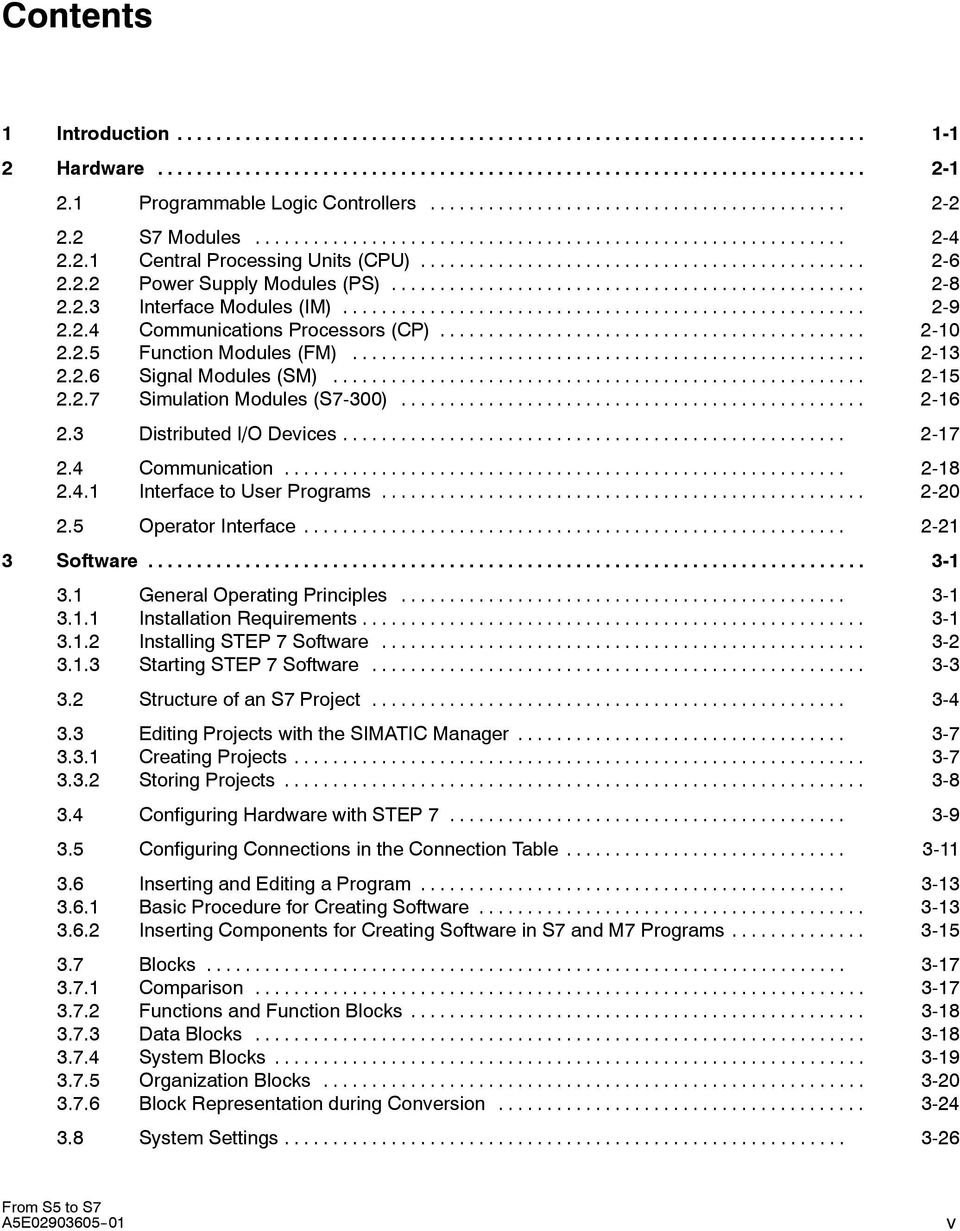
6 Contents 3.9 Standard Functions Floating-Point Math Signal Functions Integrated Functions Basic Functions Analog Functions Math Functions Data Types Address Areas Overview New Addresses in S7: Local Data Instructions Addressing Absolute Addressing Symbolic Addressing New Feature: Complete Addressing of Data Addresses Indirect Addressing Procedure Analyzing the S5 System Creating an S7 Project Configuring Hardware Preparing for Conversion Providing the Required Files Checking Addresses Preparing the S5 Program Creating Macros Instruction Macros OB Macros Editing Macros Conversion Starting the Conversion Generated Files Interpreting Messages Editing the Converted Program Address Changes Options for Changing Addressing Non-Convertible Functions Indirect Addressing -- Conversion Working with Direct Memory Accesses Assigning Parameters Standard Functions vi
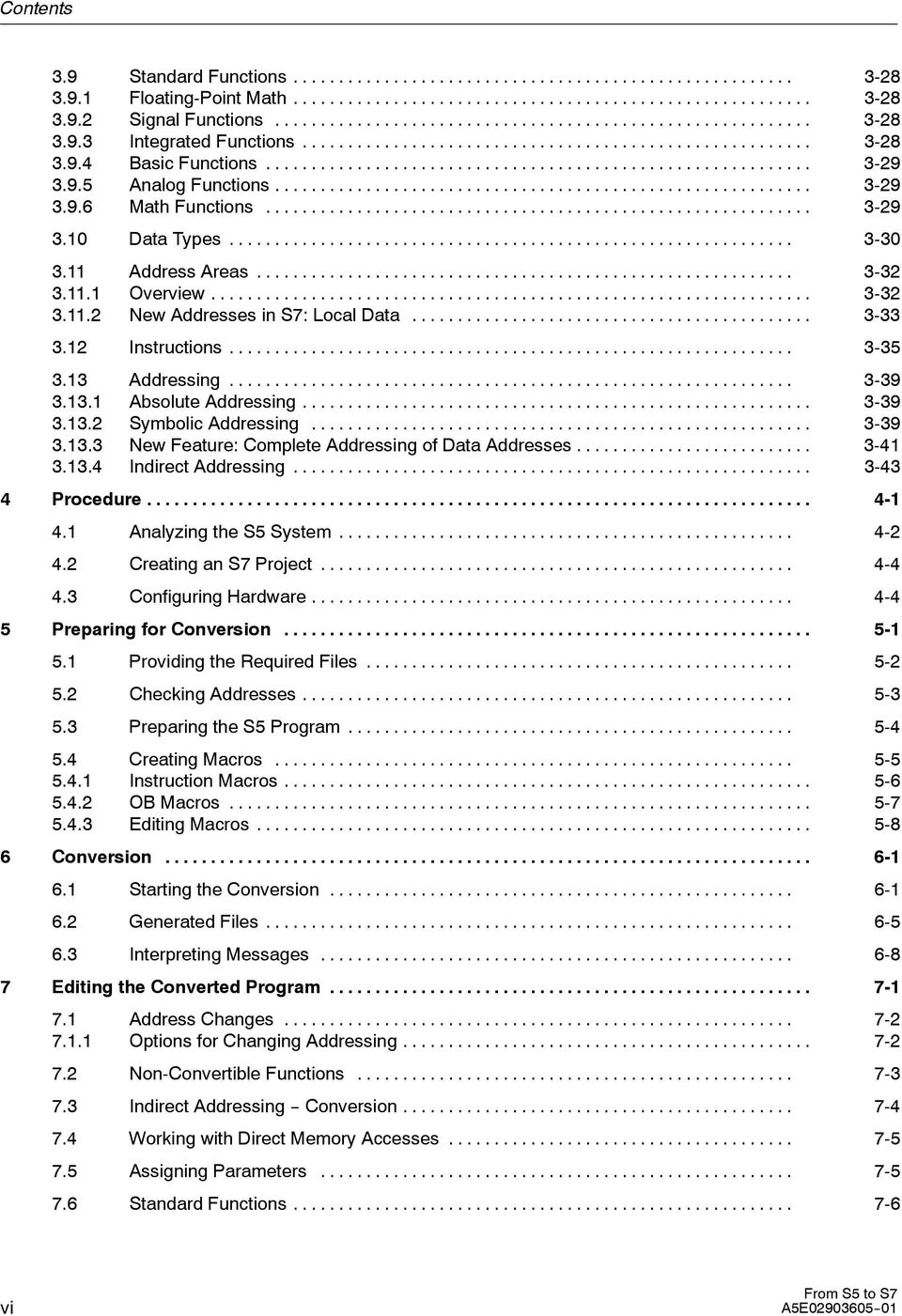
7 Contents 8 Compiling the Program Application Example Analog Value Processing Temporary Local Data Evaluating the Start Information from the Diagnostic Interrupt OB (OB82) Block Transfer Calling the Examples A Address and Instruction Lists... A-1 A.1 Addresses... A-1 A.2 Instructions... A-3 B Literature List... B-1 Glossary... Index... Glossary-1 Index-1 vii
8 Contents viii

9 Part 1: Planning Your Conversion Introduction 1 Hardware 2 Software 3

10 -2

11 Introduction 1 Until now you were familiar with the name SIMATIC as the synonym for SIEMENS programmable controllers of the S5 family. Now the name SIMATIC stands for fully integrated automation. The concept fully integrated automation describes a revolutionary new way of combining the worlds of manufacturing and process engineering. All hardware and software components are integrated into one single system: SIMATIC. This complete integration is made possible by the universal compatibility offered by the S7 system in the following three areas: Database Data are only entered once and are then available to a whole factory. Transfer errors and inconsistencies are therefore a thing of the past. Configuring and programming All the components and systems belonging to a task are planned, configured, programmed, commissioned, debugged, and monitored with one single fully integrated software package with a modular design - under one user interface and with the most suitable utility. Communication Who communicates with whom is determined simply in a connection table and can be changed at any time. The various network types can be configured easily and uniformly. To be able to meet the wide range of possibilities of SIMATIC as a fully integrated system, brand new concepts have been shaped in SIMATIC S7. Some functions are therefore achieved in other ways to those you are familiar with in S5. The STEP 7 programming software is based on new technology and concepts. For example, the user interface is designed to meet modern ergonomic requirements and runs under Windows 95/NT. In our programming languages, we have endeavored to adhere to the IEC 1131 standard as closely as possible without becoming incompatible with STEP

12 Introduction We are convinced that our new STEP 7 system meets the following demands: A software basis for fully integrated automation Programming which conforms to IEC 1131 Compatibility with STEP 5 We are also aware that converting from an existing system to a new system gives rise to a number of questions and we recognize that it will be necessary to make certain adaptations, particularly with regard to the software. This manual is intended to provide answers to these questions and, at the same time, show you simple ways in which you can continue to use your existing STEP 5 programs in SIMATIC S7. 1-2

13 Hardware 2 This chapter describes the hardware that can be used for S7 and makes comparisons, when necessary, with the hardware used for S5, in order to facilitate the transition from S5 to S7. Converting Hardware from S5 to S7 using the Siemens Catalog on CD-ROM The Siemens CD-ROM Components for Automation / catalog CA01 (from 4/97) contains an application designed to aid you in choosing hardware when converting from S5 to S7. To access the catalog of products, select the menu command Auswahlhilfen > Simatic. Here you can enter any S5 system desired; the application uses this system data to create a rack configuration and a signal list. You can then convert this S5 configuration to an S7 configuration. 2-1
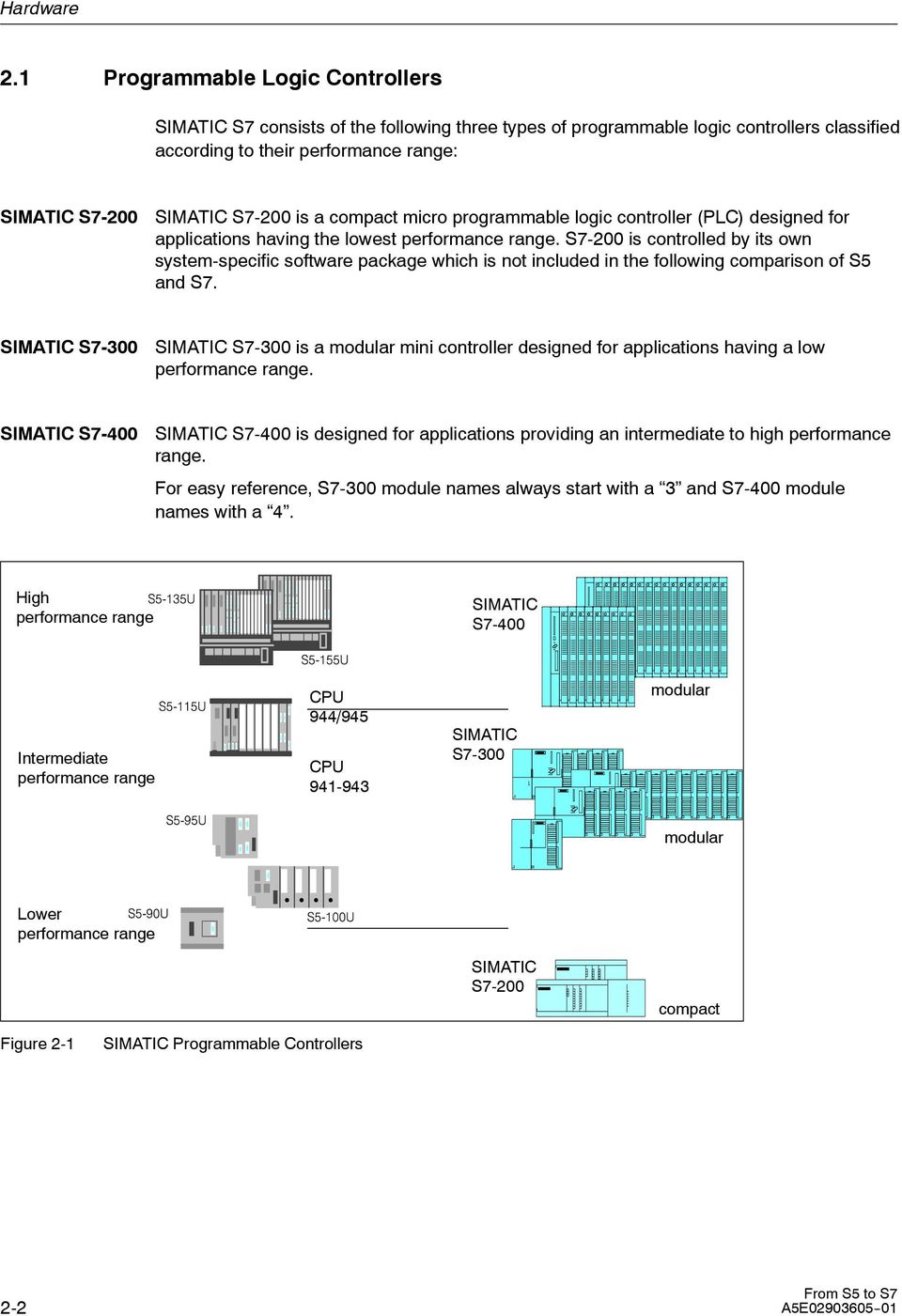
14 Hardware 2.1 Programmable Logic Controllers SIMATIC S7 consists of the following three types of programmable logic controllers classified according to their performance range: SIMATIC S7-200 SIMATIC S7-200 is a compact micro programmable logic controller (PLC) designed for applications having the lowest performance range. S7-200 is controlled by its own system-specific software package which is not included in the following comparison of S5 and S7. SIMATIC S7-300 SIMATIC S7-300 is a modular mini controller designed for applications having a low performance range. SIMATIC S7-400 SIMATIC S7-400 is designed for applications providing an intermediate to high performance range. For easy reference, S7-300 module names always start with a 3 and S7-400 module names with a 4. High performance range SIMATIC S7-400 Intermediate performance range CPU 944/945 CPU SIMATIC S7-300 modular modular Lower performance range SIMATIC S7-200 compact Figure 2-1 SIMATIC Programmable Controllers 2-2
15 Hardware Connecting Programming Devices and OPs to SIMATIC S7 Programming device interface MPI (Multipoint Interface) for programming devices and operator panels The programming device interface AS511 used in SIMATIC S5 has been replaced by the multipoint interface, MPI (for S7-300 and S7-400). This multipoint interface provides a direct electrical connection for HMI devices (HMI: Human Machine Interface, previously known as COROS) and for programming devices to the programming device interface used by SIMATIC S7. The interfaces are completely integrated. The following table provides a direct comparison of these two interface specifications: AS pin TTY interface (20 ma) Transmission rate: 9.6 Kbps Protocol: 3964R MPI 9-pin sub-d interface with RS485 technology Transmission rate: Kbps Protocol: S7 functions Max. length of network: 50 m (with bus amplifiers or special cables: up to 1000 m) All programmable modules within a configuration can be addressed via the multipoint interface One device can be connected Up to 31 devices can be connected Bus interface for Operator Panels (OP) Programmable logic controllers in the SIMATIC S5 and SIMATIC S7 automation families can be connected using the PROFIBUS (previously known as SINEC L2) bus system. As before, these connections are bus-specific. 2-3

16 Hardware 2.2 S7 Modules No Fundamental Differences from S5 The range of modules used in S7 corresponds to and expands on the known and proven module concept used in SIMATIC S5. S7 contains the following types of modules: Central processing units (CPU) Power supply modules (PS) Interface modules (IM) Communications processors (CP); (such as for connecting to PROFIBUS) Function modules (FM); (such as for counting, positioning, closed-loop control) Digital and analog modules are now called signal modules (SM) This chapter describes the similarities and differences in the range of modules used in SIMATIC S5 and SIMATIC S7. New Performance Characteristics S7 modules can be distinguished by the following features: The new modules are not equipped with jumpers or switches. The new modules do not require cooling fans. As in S5, they have the IP 20 protection class. The new modules can be assigned parameters and have diagnostic capability. The S7 slot assignment is more flexible than for S5. Expansion devices and ET 200 distributed I/O devices can trigger interrupts. 2-4

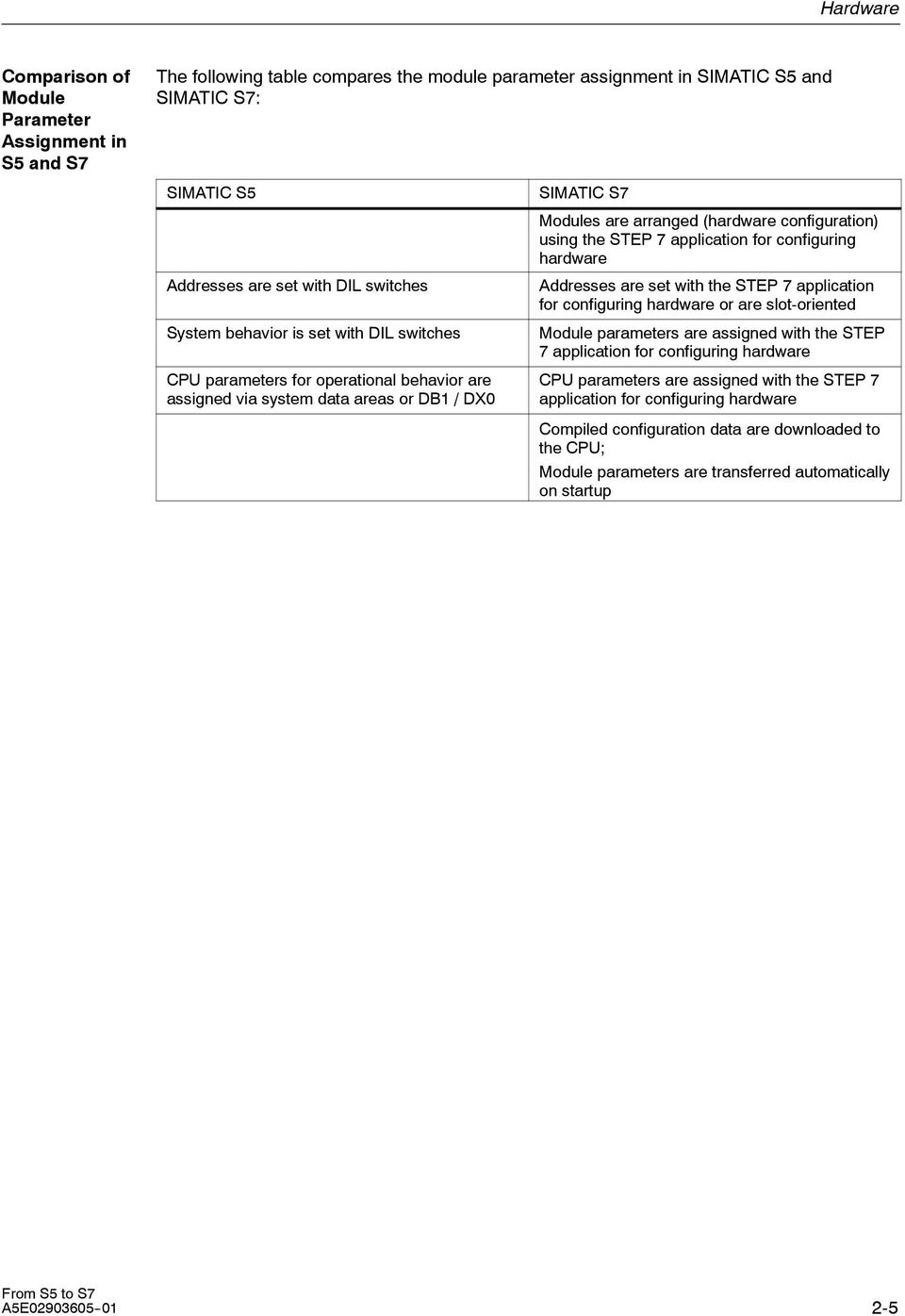
17 Hardware Comparison of Module Parameter Assignment in S5 and S7 The following table compares the module parameter assignment in SIMATIC S5 and SIMATIC S7: SIMATIC S5 Addresses are set with DIL switches System behavior is set with DIL switches CPU parameters for operational behavior are assigned via system data areas or DB1 / DX0 SIMATIC S7 Modules are arranged (hardware configuration) using the STEP 7 application for configuring hardware Addresses are set with the STEP 7 application for configuring hardware or are slot-oriented Module parameters are assigned with the STEP 7 application for configuring hardware CPU parameters are assigned with the STEP 7 application for configuring hardware Compiled configuration data are downloaded to the CPU; Module parameters are transferred automatically on startup 2-5
18 Hardware Central Processing Units (CPU) S7-300 CPUs Table 2-1 lists the most important performance specifications for S7-300 CPUs. If you want to replace an S5 CPU, you can use the following table to compare performance in order to select the most suitable CPU: Table 2-1 Performance Features of the S7-300 CPUs Feature CPU 312 IFM CPU 313 CPU 314 CPU 314 IFM CPU 315 CPU DP Work memory 6Kbytes 12 Kbytes 24 Kbytes 24 Kbytes 48 Kbytes (integrated) Load memory integrated 20 Kbytes 20 Kbytes 40 Kbytes 40 Kbytes 80 Kbytes RAM RAM; 20 Kbytes EEPROM RAM RAM RAM; 40 Kbytes EEPROM expandable with memory card -- up to 512 Kbytes up to 512 Kbytes -- up to 512 Kbytes (in CPU programmable up to 256 Kbytes) Process image size, inputs and outputs I/O address area digital inputs/outputs analog inputs/outputs 32 bytes + 4 on-board Inputs: on-board Outputs: on-board 128 bytes 128 bytes 124 bytes + 4 on-board Inputs: on-board Outputs: on-board Inputs: on-board Outputs: on-board Bit memory Counters Timers Max. sum of all retentive data Local data Blocks: OBs FBs FCs DBs SFCs SFBs 512 bytes in total; 256 bytes per priority class bytes bytes 4736 bytes 144 bytes 4736 bytes bytes in total; 256 bytes per priority class

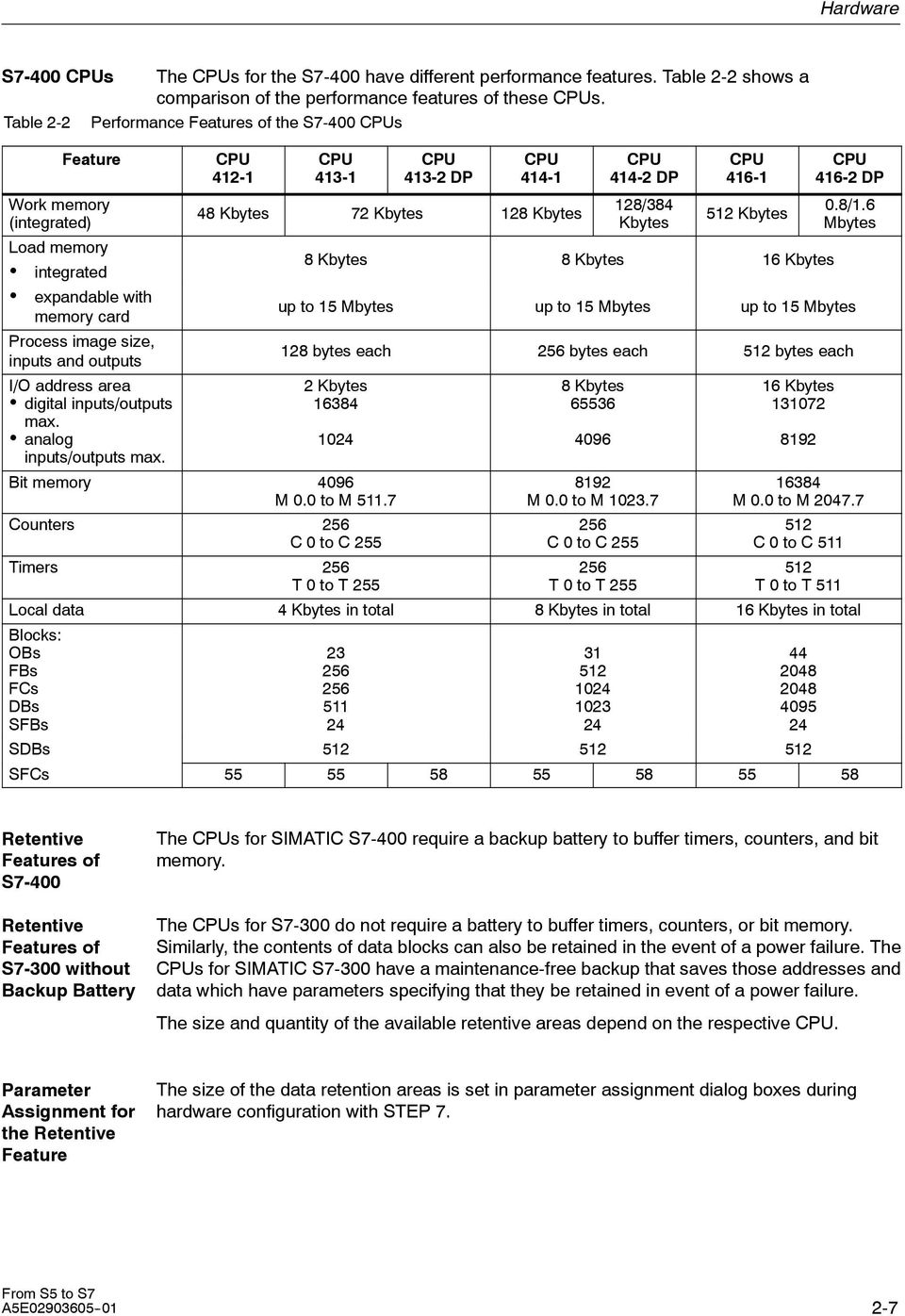
19 Hardware S7-400 CPUs The CPUs for the S7-400 have different performance features. Table 2-2 shows a comparison of the performance features of these CPUs. Table 2-2 Performance Features of the S7-400 CPUs Feature Work memory (integrated) Load memory integrated expandable with memory card Process image size, inputs and outputs I/O address area digital inputs/outputs max. analog inputs/outputs max. CPU CPU CPU DP CPU Kbytes 72 Kbytes 128 Kbytes CPU DP 128/384 Kbytes CPU Kbytes 8 Kbytes 8 Kbytes 16 Kbytes CPU DP 0.8/1.6 Mbytes up to 15 Mbytes up to 15 Mbytes up to 15 Mbytes 128 bytes each 256 bytes each 512 bytes each 2Kbytes Bit memory 4096 M 0.0 to M Counters 256 C0toC255 Timers 256 T0toT255 8Kbytes M 0.0 to M C0toC T0toT Kbytes M 0.0 to M C0toC T0toT511 Local data 4 Kbytes in total 8 Kbytes in total 16 Kbytes in total Blocks: OBs FBs FCs DBs SFBs SDBs SFCs Retentive Features of S7-400 Retentive Features of S7-300 without Backup Battery The CPUs for SIMATIC S7-400 require a backup battery to buffer timers, counters, and bit memory. The CPUs for S7-300 do not require a battery to buffer timers, counters, or bit memory. Similarly, the contents of data blocks can also be retained in the event of a power failure. The CPUs for SIMATIC S7-300 have a maintenance-free backup that saves those addresses and data which have parameters specifying that they be retained in event of a power failure. The size and quantity of the available retentive areas depend on the respective CPU. Parameter Assignment for the Retentive Feature The size of the data retention areas is set in parameter assignment dialog boxes during hardware configuration with STEP
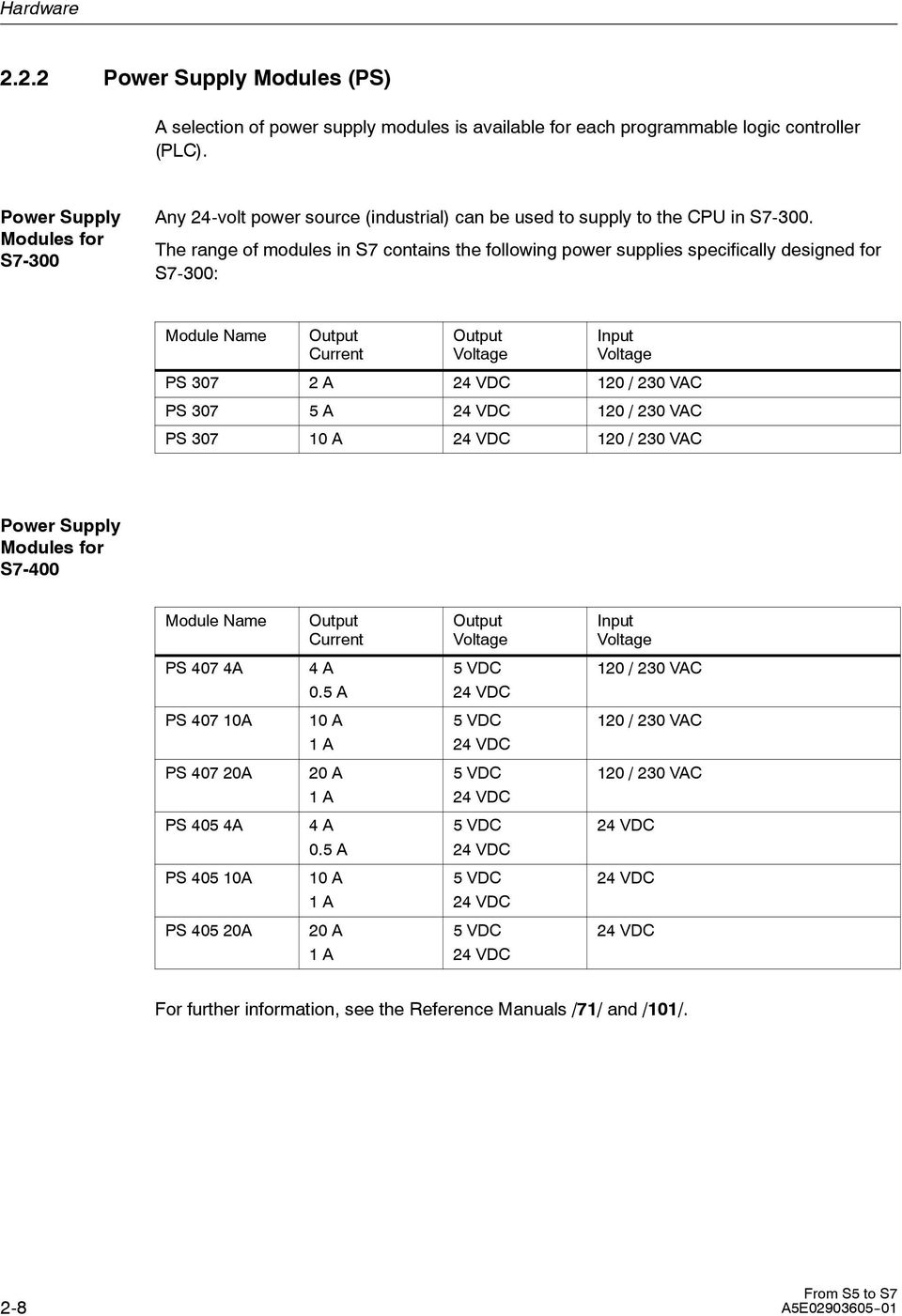
20 Hardware Power Supply Modules (PS) A selection of power supply modules is available for each programmable logic controller (PLC). Power Supply Modules for S7-300 Any 24-volt power source (industrial) can be used to supply to the CPU in S The range of modules in S7 contains the following power supplies specifically designed for S7-300: Module Name Output Current Output Voltage Input Voltage PS 307 2A 24 VDC 120 / 230 VAC PS 307 5A 24 VDC 120 / 230 VAC PS A 24 VDC 120 / 230 VAC Power Supply Modules for S7-400 Module Name Output Current Output Voltage Input Voltage PS 407 4A 4A 5VDC 120 / 230 VAC 0.5 A 24 VDC PS A 10 A 5VDC 120 / 230 VAC 1A 24 VDC PS A 20 A 5VDC 120 / 230 VAC 1A 24 VDC PS 405 4A 4A 5VDC 24 VDC 0.5 A 24 VDC PS A 10 A 5VDC 24 VDC 1A 24 VDC PS A 20 A 5VDC 24 VDC 1A 24 VDC For further information, see the Reference Manuals /71/ and /101/. 2-8
21 Hardware Interface Modules (IM) Some interface modules in S5 have been replaced in S7. This change primarily affects local area connections. In S7, it is recommended that PROFIBUS be used to transmit signals for remote area connections. Comparison of IM Modules S5 Module S7-300 Module S7-400 Module Description IM 305 IM 365 IM / IM Central configuration IM 306 IM 300 / IM 312 IM 360 / IM 361 IM / IM IM / IM Remote area (up to 100 m) IM 301 / IM 310 IM 304 / IM 314 IM 307 / IM 317 IM 308 / IM 318 Connection via PROFIBUS Connection via PROFIBUS Connection via PROFIBUS Connection via PROFIBUS Connection via PROFIBUS Connection via PROFIBUS IM Connection via PROFIBUS Connection via PROFIBUS Connection of I/O modules and signal preprocessing modules (up to 200 m) Use of distributed I/O in remote areas (up to 600 m) Distributed connection of S5 expansion devices in remote areas (up to 600 m) Connection via fiber-optic cable (up to 1500 m) Distances up to 3000 m In S7, the interface module IM 467 can be used in place of IM 308C. You can use the interface module IM to connect S5 digital and analog modules to the S7 mounting rack with IM 314 via an S5 expansion rack. Connectable S5 The following S5 expansion racks can be connected: Expansion Racks EG 183 expansion unit EG 185 expansion unit ER ER
22 Hardware Communications Processors (CP) The following section lists the S5 and S7 communications processors that can be used in various subnets. In addition, the services supported by these processors are also indicated. Subnets in SIMATIC In order to meet the varying requirements of different automation levels (such as on the processing, cell, field, and actuator-sensor levels), SIMATIC provides the following subnets: AS Interface The actuator-sensor interface (AS-i) is a connection system for the lowest processing level in automation systems. It is primarily used for networking binary sensors and actuators. Its data quantity is limited to a maximum of 4 bits per slave. MPI The multipoint interface (MPI) subnet is intended for short-range field and cell levels. The MPI is a multipoint interface used in SIMATIC S7/M7 and C7. It is designed as a programming device interface and is intended for networking a small number of CPUs and for exchanging small quantities (up to 70 bytes) of data. PROFIBUS PROFIBUS is the network used for the cell and field areas in open, manufacturer-independent, SIMATIC communication systems. PROFIBUS is suitable for quick transmission of moderate quantities of data (approx. 200 bytes). Industrial Ethernet Industrial Ethernet is the network used for the processing and cell levels in open, manufacturer-independent, SIMATIC communication systems. Industrial Ethernet is suitable for quick transmission of large quantities of data. Point-To-Point Connection A point-to-point connection is not a subnet in the traditional sense. This connection is established in SIMATIC by using point-to-point communications processors (CP) to connect two communication partners (such as PLCs, scanners, PCs) with each other. 2-10
23 Hardware AS Interface (SINEC S1) The following table provides an overview of the modules available for communicating via the actuator-sensor (AS) interface. S5 Module S7-300 Module S7-400 Module CP 2433 (AS-i functions) CP (AS-i functions) -- CP 2430 (AS-i functions) MPI (SINEC L1) Communication via SINEC L1 in S5 has been converted to global data communication using MPI in S7. All CPUs in S7-300 and S7-400 as well as the programming devices and operator panels have an MPI interface. PROFIBUS (SINEC L2) The following table provides an overview of the modules available for communicating with PROFIBUS and which services are supported by these modules. S5 Module S7-300 Module S7-400 Module CP 5431 (FMS, FDL, DP) CPU 95U (FDL, DP *)) CP (S7 functions, FDL, DP) CP (S7 functions, FDL, FMS) CP Ext. (S7 functions, FDL, DP) CP Basic (S7 functions, FDL, FMS) IM 308-B/C (DP) CPU DP (DP) CPU DP (DP) CPU DP (DP) CPU DP (DP) IM 467 (DP) *) depends on the specific equipment ordered Industrial Ethernet (SINEC H1) The following table provides an overview of the modules available for communicating with Industrial Ethernet and indicates which services are supported by these modules. S5 Module S7-300 Module S7-400 Module CP 1430 TF (ISO transport) CP (S7 functions, ISO transport) CP 1430 TCP (ISO on TCP) CP TCP (S7 functions, ISO on TCP) CP (S7 functions, ISO transport) CP TCP (S7 functions, ISO on TCP) 2-11
24 Hardware Point-To-Point Connection The following table provides an overview of the modules available for point-to-point connection and which services are supported by these modules. S5 Module S7-300 Module S7-400 Module CP 521 (3964(R), ASCII) CP 523 (3964(R), ASCII) CP 544 (3964(R), RK 512, ASCII) -- CP 340-RS 232C (3964(R), ASCII) CP ma (3964(R), ASCII) CP 340-RS 422/485 (3964(R), ASCII) CP (3964(R), RK512, ASCII) CP 524/525 (3964(R), RK 512, ASCII, additional special drivers which can be loaded CP 544 B (3964(R), RK 512, ASCII, additional special drivers which can be loaded -- CP (3964(R), RK512, ASCII, additional special drivers which can be loaded 2-12
25 Hardware Function Modules (FM) Some IP and WF modules in SIMATIC S5 can be used in S7-400 with the help of a special adapter casing. In other cases, there are new function modules available in S7 to help you obtain the functionality desired. The following table provides an overview and comparison of the signal preprocessing modules available in S5 and S7. Table 2-3 Comparison of Signal-Preprocessing Modules in S5 and S7 S5 Module Adapter Casing S7 Module IP 240 yes FM 451 (limited) Description Counter, position detection, and positioning modules IP 241 no FM 451 / Digital position detection module FM 452 (limited) IP 242A no no Counter module IP 242B yes no Counter module IP 244 yes FM 455 Controller module IP 246I/A yes FM 354 / FM 357 / FM 453 IP 247 yes FM 353 / FM 357 / FM 453 IP 252 no FM 455 (limited) IP 260 no FM 355 (limited) Positioning module for variable speed drives Positioning module for stepper motors Closed-loop control module Closed-loop control module IP 261 no no Proportioning module IP 281 no FM / FM IP 288 no FM 451 / FM 452 WF 705 yes FM 451 (limited) WF 706 no FM 451 (limited) WF 707 no FM 452 (limited) WF 721 yes FM 354 (limited because of assembly technology) Counter module Positioning module for regulating rapid/creep feed and cam control Position detection module Positioning and counter module Cam control Positioning module WF 723A yes FM 453 Positioning module 2-13
26 Hardware Table 2-3 Comparison of Signal-Preprocessing Modules in S5 and S7, continued S5 Module Adapter Casing S7 Module WF 723 B yes FM 357 (limited because of assembly technology) Description Positioning module WF 723 C yes no Positioning module FM Application module (M7-FM) SINUMERIK FM-NC FM STEPDRIVE Numeric control Stepper motor control SIMOSTEP Stepper motor 2-14
27 Hardware Signal Modules (SM) The signal modules in SIMATIC S7 are comparable in function to the input/output modules in S5. However, in addition to simple signal modules, S7 also provides modules that can be assigned parameters and which have diagnostic capability. Signal Modules which can be Assigned Parameters Digital input modules in S7 that can be assigned parameters allow you to specify (with the STEP 7 application for configuring hardware) which channels are to trigger a hardware interrupt on edge change. The input ranges of analog input modules can be easily assigned parameters with STEP 7. Signal Modules with Diagnostic Capability Modules with diagnostic capability can detect both external errors such as wire breaks or external short circuits and internal ones such as RAM errors or short circuits within modules. A diagnostic event is processed by the controller in the following two ways: By triggering a diagnostic interrupt. This notifies the appropriate organization block (OB) in the user program, which then interrupts the cyclic program. By making an entry in the diagnostic buffer of the CPU, which can then be read with a programming device or operator interface device. The following tables list the signal modules available in S7: Table 2-4 Signal Modules in SIMATIC S7-300 DI (SM 321) DO (SM 322) AI (SM 331) AO (SM 332) 32 x 24 VDC 32 x 24 VDC/0.5 A 8 x 12 bit 2 x 12 bit 16 x 24 VDC 16 x 24 VDC/0.5 A 2 x 12 bit 16 x 24 VDC with 8 x 24 VDC/0.5 A with Ex: 4 x 15 bit Ex: 4 x 15 bit hardware and diagnostic interrupt diagnostic interrupt 16 x 24 VDC 8x24VDC/2A Ex: 12 x 15 bit M-reading 8 x 120/230 VAC 8 x 120/230VAC / AI 4/AO 2 X 8/8 bit (SM 334) 2A Ex: 4 x 24 VDC Ex: 4 x 15 VDC/ 20m A Ex: 4 x 24 VDC/ 20m A Table 2-5 Signal Modules in SIMATIC S7-400 DI (SM 421) DO (SM 422) AI (SM 431) AO (SM 432) 32 x DC 24 V 32 x 24 VDC/0.5 A 8 x 13 bit 8 x 13 bit 16 x 24/60 VUC with hardware and diagnostic interrupt 16x24VDC/2A 8 x 14 bit (for temperature measurement) 2-15
28 Hardware Table 2-5 Signal Modules in SIMATIC S7-400, Fortsetzung, Fortsetzung DI (SM 421) DO (SM 422) 16 x 120/230 VUC 16 x 120/230 VAC /5 A 32 x 120 VUC 16 x 120/230 VAC /2 A 16 x 30/230 VUC/ Rel. 5 A AI (SM 431) 8 x 14 bit 16 x 16 bit AO (SM 432) Simulation Modules (S7-300) S7-300 provides a simulation module, SM 374, for testing your program. This simulation module has the following capabilities: It can simulate inputs, outputs, or -- 8 inputs and 8 outputs (each having the same initial address) Its functions can be set with a screwdriver It can provide status displays for simulating inputs or outputs 2-16
29 Hardware 2.3 Distributed I/O Devices The modules for distributed I/O devices in the ET 200 system which already existed in SIMATIC S5 can continue to be used in SIMATIC S7. In addition, there are new ET 200 modules to extend the range. DP Masters The following modules can be a DP master in the distributed I/O system: S7-300 with CPU DP or CP as DP master S7-400 with CPU DP / DP / 416-2DP or CP 443-5, extended as DP master DP Slaves The following are examples of devices which can be DP slaves in the distributed I/O system: Distributed I/O devices such as ET 200B, ET 200C, ET 200M, ET 200X (up to 12 Mbps) and ET 200U, ET 200L (up to 1.5 Mbps) Programmable logic controllers such as -- S5-115U, S5-135U, or S5-155U with IM 308-C as DP slave -- S5-95U with DP slave interface (up to 1.5 Mbps) -- S7-300 with CPU DP or CP as DP slave -- S7-400 with CP as DP slave Interface to actuator-sensor interface with the DP/AS-i link Text displays and operator panels for machine-like operator control and monitoring MOBY identification systems Low-voltage switching devices Field devices (such as drives, valve islands, etc.) from Siemens or other manufacturers. FMS Masters The following can serve as an FMS master: S7-300 with CP as FMS master S7-400 with CP Basic as FMS master FMS Slaves Examples of devices that can serve as an FMS slave are the ET 200U or the SIMOCODE motor protection and control device. For further information, refer to the appropriate manuals or the Siemens catalog CA
30 Hardware 2.4 Communication Services and Subnets Communication within SIMATIC S7 is based on different subnets which provide various services. Services Subnets S7 Communication Functions (S7 Functions) ISO transport FDL (SDA) ISO-on-TCP FMS DP Industrial PROFIBUS Ethernet GD MPI The following is a summary of the communication services used in SIMATIC: S7 Functions The S7 functions provide services for communicating between S7/M7 CPUs, S7 OP/OSs and PCs. These S7 functions are already integrated in each SIMATIC S7/M7 device. Since these S7 functions correspond to a service in the ISO application layer, they are independent of any one subnet and can thus be used on all subnets (MPI, PROFIBUS, Industrial Ethernet). ISO Transport These functions are used for secure data transfer from SIMATIC S7 to SIMATIC S5. They are used to transfer moderate amounts of data (up to 240 bytes) via open communication at ISO transport layer 4 based on the ISO reference model for Industrial Ethernet. ISO on TCP These functions are used for secure data transfer from SIMATIC S7 to SIMATIC S5. They are used to transfer moderate amounts of data (up to 240 bytes) via open communication according to the TCP/IP protocol at ISO transport layer 4 based on the ISO reference model for Industrial Ethernet. The ISO-on-TCP service requires the extended RFC1006 standard. FDL (SDA) These functions are used for secure data transfer from SIMATIC S7 to SIMATIC S5. They are used to transfer moderate amounts of data (up to 240 bytes) via open communication at Fieldbus Data Link (FDL) layer 2 based on the ISO reference model for Industrial Ethernet. 2-18
31 Hardware FMS PROFIBUS FMS (Fieldbus Message Specification) provides services for transferring structured data (FMS variables) over static FMS connections. The FMS service can be classified at layer 7 of the ISO reference model. It corresponds to the European standard EN Vol. 2 PROFIBUS and provides services for transferring structured data (variables). DP PROFIBUS DP services allow transparent communication with distributed I/O devices. These distributed I/O devices are addressed by the control program in exactly the same manner as centralized I/O devices. GD Global Data Communication is a simple communication option integrated in the operating system of S7-300/400 CPUs. GD communication permits cyclic exchange of data between CPUs via the multipoint interface; for S7-400, it also allows event-driven data exchange. 2-19
32 Hardware Interface to User Programs The communication interface to a user program consists of the following blocks: SFCs (without connection configuration) SFBs (with connection configuration) (only S7-400) Loadable FCs / FBs These blocks replace the S5 handling blocks. The functionality here is similar, but it is now accomplished using STEP 7 languages. To establish communication, you will have to adapt an appropriate S5 program with handling functions to the new blocks. Network Service Interface in S5 User Program Interface in S7 User Program Point-to-point connection -- Handling blocks * S7-300: loadable FBs S7-400: loadable SFBs PROFIBUS FDL (PLC-PLC) Free Layer 2 Handling blocks * Handling blocks * Handling blocks * Loadable FCs -- Loadable FBs FMS Industrial Ethernet ISO 4 ISO 4 + AP STF MAP Handling blocks * Handling blocks * Handling blocks * + loadable FBs Handling blocks * + loadable FBs Loadable FCs Loadable FBs * Integrated or loadable, depending on CPU 2-20
33 Hardware 2.5 Operator Control and Monitoring Introduction The following section provides an overview of the extent to which SIMATIC HMI (HMI: Human Machine Interface, previously COROS) operator panels can be used in SIMATIC S7. Operator Panels The SIMATIC HMI operator panel provides operator control and monitoring functions for SIMATIC S5, SIMATIC S7, and SIMATIC TI, as well as for other controllers. STEP 5 In general, a standard function block, which is called depending on the operator panel connected, is required in the programmable controller for connecting SIMATIC OP to SIMATIC S5. The following operator panels (OP) can be used with S5: -- TD17, OP5/A1, OP7/PP, OP7/DP-12, OP15/x1, OP17/PP, OP17/DP OP25, OP35, OP37, TP37 STEP 7 When connecting SIMATIC OP to SIMATIC S7/M7, a distinction must be made between PPI, MPI, and PROFIBUS as MPI nodes. PPI or MPI connections run via the programming device interface in the CPU. In doing so, SIMATIC OP uses the communication services of SIMATIC S7/M7 (S7 functions); this means that a standard function block is not required. The PROFIBUS connection from SIMATIC OP to SIMATIC S7/M7 also involves communication accomplished using S7 functions. Again, this means that a standard function block is not required. (SIMATIC OPs are active nodes and not PROFIBUS-DP slaves as is the case for the PROFIBUS connection to SIMATIC S5.) The same number of nodes that applies to an MPI connection also applies here. The following operator panels (OP) can be used with S7: -- TD17, OP3, OP5/A2, OP7/DP, OP7/DP-12, OP15/x2, OP17/DP, OP17/DP OP25, OP35, OP37, TP37 The following restrictions apply to SIMATIC OPs: -- OP3: up to 2 connections -- OP5/15/25: up to 4 connections -- TD17, OP7/17: up to 4 connections -- OP35: up to 6 connections -- OP37, TP37: up to 8 connections Configuration SIMATIC ProTool and SIMATIC ProTool/Lite are modern tools for configuring operator panels. SIMATIC ProTool can be used to configure all devices, while SIMATIC ProTool/Lite can only be used to configure line-oriented operator panels. Functionally, ProTool/Lite is a subset of ProTool. 2-21
34 Hardware Integration in SIMATIC STEP 7 ProTool can be integrated in the SIMATIC STEP 7 configuration software; this enables direct access to configuration data such as symbol tables and communication parameters used for control configuration. This feature not only saves time and money; it also prevents errors resulting from redundant data entry. Table 2-6 Configuration Tools for Operator Interface Devices Device Line-oriented OP (TD17, OP3, OP5, OP7, OP15, OP17) Graphic-oriented OP (OP25, OP35, OP37, TP37) Configuration Tool ProTool/Lite or ProTool ProTool WinCC WinCC can be used for a single or multi-terminal (client-server arrangement) system. WinCC is a system for creating solutions to visualization and process control tasks used in production and process automation; it is compatible with all business sectors and technologies. It provides function modules suitable for displaying graphics and messages, archiving information, and record-keeping in industrial applications. Its powerful and efficient hardware connection, quick display updating, and secure data archiving provide users with high flexibility and availability. In addition to these system functions, WinCC also provides open interfaces for creating user-specific solutions. These allow WinCC to be integrated in complex, company-wide automation solutions. Integrated features allowing access to data archives via standard interfaces such as ODBC and SQL and integration of objects and documents via OLE2.0 and OLE Custom Controls (OCX) are also included. These mechanisms make WinCC an effective communication partner for Windows applications. WinCC is based on the 32-bit operating systems MS Windows 95 or MS Windows NT. Both feature preemptive multitasking, which ensures quick reaction to process events and provides a high level of security against data loss. Windows NT provides additional security functions and can also serve as the basis for server operation in a WinCC multi-terminal system. The WinCC software is itself a 32-bit application which was developed using the most modern object-oriented software technology. 2-22
35 Software General Operating Principles Overview The software for configuring and programming SIMATIC S7/M7/C7 is designed according to modern ergonomic concepts and is thus largely self-explanatory Installation Requirements Operating System Standard Hardware Microsoft Windows 95. Programming device or PC with the following specifications and equipment: A processor (or higher) A minimum 16 Mbytes RAM (32 Mbytes recommended) A VGA monitor or other type of monitor supported by Windows 95 A keyboard, and optional but recommended, a mouse supported by Microsoft Windows 95 Storage Capacity The following storage space is required on the hard disk: The Standard package with one language installed occupies 105 Mbytes on the hard disk. The exact amount of space required depends on the amount of standard software installed. STEP 7 should also have about 64 Mbytes of total memory available for storing swap files. For example, if you have 32 Mbytes of RAM, you will need an additional 32 Mbytes of virtual memory. Approx. 50 Mbytes should be available for user data. A minimum of 1 Mbyte free memory should be available on the hard disk for setup. (The setup files are deleted once the installation is complete.) 3-1
36 Software Installing the STEP 7 Software Overview STEP 7 contains a setup program that carries out the installation automatically. User prompts appearing on the screen guide you step-by-step through the entire installation procedure. Authorization A product-specific user authorization is required to use the STEP 7 programming software. Software protected in this manner can only be used if the required authorization for the program or software package is located on the hard disk of the respective programming device or PC. To obtain this authorization, you need the copy-protected authorization diskette included in the consignment. This diskette also contains the program AUTHORS, which is required to display, install, and uninstall STEP 7. The procedure for transferring and removing this authorization is described in the User Manual /231/. Warning Siemens programming devices (such as the PG 740) are supplied with installable STEP 7 software already on the hard disk. For further information on installing STEP 7, see the User Manual /231/. 3-2
37 Software Starting the STEP 7 Software Starting After starting Windows 95/NT you will find the icon for the SIMATIC Manager on the Windows user interface. This is the access point to the STEP 7 software. Double-clicking the SIMATIC Manager icon is the fastest way to start STEP 7. This icon opens the window for the SIMATIC Manager. From here, you can access the standard system, all optional software, and all functions that you have installed. Alternatively, you can also start the SIMATIC Manager by clicking the Start button in the Windows 95/NT taskbar. The menu title for this is found under Simatic/STEP 7. SIMATIC Manager The SIMATIC Manager is the initial window used for configuring and programming. Here you can do the following: Set up projects Configure and assign parameters to hardware Configure communication connections Create programs Test programs and start them running Access to functions is object-oriented, intuitive, and easy to learn. You can work with the SIMATIC Manager in the following ways: Offline (not connected to a controller), or Online (connected to a controller) (When doing this, be sure to observe the appropriate safety guidelines.) SIMATIC Manager - zebra File Edit Insert PLC View Options Window Help zebra - <Standard Hierarchy, Offline> (Project) - - C:\SIEMENS\STEP7\S7proj\zebra zebra SIMATIC 400 Station (1) SIMATIC 400 Station MPI(1) Press F1 for help. Figure 3-1 SIMATIC Manager with an Open Project 3-3
38 Software 3.2 Structure of an S7 Project Definition Projects contain all the data and programs for an automation solution. Their purpose is to provide organized storage of data and programs created for such an application. Projects in STEP 5 You will already be familiar with the term project from working with STEP 5. In STEP 5, a project contains all STEP 5 files created for one user program in a project file. This project file contains information necessary for convenient editing and maintenance of a user program, such as parameter settings, as well as catalog and file names. Projects in STEP 7 In STEP 7, a project contains all the programs and data necessary for an automation solution, regardless of the number of CPUs involved and how they are networked. Thus, a project is not just limited to a user program used for a particular programmable module; instead, it contains several user programs used for many programmable modules, which are all stored together under a common project name. Note As in STEP 5, it is also possible in STEP 7 to create a simple user program intended for only one CPU. In this case, a project is limited to one CPU. The following section discusses the directory structure that STEP 7 provides for the user programs and data that you create. 3-4
39 Software Components of a Project A project in STEP 7 essentially consists of the objects depicted in Figure 3-2. These objects are listed and explained below. Project Station Network Programmable module Connection table Container for all the data for a program Symbol table Program in source file form Blocks Figure 3-2 Basic Objects in a STEP 7 Project with their Hierarchical Structure Network The Network object contains the definitive properties for a subnet such as MPI or PROFIBUS. Assigning a station or a communication module within a station to a network enables STEP 7 to check communication parameters for consistency. Station A station represents the structure of a programmable controller along with all the racks belonging to it. If a module with a DP interface is part of a station, then the entire master system (that is, the DP slaves belonging to it) is also part of this station. A station consists of one or more programmable modules, such as a CPU. Hardware Hardware is an object containing the configuration data and parameters for a station. The configuration data and parameters for a station are stored in system data blocks (SDBs). 3-5
40 Software Programmable Modules In contrast to other modules, programmable modules contain user programs. In the folders (known as containers in STEP 7) found in the programmable modules you will find all the data belonging to the program for the module. Examples of such programs are the following: Programs in source file form (created with a text editor) When the source program is compiled, executable blocks are created in the Blocks container. Blocks which are loaded into the programmable module Symbol tables Connection Table The connection table depicts all connections for a programmable module, such as a CPU, in a station. A connection defines the communication properties between two nodes and is identified by a connection ID. This connection ID is all that you need to program event-controlled communication using standardized communication blocks, which are similar to the handling blocks found in STEP 5. Source Files In S7 programming, source files are the basis for creating blocks. Source files cannot be downloaded to an S7 CPU. Blocks Blocks are distinct parts of a user program and are distinguished by their function, structure, and use within it. Blocks can be downloaded to S7 CPUs. In addition to the executable blocks, the Blocks container also contains the variable tables. Symbol Table The symbol table shows the assignment of symbolic names, for example, for inputs, outputs, bit memory, and blocks. 3-6
41 Software 3.3 Editing Projects with the SIMATIC Manager Creating Projects New Project Alternative Procedures To create a project, follow the steps outlined below: 1. Select the menu command File " New in the SIMATIC Manager. 2. Select the option New Project in the New dialog box. 3. Enter a name for the project and confirm your entry with OK. When editing a project, you are flexible as to the order in which you perform most of the tasks. Once you have created a project, you can choose one of the following methods: First configure the hardware and then create the software for it, or Start by creating the software independent of any configured hardware. The hardware configuration of a station does not need to be established before entering a program. Table 3-1 Alternative Procedures Alternative 1 Alternative 2 Configure the hardware first (see also Section 3.4) Configure your hardware (see Section 3.4). Once the configuration is complete, the S7 Program containers required for creating software are already inserted and available. Then create the software for the programmable modules (see Section 3.6). Create the software first Insert the required software containers (S7 Programs) in your project (see Section 3.6). Then create the software for the programmable modules (see Section 3.6). Configure your hardware (see Section 3.4). Link the S7 program to a CPU once you have configured the hardware. The procedure for downloading and testing your program without a hardware configuration is described in the User Manual /231/. 3-7
42 Software Storing Projects Overview To back up a project, you can save a copy of the project under another name or archive it. Save As... To save the project under another name, proceed as follows: 1. Open the project. 2. Select the menu command File " Save As. The Save As dialog box is displayed. 3. Select either save with or without a consistency check and close the dialog box with OK. The Save As dialog box is displayed. 4. Under Save In, select the directory in which the project is to be saved. 5. In the File Name field, enter a file name in place of the asterisk (*). Do not change the file extension. 6. Close the dialog box with OK. Make sure that there is enough memory available on the drive selected. For example, it is not advisable to select a disk drive to back up a project because a project is generally too large to fit on a diskette. You must archive projects before saving them on diskettes. Archives can then be split up over several diskettes. Archiving You can store individual projects or libraries in compressed form in an archive file located on a hard disk or a transportable data medium (diskette). In order to be able to access components of an archived project or library, the project must first be extracted from the archive. Archiving is discussed in detail in the User Manual /231/. 3-8
43 Software 3.4 Configuring Hardware with STEP 7 SIMATIC S5 did not provide an option for configuring hardware using the software. In S7, addressing and assigning parameters to modules and configuring communications is carried out by means of a STEP 7 application. The advantage of this method is that the user no longer has to make any settings on the modules, since the configuring and assigning of parameters can now be done centrally from the programming device. Prerequisite To configure hardware, a project must already have been created. Inserting a Station To create a new station in a project, open the project to display the project window (if this has not already been done). 1. Select the project. 2. Create the object for the required hardware by selecting the menu command Insert " Station. In the submenu you can select one of the following options: SIMATIC 300 station SIMATIC 400 station PC/programming device SIMATIC S5 Other stations, meaning non-simatic S7/M7 and SIMATIC S5 The stations PC/programming device, SIMATIC S5, and other stations are only listed for configuring communication links. Configuration and programming of S5 stations is not possible. Click on the + sign in front of the project icon in the project window if the station is not displayed below it. 3-9
44 Software Configuring the Hardware To configure the hardware, proceed as follows: 1. Click the new station you have inserted; it contains the Hardware object. 2. Open the Hardware object. The HWConfig window is displayed. 3. In the Hardware Configuration window, plan the structure of the station. A catalog of modules is available to help you do this. If this is not already displayed, select the menu command View " Catalog to view it. 4. Insert a rack from the module catalog in the empty window. Then select the modules and place them in the rack slots. At least one CPU must be configured for each station. During this procedure, HWConfig automatically checks all entries you make. For further information on configuring hardware, see the User Manual /231/. Result of Configuration For each CPU you create in your configuration, an S7 program and a connection table ( Connections object) are created automatically once you have saved and exited the hardware configuration. The S7 program contains the Source Files and Blocks objects as software containers as well as the symbol table. The Blocks container contains the object for OB1 and the System Data object with the compiled configuration data. 3-10
45 Software 3.5 Configuring Connections in the Connection Table In S5, connections are configured with COM NCM. There is a COM package for each communications processor (CP). In S7, all connections are configured in the connection table. Overview Configuring connections is a prerequisite for using SFB communication functions in a user program. A connection determines the following: The communication partners involved in the S7 project, The type of connection established (such as an S7 connection or FDL connection), Special properties such as the active or passive establishment of a connection or whether operating mode messages are to be sent. When you configure connections, a unique local identifier (known as the local ID) is issued for each connection. This local ID is all you require when assigning communication parameters. Each CPU that can serve as the end point of a connection has its own connection table. Special Feature If both communication partners are S7-400 stations, a local ID is automatically issued for both end points of the connection. Only one local ID is generated on the S7-400 station for connections to an S7-300 station. Loading Configuration Data The local configuration data for connection end points on an S7 station must be separately downloaded into each target station. An (empty) connection table ( Connections object) is automatically created for each CPU. This connection table is used to define communication links between CPUs in a network. After this is opened, a window is displayed containing a table for defining connections between programmable modules (For more information about defining connections, see the User Manual /231/). 3-11
46 Software Example: This example shows you how to configure a connection to a SIMATIC S5 station. It assumes Connectiontoanthat you have already inserted a SIMATIC 400 station in your project. S5 Device Insert a SIMATIC S5 station in your project and then set the properties of the station. Open the connection table for the S7 station and select the menu command Insert " Connections to insert a connection. A dialog box is displayed in which you can enter the communication partner (the SIMATIC S5 station) and the type of connection. Once you have entered this information, the connection appears in the connection table. The properties for the connection must be entered in the corresponding COM NCM for the S5 station. Verbpro - zebra\simatic 400-Station(1)\CPU413-1(1) - Configuring Connections Connection Table Edit Insert PLC View Help Station: SIMATIC Module: CPU (1) Local 400-Station ID Partner (1) ID Active Send Operating Mode Partner Type (hex.) (hex.) Connection Setup Messages 1000 SIMATIC S5 (1) S7 PtP Connection Yes No Ready Row 1 - Loc. ID: Sel. 0 of 0: Figure 3-3 Connection Table 3-12
47 Software 3.6 Inserting and Editing a Program The procedure described in this section applies to creating a new program Basic Procedure for Creating Software Overview The software for CPUs is stored in program containers. In SIMATIC S7 modules, such an object is called an S7 Program. The figure below shows an S7 program in the CPU of a SIMATIC 300 station. SIMATIC Manager - zebra File Edit Insert PLC View Options Window Help zebra - <Standard Hierarchy, Offline> (Project) - - C:\SIEMENS\STEP7\S7p... zebra SIMATIC 400 Station SIMATIC 400 Station CPU 314 (1) S7 Program (2) Source Files Blocks S7 S7 Program (1) Source Files Symbols Blocks Press F1 for help. Figure 3-4 Open S7 Program in the SIMATIC Manager 3-13
48 Software Procedure To create the software for your project, proceed as follows: 1. Open the S7 program. 2. Open the Symbols object in the S7 program and define the symbols. (This step can also be done later.) You will find more information on defining symbols in Section Open the Blocks container if you want to create blocks, or open the Source Files container if you want to create a source file. 4. Insert a block or a source file, as appropriate. (For detailed information, see Section 3.6.2). The following menu commands are used for this: -- Insert " S7 Software " Block, or -- Insert " S7 Software " Source File 5. Open the block or source file and enter a program. You will find more information on programs in the Programming Manuals /232/-/236/. Depending on your task, you may not need to perform all these steps. S7 Program Container for all data in a program Container for source files Container for blocks Program in source file form Compile Generate source file Blocks Figure 3-5 Basic Objects in a STEP 7 Project and Their Hierarchical Structure 3-14
49 Software Inserting Components for Creating Software in S7 and M7 Programs Existing Components An S7/M7 program is created automatically for each programmable module as a container for the software: The following objects already exist in a new S7 program: Symbol table ( Symbols object) A Blocks container for blocks with OB1 as the first block A Source Files container for programs in the form of source files Creating S7 Blocks If you want to create Statement List, Function Block Diagram, or Ladder Logic programs, select the existing Blocks object and then click the menu command Insert " S7 Software " Block. In the submenu, you can select the type of block you want to create (such as a data block, user-defined data type (UDT), function, function block, organization block, or variable table (VAT)). You can now open the (empty) block and start entering the Statement List, Ladder Logic, or Function Block Diagram program. You will find more information in the Statement List /232/, Ladder Logic /233/, and Function Block Diagram /236/ Programming Manuals. The System Data object (SDB) which may exist in a user program was created by the system. You can open it to view its contents, but you cannot make changes to it for reasons of consistency. It is used to make changes to the configuration once you have loaded a program and to download the changes to the programmable controller. Using Blocks from Standard Libraries You can also use blocks from the standard libraries supplied with the software to create user programs. You access the libraries using the menu command File " Open. You will find more information on using standard libraries and creating your own libraries in the online help. Creating Source Files If you want to create a source file in Statement List, select the Source Files or Charts object in the S7 program and then select the menu command Insert " S7 Software " Source File. In the submenu, you can select the source file which matches your programming language. You can now open the empty source file and start entering your program. Creating a Symbol Table An (empty) symbol table ( Symbols object) is created automatically when the S7 program is created. When you open the symbol table, the Symbol Editor window opens displaying a symbol table where you can define symbols (refer to Section for more details). 3-15
50 Software Inserting External Source Files You can create and edit source files with any ASCII editor. You can then import these files into your project and compile them into executable blocks. To insert an external source file, proceed as follows: 1. Select the Source Files container to which you want to import the source file. 2. Select the menu command Insert " External Source File. 3. Enter the source file name in the dialog box which appears. The blocks created when the imported source file is compiled are stored in the Blocks container. 3-16
51 Software 3.7 Blocks Comparison The following table provides a comparison of the blocks in STEP 5 and STEP 7. The table is intended to answer the question Which STEP 7 block should I use for which STEP 5 block? No Fixed Assignment This table is not to be interpreted as a fixed one-to-one set of assignments since the new block environment makes additional programming options available. The table entries are to be understood as a set of recommendations for starting STEP 7 programming. Table 3-2 Comparison of Blocks: STEP 5 / STEP 7 STEP 5 Block STEP 7 Block Explanation Organization block (OB) Organization blocks (OB) Interface to the operating system Integrated special OBs System functions (SFC) System function blocks (SFBs) System functions in STEP 7 replace the special organization blocks (STEP 5) that can be called in the user program. Function block (FB, FX) Function (FC) Functions (FCs) in STEP 7 have the same properties as function blocks in STEP 5. Program block (PB) Function block (FB) Program blocks correspond to the function blocks in STEP 7. Function blocks in STEP 7 have completely new properties compared to blocks in STEP 5 having the same name; thus, they now provide new programming options. Note: During conversion, program blocks are transformed into functions (FCs). Sequence block (SB) -- There are no sequence blocks in STEP 7. Data block (DB, DX) Data block (DB) In STEP 7 the data blocks are longer than in STEP 5 (in S7-300 up to 8 Kbytes, in S7-400 up to 64 Kbytes). Data block DX0, DB1 in its special function Comment blocks DK, DKX, FK, FKX, PK System data blocks (SDB) (CPU parameter assignment) The new system data blocks contain all the hardware configuration data, including the CPU parameter assignments, which determine the program processing. -- In STEP 7 there are no longer any comment blocks. Comments are contained in the respective block in the offline database. 3-17
52 Software Functions and Function Blocks Functions (FCs) Functions (FCs) are logic blocks without a memory. The output parameters contain the calculated function values after the function is processed. It is then up to the user how the actual parameters are used and saved after the FC is called. Do not confuse functions with function blocks! In STEP 7 these are different types of blocks. Function Blocks (FBs) Function blocks (FB) are logic blocks which do have a memory. The memory is in the form of an instance data block which is associated with the function, in which the actual parameters and static data of the function block are stored. Function blocks are used for applications such as programming controller structures Data Blocks Data blocks store the data for the user program. A distiction is made between shared data blocks and instance data blocks, as explained in the following: Shared data blocks are not assigned to any particular block (as in STEP 5). Instance data blocks are associated with a function block (FB) and contain, in addition to the FB data, the data from multiple instances that may have been defined. Every data block can either be a shared data block or an instance data block. 3-18
53 Software System Blocks System Functions (SFCs) and System Function Blocks (SFBs) You do not have to program every function yourself. You can also program communication functions, for example, by using pre-configured blocks that are available in the operating system on the CPUs. These are the following: System functions (SFCs), with properties like those of functions (FCs) System function blocks (SFBs), with properties like those of function blocks (FBs). System Data Blocks (SDB) The previous discussion was centered around blocks containing programs or data from the user program. In addition to these blocks there are other blocks containing settings such as module parameters or addresses. These are called system data blocks (SDBs) and are created by special STEP 7 applications, for example, when entering the hardware configuration or creating connection tables. 3-19
54 Software Organization Blocks Organization blocks (OBs) form the interface between the operating system and the user program. Different organization blocks carry out their own specific tasks. Distribution of Organization Blocks You assemble the STL user program for your S7 CPU from the organization blocks (OBs) required for your automation solution. Table 3-3 Comparison of the OBs in S5 and S7 Function S5 S7 Main program Free cycle OB1 OB1 Interrupts Startup Time-delay (delayed) interrupt Time-of-day (clock-controlled) interrupt OB6 OB9 OB20 to OB23 OB10 to OB17 Hardware interrupts OB2 to OB5 OB40 to OB47 Process interrupts OB2toOB9(IB0) Replaced by hardware interrupts Cyclic (timed) interrupts OB10 to OB18 OB30 to OB38 Multicomputing interrupt -- OB60 Manual complete (cold) restart OB21 (S5-115U) OB20 (from S5-135U) OB100 Manual (warm) restart OB21 (from S5-135U) OB101 Automatic (warm) restart OB22 OB101 Errors Error OB19 to OB35 OB121, OB122, OB80 to OB87 Other Processing in STOP mode OB39 Omitted Background processing -- OB
55 Software Error Handling Error OBs Error OBs are called if an error occurs during program execution. You can use them to help program error reactions. If no error OB exists for a particular error type, then the CPU goes into STOP mode. Table 3-4 Error Handling in S5 and S7 Function S5 S7 Calling a block which is not loaded OB19 OB121 Timeout with direct access to I/O modules OB23 OB122 Timeout updating the process image and the IPC flags (interprocessor communication flags) OB24 OB122 Addressing error OB25 OB122 Cycle time exceeded OB26 OB80 Substitution error OB27 Omitted Stop by operator Timeout with input byte IB 0 Illegal instruction code Timeout with direct access to I/Os in the extended address area Illegal parameter Parity error or timeout accessing user memory OB28 (S5-135U) OB28 (S5-155U) OB29 (S5-135U) OB29 (S5-155U) OB30 (S5-135U) OB30 (S5-155U) Omitted OB85 STOP OB122 Omitted OB122 Special function group error OB31 Omitted Load and transfer error with a data block OB32 OB121 Collision of timed interrupts OB33 OB80 Controller error Error generating a data block OB34 (S5-135U) OB34 (S5-155U) Omitted SFC feedback Communication error OB35 OB
56 Software Troubleshooting in S5 and S7 Exceeded Signal As in S5, you can also use the status word bits OV and OS to evaluate a report of an exceeded signal. The difference in behavior in the two systems is minor. For further information about the behavior of status bits with reference to instructions, see the Statement List Programming Manual /232/. Integrated Special Functions The interface between the user program and the system program in S5 CPUs consists of accesses made to the operating system area and via special OBs. In S7 CPUs, this interface has two new block types ( system functions and system function blocks ), in addition to the organization blocks. System Functions/Syste m Function Blocks System functions (SFCs) and system function blocks (SFBs) are blocks integrated in the CPU operating system which can be called in a STEP 7 user program as needed. If an error occurs during processing of a system function (SFC), this error can be evaluated in the user program with the aid of the RET_VAL return value. Table 3-5 Special Functions in S5 and S7 Function S5 Block Replacement in S7 Cycle time triggering OB31 SFC43 RE_TRIGR Battery failure OB34 OB81 (Error reaction can be programmed by user) Access to condition code byte OB110 STEP 7 instruction: L STW/T STW Delete ACCU OB111 STEP 7 instruction sequence: L 0; PUSH; PUSH; PUSH Roll up ACCU OB112 Function not identical: STEP 7 instruction: PUSH Roll down ACCU OB113 Function not identical STEP 7 instruction: POP Disable all interrupts on/off OB120 SFC41 DIS_AIRT SFC42 EN_AIRT Disable cyclic (timed) interrupts individually on/off OB121 SFC39 DIS_IRT SFC40 EN_IRT Delay all interrupts on/off OB122 SFC41 DIS_AIRT SFC42 EN_AIRT Delay cyclic (timed) interrupts individually on/off Set/read CPU time (continued on next page) OB123 OB150 SFC39 DIS_IRT SFC40 EN_IRT SFC0 SET_CLK SFC1 READ_CLK Set/read time-controlled interrupt time OB151 SFC28 SET_TINT SFC30 ACT_TINT SFC31 QRY_TINT Cycle statistics OB152 Local data in OB1 3-22
57 Software Table 3-5 Special Functions in S5 and S7, continued Function Counter loop OB (S5-135U) S5 Block Replacement in S7 STEP 7 instruction: LOOP Variable timed loop OB160 (S5-115U) SFC47 WAIT Read block stack OB170 Omitted Variable data block access OB180 Omitted Test data block OB181 SFC24 TEST_DB Copy data area OB182 SFC20 BLKMOV Transfer flags to data blocks OB190, OB192 SFC20 BLKMOV Transfer data blocks to flag areas OB191, OB193 SFC20 BLKMOV Functions for multiprocessor communication OB Omitted Page access OB No page addressing in S7 Sign extension OB220 S7 instruction: ITD Set cycle monitoring time OB221 Parameter assignment with S7 Restart cycle monitoring time OB222 SFC43 RE_TRIGR Compare startup types OB223 Multicomputing startup only for same startup type Transfer IPC flags in blocks OB224 Omitted Read word from the system program OB226 Omitted Read CRC of the system program OB227 Omitted Read status information of a program processing level OB228 SFC51 RDSYSST SFC6 RD_SINFO Functions for handling blocks OB Communication with SFBs Initialize shift register OB240 Omitted Process shift register OB241 Omitted Delete shift register OB242 Omitted Control: Initialize PID algorithm Control: Process PID algorithm Transfer data blocks (DB/DX) to DB RAM OB250 OB251 OB254, OB255 Closed-loop control FBs: FB41 - FB43 or SFB41 - SFB43 Omitted 3-23
58 Software Block Representation during Conversion Block Assignment.The block structure has been changed for S7. The figure below shows a simplified example of a block assignment for STEP 5 and STEP 7 resulting from the conversion process. STEP 5 OB FB PB SB DB OB FC DB SDB FB STEP 7 Figure 3-6 Blocks with Comparable Function in STEP 5 and STEP 7 Table 3-6 on the following page shows you how block calls are converted. 3-24
59 Software Table 3-6 Block Types in S5 and S7 OB OB Fixed numbers Fixed numbers S5 User program Corresponding S7 OB Fixed numbers Special function S7 Not convertible, must be reprogrammed with S7 PB 0to255 User program FC blocks without parameters Number is proposed FB/FX 0to255 User program FC blocks with parameters whose names are retained FB FB/FX Fixed numbers Fixed names Integrated function blocks Standard function blocks Loadable FCs contained in the FBlib1 library which must be loaded to the converted file before compiling Loadable FCs contained in the FBlib1 library which must be loaded to the converted file before compiling SB 0to255 User program FC blocks without parameters (sequencers cannot be converted and must be created in S7 GRAPH. Number is proposed Fixed numbers Fixed numbers Number is suggested DB 2to255 User data Shared data blocks (DBs) Number taken from S5 DX 1to255 User data Shared data blocks (DBs) Number from 256 onwards is suggested DB1/ DX0 Data blocks with system settings If the blocks contain CPU-specific entries, the parameter settings must be made with STEP 7. The converted contents of DB1 and DX0 are irrelevant and can be deleted. 3-25
60 Software 3.8 System Settings Converting DB1 and DX0 The following tables show how the functions for the parameters in DB1 and DX0 (system settings) are made: Table 3-7 Converting the System Settings from DB1 S5 Parameter Block Startup delay IPC flags Location of error code Replace number of integrated FBs On-board analog inputs On-board interrupt On-board counter Change priorities of OBs Output/disable process image Read in/disable process image Retentive flags Retentive timers Retentive counters SINEC L1 SINEC L2 Software protection Clock parameters Assigning parameters to timed interrupt OBs Cycle time monitoring How Implemented in S7 Call SFC47 WAIT Set using global data communication, call SFC60 GD_SND SFC61 GD_RCV System enters error messages in the diagnostic buffer. Information about Location of error code omitted Omitted Set in HWConfig using CPU properties Set in HWConfig using CPU properties Set in HWConfig using CPU properties Set in HWConfig using CPU properties Call SFC27 UPDAT_PO Call SFC26 UPDAT_PI Set in HWConfig using CPU properties Set in HWConfig using CPU properties Set in HWConfig using CPU properties Replaced by MPI bus (global data communication) Set with HWConfig In preparation Set in HWConfig using CPU properties or by calling SFC28 SET_TINT Set in HWConfig using CPU properties Set in HWConfig using CPU properties 3-26
61 Software Table 3-8 Converting the System Settings from DX0 S5 Parameter Block Addressing error monitoring Updating the IPC flags Startup types after power on Start synchronization in multiprocessor operation Number of timer cells Error handling Floating-point math Process (hardware) interrupt triggering Timed (cyclic) interrupt processing mode Cycle time monitoring Call OB121 Global data communication How Implemented in S7 Set in HWConfig using CPU properties Set in HWConfig using CPU properties Fixed CPU-specific value (for S7-300) or set in HWConfig using CPU properties (for S7-400) Call: SFC36 MSK_FLT SFC37 DMSK_FLT Present Set in HWConfig using CPU properties Call SFC28 SET_TINT Set in HWConfig using CPU properties 3-27
62 Software 3.9 Standard Functions During conversion, the standard functions present in S5 are automatically replaced by converted functions having the same functionality. In S7, most of these functions can be replaced by simplified command sequences, which conserves memory and reduces the cycle time. The standard functions are contained in the StdLib30 S7 library located in the program container FBLib1. For further information on working with libraries, refer to the online help Floating-Point Math STEP 5 STEP 7 STEP 5 STEP 7 FB Name Number Name FB Name Number Name GP:FPGP FC61 GP_FPGP GP:MUL FC65 GP_MUL GP:GPFP FC62 GP_GPFP GP:DIV FC66 GP_DIV GP:ADD FC63 GP_ADD GP:VGL FC67 GP_VGL GP:SUB FC64 GP_SUB RAD:GP FC68 RAD_GP Signal Functions STEP 5 STEP 7 STEP 5 STEP 7 FB Name Number Name FB Name Number Name MLD:TG FC69 MLD_TG MLD:EZ FC75 MLD_EZ MELD:TGZ FC70 MELD_TGZ MLD:ED FC76 MLD_ED MLD:EZW FC71 MLD_EZW MLD:EZWK FC77 MLD_EZWK MLD:EDW FC72 MLD_EDW MLD:EDWK FC78 MLD_EDWK MLD:SAMW FC73 MLD_SAMW MLD:EZK FC79 MLD_EZK MLD:SAM FC74 MLD_SAM MLD:EDK FC80 MLD_EDK Integrated Functions STEP 5 STEP 7 FB Name Number Name COD:B4 FC81 COD_B4 COD:16 FC82 COD_16 MUL:16 FC83 MUL_16 DIV:16 FC84 DIV_
63 Software Basic Functions STEP 5 STEP 7 STEP 5 STEP 7 FB Name Number Name FB Name Number Name ADD:32 FC85 ADD_32 REG:LIFO FC93 REG_LIFO SUB:32 FC86 SUB_32 DB:COPY FC94 DB_COPY MUL:32 FC87 MUL_32 DB:COPY FC95 DB_COPY DIV:32 FC88 DIV_32 RETTEN FC96 RETTEN RAD:16 FC89 RAD_16 LADEN FC97 LADEN REG:SCHB FC90 REG_SCHB COD:B8 FC98 COD_B8 REG:SCHW FC91 REG_SCHW COD:32 FC99 COD_32 REG:FIFO FC92 REG_FIFO Analog Functions STEP 5 STEP 7 STEP 5 STEP 7 FB Name Number Name FB Name Number Name AE:460 FC100 AE_460_1 AE:466 FC106 AE_466_1 AE:460 FC101 AE_460_2 AE:466 FC107 AE_466_2 AE:463 FC102 AE_463_1 RLG:AA FC108 RLG_AA1 AE:463 FC103 AE_463_2 RLG:AA FC109 RLG_AA2 AE:464 FC104 AE_464_1 PER:ET FC110 PER_ET1 AE:464 FC105 AE_464_2 PER:ET FC111 PER_ET Math Functions STEP 5 STEP 7 STEP 5 STEP 7 FB Name Number Name FB Name Number Name SINE FC112 SINE ARCCOT FC119 ARCCOT COSINE FC113 COSINE LN X FC120 LN_X TANGENT FC114 TANGENT LG X FC121 LG_X COTANG FC115 COTANG BLOGX FC122 B_LOG_X ARCSIN FC116 ARCSIN E^X FC123 E_H_N ARCCOS FC117 ARCCOS ZEHN^X FC124 ZEHN_H_N ARCTAN FC118 ARCTAN A2^A1 FC125 A2_H_A1 3-29
64 Software 3.10 Data Types STEP 7 uses new data formats. The table below compares the different data types in S5 and S7: Table 3-9 Data Types in S5 and S7 Data Types in S5 Data Types in S7 Data Class BOOL, BOOL, BYTE, BYTE, WORD, WORD, DWORD, DWORD, Integer, INT, Double integer, DINT, Floating point, REAL, Time value, S5TIME, - TIME, DATE; TIME_OF_DAY, ASCII character CHAR -- DATE_AND_TIME, STRING, ARRAY, STRUCT Timers, TIMER, Counters, COUNTER, Blocks BLOCK_FC, BLOCK_FB, BLOCK_DB, BLOCK_SDB, -- POINTER, -- ANY Elementary data types Complex data types Parameter types 3-30
65 Software Table 3-10 Different Formats for Constants in S5 and S7 Formats in S5 Example Formats in S7 Example KB LKB10 k8 L B#16# A KF LKF10 k16 L10 KH L KH FFFF 16# L 16# FFFF KM L KM # L 2# _ KY L KY 10,12 B# L B# (10,12) KT LKT10.0 S5TIME# (S5T#) L S5TIME# 100ms KC LKC30 C# L C#30 DH L DH FFFF FFFF 16# L DW#16# FFFF_FFFF KS LKSWW xx L WW KG L KG Floating point L E+08 Representation: S5 format Repr.: Single format compl. with ANSI/IEEE Exponent Mantissa Exponent Mantissa SE SM S Exponent = value of exponent SE = sign of the exponent Exponent = actual exponent + bias* (+127) S = sign of the mantissa SM = sign of the mantissa Range of values: 1.5 x to1.7x10 38 Range of values: approx x to 3.4 x * Bias: This is an offset factor separating the exponents into positive and negative areas. The value 127 in the exponent area corresponds to the value 0 in an absolute sense. For further information about data types see the Statement List Programming Manual /232/. 3-31
66 Software 3.11 Address Areas Overview Table 3-11 Addresses in S5 and S7 Address Areas Addresses in S5 Addresses in S7 Remark Inputs I I Outputs Q Q I/O P, Q, G PI for load commands Shared I/O is not Bit memory (flag) area F M PQ for transfer commands converted S M from M (Converter) Scratchpad flags L Converted like flags Timers T T Counters C C Data area D... DB... Converted as shared data addresses System data RS, RT, RI, RJ - Not Page area C - converted Note on Data Addresses In S7 there are two data block registers: the DB register, which is predominantly used for shared data blocks and the DI register, which is preferred for instance DBs. For this reason there are also two types of data addresses. The addresses DBX, DBB, DBW, and DBD are addresses of shared data blocks; the addresses DIX, DIB, DIW, and DID are addresses of instance DBs. During conversion, addresses of shared data blocks are used for the data block addresses D, DB, DW, DD. Also note how data blocks are converted (see Section 3.7.6).! Warning Be aware that the size and number areas for address areas and the number and length of blocks for S7 all depend upon the CPU used. CPU performance criteria and ratings can be found in Section
67 Software New Addresses in S7: Local Data Local Data in STEP 7 Local data in STEP 7 are the data assigned to a logic block which are either declared in its declaration section or in its variable declaration. Depending on the block, they consist of formal parameters, static data, and temporary data. Local data are usually addressed symbolically. Block Parameters Block parameters of functions (FC) are handled like the block parameters in S5: the block parameters represent pointers which point to the corresponding actual parameter. Block parameters of function blocks (FB) are stored like the static local data in the instance data block. Static Local Data Static local data can be used in every function block. They are defined in the declaration section and stored in the instance data block. Static local data, like data addresses in shared data blocks, retain their value until they are overwritten by the program. Generally, the static local data are only processed in the function block. However, since they are stored in a data block, the local data can be accessed in the user program at any time, as is the case with variables in a shared data block. Temporary Local Data Scratchpad flags in STEP 5 In STEP 5, bit memory address areas are used to store data temporarily within blocks. By common agreement, the flags 200 to 250 are reserved for temporary storage. The management of scratchpad flags is completely up to the user. Temporary local data in STEP 7 Temporary local data are storage areas for data that are only valid during block processing. As soon as the block has been processed, these local data release the used memory again. Each priority class has its own local data stack. This prevents intermediate results from being inadvertently overwritten by interrupt programs. 3-33
68 Software Using Temporary Local Data in STEP 7 In STEP 7, temporary variables are used for the following three applications: As intermediate storage for data from a user program. This application is explained above and applies to functions (FCs), function blocks (FBs), and organization blocks (OBs). As memory used for transferring operating system information to the user program. The information supplied by the operating system to the user program has a special name: start information. This start information is exclusively provided to the organization blocks (OBs) as an interface between the operating system and the user program. To transfer parameters in FCs. Where Are Temporary Local Data Declared? You declare temporary local data within a block. When you create a new block, you declare symbolic names for the temporary variables at the beginning and then use them within the block. Each priority class has 256 bytes available in the S A total of 16 Kbytes are available in the S7-400 which the user can divide among the priority classes when assigning parameters to the CPU. 3-34
69 Software 3.12 Instructions The following table provides an overview of the instructions used. In addition, it also shows which instructions can be converted. If the instructions are not convertible, then other conversion options are indicated. Table 3-12 Instructions in S5 and in S7 Instruction Type S5 S7 Conversion Conversion Option Accumulator instructions TAK, ENT, I, D, ADDBN, ADDKF, ADDDH TAK, ENT, INC, DEC, +, New in S7: CAW, CAD, PUSH, POP, LEAVE yes -- Address register instructions / Register instructions MA1, MBR, ABR, MAS, MAB, MSB, MSA, MBA, MBS; TSG, LRB, LRW, LRD, TRB, TRW, TRD New in S7: LAR1, LAR2, TAR1, TAR2, +AR1, +AR2, CAR no Use address register (AR1, AR2) Bit logic instructions A, AN, O, ON, A(, O(,),O,S,R,RB, RD= A, AN, O, ON, A(, O(,),O,S,R,= yes -- TB,TBN,SU,RU SET; A, SET; AN, SET; S, SET; R New in S7: X, XN, X(, XN(, FP, FN,NOT,SET, CLR, SAVE Timer instructions SP, SE, SD, SS/SSU, SF/SFD, FR, SEC SP, SE, SD, SS, SF, FR, S T yes -- Counter instructions CU/SSU, CD/SFD, FR, SEC CU, CD, FR, S C yes -- Load and transfer instructions L, LD, LW, LDW, TL PB, L QB, L PW, L QW, T PB, T QB, TPW,TQW L, LC, T LPIB,LPIW, TPQB,TPQW yes - (continued on next page) LY GB / GW / GD / CB / CW / CD, LW GW / GD / CW / CD, TY GB / GW / GD / CB / CW / CD, TW GW / GD / CW / CD no Substitute by access to I/O area Integer math instructions +F,--F,xF,:F,+D, -- D +I, --I, *I, /I, +D, --D, *D, /D yes -- New in S7: MOD 3-35
70 Software Table 3-12 Instructions in S5 and in S7, continued Instruction Type S5 S7 Conversion Conversion Option Floating-point math instructions +G, --G, xg, :G +R, --R, *R, /R yes -- Comparison instructions!=f, ><F, >F, <F, >=F, <=F,!=D, ><D, D, <D, >=D, <=D,!=G, ><G, >G, <G, >=G, <=G ==I, <>I, >I, <I; >=I, <=I, ==D, <>D, >D, <D, >=D, <=D, ==R, <>R, >R, <R, >=R, <=R yes -- Conversion instructions CFW, CSW, CSD DEF, DED, DUF, DUD, GFD, FDG INVI, NEGI, NEGD, BTI, BTD, DTB, ITB, RND, DTR yes -- New in S7: ITD, RND+, RND--, TRUNC, INVD, NEGR Word logic instructions AW, OW, XOW AW, OW, XOW yes -- New in S7: AD, OD, XOD Shift and rotate instructions SLW, SLD, SRW, SRD, SVW, SVD, RLD, RRD SLW, SLD, SRW, SRD, SSI, SSD, RLD, RRD yes -- New in S7: RLDA, RRDA Data block instructions G, CX OPN yes G, GX SFC22 no Substitute by calling SFC22 CREATE_DB New in S7: CDB (continued on next page) LDBLG,LDBNO,L DILG, L DINO Logic control instructions, jump JU, JC, JN, JZ, JP, JM, JO, JOS, JUR JU, JC, JN, JZ, JP, JM, JO, JOS yes -- New in S7: JCN, JCB, JNB, JBI, JNBI, JMZ, JPZ, JUO, LOOP, JL Block instructions JU, JC, DOU, DOC, BE, BEU, BEC CALL, BE, BEU, BEC yes -- Command output instructions/ Master control relay instructions BAS, BAF New in S7: MCRA, MCRD, MCR(, )MCR no Substitute by calling SFC26, SFC27 or master control relay instructions Stop commands STP, STS, STW SFC46 no Substitute by calling SFC46 STP 3-36
71 Software Table 3-12 Instructions in S5 and in S7, continued Instruction Type Processing functions S5 DO <Formal parameter> DOFW,DODW DO RS S7 Conversion Conversion Option - no Call of DB / code block must be newly programmed Memory-indirect addressing Area-crossing register-indirect addressing yes no Recommendation: substitute with register indirect addressing Must be substituted with indirect addressing (see Section ) Absolute memory addressing LIR, TIR, LDI, TDI -- no Must be substituted with indirect addressing (see Section ) Block transfers Interrupt commands (continued on next page) TNB, TNW, TXB, TXW LIM, SIM, IAE, RAE, IA, RA SFC20 no Substitute by calling SFC20 BLKMOV SFC39to42 no Substitute by calling SFC39-42 Page commands ACR, TSC, TSG -- no S7 has no page access. 3-37
72 Software Table 3-12 Instructions in S5 and in S7, continued Instruction Type S5 S7 Conversion Conversion Option Math functions -- ABS, COS, SIN, TAN, ACOS, ASIN, ATAN, EXP, LN Null instructions BLD xxx BLD xxx yes -- NOP 0, NOP 1 NOP 0, NOP
73 Software 3.13 Addressing Absolute Addressing The absolute addressing in S5 and S7 is identical, with one exception: In S7, data in data blocks are addressed in bytes; that is, word addresses in S5 are transformed into byte addresses by being multiplied by 2. The following table shows the assignment during this conversion (data area addressing: S5 S7 DL 0, 1, 2, 3, DBB0,2,4,6, DR 0, 1, 2, 3, DBB 1, 3, 5, 7, DW 0, 1, 2, 3, DBW0,2,4,6, DD 0, 1, 2, 3, DBD0,2,4,6, Dx.y DBX 2 x.y for 8 y 15 DBX (2 x+1).y for 0 y Symbolic Addressing The symbolic addressing in S5 is also used in S7. However, there are now new options for creating and using the symbols. There are no differences in programming. Symbols in STEP 5 Symbols for STEP 5 programs are declared with the help of the symbol editor. This editor generates an assignment list which allows you to use the symbols defined there instead of absolute addresses. Symbols in STEP 7 In S7, symbols can be up to 24 characters long. Shared Symbols STEP 7 also has a symbol editor, but the assignment list (ZULI) is now known as a symbol table. In it you can declare all shared symbols such as inputs, outputs, bit memory (flags), and blocks. When you assign symbols with the symbol editor, these are valid for a CPU program. 3-39
74 Software Local Symbols Besides being able to declare symbols with the symbol editor, STEP 7 also gives you the option of specifying local symbols for data addresses and for the local data area when programming blocks. If you assign symbols within a block instead of assigning them with the symbol editor, then this symbol is only valid for the block concerned. In this case the symbol is local to the block. When are Symbols Declared? STEP 7 does not stipulate exactly when you have to specify your symbols. When doing this you have the following two options: Specify them before beginning to program (This is required if the user program is input incrementally; that is, if the program syntax is checked after each line is created.) Specify them after creating the user program but before compiling (This is required if the user program is input in free-edit mode; that is, if the program is created as an ASCII file (source file).) Importing a Symbol Table In S7, you have the option of creating and editing the symbol table with the editor of your choice. You can import tables that you created with another tool into your symbol table and then edit them further. For example, the import function can be used to add assignment lists created in STEP 5/ST after conversion. The following data formats are available: *.SDF, *.ASC, *.DIF, and *.SEQ. To import a symbol table, proceed as follows: 1. Open the S7 program containing the symbol table in the project window. 2. Double-click the Symbols container to open the symbol table. 3. Select the menu command Symbol Table " Import in the window containing the symbol table. A dialog box is displayed. 4. Select the symbol table that you want to import in the dialog box and then click the Open button. 5. Check over the data records in the symbol table and make any corrections necessary. 6. Save and close the symbol table. Warning A symbol table in *.SEQ file format that was converted from S5 to S7 can no longer be imported into S5. The file format *.DIF is recommended for exchanging symbol tables between S5 and S7. For further information on symbol tables, see the User Manual /231/. 3-40
75 Software New Feature: Complete Addressing of Data Addresses Complete addressing means that the data block is specified along with the data address. This was not possible in S5. Complete addressing can occur either absolutely or symbolically. Combining absolute and symbolic addressing within one statement is not possible. Example L DB100.DBW6 L DB_MOTOR.SPEED DB_MOTOR is the symbol for the data block DB100 and is defined in the symbol table. MOTOR.SPEED is a data address that was declared in the data block. This means that the symbolic name for the data address (DB_MOTOR.SPEED) is just as unique as the absolute address (DB100.DBW6). Completely addressed data access can only be done in connection with the shared data block register (DB register). During complete addressing the STL editor issues statements: 1. Open the data block via the DB register (such as OPN DB100) 2. Access the data address (such as L DBW 6) Possible Operations Using Completely- Addressed Data Access You have the option of using completely addressed access for all instructions that are allowed for the data type in the data address being addressed. Completely addressed data addresses can also be specified as block parameters. This is strongly recommended since it is possible for the data block to be switched when it is called. Complete addressing ensures that the correct data address is transferred from the correct data block. 3-41
76 Software Dangers of Partial Addressing In principle it is possible to access data addresses in the same way as in STEP 5 ( partial addressing ). Example: LDBW6 L SPEED In STEP 7 this may cause problems because STEP 7 changes the registers for the S7-300/S7-400 CPU during various operations. In some cases the DB number in the DB register will be overwritten. The DB register may be overwritten in the following situations. Thus, particular care must be taken here: The DB register is overwritten during data access using complete addressing. If a function block (FB) is called, then the data block register for the calling block is overwritten. After a call is made to a function (FC) which transfers a parameter with a complex data type (such as STRING, DATE_AND_TIME, ARRAY, STRUCT, or UDT), the contents of the DB register for the calling block are overwritten. After you have assigned an actual parameter to an FC stored in a DB (such as DB100.DBX0.1), STEP 7 opens the DB (DB100) in which the contents of the DB register are overwritten. After an FB has addressed an in/out parameter with a complex data type such as STRING, DATE_AND_TIME, ARRAY, STRUCT, or UDT, STEP 7 uses the DB register to access data. This step overwrites the contents of the DB register. After an FC has addressed a parameter (input, output or in/out) with a complex data type (such as STRING, DATE_AND_TIME, ARRAY, STRUCT, or UDT), STEP 7 uses the DB register to access data. This step overwrites the contents of the DB register. 3-42
77 Software Indirect Addressing Indirect addressing using the DO function of S5 has been replaced in S7 by the new indirect memory and register addressing commands. Pointer Format in STEP 5 In S5 the pointer for the indicated processing operation occupies one word. The structure of the pointer is depicted in Figure 3-7: Bit address Byte address Word address/ Block number Figure 3-7 Structure Pointer S5 Pointer Format in STEP 7 In S7 there are two possible pointer formats, word and double-word nnnn nnnn nnnn nnnn Bits 0 to 15 (nnnn nnnn nnnn nnnn): Number (area 0 to ) of a timer (T), a counter (C), data block (DB), function (FC), or function block (FB) Figure 3-8 Pointer in Word Format for Memory-Indirect Addressing a000 0rrr bbb bbbb bbbb bbbb b xxx Bit 31 = 0 (a) means area-internal addressing Bit 31 = 1 (a) means area-crossing addressing Bit 24, 25, 26 (rrr): Area ID for area-crossing addressing Bits 3 to 18 (bbbb bbbb bbbb bbbb): Number (area 0 to ) of the addressed byte Bits 0 to 2 (xxx): Number (area 0 to 7) of the addressed bit Figure 3-9 Pointer in Double Word Format for Memory-Indirect and Register Indirect Addressing 3-43
78 Software Memory-Indirect Addressing Memory-indirect addressing corresponds to indirect addressing in S5. During memory-indirect addressing, the address specifies the address of the value that will process the instruction. The address consists of the following parts: An address identifier, such as IB for input byte, and A word that contains the number of a timer (T), a counter (C), a data block (DB), a function (FC) or a function block (FB), or A double word that specifies the exact address of a value within the memory area indicated by the address identifier. The address uses the pointer to indirectly indicate the address of the value or the number. This word or double word can be located in one of the following areas: Bit memory (flag) (M) Data block (DB) Instance data block (DI) Local data (L) The advantage of memory-indirect addressing is that you can dynamically modify the address of the statement when editing the program. Examples The following examples show how you can work with a pointer in word format: STL S5 STL S7 Explanation LKB5 TFW2 DO FW 2 LT0 L+5 TMW2 L T [MW 2]] Load the value 5 as an integer in ACCU 1. Transfer the contents of ACCU 1 into the memory word MW2. Load the time value of the timer T 5. The following two examples show how you can work with a pointer in double-word format. STL S5 STL S7 Explanation LKB8 TFY3 LKB7 TFY2 DO FW 2 AI0.0 DO FW 2 =Q0.0 L P#8.7 TMD2 AI[MD2] =Q[MD2] Load 2# (binary value) in ACCU 1 (S7). Save the address 8.7 in the memory word FW 2 (S5) / memory double word MD 2 (S7). The controller queries the input I 8.7 and assigns its signal state to the output Q 8.7. STL S5 STL S7 Explanation LKB8 DO FW 2 DO FW 2 LIB0 DO FW 2 TFW0 L P#8.0 TMD2 LIB[MD2] TMW[MD2] Load 2# (binary value) in ACCU 1 (S7). Save the address 8 in memory word FW 2 (S5) / memory double word MD 2 (S7). The controller loads input byte IB 8 and transfers the contents to memory word FW 8 (MW 8 in STEP 7). 3-44
79 Software Using the When working with a memory-indirect address that is stored in the memory area of the data Correct block, you must first open the data block by using the Open data block instruction (OPN). Sequence Syntax After this, you can use the data word or data double word as the indirect address, as shown in the following example: OPN DB10 L IB [DBD 20] When accessing a byte, word, or double word, first make sure that the bit number of the pointer is 0. Register-Indirect Addressing In STEP 7, the address registers AR1 and AR2 are used for indirect addressing. With indirect addressing, the address specifies the memory location of the value that will process the instruction. The address consists of the following two parts: An address identifier An address register and a pointer for indicating the offset added to the content of the address register in order to determine the exact address that the instruction is to process. The pointer is indicated by P#Byte.Bit. The address points indirectly to the address of the value. It does this by using the address register plus the offset. An instruction that uses area-internal, register-indirect addressing does not change the value in the address register. For further information, see the Statement List Programming Manual /232/. 3-45
80 Software 3-46
81 Part 2: Converting Programs Procedure 4 Preparing for Conversion 5 Conversion 6 Editing the Converted Program 7 Compiling 8 Application Example 9
82 3-2
83 Procedure 4 The programming of S7 in STL is largely compatible with S5 STL. Similarly, programming Ladder in S7 is compatible to S5 LAD and programming FBD in S7 is compatible to S5 CSF. Thus, if you are an S5 user and want to use existing programs in S7, this change is made much easier for you. You can base the new system on your tried and tested S5 programs and convert them to S7 programs. How to Proceed The following list tells you how to convert your S5 program and lists the sections where you will find the required information. The list is intended as an example and as a guideline (individual steps can also be skipped). 4-1
84 Procedure Procedure 4.1 Analyzing the S5 System Before you convert your S5 program you should clarify the following questions: Functionality of the Modules (see Chapter 2) How can the functionality of the modules used in your S5 program be achieved in S7? Can your S5 modules be used in S7 with the help of adapter or interface modules? Can your S5 modules be replaced with S7 modules? System Settings (see Section 3.8) How can the required system settings be implemented in S7? Range of Instructions (see Section 3.12) How can the range of instructions used by the S5 CPU be implemented using your S7 CPU? If individual instructions cannot be converted, a message is output indicating the corresponding program sections and the instructions must be reprogrammed manually. Standard Software (see Section 3.9) Do the S5 standard function blocks called in the program to be converted also exist as functions in S7? The S7 Standard software supplied includes the standard software packages already converted for basic functions, floating-point math, integrated functions, signal functions, and math functions. Special Functions (see Table 3-5) Can integrated special functions used in S5 programs be replaced? 4-2
85 Procedure Procedure Which Parts of Your Program Should be Reprogrammed in S7? In general, not all the parts of a program can be converted. Considering the following points will help you decide whether to convert your S5 program or to recreate it in S7. Programs only containing digital and binary logic operations do not need to be revised. Absolute addresses cannot be addressed in S7. The corresponding instructions (such as LIR, TIR, etc.) are not converted. If a program frequently works with absolute addresses, it is a good idea to rewrite these parts of the program or, if necessary, the entire program. Processing functions (such as DO FW, DO DW) are partially converted; however, in this case you can save memory by reprogramming the functions in S7. This functionality can be obtained with indirect addressing. The parameter values of block calls must be always be checked and adapted since the actual parameters used are transferred during conversion without being changed. 4-3
86 Procedure Procedure 4.2 Creating an S7 Project STEP 7 provides you with the following two options for creating a project: Creating a Project with the STEP 7 Wizard Creating a Program Manually The STEP 7 wizard helps you create a STEP 7 program quickly with the CPU you want to use. After completing this step, you can start programming. In addition, you have the option of creating your project manually. The procedure for this is described in Section Defining Hardware At this point it is a good idea to configure the hardware since data are determined in HWConfig that can be then be used to prepare for conversion. However, if you do not want to configure your hardware yet, you can still do it later. Defining Hardware The information found in Chapter 2 ( Hardware ) will help you select the S7 or S5 modules required for your configuration and fill out the hardware configuration table (see Section 3.4). Address Allocation The address allocation for the modules is done automatically by HWConfig. This means that you can already use the addresses during conversion. Making System Settings When assigning parameters to the CPU in HWConfig you can also make system settings which were created in DB1/DX0 in S5 or by system utilities (see Section 3.4). Specifying Retentive Behavior The retentive behavior can also be set in the parameter data in the CPU. The retentive behavior is, however, dependent on the battery backup (see Section 3.4). 4-4
87 Preparing for Conversion 5 Overview Providing the required files (see Section 5.1) Program file <Name>ST.S5D Cross-reference list <Name>XR.INI Optional assignment list <Name>Z0.SEQ Checking addresses (see Section 5.2) Preparing the S5 program (see Section 5.3) Creating macros (see Section 5.4) Number of addresses Number of blocks Evaluate and delete the data blocks DB1 / DX0 Remove calls from the integrated blocks Remove access to the system data area Adapt the address areas Assign macros to non-convertible program parts Delete data blocks without structure down to one data word Command macros Organization block (OB) macros 5-1
88 Preparing for Conversion Preparing for Conversion 5.1 Providing the Required Files The following data are required as the basis for converting your S5 program: Program file <Name> ST.S5D and Cross-reference list <Name> XR.INI The cross-reference list is required when converting in order to retain the program structure and call hierarchy of the S5 program. Optional Requirement If you want to use symbolic names in your program instead of absolute addresses, you also require the following data to generate the converted assignment list: S5 assignment list <Name> Z0.SEQ. Procedure To prepare the conversion, proceed as follows: 1. Create a current cross-reference list for your S5 program using the S5 software. 2. Copy your STEP 5 program file, the corresponding cross-reference list and, if necessary, the assignment list into a DOS directory. 5-2
89 Preparing for Conversion Preparing for Conversion 5.2 Checking Addresses Range of Functions of the CPU It may be necessary to adapt the converted program to the S7 CPU being used. To gain an overview of the range of functions of the S7 CPU, proceed as follows: 1. Determine the S7 CPU that you want to use. 2. Find this S7 CPU in the performance specifications tables in Section and compare the following two specifications: Number of addresses Number of blocks with the addresses and blocks to be used, or 1. Open the SIMATIC Manager. 2. Select the S7 CPU in the online view of the project structure. 3. Use the menu command PLC " Module Information to open a dialog box which includes, among other things, the following information: In the General tab you can identify the CPU type, obtain information on the memory configuration, and read the size of the available address areas. In the Blocks tab there is information on the available blocks. This includes the maximum number and length of the blocks types, as well as all OBs, SFBs, and SFCs present on the CPU. Adapting the Converted Program To adapt the STL program being converted so that it can run on the CPU, check it for the permitted number of blocks and addresses, and modify as necessary. 5-3
90 Preparing for Conversion Preparing for Conversion 5.3 Preparing the S5 Program Before actually converting your STEP 5 program, you can prepare it for its future use as a STEP 7 program. (However, you do not have to do this first; all necessary corrections can also be made in the STEP 7 source file after the conversion.) This initial adaptation will reduce the number of error messages and warnings occurring during conversion. For example, you can make the following adaptations to the STEP 5 program before proceeding with the conversion: Evaluate system settings in the data blocks with the program properties DB1 or DX0. After this, you can delete DB1 and DX0. Remove all calls from integrated blocks or accesses to the system data area; this functionality can be achieved by assigning parameters to the S7 CPU. Adapt all input, output, and peripheral address areas to the (new) module addresses by using the STEP 5 function Rewire. (When doing this, you should make sure that the STEP 5 address area is not exceeded; otherwise, an error will be reported during the first cycle of the conversion process. If this occurs, these instructions will not be converted.) Delete all repeated non-convertible parts of the program until there is only one unique STEP 5 instruction for each part of the program. This unique instruction can be assigned a macro to replace the part of the program (see Section 5.4) If your program contains very many (and long) data blocks having no structure (such as those used as data buffers), you can delete the data words in these data blocks until only one data word remains. After converting but before compiling, you can program the contents of these data blocks in the source file by using an array declaration, such as buffer: ARRAY [1..256] of WORD. With the converter you can not only convert complete programs but also individual program blocks. 5-4
91 Preparing for Conversion Preparing for Conversion 5.4 Creating Macros Uses of Macros When converting, you can define macros for the following: S5 instructions that cannot be automatically converted and S5 instructions that you want to convert differently from the standard conversion. Macros can be useful if your program contains many S5 instructions which correspond to the characteristics listed above. Macro Functions Macros can replace the following: S5 instructions S5 organization blocks (OBs) The macros are saved for the SIMATIC instruction set in the S7S5CAPA.MAC file and for the international instruction set in the S7S5CAPB.MAC file. If you work with both instruction sets, you must specify the macros for each file. A distinction is made between instruction macros and OB macros. You can create 256 instruction macros and 256 OB macros. 5-5
92 Preparing for Conversion Preparing for Conversion Instruction Macros Instruction macros must be structured as follows: $MACRO: <S5 instruction> S7 instruction sequence $ENDMACRO When defining a macro, enter the complete statement (instruction and absolute address) for <S5 instruction>. The table below shows a macro for the statement G DB 0, which is used to set up data blocks in S5. The length (in words) of the data block to be set up is in ACCU 1. In S7, the function is realized using the system function SFC22 CREAT_DB. The length of the data block must be converted into bytes. Table 5-1 Example of an Instruction Macro Macro S5 S7 $MACRO: G DB 0 //Replaces instruction L Constant L Constant; //for setting up a DB DO FW 100 SLW 1 //Number of words GDB0 SLW 1; //into number of bytes T MW 102; T MW 102 CALL SFC22( CALL SFC 22( //Call SFC CREAT_DB LOW_LIMIT := MW 100, LOW_LIMIT := MW 100, UP_LIMIT := MW 100, UP_LIMIT := MW 100, COUNT := MW 102, COUNT := MW 102, RET_VAL := MW 106, RET_VAL := MW 106, DB_NUMBER := MW 104); DB_NUMBER := MW 104); $ENDMACRO 5-6
93 Preparing for Conversion Preparing for Conversion OB Macros Due to the differences in the organization blocks between S5 and S7 it may be advisable to control the conversion of your instructions with S5 OBs yourself. In this case, OB macros must be structured as follows: $OBCALL: <Number of the OB> CALL <S7 system function>; $ENDMACRO If an instruction with the address OB x is found in the S5 source file, this instruction is replaced by the defined macro instructions. Exceptions to this are the FB calls that use OBs as formal parameters. Table 5-2 Example of an OB Macro $OBCALL: 31 //with OB31 CALL SFC 43; $ENDMACRO Macro S5 S7 //Replaces instructions JU OB 31 CALL SFC43; Notes on Creating OBs The functions of the organization blocks in S5 are different from those of the OBs in S7. OBs that cannot be converted automatically must be replaced by the following: OBs with a different range of functions New S7 instructions, or System settings which are defined when assigning the hardware parameters For detailed information about replacing S5 OBs, see Section Warning There is no check to determine whether a macro is defined twice. If this happens to be the case, then the first macro defined is used. There is no check to determine whether the specified S7 instruction sequence is correct. Make sure that keywords and special characters (colon) are correctly written. 5-7
94 Preparing for Conversion Preparing for Conversion Editing Macros Macros are created as follows: 1. Start the S5/S7 Converter by clicking the Start button in the Windows 95 taskbar and selecting Simatic/STEP 7/Convert S5 files. 2. Select the menu command Edit " Replace Macro (There must be no program file open!). Result: The S7S5CAPB.MAC file is opened. 3. Enter the macros as described above and save the file with the menu command File " Save. 4. Close the file with the menu command File " Close. Result: The S7S5CAPB.MAC file is closed. The macros are valid the next time you start a conversion run. Converting S5 Files - [s7u5capb.mac] File Edit View Help $MACRO: G DB0 SLW 1; T MW 102; CALL SFC 22( LOW_LIMIT := MW 100, UP_LIMIT := MW 100, COUNT := MW 102, RET_VAL := MW 106, DB_NUMBER := MW 104); $ENDMACRO Press F1 for help. 1:1 Figure 5-1 Macro in the Window Converting S5 Files 5-8
95 Conversion Starting the Conversion Prior Requirements Before you start to convert programs, make sure that the S5 file you want to convert, the cross-reference list and, if necessary, the assignment list are in the same directory (see Section 5.1). Starting the S5/S7 Converter After you have installed the STEP 7 software on your programming device, start the S5/S7 Converter using the Start button in the taskbar of Windows 95. Click on the entry Simatic/STEP 7/Convert S5 files. The S5/S7 Converter then displays the following initial screen: File Converting S5 Files Edit View Help Press F1 for help. Figure 6-1 Initial Screen of the S5/S7 Converter 6-1
96 Conversion Selecting a Program File To select a program file, proceed as follows: 1. Select the menu command File " Open. 2. Select the drive and the directory containing the files to be converted. 3. Select the file to be converted and click OK to confirm your selection. Result: The S5/S7 Converter displays the source and target files and an assignment of the old and new block numbers. The figure below shows the dialog box Converting S5 Files [<Test>ST.S5D]. Converting S5 Files - [Test@@st.s5d] File Edit View Help S5 File: D:\S5CONV\S5_PROGR\TEST@@ST.S5D XRF File: D:\S5CONV\S5_PROGR\TEST@@R.INI STL File: D:\S5CONV\S7_PROGR\TEST@@AC.AWL Error File: D:\S5CONV\S7_PROGR\TEST@@AF.SEQ S5 Assignment List: D:\S5CONV\S5_PROGR\TEST@@Z0.SEQ Converted Assignment List: D:\S5CONV\S7_PROGR\TEST@@S7.SEQ No. Name Std. New No. FB242 MUL:16 * -FC83 FB243 DIV:16 * -FC84 FX3 Check -FC5 FX100 STANDARD -FC6 OB1 -OB1 OB21 -OB101 PB1 -FC7 SB1 -FC8 Start Cancel Help Press F1 for help. Figure 6-2 Converting S5 Files -- [<Test>ST.S5D] Dialog Box Changing the Target File Names If required, you can modify the names of the target files STL File, Error File and Converted Assignment List proposed by the software. This may be necessary if the editor with which you want to process the converted files requires certain name conventions (for example TEST.TXT). To change the name of a file, proceed as follows: 1. Click the text box with the path name of the target file you want to modify. 2. Modify the text as required. Assignment No. -> New No. The software proposes new numbers for the blocks to be converted and displays them in the dialog box Converting S5 Files [<Test>ST.S5D]. If you want to assign different numbers, proceed as follows: 1. Double-click the block number you want to modify. 2. Enter the new number in the New Block Number dialog box and click the OK button to confirm your entry. 6-2
97 Conversion S5 Standard Function Blocks If your S5 program contains standard function blocks (SFBs), these are marked by an asterisk in the Std. column. Starting the Conversion By clicking on the Start button, you start the conversion. The conversion consists of two conversion runs and the conversion of the assignment list. In the first conversion run, the S5 program is converted into an S5 source file with all blocks and comments. Convert File Status: 1st run Files: STEP 5 File D:\..\TEST@@ST.S5D Block: SB 39 Statistics: Total Block Lines: Warnings: 12 6 Errors: 0 0 Cancel Figure 6-3 First Conversion Run In the second run, the S5 source file is converted to the STL source file with the new block types, block numbers, and S7 syntax. 6-3
98 Conversion Converting the Assignment List The symbols in the S5 assignment list are converted into a form which can be imported by the Symbol Editor. Convert File Status: Files: STL Block: Assignment List D:\..\TEST@@S7.SEQ Statistics: Total Block Lines: Warnings: 8 0 Errors: 0 0 Cancel Figure 6-4 Converting the Assignment List 6-4
99 Conversion 6.2 Generated Files During conversion, the S5/S7 convertor generates the following files: The file <Name>A0.SEQ: This file is generated during the first conversion run. It contains the file <Name>ST.S5D in ASCII form. The file <Name>AC.AWL: This file is generated during the second conversion run. It contains the STL program. Any messages resulting from incorrect macro definitions originate from this run. The file <Name>S7.SEQ: This file is generated from the conversion of the assignment list. It contains the converted assignment list in a form suitable for importing with the Symbol Editor. The error file <Name>AF.SEQ: This file is displayed in the upper list box in the Converting S5 Files window and contains the errors and warnings in the converted program. These messages are generated during both conversion runs and also during conversion of the assignment list. 6-5
100 Conversion After the conversion runs are completed, a dialog box displays the total number of errors and warnings made in the converted program. Converting S5 Files - [012625st.s5d] File Edit View Help C:\S5CONV\S5_PROGR\TEST@@AF.SEQ Warning in Line 169 STEP 5 ASCII File: *** FB 16, rel. Addr. 0H : Preheader not available *** Warning in Line 169 STEP 5 ASCII File: *** FB 185, rel. Addr. 0H : Output not allowed (product no.) *** *** Error in Line 7060 (PB 211): Block not available *** CALL FB 180; *** Error in Line (SB 38): Block not available *** CALL FB 16; *** Error in Line (SB 40): Block not available *** CALL FB 16; S7U5CAPX Conversion complete Errors: 3 Warnings: 2 OK D:\S5CONV\S5_PROGR\TEST@@a0.seq #FB99 #N FILL DB (B). Press F1 for help. Figure 6-5 Messages When Converting 6-6
101 Conversion Localizing Errors In the lower list box in the window you can display the location in the file at which the error occurred. Messages are output in the STL source file at the points in the program at which errors were detected. This file also contains warnings or indications that problems might occur (for example, due to changes in the instruction semantics). Printing Messages Select the menu command File " Print to print out the message files you require. Print Printer: Print Standard printer (HP LaserJet 4Si MX) Setup... Block Assignment: Error List: S5 ASCII File: STL Source File: S5 Assignment List: Converted Assignment List: Macros: Print Quality: 600 dpi OK Cancel Help Figure 6-6 Print Dialog Box 6-7
102 Conversion 6.3 Analyzing Interpreting Messages Messages The messages generated during conversion consist of error messages and warnings. To analyze these messages, proceed as follows: 1. Display the file containing the error in the lower list box of the Messages window. 2. The meaning of the messages can be found in the online help. 3. Correct the error as suggested under Remedy. Error Messages Error messages are displayed if parts of the S5 program cannot be converted and are only included as comments in the S7 program. The table below lists all the error messages, their meaning, and possible remedies. References to Rules Chapter 3 (Software) contains the rules for converting S5 programs to S7. Here you can also find further references to possible error sources and assistance when subsequently editing the STL program. Table 6-1 Error Messages, Meaning, and Remedy Error Message Absolute parameter does not match address Bit access to T/C is no longer allowed (please check) Sourc Meaning Remedy e 1st run Wrong address ID Check the instruction 2nd run S5 program contains bit access to timers and counters Block not available 1st run Called block (FB, FX) missing or block is shown in the block list but it does not exist in the program file 2nd run Block is called that does not exist in the program file Check the STL program Check the program structure Check whether the cross-reference list was specified, or check the program structure CALL OB is not allowed 2nd run Calling OBs is not allowed in S7 If necessary, use the statement CALL SFC CALL SFC xy generating, 2nd run Parameters for SFC missing Complete the SFC parameter list please extend parameter list Command in block not 1st run For example, jump within a program block Check the instruction allowed Comment too long 1st run ErrorinS5file Check the program file Conversion error 2nd run BI without constant Include a constant with the load instruction Directory not available 1st run Program file does not contain any blocks Check the program file Error in macro file. Macro xy 2nd run Macro error Check the macro instruction ignored Error in parameter 1st run Error in the S5 program Check the program file File not found general Selected file does not exist Check the program file Invalid MC5 code was 1st run Conversion of an older S5 instruction None converted Invalid operator 1st run Operator in S5 file not known or cannot be converted Replace the operator with the appropriate S7 instruction 6-8
103 Conversion Table 6-1 Error Messages, Meaning, and Remedy Error Message Invalid operator, may be replaced by the instruction \ L P# formal parameter\ Jump label cannot be generated Sourc e 2nd run Meaning The operator cannot be loaded into S7 in this form Remedy You may have to use the specified instruction 2nd run JUR instruction exceeds block limit Correct the error in the S5 program Label invalid 1st run Jump label contains invalid characters Check the S5 file Label undefined 1st run Jump label not defined in the preheader Check the S5 file Memory overflow in programming device (space problem) 1st run Not enough main memory Delete files you no longer require in the main memory No access rights general File is read-only Clear the read-only attribute No block name given 1st run Block name consists of only blanks Enter a block name Undefined command 1st run Invalid MC5/STL instruction Correct the S5 program file 2nd run Instruction does not exist in S7 Edit a macro or replace the instruction with the appropriate S7 instruction sequence Undefined formal parameter 1st run More parameters than in calling block Check the S5 program file Write error on diskette general File is read-only or there is no space on the diskette Clear the read-only attribute or delete unnecessary data Wrong address 1st run Address does not match instruction Check the S5 source file 2nd run Address does not match instruction Modify the STL file Wrong comment length 1st run ErrorinS5file Check the program file Wrong nesting depth 1st run End of bracketed expression incorrect Check the nesting levels, correct the programming error Wrong number of parameters 1st run Error in the S5 program Check the program file Wrong parameter type 1st run Error in the S5 program Check the program file 6-9
104 Conversion Warnings Warnings are displayed if parts of the S5 program are converted but should be checked once more. Table 6-2 Warnings, Meaning, and Remedy Warning ID only influences Accu 1-L, now whole Accu 1 If S5 115U, then change to OB 100 Jump instruction after EDIT cannot be compiled Note block numbers may be changed OB 23 and OB 24 have been converted to OB 122 Sourc e Meaning Remedy 2nd run S7 accumulators extended to 32 bits Check the consequences of an indirect INCREMENT/DECREMENT instruction in the STL program 2nd run 2nd run 2nd run 2nd run The startup OB21 in S5 is automatically converted to OB101 An EDIT instruction with JU cannot be converted automatically An indirect block call does not take into account new block numbers (number is fetched from corresponding memory word or data word) OB 23 and OB 24 are both replaced by OB 122 in S7 If the S5 program ran on an S5-115U, you have to change OB101 to OB100 Replace the instruction in the STL file by JL and check the jump Change the logic in S5 or use fixed block calls Put the contents of OBs 23 and 24 into OB 122 and delete the other OB 122 OB was interpreted as OB 34 from S5-115U 2nd run Depending on the CPU used, the OB 34 can have different meanings Check whether this OB matches your program Output not allowed (GRAPH5 block) Output not allowed (product no.) Please check time interval settings Please observe different STOP commands 1st run GRAPH 5 blocks cannot be converted You may have to insert a GRAPH 7 block 1st run 2nd run 2nd run S5 standard function block must be replaced by an S7 FC Time intervals can be more precisely set in S7 than in S5 No distinction has been made between STP, STS, and STW Preheader not available 1st run For FBs and FXs the jump label identifiers are missing, for DBs and DXs the data formats are missing RLO is set 2nd run With the S5 instructions SU and RU the RLO is set in S7 S5 screen DB was not used to assign parameters to S7 System preferences cannot be set by the S5/S7 Converter None Adjust the time interval using the function Hardware Configuration Check the program file Check whether the preheaders exist in another file If necessary, insert the instruction CLEAR 1st run MASK is in DW0 and DW1 Assign parameters to the programmable controller using STEP 7 2nd run DB and DX will be converted but do not have the same meaning as in S5 Make the system settings using the configuration table 6-10
105 Editing the Converted Program 7 Preparing to Edit The following preparations are necessary to edit the STL source file generated during conversion: Make a printout of the messages generated during conversion. Create an S7 program in a project in the SIMATIC Manager, if you have not already done so. Import the STL source file program into the Source Files container of this S7 program, using the menu command Insert " External Source File, Open the converted file. Editing the File To edit the generated STL source file, we recommend the following procedure: Work through the program in interactive mode and modify or supplement the S5 instructions and organization blocks that were not converted based on the warnings (see Part 1). 7-1
106 Editing the Converted Program 7.1 Address Changes Usually, input and output modules are affected by address changes. The addresses for these modules can be found in HWConfig Options for Changing Addresses Rewiring in S5 Before converting you can use the Rewire function to adapt the addresses of individual addresses in S5 to the new addresses in S7. Rewiring in S7 The SIMATIC Manager contains a function for automatically rewiring blocks generated from your source file. To rewire blocks, proceed as follows: 1. Select the blocks in your program to be rewired in the SIMATIC Manager. 2. Open the table used for rewiring by selecting the menu command Options " Rewire. 3. Enter the old and new addresses for each address in the table and then save them. The blocks now contain the changed addresses. Changing Addresses in the S7 Source File In your program, adapt access to inputs and outputs as well as direct I/O access to the new module addresses in S7. In the S7 source file you can easily make changes to the absolute addresses by selecting the menu command Edit " Replace. Caution: If the old and new address areas overlap, then unintended changes can occur. Generating a New (Symbolically Addressed) S7 Source File Prerequisite If you want to use symbolic addressing, you can also use the symbol table to do the rewiring. Before rewiring, you must already have a compiled program that is error-free and a symbol table that contains all the symbols necessary for modifying the absolute addresses. 7-2
107 Editing the Converted Program Procedure To change the addresses, proceed as follows: 1. Open a block containing addresses to be changed. Select the option Symbolic Representation in the Editor tab of the dialog box opened with the menu command Options " Customize. Repeat this procedure for all blocks containing addresses that you wish to change. 2. Generate a source file from the blocks by selecting the menu command File " Generate Source File. The blocks can be selected in a dialog box after you have entered the name of the source file. When creating a sequence of blocks, remember to take the call hierarchy into account. As a rule, called blocks must already exist. This means that they must be entered in the source file in front of the blocks from which they are called. Result: The source file generated contains the instructions with symbolic addressing. 3. Now you can carry out the rewiring in the symbol table. Replace the changed S5 addresses with the new S7 addresses. 4. Once the source file is compiled, the blocks contain the new addresses. 7-3
108 Editing the Converted Program 7.2 Non-Convertible Functions Addresses and instructions that cannot be converted automatically are only included as comments in the generated S7 program. These you must revise yourself. Astheuser,therearetwowaysinwhichyou can convert these instructions: You can define your own S7 STL instruction sequence (macros) for these instructions (if they occur in the user program). These can then be used during conversion. You can edit the instruction sequences in the resulting S7 program. Which method is better depends on the number of occurrences of such instructions in your user program. You can read about non-convertible addresses and instructions in Sections 3.11 and These sections also contain suggestions for creating non-convertible functions in S Indirect Addressing - Conversion The S5/S7 Converter uses STEP 7 instructions to convert indirect addressing with DO FW and DO DW. The instruction sequence generated is generally very extensive since the STEP 5 pointer has to be converted into STEP 7 format, and the accumulator contents and the status word must be buffered when doing so. If your program contains very frequent indirect addressing, then it is worth adapting to the indirect addressing in STEP 7. A substantial amount of memory space can be saved by using appropriate programming techniques. The list below explains how the S5/S7 Converter converts indirect addressing in different cases: Timers and Counters Indirect addressing of timers and counters is converted into memory-indirect addressing by using a temporary local data word. Blocks Indirect addressing of blocks is converted into memory-indirect addressing by using a temporary local data word. The new block numbers cannot be taken into account during conversion and must therefore be corrected. Addresses The indirect addressing of addresses is converted by bits and words into register-indirect addressing by using the address register AR1 and temporary local data as a buffer for the status word STW, ACCU 1, and ACCU 2. Indirect Addressing via the BR Register Other Types of Indirect Addressing 7-4 The instructions are not converted. Indirect addressing must be reprogrammed in S7. The instructions must be reprogrammed in S7. For further information on indirect addressing, see Section
109 Editing the Converted Program 7.4 Working with Direct Memory Access In STEP 5, access to absolute memory addresses was used for some functions. This type of access no longer exists in STEP 7. STEP 5 STEP 7 Addressing data addresses in extra long data blocks Addressing data addresses greater than 255 can now be done with standard instructions (L, T,...). Indirect addressing with the BR register Using block transfers Indirect addressing can be done with register-indirect addressing (see Section and the Statement List Programming Manual /232/). For block transfers there is now a system function SFC20 BLKMOV. The memory areas to be copied are specified at the block parameters. If the memory areas are variable, then they can be specified at the parameters ANY pointer, which can be accessed in the user program. 7.5 Assigning Parameters S5 Command B<Block Parameters> Depending on the type of block transferred, the statement B <Formal Parameters of Type B > runs in S5 as the following: JU Logic Block or as A DB Data Block. In this case, automatic conversion is not possible because of missing type information in the formal parameter. Check your program for X instructions with parameters of type B and then convert these instructions manually. Actual Parameters For function blocks with parameters assigned, the S5/S7 Converter applies the actual parameters to block calls without changing them. If you have already defined addresses with an actual parameter, you will have to check this address definition and change it if necessary. Examples: Defining a data word number: This must be converted into addressing done in bytes Defining an I/O address: The new module address must be used. Transferring a block: The block must include the new block number. 7-5
110 Editing the Converted Program 7.6 Standard Functions S5 Standard Function Blocks If your S5 program contains standard function blocks (SFBs), they are indicated as follows: Before conversion: by an asterisk in the Std. column of the dialog box Converting S5 Files [<Name>ST.S5D], and After conversion: by displaying the message Output not allowed (product no.). The STEP 7 Standard software is supplied with S7 functions that have already been converted (former S5 standard function blocks) for floating-point math, signal functions, integrated functions, basic logic functions, and math functions with the names FC61 to FC125 (see Section 3.9). Inserting FCs To integrate the S7 functions into your S7 program, proceed as follows: 1. Open the project into which you want to insert the functions. 2. Open the standard library in the SIMATIC Manager with the converted S5 functions (StdLib30). 3. Copy the required S7 functions from the standard library into the S7 program. 7-6
111 Compiling the Program 8 Before you can run the converted and edited program, it must be compiled with the STL compiler. The procedure is exactly the same as for compiling a newly written text file. Checking Data Consistency Select the the menu command File " Consistency Check to check the syntax and consistency of the source file at any time without causing blocks to be generated. Among other things, this function checks the following: The syntax, The symbols, and For the presence of called blocks in the program Once the check is complete, a compiler report is generated which contains the name of the compiled file, the number of lines compiled, the number of errors present, as well as any warnings that occurred. 8-1
112 Compiling the Program Compiling the Source File Select the menu command File " Compile to convert your source file into a block. Once the compiling is complete, a compiler report is displayed containing any errors that occurred. This report is similar to the one displayed after a file has been checked for consistency. If a source file contains several blocks, then only the error-free ones are compiled and saved. LAD/STL/FBD - [Example_V4\S7 Program(1)\...\Local Data1] File Edit Insert PLC Debug View Options Window Help FUNCTION MEASVALS: INT TITLE = Calculating measured value NAME: MEASURED VALUE VERSION : VAR_INPUT INPUT VALUE : REAL; UPPER LIMIT : REAL ; LOWER LIMIT : REAL ; Compiler Report File Name: LocalData1 No.ofLines: 43 No.ofWarnings: 0 No.ofErrors: 10 VAR_TEMP LOCAL END_VAR : REAL; OK Help Error in Line 2, Column 150 Level 2: Symbol MEASVALS not in symbol table. Error in Line 2, Column 10, Level 2: Type conflict for MEASVALS. Error in Line 8, Column 1, Level 2: Error writing to comment block. Error in Line 22, Column 16, Level 2: Variable INPUT VALUE does not match either Error in Line 26, Column 2, Level 2: Syntax error in L. Error in Line 26, Column 14, Level 2: Variable UPPER LIMIT does not match either Error in Line 27, Column 15, Level 2: Variable LOWER LIMIT does not match either Error in Line 29, Column 9, Level 2: Variable LOCAL does not match either a decl Error in Line 30, Column 5, Level 2: Syntax error in ;. Error in Line 33, Column 1, Level 2: Variable RET_VAL does not match either a decl Compiler Result: 10 Errors, 0 Warnings Figure 8-1 Consistency Check and Compiling Source Files Troubleshooting If there are errors and/or warnings present in your converted program after it has been checked for consistency or compiled, they are listed under the source file in a second window section, along with their cause. If you then select an error message, the location of the corresponding error in the source file will be displayed. This coupling of error message with error location enables quick troubleshooting and error correction. You can correct errors and make changes in overwrite mode. Press the INSERT key to toggle between the insert and overwrite modes. 8-2
113 Application Example 9 This chapter presents an application example illustrating four areas of operation that are either new in S7 or are now performed differently than in S5: Analog value processing Local data Evaluation of startup information in the organization blocks Block transfer In this example, a motor operating to the right (clockwise) and left (counter-clockwise) is controlled by means of a digital I/O module. The speed is read by an analog input module and can be output by an analog output module. The digital and analog modules used in this example must be able to trigger a diagnostic interrupt. Configuration PS CPU DI DO AI AO Motor Speed control Speed measurement Figure 9-1 Configuration of the Application Example 9-1
114 Application Example 9.1 Analog Value Processing Conversion of Analog Values The analog values are only processed in digital form by the CPU. Analog input modules convert the analog processing signal into digital form. Analog output modules convert the digital output value into an analog signal. Analog Value Representation in S5 Table 9-1 Example of the Analog Input Module 6ES LA13 Resolution Analog Value Bit Number Bit Value PS A E O The values for analog output modules are depicted as 12-bit twos complement. Analog input modules can evaluate the value as a signed 12-bit number or as a 13-bit twos complement, as required. The O bit indicates the amount of overflow. The E bit is the error bit, which is set when an error occurs (for example, a wire break, if thius has been assigned parameters). The A bit corresponds to the activity bit. If the bit is 0, then the value displayed is valid. Analog Value Representation in S7 For the same nominal range, the digitalized analog value is the same for input and output values. Analog values are represented as a twos complement. Table 9-2 Example of Analog Input Modules in S7 Resolution Analog Value Bit Number Bit Value S The sign preceding (S = sign) the analog value is always in bit 15; here, a 0 stands for a positive and a 1 for a negative value. In S7 there are no error bits. If an error occurs, the value W#16#7FFF is output. In the case of an error, blocks having diagnostic capability can trigger a diagnostic interrupt. The parameters for this interrupt are set in HWConfig. 9-2
115 Application Example If the resolution of an analog module is less than 15 bits, the analog value is left-aligned in the user data. Unoccupied low values have the signal state 0. Example In this example, the speed of the motor is read by an analog input module having a resolution of 14 bits. This measured value has a bipolar range, such as +/ -10V. Upper and lower limits are transferred as parameters. The analog value is checked for an upper and lower limit. If the value read lies outside of the permissible range, an error is reported using the binary result (BR = 0) and output as the value 0. If the value is acceptable, it is output. The analog value is output via the return value RET_VAL of the function. This RET_VAL is a functional value. In S7, this is a new functionality compared to S5. 9-3
116 Application Example FUNCTION FC1: REAL TITLE = Analog Value Processing NAME: ANALOG VERSION: VAR_INPUT INPUT VALUE : INT; // Input value UPPER LIMIT : REAL; // Upper limit for the analog value LOWER LIMIT : REAL; // Lower limit for the analog value END_VAR BEGIN NETWORK TITLE = Checking Upper and Lower Limits O(; L INPUT VALUE; // Input value > Upper limit L ; >I; ); O(; // or L INPUT VALUE; // Input value < Lower limit L ; <I; ); NOT; L 0; JNB END; // If upper or lower limit exceeded, no further // processing, return value = 0 and BR = 0 // If no upper or lower limt exceeded => BR = 1 NETWORK TITLE = Converting Digital Value into Revolutions L UPPER LIMIT; // Formula for converting INPUT VALUE into // revolutions: L LOWER LIMIT; // Analog value = (UPPER LIMIT - LOWER LIMIT) // * INPUT VALUE -R; // / (55296 (number of units)) L INPUT VALUE; ITD; // Convert value into floating-point number DTR; *R; L ; /R; END: T RET_VAL; BE; END_FUNCTION Figure 9-2 Analog Value Processing 9.2 Temporary Local Data Temporary local data function as buffer storage and thus replace the scratchpad flags used in S5. Temporary local data can be used in all logic blocks. These data are lost after a logic block has been processed; they are located in the local data stack (L stack). 9-4
117 Application Example Example 1 This first example uses the temporary local data that are symbolically addressed as a buffer. A preset speed is converted into the digitalized measured value for the analog output module having a resolution of 14 bits. This measured value has a bipolar range, such as +/ -10V. Upper and lower limits are transferred as parameters. The measured value is output via the return value (RET_VAL) for the function. Each function can optionally provide a return value. The data type of the return value is indicated in the description of the function. If no return value is provided, then the position for the data type has the entry VOID. FUNCTION FC2: INT TITLE = Calculating Measured Value NAME: MEASURED VALUE VERSION: VAR_INPUT INPUT VALUE : REAL; // Input value (current value) UPPER LIMIT : REAL; // Upper limit LOWER LIMIT : REAL; // Lower limit END_VAR VAR_TEMP LOCAL : REAL; // Local data as intermediate result END_VAR BEGIN NETWORK TITLE = Calculating Measured Value L INPUT VALUE; // Formula for calculating units: L ; // Measured value = INPUT VALUE *R; // * (number of units) // / (UPPER LIMIT - LOWER LIMIT) T LOCAL; // Intermediate result in local data L UPPER LIMIT; // Buffer L LOWER LIMIT; -R; L LOCAL; TAK; /R; RND; // Convert floating-point number into integer T RET_VAL; END_FUNCTION Figure 9-3 Calculating Measured Value Example 2 The second example uses local data which are addressed absolutely, such as the S5 scratchpad flags, and shows how the clockwise and counter-clockwise operation of a motor is controlled. In this example, the input byte and the output byte are copied into the local data area. The user must reserve an area in the local stack for temporary local data use since the L stack is being used by the LAD/STL/FBD editor. The absolute addresses of the local data can be read in the block located in the declaration section. The local data bits are linked to each other by logic operations in the program. This produces the output signals which are written back at the end of the block to the output byte from the local data. The addresses for the input and output bytes can be assigned parameters. 9-5
118 Application Example Warning Inserting new variables in front of existing local data will cause the subsequent local data addresses to be shifted. Table 9-3 Assignment of Inputs, Outputs, and Local Data Address Local Data Name Description In.0 L0.0 ON ON switch In.1 L0.1 STOP Stop motor In.2 L0.2 EMERGENCY_STOP Emergency stop button In.3 L0.3 MOTOR_RIGHT Motor: clockwise on In.4 L0.4 MOTOR_LEFT Motor: counter-clockwise on In.5 L0.5 LIMIT SWITCH RIGHT Limit switch, right In.6 L0.6 LIMIT SWITCH LEFT Limitswitch,left In.7 L0.7 - Free Qm.0 L1.0 READY Motor is ready Qm.1 L1.1 CLOCKWISE Clockwise active Qm.2 L1.2 COUNTER-CLOCKWISE Counter-clockwise active Qm.3 L1.3 POSITION REACHED Position reached Operation The voltage is applied via the ON switch. The motor is now ready for use; this status is signaled by the output READY. The motor can be operated in a clockwise or counter-clockwise direction as required by using the buttons MOTOR_RIGHT and MOTOR_LEFT, respectively. The motor can only be operated in one direction at a time. Before changing the direction of motor rotation, the motor must be paused with the STOP switch. If a travel limit switch is reached, the motor is stopped. The EMERGENCY_STOP button also stops the motor; if this occurs then the motor can be restarted only after the EMERGENCY_STOP button has been reset. 9-6
119 Application Example FUNCTION FC3: VOID TITLE = Motor Control NAME: MOTOR VERSION: VAR_INPUT INPUT BYTE : BYTE; // Input byte END_VAR VAR_IN_OUT OUTPUT BYTE : BYTE; // Output byte END_VAR VAR_TEMP IMAGE_INPUT BYTE : BYTE;// Image of input byte IMAGE_OUTPUT BYTE : BYTE;// Image of output byte END_VAR BEGIN NETWORK TITLE = Motor Control L INPUT BYTE; // Copy input byte into local data area T IMAGE_INPUT BYTE; L OUTPUT BYTE; // Copy output byte into local data area T IMAGE_OUTPUT BYTE; ON L0.0; // Motor not switched on (no voltage) ON L0.2; // or EMERGENCY_STOP button pushed R L1.0; // => Motor is ready to reset R L1.1; // => Reset motor control R L1.2; R L1.3; // => Reset position reached JC END; // => No further signal evaluation A L0.0; // Motor switched on S L1.0; // => Set motor switched on A L0.3; // Operate motor clockwise AN L0.4; // Disable: no operation counter-clockwise AN L1.2; // and counter-clockwise not active FP M0.0; // Create positive edge S L1.1; // Then: switch on clockwise R L1.3; // Reset position reached A L0.4; // Operate motor counter-clockwise AN L0.3; // Disable: no operation clockwise AN L1.1; // and clockwise not active FP M0.1; // Create positive edge S L1.2; // Then: switch on counter-clockwise R L1.3; // Reset position reached O(; A L0.5; // Right limit switch reached and A L1.1; // clockwise active ); O(; // or A L0.6; // Left limit switch reached and A L1.2; // counter-clockwise active ); S L1.3; // => Position set reached O L0.1; // Stop motor switch pushed or O L1.3; // position reached R L1.1; // => Reset motor operation R L1.2; END: L IMAGE_OUTPUT BYTE; // Copy local data to output byte T OUTPUT BYTE; END_FUNCTION Figure 9-4 Motor Control Function 9-7
120 Application Example 9.3 Evaluating the Startup Information from the Diagnostic Interrupt OB (OB82) Startup Information If the organization blocks are called by the operating system, the user is provided with system-wide startup information in the local data stack. This startup information is 20 bytes long and is available after OB processing has started. Start Information for OB82 The startup information from the diagnostic interrupt OB contains the logical base address with four bytes of diagnostic information. The exact structure of this startup information is described in the Reference Manual /235/. Templates for the corresponding variable declaration table are located in the StdLib30 standard library under the heading StdOBs. Based on diagnostic interrupt parameters previously configured in HWConfig, the digital modules make a request to the CPU for a diagnostic interrupt. This function applies to both incoming and outgoing events. After this request, the operating system calls the organization block OB82. You can disable, delay, or re-enable the calling of the diagnostic interrupt OB with the help of the system functions (SFCs) 39 to 42. For further information, see the Reference Manual /235/. Example The following sample program shows how the external auxiliary voltage is evaluated. If the external auxiliary voltage is interrupted, the bit NO_EXT_VOLTAGE is set in DB82 DB_DIAG. In addition, the module address and the time of the event are also saved. This information can be processed later in the program. Before the STL source file is compiled, the symbol for the data block DB82 DB_DIAG must be entered in the symbol table. 9-8
121 Application Example DATA_BLOCK DB_DIAG TITLE = Diagnostic Data NAME: DB_DIAG VERSION: STRUCT MDL_ADDR : INT; // Module address NO_EXT_VOLTAGE : BOOL; // No error bit for ext. aux. voltage DATE_TIME : DATE_AND_TIME; // Date and time at which the // diagnostic interrupt was triggered SFC_RET_VAL : INT; // Return code of SFC BLKMOV END_STRUCT; BEGIN END_DATA_BLOCK ORGANIZATION_BLOCK OB82 TITLE = Diagnostic Interrupt NAME: Diagnostic VERSION: VAR_TEMP OB82_EV_CLASS : BYTE;// Event class and IDs: // B#16#38: outgoing event // B#16#39: incoming event OB82_FLT_ID : BYTE;// Error code (B#16#42) OB82_PRIORITY : BYTE;// Priority class 26 or 28 OB82_OB_NUMBR : BYTE;// OB number OB82_RESERVED_1 : BYTE;// Reserved OB82_IO_FLAG : BYTE;// Input module: B#16#54 // Output module: B#16#55 OB82_MDL_ADDR : INT; // Logical base address of module // where the fault occurred OB82_MDL_DEFECT : BOOL;// Module is defective OB82_INT_FAULT : BOOL;// Internal fault OB82_EXT_FAULT : BOOL;// External fault OB82_PNT_INFO : BOOL;// Channel fault OB82_EXT_VOLTAGE : BOOL;// External voltage failed OB82_FLD_CONNCTR : BOOL;// Front panel connector not plugged OB82_NO_CONFIG : BOOL;// Module is not configured OB82_CONFIG_ERR OB82_MDL_TYPE : BOOL;// Incorrect parameters on module : BYTE;// Bit 0 to 3: Module class // Bit 4: Channel information exists // Bit 5: User information exists // Bit 6: Diag. interrupt from substitute // Bit 7: Reserve OB82_SUB_MDL_ERR : BOOL;// Submodule is missing or has an error OB82_COMM_FAULT : BOOL;// Communication problem OB82_MDL_STOP : BOOL; // Operating mode (0: RUN, 1: STOP) OB82_WTCH_DOG_FLT : BOOL;// Watchdog timer responded OB82_INT_PS_FLT : BOOL;// Internal power supply failed OB82_PRIM_BATT_FLT : BOOL;// Battery dead OB82_BCKUP_BATT_FLT : BOOL;// Entire backup failed OB82_RESERVED_2 : BOOL;// Reserved OB82_RACK_FLT : BOOL;// Rack failure OB82_PROC_FLT : BOOL;// Processor failure OB82_EPROM_FLT : BOOL;// EPROM fault OB82_RAM_FLT : BOOL;// RAM fault continued Figure 9-5 Diagnostic Data Evaluation 9-9
122 Application Example OB82_ADC_FLT : BOOL; // ADC/DAC error OB82_FUSE_FLT : BOOL; // Fuse blown OB82_HW_INTR_FLT : BOOL; // Hardware interrupt lost OB82_RESERVED_3 : BOOL; // Reserved OB82_DATE_TIME: DATE_AND_TIME; // Date and time when OB was called END_VAR BEGIN NETWORK TITLE = Diagnostic Interrupt L OB82_MDL_ADDR; // Save module address T DB_DIAG.MDL_ADDR; L OB82_EV_CLASS; // Event class = B#16#38: L B#16#38; // Outgoing event ==I; JC GO; // Incoming event: A OB82_EXT_VOLTAGE; // Check if no ext. auxiliary voltage S DB_DIAG.NO_EXT_VOLTAGE; // Set bit JU TIME; // Outgoing event: GO: A OB82_EXT_VOLTAGE; // Ext. auxiliary voltage present again R DB_DIAG.NO_EXT_VOLTAGE; // Reset bit NETWORK TITLE = Save Time TIME: CALL SFC20( // SFC BLKMOV SRCBLK :=OB82_DATE_TIME, // Save date and time at which RET_VAL:=DB_DIAG.SFC_RET_VAL, // diagnostic interrupt DSTBLK :=DB_DIAG.DATE_TIME); // was requested END_ORGANIZATION_BLOCK Figure 9-6 Diagnostic Data Evaluation, continued 9.4 Block Transfer You can use the system function SFC20 BLKMOV (block move) to copy the contents of one memory area, the source field, into another memory area, the target field. You can use SFC20 BLKMOV to copy all inputs, outputs, bit memory, and data. Parameters Parameter Declaration Data Type Memory Area Description SRCBLK INPUT ANY I, Q, M, D, L Indicates the memory area to be copied (source field). RET_VAL OUTPUT INT I, Q, M, D, L If an error occurs during processing of the function, the return value will contain an error code. DSTBLK OUTPUT ANY I, Q, M, D, L Indicates the memory area into which the data is to be copied (target field) 9-10
123 Application Example Warning The source and target fields must not overlap. If the target field specified is larger than the source field, than only the amount of data contained in the source field is copied into the target field. If the target field specified is smaller that the source field, then only the amount of data that the target field can accept is copied. If you want to have the parameters for the source and target areas of SFC20 BLKMOV filled with variable values instead of constant pointers, you can do this by using temporary variables of the data type ANY. 9-11
124 Application Example Structure of the ANY Pointer for Data Types The following tables show the structure of the ANY pointer. Table 9-4 ANY Pointer Byte n Byte n+1 Byte n+2 Byte n+3 Byte n+4 Byte n+5 Byte n+6 Byte n+7 Byte n+8 Byte n+9 B#16#10 Type (see Table 9-5) Length Data block no. for data blocks Area pointer (see Figure 9-7) Table 9-5 Type (Byte n+1) Value: Type: BOOL BYTE CHAR WORD INT DWORD DINT Value: A 0B 0C 0E 13 Type: REAL DATE TOD TIME S5TIME DT String Byte n+6 Byte n+7 Byte n+8 Byte n a 000 0rrr bbb bbbb bbbb bbbb b xxx Bits 2 to 0 (xxx): Bit address; Number of addressed bit (area 0to7) Bits 26 to 24: Area ID for area-crossing addressing r r r: 000=P 001=I 010=Q 011=M 100=DBX 101=DIX 111=L Bit 31 = 0 (a) indicates area-internal addressing Bit 31 = 1 (a) indicates area-crossing addressing Bits 18 to 3 (bbbb bbbb bbbb bbbb): Byte address; Number of addressed byte (area 0 to ) Figure9-7 AreaPointer(Byten+6toByten+9) Example The example shows a function which uses the the system function SFC20 BLKMOV to copy data area (in data blocks). Variable source and target areas can be entered as parameters. 9-12
125 Application Example Principle The function contains two ANY pointers in the local data area and one ANY pointer for the target area. As a rule, the ANY data type can only be used for variables in the local data area. In the function, the ANY pointer is assigned a value as indicated in the structure previously described. This value is indicated in the parameters when the SFC20 BLKMOV is called. FUNCTION FC4: INT TITLE = Copying Data Areas NAME: COPY VERSION: VAR_INPUT SOURCE_DBNO : INT; // DB no. of source area SOURCE_BEGIN : INT; // Data word no. of beginning of source area SOURCE_LENGTH : INT; // Length of source area in bytes DEST_DBNO : INT; // DB no. of destination area DEST_BEGIN : INT; // Data word no. of beginning of dest. area DEST_LENGTH : INT; // Length of destination area in bytes END_VAR VAR_TEMP POINTER_SOURCE: ANY; // ANY pointer for the source area POINTER_DEST : ANY; // ANY pointer for the destination area END_VAR BEGIN NETWORK TITLE = Preparing Source Pointer L P##POINTER_SOURCE; // Load address of pointer in source area LAR1; // into address register 1 L W#16#1002; // Write area ID for data area in T LW[AR1, P#0.0]; // ANY pointer for source L SOURCE_DBNO; // Write DB no. in ANY pointer for source T LW[AR1, P#4.0]; L SOURCE_BEGIN; // Convert beginning of data area SLD 3; // into pointer format, OD DW#16# ; // Link area ID T LD[AR1, P#6.0]; // and write in ANY pointer for source L SOURCE_LENGTH; // Write length of data area in ANY pointer T LW[AR1, P#2.0]; // for source continued Figure 9-8 Copying Data Areas 9-13
126 Application Example NETWORK TITLE = Preparing Destination Pointer L P##POINTER_DEST; // Load address of pointer to dest. area LAR1; // in address register 1 L W#16#1002; // Write area ID for data area in T LW[AR1, P#0.0]; // ANY pointer for destination L DEST_DBNO; // DB no. in ANY pointer for destination T LW[AR1, P#4.0]; L DEST_BEGIN; // Convert beginning of data area SLD 3; // into pointer format OD DW#16# ; // Link area ID T LD[AR1, P#6.0]; // and write in ANY pointer for destination L DEST_LENGTH; // Write length of data area to ANY pointer T LW[AR1, P#2.0]; // for destination NETWORK TITLE = Copying Data CALL SFC 20( // Copy data with SFC BLKMOV (block transfer) SRCBLK := POINTER_SOURCE, // Pointer to source area RET_VAL:= RET_VAL, // Return code of SFC BLKMOV DSTBLK := POINTER_DEST); // Pointer to destination area END_FUNCTION Figure 9-9 Copying Data Areas, continued 9.5 Calling the Examples This section contains the symbol table, the data blocks required for assigning values to the block parameters, and the organization block OB1 with the calls for the functions previously described. Table 9-6 Symbol Table Symbol Address Data Type Comments DB_DIAG DB82 DB82 Diagnostic data block DB_MEASVALS DB100 DB100 Data block for measured values DB_MOTOR_1 DB110 DB110 Data block for motor 1 ERROR MW 100 WORD Return value of the function FC4 for block transfer 9-14
127 Application Example DATA_BLOCK DB_MEASVALS TITLE = Measured Values NAME: DB_MEASVALS VERSION: STRUCT ANALOGVAL_1 : REAL; // Analog value 1 from FC1 ANALOGVAL_2 : REAL; // Analog value 2 from FC2 DIGITALVAL_2 : INT; // Digitalized measured value from FC2 END_STRUCT; BEGIN END_DATA_BLOCK DATA_BLOCK DB_MOTOR_1 TITLE = Motor Data NAME: DB_MOTOR_1 VERSION: STRUCT CONTROL WORD : WORD; // Control of motor 1 SPEED : REAL; // Speed of motor 1 TEMPERATURE : REAL; // Temperature of motor 1 CURRENT : REAL; // Current consumption of motor 1 END_STRUCT; BEGIN END_DATA_BLOCK ORGANIZATION_BLOCK OB1 TITLE = Call in Cycle NAME: CYCLE VERSION: VAR_TEMP STARTINFO: ARRAY [1..20] of BYTE; END_VAR BEGIN NETWORK TITLE = Call of Functions CALL FC1( // Call function for INPUT VALUE := IW 0, // analog value processing UPPER LIMIT := +10.0, // Measured range: +/-10V LOWER LIMIT := -10.0, RET_VAL := DB_MEASVALS.ANALOGVAL_1); // RET_VAL = Analog value // Call function for calculating CALL FC2( // digitalized measured value INPUT VALUE := DB_MEASVALS.ANALOGVAL_2,// UPPER LIMIT := +10.0, // Measured range: +/-10V LOWER LIMIT := -10.0, RET_VAL := DB_MEASVALS.DIGITALVAL_2); // RET_VAL = digitalized meas. value CALL FC3( // Call function for motor control INPUT BYTE := IB 4, OUTPUT BYTE := QB 8); CALL FC4( // Call function for block transfer SOURCE_DBNO := 100, // Source: DB100 SOURCE_BEGIN := 0, // From data byte DBB 0 SOURCE_LENGTH := 8, // Length: 4 Byte DEST_DBNO := 110, // Destination: DB110 DEST_BEGIN := 2, // From data byte DBB 6 DEST_LENGTH := 8, // Length: 4 bytes RET_VAL := ERROR); // RET_VAL = Error code for SFC20 BLKMOV END_ORGANIZATION_BLOCK Figure 9-10 OB1 9-15
128 Application Example 9-16
129 Appendix Address and Instruction Lists Literature List Glossary, Index A B
130 I-2
131 Address and Instruction Lists A A.1 Addresses Convertible Addresses The following addresses are converted: Table A-1 Convertible Addresses S5 STL (German) S5 STL (International) S7 STL (German) A Q A Q AB QB AB QB AD QD AD QD AW QW AW QW BF BN D D DBX DBX DW DW DBW DBW DD DD DBD DBD DR DR DBB DBB DL DL DBB DBB E I E I EB IB EB IB ED ID ED ID EW IW EW IW M F M M MB FY MB MB MD FD MD MD MW FW MW MW S7 STL (International) PW PW PEW/PAW PIW/PQW PY PY PEB/PAB PIB/PQB QB OY PEB/PAB PIB/PQB QW OW PEW/PAW PIW/PQW S S M M SD SD MD MD SW SW MW MW SY SY MB MB A-1
132 Address and Instruction Lists Table A-1 Convertible Addresses S5 STL (German) S5 STL (International) S7 STL (German) T T T T Z C Z C = <Formal parameter> = <Formal parameter> # <Formal parameter> S7 STL (International) # <Formal parameter> Non-Convertible Addresses Table A-2 shows the addresses that cannot be converted. Table A-2 A1 A2 BA BB BR BS BT CB CD CW GB GD GW SA Non-Convertible Addresses S5 STL (German) A1 A2 RI RJ BR RS RT CY CD CW GY GD GW SA S5 STL (International) A-2
133 Address and Instruction Lists A.2 Instructions Conversion Instructions without Addresses Table A-3 shows all the S5 instructions (without addresses) in STL that can be converted automatically into S7 STL: Table A-3 Convertible Instructions (without Addresses) S5 STL (German) S5 STL (International) S7 STL (German) S7 STL (International) AF RA CALL SFC42 CALL SFC42 AS IA CALL SFC41 CALL SFC41 BEA BEU BEA BEU BEB BEC BEB BEC +D +D +D +D --D --D --D --D!=D!=D ==D ==D ><D ><D <>D <>D >D >D >D >D >=D >=D >=D >=D <D <D <D <D <=D <=D <=D <=D DED DED BTD BTD DEF DEF BTI BTI DUD DUD DTB DTB DUF DUF ITB ITB ENT ENT ENT ENT +F +F +I +I --F --F --I --I :F :F /I /I xf xf *I *I!=F!=F ==I ==I ><F ><F <>I <>I >F >F >I >I >=F >=F >=I >=I <F <F <I <I <=F <=F <=I <=I FDG FDG DTR DTR +G +G +R +R --G --G --R --R :G :G /R /R xg xg *R *R!=G!=G ==R ==R A-3
134 Address and Instruction Lists Table A-3 Convertible Instructions (without Addresses), continued S5 STL (German) S5 STL (International) S7 STL (German) ><G ><G <>R <>R >G >G >R >R >=G >=G >=R >=R <G <G <R <R <=G <=G <=R <=R GFD GFD RND RND KEW CFW INVI INVI KZD CSD NEGD NEGD KZW CSW NEGI NEGI O O O O O( O( O( O( OW OW OW OW S7 STL (International) STP STP CALL SFC 46 CALL SFC 46 STS STS CALL SFC 46 CALL SFC 46 STW STW CALL SFC 46 CALL SFC 46 TAK TAK TAK TAK U( A( U( A( UW AW UW AW XOW XOW XOW XOW ) ) ) ) *** *** NETWORK NETWORK Conversion Instructions with Addresses Table A-4 shows all the S5 instructions (with addresses) in STL that can be converted automatically into S7 STL: Table A-4 Convertible Instructions (with Addresses) S5 STL (German) S5 STL (International) S7 STL (German) A C AUF OPN ADD BF ADD DH ADD KF ADD BF ADD DH ADD KF S7 STL (International) AX CX AUF OPN B DO Instruction sequence for indirect addressing BA BA BAB DOC SPB JC D D DEC DEC Instruction sequence for indirect addressing A-4
135 Address and Instruction Lists Table A-4 Convertible Instructions (with Addresses), continued S5 STL (German) S5 STL (International) S7 STL (German) S7 STL (International) E G CALL SFC22 CALL SFC22 EX GX CALL SFC22 CALL SFC22 FR FR FR FR I I INC INC L L L L LC LD LC LC NOP NOP NOP NOP O O O O ON ON ON ON P TB SET; U PN TBN SET; UN SET; A SET; AN R R R R RB RB R R RD RD R R RLD RLD RLD RLD RLW RLW RLW RLW RRD RRD RRD RRD RRW RRW RRW RRW RU RU SET; R SET; R S S S S SA SF SA SF SAR SFD SA Timer SF ZR Zähler CD SE SD SE SD SI SP SI SP SLD SLD SLD SLD SLW SLW SLW SLW SPA JU SPA JU SPB JC SPB JC SPM JM SPM JM SPN JN SPN JCN SPO JO SPO JO SPP JP SPP JP SPR JUR SPA JU SPS JOS SPS JOS SPZ JZ SPZ JZ SRD SRD SRD SRD Timer Counter A-5
136 Address and Instruction Lists Table A-4 Convertible Instructions (with Addresses), continued S5 STL (German) S5 STL (International) S7 STL (German) SRW SRW SRW SRW SS SS SS SS SSV SSU SS Timer SS ZV Zähler CU SU SU SET; SET; S S SV SE SV SE SVD SSD SSD SSD SVW SSW SSI SSI SVZ SEC SV Timer SE S Zähler S T T T T S7 STL (International) Timer Counter Timer Counter TNB TNB CALL SFC20 CALL SFC20 TNW TNW CALL SFC20 CALL SFC20 U A U A UN AN UN AN ZR CD ZR CD ZV CU ZV CU = = = = Non-Convertible Instructions The following table shows the S5 STL instructions that cannot be converted automatically. Table A-5 Non-Convertible Instructions AAS AAF ABR ACR AFF AFS ASM BAF BAS S5 STL (German) BI (can only be converted for parameter type D/constant) BLD LB LD IAI RAI ABR ACR RAE IAE ASM BAF BAS S5 STL (International) DI (can only be converted for parameter type D/constant) BLD LB LD A-6
137 Address and Instruction Lists Table A-5 Non-Convertible Instructions S5 STL (German) LD=<Formal parameter> (can only be converted for parameter type D/constant) LDI LIM LIR LRB LRD LRW LW LW=<Formal parameter> (can only be converted for parameter type D/constant) MA1 MAB MAS MBA MBR MBS MSA MSB SEF SES SIM TB TDI TIR TSC TSG TRB TRD TRW TW TXB TXW UBE S5 STL (International) LD=<Formal parameter> (can only be converted for parameter type D/constant) LDI LIM LIR LRB LRD LRW LW LW=<Formal parameter> (can only be converted for parameter type D/constant) MA1 MAB MAS MBA MBR MBS MSA MSB SEE SED SIM TB TDI TIR TSC TSG TRB TRD TRW TW TXB TXW UBE A-7
138 Address and Instruction Lists A-8
139 Literature List B /21/ Technical Overview: S7/M7 Programmable Controllers, Distributed I/O with PROFIBUS-DP and AS-i /30/ Primer: S7-300 Programmable Controller, Quick Start /70/ Manual: S7-300 Programmable Controller, Hardware and Installation /71/ Reference Manual: S7-300 and M7-300 Programmable Controllers, Module Specifications /72/ Instruction List: S7-300 Programmable Controller, CPU 312 IFM, 314 IFM, 313, 314, 315-2DP /100/ Manual: S7-400, M7-400 Programmable Controllers, Hardware and Installation /101/ Reference Manual: S7-400, M7-400 Programmable Controllers, Module Specifications /102/ Reference Guide: S7-400 Instruction List, CPU 412, 413, 414, 416 /231/ User Manual: Standard Software for S7 and M7, STEP 7 /232/ Manual: Statement List (STL) for S7-300 and S7-400, Programming /233/ Manual: Ladder Logic (LAD) for S7-300 and S7-400, Programming /234/ Programming Manual: System Software for S7-300 and S7-400, Program Design /235/ Reference Manual: System Software for S7-300 and S7-400, System and Standard Functions /236/ Manual: Function Block Diagram (FBD) for S7-300 and S7-400, Programming /249/ Manual: Continuous Function Chart (CFC), Volume 2: S7/M7 /250/ Manual: Structured Control Language (SCL) for S7-300 and S7-400, Programming /251/ Manual: GRAPH for S7-300 and S7-400, Programming Sequential Control Systems /252/ Manual: HiGraph for S7-300 and S7-400, Programming State Graphs B-1
140 Literature List /253/ Manual: C Programming for S7-300 and S7-400, Writing C Programs /254/ Manual: Continuous Function Chart (CFC), Volume1 /270/ Manual: S7-PDIAG for S7-300 and S7-400, Configuring Process Diagnostics for LAD, STL, and FBD /271/ Manual: NETPRO, Configuring Networks /280/ Programming Manual: System Software for M7-300 and M7-400, Program Design /281/ Reference Manual: System Software for M7-300 and M7-400, System and Standard Functions /282/ User Manual: System Software for M7-300 and M7-400, Installation and Operation /290/ User Manual: ProC/C++ for M7-300 and M7-400, Writing C Programs /291/ User Manual: ProC/C++ for M7-300 and M7-400, Debugging C Programs /500/ Manual: SIMATIC NET, NCM S7 for Industrial Ethernet /501/ Manual: SIMATIC NET, NCM S7 for PROFIBUS /800/ DOCPRO Creating Documentation (CD only) /801/ TeleService for S7, C7, and M7 Remote Maintenance for Automation Systems (CD only) /802/ PLC Simulation for S7-300 and S7-400 (CD only) /803/ Reference Manual: Standard Software for S7-300 and S7-400, STEP 7 Standard Functions, Part 2 (CD only) B-2
141 Glossary A Actual Parameter Actual parameters replace formal parameters when a function block (FB) or function (FC) is called, for example, the formal parameter START is replaced by the actual parameter I3.6. Address An address includes the address identifier and the physical memory location where the address is stored. Examples: Input I12.1; Memory Word MW25; Data Block DB3. An address is part of a STEP 7 statement and specifies what the processor should execute the instruction on. Addresses can be absolute or symbolic. Assigning Parameters Assigning parameters means setting the behavior of a module. B Block Blocks are part of the user program and can be distinguished by their function, their structure, or their purpose. STEP 7 provides the following types of blocks: Logic blocks (FB, FC, OB, SFB, SFC) Data blocks (DB, SDB) User-defined data types (UDT) Block Call A block call is the branch into the called block taken during program processing. Block Parameter Block parameters are token values within multipurpose blocks which are supplied with current values when the corresponding block is called. Glossary-1
142 Glossary C Compiler The compiler program for compiling a program written in a higher programming language to the machine code the CPU uses is known as a compiler. Configuring Configuring is the selection and putting together of the individual components of a programmable logic controller (PLC), and the installation of the required software and adapting it to the specific task (such as assigning parameters to the modules.) D Data Block (DB) Data blocks are areas in the user program which contain user data. There are shared data blocks which can be accessed by all logic blocks, and there are instance data blocks which are associated with a particular function block (FB) call. Data blocks contain no logic instructions, in contrast to all other types of block. Data, Static Static data are local data in a function block which are stored in the instance data block and thus remain stored until the next function block call. Data, Temporary Temporary data are local data in a block which are kept in the L stack while the block is in use and are no longer available once the block is closed. Data Type With the help of data types you can specify how the value of a variable or a constant is to be used in the user program. There are two data types according to IEC available to users of SIMATIC S7: elementary and complex data types. Data Type, Complex Complex data types are defined by the user with the data type declaration. They do not have their own name and cannot be used more than once. A distinction is made between arrays and structures. The data types String and Date and Time also belong to this category. Data Type, Elementary Elementary data types are predefined data types according to IEC , for example, the data type BOOL defines a binary variable ( bit ); the data type INT defines a 16-bit fixed-point variable (integer). Declaration Section The local data of a logic block are declared in the declaration section if the program is generated using a text editor. Glossary-2
143 Glossary F Formal Parameter A formal parameter is a token value for the actual parameter of logic blocks which can be assigned parameters. The formal parameters are declared by the user in the case of function blocks and functions, but are already present in the case of system function blocks and system functions. When calling the block, an actual parameter is assigned to the formal parameter so that the called block works with its current value. The formal parameters are included amongst the local data of the block and are divided into input, output, and I/O parameters. Function (FC) According to the International Electrotechnical Commission s IEC standard, functions are logic blocks that do not reference an instance data block, meaning they do not have a memory. A function allows you to pass parameters in the user program, which means they are suitable for programming complex functions that are required frequently, for example, calculations. As there is no memory available, the calculated values must be processed immediately following the FC call. Function Block (FB) According to the International Electrotechnical Commission s IEC standard, function blocks are logic blocks that reference an instance data block, meaning they have static data. A function block allows you to pass parameters in the user program, which means they are suitable for programming complex functions that are required frequently, for example, control systems, operating mode selection. As function blocks have a memory in the form of the associated instance data block, its parameters (outputs, for example) can be accessed at any time and any point in the user program. I I/O, Distributed (DP) The distributed I/O consists of analog and digital modules which are located at a physical distance from the central rack. Characteristic of the distributed I/O is the modular rack system whose aim it is to save connecting wires, thereby saving costs by placing the I/O modules close to the process. Instance An instance is the call of a function block; an instance data block is associated with this call. Instance Data Block An instance data block stores the formal parameters and static data for function blocks. An instance data block can be associated with a function block call or a call hierarchy of function blocks. Instruction An instruction is part of a STEP 7 statement and specifies what the processor should do. Glossary-3
144 Glossary L Local Data Local data are data assigned to a logic block which are declared in its declaration section or its variable declaration. They cover (depending on the block): formal parameters, static data, temporary data. Logic Block In SIMATIC S7, a logic block is a block that contains part of the STEP 7 user program. The other type of block is a data block which contains only data. The following list shows the types of logic blocks: Organization block (OB) Function block (FB) Function (FC) System function block (SFB) System function (SFC) M Macro A macro is a sequence of instructions which are combined into a mnemonic call optimized for execution. O Online Help STEP 7 enables you to display context-sensitive help on the screen while you are working with the programming software. Organization Block (OB) Organization blocks form the interface between the CPU operating system and the user program. The sequence in which the user program should be processed is laid down in the organization blocks. P Pointer A pointer is a variable which does not possess a particular value but the address of another variable. With pointer instructions, the type on the right side of the operator must correspond tothetypeontheleftside. Programming Language A programming language is used to create user programs and provides a specific vocabulary for this purpose in the form of text instructions or graphic elements. These instructions are entered by the user using an editor and compiled into an executable user program. Glossary-4
145 Glossary Project A project is a container for all objects in an automation task, independent of the number of stations, modules, and how they are connected in a network. R Retentive Data are called retentive if they have the same value after a power supply failure as before the power supply failed. The data are backed up in two ways: Voltage backup Backup memory S S7 Program An S7 program is a container for blocks, source files, and charts for S7 programmable modules which also contains the symbol table. Shared Data Shared data are data which can be accessed from any logic block (function (FC), function block (FB), organization block (OB)). These are bit memory (M), inputs (I), outputs (Q), timers (T), counters (C), and elements of data blocks (DB). You can access shared data either absolutely or symbolically. Statement A statement is the smallest independent part of a user program created in a textual language. It represents a command for the processor. Statement List (STL) Statement List is a textual representation of the STEP 7 programming language, similar to machine code. Symbol A symbol is a name defined by the user, taking syntax rules into consideration. This name can be used in programming and in operating and monitoring once you have defined it (for example, as a variable, a data type, a jump label, or a block). Example: Address: I5.0, Data Type: BOOL, Symbol: Emer_Off_Switch A distinction is made between shared symbols and block-specific symbols. Shared symbols are available to all parts of the program, therefore the symbol you assign must be unique for the whole user program. Block-specific symbols are only recognized within the block for which they were assigned. Symbol Table A table used to assign symbols (or symbolic names) to addresses for shared data and blocks. Examples: Emer_Off (Symbol), I1.7 (Address) Controller (Symbol), SFB24 (Block) Glossary-5
146 Glossary V Variable A variable defines an item of data with variable content which can be used in the STEP 7 user program. A variable consists of an address and a data type, and can be identified by means of a symbolic name. Glossary-6
147 Index A Absolute address, 4-3 Accumulator instructions, 3-35 Actuator-sensor interface, 2-10 Adapter casing, 2-13 Address convertible, A-1 non-convertible, A-2 Address allocation, 4-4 Address areas, overview, 3-32 Address changes, 7-2 Address register, 3-45 Addressing absolute, 3-39 data addresses, 3-41 indirect, 3-43 converting, 7-4 memory-indirect, 3-44 register-indirect, 3-45 symbolic, 3-39 Analog functions, 3-29 Analog value processing, example, 9-2 ANY pointer, 9-12 AS-i, 2-10 AS511, 2-3 ASCII source file, 3-16 Assignment list, 3-39, 6-1, 6-4 Authorization, 3-2 B Background processing, 3-20 Backup battery, 2-7 Basic functions, 3-29 Battery failure, 3-22 Bit logic instructions, 3-35 Bit memory, CPU, 2-6, 2-7 Block instructions, 3-37 Block transfer, 7-5 example, 9-11 Block transfers, 3-37 Block types, in S5 and S7, 3-25 Blocks comparison STEP 5/STEP 7, 3-17 CPU, 2-6, 2-7 Blocks container, STEP 7 object, 3-6 BR register, 7-5 C Cam control, 2-13 CD-ROM, 2-1 Command output instructions, 3-37 Comment block, 3-17 Communication, event-driven, 2-19 Communication functions, 2-18 Communications processors, 2-10 Comparison instructions, 3-36 Compiling, 8-1 Complete restart, 3-20 Configuration tool, 2-22 Configuring communication connections, 3-11 hardware, 3-9 Connection, configured to S5 station, 3-12 Connection table, 3-11 STEP 7 object, 3-6 Consistency check, 8-1 Constant format, 3-31 Controller module, 2-13 Conversion, requirements, 4-2 Conversion instructions, 3-36 Convertible address, A-1 instruction, A-3, A-4 COROS, 2-3 Counter instructions, 3-35 Counter module, 2-13 Counters, CPU, 2-6, 2-7 CP modules, 2-10 Index-1
148 Index CPU, 5-3 analog inputs, 2-6, 2-7 analog outputs, 2-6, 2-7 bit memory, 2-6, 2-7 blocks, 2-6, 2-7 counters, 2-6, 2-7 DBs, 2-6, 2-7 digital inputs, 2-6, 2-7 digital outputs, 2-6, 2-7 FBs, 2-6, 2-7 FCs, 2-6, 2-7 load memory, 2-6, 2-7 local data, 2-6, 2-7 OBs, 2-6, 2-7 process image, 2-6, 2-7 retentive data, 2-6 S7-300, 2-6 S7-400, 2-7 SDBs, 2-7 SFBs, 2-6, 2-7 SFCs,2-6,2-7 timers, 2-6, 2-7 work memory, 2-6, 2-7 CRC, 3-23 Creating software, 3-13 inserting components, 3-15 Cross-reference list, 6-1 Cycle monitoring time, 3-23 Cyclic interrupt, 3-20 D Data block (DB), 3-17, 3-18 Data block instructions, 3-36 DB. See Data block DB register, 3-41, 3-42 DB1, 3-26 DB1/DX0, 4-4, 5-4 Diagnostic buffer, 2-15 Diagnostic interrupt, 2-15, 9-2 DIL switches, 2-5 Distributed I/O, 2-17 DP master, modules, 2-17 DP slave, modules, 2-17 DX. See Data block DX0, 3-26 E Edge change, 2-15 Error handling, 3-21 Error messages, 6-8 ET 200, 2-17 Ethernet, 2-10 Example analog value processing, 9-2 block transfer, 9-11 start information, 9-8 temporary local data, 9-5 Expansion rack, 2-9 F FB. See Function block FC. See Function FDL (SDA), 2-18 File formats, 3-40 Floating-point math, 3-28 Floating-point math instructions, 3-36 FM modules, 2-13 FMS master, 2-17 FMS service, 2-19 FMS slaves, 2-17 Fully integrated automation, 1-1 Function (FC), 3-17, 3-18 Function block (FB), 3-17, 3-18 Function modules, 2-13 FX. See Function block G GD communication. See Global data communication Global data communication, 2-19 H Handling block, 2-20 Hardware, STEP 7 object, 3-5 Hardware interrupt, 2-15, 3-20 HMI (Human Machine Interface), 2-3, 2-21 I IM modules, 2-9 Importing ASCII source file, 3-16 symbol table, 3-40 Indirect addressing, converting, 7-4 Industrial Ethernet, 2-10, 2-18 interface in user program, 2-20 modules, 2-11 Inputs analog, 2-6, 2-7 digital, 2-6, 2-7 Installation, STEP 7 software, 3-2 Index-2
149 Index Instruction convertible, A-3, A-4 non-convertible, A-6 Instruction macro, 5-6 Instructions, overview, 3-35 Integer math instructions, 3-36 Interface modules, 2-9 Interprocessor communication flags, 3-23 Interrupt, 3-20, 3-22 Interrupt commands, 3-37 IP modules, 2-13 ISO transport, 2-18 ISO-on-TCP, 2-18 J Jump instructions, 3-37 L LIR, 4-3 Load instructions, 3-35 Load memory CPU S7-300, 2-6 CPU S7-400, 2-7 Local data, 3-33 CPU, 2-6, 2-7 M Macro, 5-5 creating, 5-8 Math functions, 3-29, 3-38 Memory, 4-3 Module catalog, 3-10 Module information, 5-3 Module parameters, comparison S5/S7, 2-5 Modules, overview, 2-4 MPI, 2-3, 2-10, 2-18 Multicomputing interrupt, 3-20 Multipoint interface, 2-3 N Network, STEP 7 object, 3-5 Non-convertible address, A-2 instruction, A-6 Null instructions, 3-38 O OB. See Organization block OB macro, 5-7 OB1, example, 9-14 Operator control and monitoring, 2-21 Operator Panel (OP), 2-21 Organization block (OB), 3-17, 3-20 Outputs analog, 2-6, 2-7 digital, 2-6, 2-7 P Page commands, 3-38 PB. See Program block Performance, 2-2 PG interface, 2-10 Point-to-point connection, 2-10 interface in user program, 2-20 modules, 2-12 Pointer format, 3-43 Position detection modules, 2-13 Positioning module, 2-13 Power supply modules, 2-8 Process image, CPU, 2-6, 2-7 Processing functions, (DO FW, DO DW), 4-3 PROFIBUS, 2-3, 2-10, 2-18 interface in user program, 2-20 modules, 2-11 Program block (PB), 3-17 Programmable controllers, overview, 2-2 Programmable modules, 3-6 Programming device interface AS511, 2-3 MPI, 2-3 Project, 3-4 creating, 3-7 Project file, 3-4 Proportioning module, 2-13 ProTool, 2-22 R Register instructions, 3-35 Restart, 3-20 RET_VAL, 9-3 Retentive behavior, 4-4 Retentive data, CPU, 2-6 Retentivity, 2-7 Index-3
150 Index Return value of a function, 9-3 of a system function, 3-22 Rewire, 5-4, 7-2 Rotate instructions, 3-36 S S5 expansion unit, 2-9 S5 handling block, 2-20 S5 standard function blocks, 7-6 S7 blocks, creating, 3-15 S7 project, creating, 4-4 SB. See Sequence block Scratchpad flags, 3-33, 9-6 SDB. See System data block Sequence block (SB), 3-17 Set/read CPU time, 3-22 SFB. See System function block SFC. See System function Shift instructions, 3-36 Shift register, 3-23 Signal functions, 3-28 Signal modules, 2-15 Signal preprocessing modules, 2-13 SIMATIC Manager, 3-3 window, 3-13 SIMATIC S7, overview, 2-2 Simulator module, 2-16 SINEC H1, 2-11 SINEC L1, 2-11, 3-26 SINEC L2, 2-11, 3-26 SINEC S1, 2-11 SM modules, 2-15 Software, overview of components, 3-14 Source file, STEP 7 object, 3-6 Special functions, 3-22 Special OBs, 3-17 Standard functions, 3-28 Standard library, 3-15 Start information, 3-34, 9-8 Startup, 3-20 Station, STEP 7 object, 3-5 STEP 5 block, 3-17 STEP 5 project, 3-4 STEP 7 installing, 3-2 starting, 3-3 STEP 7 project, 3-4 archiving, 3-8 components, 3-5 creating, 3-7 storing, 3-8 STL compiler, 8-1 Stop instructions, 3-37 Subnet, 2-10 Symbol, local, 3-40 Symbol table, 3-40 creating, 3-15 example, 9-14 STEP 7 object, 3-6 System data block (SDB), 3-17, 3-19 System function (SFC), 3-17, 3-19 System function block (SFB), 3-17, 3-19 System settings S5, 3-26 T Time-delay interrupt, 3-20 Time-of-day interrupt, 3-20 Timer instructions, 3-35 Timers,CPU,2-6,2-7 TIR, 4-3 Tool, hardware conversion, 2-1 Transfer instructions, 3-35 U User authorization, 3-2 V Visualization, 2-22 W Warning, Converter messages, 6-10 WinCC, 2-22 Word logic instructions, 3-36 Work memory, CPU, 2-6, 2-7 Index-4
Training Document for Comprehensive Automation Solutions Totally Integrated Automation (T I A) MODULE A5 Programming the CPU 314C-2DP
 Training Document for Comprehensive Automation Solutions Totally Integrated Automation (T I A) MODULE T I A Training Document Page 1 of 25 Module This document has been written by Siemens AG for training
CPU 317-2 PN/DP: Configuring an ET. 200S as PROFINET IO device SIMATIC. PROFINET CPU 317-2 PN/DP: Configuring an ET 200S as PROFINET IO device
 CPU 317-2 PN/DP: Configuring an ET 200S as PROFINET IO device SIMATIC PROFINET CPU 317-2 PN/DP: Configuring an ET 200S as PROFINET IO device Introduction 1 Preparation 2 Learning units 3 Further Information
SIMATIC NET. CP 243-2 AS-Interface Master B C. Preface Contents. Technical Description and Installation Instructions Interface to the User Program
 Preface Contents SIMATIC NET CP 243-2 AS-Interface Master Manual Technical Description and Installation Instructions Interface to the User Program 2 in the S7-200 CPU Access to the Data of the AS-i Slaves
CPUs - CPU 315-2 PN/DP
 Overview The CPU with a medium program memory and quantity framework High processing performance in binary and floating-point arithmetic Used as a central controller on production lines with central and
WinCC. Communication Manual. Manual 2. This manual is part of the documentation package with the order number: 6AV6392-1CA05-0AB0 C79000-G8276-C156-01
 WinCC Communication Manual Manual 2 This manual is part of the documentation package with the order number: 6AV6392-1CA05-0AB0 Release: September 1999 WinCC, SIMATIC, SINEC, STEP are trademarks of Siemens.
SIMATIC. C7-621, C7-621 AS-i Control Systems. Volume 2 Working with C7 A B C D E. Contents. User Information. Introduction. Startup.
 Contents User Information Introduction 1 Startup 2 SIMATIC C7-621, C7-621 AS-i Control Systems Volume 2 Working with C7 Manual Controlling Controlling with the C7 CPU 3 Addessing, Parameter Assignment,
Creating the program. TIA Portal. SIMATIC Creating the program. Loading the block library. Deleting program block Main [OB1] Copying program blocks
![Creating the program. TIA Portal. SIMATIC Creating the program. Loading the block library. Deleting program block Main [OB1] Copying program blocks](/thumbs/37/17675850.jpg "Creating the program. TIA Portal. SIMATIC Creating the program. Loading the block library. Deleting program block Main [OB1] Copying program blocks") Loading the block library 1 Deleting program block Main [OB1] 2 TIA Portal SIMATIC Getting Started Copying program blocks 3 Cyclic interrupt OB 4 Copying tag tables 5 Compiling a project 6 Load project
Loading the block library 1 Deleting program block Main [OB1] 2 TIA Portal SIMATIC Getting Started Copying program blocks 3 Cyclic interrupt OB 4 Copying tag tables 5 Compiling a project 6 Load project
SIMATIC. WinCC V7.0. Getting started. Getting started. Welcome 2. Icons 3. Creating a project 4. Configure communication 5
 SIMATIC WinCC V7.0 SIMATIC WinCC V7.0 Printout of the Online Help 1 Welcome 2 Icons 3 Creating a project 4 Configure communication 5 Configuring the Process Screens 6 Archiving and displaying values 7
Training Document for Comprehensive Automation Solutions Totally Integrated Automation (T I A) MODUL E04
 Training Document for Comprehensive Automation Solutions Totally Integrated Automation (T I A) MODUL PROFINET with IO Controller CPU 315F-2 PN/DP and IO Device ET 200S T I A Training Document Page 1 of
S7 for Windows S7-300/400
 S7 for Windows S7-300/400 A Programming System for the Siemens S7 300 / 400 PLC s IBHsoftec has an efficient and straight-forward programming system for the Simatic S7-300 and ern controller concept can
Configuration limits for products of the SIMATIC NET PC Software V12 SIMATIC NET. Configuration limits for products of the SIMATIC NET PC Software V12
 Configuration limits for products of the SIMATIC NET PC Software V12 Communications partners and configuration limits for HARDNET-PB DP-Base 1 software Configuration limits, SOFTNET-PB DP 2 SIMATIC NET
Validity 1. Improvements in STEP 7 2. Improvements in WinCC 3. Simatic. Readme. Readme
 Validity 1 Improvements in STEP 7 2 Simatic Improvements in WinCC 3 2012 Legal information Warning notice system This manual contains notices you have to observe in order to ensure your personal safety,
WinCC Runtime Professional Readme SIMATIC HMI. WinCC V11 SP1. Readme WinCC Runtime Professional. Special considerations for Windows 7.
 WinCC Runtime Professional Readme SIMATIC HMI WinCC V11 SP1 Special considerations for Windows 7 1 Installation 2 Runtime 3 Options 4 HMI devices 5 Readme WinCC Runtime Professional System Manual Online
Visualization SIMATIC. Visualization. Present sample project. HMI configuration. Insert HMI device from libraries 3. Configuring HMI connection 4
 Present sample project 1 HMI configuration 2 SIMATIC Getting Started Insert HMI device from libraries 3 Configuring HMI connection 4 Configuring system diagnostics 5 Simulating an HMI device 6 05/2014
Applications & Tools. Configuration of Messages and Alarms in WinCC (TIA Portal) WinCC (TIA Portal) Application description December 2012
 Cover Configuration of Messages and Alarms in WinCC (TIA Portal) WinCC (TIA Portal) Application description December 2012 Applications & Tools Answers for industry. Siemens Industry Online Support This
Validity 1. Installation 2 SIMATIC. WinCC flexible Tag simulator Update 1. Readme
 Validity 1 Installation 2 SIMATIC WinCC flexible Readme 05/2011 Legal information Warning notice system This manual contains notices you have to observe in order to ensure your personal safety, as well
DANGER indicates that death or severe personal injury will result if proper precautions are not taken.
 Multi-User Systems 1 ArchiveServer 2 SIMATIC HMI WinCC V7.0 SP1 File Server 3 WinCC ServiceMode 4 Redundant Systems 5 System Manual Print of the Online Help 11/2008 Legal information Warning notice system
SIMATIC HMI. WinCC flexible 2008 Getting Started - First-Time Users Getting Started. Printout of the Online Help 06/2008 A5E00279548-04
 SIMATIC HMI WinCC flexible 2008 Getting Started - First-Time Users Getting Started Printout of the Online Help 06/2008 A5E00279548-04 Safety Guidelines This manual contains notices you have to observe
SIMATIC S7-300. Getting Started for First Time Users. Order No.: 6ZB5310-0NC02-0BA0 04/2007 A5E01094750-01
 SIMATIC S7-300 Getting Started for First Time Users Order No.: 6ZB5310-0NC02-0BA0 04/2007 A5E01094750-01 Safety Guidelines This manual contains notices you have to observe in order to ensure your personal
SIMATIC NET. S7-CPs for PROFIBUS. CP 443-5 Basic. Manual Part B3
 SIMATIC NET S7-CPs for PROFIBUS Manual Part B3 CP 443-5 Basic 6GK7 443-5FX02-0XE0 Version 1 and higher (firmware version V4.0 and higher) for SIMATIC S7-400 / S7-400H Status and fault LEDs Mode selector
CP 342-5. Page 1342 Mar 2008 Siemens ITS
 CP 342-5 Function The CP 342-5 provides access to different communication services of the PROFIBUS bus system: PROFIBUS DP (according to IEC 61158/61784, master or slave) PG/OP communication S7 communication
Training document for the company-wide automation solution Totally Integrated Automation (T I A) MODULE A5. PLC-Simulation with S7-PLCSIM
 Training document for the company-wide automation solution Totally Integrated Automation (T I A) MODULE A5 PLC- Simulation with S7-PLCSIM T I A Training document Page 1 of 14 Module A5 This document was
The CP 342-5 provides access to different communication services of the PROFIBUS bus system:
 SIPLUS CP 342-5 Function The CP 342-5 provides access to different communication services of the PROFIBUS bus system: PROFIBUS DP (according to IEC 61158/61784, master or slave) PG/OP communication S7
SIMATIC. ET 200S distributed I/O Digital electronic module 8DO DC24V/0.5 A (6ES7132-4BF00-0AA0) Preface. Properties 1. Diagnostics 2.
 SIMATIC ET 200S distributed I/O SIMATIC Preface Properties 1 Diagnostics 2 ET 200S distributed I/O Digital electronic module 8DO DC24V/0.5 A (6ES7132-4BF00-0AA0) Manual 04/2007 A5E01077385-01 Safety Guidelines
SIMATIC. ET 200S distributed I/O Digital electronic module 8DI DC24V (6ES7131-4BF00-0AA0) Preface. Properties 1. Diagnostics 2.
 SIMATIC ET 200S distributed I/O SIMATIC Preface Properties 1 Diagnostics 2 ET 200S distributed I/O Digital electronic module 8DI DC24V (6ES7131-4BF00-0AA0) Manual 04/2007 A5E01077339-01 Safety Guidelines
WWW.Processcontrol.mihanblog.com
 Contents File: PRO1_02E.1 Information and Page From Process to Project... 2 STEP 7 Tools... 3 Starting the SIMATIC Manager... 4 SIMATIC Manager Menus and Toolbars... 5 The Toolbar in the SIMATIC Manager...
S7-400H SIMATIC. Fault-tolerant systems S7-400H. Preface 1 Fault-tolerant automation systems. S7-400H setup options 3.
 SIMATIC Fault-tolerant systems System Manual 12/2010 A5E00267695-07 Preface 1 Fault-tolerant automation systems 2 setup options 3 Getting Started 4 Assembly of a CPU 41x H 5 Special functions of a CPU
Validity 1. Improvements in STEP 7 2. Improvements in WinCC 3 SIMATIC. Readme. Programming and Operating Manual
 Validity 1 Improvements in STEP 7 2 SIMATIC Improvements in WinCC 3 Readme Programming and Operating Manual 07/2013 Legal information Warning notice system This manual contains notices you have to observe
The CP 342-5 FO provides access to different communication services of the PROFIBUS bus system:
 CP 342-5 FO Function The CP 342-5 FO provides access to different communication services of the PROFIBUS bus system: PROFIBUS DP (according to IEC 61 158/61784, master or slave) PG/OP communication S7
PROFINET IO Diagnostics 1
 PROFINET IO is a very cost effective and reliable technology. However, extensive installations can have thousands of PROFINET IO devices operating on many networks. The reliable operation of these networks
Training Document for Comprehensive Automation Solutions Totally Integrated Automation (T I A) MODULE C2. High Level Programming with S7-SCL
 Training Document for Comprehensive Automation Solutions Totally Integrated Automation (T I A) MODULE High Level Language Programming with S7-SCL T I A Training Document Page 1 of 34 Module High Level
SIMATIC S7-300, CPU 315-2DP CPU WITH MPI INTERFACE INTEGRATED 24 V DC POWER SUPPLY 128 KBYTE WORKING MEMORY 2
 6ES7315-2AG10-0AB0 Page 1 Product data sheet 6ES7315-2AG10-0AB0 SIMATIC S7-300, CPU 315-2DP CPU WITH MPI INTERFACE INTEGRATED 24 V DC POWER SUPPLY 128 KBYTE WORKING MEMORY 2. INTERFACE DP-MASTER/SLAVE
SIMATIC. PLC Simulation for S7-300 and S7-400. Preface, Contents Installing the PLC. Simulation Software Getting Started with
 SIMATIC PLC Simulation for S7-300 and S7-400 Manual Preface, Contents Installing the PLC 1 Simulation Software Getting Started with 2 S7-PLCSIM Running a Program on the 3 Simulated PLC Monitoring and Modifying
FAQ Communication over IE
 FAQ Communication over IE S7 communication between S7-200 and S7-300/400 FAQ Table of Contents Table of Contents... 2 Question...2 How do I configure a S7 connection to exchange data between S7-200 and
SOFTLINK 300. CPU Specifications. Reference Manual
 SOFTLINK 300 Reference Manual This manual is part of the documentation Package with the order number 300 314-1SL01 300 314-2DP01 300 315-2DP01 Edition 04/2011 i Preface Purpose of the manual This manual
6ES7 313-6BE01-0AB0 6ES7 313-5BE01-0AB0
 4 SIMATIC S7-300 Central processing units CPU 312C to CPU 317F-2 DP CPU 317F-2 DP The failsafe CPU with a large program memory and quantity framework for demanding applications For configuration of a failsaf
DB Administration COMOS. Platform DB Administration. Trademarks 1. Prerequisites. MS SQL Server 2005/2008 3. Oracle. Operating Manual 09/2011
 Trademarks 1 Prerequisites 2 COMOS Platform MS SQL Server 2005/2008 3 Oracle 4 Operating Manual 09/2011 A5E03638301-01 Legal information Legal information Warning notice system This manual contains notices
CPU 319-3 PN/DP. Function
 CPU 319-3 PN/DP Function Password protection; a password concept protects the user program from unauthorized access. Block encryption; the functions (FCs) and function blocks (FBs) can be stored in the
Creating the project and hardware. TIA Portal. SIMATIC Creating the project and hardware. Introduction to the TIA Portal 1. Creating a project
 Introduction to the TIA Portal 1 Creating a project 2 TIA Portal SIMATIC Getting Started Creating an S7-1500 CPU 3 Running the hardware detection 4 Creating ET 200 interface modules 5 Networking ET 200
SIMATIC NET. S7-CPs for PROFIBUS Configuring and Commissioning
 SIMATIC NET S7-CPs for PROFIBUS Configuring and Commissioning Manual Part A General Application Preface, Contents Communication over S7-CPs 1 Characteristics of the PROFIBUS CPs 2 NCM S7 for PROFIBUS CPs
SIMATIC HMI. WinCC flexible Getting Started First Time User. Order number 6ZB5370-1CL02-0BA2. Edition 04/2006 A5E00279548-03
 SIMATIC HMI WinCC flexible Getting Started First Time User Order number 6ZB5370-1CL02-0BA2 Edition 04/2006 A5E00279548-03 Safety Guidelines This manual contains notices which you should observe to ensure
SIMATIC The Process Device Manager Manual Edition 12/2004 A5E00325944-01
 s SIMATIC Manual Preface, Contents Product Introduction and Installation 1 Starting SIMATIC PDM 2 Configuring Networks and Devices 3 SIMATIC PDM Integrated 4 Working with SIMATIC PDM 5 Loading of Data
SIMATIC. S7 300 PLC CPU 317T-2 DP: Controlling a virtual axis. Introduction. Preparation. Learning units 3. Further information 4.
 Introduction 1 Preparation 2 SIMATIC S7 300 PLC CPU 317T-2 DP: Controlling a virtual axis Learning units 3 Further information 4 Getting Started 12/2005 A5E00266292-03 Safety Guidelines This manual contains
6ES7313-5BF03-0AB0. Supply voltages Rated value 24 V DC Yes permissible range, upper limit (DC) circuit breaker type B, min. 4 A
 6ES7313-5BF03-0AB0 Page 1 Product data sheet 6ES7313-5BF03-0AB0 SIMATIC S7-300, CPU 313C, COMPACT CPU WITH MPI, 24 DI/16 DO, 4AI, 2AO 1 PT100, 3 FAST COUNTERS (30 KHZ), INTEGRATED 24V DC POWER SUPPLY,
SIMATIC NET. Installation Instructions. INSTALLATION INSTRUCTIONS for the CP 5412 (A2) C79000-Z8974-C39-02. Stand / Dated 04/98
 SIMATIC NET Installation Instructions Stand / Dated 04/98 INSTALLATION INSTRUCTIONS for the CP 5412 (A2) This document contains information in English. SIEMENS AG 1998 Subject to change SIEMENS Aktiengesellschaft
PROCESS AUTOMATION PLANNING AND INTEGRATION INFORMATION LB8106* Integration in Siemens SIMATIC PCS 7
 PROCESS AUTOMATION PLANNING AND INTEGRATION INFORMATION LB8106* Integration in Siemens SIMATIC PCS 7 With regard to the supply of products, the current issue of the following document is applicable: The
SIMATIC. ET 200S distributed I/O 2AO I ST analog electronic module (6ES7135-4GB01-0AB0) Preface. Properties 1. Parameters 2.
 SIMATIC ET 200S distributed I/O SIMATIC ET 200S distributed I/O 2AO I ST analog electronic module (6ES7135-4GB01-0AB0) Manual Preface Properties 1 Parameters 2 Diagnostics 3 Analog value representation
Automation Unit TM 1703 ACP Flexible automation and telecontrol
 Automation Unit Flexible automation and telecontrol Power Transmission and Distribution Outstanding performance: Automate simply with Highly complex and yet fully transparent automation solutions are not
SIMATIC. SIMATIC Logon. User management and electronic signatures. Hardware and Software Requirements. Scope of delivery 3.
 SIMATIC SIMATIC SIMATIC User management and electronic signatures 1 Hardware and Software Requirements 2 Scope of delivery 3 Installation 4 5 Configuration Manual 08/2008 A5E00496669-05 Legal information
SIMATIC. PC Adapter USB. Preface, Contents Properties of the PC Adapter USB 1. Package Components
 s SIMATIC Manual Preface, Contents Properties of the 1 Package Components 2 Requirements for Operation 3 Hardware Design of the 4 Working with the 5 on the MPI/DP Network 6 Firmware Update 7 Error Diagnostics
Using the WAGO 750-340 PROFINET Coupler as Remote I/O with a Siemens S7 PLC
 Using the WAGO 750-340 PROFINET Coupler as Remote I/O with a Siemens S7 PLC, English Version 1.0.0 2 General Copyright 2007 by WAGO Kontakttechnik GmbH & Co. KG All rights reserved. WAGO Kontakttechnik
s Preface SIMATIC Configuring Hardware and Communication Connections with STEP 7 Contents Basics of Configuring Hardware with STEP 7 1
 s Preface SIMATIC Configuring Hardware and Communication Connections with STEP 7 Manual This manual is part of the documentation package with the order number: 6ES7810-4CA08-8BW0 Contents Basics of Configuring
Software redundancy for SIMATIC S7 SIMATIC. S7-300/S7-400 Software redundancy for SIMATIC S7. Contents 1
 Contents 1 How should I use this description? - A tip for 2 readers SIMATIC S7-300/S7-400 Software redundancy for SIMATIC S7 Function Manual Introduction 3 How software redundancy works 4 Blocks for software
DANGER indicates that death or severe personal injury will result if proper precautions are not taken.
 SIMATIC Process Control System PCS 7 V7.0 SP1 SIMATIC Process Control System PCS 7 V7.0 SP1 Preface 1 PC components of a PCS 7 system 2 Hardware for PC stations 3 Installing PC stations 4 Appendix 5 Operating
http://support.automation.siemens.com/ww/view/en/4067870&td=1
 6ES7316-2AG00-0AB0 SIMATIC S7-300, CPU 316 Technical / CAx data nmlkji Technical Data nmlkj CAx data As of 2010-01-24 Power supply Input voltage Rated value (DC) permissible range, lower limit (DC) permissible
SIMATIC. Open TCP/IP Communication via Industrial Ethernet. Contents Open TCP/IP Communication via Industrial Ethernet 1. Index.
 s Contents Open TCP/IP Communication via Industrial Ethernet 1 SIMATIC Index Open TCP/IP Communication via Industrial Ethernet Manual Edition 12/2005 A5E00711636-01 Safety Guidelines This manual contains
1 Application Description... 3. 1.1 Objective... 3 1.2 Goals... 3
 Contents Moxa Technical Support Team [email protected] 1 Application Description... 3 1.1 Objective... 3 1.2 Goals... 3 2 System Topology... 3 3 Hardware and Software Requirements... 4 4 Configuration...
Data sheet SLIO CPU 015 (015-CEFPR00)
 Data sheet SLIO CPU 015 (015-CEFPR00) Technical data Order no. 015-CEFPR00 SLIO CPU 015 Module ID - General information Note - Features SPEED7 technology 256 kb work memory Memory extension (max. 512 kb)
S7-1500/S7-1500F Technical Data
 Standard CPUs CPU 1511-1 PN CPU 1513-1 PN CPU 1515-2 PN Type Standard CPU Standard CPU Standard CPU Dimensions 35 x 147 x 129 mm 35 x 147 x 129 mm 70 x 147 x 129 mm Spare part availability after 10 years
6ES7314-6CG03-0AB0. Supply voltages Rated value 24 V DC Yes permissible range, upper limit (DC) circuit breaker type B, min. 4 A
 6ES7314-6CG03-0AB0 Page 1 Product data sheet 6ES7314-6CG03-0AB0 SIMATIC S7-300, CPU 314C-2DP COMPACT CPU WITH MPI, 24 DI/16 DO, 4AI, 2AO, 1 PT100, 4 FAST COUNTERS (60 KHZ), INTEGRATED DP INTERFACE, INTEGRATED
LOGO! LOGO! App V.10. LOGO! app 1. Making basic settings and establishing a connection to LOGO! Using the device overview 3. Creating controls 4
 LOGO! app 1 Making basic settings and establishing a connection to LOGO! 2 LOGO! Using the device overview 3 Creating controls 4 Settings and project information 5 Operating Manual 04/2016 A5E38071463-AA
Information Server Documentation SIMATIC. Information Server V8.0 Update 1 Information Server Documentation. Introduction 1. Web application basics 2
 Introduction 1 Web application basics 2 SIMATIC Information Server V8.0 Update 1 System Manual Office add-ins basics 3 Time specifications 4 Report templates 5 Working with the Web application 6 Working
WinCC. Configuration Manual. Manual Volume 3
 WinCC Configuration Manual Manual Volume 3 This manual is part of the documentation package with the order number: 6AV6392-1CA05-0AB0 Release: September 1999 WinCC, SIMATIC, SINEC, STEP are trademarks
SIMATIC Expert Communication Connecting S7-400H to PC Station (WinCC)
 SIMATIC Expert Communication Connecting S7-400H to PC Station (WinCC) Getting Started Edition 08/ 2001 Contents 1 Automation problem... 3 2 Solution description... 3 2.1 S7-400H... 3 2.2 S7-RedConnect...
SCADAPack E ISaGRAF 3 User Manual
 SCADAPack E ISaGRAF 3 User Manual 2 SCADAPack E ISaGRAF 3 User Manual Table of Contents Part I ISaGRAF 3 User Manual 3 1 Technical... Support 3 2 Safety... Information 4 3 Preface... 6 4 Overview... 8
FAQ about Drive Technology
 FAQ about Drive Technology Technology CPU FAQ Operation of SINAMICS S120 (Firmware V2.2) with the Technology CPU (S7 Technology V2.0 SP1) SINAMICS S120 at Technology CPU Entry ID: 21767896 Table of Contents
SIMATIC. S7 Graph V5.1 for S7-300/400 Programming Sequential Control Systems. Preface, Contents. Product Overview. Installation and Authorization
 SIMATIC S7 Graph V5.1 for S7-300/400 Programming Sequential Control Systems Manual This manual has the order number: 6ES7 811-0CC04-8BA0 Preface, Contents Product Overview 1 Installation and Authorization
Using the AnyBus -X Gateway to Communicate between a DVT camera and a Profibus Master
 Using the AnyBus -X Gateway to Communicate between a DVT camera and a Profibus Master Page 1 of 13 Table of Contents 1 OVERVIEW... 3 2 INSTALLING AND CONFIGURING THE ANYBUS -X GENERIC GATEWAY AND ETHERNET
Training Document for Comprehensive Automation Solutions Totally Integrated Automation (T I A) MODULE E05
 Training Document for Comprehensive Automation Solutions Totally Integrated Automation (T I A) MODULE PROFINET with IO-Controller CP343-1 Advanced and IO-Device ET 200S T I A Training Document Page 1 of
Automation License Manager
 s Contents Product Overview 1 Installation 2 Working with the Automation License Manager 3 Glossary Manual Index 12/2008 A5E02389428-01 Legal information Warning notice system This manual contains notices
SIMATIC. Testing Your S7 Programs with S7-PLCSIM. Preface, Contents. Product Overview. Installing the S7-PLCSIM Software. Getting Started with
 Preface, Contents SIMATIC Testing Your S7 Programs with S7-PLCSIM User Manual Product Overview 1 Installing the S7-PLCSIM Software 2 Getting Started with S7-PLCSIM 3 Running a Program on the Simulated
SIMATIC. System Software for S7-300 and S7-400 Program Design A B C D. Programming Manual C79000-G7076-C506-01. Preface, Contents
 SIMATIC System Software for S7-300 and S7-400 Program Design Programming Manual Preface, Contents How to Design Control Programs 1 Structuring the User Program 2 Organization Blocks and Executing the 3
SIMATIC. Programming with STEP 7 Lite V3.0. Preface, Contents Introducing the Product and Installing the Software. Basics of Designing a Program 2
 s SIMATIC Programming with STEP 7 Lite V3.0 Manual Preface, Contents Introducing the Product and Installing the Software 1 Basics of Designing a Program 2 Startup and Operation 3 Setting Up and Editing
S7-1200 and STEP 7 Basic V10.5
 S7-1200 and STEP 7 Basic V10.5 S7-200 vs. S7-1200 Expandability S7-200 S7-1200 max. 7 Modules max. 3 Modules (CM) max. 8 Modules (SM) Page 2 Advantages of S7-1200, compared to S7-200 I/O Internal periphery
Service & Support. How can you establish a connection between an S7-1200 PLC and SIMATIC NET OPC? S7-1200 PLC, SIMATIC NET OPC.
 Cover How can you establish a connection between an S7-1200 PLC and SIMATIC NET OPC? S7-1200 PLC, SIMATIC NET OPC FAQ January 2010 Service & Support Answers for industry. This entry is from the Service&Support
Service & Support. How can you establish a connection between a S7-1200 PLC and SIMATIC NET OPC? S7-1200 PLC, SIMATIC NET OPC.
 Cover How can you establish a connection between a S7-1200 PLC and SIMATIC NET OPC? S7-1200 PLC, SIMATIC NET OPC FAQ November 2009 Service & Support Answers for industry. Question This entry is from the
6AV3617-1JC30-0AX1. Type of voltage. UPS connectable (serial) Backup battery. minimum backup duration Memory. Flash / RAM.
 6AV3617-1JC30-0AX1 Page 1 Product data sheet 6AV3617-1JC30-0AX1 OPERATOR PANEL OP17/DP12 LC DISPLAY, BACKLIT LED 4X20/8X40 LINESXCHARACTERS SIMATIC S5, 505, S7, M7, NATIVE DRIVERS, PROFIBUS-DP 12 MBAUD,
SIMATIC S7-1200. It s the Interplay that makes the difference. Siemens AG 2010. All Rights Reserved.
 SIMATIC S7-1200 It s the Interplay that makes the difference SIMATIC S7-1200 Controller SIMATIC S7-1200 CPUs CPU 1211C 3 configurations per CPU Dimensions W x H x D (mm) CPU 1212C CPU 1214C DC/DC/DC, AC/DC/RLY,
CP 1242-7 SIMATIC NET. S7-1200 - Telecontrol CP 1242-7. Preface. Application and properties. Displays and connectors 2
 Preface Application and properties 1 SIMATIC NET S7-1200 - Telecontrol Operating Instructions Displays and connectors 2 Installation, connecting up, commissioning 3 Notes on operation and configuration
Getting Started - SINAMICS Startdrive. Startdrive. SINAMICS Getting Started - SINAMICS Startdrive. Introduction 1
 Introduction 1 Connecting the drive unit to the PC 2 Startdrive SINAMICS Getting Started - SINAMICS Startdrive Getting Started Creating a project 3 Going online and incorporating devices 4 Commissioning
SIMATIC NET. Functions (FC) and function blocks (FB) for SIMATIC NET S7 CPs. Preface. Overview and general information on working with FCs and FBs
 Preface Overview and general information on working with FCs and FBs 1 SIMATIC NET Functions (FC) and function blocks (FB) for SIMATIC NET S7 CPs Programming Manual FCs / FBs for Industrial Ethernet 2
Realize your full potential with the new version of SIMATIC PCS 7
 Version 8.1 Realize your full potential with the new version of SIMATIC PCS 7 Performance you trust siemens.com/simatic-pcs7 Answers for industry. More than 70 new features, new possibilities: SIMATIC
Siemens AG 2010. Fieldbus solutions with the SIMATIC PCS 7 distributed control system. Brochure April 2010 SIMATIC PCS 7. Answers for industry.
 Fieldbus solutions with the SIMATIC PCS 7 distributed control system Brochure April 2010 SIMATIC PCS 7 Answers for industry. Fieldbus solutions with SIMATIC PCS 7 OS multi-clients Engineering station Maintenance/
Training Document for Integrated Automation Solutions Totally Integrated Automation (TIA) MODULE M1
 Training Document for Integrated Automation Solutions Totally Integrated Automation (TIA) MODULE M1 Startup Programming of the SIMATIC S7-1200 with TIA Portal V10 T I A Ausbildungsunterlage Seite 1 von
SIMATIC. S7-300 Programmable Controller Installation and Hardware. Preface, Contents. Product Overview 1. Mechanical Configuration 2
 SIMATIC S7-300 Programmable Controller Installation and Hardware Manual This Manual is Part of the Documentation Package with the Order Number: 6ES7 398-8AA02-8BA0 Preface, Contents Product Overview 1
SIMATIC. Process Control System PCS 7 Configuration Symantec Endpoint Protection (V12.1) Preface 1. Virus scanner administration 2.
 Preface 1 Virus scanner administration 2 SIMATIC Configuration 3 Process Control System PCS 7 Configuration Symantec Endpoint Protection (V12.1) Commissioning Manual 04/2013 A5E03874574-02 Legal information
Siemens AG 2011. 3/42 Analog modules 3/42 EM 231 3/42 EM 232 3/42 EM 235 3/47 EM 231 thermocouple module 3/49 EM 231 RTD module
 Siemens AG 2011 /2 Introduction /4 Central processing units /4 CPU 221 /4 CPU 222 /4 CPU 224 /4 CPU 224 XP, CPU 224 XPsi /4 CPU 226 /24 SIPLUS central processing units /24 SIPLUS CPU 221 /25 SIPLUS CPU
S7-1500 SIMATIC S7-1500. Welcome. Automation task. Hardware section 2. Software section 3. Security. Getting Started 05/2014 A5E03981761-AC
 Welcome Automation task 1 SIMATIC Hardware section 2 Software section 3 Security 4 Getting Started 05/2014 A5E03981761-AC Legal information Warning notice system This manual contains notices you have to
Programmable set for Ethernet Modbus/TCP in IP67 TI-BL67-PG-EN-2
 Type code Ident no. 1545065 Number of channels 2 Dimensions (W x L x H) 108 x 145 x 77.5 mm CoDeSys-programmable acc. to IEC 61131-3 Cable max. 50 m between interface and read/write head 10/100 Mbps Male
SIMATIC. Automation System S7-400H Fault-tolerant Systems. Preface, Contents. Fault-Tolerant Programmable Logic Controllers 1
 SIMATIC Automation System S7-400H Fault-tolerant Systems Manual Preface, Contents Fault-Tolerant Programmable Logic Controllers 1 S7-400H Installation Options 2 Getting Started 3 Installation of a CPU
Permissible ambient temperature Operation Storage, transport
 The Sitras PRO combined DC protective unit and controller is used in the power supply for DC railways in mass transit and main-line systems up 3,000 V DC. It protects DC switch gear and contact line systems
SIMATIC PCS 7. SIMATIC Maintenance Station PDM A stand-alone Solution. Siemens AG 2011. All Rights Reserved.
 SIMATIC PCS 7 SIMATIC Maintenance Station PDM A stand-alone Solution SIMATIC Maintenance Station PDM Use Independent Maintenance Station of a used Distributed Control System (DCS) or Process Logic Controller
TEXT DISPLAY TD17 LC DISPLAY, BACK-LIT LED, 4X20/8X40 LINES X CHARACTERS F0R SIMATIC S5,505,S7,M7 NATIVE DRIVERS, PROFIBUS-DP12
 6AV3017-1NE30-0AX0 Page 1 Product data sheet 6AV3017-1NE30-0AX0 TEXT DISPLAY TD17 LC DISPLAY, BACK-LIT LED, 4X20/8X40 LINES X CHARACTERS F0R SIMATIC S5,505,S7,M7 NATIVE DRIVERS, PROFIBUS-DP12 Supply voltage
Controllers. The integrated standard software guarantees highest quality standards! Simple and safe operation. Specific and clear indication
 Screwdriving technology Automation Air motors Air tools Controllers Sequence Controllers for Screwdrivingand Assembly Stations The integrated standard software guarantees highest quality standards! Simple
SIMATIC NET. DP Base Programming Interface for CP 5613/CP 5614. Preface, Contents. Basic Steps in Creating a DP Application 1
 SIMATIC NET DP Base Programming Interface for CP 5613/CP 5614 Manual Preface, Contents Basic Steps in Creating a DP Application 1 Overview of PROFIBUS DP 2 Overview of the DP Base Interface 3 Description
SIMATIC Route Control Configuration, Control and Diagnostics of Material Transports. Product Brief February 2004
 SIMATIC Route Control Configuration, Control and Diagnostics of Material Transports Product Brief February 2004 Application Area, Configuration Application Area SIMATIC Route Control adds a tool for the
SLC 5/05 Processors Firmware/Operating System ControlFLASH Upgrade
 Installation Instructions SLC 5/05 Processors Firmware/Operating System ControlFLASH Upgrade Catalog Numbers 1747-DU501 Topic Page System Requirements 3 Install ControlFLASH 3 Prior to Running ControlFLASH
How To Write A Profibus Dpl (Profibus) Program
 SIMATIC NET DP Base Programming Interface for CP 5613/CP 5614 Manual Preface, Contents Basic Steps in Creating a DP Application 1 Overview of PROFIBUS DP 2 Overview of the DP Base Interface 3 Description
SIMATIC NET. S7-CPs for Industrial Ethernet. CP 343-1 Lean. Manual Part B8. Version 1 or higher (Firmware Version V1.0) for SIMATIC S7-300 / C7-300
 SIMATIC NET S7-CPs for Industrial Ethernet Manual Part B8 CP 343-1 Lean 6GK7 343-1CX00-0XE0 for SIMATIC S7-300 / C7-300 Version 1 or higher (Firmware Version V1.0) LED displays TP port: 8-pin RJ-45 jack
SIMATIC. ET 200S distributed I/O 2AI U ST analog electronic module (6ES7134-4FB01-0AB0) Preface. Properties 1. Parameters 2.
 SIMATIC ET 200S distributed I/O SIMATIC ET 200S distributed I/O 2AI U ST analog electronic module (6ES7134-4FB01-0AB0) Manual Preface Properties 1 Parameters 2 Diagnostics 3 Analog value representation