
Improved diagnosis of low-level cloud from MSG SEVIRI data for assimilation into Met Office limited area models
|
|
|
- Cecil Hopkins
- 9 years ago
- Views:
Transcription
1 Improved diagnosis of low-level cloud from MSG SEVIRI data for assimilation into Met Office limited area models Peter N. Francis, James A. Hocking & Roger W. Saunders Met Office, Exeter, U.K. Abstract The latest Met Office cloud-top height retrieval using Meteosat Second Generation (MSG) SEVIRI data is described, and the impact of some proposed changes is investigated. For one particular case study, comparisons with coincident radiosonde data show that, for low-cloud situations, the resulting cloud-top height values are systematically and significantly improved with the updated scheme. INTRODUCTION Correct diagnosis of the initialised low-level cloud field is crucial to the performance of limited-area NWP models. Errors in the determination of low-cloud coverage, or of its height, can lead to significant deficiencies in the analysed structure of the model boundary layer, resulting in too much or too little boundary layer cloud in the initial state, and errors in the time-evolution of the cloud through the forecast period. These in turn can cause serious inaccuracies in important forecast quantities such as precipitation, near-surface temperature and visibility. The Met Office limited-area models (i.e. the North Atlantic/European and UK models) currently make use of MSG-derived cloud-cover and cloud-top height (CTH) fields as part of their cloud analysis, using algorithms developed at the Met Office. This paper presents the latest results of some ongoing work which aims to improve the accuracy of the CTH derivation, particularly for low-level clouds. DERIVATION OF CLOUD-TOP HEIGHT FROM SEVIRI DATA A number of different schemes are used at the Met Office to derive the CTH from the SEVIRI infrared channels (see Saunders et al., 2006). The default method is a minimum residual technique (Eyre and Menzel, 1989), which works best for mid- and high-level clouds, but for low-level cloud the so-called Stable Layers method (Moseley, 2003) is chosen, due to the infrared channels' reduced ability to sense accurately the height of such clouds. The Stable Layers method uses the IR10.8 channel radiance and attempts to find the best level for the cloud-top to obtain agreement between the observed and simulated radiance. The cost function used in this scheme currently also includes the constraint that no cloud can form at the base of an unstable layer. In this case, the model background (i.e. the forecast from 6 hours previously) is clearly a very important constraint in determining the derived cloud-top height. However, problems can arise when the model background is poor for example, when the boundary layer-capping temperature inversion is not captured accurately by the model. In these cases, it is very easy for automated CTH schemes to place the cloud-top at the wrong level e.g. in the dry layer above the inversion which can lead to serious shortcomings in the subsequent model evolution. It is important therefore to improve the techniques used to derive CTH, in order to make optimum use of both the satellite and the model background data.

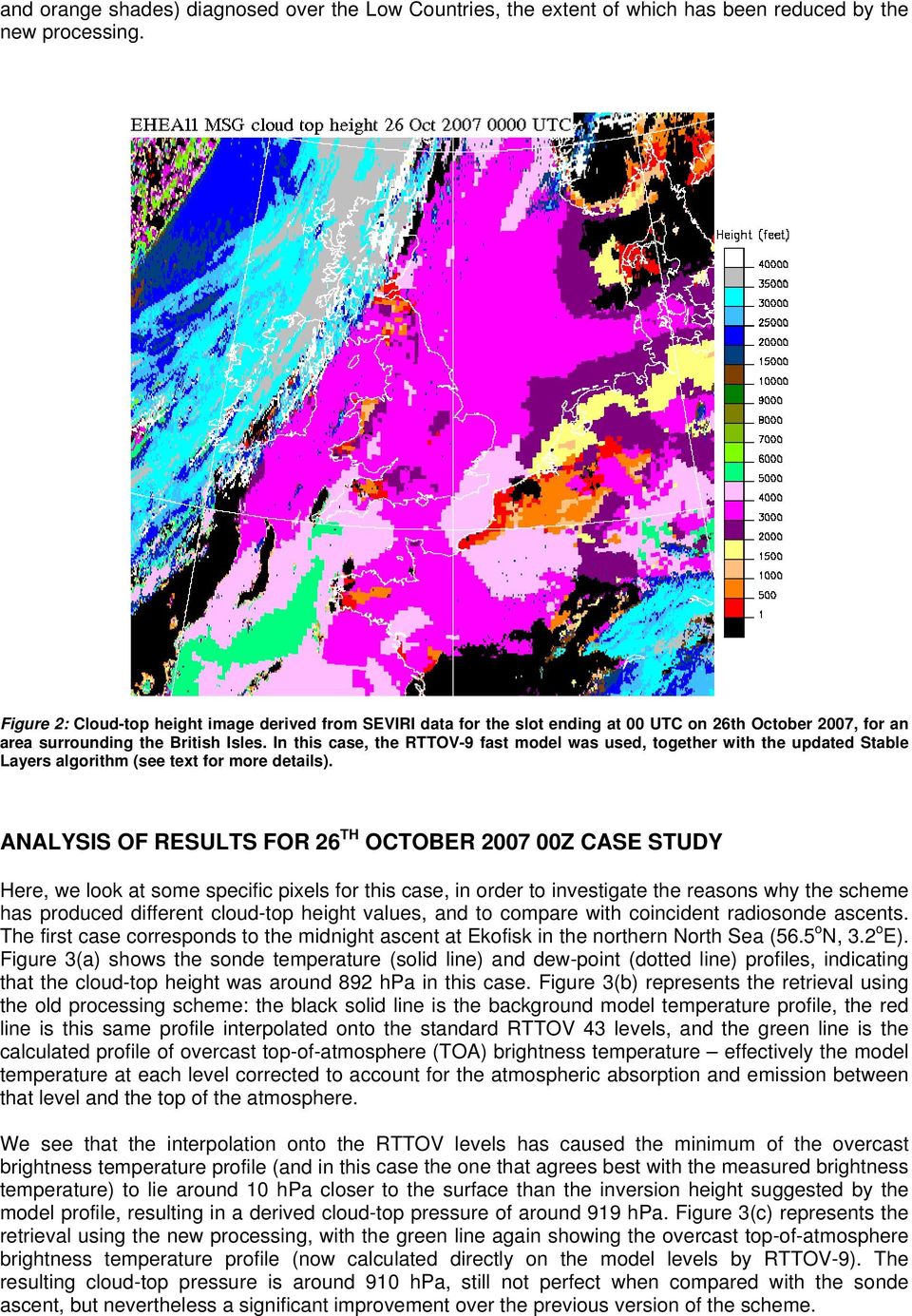
2 RECENT CHANGES INTRODUCED FOR TESTING Two changes have been introduced into the processing software. The first of these involves updating the fast radiative transfer model RTTOV (Saunders et al., 1999) used to calculate the simulated radiances from the model background, with RTTOV-9 ( nwpsaf/rtm/rtm_rttov9.html) replacing the RTTOV-7 version currently being used by the scheme. The advantage of this is that, whereas RTTOV-7 uses a fixed vertical grid of 43 levels, RTTOV-9 allows us to compute the radiative transfer on a user-defined vertical grid. This means that we can carry out all our calculations on the model vertical grid (38 levels currently for the NAE model), and removes the need to carry out vertical interpolations between the different vertical grids. The second change involves an improvement to the way the cost function is calculated within the Stable Layers scheme. In the existing scheme, an initial check is made to ensure that the stability of each model layer is greater than a prescribed threshold (-5 K km -1 ) before proceeeding to the rest of the algorithm, but this information is not itself otherwise used in the calculation of the cost function. In the updated scheme being tested here, the amount by which the stability exceeds the threshold is now also used in the derivation of the cost function, such that layers whose lapse rates only just exceed the threshold are penalised heavily, the additional cost decreasing linearly with increasing lapse rate and reaching zero when a value of +7 K km-1 is reached. AN EXAMPLE OF THE IMPACT OF THESE CHANGES Below is an example of the impact of these changes on a CTH image, in this case using data from 00Z on 26th October The result of the old processing is shown in Figure 1, with the image from the updated scheme shown in Figure 2. Of particular interest is the large area of low-level cloud over the UK, the North Sea and NW Europe, and the fact that there is generally a systematic increase in the derived CTH values when using the updated processing. Note also the area of very low cloud (red Figure 1: Cloud-top height image derived from SEVIRI data for the slot ending at 00 UTC on 26th October 2007, for an area surrounding the British Isles. The fast model used in this case was RTTOV-7, and the existing Stable Layers algorithm was also used (see text for more details).

3 and orange shades) diagnosed over the Low Countries, the extent of which has been reduced by the new processing. Figure 2: Cloud-top height image derived from SEVIRI data for the slot ending at 00 UTC on 26th October 2007, for an area surrounding the British Isles. In this case, the RTTOV-9 fast model was used, together with the updated Stable Layers algorithm (see text for more details). ANALYSIS OF RESULTS FOR 26 TH OCTOBER Z CASE STUDY Here, we look at some specific pixels for this case, in order to investigate the reasons why the scheme has produced different cloud-top heigh t values, and to compare with coincident radiosonde ascents. o o The first case corresponds to the midnight ascent at Ekofisk in the northern North Sea (56.5 N, 3.2 E). Figure 3(a) shows the sonde temperature (solid line) and dew-point (dotted line) profiles, indicating that the cloud-top height was around 892 hpa in this case. Figure 3(b) represents the retrieval using the old processing scheme: the black solid line is the background model temperature profile, the red line is this same profile interpolated onto the standard RTTOV 43 levels, and the green line is the calculated profile of overcast top-of-atmosphere (TOA) brightness temperature effectively the model temperature at each level corrected to account for the atmospheric absorption and emission between that level and the top of the atmosphere. We see that the interpolation onto the RTTOV levels has caused the minimum of the overcast brightness temperature profile (and in this case the one that agrees best with the measured brightness temperature) to lie around 10 hpa closer to the surface than the inversion height suggested by the model profile, resulting in a derived cloud-top pressure of around 919 hpa. Figure 3(c) represents the retrieval using the new processing, with the green line again showing the overcast top-of-atmosphere brightness temperature profile (now calculated directly on the model levels by RTTOV-9). The resulting cloud-top pressure is around 910 hpa, still not perfect when compared with the sonde ascent, but nevertheless a significant improvement over the previous version of the scheme.
4 (a) (b) (c) Figure 3: (a) Radiosonde temperature (solid line) and dew-point (dotted line) profiles for Ekofisk (56.5 o N, 3.2 o E) at 00 UTC on 26th October (b) Retrieval using the existing processing scheme the black solid line is the background model temperature profile, the red line is this same profile interpolated onto the standard RTTOV 43 levels, and the green line is the calculated profile of overcast top-of-atmosphere (TOA) brightness temperature (BT). The dotted line is the model dew-point profile. (c) Retrieval using the new processing the black solid line is again the model temperature profile, the dotted line is the model dew-point profile, and the green line shows the overcast top-ofatmosphere BT profile (now calculated directly on the model levels by RTTOV-9). o o The Emden (53.4 N, 7.2 E) ascent in Figure 4(a) shows a cloud-top at around 924 hpa, whereas the retrieval using the old processing scheme in Figure 4(b) comes up with a value of around 953 hpa, i.e. it puts the cloud-top around 250 m too low. The retrieval using the new processing in Figure 4(c) puts the cloud-top around 939 hpa. This corresponds to an improvement in the CTH of around 120 m (i.e. the CTH error is halved), and is again due almost entirely to the removal of the need to interpolate between the different vertical grids.

5 (a) (b) (c) The Herstmonceux (50.9 N, 0.3 E) ascent in Figure 5(a) shows a cloud-top at around 873 hpa, with the retrieval from the old processing scheme in Figure 5(b) returning a value of around 920 hpa, i.e. an error in CTH of around 425 m. The retrieval using the new processing in Figure 5(c) puts the cloud- top around 870 hpa, very close to the true value. In this case, the improvement is not only due to the introduction of RTTOV-9, but also due to the change in the cost function even though the model s Figure 4: (a) Radiosonde temperature (solid line) and dew-point (dotted line) profiles for Emden (53.4 o N, 7.2 o E) at 00 UTC on 26th October (b) Retrieval using the existing processing scheme the black solid line is the background model temperature profile, the red line is this same profile interpolated onto the standard RTTOV 43 levels, and the green line is the calculated profile of overcast top-of-atmosphere (TOA) brightness temperature (BT). The dotted line is the model dew-point profile. (c) Retrieval using the new processing the black solid line is again the model temperature profile, the dotted line is the model dew-point profile, and the green line shows the overcast top-ofatmosphere BT profile (now calculated directly on the model levels by RTTOV-9). o o

6 temperature inversion is much weaker than shown by the sonde ascent, the new scheme has now successfully identified the base of the model inversion as the best place to position the cloud-top. (a) (b) (c) Figure 5: (a) Radiosonde temperature (solid line) and dew-point (dotted line) profiles for Herstmonceux (50.9 o N, 0.3 o E) at 00 UTC on 26th October (b) Retrieval using the existing processing scheme the black solid line is the background model temperature profile, the red line is this same profile interpolated onto the standard RTTOV 43 levels, and the green line is the calculated profile of overcast top-of-atmosphere (TOA) brightness temperature (BT). The dotted line is the model dew-point profile. (c) Retrieval using the new processing the black solid line is again the model temperature profile, the dotted line is the model dew-point profile, and the green line shows the overcast top-ofatmosphere BT profile (now calculated directly on the model levels by RTTOV-9). As a final example, we show the Essen (51.4 o N, 7.0 o E) ascent in Figure 6(a) compared with the CTH retrievals from the old and new versions of the CTH scheme (Figures 6(b) and 6(c) respectively). The

7 sonde shows the cloud-top at around 909 hpa, whereas the old processing puts the cloud-top much closer to the surface, at around 1007 hpa. This is because the model does not capture the strong inversion at around 900 hpa at all well, and this inversion is also smoothed out by the vertical interpolation. However, we see that even the new scheme has failed to improve matters significantly in this case although the inversion around 900 hpa is now better represented by the RTTOV-9 calculations, the presence of a small but significant model inversion near the surface has caused the scheme to place the cloud-top at around 999 hpa, still significantly in error. (a) (b) (c) Figure 6: (a) Radiosonde temperature (solid line) and dew-point (dotted line) profiles for Essen (51.4 o N, 7.0 o E) at 00 UTC on 26th October (b) Retrieval using the existing processing scheme the black solid line is the background model temperature profile, the red line is this same profile interpolated onto the standard RTTOV 43 levels, and the green line is the calculated profile of overcast top-of-atmosphere (TOA) brightness temperature (BT). The dotted line is the model dew-point profile. (c) Retrieval using the new processing the black solid line is again the model temperature profile, the dotted line is the model dew-point profile, and the green line shows the overcast top-ofatmosphere BT profile (now calculated directly on the model levels by RTTOV-9).

8 CONCLUSIONS AND FURTHER WORK We have shown the impact of changes to the Met Office s SEVIRI cloud-top height scheme, including the introduction of the RTTOV-9 fast model into the processing. Comparisons with coincident radiosonde data have shown that, for low-cloud situations, the resulting CTH values are systematically and significantly improved with the updated scheme. This is the case for the 26th October 2007 data shown here, and also for several other case studies not presented here. However, there are still instances (e.g. the Essen ascent in Figure 6 and the persistence of sizeable areas of very low diagnosed cloud over the Low Countries in the image in Figure 2) where the new scheme still gives CTH values which are significantly in error. More work is planned on further improvements to the CTH scheme, and also on making improvements to the assimilation of cloud information into the forecast models (see Taylor et al., 2008), which should help us produce better low-cloud forecasts in the future. REFERENCES Eyre, J.R. and W.P. Menzel, Retrieval of cloud parameters from satellite sounder data: a simulation study. J. Appl. Meteorol., 28, Moseley, S., 2003: Changes to the Nimrod cloud top height diagnosis. Met Office Forecasting Research Technical Report no Saunders, R.W., M. Matricardi and P. Brunel, 1999: An improved fast radiative transfer model for assimilation of satellite radiance observations. Quart. J. Roy. Meteorol. Soc., 125, Saunders, R.W., R.A. Francis, P.N. Francis, J. Crawford, A.J. Smith, I.D. Brown, R.B.E. Taylor, M. Forsythe, M. Doutriaux-Boucher and S.C. Millington, The exploitation of Meteosat Second Generation Data in the Met Office. Proceedings of the 2006 EUMETSAT Meteorological Satellite Conference, Helsinki, Finland. Taylor, R.B.E., R. Renshaw, R.W. Saunders and P.N. Francis, Assimilation of SEVIRI cloud-top parameters in the regional Met Office forecast model. Proceedings of the 2008 EUMETSAT Meteorological Satellite Conference, Darmstadt, Germany.
Synoptic assessment of AMV errors
 NWP SAF Satellite Application Facility for Numerical Weather Prediction Visiting Scientist mission report Document NWPSAF-MO-VS-038 Version 1.0 4 June 2009 Synoptic assessment of AMV errors Renato Galante
Validation of SEVIRI cloud-top height retrievals from A-Train data
 Validation of SEVIRI cloud-top height retrievals from A-Train data Chu-Yong Chung, Pete N Francis, and Roger Saunders Contents Introduction MO GeoCloud AVAC-S Long-term monitoring Comparison with OCA Summary
SAFNWC/MSG Cloud type/height. Application for fog/low cloud situations
 SAFNWC/MSG Cloud type/height. Application for fog/low cloud situations 22 September 2011 Hervé LE GLEAU, Marcel DERRIEN Centre de météorologie Spatiale. Lannion Météo-France 1 Fog or low level clouds?
Assimilation of cloudy infrared satellite observations: The Met Office perspective
 Assimilation of cloudy infrared satellite observations: The Met Office perspective Ed Pavelin, Met Office International Symposium on Data Assimilation 2014, Munich Contents This presentation covers the
ECMWF Aerosol and Cloud Detection Software. User Guide. version 1.2 20/01/2015. Reima Eresmaa ECMWF
 ECMWF Aerosol and Cloud User Guide version 1.2 20/01/2015 Reima Eresmaa ECMWF This documentation was developed within the context of the EUMETSAT Satellite Application Facility on Numerical Weather Prediction
Clear Sky Radiance (CSR) Product from MTSAT-1R. UESAWA Daisaku* Abstract
 Clear Sky Radiance (CSR) Product from MTSAT-1R UESAWA Daisaku* Abstract The Meteorological Satellite Center (MSC) has developed a Clear Sky Radiance (CSR) product from MTSAT-1R and has been disseminating
The impact of window size on AMV
 The impact of window size on AMV E. H. Sohn 1 and R. Borde 2 KMA 1 and EUMETSAT 2 Abstract Target size determination is subjective not only for tracking the vector but also AMV results. Smaller target
Night Microphysics RGB Nephanalysis in night time
 Copyright, JMA Night Microphysics RGB Nephanalysis in night time Meteorological Satellite Center, JMA What s Night Microphysics RGB? R : B15(I2 12.3)-B13(IR 10.4) Range : -4 2 [K] Gamma : 1.0 G : B13(IR
GOES-R AWG Cloud Team: ABI Cloud Height
 GOES-R AWG Cloud Team: ABI Cloud Height June 8, 2010 Presented By: Andrew Heidinger 1 1 NOAA/NESDIS/STAR 1 Outline Executive Summary Algorithm Description ADEB and IV&V Response Summary Requirements Specification
Estimation of satellite observations bias correction for limited area model
 Estimation of satellite observations bias correction for limited area model Roger Randriamampianina Hungarian Meteorological Service, Budapest, Hungary [email protected] Abstract Assimilation of satellite radiances
Overview of the IR channels and their applications
 Ján Kaňák Slovak Hydrometeorological Institute [email protected] Overview of the IR channels and their applications EUMeTrain, 14 June 2011 Ján Kaňák, SHMÚ 1 Basics in satellite Infrared image interpretation
Towards assimilating IASI satellite observations over cold surfaces - the cloud detection aspect
 Towards assimilating IASI satellite observations over cold surfaces - the cloud detection aspect Tuuli Perttula, FMI + Thanks to: Nadia Fourrié, Lydie Lavanant, Florence Rabier and Vincent Guidard, Météo
Volcanic Ash Monitoring: Product Guide
 Doc.No. Issue : : EUM/TSS/MAN/15/802120 v1a EUMETSAT Eumetsat-Allee 1, D-64295 Darmstadt, Germany Tel: +49 6151 807-7 Fax: +49 6151 807 555 Date : 2 June 2015 http://www.eumetsat.int WBS/DBS : EUMETSAT
MSG MPEF Products focus on GII Simon Elliott Meteorological Operations Division [email protected]
 MSG MPEF focus on GII Simon Elliott Meteorological Operations Division [email protected] MSG Application Workshop, 15-19 March 2010, Alanya, Türkiye Slide: 1 1. What is the MPEF? Meteorological
Options for filling the LEO-GEO AMV Coverage Gap Francis Warrick Met Office, UK
 AMV investigation Document NWPSAF-MO-TR- Version. // Options for filling the LEO-GEO AMV Coverage Gap Francis Warrick Met Office, UK Options for filling the LEO-GEO AMV Coverage Gap Doc ID : NWPSAF-MO-TR-
Studying cloud properties from space using sounder data: A preparatory study for INSAT-3D
 Studying cloud properties from space using sounder data: A preparatory study for INSAT-3D Munn V. Shukla and P. K. Thapliyal Atmospheric Sciences Division Atmospheric and Oceanic Sciences Group Space Applications
How To Understand Cloud Properties From Satellite Imagery
 P1.70 NIGHTTIME RETRIEVAL OF CLOUD MICROPHYSICAL PROPERTIES FOR GOES-R Patrick W. Heck * Cooperative Institute for Meteorological Satellite Studies, University of Wisconsin-Madison Madison, Wisconsin P.
Active Fire Monitoring: Product Guide
 Active Fire Monitoring: Product Guide Doc.No. Issue : : EUM/TSS/MAN/15/801989 v1c EUMETSAT Eumetsat-Allee 1, D-64295 Darmstadt, Germany Tel: +49 6151 807-7 Fax: +49 6151 807 555 Date : 14 April 2015 http://www.eumetsat.int
The APOLLO cloud product statistics Web service
 The APOLLO cloud product statistics Web service Introduction DLR and Transvalor are preparing a new Web service to disseminate the statistics of the APOLLO cloud physical parameters as a further help in
WV IMAGES. Christo Georgiev. NIMH, Bulgaria. Satellite Image Interpretation and Applications EUMeTrain Online Course, 10 30 June 2011
 WV IMAGES Satellite Image Interpretation and Applications EUMeTrain Online Course, 10 30 June 2011 Christo Georgiev NIMH, Bulgaria INTRODICTION The radiometer SEVIRI of Meteosat Second Generation (MSG)
Developing Continuous SCM/CRM Forcing Using NWP Products Constrained by ARM Observations
 Developing Continuous SCM/CRM Forcing Using NWP Products Constrained by ARM Observations S. C. Xie, R. T. Cederwall, and J. J. Yio Lawrence Livermore National Laboratory Livermore, California M. H. Zhang
Evaluation of the Effect of Upper-Level Cirrus Clouds on Satellite Retrievals of Low-Level Cloud Droplet Effective Radius
 Evaluation of the Effect of Upper-Level Cirrus Clouds on Satellite Retrievals of Low-Level Cloud Droplet Effective Radius F.-L. Chang and Z. Li Earth System Science Interdisciplinary Center University
Outline of RGB Composite Imagery
 Outline of RGB Composite Imagery Data Processing Division, Data Processing Department Meteorological Satellite Center (MSC) JMA Akihiro SHIMIZU 29 September, 2014 Updated 6 July, 2015 1 Contents What s
The APOLLO cloud product statistics Web service The APOLLO cloud product statistics Web service
 The APOLLO cloud product statistics Web service Introduction DLR and Transvalor are preparing a new Web service to disseminate the statistics of the APOLLO cloud physical parameters as a further help in
Convective Clouds. Convective clouds 1
 Convective clouds 1 Convective Clouds Introduction Convective clouds are formed in vertical motions that result from the instability of the atmosphere. This instability can be caused by: a. heating at
EUMETSAT Satellite Programmes
 EUMETSAT Satellite Programmes Nowcasting Applications Developing Countries Marianne König [email protected] WSN-12 Rio de Janeiro 06-10 August 2012 27 Member States & 4 Cooperating States Member
CALCULATION OF CLOUD MOTION WIND WITH GMS-5 IMAGES IN CHINA. Satellite Meteorological Center Beijing 100081, China ABSTRACT
 CALCULATION OF CLOUD MOTION WIND WITH GMS-5 IMAGES IN CHINA Xu Jianmin Zhang Qisong Satellite Meteorological Center Beijing 100081, China ABSTRACT With GMS-5 images, cloud motion wind was calculated. For
MOGREPS status and activities
 MOGREPS status and activities by Warren Tennant with contributions from Rob Neal, Sarah Beare, Neill Bowler & Richard Swinbank Crown copyright Met Office 32 nd EWGLAM and 17 th SRNWP meetings 1 Contents
Nowcasting of significant convection by application of cloud tracking algorithm to satellite and radar images
 Nowcasting of significant convection by application of cloud tracking algorithm to satellite and radar images Ng Ka Ho, Hong Kong Observatory, Hong Kong Abstract Automated forecast of significant convection
Cloud Grid Information Objective Dvorak Analysis (CLOUD) at the RSMC Tokyo - Typhoon Center
 Cloud Grid Information Objective Dvorak Analysis (CLOUD) at the RSMC Tokyo - Typhoon Center Kenji Kishimoto, Masaru Sasaki and Masashi Kunitsugu Forecast Division, Forecast Department Japan Meteorological
SYNERGISTIC USE OF IMAGER WINDOW OBSERVATIONS FOR CLOUD- CLEARING OF SOUNDER OBSERVATION FOR INSAT-3D
 SYNERGISTIC USE OF IMAGER WINDOW OBSERVATIONS FOR CLOUD- CLEARING OF SOUNDER OBSERVATION FOR INSAT-3D ABSTRACT: Jyotirmayee Satapathy*, P.K. Thapliyal, M.V. Shukla, C. M. Kishtawal Atmospheric and Oceanic
Satellite Remote Sensing of Volcanic Ash
 Marco Fulle www.stromboli.net Satellite Remote Sensing of Volcanic Ash Michael Pavolonis NOAA/NESDIS/STAR SCOPE Nowcasting 1 Meeting November 19 22, 2013 1 Outline Getty Images Volcanic ash satellite remote
Satellite remote sensing using AVHRR, ATSR, MODIS, METEOSAT, MSG
 Satellite remote sensing using AVHRR, ATSR, MODIS, METEOSAT, MSG Ralf Meerkötter, Luca Bugliaro, Knut Dammann, Gerhard Gesell, Christine König, Waldemar Krebs, Hermann Mannstein, Bernhard Mayer, presented
Project Title: Quantifying Uncertainties of High-Resolution WRF Modeling on Downslope Wind Forecasts in the Las Vegas Valley
 University: Florida Institute of Technology Name of University Researcher Preparing Report: Sen Chiao NWS Office: Las Vegas Name of NWS Researcher Preparing Report: Stanley Czyzyk Type of Project (Partners
Guy Carpenter Asia-Pacific Climate Impact Centre, School of energy and Environment, City University of Hong Kong
 Diurnal and Semi-diurnal Variations of Rainfall in Southeast China Judy Huang and Johnny Chan Guy Carpenter Asia-Pacific Climate Impact Centre School of Energy and Environment City University of Hong Kong
USING THE GOES 3.9 µm SHORTWAVE INFRARED CHANNEL TO TRACK LOW-LEVEL CLOUD-DRIFT WINDS ABSTRACT
 USING THE GOES 3.9 µm SHORTWAVE INFRARED CHANNEL TO TRACK LOW-LEVEL CLOUD-DRIFT WINDS Jason P. Dunion 1 and Christopher S. Velden 2 1 NOAA/AOML/Hurricane Research Division, 2 UW/CIMSS ABSTRACT Low-level
Labs in Bologna & Potenza Menzel. Lab 3 Interrogating AIRS Data and Exploring Spectral Properties of Clouds and Moisture
 Labs in Bologna & Potenza Menzel Lab 3 Interrogating AIRS Data and Exploring Spectral Properties of Clouds and Moisture Figure 1: High resolution atmospheric absorption spectrum and comparative blackbody
Cloud detection by using cloud cost for AIRS: Part 1
 cloud cost for the Advanced Infrared Radiometer Sounder (Part I) - A simulation study - August 19, 2002 Yoshiaki Takeuchi Japan Meteorological Agency EUMETSAT NWP-SAF Visiting Scientist to Met Office,
All-sky assimilation of microwave imager observations sensitive to water vapour, cloud and rain
 All-sky assimilation of microwave imager observations sensitive to water vapour, cloud and rain A.J. Geer, P. Bauer, P. Lopez and D. Salmond European Centre for Medium-Range Weather Forecasts, Reading,
IRS Level 2 Processing Concept Status
 IRS Level 2 Processing Concept Status Stephen Tjemkes, Jochen Grandell and Xavier Calbet 6th MTG Mission Team Meeting 17 18 June 2008, Estec, Noordwijk Page 1 Content Introduction Level 2 Processing Concept
Cloud detection and clearing for the MOPITT instrument
 Cloud detection and clearing for the MOPITT instrument Juying Warner, John Gille, David P. Edwards and Paul Bailey National Center for Atmospheric Research, Boulder, Colorado ABSTRACT The Measurement Of
Cloud/Hydrometeor Initialization in the 20-km RUC Using GOES Data
 WORLD METEOROLOGICAL ORGANIZATION COMMISSION FOR BASIC SYSTEMS OPEN PROGRAMMME AREA GROUP ON INTEGRATED OBSERVING SYSTEMS EXPERT TEAM ON OBSERVATIONAL DATA REQUIREMENTS AND REDESIGN OF THE GLOBAL OBSERVING
Measurement of the effect of biomass burning aerosol on inhibition of cloud formation over the Amazon
 Supporting Online Material for Koren et al. Measurement of the effect of biomass burning aerosol on inhibition of cloud formation over the Amazon 1. MODIS new cloud detection algorithm The operational
Comparative Evaluation of High Resolution Numerical Weather Prediction Models COSMO-WRF
 3 Working Group on Verification and Case Studies 56 Comparative Evaluation of High Resolution Numerical Weather Prediction Models COSMO-WRF Bogdan Alexandru MACO, Mihaela BOGDAN, Amalia IRIZA, Cosmin Dănuţ
Towards an NWP-testbed
 Towards an NWP-testbed Ewan O Connor and Robin Hogan University of Reading, UK Overview Cloud schemes in NWP models are basically the same as in climate models, but easier to evaluate using ARM because:
CERES Edition 2 & Edition 3 Cloud Cover, Cloud Altitude and Temperature
 CERES Edition 2 & Edition 3 Cloud Cover, Cloud Altitude and Temperature S. Sun-Mack 1, P. Minnis 2, Y. Chen 1, R. Smith 1, Q. Z. Trepte 1, F. -L. Chang, D. Winker 2 (1) SSAI, Hampton, VA (2) NASA Langley
REMOTE SENSING OF CLOUD-AEROSOL RADIATIVE EFFECTS FROM SATELLITE DATA: A CASE STUDY OVER THE SOUTH OF PORTUGAL
 REMOTE SENSING OF CLOUD-AEROSOL RADIATIVE EFFECTS FROM SATELLITE DATA: A CASE STUDY OVER THE SOUTH OF PORTUGAL D. Santos (1), M. J. Costa (1,2), D. Bortoli (1,3) and A. M. Silva (1,2) (1) Évora Geophysics
Best practices for RGB compositing of multi-spectral imagery
 Best practices for RGB compositing of multi-spectral imagery User Service Division, EUMETSAT Introduction Until recently imagers on geostationary satellites were limited to 2-3 spectral channels, i.e.
Diurnal Cycle: Cloud Base Height clear sky
 Diurnal Cycle: Cloud Base Height clear sky Helsinki CNN I Madrid, 16 Dezember 2002 1 Cabauw Geesthacht Cabauw Geesthacht Helsinki Helsinki Petersburg Potsdam Petersburg Potsdam CNN I CNN II Madrid, 16
How do Scientists Forecast Thunderstorms?
 How do Scientists Forecast Thunderstorms? Objective In the summer, over the Great Plains, weather predictions often call for afternoon thunderstorms. While most of us use weather forecasts to help pick
Tropical Cyclogenesis Monitoring at RSMC Tokyo Mikio, Ueno Forecaster, Tokyo Typhoon Center Japan Meteorological Agency (JMA)
 JMA/WMO Workshop on Effective Tropical Cyclone Warning in Southeast Asia 11 14 March, 2014 Tropical Cyclogenesis Monitoring at RSMC Tokyo Mikio, Ueno Forecaster, Tokyo Typhoon Center Japan Meteorological
Cloud Thickness Estimation from GOES-8 Satellite Data Over the ARM-SGP Site
 Cloud Thickness Estimation from GOES-8 Satellite Data Over the ARM-SGP Site V. Chakrapani, D. R. Doelling, and A. D. Rapp Analytical Services and Materials, Inc. Hampton, Virginia P. Minnis National Aeronautics
Sub-grid cloud parametrization issues in Met Office Unified Model
 Sub-grid cloud parametrization issues in Met Office Unified Model Cyril Morcrette Workshop on Parametrization of clouds and precipitation across model resolutions, ECMWF, Reading, November 2012 Table of
COMPUTING CLOUD MOTION USING A CORRELATION RELAXATION ALGORITHM Improving Estimation by Exploiting Problem Knowledge Q. X. WU
 COMPUTING CLOUD MOTION USING A CORRELATION RELAXATION ALGORITHM Improving Estimation by Exploiting Problem Knowledge Q. X. WU Image Processing Group, Landcare Research New Zealand P.O. Box 38491, Wellington
VIIRS-CrIS mapping. NWP SAF AAPP VIIRS-CrIS Mapping
 NWP SAF AAPP VIIRS-CrIS Mapping This documentation was developed within the context of the EUMETSAT Satellite Application Facility on Numerical Weather Prediction (NWP SAF), under the Cooperation Agreement
Mode-S Enhanced Surveillance derived observations from multiple Air Traffic Control Radars and the impact in hourly HIRLAM
 Mode-S Enhanced Surveillance derived observations from multiple Air Traffic Control Radars and the impact in hourly HIRLAM 1 Introduction Upper air wind is one of the most important parameters to obtain
METEOSAT 8 SEVIRI and NOAA AVHRR Cloud Products. A Climate Monitoring SAF Comparison Study. Meteorologi. Sheldon Johnston and Karl-Göran Karlsson
 Nr 127, 2007 Meteorologi METEOSAT 8 SEVIRI and NOAA AVHRR Cloud Products A Climate Monitoring SAF Comparison Study Sheldon Johnston and Karl-Göran Karlsson Cover Image The difference between the mean cloudiness
Stability and Cloud Development. Stability in the atmosphere AT350. Why did this cloud form, whereas the sky was clear 4 hours ago?
 Stability and Cloud Development AT350 Why did this cloud form, whereas the sky was clear 4 hours ago? Stability in the atmosphere An Initial Perturbation Stable Unstable Neutral If an air parcel is displaced
WMO 7 International Workshop on Volcanic Ash, Anchorage, AK
 An algorithm for automated cloud pattern recognition and mass eruption rate estimation from umbrella cloud or downwind plume observed via satellite imagery 1 WMO 7 International Workshop on Volcanic Ash,
MSG-SEVIRI cloud physical properties for model evaluations
 Rob Roebeling Weather Research Thanks to: Hartwig Deneke, Bastiaan Jonkheid, Wouter Greuell, Jan Fokke Meirink and Erwin Wolters (KNMI) MSG-SEVIRI cloud physical properties for model evaluations Cloud
How To Model An Ac Cloud
 Development of an Elevated Mixed Layer Model for Parameterizing Altocumulus Cloud Layers S. Liu and S. K. Krueger Department of Meteorology University of Utah, Salt Lake City, Utah Introduction Altocumulus
GOES-R Advanced Baseline Imager (ABI) Algorithm Theoretical Basis Document For Low Cloud and Fog
 NOAA NESDIS CENTER for SATELLITE APPLICATIONS and RESEARCH GOES-R Advanced Baseline Imager (ABI) Algorithm Theoretical Basis Document For Low Cloud and Fog Corey Calvert, UW/CIMSS Mike Pavolonis, NOAA/NESDIS/STAR
Sentinel-3 Marine Test Data Set processed at EUMETSAT
 Sentinel-3 Marine Test Data Set processed at EUMETSAT Doc.No. : EUM/TSS/TEN/15/822144 Issue : v2 e-signed Date : 15 December 2015 WBS/DBS : EUMETSAT Eumetsat-Allee 1, D-64295 Darmstadt, Germany Tel: +49
39th International Physics Olympiad - Hanoi - Vietnam - 2008. Theoretical Problem No. 3
 CHANGE OF AIR TEMPERATURE WITH ALTITUDE, ATMOSPHERIC STABILITY AND AIR POLLUTION Vertical motion of air governs many atmospheric processes, such as the formation of clouds and precipitation and the dispersal
Winds. Winds on a weather map are represented by wind barbs; e.g., Notes:
 Winds Winds on a weather map are represented by wind barbs; e.g., flag half flag pennant wind direction The wind is blowing from the side with the flags and pennants (think an arrow with feathers) Speeds
Improvement in the Assessment of SIRS Broadband Longwave Radiation Data Quality
 Improvement in the Assessment of SIRS Broadband Longwave Radiation Data Quality M. E. Splitt University of Utah Salt Lake City, Utah C. P. Bahrmann Cooperative Institute for Meteorological Satellite Studies
Daily High-resolution Blended Analyses for Sea Surface Temperature
 Daily High-resolution Blended Analyses for Sea Surface Temperature by Richard W. Reynolds 1, Thomas M. Smith 2, Chunying Liu 1, Dudley B. Chelton 3, Kenneth S. Casey 4, and Michael G. Schlax 3 1 NOAA National
Current posture analysis is nothing without providing bilateral feedback aiming towards improving performance through appropriate remedial actions:
 NATIONAL UPPER-AIR NETWORK PERFORMANCE MONITORING, TASKS AND EXPERIENCE A. Kats, A. Naumov, A. Ivanov Central Aerological Observatory, Roshydromet 3 Pervomaiskaya Street, Dolgoprudny, 141700, Russian Federation
SATELLITE OBSERVATION OF THE DAILY VARIATION OF THIN CIRRUS
 SATELLITE OBSERVATION OF THE DAILY VARIATION OF THIN CIRRUS Hermann Mannstein and Stephan Kox ATMOS 2012 Bruges, 2012-06-21 Folie 1 Why cirrus? Folie 2 Warum Eiswolken? Folie 3 Folie 4 Folie 5 Folie 6
A review of cloud top height and optical depth histograms from MISR, ISCCP, and MODIS
 JOURNAL OF GEOPHYSICAL RESEARCH, VOL. 115,, doi:10.1029/2009jd013422, 2010 A review of cloud top height and optical depth histograms from MISR, ISCCP, and MODIS Roger Marchand, 1 Thomas Ackerman, 1 Mike
A comparison of NOAA/AVHRR derived cloud amount with MODIS and surface observation
 A comparison of NOAA/AVHRR derived cloud amount with MODIS and surface observation LIU Jian YANG Xiaofeng and CUI Peng National Satellite Meteorological Center, CMA, CHINA outline 1. Introduction 2. Data
Radiative effects of clouds, ice sheet and sea ice in the Antarctic
 Snow and fee Covers: Interactions with the Atmosphere and Ecosystems (Proceedings of Yokohama Symposia J2 and J5, July 1993). IAHS Publ. no. 223, 1994. 29 Radiative effects of clouds, ice sheet and sea
Mixing Heights & Smoke Dispersion. Casey Sullivan Meteorologist/Forecaster National Weather Service Chicago
 Mixing Heights & Smoke Dispersion Casey Sullivan Meteorologist/Forecaster National Weather Service Chicago Brief Introduction Fire Weather Program Manager Liaison between the NWS Chicago office and local
Including thermal effects in CFD simulations
 Including thermal effects in CFD simulations Catherine Meissner, Arne Reidar Gravdahl, Birthe Steensen [email protected], [email protected] Fjordgaten 15, N-125 Tonsberg hone: +47 8 1800 Norway Fax:
HIGH RESOLUTION SATELLITE IMAGERY OF THE NEW ZEALAND AREA: A VIEW OF LEE WAVES*
 Weather and Climate (1982) 2: 23-29 23 HIGH RESOLUTION SATELLITE IMAGERY OF THE NEW ZEALAND AREA: A VIEW OF LEE WAVES* C. G. Revell New Zealand Meteorological Service, Wellington ABSTRACT Examples of cloud
Nowcasting: analysis and up to 6 hours forecast
 Nowcasting: analysis and up to 6 hours forecast Very high resoultion in time and space Better than NWP Rapid update Application oriented NWP problems for 0 6 forecast: Incomplete physics Resolution space
Eco Pelmet Modelling and Assessment. CFD Based Study. Report Number 610.14351-R1D1. 13 January 2015
 EcoPelmet Pty Ltd c/- Geoff Hesford Engineering 45 Market Street FREMANTLE WA 6160 Version: Page 2 PREPARED BY: ABN 29 001 584 612 2 Lincoln Street Lane Cove NSW 2066 Australia (PO Box 176 Lane Cove NSW
INTELLIGENT ENERGY MANAGEMENT OF ELECTRICAL POWER SYSTEMS WITH DISTRIBUTED FEEDING ON THE BASIS OF FORECASTS OF DEMAND AND GENERATION Chr.
 INTELLIGENT ENERGY MANAGEMENT OF ELECTRICAL POWER SYSTEMS WITH DISTRIBUTED FEEDING ON THE BASIS OF FORECASTS OF DEMAND AND GENERATION Chr. Meisenbach M. Hable G. Winkler P. Meier Technology, Laboratory
Solarstromprognosen für Übertragungsnetzbetreiber
 Solarstromprognosen für Übertragungsnetzbetreiber Elke Lorenz, Jan Kühnert, Annette Hammer, Detlev Heienmann Universität Oldenburg 1 Outline grid integration of photovoltaic power (PV) in Germany overview
Analysis of Cloud Variability and Sampling Errors in Surface and Satellite Measurements
 Analysis of Cloud Variability and Sampling Errors in Surface and Satellite Measurements Z. Li, M. C. Cribb, and F.-L. Chang Earth System Science Interdisciplinary Center University of Maryland College