
CACHE. Course Handbook. Level 2 Award, Level 2 Certificate and Level 2 Diploma in Child Care and Education
|
|
|
- Quentin Cox
- 9 years ago
- Views:
Transcription
1 CACHE Course Handbook Level 2 Award, Level 2 Certificate and Level 2 Diploma in Child Care and Education Syllabus, Regulations and Assessment Materials 5th edition

2 CACHE 2011 Except as allowed by law, or where specified in the text, no part of this publication may be reproduced or transmitted in any form or by any means without prior permission from the Council for Awards in Care, Health and Education. All photographs appearing in this handbook have a signed parental release form and are the exclusive property of CACHE. They are protected under the copyright law and can not be reproduced, copied or manipulated in any form. This includes the use of any image or part of an image in individual or group projects and assessment materials. Qualification Accreditation Numbers: CACHE Level 2 Award in Child Care and Education 500/1887/5 CACHE Level 2 Certificate in Child Care and Education 500/1886/3 CACHE Level 2 Diploma in Child Care and Education 500/1888/7 Published in Great Britain by CACHE First Edition 2007 Second Edition 2008 Third Edition June 2009 Fourth Edition June 2010 Fifth Edition August 2011 Book code 500/1888/7/V1 Book code 500/1888/7/V2 Book code 500/1888/7/V3 Book code 500/1888/7/V4 Book code 500/1888/7/V5 Publication date August 2011 Publisher Council for Awards in Care, Health and Education Apex House 81 Camp Road St Albans Hertfordshire AL1 5GB Telephone Registered Company No: Registered Charity No: Printed in England by Océ (UK) Limited Océ House Chatham Way Brentwood Essex CM14 4DZ Océ Ref:
3 Level 2 Award, Level 2 Certificate and Level 2 Diploma in Contents Contents Candidate information About this handbook Introduction iii v vii Section 1 Assessment of your learning 1 Plagiarism 3 Types of assessment 3 Internally assessed unit assignments 4 Internal assessment procedures 4 Referral of internally assessed unit assignments 4 Improving your grade for internally assessed assignments 4 External assessment: Multiple choice question paper 5 Re-mark request for multiple choice question paper 5 Referral on multiple choice question paper 5 Certification 5 Section 2 Structure of the qualifications 7 CACHE Level 2 Award in Child Care and Education 9 CACHE Level 2 Certificate in Child Care and Education 9 CACHE Level 2 Diploma in Child Care and Education 9 Unit titles 10 Section 3 Assessment strategies 11 CACHE Level 2 Award in Child Care and Education 13 CACHE Level 2 Certificate in Child Care and Education 13 CACHE Level 2 Diploma in Child Care and Education 14 i
4 Contents Level 2 Award, Level 2 Certificate and Level 2 Diploma in Section 4 The syllabus 15 References and bibliography in unit assignments 17 Unit 1 An introduction to working with children 19 Unit 2 The developing child 27 Unit 3 Safe, healthy and nurturing environments for children 35 Unit 4 Children and play 39 Unit 5 Communication and professional skills within child care and education 45 Unit 6 The child care practitioner in the workplace 51 Unit 7 Working with children from birth to age 5 years 59 Unit 8 Play activity for children from birth to age 16 years 67 Unit 9 Supporting children with additional needs 75 Unit 10 Introduction to children s learning 83 Unit 11 Supporting children and families 91 Section 5 About CACHE 99 Section 6 Mapping 103 Section 7 Mapping of Key Skills 107 Section 8 Assignment and marking forms 113 Assignment planner 115 Record of the grades achieved for the CACHE Level 2 Award, Level 2 Certificate and 117 Level 2 Diploma in Child Care and Education Compensatory marking grid: Guidance for awarding marks 119 Section 9 Placement records 167 Candidate information 169 Evidence of internal moderation 171 Placement Summary 173 Practice Evidence Records 175 Practice Evidence Record Diary 175 Professional Development Profiles 215 Handbook feedback form 231 ii

5 Level 2 Award, Level 2 Certificate and Level 2 Diploma in Candidate information Candidate information Name: Your Personal Details Address: Telephone Number: PIN: Date you registered for the CACHE Level 2 Award in Child Care and Education: Date you registered for the CACHE Level 2 Certificate in Child Care and Education: Date you registered for the CACHE Level 2 Diploma in Child Care and Education: Site/Centre name: Your Centre Details Site/Centre address: Site/Centre Telephone number: Site/Centre number: Name of your course tutor: iii

6 Candidate information Level 2 Award, Level 2 Certificate and Level 2 Diploma in This page is intentionally blank. iv

7 Level 2 Award, Level 2 Certificate and Level 2 Diploma in About this handbook About this handbook This handbook provides the information you will need for the 3 qualifications: CACHE Level 2 Award in Child Care and Education CACHE Level 2 Certificate in Child Care and Education CACHE Level 2 Diploma in Child Care and Education. References to qualifications in this handbook For ease we have used Level 2 Award, Level 2 Certificate and Level 2 Diploma in Child Care and Education, instead of listing all 3 qualifications in full when referring to them. What is included in this handbook The introduction and assessment of your learning sections contain general information about the qualifications and explanations of the terms used throughout the handbook. Section 1 explains the methods that will be used to assess your learning. Section 2 explains the qualification structures and the combination of units needed to achieve the Award or the Certificate or the Diploma. The syllabus section provides a breakdown of each unit. Under each unit heading, you will also find the assignment details and grading structure. You can find out about CACHE in Section 5, and on the CACHE website. The tables in Section 6 show how the CACHE Level 2 Award, the Level 2 Certificate and the Level 2 Diploma in Child Care and Education map to the Common Induction Standards, the National Occupational Standards in Children's Care, Learning and Development, Every Child Matters and the Early Years Foundation Stage. The placement records Section 9 contains: the Placement Summary Practice Evidence Records Practice Evidence Record Diary Professional Development Profiles. This section can be detached from the rest of the handbook and taken with you to your placements. v

8 About this handbook Level 2 Award, Level 2 Certificate and Level 2 Diploma in This page is intentionally blank. vi

9 Level 2 Award, Level 2 Certificate and Level 2 Diploma in Introduction Introduction Welcome to the CACHE Level 2 Award, Level 2 Certificate and Level 2 Diploma in Child Care and Education qualifications. These qualifications prepare you to work in a supervised capacity, with children and their families in a variety of settings and environments within the sector of Children's Services. Your Centre will register you as a candidate with CACHE. You will receive a personal identification number (PIN) for entry to any assessment for these qualifications. The Practice Evidence Records referred to in the handbook must be completed to a satisfactory standard. It is very important to link theory to practice and you will find that, in general, the unit you are studying has close links with the training environment in which you have been placed. Recommended Guided Learning Hours (GLH) Guided Learning Hours include: time spent with your tutor(s), who will use a number of different ways to help you learn, so that not all the recommended hours will be spent in the classroom, and time the tutor or placement supervisor spends with you in your placement supporting, or assessing you. About the qualifications There are 3 qualifications; Award, Certificate and Diploma, with the Award and Certificate building towards the Level 2 Diploma. It is expected that most people will progress through the Award and Certificate to complete the Diploma in order to be able to practice as an early years practitioner. Award Certificate Diploma You must achieve Units 1 and 2; 120 Guided Learning Hours (GLH) to complete. You must achieve Units 1-5; 300 GLH to complete. You must achieve Units 1-6; plus one optional unit chosen by your Centre from Units 7-11; 480 GLH to complete. vii

10 Introduction Level 2 Award, Level 2 Certificate and Level 2 Diploma in Practical Training Throughout the qualifications you will be expected to participate in professional practice in a variety of settings in order to apply what you have learnt in a practical environment. This will take an additional 390 recommended practical training hours and will be assessed when you reach Unit 6. You will need to evidence your practical training through Practice Evidence Records (PERs), Practice Evidence Records Diary (PERD) and Professional Development Profiles (PDPs). PERs are used to show the practical application of your learning from units 3, 4 and 6. The PERD allows you to evaluate and reflect on your practice from units 3, 4 and your optional unit. PDPs are a reflection of your performance on each placement. Age groups A total of 65 days (390 hours) of practical training is recommended. Your Centre will allocate this time to the age groups below. 1 to 3 years 11 months 30 days (recommended) 4 to 7 years 11 months 20 days (recommended) The remaining 15 days may be allocated to either of these age groups, or to the age group from birth to 1 year and/or 7 years 11 months to 16 years. It is recommended that practical training be undertaken throughout the qualifications. This will be planned by your Centre. To become a competent practitioner, the range of training environments should provide for a spread of experience. Where you are in supervised employment with children in the age range from birth to 7 years 11 months, you may complete some of your practical training in your place of employment, as long as it is approved by your Centre and registered with the appropriate authorities. However, you must cover all the age ranges and should have placements outside your work environment to gain balanced and wider experience. Attendance at classes CACHE recommends that you attend 100% (at least 80%) of the teaching time allocated by the Centre for each unit. Your Centre will keep a record of your attendance, and if they feel that you have attended an insufficient number of learning hours, they may ask you to take additional study before allowing you to submit the relevant assignment. viii
11 Level 2 Award, Level 2 Certificate and Level 2 Diploma in Introduction Remission of tuition If you have a considerable amount of experience or previous training, you should discuss remission of tuition with your Centre. The Centre may agree to a reduction of the teaching time required for each unit. However, you will still have to complete all the assessments to become qualified. Placement monitoring It is necessary for the Centre to work closely with practical work environments to assess your level of competence. You will be visited in your training environments by a tutor or placement officer from your Centre, who will give you verbal and written feedback following the visit. Fees CACHE charges a registration fee for all candidates, which will be dealt with by your Centre. If you require information about CACHE fees, you should contact your Centre or see the CACHE website. Entry requirements There are no formal entry requirements for this qualification; however, your Centre may set their own criteria. Candidates must be at least 14 years old in order to register for the Award and Certificate and at least 16 years old in order to register for the Diploma. Possible restrictions on entry to the qualification If you work with children or in health and social care, you are exempt from the Rehabilitation of Offenders Act This means that prior convictions can not become spent and will remain on your record indefinitely. Centres should be aware of the implications of this when recruiting learners to their programmes. Progression from this qualification This qualification allows progression to higher level professional training, including other CACHE qualifications: progress to the Level 3 Diploma for the Children and Young People's Workforce (QCF) progress to a related Level 3 qualification progress to the Level 3 Award, the Level 3 Certificate and Level 3 Diploma in Child Care and Education ix

12 Introduction Level 2 Award, Level 2 Certificate and Level 2 Diploma in This page is intentionally blank. x

13 Level 2 Award, Level 2 Certificate and Level 2 Diploma in Section 1 Section 1 Assessment of your learning 1
14 Section 1 Level 2 Award, Level 2 Certificate and Level 2 Diploma in This page is intentionally blank. 2

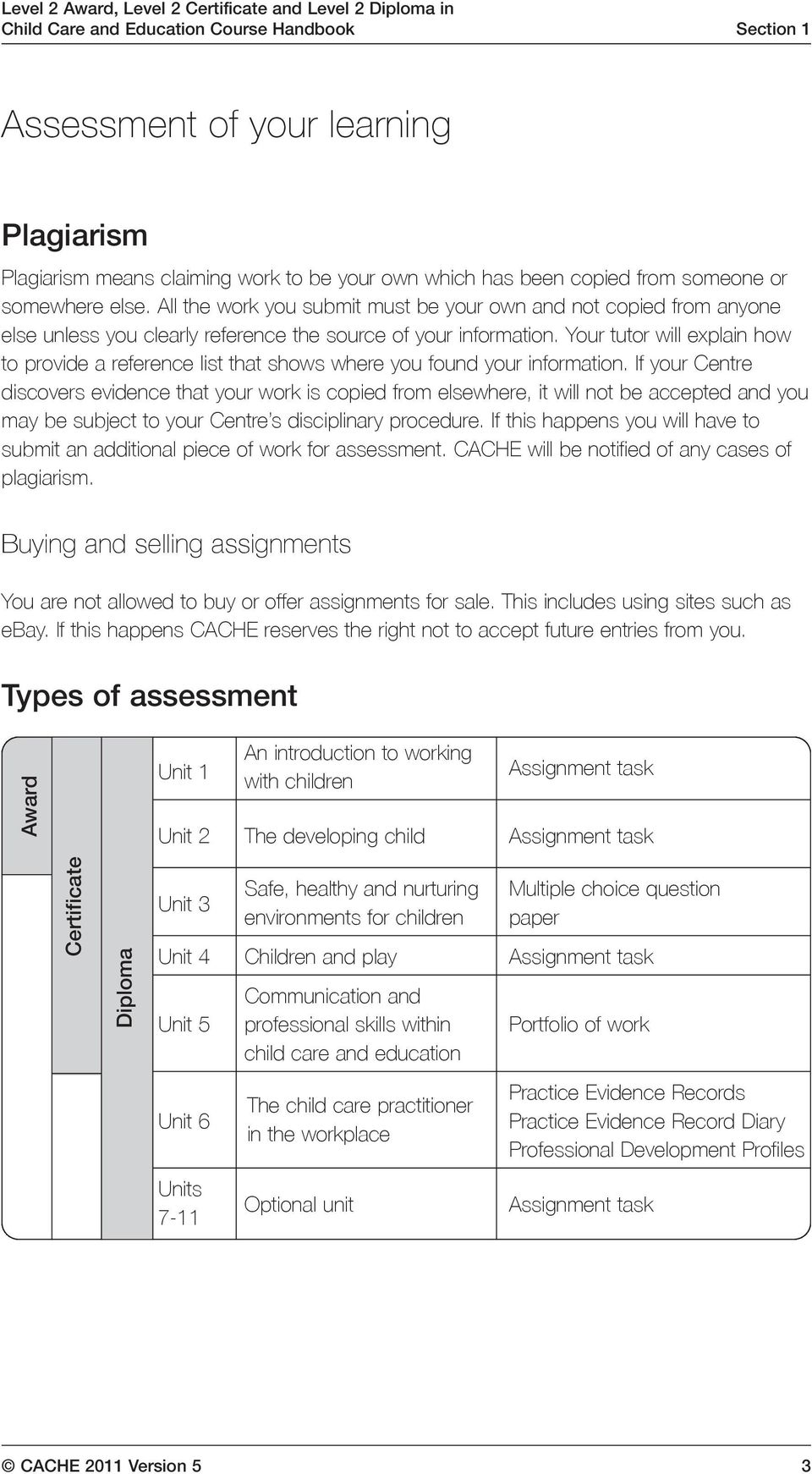
15 Level 2 Award, Level 2 Certificate and Level 2 Diploma in Section 1 Assessment of your learning Plagiarism Plagiarism means claiming work to be your own which has been copied from someone or somewhere else. All the work you submit must be your own and not copied from anyone else unless you clearly reference the source of your information. Your tutor will explain how to provide a reference list that shows where you found your information. If your Centre discovers evidence that your work is copied from elsewhere, it will not be accepted and you may be subject to your Centre s disciplinary procedure. If this happens you will have to submit an additional piece of work for assessment. CACHE will be notified of any cases of plagiarism. Buying and selling assignments You are not allowed to buy or offer assignments for sale. This includes using sites such as ebay. If this happens CACHE reserves the right not to accept future entries from you. Types of assessment Award Unit 1 An introduction to working with children Assignment task Unit 2 The developing child Assignment task Certificate Diploma Unit 3 Safe, healthy and nurturing environments for children The child care practitioner in the workplace Multiple choice question paper Unit 4 Children and play Assignment task Communication and Unit 5 professional skills within Portfolio of work child care and education Unit 6 Units 7-11 Optional unit Practice Evidence Records Practice Evidence Record Diary Professional Development Profiles Assignment task 3
16 Section 1 Level 2 Award, Level 2 Certificate and Level 2 Diploma in Internally assessed unit assignments Units 1, 2, 4 and 5 and the optional unit are each assessed through assignments which are set by CACHE and marked by your Centre. The assignment task and grading criteria for units 1, 2, 4 and 5 are shown in the Syllabus section. Your Centre will set the date when you are to submit the assignment to them. If you are not going to be able to meet the deadline you must discuss this as soon as you can with your tutor, who will inform you of the Centre's policy on handing in assignments after the submission date. It is recommended that you keep a copy of your assignment before handing it to your tutor. The tutor will mark your assignments against the grading criteria written by CACHE. These can be found with each assignment. Then another tutor, who is called an internal moderator, will take a sample to ensure the correct standard has been achieved. The marker will return the assignment to you if you need to resubmit or intend to upgrade. CACHE will also request a sample of candidates assignments to ensure your Centre is marking consistently and accurately to the agreed CACHE standard. Internal assessment procedures Each assignment will require a substantial amount of research and work. Assignments should be submitted on A4 paper, where possible, and can be written in ink, typed or wordprocessed. You need to write your name, personal identification number (PIN) and Centre number on each sheet of paper. Referral of internally assessed unit assignments If your assignment does not meet the criteria for a D grade it will be graded as a Referral. You may resubmit your work with improvements. Your tutor will negotiate a resubmission date with you. Any additional work must be presented on a separate page and retained with your original work for marking and moderation. If your assignment still does not achieve a D grade your tutor will discuss an action plan, which may involve some extra study, before you submit your assignment again. Improving your grade for internally assessed assignments Once you have achieved a D grade or above on the assignments marked by your Centre, you might want to consider trying to improve your grade. Your tutor can explain how you might be able to do this. Any additional work must be presented on a separate page and retained with your original work for marking and moderation. It is recommended that you keep a copy of your assignment before handing it to your tutor. Your Centre may also allow you to re-submit your assignment to achieve a higher grade after the unit grade has been sent to CACHE for processing. This must be completed within 3 months of issue of a unit/qualification certificate. 4
17 Level 2 Award, Level 2 Certificate and Level 2 Diploma in Section 1 External assessment: Multiple choice question paper Unit 3 is assessed using a multiple choice question paper (MCQ), which is prepared by CACHE. You will not see the paper in advance, so make sure you are confident about everything that you have learned. Your Centre and tutor will give you plenty of notice, so that you have time to prepare. Your paper will be graded as either Pass or Refer. For test dates, sitting times and final date of entry for the test please refer to the CACHE External Assessment Timetable which is available from your Centre or on the CACHE website. Re-mark request for multiple choice question paper Your Centre may request a re-mark if they, and you, do not think the result is a true reflection of your performance. This must be done within 20 working days of the result reaching your Centre. You should be aware that the mark sheets are marked electronically and the result is unlikely to change. If the result remains unchanged, CACHE will charge a fee for the re-mark. A fees list can be found on the CACHE website. Referral on multiple choice question paper Results that do not achieve a Pass mark will be graded as a Referral. If you are referred on your multiple choice question paper, your Centre may re-enter you to take the question paper again until you get enough marks. You should discuss the arrangements for being re-entered for the test with your tutor and Centre. You can retake the multiple choice question paper on any of the test dates offered by your Centre. You must achieve a Pass grade in the MCQ test to gain the CACHE Level 2 Award/Certificate/Diploma in Child Care and Education. Certification Certificates are issued by CACHE to reflect your achievements. Candidates under 16 years of age can complete the full Award or Certificate and receive certification for these qualifications. However, candidates must be 16 years or over to complete the Diploma and receive certification. You will need to keep your certificates safe as evidence for future employment. 5
18 Section 1 Level 2 Award, Level 2 Certificate and Level 2 Diploma in This page is intentionally blank. 6

19 Level 2 Award, Level 2 Certificate and Level 2 Diploma in Section 2 Section 2 Structure of the qualifications 7

20 Section 2 Level 2 Award, Level 2 Certificate and Level 2 Diploma in This page is intentionally blank. 8

21 Level 2 Award, Level 2 Certificate and Level 2 Diploma in Section 2 Structure of the qualifications CACHE Level 2 Award in Child Care and Education Candidates must achieve two units: Units 1 and 2 (both mandatory) Guided Learning Hours total: 120 CACHE Level 2 Certificate in Child Care and Education Candidates must achieve five units: Units 1-5 (all mandatory) Guided Learning Hours total: 300 CACHE Level 2 Diploma in Child Care and Education Candidates must achieve seven units: Units 1-6 (all mandatory units), plus one optional unit chosen from Units 7-11 Guided Learning Hours total: 480 plus 390 recommended practical training hours in Unit 6 The CACHE Level 2 Award, Level 2 Certificate and the Level 2 Diploma in Child Care and Education will be awarded at grades A* - D. These qualifications have been designed to provide the knowledge and understanding that support competent practice. It will help you to develop many of the practical skills and competencies set out in the National Occupational Standards in Children's Care, Learning and Development at Level 2. 9
22 Section 2 Level 2 Award, Level 2 Certificate and Level 2 Diploma in Unit titles Unit 1 An introduction to working with children 30 GLH Unit 2 The developing child 90 GLH Unit 3 Safe, healthy and nurturing environments for children 60 GLH Unit 4 Children and play 60 GLH Unit 5 Communication and professional skills within child care and education 60 GLH Unit 6 The child care practitioner in the workplace 120 GLH (including (practical unit) practical placement supervisor) 390 recommended practical training hours throughout the qualification. See Practical training in the Introduction to this handbook Unit 7 Working with children from birth to age 5 years 60 GLH Unit 8 Play activity for children from birth to age 16 years 60 GLH Unit 9 Supporting children with additional needs 60 GLH Unit 10 Introduction to children's learning 60 GLH Unit 11 Supporting children and families 60 GLH 10
23 Level 2 Award, Level 2 Certificate and Level 2 Diploma in Section 3 Section 3 Assessment strategies 11
24 Section 3 Level 2 Award, Level 2 Certificate and Level 2 Diploma in This page is intentionally blank. 12
25 Level 2 Award, Level 2 Certificate and Level 2 Diploma in Section 3 Assessment strategies CACHE Level 2 Award in Child Care and Education Assessment of your learning You will have to complete the assessment for Unit 1 and 2 at D grade or above to gain the Award. Unit 1 An introduction to working with children Assessment task; assignment externally devised and internally assessed Unit 2 The developing child Assessment task; assignment externally devised and internally assessed CACHE Level 2 Certificate in Child Care and Education Assessment of your learning You will have to achieve the assessments for the Level 2 Award, complete the assessment for unit 3 at Pass grade and complete the assessments for units 4 and 5 at D grade or above to gain the Certificate. Unit 3 Safe, healthy and nurturing environments for children External assessment; multiple choice question paper Unit 4 Children and play Assessment task; assignment externally devised and internally assessed Unit 5 Communication and professional skills within child care and education Assessment task; Portfolio of work to support professional practice in the workplace; externally devised and internally assessed 13
26 Section 3 Level 2 Award, Level 2 Certificate and Level 2 Diploma in CACHE Level 2 Diploma in Child Care and Education Assessment of your learning You will have to achieve the assessments for the Level 2 Certificate, fulfil the requirements of Practice Evidence Records and the Practice Evidence Record Diary for Unit 6 to show fitness to practice and complete an Optional Unit and the assessment at D grade or above to gain the Diploma. Unit 6 The child care practitioner in the workplace Practice Evidence Records (Pass grade only) Professional Development Profiles (Pass grade only) Optional unit: Assessment task; assignment externally devised and internally assessed 14
27 Level 2 Award, Level 2 Certificate and Level 2 Diploma in Section 4 Section 4 The syllabus 15
28 Section 4 Level 2 Award, Level 2 Certificate and Level 2 Diploma in This page is intentionally blank. 16
29 Level 2 Award, Level 2 Certificate and Level 2 Diploma in Section 4 References and bibliography in unit assignments Your assignment may require you to include references and a bibliography. You should include at least two references in the text of your work. These references should be clearly identified and relate to one or more sources of information which should be included in your bibliography which includes your wider reading. Your bibliography should list one or more relevant source(s) of information. The CACHE booklet Finding the Level explains how to show your references and bibliography. 17
30 Section 4 Level 2 Award, Level 2 Certificate and Level 2 Diploma in This page is intentionally blank. 18
31 Level 2 Award, Level 2 Certificate and Level 2 Diploma in Section 4 Unit 1 An introduction to working with children 19
32 Section 4 Level 2 Award, Level 2 Certificate and Level 2 Diploma in This page is intentionally blank. 20
33 Level 2 Award, Level 2 Certificate and Level 2 Diploma in Section 4 Unit 1 An introduction to working with children This is an introductory unit designed to give you an overview of the types of settings and local provision for children in your area. You will learn how to prepare for working in settings and the responsibilities of your role. The content also includes gaining understanding of children's individual needs and how to treat children fairly. You will also gain an insight into your preferred learning style and develop your ability to study. Unit 1 An introduction to working with children (mapped to CCLD 201) GLH: 30 LEARNING OUTCOMES The learner will understand: ASSESSMENT CRITERIA The learner can: 1. The types of settings and local 1.1. Describe the main types of settings provision for children. available for children Identify some of these settings within local provision. 2. How to prepare for their placement 2.1. Give the key issues to consider when including: dress code, behaviour, preparing for a placement with timekeeping, positive attitudes. children. 3. The responsibilities and limits of 3.1. Identify some of the likely their role in placements. responsibilities that may be part of their role, the importance of meeting these and recognising when they should refer to others. 4. Children's individual needs and 4.1. Identify children's differing individual necessity for fairness and inclusive needs and ways of working that treat practice. children fairly and in line with current diversity and inclusive practice. 5. Their own preferred learning style 5.1. Identify own preferred learning style. and develop relevant study skills Demonstrate relevant study skills. 21
34 Section 4 Level 2 Award, Level 2 Certificate and Level 2 Diploma in Unit 1 An introduction to working with children Delivery guidance During this unit you will learn about: The variety of settings that are available for children including: pre-schools and playgroups nursery school home-based care day care sessional day care children's centres crèches extended schools school provision hospitals community based services Sure Start programmes The differences between the voluntary, private and public sectors and the range of provision within your area. This could include sessional groups such as scouts, church groups, parent and toddler sessions and sporting activities. Multi-agency work and the different professionals and agencies who work with children from the health, social and educational perspectives. The expectations of placements regarding appropriate dress, behaviour and personal hygiene. You will consider the importance of timekeeping and having a positive attitude and your responses to other professionals and colleagues. The responsibilities and limits of your role, including how to work with families and other professionals. You will consider the importance of confidentiality and procedures for sharing information. 22
35 Level 2 Award, Level 2 Certificate and Level 2 Diploma in Section 4 The importance of understanding children's individual needs and your role in meeting those needs. The importance of treating children with fairness and equality and how to do this. The different learning styles that people use and how to identify your own preferred style. This will include considering the effectiveness of your individual style and methods to assist your learning. The study skills that will help you to complete your course. These could include: using appropriate books for information using the Internet giving presentations and sharing information participating in group discussions reading and summarising information using references in assignments and compiling a bibliography writing different documents for assignments punctuation and grammar 23
36 Section 4 Level 2 Award, Level 2 Certificate and Level 2 Diploma in Unit 1 Assignment An introduction to working with children This assignment provides the assessment for the unit. The completed assignment MUST be submitted and marked as a whole and not in separate sections. Assignment task: What do I have to do? The whole task must be completed in order to achieve the unit. Explain how you can show positive attitudes when you are working in a childcare setting. 1. Choose two settings available for: children under 5 years and children aged between 5 and 7 years For each age range, choose: ONE (1) setting that is statutory provision and ONE (1) setting that is a different type of provision Describe the purpose of each setting. 2. Choose either: ONE (1) professional who works with children or ONE (1) agency that works with children Describe the work of this professional or agency. 3. Describe how to keep information about children and families confidential. Give TWO (2) examples to show when you should refer information to professionals in the setting. Explain the importance of keeping information confidential. 4. Explain how to prepare for work in a placement with children: Explain why the first impressions which you make in the setting are important. Explain how you can show positive attitudes when you are working in a childcare setting 24
37 Level 2 Award, Level 2 Certificate and Level 2 Diploma in Section 4 5. Give TWO (2) different ways in which you can show that you understand the importance of valuing each child as an individual. 6. Describe how your preferred learning style helps you in your studies and reflect on why this is important. Throughout the assignment you should ensure that you address diversity and inclusive practice where it is appropriate to the task. Your completed work should not exceed 2,000 words. There is no lower word limit. Work that is more than 10% above the word limit will not be marked. References and quotations within the text are not included in the word limit. 25
38 Section 4 Level 2 Award, Level 2 Certificate and Level 2 Diploma in Unit 1 An introduction to working with children Assignment criteria D1 D2 D3 D4 D5 D6 D7 D8 C1 B1 B2 A1 Describe the purpose of ONE (1) setting that is statutory provision for each age range Describe the purpose of ONE (1) setting that is a different type of provision for each age range Describe the work of a professional or an agency working with children Describe how to keep information about children and families confidential Explain how to prepare to work in a placement with children Give TWO (2) different ways in which you can show that you understand the importance of valuing each child as an individual Show an understanding of diversity and inclusive practice Include references and a bibliography Give TWO (2) examples of when you should refer information about children and families to professionals in the setting Explain why the first impressions that you make in the setting are important Explain suitable ways in which you can show positive attitudes when working in a childcare setting Explain the importance of keeping information about children and families confidential A* Reflect on the importance of recognising your own learning style and using this knowledge effectively in your studies 26
39 Level 2 Award, Level 2 Certificate and Level 2 Diploma in Section 4 Unit 2 The developing child 27
40 Section 4 Level 2 Award, Level 2 Certificate and Level 2 Diploma in This page is intentionally blank. 28
41 Level 2 Award, Level 2 Certificate and Level 2 Diploma in Section 4 Unit 2 The developing child This unit focuses on patterns of development for each area and the factors that affect development. You will be introduced to ways of observing children so that you can support development through appropriate activities and care routines. You will also learn how to work with children when they move from one setting to another. Unit 2 The developing child (mapped to CCLD 203) GLH: 90 LEARNING OUTCOMES The learner will understand: ASSESSMENT CRITERIA The learner can: 1. The expected pattern of 1.1. Identify the main stages and the development. sequence of the areas of development Relate the stages and sequence of development to children from birth to 16 years. 2. The importance of careful 2.1. Identify ways to observe children and observations and how they to contribute to observations. support development Illustrate how observations can be used to support the development of children. 3. How to identify influences that 3.1. Identify some of the influences that affect children's development such affect children's development. as background, health and environment. 4. How to use everyday care routines 4.1. Demonstrate the everyday activities and activities to support which promote personal hygiene and development. help children to maintain their own health and safety Explain how care routines and activities can meet the care needs and support the welfare of children. 5. How to support children through 5.1. Identify some of the transitions that transitions in their lives. children may experience Identify the effects of these transitions on social and emotional development Show that you understand ways to support children through transitions. 29
42 Section 4 Level 2 Award, Level 2 Certificate and Level 2 Diploma in Unit 2 The developing child Delivery guidance During this unit you will learn about: The physical development of children from birth to 16 years. The communication and intellectual development of children from birth to 16 years. The social, emotional and behavioural development of children from birth to 16 years. The pattern of development for each age range and area of development from: birth to 3 years 3 to 7 years 7 to 12 years 12 to 16 years A range of techniques practitioners can use for observing children. How to share your observations with colleagues to promote development. The importance of confidentiality and objectivity when observing children. The factors that contribute to development, for example: the child's background health and welfare immediate and wider environment cultural influences social/economic influences The care needs of individual children. The importance of supporting the health and welfare of the child. How to promote and maintain good hygiene and hygiene routines. How to safeguard children to keep them safe and healthy. 30
43 Level 2 Award, Level 2 Certificate and Level 2 Diploma in Section 4 The importance of routines for everyday care in supporting children's development. Planning routines to meet individual needs within a range of different voluntary, private or public sector provision. Recognising the importance of a secure base for children's development. The role of the key worker working within a range of provisions. The changes experienced by children, for example starting school, moving house, bereavement, having a new sibling and the possible effects on children. How to support children through changes to provide consistency and reassurance. 31
44 Section 4 Level 2 Award, Level 2 Certificate and Level 2 Diploma in Unit 2 Assignment The developing child This assignment provides the assessment for the unit. The completed assignment MUST be submitted and marked as a whole and not in separate sections. Assignment task: What do I have to do? The whole task must be completed in order to achieve the unit. You work in an early years setting with children aged 4 years. A meeting is to be held to discuss the children s social development. The children in this group will soon be moving to a different setting. 1. Describe the expected stage of social development of: children aged 4 years. children aged 5 years. 2 Consider how and why practitioners observe children in the setting: Describe ONE (1) suitable method of observing and recording the social development of children aged 5 years. Explain ONE (1) advantage and ONE (1) disadvantage of this method of observing children. Explain how observations can be used to support the development of children. Explain why it is important to understand the pattern of development of children from birth to 16 years. 3 Identify the main influences that may affect the social development of children. 4 Describe how snack and mealtimes can support the social development of children. 5 Write about: how children s development may be affected when they experience transitions. ways the practitioner can support children through transitions. 6 Reflect on the reasons why everyday care routines are important in early years group settings. Throughout the assignment you should ensure that you address diversity and inclusive practice where it is appropriate to the task. Your completed work should not exceed 2,000 words. There is no lower word limit. Work that is more than 10% above the word limit will not be marked. References and quotations within the text are not included in the word limit. 32
45 Level 2 Award, Level 2 Certificate and Level 2 Diploma in Section 4 Unit 2 The developing child Assignment criteria D1 D2 D3 D4 D5 D6 D7 D8 C1 B1 B2 A1 Describe the expected stage of social development of children aged 4 years. Describe the expected stage of social development of children aged 5 years. Describe ONE (1) suitable method of observing and recording the social development of children aged 5 years. Explain ONE (1) advantage and ONE (1) disadvantage of this method of observing children. Identify the main influences that may affect the social development of children. Describe how snack and mealtimes can support the social development of children. Show an understanding of diversity and inclusive practice. Include references and a bibliography. Identify the possible effects of transitions on the development of children. Describe ways the practitioner can support children through transitions. Explain how observations can be used to support the development of children. Explain why it is important for practitioners to understand the pattern of development of children from birth to 16 years. A* Reflect on the reasons why everyday care routines are important in early years group settings. 33
46 Section 4 Level 2 Award, Level 2 Certificate and Level 2 Diploma in This page is intentionally blank. 34
47 Level 2 Award, Level 2 Certificate and Level 2 Diploma in Section 4 Unit 3 Safe, healthy and nurturing environments for children 35
48 Section 4 Level 2 Award, Level 2 Certificate and Level 2 Diploma in This page is intentionally blank. 36
49 Level 2 Award, Level 2 Certificate and Level 2 Diploma in Section 4 Unit 3 Safe, healthy and nurturing environments for children This unit teaches you about the preparation and maintenance of a safe environment and how to safeguard children and adults through working practices. You will also consider your role in managing conflict when working with children. Unit 3 Safe, healthy and nurturing environments for children (mapped to CCLD 202) GLH: 60 LEARNING OUTCOMES The learner will understand: ASSESSMENT CRITERIA The learner can: 1. How to prepare and maintain a 1.1. Describe the main regulations and safe environment and follow requirements that normally relate to relevant policies and procedures. environments for children Illustrate ways to support the health and safety of children. 2. How to implement working practices 2.1. Explain ways to work to ensure that that safeguard children and the children are protected and kept safe. adults who work with them Describe how adults can work in ways that keep themselves safe. 3. The role of the practitioner in working 3.1. Identify some of the causes and with children to manage conflict. effects of positive and negative behaviour in children Describe how to work to help children to manage their behaviour or the situations which may be difficult for them. 37
50 Section 4 Level 2 Award, Level 2 Certificate and Level 2 Diploma in Unit 3 Safe, healthy and nurturing environments for children Delivery guidance During this unit you will learn about: The policies and procedures that support and maintain a safe environment for children. How to follow relevant policies and procedures for a range of settings. The Health and Safety legislation in the country in which you live. The emergency procedures followed in a range of settings. The importance of using the risk assessment process and how to identify risks in the setting. Safe working practices within a range of settings, to include the voluntary, private or public sector. How to maintain and promote the personal safety of the child, for example through road safety. How to work safely outside the setting and how to plan safe outings and trips. The safeguarding children procedures followed by practitioners across a range of settings. The importance of awareness and identification of children who may be at risk. The causes and effects of positive/negative behaviour. The situations which children may find difficult, for example starting a new school, resolving conflict, a new task or activity. Behaviour linked to the ages and stages of development. Recognise the ages and stages of social and emotional development and the implications for behaviour. The role of the practitioner in managing behaviour. A range of strategies practitioners use to manage conflict. NB It is anticipated that employers would expect specialised training and qualifications in First Aid to be completed by employees, in line with legislation. 38
51 Level 2 Award, Level 2 Certificate and Level 2 Diploma in Section 4 Unit 4 Children and play 39
52 Section 4 Level 2 Award, Level 2 Certificate and Level 2 Diploma in This page is intentionally blank. 40
53 Level 2 Award, Level 2 Certificate and Level 2 Diploma in Section 4 Unit 4 Children and play The importance of play in children's development is the focus of this unit. You will learn about the stages and types of play and how you can provide appropriate activities to support development through play. You will think about how to provide children with challenge and risk in a safe environment and the role of the adult in encouraging exploration and investigation. Unit 4: Children and play (mapped to CCLD 206) GLH: 60 LEARNING OUTCOMES The learner will understand: ASSESSMENT CRITERIA The learner can: 1. The importance of play and activities 1.1. Explain why play is important for and how these link to development. learning and development Explain one of the main theories of play. 2. The stages of play List the different stages of play Describe how children play at different ages and stages. 3. The types of play and appropriate 3.1. Identify the main types of play. activities for learning and how to 3.2. Describe typical play or suitable provide them. activities which support some of the main types of play Explain how adults can provide play and activities to encourage learning and development. 41
54 Section 4 Level 2 Award, Level 2 Certificate and Level 2 Diploma in Unit 4 Children and play Delivery guidance During this unit you will learn about: The theories of play that help practitioners to understand its importance. How children become involved in their play and activities. The importance of play in supporting all aspects of development. The stages of play and the key terms, for example: parallel play associative play co-operative play The areas and types of play, for example: creative play drama and imaginative play physical play and exercise social/emotional play spontaneous play discovery play Planning activities for play in a range of settings and provision. The role of risk and challenge in play. The role of the adult in providing activities and supporting children. How to encourage exploration and investigation through play. 42
55 Level 2 Award, Level 2 Certificate and Level 2 Diploma in Section 4 Unit 4 Assignment Children and play This assignment provides the assessment for the unit. The completed assignment MUST be submitted and marked as a whole and not in separate sections. Assignment task: What do I have to do? The whole task must be completed in order to achieve the unit. 1. Choose THREE (3) different settings where children might play, for example: an early years setting; a local park; a school playground; an adventure play area or the home. For each setting: state a typical age range of children who might play in that setting outline the stage of play that is most common for children of this age in that setting Describe ONE (1) type of play that might take place in each setting and ONE (1) activity or experience in which children may demonstrate this type of play. 2. Identify a theory of play which relates to ONE (1) type of play you chose and discuss how it may help the adult to understand the children's play. 3. Explain the role of the adult in providing activities and supporting children to use risk and challenge in play. Your explanation should include: ONE (1) example of a play activity that is suitable for each of the chosen settings that will provide challenge and help children to understand risks the resources which will support each of the play activities how the adult can encourage exploration and investigation through play why children benefit from risk and challenge in play Throughout the assignment you should ensure that you address diversity and inclusive practice where it is appropriate to the task. Your completed work should not exceed 2,000 words. There is no lower word limit. Work that is more than 10% above the word limit will not be marked. References and quotations within the text are not included in the word limit. 43
56 Section 4 Level 2 Award, Level 2 Certificate and Level 2 Diploma in Unit 4 Children and play Assignment criteria D1 D2 D3 D4 D5 D6 D7 D8 C1 B1 B2 A1 Identify THREE (3) different settings where children might play State the typical age range and the stage of play of the children who might play in each setting Describe ONE (1) type of play that may take place in each setting Describe ONE (1) activity or experience in which children might demonstrate each type of play Identify a theory of play related to ONE (1) type of play Give ONE (1) example of a play activity for each of the chosen settings that will provide challenge and help children to understand risks Show an understanding of diversity and inclusive practice Include references and a bibliography Explain the resources that will support each of the play activities Explain how children benefit from play activities that provide challenge and help them to understand risks Explain how the adult can encourage exploration and investigation through play Discuss how the identified theory of play helps understanding of children's play A* Reflect on the role of the adult in providing activities and supporting children's play 44
57 Level 2 Award, Level 2 Certificate and Level 2 Diploma in Section 4 Unit 5 Communication and professional skills within child care and education 45
58 Section 4 Level 2 Award, Level 2 Certificate and Level 2 Diploma in This page is intentionally blank. 46
59 Level 2 Award, Level 2 Certificate and Level 2 Diploma in Section 4 Unit 5 Communication and professional skills within child care and education During this unit you will learn how to develop effective communication skills to assist in your work with children and adults in a variety of settings. You will have the opportunity to consider your developing knowledge and to think about how you can improve your practice. The content of the unit also enables you to investigate employment opportunities and to set targets for your own professional development. Unit 5 Communication and professional skills within child care and education (mapped to CCLD 201 and 204) GLH: 60 LEARNING OUTCOMES The learner will understand: ASSESSMENT CRITERIA The learner can: 1. How to develop effective 1.1. Demonstrate how to communicate communication skills to work with effectively in a variety of ways with children and adults in a variety of children. settings Explain the skills needed to support professional communication with adults in the work setting Describe the main reasons to maintain confidentiality. 2. How to use their developing 2.1. Provide a range of evidence to show knowledge and skills to improve how they use different skills and their practice and set appropriate strategies to support and improve targets to develop professionally. their professional practice Reflect on the contribution of their personal experiences to their professional development. 3. How to investigate employment 3.1. Provide evidence of investigating ways opportunities and routes of to prepare for employment and progression. include some possible ways to make professional progress. 47
60 Section 4 Level 2 Award, Level 2 Certificate and Level 2 Diploma in Unit 5 Communication and professional skills within child care and education Delivery guidance During this unit you will learn about: How to interact with and respond to children and adults in a range of settings to support a multi-agency approach. Developing listening skills, including recognising children's need for attention. The non-verbal communication of children and how to interpret this. Using sensitive questioning and encouraging children to express themselves in their own time. The importance of an objective and non-judgmental approach when communicating with children. How to communicate with other professionals in a multi-agency approach. The importance of confidentiality and sharing information in line with procedures when working with children. The importance of setting short, medium and long term targets for personal and professional development. How to use feedback to identify areas of your practice that need development. How to set appropriate targets to develop yourself as a professional working in a multi-agency context. How to review, update and amend targets for professional skills. How to keep a placement diary and reflect on your practice in relation to Practice Evidence Records. How to access support to make improvements to your practice, for example through tutorials and supervisory guidance in your work placement. The effect of your own background, life history and experiences on your practice. Local and national organisations in the voluntary, private and public sector that provide employment. How to find out about career progression through career advisors. The range of professional development that is available to you. 48
61 Level 2 Award, Level 2 Certificate and Level 2 Diploma in Section 4 Unit 5 Portfolio Communication and professional skills within child care and education This portfolio provides the assessment for the unit. The completed portfolio MUST be submitted and marked as a whole and not in separate sections. Portfolio task: What do I have to do? The whole task must be completed in order to achieve the unit. Produce a portfolio of work that supports professional practice in the workplace, and which provides evidence of your ability to work as a competent practitioner and to be an effective communicator with children, parents and professionals. Select FOUR (4) examples of professional practice from the following list. The evidence which is required should be about these FOUR (4) examples of professional practice. non-judgmental approaches to practice timekeeping and attendance attitudes to work awareness of children's development understanding of children's behaviour recognising the effect of own experiences short and long term planning supporting colleagues Collate evidence in the portfolio which includes: 1. An explanation of why each selected aspect of professional practice will be essential when you are working in an early years setting. 2. Examples of how you are developing the knowledge or skills which will improve EACH selected aspect of your professional practice. 3. Examples of your effective communication with children and with parents. 4. Information about the importance of maintaining confidentiality and how you have demonstrated this. 5. Ways that you are preparing for employment and to undertake some professional development. Throughout the portfolio you should ensure that you address diversity and inclusive practice where it is appropriate to the task. 49
62 Section 4 Level 2 Award, Level 2 Certificate and Level 2 Diploma in Unit 5 Communication and professional skills within child care and education Assignment criteria D1 D2 D3 D4 D5 D6 D7 D8 C1 B1 B2 A1 Select FOUR (4) aspects of professional practice Identify why each selected aspect of professional practice is essential when working in an early years setting Include examples of how you are developing the knowledge or skills that will improve each selected aspect of professional practice Include examples of your effective communication with children and with parents Provide evidence to show how you maintain confidentiality in work with children and parents Provide evidence of ways that you are preparing for employment and finding information about professional development Show an understanding of diversity and inclusive practice Include references and a bibliography Explain how your developing knowledge or skills in each selected aspect will improve your professional practice Explain why the examples of communication with children and with parents were effective Explain the importance of maintaining confidentiality when working with children and parents Explain the reasons for preparing for employment and for finding information about professional development A* Reflect on why it is important to review your communication and professional skills 50
63 Level 2 Award, Level 2 Certificate and Level 2 Diploma in Section 4 Unit 6 The child care practitioner in the workplace 51
64 Section 4 Level 2 Award, Level 2 Certificate and Level 2 Diploma in This page is intentionally blank. 52
65 Level 2 Award, Level 2 Certificate and Level 2 Diploma in Section 4 Unit 6 The child care practitioner in the workplace This unit has a strong practical focus and will involve you participating in a working environment with children. You will learn about the professional standards of the practitioner and how to apply these. There will also be the opportunity to observe development and to carry out planned play activities. Unit 6 The child care practitioner in the workplace (mapped to CCLD 201, 203, 204, 206, 208, 209 and 210) GLH: recommended practical training hours You will have to show fitness to practice by completing successfully the Practice Evidence Records, Practice Evidence Records Diary and Professional Development Profiles for this unit LEARNING OUTCOMES The learner will understand: ASSESSMENT CRITERIA The learner can: 1. The professional standards of the 1.1. Apply their learning to practice in the practitioner. workplace Identify and provide evidence that shows their competence in a range of set tasks Show that they can maintain a professional approach to their work. 2. How to observe development across 2.1. Observe children's development a minimum of two of the following across a minimum of two of the age ranges: following age ranges: birth to 3 years birth to 3 years 3 to 7 years 3 to 7 years 7 to 12 years 7 to 12 years 12 to 16 years 12 to 16 years 2.2. Use observations to plan play and activities. 3. How to carry out planned 3.1. Plan suitable play and activities. play/activities Provide play activities safely and involve children. 4. How to use effective communication 4.1. Demonstrate effective communication skills and contribute to positive skills and maintain positive relationships. relationships in the workplace. 53
66 Section 4 Level 2 Award, Level 2 Certificate and Level 2 Diploma in Unit 6 The child care practitioner in the workplace Delivery guidance During this unit you will learn about: The professional standards required in all settings of the children's workforce. The professional standards required of the practitioner when applying learning to practice in the workplace. The value of interpersonal skills when working with children in a range of settings. The importance of self-management, for example punctuality, commitment, personal hygiene, dress and timekeeping in maintaining a professional approach to your work. How to use your initiative when working in a team of multi-agency professionals. Verbal and non-verbal communication skills and how to communicate with children and adults. The importance of effective communication skills in the workplace. How to provide a positive role model and interact positively with children in a range of settings. The importance of an inclusive approach to practice when working with children. The variety of methods used for observing children across different age ranges and in a range of settings. How to observe children sensitively in a range of settings. The importance of maintaining confidentiality and recording and storing information. How to use observations to plan activities that enable children to develop their full potential. The importance of effective planning for play and activities in a range of settings. Setting out and clearing away play/activities that encourage children's development. How to encourage children to participate and immerse themselves in activities. How to provide a safe and hygienic environment for play in a range of settings. The importance of positive relationships in the workplace and how to contribute to them. 54
67 Level 2 Award, Level 2 Certificate and Level 2 Diploma in Section 4 Unit 6 Assignment The child care practitioner in the workplace Unit 6 contains FOUR (4) parts which you must complete to achieve the unit. 1. Placement Summary 2. Practice Evidence Records 3. Practice Evidence Record Diary 4. Professional Development Profiles All records should be completed in ink, signed and dated as appropriate to ensure they are authentic. Corrections must only be made using a single line through the text to be amended. The use of correcting fluid or erasers of any type is not permitted. Supervisors should not use ditto marks or sign across statements. 1. Placement Summary This is a record of the placements you have attended and the number of days or equivalent hours you have completed. You should fill in the record when you have completed each practical placement and ensure the placement supervisor signs for each placement. Your tutor will then sign the Placement Summary at the end of your course. It is very important that you keep this record up to date and provide accurate information. 2. Practice Evidence Records The Practice Evidence Records contain statements which describe the skills and tasks you must be able to perform competently in your practical placement. The statements are linked to the learning outcomes in the relevant units and also show links to the National Occupational Standards in Children's Care, Learning and Development. Your placement supervisor, tutor or teacher will sign each statement when they are satisfied that you are performing the task or skill satisfactorily. Statements may be signed at different placements. 55
68 Section 4 Level 2 Award, Level 2 Certificate and Level 2 Diploma in 3. Practice Evidence Record Diary The Practice Evidence Record Diaries are available in Section 9 of this handbook. The work is graded Pass/Refer. Student guidance The practical elements of your course are very important to your future career in the sector. As part of the evidence you need to provide for your Practice Evidence Records, you are expected to complete a Practice Evidence Record Diary. This will be marked by your tutor and verified by your placement supervisor. The diary consists of tasks that ideally you will complete in your work placement. This Practice Evidence Record Diary will give you the opportunity to demonstrate your skills in evaluation and reflection. It will also give you the opportunity to evidence your understanding of all the practical skills you have gained whilst you have been on work placement and will be a useful addition to your portfolio when you decide to pursue a career. Your tutor will give you guidance on how to complete the diary. The diary must be completed to achieve a Pass grade for your practical unit. Tutor guidance As part of the practical unit learners are required to complete a Practice Evidence Record Diary. The tutor will need to guide the learners to complete tasks that will be marked by the tutor against a set of criteria and given a grade. The learners will also be required to enlist the support of their placement supervisors to sign and verify the tasks as having been implemented, and to support the process where necessary. When it is difficult or not appropriate to implement the tasks in the settings they can be completed in a simulated situation. The Practice Evidence Record Diary has been designed so that learners can provide evidence of their ability to evaluate and reflect upon their practice through a given task. Each task will have a sheet to be filled in and the learners are not expected to produce copious amounts of written material. These tasks are not assignments and do not have to be referenced. The criteria will guide learners on producing the evidence. Tutors will need to support learners by ensuring they have opportunity to explore ideas, activities and observation skills in class time. This support will enable the learners to produce good quality tasks with appropriate levels of evaluative and reflective skills. 4. Professional Development Profiles (PDPs) There are nine sections in a Professional Development Profile. You must gain a Pass in each section to achieve a satisfactory PDP. If you do not achieve a satisfactory PDP, you will be referred. Each placement supervisor will complete a final PDP towards the end of your placement, indicating a Pass or Refer and provide comments for each statement. It is important that you discuss the outcome with your supervisor and ask how you can improve your work, particularly if you are referred. 56
69 Level 2 Award, Level 2 Certificate and Level 2 Diploma in Section 4 You must complete TWO (2) PDPs satisfactorily (a Pass in each of the nine sections) in order to achieve an overall Pass in the Professional Development Profiles. You must achieve one satisfactory PDP for each age range: 1 to 3 years 11 months 4 to 7 years 11 months Each PDP must be completed over a period of at least 20 days. If, at the end of your course of study, you have not achieved a Pass in the required PDPs you will be required to undertake an additional training placement of 25 days for each outstanding PDP. Your Centre can photocopy additional copies of the PDP or take a copy from the CACHE website, if these are required. Interim reports are not mandatory. They may be completed at any time to support you in achieving the placement. If you falsify any area of the PDP including signatures, it will not be considered valid for assessment. 57
70 Section 4 Level 2 Award, Level 2 Certificate and Level 2 Diploma in This page is intentionally blank. 58
71 Level 2 Award, Level 2 Certificate and Level 2 Diploma in Section 4 Unit 7 Working with children from birth to age 5 years 59
72 Section 4 Level 2 Award, Level 2 Certificate and Level 2 Diploma in This page is intentionally blank. 60
73 Level 2 Award, Level 2 Certificate and Level 2 Diploma in Section 4 Unit 7 Working with children from birth to age 5 years During this unit you will learn about how to plan and support environments for children aged from birth to age 5 years. This will involve you working with other professionals and being part of a team that establishes relationships with parents. You will consider the diverse needs of babies and young children and how to meet them. Unit 7: Working with children from birth to age 5 years (mapped to CCLD 208) GLH: 60 LEARNING OUTCOMES The learner will understand: ASSESSMENT CRITERIA The learner can: 1. How to plan and support 1.1. Describe how to plan and support the environments for children from birth provision of effective, high quality to age 5 years. childcare environments Identify how to contribute to environments which meet the individual needs of children. 2. How to contribute to working with 2.1. Describe working relationships and parents as part of a team. professional roles when working with parents Identify the key issues which affect and support teamwork with parents. 3. How to recognise the importance 3.1. Explain reasons for working with other of working with other professionals. professionals and agencies. 4. How to meet the diverse needs of 4.1. Identify how to support the protection babies and young children. of children Describe some ways that the needs and rights of babies, young children and their families can be met and supported in practice. 61
74 Section 4 Level 2 Award, Level 2 Certificate and Level 2 Diploma in Unit 7 Working with children from birth to age 5 years Delivery guidance During this unit you will learn about: How to promote a healthy, hygienic and safe environment for children in a range of settings. The importance of promoting children's welfare in a range of settings. The provision of reassuring and secure surroundings for young children. How to adapt environments to meet the diverse needs of children. Planning environments such as layouts, security, lighting and heating within a range of settings. The different ways to display children's work. The basic physical and health needs of children from birth to age 5 years. The Health and Safety requirements when working with children from birth to age 5 years. Your role in promoting and maintaining relationships with families. The importance of shared care between the setting, the home and the family. The principles of effective communication when working with families and their children. The role of the key worker when working within the voluntary, private and public sectors. The lines of reporting and recording to management in a professional manner. Diverse family backgrounds and the importance of valuing different lifestyles. The importance and role of parents in children's lives. Meeting the needs of parents in a variety of settings. The key principles of legal frameworks to support working with children and children's welfare. The role of different professionals who may work with children and their families in a multiagency approach. The protection of all children and the role of multi-agency work. 62
75 Level 2 Award, Level 2 Certificate and Level 2 Diploma in Section 4 The rights of children and their families. The causes and effects of discrimination in a multi-ethnic society. Strategies to promote and meet the needs of individual children and their families. The identification of, and how to support children with, additional needs. The role of the adult in supporting a diverse and inclusive environment. 63
76 Section 4 Level 2 Award, Level 2 Certificate and Level 2 Diploma in Unit 7 Working with children from birth to age 5 years (mapped to CCLD 202, 207 and 208) This assignment provides the assessment for the unit. The completed assignment MUST be submitted and marked as a whole and not in separate sections. Assignment Task What do I have to do? The whole task must be completed in order to achieve the unit You are helping to prepare information that is to be used by the setting to guide and explain how to plan and support high quality childcare for children from birth to age 5 years. 1. Make a list of the main points that make the environment a safe and reassuring place for young children from birth to age 5 years 2. List the physical and health needs of babies and young children 3. Write a description of how the setting can meet the different individual needs of babies and of young children 4. Write a description of how the practitioner in the setting can develop and maintain professional relationships with parents work with colleagues in a team to support parents support the protection of children 5. Explain why practitioners work with other professionals and agencies 6. Write an explanation of: the importance of recording and reporting in a professional manner the issues which affect and support teamwork with parents the role of the keyworker in sharing care with parents and families why the setting should promote the rights of the child and family the role of the practitioner in supporting a diverse and inclusive environment 64
77 Level 2 Award, Level 2 Certificate and Level 2 Diploma in Section 4 Throughout the assignment you should ensure that you address diversity and inclusive practice where it is appropriate to the task. Your completed work should not exceed 2,000 words. There is no lower word limit. Work that is more than 10% above the word limit will not be marked. References and quotations within the text are not included in the word limit. 65
78 Section 4 Level 2 Award, Level 2 Certificate and Level 2 Diploma in Unit 7 Working with children from birth to age 5 years Assignment criteria D1 D2 D3 D4 D5 D6 D7 D8 D9 C1 B1 B2 A1 List FIVE (5) of the main points to be considered when planning a safe and reassuring child care environment List TWO (2) physical and TWO (2) health needs of children from birth to 5years Describe TWO (2) ways the individual needs of babies and TWO (2) ways the individual needs of young children can be met in the setting Describe TWO (2) ways the practitioner can develop and maintain relationships with families Explain how the practitioner can work in a team with colleagues to support parents Explain how the practitioner can support the protection of children in the setting Give TWO (2) reasons why practitioners work with other professionals and agencies Show understanding of diversity and inclusive practice Include references and a bibliography Explain why the practitioner should record and report information in a professional manner Explain the issues which affect and support teamwork with parents Discuss the role of the keyworker in sharing care with parents and families in an early years setting Discuss reasons why the setting should promote the rights of the child and their family A* Reflect on the role of the practitioner in supporting a diverse and inclusive environment 66
79 Level 2 Award, Level 2 Certificate and Level 2 Diploma in Section 4 Unit 8 Play activity for children from birth to age 16 years 67
80 Section 4 Level 2 Award, Level 2 Certificate and Level 2 Diploma in This page is intentionally blank. 68
81 Level 2 Award, Level 2 Certificate and Level 2 Diploma in Section 4 Unit 8 Play activity for children from birth to age 16 years This unit will teach you about how to provide play activities for children. This will include understanding about the main stages of play and the diverse play needs of individuals. You will learn how to support play opportunities and the key issues for you to consider as an adult. Unit 8: Play activity for children from birth to age 16 years (mapped to CCLD 206 and 210) GLH: 60 LEARNING OUTCOMES The learner will understand: ASSESSMENT CRITERIA The learner can: 1. How to meet the diverse play needs 1.1. Identify how the main stages of play of children. relate to the diverse play needs of children and to their play environments Describe ways to further the interests, views and play needs of children. 2. How to support a range of play 2.1. Explain how some opportunities and opportunities for children. activities can support different types of play Demonstrate how to contribute to environments which will stimulate exploration, investigation and play. 3. The role of the adult in providing play 3.1. Identify the key issues for the adult activity for children. when providing play opportunities and activities Describe some ways to contribute to supporting children during play. 69
82 Section 4 Level 2 Award, Level 2 Certificate and Level 2 Diploma in Unit 8 Play activity for children from birth to age 16 years Delivery guidance During this unit you will learn about: The stages of play. The interests of children from birth to age 16 years. The importance of consulting with children about their play environments. How to recognise the individual play needs of children. How to review resources and opportunities for individual children when planning in a variety of settings. Suitable activities to facilitate inclusive play for children in a range of settings from birth to age 16 years. How to use music, movement, rhythm and games to promote play. The opportunities for drama and imaginative play in a variety of settings. Ways to support children to express their creativity. The role of the adult in supporting physical play opportunities. How to encourage children to explore and investigate through play. How to create play environments indoors and outdoors that stimulate play opportunities. The Health and Safety requirements for a range of provision in the country in which you live. The policies and procedures of a range of settings. The importance of children's rights and making choices in play in a range of settings. How to encourage children to direct their own play. How to support children according to their age, needs and abilities. Working with colleagues in the promotion of play. How to end a play session. 70
83 Level 2 Award, Level 2 Certificate and Level 2 Diploma in Section 4 Unit 8 Assignment Play activity for children from birth to age 16 years (mapped to CCLD 206.3,CCLD 206.4, CCLD 206.5) The assignment provides the assessment for the unit. The completed assignment MUST be submitted and marked as a whole and not in separate sections. Assignment Task What do I have to do? The whole assignment must be completed in order to achieve the unit. You are working as an assistant in a pre-school group for children aged from 2 to 4 years. The staff team has noticed that some of the children are becoming bored with the routine. You have been asked to choose play activities to engage the children's interest and imagination. 1. Choose THREE (3) activities which support: Creative play Physical play Investigative play For each activity you should: Explain the purpose of the activity State the age range the activity is planned for Identify resources required which will ensure your activities are inclusive and encourage spontaneity and choice Explain how you will set up the activity to promote the children's interest Describe how you will ensure the activity and the environment are safe for the children Explain how the practitioner can support and stimulate the play Identify how the activities meet the individual needs of the children 2. Describe how to extend ONE (1) of these to meet the individual play needs of the children 3. Reflect on why it is important to encourage children to direct their own play and make choices. Throughout the assignment you should ensure that you address diversity and inclusive practice where it is appropriate to the task. 71
84 Section 4 Level 2 Award, Level 2 Certificate and Level 2 Diploma in Your completed work should not exceed 2,000 words. There is no lower word limit. Work that is more than 10% above the word limit will not be marked. References and quotations within the text are not included in the word limit. 72
85 Level 2 Award, Level 2 Certificate and Level 2 Diploma in Section 4 Unit 8 Play activity for children from birth to age 16 years Assignment criteria D1 D2 D3 D4 D5 D6 D7 D8 D9 C1 B1 A1 Describe THREE (3) activities to include ONE (1) activity to encourage creative play, ONE (1) activity for physical play and ONE (1) activity for investigative play. State the purpose of each activity and the age range of children Describe how the activities are set up to promote the children's interest Describe the health and safety requirements for the activities and the environment Explain the role of the practitioner in supporting and stimulating play Explain how the activities provide for children's choice Explain how the activities meet the individual needs of the children Show an understanding of diversity and inclusive practice Include references and a bibliography Give THREE (3) examples of appropriate resources to support spontaneity and choice Explain how the activities can be extended to meet individual play needs Describe how practitioners can encourage children to direct their own play A* Discuss the importance of children making choices in their play 73
86 Section 4 Level 2 Award, Level 2 Certificate and Level 2 Diploma in This page is intentionally blank. 74
87 Level 2 Award, Level 2 Certificate and Level 2 Diploma in Section 4 Unit 9 Supporting children with additional needs 75
88 Section 4 Level 2 Award, Level 2 Certificate and Level 2 Diploma in This page is intentionally blank. 76
89 Level 2 Award, Level 2 Certificate and Level 2 Diploma in Section 4 Unit 9 Supporting children with additional needs During this unit you will learn how to support children with additional needs and their families. This will include knowledge of legal requirements and sources of support for children. You will consider the needs of the child in the setting and some of the possible barriers to participation. You will also think about your role as an adult and how you can adapt activities to assist participation. Unit 9 Supporting children with additional needs (mapped to CCLD 209) GLH: 60 LEARNING OUTCOMES The learner will understand: ASSESSMENT CRITERIA The learner can: 1. How to support children with 1.1. Identify the legal requirements and additional needs and their families. other sources which support children with additional needs Identify the main reasons for working in partnership with parents and families. 2. How to support children with 2.1. Describe some of the key issues additional needs within the setting. which contribute to effective support of children with additional needs within the setting Describe how the adult can plan to meet individual needs. 3. The role of the adult in enabling 3.1. Identify barriers to participation and children with additional needs to how these can be overcome. participate in activities and 3.2. Explain some ways that children with experiences. additional needs can be helped to participate in activities and experiences. 77
90 Section 4 Level 2 Award, Level 2 Certificate and Level 2 Diploma in Unit 9 Supporting children with additional needs Delivery guidance During this unit you will learn about: The legal requirements in the country in which you live. The codes of practice and how these affect provision across the voluntary, private and public sectors. The range of local and national support available for children and their families. How to access available information to support children and their families. The importance of inclusion and how this should work in a range of settings. The advantages and disadvantages of inclusion for the child. Establishing and maintaining partnerships with parents and families, according to the procedures of a variety of settings. Providing support for children and families to include effective communication. The impact on families. How to recognise and plan for individual needs and learning opportunities. The importance of avoiding labelling and stereotyping. The importance of realistic expectations of children's development. How to use specific methods of communication. The barriers to participation for children and families. How to review activities and experiences to ensure an inclusive approach. The specialist aids and equipment that are available. The safe use of specialist aids and equipment. 78
91 Level 2 Award, Level 2 Certificate and Level 2 Diploma in Section 4 Unit 9 Assignment Supporting children with additional needs (mapped to CCLD 209.2) The assignment provides the assessment for the unit. The completed assignment MUST be submitted and marked as a whole and not in separate sections. Assignment Task What do I have to do? The whole task must be completed in order to achieve the unit. You have been asked to be involved in the review and revision of the Inclusion policy of the setting where you work. Your manager has suggested you prepare for this by gathering the following information: 1. The main legal requirements that aim to support children with additional needs and their families. 2. Why settings should have an inclusive approach 3. The main areas that need to be covered by an Inclusion policy 4. Select TWO (2) national and ONE (1) local source of information that supports children and their families 5. Describe how the practitioner can identify and plan to meet the individual needs of children develop positive working relationships with parents and families plan TWO (2) different ways to support and help children with additional needs to join in the activities and experiences of the setting. 6. Give an explanation of: Why it is important to use specialist aids and equipment safely Ways to communicate effectively with children and their families Why some children and their families may find it harder than others to participate in the activities/experiences of the setting The importance of having realistic expectations of children's development The benefits of inclusion for the child The role of the practitioner in promoting diversity and inclusion 79
92 Section 4 Level 2 Award, Level 2 Certificate and Level 2 Diploma in Throughout the assignment you should ensure that you address diversity and inclusive practice where it is appropriate to the task. Your completed work should not exceed 2,000 words. There is no lower word limit. Work that is more than 10% above the word limit will not be marked. References and quotations within the text are not included in the word limit. 80
93 Level 2 Award, Level 2 Certificate and Level 2 Diploma in Section 4 Unit 9 Supporting children with additional needs Assignment criteria D1 D2 D3 D4 D5 D6 D7 D8 D9 C1 B1 B2 A1 List the main legal requirements that support children with additional needs and their families Explain why settings should have an Inclusion policy. State the main areas that need to be included in an Inclusion policy Describe THREE (3) sources of information that can support children and their families Describe how the practitioner can identify and plan to meet the individual needs of children Describe ways in which the practitioner can develop positive working relationships with parents and families Give examples of TWO (2) different ways that the practitioner can plan to support and help children with additional needs to join in the activities and experiences of the setting Describe why it is important to use specialist aids and equipment safely Include references and a bibliography Discuss TWO (2) ways to communicate effectively with children and their families Explain why some children and their families may find it harder than others to participate in the activities/experiences of the setting Explain why it is important to have realistic expectations of children's development Discuss the benefits of inclusion for the child A* Reflect on the role of the practitioner in promoting diversity and inclusion 81
94 Section 4 Level 2 Award, Level 2 Certificate and Level 2 Diploma in This page is intentionally blank. 82
95 Level 2 Award, Level 2 Certificate and Level 2 Diploma in Section 4 Unit 10 Introduction to children's learning 83
96 Section 4 Level 2 Award, Level 2 Certificate and Level 2 Diploma in This page is intentionally blank. 84
97 Level 2 Award, Level 2 Certificate and Level 2 Diploma in Section 4 Unit 10 Introduction to children's learning This unit provides an introduction to frameworks for learning and the different ways that children learn. You will study some of the key issues that affect children's learning and find out how the adult can create opportunities for learning that meet individual needs. Unit 10: Introduction to children's learning GLH: 60 LEARNING OUTCOMES The learner will understand: ASSESSMENT CRITERIA The learner can: 1. The different frameworks for learning 1.1. Identify the main aspects of the for children from birth to age frameworks for learning in the country 16 years. in which they live Identify some ways that different frameworks support learning. 2. The principles of how children learn List the key issues which affect children's learning Explain how play can support active learning. 3. The role of the adult in supporting 3.1. Describe how the adult can create children's learning from birth to opportunities for learning. age 16 years Identify some of the different types of activities that meet the needs of children and support their skills for learning Explain the importance of effective communication and consultation with children when supporting their learning. 85
98 Section 4 Level 2 Award, Level 2 Certificate and Level 2 Diploma in Unit 10 Introduction to children's learning Delivery guidance During this unit you will learn about: The different frameworks for learning available for children from birth to 16 years in the country in which you live. The structure and content of different learning frameworks. The principles and approaches of competing frameworks for learning. Your role in supporting different approaches to learning in a range of settings. The stages and sequence of cognitive development. The critical periods for learning. The effective types of environments that encourage learning. The role of active learning and the importance of play in a variety of settings. The factors that can affect the child's ability to learn. The skills children need to learn effectively. How to encourage concentration and attention in children. How to support the development of skills for children to become effective learners, for example self-reliance, determination, motivation, confidence, and independence. How to provide an environment that supports and encourages children's learning. The types of environments that encourage learning. The different learning opportunities in everyday situations and daily routines in a variety of settings. The different types of activities that meet the diverse needs of children from birth to age 16 years that are: adult directed child initiated structured spontaneous The principles of effective communication when supporting children's learning. The importance of consulting the child when supporting children's learning from birth to 16 years. 86
99 Level 2 Award, Level 2 Certificate and Level 2 Diploma in Section 4 Unit 10 Assignment Introduction to children s learning This assignment provides the assessment for the unit. The completed assignment MUST be submitted and marked as a whole and not in separate sections Assignment Task What do I have to do? The whole task must be completed in order to achieve the unit. Parents and carers are often confused about what their child is learning and want to know ways they can help their child develop and get the best start in life. Create an informative guide for parents/carers entitled "Your Child's Learning Journey". 1. List the different frameworks for learning for children up until the age of 16 years that are used in your country 2. Explain the different aspects of each framework and include information about: 1. the aim of each framework, 2. the appropriate age range of the children 3. how the framework may support learning 3. Choose ONE (1) of the following age ranges: Birth to 3 years OR 3 to 7 years OR 7 to 12 years OR 12 to 16 years Select THREE (3) simple play activities which parents/carers can provide to meet the needs of their children in the chosen age range 4. Describe how the parents/carers of children of the chosen age range can support the child's learning by offering these simple activities 5. Give examples of opportunities when parents/carers can communicate and consult with children to support their learning 6. Explain THREE (3) key issues which can affect children's learning 7. Explain how play can support learning 87
100 Section 4 Level 2 Award, Level 2 Certificate and Level 2 Diploma in 8. Include explanations of How practitioners use frameworks to support learning How to provide an environment to support and encourage learning The role of active learning and the importance of play The value of communicating with children to support learning Throughout the assignment you should ensure that you address diversity and inclusive practice where it is appropriate to the task. Your completed work should not exceed 2,000 words. There is no lower word limit. Work that is more than 10% above the word limit will not be marked. References and quotations within the text are not included in the word limit. 88
101 Level 2 Award, Level 2 Certificate and Level 2 Diploma in Section 4 Unit 10 Introduction to children s learning Assignment criteria D1 D2 D3 D4 D5 D6 D7 D8 D9 C1 B1 A1 Identify the different frameworks for learning for children up until the age of 16 years that are used in your country Explain the different aspects of each framework to include: the aim of each framework, the appropriate age range of the children how the framework may support learning Describe THREE (3) simple play activities which parents/carers can provide for their children for the chosen age range Describe how EACH play activity enables parents/carers to support their children's learning Give examples of opportunities when parents/carers can communicate and consult with children to support their learning Explain THREE (3) issues which may affect children's ability to learn Explain how play can support learning Show an understanding of diversity and inclusive practice Include references and a bibliography Explain how frameworks are used by practitioners to support learning Explain how to provide an environment which supports and encourages children's learning Describe the role of active learning and the importance of play A* Discuss the value of communicating with children to support their learning 89
102 Section 4 Level 2 Award, Level 2 Certificate and Level 2 Diploma in This page is intentionally blank. 90
103 Level 2 Award, Level 2 Certificate and Level 2 Diploma in Section 4 Unit 11 Supporting children and families 91
104 Section 4 Level 2 Award, Level 2 Certificate and Level 2 Diploma in This page is intentionally blank. 92
105 Level 2 Award, Level 2 Certificate and Level 2 Diploma in Section 4 Unit 11 Supporting children and families During this unit you will learn about the range of support available for children and families and how to build positive relationships. You will consider your role as an adult in managing potentially sensitive situations and take into account your responsibilities. Unit 11: Supporting children and families (mapped to CCLD 201) GLH: 60 LEARNING OUTCOMES The learner will understand: ASSESSMENT CRITERIA The learner can: 1. The range of support available for 1.1. Describe some of the types of social children and families. care organisations and settings available for children and families Identify some of the main organisations or agencies that provide national and local support. 2. How to build positive relationships 2.1. Explain why children and families may with children and their families. require support Identify the key issues that are important in building positive relationships with children and families Describe ways of working that will support positive relationships and help to manage sensitive situations. 3. The role of the adult when 3.1. Demonstrate how to work in a team supporting children and their families which supports children and families. in a social care setting Explain reasons to maintain confidentiality Identify the likely role and responsibilities of the adult when supporting children and families in the social care setting. 93
106 Section 4 Level 2 Award, Level 2 Certificate and Level 2 Diploma in Unit 11 Supporting children and families Delivery guidance During this unit you will learn about: The range of social care settings (for example, family centres and day care centres) that are available for vulnerable children and families and that provide support through a multi-agency approach. The national and local support that is available for children and families. The range of statutory, private and voluntary organisations that support children and families. The range of challenges experienced by children and their families. How to interact with and respond to children and their families in a variety of settings. How to allow children to express themselves to enable a supportive framework. The importance of recognising and valuing the role of families in building relationships with children and families. How to share information when requested, in line with procedures. How to communicate with children and their families. How to treat adults with courtesy and respect to enable positive relationships. Planning activities and experiences to meet the needs of individuals and their families. The importance of working in a team and providing feedback to colleagues. The importance of maintaining confidentiality. Your role in supporting the individual needs of the child. Your personal role and responsibilities within the setting. How to deal with sensitive situations in a positive way. 94
107 Level 2 Award, Level 2 Certificate and Level 2 Diploma in Section 4 Unit 11 Supporting children and families (mapped to CCLD 201.1, CCLD 201.3, CCLD 201.4) The assignment provides the assessment for the unit. The completed assignment MUST be submitted and marked as a whole and not in separate sections. Assignment Task What do I have to do? The whole task must be completed in order to achieve the unit. You have been invited to an interview for a position in a social care setting. To prepare yourself for this interview, you are seeking information about working with vulnerable children and their families: 1. Choose TWO (2) different types of social care settings that work with children and their families Describe how each aims to provide support for children and their parents/families 2. Choose ONE (1) local and ONE (1) national organisation or agency that may support children and their families who attend a social care setting. Find out about their work. 3. Consider the range of reasons why children and their families may need the additional support of a social care setting 4. Choose TWO (2) different activities or experiences that could be used with children and/or their families describe each activity/experience state how each could support the child and their family 5. Show how practitioners can develop and maintain positive relationships with children and families in multi-agency teams in sensitive situations 6. Explain how the practitioner in a social care setting can share information with others in line with the procedures of the setting communicate effectively with children, parents, colleagues and other professionals recognise the importance of team work 7. Explain why the practitioner should help children express their needs and feelings 95
108 Section 4 Level 2 Award, Level 2 Certificate and Level 2 Diploma in 8. Reflect on how working with parents/carers in a social care setting can help to meet the needs of the children Throughout the assignment you should ensure that you address diversity and inclusive practice where appropriate Your completed work should not exceed 2,000 words. There is no lower word limit. Work that is more than 10% above the word limit will not be marked. References and quotations within the text are not included in the word limit 96
109 Level 2 Award, Level 2 Certificate and Level 2 Diploma in Section 4 Unit 11 Supporting children and families Assignment criteria D1 D2 D3 D4 D5 D6 D7 D8 D9 C1 B1 B2 A1 Describe how TWO (2) different types of social care settings provide support for children and their parents/families Describe how ONE (1) local and ONE (1) national organisation can provide support for children and their families Identify possible reasons why children and their families may need the support of a social care setting Describe TWO (2) different activities or experiences that could support children and/or their families in a social care setting Describe ways to build positive relationships with children and their families Identify when the practitioner may need to work as a member of a multi-agency team Give an example of how the practitioner could manage a sensitive situation between the parents and the setting Show an understanding of diversity and inclusive practice Include references and a bibliography Explain how to share information about children and their families with others Discuss the skills the practitioner requires to effectively communicate in a social care setting Discuss why team work is important within a social care setting Explain why the practitioner should help children to be able to express their needs and feelings A* Reflect on how working with parents/carers in a social care setting can help to meet the needs of the children 97
110 Section 4 Level 2 Award, Level 2 Certificate and Level 2 Diploma in This page is intentionally blank. 98
111 Level 2 Award, Level 2 Certificate and Level 2 Diploma in Section 5 Section 5 About CACHE 99
112 Section 5 Level 2 Award, Level 2 Certificate and Level 2 Diploma in This page is intentionally blank. 100
113 Level 2 Award, Level 2 Certificate and Level 2 Diploma in Section 5 Section 5 About CACHE What is CACHE? Council for Awards in Care, Health and Education (CACHE). CACHE is the leading provider of nationally recognised qualifications in early years care and education and in playwork. Its courses and qualifications provide the underpinning knowledge and practical training for child care and education practitioners who work with children and families in a wide range of settings. The settings include childminding, play groups, crèches, nursery, infant or primary schools or classes, day nurseries, family centres, play settings and hospitals within the public, private and voluntary sectors. CACHE also awards Key Skills, Assessor and Verifier Awards, NVQs in Children's Care, Learning and Development, NVQs in Playwork, NVQs for Teaching Assistants and NVQs in Care for those involved in working with children, families and young people in the voluntary, public or private sectors. CACHE Mission Statement CACHE is dedicated to raising the professional standards of children and young people s care and education, and to offer the best quality courses and qualifications as a service to children and their families. CACHE Equality and Diversity Statement CACHE and its Board of Trustees value diversity and believe that people from differing backgrounds bring different ideas, perspectives and experiences to all aspects of learning and development. CACHE is fully committed to treating everyone fairly, with respect and with dignity in their employment and in their learning. CACHE requires its approved Centres to have their own Diversity/Equal Opportunities Policy, to make sure that all candidates and those who have responsibility for the recruitment, teaching and the assessment of these candidates, can enjoy a positive learning environment whilst at the same time safeguarding the integrity of CACHE awards. CACHE is committed to developing and promoting an understanding of diversity throughout all products and activities relating to our awards. This includes our curricula, publications, training and assessment procedures to support candidates to have a positive and inclusive learning experience. CACHE is committed to continue helping everyone who works in the sector to work towards a truly diverse and inclusive society. 101
114 Section 5 Level 2 Award, Level 2 Certificate and Level 2 Diploma in The Trustees and staff at CACHE are fully committed to complying with legislation and requirements from regulators on diversity and inclusion. We will continue to support our approved centres to provide an enriched and inclusive learning experience for all candidates. This CACHE policy statement is dynamic and evolving, and conforms to current legislation. CACHE Statement of Values This statement of values should underpin the content and delivery of the syllabus for these qualifications and every aspect of the assessment. The CACHE candidate will: Put the child first by: - ensuring the child's welfare and safety - showing compassion and sensitivity - respecting the child as an individual - upholding the child's rights and dignity - enabling the child to achieve their full learning potential Never use physical punishment Respect the parent, or those in a parenting role, as the primary carer and educator of the child Respect the contribution and expertise of staff in the child care and education field and other professionals with whom they may be involved Respect the customs, values and spiritual beliefs of the child and their family Uphold CACHE's Equality and Diversity Statement Honour the confidentiality of information relating to the child and their family, unless its disclosure is required by law or is in the best interest of the child 102
115 Level 2 Award, Level 2 Certificate and Level 2 Diploma in Section 6 Section 6 Mapping 103
116 Section 6 Level 2 Award, Level 2 Certificate and Level 2 Diploma in This page is intentionally blank. 104
117 Level 2 Award, Level 2 Certificate and Level 2 Diploma in Section 6 Mapping of the CACHE Level 2 Award, Level 2 Certificate and Level 2 Diploma in Child Care and Education to the following: CACHE Level 2 Award, Level 2 Certificate and Level 2 Diploma in Common CCLD Every Child Child Care and Education Induction Level 2 Matters Standards Unit 1 An introduction to working with children 1,2, ,5 Unit 2 The developing child 4, ,4 Unit 3 Safe, healthy and nurturing environments for children 2,3, Unit 4 Children and play 4, Unit 5 Communication and professional skills within child care and education 1,2,3,4,6,7 204/201 1,6 Unit 6 The child care practitioner in the workplace 1,2,3,4,5,7-1,2,3,6 Unit 7 Working with children from birth to age 5 years 1,3,4,5, ,3,5 Unit 8 Play activity for children from birth to age 16 years 3,5,6 206/210 2,3 Unit 9 Supporting children with additional needs 3,5, ,5,6 Unit 10 Introduction to children's learning 5-2 Unit 11 Supporting children and families 1,2,5, ,6 The Foundation Phase Framework for children s learning for 3 to 7 year olds in Wales is implemented from September 2008, for children aged 3 and 4 years in the first year of implementation. For further information from the Welsh Assembly Government, see the website: 105
118 Section 6 Level 2 Award, Level 2 Certificate and Level 2 Diploma in Mapping of the CACHE Level 2 Award, Level 2 Certificate and Level 2 Diploma in Child Care and Education to the Early Years Foundation Stage CACHE Level 2 Award, Level 2 Certificate and A unique Empowering Enabling Holistic Level 2 Diploma in Child Care and Education child relationships environments learning and development Unit 1 An introduction to working with children 3 Unit 2 The developing child Unit 3 Safe, healthy and nurturing environments for children 3 3 Unit 4 Children and play Unit 5 Communication and professional skills within child care and education 3 3 Unit 6 The child care practitioner in the workplace Unit 7 Working with children from birth to age 5 years Unit 8 Play activity for children from birth to age 16 years Unit 9 Supporting children with additional needs Unit 10 Introduction to children's learning Unit 11 Supporting children and families
119 Level 2 Award, Level 2 Certificate and Level 2 Diploma in Section 7 Section 7 Mapping of Key Skills 107
120 Section 7 Level 2 Award, Level 2 Certificate and Level 2 Diploma in This page is intentionally blank. 108
121 Level 2 Award, Level 2 Certificate and Level 2 Diploma in Section 7 Section 7 Mapping of Key Skills Level 2 Award, Level 2 Certificate and Level 2 Diploma in Child Care and Education to the following: Key Skills Unit Communication C C C C2.1a C2.1b C C Application of Number N N N N N N ICT ICT ICT ICT ICT ICT ICT Working with Others WO WO WO WO WO WO
122 Section 7 Level 2 Award, Level 2 Certificate and Level 2 Diploma in Unit Improving Own Learning and Performance LP LP LP LP LP LP Problem Solving PS PS PS PS PS PS Functional Skills English L L L L L L L L L L L L L L L L
123 Level 2 Award, Level 2 Certificate and Level 2 Diploma in Section 7 Unit L L L L L L L L Maths FM FM FM FM FM FM FM FM FM FM ICT L L L L L L L L L L L L L L
124 Section 7 Level 2 Award, Level 2 Certificate and Level 2 Diploma in Unit L L L L L L L L L L L L L L L L L L L2.2.5 L L L L L L L L L L L L L L L
125 Level 2 Award, Level 2 Certificate and Level 2 Diploma in Section 8 Section 8 Assignment and marking forms 113
126 Section 8 Level 2 Award, Level 2 Certificate and Level 2 Diploma in This page is intentionally blank. 114
127 Level 2 Award, Level 2 Certificate and Level 2 Diploma in Section 8 Assignment planner CACHE Level 2 Award, Level 3 Certificate and Level 3 Diploma in Child Care and Education Name: PIN: Site/Centre No: Candidate It should be noted that this form is not mandatory and Centres may devise their own form for planning. Please enter the submission date into the appropriate box in the table below. Sept Oct Nov Dec Jan Feb March April May June July August Unit 1 Unit 2 Unit 3 IM Marker IM Marker IM Marker Unit 4 IM Marker Unit 5 IM Marker Unit 6 IM Marker Unit 7 IM Marker Please refer to the External Assessment Timetable for test dates, which can be found on the CACHE website 115
128 Section 8 Level 2 Award, Level 2 Certificate and Level 2 Diploma in This page is intentionally blank. 116
129 Level 2 Award, Level 2 Certificate and Level 2 Diploma in Section 8 Record of the grades achieved for the CACHE Level 2 Award, Level 2 Certificate and Level 2 Diploma in Child Care and Education Grades achieved Unit grade: Grade A* Unit grade: Grade A Unit grade: Grade B Unit grade: Grade C Unit grade: Grade D Points/ unit Points/grade Description of Unit Hours per unit No. of incs Grade value Points Grade value Points Grade value Points Grade value Points Grade value Points Unit 1 An introduction to working with children Award points: Award grade: Unit 2 The developing child Unit 3 Safe, healthy and nurturing environments for children Multiple choice paper examination: Pass only Unit 4 Children and play Unit 5 Communication and professional skills within child care and education 1 Award points: + Certificate points: Total Certificate points: Certificate grade: Unit 6 The child care practitioner in the workplace Practical unit PERs and PDPs: Pass only Optional unit Certificate points: + Diploma points: Total Diploma points: Diploma grade: Qualification grade: Number of increments x grade value = points for unit assignment To achieve the CACHE Level 2 Diploma in Child Care and Education, candidates must achieve: the CACHE Level 2 Award in Child Care and Education, the CACHE Level 2 Certificate in Child Care and Education, the required assessments for the Level 2 Diploma and be assessed as practically and professionally competent through the PERs and the PDPs. Points achieved are cumulative and are carried forward to contribute to the grades awarded for the Certificate and Diploma. CACHE Level 2 Award in Child Care and Education Candidates must achieve a Pass in each unit and are graded as follows: points A* points A points B 7 9 points C 4 6 points D CACHE Level 2 Certificate in Child Care and Education Candidates must achieve a Pass in each unit including the Multiple Choice Question and are graded as follows: points A* points A points B points C 9 14 points D CACHE Level 2 Diploma in Child Care and Education Candidates must achieve a Pass in each unit including the PERs, PDP and are graded as follows: A* A B C D Apex House, 81 Camp Road St Albans, Hertfordshire AL1 5GB Tel:
130 Section 8 Level 2 Award, Level 2 Certificate and Level 2 Diploma in This page is intentionally blank. 118
131 Level 2 Award, Level 2 Certificate and Level 2 Diploma in Section 8 Compensatory marking grid: Guidance for awarding marks These descriptions provide general guidelines for tutors marking internally assessed assignments. They indicate the level of work that is required. The descriptions should be applied to the requirements of the grading criteria. Final grades are determined by the total mark achieved. It may be possible for a candidate to achieve a D grade even though all criteria have not been attempted or awarded any marks. To achieve 0 1 mark To achieve 2 3 marks To achieve 4 5 marks D 0 marks: no relevant information given 1 mark: response simplistic and underdeveloped, limited ideas 2 marks: knowledge of relevant points; little development of ideas 3 marks: sound knowledge of subject; some development of ideas 4-5 marks: detailed/clear knowledge; understanding expressed accurately; professional terms used correctly; ideas expressed accurately; may use relevant references or examples that show application of knowledge D Show an understanding of diversity and inclusive practice: 0 marks: no evidence of understanding 1 mark: basic understanding 2 marks: reasonable understanding shown in suitable responses 3 marks: may apply knowledge to practical situations; some ideas developed 4-5 marks: clear understanding; recognition of own role; may refer to current information, policy, legislation; may use relevant examples to apply knowledge to practical situations D Include references and a bibliography: 0 marks: no evidence of references and bibliography 1 mark: one source given as a bibliography 2 marks: one relevant reference attempted; bibliography with one source 3 marks: two relevant references attempted; bibliography with one source 4-5 marks: more than two relevant references given; wider range of appropriate sources; may include background reading in bibliography; information clearly presented to enable checking of sources 119
132 Section 8 Level 2 Award, Level 2 Certificate and Level 2 Diploma in C B A To achieve 0 3 marks To achieve 4 7 marks To achieve 8 10 marks 0 marks: no relevant points given 1 mark: relevant to subject; brief 2 3 marks: relevant simple response 4 5 marks: mainly correct but without depth 6 7 marks: mainly correct; more depth; may give relevant examples of practical situations 8 marks: a fuller explanation; showing a wider level of understanding; may include relevant examples 9 10 marks: may link experience to theory or current research To achieve 0 3 marks To achieve 4 7 marks To achieve 8 10 marks 0 marks: no relevant knowledge shown 1 2 marks: very basic understanding shown 3 marks: brief; relevant information 4 5 marks: sound but basic or descriptive response, little development of ideas 6 7 marks: development of ideas, mainly accurate; may show understanding of relevant theories and/or include practical examples 8 marks: fuller explanation with clear understanding of the subject; relevant ideas expressed; may use relevant practical examples and/or relate work to research or theories to support their work 9 10 marks: greater understanding; breadth and depth of response To achieve 0 5 marks To achieve 6 10 marks To achieve marks 0 marks: no relevant knowledge shown 1 3 marks: little evidence of knowledge; simple statements 4 5 marks: basic explanation relevant to the subject 6 8 marks: sound description, relevant to the subject; some ideas developed; mainly accurate 9 10 marks: increased breadth and depth of knowledge, some understanding applied; may include practical examples; understanding of relevant theories marks: detailed description; sound understanding of the subject; some understanding of relevant theories marks: relevant and coherent response; understanding well expressed 120
133 Level 2 Award, Level 2 Certificate and Level 2 Diploma in Section 8 A* To achieve 0 5 marks To achieve 6 10 marks To achieve marks 0 marks: no relevant knowledge shown 1-3 marks: little evidence of knowledge and understanding; simple statements and judgements 4-5 marks: basic understanding of some points; limited conclusions 6-8 marks: sound depth of understanding; analysis of information 9-10 marks: some comparison of different aspects of the topic; impact of these may be considered marks: some issues examined in detail from more than one perspective; includes relevant examples that apply knowledge and understanding to situations; some evidence of current research, theories and understanding of concepts marks: consistently greater breadth and depth of response 121
134 Section 8 Level 2 Award, Level 2 Certificate and Level 2 Diploma in This page is intentionally blank. 122
135 Level 2 Award, Level 2 Certificate and Level 2 Diploma in Section 8 Unit submission form Candidate CACHE Level 2 Award, Level 2 Certificate and Level 2 Diploma in Child Care and Education You must complete this form and attach it to your assignment on submission. The assignment will not be accepted without this form. Unit 1 An introduction to working with children Candidate declaration I declare that this is my own work and I understand that any grades are provisional until internal and standards moderation have taken place. Candidate Signature: Tutor feedback Name: PIN: Site/Centre No: Date: Grade awarded: Number of words used in the assignment: (to be filled in by the candidate) Word count Signatures Tutor signature: Date: IM signature: (if chosen for sample) Date: Apex House, 81 Camp Road St Albans, Hertfordshire AL1 5GB Tel:
136 Section 8 Level 2 Award, Level 2 Certificate and Level 2 Diploma in This page is intentionally blank. 124
137 Level 2 Award, Level 2 Certificate and Level 2 Diploma in Section 8 Compensatory marking grid CACHE Level 2 Award, Level 2 Certificate and Level 2 Diploma in Child Care and Education Unit 1 An introduction to working with children Criteria Description Internal marker (Circle mark achieved) Internal moderator (Circle mark achieved) D1 Describe the purpose of ONE (1) setting that is a statutory provision for each age range D2 Describe the purpose of ONE (1) setting that is a different type of provision for each age range D3 Describe the work of a professional or an agency working with children D4 Describe how to keep information about children and families confidential D5 Explain how to prepare to work in a placement with children Candidate Name: PIN: Site/Centre No: Resubmission/upgrade Internal marker (Circle mark achieved) Internal moderator (Circle mark achieved) 125
138 Section 8 Level 2 Award, Level 2 Certificate and Level 2 Diploma in Compensatory marking grid CACHE Level 2 Award, Level 2 Certificate and Level 2 Diploma in Child Care and Education Unit 1 An introduction to working with children (continued) Criteria Description Internal marker (Circle mark achieved) Internal moderator (Circle mark achieved) D6 Give TWO (2) different ways in which you can show that you understand the importance of valuing each child as an individual D7 Show an understanding of diversity and inclusive practice D8 Include references and a bibliography C1 Give TWO (2) examples of when you should refer information about children and families to professionals in the setting B1 Explain why the first impressions that you make in the setting are important Candidate Name: PIN: Site/Centre No: Resubmission/upgrade Internal marker (Circle mark achieved) Internal moderator (Circle mark achieved) 126
139 Level 2 Award, Level 2 Certificate and Level 2 Diploma in Section 8 Compensatory marking grid CACHE Level 2 Award, Level 2 Certificate and Level 2 Diploma in Child Care and Education Name: PIN: Candidate Unit 1 An introduction to working with children (continued) Site/Centre No: Criteria Description Internal marker (Circle mark achieved) Internal moderator (Circle mark achieved) Resubmission/upgrade Internal marker (Circle mark achieved) Internal moderator (Circle mark achieved) B2 Explain suitable ways in which you can show positive attitudes when working in a childcare setting A1 Explain the importance of keeping information about children and families confidential A* Reflect on the importance of recognising your own learning style and using this knowledge effectively in your studies Total marks: Grade: Grade boundaries Internal marker signature: A* = A = B = C = D = Refer = 0-34 Internal moderator signature (if chosen for sample): Date: 127
140 Section 8 Level 2 Award, Level 2 Certificate and Level 2 Diploma in This page is intentionally blank. 128
141 Level 2 Award, Level 2 Certificate and Level 2 Diploma in Unit submission form Section 8 Candidate CACHE Level 2 Award, Level 2 Certificate and Level 2 Diploma in Child Care and Education You must complete this form and attach it to your assignment on submission. The assignment will not be accepted without this form. Name: PIN: Site/Centre No: Unit 2 The developing child Candidate declaration I declare that this is my own work and I understand that any grades are provisional until internal and standards moderation have taken place. Candidate signature: Date: Tutor feedback Grade awarded: Word count Number of words used in the assignment: (to be filled in by the candidate) Signatures Tutor signature: Date: IM signature: (if chosen for sample) Date: Apex House, 81 Camp Road St Albans, Hertfordshire AL1 5GB Tel:
142 Section 8 Level 2 Award, Level 2 Certificate and Level 2 Diploma in This page is intentionally blank. 130
143 Level 2 Award, Level 2 Certificate and Level 2 Diploma in Section 8 Compensatory marking grid CACHE Level 2 Award, Level 2 Certificate and Level 2 Diploma in Child Care and Education Unit 2 The developing child Criteria Description Internal marker (Circle mark achieved) Internal moderator (Circle mark achieved) D1 Describe the expected stage of social development of children aged 4 years. D2 Describe the expected stage of social development of children aged 5 years. D3 Describe ONE (1) suitable method of observing and recording the social development of children aged 5 years. D4 Explain ONE (1) advantage and ONE (1) disadvantage of this method of observing children. D5 Identify the main influences that may affect the social development of children. Candidate Name: PIN: Site/Centre No: Resubmission/upgrade Internal marker (Circle mark achieved) Internal moderator (Circle mark achieved) 131
144 Section 8 Level 2 Award, Level 2 Certificate and Level 2 Diploma in Compensatory marking grid CACHE Level 2 Award, Level 2 Certificate and Level 2 Diploma in Child Care and Education Unit 2 The developing child (continued) Criteria Description Internal marker (Circle mark achieved) Internal moderator (Circle mark achieved) D6 Describe how snack and mealtimes can support the social development of children. D7 Show an understanding of diversity and inclusive practice. D8 Include references and a bibliography. C1 Identify the possible effects of transitions on the development of children. B1 Describe ways the practitioner can support children through transitions. B2 Explain how observations can be used to support the development of children. Candidate Name: PIN: Site/Centre No: Resubmission/upgrade Internal marker (Circle mark achieved) Internal moderator (Circle mark achieved) 132
145 Level 2 Award, Level 2 Certificate and Level 2 Diploma in Section 8 Compensatory marking grid CACHE Level 2 Award, Level 2 Certificate and Level 2 Diploma in Child Care and Education Name: PIN: Candidate Unit 2 The developing child (continued) Site/Centre No: Criteria Description Internal marker (Circle mark achieved) Internal moderator (Circle mark achieved) Resubmission/upgrade Internal marker (Circle mark achieved) Internal moderator (Circle mark achieved) A1 Explain why it is important for practitioners to understand the pattern of development of children from birth to 16 years A* Reflect on the reasons why everyday care routines are important in early years group settings Total marks: Grade: Grade boundaries Internal marker signature: A* = A = B = C = D = Refer = 0-34 Internal moderator signature (if chosen for sample): Date: 133
146 Section 8 Level 2 Award, Level 2 Certificate and Level 2 Diploma in This page is intentionally blank. 134
147 Level 2 Award, Level 2 Certificate and Level 2 Diploma in Unit submission form Section 8 Candidate CACHE Level 2 Certificate and Level 2 Diploma in Child Care and Education You must complete this form and attach it to your assignment on submission. The assignment will not be accepted without this form. Name: PIN: Site/Centre No: Unit 4 Children and play Candidate declaration I declare that this is my own work and I understand that any grades are provisional until internal and standards moderation have taken place. Candidate signature: Date: Tutor feedback Grade awarded: Word count Number of words used in the assignment: (to be filled in by the candidate) Signatures Tutor signature: Date: IM signature: (if chosen for sample) Date: Apex House, 81 Camp Road St Albans, Hertfordshire AL1 5GB Tel:
148 Section 8 Level 2 Award, Level 2 Certificate and Level 2 Diploma in This page is intentionally blank. 136
149 Level 2 Award, Level 2 Certificate and Level 2 Diploma in Section 8 Compensatory marking grid CACHE Level 2 Certificate and Level 2 Diploma in Child Care and Education Unit 4 Children and play Criteria Description Internal marker (Circle mark achieved) Internal moderator (Circle mark achieved) D1 Identify THREE (3) different settings where children might play D2 State the typical age range and the stage of play of the children who might play in each setting D3 Describe ONE (1) type of play that may take place in each setting D4 Describe ONE (1) activity or experience in which children might demonstrate each type of play D5 Identify a theory of play related to one type of play D6 Give ONE (1) example of a play activity for each of the chosen settings that will provide challenge and help children to understand risks D7 Show an understanding of diversity and inclusive practice Candidate Name: PIN: Site/Centre No: Resubmission/upgrade Internal marker (Circle mark achieved) Internal moderator (Circle mark achieved) 137
150 Section 8 Level 2 Award, Level 2 Certificate and Level 2 Diploma in Compensatory marking grid Candidate CACHE Level 2 Certificate and Level 2 Diploma in Child Care and Education Name: PIN: Unit 4 Children and play (continued) Criteria Description Internal marker (Circle mark achieved) Internal moderator (Circle mark achieved) Site/Centre No: Resubmission/upgrade Internal marker (Circle mark achieved) Internal moderator (Circle mark achieved) D8 Include references and a bibliography C1 Explain the resources that will support each of the play activities B1 Explain how children benefit from play activities that provide challenge and help them to understand risks B2 Explain how the adult can encourage exploration and investigation through play A1 Discuss how the identified theory of play helps understanding of children's play A* Reflect on the role of the adult in providing activities and supporting children's play Total marks: Grade: Grade boundaries Internal marker signature: A* = A = B = C = D = Refer = 0-34 Internal moderator signature (if chosen for sample): Date: 138
151 Level 2 Award, Level 2 Certificate and Level 2 Diploma in Unit submission form Section 8 Candidate CACHE Level 2 Certificate and Level 2 Diploma in Child Care and Education You must complete this form and attach it to your assignment on submission. The assignment will not be accepted without this form. Name: PIN: Site/Centre No: Candidate declaration Unit 5 Communication and professional skills within child care and education I declare that this is my own work and I understand that any grades are provisional until internal and standards moderation have taken place. Candidate signature: Date: Tutor feedback Grade awarded: Signatures Tutor signature: Date: IM signature: (if chosen for sample) Date: Apex House, 81 Camp Road St Albans, Hertfordshire AL1 5GB Tel:
152 Section 8 Level 2 Award, Level 2 Certificate and Level 2 Diploma in This page is intentionally blank. 140
153 Level 2 Award, Level 2 Certificate and Level 2 Diploma in Section 8 Compensatory marking grid CACHE Level 2 Certificate and Level 2 Diploma in Child Care and Education Unit 5 Communication and professional skills within child care and education Criteria Description Internal marker (Circle mark achieved) Internal moderator (Circle mark achieved) D1 Select FOUR (4) aspects of professional practice D2 Identify why each selected aspect of professional practice is essential when working in an early years setting D3 Include examples of how you are developing the knowledge or skills that will improve each selected aspect of professional practice D4 Include examples of your effective communication with children and with parents D5 Provide evidence to show how you maintain confidentiality in work with children and parents D6 Provide evidence of ways that you are preparing for employment and finding information about professional development D7 Show an understanding of diversity and inclusive practice Candidate Name: PIN: Site/Centre No: Resubmission/upgrade Internal marker (Circle mark achieved) Internal moderator (Circle mark achieved) 141
154 Section 8 Level 2 Award, Level 2 Certificate and Level 2 Diploma in Compensatory marking grid CACHE Level 2 Certificate and Level 2 Diploma in Child Care and Education Unit 5 Communication and professional skills within child care and education (continued) Criteria Description Internal marker (Circle mark achieved) Internal moderator (Circle mark achieved) D8 Include references and a bibliography C1 Explain how your developing knowledge or skills in each selected aspect will your improve professional practice B1 Explain why the examples of communication with children and with parents were effective B2 Explain the importance of maintaining confidentiality when working with children and parents A1 Explain the reasons for preparing for employment and for finding information about professional development Candidate Name: PIN: Site/Centre No: Resubmission/upgrade Internal marker (Circle mark achieved) Internal moderator (Circle mark achieved)
155 Level 2 Award, Level 2 Certificate and Level 2 Diploma in Section 8 Compensatory marking grid CACHE Level 2 Certificate and Level 2 Diploma in Child Care and Education Unit 5 Communication and professional skills within child care and education (continued) Name: PIN: Site/Centre No: Candidate Criteria Description Internal marker (Circle mark achieved) Internal moderator (Circle mark achieved) Resubmission/upgrade Internal marker (Circle mark achieved) Internal moderator (Circle mark achieved) A* Reflect on why it is important to review your communication and professional skills Total marks: Grade: Grade boundaries A* = A = B = C = D = Refer = 0-34 Internal marker signature: Internal moderator signature (if chosen for sample): Date: 143
156 Section 8 Level 2 Award, Level 2 Certificate and Level 2 Diploma in This page is intentionally blank. 144
157 Level 2 Award, Level 2 Certificate and Level 2 Diploma in Unit submission form Section 8 Candidate CACHE Level 2 Diploma in Child Care and Education You must complete this form and attach it to your assignment on submission. The assignment will not be accepted without this form. Name: PIN: Site/Centre No: Candidate declaration Optional Unit: (Insert optional unit details above) I declare that this is my own work and I understand that any grades are provisional until internal and standards moderation have taken place. Candidate signature: Date: Tutor feedback Grade awarded: Signatures Tutor signature: Date: IM signature: (if chosen for sample) Date: Apex House, 81 Camp Road St Albans, Hertfordshire AL1 5GB Tel:
158 Section 8 Level 2 Award, Level 2 Certificate and Level 2 Diploma in This page is intentionally blank. 146
159 Level 2 Award, Level 2 Certificate and Level 2 Diploma in Section 8 Compensatory marking grid CACHE Level 2 Diploma in Child Care and Education Optional unit 7 Working with children from birth to age 5 years Criteria Description Internal marker (Circle mark achieved) Internal moderator (Circle mark achieved) D1 List FIVE (5) of the main points to be considered when planning a safe and reassuring child care environment D2 List TWO (2) physical and TWO (2) health needs of children from birth to 5 years D3 Describe TWO (2) ways the individual needs of babies and TWO (2) ways the individual needs of young children can be met in the setting D4 Describe TWO (2) ways the practitioner can develop and maintain relationships with families D5 Explain how the practitioner can work in a team with colleagues to support parents D6 Explain how the practitioner can support the protection of children in the setting Candidate Name: PIN: Site/Centre No: Resubmission/upgrade Internal marker (Circle mark achieved) Internal moderator (Circle mark achieved) 147
160 Section 8 Level 2 Award, Level 2 Certificate and Level 2 Diploma in Compensatory marking grid CACHE Level 2 Diploma in Child Care and Education Optional unit 7 Working with children from birth to age 5 years (continued) Criteria Description Internal marker (Circle mark achieved) Internal moderator (Circle mark achieved) D7 Give TWO (2) reasons why practitioners work with other professionals and agencies D8 Show understanding of diversity and inclusive practice D9 Include references and a bibliography C1 Explain why the practitioner should record and report information in a professional manner B1 Explain the issues which affect and support teamwork with parents B2 Discuss the role of the keyworker in sharing care with parents and families in an early years setting A1 Discuss reasons why the setting should promote the rights of the child and their family Candidate Name: PIN: Site/Centre No: Resubmission/upgrade Internal marker (Circle mark achieved) Internal moderator (Circle mark achieved)
161 Level 2 Award, Level 2 Certificate and Level 2 Diploma in Section 8 Compensatory marking grid CACHE Level 2 Diploma in Child Care and Education Optional unit 7 Working with children from birth to age 5 years (continued) Criteria Description Internal marker (Circle mark achieved) Internal moderator (Circle mark achieved) A* Reflect on the role of the practitioner in supporting a diverse and inclusive environment Total marks: Grade: A* = A = B = C = D = Refer = 0 34 Internal marker signature: Internal moderator signature (if chosen for sample): Date: Candidate Name: PIN: Site/Centre No: Resubmission/upgrade Internal marker (Circle mark achieved) Internal moderator (Circle mark achieved)
162 Section 8 Level 2 Award, Level 2 Certificate and Level 2 Diploma in This page is intentionally blank. 150
163 Level 2 Award, Level 2 Certificate and Level 2 Diploma in Section 8 Compensatory marking grid CACHE Level 2 Diploma in Child Care and Education Optional unit 8 Play activity for children from birth to age 16 years Criteria Description Internal marker (Circle mark achieved) Internal moderator (Circle mark achieved) D1 Describe THREE (3) activities to include ONE (1) activity to encourage creative play, ONE (1) activity for physical play and ONE (1) activity for investigative play. D2 State the purpose of each activity and the age range of children D3 Describe how the activities are set up to promote the children's interest D4 Describe the health and safety requirements for the activities and the environment D5 Explain the role of the practitioner in supporting and stimulating play D6 Explain how the activities provide for children's choice D7 Explain how the activities meet the individual needs of the children Candidate Name: PIN: Site/Centre No: Resubmission/upgrade Internal marker (Circle mark achieved) Internal moderator (Circle mark achieved) 151
164 Section 8 Level 2 Award, Level 2 Certificate and Level 2 Diploma in Compensatory marking grid CACHE Level 2 Diploma in Child Care and Education Optional unit 8 Play activity for children from birth to age 16 years (continued) Criteria Description Internal marker (Circle mark achieved) Internal moderator (Circle mark achieved) D8 Show an understanding of diversity and inclusive practice D9 Include references and a bibliography C1 Give THREE (3) examples of appropriate resources to support spontaneity and choice B1 Explain how the activities can be extended to meet individual play needs A1 Describe how practitioners can encourage children to direct their own play Candidate Name: PIN: Site/Centre No: Resubmission/upgrade Internal marker (Circle mark achieved) Internal moderator (Circle mark achieved)
165 Level 2 Award, Level 2 Certificate and Level 2 Diploma in Section 8 Compensatory marking grid CACHE Level 2 Diploma in Child Care and Education Optional unit 8 Play activity for children from birth to age 16 years (continued) Criteria Description Internal marker (Circle mark achieved) Internal moderator (Circle mark achieved) A* Discuss the importance of children making choices in their play Total marks: Grade: A* = A = B = C = D = Refer = 0 34 Internal marker signature: Internal moderator signature (if chosen for sample): Date: Candidate Name: PIN: Site/Centre No: Resubmission/upgrade Internal marker (Circle mark achieved) Internal moderator (Circle mark achieved)
166 Section 8 Level 2 Award, Level 2 Certificate and Level 2 Diploma in This page is intentionally blank. 154
167 Level 2 Award, Level 2 Certificate and Level 2 Diploma in Section 8 D1 D2 D3 D4 D5 D6 Compensatory marking grid CACHE Level 2 Diploma in Child Care and Education Optional unit 9 Supporting children with additional needs Criteria Description Internal marker (Circle mark achieved) Internal moderator (Circle mark achieved) List the main legal requirements that support children with additional needs and their families Explain why settings should have an Inclusion policy State the main areas that need to be included in an Inclusion policy Describe THREE (3) sources of information that can support children and their families Describe how the practitioner can identify and plan to meet the individual needs of children Describe ways in which the practitioner can develop positive working relationships with parents and families Candidate Name: PIN: Site/Centre No: Resubmission/upgrade Internal marker (Circle mark achieved) Internal moderator (Circle mark achieved) 155
168 Section 8 Level 2 Award, Level 2 Certificate and Level 2 Diploma in Compensatory marking grid CACHE Level 2 Diploma in Child Care and Education Optional unit 9 Supporting children with additional needs Criteria Description Internal marker (Circle mark achieved) Internal moderator (Circle mark achieved) D7 Give examples of TWO (2) different ways that the practitioner can plan to support and help children with additional needs to join in the activities and experiences of the setting D8 Describe why it is important to use specialist aids and equipment safely D9 Include references and a bibliography C1 Discuss TWO (2) ways to communicate effectively with children and their families B1 Explain why some children and their families may find it harder than others to participate in the activities/experiences of the setting B2 Explain why it is important to have realistic expectations of children's development Candidate Name: PIN: Site/Centre No: Resubmission/upgrade Internal marker (Circle mark achieved) Internal moderator (Circle mark achieved) 156
169 Level 2 Award, Level 2 Certificate and Level 2 Diploma in Section 8 Compensatory marking grid CACHE Level 2 Diploma in Child Care and Education Optional unit 9 Supporting children with additional needs Criteria Description Internal marker (Circle mark achieved) Internal moderator (Circle mark achieved) A1 Discuss the benefits of inclusion for the child A* Reflect on the role of the practitioner in promoting diversity and inclusion Total marks: Grade: A* = A = B = C = D = Refer = 0 34 Internal marker signature: Internal moderator signature (if chosen for sample): Date: Candidate Name: PIN: Site/Centre No: Resubmission/upgrade Internal marker (Circle mark achieved) Internal moderator (Circle mark achieved)
170 Section 8 Level 2 Award, Level 2 Certificate and Level 2 Diploma in This page is intentionally blank. 158
171 Level 2 Award, Level 2 Certificate and Level 2 Diploma in Section 8 Compensatory marking grid CACHE Level 2 Diploma in Child Care and Education Optional unit 10 Introduction to children s learning Criteria Description Internal marker (Circle mark achieved) D1 Identify the different frameworks for learning for children up until the age of 16 years that are used in your country D2 Explain the different aspects of each framework to include: the aim of each framework, the appropriate age range of the children how the framework may support learning D3 Describe THREE (3) simple play activities which parents/carers can provide for their children for the chosen age range D4 Describe how EACH play activity enables parents/carers to support their children's learning D5 Give examples of opportunities when parents/carers can communicate and consult with children to support their learning Internal moderator (Circle mark achieved) Candidate Name: PIN: Site/Centre No: Resubmission/upgrade Internal marker (Circle mark achieved) Internal moderator (Circle mark achieved) 159
172 Section 8 Level 2 Award, Level 2 Certificate and Level 2 Diploma in Compensatory marking grid CACHE Level 2 Diploma in Child Care and Education Optional unit 10 Introduction to children s learning (continued) Criteria Description Internal marker (Circle mark achieved) Internal moderator (Circle mark achieved) D6 Explain THREE (3) issues which may affect children's ability to learn D7 Explain how play can support learning D8 Show an understanding of diversity and inclusive practice D9 Include references and a bibliography C1 Explain how frameworks are used by practitioners to support learning B1 Explain how to provide an environment which supports and encourages children's learning A1 Describe the role of active learning and the importance of play Candidate Name: PIN: Site/Centre No: Resubmission/upgrade Internal marker (Circle mark achieved) Internal moderator (Circle mark achieved)
173 Level 2 Award, Level 2 Certificate and Level 2 Diploma in Section 8 Compensatory marking grid CACHE Level 2 Diploma in Child Care and Education Optional unit 10 Introduction to children s learning (continued) Criteria Description Internal marker (Circle mark achieved) Internal moderator (Circle mark achieved) A* Discuss the value of communicating with children to support their learning Total marks: Grade: A* = A = B = C = D = Refer = 0 34 Internal marker signature: Internal moderator signature (if chosen for sample): Date: Candidate Name: PIN: Site/Centre No: Resubmission/upgrade Internal marker (Circle mark achieved) Internal moderator (Circle mark achieved)
174 Section 8 Level 2 Award, Level 2 Certificate and Level 2 Diploma in This page is intentionally blank. 162
175 Level 2 Award, Level 2 Certificate and Level 2 Diploma in Section 8 Compensatory marking grid CACHE Level 2 Diploma in Child Care and Education Optional unit 11 Supporting children and families Criteria Description Internal marker (Circle mark achieved) D1 Describe how TWO (2) different types of social care settings provide support for children and their parents/families D2 Describe how ONE (1) local and ONE (1) national organisation can provide support for children and their families D3 Identify possible reasons why children and their families may need the support of a social care setting D4 Describe TWO (2) different activities or experiences that could support children and/or their families in a social care setting D5 Describe ways to build positive relationships with children and their families D6 Identify when the practitioner may need to work as a member of a multi-agency team Internal moderator (Circle mark achieved) Candidate Name: PIN: Site/Centre No: Resubmission/upgrade Internal marker (Circle mark achieved) Internal moderator (Circle mark achieved) 163
176 Section 8 Level 2 Award, Level 2 Certificate and Level 2 Diploma in Compensatory marking grid CACHE Level 2 Diploma in Child Care and Education Optional unit 11 Supporting children and families (continued) Criteria Description Internal marker (Circle mark achieved) Internal moderator (Circle mark achieved) D7 Give an example of how the practitioner could manage a sensitive situation between the parents and the setting D8 Show an understanding of diversity and inclusive practice D9 Include references and a bibliography C1 Explain how to share information about children and their families with others B1 Discuss the skills the practitioner requires to effectively communicate in a social care setting B2 Discuss why team work is important within a social care setting Candidate Name: PIN: Site/Centre No: Resubmission/upgrade Internal marker (Circle mark achieved) Internal moderator (Circle mark achieved) 164
177 Level 2 Award, Level 2 Certificate and Level 2 Diploma in Section 8 Compensatory marking grid CACHE Level 2 Diploma in Child Care and Education Optional unit 11 Supporting children and families (continued) Criteria Description Internal marker (Circle mark achieved) Internal moderator (Circle mark achieved) A1 Explain why the practitioner should help children to be able to express their needs and feelings A* Reflect on how working with parents/carers in a social care setting can help to meet the needs of the children Total marks: Grade: A* = A = B = C = D = Refer = 0 34 Internal marker signature: Internal moderator signature (if chosen for sample): Date: Candidate Name: PIN: Site/Centre No: Resubmission/upgrade Internal marker (Circle mark achieved) Internal moderator (Circle mark achieved)
178 Section 8 Level 2 Award, Level 2 Certificate and Level 2 Diploma in This page is intentionally blank. 166
179 Level 2 Award, Level 2 Certificate and Level 2 Diploma in Section 9 Section 9 Placement Records 167
180 Section 9 Level 2 Award, Level 2 Certificate and Level 2 Diploma in This page is intentionally blank. 168
181 Level 2 Award, Level 2 Certificate and Level 2 Diploma in Section 9 Candidate information Name: Your Personal Details Address: Telephone Number: PIN: Date you registered for the CACHE Level 2 Award in Child Care and Education: Date you registered for the CACHE Level 2 Certificate in Child Care and Education: Date you registered for the CACHE Level 2 Diploma in Child Care and Education: Site/Centre name: Your Centre Details Site/Centre address: Site/Centre Telephone number: Site/Centre number: Name of your course tutor: 169
182 Section 9 Level 2 Award, Level 2 Certificate and Level 2 Diploma in This page is intentionally blank. 170
183 Level 2 Award, Level 2 Certificate and Level 2 Diploma in Evidence of internal moderation CACHE Level 2 Diploma in Child Care and Education Name: PIN: Site/Centre No: Section 9 Candidate Placement Summary Practice Evidence Records Practice Evidence Record Diary Professional Development Profiles Complete Complete Complete Complete Candidate declaration I declare that this is my own work and I understand that any grades are provisional until internal and standards moderation have taken place. Candidate signature: Date: Tutor feedback Grade awarded: Signatures Tutor name: Tutor signature: Date: IM name: (if chosen for sample) IM signature: (if chosen for sample) Date: Apex House, 81 Camp Road St Albans, Hertfordshire AL1 5GB Tel:
184 Section 9 Level 2 Award, Level 2 Certificate and Level 2 Diploma in This page is intentionally blank. 172
185 Level 2 Award, Level 2 Certificate and Level 2 Diploma in Section 9 Placement Summary Candidate CACHE Level 2 Award, Level 2 Certificate and Level 2 Diploma in Child Care and Education Name: PIN: Site/Centre No: Placement Summary Placement dates From To Name of placement supervisor and name and address of placement Number of days*/hours with children in age ranges: Birth to 1y 1y to 3y 11m 4y to 7y 11m 8y to 16y Placement Supervisor Signature Total number of days*/hours attended throughout course: *A day represents approximately six hours Authorisation Tutor s name: Site/Centre name: Tutor s signature: Date: Apex House, 81 Camp Road St Albans, Hertfordshire AL1 5GB Tel:
186 Section 9 Level 2 Award, Level 2 Certificate and Level 2 Diploma in This page is intentionally blank. 174
187 Level 2 Award, Level 2 Certificate and Level 2 Diploma in Section 9 Practice Evidence Records (PERs) You must identify evidence that shows your competence (ability) in each task. Evidence should be obtained through observation, by your supervisor or the person who visits you in placement. If this is not possible, discussion with your supervisor, tutor or teacher, or assignment work can be used as evidence. You must complete evidence for all the tasks to complete the qualification. If you sign a PER yourself, or falsify any area of the PERs, that part of your work will not be considered valid for assessment. All PERs must be completed in approved placements, closely monitored by your placement supervisor, tutor or teacher. Evidence of your performance in the PERs must be from an approved placement only. Practice Evidence Record Diary (PERD) The practical elements of your course are important to your work in the sector. As part of the evidence to achieve your PERs you are expected to complete a Practice Evidence Record Diary, which will be marked by your tutor and verified as an accurate account by your placement supervisor. The diary consists of tasks that you should complete in your placement. This Practice Evidence Record Diary will give you the opportunity to demonstrate your skills in evaluation and reflection. It will also give you the opportunity to show your understanding of the practical skills you have gained in placement. Your tutor will give you guidance on how to complete the Practice Evidence Record Diary. You will receive a Pass or Refer grade when you have completed the PERS, including your Practice Evidence Record Diary. You must achieve a Pass grade to achieve Unit 6. You do not need to complete PERs for the optional units but there is a generic task for the Practice Evidence Record Diary. 175
188 Section 9 Level 2 Award, Level 2 Certificate and Level 2 Diploma in This page is intentionally blank. 176
189 Level 2 Award, Level 2 Certificate and Level 2 Diploma in Section 9 Practice Evidence Record CACHE Level 2 Certificate and Level 2 Diploma in Child Care and Education Unit 3 Practice Evidence Record Safe, healthy and nurturing environments for children NOS Children s Care, Learning and Development Level 2 Unit and assessment criteria The candidate is able to: Evidence 1 (Candidate to complete by ticking evidence type) Signature of tutor/supervisor/ placement visitor Optional evidence 2 additional evidence (Candidate to complete by ticking evidence type) Signature of tutor/supervisor/ placement visitor CCLD K2S21 K2D22 Unit Assess the physical aspects of the environment and make changes if appropriate, for example room temperature, lighting, ventilation (with permission from placement supervisor). Seen Age or Other Age Name: Signature: Date: Seen Age or Other Age Name: Signature: Date: CCLD K2S20 Unit Identify potential hazards within the environment and act appropriately. Seen Age or Other Age Name: Signature: Date: Seen Age or Other Age Name: Signature: Date: CCLD K2T67 K2D71 Unit Support and reassure the child when unexpected changes occur in the child's daily routine, for example a visitor in the room, a change to timetable or a change in weather. Seen Age or Other Age Name: Signature: Date: Seen Age or Other Age Name: Signature: Date: Candidate name: Centre number: PIN: Tutor signature: Date: 177
190 Section 9 Level 2 Award, Level 2 Certificate and Level 2 Diploma in Unit 3 Practice Evidence Record Safe, healthy and nurturing environments for children (continued) NOS Children s Care, Learning and Development Level 2 Unit and assessment criteria The candidate is able to: Evidence 1 (Candidate to complete by ticking evidence type) Signature of tutor/supervisor/ placement visitor Optional evidence 2 additional evidence (Candidate to complete by ticking evidence type) Signature of tutor/supervisor/ placement visitor CCLD K2D61 Unit Encourage all children to participate in the care of the environment taking account of the child's development stage and avoiding all forms of gender and other stereotyping. Seen Age or Other Age Name: Signature: Date: Seen Age or Other Age Name: Signature: Date: Unit Supervise children's play in a quiet and calm manner. Seen Age or Other Age Name: Signature: Date: Seen Age or Other Age Name: Signature: Date: CCLD K2T67 Unit Prepare and support the child for planned changes to the daily routine. Seen Age or Other Age Name: Signature: Date: Seen Age or Other Age Name: Signature: Date: Candidate name: Centre number: PIN: Tutor signature: Date: 178
191 Level 2 Award, Level 2 Certificate and Level 2 Diploma in Section 9 Unit 3 Practice Evidence Record Safe, healthy and nurturing environments for children (continued) NOS Children s Care, Learning and Development Level 2 Unit and assessment criteria The candidate is able to: Evidence 1 (Candidate to complete by ticking evidence type) Signature of tutor/supervisor/ placement visitor Optional evidence 2 additional evidence (Candidate to complete by ticking evidence type) Signature of tutor/supervisor/ placement visitor CCLD K2S24 Unit Encourage the personal hygiene routines of the child/children. Seen Age or Other Age Name: Signature: Date: Seen Age or Other Age Name: Signature: Date: CCLD K2D77 Unit Use a calm and reassuring manner when encouraging children to rest or sleep. Seen Age or Other Age Name: Signature: Date: Seen Age or Other Age Name: Signature: Date: CCLD K2D77 Unit Encourage children to participate in quiet activities after a period of physical activities. Seen Age or Other Age Name: Signature: Date: Seen Age or Other Age Name: Signature: Date: Candidate name: Centre number: PIN: Tutor signature: Date: 179
192 Section 9 Level 2 Award, Level 2 Certificate and Level 2 Diploma in Unit 3 Practice Evidence Record Safe, healthy and nurturing environments for children (continued) NOS Children s Care, Learning and Development Level 2 Unit and assessment criteria The candidate is able to: Evidence 1 (Candidate to complete by ticking evidence type) Signature of tutor/supervisor/ placement visitor Optional evidence 2 additional evidence (Candidate to complete by ticking evidence type) Signature of tutor/supervisor/ placement visitor CCLD K2S79 Unit Help to provide food which meets the nutritional requirements of the child, takes account of cultural, religious or medical dietary requirements and present it in a suitable way. Seen Age or Other Age Name: Signature: Date: Seen Age or Other Age Name: Signature: Date: CCLD K2D48 Unit Use meal or snack times as a learning situation, for example, different foods and different ways of eating, talking with each other, encouraging social skills, etc. Seen Age or Other Age Name: Signature: Date: Seen Age or Other Age Name: Signature: Date: CCLD K2S29 Unit Comfort the child who is ill or upset. Seen Age or Other Age Name: Signature: Date: Seen Age or Other Age Name: Signature: Date: Candidate name: Centre number: PIN: Tutor signature: Date: 180
193 Level 2 Award, Level 2 Certificate and Level 2 Diploma in Section 9 Unit 3 Practice Evidence Record Safe, healthy and nurturing environments for children (continued) NOS Children s Care, Learning and Development Level 2 Unit and assessment criteria The candidate is able to: Evidence 1 (Candidate to complete by ticking evidence type) Signature of tutor/supervisor/ placement visitor Optional evidence 2 additional evidence (Candidate to complete by ticking evidence type) Signature of tutor/supervisor/ placement visitor CCLD K2D41 K2M42 Unit Pass on relevant information concerning the child in an accurate way to the appropriate adult. Seen Age or Other Age Name: Signature: Date: Seen Age or Other Age Name: Signature: Date: CCLD K2D37 Unit Promote positive aspects of children's behaviour through praise and encouragement. Seen Age or Other Age Name: Signature: Date: Seen Age or Other Age Name: Signature: Date: Candidate name: Centre number: PIN: Tutor signature: Date: 181
194 Section 9 Level 2 Award, Level 2 Certificate and Level 2 Diploma in Unit 3 Practice Evidence Record Safe, healthy and nurturing environments for children (continued) NOS Children s Care, Learning and Development Level 2 Unit and assessment criteria The candidate is able to: Evidence 1 (Candidate to complete by ticking evidence type) Signature of tutor/supervisor/ placement visitor Optional evidence 2 additional evidence (Candidate to complete by ticking evidence type) Signature of tutor/supervisor/ placement visitor CCLD K2D35 Unit Be consistent and free of stereotyping in their approach when handling children's behaviour, following the guidance within the setting. Seen Age or Other Age Name: Signature: Date: Seen Age or Other Age Name: Signature: Date: CCLD K2D36 Unit Respond to incidents of unwanted behaviour in a calm and controlled way and report the incidents. Seen Age or Other Age Name: Signature: Date: Seen Age or Other Age Name: Signature: Date: Candidate name: Centre number: PIN: Tutor signature: Date: 182
195 Level 2 Award, Level 2 Certificate and Level 2 Diploma in Section 9 Practice Evidence Record CACHE Level 2 Certificate and Level 2 Diploma in Child Care and Education Unit 4 Practice Evidence Record Children and play NOS Children s Care, Learning and Development Level 2 Unit and assessment criteria The candidate is able to: Evidence 1 (Candidate to complete by ticking evidence type) Signature of tutor/supervisor/ placement visitor Optional evidence 2 additional evidence (Candidate to complete by ticking evidence type) Signature of tutor/supervisor/ placement visitor CCLD K2D43 Unit Encourage the child to work and play with other children. Seen Age or Other Age Name: Signature: Date: Seen Age or Other Age Name: Signature: Date: CCLD K2D48 K2D49 K2D50 Unit Encourage the child/children to resolve arguments and difficulties themselves in a safe and reassuring way. Seen Age or Other Age Name: Signature: Date: Seen Age or Other Age Name: Signature: Date: CCLD K2D49 Unit Praise and encourage the child during play activities in order to increase his/her confidence. Seen Age or Other Age Name: Signature: Date: Seen Age or Other Age Name: Signature: Date: Candidate name: Centre number: PIN: Tutor signature: Date: 183
196 Section 9 Level 2 Award, Level 2 Certificate and Level 2 Diploma in Unit 4 Practice Evidence Record Children and play (continued) NOS Children s Care, Learning and Development Level 2 Unit and assessment criteria The candidate is able to: Evidence 1 (Candidate to complete by ticking evidence type) Signature of tutor/supervisor/ placement visitor Optional evidence 2 additional evidence (Candidate to complete by ticking evidence type) Signature of tutor/supervisor/ placement visitor CCLD K2D47 Unit Sensitively encourage the child to develop social skills and independence according to the stage of development. Seen Age or Other Age Name: Signature: Date: Seen Age or Other Age Name: Signature: Date: CCLD K2D48 Unit Help the child to cope with negative feelings and emotional outbursts in a calm and reassuring way. Seen Age or Other Age Name: Signature: Date: Seen Age or Other Age Name: Signature: Date: CCLD K2D48 K2D49 K2D50 Unit Use everyday situations to help develop the child's social relationships. Seen Age or Other Age Name: Signature: Date: Seen Age or Other Age Name: Signature: Date: Candidate name: Centre number: PIN: Tutor signature: Date: 184
197 Level 2 Award, Level 2 Certificate and Level 2 Diploma in Section 9 Unit 4 Practice Evidence Record Children and play (continued) NOS Children s Care, Learning and Development Level 2 Unit and assessment criteria The candidate is able to: Evidence 1 (Candidate to complete by ticking evidence type) Signature of tutor/supervisor/ placement visitor Optional evidence 2 additional evidence (Candidate to complete by ticking evidence type) Signature of tutor/supervisor/ placement visitor CCLD Unit 4 Provide a good role model for Seen Age Name: 3.3 children by valuing and or respecting all people, treating Signature: Other Age people with fairness and following inclusive practice in Date: positive ways. Seen Age or Other Age Name: Signature: Date: Candidate name: Centre number: PIN: Tutor signature: Date: 185
198 Section 9 Level 2 Award, Level 2 Certificate and Level 2 Diploma in This page is intentionally blank. 186
199 Level 2 Award, Level 2 Certificate and Level 2 Diploma in Section 9 Practice Evidence Record CACHE Level 2 Certificate and Level 2 Diploma in Child Care and Education Unit 6 Practice Evidence Record The child care practitioner in the workplace NOS Children s Care, Learning and Development Level 2 Unit and assessment criteria The candidate is able to: Evidence 1 (Candidate to complete by ticking evidence type) Signature of tutor/supervisor/ placement visitor Optional evidence 2 additional evidence (Candidate to complete by ticking evidence type) Signature of tutor/supervisor/ placement visitor CCLD Unit 6 Carry out tasks to the required Seen Age Name: standards and within the time allocated. or Other Age Signature: Date: Seen Age or Other Age Name: Signature: Date: CCLD K2M12 Unit Pass on information accurately from one person to another. Seen Age or Other Age Name: Signature: Date: Seen Age or Other Age Name: Signature: Date: CCLD Unit 6 Discuss what has occurred in Seen Age Name: the work setting with other members of the team. or Other Age Signature: Date: Seen Age or Other Age Name: Signature: Date: Candidate name: Centre number: PIN: Tutor signature: Date: 187
200 Section 9 Level 2 Award, Level 2 Certificate and Level 2 Diploma in Unit 6 Practice Evidence Record The child care practitioner in the workplace (continued) NOS Children s Care, Learning and Development Level 2 Unit and assessment criteria The candidate is able to: Evidence 1 (Candidate to complete by ticking evidence type) Signature of tutor/supervisor/ placement visitor Optional evidence 2 additional evidence (Candidate to complete by ticking evidence type) Signature of tutor/supervisor/ placement visitor CCLD Unit Contribute to the work of the other team members. Seen Age or Other Age Name: Signature: Date: Seen Age or Other Age Name: Signature: Date: CCLD Unit 6 Be trusted to complete a given Seen Age Name: task to the required standard. or Other Age Signature: Date: Seen Age or Other Age Name: Signature: Date: Candidate name: Centre number: PIN: Tutor signature: Date: 188
201 Level 2 Award, Level 2 Certificate and Level 2 Diploma in Practice Evidence Record Diary Section 9 Candidate CACHE Level 2 Certificate and Level 2 Diploma in Child Care and Education Name: PIN: Unit 3: Safe, healthy and nurturing environment for children PERs evidence numbers: Task 1: Write a short account of ways in which you have helped to promote a safe environment for the children in your setting. Include a description of how you: identified possible hazards and acted appropriately encouraged children to help care for their environment Give ONE (1) example of when you passed on relevant information about a child to an appropriate person in a suitable way Assignment criteria P3.1 Identify possible hazards in the environment and the appropriate action P3.2 Describe how to encourage children to take care of the environment P3.3 Include an example of when you passed on relevant information about a child in a suitable way Record of Unit 3 Task 1 189
202 Section 9 Level 2 Award, Level 2 Certificate and Level 2 Diploma in Record of Unit 3 Task 1 cont. Signatures Supervisor/tutor comment: Date: Signature: 190
203 Level 2 Award, Level 2 Certificate and Level 2 Diploma in Practice Evidence Record Diary Section 9 Candidate CACHE Level 2 Certificate and Level 2 Diploma in Child Care and Education Name: PIN: Unit 3: Safe, healthy and nurturing environment for children PERs evidence numbers: Task 2: Write a brief account of an occasion when you have supported and reassured a child when: the child has had an unexpected change during their routine OR you have encouraged the child to participate in quiet activities after a period of physical activities OR the child needed to be encouraged to sleep or rest OR the child was unwell or distressed Explain how you passed this information to an appropriate person in an accurate way Assignment criteria P3.4 Describe how a child has been supported and reassured P3.5 Explain procedures for passing on information concerning a child to an appropriate person in an accurate way Record of Unit 3 Task 2 191
204 Section 9 Level 2 Award, Level 2 Certificate and Level 2 Diploma in Record of Unit 3 Task 2 cont. Signatures Supervisor/tutor comment: Date: Signature: 192
205 Level 2 Award, Level 2 Certificate and Level 2 Diploma in Practice Evidence Record Diary Section 9 Candidate CACHE Level 2 Certificate and Level 2 Diploma in Child Care and Education Name: PIN: Unit 3: Safe, healthy and nurturing environment for children PERs evidence numbers: Task 3: Describe an activity you have taken part in, to use a meal time or snack time as a learning situation for children. Describe how the activity: encouraged children s social skills helped the children to understand different foods and ways of eating Give an example of how your activity took account of cultural, religious, medical or dietary requirements Assignment criteria P3.6 Describe an activity using a meal time or snack time as a learning situation for children P3.7 Show an understanding of cultural, religious, medical or dietary requirements Record of Unit 3 Task 3 193
206 Section 9 Level 2 Award, Level 2 Certificate and Level 2 Diploma in Record of Unit 3 Task 3 cont. Signatures Supervisor/tutor comment: Date: Signature: 194
207 Level 2 Award, Level 2 Certificate and Level 2 Diploma in Practice Evidence Record Diary Section 9 Candidate CACHE Level 2 Certificate and Level 2 Diploma in Child Care and Education Name: PIN: Unit 3: Safe, healthy and nurturing environment for children PERs evidence numbers: Task 4: Complete THREE (3) five minute observations (with permission) of a child in your setting (with your supervisor or tutor s guidance) looking at a child s behaviour in different situations i.e. with friends; during quiet periods; during free play. Write a brief conclusion stating how to support the child to promote positive behaviour and include: consistent management of the child s behaviour how to respond to unwanted behaviour from the child following the procedures Explain what you have learned from this opportunity to observe the child s behaviour Assignment criteria P3.8 Describe how the adult can promote positive aspects of children s behaviour P3.9 Describe the ways to respond to unwanted behaviour Record of Unit 3 Task 4 195
208 Section 9 Level 2 Award, Level 2 Certificate and Level 2 Diploma in Record of Unit 3 Task 4 cont. Signatures Supervisor/tutor comment: Date: Signature: 196
209 Level 2 Award, Level 2 Certificate and Level 2 Diploma in Section 9 Unit 3: Safe, healthy and nurturing environments for children Grading Criteria P3.1 Identify possible hazards in the environment and the appropriate action P3.2 Describe how to encourage children to take care of the environment. P3.3 Include an example of when you passed on relevant information about a child in a suitable way P3.4 Describe how a child has been supported and reassured P3.5 Explain procedures for passing on information concerning a child to an appropriate person in an accurate way P3.6 Describe an activity using a meal time or snack time as a learning situation for children P3.7 Show an understanding of cultural, religious, medical or dietary requirements P3.8 Describe how the adult can promote positive aspects of children s behaviour P3.9 Describe the ways to respond to unwanted behaviour Unit 3: Total marks 0 1 mark 2 3 marks 4 5 marks The candidate The candidate The candidate demonstrates a demonstrates applies knowledge basic knowledge application of and demonstrates knowledge understanding
210 Section 9 Level 2 Award, Level 2 Certificate and Level 2 Diploma in This page is intentionally blank. 198
211 Level 2 Award, Level 2 Certificate and Level 2 Diploma in Practice Evidence Record Diary Section 9 Candidate CACHE Level 2 Certificate and Level 2 Diploma in Child Care and Education Name: PIN: Unit 4: Children and play PERs evidence numbers: Task 1: Describe ONE (1) activity which will support children s social development by: encouraging children to work and play with other children OR encouraging children to resolve arguments and difficulties themselves OR encouraging children s confidence Assignment criteria P4.1 Describe an activity which supports one of the aspects of children s social development Record of Unit 4 Task 1 199
212 Section 9 Level 2 Award, Level 2 Certificate and Level 2 Diploma in Record of Unit 4 Task 1 cont. Signatures Supervisor/tutor comment: Date: Signature: 200
213 Level 2 Award, Level 2 Certificate and Level 2 Diploma in Practice Evidence Record Diary Section 9 Candidate CACHE Level 2 Certificate and Level 2 Diploma in Child Care and Education Name: PIN: Unit 4: Children and play PERs evidence numbers: Task 2: Complete a five minute observation of a child or children developing social relationships during an everyday situation. Write a brief conclusion about how the child s or children s social relationships were developing during the observation. Assignment criteria P4.2 Write a conclusion which shows how the child or children s social relationships were developing. Record of Unit 4 Task 2 201
214 Section 9 Level 2 Award, Level 2 Certificate and Level 2 Diploma in Record of Unit 4 Task 2 cont. Signatures Supervisor/tutor comment: Date: Signature: 202
215 Level 2 Award, Level 2 Certificate and Level 2 Diploma in Practice Evidence Record Diary Section 9 Candidate CACHE Level 2 Certificate and Level 2 Diploma in Child Care and Education Name: PIN: Unit 4: Children and play PERs evidence numbers: Task 3: Write an account which describes your learning about: encouraging children to play with other children the benefits of praise and encouragement encouraging children sensitively to develop social skills helping children to cope with negative feelings and emotional outbursts the ways in which you can be a positive role model for children Give TWO (2) examples of how you could improve the ways you encourage children s social skills Assignment criteria P4.3 Describe your personal learning P4.4 Reflect on your learning and give TWO (2) examples of how you could improve the ways you encourage children s social skills. Record of Unit 4 Task 3 203
216 Section 9 Level 2 Award, Level 2 Certificate and Level 2 Diploma in Record of Unit 4 Task 3 cont. Signatures Supervisor/tutor comment: Date: Signature: 204
217 Level 2 Award, Level 2 Certificate and Level 2 Diploma in Section 9 Unit 4: Children and play Grading Criteria P4.1 Describe an activity which supports one of the aspects of children s social development. P4.2 Write a conclusion which shows how the child or children s social relationships were developing. P4.3 Describe your personal learning. P4.4 Reflect on your learning and give TWO (2) examples of how you could improve the ways you encourage children s social skills. 0 1 mark 2 3 marks 4 5 marks The candidate The candidate The candidate demonstrates a demonstrates applies knowledge basic knowledge application of and demonstrates knowledge understanding Unit 4: Total marks 205
218 Section 9 Level 2 Award, Level 2 Certificate and Level 2 Diploma in This page is intentionally blank. 206
219 Level 2 Award, Level 2 Certificate and Level 2 Diploma in Practice Evidence Record Diary Section 9 Candidate CACHE Level 2 Certificate and Level 2 Diploma in Child Care and Education Name: PIN: Unit 6: The childcare practitioner in the workplace PERs evidence numbers: Task 1: Write a brief account giving an example of how you: carried out tasks to the required standards and within the time allocated OR passed on information accurately to another person OR discussed an incident in the setting with another member of the team Describe how the example contributed to working as part of the team and showed that you could be trusted to work to a satisfactory standard Assignment criteria P6.1 Give an example of what you did P6.2 Describe how this example showed your contribution to team work P6.3 Describe how this example showed that you could be trusted to work to a satisfactory standard Record of Unit 6 Task 1 207
220 Section 9 Level 2 Award, Level 2 Certificate and Level 2 Diploma in Record of Unit 6 Task 1 cont. Signatures Supervisor/tutor comment: Date: Signature: 208
221 Level 2 Award, Level 2 Certificate and Level 2 Diploma in Section 9 Unit 6: The childcare practitioner in the workplace Grading Criteria P6.1 Give an example of what you did P6.2 Describe how this example showed your contribution to team work P6.3 Describe how this example showed that you could be trusted to work to a satisfactory standard 0 1 mark 2 3 marks 4 5 marks The candidate The candidate The candidate demonstrates a demonstrates applies knowledge basic knowledge application of and demonstrates knowledge understanding Unit 6: Total marks 209
222 Section 9 Level 2 Award, Level 2 Certificate and Level 2 Diploma in This page is intentionally blank. 210
223 Level 2 Award, Level 2 Certificate and Level 2 Diploma in Practice Evidence Record Diary Section 9 Candidate CACHE Level 2 Diploma in Child Care and Education Name: PIN: Optional Unit PERs evidence numbers: Task: Produce an account of the role of the practitioner that must be directly linked to the optional unit you are studying. Write a brief account giving an example of your role in one of the following: Planning an activity for an individual child OR Planning an activity for a group of children OR Supporting a child through a time of stress Give TWO (2) examples of how you could improve your practice in the future Assignment criteria P7.1 Give an example of your role in planning or providing support P7.2 Reflect on the effectiveness of your role P7.3 Explain the challenges to you in your role P7.4 Give TWO (2) examples of how you could improve your practice in the future Record of Optional Unit Task 211
224 Section 9 Level 2 Award, Level 2 Certificate and Level 2 Diploma in Record of Optional Unit Task cont. Signatures Supervisor/tutor comment: Date: Signature: 212
225 Level 2 Award, Level 2 Certificate and Level 2 Diploma in Section 9 Optional Unit Grading Criteria P7.1 Give an example of your role in planning or providing support. P7.2 Reflect on the effectiveness of your role. P7.3 Explain the challenges to you in your role. P7.4 Give TWO (2) examples of how you could improve your practice in the future. 0 1 mark 2 3 marks 4 5 marks The candidate The candidate The candidate demonstrates a demonstrates applies knowledge basic knowledge application of and demonstrates knowledge understanding Optional Unit: Total marks 213
226 Section 9 Level 2 Award, Level 2 Certificate and Level 2 Diploma in Grade for Practice Evidence Record Diary Marks Unit 3 Unit 4 Unit 6 Optional Unit Total mark Overall marks 100 Pass Refer marks 0 39 marks 214
227 Level 2 Award, Level 2 Certificate and Level 2 Diploma in Section 9 Professional Development Profile: Interim report 1 (not mandatory) Name: Candidate CACHE Level 2 Award, Level 2 Certificate and Level 2 Diploma in Child Care and Education No. Grade Core principles Comments from placement supervisor 1. Pass Refer Demonstrates positive and consistent attitudes and behaviour which shows commitment to the welfare of the child and family. 2. Pass Refer Respects confidentiality of information relating to the child, family and the setting, recognising the boundaries and limits within their role. 3. Pass Refer Demonstrates a commitment to diversity, inclusiveness and differentiation. 4. Pass Refer The ability to communicate effectively with children. PIN: Site/Centre No: 5. Pass Refer Ability to relate politely, courteously and appropriately with parents, carers and other adults. 6. Pass Refer Demonstrates professional standards of timekeeping. 7. Pass Refer Use of personal initiative within the setting and with regard to centre course work completed within the setting. 8. Pass Refer A recognition and respect for the contribution of other professional staff and the ability to work effectively as a team member. 9. Pass Refer A knowledge and awareness of hygiene, safety and security and the ability to implement this in practice. Number of days attended by candidate: Placement supervisor signature: Date: Print name (supervisor) Placement name Tutor s comments Tutor signature: Date: Apex House, 81 Camp Road St Albans, Hertfordshire AL1 5GB Tel:
228 Section 9 Level 2 Award, Level 2 Certificate and Level 2 Diploma in Supervisor/placement visitor guidance on PDP 1 Interim report Criteria 1. The candidate is consistently open, friendly and enthusiastic towards children and their families The candidate values the child as an individual and enjoys being in their company The candidate is suitable to continue training and working with young children 2. The candidate understands the principles of confidentiality on a 'need to know' basis 3 The candidate works with ALL children in the class/setting The candidate values children's identity and promotes the child's positive self-esteem The candidate challenges stereotypical views 4. The candidate communicates with children in a way that is appropriate to their age, needs and abilities The candidate listens and responds to children The candidate encourages children to ask questions and offer ideas The candidate recognises when there are communication difficulties and is able to adapt accordingly 5. The candidate demonstrates a non-judgmental attitude The candidate values diversity and recognises cultural, religious and ethnic difference The candidate communicates with parents in an open welcoming manner The candidate respects the setting's policy relating to their role with parents etc 6. The candidate arrives at the time agreed with the supervisor The candidate leaves at the time agreed with the supervisor The candidate follows placement procedures concerning late arrival or absence 7. The candidate discusses work plan(s) with the placement supervisor The candidate takes responsibility for completing the plan(s) on time The candidate is aware of routine tasks to be completed and carries them out appropriately within the confines of their job role The candidate is able to ask for clarification when needed The candidate is willing to undertake a wide range of tasks within their job role 8. The candidate is able to accept and act upon constructive criticism given by the staff in the setting The candidate understands their job role within the placement The candidate recognises the importance of preparing, providing and reviewing tasks that they have agreed to undertake 9. The candidate has up to date and accurate information about health, safety and security requirements for the placement The candidate follows health, safety and security procedures in the placement The candidate supervises children according to legislation and accepted policy and practice in the placement At the interim stage you should develop an action plan with the candidate and Centre staff which should help the candidate achieve a Pass by the end of the placement 216
229 Level 2 Award, Level 2 Certificate and Level 2 Diploma in Section 9 Professional Development Profile: Final report 1 (mandatory) Name: Candidate CACHE Level 2 Award, Level 2 Certificate and Level 2 Diploma in Child Care and Education PIN: Site/Centre No: No. Grade Core principles Comments from placement supervisor 1. Pass Refer Demonstrates positive and consistent attitudes and behaviour which shows commitment to the welfare of the child and family. 2. Pass Refer Respects confidentiality of information relating to the child, family and the setting, recognising the boundaries and limits within their role. 3. Pass Refer Demonstrates a commitment to diversity, inclusiveness and differentiation. 4. Pass Refer The ability to communicate effectively with children. 5. Pass Refer Ability to relate politely, courteously and appropriately with parents, carers and other adults. 6. Pass Refer Demonstrates professional standards of timekeeping. 7. Pass Refer Use of personal initiative within the setting and with regard to centre course work completed within the setting. 8. Pass Refer A recognition and respect for the contribution of other professional staff and the ability to work effectively as a team member. 9. Pass Refer A knowledge and awareness of hygiene, safety and security and the ability to implement this in practice. Number of days attended by candidate: Placement supervisor signature: Date: Placement name Tutor s comments Tutor signature: Date: Apex House, 81 Camp Road St Albans, Hertfordshire AL1 5GB Tel:
230 Section 9 Level 2 Award, Level 2 Certificate and Level 2 Diploma in Supervisor/placement visitor guidance on PDP 1 Final report Criteria 1. The candidate is consistently open, friendly and enthusiastic towards children and their families The candidate values the child as an individual and enjoys being in their company The candidate is suitable to continue training and working with young children 2. The candidate understands the principles of confidentiality on a 'need to know' basis 3 The candidate works with ALL children in the class/setting The candidate values children's identity and promotes the child's positive self-esteem The candidate challenges stereotypical views 4. The candidate communicates with children in a way that is appropriate to their age, needs and abilities The candidate listens and responds to children The candidate encourages children to ask questions and offer ideas The candidate recognises when there are communication difficulties and is able to adapt accordingly 5. The candidate demonstrates a non-judgmental attitude The candidate values diversity and recognises cultural, religious and ethnic difference The candidate communicates with parents in an open welcoming manner The candidate respects the setting's policy relating to their role with parents etc 6. The candidate arrives at the time agreed with the supervisor The candidate leaves at the time agreed with the supervisor The candidate follows placement procedures concerning late arrival or absence 7. The candidate discusses work plan(s) with the placement supervisor The candidate takes responsibility for completing the plan(s) on time The candidate is aware of routine tasks to be completed and carries them out appropriately within the confines of their job role The candidate is able to ask for clarification when needed The candidate is willing to undertake a wide range of tasks within their job role 8. The candidate is able to accept and act upon constructive criticism given by the staff in the setting The candidate understands their job role within the placement The candidate recognises the importance of preparing, providing and reviewing tasks that they have agreed to undertake 9. The candidate has up to date and accurate information about health, safety and security requirements for the placement The candidate follows health, safety and security procedures in the placement The candidate supervises children according to legislation and accepted policy and practice in the placement If the candidate has not improved following an interim action plan you should choose the Refer option on the final Professional Development Profile Please include feedback in the comments column as to why a Pass has not been achieved Candidates need a Pass in every criteria to achieve a Pass in the PDP 218
231 Level 2 Award, Level 2 Certificate and Level 2 Diploma in Section 9 Professional Development Profile: Interim report 2 (not mandatory) Name: Candidate CACHE Level 2 Award, Level 2 Certificate and Level 2 Diploma in Child Care and Education PIN: Site/Centre No: No. Grade Core principles Comments from placement supervisor 1. Pass Refer Demonstrates positive and consistent attitudes and behaviour which shows commitment to the welfare of the child and family. 2. Pass Refer Respects confidentiality of information relating to the child, family and the setting, recognising the boundaries and limits within their role. 3. Pass Refer Demonstrates a commitment to diversity, inclusiveness and differentiation. 4. Pass Refer The ability to communicate effectively with children. 5. Pass Refer Ability to relate politely, courteously and appropriately with parents, carers and other adults. 6. Pass Refer Demonstrates professional standards of timekeeping. 7. Pass Refer Use of personal initiative within the setting and with regard to centre course work completed within the setting. 8. Pass Refer A recognition and respect for the contribution of other professional staff and the ability to work effectively as a team member. 9. Pass Refer A knowledge and awareness of hygiene, safety and security and the ability to implement this in practice. Number of days attended by candidate: Placement supervisor signature: Date: Placement name Tutor s comments Tutor signature: Date: Apex House, 81 Camp Road St Albans, Hertfordshire AL1 5GB Tel:
232 Section 9 Level 2 Award, Level 2 Certificate and Level 2 Diploma in Supervisor/placement visitor guidance on PDP 2 Interim report Criteria 1. The candidate is consistently open, friendly and enthusiastic towards children and their families The candidate values the child as an individual and enjoys being in their company The candidate is suitable to continue training and working with young children 2. The candidate understands the principles of confidentiality on a 'need to know' basis 3 The candidate works with ALL children in the class/setting The candidate values children's identity and promotes the child's positive self-esteem The candidate challenges stereotypical views 4. The candidate communicates with children in a way that is appropriate to their age, needs and abilities The candidate listens and responds to children The candidate encourages children to ask questions and offer ideas The candidate recognises when there are communication difficulties and is able to adapt accordingly 5. The candidate demonstrates a non-judgmental attitude The candidate values diversity and recognises cultural, religious and ethnic difference The candidate communicates with parents in an open welcoming manner The candidate respects the setting's policy relating to their role with parents etc 6. The candidate arrives at the time agreed with the supervisor The candidate leaves at the time agreed with the supervisor The candidate follows placement procedures concerning late arrival or absence 7. The candidate discusses work plan(s) with the placement supervisor The candidate takes responsibility for completing the plan(s) on time The candidate is aware of routine tasks to be completed and carries them out appropriately within the confines of their job role The candidate is able to ask for clarification when needed The candidate is willing to undertake a wide range of tasks within their job role 8. The candidate is able to accept and act upon constructive criticism given by the staff in the setting The candidate understands their job role within the placement The candidate recognises the importance of preparing, providing and reviewing tasks that they have agreed to undertake 9. The candidate has up to date and accurate information about health, safety and security requirements for the placement The candidate follows health, safety and security procedures in the placement The candidate supervises children according to legislation and accepted policy and practice in the placement At the interim stage you should develop an action plan with the candidate and Centre staff which should help the candidate achieve a Pass by the end of the placement 220
233 Level 2 Award, Level 2 Certificate and Level 2 Diploma in Section 9 Professional Development Profile: Final report 2 (mandatory) CACHE Level 2 Award, Level 2 Certificate and Level 2 Diploma in Child Care and Education No. Grade Core principles Comments from placement supervisor 1. Pass Refer Demonstrates positive and consistent attitudes and behaviour which shows commitment to the welfare of the child and family. 2. Pass Refer Respects confidentiality of information relating to the child, family and the setting, recognising the boundaries and limits within their role. 3. Pass Refer Demonstrates a commitment to diversity, inclusiveness and differentiation. 4. Pass Refer The ability to communicate effectively with children. Name: PIN: Site/Centre No: Candidate 5. Pass Refer Ability to relate politely, courteously and appropriately with parents, carers and other adults. 6. Pass Refer Demonstrates professional standards of timekeeping. 7. Pass Refer Use of personal initiative within the setting and with regard to centre course work completed within the setting. 8. Pass Refer A recognition and respect for the contribution of other professional staff and the ability to work effectively as a team member. 9. Pass Refer A knowledge and awareness of hygiene, safety and security and the ability to implement this in practice. Number of days attended by candidate: Placement supervisor signature: Date: Placement name Tutor s comments Tutor signature: Date: Apex House, 81 Camp Road St Albans, Hertfordshire AL1 5GB Tel:
234 Section 9 Level 2 Award, Level 2 Certificate and Level 2 Diploma in Supervisor/placement visitor guidance on PDP 2 Final report Criteria 1. The candidate is consistently open, friendly and enthusiastic towards children and their families The candidate values the child as an individual and enjoys being in their company The candidate is suitable to continue training and working with young children 2. The candidate understands the principles of confidentiality on a 'need to know' basis 3 The candidate works with ALL children in the class/setting The candidate values children's identity and promotes the child's positive self-esteem The candidate challenges stereotypical views 4. The candidate communicates with children in a way that is appropriate to their age, needs and abilities The candidate listens and responds to children The candidate encourages children to ask questions and offer ideas The candidate recognises when there are communication difficulties and is able to adapt accordingly 5. The candidate demonstrates a non-judgmental attitude The candidate values diversity and recognises cultural, religious and ethnic difference The candidate communicates with parents in an open welcoming manner The candidate respects the setting's policy relating to their role with parents etc 6. The candidate arrives at the time agreed with the supervisor The candidate leaves at the time agreed with the supervisor The candidate follows placement procedures concerning late arrival or absence 7. The candidate discusses work plan(s) with the placement supervisor The candidate takes responsibility for completing the plan(s) on time The candidate is aware of routine tasks to be completed and carries them out appropriately within the confines of their job role The candidate is able to ask for clarification when needed The candidate is willing to undertake a wide range of tasks within their job role 8. The candidate is able to accept and act upon constructive criticism given by the staff in the setting The candidate understands their job role within the placement The candidate recognises the importance of preparing, providing and reviewing tasks that they have agreed to undertake 9. The candidate has up to date and accurate information about health, safety and security requirements for the placement The candidate follows health, safety and security procedures in the placement The candidate supervises children according to legislation and accepted policy and practice in the placement If the candidate has not improved following an interim action plan you should choose the Refer option on the final Professional Development Profile Please include feedback in the comments column as to why a Pass has not been achieved Candidates need a Pass in every criteria to achieve a Pass in the PDP 222
235 Level 2 Award, Level 2 Certificate and Level 2 Diploma in Section 9 Professional Development Profile: Interim report 3 (not mandatory) Name: Candidate CACHE Level 2 Award, Level 2 Certificate and Level 2 Diploma in Child Care and Education PIN: Site/Centre No: No. Grade Core principles Comments from placement supervisor 1. Pass Refer Demonstrates positive and consistent attitudes and behaviour which shows commitment to the welfare of the child and family. 2. Pass Refer Respects confidentiality of information relating to the child, family and the setting, recognising the boundaries and limits within their role. 3. Pass Refer Demonstrates a commitment to diversity, inclusiveness and differentiation. 4. Pass Refer The ability to communicate effectively with children. 5. Pass Refer Ability to relate politely, courteously and appropriately with parents, carers and other adults. 6. Pass Refer Demonstrates professional standards of timekeeping. 7. Pass Refer Use of personal initiative within the setting and with regard to centre course work completed within the setting. 8. Pass Refer A recognition and respect for the contribution of other professional staff and the ability to work effectively as a team member. 9. Pass Refer A knowledge and awareness of hygiene, safety and security and the ability to implement this in practice. Number of days attended by candidate: Placement supervisor signature: Date: Placement name Tutor s comments Tutor signature: Date: Apex House, 81 Camp Road St Albans, Hertfordshire AL1 5GB Tel:
236 Section 9 Level 2 Award, Level 2 Certificate and Level 2 Diploma in Supervisor/placement visitor guidance on PDP 3 Interim report Criteria 1. The candidate is consistently open, friendly and enthusiastic towards children and their families The candidate values the child as an individual and enjoys being in their company The candidate is suitable to continue training and working with young children 2. The candidate understands the principles of confidentiality on a 'need to know' basis 3 The candidate works with ALL children in the class/setting The candidate values children's identity and promotes the child's positive self-esteem The candidate challenges stereotypical views 4. The candidate communicates with children in a way that is appropriate to their age, needs and abilities The candidate listens and responds to children The candidate encourages children to ask questions and offer ideas The candidate recognises when there are communication difficulties and is able to adapt accordingly 5. The candidate demonstrates a non-judgmental attitude The candidate values diversity and recognises cultural, religious and ethnic difference The candidate communicates with parents in an open welcoming manner The candidate respects the setting's policy relating to their role with parents etc 6. The candidate arrives at the time agreed with the supervisor The candidate leaves at the time agreed with the supervisor The candidate follows placement procedures concerning late arrival or absence 7. The candidate discusses work plan(s) with the placement supervisor The candidate takes responsibility for completing the plan(s) on time The candidate is aware of routine tasks to be completed and carries them out appropriately within the confines of their job role The candidate is able to ask for clarification when needed The candidate is willing to undertake a wide range of tasks within their job role 8. The candidate is able to accept and act upon constructive criticism given by the staff in the setting The candidate understands their job role within the placement The candidate recognises the importance of preparing, providing and reviewing tasks that they have agreed to undertake 9. The candidate has up to date and accurate information about health, safety and security requirements for the placement The candidate follows health, safety and security procedures in the placement The candidate supervises children according to legislation and accepted policy and practice in the placement At the interim stage you should develop an action plan with the candidate and Centre staff which should help the candidate achieve a Pass by the end of the placement 224
237 Level 2 Award, Level 2 Certificate and Level 2 Diploma in Section 9 Professional Development Profile: Final report 3 (mandatory) Name: Candidate CACHE Level 2 Award, Level 2 Certificate and Level 2 Diploma in Child Care and Education PIN: Site/Centre No: No. Grade Core principles Comments from placement supervisor 1. Pass Refer Demonstrates positive and consistent attitudes and behaviour which shows commitment to the welfare of the child and family. 2. Pass Refer Respects confidentiality of information relating to the child, family and the setting, recognising the boundaries and limits within their role. 3. Pass Refer Demonstrates a commitment to diversity, inclusiveness and differentiation. 4. Pass Refer The ability to communicate effectively with children. 5. Pass Refer Ability to relate politely, courteously and appropriately with parents, carers and other adults. 6. Pass Refer Demonstrates professional standards of timekeeping. 7. Pass Refer Use of personal initiative within the setting and with regard to centre course work completed within the setting. 8. Pass Refer A recognition and respect for the contribution of other professional staff and the ability to work effectively as a team member. 9. Pass Refer A knowledge and awareness of hygiene, safety and security and the ability to implement this in practice. Number of days attended by candidate: Placement supervisor signature: Date: Placement name Tutor s comments Tutor signature: Date: Apex House, 81 Camp Road St Albans, Hertfordshire AL1 5GB Tel:
238 Section 9 Level 2 Award, Level 2 Certificate and Level 2 Diploma in Supervisor/placement visitor guidance on PDP 3 Final report Criteria 1. The candidate is consistently open, friendly and enthusiastic towards children and their families The candidate values the child as an individual and enjoys being in their company The candidate is suitable to continue training and working with young children 2. The candidate understands the principles of confidentiality on a 'need to know' basis 3 The candidate works with ALL children in the class/setting The candidate values children's identity and promotes the child's positive self-esteem The candidate challenges stereotypical views 4. The candidate communicates with children in a way that is appropriate to their age, needs and abilities The candidate listens and responds to children The candidate encourages children to ask questions and offer ideas The candidate recognises when there are communication difficulties and is able to adapt accordingly 5. The candidate demonstrates a non-judgmental attitude The candidate values diversity and recognises cultural, religious and ethnic difference The candidate communicates with parents in an open welcoming manner The candidate respects the setting's policy relating to their role with parents etc 6. The candidate arrives at the time agreed with the supervisor The candidate leaves at the time agreed with the supervisor The candidate follows placement procedures concerning late arrival or absence 7. The candidate discusses work plan(s) with the placement supervisor The candidate takes responsibility for completing the plan(s) on time The candidate is aware of routine tasks to be completed and carries them out appropriately within the confines of their job role The candidate is able to ask for clarification when needed The candidate is willing to undertake a wide range of tasks within their job role 8. The candidate is able to accept and act upon constructive criticism given by the staff in the setting The candidate understands their job role within the placement The candidate recognises the importance of preparing, providing and reviewing tasks that they have agreed to undertake 9. The candidate has up to date and accurate information about health, safety and security requirements for the placement The candidate follows health, safety and security procedures in the placement The candidate supervises children according to legislation and accepted policy and practice in the placement If the candidate has not improved following an interim action plan you should choose the Refer option on the final Professional Development Profile Please include feedback in the comments column as to why a Pass has not been achieved Candidates need a Pass in every criteria to achieve a Pass in the PDP 226
239 Level 2 Award, Level 2 Certificate and Level 2 Diploma in Section 9 Professional Development Profile: Interim report 4 (not mandatory only used for additional training placements) Name: Candidate CACHE Level 2 Award, Level 2 Certificate and Level 2 Diploma in Child Care and Education PIN: Site/Centre No: No. Grade Core principles Comments from placement supervisor 1. Pass Refer Demonstrates positive and consistent attitudes and behaviour which shows commitment to the welfare of the child and family. 2. Pass Refer Respects confidentiality of information relating to the child, family and the setting, recognising the boundaries and limits within their role. 3. Pass Refer Demonstrates a commitment to diversity, inclusiveness and differentiation. 4. Pass Refer The ability to communicate effectively with children. 5. Pass Refer Ability to relate politely, courteously and appropriately with parents, carers and other adults. 6. Pass Refer Demonstrates professional standards of timekeeping. 7. Pass Refer Use of personal initiative within the setting and with regard to centre course work completed within the setting. 8. Pass Refer A recognition and respect for the contribution of other professional staff and the ability to work effectively as a team member. 9. Pass Refer A knowledge and awareness of hygiene, safety and security and the ability to implement this in practice. Number of days attended by candidate: Placement supervisor signature: Date: Placement name Tutor s comments Tutor signature: Date: Apex House, 81 Camp Road St Albans, Hertfordshire AL1 5GB Tel:
240 Section 9 Level 2 Award, Level 2 Certificate and Level 2 Diploma in Supervisor/placement visitor guidance on PDP 4 Interim report Criteria 1. The candidate is consistently open, friendly and enthusiastic towards children and their families The candidate values the child as an individual and enjoys being in their company The candidate is suitable to continue training and working with young children 2. The candidate understands the principles of confidentiality on a 'need to know' basis 3 The candidate works with ALL children in the class/setting The candidate values children's identity and promotes the child's positive self-esteem The candidate challenges stereotypical views 4. The candidate communicates with children in a way that is appropriate to their age, needs and abilities The candidate listens and responds to children The candidate encourages children to ask questions and offer ideas The candidate recognises when there are communication difficulties and is able to adapt accordingly 5. The candidate demonstrates a non-judgmental attitude The candidate values diversity and recognises cultural, religious and ethnic difference The candidate communicates with parents in an open welcoming manner The candidate respects the setting's policy relating to their role with parents etc 6. The candidate arrives at the time agreed with the supervisor The candidate leaves at the time agreed with the supervisor The candidate follows placement procedures concerning late arrival or absence 7. The candidate discusses work plan(s) with the placement supervisor The candidate takes responsibility for completing the plan(s) on time The candidate is aware of routine tasks to be completed and carries them out appropriately within the confines of their job role The candidate is able to ask for clarification when needed The candidate is willing to undertake a wide range of tasks within their job role 8. The candidate is able to accept and act upon constructive criticism given by the staff in the setting The candidate understands their job role within the placement The candidate recognises the importance of preparing, providing and reviewing tasks that they have agreed to undertake 9. The candidate has up to date and accurate information about health, safety and security requirements for the placement The candidate follows health, safety and security procedures in the placement The candidate supervises children according to legislation and accepted policy and practice in the placement At the interim stage you should develop an action plan with the candidate and Centre staff which should help the candidate achieve a Pass by the end of the placement 228
241 Level 2 Award, Level 2 Certificate and Level 2 Diploma in Section 9 Professional Development Profile: Final report 4 (mandatory) Name: Candidate CACHE Level 2 Award, Level 2 Certificate and Level 2 Diploma in Child Care and Education PIN: Site/Centre No: No. Grade Core principles Comments from placement supervisor 1. Pass Refer Demonstrates positive and consistent attitudes and behaviour which shows commitment to the welfare of the child and family. 2. Pass Refer Respects confidentiality of information relating to the child, family and the setting, recognising the boundaries and limits within their role. 3. Pass Refer Demonstrates a commitment to diversity, inclusiveness and differentiation. 4. Pass Refer The ability to communicate effectively with children. 5. Pass Refer Ability to relate politely, courteously and appropriately with parents, carers and other adults. 6. Pass Refer Demonstrates professional standards of timekeeping. 7. Pass Refer Use of personal initiative within the setting and with regard to centre course work completed within the setting. 8. Pass Refer A recognition and respect for the contribution of other professional staff and the ability to work effectively as a team member. 9. Pass Refer A knowledge and awareness of hygiene, safety and security and the ability to implement this in practice. Number of days attended by candidate: Placement supervisor signature: Date: Placement name Tutor s comments Tutor signature: Date: Apex House, 81 Camp Road St Albans, Hertfordshire AL1 5GB Tel:
242 Section 9 Level 2 Award, Level 2 Certificate and Level 2 Diploma in Supervisor/placement visitor guidance on PDP 4 Final report Criteria 1. The candidate is consistently open, friendly and enthusiastic towards children and their families The candidate values the child as an individual and enjoys being in their company The candidate is suitable to continue training and working with young children 2. The candidate understands the principles of confidentiality on a 'need to know' basis 3 The candidate works with ALL children in the class/setting The candidate values children's identity and promotes the child's positive self-esteem The candidate challenges stereotypical views 4. The candidate communicates with children in a way that is appropriate to their age, needs and abilities The candidate listens and responds to children The candidate encourages children to ask questions and offer ideas The candidate recognises when there are communication difficulties and is able to adapt accordingly 5. The candidate demonstrates a non-judgmental attitude The candidate values diversity and recognises cultural, religious and ethnic difference The candidate communicates with parents in an open welcoming manner The candidate respects the setting's policy relating to their role with parents etc 6. The candidate arrives at the time agreed with the supervisor The candidate leaves at the time agreed with the supervisor The candidate follows placement procedures concerning late arrival or absence 7. The candidate discusses work plan(s) with the placement supervisor The candidate takes responsibility for completing the plan(s) on time The candidate is aware of routine tasks to be completed and carries them out appropriately within the confines of their job role The candidate is able to ask for clarification when needed The candidate is willing to undertake a wide range of tasks within their job role 8. The candidate is able to accept and act upon constructive criticism given by the staff in the setting The candidate understands their job role within the placement The candidate recognises the importance of preparing, providing and reviewing tasks that they have agreed to undertake 9. The candidate has up to date and accurate information about health, safety and security requirements for the placement The candidate follows health, safety and security procedures in the placement The candidate supervises children according to legislation and accepted policy and practice in the placement If the candidate has not improved following an interim action plan you should choose the Refer option on the final Professional Development Profile Please include feedback in the comments column as to why a Pass has not been achieved Candidates need a Pass in every criteria to achieve a Pass in the PDP 230
243 Level 2 Award, Level 2 Certificate and Level 2 Diploma in Handbook feedback form Handbook feedback for: Level 2 Award, Level 2 Certificate and Level 2 Diploma in Child Care and Education Please use this form to let us know what you think of this handbook. Examples of the things we would like to know are: does the handbook contain everything you need? what you did or did not like about the handbook was it easy to find the information you needed? any other comments or suggestions about the handbook There is a larger comments box overleaf if needed. Your comments Your contact details Please write your contact details here so we can respond to your comments. Post or fax to: CACHE Qualifications Manager CACHE Apex House 81 Camp Road St. Albans Herts AL1 5GB Fax:
244 Handbook feedback form Level 2 Award, Level 2 Certificate and Level 2 Diploma in Your comments continued* * If you complete this box and are faxing this form to us, please remember to fax both sides. 232
CANDIDATE HANDBOOK. CACHE Level 3 Award/Certificate/Diploma in Child Care and Education. ensuring exceptional development
 CANDIDATE HANDBOOK CACHE Level 3 Award/Certificate/Diploma in Child Care and Education ensuring exceptional development CACHE Course Handbook Level 3 Award, Level 3 Certificate and Level 3 Diploma in Child
CACHE Level 3 Diploma in Early Years Education and Care (Early Years Educator) 601/2147/6
 CACHE Level 3 Diploma in Early Years Education and Care (Early Years Educator) 601/2147/6 CACHE 2013 1 CACHE Level 3 Diploma in Early Years Education and Care (Early Years Educator) CACHE Copyright 2013
CACHE Qualification Specification. CACHE Level 3 Diploma for the Children and Young People s Workforce (QCF)
 CACHE Qualification Specification CACHE Level 3 Diploma for the Children and Young People s Workforce (QCF) CACHE Level 3 Diploma for the Children and Young People s Workforce (QCF) CACHE Copyright 2012
IAM Level 2 Certificate in Principles of Business and Administration
 IAM Level 2 Certificate in Principles of Business and Administration Qualification aim The IAM Level 2 Certificate in Principles of Business and Administration aims to develop learners knowledge and understanding
QCF. Residential childcare. Centre Handbook
 QCF Residential childcare Centre Handbook OCR Level 3 Diploma for Residential Childcare (England) Entry code 10405 OCR Level 5 Diploma in Leadership and Management for Residential Childcare (England) Entry
IQ Level 3 NVQ Diploma in Management (QCF) Specification
 IQ Level 3 NVQ Diploma in Management (QCF) Specification Regulation No: 600/6699/4 Page 1 of 94 IQB/0.2/115 Version 1.0 10/10/2012 Author CZ Contents Page Introduction... 4 About this Qualification (Description,
QUALIFICATION SPECIFICATIONS ILM LEVEL 7 CERTIFICATE IN EXECUTIVE COACHING AND LEADERSHIP MENTORING
 QUALIFICATION SPECIFICATIONS ILM LEVEL 7 CERTIFICATE IN EXECUTIVE COACHING AND LEADERSHIP MENTORING QS/L7CECLM/0911 Circulation of Qualification Specifications These Qualification Specifications are provided
IAM Level 4. Diploma in Business and Administrative Management. Qualification handbook. 2011 edition
 IAM Level 4 Diploma in Business and Administrative Management Qualification handbook 2011 edition Published by the IAM IAM 2011 Registered charity number 254807 Published 2011 All rights reserved. This
Provider Level Duration Requirements/Leads To. Full Time
 Health & Social Care s at Hertfordshire s Regional Caring for children Cache Foundation Award Level 1 Level 1 1 Year Full Time Requirements: A minimum of 130 GCSE entry points including; English and Maths
Childcare qualifications for nannies
 Childcare qualifications for nannies This guide aims to provide an overview of the various childcare qualifications held by nannies. It is not an exhaustive list and, should a candidate hold a qualification
Specification. Edexcel NVQ qualification. Edexcel Level 3 NVQ Certificate in Management (QCF)
 Specification Edexcel NVQ qualification Edexcel Level 3 NVQ Certificate in Management (QCF) For first registration August 2010 Edexcel, a Pearson company, is the UK s largest awarding organisation offering
Childcare Online Training Course Brochure 2015
 Childcare Online Training Course Brochure 2015 Looking after children as a career is one of the most important jobs a person can do. With the next generation of people being taught and supported by childcare
ACADEMIC AWARD REGULATIONS Framework and Regulations for Professional Doctorates. Approval for this regulation given by :
 ACADEMIC AWARD REGULATIONS Framework and Regulations for Professional Doctorates Name of regulation : Purpose of regulation : Approval for this regulation given by : Responsibility for its update : Regulation
Quality Assurance for next generation NQF BTEC
 Quality Assurance for Next Generation BTEC 65 Quality Assurance for next generation NQF BTEC Issue 2 November 2012 Contents Which qualifications does this chapter cover?... 67 How are the new NQF BTECs
These qualifications have been accredited as part of the Qualifications and Credit Framework (QCF).
 OCR Awards, Certificates and Diplomas in Business Skills Level 2 Award (06683) Level 2 Certificate (06684) Level 2 Diploma (06685) Level 3 Award (06686) Level 3 Certificate (06687) Level 3 Diploma (06688)
IAM Level 2. NVQ Certificate in Business and Administration. Qualification handbook. 2012 edition
 IAM Level 2 NVQ Certificate in Business and Administration Qualification handbook 2012 edition Published by the IAM IAM 2012 Registered charity number 254807 Published 2012 All rights reserved. This publication
IAM Levels 4 and 5. Certificate in Business and Administrative Management. Qualification handbook. 2011 edition
 IAM Levels 4 and 5 Certificate in Business and Administrative Management Qualification handbook 2011 edition Published by the IAM IAM 2011 Registered charity number 254807 Published 2011 All rights reserved.
VPQ Level 6 Business, Management and Enterprise
 VPQ Level 6 Business, Management and Enterprise VPQ Level 6 Certificate in Business, Management and Enterprise The VPQ Level 6 Certificate in Business, Management and Enterprise is a 30 credit qualification.
Level 3 Certificate in Community Justice (7499-01)
 Level 3 Certificate in Community Justice (7499-01) Qualification handbook QCA Number 500/1868/1 www.cityandguilds.com February 2008 Version 1.0 About City & Guilds City & Guilds is the UK s leading provider
ILM Level 3 Qualifications in Leadership and Management. Candidate Handbook
 ILM Level 3 Qualifications in Leadership and Management Candidate Handbook 2 Background to ILM The Institute of Leadership & Management (ILM) is Europe s largest independent Leadership and Management Awarding
Social Media and Digital Marketing (England)
 Social Media and Digital Marketing (England) Latest framework version? Please use this link to see if this is the latest issued version of this framework: afo.sscalliance.org/frameworkslibrary/index.cfm?id=fr01743
Central Services. Business Support Service JOB DESCRIPTION
 Central Services Business Support Service JOB DESCRIPTION POST: GRADE: Grade: Band 12 RESPONSIBLE TO: A Head of Business Support STAFF MANAGED: Team Leaders. In some instance, a Business Support Manager
Supporting Teaching and Learning in Schools
 QCF Supporting Teaching and Learning in Schools OCR Level 3 Certificate in Supporting Teaching and Learning in Schools Scheme code 04468 Scheme code 04469 Scheme code 04470 Centre Handbook OCR Level 3
BTEC Level 3 Extended Diploma in Business
 Heathcote School & Science College Business Studies Department BTEC Level 3 Extended Diploma in Business Student Course Handbook 2015-16 Name: Teacher/s: Course Introduction Welcome to the BTEC Level 3
QUALIFICATION FACTS: CACHE LEVEL 3 DIPLOMA IN SPECIALIST SUPPORT FOR TEACHING AND LEARNING IN SCHOOLS (QCF)
 QUALIFICATION FACTS: CACHE LEVEL 3 DIPLOMA IN SPECIALIST SUPPORT FOR TEACHING AND LEARNING IN SCHOOLS (QCF) QRN: 501/0476/7 ABOUT THIS QUALIFICATION This qualification: It will provide learners with a
The University s course specification template has been developed to fulfil three main functions; it shall act:
 LONDON METROPOLITAN UNIVERSITY Course Specification template The University s course specification template has been developed to fulfil three main functions; it shall act: as a source of information for
datasheet QCF Contact Centre Operations What is an NVQ?
 QCF Contact Centre Operations Contact Centre Operations Level 2 Certificate (10265) Contact Centre Operations Level 3 Diploma (10268) Contact Centre Operations Level 4 Diploma (10269) OCR s qualifications
Business Administration. Level 3 Diploma in Business Administration (QCF) 2014 Skills CFA Level 3 Diploma in Business Administration (QCF) Page 1
 Business Administration Level 3 Diploma in Business Administration (QCF) 2014 Level 3 Diploma in Business Administration (QCF) Page 1 Level 3 Diploma in Business Administration (combined qualification)
Suite Overview...2. Glossary...8. Functional Map.11. List of Standards..15. Youth Work Standards 16. Signposting to other Standards...
 LSI YW00 Youth Work National Occupational Standards Introduction Youth Work National Occupational Standards Introduction Contents: Suite Overview...2 Glossary......8 Functional Map.11 List of Standards..15
IAM Level 5. Diploma in Business and Administrative Management. Qualification handbook. 2011 edition
 IAM Level 5 Diploma in Business and Administrative Management Qualification handbook 2011 edition Published by the IAM IAM 2011 Registered charity number 254807 Published 2011 All rights reserved. This
Foundation Degree in Early Childhood Studies
 Foundation Degree in Early Childhood Studies at Ashton Sixth Form College Validated by Staffordshire University Guidance & Information Ashton Sixth Form College Higher Education Contents When are the deadlines?...
Customer Service. Level 3 Diploma in Customer Service (QCF) 2014 Skills CFA Level 3 Diploma in Customer Service (QCF) Page 1
 Customer Service Level 3 Diploma in Customer Service (QCF) 2014 Level 3 Diploma in Customer Service (QCF) Page 1 Level 3 Diploma in Customer Service (combined qualification) Qualification Title Credit
careers & qualifications in childcare
 careers & qualifications in childcare common core of skills and knowledge The Common Core of Skills and Knowledge for the Children s Workforce is a framework that sets out the basics skills and knowledge
Bachelor of Education Dual Degree Programs (Secondary & MYS) Introduction to Professional Practice. Professional Experience Handbook
 Bachelor of Education Dual Degree Programs (Secondary & MYS) Introduction to Professional Practice Professional Experience Handbook The University of Queensland 2015 B Ed Dual Degree Secondary Introduction
Qualification and Assessment Specification
 Qualification and Assessment Specification NOCN Level 3 Award in Skills for Employment, Training and Personal Qualification No: 601/1683/3 NOCN Level 3 Certificate in Skills for Employment, Training and
Master of Teaching (Primary) Primary Professional Experience 1. Professional Experience Handbook
 Master of Teaching (Primary) Primary Professional Experience 1 Professional Experience Handbook The University of Queensland 2015 The University of Queensland - School of Education M Teach - Primary Professional
How to revalidate with the NMC Requirements for renewing your registration
 How to revalidate with the NMC Requirements for renewing your registration CONTENTS WHAT DOES THIS DOCUMENT DO?...3 WHAT IS REVALIDATION?...5 CHECKLIST OF REQUIREMENTS AND SUPPORTING EVIDENCE... 7 THE
Qualifications for those on the Early Years and Childcare Registers
 Qualifications for those on the Early Years and Childcare Registers Guidance for inspectors on assessing the qualifications of those providing childcare on the Early Years and Childcare Registers. Published:
Entry 3 Award, Certificate and Diploma in Employability and Personal Development (7546) Candidate logbook
 Entry 3 Award, Certificate and Diploma in Employability and Personal Development (7546) Candi logbook www.cityandguilds.com January 2011 Version 4.0 (November 2013) About City & Guilds City & Guilds is
Level 2/3 Award/Certificate/Diploma in Medical Administration (5519)
 www.cityandguilds.com October 2013 Version 2.0 Level 2/3 Award/Certificate/Diploma in Medical Administration (5519) Assessment guide for Written Examinations, Assignments and Work Experience Instructions
Childcare, Health and Care
 Childcare, Health and Care Do you aspire to pursue a career within the education, health or care sector? Whether you are looking for a career as a nursery assistant, nursery officer, early year s practitioner,
Volunteer Managers National Occupational Standards
 Volunteer Managers National Occupational Standards Contents 00 Forward 00 Section 1 Introduction 00 Who are these standards for? 00 Why should you use them? 00 How can you use them? 00 What s in a Standard?
Vocational Qualifications. EDI Level 3 NVQ Diploma in Customer Service. Specification
 Vocational Qualifications EDI Level 3 NVQ Diploma in Customer Service Specification Effective from: 1 August 2010 Accreditation number: 500/8823/3 QCFS0106A For further information contact us: Tel. +44
Programme name Civil Engineering, Civil Engineering with Industrial Placement
 PROGRAMME SPECIFICATION KEY FACTS Programme name Civil Engineering, Civil Engineering with Industrial Placement Award BEng (Hons) School School of Mathematics, Computer Science and Engineering Department
Home-based Childcare
 The Further Education and Training Awards Council (FETAC) was set up as a statutory body on 11 June 2001 by the Minister for Education and Science. Under the Qualifications (Education & Training) Act,
NEEDS AND DISABILITIES MA ND DISABILITIES MA SPECIAL ECIAL EDUCATIONAL NEEDS AL NEEDS AND DISABILITIES S MA SPECIAL EDUCATIONAL
 PECIAL EDUCATIONAL NEEDS NEEDS AND DISABILITIES MA ND DISABILITIES MA SPECIAL ECIAL EDUCATIONAL NEEDS AL NEEDS AND DISABILITIES S MA SPECIAL EDUCATIONAL FACULTY OF EDUCATION AND CHILDREN S SERVICES ACADEMIC
Reflective Writing. How do you write reflectively? Stages of reflective thinking
 Reflective Writing Reflective Writing There are a variety of reasons you might need to write reflectively. When you apply for jobs, undertake self-evaluation at work or whilst studying, or when writing
Certificate of School Business Management
 Inspiring leaders to improve children s lives Schools and academies Certificate of School Business Management Programme handbook Professional development Certificate of School Business Management Programme
Applied health and safety
 Applied health and safety Outline qualifications specification NCRQ National Compliance & Risk Qualifications 2 Introduction Background to the qualifications National Compliance and Risk Qualifications
EDI Level 3 NVQ in Customer Service
 EDI Level 3 NVQ in Customer Service Candidate Pack Effective from: 1 August 2006 Accreditation Number: 100/6105/8 Subject code : N2263 ASNC1235 Vision Statement Our vision is to contribute to the achievements
Edexcel Level 3 Awards and Certificate in Assessing the Quality of Assessment (QCF)
 Edexcel Level 3 Awards and Certificate in Assessing the Quality of Assessment (QCF) Specification Edexcel specialist qualification First teaching September 2010 Issue 2 Pearson Education Ltd is one of
IAM Level 6. Diploma in Business and Administrative Management. Qualification handbook. 2011 edition
 IAM Level 6 Diploma in Business and Administrative Management Qualification handbook 2011 edition Published by the IAM IAM 2011 Registered charity number 254807 Published 2011 All rights reserved. This
QCF. Business Administration. Centre Handbook. OCR Level 2 Diploma in Business Administration Entry code 10383. Oxford Cambridge and RSA
 Oxford Cambridge and RSA QCF Business Administration Centre Handbook OCR Level 2 Diploma in Business Administration Entry code 10383 OCR 2014 September 2014 OCR Level 2 Diploma in Business Administration
Disclosure of Criminal Convictions Code of Practice
 Disclosure of Criminal Convictions Code of Practice 1. Scope This code of practice is recommended for adoption by the governing bodies of community, voluntary controlled voluntary aided and foundation
Level 3 Advanced Technical Diploma in Leisure, Travel and Tourism (450) (4782-31)
 Level 3 Advanced Technical Diploma in Leisure, Travel and Tourism (450) (4782-31) September 2015 Version 1.0 Qualification Handbook Qualification at a glance Industry area City & Guilds qualification number
ESB Level 1 Award in ESOL Skills for Life (Writing) (QCF)
 ESB Level 1 Award in ESOL Skills for Life (Writing) (QCF) Table of Contents Introduction 3 Qualification Profile 5 Glossary 6 Qualification Framework 7 Writing 1. Assessment criteria 8 2. Assessment paper
How To Get A Masters Degree By Research
 REGULATION 23 MASTERS DEGREES BY RESEARCH 1. General The University confers Masters Degrees by Research in line with the Framework for Higher Education Qualifications in England, Wales and Northern Ireland
EDI Level 3 Assessing Qualifications. EDI Level 4 Internal Quality Assurance Qualifications. EDI Level 4 External Quality Assurance Qualifications
 Vocational Qualifications EDI Level 3 Assessing Qualifications EDI Level 4 Internal Quality Assurance Qualifications EDI Level 4 External Quality Assurance Qualifications Candidate Pack Effective from:
HIGHER NATIONAL DIPLOMA DIGITAL PHOTOGRAPHY. Programme Specification
 HIGHER NATIONAL DIPLOMA DIGITAL PHOTOGRAPHY Programme Specification Awarding Body Teaching Institution Award title(s) Programme title Language of study UCAS Code(s) Programme specification status Edexcel
Cleveland College of Art & Design BA (Hons) Fashion Enterprise Programme Handbook 2013-2014 1
 Cleveland College of Art & Design BA (Hons) Fashion Enterprise Programme Handbook 2013-2014 1 BA (Hons) Fashion Enterprise Programme Handbook 2013-2014 Your Programme Handbook provides you with a range
Teaching Institutions: Institute of Education, University of London
 PROGRAMME SPECIFICATION MA Higher and Professional Education Awarding body: Institute of Education, University of London Teaching Institutions: Institute of Education, University of London Name of final
Childcare FETAC Level 5
 Childcare FETAC Level 5 LoCall 1890 252 647 Lines Open 9am-9pm Mon-Sun facebook.com/chevrongroup Table of Contents Vision Statement 2 Company Profile 3 Structure of the Programme 4 Online Delivery 7 FETAC
Sport, Fitness and Recreation Certificate III in Fitness. Student Work Placement Booklet
 Sport, Fitness and Recreation Certificate III in Fitness Year 11 Student Work Placement Booklet Student: School: LaSalle Catholic College Bankstown School Contact Phone No. 02 9793 5600 Course Teacher:
1.1 Full name: Social Work Practitioner Youth Justice
 CPD sample profile 1.1 Full name: Social Work Practitioner Youth Justice 1.2 Profession: Social Worker 1.3 Registration number: SWXXXX 2. Summary of recent work / practice I work as a front line social
CMI Level 5 Professional Consulting Top Up Document June 2015 Version 3
 CMI Level 5 Professional Consulting Top Up Document June 2015 Version 3 Contents Introduction 3 Top Up Summary 3 Certificate in Management Consultancy Essentials 3 Top Up requirements for the CMI Level
Leadership and Management Training
 Bury College Business Solutions Leadership and Management Training The employers choice. For all your company training needs. Bury College Business Solutions - Customer Excellence Award Winner 2011 Develop
PRTL and Renewal 5. Continuous Learning and Development Standards Post Registration Training and Learning (PRTL) Guidance for Social Care Registrants
 PRTL and Renewal 5 Continuous Learning and Development Standards Post Registration Training and Learning (PRTL) Guidance for Social Care Registrants March 2012 Produced by: Northern Ireland Social Care
CELTA. Syllabus and Assessment Guidelines. Fourth Edition. Certificate in Teaching English to Speakers of Other Languages
 CELTA Certificate in Teaching English to Speakers of Other Languages Syllabus and Assessment Guidelines Fourth Edition CELTA (Certificate in Teaching English to Speakers of Other Languages) is regulated
BIIAB Level 3 Diploma in Children s Learning and Development (Early Years Educator) (QCF)
 Optional Units BIIAB Level 3 Diploma in Children s Learning and Development (Early Years Educator) (QCF) 601/7786/X Version 1 BIIAB November 2015 Contents Optional Group B Unit No. 3CLD10 3CLD11 3CLD12
Programme Specification 2015/16
 Programme Specification 2015/16 1. Awarding body University of Surrey 2. Teaching institution (if different) N/A 3. Final award BSc (Hons) 4. Programme title/route/pathway International Events Management
Your course opportunities CENTRE FOR CAREER & PERSONAL DEVELOPMENT. Faculty of Education
 Your course opportunities CENTRE FOR CAREER & PERSONAL DEVELOPMENT Faculty of Education 2 Centre for Career & Personal Development A place for career building Faculty of Education Centre for Career & Personal
Personal and Professional Development in Health and Social Care
 Unit 6: Personal and Professional Development in Health and Social Care Unit code: QCF Level 3: Credit value: 20 Guided learning hours: 120 Aim and purpose D/600/8958 BTEC Nationals This unit aims to enable
BA (Hons) in Early Childhood Studies
 BA (Hons) in Early Childhood Studies at Ashton Sixth Form College Validated by Staffordshire University Guidance & Information Ashton Sixth Form College Higher Education Contents Contents... 1 When are
QUALIFICATION HANDBOOK
 QUALIFICATION HANDBOOK Level 2 Extended Certificate in Health Informatics (7450-12) February 2012 Version 1.0 Qualification at a glance Subject area City & Guilds number 7450 Health Informatics Age group
Level 3 Diploma for Children s Care, Learning and Development (4227-06) (Wales and Northern Ireland)
 Level 3 Diploma for Children s Care, Learning and Development (4227-06) (Wales and Northern Ireland) Qualification handbook for centres 501/1410/4 Group A units (Mandatory) www.cityandguilds.com December
Job Description. BRANCH Integrated Services GRADE JM2
 DIRECTORATE People and Communities JOB TITLE Consultant Social Work Practitioner Job Description BRANCH Integrated Services GRADE JM2 SECTION Community Family Service Main Purpose of the Job To operate
UNIVERSITY OF BIRMINGHAM CODE OF PRACTICE ON EXTERNAL EXAMINING (TAUGHT PROVISION)
 UNIVERSITY OF BIRMINGHAM CODE OF PRACTICE ON EXTERNAL EXAMINING (TAUGHT PROVISION) 1 Index of points 1. Principles 2. Appointment of External Examiners 3. Induction 4. Enhancement of Quality 5. Scrutiny
Mode of Study The MPH course will be delivered full-time and part-time on campus at the Kedleston Road site
 PROGRAMME SPECIFICATION DOCUMENT SECTION ONE: GENERAL INFORMATION Programme Title/ Subject Title: Master of Public Health Award title and Interim awards: Postgraduate Certificate in Public Health Postgraduate
Validated Programme Specification
 Validated Programme Specification 1. Awarding Institution/Body Teesside University [TU] 2. Teaching Institution Dearne Valley College 3. Delivery Location(s) [if different from TU] Dearne Valley College,
Pearson Edexcel BTEC Level 7 Diploma in Strategic Management and Leadership
 Pearson Edexcel BTEC Level 7 Diploma in Strategic Management and Leadership at the London College of Business Programme Title Awarding Body Pearson Edexcel BTEC Level 7 Diploma in Strategic Management
PROGRAMME SPECIFICATION
 PROGRAMME SPECIFICATION 1. Programme Title BA (Hons) Counselling 2. Name of final Award (s) 3. Awarding body/institution 4. Teaching institution 5. Mode (s) of Delivery GENERAL INFORMATION BA (Hons) Counselling
Multi-skilled Vehicle Collision Repair (England)
 Multi-skilled Vehicle Collision Repair (England) Latest framework version? Please use this link to see if this is the latest issued version of this framework: afo.sscalliance.org/frameworkslibrary/index.cfm?id=fr02283
Fact Sheet - Level 2 Diploma in Business Administration (QCF)
 Fact Sheet - Level 2 Diploma in Business Administration (QCF) Combined (Competence and Knowledge) qualification This Apprenticeship framework consists of the following elements- Level 2 Diploma in Business
HND Business & Accounting. Programme Specification
 HND Business & Accounting Programme Specification Awarding Body: Teaching Institution: Final Award: Programme Title: Mode of Study: Language of Study: UCAS Code: Edexcel (BTEC) South and City College Birmingham
Certificate in Leadership (Early Childhood Education) and Diploma in Leadership (Early Childhood Education) Programme Handbook
 Certificate in Leadership (Early Childhood Education) and Diploma in Leadership (Early Childhood Education) Programme Handbook February 2014 TABLE OF CONTENTS INTRODUCTION... 4 PROGRAMME OVERVIEW... 5
Childcare Courses, ESOL and related subjects in Brent and neighbouring boroughs
 Brent Children & Families Information Service 020 8937 3001 www.brent.gov.uk/childcare Chesterfield House, 9 Park Lane, Wembley, Middlesex, HA9 7RH Childcare Courses, ESOL and related subjects in Brent
Performance objectives
 Performance objectives are benchmarks of effective performance that describe the types of work activities students and affiliates will be involved in as trainee accountants. They also outline the values
INTRODUCTION 1 STRUCTURE AND APPROACH 1 CONTEXT AND PURPOSE 2 STATEMENT OF PURPOSE 3
 June 2007 Table of Contents INTRODUCTION 1 STRUCTURE AND APPROACH 1 CONTEXT AND PURPOSE 2 STATEMENT OF PURPOSE 3 3 Standard 1: Statement of purpose 3 Standard 2: Written guide to the adoption service for
Level 2 Certificate in Preparing and Delivering a Sustainable Social Enterprise Activity (QCF)
 Level 2 Certificate in Preparing and Delivering a Sustainable Social Enterprise Activity (QCF) 601/0432/6 Qualification and Unit Specification 2013 SFEDI Awards Contents About SFEDI Awards... 3 Customer
Post 16 Curriculum Booklet
 Post 16 Curriculum Booklet Post 16 Department Courses Page Pathway to Independent Living 3 Introductory Diploma in Catering and Hospitality 4 Level 1 Certificate in Fabrication and Welding 5 Level 1 Diploma
For examination in 2015
 Cambridge International Certificate in Teaching with Digital Technologies 6224 Cambridge International Diploma in Teaching with Digital Technologies 6225 For examination in 2015 Preface This syllabus sets
JOB DESCRIPTION. Putteridge High School. EMAS Coordinator
 JOB DESCRIPTION TITLE: SCHOOL: RESPONSIBLE TO: GRADE: Polish/Romanian/English Speaking Teaching Assistant Putteridge High School EMAS Coordinator L4 PURPOSE OF POST: To enable young people to become confident