
Certificate of School Business Management
|
|
|
- Augustine Chambers
- 10 years ago
- Views:
Transcription
1 Inspiring leaders to improve children s lives Schools and academies Certificate of School Business Management Programme handbook Professional development

2 Certificate of School Business Management Programme Handbook Welcome 1 Programme aims 2 Learning outcomes 3 The school business management competency framework 4 Overview of the CSBM programme 6 CSBM programme structure 8 Model of professional learning 13 Assessment of the CSBM programme 20 Appendix 1: Guidance on effective studying 37 Appendix 2: Guidance on bibliographic notation 40 Appendix 3: Level matrices for the CSBM programme 43 References 44

3 1 Certificate of School Business Management Programme Handbook Welcome Welcome to the Certificate of School Business Management (CSBM). This course is designed to develop your professional knowledge, understanding and competence so that you will be able to contribute effectively to a number of key areas of school business management. The CSBM equips existing and potential school business managers (SBMs) to fulfil a range of roles which in the past may have been undertaken by senior members of teaching staff. Significant changes are taking place in school structures as they provide a broader range of services to pupils, families and their communities and work collaboratively to secure improvements in performance at lower costs. Many schools are also changing their status as organisations, for example, by securing academy status or becoming part of a federation of schools. To reflect these changes, throughout this programme the term school is synonymous with the term organisation. We recognise that participants on the programme will be at different stages in terms of their career development. Some will be experienced business managers who wish to consolidate and extend their skills in particular areas; some will be comparatively inexperienced and seek to extend their skills; some may be new or potential SBMs, perhaps with experience in a related profession, who are now seeking to transfer those skills to the new context of school business management. The programme s flexible structure allows participants to focus on their particular learning needs in the context of a school setting. The programme will also provide you with many opportunities to meet and discuss issues with fellow SBMs. We believe this can be one of the most valuable aspects of the programme and we hope you will take full advantage of the opportunities available. This handbook contains most of the information and guidance you will need to complete the CSBM. However, as the programme is delivered using a blended learning approach some information will only be available online through the modules and resources in the My College area of the National College website ( Any subsequent versions of this handbook will be also made available on these webpages. The handbook has been written following plain English guidelines, so we would appreciate any feedback regarding sections which you feel are not clear. Best wishes with your studies and for an enjoyable and challenging learning experience.

4 Certificate of School Business Management Programme Handbook 2 Programme aims The CSBM programme aims to provide you with a framework for developing your learning and improving your professional practice, and through this to enhance the outcomes for the school and community in which you work. To this end, the programme seeks to give you the opportunity to explore and develop leadership, administrative and management skills and to acquire professional knowledge. A key feature of the programme is the notion of the participant as a reflective practitioner. This is someone who is able to deepen their learning about concepts and techniques related to their professional practice, and then apply this to themselves and their school, reflecting on their personal experience as they progress. The programme therefore aims to act as a catalyst for change at both a personal and an organisational level. The specific aims of this programme are to provide: an opportunity to enhance the leadership, administrative and managerial capacity of participants in an educational setting a framework to facilitate the acquisition of knowledge, understanding, skills and experience, which, in turn, will enhance participants' ability to understand and contribute to the effectiveness of their own educational institutions a framework within which the participant may negotiate tasks and areas of experience to suit their individual needs and development where appropriate a range of established techniques to enable participants to initiate and undertake critical analysis of information, proposing solutions to problems arising from that analysis an opportunity for participants to communicate information, arguments and analysis effectively, in a variety of forums, to specialist and non-specialist audiences access to tutorial support that enables participants to deploy key techniques of school business management effectively and engage in reflective debate and practice a foundation for future advanced professional development as a school business manager

5 3 Certificate of School Business Management Programme Handbook Learning outcomes The learning outcomes of the CSBM programme are to enable you to: extend your knowledge of technical and professional aspects of school business management manage resources within your school more efficiently and effectively deepen your understanding of school business management in an educational context evaluate the efficiency and effectiveness of school business management in a specific school setting develop your professional competence in relation to the role of the school business manager demonstrate the impact of your professional learning on yourself and on a school setting prepare you for further study on the suite of SBM programmes
6 Certificate of School Business Management Programme Handbook 4 The school business management competency framework The design of the programme (in terms of both module content and assessment requirements) is broadly based on the school business management competency framework (National College & NASBM, 2009). The competency framework has been developed to identify the skills, knowledge and understanding required to become an effective SBM. The framework contains six sections, each of which is broken down into sub-sections describing the professional attributes, knowledge and understanding that you are expected to demonstrate in order to meet the requirements of each. Section 1: Managing self and personal skills managing your own resources maintaining your career/professional development developing your personal networks maintaining professional values and ethics Section 2: Providing direction providing leadership planning school improvement ensuring compliance with legal, regulatory, ethical and social requirements managing risk fostering school culture Section 3: Facilitating change planning, leading and implementing organisational change developing innovation building capacity for organisational change Section 4: Working with people allocating and monitoring the progress of work developing productive relationships with colleagues and stakeholders recruiting and supporting workforce planning managing one s own performance and development building, developing and leading teams

7 5 Certificate of School Business Management Programme Handbook Section 5: Effective use of resources managing finance managing technology managing health and safety managing physical resources managing environmental impact Section 6: Achieving results managing projects managing school processes implementing school service improvements developing and strengthening community services improving school performance The competency framework breaks these areas down into further sub-sections of competency, and describes how the professional attributes, knowledge and understanding of the SBM manifest themselves in four different roles or levels (National College & NASBM, 2009:7). These four levels set out the main occupational roles (school administrator, school business manager, advanced school business manager and school business director). The CSBM programme is primarily targeted at level 2 of the competency framework, ie the descriptors relating to the role of school business manager.
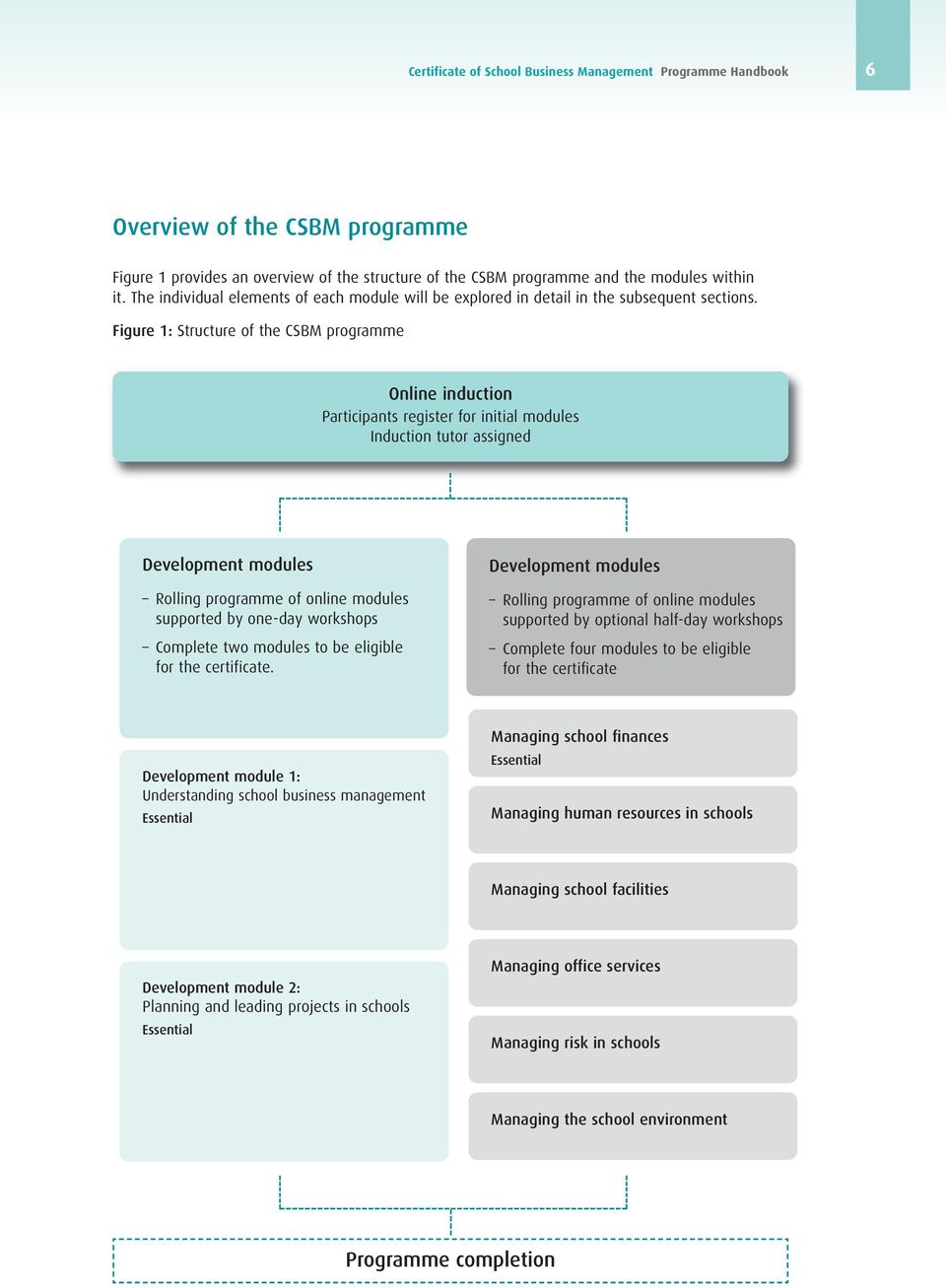
8 Certificate of School Business Management Programme Handbook 6 Overview of the CSBM programme Figure 1 provides an overview of the structure of the CSBM programme and the modules within it. The individual elements of each module will be explored in detail in the subsequent sections. Figure 1: Structure of the CSBM programme Online induction Participants register for initial modules Induction tutor assigned Development modules Rolling programme of online modules supported by one-day workshops Complete two modules to be eligible for the certificate. Development modules Rolling programme of online modules supported by optional half-day workshops Complete four modules to be eligible for the certificate Development module 1: Understanding school business management Essential Managing school finances Essential Managing human resources in schools Managing school facilities Development module 2: Planning and leading projects in schools Essential Managing office services Managing risk in schools Managing the school environment Programme completion
9 7 Certificate of School Business Management Programme Handbook Personalisation A key characteristic of the programme is that you will exercise a high measure of control over the timing and sequence of your studies and your level of engagement with the content. In addition to being able to choose the modules you study (noting the essential ones detailed in Figure 1), it may also be appropriate for you to elect to fast-track through to assessment in one or more of the modules, as described in the sections below. In addition to choosing the areas of study you may also choose which elements of the modular content you undertake. Figure 2 illustrates how you can design your engagement with the material and activities available. Figure 2: Options for undertaking the CSBM programme Option 1: Study online module, engage in group activities (web conferences, online discussions and attend workshop) Option 2: Study online module, engage in group activities (web conference, online) Option 3: Study online module only Programme completion

10 Certificate of School Business Management Programme Handbook 8 CSBM programme structure Key principles The CSBM programme structure is intended to give participants flexibility and choice in their proposed learning journey, depending on their circumstances. It is based on the following principles. Programme registration Participants may choose to register either for single modules or the full programme. All participants registering for the full certificate must complete the online induction before entering the main suite of modules. Participants who elect to complete the full certificate programme are assigned module tutors who will monitor and support their work throughout the programme. Full programme registration will remain live for a two-year period from registration onto the programme. Module sequence Development modules 1 and 2 are essential, as is the operational module, Managing school finances. In most cases, it is expected that participants completing the full certificate will begin their studies with Development module 1. However, it is possible to begin Development module 2, or complete an operational module, alongside development module 1. Thereafter, participants undertake their chosen modules in a sequence which suits their learning and professional development needs. This applies particularly to the six operational modules, of which participants must successfully complete any four (to include Managing school finances) to qualify for the certificate. Providers offer a schedule of modules which participants can then register for based on a sixmonth cycle. It should not be assumed by participants that they can access modules on demand. Your choice of modules can be reviewed as you progress through the programme. It should be noted that once a participant has formally begun a module (by enrolling on a workshop or submitting for assessment) that the module must be completed. Regional workshops A series of regional face-to-face workshops is offered by providers; these are optional and designed to complement the online module resources and activities. Each operational module has a supporting three-hour workshop. These provide an opportunity to engage with the module tutor and fellow participants to explore ideas, gain knowledge and develop skills. Each development module has a supporting one-day workshop. Participants are strongly recommended to register for the regional workshops provided for the development modules.

11 9 Certificate of School Business Management Programme Handbook Timescales for completion The duration of development module 1 (DM1) is 12 weeks and development module 2 (DM2) runs for 24 weeks to enable you to complete your project work over time. However, participants are given a choice of dates for submission for each module assessment. Operational modules are completed within a 12-week timeframe. Module assessment Once registration for a specific module has been completed, participants are required to submit their work for summative assessment for that module within a timescale agreed with the tutor. An assessor will assess your work, assign a mark for the level achieved and provide concise summary feedback. Participants who achieve a referral grade in the assessment of a module may resubmit their work for reassessment. Moderation and quality assurance processes are in place to ensure consistency of assessment and equality of treatment. Programme completion Participants who do not achieve a pass grade for a module have one opportunity to resubmit the assessment for that module. Participants are required to achieve a pass in each of the development modules and four of the operational modules, including Managing school finances, to achieve the CSBM award. Online induction The starting-point for you on the certificate programme is the online induction. It provides an overview of the College, programme content, blended learning, and assessment requirements. There is also some guidance on the study skills required to complete the programme successfully. A key part of the online induction is a needs assessment, which is designed to help you plan your overall programme journey. Some examples of individual programme learning journeys are included in the online induction to help you think through your initial planning about your own possible routes through the programme. Your provider can offer you guidance should you need any support with this decision making process. Progression onto the programme will be subject to completion of the online induction and approval of your proposed programme learning journey by your tutor.

12 Certificate of School Business Management Programme Handbook 10 Your induction tutor will monitor and guide your individual progression through to completion of development module 1. The tutor will hold a short progress review with you at the end of your interview assessment for development module 1. As part of your online induction module your Provider will contact you and will send you a learning journey template to complete. There will be web conference or telephone support to help you to complete your learning journey template. You will need to consider and respond to the following questions: Which of the operational modules do you wish to complete? Which (if any) of these modules do you wish to opt for as the fast-track route through to assessment? Which module workshops do you wish to attend? Over what time frame do you plan to complete the programme as a whole? Once completed, your learning journey template should be sent to your tutor. Development modules The two development modules are concerned with the generic knowledge and skills related to the work of the SBM. They focus primarily on the following key areas within the school business management competency framework: Managing self and personal skills Providing direction Facilitating change Achieving results The development modules are as follows. Development module 1: Understanding school business management Module 1 is designed to help you understand the changing role of school business management and also focuses on the development of strategic and management skills related to your role as a school business manager. Development module 2: Planning and leading projects in schools Module 2 is focused on the development of skills related to project management and change leadership. As part of this module you will plan and deliver a project designed to develop facilities, systems and processes in a school setting.

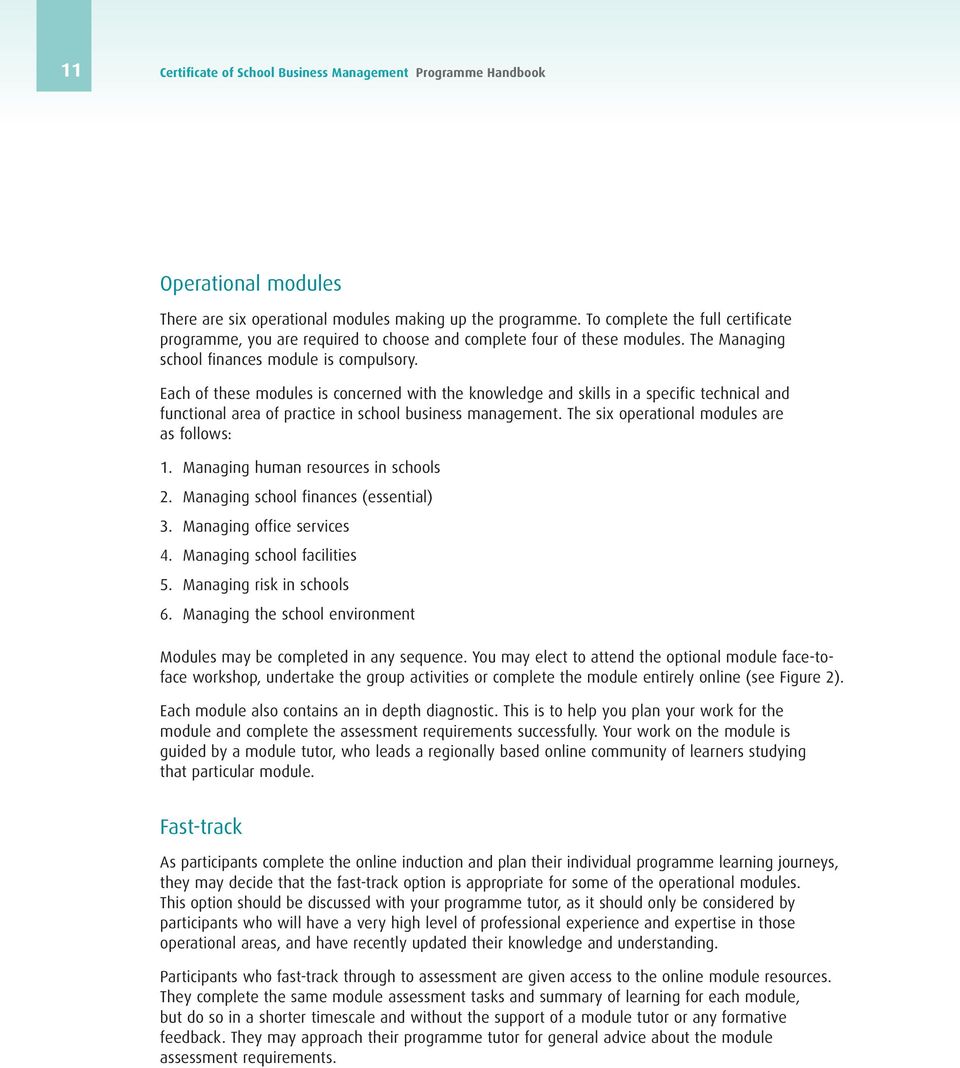
13 11 Certificate of School Business Management Programme Handbook Operational modules There are six operational modules making up the programme. To complete the full certificate programme, you are required to choose and complete four of these modules. The Managing school finances module is compulsory. Each of these modules is concerned with the knowledge and skills in a specific technical and functional area of practice in school business management. The six operational modules are as follows: 1. Managing human resources in schools 2. Managing school finances (essential) 3. Managing office services 4. Managing school facilities 5. Managing risk in schools 6. Managing the school environment Modules may be completed in any sequence. You may elect to attend the optional module face-toface workshop, undertake the group activities or complete the module entirely online (see Figure 2). Each module also contains an in depth diagnostic. This is to help you plan your work for the module and complete the assessment requirements successfully. Your work on the module is guided by a module tutor, who leads a regionally based online community of learners studying that particular module. Fast-track As participants complete the online induction and plan their individual programme learning journeys, they may decide that the fast-track option is appropriate for some of the operational modules. This option should be discussed with your programme tutor, as it should only be considered by participants who will have a very high level of professional experience and expertise in those operational areas, and have recently updated their knowledge and understanding. Participants who fast-track through to assessment are given access to the online module resources. They complete the same module assessment tasks and summary of learning for each module, but do so in a shorter timescale and without the support of a module tutor or any formative feedback. They may approach their programme tutor for general advice about the module assessment requirements.
14 Certificate of School Business Management Programme Handbook 12 Withdrawals It is inevitable that from time to time some participants will, for whatever reason, wish to withdraw from the programme. In the first instance, participants wishing to do so should seek to discuss any difficulties with their programme tutor. If no alternative course of action to withdrawing can be found, details of the procedures to be followed can be obtained by contacting the training provider. The provider will also discuss any financial implications of withdrawing. Programme evaluation The National College is committed to regularly reviewing and evaluating its programmes to ensure their quality, value and impact. At the start and end of the programme you will be asked to complete and submit a short evaluation questionnaire which will provide the National College with information on how the programme has assisted in your development and influenced your school. You will also find a small number of questions at the end of each online module which will provide you with the opportunity of feeding back your views on the content you have just studied. Your views are valued and important in shaping the future of school business management provision and the profession of the SBM. All responses are treated in confidence. Certification Once your work has been marked and moderated, and your end-of-programme evaluation questionnaire completed and submitted, certificates are issued by the National College. In order to ensure robust standards are maintained, a moderation team evaluates a sample of all work submitted.

15 13 Certificate of School Business Management Programme Handbook Model of professional learning The CSBM programme recognises that individual learners have different learning styles and preferred ways of developing. It therefore offers a blend of learning experiences which include: Online learning resources: completing diagnostics and using the online module study materials Online networks: discussion with other participants and tutors, participating in debates and providing and receiving peer support School-focused research and development work: investigations into current policy and practice in a school setting and planning for improvement Web conference discussions: opportunities to discuss key issues with your module tutor and other participants via a conference telephone call and networked computers Regional workshops: a series of optional three-hour workshops, each one focused on a particular module, where participants can engage with their tutor and fellow participants to explore ideas, gain knowledge and develop skills Study groups You may also elect to join an optional study group at the start of the module. The study group serves an important educational function in terms of promoting the development of a learning community that will continue to work together online. When you register online for a module you are assigned to a module study group. Workshops You may also elect to join an optional face-to-face workshop at the start of the module. The purpose of this workshop is to provide an overview of the module contents and their significance to school business management. Blended learning model The CSBM programme uses a blended learning approach in order to accommodate different learning styles and preferences (Figure 3).
16 Certificate of School Business Management Programme Handbook 14 Figure 3: Blended learning approach on CSBM Participants register for module online and are assigned to a module study group Participants access online module study guide and complete module diagnostic Optional workshop available Participants plan initial work for the module Module tutor leads study group online through learning community, including scheduled discussions and web conference sessions Participants engage with online learning resources and complete school-focused activities Participants submit selected work to module tutor for formative feedback Participants submit work for module assessment Assessor grades work and provides written feedback

17 15 Certificate of School Business Management Programme Handbook Module activities The online module learning resources contain module activities that are related to the learning outcomes for each module. These are designed to support the assessed tasks at the end of the module, and to provide a framework of support. These module activities are intended to: stimulate your initial thinking about the subject matter require you to seek out information, either in school or via the internet encourage you to engage with appropriate concepts and techniques which can then be applied to your own school setting enable you to reflect upon key aspects of your professional practice and your development needs You are responsible for planning your work for each module. You will need to gain an initial overview of the module contents and assessment requirements and consider your current level of professional knowledge, understanding and competence in relation to these. A key part of this planning is to identify which of the module activities is likely to enhance your knowledge and expertise and help you complete the assessment requirements. A template is provided for the completion of the module activities for each module, and you should use this to build up an activities log over time. You are not required to submit your activities log for assessment. However, you should draw on it when you are completing your module assessment tasks and summaries of learning; you will often use the material from the activities log as appendices to the work you submit for each module. Online learning An exciting feature of the CSBM programme is the opportunity it offers for online learning both in terms of interactive module content through the learning schedule online and supported learning through group discussions and activities within the module learning group. All the online activities are managed through the National College website. Guidance on how to access the online resources is provided in your welcome letter. Further guidance is available in your learning schedule online, and a helpdesk facility is available to solve any technical problems participants experience. My Programmes area The My Programmes area of the National College website contains all the CSBM programme materials needed for each module as you progress through the programme.

18 Certificate of School Business Management Programme Handbook 16 My groups and discussions area and the online network This area is an interactive online communication tool used by participants on most National College programmes, as well as national open-discussion groups. These consist of: an integrated facility for all participants and tutors to correspond, hold online discussions, ask questions and have them answered a public opportunity for National College members to engage in professional discussion a private space for learning groups and their tutors to exchange views and clarify questions links to other areas of interest such as SBM Arena, the Department for Education (DfE), other relevant government departments, professional and academic sites and other special interest groups a managed noticeboard that posts forthcoming events, headlines, urgent information and navigational advice Access to participant data and records is personalised and what is recorded cannot be viewed by anyone else. Online discussions As you progress through the programme you will be able to engage in three types of online learning community; the first focused on national discussions of relevance to SBMs; the second based on the development modules and supported by the tutor who supported you through the induction process; and the third provided by specialist module tutors as you work on your chosen operational modules. The national discussions area provides an arena to help you keep in touch with national development, policy issues, good practice and business opportunities. The other two learning communities are much more focused on your professional learning on the CSBM programme (Figure 4).
19 17 Certificate of School Business Management Programme Handbook Figure 4: Structure of learning for development and operational modules Development modules led by induction tutor support for development activities one-to-one support for learning creation of a learning community provision of wider discussions Operational modules led by module tutor support for module specific activities creation of short-term learning community specific to the module Your induction tutor On joining the CSBM programme, you will be allocated an induction tutor. Their role is to provide online support for a group of participants throughout the early stages of their learning journey on the programme, but most especially through the development modules. Your induction tutor will then become your tutor for development module 1. This support will be provided online, mainly through the online network. The role involves: Providing support for the group in development module work: creating discussions on given issues encouraging peer support for particular activities facilitating hotseats where appropriate leading one or two web conference sessions acting as an initial point of reference for questions or concerns providing formative feedback on selected work in draft

20 Certificate of School Business Management Programme Handbook 18 Modules tutors When you register to complete an operational module, you will be assigned a module tutor and will join a study group for that module for a period of 12 weeks. The role of the module tutor is to work online and: provide support for the learning across the four units making up the module promote discussion and debate on specific issues related to the module act as a specialist within the module area of expertise provide hotseats and discussion forums with guests conduct a web conference session with the study group provide formative feedback on selected work in draft Technical support If you experience difficulties when trying to access either My groups and discussions or My College, please contact the National College helpdesk on or [email protected]. Participants should be aware that: sometimes servers go down and web addresses that seem to be broken often work a little later on, or there may be a problem with the browser setting on your own computer or the computer may work when you open a new window it is always more reliable to access websites directly from the links within the online materials as the online materials are continuously updated, whereas web addresses in paper materials can become out of date the process for reporting faults and difficulties is through the helpdesk participants are expected to develop internet research skills to enable them to use internet search facilities. This is so that they can locate appropriate alternative web addresses and search facilities and find documents that have been moved or seek appropriate alternatives sharing reliable appropriate alternatives with the SBM community on SBM Arena and reporting them to the programme team via the helpdesk is part of online peer support
21 19 Certificate of School Business Management Programme Handbook Working online Studying and communicating online is different from doing so offline and requires a particular approach. There are guidelines to good behaviour online when using My groups and discussions and these are available online and below. Guidelines for good behaviour online Take time to read and reflect on what others are saying. Respect the views of others, even if you disagree with them. Tell us what you think your views are as valuable as anyone else s. Support colleagues who are asking for help. Keep your contributions relatively short. Aim to be positive, contributing on what can be done rather than what can t. Challenge ideas rather than personalities. If you agree, show your support to colleagues. Even if you don t have a particular point to make, it is really encouraging for others if you acknowledge their contribution. If you have a lot to say, it is better to break it up into a series of short contributions, perhaps with each one focusing on a different point. Stay on the point. If you introduce many varying ideas, it is difficult to track conversations and it is easy to lose ideas. Assume the good intentions of others contributions often read differently from how they were intended. When you ve made a contribution, review it with a view to the possible impact your words may have on the discussion. Avoid criticising and naming individuals or organisations. Don t use capital letters to emphasise a point in online etiquette, this is the equivalent to shouting. If you make comments in a discussion, make a commitment to staying with the discussion. Passing comments can often be disruptive. If you are retiring from a discussion, please let the group or community know. Try not to dominate a discussion allow others to share in the online experience. Don t leave it too long before responding to a colleague, especially if you have agreed to respond online. If you are unable to contribute for a period of time, let the group know. This does not mean you have to divulge the reason why you can t contribute. It is all right, at times, to read the discussions without contributing if you feel that you have nothing to say at that time.
22 Certificate of School Business Management Programme Handbook 20 Assessment of the CSBM programme Introduction The purpose of this section is to give you an overview of the design of the assessment of the programme and guidance on how to present your work so that you can meet the assessment requirements. More information about the assessment tasks for specific modules can be found online on the module home page in the Assessment and Activities section. The design of the programme and the assessment process offer you flexible tools which you can draw upon dependent on your individual needs. Thus, you can construct your own routes through each particular module if you wish, leading to the formal assessment of each module. Table 2 illustrates some of the possible routes to formal assessment. During the online induction, you will discuss and agree with your programme tutor the particular routes through the modules you will undertake. Table 2: Routes for formal assessment on CSBM programme Participant Complete module diagnostic: discuss with tutor/mentor Engage in group activities: web conference, online forums A B C D* Complete module activities: use to support unit assessment tasks Complete draft of one unit assessment task: submit to tutor for feedback Complete assessment tasks for formal assessment * fast-track
23 21 Certificate of School Business Management Programme Handbook Aims of CSBM assessment Assessment is a key part of the integrated learning strategy that underpins the CSBM programme. The assessment requirements are designed to promote and consolidate the professional competence of participants. The feedback provided to participants on their assessment outcomes is intended to promote personal reflection, recognise achievements and identify further areas for professional learning. The principal aims of the assessment strategy for this programme are to: enable you to develop your professional competence by identifying areas for improvement, thereby helping to improve both your personal and academic performance provide the mechanism to decide whether you have reached the standards laid down for the award of the certificate You will receive formative feedback on drafts of some of your work from your module tutors as you progress through the programme. You will also receive summative assessment feedback from your assessors. However, this written summative feedback also has a formative dimension, and is intended to help you improve your performance as you progress through the programme and in your subsequent professional learning and career development. Rationale for the model of assessment The assessment model for the CSBM programme draws upon a number of different sources of information and design frameworks. It has been planned to ensure continuity and parity with the previous programme in terms of study workload. It is also aligned with the framework that has been established for the other National College school business management programmes. The key information sources and design frameworks used in the development of the assessment model were: National Qualifications Framework (NQF) summary of Level 4 descriptors requirements for accreditation within the Qualifications and Credit Framework (QCF) school business management competency framework (National College & NASBM, 2009) An initial reference point for the assessment model is the national qualifications framework (NQF). The assessment requirements for the CSBM conform to Level 4 of the NQF in terms of academic rigour, criticism and analysis in application to practice. The NQF states: Level 4 qualifications recognise specialist learning and involve a high level of information and knowledge in an area of work or study. Learning at this level is appropriate for people working in technical and professional roles and/or managing or developing others. The summary learning outcomes at Level 4 of the NQF are as follows: Develop a rigorous approach to the development of a broad knowledge-base. Employ a range of specialised skills.
24 Certificate of School Business Management Programme Handbook 22 Evaluate information, using it to plan and develop investigative strategies and determine solutions to a variety of unpredictable problems. Operate in a range of varied and specific contexts, taking responsibility for the nature and quality of outputs. The programme has also been prepared for accreditation as part of the qualifications and credit framework (QCF). Each module (and sub-section of the module) is written in a way that conforms to QCF unit requirements. QCF accreditation is important because it provides a statement of the credit value of each module, which other organisations can use to determine the level and characteristics of the work you have done for the CSBM. The CSBM programme (in terms of both module content and assessment requirements) is broadly based on the school business management competency framework. This is an important reference point for anyone studying on the programme, although the structure of the programme and its assessment requirement do not simply mirror the competences set out in the competency framework. General features of the design The general features of the assessment of the CSBM programme are as follows: The programme is constructed around eight modules. Each module is individually assessed on completion of that module. The assessment requirements for each module reflect the learning outcomes of the units making up that module and are linked to the school business management competency framework. In order to complete the CSBM participants are required to complete two mandatory development modules and four operational modules, with the operational module Managing school finances being compulsory. A range of assessment techniques is used to ensure rigorous coverage of the learning outcomes of each module and a clear focus on the development of professional and occupational skills. Each module is made up of four units. Each unit is assessed against four key areas of assessment criteria and assigned a grade. Summative assessment of the level of work submitted, together with written summary feedback, is provided on completion of each module. Participants who are suitably experienced may elect to fast-track through to assessment of a module. Participants are required to achieve at least a pass grade in each unit to gain a pass for the module as a whole. Participants receiving a referral for a module may prepare their work for resubmission. Successful completion of the CSBM programme (and award of the qualification) is dependent on the achievement of a pass grade in each module completed. Where the web conferencing tool is used for assessment, these may be recorded for quality assurance purposes.
25 23 Certificate of School Business Management Programme Handbook Preparing for assessment: formative feedback To help you to prepare for the assessment of each module, you will receive a certain amount of feedback on certain elements of your work. Table 1 provides an overview of the formative feedback you can expect from your tutors during the programme. Table 1: Formative feedback arrangements Module Feedback Development module 1: Understanding school business management The tutor will provide written feedback on units 1 and 3 of this module. Development module 2: Planning and leading projects The tutor will provide written feedback on units 1 and 2 of this module. They will also comment on the project proposal (unit 1) and project plan (unit 2). Operational modules The module tutor will provide written feedback on unit 1 of each of the operational modules. They will also provide brief feedback on the module summary of learning that is completed for each module. Your tutors will provide you with formative feedback on a draft of your work as shown in Table 1. The feedback is intended to provide you with brief guidance on the work you have submitted in draft. It will give a concise appraisal of development points relating to the four areas of assessment (knowledge and understanding, etc). You can then use this feedback to edit your work prior to submission on completion of the module. Your tutor will give you deadlines for submission of the various pieces of work in draft. Tutors only review each piece of work once, so please do not re-send further drafts for comment. Please note that whilst your tutor will provide you with feedback, it is the assessor who will make the final judgement about the quality of your finished work. It is therefore your responsibility to ensure that you have covered all the assessment requirements. To help you, read the unit checklists for each module before you finally submit your work. These checklists are online, as part of the module resources.
26 Certificate of School Business Management Programme Handbook 24 Learning outcomes and key areas of assessment The assessment is based on the learning outcomes for each of the four units making up a module. Each unit is in turn structured around four learning outcomes. For example, the learning outcomes for unit 3 of Development module 2, Planning and leading projects in schools, are as follows: Unit 3: Leading and managing development projects Learning outcomes: By the end of this unit you will be able to: demonstrate knowledge and understanding of key concepts and techniques related to the leadership and management of development projects apply these key concepts and techniques to the leadership and management of a school development project monitor the progress of the project and respond to emerging issues in project leadership and management communicate with others affected by the project and report on its progress in an appropriate manner The four learning outcomes for each unit are related directly to the key areas of assessment used across the suite of school business management programmes. For CSBM, these are defined as follows: Knowledge and understanding of key concepts and techniques This relates to the theoretical and technical content of the programme: theoretical frameworks and occupational techniques that can be used to make sense of the workplace and plan action to improve it. Application of learning to professional practice This concerns the application of these theoretical frameworks and occupational techniques in the workplace to examine aspects of current systems and make improvements in policy and practice. It is also used here to cover the use of different technical and operational skills required in practice in specific areas of school business management. Analysis, reflection and personal accountability This area focuses on the ability to manage one s own professional learning, reflect on experience, develop insights into self, and take action to enhance one s knowledge and skills through the programme. It also covers the ability to analyse situations encountered in the workplace, exercise good judgement and make choices in professional practice. Finally, it concerns the ability and willingness to be accountable for outcomes in a professional role and to make decisions in a context of limited supervision.
27 25 Certificate of School Business Management Programme Handbook Communication and study skills This final area covers the skills needed to manage professional learning and complete the programme successfully. It includes a range of study skills that are needed in professional learning and also daily professional practice in the workplace; for example, to be able to access legislative requirements relating to school business management and ensure that a school complies with these. It also covers the skills needed to communicate with others in the workplace, both orally and in writing. Whilst there is a close and complex relationship between these different areas of assessment, the requirements of the programme have been carefully designed to achieve an appropriate balance between these different aspects of learning. Learning outcomes and assessment criteria related to each unit making up the programme encompass these four key areas. The learning outcomes summarise what you should know and be able to do by the end of the unit. The module study guide for each module identifies the learning outcomes. However, it is essential that you ensure that you follow the rubric of the unit assessment task and answer the question as set as you will be assessed against the requirements identified in the assessment task. There are separate assessment task and study guide documents for each module that you study and these can be located in the online modules. Assessment levels The performance of participants is assessed in relation to the learning outcomes and assessment criteria in each unit and module completed. Assessors assign a grade for the level achieved for each unit and for the module as a whole. Four levels of performance are used in the assessment process: referral, pass, good pass and excellent pass. The meaning of each level is as follows: Referral: the assessment criteria for the module have not been met, and the work submitted requires revision in order to achieve a pass grade. Pass: the assessment criteria for the module have been achieved, and reflect a satisfactory level of occupational and professional competency. Good pass: the assessment criteria for the module have been achieved in full, and reflect a secure level of occupational and professional competency. Excellent pass: the assessment criteria for the module have been achieved in full, and reflect a very high level of occupational and professional competency. The work has many of the characteristics of Level 5 of the NQF. For more detailed information on what these four levels mean in practice, please refer to Appendix 3: Level matrices for the CSBM programme. Participants who complete the full CSBM will also be given an overall grade for their performance across the programme. This overall grade takes into account the difference in the credit value of between the development and operational modules, the former equating to twice the latter. Participants complete two development modules, which equate to half the programme, and four operational modules which together make up the remaining half. Table 3 summarises the CSBM assessment requirements.
28 Certificate of School Business Management Programme Handbook 26 Table 3: CSBM programme assessment requirements Development module 1: Understanding school business management Professional learning portfolio (PLP) based on four units Word-count for PLP: 5,000 words +/ 10 per cent Weighting: 80 per cent of module assessment requirement Interview by an assessor via web conference Weighting: 20 per cent of module assessment requirement Development module 2: Planning and leading projects in schools Written project report, based on four units Word-count for project report: 3,000 words +/ 10 per cent Weighting: 80 per cent of module assessment requirement Preparation and delivery of presentation via web conference Weighting: 20 per cent of module assessment requirement Operational modules: Managing school finances Managing school facilities Managing the school environment Managing risk in schools Managing human resources in schools Managing office services Participants complete four of the six operational modules Each operational module is made up of four units For each operational module, participants are required to complete: four module assessment tasks (one per unit) module summary of learning online test Word-count for each assessment task: 300 to 500 words +/ 10 per cent Weighting for each unit: 20 per cent Word-count for summary of learning: 600 words +/ 10 per cent Weighting for summary of learning: 20 per cent
29 27 Certificate of School Business Management Programme Handbook Development module 1: Understanding school business management Module 1 is designed to develop an understanding of school business management and the organisational context in which it is exercised. It also focuses on the development of strategic and management skills related to the role of school business manager. The module is made up of four units: Unit 1: Describing the school setting and the role of the SBM Unit 2: Establishing your professional learning needs Unit 3: Exploring the political and organisational context of school business management Unit 4: Evaluating your professional learning and impact on the workplace The assessment of this development module comprises: completion of a professional learning portfolio (weighting: 80 per cent of module assessment requirement) conduct of an interview by an assessor via web conference (weighting: 20 per cent of module assessment requirement) Professional learning portfolio The professional learning portfolio (PLP) is completed as the participant works though the units online and is submitted on completion of the module. It comprises four units as follows: Unit 1: Describing the school setting and the role of the SBM This section of the portfolio is made up of two entries: description of the school and the community it serves description of your professional role in the school and your relationship with other school stakeholders Unit 2: Establishing your professional needs This section of the portfolio is made up of three items: review of your personal skills and characteristics as a learner analysis of your professional role and the challenges you face first stage of your professional development plan
30 Certificate of School Business Management Programme Handbook 28 Unit 3: Exploring the political and organisational context of school business management This section of the portfolio is made up of two items: report on the policy context of school business management report on the use of analytical tools in a school setting Unit 4: Evaluating your professional skills and impact on the workplace This section of the portfolio is made up of two items: reflection on your professional skills summary of professional learning through the module The maximum word-count for the professional learning portfolio is 5,000 words. Specific wordcounts are also assigned to each section of the portfolio. An appendix containing any supporting evidence relevant to the portfolio should also be submitted and is not included in the portfolio word-count. Interview The interview is conducted on completion of the module, lasts for 20 minutes, and is conducted via web conference. It is focused on the participant s understanding of school business management, school contexts and the role of the SBM. It also focuses on his or her awareness of their current skills in relation to school business management and further professional learning needs. Development module 2: Planning and leading projects in schools Module 2 is focused on the development of skills related to project management and change leadership. Participants plan and deliver a project designed to develop systems and processes in a school setting. This school-based work is supported by a series of learning activities related to the following units: Unit 1: Identifying and negotiating development projects Unit 2: Developing project plans Unit 3: Leading and managing development projects Unit 4: Reflecting on project management skills
31 29 Certificate of School Business Management Programme Handbook The assessment of this development module comprises: completion of a written project report (weighting: 80 per cent of module assessment requirement) preparation and delivery of a presentation via web conference for an assessor and a small group of participants (weighting: 20 per cent of module assessment requirement) Project report The project report is completed as the participant works though the units online and is submitted on completion of the module. It comprises four sections as follows: executive summary (200 words) section 1: account of how you identified and negotiated the development project section 2: account of how you prepared a plan for the project section 3: account of how you led and managed the project section 4: evaluation of the outcomes of the project and its impact on the workplace, together with a commentary on the professional competence and personal learning gained through its completion appendix: supporting evidence relevant to the project (not included in the project word-count) The maximum word-count for the project report is 3,000 words. Project presentation The project presentation is assessed on completion of the module. It comprises the preparation and delivery of a PowerPoint (or similar) presentation delivered via web conference for an assessor and a small group of participants. The presentation is focused on the participant s evaluation of his or her leadership and management of the development project. It should be structured as follows: brief description of the school setting why the chosen project was selected and its key objectives overview of the planning and implementation of the project explanation of what was achieved evaluation of its effectiveness as a development project reflection on professional learning gained through the project The presentation lasts for 10 minutes and is followed by questioning led by the assessor.
32 Certificate of School Business Management Programme Handbook 30 Assessment of operational modules Participants knowledge and skills in each of the operational modules will be assessed through the assessment of written work submitted on completion of the module. Each operational module is made up of four units and each unit is assessed through the completion of a module assessment task. The assessment of each operational module comprises completion of: module assessment task relating to each of the units making up the module module summary of learning online test for that module The maximum word-count for the assessment requirements relating to each operational module is 2,600 words, which is broken down as detailed in the following sections. Module assessment tasks These tasks are designed to develop the participants ability to access information relating to different aspects of school business management and use this to evaluate current systems and processes in the workplace and identify areas for improvement. The tasks generally conform to the following pattern of learning and development: research into a specific aspect of the operational area (for example to identify key techniques, good practice or current legislation) application of that knowledge to a specific school setting evaluation of current policy and practice with identification of areas for action and/or proposals for how the area should be addressed written communication of findings and recommendations The word-count for each individual module assessment task is words. Module summary of learning For each of the operational modules, participants are also required to complete a module summary of learning. This is focused on the professional learning gained through completion of the module. Participants are required to analyse and discuss their learning and its impact on the workplace. This focuses on the ability to manage one s own professional learning, reflect on experience, develop insights into self, and take action to enhance one s knowledge and skills. It also concerns the ability and willingness to be accountable for outcomes in a professional role and to make decisions in a context of limited supervision.
33 31 Certificate of School Business Management Programme Handbook The module summary of learning is designed to assess specific learning objectives that are common for all of the operational modules. On successful completion of the module summary of learning participants will be able to: evaluate their professional competence in relation to a specific operational area of school business management reflect on the learning gained through completion of the module assessment tasks and learning activities summarise insights gained into current policy and practice in a school and the impact of work undertaken on these to date identify areas for further professional learning and the improvement of policy and practice in a school The maximum word-count for the module summary of learning is 600 words +/ 10 per cent. Online module test On completion of each operational module, participants are required to complete the online test for that module. This is a knowledge-based, computer-marked multiple-choice exercise. Participants are able to access the test on any number of occasions until such time as they achieve a minimum score of 80 per cent or a score above this which they are satisfied with. Online tests are accessed via the learning schedule within the My Programmes area. Management of assessment Module assessment Participants are required to meet the assessment requirements for each module as they progress through the programme within the timeframes set out for the assessment of that specific module. In the event of a participant s work for a module being deemed a referral, the participant is entitled to resubmit their work for reassessment om one occasion. Time for completion Participants are required to complete each set of module assessment requirements by the specified date. Participants will be informed of these submission dates at the start of each module. Submission of work for assessment All work for assessment is submitted electronically; your provider will give you detailed guidance on the procedures for this. Templates are provided within each online module which must be used by participants in submitting their work.
34 Certificate of School Business Management Programme Handbook 32 When you are presenting your written work, in line with normal academic submission practice, please use the following: Arial size 11 or Arial narrow size 12 font line spacing set to 1.5 Harvard referencing The template for each assessed piece of work contains a front cover that should be completed to include: your full name title of the module to which the work relates All submissions should be named (saved) as follows: Name_Date_Module For example: jennifermaslow_february2012_managing school finances Your work should also include: a signed statement as follows: I confirm that this is my original work and that I have adhered to the written guidance received in the Participant handbook on plagiarism (see below for these guidelines) clear sections and sub-headings any additional evidence attached as an appendix to the main document, clearly cross-referenced and signposted in the main text a bibliography You should adjust the template header and footer to contain the following information: name of participant title of the module to which the work relates date of submission Submission templates are directly available within each online module. The assessment requirements set out the required word-counts for written work relating to each module. Participants must ensure that their work submitted falls within 10 per cent of the specified word-counts. For the operational modules, the word-count for the module assessment tasks making up the operational modules must fall within 300 and 500 words; no variance on this is permitted. Please note that the word-count does not include the bibliography, but does include any quotations cited and the text included within any tables or figures. Participants will be penalised for submitting work that falls outside this degree of variation.
35 33 Certificate of School Business Management Programme Handbook Appendices Participants may also, if they wish, make use of an appendix. This should contain additional information and primary evidence related to the assessment task. This will often be based on work that participants have completed in the activities log, as they have worked on the module. The material included in the appendix should be of direct relevance to the assessment requirements for that module, and should not include extraneous or irrelevant background material. Assessors will not assess the appendix, but will take the information provided there into account in assessing the main document (for example, the report or commentary). The length of the appendices attached to each module should not be longer than the word-count for the work specified for that module. Plagiarism Plagiarism is the use of someone else s work without proper acknowledgement, presenting the material as it were your own. Plagiarism is regarded as a serious academic offence and the following advice is intended to clarify any uncertainties you might have. Use of quotations or data from the work of others is entirely acceptable, and is often very valuable provided that the source of the quotation or data is given. When quoting word-for-word from the work of another person, quotation marks or indenting must be used and the source of the quoted material must be acknowledged. All work submitted for assessment must be your own work. Unacknowledged direct copying from the work of a colleague, or the close paraphrasing of somebody else s work is called plagiarism. This also refers to copying from published sources such as books, reports or journal articles. You must submit your own, original work. The National College gives providers the authority to take action against you if you are found to have plagiarised or cheated in any way to gain an unfair advantage. You should make use of the Harvard referencing system in all work submitted for the programme (see Appendix 1). Observing ethical standards The programme involves writing down accounts of analyses and projects undertaken in your own school, and reflections on them, which may include expressing opinions about the work of colleagues. The programme also encourages critical enquiry and independent thinking, which should not be mistaken for criticism of the school. The following guidelines are intended to help participants ensure they are working within acceptable ethical standards. You should anonymise the school in your reports, but provide a brief description of the school setting and characteristics. References to colleagues and stakeholders should not identify individuals by name, but should specify their role (eg, chair of governors, principal).
36 Certificate of School Business Management Programme Handbook 34 Make sure that someone in the school, such as the headteacher or in-school mentor, knows what projects or investigations you are undertaking as part of the programme, and that they are, in general, happy with them. Discuss any potentially sensitive issues with this person before going ahead. Consider to what extent the project is an integral part of your job. If the project involves matters that others might regard as being outside your normal core responsibility, then it becomes more important for you to seek agreement, consent and co-operation from the colleagues who might be affected or involved. If you write anything down that could be perceived as critical of a colleague s work (even if they are not identifiable), then you need to ask yourself the following questions. Do I have objective evidence to support this view? Have I discussed this with my mentor? Do I really need to include this in order to produce a complete and honest account? Could I manage the situation if I found the person concerned reading over my shoulder? Have I been professional in the way I have written about this? Extensions If you cannot submit your work for assessment by the deadline, you must contact your provider no less than two days before the submission date. It may be possible to grant you an extension of up to five working days if there are extenuating circumstances. These will not normally include workload issues. If an extension is not requested and work is submitted late, the highest grade that it will be possible to award will be a pass grade. Summative feedback Participants will receive written feedback on each module once it has been assessed. This feedback is based upon a standard form and is completed by an assessor. It will comprise the overall grade achieved for each module, together with detailed feedback on what has been achieved, how it could have been improved further, and areas in which the participant should seek to develop their competence in the future. Assessors complete the assessment form electronically within the timeframes set out for the assessment and moderation of each module. Referral Where a participant s work for a module has been assessed as a referral, the written feedback will state clearly what action needs to be taken. The participant may also request some additional guidance from their module tutor in the light of the feedback, but may not submit their revised work to the tutor for further feedback prior to its resubmission. Participants are normally allowed to retrieve a referral for a module by revision of the original submission. Participants who receive a referral for a module are allowed to progress to further modules in the interim. If a participant wishes to repeat a module, or undertake further assessment to recover a referral, they must meet the cost of doing so and overall completion must remain with the two-year registration period.
37 35 Certificate of School Business Management Programme Handbook Resubmission Participants who achieve a referral for a module will be given a resubmission date. Resubmitted work may only be assigned a level of referral or pass. Standardisation and moderation Assessors take part in standardisation processes to ensure a shared understanding of module assessment requirements. In order to ensure parity and consistency of standards and to meet accreditation requirements, a sample of work submitted by participants to meet module assessment requirements will be moderated by the provider. Following each round of assessment, a selection of work also goes forward to be moderated nationally. This not only ensures consistency of assessment across the country but also provides for a further opinion on any work deemed not to have reached the required standard. Programme completion The conferment of the award of Certificate of School Business Management is subject to successful completion of the two development modules and four of the operational modules, which must include the Managing school finances module. An assessment board will be convened by the National College on a periodic basis to confirm formally those participants who have met the programme requirements. Participants should note that the certificate issued does not specify the level at which the participant has passed the programme. Assessment regulations If you have a disability or specific need, you can apply to be assessed by methods other than those normally approved for the programme. Supporting evidence will be required. Appeals In line with the National College s policy related to all school business management programmes, appeals are only accepted when you have not reached the required level to pass the programme. No appeals can be made against the grade of an assessed module that has been deemed to meet programme requirements. If you wish to appeal against the outcome of an assessment activity you have completed, you should notify your training provider in writing no later than eight weeks after being notified of your results. Your programme manager will establish an independent appeals panel to consider your appeal and will send you details of the formal procedure if required.
38 Certificate of School Business Management Programme Handbook 36 If the matter cannot be resolved satisfactory by the training provider, the complaint or appeal may be referred to the National College at the following address: CSBM programme co-ordinator National College for School Leadership School business management team Lime House Mere Way Ruddington Field Business Park Nottingham NG11 6JS Institute of Administrative Management The Institute of Administrative Management (IAM) is the only professional body for both practising and aspiring administrative managers. Students and members are professionals who are responsible for the management of: systems human resources communication information technology facilities training and development finance Managers in 21st-century schools need to ensure that they engage in continuous professional development and adopt a systematic approach to life-long learning to ensure career advancement. Management is, after all, a transferable skill across a range of specialisms. IAM qualifications and membership will provide you with the expertise, knowledge and practical skills to sustain your competitive advantage. IAM supports managers (and aspiring managers) at all levels. Its aim is to improve both personal and organisational performance through a systematic approach to professional development. These provisions apply when participants are being considered for the final award of the Certificate of School Business Management. Awards On successful completion of the programme, the National College offers a dual award comprising the CSBM and the IAM Diploma in Administrative Management, broadly equivalent to a national vocational qualification (NVQ) at Level 4, or year 1 of a first degree.
39 37 Certificate of School Business Management Programme Handbook Appendix 1: Guidance on effective studying Introduction The blended learning approach requires participants to spend part of their time studying materials on their own, to apply that learning to real projects undertaken in their own schools, and then to reflect upon those experiences. These notes are intended to provide guidance and advice on how to make your study more effective. Designing small-scale projects and investigations Some of the assessment requirements on the CSBM programme require participants to undertake developmental projects or real investigations in their work situation, and then to reflect on what they have learned. The following are some of the factors to bear in mind: Time: be realistic about what can be achieved in the time. Scope: a project that is drawn tightly, and treats one issue thoroughly, is usually better than one that ranges widely and superficially across too broad a field. Relevance to work: there should be a clear point to the project. It is always advisable to pick a project that is relevant to current work priorities and thus minimise the amount of additional work to be done for the programme as well as contributing to the organisation s development. Control: all other factors being equal, it is less risky to choose a project that can be delivered largely within the control of the participant and his or her immediate colleagues. Projects heavily dependent on the actions and voluntary co-operation of a wider range of colleagues are less easy to control and more likely to fall behind schedule. Official support: generally, projects are more secure where they are supported by senior management, eg where they contribute to an action in the school improvement plan. Reading Reading is an important component of the programme. It is essential to relate the actions and reflections undertaken on this programme with published ideas and research findings. These sources also help participants to understand the nature and causes of the problems they intend to tackle through their projects, and to make informed choices about the intervention strategies used. The literature also provides a common language for describing and discussing the issues, events, behaviours and other phenomena observed. The following advice is offered: If you do not have easy access to an academic library, it may be possible to share books with fellow participants or colleagues at work. You may find it useful to trawl the internet for online versions of the article or book you are looking for.
40 Certificate of School Business Management Programme Handbook 38 Read purposefully. Do not simply open a text and read it like a novel. A quick initial skim should help you to judge what you hope to gain from reading it. It might be to spark off ideas for a suitable topic for an assignment, or to illustrate some concepts presented in the module, or to compare the findings presented in an article with your experiences of your own institution, or to provide a method of explaining something. Read critically. Writers are mainly expressing opinions, not facts. Writers underlying beliefs may not always be stated overtly. Where is this particular writer coming from? What assumptions does he or she seem to be making? Do you agree with the viewpoint? Does the writer say things that contradict your own beliefs and values? Reflection and analysis Reflecting comes more naturally to some people than to others. In the context of this programme, there are four main aspects of reflection to bear in mind. Developing a dual perspective: a reflective practitioner must be able to move to and fro between two states of mind: being part of the action, wholly engaged as a player, influencing and being influenced along with everyone else; and then periodically stepping back to be a detached observer, looking with cool neutrality at what is going on. Engaging in structured self-evaluation and review: everyone knows (by how they feel) whether they have had a good or bad day, but a reflective practitioner will unpack, analyse and articulate those feelings (to themselves) in a way that is structured and systematic, and leads to positive future developments. Using theory to understand work issues: analysis involves drawing upon the ideas and concepts presented in books and articles to develop a deeper understanding of day-to-day professional practice, and to develop and deepen a coherent set of personal beliefs about these matters. Practising conscious learning: everyone learns through living, but much of that learning is unconscious and may include much that is negative or limiting. Reflective practitioners are people who are not only actively open to learning, but who are also more conscious of the processes of their own learning, and more able to use that learning to address the issues in their lives and work. Observing professional standards The programme involves writing down accounts of projects undertaken in school, and reflections on them, which may include expressing opinions about the work of colleagues. The programme also encourages critical enquiry and independent thinking, which might be mistaken for criticism of the school. The following guidelines are intended to help participants ensure they work within acceptable professional standards: Make sure that someone in the school, such as the headteacher or in-school mentor, knows what projects or investigations you are undertaking as part of the programme, and that they are, in general, happy with them. Discuss any potentially sensitive issues with this person before going ahead.
41 39 Certificate of School Business Management Programme Handbook Consider to what extent the project is an integral part of your job. If the project involves matters that others might regard as being outside your normal core responsibility, then it becomes more important for you to seek agreement, consent and co-operation from the colleagues who might be affected or involved. If you write anything down which could be perceived as critical of a colleague s work (even if they are not identifiable), then you need to ask yourself the following questions. Do I have objective evidence to support this view? Have I discussed this with my mentor? Do I really need to include this in order to produce a complete and honest account? Could I manage the situation if I found the person concerned reading over my shoulder? Have I been professional in the way I have written about this? Increasing the validity of findings The formal assessment of the programme relies on the material that each participant completes for his or her assessed work. This includes material that is the participant s interpretation and opinion about the things he or she is describing and analysing. The assessors will not visit your schools to form their own view of the accuracy of your judgements. For the purposes of assessment, and to conform with academic standards, it is important, therefore, for your work to incorporate the characteristics of authentic and authoritative accounts that are accurate, truthful and hence valid. The following are some ways in which you can increase the validity of your account of your school-focused research and development activities: Conclusions drawn should be clearly based on evidence, and the link between the evidence and the conclusion clearly argued. Where appropriate, use more than one method of data capture (this is called triangulation). Clearly distinguish original data from analysis, ie Here are the facts (data) and This is how I interpret them (analysis). Involve other people in discussion at more than one of the key stages ie, project design, data capture, analysis, interpretation and conclusion. Ensure this involvement is recorded in the account and in particular, that conclusions have been tested out and are supported.
42 Certificate of School Business Management Programme Handbook 40 Appendix 2: Guidance on bibliographic notation When completing the module assessment requirements, you should use appropriate conventions when referring to academic and professional texts. The use of the Harvard system is recommended for referencing materials. Examples of bibliographic notation, and how it should appear referenced in the text and in the bibliography at the end of a piece of work, are set out below. A bibliography is a list of the materials that you have used in studying a module but not referred to directly in your module answers. A separate reference list is needed for sources that your have directly quoted or referred to by name in your module answers. Referring to author(s) in a general sense Interesting work was published in the early 1990s in the field of quality in education; notable in this area is the work of O Sullivan et al (2000). In the bibliography the citation would appear as: O Sullivan, F., Thody, A. and Wood, E., (2000). From Bursar to School Business Manager: Reengineering leadership for resource management. London: Financial Times, Pitman. Note the publication is in italics and the location as well as the name of the publisher is cited. Referring to a specific quote by book author(s) Short quotes In defining marketing, Davies and Ellison (1997: 10) state Very often schools see marketing as designing a new school prospectus or a new school sign. Long quotes If the material being quoted is more than a sentence, the whole quote should be indented and single spaced as follows: There is often confusion between the concepts of marketing as a means of communicating specific aspects of an organisation's activities and markets as a means of allocating resources. It is important to obtain a clear understanding at the outset. In this chapter we will consider firstly aspects of marketing and the myths and misconceptions that surround it and then briefly look at educational markets as allocation systems. Davies and Ellison, 1997: 10 Note that in all cases the page number(s) should appear after the date. In the bibliography this would appear as: Davies, B. & Ellison, L. (1997). Strategic Marketing for Schools. London: Pitman.
43 41 Certificate of School Business Management Programme Handbook Referring to information accessed via the internet The method of referencing web-based research follows a similar format to that for print, with some information omitted and some added: Author/editor (Year). Title [online]. (edition). Place of publication, Publisher (if ascertainable). Available from: URL [Date accessed] However, you may not be able to find some elements of the information listed above, so cite what is available, for example: Williams, P. L. (2009). Strategic management in schools [online]. Springer-Verlag. Available from: [Accessed: 6/4/2011]. Instead of a title, there may only be a file or site name. Other shortfalls to be aware of are: place of publication and name of the publisher may be missing, so provide the URL in place of this if there is no date, give the date of electronic publication or posting or the latest update, whichever is most recent (if known) online authors may use log-in names or aliases Always include the date that you accessed the source. In the text this would appear as: If a school narrowly fails to meet the Standard, the school would have a total of 20 working days grace in order to provide the additional evidence required to meet that criterion before a final decision is made, without additional charge (Financial Management Standard in Schools (2008). In the bibliography this would appear as: Financial Management Standard in Schools (2008). G5A Guidance for Schools Completing the Assessment Form [online]. Available from: [Updated April 2008: accessed 30/4/2011].
44 Certificate of School Business Management Programme Handbook 42 Referring to a chapter by an author in an edited book In this case, the author is referred to in the main text and the editors of the book in the bibliography. Thus, for this piece of text where Southorn is the author of a contribution in an edited collection: Southorn (1997) contributes to the debate on information technology in a perceptive way the bibliographic entry would appear as: Southorn, N. (1997). Reengineering post-16 courses. In B. Davies & J. West-Burnham (eds), Reengineering and Total Quality in Schools, pp London: Pitman. Note the chapter title is in ordinary Roman font and the title of the edited book is in italics. Also the editors names have the initial before the surname, and the page span is included for the chapter or article in question. Referring to a journal article Here the author is referred to as above, but the bibliography is different. The following example of a journal article: O Sullivan (1997), writing about learning organisations in education... appears in the bibliography as: O Sullivan, F. (1997). Learning Organisations: reengineering schools for lifelong learning. School Leadership and Management 17(2), pp Note that the journal title is in italics as the main source. The journal volume number (17) and issue number (2) are cited, as is the page span thus: 17(2): There are also conventions for internet and other transient media; please check with your tutor if you have any doubts about this or any of the information above.
45 43 Certificate of School Business Management Programme Handbook Appendix 3: Level matrices for the CSBM programme Table 1: Level matrices for CSBM programme Level of performance Level 1: Refer Level 2: Pass Level 3: Good pass Level 4: Excellent pass Knowledge and understanding of key concepts and techniques No evidence of knowledge and understanding of the role of the SBM in relation to this operational area Demonstrates emerging knowledge and understanding of the role of SBM in relation to this operational area Demonstrates secure knowledge and understanding of the role of the SBM in relation to this operational area Demonstrates deep knowledge and understanding of the role of the SBM in relation to this operational area Application of learning to professional practice No evidence of ability to evaluate a school s current policy and practice related to this operational area Evidence of emerging ability to evaluate a school s current policy and practice related to this operational area Demonstrates clear ability to evaluate a school s current policy and practice related to this operational area Demonstrates high level of ability in the critical evaluation of a school s current policy and practice related to this operational area Analysis, reflection and personal accountability No mention of professional competences. No evidence of ability to reflect upon learning gained. No identification of areas for further development. Demonstrates emerging ability to evaluate their professional competence in this operational area, reflect on learning gained and identify areas for further development Demonstrates clear ability to evaluate their professional competence in this operational area, reflect on learning gained and identify areas for further development Demonstrates ability to critically evaluate their professional competence in this operational area, reflect on learning gained and identify areas for further development Proactive in identifying areas for development and planning to meet development needs Acts as a self-directed adult learner Communication skills Limited ability to write about their professional role, competency and learning in a suitable format and style Poor standard of presentation Writes about their own professional role, competency and learning in a format and style that is broadly appropriate, with acceptable standard of presentation Writes fluently about their own professional role, competency and learning in an appropriate format and style, with high standard of presentation Writes with fluency and creativity about their own professional role, competency and learning in a style that engages the audience, with a highly professional standard of presentation
46 Certificate of School Business Management Programme Handbook 44 References National College & NASBM, 2009, School business management competency framework: a guide to continuous professional development for SBMs, Nottingham, National College & National Association of School Business Management. Available at Competency%20Framework% pdf [accessed 16 March 2011]
47 The National College exists to develop and support great leaders of schools and children s centres whatever their context or phase. Enabling leaders to work together to lead improvement Helping to identify and develop the next generation of leaders Improving the quality of leadership so that every child has the best opportunity to succeed 2012 National College for School Leadership All rights reserved. No part of this document may be reproduced without prior permission from the National College. To reuse this material, please contact the Membership Team at the National College or [email protected]. Membership of the National College gives access to unrivalled development and networking opportunities, professional support and leadership resources. Triumph Road Nottingham NG8 1DH T F E [email protected] An executive agency of the Department for Education We care about the environment We are always looking for ways to minimise our environmental impact. We only print where necessary, which is why you will find most of our materials online. When we do print we use environmentally friendly paper. PB1036/programmehandbook/May12
Diploma of School Business Management
 Inspiring leaders to improve children s lives Schools and academies Diploma of School Business Management Professional development Diploma of School Business Management Contents Introduction 1 1 Aims of
Certificate of School Business Management
 Certificate of School Business Management This document provides additional information about each module of the programme to assist prospective applicants. DEVELOPMENT MODULES DM1: Understanding School
SCHOOL BUSINESS MANAGEMENT
 ILM Level 5 Diploma SCHOOL BUSINESS MANAGEMENT Cohort One Induction Unit 2016 Getting started... This induction module offers an overview of your Level 5 course and outlines the key information you will
Advanced Diploma of School Business Management
 Inspiring leaders to improve children s lives Schools and academies Advanced Diploma of School Business Management Participant Handbook Professional development Advanced Diploma of School Business Management
Honours Degree (top-up) Business Abbreviated Programme Specification Containing Both Core + Supplementary Information
 Honours Degree (top-up) Business Abbreviated Programme Specification Containing Both Core + Supplementary Information 1 Awarding Institution / body: Lancaster University 2a Teaching institution: University
Valid from: 2012 Faculty of Humanities and Social Sciences Oxford and Cherwell Valley College Thames Valley Police
 APPENDIX H Programme Specification Programme Specification Foundation Degree Policing Valid from: 2012 Faculty of Humanities and Social Sciences Oxford and Cherwell Valley College Thames Valley Police
Mode of Study The MPH course will be delivered full-time and part-time on campus at the Kedleston Road site
 PROGRAMME SPECIFICATION DOCUMENT SECTION ONE: GENERAL INFORMATION Programme Title/ Subject Title: Master of Public Health Award title and Interim awards: Postgraduate Certificate in Public Health Postgraduate
Honours Degree (top-up) Computing Abbreviated Programme Specification Containing Both Core + Supplementary Information
 Honours Degree (top-up) Computing Abbreviated Programme Specification Containing Both Core + Supplementary Information 1 Awarding Institution / body: Lancaster University 2a Teaching institution: University
Teaching and Learning Methods
 Programme Specification (Postgraduate) Date amended: 1. Programme Title (EdD) 2. Awarding body or institution University of Leicester 3. a) Mode of Study part time b) Type of Study postgraduate research
Arts, Humanities and Social Science Faculty
 Masters in Teaching and Learning For students entering Part 1 in 2011/2 Awarding Institution: Teaching Institution: Relevant QAA subject Benchmarking group(s): Faculty: Programme length: Date of specification:
Nottingham Trent University Course Specification
 Nottingham Trent University Course Specification Basic Course Information 1. Awarding Institution: Nottingham Trent University 2. School/Campus: Nottingham Business School / City 3. Final Award, Course
Programme Specification May 2012
 Faculty of Business Computing and Law Programme Specification May 2012 MSc Accounting and Finance Valid from September 2012 JACS code N400/N300 Programme code Valid for delivery at University of Derby
Programme Advisor: Post-experience Postgraduate Programmes
 Flexible Executive MBA (Henley based) (part-time) For students entering in 2013/4 Awarding Institution: Teaching Institution: Relevant QAA subject Benchmarking group(s): Faculty: Programme length: Date
MA in Education (Dance Teaching) Programme Specification
 MA in Education (Dance Teaching) 1. Awarding Body University of Bath (subject to final agreement) 2. Teaching Institution (if different) 3. Final Award MA in Education (Dance Teaching) 4. Programme title/route/pathway
Programme Specification and Curriculum Map
 Programme Specification and Curriculum Map 1. Programme title Graduate Diploma Specialist Social Work Award Adults Code: 189L502 2. Awarding institution Middlesex University 3. Teaching institution Middlesex
Volunteer Managers National Occupational Standards
 Volunteer Managers National Occupational Standards Contents 00 Forward 00 Section 1 Introduction 00 Who are these standards for? 00 Why should you use them? 00 How can you use them? 00 What s in a Standard?
Nottingham Trent University Course Specification
 Nottingham Trent University Course Specification Basic Course Information 1. Awarding Institution: Nottingham Trent University 2. School/Campus: School of Social Sciences, City Campus 3. Final Award, Course
Programme Specification PG Cert/ PG Dip/ MA Integrative Counselling
 Programme Specification PG Cert/ PG Dip/ MA Integrative Counselling 1. Awarding institution/body University of Worcester 2. Teaching institution The Iron Mill Institute, Exeter PCI College, Dublin 3. Programme
Setting Standards Achieving Success
 Setting Standards Achieving Success Resolve F1 customer service problems Manage a project B5 Provide B10 leadership for your team Manage risk F5 team E14 Support E1 Manage a budget team and virtual working
LONDON SCHOOL OF COMMERCE. Programme Specifications for the. Cardiff Metropolitan University. MSc in International Hospitality Management
 LONDON SCHOOL OF COMMERCE Programme Specifications for the Cardiff Metropolitan University MSc in International Hospitality Management 1 Contents Programme Aims and Objectives 3 Programme Learning Outcomes
PROGRAMME SPECIFICATION University Certificate Psychology. Valid from September 2012. Faculty of Education, Health and Sciences -1 -
 Faculty of Education, Health and Sciences PROGRAMME SPECIFICATION University Certificate Valid from September 2012-1 - www.derby.ac.uk/ehs CONTENTS SECTION ONE: GENERAL INFORMATION... 1 SECTION TWO: OVERVIEW
What it takes to be an Dental Educational Supervisor now and going forward
 What it takes to be an Dental Educational Supervisor now and going forward December 2015 1 Developing people for health and healthcare www.nwpgmd.nhs.uk/dentistry What it takes to be an Educational Supervisor
Henley MBA by Flexible Learning For students entering in 2012/3. Relevant QAA subject Benchmarking group(s): Programme length:
 Henley MBA by Flexible Learning For students entering in 2012/3 Awarding Institution: Teaching Institution: Relevant QAA subject Benchmarking group(s): Faculty: Programme length: Date of specification:
Cleveland College of Art & Design BA (Hons) Fashion Enterprise Programme Handbook 2013-2014 1
 Cleveland College of Art & Design BA (Hons) Fashion Enterprise Programme Handbook 2013-2014 1 BA (Hons) Fashion Enterprise Programme Handbook 2013-2014 Your Programme Handbook provides you with a range
PROGRAMME SPECIFICATION
 PROGRAMME SPECIFICATION 1. Programme Title BA (Hons) Counselling 2. Name of final Award (s) 3. Awarding body/institution 4. Teaching institution 5. Mode (s) of Delivery GENERAL INFORMATION BA (Hons) Counselling
Programme Specification for MSc Applied Sports Performance Analysis
 PROGRAMME SPECIFICATION Postgraduate Courses Programme Specification for MSc Applied 1. Awarding institution/body University of Worcester 2. Teaching institution University of Worcester 3. Programme accredited
Faculty of Education, Health and Sciences. PROGRAMME SPECIFICATION BA Applied Social Work. Valid from September 2012. www.derby.ac.
 Faculty of Education, Health and Sciences PROGRAMME SPECIFICATION BA Applied Social Work Valid from September 2012 www.derby.ac.uk/ehs CONTENTS SECTION ONE: GENERAL INFORMATION... 1 SECTION TWO: OVERVIEW
Pearson Edexcel BTEC Level 7 Diploma in Strategic Management and Leadership
 Pearson Edexcel BTEC Level 7 Diploma in Strategic Management and Leadership at the London College of Business Programme Title Awarding Body Pearson Edexcel BTEC Level 7 Diploma in Strategic Management
ACADEMIC AWARD REGULATIONS Framework and Regulations for Professional Doctorates. Approval for this regulation given by :
 ACADEMIC AWARD REGULATIONS Framework and Regulations for Professional Doctorates Name of regulation : Purpose of regulation : Approval for this regulation given by : Responsibility for its update : Regulation
Programme Director: Programme Advisor: Post-Experience Postgraduate Programmes
 Executive MBA (Henley based) (part-time) For students entering in 2015/6 Awarding Institution: Teaching Institution: Relevant QAA subject Benchmarking group(s): Faculty: Programme length: Date of specification:
Programme Specification. Doctor of Education. Valid from: Sept 2015 Programme Code: PX3AA
 Programme Specification Doctor of Education Valid from: Sept 2015 Programme Code: PX3AA 1 CONTENTS SECTION ONE: GENERAL INFORMATION... 1 SECTION TWO: OVERVIEW AND PROGRAMME AIMS... 2 SECTION THREE: PROGRAMME
PROGRAMME SPECIFICATION POSTGRADUATE PROGRAMMES
 PROGRAMME SPECIFICATION POSTGRADUATE PROGRAMMES KEY FACTS Programme name Criminal Litigation Award LLM School The City Law School Department or equivalent Professional Courses Programme code PSCRML Type
Internal Verification
 GUIDE TO INTERNAL VERIFICATION: (for Non-NVQ qualifications): Process Procedures and Review This guide should be used for those programmes where there is a need to provide candidates with a series of assessment
Programme Specification. MSc Supply Chain Improvement
 College of Business Programme Specification MSc Supply Chain Improvement Valid from September 2012 JACS code Programme code Valid for delivery at N100, N200 MN1AL University of Derby (Kedleston Road and
CIM Professional Qualifications. CIM Level 4 Certificate in Professional Marketing
 CIM Professional Qualifications CIM Level 4 Certificate in Professional Marketing CIM Level 4 Certificate in Professional Marketing About CIM The Chartered Institute of Marketing (CIM) has been representing
Faculty of Education. School of Educational Partnership and Enterprise. Programme Specification. For. Masters in Teaching and Learning
 Faculty of Education School of Educational Partnership and Enterprise Programme Specification For Masters in Teaching and Learning Definitive Course Document: Stage Two Approval Date: December 2009 1 Programme
Foundation Degree in Supporting Childrens Development and Learning-Newbury College X313 For students entering Part 1 in 2009/0
 Foundation Degree in Supporting Childrens Development and Learning-Newbury College X313 For students entering Part 1 in 2009/0 UCAS code: Awarding Institution: Teaching Institution: Relevant QAA subject
Foundation Degree (Arts) International Hospitality Management
 Foundation Degree (Arts) International Programme Specification Programme Code: 2C44 Programme valid from September 2014 Valid for delivery at: University of Derby Derby College (from September 2015) CONTENTS
Foundation Degree Contemporary Textiles. Foundation Degree Contemporary Fashion. Foundation Degree Design for Interiors
 Foundation Degree Contemporary Textiles Foundation Degree Contemporary Fashion Foundation Degree Design for Interiors Abbreviated Programme Specification Containing Both Core + Supplementary Information
Validated Programme Specification
 Validated Programme Specification 1. Awarding Institution/Body Teesside University [TU] 2. Teaching Institution Dearne Valley College 3. Delivery Location(s) [if different from TU] Dearne Valley College,
Programme Specification (Postgraduate) Date amended: 12 April 2012
 Programme Specification (Postgraduate) Date amended: 12 April 2012 1. Programme Title(s): MSc Educational Leadership (School Business Managers) 2. Awarding body or institution: University of Leicester
The University s course specification template has been developed to fulfil three main functions; it shall act:
 LONDON METROPOLITAN UNIVERSITY Course Specification template The University s course specification template has been developed to fulfil three main functions; it shall act: as a source of information for
Henley Business School at Univ of Reading. Post-Experience Postgraduate Programmes
 MBA (full-time) For students entering in 2014/5 Awarding Institution: Teaching Institution: Relevant QAA subject Benchmarking group(s): Faculty: Programme length: Date of specification: Programme Director:
Programme Specification. MSc Human Resource Management. Valid from: September 2015 Faculty of Business
 Programme Specification MSc Human Resource Management Valid from: September 2015 Faculty of Business SECTION 1: GENERAL INFORMATION Awarding body: Teaching institution and location: Final award: Programme
PGCert/PGDip/MA Education PGDip/Masters in Teaching and Learning (MTL) Programme Specifications
 PGCert/PGDip/MA Education PGDip/Masters in Teaching and Learning (MTL) Programme Specifications Faculty of Education, Law and Social Sciences School of Education December 2011 Programme Specification PG
Programme Specification. MA Strategic Management and Leadership. Valid from: September 2015 Faculty of Business
 Programme Specification MA Strategic Management and Leadership Valid from: September 2015 Faculty of Business SECTION 1: GENERAL INFORMATION Awarding body: Teaching institution and location: Final award:
Section 1 - General Course Information
 Course Information Form (CIF) The CIF provides core information to students, staff teams and others on a particular course of study. Section 1 - General Course Information Course Title Applied Social Work
Nottingham Trent University Course Specification
 Nottingham Trent University Course Specification Basic Course Information 1. Awarding Institution: Nottingham Trent University 2. School/Campus: Law/City 3. Final Award, Course Title and LLM Legal Practice
University Centre at Blackburn College. Abbreviated Programme Specification Containing Both Core + Supplementary Information
 Abbreviated Programme Specification Containing Both Core + Supplementary Information The Degree consistently involves both employers in all stages of the programme delivery including design, delivery,
Programme Specification
 Programme Specification (please see the notes at the end of this document for a summary of uses of programme specifications) Fields marked with * must be completed for the initial submission for Stage
THE UNIVERSITY OF MANCHESTER PARTICULARS OF APPOINTMENT. FACULTY OF HUMANITIES MANCHESTER BUSINESS SCHOOL Innovation & Management Policy Division
 Ref: HUM-04213 THE UNIVERSITY OF MANCHESTER PARTICULARS OF APPOINTMENT FACULTY OF HUMANITIES MANCHESTER BUSINESS SCHOOL Innovation & Management Policy Division LECTURERS / SENIOR LECTURERS IN HEALTHCARE
A TEACHING AND LEARNING ISH, MATHS AND SCIENCE MA AND SPECIALIST PATHWAYS PATHWAYS (ENGLISH, MATHS GLISH, MATHS AND SCIENCE)
 A TEACHING AND LEARNING ISH, MATHS AND SCIENCE MA A TEACHING AND LEARNING AND SPECIALIST PATHWAYS PATHWAYS (ENGLISH, MATHS GLISH, MATHS AND SCIENCE) FACULTY OF EDUCATION AND CHILDREN S SERVICES ACADEMIC
MA EDUCATION MA Education: Childhood and Youth Studies MA Education: Higher Education MA Education: Leadership and Management MA Education: TESOL
 Programme Specification MA EDUCATION MA Education: Childhood and Youth Studies MA Education: Higher Education MA Education: Leadership and Management MA Education: TESOL PGCert Artist Teacher PGCert Challenging
Report of External Evaluation and Review
 Report of External Evaluation and Review Quality Environmental Consulting Limited Confident in educational performance Confident in capability in self-assessment Date of report: 3 September 2014 Contents
UNDERGRADUATE PROGRAMME SPECIFICATION
 UNDERGRADUATE PROGRAMME SPECIFICATION Programme Title: Awarding Body: Teaching Institution: Final Awards: Intermediate Awards: Mode of Study: Internet of Things Staffordshire University Faculty of Computing,
Programme Specifications
 Programme Specifications ADVANCED DIPLOMA IN THE STUDY OF RELIGION 1 Awarding body University of Cambridge 2 Teaching institution University of Cambridge Institute of Continuing Education * 3 Accreditation
Course Specification. MSc Audio Engineering 2016-17 (MSADE) www.leedsbeckett.ac.uk LEEDS BECKETT UNIVERSITY
 LEEDS BECKETT UNIVERSITY Course Specification MSc Audio Engineering 2016-17 (MSADE) Our courses undergo a process of review periodically, in addition to annual review and enhancement. Course Specifications
BTEC International Quality Assurance Handbook 2015-16
 BTEC International Quality Assurance Handbook 2015-16 1. Introduction Contents How to use this handbook... 2 Introduction... 2 WHAT IS QUALITY ASSURANCE?... 2 WHICH QUALIFICATIONS DOES THIS HANDBOOK COVER?...
PgCert Occupational Health and Safety Management
 PgCert Occupational Health and Safety Management Programme Specification Primary Purpose: Course management, monitoring and quality assurance. Secondary Purpose: Detailed information for students, staff
PROGRAMME SPECIFICATION POSTGRADUATE PROGRAMMES
 PROGRAMME SPECIFICATION POSTGRADUATE PROGRAMMES KEY FACTS Programme name Political and Public Policy Journalism Award MA School School of Arts and Social Sciences Department or equivalent Journalism Programme
PROGRAMME SPECIFICATION
 Programme Specification Section 1: Basic Data Awarding institution/body Teaching institution Faculty responsible for programme University of the West of England University of the West of England Faculty
Local Access Point. Progression Partner. Masters in Business Administration Inclusive of Postgraduate Diploma in Business Management
 Masters in Business Administration Inclusive of Postgraduate Diploma in Business Management COURSE PROSPECTUS Local Access Point Removing the Boundaries to Education Progression Partner Removing the Boundaries
PROGRAMME SPECIFICATION MA/MSc Psychology of Education and the MA Education (Psychology)
 PROGRAMME SPECIFICATION MA/MSc Psychology of Education and the MA Education (Psychology) Awarding Institution: Institute of Education, University of London Teaching Institution: Institute of Education,
HNC ELECTRICAL & ELECTRONIC ENGINEERING. Programme Specification
 HNC ELECTRICAL & ELECTRONIC ENGINEERING Programme Specification Programme Specification Title of Programme: HNC ELECTRICAL & ELECTRONIC ENGINEERING This specification provides a concise summary of the
BA (Hons) Contemporary Textiles (top up) BA (Hons) Contemporary Fashion (top up) BA (Hons) Contemporary Design for Interiors (top up)
 BA (Hons) Contemporary Textiles (top up) BA (Hons) Contemporary Fashion (top up) BA (Hons) Contemporary Design for Interiors (top up) Abbreviated Programme Specification Containing Both Core + Supplementary
MSc Occupational Therapy (Pre-registration) PROGRAMME SPECIFICATION. Valid from September 2012. www.derby.ac.uk/ehs
 Faculty of Education, Health and Sciences PROGRAMME SPECIFICATION MSc Therapy (Pre-registration) Valid from September 2012 MSc Therapy (Pre-registration): September 2012 www.derby.ac.uk/ehs CONTENTS SECTION
COURSE SUBJECT TITLE: MASTER OF BUSINESS ADMINISTRATION (MBA)
 B1.1 UNIVERSITY OF ULSTER PROGRAMME SPECIFICATION COURSE SUBJECT TITLE: MASTER OF BUSINESS ADMINISTRATION (MBA) PLEASE NOTE: This specification provides a concise summary of the main features of the course
PROGRAMMME SPECIFICATION FOR MA in LEADERSHIP AND MANAGEMENT (HEALTH AND SOCIAL CARE SERVICES)
 PROGRAMMME SPECIFICATION FOR MA in LEADERSHIP AND MANAGEMENT (HEALTH AND SOCIAL CARE SERVICES) MA in LEADERSHIP AND MANAGEMENT (HEALTH AND SOCIAL CARE SERVICES) 1. Award 2. Route Management (Health and
UNIVERSITY OF ULSTER PROGRAMME SPECIFICATION. Honours Subject Business Studies Major and Honours Subject Business Minor
 SECTION B1 Programme Specifications UNIVERSITY OF ULSTER PROGRAMME SPECIFICATION HONOURS SUBJECT TITLE: BSc Hons Business Studies with Specialisms Honours Subject Business Studies Major and Honours Subject
2015 2016 master s courses fashion & luxury brand management
 2015 2016 master s courses fashion & luxury brand management postgraduate programmes master s course fashion & luxury brand management 02 Brief Overview Brief Descriptive Summary These Master s courses
Nottingham Trent University Nottingham Business School
 Nottingham Trent University Nottingham Business School MSc in Higher Education Administration, Management & Leadership Postgraduate Diploma in Higher Education Administration, Management & Leadership Postgraduate
Programme Duration Full-Time: 3 Years, Part-Time: 5 Years, Sandwich Thick: 4 Years. All LJMU programmes are delivered and assessed in English
 PROGRAMME SPECIFICATION Bachelor of Arts with Honours in Events Management Awarding institution Teaching institution UCAS Code JACS Code Liverpool John Moores University LIVERPOOL JOHN MOORES UNIVERSITY
UNDERGRADUATE PROGRAMME SPECIFICATION
 UNDERGRADUATE PROGRAMME SPECIFICATION Programme Title: HNC in Applied Technologies Awarding Body: Teaching Institutions: Staffordshire University Barnsley College Shrewsbury College of Arts and Technology
This document has been archived International Programme for School Principals
 Inspiring leaders to improve children s lives This document has been archived International Programme for School Principals Training at the National College in England for school principals worldwide Prospectus
How To Learn To Be A Successful Accountant
 UNDERGRADUATE PROGRAMME SPECIFICATION Programme Title: Awarding Body: Teaching Institution: BA (Hons) Accounting and Finance Staffordshire University Staffordshire University Final Awards: BA (Hons) Accounting
Teaching institution: Institute of Education, University of London
 PROGRAMME SPECIFICATION Doctor in Education Awarding body: Institute of Education, University of London Teaching institution: Institute of Education, University of London Name of the final award: Doctor
DRAFT 8 th January 2015 Senior Chef Apprenticeship in Culinary Arts Standard Assessment Plan. Introduction
 DRAFT 8 th January 2015 Senior Chef Apprenticeship in Culinary Arts Standard Assessment Plan Introduction Hospitality employers, recognised by the Department for Business Innovation and Skills (BIS) as
Course Specification
 LEEDS BECKETT UNIVERSITY Course Specification MSc Sport and Exercise Science 2016-17 (SEMSC) Our courses undergo a process of review periodically, in addition to annual review and enhancement. Course Specifications
Professional Graduate Certificate in Education (Post-compulsory Education)
 PROGRAMME SPECIFICATION Professional Graduate Certificate in Education (Post-compulsory Education) Postgraduate Certificate in Education (Post-compulsory Education) Incorporating Lifelong Learning UK (LLUK)
PROGRAMME SPECIFICATION Definitive Document
 PROGRAMME SPECIFICATION Definitive Document Section 1: BASIC INFORMATION 1.1 Awarding Institution: University of St Mark & St John 1.2 Teaching Institution: University of St Mark & St John 1.3 Locus of
Next Steps for the IBSA VET Capability Framework. Options Paper prepared for IBSA
 Next Steps for the IBSA VET Capability Framework Options Paper prepared for IBSA October 2012 Contents Introduction... 1 Mapping the Capability Framework to TAE10 units and qualifications... 3 At Level
Engineering Gateways degrees. Bachelors and MSc Professional Engineering
 Engineering Gateways degrees Bachelors and MSc Professional Engineering A guide for Higher Education Institutions Flexible work-based pathways to being registered as a professionally qualified engineer
Chartered Manager Degree Apprenticeship Assessment Plan
 Chartered Manager Degree Apprenticeship Assessment Plan Crown copyright 2015 You may re-use this information (not including logos) free of charge in any format or medium, under the terms of the Open Government
Programme Specification. MSc Business Management. Valid from: September 2015 Faculty of Business
 Programme Specification MSc Business Management Valid from: September 2015 Faculty of Business SECTION 1: GENERAL INFORMATION Awarding body: Teaching institution and location: Final award: Programme title:
Role Profile Part 1. Lecturer Hospitality and Tourism Management. Job Title: FBL137. Reference No: Team Leader Tourism, Hospitality and Events
 Role Profile Part 1 Job Title: Reference No: Reports to: Grade: Working Hours: Faculty: Location: Main Purpose of Role: Lecturer Hospitality and Tourism Management FBL137 Team Leader Tourism, Hospitality
Level 5 Diploma in Compliance Risk Management. Meeting your professional development needs
 Level 5 Diploma in Compliance Risk Management Meeting your professional development needs Contents Introduction Qualification overview About this qualification Assessment methods The Legal and Regulatory
Programme Specification
 Programme Specification Title: Master of Business Final Award: Master of Business Administration (MBA) With Exit Awards at: Postgraduate Certificate in Management (CMS) Diploma in Management Studies (DMS)
QUAๆASSURANCE IN FINANCIAL AUDITING
 Table of contents Subject Page no. A: CHAPTERS Foreword 5 Section 1: Overview of the Handbook 6 Section 2: Quality Control and Quality Assurance 8 2. Quality, quality control and quality assurance 9 2.1
Arts, Humanities and Social Science Faculty
 MA in Education (full-time) For students entering in 2013/4 Awarding Institution: Teaching Institution: Relevant QAA subject Benchmarking group(s): Faculty: Programme length: Date of specification: Programme
Programme Specification
 Programme Specification Title: Finance Final Award: Master of Business Administration (MBA) With Exit Awards at: Master of Business Administration (MBA) Postgraduate Diploma (PG Dip) Postgraduate Certificate
BIRMINGHAM CITY UNIVERSITY. MA Criminology. Programme Specification
 BIRMINGHAM CITY UNIVERSITY MA Criminology Programme Specification Faculty of Education, Law and Social Sciences March 2011 Programme Specification: MA Criminology NOTE: This specification provides a concise
Nottingham Trent University Course Specification MA Criminology
 Nottingham Trent University Course Specification MA Criminology Basic Course Information 1. Awarding Institution: Nottingham Trent University 2. School/Campus: School of Social Science/City Campus 3. Final
Relationship Manager (Banking) Assessment Plan
 1. Introduction and Overview Relationship Manager (Banking) Assessment Plan The Relationship Manager (Banking) is an apprenticeship that takes 3-4 years to complete and is at a Level 6. It forms a key
School business management competency framework
 Professional development Schools School business management competency framework A guide to continuous professional development for SBMs Foreword National Association of School Business Management The
CHC42608 Certificate IV in Celebrancy
 CHC42608 Certificate IV in Celebrancy 1 The Course To seek appointment as a Marriage Celebrant in Australia, you must first complete the course Certificate IV in Celebrancy CHC42608. The other criteria
PROGRAMME SPECIFICATION
 MANCHESTER METROPOLITAN UNIVERSITY PS/1 PROGRAMME SPECIFICATION Basic Programme Details 1 Programme title Foundation Degrees in Business 2 Mode(s) and duration Full Time / Part Time - 2 years 3 Awarding
2015 2016 master s courses fashion promotion, communication & media
 2015 2016 master s courses fashion promotion, communication & media postgraduate programmes master s course fashion promotion, communication & media 02 Brief Overview Brief Descriptive Summary These Master
Awarding Institution: Institute of Education, University of London. Teaching Institutions: Institute of Education, University of London
 PROGRAMME SPECIFICATION MSc Psychology of Education Awarding Institution: Institute of Education, University of London Teaching Institutions: Institute of Education, University of London Details of accreditation