
Edexcel Level 3 Awards and Certificate in Assessing the Quality of Assessment (QCF)
|
|
|
- Samuel Greer
- 9 years ago
- Views:
Transcription
1 Edexcel Level 3 Awards and Certificate in Assessing the Quality of Assessment (QCF) Specification Edexcel specialist qualification First teaching September 2010 Issue 2
2 Pearson Education Ltd is one of the UK s largest awarding organisations, offering academic and vocational qualifications and testing to schools, colleges, employers and other places of learning, both in the UK and internationally. Qualifications offered include GCSE, AS and A Level, NVQ and our BTEC suite of vocational qualifications, ranging from Entry Level to BTEC Higher National Diplomas. Pearson Education Ltd administers work-based qualifications. Through initiatives such as onscreen marking and administration, Pearson is leading the way in using technology to modernise educational assessment, and to support teachers and learners. This specification is Issue 2. We will inform centres of any changes to this issue. The latest issue can be found on the Edexcel website: References to third party material made in this specification are made in good faith. We do not endorse, approve or accept responsibility for the content of materials, which may be subject to change, or any opinions expressed therein. (Material may include textbooks, journals, magazines and other publications and websites.) All information in this specification is correct at time of going to publication. Authorised by Martin Stretton Prepared by Jane Boehm Publications Code BA All the material in this publication is copyright Pearson Education Limited 2012
3 Contents 1 Introducing Edexcel Specialist qualifications 1 What are Edexcel Specialist qualifications? 1 2 Qualification summary and key information 3 QCF qualification title and Qualification Number 5 Objective of the qualifications 5 Relationship with previous specifications 6 Related qualifications in the teaching, training and education suite 7 Inter-relationships between teaching, training and education qualifications 8 Progression opportunities through Edexcel qualifications 9 Industry Support and recognition 9 Relationship with National Occupational Standards 9 3 Centre resource requirements 10 General resource requirements 10 Specific resource requirements 10 4 Qualification structures 11 Edexcel Level 3 Award in Understanding the Principles and Practices of Assessment (QCF) 11 Edexcel Level 3 Award in Assessing Competence in the Work Environment (QCF) 11 Edexcel Level 3 Award in Assessing Vocationally Related Achievement (QCF) 12 Edexcel Level 3 Certificate in Assessing Vocational Achievement (QCF) 12 5 Assessment 13 Assessment strategy 14 Types of evidence (to be read in conjunction with the assessment strategy in Annexe B) 14 6 Recognising prior learning and achievement 16 Recognition of Prior Learning 16 Credit transfer 16

4 7 Centre recognition and approval 17 Centre recognition 17 Approvals agreement 17 8 Quality assurance of centres 18 9 Programme delivery Access and recruitment Access to qualifications for learners with disabilities or specific needs Unit format 22 Unit title 22 Unit reference number 22 QCF level 22 Credit value 22 Guided learning hours 22 Unit aim 22 Assessment requirements 22 Learning outcomes 22 Assessment criteria 23 Unit amplification 23 Unit 1: Understanding the Principles and Practices of Assessment 24 Unit 2: Assess Occupational Competence in the Work Environment 32 Unit 3: Assess Vocational Skills, Knowledge and Understanding Further information and useful publications Professional development and training 46 Annexe A 47 Progression opportunities 47 Annexe B 49 LLUK Assessment Strategy 49 Annexe C 52 Unit Delivery and Assessment Guidance 52 Unit 1: Understanding the Principles and Practices of Assessment 52 Unit 2: Assess Occupational Competence in the Work Environment 56 Unit 3: Assess Vocational Skills, Knowledge and Understanding 59

5 Annexe D 62 Portfolio Evidence Record Sheets 62 Unit 1: Understanding the Principles and Practices of Assessment (Level 3) 62 Unit 2: Assess Occupational Competence in the Work Environment (Level 3) 66 Unit 3: Assess Vocational Skills, Knowledge and Understanding (Level 3) 69

6

7 Purpose of this specification The purpose of this specification is to provide details of the rules of combination and mandatory units for use in the delivery of the Level 3 Awards and Certificate in Assessing the Quality of Assessment (QCF). This specification sets out: the qualification s objective to meet the requirements for assessors, internal quality assurers (IQA) and external quality assurers (EQA) who are assessing and quality-assuring qualifications any other qualification which a learner must have completed before taking the qualification any prior knowledge, skills or understanding which the learner is required to have before taking the qualification units which a learner must have completed before the qualification will be awarded and any optional routes any other requirements which a learner must have satisfied before the learner will be assessed or before the qualification will be awarded the knowledge, skills and understanding which will be assessed as part of the qualification (giving a clear indication of their coverage and depth) the method of any assessment and any associated requirements relating to it the criteria against which learners level of attainment will be measured (such as assessment criteria) any specimen materials any specified levels of attainment.

8

9 1 Introducing Edexcel Specialist qualifications What are Edexcel Specialist qualifications? Edexcel Specialist qualifications are qualifications from Entry to level 3 on the Qualifications and Credit Framework (QCF). They are work-related qualifications and are available in a range of sectors. They give learners the knowledge, understanding and skills they need to prepare for employment. They also provide career development opportunities for those already in work. These qualifications may be full time or part time courses in schools or colleges. Training centres and employers may also offer these qualifications. There are three sizes of specialist qualification in the QCF: Award (1 to 12 credits) Certificate (13 to 36 credits) Diploma (37 credits and above). Every unit and qualification in the QCF has a credit value. The credit value of a unit is based on: one credit for every 10 hours of learning time learning time defined as the time taken by learners at the level of the unit, on average, to complete the learning outcomes to the standard determined by the assessment criteria. The following Edexcel Specialist qualification titles are covered by this specification: Edexcel Level 3 Award in Understanding the Principles and Practices of Assessment Edexcel Level 3 Award in Assessing Competence in the Work Environment Edexcel Level 3 Award in Assessing Vocationally Related Achievement Edexcel Level 3 Certificate in Assessing Vocational Achievement These qualifications: are accredited by Ofqual as being stand alone are nationally recognised were developed to meet the requirements of assessors, internal quality assurers (IQA) and external quality assurers (EQA) who are assessing and quality assuring qualifications are based on the Learning and Development National Occupational Standards (NOS). The NOS, assessment strategy and qualification structures were devised by Lifelong Learning UK (LLUK) and are now owned by the Learning and Skills Improvement Service (LSIS), the Standards Setting Body for teaching and learning offer learners an opportunity to develop their own personal growth and engagement in learning and assessment. BA Specification Edexcel Level 3 Awards and Certificate in Assessing the Quality of Assessment (QCF) Issue 2 November 2012 Pearson Education Limited
10 Each qualification includes a unit that covers all the essential knowledge and understanding that assessors or quality assurance staff need, plus one or more units that describe competent practice. Those new to assessing can take the knowledge unit and gain an understanding of assessment principles and practices before they begin a role. When they are ready to practise, they can undertake additional units. Those who need to know about assessment, but never intend to practice, for example managers, are able to learn about essential principles and practices by achieving the knowledge unit only. Those who are in a position to carry out real assessment can undertake knowledge and applied units at the same time and use evidence from one to meet requirements of others. 2 BA Specification Edexcel Level 3 Awards and Certificate in Assessing the Quality of Assessment (QCF) Issue 2 November 2012 Pearson Education Limited 2012

11 2 Qualification summary and key information Qualification title Edexcel Level 3 Award in Understanding the Principles and Practices of Assessment QCF Qualification Number (QN) 501/0774/4 Qualification framework Date registrations can be made 01/09/2010 Age range that the qualification is approved for Credit value 3 Assessment Qualifications and Credit Framework (QCF) 19+ Guided learning hours 24 Grading information Entry requirements Centre-devised assessment (internal assessment) The qualification and units are at pass grade. For details of entry requirements see below. Centres must also follow the Edexcel Access and Recruitment policy (see section 10 Access and Recruitment) Qualification title Edexcel Level 3 Award in Assessing Competence in the Work Environment QCF Qualification Number (QN) 501/0771/9 Qualification framework Qualifications and Credit Framework (QCF) Date registrations can be made 01/09/2010 Age range that the qualification 19+ is approved for Credit value 9 Assessment Guided learning hours 54 Grading information Entry requirements Centre-devised assessment (internal assessment) The qualification and units are at pass grade. For details of entry requirements see below. Centres must also follow the Edexcel Access and Recruitment policy (see section 10 Access and Recruitment) BA Specification Edexcel Level 3 Awards and Certificate in Assessing the Quality of Assessment (QCF) Issue 2 November 2012 Pearson Education Limited
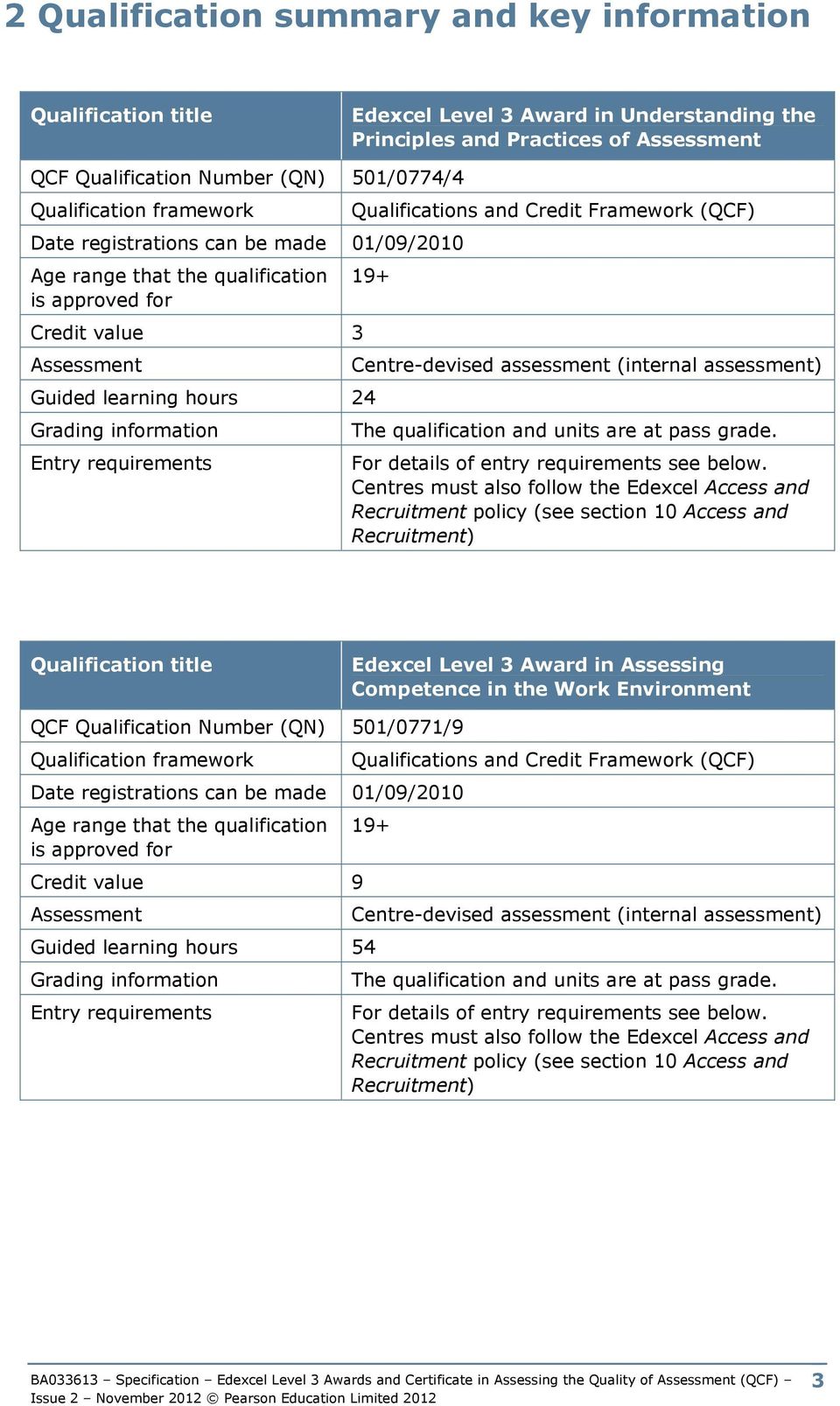
12 Qualification title Edexcel Level 3 Award in Assessing Vocationally Related Achievement QCF Qualification Number (QN) 501/0773/2 Qualification framework Date registrations can be made 01/09/2010 Age range that the qualification is approved for Credit value 9 Assessment Qualifications and Credit Framework (QCF) 19+ Guided learning hours 54 Grading information Entry requirements Centre-devised assessment (internal assessment) The qualification and units are at pass grade. For details of entry requirements see below. Centres must also follow the Edexcel Access and Recruitment policy (see section 10 Access and Recruitment) Qualification title Edexcel Level 3 Certificate in Assessing Vocational Achievement QCF Qualification Number (QN) 501/0772/0 Qualification framework Qualifications and Credit Framework (QCF) Date registrations can be made 01/09/2010 Age range that the qualification 19+ is approved for Credit value 15 Assessment Guided learning hours 84 Grading information Entry requirements Centre-devised assessment (internal assessment) The qualification and units are at pass grade. For details of entry requirements see below. Centres must also follow the Edexcel Access and Recruitment policy (see section 10 Access and Recruitment) 4 BA Specification Edexcel Level 3 Awards and Certificate in Assessing the Quality of Assessment (QCF) Issue 2 November 2012 Pearson Education Limited 2012

13 QCF qualification title and Qualification Number Centres will need to use the QCF Qualification Number (QN) when they seek public funding for their learners. As well as a QN, each unit within a qualification has a QCF unit reference number (URN). The qualification title, QN and URNs are on learners final certification documentation. Learners need to know this when they are recruited by the centre and registered with Edexcel. Further information about certification is in the Edexcel Information Manual on our website, Objective of the qualifications These qualifications replace the A1 and A2 qualifications. They are part of the new suite of qualifications for assessors, internal quality assurers (IQA) and external quality assurers (EQA). This specification includes the qualifications for assessors. They were needed to meet the emerging needs of the developing qualification frameworks and to reflect changes in the practice of assessment. These qualifications will be required for: Any assessors and verifiers involved in National Vocational Qualifications (NVQs) for the next three years. Those who deliver these qualifications will need to be qualified to meet the requirements of the NVQ Code of Practice and Sector Skills Councils assessment strategies. Assessors and quality assurance staff who deliver QCF qualifications that use the term NVQ in their title Depending on the assessment strategies set by individual Sector Skills Councils, some staff, who are assessing and quality assuring qualifications within the QCF that do not use the term NVQ in their titles, but whose purpose is to confirm occupational competence, will need to hold IQA or EQA qualifications. These qualifications would be helpful for teachers in schools who deliver vocational qualifications with applied learning, such as BTEC Firsts and Nationals. Ofqual has confirmed that practitioners who hold the A, V or D units will not have to prequalify, but must be aware of and operate in accordance with the relevant new qualification. For further information, please refer to Annexe B where there is an extract from the Lifelong Learning UK (LLUK) guidance document giving the LLUK Assessment Strategy. LLUK has been replaced by The Learning and Skills Improvement Service (LSIS) which now oversees the Assessment Strategy. Please note, that requirements set out in the Assessment Strategy are LLUK/LSIS requirements, not the requirements of the Regulators, Sector Skills Councils or awarding bodies for other qualifications. These will be covered by the assessment strategies relevant to those qualifications. The units in this specification can be approached as individual, stand-alone units but in different combinations they provide the appropriate qualification for: assessors of competence in the work environment assessors of vocationally related achievement those wishing to gain an understanding of the principles and practices of assessment. BA Specification Edexcel Level 3 Awards and Certificate in Assessing the Quality of Assessment (QCF) Issue 2 November 2012 Pearson Education Limited
14 It is essential that the correct combinations are understood and that learners are guided by assessors and tutors to the appropriate combination. These qualifications are for learners aged 19 and above who are capable of reaching the required standards in a learning and development delivery or assessment context. Edexcel s policy is that the qualifications should: be free from any barriers that restrict access and progression ensure equality of opportunity for all wishing to access the qualifications. Individual qualifications in this specification document are particularly suitable for the following groups of learners: The Edexcel Level 3 Award in Understanding the Principles and Practices of Assessment (QCF): for those who wish to gain an understanding of the principles and practices of assessment without any requirement to practice as assessors. The Edexcel Level 3 Award in Assessing Competence in the Work Environment (QCF): for assessors who assess occupational competence in an individual s work environment. The Edexcel Level 3 Award in Assessing Vocationally Related Achievement (QCF): for those who assess vocational skills, knowledge and understanding in environments other than the work environment (eg a workshop, classroom or other training environment). The Edexcel Level 3 Certificate in Assessing Vocational Achievement (QCF): for those who assess both occupational competence in the work environment and vocational skills, knowledge and understanding in environments other than the workplace (eg a workshop, classroom or other training environment). Relationship with previous specifications This specification is a direct specification replacement for specification BA Edexcel Level 3 Awards in Assessing the Quality of Assessment (QCF) and Edexcel Level 3 Certificate in Assessing the Quality of Assessment (QCF) For First Teaching September These changes have been made to reflect updates in our specification document layout. The structures, rules of combination, content and assessment of the qualifications in the earlier specification, BA025219, have not been altered. 6 BA Specification Edexcel Level 3 Awards and Certificate in Assessing the Quality of Assessment (QCF) Issue 2 November 2012 Pearson Education Limited 2012
15 Related qualifications in the teaching, training and education suite Which qualification is most appropriate for which role? ROLE Assessor or Internal Quality Assurer Trainer New to teaching or training Associate or part-time teacher Full-time teacher QUALIFICATION Training, Assessment and Quality Assurance (TAQA) Learning and Development (L&D) Preparing to Teach in the Lifelong Learning Sector (PTLLS) Certificate in Teaching in the Lifelong Learning Sector (CTLLS) Diploma in Teaching in the Lifelong Learning Sector (DTLLS) BA Specification Edexcel Level 3 Awards and Certificate in Assessing the Quality of Assessment (QCF) Issue 2 November 2012 Pearson Education Limited

16 Inter-relationships between teaching, training and education qualifications All of the teaching and learning qualifications contain some common units increasing both the transferability between the qualifications, and the choice of units available to centres and learners. Centres should select units that best reflect the needs of learner groups. These may include: training, assessing, quality assurance, part and full-time teaching. We encourage centres to make the most of the wide range of units now available from Edexcel and recommend they use the qualification structure documents to design programmes that best suit learners. Centres should ensure they have the right resources and level of approval to offer these units and qualifications, and be aware of the specific delivery sequence for the Diploma in Teaching in the Lifelong Learning Sector, (further details in Section 9, Programme Delivery). Diploma in Teaching in the Lifelong Learning Sector Certificate in Teaching in the Lifelong Learning Sector Preparing to Teach in the Lifelong Learning Sector Learning and Development Training, Assessment and Quality Assurance 8 BA Specification Edexcel Level 3 Awards and Certificate in Assessing the Quality of Assessment (QCF) Issue 2 November 2012 Pearson Education Limited 2012

17 Progression opportunities through Edexcel qualifications Learners who achieve these qualifications have a wide range of qualification progression opportunities, for example the teaching in the lifelong learning sector suite of qualifications: Preparing to Teach in the Lifelong Learning Sector (PTLLS), the Certificate in Teaching in the Lifelong Learning Sector (CTLLS) and the Diploma in Teaching in the Lifelong Learning Sector (DTLLS). See Annexe A for further information. Industry Support and recognition These qualifications are supported by the Learning and Skills Improvement Service (LSIS), the Standards Setting Body for teaching and learning. Relationship with National Occupational Standards These qualifications relate to the Professional Standards in Teaching in the Lifelong Learning Sector. The standards are available on the Learning and Skills Improvement Service Excellence Gateway, Further information is available, as well as advice on teaching in the further education sector, from the Information and Advice Service at [email protected] or telephone: BA Specification Edexcel Level 3 Awards and Certificate in Assessing the Quality of Assessment (QCF) Issue 2 November 2012 Pearson Education Limited

18 3 Centre resource requirements As part of the approval process, centres must make sure that the resources requirements below are in place before offering the qualification. General resource requirements Centres must have appropriate physical resources (for example, equipment, IT, learning materials, teaching rooms) to support the delivery and assessment of the qualifications. Staff involved in the assessment process must have relevant expertise and occupational experience. There must be systems in place to make sure continuing professional development for staff delivering the qualifications. Centres must have appropriate health and safety policies in place relating to the use of equipment by learners. Centres must deliver the qualifications in accordance with current equality legislation. Specific resource requirements As well as the general requirements above, centres must meet any specific resource requirements outlined in Annexe B: LLUK Assessment Strategy. Staff assessing the learner must meet the requirements within the overarching assessment strategy for the sector. 10 BA Specification Edexcel Level 3 Awards and Certificate in Assessing the Quality of Assessment (QCF) Issue 2 November 2012 Pearson Education Limited 2012
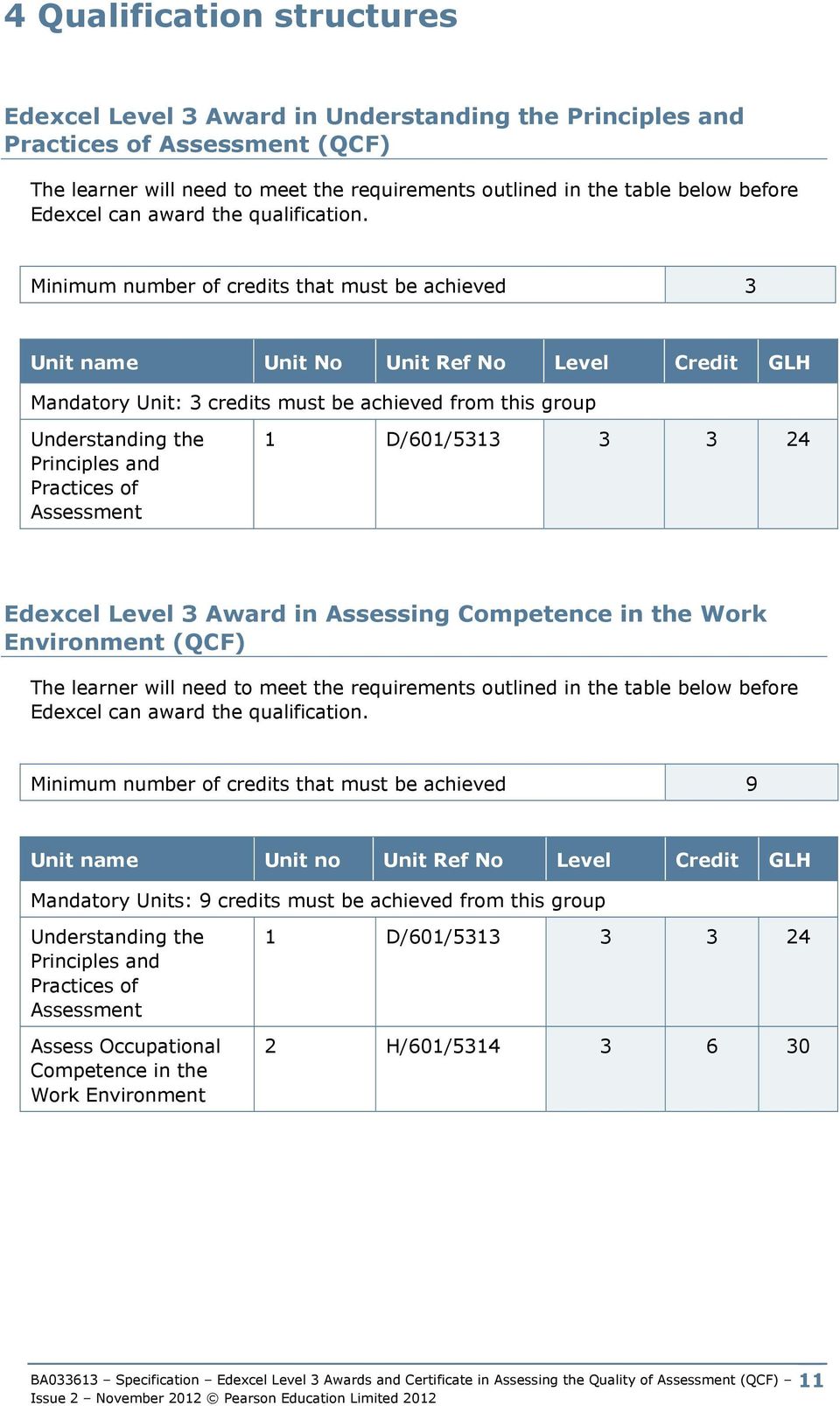
19 4 Qualification structures Edexcel Level 3 Award in Understanding the Principles and Practices of Assessment (QCF) The learner will need to meet the requirements outlined in the table below before Edexcel can award the qualification. Minimum number of credits that must be achieved 3 Unit name Unit No Unit Ref No Level Credit GLH Mandatory Unit: 3 credits must be achieved from this group Understanding the Principles and Practices of Assessment 1 D/601/ Edexcel Level 3 Award in Assessing Competence in the Work Environment (QCF) The learner will need to meet the requirements outlined in the table below before Edexcel can award the qualification. Minimum number of credits that must be achieved 9 Unit name Unit no Unit Ref No Level Credit GLH Mandatory Units: 9 credits must be achieved from this group Understanding the Principles and Practices of Assessment Assess Occupational Competence in the Work Environment 1 D/601/ H/601/ BA Specification Edexcel Level 3 Awards and Certificate in Assessing the Quality of Assessment (QCF) 11 Issue 2 November 2012 Pearson Education Limited 2012
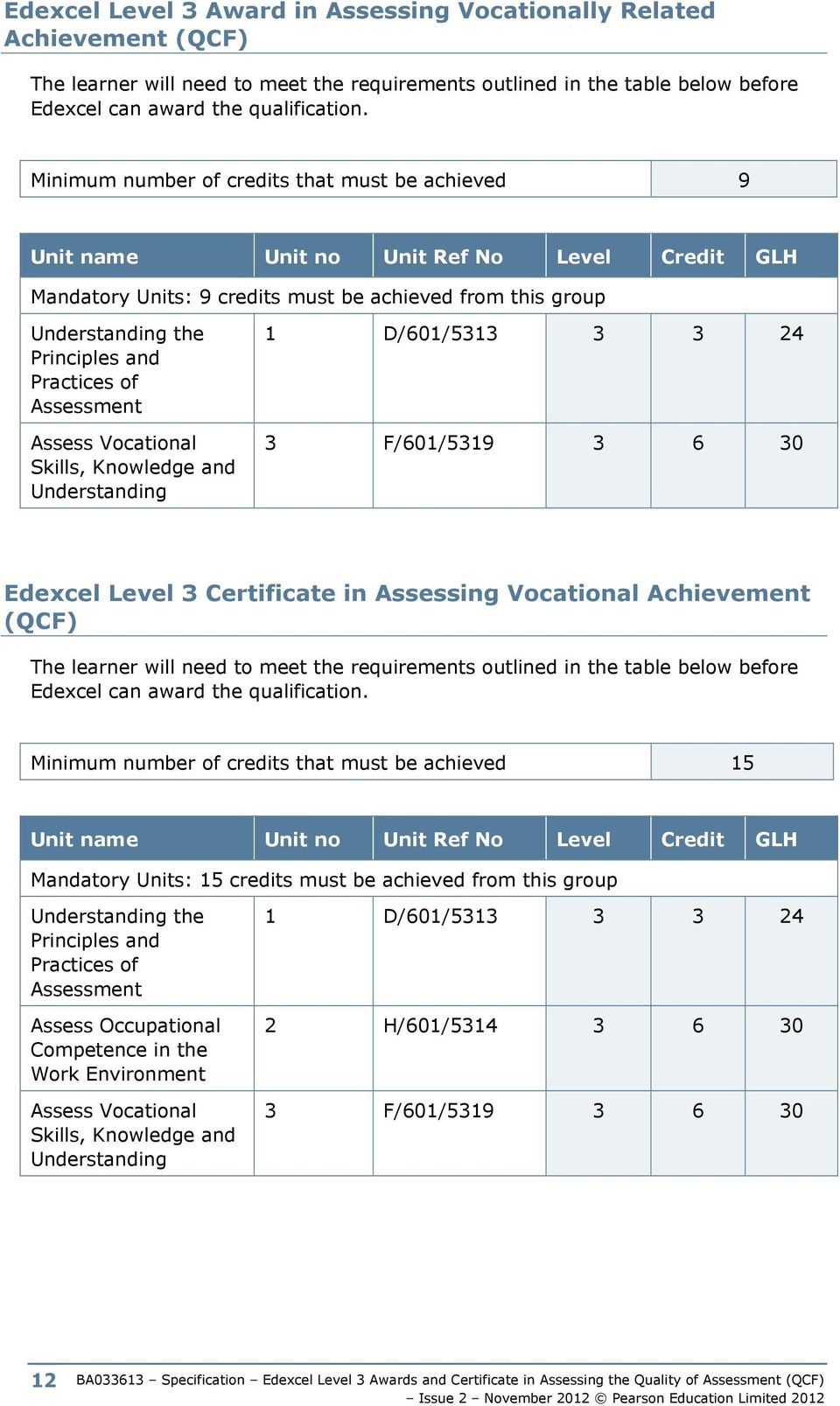
20 Edexcel Level 3 Award in Assessing Vocationally Related Achievement (QCF) The learner will need to meet the requirements outlined in the table below before Edexcel can award the qualification. Minimum number of credits that must be achieved 9 Unit name Unit no Unit Ref No Level Credit GLH Mandatory Units: 9 credits must be achieved from this group Understanding the Principles and Practices of Assessment Assess Vocational Skills, Knowledge and Understanding 1 D/601/ F/601/ Edexcel Level 3 Certificate in Assessing Vocational Achievement (QCF) The learner will need to meet the requirements outlined in the table below before Edexcel can award the qualification. Minimum number of credits that must be achieved 15 Unit name Unit no Unit Ref No Level Credit GLH Mandatory Units: 15 credits must be achieved from this group Understanding the Principles and Practices of Assessment Assess Occupational Competence in the Work Environment Assess Vocational Skills, Knowledge and Understanding 1 D/601/ H/601/ F/601/ BA Specification Edexcel Level 3 Awards and Certificate in Assessing the Quality of Assessment (QCF) Issue 2 November 2012 Pearson Education Limited 2012
21 5 Assessment The table below gives a summary of the assessment methods used in the qualifications Units All units Assessment method Centre-devised assessment Centre-devised assessment (internal assessment) Each unit has specified learning outcomes and assessment criteria. To pass an internally assessed unit, learners must meet all the learning outcomes. Centres may find it helpful if learners index and reference their evidence to the relevant learning outcomes and assessment criteria. A number of the assessment criteria in this specification document require the learner to produce evidence whereby the learner s competence can be assessed. Where appropriate, centres need to write assignment briefs for the learners to show what evidence is required. Assignment briefs should indicate clearly which assessment criteria are being targeted and what evidence is required. There should be evidence in the course file that assignments have been internally reviewed and moderated. Assignment briefs and evidence produced by learners must also meet any additional requirements in the Assessment Requirements section of the unit. Unless otherwise indicated within the Assessment Requirements section of the unit, the centre can decide what form assessment evidence will take (eg performance observation, presentations, projects, tests, extended writing) as long as the methods chosen allow learners to produce valid, sufficient and reliable evidence of meeting the assessment criteria. Centres are encouraged to provide learners with realistic scenarios and maximise the use of practical activities in delivery and assessment. To avoid over-assessment, centres are encouraged to link delivery and assessment across units. When writing assignments, centres should ensure that guidance is given for: date of issue and date for submission word count (where appropriate for depth or range required) sources/types of appropriate evidence any specific support for learners in generating appropriate evidence including cross-referencing where a single piece of evidence relates to more than one unit, for example scheme of work/session plans/observation reports the use of Harvard referencing for all research materials. There is more guidance about internal assessment on our website. See also Section 13 Further information and useful publications. BA Specification Edexcel Level 3 Awards and Certificate in Assessing the Quality of Assessment (QCF) 13 Issue 2 November 2012 Pearson Education Limited 2012
22 Assessment strategy The overall grade for each qualification is a pass. The learner must achieve all the required units within the specified qualification structure. The assessment strategy for these qualifications has been included in Annexe B. It has been developed by the Learning and Skills Improvement Service (LSIS) in partnership with employers, training providers, awarding organisations and the regulatory authorities. Evidence of competence may come from: current practice where evidence is generated from a current job role a programme of development where evidence comes from assessment opportunities built into a learning/training programme whether at or away from the workplace the Recognition of Prior Learning (RPL) where a learner can demonstrate that they can meet the assessment criteria within a unit through knowledge, understanding or skills they already possess without undertaking a course of learning. They must submit sufficient, reliable and valid evidence for internal and standards verification purposes. RPL is acceptable for accrediting a unit, several units or a whole qualification a combination of these. It is important that the evidence is: Valid Authentic Current Reliable Sufficient relevant to the standards for which competence is claimed produced by the learner sufficiently recent to create confidence that the same skill, understanding or knowledge persist at the time of the claim indicates that the learner can consistently perform at this level fully meets the requirements of the standards. Types of evidence (to be read in conjunction with the assessment strategy in Annexe B) To successfully achieve a unit, the learner must achieve all the specified learning outcomes satisfy all the assessment criteria by providing sufficient and valid evidence for each criterion show that the evidence is their own. Evidence can take a variety of different forms, including the examples below. Centres should refer to the assessment strategy for information about which of the following are permissible: direct observation of the learner s performance by their assessor (O) outcomes from oral or written questioning (Q and A) products of the learner s work (P) 14 BA Specification Edexcel Level 3 Awards and Certificate in Assessing the Quality of Assessment (QCF) Issue 2 November 2012 Pearson Education Limited 2012
23 personal statements and/or reflective accounts (RA) outcomes from simulation, where permitted by the assessment strategy (S) professional discussion (PD) assignment, project/case studies (A) authentic statements/witness testimony (WT) expert witness testimony (EPW) evidence of Recognition of Prior Learning (RPL). The abbreviations may be used for cross-referencing purposes. Learners can use one piece of evidence to prove their knowledge, skills and understanding across different assessment criteria and/or across different units. It is, therefore, not necessary for learners to have each assessment criterion assessed separately. Learners should be encouraged to reference the assessment criteria to which the evidence relates. Evidence must be made available to the assessor, internal verifier and Edexcel standards verifier. A range of recording documents is available on the Edexcel website Alternatively, centres may develop their own. BA Specification Edexcel Level 3 Awards and Certificate in Assessing the Quality of Assessment (QCF) 15 Issue 2 November 2012 Pearson Education Limited 2012
24 6 Recognising prior learning and achievement Recognition of Prior Learning Recognition of Prior Learning (RPL) is a method of assessment (leading to the award of credit) that considers whether a learner can demonstrate that they can meet the assessment requirements for a unit through knowledge, understanding or skills they already possess and so do not need to develop through a course of learning. Edexcel encourages centres to recognise learners previous achievements and experiences in and outside the workplace, as well as in the classroom. RPL provides a route for the recognition of the achievements resulting from continuous learning. RPL enables recognition of achievement from a range of activities using any valid assessment methodology. If the assessment requirements of a given unit or qualification have been met, the use of RPL is acceptable for accrediting a unit, units or a whole qualification. Evidence of learning must be sufficient, reliable and valid. Further guidance is available in the policy document Recognition of Prior Learning Policy, which is on the Edexcel website. Credit transfer Credit transfer describes the process of using a credit or credits awarded in the context of a different qualification or awarded by a different awarding organisation towards the achievement requirements of another qualification. All awarding organisations recognise the credits awarded by all other awarding organisations that operate within the QCF. If learners achieve credits with other awarding organisations, they do not need to retake any assessment for the same units. The centre must keep evidence of credit achievement. 16 BA Specification Edexcel Level 3 Awards and Certificate in Assessing the Quality of Assessment (QCF) Issue 2 November 2012 Pearson Education Limited 2012
25 7 Centre recognition and approval Centre recognition Centres that have not previously offered Edexcel qualifications need to apply for, and be granted, centre recognition as part of the process for approval to offer individual qualifications. New centres must complete an Edexcel Vocational Centre & Qualification Approval Form (VCQA). Existing centres will be given automatic approval for a new qualification if they are already approved for a qualification that is being replaced by the new qualification and the conditions for automatic approval are met. Centres that already hold Edexcel Centre approval are able to apply for qualification approval for a different level or different sector via Edexcel Online, up to and including level 3 only. In some circumstances, qualification approval using Edexcel Online may not be possible. In such cases, guidance is available as to how an approval application may be made. Approvals agreement All centres are required to enter into an approval agreement that is a formal commitment by the head or principal of a centre to meet all the requirements of the specification and any associated codes, conditions or regulations. Edexcel will act to protect the integrity of the awarding of qualifications. If centres do not comply with the agreement, this could result in the suspension of certification or withdrawal of approval. BA Specification Edexcel Level 3 Awards and Certificate in Assessing the Quality of Assessment (QCF) 17 Issue 2 November 2012 Pearson Education Limited 2012
26 8 Quality assurance of centres Quality assurance is at the heart of vocational qualifications. The Edexcel qualifications leading to Qualified Teacher Learning and Skills status are internally assessed by the centre. Centres must use internal quality assurance processes to make sure that their managers, internal verifiers and assessors are standardised and supported. Edexcel uses external quality assurance to check that all centres are working to national standards. It gives us the opportunity to identify and provide support, if needed, to safeguard certification. It also allows us to recognise and support good practice. For further information on quality assurance please refer to the BTEC Quality Assurance Handbook which can be found at Standards Verification quality assurance models The Standards Verification quality assurance model is in place for all the Training Assessment and Quality Assurance qualifications. What is Standards Verification? Standards Verification is the way in which we check that centres are operating quality assurance and assessing to the right standards. Standards Verifiers will provide advice and information and support you in demonstrating that you are working to the standards and addressing areas of weakness. It ensures that you have accurate assessment records and are assessing candidates appropriately, consistently and fairly. There will normally be two visits each year for programmes in a sector. How do we do it? We allocate a Standards Verifier: to those centres that have registered learners and we notify your Quality Nominee, who acts as our point of contact to those specific programmes that they are occupationally competent to verify. Which qualifications does Standards Verification cover? Edexcel Level 3 Award in Understanding the Principles and Practices of Assessment Edexcel Level 3 Award in Assessing Competence in the Work Environment Edexcel Level 3 Award in Assessing Vocationally Related Achievement Edexcel Level 3 Certificate in Assessing Vocational Achievement For further information please refer to chapter 6b of the BTEC Quality Assurance Handbook which can be found at: 18 BA Specification Edexcel Level 3 Awards and Certificate in Assessing the Quality of Assessment (QCF) Issue 2 November 2012 Pearson Education Limited 2012
27 9 Programme delivery Centres are free to offer the qualifications using any mode of delivery (for example full time, part time, evening only, distance learning) that meets their learners needs. Whichever mode of delivery is used, centres must make sure that learners have access to the resources identified in the specification and to the subject specialists delivering the units. Those planning the programme should aim to enhance the vocational nature of the qualification by: liaising with employers to make sure a course is relevant to learners specific needs accessing and using non-confidential data and documents from learners workplaces developing up-to-date and relevant teaching materials that make use of scenarios that are relevant to the sector giving learners the opportunity to apply their learning in practical activities including sponsoring employers in the delivery of the programme and, where appropriate, in the assessment making full use of the variety of experience of work and life that learners bring to the programme. Where legislation is referred to in a unit, centres must ensure that current legislation is taught. BA Specification Edexcel Level 3 Awards and Certificate in Assessing the Quality of Assessment (QCF) 19 Issue 2 November 2012 Pearson Education Limited 2012
28 10 Access and recruitment Edexcel s policy regarding access to our qualifications is that: they should be available to everyone who is capable of reaching the required standards they should be free from any barriers that restrict access and progression there should be equal opportunities for all those wishing to access the qualifications. Centres are required to recruit learners to Edexcel specialist qualifications with integrity. Applicants will need relevant information and advice about the qualification to make sure it meets their needs. Centres should review the applicant s prior qualifications and/or experience, considering whether this profile shows that they have the potential to achieve the qualification. For learners with disabilities and specific needs, this review will need to take account of the support available to the learner during teaching and assessment of the qualification. The review must take account of the information and guidance in Section 11 Access to qualifications for learners with disabilities or specific needs. 20 BA Specification Edexcel Level 3 Awards and Certificate in Assessing the Quality of Assessment (QCF) Issue 2 November 2012 Pearson Education Limited 2012
29 11 Access to qualifications for learners with disabilities or specific needs Equality and fairness are central to our work. Edexcel s Equality Policy requires that all learners should have equal opportunity to access our qualifications and assessments and that our qualifications are awarded in a way that is fair to every learner. We are committed to making sure that: learners with a protected characteristic (as defined by the Equality Act 2010) are not, when they are undertaking one of our qualifications, disadvantaged in comparison to learners who do not share that characteristic all learners achieve the recognition they deserve from undertaking a qualification and that this achievement can be compared fairly to the achievement of their peers. Learners taking a qualification may be assessed in British sign language or Irish sign language where it is permitted for the purpose of reasonable adjustments. Details on how to make adjustments for learners with protected characteristics are given in the policy documents Application of Reasonable Adjustment for BTEC and Edexcel NVQ Qualifications and Application for Special Consideration: BTEC and Edexcel NVQ Qualifications. The documents are on our website at BA Specification Edexcel Level 3 Awards and Certificate in Assessing the Quality of Assessment (QCF) 21 Issue 2 November 2012 Pearson Education Limited 2012
30 12 Unit format Units in this specification have the following sections: Unit title The unit title is on the QCF and this form of words will appear on the learner s Notification of Performance (NOP). Unit reference number Each unit is assigned a unit reference number that appears with the unit title on the Register of Regulated Qualifications. QCF level All units and qualifications within the QCF have a level assigned to them. There are 9 levels of achievement, from Entry to level 8. The QCF Level Descriptors inform the allocation of the level. Credit value When a learner achieves a unit, they gain the specified number of credits. Guided learning hours Guided learning hours are the times when a tutor, trainer or facilitator is present to give specific guidance towards the learning aim for a programme. This definition covers lectures, tutorials and supervised study in for example open learning centres and learning workshops. It also includes assessment by staff where learners are present. It does not include time spent by staff marking assignments or homework where the learner is not present. Unit aim This gives a summary of what the unit aims to do. Assessment requirements This section lists any specialist assessment requirements, in line with SSB guidance and assessment strategies, needed to deliver the unit. The centre will be asked to make sure that these are in place when it seeks approval from Edexcel to offer the qualification. Learning outcomes The learning outcomes of a unit set out what a learner knows, understands or is able to do as the result of a process of learning. 22 BA Specification Edexcel Level 3 Awards and Certificate in Assessing the Quality of Assessment (QCF) Issue 2 November 2012 Pearson Education Limited 2012
31 Assessment criteria The assessment criteria specify the standard required by the learner to achieve the learning outcome. Unit amplification This section gives further clarification on what a learner needs to know to achieve a learning outcome. Information in brackets gives exemplification for specific areas of knowledge. For the purposes of this suite of qualifications, the following terms are used: Tutor the person carrying out the teacher education Learner the person taking the qualification Student the person being taught or assessed by the learners Practitioner anyone with a learning and development responsibility as the whole or a part of their role. Note: Learning and Development units which are offered as optional units in the Certificate in Teaching in the Lifelong Learning Sector Qualifications and the Diploma in Teaching in the Lifelong Learning Sector qualifications have the following additional unit section: Target Groups (a recommendation for whom the unit is best suited) BA Specification Edexcel Level 3 Awards and Certificate in Assessing the Quality of Assessment (QCF) 23 Issue 2 November 2012 Pearson Education Limited 2012
32 Unit 1: Understanding the Principles and Practices of Assessment Unit reference number: D/601/5313 QCF level: 3 Credit value: 3 Guided learning hours: 24 Unit aim The aim of this unit is to assess a learning and development practitioner s knowledge and understanding of the principles and practices of assessment. Assessment requirements There is no requirement to undertake practice for this unit. However, Edexcel recommends that this unit be assessed in the workplace. The unit should be assessed using methods appropriate to the assessment of knowledge and understanding. There is no requirement for this unit to be assessed separately. Edexcel recommends that assessors adopt a holistic approach and, where possible, use one activity as evidence for learning outcomes and assessment criteria for two or more units. There must be valid, authentic and sufficient evidence for all the assessment criteria. Holistic assessment is encouraged and one piece of evidence may be used to meet the requirements of more than one learning outcome or assessment criterion. 24 BA Specification Edexcel Level 3 Awards and Certificate in Assessing the Quality of Assessment (QCF) Issue 2 November 2012 Pearson Education Limited 2012
33 Learning outcomes, assessment criteria and unit amplification To pass this unit, the learner needs to demonstrate that they can meet all the learning outcomes for the unit. The assessment criteria determine the standard required to achieve the unit. Learning outcomes Assessment criteria Unit amplification 1 Understand the principles and requirements of assessment 1.1 Explain the function of assessment in learning and development Functions, eg measurement and recording of achievement, identification of individual student needs, formative or summative assessment, fit for purpose, assessment against standards and performance/assessment criteria, monitoring development, evidence for performance review/targets/benchmarking, contributing to quality assurance, development of best practice. 1.2 Define the key concepts and principles of assessment Purpose, eg who is it for learner, trainer, assessor, organisation, employer?; assessment as part of the learning or training cycle, eg to recognise prior learning, to identify specific assessment requirements; assessment of specific learning domains, eg Bandler and Grinder s psychomotor/cognitive/affective skills, knowledge or understanding. 1.3 Explain the responsibilities of the assessor Range of responsibilities, eg to the student, the employer, the organisation, occupational standards, awarding organisation; practical responsibilities, eg planning, managing and delivering assessment; maintaining the integrity of the qualification; studentcentred assessment 1.4 Identify the regulations and requirements relevant to assessment in own area of practice Regulatory bodies of standards, eg Ofqual, Sector Skills Councils, awarding organisations, Institute for Learning; other regulations, eg health and safety, equality and diversity/disability act, data protection, safeguarding students during assessment; recording/tracking and logging assessment decisions, communicating decisions with students, standardisation, moderation and quality assurance of assessment. BA Specification Edexcel Level 3 Awards and Certificate in Assessing the Quality of Assessment (QCF) Issue 2 November 2012 Pearson Education Limited
34 Learning outcomes Assessment criteria Unit amplification 2 Understand different types of assessment method 2.1 Compare the strengths and limitations of a range of assessment methods with reference to the needs of individual learners Range of assessment methods for performance-based assessment of skills or knowledge-based assessment of understanding, individual or group assessment; fit for purpose, eg student needs, context; measures of achievement, eg performance criteria, assessment criteria, levels standards; practical limitations, eg numbers involved, range, opportunity, reliability, time constraints, resources, staffing. 3 Understand how to plan assessment 3.1 Summarise key factors to consider when planning assessment Formal, eg addressing regulations or standards, student, employer, business needs; timing of assessment, eg initial/pre-course, formative, summative, recognising prior learning; range of methods/activities to meet student needs, eg observation, performance evidence, discussion, witness/student statement, tests, multiple-choice questions, written activity, reflective journal, verbal questioning; naturally occurring evidence; specific needs. 3.2 Evaluate the benefits of using a holistic approach to assessment Benefits, eg cost and time effectiveness, motivational for students, eg promoting student responsibility and student involvement, use of naturally occurring evidence, experiential learning, linking different aspects of learning through assessment, transference of skills, workbased opportunities, rationalising collection of assessment evidence, meeting number of learning outcomes/assessment criteria, linked knowledge-based and performance-based assessment opportunities. 3.3 Explain how to plan a holistic approach to assessment Range of assessment requirements and opportunities, eg comprehensive approach, logical progression and sequencing, related to specific context, student needs, preferences, workplace opportunities to use linkages particularly between knowledge and understanding to skills requirements, naturally occurring evidence, appropriate assessment opportunities, evidence appropriate to number of learning outcomes/assessment criteria. 26 BA Specification Edexcel Level 3 Awards and Certificate in Assessing the Quality of Assessment (QCF) Issue 2 November 2012 Pearson Education Limited 2012
35 Learning outcomes Assessment criteria Unit amplification 3.4 Summarise the types of risks that may be involved in assessment in own area of responsibility Organisational risks, eg organisational culture, appropriate opportunities for assessment, staff occupational or assessment experience; practical risks, eg health and safety, equality and diversity, data protection, specific occupational risks, student-based risks, eg occupational competence, responsibility, motivation; assessment risks, eg timing, range, sufficiency, bias, fairness. 3.5 Explain how to minimise risks through the planning process Clear criteria for assessment, eg identifying/addressing specific requirements, standardisation of planning, negotiating with student; selecting appropriate range of assessment methods appropriate to context to generate the required evidence; safeguarding students, eg planning for health and safety, equality and diversity, negotiating with students, appropriate timing of assessment, clear recording, tracking, logging of assessment decisions. 4 Understand how to involve learners and others in assessment 4.1 Explain the importance of involving the learner and others in the assessment process Recognising needs, eg initial assessment, learning/training needs analysis, recognising current level of knowledge, understanding, skills and experiences; negotiating learning eg targets, goals, objectives for assessment, self-assessment, bite-size chunks, meaningful, relevant, motivation, engagement, involvement, individual responsibility; involvement with others eg organisation, colleagues, employers, peers, witnesses. 4.2 Summarise types of information that should be made available to learners and others involved in the assessment process Standards and criteria against which they will be assessed, eg awarding organisation requirements, occupational standards, other specific requirements; assessment plan, eg specific criteria they will be assessed against, timing, venue, methods, expected outcomes, opportunities for feedback, benefits of assessment, appeals procedure; requirements of the student, eg preparation, specific needs, activity, evidence required, assessment decisions. BA Specification Edexcel Level 3 Awards and Certificate in Assessing the Quality of Assessment (QCF) Issue 2 November 2012 Pearson Education Limited
36 Learning outcomes Assessment criteria Unit amplification 4.3 Explain how peer- and selfassessment can be used effectively to promote learner involvement and personal responsibility in the assessment of learning Peer feedback, eg formal or informal, witness statements, peer observations, feedback, working collaboratively, sharing goals, targets, giving and receiving feedback, awareness of risks of appearing challenging or confrontational; formal or informal selfassessment, eg SAR (Self-Assessment Review), initial assessment, current knowledge, understanding, skills, occupational competence, SWOT (strengths, weaknesses, opportunities and threats), reflection, identifying targets, target setting, action planning. 4.4 Explain how assessment arrangements can be adapted to meet the needs of individual learners. Negotiating assessment needs with individual students, eg identifying specific learning/assessment needs, range of assessment methods, activities to meet different student/context/needs, alternative assessment activities where appropriate, repeating assessment to provide opportunity for experiential learning, use of alternative assessor, learning support, discussion to supplement primary evidence; recording evidence of assessment to suit student needs, eg digital recording, audio/visual, scribe. 5 Understand how to make assessment decisions 5.1 Explain how to judge whether evidence is: sufficient authentic current Understanding rules of evidence, eg meeting outcomes and objectives identified in assessment plan, evidence is coherent, accessible, realistic, relevant, attributable, achieved within time constraints; credible and compatible with learning programme and required assessment outcomes, context, adhering to organisation, industry, awarding body and government requirements and standards. 28 BA Specification Edexcel Level 3 Awards and Certificate in Assessing the Quality of Assessment (QCF) Issue 2 November 2012 Pearson Education Limited 2012
37 Learning outcomes Assessment criteria Unit amplification 5.2 Explain how to ensure that assessment decisions are: made against specified criteria valid reliable Range of evidence, eg clearly identified, current, appropriate criteria, valid currency, level, attributable; reliable and can be repeated or learning transferred; assessment decisions are fair, eg without bias and relate to the identified criteria, complying with organisation and/or industry, awarding body and government requirements, addressing specific student needs. fair 6 Understand quality assurance of the assessment process 6.1 Evaluate the importance of quality assurance in the assessment process Ensuring organisation, occupational, awarding organisation and government requirements are meeting standardisation, quality assurance of practice, consistency across learners, assessors, contexts, units; comprehensive approach to assessment at all stages preparation, planning process, assessment outcomes ie product; benchmarking and measures of achievement; identifying development and continuing professional development needs for quality improvement. 6.2 Summarise quality assurance and standardisation procedures in own area of practice Organisation assessment policies and procedures, eg complying with Sector Skills Council, National Occupational Standards requirements; team, assessor standardisation, eg observations of practice, standardisation meetings, sharing good practice, observation of peers, workshadowing, feedback, comparisons of process and product; internal/external quality assurance reviews, evaluation procedures 6.3 Summarise the procedures to follow when there are disputes concerning assessment in own area of practice Organisation policies and procedures, eg clearly written appeals and grievance procedures, accessible systems for appeals, eg documents for appeals, appropriate staffing for management of appeals, confidentiality, non-discriminatory policy, application in practice, recording of outcomes, clear paper trail BA Specification Edexcel Level 3 Awards and Certificate in Assessing the Quality of Assessment (QCF) Issue 2 November 2012 Pearson Education Limited
38 Learning outcomes Assessment criteria Unit amplification 7 Understand how to manage information relating to assessment 7.1 Explain the importance of following procedures for the management of information relating to assessment Policies for management of assessment evidence, eg portfolios, assessment records, observation records, physical evidence, student and witness statements; management of assessment records, eg storage and retrieval, confidentiality, data protection, use of technology; sharing information with relevant parties eg students, other assessors, employer, colleagues, organisation, regulations covering sharing information, eg Ofqual, awarding organisation, Sector Skills Council, data protection 7.2 Explain how feedback and questioning contribute to the assessment process Supporting range of evidence; confirming learning, eg knowledge, understanding, skills, reward, motivation, linking learning of product and process, transferability of learning, identifying further learning requirements, target setting and action planning, recording distance travelled, value-added, progression; corroboration of assessor decision-making process, judgement; identifying specific needs or need for support 8 Understand the legal and good practice requirements in relation to assessment 8.1 Explain legal issues, policies and procedures relevant to assessment, including those for confidentiality, health, safety and welfare Organisation policies and procedures, eg associated with Ofqual, awarding organisation requirements, Sector Skills Council/National Occupational Standards, specific requirements, eg confidentiality, health, safety and welfare, inclusion, equality and diversity; staff development needs eg standardisation, sharing good practice, workshadowing, peer observation, in-service training, cascading training, continuing professional development. 8.2 Explain the contribution that technology can make to the assessment process Appropriate technology, eg initial assessments, online testing, recording of evidence including audio or visual, submission of assignments electronically, electronic feedback to learners, ing feedback, discussion forums, web-based learning, including distance or blended learning, issues of authenticity; technology for recording and storing assessment evidence, eg software, awarding organisation online provision, students managing own electronic records; security 30 BA Specification Edexcel Level 3 Awards and Certificate in Assessing the Quality of Assessment (QCF) Issue 2 November 2012 Pearson Education Limited 2012
39 Learning outcomes Assessment criteria Unit amplification 8.3 Evaluate requirements for equality and diversity and, where appropriate, bilingualism in relation to assessment Forms of inequality and discrimination and their impact on individuals, the relevant legislation, employment regulations and policies and codes of practice relevant to the promotion of equality and valuing of diversity, eg visual/auditory impairment, physical disability, bilingualism; flexibility in approach to planning of assessment and quality assurance, eg negotiating timing, context, providing additional resources where appropriate, recognising additional support needs, alternative approaches, evidence 8.4 Explain the value of reflective practice and continuing professional development in the assessment process Reflective practice, eg self-assessment, SWOT analysis (strengths, weaknesses, opportunities, threats or barriers), realistic targets for own development, using feedback from students, colleagues, managers, external evaluators, other individuals and professionals, self and team reviews, observation reports, outcome from appraisal, monitoring and modifications, updating knowledge, occupational expertise, skills and self-confidence, modifications to assessment plans, developing technologies to extend and enhance assessment process, contributing to curriculum development. BA Specification Edexcel Level 3 Awards and Certificate in Assessing the Quality of Assessment (QCF) Issue 2 November 2012 Pearson Education Limited
40 Unit 2: Assess Occupational Competence in the Work Environment Unit reference number: H/601/5314 QCF level: 3 Credit value: 6 Guided learning hours: 30 Unit aim The aim of this unit is to assess a learning and development practitioner s performance in carrying out assessments of occupational competence in a work environment. Target groups This is a valuable unit for all trainers and teachers of vocational subjects that involve assessment of occupational competence in a work environment. Assessment requirements Evidence for all learning outcomes must come from carrying out assessments in a work environment. Simulations are not allowed. As a minimum, there must be performance evidence for the following assessment methods: observation of performance in the work environment, examining products of work and questioning the learner. Other forms of evidence will be acceptable for the remaining assessment methods: discussing with the learner, use of others (witness testimony, looking at learner statements, recognising prior learning. There must be evidence of the learner carrying out a minimum of two assessments of occupational competence with at least two of their own students (ie four assessments in total). This occupational competence must not be in assessment itself, ie evidence from this unit must not come from assessing another candidate assessor who is in turn assessing someone else. There must be valid, authentic and sufficient evidence for all the assessment criteria. Holistic assessment is encouraged and one piece of evidence may be used to meet the requirements of more than one learning outcome or assessment criterion. Centres need to have Learning and Development approval to offer this unit. 32 BA Specification Edexcel Level 3 Awards and Certificate in Assessing the Quality of Assessment (QCF) Issue 2 November 2012 Pearson Education Limited 2012
41 Learning outcomes, assessment criteria and unit amplification To pass this unit, the learner needs to demonstrate that they can meet all the learning outcomes for the unit. The assessment criteria determine the standard required to achieve the unit. Learning outcomes Assessment criteria Unit amplification 1 Be able to plan the assessment of occupational competence 1.1 Plan assessment of occupational competence based on the following methods: observation of performance in the work environment examining products of work questioning the learner Assessment standards, eg awarding organisation, Sector Skills Council requirements, employer needs, performance requirements, transferability of skills; range of methods to include observation of performance in the work environment, examining products of work, questioning the learner, discussing with the learner, use of others ie witness testimony, looking at learner statements, recognising prior learning. discussing with the learner use of others (witness testimony) looking at learner statements recognising prior learning 1.2 Communicate the purpose, requirements and processes of assessing occupational competence to the learner Requirements, eg standards/criteria against which they will be assessed, awarding organisation requirements, occupational standards, other specific requirements. Assessment plan, eg specific criteria they will be assessed against, timing, venue, methods, expected outcomes, opportunities for feedback, benefits of assessment, appeals procedure; requirements of the student, eg preparation, specific needs, activity, evidence required. BA Specification Edexcel Level 3 Awards and Certificate in Assessing the Quality of Assessment (QCF) Issue 2 November 2012 Pearson Education Limited
42 Learning outcomes Assessment criteria Unit amplification 1.3 Plan the assessment of occupational competence to address learner needs and current achievements Initial assessment of students needs, eg initial assessment, learning, training needs analysis, recognising current level of knowledge, understanding, skills and experiences, performance indicators, skills tests, employer review. Negotiating learning, eg targets, goals, objectives for assessment, self-assessment, bite-size chunks, assessment that is meaningful and relevant; motivation, engagement, involvement, individual responsibility; involvement with others, eg organisation, colleagues, employers, peers, witnesses. 1.4 Identify opportunities for holistic assessment Opportunities, eg logical progression and sequencing as related to specific context, student needs; opportunities to use linkages particularly between knowledge and understanding to skills requirements; opportunities to incorporate naturally occurring evidence and appropriate assessment opportunities. 2 Be able to make assessment decisions about occupational competence 2.1 Use valid, fair and reliable assessment methods including: Use valid, fair and reliable assessment methods including: observation of performance Assessment methods, eg observation, performance evidence, discussion, witness or student statement; fit for purpose, eg student needs, context, measures of achievement ie performance criteria, assessment criteria; practical limitations, eg numbers involved, range, opportunity, time constraints, resources, staffing. examining products of work questioning the learner discussing with the learner use of others (witness testimony) looking at learner statements recognising prior learning 34 BA Specification Edexcel Level 3 Awards and Certificate in Assessing the Quality of Assessment (QCF) Issue 2 November 2012 Pearson Education Limited 2012
43 Learning outcomes Assessment criteria Unit amplification 2.2 Make assessment decisions of occupational competence against specified criteria Assessment decisions, eg credibility and compatibility with learning programme and required assessment outcomes, context, adhering to organisation, industry, awarding body and government requirements and standards. Appropriate standards, eg understanding rules of evidence, meeting outcomes and objectives identified in assessment plan; evidence is coherent, accessible, realistic, relevant, can be identified as attributed to the student, achieved within time constraints. 2.3 Follow standardisation procedures Policies and procedures, eg complying with awarding body, occupational standards requirements. Standardisation, eg observations of practice, performance evidence, discussion, witness or student statement, standardisation meetings, sharing good practice, observation of peers, work shadowing, feedback, comparisons of process and product; evaluation procedures. 2.4 Provide feedback to learners that affirms achievement and identifies any further implications for learning, assessment and progression. Feedback, eg timing and location for feedback negotiated with student, linked to assessment opportunities, using the range of available evidence, providing opportunity for students to give feedback, focusing on identified criteria and standards, involving the student actively in the feedback, avoiding personal issues or bias, use of feedback, PCP (praise, criticism, praise). 3 Be able to provide required information following the assessment of occupational competence 3.1 Maintain records of the assessment of occupational competence, its outcomes and learner progress Records, eg naturally occurring evidence, observation, interview, discussion records eg written records, video, audio, student and witness statement. Record of product, eg tracking and logging documents, action plans, assessment pro forma, examples, samples; record of questioning, regular progress checks, goals, checking targets at appropriate intervals. BA Specification Edexcel Level 3 Awards and Certificate in Assessing the Quality of Assessment (QCF) Issue 2 November 2012 Pearson Education Limited
44 Learning outcomes Assessment criteria Unit amplification 3.2 Make assessment information available to authorised colleagues Identifying appropriate colleagues, eg recording evidence in a way that can be shared with appropriate access, use of technology, electronic formats, team meetings, assessment or standardisation meetings, cross-programmes, assignments, organisation, employers, holistic approaches. 3.3 Follow procedures to maintain the confidentiality of assessment information. Secure environment for providing feedback and safeguarding recording and storage of information, eg organisational procedures, data protection, security and safety of paper-based records, electronic formats for recording and storage and electronic safeguards; identifying those with legitimate access and limiting access. 4 Be able to maintain legal and good practice requirements when assessing occupational competence 4.1 Follow relevant policies, procedures and legislation for the assessment of occupational competence, including those for health, safety and welfare Current regulatory bodies of standards, eg Ofqual, Sector Skills Councils, awarding organisations, Institute for Learning; other regulations, eg health and safety, equality and diversity including bilingualism where appropriate, data protection. Organisational policies and procedures, eg safeguarding students during assessment, standardisation/moderation of assessment; qualifications and occupational competence of assessors, professional updating, CPD requirements. 4.2 Apply requirements for equality and diversity and, where appropriate, bilingualism, when assessing occupational competence Requirements, eg equality and diversity, inequality and discrimination and their impact on individuals, legislation, employment regulations and policies and codes of practice relevant to the promotion of equality and valuing of diversity, eg visual auditory impairment, physical disability, bilingualism. Flexibility in approach to planning of assessment and quality assurance, eg negotiating timing, context, providing additional resources where appropriate, recognising additional support needs, alternative approaches. 36 BA Specification Edexcel Level 3 Awards and Certificate in Assessing the Quality of Assessment (QCF) Issue 2 November 2012 Pearson Education Limited 2012
45 Learning outcomes Assessment criteria Unit amplification 4.3 Evaluate own work in carrying out assessments of occupational competence Own work, eg self-assessment, evaluation of planning and carrying out of assessment, SAR (Self Assessment Review), understanding of current occupational and awarding organisation standards, students achievements, evaluation/feedback from students, teachers, managers, external quality assessors, other individuals and professionals, observation reports, outcome from appraisal, milestones, monitoring and modifications, updating knowledge and occupational expertise, skills and self-confidence, developing technologies. 4.4 Maintain the currency of own expertise and competence as relevant to own role in assessing occupational competence. Maintaining currency, eg using review of competence, eg identifying constraints and opportunities, action planning, establishing realistic goals and targets for own occupational competence, updating occupational expertise, skills and self-confidence, modifications to assessment plans, exploring alternative approaches to assessment, changes in policies, procedures or regulations relating to assessment, technologies to develop and improve own assessing, CPD, awarding organisation provision for professional updating, monitoring Sector Skills Council websites. BA Specification Edexcel Level 3 Awards and Certificate in Assessing the Quality of Assessment (QCF) Issue 2 November 2012 Pearson Education Limited
46 Unit 3: Assess Vocational Skills, Knowledge and Understanding Unit reference number: F/601/5319 QCF level: 3 Credit value: 6 Guided learning hours: 30 Unit aim The aim of this unit is to assess a learning and development practitioner s performance in carrying out the assessment of vocational skills, knowledge and understanding outside of the work environment. Assessment methods include: assessments of the learner in simulated environments, skills tests, oral and written questions, assignments, projects, case studies, recognising prior learning. The unit does not require the design of assessments. Assessment requirements Evidence for all learning outcomes must come from performance in the work environment. Practice should be in the appropriate context either with groups or with individuals. Simulation is not permitted. There must be evidence of the learner carrying out at least two assessments of two students' skills, knowledge and understanding (ie four assessments in total). There must be evidence to cover all of the assessment methods listed in the unit. There must be performance evidence for at least three of the following assessment methods: assessments of the student in simulated environments skills tests, oral and written questions, assignments, projects, case studies and recognising prior learning. Other forms of evidence will be acceptable for the remaining assessment methods. There is no requirement for each unit to be assessed separately. Assessors are advised to adopt a holistic approach and, where possible, to use one activity as evidence for learning outcomes and assessment criteria for two or more units. 38 BA Specification Edexcel Level 3 Awards and Certificate in Assessing the Quality of Assessment (QCF) Issue 2 November 2012 Pearson Education Limited 2012
47 Learning outcomes, assessment criteria and unit amplification To pass this unit, the learner needs to demonstrate that they can meet all the learning outcomes for the unit. The assessment criteria determine the standard required to achieve the unit. Learning outcomes Assessment criteria Unit amplification 1 Be able to prepare assessments of vocational skills, knowledge and understanding 1.1 Select methods to assess vocational skills, knowledge and understanding which address learner needs and meet assessment requirements, including: assessments of the learner in simulated environments Addressing your students needs, eg recognising prior learning, current level of skills, knowledge, understanding, specific learning, assessment needs. Meeting assessment requirements, eg organisation, awarding organisation, employers, vocational standards, fit for purpose, individual or group assessment, simulated environments, skills tests, oral and written questions or discussions, assignments, projects, case studies. skills tests oral and written questions assignments projects case studies recognising prior learning 1.2 Prepare resources and conditions for the assessment of vocational skills, knowledge and understanding Environment, eg workplace, rooming, laboratory, simulated environment, virtual learning environment. Materials, eg materials necessary for skills test, paper-based or online tests, assignment brief, practical outline, materials required for projects, case studies. Conditions, eg timing, staffing, access to ICT; learner preparation, eg support for specific students as required. BA Specification Edexcel Level 3 Awards and Certificate in Assessing the Quality of Assessment (QCF) Issue 2 November 2012 Pearson Education Limited
48 Learning outcomes Assessment criteria Unit amplification 1.3 Communicate the purpose, requirements and processes of assessment of vocational skills, knowledge and understanding to learners. Standards, criteria against which they will be assessed, eg awarding organisation requirements, vocational skills, knowledge, understanding standards. Other specific requirements, eg deadlines, venue, methods, testing procedures, format for evidence, expected outcomes, opportunities for feedback, benefits of assessment, appeals procedure. Requirements of the student, eg preparation, specific needs, activity, evidence required. 2 Be able to carry out assessments of vocational skills, knowledge and understanding 2.1 Manage assessments of vocational skills, knowledge and understanding to meet assessment requirements Organisation policies and procedures, eg initial assessment, assessment methods, range of appropriate evidence to meet specified and identified criteria, requirements of awarding organisation, regulatory bodies, National Occupational Standards, Sector Skills Council, standardisation procedures, roles and responsibilities. Appropriate assessment opportunities, eg timing and conducting of assessments, naturally occurring evidence, individuals or groups. 2.2 Provide support to learners within agreed limitations Appropriate levels of support, eg initial assessment, clarification of assessment activities, negotiating deadlines, adopting alternative approaches/timing. Identifying specific support needs, eg language, literacy, visual, auditory, physical. Availability of support, eg specialist support for visual, auditory impairments, translator for second, alternative language, practical or electronic equipment. 40 BA Specification Edexcel Level 3 Awards and Certificate in Assessing the Quality of Assessment (QCF) Issue 2 November 2012 Pearson Education Limited 2012
49 Learning outcomes Assessment criteria Unit amplification 2.3 Analyse evidence of learner achievement Sufficiency, eg employ range of evidence, student work, performance evidence, test results, responses to questioning, results, achievement records, authenticity, recording observation evidence. Comparing evidence against assessment criteria, standards, individual or group contributions, eg valid, coherent, reliable, fair, realistic, relevant. Compatibility with assessment, learning programme, eg vocational and awarding organisation standards and required learning outcomes, adhere to college and/or industry, awarding body and government requirements. 2.4 Make assessment decisions relating to vocational skills, knowledge and understanding against specified criteria Evidence that is appropriate, eg range of evidence clearly identified against assessment criteria, decisions based on evidence that is valid, sufficient and authentic, reliable and can be repeated or learning transferred; decisions are fair, without bias and relate to the identified criteria, complying with organisation and/or industry, awarding body and government requirements. 2.5 Follow standardisation procedures Organisation assessment policies and procedures, eg complying with awarding body, national occupational standards requirements. Team, assessor standardisation, eg across qualifications, units, modules, assessment criteria, learners, assessors, observations of practice, standardisation meetings, sharing good practice, observation of peers, work shadowing, feedback, comparisons of process and product; evaluation procedures. BA Specification Edexcel Level 3 Awards and Certificate in Assessing the Quality of Assessment (QCF) Issue 2 November 2012 Pearson Education Limited
50 Learning outcomes Assessment criteria Unit amplification 2.6 Provide feedback to the learner that affirms achievement and identifies any further implications for learning, assessment and progression. Appropriate approaches to feedback, eg timing and location for feedback negotiated with student, linked to assessment opportunities, using the range of available evidence, providing opportunity for students to give feedback, focusing on identified criteria and standards, involving the student actively in the feedback, avoiding personal issues or bias, use of feedback sandwich; identifying opportunities for progression, setting realistic goals. 3 Be able to provide required information following the assessment of vocational skills, knowledge and understanding 3.1 Maintain records of the assessment of vocational skills, knowledge and understanding, its outcomes and learner progress Reflects appropriate range of activities, record of appropriate naturally occurring evidence, observation, interview, discussion records, eg written records, video, audio; learner and witness statement; record of product, eg tracking and logging documents, action plans, assessment pro forma, examples; record of questioning, regular progress checks, targets checked at appropriate intervals. 3.2 Make assessment information available to authorised colleagues as required Identifying appropriate colleagues, eg recording evidence in a way that can be shared with appropriate access, use of technology, electronic formats, team meetings, assessment or standardisation meetings, cross-programmes, assignments, organisation, employers, holistic approaches, distance travelled, value added. 3.3 Follow procedures to maintain the confidentiality of assessment information Secure environment for providing feedback, safeguarding recording and storage of information, eg organisational procedures, data protection, security and safety of paper-based records, electronic formats for recording and storage and electronic safeguards; identifying those with legitimate access and limiting access 42 BA Specification Edexcel Level 3 Awards and Certificate in Assessing the Quality of Assessment (QCF) Issue 2 November 2012 Pearson Education Limited 2012
51 Learning outcomes Assessment criteria Unit amplification 4 Be able to maintain legal and good practice requirements when assessing vocational skills, knowledge and understanding 4.1 Follow relevant policies, procedures and legislation relating to the assessment of vocational skills, knowledge and understanding, including those for health, safety and welfare Regulatory bodies of standards, eg Ofqual, Sector Skills Councils, awarding organisations, Institute for Learning. Other regulations, eg health and safety, equality and diversity, data protection. Organisational policies and procedures, eg safeguarding learners during assessment, standardisation, moderation of assessment; qualifications and occupational competence of assessors, professional updating, continuing professional development requirements. 4.2 Apply requirements for equality and diversity and, where appropriate, bilingualism Legislation, employment regulations and policies and codes of practice relevant to the promotion of equality and valuing of diversity, eg visual auditory impairment, physical disability, bilingualism; flexibility in approach to planning of assessment and quality assurance, eg negotiating timing, context, providing additional resources where appropriate, recognising additional support needs, alternative approaches. 4.3 Evaluate own work in carrying out assessments of vocational skills, knowledge and understanding Review of own competence, eg self-assessment, evaluation of planning and carrying out of assessment, Self Assessment Review (SAR), understanding of current occupational and awarding organisation expectations, student s achievements, evaluation/feedback from students, teachers, managers, external quality assessors, other individuals and professionals, observation reports, outcome from appraisal, milestones, monitoring and modifications, updating knowledge and occupational expertise, skills and self-confidence, developing technologies to extend and enhance assessment process. BA Specification Edexcel Level 3 Awards and Certificate in Assessing the Quality of Assessment (QCF) Issue 2 November 2012 Pearson Education Limited
52 Learning outcomes Assessment criteria Unit amplification 4.4 Take part in continuing professional development to ensure current expertise and competence in assessing vocational skills, knowledge and understanding Using review of competence, eg identifying constraints and opportunities, action planning, establishing realistic goals and targets for own occupational competence, updating occupational expertise, skills and self-confidence, modifications to assessment plans, explore alternative approaches to assessment, changes in policies, procedures or regulations relating to assessment, technologies to develop and improvement of own assessing, CPD, awarding organisation provision for professional updating. 44 BA Specification Edexcel Level 3 Awards and Certificate in Assessing the Quality of Assessment (QCF) Issue 2 November 2012 Pearson Education Limited 2012
53 13 Further information and useful publications To get in touch with us visit our Contact us pages: Edexcel: BTEC: Work-based learning: Books, software and online resources for UK schools and colleges: Other sources of information and publications available include: Edexcel Equality Policy Edexcel Information Manual (updated annually) Reasonable Adjustment and Special Considerations for BTEC and Edexcel NVQ Qualifications Recognition of Prior Learning Policy Quality Assurance Handbook (updated annually) Publications on the quality assurance of BTEC qualifications are on our website at Our publications catalogue lists all the material available to support our qualifications. To access the catalogue and order publications, please go to Additional resources If you need further learning and teaching materials to support planning and delivery for your learners, there is a wide range of BTEC resources available. Any publisher can seek endorsement for their resources, and, if they are successful, we will list their BTEC resources on our website at: BA Specification Edexcel Level 3 Awards and Certificate in Assessing the Quality of Assessment (QCF) 45 Issue 2 November 2012 Pearson Education Limited 2012
54 14 Professional development and training Edexcel supports UK and international customers with training related to BTEC qualifications. This support is available through a choice of training options offered in our published training directory, or through customised training at your centre. The support we offer focuses on a range of issues, including: planning for the delivery of a new programme planning for assessment and grading developing effective assignments building your team and teamwork skills developing learner-centred learning and teaching approaches building functional skills into your programme building in effective and efficient quality assurance systems. The national programme of training we offer is on our website at: You can request customised training through the website or you can contact one of our advisors in the Training from Edexcel team via Customer Services to discuss your training needs. BTEC training and support for the lifetime of the qualifications Training and networks: our training programme ranges from free introductory events through sector-specific opportunities to detailed training on all aspects of delivery, assignments and assessment. We have designed our new network events programme to allow you to share your experiences, ideas and best practice with other BTEC colleagues in your region. Sign up to the training you need at: Regional support: our team of Curriculum Development Managers and Curriculum Support Consultants, based around the country, are responsible for providing advice and support in centres. They can help you with planning and curriculum developments. If you would like your Curriculum Development Manager to contact you, please get in touch with your regional office on: BA Specification Edexcel Level 3 Awards and Certificate in Assessing the Quality of Assessment (QCF) Issue 2 November 2012 Pearson Education Limited 2012
55 Annexe A Progression opportunities These are examples of progression opportunities to other Edexcel qualifications within the Learning and Development sector. Level General qualifications BTEC full vocationallyrelated qualifications BTEC specialist courses NVQ/occupational 8 7 Edexcel Diploma in the Management of Assessment 6 5 Edexcel Diploma in Teaching in the Lifelong Learning Sector Edexcel Award in Preparing to teach in the Lifelong Learning Sector 4 Edexcel Certificate in Teaching in the Lifelong Learning Sector Edexcel Award in Assuring the Quality of Assessment Edexcel Certificate in Assuring the Quality of Assessment BA Specification Edexcel Level 3 Awards and Certificate in Assessing the Quality of Assessment (QCF) Issue 2 November 2012 Pearson Education Limited
56 Level General qualifications BTEC full vocationallyrelated qualifications BTEC specialist courses NVQ/occupational 3 Edexcel Award, Certificate, Diploma in Supporting Teaching and Learning in Schools Edexcel Award in Preparing to teach in the Lifelong Learning Sector Edexcel Certificate in Teaching in the Lifelong Learning Sector 2 Edexcel Award in Support Work in Schools Edexcel Certificate in Supporting Teaching and Learning in Schools 1 Entry 48 BA Specification Edexcel Level 3 Awards and Certificate in Assessing the Quality of Assessment (QCF) Issue 2 November 2012 Pearson Education Limited 2012
57 Annexe B LLUK Assessment Strategy The following assessment strategy sets out the requirements of Lifelong Learning UK (now Learning and Skills Improvement Service, LSIS) for the qualifications in this specification. They are not the requirements of the Regulators, Sector Skills Councils or awarding organisations for other qualifications and should not be applied to them. This is taken from LLUK Assessing and Assuring the quality of Assessment Guidance for awarding organisations, March Quality assurance Centres offering these qualifications must provide internal quality assurance to ensure assessment meets all Awarding Organisation requirements and is standardised across individual assessors, assessment locations and learners. In addition, the Awarding Organisation must ensure there is a robust system of external quality assurance to ensure quality and standardisation across centres. Awarding organisations should apply appropriate risk rating measures to individual assessment centres and ensure that robust quality assurance systems are in place to manage these risks on an individual basis. Lifelong Learning UK will also expect the awarding organisations offering these qualifications to meet on a regular basis through an Awarding Organisation Forum to compare practice and identify issues of concern. Requirements for Assessors All those who assess these qualifications must: already hold the qualification (or previous equivalent qualification) they are assessing and and have successfully assessed learners for other qualifications; if assessing quality assurance roles, they must have experience as a qualified quality assurance practitioner of carrying out internal or external quality assurance of qualifications for a minimum of two assessors have up-to-date working knowledge and experience of best practice in assessment and quality assurance hold one of the following qualifications or their recognised equivalent: - the Level 3 Award in Assessing Competence in the Work Environment, or - the Level 3 Certificate in Assessing Vocational Achievement, or - A1 Assess candidate performance using a range of methods, or - D32 Assess candidate performance and D33 Assess candidate using differing sources of evidence show current evidence of continuing professional development in assessment and quality assurance. BA Specification Edexcel Level 3 Awards and Certificate in Assessing the Quality of Assessment (QCF) 49 Issue 2 November 2012 Pearson Education Limited 2012
58 Requirements for Internal Quality Assurance All those who quality assure these qualifications internally must: have up-to-date working knowledge and experience of best practice in assessment and quality assurance hold one of the following assessor qualifications or their recognised equivalent: - the Level 3 Award in Assessing Competence in the Work Environment, and or - the Level 3 Certificate in Assessing Vocational Achievement, or - A1 Assess candidate performance using a range of methods, or - D32 Assess candidate performance and D33 Assess candidate using differing sources of evidence hold or be working towards, one of the following internal quality assurance qualifications or their recognised equivalent: - the Level 4 Award in the Internal Quality Assurance of Assessment Processes and Practice, or - the Level 4 Certificate in Leading the Internal Quality Assurance of - Assessment Processes and Practice, or - V1 Conduct internal quality assurance of the assessment process, or - D34 Internally verify the assessment process show current evidence of continuing professional development in assessment and quality assurance Requirements for external quality assurance All those who provide external quality assurance for these qualifications must: have up-to-date working knowledge and experience of best practice in Learning and Development hold one of the following qualifications or their recognised equivalent: - the Level 3 Award in Assessing Competence in the Work Environment or - the Level 3 Certificate in Assessing Vocational Achievement, or - A1 Assess candidate performance using a range of methods, or - D32 Assess candidate performance and D33 Assess candidates using differing sources of evidence hold, or be working towards, one of the following external quality assurance qualifications or their recognised equivalent: - the Level 4 Award in Externally Assuring the Quality of Assessment Processes and Practice, or - the Level 4 Certificate in Leading the External Quality Assurance of Assessment Processes and Practice, or 50 BA Specification Edexcel Level 3 Awards and Certificate in Assessing the Quality of Assessment (QCF) Issue 2 November 2012 Pearson Education Limited 2012
59 - V2 Conduct external quality assurance of the assessment process, or - D35 Externally verify the assessment process. and show current evidence of continuing professional development in learning and development, assessment and quality assurance. In terms of best practice, external quality assurance staff might also be expected to hold an appropriate internal quality assurance qualification, either: - the Level 4 Award in the Internal Quality Assurance of Assessment Processes and Practice, or - the Level 4 Certificate in Leading the Internal Quality Assurance of Assessment Processes and Practice, or - V1 Conduct internal quality assurance of the assessment process or - D34 Internally verify the assessment process. BA Specification Edexcel Level 3 Awards and Certificate in Assessing the Quality of Assessment (QCF) 51 Issue 2 November 2012 Pearson Education Limited 2012
60 Annexe C Unit Delivery and Assessment Guidance Unit 1: Understanding the Principles and Practices of Assessment Delivery A holistic approach to learning and assessment is helpful to learners, showing them how to relate their own achievements to the underpinning theory, Professional Standards (PS) and National Occupational Standards (NOS). This unit provides the underpinning theory for the practical units Unit 2: Assess Occupational Competence in the Work Environment and Unit 3: Assess Vocational Skills, Knowledge and Understanding. Learners should be aware of the importance of their own professional practice and the opportunities for using naturally occurring evidence whenever available or appropriate. Learners should be encouraged to evaluate their own experiences and assess relevant past and present practice. This knowledge-based unit emphasises the importance of the shared knowledge and experience of peers and colleagues for good practice and reflection on assessment approaches. When dealing with peers and colleagues, any applicable policies and procedures regarding confidentiality should be followed. The delivery of this unit should take into account the different contexts in which learners may be undertaking assessments. Naturally occurring evidence will enable learners to relate to evidence from their own practice. This will contextualise the underpinning knowledge and help to build effective assessment processes used in the practical units Unit 2: Assess Occupational Competence in the Work Environment and Unit 3: Assess Vocational Skills, Knowledge and Understanding. The unit should focus on the knowledge required to improve understanding of the assessment process. It should also focus on the different methods that can be used to engage learners more actively in their own learning through assessment. Learners will need to examine a wide range of assessment methods in order to develop an understanding of the different purposes of assessment and the wide range of assessment tools, including those used for diagnostic, formative or summative purposes. Learners should explore, with others, how data is used in the planning, management and quality assurance of the delivery of the assessment of learning whether it is of knowledge, skills or understanding. It is important to recognise the role of assessment in enabling individual learners to feel greater ownership of their own learning, whilst providing appropriate support and guidance in accordance with the requirements of the assessment process. Delivery should emphasise links with the current professional standards and National Occupational Standards and should allow for formal and informal discussion of the issues raised by the unit content. Learners should be given opportunities to demonstrate their understanding of both organisational and 52 BA Specification Edexcel Level 3 Awards and Certificate in Assessing the Quality of Assessment (QCF) Issue 2 November 2012 Pearson Education Limited 2012
61 external requirements. Tutors should refer to the need to maintain standards of quality that will meet the requirements of external moderation, examination and quality assurance. Learners should also consider ways to address the needs of those learners unable to access usual assessment strategies. Learners should be encouraged to evaluate the requirements of their own assessment process and assess relevant past and present practice, identifying areas of strength and need. They should also evaluate the qualities and transferable skills required to meet the needs of those being assessed. It is important for learners to recognise the need to be adaptable to changing circumstances; they should also develop both the confidence and flexibility to adapt and develop assessment methods. Learners should be encouraged to follow best assessment practice, contributing effectively to the quality assurance process and understanding the need to share information with others. A mentoring system can provide informal support and guidance for learners, giving them the opportunity to record their own professional development and possible routes for progression, with the aid of a personal learning log. Assessment For assessment purposes, links should be made between this unit and the practical units Unit 2: Assess Occupational Competence in the Work Environment and Unit 3: Assess Vocational Skills, Knowledge and Understanding. These will provide opportunities to generate a range of evidence that can effectively cover assessment criteria across units. Assessment criteria requiring knowledge- or understandingbased evidence require the use of reflective journals and other forms of evaluation that can draw on research which supports the evidence of practical experience. Supporting evidence for this unit could potentially include any of the following: summaries of key documentation, eg awarding organisation documentation, quality assurance policy, documents, procedures and legal requirements assessment plan indicating when/how learners are involved, eg through providing feedback/action planning/recordkeeping written report including examples of assessment methods and procedures devised, developed and used with learners relevant to a specific programme. At least two different methods should be included to show how they can be fairly and reliably used to produce valid results justification and evaluation of selected assessment tools to suit specific learners and/or contexts identification of approaches to make assessment accessible for learners with specific needs within a specific subject area records of formal/informal assessment according to organisational and/or awarding body requirements to demonstrate how they can be used to inform changes and/or modifications to a selected curriculum/training area evidence of the use of assessment records to inform/manage/develop assessment practice individually and through negotiation within a teaching team. It is important, however, for the assessor to interview the learner so they can demonstrate the knowledge underpinning their presentation of any documentary evidence. BA Specification Edexcel Level 3 Awards and Certificate in Assessing the Quality of Assessment (QCF) 53 Issue 2 November 2012 Pearson Education Limited 2012
62 Sample holistic assessment activity The assessment for this unit is in three parts. All parts have to be completed in order to achieve the unit. Before beginning this assignment, learners need to be familiar with: policies and procedures relating to assessment and quality assurance processes (standardisation, moderation, internal and external quality assurance) of their organisation, appeals procedures and equality of opportunity (in relation to assessment).the range will depend on availability within different organisations. awarding organisation regulations about assessment Part one the principles and requirements of assessment Describe how, within your own organisation, the functions of assessment in learning and development relate to the key concepts and principles of assessment. Use your organisation documentation to review the ways in which assessment is affected by the regulations, legal issues, policies, procedures and requirements relevant to assessment and the responsibilities of the assessor in the management of the process. (This could be done through discussion or in writing.) (Assessment criteria 1.1; 1.2; 1.3; 1.4; 8.1) Part two the assessment process Use the principles from part one to identify assessment opportunities for two specific learners with different levels of occupational competence or individual needs. You need to include: types of information that need to be made available to learners and others involved in assessment the use of a holistic approach to assessment that makes use of different methods how self-assessment can be used to involve the individual learner and promote personal responsibility how peer assessment can be used to promote involvement ways in which others can be involved in the assessment process how risks for individual learners as well as the procedures can be minimised procedures to follow when there are disputes concerning assessment in your own area of practice. (This could be done through discussion or in writing.) (Assessment criteria 3.1; 3.3; 3.5; 4.1; 4.2; 4.3; 6.3) Identify a range of assessment methods you could use to enable you to make a judgement as to whether the evidence was sufficient, authentic and current. The methods identified must also provide appropriate evidence to show the assessment decisions are made against specified criteria that is valid, reliable and fair. (This may be done through discussion or in writing.) (Assessment criteria 5.1; 5.2; 7.1) 54 BA Specification Edexcel Level 3 Awards and Certificate in Assessing the Quality of Assessment (QCF) Issue 2 November 2012 Pearson Education Limited 2012
63 Produce a written report to explain the benefits of using a holistic approach to assessment, as well as the strengths and limitations of your selected assessment methods. Explain the risks involved in assessment and how you would plan assessment arrangements to meet the needs of selected learners, equality and diversity needs and minimise possible risks in the assessment process. (Assessment criteria 2.1; 3.2: 3.4; 4.4; 8.2): Part three Quality assurance of the assessment process Explain what happens to the results of the assessment process once you have completed it with learners. Include in the explanation: procedures for the management of information importance of quality assurance in the assessment process quality assurance and standardisation procedures ways to use technology in assessment. Explain how you can now use this reflective practice in your own continuing professional development to improve your assessment practice. (This could be done through discussion or in writing.) (Assessment criteria 6.1; 6.2; 6.3; 7.1; 8.3; 8.4) BA Specification Edexcel Level 3 Awards and Certificate in Assessing the Quality of Assessment (QCF) 55 Issue 2 November 2012 Pearson Education Limited 2012
64 Unit 2: Assess Occupational Competence in the Work Environment Delivery A holistic approach to learning and assessment is helpful to learners, showing them how to relate their own achievements to the underpinning theory, Professional Standards (PS) and National Occupational Standards (NOS). Learners should be aware of the importance of their own professional practice and the opportunities for using naturally occurring evidence whenever available or appropriate. Learners should be encouraged to evaluate their own experiences and assess relevant past and present practice. This is a practical unit, with links to Unit 1: Understanding the Principles and Practices of Assessment. Evidence must be generated from practice in the work environment. Evidence for this unit cannot be from simulation. Learners must be able to apply their learning to the planning, delivery and evaluation of assessment of specific learners. They may choose to combine this unit with Unit 3: Assess Vocational Skills, Knowledge and Understanding. The delivery of this unit needs to be associated with an appropriate work environment. Learners will be working in a practical context that gives them the opportunity to assess the occupational competence of their students, using the range of assessment methods identified, and justified, through the knowledge unit, Unit 1: Understanding the Principles and Practices of Assessment. Delivery methods should support learners in planning and making assessment decisions in order to share good practice and identify opportunities for developing and improving their practice. Delivery should also provide support in identifying the relevant policies, procedures and legislation so that assessment addresses the required occupational and awarding organisation standards and assessment or performance criteria. Identifying and using naturally occurring evidence will enable learners to relate to evidence from their own practice. This will contextualise the underpinning knowledge and help to build effective assessment processes in this unit. Learners should be encouraged to focus on the use of assessment methods that stimulate and encourage further learning and to use the assessment tools to help evaluate their own performance as an assessor, identifying opportunities for improvement. It is important to recognise the role of assessment in enabling individual learners to feel greater ownership of their own learning in a way that provides appropriate support and guidance in accordance with the requirements of the assessment process. Throughout the delivery of the unit, tutors should emphasise the links in practice with current professional standards and National Occupational Standards. Learners must be able to evaluate the requirements of their own assessment process to meet the needs of the learners involved in the assessment process. The learning gained from the unit should encourage individuals to develop their own assessment approaches in order to contribute effectively to the sharing of best assessment practice. A mentoring system can provide informal support and guidance for learners, giving them the opportunity to record their own professional development and possible routes for progression, with the aid of a personal learning log. 56 BA Specification Edexcel Level 3 Awards and Certificate in Assessing the Quality of Assessment (QCF) Issue 2 November 2012 Pearson Education Limited 2012
65 Assessment Practical assessment activities and opportunities for practical assessment are necessary to generate a range of evidence that can be used to cover the assessment criteria effectively. This evidence may also be used in conjunction with other appropriate units, such as Unit 1: Understanding the Principles and Practices of Assessment and Unit 3: Assess Vocational Skills, Knowledge and Understanding, as an opportunity for a holistic assessment strategy. Learners should be given the opportunity to be involved in negotiating delivery and assessment methods and approaches for a minimum of two assessments with a minimum of two of their own students (a minimum of at least four in total). The unit must be delivered in a way that relates to learners own assessment situations, students and experiences. Learners should be encouraged to evaluate their own assessment and assess their past and current practice, identifying areas of strength and needs so that they can apply their learning to their own students. Evidence for this unit must not come from assessing another candidate assessor who in turn is assessing someone else. Evidence to support this unit could include any of the following: summaries of key documentation eg awarding organisation documentation, quality assurance policy, documents, procedures and legal requirements individual ILP (Individual Learning Plan)/TNA (Training Needs Analysis)/RPL (Recognising Prior Learning) assessment plans for a minimum of TWO students on at least TWO occasions samples of assessment evidence observation report learner/witness statements assessment records from the above-mentioned plans to cover the range of assessment methods in accordance with organisational and/or awarding body requirements evidence of the use of assessment records to inform/manage/develop assessment practice individually and through negotiation within teaching team. Where actual documents are included, names should be blanked out to maintain confidentiality. Sample holistic assessment activity Produce one plan for each of two specific students for an assessment of the occupational competence in each of their work environments. The selected students need to be of different levels of occupational competence, or experience, with contrasting identified needs. Plan to use at least one of the methods below to identify appropriate evidence opportunities from the work environment: observation product evidence questioning BA Specification Edexcel Level 3 Awards and Certificate in Assessing the Quality of Assessment (QCF) 57 Issue 2 November 2012 Pearson Education Limited 2012
66 The plan needs to identify the opportunity where the student can explain their current level of occupational competence, recognising prior learning and any specific assessment needs. The plan should begin with an opportunity to discuss with each student what their assessment with involve including the purpose of the assessment, the assessment methods to be used and the intended outcomes. This needs to be linked to specific assessment criteria. Negotiate with each of the students how and when you will provide feedback, linked as closely as possible to the assessment activity. (Assessment criteria 1.1; 1.2; 1.3; 1.4; 4.1; 4.2; 4.3) Carry out each of the assessment plans in each of the students workplaces. You should use at least one of the methods identified as appropriate to the work environment: observation, product evidence, questioning. During feedback with each student, identify areas for improvement in their occupational competence, set appropriate targets to be achieved by the next assessment and record the decisions. Produce and carry out a second assessment plan with each student using methods not used previously from the primary range: observation product evidence questioning. In order to supplement the primary evidence, use any additional methods with each student, such as: discussion, witness statement, personal statement. Where one of the selected students does not have the opportunity to cover the full range, ensure that this is covered by the second student. Use an appropriate range of methods to record the outcomes of your assessment plans, following policies and procedures for confidentiality and standardisation, sharing the information with appropriate others. (Assessment criteria: 2.1; 2.2; 2.4; 3.1; 4.1; 4.2; 4.3) Following the assessments, review and evaluate your competence in the occupational context in order to identify ways in which you need to maintain the currency of your practice. (Assessment criteria: 2.3; 2.4; 3.1; 3.2; 4.1; 4.2; 4.3; 4.4) 58 BA Specification Edexcel Level 3 Awards and Certificate in Assessing the Quality of Assessment (QCF) Issue 2 November 2012 Pearson Education Limited 2012
67 Unit 3: Assess Vocational Skills, Knowledge and Understanding Delivery A holistic approach to learning and assessment is helpful to learners, showing them how to relate their own achievements to the underpinning theory, Professional Standards (PS) and National Occupational Standards (NOS). Learners should be aware of the importance of their own professional practice and the opportunities for using naturally occurring evidence whenever available or appropriate. Learners should be encouraged to evaluate their own experiences and assess relevant past and present practice. This is a practical unit, with links to Unit 1: Understanding the Principles and Practices of Assessment. Evidence must be generated from practice in the work environment. Evidence for this unit cannot be from simulation. Learners must be able to apply their learning to the planning, delivery and evaluation of assessment of specific learners. The delivery of this unit needs to be contextualised in an appropriate work environment. Learners will be working in a practical context that gives them the opportunity to assess the occupational competence of their own students using the range of assessment methods identified, and justified, through the knowledge unit Unit 1: Understanding the Principles and Practices of Assessment. Delivery methods should support learners in planning and making assessment decisions in order to share good practice and identify opportunities for developing and improving their practice. Delivery should also provide support in identifying the relevant policies, procedures and legislation so that assessment addresses the required occupational and awarding organisation standards and assessment or performance criteria. Identifying and using naturally occurring evidence will enable learners to relate to evidence from their own practice. This will contextualise the underpinning knowledge and help to build effective assessment processes in this unit. Learners should be encouraged to focus on the use of assessment methods that stimulate and encourage further learning and to use the assessment tools to help evaluate their own performance as an assessor, identifying opportunities for improvement. It is important to recognise the role of assessment in enabling individual learners to feel greater ownership of their own learning in a way that provides appropriate support and guidance in accordance with the requirements of the assessment process. Throughout the delivery of the unit, tutors should emphasise the links in practice with current professional standards and National Occupational Standards. Learners must be able to evaluate the requirements of their own assessment process to meet the needs of the learners involved in the assessment process. The learning gained from the unit should encourage individuals to develop their own assessment approaches in order to contribute effectively to the sharing of best assessment practice. A mentoring system can provide informal support and guidance for learners, giving them the opportunity to record their own professional development and possible routes for progression, with the aid of a personal learning log. BA Specification Edexcel Level 3 Awards and Certificate in Assessing the Quality of Assessment (QCF) 59 Issue 2 November 2012 Pearson Education Limited 2012
68 Assessment Practical assessment activities and opportunities for practical assessment are necessary to generate a range of evidence that can be used to cover the assessment criteria effectively. This evidence may also be used in conjunction with other appropriate units, such as Unit 1: Understanding the Principles and Practices of Assessment and Unit 2: Assess Occupational Competence in the Work Environment, as an opportunity for a holistic assessment strategy. Learners should be given the opportunity to be involved in negotiating delivery and assessment methods and approaches for a minimum of two assessments with a minimum of two of their own students (a minimum of at least four in total). The unit must be delivered in a way that relates to learners own assessment situations, learners and experiences. Learners should be encouraged to evaluate their own assessment and assess their past and current practice, identifying areas of strength and needs so that they can apply their learning to their own learners. (Evidence for this unit must not come from assessing another candidate assessor who in turn is assessing someone else.) The learner s/candidate assessor s performance evidence must be assessed by observation of practice, examining the products of work and questioning/discussions. One piece of evidence may be used to meet the requirements of more than one learning outcome or assessment criterion. Evidence to support this unit can potentially include any of the following: summaries of key documentation, eg awarding organisation documentation, quality assurance policy, documents, procedures and legal requirements Individual ILP (Individual Learning Plan)/TNA (Training Needs Analysis)/RPL (Recognising Prior Learning) Assessment plans for a minimum of TWO learners each on at least TWO occasions Samples of assessment evidence Observation report Learner/witness statements Assessment records from the above-mentioned plans to cover the range of assessment methods in accordance with organisational and/or awarding body requirements Evidence of the use of assessment records to inform/manage/develop assessment practice individually and through negotiation within teaching team. Where actual documents are included names should be blanked out to maintain confidentiality. Sample holistic assessment activity Carry out an initial assessment and LNA (Learning Needs Analysis)/TNA (Training Needs Analysis) with two potential students with contrasting assessment needs in order to identify the level of existing skills, knowledge and understanding of each student in their specific vocational area. (Assessment criteria 1.1; 1.3; 4.1; 4.2) 60 BA Specification Edexcel Level 3 Awards and Certificate in Assessing the Quality of Assessment (QCF) Issue 2 November 2012 Pearson Education Limited 2012
69 With each student, plan an assessment activity using two of the methods in Group A (see below) to identify the criteria to be assessed, opportunities for assessment and any specific learning or assessment needs. This will make each student aware of the purpose, objectives, requirements and processes of the assessment of vocational skills, knowledge and understanding required of them. (Note: Methods of assessment for vocational skills/knowledge/understanding can include group assessment, eg tests, written questions, assignments) Use two different assessment methods from Group A for each student (eg skills test and project for one student, questions and assignments for the other student). Group A skills tests oral and written questions assignments projects. Prepare the resources and conditions necessary and carry out the planned assessment with each student (whether individually or as part of a group), providing an appropriate level of support. Analyse the evidence of each student s achievement, make assessment decisions based on standardisation procedures and discuss the outcome of the assessments with each student. Provide feedback that recognises each student s achievements and identifies further needs for learning, assessment and progression. Plan and carry out a second assessment activity using at least one method from Group B (see below) using a different assessment method for each selected student. Group B assessments of the student in simulated environments case studies (Assessment criteria: 1.1; 1.2; 2.1; 2.2; 2.3; 2.4; 2.5; 2.6) Use the range of evidence available to you to complete the records of the two students achievements and progress. Make the assessment information available to authorised colleagues in an appropriate way. Use the evidence of the assessment activities to review and evaluate your competence in relation to the assessment of vocational skills, knowledge and understanding in order to identify ways in which you need to maintain the currency of your practice. (Assessment criteria: 3.1; 3.2; 3.3; 4.3; 4.4) BA Specification Edexcel Level 3 Awards and Certificate in Assessing the Quality of Assessment (QCF) 61 Issue 2 November 2012 Pearson Education Limited 2012
70 Annexe D Portfolio Evidence Record Sheets Unit 1: Understanding the Principles and Practices of Assessment (Level 3) Learning outcomes Assessment criteria Portfolio reference Date 1 Understand the principles and requirements of assessment 1.1 Explain the function of assessment in learning and development 1.2 Define the key concepts and principles of assessment 1.3 Explain the responsibilities of the assessor 1.4 Identify the regulations and requirements relevant to assessment in own area of practice 2 Understand different types of assessment method 2.1 Compare the strengths and limitations of a range of assessment methods with reference to the needs of individual learners 3 Understand how to plan assessment 3.1 Summarise key factors to consider when planning assessment 3.2 Evaluate the benefits of using a holistic approach to assessment 3.3 Explain how to plan a holistic approach to assessment 62 BA Specification Edexcel Level 3 Awards and Certificate in Assessing the Quality of Assessment (QCF) Issue 2 November 2012 Pearson Education Limited 2012
71 Learning outcomes Assessment criteria Portfolio reference Date 3.4 Summarise the types of risks that may be involved in assessment in own area of responsibility 3.5 Explain how to minimise risks through the planning process 4 Understand how to involve learners and others in assessment 4.1 Explain the importance of involving the learner and others in the assessment process 4.2 Summarise types of information that should be made available to learners and others involved in the assessment process 4.3 Explain how peer and self-assessment can be used effectively to promote learner involvement and personal responsibility in the assessment of learning 4.4 Explain how assessment arrangements can be adapted to meet the needs of individual learners 5 Understand how to make assessment decisions 5.1 Explain how to judge whether evidence is: sufficient authentic current BA Specification Edexcel Level 3 Awards and Certificate in Assessing the Quality of Assessment (QCF) Issue 2 November 2012 Pearson Education Limited
72 Learning outcomes Assessment criteria Portfolio reference Date 5.2 Explain how to ensure that assessment decisions are: made against specified criteria valid reliable fair 6 Understand quality assurance of the assessment process 6.1 Evaluate the importance of quality assurance in the assessment process 6.2 Summarise quality assurance and standardisation procedures in own area of practice 6.3 Summarise the procedures to follow when there are disputes concerning assessment in own area of practice 7 Understand how to manage information relating to assessment 7.1 Explain the importance of following procedures for the management of information relating to assessment 7.2 Explain how feedback and questioning contribute to the assessment process 64 BA Specification Edexcel Level 3 Awards and Certificate in Assessing the Quality of Assessment (QCF) Issue 2 November 2012 Pearson Education Limited 2012
73 Learning outcomes Assessment criteria Portfolio reference Date 8 Understand the legal and good practice requirements in relation to assessment 8.1 Explain legal issues, policies and procedures relevant to assessment, including those for confidentiality, health, safety and welfare. 8.2 Explain the contribution that technology can make to the assessment process 8.3 Evaluate requirements for equality and diversity and, where appropriate, bilingualism in relation to assessment 8.4 Explain the value of reflective practice and continuing professional development in the assessment process Learner name: Date: Learner signature: Date: Assessor signature: Date: Internal verifier signature (if verified) Date: BA Specification Edexcel Level 3 Awards and Certificate in Assessing the Quality of Assessment (QCF) Issue 2 November 2012 Pearson Education Limited
74 Unit 2: Assess Occupational Competence in the Work Environment (Level 3) Learning outcomes Assessment criteria Portfolio reference Date 1 Be able to plan the assessment of occupational competence 1.1 Plan assessment of occupational competence based on the following methods: observation of performance in the work environment examining products of work questioning the learner discussing with the learner use of others (witness testimony) looking at learner statements recognising prior learning 1.2 Communicate the purpose, requirements and processes of assessing occupational competence to the learner 1.3 Plan the assessment of occupational competence to address learner needs and current achievements 1.4 Identify opportunities for holistic assessment 66 BA Specification Edexcel Level 3 Awards and Certificate in Assessing the Quality of Assessment (QCF) Issue 2 November 2012 Pearson Education Limited 2012
75 Learning outcomes Assessment criteria Portfolio reference Date 2 Be able to make assessment decisions about occupational competence 2.1 Use valid, fair and reliable assessment methods including: observation of performance examining products of work questioning the learner discussing with the learner use of others (witness testimony) looking at learner statements recognising prior learning 2.2 Make assessment decisions of occupational competence against specified criteria 2.3 Follow standardisation procedures 2.4 Provide feedback to learners that affirms achievement and identifies any further implications for learning, assessment and progression 3 Be able to provide required information following the assessment of occupational 3.1 Maintain records of the assessment of occupational competence, the outcomes and learner progress 3.2 Make assessment information available to authorised colleagues competence 3.3 Follow procedures to maintain the confidentiality of assessment information BA Specification Edexcel Level 3 Awards and Certificate in Assessing the Quality of Assessment (QCF) Issue 2 November 2012 Pearson Education Limited
76 Learning outcomes Assessment criteria Portfolio reference Date 4 Be able to maintain legal and good practice requirements when assessing occupational competence 4.1 Follow relevant policies, procedures and legislation for the assessment of occupational competence, including those for health, safety and welfare 4.2 Apply requirements for equality and diversity and, where appropriate, bilingualism when assessing occupational competence 4.3 Evaluate own work in carrying out assessments of occupational competence 4.4 Maintain the currency of own expertise and competence as relevant to own role in assessing occupational competence Learner name: Date: Learner signature: Date: Assessor signature: Date: Internal verifier signature (if verified) Date: 68 BA Specification Edexcel Level 3 Awards and Certificate in Assessing the Quality of Assessment (QCF) Issue 2 November 2012 Pearson Education Limited 2012
77 Unit 3: Assess Vocational Skills, Knowledge and Understanding (Level 3) Learning outcomes Assessment criteria Portfolio reference Date 1 Be able to prepare assessments of vocational skills, knowledge and understanding 1.1 Select methods to assess vocational skills, knowledge and understanding which address learner needs and meet assessment requirements, including: assessments of the learner in simulated environments skills tests oral and written questions assignments projects case studies recognising prior learning 1.2 Prepare resources and conditions for the assessment of vocational skills, knowledge and understanding 1.3 Communicate the purpose, requirements and processes of assessment of vocational skills, knowledge and understanding to learners 2 Be able to carry out assessments of vocational skills, knowledge and understanding 2.1 Manage assessments of vocational skills, knowledge and understanding to meet assessment requirements 2.2 Provide support to learners within agreed limitations BA Specification Edexcel Level 3 Awards and Certificate in Assessing the Quality of Assessment (QCF) Issue 2 November 2012 Pearson Education Limited
78 Learning outcomes Assessment criteria Portfolio reference Date 2.3 Analyse evidence of learner achievement 2.4 Make assessment decisions relating to vocational skills, knowledge and understanding against specified criteria 2.5 Follow standardisation procedures 2.6 Provide feedback to the learner that affirms achievement and identifies any further implications for learning, assessment and progression 3 Be able to provide required information following the assessment of vocational skills, knowledge and understanding 3.1 Maintain records of the assessment of vocational skills, knowledge and understanding, its outcomes and learner progress 3.2 Make assessment information available to authorised colleagues as required 3.3 Follow procedures to maintain the confidentiality of assessment information 70 BA Specification Edexcel Level 3 Awards and Certificate in Assessing the Quality of Assessment (QCF) Issue 2 November 2012 Pearson Education Limited 2012
79 Learning outcomes Assessment criteria Portfolio reference Date 4 Be able to maintain legal and good practice requirements when assessing vocational skills, knowledge and understanding 4.1 Follow relevant policies, procedures and legislation relating to the assessment of vocational skills, knowledge and understanding, including those for health, safety and welfare 4.2 Apply requirements for equality and diversity and, where appropriate, bilingualism 4.3 Evaluate own work in carrying out assessments of vocational skills, knowledge and understanding 4.4 Take part in continuing professional development to ensure current expertise and competence in assessing vocational skills, knowledge and understanding Learners name: Date: Learner signature: Date: Assessor signature: Date: Internal verifier signature (if verified) Date: Sb071112G:\WORDPROC\LT\PD\SPECIALIST QUALS\BA033613_BTEC_SPLT_L3_AQA_ISSUE_2\BA033613_BTEC_SPLT_L3_AQA_ISSUE_2.DOC.1 80/0 BA Specification Edexcel Level 3 Awards and Certificate in Assessing the Quality of Assessment (QCF) Issue 2 November 2012 Pearson Education Limited
80 Publications Code BA November 2012 For more information on Edexcel and BTEC qualifications please visit our website: Pearson Education Limited. Registered in England and Wales No Registered Office: Edinburgh Gate, Harlow, Essex CM20 2JE. VAT Reg No GB
Pearson Edexcel Level 5 NVQ Diploma in Management (QCF) Specification
 Pearson Edexcel Level 5 NVQ Diploma in Management (QCF) Specification NVQ/Competence-based qualification First registration February 2014 Edexcel and BTEC qualifications are awarded by Pearson, the UK
Specification. Edexcel NVQ qualification. Edexcel Level 3 NVQ Certificate in Management (QCF)
 Specification Edexcel NVQ qualification Edexcel Level 3 NVQ Certificate in Management (QCF) For first registration August 2010 Edexcel, a Pearson company, is the UK s largest awarding organisation offering
Pearson Edexcel Level 3 Certificate in Hospitality Retail Outlet Management (QCF) Specification
 Pearson Edexcel Level 3 Certificate in Hospitality Retail Outlet Management (QCF) Specification NVQ/Competence-based qualification First registration January 2014 Pearson Education Limited is one of the
Specification. Issue 5. First teaching September 2010
 Pearson BTEC Entry Level Award in Business Administration (Entry 3) (QCF) Pearson BTEC Level 1 Award/Certificate/ Diploma in Business Administration (QCF) Specification Issue 5 First teaching September
BTEC Level 3 Certificate, BTEC Level 3 Subsidiary Diploma, BTEC Level 3 90-credit Diploma, BTEC Level 3 Diploma and BTEC Level 3 Extended Diploma in
 BTEC Level 3 Certificate, BTEC Level 3 Subsidiary Diploma, BTEC Level 3 90-credit Diploma, BTEC Level 3 Diploma and BTEC Level 3 Extended Diploma in Issue 3 Pearson Education Ltd is one of the UK s largest
Pearson BTEC Level 3 Diploma for Residential Childcare (England) (QCF) Specification
 Pearson BTEC Level 3 Diploma for Residential Childcare (England) (QCF) Specification Combined (Competence and Knowledge) qualification First registration January 2015 Edexcel, BTEC and LCCI qualifications
BTEC Level 3 Certificate, BTEC Level 3 Subsidiary Diploma, BTEC Level 3 90-credit Diploma, BTEC Level 3 Diploma and BTEC Level 3 Extended Diploma in
 BTEC Level 3 Certificate, BTEC Level 3 Subsidiary Diploma, BTEC Level 3 90-credit Diploma, BTEC Level 3 Diploma and BTEC Level 3 Extended Diploma in For first teaching September 2010 90-credit Diploma
BTEC Level 3 Certificate, BTEC Level 3 Subsidiary Diploma, BTEC Level 3 90-credit Diploma, BTEC Level 3 Diploma and BTEC Level 3 Extended Diploma in
 BTEC Level 3 Certificate, BTEC Level 3 Subsidiary Diploma, BTEC Level 3 90-credit Diploma, BTEC Level 3 Diploma and BTEC Level 3 Extended Diploma in Issue 2 Pearson Education Ltd is one of the UK s largest
Enterprise and Entrepreneurship
 Pearson BTEC Level 3 in Enterprise and Entrepreneurship Pearson BTEC Level 3 Subsidiary Diploma Pearson BTEC Level 3 90-credit Diploma Pearson BTEC Level 3 Diploma Pearson BTEC Level 3 Extended Diploma
BTEC Level 1/Level 2 First Award in Business Specification
 BTEC Level 1/Level 2 First Award in Business Specification First teaching September 2012 Issue 2 Pearson Education Limited is one of the UK's largest awarding organisations, offering academic and vocational
Pearson BTEC Level 5 Award in Principles of Managing the Learning and Development Function (QCF)
 Pearson BTEC Level 5 Award in Principles of Managing the Learning and Development Function (QCF) BTEC Professional qualifications Specification First teaching August 2014 Pearson Education Limited is one
Specification. Specification HEALTH AND SOCIAL CARE HEALTH AND SOCIAL CARE BTEC FIRST. From September 2012. Issue 2. Issue 2.
 BTEC FIRST Issue 2 For more information on Edexcel and BTEC qualifications please visit our website: www.edexcel.com BTEC is a registered trademark of Pearson Education Limited Pearson Education Limited.
BTEC Level 3 Certificate, BTEC Level 3 Subsidiary Diploma, BTEC Level 3 90-credit Diploma, BTEC Level 3 Diploma and BTEC Level 3 Extended Diploma in
 BTEC Level 3 Certificate, BTEC Level 3 Subsidiary Diploma, BTEC Level 3 90-credit Diploma, BTEC Level 3 Diploma and BTEC Level 3 Extended Diploma in Issue 2 Pearson Education Ltd is one of the UK s largest
Welcome to your BTEC First 2012 specification
 BTEC Level 1/Level 2 First Certificate in Information and Creative Technology BTEC Level 1/Level 2 First Extended Certificate in Information and Creative Technology Specification First teaching September
Specification. BTEC Entry 3, Level 1
 Specification BTEC Entry 3, Level 1 Edexcel Entry Level BTEC Award in Caring for Children (Entry 3) (QCF) Edexcel Level 1 BTEC Award/Certificate/Diploma in Caring for Children (QCF) For first teaching
BTEC Level 3 Certificate, BTEC Level 3 Subsidiary Diploma, BTEC Level 3 90-credit Diploma, BTEC Level 3 Diploma and BTEC Level 3 Extended Diploma in
 BTEC Level 3 Certificate, BTEC Level 3 Subsidiary Diploma, BTEC Level 3 90-credit Diploma, BTEC Level 3 Diploma and BTEC Level 3 Extended Diploma in For first teaching September 2010 90-credit Diploma
LEVEL QCF. Accredited
 LEVEL QCF Accredited Issue 9 February 2015 Edexcel, BTEC and LCCI qualifications Edexcel, BTEC and LCCI qualifications are awarded by Pearson, the UK s largest awarding body offering academic and vocational
LEVEL QCF. Accredited
 LEVEL QCF Accredited Issue 8 February 2015 Edexcel, BTEC and LCCI qualifications Edexcel, BTEC and LCCI qualifications are awarded by Pearson, the UK s largest awarding body offering academic and vocational
Specification. Edexcel BTEC Level 3 Diploma and BTEC Level 3 Extended Diploma in Electrical/Electronic Engineering (QCF) BTEC Nationals
 Specification BTEC Nationals Edexcel BTEC Level 3 Diploma and BTEC Level 3 Extended Diploma in Electrical/Electronic Engineering (QCF) For first teaching September 2010 February 2010 Edexcel, a Pearson
Pearson BTEC Level 1/ Level 2 First Diploma in Business Specification
 Pearson BTEC Level 1/ Level 2 First Diploma in Business Specification First teaching September 2013 Pearson Education Limited is one of the UK s largest awarding organisations, offering academic and vocational
Welcome to your BTEC First 2012 specification
 Pearson Education Limited is one of the UK's largest awarding organisations, offering academic and vocational qualifications and testing to schools, colleges, employers and other places of learning, both
LEVEL QCF. Accredited
 LEVEL QCF Accredited Issue 5 March 2015 Edexcel, BTEC and LCCI qualifications Edexcel, BTEC and LCCI qualifications are awarded by Pearson, the UK s largest awarding body offering academic and vocational
LEVEL QCF. Accredited
 LEVEL QCF Accredited Issue 5 March 2015 Edexcel, BTEC and LCCI qualifications Edexcel, BTEC and LCCI qualifications are awarded by Pearson, the UK s largest awarding body offering academic and vocational
QCF. Residential childcare. Centre Handbook
 QCF Residential childcare Centre Handbook OCR Level 3 Diploma for Residential Childcare (England) Entry code 10405 OCR Level 5 Diploma in Leadership and Management for Residential Childcare (England) Entry
Specification. Edexcel BTEC Level 3 Certificate/Diploma in Skills and Activities for Sport and Active Leisure (Sports Science) (QCF)
 Specification BTEC Specialist qualifications Edexcel BTEC Level 3 Certificate/Diploma in Skills and Activities for Sport and Active Leisure (Sports Science) (QCF) Supplementary information For first teaching
Supporting Teaching and Learning in Schools
 QCF Supporting Teaching and Learning in Schools OCR Level 3 Certificate in Supporting Teaching and Learning in Schools Scheme code 04468 Scheme code 04469 Scheme code 04470 Centre Handbook OCR Level 3
Higher Nationals LEVEL QCF. Accredited
 Higher Nationals LEVEL QCF Accredited Issue 4 July 2011 Edexcel, a Pearson company, is the UK s largest awarding body, offering academic and vocational qualifications and testing to more than 25,000 schools,
Edexcel BTEC Level 5 Diploma in Innovation and Growth (QCF)
 Edexcel BTEC Level 5 Diploma in Innovation and Growth (QCF) BTEC Professional Combined Competence and Knowledge qualification Specification First teaching October 2012 Pearson Education Limited is one
Edexcel BTEC Level 7 Award, Certificate, Diploma and Extended Diploma in Strategic Management and Leadership (QCF)
 Edexcel BTEC Level 7 Award, Certificate, Diploma and Extended Diploma in Strategic Management and Leadership (QCF) BTEC Professional qualifications Specification From August 2010 Issue 2 Pearson Education
BTEC International Quality Assurance Handbook 2015-16
 BTEC International Quality Assurance Handbook 2015-16 1. Introduction Contents How to use this handbook... 2 Introduction... 2 WHAT IS QUALITY ASSURANCE?... 2 WHICH QUALIFICATIONS DOES THIS HANDBOOK COVER?...
EDI Level 3 Assessing Qualifications. EDI Level 4 Internal Quality Assurance Qualifications. EDI Level 4 External Quality Assurance Qualifications
 Vocational Qualifications EDI Level 3 Assessing Qualifications EDI Level 4 Internal Quality Assurance Qualifications EDI Level 4 External Quality Assurance Qualifications Candidate Pack Effective from:
MANAGEMENT AND LEADERSHIP
 Professional Developing the skills learners need for workplace progression BTEC Professional Qualifications in MANAGEMENT AND LEADERSHIP Specification From August 2010 Accredited on the QCF Edexcel BTEC
Distance Learning Policy
 Distance Learning Policy For internal and external use September 2013 Issue 1.0 Quality, Standards and Research Contents Scope of policy 3 Policy statement 3 Regulatory references 7 Policy review date
QCF. Business Administration. Centre Handbook. OCR Level 2 Diploma in Business Administration Entry code 10383. Oxford Cambridge and RSA
 Oxford Cambridge and RSA QCF Business Administration Centre Handbook OCR Level 2 Diploma in Business Administration Entry code 10383 OCR 2014 September 2014 OCR Level 2 Diploma in Business Administration
Specification. Edexcel BTEC Level 2 Extended Certificate in Beauty Therapy Services and BTEC Level 2 Diploma in Beauty Therapy (QCF) BTEC Firsts
 Specification BTEC Firsts Edexcel BTEC Level 2 Extended Certificate in Beauty Therapy Services and BTEC Level 2 Diploma in Beauty Therapy (QCF) For first teaching September 2010 October 2010 Edexcel, a
Unit purpose and aim. The learner may explain: What documentation the candidates organisation uses The company policies and procedures on
 Unit Title: Assess in the work environment OCR unit number 2 Sector unit number 2 Level: 3 Credit value: 6 Guided learning hours: 30 Unit accreditation number: H/601/5314 Unit purpose and aim The aim of
Qualifications for the Fire Sector
 Qualifications for the Fire Sector 1 Contents 3 Why choose Pearson Work Based Learning and Colleges for fire sector qualifications 4 Qualifications Fire Safety 4 Fire and Rescue Services in the Community
Pearson Edexcel BTEC Level 7 Diploma in Strategic Management and Leadership
 Pearson Edexcel BTEC Level 7 Diploma in Strategic Management and Leadership at the London College of Business Programme Title Awarding Body Pearson Edexcel BTEC Level 7 Diploma in Strategic Management
IQ Level 3 NVQ Diploma in Management (QCF) Specification
 IQ Level 3 NVQ Diploma in Management (QCF) Specification Regulation No: 600/6699/4 Page 1 of 94 IQB/0.2/115 Version 1.0 10/10/2012 Author CZ Contents Page Introduction... 4 About this Qualification (Description,
Distance Assessment Policy
 Distance Assessment Policy For internal and external use September 2013 Issue 1.0 Quality, Standards and Research Contents Contents 2 Scope of policy 3 Policy statement 4 Regulatory references 8 Policy
BTEC Level 3 Extended Diploma in Business
 Heathcote School & Science College Business Studies Department BTEC Level 3 Extended Diploma in Business Student Course Handbook 2015-16 Name: Teacher/s: Course Introduction Welcome to the BTEC Level 3
QTLS. Frequently asked questions. Contents
 QTLS Frequently asked questions www.cityandguilds.com January 2008 Version 2.0 Contents 1 Teacher training and QTLS framework questions 4 Q1. What is the QTLS framework? 4 Q2. What is the QCF? 4 Q3. What
Quality Assurance for next generation NQF BTEC
 Quality Assurance for Next Generation BTEC 65 Quality Assurance for next generation NQF BTEC Issue 2 November 2012 Contents Which qualifications does this chapter cover?... 67 How are the new NQF BTECs
VTCT Level 3 NVQ Diploma in Hospitality Supervision and Leadership (QCF)
 VTCT Level 3 NVQ Diploma in Hospitality Supervision and Leadership (QCF) Operational start date: 1 March 2012 Credit value: 37 Guided learning hours (GLH): 206-276 Qualification number: 600/4532/2 Statement
Qualification Information Booklet Level 2 Certificate in Lifting and Positioning Engineering Construction Loads
 Qualification Information Booklet Level 2 Certificate in Lifting and Positioning Engineering Construction Loads CONTENTS INTRODUCTION...3 1. WHAT IS AN ECITB QCF QUALIFICATION?...4 1.1 What is the process
BTEC Level 3 Certificate, BTEC Level 3 Subsidiary Diploma, BTEC Level 3 90-credit Diploma, BTEC Level 3 Diploma and BTEC Level 3 Extended Diploma in
 BTEC Level 3 Certificate, BTEC Level 3 Subsidiary Diploma, BTEC Level 3 90-credit Diploma, BTEC Level 3 Diploma and BTEC Level 3 Extended Diploma in Issue 2 Pearson Education Ltd is one of the UK s largest
BTEC. Edexcel Level 4 BTEC Higher Nationals in Business. Issue 2. September 2004. Edexcel Level 4 BTEC Higher Nationals. Guidance and units.
 BTEC Edexcel Level 4 BTEC Higher Nationals in Business Issue 2 September 2004 Guidance and units Edexcel Level 4 BTEC Higher Nationals Business London Qualifications is one of the leading examining and
LEVEL QCF. Accredited
 LEVEL QCF Accredited Issue 5 February 2015 Edexcel, BTEC and LCCI qualifications Edexcel, BTEC and LCCI qualifications are awarded by Pearson, the UK s largest awarding body offering academic and vocational
Pearson BTEC Level 5 Certificate in Management (QCF) Pearson BTEC Level 5 Diploma in Management (QCF) Specification. BTEC Professional qualifications
 Pearson BTEC Level 5 Certificate in Management (QCF) Pearson BTEC Level 5 Diploma in Management (QCF) Specification BTEC Professional qualifications First teaching March 2015 Edexcel, BTEC and LCCI qualifications
QUALIFICATION HANDBOOK
 QUALIFICATION HANDBOOK Level 2 Extended Certificate in Health Informatics (7450-12) February 2012 Version 1.0 Qualification at a glance Subject area City & Guilds number 7450 Health Informatics Age group
Qualification Specification for OCN NI Level 3 Certificate in Holistic Health and Complementary Therapies (QCF) Qualification No: 601/2776/4
 Qualification Specification for OCN NI Level 3 Certificate in Holistic Health and Complementary Therapies (QCF) Qualification No: 601/2776/4 1 Qualification Regulation Information Qualification Number:
Specification. Edexcel BTEC Level 3 Certificate and BTEC Level 3 Subsidiary Diploma in Personal and Business Finance (QCF) BTEC Nationals
 Specification BTEC Nationals Edexcel BTEC Level 3 Certificate and BTEC Level 3 Subsidiary Diploma in Personal and Business Finance (QCF) For first teaching September 2010 January 2010 Edexcel, a Pearson
Level 3 NVQ Certificate/Diploma in Business and Administration (4428-03/93)
 Level 3 NVQ Certificate/Diploma in Business and Administration (4428-03/93) Qualification handbook for centres www.cityandguilds.com August 2011 ersion 1.3 (Aug 2011) Level 3 NVQ Certificate in Business
Advanced Certificate in Professional Business and Enterprise Support Services. Qualification and Unit Specification
 Advanced Certificate in Professional Business and Enterprise Support Services Qualification and Unit Specification Contents Page Qualification Overview.............................................. 3 Unit
BTEC Level 5 Diploma in Automotive Management and Leadership (QCF)
 BTEC Level 5 Diploma in Automotive Management and Leadership (QCF) BTEC Professional qualification Specification First teaching September 2012 Pearson Education Limited is one of the UK's largest awarding
PROGRAMME SPECIFICATION
 PROGRAMME SPECIFICATION 1. Programme Title BA (Hons) Counselling 2. Name of final Award (s) 3. Awarding body/institution 4. Teaching institution 5. Mode (s) of Delivery GENERAL INFORMATION BA (Hons) Counselling
Level 3 IVQs in Teaching, Training and Assessing Learning (1106)
 Level 3 IVQs in Teaching, Training and Assessing Learning (1106) Level 3 IVQ Advanced Diploma in Teaching, Training and Assessing Learning (1106-21) (500/5753/4) www.cityandguilds.com September 2006 Version
Specification. BTEC Specialist qualifications
 Specification BTEC Specialist qualifications Edexcel BTEC Level 2 Award in Food Safety in Health and Social Care and Early Years and Childcare Settings (QCF) Edexcel BTEC Level 2 Award in Promoting Food
Specification. BTEC Professional qualifications
 Pearson BTEC Level 5 Award in Management and Leadership (QCF) Pearson BTEC Level 5 Certificate in Management and Leadership (QCF) Pearson BTEC Level 5 Diploma in Management and Leadership (QCF) Specification
EDI Level 1-2 NVQ Award in Business and Administration. EDI Level 1-4 NVQ Certificate in Business and Administration
 Vocational Qualifications EDI Level 1-2 NVQ Award in Business and Administration EDI Level 1-4 NVQ Certificate in Business and Administration EDI Level 2-4 NVQ Diploma in Business and Administration Specification
Level 2 NVQ Award/Certificate/Diploma in Business and Administration (4428-02/92)
 Level 2 NVQ Award/Certificate/Diploma in Business and Administration (4428-02/92) Qualification handbook for centres www.cityandguilds.com November 2012 Version 1.4 (Nov 2012) Level 2 NVQ Award in Business
datasheet QCF Contact Centre Operations What is an NVQ?
 QCF Contact Centre Operations Contact Centre Operations Level 2 Certificate (10265) Contact Centre Operations Level 3 Diploma (10268) Contact Centre Operations Level 4 Diploma (10269) OCR s qualifications
BTEC Centre Guide to Assessment (Entry Level to Level 3)
 BTEC Centre Guide to Assessment (Entry Level to Level 3) BTEC Centre Guide to Assessment: Entry Level to Level 3 Contents Which qualifications does this guide cover? 3 Important note: updated assessment
Level 2 Certificate in International Trade and Logistics Operations (3293-01)
 Level 2 Certificate in International Trade and Logistics Operations (3293-01) Qualification handbook 501/1989/8 www.cityandguilds.com April 2011 Version 1.1 (June 2011) About City & Guilds As the UK s
3 Specification LEVEL. From September 2010. Accredited on the QCF
 Sport LEVEL 3 Specification From September 2010 Accredited on the QCF Edexcel BTEC Level 3 Certificate in Sport Edexcel BTEC Level 3 Subsidiary Diploma in Sport Edexcel BTEC Level 3 Diploma in Sport Edexcel
Arrangements for: SQA Level 2 Certificate in Plant Operations General Construction (Construction) (QCF) SQA Code: GD3R 54 Ofqual Code: 600/2724/1
 Arrangements for: SQA Level 2 Certificate in Plant Operations General Construction (Construction) (QCF) SQA Code: GD3R 54 Ofqual Code: 600/2724/1 Operational start date: 1 September 2011 Date of original
Pearson Edexcel Level 3 Diploma in Children s Learning and Development (Early Years Educator) (QCF) Specification
 Pearson Edexcel Level 3 Diploma in Children s Learning and Development (Early Years Educator) (QCF) Specification NVQ/Competence-based qualification First registration September 2014 Pearson Education
Level 2 Certificate in Understanding the Safe Handling of Medicines (QCF)
 Skillsfirst Awards Handbook Level 2 Certificate in Understanding the Safe Handling of Medicines (QCF) SHMC2 Suite 215 Fort Dunlop Fort Parkway Birmingham B24 9FD www.skillsfirst.co.uk Contents Page Section
CIM Professional Qualifications. CIM Level 4 Certificate in Professional Marketing
 CIM Professional Qualifications CIM Level 4 Certificate in Professional Marketing CIM Level 4 Certificate in Professional Marketing About CIM The Chartered Institute of Marketing (CIM) has been representing
Pearson BTEC Level 4 Diploma in Management and Leadership (QCF) Specification
 Pearson BTEC Level 4 Diploma in Management and Leadership (QCF) Specification BTEC Professional qualifications First teaching September 2014 Edexcel, BTEC and LCCI qualifications Edexcel, BTEC and LCCI
Flexible, online studies & locally delivered UK HND, Degree & Masters level qualifications in:
 Flexible, online studies & locally delivered UK HND, Degree & Masters level qualifications in: Accounting & Finance Business Marketing Law Human Resource Leadership & Management Health & Social Care Teacher
BTEC Higher Nationals. Guidance and units. Edexcel Level 4 BTEC Higher Nationals in Graphic Design
 BTEC Higher Nationals Guidance and units Edexcel Level 4 BTEC Higher Nationals in Graphic Design May 2004 London Qualifications is one of the leading examining and awarding bodies in the UK and throughout
UNDERGRADUATE PROGRAMME SPECIFICATION
 UNDERGRADUATE PROGRAMME SPECIFICATION Programme Title: HNC in Applied Technologies Awarding Body: Teaching Institutions: Staffordshire University Barnsley College Shrewsbury College of Arts and Technology
Qualifications and Credit Framework Requirements for Approved Centres. 2013 Version 2
 Qualifications and Credit Framework Requirements for Approved Centres JULY 2013 Version 2 Published by, CITB-ConstructionSkills, Bircham Newton, King s Lynn, Norfolk PE31 6RH First published June 2010,
Pearson BTEC Nationals in Creative Digital Media Production from 2016
 Pearson BTEC Nationals in Creative Digital Media Production from 2016 Introductory Guide Introducing your new BTEC Nationals in Creative Digital Media Production Your Introductory Guide at a glance Flexible
Pearson BTEC Level 3 National Diplomas in Fitness Services, Leisure Operations, Sports Performance and Excellence Specification
 Pearson BTEC Level 3 National Diplomas in Fitness Services, Leisure Operations, Sports Performance and Excellence Specification First teaching September 2016 Issue 1 Edexcel, BTEC and LCCI qualifications
Qualification and Assessment Specification
 Qualification and Assessment Specification NOCN Level 3 Award in Skills for Employment, Training and Personal Qualification No: 601/1683/3 NOCN Level 3 Certificate in Skills for Employment, Training and
IAM Level 2. NVQ Certificate in Business and Administration. Qualification handbook. 2012 edition
 IAM Level 2 NVQ Certificate in Business and Administration Qualification handbook 2012 edition Published by the IAM IAM 2012 Registered charity number 254807 Published 2012 All rights reserved. This publication
QUALIFICATION SPECIFICATIONS ILM LEVEL 7 CERTIFICATE IN EXECUTIVE COACHING AND LEADERSHIP MENTORING
 QUALIFICATION SPECIFICATIONS ILM LEVEL 7 CERTIFICATE IN EXECUTIVE COACHING AND LEADERSHIP MENTORING QS/L7CECLM/0911 Circulation of Qualification Specifications These Qualification Specifications are provided
Pearson BTEC Level 5 Diploma in Leadership and Management for Residential Childcare (England) (QCF)
 Pearson BTEC Level 5 Diploma in Leadership and Management for Residential Childcare (England) (QCF) Specification BTEC Professional qualifications First teaching January 2015 Issue 2 Edexcel, BTEC and
Higher National Certificate in Electrical-Electronic Engineering
 Higher National Certificate in Electrical-Electronic Engineering 2 Department: Engineering 3 Course Validation Number: 4 UCAS Code: 5 Qualification/Award Title: Higher National Certificate 6 Awarding Body:
Awarding body monitoring report for: English Speaking Board (International) Ltd (ESB) May 2009. Ofqual/09/4637
 Awarding body monitoring report for: English Speaking Board (International) Ltd (ESB) May 2009 Ofqual/09/4637 2009 Office of the Qualifications and Examinations Regulator 2 Contents Introduction...4 Regulating
Provide Information and Advice to Learners and Employers
 Unit Code: GB1/3/EA/019 This unit has 4 learning outcomes. LEARNING OUTCOMES The learner will: 1. Understand information and advice available for learners and employers 2. Understand own boundaries and
Level 5 Diploma in Managing the Supply Chain (QCF) Qualification Specification
 Level 5 Diploma in Managing the Supply Chain (QCF) Qualification Specification Created: May 2012 Version: 1.0 Accreditation Number: 600/5605/8 Qualification Start Date: 1 st June 2012 Qualification Last
Level 3 Certificate in assessing candidates using a range of methods (7317)
 Level 3 Certificate in assessing candidates using a range of methods (7317) Candidate guide A1 Assess candidates using a range of methods www.cityandguilds.com November 2004 About City & Guilds City &
Qualification Specification. Higher Apprenticeship in Business & Professional Administration Level 4 (England)
 Qualification Specification Higher Apprenticeship in Business & Professional Administration Level 4 (England) Version 2.0 (July 2016) Qualification Specification: Business Administration: Higher Apprenticeship
OCR Level 3 Cambridge Technical Certificate and Diplomas in IT 1
 OCR Level 3 Cambridge Technical Certificate in IT 05347 OCR Level 3 Cambridge Technical Introductory Diploma in IT 05349 OCR Level 3 Cambridge Technical Subsidiary Diploma in IT 05352 OCR Level 3 Cambridge
Level 5 Diploma in Compliance Risk Management. Meeting your professional development needs
 Level 5 Diploma in Compliance Risk Management Meeting your professional development needs Contents Introduction Qualification overview About this qualification Assessment methods The Legal and Regulatory
BTEC. Edexcel Level 5 BTEC Higher Nationals in. Hospitality Management. July 2005. Guidance and units. Hospitality Management
 BTEC Edexcel Level 5 BTEC Higher Nationals in Hospitality Management July 2005 Guidance and units Edexcel Level 5 BTEC Higher Nationals in Hospitality Management Edexcel Limited is one of the leading examining
Training, Assessment and Quality Assurance (6317)
 Training, Assessment and Quality Assurance (6317) Frequently asked questions www.cityandguilds.com Aug 2011 Version 1.7 Contents 1. Who developed these qualifications? 4 2. What does TAQA stand for? 4
ATHE Level 6 Qualifications in Healthcare Management
 ATHE Level 6 Qualifications in Healthcare Management ATHE Level 6 Award in Financial Decision Making for Managers (QCF) ATHE Level 6 Award in Leading Organisational Equality and Diversity (QCF) ATHE Level
Lead a team to improve customer service
 Lead a team to improve customer service H/601/1568 Learner name: Learner number: VTCT is the specialist awarding body for the Hairdressing, Beauty Therapy, Complementary Therapy, Hospitality and Catering
Supporting You. Supporting You. Supporting You. Dedicated website support. Visit the BTEC website for all your BTEC needs;
 Getting Ready to Teach next generation BTEC First for level 2 learners in Construction Course Code:13BVC01 2 Aims and Objectives 1 Supporting You I am a Examinations Officer Teacher Quality Nominee I need
Higher Apprenticeship in Construction Management Levels 4, 5, and 6 (England)
 Higher Apprenticeship in Construction Management Levels 4, 5, and 6 (England) Latest framework version? Please use this link to see if this is the latest issued version of this framework: afo.sscalliance.org/frameworkslibrary/index.cfm?id=fr02453
Qualification Specification. Higher Apprenticeship in Retail Management Level 4 (England)
 Qualification Specification Higher Apprenticeship in Retail Management Level 4 (England) Version 2.0 (July 2016) Page 1 of 21 This qualification specification covers the following qualifications: Qualification
OIL AND GAS INDUSTRY COMPETENCE ASSESSMENT AND VERIFICATION GUIDELINES
 OIL AND GAS INDUSTRY COMPETENCE ASSESSMENT AND VERIFICATION GUIDELINES September 2013 AMENDMENT Revision 0 released September 2013 PAGES CHANGES MADE BY: CHECKED BY: H Sanderson APPROVED BY: P Lammiman
datasheet NVQ What is an NVQ? Who are these NVQs for? What is its purpose?
 NVQ OCR Level 1 NVQ in Contact Centre Operations (03447) OCR Level 2 NVQ in Contact Centre Operations (03448) OCR Level 3 NVQ for Contact Centre Professionals (03449) OCR Level 4 NVQ for Contact Centre
Customer Service. Level 2 & Level 3 Certificate in. Specification. Including Guidance on the Customer Service Apprenticeship Framework
 Level 2 & Level 3 Certificate in Customer Service Specification Including Guidance on the Customer Service Apprenticeship Framework Ascentis Level 2 Certificate in Customer Service: Ofqual Accreditation
UK Business Support Framework Professionalising the Business Support Sector
 UK Business Support Framework Professionalising the Business Support Sector Introduction This document has been prepared by the Small Firms Enterprise Development Initiative (SFEDI), the Sector Skills